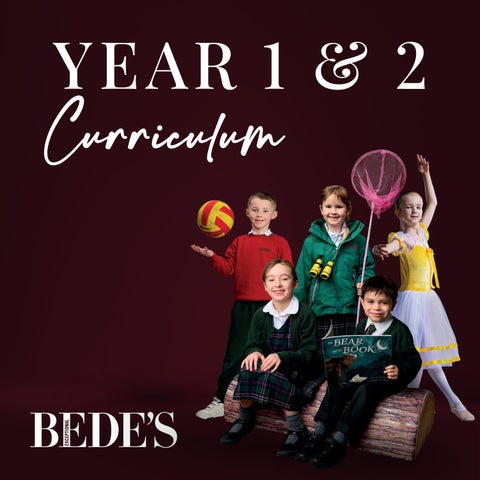
YEAR 1 & 2
Curriculum
Introduction from the Head of the Prep School Welcome to Bede’s Preparatory School ‘where every child feels a sense of belonging and finds joy in their pursuit of brilliance.’ Bede’s Prep is a vibrant, energetic and forward-thinking school, which focuses on promoting learning, personal growth and development. We provide pupils with a curriculum that is broad, stimulating and designed to facilitate the highest possible levels of attainment by those who follow it - programmes of study that imbue children with a wealth of skills, a depth of knowledge and an irrepressible curiosity. Every pupil will achieve personal excellence within a happy, safe and stimulating environment. Our core values of compassion, courage, conscientiousness and curiosity shape a pupil’s educational experience. A Bede’s education is based upon academic rigour through excellent teaching, encouraging our pupils to explore, question, take risks, and develop their creativity, communication and teamwork – all central to successful life-long learning. Our kind-hearted community is underpinned by generosity of spirit, mutual respect, warmth and compassion. By providing a festival of opportunities, we enable our pupils to discover new passions and develop new talents motivating them to be the best versions of themselves. Pupils are recognised and appreciated for who they are as individuals. They are supported and nurtured by teachers who really care. Our exceptional pastoral care is evidenced as happy pupils who are engaged in their learning and actively involved in the wider life of the school embracing every opportunity provided to them. Pupils who are kind to themselves and each other and are gracious about success and failure. Bede’s provides an all-round education where academic pursuits are supported by wonderful co-curricular opportunities and where pupils learn lessons that books cannot give; courage and joy, resilience and self belief, developing into confident globally-minded young people. I am incredibly proud to belong to such an amazing community where pupils and staff feel empowered, supported and valued. I very much hope that you will visit us and I look forward to welcoming you in person to share the exciting and vibrant experience enjoyed by our pupils.
Leigh-Anne Morris Head of Prep School
Introduction from the Assistant Head: Academic The curriculum for each year group at Bede’s Prep-Prep and Prep School focuses on promoting learning, personal growth and development. The majority of class teaching is led by the respective Year 1 or 2 teacher. However for specific subjects, for example Music, Computing and Physical Education, the pupils are taught by Prep School specialist teachers, with some lessons also taking place in facilities in other areas of the school. As the children move through the year groups, each curriculum also includes an ever-evolving and increasingly rigorous ‘hidden curriculum’ - a set of skills the children develop from the ways they are treated and the expectations set by their teachers, informed by communication between teachers, tutors and Heads of Year. This hidden curriculum is, like everything else at Bede’s, tweaked and personalised to suit the needs, talents and propensities of each individual. What is right for one child may not be for another, and as such every pupil will finish their time at Bede’s Prep with a uniquely distinguished academic record, a set of high personal ideals, and a clear set of aspirations particular to them. Bede’s is of course academically ambitious for its pupils, and our outstanding teachers work extremely hard to inspire them, drawing out passions for specific subjects and for learning in general. We aim for every pupil to achieve the very highest standards, and we can be a little bit demanding in our pursuit of excellence. To make it happen, all pupils have equal access to the curriculum regardless of gender, ethnic origin or special educational need, and all areas of the curriculum are valued equally, including academic subjects, the arts, music, practical activities and physical education. Core to the success of our school, therefore, is the peerless systems of support and communication which enable parents, pupils and teachers to all know and understand what is happening and why, what has been accomplished, and what challenges are still to be overcome. Most importantly though, everyone in the Bede’s community believes that all children have significant contributions to make to their school and the wider world, and we therefore owe each girl and boy a quiet relentlessness in the pursuit of their very best.
With this in mind, it is important to ensure that pupils do not just make the progress that might be expected. Instead, through developing talented staff, pursuing innovative teaching methodologies, and by ensuring that pupils have a full and varied experience of what school can mean, we help them to achieve at levels they never thought possible both inside and outside of the classroom. Through this, they develop a true sense of pride, ambition and accomplishment both as individuals and as a collective, and we all acquire the knowledge of what a Bede’s education really means.
Sherry Wilson
Assistant Head: Academic
Introduction from the Deputy Head At Bede’s Prep, we place children’s wellbeing at the forefront of everything we do and consistently focus on each individual child’s talents, needs, successes and emotional wellbeing, both in and outside of the classroom. We embrace our differences and together we celebrate diversity and inclusivity. Our outstanding pastoral system meets the needs of all pupils by recognising that every child is unique and by crafting an environment where children feel they belong. Academic progress and reaching target grades are important, however, for this to happen, we know that children need to feel happy, safe, challenged and supported and we encourage our pupils to explore their passions and embrace venturing outside their comfort zones, knowing we are here for them every step of the way. Within our pastoral system, each pupil has a Form Tutor, who has the responsibility of overseeing each child’s progress and development in all areas of school life, from academic to extra curricula. The tutor acts as the first point of contact for parents at Bede’s Prep, and works closely with families to monitor their child’s wellbeing – from overseeing their overall mental health and academic progress, to giving pupils practical advice in areas such as how to manage their workload. Alongside regular communication with tutors and teachers, parents are given more formal, structured updates from each of their child’s teachers at parents’ evenings and in regular reports throughout the school year. Small class sizes play a big role in ensuring that every pupil benefits from focused attention on their academic support and pastoral care, not only by their teacher but also teaching assistants and other members of the school community. From our dedicated pastoral team and Learning Enhancement department to pupil ‘buddies’(who are assigned to new pupils when they join to help with the settling in process), each child benefits from a robust support system. When your child joins Bede’s Prep, they will become part of a family unit in which everyone looks after each other. Our nurture provision is designed to offer additional support and guidance to pupils who may benefit from additional intervention to develop their social and emotional skills. These sessions aim to enhance their overall well-being and improve their academic performance by addressing specific areas of concern. Nurture sessions are delivered by our qualified nurture practitioners. This sense of community continues outside of the classroom too. Pupils across the year groups take part in a range of initiatives to promote empathy and support the local community, from charity fundraising events to beach and park litter picks in association with Plastic Free Eastbourne.
Pupils also enjoy a range of academic trips, from Beach and Forest School to residential stays further afield which brings their classroom learning to life and builds lasting friendships with their peers that will stay with them throughout Bede’s Prep and beyond. By placing the child at the forefront of everything we do, we ensure that our pupils have the tools required to reach their academic potential and have the resilience to succeed in whatever they put their minds to. Joining Bede’s Pre-Prep and Prep School can feel like a big step for both children and their parents, and therefore our Junior Years team do all we can to make this transition as seamless as possible. The smooth transition from Reception to Pre-Prep is aided by the setting in Holywell, which houses a very close-knit community and led by a team working towards the same goals and aims of the Trust by: 1. 2. 3.
Guiding and inspiring pupils to be passionate, curious, independent, happy and ambitious, both for themselves and for others, inside and outside of the classroom. Progressing and promoting each child’s unique talents through personalised, high-quality academic, creative, cocurricular and sporting programmes. Valuing the contribution of every individual in order that they are recognised and celebrated.
This supportive and nurturing environment helps children to build friendships, confidence and happiness, therefore enabling them to flourish within the learning environment. The children’s learning in the Junior Years is topic based, and they study a series of overarching themes across eachterm. Our learning makes links with different subjects across the curriculum through a huge variety of activities, and stretches beyond the classroom into outdoor environments, such as our Beach and Forest Schools, which utilise the picturesque settings right on our doorstep. As the children progress through the Junior Years, their independence and responsibilities gradually grow in preparation for moving up.
Matt Bennett-Tomlin Deputy Head
Introduction from
Assistant Head: Head of Pre-Prep & Nursery Bede’s Pre-Prep is the place where every child begins their inspiring journey of finding joy in their pursuit of brilliance, it is quite simply where the magic really happens! As Assistant Head, I have the pleasure of leading an outstanding team in Holywell, whilst following the unique journeys of our exceptional pupils. In Pre-Prep, we are proud to offer a diverse and exciting curriculum, planned and delivered with a deep understanding of what helps children to thrive academically, socially and pastorally, and designed to facilitate the highest possible levels of attainment. It is a privilege to capture children at the very beginning of their time at school, a magical time where learning can be experienced in a new and dynamic way. Additionally, our school values of Compassion, Curiosity, Courage and Conscientiousness are carefully woven into all that we do. With this in mind, it is important to ensure that pupils do not just make the progress that might be expected. Instead, through developing talented staff, pursuing innovative teaching methodologies, and by ensuring that pupils have a full and varied experience of what school can mean, we help them to achieve at levels they never thought possible. Our vision at Bede’s Pre-Prep is to provide every pupil with a realm of possibilities, whilst supporting them in navigating an ever changing world. We want them to have as many exciting, challenging and enriching experiences as possible both in and out of the classroom. In our own Holywell building, we provide a stimulating yet calming environment which includes engaging classrooms, a beautiful wildlife themed Learning Lodge, a natural outdoor area and our specially designated playground complete with its own pirate ship! We are also fortunate to have access to a range of superb facilities including a swimming pool, sports hall, theatre, computer suites and dance studio. Here in Pre-Prep, we take great pride in our curriculum and we are always committed to providing the best possible quality of education to all of our pupils. As part of the Senior Leadership Team, I play a key role in keeping a very close eye on every child’s progress to ensure nobody ever stands still! Our curriculum builds strong foundations, fosters critical thinking, and tracks progress to enable every child to achieve their full potential. Bede’s is academically ambitious for its pupils, and our outstanding teachers work tirelessly to inspire them, whilst igniting their passions for specific subjects. Most lessons are taught by form tutors whilst subject specialists teach curriculum areas such
as Modern Foreign Languages, Dance, Swimming and Sport. At Bede’s, we nurture the whole child, a commitment reflected in our robust pastoral care and comprehensive cross-curricular planning and extracurricular programs. Through this, our pupils develop a true sense of pride, ambition and accomplishment both as individuals and as a collective. We further bring learning to life through engaging trips directly linked to classroom topics, such as visits to the Lifeboat Station or Blackberry Farm. Furthermore, we are proud that our specialist teachers offer our Pre-Prep pupils individual and small group lessons such as guitar, ballet and tennis. Once the school day is complete, our daily programme of After School Clubs, includes activities which follow the children’s interests or develop the whole child. From our home here in Holywell, we never take for granted the stunning natural environment in which we are set. Nestled between the sea and the rolling hills of the South Downs, all possible outside learning opportunities are championed. Embracing our school value of curiosity, we see the outdoor environment as an extension of our classrooms with regular Forest School and Beach School lessons and trips to nearby Friston Forest - all led by our qualified Outdoor Learning lead. In Pre-Prep, we pride ourselves on fostering a culture of belonging, where every family becomes an integral part of our school community, actively seeking opportunities for close partnership.This positive ethos is also clear to see in the behaviour and attitude of our pupils, who strive to work and play together with supportive, mutual respect. Our culture is built on the belief that a successful school experience stems from hardworking children who also experience kindness, fun and laughter and you will find these in abundance around every corner! A very warm welcome to Bede’s Pre-Prep, we can’t wait for you to join us on our exciting learning adventure.
Sue Glen-Roots
Assistant Head: Head of Pre-Prep & Nursery
...create a place where every child is known One term, a Year 1 class might be sculpting clay fossils on a Tuesday, identifying rock pools on the beach on Wednesday, and performing a French play for parents on Friday. Nothing is ordinary. Everything is remembered.
There are specialist teachers in swimming, dance, and Forest School - including in our dedicated Holywell building with its famously magnificent ‘Pirate Ship’ playground. By Year 2, the senior labs and art studios beckon. The children don’t experience it as a step up. They experience it as a reward. ‘Learning is always more powerful when it feels like an adventure.’
English
Our beautiful environment of sea and countryside is both motivating and exciting for our young Bedians to start their academic journey. It inspires topics – such as nature, the sea and exploration – which are investigated through all aspects of English. At Bede’s Prep, our aim is to develop a lifelong love and enthusiasm for language and literature in all forms, and to enable our pupils to become confident and creative communicators. This philosophy is embedded as soon as children join our Bede’s community. Playing with language, revelling in reading, and learning the foundation tools to expression are core to our English lessons. Furthermore, the nurturing environment of Holywell guides our children to be active learners, encouraging each individual to find their own voice and communicate their opinions with confidence. At these early and rapid stages of development, we develop the habit of reading widely and often, for both pleasure and information. All children follow a staged reading scheme, read with their teacher daily and use the well-stocked Holywell Library. Reading at home is encouraged through a school-home liaison programme, where parents and teachers are in regular communication on specific aspects of their child’s reading progress. Celebrating our writing and communication is crucial to the development of each individual and the growth of technology has opened exciting possibilities to realise the full potential of our pupils. In Holywell, we take opportunities to develop and publish children’s response to reading and writing using both traditional writing methods and the latest digital technology. But the basics remain integral to learning with focus put on the structured building blocks of spelling, grammar and sentence structure which are central to the development of effective and expressive communicators.
What skills will my child develop? • • • • •
A life-long love and enthusiasm for language and literature in all forms. Confident and creative communicaton skills. Creativity and a love of reading at an early age. Active learning skills. Confidence to express opinions.
Hints & Tips for Home • • • •
https://www.oxfordowl.co.uk https://www.bbc.co.uk/bitesize https://www.booktrust.org.uk/ https://www.bbc.co.uk/cbeebies/stories
Year 1 marks the first year of the National Curriculum, where phonics plays a crucial role. Through a multisensory and engaging approach, children will learn to apply their phonic knowledge and skills to decode words and blend sounds in unfamiliar texts. We aim to inspire creativity and a love of reading at an early age. The start of the Autumn Term brings Book Week – a festival of literary fun, featuring visiting authors, exciting competitions and costumes – all designed to rejoice in reading for pleasure. Reading lies at the heart of our curriculum. We carefully select rich, classic and diverse texts to enrich each term’s topics, allowing for an in-depth exploration of context, vocabulary development, understanding of structural features, and fostering imagination and creativity. These key stories also inspire creative writing each term, as children innovate and use textual features to craft short narratives and retellings of events. Opportunities for non-fiction writing abound, including diaries, instructional texts, compiling a class reference book on a chosen animal and writing a series of sentences to explain a simple process. Seeing their work in published form is an empowering moment and at Bede’s, we take every opportunity to enjoy sharing and celebrating our work in a supportive and stimulating classroom environment. Likewise, poetry is celebrated throughout the year through reading and performance and children collaborate on a shared poem as well as writing poetry using pattern and rhyme. In Year 2, children embark on an exciting journey through the world of literature, guided by exciting topics studied throughout the year. They develop independence and confidence in their communication skills as well as a love of language through engaging and interactive learning. Children explore a diverse range of books, encompassing a range of genres and writing styles; for example, in the Autumn term, children delve into traditional tales and fables, using drama to role-play characters and crafting narratives from different viewpoints. Later, they transform into reporters, writing compelling news reports on the Great Fire of London. Classic poetry is also a highlight, shared and performed as a class. As the year progresses into the Spring and Summer Terms, children continue to put their learning into practice, encapsulating ideas and developing new vocabulary through multi-sensory and interactive teaching. They write their own narratives inspired by carefully selected literature chosen for both enrichment and enjoyment. During the year, children also learn about other essential writing types, including contemporary poetry that celebrates belonging, inclusion and diversity. They explore instructional writing, recounts and travel writing, linking these to topics studied across the curriculum. A strong emphasis is placed on developing children’s grammatical
and technical skills in English, learning how words and sentence structures work and how to form clear sentences and use punctuation effectively. At Bede’s, English is all about providing opportunities for rich reading and creative expression. Above all, we encourage children to have fun with words, experimenting with structure and language, crafting compositions, whilst fostering a lifelong love of reading.
Sarah Jones
Head of English
Maths
At Bede’s Prep, we are committed to fostering a deep understanding of mathematics in our young learners by making it a tangible and exciting part of their everyday lives. We believe that by actively engaging in their learning, pupils can develop essential problem-solving and reasoning skills, which are vital for understanding the world around them.
and enthusiasm for mathematics. We place a strong emphasis on developing pupils’ fluency with whole numbers, counting, and place value, as these are crucial building blocks for more advanced mathematical thinking. Our lessons are designed to be engaging, inclusive, and challenging, ensuring that every child is supported in their learning journey.
Our teaching approach is rooted in the principles of the Early Years Foundation Stage (EYFS) and the National Curriculum, ensuring that our pupils build a strong foundation in mathematics through practical, hands-on experiences. We encourage our pupils to explore mathematical concepts through a range of sensory activities that allow them to experiment, investigate, and ultimately, gain confidence in their mathematical abilities.
We aim to cultivate resilient learners who are not afraid to make mistakes and learn from them. By encouraging collaboration and communication, we help our pupils develop the confidence to articulate their ideas clearly and logically, both in written form and verbally. We also ensure that our pupils are equipped with the adaptability to apply their mathematical knowledge to a wide range of problems and contexts.
In Years 1 and 2, our primary goal is to nurture a sense of curiosity
What skills will my child develop? •
•
Fluency in Basic Mathematics: Pupils will build a strong understanding of numbers, counting, addition, and subtraction, which are the foundational skills necessary for more complex mathematical concepts. Problem-Solving and Reasoning: Through carefully structured activities, pupils will learn to solve problems, reason logically, and think critically about mathematical concepts.
•
Engagement and Curiosity: We create a learning environment that encourages exploration, questioning, and a genuine interest in mathematics.
•
Resilience and Reflection: Pupils are guided to reflect on their work, embrace challenges, and understand that perseverance is key to success in mathematics.
•
Adaptability and Application: Children will learn to apply their mathematical knowledge to new situations, helping them become flexible and independent thinkers.
Hints & Tips for Home •
Educational Apps: Use apps like DoodleMaths and Times Table Rock Stars, which provide interactive and engaging ways for your child to practise their maths skills and timetables at home.
•
Counting Games: Encourage your child to count objects around the house, such as toys, steps, or pieces of fruit. This helps reinforce their understanding of numbers and counting.
•
Maths in Everyday Life: Involve your child in activities that require basic maths, such as cooking (measuring ingredients), shopping (adding up prices), or telling the time. This helps them see the practical application of maths in daily life.
•
Educational Apps: Use apps like DoodleMaths, which provide interactive and engaging ways for your child to practise their maths skills at home. These apps adapt to your child’s level, offering challenges that are just right for their stage of development.
•
Reading Books with Maths Themes: Choose storybooks that incorporate counting, patterns, or shapes. Books like “The Very Hungry Caterpillar” or “One Is a Snail, Ten Is a Crab” make maths fun and relatable.
•
Board Games and Puzzles: Games like Snakes and Ladders, Dominoes, or simple jigsaw puzzles are excellent for developing number recognition, counting, and problemsolving skills.
•
At Bede’s Prep, we are passionate about helping every child discover the joy of mathematics. We are confident that with our supportive and dynamic approach, your child will develop the skills and confidence needed to excel in this subject, both now and in the future.
At Bede’s Prep, our Year 1 and Year 2 Mathematics curriculum is designed to build a strong foundation in key mathematical concepts, ensuring that pupils develop the confidence and skills necessary for their future learning. The White Rose maths curriculum is used with a strong focus on conceptual understanding, problem-solving, and logical reasoning. In Year 1, the primary aim is to establish a secure understanding of basic mathematical principles. Pupils develop fluency in number recognition and place value, learning to count forwards and backwards up to 100. They are introduced to simple addition and subtraction, using practical resources and mental strategies to solve problems. A key focus is understanding the place value of digits in two-digit numbers, providing a foundation for more complex arithmetic. Pupils also begin to explore multiplication and division, understanding these as repeated addition and sharing. They are introduced to fractions by recognising and finding halves and quarters of objects and quantities. Measurement is another important area in Year 1, where pupils learn to compare lengths, heights, weights, and volumes using appropriate vocabulary. They begin telling the time to the hour and half hour and develop an understanding of days, months, and seasons. In geometry, pupils identify and name common 2D shapes (such as squares and circles) and 3D shapes (such as cubes and spheres). They also describe position, direction, and movement, including whole and half turns. In Year 2, pupils build on these foundations, deepening their understanding and applying their skills with increasing independence. They continue to develop their knowledge of number and place value, counting in steps of 2, 3, 5, and 10 from any number, and comparing and ordering numbers up to 100 using symbols such as >, <, and =. Addition and subtraction become more complex, with pupils learning to add and subtract two-digit numbers using a range of strategies, including number bonds and place value. They also solve a variety of word problems. In fractions, pupils recognise and write simple fractions such as 1/2, 1/3, and 1/4, and begin to understand equivalence, for example that 2/4 is equal to 1/2. Measurement includes using standard units to measure length, height, weight, temperature, and capacity. Pupils also learn to use money and tell the time to the nearest five minutes. Geometry continues with identifying the properties of 2D and 3D shapes and describing position and movement. Pupils are also introduced to simple statistics, including pictograms, tally charts, and block diagrams.
A strong emphasis is placed on developing rapid and accurate recall of key number facts, particularly times tables, as these underpin success across all areas of mathematics.
Shamara Brown
Head of Maths
In Year 1, pupils begin to build the foundations for multiplication by counting in multiples of 2, 5 and 10. They also develop fluency through recalling doubles up to 10 and the corresponding halves, strengthening their understanding of number relationships. In Year 2, pupils work towards recalling and using multiplication and division facts for the 2, 5 and 10 times tables with increasing speed and confidence. Some pupils are also introduced to the 3 times table. Regular, structured practice is embedded into daily lessons to support fluency and retention. Also, pupils learn to represent and solve problems using arrays, repeated addition, and mental strategies, building a secure conceptual understanding alongside fluency. To support this further, all pupils have access to Times Tables Rock Stars, an engaging online platform that allows children to practise their times tables both in school and at home. Daily practice sessions help to build confidence, accuracy, and recall speed in a fun and motivating way. We encourage parents to support this learning at home, as secure knowledge of times tables is essential for future mathematical understanding, including written methods, fractions, and problem-solving. The Year 1 and Year 2 mathematics curriculum is carefully structured to provide a balanced and thorough grounding in essential mathematical skills. Through hands-on learning, problem-solving activities, and practical application, pupils at Bede’s Prep are encouraged to explore and enjoy mathematics, building a strong foundation for future success.
Science
At Bede’s Pre-Prep, we are committed to providing a rich and engaging educational experience for your child. As part of our enquirybased curriculum, we have integrated the Switched on Science scheme by Rising Stars, which beautifully complements our approach to learning in the foundation subjects. The scheme aligns perfectly with our enquiry-based curriculum, encouraging students to ask questions, explore ideas, and discover the wonders of the natural world.
What skills will my child develop? •
Scientific Enquiry: Encouraging curiosity by asking questions, making predictions, and investigating answers.
•
Practical Skills: Handling and using simple scientific equipment, observing and recording results.
•
Critical Thinking: Analysing findings and drawing conclusions based on evidence.
•
Collaborative Learning: Working with peers to share ideas, conduct experiments, and solve problems together.
•
Communication: Expressing ideas and findings clearly, both orally and in writing.
Hints & Tips for Home Supporting your child’s scientific learning at home can be both fun and rewarding. Here are a few ideas to help foster their curiosity and love for science: •
Explore Nature Together: Take walks in local parks or visit nature reserves. Encourage your child to observe plants, animals, and seasonal changes, and discuss what they notice.
•
Kitchen Experiments: Involve your child in simple, safe experiments at home, such as mixing baking soda and vinegar to see the reaction or exploring how different materials dissolve in water.
Websites: www.bbcbitesize.co.uk
The Switched on Science scheme for Year 1 and 2 is filled with exciting topics that captivate young minds and lay the foundation for a lifelong interest in science. Below are some of the key themes your child will explore: Year 1: • Everyday Materials: Discovering different materials and their properties, understanding why certain materials are used for specific purposes. •
Seasonal Changes: Observing the changes across the four seasons, including weather patterns and how they affect the environment.
•
Plants and Animals: Learning about different types of plants and animals, their habitats, and how they grow and change.
Year 2: • Uses of Everyday Materials: Expanding on the knowledge from Year 1, investigating how materials can be changed and used in various ways. •
Living Things and Their Habitats: Exploring how animals and plants are suited to their habitats and the importance of caring for the environment.
•
Forces and Movement: Understanding how forces like push and pull affect the movement of objects, through fun and interactive activities.
Our curriculum at Bede’s Pre-Prep ensures that learning is a journey of exploration and discovery. The Switched on Science scheme supports this by providing a structured yet flexible framework, allowing children to engage with science in a meaningful and enjoyable way.
George Filsell
Head of Science
Modern Foreign Languages At Bede’s Prep, pupils embark on an exciting linguistic journey, discovering French as they would a new world. Our French curriculum commences in Reception, a stage where young learners possess a natural aptitude for phonetic acquisition, readily absorbing accurate French pronunciation.
Alexandra Cazorla Head of MFL
As pupils progress into Years 1 and 2, their language skills flourish through a carefully designed and engaging range of activities. These include interactive games, songs, and role-playing scenarios, both within the classroom and occasionally extending to the outdoors, for example, exploring vocabulary related to “la plage” (the beach). To enrich their learning experience, we incorporate authentic French media such as books and video clips, presenting language within meaningful contexts. Recognising the importance of reinforcement in early language learning, our curriculum strategically integrates repeated exposure to familiar songs and rhymes. This consistent revisiting of material aids in the consolidation of vocabulary and grammatical structures, thereby fostering enhanced fluency in the target language. In years 1 and 2, pupils revisit and expand upon the basic vocabulary introduced in Reception. This progressive approach enables them to construct complete French sentences and develop the confidence to engage in simple spoken interactions. Learning is facilitated through various interactive methods, including games, songs, and video resources. Simultaneously, pupils commence the development of essential literacy skills by learning to read and write single words and simple sentences in French. Specifically, pupils learn to state their names, inquire about the names of others, express their age, and ask about the age of their peers. Furthermore, they develop a functional understanding of French numerals and learn to identify different parts of the body. Our curriculum also encompasses fundamental vocabulary related to the days of the week, months, and colours, alongside thematic units exploring clothing, the home environment, weather, family, and food. This comprehensive and engaging approach provides pupils with a strong foundation in French and cultivates an early appreciation for linguistic and cultural diversity.
What skills will my child develop?
Pupils start building sentences and linking sentences together, and are taught to: •
Listen attentively to spoken language and show understanding by joining in and responding
•
Explore the patterns and sounds of language through songs and rhymes, and link the spelling, sound and meaning of words
•
Engage in conversations; ask and answer questions
•
Appreciate stories, songs, poems and rhymes in the language
Hints & Tips for Home •
www.bbc.co.uk/bitesize
•
www.youtube.com/@BookboxFrench
Drama At Bede’s, we want to encourage meaningful participation and enjoyment of drama and theatre, inside and outside of school. We believe in ‘Drama for All’, and offer opportunities to engage on a range of different levels. Pupils are taught drama skills and techniques during lessons and pupils are encouraged to seize the many opportunities available to perform. In the Drama department, we are committed to excellence. We share a love of performance and collaboration and a desire to inspire pupils to share this. We are fortunate to have drama specialists, who teach the curriculum, activities and as the children grow up, we gradually scale up the ambition and complexity of the skills taught, productions staged and the scripts we study. Drama is an art form that is a practical activity, an emotional process and an intellectual discipline. At its core are the concepts of communication, shared experience, understanding and empathy. Drama involves the creation of imagined characters and situations which are enacted within a safe environment and a designated space. Like all arts subjects, drama helps children to make sense of their world and their place within it. Drama enables children to express themselves creatively, imaginatively, and to communicate with others effectively. It is a vital way of communicating in school and in public life. It builds confidence, teaches respect for others, and aids understanding of different needs, cultures, and lives. Drama is an effective teaching tool, as practical learning is crucial to understanding and becomes a valuable learning method when employed to illuminate other areas of the curriculum. In Year 1 and 2, the children experience drama through the wider curriculum, taking part in activities linked to a variety of topics. In English, they have the opportunity to act out specific scenes from a range of texts, as well as hot seating the characters. They also have opportunities to take part in termly workshops, in the Prep School Theatre, run by a drama specialist. The Year 1 and 2 children perform a play at the end of the Autumn Term. They very much enjoy preparing for the Christmas Nativity. The children learn their lines and rehearse songs in order to perform to an audience of family and friends. In Drama, the overall focus is to promote self-confidence, the ability to work with others, communication skills, selfdiscipline, creativity, empathy and understanding – all of which are valuable life skills.
Dan Garnham
Head of Drama
What skills will my child develop? •
Developing confidence
•
Team building and collaboration
•
Development of empathy and an awareness of others
•
Presentation skills and transferable ‘life’ skills
•
Development and improvement of creativity
Hints & Tips for Home •
For LAMDA information: https://www.lamda.ac.uk/lamdaexams/our-exams
Art Art and Design plays a large role in all aspects of learning throughout the Pre-Prep years. The children’s learning is made as hands-on as possible throughout all subjects, and practicing the creative arts is the perfect way for children to spark conversations, make connections in their learning and to experiment with different media types. Children in the Junior years learn Art and Design in a stimulating and inspiring environment in which pupils’ confidence and creativity are promoted. In these year groups, pupils are introduced to different materials and encouraged to experiment and take risks. Our specialist teachers ensure that pupils are engaged with their own learning and that their ideas are facilitated, encouraging them to make informed opinions and confidently communicate their ideas. Alongside developing an aesthetic sense by describing artifacts and images, children are encouraged to evaluate their own and others’ work. Throughout Years 1 and 2, pupils become visually literate and able to understand art as a form of visual and tactile communication. Pupils’ aesthetic sensibilities are developed, as is their ability to make informed judgements about art and design. Art is an important field that encourages pupils to enjoy and value the visual, tactile, and other sensory dimensions of the natural and made environment. Through the study of the subject, pupils gain the ability to articulate and communicate ideas, opinions and feelings about their own work and the work of others, as well as to respond thoughtfully and critically to ideas, images and varied objects from a range of cultures.
What skills will my child develop? •
Experimenting with different mixed media
•
Communication skills using the appropriate vocabulary
•
Identifying the 2D and 3D shapes
•
Learning about primary and secondary colours and mixing paint
•
Variations of mark making
•
Space awareness
•
Confidence to express personal artistic styles
•
Development of fine moto skills. (small paint brushes, detailed drawings, observational drawing)
•
Knowledge of influential artists
Hints & Tips for Home •
Towner Art Gallery
www.townereastbourne.org.uk
•
National Gallery
www.nationalgallery.org.uk
•
Peggy Guggenheim Collection www.guggenheim-venice.it/ inglese/default.html
•
Washington D.C National Gallery www.nga.gov/content/ngaweb/ education/kids.htm
•
The National Portrait Gallery NationalPortraitGallery
www.About.com/
•
The Tate Online
www.tate.org.uk
•
Young at Art
www.youngatart.co.uk
Throughout Years 1 and 2, children enjoy termly workshops engaged with cross-curricular development. Pupils have the opportunity to work with a range of different mediums, including clay, and to enter their artwork into local art and design competitions. In recent years, pupils have submitted pieces to the ‘Festival of Flowers’ art exhibition at Chichester Cathedral, the ‘Eastbourne Sunshine Carnival’ poster design competition and the ‘Explorer in Bloom’ competition. In Year 1, we often use a wide range of mixed media to explore 2D and 3D shapes, looking at their properties and how they can lend themselves to art projects -culminating in the creation of three-dimensional story characters. We also explore a range of different textures and consider different creations in which they can be used. Projects could include bear puppets created from felt, cotton and buttons (inspired by ‘Goldilocks and the Three Bears’); rocket ships made out of recycled washing up liquid bottles; and dolls houses created from upcycled shoe boxes. All of these projects are carefully designed and planned before making, and the children evaluate their finished products. We also talk about the colour wheel and explore primary and secondary colours. The children always enjoy mixing the paints and discovering what colours can be made. We explore the properties of warm and cold colours, and how and when these can be used. We take full advantage of the beach and South Downs being right on our doorstep by enjoying regular seasonal walks, where the children gain inspiration for their pictures and learn how to identify the colours required to suit. On these seasonal walks, the children are also given the opportunity to sit and sketch the landscapes around them. In Year 2, pupils begin their introduction to the main art rooms with a range of workshops. Through a variety of topic-based learning, Year 2 learn: • • • •
to use a range of materials creatively to design and make products, including clay pieces such as fossil imprints and Christmas decorations. to use drawing, painting and sculpture to develop and share their ideas, experiences and imagination. to develop a wide range of art and design techniques in using colour, pattern, texture, line, shape, form and space. about the work of a range of artists, craft makers and designers, describing the differences and similarities between different practices and disciplines and making links to their own work.
We have explored a range of artists in recent years, including Paul Klee, Claude Monet, Andy Goldsworthy, L. S. Lowry and Edward Hopper.
Will Atkinson
Head of Art & Design
Computing
At Bedes our innovative Computing and Robotics curriculum provides pupils from Reception through Year 2 with a dynamic and comprehensive introduction to the foundational principles of technology, computational thinking, and engineering. Designed to cultivate problem-solving skills, creativity, and logical reasoning from an early age, this curriculum offers a structured yet flexible pathway into the digital world. Learning begins in Reception and Year 1 with engaging unplugged activities, allowing children to grasp core algorithmic concepts such as sequencing, patterns, and logical steps through hands-on, interactive games and challenges, fostering an intuitive understanding before ever touching a computer. As they progress, pupils transition to visual programming environments, where they learn to construct and manipulate code using intuitive block-based interfaces. Here, they will explore fundamental programming constructs including sequences, loops, conditional logic, and events, applying these concepts to create simple programs, interactive stories, and basic games.
What skills will my child develop? •
Fluency with using the mouse and keyboard.
•
A knowledge of the types of personal information that should not be shared online, and an understanding of who to talk to should something worry or upset us.
•
Knowledge of how an ‘algorithm’ formed, and how this relates to instructions for machines.
•
An appreciation of how to control electronic devices, leading to a basic understanding of how to construct computer code.
•
An ability to use word processing, graphic design and multimedia presentation tools to produce digital content.
Hints & Tips for Home •
Play Unplugged Coding Games: Engage in activities that teach sequencing, patterns, and logical steps without screens, like following instructions to build with Lego or treasure hunts.
•
Explore Block-Based Coding: Introduce them to friendly visual programming apps where they can drag and drop blocks to make characters move or simple stories unfold.
•
Interact with Simple Robots: If accessible, let them play with programmable toy robots, observing how simple commands make the robot move and react.
•
Discuss Digital Safety Basics: Talk about what to do if they see something upsetting online and the importance of asking a trusted adult for help.
•
Create Digital Art Together: Use child-friendly drawing or animation apps on a tablet to foster creativity and explore digital content creation.
It is important to build the future so it is inspiring, engaging and creative. A central pillar of this curriculum is the integrated introduction to robotics. Bede’s Prep pupils will actively engage with programmable robots, moving beyond mere control to understanding how these machines receive and execute instructions. They will program robots to navigate paths, perform specific tasks, and respond to various inputs, thereby forging a tangible link between abstract code and physical outcomes. This direct interaction not only reinforces algorithmic thinking but also introduces basic robotic components and principles. Alongside these practical skills, the curriculum places significant emphasis on developing robust computational thinking abilities, explicitly fostering decomposition (breaking down complex problems), pattern recognition, abstraction (focusing on essential details), and algorithm design. An important part of the process is to let the children engage with physical coding and to experience machines relying on what they are told through their coding. Sometimes they will not do what is expected and so children must debug their code in order to move forward with the solution. These critical thinking skills are woven into every learning activity, ensuring that pupils develop a versatile toolkit for approaching challenges in any domain. Furthermore, digital literacy and responsible digital citizenship are intrinsically woven throughout the curriculum. Pupils will gain a holistic understanding of information technology’s purpose and its pervasive impact on daily life, learn to identify the various components of computing devices, and continuously reinforce e-safety practices, understanding the importance of safeguarding personal information and knowing whom to approach for support. Creative expression is also encouraged through digital content creation, where pupils utilise various tools for graphic design, multimedia presentations, and animation, often integrating these with their programming projects to produce rich, interactive digital media. This holistic approach ensures Bede’s Prep pupils develop not only technical proficiency but also the confidence, curiosity, and critical mindset necessary to thrive and innovate as responsible citizens in an increasingly technology-driven world.
Neville Sheridan
Head of Computing
Geography
Geography teaches children an understanding of places and environments. It motivates children to find out about the physical world and it should enable them to recognise the importance of sustainable development to the future of mankind. Our aim at Bede’s is to encourage pupils to value the rich and diverse school environment and to celebrate its wide catchment area both locally and globally. Pupils should be encouraged to use these resources with sensitivity, responsibility and imagination. Geography plays a vital role in developing pupils’ understanding of different attitudes, values and beliefs throughout the world. Linked to this spiritual, moral, social, environmental and cultural education. At Bede’s staff aim to develop children’s knowledge and understanding of geography by teaching about physical and human environments and their interrelation in such a way as to assist pupils make sense of the world around them.
Phil Betts
Head of Geography
Given the wonderful surroundings of the Prep School, pupils attend a fortnightly Beach School, where they can study physical geography, alongside learning about the geography and history of our local area, the environment and natural sciences. During Years 1 and 2 we will study geographical features such as the beach, cliffs, coast and forest and as well as aspects of human geography, including cities, towns and villages. By comparing a small area of the UK pupils begin to understand the similarities and differences between human and physical geography. Pupils will also become familiar with the four countries and capital cities within the United Kingdom. We also consider the seasons and daily weather patterns in the UK, as well as the location of hot and cold areas of the world. Pupils learn to use maps, globes and atlases, as well as photographs to recognise landmarks and basic features. We also introduce pupils to compass directions and locational and directional language. Throughout these years we undertake regular fieldwork sessions in order to understand our local environment.
What skills will my child develop? •
To ask geographical questions in order to find out aspects of living in a given location.
•
To observe and to record findings
•
To use and make plans, maps and globes in a range of scales.
•
To use secondary sources, for example the internet, atlases and encloypedias to enhance learning.
Hints & Tips for Home •
Get out and about to explore the local area on walks, using a map to plan journeys and follow a route.
•
Many animated films for children feature a surprising amount of geographical information including Moana, the Ice Age series and Frozen. If you watch these films together with your child, try discussing the geographical aspects with them.
•
Write letters and exchange postcards with family members and friends in different countries to help children learn more about them.
History The overall aim is that History should be verbally, visually and experientially varied, interesting and enjoyable and, above all, a skillsbased form of learning. All are supported by giving hands-on, physical and enjoyable experiences, which includes a great deal of team-teaching and cross-curricular elements. The curriculum uses enquiry-based learning, which revolves around fostering curiosity and critical thinking skills in pupils. It involves posing questions or problems to pupils and guiding them to explore and discover answers through investigation, research, and hands-on experiences. This approach encourages active engagement, collaboration, and independent thinking, as pupils take ownership of their learning process In Year 1 and 2, pupils will explore the following events: • Changes within living memory, where Year 1 study Transport and Year 2 study Toys • Events beyond living memory that are significant nationally or globally, where Year 1 study the first aeroplanes and Year 2 study The Great Fire of London • The lives of significant individuals in the past who have contributed to national and international achievements • Significant historical events, people and places in our own locality
What skills will my child develop? • Explore and discover through investigation • Use dates related to the passing of time • Able to identify different ways to represent the past • To ask and answer questions related to different sources and objects • Develop empathy and understanding as to why people did things in the past
Hints & Tips for Home •
www.bbc.co.uk/schools/primaryhistory
•
www.britishmuseum.org
•
Enjoy reading fun factual history books at home
Phil Betts
Head of History
Dance
The aim of the Dance Department is the provision of high quality dance tuition that develops pupils’ physical and creative skills. Bede’s Prep Dance offers a wide range of styles available from Nursery through to Year 8, either via curriculum dance, specialised dance classes during the school day within the Dance Programme or through our clubs and activities. Pupils can take Ballet, Contemporary, Modern/Jazz, Tap, Street, Musical Theatre and Choreography. Whether students want to learn purely for fun or if they are looking to train for a career in the Performing Arts then Bede’s Prep Dance offers them everything they need to fulfil their ambition. There are two elements to the Dance Programme at Bede’s Prep – Curriculum based classes and Co-Curricular dance activities. Curriculum dance is taken by all pupils up to and including Year 4. The delivery of these sessions is practically focussed to ensure that students are engaged at a level most suited to the stage of development of their bodies. All classes are taught by professional dance subject specialists and all classes are delivered at the highest possible standard. Pupils in Years 1 and 2 also have access to specialist dance classes in ballet, tap and modern via the Co-Curricular Programme.
What skills will my child develop? •
Strong dance technique
•
Self discipline and strong work ethic
•
Creativity
•
Confidence and self belief
•
Independence and teamwork
Hints & Tips for Home •
Go to watch theatre performances. Watch out for live streams of dance performances in the cinemas.
•
www.istd.org
•
www.royalacademyofdance.org
Curriculum dance The main aim of curriculum dance is to offer dance opportunities to all, which enhance confidence, develop the pupils’ physical skills, stamina, creativity, expression, and musicality using a range of sounds and musical styles. This strong foundation in curriculum dance prepares pupils for a successful transition to other dance genres at higher levels. Creativity and imaginative choreography by the pupils leads to a greater depth of expression through movement improving confidence and recall skills. Pupils have the opportunity to hone the key skills of dancing in duets and groups, encouraging team work and working with partners. Furthermore, dance has a very special place in the school and during their time here children are encouraged to participate in numerous live performances in cooperation with other departments such as drama and music. In Years 1 and 2 pupils get the chance to show off their dance skills in a yearly nativity production, which includes dancing, singing and acting! Dance Programme The introductory Bede’s Prep Dance Programme is aimed at dancers who have a particular talent or interest in the subject. The full programme starts in year 5, but pupils in year 3 also get the chance to access the Dance Programme classes too and years 1 and 2 can also take specialist classes via dance clubs. The programme consists of weekly classes in three core disciplines- Ballet, Modern and Tap. From Year 2, examinations can be taken in the Royal Academy of Dance (RAD) for Ballet and the Imperial Society of Teachers of Dance (ISTD) for Modern and Tap. Each of these three core disciplines trains the dancers in a different way. Ballet is the foundation of all dance and teaches pupils a good strong classical technique, which assists them not only in all other dance styles, but in a general healthy lifestyle too. The RAD syllabus aims to promote dancers who make innovative, artistic and lasting contributions to dance. With the thoughtfully planned and well-tried ISTD Modern examination syllabus, which combines modern dance, jazz and other dance styles, pupils are trained to become disciplined and versatile dancers who have a professional attitude towards dance. The ISTD Tap exams and Medal Tests are recognised internationally for their quality and excellence and teach the pupils all about rhythm, timing, dynamic and percussive dancing. All pupils from Year 2 involved in the Dance Programme, specialist classes and/or clubs and activities will be involved in the yearly Dance Showcase as part of the Bede’s Prep training. The Dance Showcase is a big event in the Bede’s calendar. All dancers taking part get the opportunity to work on specially choreographed dances in all disciplines they study, to perform in front of their friends and family. The show is run as professionally as possible giving the pupils a real insight into the dance world
Nicci Ullah
Head of Dance and what it truly takes to put on a show! The pupils gain so much confidence from these performances as well as learning many additional skills like performance quality, performing under pressure and teamwork, to name a few. Pupils from year 2 can have the opportunity to join the Legat PreAssociates which runs on a Saturday at Legat at Bede’s Senior School. Pupils will get to do classes in Ballet, Tap, Modern and Contemporary each week and get to work in the beautiful Legat dance studios. Each Pre-Associate pupil will also get the chance to perform in the annual Legat show and perform alongside the Associates as well as the Legat company. This is a fantastic opportunity for our young dancers and an incredible experience for them.
Music
Music is a part of life, as intrinsic as reading and writing. It exists all around us from telephone ringtones to scores to accompany films and ‘lift music’ and in the junior years we try to raise the awareness and appreciation of music in all its forms. Music lessons change significantly throughout these Pre-Prep years. Year 1 starts in a very similar way musically to how classes in Reception ended, with pupils singing songs linked to the topic being studied in class. Music and movement are very intertwined at this stage and many songs have actions that enable pupils to participate physically. As pupils move into Year 2 the increasing sophistication of the repertoire studied, still largely linked to the topic work in class, means pupils perform in more complex ways e.g.by singing in parts and rounds or adding instrumental accompaniment. Pupils will also undertake instrumental work, using both classroom percussion and recorders. Musical performance is a cornerstone of the work undertaken in these early years. Pupils often perform together, for example in the nativity or Pre-Prep concerts. In addition there are opportunities for solo performances in class lessons and in concerts. By the end of Year 2 many pupils are participating in optional individual or paired music lessons, and these pupils have even more performance opportunities as pupils right across the school come together to perform in a series of instrumental family specific concerts.
What skills will my child develop? •
Pupils move from recognising music which is fast, slow, loud and quiet to identifying and being able to play music which gets louder, quieter, faster and slower.
•
Pupils develop a greater understanding of the different ways in which music tells stories.
•
Pupils learn to explore, create and notate their own ‘sound pictures’.
•
Pupils progress from singing and simple classroom percussion to instruments, (especially the recorder in Year 2.)
•
Pupils learn to practise and perfect music for a performance and play together harmoniously with attention to others.
Hints & Tips for Home • • • • •
Listen to music together and discuss how it makes you feel, the instruments used and what the composer is trying to convey. Chrome music lab (https://musiclab.chromeexperiments.com/) is a fantastic resource to support experimentation / collaboration and early composition skills. House of sound (https://www.bbc.co.uk/teach/class-clips-video/music--science-ks2house-of-sound/zncr7nb) helps pupils understand how instruments in different musical families make the sounds they do. Any experience of live and recorded musical performance, in any form and location, is of great benefit to their musical experience and education. Take your child to live music: e.g. musicals, recitals or concerts.
In Year 1, music lessons are frequent, and mostly linked to the topic being studied by the class. While there are some lessons in which the skills of listening and appraising, composing and performing are developed, most lessons are a study of songs, often action songs, that tie to the classwork linked to the current topic being undertaken in other subjects. The variety comes from the ever changing repertoire as the class progresses to different topics over the year. There are opportunities for solo singing as well as group singing. In Year 2, music lessons are still primarily linked to the topic being studied in class, but the musical complexity of the material steadily increases. Songs are more likely to be sung in parts, or to have instrumental accompaniment, provided by the pupils themselves. Pupils begin to learn instruments together focussing at first on classroom percussion, and also the recorder. They begin to learn how to change volume and tempo in response to a conductor. Many pupils choose to begin individual or paired instrumental lessons. The Pre-Prep music ‘carousel’ is an opportunity for pupils from Reception to Year 2 to play together and share their music making. This is a vehicle for teaching increasingly sophisticated songs, in which several different groups of children perform in different ways at the same time. There are multiple concerts throughout the year for parents to hear what has been happening. Pupils from Reception to Year 2 also come together in the second half of the Autumn Term to work on the nativity. While Year 2 pupils tend to have the more complex roles, with solo singing and individual lines, all pupils are involved, and learn to sing, dance and act together. There is a whole series of instrumental, or instrumental family, concerts throughout the year. All pupils having individual or paired instrumental or vocal lessons, in or out of school, are asked to perform at the relevant concerts.
Alex Farley
Head of Music
Physical Education PE in Years 1 and 2, introduces a curriculum based in play. The pupils experience a variety of activities to contrast with and complement their games sessions. The programme leads through modules in fitness, Team Games, Basketball; Gymnastics; Racquet Sports and Athletics. This enables them success as individuals and the opportunity to take ownership of their own health and fitness. Within the department, for Early Years PE, we introduce the understanding of body systems, and wellbeing. This feeds into the ethos which promotes the holistic care of body and mind. At Bede’s we do not just want our pupils to be fit for school, we want to promote and encourage fitness for life by giving our pupils the tools to work with from an early age, whatever their level, body type or personal preferences within sport and exercise. We aim to promote and encourage healthy and positive attitudes towards both.
What skills will my child develop? •
Pupils begin to explore the basic functions of the body systems in relation to ‘fun running’ and training.
•
Pupils are introduced to the concept of hand/eye coordination through the basic skill acquisition required to play basketball.
•
Pupils are introduced to the concepts of core strength, agility and flexibility whilst practising and performing gymnastic routines, basic vaults and on the trampoline.
•
Racquet sports, experimenting and exploring different types of racquets and balls to enhance skills such as agility, speed, coordination and balance.
•
Athletics introduces and explores the acquisition and maintenance of fitness levels as well as the key focus on locomotor skills for running, jumping and throwing.
Our Year 1 & 2 pupils have access to exactly the same framework as older pupils but through a play based curriculum. With ever growing connections between the healthy body and healthy mind, our curriculum works to enable our younger pupils to take ownership of their physical and mental health by encouraging them to understand that there are many ways to exercise and how best to link the process to the desired outcome and enjoy themselves on the way. At Bede’s Prep we are fortunate in the geography of our site; the shingle beaches and hill runs of the South Downs provide not just a stunning setting but the very practical terrain to enhance the first Fitness Module. We open our eyes as often as our lungs to breathe in the surroundings and revel in the outdoors whilst introducing running for fun. Pupils become familiar with finding their pulse before and after exercise compare and contrast the effect. Every level is catered for with added emphasis on running as a ‘squad’ within the lessons and supporting the achievements of all. Basketball is a great team game to introduce hand eye coordination using different types of ball to safely practise the various skills and combinations required to play the game, from shooting, passing, dribbling and ball handling and footwork. Learning to play basketball in PE lends transitional skills to the core sports that we focus on in our games sessions and helps build camaraderie and teamwork as well as being really good fun. In Gymnastics, pupils begin to development fundamental movement skills and our curriculum can cater for the ranging abilities within our classes in order to extend everyone with achievable, introductory activities across a range of apparatus. In addition to the fitness attributes of gymnastics there are also positive associations between FMS and a child’s social skills, selfesteem and academic performance not to mention being an outlet for choreography and expression through movement. In PE Racquet Sports, we focus on introducing a range of equipment to encourage exploration and invention through game play. Pupils learn to apply trial and error to the equipment and come up with their own rules to organise game play, devising processes to achieve outcome devised by themselves. This supports independent, thinking, decision making and creativity within sport and encourages the children to have confidence in their ideas and share them with the groups. The emphasis in the Athletics programme is on introducing ways and opportunities for pupils to challenge themselves to run faster or for a longer period, to throw an implement further and to jump further or higher. Our PE Curriculum outlines the specifics of each of the strands and encourages the success of the individual, with the aim to compete against oneself as much as anybody else in order to improve.
The lessons we learn about being competitive in sport are so important and emulate so much of what we experience in our wider lives to win and lose graciously are such important testaments to the character of our students. What we hope to instil in our Bedian’s, is the desire to keep trying and never give up.
David Caryer
Director of Sport
PSHE At our school, the Jigsaw PSHE scheme of work is an integral part of our Key Stage 1 curriculum, designed to support the personal, social, health, and emotional development of every child. We place great importance on pupils’ spiritual, moral, social, and cultural (SMSC) growth, which forms the foundation of our school ethos. Through PSHE, we promote British Values, helping our children become healthy, responsible individuals prepared for life in modern Britain and beyond. This approach ensures that children develop the confidence to navigate moral, social, and cultural challenges as they grow. Our PSHE curriculum, through the Jigsaw scheme, is designed to be accessible and ageappropriate, ensuring that all children gain valuable knowledge and understanding of the world. The Jigsaw programme covers a range of topics that allow children to explore concepts in a safe and supportive environment. By doing so, we equip them with essential skills to thrive both now and in the future. The Jigsaw PSHE scheme for Key Stage 1 is divided into the following key themes: • Being Me in My World (understanding self and school roles) • Celebrating Difference (respecting diversity and individuality) • Dreams and Goals (setting personal targets and aspirations) • Healthy Me (understanding physical and mental health) • Relationships (building positive friendships and family ties) • Changing Me (learning about change, including physical development) These themes are carefully selected to meet the developmental needs of our children, providing them with the opportunity to explore important topics and develop vital life skills.
Matt Bennett-Tolmlin Head of PSHE
What skills will my child develop? • • • • •
Understanding and managing emotions Building positive relationships with others Developing a sense of responsibility and safety Setting and achieving personal goals Learning about physical and mental well-being
Hints & Tips for Home • • • • • •
Encourage your child to recognise and express their emotions through talking or creative activities. Support them in learning about personal hygiene routines, such as handwashing and brushing teeth. Engage in discussions about friendships and how to handle different social situations. Take part in cooking simple, healthy meals together and talk about the importance of a balanced diet. Play games that encourage taking turns and teamwork, helping your child learn to win or lose gracefully. Use everyday activities like nature walks to discuss changes in the world, linking them to what your child is learning about themselves.
Through the Jigsaw PSHE scheme, we aim to nurture well-rounded, confident, and empathetic children, ready to take on the world with positivity and resilience.
Overview of Reception Children in Reception engage in our dynamic curriculum which fosters cross curricular connections in a purposeful way. This curriculum forms part of The Early Years Foundation Stage (EYFS) framework which enables children to master foundational skills prior to the start of the National Curriculum in Year One. The EYFS is all about learning through discovery, and we believe that fostering a love of learning from the start sets the foundation for a lifelong curiosity. We recognise that children learn best when they are actively engaged and exploring their world; it is how children develop skills, solve problems, and make sense of their environment. Our approach to teaching and learning skillfully blends this vision with traditional teaching methods to ensure children also develop important foundational skills through structured, adult-led activities. Each child in our Reception form will be supported and guided by a dedicated team. This includes our Reception teacher, a specially trained teaching assistant, and carefully picked subject specialists who all bring their expertise to enrich each child’s individual learning journey.
Sue Glen-Roots
Assistant Head: Head of Pre-Prep & Nursery
English as an Additional Language (EAL) At Bede’s we welcome and value the cultural, linguistic and educational experiences that pupils who have English as a second language bring to the School. Our aim is to ensure that every child’s experience with us is a fulfilling and enjoyable one, both academically and emotionally.
Jess Wells EAL Lead
We recognise that children, who are learning English as an additional language, are immersed into a ‘world’ that they may not fully understand. We are also aware that EAL pupils may feel frustrated by their ability to communicate their understanding of a subject in English but recognise that they may be advanced in a subject. It is our role to support these children, providing them with the necessary tools in order to meet their full potential.
Our aim at Bede’s is to ensure that every child feels comfortable and confident in their surroundings; to enable EAL pupils to become confident and fluent in English speaking and listening, reading and writing so that they are able to fulfil their academic potential and to ensure that every child is able to participate fully in school life and become part of the community at Bede’s. On arrival at Bede’s all EAL children will have their reading, writing, speaking and listening skills assessed in order to ascertain the level of support they need. An individual Provision Map and Learning Plan will be created for each child. This plan is available to all members of the Bede’s teaching staff and will include a list of recommendations in order for the teacher to support the EAL pupil. The EAL specialist will work closely with classroom/subject teachers to help support EAL students to access the curriculum and where appropriate, EAL pupils will be supported by a teaching assistant in the classroom to enable the pupil to complete tasks with understanding.
What skills will my child develop? •
Pupils will develop their English reading, writing, speaking and listening skills.
Helpful Resources •
https://learnenglishteens.britishcouncil.org/
•
https://www.bbc.co.uk/learningenglish/
Learning Enhancement At Bede’s Prep School, we believe that every child has a unique strengths and the ability to achieve their very best. Our Learning Enhancement department is here to ensure that no hurdle is too big and no talent goes unnoticed. During these crucial early years in Year 1 and 2, we weave support naturally into the school day, providing a gentle, expert safety net for your child. Through early and gentle identification, we get to know your child quickly and naturally, ensuring that any extra support they might need is put in place early on to wrap a whole-school approach around their learning and development. We empower our teachers by equipping staff with practical, clever classroom strategies so that every lesson is accessible, engaging, and perfectly pitched for your child’s needs. By keeping our teaching teams constantly updated on individual pupil progress, we ensure that every milestone—big or small—is celebrated by teachers and classmates alike. In close collaboration with classroom teachers and the Head of Academics, we maintain careful progress monitoring, keeping a loving, watchful eye on your child’s educational journey to ensure they are always moving forward. We also focus on growing independence, guiding our Year 1 and 2 pupils to become brave, independent learners who love to discover things for themselves. Above all, we believe that a confident child is a thriving learner, so we focus on building confidence and wellbeing to nurture a deep sense of self-belief and happiness. Because you know your child best, we are committed to a close partnership with parents, priding ourselves on building warm, open, and communicative relationships with you every step of the way. Underpinning all of this is our expert guidance, ensuring our dedicated care always aligns beautifully with the official guidelines set out in the SEN Code of Practice. To ensure your child receives the exact level of care they need, we follow a structured, four-part cycle known as the Graduated Approach. This continuous loop allows us to adapt quickly as your child grows and shifts into new stages of development. • • • •
Assess: We gather a clear picture of your child’s needs through regular classroom observations, standard progress checks, and discussions with you. Plan: Together with the class teacher and parents, we agree on the specific adjustments, interventions, and support that will help your child thrive. Do: The planned support is put into action. This might take place during regular classroom lessons or through small, focused group activities. Review: We regularly evaluate how well the support is working. We look at the impact on your child’s progress and confidence, and adapt our next steps accordingly.
At Bede’s, we don’t just teach—we understand. We work hand-in-hand with you to ensure your child’s first steps in school are filled with confidence, success, and joy.
Jess Wells
Head of Learning Enhancement
Green Flag Award Winner
Eco Literacy
At Bede’s Pre-Prep, we believe in fostering a deep connection between our students and the natural world. Our EcoLiteracy curriculum is designed to weave themes of ecology and sustainability into our literacy and foundation subjects, ensuring that our young learners not only become proficient readers and writers but also develop a strong sense of environmental responsibility. Throughout the Key Stage 1 curriculum, we incorporate a variety of thematic fiction, poetry, and non-fiction texts that explore the beauty of the natural world and the importance of caring for our planet. These carefully selected texts serve as a springboard for discussions, creative writing, and projects that highlight the significance of sustainability in everyday life. Whether it’s reading a story about the adventures of a forest-dwelling animal, composing poems inspired by the seasons, or exploring the impact of plastic waste through non-fiction, our Eco-Literacy curriculum engages students in meaningful learning experiences. This approach not only enriches their literacy skills but also instils a lifelong commitment to preserving the environment. By integrating eco-themed content across subjects, we aim to nurture a generation of informed, thoughtful, and environmentallyconscious individuals who are equipped to make a positive impact on the world around them. Bede’s Prep School’s Eco Committee, comprising enthusiastic representatives from Reception to Year 8, boasts a remarkable threeyear legacy of progress in enhancing the school’s environmental practices. Their relentless dedication empowers students to effect change not only within the school but also in the broader community and beyond. At the core of the Eco Committee’s endeavors lies the youth-led Eco Schools program. Bede’s Prep School proudly holds the prestigious Green Flag Award (with Distinction) for two consecutive years. This achievement is a source of immense satisfaction, underscoring our collective commitment to positive action. The Green Flag accreditation from Eco-Schools serves as a welldeserved recognition, celebrating the environmental achievements of our students. It instills confidence and motivation, reinforcing their lifelong engagement with ecological issues. Moreover, it positions Bede’s Prep as a forward-thinking institution dedicated to environmental education. The Eco Committee’s initiatives encompass beach clean-ups, local litter removal, energy monitoring, and compelling eco-awareness campaigns. They have orchestrated fundraisers for environmental charities, recycling campaigns, and impactful events like the electrifying ‘Black Out’ day. Through these efforts, Bede’s Prep School is fostering responsible stewards of the environment while leaving an enduring mark on sustainability.
Learning in the Heart of Nature
Beach School At Bede’s Prep, we believe that education extends far beyond the classroom walls. With the spectacular Eastbourne seafront right on our doorstep, we are uniquely placed to offer an exciting outdoor learning experience through our Beach School programme for children in Reception, Year 1, and Year 2. Every fortnight, the entire Pre-Prep department embarks on a short and invigorating walk to the picturesque Holywell beach, where the children enjoy a wealth of opportunities to enhance their learning in a handson, nature-based environment. Our Beach School sessions are carefully crafted to complement and enrich the curriculum, offering a dynamic and engaging way for students to explore the subjects they’re learning in class. We take full advantage of the natural surroundings to inspire creativity, deepen understanding, and promote wellbeing, all while encouraging a sense of adventure and exploration. Whether it’s using the multicoloured beach pebbles to create beautiful art projects, or searching for shells and seaweed to bring science lessons to life, the beach provides an endless source of inspiration for curious young minds. In addition to its academic benefits, Beach School offers important social and emotional advantages. Outdoor play and discovery in a relaxed setting allow the children to develop vital teamwork and communication skills, while the open space provides ample opportunity for them to run, jump, and explore freely, enhancing their physical development. It’s all part of fostering a sense of joy and wonder that we believe should be at the heart of every child’s learning journey. At Bede’s Prep, we are incredibly fortunate to be situated in one of the most beautiful locations on the South Coast, and our Beach School programme ensures that we make the most of it. The children develop a sense of connection to their environment and learn to appreciate the natural world in a meaningful way, which is key to our holistic approach to education. They are encouraged to ask questions, investigate the world around them, and think critically – skills that are vital for success in both their academic journey and life beyond the classroom. Beach School is just one of the many ways Bede’s Prep stands out as a place where children’s education is not only about academic excellence but also about nurturing their love of learning in all its forms. We invite prospective parents and students to come and experience the magic of Beach School for themselves and discover how Bede’s offers a truly exceptional start to education.
Forest School
Forest School is an excellent way for the children to express their creativity and imagination and enjoy some child-led activities. The nature of Forest School is for children to grow their problem solving skills, independence and take reasonable and supported risks in their sessions. Many different activities are on offer during Forest School, including den building, mud kitchens, clay, woodland craft and problem solving games. There are also adult supported activities using tools including sawing, fire lighting, drilling, axe work and whittling. In addition, we often take classroom activities to the forest, for example, measuring the perimeter of a shape with different length sticks in Maths, making South American Totem poles on the trees using clay in Geography, creating a senses poem in English, creating and finding evidence of food chains in Science and many more possibilities. There are many cross curricular links made during these sessions and they help to inspire the children’s imagination and creativity for their own ‘choosing time’.
... turn Ambition into Reality You can’t teach a child you don’t know. That’s not an educational philosophy - it’s just obvious. And yet it’s rarer than you’d think. At Bede’s, every member of staff knows every child. Not just their name, by their fears, their ambitions, their passions. The football coach knows the anxious new starter. The librarian knows the reluctant reader. The head has time to listen.
34
Vertical Integration
Transitions That Work
Open Doors - Literally
Our Section system means children don’t just join a school year group - they join a crossage community, a family within the family. Older pupils mentor younger ones. Quiet children find their tribe. Bold leaders learn the art of looking after someone smaller than them.
The move between key stages can be a wobble for any child. We smooth it deliberately: familiar faces in new places, extra support exactly when it’s needed. A child’s sense of belonging grows as they do.
Children don’t feel comfortable on a schedule. At Bede’s, any door is the right door. Whether your child gravitates to the Head’s office, the sports pitch, or the art room, there is always someone ready to listen and someone who already knows what they’re going to say.
Bede’s Prep School Eastbourne East Sussex BN20 7XL
T 01323 734222 prep.school@bedes.org bedes.org