I N S I G H T S
O N
EDUCATION
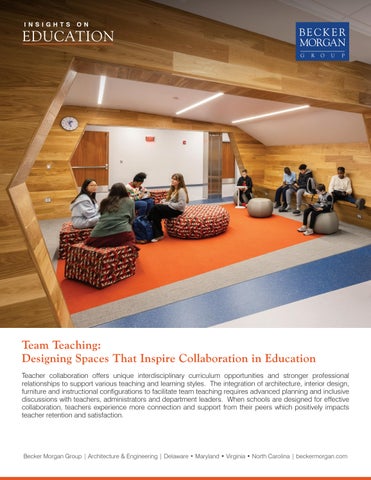
Team Teaching: Designing Spaces That Inspire Collaboration in Education Teacher collaboration offers unique interdisciplinary curriculum opportunities and stronger professional relationships to support various teaching and learning styles. The integration of architecture, interior design, furniture and instructional configurations to facilitate team teaching requires advanced planning and inclusive discussions with teachers, administrators and department leaders. When schools are designed for effective collaboration, teachers experience more connection and support from their peers which positively impacts teacher retention and satisfaction.
Becker Morgan Group | Architecture & Engineering | Delaware • Maryland • Virginia • North Carolina | beckermorgan.com
I N S I G H T S
O N
EDUCATION Building a Culture of Collaboration Designing supportive environments for team teaching requires a fundamental shift in both pedagogy and spatial ownership. The success of team teaching depends on the ability of educators to share space, ideas, and responsibilities while maintaining individual teaching identities. To support this, design must prioritize community and shared environments rather than traditional, isolated classrooms and private desks. Shared spaces foster collaboration among teachers and allow students to witness professional cooperation firsthand. Visibility between classrooms and common areas can help students see the value of teamwork, communication, and shared goals. However, shared does not mean impersonal—design can still reflect teacher identity through organized display zones, such as rotating exhibits of student projects, artwork, or teacher highlights. These personal touches humanize the environment while maintaining flexibility and openness. When thoughtfully designed, these collaborative spaces become powerful teaching tools in themselves—encouraging interaction, adaptability, and a sense of belonging among students and educators alike.
Balancing Collaboration and Privacy While collaboration is central to team teaching, balance is essential. Teachers also need dedicated spaces for reflection, individual work, and planning. Providing quiet, comfortable areas—whether within a teacher lounge or distributed throughout the school— supports mental recharge and confidential discussions. Designing for both open collaboration and private focus creates a complete professional ecosystem. Schools should integrate dedicated planning areas that allow instructional coaches and teaching teams to coordinate lessons, review progress, and develop curriculum in a setting that mirrors the flexibility of student learning environments. These spaces may include small meeting rooms, flexible furniture, writable walls, and access to technology for joint lesson development. Scheduling is another crucial factor. Built-in time for collaborative planning and curriculum alignment reinforces the purpose of these spaces and helps sustain team dynamics throughout the school year. Becker Morgan Group | Architecture & Engineering | Delaware • Maryland • Virginia • North Carolina | beckermorgan.com
I N S I G H T S
O N
EDUCATION Designing for Flexibility and Movement Flexibility and mobility are key elements of any space designed to support collaboration and team teaching. Classrooms and learning areas should accommodate multiple teaching styles, group sizes, and activity types. Easily reconfigurable furniture allows teachers to quickly adapt their environment for lectures, small-group discussions, project-based learning, or individual study. Technology integration plays a critical role in supporting this flexibility. Wireless access throughout the building, powered furniture, and digital displays encourage spontaneous learning anywhere, while analog tools—such as mobile marker boards, pin-up spaces, and writable surfaces—promote interaction and idea sharing. The goal is to create a seamless environment that allows teachers and students to move fluidly between modes of learning, fostering curiosity and engagement at every turn.
Supporting Multiple Scales of Learning In a team teaching environment, variety and visibility are essential design principles. When multiple educators collaborate, the classroom expands beyond its walls, and learning can occur across multiple scales—one-on-one tutoring, small group discussions, or large interactive sessions. Architectural design should support these scales by replacing repetitive, closed-off classrooms with interconnected learning communities. Operable walls, varying room sizes, and diverse seating options empower teachers to modify their environment as needed. Transparency and line-ofsight connections enhance supervision and safety while also encouraging student independence and choice. Team teaching redefines the teacher’s role—from sole authority to advisor and facilitator, guiding students toward self-directed learning and collaboration. The built environment becomes a key partner in this transformation, fostering a culture of teamwork, adaptability, and shared ownership of the educational experience.
Becker Morgan Group | Architecture & Engineering | Delaware • Maryland • Virginia • North Carolina | beckermorgan.com