This Modern Slavery Statement (Statement) is made in accordance with Section 14 of the Modern Slavery Act 2018 (Cth) (‘MSA’ or ‘the Act’). It describes steps taken by the Wesfarmers Group (the Group) during the year ended 30 June 2025 to identify, monitor, mitigate and remediate the risk of modern slavery in the Group’s businesses and supply chains.
This is Wesfarmers’ tenth Statement and sixth made under the MSA. References to a ‘year’, ‘this year’ or ‘2025’ are to the financial year ended 30 June 2025 and the ‘previous corresponding period’ is to the year ended 30 June 2024 unless otherwise stated. All years are financial years ending 30 June unless otherwise stated. All dollar figures are Australian dollars (AUD) unless otherwise stated.
Wesfarmers Limited ABN 28 008 984 049 is an Australian public company listed on the Australian Securities Exchange (ASX:WES). The company is registered at Level 14, Brookfield Place Tower 2, 123 St Georges Terrace, Perth Western Australia 6000.
In this Statement, references to ‘Wesfarmers’, ‘the company’, ‘the Group’, ‘we’, ‘us’, ‘our’ refer to Wesfarmers Limited. A ‘division’ includes each reporting entity listed as part of that division and other businesses within the division.
References to operations include Australianbased support centres for each division and operational sites in Australia, New Zealand and Asia. On 1 July 2025, Wesfarmers completed the sale of Coregas and it is no longer a part of Wesfarmers Industrial and Safety division. The Industrial and Safety ethical sourcing performance is reported as excluding Coregas.
References to team member numbers include full-time, part-time or casual employees, as well as those employed under fixed-term contracts (who account for less than one per cent of total team member numbers).
This Statement was approved by the Wesfarmers Board on 6 October 2025.
Consultation with entities to prepare this Statement
The Wesfarmers Board oversees the Group’s approach to managing ethical sourcing-related risks and for reporting. The Statement undergoes review by the Wesfarmers Audit and Risk Committee before being recommended for adoption by the Wesfarmers Board.
Ernst & Young (EY) has reviewed and provided limited assurance over the content of this Statement, including selected reported ethical sourcing and audit program data. The EY assurance statement is at Appendix C, which sets out more information on the scope of EY’s assurance. This Statement draws upon divisional information and, where appropriate, aggregates it to describe the Group’s approach to modern slavery risk management.
Representatives from Wesfarmers’ corporate sustainability, risk, legal, company secretariat and human resources teams are consulted on the content included in this Statement.
All divisions supported the preparation of this Statement through annual ethical sourcing and modern slavery reporting, contribution of case studies and review of this Statement.
The Group’s minimum standards, as detailed in Appendix B, are expected to be met in all divisions and businesses. It is important to acknowledge the maturity of modern slavery risk management and reporting evolves over time. The Wesfarmers Health division continues to mature its approach.
This year’s Statement benefited from consultations with external parties including reporting entities listed in Appendix A.
Mandatory reporting criteria
The table below identifies where each criterion of the Act is disclosed within sections of this Statement.
Page: 1
Appendix A
Identify the reporting entity
Pages: 3 – 9
Appendix A
Describe the reporting entity’s structure, operations and supply chains
Pages: 10 – 15
Appendix B
Describe the risks of modern slavery practices in the operations and supply chains of the reporting entity and any entities it owns or controls
Pages: 16 – 24
Appendix B
Describe the actions taken by the reporting entity and any entity it owns or controls to assess and address those risks, including due diligence and remediation processes
Pages: 28 – 29
Describe how the reporting entity assesses the effectiveness of these actions
Pages: Inside front cover, 10, 13, 16, 17
Describe the process of consultation with any entities that the reporting entity owns or controls
Pages: 30 – 39
Any other relevant information
About Wesfarmers
From its origins in 1914 as a Western Australian farmers’ cooperative, Wesfarmers has grown into one of Australia’s largest listed companies. With headquarters in Perth, Wesfarmers’ diverse businesses today span: home improvement, outdoor living products and supply of building materials; general merchandise and apparel; office and technology products; retailing and provision of health, beauty and wellness products and services; management of a retail subscription program and shared data asset; wholesale distribution of pharmaceutical goods; manufacturing and distribution of chemicals and fertilisers; gas processing; natural gas retailing; participation in an integrated lithium joint venture, including operation of a mine and concentrator, and development of a refinery; industrial and safety product distribution; and management of the Group’s investments.
Wesfarmers is one of Australia’s largest private sector employers with more than 118,000 team members and is owned by more than 480,000 shareholders.
Acknowledgement of Country
Wesfarmers proudly acknowledges the Traditional Owners of Country throughout Australia and their continuing connection to lands and waterways upon which we depend and where our businesses operate.
We pay our respects to their Elders past and present, and actively support progress towards Aboriginal and Torres Strait Islander cultural,
and economic equity.
Risk monitoring and review
Remediation and termination
address modern slavery risk
Supplier risk assessment
Supplier audits
Remediation of non-conformances
Reportable breaches
Supplier exits
Forced labour
Grievance mechanisms
Group whistleblower programs
Managing Director’s statement
Wesfarmers recognises the importance of engaging fairly with suppliers and of ethical and sustainable sourcing.
Across the Group, our teams work with suppliers with the objective that human rights are understood and respected in our operations and supply chains.
With extensive global supply chains, we see the opportunity for openness and transparency in our reporting, which is valued by investors, lenders and many others and fosters collaboration with diverse stakeholders across the many sectors in which our businesses operate.
Since 2017, our Modern Slavery Statement has reported critical or significant ethical sourcing breaches identified through monitoring activities within our operations and supply chains. This Statement includes information about the types of breaches identified and our efforts to remediate these breaches. Over a decade ago, Kmart was one of the first Australian retailers to publish a Tier 1, own-brand supplier list and today Kmart also discloses many Tier 2 and Tier 3 suppliers in its supply chain.
Wesfarmers observes the Universal Declaration of Human Rights, the International Covenant on Civil and Political Rights, the International Covenant on Economic, Social and Cultural Rights and the International Labour Organization’s Declaration on Fundamental Principles and Rights at Work. We are committed to implementing the United Nations Guiding Principles on Business and Human Rights (UNGPs) and the Ten Principles of the United Nations Global Compact. Together, these declarations, covenants and principles help us identify and respond to potential human rights and modern slavery risks.
I’m pleased to report that during the year our divisions, including teams in sourcing markets, have continued to build awareness of modern slavery risks across the Group and evolve and enhance their ethical sourcing programs:
our divisions monitored a total of over 3,400 supplier sites to identify potential ethical sourcing non-conformances including minor, major and reportable breaches
our divisions remediated, or put remediation strategies in place, for 87.5 per cent of the total reportable breaches identified across the Group with the remaining undergoing remediation planning, or situations where divisions have been unable to achieve remediation, exiting the supplier
Bunnings Group and Wesfarmers Health collectively deployed an additional 196 ‘Your Voice’ worker grievance feedback mechanisms at supplier sites. Kmart Group deployed an additional 41 SpeakUp worker grievance feedback mechanisms at supplier sites. Grievance mechanisms are now operating in 15 countries by six divisions
our divisions supported more than 3,600 supplier workers to complete over 2,500 hours of training in modern slavery and ethical sourcing across our operations.
Pleasingly, our divisions now support grievance mechanisms for over 849,000 workers across more than 1,935 supplier sites. With the training provided for workers at supplier sites, these mechanisms provide independent, in-language and accessible options for workers to report concerns and grievances. With time, I am optimistic that they will add meaningfully to our diverse, established practices – many detailed in this Statement – and that they will complement our use of independent, third-party audits of supplier sites.
We know that ethical sourcing and modern slavery risk management will remain ongoing work, for years to come, and our ethical sourcing programs will need to continue to evolve – in all our businesses.
I commend this tenth Statement, which was approved by the Wesfarmers Board on 6 October 2025, on behalf of all reporting entities.
Rob Scott Managing Director
Wesfarmers structure and operations 1.
Founded
in
1914
as
a Western Australian farmers’ cooperative, Wesfarmers is now one of Australia’s largest listed companies with more than 118,000 team members.
Wesfarmers has operations in Australia and internationally. With our divisional autonomy model, each division’s management team is accountable for strategy development and implementation, including day-to-day operational performance and the design and implementation of ethical sourcing programs.
Bunnings Group, Kmart Group, Wesfarmers Chemicals, Energy and Fertilisers (WesCEF), Officeworks, Industrial and Safety and Wesfarmers Health have ethical sourcing teams that lead ethical sourcing and human rights risks with support from the Corporate Office. In total, there are 31 dedicated ethical sourcing team members across the Group. This includes 14 Kmart Group ethical sourcing team members and six Industrial and Safety team members in offshore markets.
In addition to divisional ethical sourcing teams, other departments such as merchandising, procurement and operations, as well as divisional leadership, are involved in managing supplier relationships and maintaining minimum standards across supply chains.
Additional information about the Wesfarmers workforce is in the 2025 Wesfarmers Sustainability Databook1, which covers topics including geographic distribution, enterprise agreement coverage, Aboriginal and Torres Strait Islander employment, employee classification by type and gender, turnover rates, female leadership representation and new hires.
GD/ND 57
Male 603
Female 501
GD/ND –
GD/ND: gender diverse or not disclosed
Our businesses
Bunnings Group Kmart
Bunnings Group is the leading retailer of home improvement and lifestyle products in Australia and New Zealand, and a major supplier to project builders, commercial tradespeople and the housing industry. Bunnings Group operates a network of 511 stores, comprising Bunnings Warehouses, smaller format stores, trade centres and specialist stores, and also frame and truss plants. Bunnings Group employs more than 53,000 team members.
Group
Kmart is a leading product development company and trusted brand that operates 323 stores throughout Australia and New Zealand. Kmart’s vision is to be where families come first for the lowest prices on everyday items. Kmart employs approximately 38,000 team members in Australia, New Zealand and key sourcing markets. Target operates 124 stores and employs approximately 10,000 team members across Australia.
Chemicals, Energy and Fertilisers
Chemicals, Energy and Fertilisers manages a portfolio of eight businesses in Australia and employs more than 1,300 team members across its production and distribution facilities and support offices.
Officeworks Industrial and Safety
Officeworks is a leading retailer of technology, stationery, furniture, art supplies, and learning and development resources, with approximately 40,000 products available online and instore as well as services like Print & Create and Geeks2U. It also owns service provider Box of Books, which provides a digital education textbook platform for customers. Operating through a nationwide network of 173 stores, Officeworks employs approximately 8,800 team members.
Industrial and Safety operates two main businesses, Blackwoods and Workwear Group, which span safety products, tools, personal protective equipment, electrical and industrial supplies, and industrial and corporate workwear. Industrial and Safety employs approximately 3,100 team members.
Wesfarmers Health
Wesfarmers Health comprises a Consumer segment, which includes Retail, MediAesthetics and Digital Health, and a Wholesale segment. The Retail business centres around Priceline Pharmacy, a leading pharmacy brand with 419 community pharmacies across Australia. Priceline Pharmacies are operated through franchise partnerships with community pharmacists. Wesfarmers Health also operates 68 non-pharmacy Priceline stores. The division employs approximately 3,000 team members.
Group
data and digital and other activities
OneDigital comprises Group data and digital assets and capabilities. It forms part of the Corporate Office. Wesfarmers is an investor in Flybuys, BWP Trust, Gresham Partners and Wespine Industries.
1 Increased to 23.5 per cent following completion of the sale of BWP Management Limited to BWP Trust on 1 August 2025.
Our supply chains
Supply chains across the Group are complex, multi-tiered and vary as the divisions operate across different industries, have different operations and offer retail or business customers a wide range of products and services. Divisions directly source goods for resale (GFR), goods not for resale (GNFR) and services.
GFR are finished products and include clothing, general merchandise, office supplies, home improvement and health and beauty products, sourced predominantly by Wesfarmers’ retail divisions and Wesfarmers Health.
In addition, Bunnings also operates an online marketplace with third-party vendors selling products directly to customers without operational involvement by Bunnings in procurement, warehousing or distribution of these products. Kmart Group is in the process of establishing an online marketplace. Modern slavery risks associated with third-party marketplaces are unique because the marketplaces facilitate transactions directly between sellers and customers, without any operational involvement of the platform host in procurement, manufacture or delivery of goods. Additionally, third-party sellers may be very small, they may sell goods on a short-term or sporadic basis, and the sourcing location of the materials used in the goods may not be known to them.
Hardware supply chain
The online marketplace, Catch, ceased trading in 2025.
GNFR includes items such as IT equipment for operations and for retail store fit outs, uniforms, industrial products and equipment and bulk raw materials which are processed before sale.
For example, Kmart Group, Bunnings Group, Officeworks, Wesfarmers Health as well as Industrial and Safety contract suppliers to manufacture GFR, with suppliers usually responsible for obtaining all necessary inputs. By contrast, WesCEF sources GNFR including raw materials such as gas and chemicals for its industrial operations, with outputs sold to customers for use or for further processing.
Services include technology, security, cleaning and waste removal services, shipping and logistics services, maintenance and repair services, real estate and property management services, training and other consulting or professional services.
The diagrams below provide an overview of the hardware supply chain, the apparel supply chain and the chemicals value chain.
Sourcing hardware often involves multiple tiers within a global supply chain. Divisions may have a direct (Tier 1) relationship with suppliers of GFR and GNFR and service providers. Direct Tier 1 suppliers may engage third-party finished goods manufacturers or sub-contractors and we may have an indirect (Tier 2) relationship with these manufacturers or subcontractors. Divisions may also engage third-party sourcing offices to support direct sourcing of goods from third-party finished goods manufacturing sites.
This diagram is an indicative representation of the Bunnings hardware supply chain, with the grey boxes showing where Bunnings has currently mapped its supply chain. This mapping only includes suppliers, finished goods manufacturing sites, service providers and subcontractors who fall within the scope of the Bunnings ethical sourcing program.
Apparel supply chain
The apparel supply chain is complex, with direct suppliers often sourcing from indirect suppliers that in turn source from other suppliers, including raw material providers. Tier 1 apparel suppliers may source non-commercial goods (like zippers and buttons) from Tier 2 and Tier 3 suppliers. This diagram provides an example of how apparel might fit into a four-tier categorisation, which is representative of the Kmart Group and Workwear Group apparel supply chains.
Kmart Group has mapped Tier 1 factories that produce its own-brand apparel and general merchandise finished products. Kmart Group continued to map Tier 2 and Tier 3 processing facilities used by Tier 1 factories in the production of apparel and home textile products.
Workwear Group has mapped its supply chain from Tier 1 and Tier 2, including direct contractual relationships with Tier 1 finished goods manufacturers.
Non-commercial goods are components/ elements not sold separately to consumers.
Raw material suppliers
Farm (e.g. cotton, wool, silk, jute, flax)
Forest (e.g. viscose, hemp, kapok)
Chemicals businesses can operate across the value chain from raw material providers to customers. The following diagram describes the WesCEF value chain.
Major sourcing locations
2,996
suppliers across the Group in an Ethical Sourcing Program
suppliers in an Ethical Sourcing Program monitored this year, up from 56% last year 61%
1,935
total number of supplier sites with an operational grievance mechanism (2024: 1,739)
The Group’s supply chains are complex and geographically dispersed.
In 2025, the Group had more than 24,500 suppliers (down from more than 27,300 in 2024) that produced goods and provided services.
Bunnings Group, Kmart Group and Officeworks do not own the factories where goods are made, but engage third-party suppliers to manufacture or supply goods. Industrial and Safety produces some of its own products, while WesCEF purchases and manufactures chemicals and fertilisers.
This map shows the top 25 sourcing locations across the Group and the goods sourced from each.
These sourcing locations represent the country of origin for own-brand GFR for all divisions, as well as non-own brand GFR and GNFR for WesCEF.
UNITED STATES OF AMERICA
Chemicals, industrial inputs, accessories, health, personal protective equipment
Bunnings
WesCEF
NZ Safety Blackwoods
Blackwoods
Wesfarmers Health
Workwear Group
FRANCE
Office supplies
Officeworks
CANADA
Chemicals, industrial inputs
WesCEF
Fertiliser inputs
WesCEF
BRAZIL
Timber, office supplies
Bunnings
Officeworks
SWITZERLAND
Ammonia
WesCEF
GERMANY
Apparel, lifting/rigging equipment, industrial and safety products, health and beauty
Bunnings Blackwoods
WesCEF
Wesfarmers Health
SAUDI ARABIA
DENMARK
Industrial equipment
WesCEF
SRI LANKA
Apparel, accessories, personal protective equipment
NZ Safety Blackwoods Workwear Group
ISRAEL
Furniture, chemicals, engineering equipment
Bunnings
NZ Safety Blackwoods WesCEF
INDIA
Apparel and footwear, general merchandise, personal protective equipment, mined goods and raw materials, industrial equipment, office supplies, accessories, flooring
Bunnings
Kmart Group
WesCEF
Officeworks
Blackwoods
NZ Safety Blackwoods
Workwear Group
Wesfarmers Health
PAKISTAN
Apparel, personal protective equipment
Kmart Group
NZ Safety Blackwoods Workwear Group
SINGAPORE
Chemicals, industrial equipment
WesCEF
UNITED ARAB
EMIRATES
Fertilisers, flooring
Bunnings WesCEF
BANGLADESH
FIJI
Apparel, uniforms, textiles
Workwear Group
Apparel, personal protective equipment, footwear
Kmart Group
NZ Safety Blackwoods
Workwear Group
CHINA AND TAIWAN
Apparel, electronics, furniture, general merchandise, office supplies, personal protective equipment, solar panels, resins, bulk bags, footwear, lighting, tools and accessories, barbecues and accessories, garden decor, plumbing, cleaning, pool accessories
All divisions
THAILAND
Apparel, uniforms, general merchandise, health/beauty, coolers, personal protective equipment
Apparel, general merchandise, industrial inputs, timber, furniture
Bunnings
Kmart Group
NZ Safety Blackwoods
Workwear Group
Risk 2.
As a large, diversified conglomerate with domestic and international operations, the Group has complex supply chains and is exposed to human rights risks, including modern slavery.
The Modern Slavery Act defines modern slavery as severe forms of exploitation including trafficking in persons, slavery, servitude, forced labour, forced marriage, debt bondage, deceptive recruiting and the worst forms of child labour. These practices involve coercion, threats, or deprivation of liberty, and are distinct from other unethical labour practices like underpayment or poor working conditions, which do not meet the legal threshold for modern slavery unless they involve serious exploitation.
The Wesfarmers Ethical Sourcing and Modern Slavery Policy includes a framework for identifying and managing modern slavery risks in its operations and supply chains.
The key elements of the Policy require:
Risk governance
Divisions to appoint a risk owner and implement tailored procedures to manage and mitigate risks.
Risk identification
Divisions to assess modern slavery risks based on country, product and sector vulnerabilities, starting with Tier 1 suppliers and where possible extending to high-risk tiers beyond Tier 1 suppliers.
Setting supplier standards
Divisions to require suppliers meet minimum standards in their supplier contracts.
Risk monitoring and review
Divisions to undertake monitoring of suppliers and reviews of internal policies to support the effectiveness of, and compliance with, their ethical sourcing program.
Remediation and termination
Where divisions identify breaches of minimum standards, to seek remediation or, where this cannot be achieved, terminate the supplier relationship.
Risk governance
The Wesfarmers Ethical Sourcing and Modern Slavery Policy is embedded in the Group’s risk assessment framework and overseen by the Wesfarmers Audit and Risk Committee. The Wesfarmers risk management framework guides the identification, assessment and management of risks across the Group. Risk oversight is reinforced through the annual enterprise risk review, which includes consideration of 44 defined risk categories. This review is conducted in parallel with the corporate planning process to promote risk integration into strategy.
Wesfarmers holds quarterly forums on human rights attended by divisional and Corporate Office team members involved in managing ethical sourcing programs. These sessions enable participants to share knowledge and collaborate on mitigating and managing modern slavery risks, forced labour and high-risk materials. Attendees may also discuss effective data collection and reporting, online supplier risk platforms, regulatory reform, global human rights frameworks and worker voice initiatives, and hear from industry experts.
Risk identification
The Group draws on several international frameworks and standards to guide its approach to identifying and addressing modern slavery risks including the United Nations Guiding Principles on Business and Human Rights (UNGPs) and applicable International Labour Organization (ILO) conventions.
The UNGPs are a leading global standard for addressing human rights and modern slavery risks associated with business activities. The Group uses the UNGPs to inform its approach to human rights risk management.
Advancing ethical sourcing across Wesfarmers Industrial and Safety
Wesfarmers Industrial and Safety remains focused on strengthening ethical sourcing practices and building trusted relationships with direct suppliers, including those producing own-brand and customer-branded products.
To achieve this, Industrial and Safety worked with suppliers to improve social and environmental performance across the supply chain.
In 2025, Industrial and Safety, through its business units, conducted 470 supplier and manufacturer assessments and supported 211 third-party audits. Of identified nonconformances, 78 per cent were remediated with remaining issues progressing in line with agreed audit timeframes.
The 'Your Voice' worker helpline program, implemented across 138 sites, received two issue reports, of which one was validated and required remediation.
To support long-term improvement, teams across merchandising, sourcing and ethical sourcing engaged directly with supplier sites to address non-conformances and reduce recurrence.
A face-to-face workshop in Melbourne brought together Industrial and Safety ethical sourcing leads from Australia and New Zealand to strengthen internal alignment and enhance the division’s strategic approach to human rights and supply chain risk. The session focused on policy development, customer expectations and shared supply chain challenges, paving the way for a more integrated risk framework.
Each Industrial and Safety business unit implemented targeted enhancements to identify and mitigate modern slavery risks:
Blackwoods strengthened its internal processes, data integrity and system automation efforts. This was supported by brand-specific reporting and range rationalisation. Monthly governance reviews helped drive greater accountability and improved re-audit completion rates within agreed timeframes.
Workwear Group (WWG) focused on addressing forced labour risks, particularly in cotton sourcing and overtime practices in China. Supplier training supported risk identification and mitigation. WWG expanded both the 'Your Voice' worker helpline and its ‘trust and verify’ audit program across high-risk sourcing regions.
In 2025, the 'Your Voice' worker helpline reached 36,600 supplier employees. WWG also launched an Ethical and Compliance Hub to strengthen internal oversight, achieved reaccreditation with Ethical Clothing Australia, and improved its ranking in the Baptist World Aid Ethical Fashion Report.
NZ Safety Blackwoods deployed the 'Your Voice' worker helpline across its five most strategic direct sourcing sites to enhance worker voice and oversight.
NZ Safety Blackwoods and WWG continued to participate in Collaborative Advantage, a New Zealandbased platform promoting ethical and sustainable sourcing. Through regular meetings, participating businesses share insights and best practices on modern slavery risk mitigation, ESG leadership and due diligence frameworks.
These initiatives reflect Industrial and Safety’s commitment to continuous improvement, responsible sourcing and the ongoing development of ethical and sustainable supply chains.
The UNGPs use ‘cause’, ‘contribute’ and ‘directly linked’ to define a company’s connection to a negative human rights impact and to guide its responsibility to support remediation. According to the Guidance for Reporting Entities1 issued by the Commonwealth Attorney-General’s Department (2023), adoption of the UNGPs assists companies to identify modern slavery risks and whether that risk arises directly due to a company’s actions or indirectly, where a company’s operations, products or services are connected with modern slavery via a third party.
Across the Group, supply chain and supplier due diligence is central to risk identification. The Group strives to avoid causing or contributing to adverse human rights impacts.
The Wesfarmers Ethical Sourcing and Modern Slavery Policy provides that where the Group’s activities have caused or contributed to an adverse human rights impact, Wesfarmers or the relevant division or business will provide for, or cooperate in, remediating the impact.
Operational risk
The majority of the Group’s operational workforce is based in Australia and New Zealand. While both are assessed as having a low likelihood of modern slavery, the risk is present in all countries where we operate.
To mitigate the risk of modern slavery in our operations, all divisions maintain appropriate governance processes. Divisional governance is supported by the Wesfarmers risk management framework.
Each division maintains whistleblower policies in accordance with the Corporations Act 2001 (Cth), to support safe reporting of misconduct without fear of retaliation.
More than 82 per cent of Wesfarmers’ team members are employed under collective enterprise agreements, with the remainder on individual contracts. In Australia, enterprise agreements are voted on by team members and are subject to approval by a Commonwealth regulator. Enterprise agreements offer benefits above minimum award standards and include provisions for consultation on significant operational changes. Wesfarmers supports the right of team members to negotiate collectively, with or without third-party representation.
Supply chain risk
The divisions apply the UNGPs to identify and manage modern slavery risks across their operations and supply chains. The greatest exposure to modern slavery is through supply chains where divisions may be directly linked to modern slavery risk through the purchase of GFR, GNFR and services.
Across the Group, modern slavery risk in supply chains is elevated by several operational factors:
Complex, multi-tiered supply chains
Risk increases where supply chains are complex or span multiple countries and tiers, limiting visibility into working conditions and labour practices. The divisions attempt to address this by mapping supply chains. Third-party auditors are engaged to conduct audits of Tier 1 supplier sites. All divisions have mapped Tier 1 suppliers in their ethical sourcing programs, however, mapping beyond Tier 1 suppliers varies between divisions.
Product and service characteristics
Some products or services have a higher risk of modern slavery. For example, products and services that involve hazardous, manual or repetitive processes, and where low-skilled or low-paid labour is involved, have a higher risk of modern slavery. Enhanced due diligence and pre-qualification screening may be used for these products and services. Divisions may request additional documentation on a supplier’s processes and its supply chains, or conduct additional third-party audits, particularly for higher risk suppliers or where the supply chain for a finished product includes high-risk materials. Bunnings Group, Kmart Group, Officeworks, WesCEF, Industrial and Safety and Wesfarmers Health undertake enhanced due diligence across high-risk suppliers and high-risk materials.
Country of origin
Sourcing from regions with weak governance, conflict or poor labour protections (such as from parts of Southeast Asia) increases risk. Divisions attempt to mitigate this through enhanced due diligence processes and, where possible, by seeking further information about material traceability. Complex labour supply chains
Non-professional services may involve third-party labour hire (such as cleaning, security, horticulture and distribution centres) with opaque subcontracting arrangements
and employment of migrant workers who are more vulnerable to exploitation. Bunnings Group, WesCEF, Officeworks and Wesfarmers Health have strengthened pre-qualification and ongoing monitoring controls applied to the procurement of nonprofessional services.
Divisions use a variety of processes and systems to monitor their suppliers and to identify and assess modern slavery risks. This may include third-party screening tools and due diligence tools in their ethical sourcing program.
Sedex Analytics, Sentinel and London Stock Exchange Group (LSEG) Data & Analytics scan against public information including global sanctions lists and media reporting to detect adverse reports involving suppliers. These systems support proactive identification and assessment of potential modern slavery risks in supply chains which helps to inform targeted due diligence and compliance actions. Risk assessments help identify potential vulnerabilities and risks within supply chains. These can be verified through third-party audits which offer direct, on-the-ground visibility into working conditions and help validate whether identified risks, including those related to modern slavery, are being adequately managed.
This year, Officeworks, Industrial and Safety, WesCEF and Kmart Group evaluated third-party online risk platforms intended to enhance divisional understanding of modern slavery risks related to suppliers, sourcing countries and product types. This work will be progressed in the coming year and is intended to support due diligence practices. By embedding risk identification into procurement and operational processes, divisions can proactively manage and mitigate modern slavery risks in their operations and supply chains.
Risk monitoring and review
Each division reviews its ethical sourcing policies and procedures annually, assessing their suitability, adequacy and effectiveness. Divisions align their programs to meet the Group’s Ethical Sourcing and Modern Slavery Policy and regularly update internal frameworks to reflect evolving standards and risks.
During the year, Wesfarmers worked with divisions to review and update2 the Group’s salient human rights assessment including for Wesfarmers Health. The review used a methodology derived from the UNGPs.
1 Attorney-General’s Department (2023), Commonwealth Modern Slavery Act 2018 – Guidance for Reporting Entities, Australian Government https://modernslaveryregister.gov.au/resources/Commonwealth_Modern_Slavery_Act_Guidance_for_Reporting_Entities.pdf
2 In 2021, salient human rights issues were: supporting labour rights in our value chain; upholding the privacy and personal dignity of our customers, team members and other stakeholders; preventing adverse impacts on communities; maintaining fair and safe workplaces for our workers; respecting Indigenous peoples’ rights; ensuring product safety for our customers.
Six salient human rights issues were identified by mapping human rights risks across our operations, supply chains and business relationships. Workshops were held on each human rights issue and were attended by more than 60 team members from different business functions. The workshops reviewed similar work done in 2021 and updated potential human rights issues and impacts.
The six salient human rights issues identified were:
maintaining fairness and safety in our workplaces
respecting Indigenous peoples’ rights upholding the human right to privacy and personal dignity
promoting customer and community health and ensuring product safety
combatting modern slavery (including forced labour) in our value chains respecting the human right to a clean, healthy and sustainable environment.
This re-assessment of salient human rights is intended to support a dynamic, current and responsive ethical sourcing framework, capable of adapting to emerging risks and regulatory expectations.
Remediation and termination
Aligned with the Wesfarmers Ethical Sourcing and Modern Slavery Policy, divisions are committed to remediating breaches of the Policy. Where this cannot be achieved, a division may terminate the supplier relationship.
Divisions undertake various monitoring activities to identify modern slavery risks and non-conformances with minimum standards. These may include supply chain risk assessment, factory and supplier pre-qualification, third-party screening, independent third-party audits, grievance mechanisms and helplines and worker voice surveys. Please refer to the ‘Actions’ section for more information.
During 2025, divisions undertook monitoring activities on 1,813 suppliers at 3,495 supplier sites. Monitoring activities included independent, third-party ethical sourcing audits which seek to identify and address non-conformances with labour rights, health and safety standards and working conditions. Please refer to the ‘Actions’ section for more information.
Where monitoring activities identify a non-compliance, remediation processes or activities may include:
Corrective
action plan (CAP)
When reportable breaches are identified, such as excessive overtime or wage underpayment, divisions work with suppliers to agree a CAP which details remediation actions.
Worker-centred investigations
Divisions use tools such as grievance mechanisms, worker sentiment surveys and call-back services to validate audit findings and guide remediation.
Training and support
Suppliers and team members receive targeted training to build awareness and capacity for addressing modern slavery risks, particularly in high-risk sectors.
Together, these actions support suppliers to uplift their processes and meet Wesfarmers’ minimum ethical sourcing standards, with the aim of improving conditions for workers at supplier sites.
Supplier relationships may be terminated if remediation is unsuccessful, or the supplier is unwilling to meet minimum standards. Decisions to exit suppliers are escalated to senior leadership within a division and reported through formal channels to promote transparency and accountability. During the year, eight suppliers were exited, and in each case, remediation was unsuccessful.
Strengthening ethical sourcing oversight in WesCEF’s supply chain
This year, WesCEF continued to advance its ethical sourcing program by identifying additional high-risk suppliers –particularly in transport (including shipping) and construction services – and integrating them into its monitoring framework.
The 2025 program included 87 high-risk suppliers identified via an ethical sourcing risk assessment, including 42 in transport and construction. The assessment considered factors such as sourcing location and the nature of goods, materials or services procured.
Suppliers were assessed for compliance with Wesfarmers' minimum standards through due diligence processes, including supplier questionnaires and physical audits. These audits, facilitated by an independent third party, covered areas such as ethical sourcing and modern slavery,
anti-bribery and corruption, environmental sustainability, health and safety, social responsibility and responsible procurement.
In 2025, WesCEF completed and/or closed out 14 physical audits and identified 41 reportable breaches. Where major non-conformances were identified, WesCEF is working with suppliers to develop remediation action plans to remediate non-conformances within an agreed time frame.
By 30 June 2025, more than 100 actions involving 85 suppliers were underway or completed – nearly double the previous year. WesCEF will continue to engage with these suppliers and others identified as at risk of modern slavery, reflecting its commitment to continuous improvement and to mitigating modern slavery risks across its operations and supply chains.
Inherent modern slavery risks
In 2025, Wesfarmers had more than 24,500 suppliers, with goods for re-sale sourced from 43 locations. Here we highlight the top 25 locations that our businesses source from.
Risk types
As identified by Wesfarmers divisions
Child labour*
Corruption
Deceptive recruitment practices
Discrimination
Excessive overtime
Forced labour
Freedom of association
Migrant labour exploitation
* Child labour is a reference to the worst forms of child labour as defined in Article 3 of the ILO Convention (No 182) concerning the Prohibition and Immediate Action for the Elimination of the Worst Forms of Child Labour.
Walk Free Global Slavery Index
Estimated prevalence of modern slavery per 1,000 of population (Walk Free Global Slavery Index 2023)
UNITED STATES OF AMERICA
Global Slavery Index: 3.3
FRANCE
Global Slavery Index: 2.1.
CANADA
Global Slavery Index: 1.8
Global Slavery Index: 21.3
BRAZIL
Global Slavery Index: 5.0
SWITZERLAND
Global Slavery Index: 0.5
GERMANY
Global Slavery Index: 0.6
SAUDI ARABIA
DENMARK
Global Slavery Index: 0.6
SRI LANKA
Global Slavery Index: 6.5
ISRAEL
Global Slavery Index: 3.8
INDIA
Global Slavery Index: 8.0
SINGAPORE
Global Slavery Index: 2.1
UNITED ARAB EMIRATES
Global Slavery Index: 13.4
PAKISTAN
Global Slavery Index: 10.6
BANGLADESH
Global Slavery Index: 7.1
FIJI
Global Slavery Index: unknown
THAILAND
Global Slavery Index: 5.7
CHINA AND TAIWAN
Global Slavery Index: 4.0 (China)
Global Slavery Index: 1.7 (Taiwan)
CAMBODIA
Global Slavery Index: 5.0
AUSTRALIA
Global Slavery Index: 1.6
JAPAN
Global Slavery Index: 1.1
VIETNAM
Global Slavery Index: 4.1
SOUTH KOREA
Global Slavery Index: 3.5
NEW ZEALAND
Global Slavery Index: 1.6
INDONESIA
Global Slavery Index: 6.7
Actions 3.
Wesfarmers’ divisions implement various measures to identify and manage modern slavery risks in their operations and supply chains.
Each division operates an ethical sourcing program to address modern slavery and human rights risks relevant to its operations and supply chain. These programs include key controls such as ethical sourcing policies, supplier due diligence processes and structured reporting mechanisms. Supplier due diligence processes cover risk assessments, supply chain traceability, monitoring (including independent, third-party audits), and procedures for investigation, remediation, and/or resolution of non-conformances or grievances.
The programs are supported by feedback mechanisms, education and training initiatives and stakeholder engagement. For example, Kmart Group participates in industry collaborations and benchmarking (e.g. Baptist World Aid Ethical Fashion Report), and Bunnings, Officeworks and Wesfarmers Health participate in the United Nations Global Compact Network Australia Community of Practice. Further details on collaboration and engagement undertaken are on page 25.
The diagram below provides an overview of divisional ethical sourcing programs.
Governance and policies
The Group’s commitment to respecting and upholding human rights is outlined in the Wesfarmers Code of Conduct and supported by a suite of policies, including the Group and divisional ethical sourcing and modern slavery policies, Group and divisional anti-bribery policies, whistleblower policies and the Our Approach to Human Rights statement.
Compliance with the Wesfarmers Ethical Sourcing and Modern Slavery Policy is mandatory. It details minimum standards which must be integrated into divisional ethical sourcing policies, where appropriate to the industry in which the division operates. Key policies and control documents related to the management of modern slavery and human rights risks are listed in Appendix B and, unless otherwise noted, are available online.
Minimum standards include a requirement that suppliers and service providers must not engage in any form of modern slavery, including forced labour. Suppliers are also expected to comply with laws relating to working age and hours, provide safe and healthy working conditions, maintain accurate records, respect freedom of association and collective bargaining and support effective grievance mechanisms.
The diagram below outlines Wesfarmers’ governance framework for ethical sourcing and modern slavery risk management.
Wesfarmers Board
WESFARMERS AUDIT AND RISK COMMITTEE
The Wesfarmers Board is responsible for approving the purpose, values and strategic direction of the Group. It provides guidance and oversight to Wesfarmers and our businesses in achieving our strategic objectives. The Board also approves the Group Ethical Sourcing and Modern Slavery Policy.
Human rights risks identified in the Group’s operations and supply chains are included in Wesfarmers’ operational risk reporting and annual risk review. The Wesfarmers Audit and Risk Committee receives updates on human rights risk management, including modern slavery, at least twice each year. It also reviews and recommends public disclosures, such as this Modern Slavery Statement, to the Board for approval.
Wesfarmers Leadership Team DIVISIONAL BOARDS
Members of the Wesfarmers Leadership Team, including divisional managing directors, provide leadership to support a culture of risk identification and management. Divisional managing directors provide oversight on the development and implementation of strategies, monitoring of progress and stakeholder engagement with regard to the management of modern slavery risks.
Reports on divisional ethical sourcing programs are presented to the divisional audit, risk and compliance committees and divisional boards.
Corporate Office and divisional teams
Each division has an ethical sourcing team, responsible for developing and executing its ethical sourcing program including a supplier due diligence process aligned with the Group Ethical Sourcing and Modern Slavery Policy.
Regular Group and cross-functional engagement between divisions and Corporate Office, and their operations, merchandising, risk, property, supply chain, finance and corporate affairs teams assists in mitigating modern slavery risks.
At the operational level, sourcing managers, buyers and procurement teams are accountable for compliance with these programs, within their respective areas of responsibility.
To strengthen risk mitigation and promote alignment across the Group, the Wesfarmers Corporate Office facilitates regular cross-divisional and cross-functional collaboration. This includes structured forums, targeted workshops and sharing of resources and learning materials to support continuous improvement in ethical sourcing practices.
Internal audit
Wesfarmers has an internal audit program that reviews key operational risks on an ongoing basis. The internal audit plan includes regular checks for compliance with Wesfarmers’ policies, such as the Ethical Sourcing and Modern Slavery Policy. Findings from these audits are reported to divisional audit, risk and compliance committees as well as the Wesfarmers Audit and Risk Committee.
External assurance
Wesfarmers’ external assurance program is overseen by the appointed external auditor. The Wesfarmers Audit and Risk Committee ensures auditor independence and monitors external auditor performance. Key audit areas include limited assurance of the Modern Slavery Statement.
Actions to address modern slavery risk
This section outlines the actions taken by Wesfarmers and its divisions to enhance supply chain transparency, strengthen supplier accountability and support continuous improvement in managing modern slavery risks.
Wesfarmers’ divisions apply a risk-based approach to ethical sourcing and modern slavery, tailored to their specific operational contexts and supply chains.
While modern slavery does not include practices such as sub-standard working conditions or under-payment of wages, these issues are illegal, harmful, and if left unaddressed, can escalate into more severe forms of exploitation. Divisional programs are structured to detect and respond to such risks through due diligence activities that promote safe working conditions and responsible employment practices.
Workers’ rights are respected
Workers are free to refuse or cease work
Workers are paid fairly and receive their full entitlements
Workplace is safe
DANGEROUS WORK (REPORTABLE BREACHES)
Workers can refuse work, but doing so may be detrimental
Workers are not paid fairly and do not receive some entitlements
Workers may be required to work excessive hours
Workplace is unsafe
Supplier risk assessment
Each division assesses suppliers using factors such as country of origin, product category, raw material inputs, spend and brand. All divisions recognise heightened responsibility for own-brand products.
All divisions map Tier 1 suppliers that are in scope of the division’s ethical sourcing program. These suppliers are required to complete additional due diligence steps and are subject to monitoring controls.
Suppliers identified as higher risk are subject to additional due diligence measures which may include disclosure and mapping of Tier 2 manufacturing sites, pre-qualification protocols, Sedex registration, self-assessment questionnaires, independent, third-party audits and participation in grievance mechanisms, depending on the division’s risk profile and sourcing strategy. Most divisions use LSEG Data & Analytics to identify sanctions and adverse media reports.
Workers’ wages are withheld
Workers cannot refuse work
Workers have been manipulated into debts or had identity documents confiscated
Workers may be deprived of personal freedom
In some instances, high-risk suppliers are subject to additional monitoring and controls. For example:
Kmart Group continued to map Tier 2 and Tier 3 processing facilities used in the production of apparel and home textile products. This year it cross checked these processing facilities against foreign government forced labour entity lists and used EIQ Sentinel for adverse media screening. Kmart Group also uses the HIGG Index Facility Social & Labour Module (FSLM) as a due diligence tool to understand the social performance of processing facilities that participate in FSLM.
Workwear Group has mapped high-risk Tier 1 and Tier 2 suppliers, including fabric mills, and use LSEG Data & Analytics to screen for sanctions and adverse media reports.
Bunnings has implemented additional pre-qualification protocols for selected suppliers of high-risk materials. In response to emerging risks for some products, Bunnings has developed and embedded forced labour risk controls for these suppliers, including bespoke training and oversight mechanisms.
Officeworks has introduced a Responsible Minerals Policy, with the purpose of implementing a due diligence process to support traceability of high-risk minerals commonly sourced from conflict areas. The process is based on the five-step framework detailed in the Organisation for Economic Cooperation and Development Due Diligence Guidance for Responsible Supply Chains of Minerals from Conflict-Affected and High-Risk Areas.
DECENT WORK
MODERN SLAVERY
Supplier audits
The Group Ethical Sourcing and Modern Slavery Policy requires divisions to undertake supplier due diligence.
Third-party audit and monitoring activities (defined under the UNGPs as the ongoing management of actual and potential human rights impacts) are a core component of supplier due diligence, helping to identify, prevent, mitigate and account for how risks are addressed.
In 2025:
Bunnings Group conducted 637 audits. Bunnings segments suppliers into low-, medium- and high-risk based on geography, product type and labour practices. High-risk suppliers are required to undergo audits either annually or bi-annually. These audits are guided by a risk-based grading framework which informs supplier approval status and audit frequency.
Kmart Group suppliers completed 1,486 audits across 1,223 supplier sites including: 1,409 audits at 1,161 Tier 1 supplier sites manufacturing own- and licensed-brand finished goods; and 77 audits at 62 Tier 2 processing facilities. All ownand licensed-brand finished goods fall within the Kmart Group audit program, regardless of country location or product type.
Officeworks chose to adopt the Sedex Members Ethical Trade Audit (SMETA) 7.0 approach from the start of the 2025 calendar year.
WesCEF completed 102 monitoring activities across 86 supplier sites, including physical audits, self-assessment questionnaires and remediation plans.
Workwear Group conducted 833 'trust and verify' audits in high-risk sourcing regions. Audits confirmed that production occurred at authorised sites. Workwear Group also mapped Tier 1 and Tier 2 suppliers to maintain visibility and traceability. Audit programs are part of broader risk assessment frameworks, allowing divisions to tailor their responses based on the severity and nature of the risk. Audit results are used to:
inform supplier grading and approval decisions trigger remediation processes or supplier exits support continuous improvement through training, grievance mechanisms and policy updates.
This integrated approach is intended to support meaningful change in divisional supply chains.
Remediation of non-conformances
Since 2017, Wesfarmers has disclosed reportable breaches in its Modern Slavery Statement.
Excluding this report, Wesfarmers has published nine Modern Slavery Statements, with the last five pursuant to the Modern Slavery Act. These statements detail the methodology for classification of non-conformances, the nature of reportable breaches and remediation efforts undertaken. The statements seek to demonstrate how risks are identified, assessed and addressed across the Group’s supply chains.
Wesfarmers’ approach to remediation is grounded in the UNGPs. These principles require entities to prevent, mitigate and, where appropriate, remedy adverse human rights impacts, including modern slavery.
Non-conformances can be identified through a range of monitoring activities, including: a supplier questionnaire or survey an independent, third-party audit a grievance report other initiatives which may include site visits or site assessment. When identified, non-conformances are classified as a minor, major or reportable breach. The Group’s reportable breach classification takes into consideration:
international auditing standards, specifically the SMETA methodology
imminent threat to workers’ safety presenting a risk to life and limb any attempt to prevent the course of audit through fraud or interference
a repeat finding which has not been addressed over time. Divisions aim to work with suppliers to remediate non-conformances, including minor, major or reportable breaches, with a particular focus on the remediation of reportable breaches, reflecting the seriousness of these issues and in alignment with the UNGPs. Remediation activities seek to prioritise the rights and wellbeing of affected workers.
Across the Group, remediation includes: CAPs developed collaboratively with suppliers following independent audits (for example SMETA and BSCI), tailored to the severity of non-conformances follow-up audits and third-party verification to confirm that remediation has been completed grievance mechanisms and worker sentiment surveys which provide additional insight into working conditions and validate audit findings
training and capacity building delivered to team members, suppliers and workers to support long-term improvement.
Bunnings expands its remediation efforts
This year, Bunnings worked with 367 supplier sites to remediate more than 1,500 non-conformances identified through ethical sourcing audits, with the aim of improving working conditions for more than 108,000 workers in 21 countries.
The most frequently addressed issues included health and safety (1,103 findings, 69.5 per cent); working hours (127 findings, 8.0 per cent); and wages (98 findings, 6.2 per cent).
Bunnings’ commitment to continuous improvement in ethical sourcing is evident in the steady growth of its remediation efforts over the past five years. From 2021 to 2025, the number of supplier sites where remediation took place grew by 166 per cent (from 138 to 367) and the number of countries involved increased from 15 to 21. Although non-conformance numbers vary due to audit scope and supplier mix, the overall trend demonstrates a deepening commitment to worker welfare and supply chain transparency.
Over the past year, Bunnings’ ethical sourcing program evolved to address emerging supply chain risks, including selected products identified as high-risk of forced labour. Oversight expanded to incorporate additional due diligence, embedding forced labour risk controls and delivering 34 hours of bespoke training to internal teams and suppliers.
Bunnings will continue to broaden the reach of its ethical sourcing program to cover more suppliers, its manufacturers and their workforces.
Remediation status
Remediation not yet commenced <1%
Remediation
544 reportable breaches
Exited for commercial/ other reasons 8%
Exited for ethical sourcing issues 4%
Reportable breaches
In 2025, none of the identified reportable breaches were assessed as modern slavery events.
Across the Group, 87.5 per cent of reportable breaches underwent remediation and were closed out. The remaining 12.5 per cent of reportable breaches include those reported within the last month of the reporting period (and remediation was yet to commence), reportable breaches for which remediation was still underway or reportable breaches where remediation could not be achieved and the supplier was exited.
Reportable breaches were most prevalent in China (50 per cent), followed by Bangladesh (10 per cent), India (seven per cent), Malaysia (six per cent) and Cambodia (five per cent). Australia accounted for three per cent of reportable breaches, with smaller numbers in Brazil, Egypt, Germany and Guinea.
Reportable breaches (by type)
REPORTABLE BREACHES FINDINGS
BUNNINGS GROUP
104
KMART GROUP
164
OFFICEWORKS
133
Identified 104 reportable breaches. The most common issues related to health and safety, excessive working hours and wage compliance, and were identified through third-party audits. Bunnings collaborated with suppliers to address these issues, including to develop corrective action plans, capacity-building initiatives and follow-up audits.
Identified 164 reportable breaches. The key reportable breaches pertained to health, safety and hygiene standards. Additional breaches included excessive overtime, inaccurate or incomplete time and wage records, employment conditions and unauthorised subcontracting. Kmart Group’s ethical sourcing team collaborated with suppliers to implement corrective action plans which were reinforced through factory visits, online and in-person engagement focused on compliance and continuous improvement.
Identified 133 reportable breaches. Officeworks implemented a series of targeted actions to strengthen its ethical sourcing program including adopting a new Responsible Minerals Policy. The division remediated critical reportable breaches related to recruitment fees and supported zero-fee policies. It expanded its worker voice program to better detect forced labour risks, maintained supplier due diligence and contract requirements and provided targeted training to team members and suppliers on modern slavery indicators and responsible purchasing.
INDUSTRIAL AND SAFETY
82
Reported 82 reportable breaches, principally for suppliers to Blackwoods and Workwear Group. Industrial and Safety prioritised remediation of health and safety issues, wage compliance and working hours violations, while also engaging directly with suppliers to build capability and reduce the recurrence of reportable breaches.
WESFARMERS HEALTH
20
41
Reported 20 reportable breaches, with key breaches related to fire and structural safety. Other breaches were primarily associated with inconsistent or incomplete payroll or working hour records, highlighting gaps in the recordkeeping practices at supplier facilities. Remediation actions for the critical reportable breaches were implemented, with ongoing monitoring in accordance with the division’s risk assessment framework.
Reported 41 reportable breaches. Reportable breaches related primarily to health, safety and hygiene, wages, working hours and regular employment. WesCEF developed remediation action plans for each breach with three accepted by suppliers, five pending acceptance and two under consideration. One supplier was exited for commercial reasons and no suppliers were exited due to ethical sourcing breaches.
Where suppliers are unwilling to engage or remediate, divisions may exit the relationship. This is considered an action of last resort, with divisions having a strong preference for remediation.
Remediation across all divisions is supported by:
divisional leadership oversight, which may include monthly reporting to chief financial officers and quarterly updates to divisional audit, risk and compliance committees governance integration, with remediation embedded in broader risk and compliance frameworks supplier engagement, including direct meetings, site visits and collaborative problem solving.
This integrated approach supports remediation to work as a compliance and strategic tool, with the potential to improve labour conditions for workers and strengthen supplier relationships.
Supplier exits
Generally, a supplier may be exited because it is unwilling to remediate reportable breaches on a timely basis or because there is a fundamental or irreconcilable difference on business ethics (evidenced through, for example, attempted bribery of auditors). Suppliers unwilling or unable to meet ethical sourcing standards may be suspended or terminated. If removed for these reasons, divisional audit, risk and compliance committees, management and boards are notified.
This year, eight suppliers were exited where remediation could not be achieved, despite attempts at remediation including: investigating and developing a CAP engaging directly with the supplier or supplier site management team to discuss breaches and remediation conducting follow-up audits to assess performance.
During 2025, Bunnings exited two indirect manufacturers associated with refusal to audit and attempted bribery; Blackwoods exited two supplier sites due to persistent non-compliance and NZ Safety Blackwoods exited one supplier; and Kmart Group exited three factories due to unauthorised subcontracting.
Forced labour
Wesfarmers defines forced labour as work performed involuntarily because of coercion, threat or deception. The ILO identifies 11 indicators of forced labour which are used by the Group to identify situations of forced labour, through ethical sourcing due diligence and monitoring activities.
As shown in the diagram below, the 11 indicators are the most common signs or clues that might point to the existence of forced labour. The existence of one indicator does not by itself indicate forced labour and not all indicators need to be present for a situation to be forced labour. Where forced labour indicators are identified, they are classified as a reportable breach and either remediated, or the decision may be taken to exit the supplier if it is unwilling to make mandatory improvements. There were no instances of forced labour identified during the reporting year.
During the year, divisions actively focused on addressing forced labour risks through targeted training, supplier engagement and enhanced risk assessment protocols.
Non-conformances identified via monitoring program, risk assessments, audit, and/or helpline
Event of forced labour
A forced labour event is present when a person provides involuntary work or labour services, because of coercion, threat or deception.
When implementing remediation measures, the safety, welfare and best interests of the worker will be prioritised.
Wesfarmers and its divisions are committed to working with suppliers to remediate non-conformances. The decision to exit is only taken when all other options have been exhausted.
SEVERITY
FORCED LABOUR EVENT
Grievance mechanisms
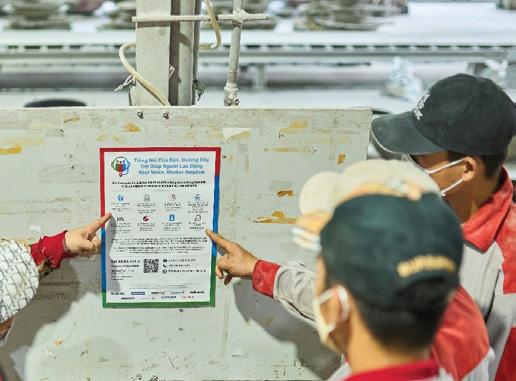
Grievance mechanisms are an important tool to monitor working conditions at supplier sites. Grievance mechanisms operate by providing workers with a helpline number displayed on multilingual posters throughout the factory and dormitory areas. Effective grievance mechanisms have the potential to provide near real-time and regular feedback on working conditions.
By supporting the establishment of grievance mechanisms, divisions aim to enable workers at supplier sites to confidentially raise concerns, including business-related human rights and modern slavery risks. Divisions fund grievance mechanisms that are consistent with the Group Ethical Sourcing and Modern Slavery Policy, the UNGPs and ILO conventions.
Some divisions may engage with workers via worker sentiment surveys, which offer the opportunity for workers to confidentially share their work experiences. This proactive approach enables deeper engagement and can uncover insights that complement other reporting channels such as audits and factory grievance mechanisms.
By the end of the reporting year, 1,935 supplier sites operated grievance mechanisms funded by Wesfarmers divisions, providing access to an anonymous reporting channel for more than 849,000 workers across 15 countries.
In 2025, a range of grievance mechanism and worker engagement programs were utilised by the divisions including:
Bunnings, Blackwoods, Bullivants, Workwear Group and Wesfarmers Health continued to collaborate on the 'Your Voice' worker helpline grievance mechanism. This helpline is managed by third-party provider, QIMA. A total of 699 sites and 158,365 workers were covered under the 'Your Voice' worker helpline.
Officeworks manages a third-party grievance program, which provides access for workers in its supply chain to grievance channels. A total of nine supplier sites have access to a grievance channel covering more than 3,100 workers.
Kmart Group operated the formal grievance platform SpeakUp, managed by third-party provider NAVEX Global. This mechanism was accessible to factory workers, with multilingual posters displayed across supplier sites. A total of 1,227 sites and 687,662 workers were covered.
Bunnings and Officeworks engaged independent third-parties to deliver worker sentiment surveys at selected
sites, intended to better understand the experiences of workers. This year, Officeworks included 11 new factories in its program and conducted 20 surveys. Bunnings deployed a worker survey following a recent audit in Thailand, with 51 workers responding and a follow up audit scheduled in 2026.
Bunnings continued to pilot the ‘Your Voice, Worker Call-Back’ service, interviewing 33 workers during the year. The call-back service allows auditors to call workers following audits to discreetly enquire about their working conditions and remediation of breaches. Of the 33 workers interviewed, none reported any concerns.
During the reporting period, worker grievance mechanisms received 20 contacts. Of these:
four cases remain open and are currently under investigation in collaboration with suppliers. one contact was substantiated, where an investigation confirmed breaches of policy relating to migrant worker fees and document falsification. Appropriate remediation was undertaken which included the supplier being required to refund fees and revise all onboarding documentation.
15 contacts were general enquiries (i.e. workers confirming local hourly rates of pay), which were resolved immediately by the helpline operator.
Group whistleblower programs
In compliance with the Corporations Act, each division has a Whistleblower Policy.
The Corporate Office and divisional whistleblower programs provide channels for current or former officers, team members, suppliers, contractors and their employees or relatives to raise concerns about misconduct or an improper state of affairs, without fear of retaliation.
Reports can be made directly to protected disclosure officers or via confidential external hotlines managed by third parties and passed on to protected disclosure officers. Reports assessed as falling under the policy are investigated. If substantiated, appropriate action is taken.
In 2025, no reports were received through the Corporate Office or divisional whistleblower programs making allegations of modern slavery.
Worker helpline expands in Bunnings’ supply chain
During the year, Bunnings expanded its ethical sourcing program by implementing the 'Your Voice' worker helpline at an additional 165 supplier sites in China. This brings the total number of participating sites to 557 across China, Vietnam and Indonesia, providing access to more than 110,000 workers.
The 'Your Voice' worker helpline is a third-party managed grievance mechanism that enables workers to report workplace concerns –such as pay discrepancies or health and safety issues – anonymously and without fear of retaliation. It is accessible through multiple channels, including phone, email and messaging platforms such as WhatsApp and WeChat. The helpline provides a safe and confidential environment for workers to raise concerns.
As part of the onboarding process, Bunnings conducted supplier briefings and factory webinars in Chinese, Vietnamese and Bahasa through its program partner, QIMA To support ongoing awareness, multilingual posters, pocket cards and other materials were distributed across participating sites.
The helpline complements Bunnings’ ethical sourcing due diligence program by validating audit and risk assessment results and providing visibility of issues at suppliers' sites beyond the regular audit cadence. During the year, Bunnings received 16 contacts to the helpline, consisting of four reports that are under investigation, nine general inquiries about working conditions which did not trigger an investigation (such as hourly rates of pay), and three contacts from sites that do not supply to Bunnings.
Training and capacity building
Each year, team members and suppliers across the Group receive ethical sourcing training tailored to their roles and responsibilities.
During the reporting period, 6,202 team members and 3,647 supplier workers completed ethical sourcing and modern slavery training, totalling 5,308 hours of learning.
Divisional ethical sourcing teams train other relevant employees, third-party auditors and suppliers, including factory team members.
Specifically:
Kmart Group delivered more than 3,400 hours of training to team members, third-party auditors, suppliers and factories. New ethical sourcing training was rolled out to suppliers and factories during the financial year.
Bunnings delivered training to more than 900 team members and 89 suppliers, offering practical guidance to help mitigate modern slavery risks and support the expansion of the ‘Your Voice' worker helpline.
Wesfarmers Health trained more than 1,300 team members and Officeworks trained 300 team members.
Industrial and Safety offered e-learning, a SharePoint hub and interactive Lunch and Learn sessions to more than 2,500 team members. Biannual compliance training (including on forced labour indicators) is offered across sourcing regions.
Training for divisional buying and sourcing teams covers: ethical sourcing and human rights commitments, including modern slavery risk evolving expectations under domestic legislation, international frameworks and from stakeholders the potential impact of sourcing decisions (such as short time frames) on workers’ rights effective strategies for managing human rights impacts insights from audit findings and stakeholder feedback.
In addition, team members complete online courses tailored to the division and business they work in, covering ethical procurement, definitions of modern slavery and forced labour, protective measures for human rights and risk identification in the workplace.
Training empowers women in Kmart Group’s supply chain
In 2020, Kmart Group set a goal to support at least 100,000 female workers at supplier factories access training in health, education or professional skills by December 2025. This goal was achieved ahead of schedule. As of June 2025, a total of 108,465 female workers across 57 factories had completed training programs delivered through strategic partnerships with BSR’s HERproject and RISE (Reimagining Industry to Support Equality).
A key component of the initiative is the peer educator model, which trains selected female workers to share knowledge and facilitate learning with their colleagues. This approach is intended to build internal capacity, promote ongoing knowledge sharing beyond the initial training period, and contribute to a sustainable learning environment.
The initiative aligns with Kmart Group’s commitment to responsible sourcing practices. In addition to workplace benefits, many participants reported positive decisionmaking in areas such as health and household financial management.
ETHICAL SOURCING TRAINING
9,849
Collaboration and engagement 4.
Wesfarmers recognises that collaboration with industry organisations, government bodies and non-government organisations is essential to identify issues and risks and promote effective action to address modern slavery risks.
Stakeholders who engage with our ethical sourcing programs include individuals and entities affected by our operations, such as team members, customers, suppliers and their employees, local communities, investors, lenders and other groups. Government, non-government organisations and media are also stakeholders.
This year, the Group participated in or facilitated initiatives designed to bring organisations together to address challenges, exchange knowledge, cultivate best practices and drive innovation. A table detailing these engagements is provided below.
PURPOSE
PARTICIPATING
Association of Professional Social Compliance Auditors (APSCA)
The industry association created to support individuals and organisations by promoting the use of independent social compliance audits as a tool to advance workplace conditions globally.
Blackwoods
Bullivants
Bunnings
NZ Safety Blackwoods
Officeworks
Workwear Group
Australian Catholic Anti-Slavery Network (ACAN)
ACAN provides members with access to modern slavery resources, including templates for policies, contract clauses, codes of conduct for suppliers, questionnaires for suppliers and reporting tools. Training programs are also available through ACAN for board members, staff, procurement teams and suppliers.
Bunnings
Workwear Group
APSCA is recognised as the leader in providing auditors with the competencies to perform independent social compliance audits. Bunnings will only book supplier audits with APSCA-accredited auditors. Officeworks uses ASPCA to confirm auditor accreditation.
Bunnings is a supplier to ACAN and is subject to the same controls as Workwear Group.
Some Workwear Group customers are members of ACAN and can access information shared by Workwear Group to ACAN via Sedex, which provides ethical sourcing visibility.
PURPOSE
Baptist World Aid
The Baptist World Aid Ethical Fashion Report is a bi-annual publication that evaluates and rates fashion brands on their ethical practices. The report aims to raise awareness about labour rights, environmental sustainability and transparency in the global fashion industry. It helps consumers make informed choices by highlighting which brands are committed to improving their supply chains and ensuring fair working conditions.
PARTICIPATING BUSINESS
Kmart Group Workwear Group
Cascale (formerly the Sustainable Apparel Coalition)
A global multi-stakeholder non-profit alliance of 300 leading consumer brands, retailers, manufacturers, sourcing agents, service providers, trade associations, NGOs and academic institutions.
Collaborative Advantage
A network for New Zealand ethical and sustainable sourcing practitioners to discuss and share best practice approaches to modern slavery and ethical sourcing.
Kmart Group
HOW THIS SUPPORTS ETHICAL SOURCING PROGRAMS
The Baptist World Aid Ethical Fashion report is published biannually. Kmart Group and Workwear Group participated in 2024 and in the previous publications, which provides stakeholders with additional transparency of Kmart Group and Workwear Group’s ethical sourcing practices.
Bunnings
NZ Safety Blackwoods Workwear Group
Human Rights Resources & Energy Collaborative (HRREC)
The purpose of this Group is to provide a forum for practitioners working in the resources and energy sectors to network and share knowledge on respect for human rights, including but not limited to the implementation of the MSA.
Responsible Labour Initiative
A multi-industry, multi-stakeholder initiative focused on ensuring the rights of workers vulnerable to forced labour in global supply chains are consistently respected and promoted.
Sedex stakeholder initiatives
Sedex is a global membership organisation dedicated to improving ethical and responsible business practices within global supply chains. It provides companies with a secure online platform to manage and share data on various aspects of their supply chain, including labour rights, health and safety, environmental impact and business ethics. Sedex operates the SMETA (Sedex Members Ethical Trade Audit), a widely recognised social audit methodology used to assess suppliers’ compliance with ethical sourcing standards.
Wesfarmers Corporate Office WesCEF
Blackwoods
Cascale developed the Higg Index to measure and evaluate the social and environmental impacts of value chains and products. Kmart Group uses the Higg Index Facility Social & Labor Module (FSLM) as a due diligence tool to understand the social performance of Tier 2 and Tier 3 processing facilities that are participating in FSLM.
Bunnings attends the Collaborative Advantage quarterly meetings alongside businesses primarily based in New Zealand, but extending to Australia.
Wesfarmers’ Corporate Office and WesCEF team members have attended regular forums and working groups to learn and share knowledge on human rights, including high-risk material procurement, MSA reviews and shipping risks.
Blackwoods leverages the tools developed by the Responsible Labour Initiative for knowledge sharing and insights.
Divisional involvement with Sedex has supported the evolution of the Sedex platform. Some divisions have been involved in Sedex’s ANZ Advisory Group, Data Framework Taskforce, Grievance Mechanism Approach, Audit Framework and API Beta Program. Feedback has been provided to Sedex on excessive recruitment fees, worker surveys and forced labour self-assessment questionnaires. Some divisions provided feedback on the service provider modern slavery questionnaire. The Wesfarmers Reportable Breach Framework is generally aligned to the SMETA methodology.
PURPOSE
PARTICIPATING BUSINESS
HOW THIS SUPPORTS ETHICAL SOURCING PROGRAMS
The European Do It Yourself Retail Association (EDRA), as part of the Global Home Improvement Network (GHIN)
EDRA creates a strong collective voice for home improvement retailers in Europe and Australia. The GHIN is a forum for knowledge sharing and networking for retailers.
Bunnings
CERTIFICATION, AGREEMENT OR ACCREDITATION
Action, Collaboration, Transformation (ACT)
An agreement between global brands, retailers and trade unions to transform the garment, textile and footwear industry by achieving living wages for workers through collective bargaining at the industry level.
Kmart Group
The International Accord for Health and Safety
The International Accord that promotes workplace health and safety through independent safety inspections, training programs and a complaints mechanism for workers in the Bangladesh and Pakistan garment industries.
Ethical Clothing Australia (ECA)
An accreditation body working collaboratively with local textile, clothing and footwear businesses to protect and uphold the rights of Australian garment workers.
Forest Stewardship Council (FSC)
In addition to sustainable forestry practices, FSC standards consider social and economic wellbeing of workers, with the aim that harvesting and processing sites are free from forced or bonded labour.
Kmart – Bangladesh and Pakistan Target – Bangladesh Workwear Group – Bangladesh
EDRA provides Bunnings with global retailing trend information, including best practice retailing and customer experience.
ACT participants are making progress on a number of commitments that intend to accelerate living standards of workers in the apparel and footwear supply chain. For Kmart Group, this has included implementing the ACT Global Purchasing Practices Standard. More information is available on the Kmart and Target websites.
Factories undergo regular inspections for fire, electrical and structural building safety. Any issues found are monitored through to remediation.
Workwear Group
Blackwoods Bunnings Kmart Group Officeworks
ECA accreditation supports ethical sourcing in Australian clothing production and provides auditing assurance of local manufacturers.
Bunnings is a FSC promotional licence holder. Bunnings participates in FSC Australia and New Zealand knowledge webinars, forums and FSC Forest Week events. Kmart Group and Officeworks use the FSC standards as part of their broader illegal logging due diligence procedures prior to importing timber-based products into Australia.
Programme for the Endorsement of Forest Certification (PEFC) and Responsible Wood
PEFC is an international, non-profit, non-government organisation that promotes sustainable forest management. Responsible Wood is Australia’s national forestry standard independently recognised by PEFC.
Bunnings
Bunnings is a PEFC/Responsible Wood Off-Product Logo Licence holder. Bunnings participates in PEFC/Responsible Wood’s knowledge webinars and forums, and gains insights into sustainable forest management in Australia.
Assessing the effectiveness of our actions 5.
Each year, the Group reviews the effectiveness of actions taken to identify if ethical sourcing programs are advancing the rights of workers and mitigating ethical sourcing and modern slavery risks across the Group's operations and supply chains.
A combination of qualitative and quantitative measures is used to assess effectiveness:
Key performance indicators (KPIs) such as audit completion rates, breach closure rates, grievance mechanism coverage and supplier onboarding progress. Bunnings, Kmart Group and Workwear Group assessed their ethical sourcing programs using KPIs including audit completion rates, remediation outcomes and grievance mechanism coverage.
Internal audit programs to monitor compliance and identify systemic issues. Blackwoods maintained internal dashboards and audit tracking systems, with effectiveness measured through breach remediation rates and supplier onboarding progress.
Operational risk reviews to evaluate emerging risks and mitigation strategies. Kmart Group integrated third-party audits, grievance mechanisms and remediation tracking. Kmart Group and Officeworks implemented new Standard
Operating Procedures (SOPs) for GNFR and services procurement. Bunnings tracked breach closure rates, grievance contacts and training hours to evaluate program performance. Independent reviews to validate program integrity and identify improvement opportunities were conducted by Kmart Group and Officeworks.
Grievance and/or whistleblower mechanisms in place in all divisions. Kmart Group, Bunnings, Officeworks, WesCEF, Wesfarmers Health and Industrial and Safety track and remediate confirmed cases.
Limited sustainability assurance on ethical sourcing data and disclosures.
Effectiveness reviews are supported by regular engagement between sourcing, compliance and sustainability teams and by feedback from suppliers and workers.
Continuous improvement
This year, Wesfarmers engaged an independent consultant to review procurement of GFR and GNFR that include materials with a high risk of modern slavery.
Guidance is being co-developed with the divisions, with the intention that it will be embedded in procurement practices.
As in previous years, the Group commissioned an independent review of its ninth Modern Slavery Statement. That review has informed various sections of this Statement.
Looking ahead, divisions plan to expand effectiveness testing to include measures such as:
improved grievance mechanism accessibility for supply chain workers refined KPIs to better capture program effectiveness, including outcomes and worker wellbeing.
These initiatives reflect Wesfarmers’ commitment to strengthening its ethical sourcing programs and to taking action that is meaningful and measurable.
Ethical Clothing Australia accreditation in Workwear Group’s supply chain
Workwear Group (WWG) has maintained accreditation with Ethical Clothing Australia (ECA) since 2015, reflecting its sustained commitment to ethical, fair and transparent manufacturing practices across its Australian supply chain.
As Australia is WWG’s third-largest sourcing region, this accreditation plays a key role in supporting labour rights and supply chain accountability.
About Ethical Clothing Australia
ECA is an independent, not-for-profit organisation that accredits businesses with transparent and legally compliant supply chains in the textile, clothing and footwear industries. Accreditation confirms that workers are paid fairly, work in safe conditions and have their rights respected. The process includes comprehensive compliance checks across the full local supply chain and ongoing monitoring to ensure standards are upheld.
WWG’s approach to ethical manufacturing
WWG has embedded ECA’s standards across its Australian operations. Currently, 22 local suppliers contribute to the accredited supply chain, providing services such as design, pattern making, cutting, garment manufacturing and value-added processing. This includes partnerships with Indigenous-owned businesses, supporting ethical production and promoting economic inclusion for First Nations communities.
All participating suppliers undergo independent audits under ECA’s framework to verify compliance with Australian workplace laws and ethical sourcing standards. These audits help ensure that workers are protected from exploitation and workplace conditions meet legal and ethical requirements.
WWG’s long-standing collaboration with ECA remains a core component of its broader commitment to responsible sourcing and sustainable supply chain practices.
Performance and priorities
The divisions report to their respective audit, risk and compliance committees and boards, and to the Wesfarmers Audit and Risk Committee and Wesfarmers Board.
Reports detail key issues and areas of focus across divisional ethical sourcing programs, including breaches identified through the monitoring programs and remediation activities.
In our 2024 Modern Slavery Statement, the Group set out improvements and focus areas for 2025, which are restated this year with progress noted against each item.
PROGRAM AREA PRIOR YEAR FOCUS AREAS STATUS
Governance
Supplier due diligence and onboarding
Continue to evolve the Ethical Sourcing and Modern Slavery Policy to enhance consideration of the risks to vulnerable workers in the supply chains
Continue to leverage the Group Human Rights Forum and working groups for greater collaboration and learning
Review our approach to human rights control document
Further develop procedures for procurement of GFR and GNFR that include high-risk materials
Supplier monitoring Seek independent advice on exposure to forced labour across the Group’s operations and supply chains
Stakeholder engagement Support ongoing implementation and uptake of grievance mechanisms and other direct engagement with workers or their representatives
Remediation reporting
Consider how to better report on remediation activities and share learnings. This item is an extension to the work completed in 2023
Underway Did not meet Met
Quarterly forums were held
This document is currently under review and will be updated in 2026
Guidelines are being considered to address due diligence for GFR and GNFR that include high-risk materials
The Corporate Office engaged an external subject matter expert on forced labour and high-risk materials procedure and guidance
Wesfarmers, with Officeworks, WesCEF and Kmart Group, reviewed three online platforms that provide greater insight into supply chains
A decision will be made in 2026 regarding the merits of these additional platforms
Divisions will continue to use contract templates with modern slavery clauses
Divisions continued to engage with diverse stakeholders including organisations listed on pages 25-27 of this Statement
Wesfarmers Health will continue to strengthen supplier due diligence and audit protocols as its processes mature
Divisions continued to expand their worker helplines and survey programs
Divisions continue to report to the Corporate Office on reportable breaches, including how they are identified, remediated and closed
A maturity assessment is being developed to evaluate how well divisions manage remediation and supplier risk. This is intended to support further standardisation of remediation reporting across divisions
The policy was reviewed in 2025
Future focus areas 7.
The divisions are focused on strengthening ethical sourcing programs to identify, prevent, mitigate and manage the risk of modern slavery in their operations and supply chains. The table below provides a summary of future focus areas. Not all focus areas apply to each of the divisions.
PROGRAM AREA
Governance
Ethical sourcing program
FOCUS
Evolve Group Ethical Sourcing and Modern Slavery Policy and associated guidance
Support implementation of ethical sourcing programs in divisions or businesses that are new to the Group
Continue to expand the scale and scope of the ethical sourcing programs. This work remains ongoing as divisions continue to review and mature their ethical sourcing programs
Continue to monitor domestic and international modern slavery risks in services procured by the divisions
Supplier due diligence and onboarding
Supplier monitoring
Stakeholder engagement
Program effectiveness
Training, education and engagement
Divisions continue to enhance supplier due diligence and onboarding by using a combination of risk-based frameworks, integrating advanced screening tools and embedding ethical sourcing clauses into contracts
These efforts aim to improve transparency encourage suppliers to meet compliance standards before onboarding and strengthen remediation and monitoring processes
Once finalised, integrate the Wesfarmers high-risk materials guidance into divisional procurement processes
Continue to support the implementation and uptake of worker grievance mechanisms, as well as other direct engagement with workers or their representatives
Develop an ethical sourcing risk maturity assessment process
Continue to build awareness and capability among team members about the risks of modern slavery in supply chains, especially those engaging with sourcing locations with a high risk of modern slavery
Appendices 8.
Appendix A – Reporting entities
This Modern Slavery Statement is made on behalf of Wesfarmers Limited (ABN 28 008 984 049) and the reporting entities listed in the following table.
The registered office address for the reporting entities listed in Appendix A is Level 14, Brookfield Place Tower 2, 123 St Georges Terrace, Perth, Western Australia. Wesfarmers holds a 50 per cent interest in Loyalty Pacific Pty Ltd (Flybuys) and Queensland Nitrates Pty Ltd (QNP), both of which prepare their own Modern Slavery Statement.
Wesfarmers Limited
ABN 28 008 984 049
Bunnings Group reporting entities
Bunnings Group Limited
ABN 26 008 672 179
Perth, Western Australia Wesfarmers Limited (Wesfarmers) is a for-profit company limited by shares incorporated and domiciled in Australia whose shares are publicly traded on the Australian Securities Exchange (ASX:WES). The nature of the operations and principal activities of Wesfarmers and our subsidiaries include: home improvement, outdoor living products and supply of building materials; general merchandise and apparel; office and technology products; retailing and provision of health, beauty and wellness products and services; management of a retail subscription program and shared data asset, online marketplace and Group media network; wholesale distribution of pharmaceutical goods; manufacturing and distribution of chemicals and fertilisers; participation in an integrated lithium joint venture, including operation of a mine and concentrator, and development of a refinery; industrial and safety product distribution; gas extraction and distribution; and management of the Group’s investments.
Wesfarmers Limited is the ultimate holding company of the reporting entities listed in this Modern Slavery Statement.
Burnley, Victoria Bunnings Group Limited (Bunnings) is the leading retailer of home improvement and lifestyle products in Australia and New Zealand, and a major supplier to project builders, commercial tradespeople and the housing industry. Bunnings Group’s network of 511 locations includes warehouses, trade centres, Tool Kit Depot stores and Beaumont Tiles stores, as well as the Bunnings online marketplace.
REPORTING ENTITY
RJ Beaumont & Co Pty Ltd
ABN 61 007 703 997
Kmart Group reporting entities
Kmart Australia Limited
ABN 73 004 700 485
Target Australia Pty Ltd
ABN 75 004 250 944
Officeworks reporting entity
Officeworks Ltd
ABN 36 004 763 526
OneDigital reporting entity
Catch.com.au Pty Ltd
ABN 22 149 779 939
Wesfarmers Health reporting entities
Australian Pharmaceutical Industries Pty Ltd
ABN 57 000 004 320
PRINCIPAL PLACE OF BUSINESS
Adelaide, South Australia
Burnley, Victoria
DESCRIPTION
OF ACTIVITY
RJ Beaumont & Co owns the Beaumont Tiles business specialising in tiles and bathroomware, tools and accessories. It operates through a network of showrooms, studios, clearance centres and trade centres across Australia.
Kmart provides a wide range of everyday retail products from 323 stores in Australia and New Zealand and online. Kmart is also a leading product development company and has expanded and deployed this capability into international markets.
Target is a retailer of apparel, homewares, beauty and general merchandise products in 124 stores across Australia and online.
Chadstone, Victoria
API Victoria Pty Ltd
ABN 68 001 941 608
Australian Pharmaceutical Industries (Queensland) Pty Ltd
ABN 62 009 781 668
Priceline Proprietary Limited as trustee for The Priceline Unit Trust
ABN 65 701 908 786
Docklands, Victoria
Officeworks is a leading retailer of technology, stationery, furniture, art supplies and learning and development resources, operating through a nationwide network of 173 stores and online.
Catch was an online e-commerce business operating a third-party online marketplace. Catch ceased trading during 2025.
Docklands, Victoria Australian Pharmaceutical Industries (API) is a leading Australian pharmacy, health and beauty retailer and supplier. API, through its subsidiaries, owns the Priceline, Clear Skincare clinics, SILK Laser clinics, InstantScripts and SiSU businesses. API is also a wholesaler of pharmaceutical products and offers retail support services to pharmacies through the Priceline Pharmacy franchise network and banner brand stores.
Docklands, Victoria
Docklands, Victoria
Docklands, Victoria
API Victoria is a distributor of pharmaceutical goods and products to pharmacies in Australia.
API Queensland is a distributor of pharmaceutical goods and products to pharmacies in Australia.
Priceline partners with community pharmacists through franchise arrangements and owns non-pharmacy Priceline stores. Priceline also operates the Sister Club loyalty program. Priceline is a leading pharmacy, health and beauty store comprising 479 company-owned and franchised Priceline and Priceline Pharmacy stores across Australia.
Wesfarmers Chemical Energy and Fertilisers (WesCEF) reporting entities
Wesfarmers Chemicals, Energy and Fertilisers Limited
ABN 48 008 797 402
AVC Trading Pty Ltd
ABN 65 099 189 072
Australian Gold Reagents Pty Ltd
ABN 93 009 140 121
CSBP Limited
ABN 81 008 668 371
Murdoch, Western Australia
WesCEF manages eight businesses in Australia across the chemicals, energy, fertiliser and lithium sectors with a shared services model that supports the production, distribution and retail assets in the WesCEF portfolio.
Campbellfield, Victoria AVC Trading is Australia’s largest importer of PVC resin and polymer materials. AVC Trading also provides shipping solutions and is a third-party specialist logistics provider assisting businesses that regularly import non-hazardous products into Australia from Asia.
Kwinana, Western Australia
Kwinana, Western Australia
AGR is a 75 per cent owned joint venture with Coogee Chemicals. It manufactures and sells sodium cyanide to mining companies throughout Australia and internationally, for use in gold extraction.
CSBP manufactures and supplies ammonia, ammonium nitrate and industrial chemicals to the Western Australian resource and industrial sectors. CSBP also manufactures, imports and distributes phosphate, nitrogen and potassiumbased fertilisers in blended, compound and liquid form for the Western Australian agricultural sector.
REPORTING ENTITY
Wesfarmers Kleenheat Gas Pty Ltd
ABN 40 008 679 543
Wesfarmers LPG Pty Ltd
ABN 32 009 214 831
MH Gold Pty Limited
ABN 51 608 814 204
PRINCIPAL PLACE OF BUSINESS DESCRIPTION OF ACTIVITY
Murdoch, Western Australia Kleenheat is a retailer of natural gas to residential and commercial markets.
Kwinana, Western Australia
Murdoch, Western Australia
Wesfarmers Industrial and Safety (WIS) reporting entities
Wesfarmers Industrial and Safety Pty Ltd
ABN 15 137 253 528
Coregas Pty Ltd
ABN 32 001 255 312
J. Blackwood and Son Pty Ltd
ABN 43 000 010 300
The Workwear Group Pty Ltd
ABN 82 004 055 387
Bullivants Pty Limited
ABN 47 087 887 072
Extracts liquefied petroleum gas (LPG) from natural gas and sells, on a wholesale basis, propane, butane and condensate to domestic and export markets.
Sells and markets spodumene concentrate and lithium hydroxide offtake received from the Covalent Lithium JV, between Wesfarmers and SQM.
Macquarie Park, New South Wales
Yennora, New South Wales
Macquarie Park, New South Wales
Wesfarmers Industrial and Safety (WIS) is a leading supplier of industrial, safety and workwear products, and services to a wide range of customers, including to many of Australia and New Zealand’s largest corporate and government entities. WIS manages five businesses: Blackwoods, NZ Safety Blackwoods, Bullivants and Workwear Group.
Coregas is a supplier of industrial, specialty and medical gases in Australia and New Zealand, serving customers of all sizes through multiple sales channels and distribution networks. Coregas has, with effect from 1 July 2025, been divested and from that date no longer forms part of the Group.
Blackwoods is a retailer of tools, workplace safety and personal protective equipment, workwear, electrical and industrial supplies to businesses across Australia and New Zealand.
Port Melbourne, Victoria Workwear Group manufactures and retails workwear, featuring industrial workwear brands Hard Yakka and King Gee. Workwear Group supplies bespoke and catalogue uniforms to large organisations in professional services, health, industrial and emergency services segments through its NNT and Workwear Group Uniforms brands.
Eastern Creek, New South Wales
Group reporting entities (holding companies)
Ucone Pty Ltd
ABN 99 002 534 278
Wesfarmers Bunnings Limited
ABN 25 008 673 363
Wesfarmers Retail Holdings Pty Ltd
ABN 14 126 199 022
Kmart Holdings Pty Ltd
ABN 57 627 042 460
Bullivants is a provider of specialist lifting, rigging, height safety and related services to the industrial sector.
Perth, Western Australia Holding company within the Bunnings division.
Perth, Western Australia Holding company within the Bunnings division.
Perth, Western Australia Holding company of various retail businesses, including Kmart, Target, Officeworks and Catch.
Perth, Western Australia Holding company within the Kmart division.
REPORTING ENTITY
Target Holdings Pty Ltd
ABN 32 627 042 353
Wesfarmers Department Stores Holdings Pty Ltd
ABN 22 627 042 308
Officeworks Holdings Pty Ltd
ABN 51 627 042 497
Wesfarmers Online Retail Holdings Pty Ltd
ABN 66 633 981 414
Catch Group Holdings Pty Ltd
ABN 89 159 074 003
WFM Investments Pty Ltd
ABN 75 651 355 501
New Price Retail Pty Ltd
ABN 28 082 268 362
New Price Retail Finance Pty Ltd ABN 25 107 444 315
Synapse Finance Pty Ltd
ABN 95 107 444 299
Wesfarmers Retail Pty Ltd
ABN 94 097 092 085
Howard Smith Limited ABN 54 004 071 845
The Workwear Group Holding Pty Ltd
ABN 52 154 382 386
AVC Holdings Pty Ltd
ABN 22 099 222 456
Chemical Holdings Kwinana Pty Ltd
ABN 34 009 187 375
Cuming Smith and Company Ltd ABN 46 004 048 319
Manacol Pty Limited
ABN 70 114 552 251
Wesfarmers Fertilizers Pty Ltd
ABN 73 008 741 160
PRINCIPAL PLACE OF BUSINESS DESCRIPTION OF ACTIVITY
Perth, Western Australia Holding company within the Kmart division.
Perth, Western Australia Holding company within the Kmart division.
Perth, Western Australia Holding company within the Officeworks division.
Perth, Western Australia Holding company within the OneDigital division.
Bentleigh, Victoria Holding company within the OneDigital division.
Perth, Western Australia Holding company within the Health division.
Camberwell, Victoria Holding company within the Health division.
Camberwell, Victoria Holding company within the Health division.
Camberwell, Victoria Holding company within the Health division.
Perth, Western Australia Holding company within the WIS division.
Perth, Western Australia Holding company within the WIS division.
Macquarie Park, New South Wales Holding company within the WIS division.
Campbellfield, Victoria Holding company within the WesCEF division.
Kwinana, Western Australia Holding company within the WesCEF division.
Perth, Western Australia Holding company within the WesCEF division.
Campbellfield, Victoria Holding company within the WesCEF division.
Perth, Western Australia Holding company within the WesCEF division.
Appendix B – Policies and control documents
POLICY OR CONTROL DOCUMENT
Code of Conduct
Our approach to human rights
Ethical Sourcing and Modern Slavery Policy
Anti-bribery Policy
Whistleblower Policy
Diverse, Inclusive and Respectful Workplaces Policy
Divisional policies and codes
DESCRIPTION
References Wesfarmers’ policies, procedures and guidelines which apply to anyone employed by, or who works in or for, the Wesfarmers Group requires that they comply with a set of guiding principles and expectations, consistent with Wesfarmers’ values.
Sets out the Group commitment to respecting human rights, including through our sourcing activities and as an employer. It identifies the Group’s salient human rights issues. This document is currently under review and a new statement detailing our approach to human rights will be released in 2026.
Reflects the Group's approach to engaging fairly with suppliers, sourcing goods and services ethically and sustainably. In line with a responsibility to respect human rights, the purpose of the policy is to require compliance with local, national and other applicable laws and regulations; act to prevent, mitigate and, where appropriate, remedy modern slavery and other adverse human rights impacts in our operations and supply chains; and take all reasonable steps to meet minimum employment standards.
Sets out the responsibilities of Group companies and team members to observe and uphold the prohibition on bribery and related improper conduct. It provides information and guidance on how to recognise and deal with instances of bribery and other improper conduct.
Promotes and supports a culture of honest and ethical behaviour. The policy concerns reporting suspected or actual misconduct or an improper state of affairs involving Wesfarmers’ businesses, and outlines the process for making and investigating a whistleblower report.
Establishes measures and protections (as required by the relevant legislation) for eligible whistleblowers who report their concerns.
Applies to, among others, Wesfarmers team members and external whistleblowers, including suppliers and their team members and relatives.
Outlines the Group’s commitment to outstanding people, diverse teams and inclusive, safe and respectful workplaces. The policy notes that diversity includes differences of gender, ethnicity, indigeneity, religious beliefs, age, ability, family or carer’s responsibilities, sexual orientation and gender identity.
Aims to encourage an inclusive work environment where everyone feels safe and respected.
The table below provides a list or divisional policies, codes or control documents. These are updated to align with the Group Ethical Sourcing and Modern Slavery Policy and international best practice.
DIVISIONAL POLICIES, CODES OR CONTROL DOCUMENTS: DESCRIPTION
Bunnings
Ethical Sourcing Code of Conduct Code of Conduct establishes supplier minimum standards and is based on International Labour Organization conventions. Outlines Bunnings’ commitment to upholding the human rights of workers in their supply chain and broader business operations.
Responsible Timber Sourcing Policy
Other relevant control documents
Supports traceability of timber products and aims to ensure that the timber sold by Bunnings is responsibly sourced and originates from legal and well-managed forestry operations that do not contribute to deforestation and provide direct benefit to local communities.
Ethical Sourcing Supplier Guide
Bunnings Ethical Sourcing Service Provider Subcontractor Approval Process
Bunnings Forced Labour Remediation Protocol
Bunnings Child Labour Remediation Protocol
DIVISIONAL POLICIES, CODES OR CONTROL DOCUMENTS:
Kmart Group
Kmart Group Ethical Sourcing Code
DESCRIPTION
Sets out minimum requirements and expectations that all suppliers must meet as a condition of doing business with any business within the Kmart Group. It applies to all vendors, factories or authorised sub-contractors of the Kmart Group, and includes suppliers of retail merchandise, GNFR, and services.
Kmart Group ES Program Supplier Manual Assists suppliers of retail merchandise to Kmart Group in understanding and complying with the different elements of the Kmart Group Ethical Sourcing Program.
Other relevant control documents
Officeworks
Ethical Sourcing and Modern Slavery Policy
Human Rights Position Statement
Sustainable Wood Fibre Sourcing Policy
Other relevant control documents
Wesfarmers Industrial and Safety
Blackwoods
Ethical Sourcing Policy
NZ Safety Blackwoods
Ethical Sourcing Policy
Bullivants
Ethical Sourcing Policy
Workwear Group
Ethical Sourcing Policy
Coregas
Ethical Sourcing Policy
WesCEF
Ethical Sourcing and Modern Slavery Policy
Wesfarmers Health
Ethical Sourcing and Modern Slavery Policy
Other relevant control documents
OneDigital Catch
OneDigital/Catch Ethical Sourcing Code
Kmart Group Timber (Wood and Paper) Product Due Diligence Framework Standard Operating Procedure (SOP)
Solar Energy Modern Slavery Due Diligence Framework SOP
Establishes Officeworks’ commitment to source goods and services responsibly. It describes business critical issues and sets minimum requirements expected from suppliers from a modern slavery, ethical sourcing and animal welfare perspective. The document also describes the remediation framework and procedures adopted by the business.
Enhances Officeworks’ commitment to respecting human rights and describes the six salient human rights issues of focus, which are at risk of having severe negative impact through activities or business relationships.
Establishes Officeworks’ commitment to sourcing materials that don’t contribute to deforestation.
Supplier Engagement Pack – Goods and Services
Ethical Sourcing Audit Requirements
Responsible Minerals Policy
Describe requirements for sourcing products and services in an ethical and responsible manner, and considers the welfare of workers, their health and safety, business integrity and potential environmental impacts and animal welfare issues.
Establishes roles and responsibilities of WesCEF’s employees, suppliers, contractors and customers to maintain high standards of conduct and ethics in its supply chain, including the process for reporting non-compliances, auditing and documentation.
Governs Wesfarmers Health’s approach to ethical sourcing and modern slavery and outlines the minimum standards required of suppliers.
Standard operating procedures related to animal testing, cotton, mica, rubber and solar panels.
Child Labour Remediation Policy
Sets out minimum standards and expectations that all suppliers must meet as a condition of doing business with businesses in the OneDigital division, including OneData, OnePass and OneReach.
It applies to all vendors, factories or authorised sub-contractors of businesses in the OneDigital division, and includes suppliers of retail merchandise, GNFR, and services.