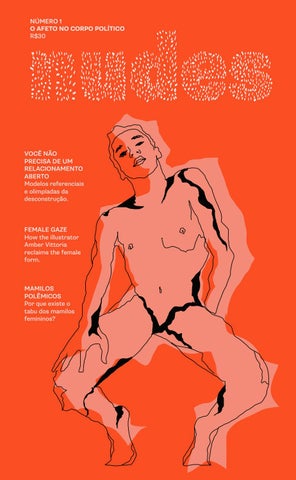
NÚMERO 1 O AFETO NO CORPO POLÍTICO R$30
VOCÊ NÃO PRECISA DE UM RELACIONAMENTO ABERTO Modelos referenciais e olimpíadas da desconstrução.
FEMALE GAZE How the illustrator Amber Vittoria reclaims the female form.
MAMILOS POLÊMICOS Por que existe o tabu dos mamilos femininos?
1
2
3
editorial
afeto? Responsabilidade afetiva e relações livres A primeira vez que tive contato com esse termo foi em um contexto de relações livres e, até recentemente, não o conhecia em outros contextos. Em se tratando de relações não-monogâmicas, me parece bem óbvio falar de responsabilidade afetiva. Significa que ser livre não é oba-oba, que você precisa ser responsável para com as pessoas com quem se relaciona. Mas o que exatamente é ser responsável? Entendo responsabilidade afetiva, em termos básicos, como manter diálogo e agir com honestidade. Muito do que se cria de expectativas em relacionamentos é por pura falta de comunicação. Não vejo responsabilidade afetiva como uma forma de se responsabilizar pelo que outra pessoa sente. Não acho nem desejável que alguém se responsabilize pelos sentimentos de outros. O importante é se comunicar honestamente. Daí pra frente, cada um é dono de si e faz suas próprias escolhas e toma suas próprias decisões embasadas nas informações que tem. Em contextos monogâmicos, tenho visto o termo ser usado para se referir a pessoas que iludem as outras, que dão falsas esperanças e que cultivam expectativas em relação a coisas que não cumprem. Acontece que iludir, dar falsas esperanças e cultivar expectativas são termos muito amplos. E, quando analisamos os pormenores do que a pessoa fez para ser lida como alguém que iludiu, deu falsas esperanças e cultivou expectativas, me parece que o que houve foi falta de diálogo, que resultou numa interpretação equivocada de determinadas atitudes.
Assumindo responsabilidade pelos próprios sentimentos Responsabilizar aqueles com quem nos relacionamos pelo que sentimos é prejudicial tanto para o relacionamento quanto pra nós mesmas. É ruim dessas duas formas, porque, quando uma pessoa que gosta da gente se sente responsável pela nossa dor, ela vai querer mudar de comportamento por culpa, não por compaixão. Quando as pessoas mudam por culpa, resolvemos o problema apenas naquele momento. Passado um tempo, a conta irá chegar, pois, quanto mais elas mudarem por se sentirem culpadas, menos boa vontade elas terão para agirem de maneira compassiva conosco no futuro. Então, vamos pensar um pouco no nosso lado de cada situação? Não digo que todas as pessoas sejam santas, mas o inferno definitivamente não é os outros. Até mesmo quando alguém sabidamente faz de tudo pra não ser legal com a gente, até mesmo em relações abusivas, não é melhor, em vez de focar em tudo que tem de errado no outro, refletir sobre de que maneiras podemos nos fortalecer para não passarmos mais por esse tipo de situação? Antes de falar de responsabilidade afetiva, que tal falarmos mais de autoestima e autonomia?
Laura Pires 4
“Se você gosta de uma pessoa que te trata mal, não é que você gosta muito da pessoa, é que você não gosta muito de você.”
5
Sumário 6
Playlist do mês Banheira
8 14
Sexo oral e relações sem camisinha estão disseminando supergonorréia
16 26
Heart sails with love por Gabriel Barbosa
Female gaze: how the illustrator Amber Vittoria reclaims the female form
30 6
American Bitch: the cunning episode of “Girls”
Fazer falta por Beatriz Vecchia
38
42
Você não precisa de um relacionamento aberto por Laura Pires
Mamilos polêmicos: por que existe o tabu com os mamilos femininos?
46 52
Dynamite por Beatriz Vecchia
Fetiche do mês Vouyerismo
54
Sobre nós Agradecimentos 7
playlist do mês
BANHEIRA Playlist dedicada pra aquele momento de tomar um banho bem gostoso com seu gato(a); um banho bem especial, para ficar bem cheirosa.
1 2 3 4 5 6 7 8 9 10 11 12 13 14 15
location
khalid
redbone
childish gambino
same drugs saved girl
chance the rapper
khalid
the internet | KAYTRANADA
special affair fire & desire might be sober
the internet drake
anderson .paak
childish gambino
LOVE.FEAT.ZACARI
kendrick lamar | zacari
shadow man
noname | phoenix | smino
bye bye baby
noname
often me voy
the weeknd ibeyi | mala rodríguez
messy love
mura masa
siga a NUDES e ouça a playlist completa no spotify https://open.spotify.com/user/nudes/playlist/BANHEIRA 8
9
AMERICAN
THE CUNNING EPISODE OF “GIRLS”
The key to “American Bitch,” Sunday’s scathing and timely episode of “Girls,” is the compliments. “Hannah, you’re clearly very bright,” Chuck Palmer, a novelist celebrated for his confessional work, says. “I could tell that from the first sentence you wrote.” He reads the sentence, as Hannah struggles to hide her pleasure: “ ‘If one more male writer I love reveals himself to be a heinous sleazebag, I’m going to do a bunch of murders, create a new Isle of Lesbos, and never look back.’ ” “You’re funny!” Palmer says. “That’s a funny sentence.” Palmer goes on to call Hannah “a smart woman” and mention her “pretty face” and explain that he invited her to his place—selected above other bloggers and feminist critics—because “you write well, you write sharply.” A New York creative icon, Palmer lives in a grand apartment on the Upper West Side. He has a
10
BITCH
by Emily Nussbaum
framed Woody Allen poster: it’s Woody with his head ringed by a medieval saint’s golden halo, holding a gun to his head. He’s got an ex-wife with whom he fights over custody; their biracial daughter plays the flute. He tells Hannah that he once ate so many chocolate-covered cherries that he stuck his finger down his throat. “I’m not perfect, but I’m not saying I’m perfect,” he tells Hannah, the bad boy’s defense. “I’m a horny motherfucker with the impulse control of a toddler.” He feels like a familiar figure.
nonfiction”—a tattletale skill that Hannah, Chuck, and Lena Dunham (and Philip Roth, for that matter, along with most sitcom writers, comedians, graphic novelists, and pop lyricists) specialize in. But online, college girls have been writing their own mini-memoirs about Chuck: scathing Tumblr posts about “non-consensual blow jobs.” Hannah wrote a post about those girls on a “niche feminist site,” condemning Palmer for having exploited his fans. He wants to defend himself, it seems.
A middle-aged male artist in the semi-autobiographical tradition of Philip Roth, Palmer is a novelist whose works include “The 9th of July” and “The Dirty Ones”; his home is full of pen/Faulkner awards and photos with luminaries such as Toni Morrison. Those walls are also filled with photorealistic paintings of the apartment itself: it’s a sly visual reference to the memoir, particularly the twisty, half-denied, half-admitted moral gray area of “creative
Hannah is nervous when she arrives, fixing her lipstick in the gilded elevatwor, then holding onto her handbag because she doesn’t plan to stay long. But even while the two argue—as he complains to her about witch trials, and how she’s wasting her talent on gossip—he keeps on steadily complimenting her, a drip of sedative, calling her funny, funny, funny. The praise pays off: Hannah relaxes her guard.
11
Something else happens, of course: “American Bitch” is a trick episode—and while it stands alone, it also serves as a bookend to an earlier “Girls” episode, “One Man’s Trash,” which was also directed by Richard Shepard. That episode, the fifth of Season 2, was about Hannah’s interaction with another middle-aged man who owns enviable real estate: a Brooklyn brownstone. In “One Man’s Trash,” Hannah fell into a dizzy, idyllic, intensely sensual weekend with a lonely, older, divorced man, Joshua, and got three days off from her life, during which she was treasured for her youth, took a luxurious shower, got wrapped in a towel and carried to bed when she fainted, played naked Ping-Pong, was given a rare orgasm (one of the only scenes of “good sex” on the show) and, also, listened to. Finally, however, Hannah sabotaged this utopia, accidentally/on purpose: she chattered confessions that made her seem crazy, or at least too unstable to be cute. It was a private encounter, the kind that only the two people involved could understand. It ended with Hannah waking up alone in that bourgeois fantasy house, then acting as if she were an adult: she ate toast, read the paper, made the bed, and, finally, before leaving, acted responsibly, taking the garbage out. In contrast, “American Bitch” is that story’s poisoned underside: it’s not about healing but humiliation, and the kinds of messes that can’t be cleaned up. As Hannah and Chuck keep moving together, from the foyer to the living room to the kitchen to the bedroom, they have a clever debate, one that is not merely about sexual assault but about fame, money, literary ethics, and the benefits and dangers of the Internet. It’s a power game that’s a little bit Mamet’s “Oleanna,” a little bit Chabon’s “Wonder Boys,” a little bit Apatow’s “Funny People,” with some “Clouds of Sils Maria,” plus the recent “Easy” episode starring Marc Maron. In certain ways, it’s a classic exchange between an older artist (rich, decadent, in print) and a younger artist (poor, moralistic, online). Chuck scores some points: it’s the women who throw themselves at him, he argues, because they are seeking stories to tell. Who really has the power, he asks: the zitty older virgin—him—or a beautiful young model? Hannah resists those arguments; she scores her points, too. “I’m tired of gray areas,” she tells him in disgust, when he waves off any sense that he’s even powerful. She shares a story about having being groomed by a gradeschool teacher, another older man who selected her, making her feel chosen and special (a story that’s one of Lena Dunham’s own real-life stories, which she wrote about in her memoir). Chuck sympathizes. Eventually,
he asks Hannah about herself—as, he suggests, a form of ethical payback for the exploitative relationships with his fans: he never really listened to the other young women, but now he’ll listen to her, see her as a person, in order to make up for it. It’s a shady move, one that plays to Hannah’s ego, the part of her that once, high on opium, felt like the voice of her generation. Along the way, Chuck makes her pity him, telling her about how he can’t sleep without pills, how he’s back in therapy, how fearful he is of his daughter finding out about the rumors. He makes Hannah feel like a colleague, an equal. By the time Chuck’s offering Hannah a gift from the shelf in his bedroom, he’s already won. It’s a trap laid by a narcissist for another narcissist. Who among us can say we wouldn’t ever fall for one of those? The last passage of the episode is a nasty joke that Philip Roth himself would surely appreciate. In the bedroom, once he’s called Hannah funny again and given her that copy of “When She Was Good” (Roth’s novel about a female do-gooder who tries to improve men), Chuck asks her to lie on the bed with him. “I just want to feel close to someone in a way I haven’t in a long time,” he tells her (the line of every nice guy bargaining to spend the night), and then he parodies the language of consent by talking about her staying clothed and honoring boundaries. “Your bed smells like snacks,” Hannah says, lying down, gingerly. “I live alone, lady,” Chuck says—more self-pity, and with it, she folds, and apologizes to him, entirely. Hannah says she’s sorry for writing something uninformed, something that hurt him. Chuck tells her that he’s not angry. And then he adjusts himself, and, in a move that has to be practiced, pulls out his cock and puts it on her thigh. On impulse, Hannah reaches down and touches it. Then she leaps out of the bed, horrified. Chuck transforms, like the wolf pulling off Grandma’s nightcap: he grins, Matthew Rhys’s perfect crooked grin. Chuck has shoved Hannah straight into the gray area, the one that generally shuts women up: she’d gone to his bedroom and accepted a gift, she agreed to lie down with him, she touched him. There’s no way she could ever tell this story about a famous man without the story becoming about her. The compliments were lures. And he knows, after all, that his daughter will arrive at 3 p.m. When the doorbell rings and the daughter arrives, she plays a concert for the two of them. Hannah stares at Chuck, but he only looks at his daughter. He beams, staring forward: he got what he wanted. His true kink seemed to be tricking her into it.
13
“American Bitch” is a cunning episode; it’s a timely one, too. It has one major flaw, although it doesn’t harm the episode’s effectiveness: Hannah doesn’t feel much like the character we’ve watched for six seasons. That person has acted a bit like Chuck at times: she macked on one middle-aged boss and flashed another; she slept with a teen boy; she nearly forced her sweet boyfriend to receive a blow job he kept rejecting. It’s part of what makes Hannah such an original character: her sexual chaos, her willingness to embrace abjection, the fact that she won’t take a no, even when it turns her into the butt of someone else’s joke. The Hannah in “American Bitch” feels more like Lena Dunham, in her ideas if not her biography. It’s Hannah’s creator who has become, over six seasons, a voice for feminism, elevating other women’s voices in Lenny Letter; it’s Dunham who talks about rape culture and her experience as a survivor. Of course, that other gray area, the one between Lena and Hannah (and Aura, her character in “Tiny Furniture”; and Ella, from Dunham’s college-era film “Creative Nonfiction”; and Anna, the character that Hannah writes about when she’s in Iowa, who “has to eat every two hours or she faints”), is a big part of the show’s dark-comic engine—just as it has been in every great sitcom throughout TV history, from “I Love Lucy” to “Louie” to “Seinfeld” to “Roseanne.” TV sitcoms are machines that turn private humiliations into something big and wild and public. Through Hannah, Dunham gets to paint a picture of her own house and then paint herself into it. The episode lacks continuity, but it’s a brilliant one-off. Then there’s the ending, a perfect little shock. In “One Man’s Trash,” Hannah sleeps over at Joshua’s place, and then she leaves, alone, in the morning. In “American Bitch,” she gets trapped in Chuck’s apartment, forced to watch that flute recital: she’s furious, tonguetied. As the flute merges into the tune of Rihanna’s “Desperado”—“a man whose heart is hollow”—Hannah leaves the building. In “One Man’s Trash,” the street she walks down is empty. In “American Bitch,” it’s full of other young women. They stream past Hannah, facing the other way, and then into Chuck’s building like beautiful zombies. If you want to compliment a creator, tell her she’s singular—exceptional, superior, not like other girls. Chuck’s punishment is that he’s made Hannah feel the ways in which she’s not special. His payback is that he’s made Hannah female again, interchangeable with other women. He’s put her back into that concord of voices, another creative girl with a story that she can never tell.
14
DES PER ADO
15
Sexo oral e relações sem camisinha estão disseminando supergonorreia A infecção se espalha através do sexo desprotegido, tanto vaginal, como oral e anal.
A doença é causada pela bactéria Neisseria gonorrhoea. A infecção se espalha através do sexo desprotegido, tanto vaginal, como oral e anal. Entre os infectados, um em dez homens heterossexuais, além de mais de três quartos das mulheres e de homens gays não têm sintomas facilmente reconhecidos. Mas os sintomas podem incluir uma secreção verde ou amarela a partir dos órgãos sexuais, dor ao urinar e sangramentos esporádicos. Infecções não tratadas podem levar a infertilidade, doença inflamatória pélvica e podem ser transmitidas para o bebê durante a gravidez. A OMS está cobrando que países monitorem a dispersão da gonorreia resistente e invistam em novas drogas. “A situação é bastante sombria”, comentou Manica Balasegaram, da Parceria Global de Pesquisa e Desenvolvimento de Antibióticos. “Há apenas três drogas sendo produzidas e não há garantia de que nenhuma vá de fato funcionar”. E, segundo a OMS, vacinas vão ser necessárias para interromper a dispersão da gonorreia. “Desde a introdução da penicilina, que garante uma cura rápida e confiável, a gonorreia desenvolveu resistência a todos os antibióticos”, explicou Richard Stabler, da Escola de Londres de Higiene e Medicina Tropical. “Nos últimos 15 anos, a terapia precisou ser trocada três vezes por conta do aumento das taxas de resistência no mundo. Estamos agora num ponto em que estamos usando as drogas como último recurso, mas há sinais preocupantes de falha no tratamento devido a cepas resistentes.” 16
74,8% nunca fez o teste de HIV na vida
19,5% fez sexo com mais de cinco pessoas no último ano
43,4% não se protegeu durante sexo casual
21,6% acha que existe cura para a Aids
A doença é causada pela bactéria Neisseria gonorrhoea. A infecção se espalha através do sexo desprotegido, tanto vaginal, como oral e anal. Entre os infectados, um em dez homens heterossexuais, além de mais de três quartos das mulheres e de homens gays não têm sintomas facilmente reconhecidos. Mas os sintomas podem incluir uma secreção verde ou amarela a partir dos órgãos sexuais, dor ao urinar e sangramentos esporádicos. Infecções não tratadas podem levar a infertilidade, doença inflamatória pélvica e podem ser transmitidas para o bebê durante a gravidez. A OMS está cobrando que países monitorem a dispersão da gonorreia resistente e invistam em novas drogas.
“Seis em cada dez jovens entre 15 e 24 anos fez sexo sem preservativo no último ano”
Dados coletados do Instituto Pasteur. Fonte: UOL
17
Female gaze:
18
How the illustrator Amber Vittoria reclaims the female form Women have long been portrayed in art as the lover, the muse, the mother, but rarely as just women. Possibly because there is no such thing as “just� a woman; she is complex, enigmatic, multifaceted, everything all at once. New York City based illustrator Amber Vittoria, seeks to wrap her mind around all parts of herself and her amorphous gender, embracing the female longing to understand, to accept, to celebrate. Like Picasso in his famed Demoiselles D’Avignon, those who break the mold of traditional female beauty are seen as dirty and subversive, but with Amber, subversivism never seemed so sweet. Nada Alic interviews her below: 19
Your representation of the female form is so striking to me, I was just watching John Berger’s Ways of Seeing Episode 2 on male painters painting the female form through the male gaze and how women are so often objectified in art. It feels like there’s this movement among female artists (or maybe it’s just now coming into public consciousness) of reclaiming the female form and desexualizing it. Your work makes me think of that, hairy legs, different body types, etc. Was that intentional on your part? Is your work, in some part, political? On both the intent and the political thematics, definitely. Throughout recent art history, the majority of women within pieces are depicted by male painters as sexual, maternal, or a stereotype of the like. As gender becomes progressively more fluid, I’ve personally felt empowered to break the trope of an ‘ideal physical female,’ to propel forward my ideals of femininity and my sense of the female form. The colors you use are so bright and feminine, does that play into the message you are trying to convey, almost in contrast to the imagery? What is the relevance of color to you? Although several of my pieces are rooted in the raw thematics of femininity and physical identity, the bright, bold palettes I pull from are meant to be a celebration of the power, strength, and intelligence of the woman. You’ve worked with clients such as Man Repeller, Teen Vogue, Lenny Letter, etc. How did this happen? Did they approach you? For majority of my clients, I’ve reached out to them via cold email, either finding a contact on their web page, or through Instagram.
20
Describe a typical day for you, do you work from home? What are your daily rituals? In addition to illustrating, I am also a full-time designer at Avon. A typical weekday involves me waking up, running for a few miles, getting ready for work, working until the early evening, then coming home and drawing/writing/reading. As for rituals, running allows me time to think about new pieces that I’m working on, which is incredible. Reading also teaches me, which influences a lot of my work. I just finished ‘Consider the Lobster’ by David Foster Wallace today, actually. My brother has wanted me to read that for a while. It’s a lovely compilation of his work. Who are the contemporaries/peers/friends that most inspire you? Be it, other artists, musicians, etc. My shortlist would consist of Gill Gold, who did my most recent ink. She is incredibly talented and a wonderful human being. Allison Bamcat, whose work brings a large smile to my face; her use of color and pattern is pristine. Nomad-Chic, for when I need a little zen and gorgeous collages. India K, for honest, beautiful photography and installation art. Finally, Jen Hsieh, whose world is bright and full of magical destinations. You recently contributed to a pin collab, can you tell us about that? Do you hope to do more collabs in the future? My first pin collaboration was with my good friend India, who is an incredible photographer and installation artist. She came to me with an idea of a pin simply stating ‘Product of Immigration‘ to raise funds for the ACLU. We sold 200 pins and donated $2,200 to the ACLU, all in a period of approximately a month! Since, I’ve collaborated with my former writing partner, Rishi Magia on a ‘Love Who You Want’ pin to raise money for OutRight Action International. Thus far we have raised a bit over $800. My end goal is to have art to fundraise with every few months.
“It feels like there’s this movement among female artists (or maybe it’s just now coming into public consciousness) of reclaiming the female form and desexualizing it.” What do you hope to achieve with your art? What would make you feel like: yes, I’ve made it. To continue to break the tropes of the ideal physical female, of gender, and of appearance, would all be incredible achievements. In regards to ‘I’ve made it’ moments, I’ve fortunately had a few: working with Teen Vogue, Man Repeller, Lenny Letter, being written up about on Society6 and It’s Nice That and having people send me photos of their art framed in their homes. The idea that my work has connected with someone who I may never meet in person is the most incredible feeling. What’s next for you/anything else you’d like to add/tell us? I am always open to chat. If you have a comment on some of my work, think there is a book I would find interesting, or have an awesome secret running path in Manhattan, feel free to send me an email: amber.vittoria@gmail.com
What is your advice to other artists looking to market themselves on the internet? i.e. tips for Instagram, pitching to blogs, etc. Instagram has been the single-most incredible resource for my artwork. I’ve been able to cultivate a truly wonderful audience where I can share my true self through my art and snapshots of my life. For Instagram, testing and learning are important. I’ve learned when it is best to post my work, which hashtags to use, and what stories my audience gravitates towards. In regards to cold-emailing/pitching, give a gift. Most of my cold emails (especially if it is to a specific person and not to an info@tktk.com) offer to send some of my art as an introduction, even if it is just a small hand-drawn post-card.
21
VOCÊ NÃO PRECISA DE UM RELACIONAMENTO ABERTO MODELOS REFERENCIAIS E .OLIMPÍADAS DA DESCONSTRUÇÃO POR LAURA PIRES 22
23
Está rolando uma moda de amor livre. Chato afirmar isso, mas é verdade. De uns tempos pra cá, esse discurso vem se popularizando cada vez mais e, na mesma velocidade, pessoas vêm questionando suas formas de se relacionar. Infelizmente, observo que essa grande quantidade de pessoas que questionam é mulheres que receberam a proposta de seus namorados homens. Arrisco dizer que, na maior parte das vezes, esses namorados homens acreditam que amor livre é aquele oba-oba de poder fazer o que quiser sem ter que se preocupar com os sentimentos da parceira e, por isso, tentam vender a ideia. Talvez isso esteja soando um pouco agressivo, mas é com certa frequência que recebo e-mails e mensagens de 1) homens pedindo ajuda para argumentar com a namorada sobre por que relacionamento aberto é legal e 2) mulheres desesperadas porque já tentaram e não conseguem se sentir bem em um relacionamento aberto, mas não querem perder o namorado. Para o segundo grupo, eu digo: você não precisa querer um relacionamento aberto. Para o primeiro: toma vergonha na cara. Talvez, para quem acompanha meus textos, esteja soando estranho esse meu discurso e quero explicar logo que não “mudei de lado”, não passei a de repente achar que a monogamia é o caminho e que amor livre é bobagem. Nada disso. O que sou determinantemente contra, em termos bem claros, é cagação de regra. Conforme já contei outras vezes, caí no tema das relações não-monogâmicas quando comecei a estudar a historicização do que entendemos por amor. Foi ali que aprendi que o que se acredita no senso comum ocidental contemporâneo sobre o que é amor e como deve ser a dinâmica de relacionamentos afetivo-sexuais é uma noção recente em termos históricos. Em diferentes momentos e contextos histórico-sociais, o que se entende por amor e relacionamentos muda. Isto é, nossas crenças sobre esse tema (e diversos outros) é uma construção social. A grande epifania aqui é: se não é natural e sim construído socialmente, pode ser diferente do que é agora. E, se pode ser diferente disso, não precisa seguir o modelo, cada um pode construir relações mais satisfatórias para si próprio. Naturalmente, cheguei ao tema da não-monogamia, pois é essa filosofia que prega maneiras mais livres de se relacionar. Por “livres,” entende-se livres do Estado e da Igreja, que costumam determinar o que vale ou não como relacionamento amoroso. Para mim, a não-monogamia é isso: libertação dos valores tradicionais e autonomia para escolher o que queremos e consideramos importante em uma relação. A parte de sair com outras pessoas é secundária, não por ser menos importante (porque isso vai variar), mas por uma consequência natural possível dessa liberdade e não uma força motivadora primária. Infelizmente, como os valores tradicionais sobre relacionamentos vinculam compromisso, amor, respeito e tudo mais de positivo à exclusividade sexual, o senso comum foca 24
demais no sexo quando falamos sobre relações nãomonogâmicas. Mas não duvide: em teoria, são os tradicionais que se importam tanto assim com sexo. A grande questão aqui é: não há vantagem alguma em lutar contra um modelo de relação se for para substituí-lo por outro. O que é de fato interessante de se rebater é a existência de um modelo referencial para que indivíduos tentem se encaixar e aqueles que não se encaixam sejam excluídos e discriminados. Não quero propor uma ditadura não-monogâmica no lugar da monogâmica. Eu quero que todo mundo se sinta cada vez mais livre para escolher o que bem entender. Não é fácil se desgarrar da ideia de modelo referencial. Recebo muitas mensagens de pessoas que perguntam: “Mas como é um relacionamento aberto?” e isso é impossível de responder, pois ele é como você quiser que seja, em acordo com quem estiver se relacionando com você. A única coisa que posso recomendar é respeito a si mesma e aos demais. Daí em diante, vale tudo. A monogamia é um pacote pronto que nos ensinam desde sempre. Crescemos sem o costume de questionar o que realmente desejamos, o que realmente nos satisfaz. Pode ser que o que nos satisfaça seja exatamente o modelo, mas, mais provavelmente, o que nos satisfaz será algo que foge a ele em maior ou menor grau. É por isso que recomendo sempre que se faça esse autoquestionamento: O que eu quero? O que eu valorizo? O que é prioridade? E dane-se o que a sociedade quer, valoriza e considera importante. Pode ser que, pra você, a exclusividade sexual seja importante e não há nada de mal nisso, desde que você se junte a alguém que acredite no mesmo. Abrir-se aos questionamentos não significa necessariamente rejeitar tudo que vem do modelo referencial vigente. Você pode de fato gostar da monogamia. É comum que as relações livres sejam defendidas como um estágio evolutivo das relações e muita gente que mudou para a não-monogamia se sente amadurecida, desenvolvida e evoluída pois foi essa a experiência pessoal que teve. No entanto, as pessoas são diferentes. Credito a sensação de amadurecimento e evolução ao auto-conhecimento desenvolvido e não à não- monogamia em si. Outro discurso comum é de que a monogamia não é natural. Outra bobagem, que aliás é uma ótima
desculpa pra quem quer justificar traição em relações monogâmicas, mas não tem nada a ver com isso. O que não é natural é uma regra que seja capaz de abarcar todos os indivíduo. A humanidade não é monogâmica nem não-monogâmica. Ela é composta por uma variedade de indivíduos, com suas histórias de vida, experiências e sentimentos que constroem quem são. É claro que o contexto social está sempre ali formando nosso caráter também e nos fazendo acreditar que certas coisas são “naturais”, mas não me interessa disputar pelo que é mais natural. O legal é entender o que funciona melhor pra você e juntar com quem queira algo parecido. Você não precisa de um relacionamento aberto. Se a pessoa com quem você se relaciona te pressiona a isso e você tenta, mas só sente dor e sofrimento e está fazendo isso por ela, talvez isso não seja mesmo pra você. Se é algo que você, pessoalmente, tem vontade de “superar”, tudo bem, continue tentando. Mas por você, não por outra pessoa. Você não precisa de um relacionamento aberto. Se você é de esquerda e sente uma pressão social em seus grupos de amigas para ser não-monogâmica, relaxa, você não precisa competir nas Olimpíadas da Desconstrução, muito menos vencê-las. Só você pode decidir o que é melhor pra você. Não adianta rejeitar um modelo pra adotar outro. Você não precisa de um relacionamento aberto. Se você tentou e não gostou, você tem todo o direito de não querer tentar de novo. Pode ser que seja diferente? Claro. Mas você não é obrigada a querer tentar. Você não precisa de um relacionamento aberto. Se você tentou e gostou, mas agora não está mais a fim, isso também é escolha sua. Pode ser que você mude de ideia de novo? Claro. Mas espera mudar de ideia de novo, então. E, se não mudar, também não tem problema. Ah, mas você quer sim um relacionamento aberto, uma relação livre, que seja, e acha que isso é o ideal pra você sim. Ótimo, então viva assim, construa algo assim com quem queira isso também — ou queira tentar isso também — e viva a sua vida. Mas não caia na armadilha de generalizar sua experiência individual para todos os seres humanos. Fique feliz que encontrou algo que funciona para você neste momento da vida, mas não queira prescrever o mesmo para os outros. Cada um é cada um.
VOCÊ NÃO PRECISA DE UM RELACIONAMENTO ABERTO. SABE POR QUÊ? VOCÊ NÃO PRECISA DE NADA. VOCÊ PODE FAZER O QUE QUISER.
25
ensaio
26
dynamite
27
28
29
fetiche do mês
VOUYEUR Voyeurismo (vua-ierismo) ou mixoscopia (cs) é uma prática que consiste em um indivíduo obter prazer sexual através da observação de pessoas praticando sexo ou nuas. Quando a pessoa observada não está ciente de que está sendo observada, tal comportamento é crime, configurando invasão de privacidade.
CONSENTIDO PODE NÃO CONSENTIDO NÃO PODE 31
sobre nós Nós, Bia e Gabi, somos designers, amigos, esquerdinhas caviar, roomates, fãs de M.I.A e Gaiola das Popozudas. Dupla eterna de trabalho, nos juntamos para criar a NUDES, revista que trata de sexo e relacionamento de uma forma naturalizada, sem tabus, sem preconceito e sem vergonha. A NUDES chega bagunçando a zorra toda e desafiando todo e qualquer ideal prédeterminado sobre o corpo, o sexo e as relações intrapessoais. Nesta edição tratamos do tema afeto no corpo político, com uma coleção de textos incríveis (podemos falar porque não escrevemos) que vão de relacionamentos abertos a mamilos polêmicos e um episódio lindo de Girls. Além dos textos contamos com dois ensaios fotográficos que trabalham a questão do afeto de uma forma íntima e próxima (e não só porque fotografamos quem amamos). Além de uma série de ilustrações que complementam os textos. Esperamos agradar (e desagradar) a maior pluralidade de vozes que conseguirmos alcançar e colocar o debate na mesa. Queremos agradecer a todos que colaboraram nesta edição, em especial: Milo, Ed e Pizza Mania. Por fim, millennials que somos, deixamos aqui nossos perfis do instagram. Boa leitura! @revistanudes @biavelha @gabrielbbl @ssantanerss
32
33
34
35
36