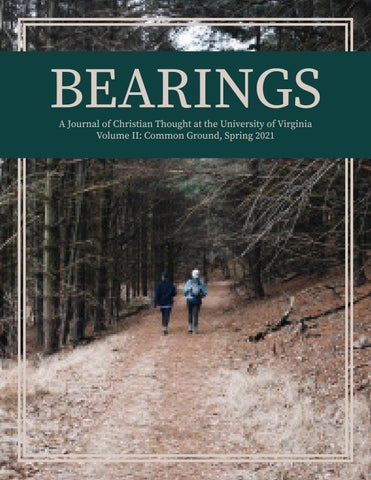
BEARINGS A Journal of Christian Thought at the University of Virginia Volume II: Common Ground, Spring 2021
Contents 04
09 THE DIFFICULTY OF BIBLICAL POLITICAL PHILOSOPHY by Connor Pearson
06 LETTER FROM THE EDITOR by Garrett Hicks
JUSTICE by Meredith Brooker
COMMON GROUND WITH UNCOMMON HEROES by Julie Wilson
CHRISTIANITY AND GOVERNMENT Anonymous
MY SUN AND STARS by Elizabeth Armistead
THE TEAM
WINDY SIGHTINGS by Victoria Van Dixhoorn
14 10
05 2
12
08
25
17 20
33 THE FLOWERS OF FOLIES-BERGERE by Elizabeth Armistead
I HAVE SOMETHING TO SAY by Elizabeth Armistead
MICROSCOPIC BEAUTY by Eli Benn
KISSING POPPIES, PUSHING DAISIES by Blake Cox CULTIVATING KINGDOM CULTURE AWAY FROM UVA by Renée Lin Mitchell
GOD IS LOVE by Sarah Shepherd CREATION CARE AS A CHRISTIAN IMPERATIVE by Lauren Kim
18
ACKNOWLEDGEMENTS
26 22
34
3
Letter from the Editor Dear reader, I had the pleasure of introducing the first edition of Bearings just over one year ago. If you take a look at the cover of that journal, you will see an image of an asphalt road leading into the warmth of a setting sun. Upon closer examination, you may even notice a small, unassuming subtitle—“finding your direction amidst the chaos.” While reflecting on the present experience of disease, inequality, racial injustice, political violence, and death, I am made more aware of the limitations to my ability to create order and find truth. For this edition, we asked students to submit pieces under the theme “common ground.” I imagined submissions that would engage in public discourse while advocating for a shared sense of unity in Christ. In response, our writers and artists created pieces that lean into dissonance and mystery to engage in a much deeper level of questioning than I expected. Some articles complement one another, easing tension and creating a shared understanding of Christian responsibility. Others leave contradictions unresolved and questions unanswered. In the following pages, you will read pieces that advise caution in political discourse next to authors who justify political action with biblical text. Throughout, there is a collective struggle to comprehend God’s character and find voice, captured in one author’s cry, “I have something to say, but I can’t.” Voice. Proverbs 18:21 says that “the tongue has the power of life and death.” Technology has given birth to platforms that place a megaphone in the hands of millions, granting writing new potential while surrounding us with ever increasing noise. This edition has taught me that the measure of an editor is not the ability to write; it is the willingness to listen. In Luke 1:20, God silenced Zechariah. In taking away his voice, God called Zechariah to humility in a state of listening. It is my hope that the pieces in this journal not only inspire you to speak truth, but that they also encourage listening and togetherness in the search for common ground. I cannot adequately express how grateful I am to all of the editors, artists, photographers, and designers who contributed to this journal. I am especially thankful for the friends, family, and supporters who gave their time and resources to support our work. Finally, I am grateful for you, dear reader. Thank you for giving your time, earnest consideration, and sincere response to our journal. Grace and peace, Garrett Hicks Editor-in-Chief
4
Editor-in-Chief
Publicity Head
Logistics Head
Financial Head
Design Head
Copy Editor
Garrett Hicks
Eli Benn
Abby Vendt
Ellery Huffman
Christopher Clemens
Jessica Tennis
Editors
Annika Reynolds Bennett Crow Connor Pearson Dakota Baker Jessica Tennis Jimmy Winner John Godfrey Mia Oppler Michael Lu Sarah Ross Sarah Shepherd Sophia Kerns William Craig
Design Team Caroline Peterson Caroline Stoerker Christopher Clemens Ellery Huffman Ellie Wilkie Karen Cortez Rachel Delaney
5
Common Groundwith Uncommon Heroes Hawkeye and Christian Redemption in Avengers: Endgame by Julie Wilson Return to the past. Get the Infinity Stones. Undo Thanos’s Snap, which wiped out half of the universe’s population. This is the mission that the Avengers undertake in the movie Avengers: Endgame (2019). Most of the Avengers seek to fix their original failure to stop Thanos in Avengers: Infinity War (2018), but Hawkeye seeks to fix his mistakes that happened after the Snap. Endgame beautifully depicts Hawkeye’s journey “from righteous to dirty and back to righteous again...returning to his family, both his Avengers family and his blood family” (Jackson). Both moral restoration and relational restoration play a crucial part in Hawkeye’s redemption, and these types of restoration also play out in God’s redemption of humankind. Whether intentional or not, Hawkeye’s arc in Endgame has heavy Christian undertones, and it demonstrates that the core elements of the Gospel can be found even in secular superhero movies. By examining the similarities between Hawkeye’s redemption and Christian redemption, I aim to explore the fundamentals of Christian teaching and to emphasize their relevance to all audiences, whether nerdy English majors (like me!) or mighty superheroes.
“For God did not send his Son into the world to condemn the world, but to save the world through him.” 1. Everyone, including superheroes, needs some saving.
Despite his archery skills, Hawkeye is just as susceptible to pain, anger, and vengeance as any other human. When his entire family dies in the Snap, he leaves the Avengers and becomes a rogue killer, senselessly taking human life where he once fought to protect it. Black Widow, his friend and fellow Avenger, finally locates and confronts him in Tokyo, where he is committing one of his vigilante (if we can call it that) killings. In the ensuing conversation, Black Widow reminds Hawkeye that his actions are futile (“Killing all these people isn’t going to bring your family back”) and tells him, “We found something. A chance [to undo the Snap].” She sees the internal pain and hopelessness that drive his actions, but she refuses to condemn him or write him off as too far gone. Black Widow recognizes Hawkeye’s need for redemption, and her words are a harbinger of hope that offers Hawkeye an opportunity to change. Black Widow functions in Endgame as a “Christ figure,” a character who shares certain qualities with Jesus. Like the shepherd who leaves the ninety-nine sheep to seek out the lost one, Black Widow leaves the Avengers’ base to bring Hawkeye back to the team. Her decision to help Hawkeye, rather than condemn him, is reminiscent of Jesus’ words
6
in John 3:17, “For God did not send his Son into the world to condemn the world, but to save the world through him.” God could have sent Jesus to justly convict and punish the world for its many sins, but He instead offers the world “[a] chance” to return to Him through Jesus. Hawkeye’s arc in Endgame conveys the same message: we can be found even if we do not know that we are lost, but understanding that we were lost allows us to joyfully appreciate the finding. 2. We all need someone who is stronger than ourselves to save us.
Hawkeye is unable to free himself from the despair and violence in which he is ensnared. Consequently, he needs someone who both understands his situation and is removed from it. The answer, in this instance, is Black Widow. In an earlier movie (The Avengers, 2012), Black Widow reveals how she once fought against S.H.I.E.L.D. (the organization that created the Avengers) before Hawkeye convinced her to switch sides and join S.H.I.E.L.D. How could she convince Hawkeye to return to the Avengers if she herself was still operating against S.H.I.E.L.D.? We see something similar happening in the Gospel. Jesus’ fully divine and fully human nature allows Him to experience human life without being corrupted by the world’s sins.
C.S. Lewis draws a similar comparison when talking about Jesus’ salvation of humankind in Mere Christianity: If I am drowning in a rapid river, a man who still has one foot on the bank may give me a hand which saves my life. Ought I to shout back (between my gasps) “No, it’s not fair! You have an advantage! You’re keeping one foot on the bank”? That advantage—call it “unfair” if you like—is the only reason why he can be of any use to me. To what will you look for help if you will not look to that which is stronger than yourself? (61) This foot on the bank, to use Lewis’ words, does not make Black Widow unwilling or unable to reach out to Hawkeye. Indeed, at the end of their conversation in Tokyo, she physically reaches out and grabs Hawkeye’s hand, a gesture of comfort and hope. This, too, is reminiscent of Jesus, who is willing to touch the lepers, the sick, the dead, and the “unclean” in order to heal them physically and spiritually—even though it costs Him His life.
3. Our need for redemption necessitates a sacrifice. Hawkeye returns to the Avengers, but that does not end his quest for redemption. Rather, it ends on the planet Vormir, where he and Black Widow discover that one of them must die in order for the other to get the Soul Stone. As they try to figure out what to do, Hawkeye says to Black Widow, “You know what I’ve done. You know what I’ve become.” With his past crimes in mind, he does not consider himself worthy to have Black Widow sacrifice herself for him. He later explains to the other Avengers, “It was supposed to be me.” Nevertheless, Black Widow indicates that Hawkeye is worth dying for, saying, “I don’t judge people on their worst mistakes…You didn’t.” Not only does Black Widow remind Hawkeye of the mercy he showed her, but she returns it to him in this moment. She is the one who throws herself off the cliff, allowing Hawkeye to retrieve the Soul Stone and, eventually, to reunite with his family on Earth. We can all relate to Hawkeye’s situation. The Bible says, “all have sinned and fall short of the glory of God”
and “the wages of sin is death” (Romans 3:23, 6:23). Because all have sinned, all deserve death; and if God is the source of all life and is “the Life” (John 14:6), then an eternity in hell - forever away from God - is death. It is not pleasant to think about sin and hell, but it is necessary to do so. Only by acknowledging what “was supposed” to happen (to use Hawkeye’s words) can we marvel at what actually did happen: Jesus, not us, paid the price for our sins. Jesus and Black Widow’s sacrifices are so moving because they willingly gave their lives for those who do not deserve to profit from their deaths. That being said, the two sacrifices have substantial differences. Black Widow’s death allows the Avengers to get the Soul Stone and to bring everyone back from the Snap, but it does not address the problem of sin in the world, nor can the Avengers bring Black Widow back from the dead. Jesus’ death, however, does not end in death but in His resurrection and in the new life He offers. As Paul continues in Romans 6:23, “the wages of sin is death, but the gift of God is eternal life in Christ Jesus our Lord.” Black Widow’s death only brings back the living organisms that Thanos killed with his Snap five years ago; Jesus’ death and resurrection offers eternal life for all humans, whether they lived before, during, or after His incarnation. I frequently cry at movies, but to my surprise, I only cried at the Vormir scene when I first saw Endgame. Watching Hawkeye and Black Widow drew my thoughts to the love, pain, and willingness that Jesus showed on the cross. Endgame is not a retelling of the Gospel, as blogger Griffin Paul Jackson cautions. But, Jackson does note, “It is definitely an important conversation-starter for so many fundamentals of faith.” Hawkeye’s encounters with Black Widow remind us of our need for forgiveness from previous wrongdoings, as well as our longing for a restored relationship with God and with others. In a sense, we are superheroes who seek redemption, and we ultimately find it not in ourselves but in the greatest Superhero: Jesus.
Avengers: Endgame. Directed by Anthony and Joe Russo. Released 26 April 2019. United States. 181 minutes. Viewed through SWANK Streaming Film Database, Swank Motion Pictures. Accessed through the University of Virginia, 28 February 2020. https://digitalcampus-swankmp-net.proxy01.its.virginia.edu/uva296909/#/play/52E70B25B18A816C?watch=1. “Avengers: Endgame (2019) - Jeremy Renner: Clint Barton, Hawkeye.” IMDb. IMDb.com, Inc. Accessed 25 February 2020. https://www.imdb.com/title/tt4154796/characters/ nm0719637. Used to help with the quotes I pulled from the movie. Jackson, Griffin Paul. “‘Avengers: Endgame’ as Christian Commentary.” Griffin Paul Jackson (blog). Griffin Paul Jackson. 6 May 2019. Accessed 27 Mar 2020. https://griffinpauljackson. com/2019/05/06/avengers-endgame-as-christian-commentary/. Lewis, C. S. Mere Christianity: Comprising The Case for Christianity, Christian Behaviour, and Beyond Personality. 1st Touchstone ed. New York: Simon & Schuster, 1996. NIV Study Bible. New International Version (NIV), fully revised edition (2002). Published by Zondervan in 2002.
7
Windy Sightings by Victoria Van Dixhoorn
8
Justice
by Meredith Brooker
What about the good people? The ones who don’t proclaim you, intentionally or unintentionally. What about the good people? What about those who just don’t know? They were born into another, maybe they were never told. What about those who just don’t know? But you are good, and you are Just. So help me love, and help me trust. For if it is that they will fall, Lord, help me be a light to all.
9
by Elizabeth Armistead
I used to talk to the stars And people stared at me I used to laugh at the sun And you got up to leave I was silenced behind the scenes The maelstrom of my mind cut short An aberration of society Used to make others sport I was supposed to cloud the star in me, the sun about to leap Cause Mommy said the other girls liked it hidden deep It’s not that I’m dangerous, cruel, or even crude It’s just that my mind bubbles as it brews It’s not that my thoughts undermine command It’s just that my schemes follow different plans I may look the same, but since I don’t conform, I am an alien Ostracized and scorned Now it’s all quite different, my sun and stars can shine Mommy says the other girls love me all the time 10
by Emily Zekany
Acceptance is a virtue, lacked by the depraved And now the other girls and I all act the same I suppose it’s cause they scorned me I’m sorry, I didn’t mean it, are you okay Yes I’m fine, I’ve been waiting for this day The day my sun paints the sky And my stars twinkle without a lie My maelstrom whirls free Somehow tamed by a fee My bubbling brew bursts open No flame to sustain it Regardless of the reason or the rhyme Mommy says the other girls take the same pills all the time We didn’t understand you But we want to make it better I think the other girls realized something They learned to be accepting Empathy strikes back But where does the journey end I don’t think they know That not everybody’s maelstrom is as pure and white as snow But at least they learned that different isn’t a deep crack Or maybe they finally learned the thing conforming lacks 11
The Difficulty of B i b l i c a l P o l i t i c a l P h i l o s o p hy A call for charitability and reconciliation between Christians of all political stripes by Connor Pearson
12
When Christians invoke scripture in political
addition, many pro-slavery Christians of his era pointed
discourse, they almost always fail to acknowledge that
to the passages of the Torah and the epistles that regulate
informing public policy decisions on the basis of Jesus’
slavery. Supporters of slavery contended that these passages
teachings is an extremely difficult task. Unlike the Old
implicitly demonstrate God’s approval of slavery. For
Covenant between God and the Israelites, the New
example, Richard Furman, an influential Baptist pastor,
Covenant between God and followers of Jesus does not
wrote “for the right of holding slaves is clearly established
establish a civil government to govern God’s people. To
by the holy scriptures… in the Old Testament, the Israelites
create such an authority would be impossible, as under
were directed to purchase their bond-men and bond-maids
the New Covenant, God’s chosen do not comprise a single
of the Heathen nations.” If slavery truly was an affront to
nation. As a consequence, scripture does not provide
his character, so the argument went, then God would not
unequivocal guidance on the vast majority of today’s
have established rules for the institution.
political debates. And yet, unfortunately, Christians of
all political stripes often act as though their respective
theological debate by demonstrating the fundamental
ideologies are expressed verbatim in the Bible. Unless one
inconsistency between the practice of slavery and the
desires that our government adopt the civil law of Israel to
Bible’s recognition of the equality of peoples. As Charles
the letter, this confidence is unjustified. The Bible simply
Spurgeon remarked, “to hold our fellow creatures in
does not offer obvious answers to most important current
bondage is a sin, and a damnable one, inconsistent with
policy discussions.
grace.” It is impossible to reconcile slavery with the gospel’s
message of grace. Nor is it consistent with the golden rule,
Slavery in the history of the church provides
Christian abolitionists ultimately prevailed in the
an illustration of the challenges of biblical political
to do unto others as you would have them do unto you. And
philosophy. Throughout modern church history, many
it is incompatible with the second greatest commandment,
faithful servants of God’s have sincerely believed that the
to love one’s neighbor as oneself, the commandment that
institution of slavery is consistent with biblical values.
scripture teaches is the foundation for the rest of the law
A prime example is Jonathan Edwards, who played a
and prophets along with the greatest commandment. Yet
pivotal role in the First Great Awakening and delivered the
the battle was hard-fought because of the lack of explicit
classic sermon “Sinners in the Hands of an Angry God.”
condemnations of bondage in scripture. Herein lies the
In spite of being perhaps the most influential spiritual
crucial lesson about the Bible and politics. If scripture can
leader in the history of our nation, Edwards owned several
be so easily twisted to support a practice as morally heinous
slaves during his lifetime and defended the practice. In
as slavery, we ought to be abundantly humble about our
political beliefs regarding issues of lesser gravity.
and respect them, provided that this does not contradict
God’s will. Hence, the New Testament does not offer a
The enormous theological disagreements between
Christians further illuminate the challenge of discerning
blueprint to follow for believers who are able to choose
God’s will for our decisions in the voting booth. The Bible’s
their government officials. Instead, Christians must turn
purpose is to instruct believers about God, the history of
to the passages of the word that instruct them how to treat
mankind’s redemption, and morality. It is a theological
their fellow image-bearers and use inference to arrive at
text. In spite of this, there is a vast range of theological
conclusions on public policy, a task that is fraught with
issues upon which Christians vehemently differ. Just
adversity and extraordinarily contentious.
within the evangelical community for instance, there is no
consensus on the nature of predestination, infant baptism,
historically unprecedented gift of choosing how the
the apocalypse, ordination of women, or a host of other
government is run. Like all gifts, Christians should give
debates with important implications. And the theological
thanks to God for the right to vote and earnestly study
disputes between the thousands of denominations
scripture to discover how to use this gift for his glory.
comprising Christendom worldwide are endless. In light
Unfortunately, this particular gift has served as a potent
of this diversity of opinion on what the Bible teaches about
weapon in the Enemy’s arsenal to divide the body of
its primary subject matter, Christians should be far less
believers. Christians ought to be concerned with the
confident in their views on politics, a secondary if not
administration of our earthly kingdoms. The Bible’s
peripheral focus of scripture.
emphasis on justice demands that believers advocate for
reform that reflects God’s character. Biblical teaching
The inherent difficulty of biblical political
Citizens of the United States are afforded the
philosophy stems from the fact that God did not send his
mandated the abolition of slavery, for example. But for
Son into the world to be the political leader of His people.
political debates on which the Bible does not speak as
In the realm of politics, Jesus’ ministry could scarcely
clearly, believers must not let earthly affairs hinder their
be further from revolutionary. His only instructions to
efforts to further the glory of the Kingdom of Heaven.
believers regarding the state command his followers to
Disunity in Christendom over biblically disputable
obey the earthly authorities God has placed over them, such
political controversies impairs the body of Christ’s ability
as the teaching from Matthew 22:21 to “render therefore
to fulfill God’s commands. Christians’ foremost duties are
unto Caesar the things which are Caesar’s.” Christians
to carry out the great commission and to obey the greatest
are to treat the political institutions over them as given
commandment: their civic duties must come second.
13
CHRISTIANITY AND GOVERNMENT Anonymous
In November 2019, pastor Bill Devlin got tear gassed on a Hong Kong street. He later recalled, The tear gas fell right at my feet and within 10 seconds my eyes were on fire and I couldn’t see. It was about three minutes before I could see. I had to wash it out with one of those spray things of saline solution (Smith, 2019). Pastor Bill Devlin is the Missions Pastor of Infinity Bible Church in New York, and he traveled to Hong Kong to support the prodemocracy protest and pray for the release of the students. How did this all happen? Why would an American pastor join the protest against the Hong Kong government? And what did the Chinese government do to anger those Christians? In order to understand, we should look into the current religious atmosphere in China. According to government estimates, about 12% of the Hong Kong population are Christians. Many fear that their religious freedom will be the first 14
to go away when the mainland government obtains full control of the Hong Kong area. Their fear is not rootless. The Chinese government has a long history of suppressing religious freedom. Despite being a right written in the Chinese constitution, religious freedom only applies to the five religions recognized by the state (Albert, 2018). Christians and other religious groups are facing great difficulties in China. In 2018, the Chinese government tore down many churches, including megachurches that can hold over 50,000 people for worship services. They have also arrested many pastors that are not sanctioned by the state (Goldman, 2018). Christians are not the only ones who are suffering. According to Adrian Zenz, a German scholar who testified before U.S. Congress and Canada’s Parliament, more than 120,000 members of China’s Muslim Uighur minority are detained in the “re-education” camps in the Xinjiang region, where inmates undergo months or years of indoctrination aimed at transforming them into secular and loyal supporters of the party. The relatives and families of those detainees are told that they are being reeducated so that they will
not be influenced by extremists and there is no need to worry about their living conditions. According to leaked official documents obtained by New York Times, Chairman Xi stated, “we must be as harsh as them... and show absolutely no mercy.” (Phillips, 2018) Although other religious groups have not suffered the same level of persecution, many fear that the political environment is only getting worse. The history of Christianity in China is long and tortuous. Christianity was first brought to China by Italian Jesuit missionary Matteo Ricci in the late sixteenth century, and Protestant missionary Robert Morrison translated the Bible into Mandarin (Albert, 2018). Historically, Christianity has been associated with some political movements, most notably the Taiping Rebellion. After the People’s Republic of China was established in 1949, the government declared itself “atheist” and took down many houses of worship, especially during the height of the Cultural Revolution. After the death of Mao, the state loosened its grasp on religion by formally recognizing 5 religions - Buddhism, Catholicism, Daoism, Islam, and Protestantism. However, religious activities are still heavily regulated by the State Administration for Religious Affairs, which manages everything from selection of the leadership and clergy to the interpretation of doctrine. Besides the state approved Three-Self Patriotic Movement churches, there are many underground “house churches” for those who do not agree with the official doctrine from the government. These house churches are not protected by the Chinese constitution and are frequently shut down by the government. On September 7, 2017, China’s State Council released a revised version of the Religious Affairs Regulations, which launched the fiercest campaign against house churches since the 1980s (Zhang, 2017). Later in 2018, the state shut down many well-known house churches, including Rongguili Church in Guangzhou, Xunsiding Church in Xiamen, and many others in major cities. Despite the adversity, the Christian population in mainland China is growing steadily. According to the Financial Times, there are an estimated 100 million Christians in China, which is more than the 86.7 million members of the Chinese Communist party. If Christianity continues to spread at its current pace, the country is likely to have the world’s largest Christian population within the next 15 years. (Anderlini, 2014) Chinese churches are even sending out missionaries as part of the Back to Jerusalem movement. These Chinese missionaries aim to evangelize the unreached peoples from eastern provinces of China, westwards towards Jerusalem. Starting in 2000, they have been sending many missionaries to west Asian countries to evangelize (Back to Jerusalem). The rise of Christianity has increased concerns among the Chinese officials. Fenggang Yang, director of the Center on Religion and Chinese Society at Purdue University, states that “Chinese officials often cite the experience of Poland, where they believe the Catholic Church helped destroy communism and, although the two situations are not really comparable, the party still sees Christianity as a very serious threat that it needs to suppress.” What if Christians outside of China are also facing a similar situation? No one wants to think about the possibility that it will ever happen, but we need to be prepared. How do we act if we are caught between Christianity and the government or authorities? Pastor Wang Yi set an example for us. He was the senior pastor of Early Rain Covenant Church in Chengdu, China, a house church consisting of over 700 people before the authorities shut it down in 2018. Over 100 people were arrested during the crackdown and pastor Wang Yi was one of them. He was sentenced to prison for 9 years for “inciting subversion” (Lew, 2018). Knowing that he would likely be arrested someday due to his outspokenness, he prepared a declaration 15
to be published by his church should he be detained. The declaration titled “My Declaration of Faithful Disobedience” draws important references from Romans 13 that, regardless of the forms they may take, all governments are instituted by God and as Christians we should not resist their judgement. However, he also points out that if the will of the government directly contradicts God’s will, Christians must obey God even if it means suffering punishment from the government (Yi, 2018). As members of the body of Christ, we are called to “Learn to do right; seek justice. Defend the oppressed” according to Isaiah 1:17. We need to support those who are being oppressed, especially other brothers and sisters in Christ. We should not remain silent on that issue, instead we should help each other through prayers and peaceful demonstrations, even if they are far away. We should also learn the important lesson
from Chinese Christians that we ought not take religious freedom for granted, and we need to ensure that it will not go away. No one should be persecuted because of their religion alone. And for those who cannot practise Christianity freely and may face persecution as a result of it, Peter wrote in 1 Peter 4:12-14, “Beloved, do not be surprised at the fiery trial when it comes upon you to test you, as though something strange were happening to you. But rejoice insofar as you share Christ’s sufferings, that you may also rejoice and be glad when his glory is revealed. If you are insulted for the name of Christ, you are blessed, because the Spirit of glory and of God rests upon you.” It is difficult to not be afraid and instead rejoice when under trials, but if we put our trust in our Lord there is no persecution too great to suffer.
Smith, Samuel. “American Pastors Tear-Gassed in Hong Kong as They Supported pro-Democracy Protesters.” The Christian Post, 2 Dec. 2019, www.christianpost.com/news/american-pastors-tear-gassed-in-hong-kong-as-they-supported-pro-democracy-protesters.html. Goldman, Russell. “Chinese Police Dynamite Christian Megachurch.” The New York Times, The New York Times, 12 Jan. 2018, www.nytimes.com/2018/01/12/world/asia/china-church-dynamite.html?action=click&module=RelatedCoverage&pgtype=Article®ion. Lew, Linda, and Guo Rui. “Chinese Pastor Wang Yi Gets Nine Years in Jail for ‘Inciting Subversion’.” South China Morning Post, 30 Dec. 2019, www.scmp.com/news/china/politics/article/3043887/chinas-pastor-wang-yi-gets-9-years-jail-inciting-subversion. Yi, Wang. “My Declaration of Faithful Disobedience.” China Partnership, 12 Dec. 2018, www.chinapartnership.org/ blog/2018/12/my-declaration-of-faithful-disobedience. Phillips, Tom. “China ‘Holding at Least 120,000 Uighurs in Re-Education Camps’.” The Guardian, Guardian News and Media, 25 Jan. 2018, www.theguardian.com/world/2018/jan/25/at-least-120000-muslim-uighurs-held-in-chinese-re-education-camps-report. Albert, Eleanor. “Christianity in China.” Council on Foreign Relations, 11 Oct. 2018, www.cfr.org/backgrounder/christianity-china. “About BTJ.” Back to Jerusalem, backtojerusalem.com/about/. Anderlini, Jamil. “The Rise of Christianity in China.” Financial Times, 7 Nov. 2014, www.ft.com/content/a6d2a6906545-11e4-91b1-00144feabdc0. Zhang, Laney. “China: Revised Regulations on Religious Affairs.” Global Legal Monitor, Library of Congress, 9 Nov. 2017, www.loc.gov/law/foreign-news/article/china-revised-regulations-on-religious-affairs/.
16
I Have Something to Say by Elizabeth Armistead
I have something to say But I can’t My lips move, my tongue stinging from the bitterness of all the wrong words And I want to refine them, craft them Shape them into elegant perfection that the speaker will savor as each syllable slips softly from their tongue Each dribbling drop plopping into place But the spoken word is not a shelf of tomes arranged in a predetermined order It is a living organism Each speaker births blossoms that shiver in sighing wind Antiquated limbs crossing over each other and weaving wildly Millions of names clinging to one blossom that smells as sweet And I have something to say But caught up inside the eloquence of this place I can’t Because each syllable slithers into nothingness as it is born away on the sighing wind A discordant jumble of notes crying out against the abuse And I have something to say But I can’t
by Eli Benn
17
GOD IS LOVE by Sarah Shephard
During August of 2017, I was moving into college in a city that was making national headlines – and not for a good thing. All of my parents’ friends and my family were asking me if I was nervous to be moving to Charlottesville just one week after such an event. If I’m being honest, I really didn’t understand what had happened. I knew there were some people called Neo-Nazis with torches and someone had been run over by a car. I knew I had gotten a heck of a lot of emails from UVA after this event. But still, when people asked me how I was feeling about moving in after this, I would just kind of chuckle and say that I hope it didn’t happen again while I was there. I didn’t get it. As I spent my first week navigating a new place and attending class for the first time, every professor opened up the first class with a discussion of what happened on August 11th & 12th, saying that Charlottesville was a place of love and inclusion, not hatred. Now that was something I thought I understood and could get behind, but I still didn’t really get just exactly what that meant either. Fast forward one month to the benefit concert for the community of Charlottesville and I’m sitting in Scott Stadium listening to Justin Timberlake and Ariana Grande – for free. I was stoked. But I still didn’t get it. I can’t put my finger on the moment when I truly understood the magnitude of what happened. Maybe it was hearing stories from Lawn residents who had just moved into their new homes August 11th, excited for the start of another year of school and memories. Instead of celebrating this occasion, these 21 year olds locked the doors to
18
their homes and hid in their rooms, having nowhere safe to go, just wondering if they were going to make it out of that night unscathed. Think about that. Really consider the magnitude of those emotions thrust upon these students. That’s not something a college kid should have to endure. Maybe it was after hearing the account of one of the first responders to Heather Heyer, the woman whose life was taken after a car was driven into a peaceful protest. His story forced me to come to the realization that this was actually a real and damaging thing that happened where I live, something that I knew but was probably choosing not to process. Or maybe it was the story of an African American woman attending a prayer meeting in a church surrounded by the protestors who had to remain there until everyone was gone, even though the white people were able to safely walk out the doors.
Maybe it was in a conversation about what it means as a Christian to pursue reconciliation between every race and ways to heal brokenness in our unjust society. That was a new thing for me in college. Not only was I plunged into a community that showed me that injustice really existed in a very tangible way, but I also discovered that the God who loves me cares deeply about these issues. Contrary to the narratives I had grown up hearing, these conversations led me to the conclusion that pursuing justice isn’t just a “liberal agenda” tacked on to Christianity, but a critical component of the gospel. God mourns and laments our broken world. God’s heart broke for Charlottesville that day. He despises injustice and hate. His desire is that we love and take His love to the broken places, where He already dwells and is big enough to redeem.
I’m not claiming now to understand everything that happened that day, but I have begun to comprehend it. This world is so broken. I just don’t understand that kind of hate. Especially from people saying they are Christians. Mankind is made in God’s image, how can a Christian so strongly hate something made in the image of their Father? In Matthew 22, Jesus gives his followers their greatest commands: to love God and to love their neighbor as ourselves. LOVE! That is it. That is what we are supposed to do - mirror the unconditional love our Father has for us. To those who don’t share my faith that are reading this, I am sorry that people who claim to love God hate people. I’m even more sorry if you have been on the receiving end of this hate. Because that’s not what God is about. He loves you and every one of his children so deeply. Now, I’m not trying to say that I am perfect and a model for love because that’s far from the truth. It’s my goal to try though. As I continue to study at UVA, I hope that Charlottesville makes some more national headlines. My desire is for Charlottesville and UVA to be known for their radical love. I have found a place of love and home here that everyone deserves. So, to my peers at UVA, let’s love together – this incoming class of first years, our classmates, our roommates, the people we don’t really have a lot in common with, even people who don’t really seem to love us back. Because at the end of the day, we are all human, and humans need love.
by Josh Kim
19
Kissing Poppies, Pushing Daisies by Blake Cox Randell couldn’t see what he was doing. For the past year, a hard life had caught up to him and he was going blind. I made him a plate of food. Honey-glazed ham, roasted turkey, stuffing with gravy, and green bean casserole were dolloped in heaping mounds onto his plate. We sat beside one another at Nana’s kitchen table. As he began chomping-down in his typical, pig-at-a-trough manner, I looked at my uncle and thought: “This will be the last time I ever see him alive.” It was Tuesday, December 25, 2018. One month and one day later, after a jovial evening listening to ‘90s grunge at a friend’s house, I was on my way home when I noticed several missed calls. My battery was nearly dead. “Of course!” I yawped to myself. No one ever calls me. When family calls this many times they usually want something or it’s an emergency. I didn’t have enough battery left for messages, so I called my mother hastily. Four or five rings in, my phone died. It was late and I knew where the cops lurk. I sped home with little regard for the law, pushing my 2006 Volkswagen Golf to its limits. My heart pumped with anxiety for twenty minutes. Finally, I arrived home. Randell was in the ICU. I was quickly enraged. “How can he keep doing this! Doesn’t he know how much he puts us through?” I howled to my mother. She placated my anger as we raced to the hospital. Less than a mile down Bundle Road, my Auntie CC called. There was nothing that could be done that night. The doctors needed to run tests. Mom turned the car around at Spencer’s gas station; we would go to the hospital in the morning. It was no big deal. We thought he’d come to. He always did. The following day I went into his room alone. My family didn’t have a pastor, so I was compelled to guide Randell through prayer. As he lay there unconscious, his body writhing from left to right - a result of his brainstem detaching from his spine - I placed my hand on his arm, encased with hair like a boar bristle brush, and began to pray. That shadowy, demonic figure appeared in my periphery. I’d seen him before - he wants me, but he knows I’m not his. A consolatory voice invaded my mind, whispering: “Ignore him. Do not look into the corner.” I continued praying and whispered in my uncle’s ear, “You were always my favorite.” His arms curled up like a dying spider, he let out a deep sigh. With my hand on his chest, which was more plush than his arm, I felt my uncle’s heartbeat fade incrementally. Fifteen minutes later, he passed from this world to the next. It was January 28, 2019, the day after our demonic confrontation. My other uncle, Jeffrey, said it was fitting that Randell’s heart was the last part of him to cease. Randell was all heart. He had just turned fifty in November. I hadn’t seen him since Christmas.
“How can he keep doing this! Doesn’t he know how much he puts us through?”
20
by Eli Benn
Jeffrey was my only remaining blood uncle. Our relationship had always been contentious, but the rift between us had mellowed since I became a man. He was only fourteen when I was born and was used to being the family’s baby. For years, he abused me out of jealousy. Bullying me was a pastime for him. Rather than teaching me the rules of football, he taught me the pain of the game. Hyperextended fingers, a bruised chest, bringing me to tears, these were his main objectives. Randell never treated me poorly. We were all fatherless little boys and I looked up to them both. Jeffrey was street-smart. No cop or criminal could outwit him. Having deep contempt for them myself, I relished in the fact that neither could catch him; despite my disapproval of his lifestyle. What would happen to him three months after Randell’s death was dispiriting, to say the least. It was midnight, May 4, 2019, when I received the call. Again, I had missed calls from my Auntie CC, Nana, and my cousin, Dallan. I finally answered. It was Dallan, Jeffrey’s son. “My dad’s dead, Blake!” he bewailed. “It’s a crime scene!” I told him I loved him, broke the news to my mother, and we were off. I drove my inconsolable mother and cousin, Brylee - Randell’s daughter - to Nana’s house. We took mom’s Volvo V60 this time; its T5 engine screams compared to my hatchback. We arrived on the scene, my Nana’s abode teemed with Chesterfield’s “finest.” They infested the house like ants, but lacked the mental fortitude of those little creatures. They were insolent toward my family, wearing scornful faces. I burst through the front door, walked down the hall, and there he lay. Jeffrey rested where my Auntie CC used to do her hair like Cyndi Lauper, not far from the oil furnace where me and my cousins dried off after a day in the snow as children. He was already cyan-blue, with his typical, devious smirk on his face. I prayed over another uncle. Before I arrived, Jeffrey’s demon left. There would be no spiritual battle like Randell’s. He died, alone, in my Nana’s bathroom. The snow-white, plastic bags taped over his hands will never escape my memory. He was forty-seven. Each of my uncles kissed their poppies differently. Randell gobbled his down like Christmas dinner: Xanax and oxycodone. Jeffrey, like an Eskimo, kissed his nasally: cocaine laced with dimethylfentanyl, among other opiates. That tombstone-gray powder was nearly ninety percent fentanyl, which explains his euphoric smirk. When you kiss a poppy, you always run the risk of pushing daisies. In all situations, no matter how demonic, Christ shows his love. Love is getting right with the Lord before we die; like Randell. Like the Apostle Paul, he was blinded to draw him closer to Christ. Love is giving a friend your last dose of Narcan, moments before your own death; like Jeffrey. Despite Jeffrey’s lifestyle, he was saved many years before his addictions consumed him. As the Pastor Charles Stanley would aptly put it: “No matter when, how, or why we die, we are saved.” Is it possible to love two men, both of whom treated you differently? I did. I still do. True love means honoring my uncles, regardless of their demons. They are the Lord’s now. They are always mine. They no longer belong to their demons.
21
Creation Care as a Christian Imperative by Lauren Kim
22
by Eli Benn
God blessed them and said to them, “Be fruitful and increase in number; fill the earth and subdue it. Rule over the fish in the sea and the birds in the sky and over every living creature that moves on the ground.” (Gen. 1:28) In simple terms, Creation care is the act of stewarding over all of God’s natural handiwork. In the beginning, God gave Man the responsibility of ruling over the natural world. God’s call to stewardship did not just stop at Adam; all people inherit this call today. I believe the call to Creation care is just as important to the Christian identity as volunteering or mission work. Contrary to popular belief, environmentalism is not just a secular movement but also spiritual duty. Before I address why Christians should care, we must understand the concepts of stewardship, ownership, and rulership. It is important to remember that the world belongs to God and we are just stewards on His earth. If God is likened to a farmer, then mankind is like a farmhand who works for the owner and tends to his lands and animals. As stewards we should not trash God’s property; rather, we can respect God by maintaining His creation and using the resources He gave us responsibly. When God asks us to rule over the Earth, He is asking for humans to care for, not abuse, nature. Christians should protect the environment because God owns and loves the natural world beyond just mankind. In Genesis 9:8-17, God shows His affection for his nonhuman creation through the Noahic covenant. This covenant is a promise to never flood the Earth again between God and all of creation. This promise is not just to Noah but with “every living creature” (Genesis 9:10). That subtle but emphatic distinction shows that God remembers and cherishes His other creations. If God had no love for nature, He would not have spared or respected wildlife in this way. The Christian
walk means honoring God’s words and values. Our Creator loves the natural world, as shown by His respect for both human and non-human life—we should follow his example. “He has sent me to proclaim freedom for the prisoners and recovery of sight for the blind, to set the oppressed free” (Luke 4:18) Environmental justice is a sanctity of life issue; Christians should have a heart for the environment because it intersects with social movements in line with God’s intentions. For example, Environmental racism is when historically minority areas are intentionally polluted, resulting in high illness rates[1]. Food pollution, like chemicals and microplastics in fish, are consumed by families across the world[2]. Climate change floods low-level lands forcing millions of locals to become refugees[3]. When natural disasters strike, the poor are disproportionately affected. While middle and upper class members can afford to move away or adopt expensive alternatives to all of these threats, the underclass is exposed to the sheer force of climate change and pollution [4] . Jesus makes it clear across scripture that to follow him means to aid the downtrodden and to protect life. If exploitation is causing even one precious life to suffer then we need to remove the root of the problem-misuse and abuse of the environment. Environmental decline does not discriminate and harms all life, meaning that environmentalism is, at its core, about protecting the sanctity of life. Thus, environmental abuse and the degradation of life, whether driven by racism or corporate greed, is antithetical to God’s plans and heart for compassion and fairness.
23
“For ever since the world was created, people have seen the earth and sky. Through everything God made, they can clearly see his invisible qualities—his eternal power and divine nature. So they have no excuse for not knowing God” (Romans 1:20) Our invisible God manifests Himself into visibility through His creation. If we want to make God more accessible to the human imagination, we need to keep the natural world intact. That way nature can continue to convey His holiness. Some Christians, like me, feel a certain divinity in the vastness of the universe or in the beauty of landscapes before they knew there was a God. Nature acts as an effective mediator by revealing the presence of the Lord. Consider the sheer number of Christian songs that use natural imagery to express The nature of God. When we destroy creation, we are cutting off access to see His face and glory. As God’s ambassadors, let us preserve nature so we can better represent God to humanity. The preservation of God’s creation is not simply about aesthetic beauty; nature is an essential way in which people experience God’s presence. The nations were angry, and your wrath has come. The time has come for judging the dead, and for rewarding your servants the prophets and your people who revere your name, both great and small-- and for destroying those who destroy the earth.” (Revelations 11:18)
characteristics should be to love God with all our soul, improve the world through good works, and respect all things. In light of these revelations, let us care for the poor and oppressed as commanded by the Gospel. Let us heal the Earth and solve problems that hurt the people across all backgrounds. Let us use nature as a mirror for God to make Himself known to the nations. God’s heart is inclined towards all creation, so let us too be compassionate for the Earth. Being a good steward doesn’t mean going to extremes to pursue a more sustainable life. I encourage you to incorporate a few of the following ideas into your life. God honors every effort no matter how small. • Start separating your trash into recyclables, compost, and waste • Learn about Creation Care • Volunteer at an animal rescue or shelter • Ask friends and family to go on a hike • Thrift or reduce consumption of fast fashion • Research about environmental injustices in your hometown/state • Read about company and government policies surrounding climate change • Pray about how you can use your skill sets to help protect the people, environment, and beings in this world. • Pray for those affected by environmental decline All Bible selections from the NIV unless otherwise noted
Stewarding the environment is a nonnegotiable decree from the Lord and inaction is disobedience to His plans. Creation care is a mandate from God himself and Christians need to listen to this call. God hates injustice, and environmental abuse is a sin against God, our neighbors, and our Earth. We cannot be complicit in this abuse or ignore God’s call. As Christians, our defining
24
[1] Mayhew-Bergman, Megan, “They chose us because we were rural and poor’: when environmental racism and climate change collide,” The Guardian, March 8, 2019, https://www.theguardian.com/environment/2019/ mar/08/climate-changed-racism-environment-south [2] Joyce, Christopher, “Microplastics Have Invaded The Deep Ocean - And The Food Chain,” NPR, June 6, 2019, https://www.npr.org/sections/ thesalt/2019/06/06/729419975/microplastics-have-invaded-the-deepocean-and-the-food-chain [3] Lewis, Sophie, “Millions of future climate refugees may need protection, U.N. committee warns,” CBS News, January 21, 2020, https://www.cbsnews. com/news/climate-change-refugees-united-nations-rules/ [4] Boustan, Leah, “Natural Disasters by Location: Rich Leave and Poor Get Poorer” Scientific American, Scientific American, July 2, 2017, https://www. scientificamerican.com/article/natural-disasters-by-location-rich-leave-andpoor-get-poorer/
The Flowers of Folies-Bergere by Elizabeth Armistead
25
Scattered: Cultivating Kingdom Culture Away from Home by Renée Lin Mitchell
To my friends who are international students and immigrants in the University and local Charlottesville communities– I admire you all so much more than you’ll ever know. You mean the world to me and are world-changers, each and every one of you! Thank you so much for your friendship. I am praying for you.
26
by Emily Zekany
R
elatively few people know what it is like to country - a heavenly one. Therefore God build a life for themselves far away from is not ashamed to be called their God, for
home. They often experience the struggles of He has prepared a city for them” (Hebrews learning new languages, adapting to new 11:13, 16). There we have it! Christians are cultures, and being viewed as an outsider citizens of heaven, sojourners on earth, when confined to the classroom through the immersed in the world yet not of it, eagerly likes of study abroad programs, or perhaps awaiting the return of Christ (Philippians for a few relaxing weeks on vacation. But for 3:20). They are far away from where they people who immigrate to another country belong, yet continue to hold their home close in hopes of a better life, homesickness and to their hearts. How should they adapt to barriers to communication tend to creep their current culture in the world? How much in at every turn. Having left loved ones should they adapt? What should they do in and previous careers behind in their home the face of cultural clash between the values country, they are now faced with the uphill of the world and the values of the Kingdom? climb of what seems like starting from scratch. In light of the pilgrimage of Christians, how
As much as these challenges may should their native citizens treat foreigners?
seem like a different world to those of us who To answer these questions, we shall first look have lived and thrived in our home cultures, at how the Bible provides plenty of in-depth these struggles ought to resonate deeply with portraits on people of God who were exiles Christians. Perhaps no one is as adamant in a foreign land, yet represented their home about this assertion as the author of the book well. of Hebrews, who presented a passage within
Rejected. Betrayed. Sold. He was a
that book known as the Bible’s hall of fame of slave, sent away by his own brothers, forcing faith, describing how men and women from him to trek from his father’s land in Canaan Scripture have sought to glorify God. The text to Egypt. There, the captain of the Egyptian stresses that the great heroes of the faith listed guard, Potiphar, purchased Joseph and put in chapter eleven were “aliens and strangers him in charge of his household. At first, things on earth” who “were longing for a better were looking up. Joseph was an excellent 27
steward of his master’s resources and managed with God at all during his time in prison? Even after them well. He earned Potiphar’s trust quickly. Then, trusting in Him and His goodness, his life kept going
Rejected. Betrayed. Sold. Potiphar’s wife framed him for an egregious crime from bad to worse, experiencing unwarranted hatred and put him in prison as a result. Here, Joseph hit a from those around him. Next thing he knew, he was low point in his story. Who knows if he was angry thrust into a land unknown to him, by himself, far
by Emily Zekany
away from the comfort of his father who loved him.
and put him in charge of all of Egypt, and because
Whatever his struggles, Joseph ultimately he gave God the glory, God gave him wisdom to
decided to trust God, which we know because he prepare Egypt for the upcoming years of famine. In gave Him glory for what he did have. God revealed many ways, Joseph is the quintessential example of the meaning of dreams to him, and Joseph was quick how someone who was likely distraught in a foreign to give Him credit for those interpretations (Genesis land made the most of that unsettling opportunity. 40:8; 41:16, 25). When Pharaoh, the king of Egypt, He allowed God to work in him and through him to heard that God gave him dreams and revealed their powerfully impact the entire nation. Sure enough, meaning through Joseph, he acknowledged that God proved Himself to be a redeemer, able to the Spirit of God was at work through him (Genesis create something beautiful out of deep misfortunes, 41:38-40). Pharaoh made Joseph his right-hand man which Joseph eagerly pointed out to his family: “You 28
intended to harm me, but God intended it for good lions’ den and even into a fiery furnace, these four men to accomplish what is now being done, the saving of held fast to their faith in God. Even more so, their love many lives” (Genesis 50:20).
and devotion to their God informed every decision
Daniel, Hananiah, Mishael, and Azariah were that they made as they assimilated into Babylonian
among the Jews that King Nebuchadnezzar sent culture. They made known their conviction that their into exile in Babylon when he besieged Jerusalem. God is real, present, and sovereign over every Though they were forced to assimilate into Babylonian circumstance. Daniel, the humble scholar, never failed culture, even taking on new names in the process, to give God the glory and honor for His knowledge the book of Daniel is rich with stories of how God prior to advising the king and revealing his dreams’ glorified Himself through these four men in their home interpretations. In this manner, he preserved his Jewish away from home. Starting from their first days in the culture that was so intricately woven into the culture of king’s court, they resolved not to defile themselves the Kingdom of God, all while in a foreign land. As a with the royal food, per the customs of Israel. In result of his faithful obedience, King Darius wrote to response to their commitment to purity in the midst of every nation and people group throughout the land, a culture of indulgence, “God gave knowledge and declaring that the God of Daniel “is the living God, understanding of all kinds of literature and learning” and he endures forever… He rescues and saves; he to them, and Daniel “could understand visions and performs signs and wonders in the heavens and on dreams of all kinds” (Daniel 1:17).
the earth. He has rescued Daniel from the power of
Later, under the rule of King Darius, Daniel the lions” (Daniel 6:26-27).
refused to give up praying to his God, even when
How profound it is that this single act of
the consequence of doing so would land him in the obedience compelled the king to proclaim his lions’ den by royal decree. The administrators of the incredible testimony to all the nations and people kingdom caught him praying to God instead of King of every language (Daniel 6:25). Through the lives Darius, and carried out his sentence according to the of Daniel, Hananiah, Mishael, and Azariah, God law. Once more, God proved Himself faithful in how showed the world that He is mighty to save and that He preserved Daniel in the lions’ den, which Daniel He rescues those who love Him, time and time again. testifies to: “My God sent his angel, and he shut the
While many Jews were free to return to their
mouths of the lions. They have not hurt me, because I homeland in the aftermath of the Babylonian exile, was found innocent in his sight” (Daniel 6:22).
many of them remained scattered in foreign nations.
Through the terrors of being thrown into the A good number of those Jews remained settled under 29
ethnic heritage must have been widely scorned,
Who knows but that you have come to royal position for such a time as this?
given Mordecai’s warnings to keep it secret and, of course, Haman’s enthusiasm in his plot to destroy the Jews (Esther 2:10, 20). However, even though the king ushered Esther into a life that she did not choose, in a culture that is hostile towards her own, she functioned as a key instrument in the story of God’s redemption, ultimately pointing to the upcoming reality in Jesus Christ. Though the Jews seemed destined to
Persian rule, including Mordecai and his cousin be destroyed, they were saved by one who interceded Esther. King Xerxes, the ruler of Persia and Media, on their behalf and laid her life down for them. took many girls from their families in his search for
When looking at the dire circumstances that
a new queen, with Esther among them. Perhaps Esther found herself in, similar to those of Joseph’s life, the church often glamorizes this chapter of Esther’s it is easy to assume that little good can arise from such life. Many often underscore the mandatory year of situations. After all, just as Potiphar ensured that Joseph beauty treatments while overlooking her treatment went to prison on the basis of a serious grievance, as property. It is important to acknowledge that she Esther’s transition to life in the palace seemed to be had very little autonomy in her circumstances. She just as much of a final sentence on her life. If the king was a girl completely at the mercy of this forty-year- did not select her as queen after their first meeting, she old king and his every whim, even when he made her would enter the king’s harem permanently, perhaps queen. Today, there are myriad communities around never again to have the king summon her and the world who find themselves in this uncomfortable, certainly never able to marry anyone else. Yet Esther’s and often dehumanizing, position in relation to hardships reveal a similar message of hope as Genesis person(s) in power. From the plight of refugees who 50:20, through the words of Mordecai: “Who knows are forced to flee due to civil war to the human but that you have come to royal position for such a trafficking that occurs even in the cities that we call time as this?” (Esther 4:14). Indeed, through a girl who home, myriad people can speak to the sorrows that had been used and degraded, the Lord raised up a Esther endured, and to much greater extents as well. representative of His mercy and deliverance to display 30
In addition to these misfortunes, Esther’s to all of Persia, and He is just as much of a protector,
restorer, and redeemer to the outcast today. The a foreigner lives with you in your land, don’t take question is whether or not Christians will partner with advantage of him. Treat the foreigner the same as a Him on this mission to empower others to reach their native. Love him like one of your own. Remember that full potential, showcasing God’s love and personality you were once foreigners in Egypt” (Leviticus 19:33by being His hands and feet to the world.
34, MSG). To echo the sentiments of the author of
Perhaps the examples given above are too Hebrews, Christians should feel a lot like foreigners
bleak to represent the case of most immigrants, but when identifying themselves as citizens of heaven yet sadly they certainly paint an accurate picture of at sojourners while on earth. Why not embrace people least some immigrants’ lives. Merchants sold Joseph from every nation, tribe, and tongue as our own when into slavery and Daniel was in exile along with his they come to live among us? There is a great deal to people, while Esther merely grew up in a scattered learn from them, and God may very well teach us community, only to be forced to enter the king’s through them. service. As such, let’s not forget the plight of refugees
If God moved powerfully to bring healing and
and persecuted people around the world today, who deliverance to the nations through the lives of at least are similarly scattered because they have no other six foreigners – Joseph, Esther, Daniel, Hananiah, opportunity for a better life.
Mishael, and Azariah – then surely He who is the
In any case, whether the reason for moving same yesterday, today, and forever continues to
to another nation is dire or not, God’s standards work in similar ways through similar people (Hebrews for receiving foreign nationals are clear: “When 13:8). The lesson to take away from these Old
by Emily Zekany
31
Testament narratives is twofold. First of all, as citizens their home, the Kingdom of Heaven, may very well of heaven and ambassadors of Christ, the hardships introduce a lot of grief and struggle into their lives, that Christians face are similar to the hardships faced just as immigrants often find when they face culture by anyone struggling to feel at home in a new culture. clash. Yet the comfort in the struggle is that Jesus Their loving devotion to Christ, growth in servanthood, knows exactly what His people are going through: and practice of humble repentance certainly run “He was despised and rejected by men, a man of against the grain in many different communities, some sorrows, and familiar with suffering. Like one from of which are extremely hostile towards such values. whom men hide their faces, he was despised, and we Secondly, because they can relate to these hardships, esteemed him not” (Isaiah 53:3). There is no clearer and out of reverence for Christ, Christians ought to example of a citizen of heaven being marginalized love foreigners as their own communities and pursue than Jesus Himself! Despite all the ways that people empathy. They would do well to extend hospitality to misunderstood Him, “for the joy set before Him [He] them, hear their stories, embrace their cultures, and endured the cross, scorning its shame,” because “He support their dreams. Otherwise, they do themselves a will see the result of the suffering of his soul and be great disservice when they miss opportunities to learn satisfied” (Hebrews 12:2; Isaiah 53:11). It is now the about the world through their neighbors’ eyes, which pleasure and honor of His disciples to follow in His would increase their open-mindedness and patience, example as they proudly represent their home while as well as allow them to share the love of Christ. It away from home, until the day that they return. should be their joy to demonstrate compassion and to seek justice for those who have been oppressed like Esther and Joseph.
The Christian journey will likely be hard, for
Jesus Himself promised that those who love Him will have trouble in this world (John 16:33). If we belong to Him then we simply do not belong to the world (John 15:18-19). Especially for His disciples living in countries whose governments actively resist Christianity, their lives sometimes look a lot like the life-and-death situations in which Joseph, Esther, and Daniel found themselves. To represent the culture of 32
All Scripture references are in New International Version (NIV) unless otherwise noted
Microscope Photography
by Eli Benn 33
ACKNOWLEDGEMENTS We especially want to thank the ...
for their generous contributions that made the production of this journal possible. Additionally, thank you to everyone who contributed to the creation of this journal and to the funding of its publication.
Feel free to reach out to us at bearingsuva@gmail.com or visit our website at https://bearingsvirginia.wixsite.com/bearingsuva.
34
35
36