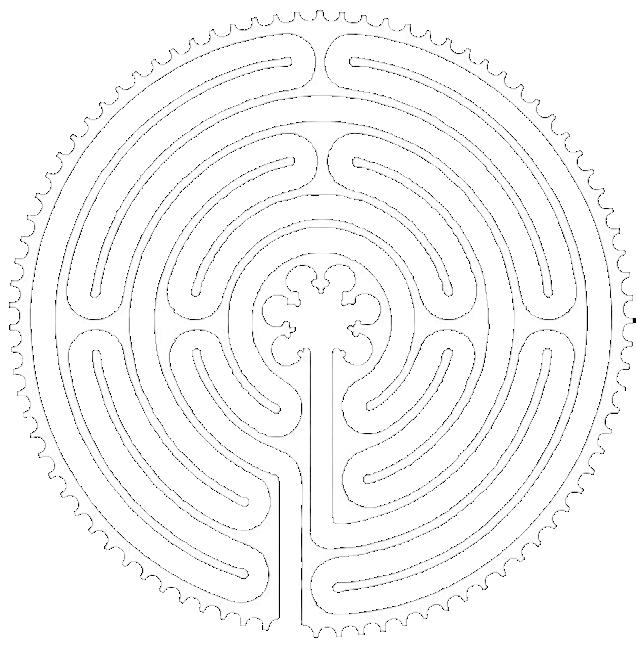
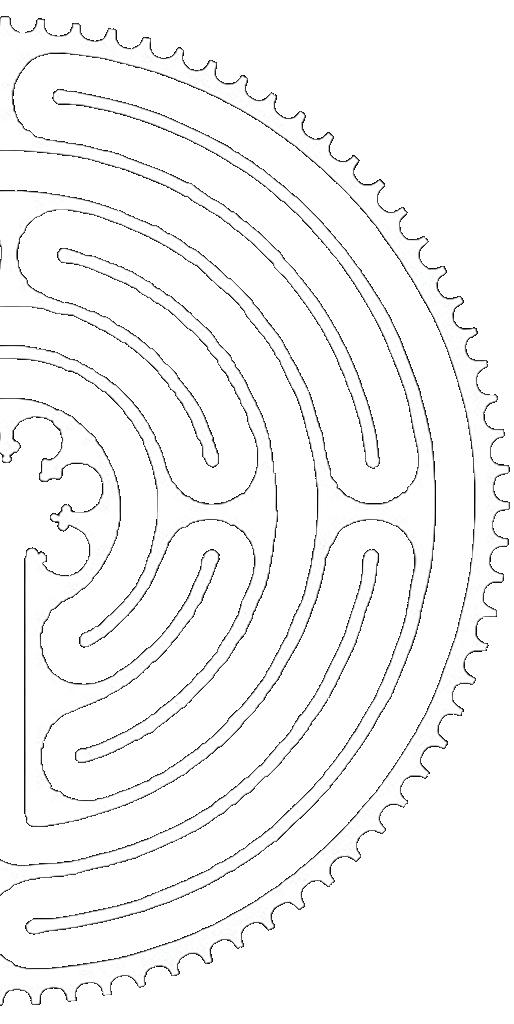
LABYRINTH
OUR MISSION
Bearings is a student-run journal of Christian thought at the University of Virginia that seeks to provide an interdenominational and interdisciplinary forum for spiritual conversation on Grounds.
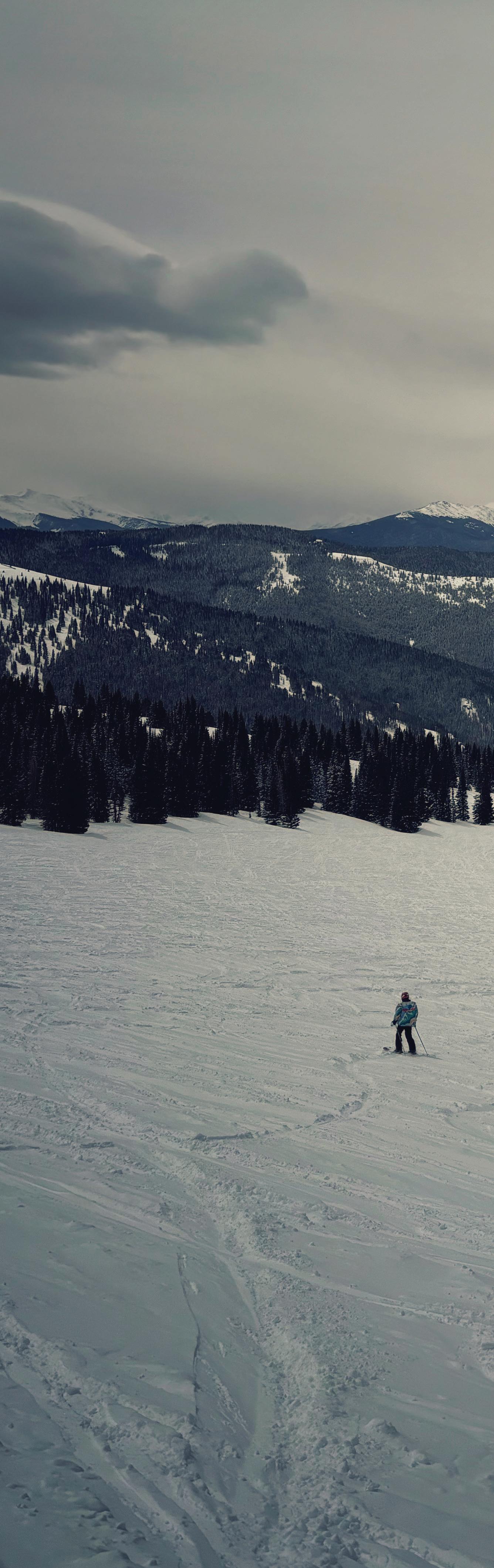
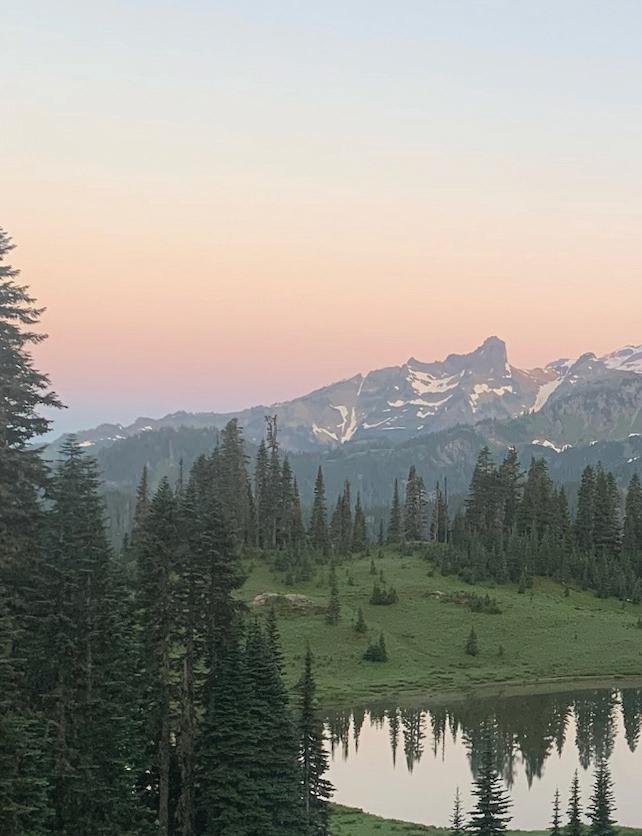
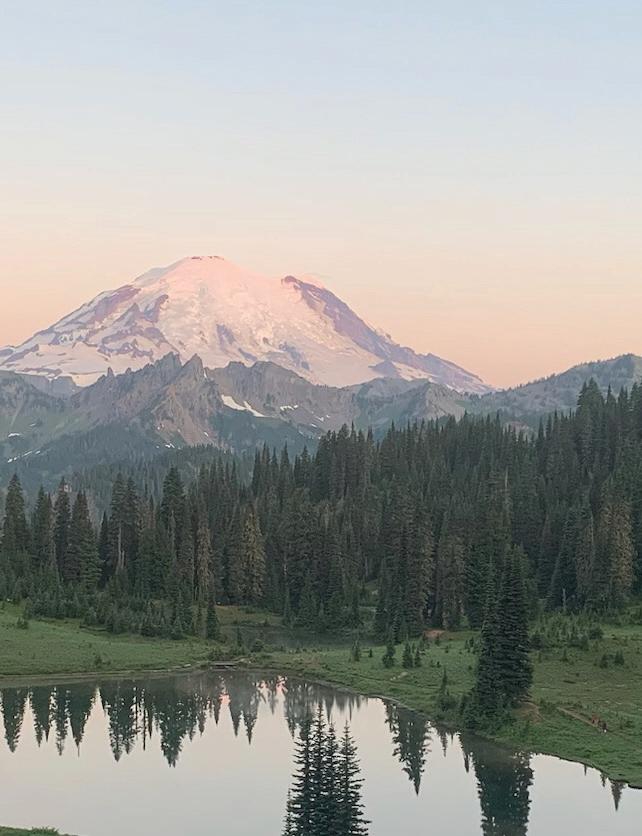
Charlie Haq Photography
COVER DESIGN
Dear Reader,
The origin of the Labyrinth dates back well over 4000 years, serving a multitude of functions for people across their existence. Various religious, spiritual, and mythological purposes were ascribed to its structure, offering something unique to each who encountered it. Today, Christians have adopted it, again, in a multitude of ways; it offers itself as a prayer practice, a metaphor for walking the Christian walk, a path toward Truth.
The Rev. Dr. Carole Ann Camp views the labyrinth as a perspective to embody. She writes, “You can choose to live your life as a maze or a labyrinth—a maze with its confusions, wrong turns, dead ends and false hopes, or a labyrinth with its many turnings, but none of them wrong, a path with sure and certain knowledge of reaching and experiencing the center, home” ( Labyrinths from the Outside In ).
I first experienced the transformative powers of the labyrinth at Richmond Hill, a retreat center situated just as its name suggests: on a hill overlooking a stunning view of the city. Amidst the city’s bustling energy protrudes a spiritual haven fixed with a garden, a library, a chapel, and a labyrinth, inviting visitors to walk along its old brick path studded with patches of moss. Each step rhythmically pulled me into a meditative state as I was guided in and then out from its center, centered myself amidst the city’s chaos.
In this issue, our writers chart their paths of the labyrinth and wish to bring you along. I invite you to cede to the twists and turns of this Labyrinth, getting lost in its pages, but never straying from the route.
Thank you to the Parent’s Program, the Center for Christian Study, and anonymous donors for generously offering financial support. Thank you, also, to our dedicated team of editors, designers, writers, and artists who built this issue, brick by brick. I’m constantly inspired by your souls and minds and imaginations. Thank you for breathing the life into Bearings.
Lastly, thank you, dear reader. Wherever this journal may find you, let it accompany you along your path, in and out of your way to Truth.
Peyton Rabb, Editor-in-Chief
The Team
EXECUTIVE TEAM
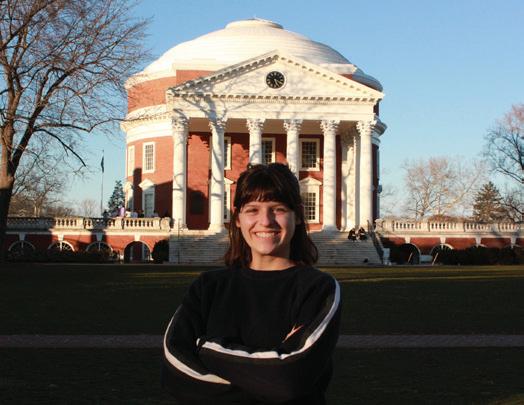
Peyton Rabb Editor-in-Chief
EDITORS
Annie Bryant
Josh Tomiak
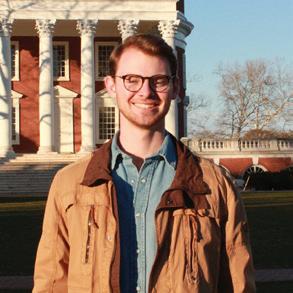
Rob Batton President
Rob Batton
Khoa Nguyen
Lillian Buchanan Social and Financial Chair
Peyton Stallings Creative Director
Kinsley Verbrugge Caroline Haig
DESIGNERS
Peyton Stallings | Pages 4-5, 8-13, 16-19, 22-31
Olivia Haas | Pages 6-7, 20-21
Michel Brooks | Pages 8-9
Ashyr Huggins | Pages 14-15
FEATURED ARTISTS
Charlie Haq | Photography
Grace Campbell | Ink
Peyton Stallings | Watercolor
Peyton Rabb
INFINITY IN HIS HANDS
LAYLA RAGLAND
A LITURGY FOR WALKING ACROSS GROUNDS
KINSLEY VERBRUGGE
REFLECTIONS
OLIVIA CRANE
VESSELS
REAGAN STALLINGS
THE DEER PUNTER
EMMAUS
JOSH TOMIAK
LABYRINTH
JACK MARTINEZ
WALKING
10 12 16 18 22
KHOA NGUYEN 24 28
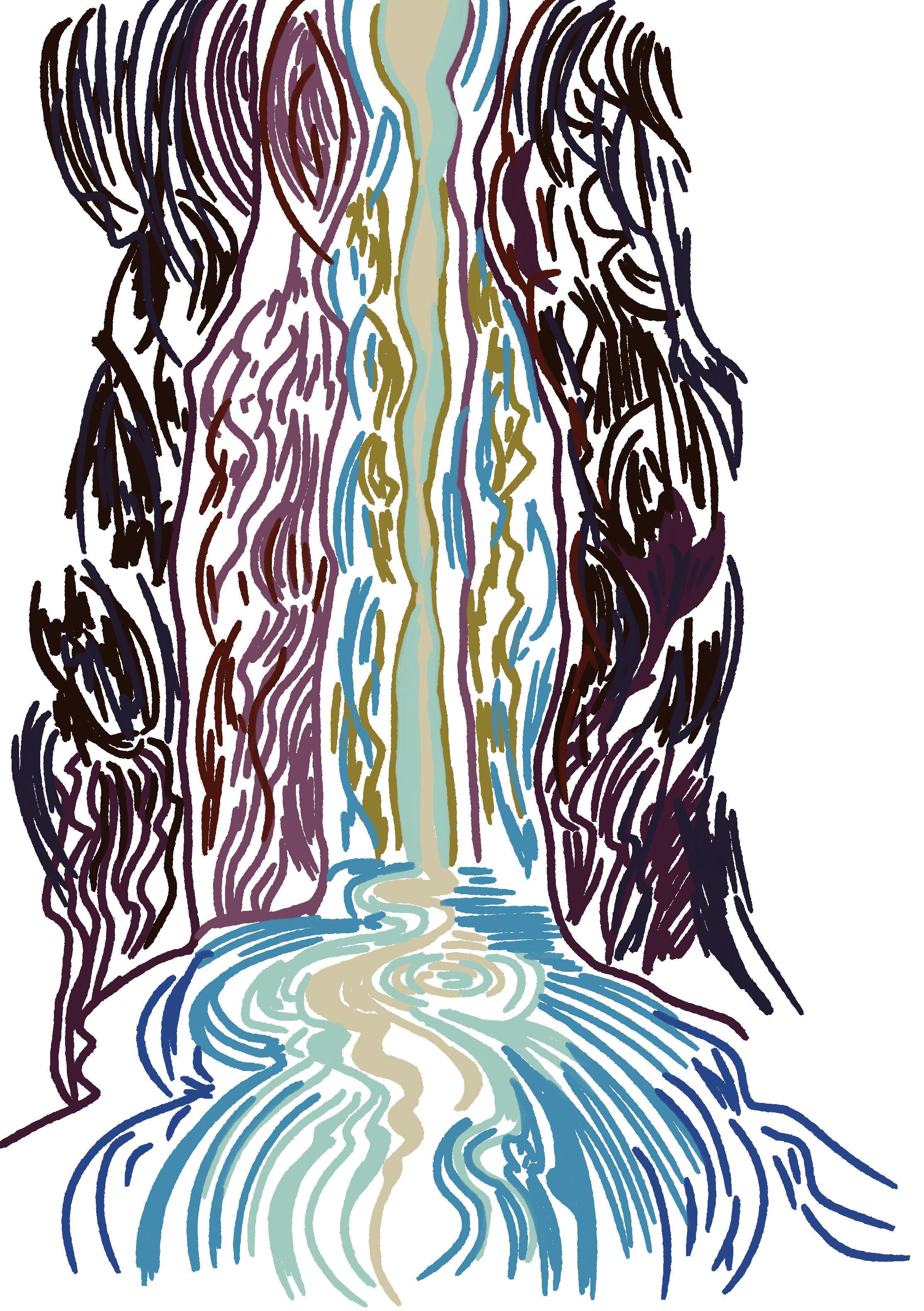
"The mind can go in a thousand directions, but on this beautiful path, I walk in peace."
Thich Nhat Hanh
Infinity in His Hands
LAYLA RAGLAND
"Lift up your eyes and look to the heavens: Who created all these? He who brings out the starry host one by one and calls forth each of them by name. Because of his great power and mighty strength, not one of them is missing."
-Isaiah 40:26
In the cool air of a quiet night, I enjoy a couple precious moments of solace to gaze on those starry hosts. My heart, so used to racing during these long hectic days, is glad to slow to a gentle beat. My mind, constantly filled with equations and work, slides into a moment of calm. Laying there in the soft grass, the stillness consumes my soul. No other preoccupations, no other concerns in this moment than enjoying the soft celestial lights overlooking me from their height in the heavens.
Despite so many attempts at counting, no human knows the number of stars in our galaxy and beyond. That number is infinite. But, God knows. Isaiah 40:26 says that "because of his great power ... not one of [the stars] is missing." Can you imagine a God who has such power that infinity is accounted for in His Hands? Is it even reasonable for a Christian to believe this?
Infinity is one of those concepts our brains tend to wrestle with. For me, the first time my math class reached this idea, it was a mind-blowing revelation. But, after a couple months, a couple tests, it morphed into a commonplace part of my calculations and warranted little extra consideration. And for many, once one satisfactorily grasps a concept, it becomes

nothing more than a route to an exam solution.
As the famed mathematicians Phillip Davis and Rueben Hersh once said: “If you do mathematics every day, it seems the most natural thing in the world. If you stop to think about what you are doing and what it means, it seems one of the most mysterious.” 1
But why is that? It comes down to how math, at its very core, is either invented or discovered. In this prominent, perplexing debate, mathematicians choose either realism or antirealism.
6 | bearings

Why is this important?
The mathematical realist looks at the world around them and believes that the laws exist outside of the human mind. They consider math a real, true way to express the state of the world. The mathematical anti-realist, on the other hand, looks at math as an invention of humans, not as a discovery of properties that underlie our world.
But take stargazing: there are complex laws of gravity, motion, and physics delineating how these stars stay suspended above me.
Beyond that, what about the laws of economics? Or general relativity? Is there a chance that these are all something that humans have invented to fit the world around us?
Or rather, are all of these things underlying laws of this universe that suggest the mind of a designer large enough and complex enough to control infinity?
Even if math repels you, I implore you to take a minute and bear with me. I cannot tell you for certain that this world is characterized by mathematical realism; if I was able to tell you definitively, this debate would not exist. Instead, I can give you two different pictures of this world. The first is a world in which addition, the simple idea that 3+2 = 5 is not a fact per se, but a rule that humans have regularly observed, and that somewhere in this universe it does not have to hold true. The second is a world in which 3+2 = 5 is a set dialogue of truth, a defining factor of the world we exist within.
That addition example seems simplistic, and it is. Have any discoveries in mathematics shaken the view that math could be an invention and not a discovery? Yes. For instance, atheist and Nobel Prize winner Roger Penrose unearthed an intricate theory known as the Mandlebrot set. The complex concept creates selfsimilar, infinitely-repeating, bounded fractals. And yet, it is expressed as a single, short equation. Penrose, shaken upon this discovery, wrote, “Can [math] be other than an arbitrary construction of the human mind? . . . It is as though human thought is, instead, being guided towards some external truth—truth which has a reality of its own, and which is revealed only partially to us.”2
To some of the greatest minds in the world, math is a path. It is a winding, beautiful route by which they find themselves reaching the heart of something greater. In the same way that galaxies and stars knit together in ways that show the majesty of God in creation, math gives us a chance to reflect on the beautifully-crafted logic underlying this world. Penrose noted that “like Mount Everest, the Mandelbrot set is just there!” as though creation
extends beyond the world around us and reaches into this intangible scope of thought. 3 It is these moments together, of simple addition and mindbending geometry, that illuminate the workings of a powerful and meticulous mind. Not just a set of logic that allows this world to exist, but one that celebrates exploration. A Creator who enables math to appear as art.
Math is beautiful. Some of the greatest human minds have taken notice of this masterpiece of math. Einstein once made the comment, “How can it be that mathematics, being after all a product of human thought which is independent of experience, is so admirably appropriate to the objects of reality?”4
Maybe because it is not our product.
So, when you look at stars or suffer through another problem set, take a second to think about it. Math is either a pointless, boring set of hopes that humans have tried to apply to the world around us. Or, math is a beautiful product of an intelligent designer revealing perfect intricacies behind the logic holding this
universe together.
Christian theology addresses our God as the Lord of justice, love, mercy and goodness. But He is also the Lord of math and the Lord over math. The very doctrine of personhood that our minds cannot fully comprehend, the Trinitarian God, is a numerical concept.
As a Christian, I cannot help but believe that my God is as great and glorious in a mathematical regard as in all other regards. To the non-Christians, consider this question: if the greatest minds in history have been stumped by the overly-perfect logic that seems to constitute the study of math, could we have really been that skilled to manufacture it?
Or, is He?
1Philip J. Davis and Reuben Hersh, The Mathematical Experience (Brighton, UK: Harvester Press, 1981) 318.
2 Roger Penrose, The Emperor's New Mind: Concerning Computers, Minds, and the Laws of Physics (Oxford: Oxford University Press, 1989), 123.
3 Ibid., 125
4 Albert Einstein, Albert Einstein's Theory of General Relativity, ed. Gerald E. Tauber (New York: Crown, 1979), 159.
Layla Ragland is a first-year student majoring in biomedical engineering. Her hobbies include reading, archery, and cooking. She is always ready to chat about exploring theology and apologetics.

A Liturgy for Walking Across Grounds
KINSLEY VERBRUGGE
“You make known to me the path of life; in your presence there is fullness of joy; at your right hand are pleasures forevermore.”
–Psalm 16:11 (E.S.V)
Oh Lord, our King,
You have gifted us with moments to rest and reflect on You in the daily rhythm of walking.
Yet, as we walk to classes and meetings and meals with friends, our minds wander through anxieties: chaotic schedules and lengthy to-do lists, uncertain futures and longings for purpose.
Often, our steps feel weary, like walking through a maze, the path obscured.
Often, our hearts contain more questions than answers.
So plagued by anxieties, we lose track of Your calling. You invite us to slow down, to delight, to recenter our hearts on You. You invite us to find comfort in Your promises.
Every tree, every flower, every cloud, every gust of wind, every building, every face of a fellow image bearer presents an opportunity to delight in You, our majestic and holy Creator.
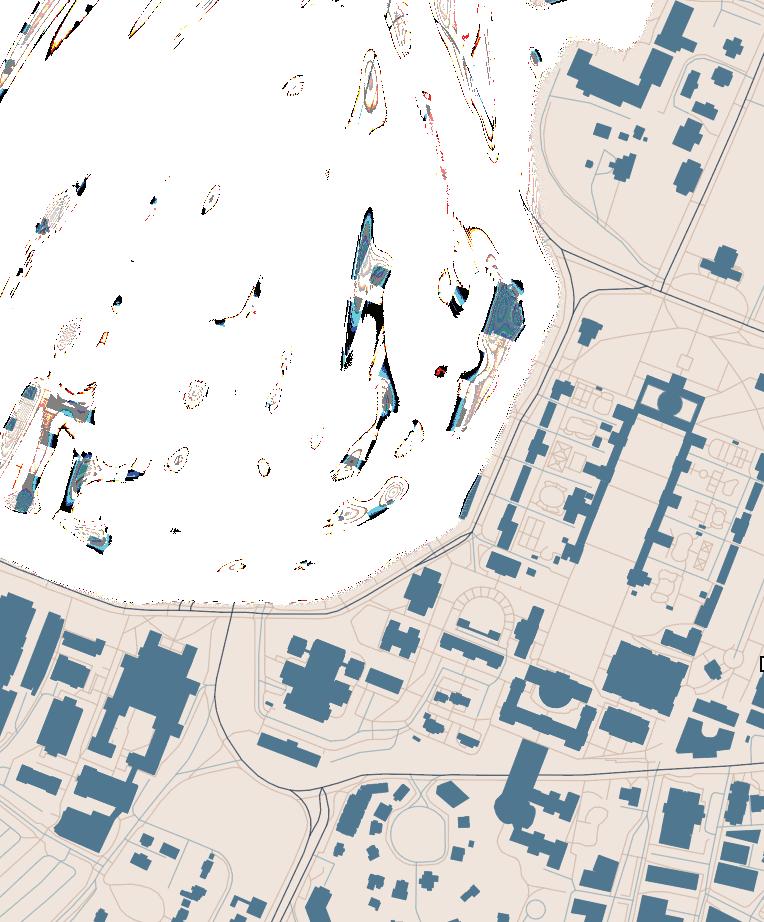
Each step reminds us that You are the author of our steps, that You guide and direct us, that You invite us to humbly submit to a calling greater than our hearts could ever imagine.
We lay our fears, our hopes, our longings for purpose at Your feet.
We surrender our pride that hardens us from hearing and humbly submitting to Your will.
We surrender our desires for control, trusting the Guide through each twist and turn.
Christ, be present with us in these walks. Meet us in these anxieties and, by Your grace, deliver us from them by the power of Your spirit.
Challenge us, Lord, to look up to the heavens, to gaze upon You, and to walk confidently knowing that You guide Your children.
May our labors today assist You with bringing Your kingdom to earth. We offer our bodies to You as living sacrifices.
Amen.
Reflections
OLIVIA CRANE
Have you ever experienced something so beautiful that it pierced your soul in agony? Has Beethoven, or the Blue Ridge Mountains, or the love of your dearest friend, ever reminded you of—and set you longing for—something that escapes your reach when you try to describe it?
In the labyrinth of my faith journey, the Lord has met me through transcendent moments of His grace— shadows which point to Him. These “shadows” have ranged from the beauty of Mahler’s fifth symphony to the magnitude of the Grand Canyon to the comfort of Aslan’s tears in C.S. Lewis’s The Magician’s Nephew. These moments have offered me a glimpse of the full joy I will experience when I meet God face to face. In Reflections, I hope to convey that God reveals Himself to us through shadows of His nature and moments we spend contemplating Him. A painting is obviously different from an essay, and in this description, I recognize that artistic and philosophical ideas cannot, and perhaps should not, be summarized into a neat box of words. This said, I hope this article provides some context and depth to your viewing of this painting, and I invite you, with each of your own unique stories, to ruminate on how Reflections might be meaningful to you.
Books. Plato, Augustine, and a collection of everyday liturgies. Christian Platonism—the framework that everything on earth and in us reflects a deeper version of what we will experience in Heaven—has played a key role in my faith. While Plato is by no means Scripture, his ideas have guided me closer to
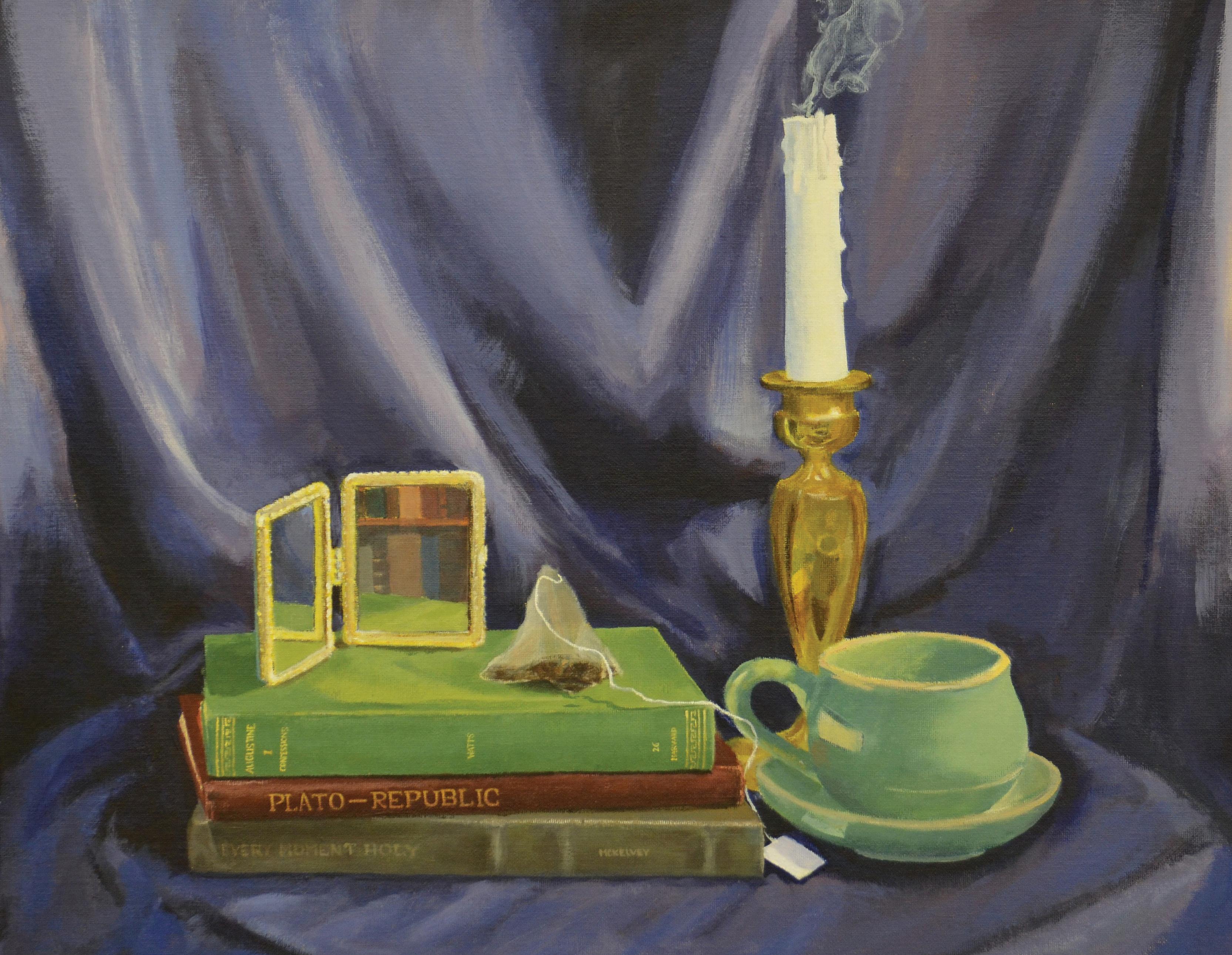
the Lord in my desire for Him. As I reflected on what “Labyrinth” means in the Church, I realized that Plato and other secular philosophers have been unexpected guides in my faith just as a labyrinth leads to its center through unexpected turns. “To gaze upon the beauty of the Lord and to inquire in His temple”1 will be our utmost joy one day, but for now, we must trust Him in quiet dependence and faithful devotion. Plato, Augustine, and others have grown my understanding of this unseen reality, and this painting memorializes their influence. Every Moment Holy, the bottommost book in this composition, has also shown me a window into
God’s eternity; every moment, no matter how mundane, can glorify Him if we reorient our hearts to live life as a prayer.
Mirror. In this painting, I included a pocket looking glass that a friend gifted me from Korea. This mirror, the teacup, and the candlestick contain reflections of their surrounding objects. These reflections symbolize the reflections which all of creation, including you and I, possess of our Creator. We are beautiful because He has made us so after His own likeness. May we ever grow in longing for the deep beauty of the Ancient of
Olivia Crane Reflections , 2025 Acrylic Painting
Days which we reflect in our beings and which all of nature reflects.
Candle. Throughout my high school years, several people within my Christian community suddenly passed away. Through tragedy, the Lord reminded me of His eternal presence and infinite might. He also reminded me of the fleetingness of life on earth. This candle, its smoke still escaping the wick, captures the brevity of life and time. In Macbeth’s words, “Out, out, brief candle! / Life’s but a walking shadow, a poor player, / That struts and frets his hour upon the stage and then is heard no more.”2 Looking around at the tragedies facing us in the world, there is truth in this saying. But unlike Macbeth admits, every shadow must have an original shadow caster. Our lives are “walking shadows,” but as shadows of our heavenly Creator. Just as the shadows on the wall of Plato’s cave point to a deeper reality outside the cave, life is not confined to what we can see. It is only because we shadow an eternal Goodness, Beauty, and Truth that we may do anything good, create anything beautiful, and speak anything true. May we never get so caught up in the shadows on earth that we miss the One who casts them.
Tea. Few activities can be compared to sitting down with a book and a cup of tea in the winter. While I have tried to illustrate some of the philosophical implications in this painting by writing about it, this composition is also a simple picture of my love for sitting (steeping, one might say) in my thoughts and absorbing the wisdom of authors, theologians, and friends.
Quietly depending on the Lord means believing in His goodness when death seems more present than life. It means setting apart sacred time for the enjoyment of His presence amid a hectic schedule. It means prayer. With a cup of tea, a candle, and the best of old books, time suddenly pauses…just as it did every time I added stroke after stroke to this painting. Everything around us, and we ourselves, imitate and reflect the source of our existence and goodness—Christ Himself.
At times, life is snuffed out as a brief candle. But just as a painting mirrors reality, life itself is beautiful because it is a walking shadow of our Creator in Heaven.

Olivia Crane is a first-year in the College of Arts and Sciences. She loves reading classics, discussing philosophy, and admiring transcendent Beauty through music, art, and nature. When she isn’t in class, you can find her enjoying fellowship at the Center for Christian Study or practicing violin at Old Cabell Hall.
1Psalm 27:4b, (E.S.V)
2 Shakespeare, Macbeth
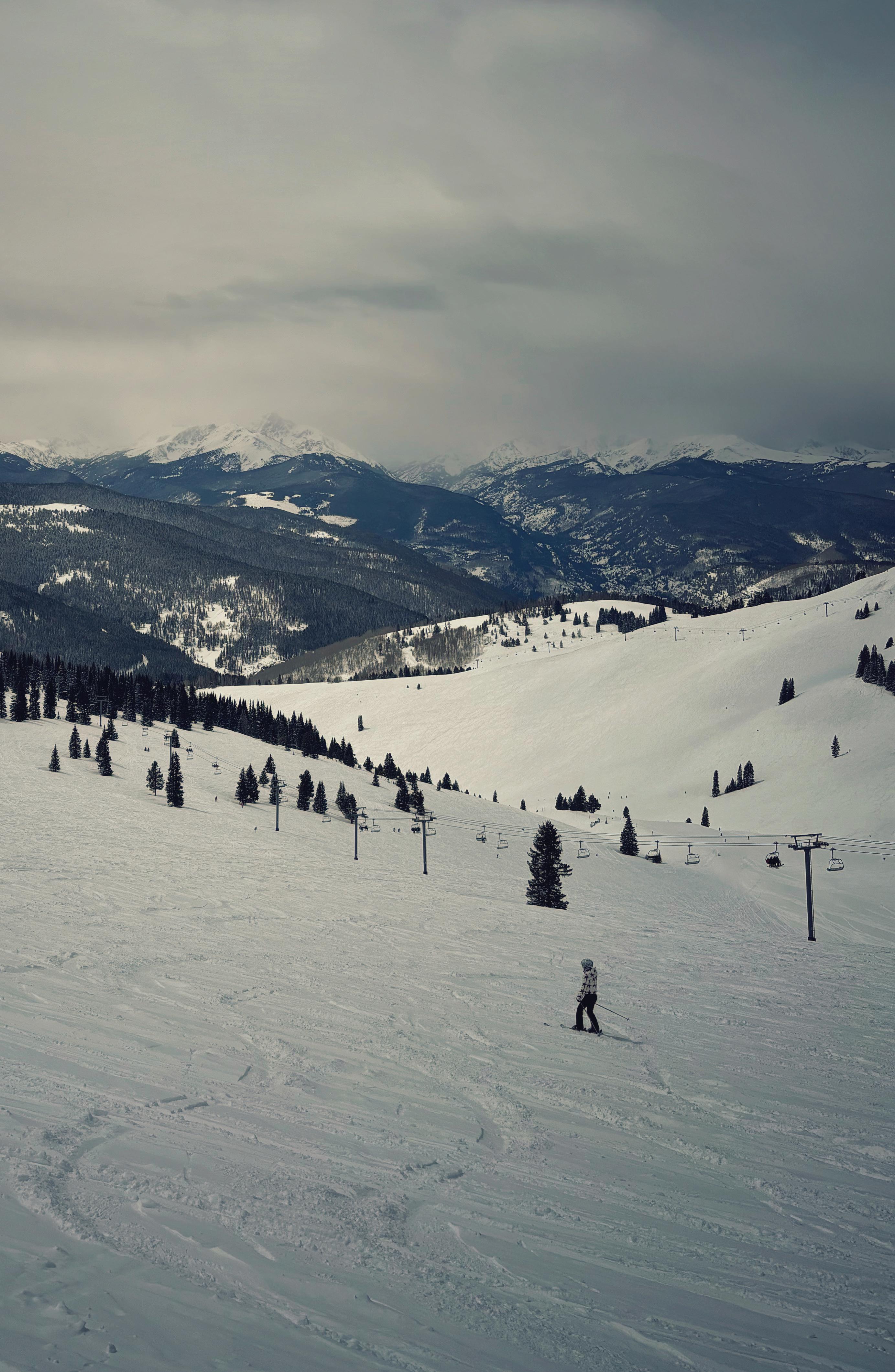
PHOTOGRAPHY FROM CHARLIE HAQ
Vessels
REAGAN STALLINGS
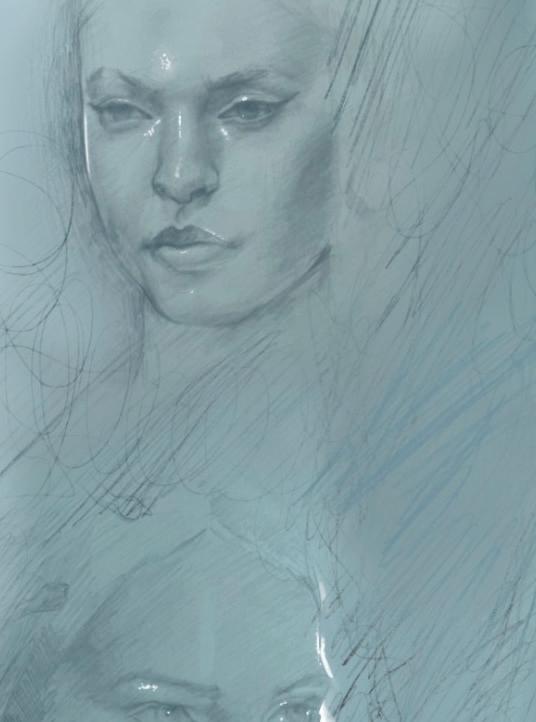
5:12. 6:10. Sunrise. Hands move. I’m still. Shut eyes. Inside. Shoes laced. Teeth brushed. Outside. Cold air. Missed bus. Move fast. Grab keys. Slam door. Exhale. The now. Before.
My chest, a drum. My blood Beats loud. Beats fast. A flood. No pens. No book. Breathe in. Just pulse. Just be. Begin.
The tidal wave that roars in me Is held by venous walls. My lifeblood is a labyrinth— A home of endless halls. I know that I could walk the length Of vessels all my days, But if I walked them long enough, I’d find my heart always.
We run. We tire. We wait. We love. We lose. We hate. Years turn. Scars fade. Light breaks. We yearn. We hope. We ache.
20 | bearings
I know, deep down, I hold A truth, in full, not told. A song no lips have sung. A breath caught in my lungs. I know. You know. There’s strain. We cry. We dance. Remain.
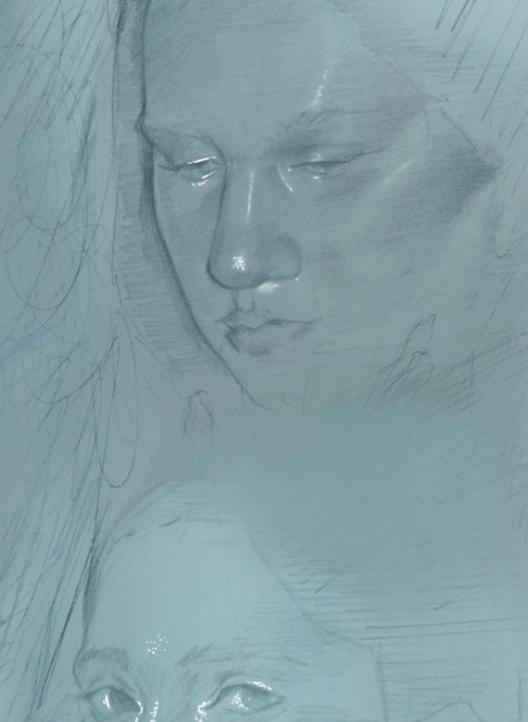
Maybe our living labyrinth
Is not a new design, But recreation of a flow
Both mortal and divine.
Of love that walks through every door And leaves no inch untouched.
Of every being that has lived And every beauty clutched.
Perhaps the beat of all our march And every breath we breathe Is contained in a vasculature
We can’t see to believe. We are the veined limbs of Christ. We bleed the blood He shed. And every perfect, joyful pulse Leads to His heart instead.
The Deer Punter
MASON MABRY
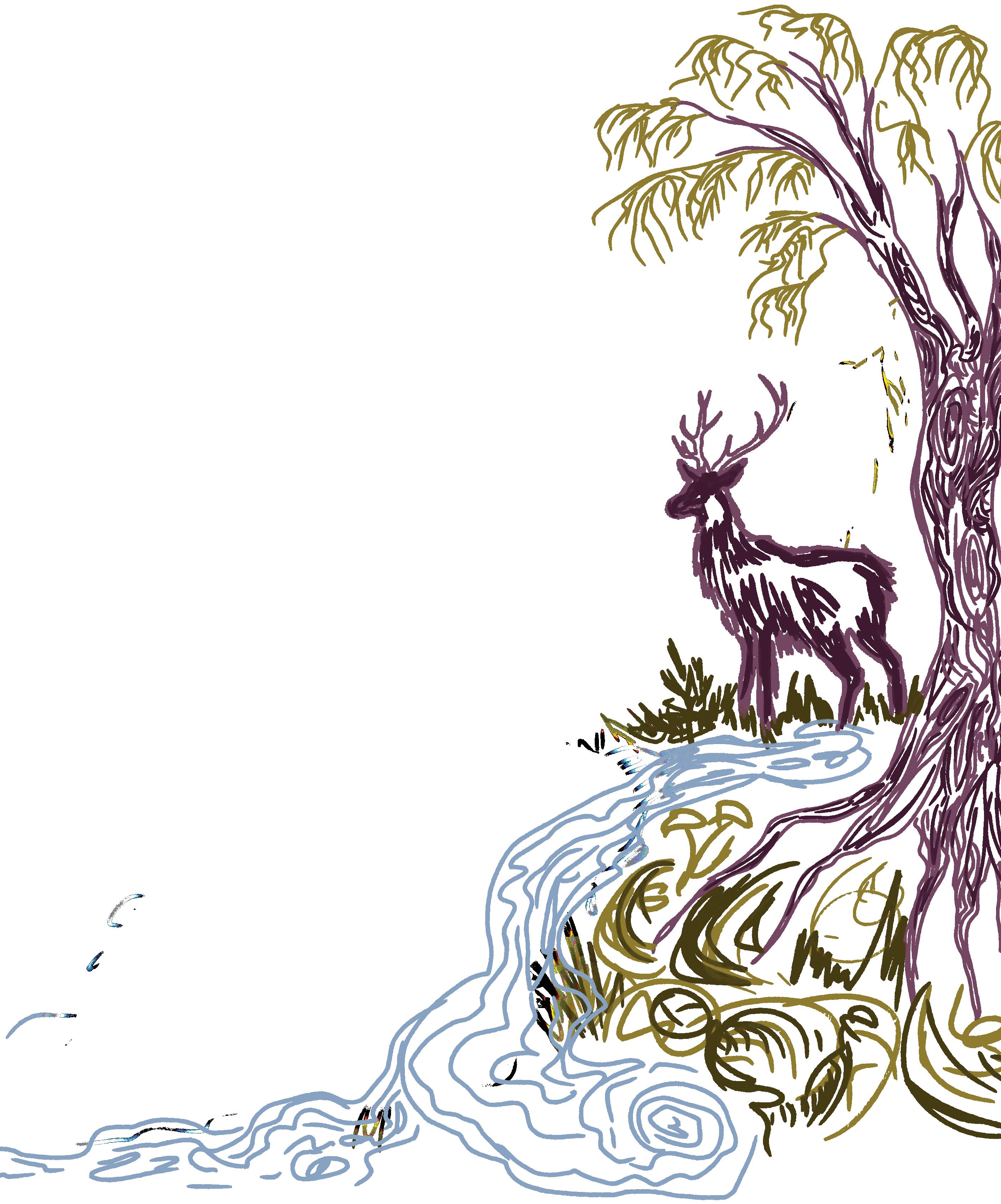
Afew miles south of nowhere, a small creek runs through an ancient ravine, twisting and kkturning like a cottonmouth on the hunt. Its flanks welcome the falling leaves of orange and deep red that adorn the mountains it creeps alongside. As one dead and dry leaf falls to a calmer spot in the water, the current drives it forward. After a few dozen feet, the creek bed begins to drop and the rounded pebbles and boulders littering its depths finally surface, producing rapids and a surety that the leaf will soak and sink. Despite this, the dried-up flake passes through every inch of turbulence without so much as a droplet splashing onto it, gliding past each hazard in exactly the manner necessary for its survival. From there, it simply floats along, made living by a current that it would trust if it were able.
Eventually, the water meets six gray towers of concrete and steel, which raise a bridge of the same to couple the two sides of Interstate — “BRRRRRRRR!” A rumble strip’s deep hum stiffly vibrates the skull of one sleeping wretch, tearing him from rest and allowing him to guide his puke green station wagon away from the bridge’s concrete barrier.
This is a man in his late twenties, with a five-o’clock shadow, a hairline currently fleeing the scene, and the strong smell of whatever was in the dented silver flask he just emptied. He’s a man who was unwilling
to finish school and is now unable to hold down a job, dooming himself to forever chase after riches he wasn’t born lucky enough to find. His name is Nathan Francis May, although he prefers Nate.
Nathan has been driving for hours now, and the exhaustion has clearly begun to set in. It’s his own fault, really. In the past hour, he’s driven past three motels and ignored each, all because he has “somewhere to be.” His mind races as his eyes dart about the road’s right side, watching the ivy green mile markers tick forward like the minutes on a digital clock. He repeats directions endlessly in his thoughts, refraining from any verbal expression out of some irrational fear that someone out there might actually hear him.
Finally, just as the sun begins to set, Nathan passes one last marker and a ten-foot opening appears in the guard rail. He slams the brake and comes to a complete stop right alongside it. He sees a dirt road within, and for the first time, he really believes what he’s been told. He really believes he’ll find it. Nathan turns the wheel right and his front tires dip onto the rougher dirt. As he feels the bump of his back tires leaving the path he knows, Nathan sighs and speaks for the first time in hours: “One-twenty-four point two.” He can say whatever he wants, now. He no longer worries about prying eyes or minding ears, because he knows that
“I am completely alone.”
After about a half-mile, the dirt gives way to asphalt as the car climbs onto a paved road that has seen better days. The derelict road bobs and twists with an extremity that would alarm any rational motorist. Not to mention that the onset of night has left the car’s headlights a task they scarcely eke out, revealing the path only moments ahead of time. Despite this, Nathan raises speed and meets each turn with a childish, greedy excitement for what he might find around it.
As he crushes the accelerator beneath his right foot, his car reaches a speed of fifty-two miles per hour.
With this velocity, coupled with the road conditions, and assuming a reaction time of one-tenth of a second, it would probably require around seventy feet for his vehicle to come to a complete stop. Even in these conditions, he can probably manage to avoid an accident.
As he rounds one of the sharper curves, a fairly large white-tailed deer appears on the road ahead. In the 40 feet and roughly half-second between Nathan and the deer, he doesn’t so much as tap the brake pedal. His car slams into the poor creature and flings it left.
The fool hits the brake and manages to stop after about 150 feet. Now motionless, Nathan sits for around thirty seconds, slowly transitioning from dumbstruck to frustrated, rightfully scolding himself for failing to stop before it was too late. As he curses his own incompetence, Nathan reaches for the door. The lock clicks as he pulls the handle and shoves the rest into the world outside. In the same moment, the night air smothers his body, assaulting Nathan with a heat that reminds him of stepping outside of an air-conditioned hotel in Las Vegas, like a bear hug from hell itself. This sort of temperature wouldn’t have been possible on a hot summer day, so how is it now? Nathan hasn’t a clue.
Though bewildered, he stumbles out and checks the front of the car to see a cracked headlight, a basketball-sized dent in the front bumper, and what looks to be his beaten-up hood’s attempt to model the Appalachians. All of these predate the hit. As he breathes a sigh of relief for the lack of damage, a frigid breeze strikes the arch of his back, sending him into shivers and yet still lacking even a semblance of relief from the heat. With the wind comes the stench of … something dead. Nathan whips around with as much violence as his fatigue allows to find the odor’s source. About fifteen feet away, much closer than it should be, lies the carcass of a large male white-tailed deer.
It lies on its side with a bloated stomach, a pale hide shown through its thinning fur, and pristine white maggots like freckles over its entire body. Swarming black flies carpet the carcass and neglect only one
spot, a gash in its side that must have once bled gallons from the wretch, but is now colored only by growing and browning maggots engorged on the deer’s rotting soft tissue. Through the growing slit, one of its ribs pokes through, picked clean mostly by maggots that have since grown into the flies now whirling around the creature’s cavernous chest.
From the torso, his eyes drift and soon catch sight of its massive antlers. Nathan never learned how to count points, but he knew this one had more than its fair share. With some extending less than an inch from the main branch and others almost a foot, each point jets out to form its own path through a maze of bone, winding around its compatriots until each slowly winnows down to a razor sharp dead end. Antlers this large have to be a rare sight, with every one of the many points representing a chapter in a long, long life lived. They would surely form the ultimate status symbol, turning any brawny buck into the apex of the social order. That is, they would if they didn’t veer downward to pierce the top of the old boy’s skull in four places.
The points can’t have burrowed in terribly far if the deer was still alive prior to Nathan’s interference. They seem to end just after hitting bone, although that’s not to say they yielded no effect. From each puncture site, dried blood spills from a broken hide to trace a path directly to the creature’s large, glistening eyes.
Centering and shrouding a great deal of each eye are large black pupils surrounded by cloudy, dark brown rings whose colors swirl about like a storm on Jupiter. If not for the complete lack of motion, Nathan might have assumed these were the eyes of a living thing, staring directly into his own. In fact, the discomfort he feels under the dead beast’s stare compels him into a small sidestep to avoid the eyes’ direct attention. It doesn’t work. He moves again, this time a touch further, but still finds the same not-empty-enough gaze set squarely onto his own. With each movement, Nathan feels the heat of a glare that simply can’t have conveyed itself toward him. It’s dead. He’s a fool to believe anything else.
Thoroughly spooked and lacking the curiosity to remain, Nathan turns back to his car. As he takes his first step toward the only thing he still understands, he hears the click of a hoof on asphalt and wheels around not a moment later to two beautiful brown eyes still staring him right in the face, only now on equal footing.
Standing tall before Nathan Francis May is … not a carcass. Its torso lacks any sign of wounding and any organisms subsisting on its flesh are firmly out of view. Its antlers lie on the ground and its head is held high. It turns before Nathan does. Evidently, it is more a shock to Nathan than vice versa. Slowly, it takes one step, and then another, reaching the edge of the road after a few paces. From there, every following step appears more certain than the last, until it gallops into a clearer path through the forest.
Above the path, the moon hangs just a few degrees over the horizon, nested by trees on either side. Directly below it, the sky seems to blur, like viewing the Pleiades without a telescope, only much, much brighter. A curious sight to be sure, but a lesser mystery for a night such as this. Nathan walks back to the car and sets out on his way.
What Nathan has been looking for this entire time is marked by a tree with a bright red ring spray painted around it, the sort that’s been condemned to felling by a logging company. As he continues to drive, he keeps a constant watch over both sides of the road, but his headlights have grown less cooperative and his eyes are starting to glaze over his surroundings. After about an hour, he sees a glint on the road and swerves to avoid a torn piece of metal to his left. From there, a trail of glass shards leads to a familiar-looking puke green station wagon angled into a ditch on his right.
As he passes, he sees that its grille has been reduced to a crater and the top half of its driver’s seat has crumpled in on itself. He keeps driving. After another hour, he passes the same scene and responds in the same manner.
Shortly after that, his gas gauge starts blinking and Nathan begins to search in vain for the dirt road


Emmaus
JOSH TOMIAK
Glory? What glory?
“Glory of the father” I am called, 1 but we go miles (seven!) through dark morning without joy and hope, sorrowfully seeking after hot springs2Hope seems void, despair great. Eventually, another one beside comes and speaks boldly, we hear but cannot understand and him see truly, we only urge, “Rest now,” and, “Day is ending...”
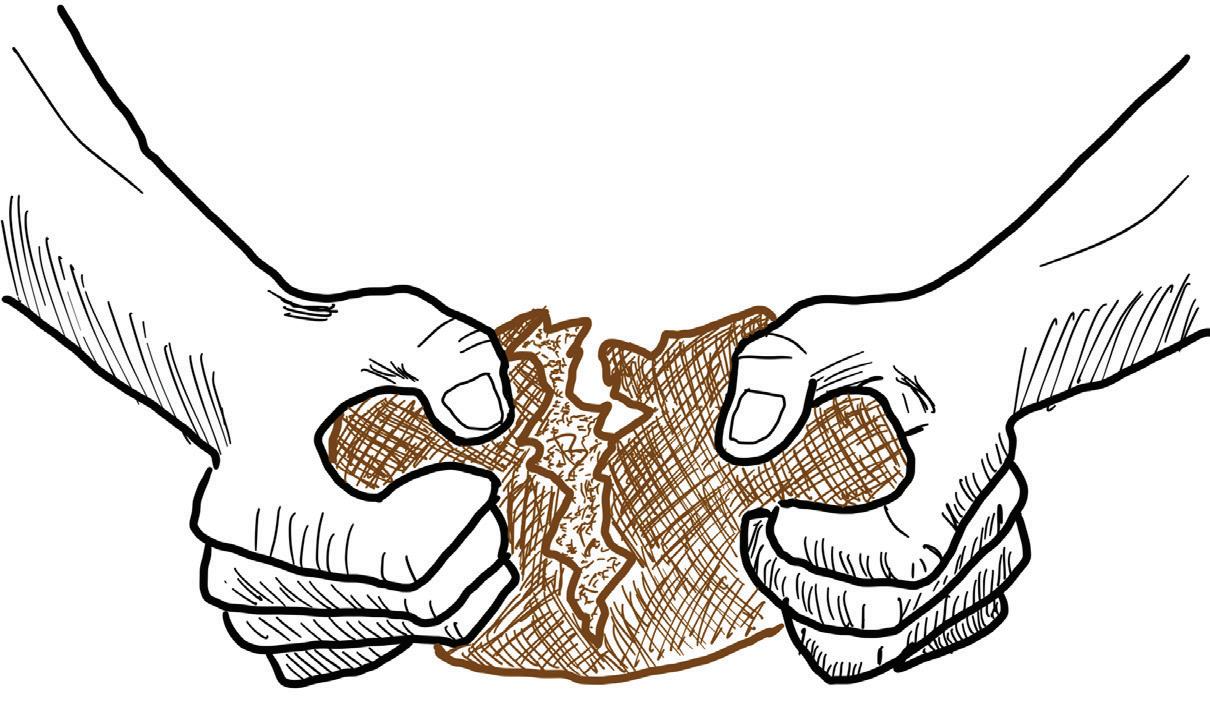
Then, as he breaks the bread, he vanishes!
Ended is day, and now rest urges - only, we truly saw him, and understanding, cannot but hear: we boldly speak and come beside one another; Eventually, great despair ... void seems! Hope springs hot, after seeking sorrowfullyHope and joy without mourning!
Dark through seven miles go we, but calling am I, Father, thee of glory:
“Glory! What glory!”
1Luke 24: 13-35, (E.S.V)
Labyrinth
JACK MARTINEZ
O"Give me some time Let me learn how to speak I'm a maze to you"
- The Maze by Manchester Orchestra
n Palm Sunday, nearly 5 years since I stopped identifying as a Christian, I chose to go to an Episcopal church. No one spoke to me, I spoke to no one. I would not speak to a single other parishioner for nearly a month.
"When I was a child, I spoke like a child, I thought like a child, I reasoned like a child. When I became an adult, I put an end to childish ways."1
Growing up, my grandma learned that, to be able to get anywhere, she could only speak one, "correct" language.
"They only taught me English because I looked like a Gringa," my grandma said,“but they wouldn't teach you if you were Mexican. We went to segregated schools, they separated us in the doctor's office, if a White person wanted your spot in school, you'd be forced to give it up."
The Catholic nursing school in Arizona rejected her, so she went to community college and held babies in the NICU. A nun there asked her if she was going to apply to the school, and Grandma told her they had already rejected her. She told her to apply again.
After 60 years, she still doesn't know who paid for her tuition.
I had spent hours scouring the website to make sure
24 | bearings
this place was safe, I even watched a couple recorded livestreams to make sure the pastor wasn't going to say anything hurtful. I did not feel safe in any church.
"I spent so long wanting to be accepted by them and respected that I lost who I was," my Dad said, "I wanted to be white, and I really regret that. I did not love myself."
My grandmother never taught my dad Spanish in order that he could have a better chance in this country that they were both native to. He can't speak it at all. English silenced him. I picked it up in college. I struggle to speak, but I can listen. Somewhere, a long time ago, my Sonoran ancestors spoke their indigenous languages. Spanish silenced them first.
"If I speak in the tongues of humans and of angels but do not have love, I am a noisy gong or a clanging cymbal."2
The liturgy was printed out fully in the booklet, I could take a pencil from the pew and underline the scripture. I could open the red book in the pew
and find every order of service I could imagine. I spent my childhood being kept from my culture, my language, and my family. I have spent my adulthood reconnecting with it. I know the stories, the recipes, where I came from. I can listen when they speak. I can understand a part. I can say very little with confidence.
"For we know only in part, and we prophesy only in part, but when the complete comes, the partial will come to an end."3
We said the Nicene Creed, the stained glass Christ guarded his sheep. I felt welcome to take the Eucharist for the first time since I was 15 years old. I sat in my car and I wrote, shakily, that I had found my home. I asked a week later how I could be confirmed. They told me the bishop would not be back until next year.
My dad, a Mexican-American Catholic, told me, while I was in Catholic school, that all religion is an incomplete attempt to understand something incomprehensible to us. All religion is a language through which we can reach out and glimpse the
divine, but it is not even close to being that divine presence itself. Religion is a word used to describe the silence. It is an incomplete, comprehensible painting of a God and a reality that is beyond us. He told me this because, while to me God was always impossibly close and undeniable, I could not reconcile my understanding with the understanding being taught to me then the one that said I had rejected that same impossibly close God with my very existence. I could not understand a God that would exclude and punish so many for not fitting a certain mold. I could not understand a love that was not really love.
When I was 10 years old, my dad began to attend AA. It was then that my understanding began to shift. I began to understand God not as some separate being, far away from us, but something so close to us, who loved us so much, that even in our darkest times He would be there. I began to understand God not as a jealous, self-righteous tyrant, but a force of love so profoundly powerful and so interconnected with us that the only way to Him is through ourselves. The serenity prayer stayed on my lips, the twelve steps stayed in my mind, the small, anonymous, community who listens without judging and loves without qualifying became a building block of my understanding of what God looks like in the world.
It dawned on me over the next few months of attending that I could be a priest now if I wanted to, I could take the Eucharist every Sunday, I could participate in the whole life of the church without being shunned. I could hear, for the first time, the words of God without hearing the asterisk next to them. Without only being able to see and hear all the exceptions to God's infinite love and mercy.
What can I really say of God? The is no ultimate container in which we can fit all of Him. No right doctrine handed down by authority that will lead us to the ultimate truth of Him. There is no living, flawless person who speaks for Him. There is no text that is not only a translation of what the students of the teachers and the prophets and the messiahs said that they said. I have my favorite texts, my favorite versions. I used to have a Catholic Bible, now I have
an NRSV one, a Book of Common Prayer instead of the Catechism. I've read the Bible in pieces of Old English, Middle English, Spanish, Early Modern English. My girlfriend can read it in Latin and Biblical Greek. My favorite translation of the Psalms is in the Book of Common Prayer, the 1979 version. When I pick through readings for a homily, I specify the translation.
The translation.
How do you translate God?
How do you know that the words you read and hear are the words that were there first?
How do we know that what we hear is what they meant to say?
The truth is, we don't. There is only translation, the residue of thousands of choices over thousands of lifetimes left on the pages of our holy books and holy words. The ways in which we choose to translate, read, and interpret those texts, what we choose to include and to leave out, can create or destroy our whole understanding of God.
Linguistic relativity is the theory that the structure of the language a person speaks can influence their perception of reality. It can easily slide into linguistic determinism, which posits that the language you speak traps you into a certain perception of reality. It is more likely the first one is closer to the truth. Language does shape our perception of reality and the way we think about things, but it is not the end-all, be-all of it. We can change it, we can think differently, we can learn new languages.
Language shapes our reality, but is it reality?
Religion shapes our God, but is it God?
Doctrines are flawed and human and fall short, and yet we still choose to try to make the incomprehensible understandable, the expansive containable. To pretend we know anything at all is
laughable, and yet we still choose to hurt others in the name of that limited version of God that we have chosen to shrink down and mirror our own base human fear of the Other upon. I know this, I have been hurt by this, I have seen what it does to the world and to others. I have seen language and religion twisted and used for violence. Again and again and again. And yet.
Yet.
The language I have chosen to speak, after much consternation and debate, is the language of Christ.
It's a heavy word on my lips. It brings with it a long history of atrocity, of pain. It brings with it the ideas of empire, of hate and fear, destruction, desolation. Control. It brings with it a very human definition of an incomprehensible thing. In that way it is much like the words "love" and "family" and "community." It is a word shaped by the one who first forms it for you, and that can be a very bitter, painful thing. It still can make me taste blood, make my heart ache and my blood run cold. I still feel the flush of anger when I think of the depths of the intolerance and the hate that can be containedwithin it. I still don't feel welcome in most places that profess to speak the language of Christ.
Christ. A heavy word. A mountain of misunderstanding, of pain, of fear. When many people hear it, they think of the hypocrisy of a "loving" God who rejects wholly those who don't conform and punishes those who don't follow him. They think of a God that wishes to see man dominate the land and wipes out what can't be set forcibly into perfect order. They think of Christianity as covering for those who tear apart children and the innocent like wolves. They think of how it casts out those who are lowly, poor, and outcast. They think of it as a language of love with blood on its hands, hiding the abusers with a pleasant, ordered mask and declaring them the exulted of God. In a lot of ways, they are not wrong.
I learned a long time ago that a language can be full of empty words, vapid phrases, meaningless lies. A language can be spoken, and no one will truly listen.
People will recoil if it makes them too aware of themselves. People will kill it if it threatens them and their sense of the world.
So why choose to speak that same bitter language?
Because, in a lot of ways, they are not right, either.
A year after I joined the Episcopal church, I knelt in front of one of the bishops and covered my hands with her own. She spoke to me, then reached forward and used her thumb to brush oil on my forehead in the shape of the cross. Sealing me as one of God's own, forever.
I didn't have to be here. She didn't have to be here. We chose to be here. We chose to be here, where many would say we shouldn't be. There are many, many more of us, the ones denied the authority, the right, the community, the basic dignity of humanity because of who we are. We, who are God's equal children. Taking up our rightful inheritance.
I never had to learn Spanish, but I wanted to speak the language of my family, I wanted to reach back and connect with that sense of that something that I came from. That imperfect, scary something. That history that hurts as much as it shows how the love was there, was always there. I chose to speak the language of Christ not because I had to, but because when I came back from my necessary wanderings, I finally heard and understood that this, too, was my heritage. This, too, was worth saving and repairing.
“I will never leave you nor forsake you."4
I have walked the maze of my life only to realize it's a labyrinth. Circling down into the center of my being. There I found the fundamental language of love, which is the language of hope. A real hope, pointing back towards a reality in which love is the only thing that truly matters. I have seen people of all religions and lack there of speak this fundamental language. I have seen them reach out with love instead of recoiling in fear, to be able to admit their own faults without turning away, to stand in the face of a cruel,
selfish world and choose instead to be kind. I have seen what love can do when it is not mistaken for control and used as a cover for hatred.
"The light shines in the darkness, and the darkness has not overcome it."5
I stood in front of a Station of the Cross in a grotto last summer. The mosaic was of Christ in the garden of Gethsemane. I came to my faith on Palm Sunday. I reaffirmed it in Lent. The Passion haunts me, transfixes me. "We declare Christ crucified" becomes the declaration I make, like Paul did thousands of years ago. The religion, the language of a God who bows down with the oppressed, who dies out of love, who shows us that dying to ourselves only allows us to become ourselves.
That Palm Sunday, I finally heard God in a church, clearly speaking in my own tongue.
"I will give thanks to you, for you answered me and have become my salvation. The same stone which the builders rejected has become the chief cornerstone. This is the Lord's doing, and it is marvelous in our eyes. On this day the Lord has acted; we will rejoice and be glad in it. "5
11 Cor. 13:11 (NIV).
21 Cor. 13:1 (NIV).
31 Cor. 13:9-10 (NIV).
4Hebrews 13:5 (NIV).
5John 1:5 (NIV).
6Psalm 118:21-24 (NIV).
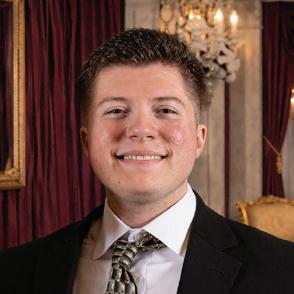
Jack Martinez is a fourth-year transfer that came back to college to study English with a concentration in Medieval and Renaissance Studies. Outside of being a full-time student, Jack likes to build computers and help renovate buildings with his dad, spend time cooking with his grandmother, writing fiction and poetry for fun, and loves to spend time being active either at the gym or outside in nature.
Walking
KHOA NGUYEN
The two young men were both eating, or rather trying to eat, when they realized that they were on the brink of tears. So they set down their forks. They excused themselves. They turned their faces down. They hurried out.
They entered the empty seminary courtyard several minutes apart from one another. Consequently, the second young man stepped into the courtyard to find the first young man on a bench, hunched, with his head in his hands. The first jerked his head up at the sound of approaching footsteps and they stared at each other. Weeping young man to weeping young man. Finally, the second managed: “Might I sit with you?”
“Yes.”
The second took a seat next to the first. They did not say anything to each other for a long time. They only fought to regulate their jagged breathing. But then the second young man spoke into the silence. He spoke quietly. They would both speak quietly. As if the silence of the courtyard were something to be obeyed. “What is your name?” the second asked.
“Eli,” the first replied slowly. He extended a wet hand. “Yours?”
The second grasped Eli’s hand with an equally wet hand. “My name is Giulio,” he said.
“Giulio.”
“Yes. Eli. Might I ask what is wrong?”
Eli hesitated.
“You do not have to tell me if you do not want to,” Giulio added. He raised his hands slightly in a slowing gesture.
Eli looked down at his own hands, clenched them into fists, then released them. “I don’t know,” he said, still looking down. And then his voice suddenly hardened. “Look, Giulio. I don’t know you at all.”
“Yes. That is true.”
“And I don’t talk to anyone about these kinds of things. Period. Least of all someone I’ve never met before.”
“All right. All right.”
“That’s not what I meant.” Eli shook his head, closed his eyes. Then he looked at Giulio and said: “Forgive me. That was harsh of me.”
Giulio’s lips were a thin line. “Yes,” he said after a moment. “I forgive you.”
“What I was trying to say was that while I’ve never talked through any of these kinds of things with anyone, that doesn’t mean that I don’t want to do so. I do want to do so.”
“That’s all right. Whether you want to talk about it or you do not, I’m here.”
“Thanks.”
Giulio acknowledged this with a slight bow of his head.
“And also,” Eli added. He swallowed. “I’ll accept that offer of yours to talk through it.”
“Are you sure?”
“Yes.”
“All right. You can begin whenever you want to.”
Giulio looked at Eli, waiting. Eli glanced tensely back at him, then looked away. The eye contact was too much for him.
“I am afraid of this seminary,” Eli forced out.
He glanced again at Giulio. Giulio was silent. “Look,” Eli almost snapped. He felt stupid. These feelings were stupid. “Look, we’re studying here at this seminary. We’re here to commit our entire lives to God as priests. Take— take vows and all that. And just saying something like that— saying that we are committing our entire lives— I can’t comprehend, can’t bear, a commitment that huge or that uncertain. Don’t you understand what I mean?”
Giulio nodded.
“And then I have this— this terrible sense of uncertainty that I’m in the wrong place,” Eli went on. His voice became increasingly constricted. “Maybe I wasn’t called to attend seminary, maybe I should have gone to university or married or— or— oh, I don’t know. I don’t know.”
His voice trembled. He faced Giulio. “What on earth am I doing here, Giulio?” he asked, his voice choking. The tears were trickling down his face now. “What can I do if I don’t know what I’m doing here or— or am I too coward to even confront what I’m doing here? I can’t do this. Don’t you understand?”
“Yes,” replied Giulio. He swallowed. “Yes, I know. I’m so sorry.” And he wrapped an arm around Eli’s shoulders. Every single muscle in Eli’s back instantly tightened at that. But then Eli’s shoulders trembled. They shook. Giulio tightened his arm around Eli. “Eli,” Giulio said softly. He tried to make eye contact. Eli turned roughly away. “Look. You can trust me.”
Eli was silent. But then he thickly nodded. And suddenly Giulio felt the muscles in Eli’s back relax. They did not speak for several minutes. No sound in the courtyard but Giulio’s heavy breathing. Then Eli swiped at his eyes. He exhaled. He looked at Giulio.
“How about you?” Eli asked hoarsely. “Why are you here?”
“That is a fair question. The truth is, I miss home.”
“Oh.”
“Yes,” chuckled Giulio. “I know. It is a rather small thing to be upset over, isn’t it?”
“Well, I don’t know about that.”
“It is inexplicable,” Giulio said. He shook his head. “Almost irrational of me. Do you know, I was so thrilled to leave home and enter seminary? If you had seen me then you would never have guessed that I would be as I am now.”
Giulio paused. He chuckled again. “But I suppose it isn’t entirely irrational, now that I think about it,” he said. “I have never lived away from home until now. So it makes sense that everything is so disorienting.”
“How far away from home are you?”
“Two days by train.”
“That’s hard.”
“It’s— it’s all right.” Giulio took a deep breath and went on, the words almost tumbling uncontrollably out of his mouth. “I suppose what makes it all so disorienting is that back home, I knew— I knew that everything had its place. I knew how everything operated. I had this routine that I was sure of, and I needed that. So when I entered seminary, this completely new place, new system two days by train away from home...”
“Yes.”
“Maybe it isn’t so irrational of me, then, to be upset. It is overwhelming, with too many things I have to learn, too many things that I have to get used to.”
“I’m sorry,” Eli said softly.
Giulio nodded.
And then he caught sight of something on the courtyard floor.
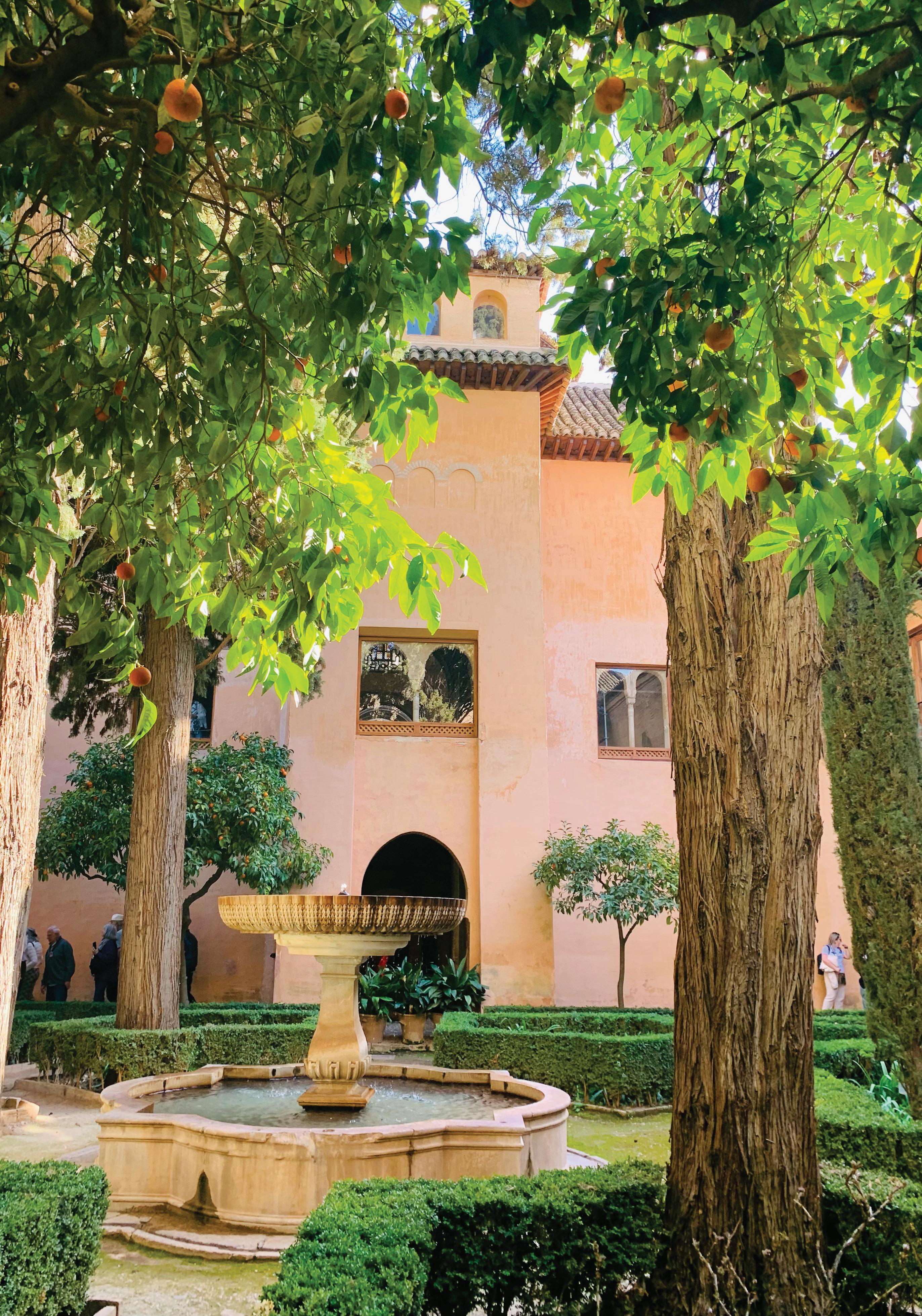
The seminary, at the time that it was being built, had had no clear specifications for the courtyard other than its being situated near the dining hall. So the architect had asked the bishop about this. The bishop had thrown up his hands. “Let the courtyard be a space for contemplation,” he had said at random. And the architect had suddenly remembered visiting a cathedral many years ago, a cathedral with a labyrinth carved into its marble floor.
People of the church had slowly walked, kneeled in it, the architect had remembered, their lips moving in silent prayer. And this memory had struck the architect so strongly that he had immediately drawn up plans for the seminary courtyard to contain a similar labyrinth. Unfortunately, however, he had neglected to ask the bishop whether such a tradition was known to the area. It was not. So the courtyard was always empty.
Giulio stood up unsteadily. He didn’t know that he was seeing a labyrinth. He didn’t know what it was at all. He walked towards what he had seen, studied it. Yes. A labyrinth traced out in white bricks. A labyrinth with one choiceless path to the center, winding as tortuously as a French horn. And it was all so large as to be almost straining against the confines of the courtyard. “Eli,” Giulio called, still looking at the labyrinth. “Come take a look.”
Eli came over.
“It’s a labyrinth,” said Giulio.
“I see.”
“What do you make of it?”
“Well, what can I say? It’s large and complex.”
“Be serious with me,” Giulio said, almost smiling. “Fine.”
And Eli thought about it. “I don’t know,” he replied
after a moment. “As you said, it’s a labyrinth. There’s not much more to it than that. Perhaps everyone avoids it because it doesn’t look very Christian.”
Giulio did not respond at once. He had returned to looking fixedly at the labyrinth. “I wonder what it is meant for,” he said absently.
“You don’t think it’s just decoration?”
“No.” And Giulio pointed to the outer lines of the labyrinth. “Look at those lines. How widely spaced apart they are. They wouldn’t have to be that wide if it were just decoration.”
“As if people were meant to walk in it.”
“Yes. Exactly. That is what I am thinking.”
“The way you’re looking at it, it’s as if you want to walk in it, too.”
Giulio smiled. “Yes.”
“What?”
“Yes,” Giulio repeated. Again the smile. “Look, Eli, I’ve— I’ve always found walking as something that brings me to peace. I am a pacer at heart. So of course I want to walk in this labyrinth.” He faced Eli. “Would you like to join me?”
“I think... Yes. We should do this.”
“Are you sure?”
“Yes.”
Giulio was still looking at Eli. Then he instinctively wrapped his left arm around Eli’s shoulders again. Eli did not tense up this time. Instead, he grinned. And he swung his right arm around Giulio’s shoulders. They looked at each other, then at the labyrinth. They were already standing at its mouth. “Are you ready?” asked Eli.
“As we are?”
“Yes. As we are.”
“All right, then. Yes.”
They took one hesitant, clumsy step together. It was so clumsy that Eli nearly laughed. Then another, less clumsy step. Then another. And another. They moved like some giant, lumbering creature. Their breaths were heavy. Their eyes were set on the ground and that curling white line of bricks. Then the path turned sharply, and Giulio had to stand still as Eli turned. At another turn it was Eli standing still and Giulio turning.
They made their way closer and closer to the center, maneuvering more and more easily, their steps falling into a steadier and steadier rhythm. And then they reached a point where they had been walking for so long that they lost track of time. They felt as if they had been walking now for days, as if the curling white line of bricks in their vision would never end.
And Eli suddenly spoke. “I wish,” he said, “that we could personally encounter God. Each one of us. I wish that God could tell us, "I want you to go this way, or that way," so that we wouldn’t have to agonize over our vocation. So that we wouldn’t find it so difficult— so difficult to trust.” He looked into Giulio’s face. “You know?”
Giulio was silent. They took another turn.
“I cannot deny that I would want that as well,” Giulio said at last. “But I do not think that we need to encounter God to discern His will. I do think that...” Another turn. “I do think that God reveals His will in these small but nevertheless discernable ways. That God reveals His will in the still, small voice of our hearts. That discernment becomes simple in that sense— becomes this simple path of listening love.”
“That’s true,” Eli admitted. “Yes, listening is simple. But carrying out that listening, that still involves agonizing. It’s that I wish could change.”
“Yes. What you say makes sense.”
Another turn.
“Perhaps this will sound odd at first,” said Giulio, “but I think that it is right that we have to deal with so much agonizing— agonizing uncertainty, as you were saying earlier.”
“How so?”
“Because it is precisely in that uncertainty that we receive— that we receive these lenses, of a sort. These lenses to clearly see how much things are out of our control. To clearly see ourselves in our weakness.”
Another turn.
“We so often see our own will, our own actions shaping things. But that is not a true perspective. There is a point at which that becomes an illusion. So I think that— that uncertainty takes us away from this illusion of control and brings us to the truth of how so much is outside of our control. Of how everything has always been in God’s control.”
Another turn.
“Eli, I think that uncertainty brings us to a deep awareness of God as God, of God as more powerful and wise and good than we acknowledge in each day. And with that there’s a transformation in how we relate to God. In surrender. In faith. In hope. I think that uncertainty is truly a gift, then. It is God’s way of drawing us back to relying on Him.”
“Yes,” Eli said softly.
Another turn.
“I think that something similar applies to me, too,” said Giulio. “I’m missing home. Perhaps that is God’s way of drawing me away from all of that self-assurance I had about home. God’s way of drawing me towards Him and the only true home that is in Him.”
“What you say reminds me of a verse in Hebrews. Might I tell it to you?”
“Please.”
Another turn.
Eli closed his eyes in concentration. “‘By faith Abraham obeyed when he was called to go out to a place which he was to receive as an inheritance; and he went out, not knowing where he was to go,’” Eli recited.
Another turn. Arms across each other’s shoulders. Easier breaths now.
“‘By faith he sojourned in the land of promise, as in a foreign land, living in tents with Isaac and Jacob, heirs with him of the same promise.’”
Another turn.
“‘For he looked forward to the city which has foundations,’” Eli finished, “‘whose builder and maker is God." 1
“Yes,” breathed Giulio. “Yes, exactly. Thank you.”
“Of course.”
They took another turn.
And suddenly everything changed. The seminary around them vanished, the courtyard walls vanished, the courtyard’s brick paving swallowed up the entire world, so that there were no mountains, no oceans, just a flat desert of brick floor and one labyrinth outlined in endless white bricks; far in the distance, the seminary was in the center of the labyrinth, visible in all directions, and the bells were ringing without ceasing; and as Giulio and Eli looked on, bewildered, thousands upon thousands of saints and sinners walked slowly up and down the labyrinth’s paths, some stopping, some pushing on, some looking behind them and some looking ahead. And they were all sobbing.
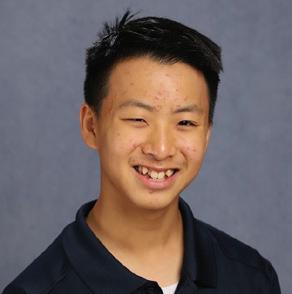
Khoa Nguyen is a first-year student in the College of Arts and Sciences. He doesn't know his major yet, but he's considering studying either Mathematics or Cognitive Science. He's involved with Catholic Hoos, and spends the majority of his free time writing short stories alongside reading, playing guitar, and taking many, many walks outside.
1Hebrews 11:8-10 (RSV).
Creative Writers

Kinsley Verbrugge is a first year student planning to study Economics and English. In her free time, you can most likely find her exploring new running routes through grounds, planning a trip to Cou Cou Rachou, or reading her favorite Every Moment Holy liturgies.

Reagan Stallings is a fourthyear studying kinesiology. Her passions include coffee shop exploration, music making, reading good books, and writing to share the truth goodness and beauty of God's creation.
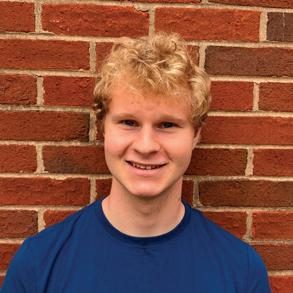
Mason Mabry is a third-year with a major in Astronomy-Physics and a minor in History. He enjoys reading, stargazing, and watching movies. You might find him on a short run or a long walk around Grounds.
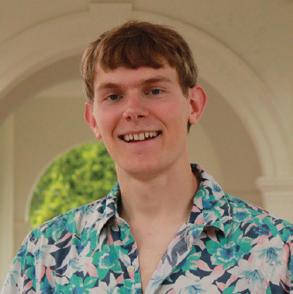
Josh Tomiak is a fourth-year studying computer science, music, and religion. Outside class, he teaches drum lessons, records music, and stays active shooting hoops. If you see him, be sure to ask about Biblical Hebrew and Appalachia.
Partner With Us
JOIN THE TEAM
If you are an undergraduate student interested in writing, designing, editing, or managing social media, we would love to have you on our team. We are always looking for new members who are passionate about integrating faith and culture on Grounds.
SUBMIT YOUR WORK
If you are an undergraduate student at the University of Virginia, we eagerly invite you to submit your work. We accept a variety of written work and visual art.
To learn more, email bearingsuva@gmail.com. To submit work, visit bearingsuva.org/submissions.
DONATE
Your donation allows us to distribute our journal to the University of Virginia as well as the greater Charlottesville area to foster dialogue on Christianity in an academic setting.
To donate, visit www.bearingsuva.org/donate.
ACKNOWLEDGEMENTS
Thank you to the Center for Christian Study at the University of Virginia for their continued support.
We also extend our gratitude to the UVA Parents Program and various community contributors who made the production of this issue possible.
Lastly, we would like to thank our mentor, Fitz Green, for his guidance and encouragement.

WHO WE ARE
Bearings is a member of the Augustine Collective, a coalition of student-run journals at university campuses across the nation.
www.bearingsuva.org @bearingsuva bearingsuva@gmail.com