The
Beacon
M A G A Z I N E
FALL/WINTER 2026
INSIDE ON THE FARM Finnriver promises a real PNW experience on the Peninsula SEAS THE DAY Buoys, budgets and life aboard a Coast Guard cutter PSYCHIC POWERS Searching for signs: One writer seeks enlightenment
Come On In Fall/Winter 2026 4
12
Unseen Connections
12
Messages from beyond – or something else entirely? A curious skeptic steps inside the world of mediums, psychics and healers in search of answers. (Clockwise from top left: Jeffery Marks, Amanda Gail, Brodie Stowell, Jeff Maple, David Zarza)
Cider farm rules
4
A Day in the Life
Artist’s Corner
7
Our Contributors
A Coast Guardsman’s workday unfolds aboard a buoy tender in Puget Sound. Come aboard for an inside look at the work that helps local mariners find their way.
Paul Archipley President
24
Small wonders
19
The Olympic Peninsula is home to Finnriver Farm & Cidery, which offers a family-friendly vibe and gorgeous views away from it all.
Small gifts, big meaning Holiday giving doesn’t have to come wrapped in a big box. From toy donations to charitable contributions, discover ways to help through local organizations.
Tim Jordan creates city landscapes on a scale that invite a closer look. Among his miniature subjects is a familiar local landmark.
23
Mukilteo artist Chris Hopkins had a productive and varied career. Now semi-retired, he’d much rather focus on what’s to come.
Jenn Barker Publisher
Brian Soergel Managing Editor
Season to Taste
30
Comfort by the bowlful: A hearty sweet potato chili and classic cornbread make the perfect cool-weather pairing.
7
Tina Novak Advertising Sales
728 3rd St., Ste. D, Mukilteo, WA 98275 425-347-5634 mukilteobeacon.com edmondsbeacon.com millcreekbeacon.com
Debbie Magill Design & Layout
Maria A. Montalvo Freelance Writer
Carly B. Dykes Freelance Writer
Lauren Salcedo Freelance Writer
The Beacon Magazine is a supplement to the Beacon newspapers.
THE BEACON MAGAZINE – FALL/WINTER 2026
3
The FINNRIVER EXPERIENCE
Come for the cider, stay for the food, music, orchards and unmistakable Peninsula vibe
P
By Maria A. Montalvo
lanning a day trip from south Snohomish County is difficult because there are so many fantastic choices. Less than an hour on I-5 takes us to beautiful tulip fields and bountiful farmland, and quaint downtown strolls can be found in towns in every direction. Perhaps most remarkable, with just a short ferry ride from Mukilteo, Edmonds, and Mill Creek, we can enjoy fresh seafood on an island or on the Olympic Peninsula. For a one-day trip, consider a ride on the Edmonds-Kingston Ferry for a quick 25-minute crossing and scenery-rich 45-minute drive to Chimacum, just past Port Ludlow. The Olympic Peninsula is home to a truly unique, family-friendly experience that could not feel more “PNW” from real PNW people – and we can take it all in and be home in time for sunset. Finnriver Farm & Cidery is an organic farm, orchard, and craft cidery along a salmon stream in the Chimacum Valley, and it offers much more than apples. After a graciously traffic-free crossing of the gorgeous Hood Canal Bridge, we entered the charming farm town of Chimacum. Signs for farm stands and orchards and all things different from our days on this side of the Puget Sound. Pulling into the parking lot, Finnriver welcomes you, many times, with gracious messages of greeting and inclusion, and the setting within gorgeous fields of flowers and orchards of apples makes you feel like you are in a different world, a very, very happy one.
A. Montalvo photo 4 Maria THE BEACON MAGAZINE – FALL/WINTER 2026
Sarah Wright photo
Above: Andrew Byers, owner and Operations Director, and Chris Weir, head cidermaker, share a toast. Right: Apples are in plenty of supply, of course, at the cidery. Below right: Weir pours a glass of cider for sampling. Inset: Cider sample trays are available on the menu.
Finnriver Farm & Cidery photo
Margie Bowker photo
Finnriver created a Cider Garden, where folks can gather year-round for cider on draft, tours and tastings, live music, local food, seasonal events, and local crafts and art. Dozens of tables are filled with patrons enjoying glasses of cider, platters of oysters, and plates of pizza. The buzz of conversation layered over the sound of kids running around in the field beyond the Cider Garden and the band tuning up on stage. The Finnriver employee working in the bottleshop described it perfectly: “It is a beautiful and magical community, and there is always so much going on.” The 50-acre historic farm and orchard had been looking for a new owner when the Kisler family came upon it nearly 20 years ago. Keith and Crystie Kisler and Eric Jorgensen co-founded Finnriver Cidery in 2008. Andrew Byers came on as head cidermaker in 2013 and joined the ownership in 2018. The name came by combining the children’s names of original farm partners, Kate Dean and Will O’Donnell, and the Kislers (Finn and River). The Kislers, along with Jorsensen and Byers, have continued to expand the company’s offerings and its commitment to community. The Finnriver Orchard and Cider Garden is on a historic former dairy just south of the Chimacum crossroads. The farm grows apples and pears for the cidery to ferment into hard ciders and fruit wines. Their associated Chimacum Valley Grainery produces local flours, pastas, and baked goods, and the farm stand, Stellar J Farms, grows and sells organic fruits and veggies. Today, the Jefferson Land Trust protects Finnriver as a farm. Finnriver, a regular at the Edmonds Summer Market, takes its cider seriously. “Cidermaking is a way to take a snapshot of time; this orchard, that season, these people, those barrels,” says co-owner Byers. “It is intimate both in the creative aspect and in the way we aim to share it.” They know the history, the science, the ingredients, and the interconnections necessary to make each sip of cider delicious. When you first look at the ciders on tap, the variety and categories can seem overwhelming, but there is a method to the madness (and it’s not actually madness). Byers is a “scientist (botany and fungal ecology), chef, and cider maker,” or pommelier. He’s a scientist who understands how import-
Sarah Wright photo
ant the process of invention is. Finnriver gives its cider makers the creative freedom to create new recipes each year, known as the Cidermaker Series. Depending on the ingredients available or chosen, one weekend visit to Finnriver could mean a small batch of a crabapple cider or the Peach Pepper Cyser. The Cidery makes what they call Core Ciders – the Finnriver interpretations of world cider traditions, but that is just the beginning. They also offer modern ciders, which are distinct from contemporary options, as well as seasonal ciders or botanical ciders. Oh, and not to be outshone
THE BEACON MAGAZINE – FALL/WINTER 2026
5
Margie Bowker photo
Maria A. Montalvo photo
Finnriver offers plenty of cider to choose from, plus live music and a cidery taproom that's a must-see on a visit to the 50-acre farm.
are the Orchard and the aforementioned Cidermaker series. My favorite of the day was the Farmstead cider, an all-apple cider made from damaged and overripe fruit that Finnriver buys from orchards around the state. They also have Fortified Fruit Brandywines (from distilled apple brandy) and the Pommeaus and Spirited Wines (port-style wines fortified with custom-distilled apple or pear brandy). So much to choose from. But don’t think of it as overwhelming;
Fall in love with your windows! Residential & Commercial Window Cleaning Service Reliable • Exceptional Results • Hassle-Free
Book Appointment TODAY for $50 OFF your Window Washing Service! Offer valid until 11/30/2026
Service Area
Mukilteo • Edmonds • Surrounding Areas
Call or Text (425) 200-4711 6 THE BEACON MAGAZINE – FALL/WINTER 2026
You can choose from modern ciders, distinct from contemporary options, as well as seasonal or botanical ciders.
see it as an opportunity to taste. And don’t forget about the food! Finnriver features an amazing array of local food trucks and has its own kitchen. It hosts a range of guest food vendors throughout the season, including Sushi by Chef Wyatt, Dented Buoy Pizza, Friendly Nettle, Moonlight Oysters, Fiddlehead Creamery, and more. If that is not enough of a draw, be sure to check out their packed events calendar. Visitors can join a Cheese & Cider Tasting or Paint & Sip; try line dancing; sit in on a seminar; try your knowledge at the Marine Science Trivia Night (in cooperation with the Port Townsend Marine Science Center); be creative as part of a Crushed Glass Art Party; take the kids to storytelling groups; and of course, listen to some great bands on Fridays, Saturdays, and Sundays (voted best live music and dance venue on the Peninsula three years in a row). Seriously, all right there among the orchards. The company is proud of its established heritage as a leader in the Pacific Northwest hard-cider revival. Finnriver is also committed to being a part of a sustainable regional community food system and attempts to honor the traditional and contemporary territories of the S’Klallam and the Chemakum. The farm is certified organic and salmon safe, and the cidery is a Certified B Corporation. They live their mission “to celebrate the beauty and bounty of the earth, to reconnect people to the land that sustains us, and to grow community.” It’s inspiring, in this day and age, to find a business partnership rooted in friendship, literally and figuratively. These people care about each other and the world around them. As they put it, “Crew members, investors, community partners, and visitors have contributed to the shape and flow of Finnriver. With several thousand cider trees in the ground, multiple land partners, and over 50 members of the Cidery crew, organic farming, craft fermenting, and community building continue side by side here.” Finnriver is a special place, a business committed to its community, to sustainability, to its team members, and to the natural world we share. It definitely has a vibe, and it is one you do not want to miss – the perfect spot for a day trip. Finnriver Farm & Cidery is open Wednesday to Sunday, from noon until 7:30 or 8:30 p.m. Depending on the day, visitors can relax in a stunning outdoor setting and enjoy 14-plus hard ciders on draft, two beer taps, and a range of specialty ciders, cocktails, seasonal hot drinks, and non-alcoholic offerings. Canine friends are welcome in the Bark Yard. Check out their website (www.finnriver.com) for more information. n Maria A. Montalvo photo
A Day in the Life
Brian Soergel photo
Keeping Puget Sound’s on Course LIFE ONBOARD – ON AND OFF – A BUOY TENDER By Brian Soergel
F
or George Rohwer, a day at the office might mean managing the logistics, purchasing, financial accounting, and inventory aboard a U.S. Coast Guard cutter. But on a buoy tender with a crew of only about 20 to 25 people, job descriptions have a way of expanding. Especially when Rohwer is underway on the Coast Guard Cutter Henry Blake, a 175-foot buoy tender based at Naval Station Everett. It might mean standing on the deck, helping haul a navigation buoy – along with its chain and heavy anchor – out of the waters of the Salish Sea. “Just because I’m basically an accountant-slash supply chain guy, it doesn’t mean I won’t also do some of the labor,” the petty officer second-class (SK2) storekeeper said. “There’s not enough hands to specialize that much.”
Top: Coast Guard Petty Officer George Rohwer takes a break from his duties aboard the Coast Guard Cutter Henry Blake, home-ported in Everett. Left: Rohwer fishes on off-duty hours while underway. George Rohwer photo THE BEACON MAGAZINE – FALL/WINTER 2026
7
Variety is part of life aboard a Coast Guard cutter. That can put Rohwer in two very different workplaces: an office aboard the cutter by the bridge or the buoy deck, where he is qualified to work as a rigger and operate the ship’s crane. He also stands watch on the bridge while the cutter is underway.
It’s a buoy’s life
T
he Henry Blake, named after a 19th-century lighthouse keeper (not the “M*A*S*H” character), is an aids-to-navigation cutter. Its primary area of responsibility includes the Salish Sea – encompassing Puget Sound, Grays Harbor, and the San Juan Islands – where its crew maintains the buoys and other navigation aids mariners use to safely move through Northwest waters. Think of a network of road signs for the water. Buoys and other aids identify channels, hazards, and safe routes. Without them, Rohwer explained, vessels could stray into shallow water and run aground. And unlike a highway sign planted beside a road, a buoy spends its life being battered by salt water, weather, and currents. The Henry Blake maintains 110 lighted and 48 unlighted buoys, as well as 65 shore aids to navigation. It also performs other Coast Guard missions, including search and rescue, maritime law enforcement, and marine environmental protection. “Someone has to maintain those buoys and those aids, or they’re eventually just going to weather,” Rohwer said. The job is to keep them from drifting off station and to make sure their lights and other components continue working. On any given day underway, when the Henry Blake works a buoy, its crew can bring it aboard into a saddle on the buoy deck. Crew members haul up the chain and sinker that hold it in position and inspect the equipment, including shackles and chain, for wear or damage. The goal is simple but important: Make sure the aid stays where mariners expect to find it. Rohwer sees a direct connection between that work and the Puget Sound region’s maritime economy. Commercial ships depend on a reliable system of navigation aids to safely enter and leave the area’s ports. The cutter also has sophisticated equipment to support the work. Rohwer described a dynamic-positioning system that can hold the Henry Blake at a designated location while the crew works a buoy, allowing an aid to be positioned with remarkable precision.
One storekeeper, many jobs
R
ohwer, 32, is on what the Coast Guard calls “independent duty,” meaning he is the only storekeeper assigned to the cutter. In port, much of his day can resemble a civilian logistics or financial-management job. He handles procurement, supplies and services, budget execution, property and inventory management, and other logistical needs for the cutter. He is also the only person aboard with certain certifications and purchasing authority needed for some of that work. Rohwer said managing the cutter’s entire budget is more responsibility than someone of his rank might ordinarily have at a larger unit. His next assignment could put him into a more specialized position involving procurement, property, or contracting. On the Henry Blake, however, he gets to do a little of everything. When the cutter gets underway, the job changes. Rohwer can work on the bridge, recording information about navigation aids as they are serviced. He can operate the crane. As a rigger, he can join the crew on the buoy deck, handling the heavy equipment used to bring buoys aboard. It is one reason there isn’t really a “typical” day. The cutter normally gets underway once or twice a month,
Rohwer stands at the top of steps leading to crews’ quarters and the galley. Red lights can be used inside cutters to preserve night vision so crewmembers can move to a dark deck without losing their ability to see in the dark. Rohwer said crewmembers stand 24hour duty aboard the cutter; he typically does that two or three times a month. Brian Soergel photo
8 THE BEACON MAGAZINE – FALL/WINTER 2026
Brian Soergel photo
often for about five days at a time. Its regular territory is Puget Sound and the San Juan Islands, although the cutter can travel much farther when necessary. Rohwer and the crew recently headed north toward Juneau, Alaska, for an annual buoy-tender gathering involving crews from Coast Guard districts in the Pacific Northwest and Alaska. The event includes competitions built around the specialized skills buoy-tender crews use, including crane operation, line throwing, and handling chain and shackles.
Onboard life
W
hen the Henry Blake is underway, it’s not just Rohwer’s workplace. It’s home. He sleeps in a five-person berthing area with other second-class petty officers. Living arrangements aboard become somewhat more private with rank, he said, with senior personnel and the cutter’s command having smaller berthing areas or their own staterooms. Meals are prepared aboard. On a normal day, breakfast might include eggs cooked to order, pancakes, bacon, or sausage. The coffee maker gets plenty of use. And when the workday allows some downtime, sailors find familiar ways to relax. A Nintendo Switch is aboard, and it’s plenty popular. The crew watches movies, and Rohwer brought along a collection of Jack London stories and novels for the trip, including “The Sea-Wolf,” “The Call of the Wild,” and “White Fang.” Technology has also made underway life considerably less isolated. Rohwer said the cutter now has Starshield, the government version of the Starlink satellite network. Before it was installed, getting underway meant losing internet access. Now the connection aboard can be better than his cellphone. Still, some of Rohwer’s favorite moments at sea have little to do with technology. He remembers traveling beneath a dark sky with virtually no light pollution and looking at the stars through night-vision goggles. “You can see all the stars. You can see everything.” On another trip, while heading to Portland for Fleet Week, dolphins appeared alongside the cutter. On another, Rohwer gazed in wonder at the northern lights.
From Renton to Everett — and back again
D
aily life changes considerably when the Henry Blake returns to Everett. Rohwer lives in Renton with his wife, who has a civilian job. Most days in port, he reports to the cutter and works from his small office aboard, then heads home at the end of the day. There are exceptions. Crew members stand 24-hour duty aboard the cutter, and Rohwer said he typically does that two or three times a month. Otherwise, his in-port schedule can feel surprisingly conventional – essentially
Rohwer stands on the gangplank to the Henry Blake at its home base in Everett. Below, a dog smiles for Rohwer’s camera during a stop in Alaska.
to get out of “I wanted Washington state. I’ve
been here my whole life leading up to that, and I just wanted to see other places. That was kind of like 50% of it. The other 50% was that I just thought it was a cool experience. I liked the mission of the Coast Guard.”
an office workday followed by the commute home. It is a long way, in some respects, from where his Coast Guard career began. The Gig Harbor native joined the service at 24 after attending Central Washington University, where he earned a degree in technical writing and once considered journalism. He wanted to see more of the world than his home state, and the Coast Guard offered that opportunity. He initially secured an assignment to Alaska and later spent about four and a half years in New York. Like many in the military, part of the Coast Guard’s appeal was experiencing new locations. “I wanted to get out of Washington state,” Rohwer said. “I’ve been here my whole life leading up to that, and I just wanted to see other places. That was kind of like 50% of it. The other 50% was that I just thought it was a cool experience. I liked the mission of the Coast Guard.” Now, after roughly eight years in the service, he is back in Washington and plans to make the Coast Guard a 20-year career.
THE BEACON MAGAZINE – FALL/WINTER 2026
9
Storekeeper was a job he had considered even before joining. Finance, property management, and logistics interested him, and he recognized that supply-chain skills could translate to civilian employment someday. He found he liked the work even more than he expected. But the attraction goes beyond spreadsheets and purchasing. Rohwer said he believes in the Coast Guard’s broader missions and particularly enjoys aids-to-navigation work. As a storekeeper, he also likes being in a support role – the person who can purchase what a unit needs and solve the logistical problems that allow everyone else to do their jobs.
A small crew depends on teamwork
A
cutter the size of the Henry Blake makes teamwork unavoidable. Its crew ranges from young Coast Guardsmen just out of high school to senior members in their 40s. Rohwer falls somewhere in the middle. On a larger ship, sailors may be able to remain largely within their specialties. With only a couple dozen people aboard the Henry Blake, everyone has to carry more than one responsibility. That makes the crew’s relationships important. Rohwer said the Henry Blake has a particularly good crew whose members generally enjoy working together. But liking one another, he said, isn’t really the essential part. “They don’t have to like each other, but they do have to get along,” he said. And aboard a small cutter, it quickly becomes apparent if somebody isn’t carrying his or her share of the work. “There’s a lot of teamwork that goes into it. Basically, a lot of people have to wear a lot of different hats.” For Rohwer, those hats can include accountant, purchasing agent, inventory manager, bridge watchstander, crane operator and buoy-deck rigger — sometimes within the span of a single trip. It’s a job that shifts between office and ocean, between a commute home to Renton and a bunk shared with shipmates, and between the routine work of balancing a budget and the heavy, physical work of maintaining the markers that guide vessels through Puget Sound. Most mariners passing one of those buoys may never know who keeps it there. For the crew of the Henry Blake, that’s the job. n
Earn a Bachelor’s Degree at Edmonds College
We’re more than a college, and you’re more than a student. Let us help you unlock your full potential and make your dreams of earning a bachelor’s degree at Edmonds College a reality.
George Rohwer photo
You have to do it all on a buoy tender. Here, Rohwer pulls duty on the bridge.
We offer seven bachelor’s programs that offer hands-on training for in-demand careers: • Advanced Manufacturing and Materials Engineering Technology, • Behavioral Health Support Specialist, • Child, Youth, and Family Studies, • Computer Science, • Information Technology - Application Development, • Integrated Healthcare Management, and • Robotics and Artificial Intelligence
Start your journey at Edmonds College today. Visit edmonds.edu/bachelor-degrees.
Edmonds College does not discriminate on the basis of race; color; national origin; sex; disability; age; religion; sexual orientation; citizenship, marital, or veteran status; or genetic information in its programs and activities. The following person has been designated to handle inquiries regarding nondiscrimination policies: Kathy Smith (Title IX and Section 504 Coordinator/Investigator); Clearview Building, Room 122B; kathy.smith@edmonds.edu, 425.640.1814. Project Number: 26-27-034
10 THE BEACON MAGAZINE – FALL/WINTER 2026
B R I L L I A N T
S E N I O R
L I V I N G
Independent, Assisted Living, Enhanced Assisted Living, and Memory Care
Call Today to Schedule a Tour (425) 287-5742 4015 164th St SW, Lynnwood WA 98087 QuailParkofLynnwood.com
THE BEACON MAGAZINE – FALL/WINTER 2026
11
BRIDGING
REALITIES: Can mediums guide us? By Paul Archipley
A
sk a medium what it’s like to communicate with the dead, and the answer may be less dramatic than Hollywood’s version. There may be no ghost standing in the corner. No disembodied voice delivering complete sentences. No crystal ball. Instead, the people I interviewed described something considerably more subtle: a physical sensation. An emotion that seemingly comes out of nowhere. A picture appearing in the mind. A name, a phrase, a symbol. A sudden sense of knowing something they couldn’t have possibly known otherwise. Then comes the hard part: interpreting what the heck it means. I approached the subject as a skeptic – but a curious one. I have friends I respect who are convinced they’ve communicated with the dead. Rather than trying to prove or disprove their experiences, I wanted to know what people who describe themselves as mediums, psychics, intuitives or healers believe is actually happening. I interviewed Mukilteo evidential medium Jeffrey Marks, intuitive Amanda Gail of Edmonds and Picnic Point healer Jeff Maple. I also talked with Mukilteo resident Brodie Stowell, who consulted mediums following his parents’ deaths. He said the experiences profoundly affected him. Finally, I sat in on a Zoom gathering conducted by Seattle psychic David Zarza, watching him respond in real time to questions about relationships, careers, health, children and the future. Their beliefs and methods differ, sometimes substantially. Nevertheless, certain themes surfaced repeatedly.
Receiving, then interpreting
F
or Marks, it began with fear. He traces his experiences to age 3, when his family briefly lived in a house in White Salmon that he says was haunted. One night, Marks said, he saw what appeared to be someone walking across his bedroom. The figure stopped, looked at him and then charged toward him. “I never knew fear until 3 years old,” he said. The experience frightened him enough that he slept with the covers over his head for years. At 15, Marks was listening to music in bed, deeply relaxed. But when he opened his eyes, seven people were standing around him. Initially terrified – who wouldn’t be! – he managed to recreate his relaxed state. And the figures returned. Marks said one touched his hand, producing an electrical sensation, and communicated mentally that they were there to help rather than hurt him. He came to regard them as spirit guides. Marks said becoming a medium wasn’t a career he would have picked. Eventually, however, he began deliberately developing what he believed he had experienced since childhood. Maple’s beginnings were almost the opposite. He grew up in a family where dreams, spirits and past lives were normal conversation. He recalls playing a guessing game with his sister in which he believes they communicated telepathically. Later, Maple spent nearly 15 years in the Army,
THE BEACON MAGAZINE – FALL/WINTER 2026
13
Difference
EXPERIENCE THE
Memory Care 10605 NE 185th Street Bothell WA 98011 LIC #2623
CogirofBothell.com (425) 371-4234
Assisted Living, & Memory Care 21500 72nd Ave W Edmonds, WA 98026 LIC #2624
CogirofEdmonds.com (425) 358-9614
Independent Living & Assisted Living 14905 Bothell Everett Hwy Mill Creek, WA 98012 LIC #2475
CogirofMillCreek.com (425) 484-7769
CALL TODAY FOR OUR MOVE-IN PROMOTIONS! 14 THE BEACON MAGAZINE – FALL/WINTER 2026
including three combat tours. He said he suppressed his spiritual sensitivity to better function in the military’s culture. War hit him hard. After leaving the service, he struggled with depression and PTSD symptoms. Reading about empaths led to what he calls a spiritual awakening and, eventually, to a psychic fair in Mill Creek. There, a medium noticed him walking around trying to “sense” which practitioner felt right. “I saw what you were doing,” Maple recalled her saying. “You were reading people.” She told him his abilities ran in his family, and described him as having “healing hands.” Maple subsequently trained with her and began practicing. Gail’s journey was less dramatic. She described her development primarily as learning to stop suppressing herself. “The only time that this part of my life took off was when I finally decided I need to know what I am, who I am,” she said. A former hairdresser, she knew she had some innate ability; while clients sat in her chair at the salon, she could sense their emotions, knew when they were struggling or suffering. Interestingly, after Gail had been reading people for about four months, the first medium she went to see was Marks. His approach was far more analytical than hers. “I am all heart, and he is very mental,” Gail said. Three practitioners, three paths: fear and eventual acceptance for Marks; early familiarity followed by suppression and rediscovery for Maple; and a process of self-exploration for Gail.
Information receiving methods vary
D
espite those different beginnings, their descriptions of how information arrives are remarkably similar. Marks calls himself an “evidential medium.” He believes a reading should provide specific information identifying a deceased person rather than vague assurances. But that information, he said, doesn’t generally arrive in complete sentences. Marks described moving his ordinary consciousness aside – from the driver’s seat to the passenger seat – and receiving physical sensations, emotions, mental pictures, names and phrases that he must then interpret. Gail also describes an internal process. She may perceive a hazy image, clothing, an approximate age or another visual reference that helps her interpret what she believes she’s receiving. Maple said he initially scanned people’s bodies with his hands, and experienced heat or a magnetic-like sensation near areas he associated with pain or emotional issues. Later came mental pictures, followed eventually by words and directions. Stowell, describing readings from the client’s side, independently characterized mediums as communicating through “symbology, pictures and interpretation.” Whatever the source, their descriptions share an important characteristic: They aren’t simply hearing dead people talk. They say they receive impressions and then interpret them.
A gift – or something everybody can do?
A
nother unexpected point of agreement is that practitioners generally don’t think they’re special. They don’t consider themselves uniquely chosen. Marks says everybody potentially can develop mediumship. Maple emphasizes practice, and compares intuitive ability to other human talents: People may have different levels of natural aptitude, but skills can be developed.
THE BEACON MAGAZINE – FALL/WINTER 2026
15
Zarza made much the same point during his Zoom session while discussing remote viewing, the purported ability to perceive people, places or events from a distance. “It’s something that we all can do,” he told the group, adding that people may already experience it but dismiss it as imagination. Maple’s teacher put the lesson more bluntly: Practice means getting things wrong, falling on your face and gradually building confidence.
Talking to the dead – or counseling the living?
H
ere their approaches diverge. Marks’ answer is evidence. Anybody can say someone’s grandmother is present and loves them, he said. He wants to discover details specific enough that the client recognizes the purported communicator – information he believes he couldn’t otherwise know. Gail isn’t interested in science validating her experiences, but that doesn’t mean she wants clients to abandon critical thinking. She tells them to keep their “wise mind” engaged, and criticizes readings so vague that clients simply agree with whatever is said. “I think that there does need to be proof,” she said. Zarza’s Zoom session demonstrated a more interactive approach. Participants frequently supplied information before or during readings, and Zarza sometimes asked for a small detail about their day before consulting what he calls “the universe.” That raises a legitimate question: How much information originates with the psychic, and how much develops through interaction with the client? The interviews didn’t answer that question. They did demonstrate that practitioners themselves have different standards for evidence. And for the skeptic, that raises an obvious question: How much information originates with the psychic, and how much develops through the interaction? For believers, the question may be different: Does the exchange help the psychic refine what he or she is receiving? Again, the interviews didn’t settle that question. They showed that even practitioners have different standards for what constitutes convincing evidence.
Where are the boundaries?
I
began this project expecting to hear mostly about communicating with dead people. Instead, much of the conversation concerned the living. Grief. Guilt. Relationships. Fear. Work. Regret. Trauma. Purpose.
Marks acknowledged similarities between mediumship and grief counseling. Some clients want reassurance that a loved one is OK. Others carry guilt about relationships that were never repaired. Stowell said reassurance was precisely what he sought after his parents’ deaths. “For me, it was a big healing process reaching out to both my father and my mother because I felt I didn’t have any way of grieving,” he said. He believes society does a poor job of teaching people – especially men – how to grieve. Zarza’s Zoom session pushed the counseling aspect further. Participants asked about marriage, employment, romance, parenting and an international move. Zarza responded as much like a life coach as a psychic, sometimes making predictions, but often encouraging participants to examine fear, relationships and their own behavior. Whether those insights came from “the universe,” as Zarza believes, or from an observant human being is a question each listener may answer differently. But people clearly were seeking guidance.
Predicting the future
T
he practitioners also differ over prediction. Gail said she doesn’t really do it. Marks will discuss possible futures but stresses free will. Predictions, he said, represent probabilities rather than events written in stone. Zarza is more comfortable with specifics. During the Zoom session, he predicted when one participant might leave her job, estimated when another might enter a serious relationship, and gave Stowell a time frame for a planned overseas move. Those differences are a reminder that “psychic,” “medium,” “intuitive” and “healer” don’t describe a single belief system or method.
Where are the boundaries?
T
hat makes ethics particularly important. Marks’ rule is “do no harm.” He believes mediums should provide evidence rather than exploit clients emotionally or financially. He also discourages readings immediately after a death because people in acute grief may be particularly vulnerable. Gail and Maple raised another boundary: permission. Both said practitioners should obtain consent before deliberately attempting to read someone.
Health presents an even more complicated boundary. During Zarza’s gathering, a woman undergoing cancer treatment asked about recurring pain. Zarza said he wasn’t a physician and wasn’t offering medical advice, but he provided impressions about possible causes while also encouraging her to consult her doctors. The exchange illustrated how quickly spiritual guidance can overlap with areas that might be better addressed by medical, mental health, financial or other trained professionals.
Death – and how to live
F
or Stowell, the ultimate question isn’t whether mediumship is real. He’s convinced it is. Instead, what matters is what believing it has done to his understanding of death. He wanted to know his parents were OK. He says his readings provided that reassurance. But they also affected how he thinks about his own life. “I realize life is finite,” Stowell said. Maple arrives at much the same place – from another direction. He sometimes asks older clients to imagine themselves on their deathbeds. They probably won’t wish they had worked harder, he tells them. They may wish they had spent more time doing what they loved, laughed more or appreciated what they had. His advice is decidedly earthly: Don’t wait until the end. Toward the end of Zarza’s Zoom session, Stowell returned to the same theme. Recently retired, he said he felt as though his life had been given back to him. He spoke about a message he believes came from his deceased father: Spend as much time in nature as possible. Stowell said he now notices beautiful things he once overlooked. I began these interviews wondering whether people really can communicate with the dead. I can’t say these conversations answered that question for me. But they did change the question. Perhaps the mystery isn’t confined to whether consciousness survives death, whether a picture appearing in someone’s mind came from a deceased relative or whether a sudden intuition originated somewhere outside ourselves. There is another question underneath all of those: If our time here really is finite – something skeptics and believers can agree on – what are we going to do with it? For a story that started out being about talking to the dead, I found myself spending an unexpected amount of time thinking about how to live. n
You’re in Good Company With local decision makers and leaders from right here in your community Business Checking Business Loans Sweep Accounts Nonprofit Lending SBA Loans and more!
Ashley Davis VP Branch Manager (425) 275-4382 Ashley.Davis@fsbwa.com
FSBWA.COM
How We Do It: Proven Processes Planning Communication Client
Your local
DESIGN-BUILD REMODELER FOR OVER A DECADE
Collaboration
What We Do: Kitchens / Bathrooms Additions Aging-in-Place
Let’s Get Planning: 425-977-9661 contact@northlightcustom.com www.northlightcustom.com
Outdoor Living ADUs Whole Homes
LIC# NORTHCB745KQ THE BEACON MAGAZINE – FALL/WINTER 2026
17
brings routine dog wellness care to Lynnwood New business focuses on keeping dogs clean, comfortable and healthy
F
or Scenthound owner Ed Steidl, taking care of a dog shouldn’t necessarily mean an expensive trip to a traditional groomer. Most dogs don’t need elaborate haircuts, he said, but they all need the basics. “Every dog needs routine hygiene,” Steidl said. “Every dog needs a bath. Every dog needs their ears cleaned, teeth cleaned, nails clipped.” That idea is at the heart of Scenthound, a new dog hygiene and wellness business in Lynnwood. Its basic service covers those essentials, with additional services available depending on a dog’s needs. A key part of the concept is Scenthound’s six-point S.C.E.N.T. Check, covering a dog’s skin, coat, ears, nails, teeth and glands. Results are documented in the company’s app. Staff members may notice such things as hot spots, matting or lumps, and alert owners when something deserves closer attention. Scenthound does not diagnose medical conditions, but can recommend that an owner consult a veterinarian. That, Steidl said, is what separates Scenthound from full-service groomers, pet supply chains and boarding-and-grooming operators. Those businesses mostly build around occasional haircuts or baths. Because members visit monthly, the S.C.E.N.T. Check becomes an ongoing record of a dog’s condition rather than a onetime snapshot. “Because we see dogs more often, we can catch small things — a hot spot, an ear that’s starting to look irritated — while they’re still small,” Steidl said.
“People hear ‘dog groomer’ and think haircut,” he said. “What we’re actually offering is closer to routine wellness for your dog — the grooming is almost a side effect of that.” Regular visits also help dogs grow familiar with the location, smells and staff. “We’ve seen anxiety in dogs go down over time,” he said. Steidl spent much of his career in technology, including more than a decade at Microsoft. He discovered Scenthound while exploring franchise opportunities, and as the owner of two dogs, he immediately understood the concept. He also had an earlier connection to animal care. Steidl once considered becoming a veterinarian and worked at a veterinary clinic and a veterinary emergency room while in college. Opening Scenthound, he said, has brought him “a little bit full circle.” The Lynnwood location is the first of 11 Scenthound franchises Steidl plans for the greater Seattle area. He is already working toward a second location in Shoreline. Scenthound primarily operates through monthly memberships, although nonmembers can make appointments when space is available. Routine hygiene appointments generally take about 30 to 45 minutes, and customers can book and change appointments through the app. For Steidl, though, the bigger goal goes beyond a clean dog. “We increase the connection between people and their dogs,” Steidl said. “That’s what we’re all about.” Sponsored content
425-333-DOGS (3647) | scenthound.com/lynnwood 19709 Highway 99, Lynnwood 18 THE BEACON MAGAZINE – FALL/WINTER 2026
Carly B. Dykes photo
It’s a small world, after all H
Tim Jordan's tribute to Seattle grows with a handcrafted Mukilteo Lighthouse
T
By Carly B. Dykes im Jordan thinks small, but on a large scale. Or gauge, if you prefer. He’s a train aficionado whose long-time model-train hobby has earned acclaim from local train buffs and featured on numerous local TV stations. Yes, there are trains. But there’s much more to see with Jordan’s most impressive build, aptly named “Tribute to Seattle.” The table-sized model railroad the Bothell resident has spent 23 years building sports the iconic Space Needle, of course. The Fremont Troll looms, and a piece of rubble from the demolished Kingdome adds real-life drama. There’s more. Kenmore Air seaplanes on Puget Sound. The Pink Elephant car wash joins the city’s familiar landmarks. The red “R” on the old Rainier beer building. And an advertisement for Jordan’s business, Sheds Plus, slips a little personal history into the scenery. Look closer, and the layout becomes more than a collection of recognizable buildings. It is a portrait of the
Carly B. Dykes photo
Carly B. Dykes photo
All photos by Tim Jordan unless otherwise noted THE BEACON MAGAZINE – FALL/WINTER 2026
19
native New Yorker’s adopted home, assembled through years of intricate work, chance encounters, and contributions from people who wanted a place in his miniature world. The trains brought him back to a childhood passion. Everything around the tracks tells the story of what happened next.
live on television. Afterward, the public was invited to collect rubble before it was all hauled away. But his own acquisition came years later, thanks to a hoodie bearing the stadium’s logo. A waitress noticed it and told him she had pieces of the Kingdome. He told her about his model railroad and showed her the layout. The conversation led to an Finding his Seattle invitation to her home on ordan was 6 when he and Whidbey Island. Jordan his brother discovered boarded the ferry prepared a model train layout and to bring back a souvenir. “I figured out how to assemtook a hammer, a bag, and ble and run it. His brother my camera.” Her piece of wasn’t especially impressed. rubble was marked with But Jordan was captivated. the date she collected it. A “I was in love with it, and I fragment eventually found don’t know why,” he said. He its way into his layout, pored over train magazines giving the miniature city a as a boy, but the hobby tangible connection to the eventually went on hold. His one that inspired it. path from New York to the Other people have conPacific Northwest included tributed their own interprea high school job at a car tations of Seattle. The team wash in the Hamptons, milbehind the “Rainier: A Beer itary service, and a career as Odyssey” indie documenTim Jordan photo a jet mechanic. tary brought five custom Jordan moved to the PNW figures dressed as Rainier in 2000. Working at Boeing beer bottles. Snohomish Field, he watched trains pass artist Carrie Milburn Above: An intricate miniature model of the historic Mukilteo Lighthouse each day – an everyday sight shared digital images of was built-to-scale to the real thing. Below: Jordan relied on a photo of the that would help inspire the her Seattle-themed artwork, Mukilteo Lighthouse to construct his miniature version. In the background railroad he eventually built. including depictions of Kurt is the equally historic Space Needle at the Seattle Center. He returned to model trains Cobain and Jimi Hendrix. at 30, after the birth of his A friend who paints first child. Expecting to graffiti on rail cars contribspend more time at home, uted a boxcar mural and a he wanted a project he hand-painted sign comcould work on there. So he started a layout downstairs. bining local landmarks with a Sounder train, a Ride the Ducks That project became “Tribute to Seattle.” And as his connection vehicle, and Boeing airplanes. Those additions have helped make to the region deepened, the landscape around his trains continthe railroad something Jordan could not have built entirely on ued to change. his own: a collection of other people’s creativity as well as his.
J
More than scenery
R
e-creating a city requires a mix of resourcefulness and patience. Many of Jordan’s buildings are 3-D printed or adapted from model railroad kits. Others give him a reason to work by hand. For a recent addition, the Mukilteo Lighthouse, he chose an old-school approach: building the replica from scrap parts. First came a visit to the real lighthouse. Jordan took his son to the top and collected measurements. Using a scale ruler, he laid out the individual pieces, scored them with a blade, folded them into shape, and carefully fitted them onto the model. The result brought another Northwest landmark into his expanding version of Seattle. But not every piece of the layout began with measurements and a workbench. Some arrived through coincidence, like the Kingdome. Jordan watched the infamous ballpark’s demolition
20 THE BEACON MAGAZINE – FALL/WINTER 2026
Passing it along
T
he contributions aren’t limited to scenery. Over the years, fellow hobbyists and community members have entrusted Jordan with trains they no longer have room for or know someone else will enjoy. Recently, a Kirkland man gave him an entire collection. The two had met years earlier when Jordan displayed his layout at a museum in Snohomish; the man needed space and remembered their conversation. Jordan’s work has now appeared in the kind of magazines he once read as a child, along with local television news coverage. Still, he credits much of the Carly B. Dykes photo interest to word of mouth. People tell him about trains available to buy or give away. Familiar faces return to train shows looking for his booth. That steady flow of equipment allows him to do more than add to his own collection. He assembles donated trains and materials
into layouts for children, giving them a starting point much like the one he stumbled upon at 6. “I get the stuff for free, so I’ll put something together for them to play with,” he said. Jordan worries model railroading could become a lost art. Putting a working layout into a child’s hands is his way of helping it endure. That interest in the next generation also connects with his involvement in the United Northwest Model Railroad Club. The club holds an annual February show at the Evergreen Fairgrounds in Monroe, benefiting a local 4-H club. Jordan has sponsored the show for several years and brings his Seattle layout to display. Last year’s event set records for attendance and donations. While he helps other people get started, his own railroad remains a work in progress. Next comes a more detailed interior for Smith Tower, including a fully decorated penthouse. He also plans to build the houseboat from “Sleepless in Seattle,” a project that will require remodeling part of his miniature waterfront. Twenty-three years after starting a project to keep himself occupied at home, Jordan is still making room for another piece of Seattle. n
T
wenty-three years after starting a project to keep himself occupied at home, Jordan is still making room for another piece of Seattle.
Tim Jordan holds his completed Mukilteo Lighthouse. Using a scale ruler, he laid out the individual pieces, scored them with a blade, folded them into shape, and carefully fitted them onto the model.
Brian Soergel photo
THE BEACON MAGAZINE – FALL/WINTER 2026
21
Holiday Food Safety Tips Give thanks, not foodborne illness.
Wash
your hands and sanitize countertops!
Separate foods to prevent cross contamination!
Cook
food thoroughly to kill bacteria!
For more information, go to snohd.org/seasonalfood
Store
foods properly in the refrigerator!
Artist's Corner Chris Hopkins, Mukilteo
F
or artist Chris Hopkins, retirement is largely a technicality. “I’m retired on paper,” Hopkins said. But as long as people continue commissioning his work – and as long as he enjoys creating it – he has little intention of putting down his brushes.
Hopkins is perhaps best known for a commercial illustration career that included artwork connected with “Return of the Jedi,” “Labyrinth,” “Indiana Jones and the Temple of Doom,” album covers and Super Bowl theme art. But those projects are decades behind him, and Hopkins would rather talk about what he’s doing now.
His more recent work has focused on fine art and telling stories of perseverance and history. Among his major projects is a series of more than 60 works honoring the Tuskegee Airmen, documenting the Black pilots, ground crews, and families who confronted enemies overseas and racial discrimination at home. Another series examines the incarceration of Japanese Americans during World War II, including paintings depicting Bainbridge Island newspaper publishers Walt and Milly Woodward, who used the Bainbridge Review to oppose the forced removal of their Japanese American neighbors. Hopkins also has a long association with the U.S. Air Force Art Program. His assignments took him to Afghanistan as a combat artist and later to Walter Reed, where he sketched wounded service members. More recently, he completed a portrait of former Air Force Secretary Frank Kendall for the National Gallery. Hopkins works primarily in oils these days, although he has experimented with resin and encaustic. Through it all, his philosophy remains remarkably simple: Keep learning. He considers himself a “lifetime student,” and when asked to name his favorite painting, Hopkins offered an answer that helps explain why retirement holds little appeal. That painting, he said, is probably still somewhere in the future. n
THE BEACON MAGAZINE – FALL/WINTER 2026
23
Kellie Lewis photo
A
little help, a lasting impact
TOYS
for TOTS
CHUR CHES
LOCAL FOOD BANKS
CHA RITIES VOLUN TEERS
Local charities bring holiday joy to families in need – inspiring some recipients to give back for years to come By Lauren Salcedo
I
t’s a holiday memory that many of us hold dear – the joy on a child’s face when they wake up on Christmas morning and see those brightly wrapped presents under the tree, just waiting to be opened. Yet for many Snohomish County residents, the holiday season brings additional hardship. Rising fuel and food prices, a challenging job market, and cuts to national support programs have left many families struggling to put food on the table. Toys under the tree become a luxury these families cannot afford.
Luckily, even during these difficult times, several hard-working nonprofits and faith-based organizations are trying to fill the gaps and bring Christmas joy to children and their families.
Toys for Tots
O
ne such holiday giving organization is the Marine Corps Reserve Toys for Tots, a national public charity organization with more than 850 satellite programs, including one in Everett. “Our mission is to deliver symbols of
TOYSforTOTSCHURCHESCHARITIES LOCALFOODBANKSVOLUNTEERS
How to help during the holidays
D
uring the holiday season, thousands of families across Snohomish County depend on the kindness of neighbors they may never meet. Behind every wrapped present, stocked food basket, and winter coat is a volunteer, donor, or local business that decided to make someone else’s holiday brighter. Whether it’s donating a toy, sponsoring a family, or spending a day sorting gifts, there are countless ways local residents can make an impact. Here are just a few. • Donate a new unwrapped toy • Sponsor a family • Purchase gift cards • Donate warm coats and clothing • Volunteer to sort or wrap gifts • Host a workplace toy drive • Make a financial contribution • Share opportunities on social media • At schools, food banks, senior centers, churches and fire districts, coordinate or assist in adopt-a-family programs, toy drives, food baskets, and volunteer opportunities.
The Edmonds Food Bank’s Toy Shop provided toys to 950 families in 2025. But the need for support has only increased for this holiday season.
hope to underserved and underprivileged communities in need,” said area coordinator Mary Butler. “The extension of that hope comes from the men and women who have served our country and decided that this is how they choose to continue their service on domestic soil. It is an honor and a privilege and a responsibility for us to continue that service here.” The long-standing program collects new, unwrapped toys to distribute to economically disadvantaged children during the holidays and beyond. “Last year we served more than 68,000 children,” said Butler, who
has been the local Toys for Tots area coordinator for 16 years. She explained that local families can qualify for the program in two ways. One way is to apply online starting Oct. 1 every year. Families must meet income requirements; however, if they already qualify for food stamps and medical, they also qualify for Toys for Tots. “If you qualify for those programs, you are either working-class poor or under the poverty level, so you qualify for our assistance,” Butler said. She noted that the online application does require pay stubs, birth certificates, and legal guardianship paperwork to prevent fraud, though fraud is rare. Another way that families can qualify for assistance is through community organizations – such as domestic violence shelters and food banks – that determine their own qualifications and reach out on behalf of the families with a list of the children, their ages and genders, and their desired toys. Bright City Church at 2730 Oakes Ave. in Everett hosts the Toys for Tots warehouse at no cost to the organization, from Nov. 30-Dec. 21, Monday through Saturday, 9 a.m. to 4 p.m. Individual families come through the doors to receive toys and books for their children. For those interested in supporting the Toys for Tots mission, several ways to get involved are available. One way is for businesses to volunteer as donation locations or “drop sites.” About 300 local businesses serve as Toys for Tots drop sites. To qualify, businesses must apply online and sign a document declaring that all donations
Contact your local provider for more information.
Spotlight on organizations • Toys for Tots (everett-wa.toysfortots.org): Collects new, unwrapped toys for children throughout Snohomish County. Readers can donate toys, volunteer, or host collection boxes. • Operation Christmas Child (samaritanspurse.org/occ): Shoebox gifts filled with toys, school supplies, and hygiene items are distributed to children around the world. • One Simple Wish (onesimplewish.org/ user/register/cp): Connects donors with specific wishes from children and young adults in foster care. • Christmas House (christmas-house.org): Provides holiday gifts to thousands of local children each year. • United Way of Snohomish County (uwsc. org). To donate or learn more about opportunities, contact Director of Development Megan Ruth at megan.ruth@uwsc.org.
are the property of Toys for Tots. Businesses must complete this application every year. Those who would like to donate can bring new, unwrapped toys to the donation locations listed on the Toys for Tots website or donate money online. Those funds go directly to purchasing toys for children in Snohomish County.
Volunteers
L
ike other charity organizations, Toys for Tots can always use more volunteers. “During our peak times, we will have maybe 45 volunteers, when we probably need 60.” To volunteer, visit the sign-up page on the website. Last year, 103 volunteered. One Snohomish County family has volunteered for Toys for Tots for more than a decade. In 2010, Fredy and Kirstin Esquivel were a young family starting out, with two young kids at home, and found themselves struggling. Fredy, a sergeant in the Marine Corps, had recently returned from Afghanistan, while Kirstin worked full-time and attended San Diego State University. “We were a young family experiencing financial hardship and just trying to make Christmas happen, and at the time we just didn’t know how we were going to make it happen,” Fredy said. One of his fellow Marines reached out to him and told him they could sign up for Toys for Tots. “We showed up, and they said, ‘You can have two big items and one small item per kid.’ Unbeknownst to us, these toys were not inexpensive; they were expensive gifts, and they let us grab a bike as well. It was just a great experience.” THE BEACON MAGAZINE – FALL/WINTER 2026
25
Esquivel family photos
The Marine Corps Reserves’ Toys for Tots mission is “to deliver symbols of hope to underserved and underprivileged communities in need.”
Not only had the family been struggling financially, but Fredy was also recovering from being seriously injured in combat only a few months before. In August 2010, while on a route clearance mission, an improvised explosive device detonated directly beneath him. He suffered spinal compression and a traumatic brain injury that had lasting physical and mental effects. He was later awarded a Purple Heart. In 2012, after they welcomed another child, someone “adopted” their family through the Toys for Tots program and left two huge boxes of gifts on their doorstep. “They individually wrapped each gift for each of our children, and they also gave us gift cards for the local grocery store.” In 2015, the family moved from California to Lake Stevens. Fredy is a firefighter for the Port of Seattle, and Kristin stays home with their two youngest children and runs her own business. “We moved up here so I could attend the University of Washington, and one of the first things I did was seek out a local Toys for Tots, and that’s how we met Mary and King Butler,” Fredy said. “We have been volunteering here for 11 years. Now our younger kids are 14 and 11, and they have also been volunteering. For me, being a part of a community means giving to your community. There are a lot of people in need, and sometimes you don’t know who it is; it can be your neighbor. It’s not an organization that has high overhead.” Since the family volunteers each year, they have seen firsthand how the need has grown. “There are a lot of great companies that help donate and really put forth an effort to help the community, but especially now there are so many more people in need that it is hard to keep up with demand,” Kirstin said. “I’m really glad it exists because they helped us and now they have helped us teach our kids to give back.” Fredy said he wished he could go back and find the people who donated to them all those years ago and tell them they made a difference. “They don’t know the fire that they lit inside Kirstin and I to give back,” he said. “I don’t know who those people are, but if I could, I would want to say ‘thank you’ because you not only helped us, but you helped a lot of families in need.”
26 THE BEACON MAGAZINE – FALL/WINTER 2026
Local churches and food banks
A
nother way to give during the holiday season is to reach out to churches and faith-based organizations, many of which also partner with local food banks to serve community members struggling with food insecurity. Edmonds United Methodist Church has several missions that support the community, and a congregation highly focused on giving back. In 2025, the church awarded 25 organizations a total of $28,000. “We support individuals and as a community because we know that, especially these past few years when there are active attacks on the safety net and active threats to marginalized groups by national authorities, by rhetoric, and by groups locally, it’s only through generosity that we fill those gaps,” said the Rev. Jeremy Smith. In the holiday season, the church hosts a few events that go back into the community – the Holiday Bazaar and the Toy Shop. For the latter, people can donate new or very gently used toys, which parents in need then choose for their children. “The Toy Shop was an Edmonds UMC program, a very large one, until the pandemic,” Smith said. “Then when the pandemic hit, we transferred it to the food bank, which at that point had become independent from Edmonds UMC.” The pandemic put the Toy Shop at risk, but according to Smith, the food bank had the “logistics and the people to be able to really get toys into the hands of kids.” The Edmonds Food Bank also began as a part of Edmonds UMC in the 1980s, but has since become an independent nonprofit operating out of the church’s lower level. It provides food to families in need yearround, and the Toy Shop provides gifts for children who would otherwise go without during Christmas. Last year, the Toy Shop provided toys to 950 families. But the need for support has only increased. More than 3,500 households came to the food bank at least once, said Casey Davis, the food bank’s executive director and CEO. “Donations always increase around the harvest season and around the holiday season, but so do requests for support.” Davis said that people often struggle more in the winter, when bills are higher, the weather is colder, and healthy foods are more expensive or difficult to find.
“People turn to food banks for their nutritional needs because they can’t afford the basic needs at the grocery store. Things like fresh fruits, produce, dairy, and meats are always in high demand and even higher during the holiday season.” The Edmonds Food Bank and the Toy Shop always need more volunteers. Those interested can connect on their website at edmondsfoodbank.org. Of particular need is translators. Ukrainian, Spanish, Farsi, Korean, and Chinese translators are always welcome. While they don’t have a firm number of families that will request support from the Toy Shop, they know it could be up to 1,600, based on how many children visit the food bank each week. To apply, go to tinyurl.com/5yf67bvn. They request new or very gently used toys for younger kids, but for kids 10 and up, they give out $50 gift cards to stores like Fred Meyer or Target because there aren’t many affordable toys for this age group. The Toy Shop always welcomes the donation of these gift cards, as well as financial donations that allow the organization to fill gaps – if it runs out of toys for a certain age group, they go out and buy more rather than letting families walk away with nothing. They also welcome donations of new and very gently used age-appropriate books for children of all ages, but especially those 10 and up. “We provide a book to every child,” said Jennifer Cole Wilson, development specialist for the food bank. “If there are donors that want to give more at that level, they can.” While these many different donations will make a difference in the lives of children and families in our area, Davis did not want the organization to be seen as heroes. “We invite the parents or legal guardians to come in and shop for their children, so the presents don’t look like they are coming from us, because the parent or the guardian or the family member should be the hero of the story. Children should see the family members as the heroes. That allows them to grow up and understand that they can be heroes within their own community.” Although the holidays can be joyful, many neighbors struggle to meet their families’ needs during this time. Read the accompanying sidebar to see how you can get involved. n
Go with a good neighbor Being a good neighbor means being there for my community. As your local State Farm agent, I'm ready to help whenever you need me. Give me a call. ®
Matt Martin
Agent 12308 Mukilteo Speedway, Suite 4 Mukilteo, WA 98275 Bus: 425-743-2600 matt.martin.lozz@statefarm.com www.mattmartin.biz
State Farm Bloomington, IL
THE BEACON MAGAZINE – FALL/WINTER 2026
27
ADVERTISING / MEDIA Beacon Publishing, Inc. The Beacon Magazine Mukilteo Beacon Edmonds Beacon Mill Creek Beacon 728 3rd Street, Suite D Mukilteo, WA 98275 425-347-5634 thebeaconmagazine.com mukilteobeacon.com edmondsbeacon.com millcreekbeacon.com
AIRPORT Paine Field Snohomish County Airport 9901 24th Place W, Suite A Everett, WA 98204 425-388-5125 painefield.com
AUTO GLASS
Business Directory DOG GROOMING
RETAIL
Scenthound
Best Kept Secret
19709 Highway 99 Lynnwood, WA 98036 425-333-3647 (DOGS) scenthound.com/lynnwood
3616 South Road, Suite B-2 Mukilteo, WA 98275 425-822-6600
EDUCATION
413 Lincoln Avenue Mukilteo, WA 98275 206-601-2789
Edmonds College
20000 68th Ave. W. Lynnwood, WA 98036 425-640-1697 edmonds.edu
HEALTH & WELLNESS Snohomish County Health Dept. 3020 Rucker Avenue, Suite 300 Everett, WA 98201 425-339-5200 snohd.org
Tropical Tan & Light Therapy
11324 Mukilteo Speedway Mukilteo, WA 98275 425-742-9408 johns-auto-glass.com
11811 Mukilteo Speedway, Suite 104 Mukilteo, WA 98275 425-347-4967 gotropicaltan.com
BANKING
HOME IMPROVEMENT
1st Security Bank
Northlight Custom Builders, LLC
John’s Auto Glass
Edmonds Branch 425-774-5144 fsbwa.com
CANNABIS DISPENSARY Puffwick & Blunt
11811 Mukilteo Speedway, Suite 111 Mukilteo, WA 98275 425-322-4799 puffwickblunt.com
102 5th Avenue S Edmonds, WA 98020 425-771-2601 treasuresandteas.com
SENIOR LIVING Cogir Senior Living
10605 NE 185th Street Bothell, WA 98011 425-371-4234 21500 72nd Avenue W Edmonds, WA 98026 425-358-9614 14905 Bothell-Everett Hwy Mill Creek, WA 98012 425-484-7769 cogirseniorliving.com
Harbour Pointe Senior Living 10200 Harbour Place Mukilteo, WA 98275 425-541-7598
INSURANCE
quailparkoflynnwood.com
Chris Pirie Advantage Insurance Benefits
Shoreline, WA 98155 206-542-4743 snokingseniorcare.com
Mukilteo, WA 98275 425-299-5058
Matt Martin State Farm Insurance
Quail Park of Lynnwood 4015 164th Street SW Lynnwood, WA 98087 425-287-5742
Seniors Helping Seniors
STORAGE SOLUTIONS Sheds Plus
1916 Filbert Road Lynnwood, WA 98036 425-465-4740 shedsplusllc.com
WINDOW WASHING Window Washington
REAL ESTATE
Everett, WA 425-200-4711 winwa.io
Coldwell Banker Bain
WINE TASTING & SOCIAL CLUB
512 Bell Street Edmonds, WA 98020 coldwellbankerhomes.com/ wa/edmonds/agents wa/mill-creek/agents
28 THE BEACON MAGAZINE – FALL/WINTER 2026
Treasures and Teas
hpretire.com
12308 Mukilteo Speedway #4 Mukilteo, WA 98275 425-743-2600 mattmartin.biz
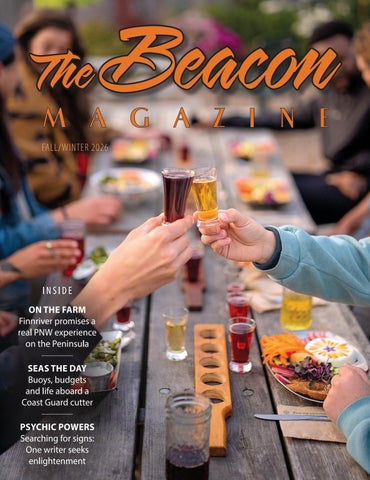
Finnriver Farm & Cidery on the Olympic Peninsula. Finnriver Farm & Cidery photo
Hodge Podge
9800 Harbour Place, Suite 201 Mukilteo, WA 98275 425-977-9661 northlightcustom.com
advantageinsurancebenefits.com
ABOUT THE COVER:
mukilteosamplestore.com
Elsom Cellars
18521 76th Avenue W #104 Edmonds, WA 98026 425-298-3082 elsomcellars.com
Discover Mukilteo’s Clothing Sample Store Women | Men | Accessories
OPEN: Wednesday through Saturday 10 a.m. to 5 p.m. www.MukilteoSampleStore.com
425-822-6600
3616 South Road Suite B2, Mukilteo, WA 98275
THE BEACON MAGAZINE – FALL/WINTER 2026
29
Season toTaste
Homecooked Sweet Potato Chili with Cornbread W
alking in the door to the smell of homemade chili is sure to warm you up from the inside out, but if you forgot to set up the slow cooker before heading out the door in the morning, don’t fret – a hearty bowl of beans, beef, and stewed goodness can still await. For a quick and easy version of the comfort food classic, consider this Quick Homecooked Sweet Potato Chili that’s made in a skillet and ready in half an hour.
Cornbread Ingredients
• 1 teaspoon salt
• 1 cup all-purpose flour
• 1/3 cup melted butter or
• 1 cup yellow cornmeal
• 2/3 cup granulated sugar • 1 tablespoon
baking powder
• 1 cup buttermilk or milk
vegetable oil (plus extra for the pan) • 1 large egg
Directions
Unsplash photo
Chili
Serve with:
Ingredients
• sliced avocado
• 1 pound ground beef • 1 onion, chopped
• 1 can (15 ounces) tomato sauce • 1 can (15 ounces) kidney beans
• 1 can (14 1/2 ounces) stewed tomatoes • 1 can (10 ounces) diced tomatoes
with green chilies
• 1 sweet potato, cubed • water (optional)
• teaspoon chili powder
• teaspoon garlic powder • Salt & pepper, to taste
30 THE BEACON MAGAZINE – FALL/WINTER 2026
• sour cream
• cornbread (recipe at left)
Directions
1. In large saucepan over medium heat, cook ground beef and onion until meat is browned and onion is tender, 5-7 minutes. 2. Stir in tomato sauce, kidney beans, stewed tomatoes with juices, diced tomatoes with green chilies and cubed sweet potato. Add water to reach desired consistency. 3. Season with chili powder and garlic powder. Add salt and pepper, to taste. 4. Bring to boil then reduce heat to low. Cover and simmer 15 minutes. 5. Serve with sour cream, sliced avocado and cornbread, if desired.
1. Preheat the oven to 400°F (200°C). Place a 9-inch cast-iron skillet or baking dish inside while it heats. 2. Whisk the cornmeal, flour, sugar, baking powder, and salt together in a large bowl. 3. In a separate bowl, whisk the milk, melted butter (or oil), and egg together. 4. Add any add-in ingredients now, then pour the wet mixture into the dry ingredients. Stir gently with a spatula just until combined. Do not overmix. 5. Carefully remove your hot skillet from the oven and add a small pat of butter to melt and coat the bottom and sides. 6. Pour the batter into the hot pan. Bake for 20 to 25 minutes until golden brown and a toothpick inserted in the center comes out clean. 7. Let the cornbread cool for 10 minutes before slicing. NOTE: Good Add-ins for Cornbread • 1/2 cup of shredded cheddar cheese
• 1/4 cup of diced candied or pickled jalapeno
• 1 can of green chilies or diced roasted red peppers • 1 cup of whole kernel corn (canned or frozen) • Minced garlic, chives, rosemary, and thyme
• Cooked crumbled bacon, mixed in or on top
Is it time for a change?
ASSISTED LIVING & MEMORY CARE
The decision to move to senior living is seldom easy, but if you find yourself wanting more independence, security and companionship, and less time spent on chores and household maintenance then it could be time to make a change. We’re here to help you decide if senior living is the best choice for you and your family.
Call (425) 541-7598 to speak to an advisor today. 10200 Harbour Place, Mukilteo | www.hpmukilteo.com
Your c�������n� gateway to nine destinations
PORTLAND