Ronald Reagan in Berlin
The President and the Divided City
Translated by Jessica Wood
BeBra Wissenschaft Verlag
Bibliographic Information of the German National Library
The German National Library lists this publication in the German National Bibliography; detailed bibliographic data are retrievable online at http://dnb.d-nb.de.
This book is an open access publication. It is licensed under the AttributionNonCommercial-NoDerivatives 4.0 International License (CC BY-NC-ND 4.0).
For the full license terms, see https://creativecommons.org/licenses/by-nc-nd/4.0/
For questions regarding product safety, please contact herstellung@bebraverlag.de.
Original German title
Ronald Reagan in Berlin. Der Präsident, die Staatssicherheit und die geteilte Stadt
First published as Ernst-Reuter-Heft, issue 7, 2 nd updated edition, Berlin 2017.
BeBra Wissenschaft Verlag is an imprint of BeBra Verlag.
First English edition
© 2026 BeBra Verlag GmbH
Asternplatz 3, 12203 Berlin
post@bebraverlag.de
Series Editor: Michael C. Bienert
Proofreading: Penny Croucher, London/ Leonie Steger, Berlin/ Jessica Wood, Lichfield
Cover and Typesetting: typegerecht berlin
Printed in the European Union
ISBN 978-3-95410-360-7
www.bebra-wissenschaft.de
Ronald Reagan over time
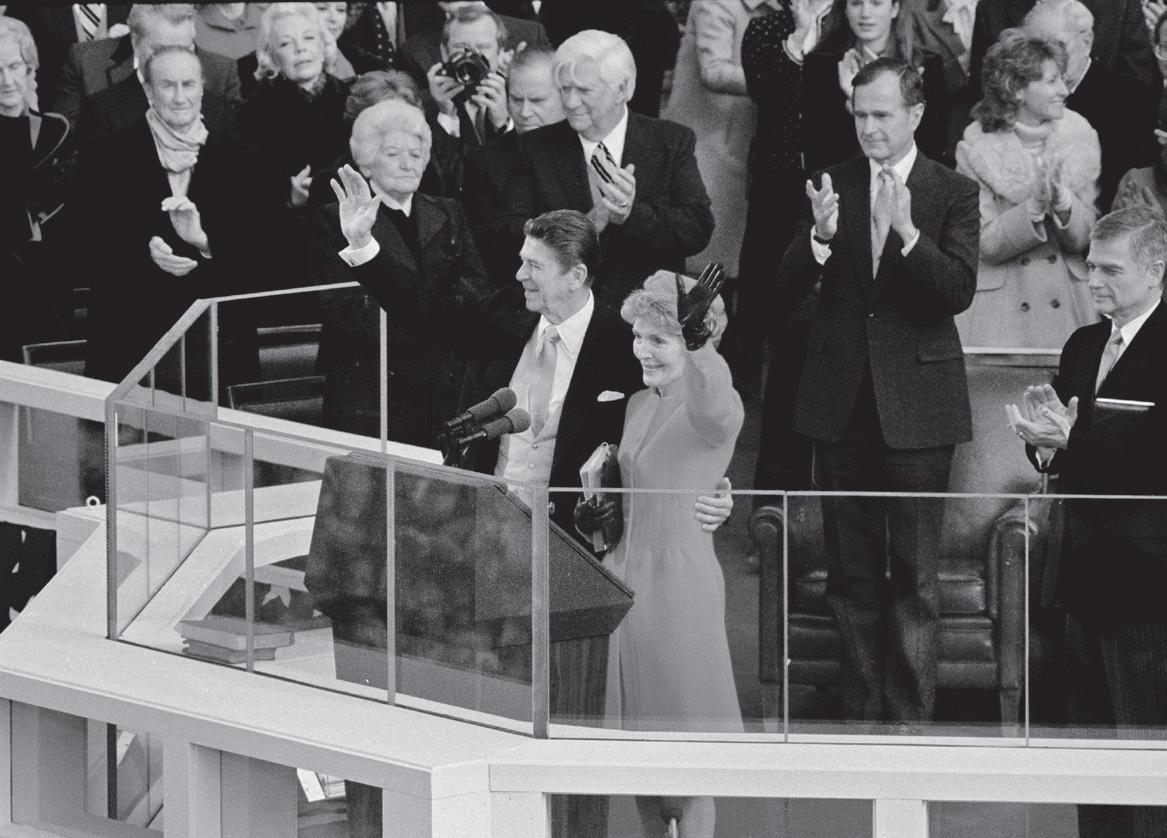
When Ronald Wilson Reagan, the 40th President of the United States of America, took office in January 1981, he could already look back on a colorful life. Born in Illinois, in the Midwest, on February 6, 1911, and raised in humble circumstances, his professional life was extremely varied. Among other roles, he worked as a sports reporter and trade union official, TV presenter, and film actor – and not as unsuccessfully as is often assumed today. A supporter of the Democratic Party until the early 1960s, he then made a career as a committed member of the Republican Party, leading to his election as Governor of the State of California in November 1966. After being re-elected for a second term, he left this post at the beginning of 1975 and quickly turned his attention to a higher goal: the presidency. On his first attempt, however, he failed to defeat the incumbent President Gerald Ford at the Republican National Convention in 1976. Four years later, Reagan’s moment finally came: nominated as a candidate by his party, he won a landslide victory against Jimmy Carter, who had proven somewhat hapless as President. On January 20, 1981, Reagan was sworn into office on the steps of the Washington Capitol.
Hardly any other president of the twentieth century was and remains as polarizing as Ronald Reagan. Some view him as a ruthless “Cold War monger,” the driving force behind the arms race and an expansionist foreign policy. They hold him responsible for massive cuts in the social sector, the dramatic widening of the gulf between the wealthy and the poor in America’s population, and a budget deficit that reached dizzying heights. Others emphasize Reagan’s real and perceived successes, claiming that his policies brought the Soviet Union to its knees economically and ended the Cold War. Unemployment and inflation fell noticeably during his time in office, and the USA rose
to its former greatness. Regardless of how one judges his policies, the transformation processes they triggered were so comprehensive that they were soon given their own name: the “Reagan Revolution.”
In terms of foreign policy, Reagan took an aggressive anti-communist course with a religious foundation, relying on the strength of the US economy and aiming from the outset to push the Soviet Union beyond its economic limits with a ruinous arms race. Even before Reagan entered office, however, these ideas had played an important role in American politics. By the time Soviet troops invaded Afghanistan in December 1979, the fragile thaw in relations between the major powers had broken off. Even in the small German Democratic Republic (GDR), people were aware that hardship could lie ahead: “[i]n the conception of American policy vis-à-vis the socialist countries, Eastern experts in the US State Department believe that in these countries a range of factors will, over the next few years, lead to internal tension and conflict and severely hinder the establishment of a political consensus between leadership and population. In particular, these factors include the finite nature of Soviet reserves of raw materials, the technological backwardness of the socialist countries, and the population’s growing demands in terms of consumption […].”1
This assessment from 1976 was to prove almost prophetic – but things had not quite reached that point yet. At the start of his presidency, Reagan, who signed extensive disarmament treaties during his second term in office, initially adopted a policy of comprehensive rearmament and confrontation. In his dichotomous view of the world, there was little room for differentiation. The “Evil Empire,” as he described
1 Foreign policy information overview no. 3/ 76 of January 16, 1978, in Federal Commissioner for the Records of the State Security Service of the Former GDR (BStU), HVA, no. 81, part 3, sheet 506.
the Soviet Union in a high-profile speech given on March 8, 1983, needed to be eradicated. But what role did his visits to West Berlin –which many Americans regarded as an “outpost of freedom” – play? Reagan’s call to Mikhail Gorbachev to open the Brandenburg Gate and tear down the Wall stands within the canon of contemporary history’s most important speeches. For the most part, however, this exhausts what is known about the relationship between the American President and the divided metropolis. His other visits to the city remain largely unknown, although they had a recognizable influence on him or provided him with a stage for the promotion of his policies – and sometimes both. Reagan visited the divided city four times, twice as President. In so doing, he continued a long-lasting tradition: he was by no means the first American head of state to visit Berlin, nor would he be the last. Nevertheless, he set his own tone. This will be explored in the
Ronald Reagan’s inauguration in Washington, January 20, 1981.