BDSlife
The magazine from BDS for people who love libraries
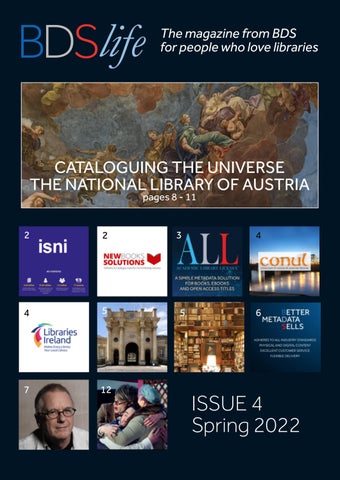
CATALOGUING THE UNIVERSE THE NATIONAL LIBRARY OF AUSTRIA pages 8 - 11
2
2
4
5
7
12
3
5
4
6
ISSUE 4 Spring 2022 1
BDS FORGES NEW LINKS WITH ISNI BDS is pleased to announce that it has become a member of the ISNI Registration Agency. Representing the library, book and entertainment sectors, BDS will contribute metadata to the ISNI database and begin assigning ISNIs to the public names of individuals and organisations. Having participated in the UK’s recent ISNI pilot, and currently implementing the integration of ISNI codes into its metadata, beginning with its service to the British Library, BDS is ready to champion the adoption of the ISNI standard within the UK book industry and beyond. “The inclusion of ISNI codes in the metadata BDS supplies to the British Library will prove a valuable resource for our researchers,” says Andrew MacEwan, Head of Metadata at the British Library. “We are delighted to work with the experts at BDS to achieve this.” ISNI (International Standard Name Identifier) is the ISO certified global standard number for identifying contributors to creative works and those active in their distribution. It is used to identify persons and organisations involved in creative activities, as well as their public personas. It is a critical component in Linked Data and Semantic Web applications. Since the ISNI-International Agency was established in 2010 by international bodies, ISNI has expanded rapidly, as the potential benefits of unambiguous identification of creative parties has become apparent.
Moving forward, BDS aims to offer ISNI to other markets. BDS web division, BDSDigital, has also been busy building the new www.isni.org website which went live in June 2020. The website is an important element in communicating with ISNI users around the world. These include libraries, publishers, producers of music or films, bibliographic services, rights management organisations, search engines, online stores, and data aggregators. “We were expertly led through a process to determine the most important features and navigation to best support ISNI’s purposes,” says ISNI-IA’s Executive Director, Tim Devenport. “Colleagues from ISNI’s Quality Team, based at the British Library, are closely involved alongside BDS personnel in the subsequent running of the site. The result is a secure site that provides a responsive framework for the content and features we need. And partnering with BDS gives ISNI confidence that we can develop the platform further as ISNI’s business evolves.” “BDS was delighted to be chosen as the web services provider for ISNI-IA,” says Eric Green, Managing Director of BDSDigital. “As a company that prides itself on adherence to internationally agreed standards when working with bibliographic metadata, we feel a deep synergy between our organisations and what ISNI represents.” “We’re looking forward to moving forward in partnership with BDS as a demanding but, we hope, stimulating client in future,” says Tim Devenport.
BDS NEWBOOKS DEAL BDS is working in close cooperation with Cologne-based Newbooks Solutions, a well-known service provider for software and catalogue data in the German publishing industry. A deal enables BDS metadata on English language publications to be made available to international key accounts of Newbooks. “Newbooks is delighted to be introducing BDS metadata to our international key accounts,” says Moritz Hodde, CEO of Newbooks Solutions. “Our new cooperation enables library suppliers to use the best possible catalogue metadata for their customer information systems such as webshops, portals, and newsletters. In particular, library suppliers and other specialist booksellers can use the metadata within our Approval Plan and eProcurement systems.” Newbooks Solutions was on stand 2A81 alongside BDS at the London Book Fair between the 5th and 7th April, to provide more information for international booksellers and publishers on how to work with Newbooks and BDS metadata.
2
“From the first meeting between Moritz and me, where we discussed our respective company’s experience, expertise and ethos, we both recognised that there was a dynamic synergy between us, and that we shared a vision for the industry,” says Barry Smith, Director of Sales at BDS. “We have since moved forward to create a fantastic offering for German readers, libraries and booksellers interested in comprehensive, timely and fully enriched metadata. I feel sure our partnership will go from strength to strength.” Contact Barry Smith to find out more on 07725 001833 or barry.smith@bdslive.com Find out more about Newbooks solutions at www.newbooks-solutions.com
ALL VALUES CUSTOMER FEEDBACK The BDS Academic Library Licence continues to prove popular and evolve with customer feedback. Several recent events and events over the coming months will expose the BDS ALL to more university librarians, in Great Britain and Ireland. “I think it is one of the great strengths of BDS to listen to its customers. We have certainly been keeping all communication channels open over the winter months,” says Heather Sherman, Director of Academic Library Operations at BDS. “We have adapted our offering to streamline with university library working methods, especially in the area of sharing metadata.” The BDS ALL was presented by Heather at the National Acquisitions Group (NAG) seminar in Birmingham on 11th May. She was followed by Andrew Knight of Imperial College London who gave a presentation how the University has employed the ALL to achieve efficiencies across many areas of the library’s operation. “The talks Andrew Knight and I gave were well received,” says Heather. “We had a lot of questions afterwards, which is always a good sign.” Next up, Heather Sherman and Sarah Armitage travel to Limerick for the Consortium of National and University Libraries conference on the 24th and 25th May (see article this issue). On Monday the 30th May it is on to the annual UKSG conference in Telford. BDS is hosting an “Insight Event”, open by invitation. Anyone at the conference who wishes to attend should contact Heather to secure their place.
Busy Summer Ahead “It’s going to be a busy summer for me and for the BDS ALL,” says Heather, “and I look forward to getting more feedback and ideas from university libraries as we develop ALL into an even more remarkable service.” Since 1995, BDS has innovated at every stage of the process of metadata aggregation, curation, enrichment and delivery. The BDS ALL allows academic libraries to benefit from these years of dedicated experience, from cataloguing expertise to cutting edge IT development. The Academic Library Licence brings everything together in one simple solution to the issues facing metadata provision and use in the 21st century. A leaflet is available that outlines features and developments in the service. Download your copy from www.bdslive.com/wp-content/uploads/2022/05/ALLInformation-Sheet-March-2022-final.pdf. To find out more information about the BDS Academic Library Licence contact Heather Sherman on +44 (0)711 378 086 or heather.sherman@bdslive.com.
3
BDS AT CONUL: WELCOME TO THE FUTURE BDS is a Gold Sponsor of the forthcoming Consortium of National and University Libraries (CONUL) conference. The event takes place at the Limerick Strand Hotel on the 25th & 26th May 2022. This year’s conference theme is Library.Now – Welcome to the Future.
BDS will be represented by Heather Sherman, Director of Academic Library Operations, and Director of Library Sales, Sarah Armitage. Heather will be giving a short presentation on Thursday 26th entitled Streamlining Metadata Supply for ALL. “CONUL is a great opportunity to introduces Ireland’s academic universities to the ALL,” says Heather. “Sarah and I are really looking forward to seeing Limerick and meeting conference delegates. I feel sure that BDS has an important role to play in the future of metadata provision to Ireland’s university libraries.” Keynotes Speakers Keynote speakers at the event are Chris Bourg, Director of Libraries at Massachusetts Institute of Technology and Melissa Highton, Assistant Principal for Online Learning and Director of Learning, Teaching and Web Services, University of Edinburgh.
Library Visit There will also be the possibility for delegates to visit Limerick University’s new Glucksman Library. “Designed to respond to the nexus of change in information provision, pedagogy, research practice and reader behaviour,” the library opened in 2018. People wishing to know more about the BDS Academic Library Licence and other services that BDS offers academic libraries, should contact Heather Sherman on 07711 378086 or heather.sherman@bdslive.com.
The Conference will explore the future of the library as it relates to innovations in services, learning and research, technology, spaces, collections, and staff development. It will be the first in-person CONUL conference to take place since 2018.
IRELAND CHOOSES BDS METADATA The Republic of Ireland’s public libraries started to use BDS metadata as of April 2022. A five-year contract was awarded by the Local Government Management Agency (LGMA). BDS metadata is delivered via Civica’s cloud Spydus library management software.
“This represents a huge vote of confidence in BDS’s metadata and service,” says Sarah Armitage, Director of Library Sales. “It means that BDS services every public library in Ireland and the UK.”
The LGMA was established in 2012. It is a state agency that provides collaborative support for the coordinated and cost-effective delivery of local government services and policy in Ireland.
330 library branches and 29 mobile libraries across all 31 of the Republic’s local authorities benefit from the accuracy, consistency and extended content offered by BDS metadata.
“Our aim is to inspire, connect and empower communities through our libraries – helping to improve literacy and access to books and digital formats for everyone,” says Stuart Hamilton, Head of Libraries Development, LGMA. “We are happy to be working with BDS to meet the needs of local libraries and visitors and enable our staff to spend more time adding value where it is needed most.”
With over 17 million visits per year, Public libraries across Ireland provide access to more than 12 million physical books eBooks and eAudiobooks.
4
OUP AND BDS: 10 YEARS WORKING TOGETHER Renowned publisher Oxford University Press provides digital resources to users in academic, public, corporate, medical, and law libraries around the world. BDS works with OUP in advance of publication, to create full, confirmed bibliographic records for each digital publication. Titles cover the Arts & Humanities, Dictionaries & Reference, Law, Medicine & Health, Science & Mathematics, and Social Sciences. “Oxford University Press has had a longstanding relationship with BDS to provision MARC records. This relationship has spanned over ten years,” says Julia Mielish, Discovery Manager, Oxford University Press. “During that time, we have relied on BDS to provide us with MARC records for all our online content. Records have been provided quickly with a short turnaround and we have appreciated the detail and care that BDS have provided.” In September 2021, for example, BDS received requests for 630 titles in 30 separate instances, reflecting OUP’s dynamic publishing programme that reaches universities across the world and includes products such as Oxford Scholarship Online, Oxford Medicine Online, Oxford Scholarly Editions Online, and Oxford Bibliographies. “OUP send us their lists and access to the website in advance of publication, and we create full, confirmed bibliographic records for each title,” says Jenny Wright, Chief Metadata Officer at BDS. “BDS uses international library standards to produce full MARC21 RDA records with NACO name headings, Dewey classification, and Library of Congress classification and subject headings.” The expertise developed over the past 10 years working with OUP has informed the methodology BDS employs to create metadata for academic institutions as part of its Academic Library Licence. Find out more about Oxford University Press digital publications at https://global.oup.com/academic/online Find out more about the BDS Academic Library Licence at www.bdslive.com/libraries/academic-libraries To learn more about MARC records for publishers, contact lesley.whyte@bdslive.com
WHY DOESN’T EVERYONE LOVE METADATA? “I love metadata, you love metadata, why doesn’t everyone love metadata?” Jenny Wright, Chief Metadata Officer at BDS, addresses her cataloguer colleagues and confesses her love for the rules and descriptive codes that govern the creation of metadata along with tongue-in-cheek bewilderment over those who don’t share her passion. Through a series of questions and answers, Jenny clarifies the confusions you may have about metadata and cataloguing. It appears in the Metadata & Discovery Group’s regular publication, Catalogue and Index. She leaps in at the deep-end, asking: What is Cataloguing? “Cataloguing is the act of creating and editing metadata…” and she addresses one question head-on: Can’t you just Google it? “The catalogue is … an important management tool. Acquisition, weeding and maintenance of the collection all require an inventory, with sufficient data to support those tasks. The reference librarian can’t refer to a resource if they don’t know it’s there. The school librarian can’t compile a reading list on a topic if they don’t know what resources they have, or they can’t search by subject.” In other words, no, you can’t just Google it.
And she turns one of the more commonly held truisms on its head. Doesn’t modern technology mean there’s no need for cataloguers these days? “In many ways, advancing technology requires cataloguers’ skills more than ever as linked library data will rely on authority control, controlled vocabularies and recording of identifiers, all of which require accurate human intervention.” And for those of us who still don’t get it… “Well, few of us really know how a modern car engine works and yet we know how fundamental it is for a car to function. Parts of the technology may need to be updated, but propulsion is still required. The catalogue is as fundamental to a library as an engine is to a vehicle. Libraries are about putting resources into the hands of their users, either physically or digitally, and the catalogue serves that purpose.” She concludes her entertaining piece with the observation that “we need to continue to advocate for metadata and the use of standards which support the levels of precision and consistency which enable catalogues to produce reliable, useful search results.” Learn more about the Metadata Discovery Group at www.cilip.org.uk
5
LBF ‘22: THRIVING AND INVIGORATED BDS returned, along with the publishing industry and book trade, to the London Book Fair. The event took place between 5th and 7th April. BDS occupied its traditional stand which had been carried over while the pandemic forced the closure of the event.
Good News for BDS “It is clear that metadata has a more important role to play in the book trade since the pandemic forced people online and now, as we emerge from its grip, that role is set to increase,” says Keith. “This is good news for BDS.” There is still a lot of catching up to do for events such as the London Book Fair itself. While over 15,000 visitors and exhibitors from over 100 countries attended the Fair, these figures were significantly down on numbers for 2019, the last real world Fair. Then 25,000 visitors and exhibitors attended. This was noticeable as you walked the aisles. However, this year 850 companies exhibited. There were over 100 seminars, and events, interviews, discussions and demonstrations attracted large and engaged audiences. The Rights section, repositioned to be close to the main exhibition area, was busy throughout.
Left to right: Matthew Pollock, Lesley Whyte and Sarah Armitage on the BDS stand There was an air of optimism and energy around the Fair as delegates met up with colleagues and old friends after such a long period of enforced absence. The Fair’s chosen theme which it expressed in the tag line: You Are The Story. Representing BDS, Publisher Liaison Manager, Dorothy Reid and Trade Data Manager, Keith Walters, had a busy schedule of meetings with long-standing clients and prospective customers. “Business started briskly the moment the Fair opened,” said Dorothy. “It was a pleasure to meet and catch up with familiar faces and also exciting to meet many new people whom I only had the chance to correspond with or occasionally meet over Zoom.” The BDS stand also hosted meetings for German company, Newbooks. Newbooks have recently partnered BDS in marketing BDS metadata to German speaking Europe. The stand design emphasised connection and agreement with the message that “Better Metadata Sells” while a redesigned layout allowed for a relaxed feel to meetings and more visitors, something that proved useful as passing trade was a factor on all three days of the Fair.
6
Focus and Friendship The emirate of Sharjah was the focus country for this year’s Fair. It lavishly presented its vision for culture and publishing while promoting its own Book Fair. This usually takes place in November each year. Above the Sharjah stand, on the second floor, an area represented Ukraine. This attracted crowds as the West’s interest in Ukrainian literature grows. Publishers are eager to engage with Ukrainian culture and writers as the country’s geopolitical position in the Slavic world polarises against its aggressive neighbours. The urgency felt over the Ukraine crisis was marked by fund-raising and awareness events. It was certain that people were happy to be back at the London Book Fair. It may be that fairs such as this will never be the same again. Changing circumstances, improved digital communications, new trade models and an abundance of caution may see to that. But LBF ‘22 demonstrated the book trade is not only back in the real world, it is thriving and invigorated.
DAVID LINDLEY 1945-2022 It is with great sadness that BDS learnt of the death of David Lindley. David was a well-known figure in the library world, a good friend to BDS and a key agent in the management and maintenance of the website Designing Libraries. “David was one of my first customers in the early days of BDS when I was responsible for sales,” recalls Lesley Whyte. “I visited him on a very hot day in July 1995, driving from my home to Leamington Spa and back in a day, a round trip of almost 600 miles. But it was worth the effort, because David immediately understood what we were trying to achieve, how availability of rich data was going to drive purchasing decisions, and how selection of library stock would change forever. “Over the years, a friendship as well as a professional relationship developed, and I discovered that I shared David’s interest in library design, as well as his love of poetry. But it was only after he died that I learned from his widow, Caron, that David had aspired to be a writer from his youth. “Caron supplied BDS with some biographical information about David, which is printed here, in part, along with a link to a tribute on the website of BDSlife’s writer, John Hudson, who corresponded with David about poetry in the final stages of his life which can be found here.”
David Lindley David Lindley was born in 1945 in Dewsbury, West Yorkshire, where he attended the local grammar school. He left school at sixteen, and with ten pounds in his pocket set off to London ‘to become a writer’. An avid reader, he had spent all his free hours in Dewsbury public library, then under the stewardship of the inspirational borough librarian Fred Smith. Once in London, he was offered a position as library assistant in Ilford (now Redbridge) Central Library. David later went on to qualify at the library school at Ealing Technical College, and remained with Redbridge until 1974 when he moved to Dunn & Wilson in Morley and began a new career in the library supply industry. In 1983 joined Books for Students in Warwick, becoming sales and marketing director. He was influential in the reader development movement and the creation of library promotions. He helped found and manage the annual Summer Reading Challenge. He chaired the Library Booksellers Group of the Booksellers Association, and was a well-known and respected figure in the publishing and library professional world. Later in his career, David was engaged by the MLA to secure funding for Designing Libraries, at that time a library buildings database project at Aberystwyth University. In 2011, Designing Libraries was incorporated as a Community Interest Company to continue to serve all sectors of the library profession, related organisations and anyone interested in library planning, design and the future shape of library services. He continued the successful management of the company until overtaken by ill health. Sadly, David passed away on 18 March 2022. He will be sorely missed by his second wife, Caron, who cared for him throughout his two-year struggle with Idiopathic Pulmonary Fibrosis. David is also survived by his sons, Alex and James, by his first wife, Sue, and granddaughters, Harriet and Mia. In addition to his library-related career, David wrote and published several books of poetry, philosophy and translations, notably new verse translations of the Bhagavad Gita and the Tao Te Ching, and the bestselling How to Write a Haiku.
All David’s published work can be seen at www.verborumeditions.com Designing Libraries can be found at www.designinglibraries.org.uk
7
Early 18th century Europe: power is claimed and asserted by monarchs, emperors and republics who fight bloody wars of succession. In Vienna, the victories of Holy Roman Emperor Charles VI are to be commemorated through the construction of the Prunksaal, one of the greatest libraries on Earth, and now the heart of the Austrian National Library…
CATALOGUING THE UNIVERSE Outside the Austrian National Library on Heldenplatz or Hero Square, in the heart of Vienna and its royal palaces, the Hofburg, is a statue of Prince Eugene of Savoy riding triumphantly on horseback. Prince Eugene was key to Hapsburg military success; he won battles and, just as importantly for our story, he loved books. Between defeating the Turks and the French, he befriended Leibniz, Rousseau and Montesquieu. “It is hardly believable,” wrote Rousseau, “that a man who carries on his shoulders the burden of almost all the affairs of Europe … should find as much time to read as though he had nothing else to do.” If knowledge is power, then the library is the embodiment of power. Power manifested itself through books in several ways. Books affirmed authority: they could justify the claims of kings and prove that God is on your side. They represented wealth: through marriage with Mary of Burgundy, Emperor Maximilian I (1459–1519) received books valued at 100,000 guldens, about an eighth of his wife’s dowry. Books contained knowledge on the humanities and the sciences, all-important for statecraft, fighting wars and curing ailments. The mania for book collecting grew as did the collections of individuals, Prince Eugene included. Specialised buildings had to be constructed to house these books and methods had to be devised on how to find a book among the increasingly vast collections.
The Library as Power The age of the great Baroque library arrived, heralded by trumpet-blowing angels painted on gravity-defying domes above marble paving and shelf upon ornately carved shelf of books. These libraries were not ornamental additions to a royal portfolio of gold-leaf real-estate. They were the heart of power, the foundation of dynastic claims, the future of family fortunes. The Holy Roman Emperor, Charles VI, determined to assert his imperiousness and follow plans laid by his father Leopold, authorised the construction of a permanent home for the library of the Hofburg Palace in 1722. The already large and diverse collection was to be augmented by the 15,000 books collected over the years by Charles’ stalwart supporter and friend, Prince Eugene. The architect, Johann Bernhard Fischer von Erlach (1656 – 1723) was commissioned to design the library as he did much of Baroque Vienna. The Prunksaal or
Prince Eugene of Savoy (1663-1736) by Anton Dominik Ferkorn Ceremonial Hall, as it is known, was to be capable of housing 200,000 books, although it started out with around 90,000. These had been acquired since before the appointment of the library’s first librarian, Hugo Blotius. He wrote in his inventory of 9000 items in 1576: “How unkempt and desolate everything seemed – how much mould and rot everywhere – how much damage from moths and bookworms – how cobwebs covered everything!” The Prunksaal was to change that. With such a large number of items and with the requirement to climb vertiginous ladders to reach anything above head height, random browsing was not an option. This library needed a catalogue.
Background artwork: part of the great dome of the Prunksaal painted by Daniel Gran (1694–1757)
8
The Need for Order Prince Eugene’s library had used simple subdivisions based on the colour of leather bindings: blue for Theology and Jurisprudence, yellow for Natural Science, red for Literature but once placed in the new library these coloured building blocks became part of a Tower of Babel (which, ironically, can be viewed a few hundred metres away in its famous incarnation painted by Pieter Breughel the Elder). The solution to this challenge which threatened the effectiveness of Charles’ ambitious undertaking is elegant and magnificently preserved in a part of the modern-day library that was once a monastery – a fitting nod in the direction of the monks that so painstakingly created and developed the earliest collections of books in Europe. The inventory begun by Blotius in the 16th century developed into a volume catalogue but this proved difficult to maintain and update. In the latter part of the 18th century, the creation of probably the oldest “card” or, in fact, sheet catalogue in history was undertaken by the prefect Gottfried van Swieten – this is known as the Josephinische Katalog. However, maintenance persisted in the form of the volume catalogue until 1848. It was then that the book holdings were re-catalogued in sheet format, each sheet collected alphabetically in boxes (pictured below).
Metadata in a Cursive Script These shelves of beautifully hand-made boxes hold a catalogue of the universe. Each sheet has an entry for a book, written in elegant handwriting. Each entry is stored by author. Cataloguing rules determine what is included in the entry. The arrangement of stock on the shelves is in press mark order, so subject classification is not required, but the bibliographic description for each item is extensive. The value of metadata and consistency introduced through standards is recognised.
A bookcase in the Prunksaal
Boxes containing sheets that catalogued the library starting in 1848
9
Cataloguing rules and systems have changed over the centuries, but the basic principles of recording information for posterity and information retrieval remain. The catalogue for the Austrian National Library, as it has become, is a Baroque masterpiece every bit as marvellous as the library’s dome, plasterwork and frescoes.
The Interactive Catalogue Acting as a mirror for the Library itself, the catalogue allowed for inspection of the collection at many levels and also enabled the critique of its contents. It was soon realised that the collection needed to become a tool for research and the furtherance of knowledge and not simply a reflection of the world around it. Thus, soon after Emperor Charles had a statue of himself placed directly under the dome of the Library which itself depicted the munificence and glory of the Habsburg dynasty supported by God, the Library itself was sowing the seeds of change. Knowledge is power but knowledge doesn’t obey the edict of emperors.
Charles VI, Holy Roman Emperor, at the centre of his library
10
Cataloguing rules published in Vienna in 1901
Time and science took the library forward. The sheet catalogue of 1848 was superseded by the “Preußischer Katalog” in 1931, a standard format typewritten card catalogue that expanded to incorporate the handwritten sheet catalogue in the 1960s. Today this catalogue lines the corridors of the library’s backrooms. However, it is remarkable that both catalogues were in use until 1991, covering books published from 1501. Electronic cataloguing began in 1991 and eventually the library migrated over to MARC21 in 2018 but the journey began with an archduke, a prince and a changing vision of the order of the universe with a library at its heart.
Universal Vision On the façade of the Library building, to left and right, are the figures of Atlas holding the sky on his shoulders and Gaia holding Earth on hers. The statement in gold and stone is clear: here is the universe. The books on the shelves inside that building are not silent witnesses to this universe but active whisperers directing the journeys of countless enquiring minds. Such journeys would have been impossible were it not for those elegantly cursive entries in the filed boxes that mark the beginnings of the Austrian National Library as we know it today.
The entrance to the Prunksaal, with Atlas and Gaia supporting the universe together I would like to thank my guides for the day, Karin Kleiber for making the introductions, Wolf-Dieter Lang for providing historical background and a tour of the library, and Monika Kiegler-Griensteidl for introducing the catalogue and the collections.
Find out more about the Austrian National Library at www.onb.ac.at/en
11
BDS MARRIES MOZART BDS is sponsoring a performance of Mozart’s Marriage of Figaro, one of the world’s most famous and popular operas. It will take place on the opening night of the Absolute Classics Festival. Mozart’s comedy of love, lust and mistaken identity will be staged by Opera Bohemia. The Dumfries performance will form part of the troupe’s tour of Scotland. A small chamber orchestra will accompany the soloists. Douglas Nairne and Alistair Digges founded Opera Bohemia in 2010. Hailed as, “One of the most exciting new opera companies in the country,” Opera Bohemia quickly established its reputation. In 2017, it launched an education project, taking free opera workshops to hundreds of school children around Scotland. “BDS is pleased to continue its support of Absolute Classics,” says Lesley Whyte. “The annual festival and year-round series of concerts alongside the educational programme has made a huge difference to the cultural life and experience of the region of Dumfries and Galloway, where BDS is based.”
Exuberance and Fun The performance will take place on the 11th August at the Easterbrook Hall, part of the Crichton grounds in Dumfries. “The Marriage of Figaro is such an exuberant and funny opera,” says Alex McQuiston, Artistic Director of Absolute Classics. “It has everything: great tunes, a brilliant libretto and farcical antics on stage, it is the perfect opening night for our festival and I am sure our audience will love it. “I’d like to thank BDS for its generous sponsorship for this performance and thank all our supporters who make the Absolute Classics Festival so special.” Mozart’s opera was subversive in its time and remains an astute comment on the abuse of power. First performed in 1786 in Vienna, it features a corrupt the ruling class competing against and undermined by the honest and intelligent working man and woman. Such sentiments eventually erupted into the French Revolution just a few year’s after the opera’s opening night. A preview of the production can be seen on YouTube.
SUBSCRIBE TO BDSLIFE MAGAZINE In each issue you will catch up on the latest ideas from experts, read interviews with professionals and industry leaders, as well as read about BDS, its innovations, events and products and services relevant to the book trade. Sign up to receive an email as soon as each issue is ready to read online or in pdf format.
https://bdslive.com/bdslife-magazine-sign-up Bibliographic Data Services Limited Annandale House The Crichton Bankend Road Dumfries DG1 4TA Company Reg: Scotland 154602 VAT: GB 652 4313 58
12
T: 01387 702 251 F: 01387 702 259 E: info@bdslive.com
www.bdslive.com