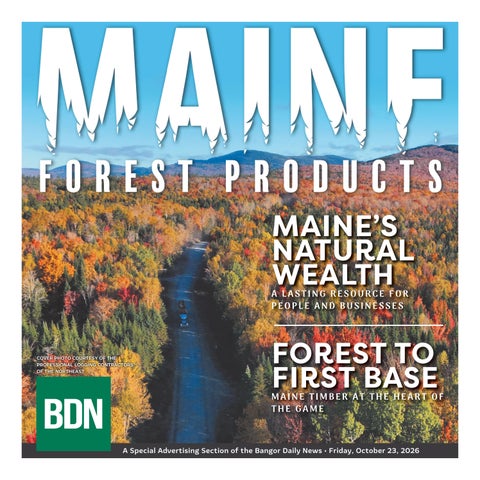
MAINE’S NATURAL WEALTH
A LASTING RESOURCE FOR PEOPLE AND BUSINESSES
COVER PHOTO COURTESY OF THE PROFESSIONAL LOGGING CONTRACTORS OF THE NORTHEAST
FOREST TO FIRST BASE
MAINE TIMBER AT THE HEART OF THE GAME
2
MAINE FOREST PRODUCTS • Bangor Daily News Special Advertising Section • October 23, 2026
MAINE’S FOREST ACRES ARE AN ESSENTIAL DUAL ECONOMIC ENGINE BY WANDA CURTIS
An aerial view of hardwood forest in full autumn color surrounding a pulp and paper mill in central Maine, with the mill’s stacks and process buildings visible at right. PHOTO COURTESY OF CENTER FOR RESEARCH ON SUSTAINABLE FORESTS, UNIVERSITY OF MAINE
According to the Maine Forest Service (MFS), the state of Maine boasts the highest percentage of forested land of any state in the nation. Approximately 17.5 million acres of forest land cover upwards of 89 percent of the land area. Director of the Center for Research on Sustainable Forests Aaron Weiskittel said recently that Maine is not only the most heavily forested state in the nation, but that Maine’s history, culture, and economy are defined by trees. For centuries, he said, the working forest has shaped Maine’s character, rural communities, and way of life. “Maine ranks among the states most dependent on its forest sector, generating roughly $1 out of every $29 in state GDP and leading the country in the forest share of its exports,” Weiskittel said. “As we celebrate Maine Forest Products Week (Oct. 18-24), these unique 17.5 million working forest acres remain an essential dual economic engine, powering an $8.3 billion manufacturing base alongside a $3.4 billion outdoor recreation industry.” According to Weiskittel, Maine’s forest products industry contributes $8.3 billion in total annual economic output, supports over 29,000 jobs, and accounts for 3.45% of state GDP. Outdoor recreation generates another $3.4 billion in value-added GDP through woods-dependent activities like hunting, fishing, guided outfitting, snowmobiling, camping, and leaf peeping across the state, he said. That’s a total of about $11 billion in total economic output generated through Maine’s forest industry. “Maine’s 17.5 million acres of working forests, particularly the Maine North Woods, provide the land base and infrastructure like trail networks, access roads, and managed open space that make outdoor recreation possible,”
Weiskittel said. “Outdoor recreation fits alongside the forest products industry because private working forest owners maintain open access for recreation, making the forest a dual economic engine for both wood manufacturing and tourism/recreation.”
Maine Exports Millions of Dollars in Wood Products Annually According to the Census USA Trade Online for 2022, Maine shipped $577 million worth of forest products to 49 countries in 2022. The exports included $287 million worth of paper and paperboard, $171 million worth of wood and articles of wood, $119 worth of pulp and recovered paper, and about $9 million worth of furniture. About $385 million of those products went to Canada, $40 million to China, $36 million to Belgium, $28 million to Italy, $22 million to Germany, and $20 million to Mexico. U.S. Census Bureau and Department of Transportation 2022 statistics show that Maine also sent $20 million worth of forest products to Connecticut, $28 million to Rhode Island, $47 million to New Jersey, $119 million to Vermont, $130 million to Pennsylvania, $178 million to Massachusetts, $204 million to New Hampshire, and $1.3 billion to New York that year. “Covering 17.5 million acres, Maine’s working forests anchor the rural economy and municipal tax base,” Weiskittel said.
Aroostook County Leads the Way According to the 2023 Maine Forest Service Wood Processing Report, the largest Maine supplier of wood was Aroostook County. Roughly 839,000 green tons of pulpwood and 235 million board feet of saw logs were harvested there in 2023. Penobscot, Somerset, Washington, Piscataquis, Franklin, and Oxford counties also supply a large amount of wood. Southern and coastal counties contribute only a small amount, Weiskittel said.
MAINE FOREST PRODUCTS • Bangor Daily News Special Advertising Section • October 23, 2026
Most Popular Species The most popular species in Maine used for wood products, in recent years, have been spruce and fir. Those accounted for a little over half of its 890 million board feet of sawlogs in 2023, Weiskittel said. The next most popular species are red and white pine, he said. Those accounted for 172 million board feet of the sawlogs harvested that year.
Maine Also Imports Wood Interesting to note is the fact that Maine not only exports wood, but we also import wood from other New England states and Canada. The 2023 MFS Wood Processor Report shows that in 2023 Maine imported about 2.7 million tons of wood from New Hampshire, Vermont, New York, New Brunswick, Quebec, and Ontario during that year. “Maine’s mills take in slightly more than Maine landowners send out,” Weiskittel said. “Canadian timber is often significantly closer to northern/eastern Maine mills than southern/western Maine timber, reducing freight costs. Paper and packaging mills require softwood/hardwood blends, importing roundwood or chips when local supply of a specific species falls short. Maine mills process 11 million green tons annually against 10 million tons of local harvest (2 million of which are exported), requiring imports to maintain full capacity.”
PHOTO COURTESY OF DEAN PEPPER, OWNER OF D-R-PEPPER WOOD HARVESTING, AND THE MAINE FOREST PRODUCTS COUNCIL
PROUD PARTNER
PROFESSIONAL LOGGING CONTRACTOR OF THE NORTHEAST
COMMERCIAL AUTO • GENERAL LIABILITY • WORKERS’ COMP • INLAND MARINE • UMBRELLA AND PROPERTY
3
4
MAINE FOREST PRODUCTS • Bangor Daily News Special Advertising Section • October 23, 2026
ROOTED IN THE GAME: HOW MAINE TREES POWER AMERICA’S PASTIME BY DYLAN SAVAGEAU
M
aine hardwood finds its way into countless products, from flooring and furniture to more distinctive items — like baseball bats. During the two seasons I worked at Dovetail Bat Company, I had a firsthand look at nearly every stage of the process. Tree-length logs arrived at the yard and passed through a series of transformations, being cut into 40-inch sections, shaped into billets, and eventually turned into the finished bats swung by major leaguers and little leaguers alike on fields all over the world. There were only 10 people working at the company when I was there, including thenowners Paul and Theresa Lancisi. My job titles covered about as much ground as the shop itself: bat turner and lathe operator, wood cutter, billet maker, kiln operator, finisher, and tractor operator. In a small shop, you do whatever needs doing. Dovetail Bat Company works primarily with three Maine hardwoods: rock maple, yellow birch, and white ash. Each has its own characteristics, but all three have to meet the same basic requirements. The grain needs to be straight, and the wood has to be free of defects that could compromise the durability of the finished bat. But the process actually begins long before a log reaches the Dovetail yard. “Foresters are the start of our extremely important supply chain,” explained Ben Chase, CEO of Dovetail Bat Company. “They decide which trees get harvested and how they’re handled. By the time a log reaches us in Shirley, its quality is largely fixed.” Where the tree grew, how it was cut, and how it was handled afterward can all affect the yield and grade of the billets. A bat log is a different product than a veneer log, saw log, or pulpwood, so getting the right material depends on the people making those decisions in the woods. The logs are split before being sawn with a laser-guided system that follows the grain. The target is a grain slope of between zero and three degrees. That number might not mean much to somebody walking through the shop. But it means plenty to the players using the bats. A defect in the wrong place could send a piece of wood down a very different path. When I was there, the worst material was bundled and sold as firewood. Pieces that were sound enough for a bat but didn’t meet Major League or Minor League specifications would become tournament or batting-practice bats, sold at a lower price. Chase put it this way: “A tree can be perfectly good lumber with a slight spiral
or slope in the grain, but that same tree can produce a bat that breaks.” Once the wood is cut and split, the next job is getting it through the kiln. The wood is stacked between heavy metal plates and dried for 14 days. I remember those plates being heavy, hot, a pain to move, and loading and unloading them was some of the more physically demanding work in the shop’s process. After drying, the wood is turned into cylindrical billets, then graded, weighed, and stored in a climate-controlled room. At that point, a piece of Maine hardwood has become the raw material for a baseball bat. Once a billet is ready, a high-tech CNC machine cuts the initial outline of the bat. From there, we would take over at the lathe, measuring the entire profile and sanding the bat down to the exact specifications for a particular model or player. Every bat has its own dimensions, and getting those measurements right was critical to producing a bat that met the required specifications. The final steps included sanding and a traditional bone-rubbed process. Rubbing the barrel with a bone compresses the wood’s pores, helping to harden the surface before the bat moves on to the finishing stages. All of the bats we made were built to professional-quality standards, but Major League Baseball had additional requirements. Grain straightness, barrel size, and paint specifications were more exacting at the Major League level. That extra scrutiny makes sense. A baseball bat has a pretty demanding job. It has to take repeated, hard contact from some of the faster throws and strongest swings in the game without failing. By the time I was working there, Dovetail bats were already being used by Major League players. The company made its MLB debut in 2014 with the pennantwinning Kansas City Royals, and Pete Alonso used Dovetail bats during his record-setting 2019 rookie season with the New York Mets. That season gave me one of the strangest experiences of working at Dovetail Bat Company. I watched Alonso use one of our bats in the 2019 Home Run Derby and more in the All-Star Game, and watched Jeff McNeil swing a Dovetail in the All-Star Game as well. Alonso went on to win the Derby and was named National League Rookie of the Year while also leading the MLB in home runs with 53 that season, breaking the all-time rookie home run record.
MAINE FOREST PRODUCTS • Bangor Daily News Special Advertising Section • October 23, 2026
I had watched those bats being made in a shop in Shirley, Maine. And then they were on national television. I started watching a lot more baseball while I worked at Dovetail because I wanted to see how many of our bats I could spot. Teams I never thought I’d give my time to started becoming a blast to watch. Growing up a Red Sox fan, I started paying attention to the whole league. It also made the connection between baseball and Maine’s working forest pretty hard to miss. Maine is a forest state, with trees covering nearly 90 percent of its land. A 2024 analysis estimated that the forest products industry contributes $8.3 billion to the state’s economy and supports more than 29,000 jobs. Most people probably think of Maine forest products as lumber, paper, pulp, or firewood. A baseball bat is a much more specialized product, but the basic idea is the same: take a resource grown in the working forest and add value to it through skilled labor and manufacturing. Maple, birch, and ash each have their own characteristics. The differences aren’t necessarily obvious to somebody walking through the shop. After enough time around the wood, though, you learn what you’re looking at. You learn to notice grain. You learn to spot defects. You learn that a piece of wood can look perfectly good and still not be the right piece of wood for a baseball bat. Eventually, you start looking at trees a little differently. A section of Maine hardwood can become a billet, then a piece of sporting equipment used by a player in front of millions of people around the world. That’s a long way to travel for a tree. I still think about the logs coming into the yard, the heat coming off the kiln plates, the noise of the lathe even through my headphones, and the rows of finished bats waiting to leave Shirley. Most of the work was physical, repetitive, and truthfully, pretty damn hard. But there was also something satisfying about knowing exactly where the raw material came from and what it was going to become. We were taking some of Maine’s most familiar raw material and turning it into a highly specialized product that could compete at the highest level of the sport. Not bad for a little shop in Shirley, Maine.
5
6
MAINE FOREST PRODUCTS • Bangor Daily News Special Advertising Section • October 23, 2026
PROFESSIONAL LOGGING CONTRACTORS (PLC) OF THE NORTHEAST HOLDS ST
31 ANNUAL MEETING
STORY AND PHOTOS COURTESY OF THE PROFESSIONAL LOGGING CONTRACTORS OF THE NORTHEAST
The Professional Logging Contractors (PLC) of the Northeast held its 31st Annual Meeting May 7-8, raising $134,610 for Log A Load For Kids and presenting awards to businesses and individuals from across Maine, Vermont, and New York for their contributions to the logging industry. The meeting was held at the Samoset Resort in Rockport, with more than 200 people attending the main events on Friday. This was the third annual meeting of the PLC since its expansion in 2023 from a Maine organization to a regional one serving loggers and forest truckers across the Northeast. The annual meeting is the PLC’s largest event and highlighted by the Log A Load for Kids Auction raising money for Children’s Miracle Network (CMN) which goes to hospitals in Maine, Vermont and New York. Families served by the hospitals were in attendance for the event, which also marked a major milestone — the PLC’s Log A Load efforts have now raised more than $3 million since 1995. “This special group of people always steps up when it comes to supporting the kids and their families, and I am proud they came through once again in spite of the
Auction: The Professional Logging Contractors (PLC) of the Northeast 31st Annual Meeting May 7-8, raising $134,610 for Log A Load For Kids at the live auction to benefit Children’s Miracle Network Hospitals in Maine and Vermont. difficult year the industry has had to help us reach the $3 million mark on total funds raised since this effort began more than three decades ago,” Dana Doran, Executive Director of the PLC, said. “No matter how tough things get, our members, supporters, and friends reach deep every year at our Log A Load for Kids Auction to support the children and families served by Children’s Miracle Network. I am so grateful for the generosity shown here, and I know the families and the hospitals are grateful as well.” The Annual Meeting spanned two days, beginning Thursday with a tour of Vinalhaven island including stops at a wind farm, lighthouse, historic granite quarry, and a local brewery, and an evening social gathering at the Samoset Resort. The second day began with a panel featuring candidates for Maine governor followed by a business meeting for all PLC Member contractors, with board and officer elections, and then a special presentation by Matt O’Malia of Timber HP that was also attended by Maine Governor Janet Mills. The evening events included the traditional Log A Load for Kids Auction, dinner, and the PLC awards ceremony. PLC’s special guest for the evening, Maine native and two-time Olympic gold medalist Seth Wescott, took part in the auction and donated items for it. Awards were presented to the following individuals and organizations during the evening portion of the event:
MAINE FOREST PRODUCTS • Bangor Daily News Special Advertising Section • October 23, 2026
7
PLC Logger of the Year Awards: These awards recognize PLC Logging
Master Logger Supporter’s Awards: The Master Logger Supporter’s Awards
Contractors for their commitment to the sustainability of the industry and logging as a profession. This year for the third time the award went to two companies, one from Maine and one from Vermont. The winners are: Southwind Forestry of Pawlet, Vermont; and T. Condon Timber Harvesting of Ashland, Maine.
were created to recognize individuals and organizations that have been outstanding supporters of the Master Logger Certification Program® and the standard it represents. The winner this year is: The New York Watershed Agricultural Council.
PLC Community Service Award: This award is given annually to a PLC
PLC Supporting Member Acadia Insurance presented its annual Acadia Safety Award to Scott Madden of Madden Timberlands Inc. of Glenburn, Maine.
member, Supporting Member or affiliated organization that has demonstrated a significant commitment to giving back to their community. The winner this year is: TNT Road Company Inc. of Fort Kent, Maine.
PLC Supporting Member Award: The PLC Supporting Member of the Year Award is presented annually to a PLC Supporting Member that has demonstrated an unprecedented commitment to logging contractors in Maine. The winner this year is: Pro Pac Industries of Saint-Côme–Linière, Quebec. PLC President’s Award: The President’s Award is presented to individuals or organizations within the PLC which have a significant and positive impact on the PLC and the logging industry in Maine. The winner this year is: Peter Collins, Sales Manager for Milton CAT. PLC Impact Award: Each year, the PLC recognizes persons or organizations from the public sector who have demonstrated a commitment to the logging industry and made a significant impact for its improvement. This year the award goes to: The Vermont Department of Forests, Parks and Recreation.
Logger of the Year Maine: Troy Condon, owner of T. Condon Timber Harvesting of Ashland, ME., winner of the PLC Logger of the Year for Maine in 2026, at left, accepting the award from PLC Executive Director Dana Doran.
Logger of the Year Vermont: Gabe Russo, owner of Southwind Forestry of Pawlet, Vermont, winner of the PLC Logger of the Year for Vermont in 2026, at left, accepting the award from PLC Executive Director Dana Doran.
8
MAINE FOREST PRODUCTS • Bangor Daily News Special Advertising Section • October 23, 2026
MECHANIZED LOGGING OPERATIONS AND FOREST TRUCKING PROGRAM IN ITS 10TH YEAR STORY AND PHOTOS COURTESY OF THE PROFESSIONAL LOGGING CONTRACTORS OF THE NORTHEAST
T
he Mechanized Logging Operations and Forest Trucking (MLOFT) Program, a unique hands-on training course that prepares students for careers in the logging industry, is in its tenth year of classes at an active harvest site in central Maine. The certificate program for operators of mechanized logging and forest trucking equipment will run for 20 weeks. Classes began June 22 on the Kennebec Valley Community College (KVCC) Alfond Campus on U.S. Route 201 in Hinckley and will run through Nov. 5, when students will graduate. “The demand for qualified logging operators and forest truckers in our region remains high, and this program continues to address that need in the most efficient and affordable way for the industry,” Dana Doran, Executive Director of the Professional Logging Contractors of the Northeast (PLC), said. “This is our 10th year of operation and that is a testament to the enduring value of the program. There is no better opportunity for anyone interested in starting a career in the logging industry, and thanks to continued support and generosity from industry sponsors and supporters and the State of Maine, students can access this training at little to no cost.” Students in this year’s class include: Odin Tanguay, Yarmouth, ME; Jackson Newton, Anson ME; Hunter Newton, Buckfield, ME; Emily Pierce, Albion, ME; Samuel Armstrong, Richmond, ME; Lochlan Campbell, Starks, ME; Nicholas Clewly, Pittsfield, ME; Bowen Leighton, Starks, ME; Chandler, McMichael, Vassalboro, ME.; Josh Perry, Waldoboro, ME; Hunter Lafoe, Harrington, ME; Caleb McKusick, Abbott, ME; Peyton Plourde, Solon, ME; Isaac Jordan, Londonderry, VT; and Evan Ford, East Dorset, VT. The program is administered by KVCC in partnership with the PLC and includes a strong emphasis on safety as
well as giving students an understanding of the variables of timber growth, tree species, and markets. Students pay no tuition or fees. The program provides all personal protective equipment (PPE) and scholarships from Skowhegan Savings Bank to assist with living expenses. Local housing is available at reduced cost to students who live beyond a reasonable commuting distance from the program. The opportunity to earn a CDL-A permit and receive preparation for the state driving exam was a significant addition to the program in 2023 and has expanded opportunities for graduates while increasing benefits to logging employers who need more mechanized logging operators and truck drivers. Students in the program harvest timber and operate trucks using sophisticated state-of-the-art machines like those they will encounter in the logging industry. The handson experience students gain operating equipment is an opportunity unavailable anywhere else in the region. The program was created in 2017 by the Maine Community College System, the PLC, and industry partners. Dozens of graduates are working in the Northeast’s logging industry today, and the demand for additional equipment operators and truck drivers remains high due to the rapidly aging workforce in the logging industry. Most logging in the region now relies on mechanized equipment. The industry also relies almost exclusively on heavy trucks to move wood. With the majority of logging operators and forest truckers at or nearing retirement age, the demand for new workers in the logging industry is high and most students in the certificate program have had job offers before graduating. Logging is a vital part of the Northeast’s forest products sector, contributing an estimated $1.3 billion to the region’s economy in 2024.
MAINE FOREST PRODUCTS • Bangor Daily News Special Advertising Section • October 23, 2026
9
10
MAINE FOREST PRODUCTS • Bangor Daily News Special Advertising Section • October 23, 2026
TIMBER HARVEST VISITS HELP MAINE FOREST RANGERS KEEP A PRESENCE COURTESY OF THE MAINE FOREST SERVICE
Did you know that Maine’s Forest Rangers have made more than 5,000 site visits to timber harvests over the last 4 years? Wildfire-related duties are not the only reason Rangers venture into the forest. From Eliot to Fort Kent, T5 R20 WELS to T11 R3 NBPP, and everywhere in between, Rangers keep a presence in the woods throughout their patrol areas. Staying aware of harvest activities and conducting inspections are ways that Rangers fulfill an important objective: to enhance the safe, sound, and responsible management of the forest for this and future generations. Rangers routinely inspect commercial timber harvesting operations to ensure that landowners and loggers are complying with various aspects of Maine’s Forest Practices Act. Specifically, Rangers check on Forestry Operations Notifications, proper marking of property lines, and compliance with Maine’s clearcutting regulations. During these inspections, Rangers also look at truck haul road and skid trail water crossings, as well as any harvesting activity within the shoreland zones. These areas are reviewed to ensure operations meet state and local water quality standards and are not causing erosion or sedimentation problems. Rangers regularly collaborate with Maine Forest Service District Foresters and other field staff on this important work.
Rangers bring their wildfire prevention expertise to these inspections and may also check timber harvesting equipment to ensure their exhaust systems are properly equipped with spark arrestor control devices. Harvesting slash accumulation in statutorily protected areas such as near utility lines, property lines, railways, dwellings, and roadways is another inspection element Rangers examine and address when needed. Compliance with the State’s spark arrestor and slash laws prevent the start of wildfires and limit their spread when they do occur. Ranger visits on nights and weekends are a way to keep an eye on loggers’ equipment when they are not there. “Timber Asset Security” checks are meant to protect these valuable investments from theft and vandalism. Additionally, Rangers may provide courtesy checks on other property such as gates and communicate any issues to the landowner if found. The best-case scenario is that everything looks good, and the only sign of the Ranger’s visit is a courtesy card left to let you know they were there. While most site visits are Ranger-initiated, complaints from forest landowners regarding the unlawful cutting of trees, timber theft and trespass, and failure of the logger to pay for trees that have been cut and sold also prompt investigation. Forest Rangers are the lead authority when it comes to presenting timber theft and trespass cases for prosecution at the District Court level and work with the District Attorney’s Office to hold violators accountable and obtain the appropriate restitution for the landowner. Maine’s Forest Rangers are proud of the role we serve in protecting Maine’s valuable forest resources and ensuring the sound and responsible management of the forest for this and future generations. If you are a logger, forester, land manager or landowner and have questions or would like assistance, please contact your local Forest Ranger.
MAINE FOREST PRODUCTS • Bangor Daily News Special Advertising Section • October 23, 2026
11
CARELESS BURNING CAN CAUSE A
WILDFIRE! COURTESY OF THE MAINE FOREST SERVICE
HOW: Check the daily fire danger rating at mainefireweather.org to see if it’s safe to burn. Keep a fire extinguisher, shovel, and water nearby. Be ready to put out your fire! Never leave a burn pile unattended. Clear all flammable material and vegetation down to mineral soil within at least 15 feet of your burn pile. Small burn piles are easier to control and less likely to escape.
WHAT:
WHEN:
Do not burn garbage, carpet, insulation or construction debris
Postpone burning if it is hot, dry or windy.
Do not use gas or kerosene on your burn pile.
Check for any fire restrictions in effect.
Dried clippings, bushes, plants and prunings from vegetation on your property.
Obtain a free online burn permit at maineburnpermit.com before you begin burning. Contact your local fire department with any questions.
12
MAINE FOREST PRODUCTS • Bangor Daily News Special Advertising Section • October 23, 2026
ECONOMIC IMPACT STUDY REVEALS GROWING LIST OF CHALLENGES COURTESY OF THE PROFESSIONAL LOGGING CONTRACTORS OF THE NORTHEAST
I
n late February, the Professional Logging Contractors of the Northeast (PLC) released results of a comprehensive study of the economic impact of Northeast logging and forest trucking, showing the industry contributed an estimated $1.3 billion to the regional economy in 2024. The study, The Economic Contribution of Logging and Trucking in the Northeast, conducted by Wallace Economic Advisers, LLC, also revealed that in 2024 logging and forest trucking supported approximately 10,543 Northeast jobs either directly or indirectly, generated $393 million in labor income, pumped an estimated $61 million into state and local tax coffers, and remained critical to a range of industries and communities across the region. At the same time, the study showed the industry is facing an ever-mounting list of challenges that threaten its future, including loss of markets and market uncertainty, rising costs, shrinking profits, worker shortages, and lack of succession planning. “This is the first truly regional impact study of its kind for the logging and forest trucking industry, and it clearly demonstrates both the immense importance of the industry to the Northeast, and the very real possibility that the industry has reached a breaking point,” Dana Doran, Executive Director of the Professional Logging Contractors of the Northeast, said. “The forest economy of the Northeast is built on a foundation provided by loggers and truckers, and anything that threatens that foundation threatens the entire sector, with dire consequences for the region.” The study looked at the Northeast region as a whole and also included state by state breakdowns of the data. Maine leads the region in logging output followed by New York, New Hampshire, and Vermont. The impact of the industry in other states in the region is smaller but still significant. Numbers by state for 2024 included:
MAINE: 2,744 direct logging and
trucking jobs, along with an additional 1,715 indirect jobs, for a total of about 4,460 jobs statewide. Total economic output from logging and trucking reached approximately $534 million, the highest in the region, including $283 million in total labor earnings, and generated an estimated $23 million in state tax revenues.
NEW YORK: 1,911 direct logging and trucking jobs, along with an additional 500 indirect jobs, for a total of about 2,411 jobs statewide. Total economic output from logging and trucking reached approximately $280 million, including $140 million in total labor earnings, and generated an estimated $19 million in state tax revenues.
NEW HAMPSHIRE: 804 direct
logging and trucking jobs, along with an additional 700 indirect jobs, for a total of about 1,504 jobs statewide. Total economic output from logging and trucking reached approximately $243 million, including $94 million in total labor earnings, and generated an estimated $6 million in state tax revenues.
VERMONT: 800 direct logging and
trucking jobs, along with an additional 500 indirect jobs across the state. Total economic output ranked fourth in the Northeast at approximately $140 million, including $75 million in labor earnings, and generated an estimated $9 million in state tax revenues.
MAINE FOREST PRODUCTS • Bangor Daily News Special Advertising Section • October 23, 2026
MASSACHUSETTS: 440 direct logging and trucking jobs, along with an additional 124 indirect jobs, for a total of about 564 jobs statewide. Total economic output from logging and trucking reached approximately $72 million, including $34 million in total labor earnings, and generated an estimated $3.3 million in state tax revenues.
The study revealed loggers throughout the region are facing many of the same challenges, but they vary in severity depending on location. Loss of markets — particularly lowgrade wood markets — was seen as the top threat to the industry by contractors, and only 14 percent of those surveyed believe there are sufficient markets to sell wood. Other threats included the rapid escalation of operating costs relative to stagnant or declining stumpage and delivered-wood rates, rising equipment prices, and an aging workforce with too few new workers. The study also highlighted important trends in the industry including a shift toward more cut-to-length logging equipment (47%) versus whole-tree (43%) being utilized by logging contractors. Only 11% of contractors continue to fell trees with chainsaws. In general, the study revealed the size of logging firms has been declining in recent years. In 2024, respondents reported an average employment total of nine workers, with more than half (52%) working in the woods, three in trucking, and the remaining two working in administrative support or as mechanics. This is less than half the average of 22 workers found in 2014. The study was conducted in the second half of 2025 and included analysis relying on the U.S. Bureau of Economic Analysis’ Regional Input–Output Modeling System (RIMS II), a widely used framework for estimating the total effects of economic activity within a defined region. It also included a survey of 140 logging and trucking firms across the Northeast to build a more comprehensive picture of the industry’s status and impact. Three similar studies have been conducted by the PLC for the state of Maine only, focusing on 2014, 2017, and 2021 data. The new study’s focus on the entire Northeast region is the first attempt to capture what is happening across states including Maine, New York, New Hampshire, Vermont, Massachusetts, Connecticut, and Rhode Island.
CONNECTICUT:
208 direct logging and trucking jobs, along with an additional 72 indirect jobs, for a total of about 279 jobs statewide. Total economic output from logging and trucking reached approximately $39 million, including $17 million in total labor earnings, and generated an estimated $1.7 million in state tax revenues.
RHODE ISLAND: 40 direct logging and trucking jobs, along with an additional 24 indirect and induced jobs, for a total of about 64 jobs statewide. Total economic output from logging and trucking reached approximately $8 million, including $2 million in total labor earnings, and generated an estimated $200,000 in state tax revenues.
LOGGING AND TRUCKING IN THE NORTHEAST 2024
$1.3B 6,930 EMPLOYED WORKERS
3,613 INDIRECT JOBS
ECONOMIC CONTRIBUTION
CONTRIBUTED TO THE REGION’S ECONOMY
$393M DIRECT EARNINGS
13
$646M TOTAL EARNINGS
$61M
STATE & LOCAL TAXES PAID
14
MAINE FOREST PRODUCTS • Bangor Daily News Special Advertising Section • October 23, 2026
Families of Jacob, a young cancer survivor who was the Barbara Bush Children’s Hospital (BBCH) patient champion for 2023; and Stella, a child with cystic fibrosis who is the BBCH patient champion for 2026, are joined by Meaghan McNamara, the hospital Philanthropy Manager at left, and Professional Logging Contractors of the Northeast Executive Director Dana Doran, center at the Eighth annual Log A Load for Kids Southern Maine Golf Tournament on Aug. 28 at Lake Kezar Country Club in Lovell.
PLC RAISES MORE THAN $125,000 FOR CHILDREN’S MIRACLE NETWORK HOSPITALS STORY AND PHOTOS COURTESY OF THE PROFESSIONAL LOGGING CONTRACTORS OF THE NORTHEAST Players competing during the 30th annual Log A Load for Kids Northern Maine Golf Tournament on Sept. 18 at JaTo Highlands Golf Course in Lincoln.
T
he Professional Logging Contractors (PLC) of the Northeast once again demonstrated the logging industry’s commitment to children’s health this summer, raising a combined total of more than $125,000 at its annual Log A Load for Kids golf tournaments in Maine and continuing a long-running effort that has now generated more than $3 million for children’s hospitals since 1995. Nearly 200 people attended the two tournaments, which were held in southern and northern Maine and brought together PLC members, supporters, sponsors and teams to raise money for children in need. The fundraising total included a record $55,407 raised at the eighth annual Log A Load for Kids Southern Maine Golf Tournament on Aug. 28 at Lake Kezar Country Club in Lovell. The tournament sold out with 38 teams, surpassing the previous Southern Maine record of $55,360 set the year before. Three weeks later, PLC raised an additional record $70,000 at its 30th annual Log A Load for Kids Northern Maine Golf Tournament on Sept. 18 at JaTo Highlands Golf Course in Lincoln. The Northern Maine event also sold out, with 41 teams participating. The Northern Maine total received an additional boost after the tournament when
an anonymous donor contributed more than $6,000, pushing the final total to the record $70,000. Funds raised through the two golf tournaments support Children’s Miracle Network hospitals, including Barbara Bush Children’s Hospital in Portland and Northern Light Eastern Maine Medical Center in Bangor. The money supports research and training, medical equipment, neonatal intensive care and other efforts aimed at improving the lives of children. The PLC has partnered with Northern Light Health Foundation in the Log A Load effort since 1996, while Barbara Bush Children’s Hospital joined the effort in 2019. The University of Vermont Children’s Hospital became a PLC Log A Load partner in 2024. The two golf tournaments are part of a much larger annual Log A Load fundraising effort. PLC also raised $134,610 through its live auction at the 2026 Annual Membership Meeting, bringing the organization’s fundraising total since 1995 to more than $3 million. In 2025, PLC’s Log A Load efforts raised $292,746. Thank you to the sponsors, supporters, and players who made the tournaments a success!
MAINE FOREST PRODUCTS • Bangor Daily News Special Advertising Section • October 23, 2026
15
PROTECTING MAINE’S FOREST PRODUCTS INDUSTRY SINCE 1868 COURTESY OF UNITED INSURANCE
In Maine’s forest products industry, no two days are the same. From harvesting timber and transporting loads to managing crews and equipment, logging professionals face challenges that demand skill, dedication, and a commitment to safety. At United Insurance, we believe real protection starts with understanding your work. Since 1868, we’ve built our business by serving the industries that power Maine’s economy, including logging, forestry, transportation, and construction. For over 156 years, we’ve taken the time to understand the unique risks our clients face so we can help them protect what matters most. The right insurance coverage does more than respond after a loss. It helps businesses proactively prepare for the unexpected, manage their risks, and keep operations moving forward. That’s why our approach goes beyond just policies. We work alongside clients to identify exposures, strengthen safety programs, evaluate claims trends, and develop practical risk management strategies that support longterm success.
In an industry where hazards are real and downtime is costly, peace of mind comes from having a trusted partner who understands your business and stands beside you along the way. At United Insurance, we’re proud to support the people who work in Maine’s woods and help keep one of our state’s most important industries evolving and moving forward. If you’re a logging contractor, forest products manufacturer, or transportation company supporting Maine’s timber economy, now is the time to take a fresh look at your insurance program. Let United Insurance help you identify coverage gaps, strengthen your risk management strategy, and ensure your business is protected for whatever lies ahead. Contact your local United Insurance office today and experience the difference of working with a partner who understands your industry.
Visit UnitedInsurance.net/Forestry or give us a call at 800-734-2333
16
MAINE FOREST PRODUCTS • Bangor Daily News Special Advertising Section • October 23, 2026
MAINE FOREST PRODUCTS • Bangor Daily News Special Advertising Section • October 23, 2026
17
COURTESY OF MAINE FOREST SERVICE FOREST HEALTH & MONITORING
S
pruce and fir trees that turn reddish brown in summer may be showing signs of feeding damage from the native spruce budworm. The caterpillars primarily eat developing buds and needles of spruce and fir, causing the damaged foliage to die and turn reddish brown. In communities around Fort Kent, spruce budworm has caused extensive defoliation in recent years, raising concerns about forest health and long-term impacts. Spruce budworm is always present in Maine’s forests, but populations can occasionally overwhelm their natural enemies and build to outbreak levels. Repeated heavy feeding can cause a significant decline of spruce and fir trees and may eventually lead to tree mortality. Dead and declining trees are more than just a change in color. Healthy trees can withstand stressors such as drought, disease, and insect damage. Widespread spruce budworm outbreaks can alter this balance, affecting wildlife habitat, forest resources, and the Maine communities that depend on healthy forests.
Spruce-fir trees in Fort Kent with reddish-brown needles from spruce budworm defoliation in 2025. PHOTO COURTESY OF E. DESCHENE, MAINE FOREST SERVICE.
A management approach that includes small woodlots. Spruce budworm populations are tracked by washing out and counting the small second-instar caterpillars (L2) from collected tree branches. These L2 counts approximate population density and show where spruce budworm populations are growing and poised to reach outbreak levels. To help maintain the health and resilience of Maine’s forests, the Early Intervention Strategy (EIS) uses targeted aerial insecticide applications in woodlands with rising spruce budworm populations to prevent an outbreak. When EIS reduces budworm populations, natural enemies of spruce budworm can keep them low and stable, maintaining forest health. In 2026, 38 owners of small woodlands participated in EIS management with 127 woodlots enrolled. Another 62,249 acres were treated on large woodland ownerships and public lands across Northern Aroostook County.
Early results are encouraging. The goal of EIS isn’t to eliminate spruce budworm – success in the EIS approach across the landscape is defined as stabilized budworm populations, reduced host damage, and the presence of natural enemies helping keep populations in check. In treated areas, post-treatment monitoring samples documented a ~90% reduction in spruce budworm populations. In both treated and untreated areas, evidence of spruce budworm mortality from parasitoids, insect natural enemies of spruce budworm, was also documented. Fewer budworm caterpillars across the landscape meant fewer caterpillars feeding on host foliage throughout the season. As a result, spruce and fir trees remained green this summer.
Don’t see red in your woodlot! The Maine Forest Service is organizing another voluntary EIS program for small woodland owners in areas with rising spruce budworm populations in 2027. Landowners with spruce-fir woodlots in Northern Aroostook County may qualify to enroll their forests in the EIS program for free and are invited to submit a landowner interest form with information about the woodlots they would like considered for inclusion. We encourage landowners to talk to their neighbors with adjoining woods that may also be eligible for treatments. Encourage them to submit a landowner interest form by going to the Maine Forest Service website at www.maine.gov/sbw. Maine Forest Service District Foresters and Forest Health staff can also provide free woodlot visits if you have further questions.
Spruce budworm outbreaks are regional. Given the populations in the region, we expect several more years of potential damage from feeding budworm larvae. Early intervention can prevent budworm health impacts on your forest. Join the effort to prevent a larger outbreak of this pest and fill out the landowner interest form on our website today!
Submission Deadline: December 1
18
MAINE FOREST PRODUCTS • Bangor Daily News Special Advertising Section • October 23, 2026
877-947-8637
18 LOCATIONS SERVING YOUR NEEDS
WWW.VARNEYAGENCY.COM
MAINE FOREST PRODUCTS • Bangor Daily News Special Advertising Section • October 23, 2026
THE MAINE FOREST SERVICE: 135 YEARS OF STEWARDSHIP COURTESY OF THE MAINE FOREST SERVICE
W
ith almost 90% of the state forested, it may be hard to believe that Maine woodlands have been harvested for over 300 years. However, over 17 million acres of Maine forests stand as a testament to the benefits of responsible stewardship. Long before the state’s founding, they have been integral to a web of natural resources that shape the culture, economy, and identity of the people who live here. For 135 years, the Maine Forest Service (MFS) has worked alongside these forest stewards to protect that legacy. “Maine is the most forested state in the nation. Everybody here depends on our forests,” said MFS Director Patty Cormier. “They’re part of all our lives, whether we realize it or not.” In the earliest days of what would become MFS, Forest Commissioners’ Reports provided an overview of wildfires and fire prevention, reflecting the agency’s core mission. Foreshadowing evolving needs, these reports also discussed forest health and conditions and provided stewardship advice for landowners. Today, the MFS Forest Policy and Management Division (FPM) is dedicated to helping landowners and others steward Maine’s forests. Providing accessible, reliable, and objective guidance is core to its mission. “Our cornerstone is providing information on everything related to trees and forests,” FPM Division Director Morten Moesswilde said. “We assist folks in the field every day: a logger who wants input on their operation, private consulting foresters who need another set of eyes, and especially woodland owners of every background. We offer technical guidance to anyone.” From Fort Kent to Kittery, the Division’s ground efforts are led by District Foresters. These 12 professionals
(207) 287-2791 ForestInfo@Maine.gov
Some of the earliest examples of Forest Commissioners’ Reports, which provided an overview of wildfires and fire prevention. These reports also discussed forest health and conditions and provided stewardship advice for landowners.
In the mid-20th century, a robust Service Forester program worked with landowners on woodland management and harvesting, helping supply Maine’s forest products industry. Though much of that hands-on forestry has transitioned to the private sector, MFS continues to provide technical field guidance through its District Foresters.
work in every Maine community, meeting with landowners, loggers, foresters, nonprofit organizations, students, and community members to inform and inspire science-based stewardship. The heart of the work is a “walk-and-talk,” an in-person meeting that helps define and reach landowner goals. “Some people want woodlands to provide income, and others just want a quiet place to take a walk,” said District Forester Julie Davenport, who serves across Franklin and Kennebec counties. “My job is to help them understand their property, determine what could work, and connect them with the people and information they need to make that happen. Ultimately, I hope to make connections between people and forests that last.” The forests being managed today took root generations ago. Tending them requires a long-term perspective. MFS also anticipates changes and promotes policies that support landowners and businesses far into the future. Through research, monitoring, and targeted program management, MFS informs decision-makers and the public about forest conditions and their impact on forest products, recreation, water quality, and wildlife. Today, Maine’s forests face new challenges as the state’s population and people’s connections to the woods change. Climate change and shifts in global forest products markets are also shaping how forests are managed and how they support local jobs and communities. “Maine is facing issues that require thoughtful approaches that draw from deep perspectives,” Cormier said. “Fortunately, we have a 135-year-long history of rising to the challenge of protecting our forests, forest economy, and the people that depend on them.”
Reach out to your local District Forester
19
20
MAINE FOREST PRODUCTS • Bangor Daily News Special Advertising Section • October 23, 2026
PROFESSIONAL LOGGING CONTRACTORS (PLC) OF THE NORTHEAST LOG A LOAD FOR KIDS EFFORT RAISES $292,746 IN 2025 COURTESY OF JON HUMPHREY, PROFESSIONAL LOGGING CONTRACTORS (PLC) OF THE NORTHEAST
On Jan. 23 of this year, PLC Executive Director Dana Doran (at right) presented a check for $292,746 to representatives from Northern Light/Eastern Maine Medical Center in Bangor and MaineHealth Barbara Bush Children’s Hospital in Portland at the PLC’s office in Augusta. Those accepting the check on behalf of the hospitals were, from left to right, Tracy Jameson, Philanthropy Specialist for Northern Light Eastern Maine Medical Center CMN; Nichole Trainor, Northern Light Eastern Maine Medical Center CMN Program Director; and Meaghan McNamara, MaineHealth Senior Philanthropy Manager.
T
he Professional Logging Contractors (PLC) of the Northeast raised $292,746 for Children’s Miracle Network (CMN) last year through its annual Log A Load for Kids fundraising efforts. The total for 2025 included funds raised at the PLC’s two Log A Load golf tournaments, the Log A Load live auction at the PLC’s 2025 annual meeting, and a Log A Load half marathon fundraiser in December. “This total represents the incredible generosity and commitment of the PLC’s Members, Supporting Members, friends, families and supporters,” said Dana Doran, Executive Director of the PLC. “In a time of unprecedented challenges and struggle for the industry, this group rallied to once again achieve an amazing result for the children and families supported by Children’s Miracle Network, and everyone involved should be very proud of this accomplishment.” On Jan. 23 of this year, Doran presented a check for the funds to representatives from Northern Light/Eastern Maine Medical Center in Bangor and MaineHealth Barbara Bush Children’s Hospital in Portland. Both are CMN hospitals. The check was presented at the PLC’s office in Augusta. Those accepting the check on behalf of the hospitals were Nichole Trainor, Northern Light Eastern Maine Medical Center CMN Program Director; Tracy Jameson, Philanthropy Specialist for Northern Light Eastern Maine Medical Center CMN; and Meaghan McNamara, MaineHealth Senior Philanthropy Manager. “We want to express our deepest gratitude to the Professional Logging Contractors of the Northeast for your continued support,” Trainor said. “Because of you, our youngest patients and their families feel comforted, safe, and deeply cared for. Thank you for standing with them — and with us.” “We can’t thank the Professional Logging Contractors of the Northeast enough for their commitment to making a difference in the lives of our patients,” McNamara
said. “The PLC — and the whole logging community who rallies around these fundraising events – helps to transform the care and services that we’re able to provide. And we are so grateful for that support!” The PLC’s Log A Load efforts had raised more than $2.9 million since 1995 by the end of last year. While the total for 2026 has not yet been fully tallied, it surpassed $3 million in May. The PLC raises the majority of Log A Load funds each year during an auction at its annual meeting in the spring and at golf tournaments in Maine in August and September. In 2025 for the first time, additional funds were raised at the Millinocket half-marathon in Maine in December. The PLC and the Northern Light Health Foundation (formerly Eastern Maine Health Systems Foundation) have partnered in the Log A Load fund-raising effort since 1996. Donations have gone to support research and training, purchase equipment, and pay for uncompensated care, all in support of the mission to save and improve the lives of as many children as possible. Northern Light Eastern Maine Medical Center in Bangor includes a Neonatal Intensive Care Unit that has received support for years from the PLC’s Log A Load efforts. The PLC began partnering with MaineHealth Barbara Bush Children’s Hospital in Portland for the southern tournament in 2019, and in 2024 for the first time began partnering with the University of Vermont Children’s Hospital in Burlington, Vermont as well — also a CMN hospital. Log A Load for Kids is an annual campaign which began in 1988 when loggers and others in the forest products community began donating the value of a load of logs to their local CMN hospital. Today, Log A Load is a leader in CMN Hospitals’ fundraising, raising more than $6.5 million annually through golf tournaments, fishing events, dinners, truckloads of log donations, and other events.
MAINE FOREST PRODUCTS • Bangor Daily News Special Advertising Section • October 23, 2026
21
22
MAINE FOREST PRODUCTS • Bangor Daily News Special Advertising Section • October 23, 2026
PRINT WORKS PROFESSIONAL DESIGN & PRINT
ANNUAL REPORTS • BANNERS • BOOKLETS • BROC HURES E D D M M A I L I N G S • C ATA LO G S • E N V E LO P E S • F LY E R S GREETING CARDS • HANDBOOKS • LETTERHEADS • MENUS N E WS L E T T E R S • N OT E PA D S • S T I C K E R S • P RO G R A M S
& MORE
2 0 7. 76 4 . 4 4 7 1
printworks@bangordailynews.com
260 MISSILE ST. • SUITE 1 • PRESQUE ISLE, ME
now you can View all of
our Special Sections
ONLINE For FREE
MAINE FOREST PRODUCTS • Bangor Daily News Special Advertising Section • October 23, 2026
digital advertising • public relations • graphic design • marketing • web services • and more
Get Noticed. Make an impact.
Grow your Business. 207.947.9333 1 Merchants Plaza, Bangor pulsemarketingagency.com
23
24
MAINE FOREST PRODUCTS • Bangor Daily News Special Advertising Section • October 23, 2026