IN THE LAB:
Maine Science & Research A NEW ERA OF MEDICINE RISES
ON MAINE’S SHORELINE
SWIMMING TOWARD DISCOVERY:
UMAINE’S INNOVATIVE ZEBRAFISH FACILITY
INSPIRING INNOVATION:
MAINE SCIENCE FESTIVAL KICKS OFF IN BANGOR
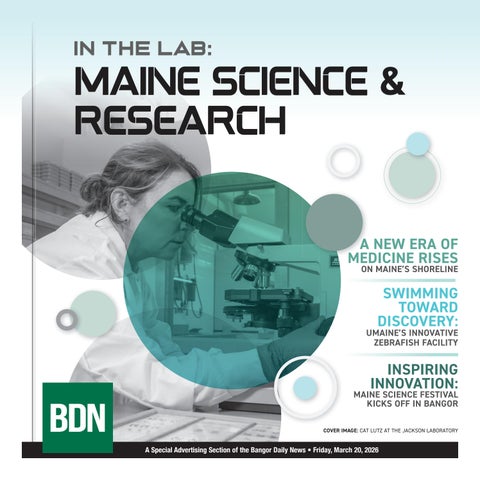
COVER IMAGE: CAT LUTZ AT THE JACKSON LABORATORY
A Special Advertising Section of the Bangor Daily News • Friday, March 20, 2026
2
IN THE LAB: MAINE SCIENCE & RESEARCH • Bangor Daily News Special Advertising Section • March 20, 2026
ON THE COAST OF MAINE, THE FUTURE OF MEDICINE IS ALREADY HERE BY ANGELA MARCOLINI
O
n any given summer day in Bar Harbor, families gather on the grassy knoll overlooking Frenchman Bay, eating ice cream and laughing in the sun as they reminisce about a day spent exploring the nearby trails in Acadia National Park. Meanwhile, just beyond the bustle of downtown, small teams of world-renowned scientists gather around conference tables and video screens to talk about children they know by name and diseases few doctors have ever encountered. At The Jackson Laboratory’s Rare Disease Translational Center (RDTC), a research program often begins with a single child, a single gene, and a family that has already traveled a long road to get there. These families have become the unlikely medical experts in their child’s condition. They have read the scientific papers, connected with other patients across the world, and searched for anyone who might be able to help. “Parents come to us after they’ve figured out what gene is involved and what mutation their child has. It’s a long journey to diagnosis,” said Cat Lutz, vice president of the RDTC. “With legislative pressure to make genome sequencing more accessible, the goal is to see these kids earlier, where we have a reasonable chance to develop their possible treatments.” A diagnosis brings answers to missed developmental milestones and physical symptoms, but it also brings a new kind of uncertainty: the realization that treatment may not yet exist, and that progress depends on building something that has never been built before. For many parents, the center represents both a turning point and a partnership. The question has shifted from What’s wrong? to What can be done?
WHEN TREATMENT DOESN’T EXIST For families, the possibility of treatment can feel both immediate and distant at the same time. The science has advanced quickly, but experiments still need to be done, and building therapies still requires navigating a system that was never designed for diseases like theirs. What many families discover is that the disease affecting their child is so rare that almost no organized research exists. For most of modern medicine, that absence made a certain kind of sense. Drug development is expensive and uncertain work, and the system that evolved around it depends on scale and profit. Therapies are designed for large patient populations and developed over long timelines, supported by markets capable of sustaining the investment required to bring a drug to patients. Rare diseases rarely fit that model.
CAT LUTZ AT THE JACKSON LABORATORY
IN THE LAB: MAINE SCIENCE & RESEARCH • Bangor Daily News Special Advertising Section • March 20, 2026 3
“It’s just not a sustainable financial model for most companies,” Lutz said. “We need to stop trying to shoehorn rare genetic diseases into the existing drug development paradigm. Instead, we need to build the ecosystem of innovation that supports economic sustainability in platformed approaches where every rare disease treatment directly informs the next.” Many rare genetic disorders affect only dozens or hundreds of patients worldwide. Even within a single disease, dozens of mutations may exist, each requiring a slightly different therapeutic approach. Thus, progress depends on a different kind of support. Much of the work moves forward through a combination of public investment, research grants, and philanthropy. Federal agencies such as the National Institutes of Health play a crucial role, funding the early scientific work that makes new therapies possible and helping sustain research that may never attract traditional commercial investment. Without that support, many rare disease programs would never begin. The mismatch between cost and population has shaped rare disease medicine for decades. Families often become the engine of discovery, building foundations, raising research funds, and connecting with scientists across the world. “Lessening this burden for families is a large part of our mission,” Lutz said.
RARE IS NOT RARE Rare diseases can sound distant, defined by conditions so uncommon that most people will never hear their names. Taken together, they are anything but rare. More than 10,000 rare diseases have been identified worldwide, affecting hundreds of millions of people collectively. Approximately 30% of children with a rare genetic disease don’t live to see their fifth birthday. For those that do survive, their symptoms continue across a lifetime. Seen this way, rare disease research begins to look less like a specialized corner of medicine and more like a vast and largely unsolved frontier. For much of the past, that frontier remained out of reach. The scientific barriers were as formidable as the economic ones. The tools needed to correct genetic disease simply did not exist.
A NEW MODEL OF DRUG DISCOVERY What has changed in recent years is not the diseases themselves but the technologies available to treat them. Gene replacement therapies, antisense treatments, and gene editing have made it possible, at least in principle, to correct the mutations that cause many rare conditions. Diseases once understood only at the level of biology can now be approached at the level of intervention. “The technologies are largely there,” Lutz said. “Science isn’t the rate-limiting factor anymore.” The challenge now is learning how to develop and deliver those therapies fast enough, and at a scale that makes them sustainable. Traditional drug development unfolds in a careful sequence: discovery followed by preclinical research, clinical trials, and regulatory review. The process often stretches across a decade or more. Rare diseases unfold on a different timeline. It starts after a diagnosis and the clock of someone’s life, often the life of a child, is ticking. At the Rare Disease Translational Center, scientific research moves forward alongside manufacturing plans, trial designs, and regulatory strategy. Instead of waiting for one stage to end before another begins, teams work in parallel, compressing timelines wherever possible. “If you try to do everything in a silo, you’ll fail,” Lutz said.
The center operates as a network as much as a laboratory, bringing together leading experts in gene editing, viral delivery, and clinical medicine from institutions around the world. At the same time, researchers are working toward treatment platforms that can be adapted across diseases rather than built from scratch each time. Instead of developing entirely new therapies for every mutation, scientists aim to modify shared technological frameworks, approaches that could make rare disease treatments faster and more affordable.
FROM ONE CHILD TO MANY If scientists can solve the problem for one gene and one child, the solutions may extend far beyond rare disease. Single-gene disorders offer some of the clearest test cases for precision medicine. The genetic cause is often known, the biological pathway can be traced, and the impact of treatment can be measured in direct and meaningful ways. For researchers, rare diseases provide an opportunity to develop and refine technologies that may later be applied much more broadly. Technologies first developed to correct rare mutations are already beginning to influence how scientists approach more complex conditions. Methods for editing genes, delivering therapies to specific tissues, and manufacturing individualized treatments could eventually reshape how medicine treats diseases such as ALS, Parkinson’s, or Alzheimer’s disease, where genetic risk factors often play an important role but therapies have proven difficult to develop due the complexity of the disease. In this way, rare disease research is not simply about treating small numbers of patients. It is helping to establish the scientific and regulatory foundations for a more precise kind of medicine, one that focuses on correcting the underlying causes of disease rather than managing symptoms after they appear. The work happening under Lutz’s leadership represents the building blocks of that future. Each therapy developed for a rare mutation adds to a growing body of knowledge about how to design, manufacture, and safely deliver genetic treatments. What begins as a treatment for a single child can become a template for treating many others, sometimes across entirely different diseases. “Hope has carried families a long way,” Lutz said. “But today we have something more than hope. We have the tools advancing faster than we imagined, especially with AI. What we need now is the funding and infrastructure to operationalize and scale.” At JAX, that strategy is taking shape. Rare diseases are not the margins of medicine, but where the next generation of therapies is being built, right here on the coast of Maine, by a dedicated team of scientists working today, one child and one gene at a time for a future that benefits us all.
4
IN THE LAB: MAINE SCIENCE & RESEARCH • Bangor Daily News Special Advertising Section • March 20, 2026
IN THE LAB: MAINE SCIENCE & RESEARCH • Bangor Daily News Special Advertising Section • March 20, 2026 5
SCIENCE TAKES CENTER STAGE IN BANGOR THE MAINE SCIENCE FESTIVAL KICKS OFF MARCH 25 BY EMILY BURNHAM
W
hen the Maine Science Festival was first held in Bangor in 2015, founder Kate Dickerson couldn’t have imagined all the ways in which the festival would grow and change over the next decade. The festival, a program of the Maine Discovery Museum — which Dickerson is now executive director of — remains focused on all the groundbreaking science and research being done right in Maine. But its programming and scope has changed tremendously, and when the five days of the 12th edition of the festival kick off on March 25, Dickerson said attendees will see just how much it has evolved. “When we started, it was barely two and a half days. Now it’s five jam-packed days,” said Dickerson. “The demand for what we’re doing — making science accessible to people of all ages — means we’ve developed all sorts of new events that let people connect in whatever way works best for them.” For some, that means going to the festival’s ever-popular trivia night, a yearly favorite held this year at 6:30 p.m. on March 25 at Seasons Restaurant in Bangor, in which competitors eagerly try to outsmart each other in a series of science-themed trivia questions that Dickerson says are “really quite hard.” For others, that means attending long-running events like 5 Minute Genius, the festival’s unofficial headlining event, set for 7 p.m., March 28 at the Bangor Opera House, in which eight Maine scientists each give fast-paced five-minute talks explaining the work they do in a fun, punchy way, followed by five minutes for questions. Audience members hear from everyone from physicians and biochemists to marine biologists and engineers. And for hundreds of kids and adults, that means attending the two days of exhibits and programming at the Cross Insurance Center, March 27-28. Friday is reserved for 7th and 8th grade students from all around Maine, while Saturday is open to everybody.
Among the highlights this year are workshops on thermal radiation and quantum materials; audio engineering and visualizing sound waves; how wind turbines actually work; how cheese is made from soil to water to cow to dairy; and an explosive, all ages demonstration on the power of fire and ice. There’s also an art and science exhibit, “Forests: Sanctuaries for the Dark,” a collaboration between a local photographer and the Forest Society of Maine, showcasing astrophotography and Maine’s Dark Skies initiative. “One thing we’ve consistently leaned into over the years is having the arts and humanities always interwoven into our programming,” said Dickerson. “It’s a really important way that we break down silos so people can better connect with science.” Dickerson said having Maine scientists be fully accessible over the course of the festival has led to a much greater appreciation among audiences of the amazing scientific work being done right here in Maine — so much so that organizers have added a new event. “Taproom Tales,” set for 7 p.m. on March 27, will feature Maine scientists telling stories about their personal experiences doing research, inspired by the Moth Radio Hour on NPR. “We used to bring in a big, outside headliner, but we’ve stopped doing that because we really want to keep the focus on the work being done here in Maine, and on the people doing it,” Dickerson said. “We’re really the only science festival nationwide that focuses on science just in our state. We’re really proud of that.” Organizers also take a lot of pride in the fact that the festival has always been 100 percent free to all. “Our goal is always to break down silos and get people excited about science and ready to learn,” Dickerson said. “We don’t want to put up any barriers to make sure people get to access that.”
The Maine Science Festival is set for March 25-29 in venues all across Bangor. For a full schedule, visit mainesciencefestival.org.
6
IN THE LAB: MAINE SCIENCE & RESEARCH • Bangor Daily News Special Advertising Section • March 20, 2026
S
cience immersion at Maine Maritime Academy (MMA) begins on day one for students in the Corning School of Ocean Studies. “Ocean Studies sets itself apart from other undergraduate programs with unparalleled access to vessels and research-grade instrumentation—including our dedicated research vessel, RV Friendship—for student use, proximity to nearshore habitats within the Bagaduce watershed and greater Penobscot Bay region, and a faculty dedicated to teaching and learning,” explains Dr. Jessica Muhlin, Department Chair and faculty member in Ocean Studies. “Although Ocean Studies faculty conduct our own research, our focus is on cultivating the next generation of ocean scientists.” Established in 1990, Ocean Studies offers three programs: Marine Biology, Oceanography, and Coastal and Marine Environmental Science (CMES). Many students choose to enroll in MMA’s dual major with Small Vessel Operations (SVO), a unique five-year pathway that allows them to earn a Bachelor of Science degree while gaining eligibility to test for a U.S. Coast
COURTESY OF THE MAINE MARITIME ACADEMY Guard license of up to 200 gross tons for near-coastal operations up to 200 miles offshore. Participating in authentic, independent scientific research is a cornerstone of all three Ocean Studies programs. Faculty nurture each student’s curiosity in ocean sciences, guiding them in developing the skills and techniques needed to complete an independent research project during their junior and senior years. “My experience conducting independent research at MMA has been incredibly eye-opening. It has given me the opportunity to engage in every stage of the research process,” shares Mackenzie Morin, a CMES/SVO fifthyear student. “From developing my own research question and writing a proposal, to collecting and analyzing data and ultimately sharing my findings through writing and presentations. Many undergraduate students at other institutions do not have this level of independence, which is what makes the Ocean Studies programs at MMA so unique and impactful. I feel well prepared for whatever comes next in my career.”
This spring, MMA, in partnership with the U.S. Maritime Administration (MARAD), will receive a purpose-built, state-of-the-art training vessel, the State of Maine. Known as National Security Multi-Mission Vessel 3 (NSMV 3), it represents a significant step forward in maritime education, with plans to integrate CMES and Oceanography students aboard. “Ocean Studies is excited about the unmatched potential for CMES and Oceanography students to conduct science at sea while addressing issues of ocean change and sustainability,” says Ocean Studies faculty member Dr. Kerry Whittaker. “This ocean-going platform will allow us to take students and curriculum to the high seas, advancing understanding of global ocean systems using cutting-edge tools. At sea and in port, through community building and engagement with global leaders, students will explore purpose, agency, and sustainability in how we use and care for our blue planet.” For prospective students considering careers in ocean sciences, MMA offers a distinctive opportunity to prepare for both scientific work and life at sea.
IN THE LAB: MAINE SCIENCE & RESEARCH • Bangor Daily News Special Advertising Section • March 20, 2026 7
SMALL FISH, BIG IMPACT: UMAINE’S NEW ZEBRAFISH RESEARCH LAB BY CRYSTAL SANDS
W
hat do humans and zebrafish have in common? It turns out a lot more than most of us might think. Zebrafish and humans share approximately 70% of the same genes. Researchers at the University of Maine in Orono are leveraging the human-zebrafish connection in a new lab designed to advance health discoveries. “We want to understand how defects cause sickness, and zebrafish make it easy to study that question,” said Jared Talbot, associate professor of developmental biology. Talbot explained that zebrafish are excellent for research, not only because of the genes humans share with them, but also because their eggs are transparent, as are the spawn during the first weeks of life. This transparency makes it easy for researchers to observe as tissues develop. Zebrafish are also relatively easy to house and produce a lot of offspring in a short period, making the small fish easier to manage for research compared to mice, for example. The new lab, which opened last May and was funded by a grant written and secured by Clarissa Henry, professor of biological sciences at UMaine, enables the research
team to communicate and share findings with over 1,000 other labs around the world that study zebrafish. Right now, the team at UMaine has two main focuses in their new lab: First, they are looking at the MYLPF gene (a gene that encodes protein crucial for muscle contraction), and why people get sick when its function is disrupted. The second focus is on how cells migrate to the right places to build muscles. Henry said the need for a new facility to conduct this important research was clear, and the new lab and improved conditions are already yielding success. According to Henry, the team has seen a 400% increase in the fish’s ability to produce offspring, which improves the team’s ability to conduct research. “This has been fantastic for our students,” Henry said. “For our undergraduates, the lab provides opportunities for team building and hands-on work.” She added that the lab has also been great for recruitment of graduate students. Alexandra Myles is one of those students taking advantage of the valuable research lab. She is a senior at UMaine studying pre-med, and said she’s always
loved research. She recently won a grant to fund her own study in the lab. Troy Hupper is a graduate student who has been working in the lab to study the effects of the MYLPF gene on movement. “We can use the zebrafish as a possible therapeutic model for humans,” Hupper said. Mark Nilan has been managing the zebrafish lab at UMaine since 2003, and played a critical role in the new lab’s design. He said the new facility has more than doubled what they were able to do in the old lab, which didn’t have ideal heat or lighting. “This new lab creates prime conditions for the zebrafish, and it has made a big difference,” Nilan said. Nilan also emphasized that the zebrafish lab is open for activities like school field trips, which can help inspire the next generation of young scientists. The work of these UMaine researchers is inspiring for all ages. For example, studies in the zebrafish lab have already led to important discoveries about what happens to our muscles when we’re sick with a virus. These kinds of discoveries can lead to help for millions of people — and it’s all happening right here in our community.
8
I
IN THE LAB: MAINE SCIENCE & RESEARCH • Bangor Daily News Special Advertising Section • March 20, 2026
MSSM EMBRACES MAINE SCIENCE COURTESY OF THE MAINE SCHOOL OF SCIENCE AND MATHEMATICS
n the classroom at Maine School of Science and Mathematics, students learn real lab skills. In the field and through internships, they learn practical methods for collecting data, testing ideas, and communicating results. The goal is more than a grade; it’s about real outcomes that help daily life. Maine needs more than just science research; it needs science with an impact. With an aging population and an economy tied to forestry, wildlife, and tourism, the state needs science that delivers actionable steps. Public services rely on reliable tech, so research that strengthens resilience matters to everyday life. During a two-week special projects class called January Term (J-Term), students take one special-focus class or pursue an internship aligned with their passions. The internships, available to sophomores and higher, let them step into real workplaces to get hands-on experience, not just learning, but also doing. Some may work with people in a doctor’s office, at a software company on a computer, or in the field monitoring woodlands and collecting data through field notes. One such student is sophomore Olivia from Wiscasset, who worked with Dorothy Lamson (retired head of Chewonki) to monitor how northern Maine’s woodlands
adapt to this winter climate, through daily lessons and explorations. Olivia said they would start an expedition outside, tracking animal prints and looking for anything new. She spent much of her time around a reserve area owned by a company that manages parks. In the evening, she would review the journal of data points she had tracked each day and compile the results in a table. She said she focused on birdwatching and observed their behavior. January Term offers both on-campus classes and student-driven internships. Olivia said she considered the
class options, but loves the Maine outdoors and wanted to go out and explore. She loved the repetition of tracking the same things every day and noted, “Real research is multiple takes.” She said she was most proud of her journal and how she analyzed the data. She said she can identify every kind of conifer tree and almost any local Maine tracks. One unique feature of MSSM is the way students can choose their own paths based on their passions. It was Olivia’s job to completely coordinate the internship, and she appreciated the trust and freedom she was allowed. She appreciates the way students at MSSM have so much freedom in doing their work and wishes adults would trust children more with real work. When asked how she would respond to a Legislator asking why this matters, Olivia said, “We need to be more aware of how our ecosystem works.” She added, “If we do not understand behaviors or why things are happening, we cannot prevent problems.” That is exactly what internships like Olivia’s build. Students learn about patterns, evidence, data collection, analysis, and explanation. This not only teaches a real-life skill, but it also helps make Maine smarter about winter, wildlife, and climate.