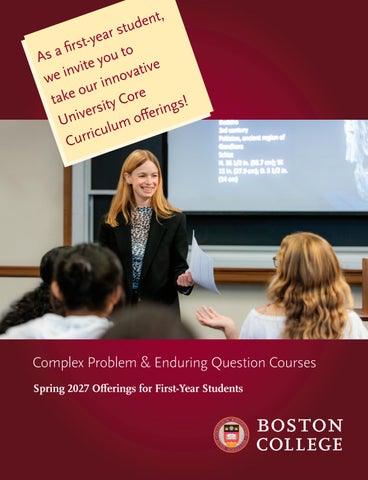
, t n e d u t s ar e y t rs fi a to u As o y e e t i v i v t n a i v o we n n ri u o re o take C ! y s t i g s n er eri v i ff n o U m u l u ic r r u C
Complex Problem & Enduring Question Courses Spring 2027 Offerings for First-Year Students
A
s a member of the Class of 2030, you are invited to enroll in Boston College’s innovative Complex Problem & Enduring Question courses–known on campus
by their acronym, CP & EQ. These courses are collaboratively
taught by faculty members from different academic fields and are designed to engage students in interdisciplinary explorations of topics of critical importance. Created for first-year students, CP & EQ courses satisfy University Core Curriculum requirements and exemplify BC’s distinctive approach to Core education. They establish a foundation for intellectual development that prepares you to become an engaged, effective world citizen. Learn more about BC’s CP & EQ courses in this brochure by browsing the options available to you this spring.
–1–
Complex Problem & Enduring Question Courses 1. Small class sizes with professors and classmates who know you.
What makes these courses distinctive?
CP & EQ courses facilitate a close, collaborative learning experience for students. 2. Learning happens inside and outside the classroom. CP & EQ courses extend inquiry beyond the classroom to labs, Reflection sessions, conversations with outside speakers, and off-campus field trips, creating an intensive shared learning experience for both teachers and students. 3. Courses center on interdisciplinary topics that are both urgent and timeless. Examples of these subjects include migration, social inequalities, technological change, compassion and belonging, and justice and the common good, to name a few. Each semester’s offerings have been different since 2015, when these courses were first introduced.
–2–
Key Features of Each Course Type Complex Problem Courses
▶
Enduring Question Courses
6 credits
▶ Team-taught by professors from different
▶
Two linked 3-credit courses
▶
Taught by two professors from different academic fields
▶
19 students
academic fields ▶ 76 students ▶
Fulfill up to 3 University Core requirements
▶
Fulfill up to 3 University Core requirements
▶
Lectures multiple days per week
▶
Lectures multiple days per week
▶
Lab once per week
▶
▶
Reflection once per week, where students and faculty gather to connect the course content to their lived experiences
Reflection four times per semester, where students and faculty gather to connect the course content to their lived experiences
–3–
Watch a Video about CP & EQ Courses
My EQ course brought theology and history into conversation in ways I never expected. It pushed me to think across disciplines and reflect on my own formation—and it sparked the research interest I’m still pursuing today.
The Rule of Law and the Meaning of Justice EQ course set the foundation for my development at Boston College. My English and Law School professors cared about my growth not only academically, but also as an individual.
Lucian Mahoney ’26 Major: History/Economics
Amaris Ramos ’26 Major: Transformative Educational Studies/Political Science Minor: English
My EQ course challenged my preconceived notions of history and art across the Mediterranean, while fostering a real community and lasting connections with my classmates. Nicholas Martin ’28 Major: International Studies Minor: Finance
–4–
These courses provide a unique opportunity to build a tight-knit community in the classroom and lasting relationships with professors and peers in a way that I never could have imagined. I wish I could’ve taken every single one. Atticus Crothers ’26 Major: Political Science Minor: Environmental Studies
As a nursing student, I was excited to have the opportunity to also explore other interests. Luckily, my EQ course gave me the opportunity to learn about history and theology in a new and innovative way that has shifted my perspective forever.
My Core course allowed me to step outside myself and examine topics from my peers’ viewpoints. The course as a whole made me a more compassionate and understanding person, which I will value for the rest of my life.
Molly Farr ’26 Major: Nursing
Legacy Durham ’28 Major: Biology/Classical Studies Minor: Education –5–
My CP course provided a unique interdisciplinary approach that exposed me to the interconnected nature of academia. Ultimately, my semester project for my Colonizing
One of my favorite courses at BC was my EQ in Spring 2024. The small class size allowed me to form lasting friendships and meaningful memories while learning from professors who cared about our success.
History course set the trajectory for my academic career here at BC, as I declared a history major. Kylie Drakos ’28
Luis Suriel ’27
Major: Political Science/History
Major: History Minor: Finance
My EQ course allowed me to explore a subject completely outside of my major. I was able to learn about new topics in a supportive environment with a small group of students and two professors. Jack Francis ’26 Major: Mathematics Minor: Finance
–6–
See what your peers are saying about CP & EQ courses!
University Core Curriculum The centerpiece of a Jesuit education has always been a common curriculum that emphasizes the study of defining works in the humanities, the natural sciences, the social sciences, and the arts. BC’s University Core Curriculum is designed to provide a broad understanding of the forces that have shaped the world by challenging you to think across disciplines in order to make good decisions and to communicate effectively in an increasingly complex world. All the courses included in this brochure satisfy University Core requirements. To fulfill the University Core, you must complete: 1 course in the Arts 1 course in Cultural Diversity 1 course in History I 1 course in History II 1 course in Literature 1 course in Mathematics 2 courses in Natural Science
To vie
w all
that s
2 courses in Philosophy
cours
es Univ Core ersity Curri culum requi reme nts, v bc.ed isit u/cor e atisfy
2 courses in Social Science 1 course in Christian Theology 1 course in Sacred Texts and Traditions 1 course in Writing
–7–
Course Catalog Complex Problem Courses
Take Me to the River: The History and Science of U.S. Waterways
Code and Consequences: An Introduction to AI and Its Societal Impacts
EESC1721 + HIST1737
CSCI1702 + UNAS1744
Fulfills
Fulfills
1 Natural Science + History II + Cultural Diversity
Mathematics + 1 Social Science + Cultural Diversity
Professors
Professors
Noah Snyder, Earth and Environmental Sciences
Jessica Finocchiaro, Computer Science
Conevery Bolton Valencius, History
Brian Smith, Lynch School of Education and Human
Kathryn Bruce, Core Fellow
Development Taylor Beauvais, Core Fellow
From colonial grist mills to modern megadams, from Civil War battles of ironclad steamboats to contemporary battles over environmental legislation, rivers course with the lifeblood of American history. In this course, we will use telling moments in the history of U.S. waterways to explore how Americans have encountered, managed, and lived next to rivers. We will also build from these episodes to investigate the science of hydrology, watersheds, climate change, and sediment management. As we trace the role of waterways in U.S. policy-making, energy production, and governance, we will also pay attention to how waters touch the American spirit—through imagination, exploration,
This course provides an introduction to how artificial intelligence (AI) technologies are reshaping our world. Students will learn how algorithms, data, and computing power come together to influence our lives, from what we read to what we buy to how we learn. Through discussion and debate as well as hands-on analysis using computing tools such as the Python programming language, we will delve into topics such as the environmental costs of large data centers, legal issues related to training AI, and the adoption of AI companions. In the end, students will gain critical perspectives necessary to participate responsibly in conversations about the future of AI. No prior coding experience is needed.
baptism, and the Blues. Course Times
Course Times
LECTURE TTh
LECTURE
3:00 PM – 4:15 PM
LAB (CHOOSE 1)
TTh
M
12:00 PM – 1:15 PM
LAB (CHOOSE 1)
M
1:30 PM – 2:45 PM
M
12:00 PM – 1:15 PM
W
12:00 PM – 1:15 PM
W
12:00 PM – 1:15 PM
W
1:30 PM – 2:45 PM
F
12:00 PM – 1:15 PM
REFLECTION
F
1:30 PM – 2:45 PM
T
REFLECTION
6:00 PM – 7:15 PM
T
–8–
1:30 PM – 2:45 PM
6:00 PM – 7:15 PM
Enduring Question Courses
Memory, Disruption, Hope: Literary Perspectives CLAS1708
Crafting Alternative Futures: Communication, Agency, and WorldMaking COMM2205
Memory, Disruption, Hope: Philosophical Perspectives PHIL1730
Crafting Alternative Futures: Imagined Worlds in Literature ENGL1739
Fulfills Literature + 1 Philosophy
Fulfills
Professors
1 Social Science + Literature + Cultural Diversity
Thomas Epstein, Classical Studies
Professors
Vanessa Rumble, Philosophy
Kalemba Kizito, Communication Krithika Vachali, English
Is memory merely a storehouse for empirical experience or something more, something different, perhaps a key to the very possibility of meaningful experience?
How can we harness the power of imagination to build alternative societies?
These paired courses explore memory as a personal, social, and intellectual-spiritual life force. While it can be argued that memory is at the root of both literature and philosophy, memory as an object of literary expression and philosophical reflection gained particular momentum from the 19th century forward. We will explore some of the history and sources of this newfound focus on memory and apply our insights to both personal and collective experience. We will look at the crucial role played by the past in the very possibility of framing a future and observe how literature and philosophy approach the phenomenon of memory differently. Activities will include visits to museums and historical sites.
These paired courses invite students to explore the power of public imagination as a tool for constructing alternative societies. By working with critical, media, and communication theories alongside literature and film about speculative future worlds, students will interrogate existing systems and envision futures that challenge the status quo. Students will be encouraged to take agency in the process of creating new futures by collaborating on projects and crafting narratives and blueprints for societies that prioritize sustainability, equity, and the common good. Through the course, students will develop the tools to critically examine social, political, intellectual, and literary texts while learning to use persuasion to mobilize communities and take an active role in shaping the future.
Course Times LECTURE TTh 12:00 PM – 1:15 PM
Course Times
TTh
LECTURE
1:30 PM – 2:45 PM
REFLECTION (4 TIMES PER SEMESTER)
MWF 10:00 AM –10:50 AM
T
MWF 11:00 AM –11:50 AM
6:00 PM – 7:50 PM
REFLECTION (4 TIMES PER SEMESTER) W
–9–
6:00 PM – 7:50 PM
Enduring Question Courses
Reckoning with Incarceration: Social Perspectives COMM2183
How Sports Explain America: The History of Sports in the United States HIST1718
Reckoning with Incarceration: Biological Perspectives UNAS1734
How Sports Explain America: The Sociology of Sports in the United States SOCY1718
Fulfills 1 Social Science + 1 Natural Science + Cultural Diversity
Fulfills
Professors
History II + 1 Social Science + Cultural Diversity
Celeste Wells, Communication
Professors
Jessica Black, School of Social Work
Thomas Mogan, Associate Dean, Morrissey College of Arts and Sciences
How do stories concerning justice, retribution, and rehabilitation shape the physical, mental, and social health of individuals?
Kyoung-yim Kim, Morrissey College of Arts and Sciences How have sports served to define and illustrate the essence of American society and culture throughout history and in contemporary times?
These paired courses will examine how the universal needs of justice and safety are institutionalized by legal, social, health, and cultural fields, and how victims, perpetrators of crime, and the families of both come to understand them. One course will explore the stories and unequal impacts of the retribution versus rehabilitation design of the U.S. incarceration model, while the other course will examine how experiences like toxic stress, social exclusion, and poor sleep impact physical and mental health on a biological level and throughout the lifespan.
These paired courses will explore the complex relationship between sports and society. Through an interdisciplinary approach to history and sociology, students will analyze the evolution of sports, assess how they mirror the changing dynamics of American society and culture, and investigate the multifaceted roles sports have played and continue to play in shaping our society. By the end of these courses, students will understand how sports serve as a microcosm of American society and a platform for social change, fostering critical thinking and a deep appreciation of the nation’s cultural fabric.
Course Times LECTURE TTh 12:00 PM – 1:15 PM TTh
Course Times
1:30 PM – 2:45 PM
REFLECTION (4 TIMES PER SEMESTER)
LECTURE
T
TTh
3:00 PM – 4:15 PM
TTh
4:30 PM – 5:45 PM
6:00 PM – 7:50 PM
REFLECTION (4 TIMES PER SEMESTER) Th
–10–
6:00 PM – 7:50 PM
Human/Nature: Connecting to the Living World Through Biology BIOL1713
The Formation of Early Christian Thought: A Philosophical Examination PHIL1722
Human/Nature: Connecting to the Living World Through Music MUSA1703
The Formation of Early Christian Thought: A Theological Examination THEO1722
Fulfills
Fulfills
1 Natural Science + Arts
1 Philosophy + 1 Theology (Christian Theology)
Professors
Professors
Heather Olins, Biology
Sarah Byers, Philosophy
Anna Wittstruck, Music
Paul Ulishney, Theology
How do humans connect to nature?
How did Greco-Roman philosophy contribute to rational Christian theology?
Throughout history, humans have explored, expressed, and attempted to understand our connection to nature. These paired courses examine the cultural inscriptions and values that have shaped our perceptions of our natural surroundings and that inform knowledge-seeking and expression. Students will explore themes of attention, objectivity, and how being part of the thing we study and/or create can influence the outcome of that investigative and creative process. We will analyze musical works that aim to represent the natural world and also think about the materials needed from the natural world to develop technologies for music making, from acoustic instruments to generative AI, and their environmental impact and sustainability. Theorizing humanity’s intrinsic love of nature, we will also consider our responsibility to the living world in the midst of threats to biodiversity.
These courses address the enduring question of the relationship between faith and reason. In the early Christian era, leading intellectuals attempted to integrate the Jewish and Christian scriptures and traditions with rational philosophy. They employed Greek and Roman philosophy to reflect upon foundational issues in metaphysics, human psychology, epistemology, ethics, and God’s action in time. We will examine important concepts, arguments, and theories of ancient pagan philosophers (Plato, Aristotle, Seneca, Epictetus, Plotinus) and trace their adoption and adaptation by leading Christians (Justin Martyr, Origen, Lactantius, Athanasius, Augustine). Course Times LECTURE TTh
Course Times
TTh 10:30 AM – 11:45 AM
LECTURE
REFLECTION (4 TIMES PER SEMESTER)
TTh 10:30 AM – 11:45 AM
T
TTh 12:00 PM – 1:15 PM REFLECTION (4 TIMES PER SEMESTER) Th
9:00 AM – 10:15 AM
6:00 PM – 7:50 PM
–11–
6:00 PM – 7:50 PM
Enduring Question Courses
Poverty and Progress: Literary Perspectives on Causes and Consequences ENGL1742
Urban Paradoxes: Histories of Cities, Power, and Environment in the Americas HIST1736
Poverty and Progress: Critical Perspectives on Political Economy UNAS1737
Urban Paradoxes: Theories and Practices of City Infrastructures UNAS1742
Fulfills Literature + 1 Social Science + Cultural Diversity
Fulfills
Professors
History II + 1 Social Science + Cultural Diversity
Gayathri Goel, Core Fellow
Professors
Peter Giraudo, Core Fellow
Andrei Guadarrama, Core Fellow Ethan Tupelo, Core Fellow
Why does poverty persist and how can we remedy it?
What makes urban life possible?
In an individualistic society such as ours, poverty is often framed as a personal failing. In these paired courses, however, we will look at some of the systemic factors, notably capitalism, as mechanisms that create and sustain a poorer class of people. We will also consider how poverty complicates narratives of markets as fostering progress and individual freedom. If freedom for some requires the regimentation and exclusion of the many, is it genuine progress? By examining enduring accounts of poverty, we will explore its origins as a mass phenomenon, consequences for civic bonds, and influence on political participation. In addition to making poverty visible, literary texts will also demystify the complex nexus of factors that produce poverty and inhibit true progress.
We live in an urban world, yet most humans lived outside urban areas until 2007. To understand this transformation, these courses examine the social and material processes that make urban life possible, investigating core contradictions of the city—a site of economic growth and inequality, political freedom and oppression, environmental justice and disaster. Against interpreting urban growth, infrastructure, and markets as neutral, we will make visible the power relations and systems that shape and constrain human interactions and beliefs. These courses combine history and political theory, emphasizing cities in the U.S. and Latin America in the 20th century. Students will research a city and propose solutions to ongoing problems of global cities.
Course Times
Course Times
LECTURE
LECTURE
Section 01
Section 01
MWF 12:00 PM – 12:50 PM
MWF 10:00 AM – 10:50 AM
MWF 1:00 PM – 1:50 PM OR
MWF 11:00 AM – 11:50 AM OR
Section 02
Section 02
MWF 1:00 PM – 1:50 PM
MWF 11:00 AM – 11:50 AM
MWF 2:00 PM – 2:50 PM
MWF 12:00 PM – 12:50 PM
REFLECTION (4 TIMES PER SEMESTER) Th
REFLECTION (4 TIMES PER SEMESTER)
6:00 PM – 7:50 PM
T
–12–
6:00 PM – 7:50 PM
Stokes Hall S260 140 Commonwealth Avenue Chestnut Hill, MA 02467 bc.edu/core