Bakery, Confectionery, Tobacco Workers and Grain Millers International Union
January/ February 2014
on
Ke
llo
gg
Pa g
y
es W M or 8 & LK ke 9 Da rs’ E v
en
ts
Volume 16 Number 1
the
PRESIDENT’S MESSAGE
FIGHTING TODAY to
L
PROTECT our FUTURE
Looking at these words from the BCTGM’s Declaration the BCTGM, “Fighting Today to Protect Our Future”. I believe that this theme truly captures what the BCTGM of Principles, it is as if those leaders who wrote our Constitution knew exactly what our Union has been up is all about in an era when far too many employers operate against for the past four years and corporations devoid of any moral compass, “The opposition from employers how we have responded. consumed by greed and disdainful of the and their strong political Since our last International skilled and dedicated men and women representatives seems sharp and Union Convention in 2010, the who make their companies run. constant, and in the face of these, BCTGM and our members have All that the BCTGM seeks are it is our declared purpose to been forced to confront one fierce, responsible, constructive collective maintain our unity and solidarity.” gut-wrenching challenge after bargaining relationships with employers – From the Declaration of Principles, another – challenges that have tested and fair contracts that allow our members BCTGM Constitution our resilience and solidarity. to provide a good quality of life for During the last four years, employers across our their families and ensure dignity, justice and respect in the industries, even those with whom this Union has enjoyed workplace. Our long history proves that employers that a longstanding and productive collective bargaining choose to work with our Union in such a manner experience relationship, have chosen to become harsh and irresponsible success. adversaries. These employers have been intent on using their But when we are confronted by employers, financial financial muscle to take greater control over our workplaces institutions and political forces that threaten the interests of and amass ever-increasing riches for themselves from our our members and this Union, we will never back down. members’ hard work. We fight today not because we want to, but because we But every employer that has taken on this Union has must. This is our obligation and responsibility to those who severely underestimated the strength and determination of built this Union, to those who are working today to make the the BCTGM and the courage and unity of our members. BCTGM even stronger and to those who will carry on this In the toughest times and in the face of the greatest proud tradition in the years ahead. adversity, the BCTGM has stood strong and fought hard We fight today to protect our future. And our adversaries and smart in order to preserve and protect all that has been should know that there will always be plenty of fight in the achieved for our members throughout our proud 128 -year BCTGM. history. David B. Durkee When Roquette America, then American Crystal Sugar BCTGM International President and now Kellogg, for the second time, chose the deplorable path of locking out our members, each of these companies expected us to wilt, to knuckle under to their pressure and simply accept outrageous terms and conditions for settlement. Official Publication of the Bakery, Confectionery, Tobacco They did not appreciate the intensity of our Workers and Grain Millers International Union commitment to preserving the standard of living our 10401 Connecticut Avenue, Kensington, Maryland 20895-3961 (301) 933-8600 members and this Union have worked so long and hard to www.bctgm.org achieve. David B. Durkee, Editor When the Wall Street hedge fund and private equity Corrina A. Christensen, Assistant Editor bosses who took over the former Hostess Brands and ran it BCTGM General Executive Board into the ground, did not understand that our members, who President David B. Durkee • Secretary-Treasurer Steve Bertelli Vice Presidents Jethro Head • Arthur Montminy had built Hostess and saved it time and again, had suffered Robert Oakley • Ron Piercey • James Rivers • Randy Roark through enough management incompetence and were BCTGM General Executive Board Members unwilling to take any more disrespect and indignity from Joyce Alston • John Bethel • Thomas Bingler • Edward Burpo this employer. Butch Henley • Paul LaBuda • Terry Lansing Richard Lewis • Earl Lublow • Gary Oskoian • William Shadbolt Because of all that we have been through as Union for Paula Steig • Doyle Townson • Jeff Webb the past four years and how hard we all battle every day to BCTGM News (ISSN 1525-4860) is published bi-monthly by the Bakery, Confectionery, Tobacco Workers and Grain Millers International Union, 10401 Connecticut Avenue, Kensington, MD defend the quality of our contracts and the quality of life of 20895-3961. Periodicals postage paid at Kensington, MD and at additional mailing offices. Subscription to new members only. Postmaster: Send address changes to BCTGM News, 10401 Connecticut Avenue, Kensington, MD 20895-3961. our members – former, current and future – we have selected as the theme for this year’s 39th Constitutional Convention of
BCTGM News
2
BCTGM News
BCTGM Activists RALLY AGAINST NAFTA-Style Trade Model U.S. Representative Keith Ellison (D-Minn.) put it best when he said the Trans-Pacific Partnership is the “largest corporate power grab you never heard of.”
In the last few months, labor, community, environmental and consumer activists have helped generate significant opposition to granting Fast Track for the TPP. In late January, the Citizens Trade Campaign sent a letter to Congress opposing Fast Track that was signed by 564 leading labor and environmental organizations — including the BCTGM. It is well known that Fast Track for the TPP would offshore millions of American jobs, drive down wages, reduce tax revenue for our schools and open environmental protects to attack by transnational corporations here and around the globe. “America’s workforce deserves better than warmed over trade deals, which will do nothing to raise wages or reduce our $540 billion trade deficit,” reflects AFL-CIO President Richard Trumka. “The United States is long overdue for an overhaul of its trade priorities and trade practices. Rather than focusing on empowering multinational corporations, we should be working to support domestic manufacturing jobs, fix our crumbling infrastructure and rebuild a strong middle class. This fast track bill will do the opposite,” Trumka concludes.
The Trans-Pacific Partnership, also known as the TPP, is a massive trade deal that will give corporations new powers to attack important workers’ rights, environmental and public health protections. The TPP trade deal has been negotiated among 12 countries mostly in secret for more than three years. It would offshore millions of American jobs and erode the wages of workers in the U.S. It would decrease access to life-saving medicines and flood the U.S. marketplace with unsafe food. And as if that’s not enough, corporate lobbyists want Congress to put the TPP on a “fast track,” which means that members of Congress cannot change the agreement to make it better for Americans. Under Fast Track, Congress cedes its authority without guaranteeing that Americans get a good trade deal in return. The executive branch has repeatedly sent bad deal after bad deal to Congress: the North American Free Trade Agreement (NAFTA), the World Trade Organization (WTO) talks, the Central American Free Trade Agreement (CAFTA), the U.S.Colombia Free Trade Agreement, the U.S.Korea trade agreement, just to name a few. And they’ve all passed under Fast Track. Meanwhile, workers have paid the price for these bad trade deals: The Economic Policy Institute (EPI) has determined that net job displacement since China entered the WTO in 2001 cost the U.S. economy $37 billion in lost wages in 2011 alone. In San Francisco, BCTGM Local 24 (San Francisco) and Local And the impact has not been equal— 125 (Oakland, Calif.) members joined together with other labor, it has displaced a disproportionately community and elected leaders during the nationwide week of action to tell Congress to oppose any “Fast Track” authority for large number of good jobs for minority trade deals, including the Trans Pacific Partnership that has been workers—958,800 good jobs with excellent called NAFTA on steroids. Pictured here, from left to right, is L. 125 benefits, 35 percent of total jobs displaced. member John Belmares, L. 125 Rec. Secy. David Cheong, L. 125 Vice Pres. Jesus Flores, L. 24 Bus. Agt. Juan D. Mejorado, L. 125 Fin. NAFTA has displaced nearly 700,000 jobs Secy.-Treas. Rene Castillo, and L. 24 Bus. Agt. Oscar Hernandez. and has helped push wages down. January/February 2014
www.bctgm.org
3
The History of BCTGM-Made In the early 20th Century, Fleer Chewing Gum Company, in Philadelphia, had been trying for years to produce a gum formula that allowed bubbles to be blown and was less sticky than regular chewing gum. In 1928, an accountant at the gum company, Walter Diemer, who liked to experiment with gum recipes in his spare time, accidentally stumbled upon
4
a unique formula. Compared to standard chewing gum, Diemer’s recipe was less sticky and more flexible than other chewing gums, characteristics that allowed a chewer to make bubbles. Diemer used a pink dye for his new gum because pink was the only color available at the factory during his experiment. Pink remains the industry standard for bubble gum. Using a salt water taffy wrapping machine, Diemer wrapped one hundred pieces of his creation and took samples to a local candy shop and it sold
BCTGM News
DUBBLE BUBBLE Gum out in a single day. Realizing they had a new, wonderful type of gum, Fleer Chewing Gum Company marketed Diemer’s new gum as “Dubble Bubble.” To help sell the new bubble gum, Diemer personally taught salespeople how to blow bubbles so that they in turn could teach potential customers. Dubble Bubble remained the only bubble gum on the market until Bazooka bubble gum
January/February 2014
appeared after World War II. In 1998, Dubble Bubble was purchased by Concord Confections. In 2004, Tootsie Roll Industries acquired Concord and today the gum is sold in more than 50 countries. Today, BCTGM Local 264 (Toronto) members continue to produce the famous treat. Pictured on these pages are the proud union workers who produce Dubble Bubble products at the Concord, Ontario gum factory.
www.bctgm.org
5
Workers Vote BCTGM Yes! Workers at the new state-of-the-art Bimbo Bakeries USA facility in Topeka, Kan. voted overwhelmingly to join BCTGM Local 218 (Kansas City,
Mo.) in early January. Workers at the 135,000-squarefoot Topeka plant make bread and buns under the Sara Lee, Iron Kids, Orowheat, Ball Park and numerous private label brands. The BCTGM represents approximately 8,000 workers at Bimbo facilities across the United States making Boboli, Stroehmann, Thomas’, Sara Lee, Arnold and Entenmann’s products. The organizing campaign began in October when workers reached out to the BCTGM International Union. Concerned about a lack of pay raises and favoritism in the plant, workers began to talk about the merits of joining the BCTGM and negotiating a collective bargaining agreement. Leaders of Local 218, assisted by BCTGM International Representative Brad Schmidt, met with workers from the plant and created an organizing committee. Key members of that committee began talking to workers throughout the facility and by Thanksgiving an overwhelming majority had signed authorization cards to have a union election. According to Schmidt, once the organizing committee began talking to fellow workers, “the campaign 6
organized in the last thirteen just snowballed.” months by the BCTGM,” notes “Many of these workers knew we had Bimbo contracts across the BCTGM International Director of country, and quite honestly they felt, Organization John Price. “Workers at the Topeka bakery ‘why not us?’”, said Schmidt. are holding tight to the solidarity The Topeka factory is part they formed during the campaign of a long-term strategy by Bimbo going into contract negotiations. Bakeries USA to invest in its U.S. These workers feel manufacturing secure with the infrastructure. “These workers knowledge that The Topeka feel secure with the BCTGM has plant, built in 2011, is run as a the knowledge that an excellent record of negotiating high performance the BCTGM has an great contracts,” work system. excellent record of said Third Region Workers are highly International Vice trained, have negotiating great President Jethro more autonomy contracts...” Head. than at normal The BCTGM manufacturing also represents workers at Bimbo’s facilities, and work in teams. other two high-performance plants “This is the third Bimbo in Texas and Pennsylvania. high performance work place
Bimbo Bakeries USA operates more than 70 bakeries and distributes brands including Arnold, Ball Park, Bimbo, Boboli, Brownberry, EarthGrains, Entenmann’s, Francisco, Freihofer’s, Iron Kids, Marinela, Mrs. Baird’s, Oroweat, Sara Lee, Stroehmann, Thomas’, and Tia Rosa. Bimbo Bakeries USA is headquartered in Horsham, Pennsylvania, and is the U.S. Division of Mexico’s Grupo Bimbo, one of the world’s largest baking companies with over 126,000 associates and operations in 19 countries throughout the Americas, Asia and Europe. BCTGM News
THE LABOR MOVEMENT MATTERS By Sen. Sherrod Brown, D-Ohio
T
he American labor movement matters. Whether it’s fighting for equal pay for equal work, protecting collective bargaining rights, or working to create jobs, a strong labor movement builds a stronger middle class. With too many Americans working harder than ever and barely getting by, it’s past time to raise the minimum wage. President Franklin Roosevelt signed the Fair Labor Standards Act into law 75 years ago. This legislation ensured that workers would earn a minimum wage and work reasonable hours. Too many families are still struggling. Americans who work hard and play by the rules should be able to take care of their families. That’s why I’m fighting to pass the Fair Minimum Wage Act, which would raise the minimum wage to $10.10 an hour in three steps of 95 cents each and then provide for automatic annual increases linked to changes in the cost of living. The bill would also gradually raise the minimum wage for tipped workers for the first time in 20 years. The tipped minimum wage currently stands at just $2.13 an hour. This bill would increase it to 70% of the regular minimum wage. The labor movement has been pivotal in ensuring workers receive fair pay – and the resources needed to do their jobs well. Turning back the clock on workers’ rights won’t work. Without collective bargaining rights, we could lose the gains made by the labor movement. That’s why, when the Governor of Ohio threatened to strip collective bargaining rights from workers in my home state, unions organized and fought back. They fought back and won because unions know that nurses who work midnight shifts, teachers who reach into their own pockets to pay for school supplies, and firefighters who put their lives on the line deserve to advocate for the safety equipment, supplies, technology, and resources needed to do their jobs. Americans eager to join or re-join the workforce should also have access to good-paying jobs that are the foundation of our middle class. Supporting trade that supports American jobs is one way we can create new jobs right now.
January/February 2014
We all know trade matters for manufacturers and middle-class workers throughout the country. That’s because when we increase our exports, manufacturers can increase their bottom lines. Unfortunately, our growing trade deficit with countries like China keeps our domestic companies on the defensive. American workers and businesses can compete with anyone in the world, but when countries manipulate their currencies – to give their exports unfair price advantages over American-made products -- that’s not competing, it’s cheating. In 2011, an Economic Policy Institute report estimated that our trade deficit with China, exacerbated by Chinese currency manipulation, has caused the loss of more than 2.8 million American jobs since 2001 – including more than 1.9 million manufacturing jobs. And Ohio alone has lost more than 100,000 of these manufacturing jobs as a result of the Chinese trade deficit. A recent report found that addressing currency manipulation could create more than 2 million jobs – including between about 95,000 and 200,000 in Ohio alone. But legislation is needed to use trade laws to combat currency manipulation. Along with Sen. Jeff Sessions (R-Ala.), and a strong bipartisan group of our colleagues, I re-introduced a bill to treat currency manipulation as the illegal trade subsidy it is. The Currency Exchange Rate Oversight Reform Act of 2013 establishes new criteria for the Treasury Department to identify countries misaligning currency – and trigger tougher consequences for those who engage in such unfair trade practices. Our bipartisan bill has no cost to taxpayers. The Senate came together in 2011 to address this problem -- to stand up for Ohio and U.S. businesses and manufacturers, and to help spur our economic recovery. Again, I plan to work with my colleagues, on both sides of the aisle, to pass this legislation. By pushing for fair pay, challenging threats to collective bargaining rights, and advocating for trade policies that level the playing field for American workers, the labor movement is working to position our workers to meet the challenges and opportunities of globalization.
www.bctgm.org
7
Memphis MLK Day Events
Highlight Plight of
Locked Out Kellogg Workers
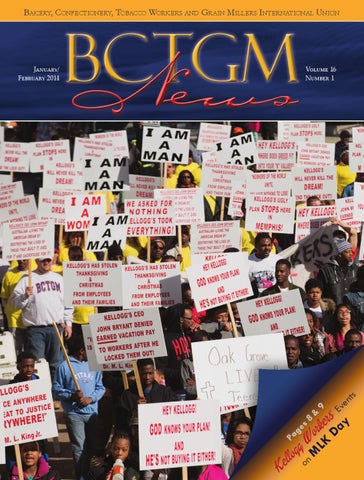
Memphis is historically a city that strongly embraces its workers. Part of that history is the legacy of Dr. Martin Luther King, Jr., who came to support Memphis sanitation workers on strike in 1968 when he was assassinated. On January 20, 2014, Martin Luther King, Jr. Day, the Memphis community once again displayed support and solidarity with Memphis workers. Specifically, the 220 BCTGM Local 252G members locked out by Kellogg. Hundreds of community and religious activists joined the BCTGM and other labor and allied organizations in events to commemorate the legacy of Dr. King, while highlighting the current struggle of Kellogg workers in Memphis. BCTGM International President David Durkee and 8
International Secretary-Treasurer Steve Bertelli led a large group of locked out Local 252G members, families and supporters down Main Street for the 29th annual Martin Luther King Jr. Holiday Parade. BCTGM members from as far away as Ohio and Michigan came to march with their locked out union brothers and sisters. Hundreds of union members, dressed in bright yellow Kellogg Lockout: Memphis, Tenn. shirts, carried signs and a banner, “Kellogg: This is NOT the 1960s – We Already Won Our Rights!” Following the parade, President Durkee and the locked out Kellogg workers were honored as special guests
during a Martin Luther King Jr. commemoration service sponsored by the Southern Christian Leadership Conference (SCLC). In his remarks to the special gathering at Cane Creek Baptist Church, Durkee reflected on the legacy of Martin Luther King, Jr., noting that Dr. King’s passionate fight to end social and economic
BCTGM News
turned on its workforce, their families, and their communities.” Reflecting on the abrupt announcement made by Kellogg just two weeks before Christmas that it plans to close plants in London, Ontario and Charmhaven, Australia, Durkee said, “It goes without saying that these closings will devastate the local economies and hurt both communities. More middle-class jobs will disappear. And I’d be remiss if I didn’t tell you that Kellogg just built another plant in Mexico. “Kellogg, it turns out, is just like every other large company beholden to Wall Street profits before people. The downsizing of the middle-class and the destruction of the American dream,” added Durkee.
“But Kellogg and its friends on Wall Street are in for a rude awakening. As Dr. King said nearly fifty years ago : ‘Something is happening in Memphis; something is happening in this world.’ And that something is a movement to take back our communities. To fight for justice. To fight for power. “Dr. King knew that if a movement was to be successful, people of all different types would have to come together. And we are seeing that today,” Durkee proclaimed. “One of Dr. King’s lasting legacies was his firm belief that people would indeed stand up for themselves; that they would fight for equality and justice; and that they would band together with their fellow citizens and demand a better day. That time is now,” concluded Durkee.
injustice resonates today just as it did nearly 50 years ago. “One of those fights is going on right here in Memphis. This fight embodies all that is wrong with today’s America. But it also illustrates the spirit, unity, and resilience of America’s working families and the communities that they live in,” Durkee told the crowd. “You are all well aware that three months ago Kellogg READ President Durkee’s Company locked the doors to full MLK Day speech on its Memphis plant, telling its hard working employees to go bctgm.org. home, and not to bother returning until they would agree to a contract that would set back the next generation of Kellogg workers. Not just here in Memphis; but all over North America,” said Durkee. He noted that Kellogg is a $14 billion dollar company that pays its CEO and top executives millions of dollars, while simultaneously lavishing its dividends and stock buybacks on its largest BCTGM Fourth Region Intl. Vice Pres. James Rivers (left), L. 149 (Memphis) Pres. Letitia Malone investors. “And yet despite (center) and Intl. Secy.-Treas. Steve Bertelli (right) help lead the MLK Day march in Memphis. all these riches, Kellogg January/February 2014
www.bctgm.org
9
2014 BCTGM International Constitutional Convention
ELIGIBILITY REQUIREMENTS FOR DELEGATES The 39th Constitutional Convention of the BCTGM will be held at Planet Hollywood Resort and Casino in Las Vegas, August 6 - 12, 2014. A Delegate to the Convention, per Article III, Section 5 of the Constitution, must have been a continuously good-standing, dues-paying member of the International Union and Local Union the delegate represents for at least two (2) continuous years next prior to election. According to the official
Convention Call, which will be posted on www.bctgm.org on April 1, 2014, published in the March/April 2014 BCTGM NEWS, and mailed to all Local Unions on May 1, 2014, delegate elections are “subject to the provisions of the International Constitution and the Labor Management Reporting and Disclosure Act of 1959 (Landrum-Griffin Law).” Because there will be an election of officers at the Convention, the LandrumGriffin Act requires that the delegates to the Convention who will be voting for officers
must be elected in secret-ballot elections. That means that all local unions must select their delegates by secret-ballot elections either at union meetings or by mail ballot referendum. Notice must be given to the membership of the time and place for nomination and election of delegates. Delegates cannot be elected by voice vote or by show of hands. Local Union officers are urged to keep the local union up-todate in its reports and per capita tax payments to the International Union to ensure participation in the BCTGM’s 39th Constitutional Convention in 2014.
Applicants to the 2014 BCTGM Scholarship Program The deadline for applications to the BCTGM 2014 International Scholarship program has passed.
Profile & Grades
All those who submitted an application prior to the January 31 deadline date are reminded to submit the following requirements prior to the March 31 deadline: Personal Profile – completed by the applicant. Academic Report – completed by the high school (or college, if a member). The report should reflect the first semester grades for the senior year (or more recent academic performance, if a member)
Essay Each applicant is required to write and submit an essay (250-500 words) to demonstrate the ability to organize thoughts and express oneself. The essay may be one of the following: Same essay as the essay requirement used in your college application. Same essay as the Union Plus Scholarship application (U.S. applicants only). Essay on “Organized Labor’s Contribution to the Welfare of the People of North America.” SAT or ACT Scores (if applicable)
For more information contact the BCTGM International Scholarship Office: (301) 933-8600. 10
BCTGM News
PHILIP MORRIS Members
BCTGM Locals 203T (Richmond, Va.) and 359T (Hopewell, Va.) reached agreement on a four- year Master Agreement with Philip Morris that will cover more than 1,200 workers at the company’s facilities in Richmond and Chester, Virginia.
The new contract, which was overwhelmingly ratified by the membership, includes a $4,500 bonus, a seven percent wage increase, a $4.00 pension rate increase on each classification, an increase in the Local’s Annual Educational reimbursement, and additional changes to language. The two local unions negotiate a Master Agreement with Philip Morris on economic issues including wages, benefits, health insurance and premium pay, but also negotiate separate contracts specifically covering local and plant-specific issues. Local 203T BCTGM members January/February 2014
Ratify New Contract
at the Richmond facility, the which is then shipped to Richmond largest Philip Morris plant to be used in cigarette production. in North America, produce Negotiations were led by Marlboro, Marlboro Lights, and 203T President and International Virginia Slims, among other General Executive Board member brands. Workers at the plant are Butch Henley and Local 359T responsible for the production President Bill James, who were and packaging of the cigarettes, assisted by BCTGM International quality control, warehousing and Representative Randy Fulk. shipping. The Richmond facility According to Fulk, members at the manufactured approximately two facilities were most concerned 136 billion cigarettes last year, about pay increases and maintaining primarily for the domestic market. their health care benefit levels. The fastest machine in the Negotiating Committee Members plant churns Members of the negotiating committee included out 16,000 (pictured above from left to right, standing) L. 203T Fin. cigarettes a Secy. Scott Trammell, L. 203T committee members minute. Toby Hawley, Michael Funkhouser, William Charity The Local and Floyd Gaines; L. 359T committee member Kevin 359T facility Anderson, L. 203T committee member Richard Davis, in Chester is a L. 203T Rec. Secy. Romel Edmonson, L. 359T Vice Reconstituted Pres. Marty Greene, L. 203T committee member Ivery Leaf plant. Bryant, L. 359T Rec.Secy. Madelina Harris and L.359T Union workers committee members Willetta Kirby and Lorenzo Gray; in Chester are (seated left to right) L. 203T Vice Pres. Keith Morris, Sr., engaged in the L. 203T Pres. Linwood “Butch” Henley, BCTGM Intl. Rep. reprocessing of Randy Fulk and L. 359T Pres. William James. unused tobacco, www.bctgm.org
11
NLRB Proposes Rule to EXPEDITE Union Elections
T
he National Labor Relations Board (NLRB) on February 5 issued a proposed rule that would alleviate the delays, inefficiencies, abuse of process and unnecessary litigation that plague the current system for workers who want to vote on whether to have a union. The new rule would: Allow for electronic filing and transmission of election petitions and other documents; Ensure that employees, employers and unions receive and exchange timely information they need to understand and participate in the representation case process; Streamline pre- and post-election procedures to facilitate agreement and eliminate unnecessary litigation; Include telephone numbers and email addresses in voter lists to enable parties to the election to be able to communicate with voters using modern technology; and Consolidate all election-related appeals to the Board into a single post-election appeals process. NLRB Chairman Mark Pearce said, “Unnecessary delay and inefficiencies hurt both employees and employers. These proposals are intended to improve the process for all parties, in all cases...” BCTGM International Director of Organization John Price noted, “This is certainly a step in the right direction. To have the ability to be able to better communicate with workers about the benefits of becoming a union member 12
before a union election is critical, but still it doesn’t level the playing field. Too often employers take advantage of long delays in the election process. The faster workers can get to a vote, the less time they will be forced to tolerate threats, intimidation and coercion by anti-union employers before voting,” Price said. AFL-CIO President Richard Trumka said, “When workers petition for an NLRB election, they should receive a timely opportunity to vote. But the current NLRB election process is riddled with delay and provides too many opportunities for employers to manipulate and drag out the process through costly and unnecessary litigation and deny workers a vote.” A similar election rule was issued in 2011 and was due to go into effect in April 2012. Employer groups including the U.S. Chamber of Commerce said the change would make it more difficult for them to make their case against unionization. Big Business led a massive legal battle to block its implementation. The proposed rule change has a 75-day public comment period and will be subject to a public hearing in early April. After that it could be revised before going into effect.
The recent ruling by the NLRB would help eliminate unnecssary litigation by streamlining post-election procedures. Workers like Kathleen Von Eitzen and her fellow Panera bakers in Michigan, have been tied up in litigation since they voted to become BCTGM members in March 2012. Pictured here, Von Eitzen discusses Panera’s refusal to bargain at a “Give Us 5” rally in Washington D.C. last summer.
BCTGM News
RIGHT-TO-WORK-FOR-LESS STATES
Have Poor Quality of Life
U
niversity of Oregon labor scholar and EPI research associate Gordon Lafer often points out how relatively poor the quality of life is in rightto-work-for-less states, on average, compared to states that don’t restrict union contract rights. Politico just came out with a new ranking of the 50 states, on a combination of 14 different measures of quality of life, including “high school graduation rates, per capita income, life expectancy and crime rate.” Then they average those 14 to create one overall ranking of the states. The outcome suggests the opposite of corporate assertions that right-to-work-for-less states are doing better than others. According to Politico, 4 of the 5 best states to live in are
non-right-to-work-for-less. In order, they are New Hampshire, Minnesota, Vermont, Utah, and Massachusetts. Right-to-work-for-less states account for 8 of the 10 worst states, and all 5 of the 5 worst states (in order, from 46th-50th: Alabama, Tennessee, Arkansas, Louisiana, Mississsippi). The majority of RTW states are not only in the bottom half of the country, but in the bottom 20 of the 50 states. Lafer’s home state, Oregon, where corporate backers are trying to pass a public sector right-towork-for-less law, is ranked 23rd, outperforming nearly 2/3 of the states that currently have RTW laws. Read More at EPI: www.epi.org
POLITICO compliled statistics such as crime, education, income and employment and ranked all 50 states.
HOW DO
RIGHT-TO-WORK-FOR-LESS STATES FARE?
Four of the top five states (MN, VT, NH & MA) are non-RTW.
2
3
1 5
48 49 51
47
50
The bottom five states (AL, TN, AR, LA & MS) are all Right to Work.
Right-to-Work is Wrong. For more info search #standuptoalec
FULL RANKINGS: Non-RTW 1 New Hampshire 2 Minnesota 3 Vermont 4 Utah 5 Massachusetts 6 Wyoming 7 Colorado 8 Iowa 9 Washington 10 Connecticut 11 Nebraska 12 New Jersey 13 Montana 14 Maine 15 Virginia 16 North Dakota 17 Hawaii 18 South Dakota 19 Wisconsin 20 Idaho 21 Maryland 22 Kansas 23 Oregon 24 Delaware 25 Alaska 26 Pennsylvania
RTW 27 New York 28 Rhode Island 29 Illinois 30 California 31 Missouri 32 Indiana 33 Arizona 34 Ohio 35 Texas 36 Michigan 37 Florida 38 New Mexico 39 North Carolina 40 Nevada 41 Oklahoma 42 Georgia 43 West Virginia 44 Kentucky 45 South Carolina 46 Dist. of Columbia 47 Alabama 48 Tennessee 49 Arkansas 50 Louisiana 51 Mississippi
Sources: www.politico.com /magazine/story/2014/01/states-of-our-union-are-not-all-strong-102547.html, www.nrtw.org/rtws.htm
January/February 2014
www.bctgm.org
13
Preservation of Historic Union Banner The following comes from BCTGM Local 114 (Portland, Ore.) Financial Secretary-Treasurer Terry Lansing who details the history of the local’s union banner, which was recently preserved by Village Frame & Gallery in Multnomah Village, Ore. Our Bakery & Confectionery Union was organized in Oregon in 1904. We were the Union of bakers throughout Northwestern Oregon, and created the standard of quality and cleanliness (the Union slogan) in the bakeries of that time. Union workers proudly displayed their banners at public events. Not many of these banners remain today. Our Bakery & Confectionery Union Local 114 Banner was in storage for many years and fortunately survived with minimal wear
and tear. We estimate the banner was created sometime between 1910 and 1920. It is a hand-painted banner, signed by artist O.R Hartwig. It also has the Painters Union insignia at the bottom. We discovered that O.R. Hartwig was the President of the Oregon Federation of Labor from 1915 to 1920. He was also the President of the Painters Union and is credited with helping to found Oregon Workers Compensation Laws for injured workers. The banner proudly hangs in our Union Office. To our knowledge there are only two such Bakers Union banners left on the West Coast – Local 114’s and the BCTGM Local 24 historic banner that hangs in the museum at Boudin’s Bakery on Fisherman’s Wharf in San Francisco.
SOTU Special Guest
BCTGM Goodness
Congressman Steve Cohen (D-Tenn.) hosted the son of Local 252G (Memphis, Tenn.) Fin. Secy. Trence Jackson, Ryun Edward Jackson, as his guest for President Barack Obama’s State of the Union Address on January 28. Ryun is an intern for the Congressman and is a part of the Congressional Black Caucus Foundation “Emerging Leaders” program. Ryun graduated in 2013 from the University of Memphis with a degree in Political Science and African American Studies. Ryun is currently enrolled in George Washington University’s Semester in Washington Politics program in Washington D.C. As a Congressional Black Caucus Foundation Emerging Leaders Intern, Ryun works at the U.S. Department of Commerce Office of Secretary Penny S. Pritzker. While attending the University of Memphis, Ryun also worked at the Kellogg Co. plant in Memphis.
BCTGM Local 342 (Bloomington, Ill.) member Shirley Watkins (pictured left) traveled to Washington, Ill. on November 20, 2013 to assist tornado victims with cleanup efforts following the deadly tornado on November 18 that devastated the area. The storms left at least seven people dead across Illinois and destroyed hundreds of homes and businesses. According to L. 342 President Mike Johnson, Watkins volunteers countless hours for several animal rescue organizations as well as community organizations. Johnson notes that Watkins is always the first to step up and raise support for any fellow union brother or sister who may need help in a difficult time. “We are very proud of Shirley and her efforts and appreciate her more than she will ever know,” writes Johnson.
14
BCTGM News
SHAPE UP and et the lowest rates on new memberships at your choice of over 8,000 fitness clubs, including Total Fitness, Curves, World Gym, and Lady of America locations. BCTGM Power/Union Plus has partnered with GlobalFit to provide these healthy living programs for you.
Fitness Clubs • Check out any club before joining with a free guest pass. • Freeze your fitness club membership, and visit another participating club while traveling, when you commit to your health with GlobalFit’s Commit Membership option. • Family members are eligible for this program. • Get no-hassle billing to your credit card or bank account.
NutriSystem Program Discount • Get a special low price on NutriSystem through GlobalFit. • Enjoy NutriSystem's confidentiality and convenience. With NutriSystem there's no counting, no meetings, and no public weigh-ins. • Get online and phone support from NutriSystem's nutritionists and counselors.
B
$AVE GM CT
POWER Healthy Living Programs
• Health Coaching provides one-on-one guidance from a trained professional to help you lose weight, de-stress, or meet any other health goal. • Smoking Cessation classes can help you quit for good with a convenient, guided program that includes free educational materials.
NOTE: To receive your union-member rates on any of these programs, you must enroll directly through GlobalFit. These rates are not available to the general public. Fitness club participation is not available for current club members.
Call
1.800.294.1500 to speak with a GlobalFit fitness representative
For more information about these benefits available to union members go to:
www.UnionPlus.org/HealthClubs January/February 2014
www.bctgm.org
15
Printed in the U.S.A.
FIGHTING TODAY TO PROTECT OUR
FUTURE BCTGM 39 TH CONSTITUTIONAL CONVENTION
CONVENTION ELIGIBILITY REQUIREMENTS • PAGE 10