$28/year | $3.50/copy | Volume 78 No. 09 | september 2026
THE VOICE OF WISCONSIN'S POTATO & VEGETABLE INDUSTRY
STORAGE/MARKETING ISSUE
INTERVIEW:
JACALYNN GUMZ
Gumz Farms LLC
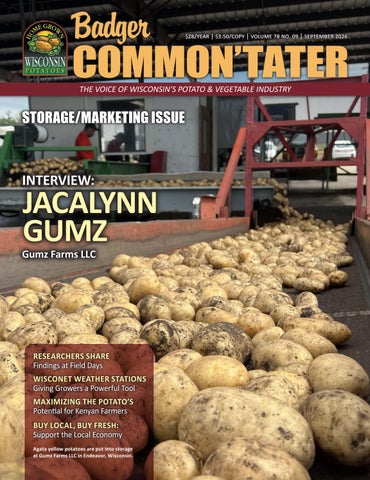
RESEARCHERS SHARE Findings at Field Days WISCONET WEATHER STATIONS Giving Growers a Powerful Tool MAXIMIZING THE POTATO’S Potential for Kenyan Farmers BUY LOCAL, BUY FRESH: Support the Local Economy Agata yellow potatoes are put into storage at Gumz Farms LLC in Endeavor, Wisconsin.
POTATO EXPO JANUARY 5-7, 2027
GAY LO R D R O C K I E S DEN VER , C O LO RA D O
Year-round shipping from all areas.
Inventory • Replenishment services • Handle all freight needs • Long-Range planning • Jenna Wenzel • John Eckendorf Nic Bushman • Chris Lockery • Tim Feit Mike Gatz, Jim Stefan and Chris Fleming (Milwaukee) Paul Hegewald (All fruits and vegetables) Mike Whyte (Michigan) Transportation: Matt Dobbe • Denise Moze Mike Carter CEO | John Hopfensperger COO
800-826-0200 715-677-4533 • Fax: 715-677-4076 Rosholt, Wisconsin
On the Cover: After potatoes are unloaded at Gumz Farms LLC, in Endeavor, Wisconsin, they’re run through a TOMRA optical sorter before heading into storage via conveyors and a bin piler, according to Jacalynn Gumz, precision agriculture and potato production specialist for the operation. She identifies the potatoes on the cover as being of the Agata yellow variety.
8 BADGER COMMON’TATER INTERVIEW:
Jacalynn Gumz, along with her cousins, Jason and Alex, represents the fifth generation of Gumz Farms, in Endeavor. Alex’s father, Richard, and her uncle, Rod, own the operation, which grows, stores, and packs red and yellow potatoes and yellow onions for retail, carrots for processing, field corn, soybeans, and mint. Jacalynn poses here in a field of Red Prairie potatoes on a hazy morning, August 11, 2026, not long before harvest got underway.
DEPARTMENTS: AUXILIARY NEWS .............. 67 BADGER BEAT.................... 69
18
28
51
RESEARCHERS SHARE FIELD DAY FINDINGS
NOW NEWS
NPC NEWS
Industry gets a sneak peek at the current potato trials
The Potato Sustainability Alliance holds its Summer Symposium in Wisconsin
National Potato Council tours Better Made Snack Foods at Summer Meeting
FEATURE ARTICLES: 25 WISCONET WEATHER stations network helps farmers reduce costs/improve yields
DISHING IT UP WITH DANA....................... 73 EYES ON ASSOCIATES......... 39 MARK YOUR CALENDAR...... 6 MARKETPLACE................... 54 NEW PRODUCTS................ 61 PEOPLE.............................. 37
45 TECHNOLOGY & EXPORTS provide opportunities for the Kenyan potato industry
PLANTING IDEAS.................. 6
63 BUY LOCAL, BUY FRESH: Choosing locally grown potatoes supports state economy
WPIB FOCUS...................... 62
4
BC�T September
WPVGA Board of Directors: President: Wendy Dykstra Vice President: Josh Knights Secretary: Brian Lee Treasurer: John Hopfensperger Directors: Randy Fleishauer, Charlie Husnick, Andy Schroeder, Jeff Suchon & Lucas Wysocki Wisconsin Potato Industry Board: President: Heidi Alsum-Randall Vice President: Andy Diercks Secretary: Nicola Carey Treasurer: Keith Wolter Directors: Rod Gumz, Charlie Mattek, Jim Okray, Eric Schroeder & Joe Seis WPVGA Associate Division Board of Directors: President: Matt Selenske Vice President: Ethan Olson
Secretary: Melissa Heise Treasurer: Paul Salm Directors: Matthew Hartman, Brady Patoka, Scott Scheer, Morgan Smolarek & Brandon Taylor Wisconsin Seed Potato Improvement Association Board of Directors: President: Andy Schroeder Vice President: Clover Spacek Secretary/Treasurer: Ryan Fassbender Directors: Mitch Mattek & Markus Shafel Wisconsin Potato Growers Auxiliary Board of Directors: President: Jenna Suchon Vice President: Erin Meister Secretary/Treasurer: Samantha Cypher Directors: Jody Baginski, Emily Bustamante, Misti Kinnison & Heidi Schleicher
Mission Statement of the WPVGA: To advance the interests of WPVGA members through education, information, environmentally sound research, promotion, governmental action and involvement. Mission Statement of the WPVGA Associate Division: To work in partnership with the WPVGA as product and service providers to promote mutual industry viability by providing technology and information resources. Badger Common’Tater is published monthly at 700 Fifth Avenue, Antigo, Wisconsin 54409
WPVGA Staff: Executive Director: Tamas Houlihan Managing Editor: Joe Kertzman Director of Promotions & Consumer Education: Dana Rady Financial Officer: Karen Rasmussen Executive Assistant: Julie Braun Program Assistant: Madison Hoffman-Taylor Spudmobile Education & Outreach Administrator: Patrick Popejoy
WPVGA Office: (715) 623-7683 • FAX: (715) 623-3176 E-mail: wpvga@wisconsinpotatoes.com Website: www.wisconsinpotatoes.com LIKE US ON FACEBOOK: www.facebook.com/WPVGA
Subscription rates: $3.50/copy, $28/year; $45/2 years. Foreign subscription rates: $35/year; $55/2 years. Telephone: (715) 623-7683 Mailing address: P.O. Box 327, Antigo, Wisconsin 54409 Or, subscribe free online: http://wisconsinpotatoes.com/blog-news/subscribe/ ADVERTISING: To advertise your service or product in this magazine, call (715) 630-6213, or email: Joe Kertzman: jkertzman@wisconsinpotatoes.com. The editor welcomes manuscripts and pictures but accepts no responsibility for such material while in our hands. BC�T September
5
MARK YOUR
Calendar
OCTOBER 3-4
MILWAUKEE LAKEFRONT MARATHON 400 W. Wisconsin Ave. Milwaukee, WI
10
40th ANNUAL SPUD BOWL Community Stadium at Goerke Park Stevens Point, WI
14-16
IFPA GLOBAL PRODUCE & FLORAL SHOW Orange County Convention Center Orlando, FL
22
7th ANNUAL SPORTING CLAYS SHOOT Wausau Skeet and Trap Club Wausau/Brokaw, WI
26-30
WORLD POTATO CONGRESS 2026 Nairobi, Kenya, Africa
NOVEMBER 2-3
WPVGA & UW EXTENSION RESEARCH MEETING Hancock Agricultural Research Station Hancock, WI
15
MADISON MARATHON Capitol Square, Mifflin St. and Wisconsin Ave. Madison, WI
JANUARY 2027 5-7
2027 POTATO EXPO Gaylord Rockies Resort & Convention Center Denver, CO
FEBRUARY 9-11
WPVGA GROWER ED CONFERENCE & INDUSTRY SHOW Holiday Inn & Convention Center Stevens Point, WI
MARCH 30-4/1
65th ANNUAL WPS FARM SHOW Experimental Aircraft Association grounds Oshkosh, WI
MAY 22-25
NATIONAL RESTAURANT ASSOC. SHOW McCormick Place Chicago, IL
OCTOBER 20-22
6
IFPA GLOBAL PRODUCE & FLORAL SHOW 2027 Georgia World Congress Center Atlanta, GA BC�T September
Planting Ideas Katie Neumiller-Floming
of Neumiller Farms, a long-time grower member of the Wisconsin Potato & Vegetable Growers Association (WPVGA), texted these two images to my coworker, Dana Rady, who forwarded them to me. Katie noted in the text, “A few weeks ago, I was invited to a Rose Garden dinner at the White House representing PepsiCo/Frito-Lay.” NeumillerFloming is shown with 33rd U.S. Secretary of Agriculture Brooke Rollins in the first image, and outside a gate with the White House in the background in the second photo. What an honor that must have been to represent the industry at a Rose Garden dinner. Featured in this issue is complete coverage of the Hancock, Langlade, and Rhinelander Agricultural Research Station Field Days, held on consecutive Thursdays this year, July 9, 16 and 23. The field days showcased ongoing potato and vegetable research in central and northcentral Wisconsin being carried out by University of Wisconsin scientists and collaborators to help growers continue raising high-yielding crops efficiently and sustainably. I hope you enjoy the feature “Researchers Share Findings at Field Days.” With summertime being a whirlwind of activity, the WPVGA Associate Division also held the 2026 Putt-Tato Open, July 8, at Lake Arrowhead golf course in Nekoosa, Wisconsin. A jam-packed roster of 42 teams and four players each (some with three) descended on the course for the annual scramble tournament and the biggest fundraiser of the year for the Associate Division. The Putt-Tato Open reached its fundraising goals, with proceeds earmarked toward agricultural research, college scholarships (including a new endowed scholarship fund) and other industry causes to be determined by the Associate Division throughout the course of the year. Please see “Eyes on Associates” for photos and full coverage of the event. The Food + Farm Exploration Center, in Plover, Wisconsin, was also an incredibly busy place this summer, with the Potato Sustainability Alliance holding its Annual Summer Symposium there. The Food + Farm Exploration Center also hosted a Guenthner Potato Company Century Farm Celebration, August 4, and recently announced the inaugural “Rooted in Gratitude” annual fundraising event, to be held September 17, this year honoring exceptional women who have helped shape Wisconsin agriculture. See “Now News” for the announcement and events coverage. Please email me with your thoughts and questions. If you wish to be notified when our free online magazine is available monthly, here is the subscriber link: http://wisconsinpotatoes.com/blog-news/ subscribe.
Joe Kertzman
Managing Editor jkertzman@wisconsinpotatoes.com
Schroeder Bros. Farms, Inc. WISCONSIN “ONLY THE BEST” CERTIFIED SEED POTATOES REDS
Dark Red Norland
RUSSETS
COL 8 Norkotah Goldrush Reveille Silverton TX 296 Norkotah
WHITES Atlantic Bliss Lamoka Mackinaw Manistee Petoskey Snowden
N1435 Cty Rd D Antigo, WI (715) 623-2689 farm@sbfi.biz johnt@sbfi.biz
Foundation & Certified Seed Potatoes
Interview JACALYNN GUMZ, Precision Ag and Potato
NAME: Jacalynn Gumz TITLE: Precision Ag and Potato Production Specialist COMPANY: Gumz Farms LLC LOCATION: Endeavor, WI HOMETOWN: Endeavor YEARS IN PRESENT POSITION: Five PREVIOUS EMPLOYMENT: Corteva Agriscience in Johnston, Iowa, and Walt Disney World, Orlando, Florida SCHOOLING: Bachelor of Science Degree in Agriculture Education from Iowa State University ACTIVITIES/ORGANIZATIONS: Potatoes USA Board of Directors, Vice President of Portage Curling Club Board of Directors, U.S. Women’s Curling Association representative, and USA Curling Level II official FAMILY: Parents, Richard and Linda Gumz, and fiancé, Unal Karabulut HOBBIES: Curling, raising backyard chickens, tropical plants, and planning a wedding 8
BC�T September
Production Specialist, Gumz Farms
By Joe Kertzman, managing editor, Badger Common’Tater
“On any given day, you can find Jacalynn Gumz out in the potato,
onion, carrot and mint fields at Gumz Farms LLC, in Endeavor, Wisconsin, and the quiet community, located on Buffalo Lake in Marquette County, is not such a bad place to be! When Jacalynn’s great-grandfather started farming, he expanded his own father’s farm in northern Indiana into Wisconsin, in the 1940’s. In the late 1950’s, Jacalynn’s grandfather began managing the main farm in Indiana, and since there were management opportunities in Wisconsin, her dad, Richard, and uncle, Rod, moved to the state.
Wisconsin for over 100 years.
Gumz Farms LLC grows, stores, and packs red and yellow potatoes and yellow onions for retail, carrots for processing, field corn, soybeans, and mint. The Gumz family has been raising mint in Indiana and
Above: Precision Ag and Potato Production Specialist Jacalynn Gumz is part of the fifth generation at Gumz Farms LLC, which grows, stores, and packs red and yellow potatoes and yellow onions for retail, carrots for processing, field corn, soybeans, and mint in Endeavor, Wisconsin.
And while Gumz Farms LLC has grown in both size and as a vertical business, the family has also grown alongside it. Jacalynn was recently elected as a new member of the Potatoes USA Board of Directors, which guides the
organization’s efforts to promote and support the potato industry. The Board sets strategic objectives for the organization and allocates resources to marketing, research, and education initiatives. Jacalynn, what generation do you represent at Gumz Farms, LLC, and what is your role on the farm? I represent the fifth generation at Gumz Farms. My father, Richard, and my uncle, Rod, are the owners of Gumz Farms. My cousins, Jason and Alex, are also fifth generation with me back at the farm. My role is primarily outside in the fields working with our potatoes, onions, carrots and mint. I get involved in a little bit of everything. I am heavily involved with potato production, from sourcing seed to the day-to-day operations of planting and harvesting and then to scouting, internal research, sampling, and quality control. I’m also our precision agriculture person. I’m in charge of our 20 Ag Leaderguided tractors that primarily work with potatoes and onions, and one John Deere guidance system for corn planting. All guidance we use is RTK
(Real-Time Kinematic positioning) with sub-inch accuracy. I really enjoy the problem-solving aspect of working with precision agriculture.
Above: Gumz Farms LLC raises around 1,100 acres of fresh market red and yellow potatoes, dividing acreage into about 60% for red and 40% yellow.
Did you always know that you wanted to work on the farm, or what was your path getting to where you are today? I always knew I wanted to be in agriculture and thought that I would become an agriculture teacher and FFA advisor.
I loved my time in FFA and wanted to be involved in creating that positive experience for other young adults.
N V S
Towards the end of college, I did an internship that steered me more continued on pg. 10
ELSON’S
N7158 6TH DRIVE P.O. BOX 215 PLAINFIELD, WI 54966 OFFICE: (715) 335-6660 FAX: (715) 335-6661
EGETABLE
KEEP ON TRACK WITH OUR
TORAGE
S
YSTEMS INC.
SPROUT INHIBITORS AND DISINFECTANTS
STORAGE VENTILATION
SPROUT INHIBITING
• COMPUTERIZED CONTROL PANELS • HUMIDIFICATION • REFRIGERATION
• FRUIT GUARD APPLICATIONS • SMART BLOCK APPLICATIONS • CIPC, CLOVE OIL APPLICATIONS
AGRI-VENTILATION SALES AND SERVICE 24 HR. EMERG. SERVICE BC�T September
9
Interview. . .
continued from pg. 9
towards horticulture, so I ended up taking more classes and completed a minor. After college, I worked for Corteva Agriscience in their research greenhouses in Johnston, Iowa. I was part of the breeding program for corn, wheat, canola, and cotton. After four years, during corporate mergers, I took an offer to leave and return to the farm. I appreciated my time away, but I am very grateful
to be back in beautiful Wisconsin. What do you most take pride in regarding the family business, started in 1892 and expanding into Wisconsin in the 1940’s? My family has been growing mint for over 100 years. That’s amazing to think about. The whole reason we are in Wisconsin is because of mint and verticillium wilt (in Indiana). The original farm is in North Judson, Indiana, and my great grandpa had
an opportunity to purchase new land in Wisconsin that had never grown mint. In addition to mint, how many acres of potatoes does Gumz Farms, LLC, grow, store and pack, and how about yellow onions? And is it all for the retail market? Yes, all the potatoes and onions are for retail. We grow around 1,100 acres of fresh market red and yellow potatoes, allotting the acreage to about 60% red and 40% yellow. We purposely space out planting in the spring from mid-April to mid-June so that we can harvest as we pack for the highest quality tuber. Most of our Above: Gumz Farms has four long-term and six short-term potato storage buildings, all connected through flumes. Fresh produce is pictured ready to leave the packaging facility. The onions are being stored in totes to later be packaged into 3-pound bags. The operation packages two-thirds of the onions grown in Wisconsin. Left: The good-looking family of farmers includes, from left to right, Richard and Linda Gumz; Rod and Michelle Gumz, and their son, Jason, between them; and Richard and Linda’s daughter, Jacalynn, this issue’s interviewee. Not shown is Rod and Michelle’s daughter, Alex.
10 BC�T September
“In everyday life, I try to be an ambassador for agriculture, talking to friends, family, and strangers about potato and vegetable production.”
– Jacalynn Gumz
Jacalynn Gumz (second from right) is vice president of the Portage Curling Club Board of Directors, a U.S. Women’s Curling Association representative, and a USA Curling Level II official. Jacalynn’s fiancé, Unal Karabulut, is second from left in the photo.
potatoes are shipped shortly after harvesting, with harvest lasting from mid-August through mid-October. We can store about 240,000 cwt. (hundredweight) of potatoes, but plan to have all our own shipped by February. We package two-thirds of the onions grown in Wisconsin. We grow primarily yellow but also have some red onions. The onions are grown on 72-inch center beds and harvested mid-August through September.
Customizing equipment to fit your needs for over 30 years!
2013 LENCO WRAP-AROUND SELF-PROPELLED HARVESTER Sale Price: $550,000
2007 LENCO 4RSPAH 65” Air Head
We store onions in climate-controlled bulk storage. The buildings have a special removable false floor to promote air circulation. Is the farm still raising carrots for processing, field corn, soybeans, and over 1,000 acres of mint? Unfortunately, we have had to cut back on acres of mint due to low demand for USA-grown mint oil. Currently, we have around 700 acres of peppermint and spearmint. We would like to grow more if there were contracts available. continued on pg. 12
SALFORD BBI SPREADERS In Stock
Proud Dealer of:
NEW LINE OF FERTILIZER TANKS Duo-Lift Cone Bottom Tanks Multiple Sizes Available
PORTABLE DIRT CONVEYOR In Stock
® Mulchers
Rock Crushers
Conveyor Belts
New & Used Sales Service • Repair
2731 Maple Drive • Plover, WI 54467 • 715-344-3401 • Toll Free: 1-888-696-4019
www.bigironequipment.com
BC�T September 11
Interview. . .
continued from pg. 11
And, yes, we also grow carrots, field corn, and soybeans. The “slicer and dicer” carrots we raise are for processing and are shipped directly off the farm. Field corn and soybeans are used for rotation and grown on more marginal fields. We became an official Beck’s seed dealer in 2024 and really appreciate the family farm quality of their company. How many full- and part-time employees does the operation have? Are many of them long-term employees? We mostly have yearround employment due to our pack
12 BC�T September
shed running all year. We have some H2A workers over the summer for our onions and a few seasonal employees for harvest. We have many multigeneration families that work and have worked on the farm. What advantage does Gumz Farms LLC have in terms of planting and harvesting in muck soil? Are there disadvantages? Growing on muck has a lot of benefits and some unique challenges. We see benefits in terms of high organic matter and getting a beautiful red color on potatoes. Unlike this growing season, most years we are trying to take water
Above: A new piece of equipment purchased in the spring of this year, a Carbon Robotics G2 Laser Weeder is used to kill weeds in an onion field at Gumz Farms. Jacalynn Gumz says, using the laser weeder, the farming operation has experienced healthier onions that are maturing slightly quicker due to reduced dings from herbicides. Below: Potatoes are ripped for drainage at Gumz Farms LLC in Endeavor, Wisconsin. It’s the first step after planting, which is then followed by hilling.
off the field. Because of muck’s high water-holding capacity, when it gets wet, it’s heavy and it is difficult to run equipment in the field. Muck is also incredibly prone to wind erosion
when dry, so we use a lot of cover crops to prevent this. All our muck fields are tiled at a minimum of every 50 feet, and some down to as narrow as 20-foot spacing. Congratulations on recently being elected to the Potatoes USA Board of Directors. Why did you decide to run for the Board? I really wanted to get more involved in the industry and meet other growers from across the country. One of the main reasons for running was to gain perspective on U.S. potatoes. I want to learn as much as possible to bring back to the farm. Hopefully this knowledge will help advance our farm and put us in the best possible position. And I think you just had your first Potatoes USA Board Meeting. How did it go? I wasn’t quite sure what to expect from the first meeting, but I met a lot of very knowledgeable and
Currently, Gumz Farms LLC raises 700 acres of peppermint and spearmint and would like to grow more if there were contracts available.
passionate producers from across the country. I learned how Potatoes USA drives demand internationally for USAgrown potatoes, all the research being done for processing chips and
fries, and how the team works with end-users to develop new menu items for restaurants. I’m excited to do what I can to help promote the potato industry. continued on pg. 14
BC�T September 13
Interview. . .
continued from pg. 13
You are also a graduate of the WPVGA Member Development Program. Why was it important for you to take the Association’s leadership training, and what did you gain from it? Yes, I did the Membership Development Program in 2023-’24. I was still very new to the industry, so it was a great way for me
to learn about the WPVGA, see other operations, and connect with people in the industry. What’s your favorite part of working on the farm? I really enjoy following the crop from planting to harvest. It’s especially rewarding during harvest to see the fruits of everyone’s hard
labor that went into producing the crop. I also enjoy spending time with my family. I love being able to work with and learn from my father. This is our storage and marketing issue. How long does Gumz Farms LLC store potatoes each year? And onions and/or carrots? We have four long-term and six short-term potato storages at our farm, and all storage buildings are connected through flumes. Short-term storage is used to get the crop off the field, cooled, packaged, and shipped. Long-term storages are filled toward the end of harvest and used to extend our crop shipping season. However, long-term storage is only until about February because potatoes coming off the muck soil have a high-water content and don’t store as well. Above and Left: Gumz Farms LLC primarily raises yellow onions and some reds. The onions are grown on 72-inch center beds and harvested from mid-August through September. The onions are stored in climate-controlled bulk storage, with each building having a special removable false floor to promote air circulation.
14 BC�T September
We can store onions for quite a bit longer. We have several storages spread out across our farms and typically store until the end of June. The dry-down process is a crucial step in onion storage. When the onions are first put into storage, they are subjected to heat to cure them, and then we gradually lower the temperature for longer storage. We are constantly testing varieties for storability. One of our internal research projects that I help the onion team with is raising test plots. We take 1/1000th of an acre for test plots and storage, keeping them with our bulk storage, and then grade them, usually in March. We do not store carrots. What does Gumz Farms do well in marketing its brands? How can you, yourself, help market Gumz Farms LLC? We try to get our name out there as much as we can, but most of our business is done on a relationship basis. We like to focus
on customer service, creating those relations and producing quality work in a timely fashion.
Above: Raising crops on muck soil with high organic matter is a benefit in getting a beautiful red color on potatoes.
Our advantage is location, which allows for quick delivery throughout the Midwest. Our sales team is also going to many trade shows like the National Onion Association meetings and produce expos like the Southeast Produce Council’s “Southern Exposure.”
I do my part by attending Potato Expo and representing Wisconsin on the Potatoes USA Board. In everyday life, I try to be an ambassador for agriculture, talking to friends, family, and strangers about potato and vegetable production. continued on pg. 16
Products • Strategies Solutions
Ingenuity Optical Sorter – 60 Channel Enduro Harvester
Plan ahead and order your pivot now for spring arrival!
PARTS & SERVICE: AVR/UNDERHAUG • DOUBLE L (LL) BROEKEMA • NOFFSINGER • TEROG AG PARTS AND MUCH MORE!
CELEBRATING 50 YEARS IN BUSINESS. 1976-2026 THANK YOU FOR YOUR SUPPORT!
New North American Dewulf Piler VIEW OUR
D Thank you for your support! EQUUSE IPMENT 1.800.225.9727 • www.tipinc.net LIST ONLINE!
1619 County Road K, Custer WI 54423 • Call: 715-592-4650 • Fax: 715-592-5063 • Email: tip@tipinc.net BC�T September 15
Interview. . .
continued from pg. 15
The operation also has a stateof-the-art sorting, grading, and packing facility. Has there been a lot of development in that area since your time on the farm, and if so, in what areas? Yes, we are consistently improving what we do and have just finished installing an Ellips USA grading system. The Ellips is a fully automated lane grader that uses AI (artificial intelligence) to grade and sort potatoes. We hope for labor savings by reducing the number of people hand grading and to have consistent, highquality, and uniform packages. Most
of our product leaves the farm in retail-size packages of 3-pound (lb.) onion and 5- and 10-lb. potato bags that are then placed in larger bulk bags for ease of stacking. The 50-lb. bulk bags are made and filled by heat-seaming a bag from rollstock netting and then counting the appropriate number of small bags. The 50-lb. bags are automatically stacked on a pallet by a Verbruggen palletizer made in the Netherlands. Over the years, we’ve tried to reduce labor, become more efficient, and source product from across the
Recent upgrades to the Gumz Farms grading, sorting, and packing facility include an Ellips fully automated lane grader that uses AI to grade and sort potatoes (left), and a Verbruggen palletizer, made in the Netherlands, that automatically stacks 50-lb. bags of potatoes onto pallets (right). 16 BC�T September
Above: Beautiful, healthy fields of potatoes are grown in the muck soils of Gumz Farms in Endeavor, Wisconsin.
United States to keep our customers’ shelves stocked 24/7. Any other new farm tractors, machinery, or technologies you want to mention? We purchased an Ecorobotix ARA sprayer last year and a Carbon Robotics Laser Weeder this spring. Both utilize AI. We use them together to reduce hand weeding and crop protection costs. Our laser weeder is set up with a fully
autonomous kit. We ran the laser weeder 24/7 with stops only for fuel and maintenance. We mostly had our own operators in the cab from about 6 a.m.-9 p.m., and then from 9 p.m. to 6 a.m., we turned the laser weeder over to remote operators. It was a little nerve racking the first night when it was running autonomously. The laser weeder does an amazing job at killing weeds, and we’ve seen healthier onions that are maturing slightly quicker due to the reduced dings from herbicides. Its main limitation is speed, with our average for the whole season being 1.5 acres an hour. We couldn’t cover all our acreage due to this limitation, so we focused on around 300 acres. Speaking of which, how is the growing season going as far as weather, health of crops, and projected yield? Well, we’ve had a very polarizing season this year. April was the wettest April in Wisconsin’s history and May was one of the driest. We had a lot of wind, hail, and even a tornado this spring. The tornado destroyed one of our equipment storage sheds, but thankfully most of the equipment wasn’t heavily damaged. Overall, our potato crop looks great. I’ve been pulling field samples, and
Potato Storage - Bryan Bula Farms
they are a great size with smooth skin. I’m excited to start harvesting. We lost some stand in our onions this spring because of dry conditions and wind. We even replanted some onions, which is very unusual. Hopefully the thinner stand will produce larger onions. What do you hope for the family business in general? The farm has advanced a lot even in the short time I’ve been back. I’ve seen how the Ag Leader-guided tractors have improved our systems, as well as the
Above: Potatoes are put into storage at Gumz Farms LLC in Endeavor, Wisconsin.
addition of AI with the Ecorobotix ARA, Carbon Robotics G2 Laser Weeder, and the Ellipse grader. It will be exciting to see how technology advances, but it’s difficult to envision what farming will be like in 50 years. I hope, with all the advancements in technology, that we continue to improve our efficiency and quality so that we can produce the best product possible.
MILLER’S ROOFING & CONSTRUCTION, LLC • Agriculture & Commercial • Insulated Warehouses & Custom-Built Pole Sheds • Steel Roofing and Siding
S2770 Iron Street • LaValle, WI 53941
Contact John Miller | 608-985-8944 | Leave a message! BC�T September 17
Researchers Share Findings at Field Days Growers and those invested in the ag industry get a first-hand glimpse at current potato trials By Joe Kertzman, Managing Editor, Badger Common’Tater Like a science-driven triathlon, the three field days held at the Hancock, Langlade and Rhinelander Agricultural Research Stations paint a comprehensive picture of potato, cover cropping, and vegetable trials being conducted by University of Wisconsin (UW) Extension specialists. Held on consecutive Thursdays, this year falling on July 9, 16, and 23, the field days showcase ongoing potato
and vegetable research in central and northcentral Wisconsin carried out by UW scientists and collaborators to help growers continue raising high-yielding crops efficiently and sustainably. The 412-acre Hancock Agricultural Research Station (HARS), located in the state’s Central Sands potato production area, focuses on developing and evaluating ways
to grow vegetables sustainably in the region’s sandy, fast-draining soils above a high water table. Above: In Dr. Jeff Endelman’s update of his Potato Breeding Program during the Rhinelander Agricultural Research Station (RARS) Field Day, he highlighted two experimental chipping varieties, W17066 and W17AF6670, that have good starch content, processing quality, disease resistance to common scab, and the ability to store for nine months, as well as W17AF6670 being resistant to PVY. Far Left: At the Antigo Field day, Ph.D. student Claire Schloemer, UW Department of Entomology, covered full-season PVY management, such as early vine kill, crop isolation, using disease-resistant cultivars, high- and low-input programming, and scouting. Left: USDA Agricultural Research Service scientist Dennis Halterman gave Hancock Agricultural Research Station (HARS) Field Day attendees an up-close look at droughtand disease-resistant wild potato varieties from South and Central America being grown as part of a diploid breeding trial. The varieties are maintained at the U.S. Potato Genebank in Sturgeon Bay, Wisconsin.
18 BC�T September
On July 9, HARS Superintendent Troy Fishler welcomed field day attendees and introduced the day’s master of ceremonies, UW-Extension Agricultural Water Quality Outreach Specialist Guolong Liang.
Wagon tours and potato research updates included presentations by Dr. Russell Groves and Ph.D. student Claire Schloemer, UW Department of Entomology, on “Insect Management in Potato & Processing Vegetables,” continued on pg. 20
Left: Dr. Yi Wang, UW Department of Plant and Agroecosystem Sciences, discussed “Using Precision Agriculture Technologies in Vegetable Crop Production” at the HARS Field Day. Right: Brooke Babler gave a Wisconsin Seed Potato Certification Program update during the RARS Field Day.
SNOWDEN • ATLANTIC • LAMOKA MANISTEE • MACKINAW • PETOSKEY
Contact: Jim or John
BC�T September 19
Researchers Share Findings at Field Days. . . continued from pg. 19
and Dr. Jeffrey Endelman, UW Department of Plant and Agroecosystem Sciences, who gave a “Potato Breeding Program Update.” The work by Dr. Groves and Schloemer includes research on the first principles of Potato Virus Y (PVY) disease management, Colorado potato beetle (CPB) insecticide resistance, and looking at coordinating insecticide application and crop rotation across multi-farm
acreage to prevent resistance. Dr. Endelman’s Potato Breeding Program is conducting variety trials to determine which potatoes are resistant to CPB, including the evaluation of 300 wild diploid potato varieties with desirable traits and genetic variations for resistance. U.S. Department of Agriculture (USDA) Agricultural Research Service scientist Dennis Halterman talked about “Developing Wild Materials
Above: During the Antigo Field Day, Dr. Amanda Gevens, UW Department of Plant Pathology, provided a potato common scab research update, a report on late blight (no cases reported in tomato or potato in Wisconsin), and an overview of an early blight trial at HARS targeting early disease detection.
for Diploid Breeding,” and Dr. Yi Wang, UW Department of Plant and Agroecosystem Sciences, discussed “Using Precision Agriculture Technologies in Vegetable Crop Production.” Dr. Halterman is working on droughtand disease-resistant wild varieties from South and Central America for diploid potato breeding. The varieties are maintained at the U.S. Potato Genebank in Sturgeon Bay, Wisconsin.
Dr. Jed Colquhoun, UW Plant and Agroecosystem Sciences, told HARS attendees that, “Water hemp is on the move like I’ve never seen it before, showing all the signs of rapid herbicide resistance and most likely metabolic resistance. It can resist any stressor that touches it.” 20 BC�T September
AI-DRIVEN TECHNOLOGIES Dr. Wang reviewed projects on commercial potato farms where drones are flown over fields to create spatial maps and predict potato nitrogen uptake, as well as multiple Artificial Intelligence (AI)-driven technologies to predict yield and manage fertilization and irrigation. Dr. Jed Colquhoun and Assistant Professor Steven Hall, UW Plant and
“Breeding for resistance is where many of our answers lie across multiple potato diseases.” – Dr. Amanda Gevens, UW Department of Plant Pathology
A stop alongside a flowering pollinator field at RARS had Maura Koth, a student in the Dr. Endelman Lab, UW Department of Plant and Agroecosystem Sciences, confirming to those on the wagon tour the vital role pollinators play in our ecosystem and farmland.
Agroecosystem Sciences, delved into their research on “Water Quality and Weed Management,” and Dr. Matt Ruark, UW Department of Soil and Environmental Sciences, presented “Potato and 4R Nitrogen Management.” Dr. Colquhoun said, “Water hemp is on the move like I’ve never seen it before, showing all the signs of rapid herbicide resistance and most likely metabolic resistance. It can resist any stressor that touches it.” Like Wang’s research, Colquhoun and Hall are looking at AI-driven tools, in this case precision sprayers using high rates of herbicides in precision micro-doses, as well as potential new herbicide registrations, cover crops, including camelina, and even adding paper mill residuals into fields to capture nitrates. Dr. Ruark is asking, “When can we ‘break’ the potato through nitrogen management?” He is not only spoonfeeding nitrogen to crops but also applying it at the highest rates to continued on pg. 22
Biocatalyst for Nutrient Release
BENEFITS • Maximizes nutrient release from crop residues and the soil • Extends existing nutrient availability later into the season • Supports easier plantability in the spring • Promotes more even crop emergence • Optimizes yield potential for the next crop
Plainfield, WI | 715-335-4900 BC�T September 21
Researchers Share Findings at Field Days. . .. . . continued from pg. 21
determine uptake, leaching, and yields, and where the sweet spots and breaking points of nitrogen application fall. He’s also evaluating which crops that were grown in fields preceding potatoes, like soybeans or corn, take up the most nitrogen or leave the most behind via crop residue. Dr. Amanda Gevens, UW Department of Plant Pathology, gave a “Potato Disease Research Update” in which she explained fungicide strategies being implemented to comply with Endangered Species Act regulations. Dr. Gevens also covered foliar trials in Russett Burbank potatoes looking for potential replacements for chlorothalonil, as well as black dot and white mold fungicide application trials, and a PVY study using hyperspectral detection. Following the wagon tours to research fields, attendees enjoyed a social hour and grilled chicken dinner with sweet corn, baked potato and potato salad provided compliments of the Associate Division of the Wisconsin Potato & Vegetable Growers Association (WPVGA). GRILLED CHICKEN DINNER Brady Patoka of Jay-Mar, Inc. and his fellow Associate Division board
members grilled the chicken, potatoes and sweet corn, the latter being courtesy of Flyte Family Farms. The station’s horticultural garden and Wisconsin Potato and Vegetable Storage Research Facility (SRF) were open for self-guided tours throughout the day. Researchers use the SRF, erected in 2006 through a WPVGA gift, to study ways of curbing losses and improving the quality of stored potatoes. Langlade County Agricultural Research Station (LARS) Manager Kevin Gallenberg welcomed guests attending the Antigo Field Day,
RARS Superintendent Becky Eddy wrapped up the field day saying the research station in Rhinelander is pushing the boundaries of what is possible with commitment to quality crops. 22 BC�T September
Above: LARS Manager Kevin Gallenberg gave an overview of potato research activities at the station and, in the absence of Dr. Maria Caraza-Harter, presented her findings on a potato common scab resistance and susceptibility trial, including studying markers for PVY resistance.
July 16, and thanked local businesses and sponsors, including the Wisconsin Potato Industry Board, WPVGA and WPVGA Associate Division, and Wisconsin Seed Potato Improvement Association, as well as several companies and area potato growers. Brooke Babler, assistant research program director for the Wisconsin Seed Potato Certification Program (WSPCP), had good news for Antigo Field Day attendees, citing 9,200 acres of seed potatoes certified this year, and a first inspection completed with PVY levels down overall from last year and early generation seed looking good. Babler noted that direct tuber testing was approved by Wisconsin seed potato growers as a post-harvest test, and that her lab is also offering the same potato seed evaluation options as in the past, such as ELISA and PCR, as well as greenhouse and Hawaii winter grow-outs and certified seed lot tests.
UW Extension Regional Crops/ Soils Educator Dr. Scott Reuss asked growers in attendance if there was an ideal month for pesticide applicator training, and touted cover crops that reduce diseases such as Rhizoctonia and common scab, and at the same time give growers an economic return on investment. UW Extension Nitrogen Management Outreach Specialist Megan Blauwet reviewed the Nitrogen Optimization Pilot Program (NOPP), pointing to a current LARS potato nitrogen and phosphorus application rate trial looking at uptake, leaching, and yields. The NOPP is a farmer-driven grant program administered by the Wisconsin Department of Agriculture, Trade and Consumer Protection with the goal of increasing nitrogen uptake efficiency in every region of the state across crops.
PVY RESISTANCE Dr. Maria Caraza-Harter, UW Plant and Agroecosystem Sciences, could not be in attendance, but shared information on a potato common scab resistance and susceptibility trial being conducted at LARS, including studying. She noted that two PVY- and common scab-resistant chipping potato lines were approved in national trials. Dr. Gevens gave a potato common scab research update, as well as a report on late blight (no cases reported in tomato or potato in Wisconsin), and presented an overview of an early blight trial at HARS targeting early disease detection.
Above: Dr. Matt Ruark, UW Department of Soil and Environmental Sciences, presented “Potato and 4R Nitrogen Management” at the HARS Field Day.
“Breeding for resistance is where many of our answers lie for multiple potato diseases,” Gevens noted.
disease-resistant cultivars, high- and low-input programs, and scouting.
Dr. Groves and Claire Schloemer covered full-season PVY management such as early vine kill, crop isolation,
A reception with food and refreshments, sponsored by Insight FS continued on pg. 24
Power That Performs.
Experience It Firsthand. Demo a Massey Ferguson High Horsepower tractor today & experience the POWER in action! action! CALL US TODAY TO SCHEDULE A DEMO! BC�T September 23
Researchers Share Findings at Field Days. . .. . . continued from pg. 23
and the WPVGA Associate Division, was held at Antigo’s East City Park immediately following the Antigo Field Day presentations. UW Director of Agricultural Research Stations Mike Peters welcome guests to the Rhinelander Agricultural Research Station (RARS) Field Day, July 23, saying, “I’m so glad you’re here to help celebrate the Wisconsin
’s Ronefrigeration R & Air Conditioning
24 HOUR
EMERGENCY SERVICE
YOUR ONE CALL STORAGE SOLUTION
Computerized Control Systems Refrigeration • Humidification • Ozone Electrical Design & Installation Potatoes • Onions Sprout Inhibiting: Sprout Nip® • Amplify® • Shield®
1-800-236-0005 WWW.RONSREFRIGERATION.COM
24 BC�T September
Idea and groundbreaking research conducted by our researchers.” Ryan Vinhal, a biological sciences aid with the U.S. Forest Service, explained how RARS has been phytofiltering disinfectant wastewater using poplar and willow trees. The trees are used to break down and prevent movement of contaminants and clean up contaminated sites. Dr. Ann Impullitti and Dr. Shannon Riha, UW-Stevens Point Departments of Biology and Chemistry, respectively, presented “Understanding How PlantSoil Interactions influence PFAS Distribution and Transport” and their research into PFAS (per- and polyfluoroalkyl substances) extraction from soil using different cropping systems. POTATO ROT NEMATODE Babler gave a Wisconsin Seed Potato Certification Program update. Of note is that, for any potatoes being exported to Canada, the Canadian Food Inspection Agency is requiring certified seed and commercial potato growers to have crops tested for potato rot nematode and fill out a food survey. A stop alongside a flowering pollinator field at RARS had Maura Koth, a student in the Dr. Endelman Lab, UW Department of Plant and Agroecosystem Sciences, confirm to those on the wagon tour the vital role pollinators play in our ecosystem and farmland. Another of Dr. Endelman’s students, Johan Aparicio, presented “Remote Sensing to Improve Breeding for Highter Yield,” and discussed the role drones play in breeding by using imaging data that, when combined with DNA and other field data, can help growers make more accurate decisions in selecting for higheryielding varieties. In Dr. Endelman’s update of his Potato Breeding Program, he highlighted
two experimental chipping varieties, W17066 and W17AF6670, that have shown to have good starch content, processing quality, disease resistance to common scab, and the ability to store for nine months, as well as W17AF6670 being resistant to PVY. Dr. Gevens shared “Strategies for Early Blight and White Mold Management in Potato,” including timing of fungicide application, using reduced-risk fungicides, and those such as VM Agritech’s Curezin that could replace chlorothalonil should it lose registration in Wisconsin. She also gave an overview of a PVY demonstration plot in Hancock with five potato cultivars inoculated and planted, and her team’s use of hyperspectral reflectance to collect data that can’t be seen in the field, an improved tool for PVY strain identification. In her presentation “Insect Management to Limit Transmission of Potato Virus Y,” Schloemer explained the distinction between colonizing and non-colonizing aphids, and went over control strategies such as paraffinic oils, early vine kill, spatial isolation, and alternatives to neonicotinoids such as Syngenta Platinum and FMC Verimark. RARS Superintendent Becky Eddy wrapped up the field day saying the research station in Rhinelander is pushing the boundaries of what is possible with commitment to quality crops. “Not a single potato variety has failed to achieve foundation or certified seed status because of disease or virus,” she noted. “The work we do today is essential for securing food for tomorrow.”
Wisconet Weather Stations Give Growers a Powerful Tool Hyperlocal network of weather stations helps farmers reduce costs and improve yields By Chris Barncard, University of Wisconsin-Madison Strategic Communications Photos by Althea Dotzour and Taylor Wolfram If you closed your eyes, and maybe if David Bartling wasn’t trying to shout over the roar of harvesting machinery, you might guess he was talking about his software business or a chemistry lab, not the weather on the farm. “The more data, the better,” says Bartling, co-owner of Bartling’s Manitowish Cranberry Company in Vilas County, Wisconsin. “I have an engineering background, and an engineer likes data.” Over nearly 80 years and three generations that the Bartling family has been growing cranberries in Wisconsin’s Northwoods, plenty has changed about the way farmers approach their work. In particular, understanding the growing environment—temperature and moisture, above ground and below, past, present and future—has
taken on a decidedly modern edge. “When you dial down and focus on ways to support the farmers in our very diversified agricultural economy in Wisconsin, what they require feels familiar to a scientist,” says Professor Chris Kucharik, Plant and Agroecosystem Sciences, University of Wisconsin (UW)-Madison College of Agricultural and Life Sciences. “It’s detailed information,” Kucharik adds, “different types of support tools, data-based models to help them guide their decision-making.” Kucharik is the director of a team of meteorologists, engineers, web developers and technicians building out Wisconet, a statewide network of high-quality weather stations providing valuable, local data to farmers. continued on pg. 26
A Wisconet station is pictured at Hillside Apples, a family-owned apple orchard in Casco, Wisconsin. Photos courtesy of Taylor Wolfram, UW-Madison BC�T September 25
Wisconet Weather Stations Give Growers a Powerful Tool. . . continued from pg. 25
David Bartling, co-owner of Bartlings Manitowish Cranberry Company, Inc. in Manitowish Waters, Wisconsin, gathers a handful of cranberries during harvest on September 23, 2025. Bartling can access the Wisconet website from his phone for realtime information. Photos courtesy of Althea Dotzour, UW-Madison
STATION LOCATION In Bartling’s case, it couldn’t be more local. In 2024, he and Michael O’Brien, a neighbor and general manager of Vilas Cranberry Company, agreed to allow Wisconet to install a station on a shared berm between their farms. Now, research-grade instruments are taking new measurements of air and soil temperature, humidity, precipitation, wind and more every few minutes within yards of their plants. “When you’re applying fertilizer or treating for pests, to be able to do that according to data coming from right down the road from your own beds, that benefit is awesome,” says Barting, a UW-Madison graduate in biological systems engineering. “The rain gauge we had for 40 years was probably $5 down at the hardware store,” he adds. “And if I forgot to drive by it and empty it after the last rain, well, Wisconet is a little more reliable.” And, because each Wisconet site has a page on the network’s website reporting the latest (and historical) data, Bartling can check on his farm 26 BC�T September
while he’s dropping his daughter off at daycare in the morning or making a run to the supply store. It’s not easy for owners of small farms to invest in data and analysis, according to O’Brien, making Wisconet an important resource even to farms that don’t host a Wisconet station. “You’d be surprised how many farmers don’t have access to that kind of information. The equipment and expertise are expensive,” he says. “To my knowledge, all the growers around here use it. And we can look at surrounding stations to see what’s coming toward us or whether something is starting to move off.” Timely access was important to Bill Roethle, owner of the Hillside Apples farm in Casco, just east of Green Bay. He jumped at the opportunity to relocate a Wisconet station from a nearby farm when its owner decided to retire. FARM-RELEVANT WEATHER Roethle used to get his farm-relevant weather information by calling a recorded service in Sturgeon Bay, about 20 miles up the Lake Michigan shore.
“Sometimes, they’d have the same message on there for a week or so,” Roethle says. “Now, I can pull out my phone and look at it myself. Better decisions can be made, because it’s right here and up-to-the-minute data.” With support from the Wisconsin Alumni Research Foundation, Wisconet has grown since 2023 from 14 stations to nearly 80. The pins marking stations on the state map in Chris Vagasky’s office have quickly accumulated, multiplying Wisconet’s benefits as empty territory disappears. “They’re in a really diverse range of locations, including farms, forests and built-up areas,” says Vagasky, a meteorologist and Wisconet program manager. “So, the data we gather from these stations can be used at different scales—locally, regionally or as a networked representation of the whole state—in ways that are useful for agriculture, emergency management and research applications.” Wisconet also shares its stations’ data with the National Oceanic
“Having specific and timely knowledge about their own area is a real economic advantage for Wisconsin farmers.” – Professor Chris Kucharik, UW-Madison Department of Plant and Agroecosystem Sciences
and Atmospheric Administration, contributing to services like national severe weather forecasting and drought monitoring.
“Having specific and timely knowledge about their own area is a real economic advantage for Wisconsin farmers,” he concludes.
It’s also available to the public. On Wisconet’s website (https://wisconet. wisc.edu), anyone can find the station closest to them, or in another corner of the state, to check current conditions or recent trends and even tools that map heat risk and storm severity.
Wisconet is supported by the Wisconsin Rural Partnership Institute via the USDA National Institute of Food and Agriculture.
Many other states have weather station networks, called mesonets, referring to observations taken on the mesoscale or across 10s or 100s of kilometers.
Any opinions, findings, conclusions, or recommendations expressed in this publication are those of the author(s) and should not
A Wisconet station is pictured at Vilas Cranberry LLC in Manitowish Waters, on September 23, 2025. Photo courtesy of Althea Dotzour, UW-Madison
be construed to represent any official USDA or U.S. Government determination or policy. Additional support comes from the Wisconsin Alumni Research Foundation.
ABOVE & BEYOND Wisconet stations go above and beyond for farmers, adding to the typical mesonet station’s array of equipment are some extra sensors like those that track soil moisture at intervals down several feet into the ground. Funding from the U.S. Department of Agriculture (USDA)-supported Wisconsin Rural Partnerships Institute has helped Wisconet developers turn the stream of data from the stations into tools specific to different types of crops grown around the state. “We can translate the stations’ reports into alerts when the conditions are just right for a particular disease to spread through cherry trees or when it’s almost been warm and wet enough for a pest that eats corn roots to emerge,” Kucharik says.
Over 30 years BTU Ventilation has been at the forefront, providing cutting-edge ventilation and refrigeration solutions for the vegetable industry world wide! BC�T September 27
Now News
PSA Hosts 2026 Symposium in Wisconsin Potato Sustainability Alliance holds event at the Food + Farm Exploration Center The Potato Sustainability Alliance (PSA) held its 5th Annual Summer Symposium, July 14-17, 2026, at the Food + Farm Exploration Center in Plover, Wisconsin. The annual event brings together potato growers, processors, allied industry partners, researchers, sustainability leaders, and students
from across North America to explore the latest data, insights, and innovations that shape the future of potato sustainability.
third-party verification updates, emerging sustainability trends, and collaborative strategies that strengthen the potato value chain.
The PSA Summer Symposium serves as the cornerstone sustainability event for the potato industry, offering attendees a dive into the results of the PSA On-Farm Assessment,
Interactive sessions, panel discussions, and networking opportunities create space for practical conversations grounded in real-world experiences. The 2026 Symposium highlighted insights from the 2025 assessment cycle and explored multi-year trends across soil health, water stewardship, biodiversity, greenhouse gas emissions, and community impact. Attendees heard updates on technology innovations, local grower learnings, and ongoing efforts Above: During the Potato Sustainability Alliance (PSA) 2026 Summer Symposium, July 14-17, 2026, PSA Chief Executive Officer (CEO) John Mesko emphasized the importance of transparency and collaboration, saying, “The Symposium is where data meets dialogue. By sharing aggregated assessment results and verification insights, we help build trust across the supply chain while equipping growers and partners with practical tools to know more.”
28 BC�T September
to advance credible, data-driven sustainability reporting. “We believe sustainability progress happens when the entire value chain is at the table,” remarked Tracy Shinners-Carnelley, board chair of PSA and vice president of research, quality and sustainability, Peak of the Market. “The Summer Symposium creates a unique environment where growers, buyers, processors, and partners can share perspectives, learn from one another, and collectively define what meaningful potato sustainability looks like today and into the future,” Shinners-Carnelley added. DATA MEETS DIALOGUE PSA Chief Executive Officer (CEO) John Mesko emphasized the importance of transparency and collaboration. “The Symposium is where data meets dialogue,” Mesko said. “By sharing aggregated assessment results and verification insights, we help build trust across the supply chain while equipping growers and partners with practical tools to know more.” “We have the best minds already working on potatoes. We want to grow potatoes efficiently and sustainably, so consumers, shareholders and anyone in the community and society are impressed and not worried about resources used to grow this crop,” Mesko added.
A Wisconsin Grower Perspectives Panel, on July 15, included, from left to right, Dan Walsch, agronomist for Plover River Farms, Larry Alsum, owner & CEO at Alsum Farms & Produce, Inc., and A.J. Bussan, agronomist and chief agriculture officer for Wysocki Produce Farm, who shared real-world insights from the field.
opportunities and challenges shaping local operations today, along with practical perspectives on advancing sustainability at the farm level. Kevin Masarik, director and extension specialist, Center for Watershed Science and Education, University of Wisconsin (UW)-Stevens Point, provided insight into the challenges and opportunities facing the region, including water quality, conservation practices, and evolving regulations, while sharing practical approaches to responsible water management.
Matt Ruark, professor of soil science, UW-Madison Department of Soil and Environmental Sciences, and Jed Colquhoun, professor and integrated pest management program director, UW-Madison Department of Plant and Agroecosystem Sciences, explored the latest approaches to fertilizer use and weed management. Russ Groves, professor and associate department chair, UW-Madison Department of Entomology, and Bryan Bowen, director of agronomy continued on pg. 30
The packed Summer Symposium agenda included a Welcome Reception on Tuesday, July 14, sponsored by Compeer Financial, on The Food + Farm Exploration Center Observation Deck followed by a Cigar Social. A Wisconsin Grower Perspectives Panel on July 15 included Dan Walsch, agronomist for Plover River Farms, Larry Alsum, owner & CEO at Alsum Farms & Produce, Inc., and A.J. Bussan, agronomist and chief agriculture officer for Wysocki Produce Farm, who shared real-world insights from the field. Attendees heard firsthand about the
M.P.B M.P.B Builders, Builders, Inc. Inc. From FromPlanning Planningthrough throughCompletion Completion Commercial Commercial• •Residential Residential••Agricultural Agricultural Designand andConstruction Construction of: of: Design
PostFrame Frame• •Stud StudWall Wall&&Steel SteelBuildings Buildings Post
654 E. OSHKOSH OSHKOSHSTREET STREET 654 E. RIPON, WISCONSIN WISCONSIN54971 54971
654 E. OSHKOSH STREET Phone: 920-748-2601 920-748-2601 RIPON, WISCONSIN 54971 1-800-782-9632 1-800-782-9632 Phone: 920-748-4829 Fax:920-748-2601 920-748-4829
Fax: 920-748-4829 info@mpbbuilders.com
www.mpbbuilders.com www.mpbbuilders.com BC�T September 29
Now News. . .
continued from pg. 29
at Black Gold Farms, focused their presentation on the importance of coordinating active ingredient rotation across operations to help manage resistance and maintain long-term effectiveness. Dani Heisler, producer-led program manager, Wisconsin Department of Agriculture, Trade & Consumer Protection, and Wisconsin Potato & Vegetable Growers Association Executive Director Tamas Houlihan highlighted Wisconsin-based initiatives that are driving meaningful progress in agricultural sustainability. HEALTHY GROWN Such initiatives include the Wisconsin Healthy Grown® program and Producer-Led Watershed Protection Grants Program that support growers, improve water quality, and advance on-farm practices. Erika Wagner, climate choice business development manager for Yara North America, Amanda Gevens, professor and extension specialist at UW-Madison Department of Plant Pathology, and Kelly Verhaalen, agronomist for McCain Foods, covered emerging technologies that help advance sustainability across the industry.
Topics included the use of drones for efficient data collection and monitoring, as well as advancements in storage sensor technology, and real-world applications. Natalie Nesburg, PSA program manager, gave a rundown on the latest On-Farm Assessment results, exploring what the data reveals about on-farm practices and overall performance. Nesburg also shared PSA verification results. In a “Position Paper Breakouts: Turning Ideas into Action” session, symposium attendees broke into smaller groups to discuss key
Above: Matt Ruark, professor of soil science, University of Wisconsin (UW)-Madison Department of Soil and Environmental Sciences, explored how potatoes respond to nitrogen as well as gains made within the production system using polymer-coated urea and reducing nitrate leaching. “The future of nitrogen management on potato should focus on improving supply timing relative to potato need,” Ruark said.
topics outlined in the PSA position papers such as water use efficiency, variety development and potato sustainability. Sector-specific groups discussed priorities, challenges, and opportunities unique to their roles in the industry. These focused conversations were designed to encourage open dialogue, share insights, and identify opportunities for greater alignment across the value chain. In an interactive physical therapy session on Thursday, July 16, Dr. Rachel Nesburg revealed common physical ailments Left: Kelly Verhaalen, agronomist for McCain Foods, and Bryan Bowen, director of agronomy at Black Gold Farms, covered emerging technologies that are helping advance sustainability across the industry, as well as the importance of coordinating active ingredient rotation across operations to help manage resistance and maintain long-term effectiveness.
30 BC�T September
experienced both in the field and at the desk. Attendees learned practical techniques for movement, posture, lifting, and body mechanics designed to help reduce strain, prevent injury, and support long-term physical health. Mesko and Shinners-Carnelley provided a high-level overview of the current state of the Potato Sustainability Alliance, including key priorities, progress, and areas of focus. Afterwards, attendees broke into small groups to discuss PSA’s current priorities, future opportunities, and strategic direction.
dating back to 1873, Symposium guests learned how the operation blends tradition and innovation by utilizing advanced technology and sustainable practices to drive efficient, large-scale production. The PSA Board of Directors Meeting rounded out the event on Friday, July 17. The Food + Farm Exploration Center provided a dynamic backdrop for the event. Located in the heart of
Wisconsin’s potato country, the Center is an interactive, educational facility dedicated to connecting consumers and the agricultural community through hands-on exhibits, culinary experiences, and immersive learning. Its mission aligns closely with PSA’s commitment to transparency, education, and public engagement in sustainable agriculture. continued on pg. 32
STAYING INFORMED Courtney Rude Lamie, PSA communications lead, presented an overview of how the PSA communicates with its members and partners, including key updates, resources, and channels to stay informed. Chelsea Zegler, North American agronomy and sustainability manager for McCain Foods, Molly McIlquham, soil health educator for the Soil Health Institute, and Brandi Richter and Jamie Patton, U.S. Department of Agriculture, discussed the role Regional Conservation Partnership Program (RCPP) projects play in supporting conservation and sustainability. Mesco provided an update on ongoing sustainability and conservation efforts connected to the Lake Winnipeg Basin Project and gave attendees the opportunity to offer feedback on the overall PSA Summer Symposium sessions. Symposium attendees then visited the Hancock Agricultural Research Station to learn about the key role it plays in advancing agricultural research and sustainability. Attendees were treated to a behind-the-scenes look at field trials and innovations shaping the future of crop production. At Heartland Farms, a fifth-generation, family-owned potato and vegetable operation in Hancock, with roots BC�T September 31
Now News. . .
continued from pg. 31
Compeer Financial Awards Emergency Response Grants Forty-eight Wisconsin departments receive funds for equipment and technology
To ensure volunteer emergency response departments are equipped with technology and tools to effectively respond to rural emergencies, Compeer Financial awarded 48 departments in Wisconsin grants totaling $344,376. An additional 98 departments in Illinois and Minnesota received $670,823. The Emergency First Responder Grants provide rural first responders with critical equipment that improves lifesaving capabilities, protects volunteer responders, strengthens regional emergency
preparedness, and enhances the safety and resilience of the communities they serve. Responding to rural crises is becoming increasingly difficult, as departments are faced with limited funding, larger coverage areas, population demographic challenges and dated communication infrastructure. As a rural-based business, Compeer Financial understands the strain volunteer emergency response departments are under.
MAST
ENTERPRISES LLC MILLWRIGHT SERVICES CUSTOM MANUFACTURING
Levi Mast • 715-228-2067
• CUSTOM EQUIPMENT Design • Build • Retrofit In-house or On-site
• PORTABLE WELDING • ON-SITE FABRICATION • PARTS SALES
V-belts • Pulleys • Bearings Air Compressors • Pneumatics
W5597 Dakota Ave • Coloma WI 54930
IN-HOUSE / ON-SITE FABRICATION • INCLUDING INSTALLATION 32 BC�T September
Above: The City of Waterloo Fire & EMS was one of 48 volunteer fire, rescue and ambulance departments across Wisconsin to receive an Emergency First Responder Grant of up to $7,500 from Compeer Financial. In total, Compeer awarded 146 departments across Illinois, Minnesota and Wisconsin more than $1 million to use for purchasing new equipment.
“As rural residents ourselves, we want to ensure our first responders are prepared to answer emergency calls. The Emergency First Responder Grants support our vision of creating a world where agriculture and rural communities are dynamic, collaborative and thriving,” says Karen Schieler, manager of Compeer Giving at Compeer Financial. “We’re proud to award these grants that provide first responders with important equipment, personal protective gear, and technology, and enhance their ability to respond to crisis situations,” Schieler adds. Departments will use this year’s grants to support the following capabilities:
• Improve response times and emergency care. In rural areas where transport times are often longer, having lifesaving equipment in the hands of first responders can mean earlier intervention and better patient outcomes. Many departments are using grant funds for automated external defibrillators (AEDs), cardiac monitors, radios, pagers and advanced emergency medical services (EMS) equipment.
Compeer Giving intends to offer the Emergency First Responder Grants again in 2027. About Compeer Giving Compeer Giving is Compeer Financial’s robust corporate giving program, focused on philanthropic support for agriculture and rural communities across the upper Midwest. Since 2018, Compeer has distributed nearly $40 million, enhancing agriculture education and workforce, inspiring youth, empowering farmers,
nurturing rural communities and equipping rural first responders. The Compeer Giving Board of Trustees is committed to creating a positive impact and supporting the vision for creating a world where agriculture and rural communities are dynamic, collaborative and thriving. More information about Compeer Giving can be found at https:// compeer.com/investing-in-ruralcommunities/giving-back/. continued on pg. 34
• Strengthen firefighter and responder safety. Due to funding constraints, emergency response departments often have to choose between upgrading tools and equipment or updating safety gear. A significant portion of grant requests focus on replacing outdated turnout gear, helmets, self-contained breathing apparatus (SCBA) equipment, boots, radios and other protective equipment. • Expand local rescue capabilities and reduce reliance on distant resources. In many rural communities, the nearest specialized rescue team may be 30-40 minutes away. Several departments are investing in specialized rescue equipment for grain bin rescues, vehicle extrications, confined-space incidents and technical rescues to help ensure life-saving capabilities are available closer to home when every minute matters. Since beginning the Emergency Response Grants in 2018, Compeer Giving has provided more than $5.75 million in grants to equip volunteer first responders with the equipment and tools needed to aid rural residents across Compeer’s 144-county territory. The Emergency First Responder Grants account for both the needs of the department to service the community and the safety needs of the volunteer first responders. BC�T September 33
Now News. . .
continued from pg. 33
FFEC Announces “Rooted in Gratitude” Honorees Food + Farm Exploration Center celebrates Wisconsin women in agriculture The Food + Farm Exploration Center is proud to announce the inaugural “Rooted in Gratitude” Honorees, celebrating exceptional women whose leadership, innovation and dedication have helped shape Wisconsin agriculture. The women will be honored during Rooted in Gratitude, the Center’s signature annual fundraising event and inaugural recognition ceremony, on Thursday, September 17, 2026, at the Food + Farm Exploration Center, in Plover. The evening will raise support for hands-on agricultural education while celebrating the remarkable women who continue to strengthen Wisconsin’s agricultural community. More than a fundraising dinner, Rooted in Gratitude brings the community together to celebrate the people behind Wisconsin agriculture while investing in the future of agricultural education.
Dianne Somers (left) of Plover River Farms is being awarded the “Legacy Leader Award,” and Wendy Dykstra (left in the second image) and Heidi Randall (right), Alsum Farms & Produce, are to be honored as “Emerging Ag Leaders” at the inaugural “Rooted in Gratitude” recognition ceremony and fundraising event at the Food + Farm Exploration Center.
Guests will enjoy an elegant farm-to-table dining experience, inspiring stories, the inaugural recognition ceremony, an auction
and opportunities to directly support the Center’s mission of connecting people of all ages to the journey of food from field to fork. Proceeds from the evening support hands-on educational experiences, including school field trips, outreach programs, culinary education, demonstration fields, interactive exhibits and accessible learning opportunities that inspire curiosity about agriculture. In recognition of the International Year of the Woman Farmer, this year’s inaugural recognition ceremony celebrates women whose leadership and service continue to strengthen Wisconsin agriculture and inspire future generations. 2026 Rooted in Gratitude Honorees The recognition categories reflect the many ways women strengthen Wisconsin agriculture, from education and innovation to sustainability, community leadership
34 BC�T September
and lifelong service. o Ag Education Champion Heidi Slinkman, Gaynor Cranberry Company & Cranberry Learning Inc., Wood County o Ag Innovator Jill Albanese, Wisconsin State Fair, Milwaukee County o Community Catalyst Jill Makovec, Learfield / Brownfield Ag News and Wisconsin Radio Network, Dane & Grant Counties o Legacy Leader Dianne Somers, Plover River Farms Alliance, Portage County o Sustainability Steward Sara Stelter, Stelter Farms, Waushara County o Emerging Ag Leaders (Joint Honorees) Wendy Dykstra and Heidi Randall, Alsum Farms & Produce, Columbia County “The women we are recognizing
have each strengthened Wisconsin agriculture in meaningful and lasting ways,” says Amy Wiernik, donor development director for Food + Farm Exploration Center. “Rooted in Gratitude is an opportunity to celebrate their extraordinary contributions, express our appreciation for the people who shape our agricultural community and invest in educational experiences that will inspire the next generation of agricultural leaders,” Wiernik remarks. Event Details Rooted in Gratitude, Thursday, September 17, 2026, 5:30–9:00 p.m., Food + Farm Exploration Center, 3400 Innovation Drive, Plover, WI Tickets are now on sale. Learn more and reserve your seats at: https://explorefoodandfarm.org/ rooted-in-gratitude.
Event Partners Leading sponsorship for the inaugural Rooted in Gratitude event is provided by Alacrity Wealth Advisors, Heartland Farms, Seneca, and the Wisconsin Potato & Vegetable Growers Association Promotions Committee, along with the generous support of many additional sponsors. About Food + Farm Exploration Center Food + Farm Exploration Center is a nonprofit 501(c)(3) organization dedicated to advancing agricultural literacy and inspiring curiosity about the journey of food from field to fork. Through immersive exhibits, handson learning, and community events, the Center connects people of all ages to the science, technology, and people behind agriculture. To learn more, visit https:// explorefoodandfarm.org. continued on pg. 36
Quality Growers of Foundation and Certified Seed Potatoes for Over 50 Years!
Yellows:
Reds:
Colomba
Ferndale Modoc Red Norland
Russets:
Caribou Gold Rush Silverton Reveille
We handle our own line of clean and dependable late model trucks for all of your delivery needs.
WISCONSIN N3502 Hwy H • Antigo, WI 54409 CERTIFIED SEED POTATOES Office: 715-627-7753 • Fax: 715-623-5412 • mike@baginskifarms.com BC�T September 35
Now News. . .
continued from pg. 35
Guenthner Potato Company Celebrated as Century Farm
Food + Farm Exploration Center hosts celebration marking the prestigious occasion
On August 4, 2026, the Food + Farm Exploration Center in Plover, Wisconsin, hosted a celebration marking the prestigious occasion of Guenthner Potato Company being recognized as a Wisconsin Century Farm.
Bob Guenthner thanks guests for attending Dick and Barb Pavelski invited the the Century Farm Celebration, saying he potato and vegetable community can’t believe how many people attended and humbly stating that the celebration is of Wisconsin to celebrate their not about him, but about his family reaching friends and fellow potato growers, the remarkable milestone. Bob did his Robert and Cheri Guenthner, along best to thank each of his family members, with the Guenthner Potato Company employees, fellow farmers, and friends 09-26 Badger Common'Tater (7.25x2.25).v1.pdf 1 2026-08-04 3:36 pm on becoming a Century Farm. gathered.
36 BC�T September
Above: Dick Pavelski (right), founding member and director of the Food + Farm Exploration Center, congratulates Bob Guenthner (left) on the prestigious occasion of Guenthner Potato Company being recognized as a Wisconsin Century Farm.
For over 100 years, the Guenthner family has remained rooted in tradition, hard work, and a deep commitment to Wisconsin agriculture. This remarkable designation honors generations of family dedication and a rich farming heritage.
People
Trudy Bula Passes Away
She shared 51 wonderful years married to WPVGA Hall of Famer Kevin Bula Trudy Ann Bula, age 78, of Antigo, Wisconsin, passed away July 2, 2026, at Aspirus Langlade Hospital surrounded by her family. Trudy was born on March 27, 1948, in Antigo, to the late Stanley and Lucille (Holten) Benes. On March 21, 1975, she was united in marriage to the love of her life, Kevin Bula, with whom she shared more than 51 wonderful years. Trudy was a graduate from Antigo High School class of 1966. She went on to Langlade County Teachers College to embark on a long career as a dedicated educator. She received her bachelor's degree in teaching as well as her master’s degree from the University of Wisconsin-Stevens Point. She devoted 34 years to teaching, spending most of her career at Crestwood Elementary School. Trudy’s passion for education and dedication to her students touched countless lives and left a lasting impact on her community. Before beginning her teaching career, Trudy worked for several years alongside her mother and sister at Quinn’s (Pub Grill Banquet Hall) in Neva. It was there that her lifelong love of cooking began, a passion she joyfully shared with family and friends throughout her life. TENDING HER GARDENS Trudy found great happiness in tending her gardens. After retiring, she and Kevin established a daylily farm on their property, where she delighted in leading visitors through rows of vibrant blooms, sharing her knowledge and appreciation for each variety. Together, Trudy and Kevin also developed a small maple syrup operation. Springtime meant tapping
trees, collecting sap, and making syrup with the help of their children, grandchildren, family, and friends. Trudy truly had a zest for life. She enjoyed golfing, attending the theater, entertaining family and friends at the Bula Barn, and traveling the world (particularly to her happy place in Longboat Key, Florida). Above all, Trudy treasured her family. She is survived by her beloved husband, Kevin; her two daughters, Andrea (Michael) Huss, of Kaukauna, and Katherine “Katie” Bula of Madison; her two grandchildren, Clay (Danielle) Huss and Megan Huss, both of De Pere; her sister, Julie (Bill) Brandt of Antigo; her brothers, Gary (Pat) Benes of Lewistown, Montana, and Marty (Peggy) Benes of Antigo; along with many cherished nieces, nephews, extended family members, and dear friends. A celebration of Trudy’s life will be held on October 10, 2026, at The
flexible efficient precise
Trudy Ann Bula March 27, 1948 – July 2, 2026
Bula Barn, W11915 Highland Rd., Antigo, 54409. More details to follow. Please note that the family intends to establish a scholarship fund for an Antigo High School graduate pursuing a degree in education. Additional details will be shared when available. Strasser-Roller Funeral Home is assisting the family. continued on pg. 38
• Our refrigeration units are available in single and three phase • Quality components, manufactured at our shop in Prince Edward Island • Door models are portable and can be moved to different storages as needed
1242 Route 246 South Melville, PE Phone: 902.658.2550 gormancontrols.com
BC�T September 37
People. . .
continued from pg. 37
Ronald Francis Zalewski Sr. Passes On
He and his wife, Sue, operated Ron Zalewski Farms until retirement in 2001 Ronald Francis Zalewski, Sr., age 82, of both Pelican Lake, Wisconsin, and Green Valley, Arizona, passed away on July 14, 2026, with Ronnie and Jenny by his side. He courageously fought an eight-plus-year battle with prostate cancer. He was born on September 26, 1943, at Langlade Memorial Hospital, in Antigo, to the late Stanley and Sally Zalewski. After graduating from Antigo High School, Ron went on to North Central Technical Institute, in Wausau, where he received an Associate Degree in Mechanical Design and earned the Outstanding Student Award upon graduation. Ron then worked at Marathon Electric for four years, where he realized his heart was actually in potato farming. On March 4, 1967, Ron and Sue Ellen Wendt were married. She preceded him in death on November 26, 2021. The couple bought their first farm in 1969 and operated Ron Zalewski Farms until retirement in 2001. During this time, Ron served on many boards, including as secretary of the National Potato Board for six years; director and president of the Wisconsin Seed Potato Improvement Association; Wisconsin Potato Industry Board; and on the Wisconsin Potato & Vegetable Growers Association Board of Directors. Ron marketed his Wisconsin seed potatoes under the “Little Fawn” brand. At the time of retirement, he and Sue, along with Ronnie and Jenny, farmed over 1,000 acres of crops, with 360 acres being seed potatoes. Ron also sat on the Board for St. Hyacinth Catholic School for several years. Ron enjoyed his retirement to the 38 BC�T September
fullest. He thoroughly loved deer hunting at Lily with his son, Ron Jr., son-in-law, Brian, and grandsons, Lane, Logan, Luke and Levi. In the summers, Ronnie, Logan and Gramps spent a lot of time getting ready for the fall gun hunt season, which was the highlight of his year. He also enjoyed fishing, golfing and wintering in Arizona, where he developed a passion for UTV (utility terrain vehicle) riding. Ron would ride thousands of miles every year with his numerous riding buddies and was always looking forward to the next adventure. MANY STORIES & JOKES Ron had more stories and jokes than one could count. His friends commented many times on farming, hunting, fishing or UTV stories that went on and on. He also talked about his family, whom he loved so very much. We are confident that each and every one of Ron’s friends and family members have several fond memories and experiences with him as he was a very active person and always on the move. Even days leading up to his passing, he longed for one last UTV adventure and one last trip to Arizona, but God had a different plan. Ron is survived by his son, Ron Jr. (Bobbi), Antigo; daughter, Jennifer (Brian) Hissom, Eagle River; and grandsons, Lane (Makayla) Zalewski, Logan Hissom, Luke Hissom and Levi Hissom. In addition to his parents and wife, Ron was preceded in death by a son, Steven Merle; and three brothers, Stanley (Shirley) Zalewski, Marvin (Jeane) Zalewski, and Jim Zalewski. A funeral Mass was held on July 20
Ronald Francis Zalewski Sr. September 26, 1943 – July 14, 2026
at Saints Mary and Hyacinth Catholic Church, in Antigo, with the Very Reverend Joel Sember and Reverend Charles Hoffmann officiating. Visitation was held at the church, and burial at Bent Cemetery in Bryant, where Ron was laid to rest next to his lovely wife, Sue, and beloved son, Steven. Ron and Sue were very generous in giving to charities throughout their lives. In lieu of flowers, the family welcomes memorial donations to Tunnels to Towers in honor of Ron (www.t2t.org). This was a very long and difficult journey that many wonderful people helped in even the slightest ways (a text, a phone call, a visit, words of encouragement). The family appreciates everyone that reached out and everyone that showed up ... it all mattered. “Rest easy, Daddy, your pain is over. May your reunion with Mom and Steve be more wonderful than any of us could even imagine. We love you, we miss you, and we will see you again someday.” –Jr. and your baby
Eyes on Associates Golfers Stayed the Course at 2026 Putt-Tato Open
Popular WPVGA Associate Division tournament raises funds for research, scholarships and industry requests The golf gods were looking down on Lake Arrowhead golf course, in Nekoosa, Wisconsin, for the 2026 Putt-Tato Open on a day that that had been forecasted for rain, but the drops held off until late afternoon when the golfers were settled into the clubhouse, July 8, for the dinner and awards ceremony.
Associate Division throughout the course of the year. The tournament is a favorite among industry players as a nice mid-season opportunity for the Wisconsin potato and vegetable growing community to gather before harvest for camaraderie, networking, and
Left: It was all song and dance at the 2026 Putt-Tato Open, with one of two Coloma Farms teams taking the lead, including, from left to right, Jay Warner rocking the maraca, Dick Okray playing the ukelele, Mike Carter on the flute, and Andy Diercks holding it down with the castanet. Right: Landing in 1st Place with a score of 54, or 8 under par, at the 2026 PuttTato Open was team McGowan Rice Construction represented by, from left to right, Mark Rice, Jake Schwartzman, and Brad and Josh Knights.
a sporting good time. Through sponsorships, donations, and raffle ticket and mulligan sales, this year’s event raised more than $27,000 for worthy industry causes. continued on pg. 40
A jam-packed roster of 42 teams and four players each (some with three) descended on the course for the annual scramble tournament, with the Putt-Tato Open reigning supreme once again as the biggest fundraiser of the year for the Associate Division of the Wisconsin Potato & Vegetable Growers Association (WPVGA). Thanks to the generosity and support of golfers, sponsors and donors, the 2026 Putt-Tato Open reached its fundraising goals, with proceeds earmarked toward agricultural research, college scholarships (including a new endowed scholarship fund) and other industry causes to be determined by the
Altmann Construction was well represented at the Putt-Tato Open by, from left to right, Tom Altmann, Jeremy Leck, Matt Hartmann, and Terek Nesheim. BC�T September 39
Eyes On Associates. . . continued from pg. 39
REMINDER:
Watch your inboxes for the WPVGA Tater Talk eNewsletter and information on registering for the 7th Annual Sporting Clays Shoot October 22, 2026 at the Wausau Skeet and Trap Club in Brokaw, Wisconsin.
The total includes $1,400 in mulligan sales and $2,920 in raffle tickets sold to golfers. The Putt-Tato Open is an incredible undertaking, with Associate Division board members stationed outside the clubhouse on the morning of the event to check groups in and sell mulligans to golfers who always prove generous in their support of the industry. WPVGA Executive Assistant Julie Braun and Financial Officer Karen Rasmussen not only coordinated the golf outing but also set up a booth at the fourth hole to sell raffle tickets and engage golfers throughout the day.
Top Left: One of two Volm Companies teams secured 2nd Place with a score of 55 and 17 under par at the Putt-Tato Open, represented here by Jake Fierst (left) and Jordan Mach, who gives Jake all the credit. Not shown but also on the team are Tom Mach and Nate Piel. Top RIght: Representing Big Iron Equipment, Chris Kulinski hits a chip shot out of the rough at the Putt-Tato Open. Left: Golfing for North Central Irrigation and representing Heartland Farms, Gage Meddaugh was happy with his raffle prize—a Massey Ferguson pedal tractor donated by Swiderski Equipment.
AgCountry Farm Credit Services; Rural Mutual Insurance—the Zinda Insurance Group of Plover; Rural Mutual Insurance—Jim Wehinger, Adams; VM Agritech; and Volm Companies, Inc. sponsored lunch hot off the grill outside the clubhouse. SPONSOR SPOTLIGHT McCain Foods donated appetizers for the awards banquet, while Progressive Ag stepped up to the plate as the 2026 Premier Event Sponsor. The Gold Dinner Sponsor was Sand County Equipment/ Lemken/Lockwood, and Silver Sponsors included Big Iron Equipment/Spudnik, and Compeer Financial.
WPVGA Executive Director Tamas Houlihan blasts one off the tee, golfing for the Okray Family Farms team at the Putt-Tato Open. 40 BC�T September
See the Putt-Tato Open “Thank You” ad in this issue for a rundown of all companies helping to make the event an incredible success.
Associate Division Board President Matt Selenske was more than happy to announce the tournament winners after dinner during the awards banquet, and, with the help of WPVGA staff and Associate Division members, present cash to individual hole winners, and draw names and give out raffle and door prizes. Prize money was awarded for top scores, and impressive donated items went to those whose names were drawn for raffle and door prizes.
The industry support was amazing as always, and everyone who participated in the Putt-Tato Open contributed to a good cause and walked away winners. Seemingly all segments of the potato and vegetable growing industry participate each year, including growers, of course, as well as processors, potato brokers, fertilizer and chemical plants, implement dealers, insurance companies, banks and lending offices, real estate
Golf is the only competition at the Putt-Tato Open, not business, as the Riesterer & Schnell team enjoys chicken legs grilled at the Swiderski Equipment occupied hole. From left to right are Lukas Erdmann, Tim Duel, Brian Hiess, and Travis Pliska of Riesterer & Schnell.
Above: Golfing for AgCountry FCS, Chase Knutson of K&K Farms Inc. hits a nice putt shot at the 2026 Putt-Tato Open.
agents, and irrigation, bagging/ packaging, refrigeration, trucking, and construction companies. Nearly 15 occupied hole sponsors hosted games and contests, and gave out prizes, gifts, and refreshments on the course, providing fun at each stop continued on pg. 42
Representing American Drone, Family Insurance Center and Mike Wolter Riverside Farms are, from left to right, Jeramy Williams, Michael Wolter, Eric Greening, and Brian Mattmiller. BC�T September 41
Eyes on Associates . . . continued from pg. 41
along the way. Every year, the Putt-Tato Open awards players for longest drives and putts at certain holes, and being closest to the pins at others, as well as monetary prizes up for grabs to golfers with the best (and worst) shots. The much-anticipated Putt-Tato Open provides a nice break during the growing season and generates significant
Farmers helping farmers? Steve Worzella of Worzella & Sons Inc. won a fishing kayak donated as a Putt-Tato Open raffle prize by Sowinski Farms. 42 BC�T September
funds that are put right back into the industry. With the 2026 tournament again being sold out, it speaks directly to the dedication and generosity of the Wisconsin potato and vegetable growing industry. Look for the Putt-Tato Open to be back and stronger than ever in 2027 and for years to come. continued on pg. 44
Left: Andrew Schulenberg of Compeer Financial tries to win some cash by putting a ball onto a pad of bills at the Progressive Ag occupied hole. Those who landed on the cash won whatever denomination of bill the ball settled on. Top Right: With a score of 56 and 16 strokes under parr, the Progressive Ag team found themselves in 3rd Place. From left to right are Roger, Cory, Brett and Becky Gerzmehle. Bottom Right: Preston Benisch of The Little Potato Company hits a solid drive during the Putt-Tato Open in Nekoosa.
The Sand County Equipment team barely needed to get off the golf cart at the Putt-Tato Open, represented here by, from left to right, Jay Halbert, Joe Dahlen, Jeff Lauritzen, and Paul Cieslewicz.
THANK YOU
WPVGA Associate Division
to the 2026 Putt-Tato Open Golf Sponsors PREMIER EVENT SPONSOR Progressive Ag
GOLD DINNER SPONSORS
Sand County Equipment/Lemken/Lockwood
SILVER SPONSORS
Big Iron Equipment/Spudnik Compeer Financial
LUNCH SPONSORS
AgCountry Farm Credit Services Rural Mutual Insurance: Zinda Insurance Group & Jim Wehinger VM Agritech Volm Companies, Inc.
APPETIZER SPONSOR McCain Foods USA
GOLF BALL SPONSOR Sand County Equipment
RAFFLE PRIZE SPONSORS
• Blackstone Griddle – Allied Co-op/Pest Pros • Avata 2 Drone – American Drone/Mt. Morris Mutual Insurance/Jay-Mar, Inc. • RTIC Cooler with Beverages – BMO Bank • Fishing Basket – EXIT Realty CW • Bloody Mary Gift Basket – Food + Farm Exploration Center • Drone Application – JDP Aerial Ag Applications • Gift Certificate for Rounds of Golf with Carts – Lake Arrowhead Golf Course • Drone Application – Magadrone • Fishing Kayak – Sowinski Farms • Drone Application – Sun Valley Aerial Acres, LLC • Massey Ferguson Pedal Tractor & Gift Basket – Swiderski Equipment, Inc. • Custom Bean Bag Toss Set – Vista Financial Strategies, LLC
HOLE SPONSORS
Allen Supply Company, Inc. Anderson O’Brien, LLP Ascendance Truck Centers Bula Land Company Compeer Financial EXIT Realty CW Food + Farm Exploration Center Gowan USA Green Bay Packaging, Inc. M3 Insurance Mayo Manufacturing MetLife Agricultural Finance Modern Produce Equipment LLC Nelson’s Vegetable Storage Systems, Inc.
Noble Community Clinics North Central Irrigation Progressive Ag Roberts Irrigation Schierl Tire & Auto Service Service Motor Company Swiderski Equipment, Inc. T H Agri-Chemicals Inc. The Little Potato Company The Portage County Bank TIP Inc./Dewulf North America/Redox TriEst Ag Group Truck Country Vista Financial Strategies, LLC Warner & Warner, Inc.
Eyes on Associates . . . continued from pg. 42
Karl Crave of Green Bay Packaging powers one off the tee at the Putt-Tato Open.
Golfing for team BMO Bank at the Putt-Tato Open are, from left to right, Paul Salm, Zack Wysocki, Lucas Wysocki and Tom Domaszek.
MIKADO
Early. High Yielding. Exceptional Skin Finish. Mikado is a very earlymaturing, yellow-fleshed variety that delivers high yields of large, uniform tubers with an attractive, smooth skin finish. Well suited to both organic and conventional production.
Inquire today about Mikado seed availability! inquire@solanum-int.com 44 BC�T September
Very Early High Yield 780-991-4302
Scab & PVY Resistant
Heat & Drought Tolerant
solanum-int.com
4 Legend Trail, Stony Plain, Alberta
Maximizing the Potato’s Potential A growing population, technology, and exports provide opportunities for the Kenyan potato industry By Cedric Porter, Editor, World Potato Markets Photos courtesy of Fresh Crop Marketing and the World Potato Congress Organizing Committee A growing population, increased export demand, adoption of technologies, and increased breeding of improved varieties provide opportunities for the Kenyan potato industry, according to Severino Manene, Kenya’s Assistant Director for Agriculture, Horticulture Division, Ministry of Agriculture & Livestock Development, when he spoke to World Potato Markets ahead of the World Potato Congress in October this year.
Much of the main potato-growing region is ideally suited to potatoes, with rainfall of between 47 and 71 inches a year and temperatures ranging from 59 and 75° Fahrenheit. Meanwhile, investment in irrigation and technology is opening other regions to potato growing. “About 90% of Kenyan potato production takes place on small-scale farms of between half an acre to two acres. Production on large-scale commercial farms is commonly done
under irrigation,” Manene says. On those smaller farms, 90% of what is produced is sold to the local market. Potatoes are often grown as pure stand, but rotated with maize, beans and other crops. POTATO PRODUCTION There are two main potato-growing periods, one during the “Short Rains” season from the beginning of October to the end of December continued on pg. 46
“Potatoes are grown in different regions across the country. The crop is mainly grown in 29 out of the 47 counties in the country, with 16 major and 13 minor growing counties,” Manene details. “These areas fall within the altitudes 1,500 to 3,000 meters [roughly 5,000 to 10,000 feet] above sea level focused in the mountainous region, mainly in the western, the Rift Valley, eastern and central part of the country,” he says. BC�T September 45
Maximizing the Potato’s Potential. . . continued from pg. 45
and one during the “Long Rains” period from the beginning of March until June, when most of the crop is grown. Growers with irrigation can produce in other times of the year, giving them an advantage. Potato production ranges from 2-2.5 million tonnes. In 2024, 2.118 million tonnes of potatoes were produced
in Kenya, according to UN FAOSTAT, making it the 31st largest grower in the world and the 5th largest in Africa, after Egypt, Algeria, South Africa and Morocco. In 2024, Kenya harvested the 13th largest potato area in the world at 225,950 hectares (558,335 acres), nestling between Egypt and France. It was estimated in 2023 that the potato value chain added 61 billion
BINFRONT BARRIERS …a better barrier
WHEN THERE’S A NEED FOR SEPARATION.
IDEAL FOR
Barrier system walls off potatoes in bulk storage.
BinFronts can be placed in tight circumferences for corners or circles, eliminating the burden of ordering corner pieces.
• Interlocking Design for Stacking • Angled Barrier Ends Allow for 90-Degree Turns Using Three Barriers
BULK STORAGE
Contact Pete Schroeder • 715-623-2689 Email: farm@sbfi.biz • Web: https://binfront.biz/ 46 BC�T September
Left: According to Severino Manene, Kenya’s Assistant Director for Agriculture, potatoes are grown in different regions across Kenya. The crop is mainly grown in 29 of the 47 counties in the country. RIght: There is a need for climate resilient potato varieties in Kenya, including those that can withstand disease such as late blight, and others that can withstand erratic weather patterns due to climate change.
Kenyan shillings (U.S. $470 million) to the country’s economy. The country’s potato industry is small but growing. NINE AIMS Manene said current yields are about 10 tonne/hectare, but the potential is for yields of between 30-40 tonnes a hectare. That is not being achieved due to a variety of challenges, including lack of crop rotations, with an increasing population leading to land fragmentation, as well as threats from pests and diseases, and a lack of climate resilient potato varieties. Since 2016, Kenya’s potato industry has been guided by the National Potato Strategy, published by the National Potato Council of Kenya
Kenya annual potato hectares and yield. Source:
in partnership with the Ministry of Agriculture, and Livestock Development, and other partners. The current strategy has nine aims: 1. Strengthened institutional, legal and regulatory framework; 2. Enhanced research in the potato industry;
Kenya annual potato production in tonnes.
3. Potato variety development and seed production; 4. Increased potato production; 5. Post-harvest management, value addition, marketing and utilization; 6. Enhanced imports, exports and trade; 7. Enhanced use of data management tools;
8. Increased participation of youth and women in potato value chain businesses; 9. Enhanced industry coordination and funding. Potato breeding is undertaken by the Government’s KALRO agency (Kenya continued on pg. 48
To succeed today, growers need one eye focused on the bottom line while the other looks to the future. Every day we’re helping you produce more with less, increasing yields, improving your operation's water and energy efficiency and giving you a greater return on investment. Preparing for tomorrow, and making the most of today.
THIS IS VALLEY. valleyirrigation.com
As we cou we are tha make us w and your happiness
REDEFINE THANKFUL YOUR BOTTOM LINE FOR YOU.
Happy Th
NorthDEALER Central LOGOIrrigation
Valley® Irrigation Dealer Address |Proud Phone Number Website Providing the Highest Quality of Sales,| Service and Support
suggested font: Arial
DA1730
4 COLUMN x 5” 7.708” x 5”
Plainfield, WI: 715-335-6368 • 800-755-0268 Beloit, WI: 608-362-0706 • 800-924-0321
valleynci.c CA1143
BC�T September 47
Maximizing the Potato’s Potential. . . continued from pg. 47
Agricultural & Livestock Research Organisation), in collaboration with other partners such as the International Potato Centre (CIP). They are working together to develop and disseminate improved potato varieties, which are suitable for local conditions and meet market demands. “There is a need for climate resilient varieties, including those that can withstand disease such as late blight, and the ones that can withstand erratic weather patterns due to climate change phenomena,” Manene stresses. A lack of potato storage and cooling facilities means that there are limited options as to when growers sell their stocks of potatoes, which does not allow them to maximize crop values. The government is supporting construction of cold storage facilities, which are managed by Farmer Producer Groups (FPGs) and farmer cooperatives. This gives growers greater flexibility in selling their potatoes throughout the year. Growers are also being encouraged to join marketing groups to give them more strength within the potato value chain and reduce reliance on middlemen in selling
of potatoes. “There is a lot of potential for the Kenyan potato industry. The population continues to grow and the movement of people from the countryside to towns provides opportunities,” Manene states. “Meanwhile, export opportunities are increasing, too.” POPULATION GROWTH The population of Kenya was estimated at 53.3 million people in mid-2025, according to Kenya’s National Bureau of Statistics, with growth of almost 2% a year. Latest United Nations (UN) median
Any field. Any challenge. WE ALWAYS SHOW UP. See how at jay-mar.com Your exclusive Channel Corn and Soybean Seed dealer in Central WI.
48 BC�T September
population estimates show that the population could be 82 million by 2025 and surpass 100 million sometime in the 2070s. Data from the Population Matters organization shows that 30% of the country is urban and that is forecast to increase to 50% by 2050, with an urbanization growth rate of 3.4% a year. The capital of Nairobi has a population of 4.4 million, with 1.2 million people living in the coastal city of Mombasa. There are five other cities with populations of more than 300,000. The increase in population means
that potato consumption is falling, despite stable production. UN Food and Agriculture Organization figures show that average potato and potato product consumption in 2023 was 29.7 kilograms (65.5 pounds) a head each year, a decrease from 32.1/kg. (70.75 lbs.)/person/year 10 years prior. There is evidence of increased trade in potatoes. Kenyan customs data shows that the export of fresh potatoes is variable from year to year, with most trade between Kenya and neighboring Uganda. National statistics data shows that, in 2025, almost 250,000 tonnes of fresh potatoes were exported by Kenya, which was up 97.6% over the 2024 figure. Uganda accounted for all but 760 tonnes of the trade, with South Sudan taking 595 tonnes. There has been a steady increase in exports since 2020, with the 2025 total a record. The average price of Kenyan fresh potato exports fluctuates. In 2025 it was at an average of U.S. $313/tonne. There are also increasing seed potato exports. In 2025, 1,125 tonnes of seed potatoes were exported from the country, which was up from 128 tonnes in 2024. Uganda accounted for 915 tonnes of the trade and Somalia, 209 tonnes. The average price of those exports in 2025 was U.S. $502/tonne. There are very few processed potato product exports from Kenya, with only 340 tonnes of frozen French fries, dehydrated potatoes, or potato chip shipments recorded in 2025. Uganda and Tanzania are the main recipients of Kenyan products. Processed product imports were at 940 tonnes in 2025, with Egypt responsible for 670 tonnes of that trade. FUTURE PROSPECTS While acknowledging the challenges facing the Kenyan potato industry, Severino Manene is optimistic about its future. “Kenya has ideal conditions
“Kenya has skilled and enthusiastic farmers who are becoming more organized and have greater access to technology and more resilient varieties.”
– Severino Manene,
Kenya’s Assistant Director for Agriculture
Dryland Grown…Northern Vigor!
Caribou Russet • Chieftain • Dakota Pearl Dark Red Norland • Jule • Lamoka ND7799C-1 • Petoskey • Plover Russet Silverton • Goldrush • Red Norland Reveille Russet • Ruby Red • Viking • Waneta We are now offering Dryland Grown…Northern shipmentsVigor! in 2,200 lb. totes and contracting for the 2026 crop year and beyond.
www.johnmillerfarms.com
North Dakota Certified Seed Potatoes • Minto, ND
Contact Us Today for all of your certified seed potato needs! John 701-360-3857 Zach 701-360-0826 Christian 701-360-3714 Main Office 701-248-3215
All Lots Non-GMO Tested
continued on pg. 50 BC�T September 49
Maximizing the Potato’s Potential. . . continued from pg. 49
for growing potatoes in many parts of the country,” he says. “It has skilled and enthusiastic farmers who are becoming more organized and have greater access to technology and more resilient varieties. The populations of Kenya and its neighbors are growing strongly and becoming more urban, which means there is greater need for more potatoes,” Manene imparts. “Eating habits are changing,” he concludes, “and as the market develops, there is more potential for potato farmers to have a greater share of the value of the potato chain.” The World Potato Congress takes place in Naivasha, Kenya, outside of Nairobi October 26-30, 2026. For more information on the World Potato Congress in Kenya, visit https://wpc2026kenya.com/.
Potato Markets, a media partner of the World Potato Congress. World Potato Markets publishes weekly reports on global potato and potato product output, prices, demand and trade.
This article was published by World
Editor Cedric Porter will be speaking
Here for Helping Grow Your Business with Confidence
at the World Potato Congress in Kenya. For more information on World Potato Markets, contact Cedric Porter, cedric@supplyintelligence. co.uk, or phone 0044 7881 956446. Visit https://worldpotatomarkets.com for more details.
COMMERCIAL FINANCING & SOLUTIONS BUILT FOR POTATO GROWERS >> Operating Loans | Term Loans | Revolving Loans Leasing Services | Farm Cash Management Services Crop Insurance | Patronage Program | And More
CATHY SCHOMMER VP Commercial Financing
(608) 370-6792 Cathy.Schommer@compeer.com
DAN KENDALL Insurance Officer
(608) 370-6825 Dan.Kendall@compeer.com
Scan the QR code to learn more >> Patronage remains at the discretion of the Compeer Board of Directors based on a combination of factors. No guaranty of annual allocations. Compeer does not provide legal advice or certified financial planning. Equal Credit Opportunity Lender. Equal Opportunity Provider and Employer. NMLS #619731. © 2026 All rights reserved.
50 BC�T September
NPC News
NPC President Sklarczyk Hosts 2026 Summer Meeting Event includes summary of advocacy efforts on behalf of the industry On July 21-24, 2026, National Potato Council (NPC) President and Michigan potato grower Ben Sklarczyk brought the industry together for NPC’s Summer Meeting, hosted in Detroit. The event included committee and board meetings, as well as updates on the council’s ongoing advocacy efforts on behalf of the industry.
added. “It keeps us focused on our long-term goals, not chasing trends or shifting political winds.” During a combined general session with attendees of Potatoes USA’s Summer Meeting, the group heard
policy and market updates from the two organizations. Updates included a 360° Industry Perspective panel moderated by Kelly Turner, executive director of Michigan continued on pg. 52
“This city is special to my family’s history. Just a few miles from here, my grandfather made the decision to switch from growing table stock to seed potatoes,” Sklarczyk told the group. “He believed it was the right move for the farm. Two generations later, I appreciate his wisdom and vision.” “That same wisdom and vision, from growers across the country, gives NPC strength in Washington,” Sklarczyk Above: National Potato Council (NPC) President and Michigan potato grower Ben Sklarczyk (standing behind podium) brought the industry together, July 21-24, for the 2026 NPC Summer Meeting in Detroit. BC�T September 51
NPC News. . .
continued from pg. 51
Potatoes, and panelists Mark Klompien, president/chief executive officer (CEO) of United Potato Growers of America, Kam Quarles, CEO of the National Potato Council, and Blair Richardson, CEO of Potatoes USA. Kim Breshears, chief marketing officer of Potatoes USA, briefed the group on the forces shaping potato demand. The joint session concluded with a trade discussion moderated by Matt Lantz, senior vice president of global access at Bryant Christie Inc., and panelists Jared Balcom, president of Balcom & Moe from Pasco, Washington, Matt Wilkes, director of potato services of Michigan, and Quarles. In addition to organizational meetings and updates, the group enjoyed an evening at the historic music venue Saint Andrew’s Hall, dinner and a tour of the Ford Right and Below: The group enjoyed an evening at the historic music venue Saint Andrew’s Hall, dinner and a tour of the Ford Piquette Avenue Plant, birthplace of the Model T, and a group outing to Comerica Park for a baseball game between the Detroit Tigers and Kansas City Royals.
52 BC�T September
With the 2026 Summer Meeting held in Detroit, Michigan, NPC President and Michigan potato grower Ben Sklarczyk (back, orange shirt) said, “This city is special to my family’s history. Just a few miles from here, my grandfather made the decision to switch from growing table stock to seed potatoes. He believed it was the right move for the farm. Two generations later, I appreciate his wisdom and vision.”
Piquette Avenue Plant, birthplace of the Model T, and a group outing to Comerica Park for a baseball game between the Detroit Tigers and Kansas City Royals.
all the sponsors for their support and Michigan Potatoes for helping organize this important meeting for our industry.”
Above: Summer Meeting attendees toured Better Made Snack Foods, located in downtown Detroit.
Before heading out on Friday, attendees toured Better Made Snack Foods, located in downtown Detroit. “It was a privilege to welcome my fellow growers to my home state,” Sklarczyk said. “Thanks to
P O Box 267, Monte Vista, CO 81144 During a combined general session with attendees of Potatoes USA’s Summer Meeting, the group heard policy and market updates from the two organizations. Kim Breshears, chief marketing officer of Potatoes USA, briefed the group on the forces shaping potato demand.
ColoradoCertifiedPotatoGrowers.com Lyla@ColoradoCertifiedPotatoGrowers.com (719) 274-5996
BC�T September 53
Marketplace
By Dana Rady, WPVGA Director of Promotions & Consumer Education
WPVGA Builds Momentum for a New Year
Promotions Committee transforms strategic priorities into actionable programs Following a productive Promotions Retreat at the Kalahari Wisconsin Dells, May 27-28, 2026, the Wisconsin Potato & Vegetable Growers Association (WPVGA) Promotions Committee has been hard at work transforming strategic priorities into actionable programs. Guided by the committee’s vision to maximize promotional impact
while ensuring responsible stewardship of grower assessment dollars, several initiatives are already taking shape for the 2026-’27 program year. One of the most significant developments has been the evolution of the Association’s digital marketing strategy through its partnership with Midwest Family Madison (MWFM).
Recent changes to Meta’s advertising platform have eliminated the ability to effectively target audiences through boosted social media posts. Rather than continuing to invest in a tactic that now distributes content broadly across the United States, the Promotions Committee is pivoting to a more strategic, data-driven approach.
The Midwest Family Madison team showcased ways to grow the Wisconsin potatoes digital blueprint to audiences in urban centers where consumers are further removed from the origins of their food. The ideas were shared with Promotions Committee members on May 27, 2026, during the Promotions Retreat at the Kalahari in Wisconsin Dells. The Midwest Family Madison team members pictured are, from left to right, Liz Matzke, Elyse Birkett, and Sarah Belleau. 54 BC�T September
The revised plan emphasizes programmatic advertising across additional geographic markets, increased use of audiences on two Midwest Family radio stations, and a stronger focus on reaching highquality consumers instead of simply generating higher audience numbers. These adjustments align directly with priorities established during the Promotions Retreat. INFLUENTIAL AUDIENCE Ten Acre Marketing continues to expand efforts aimed at one of the industry’s most influential audiences, registered dietitians and healthcare professionals. Plans include hosting an in-person “Healthcare University” educational event at a Wisconsin hospital, providing opportunities to share science-based nutritional information and strengthen relationships with healthcare providers. To extend the program’s impact,
Brock Nemecek, vice president of client services at Ten Acre Marketing, addresses the Promotions Committee on May 27 at the Kalahari Wisconsin Dells. During the Ten Acre Marketing presentation, Nemecek provided ideas on how the Wisconsin potato industry can continue building relationships with registered dietitians to further influence their clients and colleagues in the medical field, school foodservice, and retail.
Ten Acre Marketing is also developing a comprehensive communications toolkit that registered dietitians and other partners can use across social media, healthcare offices, retail environments, and community
outreach efforts. These resources will help ensure consistent messaging about the nutritional value and versatility of Wisconsin potatoes. continued on pg. 56
What do you expect from the seed potatoes that you buy?
The varieties that yo
u need.
The early generation that you want.
The quality and yie ld you have come to that expect.
Wisconsin has it!
For a directory of Wisconsin Certified Seed Potato Growers or a free video, contact:
WISCONSIN CERTIFIED SEED POTATOES
Wisconsin Seed Potato Improvement Association, Inc. P.O. Box 173, Antigo, WI 54409 715-623-4039 www.potatoseed.org
View a directory of the Wisconsin Certified Seed Potato Growers on your smartphone.
BC�T September 55
Marketplace. . .
continued from pg. 55
Planning is well underway for another season of “Wisconsin Foodie,” with several creative concepts currently under consideration. Story ideas include highlighting Wisconsin Certified Seed Potatoes, following the “Life of a Spud” from planting through harvest, showcasing the journey from field to fork, and exploring Wisconsin’s frozen potato
processing industry. While the final episode concept has not yet been selected, current discussions are leaning toward a recipe-focused feature that would inspire consumers while showcasing the versatility of Wisconsin potatoes. ALICE IN DAIRYLAND The Promotions Committee also
CUSTOMIZED FINANCING
Unique operations need unique solutions. Get the customized financing, insurance, and business services from a team focused on agriculture. Our tailored solutions will meet the unique financial needs of any size farm, ranch, or agribusiness. AgCountry.com AgCountry is an equal opportunity employer, an equal credit opportunity lender, and an equal housing lender.
continues its successful partnership with Wisconsin’s Alice in Dairyland program. Although the 2026-’27 contract is still being finalized through the Wisconsin Department of Agriculture, Trade and Consumer Protection (DATCP), some proposed activities to highlight include cooking demonstrations in the Madison media market, coordinated traditional and social media campaigns, retail store appearances, gym visits, YouTube cooking segments, participation at Powered by Wisconsin Potatoes events and Green Bay Packers activities, along with school outreach programs supporting the Wisconsin Potato Growers Auxiliary’s educational efforts. These activities continue to provide valuable opportunities to connect directly with consumers and reinforce the role Wisconsin potatoes play in healthy, active lifestyles. Perhaps the most significant development since the Promotions Retreat involves the Food + Farm Exploration Center (FFEC). At its June meeting, the Wisconsin Potato Industry Board approved a one-year $100,000 investment in the FFEC. This funding will flow through the Promotions Committee, allowing the Association to expand educational programming while evaluating the partnership before considering a similar investment in the second year. Originally, the Promotions Committee had allocated $25,000 toward FFEC programming. The additional $75,000 provided by the Industry Board allows the committee to pursue several highimpact educational initiatives discussed during the Promotions Retreat, including bringing student field trips from urban school districts to the Center, hosting educational programs for registered dietitians, featuring guest speakers from the
56 BC�T September
industry, and creating additional educational experiences that showcase Wisconsin agriculture and potato production. The expanded partnership represents a significant opportunity to reach consumers, educators, healthcare professionals, and future generations through immersive agricultural education. As part of the FFEC partnership, $15,000 of the approved funding has been designated to sponsor the Center’s premier fundraising event, “Rooted in Gratitude,” on September 17. The sponsorship includes a reserved WPVGA table, providing committee members with an opportunity to support the Center while strengthening relationships with agricultural partners and community leaders. INTERNATIONAL TRADE The 2026-’27 promotional plan
Above: Alexandria Behrend, executive director of the Food + Farm Exploration Center in Plover, showcases all that’s possible for the Wisconsin potato and vegetable industry through investment into the educational facility.
Marketing Association (CPMA) Convention and Trade Show and ANTAD in Guadalajara, Mexico.
also recognizes the importance of expanding market opportunities beyond Wisconsin. The Promotions Committee has approved participation in two major international trade events during 2027, the Canadian Produce
These events provide valuable opportunities to strengthen continued on pg. 58
Rural Mutual Insurance Company
Born from the vision of the Wisconsin Farm Bureau Federation, Rural Mutual Insurance was created to provide affordable protection for Wisconsin farm families when others wouldn’t. Nearly a century later, we’re still here to help protect your farm, your family, your future, and your livelihood.
PROTECTING
PROTECT YOUR WISCONSIN LEGACY.
WISCONSIN SINCE 1934 WE HAVEN'T LEFT YOUR SIDE SINCE.
SCAN TO FIND YOUR LOCAL AGENT
RuralMutual.com BC�T September 57
Marketplace. . .
continued from pg. 57
relationships with buyers, wholesalers, retailers, and foodservice professionals while showcasing the quality, versatility, and sustainability of Wisconsin potatoes in key export markets. The Promotions Committee remains committed to investing in the continued success of the Wisconsin Healthy Grown® Program. Funding will support both consumerfacing promotional efforts that build awareness of the program’s environmental stewardship and sustainability benefits, as well as
industry initiatives that encourage grower participation. A continued priority will be assisting growers by covering certification fees, ensuring the program remains accessible while maintaining Wisconsin’s leadership in sustainable potato production. The Wisconsin Spudmobile continues to be one of the Association’s most recognizable educational and promotional assets. With Patrick Popejoy behind the wheel, the Spudmobile will continue
Amherst Junction Dry Fertilizer Facility Boosting capacity, speed, and efficiency. Our fertilizer facility offers large storage capacity, advanced blending with reliable access to dry fertilizer across Wisconsin. Contact us today! Insight FS
3895 County Rd Q, Amherst Junction 715-824-3151 amherstjunction@insightfs.com insightfs.com 58 BC�T September
Above: On day one of the Promotions Retreat, Natalie Clark, founder of Mindfree: Transcend Limiting Beliefs, introduces the Promotions Committee members to bodybased coaching techniques designed to strengthen collaboration, improve focus, and encourage strategic thinking.
traveling throughout Wisconsin and neighboring states, appearing at schools, fairs, festivals, community celebrations, and industry events to educate consumers about Wisconsin potatoes. Looking toward the future, the Promotions Committee is also investing in the next generation of this successful outreach vehicle through the development of the Spudmobile 2.0, ensuring the program remains an engaging and effective promotional tool for years to come. COMMUNITY ENGAGEMENT Community engagement remains a cornerstone of the Promotions Committee’s promotional strategy. During the 2026-’27 program year, the WPVGA will continue supporting organizations and events that connect directly with Wisconsin families and consumers. Highlights include sponsorship of the Stevens Point Youth Area Football program, continued television advertising campaigns
in the Eau Claire and Wausau media markets, and sponsorship of the 2026 Spud Bowl, scheduled for October 10. Fan-favorite mascot Spudly will continue making appearances at community events, promotional activities, and educational programs whenever possible, helping create memorable interactions with consumers of all ages. The Powered by Wisconsin Potatoes initiative will continue encouraging healthy lifestyles while reinforcing potatoes as the fuel of choice for active individuals. Planned events include participation in the Milwaukee Lakefront Marathon in October 2026, the Madison Marathon in November 2026, and the Run Madtown Half Marathon in May 2027. These events provide excellent opportunities to engage thousands of runners and spectators in urban centers where consumers are further
removed from the origins of their food while promoting the nutritional benefits of Wisconsin potatoes through product sampling, education, and interactive outreach. In addition to consumer promotion, the committee continues to recognize the importance of strengthening the industry from within. Funding will support ongoing food safety education and training opportunities, helping Wisconsin growers remain at the forefront of evolving food safety standards while reinforcing the industry’s reputation for producing safe, high-quality products. LEADERSHIP DEVELOPMENT Leadership is not a destination; it’s an ongoing journey of learning, growth, and continuous improvement. Whether serving as a member of the WPVGA staff, volunteering on an Association committee or board, managing a farming operation, or working within the industry, effective leadership plays a vital role in the
continued success of Wisconsin agriculture. Recognizing that strong organizations are built on strong leaders, the Promotions Committee has incorporated short personal and professional development sessions into select committee meetings throughout the year, including the 2026 Promotions Retreat held in May. This year’s retreat featured Natalie Clark of Rhinelander, founder of Mindfree: Transcend Limiting Beliefs and a life and business transformational coach. Clark introduced committee members to body-based coaching techniques designed to strengthen collaboration, improve focus, and encourage strategic thinking. Through guided somatic practices and intentional breathing exercises, participants explored techniques continued on pg. 60
Lemken Rubin 12
Lemken: Making Tillage Great Again
In the heart of potato country. Serving all of Agriculture.
www.sandcountyequipment.com
SEE THE DIFFERENCE!
Your Dealer for:
www.sandcountyequipment.com
In the heart of potato country. Serving all of Agriculture.
Demo’s Available
Theirs
In the heart of potato country. Serving all of Agriculture. Your Dealer for: See Us in the Safe-T-Pull SEE THE DIFFERENCE! www.sandcountyequipment.com Booth #C5510 Owner: Ours
Paul Cieslewicz Demo’s Available
Sand Equipment, LLC • Cell: See Us At 498-6651 Booth #C5510See Us in the Safe-T-Pull Shop: County (715) 335-6652 • Fax: (715) 335-6653 (715) Paul Cieslewicz Owner Wisconsin Public Service Service 8364 Monica PO Box • Bancroft, WI 54921 Wisconsin Public Shop: (715) 335-6652 • Fax: (715)Road, 335-6653Cell: (715)228 498-6651 Booth #C5510 Farm Oshkosh Monica Road, P.O. Box 228 • Bancroft, WI 54921• www.sandcountyequipment.com E-mail:8364 paul@sandcountyequipment.com Farm Show, Show, Oshkosh Demo’s Available E-mail: paul@sandcountyequuipment.com • www.sandcountyequipment.com Theirsall makes of equipment th th March ServicingServicing all makes of equipment March 2824th-26th. , 29Ours & 30th
SEE THE DIFFERENCE!
Sand County Equipment, LLC Paul Cieslewicz Owner
Shop: (715) 335-6652 • Fax: (715) 335-6653Cell: (715) 498-6651 8364 Monica Road, P.O. Box 228 • Bancroft, WI 54921
Yo
See Us At Booth #C5510 BC�T September See 59 Us i
Wisconsin Public Service Service Wisconsin Public Farm Show, Oshkosh
Bo
Marketplace. . .
continued from pg. 59
intended to help shift mindset, enhance creativity, express gratitude, release distractions, and approach decision-making with greater clarity and purpose. While the concepts were new to many attendees, the exercises provided an opportunity to pause, refocus, and engage more intentionally with the committee’s
strategic work. Clark also introduced the concept of life colors, a personality framework that recognizes the unique strengths and communication styles that each person brings to a team. By understanding these different leadership styles, committee members gained insight into how diverse perspectives can complement
one another and contribute to more effective collaboration and decisionmaking. The leadership development session offered more than a welcome change of pace during the retreat; it reinforced the importance of investing in people as well as programs. As the Promotions Committee continues to guide initiatives that benefit Wisconsin’s potato industry, fostering stronger leaders and more cohesive teams remains an important part of that mission. INDUSTRY ENGAGEMENT The months following the May Promotions Retreat have demonstrated the committee’s commitment to adapting, innovating, and investing wisely in programs that strengthen consumer awareness, industry engagement, and market development. From refining digital advertising strategies and expanding healthcare outreach to supporting sustainability initiatives, investing in educational partnerships, participating in international trade shows, enhancing community engagement, and growing signature programs like the Wisconsin Spudmobile and Powered by Wisconsin Potatoes, the 2026-’27 Promotions Program reflects a comprehensive approach to advancing Wisconsin’s potato industry. As these initiatives continue to unfold throughout the coming year, they represent the Promotions Committee’s ongoing commitment to promoting Wisconsin potatoes through strategic partnerships, meaningful education, responsible investment of grower resources, and innovative programming that will benefit the industry for years to come.
60 BC�T September
New Products Suit Up for Storage
YaraLiva Calcium Nitrate gives potatoes the strength they need to thrive, from field to storage When it comes to growing and storing potatoes, strength matters. That’s where YaraLiva Calcium Nitrate comes in—a powerful, critical ally in growing healthy and resilient tubers that stand up to in-season stress and storage challenges. Did you know that as much as 99.5% of the calcium in the soil is not available to plants? YaraLiva’s fully soluble calcium protects potatoes from abiotic stress like heat, drought, salinity and sodicity, biotic stress such as pink rot and other bacterial and fungal infections, and physiological disorders like hollow heart, internal brown spot and bruise.
solution” to produce nitrate fertilizer using a catalyst that converts nitrous oxide back to harmless atmospheric nitrogen and oxygen gas.
Compared to straight urea ammonium nitrate, Yara’s calcium nitrate solutions deliver higher yields, increased nitrogen use efficiency and improved potato storability, all with a lower carbon footprint.
Reducing nitrous oxide emissions significantly reduces the carbon footprint of Yara nitrate-based fertilizer products and is highly beneficial in meeting environmental stewardship goals.
Nitrate nitrogen, the main source of N in YaraLiva products, is immediately available for uptake when potatoes need it, not later. Water soluble calcium promotes stronger cell walls, contributing to healthy potato crops and quality tubers that will last longer in storage.
YaraLiva calcium nitrate products are the best in-season fertilizer products for your potatoes. With completely soluble calcium and potato-preferred nitrate nitrogen, YaraLiva products guarantee these critical nutrients are quickly and efficiently available
YaraLiva calcium nitrate has a low carbon footprint at the production gate. Manufacturing nitrate-based fertilizer using traditional technology generates a large carbon footprint by releasing nitrous oxide gas. From an environmental perspective, nitrous oxide must be controlled since 1 pound of emission is equivalent to releasing 298 pounds of CO2. GREEN SOLUTION Yara engineers developed a “green
to help your potato crop thrive. Nitrate nitrogen is fast-acting and predictable to ensure there are no late-season flare-ups of unwanted nitrogen that can occur with urea and other ammonium forms. Across all different potato growing regions in North America, treatment with YaraLiva Calcium Nitrate has resulted in improved tuber quality, improved storability, increased yields and higher return on investment. For more information, contact Yara, attn: Missy Schug, missy.schug@yara. com, 269-207-0177, or visit https:// www.yara.us. continued on pg. 62
SUPPORT YOUR FELLOW WPVGA MEMBERS When you need goods or services, please consider asking our Associate Division Members for quotes or explore what they have to offer. Together, we make a strong organization and appreciate how wonderful we are as a group. BC�T September 61
New Products. . .
continued from pg. 61
A Fresh Way to Manage Produce MyProduce simplifies, organizes and integrates your entire operations management process Produce packer-shippers are facing challenges on multiple fronts, from rising costs and labor shortages to new U.S. Food and Drug Administration traceability requirements. Meanwhile, the legacy software systems that you rely on don’t easily share data with other systems. The good news is RedLine Solutions has an answer to these challenges in MyProduce Professional Software, a cloud-based system that is easy to use, affordable, and continuously adding new functionality to address the needs of packer-shippers. Your purchase is also Zebra Validated, meaning that Zebra has tested MyProduce and found it to work seamlessly on the MC9300, MC3300X, TC53, and TC78 devices. MyProduce Professional pays for itself through productivity gains achieved through workflow automation. Directed activities validate worker activities throughout
their tasks, ensuring the right people are doing the right activity with the right products at the right time. This is all accomplished while maintaining complete traceability information to meet current customer Produce Traceability Initiative requirements and upcoming Food Safety Modernization Act (FSMA) 204 traceability regulations. Key Features include: •P aperless workflows for picking, staging, and shipping orders, all using the latest order updates to ensure the correct product and counts are shipped every time. • Inventory visibility, management, and traceability from the moment you receive bulk or packed product through to shipment.
•A bility to integrate with modern Microsoft Business Central D365 or legacy systems like Famous™ Software. In addition, as a cloud-based solution, RedLine Solutions immediately: • S aves the cost of buying, patching and maintaining your server and database. •R educes the amount of necessary internal or contract IT (information technology) staff. rovides enterprise-grade security •P for access to your system and data. •G ives access to view and manage your operations anytime from anywhere.
• Worker productivity visibility, including ranking by task to peers.
To learn more about MyProduce, visit https://redlineforproduce.com/ myproduce/. For information and resources on FSMA 204, see https:// redlineforproduce.com/fsma-204/.
• I ntegration with rugged mobile devices for real-time validation of pack or sales order.
You can also contact RedLine Solutions at 408-562-1700, or info@redlineforproduce.com.
WPIB Focus Wisconsin Potato Assessment Collections: Two-Year Comparison Month
Jul-25
CWT
1,636,896.24
1,636,896.24
Assessment
$130,951.76
$130,951.76
Month
Jul-26
CWT
1,761,767.43
1,761,767.43
Assessment
$140,941.37
$140,941.37
62 BC�T September
Aug-25
Aug-26
Sep-25
Sep-26
Oct-25
Oct-26
Nov-25
Nov-26
Dec-25
Dec-26
Jan-26
Jan-27
Feb-26
Feb-27
Mar-26
Mar-27
Apr-26
Apr-27
May-26
May-27
Jun-26
Jun-27
Year-to-Date
Year-to-Date
Buy Local, Buy Fresh Choosing locally grown potatoes supports Wisconsin’s economy and nourishes community resilience By Jenny Heap, Master of Science, Registered Dietitian Nutritionist Though Wisconsin is well known for dairy, the state is fortunate to grow an impressive variety of crops. In addition to being a leading producer of tart cherries, cranberries, beets, sweet corn, and many other vegetables, Wisconsin ranks third in the nation for potato production and is the top potato-producing state east of the Mississippi River. Despite this local bounty, only a small percentage of Wisconsin’s food dollars (estimates are in the single digits) stay within the state, indicating that the rest are spent on products sourced outside of Wisconsin. With such rich abundance in our own backyard, there is ample opportunity to shift this imbalance, with this wholesome local produce nourishing consumers in more ways than one. Choosing locally sourced potatoes
is a simple way for Wisconsin consumers to adopt more sustainable consumption patterns while supporting the local economy and nourishing community resilience.
nourishes the community in more ways than one. For consumers looking to reduce their carbon footprint, buying local just makes sense.
Wisconsin Registered Dietitian Nutritionists (RDNs) have a unique role to play in the ecosystem of healthy living, influencing both individual health choices and community wellness.
Purchasing potatoes grown nearby substantially reduces food miles—the distance food travels from farm to table—and the resulting continued on pg. 64
Whether counseling individuals or making menu and sourcing decisions in foodservice settings, RDNs can help cultivate sustainable consumption patterns and foster “sustainable, resilient, and healthy” food systems by encouraging the use of locally sourced produce, including Wisconsin potatoes. NOURISHING COMMUNITY Choosing Wisconsin potatoes BC�T September 63
Buy Local, Buy Fresh. . . continued from pg. 63
Above and Right: Creamer potatoes grown for the Little Potato Company are sorted and graded before being put into box storage at Flyte Family Farms, LLC in Coloma, Wisconsin.
greenhouse gas emissions from transportation. Buying local also helps keep farmland productive, preserving open spaces and preventing urban sprawl. A preference for locally grown potatoes also lends support to the Wisconsin Healthy Grown® program, an elevated sustainability standard introduced by local growers in the late 1990’s. Program participants meet strict research-based sustainability standards related to water and soil conservation and pest management and are certified annually by a third party. The program also supports farmers in implementing practices that protect pollinators and restore native ecosystems. In essence, buying local supports a farming community committed to preserving the environment and 64 BC�T September
producing high-quality, nutrient-rich potatoes. Look for the Wisconsin Healthy Grown® certification seal. In 2012, Adam and Carrie Flyte partnered with Adam’s grandfather to rescue 500 acres of fallowed farmland and create Flyte Family Farms. Today, they farm over 4,000 acres with their three children and participate in the Wisconsin Healthy Grown program. In Carrie’s words, “It is important to us as growers to produce high-quality, healthy food that we would feed our families. We practice that tradition by eating what we grow and following research-based sustainability standards.” FARMING HERITAGE Wisconsin has a rich potato farming heritage. Many operations are multi-generational family farms, and keeping food dollars local supports
these farms and farm families, but that’s just the beginning. Buying local helps ensure that growers earn a fair return, strengthening their businesses and allowing them to employ more rural workers. Farmers, in turn, reinvest their dollars locally, boosting the economy, strengthening the rural workforce, and supporting neighboring businesses that the farming community relies on. Rod Gumz co-owns a fourthgeneration family farm with his brother, Richard. They grow onions and red potatoes in the rich soils of southcentral Wisconsin. Specialty crops like those grown by Gumz Farms generate $6.4 billion in economic activity, and directly or indirectly, are responsible for 132,000 jobs in the state.
For Gumz, reinvesting in the community is second nature. “We do business locally and reinvest in the region, working with area contractors, suppliers, and professionals,” Rod says. “It’s a cycle of support that benefits everyone.” “Supporting local businesses strengthens the heart of the community,” he continues. “At Gumz Farms, we’re proud to be not only a local farm, but also an active partner in several surrounding towns near Endeavor, Wisconsin.” “We support a range of local organizations,” Rod concludes, “believing that strong communities start with engaged individuals and businesses.” COMMUNITY RESILIENCE Buying local potatoes strengthens community food distribution channels. Shorter supply chains mean more predictable cost and availability. The more we strengthen the demand for locally produced food, the stronger these systems become and the more self-sufficient our communities are in times of crisis. Preserving access to fresh food during times of economic downturns or supply chain disruptions is especially important for school nutrition programs and hospital settings. Wisconsin’s warm days and cool nights, efficient irrigation, and groundwater recharge make the state ideal for cultivating high-quality potatoes. Locally harvested produce is often fresher than more distant alternatives because it travels fewer miles from farm to market and generally gets there more quickly. Choosing Wisconsin-grown potatoes means you are getting quality potatoes and the freshest available. But, how do you know you’re buying Wisconsin-grown potatoes? According to Dana Rady, director of promotions and consumer education for the Wisconsin Potato & Vegetable
Growers Association, “The best way to know you’re buying a Wisconsin potato is to flip the bag over and look for a ‘Packaged and Distributed by’ location in Wisconsin.
footprint and more regional pride.”
“While it may take an extra step, it’s the surest way to support local farmers,” Rady says. “If you don’t see Wisconsin potatoes at your grocery store, ask the produce manager to stock them so you can enjoy a fresher product with a smaller carbon
Choosing potatoes sourced locally supports Wisconsin farmers, strengthens rural economies, fosters community resilience, and helps clients make sustainable, practical food choices rooted in regional pride.
AMPLE POTATO SUPPLY In Wisconsin, we are fortunate to have an ample and affordable supply of fresh, nutrient-rich, high-quality potatoes grown in our own backyard.
continued on pg. 66
PLAN BETTER BUILD BETTER MAINTAIN BETTER Mark Rice, Owner | Cell: 208.863.7242 | mrice@mcgowanrice.com | COMMITTED TO QUALITY SERVICES Master Planning Design/Engineering Potato Storage Consulting General Contracting United States and Canada PROJECT TYPES Potato Storage: - Air Envelope - Straight Wall - Arch Buildings - Bin Storage Truck/Maintenance Shops Wash/Grading Facilities Packing Sheds Building Maintenance Remodels
mcgowanrice.com
BC�T September 65
Buy Local, Buy Fresh. . . continued from pg. 65
Explore more at https:// eatwisconsinpotatoes.com. And share these Wisconsin potatoinspired recipes with friends, family and clients, or try them yourself for a light, satisfying late-summer meal: https://eatwisconsinpotatoes.com/ recipes/grilled-red-potato-skewers/ https://eatwisconsinpotatoes.com/ recipes/grilled-lemony-dill-potatosalad/
“It is important to us as growers to produce high-quality, healthy food that we would feed our families. We practice that tradition by eating what we grow and following research-based sustainability standards.”
https://eatwisconsinpotatoes.com/ recipes/chile-lime-potato-tacos/ Content produced in partnership with the Wisconsin Potato & Vegetable Growers Association (WPVGA). The WPVGA represents growers committed to good agriculture, food safety, nutrition, traceability and providing America with fresh, highquality produce. Wisconsin-grown potatoes offer more than just great taste. Local and
“We’re very eager and excited about the future of this farm.
We know Ruder Ware will help position us for success.” Jenna Dempze
Ag Operations Manager, Gaynor Cranberry
66 BC�T September
– Carrie Flyte,
Flyte Family Farms LLC
sustainably sourced, they’re packed with nutrition no matter the variety.
maintain the highest sustainability standards.
Every one of our Wisconsin Healthy Grown® farms is certified by an independent oversight organization. They ensure our growers pass annual Wisconsin Healthy Grown potato and vegetable whole-farm audits, and that all our packers and shippers
- Spiker M, Reinhardt S, Bruening M. Academy of Nutrition and Dietetics: Revised 2020 Standards of Professional Performance for Registered Dietitian Nutritionists (Competent, Proficient, and Expert) in Sustainable, Resilient, and Healthy Food and Water Systems. J Acad Nutr Diet. 2020;120(9):15681585.e28. doi:10.1016/j.jand.2020.05.010.
Cranberry farming is often a generational endeavor, and the team at Ruder Ware understands the delicate nature of family businesses. Clients like Jenna and Heidi at Gaynor Cranberry Company trust Ruder Ware to guide them through challenging discussions about succession, the future of the farm, and strategies for better positioning their business.
Auxiliary News By Erin Meister, Vice President, WPGA
As summer comes to an end, and fall is ushered in, the
Above: Jenna Suchon (left) replaces Heidi Schleicher (right) as president of the 2026’27 Wisconsin Potato Growers Auxiliary Board of Directors. Schleicher remains on the Board as a valued member and director.
Dakotah Smiley has served diligently as vice president of the Auxiliary Board the past two years, writing our updates and serving on the social events committee along with various other roles on the Board. She brought fresh and new ideas to the social events, including my personal favorite: “Mocktails and Dessert” this year.
our farming community in the last five years, and I’m hoping to become a more active member by meeting more people.”
season brings a new Board to the Wisconsin Potato Growers Auxiliary. We are excited for the year and want to say a “Goodbye!” and “Welcome!” to outgoing and incoming board members.
When asked what her favorite memory was of being on the Board, Dakotah stated, “working the Harvest Fair baked potato stand and talking about the industry with the fairgoers, but also being able to help celebrate the 50th anniversary of the Auxiliary!” Although she will no longer be
serving on the Board, Dakotah will be keeping busy with her two children as school starts and striving to excel at her job as a recruiter with AgHires. We also get to welcome a new board member, Emily Bustamante! Emily was approached by her cousin, Heidi Schleicher, past president of the Auxiliary, to fill an empty seat on the Board. Emily was going to be leaving a position on a local daycare board and found the role on the Auxiliary Board would be a good fit for her and her family. When asked what made her say “yes” to being on the Auxiliary Board, she included in her response, “I haven’t had much availability to socialize with
EDUCATIONAL RESOURCES Some things Emily hopes to see accomplished during her time on the Board include being able to share the Auxiliary’s educational resources with people who would like to learn more about the industry. She would also like to personally correct misinformation that she comes across in her and her family’s lives. And one final introduction, the new president of the Board, Jenna Suchon. Jenna is also a new mom of a baby girl named Josie and works continued on pg. 68 BC�T September 67
Auxiliary News. . . continued from pg. 67
with her husband, Jared, at Bushman Riverside Ranch in Crivitz, Wisconsin. Her initial decision to join the Board was “spur of the moment,” she notes. Jenna had attended her first ever Auxiliary meeting with a coworker a few years ago. At this meeting, there was an empty seat needing to be filled on the Board. Her co-worker nominated Jenna for the board seat, believing she would fit the role well. It was a complete surprise to Jenna, but she embraced the role and said she is so glad that she did! When asked what she would like to see accomplished during her time on the Board, Jenna’s response was, “Honestly, I would like to see more women joining the Auxiliary. I don’t think very many people know about it. I had no idea it existed until my
coworker invited me to the Annual Meeting.” “I would love to see more women in this industry coming together,” Jenna added, “make friends, and do good things!” The Auxiliary is looking forward to the 2026-’27 year and what is to come!
Erin Meister RIght: New Auxiliary board member Emily Bustamante is pictured with her husband, John, general manager of Wysocki Produce Farm, and two of their adorable children, Oliver (left) and Autumn. The picture was taken in June 2021 before the newest arrival in the Bustamante family, Tobin, was born.
NEW INSECTICIDE GET CONTIGO™ 600 SC PRODUCT INFO
PROTECT YOUR
BATTLEFIELD TARGET COLORADO POTATO BEETLES NEW INSECTICIDE
Contigo™ 600 SC, formulated with chlorantraniliprole, targets destructive pests including Colorado potato beetles and potato tuberworms. Contigo may be applied to potato crops as a direct foliar spray or chemigation using overhead sprinklers.
BATTLE TESTED CHEMISTRIES ©2026 Atticus. Important: Always read and follow label instructions. Contigo™ is a trademark of Atticus LLC.
68 BC�T September
Badger Beat The Potato 2.0 Coordinated Agricultural Project
Nationwide collaboration aims to enable potato production from hybrid seed By Jeffrey Endelman, University of Wisconsin-Madison Department of Plant & Agroecosystem Sciences
July 1, 2026, was the
official start date for the Potato 2.0 Coordinated Agricultural Project (CAP), a nationwide collaboration between six universities and two units of the U.S. Department of Agriculture (USDA) Agricultural Research Service (Table 1). The $8 million, four-year project has received its first round of funding from the USDA National Institute of Food and Agriculture (NIFA) through the Specialty Crop Research Initiative (SCRI) (https://portal.nifa.usda.gov/ enterprise-search/projects/1034662). Potato 2.0 represents a global effort
Institution
Key Personnel
University of Wisconsin
Jeff Endelman, Jed Colquhoun, Amanda Gevens, Yi Wang
Michigan State University
David Douches, Ryan Warner
University of Minnesota
Laura Shannon, Nathan Eylands
University of Maine
Ek Han Tan, Mario Andrade
Oregon State University
Sagar Sathuvalli
Washington State University
Michael Brady
USDA ARS Pacific West
Max Feldman
USDA ARS Northeast
Paul Collins
Table 1: Institutions and Researchers in the Potato 2.0 CAP
continued on pg. 70
Dewulf MP 18-110
Store loader developed for the North American market
Belt width of 43.3 in Capacity of up to 250 tonnes per hour Pivot radius of 75.5 ft Premium filling program:
fully automatic and autonomously forms new layers
www.dewulfgroup.com BC�T September 69
Badger Beat. . .
continued from pg. 69
in both the public and private sectors to develop and utilize a new type of potato variety: a diploid F1 hybrid. The Potato 2.0 CAP has two main premises: (1) F1 hybrid breeding is a transformative technology that can deliver new varieties with the traits needed for current and future sustainability goals; and (2) seedling transplants will be used as nuclear seed to produce elite foundation seed tubers (Figure 1; Mitchell et al. 2022). The Potato 2.0 CAP builds on the accomplishments of a previous SCRI project: “Creating a new paradigm for potato breeding based on true seed.” That project generated hundreds of diploid lines from elite tetraploid varieties, through a natural pollination technique called haploid induction (Busse et al. 2021). Whole-genome sequence data was published for nearly 100 diploids (Coronejo et al. 2025), which is already having a practical impact on breeding through the design of new genetic markers (Endelman et al. 2024). Research activities for the Potato 2.0 CAP will address three components
Figure 1: Illustrated is a comparison of the current seed system (Potato 1.0) with the vision for diploid F1 hybrids (Potato 2.0). Economic analyses planned for the Potato 2.0 CAP will help refine predictions about the number of generations of seed tuber multiplication.
of the overall system: (1) variety development, (2) hybrid seed, and (3) elite foundation seed. Objective 1. Developing F1 Hybrid Varieties Because the parents of F1 hybrids will be inbred diploids, pest-resistance traits can be introduced through marker-assisted backcrossing, which is impossible in traditional potato breeding. As a result, F1 hybrid FSMA 204 COMPLIANCE WITH ENHANCED PRODUCTIVITY LARGE RETAILERS EXPECT Traceability On All Commodities
EASILY SHARE Traceability Data R
REAL-TIME MOBILE Data Collection
SCALABLE Cloud-Based Software
DRIVE PRODUCTIVITY from Operational Efficiency
info@myproduce.com | redlineforproduce.com | 408-562-1700 70 BC�T September
varieties will be more resistant to disease and insect pests. In this project, diploid breeding lines will be screened in the field or with genetic markers for resistance to common scab, potato virus Y, tobacco rattle virus, late blight, Verticillium wilt, black dot, silver scurf, golden nematode, and Columbia root knot nematode. One of the challenges with F1 hybrid breeding is that potato exhibits severe inbreeding depression, just like animals. The potato genome contains many deleterious genetic variants, which are ordinarily masked by functional variants in tetraploid varieties (i.e., through dominance). With inbreeding, the deleterious trait becomes visible when the functional variant is lost. To give one example, severe dwarfism was observed in some of our initial inbred populations (Figure 2) due to a defective enzyme in the synthesis of the plant hormone gibberellin. Our project will use selection methods pioneered in animal breeding to control the inbreeding rate, which experience and simulation have shown balances genetic progress with the
conservation of genetic diversity.
collections and has caused outbreaks in breeding programs. Additional pathogens may be transmitted on the seed coat of TPS, and research in Potato 2.0 CAP will assess this risk for common diseases.
Objective 2. Production & Certification of F1 Hybrid Seed Compared with potato tuber traits, flowering and sexual reproduction have not been studied as extensively. The last major public research effort peaked in the 1980’s, when the International Potato Center tried to develop tetraploid true potato seed (TPS) varieties, a strategy they ultimately abandoned, in part due to the difficulties with inbreeding and achieving sufficient F1 uniformity in tetraploids. For the current project, the influences of light, temperature, and nitrogen on flowering, fruit and seed production will be investigated using partially inbred, diploid parents. Compared with seed tubers, which can be a source of inoculum for many pathogens, the risk profile for TPS is much lower. The main pathogen of concern for transmission within the seed is potato spindle tuber viroid
This information will help inform the development of seed certification standards for potato TPS, which are ambiguous or non-existent in most states. Figure 2: This is a comparison of normal (left) and dwarf (right) individuals from the same F2 population. The dwarf individual is homozygous for a deleterious genetic variant that disrupts synthesis of the plant hormone gibberellin. Photo courtesy of Maria Caraza-Harter, University of Wisconsin-Madison
(PSTVd), which is even more basic than a virus: it is just a short noncoding RNA (no genes, no proteins). PSTVd was eradicated from the commercial seed supply decades ago, but it persists in germplasm
Objective 3. Elite Foundation Seed of F1 Hybrids: Production & Socioeconomics Our working hypothesis is that elite foundation seed tubers will be produced from TPS in one growing season with two stages: seedling plugs will first be produced in a greenhouse, then transplanted and managed as a field crop (Figure 3). Potato 2.0 CAP researchers will investigate parameters for both stages. For the greenhouse crop, this continued on pg. 72
QUALITY THAT LASTS BEYOND HARVEST
Built on research and real‑world experience, our solutions help you preserve field-fresh potato quality through storage and shipment. Helping potatoes go the distance. 208 887 9766
WWW.14GROUP.COM
BC�T September 71
Badger Beat. . .
continued from pg. 71
includes protocols for TPS germination and growth environment variables, such as temperature and vapor pressure deficit. Transitioning from a controlled environment to the field requires steps to acclimate seedlings, which is called “hardening off.”
plant health after transplanting.
The developmental age of seedlings, light conditions during hardening off, and the external environment are all potential influences on survival and
F1 hybrid varieties will bring changes to the potato seed system, and our project aims to develop resources to help plan for it.
Several experiments are planned to better understand these interactions. Potato 2.0 CAP researchers will also develop herbicide, fungicide, irrigation, and fertility programs tailored to field production beginning with seedling transplants.
Enterprise budgets are decision tools for approximating farm-level profitability based on the technical requirements for production in a particular region. These budgets will be developed using the existing literature and interviews with potato growers and experts from the vegetable transplant industry. The social impacts of these changes will also be studied using methods of qualitative analysis.
Figure 3: Six-week-old seedlings are transplanted from 72-cell plug trays using a two-row planter.
Outreach Plan The Potato 2.0 CAP team is well connected with the potato industry and has over 100 years of collective experience. A project website is under development to share project outcomes, as well as industry news in the global effort to develop F1 hybrid varieties.
A semi-annual newsletter with more details about personnel and their research projects will be disseminated. Feature articles in grower magazines are planned, as well as presentations at field days, and industry conferences at the state and national level. In the meantime, I would love to hear from you if you have questions, advice, or ideas for collaboration. My email address is endelman@wisc. edu. References Busse JS, Jansky SH, Agha HI, Schmitz Carley CA, Shannon LM, Bethke PC (2021) A high throughput method for generating dihaploids from tetraploid potato. American Journal of Potato Research 98:304-314. https://doi.org/10.1007/s12230-02109844-1. Coronejo S, Vaillancourt B, Hamilton JP, Meng X, Mailloux K, Christensen G, Huege J, et al. (2026) Potato dihaploids uncover diverse alleles to facilitate diploid potato breeding. Plant Genome 19:e70169. https://doi.org/10.1002/tpg2.70169 Endelman JB, Kante M, Lindqvist-Kreuze H, Kilian A, Shannon LM, Caraza-Harter MV, Vaillancourt B, Malloux K, Hamilton JP, Buell CR (2024) Targeted genotyping-by-sequencing of potato and data analysis with R/polyBreedR. Plant Genome 17:e20484. https://doi.org/10.1002/tpg2.20484 Mitchell P, Endelman J, Bethke P, Shi G (2022) Impact of True Potato Seed on the Industry. Badger Common'Tater Vol 74, Issue 8:61-66.
HARVEST SUCCESS
ELEVATE YOUR HARVEST
MONTANA: YOUR SOURCE FOR CERTIFIED SEED POTATOES. WHERE TR ADITION MEETS QUALIT Y
DIG IN AT MONTANASPUD.ORG 72 BC�T September
Download Your Free Certification Directory
DISHING IT UP WITH DANA Potato Pizza Bites Are a Real Game Changer
These tasty bite-size morsels include protein, healthy fat, and complex carbohydrates Column and photos by Dana Rady, Wisconsin Potato & Vegetable Growers Association In February 2013, our son, Griffin, was born. Approximately twoand-a-half years later, his brother, Easton, came along. I didn’t grow up with brothers, but I’ve heard many mothers comment about how frequently boys eat, especially as they mature. So, when Griffin and Easton were infants, I thought, “At least I don’t have to worry about the grocery bill until they’re in high school.” That was the biggest lie I told myself. Yes, economic circumstances and other factors have all contributed to spending more on food each week. As a family, we focus on eating quality proteins, healthy fats, and fruits and vegetables. Even so, I am in awe at how fast Griffin, who is now 13 and one year away from high school, is growing. Easton is no slouch, either, but he hasn’t quite hit the same growth spurt as his older brother.
HEALTHY FOOD You’re looking at a mom who needs to keep food in the house. And while the boys will eat just about anything, I don’t want just any food. I want to support them with whole, satiating, healthy, delicious, and preferably homemade food, including snacks, meals, side dishes, and everything in between. Especially with on-the-go schedules throughout the year between baseball, football, basketball, and swimming, ensuring that the boys and their sister, Havyn, receive the nutrients they need to be their best each day is vital for their success and growth. Potatoes easily fit the criteria given the health benefits they naturally provide, their satiating properties, and especially, their versatility. The humble potato’s ability to
POTATO PIZZA BITES INGREDIENTS: 2 large russet potatoes 4 Tbsp butter, melted 1 egg, beaten 1/2 cup grated parmesan cheese 1 cup shredded mozzarella cheese 2 ripe tomatoes, peeled and thinly sliced 12 fresh basil leaves
successfully adapt to various dishes and flavors is truly one of my favorite qualities about America’s most-loved vegetable. That’s why keeping “Potato Pizza Bites” in the Rowdy Rady household is a “no-brainer.” An easy snack to make ahead of time, keep in the freezer, and use for a quick snack continued on pg. 74
In March, we bought Griffin new tennis shoes and cleats for baseball since he had outgrown his from the beginning of the school year. On that shopping spree, we bought him a size 12 in men’s. Barely five months later, he showed me that his toes were poking through the tennis shoes. He is quite proud that he’s officially surpassed me in height as of this summer (when I’m not wearing heels) and isn’t far behind me in weight either. BC�T September 73
Dishing It Up with Dana… continued from pg. 73
or lunch can make all the difference when you’re bouncing from school to evening practices and don’t walk through the door again until 7 p.m. These bite-sized morsels have protein, healthy fat, and complex carbohydrates. They’re also completely customizable to fit your individual tastes. Trust me, they’re a real game changer! Directions: Place potatoes in a large saucepan with just enough water to cover them. Bring the pot to a boil and cook for 15 minutes, or until potatoes are tender. Drain the potatoes, and when cool enough to handle, peel
Advertisers Index
Above: Both the 11U and 13U Hodag baseball teams took first place at the baseball tournament, in Mosinee, the weekend of July 24. Pictured left to right are Eric, Havyn, Dana, Easton (#22), and Griffin (#15) Rady.
and grate. In a large bowl, mix the melted butter, beaten egg, and parmesan cheese. Stir in the grated potatoes until well-blended. Preheat the oven to 350 degrees. Lightly coat the insides of the cups of a 12-cup muffin tin with cooking spray. Press grated potato mixture in the bottom and up the sides of the muffin cups. Divide the mozzarella cheese evenly between muffin cups. Top cheese with a tomato slice in each cup and place a basil leaf on top of each tomato slice. Bake for 20 minutes or until tomato slices are cooked and cheese is golden brown. Visit https://eatwisconsinpotatoes. com/recipes/potato-pizza-bites/. Left: The 13U Hodags took first place in their last tournament of the 2026 baseball season, in Rhinelander, on the weekend of July 31. Pictured left to right are Easton Rady, Carol Blado (Dana’s mom), and Havyn, Griffin, Dana, and Eric Rady, along with the dog, Yukon.
74 BC�T September
1,4 Group...................................... 71 AgCountry Farm Credit Services... 56 Altmann Construction.................. 51 Ascendance Truck Centers............ 28 Atticus LLC.................................... 68 Badger State Irrigation................. 76 Baginski Farms Inc........................ 35 Big Iron Equipment....................... 11 Binfront Barriers........................... 46 BTU Ventilation............................. 27 Bushmans’ Inc................................ 3 Colorado Certified Potato Growers Association........ 53 Compeer Financial........................ 50 Dewulf Group............................... 69 Food + Farm Exploration Center... 13 Gorman Controls Ltd. .................. 37 Hammer-Lok................................. 45 Insight FS...................................... 58 J.W. Mattek & Sons....................... 19 Jay-Mar Inc................................... 48 John Miller Farms......................... 49 M.P.B. Builders, Inc....................... 29 Mast Enterprises.......................... 32 McGowan Rice Construction........ 65 Miller’s Roofing & Construction, LLC.................... 17 Montana Potato Advisory Committee................... 72 National Potato Council.................. 2 Nelson’s Vegetable Storage Systems Inc...................... 9 North Central Irrigation................ 47 Nutrien Ag Solutions.................... 21 Paragon Potato Packing................ 34 Redline Solutions.......................... 70 Roberts Irrigation . ....................... 60 Ron’s Refrigeration....................... 24 Ruder Ware ................................. 66 Rural Mutual Insurance................ 57 Sand County Equipment............... 59 Schroeder Brothers Farms.............. 7 Solanum International.................. 44 Swiderski Equipment.................... 23 T.I.P., Inc........................................ 15 ThorPack, LLC............................... 31 Vista Financial Strategies.............. 33 Volm Companies........................... 36 WPVGA Putt-Tato Open Thank Sponsors.......................... 43 WPVGA Support Our Members.... 61 WSPIA........................................... 55 Wyma Solutions.............................. 5 Yara North America...................... 75
9 OUT OF 10 PLANTS PREFER NITRATE-N. THE 10TH IS A WEED. Get N that’s accessible when crops need it – not when they don’t. YaraLiva nitrate-N. Fast acting. Reliable. Efficient. If you’re using any other form of nitrogen, you’re just feeding everything green.
CN-9 & CAN-17 Only available from leading crop input retailers.
P.O. Box 327 Antigo, WI 54409 CHANGE SERVICE REQUESTED
Non-Profit Org U.S. Postage Paid Stevens Point, WI 54481 Permit No. 480