$28/year | $3.50/copy | Volume 78 No. 07 | juLY 2026
THE VOICE OF WISCONSIN'S POTATO & VEGETABLE INDUSTRY
CROP PROTECTION ISSUE
INTERVIEW:
ERIKA WAGNER
Yara North America
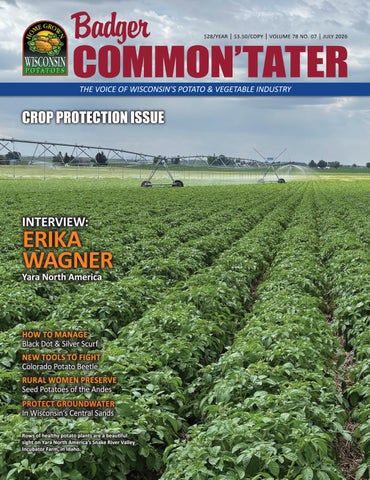
HOW TO MANAGE Black Dot & Silver Scurf NEW TOOLS TO FIGHT Colorado Potato Beetle RURAL WOMEN PRESERVE Seed Potatoes of the Andes PROTECT GROUNDWATER In Wisconsin’s Central Sands Rows of healthy potato plants are a beautiful sight on Yara North America’s Snake River Valley Incubator Farm, in Idaho.
NOW SERVING THE ANTIGO AREA 24-Hour Guaranteed Emergency Service
SALES • SERVICE • INSTALLATION
20 CELEBRATING
Years
IN BUSINESS OCTOBER 2024
CENTRAL DOOR SOLUTIONS
Handling all your dock leveler, dock seal and truck restraint needs.
Before
After
Call for a FREE analysis & estimate. • Commercial, Industrial & Agricultural Overhead Sectional Doors • Dock Levelers, Shelters, Seals & Platform Lifts • Residential Garage Doors & Openers
Before
After
• Security, Fire & Steel Coiling Doors • Commercial, Residential Openers & Accessories • Specializing in Agricultural Food Processing & Storage Facilities
1430 Contractors Blvd. • Plover, Wisconsin • 715-342-4153 Service All Makes & Models
www.centraldoorsolutions.com
America’s Favorite Garage Doors®
FIELD-FOCUSED. GROWER-DRIVEN. SINCE 1962 Across America’s potato regions, growers rely on Gowan’s family of products to keep fields clean and yields strong. Our portfolio brings together trusted weed control like Sonalan ® HFP,Eptam ®, Treflan ® HFP and Vida ®, disease prevention from Zing! ®, Gavel ®, Badge ® SC, Badge ® X2, and Reason ®. As well as, Insect and Mite control from Onager ®, Trigard ® and Imidan ®. Real solutions for real growers. Grounded in agronomy, rooted in the field, and ready for whatever the season brings.
GOWANCO.COM Badge®, Eptam®, Imidan®, Reason®, Sonalan®, Vida®, Treflan®, Trigard®, Onager® and the donkey logo are registered trademarks of Gowan Company, L.L.C. Gavel® and Zing!® are registered trademarks used under license by Gowan Company, L.L.C. Always read and follow all label directions.
On the Cover: Yara North America’s Snake River Valley Incubator
Farm, in Idaho, allows the company’s agronomy team to test crop nutrition solutions under real-world conditions and measure their impact on performance, yield, quality, and storability, as well as return on investment for growers. A healthy field of potatoes is the goal and always a welcome summertime sight at the Incubator Farm.
8 BADGER COMMON’TATER INTERVIEW:
Yara North America Climate Choice Business Development Manager Erika Wagner (left) works in collaboration with the company’s Idaho team on the Snake River Valley Incubator Farm, which is managed by Yara Crop Solutions Agronomist Florencia Irigoyen (right). Together, the team explores how a complete and optimized potato nutrition program can lead to a reduced carbon footprint and improved nutrient efficiency.
DEPARTMENTS: BADGER BEAT.................... 48 DISHING IT UP WITH DANA...................... 61
18 KEYS TO BLACK DOT & SILVER SCURF CONTROL Wisconsin growers raising concern about the diseases
EYES ON ASSOCIATES......... 26
34
44
MARK YOUR CALENDAR...... 6
NOW NEWS
MARKETPLACE
NEW PRODUCTS................ 30
Workforce development initiative raises awareness of careers in crop science
WPVGA representatives attend Canada’s largest produce industry event
NPC NEWS......................... 60 PEOPLE.............................. 42
FEATURE ARTICLES:
PLANTING IDEAS.................. 6
22 RESEARCHERS & GROWERS partner to find solutions and prevent nitrate leaching
POTATOES USA NEWS........ 58
39 NEW TOOLS EMERGE IN FIGHT against neonic-resistant Colorado potato beetles
SEED PIECE........................ 55
53 GUARDIANS OF NATIVE POTATOES are women preserving the seeds of the Andes
WPIB FOCUS...................... 52
4
BC�T July
SATURDAY, 8/8/26
Scan to register! PRESENTED BY:
WITH HELP FROM:
Times
Antigo
Supporting AHS Track & Cross Country and other youth organizations.
Schroeder’s Gifts • Bolen Realty • Promise Physical Therapy Fuller’s Sales & Service • Cornerstone Chiropractic • Hwy 45 Mercantile
For more information or to register online, visit antigotatertrot.com WPVGA Board of Directors: President: Wendy Dykstra Vice President: Josh Knights Secretary: Brian Lee Treasurer: John Hopfensperger Directors: Randy Fleishauer, Charlie Husnick, Andy Schroeder, Jeff Suchon & Lucas Wysocki Wisconsin Potato Industry Board: President: Heidi Alsum-Randall Vice President: Andy Diercks Secretary: Nicola Carey Treasurer: Keith Wolter Directors: Rod Gumz, Jim Okray, Eric Schroeder, Joe Seis & Tom Wild WPVGA Associate Division Board of Directors: President: Matt Selenske Vice President: Ethan Olson
Secretary: Melissa Heise Treasurer: Paul Salm Directors: Matthew Hartman, Brady Patoka, Scott Scheer, Morgan Smolarek & Brandon Taylor Wisconsin Seed Potato Improvement Association Board of Directors: President: Andy Schroeder Vice President: Clover Spacek Secretary/Treasurer: Ryan Fassbender Directors: Mitch Mattek & Markus Shafel Wisconsin Potato Growers Auxiliary Board of Directors: President: Heidi Schleicher Vice President: Dakotah Smiley Secretary/Treasurer: Samantha Cypher Directors: Jody Baginski, Misti Kinnison, Jenna Suchon & Erin Meister
Mission Statement of the WPVGA: To advance the interests of WPVGA members through education, information, environmentally sound research, promotion, governmental action and involvement. Mission Statement of the WPVGA Associate Division: To work in partnership with the WPVGA as product and service providers to promote mutual industry viability by providing technology and information resources. Badger Common’Tater is published monthly at 700 Fifth Avenue, Antigo, Wisconsin 54409
WPVGA Staff: Executive Director: Tamas Houlihan Managing Editor: Joe Kertzman Director of Promotions & Consumer Education: Dana Rady Financial Officer: Karen Rasmussen Executive Assistant: Julie Braun Program Assistant: Madison Hoffman-Taylor Spudmobile Education & Outreach Administrator: Patrick Popejoy
WPVGA Office: (715) 623-7683 • FAX: (715) 623-3176 E-mail: wpvga@wisconsinpotatoes.com Website: www.wisconsinpotatoes.com LIKE US ON FACEBOOK: www.facebook.com/WPVGA
Subscription rates: $3.50/copy, $28/year; $45/2 years. Foreign subscription rates: $35/year; $55/2 years. Telephone: (715) 623-7683 Mailing address: P.O. Box 327, Antigo, Wisconsin 54409 Or, subscribe free online: http://wisconsinpotatoes.com/blog-news/subscribe/ ADVERTISING: To advertise your service or product in this magazine, call (715) 630-6213, or email: Joe Kertzman: jkertzman@wisconsinpotatoes.com. The editor welcomes manuscripts and pictures but accepts no responsibility for such material while in our hands. BC�T July
5
MARK YOUR
Calendar
JULY
8 9
14-16 16 20-22 21-24 23
2026 PUTT-TATO OPEN GOLF OUTING Lake Arrowhead Golf Course Nekoosa, WI HARS FIELD DAY Hancock Agricultural Research Station Hancock, WI 72ND WISCONSIN FARM TECHNOLOGY DAYS Redetzkes’ No Joke Dairy Stratford, WI ANTIGO FIELD DAY Langlade Agricultural Research Station Antigo, WI POTATOES USA SUMMER MEETING Westin Book Cadillac Detroit, MI NATIONAL POTATO COUNCIL SUMMER MEETING Westin Book Cadillac Detroit, MI RARS FIELD DAY Rhinelander Agricultural Research Station Rhinelander, WI
AUGUST
6-16
WISCONSIN STATE FAIR West Allis, WI 46th ANNUAL ANTIGO TATER TROT City Park Antigo, WI
8
OCTOBER
15-17
IFPA GLOBAL PRODUCE & FLORAL SHOW Orange County Convention Center Orlando, FL 7th ANNUAL SPORTING CLAYS SHOOT Wausau Skeet and Trap Club Wausau/Brokaw, WI WORLD POTATO CONGRESS 2026 Nairobi, Kenya, Africa
22 26-30
NOVEMBER
2-3
WPVGA & UW EXTENSION RESEARCH MEETING Hancock Agricultural Research Station Hancock, WI
JANUARY 2027
5-7
2027 POTATO EXPO Gaylord Rockies Resort & Convention Center Denver, CO
FEBRUARY
9-11
WPVGA GROWER ED CONFERENCE & INDUSTRY SHOW Holiday Inn & Convention Center Stevens Point, WI
MARCH
30-4/1
MAY
22-25 6
65th ANNUAL WPS FARM SHOW Experimental Aircraft Association grounds Oshkosh, WI NATIONAL RESTAURANT ASSOC. SHOW McCormick Place Chicago, IL
BC�T July
Planting Ideas With her contagious enthusiasm, Erin Meister of Reabe Spraying Service, Inc., Plover, Wisconsin, is a respected member of the Wisconsin Potato Growers Auxiliary Board of Directors and liaison to the Wisconsin Potato & Vegetable Growers Association (WPVGA) Promotions Committee. She’s also an accomplished runner who often participates in the WPVGA “Powered by Wisconsin Potatoes” events. Plus, she can and does strike up conversations with just about anyone.
Apparently, that was the case just prior to her texting me the photo at right with this note: “Joe, you won’t believe this! I was at the starting line of the Tomorrow River Trail Half-Marathon and got into a conversation with Jeff Helgestad (at left in the photo with Erin) and his wife from Cambridge, Wisconsin, neither of whom had I ever met before. Jeff told me he had potatoes in his pocket for fuel on his run! He has a ritual the day before each race. He pokes, salts and boils potatoes in preparation for the event to gain maximum energy. He gave me permission to text you the picture and use it in the Badger Common’Tater.” Thank you, Erin, and keep up the good work of being a fantastic ambassador for Wisconsin potatoes! Speaking of promoting Wisconsin potatoes, WPVGA Director of Promotions & Consumer Education Dana Rady attended the Canadian Produce Marketing Association (CPMA) Convention and Trade Show, April 28-May 1, in Toronto, Canada. For WPVGA representatives attending Canada’s largest produce industry event, the trade show was much more than an opportunity to walk the exhibit floor and attend educational sessions. It was a chance to reconnect with colleagues and friends whose relationships were first strengthened when the WPVGA welcomed Canadian potato industry leaders to Wisconsin for a Reverse Trade Mission, in 2024. The 2024 Reverse Trade Mission was an initiative designed to showcase Wisconsin’s potato and vegetable industry while fostering crossborder collaboration. See “Marketplace” herein for CPMA Trade Show coverage. This “Crop Protection” issue of the Badger Common’Tater also includes feature articles on managing black dot and silver scurf, new tools in the fight against Colorado potato beetle, protecting groundwater in Wisconsin’s Central Sands, and how rural women across the Andean highlands and islands of southern Chile safeguard the diversity of native potatoes. Enjoy each of the informative features herein. Please email me with your thoughts and questions. If you wish to be notified when our free online magazine is available monthly, here is the subscriber link: http://wisconsinpotatoes.com/blog-news/ subscribe.
Joe Kertzman
Managing Editor jkertzman@wisconsinpotatoes.com
Schroeder Bros. Farms, Inc. WISCONSIN “ONLY THE BEST” CERTIFIED SEED POTATOES REDS
Dark Red Norland
RUSSETS
COL 8 Norkotah Goldrush Reveille Silverton TX 296 Norkotah
WHITES Atlantic Bliss Lamoka Mackinaw Manistee Petoskey Snowden
N1435 Cty Rd D Antigo, WI (715) 623-2689 farm@sbfi.biz johnt@sbfi.biz
Foundation & Certified Seed Potatoes
NAME: Erika Wagner Title: Climate Choice Business Development Manager (previously Agronomy Solutions Manager)
Interview
ERIKA WAGNER, Climate Choice Business Development
Company: Yara North America
Manager, Yara North America
Location: Boise, Idaho, but covering all North America
By Joe Kertzman, managing editor, Badger Common’Tater
Hometown: Mckean, Pennsylvania, just south of Erie
With an ambitious corporate mission of responsibly feeding
Years in Present Position: Eight months, and with Yara for five years
the world and protecting the planet, Yara North America offers crop nutrition solutions and industrial products, specializing in complete crop nutrition solutions.
Previous Employment: JR Simplot Company as an agronomist on the Innate potato program, and Azotic Technologies as an agronomist trialing a biological nitrogen fixation product
The company focuses on delivering sustainable solutions that enhance crop yields while reducing the environmental impact.
Schooling: Bachelor of Science in molecular biology from Lehigh University, and a master’s degree in agronomy from Penn State University Activities/Organizations: Vice chair of the Executive Committee of the Potato Sustainability Alliance Hobbies: Skiing, camping, hiking, and mountain biking, as well as traveling around North America and visiting with potato growers in the field to learn about how they grow potatoes, the challenges they face, and the creative solutions they come up with to solve their largest challenges 8
BC�T July
Products include YaraBela™, premium nitrates that provide a fast response to nitrogen needs, YaraLiva™ calcium nitrate, a nitrate-nitrogen product line that offers available nitrogen and 100 percent soluble calcium, YaraVita™ foliar nutrition and micronutrient coatings, and YaraAmplix Biostimulants™ designed to improve nutrient use efficiency. With Yara International being a global crop nutrition and industrial solutions company based in Norway, Yara North America, established in 1946,
is headquartered in Tampa, Florida. Erika Wagner, the Climate Choice business development manager and previous agronomy solutions manager for Yara North America, is herself based in Boise, Idaho, but works with growers across North America. Erika, how long have you been with Yara, and what does your position primarily entail? I have been with Above: In her role as Yara North America’s Climate Choice business development manager, Erika Wagner works with growers, agronomists, and the food chain across North America in developing crop nutrition solutions that help growers produce highyielding, high-quality crops like potatoes.
Yara for five years as an agronomist but have been in my current position as a Climate Choice business development manager for eight months. In my role, I work with growers, agronomists, and the food chain across North America in developing crop nutrition solutions that help growers produce high-yielding, high-quality crops while improving nutrient use efficiency, reducing greenhouse gas emissions, and responding to in-season stresses. I also work with our Yara Climate Choice fertilizer products that use either carbon capture and storage (CCS) or renewable energy to reduce the greenhouse gas emissions at the point of manufacturing. These products can be a very effective tool to reduce greenhouse gas emissions on the potato and vegetable acre. Can you describe some current projects, trials, or research areas? Currently, I am working on potato, corn, and malt barley projects in the United States and Canada. In each project, my goal is to help growers improve nitrogen use efficiency and, in turn, reduce nitrogen losses by following the 4 R’s (right source, right rate, right
time, and right place) and using a very predictable and efficient source of nitrogen—YaraLiva calcium nitrate. This not only helps with efficiency and return on investment, if the nitrogen put out ends up in the crop at harvest, but it also helps reduce greenhouse gas emissions on the acre as nitrogen fertilizer is one of the largest contributors to greenhouse gas emissions in agriculture. In working with potato growers, we have also been able to improve
N V S
crop quality, pack out, and quality of tubers coming out of storage by feeding the crop with soluble and available calcium using YaraLiva calcium nitrate. continued on pg. 10
ELSON’S
N7158 6TH DRIVE P.O. BOX 215 PLAINFIELD, WI 54966 OFFICE: (715) 335-6660 FAX: (715) 335-6661
EGETABLE
KEEP ON TRACK WITH OUR
TORAGE
S
Above: The Yara Incubator Farm in Idaho’s Snake River Valley is managed by the agronomy team who evaluate crop nutrition solutions in commercial potato production. The farm allows the agronomists to test solutions under real-world conditions and measure their impact on crop performance, yield, quality, storability, and return on investment for growers.
YSTEMS INC.
SPROUT INHIBITORS AND DISINFECTANTS
STORAGE VENTILATION
SPROUT INHIBITING
• COMPUTERIZED CONTROL PANELS • HUMIDIFICATION • REFRIGERATION
• FRUIT GUARD APPLICATIONS • SMART BLOCK APPLICATIONS • CIPC, CLOVE OIL APPLICATIONS
AGRI-VENTILATION SALES AND SERVICE 24 HR. EMERG. SERVICE BC�T July
9
Interview. . .
continued from pg. 9
We also work with potato growers to help respond to unexpected inseason stresses, whether it’s heat, smoke, cold, insect and disease pressure, or water stress. Growers see it all, and crop nutrition is an underutilized tool to have in the
toolbox to help the crop withstand stress and recover. As a global crop nutrition company, how can Yara help Wisconsin potato and vegetable growers? Because Yara is a global crop nutrition company,
we can pull from our knowledge base and crop nutrition experts around the world to create novel products and solutions for all major globally produced crops. Pairing this global resource with the expertise of our local team on the ground in Wisconsin allows us to create prescriptive solutions that are tailored for local challenges and conditions but are based in years of agronomic and formulations expertise. When we look at the Wisconsin potato and vegetable market, we know that, along with crop yield and quality, nutrient and water use efficiency are exceedingly important. Yara offers growers balanced,
Yara Crop Solutions Agronomist Florencia Irigoyen, who manages the Snake River Valley Incubator Farm, is shown holding a potato sample she dug, and in front of a tank holding YaraLiva™ calcium nitrate, a nitrate-nitrogen product that offers available nitrogen and 100 percent soluble calcium. 10 BC�T July
Above: Burbank potato plants flower and eventually produce tubers at the Yara Incubator Farm in the Snake River Valley of Idaho. Hosted by Driscoll Brothers and Joey Wallace, a grower in Jerome, Idaho, the incubator farm is placed in a grower’s field of potatoes each year, and its scale allows agronomists to pressure test Yara solutions in a commercial and realistic environment, all the way from planting through the growing season, at harvest, and during the storage period.
“When we look at the Wisconsin potato and vegetable market, we know that, along with crop yield and quality, nutrient and water use efficiency are exceedingly important.”
– Erika Wagner
Above: Grower standard potatoes are shown at left in comparison to those treated using Yara crop nutrition solutions (right) on the Snake River Valley Incubator Farm.
prescriptive, and efficient crop nutrition solutions that positively impact the agronomic, economic, and financial components of their business. What products and services can Yara provide to help growers increase crop quality and yield? YaraLiva calcium nitrate products provide predictable and immediately available nitrate-nitrogen paired with soluble and available calcium. Most crops prefer nitrate-nitrogen because it is immediately available for uptake. Spoon-feeding a crop with predictable nitrate-nitrogen can be highly efficient, ensuring that the nitrogen being applied is taken up by the crop and not lost. In addition, YaraLiva calcium nitrate provides soluble calcium, which is important for cell wall strength and improves potato and vegetable quality at the point of harvest and coming out of storage. The YaraVita portfolio features highquality micronutrient foliar and fertilizer coating solutions. One foliar continued on pg. 12
Customizing equipment to fit your needs for over 30 years!
2013 LENCO WRAP-AROUND SELF-PROPELLED HARVESTER Sale Price: $550,000
SALFORD BBI SPREADERS In Stock
Proud Dealer of:
2007 LENCO 4RSPAH 65” Air Head
NEW LINE OF FERTILIZER TANKS Duo-Lift Cone Bottom Tanks Multiple Sizes Available
PORTABLE DIRT CONVEYOR In Stock
® Mulchers
Rock Crushers
Conveyor Belts
New & Used Sales Service • Repair
2731 Maple Drive • Plover, WI 54467 • 715-344-3401 • Toll Free: 1-888-696-4019
www.bigironequipment.com
BC�T July 11
Interview. . .
continued from pg. 11
Shown during potato harvest, Yara Climate Choice Business Development Manager Erika Wagner works in collaboration with the company’s Idaho team on the Snake River Valley Incubator Farm.
product that we often use in potatoes is YaraVita Solatrel™, which includes phosphate, potassium, calcium, zinc and manganese to support tuber numbers, quality and size. From the field level, what are you doing to help growers? Working with growers is one of the best parts of my job. I work with many growers across the United States and Canada to learn about their pain points and challenges, identify ways to use
crop nutrition as a solution to those challenges, and follow the crop throughout the season to see if the solutions we develop are successful. In agronomy, you can never predict the year you’re going to have, so we don’t always hit a home run on the first try, but we learn something every year and usually find a good solution at the end of the day. Crop nutrition can seem black
and white, but when you combine nutrient management principles with regional variability in weather, soil, crops, varieties, and specific regional challenges, it’s rare that any two solutions look exactly alike. How many people are on your team, and how’s the growing season going? I work with every agronomist, scientist, and sales team member in Yara North America. My focus on potato and food crops produced for the value chain means that my work touches every state and many Canadian provinces. I collaborate with our local Idaho team where Yara has their Snake River Valley Incubator Farm, which is focused on nutrient management solutions on the processing potato acre, and many other collaborations in potato across southern Idaho. The growing season in Idaho got off to a slow start with a cold spring and late frost, but in the past couple of weeks, things have really taken off, and the crop has jumped out of the ground.
Agronomist Florencia Irigoyen conducts soil sampling (left) and Erika Wagner samples plants (right) on the Yara Snake River Valley Incubator Farm. 12 BC�T July
However, much of our water for irrigation in Idaho depends on good snow over the winter and we had a very warm and dry winter, so water
is on everyone’s mind going into the heat of the summer. In the Midwest, the season got off to a slow start with rain, snow, cold weather, and even a few tornadoes. Things are starting to warm up now and most of the potatoes are planted and out of the ground. Unlike Idaho where we are hoping not to run out of water, in the Midwest, we are hoping for welltimed moisture throughout the rest of the growing season. Just enough rain and at the right time is always on our wish list for a growing season. Erika, who do you most directly share your agronomy knowledge with, and with what goals? I share my knowledge with two main audiences: growers and the food value chain. With growers, I am passionate about understanding their challenges and coming up with solutions that work both agronomically and practically
Yara Senior Sales Agronomist Tom Sharp demonstrates how calcium is taken up into tubers.
and deliver an ROI (return on investment).
emissions) and help develop solutions for growers and the value chain to meet these goals.
In my role as Climate Choice business development manager, I work to understand the sustainability goals of the food value chain (mainly nitrogen use efficiency and the reduction of greenhouse gas
I focus on solutions that agronomically and logistically fit the crop, are effective in impacting NUE (nitrogen use efficiency) and continued on pg. 14
Rural Mutual Insurance Company
Born from the vision of the Wisconsin Farm Bureau Federation, Rural Mutual Insurance was created to provide affordable protection for Wisconsin farm families when others wouldn’t. Nearly a century later, we’re still here to help protect your farm, your family, your future, and your livelihood.
PROTECTING
PROTECT YOUR WISCONSIN LEGACY.
WISCONSIN SINCE 1934 WE HAVEN'T LEFT YOUR SIDE SINCE.
SCAN TO FIND YOUR LOCAL AGENT
RuralMutual.com BC�T July 13
Interview. . .
continued from pg. 13
greenhouse gas emissions and achieve a solid ROI. What current Yara locations are helping growers in the Midwest specifically? Our Great Lakes and corn belt teams are well-positioned in the Midwest, with representation in Wisconsin, Michigan, New York, Illinois, Indiana, Iowa, and Kentucky. For more information or to find an agronomist in your region, visit https://www.yara.us. How many worldwide and domestic locations does Yara have, as well as employees? Yara is present in 140 countries with approximately 16,000 employees and 25 production plants worldwide. In the U.S., we have approximately 200 employees who are positioned at our Tampa
headquarters and terminals, as well as sales agronomists across the country to cover every state. What current project or focus of yours are you most excited about and why? In my role, I combine agronomic expertise with Yara’s low-carbon crop nutrition solutions to help food companies and growers reduce the environmental footprint of crop production. Building on more than 20 years of investment in emissions-reducing technologies, Yara offers both lowcarbon nitrate fertilizers and Climate Choice products manufactured using renewable energy or carbon capture technologies, delivering some of the lowest-carbon nitrogen sources available.
Above and Below: At the Snake River Valley Incubator Farm, global crop nutrition company Yara is fostering collaboration across the agricultural industry to explore how a complete and optimized potato nutrition program can lead to a reduced carbon footprint and improved nutrient efficiency.
For potato and vegetable production, fertilizer, particularly nitrogen, is one of the largest contributors to greenhouse gas emissions. Reducing emissions starts with optimizing nutrient use through sound agronomic practices, including the 4Rs, efficient nitrogen sources such as YaraLiva calcium nitrate, and season-long nutrient management. An additional opportunity is selecting fertilizers with a lower manufacturing footprint. Across three years of commercial potato trials in the Northwest, Midwest, and Southeast, YaraLiva CN-9 Low Carbon improved nitrogen use efficiency by an average of 8% while reducing fertilizer-related greenhouse gas emissions by 19% per acre. What makes these solutions especially valuable is that they deliver both sustainability benefits and strong agronomic performance, supporting yield, quality, and profitability for the grower.
14 BC�T July
I know you have an incubator farm in the Snake River Valley of Idaho. Does Yara have incubator farms across the country, and with what goals in mind? Yara’s U.S. incubator farm program is currently centered in Idaho’s Snake River Valley, where we evaluate crop nutrition solutions in commercial potato production. Managed by our agronomy team, the farm allows us to test solutions under real-world conditions and measure their impact on crop performance, yield, quality, storability, and ROI for growers. Do you work directly with the incubator farm? I work in collaboration with our Idaho team on the Snake River Valley Incubator Farm, which is managed by Yara’s crop solutions agronomist, Florencia Irigoyen. This incubator farm is placed in a grower’s field of potatoes each year, and its scale allows us to pressure test our solutions in a commercial
and realistic environment, all the way from planting the crop, through the growing season, at harvest, and during the storage period. We collect data from each treatment at each point, so we have a solid understanding of the impact of our solutions on agronomic performance, yield, quality, storability, and ROI to
Above: A potato field stretching to the horizon is harvested on Yara’s Incubator Farm in the Snake River Valley of Idaho.
the grower at the end of the day. The Snake River Valley Incubator Farm is hosted by Driscoll Brothers and Joey Wallace, a grower in continued on pg. 16
Valley Turns Storm Setbacks into Comebacks As we count our many blessings, we are thankful for all you do. You make us who we are. We wish you and your family a holiday filled with happiness, gratitude and laughter.
THANKFUL FOR YOU.
valleyirrigation.com
Happy Thanksgiving!
When storms hit, equipment damage doesn’t have to slow you down. Count on Valley to bring you fast delivery, reliable installations and top-notch repairs to get your pivots running and your farm back in action.
When the storm passes, Valley’s still with you – call today!
North Central Irrigation DEALER LOGO
Proud Valley® Irrigation Dealer Address | Phone | Website Providing the Highest QualityNumber of Sales, Service and Support
DA1730
4 COLUMN x 5” 7.708” x 5”
font: Arial • 800-755-0268 Plainfield,suggested WI: 715-335-6368 Beloit, WI: 608-362-0706 • 800-924-0321
valleynci.com | valleyirrigation.com CA1192
BC�T July 15
Interview. . .
continued from pg. 15
Jerome, Idaho. Their participation is integral to our success and learnings. The incubator farm is a great example of how collaboration with engaged and innovative growers makes our work possible and more impactful, and many of those learnings can be applied anywhere potatoes are grown. What do you enjoy most about being a business development manager with Yara? Yara has a strong focus on agronomy and practical solutions that work at-scale. My background is in science, but I know that the best solutions in theory just don’t work if they aren’t practical on the ground. You can spend a lot of time at a desk coming up with a solution or tool that will never be applied if it requires too many impractical changes for a grower. I really value Yara’s approach in combining agronomic knowledge, excellent product formulation, and practical on-the-ground knowledge to give growers the tools they need to effectively grow their crops. This practical focus means that I get to spend a lot of time in the field with growers all over the U.S. and Canada, and I really love that part of my job. I learn something new every time 16 BC�T July
I visit a field with a grower. What are you most proud of as far as the products and services Yara provides to growers? I am proud that we at Yara are leading the way in helping growers and the food chain identify practical and impactful levers to pull that impact nutrient use efficiency, yield, quality, and greenhouse gas emissions on the potato, vegetable, and food crop acres. We pair agronomy and on-theground expertise with science and technological advances to come up with solutions that are effective, regionally tailored, and have a good agronomic fit. What’s the most exciting development in agronomy solutions for you right now, Erika? Crop nutrition and fertilizer are generally accepted to be important to the success of a crop, but that may not be an area that people first think of when they consider innovations in agriculture. At the same time, potato and vegetable growers are some of the most knowledgeable people that I meet when it comes to understanding the importance and benefits of a complete crop nutrition
Above and Opposite Page: Potato plants are shown at emergence and growth stages, including marble-size tubers, at Yara’s Snake River Valley Incubator Farm.
program because they are really impacted by both yield and quality at the end of the day. They also tend to follow the 4 R’s closely to make sure they are capturing the full benefit of the fertilizer that they are applying. Even so, growers are facing a lot of new pressures, both environmentally and economically, and I have found that many are looking for more complete and nuanced solutions from the world of crop nutrition to help them meet these challenges. The crop nutrition space is coming up with tools to help as the focus shifts from not only maximizing yields, but also to producing a crop that is resilient to unpredictable weather patterns and has excellent quality at harvest and in storage, all while efficiently using inputs (fertilizer, water, etc.). People who work in the crop nutrition space are responding by developing new products tailored to meet the needs of growers in 2026.
We are diving into bio-stimulants to help the crop function more efficiently; working to understand and share knowledge about practices that can impact soil health; and considering how digital tools and spoon-feeding predictable sources of nitrogen can help fine-tune a crop nutrition program during the growing season (to name a few). I am most excited about my opportunity to engage with knowledgeable and curious growers to come up with creative, tailored solutions to help them be successful in 2026 and for years to come. What’s the first step for growers so you or Yara can help them one-onone in Wisconsin and the Midwest? Growers in Wisconsin and the Midwest can reach out to me directly or to one of our excellent sales team members in their state (you can find your local sales agronomist at our website: https://www.yara.us). What do you hope they’ll take away from a partnership with Yara? I hope that they find our team to be a good resource for crop nutrition knowledge that can work with them to help them meet their goals on the farm, whether they include yield, quality, efficiency, sustainability, or all the above. Potato Storage - Bryan Bula Farms
What do you hope for yourself and your team? For our team, I hope we continue to build strong collaborations throughout the food chain that help accelerate the adoption of low-carbon farming practices.
By combining agronomic expertise, innovative products, and real-world data, we have an opportunity to help shape a more sustainable food system while delivering value to growers and customers alike.
MILLER’S ROOFING & CONSTRUCTION, LLC • Agriculture & Commercial • Insulated Warehouses & Custom-Built Pole Sheds • Steel Roofing and Siding
S2770 Iron Street • LaValle, WI 53941
Contact John Miller | 608-985-8944 | Leave a message! BC�T July 17
Managing Black Dot & Silver Scurf Wisconsin potato growers have increasingly reported concerns about the diseases By Amanda Gevens, professor and Extension vegetable pathologist, University of Wisconsin (UW)-Madison Department of Plant Pathology Wisconsin potato growers have increasingly reported concerns about black dot and silver scurf over the past several years. These diseases are often subtle during crop development, yet can significantly impact tuber appearance, storability, and marketability by harvest and throughout storage. Unlike explosive diseases such as late blight, black dot and silver scurf tend to develop quietly and are heavily influenced by environmental stress, soil conditions, crop injury, and
long-term production practices. As weather patterns become more variable and production systems evolve, these diseases appear to be gaining importance across the industry. Black dot is caused by the fungus Colletotrichum coccodes, and the accompanying photo shows black dot tuber symptoms. The pathogen survives in soils and crop residue as structures called microsclerotia. One of the challenges of black dot
Above: Dr. Amanda Gevens, UW Department of Plant Pathology, is pictured in an Alsum Farms & Produce potato field near Arena, Wisconsin. Photo courtesy of Michael P. King, UW-Madison College of Agricultural and Life Sciences (CALS)
is that infection often occurs very early in the season but remains symptomless for weeks if not months. Like other Colletotrichum pathogens, the fungus infects plants latently or mildly during early growth stages and later becomes more aggressive and symptomatic once the crop begins allocating energy into tuber production. Black dot symptoms may include premature vine decline, lower stem discoloration, reduced root vigor, uneven crop maturity, and tuber blemishes. Black dot is frequently associated with the Potato Early Die.
Black Dot 18 BC�T July
Silver Scurf
Silver scurf is caused by the debris and seedborne fungal pathogen
Helminthosporium solani and primarily affects potato tuber skin, as per the accompanying photo. The disease can be noted at time of harvest, but most often becomes more visible during storage and may appear as silvery or bronze discoloration, patchy skin blemishing, increased shrink and moisture loss, and reduced visual quality. Silver scurf can continue developing during storage, particularly under humid conditions and extended storage periods. Several factors may be contributing to the increasing occurrence of black dot and silver scurf across Wisconsin and other potato-producing regions. Warmer winter soil temperatures may preserve infected crop debris and pathogen inoculum more effectively than in the past. In addition, growers increasingly face intense rainfall events, rapid drying cycles, high winds, blowing sand (creates wound sites for earliest infections on newly emerged potato crops), hail, unexpected cold, and heat extremes during spring and fall “shoulder seasons.”
“These diseases are often subtle during crop development, yet can significantly impact tuber appearance, storability, and marketability by harvest and throughout storage.” – Amanda Gevens
particularly, is strongly associated with seedborne inoculum and storage contamination. MODERN CULTIVARS Some modern cultivars can have greater susceptibility to silver scurf and black dot than varieties commonly grown in earlier decades. In conventional systems, reduced fungicide sensitivity may contribute to reduced disease suppression over time.
The period of emergence through first hilling is especially important for black dot infection. Young stems can become damaged by blowing sand, cultivation, hail, or other physical injury. These wounds can become entry points for Colletotrichum coccodes. Once lower stem infections develop, the pathogen can contribute to early vine decline, move downward on continued on pg. 20
These weather fluctuations can physically damage plants and create favorable conditions for infection. Reduced tillage systems in crops prior to the current year’s potato production may preserve infected residue longer and slow the decomposition of pathogen-infested material. For black dot particularly, infected crop debris can remain an important inoculum source. Avoiding excessive undecomposed residue at planting, allowing adequate decomposition time, maintaining good hill drainage and aeration, and considering brassica cover crops where appropriate can help limit inoculum. Even certified seed potatoes can harbor low or asymptomatic levels of these pathogens. Silver scurf, BC�T July 19
Managing Black Dot & Silver Scurf . . . continued from pg. 19
Silver scurf lesions are shown on a potato tuber.
stolons and to tubers, or produce spores that wash into the hill zone during irrigation or rainfall. In conventional production systems, strobilurin (FRAC 11) and SDHI (FRAC 7) fungicides such as azoxystrobin and boscalid have shown suppression of black dot when applied during early stem development (in-furrow, and/or prior to row touch). For silver scurf, treatment on seed and in-furrow with fungicides in the strobilurin and SDHI groups, as well as the phenylpyrrole group (FRAC 12 such as fludioxonil), can limit the progression of the pathogen. Many growers are reconsidering how aggressive cultivation practices can influence blemish disease development. Frequent deep cultivation could dry soil excessively, damage roots and stems, increase crop stress, and create more infection opportunities. Maintaining stable hill moisture and minimizing unnecessary soil disturbance or plant injury during 20 BC�T July
early crop development may help reduce disease pressure.
Above: Black dot disease symptoms are pictured on potato tubers.
Questions also arise regarding poultry-based fertilizers and pelletized manure amendments and their role in these blemish diseases.
Broadcast incorporation may reduce concentrated hill-zone effects compared to heavily banded applications, particularly when salt levels are elevated.
I do not have research data to provide specific disease management recommendations in this regard, but inputs that damage the tuber periderm can provide entry for pathogen infection. ELEPHANT HIDE Salt injury or elevated electrical conductivity in the hill zone can result from soluble salts such as potassium, sodium, and ammonium. Under certain conditions, this may contribute to tubers with a rough finish, uneven tuber surfaces, or defects resembling burn or “elephant hide.” Poorly composted poultry manure or unstable pelletized products might contain relatively high soluble salt levels. In addition, poultry-based amendments can alter soil microbial communities and potentially increase disease pressure, especially under higher soil pH, dry soil conditions, and concentrated placement near seed pieces. To reduce risk, avoid direct in-furrow placement near seed pieces, allow time for mineralization before planting, incorporate thoroughly, and irrigate where possible to reduce localized salt or ammonia accumulation.
Cover crops and green manures remain valuable for soil health, but species selection and residue management matter. The black dot pathogen can survive or colonize a wide range of plant material. Potential hosts or reservoirs include tomato, pepper, eggplant, soybean, clover, alfalfa, rye, oats, vetch, and numerous weeds including nightshades and pigweed. Even when crops are not classical disease hosts, residues may still support pathogen survival. Highbiomass green manures might unintentionally increase inoculum simply by providing organic substrate. Silver scurf is driven primarily by infected seed tubers, contaminated storage environments, and tuber-totuber spread. Most rotation crops and cover crops are not important reservoirs for H. solani. Leaving tubers in the ground too long after vine senescence increases risk for both black dot and silver scurf. Risk often increases substantially beyond approximately one week after vine kill. Silver scurf seems to especially thrive when moist conditions are followed by rapid hill drying before harvest.
STORAGE ENVIRONMENTS Storage environments can contribute significantly to silver scurf survival and spread. The silver scurf pathogen survives primarily on infected tubers, in storage dust, and on storage surfaces. Post-harvest fungicides and sanitizers can help to minimize silver scurf spread, but these treatments do not influence black dot as there are no airborne spores released in this stage of crop life.
No single management practice will eliminate these diseases. Successful suppression depends upon integrating:
• Thoughtful cultivation practices
• Healthy seed, and seed and infurrow applied fungicides
• Strong storage sanitation
• Careful fertility management • Reduced crop stress • Fungicides at first-hilling or prior to row-touch
• Effective rotation planning • Proper harvest timing For more information on fungicides and other crop inputs, visit the Commercial Vegetable Production in Wisconsin A3422 Guide at https:// vegpath.plantpath.wisc.edu/ resources/a3422/.
Black dot symptoms can worsen in appearance during storage, but the disease doesn’t actively spread. The black dot pathogen is resilient because its microsclerotia can survive independently outside plant tissue. Effective sanitation includes thorough removal of organic debris, pressure washing of walls, floors, and ventilation systems, and careful airflow and humidity management. Disinfectants including those containing chlorine dioxide, peroxyacetic acid and hydrogen peroxide, such as SaniDate, may help reduce residual inoculum after cleaning. Fungicides including phosphorous acids such as Phostrol, Stadium (Syngenta; azoxystrobin, fludioxonil, difenoconazole), and Scholar (Syngenta; fludioxonil) have also demonstrated positive silver scurf management. However, good tuber harvest, handling, and storing practices, as well as the physical removal of organic matter, remain the most important sanitation practices for tuber health. In summary, black dot and silver scurf are increasingly important diseases because they are closely tied to environmental stress, residue management, crop injury, changing weather patterns, storage conditions, and long-term soil and production practices. BC�T July 21
Illustration by Audra Koscik
Protecting Groundwater in Wisconsin’s Centr al Sands Researchers partner with growers in finding solutions to prevent nitrate leaching By Audra Koscik, communications specialist, University of Wisconsin (UW)-Madison Plant and Agroecosystem Sciences In the heart of Wisconsin, the earth is composed of deep, sandy soil, making it an ideal area to grow specialty crops like potatoes. This region, known as Wisconsin’s Central Sands, is home to a thriving agricultural industry that generates billions of dollars in revenue and provides thousands of jobs. However, the sandy soil also creates challenges as it is prone to flushing fertilizers and pesticides into the groundwater, consequently impacting community and environmental wellbeing. Steven Hall and Jed Colquhoun, faculty in the Department of Plant and Agroecosystem Sciences at the University of Wisconsin (UW)Madison, are studying a particularly prominent challenge in the Central Sands: nitrate leaching. Growers apply nitrogen fertilizer to 22 BC�T July
their fields as it is essential for crops, especially nitrogen-loving plants like potatoes. However, if there is more nitrate than the crop needs, it can leach into the groundwater below.
effects from nitrate,” Hall states. “Pregnant women and children are likely most at risk, but there’s also increasing evidence of other health impacts, such as increases in cancer.”
“One of the challenges is getting both the amount and timing of that nitrogen application to correspond to crop demand,” Hall says. “If you have a mismatch, particularly on sandy soils, that nitrate is really vulnerable to leaching.”
FINDING SOLUTIONS Given the region’s sandy soil and agricultural context, it has some of the highest concentrations of nitrate in the drinking water throughout the state. UW researchers, growers, and food production companies are teaming up to understand the issue and find solutions.
Rain can wash the nitrate past the plants’ roots. “And then it’s essentially gone, from the perspective of the plant,” Hall explains. The nitrate can flow into subsoils and aquifers, and then eventually into wells. And, while nitrate is essential for crop growth, it can be harmful in drinking water. “There are several negative health
To begin their work, scientists met with growers, industry professionals, and residents. “In all our discussions with rural community members, we’ve heard that everyone, including the farmers, wants to protect groundwater quality in the region. It’s the source of irrigation water, drinking water,
and valued ecosystems that surround agriculture like wetlands, streams, and lakes,” Colquhoun says. Residents also want solutions that support the local agricultural industry. “So, our challenge in this work is to find ways that agriculture can remain a vibrant contributor that allows people to live in the region while also protecting the groundwater that supports it,” Colquhoun details. Through support from the U.S. Department of Agriculture’s National Institute of Food and Agriculture, Colquhoun and Hall’s research teams are studying a variety of agronomically feasible strategies to protect groundwater. One promising method they are investigating is adding plants to crop rotations. Many growers in the Central Sands already use cover crops that can help capture excess nitrate. In these
“One of the challenges is getting both the amount and timing of that nitrogen application to correspond to crop demand.”
– Steven Hall,
UW-Madison Assistant Professor
systems, growers plant a second crop after harvesting their main crop. The cover crop can utilize any nitrate left in the field, store it in its plant tissue, and release the nitrate in the spring for the next crop. DIVERSIFY CROP ROTATIONS “Additionally, we’re exploring ways to further diversify the crop rotations with innovative plants like winter camelina, which can be grown as a winter cover crop and then pressed for use as sustainable aviation fuel,”
Colquhoun says. While cover cropping can help reduce nitrate leaching post-harvest, nitrate can still leach during the main growing season. Nitrate is especially prone to leaching in potato fields where crops are grown in hills, often allowing water to drain to the furrows and flush nutrients into the groundwater. To catch this nitrate, Colquhoun and Hall are researching the effectiveness continued on pg. 24
SNOWDEN • ATLANTIC • LAMOKA MANISTEE • LADY LIBERTY MACKINAW • PETOSKEY • BLISS
Contact: Jim or John
BC�T July 23
Protecting Groundwater in Wisconsin’s Central Sands. . . continued from pg. 23
of intercropping systems. In these systems, a secondary crop is grown between the main crop’s rows. This secondary crop can scavenge any excess nitrate. “The key here is to use multiple strategies such as in-season interseedings and off-season cover crops to reduce input leaching risks across crop rotation,” Colquhoun imparts. To ensure results are relevant to the region, Colquhoun and Hall are conducting research on a network of growers’ fields in the Central Sands. “In each field, we have replicated large-scale plots where we’re working with our grower partners to compare innovative groundwater quality protection practices to the standard way of growing crops,” Colquhoun says. They then collect data to study varying strategies’ agronomic, economic, and environmental implications.
Steven Hall and Jed Colquhoun, UW-Madison Department of Plant and Agroecosystem Sciences, and their teams are researching the effectiveness of intercropping systems in preventing nitrate leaching. Shown here, yellow mustard grows in the furrows between rows of potato plants.
FIELD LYSIMETERS “One of the exciting parts of the work are these lysimeters we installed beneath the fields of participating farms,” Hall remarks. “The lysimeters allow us to measure nitrate leaching pretty robustly and will ideally be in the ground for many years.”
Researchers can then continuously monitor the lysimeters to track longterm trends in nitrate leaching. While research is ongoing, Colquhoun and Hall’s scientific teams and partners have already discovered a few promising findings.
“Our research team has made great headway in the first couple of growing seasons across a wide range of research topics, ranging from new fertilizer strategies to optimized weather monitoring networks and remote sensing of crop and water status,” Colquhoun states. “We’re now putting those pieces together to make a new suite of production practices that are agronomically feasible,” he adds. Collectively, growers, scientists, food industry partners, and university organizations make a powerful team to support Wisconsinites.
Corn and yellow mustard grow side-by-side in an intercropping system. 24 BC�T July
Researchers bury lysimeters to caption data on long-term trends in nitrate leaching.
“I hope that these efforts allow for vibrant agriculture to support local communities while protecting the groundwater that supports all ecosystems in the region,” Colquhoun concludes.
9 OUT OF 10 PLANTS PREFER NITRATE-N. THE 10TH IS A WEED. Get N that’s accessible when crops need it – not when they don’t. YaraLiva nitrate-N. Fast acting. Reliable. Efficient. If you’re using any other form of nitrogen, you’re just feeding everything green.
CN-9 & CAN-17 Only available from leading crop input retailers.
Harlee Kirsling
Kylie Garner
Jacob Kirsling
Eyes on Associates
Associate Division & Auxiliary Award Scholarships Academic excellence rewarded to scholars whose families are WPVGA members The WPVGA Associate Division and Wisconsin Potato Growers Auxiliary are pleased to announce scholarships totaling over $9,000 awarded to students attending post-secondary institutions. The scholarships can be used to defray educational expenses and are open to students in undergraduate and post-graduate programs. Applicants must be residents of Wisconsin and are eligible to reapply in subsequent years regardless of whether they have been previously awarded a scholarship. The applicant or applicant’s immediate family must be a member of or employed by the Wisconsin Potato & Vegetable Growers Association (WPVGA) or a WPVGA grower or Associate Division member. Scholarships are based on merit such as grade point average and extracurricular activities, and the applicant must attend an accredited school. Aware of the need for an educated and driven agricultural workforce, the WPVGA Associate Division and Wisconsin Potato Growers Auxiliary team up each year to raise funds 26 BC�T July
through golf outings, membership dues, a silent auction, donations, and baked potato and French fry booths to award dedicated students with scholarships. The Avis M. Wysocki Memorial Scholarship is awarded to the top candidate and funded not only through a silent auction the Associate Division holds during the Grower Education Conference & Industry Show, but also via donations and a special contribution made by the Auxiliary. Established in 2016, the Avis M. Wysocki Memorial Scholarship honors its namesake, who was a founding member of the Auxiliary and an integral part of the Wisconsin potato industry. For judges to remain objective, the names of the students are taken off their applications when board members review and evaluate them, thus awarding is done solely on the merits of applicants and information they provide. This year, the Auxiliary and Associate Division came together to award eight deserving students whose
families are employed by or members of the WPVGA with $9,250 in scholarships. For the second year in a row, the winner of the Avis M. Wysocki Memorial Scholarship is HARLEE KIRSLING, who grew up on the family potato and vegetable farm, Patoka Farms, LLC, in Amherst, and currently works there and at Del Monte Foods as a crop scout. She previously worked in the Colorful Plate Café at the Food + Farm Exploration Center of Plover. Pursuing an agribusiness major and crop science minor at the University of Wisconsin (UW)-River Falls, Harlee has also won the Portage County Business Council Agribusiness Scholarship and Dan Hamerski Memorial Scholarship (both in 2025), as well as a 2025 State FFA Degree, and the FFA Academic Achievement Award for four years in a row. She has been a member of the Agricultural Business Marketing Society at UW-River Falls, the Amherst Student Council, National Honor Society (Amherst High School), and was president of the Amherst
Jonas Bushman
FFA from 2024-’25.
Karissa Rettler
Carrying a 3.8 grade point average (GPA) through 38 credits at UWRiver Falls, with another 17 credits in progress, KYLIE GARNER is the daughter of Bradley and Amber Garner, the former employed by Weekly Farms in Plainfield.
“I see myself building my life in or around Portage County,” Harlee says. “Growing up on my family’s farm has given me a love for this area and the people. This community is built with strong, hard-working people who Majoring in animal science with a exhibit traits like responsibility and minor in agricultural business, Kylie perseverance that I learned working 07-26 Badger Common'Tater (7.25x4.75).v1.pdf 1 2026-06-01 9:40 am plans to attend veterinary school on the farm.”
Brooklyn Raese
and is eager to pursue her dream of becoming a veterinarian specializing in large animal health in rural Wisconsin. “I’m especially interested in preventative herd health and helping producers make practical decisions about nutrition, management, and overall animal well-being,” she says. continued on pg. 28
BC�T July 27
Eyes on Associates . . . continued from pg. 27
Madison Kwak
Nancy Hansen
Alexia Rank
“I also hope to continue building my own cattle herd and stay involved in youth livestock programs, because those experiences have played a major role in shaping who I am.”
Patoka Family Farms, but I’ve also worked for other WPVGA member farms. I recognize the importance of potatoes in Wisconsin and appreciate the work put into them.”
Kylie was Class Salutatorian at Almond-Bancroft School District in 2025, and has won numerous awards and honors, including the Wisconsin Livestock and Meat Council Scholarship, 2026 COLLEGE Scholarship Fund, and Falcon’s Scholar Scholarship.
JONAS BUSHMAN, whose parents are John and Amy Bushman, of Wittenberg, worked for the family business, Bushman Associates, as a farm manager for four years before embarking on his college career.
and High School FFA Scholarship winner, member of the university Dean’s List and Honors Program, a member of the National Honor Society, and was Class Salutatorian at Tri-County High School. Karissa previously won the Adams-Columbia Scholarship.
Son of Jason and Jenny Kirsling, of Amherst, and brother of Avis M. Wysocki Memorial Scholarship winner, Harlee, JACOB KIRSLING has earned 57 credits as a crop science major and agricultural business minor at UW-River Falls, is an Alpha Gamma Rho member/brother, and has carried a cumulative 3.708 GPA throughout his college career. Jacob was also awarded a 2025 WPVGA Associate Division and Auxiliary Scholarship and has made the UW-River Falls Dean’s List for the past three semesters. He works at Jay-Mar, Inc., and Patoka Family Farms, and was previously employed by Sand County Equipment. “My Patoka family farming history goes back five generations, and my work ethic developed by working on the potato grading line,” he says. “Not only have I spent my life at 28 BC�T July
Enrolled at UW-River Falls, Jonas earned 24 college credits and a 3.974 cumulative GPA, won the UW-River Falls Falcon Scholars Scholarship and the Falcons Fly Higher Scholarship, is a member of the National Honor Society, and was named into the Academic All-Conference three times. “Upon graduating from UW-River Falls, it is my goal to move back home and continue to work on my family’s farm,” he says. “I hope my major in agricultural engineering will allow me to better integrate new technology into our operation, which will, in turn, make the farm more efficient and profitable.” Employed by Flyte Family Farms, of Coloma, since 2018, and the Town & Country Veterinary Clinic since 2024, KARISSA RETTLER has earned 109 credits at UW-Stevens Point toward her pre-vet and biology degrees. She is also a National FFA Scholarship
She has already applied to veterinary school and plans to attend the University of Minnesota College of Veterinary Medicine. “After receiving my Doctor of Veterinary Medicine degree, I plan to return to Central Wisconsin and open my own veterinary clinic because I want to give back to the area that has supported me throughout my life,” Karissa says. Daughter of farmer Craig Raese and Chippewa Valley Bean Chief Financial Officer Kailey Purvis, BROOKLYN RAESE is a recent graduate of Eau Claire Memorial High School where she carried a cumulative GPA of 3.89. Brooklyn is enrolled at Chippewa Valley Technical College for the fall 2026 semester. A member of the Eau Claire area FFA Chapter and the Rock Creek Rangers, she has been involved in 4-H and numerous community service projects including volunteering at the Feed My People Food Bank, supporting local animal shelters, and as a member of the Horse Evaluation
Career Development Event. “Ater graduating from the Animal Science Management Program, my immediate goal is to be a nutritionist for local dairy farms,” Brooklyn says. “My career will benefit the industry by helping farmers optimize herd health and economic efficiency.” MADISON KWAK is the daughter of Thomas and Tricia Kwak, who have both worked for WPVGA Associate Division member company Chippewa Valley Bean, with Thomas retiring in March 2025. Having earned 64 credits and carried a 3.543 cumulative GPA at the University of Wisconsin-Madison as an atmospheric and oceanic sciences major, Madison has won the Herb Kohl Scholarship, the Wisconsin Higher Education Board Academic Excellence Scholarship, and the UWMadison Bruce A. Bogue Scholarship. She is treasurer of the Association of Women in Agriculture, attends biweekly meetings of Madison’s American Meteorological Society, is the forensics captain, and a threetime gold medalist and two-time silver medalist on the forensics team. Madison was a four-time academic letter winner at Menomonie Senior High School, an accredited parliamentarian, school valedictorian,
National Honor Society member and National Finalist in FFA Equine Placement Proficiency. Daughter of Roger and Robin Hansen, the latter a bookkeeper at Gary Bula Farms and Nathan Bula Farms, LLC, NANCY HANSEN is enrolled at Southwest Technical College, in Fennimore, as an animal science major and agribusiness minor for the fall 2026 semester. Nancy achieved High Honor Roll for all four years she attended AdamsFriendship High School, earned her State FFA Degree during her junior year, and FFA Chapter in Service and Chapter in Leadership awards, each for two years. She is employed at Bryan Bula Farms as a general laborer and Nathan Bula Farms as lead cashier. “I have gone on many job shadows through school, and I really liked shadowing a livestock nutritionist,” Nancy says. “Within five years of graduating, I hope to be in my dream job of working with animals.” Another exciting annual scholarship opportunity, now in its second year, is specifically designated for students who have an interest in specialty crops. Funded and awarded by a couple wishing to remain anonymous donors, the “Specialty
Crop Scholarship” is curated through the WPVGA. The donors announce that ALEXIA RANK has won the Specialty Crop Scholarship for the second year in a row. “The reason that we have chosen Alexia again this year is her continued dedication to the potato industry. She is switching her major this fall from chemistry to environmental science because she wishes to work more directly with the farmers,” the donors note. “She is very aware of the cost of growing potatoes and has a desire to help farmers via soil conservation or helping create new varieties of resistant plants,” they continue. “She understands the value of crop knowledge and how that can positively impact the farming community.” “We are also impressed by Alexia’s work ethic,” the donors conclude, “as she continues to work in farm-related jobs while continuing her education.” Congratulations to all the dedicated and deserving scholarship winners who have committed themselves to bettering the agriculture industry and planet as we know it, and who plan to create big, positive impacts in the future.
COMPLETE CROP CONSULTANTS
Crop Scouting
Tissue Testing
Soil Sampling
Disease Diagnostics
Nutrient Management
www.allied.coop | info@allied.coop
VERTICILLIUM & NEMATODE LAB:
Soil & Root Nematodes • Soybean Cyst Nematode • Verticillium Assay • Early Dying Analysis BC�T July 29
New Products Calantha Offers Sustainable Solution Against CPB
RNA-based sprayable bioinsecticide targets and kills ravenous Colorado potato beetles By Krishna Ramanujan, Cornell Chronicle, Cornell University The first sprayable insecticide made of RNA can target and kill ravenous Colorado potato beetles while sparing most beneficial insects, making it a promising environmentally friendly option. Colorado potato beetles can devastate entire fields of potatoes, tomatoes and eggplants, leading to billions of dollars of annual crop damage globally. The pests have also developed resistance to many insecticides, which makes the need for a new control method especially important. Calantha bioinsecticide from GreenLight Biosciences is highly effective when applied a few times once larvae first appear in the spring, according to a new study published October 22, 2025, in Pest Management Science that tested the spray’s efficacy. “Depending on where you are in the country, there are Colorado potato beetle populations that may be resistant to multiple active ingredients belonging to multiple classes of insecticides,” says Brian Nault, professor of entomology at Cornell AgriTech in the College of
Adult Colorado potato beetles eat the leaf of a potato plant.
Agriculture and Life Sciences and senior author of the study. “This is a brand-new class with a novel mode of action and it’s a benefit environmentally because it’s not going to interfere with nontarget insects,” Professor Nault explains. Broad spectrum insecticides kill indiscriminately, affecting populations of beneficial insects such as bees, predatory wasps and ladybugs. RNA TECHNOLOGY The sprayable RNA technology can
SUPPORT YOUR FELLOW WPVGA MEMBERS When you need goods or services, please consider asking our Associate Division Members for quotes or explore what they have to offer. Together, we make a strong organization and appreciate how wonderful we are as a group. 30 BC�T July
also be tailored to address other pests. A new product for countering varroa mites that spread disease to honeybees is currently in the regulatory approval pipeline, and researchers are investigating using the tool to combat Asian citrus psyllids, bark beetles and even mosquitoes. Scientists have previously engineered corn plants that produce an RNAbased insecticide to suppress western corn rootworm, but this is the first sprayable product. Calantha works by co-opting a genetic process called RNA interference. While DNA includes two strands of genetic code, RNA, which translates instructions in DNA for cells to produce specific proteins, is mostly a single strand. But, in some instances, such as with viruses, double-stranded RNA (dsRNA) occurs. In RNA interference, dsRNA silences a gene, which prevents it from
making a specific protein. In the case of Calantha, a tailored dsRNA is sprayed onto plants. Once eaten by Colorado potato beetle adults and larvae, the dsRNA enters cells that line the gut. The cells’ machinery acts on the dsRNA, following a pathway that ultimately silences a specific Colorado potato beetle gene called PSMB5, which plays a role in maintaining cellular health by removing defective proteins from cells.
Calantha with other chemical sprays to kill the various pests.
sufficient to control that spring generation.”
To optimize Calantha, Nault and colleagues began applying it in spring when the first eggs hatch and followed up with weekly treatments for the next two to three weeks while populations and larvae are both small.
Also, the product’s manufacturing process doesn’t align with guidelines for organic use, thereby depriving organic farmers of a potentially valuable tool, Nault remarks.
Without PSMB5, these defective proteins accumulate, cells die, and a few days later, so does the insect.
“It’s highly effective when used at these times and intervals,” Nault says. “With this particular product, it’s much more effective against small larvae, so you want to make sure that you target the earlier stages of the insect’s development.”
TWO GENERATIONS Colorado potato beetles have two generations, in spring and summer. In the first generation, other pests have yet to appear, making it the best time to apply the insecticide. By the time the second generation emerges, aphids and leafhoppers are also found, which may require coupling
Note that in New York State, the Department of Environmental Conservation limits Calantha use to two applications per year to keep the insect from developing resistance. “In New York, it’s going to work better to use it on a small to moderate size population,” Nault states. “Two applications may be
Marcelo Dimase, a postdoctoral researcher in Nault’s lab, is the paper’s first author. Co-authors include Brian Manley at Greenlight Biosciences, Andrei Alyokhin at the University of Maine and Russell Groves of the University of Wisconsin-Madison. The study was funded by GreenLight Biosciences, which developed the dsRNA used in Calantha. For more information about Calantha, contact GreenLight Biosciences, attn: Paige Kempton, 9 Laboratory Dr., Ste. 300, Durham, NC 27713, paige.kempton@ greenlightbio.com, 919-446-1743, https://greenlightbiosciences.com. continued on pg. 32
THE LATEST IN APPLICATION, ALL IN ONE PLACE. Demo & compare the latest in sprayer & spreader technology at
SEI APPLICATION DAYS
Last Week Of July (9:00AM-2:00PM )
Okray Produce Company (On County Road F, south of Hwy 54 in Plover, WI)
Visit seiapplicationdays.com for more details!
BC�T July 31
New Products . . . continued from pg. 31
Ceres AI Enhances Integration with John Deere Decisions made faster by viewing Ceres AI insights directly in the John Deere Operations Center Ceres AI, the company behind one of the world’s most advanced agricultural intelligence platforms, announces a renewed and enhanced integration with the John Deere Operations Center™. While this integration has existed for years, recent upgrades bring a more seamless and actionable experience for growers. Enhanced integration enables Ceres insights to be viewed directly in the Operations Center, allowing users to overlay imagery with machine, planting, and application data for a complete picture of field performance. It also simplifies setup by syncing field boundaries between platforms. “This is more than a technical upgrade; it’s a meaningful step forward in delivering intelligence where it matters most,” says Anubhav Sharma, director of marketing at Ceres. “By embedding our insights within tools growers already rely on, we’re making it easier to onboard 32 BC�T July
faster, take action, and operate more confidently from day one.” This improved integration also delivers value for insurers by enabling faster access to field boundaries, planted crops, planting dates, and historical yield data,” Sharma adds, “which are critical inputs for underwriting and risk assessment.” What’s New in the Integration: • In-Platform Access to Ceres Insights Growers can now view highresolution imagery data layers from Ceres directly in the John Deere Operations Center, minimizing platform switching and streamlining workflows. • Layered, Field-Level Intelligence Combine Ceres insights with machine, application, and planting data to better understand crop health, input efficiency, and yield risk, and take timely action based on that intelligence. • Simplified Field Setup
Above: Growers can now view highresolution imagery data layers from Ceres directly in the John Deere Operations Center, minimizing platform switching and streamlining workflows.
Field boundaries and data from John Deere now flow directly into Ceres, reducing manual entry and improving accuracy. These enhancements address a longstanding challenge in agriculture: fragmented data ecosystems. By connecting systems, Ceres helps growers move from managing data to acting on it. This announcement also reflects the company’s broader vision: to unify agricultural operations, finance, and risk management data through the Ceres AI platform and make those insights accessible wherever customers work. For more information, contact Ceres Director of Marketing Anubhav Sharma, asharma@ceres.ai.
Now News Compeer Financial Awards Grants to Farmers’ Markets More than $25,000 awarded to expand visibility at 27 Wisconsin farmers’ markets Through its Compeer Giving program, Compeer Financial awarded $25,750 to 27 Wisconsin farmers’ markets. Farmers’ markets connect rural and urban populations, and the Farmers Market Organization Grant Program is meant to elevate the impact of this connection with ag by supporting marketing, technology, education and engagement initiatives.
role farmers’ markets play,” she adds, “in enabling farmers to share their passion, helping consumers understand the care with which food is grown, and driving economic progress for rural communities.”
An additional 44 farmers’ markets in Illinois and Minnesota also received grant funding.
Noting that increased visibility is critical to boosting both customer traffic and vendor participation, most grant recipients (86 percent) intend to use the funding for marketing initiatives, such as social media campaigns, local advertising, signage, and branding.
“Spring unofficially marks the opening of farmers’ markets, which serve as an opportunity to build community between consumers and area farmers,” says Karen Schieler, manager of Compeer Giving at Compeer Financial. “We’re pleased to support the 34 BC�T July
Schieler notes that many applicants position their markets as hubs for both economic activity and community connection.
Other frequently cited uses include: • Infrastructure, such as tents, tables, signage and point-of-sale
Above: Compeer Financial awarded a combined total of $25,750 to the Sheboygan County Interfaith Organization Farmers Market and 26 other Wisconsin farmers markets to expand their visibility and economic impact.
technology, to help create a more professional, weather-resilient and accessible market environment for both vendors and customers. • E xpanded food access through SNAP/EBT (Supplemental Nutrition Assistance Program/Electronic Benefits Transfer) systems, matching programs and outreach to underserved populations to improve equitable access to local foods. •V endor training and tools to help vendors operate more efficiently in support of the long-term sustainability of the market.
To be eligible for the grant program, applicants must be an established farmers’ market within Compeer Financial’s 144-county territory that also: • Has at least three vendors of locally produced agricultural products. • Is free and open to the public. • Has posted hours of operation. The 27 Wisconsin farmers’ markets, which serve nearly 913,000 visitors annually, receiving a grant from Compeer Giving are: WISCONSIN • Belleville Farmers Market • Beloit Farmers Market • Boscobel Farmers Market • Burlington Farmers Market, Inc. • Dane County Farmers’ Market – Wednesday Market • DeForest Farmers’ Market • Dodgeville Farmers Market • Downtown Fond du Lac Farmers Market
• Eau Claire Downtown Farmers Market • Farmers Garden Market (Whitehall) • Future Neenah Farmers Market • Historic Delafield Farmers Market • Jackson County Farmers Market • Kenosha HarborMarket • La Crosse Farmers Market Association • Main Street Monroe Farmers Market • Platteville Farmer’s Market • Prairie du Chien Thursday Night Farmers Market • Racine Farmers Market • Richfield Farmers Market, Inc. • Ridgeway Farmers Market • River Falls Farmers Market • Sheboygan County Interfaith Organization (SCIO) Farmers Market • Sun Prairie Farmers Market • TCC Farmers Market & Friends (Mayville) • Verona Downtown Farmers Market • Westside Community Market
About Compeer Giving Compeer Giving is Compeer Financial’s robust corporate giving program focused on philanthropic support for agriculture and rural communities across the upper Midwest. Since 2018, Compeer has distributed nearly $40 million to enhance agriculture education and workforce, inspire youth, empower farmers, nurture rural communities, and equip rural first responders. The Compeer Giving Board of Trustees is committed to creating a positive impact and supporting the vision for creating a world where agriculture and rural communities are dynamic, collaborative, and thriving. More information about Compeer Giving can be found at https:// compeer.com/investing-in-ruralcommunities/giving-back. continued on pg. 36
BC�T July 35
Now News. . .
continued from pg. 35
Food + Farm Exploration Center Is “Rooted in Gratitude” Nominations now open to honor women in Wisconsin as part of fundraising event The Food + Farm Exploration Center of Plover, Wisconsin, is proud to announce its “Rooted in Gratitude” annual fundraising event celebrating agriculture and the people who make it possible. Rooted in Gratitude is an evening that brings the community together to celebrate agriculture while fueling hands-on learning experiences, educational programming, and opportunities that connect people of all ages to the story of their food, from field to fork. Each year, the event highlights a theme that reflects the people and their stories shaping agriculture. In 2026, Rooted in Gratitude will focus on Women in Agriculture, aligning with the International Year of the Woman Farmer and celebrating the leadership and impact of women across Wisconsin’s agricultural industry. Rooted in Gratitude will take place on Thursday, September 17, 2026, from 5:30-9:00 p.m. at the Food + Farm Exploration Center. Tickets and 36 BC�T July
event details are available by visiting https://explorefoodandfarm.org/ rooted-in-gratitude. Proceeds from the event support hands-on educational programming, including field trips, culinary experiences, demonstration fields, and accessible learning opportunities for all ages. “Rooted in Gratitude is more than a fundraiser; it’s an opportunity to recognize the individuals who are driving agriculture forward while ensuring we can continue to educate and inspire future generations,” says Amy Wiernik, donor development director of the Food + Farm Exploration Center. As part of this year’s theme, the Food + Farm Exploration Center is seeking nominations to honor women across Wisconsin who are making a meaningful impact in agriculture. From farmers and innovators to educators and advocates, these individuals play a vital role in sustaining and advancing the industry.
Nominations are now open. Community members are encouraged to submit the names of women who are making a difference in Wisconsin agriculture. To submit a nomination, visit: https://explorefoodandfarm. org/rooted-in-gratitude-nominate. “By honoring these incredible women, we not only celebrate their achievements but also inspire the next generation to see themselves in agriculture,” Wiernik concludes. About the Food + Farm Exploration Center The Food + Farm Exploration Center is a nonprofit 501(c)(3) organization dedicated to advancing agricultural literacy and inspiring curiosity about the journey of food from field to fork. Through immersive exhibits, handson learning, and community events, the Center connects people of all ages to the science, technology, and people behind agriculture. To learn more, visit https:// explorefoodandfarm.org.
17 Participate in Past Presidents Golf Outing Players hit the links at Lawsonia golf course after WPVGA Board Meeting On June 10, a time-honored tradition continued as the WPVGA held its Past Presidents Golf Tournament, this year at Lawsonia golf course, in Green Lake, Wisconsin. As is tradition, current WPVGA Board President Wendy Dykstra chose the course this year, and although Lawsonia is one of Wisconsin’s most gorgeous golf destinations, including two 18-hole courses, afternoon thunderstorms only allowed the golfers to get 7 holes in before the course was cleared for safety. The annual tournament honors the current and past presidents of the WPVGA Board of Directors and
affiliated boards, who often invite their spouses. The event is a good opportunity for potato and vegetable growers and associates who have volunteered their time and remain involved in the industry to catch up and have some fun. Winners of the four-person scramble tournament were Steve Tatro, Kenton Mehlberg, Wayne Solinsky, and Andy Schroeder, with a score of one under par, and in second place at two over par were Larry Alsum, Heidi Randall, Wendy Dykstra, and Jim Beach. A fun-filled day that began with a WPVGA Board Meeting continued during the first seven holes of the
One foursome enjoying the three-person scramble includes, from left to right, Bob Guenthner, Andy Diercks, and Mary and Dennis Schultz.
Above: Fourteen of the seventeen participants in the WPVGA “Past Presidents Golf Tournament,” June 10, include, from left to right, Tamas Houlihan, Bob Guenthner, Jeff Suchon, Wendy Dykstra, Heidi Randall, Larry Alsum, Steve Tatro, Wayne Solinsky, Andy Schroeder, Kenton Mehlberg, Dale Bowe, Jim Beach, Charlie Husnick, and Randy Fleishauer. Not shown (but pictured elsewhere herein) are Andy Diercks, and Dennis and Mary Schultz.
golf outing, and although the rains put a damper on the rest of the tournament, past president golfers enjoyed the event and anticipate the annual tradition continuing in 2027. continued on pg. 38
WPVGA Board member and past president Randy Fleishauer lines up a tee shot at Lawsonia golf course, in Green Lake, Wisconsin, during the Past Presidents Golf Tournament. BC�T July 37
Now News. . .
continued from pg. 37
Campaign Engages Next Generation of Scientists Workforce development initiative aims to raise awareness of science careers The American Society of Agronomy (ASA), Crop Science Society of America (CSSA), and Soil Science Society of America (SSSA), collectively known as the Societies, have launched the “Dig In, Do Good” workforce development campaign to increase enrollment in agronomy and crop and soil science programs at U.S. post-secondary institutions. The initiative provides resources to help college-bound high school students, as well as undecided firstand second-year college students, explore meaningful, purpose-driven career opportunities. Demand for agricultural scientists is projected to grow by 6 percent from 2024 to 20341, yet only 16 percent of high school seniors express interest in pursuing a STEM career2, highlighting a critical gap the campaign aims to address. “Strengthening the future of the agricultural and natural resource sciences starts with building a skilled and passionate workforce,” says Jim Cudahy, chief executive officer of the Alliance of Crop, Soil and Environmental Science Societies (ACSESS). 38 BC�T July
“The Dig In, Do Good initiative is an investment in that future,” Cudahy adds, “connecting students to purpose-driven careers that feed communities, protect our natural resources and shape a more sustainable future.” At the center of the campaign is a mobile-first website offering helpful career resources for students, school counselors and teachers. Resources include: • Career profiles detailing real-world roles, including job outlook, salary insights and more, to help students connect pathways to future possibilities. • Interactive career quiz that matches users’ interests and strengths with potential roles to guide conversations and planning. • College database linking students with strong agronomic-related programs aligned with their career goals. • Resources page for teachers and counselors to enhance classroom learning and support students exploring potential
career opportunities. “Encouraging students to explore careers in agronomy, crop and soil science is critical to tackling global challenges,” says Dr. Wade Thomason, president of ASA. “The Dig In, Do Good campaign provides the real-world knowledge students need to guide them to impactful career pathways.” Visit https://digindogood.com to learn more about the campaign. The Alliance of Crop, Soil, and Environmental Science Societies (ACSESS) is a nonprofit 501(c)(3) organization providing management and administrative support services to its founding members: the American Society of Agronomy (ASA), Crop Science Society of America (CSSA), and Soil Science Society of America (SSSA). The headquarters office for these international Societies is based in Madison, Wisconsin. Bureau of Labor Statistics, U.S. Department of Labor, Occupational Outlook Handbook, Agricultural and Food Scientists, 2025
1
CodeWizardHQ, The Ultimate List of STEM Statistics 2025, 2025
2
New Tools Emerge in Fight Against CPB Colorado potato beetle shows increasing resistance to neonicotinoids, but new weapons hold promise By Dean Peterson, contributing writer, Spudman Two industry standards for controlling first-generation Colorado potato beetles are both systemic and effective. Thiamethoxam is applied in-furrow or as a seed treatment and sold in products such as Platinum or Cruiser. Imidacloprid, sold in products such as Admire Pro, is a soil treatment applied at planting. The two treatments have something else in common: They’re both neonicotinoids, and that’s becoming a problem. Colorado potato beetle is showing increasing resistance to neonicotinoids in the eastern and central United States. Neonicotinoids are also highly toxic to bees. Large grocers have adopted pollinator protection plans, while laws like New York’s Birds and Bees Protection Act, which will restrict neonicotinoid use as seed treatments on corn, soybeans and wheat in a few years, could be an indicator of what potato growers may
someday face. “Neonicotinoids are getting close scrutiny both scientifically and publicly,” says Brian Nault, a professor in Cornell University’s Department of Entomology.
There are alternatives to neonicotinoids for controlling first-generation Colorado potato beetles. Insecticide Verimark is not a neonicotinoid and can be used continued on pg. 40
BINFRONT BARRIERS …a better barrier
WHEN THERE’S A NEED FOR SEPARATION.
IDEAL FOR
Barrier system walls off potatoes in bulk storage.
BinFronts can be placed in tight circumferences for corners or circles, eliminating the burden of ordering corner pieces.
• Interlocking Design for Stacking • Angled Barrier Ends Allow for 90-Degree Turns Using Three Barriers
BULK STORAGE
Contact Pete Schroeder • 715-623-2689 Email: farm@sbfi.biz • Web: https://binfront.biz/ BC�T July 39
New Tools Emerge in Fight Against CPB. . . continued from pg. 39
as a soil application or seed treatment. “We’ve seen good results from it in our trials,” says Russ Groves, professor and Extension specialist, University of Wisconsin-Madison Department of Entomology. Cost is an issue, but Verimark’s active ingredient, cyantraniliprole, will soon go off patent, which could bring the cost down. Groves advises applying Verimark at planting or using foliar applications of insecticides to control the first generation of pests. SEASONAL CONTROL “You don’t have to use a neonicotinoid every year,” Groves states. “There are other insecticides for well-timed control of Colorado potato beetle in the spring.” Those strategies have been evaluated in research plots at Cornell University for two years. Although beetle counts were slightly higher in the Verimark program in one of two years, the damage and yield in both strategies were consistent with a neonicotinoid program in both years. The strategies have also been tested at the University of Wisconsin, University of Maine, Michigan State University and Washington State University. In 2026, Cornell researchers will evaluate the strategies on growers’ farms. New products registered for foliar control of Colorado potato beetles, like Calantha and Zivalgo, also have the potential to help. Calantha is a bioinsecticide that can effectively manage first-generation pests with a new mode of action that specifically targets Colorado potato beetles without harming bees and natural enemies. Its active ingredient is a ribonucleic acid molecule called Ledprona, which silences a gene necessary for protein production in Colorado potato beetles. Calantha, however, requires 40 BC�T July
Colorado potato beetle is showing increasing resistance to neonicotinoids in the eastern and central United States. Photo courtesy of Zach Cohen
multiple applications. Wisconsin research showed three applications over three successive weeks provided good suppression. The product is also not fast-acting, as the larvae first must ingest it and then slowly die. It needs to be applied at the beginning of a new population. The threshold to initiate treatment is when 10% of the eggs have hatched. Zivalgo, an insecticide with a new, non-systemic active ingredient, Isocycloseram, is effective on Colorado potato beetle, Nault says. Within 12 to 24 hours of application, all feeding stops. GENERATIONAL APPLICATION “Growers can treat the first generation and rotate to another insecticide class for the second,” he remarks. Zivalgo, expected to be approved for use nationwide later this year, will likely require two applications about a week apart. Calantha is the first Group 35 insecticide, while Zivalgo is a Group 30. Neonicotinoid products all have a Group 4A mode of action.
Selecting foliar insecticide should start with buyer needs. It’s also important to understand that not all foliar insecticides function in the same way. They often target different stages of pest development, with some killing only larvae and others best suited for perimeter treatment. Some foliar products are sold in combinations to help manage resistance. “For that to work, the products have to have the same efficacy over the same time period,” Groves notes. “If any of them have a shorter window of control, you can generate cross resistance quickly. If you’re using a pre-mix, understand why.” Neonicotinoid resistance has yet to be identified in much of the western United States, and neonicotinoids continue to be the standard for controlling first-generation beetles. “In the Columbia Basin, we have lots of insect pests besides Colorado potato beetle,” says Tim Waters, professor and regional vegetable Extension specialist at Washington State University.
SECONDARY PESTS That list includes spider mites, thrips and other hard-to-control species. What other secondary pests are present usually decides which foliar insecticide is used for the second generation of Colorado potato beetle. “For second generation, we tell growers to be ready with a number of foliar options and look at what your other pests are,” Waters affirms. Organic potato growers in the northeastern United States are reporting emerging resistance to popular insecticide Entrust in Colorado potato beetle. Insecticides using the naturally occurring soil bacterium Spinosad, Entrust’s active ingredient, have been available for decades, but inert ingredients in the products were not acceptable for organic production, Groves says. Entrust is the first Spinosad insecticide to be certified for organic production by the Organic Materials Review Institute (OMRI), and no other OMRI-certified alternatives work as well for Colorado potato beetle control. The declining effectiveness of Entrust “is one of the biggest challenges for organic growers,” Nault says. “Organic growers really need another effective tool.” Since Colorado potato beetles only move around half a mile after emergence in the spring, crop rotation and field location offer a possible mechanism of control, Grove says.
“Neonicotinoids are getting close scrutiny both scientifically and publicly.” – Brian Nault, professor, Cornell University Department of Entomology
CUSTOMIZED FINANCING
Unique operations need unique solutions. Get the customized financing, insurance, and business services from a team focused on agriculture. Our tailored solutions will meet the unique financial needs of any size farm, ranch, or agribusiness. AgCountry.com AgCountry is an equal opportunity employer, an equal credit opportunity lender, and an equal housing lender.
Alternative hosts like eggplant also need to be considered, while late planting, though unpopular, can also be an effective control, as Colorado potato beetle has evolved to synchronize emergence with potato crops, Groves says. Delaying planting until late June or even July will produce shorter, loweryielding plants but eliminate the first generation’s source of food. BC�T July 41
People World Potato Congress Announces Latest Speakers 2026 lineup takes shape for the 13th annual gathering to be held in Kenya, Africa With just over three months to go until the 13th World Potato Congress (WPC) in Kenya, Africa, the WPC is delighted to announce its latest lineup of speakers. Jamey Higham As President/Chief Executive Officer (CEO) of the Idaho Potato Commission, Higham is no stranger to Idaho’s “Potato Country.” Born and raised in Shelley, Idaho, potatoes have played a big role in his life. He studied Political Science at Brigham Young University in Provo, Utah, and received his Master of Business Administration in International Marketing from The Thunderbird School of Global Management. Higham has given back to the produce industry throughout his career. He is as a current member of the United Fresh Government Relations Council, has supported the United Fresh Produce Industry Leadership class 13, and has served for the past three years on the Board of Directors for the International Fresh Produce Association. Higham will be presenting on “Branding and Marketing.” Prof. Hamadi Boga Prof. Hamadi Boga is a seasoned professional with nearly 30 years of experience as a scientist, academic, and government technocrat. As the Vice President – Programs Delivery, at AGRA, he oversees AGRA’s delivery function in 15 AGRA Countries spread across East, Southern and West Africa. Prof. Boga is widely recognized for his strategic leadership in agriculture policy and fundraising, particularly in 42 BC�T July
spearheading the development and implementation of Kenya’s 10-year Agricultural Sector Transformation and Growth Strategy. Prof. Boga will be presenting on the “Role of AGRA in Supporting Food Security Through the Potato Value Chain.” Soundararadjane S. Soundararadjane serves as the CEO of HyFarm, the agribusiness arm of HyFun Foods, and is widely recognized as a leading voice in India’s fast-rising processing-grade potato sector and a champion of technology-enabled, value-driven agriculture. At HyFarm, he leads the development of next-generation production architecture grounded in modern agronomy, digital traceability, and sustainability-led practices.
His work focuses on elevating storage-grade quality, reducing fieldto-factory variability, strengthening farmer partnerships, and ensuring a predictable, high-performance supply for India’s processing and food service industries. Soundararadjane S. will be presenting “The India Potato Story.” Dr. Aska Goverse Dr. Goverse is Associate Professor i us promovendi at the Laboratory of Nematology in the Plant Science Group of Wageningen University & Research (WUR), the Netherlands. Dr. Goverse is coordinator of the research and innovation project NEMEMERGE, which was granted, in 2023, in the framework of Horizon Europe by the European Commission. NEM-EMERGE aims to provide a spectrum of sustainable, sciencebased solutions to counter the
emergence and proliferation of invasive and virulent nematodes in Europe and beyond. To ensure the adoption and implementation of NEM-EMERGE tools in the sector, a multi-actor approach is used based on stakeholder engagement and demands. In addition, Dr. Goverse is
contributing to education by teaching and supervising BSc and MSc students in the Plant Science and Plant Biotechnology program at WUR. Moreover, she is leading her research group on molecular mechanisms underlying plant susceptibility and resistance to nematodes. Dr. Goverse will be presenting on “NEM-EMERGE- Research &
Innovation Strategies and Pathways.” To view all speakers invited to make presentations at the 13th World Potato Congress in Kenya, visit https://wpc2026kenya.com/plenaryspeakers-concurrent-sessions/. To learn more about the World Potato Congress, visit https://wpc2026kenya. com.
Jason A. Maki Passes Away
Owner of K&S Fuel Injection took great pride in the business Jason A. Maki, age 51, of Weston, Wisconsin, passed away on Tuesday, April 28, 2026, at the Aspirus Wausau Hospital. He was born on September 15, 1974, in Crystal Falls, Michigan. He was the son of the late JoAnn and Ken Kosky. Jason attended and graduated from DC Everest High School, and later from Northcentral Technical College in Wausau. He married Raechel Miller on July 29, 2006. They later divorced but remained close. She survives. Jason became the owner of K&S Fuel Injection after the passing of his father. He took great pride in the business and enjoyed running it with the help of his family, especially his brother, Mike, for the past 20 years. He was incredibly proud of his son, Carter, who was his true pride and joy. They loved a good movie together and having laughs while playing a game of pinball. Jason had a love for animals, both big and small, and the family had many cats and dogs over the years. Jason was always willing to help friends and family with fundraising, charitable causes and supporting his community. His generous spirit was evident wherever he went. You always knew when Jason entered
the room from his distinct voice and infectious laugh. He looked forward to cheering on the Green Bay Packers, Milwaukee Brewers and Wisconsin Badgers with his friends and family. He enjoyed his visits to Michigan’s Upper Peninsula and never passed a pastry shop without stopping. DIESEL INDUSTRY Jason loved all the aspects of diesel performance and spent his entire career working in the industry he enjoyed so much. He will be missed dearly and remembered fondly. Jason leaves behind his beloved son, Carter Maki, of Madison; his former spouse and mother of his child, Raechel Miller, of Rothschild; sisters, Terri Kosky (Tom Brandt) of Shawano and Shannon (“Bear”) Bowe of Marathon; brother, Michael (Nici) Kosky, of Weston; and many nieces and nephews whom all loved their Uncle Jason. He will be deeply missed by many close friends who were a second family to Jason over many years. His absence in the lives of his family and those closest to him will be enormous. A gathering to Celebrate Jason’s Life was held on Saturday, May 16, 2026,
Jason A. Maki September 15, 1974 – April 28, 2026
at Brainard Funeral Home in Weston. Please consider directing donations in Jason’s name to the Never Forgotten Honor Flight Program for veterans or consider a purchase at the Market Animal Sale at the Wisconsin Valley Fair, which benefits the youth of FFA. Brainard Funeral Home & Cremation Center of Weston was honored to assist Jason’s family with arrangements. Online condolences can be made at www.brainardhelke. com. BC�T July 43
Marketplace
by Dana Rady, WPVGA Director of Promotions & Consumer Education
From Wisconsin to Toronto:
Relationships are cultivated through trade and trust Two years after welcoming Canadian potato industry leaders to Wisconsin for the Wisconsin Potato & Vegetable Growers Association (WPVGA) Reverse Trade Mission, many of those same relationships came full circle at the Canadian Produce Marketing Association (CPMA) Convention and Trade Show in Toronto, April 28May 1, 2026. For WPVGA representatives attending Canada’s largest produce industry event, the trade show was much more than an opportunity to walk the exhibit floor and attend educational sessions.
It was a chance to reconnect with colleagues and friends whose relationships were first strengthened during the 2024 Reverse Trade Mission, an initiative designed to showcase Wisconsin’s potato and vegetable industry while fostering cross-border collaboration. Among those reconnecting with WPVGA in Toronto were Greg Donald, general manager of the Prince Edward Island Potato Board, Kevin Brubacher, general manager of the Ontario Potato Board, Tracy ShinnersCarnelley, vice president of research, quality, and sustainability for Peak of the Market in Manitoba, Bill Zylmans,
grower and owner of W&A Farms in British Columbia, and Victoria Stamper, general manager of the United Potato Growers of Canada. All were participants in the April 2024 Reverse Trade Mission. Their visit to Wisconsin provided an inside look at the state’s exceptional potato production, research facilities, storage operations, and processing infrastructure. The conversations that began during farm tours, facility visits, and industry meetings have continued ever since. During the 2026 CPMA Convention and Trade Show in Toronto, WPVGA representatives met with growers and industry leaders from across Canada’s potato-producing regions. Among them were Marlon Kuhl, and Shawn Brenn and members of his team, along with other producers representing provinces from coast to coast. Bringing together thousands of produce industry professionals from across North America and beyond, Left: WPVGA Director of Promotions Dana Rady (left) visits with Kevin Brubacher (center), general manager of the Ontario Potato Board, and Victoria Stamper (right), general manager, United Potato Growers of Canada, at the Canadian Produce Marketing Association (CPMA) Convention and Trade Show, in Toronto.
44 BC�T July
CPMA serves as a hub for innovation, education, and networking. The event highlights emerging technologies, new products, marketing trends, and research developments that influence the future of fresh produce. For WPVGA, however, the most meaningful moments often occurred away from the trade show floor, in conversations over coffee, during networking events, and in meetings with growers and industry stakeholders. PARTNERS IN POTATOES These interactions help strengthen the partnerships that support knowledge sharing and collaborative problem solving throughout the potato industry. The 2024 Reverse Trade Mission was built on the idea that meaningful industry advancement happens when people have opportunities to connect and learn directly from one another.
By inviting Canadian industry leaders to experience Wisconsin agriculture firsthand, WPVGA created an environment where questions could be asked, ideas exchanged, and relationships established. The Toronto reunion demonstrated just how successful that effort has continued on pg. 46
Left: Reconnecting with friends and continuing to build relationships in agriculture has been WPVGA’s focus since the Reverse Trade Mission it organized for Canada in 2024. Among the 2024 participants was Greg Donald (second from right), general manager of the Prince Edward Island (PEI) Potato Board. WPVGA Director of Promotions Dana Rady (right) stopped by the PEI booth to visit with Donald and his team, Mark Phillips (left) and Kendra Mills (second from left).
Next level nutrition is here. Most nutrition programs kind of look the same—until they don’t. If you take a closer look at NutriSync products, you’ll see a proprietary nutrient transport technology like nothing else on the market. NutriSync brand micronutrients contain a naturally occurring carbohydrate that moves nutrients through the vascular tissue to the growing points where they are needed most.
CROP PROTECTION
715.335.4900
Plainfield, WI BC�T July 45
Marketplace. . .
continued from pg. 45
been. What began as a week of tours and introductions in Wisconsin has evolved into an ongoing network of professional connections spanning international borders. The conversations continue, new opportunities emerge, and growers on both sides of the border benefit from a broader perspective on the challenges and opportunities shaping the potato industry. As WPVGA looks toward the future, the Association remains committed to fostering the relationships that help move agriculture forward. The connections renewed at CPMA 2026 are a reminder that, while potatoes may be grown in different soils and climates, the people who produce them share a common commitment to innovation, stewardship, and the success of the industry.
WPVGA Director of Promotions Dana Rady visited with the team at Brenn-B Farms in Ontario. Pictured, left to right in the back row, are Shawn Brenn, Rady, and Ash Haynes, and seated is Nicki Scott.
Two years after Canadian growers and industry leaders traveled to Wisconsin, the relationships planted during that visit continue
QUALITY THAT LASTS BEYOND HARVEST
Built on research and real‑world experience, our solutions help you preserve field-fresh potato quality through storage and shipment. Helping potatoes go the distance. 208 887 9766
46 BC�T July
WWW.14GROUP.COM
to grow, proof that some of the most valuable harvests in agriculture are the partnerships cultivated along the way.
Conversations continued after the tradeshow as this group enjoyed dinner at an Italian restaurant in downtown Toronto. Pictured from left to right are WPVGA Director of Promotions Dana Rady, Nicki Scott of Brenn-B Farms, Kevin Brubacher of the Ontario Potato Board, Bill Zylmans of W&A Farms, Shawn Brenn of Brenn-B Farms, and Victoria Stamper of the United Potato Growers of Canada.
The Peak of the Market booth at CPMA featured a fun activity that required visitors to take a quiz to find out what kind of potato they are. WPVGA Director of Promotions Dana Rady is “Big Russ,” or russet, who exhibits “steady, dependable, and built for the long haul” characteristics. Bill Zylmans also took the quiz and is “Sweet Pete,” who is “endlessly optimistic and sweet, and lights up every room or plate with his sunny spirit!”
Products • Strategies Solutions
Ingenuity Optical Sorter – 60 Channel
Enduro Harvester
FEATURING:
• Rear Wheel Steering • Planting element with self cleaning cup inserts
• Turn rows on and off, control seed spacing and much more instantly from Miedema’s easy to use monitor
New North American Dewulf Piler
Plan ahead and order your pivot now for spring arrival!
• DOUBLE L (LL) • BROEKEMA PARTS & SERVICE: AVR/UNDERHAUG NOFFSINGER • TEROG • AG PARTS AND MUCH MORE! VIEW OUR
D Thank you for your support! EQUUSE IPMENT 1.800.225.9727 • www.tipinc.net LIST ONLINE!
1619 County Road K, Custer WI 54423 • Call: 715-592-4650 • Fax: 715-592-5063 • Email: tip@tipinc.net BC�T July 47
Badger Beat First Principles of Potato Virus Y Disease Management Planting clean seed, spatial isolation, and early vine killing are critical elements for sustainable control By Russell L. Groves1, Ben Bradford1, Claire Schloemer1, Amanda Gevens2, Brooke Babler2, Josie Spurgeon2, Samantha Conklin3 and Chuck Bolte3 Department of Entomology, University of Wisconsin Department of Plant Pathology, University of Wisconsin 3 AgSource Agronomic Consulting, Antigo, Wisconsin 1
2
Potato virus Y (PVY) is an aphid-transmitted and type member/ species of the Potyviridae that causes disease in numerous solanaceous crops including tomato, pepper, tobacco, and potato. In potato, PVY can be a yield and quality-limiting pathogen that can cause as much as 50 to 80 percent yield loss in heavily infected commercial lots. Select strains of the virus may also cause post-harvest losses due to tuber necrosis and reduced storage quality. PVY has been successfully managed for decades, but in recent years the virus has re-emerged as a potentially serious disease problem. The emergence of new recombinant strains of PVY that cause mild foliar disease symptoms, the emergence and establishment of new aphid vectors, and the widespread adoption of potato varieties that express mild symptoms of PVY infection are all thought to contribute to the reemergence of PVY. For many years seed potato certification programs have succeeded in maintaining PVY levels at low and acceptable levels. As previously noted, however, the occurrence of new PVY strains, the widespread planting of symptomless varieties, and the increased abundance of late-season colonizing aphid vectors require an adherence to sustainable management strategies that rely on first principles 48 BC�T July
of disease control. In March 2026, the Wisconsin Seed Potato Certification Program (WSPCP) and the University of WisconsinMadison brought together annual certification data for 2025 and combined these data with aphid scouting information offered by AgSource Agronomic Consulting. FIRST PRINCIPLES This compilation of information allowed researchers to explore questions around the importance of first principles in managing this viral pathogen of seed potato. Specifically, post-harvest PVY
incidence data from individual lots were joined with cultivar identity, seasonal aphid scouting, spatial proximity of individual lots, and the timing of vine killing to learn what factors appear to be contributing to elevated disease. To successfully manage this viral pathogen long into the future, management practices that focus on disease prevention by planting uninfected seed, reducing the proximity of seed crops to inoculum sources (commercial acreage), and reducing the likelihood that viruliferous aphids will feed on the crop through early vine killing were
all considered as first principles that can limit disease. Application of insecticide alone will seldom achieve any permanent control of PVY, especially if most aphids migrating through seed potato fields are regarded as a combination of potato colonizing and non-potato colonizing species. The systemic neonicotinoid insecticides have historically proven invaluable in controlling many of the potato colonizing aphid species (e.g., green peach and potato aphid), but because many of the aphids responsible for PVY spread appear to be overwintering in areas of central and southern Wisconsin, foliar insecticides have increasing been recommended for PVY management where they had not been previously. Where colonizing species have become more prevalent earlier in the production season and established in developing seed crops, insecticides are now considered a very practical solution for disease management.
Figure 1: The figure shows mean Potato Virus Y infection prevalence among seed lots grown in the 2023-2025 interval and distributed among 25 commonly grown potato cultivars, Wisconsin Seed Potato Certification Program, Antigo, Wisconsin. Class categories represent the proportion of lots classified by Potato Virus Y infection tolerance as “Foundation” (< 0.5%), “Certified” (0.5< X < 5.0%) or “Rejected” (> 5.0%)’ in the 3-year production summary. Over the course of the 2023-2025 interval, virus prevalence could have been measured by a combination of assay methods to include visual inspection, ELISA-based leaf testing, or dormant tuber, IC-PCR testing.
As an outcome of our analysis, it became obvious how important the specific cultivar of potato was in determining (predicting) final PVY incidence. A decadal assessment of the WSPCP revealed select cultivars that remain challenging for PVY control.
Whether due to a lack of age-related or mature plant resistance or an absence of symptom expression in post-harvest testing, the ‘challenging’ cultivars identified in Figure 1 illustrate the absolute need to plant clean seed as a critical first principle
of PVY management. Certification programs around the United States make efforts to harmonize the maximum allowable virus incidence thresholds for continued on pg. 50
Any field. Any challenge. WE ALWAYS SHOW UP. See how at jay-mar.com Your exclusive Channel Corn and Soybean Seed dealer in Central WI.
BC�T July 49
Badger Beat. . .
continued from pg. 49
resale. However, visual inspection alone cannot reliably detect all PVY infections, especially when recombinant strains or tolerant cultivars are involved. Inspectors must evaluate large fields under variable environmental conditions, and symptom expression can be influenced by temperature, plant age, and co‑infections. Accurate detection of PVY strains now requires more sensitive and
specific diagnostic tools. ELISA remains widely used due to its cost‑effectiveness, but it struggles to distinguish among recombinant strains. Molecular methods using IC-RT‑PCR offer greater precision but are often more expensive and require specialized expertise. This reflects a broader trend in certification efforts, and that is as PVY strain complexity increases,
agencies must continually update diagnostic protocols, invest in new technologies, and train personnel. Our analysis also revealed the importance of spatial isolation of seed lots away from other potato production, and with special reference to instances where commercial potato could be planted in proximity to seed. Figures 2A and 2B illustrate the intensity of potato production over a six-year timeframe in northern Wisconsin, and we can observe the challenges faced by seed producers to physically isolate fields from other surrounding potato crops. Spatial isolation of early generation seed is one of the most powerful Above: Figures 2A and 2B. Potato production intensity is illustrated over 6 years (2018-2023) in the seed producing region of Langlade County, Wisconsin (A), and the influence of spatial isolation on colonizing aphid abundance associated with neighboring potato in this same region (B). Spatial analysis revealed the influence of isolation on overall aphid pressure, and the strongest effect was observed when >10 neighbors occurred within a 5-kilometer radius of a given field. The effect on aphid pressure was far less pronounced when fewer than 10 neighbors occurred within a 10-kilometer radius.
50 BC�T July
You’d be healthier, too your winters in Hawaii
epidemiological tools, and important first principles, used to protect early‑generation seed potatoes from the spread of viral pathogens. Spatial isolation reduces this risk by limiting the opportunities for pathogens, especially those transmitted by insect vectors or through proximity, to move into seed production fields.
You’d You’d You’d bebe healthier, be healthier, healthier, too, too, too, if if you you if you spent spent spent your your your winters winters winters in in Hawaii. in Hawaii. Hawaii.
This is especially true when attempting to limit the spread of PVY and other aphid‑borne viruses of potato (like potato leafroll virus) in which the viral inoculum is nearly always maintained in the seed crop, specifically. These viruses do not spread efficiently over long distances; instead, they rely on short‑range movement by winged aphids.
You’d be healthier, too, if you spent your winters in Hawaii.
By placing early‑generation seed fields far from commercial potato crops or volunteer plants, growers reduce the density of viruliferous aphids entering the field. This distance buffer lowers the risk
Figure 3: Final seed lot classification is shown following post-harvest winter testing and relationship to final date of aphid scouting (assumed here as a proxy for initiation of vine killing). Classification categories “Foundation” (< 0.5%), “Certified” (0.5< X < 5.0%) or “Rejected” (> 5.0%) over the 2025 production year differed significantly based on time of presumed vine killing, with a statistically higher mean fraction of seed lots classified as Foundation associated with earlier vine killing dates.
of PVY moving from commercial potato into early generation seed, making it less likely that initial
You’d be healthier, too, if you spent your winters in Hawaii.
infections will lead to pathogen increase. continued on pg. 52
100% of Wisconsin Seed Potatoes must be winter tested to be eligible for certified seed tags.
• While their of the
• Wisco top-q
• With one g
• While all state seed winter Don’t bet potato your associations farm on untested seed p test their foundation lots, some do not winter • While• While all state • all While seed state allpotato seed state potato seed associations potato associations associations winterwinter test winter test test Check the100% winter test results and Begin with the B test oflots, their certified seed lots. their foundation their foundation theirlots, foundation some lots, some do notdo some winter not do winter test not 100% winter test 100% test 100%
100% 100% of 100% Wisconsin of Wisconsin of Wisconsin Seed Seed Seed of theirofcertified theirofcertified their certified lots. seed does, lots. seedand lots.this assures you get only •seed Wisconsin Potatoes Potatoes Potatoes must must be must be winter winter be winter •WISCONSIN Whilethe alltop-quality state seed potato associations winter test seed. • Wisconsin • Wisconsin •does, Wisconsin and this and does, assures this and assures this youdoassures get youwinter only get you the only get the only the 100% of Wisconsin Seed Wisconsin Seed Potato Improvement CERTIFIED theirdoes, foundation lots, some not test 100% tested tested tested to be to be eligible to eligible be eligible for for for P.O. Box 173 • Antigo, WI 54409 SEED POTATOES top-quality top-quality seed. top-quality seed. seed. of •their certified seed lots. Badger State Brand Tag, • 715-623-4039 With the Wisconsin Potatoes must be winter you get one grade, oneBrand standard-certification •With Wisconsin does, and this assures you get only the With•the With Wisconsin •the Wisconsin theBadger Wisconsin Badger State Badger Brand State Tag, State you Brand Tag, getyou Tag, get you get certified certified certified seed seed tags. seed tags.• for tested to betags. eligible top-quality seed. that counts. one grade, one grade, one onestandard–certification grade, one standard–certification one standard–certification that counts. that counts. that counts.
certified seed tags.
• With the Wisconsin Badger State Brand Tag, you get one grade, one standard–certification that counts.
Don’tDon’t betDon’t your bet your farm bet your farm on untested farm on untested on untested seedseed potatoes. seed potatoes. potatoes. Check Check theCheck winter the winter the test winter test results results testand results Begin andfarm Begin and with Begin with the Best with the seed Best — theWisconsin! Best — Wisconsin! — Wisconsin! Don’t bet your on untested potatoes.
• While all state seed potato associations winter test 100% of WisconsinCheck Seedthe winter their foundation some do not and winter test 100% with the Best — Wisconsin! testlots,results Begin of their certified seed lots. Potatoes mustWISCONSIN be winter WISCONSIN WISCONSIN • Wisconsin and this assuresPotato you get only the Association, Wisconsin Wisconsin Seeddoes, Seed Potato Seed Potato Improvement Improvement Improvement Association, Association, Inc. Inc. Inc. CERTIFIED CERTIFIED tested toCERTIFIED be eligible for Wisconsin WISCONSIN top-quality seed. P.O. Box P.O. 173 Box • P.O. Antigo, 173 Box • Antigo, WI 173 54409 • Antigo, WI 54409 • 715-623-4039 WI • 54409 715-623-4039 • 715-623-4039 • www.potatoseed.org • www.potatoseed.org • www.potatoseed.org SEED SEED POTATOES SEED POTATOES POTATOES Wisconsin Seed Potato Improvement Association, Inc. • With the Wisconsin Badger State Brand Tag, you get certified seed SEED tags.CERTIFIED P.O. Box 173 • Antigo, WI 54409 • 715-623-4039 • www.potatoseed.org POTATOES
For a directory Forof a directory Wisconsin Forofa Wisconsin directory of Wisconsin Certified Seed Certified Potato Seed Growers, Certified Potato scan Growers, Seed Potato scan Growers, scan this code with this your code smartphone. with this your code smartphone. your smartphone. For a directory ofwith Wisconsin
one grade, one standard–certification that counts.
Don’t bet your farm on untested seed potatoes. Check the winter test results and Begin with the Best — Wisconsin! WISCONSIN
Wisconsin Seed Potato Improvement Association, Inc.
Certified Seed Potato Growers, scan this code with your smartphone.
BC�T July 51
Badger Beat. . .
continued from pg. 51
Avoidance in time (early vine killing) represents another first principle to limit the transmission of PVY. In Wisconsin (and many other regions of the Upper Midwest), it is well documented that the greatest threat for aphid colonization in potato (and PVY transmission) occurs in the second half of the growing season. More specifically, the later a seed crop is grown in the summer, the greater the risk for transmission. Compiled data from 2025 (albeit a single production season) unquestionably bore this trend (Figure 3), and improved certification outcomes were consistently associated with early vine killing dates. Early killing of potato vines reduces the exposure of the crop to potentially viruliferous aphid vectors and the movement of viral particles from infected foliage into developing tubers, thereby lowering the risk of virus transmission. By shortening the period during which plants are exposed and susceptible, it limits the accumulation and spread of PVY within the crop. This practice helps preserve tuber
Both sites offer important information to growers about the actual captures of aphids in specific regions and the anticipated movement and migration patterns of aphids based upon past captures.
quality and seed health, ultimately reducing downstream disease pressure in subsequent plantings. Recall that PVY pressure varies by region due to differences in aphid populations, climate, and cropping systems (DiFonzo 1996). Warmer temperatures and longer growing seasons can increase aphid activity, raising transmission risk. Regional differences in strain prevalence also influence certification challenges. For example, recombinant strains dominate in many North American production areas, requiring region‑specific diagnostic strategies (Radcliffe and Ragsdale 2002). In the midwestern region of the United States, decision support tools have been developed to aid producers in risk predictions of aphid flights. Examples include the Aphid Alert system (https://aphidalert.blogspot. com) managed by the University of Minnesota (Dr. Ian McCrae) and the Vegetable Disease and Insect Forecasting Network site (https:// agweather.cals.wisc.edu/vdifn) managed by the University of Wisconsin.
Aphid Alert, 2026. Monitoring PVY Vectors in Minnesota and North Dakota. University of Minnesota, https://aphidalert.blogspot.com/ Difonzo, C. D., Ragsdale, D. W., Radcliffe, E. B., Gudmestad, N. C., and Secor, G. A. 1996. Crop borders reduce potato virus Y incidence in seed potato. Ann. Appl. Biol. 129:289-302. Radcliffe, E.B., and D.W. Ragsdale. 2002. Aphid-transmitted potato viruses: the importance of understanding vector biology. American Journal of Potato Research 79: 353–386. Wisconsin Seed Potato Certification Program, 2026. Department of Plant Pathology, University of Wisconsin. https://seedpotato. russell.wisc.edu/ Wisconsin Vegetable Disease and Insect Forecasting, 2026 Department of Entomology, University of Wisconsin (https://agweather. cals.wisc.edu/vdifn).
WPIB Focus
Wisconsin Potato Assessment Collections: Two-Year Comparison
Month
Jul-24
Aug-24
Sep-24
Oct-24
Nov-24
Dec-24
Jan-25
Feb-25
Mar-25
Apr-25
May-25
CWT
2,082,664.08
1,837,453.47
642,921.10
2,193,868.28
2,558,234.61
2,533,917.93
2,160,286.12
1,795,454.22
1,467,937.58
2,343,812.59
1,959,992.68
21,576,542.66
Assessment
$167,100.87
$146,986.28
$51,433.66
$175,474.49
$204,693.85
$202,713.44
$172,787.78
$143,636.38
$117,470.22
$187,505.21
$156,799.28
$1,726,601.46
Month
Jul-25
Aug-25
Sep-25
Oct-25
Nov-25
Dec-25
Jan-26
Feb-26
Mar-26
Apr-26
May-26
CWT
1,636,896.24
1,249,169.92
1,428,931.67
2,036,836.05
2,430,392.57
1,648,660.06
1,345,449.68
1,805,036.43
2,013,366.05
2,620,537.71
1,980,284.94
20,195,561.32
Assessment
$130,951.76
$99,933.61
$114,314.52
$162,947.02
$194,431.57
$131,892.72
$107,635.99
$144,402.93
$161,069.23
$209,642.85
$158,422.82
$1,615,645.02
52 BC�T July
Jun-25
Jun-26
Year-to-Date
Year-to-Date
Guardians of Native Potatoes Rural women preserve the seeds of the Andes Feature article provided by the International Potato Center (CIP) Across the Andean highlands and the islands of southern Chile, rural women safeguard a valuable treasure: the diversity of native potatoes. Their quiet yet powerful work sustains the biodiversity that feeds us and the cultural heritage that connects generations. In this International Year of the Woman Farmer, we celebrate these women, guardians of the earth, keepers of seeds, and custodians of ancestral knowledge.
Yolanda Millapichún safeguards 120 genotypes repatriated from the Potato Germplasm Bank of the Universidad Austral de Chile, tending to them for the past 20 years.
Above: In Chiloé, Chile, women farmers have formed an association of guardians, “Mujeres Guardadoras,” to restore, grow and market safeguarded native potato varieties.
Through the project, women farmers are now forming an association of guardians to restore, grow, and
market these varieties, ensuring that this tradition continues. continued on pg. 54
Chiloé, Chile: Where the Potato Tells a Story In Chiloé, Chile, native potatoes have been cultivated for centuries in small family plots. These potatoes, with their vibrant colors and unique shapes, tell stories of ancestry, adaptation, and care. Farmers Mirna Oyarzún and Esmerinda Culún conserve around 35 genotypes each year, keeping a legacy passed through generations.
In the Bolivian altiplano, through the Food and Agriculture Organization (FAO)-supported project led by the International Potato Center (CIP), the organization PROSUCO works with female seed guardians who protect 23 native potato and six maize varieties. BC�T July 53
Guardians of Native Potatoes. . . continued from pg. 53
Bolivia: Women and the Wisdom of Seeds In the Bolivian altiplano, women have long been at the heart of farming. Within the Food and Agriculture Organization (FAO)-supported project led by the International Potato Center (CIP), the organization PROSUCO works with female seed guardians who protect 23 native potato and six
’s Ronefrigeration R & Air Conditioning
24 HOUR
EMERGENCY SERVICE
maize varieties. Guided by their knowledge of local climate and traditional indicators, they plan their plantings, honor Pachamama (Mother Earth) through rituals of gratitude, and sustain their families with diverse crops. Each variety carries its own story, taste, and purpose, creating a living connection to Andean heritage.
YOUR ONE CALL STORAGE SOLUTION
Computerized Control Systems Refrigeration • Humidification • Ozone Electrical Design & Installation Potatoes • Onions Sprout Inhibiting: Sprout Nip® • Amplify® • Shield®
1-800-236-0005 WWW.RONSREFRIGERATION.COM
54 BC�T July
Peru: Empowering the Guardians of the Potato’s Birthplace In Peru, the legacy continues through the Association of Guardians of Native Potatoes (AGUAPAN). Across nine regions, many of its members are women who conserve native potato biodiversity. To strengthen their leadership, CIP supports the Leadership Program for the Empowerment of AGUAPAN Women Producers and Marketers, which builds skills in communication, negotiation, and entrepreneurship while reinforcing confidence and collective identity. These women are expanding their roles beyond production, taking part in leadership, decision-making, and market participation, ensuring that native potatoes remain a source of nourishment, pride, and identity. Women Who Feed the Future From the misty fields of Chiloé
Above: In Peru, the Association of Guardians of Native Potatoes (AGUAPAN) is made up of women who conserve native potato biodiversity.
to the highlands of Bolivia and Peru, these women embody resilience and wisdom. Their hands preserve the diversity that sustains humanity. At the International Potato Center (CIP), we recognize that the future of food security depends on these rural women who protect biodiversity, nurture communities, and keep the world’s most humble crop thriving for generations to come. This story is made possible through the project “Youth, Citizen Science and E-commerce: scaling integrated conservation solutions and farmers’ rights by connecting key diversity hotspots: Bolivia, Chile, and Peru”, led by the International Potato Center (CIP) in partnership with the Food and Agriculture Organization of the United Nations (FAO).
Seed Piece Syngenta Holds “Future of Veg” Field Days See innovation in real-world conditions alongside technical experts
Syngenta Vegetable Seeds is bringing back its “Future
of Veg” events this summer, with simultaneous field days in Woodland, California, and Plainfield, Wisconsin. The events, scheduled for August 11– 13, 2026, offer growers, processors, and channel partners an inside look at the latest advancements in vegetable variety development across key growing regions. “The Future of Veg is more than just an event series; it’s a partnership opportunity,” says Rafael Pons, Syngenta Vegetable Seeds regional customer experience lead. “We’ve
designed these experiences to address the specific crops that matter most to
you, our valued partners. continued on pg. 56
BRUCE ANDERSEN SHARES THE PROS OF FALCONDOR ™ SC LISTEN NOW
PROTECT YOUR
BATTLEFIELD NEW INSECTICIDE
Falcondor™ SC, formulated with spinosad, delivers broadspectrum control of pests including thrips and leafminers. Falcondor SC offers fast-acting performance and is an ideal partner in resistance management programs. ATTICUSLLC.COM
BATTLE TESTED CHEMISTRIES ©2026 Atticus. Important: Always read and follow label instructions. Falcondor™ is a trademark of Atticus LLC.
BC�T July 55
Seed Piece. . .
continued from pg. 55
“Our Syngenta breeders and experts will be on hand to discuss how we can work together to meet your evolving needs,” Pons asserts. Now in its second year, the Future of Veg series brings Syngenta’s innovation pipeline directly to the growing regions where it matters most.
showcase the full Syngenta ecosystem, including crop protection and the company’s Seedcare solutions. Field Day: Plainfield, Wisconsin — August 11-13, 2026 The Plainfield event focuses on processing, fresh market, and integrated solutions across sweet corn, beans, and diversified crops.
Visitors will walk alongside Syngenta breeders, pathologists, technical experts and sales representatives to see varieties performing in real-world conditions, ask questions, and provide feedback that shapes the products of tomorrow.
Growers and processors will explore:
Beyond genetics, both events will
• Processor Bean — An upcoming
• Processor Sweet Corn — A diverse pipeline across a broad range of maturities and types, with an emphasis on yield potential, disease resistance, and key processingquality traits.
Above: Revision is a TripleSweet® bi-color sweet corn hybrid developed by Syngenta and designed for the fresh market with a focus on super sweet flavor, tender bite, and strong pest protection. Left: During the Woodland, California, “Future of Veg” field day, Syngenta’s new long-day onion portfolio will feature excellent skin quality, consistent globe shape, bolting tolerance, and more. Featured varieties include Roundo (shown), an early, long-day yellow onion, and Olympo, a main season, long-day white onion. 56 BC�T July
Above: The Plainfield, Wisconsin, “Future of Veg” field day focuses on processing, fresh market, and integrated solutions across sweet corn, beans, and diversified crops such as watermelon.
pipeline of future varieties showcasing how next-generation genetics help provide longterm productivity and simplified management. • Fresh Market Sweet Corn — Decades of sweet corn expertise have evolved into the modern Attribute® II Sweet Corn Trait Stacks, designed to simplify daily management and protect freshmarket yield potential. • Fresh Market Bean — Fresh market bean varieties focused on pod quality, disease resistance, and the aesthetic traits that stand out in the produce aisle. • Diversified Solutions for the Fresh Market — A comprehensive portfolio across watermelon, zucchini, broccoli, cabbage, brussels sprouts, and cauliflower, with an emphasis on high-performing genetics that help prioritize fruit quality, disease resistance, harvest efficiency, and heat tolerance. Special highlights at Plainfield include Seedcare and crop protection demos and access to Syngenta’s on-site pathologist. To register, visit https://www. syngentavegetables.com/en-us/field-
event/future-veg-field-day-plainfield. Field Day: Woodland, California — August 11-13, 2026 The Woodland event focuses on breeding, genetics, and global trends across several featured crop portfolios: watermelon, hot peppers, melons, and onions. Growers will explore: • Onion Portfolio — Syngenta’s new long-day onion portfolio features excellent skin quality, consistent globe shape, bolting tolerance, and more. Featured varieties include Roundo, an early, long-day yellow onion, and Olympo, a main season, long-day white onion. • Hot Pepper Portfolio — “Picosos que le pienen sabor a Mexico” — A new portfolio that redefines quality, taste, and yield, with ancho and jalapeño varieties widely adaptable across multiple regions. • Watermelon — A broad selection
of premium watermelon genetics tailored to growing regions and market trends, including dark crimson rinds and sugar baby types, along with seedless varieties, pollenizers, and rootstock. Featured varieties include Valor, an earlymaturing, large, seedless crimson variety, and Bahama, a large, seedless sugar baby type.
Seeds will celebrate the contributions of women across the agricultural value chain as part of this year’s Future of Veg programming. With both events on the horizon, the excitement continues to build across the Syngenta team.
Special highlights at Woodland include the International Woman Farmer of the Year activation, the Full Count Plant Program, and a Regenerative Agriculture session, with guest speakers joining during lunch.
“At the heart of every field-ready innovation is strong collaboration with our customers. Future of Veg creates a space for growers and partners from around the world to connect, exchange ideas, and help shape the future of vegetables together,” says Ana Grau, Syngenta Vegetable Seeds marketing head, NAJAK & LATAM.
To register, visit https://www. syngentavegetables.com/en-us/ field-event/future-veg-field-day-2026woodland.
“We can’t wait to welcome growers and partners worldwide,” Grau adds. “See you in Woodland and Plainfield this August.”
WOMEN IN AG In recognition of the United Nations’ “International Year of the Woman Farmer 2026,” Syngenta Vegetable
For more information and to register for either event, visit https://www. syngentavegetables.com/en-us/ landing/future-veg-2026.
BC�T July 57
Potatoes USA News 26 Speed Spuds Run Pittsburgh Marathon
Potatoes get their moment in the spotlight at one of the biggest races of the year On May 3, 26 Speedy Spuds in custom potato costumes took on the Pittsburgh Marathon and Half Marathon, putting potatoes at the center of one of the biggest race weekends of the year. The Speedy Spud campaign earned 30 original media placements across 10 cities, including national coverage on CBSNews.com. The campaign featured 26 runners— one for each gram of carbs in a medium (5.3 oz.) skin-on potato— and costumes were complete with nutrition labels showing how potatoes can fuel athletic performance.
A coordinated social media campaign around the event added 59 posts and nearly 12,000 interactions across Facebook, Instagram, TikTok, and YouTube.
To watch the video and see the campaign in action, visit https:// potatoesusa.com/26-speedy-spudsran-the-pittsburgh-marathon-givingpotatoes-a-moment-in-the-spotlight/.
Nominations Open for 2027 Potatoes USA Board The Board is currently seeking qualified nominees to fill fifty-five open seats Potatoes USA is pleased to announce that nominations are now open for new board members for the 2027 term. The Board is seeking nominees to fill 55 open seats, with all terms beginning in March 2027. The Potatoes USA Board is currently seeking qualified nominees to succeed outgoing members in the following states: • For one-year terms ending February 29, 2028: Idaho, Kansas, Kentucky, Louisiana, Mississippi, New Jersey, New Mexico, Oklahoma, Rhode Island, South Carolina, South Dakota, Tennessee, Utah, West Virginia, and Wyoming. 58 BC�T July
• For two-year terms ending February 28, 2029: Alabama, Alaska, Arkansas, Connecticut, Delaware, Georgia, Hawaii, Idaho (two seats), Indiana, and Wisconsin. • F or three-year terms ending February 28, 2030: Colorado, Florida, Idaho (eight seats), Illinois, Iowa, Maine, Missouri, Nebraska, New York, North Carolina, North Dakota (two seats), Ohio, Oregon (two seats), Virginia, Washington (three seats), Wisconsin, and Importers (two seats). Potatoes USA is the nation’s potato research and promotion organization and the central organizing force in implementing programs to strengthen
potato demand. It provides the industry with ideas, information, tools, and inspiration to unite and achieve common goals. Shortly, all state potato organizations will receive the information and materials to begin the process of seeking and nominating interested growers. Appointed growers will be seated on the Board at the 2027 Spring Meeting in Denver, March 8-10, 2027. Board Member Guidelines It serves the good of both potato production regions and Potatoes USA by recruiting board members who will take an active interest in participating on the Board. A board member should
communicate the interests of his/her production region to the Board and carry the message of the Board back to his/her farming community.
• Be visible in community work, and participate in local government, cultural, or business affairs, someone who is a leader.
A nominee for Potatoes USA should be willing to:
• Be willing to represent and communicate with his/her constituents on a regular basis.
• Attend board meetings for the entirety of their term: o Spring Meeting: Held in Denver, Colorado, the second week of March. o Summer Meeting: Held in July or early August. The location changes each year. o Strategy Meeting: Held in Denver, Colorado, late fall or early winter. • Be active in the potato farming community.
• Take the time to support Potatoes USA programs in his/her area. • Speak to grower groups, newspaper reporters, and interested parties about Potatoes USA programs, relating the value of the Board to all growers, how the 3 cent-perhundredweight assessment is invested, and ask for input from those interested in becoming active in the promotion of potatoes. If you are interested in being considered by your state grower
Here for Helping Grow Your Business with Confidence
leadership to fill an open spot representing your state, please contact your state program manager. Alternatively, contact Chelsea Gray, director of administrative affairs, Potatoes USA, (303) 873-2332, chelsea@potatoesusa.com. The nominating process will be completed by August 15, 2026. Diversity Statement Potatoes USA is open to all individuals without regard to race, color, religion, sex, national origin, age, or marital status, and it is Potatoes USA’s policy that membership on the Board and its committees reflect the diversity of individuals served by its programs. It is therefore the Board’s policy to have the representation of producers from diverse backgrounds on its board and strongly encourages women, younger growers, minorities, and persons with disabilities to seek nominations to the Board and to participate in the Board’s activities.
COMMERCIAL FINANCING & SOLUTIONS BUILT FOR POTATO GROWERS >> Operating Loans | Term Loans | Revolving Loans Leasing Services | Farm Cash Management Services Crop Insurance | Patronage Program | And More
CATHY SCHOMMER VP Commercial Financing
(608) 370-6792 Cathy.Schommer@compeer.com
DAN KENDALL Insurance Officer
(608) 370-6825 Dan.Kendall@compeer.com
Scan the QR code to learn more >> Patronage remains at the discretion of the Compeer Board of Directors based on a combination of factors. No guaranty of annual allocations. Compeer does not provide legal advice or certified financial planning. Equal Credit Opportunity Lender. Equal Opportunity Provider and Employer. NMLS #619731. © 2026 All rights reserved.
BC�T July 59
NPC News Quarles Reviews USMCA at West Coast Produce Expo NPC CEO joins panel discussion on the future of North American ag trade National Potato Council CEO Kam Quarles joined a panel at the West Coast Produce Expo, May 29, in Palm Desert, California, for a discussion on the future of North American agricultural trade. The session, titled “Navigating USMCA Review: The Future of North American Produce Trade,” came as U.S. and Mexican negotiators began the first of a series of meetings to revise the USMCA (United StatesMexico-Canada Agreement). Brian Kuehl, director of government and public affairs at Pinion, moderated the panel, which also included Ana Ambrosi, corporate communications and sustainability at Avocados from Mexico, and Claire Citeau, executive director of the Canadian Agri-Food Trade Alliance (CAFTA).
National Potato Council Chief Executive Officer (CEO) Kam Quarles (right on stage) discusses the future of North American agricultural trade, on May 29, during a panel discussion at West Coast Produce Expo.
Assistance for Specialty Crops Farmers Now Available On May 29, the U.S. Department of Agriculture (USDA) announced payment rates and the enrollment period for the Assistance for Specialty Crops Farmers (ASCF) program, which includes $1.625 billion in funding for eligible specialty crop producers. The specialty crop program is built on a framework like the first Coronavirus Food Assistance Program (CFAP1). The USDA uses internal data to establish overall eligibility and determine various payment rates based on national averages. • Potato Payment Rate: $225 per acre.
60 BC�T July
• Payment Cap: $250,000 per entity. • AGI Limitation: The USDA is returning to standard payment limitations. Any entity with an Adjusted Gross Income (AGI) above $900,000 is ineligible for relief. • A complete list of all eligible commodities along with their respective categories are listed on pages 5 and 6 of the final rule. Visit https://public-inspection. federalregister.gov/2026-10930.pdf. • Payments will be made on acres of eligible specialty crops planted in 2025 and reported to the Farm
Service Agency (FSA) by April 24, 2026, for filing acreage reports. Producers who have a Login.gov account can now access and submit their pre-filled application. Producers who do not have a Login.gov account or prefer to enroll in person at their local FSA office can now request their prefilled application. The ASCF enrollment period closes on August 7, 2026. For more information, visit https:// www.fsa.usda.gov/resources/ programs/assistance-specialtycrop-farmers-ascf-program.
DISHING IT UP WITH DANA Potato Pizza is Delicious & Satiating
Caramelized onions add flavor and yet more nutrients to the quick and easy meal Column and photos by Dana Rady, Wisconsin Potato & Vegetable Growers Association I love making homemade pizzas, trying different toppings, experimenting with artisan pizzas that include barbecue sauce as the base, topped with meat, veggies and bleu cheese. I like getting my kids involved in helping to put the pizzas together and then enjoying each slice over quality conversations. In fact, I’ve even been experimenting with sourdough and making pizza crust from the discard. One suggestion that might seem unusual for most, however, is to include Wisconsin potatoes on that next pizza. It may not be the norm, but it is delicious and satiating, not to mention that it’s packed with nutrients. The crust that is part of this recipe is also truly divine. And don’t worry about time because it’s not a factor. This crust comes together quickly,
which means more time to spend with your family!
Fahrenheit, with pizza stone positioned on lowest rack.
I also recommend that, since we’re in the heart of grilling season, to cook this on the grill for a “woodfire flavor” that everyone will rave about.
Divide the dough into four or five sections. Roll out on floured surface.
The absolute best part about this recipe is that you are free to experiment with the toppings. Just do me a favor and leave the potatoes on it. I am confident you’ll be glad you did. DIRECTIONS: Pizza Crust Stir together water, sugar and yeast. Let proof. Add salt, olive oil, and, gradually, 4-to-4 1/2 cups flour. Knead in as much flour as it takes so it doesn’t feel too sticky. Let it rest for about an hour. Preheat your oven to 500 degrees
Transfer to a peel covered in cornmeal. Poke small holes throughout and slide the pizza dough disc onto the hot preheated stone. continued on pg. 62
PIZZA AND TOPPINGS INGREDIENTS: izza crusts (see pizza crust p ingredients and instructions) 1 yellow onion 1 red onion 3 Tbsp butter 1 Tbsp olive oil 1-2 Tbsp water (*if needed) 3 medium red potatoes sliced very thin 3 oz mild Gruyère cheese 1 Tbsp rosemary 2
PIZZA CRUST 2 cups water, lukewarm 1 packet instant dry yeast 1 Tbsp sugar 1 Tbsp salt 1 Tbsp olive oil 4-5 cups flour Cornmeal for dusting of pan or peel BC�T July 61
Dishing It Up with Dana… continued from pg. 61
Advertisers Index 1,4 Group......................................46 AgCountry Farm Credit Services...41 Allied Coop...................................29 Antigo Tater Trot.............................5 Atticus, LLC...................................55 Badger State Irrigation.................64 Big Iron Equipment.......................11 Binfront Barriers...........................39 BioSafe Systems............................50 Central Door Solutions...................2 Compeer Financial........................59
After two minutes of baking, open the oven and poke dough to release any air pockets that have formed. Let the dough bake for approximately two more minutes. Transfer to peel. Pizza and Toppings Begin by caramelizing the onions. Slice the onions into 1/8-inch slices. Place them in a pan (cast iron is recommended) and add the butter and olive oil. Cook on medium-high heat, stirring occasionally. As the onions release their water and begin to caramelize, adjust the temperature to avoid burning them, but keep them cooking at a steady pace. Continue to check on the
onions about every five minutes or so and stir and scrape the bottom of your plan to release all the “bits” that build up on the bottom. * You may choose to add a tablespoon or two of water to the onions toward the end of your cooking time to deglaze the pan.
Gowan Company............................3 J.W. Mattek & Sons.......................23 Jay-Mar Inc...................................49 JH Biotech, Inc..............................33 Miller’s Roofing & Construction, LLC....................17
When the onions become the consistency of jam and turn a dark blonde color, they are ready.
Nelson’s Vegetable
The whole process takes about 45-60 minutes.
Noffsinger Mfg..............................19
While the onions are caramelizing, place the thinly sliced potatoes on the par-baked pizza crusts and sprinkle the rosemary on top of the potatoes. Once the onions are ready, place them onto the pizza and then top each pizza with the cheese (you could shred the cheese, or add in slices for a more rustic look). Pizza Place the topped pizzas into a 350-degree oven for about 10 to 12 minutes until the potatoes have softened and the cheese is fully melted. Visit https://eatwisconsinpotatoes. com/recipes/potato-andcaramelized-onion-pizza/.
62 BC�T July
Food + Farm Exploration Center...57
Storage Systems Inc......................9
North Central Irrigation................15 Nutrien Ag Solutions....................45 Roberts Irrigation . .......................35 Ron’s Refrigeration.......................54 Rural Mutual Insurance................13 Sand County Equipment...............63 Schroeder Brothers Farms..............7 Swiderski Equipment....................31 T.I.P., Inc........................................47 ThorPack, LLC...............................21 Volm Companies...........................27 WPVGA Support Our Members....30 WSPIA...........................................51 Yara North America......................25
Versatile DeltaTrack tractors meet rigorous demands of
MODERN AGRICULTURE!
In the heart of potato country. Serving all of Agriculture.
DELTATRACK MODELS 520-610 • Suspended Cab • QSX15 Cummins Engine • CAT® Transmission • Versatile Outboard Planetary • Track System
The Versatile legacy of production of articulated four-wheel drive tractors is extensive. When conception of a track unit began there was no doubt that a four-track system was the best solution for Versatile and for the dealers and customers. In partnership with industry-leading suppliers, Versatile has developed a new class leader in the agricultural market.
7” (178 mm) high-resolution monitor is standard! • Programmed to display your hydraulic settings for quick reference • Support up to four external cameras All Versatile tractors are designed with easy serviceability in mind. Routine service can extend the life of your tractor, minimize downtime and lower your operating costs.
Servicing ALL Makes of Equipment
Shop: (715) 335-6652 • Cell: (715) 498-6651 E-mail: paul@sandcountyequipment.com 8364 Monica Road, PO Box 228 • Bancroft, WI 54921
www.sandcountyequipment.com
Visit us on FACEBOOK ©2021 Buhler Versatile Inc. www.buhlerindustries.com
P.O. Box 327 Antigo, WI 54409 CHANGE SERVICE REQUESTED
Non-Profit Org U.S. Postage Paid Stevens Point, WI 54481 Permit No. 480