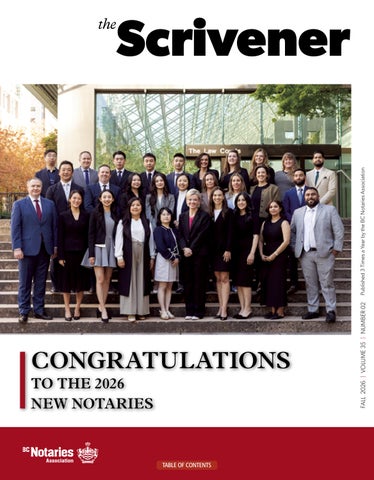
TO THE 2026 NEW NOTARIES
TABLE OF CONTENTS
FALL 2026 | VOLUME 35 | NUMBER 02
CONGRATULATIONS Published 3 Times a Year by the BC Notaries Association
Working together with Notaries in and around Vancouver since 2011.
We can help your clients with • Probate Applications • Legal Advice to Executors • Testamentary Trusts
• Living (inter vivos) Trusts • Incorporations • Tax-planned Corporate Reorganizations
Because we are focused estate-planning and probate lawyers, we refer all real estate transactions to Notaries across BC.
Connect with us to see how we can help.
www.westcoastwills.com | e. info@westcoastwills.com | p. 604 230-1068
Vancouver | North Vancouver | Burnaby | Richmond | Surrey
Contents Fall 2026 THEME:
Published by the BC Notaries Association
change change chang e change chan ge change cha nge change ch ange cchange hange
Editor-in-Chief Paul Dwyer BCNA CEO Chad Rintoul Administrative Coordinator Jenna Gardezy Courier Lightspeed Courier & Logistics Production fractal design inc. (fractal.ca) email: scrivener@bcnotaryassociation.ca website: www.bcnotaryassociation.ca Send photographs to scrivener@bcnotaryassociation.ca All rights reserved. Contents may not be reprinted or reproduced without written permission from the publisher. This journal is a forum for discussion, not a medium of official pronouncement. The BC Notaries Association does not, in any sense, endorse or accept responsibility for opinions expressed by contributors.
6
Change Chad Rintoul, CEO, BCNA
7
Rimpy Sadhra, President, BCNA
ax Logan, Executive Director and CEO M of the Society of Notaries Public of British Columbia
POSTAGE PAID AT VANCOUVER, BC RETURN UNDELIVERABLE CANADIAN ADDRESSES TO CIRCULATION DEPT. BC NOTARIES ASSOCIATION SUITE 201, 2453 BEACON AVENUE SIDNEY, BRITISH COLUMBIA V8L 1X7
4
BC NOTARIES ASSOCIATION
20 Changes to the First-Time Home Buyer GST Rebate
Jeremy Andersen
Embracing Change: Navigating a New Landscape for BC Notaries
10 Change and Balance
CANADA POST: PUBLICATIONS MAIL AGREEMENT No. 40010827
Strata Councils
Elaine T. McCormack / Emily Sheard
Keynote Turn the Page, Preserve the Story Paul Dwyer
8
16 Changing of the Guard:
12 No Small Change
Practical Considerations When a Client Wishes to Change Their Estate Plan Later in Life Kaila Dotten
22 Our Relationship with Change Changes What research on aging can teach us about time, choice, discernment, and the changing client Rhonda Latreille
29 Wealth Transfer Planning:
Preparing For Life's Transitions Rupmeet Singh
32 BCNA Continuing Education
G R A D UAT I N G C L A S S O F 2026 – CO H O R T 17
BC Notaries Graduation 2026 36 Installation Ceremony
44 Making Sense of Change
38 Class of 2026 Photo
Nigel Atkin
47 Retrospective – Law Offices and Technology in the Year 2000 Or, The Millennium is Coming Sooner Than You Think
Gorsharen Dosange, Class Representative
40 Speakers and Presenters 41 BC Notary Grad Awards 2026 42 One Year Out – The Scrivener asks
last year's Class Rep to share their experience after one year in the field. Kyla O'Reilly
Ron Usher
51 Update On Interim Distributions in Estates
Trevor Todd
58 People
Read The Scrivener online.
Scan here:
39 Address to the Graduates
T H E SCR I V EN ER : W H AT’S I N A N A M E? “A professional penman, a copyist, a scribe... a Notary.” Thus the Oxford English Dictionary describes a scrivener, the craftsman charged with ensuring that the written affairs of others flow smoothly, seamlessly, and accurately. Where a scrivener must record the files accurately, it’s the Notary whose Seal is bond. We chose The Scrivener as the name of our magazine to celebrate the Notary’s role in drafting, communicating, authenticating, and getting the facts straight. We strive to publish articles about points of law and the Notary profession for the education and enjoyment of our members, our allied professionals in business, and the public in British Columbia. Policy on AI: The Scrivener may use AI tools to assist with research, drafting, or image creation. All content is reviewed and approved by our editorial team before publication.
www.bcnotaryassociation.ca/resources/scrivener
TABLE OF CONTENTS
THE SCRIVENER | FALL 2026
5
CEO B C N O TA R I E S A S S O C I AT I O N
Change
CHAD RINTOUL
Î Change. What an appropriate theme to mark the changing of seasons, and to welcome not only a new editor of this magazine, but also a new Executive Director at the Society of Notaries Public, and twenty-nine new Notaries to the profession following a gruelling Master's degree at Simon Fraser University and an education program through the regulator. While you will notice some change to the look and feel of the Scrivener, as we have shifted to a new printer, it's really "under the hood" where Paul Dwyer will leave his mark! I welcome Paul, our long time graphic designer into his new role as editor. Along with Paul, I welcome twenty-nine new Notaries who have joined the profession. In this edition of the Scrivener you will get to meet them. The BC Notaries Association was honoured to celebrate their commissioning alongside the Society of Notaries Public in September. Our congratulations to each of you!
6
BC NOTARIES ASSOCIATION | bcnotaryassociation.ca
You will also meet Max Logan in this edition of the Scrivener. Max assumed the reins of the Society of Notaries Public back in June, from John Mayr. We wish John the best in his retirement, and look forward to working with Max as we welcome the challenges that come next. Finally, I'll thank the Board of Directors of the Association. For the past eight years I have served as an elected municipal councillor, and I appreciate the Board giving me the latitude to serve my community. While I did not run for reelection this October, I will find other opportunities to make an impact outside of work, and I'm proud to be affiliated with a profession that recognizes the importance of giving back to their community. Time marches on, and it brings change for all of us. One constant is the BCNA and our mission to advocate for Notaries, provide continuing education opportunities, and promote the profession. Respectfully, Chad Rintoul Chief Executive Officer
TABLE OF CONTENTS
KEYNOTE EDITOR-IN-CHIEF
Turn the Page, Preserve the Story Î Change can arrive as a shock or a surprise, but more often it creeps along over time, like my waistline... and my hairline.
PAU L DW Y E R
Looking back through the 110 issues Val produced, I’m humbled by how much The Scrivener has evolved over the years. Those changes have made it the valuable resource for BC Notaries it is today. Thank you, Val, for your care, your craft, and a solid foundation to build on.
Whether it comes by luck or hard work, good fortune or bad, one thing holds true— change is bound to disrupt the status quo. What matters is how we respond.
Ironically, I made it my goal to keep this change as invisible as possible while working on this, the 111th issue. Writing my first Keynote column as Editorin-Chief from a laptop in a semi-remote cabin has given me the chance to reflect on the many changes that have brought me here. You’ll see some of what I mean in Ron Usher’s prescient article from 1992 on page 47.
Sitting in my cabin in the woods, watching the leaves turn from green to gold, I’m reminded that some changes are predictable—even inevitable—and can be planned for. Change is the thread running through this issue. Kaila Dotten (p. 12) reminds us what to consider when a client’s plans shift, and Rup Singh’s article on wealth transfers (p. 29) takes the long view of the changes a legacy can set in motion. Elaine McCormack and Emily Sheard (p. 16) explore the dynamics and mechanics of change within a strata council, where turnover can threaten continuity. Rhonda Latreille (p. 22) reflects on how our relationship with change evolves over a lifetime, and Nigel Atkin tries to make sense of it all (p. 44). In this issue of The Scrivener, I have become an actual agent of change as I take up the pen passed to me by our previous Editor-in-Chief, Val Wilson.
In this issue, we also congratulate our newest Commissioned Notaries from September 2026 (p.36) and hear from last year’s Class Representative about what life looks like one year out (p. 42). Their stories remind us that every career begins with a leap into the unknown... with change. Finally, my sincere thanks to the incredible host of professionals and contributors who helped me through my first solo flight of The Scrivener. Great team. Kudos. I remain, Paul Dwyer Editor-in-Chief
TABLE OF CONTENTS
THE SCRIVENER | FALL 2026
7
PRESIDENT B C N O TA R I E S A S S O C I AT I O N
Embracing Change: Navigating a New Landscape for BC Notaries
R I M PY SA D H R A
Today, we find ourselves at another important crossroads. British Columbia’s political landscape is shifting, the real estate market continues to experience uncertainty, and our profession is preparing for a new era of legal services regulation. Î As the seasons change across British Columbia, we are reminded that change is both inevitable and necessary. Autumn, in particular, is a season of transition—a time to reflect on what has served us well, let go of what no longer does, and prepare thoughtfully for what comes next. Change is inevitable. It challenges us, pushes us beyond our comfort zones, and often creates opportunities we may not have anticipated. As BC Notaries, we are no strangers to change. Our profession has evolved over the past century, adapting to shifting economic
8
conditions, legislative reforms, technological advancements, and the changing needs of the communities we serve. Today, we find ourselves at another important crossroads. British Columbia’s political landscape is shifting, the real estate market continues to experience uncertainty, and our profession is preparing for a new era of legal services regulation. While these developments bring challenges, they also present an opportunity to reflect on who we are, the value we provide, and where we want to go.
BC NOTARIES ASSOCIATION | bcnotaryassociation.ca
TABLE OF CONTENTS
A Changing Political Landscape British Columbia is experiencing a significant period of political transition. As of this writing, a provincial election is just days away, and we may have a new government on the horizon. Whether or not the government changes, discussions surrounding housing affordability, economic stability, public services, and government priorities are once again at the forefront. For BC Notaries, political developments are more than headlines. Government decisions influence the regulatory environment in which we practise, the real estate transactions we facilitate, and the financial and estate planning needs of our clients. As an Association, our responsibility is not to align ourselves with any particular political party, but rather to build meaningful relationships across the political spectrum. Constructive dialogue, collaboration, and continued advocacy remain essential to ensuring that the voice of BC Notaries is heard and that we continue to provide legal services to our communities. The Legal Professions Act represents a substantial shift in how legal professionals in British Columbia will be regulated. As the province works through this transition, it is important that the experience, contributions, and unique role of BC Notaries remain recognized.
As we navigate these discussions, the BC Notaries Association will continue to advocate for the interests of our members and the long-term sustainability of our profession. Real Estate: Navigating Uncertainty and Opportunity The real estate market has long been a cornerstone of many notarial practices throughout British Columbia. In recent years, however, we have witnessed considerable fluctuations in transaction volumes, consumer confidence, interest rates, and housing affordability. As business owners and professionals, we should be asking ourselves: Where is our market going? What will our clients need from us tomorrow? And what decisions should we be making today to ensure our practices remain relevant and successful? Sometimes the most important business decisions are not about reacting to what is happening today, but about anticipating what may be coming next. Some periods will bring growth, others uncertainty. Our responsibility is not to resist those changes, but to understand them, prepare for them, and make thoughtful, progressive decisions that position our practices—and our profession—for long-term success.
TABLE OF CONTENTS
Looking Forward with Confidence As we celebrate a century of service, I am reminded that the strength of our profession has never rested solely in legislation, market conditions, or political circumstances. It rests in our people. Change can be uncomfortable, particularly when the path forward is not entirely clear. But it also encourages innovation, collaboration, and growth. As President of the BC Notaries Association, I remain committed to fostering relationships, advocating for our members, and ensuring that our profession continues to have a strong and respected voice. Our next chapter will undoubtedly bring new challenges. It will also bring new possibilities. We cannot always control the changes around us, but we can influence how we respond, how we lead, and the future we create together. Regards, Rimpy Sadhra, West Coast Notaries THE SCRIVENER | FALL 2026
9
CHANGE
Change and Balance Î Change has always been part of a Notary's practice—changing market conditions, changing technology, changing client expectations. That theme has been present in my career as well. For most of the past decade, I have worked with organizations undergoing significant change as they grappled with new legislation and regulations and had to adjust to a new field of play. And now, the Society and the Notarial profession are collectively grappling with fundamental change to the way in which the profession is regulated. I took on the role of Executive Director and CEO of the Society of Notaries Public of British Columbia at a moment when the ground beneath the profession was already shifting. That shift is now accelerating. We are working toward amalgamation with the Law Society of British Columbia, forming a single new regulator, Legal Professions British Columbia, under the Legal Professions Act. The target date is January 1, 2028, but the real work is happening now as we work towards the amalgamation while also seeking to preserve the history, culture and tradition of professional regulation that has served the people of BC for 100 years. There's an obvious temptation, in a transition like this, to treat change as something to survive and to hold as much of the old structure in place as possible and wait for the disruption to pass. But those of us who have navigated change know that posture can only survive for so long. In my experience,
10
the key to navigating change is to find balance. To balance holding onto tradition, while seizing the opportunity for innovation. Too often, we hold onto the old ways of doing things because it is easier that way. But when change confronts us and we have no choice but to role up our sleeves and do the work, we get a chance to seek new ways of working and to implement innovation that in ordinary times would elude us. While it is not without its challenges, amalgamation can be an opportunity to build regulatory clarity and public confidence into a new institution from the ground up. Leadership through this kind of change means finding balance in other ways too – working hard but also finding time to recharge one’s batteries; working consistently toward the end goal, but taking the time to listen and learn from those with the expertise and those most affected by the change; staying close to the details while keeping sight of the larger questions of what the public needs from their legal professionals' regulator, and how to make sure that need survives the transition intact. Whether as notaries or as regulators, we have our work cut out for us in the 18 months ahead, but I have every confidence we will emerge better and more resilient, making us better equipped for whatever inevitable change will come next. MAX LOGAN is Executive Director and CEO of the Society of Notaries Public of British Columbia
BC NOTARIES ASSOCIATION | bcnotaryassociation.ca
TABLE OF CONTENTS
MA X LOGAN
In my experience, the key to navigating change is to find balance. To balance holding onto tradition, while seizing the opportunity for innovation.
Everything you need to move a real estate transaction forward. Unity® brings the tools, information and workflows BC notaries need to manage property transactions into one place. Run your practice Stay on top of your day and give your team visibility across the practice. Manage your matters Bring matter information, documents, tasks and workflows together. Complete the transaction Access the tools and services needed to progress property transactions.
Learn more about Unity® Practice Management at dyedurham.ca TABLE OF CONTENTS
THE SCRIVENER | FALL 2026
11
CHANGE
No Small Change
K AILA DOTTEN
Practical Considerations When a Client Wishes to Change Their Estate Plan Later in Life
Î Life changes. Spouses die, relationships break down, new relationships develop, a child acts as a sole or primary caregiver for years, new family members are added and some are lost, assets change, businesses are passed on to the next generation. As life changes, Will-makers understandably want to change their estate plans too.
There is an important difference between an estate plan that is implementable and one that is defensible, capable of withstanding later scrutiny because it is coherent, documented and legally resilient. The following five tips are meant to help Will-drafting professionals move their estate plans from implementable to defensible.
Sometimes the changes appear to be minor, other times they are dramatic. Regardless, the change in and of itself may pose significant risk to the client and their future estate.
1. Do not treat testamentary capacity as a checkbox
It is trite law that a Will-maker is entitled to change their estate plan at any time before their death. The greater the departure from an established estate plan, the more important it becomes to understand, document, and carefully implement a Will-maker’s updated instructions.
12
BC NOTARIES ASSOCIATION | bcnotaryassociation.ca
Pursuant to the Wills, Estates and Succession Act (“WESA”), any person who is 16 years or older and mentally capable may make a Will. Section 37 of WESA provides that valid Wills must meet certain formal requirements (e.g., be witnessed by two witnesses and signed at the end). A Willmaker must also have testamentary capacity, a common-law concept that goes beyond simply whether a client appears to a Will-drafting professional to be generally competent.
TABLE OF CONTENTS
The legal test for determining testamentary capacity is long-standing and dates back to Banks v. Goodfellow (1870), LR 5 QB 549. In order to find that someone had testamentary capacity at the time a Will was made, there must be evidence that the Will-maker
could later be produced to bolster the validity of the Willmaker’s intended changes.
(a) u nderstood the nature and effect of making a Will,
Just because a person is vulnerable or dependent on another person (whether due to age or disability) does not mean they are subject to undue influence. Likewise, the simple fact that a client wishes to divide their estate unequally does not establish undue influence.
(b) understood the general extent of the property being disposed of, (c) comprehended and appreciated the claims to which they ought to give effect, and (d) was not affected by a disorder of the mind or delusion that influences the testamentary disposition.1 From a practical perspective, a Will-maker may be conversationally oriented, and capable of discussing ordinary matters while still having questionable testamentary capacity.
For example, it would be prudent to ask “what do you want your estate plan to accomplish?”, “who are the people who might ordinarily expect to benefit from your estate?”, “why have you decided to make this change?”, and “what do you understand the financial consequences of this change to be?”
It is important, when taking instructions for a significant change in an estate plan, that questions are asked of the Will-maker which require them to specify the change and explain it, not simply confirm it. For example, it would be prudent to ask “what do you want your estate plan to accomplish?”, “who are the people who might ordinarily expect to benefit from your estate?”, “why have you decided to make this change?”, and “what do you understand the financial consequences of this change to be?”. In addition, the Will-maker should be able to accurately describe their significant assets, understand and know what their current Will provides and explain it, and be able to specify the change they hope to see in their new plan.
In their notes, Will-drafting professionals should be sure to record the Will-maker’s actual answers and reasoning instead of just noting that capacity was confirmed. If a new estate plan is later challenged, the professional’s notes are very likely to be produced, and the most important evidence will be the professional’s notes of the client’s explanation and not simply a professional’s conclusion that the client “appeared competent”. The goal is not to create unnecessary obstacles for a Will-maker, but rather to create a reliable contemporaneous record of the client’s testamentary understanding which 1
Nassim v. Nassim Estate, 2022 BCSC 402
2. Pay attention to possible dependence, domination and suspicious circumstances
That said, section 52 of WESA is explicit that if a Will is challenged on the basis that it was drafted at a time that a person was in a position where the potential for dependence or domination of the Will-maker was present, the person seeking to uphold the Will or gift must establish that undue influence was not exercised. In other words, where this potential exists, section 52 creates a presumption that there was undue influence and puts the onus on the person wishing to uphold the Will to prove that there was no undue influence. Examples of potential for dependence or domination might not always be obvious.
Consider a client who relies on a child for transportation, meals or personal care, has given the child control over their banking, appointed the child as attorney under a power of attorney, moved into the child’s home, has limited contact with other family members or is accompanied to appointments by the child. Each of these examples alone could be evidence of a potential for dependence or domination. If that same child receives the majority of the Will-maker’s estate pursuant to a revised Will, the child would have the obligation to prove that undue influence was not exercised. If any of these circumstances exist, a more careful inquiry is necessary by the professional completing the Will-maker’s estate plan. Practically, a Will-drafting professional should meet with the Will-maker alone. Notes kept on file should include at minimum who contacted the office, who arranged the appointment, who accompanied the adult to the office, whether a beneficiary was present, whether the client was interviewed privately, what explanation the client gave independently for the change, whether the client understood the effect of excluding or reducing another beneficiary, and any concerns that were raised and how they were addressed.
TABLE OF CONTENTS
THE SCRIVENER | FALL 2026
13
CHANGE
The key takeaway is that it is imprudent to allow the person who benefits from a change to a Will to become the narrator of the client’s intentions.
reasonable expectations, the standard of living of the parties, prior gifts and benefits, financial need and other personal circumstances, misconduct and competing beneficiaries.
3. A lways draft with WESA’s Wills-variation regime as a lens
In Tom v. Tang, 2023 BCCA 221, the Court of Appeal considered an unequal distribution among five adult children. The reasons for favouring two children (because they had provided care) were relevant, but the overall distribution remained subject to the objective “judicious parent” analysis.
Will-makers are generally free to make unequal gifts, but testamentary freedom in British Columbia is subject to WESA’s Wills-variation regime. Section 60 of WESA allows the court to vary a Will if the Will does not make adequate provision for the proper maintenance and support of the Will-maker’s spouse or children. Equal treatment of independent adult children is not automatically required, and unequal treatment does not automatically mean that a Will fails to make adequate, just and equitable provision. The court’s analysis on variation claims is fact-driven and each case is different. In the context of a Wills-variation claim, the client’s reason for any change is important. Section 62 of WESA specifically allows the court to consider evidence of the Will-maker’s reasoning. Other factors a court may consider include the size of the estate, the relationship the challenging person has with the Will-maker, contributions by the challenging person,
A Will-drafting professional need not predict the viability of a possible future variation claim, but rather should recognize when the Will-maker’s instructions create a foreseeable litigation issue. When faced with a foreseeable litigation issue, such as a Will-maker who wishes to leave unequal gifts to their adult children or leave their entire estate to a new spouse, the professional should ask more questions and record the client’s answers. Ask why? What has changed since the previous Will? What relationship does the client have with each child or any spouses? Have any of the children provided care or financial assistance? Are the children financially dependent? Have any of the children already received gifts from the client? Are any of the children facing disability or any other particular need? Is the spouse the children’s parent? If not, where is the children’s other parent? Knowing the family dynamics and history is important.
YOUR CONNECTION TO BC’S MORTGAGE BROKER COMMUNITY Stay informed. Build connections. Grow professionally.
JOIN FOR $269/YEAR LEARN
Education, resources & industry insights
CONNECT
Build relationships across BC’s mortgage broker community
SAVE
Member pricing on courses, webinars & events
GET INVOLVED
Opportunities to serve on committees and the Board
Individual Non-Voting Associate Membership For professionals working in or alongside the mortgage industry.
BECOME A MEMBER TODAY cmbabc.ca | 604.408.9989
14
BC NOTARIES ASSOCIATION | bcnotaryassociation.ca
TABLE OF CONTENTS
Approximate Value
Ownership
Passes under Will?
Beneficiary/ Designation
Residence
$_________
Joint/Sole
Yes/No
_____________
Investment account
$_________
Sole/Joint
Yes/No
_____________
RRIF
$_________
Sole
No
_____________
Life insurance
$_________
Sole
No
_____________
Private company
$_________
Sole
Yes
_____________
Asset
An asset map like the one above is a good way to keep all of this information in one spot
Once the Will-drafting professional has all of this information, they should be careful not to overdraft.
5. Don’t rely on section 58 of WESA as a drafting safety net
Under section 62 of WESA, a court may consider a written statement signed by the Will-maker laying out their reasons and the circumstances in which the Will was made. That does not mean that every Will-maker should be encouraged to put a disinheritance letter into the file or Will. A better approach is to create a measured contemporaneous record of the instructions and reasons. In doing so, avoid gratuitous statements about the children and focus on facts. For example, avoid statements like “my son is a terrible person and deserves nothing”. Instead, record the facts neutrally and accurately, which creates evidence without turning the Will into a family indictment.
If you’re not familiar with section 58 as a Will-drafting professional, you need to be. It is an important and powerful provision which allows the court to order that a record, document, writing or marking on a Will be effective despite non-compliance with the s. 37 formalities.
4. Don’t assume that the Will is the whole story A Will-maker is likely to have put careful thought into their estate plan, and the professional drafting the Will should focus on carrying out their wishes. However, if significant assets are held in joint tenancy, and beneficiary designations pre-dating the Will are not changed, those assets may pass outside the Will entirely and the Will may not operate as the Will-maker intended, and could potentially result in significant conflict after the Will-maker’s death. In blended families, or when older adults are changing their estate plan, it is important for the drafting professional to have a clear picture of the entire estate plan. A professional needs to consider and understand not only the different types of assets being distributed under the Will-maker’s estate plan, but also the existing ownership and beneficiary structures for each one. A practical tip to avoid this pitfall is creating an asset map for Will-makers. It is a good way to keep all of this information in one spot, ensure that the Will works with the rest of the estate plan, and identify any inconsistencies that may otherwise be missed.
The court may make this order when it finds that the record, document, writing or marking on a Will represents the deceased’s firm and final testamentary intentions, or an intention to revoke, alter or revive an earlier Will or testamentary disposition. In determining this question, the court will consider all of the circumstances including previous Wills and other information relating to the Will-maker’s estate plan. Don’t rely on section 58 to effect changes in an estate plan. Best practice for Will-drafting professionals is to draft and execute Wills which are compliant with section 37. Post-death applications to cure a document under section 58 are costly, time-consuming, create a lot of uncertainty for the potential beneficiaries and executor(s) and delay the administration of the Will-maker’s estate. Conclusion The main takeaway is that a Will-drafting professional’s file may be as important as the Will itself. Ask the right questions, take good notes, keep all communication logs and meeting notes and maintain full electronic copies of the files. A well-documented file should allow another professional, years later, to say what the client’s previous estate plan was, what the changes were, why the client wanted the change, who was involved, whether the client gave instructions independently, what the client understood about the consequences and how the change was implemented. KAILA DOTTEN is an associate at Cassady & Company in New Westminster.
TABLE OF CONTENTS
THE SCRIVENER | FALL 2026
15
STRATA LAW
Changing of the Guard: Strata Councils
Î The individuals on a strata council can stay the same for many years in certain communities, or there can be a full or partial changeover of its members from year to year. Navigating changes in strata council membership is critical to ensuring continuity of strata business and minimizing disruptions. Some strata councils have strata management companies to assist them with this change of the weather, and others bravely face what can be a storm by themselves. In this article, we first consider when the membership of a strata council can change under the Strata Property Act, SBC 1998, c 43 (“SPA”). We then move on to considering mandatory business at the first council meeting held after an annual general meeting, and recommended business thereafter to facilitate a smooth changing of the guard. If you
16
BC NOTARIES ASSOCIATION | bcnotaryassociation.ca
E L A I N E T. M C C O R M AC K
E M I LY SHEARD
are a strata council member or considering joining council, this article serves as a starting point to enter the “new year” (after the annual general meeting is held) with confidence. How the guard changes. The usual way that the membership of a strata council changes is pursuant to a vote at an annual general meeting. For many strata communities, annual general meetings occur in the Fall. Under SPA and the Schedule of Standard Bylaws thereto (the “Standard Bylaws”), a strata council member’s term ends at the end of each annual general meeting (section 10, Standard Bylaws), and a strata council must be elected at each annual general meeting (section 25, SPA). The Standard Bylaws apply to all strata corporations and are
TABLE OF CONTENTS
the strata corporation’s bylaws, to the extent that different bylaws are filed in the Land Title Office (section 120). Even if an annual general meeting is waived under section 41 of SPA, a strata council must still be elected by acclamation. The budget for the coming fiscal year must also be approved, and any other business must be dealt with (section 41). Waiving an annual general meeting is a distinct concept from waiving notice for an annual general meeting under section 45 of SPA. Strata corporations that have fewer than four owners and strata plans that have fewer than four strata lots, such as duplexes, triplexes and quadplexes, are in a unique circumstance with respect to strata council membership. In those cases, all of the owners are on the strata council under the Standard Bylaws (section 9(2)). Those “smaller stratas” often work well until they do not and disputes arise, for example, when costly common property maintenance arises on an urgent basis. The membership of a strata council may also change outside of the annual general meeting process under the Standard Bylaws, or under amended bylaws that are passed by the owners by 3/4 vote and filed in the Land Title Office. As a best practice, be sure to review your community’s filed bylaws. Under the Standard Bylaws, if a strata council member resigns, or they are unwilling or unable to act for a period of two or more months, then the Standard Bylaws permit the other remaining members of the strata council to appoint a replacement strata council member to take their place for the rest of the term (section 12). There are numerous reasons why a strata council member may resign or be unwilling or unable to act throughout their term, such as illness, other commitments or selling their strata lot and no longer being an owner. This section allows the strata council to navigate the change in council membership by appointing a replacement before the next annual general meeting. The Standard Bylaws also permit a strata corporation to remove a council member (section 11). In contrast to replacing a strata council member as considered above, the owners at an annual or special general meeting can pass a resolution to remove one or more strata council members by majority vote. Within the last year or so, there have been a number of occasions when the Civil Resolution Tribunal (“CRT”) has been asked to make a decision on a strata property matter and also asked to grant orders removing one or more strata council members. Generally, the CRT has declined to make orders to remove one or more strata council members, citing the owners’ democratic rights to remove council members through their own process under their bylaws (see Schuler v The Owners, Strata Plan BCS 4064, 2018 BCCRT 175; Smith v The Owners, Strata Plan BCS 815, 2025 BCCRT 1709; Singh v The Owners, Strata Plan EPS 4941, 2026 BCCRT 130; Angel v The Owners, Strata Plan BCS 3011, 2026 BCCRT 179; Skoreyko v The Owners, Strata Plan K 400, 2026 BCCRT 219; and Papineau v The Owners, Strata Plan VIS 3321, 2026 BCCRT 1243).
TABLE OF CONTENTS
BC Notaries Speak Your Language
BC Notaries around the province offer many noncontentious legal services in an impressive variety of languages. English Afrikaans Arabic Bengali Bosnian Cantonese Chinese Croatian Danish Dutch Farsi Fijian Filipino Finnish Flemish French Fujian Gujarati Hindi Hungarian Italian Japanese Korean
Malaysian Mandarin Persian Polish Portuguese Punjabi Romanian Russian Serbian Spanish Swahili Swatow Swedish Tagalog Taiwanese Tamil Taoshan Telegu Turkish Ukrainian Urdu Vietnamese
Search for a BC Notary by languages spoken. www.bcnotaryassociation.ca THE SCRIVENER | FALL 2026
17
STRATA LAW
There has also been recent litigation concerning whether strata council members have been properly elected, particularly when one or more strata council members have been removed and replaced at a special general meeting that was forced by a petition of the owners (see The Owners, Strata Plan BCS 3444 v Lai, 2026 BCSC 1277 [Lai]). In those situations, there are often two factions of owners vying to control the strata council. The situation may become unworkable to the extent that an administrator is appointed by the Supreme Court of British Columbia, as was the case in Lai. Now that we have considered how the membership of strata councils can change, we consider what must happen at the first council meeting after an annual general meeting.
year, the strata council should set goals for the year to come. When considering those goals, going back to the basics is a great starting place to address new business. For each topic, consider who, what, where, when, how (and sometimes why)? Review the strata management agreement, if applicable. If the strata corporation has retained a strata management company, reviewing the agreement is critical to understanding the strata manager’s role and delineating it from those tasks that the strata council will be performing. The Condominium Home Owners Association of BC (CHOA) has a thoughtful and detailed checklist to assist with this topic (see Bulletin 400-023).
Mandatory business at the first strata council meeting. Strata councils are required under the Standard Bylaws to elect certain officers at the first strata council meeting after each annual general meeting (section 13). Those officers are the president, vice president, secretary and treasurer. A strata council member can hold more than one office at the same time, except for the offices of the vice president and president (section 13). Even if some or all of the same strata council members are voted in, there may be some changes in officers from year to year. Next, we consider some recommended topics strata councils can discuss to help make the changing of the guard as smooth as possible and to minimize interruptions.
Strata councils are required under the Standard Bylaws to elect certain officers at the first strata council meeting after each annual general meeting (section 13). Those officers are the president, vice president, secretary and treasurer.
Subsequent recommended business to ensure a smooth change. Whenever the membership of a strata council changes, there is the potential for lack of continuity. The following is a brief list of key topics that strata councils can discuss after the annual general meeting to help smooth the transition from old council to new: Address outstanding matters from the previous year. Before jumping ahead to setting new goals for the year to come, the newly formed strata council should consider any outstanding matters from the previous year, such as arrears in monies owed to the strata corporation by owners, and either address them promptly or determine a plan to do so. Goal setting for the year to come. After addressing outstanding matters from the previous
18
BC NOTARIES ASSOCIATION | bcnotaryassociation.ca
Review employee contracts. Some strata corporations hire employees to assist with the operations of the community, such as a building caretaker. Council members should be aware of the terms of each employee’s contract to understand the employee’s responsibilities, as well as the strata council’s expectations of the employee. Review any other current contracts. Strata corporations often have contracts for services such as snow removal, landscaping and more. Council members should be aware of those contracts and their terms, with respect to duration and otherwise. This review will be important for forecasting when contract renewals are up and to leave time to make decisions for negotiations or to find new vendors to perform the service without interrupting the same.
Review insurance policies. Strata corporations are required under SPA and the Standard Bylaws to maintain insurance on certain property. Strata corporations may also choose to obtain optional insurance, such as errors and omissions insurance for their council members. Council members should be aware of what insurance policies the strata corporation carries and their details, such as deductible amounts, as well as whether there is errors and omissions insurance in place to protect them in their roles as council members. Determining lines of communication between owners and strata council members. Council should discuss how it would collectively like owners to correspond with its members — for example, how owners can make certain requests, such as for alterations to their strata lot or for strata documents under sections 35 and 36 of SPA. If the strata corporation has a strata manager, it may be discussed in the strata management agreement that the strata manager will field most of those inquiries.
TABLE OF CONTENTS
Office
Council members should also decide how to notify owners of their established lines of communication, which may be by publishing the same in minutes of a council meeting. Council’s expectations of each other.
for Sale or Lease Downtown Vancouver
482 sq. ft. furnished office suite on 938 Howe Street, available immediately at an attractive rate. Across from Vancouver Law Courts with excellent transit access. Bright suite with 2 private rooms and reception.
Council members should come prepared to discuss their expectations of their fellow council members. A conversation Contact Mahyar: 778-235-8001 should address how many times the strata council members can realistically meet in the year before the next annual general meeting, how they will address requests of owners in the time between strata council meetings, if applicable, and how they will communicate with each other. Even if one or two council members change, it is still good practice “Knowledgeable and Capable” to revisit these items soon after an annual general meeting “Knowledgeable and Capable” “Knowledgeable and Capable” to set council up for success that year and evaluate whether 604-538-3388 604-538-3388 604-538-3388 any changes to processes, contracts or other items need to be CammackHepner.ca CammackHepner.ca CammackHepner.ca made for the upcoming year. New council members should Gordon Hepner Gordon G.G. Hepner #106 – 1656 Martin Drive Gordon Hepner – 1656 Martin Drive – 1656 Martin Drive MA(ALS), Notary Public also be provided with access to copies of important strata #106#106 MA(ALS), Notary Public MA(ALS), Notary Public gordon@CammackHepner.ca Surrey, BC V4A 6E7 gordon@CammackHepner.ca Surrey, BC V4A 6E7 gordon@CammackHepner.ca Surrey, BC V4A 6E7 documents, including but not limited to the strata plan and all current bylaws. Strata councils should also consider how to address what happens when an individual is no longer on council. Many strata councils conduct some strata business, if not all, electronically. If at the end of an annual general meeting, an individual is not re-elected to the strata council, then their term ends. Even though their term ends, the individual may still have access to strata documents either electronically or physically, have access to a strata email account, or be in a group or chat with other council members. This raises privacy concerns. Strata corporations are bound by the Personal Information Protection Act, SBC 2003, c 63, with respect to the collection, use and disclosure of personal information and their obligations, including but not limited to developing and following a privacy policy (sections 2 and 5).
Here’s help with your book . . . Managing Editing Organizing Writing
valgal@shaw.ca
Fall can bring many changes, one of which may be a change in your community’s strata council membership. In this article, we considered when the membership of strata councils can change under SPA, what must happen at the first council meeting after an annual general meeting and key topics of business to consider soon thereafter. We hope this article is helpful to strata councils navigating changes in their membership. Councils may wish to obtain legal advice on various topics discussed in this article, such as strata governance, contracts, bylaws, collections, privacy and disputes. This article is for educational purposes only and does not constitute legal advice. ELAINE MCCORMACK is a Lawyer, mediator and arbitrator with Wilson McCormack Law Group. EMILY SHEARD is an associate Lawyer with Wilson McCormack Law Group.
Alexander Ning Notary Corporation Alex Ning Notary Public, Mediator, Immigration & Refugee Counsel
Alex Ning
Notary Public, Mediator, Immigration & Refugee Counsel
TABLE OF CONTENTS
206 - 8120 Granville Alexander NingAvenue, Notary Corporation Richmond, BC, Canada V6Y 1P3
206 - 8120 Granville Avenue,
Email: alex@annc.ca Fax: 604 270-4751 Richmond, BC, Canada V6Y 1P3 Direct: 604 270-8155 Telephone: 604 270-8384
Email: alex@annc.ca Direct: 604 270-8155
Fax: 604 270-4751 Telephone: 604 270-8384
THE SCRIVENER | FALL 2026
19
CHANGE
Changes to the First-Time Home Buyer GST Rebate
Î This past Spring saw a change to the federal GST when the new First-Time Home Buyer GST Rebate received Royal Assent on March 12, 2026. This long-awaited rebate was first introduced and proposed on May 27, 2025. What is the first-time home buyers’ rebate? The First-Time Home Buyer GST Rebate (the “Rebate”) allows eligible individuals who are buying, building, or substantially renovating their first home to reduce the amount of tax they pay when the home has a fair market value between $1 million and $1.5 million. Eligibility To be considered a first-time home buyer (FTHB) and thus eligible to apply for the Rebate, the applicant must meet all of the following conditions: y Must be at least 18 years of age; y Must be a Canadian citizen or permanent resident of Canada; y Must not have lived in a home that the applicant or the applicant’s spouse or common-law partner
20
owned, or jointly owned, whether in or outside of Canada, as a primary place of residence at any time in the calendar year or in the previous four calendar years; y Neither the applicant, nor the applicant’s spouse or common-law partner, has previously received an FTHB GST/HST rebate; and y The newly built or substantially renovated home must be used as the individual’s primary place of residence. If the home was purchased from a builder, the applicant must be an FTHB on the date ownership of the home is transferred. If the applicant built or substantially renovated their own home, they must be an FTHB on the earlier of when they first occupied the home as a place of residence and when construction or substantial renovation of the home is substantially completed. For purposes of the GST new housing rebate, a substantial renovation means at least 90 per cent of the existing interior livable space of a house must be removed or replaced—effectively gutting the building.
BC NOTARIES ASSOCIATION | bcnotaryassociation.ca
TABLE OF CONTENTS
JEREMY ANDERSEN
For purposes of the GST new housing rebate, a substantial renovation means at least 90 per cent of the existing interior livable space of a house must be removed or replaced—effectively gutting the building.
It is worth noting that the FTHB GST/HST rebate exists in addition to the existing GST/HST new housing rebate, meaning that individuals may be eligible for both rebates. Where both rebates apply, the FTHB GST/HST rebate acts as a top up to the existing GST/HST new housing rebate. Amount of Rebate The rebate eliminates GST on newly built or substantially renovated homes up to a maximum rebate of $50,000, meaning that GST is entirely eliminated on homes valued at or below $1 million. For homes valued between $1 million and $1.5 million, the maximum rebate is reduced on a straight-line basis. For homes valued at or above $1.5 million, there is no rebate. For example, let’s say an eligible individual purchases a new home for $1.25 million. As the new home value of $1.25 million is the mid-point between $1 million and $1.5 million, it is eligible for 50 percent of the maximum rebate of $50,000. Therefore, the eligible rebate is $25,000 (50 percent of $50,000 maximum rebate).
parties. When you are an owner-builder (which would include an owner who has undertaken to substantially renovate a home), you are generally exempt from paying additional GST on the overall fair market value of the finished home. This provides relief for homeowners who are renovating their existing home for their own personal use, but ensures property flippers are not unintentionally exempted. Applying for and Receiving the Rebate Eligible owners generally have up to two years from the date ownership of the home is transferred to apply for the rebate, although the applicable deadline depends on the type of rebate claim being made. There are five rebate application types, and each application type has its own submission requirements and filing deadline. Which application should be used depends on whether or not the builder pays or credits the rebate, and whether the interest in the land acquired is freehold or leasehold. According to the Government of Canada, all claims are subject to audit, which may result in a delay of up to six months before receiving payment.
Substantial Renovations
Final Thoughts
As I have noted here, in addition to newly built homes, the GST rebate applies to homes that have been substantially renovated, but why?
The new First-Time Home Buyer GST Rebate represents one of the most significant federal tax incentives for first-time buyers in recent years. However, the eligibility rules are detailed, and the amount of the rebate depends on a number of factors, including the purchase price, the type of home, and whether the buyer meets the definition of a first-time home buyer. Before committing to the purchase of a newly built or substantially renovated home, it is worthwhile to confirm whether you qualify and to ensure the appropriate rebate application is submitted within the required time limits. A little planning can make a significant difference.
While it is commonly overlooked that, prima facie, the GST applies to all conveyances of real property, it is generally understood that GST applies to new homes and therefore that used homes are exempt. In other words, a third party who is first to purchase a new home is subject to GST on the fair market value of that home. Subsequent owners of that home receive an automatic exemption from the tax. The same applies to homes that have been "substantially renovated". Therefore, a third party who is first to purchase a home that has been substantially renovated is also subject to GST on the fair market value of that home. An important nuance here is that this applies to transactions taking place between third
J E R E M Y A N D E R S E N is a Courtenay Notary Public and CPA, CA, with 20 years’ experience working in the public sector, private industry, and public practice.
TABLE OF CONTENTS
MACKENZIE FUJISAWA LLP BA RRI ST E RS & S OL I CI TO RS
Proud to be Serving BC Notaries and their Clients with • Wills & Estates Litigation • Real Estate Disputes • Business Disputes & Transactions
QUANG T. DUONG
IAN M. KNAPP
ANDREW J. KIM
Phone: (604) 689-3281 Fax: (604) 685-6494
www.macfuj.com
THE SCRIVENER | FALL 2026
21
CHANGE
Our Relationship with Change Changes
R H O N DA L AT R E I LLE
What research on aging can teach us about time, choice, discernment, and the changing client What if the house represents her independence, life with her husband, raising a family, celebrations around the table, neighbours she knows, routines she chose, and the quiet confidence of knowing exactly where everything belongs?
Î “She’s just set in her ways”
But is she?
Betty is in her late seventies and has lived in the same home for 42 years.
What if Betty’s reluctance has very little to do with age?
Her children have done the math. The stairs are becoming more difficult. The garden takes work. The house is worth a small fortune. A condominium would be easier.
What if the house represents her independence, life with her husband, raising a family, celebrations around the table, neighbours she knows, routines she chose, and the quiet confidence of knowing exactly where everything belongs?
Financially, practically, emotionally, and physically, selling makes sense. Betty does not want to sell. The family chalks it up to one familiar explanation. “Mom is just set in her ways.”
22
What if it represents competence, identity, autonomy, and security? And what if the condominium that looks so sensible to her children represents something completely different to Betty?
BC NOTARIES ASSOCIATION | bcnotaryassociation.ca
TABLE OF CONTENTS
That brings us to a question worth asking: Does our capacity for change diminish as we age, or does our relationship with change itself change? Do We Really Become Set in Our Ways and if So, When Does That Happen?
to learning, exploration, meeting new people, acquiring knowledge, and creating future possibilities. As perceived time becomes more limited, priorities often shift toward emotional satisfaction, close relationships, meaning, and experiences valued in the present.
There is some good news for anyone worried that a birthday eventually turns us into psychological concrete. A 2026 meta-analysis published in Psychological Bulletin brought together 229 longitudinal studies involving 230,492 people. The researchers found meaningful individual differences in personality change across our lifespan. In other words, people do not arrive at some predetermined birthday when personality freezes, and we all become permanently “set.” Now here is where it gets interesting. Changeability and appetite for change are not the same thing.
When the Future Feels Different Stanford psychologist Laura L. Carstensen offers another way of thinking about this. Dr. Carstensen developed Socioemotional Selectivity Theory, which proposes that our motivation is influenced in part by how much future time we perceive ourselves to have. When the future feels large and open, people often give greater priority
Neither calculation is irrational. They respond to different objectives. What Does This Mean for Professionals Serving Age 50+ Clients?
“Faster.”
As perceived time becomes more limited, priorities often shift toward emotional satisfaction, close relationships, meaning, and experiences valued in the present.
“More efficient.” “Completely online.” “Less paperwork.” Wonderful. But the client may be asking an entirely different set of questions. Will I understand it? Will I still be able to speak with someone? Will I have control?
What if it changes what we are willing to exchange for it?
Perhaps Betty has not yet been offered an alternative living arrangement that feels worthy of the exchange.
“Will this make the life I am living now better?”
Professionals often introduce a new process with words meant to reassure us.
What if age changes what we want from change?
And what if being experienced with change makes us more discerning rather than simply more resistant?
A 75-year-old may quite reasonably ask:
Will I feel comfortable?
Here is the part that challenges the usual age stereotype. This does not appear to be purely about chronological age. Research manipulating individuals’ perceived time horizons found that priorities can shift when people of different ages experience time as more expansive or more limited. It appears that the time horizon had more influence than age. Perhaps we do not necessarily become less willing to change as we age. Perhaps we become less willing to change for reasons that no longer matter very much to us. For instance, a 30-year-old may tolerate considerable disruption today because of what it could produce five or ten years from now.
TABLE OF CONTENTS
Will this actually improve anything that matters to me? That creates a useful question for every profession adopting new processes. Is this better? Better for whom, and by whose measure? Chosen Change Feels Different Let’s return to Betty. Compare these two statements: “I have decided that I’m ready to sell my house.” “My children have decided that it’s time for me to sell my house.” THE SCRIVENER | FALL 2026
23
CHANGE
Services a BC Notary Can Provide A. PROPERTY MATTERS 1. Residential and Commercial Real Estate Transfers 2. Mortgage Refinancing Documentation 3. Manufactured Home Transfers 4. Easements, Covenants, and Rights of Way 5. Builder’s Liens 6. Subdivisions and Statutory Building Schemes 7. Zoning Applications
B. PERSONAL PLANNING
They are identical legal transactions, yet completely different psychological and personal experiences. Research on later-life relocation has repeatedly identified involvement in the decision and perceived control as factors associated with better adjustment. A systematic review examining transitions into long-term care found that people’s ability to exercise control over the decision to move, participate in its exploration and dialogue, preserve autonomy, and retain meaningful social relationships were among the factors affecting the positive relocation experience.
y Does she feel involved in the decision or managed by it? y Is reluctance being interpreted as incapacity simply because somebody else disagrees with her choice? None of those questions assume that the family is wrong. Families often care enormously and are trying to solve real problems. They simply bring us back to the person whose signature, property, wishes, preferences, and life are actually at the centre of the transaction. The Transaction May Be Routine. The Change is Not.
1. Wills Preparation 2. Powers of Attorney 3. Representation Agreements 4. Advance Directives 5. Wills Notice Searches 6. Estate Planning
Sometimes resistance to change may actually be resistance to losing control over the change. Who Owns the Change?
Professionals may see:
C. NOTARIZATION /DOCUMENTS
A client arrives with an adult son or daughter.
Sale of property.
1. Affidavits for All Documents required at a Public Registry within BC 2. Certified True Copies of Documents 3. Execution/Authentications of International Documents 4. Notarizations/Attestations of Signatures 5. Insurance Loss Declarations 6. Personal Property Security Agreements 7. Statutory Declarations 8. Authorization of Minor-Child Travel 9. Letters of Invitation for Foreign Travel 10. Passport Application Documentation
D. BUSINESS 1. Business Purchase/Sale 2. Commercial Leases and Assignment of Leases 3. Contracts and Agreements
E. SOME BC NOTARIES PROVIDE THESE SERVICES. 1. Marine Bills of Sale and Mortgages 2. Marine Protests 3. Marriage Licences 4. Mediation 5. Real Estate Disclosure Statements
There are Notaries to serve you throughout British Columbia For the BC Notary office nearest you, please call 604-676-8570 or visit www.bcnotaryassociation.ca. Note: Not all Notaries provide all services listed. Please check with your Notary before making an appointment for services.
24
There is often a conversation beneath the conversation.
The child explains.
The client may see:
“We’re selling Mom’s house.”
he last place my husband and I lived T together.
“We’ve decided she should give up the property.” “We’re reorganizing everything.” “She doesn’t really understand online banking.” “She’ll be moving closer to us.” Perhaps everything being proposed is sensible. But listen to the pronouns. We. That one little word should make us curious. (I love the promise that being curious offers.) Whose change is it? For a professional, that may invite several quiet questions. y Who initiated the transaction? y Who is doing most of the talking? y What does the client herself want? y What alternatives does she believe she has?
BC NOTARIES ASSOCIATION | bcnotaryassociation.ca
TABLE OF CONTENTS
Professionals may see: New Will. The client may see: y daughter and I haven’t spoken in M three years. Professionals may see: Transfer of title. The client may see: I ’m finally helping my grandson buy his first home. Professionals may see: Power of attorney. The client may see: I ’m admitting that someday I may need someone else’s help. The document can be familiar to the professional while the life event behind it is entirely unfamiliar to the client.
Dr. Carstensen’s research on emotional meaning gives us a useful frame for this. As perceived time becomes shorter, emotionally meaningful goals often become relatively more prominent. Something that appears sentimentally disproportionate to someone standing outside the situation may be exactly what matters most to the person living through it. Perhaps Experience Makes Us Better at Change Now think about someone who is 80. They may have lived through economic recessions, technological revolutions, changes in family structure, marriage, divorce, parenthood, career changes, retirement, moves, illness, bereavement, f inancial upheaval, shifting social expectations, and perhaps the loss of people they loved. And then we call this person resistant to change? There is something almost comical about that. An 80-year-old may have adapted to more change than almost anyone else in the room. Perhaps accumulated experience does not eliminate adaptability. Perhaps sometimes it produces discernment. You have changed before. Many times. You know that change has costs as well as benefits. You may simply become more discriminating about paying the price. Aging Does Not Necessarily Make the World Look Darker There is another stereotype worth questioning. A meta-analysis of 100 studies involving 7,129 participants found evidence for what researchers call an
age-related positivity effect. Compared with younger adults, later-life adults showed a relative preference for positive over negative information in attention and memory. Researchers have connected this pattern, at least in part, with motivational priorities and emotion regulation. So later life cannot simply be characterized as an inevitable slide toward fear, negativity, lack of trust, and aversion to anything new. In some respects, emotional regulation can improve. (So much for Grumpy Old Men). Perhaps the reluctant client is not necessarily afraid.
Who Will See Your Ad in The Scrivener? BC Notaries Lawyers Land Surveyors of BC Real Estate Professionals Real Estate Boards and Associations Age-Friendly Designates MLAs and MPs in BC Life Insurance Brokers and Agents Accountants
Perhaps she has simply decided that what is being offered is not worth what she would have to surrender.
Managers of Financial Institutions
Now that is a very different conversation.
Provincial and Federal Court Judges
Before Calling it Resistance, Ask Five Questions When a client hesitates about a significant change, perhaps we could ask five questions before deciding what the hesitation means.
Investment Management Agencies
Registrars Mayors Government Ministries Libraries: Public and Private, including Law Society, Legal Services, Education Facilities
1. Did they choose it? Voluntary and imposed change can feel completely different.
Chambers of Commerce
2. W hat are they giving up? The answer may have very little to do with money.
Ministry of Citizens’ Services: Real Property Division
3. W hat do they believe they are getting? Professionals and family members may see benefits the client simply does not value. 4. W hat does the current situation mean to them? A house, business or document can represent far more than its practical function. 5. A re we asking them to change in a way that respects how they want to live now?
TABLE OF CONTENTS
BC Housing BC Assessment
Winter Advertising Space Deadline Nov 15, 2026 scrivener@bcnotaryassociation.ca www.bcnotaryassociation.ca THE SCRIVENER | FALL 2026
25
CHANGE
“More Efficient” and “Better” Are Not Always Synonyms. So Did Betty Sell? Perhaps she sells. Perhaps she stays. Perhaps today is not the day, and two years from now she changes her mind. We do not need to know. That is part of the point.
The question is not which outcome proves Betty was sensible. The more revealing question is whether she had the information, autonomy, time and opportunity to make the decision as her decision. Did she feel that she had agency over the situation?
The question is not which outcome proves Betty was sensible. The more revealing question is whether she had the information, autonomy, time and opportunity to make the decision as her decision. Did she feel that she had agency over the situation? “Mom is just set in her ways.” Maybe. Or perhaps Betty has spent 78 years learning what deserves changing and what does not. And perhaps that is where this discussion turns back on us. When a client resists a change that appears perfectly sensible, do we immediately ask: “Why won’t they change?” Or do we ask: “What does this change require them to give up?” “What are they being offered in return?”
“Who chose it?” And perhaps the question underneath all of them: “What does this change mean to them now?” Change can represent progress. It can also represent loss dressed in the language of efficiency, usefulness, practicality, or concern. For professionals, the challenge may be less about persuading people to accept change and more about becoming curious enough to understand the person experiencing it. Because throughout a lifetime, we do not simply experience change. Our relationship with change changes too. And perhaps the final invitation is this: The next time we are tempted to describe a client as “set in their ways,” we might ask whether the resistance belongs to them at all. Maybe, just maybe, we are the ones who need to change the way we see change. RHONDA LATREILLE, MBA, CPCA, is the Founder and CEO of Age-Friendly Business®.
Research Referenced Haehner, P., Hopwood, C. J., Schellenberg, L., Schwaba, T., & Bleidorn, W. (2026). Individual Differences In Personality Trait Changes Across the Lifespan: A MetaAnalysis of Longitudinal Studies. Psychological Bulletin. (https://psycnet.apa.org/record/2027-95464-004)
Brownie, S., Horstmanshof, L., & Garbutt, R. (2014). Factors that impact residents’ transition and psychological adjustment to long-term aged care: a systematic literature review. International Journal of Nursing Studies. (https://pubmed.ncbi.nlm.nih.gov/24813582/)
Carstensen, L. L. (2021). Socioemotional Selectivity Theory: The Role of Perceived Endings in Human Motivation. The Gerontologist, 61(8), 1188–1196. (https://academic.oup.com/gerontologist/article/61/8/1188/6412643)
Reed, A. E., Chan, L., & Mikels, J. A. (2014). Meta-analysis of the age-related positivity effect: age differences in preferences for positive over negative information. Psychology and Aging. (https://pubmed.ncbi.nlm.nih.gov/24660792/)
26
BC NOTARIES ASSOCIATION | bcnotaryassociation.ca
TABLE OF CONTENTS
The Most Dangerous Email Is the One That Looks Completely Normal A familiar name. A routine request. One click. Cyber criminals are getting better at targeting notaries—and sometimes, it only takes one convincing email to put sensitive information, funds, and transactions at risk. The Cost of a Click: How Cyber Criminals Target Legal Professionals Scan to read the article and learn how to protect yourself.
Hashim Jafree Senior Director, Product & Sales hashim.jafree@ctt.com 236.335.5423 Fraser Valley and Vancouver Island
Crystal Gill Regional Director, Title Solutions crystal.gill@ctt.com 236.330.4936 Greater Vancouver and Okanagan TABLE OF CONTENTS
THE SCRIVENER | FALL 2026
27
Prefer Paperless?
Writers! Want to be part of our
Winter 2026 Issue?
The BCNA has back issues of The Scrivener available on our website and on ISSUU at issuu.com/bcnotaryassociation.
Contact:
scrivener@bcnotaryassociation.ca
To update your subscription preference, please email bcna@bcnotaryassociation.ca.
Article & Advertising
Deadline
November 15
www.bcnotaryassociation.ca
www.bcnotaryassociation.ca 28
BC NOTARIES ASSOCIATION | bcnotaryassociation.ca
TABLE OF CONTENTS
CHANGE
Wealth Transfer Planning: Preparing For Life's Transitions
RUP SINGH
How Change Reshapes Your Wealth Legacy
Î Change is inevitable. Whether it arrives as a market correction, a shift in family structure, or a major life milestone, change forces us to reassess where we are and where we're heading. For those building and preserving wealth, change often becomes a catalyst—an opportunity to strengthen financial security and ensure your legacy aligns with your evolving priorities. Yet many successful professionals and business owners treat wealth transfer planning as a distant concern, something to address "someday." The reality is that transition planning isn't something you do once; it's a living strategy that must adapt as your circumstances change.
In my years working with clients— from incorporated professionals to business owners to high-net-worth families—I've learned that the most secure legacies are built by those who anticipate change rather than react to it. Why Static Plans Fail When I meet with clients, I often ask: "When was the last time you reviewed your wealth transfer strategy?" Many have outdated plans created during a bull market, before recent economic shifts. Markets don't remain static— neither should your strategy. Market volatility impacts wealth transfer in critical ways. Your estate
TABLE OF CONTENTS
might be worth $5 million today but $3.5 million during a significant downturn. If your succession plan assumes specific asset values (e.g., real estate, business valuation, or investments), sudden market movements can disrupt carefully laid plans. Additionally, as investment values fluctuate, so do capital gains and potential tax liabilities. A portfolio heavily weighted toward volatile stocks faces different tax exposure than a diversified one. During market downturns, families may be forced to sell assets at inopportune times to fund estate taxes or settle debts. Without proper liquidity planning, your heirs could face unnecessary losses. THE SCRIVENER | FALL 2026
29
CHANGE
Services a BC Notary Can Provide A. PROPERTY MATTERS 1. Residential and Commercial Real Estate Transfers 2. Mortgage Refinancing Documentation 3. Manufactured Home Transfers 4. Easements, Covenants, and Rights of Way 5. Builder’s Liens 6. Subdivisions and Statutory Building Schemes 7. Zoning Applications
B. PERSONAL PLANNING 1. Wills Preparation 2. Powers of Attorney 3. Representation Agreements 4. Advance Directives 5. Wills Notice Searches 6. Estate Planning
C. NOTARIZATION /DOCUMENTS 1. Affidavits for All Documents required at a Public Registry within BC 2. Certified True Copies of Documents 3. Execution/Authentications of International Documents 4. Notarizations/Attestations of Signatures 5. Insurance Loss Declarations 6. Personal Property Security Agreements 7. Statutory Declarations 8. Authorization of Minor-Child Travel 9. Letters of Invitation for Foreign Travel 10. Passport Application Documentation
D. BUSINESS 1. Business Purchase/Sale 2. Commercial Leases and Assignment of Leases 3. Contracts and Agreements
E. SOME BC NOTARIES PROVIDE THESE SERVICES. 1. Marine Bills of Sale and Mortgages 2. Marine Protests 3. Marriage Licences 4. Mediation 5. Real Estate Disclosure Statements
There are Notaries to serve you throughout British Columbia For the BC Notary office nearest you, please call 1-604-676-8570 or visit www.bcnotaryassociation.ca. Note: Not all Notaries provide all services listed. Please check with your Notary before making an appointment for services.
30
The solution? Regular strategy reviews—ideally annually or when market conditions shift significantly— ensure your plan remains resilient. Stress-test your estate plan against various market scenarios. By modelling these possibilities proactively, you can make adjustments before crisis strikes. Life Stage Shifts: From Accumulation to Distribution Your priorities at 35 are vastly different from those at 55. Yet many people fail to update their wealth transfer plans as life evolves. Early Career (Ages 30–45) focuses on wealth accumulation and protecting earning capacity through insurance. Mid-Career (Ages 45–60) is often the sweet spot—you've built significant wealth but aren't yet retired. Many incorporated professionals find themselves managing corporations, multiple investment accounts, and real estate. Your wealth transfer strategy must now address business succession planning, tax optimization across structures, and serious conversations about distributing wealth. Pre-Retirement and Retirement (Ages 60+) shifts focus from accumulation to distribution and legacy. Your wealth transfer strategy becomes critical—it's no longer theoretical. I often see this tragedy: Someone builds an impressive business over 30 years, but because they didn't plan for the transition from accumulation to distribution, their estate is fragmented, heavily taxed, or settled in ways they never intended. If you're a business owner in your 50s, what happens at 65? Do you sell? Pass it to family? Wind down? Each scenario has radically different wealth transfer implications. Family Circumstances: Complexity Requires Clarity Family dynamics are rarely simple, and they shift over time. A client with a solid plan suddenly remarried— creating two sets of adult children with different expectations. How do you support current family without
BC NOTARIES ASSOCIATION | bcnotaryassociation.ca
TABLE OF CONTENTS
depriving children from a previous marriage? How do you ensure fairness without creating conflict? Family changes that reshape strategy include marriage, divorce, remarriage, births, blended families, caregiving obligations, and evolving values. A client who once planned to leave everything equally to children might later prioritize grandchildren's education, charitable giving, or distribution based on need. Your wealth transfer plan isn't static because your family isn't static. The most resilient plans build flexibility through trusts, updates triggered by life events, and regular conversations with advisors about evolving priorities. Succession Planning: The Cornerstone of Proactive Wealth Management Succession planning applies to your entire financial life, not just businesses. For business owners, it addresses who runs the business if you can't, when and how you'll exit, valuation, and tax implications. For incorporated professionals, similar questions arise around practice management and financial affairs. But succession planning goes beyond business—it ensures your wealth is managed according to your wishes, whether you're alive or unable to act. The Three Pillars of Effective Succession Planning Are: Clarity of Intent. Your successors must understand what you want, documented through Wills, Powers of Attorney, and regular communication. Structural Alignment. Your financial structures are organized for smooth transition. Business owners might use multiple Wills (one for corporate assets, one for personal assets) to minimize probate fees and simplify settlement. Professional Coordination. Succession planning requires coordination between your financial advisor, accountant, legal counsel, and insurance broker.
When these pillars are in place, succession planning becomes proactive wealth management—a tool that protects your family, minimizes taxes, and ensures your legacy is preserved exactly as you intended. The Role of Notaries in Wealth Transfer Planning While financial planning is my specialty, wealth transfer planning isn't complete without proper legal documentation. This is where Notaries play a vital role. Wills and Powers of Attorney are the legal backbone of any wealth transfer strategy. Yet many Canadians—even those with significant wealth—either don't have these documents or have documents that are outdated and misaligned with their current financial reality. A Will outlines how your assets will be distributed after your death. For many with straightforward circumstances, Notaries offer a cost-effective and efficient path to creating a legally binding document. A Power of Attorney allows someone you trust to manage your financial affairs if you become incapacitated. Without a POA, your family could face lengthy and costly court processes. For incorporated professionals and business owners, Notaries often recommend multiple Wills—one for personal assets and another for corporate assets. This structure can significantly reduce probate fees and simplify estate settlement. The process is straightforward: A Notary meets with you to understand your wishes, drafts your documents ensuring compliance with the provincial law, and finalizes everything so you have a clear plan in place. Bringing it All Together The most resilient wealth transfer strategies recognize that financial planning and legal documentation are intrinsically connected. Your financial advisor identifies gaps and structures assets for tax efficiency; your Notary
The most resilient wealth transfer strategies recognize that financial planning and legal documentation are intrinsically connected. Your financial advisor identifies gaps and structures assets for tax efficiency; your Notary ensures intentions are documented and legally enforceable; your accountant coordinates tax implications. Regular communication with these advisors ensures your plan evolves as circumstances change.
ensures intentions are documented and legally enforceable; your accountant coordinates tax implications. Regular communication with these advisors ensures your plan evolves as circumstances change. The result? A comprehensive strategy that protects your family, minimizes taxes, honours your wishes, and gives you peace of mind. Take the First Step Toward Financial Security If you don't have a Will or POA in place—or if you suspect your financial plan
TABLE OF CONTENTS
may have gaps—it's time to take action. Change is coming. Economic and market volatility will continue. Life stages will shift. Family circumstances will evolve. The question isn't whether your strategy will need to adapt—it's whether you'll anticipate those changes or react to them. R U P M E E T S I N G H is a Senior Portfolio Manager and Wealth Advisor at RBC Dominion Securities. rupmeet.singh@rbc.com THE SCRIVENER | FALL 2026
31
BC NOTARIES
2027
CONTINUING EDUCATION CONFERENCE
WE LOOK FORWARD TO WELCOMING YOU TO THE BCNA 2027 CONTINUING EDUCATION PROGRAM
REGISTRATION WILL OPEN IN JANUARY 2027 The British Columbia Notaries Association is pleased to welcome you to our 2027 Annual Continuing Education Conference, taking place at the JW Marriott Parq Vancouver. Professional continuing education and development remain fundamental to the success of BC Notaries and play an important role in maintaining the high standards of service the public has come to expect from Notaries as trusted providers of noncontentious legal services. We extend our sincere thanks to the members of the BCNA Continuing Education Liaison Committee for their valuable contribution in helping to develop an engaging and relevant educational program for this year’s conference. Interested in exhibiting at the 2027 Conference? We welcome the opportunity to connect with organizations interested in exhibiting and engaging with BC Notaries. For exhibitor opportunities and further information, please contact Trista Zamany at tzamany@bcnotaryassociation.ca. www.bcnotaryassociation.ca 32
BC NOTARIES ASSOCIATION | bcnotaryassociation.ca
TABLE OF CONTENTS
THANK YOU
TO OUR 2026 SPONSORS
The Dye & Durham Platform connects a global network of professionals with public records to support business transactions and regulatory compliance.
With thanks to the Notary Foundation for their continued support
TABLE OF CONTENTS
THE SCRIVENER | FALL 2026
33
BC NOTARIES
Upcoming Continuing Education Sessions Lunch and Learns
Topic: Dye & Durham - Emerging Risks in BC Real Estate: Navigating AI, Cybersecurity and Client Trust Presenter: Geoff Smith, Senior Vice President, AI & IT When: Wednesday, October 21 Time: 12 noon Where: Zoom
Geoff Smith is Senior Vice President, AI & IT at Dye & Durham, where he leads AI strategy and global IT across Canada, the UK, Ireland, Australia and South Africa. He chairs the company's AI Governance Committee, which sets how AI tools are approved and used in a publicly listed legal technology business that processes data for law firms, financial institutions and government clients. Before Dye & Durham, Geoff spent 20 years in payments and fintech – an industry where security and client trust are the product. He held technology and compliance leadership roles at Carta Worldwide, including PCI DSS management for card-issuer processing serving banks and fintechs, ran IT for Island Pay's mobile payments platform in The Bahamas, and co-founded CiNKO, a stablecoin payment platform for Latin America and the Caribbean. He started his career at Visa.
Geoff Smith His focus is practical: how firms adopt AI without exposing client data, and where cyber risk actually sits in a real estate transaction.
Topic: Fct - When Real Estate Files Don’t Go As Planned. A Practical E&O Conversation Presenters: Harpreet Hayer, Business Development Manager
Heather Thoma,
Regional Vice President, Western Canada
When: Wednesday, November 4 Time: 12 noon Where: Zoom Description: Even carefully managed real estate files can lead to an errors
and omissions (E&O) allegation. While mandatory E&O insurance may respond to the underlying claim, legal professionals can still face out-of-pocket costs, including deductible payments and premium surcharge increases. Smaller issues, such as missed payouts, disbursement errors or demand letters, can also create unexpected costs before a matter reaches the mandatory insurer.
34
BC NOTARIES ASSOCIATION | bcnotaryassociation.ca
Harpreet Hayer is an experienced financial services professional with more than 20 years of banking experience in progressively senior roles across Banking and Wealth, Branch Management, and Business Banking. At FCT, she works closely with legal professionals, bringing a client-focused approach grounded in collaboration, responsiveness, and a strong understanding of their needs. She is committed to building trusted relationships and providing a positive client experience. Known for her customer-focused mindset and relationship-building skills, Harpreet draws on her extensive banking experience to provide thoughtful, practical support to clients and partners. Heather Thoma is a seasoned financial services professional with more than 20 years of industry experience, including over a decade supporting the mortgage ecosystem at FCT. Her background spans residential and commercial lending, insurance, and strategic account management, giving her a comprehensive understanding of the end-to-end mortgage lifecycle. In her role at FCT, Heather works closely with brokers, lenders, and legal professionals to improve closing efficiency, reduce risk, and enhance the borrower experience. She is known for her practical insight, collaborative approach, and ability to translate complex processes into actionable guidance for front-line mortgage professionals.
TABLE OF CONTENTS
Harpreet Hayer
Heather Thoma
Upcoming Continuing Education Sessions AGM and Lunch and Learn
Topic: AGM and LTSA Updates Presenter: Larry Blaschuk When: Wednesday, November 18 Time: 11:00am Where: Zoom Description: LTSA will deliver an update on recent enhancements and
upcoming developments. LTSA registrar Larry Blaschuk will highlight LTSA modernization initiatives designed to streamline submission workflows, increase efficiency and accuracy, and maintain a secure and reliable electronic filing system. In addition, participants will receive an update on BC Property Connect, the new service offered by LTSA that provides a secure, digital connection between property owners and their property. Creating an account will provide verified owners with property alerts for any pending changes to title. Join us to learn more about how this service can benefit you and your clients.
Larry Blaschuk is Registrar of Land Titles at the Land Title and Survey Authority of BC (LTSA), responsible for ensuring the integrity of records in the land title register. Larry joined the LTSA in 2008 from private practice as a solicitor and as corporate counsel with one of BC’s leading registration service providers. He has extensive real estate and corporate/commercial practice experience serving both commercial and residential clients throughout his career.
Larry Blaschuk Outside of the LTSA, Larry is active in the community, coaching track and field since 2006 and attending the 2008, 2012 and 2016 Olympic Games and numerous World Athletics Championship with his athletes.
Continuing Education Credit Topic: PAL in Practice: Your Questions Answered by the Experts Presenters: Hilde Deprez and Peter Bjurman When: Tuesday, November 24 Time: 11:00am – 12:00pm Where: Zoom CE Credit: 1 Complimentary for BCNA Members Have a PAL Question? Submit It for Our Upcoming Expert Q&A Following the success of our previous PAL Q&A session, we’re pleased to offer this virtual session again, giving participants another opportunity to have their questions addressed by subject matter experts Hilde Deprez and Peter Bjurman. Whether you have a new question, a topic you’d like to explore further, or a PAL issue you’d like practical guidance on, we want to hear from you. Questions and discussion topics submitted in advance will help shape the session and ensure the discussion focuses on the issues most relevant to participants.
Hilde Deprez was commissioned as a Notary in 2000. Hilde’s practice focus is Wills & Personal Planning. Hilde is also involved with the Notary Education Program both as a teacher and examiner on Wills & Personal Planning. In 2022, Hilde joined the PAL Advisor team with the Society of Notaries.
Hilde Deprez Peter Bjurman was commissioned in 2014 and has a notary practice in North Vancouver, Squamish and Whistler with a focus on real estate. Peter obtained his law degree from beautiful Birmingham England in 2008 and accredited into BC in 2009. He worked for his old man (lawyer) for many years before making the only choice of becoming a Notary.
Peter Bjurman
Questions can be submitted in advance to Trista Zamany, Continuing Education Manager by October 28, 2026.
TABLE OF CONTENTS
THE SCRIVENER | FALL 2026
35
BC NOTARIES GRADUATION 2026
BC Notaries Class of 2026
Installation Ceremony In the Supreme Court of British Columbia BEFORE THE HONOURABLE JUSTICE BASRAN Vancouver, BC, September 17, 2026
EXCERPTED FROM THE PROCEEDINGS THE CLERK: In the Supreme Court of British Columbia at Vancouver on this 17th day of September, 2026, calling the Notary installation ceremony, Justice. THE COURT: Thank you, registrar. Please be seated. CNSL Q. DUONG: Good morning, Justice. I’m appearing on behalf of the petitioners, this year’s class of Notarial candidates.
Q. Duong
Thank you for agreeing to preside over today’s installation ceremony. It is my pleasure to present to you these fine candidates who are seated over here and in the first row of the courtroom. This year we have 29 candidates to be installed.
Also in attendance today are the esteemed executives from the Society of Notaries Public of British Columbia, including Ms. Marny Morin, secretary of the society. We are also joined today by the candidates’ family members and friends, whose support has made the petitioners’ journey to this moment possible. Justice, I’m pleased to inform the court that each of these candidates has successfully completed the comprehensive two-year master's program in applied legal studies through Simon Fraser University’s School of Criminology. They have also undergone a rigorous selection process by the Society of Notaries, completed the Notary education program administered by the society and passed the prescribed statutory examinations. They have fulfilled the necessary qualifications to become Notaries in this province and to join a time-honoured profession that has served this province for over 100 years.
36
BC NOTARIES ASSOCIATION | bcnotaryassociation.ca
Although their membership is relatively small, they are a mighty profession, handling a great number of real estate, estate planning and other important transactions for the public while doing so with a reputation for high standards of integrity and honesty. Indeed, we will expect these candidates and rightfully demand that they will uphold these standards in their practice and to remember the solemn promise they will make today when they take their pledge and oath of office. Justice, with your permission I would now like to deliver the pledge of the society of Notaries to the candidates. THE COURT: You may proceed. CNSL Q. DUONG: Thank you. Candidates, please rise as I recite the pledge. I pledge myself to the advancement of the Notarial profession in British Columbia by all proper means available to me. I pledge myself to seek and maintain an equitable, honourable and cooperative association with fellow members, other practitioners and with all others who may become a part of my business and professional life. I pledge myself to place honesty and integrity above all else and to pursue my practice with diligent study and dedication in order that my service to my clients shall always be maintained at the highest possible level. I pledge myself to comply with the principles and objectives of the society as set forth in its bylaws, rules and code of ethics and professional conduct.
TABLE OF CONTENTS
I will now read each of your names and ask you to indicate your agreement with the pledge by stating “I so pledge.”
··· CNSL Q. DUONG: Justice, would you like to administer the oath of office to the candidates at this time? THE COURT: Yes, I will. CNSL Q. DUONG: Thank you. THE COURT: Candidates, if you’ll please remain standing. When I call your name, please, as you prefer, either say “I so affirm” or “I so swear.” The choice is -- the choice up to you. I’ll first read the oath of office, then go through your names. I do swear or solemnly affirm that I will not make or attest any act, contract or instrument in which I shall know there is violence or fraud, and in all things I will act uprightly and justly in the office of a Notary Public. When I call your name please say that you so affirm or so swear.
··· THE COURT: Please be seated. Well, good morning, and a special good morning to everyone who has come to support you today. Before we get underway I want to welcome all of you to the Vancouver law courts and I’m grateful to see that there are so many of you that are here to support the candidates that we’ve just met.
Notary. If I may, I think the best advice that I can give you is contained in the pledge you took a few minutes ago. Place honesty and integrity above all else, and pursue your practice with diligent study and dedication. These are not merely fine-sounding words. You must breathe life into them because the transactions that you will be carrying out and the documents that you will be creating or dealing with can be life changing for those involved. You must be trustworthy and knowledgeable at all times to serve people effectively. Without honest and diligent Notaries our system simply cannot function. So if anyone ever tries to persuade you to do something that is less than straightforward or it ever seems convenient to take a shortcut instead of following the proper steps, please remember the pledge and the oath or affirmation that you gave today and the values that you’ve committed to. Let them govern your actions. As in every profession, it is always those who have the greatest integrity and the highest standards who are the most successful in their practices. That is what I recommend you aspire to. In other words, you will do well by doing good. I wish you all long and interesting and fulfilling careers as Notaries. I expect that you will experience the deep satisfaction that comes from serving the public as members of an honourable and essential profession. I wish you all the best of luck in your new careers. Mr. Duong, would it be appropriate at this time to inform the candidates? CNSL Q. DUONG: Yes, Justice. Thank you.
It is a great honour for me to preside over this installation ceremony. As you will appreciate, most of the people who appear in the courtroom are not very happy to be here. And at the end of a case they may not be too happy with me either. So it’s a real treat for me to preside over not just an important ceremony but also a very happy occasion in your lives.
THE COURT: Pursuant to section 11 of the Notaries Act, having taken your oath of office and upon being satisfied that you have satisfactorily passed the required examination and paid the prescribed fee, you are now to be enrolled by the registrar as a member of the Society of Notaries Public of British Columbia and be entitled to practise as a Notary Public.
Today marks the final stage of all your studying and hard work to become Notaries and the beginning of a new stage of your lives as you go out to serve the public in your new role. You deserve enormous credit for your efforts, as do all those who have given their love and support to help you meet this goal. I am sure they are having a special day as well, particularly given that it’s standing room only in this courtroom. They have tremendous pride in your accomplishment, and that is well deserved.
I don’t think it would be out of place at this point to applaud the candidates.
Now, I see from your references -- and I did go through this binder -- that you are all very intelligent, well-thoughtof, accomplished people from a wide variety of backgrounds and experiences. I expect you have already given some thought to how you want to carry out your practice as a
Anything further, Mr. Duong? CNSL Q. DUONG: No. Thank you, Justice. THE COURT: All right. I wish you all the best of luck. Thank you to the families and friends who have supported our new Notaries Public. I hope you find a way to celebrate this wonderful occasion. Thank you very much. We will now adjourn. THE CLERK: Chambers is adjourned.
TABLE OF CONTENTS
THE SCRIVENER | FALL 2026
37
BC Notaries Graduating Class of 2026 1
3
2 11
4
6
7
15
16
17
12 13
20 21
22
14
8
5
25 23
26
18
27
24
38
BC NOTARIES ASSOCIATION | bcnotaryassociation.ca
TABLE OF CONTENTS
10
9 19
29 28
1. Chun Sing (Andy) Cheung 2. Braedon Snyder 3. Hojun (Tommy) Kang 4. Shize (Shawn) Mu 5. Dustin Zhang 6. Nadine MacKay 7. Rachel Green 8. Raija McLean 9. Victoria Redlon 10. Manvier Uppal 11. David Sui Wai Shen 12. Christopher Orval 13. Angela Wu 14. Jade Bayzae 15. Yun Rong (Helen) Zhao 16. Meghan Mansfield 17. Jennifer Waldner 18. Kimberly Sicoli 19. Vikkrant Mehta 20. Serhii Kolomiiets 21. Jessica Cheon 22. Kimberly Lam 23. Vanessa Wu 24. Ka Wing (Joey) Ho 25. Virginia Sandegren 26. Jasmine Ross 27. Gorsharen Dosange 28. Jaspreet Chandi 29. Pukhraj Nijjer
BC NOTARIES GRADUATION 2026
Address to the Graduates Cohort 17
Gorsharen Dosange, Class Representative
Î Over the past two years, we’ve learned an incredible amount – not only about the law, but about how to apply it thoughtfully and responsibly. We’ve spent countless hours studying legislation, working through complex scenarios, and learning from instructors and mentors who have prepared us for the profession we’re about to enter. And just as importantly, we’ve spent these two years getting to know the people we’ve shared this experience with. When you spend two years with people, you learn a lot about them. We’ve experienced losses, new beginnings, and new chapters together. We’ve celebrated each other’s milestones and supported each other through some difficult moments. And what makes this experience so special is that we’ve spent these two years getting to know one another while also learning how to codify those experiences through the law. We’ve learned how the law intersects with some of the most personal moments in people’s lives – a home purchase, a new business, a marriage, a Will, the loss of a loved one. We’ve learned that behind every document is a person, and behind every legal question is usually a story. Of course, we’ve also learned some very important practical lessons. Perhaps the most important is that the answer to almost every client question is, “It depends.” Should I add my adult child to the title? It depends. Doesn’t everyone appoint their spouse as executor? It depends. Do I need to pull off these charges on the title? It depends.
After two years, we’ve learned that the most confident response often comes from taking time to listen first. I think that lesson speaks to something important about this profession. The law provides the framework, but every person who walks through our doors brings circumstances that are uniquely their own. For the duration of this program, we were all asked why we chose to become Notaries. And while we each have our own reasons, I think the common thread is community. The work of a Notary Public is much more intimate than people realize. We’ll be entrusted with some of the most important transitions in people’s lives, and we have the opportunity to serve our communities in a very personal way. So, as we leave this program and begin this next chapter, I hope we carry forward not only what we’ve learned from our textbooks, but also what we’ve learned from each other: to understand the responsibility we’ve been given, to earn the trust placed in us, and to remember the people behind the documents. To Cohort 17, it has been an incredible privilege to learn alongside you. I’m excited for what lies ahead for each of us and am honoured to call you my colleagues.
TABLE OF CONTENTS
THE SCRIVENER | FALL 2026
39
BC NOTARIES GRADUATION 2026
SPEAKERS AND PRESENTERS
MARNY MORIN
VICKI VAN AS, PRESIDENT SNPBC
GORSHAREN DOSANGE, CLASS REPRESENTATIVE
PATRICIA FEDEWICH
DR. MARGARET HALL
HASSAN EL MASRI, DIRECTOR/PAST PRESIDENT, SNPBC
CHAD RINTOUL, CEO, BCNA
RIMPY SADHRA, PRESIDENT, BCNA
JONATHAN WONG, SNPBC
40
BC NOTARIES ASSOCIATION | bcnotaryassociation.ca
TABLE OF CONTENTS
BC Notary Grad Awards 2026 12TH ANNUAL ROBERT M. GORDON AWARD IN RECOGNITION OF ACHIEVING THE HIGHEST MARKS IN THE MASTER OF ARTS IN APPLIED LEGAL STUDIES PROGRAM
RECIPIENT: NADINE MACKAY
39TH ANNUAL DR. BERNARD W. HOETER AWARD
26TH ANNUAL STANLEY J. NICOL AWARD
IN RECOGNITION OF ACHIEVING THE HIGHEST MARKS ON ALL ADMISSION EXAMINATIONS
IN RECOGNITION OF ACHIEVING THE HIGHEST MARKS IN NOTARIAL PROCEDURES
RECIPIENT: VANESSA WU
RECIPIENT: KIMBERLY LAM
19TH ANNUAL PROF. ROBERT REID AWARD
6TH ANNUAL WAYNE BRAID AWARD IN RECOGNITION OF ACHIEVING THE HIGHEST MARKS IN PERSONAL PLANNING
IN RECOGNITION OF ACHIEVING THE HIGHEST MARKS IN PROPERTY LAW
RECIPIENT: ANGELA WU
RECIPIENT: VANESSA WU
TABLE OF CONTENTS
THE SCRIVENER | FALL 2026
41
BC NOTARIES GRADUATION 2026
One Year Out The Scrivener asks last year's Class Representative to share their experience after one year in the field.
K Y L A O'R E I LLY NORTHERN LIGHTS N O TA RY COMMISSIONED S E P T E M B E R 18, 2025
Î Many thanks to Kyla O'Reilly for taking our questions. We hope this segment is helpful to new and aspiring MALS graduates as they look forward to what comes after. Question: What drew you to become a Notary rather than another path in law or business? Answer: I had worked in the legal field for the previous decade, primarily in highconflict family law. I really loved law, but I hated the conflict. Becoming a Notary allowed me to continue pursuing my passion for law without drowning in contentious legal matters.
42
Question: Was there a person or moment that set you on this road? Answer: When the pandemic hit I lost childcare and could not continue to work in a traditional office. I branched into contract conveyancing on a whim and discovered I really enjoyed the work. I looked into my options for furthering my education and decided that becoming a Notary was an excellent next step. Question: Looking back at your Master of Arts in Applied Legal Studies, which course
BC NOTARIES ASSOCIATION | bcnotaryassociation.ca
TABLE OF CONTENTS
or experience has proven most useful in practice?
a mistake, own it, make it right, learn from it, and let it go. No one is perfect.
Answer:
Question:
Property law has proven to be the most useful in practice.
Where would you like your practice to be in five years?
Question:
Answer:
Tell us about your very first client file. How did it go? Answer: My very first client file was a lot consolidation. With the support of a fellow northern BC Notary (thank you, Geneva) who graciously walked me through it, the file went smoothly. Question:
I would like my practice to have grown, ideally including another Notary and/or more support staff. I want to increase my knowledge and skill set to better serve my community. Question: Is there an area of Notarial work you'd like to grow into? Answer: Wills and personal planning.
What kind of work has made up most of your practice so far: real estate, Wills and estates, powers of attorney, affidavits, something else?
Question:
Answer:
Answer:
My primary practice is real estate. Question: Which Association resources, courses or colleagues have you leaned on most? Answer: I have leaned heavily on my classmates from my cohort. We have an active group chat that is lively and full of knowledge and resources. I am so grateful for the relationships and camaraderie. Question:
Seeking a Career as a British Columbia Notary Public?
How are you involved in your local community, in or outside your practice?
I am a mother of four—my youngest is three and my oldest is 17—so I spend most of my spare time chauffeuring children to and from activities. Now that I have survived the first year of establishing my practice, and the terrible twos, I am looking forward to engaging with my local community in a more meaningful way.
There are business opportunities for Notaries in various communities throughout British Columbia.
Some of the Requisites for Becoming a BC Notary • Undergrad degree with a CGPA not less than 3.0 • Interest in the practice of law • Strong entrepreneurial spirit • Strong communication and people skills
Lightning Round
• Dedication to community and serving the public
Q Coffee or tea at the office?
• High degree of honesty and integrity
A Coffee Q The one thing on your desk you couldn't work without: A Dual monitors
What advice would you give someone being commissioned this year?
Q Describe your first year in three words:
Answer:
Q W hen you're not Notarizing, you're probably…
Do not be afraid to ask questions; or to reach out to your cohort; and to other, more seasoned Notaries. If you don't ask you won't learn. So many members of our community have extensive knowledge and experience — draw on it. If you make
A Chasing a toddler.
For more information, please contact The Society of Notaries Public of BC 1-800-663-0343 or visit our website, www.snpbc.ca.
A Terrifying, Chaotic, Successful
Thank you Kyla for sharing some of your journey with us after this first year of practice. We wish you all the best as you continue to grow your business.
TABLE OF CONTENTS
BC NOTARIES ARE RESPECTED IN THEIR COMMUNITIES. THE SCRIVENER | FALL 2026
43
CHANGE
Making Sense of Change
N I G E L AT K I N
It is in sharing stories, one way or another, that we build resilience, even survival strategies for change, and to deal with events to come.
Î As we witness in our daily experiences, these recent years have been marked by almost incomprehensible change in numerous domains – those of governance and politics, technology, the weather, to name a few. As well, in personal and intimate relations, as decades slide by, births and deaths, lovers and friends, in life-teaching growth and ongoing education, change has been more than constant. Moments of grief and exultation have come and mostly gone. Many of us realize how temporary life is. In retrospect, solid comfort and good memories dominate, but for others, memories trigger a trauma response. Knowing this—that change is relentless—some of us plan accordingly, as best we can, with good advice, for what we know is in the future.
44
Throughout my own life, and today, I often look back to process, understand what I have experienced. Because of the places I have been, with many colleagues, in wars and in times of great peace, the wilderness and domesticity, I’ll track common situations, events and historic issues in music, movies, poetry, and written stories to explore for what I think I have known, in what I perceived. In this regard, I find reflections of my own past shared with others in many ways infinitely interesting. I find that in knowing who else has experienced life’s moments that I can often understand well, possibly share their stories, quote lines from their songs, sometimes share poetry, and recommend films that reassure “others” of the paths they are on, that in history, and in the future, they are not alone in what sometimes seems like a solitary, sometimes difficult journey.
BC NOTARIES ASSOCIATION | bcnotaryassociation.ca
TABLE OF CONTENTS
It is in sharing stories, one way or another, that we build resilience, even survival strategies for change, and to deal with events to come. Quantum Jump For this article, I’ve started rereading a book I obtained from W.R. (Bill) Clement in 1998 titled Quantum Jump: A Survival Guide for the New Renaissance. As an author, he had been a soldier, a clinical psychologist, a developer of software, a researcher, and a policy consultant to the Canadian government, and he was a good friend of mine since the mid-1970s. These are the first three paragraphs in the book in which he made his writings available to the public for the first time: “In The Mechanical Bride, Marshall McLuhan quotes Henri Bergson’s Time and Free Will, in which Bergson poses this question: suppose some mischievous genius could so manage things that all the motion in the universe were doubled in speed and everything happened twice as fast as at present? How could we detect this fraud by which we would be deprived of half our lives? “Bergson’s reply was: Easily. We could recognize the impoverishment of our conscious lives. The contents of our lives would be reduced. “This book is about a world in which time has not only been speeded up but continues to accelerate. It is a world in which the level of abstraction has become so elevated that many can no longer understand the forces at play. Moreover, the conventional economic stabilities on which we depend for a sense of security against radical change are leaders in the race towards instability.” Defining the Rate of Change Like many who consumed Clement’s book, we have witnessed change in most areas of our lives. He defined the rate of change and provided evidence of history to explain what we will experience in the coming chapters of our lives.
Clement compares our current age with the Renaissance, generally described as originating in Italy in the 13th century and concluding in the early 17th century. He contends in that era, explorers of a “third dimension” in mathematics and art triggered a similar revolution of the mind as we do today as more recent science has theorized the existence of the fourth, fifth, and further dimensions.
Clement compares our current age with the Renaissance, generally described as originating in Italy in the 13th century and concluding in the early 17th century. He contends in that era, explorers of a “third dimension” in mathematics and art triggered a similar revolution of the mind as we do today as more recent science has theorized the existence of the fourth, fifth, and further dimensions. He said a single, irresistible force drove mass change then and that “the rate of change is a function of the abstraction of world view.” A rise in the level of abstraction with which we perceive our world, as individuals, institutions and wider societies effects massive change. As an example, our flat-earth friends of yesteryear believed Jupiter and other major gods lived in the mountains, dominated aspects of life from the oceans, farming and abundance, wars, nature, knowledge and strategy, arts and predictions, to fire and craftsmanship, and more.
TABLE OF CONTENTS
Countless minor gods performed other aspects of daily life. Things changed. When Arab numeracy literally sailed into the Mediterranean, it eventually replaced the limited concepts in the dominant society using Roman numerals to base its technology and limited understanding. When the higher concept of mathematics became more widely accepted, it resulted in dramatic advances in things like navigation, ballistics, architecture, and more. In more modern days, we have witnessed numerous societies, including our own, embrace an even more dramatic abstraction of world view. There have been numerous photos of Earth from space starting from around 1946. Advances in rockets and space travel resulted in the planet being seen clearly and, in its totality, even as an isolate, the now-famous “Blue Marble.” This world view became dominant in publications such as the Whole Earth THE SCRIVENER | FALL 2026
45
CHANGE
It’s a W.R.A.P. 4 IMPORTANT PERSONAL PLANNING DOCUMENTS
W ill R epresentation Agreement A dvance Health Care Directive P ower of Attorney Contact your BC Notary today (604) 676-8570 | www.bcnotaryassociation.ca
Catalog in 1970. A full range of international news broadcasters, from the BBC, CNN, CBC, ABC, Russia, etc., adopted the identity and branding of the Earth from space as theirs. The effect of this new world view was that general populations started considering the Earth as a spaceship and that our very existence required taking care of it, in terms of ecology and anti-war movements. The image of Earth from space both explains the rate of change and accelerates it. Clement contends that “it is not the innovation of technology – the stirrup, the yoke, the printing press, the astrolabe, the steam engine, electric lights, the automobile, the transistor, antibiotics – which alters the map of the world. It is the idea that changes the level of abstraction.” In knowing Clement, I view most things from many perspectives, teach that as human nature remains the same, only technology changes, and that while the machines can do many things – like reading and writing and arithmetic, it is most important to teach our children to recognize vested interests, and to always be aware of consequence. Perceptual mobility in personal issues, those dealing with social, psychological and financial security, is a necessary skill. For those participating on a wider, perhaps grander scale in politics and governance, climate change, and technology, this mobility of sight, wider perception is an existential requirement.
Trevor, Jackson and Chuck E. Todd providing excellent legal services in contested wills, trusts and estates for over 50 years. disinherited.com rttodd@disinherited.com | t. 604.264.8470
46
BC NOTARIES ASSOCIATION | bcnotaryassociation.ca
TABLE OF CONTENTS
Clement emphasized, “In times of great change, the most important thing to change is your mind,” that thinking on multiple levels of abstraction is a most important survival strategy. N I G E L AT K I N teaches the Evolution of Public Relations online in the University of Victoria’s Diploma Program in Public Relations. He offers counsel and workshops to leverage human capital and exploit the multiplier effect of individuals becoming better communicators.
RETROSPECTIVE
Law Offices and Technology in the Year 2000
RON USHER
Or, The Millennium is Coming Sooner Than You Think Originally penned in 1992 for the VALA (Vancouver Association of Legal Administrators) Newsletter, this piece by Ron Usher highlights technology's early rate of change and the hopes and its predictions for the Year 2000.
Î My first thoughts when preparing this article were to acknowledge how soon the end of the century will be upon us. The year 2000 is well within sight, and many decisions are now being made that will directly affect what firms will be doing at that time. Leases are being signed for periods well into the next decade. Students now articling will be the new partners of the year 2000. And Bill Gates (CEO of Microsoft and the wealthiest person in the U.S.A.) will have his 44th birthday!
now to chronically failing to predict how low prices could get, and how quickly available speed and storage would increase. I’m sure the axiom that the perfect state-of-the-art computer always costs $5,000 will still be true. Laptop computers will still be obsolete the moment they are paid for (even if you paid cash).
At page 21 of the preface to Powershift, Alvin Toffler states, “It hardly seems necessary to add that the future is not knowable in the sense of exact prediction. Life is filled with surrealistic surprise.” If perhaps the best-known futurologist can take refuge behind such a statement, I’m happy to do the same. I will not focus on predictions of exactly what computer hardware and software will look like eight years from now. I should confess
In 1992, law is practised in a remarkably diverse number of ways. The kind of work varies, as do the structure and nature of law practices. Some aspects of law office technology are universal — word processing, at least. However, the significant changes I foresee tend to be practice specific, and will not necessarily apply in the same way to all firms. Too often it is assumed that Lawyers are Lawyers are Lawyers. The next few years, fortunately, will see a
The very nature of the Legal profession creates difficulties in predicting its future.
TABLE OF CONTENTS
The year 2000 is well within sight, and many decisions are now being made that will directly affect what firms will be doing at that time. Leases are being signed for periods well into the next decade. Students now articling will be the new partners of the year 2000. And Bill Gates (CEO of Microsoft and the wealthiest person in the U.S.A.) will have his 44th birthday!
THE SCRIVENER | FALL 2026
47
RETROSPECTIVE
liberation from restrictive and narrow views of what appropriate automation is for law firms. Computers will not replace the core competencies and people that are at the heart of successful firms; the suburban firm’s charismatic, community-involved rainmaker and the downtown barrister with a flair for the dramatic and a knack for asking the right question at the right time will not be replaced by a Lawyer on a chip. I know of no reliable computer-based BS detector. Of course, the added value of the law firm — the core competency — is the addition of insight and wisdom to the situation at hand. This could be the interpretation of the situation or insight into the relation of the situation to the laws of the land. It could be the creative combination of these different information sources into a new creative solution that meets the client’s requirements. Often, it will simply be the effective and efficient handling of the client’s deal that makes the client’s experience very satisfactory. Technology will continue to be used to mediate and implement all of these client service requirements. It will not be easy for clients and legal service competitors to have access to the range of information and experience that a well-organized law firm will have. A firm’s value will be in its ability to integrate the unique facts of the situation at hand with the law and past experience. We will use the computer more effectively to bring the firm’s experience to bear on each file. Increasingly, though, computerbased technology will be in direct support of the Lawyer’s practice. The computer will not replace the Lawyer’s creative contribution to the resolution of clients’ problems. Some worry that technology is a significant threat to the role of the profession, but I repeat, the computer will not replace the Lawyer’s creative contribution to the resolution of clients’ problems. In my view, the significant threats to the practice of law as we know it will be from much stronger social and political trends that are at work in BC and Western society.
48
A question often pondered is what role the Lawyers will have. It is commonly commented that the changes in the profession’s computer use will be driven and mostly implemented by young Lawyers. It must be noted that as of March 1992, almost half of the profession was between 35 and 45 years old. Clearly, these people will be practising law in the year 2000. They are not going to be able to avoid hands-on involvement.
In 2000, it will not be possible to rely on old forms of information sharing. One of our clients had a fileroom clerk with an amazing memory for old files. You could call him up, describe what you were working on, and shortly a bundle of related files would be delivered to your desk.
This suggests that firms need to plan specific steps to ensure that essentially all Lawyers become capable of basic computer operations. This does not mean that they are turned into typists. It means they are given useful tasks to do with computers that are well set up so that they do not spend inordinate
BC NOTARIES ASSOCIATION | bcnotaryassociation.ca
TABLE OF CONTENTS
amounts of time simply making the blankety-blank things work. The general devaluing of the information professions is affecting Lawyers. It is no longer that special to be an information worker. This will increasingly be the case. An example: last year I heard of a corporation that uses its own paralegal staff to do initial legal research using computer tools. The outside counsel are instructed to comment only on the cases and information passed to them. This was done to save costs and time. Sophisticated clients no longer believe that Lawyers alone have the keys to the kingdom. Quick Law and Can/Law do not ask for the user’s credentials. The young couple buying a condo in Surrey expect the conveyance closing to be as simple and automated as an ATM transaction down at the 7-Eleven. Fee simple what? In 2000, it will not be possible to rely on old forms of information sharing. One of our clients had a fileroom clerk with an amazing memory for old files. You could call him up, describe what you were working on, and shortly a bundle of related files would be delivered to your desk. Failing that, wandering down the hallway and informally chatting with other Lawyers solved most problems. Now that the clerk has long since retired, and there are too many Lawyers spread over many floors, this system of wisdom sharing has completely broken down. A Lawyer I talked to about this article shared his frustration about the difficulty of bringing junior Lawyers up to speed. Informal education and training of new Lawyers within the firm worked for simple transactional work, but increasingly the firm’s clients want the firm to be more of a business advisor and partner. The competitive firm in the year 2000 will have its entire wisdom available to the newest student from day one. It is not too early now (in mid-1992) to start preserving the firm’s entire work product as a resource for the future. We will have tools that go beyond simply preserving the text created. Much of the value a firm brings to a file
is its understanding of the associated procedures, tricks, and folklore. We will have tools that create work plans incorporating facts, law, procedures, etc., that provide a complete blueprint for the successful, efficient completion of a specific case. A student will have at her fingertips examples of the entire handling of a matter, and could perhaps ask the system to show models of how different partners carried out a file. These systems would have explanatory notes setting out the rationale behind certain steps and tactics. Systems like these will provide competitive advantages that will be extremely difficult for other firms to duplicate. One study of office workers suggested that about 40 per cent of an office worker’s time is spent looking for information. I would not be surprised if this figure would apply to most law firms. Unfortunately, much of this searching time turns out to be difficult to bill, and, of course, this is not an effort that clearly provides the client with value for his/her money. I expect in 2000 there will be Vancouver firms that have all their file documents scanned and available to any desktop in the firm. For most purposes, the paper file will not be required. Firms will do this to cut down on the cost of finding and storing information from the outside world. When the client calls to enquire (or leaves an e-mail message), the Lawyer will respond by drawing upon a wealth of information at the desktop. This might include: all firm-generated documents, information collected, documents from other parties, status of the file in an electronic work plan (perhaps based on Law Society minimum information), logs and notes reflecting all communications and conversations on the file, all faxes sent and received and all voice transactions. The technology to do all of this is available in 1992. It is not easily or cheaply accessible, nor is it easy to integrate. It will not be cheap by the year 2000, but it might at least be much easier.
The key will be to use the technology to ensure that firms are in fact concentrating efforts on the profession’s core competencies and not on tasks that are easily duplicated by client or others. This will allow Lawyers to practise law and gain the widest possible benefit from their work. As I suggested at a recent Trial Lawyers Association seminar, firms must adopt the motto of the environmental movement: “reduce, reuse, recycle”. To take the analogy one step further, it must be noted that recycling does not work if it is inconvenient or expensive for the consumer to access.
The computer press is talking about the “intimate computer.” These are not merely personal, but very finely tuned to the requirements of an individual user. Some companies are demonstrating wearable computers. Many Lawyers in the year 2000 will have everything they have ever done throughout their careers at — to adopt Bill Gates’s phrase — their fingertips.
So, as information work is no longer special, clients who routinely use computers and information will expect their Lawyers to do the same, and with the same skill and ease that
TABLE OF CONTENTS
general business has come to expect. For example, most firms will, of necessity, have seamless computer links with any significant client. By seamless I mean things like e-mail, as simple to the client as it is to the associate down the hall. Clients will also expect firms to be able to use EDI (electronic data interchange). The civil litigation client will not arrive with a van full of documents, but rather a computer tape, or perhaps just the phone number of the computer where the Lawyer can call to review documents. Key vendors to the legal community will be large system integrators that will spread between clients the tremendous costs of system development. While large and small firms will have essentially the same computers on desktops, larger firms will have peripherals such as optical disks, more communication servers and links, and other more esoteric add-ons. Firms will be using both voiceactivated and pen-based systems, but only for specialized tasks. The keyboard will still be king. The most obvious difference at the desktop will be the use of much larger colour video monitors. Did people actually use 12-inch blackand-amber monitors? We just bid farewell to our daisywheel printer, a C-Itoh F-10 that was almost $3,000 in 1982. The laser printer will remain the printer of choice in 2000. Current printer trends will continue, with products evolving in the areas of speed, fonts, colour and direct network connections. The computer press is talking about the “intimate computer.” These are not merely personal, but very finely tuned to the requirements of an individual user. Some companies are demonstrating wearable computers. Many Lawyers in the year 2000 will have everything they have ever done throughout their careers at — to adopt Bill Gates’s phrase — their fingertips. The computer will increasingly be up front, not in back rooms or on the credenza. Lawyers will use the THE SCRIVENER | FALL 2026
49
RETROSPECTIVE
computer directly with the clients. Want to sue? Give me the facts and your MasterCard, and we’ll electronically file the writ right now. Much of the multimedia hype, currently the rage in the computer press, will pass the profession by, thankfully. What will have an impact is the integration of live and recorded video into the desktop computer. Conferences, court applications, video trial records, etc., will all find their way to the Lawyer’s desktop. As I am writing this, there is an advertisement in the Vancouver Sun announcing a multimedia video conferencing system with image sharing and high-speed file transfer (VISIT from Northern Telecom). These systems will take the next eight years to make a significant impact on law firms. By 2000, there will be an electronic mail network linking law firms in BC. This Lawyer-to-Lawyer network will erode even further the ties that bind Lawyers to their firms. Specialists will not need to work for a firm. They will
50
be available to all. This will result in a new kind of electronic collegiality. We may see firms founded by professional managers whose strength is the provision and maintenance of sophisticated computer systems. Come and hang your shingle on our electronic wall. Lawyer-secretary relationships will certainly not be the same. Of course, other factors are at work. A changing job market, the greying of our population and the full participation of women in the legal profession will be hallmarks of work environments in 2000. New positions such as document manager, database manager, and communications specialist will be found in some firms. These changes will have many implications as the profession sorts out its role as technician, counsellor and priest. To date, our computer use has mainly been to transfer work between people and machines. The changes of the next few years will see a transformation in the practice of law. Alan Kay, one of the early computer gurus, sees
BC NOTARIES ASSOCIATION | bcnotaryassociation.ca
TABLE OF CONTENTS
this transformation as our moving from using technology as a prosthetic to using it as an amplifier for our intellectual efforts. Steve Jobs has expressed this another way. He considered the fact that when the energy efficiency of humans is compared with many other animals, we are in the middle of the pack. Put the human on a bicycle, and we move to the top of the list. He wants us to see computers as “bicycles for the mind.” The top firms of the year 2000 will embody the notion of a phrase that has been around for some time: “high tech, high touch.” The skilful combination of appropriate technology with an excellent personal environment is the challenge facing all firms. And, of course, you’ll be wondering about whether or not to install WordPerfect version 9! R ON USHER was General Counsel for the Society of Notaries Public of British Columbia and a Commissioned Notary Public.
WILLS & ESTATES
Update On Interim Distributions in Estates
T R E VO R T O D D
However, where a trustee is granted powers which are to be exercised at his or her sole discretion, the Court traditionally would not interfere, unless the trustee had not turned his or her mind to the exercise of the discretion, or they had acted unfairly or in bad faith.
Î The Court retains a general jurisdiction over the actions of executors/ trustees and will normally require that a trustee discharge his or her duties with good faith, and with the standard of care of a reasonable and prudent person of business.
The case of Re Blow Press Ltd. v. U.S.W.A., (1977) O.R. (2d) 516 held that the Court had jurisdiction to intervene in the exercise of a discretion by trustees in three situations:
However, where a trustee is granted powers which are to be exercised at his or her sole discretion, the Court traditionally would not interfere, unless the trustee had not turned his or her mind to the exercise of the discretion, or they had acted unfairly or in bad faith.
2. a failure to exercise such a discretion; or
1. a mala fide exercise of such a discretion;
3. a deadlock between trustees as to the exercise of such a discretion. It is not uncommon for a Will or a trust to be drafted with adjectives giving
TABLE OF CONTENTS
THE SCRIVENER | FALL 2026
51
WILLS & ESTATES
trustees "absolute," "uncontrolled," or "full discretion" to use their authority. The Courts traditionally have not interfered unless they found mala fides with respect to its exercise of such discretion.
since the deceased Will-maker had passed away. The Court held that the power given to the executor under the Will to retain a portion of the estate did not displace the duty to distribute the assets.
In recent years, however, there are now a number of estate decisions in British Columbia that have allowed for interim distributions in certain circumstances, when the trustee is refusing or neglecting to distribute under their discretion.
In Davis v. Burns Estate, 2016 BCSC 1982, the Court held at paragraph 31 that the following criteria govern whether an interim distribution should be made: a) the amount of the benefits sought to be distributed as compared to the value of the estate;
Wills, Estates and Succession Act (WESA) Personal representatives can now distribute all forms of assets after 210 days have passed since the issuance of the representation grant, provided that no proceedings have been commenced that might affect the distribution of the estate. Section 155 (2) WESA prohibits a personal representative from distributing the estate after the 210-day waiting period without a Court order if
b) the claim of the beneficiaries on the testator;
In recent years, however, there are now a number of estate decisions in British Columbia that have allowed for interim distributions in certain circumstances...
1. proceedings have been commenced as to whether a person is a beneficiary or intestate heir; 2. a variation claim has been brought; or 3. o ther proceedings have been brought, which may affect the distribution. Interim Estate Distributions Granted Trustees generally have the right to exercise their discretion to refuse to make any interim distribution to the beneficiaries until their accounts are approved by the Court, by way of a passing of accounts. In Reznik v. Matty, 2013 BCSC 1346, an application was brought by three of four residuary beneficiaries for an order directing distribution of $15,000 to each of them from the $50,000 held back in the estate. The executor of the estate was the fourth beneficiary, and it had been 13 years
52
The Court reasoned that there was significant delay, and that the estate was of enough value and liquidity that the executor's assent to the distribution was compelled. As such, the executor was ordered to pay $10,000 to each of the residuary beneficiaries.
In assuming general jurisdiction, Reznik was followed in 80 Wellesley St. East Ltd. v. Fundy Bay Builders Ltd., [1972] 2 O.R. 280 (C.A.), which stated on page 282: As a superior Court of general “ jurisdiction, the Supreme Court of Ontario has all of the powers that are necessary to do justice between the parties. Except where provided specifically to the contrary, the Court's jurisdiction is unlimited and unrestricted in substantive law in civil matters.”
BC NOTARIES ASSOCIATION | bcnotaryassociation.ca
TABLE OF CONTENTS
c) the need of the beneficiaries for money; and d) the consent of the residuary beneficiaries to the proposed distribution. In Davis v. Burns, the applicant was 76 years of age, had been the deceased Will-maker’s common-law spouse for five years and had been friends with the Will-maker’s ex-husband and the Will-maker for many years prior. His sole income was pensions of $1500 per month most of which went to living expenses. The former spouse was bequeathed 20 percent of the assets of the estate (approximately $500,000). The applicant had no funds and a negative monthly cash inflow. The Court found that the other parties to the Court action would not be prejudiced by an interim distribution to him, and so the Court ordered an advance of $250,000, given his advanced age, and the Will’s specific direction that he should “have fun” with the monies after her death. Nykoryak v. Anderson, 2017 BCSC 1800 was a Wills variation action that followed the criteria set out in Davis v. Burns and ordered an interim distribution to each of the personal defendants from the estate funds in the amount of $50,000 each.
Each of the applicants provided evidence of their financial need and hardship and the Court found that the plaintiff’s security was still more than adequately protected from any award at trial. The leading case in British Columbia is the Court of Appeal in Hecht v. Hecht, 1991 BC J 3475, a Wills variation action involving a substantial estate that stated a non exhaustive list of potential considerations. The estate was at a minimum worth $21 million but there were 50 beneficiaries, 11 of whom stated they had need for funds. The applicant had been married to the deceased for only 49 days. The Court advanced her $200,000. At paragraphs 42-46, the Court found that the factors to be considered by the Court when deciding whether to exercise its discretion to grant leave to the executors include: (a) the amount of the benefits sought to be distributed as compared to the value of the estate; (b) the claim of the beneficiaries on the testator; (c) the need of beneficiaries for money; and (d) the consent of the residuary beneficiary to the proposed distribution. The Appeal Court cited Theobald on Wills, (14th ed. Stevens & Sons, 1982), which footnotes Re Ralphs as support for the following: I f an applicant does apply to the Court there is no rigid rule that the personal representatives must preserve the entire net estate intact until the pending application has been heard by the Court. Whether it is safe for the personal representatives to make any distribution depends on the circumstances. It may be safe, for instance, for them to pay a legacy to the applicant who is seeking more provision under the Act, or to some other legatee if there is no risk of the Court directing
Your Gift of aLifetime Your everlasting legacy can create a stronger future for children with complex health care needs in BC. Planning a gift in your Will ensures they receive essential support vital to their development for generations to come. There are many ways to plan your legacy: A gift in your Will RRSP, RRIF or TFSA Transfer of securities Life insurance policy Where there is a Will there is a way to building a brighter, healthier future for children across BC. To learn more please visit cknwkidsfund.com 11886 4842 RR0001
Can you imagine a day when animal
cruelty ends?
foreverguardian.ca TABLE OF CONTENTS
THE SCRIVENER | FALL 2026
53
WILLS & ESTATES
that any part of any provision ordered for the applicant should fall on the legacy because (say) the legacy is trifling in comparison with the size of the residuary estate or because the legatee has a high claim on the testator and is in need of money. If in doubt, personal representatives can seek the consent of the interested parties to such a payment being made and, if the consent is not forthcoming, apply to the Court for leave to make the payment. In the case of Re: Antonias Estate, 2021 BCSC 2388, the Court ordered an interim distribution where the applicants were the sole beneficiaries, and shared equally in the residue of the estate. They were siblings ranging from 76 to 89 years of age, some of them with
54
health issues, and some with concerns that they would pass away before the estate was distributed. The executor did provide an offer to make an interim distribution, the same that was sought in the Court order, but did so on the basis that a release would be signed and returned. The beneficiaries did not comply with the request to sign the release. The applicants relied on the decision of Reznik v. Matty and the quote of Austin v. Beddoe, (1893) that if an executor has assented to an interim distribution and the assets available to the estate after an interim distribution are sufficient to cover all outstanding liabilities, and had basically made that acknowledgement, it is appropriate to have assets released.
BC NOTARIES ASSOCIATION | bcnotaryassociation.ca
TABLE OF CONTENTS
The Court ordered the beneficiaries to indemnify the executor from any loss arising from the interim distribution in the event that there was an estate shortfall in assets versus liabilities. The Court ordered an interim distribution of $528,000 and noted that the estate holdback would be approximately $447,000 over and above executor’s fees of 3.5 per cent. In Holmes v. Holmes, 2024 BCSC 737, the deceased left two Wills: a general Will encompassing assets such as a residential home, and a restricted Will governing shares in a private company and another property. The value of the general estate was approximately $1.4 million and the restricted estate was worth around $3.5 million. The parties involved were the two
natural children of the deceased vs. the stepchildren of the former spouse who had already died. The executors applied to the Court for an order to distribute funds, which was opposed by the stepchildren on the basis of an ongoing claim against assets in the restricted Will, yet the claim had been dormant for three years. The Court followed the criteria of the Hecht case and permitted the executors to distribute the assets in both the general and the restricted Wills. Cases Where Interim Distribution Was Refused In Zanrosso Estate, 2021 BCSC 264 the estate was valued at $4.5 million and the executor had already distributed $1.7 million equally to the beneficiaries. After payment of taxes and fees, there remained $2 million that could be potentially further distributed.
The estate was significant and comprised mostly of corporate shares, but for various reasons the specific value of the estate had not been precisely articulated, nor was there an updated statement of assets. There were millions of dollars in assets, but also significant liabilities that remained unknown and outstanding.
Zanrosso stated that the Hecht v. Hecht Estate criteria provided helpful guidance on how to exercise the Court’s discretion, but are not an exhaustive list of potential considerations. The Court refused a further interim distribution for several reasons including ongoing litigation, and the fact that no clearance certificate had been issued by Canada Revenue Agency, (CRA) which could possibly leave the executor open to personal liability. The Court stated that since the legislator had not seen fit to expressly provide for interim distributions from an estate over the objection of the personal representative, that an order should only be made in exceptional circumstances, and with the burden on the applicant to justify the issuance of such an order. The Court again pronounced that the Court has authority to order a personal representative to make an interim distribution of an estate as per Reznik v. Matty and that such authority is discretionary, and must be exercised in order to do justice between the parties.
The Court, in exercising its discretion, will generally not compel distribution of the estate over the objection of the personal representative, but only in exceptional circumstances, with the burden lying on the applicant to justify the issuance of such an order. In Hartin Estate 2025 BCSC 2092, the court refused an application for distribution where the executor objected due to the age of the 82-year-old applicant as well as a few other factors stating that the application had not been proven to be necessary or justified. The deceased died in September 2019 and left his estate in four equal shares among his three children and his sister, the applicant. The notice
TABLE OF CONTENTS
of application asked for an interim distribution of one million dollars, but her counsel’s submissions asked for two million. The executor and her two brothers opposed the application. The family had been previously close but now was rancorous and distrusting. The estate was significant and comprised mostly of corporate shares, but for various reasons the specific value of the estate had not been precisely articulated, nor was there an updated statement of assets. There were millions of dollars in assets, but also significant liabilities that remained unknown and outstanding. THE SCRIVENER | FALL 2026
55
WILLS & ESTATES
Some assets had been sold and the estate paid certain tax liabilities as well as receiving some tax refunds. In 2022, litigation by a former partner of the deceased lasted two years before it was successfully settled and it became clear that complex tax planning was required in order to mitigate the tax consequences arising out of the settlement. Following the settlement, an interim distribution of $200,000 was paid to each beneficiary. In late 2024, the executor made a voluntary disclosure proposal to CRA as a result of the significant difference in value in the company that the estate declared in the 2021 T1 tax return as it was now significantly altered by the settlement.
56
The Court held that this was not a case where the executor had sat idle in terms of administering the estate with respect to providing updates to the beneficiaries. The estate was complex, and the two years of litigation delayed matters, as did the Covid pandemic. The Court found that tax liabilities remained to be finalized and that it was good practice to wait for a clearance certificate from CRA before distributing more funds. The Court referred to the previously mentioned cases Zanrosso Estate, Reznik v. Matty, Hecht v. Reid, and Antonias Estate. In McGovern Estates v. McGovern, 2014 ONSC 1785, at para. 41 the Court considered whether an executor acted with mala fides, or if the executor had behaved unreasonably, breached their
BC NOTARIES ASSOCIATION | bcnotaryassociation.ca
TABLE OF CONTENTS
fiduciary duty, or their duty of good faith or fairness to the beneficiaries. The Court in Hartin ultimately followed the reasoning in Zanrosso Estate that while the Court has jurisdiction to make an interim distribution order, it should not be granted over the objection of the executor, and should only be made in exceptional circumstances with the burden lying on the applicant to justify the issuance of the order. The Court in Hartin found that there were several similar circumstances in the Zanrosso case to not grant an interim distribution including: 1. T he executor had acted in a reasonable and prudent manner; 2. T here had already been a $200,000 distribution to each beneficiary;
Historically, the Courts would only interfere where there was mala fides on the part of the trustee before they would order a distribution of estate assets.
As the Court in the Zanrosso decision stated regarding the criteria set out by the Court of Appeal in the 1991 Hecht decision: “this is not an exhaustive list.” This statement appears to indicate a greater willingness of the BC Courts to order interim distributions of estate assets in appropriate circumstances.
3. T he reasons for the delay such as the two years of litigation and Covid;
interim distribution, then the Courts will seriously consider doing so.
4. T he executor was waiting for a clearance certificate before making a further distribution.
Such evidence should consist of matters such as inordinate delay, financial need, the advanced age of beneficiaries, holdback protection for the remaining beneficiaries’ interests, sufficient funds to pay future debts, and an indemnity from the beneficiaries in the event of a shortfall.
Conclusion
Hecht decision: “this is not an exhaustive list.” This statement appears to indicate a greater willingness of the BC Courts to order interim distributions of estate assets in appropriate circumstances.
Historically, the Courts would only interfere where there was mala fides on the part of the trustee before they would order a distribution of estate assets.
If such evidence is accepted by the Court, then recent cases in British Columbia indicate that the Court will give serious consideration to ordering an interim distribution of estate assets, if necessary, over the objection of the executor/trustee.
However, as illustrated in the 2025 decision of McGovern v. Hartin, the Court declined a further interim distribution to an elderly beneficiary where the executor had acted reasonably and in an appropriate manner, there had already been a $200,000 advance, and the tax complexities were such that under the circumstances, it was prudent for the executor to await a tax clearance certificate before making a further distribution.
As the recent cases indicate, if there is evidence of an appropriate set of facts that “justice is done” by ordering an
As the Court in the Zanrosso decision stated regarding the criteria set out by the Court of Appeal in the 1991
TREVOR TODD has practised law in Vancouver for 52 years and has written for The Scrivener for 28 years.
Since approximately 2013, the British Columbia Courts have been more willing to override the typical absolute discretion of a trustee as to whether or not to make an interim distribution.
TABLE OF CONTENTS
THE SCRIVENER | FALL 2026
57
PEOPLE It is with sadness that we announce the passing of Brad VanZant on May 21, 2026, at the age of 79.
After receiving a terminal diagnosis only days before his passing, he chose Medical Assistance in Dying (MAID), facing the end of his life with dignity and on his own terms, allowing him to pass peacefully with his daughters at his side. The family would like to thank the healthcare professionals and caregivers who provided support and guidance during his final days.
Brad was born on February 12, 1947 in Newmarket Ontario. Throughout his life, he was known for his determination, sense of humour, generosity, and passion for learning. Brad was a respected Notary Public whose career was marked by dedication to his clients and community. His most meaningful professional contributions were made in Coquitlam, BC, where he built lasting relationships and became a trusted advisor to generations of residents. He is survived by his daughter, Amy (Evan) Machin, and grandchildren Hunter, Elinor, Kate; and his daughter Tess (Owen) Beasley, and grandchildren Ryan and Jase, as well as his siblings Terry, Linda, and Nancy. He was predeceased by the love of his life, Shirley Miller, and his parents Bill and Betty VanZant.
William “Brad” Bradley VanZant February 12, 1947 – May 21, 2026
In lieu of flowers, donations may be made to BC Cancer society, if desired.
It is with profound sadness that the family of Nicholas "Nick" Jeffery Aubin announces his sudden and unexpected passing on September 14, 2026, in Kelowna.
Nick is also survived and deeply mourned by his mother, Melody Aubin; his father, Laurent Aubin; his brothers, René (with his wife, Lynn) and Andrew (with his wife, Marlowe); his cherished nieces, Angélique and Maya, and his nephew, Cole. As well, numerous family members in BC, Ontario, Saskatchewan and Nova Scotia.
Born on March 16, 1971, in Halifax, Nick was a man of kindness, integrity, and dedication to his family and community. In 2004, Nick achieved a major professional milestone by becoming a Notary Public, carrying on his family's legacy as he successfully took over his mother’s established Notary practice in Rutland in 2006. Nick believed deeply in giving back. He was a proud and active member of the Kinsmen Club of Kelowna as well as a Mason and lent his time and energy to many other charitable causes throughout Kelowna, always seeking ways to make a positive impact. First and foremost, Nick was a loving father. He leaves behind his two
58
A lifelong learner, Brad spent much of his life in the pursuit of knowledge, always eager to explore new ideas, perspectives, and experiences, driven by a deep curiosity about the world. In his younger days, Brad was a baseball, basketball, hockey player, an avid golfer, reader and soccer/basketball/ volleyball/baseball dad. In his later years, Brad’s focus turned more to his friends and family, proudly following the achievements of his daughters and their children.
Nicholas "Nick" Jeffery Aubin March 16, 1971 – September 14, 2026
beautiful daughters, Kate and Megan, who were the absolute lights of his life.
BC NOTARIES ASSOCIATION | bcnotaryassociation.ca
TABLE OF CONTENTS
His absence will be profoundly felt by his family, friends, and the many clients he served over the years. Remembrance Day was always at the top of Nick's yearly highlights. He honoured his Grandfather Stanley Dudka and all war veterans by laying a wreath at the Rutland service yearly along with many poppies in his front yard. We will miss that. In lieu of flowers, donations can be made in Nick’s name to the Kelowna General Hospital to support the cardiology unit.
Partner with purpose Empower others to help future generations through their Will. With your expertise, your clients can make a profound impact on children’s health. Join our network at bcchf.ca/legacy
TABLE OF CONTENTS
THE SCRIVENER | FALL 2026
59
Your Trusted Partner for Title Insurance
Stewart Title is honoured to have stood alongside BC Notaries for nearly 30 years, strengthening our shared commitment to protecting real estate transactions across the province. We support your practice with the following: u
Residential & commercial title insurance coverage
u
Closing protection endorsement with StewartPROTECT™
u
Digital identity verification by Treefort™
u
CPD education programs
u
History of solidarity with the legal community
At Stewart Title, service is the foundation of our business and integrity, the keystone in all our dealings.
We invite you to get in touch to learn more:
Nicole McLellan AVP, Residential Business Development nicole.mclellan@stewart.com
Iris Brown Vancouver Island iris.brown@stewart.com
John Gellard Vancouver / Lower Mainland john.gellard@stewart.com
Michelle Wells Fraser Valley & Tri-Cities michelle.wells@stewart.com
Janelle Bouchard Okanagan, Interior, Kootenay janelle.bouchard@stewart.com
866.515.8401 | stewart.ca Brett Horton VP, Commercial Business Development & Lender Relations brett.horton@stewart.com
© 2026 Stewart. All rights reserved. See policies for full terms and conditions.
Anisha Jagpal Commercial Business Development Manager anisha.jagpal@stewart.com