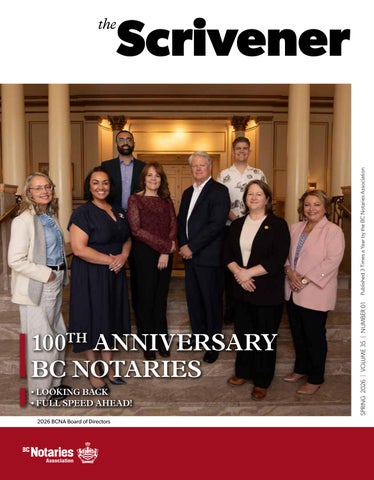
• LOOKING BACK • FULL SPEED AHEAD!
2026 BCNA Board of Directors
SPRING 2026 | VOLUME 35 | NUMBER 01
100TH ANNIVERSARY BC NOTARIES Published 3 Times a Year by the BC Notaries Association
Real estate law is complex. We make it simple. We help you close with confidence. Our comprehensive title insurance coverage is designed to protect your clients, reputation, and transactions, backed by decades of experience and local expertise.
Faster policy delivery. Total confidence. Our commitment to investing in cutting edge technology, such as advanced ID verification tools, allows us to deliver policies faster than ever.
We're more than a policy. We're your ally in real estate transactions, empowering you to work smarter, close faster, and protect your clients with confidence.
Scan to learn more.
1.800.307.0370
FCT.ca
®Registered Trademark of First American Financial Corporation.
Working together with Notaries in and around Vancouver since 2011.
We can help your clients with • Probate Applications • Legal Advice to Executors • Testamentary Trusts
• Living (inter vivos) Trusts • Incorporations • Tax-planned Corporate Reorganizations
Because we are focused estate-planning and probate lawyers, we refer all real estate transactions to Notaries across BC.
Connect with us to see how we can help.
www.westcoastwills.com | e. info@westcoastwills.com | p. 604 230-1068
Vancouver | North Vancouver | Burnaby | Richmond | Surrey
Contents Spring 2026 - 100th Anniversary BC Notaries
Published by the BC Notaries Association
Read The Scrivener online.
Scan here:
Editor-in-Chief Val Wilson BCNA CEO Chad Rintoul Administrative Coordinator Jenna Gardezy Courier Lightspeed Courier & Logistics Production fractal design inc. (fractal.ca) email: scrivener@bcnotaryassociation.ca website: www.bcnotaryassociation.ca All rights reserved. Contents may not be reprinted or reproduced without written permission from the publisher. This journal is a forum for discussion, not a medium of official pronouncement. The BC Notaries Association does not, in any sense, endorse or accept responsibility for opinions expressed by contributors. Printer: Mitchell Press
BCNA Directors from L: Morrie Baillie, Rimpy Sadhra (President), Barinder Sian, Franca Muraca, Chad Rintoul (CEO), Cam Sherk, Kate Roome, Jackie Tait
5 6
BC Notaries . . . Looking Back Moving Forward
34 BCNA 25-Year Notary Recognition
A Century of Trust . . . and a Personal Journey
36 BCNA Education Conference Photos
Greetings, Dear Readers Val Wilson
HISTORY
8
The Evolution of a BC Notary . . . from Rome to Victoria! Wayne Braid
SCRIVENER MEMORIES
10 Leading the Way he Scrivener Interviews Stan Nicol, Leta Best, T Wayne Braid and Dr. Bernard Hoeter
19 Walk Down the Mountain Bob Reid
25 When Harry Met Hughie . . . Marilyn MacDonald
NOTARIES IN BC TODAY Printed on 100% Canadian paper
CANADA POST: PUBLICATIONS MAIL AGREEMENT No. 40010827 POSTAGE PAID AT VANCOUVER, BC RETURN UNDELIVERABLE CANADIAN ADDRESSES TO CIRCULATION DEPT. BC NOTARIES ASSOCIATION SUITE 201, 2453 BEACON AVENUE SIDNEY, BRITISH COLUMBIA V8L 1X7
26 Perpetuating My Family’s Legacy Abby Rutherford
27 Achieving Life/Career Balance via the Notary Profession Hani Jo
28 Inside the Opening of a Notary
COMMUNITY
41 Generations Village
A Bold Vision for Inclusive Intergenerational Living
BC LAW INSTITUTE
42 Making Sense of Housing Law in British Columbia Marie Ong
DYE & DURHAM
44 The Map vs. The Territory:
Navigating the 2026 High Season Keith Moore
WILLS & ESTATES
46 Section 52 WESA
The Presumption of Undue Influence in Wills Trevor Todd / Jackson Todd
ACCOMMODATING AGEING CLIENTS
54 Anatomy of the Grandparent Scam Rhonda Latreille
STRATA LAW
Michael Cupello
56 Smoking Disputes
30 Century of Trust
The Role of Notaries in British Columbia
OUR 2026 BC NOTARY CONFERENCE
32 Overview of Continuing Education Sessions
BC NOTARIES ASSOCIATION
40 BCNA Conference Exhibitors
Practice in Rural British Columbia
Vicki van As
4
33 BCNA Upcoming Education Sessions
Chad Rintoul
Rimpy Sadhra
7
www.bcnotaryassociation.ca/ resources/scrivener
Trista Zamany
Elaine T. McCormack
TECHNOLOGY
60 The Hardware Stack That Was
Supposed to Save My Small Business Akash Sablok
62 PEOPLE
CEO B C N O TA R I E S A S S O C I AT I O N
BC Notaries . . . Looking Back Moving Forward CHAD RINTOUL
Î The BC Notaries Association’s recent Continuing Education Conference provided an excellent opportunity to celebrate the 100th Anniversary of The Society of Notaries Public of British Columbia. From the temples of Egypt to the Courts of Rome and the offices of medieval Europe, Notaries have remained steadfast in their purpose—guardians of authenticity, integrity, and trust. Their legacy forms the foundation upon which today’s Notaries continue to serve, linking a modern profession to an unbroken tradition that spans more than 4,000 years.
Notaries are highly educated, have annual continuing education requirements, and are subject to thorough regulatory oversight. Looking ahead, I believe it will be the personal relationship that a Notary builds with their client that continues to embody the “Tradition of Trust” that has developed over decades of service. British Columbians want to sit down with their Notary and have the Notary take the time to understand their unique needs. That personal connection will continue to build confidence and trust.
In British Columbia, for over a century Notaries have contributed to the economic fabric and development of the province. The Society of Notaries Public (SNPBC) has played a pivotal role in leading and regulating the profession since 1926.
Providing personal legal services is not about filling in some blanks on a form; it’s about connecting with and understanding a client’s needs and helping them achieve their intent. I believe this caring small-practice approach to providing legal service is what will continue to set BC Notaries apart from many other professions.
While the BC Notaries Association has a role in providing continuing education to Notaries within our mandate, the SNPBC has proactively worked over years to ensure that Notary education has developed as a measure to protect the public interest, build trust, and to produce highly trained legal professionals ready to serve British Columbians.
As we look to the future, we thank those who have made contributions to the profession over the years—my appreciation to Val Wilson, longtime Editor of The Scrivener magazine for her part in raising the profile of the profession. I wish Val the best in her endeavours and thank her for leading the transition to orientate Paul Dwyer to the role of Editor as we move forward.
The development of the Master of Applied Legal Studies Program at Simon Fraser University has ensured that future BC Notaries have the broad legal education they need to provide a range of noncontentious legal services. Students are required to have an undergraduate degree and undergo a rigorous admission process, including submission of Law School Admission Test results to ensure they are well suited to enter the Program. British Columbians can be assured that
To our members, sponsors, and exhibitors, thank you for your enthusiastic participation in our Conference. I take this opportunity to renew our pledge that the BCNA will be with you every step of the way! Respectfully, Chad Rintoul Chief Executive Officer
THE SCRIVENER | SPRING 2026
5
PRESIDENT B C N O TA R I E S A S S O C I AT I O N
A Century of Trust . . . and a Personal Journey Î Fifteen years ago, my husband Raman and I opened the doors to our Notary practice with a clear vision—to build meaningful careers while creating space for a balanced family life. What we couldn’t have fully anticipated at the time was just how intertwined those two goals would become—and how deeply rewarding the journey would be. We chose this profession with intention. Being BC Notaries offered the opportunity to serve our community in a trusted and impactful way and the flexibility to shape a life that reflected our values. In many ways, our Notary careers have delivered on that promise—and then some. In our very first year of opening offices, we also became parents. Like many new families, we were learning how to navigate sleepless nights, growing responsibilities, and the realities of running a business. Our firm didn’t just grow alongside us—it grew with us. Over the years, we’ve had the joy of watching our clients move through their own life milestones—purchasing first homes, expanding families, planning estates, and returning to us time and time again. Those relationships have become the foundation of our work and a constant reminder of why we chose this path. That said, achieving true work/ life balance didn’t happen overnight. It took us more than a decade to fully embrace and thoughtfully build
6
that structure. There were years of long days, competing priorities, and learning—sometimes the hard way—how to set boundaries and create sustainability. Looking back, that evolution was essential. Today, we can say with confidence that we’ve created a business that supports both our personal career ambitions and our family life. Beyond our own office, being Notaries has opened doors we did not initially envision. It has given us the chance to contribute to the future of BC Notaries. Encouraging students as they navigate their own paths has been one of the most fulfilling aspects of our career. It’s a chance to share technical knowledge and the real-world lessons that come from years of experience. Equally meaningful has been the ability for me to give back to my colleagues through the BCNA’s continuing education program and for both of us through the BC Notary Society’s Notary Education Program (NEP). As we advocate for the Notary community—whether through mentorship, education, or involvement in work initiatives—those contributions have reinforced our strong sense of worth and purpose. Fifteen years in, we can say with certainty that being Notaries has given us far more return than we ever expected. To be part of this unique legal community that has served British Columbians for 100 years is both a privilege and a responsibility that we carry with pride.
BC NOTARIES ASSOCIATION | bcnotaryassociation.ca
R I M PY SA D H R A
We stand among generations of BC Notaries—past, present, and future—to play our part in carrying this profession forward as a strong and trusted pillar of the legal landscape in British Columbia.
As we look ahead, we remain committed to evolving with the needs of those we serve, upholding the confidence placed in us, and continuing to build a brand rooted in integrity, care, and genuine relationships. We stand among generations of BC Notaries—past, present, and future—to play our part in carrying this profession forward as a strong and trusted pillar of the legal landscape in British Columbia. Regards, Rimpy Sadhra, West Coast Notaries
KEYNOTE EDITOR-IN-CHIEF
Services a BC Notary Can Provide VA L W I L S O N
Greetings, Dear Readers
A. PROPERTY MATTERS 1. Residential and Commercial Real Estate Transfers 2. Mortgage Refinancing Documentation 3. Manufactured Home Transfers 4. Easements, Covenants, and Rights of Way 5. Builder’s Liens 6. Subdivisions and Statutory Building Schemes 7. Zoning Applications
B. PERSONAL PLANNING 1. Wills Preparation 2. Powers of Attorney 3. Representation Agreements 4. Advance Directives 5. Wills Notice Searches 6. Estate Planning
C. NOTARIZATION /DOCUMENTS
Î It has been an education and my pleasure to serve as the Editor-inChief of The Scrivener magazine for almost 30 years. In that regard, I have interacted with so many outstanding individuals . . . and of course learned a lot about the noncontentious legal realm wherein our trusted BC Notaries thrive. With the exception of Quebec, British Columbia is the only province in Canada that has legislated specific services that Notaries are permitted by statute to perform. Please check-out the noteworthy list on this page. A teacher by previous profession and a perfectionist by nature, I have found editing a perfect fit for my interests and personality. After requesting and accepting the written expertise of contributing writers for each issue, the Editor-in-Chief polishes all the articles that appear in the publication . . . adhering to the magazine’s style and other essential elements. In the case of The Scrivener, advertising sales and service are also under the E-in-C’s purview.
Starting with the Fall 2026 issue, Paul Dwyer will assume the E-in-C duties . . . in addition to maintaining his role as our talented “graphic artist.” An intelligent, agreeable, and affable chap, Paul is a highly capable individual who is looking forward to excelling at his expanded responsibilities. Here he is. Please turn to the PEOPLE page (62) to read Paul’s words about the coming change. As it happens, CHANGE is the theme for our Fall issue. How appropriate! I will continue to enjoy editing projects, without the frequent lifecontrolling deadlines! All the Very Best to You! Val
1. Affidavits for All Documents required at a Public Registry within BC 2. Certified True Copies of Documents 3. Execution/Authentications of International Documents 4. Notarizations/Attestations of Signatures 5. Insurance Loss Declarations 6. Personal Property Security Agreements 7. Statutory Declarations 8. Authorization of Minor-Child Travel 9. Letters of Invitation for Foreign Travel 10. Passport Application Documentation
D. BUSINESS 1. Business Purchase/Sale 2. Commercial Leases and Assignment of Leases 3. Contracts and Agreements
E. SOME BC NOTARIES PROVIDE THESE SERVICES. 1. Marine Bills of Sale and Mortgages 2. Marine Protests 3. Marriage Licences 4. Mediation 5. Real Estate Disclosure Statements
There are Notaries to serve you throughout British Columbia For the BC Notary office nearest you, please call 1-604-676-8570 or visit www.bcnotaryassociation.ca. Note: Not all Notaries provide all services listed. Please check with your Notary before making an appointment for services. THE SCRIVENER | SPRING 2026
7
HISTORY
The Evolution of a BC Notary . . . from Rome to Victoria! Î From its origins in the Ancient Roman legal system to its establishment in colonial British Columbia, the office of Notary Public has evolved as a cornerstone of public trust and legal integrity. The profession’s enduring mandate—to serve the public through the preparation and authentication of legal documents—remains as vital today as it was more than 2 millennia ago. The Notarial tradition is one of the oldest continuous legal institutions in the Western world. In British Columbia, the profession’s legal foundation was established through the Notaries Act of 1869, enacted by the colonial legislature. That Act recognized Notaries as public officers authorized to provide noncontentious legal services and to attest to the execution of documents. The Making of Notaries in British Columbia When the Hudson’s Bay territory of New Caledonia became the Colony of British Columbia in 1858, one of the first lawyers to practise in Victoria was Henry P. Crease (later Sir Henry). Richard Blanshard, the first governor of Vancouver Island, was also a lawyer and at times acted as a judge. Judge Matthew Baillie Begbie—famous for his frontier justice—likely played a major role in keeping British Columbia within Canada. Many documents and stories about those early lawyers are preserved in the Provincial Archives in Victoria. By contrast, the archives say little about the
8
earliest Notaries. Even so, there must have been Notaries Public—distinct from those who were also barristers or solicitors—working in the colonial period around the Fraser River and on Vancouver Island, before British Columbia became a province. We don’t know who they were or how they were appointed. We have legal evidence of their role. Chapter 73 of an 1867 ordinance dealing with “Barristers, Attorneys, Notaries…” shows the office was recognized in law at that time.
WAY N E B R A I D
In 1897, Chapter 145 introduced a key reform: Anyone (other than a barrister or solicitor) seeking appointment as a Notary Public had to pass an examination before a Supreme Court judge—marking the first legislated entry standard for the profession in BC. That 1897 Act became the cornerstone of today’s Notarial profession.
From Colonial Ordinances to a Regulated Profession (1867–1981) We can infer that Notaries were operating here before Confederation because Chapter 73 of the 1867 Ordinance respecting Barristers, Attorneys, Notaries Public, and Articled Clerks of the Colony of Vancouver Island provides that all Notaries duly appointed in that colony at the time of the Proclamation are entitled to practise as Notaries Public in the Province of British Columbia. By 1867, British Columbia had joined Canada and there was no doubt who could commission Notaries then: The Lieutenant Governor. The British North America Act, 1867, confirmed provincial authority to appoint judicial and other officers necessary for the administration of justice. In 1897, Chapter 145 introduced a key reform: Anyone (other than a barrister or solicitor) seeking
BC NOTARIES ASSOCIATION | bcnotaryassociation.ca
appointment as a Notary Public had to pass an examination before a Supreme Court judge—marking the first legislated entry standard for the profession in BC. That 1897 Act became the cornerstone of today’s Notarial profession. The 1911 revision carried the Appointment Act forward without change. The First World War reshaped the province’s legal landscape. Many returning veterans entered the new UBC Law Faculty (founded 1914), while a number of retired British officers settled in BC and took out Notarial commissions—widely seen then as reputable community officials. Tensions grew, however, as newly minted lawyers felt nonarticled Notaries were limiting their livelihood.
In 1924, the Notaries Act (RSBC 1924) defined—not by an exhaustive list of powers but largely by exclusion— the rights and duties of a BC Notary. Commissions were now for life, and the Registrar of the Supreme Court in Victoria was directed to keep a formal Roll of Notaries. To reduce political inf luence, Notary applications went through the Supreme Court that could order an examination if the applicant was fit and if there was need. A major milestone followed on November 2, 1926, when The Society of Notaries Public of British Columbia was incorporated, formalizing the governance structure of the profession and ensuring the maintenance of ethical and professional standards that continue today. Except for Quebec, BC remains unique in Canada for organizing the Notarial profession in a statutory society. At first, The Notary Society had little authority and membership was voluntary. Through the Depression there were reportedly close to 600 Notaries, a number that fell during and after the Second World War to roughly 480. Post-War, law schools graduated many lawyers and friction increased. Some lawyers and ad hoc groups sought to limit Notaries’ powers or appointments. The 1948 overhaul of the Notaries Act did not ease matters. The statutory “need” requirement became a powerful tool for objecting to new appointments of Notaries. In January 1955, after years of negotiation led by Judge Alfred Watts, QC, then Law Society Secretary, and Alex Matthews, Notary Society Secretary 1952–1969, the Law Society and The Notary Society reached a “Contract” that governed relations for decades. Legislative changes followed. In 1956 the Law Society’s bylaws required approval by the Attorney General and the Law Society benchers; Notary
Society membership became mandatory for practising Notaries; in 1957, disciplinary provisions gave The Society of Notaries real self-regulatory powers. As part of the compromise, Notaries accepted a cap of 323 practising members and froze 64 Notarial districts in our province; new appointments would fill vacancies. In 1967, The Notary Society established a Special Fund to compensate members of the public for losses arising from a Notary’s misappropriation or wrongful conversion of funds, and it proposed detailed trust-account rules that were adopted in statute and regulation. By the late 1970s, lawyer numbers had surged while Notary numbers declined (roughly 1,000 lawyers vs. 324 Notaries in 1955, climbing to over 4,500 lawyers by the late 1970s). Debate intensified over whether Notaries should be absorbed into the Law Society—an idea the Notary Society opposed as an existential threat. In 1975, Mr. Justice Dryer emphasized that the Court must be satisfied of public need before ordering an examination, treating any private “contract” between the professions as irrelevant to the statute. That approach emboldened opponents to file need objections more frequently. By 1980–1981, The Notary Society pursued legislative reform. Public opinion shifted following prominent cases and a coordinated public-relations effort, petitions (c. 30,000 signatures), and direct engagement with government and opposition caucuses. A private bill prepared by lawyer H.A.D. Oliver prompted the government to take carriage of the file. After intense line-by-line work with Legislative Counsel, the new Notaries Act (1981) passed third reading on June 26, 1981, received Royal Assent, and—following replacement regulations—was proclaimed. The new Act severed lingering dependencies on the Law Society and modernized The Notary Society’s regulatory framework.
The Notary Society has since maintained strong audit, insurance, and discipline programs, and claims on the Special Fund have been rare. In 2007, the Trade, Investment and Labour Mobility Agreement (TILMA), a comprehensive bilateral trade agreement between British Columbia and Alberta, came into effect. It was designed to reduce interprovincial trade barriers, enhance labour mobility, and create a single, more competitive economic region. That effectively cancelled the imposed ceiling on the number of Notaries (members of The Society of Notaries Public of BC) permitted to set up practice in our province. Education and the Future of the Notary Profession Past comment by Dr. Bernard Hoeter I believe the future of the Notarial profession in British Columbia will increasingly depend on higher academic standards. I remember when solicitors could be admitted to the Bar without attending university. When I came to Canada in 1952, about one third of the province’s Supreme Court judges had never been to university. Roughly 85% of magistrates also lacked university education. hings have changed dramatically T since then. Chartered accountants once qualified without formal academic study; and now they must hold a Bachelor of Commerce degree before articling. I foresee a similar future for Notaries: one day. Notaries, too, will be required to graduate from university. Dr. Hoeter’s vision for the education future of BC Notaries was totally correct. Today, BC Notaries must hold a Master of Arts in Applied Legal Studies (MA ALS) postgrad degree from Simon Fraser University and pass essential education provided by The Society of Notaries Public of BC. WAYNE BRAID served as Secretary and CEO of The Society of Notaries Public of BC from 2000 to 2017. THE SCRIVENER | SPRING 2026
9
SCRIVENER MEMORIES
Memories As a salute to the 100th Anniversary of The Society of Notaries Public of BC, we are rerunning some memorable pieces from The Scrivener over the years.
Originally published December 2002, Volume 11, Number 4
Leading the Way The Scrivener: Good morning. It’s a pleasure to meet with you to chat about Roots and the progression of your careers as Secretaries of The Society of Notaries Public of BC.
Photo: Alastair Bird
Former Secretaries Stan Nicol and Dr. Bernard Hoeter; current Secretary/Executive Director G. Wayne Braid (right), and Leta Best, President of The Society, 2002
Î It was a pleasure to interview our Cover Story personalities for this issue’s theme of Roots. Newly elected President Leta Best joined us to reminisce and enjoy the camaraderie so evident among them all. Their team spirit, experience, and enthusiasm greatly contribute to the strength and cohesion of The Society of Notaries Public of BC and its membership.
you Dr. Hoeter. How did you decide to become a BC Notary Public? Dr. Hoeter: Well, that’s quite a story.
Thanks to Dye & Durham for arranging the services of Tambi Balchen of Charest Reporting, who recorded the interview.
I came to Canada in 1952 and at the beginning, I worked as a court interpreter and translator. I translated a lot for the American Immigration Authorities. Europeans who had come first to Canada but wanted to go to the United States had to submit their birth certificates, marriage certificates, journey certificates, etc. All those translations had to be notarized.
The Scrivener: Good morning. It’s a pleasure to meet with you to chat about Roots and the progression of your careers as Secretaries of The Society of Notaries Public of BC. Let’s start by learning a bit of background about
My good friend, then-lawyer H. A. D. Oliver, notarized most of my translations. Years later, when HADO had become a very busy barrister, he said, “Bernard, I can’t do this any more. With your background in law,
10
BC NOTARIES ASSOCIATION | bcnotaryassociation.ca
why don’t you apply for a Notary’s Seal?” I said, “I studied Roman Law in Germany, but to become a ‘Notary’! Oh, no—heaven’s sake, I don’t think that I qualify.” HADO encouraged me. “Try, old boy.” The Scrivener: Wayne, when did you become a Notary? Wayne: I became a Notary in 1986. I worked in an insurance and real estate office, where we had two Notaries working at that time: A. J. McColl and Larry Clay. I was doing the insurance part of the business. I just watched what they did and I liked what I saw. As a businessperson, I saw it was a great way to add to the business operation and help people. When Mr. McColl passed away, I applied to become a Notary. I
took the course and wrote the exams. I practised in Terrace from 1986 until I became Secretary in 2001, a year ago. The Scrivener: I understand your career has included being Coroner of Terrace? Wayne: Yes, for quite a number of years. It was an interesting business that went along with my other pursuits. I was in the insurance business, the real estate and property development business, and the Notary business, and also was Coroner. People were dying to meet me. (Laughter)
Wayne: Very intimidating. I can remember going into Dr. Hoeter’s office and waiting. His secretary, Wynn, made me comfortable, but told me, “Hoeter is a very busy man. He will get to you as soon as he can.” I can remember being taken into Dr. Hoeter’s office. I was nervous and sat in the wrong place. For some reason I went around and sat down in his chair. He simply said to me, “You can sit there if you like, young man, but I’m not sure if you can handle the work that comes with that chair.” I realized I was in the wrong chair and went around to the other side of the desk. (Laughter)
The Scrivener: Stan? Stan: I came from a similar sort of office to Wayne. We had a real estate and insurance office in Lynn Valley in North Vancouver. My dad was a Notary. When he developed glaucoma about 1968, we were quite concerned he might lose his eyesight. I made application to become a Notary. I was interviewed by Mr. Matthew, Secretary at the time. I became a Notary mainly to keep the family business going, in the event that my dad wasn’t available to work in that area. The Scrivener: You found that being qualified as a Notary Public fit well with your other business endeavours? Stan: Oh, definitely. You know, back in those days, we used to call it an allservice type of company where we’d do everything. We would list houses, sell them, insure them, and convey them. It was called “service.” That was in the days before conflict of interest. (Laughter) Wayne: It was interesting to hear Stan say he was interviewed by Alec Matthew. I can remember in ‘84 when I applied, Dr. Hoeter interviewed me. I came down from Terrace. Coming from a small town into the city to be interviewed by Dr. Hoeter was a very significant thing. Stan: Some would say intimidating. (Laughter)
I can remember being taken into Dr. Hoeter’s office. I was nervous and sat in the wrong place. For some reason I went around and sat down in his chair. He simply said to me, “You can sit there if you like, young man, but I’m not sure if you can handle the work that comes with that chair.” I realized I was in the wrong chair and went around to the other side of the desk.
Leta: I had the pleasure of meeting Dr. Hoeter when I was very young, in 1972. At that time, there was an age limit; you had to be at least 25 to apply to become a BC Notary. I wrote a letter of application to Dr. Hoeter. Because all the Notaries in Victoria were gentlemen of the old school, and two of them didn’t think I was old enough or had enough maturity to be a Notary, I had to travel to Vancouver to be interviewed by Dr. Hoeter. I was petrified. Had I known then what I know now, perhaps I wouldn’t have been as terrified, but that was my introduction to The Society. I had to wait four years for a vacancy to write my exams. It was a pleasure to become a Notary. Frank Kitto, my senior partner in Kitto & Best, was a past President of The Society. Dr. Hoeter: When I became a Notary, we had only four females in The Society. Today, over half of BC Notaries are ladies. Good women, good conveyancers. And like in Russia, where most doctors are females, most Notaries, in future, will be females. The male Notary will become an endangered species. (Laughter) The Scrivener: Dr. Hoeter, how did you become Secretary of The Society? Dr. Hoeter: Mr. Matthew’s Society office was on the same floor as my Notary office in the Vancouver Block. When Mr. Matthew died, the Board of Directors asked if I would act as temporary Secretary until they found a permanent one. They did not find anyone for nearly 20 years. (Laughter) I ran my private Notary practice, too. In those days, a Notary charged $2.50 for an affidavit. I did my notarized translations of birth and other certificates for $5.00. The Scrivener: How many languages do you speak?
The Scrivener: That was most auspicious, Wayne, seeing that you have assumed the full responsibilities of that chair. Leta, when did you become a BC Notary?
Dr. Hoeter: You hear my English is getting pretty rotten. (Laughter) My German is, of course, perfect. I spoke some Spanish. For 30 years, I was Consul of Guatemala. From high school, I knew basic French and I picked up a little Romanian. That’s five languages. I read nine years of Latin. THE SCRIVENER | SPRING 2026
11
SCRIVENER MEMORIES
I did translations for the University of British Columbia. Sometimes they received Latin certificates from other universities. UBC said, “Would you kindly translate this for us?” The Scrivener: What significant milestones or highlights come to mind about the years when you were Secretary? Dr. Hoeter: My main achievement, together with Society President Roy Bishop, was that in 1981, we got the Notaries Act amended. We finally had cut the umbilical cord to the Law Society. We became an independent organization with our own laws and rights. The price was that we had to agree to a limitation in numbers. In 1981, we settled on 323 members and no more. In my time, there were 3,000 lawyers in BC. Now I have heard there are nearly 10,000 lawyers, and we still have about 300 Notaries. When I became 65, I said, “It is enough.” My private practice boomed after this. (Laughter) We looked for a successor and found a capable man in Stan Nicol. Stan was a Director and was known to the Board. He’s had quite a career. He was the new generation. I was a very conservative, old-fashioned man. I had no computer capability. Stan was a computer man. He organized everything from a technical point of view. A new generation came in. Stan modernized the office, and got all kinds of technical things that I had not even dreamt of. And he was Chairman of many, many committees. I am proud that this man became my successor.
legislation, together with Bob Adamson who is still on the Board. That was the same year our self-insurance program started; it was a busy year. The Scrivener: Please tell us about the self-insurance program. Stan: The previous professional errors and omissions program was in the private market up to 1986. Because of the world-wide lack of insurance market, we made the decision to go on our own; it’s worked pretty well.
Dr. Hoeter: Marilyn Taylor was originally hired as a half-time bookkeeper because the bookkeeping became so complicated, I didn’t do it anymore. She came in twice a week. She is still with The Society. Wayne: She has survived three of us. (Laughter)
I understand that you put the notion of The Notary Foundation into motion.
12
Leta: Stan, you were there when we developed the in-house education program; you brought that along. And the development of The Scrivener magazine was also part of your term. Stan: Yes, and we also had a burgeoning PR program, to get the image to the public a lot more.
The Scrivener: Stan, you followed Bernard as Secretary in 1986.
Stan: I was President of The Society when Bernard announced his intention to retire. I had been pushing for a Foundation since the early ‘80s, probably about the time the new Notaries Act came in. Finally the Board decided it was worthwhile having a go at the Attorney General. He saw The Notary Foundation as another source of income for Legal Aid. In 1986, we drew the
work day and work week to know that he worked six days a week and about 14 hours a day; we were getting pretty much full-time out of him anyhow. But for the first time, the office was open full-time and gradually, there was additional staff. Every time we get a new Secretary, we get more staff. (Laughter)
The Scrivener: What other changes were taking place? Stan: As well as those two major projects, the big change was that The Society now had a full-time Secretary. Technically, Bernard worked half-time, although you have to understand his
BC NOTARIES ASSOCIATION | bcnotaryassociation.ca
Dr. Hoeter: Marilyn Taylor was originally hired as a half-time bookkeeper because the bookkeeping became so complicated, I didn’t do it anymore. She came in twice a week. She is still with The Society. Wayne: She has survived three of us. (Laughter) The Scrivener: Stan, I understand you worked diligently toward creating Representation Agreements to provide health care guidance that Powers of Attorney do not address. Stan: Yes. That became an avocation. I worked on that project as a community member and as the Secretary of The Society, working through The Notary Foundation, which provided some of the funding in the early days. I’m still working on it; we’re still waiting for changes to the legislation, then it will be full bore ahead. Wayne: It’s interesting to hear Dr. Hoeter talk about some of the projects he started and worked on, which were passed over to Stan. Some of them, I’m still working on. Representation Agreements are a good example of the kind of projects that may pass from decade to decade; many seem to revolve around government. Before the Representation Agreement Act can really start to be used effectively by the people of British Columbia, the government will review the recent report they asked
Your Gift of aLifetime
Bernie McClean to do regarding probable changes to the legislation. Stan: Work on Representation Agreements started in 1989. Wayne: Yes. Stan: So it’s been ongoing for a long time. The Scrivener: What else do you have on your plate, Wayne, as the current Secretary/Executive Director? Wayne: It’s a big plate. (Laughs) There are many things. Certainly the public has changed. There’s a greater expectation now from the public to hold professionals accountable; that’s a big part of my job now. Technology, as great as it is, has given the public much greater access to The Society, to the Secretariat; we have Websites and email. The Society over the years has made itself much more accessible to the public. And so we should. We’re a regulatory body.
Your everlasting legacy can create a stronger future for children with complex health care needs in BC. Planning a gift in your Will ensures they receive essential support vital to their development for generations to come. There are many ways to plan your legacy: A gift in your Will RRSP, RRIF or TFSA Transfer of securities Life insurance policy Where there is a Will there is a way to building a brighter, healthier future for children across BC. To learn more please visit cknwkidsfund.com 11886 4842 RR0001
What has also changed a lot from Dr. Hoeter’s day and somewhat from Stan’s day is the greater expectation that The Society provide more services to the members; I wear two hats. The Secretary wears the hat of the statutory requirements. The legislation says that we’re a self-governing professional organization, but as well, in the members’ minds, we are a trade organization. Our members want assistance with certain aspects of their profession; that’s why the programs that Stan has talked about were developed. The Scrivener: What types of continuing education themes or topics are offered to the members? Wayne: I can answer that currently and Stan can talk about some programs during his time. Representation Agreements have provided many opportunities. I’ve attended at least five in-depth seminars on the topic that The Society has provided over the past seven or eight years. Wills and estates are other areas where we provide a lot of education. Twice a year, we hold educational opportunities for our
The Turtle Valley Donkey Refuge
Thank you
from the bottom of our hearts for the
love and support of the Donkeys at Pirate
Nigella
Benny & Dudley
Turtle Valley Donkey Refuge. OUR MISSION STATEMENT
To Provide a Safe, Secure, and Permanent Home for abused, neglected, and unwanted Donkeys. Turtle Valley Donkey Refuge Society 7877 Skimikin Road, Chase, BC V0E 1M1
250-679-2778 donkeyrefuge@gmail.com
Bea’s Herd
Donations gratefully accepted.
www.turtlevalleydonkeyrefuge.com | Charity #822309001RR0001 | Tax Receipts Provided
THE SCRIVENER | SPRING 2026
13
SCRIVENER MEMORIES
members, in the spring and at our fall conference. These education sessions are very well attended. My colleagues in other societies—administrators of other self-governing professional organizations—are always impressed when I can tell them that 75 to 80 percent of our membership registers for a weekend of education. Most organizations—if they can get 20 to 30 percent—are really bragging. BC Notaries are very concerned about education and obviously participate quite actively.
I started the connection with the French and German Notaries. In the early ‘70s, The Society sent me to a world conference of Notaries in Guatemala City. Later on, Stan built up this international connection.
Stan: I know my dad had the old original legal-sized version. In fact, it was bigger than legal-sized.
That is how one of our education programs got started.
The Scrivener: Stan, would you please add to that? Stan: One of the unique things in making decisions about continuing education programs and their funding by The Society is the fact that our Board of Directors is comprised, 100 percent, of practising Notaries. They see the value of education better than some other professional organizations. For example, with lawyers, a lot of the people on the Board of the Law Society are not interested in all areas of law; they leave some decisions to the BC branch of the Canadian Bar Association. With BC Notaries and our profession, Wayne’s office is everything. The Scrivener: How many people apply each year to become BC Notaries? Wayne: We provide education each year for a minimum of 12 to 25 new Notaries each year; the course is coordinated through the University of British Columbia. We also employ an education coordinator. Rick Evans ensures that the material being taught is the current law of the day in the areas in which we practise; that gives us a big advantage. Stan was saying that we know our material the best. In co-operation with UBC, we’re able to deliver a very high-quality university education to people coming in to our profession. Dr. Hoeter: I was an examiner of notarial candidates for about 15 years. All together, there were three examiners: one appointed by the Law Society, one from The Society of Notaries, and one professor from UBC. Each had different subjects. I was examiner in Notarial procedure.
14
Dr. Hoeter: Oh, yes, but we rewrote it. We called it the Vademecum. That means “carry me with you.” It’s the Latin name for a manual students carry. Our Vademecum was a glossary of terms and procedure. It was the first education book we ever published.
Dr. Hoeter: Oh, yes, but we rewrote it. We called it the Vademecum. That means “carry me with you.” It’s the Latin name for a manual students carry. Our Vademecum was a glossary of terms and procedure. It was the first education book we ever published.
Stan: The Union of International Notaires Latin [UINL] conference was held in Greece last year. Dr. Hoeter: I only went to Guatemala and Germany. Wayne: We were in Berlin together. Stan: Bernard worked very hard on education in the ‘70s. I was Chair of the Education Committee for a while in the late ‘70s. When we first became involved with UBC, we borrowed the credit union course. That is how one of our education programs got started.
BC NOTARIES ASSOCIATION | bcnotaryassociation.ca
Dr. Hoeter: Then we shrunk it down to 8 1/2” X 11”. That was Alec Matthew’s baby. I worked on it, but Matthew started it. Wayne: One of the questions you asked, Val, was how many people apply each year to become BC Notaries. I can tell you that in the last three years, we have had up to 1,800 people call or enquire about how to become a Notary. We send out a package that provides an introduction. From that, we receive responses from between 150 and 200 individuals who actually start the process and fill out a preliminary questionnaire. We investigate their integrity and the other issues important to qualifying as a Notary. Our class size can be anywhere from 12 to 25. In any given year, we have two groups going. A class will graduate in May 2003; their court appointment takes place in June. Those who started studying in 2002 will graduate in 2004. So at any one time, we’re processing up to 50 people. The Scrivener: You require Notarial candidates to have experience in a profession or business prior to becoming a Notary Public—and you want people who are involved in their community. Wayne: The qualifications for applicants have changed over time; they were different in Dr. Hoeter’s time and then changed from the time Stan started until Stan retired. One requisite Stan and the Board of Directors introduced was that a candidate should have a university education; we still prefer that. The person must have some business experience and life experience, too. People look to Notaries for many things, not just legal advice in the fields
we provide. I found it interesting when Dr. H said it was so important to have Notaries who speak other languages; that’s very important to The Society even today because of the cultural makeup of British Columbia. It’s important that we have Notaries that can provide service in all languages to all cultures. Dr. Hoeter: In 1965, Mr. Charlie Lui became the first BC Notary of Chinese descent. It was during my time that we said we must have more Chinesespeaking Notaries. We then had an East Indian. We wanted a Portuguese- and even an Arabic-speaking Notary. The Society, today, has become truly international, more so than any other legal body in town. Among BC Notaries, you have members of all languages, of all races, of all denominations. The Scrivener: How is The Society of Notaries of BC seen internationally? Dr. Hoeter: In my time, Quebec Notaires did not recognize us. So I invited the Secretary and President of the Quebec Society of Notaires to come to some of our Annual Meetings, and attend them as guest speakers. Today Roman Notaries invite BC Notaries as guests and observers to their international meetings. Stan: I think they look at us with a great deal of admiration and curiosity, to see how well we have done in our province.
Dr. Hoeter: The Code Napoleon. Wayne: Yes. The Quebec Notaries are very familiar to the international group, and while we’re welcome as guests, we’re not full-time members of the UINL. One of our board members, Ken Sherk, however, is now a full-fledged individual member of the UINL.
Wayne: The American Notaries in various States are looking at our model up here, at the difference between lawyers and Notaries. Some states are starting to establish legislation to create Notaries. Alabama now has such legislation.
Dr. Hoeter: Yes, they sure do. Stan: And we’ve had visitors; delegations have visited us from France and China, Japan, and Italy. They are fascinated by us. Wayne: Latin Notaries operate under the Civil Code, an entirely different legal system than ours; they struggle with the fact that we are in a common law jurisdiction. The British Columbia Notary is unique in Canada. The legislation of British Columbia gives us authority to practise in certain areas of law; that’s unique to the province. In Quebec there are Notaries, but they have Civil Code.
Dr. Hoeter: English Notaries act under common law. Only two Notaries in the whole world are common law Notaries: the Notary of BC and the Notary of England. Stan: There’s that unique little group in Louisiana, too. Dr. Hoeter: They are strange Notaries—neither US Notaries nor Common Notaries—and I would not call them Roman Notaries. They originate from the time of the Louisiana
Purchase in 1803 when the French sold their North American Louisiana for $15 million to the USA. Why did Napoleon sell Louisiana to the Americans? The weak French Navy was not able to defend it. Napoleon was afraid that the British Navy would take French Louisiana, which they inherited from the Spaniards. During their short stay, the French introduced the Code Napoleon (based on Roman Law) to Louisiana. Therefore, the New Orleans Notary is still a Latin Notary. Mind you, about half of Louisiana’s Notaries are also US attorneys. Wayne: The American Notaries in various States are looking at our model up here, at the difference between lawyers and Notaries. Some states are starting to establish legislation to create Notaries. Alabama now has such legislation. Stan: Florida was the first one. Notaries are becoming important internationally. The Scrivener: What have you observed over the years about the men who have served The Society in the office of Secretary? Leta: I have had the opportunity to serve on the Board of Directors with Bernard, Stan, and Wayne. In the 30 years I’ve been associated with The Society of Notaries, I have noticed what these three gentlemen have in common—their dedication and passion to The Society. Without that, it would be very difficult for the Secretary to accomplish his challenging job and bring so much to the position. They are each so proud and honoured to be part of The Society of Notaries Public and to be a Notary Public. I’m looking forward to my year as President and working with Wayne and Stan and also our Dr. Hoeter, who is an Honourary Life Member. Dr. Hoeter: The future of BC Notaries is in your hands, Wayne. I’m the past; I have lots of stories of the past, but the future is your baby. The Scrivener: Wayne, what would like to see for The Society in the years to come? THE SCRIVENER | SPRING 2026
15
SCRIVENER MEMORIES
Wayne: The list is long and the tasks are numerous. What we’ve heard today certainly sets the foundation for what I have in front of me. We must always keep in mind the interests of the people of British Columbia, and how we can best serve their needs for noncontentious legal requirements. Certainly the future holds the opportunity to provide those kinds of services to our clients. People want a choice in their provision of legal services. Today, in many areas of law, they don’t have that. For some issues, their current choice is a lawyer or a legal how-to kit for $14.95. In my vision of British Columbia, that’s not a choice. I think Notaries are well positioned to offer some of the kinds of legal services that the public wants. We’ve proven by our past history that we provide our members with the proper education and we take care of the public. We have a good self-governing organization. The list is long. I’m looking forward to the challenges. Stan: I would like to see the numbers fill up. I’d like to see a lot more BC Notaries on board. Wayne: In the City of Surrey, the fastestgrowing city in Canada, we have eight or nine Notaries; that community probably could use 15 or 20. That’s one of the items on the long list I mentioned. Serving the needs of British Columbians is what we need to look at. Leta: You know, the changes in the population base within British Columbia, and the fact that the people of the province are so much better educated than they were two or three generations ago, open a whole new avenue for the Notary to serve the public. I think there is a public need; the people of the province are comfortable with the friendliness and the openness of our services. I would like to see The Society have more ability to serve the needs of the community. Stan: Part of that focus is the ageing of the people in our communities. We know from our practice that seniors far prefer to deal with Notaries than with lawyers for most of their legal needs; seniors see it as important that Notaries are able to provide them with additional services.
16
BC NOTARIES ASSOCIATION | bcnotaryassociation.ca
Leta: And I think that our Notaries’ ethnic diversity, multiculturalism, and gender balance within our profession give the population a good base to seek solutions for their needs in the areas in which we practise.
Leta: And I think that our Notaries’ ethnic diversity, multiculturalism, and gender balance within our profession give the population a good base to seek solutions for their needs in the areas in which we practise. The Scrivener: What additional legal services do people want Notaries to perform? Wayne: A lot of our members are approached daily by people wanting them to take care of their probate— such as a simple estate of $100,000 or $200,000. Many lawyers in the province consider such an estate too small to handle. Dr. Hoeter: Right. Wayne: While people can do a lot of that type of work themselves, they still need somebody to coordinate and take care of some aspects. Notaries, by tradition, help people with that sort of thing. That’s one of the areas where the people of British Columbia should have a choice in the provision of service. If you look around the country—in Ontario, for example—paralegals have been given all kinds of authority in the court system: probate and traffic court, traditionally noncontentious issues. The Ontario government has seen fit to offer the people of Ontario a choice. Here, we already have the alternative choice in place through legislation—BC Notaries.
Fraud that doesn’t trigger alarms Wire diversion fraud rarely begins with a system breach or an obvious warning sign. It begins with real conversations, familiar names, legitimate-looking emails, and requests that feel routine. Behind the scenes, criminals monitor communication in real time, waiting for the right moment to act. When they strike, instructions appear authentic, the request feels ordinary, and the window to stop the fraud is measured in seconds. Read the full story behind it.
Scan to read
www.chicagotitle.ca
Hashim Jafree Senior Director, Product & Sales hashim.jafree@ctt.com 236.335.5423 Fraser Valley and Vancouver Island
David DeNeire Regional Director david.deneire@ctt.com 236.330.4936 Greater Vancouver and Okanagan THE SCRIVENER | SPRING 2026
17
BUILT FOR MODERN NOTARIES
BOOK A UNITY® DEMO TODAY
Experience the Difference
We enjoyed connecting with so many passionate professionals at the recent BCNA Continuing Education Conference, where innovation and community spirit came alive. To keep that momentum going, we invite Notaries to see how Unity® can help you streamline your workflows and support a more modern, efficient practice.
Complete files faster
using an end-to-end digital workflow that eliminates manual handoffs.
Get instant title intelligence
from title search to final registration, every step connects seamlessly.
Protect sensitive financial data
with bank-grade security using end-to-end encryption, ensuring you meet compliance requirements without compromise. 18
BC NOTARIES ASSOCIATION | bcnotaryassociation.ca
SCRIVENER MEMORIES
Walk Down the Mountain Originally published Fall 2002, Volume 13, Number 3 After his horrendous accident, Bob Reid recovered to become a highly respected lawyer who taught at UBC. For many years, we were fortunate to have Professor Reid teach our BC Notaries about the legal side of many land issues in our province. Î The Comox Valley Record of Wednesday, July 7, 2004, contained an article headed, “Cairn honors those who died in war, peace.” The photo caption read, “Former Navigator Bob Reid, sole survivor of a crash in 1966, uncovers the cairn.” The article described the unveiling of a cairn at the Comox Air Force Museum Heritage Airpark, honouring members of 442 Squadron who died during war and peacetime missions.
Little did we realize that a few hours later, our plane would crash on the Hope-Princeton Slide site and only I would survive. Bob Reid
I was invited by the commanding officer of the squadron to attend this ceremony as a special guest and to speak to the current and past members of the squadron and the guests at the ceremony. The air crash was the event that most influenced and shaped my life. The following is part of my speech that day.
crewmates across the tarmac here at the base to board our aircraft, an Albatross flying boat, for our flight that day—a day that began like many other days, nothing out of the ordinary. The events of that day are etched so keenly in my mind, it seems like yesterday.
“I can still smell the air that morning. It had rained the night before and the wind was fresh and brisk, skittering the clouds against a deep blue sky. Across the Straits the mountains were covered with snow. Little did we realize that a
“It is a great honour and privilege for me to speak to you today on this hallowed occasion when we remember and honour the men and women of 442 Squadron who gave their lives in the service of their country. I would like to express my deep appreciation to Lt. Col. Colin Goodman for inviting me to attend as a member of the squadron’s extended family. My close relationship with the squadron has meant much to me as over the years, the squadron and I have participated in memorial services at the site of the air accident in which my fellow crewmates were killed many years ago. “In fact, it was 38 years ago—April 23, 1966, a Saturday morning—when I, as a young Flying Officer in the Royal Canadian Air Force, walked with my
Grumman HU-16 Albatross THE SCRIVENER | SPRING 2026
19
SCRIVENER MEMORIES
live always in our memories and this memorial cairn will ensure they will be remembered as brave heroes of Canada long after we are gone.” I have recounted orally many times the happenings of that day—Saturday, April 23, 1966. I do so again to leave a written account for my newly born granddaughter Emma. The story starts earlier in the spring of 1965 when a “sprog”1 navigator arrived at 121 Search and Rescue Squadron (121 was amalgamated into 442 Squadron in 1968) at RCAF Station Comox.
Royal Military College of Canada (RMC) in Kingston, Ontario
few hours later, our plane would crash on the Hope-Princeton Slide site and only I would survive. “It is important to us who are here today to remember and to honour those members of the Squadron who died on duty. I am here today to honour and remember my crewmates: (Flt. Lts.) Pete Semak and Phil Montgomery, (F/O) Chris Cormier, (LAC) Bob MacNaughton, and the passenger aboard that day, (S/L) James Braiden. Others are here to remember and honour loved ones, while others remember and honour ex-colleagues. And for those of you currently serving as active members in the squadron, it is especially important that you remember and honour these men and women because they are part of the history and tradition of the squadron and of the Canadian Armed Forces in which you so proudly serve.
die serving Queen and Country. What greater sacrifice can a person make in the service of one’s country? Their deaths remind us of the ultimate price paid by those who serve and safeguard the people of Canada. “The dedication of this memorial cairn means a great deal to the friends and family members of the men and women of 442 Squadron whose sacrifice we commemorate today. They will
“Recently we watched on television the ceremonies celebrating the 60th anniversary of the Canadian troops who landed at Juno Beach on D-Day. Canadians across Canada paid homage to those valiant soldiers who fought and died for our rights and freedoms. The men and women we honour today did not all die in battle against the enemy, but they did
20
BC NOTARIES ASSOCIATION | bcnotaryassociation.ca
After graduation from the Royal Military College of Canada in June 1964, I received my wings in November 1964 as a long-range navigator at the Air Navigation School at RCAF Station Winnipeg. The next month, I froze and starved on bush survival training in Jasper National Park—not at the Lodge but in the wilderness. Then in January 1965 came the final training at the Operational Training Unit (OTU) at RCAF Station Trenton. At the completion of training, the big question was: where would we be posted? Maritime Command or Transport Command? What base? The Air Force allowed each of us to submit three preferences for our future posting.
The Dedication of the Memorial Cairn
I was the only one who got none of my preferences. I was given the posting everyone else wanted: RCAF Station Comox on Vancouver Island. When I asked why I had not received any of my picks, the senior officer in charge told me that because I came from British Columbia, he had done me the favour of sending me home. I explained that my fiancée Robin (now my wife of 37 years) was in nurses’ training in Kingston, Ontario, which was why all my preference postings were in Ontario. The decision was cast in stone so, in March 1965, I loaded my 1964 Volkswagen Beetle with all my worldly possessions—mainly books— and took off across Canada for Comox. I arrived at the airbase and within a few days was sent out on a search— thankfully with an experienced navigator aboard to show me the ropes. I settled in and flew on searches all over the province, usually searching for lost aircraft or overdue boats. The aircraft used for search and rescue missions was a twin-engine amphibian airplane called the Albatross, built by Grumman Aircraft Company. The men (there were no women on squadron in those days) with whom I flew were highly skilled, brave, and dedicated in carrying out their duties. One difficult and traumatic example of their abilities was when our pararescue personnel were dropped into the crash site of the Canadian Airlines flight on which a bomb had exploded west of 100 Mile House, killing all aboard. Another was when a helicopter descended into the treetops on the west coast of the Island to lower medical personnel to ground level to allow them to treat badly injured survivors at a crash site. If the rotating blades had struck the trees, the rescue craft would have gone down. For this courageous and outstanding feat of flying, the pilot Dan Campbell was awarded the Air Force Cross. Other flights and searches took me to Kodiak Island in Alaska, to Whitehorse and Yellowknife, and all parts of the province. On CAVU days,
the beauty of the land and sea was laid out before us to be admired and treasured. On miserable rainy and cloudy days, I’d occasionally talk a pilot into taking up the T-Bird (T-33 jet trainer) for SARAH (search and radar and homing) training runs. We would burst out of the clag2 into brilliant sunlight on top of an ever-reaching bed of white fluffy clouds with only the tips of the highest mountains peeking through in the distance. My favourite memories were the water landings and take-offs, either in the waters of Georgia Strait or on one of the Interior lakes.
At the end of April, my crew was scheduled to complete a weekend training flight. We planned to fly through the Hope-Princeton into the Skaha Lake region and spend the evening in Williams Lake. On the Sunday, we planned to travel into the Rocky Mountain trench area and return to base by Bute inlet.
In 1965 I flew in the Abbotsford Air Show. To impress the crowds, we planned a JATO take-off. When we needed a boost to get airborne in a short distance, JATO (jet-assisted take-off) bottles were attached to the sides of the plane and fired as the plane started to lift off. A big flame would come flashing out and the plane felt as if some giant had kicked it in the rear. On take-off, however, a crosswind blew us over the dry, grassy infield so the flame set the grass on fire. Fire trucks and other
emergency vehicles rushed to put it out. The crowd thought it was part of the display. It was impressive, though! In April 1966, the squadron initiated a new crew system. The old practice had been for the pilots, navigators, radio officers, and crewmen to have their own duty lists, so we usually flew with different people. Now crew lists were created so we flew with the same people all the time. The crew on which I was the navigator comprised pilots Pete Semak, the captain, and Phil Montgomery, co-pilot; radio officer Chris Cormier, who had arrived at the squadron with me from the OTU; and Bob MacNaughton, an experienced crewman with whom I had flown on several searches. At the end of April, my crew was scheduled to complete a weekend training flight. We planned to fly through the Hope-Princeton into the Skaha Lake region and spend the evening in Williams Lake. On the Sunday, we planned to travel into the Rocky Mountain trench area and return to base by Bute inlet. We had taken on a passenger. Second Lieutenant James Braiden, a navigator from Trenton, arrived at the base for the annual checking out of the squadron’s nav leader Joe Scoles, who in turn would check out the rest of the squadron’s navigators. S/L Braiden was an old friend of the skipper; they had flown as a team in a “Canuck,” the CF-100, a fighter interceptor. Pete invited him to come with us on the flight. The morning of the 23rd dawned on a beautiful day. It had rained the evening before and the air smelled of sea and ozone. The wind was brisk, scudding the clouds along the skyline with the Coast Mountains behind them across the water. We arrived for the weather briefing and filed our flight plan. Then prior to take-off, the aircraft was inspected inside and out and the instruments checked. Once airborne we headed for Vancouver airspace. The radio crackled with the air-traffic noises from the tower and other aircraft. Navigation THE SCRIVENER | SPRING 2026
21
SCRIVENER MEMORIES
BC Notaries Speak Your Language
BC Notaries around the province offer many noncontentious legal services in an impressive variety of languages. English Afrikaans Arabic Bengali Bosnian Cantonese Chinese Croatian Danish Dutch Farsi Fijian Filipino Finnish Flemish French Fujian Gujarati Hindi Hungarian Italian Japanese Korean
Malaysian Mandarin Persian Polish Portuguese Punjabi Romanian Russian Serbian Spanish Swahili Swatow Swedish Tagalog Taiwanese Tamil Taoshan Telegu Turkish Ukrainian Urdu Vietnamese
Search for a BC Notary by languages spoken.
www.bcnotaryassociation.ca 22
was simple because visibility was unlimited; the pilots could see far off into the distance. Vancouver was easily identifiable because of the brown smog that always hung over it. After we passed Vancouver, we turned eastward up the Fraser Valley and when over Haney, my hometown, we circled. My family and friends knew if they saw a search and rescue craft circle, it meant I was aboard. Cloud cover started to build as we progressed up the Valley to Hope where we turned to follow the Hope-Princeton Highway into the pass between the mountains.
The panic in the voice brought me immediately alert, then the throttles were thrust full and the plane banked to the left. Now I came wideawake because I knew we could not turn the plane in the narrow pass. I looked out the window on the port side and saw the wing taking off treetops.
But the valley floor climbs rapidly in the pass. And the cloud cover was increasing. At approximately 1130 hours, we were approaching the site of the HopePrinceton slide where on January 9, 1965, a minor earthquake caused the mountain to come sweeping down, burying four people who had been trapped in their cars by an earlier
BC NOTARIES ASSOCIATION | bcnotaryassociation.ca
mudslide. The mountain filled in the valley floor in the pass to a height 200 feet higher than before the slide and displaced Lake Outram. As we were approaching the slide site, I was planning to get up and go forward into the cockpit to stand between the two pilots to get a better view of the slide. Usually when we were flying visually, I stood there but our passenger had pre-empted the position. Instead I was sitting in the navigator’s seat, on the starboard side of the aircraft underneath the starboard wing, facing forward, with the radarscope in front of me. If I swivelled around, facing the rear, there was the nav desk on which the flight maps were laid out. On the starboard side of the aircraft were the radios and other instruments, all supposedly to assist me in determining the location of the aircraft with respect to the ground. At this moment, however, the intercom squawked and I was asked how far ahead I could see on the radar. We were close to the ground; I could see only a short distance ahead on the scope. Travelling at 150 knots, that was not far at all. The next and last call over the intercom was for “max power.” The panic in the voice brought me immediately alert, then the throttles were thrust full and the plane banked to the left. Now I came wide-awake because I knew we could not turn the plane in the narrow pass. I looked out the window on the port side and saw the wing taking off treetops. I instantly knew I was going to die. No one survives a plane crash onto a mountain. My life did not pass before me. Instead I experienced a crystal clear, cold realization that I was going to die. Then the plane banked again, this time to starboard and it started to slip into the mountain. The impact of the boat hull hitting the rocks caused loose gear to fly past me. A glimmer of hope sprung up? I thought the plane was going to land on the mountain. A rough landing for certain, but I had experienced rough water landings. It was a chance to survive.
Just then the plane dug deeper into the rocks and started to break up. The impact forced my face into the radarscope. My last conscious thought was of my nose and eyeglasses breaking. The aircraft was then torn apart on the mountain. There had been no possibility it could have landed intact. But at the time I was unaware of this. I had been knocked out. When I came to, I was standing up, my left arm resting on a large boulder; I was enveloped in a white, misty fog with visibility limited to a few feet. I was alone. The aircraft and the others were not there. I was floating in space and I thought I was dead. For a long time after, I still could recall that eerie feeling. I had no idea of how much time passed. My mind wondered what was to happen now that I was dead. My revelry ended when some part of the aircraft beyond my space blew up. A large hunk flew past my head and I realized I was alive. A quick inspection revealed a flying suit in tatters, from my chest to my ankles; the exposed skin on my stomach and legs was red and raw. My hands were bleeding, as was my nose and mouth; all my front teeth had been knocked out. But there was no pain. There was an iceball in my stomach keeping the pain at bay. What I did not realize was that I had been severely burned—on over 50 percent of my body. My immediate reaction was to call for help to find out whether other crewmembers had survived. No one answered. I thought they were either dead or badly injured; I had to get off the mountain and get help. No one knew where we were. We would not be found until the cloud cover lifted and it could last for days. As it turned out, two people at the viewing site heard the crash but could not see anything because of the cloud cover. They heard my cries and went down the highway to get help. Four miles toward Hope, they encountered RCMP Cpl. Lorne Weme, who was on highway patrol.
In the meantime, I started walking down the mountain, trying to make headway among the rocks. At one stage my wristwatch fell off (the strap had been burned through); I remember thinking what a strange thing that was to happen and continued on my downward trek. (The watch presumably is still on the mountain.)
MACKENZIE FUJISAWA LLP BA RRI ST E RS & S OL I CI TO RS
The police cruiser had not even come to a full stop when I was out and stumbling into the hospital where help was waiting
The rocks on the slide area became too difficult for me to climb around so I angled into the trees on the west side. Progress was better but fatigue was taking its toll and the iceball was growing bigger. I decided to lie down on a fallen log and rest. But at the back of my mind, something warned me that if I fell asleep, I would die. For the first time since I became conscious, I became frightened I would die. I had to get off the mountain. I had to get help! I struggled downward until ahead of me, I could see the road. I stumbled out of the trees and shrubbery on the side of the road, just west of where the highway veered sharply south toward the other side of the valley floor around the slide site. A large car was passing as I stumbled out of the shrubs and trees on the side of the road. I waved vigorously, but it did not stop. Discouraged, I sunk onto the sandy shoulder of the road and unfortunately got sand particles into the burn areas on my legs. Weeks later in hospital, a doctor cursed me as he picked out each grain with tweezers to prepare for skin grafts. Meanwhile time passed and
Proud to be Serving BC Notaries and their Clients with • Wills & Estates Litigation • Real Estate Disputes • Business Disputes & Transactions
QUANG T. DUONG
IAN M. KNAPP
ANDREW J. KIM
Phone: (604) 689-3281 Fax: (604) 685-6494
www.macfuj.com
THE SCRIVENER | SPRING 2026
23
SCRIVENER MEMORIES
I waited on the shoulder—for how long and for what I don’t know—then a car came around the corner. It stopped and someone got out. Mark Gibbs was on his way to UBC when he came across a figure slumped and bleeding. Then Cpl. Weme appeared on the scene and off we went in his cruiser to the Fraser Canyon Hospital at Hope. On the drive to Hope, I don’t remember much. I remember telling Cpl. Weme there were five other persons still on the mountain and that he must contact Search and Rescue to inform them what had happened. I also remember the wild ride down the highway with the siren screaming and the tires squealing as we took corners on two wheels. I yelled at him that I had been in one crash that morning and I did not want to be in another one. I also asked him to talk to me because I did not want to lose consciousness; the iceball was no longer working and I was getting colder. The police cruiser had not even come to a full stop when I was out and stumbling into the hospital where help was waiting. Instinct told me that if I could get into the hospital, I would be all right. I never realized I was seriously injured. I remember doctors and nurses hooking me up to various bags of fluids. Before losing consciousness, I asked the doctor if he would call my family but not to talk to my mother. He called and my mother answered the phone. He asked if anyone else was in the house and my brother Larry took the phone to receive the news of what had happened. My family drove up to the hospital where they were told I was badly injured and the doctors could not tell them I would survive. I don’t remember being taken out of Fraser Canyon Hospital and put into a Search and Rescue helicopter, the same helicopter that retired this year at Comox from active service with the Armed Forces. I do remember landing, though. I did not know at the time that it was at Shaughnessy Hospital, a Department of
24
Veterans’ Affairs hospital in those days. I remember being bundled up tightly and not being able to see anything: I was in a Search and Rescue stretcher.
The sojourn in the hospital is another story that should be written— perhaps some day. For 6 weeks after the 23rd, I was in and out of consciousness. I survived and later that year, returned to Comox for a short visit. There I discussed with the squadron how I had survived the crash. Everyone thought I was in the tail section of the aircraft because only it and the left wing were intact. Everything else was in pieces.
The force of the fireball countered the forward momentum of the aircraft so I was not smashed to bits by the force of hitting the rocks on the mountain. Plus, I was breathing out when the fireball hit me so the heat did not sear my lungs. Those events had to occur in this exact order for me to survive the crash.
One of the first people to reach the crash site was George Sowden, owner of the nearby Sumallo Lodge. He described what he saw. “There were bits of wreckage around a 1500 foot area” and “the mountain is covered with oil spots that have flashed and burned.” In fact, even today, if you look up the mountain, it glitters on a sunny day from the thousands of pieces of aircraft metal that remain scattered on the crash site.
I was placed on the ground and someone was hovering over me. I was asked, “Are you Protestant or Catholic, son?” The priest was prepared to give me the last rites. I answered, “Neither, Father.” The voice replied, “God bless you, my son,” and I could sense he moved away from me. I had officially changed my religious designation to agnostic at RMC. It was a feeble protest against the strict rules and regulations of the College and, at the time, I fancied myself a rebel—at least as much as anyone in military college could be. It did get me out of attending church, even though attendance at church parade was compulsory.
BC NOTARIES ASSOCIATION | bcnotaryassociation.ca
In reconstructing what must have happened that day, the only logical explanation and the one I have recounted over the years is this one: When the aircraft slipped into the mountain prior to being ripped apart, the starboard wing dug in and was torn from the fuselage of the plane. This initial impact also knocked me unconscious and as I sat slumped in my seat, the port wing—full of aviation fuel—exploded. Its fireball blew me out the hole in the side of the aircraft created when the right wing was torn off. The force of the fireball countered the forward momentum of the aircraft so I was not smashed to bits by the force of hitting the rocks on the mountain. Plus, I was breathing out when the fireball hit me so the heat did not sear my lungs. Those events had to occur in this exact order for me to survive the crash. Tragically my crewmates and our passenger did not survive. But every 5 years, a memorial ceremony at the viewing area near the crash site is held to honour their memory. B O B R E I D is Associate Professor Emeritus of Law, UBC.
SCRIVENER MEMORIES
When Harry Met Hughie . . .
M A R I LY N M AC D O N A L D
Originally published Summer 2012, Volume 21, Number 2 Î Here in Paradise, we have the option of pursuing myriad choices to become and stay FIT! The Great Outdoors awaits. And it’s especially easy to eat “healthy” at this time of year, with all the colourful fresh fruits and veggies that abound in our Summer markets. It’s All Good!
When Harry met Hughie “Harry Rankin and I met in 1959, when he was a 40-ish, overworked lawyer. “I was a young upstart with a job at 'American Health and Silhouette.' As a fitness trainer, I had a keen interest in exercise—and a physique to match. “Harry and my father had been in the same regiHarry Rankin ment in WWII. I went to Harry for some legal advice and from there, we became lifelong friends. I admired him a great deal. Harry opened my eyes to many political and social justice issues. I was pleased and proud one day when he solicited my help to get him into shape. “Harry worked too much, ate too much, and exercised too little. We began by building a gym in his basement and I taught him some fitness fundamentals. Harry never looked back. He applied the same determination to his fitness that he did to his law career and soon he was a much thinner, stronger man.
The benefits of exercise and fresh air? We look better, feel better, and can better manage our stress. Considering all those advantages, surely we become more enjoyable company! The following fitness vignette comes to us courtesy of Hugh Cooper, spouse of Marilyn MacDonald, the graphic artist for The Scrivener magazine at that time.
“Harry kept up his regime for his entire life. Every Sunday morning, he got up at 4 am to walk the Stanley Park Seawall. After I returned to Vancouver in 1990, I began joining him, much to the consternation of my wife who complained that I slept all day Sunday after my walk! “Those walks were a wonderful time to spend Hugh Cooper w it h my friend. I will always treasure the memory of them. “Even in his ‘80s, Harry attended the earliest morning aerobics class at his local Community Centre before going to the office. He was often the lone man—one octogenarian among the (mostly) young women. “Harry lived to be 82 and was active until his death in 2002.
Hughie on the beach circa 1959
“I like to think I played a small part in his good health and longevity.” THE SCRIVENER | SPRING 2026
25
NOTARIES IN BC TODAY
Perpetuating My Family’s Legacy A B BY R U T H E R F O R D Î On September 18, 2025, I stood in the formality of the Supreme Court of British Columbia, waiting to be commissioned as a Notary, aware that this moment carried far more than my own achievement.
was there, too, sharing in the moment, a reminder that this milestone belonged to all of us in different ways.
26
1. Residential and Commercial Real Estate Transfers 2. Mortgage Refinancing Documentation 3. Manufactured Home Transfers 4. Easements, Covenants, and Rights of Way 5. Builder’s Liens 6. Subdivisions and Statutory Building Schemes 7. Zoning Applications 1. Wills Preparation 2. Powers of Attorney 3. Representation Agreements 4. Advance Directives 5. Wills Notice Searches 6. Estate Planning
C. NOTARIZATION /DOCUMENTS 1. Affidavits for All Documents required at a Public Registry within BC 2. Certified True Copies of Documents 3. Execution/Authentications of International Documents 4. Notarizations/Attestations of Signatures 5. Insurance Loss Declarations 6. Personal Property Security Agreements 7. Statutory Declarations 8. Authorization of Minor-Child Travel 9. Letters of Invitation for Foreign Travel 10. Passport Application Documentation
We had come to know one another through that shared effort and, in the Courtroom, there was a sense of camaraderie and respect. We were not just individuals being commissioned; we were a group united by a common journey.
My mother Margot Rutherford sat nearby. A Notary since 1979, she is still actively practising and now guiding me as my mentor. I am learning beside her in the same office where she has built her career, absorbing not only the technical aspects of the profession but also the values that sustain it. I am grateful and privileged to be able to draw on her support and experience. My sister
A. PROPERTY MATTERS
B. PERSONAL PLANNING
Around me were members of my cohort. Each of us had made our own sacrifices to reach that point—long hours of study, time away from family, and the steady perseverance required to complete the program.
My father Bruce Rutherford was commissioned as a British Columbia Notary in 1991. Although he passed away in 2021, his influence shaped my understanding of our profession. Standing there, I thought about the stories he told, the care he brought to his clients, and the quiet integrity that defined his practice. I remembered the photo of him and my mother in front of the statue of Themis holding the scales of justice at the Courthouse. I wished he could have been there, but I felt his presence just the same.
Services a BC Notary Can Provide
D. BUSINESS 1. Business Purchase/Sale 2. Commercial Leases and Assignment of Leases 3. Contracts and Agreements
E. SOME BC NOTARIES PROVIDE THESE SERVICES. Bruce and Margot (with Themis at the Vancouver Courthouse) in 1990, the year Bruce was sworn in
When I took the oath that day, I understood that becoming a Notary is not simply about having knowledge or becoming a businessowner. It is about trust, responsibility, and service to the public. In that Courtroom, I stepped into my new role, while carrying forward the legacy my parents began. A B BY R U T H E R FO R D practises in the Margot R. Rutherford Notary Corporation in Courtenay.
BC NOTARIES ASSOCIATION | bcnotaryassociation.ca
1. Marine Bills of Sale and Mortgages 2. Marine Protests 3. Marriage Licences 4. Mediation 5. Real Estate Disclosure Statements
There are Notaries to serve you throughout British Columbia For the BC Notary office nearest you, please call 1-604-676-8570 or visit www.bcnotaryassociation.ca. Note: Not all Notaries provide all services listed. Please check with your Notary before making an appointment for services.
NOTARIES IN BC TODAY
Achieving Life/Career Balance via the Notary Profession HANI JO
Î I started my life in Vancouver as an international student, receiving my BA degree with a major in Criminology from Simon Fraser University (SFU). Soon after graduating, I entered the legal profession as a legal administrative assistant, then worked as a corporate paralegal for about 10 years.
and sometimes stressful moments in their lives—whether they are purchasing a home, preparing legal documents, or navigating noncontentious legal matters that require care and precision. I strive to make those processes clear, especially for those who may feel overwhelmed or unfamiliar with legal procedures.
One day, I thought about how to live fully by connecting my community, my legal skills, my personality, and my desire to achieve a work/life balance. I quickly recalled I had once dreamed of becoming a Notary Public and my new journey began. I completed the Master’s degree in Applied Legal Studies (MA ALS) at SFU and the rigorous education program from The Society of Notaries Public of BC. After being sworn in as a Notary in Fall 2024, I can confidently say I have a fulfilling career.
I offer mobile appointments for those with mobility issues and special needs. Providing services in both English and Korean, I can better support a diverse range of clients and ensure accessibility within the community. My goal is to develop trust and make legal services approachable and comfortable for clients, rather than intimidating or overly complicated.
My work as a BC Notary is deeply rooted in serving the community. I assist clients during some of the most important
The Notary profession truly creates the balance I had longed for in my life. Unlike many traditional legal careers that demand long, rigid hours, being a BC Notary gives me the flexibility to manage my own schedule and build my practice in a way that reflects my personality. The flexibility allows me to enjoy one of my favourite hobbies—snowboarding. During the Winter, I head to the mountains before or after work and even on some Fridays, to recharge and find clarity. I went up the mountain more than 25 times this season! In the warmer months, I enjoy spending time outdoors camping, fishing, and exploring nature with my family. Those experiences keep me grounded and remind me of the importance of maintaining a healthy balance between work and personal life. I have meaningful work and the freedom to pursue the activities I love outside the office. For anyone considering becoming a Notary Public, my advice is simple—focus on designing a practice that fits the life you want to live. Your hours do not need to revolve around the typical 9-to-5 shift. A successful business should support your lifestyle, not replace it. BRIGHTSIDE NOTARY (Hani Jo Notary Corporation) is located in Yaletown and Kitsilano in Vancouver. THE SCRIVENER | SPRING 2026
27
NOTARIES IN BC TODAY
Inside the Opening of a Notary Practice in Rural British Columbia Î In a program as strenuous as the 2-year Master of Arts in Applied Legal Studies (MA ALS), it can be hard to see the light at the end of the tunnel. Although the Notary Education Program via The Society of Notaries Public of BC is shorter, the same can be said for it. What happens when you reach the end of the tunnel? The final, final exam has been written, the petition has been made to the Court, and the Justice has just administered the Notarial Oath. I found myself faced with: Do I apply for a Staff Notary position or do I take the leap and hang my own shingle? Considering I had previously founded and operated a successful small business in my community and there was a relative lack of Notarial representation in town, I chose to open a practice. Opening a Notarial Practice Going into business for yourself is daunting, particularly if you are establishing a professional practice. In addition to the daily responsibilities of being a BC Notary, I was also responsible for the daily routines of operating a business. Each of those responsibilities can amount to a full-time job and, for me, they did. As funds were tight when the business first opened, I had to delineate between what I wanted and what I needed. Of the items I wanted, I found ways to do without until it made sense financially. For example, I wanted my own office space. Through Community Futures South Kootenay, I was able to secure an office in the South Kootenay Business Centre that was fully furnished, had utilities included, and was a fraction of the cost of having a standalone office.
28
BC NOTARIES ASSOCIATION | bcnotaryassociation.ca
M I C H A E L C U P E LL O
I also wanted an office of my own and a separate office to meet with clients. I thought it would be nice to have a laptop to work remote and a tower computer at the office so I wouldn’t have to bring a computer with me from home to work and back every day. Last, I wanted to hire an employee to handle some of the administrative tasks. Those “wants” did not make financial sense in the beginning, however. Accommodating the needs on my list meant preparing a budget. The larger expenses on the list were y incorporation; y investing in new technology, including a new computer and monitor, printer, and a portable scanner; and y purchasing sufficient supplies for the office to get me through my first 6 months in business. I deemed incorporation a necessity because I felt it allowed for a greater delineation between the business and personal aspects of my life, as well as the tax incentives I had hoped to one day receive. I knew I needed a more powerful and secure computer to manage corporate affairs as well as the Notary practice itself. As for office supplies, I continue to remain in disbelief that basic requirements like stamps, pens, paper, file folders, etc., could amount to more than $1,000 . . . they did so quite easily. The reality? Opening a business is expensive. It is important to remember that cost-effective options do exist, and a strong business plan can help recoup start-up costs in a timely manner.
Business Plan Taking the time to construct an indepth and thorough business plan allowed me to set realistic goals and the paths required to achieve them. I evaluated the current market, identified what made me unique, and conceptualized how I could turn my vision into a viable and profitable business. A few of my goals included recouping my start-up costs within my first 6 months; completing 50 files; and becoming an established part of my community. At the time, those objectives were ambitious. It had been a few years since I had closed my first business; I was not sure how a new office would be received in a community with numerous well-established, well-respected, and communityminded law offices. To achieve my business goals, I prioritized becoming an established part of the community. In rural communities, such as mine, countless opportunities exist to get involved and contribute to the region. Of the community organizations and initiatives researched, I chose to apply for membership to the Societa M.S. Cristoforo Colombo Trail Lodge, a society focused on preserving and promoting Italian culture and heritage for its members and the community. I also became a member of the Trail & District Chamber of Commerce and a proud corporate partner of the Trail Smoke Eaters Junior “A” ice hockey team (Go Smokies!).
Trail, British Columbia
Volunteering, contributing, and actively engaging with those regional organizations granted opportunities to become an established part of the community. In doing so, I was able to meet new people, tell them what I did, and that I was centrally located in the downtown area. Cost-effective community-engagement advertising opportunities such as those resulted in meeting the additional goals I had set for myself. By getting my name and services out into the community, I was able to recoup my start-up costs before the end of my first 6 months in business and surpass the 50-file goal. The Next Chapter It has now been a year since I completed my initial 6-month business plan. I never could have imagined the success I have experienced, the opportunities that have been awarded, or the support that has been so greatly appreciated. This past June, I received the “Emerging Entrepreneur” award at the Trail & District 2025 Business Excellence Awards ceremony. In November, I onboarded my first employee, and in January I was sworn in as Presidente of the Societa M.S. Cristoforo Colombo Trail Lodge. The future is bright, and I cannot wait to see what it has in store. B C NOTARY P UBLIC MIKE C UPELLO was commissioned in September 2024. THE SCRIVENER | SPRING 2026
29
NOTARIES IN BC TODAY
Century of Trust
V I C K I VA N A S
The Role of Notaries in British Columbia Î This year marks a remarkable milestone for Notaries in British Columbia—more than a century of service to the people and communities of our province. For over 100 years, Notaries Public have carried out work that supports the security and stability of everyday life, assisting individuals and families with real estate transactions, estate planning, and important legal documents. Though small in number, BC Notaries have a broad impact. They are often involved in significant moments in people’s lives—purchasing a home, preparing a Will, transferring property, or formalizing agreements that require certainty and trust. Those moments require not only technical expertise, but also professionalism, judgment, and integrity. As President of the Notary Society of British Columbia, I am continually reminded that the strength of this profession lies in the commitment of its members and the trust placed in them by the public. A Personal Path My journey into this field began in 2016 when I opened Sterling Notary Public in Ladner, BC, with the goal of providing accessible, reliable legal services. My practice has since expanded to include two satellite offices in Osoyoos and Penticton—communities where I look forward to eventually retiring and where I already enjoy spending weekends and holidays. To ensure seamless service for clients, I was fortunate to welcome Staff Notary Eleanor Chan, who joined in October 2024. Eleanor focuses on Wills and Personal Planning while also providing coverage when I am working from the Okanagan. Having that additional support has been an invaluable resource, enabling continuity of service while supporting a healthier work/life balance—something that is especially challenging for Notaries who must balance the demands of client care with the responsibilities of running a business and managing the realities of self-employment. In a role where professional obligations, administrative duties, and client expectations often intersect, having reliable support helps create the flexibility needed to sustain both top-quality service and personal well-being.
30
BC NOTARIES ASSOCIATION | bcnotaryassociation.ca
Building a Notary practice involves far more than understanding documents and procedures. It requires developing relationships within the community and ensuring that every interaction reflects high professional standards. Clients often arrive with questions about complex noncontentious legal processes. Helping them leave with clarity and confidence is one of the most rewarding aspects of our work. Our profession has continued to evolve alongside broader changes in technology, client expectations, and service delivery. Throughout those changes, its underlying purpose—providing trusted legal services—has remained constant. Strength in Experience One of the defining qualities of the Notary line of work is the breadth of experience within it. Notaries come from many diverse backgrounds. That range enriches the work and enhances the services provided to the public. For those entering a BC Notary career today, their collective knowledge is invaluable. Skilled practitioners continue to mentor and support new Notaries, helping maintain the standards that have defined Notarial practice in our province for generations. At the same time, new members bring fresh perspectives and adaptability. They are entering during a period of change, shaped by technological developments and evolving expectations for legal services. Their contributions will help shape the future of Notarial practice. Community Connection Notaries often operate community-based practices, creating longstanding relationships with clients and local organizations. Many serve multiple generations within the same families, reflecting the trust that communities place in their Notaries.
That connection underscores the responsibility carried by Notaries. Every document prepared, every signature witnessed, and every transaction completed contributes to the legal certainty that individuals and businesses rely upon. While the work is often carried out quietly and behind the scenes, its impact is significant. Notaries play an essential role in ensuring the reliability of property transactions, Personal Planning documents, and numerous other agreements that form part of day-to-day life. Adapting to Change In recent years, BC Notaries have demonstrated resilience and adaptability as the professional landscape has evolved. Technological developments and shifting client expectations continue to influence how services are delivered. Despite those changes, the fundamental tasks of Notaries remain the same—safeguarding the authenticity of documents and ensuring that people understand the commitments they are making. The role of The Society of Notaries Public of British Columbia is to support that continuity—ensuring strong regulatory oversight, maintaining public confidence, and fostering excellence across the field.
Looking Ahead The next decade will bring more change and more opportunity. Advances in technology will influence how BC Notaries’ legal services are delivered, but communities will continue to rely on accessible, dependable professionals to guide them through important legal decisions. Personally, the coming years represent an opportunity to strengthen my practice and contribute to the profession as a whole—supporting new Notaries, encouraging collaboration, and ensuring that communities across British Columbia benefit from trusted Notarial services. A Shared Responsibility The strength of our Notary community ultimately lies in its members. From established practitioners to those beginning their careers, each BC Notary contributes to its reputation and integrity. Together, we carry forward a legacy that spans more than a century in British Columbia—one defined by trust, responsibility, and service to the communities we are privileged to serve. NOTARY VICKI VAN AS, MBA, MA ALS, is President of The Society of Notaries Public of BC and has three Notary offices in British Columbia.‑
Introducing BC Property Connect LTSA is developing a new digital service for property owners to securely track property updates with one account. Become an early adopter at bcpropertyconnect.ca
THE SCRIVENER | SPRING 2026
31
OUR 2026 BC NOTARY CONFERENCE
Overview of Continuing Education Sessions Î It was a pleasure to return to Vancouver for the 2026 BCNA Continuing Education Conference, held during a truly significant year marking 100 years for The Society of Notaries Public of British Columbia. The centennial milestone provided a meaningful opportunity to celebrate The Society’s enduring legacy while continuing to invest in the professional growth of Notaries across the province..
Richard Johnson
Mark Smiciklas
Jeremy Andersen
Keith Moore
The Conference marked the successful delivery of our 4th consecutive year hosting a hybrid conference—both virtual and in-person participation. That format once again enabled a broader number of Notaries to access and benefit from a diverse range of Continuing Education sessions, strengthening the profession now and into its next century. We extend our sincere thanks to the dedicated members of our Continuing Education Committee—Zoe Stevens, Kristy Martin, Hilde Deprez, Jackie Tait, and Akash Sablok—for their invaluable support throughout the year. Their thoughtful recommendations on topics and presenters greatly contributed to the effectiveness of our programming.
Al-Karim Kara
Zoe Stevens
Kristy Martin
Hilde Deprez
Jackie Tait
Akash Sablok
We tried something a little different this year following the Exhibitor Welcome Reception. Hosting a Friday dinner buffet was a really nice way to bring everyone together and the event generated great energy. In celebration of our 100-year anniversary, the evening was especially meaningful to recognize and welcome our newly commissioned Notaries.
Keith Baldrey
32
Pablo Rodriguez
On Saturday, the Conference opened with a keynote address by Keith Baldrey. Next, Pablo Rodrig uez facilitated a panel of experts that focused on strengthening Notary business operations
BC NOTARIES ASSOCIATION | bcnotaryassociation.ca
T R I S TA Z A M A N Y
Marny Morin
Sharon G. K. Singh
Niki Sharma
and driving sustainable growth. Panelists Richard Johnson, Mark Smiciklas, Jeremy Andersen, and Keith Moore answered Notaries’ presubmitted questions about law, marketing, accounting, sales, and industry leadership. In discussion-style, the panel explored strategies for client acquisition, business development, financial management, and sales effectiveness, offering actionable takeaways attendees can apply directly within their own practices. We heard valuable insights from Al-Karim Kara, President and Chief Executive Officer of the Land Title and Survey Authority, followed by an address from Niki Sharma, Attorney General of British Columbia.
The annual R isk Management session, led as usual by Marny Morin and Quang Duong, provided an informative case study outlining what typically occurs when a file is requested and how such Quang Duong situations can escalate into a potential lawsuit. It also highlighted how those scenarios can be unpredictable and complex—consistently keeping professionals on their toes. Two more sessions included facilitated roundtable discussions on several topics. Presented by Sharon G. K. Singh, “Cowichan Tribes Decision: Implications for BC Notaries,” provided a practical overview
of recent legal developments impacting property law and Notarial practice in British Columbia, with a focus on due diligence, land title considerations, and the intersection of Indigenous rights and property transactions. Saturday concluded with a formal Gala Dinner and opportunities for networking and celebration. At the lively rooftop after-party, participants gathered to unwind and enjoy the atmosphere and the city views. Sunday morning began with an engaging session led by Jackie Tait and Tiah Workman. Through an open, backand-forth discussion, they explored the evolving complexities of Personal Planning in Notarial practice, including Wills, Powers of Attorney, and Representation Agreements. They highlighted issues identified in practice inspections, common pitfalls in drafting and compliance, and what can lead to disputes or regulatory concern. They also covered best practices for client interviewing, assessing capacity, documenting client intent, and strengthening risk-and-file management processes to support compliant day-toJackie Tait Tiah Workman day situations. A key real-estate-focused session, “The New Reality of Home Ownership,” was presented by Lisa Niro. The discussion examined the growing use of fractional and hybrid ownership structures, including the practice of adding family members to title for financing purposes. It also outlined legal, financial, and estate implications, Lisa Niro as well as the importance of Independent Legal Advice in managing risk and ensuring informed decision-making.
BCNA Upcoming Education Sessions Lunch and Learn Wire Fraud Presenter: Chicago Title When: Wednesday, July 8, 2026 Time: 12 Noon Where: Zoom
Pitfalls in Estate Administration: What Notaries Need to Know Presenter: Truvera When: Wednesday, August 5, 2026 Time: 12 Noon Where: ZOOM
Our 2027 Education Conference
“ PA L Up d a t e s” concluded the program, led by Hilde Deprez and Peter Bjurman. The interactive session addressed frequently asked procedural and practice-related questions from attendees, Hilde Deprez Peter Bjurman providing guidance, clarification on basic issues, and real-time solutions to support everyday Notarial practice. TRISTA ZAMANY is the Continuing Education Manager at the BC Notary Association.
We are very excited to welcome our Notaries back to Vancouver at the JW Marriott Parq, April 9 to 11, 2027. THE SCRIVENER | SPRING 2026
33
OUR 2026 BC NOTARY CONFERENCE
NOTARY 2026 25-YEAR RECOGNITION
CONGRATULATIONS Hilde was born and raised in Belgium where she earned her law degree. After relocating to Canada, she was commissioned as a BC Notary Public in 2001 and opened her practice that same year. She later partnered with her spouse Filip, also a BC Notary. Together they operated their practice on Vancouver’s West Side. Hilde’s professional focus and passion have always centred on helping clients plan for their future through thoughtful and practical Wills and Personal Planning.
HILDE DEPREZ
In addition to her Notarial practice, Hilde is often a guest speaker, regularly presenting to a wide range of community groups, professional organizations, and education audiences on topics related to Wills, Personal Planning, and professional practice. Hilde has long been deeply involved in the education of our future Notaries, serving both as a teacher and an examiner. She currently serves as Manager of the Notary Education Program at The Society of Notaries Public of BC. Since 2022, she has also been a member of the Practice Advice Line (PAL), where she supports fellow Notaries with day-to-day practice and professional questions.
Born in Lebanon, Wafaa studied Law there under the French Civil Law model. She emigrated first to the United States and studied Law at the University of Arizona. She had the opportunity to work within the office of the Attorney General as a legal researcher where she researched cases and prepared briefs for the Attorney General. She ultimately settled in Delta, BC. Wafaa is married to Kassem El Masri. They have two children: Notary Hassan El Masri and Sarah El Masri. Wafaa’s grandson shares his grandpa's name: Kassem El Masri.
WAFAA MASRI
After moving to British Columbia and working in various roles, Wafaa decided to become a Notary Public and was commissioned in 2001. Wafaa set up her independent Notary practice in the Collingwood neighbourhood of East Vancouver and has practised there for the past 25 years. In 2010, she was joined by her son Hassan El Masri when he was commissioned as a Notary; they currently practise together. Wafaa and her team have taken great pleasure in providing Notarial services to the people of British Columbia over the past 25 years.
34
BC NOTARIES ASSOCIATION | bcnotaryassociation.ca
NOTARY 2026 25-YEAR RECOGNITION
CONGRATULATIONS Shinil Park was commissioned as a BC Notary Public in 2001 and has served the Greater Vancouver community for the past 25 years. He was the first Notary of Korean descent in British Columbia—a milestone on which he reflects with quiet gratitude. Throughout his career, Shinil has maintained a practice that is not flashy but humble, steady, and grounded in quiet pride. With the devoted support of his beloved wife, he has built a Notarial practice dedicated to faithfully serving clients and the community. Shinil is the proud father of two sons. One has followed in his footsteps and is now practising as a BC Notary—something that brings Shinil great joy.
SHINIL PARK
Today, Shinil enjoys a more relaxed and reflective stage of practice, continuing to serve clients while appreciating the relationships and experiences built over a quarter-century in the Notary profession.
Born in Kamloops, BC, in 1975, Harman was raised in Nanaimo. He is 1 of 3 BC Notaries in the family—along with his dad Del Virk now retired, and younger brother Nev Virk. Married 24 years, Harman and his wife Simitra Johal-Virk have two boys Savin Virk and Vanik Virk. Harman has great memories of going into the BC Notary education program and of writing the statutory exams with his fellow classmates; he clearly recalls their ritual with then-Notary Society Secretary Stan Nicol to go have a beer after exams were over at UBC. It was a good time and a relief that the exams were over.
HARMAN VIRK
Winning the prestigious Dr. Bernard Hoeter Award for the Highest Marks on All the Statutory Exams was a special moment for Harman. He always appreciated how much the Notary students were helped by the instructors—to name a few: Marny Morin, Rick Evans, Stan Nicol, Robert Reid, and Tony Dumolin. Becoming a Notary alongside his dad was pretty special for sure. Then later, brother Nev became a Notary, too. That really created a Virk family of Notaries. “I think my proudest moment was when Dad helped take the lead alongside thenSociety CEO Wayne Braid re. changing the legislation to remove the limitation on Notary Seals—a significant moment in BC Notary history.” Harman says practising in Abbotsford has been quite amazing; seeing the city grow in a quarter-century to what it is now, is truly remarkable. He looks forward to continuing to serve the Fraser Valley—and says, “Congratulations to all of this year’s recipients on 25 years of service!”
THE SCRIVENER | SPRING 2026
35
2026
36
BC NOTARIES ASSOCIATION | bcnotaryassociation.ca
CONTINUING EDUCATION CONFERENCE PHOTOS
2026
CONTINUING EDUCATION CONFERENCE PHOTOS
THE SCRIVENER | SPRING 2026
37
2026
38
BC NOTARIES ASSOCIATION | bcnotaryassociation.ca
CONTINUING EDUCATION CONFERENCE PHOTOS
2026
CONTINUING EDUCATION CONFERENCE PHOTOS
THE SCRIVENER | SPRING 2026
39
THANK YOU
TO OUR 2026 EXHIBITORS
The Dye & Durham Platform connects a global network of professionals with public records to support business transactions and regulatory compliance.
With thanks to the Notary Foundation for their continued support
40
BC NOTARIES ASSOCIATION | bcnotaryassociation.ca
COMMUNITY-BUILDING ADVERTORIAL
Generations Village A Bold Vision for Inclusive Intergenerational Living At a time when many people are searching for deeper connection, attainable housing, and a stronger sense of belonging, Mercedes Wong, CRE, CCIM, FRI, RI, is introducing a bold new vision for the future of community living.
The vision is rooted in a simple but powerful belief. Communities are stronger when generations remain connected.
In Generations Village, y
s eniors are not isolated from everyday life,
y
s tudents are not left struggling alone in an increasingly difficult housing market, and
y
f amilies are not disconnected from community.
Instead, residents share spaces, experiences, knowledge, and opportunities to contribute to one another’s lives in meaningful ways. Each neighbourhood is designed to reflect the unique needs and culture of its surrounding community. Future sites may include ageing-in-place initiatives, dementia-friendly design, educational partnerships, wellness programming, cultural gathering spaces, and opportunities for community engagement that encourage residents to remain active and connected at every stage of life.
Bardell, Yearning, Jericho Beach, watercolour on paper, 16” × 20” (framed)
Art plays an important role in the vision. From shared gathering spaces to wellness areas, gardens, hallways, and community hubs, art is envisioned as an integral part of daily life within Generations Village. The communities aim to incorporate works from local artists, including Norah Borden and Enda Bardell, helping create spaces that feel vibrant, welcoming, and deeply connected to local culture and identity. The integration of art is intended to inspire conversation, celebrate creativity, and strengthen the emotional connection people feel to the places they call home.
the future. Together, Generations Village hopes to create inclusive communities that redefine what home can mean for generations to come. For more information, visit mercedeswong.com. Norah Borden exhibits her work internationally, with pieces held in private, corporate, and public collections, including the Crown Collection of the Government of Canada.
Fortune Hill Photography
Generations Village is an inclusive intergenerational concept designed to bring seniors, students, and families together in thoughtfully connected neighbourhoods across Western Canada. More than a housing model, it is a re-imagining of how people can live together with purpose, dignity, creativity, and mutual support.
Enda Bardell, originally from Estonia, via Sweden, is a Canadian Artist now in Vancouver, Canada.
At its core, Generations Village responds to two urgent challenges facing communities today: The growing shortage of attainable housing for seniors and students, and the increasing social isolation experienced across generations. By combining housing with programming, education, culture, and shared community experiences, the concept promotes wellness, inclusion, and longterm belonging. This is not simply about building residences. It is about building communities where people genuinely care for one another. Mercedes Wong welcomes investors, collaborators, developers, Indigenous leaders, educators, artists, government partners, and community organizations who share this vision for
Disclaimer The information, analysis, and recommendations provided in this document are intended solely for informational and planning purposes. Every effort has been made to ensure the accuracy and reliability of the information, All conclusions and recommendations are based on data available at the time of preparation and best professional analysis.
Borden, Lapis Ocean, acrylic on panel, 36” × 24” THE SCRIVENER | SPRING 2026
41
BC LAW INSTITUTE
Making Sense of Housing Law in British Columbia
Î How are individuals and families finding housing security in British Columbia today? For many people, the answer is no longer as straightforward as it used to be. Current housing challenges in BC highlight a growing need for innovative legal approaches that support secure and accessible housing. Housing arrangements are changing. According to Statistics Canada, multigenerational homes, multiple-family households, and homes where a family lives with additional occupants increased by 45 % between 2001 and 2021. Another recent survey by Re/Max Canada found that about one third of Canadians are considering nontraditional ways of entering the housing market, such as co-ownership with family or friends, rent-to-own agreements, or purchasing homes with additional units for rental income. Understanding how housing works under the law is essential for anyone making decisions related to housing, whether as a tenant, landlord, homeowner, real estate professional, or
42
MARIE ONG
policymaker. Yet the legal landscape of housing in BC can be complex and easily misunderstood. To help clarify the housing landscape, the British Columbia Law Institute (BCLI) has published "The Law at Home: A Primer on Homeownership Tenures in British Columbia."
Thinking of property as a bundle of relationships rather than a single, owned object helps us understand housing arrangements that don’t fit neatly into owning or renting. That perspective also opens the door to imagining more flexible legal models for housing in the future.
Understanding “Tenure”
Contents of the Primer
Most Canadians think of property as something you physically own, like a house or a piece of land. Legally though, property is really about the relationships, rights, and responsibilities connected to it. In other words, property law is less about a “thing” and more about how people use, share, and interact with things.
The Law at Home primer provides a clear snapshot of the province’s housing law, by examining the broad range of tenure models that people rely on to secure longterm housing. Those models include traditional freehold ownership, such as fee simple ownership and life estates, as well as shared ownership arrangements like joint tenancy and tenancy in common. The guide also explores leasehold models, including ground leases, longterm residential leaseholds, and life leases.
The concept of housing tenure refers to the legal basis under which someone occupies a home. Housing tenure is not just a simple choice between renting or owning; there is a wide and evolving spectrum of arrangements, each with its own rights, responsibilities, and protections.
BC NOTARIES ASSOCIATION | bcnotaryassociation.ca
Beyond those models, the primer examines strata housing, including freehold strata, leasehold strata, and bare land strata that have become a
major gateway to housing tenure in BC. It also looks at housing cooperatives, cohousing communities, fractional ownership, manufactured homes, and floating homes. Those forms of housing can challenge traditional ideas about what it means to “own” a home but nevertheless have played an important role in providing longterm tenure for many people in the province. Why This Matters Now As British Columbia navigates growing pressures around housing, it is increasingly important to examine the legal landscape that shapes how people access and secure a home. Housing laws are not fixed; they can and should evolve in response to changing circumstances. BCLI’s new primer offers individuals exploring their housing options, homeowners, real estate professionals (including Notaries, mortgage brokers, and Realtors), or policymakers a starting point to better understand housing law in BC and think critically about legal reforms that could increase housing security and accessibility. It is a first step in a broader BCLI initiative to examine housing in the province and explore opportunities to reimagine legal frameworks for more secure and flexible housing. "The Law at Home: A Primer on Homeownership Tenures in British Columbia" is made possible by the generous funding support of The Notary Foundation of British Columbia. The primer can be downloaded at www.bcli.org/ bc-homeownership-tenures-primer. Building on that work, BCLI is also exploring leaseholds through the Rethinking Leasehold Housing Project that aims to develop practical, forwardlooking recommendations for legislative reform, beginning with a focused review of strata leaseholds. To follow this project and BCLI’s work generally, please visit BCLI’s website and sign up for our newsletter at www.bcli.org. M A R I E O N G is Staff Lawyer at British Columbia Law Institute.
Animals never stop loving us. When they need you most, you can care for them, forever, with a loving gift from your estate. Connect with us today to learn more about leaving a compassionate gift that creates a kinder future for vulnerable animals.
Tanya Newcomb
foreverguardians@spca.bc.ca | 1.855.622.7722
foreverguardian.ca
Prefer Paperless? The BCNA has editions of The Scrivener available on our website and on ISSUU at issuu.com/bcnotaryassociation. To update your subscription preference, please email bcna@bcnotaryassociation.ca. www.bcnotaryassociation.ca
Watch for Our
Fall 2026 Issue!
THEME:
Change Article & Advertising
Deadline
September 10
www.bcnotaryassociation.ca THE SCRIVENER | SPRING 2026
43
DYE & DURHAM
The Map vs. The Territory
KEITH MOORE
Navigating the 2026 High Season Î As we move into the heart of the 2026 spring market, the view from a Notary’s desk is often quite different from the one in the headlines. While the provincial average suggests a year of cautious recovery, anyone managing a closing desk in May knows that "average" is a word that rarely applies to the daily reality of BC real estate. We are currently navigating what I call a volume-complexity gap. While unit sales across the province are still finding their footing after a sluggish start to the year, the administrative weight of most files has never been heavier. Between evolving land-use regulations and the transition toward a single legal regulator, the "simple conveyance" has become a thing of the past. The Two-Speed Province: Regional Realities In my engagement across the province, the divergence I’ve seen is striking. On the coast, we are still feeling the wait-and-see hangover from the trade and tariff uncertainties of late 2025. Greater Vancouver is seeing a balanced market, but it’s one where inventory is high and buyers are taking their time. In contrast, our colleagues in the Interior and the North are reporting a much steadier hum. Markets like Kamloops and Fort St. John continue to be resilient, fueled by relative affordability and a bite-sized development boom. For a Notary in Kelowna, the Spring surge is more than just a headline; it is a pipeline of files that require more due diligence than ever before.
44
Between evolving land-use regulations and the transition toward a single legal regulator, the "simple conveyance" has become a thing of the past.
The Complexity Tax of 2026 If you feel like you’re working twice as hard for the same number of closings, you aren't imagining it. Industry analysts have noted that land use remains the defining challenge of the 2026 market. Whether it’s the implications of the Cowichan Tribes title decisions or the new layers of filing for flipping taxes and vacancy exemptions, the "administrative noise" is at an all-time high. Our 2025 BC Notary Community Survey foreshadowed this exact moment. y The Talent Crunch: 1 in 2 offices reported a critical shortage of experienced conveyancers entering 2026. y The Integration Gap: 80% of practitioners expressed frustration with digital patchworks—disconnected tools that require constant re-keying.
BC NOTARIES ASSOCIATION | bcnotaryassociation.ca
When you combine a shrinking talent pool with an expanding regulatory burden, the risk of burnout during this Summer closing peak is very real. Strategies for the Summer Closing Peak As we look toward the busy June and July closing window, here is how I suggest you lead your practice through the surge. y Protect Your Human Operating System: Your staff are navigating more complex files than ever. Ensure they have the tools to automate the rote tasks so they can focus on highvalue judgment. y Audit Your Integration: If your team is still logging into five different portals to close one file, you have a leak in your profitability. Look for where data re-keying is happening and plug the hole. y Lean Into Compliance Security: With the move toward a single regulator, audit-ready digital workflows will move from being a luxury to becoming a professional safeguard. The Vision of the Integrated Practice The 2026 market may be fragmented and complex, but your practice doesn’t have to be. Since we officially launched Unity ® in British Columbia earlier this year, I have seen legal professionals successfully use it to bridge this volume-complexity gap. We didn't build Unity ® to be just another software platform; we built it to be the infrastructure that allows you to master the Integrated Practice.
By connecting the entire deal lifecycle—from initial title search to secure payouts—into a single environment, you can finally reclaim the time lost to administrative friction. In a market where you can’t control the interest rate, controlling your internal flow is your ultimate competitive advantage, ensuring your office remains as resilient as the communities you serve. Experience the Future of BC Conveyancing Don’t let the Summer closing surge overwhelm your practice. Join the hundreds of BC legal professionals already using Unity ® to stay ahead.
From exclusive LTSA integrations and digital tax certificates to the new, bank-grade Electronic ID Verification (E-IDV), Unity ® brings your entire deal lifecycle into one secure, highefficiency hub. Book a Unity® Demo today.
K E I T H M O O R E is Regional Director, Account Management at Dye & Durham, where he works closely with law firms and Notary practices across British Columbia to support their conveyancing and real estate operations. With deep experience in legal technology and front-line insight into the province’s transaction landscape, Keith focuses on helping professionals build more efficient, resilient, and connected practices.
WELCOME TO OUR COMMUNITY ! BECOME A MEMBER TODAY AND ENJOY THESE BENEFITS: • NETWORK WITH MORTGAGE BROKERS ACROSS BRITISH COLUMBIA • PREFERRED PRICING FOR OUR ANNUAL CONFERENCE AND EXCLUSIVE ACCESS TO OUR EXPERT SERIES WEBINAR • BE LISTED IN OUR PROMINENT MEMBER DIRECTORY LEARN MORE AT: www.cmbabc.ca | 604.408.9989
THE SCRIVENER | SPRING 2026
45
WILLS & ESTATES
Section 52 WESA
T R E VO R T O D D
J AC K S O N T O D D
The Presumption of Undue Influence in Wills
Virtually every estate litigation fact pattern involves an allegation of a degree of influence...
Î INTRODUCTION
WHAT IS UNDUE INFLUENCE?
In estate litigation, one of the most difficult causes of action to win at trial is that of a plaintiff alleging undue influence. A review of the case law reveals that the majority of undue influence claims are dismissed at trial due to insufficient proof. It should also be pointed out that these are only the ones that proceeded to judgment.
Undue influence can be understood as influence that overbears the Will of the person influenced, to the extent that what he or she does is not his or her own act [Longmuir v. Holland, 2000 BCCA 538 at para. 71].
The cases are not only therefore risky to commence, the case law also shows that should the allegations of undue-influence prove to be frivolous or even unproven, the plaintiff runs a significant risk of having special costs assessed against them. Such a loss at trial can be devastating to the client, both emotionally and financially, as well as to the involved lawyers. This paper will discuss the current state of undue influence in estate law, now centred around section 52 of the Wills, Estates and Succession Act ("WESA").
46
Virtually every estate litigation fact pattern involves an allegation of a degree of influence, or where one party is dependent on another, in which circumstances a questionable transaction either by Will or intervivos occurs. It is highly difficult to win an undue influence case where the mental capacity of the Will-maker is not at least questionable at the relevant time the Will or gift was made. It is difficult enough to persuade the Court that someone has acted under the undue influence of another person when the party in question is mentally impaired, to say nothing if they were not. While rare, it is not truly necessary to be mentally incompetent or compromised to be under the influence
BC NOTARIES ASSOCIATION | bcnotaryassociation.ca
or control of another person’s direction, such as witnessed by the behaviour of individuals who join groups or cults or fall victim to persuasion of third parties (such as romance scammers or identity frauds), often at great personal expense. Such cases, however, simply do not come along very often. Should there not be other contributing factors, the mere fact of someone being in a position for potential influence might be established, but it can be swiftly rebutted, unless there are some more troubling circumstances, and/or a direct connection to a benefit received by the person in the role. One hypothetical situation would be someone who held a close relationship to the Will-maker, such as someone who had regular contact, but the Will-maker was fully independent and the person who benefitted played no role in the process. Simply by virtue of being in a potential position for influence, i.e., with access, viewed in a vacuum, would ultimately not be enough to succeed.
PRIOR TO WESA Prior to the introduction of section 52 of the Wills, Estates and Succession Act, S.B.C. 2009, c. 13 (WESA), there were two differing burdens of proof: one for Wills and one for intervivos gifts. The Courts drew a distinction between gifts or transfers intervivos, as opposed to those made by Will, and only in the case of "special trust" relationships where the transfer of the asset was intervivos, did a presumption of undue influence arise [see Geffen v. Goodman (1991) 81 DLR (4th) 211 (SCC)]. Geffen held that those types of special relationships existed between trustee and beneficiary, doctor and patient, solicitor and client, parent and child, and caregivers. No such presumption arose with respect to a Will, leaving the plaintiff with the daunting task of proving actual undue influence [Vout v. Hay (1995) 7 ETR (2d) 209 (SCC)]. The special costs consequences for not proving actual undue influence remained a powerful consideration and deterrent to claims. Presumably, many questionable Wills surely remained unchallenged.
it that is challenged or to uphold the gift has the onus of establishing that the person in the position where the potential for dependence or domination of the Will-maker was present did not exercise undue influence over the Will-maker with respect to the Will or the provision of it that is stated. REVERSE ONUS OF THE PRESUMPTION In theory, the reverse onus of proof should make it easier for a disputant to contest a Will where a beneficiary was in a position of power or trust over the deceased Will-maker or transferor.
Section 52 WESA reads as follows. 52 I n a proceeding, if a person claims that a Will or any provision of it resulted from another person; ( a) being in a position where the potential for dependence or domination of the Will-maker was present; and ( b) using that position to unduly influence the Will-maker to make the Will or the provision of it that is challenged, and establishes that the other person was in a position where the potential for dependence or domination of the Willmaker was present, the party seeking to defend the Will or the provision of
y the Will-maker’s capacity and intentions; y the Will-maker received independent legal advice or had the opportunity to do so; y the Will-maker was not isolated and knew and appreciated the consequences of the Will's terms; y the Will-maker possessed the ability to resist any influence; and
WESA codified the law when it came to the presumption of undue influence.
Section 52 WESA WESA codified the law when it came to the presumption of undue influence.
To successfully rebut the presumption, the defending party propounding the Will or defending the intervivos act, must provide evidence demonstrating factors such as
Section 52 is a positive, because the disputant or plaintiff should not have to prove that actual influence, coercion, or manipulation occurred. Proving the existence of a relationship of dependence (e.g., a vulnerable Will-maker relying on a caregiver for physical needs) or domination (e.g., a controlling beneficiary managing the Will-maker's finances) should be sufficient to trigger the presumption of undue influence. Once the challenger establishes the potential for dependence or domination, the legal burden of proof should shift to the party seeking to defend the Will (the beneficiary/alleged influencer) to prove that undue influence was not exercised. Then the propounder and/or beneficiary must satisfy the Court, on a balance of probabilities that the Will was the result of the Will-maker's own "full, free, and informed thought."
y the terms of the Will were consistent with the Will-maker's previous intentions, or if they changed, there was a rational, documented reason for the change. All of the above is perhaps what was intended when section 52 WESA was introduced, but generally speaking that is not how the Courts have treated it. It is clear that unless there is accompanying evidence pertaining to capacity or suspicious circumstances, the presumption will typically not be given much weight in the Court’s decision-making. CASELAW 1. E lder Estate v. Bradshaw, 2015 BCSC 1266 In this case an 80-year-old reclusive and cognitively declining Will-maker left his entire estate to his (26-year-younger) housekeeper, who gradually became his caregiver. The Will was challenged by the Will-maker’s nephews, who held a distant relationship with him. Several witnesses testified that their relationship was not suspicious in any manner, and the evidence supported the caregiver’s position that she was his main source of emotional and physical support for many years, and that he stated he did not know what he would do without her. THE SCRIVENER | SPRING 2026
47
WILLS & ESTATES
The Court of Appeal stated that undue influence may be established through circumstantial evidence, some of which included the deceased’s advanced stage in declining health...
In such circumstances the Court saw no reason to resort to the provisions of section 52 WESA, as there was no evidence of undue influence. 2. Richter v. Richter, 2018 BCCA 238 The Court of Appeal reversed the (then) Master’s concerns about the weakness of the plaintiff’s case, as some of it went no further than mere allegations. The plaintiff had no firsthand knowledge of the events leading up to the making of the impugned Will, but that was not surprising giving the nature of the issues. The Court of Appeal stated that undue influence may be established through circumstantial evidence, some of which included the deceased’s advanced stage in declining health, her dependence on her son and daughter at relevant times, and their advanced knowledge of the impugned a Will. The Court of Appeal found that the materials before the Master were sufficient to establish a triable issue and allowed the appeal, converting the petition into an action so that the matter might proceed to trial. 3. Ali v. Walters Estate, 2018 BCSC 1032 In Ali v. Walters Estate, the Holmes J. similarly found that she did not need to address the presumption of undue influence, as ample evidence existed that the Will-maker was not under the undue influence of his common law
48
spouse (of 6 months), who his family knew little about. The Court found that any allegations of undue influence were merely conjecture. At paragraph 68, Holmes J. addressed the component of influence, finding [ 68] In all the circumstances, the evidence makes clear that Mr. Walters wanted to make the gift to Ms. Ali allowing her to remain in the condo after his death. While Ms. Ali may have tacitly encouraged him to make that gift, if she did so her actions came nowhere close to coercion. The Will-maker had no children and was found to be strong-willed and independent, and only physically unwell. [ 110] Undue influence can arise where the relations between the donor and donee at the time of or shortly before the execution of a Will have been such as to raise a presumption that the donee had influence over the donor: Allard v. Skinner (1887), 36 Ch.D. 145 (C.A.) at 171; Modonese at para. 97. A gratuitous transfer from a parent to an adult child. [ 111] In this context, undue influence does not depend on proof of reprehensible conduct—indeed, the donee may have acted sincerely and honestly. However, equity will intervene as a matter of public policy to prevent influence existing from certain relationships from being abused: Ogilvie v. Ogilvie Estate (1998), 49 B.C.L.R. (3d) 277 (C.A.) at para. 14, citing Allard at 171; Modonese at para. 99. [ 113] Accordingly, once a relationship with the potential for domination has been established, the next phase of the inquiry is to examine the nature of the transaction. Where a gratuitous transfer is concerned, the onus moves to the defendant to rebut the presumption on the balance of probabilities: Stone v. Campbell, 2008 BCSC 1518 at paras. 43-44.
BC NOTARIES ASSOCIATION | bcnotaryassociation.ca
4. Huff Estate v. Huff, 2021 BCSC 1400 Huff Estate was an application to convert a petition to an action based on allegations that the deceased’s Will was procured in suspicious circumstances by the undue influence of a daughter who had moved in with the deceased, was present for meetings leading up to the signing of the Will, arranged the appointment for the Will’s signing, and drove him to the lawyer’s office. The Court found that she was not bound to lose the decision, and it was necessary for the matter to proceed to trial to weigh and assess the credibility of the parties. As stated in Robertson v. Dhillon, 20115 BCCA 469, if the defendant is bound to lose, the application should be granted, but if they are not bound to lose, then the application should be dismissed. This approach was followed in Kerfoot v. Richter, 2018 BCCA 238, at paras 29 and 35, and the aforementioned Huff decision also followed the reasoning of the Kerfoot decision that undue influence may be established through circumstantial evidence. In this case, the elements of one or all of the other surrounding circumstances was enough to meet the threshold of a triable action, which in essence, enough to establish the presumption under section 52 WESA. 5. Re. Miles Estate, 2023 BCSC 873 Perhaps the most difficult case to rely upon regarding the presumption of section 52 undue influence is the Re. Miles Estate decision that basically stated undue influence must be proven to show that the Will was prepared as a result of the undue influence In this matter the plaintiff’s claim to invalidate the last Will of the deceased on the basis of undue influence and lack of mental capacity was dismissed. In dealing with section 52 of WESA, the Court confirmed that where an attacker of a Will establishes the potential for dependence or domination of the Willmaker, there is a rebuttable presumption that the Will was executed under undue
influence, and the onus is then on the proponent of the Will to prove and undue influence was not exercised. The Court stated that in order to rely in the presumption in section 52, the disputant must show not only that a person had the ability to unduly influence the Will-maker, but that undue influence was in fact exercised, in that the Will or relevant provision was the product of undue influence. Suspicious circumstances of undue influence must be well-grounded, and presumptions regarding the validity of the Will can only be rebutted by evidence of suspicious circumstances. The suspicious circumstances need to surround the preparation of the Will, tend to call in to question the deceased testamentary capacity, or tend to show that the deceased free will was overborne by acts of coercion or fraud. 6. Re. Baylis Estate, 2025 BCSC 410 In Re. Baylis Estate, a petition was converted to an action and referred the matter to the trial list, based on application materials that were sufficient to raise a triable issue on the issue of undue influence and testamentary capacity and whether the deceased fully understood and approved the contents of the Will. At paragraph 26, Weatherill J. stated: [ 26] In short, before an application to prove a Will in solemn form will be referred to the trial list, there must be a bona fide triable issue that cannot be determined by reference to affidavits and documents and would affect the outcome of the proceeding. A bona fide triable issue arises where, on the evidence, there is a dispute as to facts or law that raises a reasonable doubt or suggests there is an issue that deserves to be tried. Factors to consider include the undesirability of unnecessary costs and delay, witness credibility assessments being required, the need for the Court to have a full grasp of all the evidence, and whether the interest of justice requires a trial to resolve the dispute: Konkin v. Harris, 2022 BCSC 1067 at paras. 72-79; Saputo at paras. 44-45.
In determining whether an application of petition should be converted to an action, the question is whether the party requesting the trial is bound to lose. Section 52 WESA and the quality of the surrounding evidence can become arguable before the Court sooner rather than later on a summary basis once a Petition is commenced. 7. Re. Wilson Estate, 2025 BCSC 457 Re. Wilson Estate was an application to prove a Will in solemn form, that was granted with the Court finding that the evidence overwhelmingly determined that the deceased was competent to make the subject Will. The Court further found that the respondents had failed to refer to any evidence to rebut the process by which the Will was executed, beyond vaguely referring to the deceased’s hospitalization and that she was on pain medication. With respect to section 52 WESA, the Court stated that in order to invoke the presumption, the respondents must first prove that the petitioners were in a position of dependence and domination over the deceased. In order to rebut the presumption of validity, those attacking the Will must meet the threshold of demonstrating that there is some evidence which, if accepted, would tend to negate knowledge and approval of testamentary capacity. The Court cited Laszlo v. Lawton, 2013 BCSC 305 regarding the doctrine of suspicious circumstances and stated that such suspicions have been found to exist in a wide array of situations and are not necessarily sinister in nature. There is no checklist of circumstantial factors that will invariably fit that classification. Commonly occurring themes include were beneficiaries instrumental in the preparation of the Will, especially where the beneficiary stands in a fiduciary position to the testator, or where the Will favours someone who has not previously been the object of the testator’s bounty and does not fall within the class of persons tested is usually remembered in their Wills.
The Court stated that in order to rely in the presumption in section 52, the disputant must show not only that a person had the ability to unduly influence the Will-maker, but that undue influence was in fact exercised, in that the Will or relevant provision was the product of undue influence.
In Re. Wilson, a hospitalization and belief that pain-medications may have been a factor was not enough to invoke section 52 WESA without further specific concerns. "SUSPICIOUS CIRCUMSTANCES" It is clear that while secton 52 WESA has expanded the situations in which the presumption may be flipped to the propounder, it is clear that to ultimately prove a Will or transfer to be invalid, it is won or lost on the supporting evidence. Section 52 WESA claims therefore must be accompanied by suspicious circumstance either around the Will-maker/transferor’s capacity, the surrounding circumstances, or the Will terms or intervivos recipient. The doctrine of suspicious circumstances will arise in circumstances that give rise to some suspicion. The doctrine is intended to ensure that there is no doubt that the making of the Will was the free and voluntary act of the Will-maker, but what constitutes suspicious is open-ended and THE SCRIVENER | SPRING 2026
49
WILLS & ESTATES
The Courts recognize that Alzheimer’s and dementia can impair a testator's mental powers, such that he or she is not capable of making a Will; however, a diagnosis of dementia, standing alone, does not automatically correspond to testamentary incapacity.
(g) where the division of assets among the children of the testator is substantially unequal, or a certain child or children is harshly treated; (h) where the Will substantially deviates from previous Wills; (i)
a new romantic partner or friend;
(j) where a gift is made to a person standing in a fiduciary relationship; (k) where the beneficiary accompanies the testator on each trip to the Willdrafter's office during the process to complete the Will; (l) where the Will-drafter receives the testator's instructions from someone other than the testator; (m) where the testator has had a recent serious illness or hospitalization; (n) where there is any question about the testator's testamentary capacity;
fact specific. A quick, inexhaustive list of the innumerable circumstances which could be suspicious includes the following: (a) advanced age or deteriorated health; (b) a marked change in estate planning; (c) where a gift is made to a person with whom the testator had a close relationship but which was not known or recognized by the testator's family; (d) where a gift is made to a person who is in a position to influence the testator, such as a caregiver or, the primary example, the party preparing the Will; (e) where an apparently unwarranted, undeserving, or unpopular gift is made to a beneficiary who, in the minds of the those left behind, should not receive the gift; (f) where a gift is made to a beneficiary to whom the testator has had no close relationship, such as unconnected charity;
50
(o) where there are indications that the testator abuses alcohol or uses medications that are potentially mind-altering; (p) where the testator has entered into a hasty or unwise marriage or common law relationship; (q) where there is evidence that the testator is depressed; or (r) where there is a language/cultural disability or illiteracy. The law relating to the intersection of testamentary capacity and suspicious circumstances was well-canvassed in Laszlo v. Lawton, 2013 BCSC 305. The Court recognized that faltering mental capacity is prone to fluctuate and the authorities permit variation of the degree of capacity required at such pivotal times. A more modern formulation of the test for determining mental capacity is found in Re. Schwartz, [1970] 2 OR 61 at 78 (CA), aff'd [1972] S.C.R. 150 where Laskin J.A. (dissenting on other grounds) summarized the elements of testamentary capacity:
BC NOTARIES ASSOCIATION | bcnotaryassociation.ca
... The testator must be sufficiently clear in his understanding and memory to know, on his own, and in a general way (1) t he nature and extent of his property; (2) t he persons who are the natural objects of his bounty; and (3) t he testamentary provisions he is making and he must, moreover, be capable of; (4) appreciating those factors in relation to each other, and; (5) forming an orderly desire as to the disposition of his property. To lack testamentary capacity does not mean that the testator must be in a perpetual state of substandard competence; it may change or fluctuate slightly or wildly so that at times a person may be of sound mind, while at other times may not be. The Courts recognize that Alzheimer’s and dementia can impair a testator's mental powers, such that he or she is not capable of making a Will; however, a diagnosis of dementia, standing alone, does not automatically correspond to testamentary incapacity. A person who is judicially declared incapable of managing his or her affairs pursuant to adult guardianship legislation, or who suffers from a chronic mental illness such as schizophrenia, may still have the capacity to make a valid Will. The issue of whether a testator has the requisite capacity to make a Will is a question of fact to be determined in all of the circumstances. Testamentary capacity, however, is not a medical concept or diagnosis—it is a legal construct. Medical evidence, while important and relevant, is neither essential nor conclusive in determining the presence or absence of testamentary capacity. Lay witnesses who have known the testator for many years can be very significant witnesses, and it is open to the Court to accord greater weight to lay
evidence than medical evidence, or to reject the medical evidence altogether.
y Has anyone money? A gift?
It naturally follows that there is a connection from section 52 WESA to capacity, as ultimately, the disputant is suggesting that someone was vulnerable, incapable, or was unable to resist influence.
y Do you feel like you owe anyone something?
As a practical matter, the standard of proof is a balance of probabilities; however, the caselaw makes clear that the evidence is to be scrutinized in accordance with the gravity of the suspicions raised [Vout v. Hay, [1995] 2 S.C.R. 876 at para. 27]. As stated in Moore v. Drummond, 2012 BCSC 1702 by Smith J. at para. 40: The "suspicious circumstances" must do more than create "a general miasma of suspicion"; they must create "a specific and focussed suspicion that the testator may not have known and approved of the contents of the Will": Clark v. Nash (1989), 61 D.L.R. (4th) 409 at 425 (BCCA). HOW TO IDENTIFY UNDUE INFLUENCE Solicitors This section pertains primarily to elderly clients but is not limited to them. Explore whether Will-maker is in a relationship of dependency, domination, or special confidence or trust. Some sample questions to consider asking the Will-maker or transferor would be: y Do you live alone? With family? A caregiver? A friend? y Has anything changed in your living arrangements recently? y Are you able to go wherever and whenever you wish?
asked
you
for
Carefully and respectfully explore whether Will-maker is a victim of any form of abuse or neglect in other contexts. Some sample questions to consider might be: y Has anyone ever hurt you? Has anyone taken anything that was yours without asking? y Has anyone scolded or threatened you? Are you alone a lot? y Has anyone ever failed to help you take care of yourself when you needed help?
If there is potential for the appearance of influence, this aspect should be noted, and there should be evidence in support of how the matter was considered and was not an issue in your determination.
y Are there people you like to see? Have you seen these people or done things recently with them? Conversely, are there people you don’t wish to see? y Has anyone demanded money, estate planning, or transfer of your assets? y Has anyone ever threatened to take you out of your home and put you in a care facility? Obtain relevant information from third parties when possible and if the Will-maker consents, such as the following. y Medical assessments y Committeeship proceedings y Powers of Attorney y Financial information y Credit search y Relationship dynamics
y Does anyone help you more than others? Who arranged/suggested this meeting?
Obtain medical assessment if mental capacity is also in question, but remember that mental capacity to make a Will is ultimately a legal test.
y Does anyone help you make decisions? Who does your banking?
Compile a list of events or circumstances indicating undue influence, if
detected. If there are concerns about undue influence you should not act, and should proceed appropriately to your circumstances. If there is potential for the appearance of influence, that aspect should be noted, and there should be evidence in support of how the matter was considered and was not an issue in your determination. As a practice note, when canvassing those sensitive matters, there is clearly need to need to act with tact, discretion, and awareness for the client’s well-being, on a case-by-case basis, and to refer to community resources if and when appropriate. THE SCRIVENER | SPRING 2026
51
WILLS & ESTATES
RED FLAGS TO WATCH FOR
Examples
The preceding section pertained to primarily preparing solicitors asking questions and receiving information from the client, but lawyers and Notaries will of course need to make their own observations and judgements as well.
y Confusion
The following list is not complete or definitive, but is an aid to practitioners to identify potential undue influence so that they will be alerted to carry out the necessary inquiries before preparing a Will or transfer for execution, or working backward as litigators, what to look for. (a) Will-maker invests significant trust and confidence in a person who is a beneficiary or is connected to a beneficiary (e.g., lawyer, doctor, clergy, financial advisor, accountant, formal or informal caregiver, new "suitor" or partner, etc.); (b) Isolation of Will-maker resulting in dependence on another for physical, emotional, financial, or other needs;
y Short-term memory problems, disorientation, difficulty with finances; y Signs of depression (e.g., irritable, agitated, difficulty making decisions, sad face, bowed head, general lethargy); y Delusions; y Extreme sense of well-being, continuous speech, inability to concentrate, poor judgment; y Apprehensive or appearance of being worried, distressed, overwhelmed; y Inability to answer open-ended questions;
y Dependence on beneficiary for sight, hearing, mobility, speech, illness, illiteracy. They will typically be accompanied to the relevant appointments by said person. y Signs of withdrawal, neglect/selfneglect (emaciation, inappropriate clothing, bruising, untreated injuries) y If they are in state of shock after stressful situation or grieving (d) Non-specific factors, such as unusual behaviour or instructions, particularly if the latter is changing. (e) Cultural influences, conditioned responses, fear of family member or community. (f) Impaired mental function from a psychiatric condition or a nonpsychiatric cause (e.g., trauma, stroke, substances)
52
y The Will-maker relies on notes to give instructions; y Spouses: Joint retainer but one spouse provides instructions while other remains silent; y Recent death of a family member and other family appear to influence changing existing Will; y Reconciliations. (h) Characteristics of inf luencer in Will-maker's family or circle of acquaintance. Examples y Overly helpful; y Insists on being present during interview with practitioner and on calls;
(c) Physical, psychological, and behavioural characteristics of Will-maker. Examples
y Beneficiary speaks for Will-maker, offers to pay for new Will, or is otherwise asserting control;
y Contacts practitioner persistently after instructions are taken;
The practitioner’s gut factor might be formed instantly or it may develop through the course of the intake...
y Practitioner observes negative and/or controlling attitude to Will-maker; y Practitioner is aware that influencer is in difficult financial circumstances and/or engages in substance abuse; (i) Practitioner's "gut feeling." Examples
(g) Circumstances related to making of the Will and/or the terms. Examples y Unusual gifts; sudden change for no apparent reason; frequent changes; y Marked change in instructions from prior Wills; y 3rd party initiates instructions which also benefit 3rd party;
BC NOTARIES ASSOCIATION | bcnotaryassociation.ca
y Body language of Will-maker indicates fear, anxiety, insecurity, embarrassment, etc.; y "Influencer" is difficult to deal with at appointment; y "Influencer" is rude to staff in office or on telephone, or is overly solicitous; The practitioner’s gut factor might be formed instantly or it may develop through the course of the intake and
meetings, but the gut factor is allencompassing of the other “flags” and you must trust it. Some helpful considerations for both solicitors and litigators, regarding the further quality of advice when screening for influence is set out in Cowper-Smith v. Morgan, 2016 BCCA 200: 51 T he following considerations have also been identified as relevant to the assessment of the legal advice provided to the donor (Fowler Estate v. Barnes (1996), 142 Nfld. & P.E.I.R. 223 (Nfld. T.D.), Green J., adopted in Coish v. Walsh, 2001 NFCA 41 (Nfld. C.A.) at para. 23): 1. W hether the party benefiting from the transaction is also present at the time the advice is given and/or at the time the documents are executed; 2. W hether, though technically acting for the grantor, the lawyer was engaged by and took instructions from the person alleged to be exercising the influence; 3. In a situation where the proposed transaction involves the transfer of all or substantially all of a person's assets, whether the lawyer or Notary was aware of that fact and discussed the financial implications with the grantor; 4. W hether the lawyer enquired as to whether the donor discussed the proposed transaction with other family members who might otherwise have benefited if the transaction did not take place; and 5. W hether the solicitor or Notary discussed other options whereby she could achieve her objective with less risk to her. These are known as the "Coish" factors, and can be helpful considerations for preparing counsel anticipating issues, as well as litigators, assessing the quality of evidence within fact patterns. Clearly, when faced with even the potential for accusations of potential influence, the drafting lawyer or Notary
Services a BC Notary Can Provide
should turn their mind to such possibility and document in their file how they were satisfied in their assessments. There would appear to have been many cases where section 52 WESA may have applied in the initial stages of claims, but were rebutted on the evidence along the way and did not make it to trial. If and when the legal file is produced, the quality of the file can help these issues be determined earlier rather than later within the litigation, seemingly short of trial. CONCLUSION Section 52 WESA has helped to expand and clarify the law when it comes to establishing the presumption of undue influence in Wills and intervivos transfers. However, it is not a robust tool when it comes to proving the ultimate issues, which will always be determined on a case-by-case basis, and highly fact-specifically. There can be cases wherein there are various competing presumptions in play, and while rare, section 52 WESA could be a deciding factor for the Court. For example, if there are competing presumptions for the validity and again against an intestacy, and the Court is separately considering the issue of suspicious circumstances, it is one more potential shift of the burden of proof for the Court to consider. In application, section 52 WESA in our view has not provided the presumption that was desired. In order to ultimately succeed at trial, there must be good evidence of suspicious circumstances and a connection of the accused to the benefit they received, and not just being in the position for potential influence. TREVOR TODD has practised law in Vancouver for 52 years and has written for The Scrivener for 28 years. J AC K S O N TO D D obtained his law degree from Leister University, England, and has worked with Trevor in estate litigation for 14 years.
A. PROPERTY MATTERS 1. Residential and Commercial Real Estate Transfers 2. Mortgage Refinancing Documentation 3. Manufactured Home Transfers 4. Easements, Covenants, and Rights of Way 5. Builder’s Liens 6. Subdivisions and Statutory Building Schemes 7. Zoning Applications
B. PERSONAL PLANNING 1. Wills Preparation 2. Powers of Attorney 3. Representation Agreements 4. Advance Directives 5. Wills Notice Searches 6. Estate Planning
C. NOTARIZATION /DOCUMENTS 1. Affidavits for All Documents required at a Public Registry within BC 2. Certified True Copies of Documents 3. Execution/Authentications of International Documents 4. Notarizations/Attestations of Signatures 5. Insurance Loss Declarations 6. Personal Property Security Agreements 7. Statutory Declarations 8. Authorization of Minor-Child Travel 9. Letters of Invitation for Foreign Travel 10. Passport Application Documentation
D. BUSINESS 1. Business Purchase/Sale 2. Commercial Leases and Assignment of Leases 3. Contracts and Agreements
E. SOME BC NOTARIES PROVIDE THESE SERVICES. 1. Marine Bills of Sale and Mortgages 2. Marine Protests 3. Marriage Licences 4. Mediation 5. Real Estate Disclosure Statements
There are Notaries to serve you throughout British Columbia For the BC Notary office nearest you, please call 1-604-676-8570 or visit www.bcnotaryassociation.ca. Note: Not all Notaries provide all services listed. Please check with your Notary before making an appointment for services. THE SCRIVENER | SPRING 2026
53
ACCOMMODATING AGEING CLIENTS
Anatomy of the Grandparent Scam Î It’s back. It’s dangerous. And it’s heartbreaking—the Grandparent Scam. We have been educating and warning folks about that cruel scam for decades. Although we have presented the details of the scam in our training articles and presentations, my personal experience with it was only through third-party reports. Until it wasn’t.
y Before hanging up, I asked his name; his perturbed voice said, “Come on, Grandma, you know who this is—how could you ask me that? It really hurts my feelings—it’s me, your grandson.” I said that I was reporting this call to the police and hung up.
Our phone rang. My husband answered the call, listened for a few moments, and looked concerned. He handed the phone to me. y The caller sounded like a young male, frantic and talking very quickly. I couldn’t get a word in edgewise. He kept calling me “Grandma” and offered minute details about riding in a borrowed car with a friend. They didn’t know the car was stolen, were pulled over by the police, and were now in jail. They desperately and immediately need money to be released. “Please, please help, Grandma, I really need your help and I am so embarrassed—don’t tell anyone.” y Ah, I am thinking, so here it is. I am finally experiencing the Grandparent scam firsthand. Part of me wanted to play it out as far as I could, to hear them state the amount of money needed and how the transfer of funds would take place. Although I was tempted to engage them further, I had been warned against playing along with scammers out of curiosity.
54
R H O N DA L AT R E I LLE
Let's dissect the elements that contribute to the scam's malicious genius. Emotional Hijack The scam is a masterclass in emotional manipulation, exploiting the protective instincts we hold for our loved ones. The urgency and fear seeded in their narrative are meant to overpower the logic that would otherwise flag the situation as suspicious. A Faux Familiarity
Ah, I am thinking, so here it is. I am finally experiencing the Grandparent scam firsthand.
The repeated use of “Grandma” is a calculated move to forge a false bond to deepen the emotional entanglement in the fabricated crisis at hand. Scripted to Perfection The scammers have their script down to a fine art. Every frantic utterance, every supposed hiccup in the story is rehearsed to perfection, aiming to build a facade of authenticity and urgency. A Whirlwind of Disorientation
I was struck by the precision of the performance, scripting, and acting. They were good. The Grandparent Scam is not a random act, but a finely tuned encounter designed to tug at the heartstrings and move you to their intended outcome of separating you from your money.
BC NOTARIES ASSOCIATION | bcnotaryassociation.ca
The rapid-fire delivery and barrage of words and details are meant to disorient, to drive you into a state where clear thinking takes a back seat to the emotional turbulence they've provoked. Veil of Secrecy Urging secrecy is a maneuver to isolate the individual from the voice of reason that friends or family could
provide, keeping the recipient trapped in the scammer’s deceit. Guilt, The Invisible Chain Their feigned indignation when I asked their name is a guilt-trip to make the grandparents feel wrong and not loving enough . . . a psychological trap meant to coerce cooperation. Vague Vocal Resemblance The voice didn't match my grandson’s perfectly but scammers often bank on the emotional turmoil and vague familiarity to gloss over such discrepancies. There is often just enough background noise to help disguise the fact that the voice may not exactly match your loved one. Immediate Financial Plea The plea for immediate financial aid is a pressure tactic meant to push the individual into acting hastily, forestalling any deeper analysis of the situation at hand. Curiosity, A Risky Enticement The temptation to probe further is natural, yet dangerous. Each interaction is a chance for the scammers to glean more information, to refine their deceitful art for the next target. To think we would never fall prey to those types of scams denies both the sophistication of the crafting and the execution of the calls. There is a science to the composition of every word, pause, emotion, and timing. Understanding the layers of the scam is the first step toward arming ourselves and our community against such predatory antics. Create “safe” family code-words. Make them memorable, and a little odd . . . something only your family will recognize. Artificial Intelligence (AI) is becoming very skilled at “cloning” the look and sound of real people.
Scammers use highly developed skills to exploit the caring bonds that knit our families together. So how do you stay ahead of the emotional heist? Here's a quick set of tips. Do y Take a breath before reacting. Scammers count on kneejerk panic. Slowing down buys you time and clarity to respond, rather than to react.
Seeking a Career as a British Columbia Notary Public?
y Contact your actual family member. Don’t use the “false” phone number on your call-display. You will likely find your loved one safe and not at risk. y Don’t keep it secret. Scammers want you isolated . . . involve someone else. A trusted friend or relative can give you perspective when your emotions are running high. Don’t be afraid to hang up to seek assistance and advice. Remember, secrecy and isolation are the scammer’s friend. Even call the police station, Court, or hospital where the caller claims to be. Don’t y Don’t give out names or details. If the caller says, “It’s your grandson/ granddaughter” or “your favourite,” don’t help them fill in the blanks by providing an actual name. y Don’t be guilt-tripped. They sound hurt or offended as part of their act. y Don’t send money fast or even at all . . . no gift cards, no crypto, no pre-paid credit cards, e-transfers to a personal address, and no wire transfers. Bail money for a person’s “release” always goes through official Court or government systems, with formal receipts and paperwork.
There are business opportunities for Notaries in various communities throughout British Columbia.
Some of the Requisites for Becoming a BC Notary • Undergrad degree with a CGPA not less than 3.0 • Interest in the practice of law • Strong entrepreneurial spirit • Strong communication and people skills • Dedication to community and serving the public • High degree of honesty and integrity
For more information, please contact The Society of Notaries Public of BC 1-800-663-0343 or visit our website, www.snpbc.ca.
Remember, awareness is not just protection. Awareness is power. Share it. It could save life savings and peace of mind. It could save a life. RHONDA LATREILLE, MBA, CPCA, is the Founder and CEO of Age-Friendly Business®.
BC NOTARIES ARE RESPECTED IN THEIR COMMUNITIES. THE SCRIVENER | SPRING 2026
55
STRATA LAW
Smoking Disputes
Î Councils can enforce bylaws to limit or prohibit smoking in a strata complex. This article sets out some considerations for councils when doing so. The first time I drafted a smoking bylaw for a strata corporation was in the 1990s. Since then, we have had societal and legal changes impacting smoking in strata complexes. y The use of cannabis has been legalized by the federal government. y Vaping has become popular. y We have a Tobacco and Vapour Products Control Act in British Columbia. y Cities and other local government authorities continue to ban smoking in certain public areas, including in certain areas in a strata complex.
56
BC NOTARIES ASSOCIATION | bcnotaryassociation.ca
E L A I N E T. M C C O R M AC K
y
Secondhand smoke in strata complexes has been the subject of cases in the Supreme Court of British Columbia and the British Columbia Civil Resolution Tribunal, as well as the British Columbia Human Rights Tribunal.
y
We have guidance and caselaw from the Office of the Privacy Commissioner about the necessity of protecting the personal information of individuals, and that includes their personal medical information.
With all of that, the basic problem remains the same. One resident smoking can impact others in the complex and those impacted look to the council to enforce the bylaws and protect them. The legal system also requires the council, on behalf of the strata corporation, to enforce the bylaws. In this article, I bring up some concepts for councils to consider when they receive complaints about smoking.
Smoking complaints are not “a problem between owners.” Council must move through a reasonable process to address the complaints. The owners in a strata complex have choices to make regarding how they want to live together in their community. No matter what choices the owners make regarding the bylaws, the council will still need to investigate and make decisions on complaints regarding secondhand smoke.
A strata corporation can also pass a bylaw limiting or prohibiting smoking in strata lots. Those bylaws typically ban smoking in certain locations in the complex or everywhere in the complex and do not require that the act of smoking impacts someone else. In some circumstances, the Civil Resolution Tribunal will order that owners refrain from smoking in prohibited areas. See The Owners, Strata Plan NES 2613 v. Ramsay, 2023 BCCRT 863.
To enforce a bylaw, the council needs to take certain steps, both within the strata corporation and potentially by way of external dispute resolution.
Rules have more limited application. Pursuant to section 125 of the Strata Property Act, rules can only govern the use, safety, and condition of the common property and common assets. Although rules are passed by a council motion, they must be ratified by a resolution passed by a majority vote at the next annual general meeting, or at a special general meeting held before that annual general meeting, or they cease to be effective.
A. Strata Corporation Bylaws The proper application and enforcement of bylaws related to smoking is complex. 1. Standard Bylaws The Standard Schedule of Bylaws in the Strata Property Act is the default bylaws for all strata corporations in British Columbia, unless otherwise changed, repealed, amended, or replaced. The standard bylaws in the Strata Property Act do not contain a specific prohibition against smoking in a strata lot. They do contain bylaws about use of property, including the following. 3 (1) An owner, tenant, occupant, or visitor must not use a strata lot, the common property, or common assets in a way that (a) causes a nuisance or hazard to another person; (b) causes unreasonable noise; (c) u nreasonably interferes with the rights of other persons to use and enjoy the common property, common assets, or another strata lot; (d) is illegal; or (e) is contrary to a purpose for which the strata lot or common property is intended as shown expressly or by necessary implication on or by the strata plan. The term “nuisance” above is used in the legal context of creating an unreasonable interference with the use and enjoyment of land. The particular or unique sensitivities of the complainant need to be considered when analyzing whether there has been a nuisance and/or unreasonable interference of the rights of other persons to use and enjoy the common property, common assets, or another strata lot. Chorney v. The Owners, Strata Plan VIS770, 2011 BCSC 1811. Depending on the impact of the activity on others, smoking can be found to be a nuisance.
As a result, even if there are no strata bylaws prohibiting or limiting smoking, the council will still have to properly investigate and make a decision about bylaw complaints concerning secondhand smoke based on the concept of nuisance and the impact that the smoking has on one or more other people. 2. Amending Bylaws and Passing Rules Bylaws for residential strata lots are amended by passing a ¾ vote resolution at an annual or special general meeting. There is a different process if the proposed amendments to the bylaws for a residential strata lot are taking place prior to the second annual general meeting. When considering whether to propose a no smoking bylaw to the ownership at a general meeting and what bylaw to propose, council should consider how smoking will be defined and review the physical layout of the complex and the needs of the ownership. The first consideration is what activity is being prohibited? One possible definition is contained in the City of Vancouver Health By-Law No. 9535 that provides as follows. “Smoke” or “smoking” includes burning a cigarette or cigar or burning any substance using a hooka pipe, lighted smoking device, or electronic smoking device.” It is important to spell out what activity is being prohibited or limited. With respect to the physical layout of the complex, the most important consideration is whether smoking in a particular area in the complex may cause or is likely to cause a nuisance to another resident. For instance, there are strata complexes where a few strata lots are located in a converted heritage house and there is little practical way of limiting airflow between/among the strata lots. On the other end of the spectrum, there are bareland strata corporations where everyone has their own yard and THE SCRIVENER | SPRING 2026
57
STRATA LAW
standalone home; smoking in one home would cause no more disturbance to a neighbour than in a regular suburban neighbourhood.
Discrimination in Accommodation, Service, and Facility 8 (1) A person must not, without a bona fide and reasonable justification,
B. We Have a Smoking Bylaw Prohibiting Smoking in the Complex, but People Continue to Smoke. The Bylaw Did Not Work. What do we do Now?
(a) deny to a person or class of persons any accommodation, service, or facility customarily available to the public, or
Bylaws do not enforce themselves. When enforcing strata bylaws, the Council has multiple tasks.
(b) d iscriminate against a person or class of persons regarding any accommodation, service, or facility customarily available to the public because of the Indigenous identity, race, colour, ancestry, place of origin, religion, marital status, family status, physical or mental disability, sex, sexual orientation, gender identity, or expression or age of that person or class of persons.
Bylaw enforcement is a difficult task, especially when dealing with smoking complaints. For instance, one owner may be complaining about their next-door neighbour smoking in their strata lot and on their deck. The neighbour who is making the complaint may advise that they have health concerns, exacerbated by secondhand smoke. The other owner has been smoking in their strata and deck for 20 years and does not understand why they need to stop. When enforcing bylaws, keep in mind the obligation to follow section 135 of the Strata Property Act. Councils that do not follow section 135 of the Strata Property Act may find they are unable to enforce their bylaws at the Civil Resolution Tribunal. For information on bylaw enforcement, please join CHOA for one of their frequent seminars held in person or online and review the CHOA Information Bulletins on the subject. The Civil Resolution Tribunal considers bylaw enforcement and takes into account human rights arguments, including whether a person has proven they require accommodation and if so, whether the council and the strata corporation have reasonably accommodated the disability, including disabilities that are exacerbated by secondhand smoke. C. Human Rights Tribunal Council is obliged to enforce the strata corporation’s bylaws, but must do so in accordance with the Human Rights Code. The case of Leary v. Strata Plan VR 1001 2016 BCHRT 139 describes the obligations of both the council and an owner when addressing complaints of secondhand smoke, when the smoking is related to health concerns. The comments made in that case are instructive for any council faced with a request to accommodate someone based on human rights principles. The case involved whether the Council had discriminated against Ms. Leary based on section 8 of the Human Rights Code, which provides as follows.
58
BC NOTARIES ASSOCIATION | bcnotaryassociation.ca
(2) A person does not contravene this section by discriminating (a) on the basis of sex, if the discrimination relates to the maintenance of public decency or to the determination of premiums or benefits under contracts of life or health insurance, or (b) on the basis of physical or mental disability or age, if the discrimination relates to the determination of premiums or benefits under contracts of life or health insurance. The case sets out a process for how a council should accommodate an individual who may have a disability that is adversely affected by secondhand smoke. While the case provides more detail, the obligations on the owner seeking accommodation are to (a) advise the council of their disability; (b) provide sufficient medical information; (c) discuss possible solutions; and (d) co-operate with professional or other parties involved to explore accommodation solutions. The obligations on the council when asked to provide accommodation for someone who has a physical or mental disability are to (a) address requests for accommodation promptly and take them seriously; (b) gather information required to understand the nature and extent of need for accommodation; (c) keep medical information confidential;
(d) obtain expert advice when needed;
that type of accommodation is likely to be found by the BC Human Rights Tribunal to be beyond undue hardship and not required.
(e) take a lead role in investigating solutions; (f) assess whether the strata corporation can implement a solution, including considering financial costs and the needs of those with competing disabilities; (g) not rely on a vote of the owners to deny accommodation; and (h) make sure council members working on the process are able to approach the issue with an attitude of respect, and those that cannot may need to be removed from the process. On the other hand, the owner who is smoking may tell the strata corporation that they should be allowed to continue to smoke because of a physical or mental disability. The owner smoking may advise that they are highly addicted to nicotine and have mobility issues and cannot leave their strata lot. That type of argument should be met with the same analysis set out above. Keep in mind though that the council must accommodate disabilities to the point of “undue hardship.” If an individual argues that they can put someone else’s health at risk to accommodate their own disability,
D. Enforcement of Civil Resolution Tribunal Decisions The Civil Resolution Tribunal has no ability to enforce its own decisions. If a party to a Civil Resolution Tribunal decision continues to smoke after being ordered not to do so, the proper body to enforce the order is the Supreme Court of British Columbia. E. Conclusion It is easier to write an article summarizing one of the many cases at the Civil Resolution Tribunal about smoking. There is no longer one case that provides the depth of knowledge expected of council members dealing with smoking complaints, so I chose to explain some of the complexity. This article is a general discussion only and does not constitute legal advice. For legal advice on smoking in strata complexes, please contact an experienced strata lawyer. E L A I N E M CCO R M AC K is a lawyer, mediator, and arbitrator with Wilson McCormack Law Group.
BUSINESS TO BUSINESS “Knowledgeable andand Capable” “Knowledgeable Capable” “Knowledgeable and Capable” 604-538-3388 604-538-3388 604-538-3388 CammackHepner.ca CammackHepner.ca CammackHepner.ca
#106 – 1656 Martin Drive – 1656 Martin Drive #106#106 – 1656 Martin Drive Surrey, BC V4A 6E7 Surrey, BC V4A 6E7 Surrey, BC V4A 6E7
Gordon Hepner Gordon Hepner Gordon G.G. Hepner MA(ALS), Notary Public MA(ALS), Notary Public MA(ALS), Notary Public gordon@CammackHepner.ca gordon@CammackHepner.ca gordon@CammackHepner.ca
Here’s help with your book . . . Managing Editing Organizing Writing
Alexander Ning Notary Corporation Alex Ning Notary Public, Mediator, Immigration & Refugee Counsel
Alex Ning
Notary Public, Mediator, Immigration & Refugee Counsel
206 - 8120 Granville Alexander NingAvenue, Notary Corporation Richmond, BC, Canada V6Y 1P3
206 - 8120 Granville Avenue,
Email: alex@annc.ca Fax: 604 270-4751 Richmond, BC, Canada V6Y 1P3 Direct: 604 270-8155 Telephone: 604 270-8384
Email: alex@annc.ca Direct: 604 270-8155
Fax: 604 270-4751 Telephone: 604 270-8384
valgal@shaw.ca THE SCRIVENER | SPRING 2026
59
TECHNOLOGY
The Hardware Stack That Was Supposed to Save My Small Business Î There’s a specific moment in every small businessowner’s life when they decide “this would all be easier if I just had the right setup.” y Not a new strategy y Not improved time management y Hardware. Real, physical, expensive hardware So you search “small business essentials” and suddenly you’re convinced your success depends on owning the following. y y y y
You start small—labeling folders, boxes, a few cables. Then you begin to notice everything could be labelled! y y y y
Your charger Your notebook Your desk drawer Your label printer
Soon, every object has an identity and your workspace starts to look like a museum exhibit. The label maker is no longer a tool. It’s a mindset.
A label maker A standing desk An external hard drive Something vaguely ergonomic
The Sit/Stand Desk: A Lifestyle Choice It’s not just furniture; it’s a statement that says: I care about my health, my posture, my productivity. For the first few days, that is true.
I spent an alarming amount of money on objects that now quietly observe me as I work . . . and occasionally malfunction. The External Hard Drive: Small, Silent, Terrifying Backing up your data is essential, so you buy an external hard drive. It’s small, quiet, easy to ignore, and contains everything. It is, without question, the most stressful object in the room. Your entire business now depends on a device that can
The Label Maker: A Slippery Slope
y slide off your desk, y get lost under papers, and y disconnect for no clear reason.
The label maker begins as a practical purchase to stay organized.
Every unexpected disconnect feels catastrophic.
60
A K A S H SA B L O K
BC NOTARIES ASSOCIATION | bcnotaryassociation.ca
y y y y
You stand while working. You adjust the height regularly. You feel focused, energized, elite. Then reality sets in: Standing is tiring. Sitting is easy.
Gradually, the desk settles into sitting height, where it remains most of the time. Occasionally, you raise it again, out of guilt and the joy of pushing a button and hearing the motor hum. The Cable Situation: Chaos—Organized Chaos No one warns you about the cables: Every piece of hardware comes with one or several. Individually, they seem manageable. Together, they form a system of confusion that defies logic.
It’s a W.R.A.P.
You now own y multiple identical-looking cables that do different things, y a cable you urgently need but cannot find, y several cables you refuse to throw away, “just in case.” Your clean workspace transforms into a network of wires. Cablemanagement solutions exist, but they usually involve buying more things to manage the things you have already bought. At some point, you accept that as part of the experience.
4 IMPORTANT PERSONAL PLANNING DOCUMENTS
W ill R epresentation Agreement A dvance Health Care Directive P ower of Attorney Contact your BC Notary today (604) 676-8570 | www.bcnotaryassociation.ca
The Ergonomic Setup: Confidence Included To complete the setup, you invest in ergonomic gear. y A supportive chair y A monitor arm y A better keyboard Suddenly, professional.
everything
looks
You sit down, adjust your posture, and feel like someone who has their life together. And to be fair, it does help over time. The immediate impact is psychological. You feel more productive—even if you’re doing the same work as before. So . . . Did It All Work? Yes. And no. The hardware didn’t transform the business or eliminate stress but made everything feel more real. Physical tools that provide structure, momentum, and a sense of control can introduce new problems that are immediate and impossible to ignore. Hardware can absolutely help a small business but it’s not a shortcut. It will amplify whatever you already have—good or bad. AKASH SABLOK is a BC Notary and a Technology/Automotive Journalist for TV, Print, and Online.
Trevor, Jackson and Chuck E. Todd providing excellent legal services in contested wills, trusts and estates for over 50 years. disinherited.com rttodd@disinherited.com | t. 604.264.8470
THE SCRIVENER | SPRING 2026
61
PEOPLE
Debra Irene Burden December 19, 1953, to February 27, 2026
We are saddened to announce Debra’s passing. She is survived by Marvin, her spouse of 52 years; her daughters Natalie and Angela; son-in-law Zach; granddaughters; sisters; and many other loving family members. Debra and Marvin were senior high school sweethearts. Debra was a stay-at-home mom until both
Debra's goose egg Caketopper, open and closed
daughters were in school. When ready to return to the workplace, she was employed by Notary Phyllis Simon who became Debra’s mentor and very special friend for over 37 years.
Debra was very creative. Among other things she enjoyed creating fabulous Fabergé-style eggs. These eggs were shown in her Fall 2008 article in The Scrivener.
Debra decided to become a Notary and was sworn in as a Notary Public in the Vancouver Supreme Court in December 1991. She practised in Vernon for 25 years and retired in late 2016.
For 50 years, Debra treasured the friendship of a very close group of 5 lady friends. Expressions of sympathy may be forwarded to the family at www.CypressFuneral.ca.
Hello, Scrivener Readers! For those who don't know me, I'm Paul Dwyer, the Production Designer of The Scrivener. You may have noticed me Cc’d in email threads or more recently attending the Fairmont Hotel Vancouver at the 2026 BCNA Annual Continuing Education Conference. I was the fellow in the hat.
Having had the privilege of working alongside Val for the past 3 years, I've witnessed firsthand the strong relationships she has built with the writers, advertisers, and administrators who bring this publication to life. I'm pleased to share that Val is not retiring—her exceptional editorial skills remain very much available to this community. Thank you, Val!
If we didn't get a chance to connect there, you'll be hearing much more from me soon. Starting with our Fall edition, I'm honoured to step into the role of Editor-in-Chief of The Scrivener, succeeding the wonderful Val Wilson.
A heartfelt thank you as well, to everyone who welcomed me so warmly at the 2026 Conference. It's a privilege to be part of a team so dedicated to supporting BC Notaries and the Notary profession in our province.
62
BC NOTARIES ASSOCIATION | bcnotaryassociation.ca
I look forward to working with you all and continuing to serve our membership as both Production Designer and Editor-in-Chief of the magazine. Paul Dwyer
Partner with purpose Empower others to help future generations through their Will. With your expertise, your clients can make a profound impact on children’s health. Join our network at bcchf.ca/legacy
THE SCRIVENER | SPRING 2026
63
Celebrating 100 Years of the Society of Notaries Public of BC! Stewart Title Is Honoured to Be Your Partner Congratulations to the Society of Notaries Public of British Columbia on a century of leadership and trusted service. Stewart Title is honoured to have stood alongside BC Notaries for nearly 30 years, strengthening our shared commitment to protecting real estate transactions across the province. We support your practice with the following: u
Residential & commercial title insurance coverage
u
Closing protection endorsement with StewartPROTECT™
u
Digital identity verification by Treefort™
u
CPD education programs
u
History of solidarity with the legal community
At Stewart Title, service is the foundation of our business and integrity, the keystone in all our dealings. Thank you for letting us be part of your remarkable 100‑year journey!
From all of us at Stewart Title: Nicole McLellan Sr. Director, Residential Business Development & Lender Relations 250.588.8996 nicole.mclellan@stewart.com
Iris Brown Vancouver Island 236.638.5534 iris.brown@stewart.com
Michelle Wells Fraser Valley 604.657.6730 michelle.wells@stewart.com
Sarah Pugsley Tri‑Cities 604.250.1403 sarah.pugsley@stewart.com
John Gellard Vancouver / Lower Mainland 604.376.4709 john.gellard@stewart.com
866.515.8401 | stewart.ca Brett Horton VP, Commercial Business Development & Lender Relations 604.349.0845 brett.horton@stewart.com © 2026 Stewart. All rights reserved. See policies for full terms and conditions.
Anisha Jagpal Commercial Business Development Manager 604.351.5964 anisha.jagpal@stewart.com
Published 3 Times a Year by the BC Notaries Association
TO OUR NEWEST BC NOTARIES!
THEME: ACCOMMODATING YOUR AGEING CLIENTS PUBLICATIONS MAIL AGREEMENT: 40010827
WINTER 2025 | VOLUME 34 | NUMBER 03
CONGRATULATIONS
ACCESS 2026 PROPERTY VALUES Search and compare property assessment information at bcassessment.ca If you’re among BC’s approximately 2 million property owners, visit bcassessment.ca to find your updated property assessment information. The 2026 assessments are based on market value as of July 1, 2025. Have questions or want more information? Visit us online at bcassessment.ca or contact us at 1-866-valueBC. The deadline to file an appeal for your assessment is February 2, 2026.
WE VALUE BC
Contents Winter 2025
Published by the BC Notaries Association Editor-in-Chief Val Wilson
Read The Scrivener online.
BCNA CEO Chad Rintoul
https://www.bcnotaryassociation.ca/ resources/scrivener/
Administrative Coordinator Jenna Gardezy Courier Lightspeed Courier & Logistics Production fractal design inc. (fractal.ca)
Download the magazine to your device for offline reading. BC Notaries Class of 2025
5
Chad Rintoul
email: scrivener@bcnotaryassociation.ca
6
website: www.bcnotaryassociation.ca
7
All rights reserved. Contents may not be reprinted or reproduced without written permission from the publisher. This journal is a forum for discussion, not a medium of official pronouncement. The BC Notaries Association does not, in any sense, endorse or accept responsibility for opinions expressed by contributors.
Personal Connections . . . Key to BC Notaries’ Success Because It Matters . . . Rimpy Sadhra
Welcome to 2026! Val Wilson
8
The Longevity Economy and the Future of Your Business Rhonda Latreille
10 The Office Revisions You Don’t Know You Need Rhonda Latreille
14 He Couldn’t Say Hello Until He Knew the Car Was Safe Rhonda Latreille
15 The Wealth Transfer No One’s Talking About (But Should Be) Rhonda Latreille
20 Why Can’t You Be Like You Used to Be? Rhonda Latreille
Printed on 100% Canadian paper
22 My Name Isn’t “Dearie” Rhonda Latreille
24 Legacy Isn’t the Last Step. CANADA POST: PUBLICATIONS MAIL AGREEMENT No. 40010827
It’s the Deepest One
POSTAGE PAID AT VANCOUVER, BC
27 Supporting Ageing Clients
RETURN UNDELIVERABLE CANADIAN ADDRESSES TO CIRCULATION DEPT. BC NOTARIES ASSOCIATION SUITE 201, 2453 BEACON AVENUE SIDNEY, BRITISH COLUMBIA V8L 1X7
Rhonda Latreille
with Care and Compassion Natalya Hanna
28 Tips for Making a Big Difference when Working with Mature Clients Hilary Beard
30 Protecting Ageing Clients from Financial Exploitation Ian Callaway
4
BC NOTARIES ASSOCIATION
32 BC Notaries Graduating Class of 2025 33 Address to the Graduates Kyla O'Reilly
34 BC Notaries Class of 2025 Installation Ceremony
36 A Witness to Tradition Marny Morin
37 Introducing the BCNA Board to the Legislature, regarding Make-a-Will Week
38 BCNA 42 Lessons in Uniting Canada Nigel Atkin
44 What’s New in Canadian Immigration, Eh? Alex Ning
46 Carrying on a Legacy:
Blending Tradition and Technology
48 Restoring Nature with a Bulldozer Jean-Philip Rousseau
50 Is There a Settlement? Trevor Todd
54 Top 5 Topics in Estate Planning for Millennials and Generation Z
Elaine T. McCormack and Emily Sheard
56 REIBC Foxtrot 2025 Tamara Da Silveira
57 The Skylight Calendar Max 27” and 15” Akash Sablok
59 Porsche Factory Tour Akash Sablok
62 People
CEO B C N O TA R I E S A S S O C I AT I O N
Services a BC Notary Can Provide CHAD RINTOUL
Personal Connections . . . Key to BC Notaries’ Success Î Congratulations to the 24 recently commissioned new Notaries in British Columbia! The BC Notaries Association is excited to be a part of your career journey; we hope this edition of The Scrivener provides you with excellent insight on how to make your office accommodating for clients of all ages. According to the Government of British Columbia, BC has an ageing population; by 2036, the number of residents age 65 and over is projected to reach a quarter of the province’s population. That’s significant. Their ongoing needs will be unique and changing. My own parents (avid Scrivener readers) fall into that category. I watch them continue to take comfort in personal interactions more so than technological options for services. There’s a lack of trust in a world riddled with cybercrime and fraud. They would rather sit down with their Notary, accountant, banker, or doctor and have those professionals take the time to evaluate their needs.
about confirming a client’s identity and competency, it’s about exercising empathy and understanding. I believe that their caring, small-practice approach to providing service is what sets BC Notaries apart from many other professionals. As we enter a new year, the BCNA is pleased to help recognize The Society of Notaries Public of BC’s 100-year anniversary, 1926 to 2026. Part of the fabric of this province, Notaries have been providing legal services here for over a century. The anniversary of the SNPBC as regulator of the profession is something for all Notaries to be proud of. BC Notaries provide access to noncontentious legal services throughout the province. While each new year brings change, be assured that under the Legal Professions Act, Notaries will continue to serve British Columbians as a distinct legal service profession, well into the future. I wish our readers, sponsors, and members a healthy, happy, and prosperous New Year! Respectfully,
That personal connection is a great way to build client-confidence and trust. Notaries’ work is not just
had Rintoul, C Chief Executive Officer
A. PROPERTY MATTERS 1. Residential and Commercial Real Estate Transfers 2. Mortgage Refinancing Documentation 3. Manufactured Home Transfers 4. Easements, Covenants, and Rights of Way 5. Builder’s Liens 6. Subdivisions and Statutory Building Schemes 7. Zoning Applications
B. PERSONAL PLANNING 1. Wills Preparation 2. Powers of Attorney 3. Representation Agreements 4. Advance Directives 5. Wills Notice Searches 6. Estate Planning
C. NOTARIZATION /DOCUMENTS 1. Affidavits for All Documents required at a Public Registry within BC 2. Certified True Copies of Documents 3. Execution/Authentications of International Documents 4. Notarizations/Attestations of Signatures 5. Insurance Loss Declarations 6. Personal Property Security Agreements 7. Statutory Declarations 8. Authorization of Minor-Child Travel 9. Letters of Invitation for Foreign Travel 10. Passport Application Documentation
D. BUSINESS 1. Business Purchase/Sale 2. Commercial Leases and Assignment of Leases 3. Contracts and Agreements
E. SOME BC NOTARIES PROVIDE THESE SERVICES. 1. Marine Bills of Sale and Mortgages 2. Marine Protests 3. Marriage Licences 4. Mediation 5. Real Estate Disclosure Statements
There are Notaries to serve you throughout British Columbia For the BC Notary office nearest you, please call 1-604-676-8570 or visit www.bcnotaryassociation.ca. Note: Not all Notaries provide all services listed. Please check with your Notary before making an appointment for services. THE SCRIVENER | WINTER 2025
5
PRESIDENT B C N O TA R I E S A S S O C I AT I O N
Because It Matters . . . Î Many of the people who walk through our BC Notary doors are older adults who have trusted us for years—sometimes decades. They come to us during some of the most meaningful moments in their lives. It’s our responsibility to make their experience as comfortable, respectful, and reassuring as possible. Creating a Welcoming and Safe Space A few small changes in our offices can make a big difference. Simple things—like adding handrails where needed, keeping hallways clear for wheelchairs and walkers, and making sure seating is sturdy and easy to get in and out of—help clients feel safe and supported the moment they arrive. Those and other adjustments aren’t just practical, they show clients we’ve thought about their comfort before they even see us. Offering Support with Kindness Many ageing clients appreciate a steady arm, an unhurried pace, or help settling into a chair. Those gestures may seem small, but they go a long way in building trust. Ensuring washrooms are accessible, doors are easy to open, and staff are ready to lend a hand all contribute to a caring environment where clients feel looked after. Giving Extra Time—Because It Matters Ageing clients may need more time to move around the office, take bathroom breaks, review documents, and ask questions. Things don’t always move quickly—and that’s okay. Building-in a little extra time allows clients to process information comfortably and gives
6
R I M PY SA D H R A
us the opportunity to explain things clearly, without rushing. Patience is one of the most valuable tools we have. Leading with Empathy Empathy is at the heart of BC Notaries’ work. Our ageing clients may be navigating complex decisions or emotional situations. Taking the time to listen, offer reassurance, and meet them where they are helps reinforce the trust they’ve placed in us and reflects the community spirit at the core of the Notary profession. By creating accessible spaces, offering thoughtful support, and approaching every interaction with patience and understanding, we honour the people who have contributed so much to our communities—and who continue to rely on us for guidance and care. Personal Message from the President While 2025 may not have felt as busy in sheer volume, I know how much heavier our workload has been, from rising compliance demands, more complex files, and the ripple effects of a shifting economy. It has been challenging but we Notaries have been there for our community—family, friends, clients, colleagues, and neighbours— and they appreciate our important work. I trust you took some time over the holidays to rest, recharge, and come back feeling renewed. Looking forward to an exciting and busy 2026 for all of us! Regards, Rimpy Sadhra, West Coast Notaries
BC NOTARIES ASSOCIATION | bcnotaryassociation.ca
By creating accessible spaces, offering thoughtful support, and approaching every interaction with patience and understanding, we honour the people who have contributed so much to our communities— and who continue to rely on us for guidance and care.
KEYNOTE EDITOR-IN-CHIEF
Welcome to 2026! Î The goal of our Winter-issue theme, “Accommodating Your Ageing Clients,” is to educate people about the needs of some adults as they mature. Much of our content can also be applied to your personal relationships within the family. . At age 35, I broke my ankle skiing at Whistler. On my first day home in my brand new plaster cast, I decided to make myself a nice cup of tea and then relax on the chesterfield. On my crutches, I duly created the hot beverage but found I could not carry the mug into the living room. Ever creative, I soon saw I could hold the handle of a thermos in my teeth, to ferry the tea to where I could enjoy drinking it. My life had changed . . . temporarily. For many individuals, mobility changes are not temporary . . . new ways of coping and doing even simple things must be hatched. People may suddenly need help with some of
VA L W I L S O N
their daily activities . . . and they especially appreciate the understanding and assistance of others—the kindness of strangers, professionals, friends, and family members. The articles and ideas in this issue will guide you in some of the helpful ways you can make the lives of others easier. Thanks very much to our resourceful writers! In January, it’s normal for us to look ahead into the New Year . . . at our goals, plans, and resolutions. Looking back at the old year can also be quite useful . . . to celebrate what we accomplished and what remains for us to complete. For 2026, my goals include continuing to apply kindness in all situations, to be more patient, try new things, and to appreciate others (and myself) as we are today. Do take care!
1/2 H O R I ZO N TA L A D
THE SCRIVENER | WINTER 2025
7
ACCOMMODATING AGEING CLIENTS
The Longevity Economy and the Future of Your Business The following 7 articles were researched and written by Rhonda Latreille, MBA, CPCA®, Founder & CEO of Age-Friendly Business®. Î This edition of The Scrivener invites you to view your work through a different lens, one shaped by time, purpose, people, and potential. y What if the biggest opportunity for your business is not about chasing youth?
the age range 50+; they are chasing the millennials. I invite them to reconsider that position . . . who is cosigning the loans and mortgages, paying for their grandchildren's tech toys and education, and their adult children’s emergency needs and family vacations?
y What if it is about your clear understanding of your mature clients’ experience? Physical, social, emotional, and cognitive realities define the second half of our lives. Insights about them can make your business more effective, ethical, relevant, and more successful.
“It’s not about old people; it’s about the people who are going to live a very long time.
The Power of a Generation Still in Motion Across Canada, adults age 50 and older direct more than half of all consumer spending and control . . . about 70% of private wealth. That is not a passing demographic shift; it is a structural transformation in how influence, trust, commerce, and purchasing power move through our economy. Called The Longevity Economy, it refers to a market now valued at more than US$15 trillion worldwide! Surprisingly, some businesses and professionals tell me they don’t serve
8
We are living the gift of the Thirty-Year Longevity Bonus, an unprecedented gain of 30 additional years of life expectancy in a single century . . . the last 100 years. That has never happened before in our history. While it suggests we are just now trying to figure out this whole “longevity thing,” we do know
BC NOTARIES ASSOCIATION | bcnotaryassociation.ca
R H O N DA L AT R E I LLE
Called The Longevity Economy, it refers to a market now valued at more than US$15 trillion worldwide!
those added decades have rewritten how Canadians approach work, family, purpose, and legacy. Dr. Joseph Coughlin, Director of the MIT AgeLab, explains, I t’s not about old people; it’s about the people who are going to live a very long time.” Professionals who grasp that shift and adapt will be the ones who thrive within it. Understanding the Clients Who Hold the Future Your clients in their 50s, 60s, and 70s are often juggling multiple roles— supporting adult children, caring for ageing parents, preparing for retirement, managing their wealth, and planning their estates. Serving those clients well requires seeing beyond transactions. It means aligning your work with their values, communication preferences, their fears, and their vision for what comes next. Authors David Wolfe and Robert Snyder, in Ageless Marketing: Strategies for Reaching the Hearts and Minds of the New Customer Majority, remind us that motivation at that stage is driven by values such as contribution, connection, purpose, and legacy . . . rather than by age labels.
Consider How You Frame a Will. y Presented as a legal requirement, it is a transaction. y Presented as an act of love and stewardship, it is a message to future generations and becomes transformational. y The difference is not in the paperwork. It is in empathy. Longevity Literacy: The New Core Competence Today, professional excellence means more than technical mastery. Longevity literacy—understanding how ageing affects decision-making, comprehension, perception, and trust— has become an essential skill. The Law Society of British Columbia’s Code of Professional Conduct (Rule 3.1-2 on Competence and Rule 3.2-9 on Clients with Diminished Capacity) and The Society of Notaries Public of British Columbia’s Principles and Guidelines for Ethical and Professional Conduct, both underscore competence, sound judgment, and sensitivity to client capacity. The frameworks call on professionals to communicate clearly, act with integrity, and uphold the dignity and autonomy of every client. Those are not lofty ideals; they are the very foundation of professional ethics and public trust. One Age-Friendly Business® professional, a financial planner, shared the impact of that awareness. After noticing several longterm clients had hearing challenges, she made simple but powerful adjustments, such as y lowering background noise; y slowing her speech; y keeping her hands away from her face to facilitate lipreading; y checking for understanding; and y following-up in writing.
The results were striking—improved retention, increased referrals, client satisfaction, and deeper trust.
Welcoming every client with dignity and equity is more than compliance; it’s a declaration of respect.
“When clients feel heard,” she said, “they remain loyal and they tell others.”
The Ethics and Economics of Engagement
Competence and compassion are not separate strengths. Together, they define leadership in the longevity marketplace.
Today, doing good and doing well walk hand-in-hand.
Beyond Stereotypes The words “older client” no longer signal winding down. They signal reinvention. Boomers and active seniors are running businesses, mentoring younger colleagues, volunteering, and reshaping communities. They expect professionalism without paternalism and respect without condescension.
Professionals who understand the longevity market elevate both their impact and their income. Ethical service grounded in integrity creates enduring trust. Research from Cerulli Associates revealed that more than 70% of widows change financial advisors within a year of their spouse’s death, most because they never felt truly seen. (Cerulli Relationship Continuity Study Summary: https://www.cerulli.com/ about-cerulli.) Engaging both partners early and meaningfully is not only considerate, it is good business.
Competence and compassion are not separate strengths. Together, they define leadership in the longevity marketplace.
When empathy, communication, and awareness of capacity become core competencies, you are not merely meeting regulatory expectations . . . you are building a practice designed to last. From Awareness to Advantage The path from understanding to leadership begins with deliberate, practical action. 1. Audit your environment.
Peter Hubbell, author of BoomAgers, captured it best: “This is the generation that refuses to act its age They demand clarity, efficiency, and authenticity, not assumptions.” In British Columbia, those expectations are supported by legislation and design: the Human Rights Code (section 8 on age discrimination) and accessibility standards in the BC Building Code (Division B, section 3.8).
Is it welcoming, safe, and accessible for those using mobility or hearing supports? 2. Adapt your communication. Clarity and patience build confidence. 3. Include trusted contacts. National Instrument 31-103 (Regulation issued by Canadian Securities Association (CSA), the umbrella organization of provincial and territorial securities regulators) discusses the THE SCRIVENER | WINTER 2025
9
ACCOMMODATING AGEING CLIENTS
correct application of temporary holds on financial transactions as well as documenting trusted contact persons to help support and protect all clients, especially vulnerable clients. 4. Address digital legacies. Help clients list and document access to digital assets such as emails, social media accounts, online banking, reward programs, websites, blogs, domain names, cloud-stored files, streaming and cryptocurrency accounts, and any other digitally based asset that is part of their estate and continuity plans. 5. Invest in longevity literacy. Expand your professional toolkit with specialized training and insight. The items in 1 to 5 above are not optional extras. They are how forwardthinking professionals future-proof their practice. The Opportunity of a Lifetime The Longevity Economy is not emerging. It is already here. The question is, who will lead within it? Those who honour experience will define the next generation of professional excellence. You are advising the generation that built the very systems we now work within, and they are still building. The future of your business will be defined by how wisely you y serve experience, y lead with empathy, y learn continuously, and y watch your practice and your purpose grow. In the pages that follow, you will find practical insights and tools to help bring those principles to life . . . one age-relevant, respectful conversation at a time.
10
The Office Revisions You Don’t Know You Need Making Your Space Age-Friendly. Î Walk into most professional offices and you’ll find a standard setup . . . some seating, glossy floors, decorative plants on stands, and maybe an inviting bowl of tightly wrapped candies at reception. That looks fine, unless you’re managing arthritis or using a wheelchair or a walking aid.
On a personal note, in my late 20s, it was discovered that I had abnormal bone growth in my left middle ear (called otosclerosis) and underwent surgery that helped somewhat. For me, it is not a volume issue, it is an issue of clarity. In noisy environments, I can miss many words because it sounds like people are talking underwater!
We often say no one should have to work hard to give you their money. Unintentionally, offices can be a dangerous obstacle course for clients.
Those who watched the first season of CSI on TV will recall the lead character Dr. Gil Grissom had the same issue—his condition was portrayed extremely well.
So, let’s adopt intention. Start with the Obvious Stuff The reality: Most office spaces aren’t designed with older clients in mind. The good news: You don’t need blueprints or a building permit to make the situation better. Do you understand what’s physically changing for many of your clients as they move through various life stages, and how those changes show up in daily interactions with you and in your business space? A few quick fixes can reduce their frustration, improve comfort, and lower the risk of injury. Office Design and Layout Should Respect Real Life. Hearing Starting as early as our 50s, many of us begin to progressively lose our ability to hear high-frequency sounds. It’s harder to hear certain tones and especially difficult to follow conversations in environments with distracting background noise. Presbycusis refers to age-related hearing loss; it impacts 1 in 3 people by age 65 and 1 in 2 by age 75.
BC NOTARIES ASSOCIATION | bcnotaryassociation.ca
In certain environments, I need to “lip-read and face-read” to help me grasp the spoken context and to work quickly to replace words that seem garbled! Suggested Remedies y
Slow your speaking.
y Don’t assume a client’s slow processing of your spoken information means they lack intelligence . . . they may be hearing only every third word and have to scramble to fill in the blanks before they can respond. y Speak directly to your client, not through their adult child or companion. y Speak clearly and enunciate well. y You may need to increase your volume somewhat, but don’t shout! y Lower the tone of your voice and check to see if that helps. y Establish eye contact and keep your hands away from your face in case the client is lipreading. y If a client asks you to repeat something, rephrase your sentence.
ACCOMMODATING AGEING CLIENTS
Working together with Notaries in and around Vancouver since 2011.
We can help your clients with • Probate Applications • Legal Advice to Executors • Testamentary Trusts
• Living (inter vivos) Trusts • Incorporations • Tax-planned Corporate Reorganizations
Because we are focused estate-planning and probate lawyers, we refer all real estate transactions to Notaries across BC.
Connect with us to see how we can help.
www.westcoastwills.com | e. info@westcoastwills.com | p. 604 230-1068 THE SCRIVENER | WINTER 2025 11 Vancouver | North Vancouver | Burnaby | Richmond | Surrey
ACCOMMODATING AGEING CLIENTS
Sound basic? You bet . . . that’s the point. Simple, practical demonstrations show your clients that their needs are being considered. Design Your Premises for Bodies That Have Been Around the Block. Arthritis, osteoporosis, and reduced vision aren’t rare exceptions; they are everyday realities for many adults.
Realistic Remedies for Reading y On important documents, use a minimum 12-point sans-serif font, such as Arial. y Have magnifying glasses available for those who need them or people who have forgotten their eyeglasses. y Increase the lighting by 30%.
y Arthritis is the most common chronic condition among older adults; it impacts fine motor-skills, grip, and mobility.
y Black words printed on a white background are best; avoid trendy pastels on your print materials and your website.
y Osteoporosis increases the risk of fractures from even minor impacts.
y Don’t print words on top of pictures. The words and the pictures will be compromised.
y Presbyopia can occur when our eye lens becomes less flexible; we lose the ability to read fine print and we find our arms are too short to hold printed pages at a readable distance! You Don’t Need to Turn Your Office into a Clinic. Just Be Thoughtful and Aware.
y Use large print on your business cards and appointment cards. y Place taxi or transportation information in plain view.
A few small changes can make your office a whole lot safer. y Does your seating consist of low, squishy couches? Be sure to add sturdy chairs with arms and firm seats that support the transference of weight. y Install lever-style handles instead of knobs. y Remove area rugs or secure them with anti-slip grips.
Wheelchairs, walkers, canes, and crutches aren’t accessories. They are tools necessary for freedom. The presence of mobility aids isn’t the problem. Poor office design is.
y Fix uneven flooring or tricky transitions between surfaces. y Mark thresholds and stairs with contrasting strips. y Keep pathways clear of protruding furniture or décor.
Give the Senses A Break.
y Brighten dark corners, hallways, and stairwells.
You wouldn’t hold a meeting next to an active construction site. Even subtle sensory overload can be distracting and exhausting.
y Install grab bars and use nonslip materials in washrooms.
Some clients are negatively sensitive to noise, clutter, and scents. They can
12
BC NOTARIES ASSOCIATION | bcnotaryassociation.ca
affect concentration, comfort, thinking, and mood. y Keep noise levels low. No background TV or blaring music. y Avoid strong scents in cleaning products, perfumes, essential oils, and air fresheners. y Use high-contrast signage and clean, simple fonts. y Make sure you have CO2 detectors in your office. Small changes will help your clients feel calm, focused, safe, and welcome. Let’s Talk Mobility Aids Wheelchairs, walkers, canes, and crutches aren’t accessories. They are tools necessary for freedom. The presence of mobility aids isn’t the problem. Poor office design is. Mobility aids are used for many reasons, including joint pain, injuryrecovery, balance issues, and longterm conditions. Those aids can help your clients only if your space makes room for them. y Passageways must be wide enough for safe movement. y Offer to help, but always ask before you act. y Never touch or move someone’s mobility aid without permission. y Add cane hooks at the reception desk. y Pull up a chair to have a conversation with a seated person and someone in a wheelchair, so you are at their eye level. Never tower over a person to speak with them . . . perhaps squat to maintain eye contact. Fall-Prevention Isn’t Just a Safety Thing. It’s a Good Business Decision. Our balance and reflexes decline gradually. Falls are the #1 cause of injury-related hospitalizations for adults over 65. Many falls happen during normal moments. Even a slight stumble can become serious due to brittle bones from osteoporosis.
My mother once stepped from a carpeted area onto a glossy tile floor, lost her balance, and whiplashed. She didn’t fall—the motion fractured vertebrae in her back. That’s how fragile bodies can be. And how preventable accidents are.
y If a cane or a crutch snags on an area rug, will the person go flying?
Think About the Whole Appointment Experience, Not Just the Meeting
y Is your reception desk designed for seated comfort or simply standing?
•
BC Notaries
•
Lawyers
Your client’s experience doesn’t begin in your office. It starts in the parking lot and ends when they leave your building.
And here’s a bonus. Creating an age-friendly environment doesn’t benefit just your maturing clients. It helps everyone. Think of busy parents with kids in strollers, clients on crutches after a sports injury, and your own future self.
•
Land Surveyors of BC
•
Real Estate Professionals
•
R eal Estate Boards and Associations
•
Age-Friendly Designates
A space that works for everyone doesn’t happen by accident. It happens because you decided it should. That’s how you tell someone, “You matter here.” When your space works for a client with a disability, it works better for everyone.
•
MLAs and MPs in BC
•
Life Insurance Brokers and Agents
•
Accountants
•
Managers of Financial Institutions
•
Investment Management Agencies
Clients pay attention. Not just to the words and the way you speak, but to how your space makes them feel.
•
P rovincial and Federal Court Judges
•
Registrars
•
Mayors
•
Government Ministries of
•
You’ll Get Bonus Points for Thoughtful Preparation
Accommodating all clients isn’t a trend. It’s a smart business decision and a meaningful one. One chap took over his father’s successful and established business, changed the environment to be more age-friendly, and doubled his revenue in a year!
L ibraries: Public and Private, including Law Society, Legal Services, Education Facilities
It’s not about being fancy. It’s about being ready.
So, the next time you walk into your office, ask yourself . . .
Small touches communicate that you care before a single word is spoken.
y Would this space make a 72-year-old client feel welcome? Safe? Comfortable? Confident? Respected?
Walking long distances, standing too long, or juggling carried belongings gets harder with age or injury, even if someone “looks fine.” y Are accessible parking spots nearby? y Can clients find the entrance without needing to ask? y Do doors open automatically or does pushing a button open the door? People may be carrying a bag, documents, and a phone while managing a mobility aid. Every step, from arrival to departure, is part of the appointment with you. Make it a positive experience.
Let Your Office Design Speak Your Concern. Each client who walks through your door brings a history and expectations. The way your space looks and feels, and the way it is laid out and functions, tells people exactly how much you value them, their time, safety, comfort, and dignity. You don’t need fancy wallpaper; you need thoughtfulness. y Is there room to move without squeezing past furniture or unstablebut-decorative plant stands?
y What about a fit younger adult who injured an ankle skiing and is hobbling on crutches? Designing for ease, access, safety, and poise doesn’t require a full renovation.
Who Will See Your Ad in The Scrivener?
• Chambers of Commerce • BC Housing • BC Assessment • M inistry of Citizens’ Services: Real Property Division
Spring Advertising Space Deadline March 1, 2026
Observe and rethink your environment. Do you see instant opportunities for improvement?
scrivener@bcnotaryassociation.ca www.bcnotaryassociation.ca THE SCRIVENER | WINTER 2025
13
ACCOMMODATING AGEING CLIENTS
He Couldn’t Say Hello Until He Knew the Car Was Safe What one parking experience revealed about risk, trust, and professional insight . . . The Greeting Had to Wait Î Some people are easy to read. Others need a bit more conversation, their curiosity satisfied, or even parking clarification before their real selves show up. A few years ago, my husband and I were looking for a new financial advisor. A trusted friend recommended someone whose office was about 30 minutes from our home, located in a sleek and splashy new business complex. We found the building easily. The underground parking? Not so much. There were no signs. Just row after row of unmarked sterile concrete stalls and a growing sense of uncertainty. Was parking free? Were certain spots restricted? Did we need a permit? Did we have to pay . . . where and how? After looping the garage several times, we gave up and just parked. I reassured Herb we were fine. We wouldn’t get towed; if we got a ticket, we could use the lack of signage as a defence. My reassurances did not make Herb feel better. At the building entrance, the advisor greeted us with the typical first-impression big smile and extended hand. Herb ignored it completely. Instead, he asked abruptly, “Where the heck do you park around here? Are we going to get towed?” I was still muttering, “We’ll be okay,” like a mantra. The advisor asked where we had parked and Herb answered. Unphased, the advisor admitted, “Yes, unfortunately, that area is patrolled. There is no signage but people do get ticketed there.”
14
He told Herb where to move the car and Herb rushed off to repark.
saw two very different reactions and expectations to the same problem.”
From Agitation to Charm
When a First Impression Offers Real Insight
When he returned, Herb channelled his “charming self.” He shook the advisor’s hand, smiled, and settled into the meeting with his usual confidence and quiet pleasantness. The stress evaporated because the uncertainty was gone. As we walked to the advisor’s office, I asked the advisor if he had noticed what had just happened there.
Many client meetings begin with paperwork, intake forms, formalities, and small talk. But if you look closely, especially in the first few minutes, you will often find something more valuable.
I said to the advisor, “You just witnessed a small but significant interaction . . . one that says a lot about who we are and how we operate. We came here to review our financial position and ongoing strategy. Herb could not even shake your hand until he knew the car was safe. I was willing to roll the dice, confident we would be just fine. You
BC NOTARIES ASSOCIATION | bcnotaryassociation.ca
Many client meetings begin with paperwork, intake forms, formalities, and small talk. But if you look closely, especially in the first few minutes, you will often find something more valuable. You can see how someone deals with ambiguity, pressure, new situations, and unclear expectations. They are more than personality quirks. They are decision-making styles—a potential goldmine of information. For those of us working in professions that involve trust, precision, and longterm consequences, such as law, Personal Planning, accounting, financial planning, home care, health care, real estate, etc., the early cues are tremendously valuable. How a client reacts when a process feels unclear can tell you a lot. For example . . . 1. Whether they need structure and guarantees 2. Whether they tolerate ambiguity easily 3. Whether they are attuned to risk or quick to minimize it The Meeting before the Meeting To this day, I see that parking lot experience as the “pre-meeting.” Not the one scheduled on the calendar . . . the real one. It was a spontaneous diagnostic, where the advisor had the privilege of observing a key part of how
Herb and I move through this world. That small hiccup told the advisor what kind of clients we are. No intake form could have matched the rich essence of what was revealed. And it came in handy. We were there not just to talk numbers. We were there to build a plan based on our instincts, comfort zones, preferences, and priorities. Herb’s need for clarity and security was a critical variable. My casual confidence was just as relevant. To his credit, the advisor articulated and responded to both our needs.
The Wealth Transfer No One’s Talking About (But Should Be) Why the other spouse should be at the centre of your client strategy
Could the Advisor Have Warned Us? More than a few people have told me since, “A good advisor would’ve sent you parking instructions ahead of time.” Yes, that would have been helpful, but I am glad he did not. Because that moment of uncertainty, and how each of us responded became a live demonstration of what mattered to us. If you are paying attention, those moments can give you more insight than any formal questionnaire ever would. What to Watch for in Your Next First Meeting If you work with clients, here’s a thought. Don’t skip past the awkward greeting. Don’t rush through the opening tension. Watch what is happening, not just what is being said. y Are your clients calm? y Are they distracted? y Are they already scanning for signs of risk? y Are they leaning into details or brushing them off? The answers you need are already unfolding. So the next time you welcome a new client into your office, consider this: The first real insight might come even before the handshake.
Î We’ve all heard about the massive intergenerational transfer of wealth . . . those trillions shifting from the age 50+ market to their adult children. But there’s a piece some professionals miss. Before the money moves to the kids, it often moves to the surviving spouse. And usually, that’s a woman. Women are still outliving men by about 7 years and many wives are younger than their husbands. Introducing the “Inter-Spousal Transfer of Wealth” This “first transfer” doesn’t get the headlines, but it should. If you’re
a professional working with mature clients, that moment changes everything . . . the way assets are handled, new decisions and priorities, and the professional relationships that will survive and help guide the transition. The Money Moves and the Surviving Spouse Stays—Will You? Here’s how it typically plays out . . . a couple, both in their later years, has worked with the same financial advisor for 25 years. For example, the “husband” attends every money meeting. The “wife” occasionally joins at landmark meetings and client appreciation dinners. When the husband THE SCRIVENER | WINTER 2025
15
ACCOMMODATING AGEING CLIENTS
passes away, the financial advisor assumes that the relationship will continue. It doesn’t. Within 18 months, she’s working with a new advisor. That isn’t rare. According to Investment Executive, about 70% of widows fire their husband’s financial advisor within 3 years. https://www. i nve s t me nt exe c ut ive .c om / ne w s / industry-news/70-of-widowed-clientsswitch-financial-advisors-dont-beleft-out/ Sun Life Global Investments puts the number even higher: 80% of widows in Canada switch advisors within a year. https://www.sunlife.com/en/newsroom/news-releases/announcement/ on ly-15- of-f inancial-adv isors-incanada-are-women-while-womensshare-of-wealth-assets-expected-todouble-by-2028/123720/ And it's not just financial advisors who are at risk. For example, if you're in law, real estate, or accounting, the same thing can happen to you. If your professional rapport was tied to the
16
now-deceased spouse, your competitors are ready and prepared to step in to build a new relationship. The Real Cost of Ignoring Her According to Stats Canada for the year 2023, families with the largest median net worth ($1.109M) were those where the main income earner was age 65+. y The Lifetime Value (LTV) of 1 Client. In BC the average family sells their home every 7 to 10 years. How many potential commissions/ transactions are you losing if even one surviving spouse leaves you for another professional? y The Numbers: Most industries quote an average referral rate of about 2.7 referrals per happy client, while dissatisfied clients are reported to complain to 3 to 10 persons! That’s a big and sobering range, impacting both the cost to your reputation and your opportunity. (Business Development Bank)
BC NOTARIES ASSOCIATION | bcnotaryassociation.ca
y Client Acquisition Costs: We spend a good portion of our budget on client acquisition; it is equally important to protect that investment and focus on client-experience and retention! Let’s Talk about “Mary” Mary is 68. Her husband dies suddenly from a stroke. While she was responsible for the day-to-day money management throughout their marriage, he took care of all the investments, insurance, and tax conversations . . . an effective and efficient division of labour at the time. Mary trusted “everything was in place.” That may or may not be the case. In addition to learning about her current financial and estate planning position, Mary may discover some disturbing gaps that need immediate attention. The first advisor she meets speaks quickly, drops acronyms, and never once asks how she’s feeling or what she wants. She leaves the meeting irritated and no further ahead in her quest to understand her financial situation.
We’re revoking the enemy’s power with VerifID™ We know two-factor authentication doesn’t stop fraud. Want to know what does stop it?
The next time you meet a buyer, vendor, or borrower—stop and think. Are you sure they are who they say they are? Learn more about VerifID by scanning the QR code.
Amy Chen Regional Director 604.355.6788 amy.chen@ctt.com
David DeNeire Regional Director 236.330.4936 david.deneire@ctt.com
VerifID is a service by Chicago Title Insurance Company. This material is intended to provide general information only. For specific coverage details and exclusions, please refer to the applicable policy terms and conditions. Copies are available upon request. Some products and availability may vary by province. Prices and products are subject to change without notice.
THE SCRIVENER | WINTER 2025
17
ACCOMMODATING AGEING CLIENTS
She soon moves all her business elsewhere . . . and rightly so. The new advisor sits down with her, doesn’t talk down to her, listens carefully, and creates a plan that makes sense to her. That advisor didn’t just gain a client. They built trust. That’s the difference.
Real estate often shifts first. The house isn’t just property . . . it’s memory, identity, history, and stability.
2. But here’s the thing. y If you never met the wife, she might not trust the documents. y If she didn’t feel included in the planning, she might assume it was done to her, not for her. ou’re not just the drafter anymore. Y You’re now the interpreter, the translator, and often the emotional support. That works only if she already sees you as “her” lawyer, not “his.” 3. Real estate often shifts first. The house isn’t just property . . . it’s memory, identity, history, and stability. y It may be sold quickly if the surviving spouse wants to downsize or reduce costs. y It may require title updates, survivorship processing, or tax reporting.
The Other Threat You're Not Seeing It's not just that Mary might fire you. Her 45-year-old daughter with the MBA is in her ear right now saying, "Mom, my financial advisor is amazing. You should meet her." Adult children often speak for your competition. They've been researching, they're digitally savvy, and they want to "help." The kids won't see you as trusted. They'll see you as part of the old guard that needs replacing. They're bringing their own professionals to the table. And unless you've proven your value to the surviving spouse directly, you won't stand a chance. Where BC Notaries and Lawyers Come in If you’re in law, especially estate law or Personal Planning, the first wealth transfer is where your work hits real life. 1. Estate documents meet real emotion When the husband dies, the Will activates. The PoA no longer applies. Representation Agreements may need to be redone.
18
y The process might be complicated by adult children who suddenly have opinions. If you’re the real estate lawyer or a Notary, you’re part of that transition. Get ahead of it by knowing both spouses while they’re living. Explain how title works. Review estate implications. Ask who really wants to keep the family cottage and who’s ready to let it go. Don’t leave a grieving spouse to tackle those questions on their own . . . with the help of other influential relationships who may not understand some of the nuances of the various options. 4. Personal Planning needs a rewrite. Surviving spouses face a new chapter. What was once “our” plan is now “her” plan. y She may need to (or want to) change the executor. y She may need a new PoA.
BC NOTARIES ASSOCIATION | bcnotaryassociation.ca
Professionals who anticipate those shifts, who update documents, clarify intentions, and calm the waters, aren’t just doing good legal work . . . they’re providing peace of mind. Real Estate, Taxes, and Sudden Power Shifts y Many surviving spouses in BC find themselves with assets they weren’t managing previously. That isn’t always welcome. A widow who’s never managed property may now be asked to downsize or invest. She might have adult children who are pressuring her to “just sell it all and split it.” y An accountant may suddenly be explaining capital gains issues on a property she didn’t know was in her name. Here’s what happens. y She hesitates. y She gets conflicting advice. y She wonders, “Am I being taken advantage of?” y She looks for a new advisor . . . Notary, Lawyer, Accountant, Realtor—someone who speaks her language and relates to her situation. If you’ve ignored her until now, you’re not that someone. Establish Your Value and Your Relationships BEFORE You Need Them Re. couples of any age, especially over 50, the opportunity is right now, not later. y Bring both spouses into the conversation. If one is silent, ask, “How do you feel about this plan?” y Make your documents “otherproof.” That means clear language, fair responsibilities, and understood options for future updates. y Flag the “first transfer” explicitly. Talk about what the other spouse wants to happen before anything goes to kids or charities.
y Offer guidance tailored to the other spouse. Create checklists, resource guides, or plain language explanations. y Make the other spouse feel like the client, too, not the tagalong . . . not the “later problem.” The current client, too! Why it Matters to Your Business (and Your Reputation) Professionals with that approach sleep better and retain clients longer. When the other spouse feels supported, they tell their friends. If they feel ignored, they walk and warn others. The age 50+ market already holds most of the country’s wealth. Women in that market will control a growing share—expected to reach nearly 50% of accumulated financial wealth by 2026. https://www.ipcc.ca/ women-and-wealth?utm_source That’s not just a stat. That’s a wakeup call. Serving the other spouse is more than being “nice.” It’s smart. It’s strategic. And it’s overdue. Final Thoughts The market isn’t shrinking; it’s just shifting and the surviving spouse is sitting at the centre of that shift. Professionals who serve with empathy, clarity, respect, and inclusion won’t only stay relevant, they will stand out. If you’re a Notary, a lawyer, a planner, real estate agent, or an advisor in BC (or anywhere), your next loyal client might already be in your files . . . just waiting for you to speak to them.
Animals never stop loving us. When they need you most, you can care for them, forever, with a loving gift from your estate. Connect with us today to learn more about leaving a compassionate gift that creates a kinder future for vulnerable animals.
Tanya Newcomb
foreverguardians@spca.bc.ca | 1.855.622.7722
foreverguardian.ca
Prefer Paperless? The BCNA has editions of The Scrivener available on our website and on ISSUU at issuu.com/bcnotaryassociation To update your subscription preference, please email bcna@bcnotaryassociation.ca www.bcnotaryassociation.ca
Watch for Our
Spring 2026 Issue!
THEME...
Notaries: A Tradition of Trust in BC for 100 Years!
Article Deadline March 1 Advertising Deadline March 1
To Send Photographs to the Magazine... scrivener@bcnotaryassociation.ca Please send photos at the original size. Do not reduce or retouch.
www.bcnotaryassociation.ca THE SCRIVENER | WINTER 2025
19
ACCOMMODATING AGEING CLIENTS
Why Can’t You Be Like You Used to Be? Rewriting the script on ageing, expectations, and changing body parts!
Î Bette Davis said, “Ageing isn’t for sissies!” There’s more truth to that than we care to acknowledge. Let’s be real . . . ageing can feel strange. Your body, once a predictable partner, begins making decisions without consulting you.
y Fatigue following a night of perfectly good sleep Just when you think you are adjusting to the “new you,” someone close to you comments on the person you used to be.
y A back twinge from a sneeze y Joints that click
“You used to hike all the time.” “You don’t do…anymore.”
They remind you, as if you had forgotten. You haven’t. Your body remembers vividly. The Unexpected Loneliness of Change Change is celebrated unless it involves wrinkles, gray hair, or episodic forgetfulness. A new physical disability may become suspect . . . are you trying hard enough?
The Turtle Valley Donkey Refuge
Pirate
Nigella
Benny & Dudley
OUR MISSION STATEMENT
To Provide a Safe, Secure, and Permanent Home for abused, neglected, and unwanted Donkeys. Turtle Valley Donkey Refuge Society 7877 Skimikin Road, Chase, BC V0E 1M1
250-679-2778 donkeyrefuge@gmail.com
Bea’s Herd
Donations gratefully accepted.
www.turtlevalleydonkeyrefuge.com | Charity #822309001RR0001 | Tax Receipts Provided
20
BC NOTARIES ASSOCIATION | bcnotaryassociation.ca
There’s a strange denial baked into the way our society and younger family members view ageing—the expectation that we should always be who we were, not who we are becoming. There is often an unspoken desire for older adults to remain unchanged, frozen in the familiar. You haven’t vanished, you have simply turned the page to a new chapter in your life. You are not less capable now, you’re operating with revised hardware. In your quiet recalibrating, you haven’t become less; you have simply become different. There is great value in adopting that attitude. You: Version 2.0 Think of it this way—your body isn’t betraying you. It is just sending new signals. Your 25-year-old self wanted to run 10ks. Your current self wants to make it through Costco without needing a nap. What if we didn’t see age-changes as a form of failure and instead saw them as a form of universal evolution, even wisdom? Here is some interesting research: A 2021 longitudinal study published in Psychology and Aging found that older adults with more positive selfperceptions of ageing experience a weaker link between their daily stress and their physical health symptoms. In other words, how older adults view their own ageing plays a buffering role in the way stress affects their health. (https:// www.ncbi.nlm.nih.gov/pmc/articles/ PMC11502953) When Loved Ones Miss Who You Were Your family may see you as the person who used to be much more active and capable. Their frustration isn’t malice, it’s grief masquerading as confusion. They’re mourning the version of you they felt most connected to and are frightened by any demonstration of your mortality.
They are often coming from a place of fear, love, and a little selfishness tangled together. They worry about losing you and don’t realize their worry can sound like criticism: “Why aren’t you like you were before?” Instead of reacting, perhaps next time someone asks why you’re not as spry, laugh about it: “I have upgraded to a deluxe model . . . less horsepower and more built-in wisdom.” Humour can soften the moment and so does honesty. Let them know you see what they miss and that you miss it, too, sometimes. You’re learning to appreciate the new version of yourself. It’s still you . . . smart, with added depth. Reframing the Conversation y If you have heard “you used to…” lately, did you react or respond?
Ageing isn’t about becoming less. Ageing is accumulation . . . of great stories, some injuries, interesting perspectives and experiences, earned wisdom, a few mistakes, and some necessary orthopedic devices. It’s all part of the package.
y If you’ve found yourself saying that to someone else, perhaps take a moment to reflect on where that comment came from. y Was it longing? Was it worry? ometimes we mean to connect but end S up creating distance instead. An Invitation for All Ages Ageing isn’t about becoming less. Ageing is accumulation . . . of great stories, some injuries, interesting perspectives and experiences, earned wisdom, a few mistakes, and some necessary orthopedic devices. It’s all part of the package. Let’s stop asking people to be who they were. Let’s be curious about who they are today and who they want to become. If we’re lucky, they’ll let us into their lives. THE SCRIVENER | WINTER 2025
21
ACCOMMODATING AGEING CLIENTS
My Name Isn’t “Dearie” The Small Stuff Can Hurt the Most (Ageism) Î The objective of a filming event held at a local retirement centre was to record stories from boomers and seniors sitting together over coffee, candidly sharing experiences about local professionals and the treatment they receive in stores. The Good, The Bad, and the Ugly, unrehearsed. The setup was relaxed; the young husband and wife filming team was energetic and skilled. And yet, the wife was calling the older women “sweetheart,” “beautiful,” and “dear or dearie.” When encouraged to stop using those terms, she insisted she meant no harm, “I use those terms with my friends.” “This situation is different—we are not your friends or your peers,” someone said. When the director asked the group how they felt when someone called them dearie, one lady responded, “I HATE it” . . . the others agreed wholeheartedly! Ageism—Intended or Not—Lands Hard Ageism is stereotyping, prejudice, and discrimination directed toward people based on their age. Sometimes it comes dressed as kindness or protectiveness. y Using diminutive language such as “dearie, sweetie, or honey” y Simplifying your speech as if the person is a child (infantilization) y Being overhelpful y Mak ing decisions consultation y Avoiding eye contact
22
w it hout
y Referring to older couples as “so cute” when they walk in the neighbourhood holding hands y Assuming someone isn’t cognisant because they’re “nearing retirement” y Ignoring an older person and speaking through their adult child or companion y Not promoting an older employee because “they’re winding down” Are your thoughts or actions ageist? Would you have the same thoughts, reactions, or comments about younger persons? Stop and Think y What five words come to mind when you think about older people? Frail, slow, bad drivers, forgetful, sexless, grumpy? Those aren't neutral words; they reflect bias that doesn’t just stay in your head—it shapes the way you act in your professional and personal engagements. y What if we change our lens to see ageing as universal—the progressive collection of wisdom, priceless knowledge, rich life experiences, and being knocked down and knowing how to get back up? y What if we see ageing as something to be respected? How would that influence your new interactions? Walking Positions One resident participating in the filming was a well-known, respected gentleman with a decorated career, celebrated for significant contributions to his former industry.
BC NOTARIES ASSOCIATION | bcnotaryassociation.ca
What five words come to mind when you think about older people? Frail, slow, bad drivers, forgetful, sexless, grumpy? Those aren't neutral words; they reflect bias that doesn’t just stay in your head—it shapes the way you act in your professional and personal engagements.
When the young activity coordinator at the care home walked ahead of him, the gentleman bristled. “I’m used to people walking beside me or behind me,” he said, “Not in front of me.” Although his reaction could’ve been dismissed as pride or arrogance, I remember how I felt as a young woman in my early career, the only female in a group of older male colleagues. When they walked ahead of me, I felt invisible. Unimportant. Minimized. To this day when that happens, I stop and wait. Before too long, people turn around and see that they have left me behind.
There were times that I walked ahead of my mother, trying to clear obstacles to keep her safe. I meant well. But I wonder now . . . did she feel diminished?
What Professionals Can Do Differently
I walk beside people now. If something needs clearing, I can deal with it when it appears. Beside means partnership. Ahead can be controlling.
Start Small
The Perfume Counter Snub
y Assume wisdom, not withering
A dynamic, accomplished woman in her mid-80s, serving as a representative to the UN for a large nonprofit organization, asked me, “Have you walked through the perfume department at Macy’s? Did they offer you free samples? They don’t stop me anymore,” she said. “When do those young clerks think maturing women stop caring?”
y Walk with, not ahead (literally and figuratively)
If you work with clients age 50 and older, you’re not just offering a service. You’re shaping an experience that either affirms their value or chips away at it.
y Use names, nicknames
not
You are the key You the key that are opens You are thethe key that opens You are thethe key door recovery. thatto opens the door recovery. thatto opens the door to recovery. door to recovery.
diminutive
Your gift can y Provide help after receiving permissiontransform the life y Ask more, tell less of someone living y Check your own bias before making with mental decisions y Portray older adults in your Yourlike gift can illness, Aman. Invisibility hurts. It tells people marketing as capable and diverse Your gift can
transform Your giftthe canlife transform the life Your giftthe can of someone living transform life of someone living transform the lifegift withamental of someone living Leaving legacy Science Backs It Up with mental of someone living illness, like Aman. with mental means that no matter Feelings have measurable effects. Dr. illness, like Aman. Becca Levy at Yale has spent decades Final Word with mental illness, like Aman. of what the landscape studying the impact of age-related illness, Aman. beliefs. Her research found that older Every time an older adult is overLeaving like a legacy gift they’re no longer seen as individuals with presence, preferences, style, impact, and value.
Older adults are not a niche. The 65+ age group is the fastest-growing segment of the population. They control most of the wealth. And they know when they’re being “dismissed.”
mental health isgift like in Leaving a means that no matter Leaving a legacy legacy gift 20 years, 30 years, means that no matter what the landscape means that no matter Leaving a legacy giftofand what the landscape of mental health like in Think about the jokes you tell, thebeyond, what the landscape of Coast Mental means that noismatter birthday cards you buy. Is that the vision mental health is like in 20 years, 30 years, and mental health is like in to what the landscape of of a world you would like to age into? Health will be here 20 years, 30 years, and beyond, Coast Mental 20 years, 30 years, and mental health is like in What if we stopped treating ageing beyond, Coast Mental Health will be here to respond. beyond, Mental 20 years, Coast 30 years, and A 2021 World Health Organization as something to endure . . . and started
adults with positive self-perceptions of ageing lived 7.5 years longer on average than those with negative beliefs. Not just living longer—healthier, too. Source: Yale News PubMed study https:// news.yale.edu/2002/07/29/thinkingpositively-about-aging-extends-lifemore-exercise-and-not-smoking
looked, underestimated, pitied, treated like a child, or flattened into a cliché, something significant is lost.
report framed ageism as a public health threat. Chronic exposure to negative stereotypes leads to higher stress, poorer recovery from illness, and even cognitive decline. https://www.who.int/ publications/i/item/9789240016866
treating it as something to respect?
On the f lipside, environments that celebrate age and capability help people thrive. Positive messaging and respectful treatment don’t simply support well-being, they build it.
Health will be to Healthrespond. will be here here to beyond, Coast Mental respond. respond. Health will be here Contact Meghan Boswellto Contact Meghan Boswell 604.785.1910 604.785.1910 respond. Contact Meghan Boswell
What if your next client, who happens to have silver hair, isn't meghan.boswell@coastmentalhealth.com looking for sympathy or sweetness—but Contact Meghan Boswell meghan.boswell@coastmentalhealth.com 604.785.1910 expertise, honesty, respect, validation, 604.785.1910 meghan.boswell@coastmentalhealth.com Contact Meghan Boswell meghan.boswell@coastmentalhealth.com and equality? Would you see them in a 604.785.1910 Coast Mental Health Foundation different way? meghan.boswell@coastmentalhealth.com
y Because they see you . . . they’re watching and listening. Especially now, in 2026.
Registration Number: CoastMental Mental Health Foundation Coast Health Foundation 86150 8018 RR000 Coast Mental Health Foundation Registration Number: Registration Number: coastmentalhealth.com Registration Number: 86150 8018 RR000 Coast Mental Health Foundation 86150 8018 RR000 86150 8018 RR000 coastmentalhealth.com Registration Number: coastmentalhealth.com 86150 8018 RR000 coastmentalhealth.com THE SCRIVENER coastmentalhealth.com | WINTER 2025 23
ACCOMMODATING AGEING CLIENTS
Legacy Isn’t the Last Step. It’s the Deepest One Our clients are not just reviewing insurance policies. They are asking, “Did I matter?”
Î The Fall 2025 edition of The Scrivener offered a masterclass in Personal Planning. From Wills and Representation Agreements to Advance Directives and Powers of Attorney, it gave us a clear, timely, and detailed checklist. In Accommodating Older Clients, we find the conversation developing in a related and new direction, because something interesting happens with clients as they grow older. The important documents may be in place, but the questions get bigger. What Do I Leave Behind that Outlasts the Paperwork? Joseph Coughlin, founder of MIT’s AgeLab and author of The Longevity
24
Economy, reminds us Baby Boomers are not quietly fading into the sunset. Many are now focused on the final stages of Maslow’s hierarchy— y meaning, y impact, and y legacy. Our clients are not just reviewing insurance policies. They are asking, “Did I matter?” Marti Barletta’s work with PrimeTime women points to a similar shift. Many women in their 50s and beyond are asking, “What happens to my estate?” and “What does my life stand for?”
BC NOTARIES ASSOCIATION | bcnotaryassociation.ca
They are increasingly focused on how their time, money, and experience can reflect their values, moving from accumulation to contribution. The transition embraces mentoring others, supporting family, backing causes they care about, and creating meaningful experiences to pass on. For professionals, that means legacy conversations often begin with purpose. Once that intention is articulated, legal and financial tools such as Wills and Powers of Attorney serve as the structure to carry those values forward. Although the paperwork is critical, the meaning behind it is where the legacy takes root.
When Purpose and Action Align An investment advisor shared her frustration to me about an older male client. He loved his family deeply, looked after them extremely well, and had taken care of everything except for his Will. For some reason and no matter how skillfully she tried, the advisor could not penetrate that barrier. Since caring for his family was so important to him, I recommended to the advisor that she paint a visual picture of what his death would look like to his family. When she framed the conversation around his stated purpose and values, writing a Will and serving his family aligned with his heart and head!
y A Trust can transfer money, but often not the “why” behind it. y A Power of Attorney can grant authority, but not vision and impact. Clients Are Already Thinking That Way. We Just Have to Ask. It is not about inserting philosophy where it is not wanted. It is about recognizing when a client is ready for, and perhaps even looking for, that conversation. Opening the door gives them permission to explore it. Clients may say things like this. y I want to explain why I am dividing things this way.
A Model that Makes It Practical: Lee Brower’s Quadrants
y I hope this gift helps them pursue something meaningful.
Years ago, I had the privilege of hearing Lee Brower speak about legacy. He was working with ultra-high net-worth families but what he shared applied to all of us. In the course of his conversations with clients, he came to look beyond balance sheets and trust funds, into what families really hope to pass down.
y I just want them to understand what matters most to me.
Brower proposed that wealth is not just financial—it is also personal, relational, and purposeful. He described four quadrants of legacy. y Financial: What you own y Intellectual: What you know and will continue to learn y Human: Who you are (character, values relationships) y Contribution: How you serve or give back Although his full framework goes deeper into each area, even this simple version gives us a meaningful place to start. y A Will can name an heir, but cannot explain a value.
“Is there something you hope your family remembers about how you lived, not just what you owned?”
Those are not sentimental distractions. They are the heart of what legacy means. A Deeper Conversation You don’t need to become a therapist or a legacy consultant. You need only acknowledge that legacy has layers. Offering your clients the opportunity to express those layers can make your service more complete. Here are a few ideas. y Perhaps include a “Legacy Letter” template in your estate planning package that invites your client to personalize what means most to them in each of Brower's four quadrants. y Ask, “Would you like to include a personal message with your documents?” y Suggest writing a note to accompany a charitable or personal bequest. y Prompt with a simple question:
“Is there something you hope your family remembers about how you lived, not just what you owned?” Serving Older Clients Means Seeing the Whole Person Accommodating older clients is about seeing the person in front of you as someone still building their story. Legacy is the quiet answer to this question, “Based on the values I had in my life, what do I hope my loved ones will carry forward?” The answer might not show up in a ledger. It might come through a story, a small reflection, or a reminder that the cottage was not about real estate. It was about family. Final Reflection By giving clients the opportunity to shape a personal legacy, we take on the role of stewards of intention. Let us not underestimate how much our older clients still want to contribute. Legacy is not something they leave behind. It is something they are still creating and memorializing—with your help. R H O N D A L AT R E I L L E , MBA, CPCA, is the Founder and CEO of Age-Friendly Business®. THE SCRIVENER | WINTER 2025
25
Purchase, sales & mortgage matters
Mobile access
Built-in CRM
Seamless collaboration
Coming soon:
Deeper Integrations
full signing capabilities, FCT IDV, and more
UNITY® HAS ARRIVED IN BRITISH COLUMBIA! See how Unity® saves you time and energy by reducing manual data entry, with direct integrations to the LTSA, Lender Centre, and more. Book your free demo today and experience a faster, smarter way to manage conveyancing. solutions.dyedurham.ca/unity-bc
ACCOMMODATING AGEING CLIENTS
N ATA LYA H A N N A
Supporting Ageing Clients LLP
With Care and Compassion
Î BC Notaries are proud to support the ageing community with thoughtful, patient-centred services designed to make estate planning and legal processes more accessible and stress-free. Those services include Wills, Powers of Attorney, and Representation Agreements—to ensure our senior clients can prepare for the future with peace of mind. Because travel can be a challenge for some, many Notaries carry out mobile visits to care homes and hospitals for elderly clients who cannot make it into our offices. We strive to ensure that seniors in urgent or restricted situations receive timely and professional Notarial support. A fully wheelchair-accessible streetlevel location can allow clients to visit
us safely and comfortably. If a client is accompanied by family members or caregivers, a pleasant waiting area can provide a separate space for loved ones to relax while appointments are underway.
MACKENZIE FUJISAWA LLP BA R R I ST E RS & S O L I C I TO RS
Proud to be Serving The Notary Society, BC Notaries, and Their Clients with • Wills & Estates Litigation • Real Estate Property Disputes
QUANG T. DUONG
GORDON J. KEHLER
We understand seniors may need extra time and personalized attention, so we often schedule additional or extended appointments to ensure every client feels fully supported. N OTA RY N ATA LYA H A N N A is actively involved in community events and educating the public on the importance of estate planning for seniors. Proud to be a support system of trusted professionals who care, her Tri-Cities and Burnaby practices are known for providing patience and compassion for elderly clients.
IAN M. KNAPP
1600 – 1095 West Pender Street Vancouver, BC V6E 2M6 Phone: (604) 689-3281 Fax: (604) 685-6494 www.macfuj.com THE SCRIVENER | WINTER 2025
27
ACCOMMODATING AGEING CLIENTS
Tips for Making a Big Difference when Working with Mature Clients
Î Advisors must adeptly meet the unique planning needs that clients bring to the table as they age. How can we better accommodate ageing clients? The Scrivener’s Fall edition was a brilliant compilation of helpful advice. In this article, I will add to the existing expertise . . . from a lens coloured by multiple engagement points with retirees in my daily work with estates and donors up to age 104. Each of the following is a specific situation I have accommodated with ageing donors. The narrative running in the background of a client’s mind might not mirror what they say out loud to you. A client may nod as you offer facts and options but they may not have fully grasped the importance of each point. In the Fall Scrivener, Rhonda Latreille pointed out how clients can present as anxious or they may appear quite calm, hiding the buzz in their minds.
28
Ageing clients often need a few extra steps from you . . . more time to process the situation and more gentle reminders. Questions Ask them directly if they have further questions. Your courteous prompt will ensure older clients don’t feel foolish or inadequate because they did not fully understand something at your meeting. You may describe a certain step in a different way and suddenly the client “gets it.” Or you may realize they have some incorrect impressions. Deadlines are not usually part of their reality. Your reminders are welcome. Clients may assume you have correctly absorbed the meaning of their words. Your providing clear, kind feedback can reveal poorly or partially conveyed wishes and omissions. Both you and the clients may have assumed erroneous facts.
BC NOTARIES ASSOCIATION | bcnotaryassociation.ca
H I L A RY B E A R D
Older clients might assume you are aligned with their unspoken expectations from a meeting that took place decades ago. Today, you may not even be aware of those former norms. Cultural Differences Different cultural backgrounds can lead to many imperfect assumptions about how things work in Canada. It is very helpful for you to compare each “Canadian” aspect side-by-side with how the client describes the practices in their country of origin and to take additional time to ensure your client fully appreciates that your process may be opposite to those that their culture deems proper and correct. Older clients steeped in other cultural norms will need you to focus on the key differences between what is familiar to them and the way processes work in Canada. Even Canadian-born older clients could hold beliefs handed down from their parents . . . beliefs that are present in their mind as you meet together.
Executor and Beneficiary You would be surprised at how many ageing donors will designate their mature sibling to be their executor, despite the sibling’s age, health, capability, and interest in the role of being their executor. That sibling may nominate their own child to assist them as your executor—a child who is not trusted by your client. Does the elderly client understand that their sibling, as their main beneficiary, may themselves have a Will that leaves all their legacy (and yours) to beneficiaries your client would never choose? Comprehension Clients who have been out of the workforce for a while may find their ability to speedily process business details has slowed from lack of practice and may worsen into their retirement years. Adjust your voice, explain concepts several times in various ways, and be prepared to draw an illustration if necessary.
Slightly slow your speech and increase your volume; make sure you’re not shouting or appearing to talk down to the client so they feel a loss of dignity. Be Aware Whether I visit a donor at their home, a care home, or an office, my eye is on their accessibility and convenience. y Wires taped to the office floor might be easy for you to walk over, but your client’s walker or cane might catch on it. y Walk slowly to your office with them; match their pace. y Their mobility device needs enough space so it doesn’t hit the door, doorjamb, desk, or chair. y When they are accompanied by a family member, keep your focus on your client, especially where there is a height difference between a wheelchair-seated client and others who are standing.
y Have a glass of water and tissues ready . . . perhaps not for emotional tears but to wipe watery eyes that need to see clearly to read the content of the documents and for the ease of signing on the dotted line. y For a home visit, wear low, comfortable shoes; you may have to stand next to a hospital-style bed for most, if not all, of your visit. y Watch to see if your client adjusts their hearing aid while you are speaking. If so, tactfully repeat your most recent sentences. Accommodations small and large make a big difference for ageing clients. They will certainly tell many people how very nice it was to do business with you! HILARY BEARD is the Director of Gift & Estate Planning at BC Children's Hospital Foundation.
APRIL 13 & 14, 2026 JW Marriott Parq Vancouver
Join us at the 2026 Conference & Trade Show The ultimate gathering for mortgage professionals!
DR. GREG WELLS Wellness and Elite Performance Expert
DR. ROBYNE HANLEY-DAFOE Expert on Resiliency and Workplace Wellness
Connect with brokers from across the industry, share insights, and build relationships that drive success. Don’t miss this opportunity to grow your network and your business! Learn more at www.cmbabc.ca or call at 604 408 9989 This event is organized by
BRENDON OGMUNDSON
Chief Economist for the BC Real Estate Association
RENÉE HUSE
Leadership AI in Mortgage Brokering
THE SCRIVENER | WINTER 2025
29
ACCOMMODATING AGEING CLIENTS
Protecting Ageing Clients from Financial Exploitation
I A N C A LL AWAY
Î Whether termed the Ageing Workforce, Veteran Workers, Elders, Older Adults, Pensioners, Retirees, or Seniors, our brains develop a nuanced shifting in processing . . . not necessarily a decline in cognition but in the way the brain processes information and pursues goals.
Thinking Skills Shift with Ageing
y Fluid thinking is akin to being alert “on your feet,” rather than drawing from your life experiences. Fluid thinking individuals can process new information more easily if it is based on facts and figures. Younger persons are more Fluid thinkers.
y Crystalized thinking factors-in life experiences and is not focused in the moment. Crystalized thinkers process information slower than Fluid thinkers and are heavily influenced by their accumulated knowledge and skills.
In the working environment of a sole practitioner or a corporate structure, rules are a universal commonality. Set by the business or a regulator, rules are an external operational framework that protects many decision-making outcomes.
As living financial targets move along the ageing scale, individuals have at least 1 of 3 financial profiles waiting to be exploited by financial predators.
In today’s evolving business landscape, the rapidity of change distances Crystallized thinkers from their lifetime of protected decision-making. Those no longer in the workforce are repositioned in an alien environment . . . without the rules that formerly protected them. The combination of Crystalized thinking and the absence of decision-making rules becomes the petri dish for financial predatory exploitation. Regardless of their scheme, predators universally seek weaknesses in a person’s decision-making control.
30
BC NOTARIES ASSOCIATION | bcnotaryassociation.ca
y Those with accumulated fixed assets y Those with liquid assets y Those with insufficient assets to meet their perceived or real goals need money. That group is often targeted by fraudulent windfall schemes. Although there are variances in the data, the consensus indicates three predatory sources. y Those within the victim’s family and/or caregiving network
y Those with a pre-established relationship to the victim, such as their advisors—banking, financial, investment, legal, medical, or religious
BC Notaries Speak Your Language
y Cold-call predators reaching out in-person or remotely via print or Internet enticements Regardless, the next step in financial victimization is for the predator to establish trust by enhancing their personal credibility. Like a heat-seeking missile, they often have that intuitive sixth sense . . . to share interests, love, or inject a sense of urgency. Paralleling such strategies are efforts to isolate the Crystalized thinking victim from their experiential background or their trusted contact network. The garnish for the predator? Victims with hearing deficits, physical limitations, inherent social politeness, or the fear of seeming less than knowledgeable. Not all clients will be exposed to predatory financial opportunities. For those who are exposed, there is a huge opportunity for their benefactors to inject “Critically Benevolent Monitoring” (CBM)—empathetically exercising a balanced oversight. For a CBM, the victimization barometer is relatively simple: Is the client exhibiting financial decision-making that seems rushed or lacking a properly vetted norm? While such observations or suspicions might suggest a call to the police, there are several constraints. y A lack of hard evidence y A suspicion the victim is making false accusations triggered by age, medication, or predatory manipulation y Police resources go after big game, with evidence in hand y A more immediate option is to identify the client’s trusted contact persons (TCP) . . . and ensure suspected predators hold the client’s best interests. It may be up to the TCP or the individual named in the Power of Attorney document to start flexing their authoritative muscle, rather than assuming the victim can apply self-help guidelines. Self-help guidelines are better suited for Fluid thinkers. IAN C ALLAWAY, MA, MEd, PhD(c), RHU, TRiP, MFA-P, EBP, CDCP, RIS, is also a Certified Elder Planning Councilor (EPC), Certified Executor Advisor (CEA), Certified Forensic Examiner (BCFE], Forensic Investigator (CFI), and a Fraud Examiner (CFE).
BC Notaries around the province offer many noncontentious legal services in an impressive variety of languages. English Afrikaans Arabic Bengali Bosnian Cantonese Chinese Croatian Danish Dutch Farsi Fijian Filipino Finnish Flemish French Fujian Gujarati Hindi Hungarian Italian Japanese Korean
Malaysian Mandarin Persian Polish Portuguese Punjabi Romanian Russian Serbian Spanish Swahili Swatow Swedish Tagalog Taiwanese Tamil Taoshan Telegu Turkish Ukrainian Urdu Vietnamese
Search for a BC Notary by languages spoken. www.bcnotaryassociation.ca THE SCRIVENER | WINTER 2025
31
BC Notaries Graduating Class of 2025 2
1 10 17
32
4
3 11
18
5 13
12 19
20
BC NOTARIES ASSOCIATION | bcnotaryassociation.ca
22
8 16
15
14 21
7
6
23
24
9 25
1. Marny Morin (NEP Staff) 2. Ian John Barraclough 3. Renee Fu 4. Milana-Draga Ivanovic 5. Joey Jasondeep Sidhu 6. Anca Silvia Gherman 7. Hye Jin Han 8. Gurleen Kaur Dhillon 9. I Ting Alice Lee 10. Cary Lung 11. Miaoqi Ma 12. Chi Wai Yung 13. Frank Cuthbert Morven 14. Alexandra Violet Roome Johnston 15. Doris Hong Yi Yuen 16. Shayna Marie Creaser 17. Heba Abukhadra 18. Hoi Yee Flora Leung 19. Salina Pui Ling Fan 20. Jovan V Lieu 21. Kyla Lianne O'Reilly 22. Jennifer Elyse Neron 23. Abby Caitlin Rutherford 24. Amy Lynn Dettling 25. Harleen Kaur Khaira
BC NOTARIES GRADUATION 2025
Address to the Graduates Kyla O'Reilly, Class Representative
Î Good morning. I’d like to begin by gratefully acknowledging we are gathered on the traditional, ancestral, and unceded territory of the Coast Salish peoples. It’s such an honour to stand here to speak on behalf of Cohort 16. I feel humbled to represent this incredible group of people. Our journey has tested us in every way—academically, physically, mentally, and emotionally. Each of us made sacrifices, sometimes at a great personal cost to get here. And through it all, the grit and determination in this cohort have been nothing short of inspiring. When we first came together, we were strangers. But along the way, we became classmates, colleagues, and ultimately friends. We celebrated academic milestones and life’s personal joys . . . welcoming new babies, celebrating a wedding, and sharing countless moments in between. We leaned on each other during late-night study sessions, exam stress, self-doubt, and exhaustion. We laughed together, worried together, and sometimes cried together. Above all, we learned we could truly rely on one another and discovered the strength of community. I know we will carry that forward in our professional lives. Of course, none of this would have been possible without the love and support of our families and friends. To our parents and grandparents: Thank you for stepping in with childcare, homecooked meals, advice, and places to stay while we were travelling. To our partners: Thank you for holding down the fort at home; for learning more about Wills, conveyancing, and legislation than you ever thought you’d need to know; and for being our biggest cheerleaders through it all. To our kids: Thank you for being patient, for eating a little more pizza than usual, and for loving us even when we were tired or cranky. And yes, to our pets: Thank you for always being there with love, comfort, and a wagging tail.
We also owe a huge debt of gratitude to our mentors. Thank you for opening your doors to us, for letting us stumble through our first client meetings and document preparation, and for sharing your time, knowledge, and patience. Six weeks is a long time to guide someone who’s still learning and we are so thankful for your generosity. We look forward to one day paying that mentorship forward. And to our instructors, The Society, and the staff: You’ve been with us every step of the way. Our cohort was famous for its questions—and our anxiety. Somehow, you met it all with patience, kindness, and encouragement. y Thank you Rizalyn for always being steady and supportive and for answering our many, many emails. y Thank you Morrie and Hilde for bringing joy into the process and reminding us to keep our bubbles. y Thank you Marny and John for reminding us over and over that we’d be okay. You taught us more than just technical skills . . . you showed us generosity, patience, and kindness . . . and that’s something we’ll never forget.
Rizalyn Griffiths
Morrie Baillie
Hilde Deprez
Marny Morin
John Mayr
Finally, to my classmates: I hope we all take a moment to feel proud of what we’ve accomplished. This is a huge achievement. As we step into the next chapter, may we carry forward the lessons we’ve learned, the friendships we’ve built, and the confidence that we can overcome whatever challenges lie ahead. May we continue to approach our work with curiosity, integrity, and service, bringing honour to our communities and to the Notarial profession.
THE SCRIVENER | WINTER 2025
33
BC NOTARIES GRADUATION 2025
BC Notaries Class of 2025
Installation Ceremony
In the Supreme Court of British Columbia BEFORE THE HONOURABLE JUSTICE MAISONVILLE Vancouver, BC, September 18, 2025 EXCERPTED FROM THE PROCEEDINGS THE CLERK: In the Supreme Court of British Columbia, Vancouver, in this 18th day of September 2025. Calling the Notary Installation Ceremony, Justice. THE COURT: Yes. Good morning.
I pledge myself to seek and maintain an equitable, “ honourable, and co-operative association with fellow members, other practitioners, and with all others who may become a part of my business and professional life.
CNSL Q. DUONG: Good morning, Justice. It's Duong and with me today is my colleague Mr. K. Krohman. THE COURT: Thank you.
Q. Duong
K. Krohman
CNSL Q. DUONG: First, Justice Maisonville, thank you very much for agreeing to preside over today's Installation Ceremony for this year's class of Notarial candidates. It's our pleasure and privilege to present the candidates to you. THE COURT: Yes. Thank you. CNSL Q. DUONG: This year we have 24 candidates to be installed. Also, in attendance today is an esteemed executive from The Society of Notaries Public of British Columbia, Ms. Marny Morin, Secretary of The Society. We are joined by the candidates’ families and friends whose support has been invaluable throughout their journey. Justice, I'm pleased to inform the Court that each of these candidates has successfully completed the comprehensive 2-year Master's in Applied Legal Studies Program through Simon Fraser University's School of Criminology. They've also undergone a rigorous selection process by The Society of Notaries. They've also completed the Notary Education Program administered by The Society and passed the prescribed statutory examinations. In every respect they have fulfilled the necessary qualifications to become Notaries in the province. CNSL K. KROHMAN: Candidates, please rise. If it pleases the Court, on behalf of the candidates, I will recite the candidates' pledge to The Society.
34
I pledge myself to the advancement of the Notarial “ profession in British Columbia by all proper means available to me.
BC NOTARIES ASSOCIATION | bcnotaryassociation.ca
I pledge myself to place honesty and integrity above all “ else, and to pursue my practice with diligent study and dedication in order that my service to my clients will always be maintained at the highest possible level. I pledge myself to comply with the principles and objec“ tives of The Society as set forth in its Bylaws, Rules, Code of Ethics, and Professional Conduct.” I will now read each candidate's name. Each candidate called will take the pledge. CNSL Q. DUONG: Justice, would you like to administer the oath of office to the candidates at this time? THE COURT: Yes. Thank you. I'd ask you to remain standing, and when I call your name, please, as you prefer, either say I so affirm or I so swear.
···
“I do swear that I will not make or attest any Act, contract, or instrument in which I know there is violence or fraud. And in all things, I will act uprightly and justly in the office of a Notary Public.”
···
Thank you. You may be seated. It's a great honour for me to preside over an Installation Ceremony. As you can appreciate, most of the people who come into this Courtroom are not very happy to be here. And at the end of the day, they may not be too happy with me. So, it's a real treat for me to preside over not just an important ceremony, but a very happy occasion in your lives.
Today marks the final day for all of your studying, your hard work to become Notaries, which has taken you years— beginning a new stage of your life as you go out to serve the public in your new role.
take a shortcut instead of following the proper steps, please remember the pledge and the oath or affirmation that you gave today and the values you have committed to, and let that govern your actions.
You deserve enormous credit for your efforts, as do all of those who have given you their love and support to help you with this goal. I'm sure they are having their special day as well, with their pride for your accomplishment.
In fact, as in every profession, it is always those who have the greatest integrity, the highest standards, who are the most successful in the practice. And that is what I recommend that you aspire to do. In other words, you will do well by doing good.
I see from your references that you're all very smart, well-thought-of, accomplished people from a wide variety of backgrounds and experiences. I expect you have already given some thought as to how you want to carry on your practice as a Notary.
I wish you all long, interesting, and fulfilling careers as a Notary. And as you experience the deep satisfaction that comes from serving the public, helping others as members of an honourable and essential profession, I wish you all the best of luck.
Some additional advice I can give you is that you place honesty and integrity above all, as you pursue your practice with diligence, study, and dedication. Those are not just mere fine-sounding words in the pledge and the oath. The transactions you will be dealing with and carrying out can be literally life-changing events for the people involved. And you must be trustworthy and knowledgeable as you carry out your role and serve those people effectively. You must have diligence and honesty; otherwise our system cannot function. So, if anyone ever tries to persuade you to do something that is less than straightforward or it seems convenient to
Pursuant to section 11 of the Notaries Act, having taken your oath and upon being satisfied that you have satisfactorily passed the required examinations and paid the prescribed fee, you are now to be enrolled by the Registrar as a member of The Society of Notaries Public of British Columbia, and be entitled to practise as a Notary Public. I don't think it would be out of place here to have some applause for our candidates. CNSL Q. DUONG: Thank you, Justice. THE COURT: And thank you to the families who've supported your candidates. I hope you enjoy the rest of your day and celebrate.
BC Notary Grad Awards 2025 25TH ANNUAL STANLEY J. NICOL AWARD
5TH ANNUAL WAYNE BRAID AWARD
38TH ANNUAL DR. BERNARD W. HOETER AWARD
IN RECOGNITION OF ACHIEVING THE HIGHEST MARKS IN NOTARIAL PROCEDURES
IN RECOGNITION OF ACHIEVING THE HIGHEST MARKS ON ALL ADMISSION EXAMINATIONS
WINNER:
WINNER:
KYLA LIANNE O'REILLY
KYLA LIANNE O'REILLY
18TH ANNUAL PROF. ROBERT REID AWARD
IN RECOGNITION OF ACHIEVING THE HIGHEST MARKS IN PERSONAL PLANNING
IN RECOGNITION OF ACHIEVING THE HIGHEST MARKS IN PROPERTY LAW
WINNER:
WINNER:
ANCA SILVIA GHERMAN
MIAOQI MA
11TH ANNUAL ROBERT M. GORDON AWARD IN RECOGNITION OF ACHIEVING THE HIGHEST MARKS IN THE MASTER OF ARTS IN APPLIED LEGAL STUDIES PROGRAM
WINNER: ALEXANDRA VIOLET ROOME JOHNSTON
THE SCRIVENER | WINTER 2025
35
BC NOTARIES GRADUATION 2025
A Witness to Tradition Î I was commissioned as a Notary Public in the Supreme Court of British Columbia in June 1989. Six years later, I returned to the Courthouse—this time as one of The Society’s education team—to witness the Installation Ceremony of the Class of 1995. Since then, I’ve attended 30 more commissioning ceremonies, including today’s for the Class of 2025. Each time I sit in that Courtroom, I’m reminded of the solemnity of these moments. The Justices who preside over the ceremony never fail to speak movingly. They share wise words about the profession, the weight of the oath, and the significance of the pledge. I’m always struck by how deeply they prepare; each Judge clearly reads the references submitted with every candidate’s petition to the Court. Their knowledge of the graduates is impressive and a true sign of respect for the process.
MARNY MORIN
Those are words to carry with you on bad days, good days, and every day in between. And I encourage you—come back in a few years. Sit in the Courtroom again, watch another class take the oath and be reminded why you chose this profession. You’ll be glad you did.
It’s easy, once life in a Notary practice gets busy, to forget the gravity of that oath. But each ceremony takes me back to 1989, when I stood in my red suit with my husband and two very young boys cheering me on. I remember realizing—this was a Big Deal. That day, I promised to treat my Notary Seal with respect and to deliver legal services with honour and integrity. The Class of 2025 is, in many ways, like the 29 classes preceding it . . . professional, eager, and excited. At first, some may have thought of the commissioning as just another milestone—the final step at last but, as they listened to the Judge, repeated the pledge, and took the oath, I could see the realization wash over them. They understood. The weight of this trusted tradition settled in and they got it. This was not merely a date to check off, but one to remember throughout their careers. Some graduates are second-generation Notaries, while others were inspired by friends or mentors. Watching their supporters in the gallery—often “old-timer” Notaries themselves—reminded me how powerful it is to hear the oath again. For them, the ceremony serves as both a reminder and a renewal of their own journey. I wish the Class of 2025 every success. I first met most of them when they began their MA ALS master’s degree at Simon Fraser University. I welcomed them into the Notary Education Program that January, taught them, answered their questions, and urged them not to let stress overshadow the process.
36
BC NOTARIES ASSOCIATION | bcnotaryassociation.ca
We’ve all been there—it’s survivable and it’s worth it. Because one day, you find yourself in a Courtroom of the Supreme Court of British Columbia, hearing an Honourable Justice welcome you into this tried-and-true profession. Those are words to carry with you on bad days, good days, and every day in between. And I encourage you—come back in a few years. Sit in the Courtroom again, watch another class take the oath and be reminded why you chose this profession. You’ll be glad you did. M A R N Y J . M O R I N , Notary Public, is Secretary and Director of Programs and Services for The Society of Notaries Public of BC.
MAKE-A-WILL WEEK
Introducing the BCNA Board to the Legislature, regarding Make-a-Will Week October 20, 2025 Hon. Mike Farnworth: I n the gallery today, we have members of the BC Notaries Association. They are here to help recognize Make-a-Will Week, taking place October 20 through October 26 in British Columbia. Makea-Will Week serves as an opportunity to remind British Columbians of the importance of having a Will to protect your wishes and your loved ones. uring calendar 2024, BC Notaries D completed or updated 19,989 Wills for British Columbians. I am pleased to introduce members of the BC Notaries Association Board of Directors in attendance: Board President Rimpy Sadhra; Board Vice President Cam Sherk; Board Secretary and Treasurer Jackie Tate; Director and City of Delta Councillor Daniel Boisvert, Director Morrie Baillie; Director Kate Roome; and BCNA CEO and Town of Sidney Councillor Chad Rintoul. Would the House please make them welcome—making a Will is really important.
Rimpy Sadhra
Cam Sherk
Jackie Tate
Daniel Boisvert
Rimpy Sadhra, President of BCNA; Minister Nikki Sharma, Attorney General of BC; and Chad Rintoul, CEO of BCNA
Ian Paton: Morrie Baillie
Kate Roome
he Minister of Transportation just beat me to it, but T I want to personally introduce Daniel Boisvert, a good friend of mine, a proud Delta City Councillor, past President of the BC Notaries Association, currently a Director, and a constituent of mine in Tsawwassen. I met with some of his colleagues last night. Please make Daniel Boisvert welcome. Jeremy Valeriote:
Daniel Boisvert, Paul Choi MLA, and Chad Rintoul
Chad Rintoul
n behalf of my colleague from Saanich North and the O Islands, I would like to introduce Chad Rintoul, a Sidney Councillor and the CEO of the BC Notaries Association. Will the House please make Chad feel welcome. THE SCRIVENER | WINTER 2025
37
2026
CONTINUING EDUCATION CONFERENCE
WE LOOK FORWARD TO WELCOMING YOU TO THE BCNA 2026 CONTINUING EDUCATION PROGRAM
REGISTRATION WILL OPEN IN JANUARY 2026 The British Columbia Notaries Association looks forward to holding our Annual Continuing Education Conference at The Fairmont Hotel Vancouver! We recognize that professional continuing education and advancement are fundamental to your success as Notaries, and an important piece in ensuring the continued high standards of service that the public has come to expect from Notaries as providers of non-contentious legal services. Our thanks to members of the BCNA Continuing Education Liaison Committee for helping to develop the seminar content for the program. If you are a potential conference exhibitor, please contact Trista Zamany for further information at tzamany@bcnotaryassociation.ca.
www.bcnotaryassociation.ca 38
BC NOTARIES ASSOCIATION | bcnotaryassociation.ca
2026
CONTINUING EDUCATION CONFERENCE
BOOK YOUR HOTEL ROOM TODAY! TO BOOK YOUR HOTEL ROOM
The Fairmont Hotel Vancouver
To book your hotel room at The Fairmont Hotel Vancouver, please visit this link: https://book.passkey.com/go/BCNA2026 or contact the hotel directly at 1-866-540-4452 and mention BC Notaries Conference.
WE LOOK FORWARD TO WELCOMING YOU TO CELEBRATE THE 100 YEAR ANNIVERSARY OF THE SOCIETY OF NOTARIES PUBLIC OF BC www.bcnotaryassociation.ca THE SCRIVENER | WINTER 2025
39
2026
CONTINUING EDUCATION CONFERENCE
We are excited to commemorate 100 years of notaries with a truly exceptional range of educational opportunities. This milestone year will feature many of the member-favourite sessions you consistently ask for—such as PAL Updates, with the added option to submit your questions in advance, as well as our always-popular Risk Management programming. In addition, attendees can look forward to dedicated sessions on conveyancing, personal planning, and wills, ensuring comprehensive coverage of the core areas that support your practice. We are also pleased to offer the opportunity to hear from a panel of professionals who can provide insights and expertise to help strengthen and grow your business. We have taken your feedback to heart, and alongside these classics, we will be introducing new sessions presented in fresh and engaging formats to offer even greater value and variety. Please stay tuned and keep an eye on your Notices to Members for detailed information on the full lineup of offerings included in the 2026 Continuing Education agenda. We look forward to celebrating this historic year with you.
PRELIMINARY TOPICS
Trista and Nicola: Personal Planning
Risk Management
Conveyancing
PAL
Wills
Round Table
Exciting Panel Discussions
PLEASE NOTE, MORE DETAIL TO FOLLOW. EDUCATIONAL PROGRAM IS SUBJECT TO CHANGE. BCNA MEMBER & NON-MEMBER PRICING WILL APPLY 40
BC NOTARIES ASSOCIATION | bcnotaryassociation.ca
THANK YOU
TO OUR 2025 SPONSORS
The Dye & Durham Platform connects a global network of professionals with public records to support business transactions and regulatory compliance.
With thanks to the Notary Foundation for their continued support
WITH YOU EVERY STEP OF THE WAY THE SCRIVENER | WINTER 2025
41
CANADA
Lessons in Uniting Canada Î When I first moved permanently to British Columbia, I was initially impressed by its size and then its diversity of environments and its peoples. .
the people would be as great a mistake as assuming the Chinese were closely akin to the Irish in language and culture.
I told my friends in Ontario and the United States that
The Yukon sits atop British Columbia; I still relay to friends that it is larger than Texas and buttresses BC, Alaska, the Arctic Ocean, and the Northwest Territories. The vast wilderness, distances, and the native and settler culture became ingrained in positive memories through my work with Indigenous people in Carmacks, Pelly, Stewart, Whitehorse, and Dawson City, and in my time fighting forest fires in the territory or being a reporter/photographer for the iconic Whitehorse Star newspaper.
y Geographically one could fit the entire states of California, Washington, Oregon, and Idaho into BC’s borders and still have room leftover for parts of Nevada; y Prince George was in the centre of the province, that its Pacific Ocean coastline was “maritime” in nature, where traditional oceangoing canoes once linked nations in and along the coast, and how today transportation is available by numerous ferries, tugs, barges, yachts, and other vessels; y BC’s biodiversity in modern agriculture ranged in concert with its vast terrain, its respective plains, valleys, hills and hollows resident in its Jungian Animas nature, unique in North America from lake and ocean shores to its glacial peaks and beyond, that in it grew abundant specialty crops, unique medicines, and other flora. Where there are some 600 First Nations in Canada, around 200 of those original tribes, the administrative bands in British Columbia, form a vast network of “values,” complementing a variety of language groups and respective dialects. I was told by one Elder that the varieties of original people in the province were so distinct that to generalize about
42
Yukon larger than Texas
Hitchhiking to the Yukon in those days, one was encouraged to learn “Canada” through coast-to-coast youth hostels, utilizing the national network of hockey arenas for safe and secure nights to augment personal journeys. Having young people learn about this country by experiencing it firsthand seemed national policy; those protecting it, predominantly the Royal Canadian Mounted Police, were seen as helpful— directing and assisting travellers to hostels and otherwise forwarding them on their journey. Other police forces, municipal and provincial, the Ontario Provincial Police for instance, were noted for expediting young travellers on their way. When many hundred hitchhikers were bottlenecked in Wawa, North of Lake Superior, I recall OPP helicopters ferried more than a few to distant Thunder Bay.
BC NOTARIES ASSOCIATION | bcnotaryassociation.ca
N I G E L AT K I N
Hitchhiking to the Yukon in those days, one was encouraged to learn “Canada” through coast-tocoast youth hostels, utilizing the national network of hockey arenas for safe and secure nights to augment personal journeys.
Shameless Propaganda Uniting Canada is not a new phenomenon. The ongoing flow of human beings requires that ideas, history, and purpose be regenerated in our young people. Educating generations, through whatever means—available technology or lived experience, is essential to maintaining provincial and national character, culture, even sovereignty. In earlier times, when Canada was faced with the realities of World War II, there were initiatives to teach citizens about our rich heritage, industries, sports, and various ways of life—from fishing and farming, mining, forestry, and our emerging global presence in manufacturing and commerce. A decade ago, the National Film Board released a brief documentary for its 75th birthday that examines our effort through film. In the NFB’s Own Words: “This feature documentary examines its own genre that has often been called Canada's national art form. Released in the year of the NFB's 75th birthday, Shameless Propaganda is filmmaker Robert Lower's take on the boldest and most compelling propaganda effort in our history (1939 to 1945), in which founding NFB Commissioner John Grierson saw the documentary as a "hammer to shape society." “All 500 of the films produced by the NFB until 1945 are distilled there for the essence of their message to Canadians. Using only those films and still-photos from that era, Lower recreates the picture of Canada they gave us and looks in it for the Canada we know today. What he finds is by turns enlightening, entertaining, and unexpectedly disturbing.” It is one of the many films I encourage my students to view in the Evolution of Public Relations course in the University of Victoria’s Diploma in Public Relations program. It is available online through the NFB and is only 1 hour 12 minutes long.
Education, personal experiences, and lifelong study are obligatory to national and personal security. Our classroom now is global and there are lessons to be learned in creating unity.
Although dated in what might be considered political correctness, it provides an understanding of what is needed in this or a different form to reflect on what we are today in British Columbia and Canada History as a Resource History is a resource. To ignore it is folly. Our own history and that of global allies and others is vital to our understanding of consequences and in planning and reinforcing for our respective futures. Education, personal experiences, and lifelong study are obligatory to national and personal security. Our classroom now is global and there are lessons to be learned in creating unity. In more recent times, the history and example of the European Union is a good example of providing ideas for information and experience for people learning more about their opportunities in the union of some 28 countries. Some Historical Background Grierson said, “Throughout the 1990s, the 'single market' idea allowed easier trade, more citizen interaction on issues such as the environment and security, and easier travel through the various countries. “Even though the countries of Europe had various treaties in place prior to the early 1990s, the ‘90s are generally recognized as the period when the modern day European Union arose due to the Treaty of Maastricht on the European Union—signed on February 7, 1992, and put into action November 1, 1993. The Treaty of Maastricht identified five goals designed to unify Europe in more ways than economically.
1. To strengthen the democratic governing of participating nations 2. To improve of the nations
the
efficiency
3. To establish economic and financial unification 4. To develop the "community social dimension" 5. To establish a security policy for involved nations Strategically Promoting Travel Ryanair was a modest airline founded in 1985, often struggling to find its airspace and corporate footing in the early days. Because of the need to unify unique countries and the common market, strategies were implemented to make citizens much more aware of each other. Ryanair’s adoption of the lowcost model in the 1990s reshaped the industry, making air travel accessible to millions. The airline’s aggressive low-pricing strategies, no-frills services, and ability to adapt to market demands allowed it to thrive in a fiercely competitive environment, to investorand-European benefit. History can often be a cruel reflection of our past, in personal and national reflection, but the best of us learn from it and use it to guide us in unifying actions to promote a promising future . . . at home in British Columbia and in North America and the World. NIGEL ATKIN teaches the Evolution of Public Relations course online at UVic. He offers onsite workshops to leverage human capital and exploit the multiplier effect of becoming better communicators. THE SCRIVENER | WINTER 2025
43
CANADA
What’s New in Canadian Immigration, eh?
A LE X N I N G
Updated December 2025
1. Let’s Talk Numbers (Not the Scary Kind) Canada’s government has decided to slow its roll. The grand immigration experiment of “Let’s bring in everyone!” has shifted to “Let’s bring in the right folks in the right numbers.” So, targets for permanent residents now stand at 395,000 for 2025, dialing down to 365,000 by 2027. That’s a soft landing from the earlier 500,000 projections. Over 40% of newcomers are already living in Canada—working, studying, and paying for Tim Hortons doubledoubles—so the government is saying, “You’ve proven yourself—let’s make it official.” 2. IRCC’s Shopping List (Budget Edition) Immigration, Refugees and Citizenship Canada (IRCC) is still flush, with $4 billion to keep the bureaucracy humming. That covers everything from processing visas and Permanent Resident (PR) cards to funding settlement services and interpretation headsets. The Economic Mobility Pathways Pilot (EMPP) is now permanent. It’s Canada’s way of saying, “You’re a refugee who can write code or fix a tractor? You’re in!”
44
Meanwhile, IRCC is rolling out targeted work permits for agriculture and fish processing. 3. International Students: Still Welcome (with Conditions) Study permits are now capped at 437,000, a 10% trim to relieve housing pressure and prevent diploma mills from operating like fast-food drivethrus. Changing schools mid-term? You’ll need a shiny new permit—not just a click-and-go. The Post-Graduation Work Permit (PGWP) rules are also tighter now. 4. Language Tests: Choose Your Weapon In a move toward flexibility, TOEFL Essentials has been added to IRCC’s accepted English language tests for PR applicants. More reforms are coming to language benchmarks under Bill C‑12 that aims to align language criteria with Canada’s broader integration goals. 5. B ill C‑2: The “Strong Borders” Show Bill C‑2 introduces: y Restrictions on asylum claims if filed late or irregularly (e.g., after 14 days);
BC NOTARIES ASSOCIATION | bcnotaryassociation.ca
Canada’s government has decided to slow its roll. The grand immigration experiment of “Let’s bring in everyone!” has shifted to “Let’s bring in the right folks in the right numbers.” So, targets for permanent residents now stand at 395,000 for 2025, dialing down to 365,000 by 2027. That’s a soft landing from the earlier 500,000 projections.
It’s a W.R.A.P. y Ministerial authority to suspend or cancel immigration documents; and y Expanded enforcement and data surveillance powers across agencies. 6. Bill C‑12: Quiet but Important Unlike Bill C‑2’s fireworks, Bill C‑12 updates and modernizes IRPA:
4 IMPORTANT PERSONAL PLANNING DOCUMENTS
W ill R epresentation Agreement A dvance Health Care Directive P ower of Attorney Contact your BC Notary today (604) 676-8570 | www.bcnotaryassociation.ca
y Enables digital-first processing; y Allows new regulatory conditions for temporary residents; and y Streamlines how eligibility factors are set by ministerial instruction. 7. Francophone Focus and Citizenship Reform Canada wants 12% of all PRs outside Quebec to be Francophones. A bill also proposes to expand citizenship by descent. 8. Quebec: Still Playing by Its Own Rules Quebec has again halved its family reunification quota, stretching processing times to up to 34 months. 9. Final Thoughts: A Kinder, Calmer Immigration Cycle? The year will see trimming the fat, updating the laws, and saying “nonmerci” to chaos. If you’re already in Canada, you might be invited to stay. If you’re applying, you’d better know your National Occupational Classification (NOC) code, your French verbs, and which language test doesn’t make you cry. Buckle up—but also breathe. The system’s maturing and your paperwork just might survive the ride.
Trevor, Jackson and Chuck E. Todd providing excellent legal services in contested wills, trusts and estates for over 50 years.
ALEX NING, C Med, RI, RCIC-IRB, is a BC Notary in his 41st year of practice. Past Vice Chair of the Discipline Council of the former regulator CSIC, he specializes in hearings and appeals.
disinherited.com rttodd@disinherited.com | t. 604.264.8470
THE SCRIVENER | WINTER 2025
45
SPECIAL PROFILE
Carrying on a Legacy: How One Vancouver Notary is Blending Tradition and Technology Î When clients walk into the small office of Notary Castro in downtown Vancouver, they’re stepping into more than a place of business. For Notary Public Juliana Castro, the space carries a legacy—it’s where her late father Marco practised and where she continues his work 5 years after taking over the firm. “My father was the first to tell me I’d make a good Notary. At the time, I couldn’t see it. I was working in sales for a large food manufacturer. But he kept encouraging me. Eventually I enrolled in the Notary education program.” By the time Juliana graduated, her father had passed away. The two never had the chance to work side by side, though she fondly remembers helping him evenings with file preparation and archiving or witnessing Wills for his clients. Taking over his practice felt like a way to honour him. “He’s still here with me,” she says, gesturing to the picture of Marco and her late brother on her desk.
Having moved from Brazil in 2003, she understands firsthand the challenges of adapting to a new system. Today, as she raises young children in Vancouver, she feels firmly rooted in Canadian life. “I’m as Canadian as I am Brazilian now,” she says with a smile. “When I visit Brazil these days, the culture feels a little different through my Canadian lens. I love that I get to take both parts of me wherever I am.” How Technology Powers her Notary Practice As in the offices of most modern Notaries, technology is woven into her daily practice, but it hasn’t always been that way. She recalls how, years ago, her father would physically deliver paper documents to the Land Title Office in New Westminster for registration. “He’d hand them across the counter to be stamped. Now, it’s all done online. It’s amazing how far we’ve come.”
Beyond emails, Juliana navigates portals like the LTSA for title A Community of Professionals Notary Public Juliana Castro registration . . . and receives mortgage instructions through Unity ® For Juliana, being part of British Columbia’s Notary Lender Centre and payout statements electronically. Dye community is another source of pride. “We’re a group of & Durham’s ProSuite helps streamline conveyancing files, really ethical and strong professionals and we help each other. while ProTrust keeps trust account reconciliation on track— When I see that a Notary is representing the other side of a “Thank goodness, that helps me a lot since I’m not too keen transaction, I feel relief. I know things will go smoothly, and on accounting,” she admits with a laugh. we’ll find a fair way forward.” Digital signing has also transformed the way she interacts Rather than viewing fellow Notaries as competitors, with clients; Juliana has also begun experimenting with AI she sees them as collaborators. Many Notaries carve out for some document drafting. niches serving specific cultural or linguistic communities. In Juliana’s case, speaking English, Portuguese, and Spanish Those are some of the tools she depends on for reliability allows her to support clients who might struggle with English- and efficiency and qualities she looks for when adopting any language legal documents. “Feeling fully understood makes new technology. “Technology can be a best friend or an a big difference for people.” enemy,” she says.
46
BC NOTARIES ASSOCIATION | bcnotaryassociation.ca
Glitches and downtime can be frustrating, especially when facing a deadline, so reliability is non-negotiable for her. Efficiency is another key consideration when adopting technology: “If it makes my practice more efficient. I’m open to it.” For Juliana, as for many Notaries, the biggest hurdle in adopting new technology is finding the time to learn it. “That’s time you can’t bill. But I understand that carving out the time is necessary if you want to gain efficiencies later. It’s an upfront cost that’s worth it, because you gain it back—and much more—down the road if it makes your practice run more efficiently.”
Efficiency is another key consideration when adopting technology: “If it makes my practice more efficient. I’m open to it.”
The Client Lens Her clients, often first-time homebuyers, bring their own expectations to the table. “They come with a lot of questions. It’s a new experience for them, so we tailor our approach to give each client personalized attention.” Most times, technology supports that personalization through email, phone, and even client portals that can streamline communication. A few times though, it complicates things. She’s noticed clients increasingly turning to generative AI tools to draft documents such as Powers of Attorney. “It’s interesting. Sometimes it helps because they understand a bit of the process. But it can also make things harder, because the documents aren’t always right, and the clients may think they don’t need my full services.” Still, Juliana isn’t alarmed. “I believe technology won’t replace Notaries but will continue to assist us. This is one of the oldest professions and I believe it will endure.” Looking Ahead When asked to imagine her ideal office 5 years from now, efficiency and balance top the list. Juliana pictures automated intake processes, correspondence, and document exchanges flowing seamlessly through a single system, saving time for both Notaries and clients. “If technology makes it possible for me to help more clients while giving me more time with my family, that’s the real benefit.” Work-life balance is a recurring theme. Recent late nights at the office have made Juliana realize what matters most. “I’d use those time savings to leave earlier and be with my kids,” she admits. Still, she knows that joy can come from unexpected places, too. She lights up as she recalls winning tickets to see [the band] Oasis in Toronto through a Dye & Durham prize draw at the BCNA Conference last year. At first, she almost
didn’t attend the happy-hour event where tickets for the draw were provided, because it fell on the same day her longtime staff member was leaving and she felt heavy-hearted. But the hint of an Oasis prize was too much to resist. For Juliana, the band carries deep meaning; it reminds her of her late brother who loved to sing along with their songs. “When I saw the email, I asked him from the other side to help me win the tickets. And when my name was drawn from over a hundred entries, I just knew he had a hand in it.” The concert became not only a special night out, but a memory that tied together her past and present in an unexpected way. Rooted in Both Past and Future For Juliana, the future of the Notary profession lies in striking the balance between legacy and innovation, between efficiency and personal connection. Her practice is proof that technology can transform workflows, but it’s the human side of Notarial work that keeps clients coming back. “I hope in 20 years we’ll still be here. Technology should help us, not replace us. At the end of the day, people still need the human connection.” This interview is part of Dye & Durham’s ongoing commitment to celebrating the BC Notary community and exploring the role of technology in its future. THE SCRIVENER | WINTER 2025
47
ECOLOGICAL GIFTS
Restoring Nature with a Bulldozer
JEAN-PHILIP R O U S S E AU
“The land was part of a ranch that transformed the valley into a hayfield for horses and cattle. Overgrazing left significant scars.” ~ Richard Klafki Î Restoring land to its natural state sometimes involves a bulldozer and an excavator. •
First, carefully bring in the heavy machinery.
• Second, excavate and restore under the watchful eye of wetland specialists. A challenge? Of course. Achievable? Definitely. The proof? The beautiful land of Cherry Meadows in southeast British Columbia, in the Rocky Mountain Trench near Kimberley. It is now being restored and protected forever thanks to the Ecological Gifts Program, celebrating 30 years of conservation.
Photo by Richard Klafki
Today, the property stands out for both its remarkable beauty and its significant ecological value. A creek flowing through the valley captured the Latters’ hearts from the very first sight. On the northern side, Ponderosa Pine and Western Larch grow on a few acres of grassland and open forest. On a rise, the charming Latter house overlooks the valley, grassland, and flood plain. Ponderosa Pines also tower over the other side, on the southern rise, flanked there by Douglas Fir. Though Carol and Walter Latter no longer own Cherry Meadows, their attachment to it transcends the deed. “We wanted to make sure stewardship of the land would be turned over to an organization that could take care of it, protect it,” Carol explains. “We found out about Canada’s Ecological Gifts Program and the Nature Conservancy of Canada.” Nature Conservancy of Canada became recipient of the land, but the Latters have retained their right to live there for as long as they wish.
Photo by Richard Klafki
The Machinery Gets to Work
Carol and Walter Latter acquired the property in 1992 and have lived there for almost 30 years. The longterm conservation of those 70 hectares has always been their priority. “It had been drained by farmers long before we acquired it,” Carol recounts.
“When we said we were going to use an excavator and a bulldozer to dig out the field, they were concerned, very anxious about those heavy machines arriving,” recalls Richard Klafki, of Nature Conservancy of Canada.
48
BC NOTARIES ASSOCIATION | bcnotaryassociation.ca
After the ecological gift was completed, naturalists set about restoring the valley to its former glory. In the past, the land had been used for hay. Thus began the labour-intensive operation, with an excavator, bulldozer, and environmental specialists. “We were able to create 13 little pocket wetlands all through the floodplain where the old hay field was,” Richard Klafki describes. “And we’ve left it to sit for the last 7 or 8 years.” Years in which the particularly rich ecosystem and topography of Cherry Meadows have been given a new lease on life. “The vegetation is coming back and we’re seeing more birds and other wildlife,” marvels Carol. “It made a big difference.” From their house on the rise, the Latters were the first to benefit. Before their very eyes, the renaissance of an increasingly natural and flourishing valley is unfolding. “We’re seeing more elk and deer grazing on the bottom land,” Walter notes. The highly diverse property is a crossroads: Grizzly bears and other species at risk roam through it, while waterfowl, American badgers, and rare grassland plants find refuge here. The protection of Cherry Meadows in perpetuity is a concrete example of an ecological gift turning into a conservation success story. Here, as everywhere, the benefits of every single hectare extend far beyond the boundaries of the privately protected land. Over the last 30 years, Ecological Gifts have led to enriched ecological corridors, conservation areas, and thousands of fragile ecosystems from coast to coast. Since its inception, the Ecological Gifts Program has received more than 2,000 ecological gifts, collectively valued at an assessed value of $1.3 billion. Those donations now shelter more than 260,000 hectares of land nationwide.
How Does it Work? An ecological gift can consist of land, part of a land, an eligible interest or right in land such as a conservation covenant. Every donation is unique, but they all have three things in common. y The land must be certified as ecologically sensitive; y The fair market value of the ecological gift must be determined; and y The gift must be donated to a qualified recipient, such as a land trust or government, that will ensure the land’s biodiversity and environmental heritage are preserved in perpetuity.
As for the donor, it is an everlasting legacy. “It feels really good,” Carol confirms. “Yes, because that’s what we wanted to achieve,” Walter adds. Carol and Walter Latter are proud to have made use of the Ecological Gifts Program with its generous tax benefits. “Another feeling is one of relief,” Carol concludes. “We know now that the property is protected for posterity.” To find out more about the Ecological Gifts Program, visit Environment and Climate Change Canada’s website. JEAN-PHILIP R OUSSEAU is a science, environment, and conservation writer and storyteller with a focus on nature. philiprousseau@gmail.com.
Photo by Richard Klafki
THE SCRIVENER | WINTER 2025
49
WILLS & ESTATES
Is There a Settlement?
Î A settlement agreement is a legally binding contract between two or more parties to a dispute that outlines the terms of a resolution. These agreements are a common way to resolve legal disputes, both before and after a lawsuit has been filed, and can be used in a wide range of contexts. Settlements resolve disputes, provide legal certainty that can be judicially enforced, can be confidential, not admit fault, and release the parties from further claims. Consideration is the bargain component of the settlement contract. Consideration is what each party receives in exchange for agreeing to the terms. A settlement agreement is a contract that can be enforced in Court like any other contract. On occasion, however, a disagreement may arise as to whether the parties actually agreed on all the essential terms to form a binding settlement, and they may resort to the Courts for such determination. In determining if a settlement is enforceable, the Courts usually turn to contract-law principles such as offer and acceptance, consideration, and intention to create legal relations.
50
Common Scenarios Leading the Courts Not to Find a Settlement
T R E VO R T O D D
The bar to set aside a settlement agreement is a high one due to the great public interest in holding people to their bargains.
y A dispute over an agreement to agree y Conditions precedent not met such as financing y Lack of authority to bind a client or principal y Misunderstanding or ambiguity—a “meeting of the minds” is necessary y Repudiation before acceptance y Lack of formality in a specific way Finding a Settlement There is strong public interest in favour of resolving lawsuits by agreement. The Supreme Court of Canada in Sable Offshore Energy Inc. v. Ameron International Corp., 2013 SCC 37 stated that settlements allow parties to reach a mutually acceptable resolution to their dispute without prolonging the personal and public expense and time involved in litigation. As a result, the policy of the Courts is to promote settlement and to enforce settlement agreements. This judicial policy contributes to the effective administration of justice.
BC NOTARIES ASSOCIATION | bcnotaryassociation.ca
The bar to set aside a settlement agreement is a high one due to the great public interest in holding people to their bargains. The burden of proving the existence of a settlement agreement is upon the party seeking to enforce or rely upon it: Salminen v. Garvie, 2011 BCSC 339. The standard of proof required is on the balance of probabilities. To determine if a settlement agreement is enforceable, the Court must consider whether the parties reached agreement on all the essential terms.
In Fieguth v. Acklands, section 10 states: I n the exercise of its jurisdiction in a cause or matter before it, the Court must grant, either for him absolutely or on reasonable conditions that to it seem just, all remedies that any of the parties may appear to be entitled to in respect of any legal or equitable claim properly brought forward by them in the cause or matter so that, as far as possible, all matters in controversy between the parties may be completely and finally determined and all multiplicity of legal proceedings concerning any of those matters may be avoided. In (1989) 59 DLR (4th) 114 BCCA, the Court considered the enforceability of the disputed settlement and stated that the first question is whether the parties have reached an agreement on all the essential terms. The usual principles of contract formation apply. The Court must analyze the evidence to determine whether in all the circumstances, it is clear to the objective reasonable bystander that the parties intended to contract, and whether the essential terms of the contract can be determined with a reasonable degree of certainty. The Court in Fieguth identified a two-question framework: 1. was a contract reached; and 2. if so, was it repudiated by one party that insisted on terms not agreed to. After a settlement agreement has been reached, the next stage is its completion. Unless the agreement is terminated, the parties must fulfill their obligations, express and implied. Termination by repudiation occurs when a party has an intention not to be bound by the agreement and the innocent party elects to accept the repudiation: Guarantee Company of North America v. Gordon Capital Corp., (1999) 3 SCR 423. A fundamental breach of a primary obligation may also constitute a repudiation because it deprives the other party
of substantially the whole mutually intended benefit of the agreement and thus amounts to a refusal to perform. BC Courts have frequently cited the principles set out in the leading case of Robertson v. Walwyn Stodgell Cochran Murray, 24 BCLR (2d) 385 (BCCA): t he fact that the settlement agreement may not have been a desirable one from one party’s point of view, or the fact that they may have received poor advice from their lawyer, or the fact that they later changed their minds, cannot provide grounds for setting aside the settlement agreement or refusal to enforce it.
After a settlement agreement has been reached, the next stage is its completion. Unless the agreement is terminated, the parties must fulfill their obligations, express and implied.
Robertson further stated that once a settlement agreement was made with the knowledge and consent of the parties to the litigation, and were no grounds are advanced for setting aside the agreement under general contract principles, such as fraud, duress, lack of capacity, or mutual mistake, then the Court has no alternative but to enforce the agreement. In Sojka v. Sojka, 2018 BCSC 562, the Court dealt with the enforcement of a settlement reached at a mediation where both parties were represented by counsel, and one party attempted to renege on the agreement by utilizing what the Court regarded as “settler’s remorse.”
The plaintiff brought a Court application to enforce the minutes of settlement that was signed by the parties and their counsel, and relied upon section 10 of the Law and Equity Act and the inherent jurisdiction of the Court to enforce the terms of settlement, which the Court in fact did. As a procedural note, it is not necessary to commence a separate civil action to enforce the agreement; it can be done within the same Court action is the subject settlement in issue. McKenzie v. McKenzie, (1975) (3d) 373 BCSC. Section 10 of the Law and Equity Act RSBC authorizes the Court to enforce settlement agreements in the context of an existing action, rather than requiring a party to commence a new action on an alleged settlement agreement. Section 10 States I n the exercise of its jurisdiction in a cause or matter before it, the Court must grant, either for him absolutely or on reasonable conditions that to it seem just, all remedies that any of the parties may appear to be entitled to in respect of any legal or equitable claim properly brought forward by them in the cause or matter so that, as far as possible, all matters in controversy between the parties may be completely and finally determined and all multiplicity of legal proceedings concerning any of those matters may be avoided. A settlement agreement does not have to be in writing. It may be evidenced by writing, verbally, by conduct, or by a combination of some or all of these. The fundamental issue is whether an agreement has been reached by the parties on all the essential terms of the agreement. An enforceable agreement is reached where two or more parties have reached a manifest meeting of their minds. The parties must express themselves outwardly in a manner that indicates an intention to be bound, and there may be reasonably certain mutually agreed terms: Le Soleil Hotel & Suites Ltd. v. Le Soleil Management Inc., 2009 BCSC 1303. THE SCRIVENER | WINTER 2025
51
WILLS & ESTATES
Court May Imply Terms to the Settlement When Courts find that there has been an agreement on essential terms, they will often imply nonessential terms into the agreement. The lack of agreement on nonessential terms will not stand in the way of finding an agreement. For example, assuming an agreement on essential terms is otherwise in place, Courts can and will imply terms concerning the granting of a release, the manner of payment and the timing of payment. Fieguth v. Acklands Ltd. (1989) 59 DLR (4th) 114 BCCA. In Chan v. Chan, 2025 BCCA 262, the parties entered into a settlement agreement in which the appellant agreed to purchase the respondent’s interest in a property which was the subject of litigation. Subsequently the transfer could not be completed due to a failure to agree on the terms of the release. The appellant successfully challenged the Chambers judge’s finding that the settlement agreement implied a mutual release, the appellant had repudiated the agreement and the respondent was entitled to treat the agreement at an end. The Court of Appeal disagreed and stated that it was open to the judge to accept that there were claims being advanced by both parties and a mutual release was an implied term of the settlement. As neither party was ready and willing to complete the transfer, the respondent was not entitled to accept repudiation and the settlement agreement continued to be binding Fieguth was followed, where at paragraph 35 it stated, “the settlement implies a promise to furnish a release and if there is an action, a consent dismissal unless there is a contractual agreement to the contrary.” Cases Where the Courts Refused to Find a Settlement Whether a Court should refuse to enforce a settlement agreement is informed by the competing objectives of promoting settlement and avoiding the enforcement of a settlement that would result in a clear risk of an
52
injustice. There is a strong presumption in favour of finality of settlements, and any settlement entered into with the assistance of legal counsel should be upheld except in the clearest of cases and in exceptional cases. Typically, the principles of forming a valid contract are the basis of binding settlements. The kinds of grounds on which any contract, including a settlement agreement may be set aside are fraud, undue influence, duress, or coercion: Pond v. Pond, 2017 BCCA 243.
There must also be a meeting of the minds, consideration, and be a party to the agreement.
There must also be a meeting of the minds, consideration, and be a party to the agreement. In Labrash Estate v. Labrash, 2023 ONSC 4186, two actions were commenced by an estate to recover real property that was transferred by right of survivorship claiming that the property belonged to the estate. The second action challenged the validity of the Will. A purported settlement agreement was reached for both actions, but the Court found that while there was settlement reached between the plaintiff in his personal capacity and the estate trustee that could be enforced, the Court could not find there was a settlement reached between two other signatories who were non-parties to the actions. A lawyer has ostensible authority to bind a settlement only on his or her clients.
BC NOTARIES ASSOCIATION | bcnotaryassociation.ca
In Dewar Pacific Projects Ltd. v. Fama Woodward’s Development Ltd., 2003 BCSC 53, the Court found there was no settlement agreement as it was a term of the settlement that settlement funds would be paid in trust by September 10, 2001. That term deadline had not been met and the following day the plaintiff withdrew the offer. The Court found the deadline was an essential term of the agreement, and there was no meeting of the minds as to this essential term as the timeline had not been settled. In 2598508 Ontario Inc. v. 2394049 Ontario Inc. et al., 2021 ONSC 5293, there was a telephone conversation between counsel with respect to payment of a pre-payment penalty in a mortgage. There was no written communication between counsel, nor did the parties confirm the alleged terms. At trial, the parties related different versions of what was said during the phone conversation, so the Court held that no settlement had been reached. In Apolzer v. Apolzer, 2025 BCSC 1426, a child of the deceased indicated a willingness to purchase the home owned by the deceased. The executor of the estate wrote a letter addressed “To Whom It May Concern,” stating that the estate was willing to sell the property to the son for $650,000. The purpose of the letter was to assist the son in arranging financing, but the son ran into financial trouble and was unable to arrange the financing. The executors subsequently had a second appraisal prepared that indicated the property value to be $1 million and advised the son of the new value. The son in turn wrote a letter to the executor agreeing to accept the offer to purchase the property for $650,000, and then sued to enforce the purported agreement to purchase the property for $650,000, when the executor then demanded the fair market value of $1 million be paid. The Court found that the purpose of the letter was addressed to whom it may concern and was not an offer to
sell the property for $650,000 to the son, but was solely prepared to arrange financing to unknown third parties. The second appraisal was further evidence of the lack of any offer to sell the property for $650,000. The Court found there was no meeting of the minds on all the essential terms of a binding agreement. Salminen v. Garvie, 2011 BCSC 339. In Flint v. Taggar, 2008 BCCA 504, the appeal Court found no settlement agreement was reached at a mediation where the plaintiff attempted to accept the offer at mediation, 6 weeks after the mediation and 10 days before trial. The defendant responded that the plaintiff would be entitled to costs up to the date of the mediation, but the defendant would be entitled to costs thereafter. After the plaintiff’s reply, the defendant revoked the offer on the ground that the offer made at mediation was revoked at the end of the mediation.
The Court of Appeal found no settlement agreement had been reached since the offer at mediation had not been accepted within a reasonable time and the terms of the purported settlement lacked certainty and thus was void.
Many times, the party attempting to avoid a settlement is found to simply have “settler’s remorse,”...
Conclusion The case law is clear that the Courts will attempt to enforce a settlement unless there is a clear breach of basic contract law in the formation of the settlement. The Courts have no hesitation to add implied terms such as releases or consent dismissal orders to a settlement provided that the essential terms were agreed. There are strong public policy arguments in favour of the Courts holding parties to uphold agreements and to better assist in the administration of justice. Many times, the party attempting to avoid a settlement is found
to simply have “settler’s remorse,” and is attempting to repudiate a binding agreement on technicalities. The Courts will certainly not rewrite an agreement for the parties, but will be flexible in their interpretation as to the essential terms of the contract that the parties did agree on, and find a binding settlement agreement to be enforced. T R E VO R TODD restricts his practice to estate litigation. He has practised law in Vancouver for 50 years.
BUSINESS TO BUSINESS “Knowledgeable andand Capable” “Knowledgeable Capable” “Knowledgeable and Capable” 604-538-3388 604-538-3388 604-538-3388 CammackHepner.ca CammackHepner.ca CammackHepner.ca
#106 – 1656 Martin Drive – 1656 Martin Drive #106#106 – 1656 Martin Drive Surrey, BC V4A 6E7 Surrey, Surrey, BC BC V4AV4A 6E76E7
Gordon Hepner Gordon Hepner Gordon G.G. Hepner MA(ALS), Notary Public MA(ALS), Notary Public MA(ALS), Notary Public gordon@CammackHepner.ca gordon@CammackHepner.ca gordon@CammackHepner.ca
Alexander Ning Notary Corporation Alex Ning Notary Public, Mediator, Immigration & Refugee Counsel
Alex Ning
Notary Public, Mediator, Immigration & Refugee Counsel
206 - 8120 Granville Alexander NingAvenue, Notary Corporation Richmond, BC, Canada V6Y 1P3
206 - 8120 Granville Avenue,
Email: alex@annc.ca Fax: 604 270-4751 Richmond, BC, Canada V6Y 1P3 Direct: 604 270-8155 Telephone: 604 270-8384
Email: alex@annc.ca Direct: 604 270-8155
Fax: 604 270-4751 Telephone: 604 270-8384
THE SCRIVENER | WINTER 2025
53
ESTATE PLANNING FOR MILLENNIALS AND GEN Z
Top 5 Topics in Estate Planning for Millennials and Generation Z Î Millennials and Generation Z should not be overlooked as estate planning clients. Our office is seeing an increase in people from younger generations wanting to begin estate planning now. You may be asking yourself, why? In Canada, Millennials (people born between 1981 and 1996)1 and perhaps older Generation Z (born between 1997 and 2012)2 are often compared to older generations as having more couples who cohabit rather than get married.3 They have fewer children, have them later in life, 4 or even opt for pet ownership over parenthood. Further, some Millennials and Generation Z individuals are pursuing careers as social media influencers rather than traditional careers; they diversify their investment portfolios by investing in cryptocurrencies in addition to traditional investment options.5 Those trends are also topics commonly addressed in estate planning documents for younger generations. Despite those trends, Millennials and older Generation Z can have a lot to plan for and protect—some of which may surprise you. You could be missing out on a large demographic of potential clients by not updating your estate
E L A I N E T. M C C O R M AC K
planning practice to include younger generations. In this article, we discuss five key topics to keep in mind when you are meeting with and preparing estate planning documents for younger clients.
You may have heard of the concept of “marriage-like relationship” used in the context of family law concerning child support and spousal support for unmarried ex-couples.
E M I LY SHEARD
You may have heard of the concept of “marriage-like relationship” used in the context of family law concerning child support and spousal support for unmarried ex-couples. That concept also appears in the context of estate planning. Under the Wills, Estates and Succession Act (“WESA”), the primary statute that governs Wills and estates in British Columbia; two persons are considered to be spouses if they were both alive immediately before a relevant time and they were either married or lived with each other in a marriage-like relationship for at least 2 years.6
1. I Thought We Were Just Cohabiting, But You’re My Spouse?
As an example, your clients that have lived together for 3 years may not be aware that they are considered to be spouses under WESA and that the spousal provisions of WESA apply to them. You may wish to discuss with your clients their relationship and consider how that will impact how you draft their estate planning documents.
More couples in Canada are choosing to cohabit than get married compared to the past but, under British Columbia law, the effect of doing so may be akin to being married, even though the couple has not officially tied the knot.
For example, do they still want their partner to be their personal representative or to be entitled as a beneficiary to an estate if they were to cease being spouses before the other passes away? If so, there must be specific provisions drafted into the Wills to permit that.7
1 Statistics Canada. (2024, February 21). Millennials now outnumber baby boomers in Canada. The Daily [online]. https://www150.statcan.gc.ca/n1/daily-quotidien/240221/dq240221a-eng.pdf 2 Ibid 3 Statistics Canada. (2022, July 13). State of the union: Canada leads the G7 with nearly one-quarter of couples living common law, driven by Quebec. The Daily [online]. https://www150.statcan.gc.ca/n1/en/daily-quotidien/220713/dq220713b-eng.pdf?st=xi3ifstV 4 Statistics Canada. (2022, May 16). Fewer babies born as Canada’s fertility rate hits a record low in 2020. https://www.statcan.gc.ca/o1/en/plus/960-fewer-babies-born-canadas-fertility-rate-hits-record-low-2020 5 Innovative Research Group, Inc. 2024 CSA Investor Index. https://www.securities-administrators.ca/wp-content/uploads/2024/06/CSA-2024-Investor-Index-Executive-Summary-ENG.pdf 6
Wills, Estates and Succession Act (“WESA”), SBC 2009, c. 13, ss. 1 and 2
7
WESA, ss. 65.
54
BC NOTARIES ASSOCIATION | bcnotaryassociation.ca
2. Planning for Later or Less Many younger families are planning to have fewer children or children later in life . . . for example, in their mid-30s or later. That has led to an increase in people choosing to store their reproductive material, including embryos, for future use. If your clients have reproductive material stored, you will want to recommend including provisions in their estate planning documents that address what can happen with that material after they pass away or become incapacitated. Can the surviving spouse use the material to have future children? Even after death, using reproductive material after a spouse has passed can have legal implications that may impact gifts under a Will. For example, if a surviving spouse uses reproductive material for future children, does the deceased spouse want to be deemed the parent of that child/those children at law? That could impact the distribution of estates under the Will. Also consider other documentation that may be required to ensure your clients’ wishes are honoured, for example, under the federal Assisted Human Reproduction Act and its regulations thereto. 3. But My Pet Is My Child In addition to having fewer children or children later in life, in the eyes of some younger people, their pets are their children. The perception of pets as family members is not reflected in estate planning statutes. Under WESA, pets are still considered to be personal property. Clauses can be added to estate planning documents, however, that ensure your clients’ furry family members are taken care of. For example, clauses can be included with respect to whom the pet will be given in the event of death or incapacity. You may also suggest for your clients to consider giving a cash gift to the person who will be taking care of the pet, to be used toward the 8
pet’s future care if their pet survives them. The clauses can be specific or general in nature, concerning a specific pet or all pets that your clients may acquire in the future. It should be noted that British Columbia is moving toward the concept of pets as family members in family law legislation, while still technically treating pets as personal property. Changes to the Family Law Act came into force in early 2024 that require the Supreme Court of British Columbia to consider certain factors when determining ownership of a companion animal. 8 Perhaps in time, estate planning statutes will follow suit. 4. How Many Followers Do You Have? There has been an increase in younger generations opting for nontraditional careers, such as being social media influencers, or other careers that earn revenue from content creation, such as social media chefs. Live streaming video games while providing commentary is also another way for younger generations to generate income. Those individuals may have amassed a large number of followers across social media platforms—sometimes hundreds of thousands or even millions. If your clients are in one of those professions, even on a lesser scale, you should ask them to consider what will happen to those accounts in the case of their death or incapacity . . . and address that in their estate planning documents. For example . . . y Whom do they trust to take over those accounts and manage them? y Would they let that person close the accounts or sell them in some manner? y What are the account names, on what platforms, and how can the trusted person access them in the case of death or incapacity?
What’s in Your Digital Wallet?
5. What’s in Your Digital Wallet? Investing in cryptocurrencies has become increasingly popular with younger generations. Almost one third of investments held by Canadian investors age 18 to 34 are crypto-assets, compared to those age 65 and older, where crypto-assets only make up 4% of their investment portfolio.9 Your clients’ estate planning documents should include provisions regarding what cryptocurrencies they have, what platform they are located on, how they want those assets to be liquidated and/or distributed to their beneficiaries after their death or during their lifetime during incapacity, and how to access those assets. Not an investor in cryptocurrencies? Chances are your clients have some loyalty points at their favourite stores or have digital gift cards stashed away in their emails. Your clients should consider what they want done with those assets after they pass away or become incapacitated, who will manage them, and how to access them. Estate planning is a heavy topic for any age, but particularly on younger generations who (hopefully) have a lot of life ahead of them. Remember the above five topics to discuss with your Millennial and Generation Z clients to help customize their estate planning documents to meet them where they are in life. It’s not too early! This article is for educational purposes only and does not constitute legal advice. E L A I N E M C C O R M A C K is a lawyer, mediator, and arbitrator with Wilson McCormack Law Group. E M I LY S H E A R D is an associate lawyer with Wilson McCormack Law Group.
Family Law Act, SBC 2021, c. 25, ss. 3.1 and 97.
9 Innovative Research Group, Inc. 2024 CSA Investor Index. p. 2. https://www.securities-administrators.ca/wp-content/uploads/2024/06/CSA-2024-Investor-Index-Executive-Summary-ENG.pdf
THE SCRIVENER | WINTER 2025
55
REIBC
Industry Holiday Classic Presents
Foxtrot 2025:
TA M A R A DA S I LV E I R A
An Evening of Elegance, Unity, and Industry Connection
REIBC Members attended from across the industry.
Î On Thursday November 20, 2025, the second-annual Industry Holiday Classic Presents Foxtrot brought together British Columbia’s real estate and related sectors for an unforgettable night of celebration and connection. Held in the striking ambiance of the Paradox Hotel Vancouver, the event showcased unity among organizations whose work supports the province’s vibrant real estate landscape. Hosted in partnership with the Real Estate Institute of BC (REIBC), BC Notaries Association, Greater Vancouver REALTORS®, the Appraisal Institute of BC, and the Canadian Mortgage Brokers Association, Industry Holiday Classic demonstrated the power of collective industry engagement. What began as an ambitious effort to bring multiple professional bodies under one roof has now established itself as a signature annual gathering that continues to elevate the standard for cross-sector collaboration.
56
BC NOTARIES ASSOCIATION | bcnotaryassociation.ca
The Importance of Coming Together In a sector as interconnected as real estate, opportunities for cross-disciplinary engagement are valuable. Industry Holiday Classic is a shared space where appraisers, REALTORS®, Notaries, mortgage brokers, and real estate professionals gather not simply as colleagues, but as contributors to a broader ecosystem. Strengthening Professional Synergy While each profession plays a distinct role, the work intersects daily in meaningful ways. The events enable professionals to exchange insights, deepen their understanding of complementary roles, and build stronger working relationships that ultimately benefit clients and communities across British Columbia.
As anticipation builds for next year’s celebration, Industry Holiday Classic continues its evolution toward becoming one of the most anticipated annual events in the industry! Celebrating Our Supporters Enhancing Member Experience One of the most rewarding aspects of the event is witnessing members from each organization engage with one another. Those interactions often spark new ideas and partnerships while memorable conversations carry well beyond the evening. Connecting the People Behind the Organizations Beyond the attendees, the event provides a valuable networking opportunity for staff from all participating organizations. Sharing space in person allows teams to build rapport, share best practices, and strengthen communication across associations, ultimately leading to better support for their respective members. By coming together, the organizations amplify their collective impact and highlight the shared goals that guide their work in the real estate sector.
Foxtrot would not have been possible without the commitment and generosity of its sponsors. This year, we extend special thanks to the following.
Miss Kari Dickie
y Nationwide Appraisal Services, whose sponsorship supported the evening’s featured musical guest and added a layer of sophistication to the program y Greater Vancouver REALTORS®, for their support of the live band, helping to energize the night’s entertainment y BC Notaries Association, for their continued contributions and support of this growing event Their partnership reinforces the collaborative spirit that defines Industry Holiday Classic. TA M A RA DA S I LV E I RA is the Associate Director of The Real Estate Institute of British Columbia.
TECHNOLOGY
The Skylight Calendar Max 27” and 15”
A K A S H SA B L O K
They Can be Used in Portrait or Landscape Format Î We are now a quarter of the way through this century and the folks at Skylight have provided a simple-yeteffective device that eliminates all the shortcomings of a physical calendar—and creates calmness in the home . . . and office. At first glance, Skylight Calendar Max appears disarmingly simple and its handsome digital frame won’t clash with your décor. The Calendar displays a stream of
appointments, chores, meal plans, and general life-clutter in a tidy, comprehensible way that suggests everyone in your household always knows what’s going on. You plug it in and it wakes up like a polite concierge. The adventure begins when it connects to your Wi-Fi. Skylight Calendar guides you through the initial setup with the serene tone of a therapist who has seen much worse. THE SCRIVENER | WINTER 2025
57
TECHNOLOGY
capacity to become a functioning ecosystem. Mom, dad, sister, brother, Uncle Fester (we’ve been binge-watching The Addams Family), even your Mini-Goldendoodle will appreciate the meal planning (no more “What’s for dinner?), grocery lists (so you can make that dinner), To-do lists (so you remember to get the food), and more.
The Skylight Calendar Max 27” in landscape orientation
It requests your Wi-Fi password in a manner that won’t judge you if the password is “ILoveTacos2015.” Then it asks you to link your digital calendars—Google, Outlook, iCloud—the whole constellation of half-maintained planning tools we scatter across our lives. Anywhere you enter your information . . . on your smartphone, desktop, or even the touchscreen of the Skylight Calendar, the unit automatically synchronizes the information across all your devices. Watching Skylight Calendar digest those disparate sources of truth is strangely satisfying, like watching a librarian organize a roomful of unsorted books. The device compiles every appointment, task, reminder, and birthday; then, with a small digital flourish, displays the resulting timeline with the confidence of a personal assistant who has been waiting their whole life to show you what efficiency looks like. Placed horizontally or vertically—on a counter or mounted on the wall, Skylight Calendar immediately begins radiating an atmosphere of competence. It has no pop-ups, no buzzing, and no app notifications trying to lure you into a discount for socks. It’s not trying to impress you—it is simply trying to help. The large, bright, and colour-coded interface makes Skylight Calendar look more like a piece of modern art than the cluster of responsibilities it actually represents. There is something oddly reassuring about walking past it in the morning—ah yes, the glowing rectangle says I have three meetings before lunch. What distinguishes Skylight Calendar from a simple digital planner is its belief that your household has the
58
BC NOTARIES ASSOCIATION | bcnotaryassociation.ca
Living with Skylight Calendar is a bit like introducing a new species into your home. Some people adapt instantly, tapping events onto the screen with the fascination of a child encountering a touchscreen for the first time. Others refuse to acknowledge its existence, insisting that their memory— notoriously unreliable—remains the superior scheduling system. Surprisingly, my parents adapted to the device faster than our teens. The 27” screen is so large, my parents didn’t need their reading glasses; the kids prefer the smaller-screen version (15”) that provides them privacy. The most unexpected part of Skylight Calendar is not its organization, its interface, or even its ability to reduce the number of repeat grocery trips. There is something deeply comforting about being able to offload the constant mental tabulation of what-comes-next onto a device that never forgets, panics, or insists it “had it in its head somewhere.” In the end, Skylight Calendar doesn’t transform your household into a frictionless model of efficiency. It doesn’t magically make everyone punctual or solve the eternal mystery of why no one knows when the recycling goes out. What it does is offer clarity—an ever-present snapshot of your life’s moving parts. It consoles you with the idea that even if you are not fully organized, at least your calendar is. And that small reassurance is enough to make daily life feel a little more navigable. When the same process is set up in an office environment, everyone will view the screen every time they pass by. Yes, we have calendars on our laptops, desktops, and smartphones, but viewing the information on a common screen creates unity. If that helps calm us even a bit in our crazy work days (can you say month-end?), I’ll take the minor miracle! Calendar Max 27” Classic $839 Skylight Calendar 15” Version $449 www.ca.myskylight.com
Porsche Factory Tour Î They say never meet your heroes—sometimes mystery is better than discovery—and ignorance is bliss.
bolt-together, flat-box shelf they have ever attempted to assemble at home.
During my recent visit to the Porsche Factory in Zuffenhausen, Stuttgart, Germany, I met my heroes—the engineers and production crew behind the iconic Porsche 911 sports car. I saw the 911 take shape right in front of my eyes, in real time. I am now full of knowledge I will cherish forever. The Porsche factory is not merely a 3 km stroll through a manufacturing campus; it is a cathedral of metal, motion, and the improbable belief that mechanical perfection is both possible and worth pursuing daily. Entering it feels a little like trespassing on a sacred ritual—one performed by people who take engineering and design values far more seriously than most take religion.
Then comes the moment the factory calls “The Marriage.” That feels too romantic for a process involving hydraulic lifts, torque wrenches, and a conveyor belt with the self-assurance of a monarch. Yet the metaphor fits. Due to the highly secret process, we are shown only one branch of the assembly line where the ceremony happens. We have to use our imagination. Farther along the line, the mood shifts from mechanical stoicism to something more intimate. In the upholstery
The tour begins modestly enough with our guide Laura ushering you past doors that look reassuringly ordinary. Yet the moment they slide open, you are confronted by a revelation . . . robots—towering, yellow, precise—move with a grace completely at odds with their industrial proportions. They swing welding arms in loops so elegant they could be choreographed, each motion an equation solved in steel. The logic behind the dance becomes clearer as you observe the body shells of future 911s taking shape. The stamped pieces—curved, rigid, unblemished—slot together with an inevitability that suggests destiny more than engineering. A human hair’s width matters here; a millimetre is an act of recklessness. And while most visitors nod politely as those tolerances are explained, there is a universal moment of humility when you realize the car taking form in front of you is already more perfectly proportioned than any
GT3 Build Stuttgart Marriage THE SCRIVENER | WINTER 2025
59
TECHNOLOGY
Porsche Tour assembly line
workshop, leather—soft, fragrant, potentially the most emotionally destabilizing material in the building—is shaped and stitched by human hands. After the robot ballet, the calm, meticulous craftsmanship feels almost archaic. Yet it is here that Porsche reveals its other half—the belief that even in an age dominated by automation, there remains a place for people who can coax beauty from a hide using nothing but thread, needles, and an unspoken understanding of what “right” feels like. It is oddly touching. You expect the assembly line to break the spell, but instead it reinforces it. The interplay of humans and machines resembles a conversation in which each knows the other’s strengths. Robots handle the dangerous and the exacting; humans make judgment calls no algorithm has yet learned to approximate. The result is not chaos but order—an order that feels so intentional, it borders on serene. If the tour has a climax, it is the sound of engines being test-run in their chambers. Our tour guide informs us the rooms are soundproof. That is a lie, but a charming one.
The noise—controlled, constrained, but unmistakably alive—passes through walls, bones, and any pretense of neutrality you might have had about horsepower. It is the mechanical equivalent of a choir warming up . . . the promise of something glorious, barely contained. The tour ends, somewhat mischievously, in the Porsche Museum. It is a deliberate ambush. After witnessing how these cars are made—how they are welded, assembled, calibrated, and stitched—it becomes nearly impossible to regard them as mere products. They feel instead like artifacts from a culture that worships precision without surrendering warmth. The museum reinforces that idea, offering historical proof that the factory is not an exception but a continuation. Leaving the building, you carry with you a peculiar mixture of awe and yearning. The Porsche Factory Tour does not simply reveal how cars are made; it reveals the mindset required to make something exceptionally well. It is part engineering lesson, part philosophical inquiry, and part emotional trap. You arrive as a visitor. You leave wondering whether your life could accommodate a 911 after all. I start thinking about where I can move the Christmas tree, the seasonal decorations, and the winter tires stored in my garage at home . . . to make room. And perhaps that is the truest genius of Stuttgart. Even if you cannot yet justify owning a Porsche, you depart feeling—if only for a moment—as though you should. That is my greatest takeaway —design and engineer a process, for example, document preparation in my Notary office, that is not only efficient and adaptable, but a joy to perform. Tours can be booked online at the Porsche International website. Prices range from 6-18 Euros for the public 1-hour tour, to 200 Euros for a 90-minute private tour. www.porsche.com
GT3 Build Stuttgart Final
60
BC NOTARIES ASSOCIATION | bcnotaryassociation.ca
AKASH SABLOK is a BC Notary and a Technology/ Automotive Journalist for TV, Print, and Online.
Real estate law is complex. We make it simple. We help you close with confidence. Our comprehensive title insurance coverage is designed to protect your clients, reputation, and transactions, backed by decades of experience and local expertise.
Faster policy delivery. Total confidence. Our commitment to investing in cutting edge technology, such as advanced ID verification tools, allows us to deliver policies faster than ever.
We're more than a policy. We're your ally in real estate transactions, empowering you to work smarter, close faster, and protect your clients with confidence.
Scan to learn more.
1.800.307.0370
FCT.ca
®Registered Trademark of First American Financial Corporation.
THE SCRIVENER | WINTER 2025
61
PEOPLE Winter 2013
Volume 22 • Number 4 Published Quarterly by The Society of Notaries Public of British Columbia
INSIDE: Land
Rudy Nielsen
Publications Mail Agreement: 40010827
TABLE OF CONTENTS
RUDY NIELSEN
WALTER SIEMENS
Rudy left us peacefully November 15, 2025, at age 84, holding the hand of his beloved wife Joanne. He is also survived by 2 sons, 5 grandchildren, great-grandchildren; and many dear friends.
Walter is 90 years young! His daughter Barb and his granddaughter Katie hosted him (and took this picture) at Grouse Mountain on his 90th birthday. They are very proud of their father/grandfather!
At age 9, Rudy arrived in Canada from Holland shortly after World War II with his mother, settling in northern BC. During his formative years, he began honing his considerable outdoor skills.
Born in Saskatchewan in 1935, Walter arrived in Trail, BC, in 1961 where he began his active and productive career in insurance and as a BC Notary Public.
A pioneer in the land appraisal industry, Rudy was constantly launching new ventures. In 1964 he became a Realtor and owned several real estate offices in northern BC; he obtained his Diploma in Urban Land Economics in Appraising from UBC in 1972. He was a proud REIBC member for 53 years.
His brilliance in business benefitted many fortunate community organizations. Walter dutifully served on a variety of provincial and national Boards and influential organizations, including the Insurance Council of BC, the Insurance Brokers’ Association of BC, the BC Assessment Authority, the Insurance Brokers’ Association of Canada, and The Society of Notaries Public of British Columbia. A Director of The Society for 18 years, Walter was proud to serve as Chair of the PR Committee at the launch of The Scrivener magazine. In 2025, he was inducted into the Champions of Trail.
Rudy's 2013 article
Those who knew Rudy delighted in hearing his captivating stories of adventure—tales so incredible, few could believe their authenticity. His appearances in The Scrivener include a Cover Story in 2013, and an article in the Fall of 2023. They can be found here:
Scan Here
In 1972, Rudy founded Niho Land and Cattle Company that became one of the largest recreational landholders in British Columbia. He co-founded LandQuest Realty in 1996, specializing in the marketing of rural and recreational properties. In 2000, Landcor Data Corporation was launched and became BC’s premier source of real estate data, delivering the gold standard in automated property valuation for residential properties in the province. In partnership with Coast Capital Savings, the Rudy Nielsen Scholarship Award was established at Simon Fraser University in 2023 to support students who have demonstrated perseverance through adversity.
62 BC BCNOTARIES NOTARIESASSOCIATION ASSOCIATION || bcnotaryassociation.ca bcnotaryassociation.ca 62
TABLE OF CONTENTS
Rudy's 2023 article
Partner with purpose Empower others others to to help help future future Empower generations through through their their Will. Will. generations With your your expertise, expertise, your your clients clients With can make make aa profound profound impact impact can on children’s children’s health. health. on Join our our network network at at bcchf.ca/legacy bcchf.ca/legacy Join
Your Trusted Partner for Title Insurance Stewart Title is proud to support the BC Notaries Association! You can count on us to provide knowledgeable underwriting solutions and exceptional customer service to help close your real estate transactions smoothly and with peace of mind. We support your practice with the following: u
Residential & commercial title insurance coverage
u
Closing protection endorsement with StewartPROTECT™
u
Digital identity verification by Treefort™
u
CPD education programs
u
History of solidarity with the legal community
We know that how we work with our clients is the basis for a solid partnership. That’s why service is the foundation of our business and integrity, the keystone in all our dealings.
888.667.5151 | stewart.ca
We invite you to get in touch to learn more: Nicole McLellan Director, Business Development 250.588.8996 nicole.mclellan@stewart.com
Adrienne Brabandt Okanagan / Interior / Kootenay 250.575.0623 adrienne.brabandt@stewart.com
John Gellard Vancouver / Lower Mainland 604.376.4709 john.gellard@stewart.com
Michelle Wells Fraser Valley 604.657.6730 michelle.wells@stewart.com
Sarah Pugsley Tri-Cities 604.250.1403 sarah.pugsley@stewart.com
Brett Horton AVP, Commercial Business Development 604.349.0845 brett.horton@stewart.com
Anisha Jagpal Commercial Business Development Manager 604.351.5964 anisha.jagpal@stewart.com © 2025 Stewart. All rights reserved. See policies for full terms and conditions.