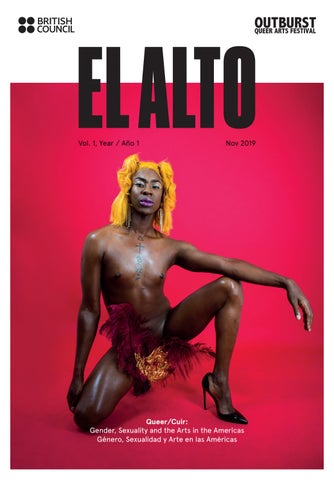
EL ALTO Vol. 1, Year / Año 1
Nov 2019
Queer/Cuir: Gender, Sexuality and the Arts in the Americas Género, Sexualidad y Arte en las Américas
British Council Outburst Queer Arts Festival
EL ALTO Vol. 1, Year / Año 1
Nov 2019
Queer/Cuir: Gender, Sexuality and the Arts in the Americas Género, Sexualidad y Arte en las Américas
Volume 1, Year 1. November 2019. Queer/Cuir: Gender, Sexuality and the Arts in the Americas (In partnership with Outburst Queer Arts Festival) ISBN 978-0-86355-964-8 – © 2019 British Council The views and opinions expressed in the articles, essays and interviews in this magazine are those of the authors and are not necessarily those of the British Council. www.britishcouncil.org Series Editor: Pablo Rosselló Issue Editors: Natalia Mallo, Ruth McCarthy, Pablo Rosselló. Designer: Joseph Pochodzaj Translators: Aiko Ikemura Amaral, Franco Castignani, Emilia Yañez. With thanks to: Annalee Davis, Auramarina Lazarde, Carla Morales Rios, Colette Norwood, Jherane Patmore, Liliane Rebelo, Lorena Martinez Luisa Michelsen, Manuela Martelli, María García Holley, Roberta Estrela D’Alva, Saada El-Akhrass, Silvia Lunazzi, Stephen Brett This publication is © British Council. All images and text are copyright of the artists and writers unless otherwise stated. The British Council is the United Kingdom’s international organisation for cultural relations and educational opportunities. A registered charity: 209131 (England and Wales), SCO377333 (Scotland). El Alto La revista bi-anual del British Council sobre arte y cultura en las Américas. Volumen 1, Año 1, Noviembre 2019. Queer/Cuir: Género, Sexualidad y Arte en las Américas (en colaboración con Outburst Queer Arts Festival) ISBN 978-0-86355-964-8 – © 2019 British Council Las opiniones expresadas en los artículos, ensayos y entrevistas de esta publicación pertenecen a sus autores y no necesariamente al British Council. www.britishcouncil.org Editor de la revista: Pablo Rosselló Editores de este número: Natalia Mallo, Ruth McCarthy, Pablo Rosselló Diseño gráfico: Joseph Pochodzaj Traducciones: Aiko Ikemura Amaral, Franco Castignani, Emilia Yañez Agradecimientos: Annalee Davis, Auramarina Lazarde, Carla Morales Rios, Colette Norwood, Jherane Patmore, Liliane Rebelo, Lorena Martinez Luisa Michelsen, Manuela Martelli, María García Holley, Roberta Estrela D’Alva, Saada El-Akhrass, Silvia Lunazzi, Stephen Brett Esta publicación es © British Counil. Todas las imágenes y textos pertenecen a los autores indicados salvo especificación. El British Council es la agencia internacional del Reino Unido para sus relaciones culturales y oportunidades educacionales. Registrado como organización benéfica: 209131 (Inglaterra y Gales), SCO377333 (Escocia).
Front Cover: © Jeana Lindo. Model / Modelo – Emani Edwards Back Cover: David Aruquipa @ Enzo Vazquez Tor
El Alto The British Council’s Arts in the Americas bi-annual review.
Index / Índice
Introduction / Introducciones ––– 05–13 Essays / Ensayos ––– 15–76 Profiles / Perfiles ––– 77–267
El Alto
4
Section 01
INTRODUCTIONS (Introducciones)
El Alto
6
PABLO ROSSELLÓ Director Arts Americas, British Council Director de Artes, Américas, British Council
Welcome to El Alto, our new review of arts and culture in the Americas. Published twice a year, each issue of the magazine will focus on a specific theme or a country within this vast and exciting region, collating and showcasing the most innovative cultural practices we’ve encountered through our various projects. Meaning both “a stop” and “a place of heights” in Spanish, El Alto wants to be a pause to reflect and take stock of what we’ve achieved through our projects - and to celebrate and disseminate the extraordinary people and initiatives that we’ve worked with. I’m very excited that this first issue celebrates over four years of collaboration with Outburst Queer Arts Festival in Belfast, an initiative started by my predecessor David Codling together with Ruth McCarthy, Artistic Director of Outburst. It has so far identified and supported dozens of queer artists and producers from across the Americas, from Canada to Brazil and from Venezuela to Mexico, allowing them to participate in the festival and supporting the development of their local projects. This first issue, developed in partnership with Outburst, presents 18 of the most exciting cultural practitioners working at the intersection between gender, sexuality and the arts; and it includes fashion designers, illustrators and visual artists, poets and curators, musicians and theatre directors, filmmakers, actors and activists. On the one hand, this publication is a sort of compendium of what’s new and exciting in queer arts in the Americas. Our use of “queer” here means not lesbian/ gay art but the wider artistic practice that explores (and critiques) normative identity-based discourses. Hence our use of the LGBTQI+ label throughout the text, the “+” being key. On the other hand, we also want to contrast and enrich the debate on queerness by bringing in experiences from the South that differ to those from the Northern hemisphere. To this end we have also commissioned a few essays that explore this difference in Mexican and Caribbean visual arts, folklore in the Peruvian and Bolivian Andes and political dissidence and dance in urban Argentina. This publication is the result of several years of hard work, patience and vision from many colleagues and partners in the UK and the Americas, so my first thanks go to all of them. Arriving three years into this collaboration with Outburst, I felt inspired and compelled to bring together the different stories behind this programme. I hope you enjoy them and that they allow you to better understand this exciting and important
Introduction / Introducciones
area within culture and the arts that celebrates creativity and freedom, and pushes the boundaries of the human to new horizons. Special thanks go to Natalia Mallo for the many hours spent editing this magazine and the many cigarettes smoked (via Skype) between Recoleta in Buenos Aires and Pompéia in São Paulo. ¡Sha sha sha estamos listos! See you at the next issue of El Alto. Bienvenidos a El Alto, la nueva revista bianual sobre arte y cultura en las Américas del British Council. Cada número de la revista estará estructurado alrededor de un tema (o un país de la región), presentando lo más innovador e interesante del panorama cultural panamericano actual. El Alto, con su significado doble de “parada” y “lugar en las alturas”, es una excusa para hacer una pausa y evaluar nuestro trabajo, su impacto, y contar las diferentes historias detrás de nuestros proyectos y sus participantes, celebrando y diseminando el trabajo de artistas y productores culturales con los que trabajamos en la región. Me emociona mucho que este número inaugural se centre en los cuatro años de trabajo con Outburst Queer Art Festival en Belfast, una colaboración iniciada por mi predecesor David Codling junto con Ruth McCarthy, Directora Artística del festival. El programa ha apoyado hasta el momento decenas de artistas y productores queer, desde Canadá hasta Brasil y desde Venezuela a México, llevándolos a participar del festival y apoyando el desarrollo de sus proyectos locales. En este primer número reunimos 18 de los perfiles más innovadores de la escena queer regional, quienes trabajan temas en la intersección del género, las sexualidad y las artes. En la lista entra todo el abanico completo de las artes e industrias creativas, incluyendo diseñadores de moda, ilustradores, artistas plásticos, poetas, curadores, músicos, directores de cine y teatro, actores y activistas. Por un lado, esta publicación quiere ser un compendio de lo nuevo dentro del panorama de arte queer en las Américas, entendiendo lo queer no sólo como sinónimo de manifestaciones artísticas lésbico/gay, sino en un sentido más amplio como ejercicios de exploración y crítica de los discursos normativos alrededor de la identidad. De ahí nuestro uso de la categoría LGBTQI+ a través del texto, siendo el “+” clave. Por otro lado, la publicación busca también problematizar y enriquecer el concepto de lo queer a través de la inclusión y el contraste con experiencias del hemisferio Sur, que difieren sustancialmente de las del Norte. Para este fin comisionamos algunos ensayos introductorios, que exploran esta diferencia en espacios específicos, desde el arte visual mexicano y caribeño contemporáneo hasta las fiestas populares andinas en el Perú y Bolivia y la nueva confluencia entre disidencia política y danza en Buenos Aires.
7
El Alto
8
Esta primera edición de El Alto es el resultado de años de trabajo, paciencia y visión de varios colegas y colaboradores del Reino Unido y las Américas, a quienes agradezco en primer lugar. Mi participación en este programa arranca recién en su tercer año, pero su impacto me ha impulsado e inspirado a buscar una plataforma donde contar sus diferentes historias. Espero las disfruten y les permitan entender mejor este estimulante e importante espacio de debate dentro del arte y la cultura, que celebra la creatividad y la libertad, y expande las fronteras de lo humano. Gracias especiales a Natalia Mallo por las infinitas horas de trabajo juntos y los muchos cigarros fumados vía Skype entre Recoleta en Buenos Aires y Pompéia en São Paulo. ¡Sha sha sha estamos listos! Nos vemos en el siguiente número.
RUTH MCCARTHY Artistic Director, Outburst Queer Arts Festival Directora Artística, Outburst Queer Arts Festival It’s been a privilege and a joy to work with artists and producers and fellow curators and activists in the Americas over the last four years. More than this, it has been an exhilarating re-awakening to the power and potential of queer art and creative collaboration at a time when the stories we tell are more important than ever in manifesting our world. The artists, activists and creators in this publication are not only reclaiming and reforming creative and cultural conversations about sexuality and gender in their own contexts, they are also reframing questions and sharing experiences that move the conversation beyond the narrow meanings of “LGBT” and “queer” that have shaped the white western narrative on this subject for the past 20 years or more. At a time when we in the west have largely shifted our terminologies and focus to “post-equality”, work coming from the Americas (Latin America and the Caribbean in particular) asks “whose equality?” and “what are the stories of our sexualities and genders that do not leave out everything else in our histories and realities?” If Queer Art and Queer Activism have always been intersectional, questioning, and radical in their creative vision and aspiration, then the marica/cuir/queer art within these pages is a reminder of what is possible when we walk brave together into our ideas. What hope becomes manifest! What magic becomes possible!
Introduction / Introducciones
9
Ha sido un privilegio y un placer trabajar con artistas, productorxs, curadorxs y activistas de los diferentes rincones de las Américas en estos últimos cuatro años. La experiencia ha sido un estimulante proceso de reconexión con el poder y el potencial del arte queer y de las colaboraciones creativas, en un momento en el que contar estas historias se hace indispensable e importante. Lxs artistas, activistas y creadorxs listados en esta publicación están no sólo reivindicando y redefiniendo el debate cultural sobre sexualidad y género en sus diferentes contextos locales; su trabajo y experiencias están también resignificando los parámetros de lo “LGBT y lo queer” que, anclados en un paradigma occidental, vienen monopolizando el debate en los últimos 20 años. En este momento donde occidente ha redefinido sus categorías en aras de un paradigma “post-ecualitario”, el arte que viene de las Américas (de Latinoamérica y el Caribe, sobre todo) ayuda a preguntarnos ¿quiénes son los beneficiarios de esa igualdad? y ¿cuáles son las historias sobre nuestras sexualidades e identidades de género que no dejan de lado todo lo demás en nuestra realidad e historia? Si el arte y activismo queer han sido siempre interseccionales, cuestionadores, radicales en su visión y ambición creativa, entonces el arte marica/cuir/queer de estas páginas sirven como recordatorio de lo que es posible de alcanzar cuando caminamos segurxs y de la mano de nuestros ideales. ¡Qué esperanza ponen de manifiesto, y qué magia la que hacen posible!
NATALIA MALLO Artist, Curator and Creative Producer Artista, Curadora Y Productora Creativa The immense variety of expressions, discourses and languages in the 17 profiles and 4 essays in this publication reflects not only the richness and creative power of queer arts in the Americas, a region as vast as it is diverse and contradictory. This variety represents above all a polyphony of propositions that suggest ways of creating, producing and being that challenge pre-established norms and refuse domestication. Being queer, dissident, LGBTQI+ or marica is a political act in itself in many parts of this region, so the work of these artists will always be a source of reflection, tension, risk and amazement. The artists and projects that are part of this paradigm speak of the body, language, childhood, oppression, affection, nature, survival, identity and love.
El Alto
10
They speak of much more, of course, as we untangle the various layers of meaning in their work. What they have in common is not only the challenging personal and social experiences they’ve gone/they go through, but also a kind of rebellious shimmer that their artistic gaze casts on reality, as they imagine a different world, and begin to build it. La inmensa variedad de expresiones, discursos y lenguajes presentes en los 17 perfiles y 4 ensayos que componen esta publicación, refleja no sólo la riqueza y la potencia creativa del arte queer en las Américas, que es una región tan vasta como diversa y contradictoria. Esta variedad representa sobretodo una polifonía de propuestas que plantean al mundo un modo de crear, producir y circular que, además de desafiar normas y convenciones, se rehúsa a ser domesticado. Ser queer, disidente, LGBTQI+ o marica es un acto político en sí mismo en varios lugares de esta región, por lo que el trabajo que emana de estxs artistas será siempre fuente de reflexión, tensión, riesgo y asombro. Lxs artistas y proyectos que forman parte de este paradigma hablan del cuerpo, el lenguaje, la infancia, la opresión, el afecto, la naturaleza, la supervivencia, la identidad y el amor. Hablan de mucho más, desde luego, a medida que nos adentramos en las varias capas de sentido de sus propuestas. Lo que tienen en común no se limita a las difíciles experiencias sociales y personales por las que han atravesado o siguen atravesando, sino que también radica en un cierto brillo rebelde que su mirada artística le echa a la realidad, mientras imaginan otro mundo, y empiezan a construirlo.
DAVID CODLING Director Arts, Middle East and North Africa; and Director Arts, Americas (2011-2017), British Council Director de Artes, Medio Oriente y Norte de África; y Director de Artes, Américas (2011-2017), British Council The queer sensibility challenges assumptions and takes nothing at face value (except of course when it insists on face value, because being contradictory and selfcontradictory are also characteristic!) and an artistic manifestation of that sensibility exists in different cultures but it is expressed in diverse ways. Its significance varies according to place and time, but it always sheds light on social, cultural and human situations from a surprising, charming or disturbing angle. Cultural exchange is about listening to, learning from and experiencing the other. With Outburst’s first visits to Brazil, Venezuela and Jamaica in 2015 we discovered a partner with whom to explore a queer angle on cultural exchange, opening up new avenues of collaboration and
Introduction / Introducciones
11
disrupting expectations on both sides of the Atlantic. The space between rhetoric (progressive or aggressive) and the lived reality in many countries of the American continent has provided many opportunities for shared reflection, celebration, cultural activism and collaboration. This discovery and enjoyment of difference through the lens of queer arts is an integral, indispensable part of serious (and seriously delightful) cultural exchange everywhere, as we now also find through new connections being made with the Arab world. La sensibilidad queer desafía las normas y valores supuestos, y no da nada por sentado (excepto, por supuesto, cuando decide hacerlo, ¡porque ser contradictorio y autocontradictorio también es parte de lo queer!), y se manifiesta en diferentes culturas pero se expresa de formas diversas. Su significado varía de acuerdo al tiempo y al lugar, pero sus manifestaciones siempre echan luz sobre su contexto social, cultural y humano inmediato a través de perspectivas sorpresivas, cautivadoras o desafiantes. El intercambio cultural es fundamentalmente un ejercicio de escucha, de aprendizaje y de experiencia del otro. Con las primeras visitas de Outburst a Brasil, Venezuela y Jamaica en 2015, descubrimos en ellos a un colaborador con quien explorar lo queer dentro de nuestro contexto de relaciones culturales, abriendo oportunidades de colaboración y generando disrupción en ambos lados del Atlántico. El espacio entre la retórica (progresiva o agresiva) y la realidad diaria en los diferentes países del continente abrieron a su vez oportunidades de reflexión compartida, celebración, activismo cultural y colaboración. Este descubrimiento (y valoración) de la diferencia a través de lo queer es parte integral e indispensable de todo intercambio cultural que pretenda ser serio (y que sea, además, ¡seriamente divertido!) en cualquier parte del mundo, como vemos también ahora con las nuevas colaboraciones forjadas entre Outburst y el mundo árabe.
El Alto
GLOSSARY / GLOSARIO LGBTQI+ Lesbian, gay, bisexual, transgender, queer, Intersex and other. Lesbiana, gay, bisexual, transgéneros, queer, intersexuales y otros. Spanish terms used throughout the text and not translated: Travesti/trava: travesti derives from the verb travestir (cross-dress), and it is used in Latin America to describe some forms of male-tofemale transitioning. Although many travestis do not consider themselves to be women, they take on feminine expressions and forms of address, and some of they might undergo hormonal and surgical interventions to acquire female body features. We differentiate travesti from other terms given the specificity of its practice and identity in Latin America, where it is sadly often the most stigmatised and marginalised form of queer identity. Trava is a shorter version of travesti, and is often used as a derogatory term in Argentina and other parts of Latin America. Marica/Puto: both are derogatory terms to refer to gay men in Latin America. Some people use it as a more generic term to describe queer/ LGBTQI+ people. Torta: derogatory term to refer to lesbians in Latin America. Like “queer”, all these words originated as derogatory terms but have been progressively claimed by the LGBTQI+ community in Latin America as a sign of pride and belonging.
12
INCLUSIVE LANGUAGE / LENGUAJE INCLUSIVO Inclusive language is a term that describes a series of linguistic practices that incorporate gender diversity into the Spanish language. It has its origins in the 1970s in both feminism and LGBTQI+ activism. Since then, LGBTQI+, marica and queer/cuir people (mainly but not exclusively) have appropriated this practice, hoping to transform Spanish grammar so that it recognises their identities and politics. In Spanish, the male gender is used when talking about groups of people with different genders: e.g. the students or the workers will both be male nouns in Spanish, even if the students/workers are a mix of women or men. Some speakers find this norm patriarchal and heteronormative, so they choose to neutralise the gender when refering to groups of individuals. In addition, Spanish applies gender (always either feminine or masculine) to nouns, adjectives and certain pronouns. In English, the use of the pronoun “they” allows to refer to non-binary and genderneutral people, but in Spanish gender markers make this impossible. As a result, Spanish inclusive language uses “x” or “e” as a form of disruption to neutralise the gender of the word/ pronoun. Estudiantes (students/male) becomes estudiantxs, Ellos (they/male) becomes ellxs or elles, todos (everyone/male) becomes todes or todxs. Communication, language and social relationships are political processes that take form according to their cultural contexts. The use in Spanish of “x” and “e” gender markers is still far from being recognised as official and
Glossary / Glosario
some speakers do not consider it acceptable, but because this is a publication about queer art and culture, we have kept the inclusive language used by some of the artists/activists and academics. El lenguaje inclusivo es un conjunto de prácticas lingüísticas que busca incorporar la diversidad de géneros cuando se habla y escribe en castellano. Se origina en los años 70 con la militancia LGBTQI+ y el feminismo. Desde entonces, las personas de género no binario y queer (mayoritaria aunque no exclusivamente) han apostado por un lenguaje que les reconozca, que identifique sus identidades. En castellano, el género masculino es usado para designar conjuntos de personas de varios géneros: e.g. los estudiantes, los trabajadores. Para algunas personas y grupos sociales, esto refleja un paradigma de lenguaje patriarcal y heteronormativo, optando por lo tanto por neutralizar el género al hablar de grupos de personas o por usar el género femenino como forma de visibilizar esta cuestión. Otro desafío es la presencia de marcadores de género, siempre femeninos o masculinos, para todo sustantivo, adjetivo y algunos pronombres. En inglés, el pronombre personal “they” puede ser usado, y es usado, como neutro, por lo que personas de género neutro o no-binarias han podido adoptarlo con éxito y replicarlo. Como resultado, el lenguaje inclusivo usa la “x” o la “e” como disrupción, como quiebre del lenguaje para neutralizar el género de la palabra o del pronombre. Estudiantes se convierte en estudiantxs, ellos se convierte en ellxs o elles, todos se convierte en todes o todxs. La comunicación, el lenguaje y las relaciones sociales son procesos políticos que toman forma
13
según los contextos culturales dentro de los que tengan lugar. El uso de la “x” o la “e” como marcadores de género dista de ser una práctica oficial o incluso aceptada, pero dada la temática de esta publicación, hemos optado por respetar y mantener las elecciones de cada artista/ activista o académico en lo que refiere al uso del lenguaje inclusivo.
© Pablo Rosselló
Section 02
ESSAYS (Ensayos)
16
Argentina
QUEER PERFORMANCE AND ACTIVISM IN THE ERA OF TRANSFEMINISMS Marie Bardet with Marcela Fuentes
Marcela (marshagall, an Argentine “scholartist” specialising in performance studies and living in Chicago) attended the event Escena Política (Political Scene) during one of her visits to Buenos Aires. Marie (a French dancer and philosopher living in Argentina) was there as well, as one of the speakers. It was October 2017, and the 2-day event had been organised by a group of performance artists, who had spent the previous months advocating the need to think about politics. During the gathering they explored queer forms of protest, because even in a country like Argentina, where exciting demonstrations against neoliberalism are taking place, protest action still resorts to predictable, outdated collective dynamics. Protest has no regard for sexuality,
for the ways in which oppression manifests in the ways we protest. During Escena Política we exchanged garments on catwalks and achieved a “zero degree” of nudity: we took to the streets like a band of iconoclasts, mutating into animals in front of the attentive gaze of La Boca’s (a Buenos Aires district) dwellers. This was just a gesture, of course, because in the context of the massive “Not One [Woman] Less” movement, those 34 individuals that were part of Escena Política were but a small minority. Even so, we wanted to bring attention to the fact that when we join or participate in demonstrations, we put on established gender performances, we remain obedient even when breaking the rules. Escena Política came to life as a demonstration against
Queer Performance and Activism in the Era of Transfeminisms
17
Entrenar la Fiesta, ORGIES © Nicolas Dodi (design/diseño: Julián Dubbie)
the shutdown of dance and show venues in the city, but it soon became a space that brought the body the centre, as a “bio-political axis”, of economic policy protests. The event and experiment favoured the intersection between feminism and queer politics. It also promoted the adoption of a “nothing will stop us” attitude.
We intend to reflect upon the problematics behind and the emergence of practices around the human body from a performative standpoint, making a link to political protests and Argentina’s recent history. As part of this exercise, we want to revise the local political movement landscape, strongly influenced by transfeminism -e.g. the “Not One [Woman] Less” demonstrations (and the strikes and gatherings that sprang from them), the swarm of green kerchiefs that waved during the struggle for the legalisation of abortion, and by the many marches and
interventions led by trans communities. These protests invite (and dare) us to experience the different perspectives forged through gestures, identities, understandings of the body and aesthetic performances; i.e., those perspectives that express and transform our sensitivity. The actions and voices of transfeminism have transformed many lives, and they have also transformed our bodies and our perceptions on a series of cross-cutting issues: racial, economic, territorial, financial, emotional, physical and collective, among others. After a period of several legislative successes in Argentina, such as the legislation on samesex marriage (2010) and gender identity (2012) —achieved thanks to the efforts of groups and leaders like Lohana Berkins and Diana Sacayán—, the demonstrations against gender violence and in favour of reproductive rights for women (the “Not One [Woman] Less” Movement and the National Campaign for the Right to Legal, Safe
El Alto
and Free Abortion) should prompt us to think about how the forces and transformations that cut through our struggling sense of corporality neither ignore nor silence the vulnerabilities that are clearly exposed on the streets. On the contrary, they call upon us to come back to, and at the same time, invent, a feeling and a conception of “the body” as a heterogeneous composition that is made up of force and vulnerability, movement and stillness, action and attentiveness. Spinoza’s idea that “no one has yet determined what the body can do” —which went viral during these protests—, goes hand in hand with a non-substantial concept of the body. The body is, in fact, a hybrid medley of relations of force, movement and stillness, whose determination to exist needs to be considered in the context of space but also time. On the afternoon of 13 June 2018, on a stage in Buenos Aires City’s central Callao Avenue, only 300 metres from Congress —the very place where the Legislation on the Voluntary Interruption of Pregnancy was about to be debated—, and while the street gradually filled with demonstrators, one militant for the Campaign for the Right to Abortion said, as she tested the microphone: “Today is a day that makes us feel like both laughing and crying at the same time”. Just a few months earlier, I had heard a similar statement: “I don’t know whether to stand still, laugh or cry…” from a girl walking by my side on 8 March 2017, during the International Women’s Strike. Holding her handmade placard, we walked next to each other for a while (we didn’t know one another but we still “stuck together”), until she asked me to take a picture of her. As her mobile made the shutter sound in my hand, she felt confused, not knowing how to react… We stared into each other’s eyes in silence as none of us really knew how to react. The urge to weep mingled with goose bumps; anger intertwined with a feeling of empowerment. A myriad of questions blended with the need to scream; silence mixed with a host of words that
18
struggled to come out; and the hugs met with smiles and laughter inspired by the gathering. What lies behind these demonstrations cannot be summarised by an emoji nor fit into a selfie. The day we decided to go on strike —“strike” arguably being the wrong term as female reproduction and caring are 24/7 forms of labour that can’t stop, even if they’re unrecognised as such—the power we felt when sensitivity was restored to the gestures that sustain our world (but go unnoticed) was in no way akin to the shield of a warrior who is certain of victory. These bodies under threat, whose very existence and whose right to life must be defended, and which feature on the daily news in the form of femicides (by life partners, family members, etc.) raise the challenge of how to highlight 1 of their lives their vulnerability without limiting (i.e. without the solution being having fewer nights out, fewer parties, increasing fear and dependence, arguing for a life under police tutelage). “Nobody is taking care of us but we have each other.”
For over a year, the collective ORGIE (Organisation for Stage Performance Research) has been organising parties every month or every other month which involve warm-ups and dancing from a stage performance perspective. In what they call Entrenar la Fiesta (Training the Party), the organisers feature a body-onbody encounter with the goal of expanding the boundaries of our bodily motions. Nowadays, as has happened before, the party becomes an urgent space for political in(ter)vention. Artist Roberto Jacoby viewed parties as manifestations of what he called “the strategy of joy” at the time when Argentina’s 1980s dictatorship was ending. This approach to parties as political and aesthetic spaces is now back. We get to dance, some say, a way to chase fear and horror away from our bodies. It can also be an exercise in trying to understand the energy that we have and
Queer Performance and Activism in the Era of Transfeminisms
the energy that we lack. The past few years have seen a boom of parties that think about partying from different angles, queer, lesbian, marica, trans or non-binary, or whatever terms one uses to describe the body they inhabit. Asides from Entrenar la Fiesta, other parties like Hyedra and Vicio (Vice) or the Antroposex Perrafest (“Antroposex Bitchfest”) parties relentlessly interrogate the “dis-comfort of desire”. There seems to be a renewed urge for parties that not only welcome everyone but that also tear down the dynamics of bouncer-ruled discos, that respect music as much as the deformities and lack of form of our enjoyment. As a political experience in today’s Buenos Aires, these festive gatherings are influenced by one of the biggest tensions of our days: how to conceive safety, safe practices, without replicating traditional punishing and vigilant practices. The promotional poster for Entrenar la Fiesta warns that “in the event of discrimination or violence, we shall activate a transfeminist protocol”. From a patriarchal protocol to a transfeminist one, we see it’s a thin line between creating “safe” spaces without falling prey to punitive stances, a prudish idea of safety (guaranteed by a generalised state of control) and “respectable” practices (like those promoted through the moral panic stirred by the #MeToo movement). Entrenar la Fiesta (or ELF) is held at the Xirgu Theatre, in an old-fashioned Italian-style dancehall: the stage is empty, and we find ourselves in the middle of a wooden dancefloor without seats. The box galleries will be used to store backpacks and coats. Clearly, we are here to remove our clothes: whether partially or fully is an individual decision. It is unclear whether we are getting ready for physical training, for a party, or for an orgy. This indeterminacy is was sustains ELF throughout the night. The party starts with a group warm-up guided by the ORGIE team: at this point, the music infiltrates the bodies and invites them to expand, to vibrate and tear down the binarism of dance moves… Hierarchies collapse through the skin and through human contact,
19
and this in turn encourages other motions in the honest and transparent physical space of this party. “When the boundaries between the bodies are broken down painlessly, a party ensues,” said Roberto Jacoby in 1992 in El deseo nace del derrumbe (“Desire is born from collapse”). In ELF, the boundaries between bodies are indeed broken down, releasing the knowledge and the sensibilities of performance art and bodily action. The party is held in a theatre which is now part of a university, and it has been conceived, organised and coordinated by people with a background in performance arts. As iconoclasts belonging to a world where dance enables contact in many directions, we materialise what we have learnt by reading Wittig over many nights: the bliss that breaks away from a reproductive organisation of our bodies blurs and redefines the contours of our skin. By playing with the dis-orientation of our desires, we de-materialise as bodies that enable new gestures and motions in space. This is about training in the “queer art of lame dancing”, as encouraged by a group of queer Barcelona participants during a Dance Philosophy Congress held in Madrid a few weeks ago, or about dancing in whichever way we see fit. ELF is not a mere party: it is a manifesto written with bodies and thoughts in motion, a declaration, and a sensitive treatise akin to Pasadas de Sexo y Revolución (Overstuffed with Sex and Revolution), a performance-cum-party held in 2018), and similar to the first action/ piece by ORGIE Diarios del Odio (Diaries of Hate). This piece, directed by Silvio Lang —the artist connecting Escena Política and ORGIE—, is based on a text by Roberto Jacoby and Syd Krochmalny which compiled hate comments published in the readers’ letters section of newspapers towards the end of Argentina’s Kirchner presidential era. Ever since its inception, ORGIE has seen a huge increase of its membership while becoming less spectacular in the events they organise: this year they did not present “a piece”. Instead, they prepared the party as a locus for political debate and as an intersection between art and politics, similar to what we saw during the
El Alto
1980s in Argentina. The party’s invitation card already sounds like a manifesto: “We explore the procedures of movement: we promote the ability tot remake our bodies; we cross intensity thresholds; we string together forces that act upon and between our bodies; we reinvent the fabric of collective dance; we confront the official politics of enjoyment, which commands where we are allowed to dance. The party is also a space of political struggle, and dance is a way of expressing dissent. We cannot let Establishment politicians define how we experience pleasure and desire. To paraphrase our “transviarch” (a combination of trans and matriarch) Lohana Berkins, we do not want the State to legislate our desires”.
It is precisely at this intersection of, on one hand, the region’s return to neo-conservatism —which attempts to regulate and altogether censor pleasure, making both lives and bodies vulnerable—, and the conviction that the recent feminist movements have changed things forever, that a number of questions come up: after so many years of transfeminist struggle, what type of corporality, gestures and performances take place on the streets, in the theatres, on the stages and in the public gatherings in Argentina (and more specifically, in Buenos Aires)? In what way does this body, whose strength is derived from its very vulnerability, determine its performance and its own re-definition, based on different understandings of what bodies can be (rather than do)? How do skins, muscles, perspectives, spaces and times change through these new gestures and alliances? As we engage in things such as riding our bikes, training in self-defence, marching at night, cooking and sharing recipes, reading about past experiences, supporting fellow women in need of an abortion, peering into the peripheries, camping near Congress as the law for the interruption of pregnancy is being debated, disseminating the voices and images from a
20
prison ward, wearing a black ribbon on our wrists as a symbol of sisterhood and as a way to protect each other (from the “We have each other” campaign), hanging a green kerchief from our backpacks, organising feminist alert groups in discos, or going to ELF-like get-togethers, how do we recognise, reflect upon and share these forces? And in doing so, how do we avoid feeling that we are being protected by an invincible and glorious body shield (because we are not super-heroes), and rather allow ourselves to accept that we can “laugh and cry at the same time”? In what part of our bodies and lives can we find this “non-blocking force” (as dancer and performer Amparo González called it) when the ways of protecting ourselves, imbued with our own vulnerabilities, step away from a victorious body ideal and from the prudish “non-violence” discourse that conditions us to suffer in silence? 1 through How can we articulate from here, delicate weaving, a discourse of denunciation, that demands justice and the liberation of our voices, at the same time as making space for raising concerns on the risks of adopting punitive positions? Performance should be seen here not as a show, but as an intentional practice bent on introspection and reflexion, aiming to nurture the current creative and experimental processes that cut across our ways of living, the bodies that we create for ourselves, and our modes of circulating and building alliances. If instead of producing a glorious body of fighting warriors, the experiences of feminism, complex and paradoxical as they have been, allow us to recognise that we can “laugh and cry at the same time”, where in our bodieslives, and in our practices-thoughts, can we make room for actions that, while remaining attentive to the current context, are aware of our vulnerabilities and refuse to hide or repress them? What gestures and modes of presenting others and ourselves can be conceived as we avoid the great active or passive binary? How can those gestures and modes break away from the mandate of happiness and success that is glorified by advertising? What are the somatic,
Queer Performance and Activism in the Era of Transfeminisms
performative and motion-related practices that enable unravelling the paralysis in our muscles, so that our skins do not become harbingers of condemnation or accomplices of discourses and practices that, for the sake of safety, are directed against groups which have also been the victims of the recent “neoliberal hunting season”?
Mis días sin Victoria (“My days without Victoria/ Victory”), by Rodrigo Arena, is a performance currently staged in several indie theatres in Buenos Aires and other Argentinean cities, and it serves as a sound box for the questions posed so far. From the outset, the title’s ambiguity raises questions on the success and/or failure in love. Victoria is the name of the girl that the director once fell in love with, but in Spanish, that name also means “victory”. This is the story of a lover’s failure, but above all, it is a story on how bodies and experiences are presented whenever they break away from binary dictates such as masculine/feminine, success/failure, show/performance/autobiographic narration. The current version of Mis días sin Victoria begins with an autobiographic speech by Arena inviting the audience to reflect upon the discomfort of presenting a performance that was conceived by a lesbian director and is now being directed by a trans man. The use of mise en abîme focuses on this gender displacement, questioning this voice upon which the performance relies: the director presents themself both as vulnerable (in choosing to continue to present this performance), and as compelling and powerful (through their gestures, texts, scenes). Letting go of the safety net of the author’s voice and exposing one’s vulnerabilities is not counter to the “non-blocking force”, but quite the opposite. A particularly powerful scene involves a Martha Graham-style “dance” to which Arena invites the public to join. The actress and dancer that played “Victoria” in the piece, plus two guest dancers who mingle with the audience, the
21
lighting technician, and a number of girlfriends, also join. These are bodies that are a far cry from exhibiting the technical virtuosity and standards of professional dancers; these are trans bodies that strip and join in the repetition of modern movements, alternating between expansion and withdrawal, elevation and collapse. This is a typical sequence of 20th century modern dance that is repeated over and over again, under a soft light and on a pool of blood-coloured paint that stains the dance-enthralled bodies. This scene can work as a catalyst for a new aesthetics and politics of the body on today’s stages and street protests. These are our days without victory (Victoria), days in which we attempt to exercise “the queer art of failure” (in Jack Halberstam’s words), by tearing down the binary opposition between success and failure, and by taking a stance as bodies whose way of being strong do not exclude being vulnerable or change. Blood, doubt, paradox and vulnerability leave their marks on us, but we do not hide them, nor we make protective shields out of them. “Fragile as bombs”, those bodies on the streets, at parties and on stages invent ways of existing and persevering, far away from the gran ideal of victory.
Exorcising fear through a scream; demanding justice and an end to the killings perpetrated against us; (re)visiting pleasure, unsuspecting pleasure; taking care of each other; working on our spontaneity; exposing failure; trying everything again. These performances, fuelled by transfeminisms and by gestures that blur their origins but honour their genealogy, powered by our bodies’ potential and our confrontation to opposing forces, by our enjoyment and our will to sustain life, or rights, to live experiences, to shed tears and to laugh; these performances are no representation of something: rather, they are what we are able to make last and let go of, endlessly.
El Alto
22
Marie Bardet holds a Doctorate in
inquiry, and social justice. Her book
Philosophy (Paris 8) and Social Sciences
Performance Constellations: Networks of
(UBA), and is currently a Lecturer and
Protest and Activism in Latin America
Researcher for IDAES in UNSAM, Buenos
(University of Michigan Press, 2019)
Aires. She combines philosophical research
maps emerging forms of collective
with dance, exploring improvisation
action that intertwine street protest
and somatic practices, thinking the
and digital networking to make visible
issue of the body from different social
and respond to transnational systems
and political perspectives. This
of power. Other selected publications
transversality feeds her publications
include “#NiUnaMenos (#NotOneWomanLess):
(Thinking and Moving, 2012); her
Hashtag Performativity, Memory, and
performative conferences (losing face,
Direct Action against Gender Violence in
2019; De-articulating: a Conference in
Argentina,” in Women Mobilizing Memory
Movement, 2012; The Remains of Gestures,
(Columbia University Press, 2019); “Making
2010); her artistic projects (Around
Change: Performance and the Workings of
the table Compagnie ORO Loic Touzé-
the Event,” in Theatre, Performance and
Kompost, 2013-2016); her academic practice
Theories of Change (Palgrave-Macmillan,
(IDAES-UNSAM, UNDAV - MA Latin American
2018); and “Theater as Event: The
Aesthetics, IDEA-USACH- MA in Latin
Politics of Interruption in Vivi Tellas’
American Art, Though and Culture (ch),
Documentary Theater,” in Calling Out of
Paris 8 (fr), ENS Port au Prince, Haiti)
Context (Paraguay Press, 2017). Her solo
and her work in artistic institutions.
performance Sujeto Transnacional uses
She’s currently researching and exploring
auto-ethnography and storytelling to
different forms of transmitting the
explore how immigration policies shape
potential of movement and thought through
contemporary transnational identities.
the project “Losing face”, supported by a
Sujeto Transnacional has been staged at
scholarship from the National Dance Centre
international conferences and curated
(Pantin) and through several research
events at renown performance venues such
collectives in Buenos AIres (Centro de
as Highways Performance Space in Los
Investigaciones Antifascistas, Formaciones
Angeles and Centro Cultural San Martín
Extrañas; 12/24, Fábrica Perú; Casa de
and Centro Cultural de la Memoria Haroldo
Bajos Estudios de la Casona de Flores,
Conti in Buenos Aires.
etc.) She’s also part of research groups like Soma&Po (Aesthetics and Politics of somatic practices) in París 8; (sensitive) Bodies and (common) Goods (IDAES-UNSAM – Paris 8 – Paris 7). Marie also supports artistic projects through creative clinics and was Choreographic Assistant to Mathild Monnier (“The Dance”). She’s a translator of texts about philosophy and the arts (Rancière, Nancy, etc.) and directs the “Small Sensitive Library” collection published by Cactus Publishing House. Marcela Fuentes is a performance theorist and artist from Argentina. She currently teaches in the Department of Performance Studies at Northwestern University. Her research and practice approach performance as a means of communication,
Argentina
23
PERFORMANCE Y ACTIVISMO QUEER EN TIEMPOS DE NI UNA MENOS Y TRANS-FEMINISMOS Marie Bardet con Marcela Fuentes
Marcela (marshagall, “scholartist” de estudios de performance argentina que reside en Chicago) participó como público del encuentro Escena Política en una de sus visitas a Buenos Aires. Marie (bailarina y filósofa francesa radicada en Argentina) como ponente. Era octubre de 2017 y un grupo de artistas de las artes escénicas que proponían desde largos meses pensar lo político de sus prácticas de cuerpo y pensamiento organizaron dos jornadas. Allí se ensayaron formas de la protesta, formas queer, porque aun con Argentina bellamente movilizada contra
el neoliberalismo, la protesta usa formas de lo colectivo algo gastadas, predecibles. La protesta no piensa la sexualidad, el modo en que ahí también se nos oprime. O, para hacer justicia, qué más se puede hacer, aparte de letras y canciones y cuerpos estallados en colores y desafíos, para dar cuenta de formas del deseo, de otras imaginaciones. Ensayamos ahí pasarelas de intercambio de vestimenta, llegando al punto “cero” de la desnudez; salimos como una banda de locas deviniendo animal ante la atenta mirada de les habitantes del barrio de La Boca. Gesto.
El Alto
24
Entrenar la Fiesta, ORGIES © Nicolas Dodi (design/diseño: Julián Dubbie)
Porque en el contexto de Ni Una Menos, esas treinta-cuarenta personas que eran parte de Escena Política se quedaban cortas. Pero aun así… es necesario explotar también el modo en que hacemos performance de género cuando estamos en las marchas, la manera en que obedecemos aun cuando transgredimos. Escena surgió para protestar por el cierre de espacios para la danza-espectáculo y se transformó en un espacio donde el cuerpo, la cuerpa, tomó el centro de la escena, centro biopolítico dentro de la protesta sobre política económica. Propiciar una intersección entre feminismos y política queer. Un vamos por todo.
Nos proponemos pensar en términos de performance las problemáticas y las emergencias de prácticas en torno a la corporeidad, en un ida y vuelta entre las calles y las escenas de la Argentina reciente. Nos proponemos aquí, en este re-encuentro, dar-nos cuenta de algo de este paisaje en cuanto está atravesado fuertemente por olas feministas, las marchas Ni Una Menos y las prácticas de asambleas y
de paro de mujeres que surgieron de ellas, la marea de pañuelos verdes que con fuerza hizo presente la larga trayectoria de la Campaña por la Legalización del Aborto, las muchas movilizaciones e intervenciones de las comunidades trans en torno a la experiencia corporal y política que implica habitar y dar cuerpo a los umbrales de las identidades de género. Estas prácticas y expresiones nos desafían a situarnos desde un adentro/afuera de la perspectiva que se ha ido tramando entre gestos, identidades, corporeidades y performances estéticas, es decir aquellas que plasman y transforman el estrato de lo sensible. Si las acciones y las voces de los transfeminismos van transformando muchas vidas, es también en cuanto transforman nuestras cuerpas y percepciones en una transversalidad de problemáticas: raciales, económicas, territoriales, financieras, emocionales, físicas, colectivas, etc. Después de una temporada de conquistas como el matrimonio igualitario (2010) y la ley de identidad de género (2012)—conquistas amasadas por el trabajo de colectivas y lideresas como Lohana Berkins y Diana Sacayán— las grandes marchas contra la violencia de género
Performance y Activismo Queer en Tiempos de Ni Una Menos y Trans-Feminismos
25
y los derechos reproductivos (Ni Una Menos, La Campaña, y otras), nos exigen pensar cómo las fuerzas y transformaciones que atraviesan nuestras corporeidades en lucha no ignoran ni callan las vulnerabilidades expuestas a flor de piel en la calle. Todo lo contrario, nos exigen volver a acercarnos e inventar a la vez una sensación y un concepto de “cuerpo” como una composición heterogénea de fuerzas y vulnerabilidades, de movimientos y quietudes, de acciones y escuchas. Si la frase tan trillada de Spinoza, “nadie sabe lo que puede un cuerpo”, se volvió viral en las luchas y también en los textos y las aulas, no hay que olvidarse que va acompañada de un concepto no sustancial de cuerpo, sino que se trata de un cuerpo que es composición híbrida de relaciones de fuerzas, de movimiento y de detención, cuya perseverancia en existir hay que pensar en el tiempo, tanto o más que en el espacio.
Paramos”, las muchas preguntas con la explosión del grito atragantado por demasiado tiempo, el silencio y las muchas palabras buscando paso, los abrazos y las risas a carcajadas fruto del encuentro. Lo que está pasando, los paros y las marchas, no se resumen en un emoticón, no entran en una selfie, aunque los presupongan como parte de su poder interpelativo… En ese día en el que nos propusimos suspender las actividades de la jornada, sin saber si realmente es posible parar para quienes realizan trabajos precarizados (o para quienes se ocupan de tareas llamadas de “cuidado” y que más bien aprendimos a nombrar como trabajo no reconocido de la reproducción de la vida) la potencia que se siente al volver sensible todos los gestos que sostienen el mundo y que nadie ve no es una coraza de guerrerx segurx de la victoria final.
El 13 de junio de 2018 a la tarde, en un escenario instalado en la Avenida Callao, a 300 metros del Congreso donde se iba a debatir la Ley de Interrupción Voluntaria del Embarazo, una de las militantes de la Campaña por el Derecho al Aborto, probando el micrófono mientras empezaba a llegar gente que iba pronto a ocupar toda la avenida, abrió con esas palabras: “Hoy es un día que nos da ganas de reírnos y de llorar al mismo tiempo”.
La aparición de cuerpas amenazadas, cuya existencia básica (derecho a la vida) debe ser defendida, espejo expresivo de las noticias diarias sobre casos de femicidio (asesinatos en el ámbito de pareja, familiar, en espacios cotidianos) plantea el desafío de cómo subrayar la vulnerabilidad sin que eso se transforme en menos salidas, menos fiestas, más miedo, más dependencia, más vivir bajo tutela policial. “No nos cuidan, nos tenemos”.
Justo unos meses antes, escuché una frase parecida: “¡Ay! No sé si ponerme dura, reír o llorar…” dijo, sorprendida la chica que caminaba al lado mío el 8 de marzo de 2017 durante el Paro Internacional de Mujeres. Con su pancarta hecha a mano, en el momento en que después de un largo rato de caminar juntas sin conocernos, casi sin mirarnos pero “juntas” en más de un sentido, me pidió que le sacara una foto. En el momento del “clic” de su celular se sintió confundida, no sabía qué cara poner… silencio, nos miramos. Es cierto, ni ella ni yo, ni ninguna de nosotras sabíamos bien qué cara poner. Se nos mezclan las ganas de llorar con la piel de gallina, la rabia con la sensación de potencia enorme de “Nosotras
Con una frecuencia mensual o bimensual, el colectivo ORGIE (Organización Grupal de Investigaciones Escénicas) da cita desde hace más de un año para una fiesta, un calentamiento, un baile, pensados desde su práctica escénica. En lo que llaman Entrenar la Fiesta, organizan y componen un cuerpo a cuerpo que busca expandir los límites de nuestros movimientos corporales. En este momento, como lo fue en otros, la fiesta deviene terreno urgente de in(ter)vención política. Si el artista Roberto Jacoby pensaba la fiesta como “estrategia de la alegría” al final de la dictadura cívico-militar en
El Alto
los inicios de los 80, ese retorno de las fiestas como práctica político-estética hoy nos vuelve a interpelar. Juntarnos a bailar para sacarnos el miedo, el terror del cuerpo, dicen algunes. También bailar juntes puede ser un ejercicio para entender la energía que tenemos y la que no. En los últimos años se multiplicaron las fiestas que se piensan a sí mismas desde, digamos, diferentes prácticas políticas de lo cuir, lésbico, puto, disidencia sexual, marica, trans o no binarie, o bien como cada quien decida llamar el espacio que habita. Entre muchísimas otras, además de Entrenar la Fiesta podemos nombrar la Hyedra, la Vicio, o las Perrafest de lxs Antroposex que interrogan con inistencia la “in-comodidad del deseo”. Es que late, una vez más, cierta urgencia de fiestas donde quepa cualquiera, que rompan la lógica del boliche vigilante, que cuiden la música tanto como las de-formidades de nuestros goces. Estas fiestas como experiencia política hoy en Buenos Aires se encuentran atravesadas por una de las tensiones más álgidas del momento: nos fuerzan a imaginar prácticas de cuidado sin volvernos vigilantes de nuestros propios entornos. Dice la invitación a Entrenar la Fiesta: “Ante cualquier actitud de discriminación o violencia activamos proto-cola trans-feminista”. Del protocolo a la proto-cola, queda claro que caminamos sobre la cornisa para pensar y hacer espacios “seguros” sin caer en el punitivismo de la denuncia a la dale que va, ni tampoco abonar el ideal de una pulcra seguridad garantizada por un estado de control generalizado, o por prácticas “respetables” impulsadas por el pánico moral post #MeToo. Entrenar la Fiesta tiene lugar este año 2019 en el teatro Xirgu, en una antigua sala a la italiana: el escenario está desocupado, nos encontramos en una pista de parquet sin butacas. Los palcos reciben mochilas y todos los abrigos. Está claro que vinimos a sacarnos la ropa, algunes menos, otres más. No se sabe bien si nos preparamos para un entrenamiento corporal, una fiesta o una orgía. Esta indecisión es la que (se) sostiene toda la noche de Entrenar la Fiesta (ELF, para
26
les íntimes). Esta fiesta empieza con una entrada en calor grupal, guiada por ORGIE, ya con una música atravesando los tejidos de cuerpos que experimentan sus capacidades de expansión, de vibratilidad, de desorganización del binarismo adelante/atrás, arriba/abajo... Una desjerarquización a través de la piel y del contacto que invita a su vez a otras circulaciones posibles en el espacio de una fiesta nada careta. “Cuando el límite entre los cuerpos se rompe sin dolor, hay fiesta”, dijo Roberto Jacoby en 1992 en El deseo nace del derrumbe. En Entrenar la Fiesta se rompe el límite entre los cuerpos, movilizando saberes-sentires de diferentes artes escénicas y trabajos corporales. La fiesta tiene lugar en un teatro que ahora es sede de una universidad y está pensada, organizada, guiada, y cuidada por muchas personas que vienen de las 1 artes escénicas y de la performance. Tránsfugas del mundo de una danza que habilita el contacto en muchas direcciones, vamos poniendo en práctica lo que, leyendo a Wittig o a lo largo de nuestras noches, fuimos aprendiendo: el goce que fuga de la organización reproductora de los cuerpos desdibuja y redibuja cada vez los contornos de nuestra piel. Así, en los juegos de des-orientar nuestros deseos, nos deshacemos cuerpos que habilitan otros gestos y otras circulaciones en el espacio, en un entrenar preciso del “arte queer de bailar mal” (como fomentaban unes barceloneses loques en un Congreso de Filosofía de la Danza en Madrid hace pocas semanas), o más bien como se nos canta… ELF no es una simple fiesta: es un manifiesto que se escribe con los cuerpos y los pensamientos moviéndose, una declaración, un tratado sensible, como lo fueron, de otra manera, la primera acción/obra de ORGIE Diarios del Odio (dirigida por Silvio Lang, figura bisagra entre Escena Política y ORGIE, a partir del texto de Roberto Jacoby y Syd Krochmalny que compilaba comentarios odiosos en la sección de lectores de los diarios al final del kirchnerismo) y Pasadas de Sexo y Revolución (performance-fiesta del 2018). Desde esas primeras experiencias, ORGIE
Performance y Activismo Queer en Tiempos de Ni Una Menos y Trans-Feminismos
se ha vuelto cada vez más tentacular en su organización grupal y menos espectacular en sus formas: este año directamente no presentan “obra”, hacen y piensan una fiesta como lugar de disputa política, una fiesta que se vuelve como un ritornelo del encuentro entre arte y política en Argentina desde los años 80. Ya el cartón de invitación a la fiesta suena como manifiesto: “Investigamos procedimientos de movimiento: creamos capacidades que rehagan nuestros cuerpos; cruzamos umbrales de intensidades; concatenamos fuerzas que actúan sobre y entre los cuerpos; reinventamos la trama de la danza colectiva, discutimos con la política oficial del goce que nos dice dónde estamos habilitados a bailar y dónde no. La fiesta es, también, una lucha política. El baile, una forma de disidencia. No podemos conceder a los políticos del orden que definan cómo gozan y desean nuestros cuerpos. Como decía nuestra traviarca, Lohana Berkins, ‘No queremos que el Estado legisle sobre nuestros deseos’”.
Es precisamente en este destiempo entre la sensación de retrocesos relacionados con la reacción neo-conservadora en la región, que intenta regular y de plano censurar el placer y vulnerabilizar los cuerpos y las vidas, y la sensación de que nada podrá volver a ser como antes luego de las olas feministas que tomaron fuerza desde el 2015, donde emergen una serie de preguntas y pensares: ¿qué corporeidades, gestos, y performances surgen de las calles, las salas, los escenarios y las asambleas de Argentina (y más específicamente en este caso Buenos Aires) después de largos años ya de luchas trans-feministas que se volvieron más presentes y fuertes que nunca sin enarbolar el cuerpo guerrero, el cuerpo poderoso, invulnerable? ¿De qué manera lo que identificamos como una corporeidad cuya fuerza teje a partir de sus vulnerabilidades marca las performances y habilita las preguntas sobre cómo hacernos otros cuerpos en vez de “qué puede un cuerpo”? ¿Cómo cambian también nuestras pieles,
27
nuestros músculos, nuestras miradas, nuestros espacios y tiempos, a través de gestos y alianzas nuevas? Pedaleando en una bici, entrenando autodefensa, marchando de noche, cocinando y traficando recetas, leyendo experiencias pasadas, acompañando compañeras que quieren abortar, mirando en los bordes, rancheando cerca del Congreso mientras adentro se discute la ley de interrupción del embarazo, haciendo circular voces e imágenes desde adentro y afuera de una cárcel, poniéndonos una cinta negra en la muñeca como señal de sororidad por si nos necesitamos (campaña “Nosotras Nos Tenemos”) o desplegando un pañuelo verde en la mochila, organizando grupas de alerta feminista en los boliches, entrenando la fiesta, ¿cómo inscribimos, pensamos, reconocemos, compartimos, esas fuerzas, sabiendo que no nos están fabricando un super caparazón de cuerpxs gloriosxs de la lucha (no somos super agentes), sino que nos permiten reconocer que podemos reír y llorar a la vez? ¿En qué parte de nuestrxs cuerpasvidas encontramos esa “fuerza que no bloquea” (como dice la bailarina y performer Amparo González) cuando nuestros modos de defendernos saben de nuestras vulnerabilidades y desarman los ideales del gran cuerpo victorioso, así como los de los discursos beatos de una “no violencia” pacificadora que nos entrena para padecer sin responder? ¿Cómo tejer desde esos registros, en una delicada urdimbre, el apoyo a las denuncias, a los pedidos de justicia, y a la liberación de la voz, pero a la vez las inquietudes acerca de los riesgos punitivistas? Performance no como espectáculo sino como puesta entre paréntesis, práctica intencional para pensarnos y dar de nuevo, para alimentar procesos actuales de creación/ experimentación que tocan transversalmente los cuerpos que nos hacemos, los modos de vivir, de hacer circular y tejer alianzas. Si más que un super cuerpo glorioso de guerrerxs para la lucha, las experiencias feministas en sus texturas complejas y paradojales nos permiten
El Alto
reconocer que podemos “reír y llorar a la vez”, ¿en qué parte de nuestrxs cuerpas-vidas, de nuestrxs prácticas-pensamientos, hacemos lugar para acciones que no dejan de escuchar el contexto, que saben de nuestras vulnerabilidades y no las esconden? ¿Qué potencia de gestos y modos de presentar-nos se tejen huyendo del gran imperativo binario activx o pasivx? ¿Cómo rajan del imperativo de felicidad y éxito winner publicitario? ¿Qué prácticas somáticas, corporales, performativas, en movimiento permiten deshacer la capa de parálisis en nuestros músculos, y no convertir nuestras pieles en agentes de anticipación de la condena ni cómplices de discursos y prácticas de la seguridad contra sectores también atacados en esta temporada de caza neoliberal?
Una performance que circula en varias salas de teatro independiente de Buenos Aires y otras ciudades de Argentina, Mis días sin Victoria de Rodrigo Arena, se puede tomar como una caja de resonancia de las preguntas planteadas hasta aquí. Ya de entrada, la ambigüedad del título instala un interrogante sobre la victoria y el fracaso amoroso: Victoria es el nombre de la chica de quien se enamoró la/el directora/ director, pero también el sustantivo que designa un éxito. Es la historia de un fracaso (amoroso) pero sobre todo la presentación de cuerpos y trayectorias que rajan de varios binarismos estancos: masculinidad/feminidad, éxito/ fracaso, espectáculo/performance/relato autobiográfico. La versión actual de Mis días sin Victoria empieza con un discurso autobiográfico de Rodrigo Arenas que convoca al público a pensar con él en la incomodidad de presentar una obra que fue pensada por una directora lesbiana y que ahora dirige un director varón trans. El recurso teatral de la puesta en abismo opera aquí en cuanto a la transición de género, poniendo en cuestión fuertemente la voz de enunciación de la performance; mostrándose, el director, vulnerable (en cuanto a la pertinencia de seguir presentando esa performance) al
28
mismo tiempo que singularmente contundente y potente (en cuanto a los gestos, textos, y escenas propuestas). Perder la gran seguridad de la voz del autor, exponer vulnerabilidades a flor de piel, no va en contra de esa fuerza que no bloquea. Todo lo contrario. Una escena especialmente potente es, por ejemplo, la de la “danza” al estilo Graham que Rodrigo transmite a quienes quieran entrar al espacio performático: su compañera de escena, la actriz -bailarina que hizo de “Victoria” durante la obra “original”, y dos bailarines invitades, presentes en el público, pero también la iluminadora, amigas que estaban por ahí, etc. Cuerpos no virtuosos, cuerpos no estilizados por las normas de la danza, cuerpos trans, se desnudan y se suman en la repetición de un movimiento moderno si los hay, alternando 1 y caída. Una expansión y repliegue, elevación secuencia típica de la danza moderna del siglo XX, repetida hasta el agotamiento bajo una luz tenue y sobre un charco de pintura color sangre que va manchando esos cuerpos absorbidos en su danza. A través de sus gestos, esta escena puede funcionar como catalizador de una estética y política de los cuerpos en los escenarios y las calles actuales. Nuestros días sin Victoria, en los que, si ensayamos “un arte queer del Fracaso” del que habla Jack Halberstam, es deshaciendo la oposición binaria entre éxito y fracaso, haciéndonos cuerpos cuyas maneras de tener fuerzas no ignoran ni la vulnerabilidad, ni las transformaciones. La sangre, la duda, la paradoja, la vulnerabilidad que nos manchan, no las escondemos, no las hacemos escudos invencibles. “Frágiles como una bomba”, esos cuerpos en calles, en fiestas, en escenas, inventan modos de persistir en su existencia, de seguir haciendo lejos del gran ideal de victoria.
Gritar un miedo, pedir justicia, demandar que paren de matarnos, (re)ocuparnos del placer, del placer sin saber, cuidarnos desde la cola,
Performance y Activismo Queer en Tiempos de Ni Una Menos y Trans-Feminismos
entrenar lo espontáneo, desplegar el fracaso, volver a intentarlo. Performances impulsadas por los trans-feminismos, gestos que desdibujan el comienzo mientras honran las genealogías, qué podemos como corporalidades, como relaciones de fuerzas, goce y sostener la vida, derechos, lo en vivo, llorar y reír, permitirlo, desplegarlo, no es representación, es lo que logramos que dure, dejarlo ir, sin punto final.
29
y Bienes (comunes) (IDAES-UNSAM – Paris 8 – Paris 7). Acompaña proyecto artísticos en clínicas de creación y fue asistente de coreografía de Mathilde Monnier (El Baile). También es traductora de textos del campo de la filosofía y del arte (Rancière, Nancy, etc.) y dirige la colección “Pequeña Biblioteca Sensible” en la Editorial Cactus. Marcela Fuentes es una artista argentina y una teórica del performance. Actualmente
Marie Bardet es doctora en Filosofía (Paris 8) y en Ciencias Sociales (UBA), y actualmente docente e investigadora del IDAES en la UNSAM. Entrelaza su práctica de la filosofía con una práctica de danza, explorando particularmente la improvisación y prácticas somáticas, así como las potencias de pensar desde los cuerpos en los campos sociales y políticos. Esta transversalidad nutre tanto su escritura en revistas internacionales y libros (Penser et Mouvoir 2011, Pensar con Mover, 2012), sus conferencias performáticas, (“perder la cara” 2019; “Des-articulando: conferencia en movimiento”, 2012; “Les restes des gestes”, 2010), sus proyectos artísticos (Alrededor de la mesa Compagnie ORO Loic Touzé-Kompost 2013-2016), como su docencia e investigación en instituciones universitarias (IDAES-UNSAM, UNDAV Maestría en Estéticas Latinoamericanas, IDEA-USACH- Magister en Arte, Pensamiento y cultura latinoamericano (ch), Paris 8 (fr), ENS Puerto Príncipe (Haití)) y en instituciones artísticas. Actualmente, sigue desarrollando sus investigaciones y explorando modos de transmisión de los potenciales del movimiento y del pensamiento en el proyecto “Perder la cara” con una beca del Centre National de la Danse (Pantin)
y en varios
espacios colectivos de investigación en Buenos Aires (Centro de Investigaciones Antifascistas, Formaciones Extrañas; 12/24, Fábrica Perú; Casa de Bajos Estudios de la Casona de Flores…). Participa de los grupos de investigación Soma&Po (Estéticas y Políticas de las prácticas somáticas) en París 8; Cuerpos (sensibles)
enseña en el Departamento de Estudios de la Performance en la Northwestern University. Su investigación y práctica buscan acercarse a la performance como vehículo de comunicación, interpelación y justicia social. Su libro Constelaciones Performativas: Redes de protesta y activismo en América Latina (Universidad de Michigan, 2019) mapea nuevas formas de acción colectiva que combinan la protesta callejera con las redes sociales para hacer visibles y confrontar los sistemas de poder transnacionales. Otras publicaciones incluyen, “El teatro como acontecimiento. Políticas de la interrupción en el teatro documental de Vivi Tellas” (en Conjunto. Revista de teatro latinoamericano. No. 185. OctubreDiciembre 2017, 45-54); y “Performance, política y protesta” (en ¿Qué son los estudios de performance?, Ed. Diana Taylor y Marcos Steuernagel. Duke University Press, HemiPress, 2015). Su performance solista “Sujeto Transnacional” usa la auto-etnografía y el discurso narrativo para explorar cómo las políticas de inmigración influyen en la constitución de la identidad transnacional contemporánea. “Sujeto Transnacional” se ha presentado en varias conferencias y espacios teatrales, desde el Highways Performance Space en Los Ángeles hasta el Centro Cultural San Martín y el Centro Cultural de la Memoria Haroldo Conti en Buenos Aires.
Caribbean
30
CARIBBEAN QUEER VISUALITIES
1
David Scott
One of the most remarkable developments in the Caribbean and its diaspora over the past two decades or so is the emergence of a generation of young visual artists working in various media (paint, film, performance) who have been transforming Caribbean visual practice, perhaps even something larger like Caribbean visual culture. A significant part of the veritable explosion of contemporary Caribbean art is owed to this generation. Undoubtedly, the increasing visibility of Caribbean art is also connected to other significant developments—for example, the fracturing of modernity’s hierarchies, the transformation of mobilities (the literal and digital movement of ideas and people in new ways across the globe), and a decentering of the evaluative and temporal assumptions of modernism that secured the privilege of a certain aesthetic norm. The significance of this generation is their attunement to these shifts and their capacity to translate them through a local visual idiom. Therefore, part of what is important to note is the location of this younger generation in a new conjuncture of Caribbean life. This is a generation that is not shaped by the culturalpolitical questions— or by the ethos that framed and animated the cultural-political questions—of
earlier generations of the postcolonial Caribbean. This younger generation came of age in a context of world-transforming dislocations at national, regional, and global levels. They did not grow up in the “aftermaths of sovereignty” so much as in the aftermaths of sovereignty’s aftermaths—in the context, in other words, of the exhaustion of the great narratives of collective social and political change of the latter half of the twentieth century, the great collective narratives of decolonisation, postcolonial nationhood, black power, and socialism, that gave point to their parents’ lives. Or to put this more precisely, this generation grew up in a context in which these narratives, once oppositional, once open to the adventure of a future-to-come, have congealed and ossified, and as a consequence the narratives have become rationalisations for modes of exclusion, marginalisation, repression, and intolerance directed at their own citizens. Almost as soon as the old antisystemic movements for social and political change were installed in institutionalised power in the new sovereign states of the region, they began to stultify into new modes of orthodoxy, into their own terrified normativities, anxiously policing the boundaries of identity and community, seeking to contain expressions of personhood and belonging, and of sex and pleasure.
Caribbean Queer Visualities
Not surprisingly, then, the artistic preoccupations of this younger generation are not organised by the same ethos of artistic value as their nationalist elders; their visual aesthetic of dissent does not gravitate, for example, toward class or race or nation, or anyway not in the same modernist, centered, earnest, aspirational way of older generations. Take Jamaica, for instance, and think of Barrington Watson’s evocation of the maternal dignity of familial black womanhood in a work such as Mother and Child (1959); and think of the dread displacements of this sentimental ethos of nationalist self-respect performed by Karl Parboosingh in a work such as Jamaican Gothic (1968), darker, grittier, more unforgiving; and then think of the displacements of this cultural nationalist aesthetic performed by Dawn Scott’s social realist critique of the structural violence embodied in the Jamaican political rationality in A Cultural Object (1985). For all their profound differences, these artists nevertheless share the horizon of a progressive collective futurity in whose name they can enact their quarrel with the terms nationhood and collective belonging. Now, true, it’s not exactly that the symbolic universe inhabited by this older generation of Jamaican artists doesn’t persist in the work of a younger generation, born from around 1980 onward. Think of Khary Darby’s sublime meditations on the intimacies of subjugation in The Birth of Tragedy (2002) or the figurative minimalism of Oneika Russell’s A Natural History series (2012) or the mannered voluptuousness—even jouissance—of Phillip Thomas’s Carousel (2009). None of these artists disavows the demand for an engaged intelligence. But none of them sees this in relation to modernist categories of social change enacted by previous generations. What has opened here in the contemporary Caribbean, I believe, is a space (undoubtedly a very embattled, uneven, and conflicted space) in which new questions about subjectivity and identity, powers and subjugations, have emerged, questions that are less about ideologies than about embodiments, less about representations
31
than about performativities, less about utopias than about instantiations, less about belongings than about lovings, less about stabilities than about displacements, less about sexualities than about desires. Powers of conformity are now as much inside as outside—inside the nation, inside the community, inside the family, inside the self. This adds dimensions to subjugations that are affective as much as cognitive, unconscious as much as conscious, invisible as much as visible. And, therefore, questions of dissidence —and indeed the very languages of dissidence— have to be learned all over again. This is the aesthetic-political space in which our Small Axe project “Caribbean Queer Visualities” emerges. We aim to inquire into the relation between queer sensibilities and visual art practice in the Caribbean and among artists of Caribbean descent in the Caribbean diaspora. How have Caribbean artists responded to the ideological and sometimes legal constraints around sexual identity and sexual practice? How have they responded to the conformist state and to community practices concerning modes of family, kinship, and belonging? Can one read dissenting engagements with sexual identity in the practice of Caribbean visual practitioners? In what ways? Indeed, can one speak broadly of a “queer visuality” in the Caribbean? What, in short, are the dimensions of Caribbean queer aesthetics, and what might some of the implications be for a queer perspective on Caribbean contemporary art practice? Our aim in this initiative has been to construct a discursive context —a forum— in which to engage these questions in an open, thought-provoking way. We do not expect final answers. We are happy if we can redescribe the problem-space in productive ways that make possible further dialogue. We are hoping for a polysemic dialogue that both redescribes our political and aesthetic pasts (giving us a different set of starting and transition points for the narrative of what we are and how we became who we are) and reorients
El Alto
our concerns with the political and aesthetic present by offering us a different concatenation of possibilities. “Caribbean Queer Visualities” is the third in a series of Small Axe visual projects —all of them supported by the generosity of the Andy Warhol Foundation for the Visual Arts, New York. It may be helpful, therefore, to say a little about what it is we are after here in our engagement with visual art, which is long-standing, even inaugural. What is art doing in a journal of criticism? For us, simply put, art is a mode of engaged intelligence with a potential to be a mode of dissenting intelligence, a way of resisting conformity, of making us see in ways we hadn’t before the subjugations and outrages that define our worlds. Though we have been interested in showing the existing and emerging work of artists, we have become more and more interested in constructing thematically-driven projects and to invite the participation of artists. For us artists are —or should be— part of the larger critical conversation. But needless to say, these projects are also aimed at stimulating and encouraging an art critical and an art historical sensibility among young scholars. We want to encourage posing questions such as the following: What kinds of critical tools are important for thinking through Caribbean art practices? What is the idea of the visual and visuality? What dimensions of history and what approaches to the past are important to the exploration of traditions of Caribbean art practice and art appreciation? What are the key conjunctures in the making of Caribbean art practice? How are we to think about the relation between the colonial and the modern, the modern and the national, the national-modern and the contemporary, the high and the popular, questions of politics and identity and ethnicity, and so on, in these practices of making visual work and in the practices of thinking about them? The first project we initiated was called “Caribbean Visual Memory” (2009). As ever we were animated by questions we didn’t know exactly how to answer. We sought to ask, How does Caribbean art remember? Or again, what
32
is the memory-politics of Caribbean visual practice? How does the past figure in the present of Caribbean visual work? What are the objects, thematics, figurations, technologies, textures, gestures —what, in effect, is the aesthetic grammar— through which the past is constituted as a site of incitement and engagement for various generations of Caribbean colonial and postcolonial artists? How is the notion of memory figured and refigured through visual representation? In the wake of this first project, it soon became clear that the question of memory had not been exhausted and needed perhaps to be re-posed. The idea for the second project, “The Visual Life of Catastrophic History” (2011–13), emerged in the immediate aftermath of the terrible earthquake in Haiti in January 2010. Catastrophe —natural, political— is a major theme in the creative Caribbean imagination. Again we posed a number of questions:1 How has visual practice in the Caribbean sought to engage our catastrophic history? Might the visual enable a distinctive hermeneutic register for evoking and interpreting catastrophe? Is there something distinctly hypervisual about catastrophe? “Caribbean Queer Visualities” aims to push the envelope established by these projects, both in terms of theme as well as in terms of programmatic concerns. Thematically, in some sense, the earlier projects were conceived within a conventional (or anyway familiar) framework. Here, however, we conceived a break, an attempt to pry open fresh cognitive-aesthetic space, less to deepen or expand, perhaps, than to change our lenses of perception and appreciation. Programmatically, we sought to construct a dialogue between artists and writers. To realize this, we organized two meetings: the first at Yale University, 14–15 November 2014; and the second at Columbia University, 2–3 April 2015. These dialogues turned out to be enormously fruitful inasmuch as they generated a surprisingly open and frank discussion about personal identity and art making in Caribbean culturalpolitical spaces. Note that what we aimed at was
Caribbean Queer Visualities
an engagement between visual artists and art writers. Given our preoccupations in Small Axe, this is a relation we aim to cultivate and shelter. True, we are driven by the visual work, but we do not mean to suggest a merely derivative role for writers. “Caribbean Queer Visualities” exemplifies something at the heart of the Small Axe Project, namely, the commitment to an experimental platform for reflexively thinking aloud about the cultural, political, sexual, aesthetic worlds in and through which we live and work. It’s what we’ve been about for twenty years. To access the full catalogue of this exhibition (which was part of Outburst’s programme in 2016) please visit http://smallaxe.net/cqv/issue-01/ 1 – Adapted from “Caribbean Queer Visualities: A Small Axe Project Statement,” Small Axe, no. 46 (March 2015), pp. 118–22. David Scott is the founder and director of the Small Axe Project and editor of Small Axe (http://smallaxe.net). He teaches in the Department of Anthropology at Columbia University. He is the author of the articles and essays: Formations of Ritual: Colonial and Anthropological Discourses on the Sinhala Yaktovil (1994); Refashioning Futures: Criticism after Postcoloniality (1999); Conscripts of Modernity: The Tragedy of Colonial Enlightenment (2004); Omens of Adversity: Tragedy, Time, Memory, Justice (2014); and Stuart Hall’s Voice: Intimations of an Ethics of Receptive Generosity (2017); and is coeditor of Powers of the Secular Modern: Talal Asad and his Interlocutors (2007).
33
El Alto
34
35
Is that a Buoy (2005) Š Nadia Huggins
Caribbean
36
VISUALIDADES QUEER EN EL CARIBE
1
David Scott
Uno de los desarrollos más notables dentro del ámbito del Caribe, en íntima relación al proceso de migración y desarrollo de diásporas ocurrido en las últimas dos décadas, es la emergencia de una generación de jóvenes artistas visuales cuyo trabajo multimedial (anclado en la pintura, el cine, la performance) ha transformado las prácticas visuales de esta región. Quizás hasta podría afirmarse que dichas transformaciones extienden su influencia más allá de la cultura visual, y que una parte importante de la explosión del arte contemporáneo caribeño se debe a la labor de esta generación. Sin lugar a dudas, la creciente visibilidad del arte caribeño también está relacionada con otros desarrollos paralelos y muy significativos, como por ejemplo la fractura de las jerarquías propias de la llamada modernidad; la ampliación de los accesos (ítem que incluye los nuevos modos –literales y digitales- en que las personas y las ideas son movilizados a nivel global); y una descentralización de los supuestos evaluativos y temporales del modernismo, que aseguraban el privilegio de una determinada normatividad estética. La importancia significativa de esta generación es su sintonía con estos cambios, tanto como su capacidad para traducirlos mediante un lenguaje visual situado.
Uno de los factores a tener en cuenta en el análisis es la ubicación de esta generación más joven dentro de una nueva coyuntura de la vida caribeña. Una generación que no está enmarcada por cuestiones político-culturales-o al menos por el ethos que animó y ofreció un marco a las inquietudes político-culturales de las generaciones anteriores en el llamado Caribe postcolonial. Más bien podría afirmarse que esta generación más joven llegó a la mayoría de edad en un contexto de aceleradas dislocaciones y transformaciones a nivel nacional, regional y global. Elles no crecieron tanto sobre los “estertores de la soberanía”, sino más bien inmerses en el proceso de elaboración de las secuelas que dejaron abiertos estos mismos, en el contexto del agotamiento de las grandes narrativas del cambio social y político colectivo de la segunda mitad del siglo XX. Obviamente aquí hacemos referencia a los grandes relatos sobre la descolonización, la nacionalidad en el contexto postcolonial, la relación entre el black power y la construcción del socialismo, ejes todos que dieron sentido y dirección a la vida de sus antecesores. Para decirlo con mayor precisión: esta generación creció en un contexto en el que estas narrativas, una vez abiertas a la aventura de un futuro por venir, se han congelado y osificado. Y como consecuencia
Visualidades Queer en el Caribe
de esta osificación, se han convertido en relatos demasiado simplificadores sobre los modos de exclusión, marginación, represión e intolerancia aplicados a los habitantes de la región. Casi tan pronto como los movimientos antisistema propios de la segunda mitad del siglo XX lograron instalarse en el poder institucionalizado de los nuevos estados soberanos, la ortodoxia adquirió nuevos rostros. Se inventaron nuevas modalidades de atemorizamiento y de vigilancia paranoide de los límites identitarios y comunitarios, con el fin de contener las distintas expresiones personales y de pertenencia, de relación a la sexualidad y de experimentación del placer. No resulta sorprendente que las preocupaciones artísticas de esta generación más joven no estén estructuradas por el mismo ethos de valor artístico que sus antecesores, más centrados en la cuestión nacional. Su estética visual de la disidencia no gravita sobre los temas clásicos de clase, raza o nación - o al menos no con la misma modulación modernista y aspiracional propia de las generaciones anteriores. En este sentido, podemos tomar a Jamaica como ejemplo, y pensar en la evocación de Barrington Watson de la dignidad maternal de la feminidad negra en un trabajo como Mother and Child (1959); o en los derroteros del sentimentalismo nacionalista realizados por Karl Parboosingh en una obra como Jamaican Gothic (1968), cuyo tono mucho más oscuro y audaz la vuelve por lo mismo inolvidable. Recordemos también los movimientos de esta estética cultural nacionalista en clave de crítica social realista, profundizados por Dawn Scott en su A cultural Object (1985), cuya reflexión gira sobre los modos en que la violencia estructural se encarna en la racionalidad política jamaiquina. A pesar de sus enormes diferencias, estes artistes comparten el horizonte de una futuridad colectiva de tono progresista, en cuyo nombre pueden disputar en los términos de la nacionalidad y de la pertenencia colectiva. Ahora bien, y esto es bastante claro, no es que el universo simbólico habitado por esta generación anterior de artistas jamaicanos no persista ni
37
deje de insistir en el trabajo de la generación más joven, nacida de 1980 en adelante. Piénsese sino en las sublimes meditaciones de Khary Darby sobre los recovecos íntimos de la opresión en su The Birth of Tragedy (2002); o en el minimalismo figurativo de la serie A Natural History (2012) de Oneika Russell; o en la voluptuosidad gozosa que pone en acto Phillip Thomas en su obra Carousel (2009). Puede observarse que ningune de estes artistes rechazaría la exigencia de una inteligencia comprometida. Lo que se modifica es la relación de sus obras respecto a las categorías modernistas de cambio social articuladas por generaciones anteriores. Lo que se ha abierto aquí en el Caribe contemporáneo, creo, es un espacio (sin duda muy disputado, desigual y conflictivo) en el que han surgido nuevas preguntas sobre la subjetividad y la identidad, sobre los poderes y las opresiones; preguntas menos centradas sobre ideologías que sobre implicancias, menos sobre representaciones que sobre performatividades, menos centradas sobre la cuestión de las utopías que sobre los modos de instauración, menos sobre pertenencias que sobre las filiaciones; menos sobre estabilidades que sobre desplazamientos, menos sobre sexualidades que sobre deseos. Los poderes que producen estados de conformidad están ahora tanto fuera como dentro -dentro de la nación, dentro de la comunidad, de la familia, dentro de uno mismo. Esto agrega nuevas dimensiones a la cuestión de las opresiones, que son tanto afectivas como cognitivas, tanto inconscientes como conscientes; dimensiones tanto invisibles como visibles. Como efecto directo son las disputas sobre lo disidente lo que provoca que los heterogéneos lenguajes de la crítica deban ser re-aprendidos nuevamente. Este es el espacio estético-político en el que nuestro proyecto ligado a la revista Small Axe, Visualidades queer en el Caribe, emerge. Nuestro objetivo es investigar la relación entre las sensibilidades queer y la práctica de las artes visuales en la región, y entre los artistas de
Caribbean
ascendencia caribeña vinculados con la diáspora. ¿Cómo han respondido los artistas caribeños a las constricciones ideológicas y muchas veces legales en torno a la identidad y a la práctica sexual? ¿Cómo se posicionaron frente a un cierto estado de conformidad y frente a las prácticas comunitarias relativas a los modos de familiaridad, de crianza y de pertenencia? ¿Nos es posible identificar compromisos disidentes con la identidad sexual en la práctica de los artistas visuales profesionales en el Caribe? ¿De qué maneras? De hecho, ¿se puede hablar de forma amplia de una “visualidad queer” en el Caribe? En resumen, ¿cuáles son las dimensiones de la estética queer caribeña y cuáles podrían ser algunas de las implicaciones para una perspectiva queer de ciertas prácticas del arte contemporáneo caribeño? El objetivo de nuestra iniciativa ha sido construir un contexto discursivo -un foro, más precisamente- en el que abordar estos interrogantes de un modo abierto y provocador. No esperamos respuestas conclusivas. Nos llena de alegría si podemos reescribir los límites del problema de manera productiva, permitiendo un mayor diálogo. Nos abrimos a una discusión polisémica, que pueda rediseñar nuestros pasados políticos y estéticos, y que nos ofrezca un conjunto de puntos de partida heterogéneos y transicionales para la narración de lo que somos y de cómo nos convertimos en quienes somos. Que reoriente nuestras preocupaciones respecto al presente político y estético en el que vivimos, al ofrecernos una articulación diferencial de posibilidades. Visualidades Queer en el Caribe es el tercero de una serie de proyectos visuales de Small Axe, todos ellos respaldados por la generosidad de la Fundación Andy Warhol para las Artes Visuales, ubicada en Nueva York. Quizás resulte útil comentar un poco sobre lo que buscamos aquí, en nuestro compromiso para con las artes visuales –un punto inaugural, pero también de larga data. ¿Qué lugar ocupa el arte en una revista de crítica? Para nosotros el arte es un
38
modo de la inteligencia comprometida, con el potencial de ser también un modo de la inteligencia disidente, una forma de resistir la conformidad y de observarnos de una manera que no habíamos percibido antes de las opresiones y atropellos que definen nuestros mundos. Aunque nos ha interesado mostrar el trabajo existente y emergente de les artistes, nos hemos interesado cada vez más en construir proyectos temáticos e invitar a la participación de elles. Para nosotres, les artistes son, o al menos creemos que deberían ser, parte de una conversación crítica más amplia. No hace falta decir que estos proyectos también tienen como objetivo fundamental estimular y alentar una sensibilidad histórico-crítica respecto a la práctica artística entre les jóvenes académiques. Alentamos a formular preguntas como las siguientes: ¿Qué tipo de herramientas críticas son importantes para reflexionar sobre las prácticas artísticas del Caribe? ¿Qué ideas se ponen en juego sobre lo visual y sobre la visualidad? ¿Qué dimensiones de la historia y qué enfoques del pasado son relevantes para la exploración de las tradiciones de la práctica artística y de la apreciación del arte en el Caribe? ¿Cuáles son las coyunturas clave en la historia de la práctica artística caribeña? ¿Cómo debemos pensar las relaciones entre lo colonial y lo moderno, lo moderno y lo nacional, lo nacionalmoderno y lo contemporáneo, la alta cultura y lo popular, las cuestiones de política, identidad y etnicidad, y así sucesivamente, en estas prácticas visuales y en las prácticas de pensamiento y reflexión sobre estos modos de hacer? El primer proyecto que iniciamos se llamó Memoria Visual del Caribe (2009). Como nos es habitual, estábamos animados por preguntas que no sabíamos exactamente cómo responder. Intentamos preguntar, ¿cómo recuerda el arte caribeño? O, de nuevo, ¿cuál es la política de la memoria habitual dentro la práctica visual caribeña? ¿Cómo figura el pasado en el presente de este trabajo? ¿Cuáles son los objetos, las temáticas, las figuraciones, las tecnologías, las texturas, los gestos - cuál es, en efecto,
Visualidades Queer en el Caribe
la gramática estética a través de la cual el pasado se constituye como un sitio de incitación y de compromiso para muchas generaciones de artistes coloniales y postcoloniales del Caribe? ¿Cómo se representa y se redefine la noción de memoria a través de la representación visual? A raíz de este primer proyecto, pronto se hizo evidente que la cuestión de la memoria no se había agotado, y que tal vez era necesario volver a plantearla. La idea para el segundo proyecto, La vida visual de la historia catastrófica (2011–13), surgió inmediatamente después del terrible terremoto en Haití en enero de 2010. La catástrofe -natural, política- es un tema importante en la imaginación artística del Caribe. Nuevamente planteamos una serie de preguntas: ¿Cómo ha intentado la práctica visual en el Caribe involucrar nuestra historia catastrófica? ¿Podría lo visual habilitar un registro hermenéutico distintivo para evocar e interpretar una catástrofe? ¿Hay algo estrictamente hipervisual en la catástrofe? Visualidades Queer en el Caribe tiene entonces como objetivo ampliar el alcance establecido por estos proyectos, tanto en términos temáticos como en términos de preocupaciones programáticas. En cierto sentido, los proyectos anteriores fueron concebidos dentro de un marco temáticamente convencional (o al menos familiar). Aquí, sin embargo, concebimos un descanso, una posibilidad de abrir un nuevo espacio estético-cognitivo, menos para profundizar o expandir que para modificar nuestros marcos de percepción y de apreciación. Buscamos construir un diálogo entre artistes y escritores, de un modo programático. Para dar cuenta de este proceso, organizamos dos encuentros: el primero en la Universidad de Yale, del 14 al 15 de noviembre de 2014; y el segundo en la Universidad de Columbia, del 2 al 3 de abril de 2015. Estas conversaciones resultaron ser enormemente fructíferas en la medida en que generaron una discusión sorprendentemente abierta y franca sobre la identidad personal y la creación artística en los espacios políticoculturales del Caribe. Téngase en cuenta que lo
39
que procurábamos era un compromiso entre artistas visuales y escritores. Dadas nuestras preocupaciones dentro del marco de Small Axe, esta es una relación que pretendemos cultivar y proteger. Es cierto que el trabajo visual nos impulsa, pero no queremos sugerir un papel meramente subalterno para los escritores. Los fragmentos de trabajos de artistas que acompañan a la obra de arte en este catálogo (fragmentos de conversaciones íntimas) surgen de este diálogo. Visualidades Queer en el Caribe visibiliza algo en el corazón del Proyecto Small Axe, a saber: el compromiso con una plataforma experimental para reflexionar públicamante sobre los mundos culturales, políticos, sexuales y estéticos en los que vivimos y trabajamos. Es lo que venimos haciendo durante veinte años. Para acceder al catálogo entero de esta muestra, que participó del Festival Outburst en 2016, visite http://smallaxe.net/cqv/issue-01/ 1 – Adaptado de “Caribbean Queer Visualities: A Small Axe Project Statement”, Small Axe no. 46 (Marzo 2015), pp.118-22. David Scott es el fundador y director del Proyecto Small Axe y editor de Small Axe (http://smallaxe.net). Es profesor en el Departamento de Antropología de la Universidad de Columbia. Es autor de los artículos y ensayos: Formaciones del Ritual: Discursos Coloniales y Antropológicos sobre el Yaktovil Cingalés (1994); Remodelación de futuros: crítica después de la poscolonialidad (1999); Conscriptos de la modernidad: la tragedia de la ilustración colonial (2004); Presagios de adversidad: tragedia, tiempo, memoria, justicia (2014); y La Voz de Stuart Hall: Intimaciones de una ética de la generosidad receptiva (2017); y es coeditor de Poderes de la Modernidad Secular: Talal Asad y sus interlocutores (2007).
Mexico
40
A BRIEF INTRODUCTION TO CONTEMPORARY QUEER ART IN MEXICO CITY Alberto RĂos de la Rosa
1. Over the past year, several cultural events have taken place to commemorate the 50th anniversary of the Stonewall riots. Historically viewed as a symbol of the budding struggle for LGBTQI+ rights internationally, the Christopher Street events (as they are also known) consisted in a series of violent demonstrations against the persistent rights violations and raids perpetrated by members of the police. The riots began on June 28, 1969 at the Stonewall Inn and raged on for almost a week in Greenwich Village, New York. After a series of meetings, demonstrators,
bar owners and Greenwich Village inhabitants alike came together to demand the creation of safe places where homosexual men and women might be able to gather without fear of becoming victims of violence or arrests. Although these demonstrations and the way they later evolved have had a global impact on the development of social, political and artistic movements in the English-speaking world, their consequences in the Southern Hemisphere have similarly permeated the events, conditions and
A Brief Introduction to Contemporary Queer Art in Mexico City
41
I Don´t Know I Miss You, 2016 © Ana Segovia. Oil on canvas/Óleo sobre tela (116 x 100 cm)
historical contexts of each region. The history of LGBTQI+ activism in Mexico initially developed in connection with movements from the Left, and with cultural and social representations from the night/club scene. The many expressions of LGBTQI+, queer, cuir or gender art in this country feed on national rallies as much as on experiences from the English-speaking world. As a result, it is necessary to briefly describe a historical decolonisation-oriented context which —though intrinsically aligned with its global counterpart— takes place as part of a cultural discourse that is local. The Stonewall riots, and the resulting coming out actions by its militants, were deeply inspired by women’s rights movements, the struggle for civil rights, and the discontent with the Vietnam War, all of which disrupted the social and political direction of the US during the 1960s. In contrast with the US, however, the first groups for lesbian and gay rights in Mexico first took to the streets as part of public demonstrations led by anarchist and leftist movements that opposed the then in power Institutional Revolutionary Party (PRI). Initially, this activism was supported by the cultural, artistic and intellectual scene of Mexico City. In 1975, the publication of the article Contra
la práctica del ciudadano como botín policíaco (“Against the use of citizens as police booties”) in Siempre Magazine, then led by writers Carlos Monsiváis, Luis González de Alba and Juan Jacobo Hernández, was popularised as the intelligentsia’s manifesto in favour of the Mexican homosexual community. This text laid the ground for the creation of three openly homosexual groups of activists three years later: Oikabeth, comprised of lesbian feminists; the Homosexual Front for Revolutionary Action, which leaned towards communism and anarchism; and the Lambda Organisation for Homosexual Liberation, which had a broader social latitude and was more open in terms of the economic and ideological standing of its partisans. These groups would first take to the streets in 1978, during the march that commemorated the tenth anniversary of Tlatelolco massacre —an event that had involved the assassination of university students in Mexico City—, and the following year they would organise the country’s first ever gay Pride parade. Although the development and creation of new activist groups dwindled because of the arrival of the HIV/AIDS epidemic, which raged both locally and globally, lesbian and gay groups continued to be tightly connected with the Left during the eighties and nineties, and actively participated
El Alto
42
“THE TASK OF ALL THESE MOVEMENTS SEEMS TO ME TO BE ABOUT DISTINGUISHING AMONGST THE NORMS AND CONVENTIONS THAT PERMIT PEOPLE TO BREATHE, TO DESIRE, TO LOVE, AND TO LIVE, AND THOSE NORMS AND CONVENTIONS THAT RESTRICT OR EVISCERATE THE CONDITIONS OF LIFE ITSELF.”
Judith Butler1
A Brief Introduction to Contemporary Queer Art in Mexico City
in the downfall of the Institutional Revolutionary Party (PRI) and the relentless democratisation of Mexican politics. An agenda for “sexual diversity rights” gained momentum around 1997. That year, as a result of the election of the first Legislative Assembly of Mexico City, most of the lesbian and gay groups and movements were unified under a clear political identity. This agenda would work as the groundwork for the consolidation of LGBTQI+ rights during the coming years, which saw the passing of a number of laws guaranteeing recognition of this community’s needs: samesex marriage was legalised in Mexico City in 2014, and the Civil Code was amended in Mexico City and four states between 2016 and 2019 to enable transgender people to make legal changes to their identity. The context of legislative, political and social openness achieved by LGBTQI+ activism has invariably influenced the emergence of artistic and cultural groups that identify themselves as queer, and whose work responds to a number of specific topics, which are discussed below. 2. The use of the word “queer” comes from the term originally used to deride homosexual men by referring to them as strange, odd, twisted or outside the norm. It was subsequently adopted by the activists themselves during the 1980s as a strategy to tear down the original connotation and as a tool to struggle against the homophobia that pervaded society during the initial years of the HIV/AIDS pandemic. The evolution of the term started to influence critical and gender theory in publications such as Gender Trouble: Feminism and the Subversion of Identity (1990) and Bodies that Matter: On the Discursive Limits of Sex (1993), by philosopher Judith Butler, and Epistemology of the Closet (1991) and Tendencies (1993), by scholar and writer Eve Sedgwick. From the standpoint of scholarly privilege, the term “queer” is semantically used to refer to peripheral sexualities, i.e., those that do not follow heteronormativity: homosexual, bisexual, lesbian, transgender and intersex. The word has evolved to also denote all
43
iconoclastic identities, not only in connection with gender and sexuality, but also to with the aim of bringing down the power relations that originate from heteronormative interaction. As a result, “queer” can also include heterosexual individuals who have the intention of challenging heteronormative dictates. “Queer” is “the open mesh of possibilities, gaps, overlaps, dissonances and resonances, lapses and excesses of meaning when the constituent elements of anyone’s gender, of anyone’s sexuality aren’t made (or can’t be made) to signify monolithically”.5 In Mexico, the word “queer” has been adopted in the academic and artistic milieus as an Anglicism that has retained its nonconformist, rebellious meaning, and flows from the personal sphere into the political one. Although there are proposals suggesting the application of this notion to the local terminology and context, no specific terms have been propounded other than the phonetic adaptation of “queer” to the more Spanishsounding “cuir”. Despite the abyss that exists between LGBTQI+ activism in Latin America and local theories that run in parallel to the Englishspeaking world, a large portion of queer art representations in a significant sector of the Mexico City art community is based on gender and sexuality theories by Northern Hemisphere philosophers and authors. 3. Queer and LGBTQI+ expressions and representations are vastly present throughout the history of universal art and have been introduced in code in different historical and geographic contexts, to avoid censorship and other social repercussions. However, they became much more evident and straightforward from the 1960s onwards, and their aesthetic and creative quality became a powerful instrument for the articulation of their communities’ political demands and social activism. Queer discourse in Mexican contemporary art is partly a reaction to the creative and activist drive to bring down binary oppositions of sexuality and identity. The many visions and responses to the
El Alto
44
With a Beard, 2018 © Manuel Solano. Acrylic on canvas/Acrílico sobre tela. (154 x 180 cm)
A Brief Introduction to Contemporary Queer Art in Mexico City
identity politics that surrounds local queer art are also intertwined with social standing, class, race and geography, and are triggered by the aim to critique all these categories. Importantly, not all LGBTQI+ artists consider their production to be queer, nor must all queer work be created by artists that belong to a peripheral sexual persuasion. In recent years, painting in Mexico has proved to be a favourable channel for the representation of ideas linked to dissidence on gender identity. The work of Ana Segovia de Fuentes (Mexico City, 1990) uses references to Mexican folk idiosyncrasy to explore the construction of collective and personal identity. Far from the visceral and anti-establishment aesthetics of the 1980s and 1990s, the scenes built by Segovia take place in a pastoral, even utopian scenario, in which the archetypes of both male and female Mexican identities are visibly exposed, appropriated and reconfigured. Segovia revisits the coded imagery in the history of art, but she does so not to conceal her characters’ sexuality, but to lay bare the media and social ruses that have been used to construct what it meant to be a man and a woman in 20th century Mexico. The painting If You Walk Away, I Walk Away (2018) features a man in a hat sitting at a table and addressing another man and a woman in a party dress with her back to the spectator. The scene seems taken from a still of a film from the Golden Age of Mexican Cinema (1930-1950s): set in a bar or a nightclub, the piece is reminiscent of the scenes where the Mexican macho was shown as a gangster surrounded by women —usually sex servants, dancers or poverty-stricken girls who were corrupted by modern city life. Likewise, the piece I Don´t Know. I Miss You (2016) shows two faceless male characters (this is one of the essential traits of the artist’s style) standing at both sides of a car: one of them, in the forefront, is half-naked and holds a beverage can. Both of them are wearing cowboy hats, and the scene takes place in a rural setting enclosed by Barbary figs and cacti. The image is completed with the phrase that serves as a title for the piece, a
45
statement that can be found in several films. Built by the national film industry during its Golden Age and further developed on TV in soaps and other shows, the figure of the charro (the traditional Mexican horseman) is dissected by the artist, who reconfigures it to insinuate homoerotism. In both pieces, Segovia succeeds in deconstructing these stereotypes with the aim of triggering new questions and ways of understanding how mass media messages produced in Mexico have impacted society. The construction of alternative perspectives in modern Mexican painting is also present in the art of Manuel Solano (Mexico City, 1987). His work, which is autobiographic, chiefly focuses on his experience of having gone partially blind as a result of an HIV-related infection. His work series Blind Transgender with AIDS (2013) is arguably his most famous body of work. In it the artist reveales his sexual identity and health problems to the public as a way of coming out of the closet. This would change in later years as Solano’s eyesight got better and his HIV viral load became undetectable. In his series, the artist mixes self-portraits with images of celebrities such as Alanis Morisette and Cher, and pictures of his friends and relatives: together, these figures portray a personal, and thus social, time point. In recent years, Solano has become one of the most representative transgender artists in Mexico, with pieces exhibited at New York City’s New Museum Triennial and the Palais de Tokyo, in Paris. His pictorial aesthetics has been described as “naïve”: through their vivid palette and their straightforward way of conveying the intended messages, his compositions complement his critique of identity politics with references to both Mexican and American folk culture. With a Beard (2018), for example, shows the portrait of a man with delineated blue eyes, and was inspired by the cover of Fatherfucker, an album by Canadian singer Peaches. In his large-format paintings, Solano continues to expand gender boundaries by using binary physical constructions and paraphernalia. In this recurrently narcissistic work, the artist focuses on his own experience,
El Alto
and above all, on his ability to put together performances that blur notions of gender, race and sexuality in modern culture. In sculpture, the latest series by artist Isaac Contreras (Culiacán, 1984) explores the representation of various pre-Columbian deities by contrasting them to conditions of gender and identity. Venus (2019) is a sculpture in Yucatan Peninsula limestone in which the artist has fused the physical traits of monoliths with figures related to the feathered serpent Quetzalcoatl, one of the few deities that can be found in most Mesoamerican cultures. One part of the piece is based on the monolith that supports one of the corners of the Palace of the Counts of Santiago de Calimaya (currently the Museum of the City of Mexico), while the back of the sculpture is engraved with different representations of Kukulkan, the Mayan version of this deity. The piece is completed with a boa covered in pink feathers, which surround the piece and fall to the ground. This animal, a symbol of power and masculinity for the Aztecs, has of late transmuted into the feminine. Beyond the profuse historical and archaeological research involved in the creation of this piece, the artist’s interest in representing these idols lies in exploring how they have been stripped of their influence or isolated from their original context, in such a way that they are nowadays presented through the lens of prejudice, and under the influence of the dissimilar contexts that have been built through history. This process has led to ignoring the nature of this deity as a male-female duality, and this is precisely what Contreras restores by subjecting it to a process of conceptual “transvestism”. The artist has named the piece Venus not only because of its semantic connotation as the goddess of love, sex and beauty in Roman mythology; but also because the planet Venus used to be associated with Quetzalcoatl in the worldview of the Nahuas. Contreras continues with the process by tying it to identity politics: “Venus flirts with the norm without really attempting to belong: maybe it is from this that it draws its strength,” says the artist.
46
Although most queer-related artistic representations in Mexico take place through the production of specific works or work series, a group of artists working with a queer approach cropped up in December 2017 as part of a self-managed venue called Salón Silicón. This space was founded by Romeo Gómez (Mexico City, 1991), whose work focuses on the mix between science-fiction and the male body; Laos Salazar (Mexico City, 1989), an artist and curator specialising in the construction of male masculinity; and Olga Rodríguez (Irapuato, 1981), a gallery owner and specialist in the management of cultural projects. The venue for this initiative —an old eighteen-square-meter beauty saloncum-dry cleaner’s located in the quarter of Escandón, in Mexico City— reflects the need for formal exhibition and marketing spaces that may be fully dedicated to artists and works with a queer and a gender identity discourse. Exhibitions such as Happy Families, by Sarah Lucas, which lasted only one night; Breakfast at Silicon’s, by Berke Gold, which involved the artist transforming the gallery into a shop window showcasing pieces of cloth from his Jewish grandmother’s wardrobe; and Galerías Similares 1ª y 2ª ediciones, which involved a group of anonymous artists making replicas of historical or famous art pieces with the goal of selling them at much more affordable prices, are just a few examples of the 22 shows that have already taken place during this gallery’s short life. Salón Silicón is thus an avant-garde project reflecting the multiple voices of counterculture and identity politics. Both from individual and collective art trenches, the development and exhibition of queer art in Mexico City lie in its influential nature and its ability to break down all that has been identified as normative. Both from an aesthetic and an activist standpoint, these different forms of creative representation respond to the local LGBTQI+ struggle, and bear the joint responsibility of continuing to generate territories that enable greater freedom of identity and a deeper respect for human rights.
A Brief Introduction to Contemporary Queer Art in Mexico City
1 – Butler, Judith. Gender Trouble: Feminism and the Subversion of Identity. New York: Routledge, 1998. 2 – Sedgwick, Eve. Tendencies. Durham: Duke University Press, 1993, p. 8. Alberto Ríos de la Rosa is an independent curator and art historian. He holds an MA in Art History from the Courtauld Institute in London, and was Curator at Fundación Casa Wabi (2014-2019), where he worked on individual shows by Daniel Buren, Michel François, Harold Ancart, Jannis Kounellis and Ugo Rondinone. He also developed Wabi’s Oaxaca and Tokyo residence programmes and promoted emerging Mexican artists through its space/gallery in Santa María la Ribera, Mexico City. He has also been part of the curatorial teams at Rufino Tamayo Museum in Mexico City, the Minneapolis Institute of Art and the Peggy Guggenheim Collection in Venice. He writes and researches for CIAC and other publications. Bibliography Butler, Judith. Bodies That Matter: On the Discursive Limits of “Sex”. New York: Routledge, 1993. Butler, Judith.Gender trouble: feminism and the subversion of identity. New York: Routledge, 1999. Butler, Judith. El género en disputa: el feminismo y la subversión de la identidad. Buenos Aires: Paidós, 1999. Gonzalez de Alba, Luis; Monsiváis, Carlos; Hernández, Juan Jacobo. Contra la práctica del ciudadano como botín policíaco. Mexico City: Siempre magazine, 1975. Sedgwick, Eve Kosofsky. Epistemology of the Closet. Berkeley: University of California Press, 1991. Sedgwick, Eve Kosofsky. Tendencies. Durham: Duke University Press, 1993.
47
Mexico
48
BREVE APROXIMACIÓN AL ARTE QUEER CONTEMPORÁNEO EN LA CIUDAD DE MÉXICO Alberto Ríos de la Rosa
1. Durante este año, diversas expresiones culturales conmemoraron el aniversario número cincuenta de las protestas de Stonewall. Consideradas históricamente como un símbolo del comienzo de la lucha por los derechos LGBTQI+ a nivel internacional, los acontecimientos de la calle Christopher (como también se les conoce) consistieron en una serie de manifestaciones violentas en contra de los constantes abusos y redadas de los policías que comenzaron el 28 de junio de 1969 en el bar Stonewall Inn y continuaron durante casi una semana en el barrio de Greenwich Village en la ciudad de Nueva York. Tras consecuentes encuentros, los manifestantes, dueños de establecimientos y algunos vecinos
se organizaron con el objetivo de exigir la creación de espacios seguros en el que los hombres homosexuales y las mujeres lesbianas pudieran reunirse sin temor a ser violentados o arrestados. Si bien estas manifestaciones y su posterior evolución han tenido una repercusión global en el desarrollo de movimientos sociales, políticos y artísticos en el mundo anglosajón, las consecuencias en las latitudes del sur han permeado de manera paralela a los acontecimientos, condiciones y contextos históricos particulares de cada región. La historia del activismo LGBTQI+ en México se ha desarrollado a partir de una relación
Breve Aproximación al Arte Queer Contemporáneo en la Ciudad de México
49
Salón Silicón, 2019. © Salón Silicón.
particular con los movimientos de izquierda y con las representaciones culturales y sociales que surgen en “la noche”. Las múltiples y diversas expresiones del arte LGBTQI+, queer, cuir o de género en México se nutren de las arengas nacionales tanto como de los referentes anglosajones, con lo cual es necesario generar un breve contexto histórico de-colonialista que, aunque corre intrínsecamente con el contexto global, se inscribe en un discurso cultural local. Las protestas de Stonewall y la consecuente salida del armario de sus militantes se nutrieron profundamente del activismo que surgió en los movimientos de liberación de las mujeres, la lucha por los derechos civiles y las críticas en contra de la guerra de Vietnam que cambiaron el curso social y político en Estados Unidos en los años sesenta. Sin embargo y a diferencia del caso estadounidense, los primeros grupos en pro de los derechos lésbico-homosexuales en México se hicieron públicos en solidaridad con las manifestaciones públicas de los movimientos anarquistas y de izquierdas que estaban en contra del régimen político de la época, del priismo. Estos primeros activismos fueron enérgicamente respaldados por la escena cultural, artística e intelectual en la Ciudad
de México. La publicación del texto Contra la práctica del ciudadano como botín policiaco en la revista Siempre, la cual estaba dirigida por los escritores Carlos Monsiváis, Luis González de Alba y Juan Jacobo Hernández, se divulgó como un manifiesto de la comunidad intelectual a favor de la comunidad homosexual en México en 1975. Dicha publicación fue uno de los antecedentes de la consecuente creación de tres grupos activistas abiertamente homosexuales tres años después: el grupo Oikabeth de lesbianas feministas, el Frente Homosexual de Acción Revolucionaria de tintes comunistas y anarquistas y la organización Lambda de Liberación Homosexual hacia un grupo social mucho más abierto desde el poder adquisitivo y la ideología. Estos grupos se expresarían por primera vez en 1978 durante la marcha de conmemoración del décimo aniversario de la matanza de estudiantes universitarios en la Ciudad de México y al año siguiente organizarían la primera marcha del Orgullo Homosexual en el país. A pesar de que el desarrollo y creación de nuevos grupos activistas se vio mermado por la epidemia de VIH/SIDA a nivel nacional y global, la relación de los grupos lésbico-homosexuales y los partidos de izquierda continuó de manera
El Alto
50
LA TAREA DE TODOS LOS MOVIMIENTOS ACTIVISTAS CONSISTE EN DISTINGUIR ENTRE LAS NORMAS Y CONVENCIONES QUE PERMITEN A LA GENTE RESPIRAR, DESEAR, AMAR Y VIVIR, Y AQUELLAS NORMAS Y CONVENCIONES QUE RESTRINGEN O COARTAN LAS CONDICIONES DE VIDA
Judith Butler1
Breve Aproximación al Arte Queer Contemporáneo en la Ciudad de México
estrecha durante la década de los ochenta y noventa, siendo partícipe de la caída del régimen y la inflexible democratización de la política mexicana. Es hasta 1997 cuando, como consecuencia de la elección de la primera Asamblea Legislativa en la Ciudad de México, se consolida una agenda de “derechos por la diversidad sexual” que unifica a la mayoría de los diversos grupos y movimientos lésbico gay bajo una identidad política. Esta agenda sería la base de la consolidación de los derechos LGBTQI+ en los siguientes años con la aprobación de una serie de leyes que garantizan el reconocimiento a las necesidades de esta comunidad: la legalización del Matrimonio Igualitario en la Ciudad de México en 2014 y la modificación de los códigos civiles para que las personas transgénero puedan hacer los cambios legales de su identidad entre 2016 y 2019 en la Ciudad de México y cuatro estados más dentro del país. El contexto de apertura legislativa, política y social que han conseguido los movimientos activistas LGBTQI+ influye invariablemente en la conformación de grupos artísticos y culturales que se identifican como queer, cuya obra responde a una serie de temáticas específicas que discutiremos a continuación. 2. El uso de la palabra queer tiene su fundamento en el término originalmente esgrimido de manera despectiva para referirse a los hombres homosexuales como lo extraño, peculiar, torcido o fuera de la norma, y que fuera posteriormente adoptado por los propios activistas en la década de los años ochenta como estrategia de desarticulación de su previa connotación y como una herramienta para enfrentar la homofobia que permeó a toda la sociedad durante los primeros años de la pandemia de VIH/SIDA. La evolución del término comienza a repercutir en la teoría crítica y de género a través de las publicaciones Gender Trouble: Feminism and the Subversion of Identity (1990) y Bodies that Matter: On the Discursive Limits of Sex (1993) de la filósofa Judith Buttler, así como Epistemology of the Closet (1991) y Tendencies (1993) de la también escritora Eve Sedgwick.
51
Desde una posición de privilegio académico, el término queer es utilizado de manera semántica para referirse a las sexualidades periféricas, es decir, aquellas sexualidades que no están ligadas con la heteronormatividad: homosexual, bisexual, lésbico, transgénero, e intersexual. La evolución del término adquiere una nueva evocación en toda aquella identidad transgresora no solo en referencia al género y la sexualidad sino también como estrategia de desarticulación de las relaciones de poder que surgen en sus interacciones. Con lo cual, el término también tiene la capacidad de incluir a aquellas personas heterosexuales que tienen la intención de romper su calidad heteronormativa. Queer es “la malla abierta de posibilidades, lagunas, superposiciones, disonancias y resonancias, lapsos y excesos de significado cuando los elementos constitutivos del género de alguien, de la sexualidad de alguien no están hechos (o pueden “estar hechos”) para significar monolíticamente”.2 En México, la palabra queer se ha adoptado en las sociedades académicas y artísticas como un anglicismo que mantiene su significado y su carácter disidente y transgresor desde lo personal y hacia lo político. Aunque existen un grupo de propuestas que proponen una consecuente aplicación a la terminología y contextos nacionales, no se ha formulado un término específico más allá de la transcripción fonética al castellano “cuir”. No obstante el gran abismo que surge entre el activismo LGBTQI+ en Latinoamérica y la teorización local que corre en paralelo a la terminología anglosajona, una gran parte de las representaciones del arte queer en un importante sector de la comunidad artística en la Ciudad de México se basan en la teoría de género y sexualidad de las y los filósofos y escritores del hemisferio norte. 3. Estas expresiones y representaciones a lo largo de la historia del arte universal son vastas y, de acuerdo con su contexto histórico y geográfico, han sido incorporadas en escenas de manera codificadas para evitar la censura
52
Venus, 2019, Š Isaac Contreras. Sculpted limestone and dyed feathers /Escultura en piedra caliza y plumas teùidas. (120 x 20 x 20 cm)
Breve Aproximación al Arte Queer Contemporáneo en la Ciudad de México
y otras repercusiones sociales. Sin embargo, a partir de la década de los sesenta, dichas representaciones se volvieron mucho más evidentes y directas; su calidad estética y creativa se transformó en un instrumento poderoso para la articulación de demandas políticas y de activismo social. El discurso queer en el arte contemporáneo mexicano responde en parte a la manifestación tanto creativa como activista por desmembrar las oposiciones binarias de sexualidad e identidad. La multiplicidad de visiones y respuestas en torno a la política de identidad que rodea al arte queer nacional también parten de la condición social, clase, raza y geografías y se producen en la crítica desde y hacia estas circunstancias. Es importante señalar que no todos los artistas LGBTQI+ consideran a su producción queer ni todas las obras queer tienen que ser generados por artistas que pertenecen a sexualidades periféricas. En los últimos años, la pintura en México ha probado ser un canal propicio para la representación de nociones ligadas a la disidencia en la identidad de género. La obra de Ana Segovia de Fuentes (Ciudad de México, 1990) ahonda en la construcción de la identidad colectiva y personal a partir de la elección de referencias de la idiosincrasia popular mexicana. Lejos de las estéticas viscerales y contestatarias de los años ochenta y noventa, las escenas que Segovia construye se inscriben en un imaginario bucólico e incluso utópico en el que los arquetipos de las identidades tanto masculinas como femeninas mexicanas son visiblemente expuestos, apropiados, y reprogramados. Segovia regresa a las imágenes codificadas propias de la historia del arte, pero no para ocultar la sexualidad de sus personajes sino para evidenciar las pericias mediáticas y sociales que han construido lo que significa ser hombre y mujer en el México del siglo XX. La escena de la pintura If You Walk Away, I Walk Away (2018) muestra un hombre con sombrero
53
sentado en una mesa dirigiéndose a otro hombre y una mujer ataviada en gala que da la espalda. La escena parece ser tomada de un fotograma de alguna cinta cinematográfica del cine de oro nacional (1930-1950s) y muestra una escena propia de un bar o cabaret en la que la figura del macho mexicano se alegaba como gánster, siempre rodeado de mujeres que normalmente se exhiben como sexoservidoras, bailarinas o jóvenes de bajos recursos que eran quebrantadas por la modernidad de la ciudad. Asimismo, la pieza I Don´t Know I Miss You (2017) muestra a dos personajes masculinos sin rostro (una de las características esenciales en la construcción de un estilo propio de la artista) separados por un auto con uno de ellos semidesnudo y sosteniendo una lata en primer plano. Ambos llevan sombreros vaqueros, y se sitúan en un paraje rural delimitado por un conjunto de nopales y cactus en el fondo. La imagen se complementa con la escritura de la frase que le da el título y que además proviene de citas de diversas cintas. La figura del “charro” mexicano fue también generada a partir del cine nacional en su época dorada y en la consecuente producción televisiva a través de telenovelas y otros programas. En la obra, sin embargo, es desmenuzada por el pincel de la artista para reconfigurarla bajo una insinuación de homoerotismo. En ambos casos, Segovia logra deconstruir estos estereotipos con el objetivo de forjar nuevas interrogantes y formas de entender cómo las realizaciones mediáticas masivas que se han producido en nuestro país han generado diversas implicaciones y repercusiones sobre sus sociedades. La construcción de visiones alternativas dentro de la pintura contemporánea mexicana continúa su ciclo con la producción del artista Manuel Solano (Ciudad de México, 1987). De carácter autobiográfico, una mayor parte de su obra se enfoca en su experiencia al quedarse parcialmente ciego como consecuencia de una infección relacionada con el VIH. La serie de trabajo Blind Transgender with AIDS (2013) es quizás el cuerpo de obra por el que se dio a conocer de manera masiva y en el que su
El Alto
condición de identidad y salud fueron reveladas al público como una especie de coming out, a pesar de que cambiarían en los años siguientes adquiriendo una mejoría en su visión y un estatus de indetectable. En la serie, Solano mezcla autorretratos con imágenes de figuras como Alanis Morisette o Cher y retratos de amigos y familiares que, en conjunto, se convierten en el retrato de un intervalo de tiempo personal y consecuentemente social. En los últimos años, Solano se ha convertido en uno los artistas transgénero mexicanos más representativos con piezas exhibidas en la Trienal del New Museum en Nueva York o en el Palais de Tokyo en París. Su estética pictórica ha sido catalogada como “ingenua” o “naif” con composiciones que se enfocan en una transmisión directa de sus mensajes y una paleta estridente que complementan la crítica a las políticas de identidad con referencias de la cultura popular tanto mexicana como estadounidense. With a Beard (2018), por ejemplo, muestra el retrato de un hombre con los ojos azules delineados y barba, la cual fue tomada de la portada del álbum Fatherfucker de la cantante canadiense Peaches. En la obra a gran formato, el artista continúa con la expansión de las fronteras de género haciendo uso de parafernalias y construcciones físicas binarias. Bajo un carácter narcisista recurrente, Solano enfoca su producción hacia su experiencia y, sobre todo, hacia su capacidad de construir performances que desfiguran las nociones de género, raza y sexualidad en la cultura contemporánea. Desde el medio escultórico, la serie más reciente de trabajo del artista Isaac Contreras (Culiacán, 1984) indaga en la representación de múltiples deidades prehispánicas desde un ángulo de oposición a las condiciones de género e identidad. Venus (2019) es una escultura hecha de piedra caliza de la península de Yucatán en la que el artista fusiona aspectos físicos de los monolitos y figuras relacionadas con Quetzalcóatl, la serpiente emplumada, que es a la vez una de las pocas deidades que se encuentra presente en la mayoría de las
54
culturas mesoamericanas. Una parte de la pieza está basada en el monolito que sostiene una de las esquinas del Palacio de los Condes de Calimaya, hoy Museo de la Ciudad de México, mientras que la parte posterior está labrada a partir de diversas representaciones de Kukulkán, el perfil maya de dicha deidad. La pieza se complementa con una boa de plumas de color rosado que rodean a la escultura y caen hacia el piso, un símbolo de masculinidad y poder en la civilización azteca que transmutó a lo femenino en nuestros días. Más allá de la extensa investigación histórica y arqueológica que recae en la obra, el interés del artista hacia la representación de estos ídolos es el de analizar cómo éstos han sido despojados de su influencia o aislados de su contexto original y son hoy presentados bajo prejuicios y contextos disímiles que se han construido a lo largo de la historia. Este proceso ha llevado a omitir la naturaleza de esta deidad como una dualidad masculinofemenina, característica que Contreras devuelve al someterlo a un proceso de “travestismo” conceptual. El artista nombra a la pieza Venus no sólo por su connotación semántica como la deidad femenina relacionada con el amor, el sexo y la belleza en la mitología romana sino también porque el planeta Venus estaba asociado en la cosmovisión nahua con Quetzalcóatl. Contreras continúa con este proceso creando un enlace con las problemáticas que se originan en las políticas de identidad actuales, “Venus coquetea con la norma sin verdaderamente intentar pertenecer a ella, quizá es ahí de donde viene su fuerza, “en palabras del propio artista. Si bien la mayoría de las representaciones artísticas asociadas a lo queer en México se presentan a través de la producción de piezas o series de obra en específico, en diciembre del 2017 surgió un grupo de artistas que trabajan bajo esta bandera en un espacio autogestionado llamado Salón Silicón, fundado por Romeo Gómez (Ciudad de México, 1991) cuya obra se enfoca en la mezcla de ciencia ficción y el cuerpo masculino; Laos Salazar (Ciudad de México, 1989), artista y curador especializado en
Breve Aproximación al Arte Queer Contemporáneo en la Ciudad de México
la construcción de la masculinidad homosexual, y Olga Rodríguez (Irapuato, 1981) galerista y gestora cultural. La plataforma de promoción se genera en un antiguo salón de belleza y tintorería de 18 metros cuadrados en el barrio de Escandón en la Ciudad de México y responde a una necesidad de espacios de exhibición y comercialización formales dedicados íntegramente a la muestra de artistas y obras bajo los discursos queer y de identidad de género. Muestras como Familias Felices de Sarah Lucas que duró tan solo una noche, Breakfast at Silicon’s de Berke Gold donde el joven artista transformó la galería en un escaparate utilizando retazos de ropa de su abuela judía o Galerías Similares 1ª y 2ª ediciones, en la que un grupo de artistas anónimos realizan réplicas de obras de arte históricas o famosas que se venden a precios mucho más accesibles son tan solo algunos ejemplos de las 22 muestras que se han realizado en su corta duración, siendo una vanguardia en la multiplicidad de voces que surgen de las expresiones de la contracultura y la política de identidad. Tanto desde las trincheras artísticas individuales como colectivas, la oferta y el desarrollo de lo queer en la producción artística de la Ciudad de México radica en su naturaleza incidente y en su calidad y capacidad de poder fragmentar todo aquello que se identifica como normativo. Tanto desde su cualidad estética como activista, las diferentes formas de representación creativa contestatarias responden a una historia local de lucha y tienen la corresponsabilidad de continuar generando terrenos que permitan una mayor libertad de identidad y un mayor respeto hacia todos los derechos humanos. 1 – Butler, Judith. Gender trouble: feminism and the subversion of identity. New York: Routledge, 1998. 2 – Sedgwick, Eve Kosofsky. Epistemology of the Closet. Berkeley: University of California Press, 1991, p.8. Alberto Ríos de la Rosa es curador independiente e historiador de arte. Tiene una maestría en historia del arte por The Courtauld Institute of Art en Londres.
55
Fue curador de Fundación Casa Wabi (20142018) donde trabajó en exposiciones individuales de Daniel Buren, Michel François, Harold Ancart, Jannis Kounellis y Ugo Rondinone, desarrolló el programa de residencias en Oaxaca y Tokio y promovió artistas emergentes mexicanos a través de su plataforma de exhibición en Santa María la Ribera, Ciudad de México. Anteriormente trabajó en los equipos curatoriales del Museo Rufino Tamayo en México, Minneapolis Institute of Art y Peggy Guggenheim Collection en Venecia. Investiga y escribe para CIAC y en otras publicaciones periódicas. Textos Citados: Butler, Judith. Bodies That Matter: On the Discursive Limits of “Sex”. New York: Routledge, 1993. Butler, Judith. Gender trouble: feminism and the subversion of identity. New York: Routledge, 1998. Butler, Judith. El género en disputa: el feminismo y la subversión de la identidad. Buenos Aires: Paidós, 1999. Gonzalez de Alba, Luis; Monsiváis, Carlos; Hernández, Juan Jacobo. Contra la práctica del ciudadano como botín policíaco. Ciudad de México: revista Siempre, 1975. Sedgwick, Eve Kosofsky. Epistemology of the Closet. Berkeley: University of California Press, 1991. Sedgwick, Eve Kosofsky. Tendencies. Durham: Duke University Press, 1993.
Peru / Bolivia
56
RETHINKING THE ANDEAN FIESTA IN CUIR FOLKLORIC TIMES Enzo E. Vasquez Toral
The patron-saint fiesta is an iconic cultural expression that encompasses what we traditionally understand as folklore in the Andes. Bringing together the ritual aspects of danzas (dance-dramas) and Catholic devotion in the form of masses and processions, fiestas are also performative reminders of the colonial past of this region.1 Perhaps, danzas stand as most significant reenactments of the past, as societal roles and history are staged and embodied through performance. Broadly understood, danzas are costumed —and sometimes masked— ritual dance-dramas composed of different characters who perform to a song for long periods of time in a particular space, parade route and/or choreography. As anthropologist Zoila Mendoza has noted, danza performance has been “a site of confrontation and identity negotiation” since colonial times, and when introduced to the space of Catholic celebrations, they stood as “expressive forms of subordinated groups,” converting danzas and
fiestas as spaces that have shaped personal and community identities beyond the space and time of celebration.2 Despite the possibilities of insubordination that danza performance affords, most fiestas are grounded in local prestige and patriarchal ruling. For instance, fiesta organisers are usually men who act as gatekeepers of tradition and who only in certain cases allow women to take on greater participation.3 However, what has greatly escaped our purview of the fiesta is that over the past decades it has not only been women but also gay men and trans women who have also sought to carve a space for themselves.4 If gender and sexuality are defining and conflictual forces in the Andean fiesta, how can we rethink it at a time when its patriarchal ruling and Catholic rituals have been in contact with gender and sexual non-normativity? In this article I highlight some of the contributions of local gay and trans artists in patron-saint fiestas in Peru and Bolivia.
Rethinking the Andean Fiesta in Cuir Folkloric Times
Looking at these cases, I argue that queerness becomes a daring activist presence and invitation to rethink the Andean fiesta—and folklore at large—if we consider the aesthetic and affective experiences that these artists bring and embody as community members. Throughout this text I use cuir as an encompassing and permeable term to describe gender and sexual non-normativity in the folkloric space of the fiesta in relation to gay and trans identities. Localised terms such as marica, travesti and transformista have been used and appropriated by LGBTI+5 members across the Andes to refer to themselves. My intention to mobilise cuir is not to replace such terms, but it stands as a decolonial gesture to the term “queer” which has been greatly introduced through Western academic discourse. Along the same line, cuir has been “mobilised” before by many scholars and activists in Latin America for similar and different purposes.6 Here I utilise cuir to mark the changing and non-normative times that I advocate for in our understanding of the fiesta if we look at how marica, travesti, and transformista artists have contributed to this space vis-à-vis the pervasive patriarchal and nationalistic views embedded in folkloric narratives across the Andes.
Panoramic view of La Fiesta de la Tunantada at Plaza Juan Bolívar Crespo, Yauyos, Jauja Province (Peru), 2017. © Enzo Vasquez Toral.
57
Cuir Remakings in La Fiesta de la Tunantada La Fiesta de la Tunantada (The Tunantada Fiesta) is a Peruvian patron-saint fiesta in honor of Saint Sebastian and Saint Fabian celebrated on January 20-25 in Yauyos, Jauja.7 The Tunantada is both the name of the fiesta and the only danza that is performed by over thirty different dance troupes or cuadrillas around a plaza where dancing, contests, and music performances take place.
Huanqa (left), Sicaína (center), Jaujina (right) before dancing at La Fiesta de la Tunantada, Yauyos, Jauja Province (Peru), 2019 © Enzo Vasquez Toral.
Particular to this danza, all of the characters must wear masks, and represent male and female identities that collectively tell the colonial history of Jauja as a space for commerce and trade. In the beginning of this fiesta in late 19th century, the Tunantada was an all-male affair as select men would cross-dress as female characters since women participation was prohibited.8 In this sense, this tradition established what I call a type of “patriarchal ritual cross-dressing.” Nevertheless, since approximately the 1970s, women have been included and, more recently, trans women and gay men have danced as
58
El Alto
female characters that were once for designed heterosexual men. Among the female dance characters, participation by cuir dancers occurs in three specific ones: The Huanqa, who represents the native from the xauxa-huanqa nobility, the Jaujina, who represents the elegant female mestizo from Jauja, and the Sicaína, who is a woman from the neighboring Sicaya district.9 All three characters wear the same womanlooking mask but differ in their costumes and ways of dancing. Initially, the only female crossdressing figure that existed was the Huanqa. In 1977, after the amount of cuadrillas grew considerably, the Tunantada moved from the Plaza Distrital de Yauyos to the much larger Plaza Juan Bolívar Crespo, where the fiesta currently takes places now hosting thousands of attendees. Based on my ongoing ethnographic work, there are varying accounts about the participation of women and cuir dancers in relation to the emergence of the Jaujina and the Sicaína. Most of my interlocutors believe that the move to Plaza Juan Bolívar Crespo allowed for women participation as the fiesta grew considerably. Furthermore, in this process the Jaujina is said to have appeared first and then the Sicaína. Some of my interlocutors believe that local costumemakers and cuir dancers helped in the process of revamping and making these characters over the years. Other interlocutors believe that women pioneered these characters and that cuir dancers only followed and contributed subsequently. The discussion of who-started-what is beyond the point, as it is common understanding that cuir dancers usually bring eye-catching costumes and accessories to each of the three characters, and this stands most of the time as a reason why they are invited to dance with certain cuadrillas. As many women dancers tell me, “we need to imitate and keep up with them.” In this respect, cuir contributions affect tradition through women’s imitation and competition even if indirectly. However, that is not to say that every woman—or man—in the Tunantada
Traditional Tunantada cuadrilla dances and spectators at Plaza Juan Bolívar Crespo, Yauyos, Jauja Province (Peru), 2017. © Enzo Vasquez Toral.
community acknowledges this aesthetic intervention, or that they respect cuir individuals as their equals. The degree of acceptance of cuir dancers varies greatly and it is mainly facilitated by the masking that occurs in the Tunantada as a condition for dancing. As mentioned before, all Tunantada dancers must wear specific masks. Additionally, each cuadrilla dances individually in front of their assigned toldo (tent) accompanied by their music bands but embedded in a sea of spectators that barely make space for them (image 3). Identities are constantly hidden, and masks aid this process. Particular to cuir dancers, the mask is both an entrance ticket and a paradoxical enabler of visibility. Thus, the hyper-masking through both mask and heavy costuming
Rethinking the Andean Fiesta in Cuir Folkloric Times
59
facilitates cuir affect and its embodiment through dancing. Each cuadrilla selectively chooses their dancers, and there is not a specific one that is composed of only cuir ones. This means that cuir participants dance alongside their heterosexual counterparts—both male and female— and an audience that scrutinises, fetishises, and sometimes celebrates their dancing skills as long as they keep the mask on.10 In the face of masking and communal scrutiny, cuir dancers sometimes travel in groups, look after each other, and celebrate together. It is through kinship and a shared cuir folkloric affect that their participation is enabled in the first place. Despite different levels of inclusion, the contribution of some cuir dancers to the Tunantada is undeniable. One of the most wellknown cuir dancers is Henry Posadas who is currently associated with the cuadrilla ran by the Tunanteros Barrio Industrial La Primavera Association (“La Primavera”). Most cuir dancers do not live year around in Jauja, and although some of them are native of the area like Henry, they have migrated in a search of more LGBTfriendly spaces to bigger cities such as Lima, or currently reside abroad. Henry has been dancing for almost 40 years since he was a teenager when he used to dance as male characters. Now, Henry dances the three female characters instinctively, and is known for bringing innovative costumes that many celebrate and imitate). Henry’s case is one of a handful of cuir dancers whose talent, contribution and work have made a difference in the Tunantada and have allowed for younger cuir generations to find a space for dance and celebration. Most recently, Henry has been featured in local newspapers and was given in December 2018 an award from the Peruvian Association of Journalists and Communicators of Radio and Television in recognition for his work in contribution to Peruvian Folklore. Although the Tunantada community at large keeps overlooking contribution by cuir dancers, Henry’s artistry is a constant reminder that their contributions cannot be silenced.
Henry Posadas dances as Sicaína in lunch festivities with Tunantada Association “La Primavera”, Jauja Province (Peru), 2019. © Enzo Vasquez Toral.
The Waphuri Galán in the Bolivian fiesta La Familia Galán (Galán Family) is a drag collective ba,sed in La Paz, Bolivia, described as a “group of transformista activists for sex and gender rights.”11 Since their inception in the late 1990s, they have intervened Bolivian spaces in gay nightclubs, LGBTQI+ marches, contests and parades, curated visual art exhibitions, produced plays and pageants, and been featured and published in magazines and local journals. Since 2001, they have also contributed to Bolivian folklore through their participation as dancers in fiestas such as Oruro’s Carnival in Oruro and La Fiesta del Gran Poder (The Fiesta of the Great Power) in La Paz.12 Specifically, they created a character called the Waphuri Galán in the Kullawada danza which is one of the danzas performed in both festivities. Although the Waphuri has been a permanent character for decades in the Kullawada, the
El Alto
Traditional Waphuri (left) and Awila (right) dance in Kullawada bloque (back) at La Fiesta del Gran Poder, La Paz, Bolivia, 2017. © Enzo Vasquez Toral.
Waphuri Galán is a revamped cuir version of the original. The Kullawada is an allegory of local weavers performed in bloques (dance blocks or groups) and whose origin dates back to the late 19th Century.13 Among the many characters, the Waphuri stands as a sole figure that represents the masculine capataz (leader) of the group of weavers.14 The initial cross-dressed figure in the Kullawada is the Awila (Grandmother), a parodic representation of an old woman that dances close to the Waphuri at the front of the bloque. However, the Familia Galán came to mariconizar (queer up) the Waphuri through gender crossings albeit by chance. Paris Galán (another drag queen in La Familia Galán) was invited to dance as a traditional Waphuri in the Kullawada Oruro fraternity for the 2001 edition of Oruro’s Carnival. The Waphuri is usually personified by only one person, but Paris decided to invite three Galán members so he would not dance alone. Alongside Paris, the original Waphuris Galán were Alén Justiniano (Malena Galán), Alberto Noriega (Calypso Galán) and David Aruquipa (Danna Galán).
60
Uncomfortable with the heaviness and masculine look of the costume they were meant to wear, they decided to design a new one. Inspired by the bullfighter-like tight costumes used by late Mexican singer Juan Gabriel, they made their own black costumes with pearl decorations. In revamping the original character, they created a showstopper that could not be said to be a man, a woman, or a drag queen—the Waphuri Galán embodied an androgynous daring character. Although they received pushbacks from locals initially, the Waphuri Galán has been featured now for almost two decades with a different costume every year, which has become more and more cuir over time.15 For instance, this past year David Aruquipa danced alongside two other Waphuris wearing costumes designed by them that featured gold, turquoise, and blue colors, whereas Paris Galán featured gold, black and green colors at another fraternity.
David Aruquipa as waphuri Galán at the Fiesta del Gran Poder, La Paz, Bolivia, 2019. © Enzo Vasquez Toral.
Rethinking the Andean Fiesta in Cuir Folkloric Times
David Aruquipa (centre) dances with the Kullawada Nuevo Amanecer fraternity at La Fiesta del Gran Poder, La Paz, Bolivia, 2019. © Enzo Vasquez Toral. Paris Galán (foreground) dances with the Kullawada Nuevo Amanecer fraternity at La Fiesta del Gran Poder, La Paz, Bolivia, 2019. © Enzo Vasquez Toral.
61
The Waphuri’s character androgyny has enabled different possibilities for a new cuir time in the Andean fiesta. In comparison to the Tunantada masked characters, the Waphuri Galán rejected the mask and now they only use it as an accessory that they hold and wave with their left hand as a type of queer hand fan. In this way, this figure has turned the daytime fiesta into a cuir space with elegant and delicate hip and hand movements and footwork. Audience members, journalists and fellow dancers approach them to congratulate them, constantly ask to take pictures with them, and every year they await the Waphuri Galán’s new costumes with anticipation. More importantly, their presence has allowed for the LGBTI+ community to participate in fiestas and to use folkloric dance as a space for visibility and acceptance. In addition to the Kullawada, the Oruro and El Gran Poder festivities include dozens of dance troupes that portray many danzas such as La Morenada, Saya, La Diablada, Caporales, etc. Today, we can see cuir dancers in almost all danzas in both male and female characters, as they have persisted and pushed back conservative fiesta organizers and have made folklore a cuir affair in many ways.16 Thus, the fiesta has become a more daring space than the Gay Pride Marches in Bolivia. The Waphuri Galán stands as a recent cuir legacy that follows earlier interventions by other cuir dancers in the 1960s and 1970s. Several of the Familia Galán members are activists, artists, public figures and academics. For instance, David Aruquipa is a prolific writer who in 2012 published a compilation of interviews titled La China Morena: Memoria Histórica Travesti, which includes several testimonies by 1960s transformistas who revamped the character of the China Morena in the Morenada dance in the Oruro’s carnival. In a conversation with Aruquipa, he mentioned that discovering about these cuir precursors by word of mouth was a surprise. Some locals from Oruro told him that the Waphuri Galán reminded them of these transformistas, which incentivised and reassured the Waphuri Galán’s presence in folklore. As Aruquipa unveils, these transformistas
El Alto
modified the China Morena significantly inspired by vedettes and TV personalities of the 1960s. Among these changes, they shortened the skirt’s length, increased the length of their boots up to the knees, added a provocative cleavage, a wig and make-up that would replace the mask that that old China Morena wore, which was a character performed by a heterosexual man who would cross-dressed under a mask.17 In the earlier 1970s there was an alleged prohibition for cuir dancers to dance as China Morenas, which allowed for women to take over the role through the present.18 Today, the China Morena is performed by women in provocative costumes catching the masculine eye of spectators. Because of Aruquipa’s book, there is now more acknowledgement about the China Morena’s cuir legacy.19 Additionally, it has allowed for cuir individuals to play as China Morenas again, which means the intervention of the China Morena of the 1960s and the Waphuri Galán of the 2000s are key moments of cuir intervention in the Bolivian fiesta’s dynamic space. Cuir Folkloric Times In his book Decolonizing the Sodomite, Michael Horswell looks at pre-colonial and colonial records and artifacts to unveil third-gender tropes of sexuality in Andean culture. Particularly, he relies on the concept of complementarity in Andean thought and the Quechua term tinkuy, which represents “the joining together of complementary opposites through a process of ritual mediation.”20 As an epilogue to his book, Horswell suggests that given that they are contemporary forms of pre-colonial taquis (song-dances in public rituals), danzas represent forms of “tinkuy negotiation of sexual difference and demonstrate the endurance of third-gender performance in the Andes,” which can aid our view of cross-dressing characters initially danced by heterosexual men, which I called earlier in this article “patriarchal ritual crossdressing.”21 Andean ways of knowing in the form of tinkuy and the pre-Hispanic third-gender deity of the Chuqui Chinchay allows us to see that perhaps the cuir folkloric times that I have invoked here
62
cannot be seen in isolation.22 For instance, this was notably pointed out by the late Giuseppe Campuzano in his groundbreaking itinerant museum Museo Travesti del Perú (Transvestite Museum of Perú), and his larger performance and academic work.23 Nevertheless, reading these cuir interventions as manifestations of complementarity seems insufficient. Instead, I see it is a form of hacking of the process of complementarity that occurs. In other words, the initial patriarchal ritual cross-dressing figures that enabled a tinkuy-like mediation between the masculine and the feminine—and in the process embodied patriarchalism—are repurposed by cuir artists today in an effort to affect folklore as a dominating narrative that they have grown up with while facing of discrimination. In making cultural expressions representative of a region, i.e. through a process of folklorisation,24 fiestas become spaces where Andean culture is celebrated and consumed by locals and tourists. In the face of a nationalistic narrative that relies on a political economy of difference, the cuir interventions that I have highlighted here offer us a way to rethink how difference in folklore also relates to gender and sexual nonnormativity.25 More importantly, I argue that they stand as activist interventions in their own right. In comparison to the Tunantada cuir dancers, La Familia Galán have become celebrated public figures and their members have held different positions that have facilitated their activist work.26 Additionally, Bolivia has antidiscrimination and gender identity laws in place that Peru has yet to see. I am not suggesting a direct correlation between state law and the “fiesta laws” that allow for more or less cuir visibility—although the masked Tunantada cuir dancers could be read this way in contrast to the daring Waphuri Galán. Instead, it is important that we rethink folklore and the fiesta in dynamic ways and revise nationalistic narratives of the 20th Century to consider cuir folkloric interventions as activist processes that problematise state law and everyday discrimination. In this respect, the Tunantada cuir
Rethinking the Andean Fiesta in Cuir Folkloric Times
dancers and La Familia Galán are testaments to the fact that the aesthetic and the festive knows no discrimination when in the hands of artists. Enzo E. Vasquez Toral is a Peruvian scholar, theater director, and performer pursuing a PhD in Performance Studies at Northwestern University in the US. His research work focuses on queer and trans engagement in cross-dressing ritual practices in patron-saint fiestas, folklore, and devotion in the Andes. He holds an MA in Performance Studies from Northwestern University, an MA in Spanish and Portuguese from Princeton University and a BA in History and Literature and Brazilian Studies from Harvard University. He can be reached at enzo@u.northwestern. edu. Bibliography Aruquipa Perez, David. “Placer, deseo y política: la revolución estética de La Familia Galán,” Bulletin de l’Institut Français d’Études Andines 45.3, 2016. La China Morena: Memoria histórica travesti. La Paz: Comunidad Diversidad and MUSEF, 2012. Dominguez Ruvalcaba, Hector. Translating the Queer: Body Politics and Transnational Conversations. London: ZED books, 2016. Falconí Travez, Diego and Santiago Castellanos, Maria Elena Viteri (ed). Resentir lo queer en América Latina: Diálogos desde/con el Sur. Barcelona: Egales, 2014. 1 – Terms such as syncretic, hybrid and mestizo are often used to characterize the Andean fiesta, which allows us to see this festive space as one in which several ways of knowing interact and challenge one another. 2 – Mendoza, Zoila. “Patron Saint Festivals and Dance in Peru: Histories Told from within” in The Andean World, edited by Linda J. Seligmann and Kathleen S. Fine-Dare (London and New York: Routledge, 2019): p.440. 3 – Here and for the rest of the text, whenever I use the singular or plural forms of “man” and “woman”, I am
63
referring to cisgender people. 4 – When making reference to trans people I refer to transgender and transsexual women (a woman who has assigned male at birth). The participation of trans men and lesbian women in the fiesta space remains less visible, and demands further research. 5 – I purposely do not include the “Q” in this acronym, which usually stands for the word queer, as it is not a term often used in Latin American Spanish and Portuguese. The word cuir as I deploy it in this essay is not common language either – I use it merely to “mobilise” it as a theoretical lens. 6 – Relevant academic publications on the queer/ cuir in the Americas include: Translating the Queer: Body Politics and Transnational Conversations (London: ZED books, 2016) by Hector Dominguez Ruvalcaba; Queer & Cuir: Políticas de lo Irreal (Mexico City: Fontamara, 2015), and Resentir lo queer en América Latina: Diálogos desde/con el Sur (Barcelona: Egales, 2014) edited by Diego Falconí Travez, Santiago Castellanos and Maria Amelia Viteri. 7 – Jauja is a province in Peru, situated in the Mantaro river valley. The Tunantada as a danza and festivity has spread across local, national, and transnational borders. Particularly, its presence in the Mantaro Valley has been imminent. For the purpose of this essay, I focus on the Yauyos fiesta given its central importance in the inception and promotion of the Tunantada. 8 – Mucha Gago, Francisco. Tunantada: Precisiones y Antología. Lima: Ministerio del Cultura del Perú, 2015, p.15. 9 – Other female dance characters that sometimes appear in other cuadrillas are María Pichana (an old and gossipy woman), and the Cusqueña (woman from Cuzco). María Pichana is a satiric figure mostly performed by heterosexual men who cross-dress, whereas the Cusqueña is usually performed by women. 10 – In January 2012, a TV show in Peru (Día D), aired a short news documentary that portrayed the Tunantada as a fiesta for travestis (transvestites). Instead of celebrating the participation of cuir dancers, it showed them as scandalous participants who had inadequately taken over the fiesta. This caused great commotion among Jaujinos (people from Jauja) who rejected the allegations in this documentary and asked the TV programme to take back their opinion. Instead of defending cuir dancers, Jaujinos showed varying levels of discrimination against them in their defense of the Tunantada, and only seemed to have focused their efforts in protecting “tradition” and prestige. Since this incident, local authorities and fiesta organisers have inspected and patrolled cuir participation more closely. 11 – Aruquipa Perez, David. “Placer, deseo y política: la revolución estética de La Familia Galán,” Bulletin de l’Institut Français d’Études Andines, 45.3 (2016), p.451. Unless specified, this and all translations in this essay are mine.
Perú / Bolivia
12 – Oruro’s Carnival is part of UNESCO’s list of Masterpieces of the Oral and Intangible Heritage of Humanity, and it is celebrated in Oruro, Bolivia, every February in honor to the Virgin of Candelaria. La Fiesta del Gran Poder is celebrated every June in La Paz, Bolivia, in honor of Our Lord Jesus of the Great Power. This latter fiesta started as a neighborhood event in the early twentieth century but has now become a larger festival in La Paz. 13 – Sigl, Eveline and David Mendoza. No se baila así nomás … Tomo II: Danzas autóctonas y folklóricas de Bolivia. La Paz: self-published, 2012, p.172. 14 – Ibid, p.186. 15 – Every year a new costume is created. They usually bring it for the first time to Oruro’s Carnival (in February) and then re-use it at La Fiesta del Gran Poder (in June, in La Paz) and at other local fiestas throughout the year. 16 – Eveline Sigl and David Mendoza. No se baila así nomás … Tomo I: género, poder, política, etnicidad, clase, religión y biodiversidad en las danzas del altiplano boliviano. La Paz: self-published, 2012, pp.353-566. 17 – Aruquipa Perez, David. La China Morena: Memoria histórica travesti. La Paz: Comunidad Diversidad and MUSEF, 2012, p.53. 18 – Peter Alaiza (“Barbarella”) was a well-known transformista who danced as a China Morena in La Fiesta del Gran Poder in La Paz. There is a legend that in 1974 he decided to come up to the stage from where then-president Hugo Banzer and other government officials were watching the fiesta and gave him a kiss on the cheek. Banzer accepted the kiss as he thought Barbarella was a cisgender woman but was later informed about Alaiza’s sexual identity. Coincidentally, the prohibition came into effect the following year and although Barbarella’s kiss was never given as a reason for it, people believe that this was the cause. 19 – For instance, Aruquipa’s book was published in collaboration with the prestigious Bolivian National Museum of Ethnography and Folklore (MUSEF). The MUSEF also hosted two exhibitions on La China Morena, and has been a supporter of La Familia Galán’s work over the past years. At the time of writing of this article the MUSEF is putting together an exhibition tentatively called La Estética en Bolivia (The Aesthetics in Bolivia), which will showcase the work of the Waphuri Galán as part of the larger exhibition. 20 – Michael Horswell, Decolonizing the Sodomite: Queer Tropes of Sexuality in Colonial Andean Culture. Austin: University of Texas Press, 2005, p.17. 21 – Ibid, p.263. 22 – The Chuqui Chinchay is said to be a prehispanic deity who was the patron and protector of indigenous peoples of two genders. In the prehispanic context, where the gender binary has not been established through colonization as a totalizing gender norm, dual-gendered peoples stand as form of androgynous individuals.
64
23 – More recently, Peruvian activist groups and artists such as Javi Nefando have further showcased and problematized figures such as the Chuqui Chinchay in their works as invitations to look at Andean queerness through time. 24 – Mendoza, Zoila. Creating Our Own: Folklore, Performance, and Identity in Cuzco, Perú. Durham: Duke University Press, 2008, pp.6-7. 25 – Although not the focus of this article, in this sense difference cannot be separated to race, ethnicity and class as sites of tension and identity formation in the Andes. 26 - For instance, and among the many positions they have held, David Aruquipa was general director of Cultural Heritage in the Bolivian Ministry of Culture between 2006 and 2009, and Paris Galán currently serves as State Assembly Representative in La Paz.
Repensar La Fiesta Andina en Tiempos de un Folclore Cuir
65
REPENSAR LA FIESTA ANDINA EN TIEMPOS DE UN FOLCLORE CUIR Enzo E. Vásquez Toral
La fiesta patronal es una expresión cultural icónica que se inscribe dentro de lo que en los Andes tradicionalmente se entiende como folclore. Al combinar los aspectos rituales de las danzas (danzas-drama) con la devoción católica de las misas y las procesiones, las fiestas también vienen a ser una evocación, en clave de performance, de las raíces coloniales de la región.1 Tal vez las danzas constituyan la recreación más significativa de ese pasado, ya que a través de ellas tienen lugar la puesta en escena y la personificación de los roles sociales y los temas de la historia. En un sentido más amplio, las danzas son actuaciones rituales con disfraces —y, a veces, máscaras— ejecutadas por un elenco de personajes que bailan al son de una canción, siguiendo una secuencia coreográfica durante periodos extensos de tiempo y en un
lugar específico o a lo largo del recorrido de un desfile. Tal como ha señalado la antropóloga Zoila Mendoza, la performance con danzas ha sido “un espacio de confrontación y negociación de identidades” desde el periodo colonial, y cuando estas pasaron a integrar las celebraciones católicas, se convirtieron en las “formas expresivas de los grupos subordinados”, lo que ha hecho de las danzas y las fiestas un ámbito para la configuración de las identidades individuales y comunitarias, más allá del lugar y de la época de la celebración.2 Pese a las múltiples posibilidades de insubordinación que ofrece la performance mediante danzas, casi todas las fiestas están enraizadas en el prestigio local y la dominación patriarcal. Por ejemplo, los organizadores de la
El Alto
fiesta a menudo son hombres que se erigen en guardianes de la tradición y que sólo en contados casos permiten una mayor participación a las mujeres.3 Sin embargo, algo que en gran medida ha escapado a nuestro entendimiento de la fiesta es el hecho de que en las últimas décadas no han sido únicamente las mujeres quienes han buscado ganar terreno propio, sino también los hombres gay y las mujeres trans.4 Si el género y la sexualidad son fuerzas determinantes y conflictivas de la fiesta andina, ¿cómo podría repensarse dicha fiesta una vez que la dominación patriarcal y los rituales católicos que le son suyos han entrado en contacto con identidades sexuales y de género no normativas? En este ensayo, subrayo una serie de innovaciones realizadas por artistas locales gay y trans a las fiestas patronales de Perú y Bolivia. Al examinar estos casos, sostengo que lo cuir se alza como una audaz presencia activista, y como una invitación a repensar la fiesta andina —y el folclore en general— si consideramos las experiencias estéticas y emocionales que esos artistas aportan y representan como miembros de la comunidad. A lo largo de este ensayo he optado por utilizar un término abarcador y permeable como el vocablo cuir para describir las identidades sexuales y de género no normativas que conviven dentro del espacio folclórico de la fiesta, específicamente con relación a las identidades gay y trans. Cabe recordar que, en los Andes, los miembros del colectivo LGBTI+5 se han apropiado de términos localizados tales como marica, travesti y transformista para referirse a sí mismos. Mi intención al “movilizar” el vocablo cuir no consiste en echar por tierra esos términos, sino en proponer un gesto descolonizador respecto del extranjerismo queer, que ha sido introducido mayormente a través del discurso académico occidental. Del mismo modo, cuir ha sido “movilizado” por muchos académicos y activistas de Latinoamérica con propósitos tanto similares como diferentes.6 Aquí utilizo cuir para marcar una ruptura con las visiones dominantes de corte patriarcal y
66
nacionalista que se encuentran arraigadas en las narrativas folclóricas de los Andes y, en cambio, dar la bienvenida a los nuevos tiempos de no normatividad que nutren la fiesta, tal como queda en evidencia si observamos la manera en que los artistas maricas, travestis y transformistas han contribuido a ese espacio. Reelaboraciones cuir en la fiesta de la Tunantada La fiesta de la Tunantada es una fiesta patronal peruana que se celebra en honor a San Sebastián y San Fabián entre el 20 y el 25 de enero en el distrito de Yauyos, en Jauja.7 El nombre Tunantada hace referencia tanto al nombre de la fiesta propiamente dicha como a la única danza que más de una treintena de cuadrillas ejecutan tras congregarse en una plaza donde se llevan a cabo diferentes bailes, concursos y actuaciones musicales (imagen 1). Esta danza tiene como particularidad que todos los personajes llevan máscaras para encarnar identidades masculinas y femeninas que colectivamente narran la historia de Jauja como
Vista panorámica de la fiesta de la Tunantada, Plaza Juan Bolívar Crespo, Yauyos, Provincia de Jauja (Perú), 2017. © Enzo Vasquez Toral.
Repensar La Fiesta Andina en Tiempos de un Folclore Cuir
enclave comercial en el periodo colonial. En sus orígenes, a fines del siglo XIX, la Tunantada era una danza bailada exclusivamente por hombres: las mujeres tenían prohibido participar, por lo que un grupo selecto de hombres representaban a los personajes femeninos vistiendo ropas del sexo opuesto.8 En tal sentido, esa tradición estableció lo que hoy denomino una suerte de “transformismo ritual y patriarcal”. No obstante, desde alrededor de la década de 1970, las mujeres se han ganado un lugar en las cuadrillas y, más recientemente, mujeres trans y hombres gay también han representado personajes femeninos que otrora fueron pensados para hombres heterosexuales. Los danzantes cuir suelen representar a tres personajes femeninos: la huanqa, que es la mujer nacida en el seno de la nobleza xauxa-huanqa; la jaujina, la mestiza elegante de Jauja; y la sicaína, una mujer del vecino distrito de Sicaya.9 Huanqa (izquierda), sicaína (centro) y jaujina (derecha), antes de bailar en La Fiesta de la Tunantada, Yauyos, Provincia de Jauja (Perú), 2019. © Enzo Vasquez Toral.
67
Los tres personajes lucen la misma máscara femenina, pero difieren en su vestuario y su manera de bailar. Al inicio, la única figura femenina representada por un transformista era la huanqa. En 1977, tras un crecimiento considerable en el número de cuadrillas, la Tunantada se mudó de la Plaza Distrital de Yauyos a la Plaza Juan Bolívar Crespo, que era mucho más grande. Hoy día la fiesta ocurre allí, y recibe a miles de espectadores. Según lo recogido en mi trabajo etnográfico, aún en curso, hay diferentes relatos sobre la participación de mujeres y danzantes cuir en relación con el surgimiento de la jaujina y la sicaína. La mayoría de mis interlocutores creen que el cambio de sede, a la Plaza Juan Bolívar Crespo, permitió que se sumaran las mujeres, dado que la fiesta se había expandido considerablemente. Es más, en esta evolución se dice que primero apareció la jaujina, y luego la sicaína. Algunos de mis interlocutores creen que los realizadores de disfraces y los danzantes cuir locales ayudaron a crear y renovar a estos personajes a lo largo de los años. Otros sostienen que las mujeres fueron las pioneras en la incorporación de estos personajes, y que los danzantes cuir se sumaron e hicieron sus aportes más tarde. Poco importa el debate sobre quién empezó qué, ya que es consabido que los bailarines cuir suelen aportar disfraces y accesorios impactantes para cada uno de los tres personajes. Esta suele ser la razón por la cual se los invita a bailar con algunas cuadrillas. Como me cuentan muchas danzantes mujeres, “tenemos que imitarlos y seguirles el ritmo”. En este sentido, los aportes cuir influyen en la tradición porque las mujeres los imitan y compiten con ellos, aunque sea en forma indirecta. Sin embargo, esto no quiere decir que cada mujer —u hombre— de la comunidad de la Tunantada reconozca esta intervención estética, o que respete a las personas cuir como sus iguales. El grado de aceptación de los danzantes cuir es muy variado, y está facilitado, sobre todo,
El Alto
por el uso de máscaras como condición para bailar la Tunantada. Como ya se mencionó, todos los danzantes deben estar enmascarados. Asimismo, cada cuadrilla baila por su cuenta ante el toldo que le ha sido asignado, y con el
68
enmascaramiento y la mirada inquisidora de la comunidad, los danzantes cuir a veces viajan en grupo, se cuidan mutuamente, y festejan juntos. Como condición primera, son la camaradería y el afecto folclórico cuir compartido los que hacen que su participación en la Tunantada sea viable. Al margen de los diferentes grados de inclusión, es innegable el aporte que algunos danzantes cuir han hecho a la Tunantada. Uno de los más conocidos se llama Henry Posadas, y actualmente se encuentra asociado a la cuadrilla a cargo de la Asociación de Tunanteros del Barrio Industrial La Primavera. La mayoría de los danzantes cuir no reside en Jauja, y si bien algunos son oriundos
Henry Posadas baila como sicaína en las festividades de almuerzo con la Asociación de Tunanteros del Barrio Industrial La Primavera, Provincia de Jauja (Perú), 2019. © Enzo Vasquez Toral.
Cuadrillas haciendo la danza tradicional de la Tunantada y espectadores en la Plaza Juan Bolívar Crespo, Yauyos, Provincia de Jauja (Perú), 2017. © Enzo Vasquez Toral.
acompañamiento de su banda musical, aunque sumergida en un mar de espectadores que apenas si le dejan espacio para moverse. Las identidades se ocultan constantemente, y las máscaras contribuyen a este fin. En relación con los danzantes cuir en particular, la máscara es un ticket de ingreso tanto como un paradójico habilitador de visibilidad. Así, el ocultamiento absoluto del rostro a través de la máscara y el abundante disfraz facilitan el afecto cuir y su encarnación a través de la danza. Cada cuadrilla elige a sus danzantes, y no existe ninguna compuesta exclusivamente por danzantes cuir. Esto significa que los participantes cuir bailan codo a codo con sus pares heterosexuales —ya sean hombres o mujeres—, y ante un público que escudriña, los ve como fetiches, y en ocasiones festeja sus aptitudes dancísticas, siempre y cuando no se saquen la máscara.10 Ante el
Repensar La Fiesta Andina en Tiempos de un Folclore Cuir
69
de la zona, como es el caso de Henry, muchos migraron en busca de espacios más tolerantes, como Lima, o bien otros países. Henry ha estado bailando durante casi 40 años, desde su adolescencia, época en la que solía representar personajes masculinos. Hoy día, hace de los tres personajes femeninos con total naturalidad, y es famoso por haber aportado disfraces innovadores que muchos celebran e imitan. El caso de Henry pertenece al de un puñado de danzantes cuir cuyo talento y trabajo han aportado una diferencia a la Tunantada, y ha permitido que las nuevas generaciones cuir encuentren su espacio en la danza y la celebración. Hace muy poco, Henry apareció en los diarios locales, y en diciembre de 2018 recibió un premio de la Asociación de Periodistas y Comunicadores de Radio y Televisión del Perú en reconocimiento de su labor en pro del folclore peruano. Si bien la comunidad de la Tunantada en general resta importancia al aporte de los danzantes cuir, el talento de Henry como artista es un recordatorio constante de que estas contribuciones no pueden ser silenciadas. El waphuri Galán en la fiesta boliviana La Familia Galán es un colectivo transformista con sede en La Paz, Bolivia, y descrito como “un grupo de activistas transformistas por los derechos sexuales y de género.11 Desde su creación, hacia fines de los años 90, los integrantes de este colectivo han trabajado en Bolivia interviniendo espacios en discotecas gay, marchas, concursos y desfiles LGBTQI+, y han curado exposiciones de arte visual, producido obras de teatro y desfiles, y aparecido y publicado en revistas y diarios locales. Asimismo, vienen contribuyendo al folclore boliviano desde 2001, mediante su participación como danzantes en fiestas como el Carnaval de Oruro y La Fiesta del Gran Poder, en la ciudad de La Paz.12 En particular, la Familia Galán creó un personaje llamado waphuri Galán, que participa de la danza de la Kullawada, baile que integra ambas festividades.
Los personajes tradicionales del waphuri (izquierda) y de la Awila (derecha) danzan en un bloque de la Kullawada (atrás) durante La Fiesta del Gran Poder, La Paz, Bolivia, 2017. © Enzo Vasquez Toral.
Si bien el waphuri fue un personaje permanente de la Kullawada durante varias décadas, el waphuri Galán es una versión cuir y remozada del original. La Kullawada es una alegoría referente a los hilanderos locales que se baila en bloques o grupos, y cuyos orígenes se remontan a fines del Siglo XIX.13 Entre los muchos personajes, el waphuri se destaca como figura solista, y representa al capataz del grupo de hilanderos.14 La primera figura transformista de la Kullawada es la Awila (o abuela), representación paródica de una anciana que baila cerca del waphuri al frente del bloque (Imagen 5). Sin embargo, la familia Galán llegó para “mariconizar” al waphuri a través de un transformismo que se dio un poco por casualidad. Paris Galán (uno de los transformistas del colectivo) fue invitado a danzar como waphuri tradicional en la fraternidad de la Kullawada en
El Alto
70
la edición 2001 del Carnaval de Oruro. El waphuri suele estar a cargo de una sola persona, pero Paris decidió invitar a tres miembros de la Familia Galán para no bailar en soledad. Junto a Paris, los waphuris Galán originales fueron Alén Justiniano (Malena Galán), Alberto Noriega (Calypso Galán) y David Aruquipa (Danna Galán).
atrevidamente andrógino. A pesar de la reticencia inicial de los lugareños, ya han pasado casi dos décadas desde que la festividad empezó a contar con la presencia del waphuri Galán, que se presenta con un disfraz distinto cada año, y con tintes progresivamente más cuir (Imagen 6).15
Incómodos con lo pesados y masculinos que eran los disfraces que se les pedía que lucieran, los miembros de la Familia Galán decidieron diseñarse unos nuevos. Fue así que tomaron de inspiración los trajes de torero que solía llevar el fallecido cantante mexicano Juan Gabriel, y crearon sus propios disfraces negros con incrustaciones en perlas. Al remozar al waphuri original, lograron crear un personaje impactante que no podía ser definido ni como hombre, ni como mujer, ni como transformista. De este modo el waphuri Galán pasó a personificar lo
Por ejemplo, este último año David Aruquipa bailó junto a otros dos waphuris que lucían disfraces diseñados por ellos mismos, en colores dorados, turquesas y azules (Imagen 7), mientras que Paris Galán llevó tonos dorados, negros y verdes cuando danzó en otra fraternidad (Imagen 8).
David Aruquipa como waphuri Galán en La Fiesta del Gran Poder, La Paz, Bolivia, 2019. © Enzo Vasquez Toral.
La androginia del waphuri Galán ha dado lugar a diferentes posibilidades a la hora de abrir la puerta hacia una nueva era cuir en la fiesta andina. En comparación con los personajes enmascarados de la Tunantada, el waphuri Galán rechazó la máscara, y actualmente sólo la utiliza como un accesorio que agita en su mano izquierda, como una suerte de abanico cuir. Así, esta figura ha convertido la fiesta diurna en un espacio cuir, incorporando elegantes y delicados movimientos de manos y caderas, además de algunos pasos coreográficos. Espectadores, periodistas y colegas danzantes por igual se acercan a felicitar a los participantes, piden sin cesar sacarse fotos con ellos, y cada año esperan con ansias los nuevos disfraces del waphuri Galán. Es más, la presencia de estos personajes ha permitido que la comunidad LGBTQI+ participe de las fiestas y utilice las danzas folclóricas como espacio para la visibilidad y la aceptación. Además de la Kullawada, las festividades de Oruro y de El Gran Poder incluyen a decenas de grupos de danza que efectúan bailes muy variados, como La Morenada, Saya, La Diablada y Caporales, entre otros. Hoy día pueden verse participantes cuir en casi todas las danzas que involucran personajes tanto masculinos como femeninos: esto es porque esta comunidad ha persistido en su avance sobre el conservadurismo de los organizadores de las fiestas, y ha hecho que el folclore devenga,
Repensar La Fiesta Andina en Tiempos de un Folclore Cuir
71
en muchos sentidos, una cuestión cuir.16 Es así como la fiesta se ha convertido en un espacio más transgresor que las Marchas del Orgullo Gay bolivianas.
David Aruquipa (centro) baila con la fraternidad Kullawada Nuevo Amanecer en La Fiesta del Gran Poder, La Paz, Bolivia, 2019. © Enzo Vasquez Toral. Paris Galán (frente) baila con la fraternidad Kullawada Antawara en La Fiesta del Gran Poder, La Paz, Bolivia, 2019. © Enzo Vasquez Toral.
El waphuri Galán se alza como un legado reciente que sigue los pasos de intervenciones anteriores, a cargo de otros danzantes cuir de los años 1960 y 1970. Varios de los miembros de la Familia Galán son activistas, artistas, figuras públicas y académicos. Por ejemplo, David Aruquipa es un prolífico escritor que en 2012 publicó una compilación de entrevistas titulada La China Morena: Memoria Histórica Travesti. Esta colección incluye varios testimonios de transformistas de la década de 1960 que remozaron el personaje de la China Morena en la danza de la Morenada que integra el Carnaval de Oruro. En una de las conversaciones, se menciona que descubrir a estos precursores cuir por medio del “boca a boca” fue una verdadera sorpresa. Algunos lugareños de Oruro le contaron a Aruquipa que el waphuri Galán les recordaba a estos transformistas, y que esto incentivó y robusteció la presencia de este personaje en el folclore. Como revela Aruquipa, estos transformistas modificaron a la China Morena profundamente, inspirados por las vedettes y las personalidades de la televisión de los 60. Entre los cambios que introdujeron, acortaron el largo de la falda, alargaron las botas hasta las rodillas, y añadieron un provocativo escote, una peluca y mucho maquillaje, en reemplazo de la máscara que sabía lucir la China Morena tradicional, que era un personaje representado por hombres heterosexuales enmascarados.17 Supuestamente, a principios de la década de 1970 se había prohibido la participación de danzantes cuir en el rol de la China Morena, y esto permitió que las mujeres se adueñaran de este personaje hasta nuestros días.18 Hoy la China Morena está a cargo de mujeres que lucen disfraces provocadores y muy cautivantes para las miradas masculinas. Debido al libro de Aruquipa, sin embargo, actualmente hay un mayor reconocimiento hacia el legado cuir de la China Morena.19 Asimismo, se ha permitido que las personas cuir vuelvan a hacer este rol, lo cual
El Alto
significa que la intervención de este personaje allá por los años 1960, y la incorporación del waphuri Galán en los 2000, son momentos clave de la participación cuir en el espacio dinámico de la fiesta boliviana. Tiempos folclóricos en clave cuir En su libro La descolonización del “Sodomita” en los Andes coloniales, Michael Horswell estudia los registros y artefactos precoloniales y coloniales con miras a develar tropos sexuales del tercer género en la cultura andina. En particular, utiliza el concepto de complementariedad entre el pensamiento andino y el término quechua tinkuy, que representa el “encuentro conjunto de opuestos complementarios a través de un proceso de mediación ritual”.20 Como epílogo a su libro, Horswell sugiere que dado que se trata de formas contemporáneas de los taquis precoloniales (canciones-danzas en el marco de rituales públicos), las danzas representan formas de “negociación tinkuy de la diferencia sexual y demuestran la resistencia de la representación de tercer género en los Andes”: esto puede ayudarnos a comprender por qué los personajes vestidos de mujer eran representados inicialmente por hombres heterosexuales, fenómeno que más arriba designé como “transformismo ritual y patriarcal”.21 Las formas andinas del conocimiento que incorporan la perspectiva del tinkuy y de la deidad prehispánica de tercer género Chuqui Chinchay insinúan que los tiempos folclóricos cuir que he mencionado aquí tal vez no deberían ser vistos de modo aislado.22 Esto ya fue señalado por el ya fallecido Giuseppe Campuzano en su revolucionario Museo Travesti del Perú, de formato itinerante, y en el resto de su obra performática y académica.23 Sin embargo, parece insuficiente interpretar estas intervenciones cuir solo como manifestaciones de la complementariedad: por el contrario, yo las veo como una forma de apropiarse clandestinamente de ella. Dicho de otro modo, las figuras transformistas rituales, inicialmente patriarcales, que permitieron una mediación entre lo masculino y lo femenino similar al tinkuy —y que en esa evolución pasaron a encarnar el patriarcado— son recicladas por los
72
artistas cuir de hoy día en su afán por presentar el folclore como una de las narrativas dominantes con las cuales crecieron al tiempo que eran blanco de la discriminación. Al hacer que las expresiones culturales sean representativas de una región dada —o sea, a través del proceso de folclorización24—, las fiestas se convierten en espacios donde la cultura andina es celebrada y consumida por lugareños tanto como por turistas. Ante una narrativa nacionalista que descansa sobre la economía política de la diferencia, las intervenciones cuir que resalté aquí nos ofrecen una manera de repensar cómo la diferencia en la esfera folclórica también se vincula con la no normatividad sexual y de género.25 Es más, postulo que se alzan como intervenciones activistas por derecho propio. En comparación con los danzantes cuir de la Tunantada, los integrantes de La Familia Galán se han convertido en figuras públicas, y han ocupado roles variados que han facilitado su activismo.26 Asimismo, Bolivia cuenta con legislación contra la discriminación y a favor de la identidad de género, cosa que aún no ha sucedido en Perú. Con esto no estoy sugiriendo que haya una correlación directa entre la ley de un Estado y las “leyes de la fiesta”, las cuales habilitan la visibilidad cuir en mayor o menor grado (si bien los danzantes cuir enmascarados de la Tunantada podrían interpretarlo así, a diferencia de lo que ocurre con el waphuri Galán). En cambio, cabe repensar el folclore y la fiesta de manera dinámica, y revisar las narrativas nacionalistas del siglo XX a fin de considerar las intervenciones folclóricas cuir como procesos activistas que problematizan la ley de un Estado y la discriminación cotidiana. En este sentido, los danzantes cuir de la Tunantada y La Familia Galán son testimonio del hecho de que lo estético y lo festivo no conocen de discriminación cuando quedan en manos de los artistas. Enzo E. Vasquez Toral is a Peruvian scholar, theater director, and performer pursuing a PhD in Performance Studies at Northwestern University in the US. His research work focuses on queer and
Repensar La Fiesta Andina en Tiempos de un Folclore Cuir
73
trans engagement in cross-dressing ritual practices in patron-saint fiestas,
Sigl, Eveline and David Mendoza, No se
folklore, and devotion in the Andes. He
baila así nomás
holds an MA in Performance Studies from
self-published, 2012.
(Vols. I and II). La Paz:
Northwestern University, an MA in Spanish and Portuguese from Princeton University and a BA in History and Literature and Brazilian Studies from Harvard University. He can be reached at enzo©u.northwestern.edu. Bibliography Aruquipa Perez, David. “Placer, deseo y política: la revolución estética de La Familia Galán,” Bulletin de l’Institut Français d’Études Andines 45.3, 2016. _____. La China Morena: Memoria histórica travesti. La Paz: Comunidad Diversidad and MUSEF, 2012. Dominguez Ruvalcaba, Hector. Translating the Queer: Body Politics and Transnational Conversations. London: ZED books, 2016. Falconí Travez, Diego and Santiago Castellanos, Maria Elena Viteri (ed). Resentir lo queer en América Latina: Diálogos desde/con el Sur. Barcelona: Egales, 2014. Horswell, Michael. Decolonizing the Sodomite: Queer Tropes of Sexuality in Colonial Andean Culture. Austin: University of Texas Press, 2005. Lanuza, Fernando and Raúl Carrazco, Margarita Valencia Triana (ed). Queer & Cuir: Políticas de lo Irreal. Mexico City: Fontamara, 2015. Mendoza, Zoila. Creating Our Own: Folklore, Performance, and Identity in Cuzco, Perú. Durham: Duke University Press, 2008. _____. “Patron Saint Festivals and Dance in Peru: Histories Told from within” in The Andean World, edited by Linda J. Seligmann and Kathleen S. Fine-Dare. London and New York: Routledge, 2019. Mucha Gago, Fernando. Tunantada: Precisiones y Antología. Lima: Ministry of Culture, 2015.
1 – El hecho de que la fiesta andina suela describirse con términos tales como “sincrético”, “híbrido” y “mestizo” pone de manifiesto que hay varias cosmovisiones interactuando e interpelándose en ese espacio festivo. 2 – Mendoza, Zoila. “Patron Saint Festivals and Dance in Peru: Histories Told from within” (Fiestas y danzas patronales del Perú: historias relatadas por sus protagonistas) en The Andean World, editado por Linda J. Seligmann y Kathleen S. Fine-Dare. Londres y Nueva York: Routledge, 2019, p. 440. 3 – Tanto aquí como en el resto del texto, siempre que utilizo las palabras hombre y mujer en singular y en plural, me refiero a personas cisgénero. 4 – Cuando hablo de personas trans, me refiero a mujeres transgénero y mujeres transexuales (es decir, mujeres a quienes se les ha asignado el sexo masculino al nacer). La participación de los hombres trans y las mujeres lesbianas en el espacio de la fiesta es menos visible y requiere de una investigación más exhaustiva. 5 – La omisión de la letra Q de queer en esta sigla es intencional y obedece a que este no es un término de uso común en el español de Latinoamérica ni en portugués. Para el caso, tampoco lo es la palabra cuir que utilizo en este ensayo, pero su inclusión tiene que ver simplemente con la intención de “movilizarla” en el marco de una perspectiva teórica. 6 – Entre otras lecturas esenciales sobre lo queer/ cuir en el continente americano, se destacan las siguientes publicaciones académicas: Translating the Queer: Body Politics and Transnational Conversations (Traducir lo queer: Políticas y conversaciones transnacionales sobre el cuerpo»). Londres: ZED books, 2016, de Héctor Domínguez Ruvalcaba; Queer & Cuir: Políticas de lo irreal (Ciudad de México: Fontamara, 2015) y Resentir lo queer en América Latina: diálogos desde/con el Sur (Barcelona: Egales, 2014) editado por Diego Falconí Trávez, Santiago Castellanos y María Amelia Viteri. 7 – Jauja es una provincia del Perú que está situada en el valle del río Mantaro. Ya sea como fiesta o como danza, la Tunantada ha traspasado las fronteras locales para adquirir trascendencia a nivel nacional e internacional. En especial, ha tenido una presencia predominante en el valle del Mantaro. En este ensayo, me he enfocado en la fiesta que se celebra en Yauyos, dado el papel primordial que dicho distrito ha tenido a la hora de crear y promover la Tunantada. 8 – Mucha Gago, Francisco. Tunantada: Precisiones y Antología. Lima: Ministerio de Cultura del Perú, 2015, pág.15. 9 – Otros personajes femeninos que a veces aparecen en otras cuadrillas son María Pichana (una
El Alto
74
anciana chismosa) y la cusqueña (o sea, la mujer oriunda de Cuzco). María Pichana es una figura satírica, en general representada por hombres heterosexuales vestidos de mujer, mientras que la cusqueña suele estar a cargo de danzantes mujeres. 10 – En enero de 2012, un programa televisivo de Perú (Día D) emitió un breve documental de noticias que retrataba la Tunantada como una fiesta para transformistas. En lugar de celebrar la participación de danzantes cuir, se los presentaba como un grupo de escandalosos que habían usurpado la fiesta. Esto causó mucha conmoción entre los jaujinos, quienes rechazaron las afirmaciones del documental y exigieron que Día D retirara lo dicho. En lugar de apoyar a los danzantes cuir, los jaujinos exhibieron diferentes grados de discriminación contra ellos en su afán por defender la Tunantada, y parecía que sus esfuerzos estaban todos dirigidos a proteger la “tradición” y el prestigio. Desde este incidente, las autoridades locales y los organizadores de la fiesta han supervisado y vigilado la participación de personas cuir más de cerca. 11 – Aruquipa Perez, David. “Placer, deseo y política: la revolución estética de La Familia Galán,” Bulletin de l’Institut Français d’Études Andines, 45.3 (2016), p.451. 12 – El Carnaval de Oruro integra la lista de la UNESCO de Obras Maestras del Patrimonio Oral e Inmaterial de la Humanidad, y se celebra en Oruro, Bolivia, cada mes de febrero en honor a la Virgen de la Candelaria. La Fiesta del Gran Poder tiene lugar durante el mes de junio en La Paz, y se realiza en homenaje a la divinidad del Señor Jesús del Gran Poder. Esta fiesta empezó a festejarse a principios del Siglo XX, y entonces no era más que un evento barrial, pero ahora se ha transformado en un festival de mayor dimensión. 13 – Sigl, Eveline y David Mendoza, No se baila así nomás … Tomo II: Danzas autóctonas y folklóricas de Bolivia. La Paz: publicación por cuenta de los autores, 2012, p.172. 14 – Ibíd., p.186. 15 – Cada año se diseña un nuevo disfraz. Por lo general se lo presenta por primera vez en el Carnaval de Oruro (febrero), y después se lo reutiliza en ocasión de La Fiesta del Gran Poder (junio, en La Paz) y en otras fiestas locales a lo largo del año. 16 – Sigl, Eveline y David Mendoza, No se baila así nomás … Tomo I: género, poder, política, etnicidad, clase, religión y biodiversidad en las danzas del altiplano boliviano. La Paz: publicación a cargo de los autores, 2012, pp.353-566. 17 – Aruquipa Perez, David. La China Morena: Memoria histórica travesti. La Paz: Comunidad Diversidad and MUSEF, 2012, p.53. 18 – Peter Alaiza (“Barbarella”) fue un transformista muy conocido que bailó como la China Morena en La Fiesta del Gran Poder, en La Paz. Cuenta la leyenda que en 1974 decidió subir al escenario desde donde el entonces presidente Hugo Banzer y otros funcionarios
estaban observando la fiesta, y darle un beso en la mejilla al primer mandatario. Banzer aceptó el beso porque pensó que Barbarella era una mujer cisgénero, pero más tarde fue informado de la verdadera identidad sexual de Alaiza. La prohibición entró en vigor al año siguiente, y si bien nunca se dijo que el beso de Barbarella era la razón detrás, muchos creen que fue la causa. 19 – Por ejemplo, el libro de Aruquipa se publicó en colaboración con el prestigioso Museo Nacional de Etnografía y Folklore (MUSEF), que también fue sede de dos exposiciones sobre La China Morena, y que ha apoyado el trabajo de la Familia Galán en los últimos años. Al momento de escribir este artículo, el MUSEF estaba armando una exposición con el tentativo nombre de La Estética en Bolivia, la cual estará destinada a mostrar el trabajo del waphuri Galán en el marco de una muestra más amplia. 20 – Horswell, Michael. Decolonizing the Sodomite: Queer Tropes of Sexuality in Colonial Andean Culture. Austin: University of Texas Press, 2005, p.17. 21 – Ibíd, p.263. 22 – Se dice que el Chuqui Chinchay es una deidad prehispánica que oficia de patrón y protector de los indígenas de género dual. En el contexto prehispánico, donde a diferencia de lo que ocurrió durante la colonización, el género binario no fue establecido como norma totalizadora, las personas de género dual son vistas como andróginas. 23 – En los últimos años, ha habido grupos y artistas activistas en Perú, como por ejemplo Javi Nefando, que han problematizado en su obra a figuras tales como el Chuqui Chinchay, con el fin de invitar al público a contemplar lo cuir en la cultura andina a través de la historia. 24 – Mendoza, Zoila. Creating Our Own: Folklore, Performance, and Identity in Cuzco, Perú. Durham: Duke University Press, 2008, pág.6-7. 25 – Si bien no es el foco del presente artículo, en este sentido el término «diferencia» no puede escindirse de conceptos como raza, origen étnico y clase como lugares de tensión y de formación de identidad en la cultura andina. 26 – Por ejemplo, entre los muchos roles que han desempeñado los miembros de La Familia Galán está el de Director General de Patrimonio Cultural del Ministerio de Cultura de Bolivia, que David Aruquipa desempeñó entre 2006 y 2009; además, Paris Galán es actualmente asambleísta departamental en La Paz.
Section Title
75
Section 03
PROFILES (Perfiles)
Section Title
77
Section 03
PROFILES (Perfiles)
Trinidad and Tobago / Trinidad y Tobago
78
ANDRE BAGOO Exploring the margins of language Explorando las fronteras del lenguaje
Andre Bagoo is a Trinidadian poet and writer, author of four books of poetry, Trick Vessels (2012), BURN (2015), Pitch Lake (2017) and The City of Dreadful Night (2018). His poems have appeared in journals such as Boston Review, Cincinnati Review, St Petersburg Review, Poetry, and The Poetry Review. He was awarded The Charlotte and Isidor Paiewonsky Prize by The Caribbean Writer in 2017. He studied law at King’s College London, before working as a journalist for ten years in Trinidad. His reportage has focused on LGBTQI+ art and activism, including coverage for the British Council of the ground-breaking Caribbean Queer Visualities show held in Belfast in 2016. In poetry that often explores the margins of language, his work frequently experiments with form and performance, most recently through inter-media collaborations with the poet Vahni Capildeo, the artist Wendy Nanan, and the Contact Improv Trinidad dance collective. His first collection of essays, The Undiscovered Country, is forthcoming from Peepal Tree Press. Andre Bagoo es un poeta y escritor trinitense, autor de cuatro libros de poesía: Trick Vessels (2012); BURN (2015); Pitch Lake (2017) y The City
of Dreadful Night (2018). Sus poemas han aparecido en revistas como el Boston Review, Cincinnati Review, St Petersburg Review, Poetry & The Poetry Review. Asimismo, fue galardonado con el premio The Charlotte e Isidor Paiewonsky por The Caribbean Writer en 2017. Estudió derecho en King’s College Londres, antes de trabajar como periodista durante diez años en Trinidad. Sus reportajes han abordado temas en las artes y el activismo LGBTQI+, incluyendo una cobertura para el British Council de la exhibición Caribbean Queer Visualities, que tuvo lugar durante el festival de Outburst de 2016 en Belfast. En su poesía, en la que a menudo explora las fronteras del lenguaje, incluye experimentos formales y performances - como lo muestran sus recientes colaboraciones transmedia con el poeta Vahni Capildeo, la artista Wendy Nanan y el colectivo de danza Contact Improv Trinidad. Su primera colección de ensayos será publicada pronto por la editorial británica Peepal Tree Press bajo el título Un País Sin Descrubir.
Right page: © Marlon James
Section Title
79
79
El Alto
80
After Tchaikovsky, Romeo and Juliet Fantasy Overture Mozart wondered if there could be such a thing as fire that did not go out, that burned you forever in the depths of hell. Therefore, all of his music is built around the hope that time is finite; he tries to see how long we can last, because we do not. Tchaikovsky understood cholera well. His mother died of it when he was 14. Perhaps it was not by accident he tried to drown in a cold Moscow river, then died of a glass of water. Or did he love himself to death inside a stranger’s insides? Inside of him a fistful of glitter a Russian doll, the boss tooth, unsheathed, unsheathing. He, the second of him, came for night had buried the first in waking realms of lavender and moss soft pillows of jet flint the unfledged part unfinished at the time of death. For fire to burn you forever you must live.
(First published in BURN, Bristol: Shearsman Books, 2015).
Andre Bagoo
81
A propósito de Tchaikovsky, Obertura fantástica de Romeo y Julieta Mozart se preguntó si habría tal cosa como un fuego que nunca se extinguiese, que ardiese para siempre en las profundidades del infierno. Toda su música, por tanto, se construye sobre la esperanza de un tiempo finito; intenta ver cuánto duramos, puesto que no podemos durar. Tchaikovsky supo muy bien lo que era el cólera. Su madre murió de ello cuando él tenía 14 años. Quizás no fue por causalidad que intentó ahogarse en un helado río de Moscú, y terminó ahogándose en su propio vaso de agua. ¿O es que se amaba a sí mismo hasta la muerte como en las entrañas de un extraño? Dentro suyo, un manojo de fulgores una muñeca rusa, un diente protuberante descubierto, desgajado. Él, su otro y segundo, llegó ya que la noche enterró al primero en reinos insomnes de lavanda y musgo suaves almohadas de piedra la parte en bruto inacabada al momento de su muerte. Para que el fuego te abrase para siempre, uno debe vivir.
(Publicado por primera vez en BURN, Bristol: Shearsman Books, 2015).
El Alto
82
Catullus in Libya
At nights I removed my penis but in the morning it grew whole again. We sat at the shore, the sea’s sulcus, & edged into the light that burns the Sahara. These women I love make me also love their men: full of semen is my purse, which pays the price and is paid in return. I use them as if I had bought them for myself, again and again their groins bursting my anus a flower at the furthest end of the desert that plows through conquerors with petals. Yet one day Libya I must flee, as I fled scorched India, and deny the light that owns my soft marrow. I will tell them of my love for her, this woman of sand. My beheaded penis will not come back like the sparrow on the cedar tree. A bad rhyme I will be. Fuck me.
(First published in Pitch Lake, Leeds: Peepal Tree Press, 2017).
Andre Bagoo
83
Cátulo en Libia
Por las noches me quitaba el pene pero por la mañana volvía a crecerme entero. Nos sentábamos en la orilla, al surco del mar y bordeábamos la luz que quema el Sahara. Estas mujeres que amo, me hacían amar también a sus hombres: lleno de semen mi bolso, que paga su precio y recibe su paga también. Los usaba como si los hubiese comprado para mí, una y otra vez sus ingles reventando mi ano una flor en lo profundo del desierto que ara, con sus pétalos, a través de los conquistadores. Pero un día de Libia habré de huír, como huí quemado de la India, y negaré la luz de mi suave médula. Les contaré de mi amor por ella, esa mujer de arena. Mi pene decapitado no volverá como regresa el gorrión al cedro. Una mala rima seré. Fóllenme.
(Publicado por primera vez en Pitch Lake, Leeds: Peepal Tree Press, 2017).
El Alto
84
Langston Hughes in Trinidad— A Closet Drama in Five Scenes
There can be no proof of it, but he would not want this performed, performer all his life. This drama in which he makes love in Nigeria to a sailor. Lagos. Where Ogun and Osun meet. He hides forever. Inside, him. His strapping sailor does not get a name, though we read of the dialogue they have before sex. Won’t it hurt you, the poet asks. Not unless it’s square, his mate replies. Are you square? Could be. Let’s see. Offstage they touch and all Langston can think is how they look like branches, these fingers, these bulging veins on mauby skin. Ogun is the god of water. Osun, the god of needs. Hold back the river. Let ink flow, speak of dreams. Everything is black.
(First published in Pitch Lake, Leeds: Peepal Tree Press, 2017).
Andre Bagoo
85
Langston Hughes en Trinidad – Drama enclosetado en cinco escenas
No hay prueba alguna de esto, y él no querría que esto se representase, actor él toda su vida. Este drama en el cual él hace el amor en Nigeria a un marinero. En Lagos. Donde Ogún y Osún se conocen. Él se esconde para siempre. Adentro suyo, él. Su marinero fornido no tiene nombre, aunque leemos el diálogo que sostienen antes del sexo. ¿No te hará daño? Le pregunta el poeta. Sólo si es cuadrada, le responde su compañero. ¿Eres cuadrado? Podría ser. Veamos. Fuera de escena, se tocan, y en todo lo que puede pensar Langston es que parecen ramas, esos dedos, esas venas hinchadas sobre piel mabí. Ogún es el Dios del agua. Osún el Dios de las necesidades. Detengan el río. Dejen fluir la tinta, hablar en sueños. Todo es negro.
(Publicado por primera vez en Pitch Lake, Leeds: Peepal Tree Press, 2017).
El Alto
86
Mealy Bug Sonnet
all they get, they get by chance and multiply in ignorance page white, they grow between branches they grow, this peacetime upheaval, grow— outbreak of dandruff in cotton tranches behold, diamond dew (a mistaken view) ‘til the whole plant is ensnowed fossil silver leaves curled like Mother’s torn hem Texas sage made fungus, at last transformed from a thing living to a thing possessed this is how it blooms, like the mushrooms in the Savannah after violent rain this is how it moors, to wide open fields, unexplored hills in the distance, grief
Andre Bagoo
87
Soneto de un bicho harinoso
Todo lo que consiguen, lo consiguen por suerte y multiplican en ignorancia la página blanca, crecen entre ramas crecen, una revuelta en tiempos de paz, crecenbrote de caspa en tramos de algodón ¡Observad!, rocío de diamantes (una visión errada) hasta que la planta entera es un fósil hojas de plata enroscadas como el dobladillo roto de mamá sabio de Tejas convertido en hongo, finalmente transformado de un organismo viviente a uno poseído así es como florece, como setas en la Savannah después de una lluvia violenta así es como atraca, en campos abiertos y anchos, montañas inexploradas a la distancia, el dolor
Mexico
88
BONITA AT CUMBRE TAJÍN Diversity and equality in the Totonacapan Diversidad e igualdad en el Totonacapan
BONITA is a collective of performers and DJs from Mexico City that has become famous for its drag parties, which are conceived as spaces for performance, music and protest towards gender conventions. Together with Tareke Ortiz from Cumbre Tajín, the guys from BONITA worked for over a month with the Totonaca LGBTQI+ community, preparing a queer component to the festival that celebrated and raised awareness of this group. BONITA es un colectivo de performers y DJs de la Ciudad de México que se ha hecho famoso
por sus fiestas drag: espacios de performance, música, maquillaje y protesta contra las convenciones de género. Junto con Tareke Ortiz de Cumbre Tajín, los chicos de BONITA trabajaron durante más de un mes con la comunidad LGBTQI+ totonaca en la preparación de un programa para traer visibilidad a la comunidad queer de la región e insertarla en la celebración de la cultura totonaca durante la Cumbre, en marzo 2019.
Section Title
89
89
El Alto
90
Bonita At Cumbre TajĂn
91
El Alto Mexico
92
93
Previous photos are credited © Alex Landen
El Alto
94
Š Patricio Malagon
Bonita At Cumbre Tajín
95
BONITA AT CUMBRE TAJÍN: TOTONACAPAN SEXODIVERSO FORUM
SYNCOPATION AND COUNTERPOINT
Veracruz is the thin strip of Mexican territory where the Atlantic makes its way into the land to become the Gulf of Mexico. The birthplace of the son jarocho folk music, the crab chilpachole and bolero singer-songwriter Agustín Lara, Veracruz is also the land of the Olmecs, the earliest known pre-Columbian civilization of Mesoamerica. Veracruz, whose name comes from “Villa Rica de la Vera Cruz” —the first formally organised city of the Americas—, was founded by Hernan Cortés, the conquistador that occupied Mexican soil to build the most powerful viceroyalty of the Spanish Empire. It is a melting pot of stories, cultures and histories that have given shape to major events in the history of Mexico. In Veracruz lies the region of Totonacapan, and in Totonacapan lies Papantla, the capital of the Totonac First Nation and the municipality with the largest diversity of UNESCO Heritage Sites, namely the archeological site of El Tajín, the Danza de los Voladores ritual (a ceremony held in Papantla which involves dance and the climbing of a 30-meter pole), and the Papantla Center for Indigenous Arts. Veracruz also has the highest record of murders of LGBTQI+ people in Mexico. This is a state riddled with violence, corruption and crimes of hate for reasons of sexual orientation, identity and/or gender expression. There’s no legislation for same-sex marriage, and the public policy
deficiencies when it comes to protecting vulnerable groups are enormous. Veracruz is thus torn between a rich, diverse cultural life, and an appalling wave of crime that destroys lives, liberties and human rights. TOTONACAPAN QUEER
The first equinoctial point of the spring of 2000 saw the birth of Cumbre Tajín, the largest cultural festival in Mexico. Since then, Cumbre Tajín has worked to foster communication among the various indigenous identities of Mexico and the Americas, with the goal of strengthening and preserving ancestral knowledge through music, crafts and sacred rituals and objects. The Totonacapan region has a significant queer community that has remained on the outskirts of the cultural celebrations of Cumbre Tajín for several years. In the absence of safe spaces for diversity, trans women have kept to the underground scene, which is mainly characterised by parties and beauty pageants behind closed doors, as their community, stigmatised by ignorance, has been condemned to growing at a slow pace and at great risk for its members. It is in this context that the First Totonacapan Sexodiverso Forum saw the light. The forum is a social and cultural project targeted on integrating
El Alto
LGBTQI+ identity into the Cumbre Tajín festival in order to properly reflect a multiple, diverse reality, and create expressions and narratives that are capable of building inclusive and safe cultural practices. The First Totonacapan Sexodiverso Forum is an initiative created jointly by Tareke Ortíz, the Artistic Director of Cumbre Tajín, and BONITA, a multidisciplinary stage collective of Mexico City that uses parties as a way to encourage attendants to explore their femininity regardless of the bodies in which it may reside. The initiative took place as part of the British Council’s Outburst Americas programme, which strives to share the experience of Outburst —Northern Ireland’s LGBTQI+ arts festival— with Mexico’s LGBTQI+ artists, with the goal of promoting the development of queer art and queer forms of expression. The First Totonacapan Sexodiverso Forum was multidimensional. For an entire month, the artists-activists designed actions jointly with the Totonac queer community to exhibit pluralistic cultural representations, and to shed light on the challenges that the community faces in the region’s context. The multiple performancebased actions, together with workshops, mentorship programs, an altar, a tortilla production project and an anti-beauty pageant, served as a showcase for how urgently the LGBTQI+ community needs to achieve integration with the traditional understanding of indigenous identity. TORTILLAS FOR EQUITY, A BEAUTY PAGEANT FOR EQUALITY
Every festival afternoon, the BONITA dressing room would become the venue for tortilla making. As dictated by the ancestral recipe, maize would be mixed with water and quicklime to produce nixtamal, but the resulting product looked in no way like the traditional preparation. The typical yellowish color was replaced by fluorescent pinks, electric purples
96
and incandescent greens. The dough would be painted with vegetable colorants to turn baking into a political act: cooking is not exclusive to women, women are not just women, and identity is indigenous, gastronomic, sexual, and political. The BONITA dressing room thus became the place where trans tortillas were fried on a comal every afternoon for the entire duration of the festival. The BONITA dressing room was thus transformed into a ceremonial venue, a performance in and of itself. Whoever visited it could gather around the comal’s fire, change their pantyhose, paint their lips and don false eyelashes. Then they would walk on a catwalk, play music on a DJ set and pay tribute to the victims of violence against trans persons and hate crimes at an altar that honored their memory and made violence visible. But this was not the only ceremony. The participants’ emotions were brought to a climax during a key moment of the programme: the “Señorita Cumbre” (“Miss Cumbre Tajín”) antibeauty pageant. For the Papantla queer community, most of its cultural life takes place and acquires meaningfulness at the parties and annual beauty pageants that involve trans women and crossdressers. The contest’s award categories are as varied as the cultural calendar: Miss Veracruz Norte, Princesses, Carnival Queens, etc. With this paramount performance in mind, the Sexodiverso project exchanged thoughts with Belfast’s Outburst Festival Director Ruth McCarthy, and asked the following question: why should a prize be awarded based on paradigms of discrimination such as beauty, physique, race and social class? Could a platform of this nature act as a way to celebrate diversity in all shapes and sizes? Can a beauty pageant also be a sociopolitical act for the denunciation of inequality? This is how the idea of the anti-beauty contest was ushered in: a contest in which beauty lies in the singularity of the individual, and where all the participants are part of an invaluable mosaic that creates a powerful identity whose celebration at Cumbre Tajín is imperative.
Bonita At Cumbre Tajín
POLITICAL CATWALK
The anti-contestants would strut on the antipageant catwalk as activists. For a whole month, each participant was coached by specialised producers to identify their style and develop a narrative that would tell their story through visual and performance-based projects. The stories of abuse, discrimination, crime and homophobia came to life on the catwalk, which ceased to be a passive place to become an active one, an arena for denunciation, for the struggle for rights, and for a joint crusade to materialise human rights that can no longer be held back. The pageant’s participants ended the show by standing at the back of the room in a horizontal line that was democratic and devoid of all hierarchies. At this point, they displayed their beauty accessories. However, the traditional crowns and scepters laden with fake jewelry were replaced by white placards written with the following motto in black lettering: We want to stay alive My body will not be rated This is no competition We are stronger together We are united Not one more of us shall fall. (© María García-Holley) The Totonacapan Sexodiverso Forum was an initiative developed by the British Council as part of the Outburst Americas Programme, in collaboration with Outburst, BONITA and Cumbre Tajín 2019. María García-Holley is Head of Arts, Mexico at the British Council.
97
El Alto
98
Bonita en Cumbre Tajín
99
© Ruth McCarthy
El Alto
100
Left and right page: Š Patricio Malagon
101
El Alto
102
© Alexis Landin
Bonita en Cumbre Tajín
103
BONITA EN CUMBRE TAJÍN: SEXODIVERSO DEL TOTONACAPAN
SÍNCOPAS Y CONTRATIEMPOS
Veracruz es esa delgada franja de territorio mexicano en donde anida el Océano Atlántico para convertirse en el Golfo de México. Cuna del son jarocho, el chilpachole de jaiba y Agustín Lara, Veracruz es también tierra de los Olmecas, la civilización prehispánica más antigua de Mesoamérica. Su nombre viene de La Villa Rica de la Vera Cruz, el primer ayuntamiento de América fundado por Hernán Cortés, quien conquistó tierras mexicanas para construir el virreinato más poderoso del imperio español. Veracruz es un crisol de historias, tiempos y culturas que componen los episodios más trascendentes del país. En Veracruz se encuentra la región de Totonacapan, y aquí se encuentra Papantla, capital del pueblo Totonaca y el municipio con mayor diversidad de Patrimonios Culturales de la Humanidad reconocidos por la UNESCO: la zona arqueológica de Tajín, la ceremonia ritual de los Voladores de Papantla, y el Centro de las Artes Indígenas. Veracruz tiene también el mayor número de asesinatos de personas LGBTQI+ de la República Mexicana. Es un estado azotado por la violencia, la corrupción y los crímenes de odio relacionados a la orientación sexual, la identidad y/o la expresión de género. El matrimonio entre personas del mismo sexo no está legislado y existen enormes vacíos de política pública para
proteger a grupos vulnerables. Veracruz se debate en la ambivalencia de un rico y diverso desarrollo cultural con una desgarradora ola de inseguridad que arrasa con vidas, libertades y derechos humanos. TOTONACAPAN QUEER
En el primer equinoccio de primavera del año 2000, surgió Cumbre Tajín, el festival cultural más grande de México. Desde entonces, Cumbre Tajín ha construido un diálogo entre las identidades indígenas de México y América para fortalecer y preservar los saberes ancestrales a través de la música, las artesanías y lo sagrado. La región del Totonacapan tiene una importante comunidad queer que durante años ha permanecido al margen de la celebración cultural de Cumbre Tajín. A falta de espacios seguros para la diversidad, las mujeres trans permanecen en la escena underground caracterizada principalmente por fiestas y certámenes de belleza a puerta cerrada, estigmatizada por la falta de conocimiento y condicionada a un crecimiento lento y de alto riesgo para los miembros de la comunidad. Bajo este contexto es que surge el Primer Foro del Sexodiverso del Totonacapan, un proyecto sociocultural que busca integrar la identidad LGBTQI+ al festival Cumbre Tajín para hacer justicia a una realidad multidiversa y crear nuevas
El Alto
104
© Pablo Roselló
expresiones y narrativas capaces de construir prácticas culturales incluyentes y seguras. El Primer Foro del Sexodiverso del Totonacapan es una iniciativa de Tareke Ortíz, Director Artístico de Cumbre Tajín, en conjunto con BONITA, un convivio escénico multidisciplinario de la Ciudad de México que a través del dispositivo de la fiesta busca incitar a los asistentes a la exploración de la feminidad sin importar los cuerpos que la habitan. La iniciativa tuvo lugar en el marco del programa Outburst Américas del British Council que busca compartir la experiencia de Outburst, el festival queer de Irlanda del Norte con artistas LGBTQI+ en México para promover el desarrollo y las expresiones de arte queer. El Primer Foro del Sexodiverso del Totonacapan
fue multidimensional. A lo largo de un mes, los artistas-activistas diseñaron acciones en conjunto con la comunidad queer Totonaca para presentar la pluralidad de representaciones culturales, así como los retos y desafíos a los cuales se enfrenta la comunidad en el contexto de la región. A través de múltiples acciones performáticas, como talleres, mentorías, un altar, producción de tortillas y un certamen de anti-belleza, se arrojó luz a la urgente necesidad de integración de la comunidad LGBTQI+ con el entendimiento tradicional de identidad indígena. TORTILLAS PARA LA EQUIDAD, CERTAMEN DE BELLEZA PARA LA IGUALDAD
En el camerino de BONITA se hacían tortillas todas las tardes durante el festival. El nixtamal se mezclaba con agua y cal como la receta
Bonita en Cumbre Tajín
ancestral, pero lejos quedaba su aspecto tradicional. El típico color amarillo deslavado era sustituido por rosas fosforescentes, morados eléctricos y verdes radioactivos. La masa se pintaba con colorantes vegetales para volverse un acto político: la cocina no pertenece solamente a las mujeres, las mujeres no son solamente mujeres; la identidad es indígena, gastronómica, sexual, política. En el camerino de BONITA se cocinaban sobre un comal tortillas trans todas las tardes. El camerino de BONITA se volvió un recinto ceremonial, un performance en sí mismo. Quienes visitaban el camerino podían reunirse alrededor del fuego del comal, cambiarse las medias, pintarse los labios y colocarse pestañas para caminar una pasarela, pinchar música en un DJ set y rendir tributo a las víctimas de la agresión trans y los crímenes de odio en un altar que honraba su memoria y visibilizaba la violencia - y esta no era la única ceremonia. La emoción de las participantes se cristalizaba hacia un momento clave de la jornada: el concurso de anti-belleza Señorita Cumbre. Para la comunidad queer de Papantla, gran parte de la vida cultural se da reunión y significado en las fiestas y el ciclo anual de los certámenes de belleza en los que concursan mujeres trans y chicos transformistas. Las categorías de concurso son tan variadas como el calendario cultural: Señorita Veracruz Norte, Princesas, Reinas del Carnaval, etc. De cara a este performance cúspide, el proyecto de Sexodiverso en conversación con Ruth McCarthy, Directora de Outburst Festival en Belfast, se preguntaron: ¿por qué habría que decidir un premio basado en paradigmas de la discriminación como son la belleza, el físico, la raza, la clase social? ¿Podría una plataforma del tipo ser una vía para celebrar la diversidad en todas sus formas? ¿Podría un certamen de belleza ser también un acto sociopolítico que denuncia la desigualdad? Nació así la idea del anti-concurso de belleza, uno en donde la hermosura está en la singularidad de la persona y todas las participantes son parte de un
105
valioso mosaico que crea una poderosa identidad necesaria de celebrarse en Cumbre Tajín. PASARELA POLÍTICA
Sobre la pasarela del anti-concurso marchaban las anti-concursantes convertidas en activistas. Durante un mes, cada participante se preparó con productores especializados para identificar su estilo y desarrollar una narrativa que pudiera contar su historia a través de propuestas visuales y performáticas. Las historias de abuso, discriminación, crimen y homofobia encontraban eco en la pasarela. La pasarela dejó de ser un lugar pasivo para ser uno activo, se convirtió en arena de denuncia, en lucha de derechos, en una causa en común que persigue la urgencia de los derechos humanos. Las participantes del certamen terminan el desfile en una fila en horizontal, al fondo del recinto, democrática, sin jerarquías. Despliegan sus accesorios de belleza, que dejaron de ser coronas y cetros con bisutería para ser pancartas de tela blanca con letras negras. En ellas se leen las consignas: Nos queremos vivas. Mi cuerpo no se califica. Esta no es una competencia. Juntas somos más fuertes. Estamos unidxs. Ni una más. (© María García-Holley) El Foro Sexodiverso del Totonacapan fue una iniciativa del British Council como parte del programa Outburst Américas, en colaboración con Outburst, BONITA y Cumbre Tajín 2019. María García-Holley es Directora de Artes, México, British Council.
El Alto
106
Bonita en Cumbre Tajín
107
© Pablo Rosselló
El Alto
108
Bonita en Cumbre Tajín
109
© Pablo Rosselló
El Alto
110
QUEER TORTILLAS
© Alexis Landin
RECIPE
RECETA
Ingredients: Vegetable paint (several colours), nixtamal (maize treated with water and quicklime), banana leaf, water, a comal skillet
Ingredientes: Pintura vegetal (de varios colores), nixtamal (preparación de maíz con agua y cal), hoja de plátano, agua, comal.
Method 1. Prepare several bits of nixtamal using different colors of vegetable paint. 2. Take an unpainted nixtamal serving, of a size similar to that of a golf ball, and flatten it on the banana leaf. 3. Decorate the flattened nixtamal with various colors. 4. Put the flattened nixtamal on the comal, remove the banana leaf, and turn over to finish frying the tortilla.
Preparación 1. Preparar porciones de nixtamal con distintos colores de pintura vegetal. 2. Tomar una porción de nixtamal sin pintar similar al tamaño de una pelota de golf, y aplanar, sobre una hoja de plátano. 3. Decorar el nixtamal aplanado sobre la hoja de plátano con los diversos colores que se crearon. 4. Colocar el nixtamal aplanado sobre el comal, retirar la hoja de plátano, voltear para terminar la cocción de la tortilla.
Bonita At Cumbre Tajín
111
ALTAR
© Jonathan Corral
“Altars are a way of celebrating memory, of paying tribute to and connecting with our ancestors, with those that have paved the way so that today we may be alive and up in arms. Altars are reminders of injustice, and as such, they prompt us to process rage through hope. During the days that we shared at Cumbre Tajín, the BONITA altar worked precisely as the space where memory is materialised through celebration and resistance.” (Peruvian singer EME, one of the programme’s participants at Cumbre Tajín).
“Los altares son una forma de hacer memoria, de honrar, de conectar con nuestrxs ancestrxs. Esxs que nos abrieron camino para estar hoy vivxs y luchando. Los altares nos recuerdan la injusticia y en ese recordatorio nos impulsan a organizar la rabia con esperanza. Los altares BONITA fueron ese espacio para tener memoria en la celebración y resistencia durante los días compartidos en Cumbre Tajín”. (EME, cantante peruana que participó del programa en Cumbre Tajín).
112
Canada
BUDDIES IN BAD TIMES 40 years of queer theatre 40 años de teatro queer
Established in 1979, Buddies in Bad Times Theatre is a professional Canadian theatre company dedicated to the development and presentation of queer theatre. The largest and longest running queer theatre in the world, Buddies has made an unparalleled contribution to the recognition and acceptance of queer lives in Canada and is Toronto’s leading destination for artistically rigorous alternative theatre. The recipient of the Lieutenant Governor’s Award for the Arts, the Michael Lynch Award for Queer History, and multiple Dora Mavor Moore Awards, Buddies has been consistently recognized by both the arts and queer communities for it contributions to Canadian culture. For 40 years, Buddies has challenged the status quo by making queer art and queer voices part of Canada’s cultural landscape. Initially nomadic, the company found a permanent home for Canadian queer theatre at 12 Alexander Street in
1994. After Founding Artistic Director Sky Gilbert stepped down, four successive artistic leaders (Sarah Garton Stanley, 1997-1999; David Oiye, 2000-2009; Brendan Healy, 2010-2015; currently, Evalyn Parry) have each marked a distinct creative era for the company. Through its season of main stage productions, artist development programmes, and new works festivals, the company has premiered over 1,000 new works for the stage. Buddies has also welcomed over one million people through the doors of its theatre in the heart of Toronto’s LGBTQI+ village. Currently, the company offers a full season of theatrical productions, including three annual festivals and showcases – the Queer Pride Festival, the 2-Spirit Cabaret of work by queer and 2-Spirtit Indigenous artists, and The Rhubarb Festival which at 41 years old is Canada’s longestrunning festival of new and experimental theatre. Buddies is also a vital source of queer innovation
113
113 Section Title
Evalyn Parry © Tanja Tiziana
El Alto
with several programmes dedicated to nurturing and elevating queer artistic expression: the Buddies Residency Programme (an artist-centred residency for developing new works for the stage that has produced 10 main stage productions since launching in 2010), the Emerging Creators Unit (a launch pad for the next generation of queer talent), and the Youth/Elders Project (facilitating cross-generational connections and supporting community-based artistic creation). Over the last decade, six Buddies productions have toured across Canada. Under the leadership of Evalyn Parry, touring activity has continued to grow; 2019/20 marks the first time that two different Buddies productions will be touring in the same season. 2019 also marks the company’s first international appearances with Kiinalik: These Sharp Tools presented at the Edinburgh International Festival and Festival Internacional Cervantino in Mexico, as well as upcoming presentations in the U.K and Australia in 2020. Establecida en 1979, Buddies in Bad Times Theatre es una compañía de teatro canadiense dedicada al desarrollo y exhibición de teatro queer. Buddies, el teatro queer más grande y de mayor trayectoria en el mundo, ha sido clave en promover el reconocimiento y la aceptación de las identidades queer en Canadá; y es uno de los principales referentes del teatro alternativo, riguroso y creativo, en Toronto. La compañía ha recibido los premios Lieutenant Governor’s Award for the Arts, el Michael Lynch Award for Queer History y los varios Premios Dora Mavor Moore, consistentemente reconocida por las comunidades queer y artística por su contribución a la cultura canadiense. Durante más de 40 años, Buddies ha desafiado el status quo, insertando voces queer en el arte y cultura canadienses. Inicialmente una iniciativa nómade, la compañía encontró en 1994 un hogar permanente en el número 12 de Alexander Street, Toronto. Luego de la partida del Fundador y Director Artístico Sky Gilbert, le sucedieron cuatro Directores Artísticos (Sarah
114
Garton Stanley, 1997-1999; David Oiye, 20002009; Brendan Healy, 2010-2015 y actualmente, Evalyn Parry). Todos han dejado un acervo de creatividad y diversidad en la compañía. En las sus varias temporadas (de producciones teatrales, programas de desarrollo de artistas, festivals), la compañía ha estrenado más de 1,000 obras nuevas y ha recibido más de un millón de espectadores. Actualmente, la compañía ofrece una temporada completa de producciones teatrales, incluidos tres festivales y un programa de exhibiciones: el Queer Pride Festival, el 2-Spirit Cabaret y el 2-Spirtit Indigenous (festivales que reciben y exhiben trabajos indígenas y queer), y el The Rhubarb Festival, que con 41 años de existencia es el festival de teatro contemporáneo y experimental más antiguo de Canadá. Buddies es también una fuente de apoyo para la innovación y el desarrollo de nuevas expresiones artísticas queer: su Buddies Residency Programme ha producido 10 obras desde que comenzó en 2010; el Emerging Creators Unit es una plataforma donde se presentan los trabajos de los nuevos talentos queer; y el Youth/Elders Project es un proyecto orientado a la comunidad donde se facilita la conexión y el intercambio intergeneracional. En la última década, y bajo la dirección de Evalyn Parry, la actividad de la compañía ha aumentado, y seis producciones de Buddies han viajado por Canadá. En 2019/20, dos producciones distintas de Buddies estarán de gira en la misma temporada por primera vez. En 2019 tuvieron lugar además las primeras apariciones internacionales con Kiinalik: These Sharp Tools, que se presentó en el Festival Internacional de Edimburgo y el Festival Internacional Cervantino en México - y que en 2020 espera presentarse en nuevos festivales en Reino Unido y Australia.
Buddies in Bad Times
115
Š Buddies in Bad Times Archive
El Alto
116
Š Buddies in Bad Times Archive
Buddies in Bad Times
IT’S 1979. It’s three years before the Toronto bathhouse raids1 will galvanize our community. Ten years after the Stonewall riots. Three years before the AIDS epidemic will begin. Six years since homosexuality has been removed from the DSM.2 Twenty-six years before gay marriage will be legalized in Canada. Gloria Gaynor is topping the charts with I Will Survive. More than 100,000 people march on Washington demanding “gay and lesbian rights.” The St. Charles Tavern on Yonge Street is a popular gay bar, a stone’s throw away from 12 Alexander Street. It’s the year that a group of young theatre artists in Toronto put on a show called Angels in Underwear. They name their production company Buddies in Bad Times Theatre. Four decades later, Buddies has become – as unlikely as it may have seemed in 1979 – a cultural institution. It is a space where risk and provocation continue to define our artistic mission. A space where many communities intersect to engage in the challenge and glory that is queer performance. A space that, nearly a quarter century ago, found a permanent home at 12 Alexander Street in the heart of downtown Toronto, making it the largest and longest-running queer theatre company in the world.
117
into the margins of a cramped storefront space or studio, The Chamber – our beloved main stage – has offered generations of queer artists a sense of perspective. For 40 years, Buddies productions, festivals, and community programming have uncovered unique queer viewpoints and offered theatrical experiences like no other company in this city or this country. We have introduced generations of artists to the world, and generations of audiences to the transformative power of seeing our stories played out onstage. We have seen our community suffer great losses and make great gains. We have grown. We have persisted. We have held our space. It’s 2018. And in our anniversary season, we reclaim works from the not-so-distant past, and we showcase the new; we tip our hats to our history, to our future, and to the continuous present. © Evalyn Parry. Evalyn Parry is a queer feminist theatremaker and the current Artistic Director of Buddies in Bad Times Theatre. A polyformal performance adventurer, she is committed to theatre that creates a space for challenging conversations, personal and social transformation. She is also the recipient of the KM Hunter Award for Theatre, the Ken McDougall Award for Directing, and the Colleen Peterson
As Buddies turns 40, I’ve been thinking a lot about space. What it means, at this moment in time, to occupy a space – as a community, as a city, and as a nation – and what it means to offer space. I’ve been thinking about how queer spaces evolve, and about the unchanging imperative for brave, courageous spaces. In our home at 12 Alexander Street, we’ve had the incredible privilege of staging our queer stories and theatrical experiments in a physical space large enough that we can stand back and see ourselves… from a bit of a distance. Not pressed
Songwriting Award. 1 – In 1981, patrons of four bathhouses in downtown Toronto were surprised by 200 police officers in a series of coordinated raids, called “Operation Soap.” They were subjected to excessive behaviour by police, including verbal taunts about their sexuality. 286 men were charged for being found in a common bawdy house (a brothel), while 20 were charged for operating a bawdy house. © Jamie Bradburn, Canadian Encyclopedia, 2018. 2 – American Psychiatric Association’s Diagnostic and Statistical Manual of Mental Disorders.
El Alto
118
© Buddies in Bad Times Archive
1979. Estamos a tres años de las redadas a los saunas en Toronto1 que galvanizaron la resistencia de nuestra comunidad LGBTQI+. Diez años después de los disturbios de Stonewall. A tres años del inicio de la epidemia del SIDA, y a seis desde la eliminación de la homosexualidad del DSM.2 Estamos también a 26 años de la legalización del matrimonio homosexual en Canadá. Gloria Gaynor encabeza las listas con I Will Survive. Más de 100,000 personas marchan en Washington, exigiendo derechos para la comunidad LGBTQI+. La taberna St. Charles en Yonge Street, en
Toronto, se convierte en eje de la comunidad queer, a unos pocos pasos del número 12 de Alexander Street, nuestra futura sede. Es en ese mismo año de 1979 que un grupo de jóvenes artistas del teatro de Toronto organizan un espectáculo titulado Angels in Underwear (Ángeles en ropa interior), y se congregan alrededor de una nueva compañía teatral, Buddies in Bad Times (Amigos en los malos momentos). Cuatro décadas después, Buddies se ha convertido, contra todo pronóstico, en una verdadera institución cultural. Un espacio donde
Buddies in Bad Times
el riesgo y la provocación definen nuestra misión artística, y donde comunidades disidentes encuentran espacio para conocerse y participar en performances queer. Buddies tiene su hogar permanente desde 1994 en el número 12 de la Alexander Street, en el corazón de Toronto, y se ha convertido desde su fundación en la compañía de teatro queer más grande y de mayor recorrido en el mundo.
119
de aniversario, recuperamos obras de un pasado no muy lejano y mostramos lo nuevo; apostamos por nuestra historia, por nuestro futuro y por el presente que vendrá. © Evalyn Parry. Evalyn Parry es directora, feminista y queer, y la actual Directora Artística de Buddies in Bad Times Theatre. Performer “poliforma” y aventurera, apuesta por un teatro que genere espacios
Cuando Buddies cumplió 40 años, me puse a pensar en la importancia del espacio - en lo que significa, en este momento, ocupar un espacio, como comunidad, como ciudad y como nación; y también en lo que significa ofrecerlo. El aniversario me ha hecho reflexionar en la forma cómo evolucionan los espacios queer, y asimismo en su necesidad como lugares valientes y desafiantes. En nuestra casa la Alexander Street disfrutamos del increíble privilegio de contar nuestras historias y mostrar nuestro experimentos teatrales queer, en un espacio físico que es lo suficientemente amplio para darnos perspectiva y reflexión. A su vez, y a través de The Chamber, nuestro querido escenario principal, hemos ofrecido a generaciones de artistas queer dirección y perspectiva en sus trabajos y performances. Durante más de 40 años, las producciones, los festivales y la programación comunitaria de Buddies han puesto en escena diferentes puntos de vista sobre lo queer, ofreciendo en el proceso experiencias teatrales como ninguna otra compañía en Toronto o Canadá lo ha hecho. Hemos presentado nuevas generaciones de artistas al mundo, y expuesto a diversas audiencias a nuestras historias con todo su poder transformador. Hemos visto a nuestra comunidad sufrir enormes pérdidas y ganar importantes victorias: hemos crecido, hemos persistido, nos hemos creado un espacio. Estamos ahora en 2018. Y en nuestra temporada
desafiantes, y que sirva de vehículo para la transformación personal y el cambio social. Recibió el premio KM Hunter Award de Teatro, el Ken McDougall Award para Directores, y el Colleen Peterson Songwriting Award, entre otros. 1 – En 1981, clientes de cuatro saunas en el centro de Toronto fueron allanados por cerca de 200 policías, en una serie de redadas coordinadas, denominadas “Operación Jabón”. Fueron sometidos a abusos y burlas, y 286 hombres fueron detenidos por hallarse en un “burdel”, y 20 por operarlos. © Jamie Bradburn, Enciclopedia canadiense, 2018. 2 – Manual Diagnóstico y Estadístico de Trastornos Mentales de la Asociación Psiquiátrica Americana.
Brazil / Brasil
120
RENATA CARVALHO The Brazilian Queen Jesus La Reina Jesús Brasileña
Renata Carvalho is an actress, director, transpologist1 and activist. After debuting in theatre as a teenager in the 1990s, she excelled (still a male actor back then) in her portrayal of female characters in plays by some of the world’s greatest playwrights. Before being invited to play Jesus in The Gospel According to Jesus, Queen of Heaven, Renata spent ten years working as a theatre director and, simultaneously, as a social worker providing preventive healthcare and assistance to travesti and transsexual people in Santos, Brazil. Through the latter, she came into contact with one of the most vulnerable communities in Brazil, and it was through this experience that she discovered and understood herself as travesti, realising the potential political and critical agency behind this identity and the need to liberate it from social stigma. Despite winning awards and critical recognition, she struggled finding new roles - largely due to the stigma around the travesti body, banned from spaces of power in society and from the world of the arts in general. Her performance in The Gospel gave her prominence and acknowledgment as an artist. Its production caused a national commotion and it was censored and attacked by conservative
groups that exploited politically the issue and tried to censor queer arts, and against which Renata became an emblematic leader. She is now an active voice in the Brazilian LGBTQI+ community, and does research about the trans body in theatre. She is one of the founders of Coletivo T, a transgender arts collective, and participated in the creation of Monart (Brazil’s National Movement of Trans Artists), which seeks to increase trans representation across the arts. She co-developed the play Domínio Público (Public Domain), which has been staged in festivals around the world. Recently, she premiered Manifesto Transpofágico (Transpophagic Manifesto), a monologue where she historicises the travesti experience, using her body as a vehicle. 1 - Transpology is how Renata describes her field of study, which involves the analysis, compilation and dissemination of the physical, social and cultural history of the trans community.
Renata Carvalho es actriz, directora, transpóloga1 y activista. Luego de debutar en teatro como adolescente durante la década de 1990, se destacó (todavía como actor en ese entonces)
Š Luciane Pires Ferreira
El Alto
122
en la interpretación de personajes femeninos en puestas de obras de los mejores dramaturgos del mundo. Antes de ser invitada a interpretar a Jesús en El Evangelio según Jesús, Reina del Cielos, Renata pasó diez años trabajando como directora de teatro, y de forma simultánea, como trabajadora social brindando atención médica preventiva y asistencia a travestis y transexuales. Es a través de este trabajo que se auto-percibe y entiende como travesti, y que se da cuenta del potencial político de la identidad travesti y de la necesidad de liberarlo del estigma y abandono sociales. A pesar de los premios obtenidos y del reconocimiento de la crítica, los obstáculos para encontrar un lugar dentro de la escena teatral se convirtieron para ella en un problema recurrente. Y ella sabía la razón detrás de todo esto: portar un cuerpo travesti, cuya condición se encuentra marginada de los espacios de poder en la sociedad y en el mundo de las artes. Su actuación en El Evangelio le dio reconocimiento como artista. La producción generó una conmoción nacional y fue ser censurada y atacada por
grupos que buscaban censurar y boicotear las expresiones artísticas de la comunidad trans/ travesti, erigiendo a Renata como emblema de resistencia y resiliencia. Renata es hoy una de las voces más activas dentro de la comunidad LGBTQI+ brasileña, y realiza investigaciones sobre el cuerpo trans en el teatro. Es una de las fundadoras del Coletivo T, compuesto exclusivamente por artistas transgénero, y participó en la creación de Monart (Movimiento Nacional de Artistas Trans), que lucha por una mayor representación y visibilidad trans en los espacios artísticos en Brasil. Co-desarrolló la obra Domínio Público, que se ha presentado en festivales alrededor del mundo. Recientemente estrenó su monólogo Manifiesto Transpofágico, donde utiliza su cuerpo como vehículo para historizar la experiencia travesti. 1 - Transpología es, según Renata, el estudio que combina el análisis, la compilación y diseminación de la historia física, social y cultural de la comunidad trans.
Renata Carvalho as Queen Jesus / Renata Carvalho como la Reina Jesús © Ligia Jardim
Renata Carvalho
123
‘QUEEN JESUS’ IN SCOTLAND AND BRAZIL Jo Clifford
The Brazilian Jesus, Queen of Heaven began her life in August 2014 during the Edinburgh Fringe.
we found another church, St. Mark’s Unitarian, just round the corner.
It had taken me five years to make this happen. First, because the intense hatred provoked by the show’s first performances in Glasgow in 2009 had left me so traumatised; and second because the Fringe venue which I was convinced would be the show’s natural home kept cancelling at the last minute.
The only slot left was late at night (22:30) but we took it. I couldn’t get any public funding for the play at that time; but I had just sold my house, and so paid for the performances with my own money.
This was the Just Festival, formerly the Festival of Justice and Peace, which used St John’s church as its venue. St John’s is a prestigious church at the West End of Edinburgh’s main street, Princes’ St., which is well known for its commitment to social justice. For three years they had declared their intention to host Queen Jesus, and then at the last minute became frightened and changed their mind. And this is the church Renata still mentions at the beginning of the Brazilian productions as the church that has refused to receive her. Because, in fact, their commitment to justice clearly did not extend to trans women. The first two years I was on my own and too unsure of myself to insist on finding another venue.
It was a little known venue; known, if at all, for music; and at that time of night Fringe audiences really go for comedy. They certainly didn’t seem much interested in Queen Jesus. So I can’t claim the show was a big success. I remember one night we had four people in the audience, and two of them walked out half way. Mostly we managed about 15, and one of them came up to me after the performance at the very end of the run. She was deeply moved, and asked me if she could have a copy of the script as she wanted to translate it and present the show in Brazil. I liked the look of her, and said yes. She told me her name was Natalia Mallo and when we met for lunch a few days later she told me she’d sat up that night and translated the play. She’d had to.
By 2014, however, things were different. Susan Worsfold and Annabel Cooper were fully committed to the play and these two magnificent women gave me courage to persist. It was at the last minute, very few venues were available, but
We met again a few months later when I was in Brazil to teach playwriting as part of the Ciclo de Dramaturgia, an education programme run by SESI and the British Council. I was able to read the
El Alto
Portuguese script, and thought it was beautiful. We became close friends, we kept writing, and I was sent the video Renata sent for her audition and followed from afar the whole process of rehearsal that led to the first performances of the show in Brazil. I saw a preview of a scene in the Instituto Tomie Ohtake when I was back there to perform the show in English as part of FIT (International Theatre Festival) in Belo Horizonte. I’ll never forget seeing Renata perform part of the show in front of the public for the first time. I was so struck by her extraordinary charisma and beauty, and the incredibly close connection between her and the audience. It was so beautiful to see. It moved me so profoundly. This was the Brazilian Queen Jesus; and the fact that she was so utterly different from the British Queen Jesus was part of what I so utterly loved about her work.
124
Natalia was (and remains) an Associate Director of our company in Scotland, and I felt a real duty to support and celebrate our sisters’ achievements in Brazil. Earlier this year, I was lucky enough to be able to see Renata perform the show in Berlin, a month or so before performing the Scottish Queen Jesus in Brussels. Both productions have deepened and strengthened with time and evolved in completely different directions. I can’t wait to see what happens in October in Glasgow later in the year (2019), when we come together in the same theatre to celebrate the show’s tenth anniversary. Me and Natalia have become close friends, and the two Queen Jesuses loving sisters. Our story has lasted a long time; but in another way, I sense it has hardly begun. © Jo Clifford Jo Clifford is a Scottish playwright,
A few months later I was back in Brazil to perform excerpts of the show with a beautiful choir of homeless people in the FLUPP Festival in the favela of the Cidade de Deus in Rio, and on the way there I was able to catch the full production in Sao Paulo and get a flavour of the impact it was having on audiences. It was very clear that something very special was going on, and that my script, Natalia’s direction and Renata’s performance were having a powerful impact on trans people and on the whole cultural scene. I remember a young trans woman coming up to me, tears in her eyes, to tell me seeing the pay had transformed her life. This moved me beyond words. This profound sense has stayed with me ever since, as I followed the triumphant progress of the play through all the hatreds and the difficulties of the next few years. By this stage,
performer, transwoman, father and grandmother. She is the author of around 100 plays, including The Gospel According to Jesus, Queen of Heaven, which premiered in 2009 in Glasgow.
Renata Carvalho
125
LA ‘REINA JESÚS’, ENTRE ESCOCIA Y BRASIL Jo Clifford
La versión brasileña de El Evangelio Según Jesús, Reina del Cielo, inició su camino en agosto de 2014, cuando presenté la obra por primera vez durante el Fringe Festival de Edimburgo. Me llevó cinco años lograr que esto sucediera. Primero, debido al trauma que me dejó el inmenso odio provocado durante las primeras performances en Glasgow en 2009; y en segundo lugar, porque el espacio en el Fringe Festival que para mí era el lugar ideal para presentar la obra, fue cancelado en el último minuto. El espacio era el Just Festival (antes el Festival de Justicia y Paz), que tenía su sede en la Iglesia de St. John, una prestigiosa parroquia ubicada en el extremo oeste de la calle St. Princess (una acera principal de Edimburgo), muy conocida en la ciudad por su compromiso con la justicia social. Durante tres años nos habían expresado su intención de ser la sede para El Evangelio... pero al último minuto, y por miedo, cambiaron de opinión. Esta es la iglesia que Renata menciona al comienzo en las presentaciones brasileñas como el lugar que se ha negado a recibirla. Una negativa que, de hecho, muestra que su tan mentado compromiso con la justicia claramente no se extiende ni incluye a las mujeres trans. Los primeros dos años me sentía tan sola e insegura conmigo misma como para insistir en la búsqueda de otro lugar. Sin embargo, hacia 2014 las cosas tomaron
otro rumbo. Susan Worsfold y Annabel Cooper estaban totalmente comprometidas con la obra, y estas dos mujeres magníficas me dieron el coraje necesario para persistir en exhibirla. A último momento, cuando ya quedaban muy pocos lugares disponibles, logramos encontrar otra iglesia cercana, la Iglesia Unitaria de St. Mark. El único horario disponible en la parroquia era a la noche, a las 22:30, pero decidimos aprovecharlo. Como no tenía financiación pública para la obra, usé dinero propio (acababa de vender mi casa) para costear las actuaciones. La iglesia era un lugar muy poco frecuentado, apenas conocido por sus conciertos. Además, a ese horario durante la noche, el público del Fringe suele apostar por ver comedias. Ciertamente nadie parecía muy interesados en la Reina Jesús. Por esto, no puedo afirmar que el show haya sido un gran éxito. Recuerdo que una noche asistieron cuatro personas, y dos de ellas se fueron a la mitad de la performance. En la mayoría de las funciones, la concurrencia promedio era de 15 espectadores. Después de la última función, una persona se me acercó. Se veía profundamente conmovida y me preguntó si podía obtener una copia del guión, ya que quería traducirlo y presentarlo en Brasil. Me cayó bien y le dije que por supuesto. Su nombre era Natalia Mallo y cuando nos reunimos unos días después para almorzar,
El Alto
126
Renata Carvalho as Queen Jesus / Renata Carvalho como Reina Jesus. Š Luciane Pires Ferreira
Renata Carvalho
me contó que se había pasado esa noche traduciendo la obra. Me dijo que había sentido una necesidad imperiosa de hacerlo. Nos encontramos nuevamente unos meses después, cuando viajé a Brasil para enseñar dramaturgia como parte del Ciclo de Dramaturgia, un proyecto de educación desarrollado por SESI y el British Council. Pude esa vez leer el guión traducido al portugués, y me pareció bellísimo. Nos hicimos muy amigas, continuamos escribiéndonos, y luego me enviaron el video que Renata preparó para su audición. Pude seguir desde lejos todo el proceso de ensayos, que condujo a las primeras presentaciones de la obra en Brasil. Ví también una previa de una escena en el Instituto Tomie Ohtake, en Sao Paulo, cuando regresé a Brasil para presentar la obra en inglés como parte de FIT (Festival Internacional de Teatro) en Belo Horizonte. Nunca me voy a olvidar de la sensación de ver a Renata actuando por primera vez frente al público. Me impresionó muchísimo su extraordinario carisma, su belleza, la increíble conexión entre ella y el público. Fue tan hermoso de ver que me dejó profundamente conmovida. Era la Reina Jesús brasileña, y el hecho de que fuera tan diferente de la Reina Jesús británica fue parte de la razón por la que me encantó tanto su trabajo. Unos meses después volví a Brasil para realizar fragmentos de la obra con un lindo coro de personas desamparadas en el FLUPP, Festival en la Favela de la Cidade de Deus en Río de Janeiro. En el camino pude ver la obra completa en Sao Paulo y tener una idea del impacto que estaba teniendo en el público.
127
Fue clarísimo que algo muy especial estaba sucediendo y que mi guión, la dirección de Natalia y la actuación de Renata estaban generando un fuerte impacto en las personas trans y en la escena cultural. Recuerdo que una joven trans se me acercó, llorando, para decirme que la obra había transformado su vida. La experiencia me conmovió al extremo. Me quedé sin palabras. Esta sensación me acompaña desde entonces, y persistió durante el éxito de su producción en Brasil y su triunfo sobre los odios y la serie de dificultades que tuvieron que enfrentar. De esta etapa, Natalia se convierte en Directora Asociada de nuestra compañía en Escocia, lo que afianzó mi convicción de apoyar y celebrar los logros de mis hermanas en Brasil. A principios de este año tuve la suerte de poder ver y acompañar a Renata en la presentación de la versión portuguesa de la obra en Berlín, un mes antes de mi presentación de la Reina Jesús (la escocesa), en Bruselas. Ambas producciones se han visto fortalecidas y han ganado en complejidad durante este tiempo, evolucionando en direcciones completamente diferentes. Espero con ansias ver qué pasa este año (2019) en Glasgow, cuando nos reunamos en el mismo teatro para celebrar el décimo aniversario de la obra. Natalia y yo nos hemos convertido en amigas íntimas, y Renata y yo en hermanas adoradas. Hemos pasado por mucho, y sin embargo siento a la vez que la nuestra es una historia que apenas comienza. © Jo Clifford Jo Clifford es una dramaturga escocesa, actriz, mujer trans, padre y abuela. Es la autora de alrededor de 100 obras de teatro, incluyendo El Evangelio según Jesús, Reina de los Cielos, que se estrenó en Glasgow en 2009.
El Alto
128
A JOURNEY TOWARDS FREEDOM: ‘THE GOSPEL…’ IN BRAZIL Natalia Mallo
It’s still hard to measure the impact made by Jo Clifford’s play The Gospel According to Jesus, Queen of Heaven. Many researchers and academics are already describing it as a work which has changed the history of Brazilian theatre.
in academic work in different areas, it is debated among activists, it is discussed in town halls and in the National Congress in the context of public policy for the LGBTQI+ community, as well as in drama schools and in debates about State control over artistic expression.
It is a work that calls into question issues that until now have hardly been discussed. Issues such as trans representation in the arts; the importance of the quality of the representation of dissident identities and modes of existence in the theatre; the power art has to provoke reflection as it throws light on sensitive social issues, and makes its aesthetic and political impacts on the world. The play points to a cultural change that urgently needs to happen in Brazil: a change in the social perception of bodies that are stigmatised, excluded from citizenship, and deprived of human rights. This is the situation of trans bodies.
Jo Clifford’s writing places the trans/travesti body and existence in the context of, and in dialogue with, Christian iconography; and in doing so, it creates an important conceptual dislocation. That body that society excludes, fetishises and attacks, that is absent from public discourse in the light of day, emerges as the protagonist and chronicler of their own story. It starts to occupy spaces that the public values, spaces like prestigious cultural institutions and international festivals. It appears in the media, in the country’s main newspapers, on radio and on TV. It also becomes an important topic for debate on social networks (the play’s Facebook page was accessed one million times in two years).
Ever since it opened in English in Glasgow in 2009, and especially since the Portuguese version opened in the Festival of Londrina in 2016, this work has been provoking discussions that range from questions of representation to public policy, from the system of privilege affecting the cultural sector to the dissemination of new understandings of sexual and gender diversity. The play is now the subject of analysis
The religious symbols the play employs in this conceptual dislocation became a profound challenge to established structures of power. In the context of the present complex and deeply polarised political situation in Brazil, which is seeing the rise of discourses with hate-filled values, we have seen the appearance of
Renata Carvalho
a ferocious counter-narrative. Sadly, it is often based on structural transphobia and a complete ignorance of the work, and it attempts to suppress trans/travesti voices and remove their physical presence from the stage. This is fuelled by a movement which reflects and perpetuates historical and structural violence. Since its opening at Londrina International Festival, the play was threatened with censorship and boycott, having at the same time a huge positive response from audiences, critics and media. The censoring methods included court orders, slanders, spreading fake news, threats of physical violence, and other boycotting strategies. These practices had the ultimate effect of threatening the autonomy of other arts practitioners and their capacity to take risks. They created self-censorship and revived old methods of censorship in institutions; they also installed fear in curators, programmers and funding bodies when they make judgements about other possibly controversial themes that need spaces and resources in order for the public to see them. At the same time, and even before these controversies, the play has achieved great success with the public. It has been performed more than 200 times in two years, and has attracted huge crowds in every venue. Up to now, tickets sell out wherever it goes. The piece has been performed in every single international festival in Brazil, besides reaching Northern Ireland, Cape Verde, Argentina, Uruguay and Germany. It has been performed in theatres, cultural centres and in museums, as well as in homeless shelters, prisons, refuges, churches and even on the streets.
129
Every single banning order has been reversed, on the grounds that they are anti constitutional. Every time attempts have been made to censor it, the forces of censorship have come out of the process demoralised, defeated and denounced by important sectors of society, including lawyers, academics, theologians, members of the artistic community, and international cultural and human rights organisations. In the middle of this confusing picture of violence and struggle, of setbacks and victories, it is possible now to see several crucial cultural changes. No-one now can talk about art in Brazil without also mentioning representation politics. No-one can talk about democracy and state of law unless art can be created in freedom, even if it causes dissension and controversy. It has never been more evident that we need to create and strengthen spaces for healthy dialogue. Plays like this are the necessary means to alert the public, the government and other public institutions of the urgency of this need. The structural inequality within the social fabric is no longer sustainable, as this play’s long journey demonstrates with utter clarity. At the same time, its discourse is not based on discord or on a black and white value system of denunciation. On the contrary, through revealing, in a body of flesh and blood, the reality of oppression, it throws life into sharp relief and is an invitation to imagine a different world. A world of pardon and acceptance where many perspectives, identities, genders and sexualities can live together. Š Natalia Mallo (translation Jo Clifford).
To go and see the play has become a political act. It is both an act of resistance against censorship and a collective action of solidarity. It has created networks of mutual support and help, and inspired new models of distribution of artistic work. It has activated a collective movement of affirmation that counters contemporary dystopian narratives and creates new forms of resistance.
Natalia Mallo is a multi-artist and curator based in Brazil. She translated and directed the brazilian production of Jo Clifford’s The Gospel According to Jesus, Queen of Heaven.
El Alto
130
STRENGTHEN SPACES FOR HEALTHY DIALOGUE. FORTALECER ESPACIOS DE DIÁLOGO SALUDABLE
Renata Carvalho
131
UN VIAJE HACIA LA LIBERTAD: ‘EL EVANGELIO…’ EN BRASIL Natalia Mallo
Resulta muy difícil de medir el impacto generado en Brasil por la obra de Jo Clifford, El Evangelio Según Jesús, Reina del Cielo. Algunxs academicxs e investigadorxs ya se animan a situarla como un hito que ha cambiado para siempre la historia del teatro brasileño. El trabajo de Jo Clifford pone en debate cuestiones sobre las que hasta el momento apenas se han echado algo de luz. Temas como la representación de los cuerpos trans en las artes; la importancia de la calidad de representaciones de este tipo de identidades disidentes en el teatro; el poder del arte para provocar una reflexión estética y política sobre este tipo de cuestiones socialmente relevantes - estos son los ejes de la obra de Clifford. La obra apunta a promover un cambio cultural urgente en Brasil: un cambio en la percepción social de los cuerpos estigmatizados, excluidos de la ciudadanía y privados de derechos humanos. Esta es justamente la situación específica de los cuerpos trans en Brasil. Desde su estreno en inglés en Glasgow (2009), y especialmente desde que se expuso al público la versión brasileña en el Festival de Londrina (2016), el trabajo de Clifford ha provocado numerosos debates, que van desde cuestiones de representación hasta políticas públicas; desde el sistema de privilegios que atraviesa al sector cultural a la difusión de nuevas percepciones sobre género y diversidad sexual en la esfera pública. La obra es ahora objeto de análisis
académico en diferentes áreas: se debate entre los activistas, se discute en los municipios y en el Congreso Nacional de Brasil, en el contexto de la promoción e implementación de políticas públicas para la comunidad LGBTQI+, así como en las escuelas de teatro y en las discusiones sobre el control estatal sobre las expresiones artísticas. La escritura de Jo Clifford tematiza el cuerpo y el modo de existencia trans/travesti en un diálogo con la iconografía cristiana, y al hacerlo, produce una importante dislocación conceptual. Ese cuerpo que la sociedad excluye, fetichiza y ataca; ese cuerpo que permanece ausente del discurso público habitual, emerge ahora como protagonista y cronista de su propia historia. Comienza a ocupar espacios que el público valora, tales como prestigiosas instituciones culturales y festivales internacionales. Se hace lugar en los medios de comunicación, en los principales diarios del país, en la radio y en la televisión. Se convierte en un tema importante para el debate en las redes sociales (la página de Facebook de la obra de Clifford generó un millón de visitas en dos años). La simbología religiosa de la que hace uso la obra para esta dislocación conceptual se convirtió en un profundo desafío para las estructuras de poder establecidas. Hemos visto, en el contexto de la actual situación política brasileña, atravesada por una compleja y profunda polarización social, la emergencia de nuevos discursos de odio y de una feroz contra-narrativa
El Alto
132
Renata Carvalho as Queen Jesus / Renata Carvalho como la Reina Jesús © Luciane Pires Ferreira
trans-odiante. Lamentablemente, dichos discursos a menudo se basan en una transfobia estructural y en una ignorancia completa de la obra, e intentan suprimir las voces de esta comunidad, llegando incluso a procurar y a desear la eliminación física de estos cuerpos del escenario. Esto es impulsado por un movimiento que refleja y perpetúa la violencia histórica y estructural en la sociedad brasileña. Desde su estreno en el Festival Internacional de Londrina, la obra de Clifford fue constantemente amenazada mediante la puesta en marcha de diversas estrategias de censura y boicot. Los métodos incluyeron órdenes judiciales, calumnias, difusión de noticias falsas, amenazas de violencia física y otras maniobras de exclusión.
Estas prácticas tuvieron el efecto último de amenazar la autonomía de muchos profesionales de las artes, en lo que refiere fundamentalmente a su capacidad de asumir riesgos. Instalaron un clima de autocensura generalizado y revivieron viejos métodos de silenciamiento en las instituciones culturales. Buscaron también diseminar el miedo en los curadores, programadores y organismos de financiación, con el fin de influir al momento de emitir sus juicios sobre otros temas y cuestiones posiblemente controvertidas, que necesiten espacios y recursos para su exhibición pública. Al mismo tiempo, e incluso antes de todas estas controversias, la obra ha cosechado una excelente respuesta por parte del público, los
Renata Carvalho
críticos y los medios. Se ha presentado en más de 200 oportunidades en los últimos dos años, y ha atraído una gran cantidad de espectadores en todos los lugares, agotando los tickets en cada presentación. La obra se ha exhibido en todos los festivales internacionales dentro de Brasil, además de llegar a Irlanda del Norte, Cabo Verde, Argentina, Uruguay y Alemania. Se ha presentado en teatros, centros culturales y museos, así como en refugios para personas sin hogar, prisiones, iglesias e incluso en las calles. Ver la obra de Clifford se ha convertido en un acto político en sí mismo. A la vez una manifestación de resistencia contra la censura y una acción colectiva de solidaridad, el trabajo de Clifford ha tramado redes de apoyo y ayuda mutua, inspirando nuevos modos de distribución del trabajo artístico. Ha activado un movimiento colectivo de afirmación que disputa las narrativas distópicas contemporáneas y crea nuevas formas de resistencia.
133
Obras como la de Jo Clifford son medios necesarios para alertar al público, al gobierno y a otras instituciones públicas sobre la urgencia de esta necesidad. La desigualdad estructural que atraviesa todo el tejido social se manifiesta insostenible, como lo demuestra con total claridad el prolongado derrotero de esta obra. Al mismo tiempo, es importante señalar que el discurso de la obra no se basa en la discordia o en un sistema de valores de denuncia maniqueos. Por el contrario, al revelar en un cuerpo encarnado la realidad concreta de la opresión, la performance lanza un soplo de alivio a la vida e invita a imaginar un mundo diferente. Un mundo que ofrezca un lugar al perdón y a la aceptación, en el cual las múltiples perspectivas, identidades, géneros y sexualidades puedan convivir. © Natalia Mallo. Natalia Mallo es una artista y curadora que vive en Brasil. Natalia fue la traductora y directora de la producción brasileña de El
Cada orden de prohibición ha sido revocada, con el argumento de su manifiesta inconstitucionalidad. Cada vez que hubo un intento de censura, las fuerzas represivas han sido denunciadas y doblegadas por importantes sectores de la sociedad, incluidos abogadxs, académicxs, teólogxs, miembros de la comunidad artística y de organizaciones internacionales que trabajan por la protección de derechos humanos y culturales. En medio de esta confusa escena de luchas y violencias, de victorias y retrocesos, es posible observar cambios culturales múltiples y decisivos. Ya nadie puede discurrir sobre el arte en Brasil sin hacer asimismo referencia a sus políticas de representación. Nadie puede discurrir sobre democracia y estado de derecho sin que la creación artística pueda ser desplegada en libertad, aun si dicha creación es vehículo de disensos y controversias. Nunca ha sido más evidente que necesitamos crear y fortalecer espacios de diálogo saludable.
Evangelio según Jesús, Reina del Cielo de Jo Clifford.
El Alto
134
“A WATERSHED MOMENT IN MY CAREER” A conversation between artists Natalia Mallo (director and translator) and Renata Carvalho (actress) of Brazil’s The Gospel According to Jesus, Queen of Heaven.
Natalia Mallo (NM): I don’t know if it was intuition or connection, but I knew that you were perfect for the role when I first met you. I’m now certain that it had to be you and that the impact we had with this production was because of your body and presence on stage. How did you feel when you first read the text? What made you want to be part of this journey? Renata Carvalho (RC): When I first read the text, I was totally transfixed. Even today, I learn something new from it every time I read or perform the text. What really caught my attention was the way Jo developed the story and brought it to the present. The relationship between religion and LGBTQI+ culture was already an important theme in my research and art. When I finished reading the text I knew I wanted to tell this story because of its power to transform prejudice, open debates, open hearts and minds, and shed a light on a very serious issue in our country. That is the main function of theatre and the artist. This the theatre that I believe in; I do theatre because I want to change the world - or at least create change where possible. NM: What was the impact of taking part in this creative process ? RC: The play made me mature as an artist, actress and researcher. It made me connect like never before with structural transphobia’s deepseated hatred and with the burden and meaning
of having a travesti body. The year-long process was crucial in preparing myself technically and psychologically to the many challenges we would face later on. The project’s interdisciplinary crew, especially the voice coach (Patrícia Antoniazzi), was essential. It changed the way I understood my voice and how I use it. I learnt how to breathe on stage. As a result, I am a different actress than I was before. It was equally fundamental to take care of and prepare my body (which I did with the help of coaches and choreographers Gisele Calazans and Fabricio Licursi). I began to look at myself, to become aware of myself, to get to know myself and, above all, to comprehend my potential presence. When you understand the latter, no-one can tell you who you are. This was liberating. The growth we experienced, all of us, intensified when the play was censored, and this allowed us to understand the world more clearly. I feel more humane after everything that has happened. NM: This experience has also strengthened your role as an activist. RC: This process has consolidated my foundations as a professional actress and it has taken me to places I never thought I would go to. It broadened my voice and gave me visibility as an artist. As a transpologist, I founded MONART (National Movement of Trans Artists) and wrote its Manifesto on Trans Representation, which opened up opportunities to present and discuss
Renata Carvalho
my research in places that I could not access previously, changing the way we do and think the arts and theatre in Brazil. It was a watershed moment in my career. NM: In terms of acting and character-building, what was the main challenge of playing Queen Jesus, given that the text deals with issues that are really close to your lived experience? RC: Being Jesus of Nazareth in a travesti body was never going to be an easy task or something that everyone would agree with. I knew this right from the beginning, as I knew well how structural transphobia works. The realities of Brazilian and European trans/travesti bodies are very different and I had to bring the former reality to the stage and to the text - i.e. “Brazilianising” the story, its Jesus, and the travesti identity, emic and experience. There are many convergences between this story and the story of my life and that of many other trans/travesti people in Brazil, and this made everything a little bit harder. At the same time, it presented itself as catharsis, as a form of denunciation, an outcry, an ‘enough!’, or as a liberation. NM: People say this play has changed the history of Brazilian theatre. RC: The play opened up debates not only in the arts but also in the Judiciary, in politics and in religion. I don’t recall any other production that has raised so many issues in so many different spaces. I’m not sure whether it has changed the history of Brazilian theatre, but it has certainly changed the way the arts and the artists see bodies like mine. That is beyond any doubt. It seems as if they’ve only just realised we exist and that we also do arts. At the same time, there’s still a long way to go. Our transphobia is structural and we need to work on it on a daily basis. Some changes are already quite noticeable, but artists need to be more aware of their time. For example, there are still cisgender actresss who are uninformed about and insensitive to our cause, that practice trans fake.1 These people
135
understand nothing. As a transpologist who is researching the trans body in the arts since 2007, I see my research gaining shape and body, I see the growing number of transvestigêneres2 people doing arts and this fills me with immeasurable joy.
NM: Now that you are travelling the world, what do you think about what’s happening in trans arts outside Brazil? RC: Trans arts comes as a lightning rod for the cisgender arts, which can no longer be as limited, careless and restricted as it is. The movement for trans representativeness in the arts has been growing all over the world and we are getting to know more trans artists as well as productions in which our bodies are present. We are producing art throughout the world and all of us are trying to humanise and naturalise our bodies, identities and experiences. NM: What would be your advice for emerging trans artists? RC: My advice is to study, to qualify yourselves and to take the craft seriously, because people do not expect us travesti and trans artists to be knowledgeable about and to understand theatre, arts and culture. An actress/artist needs to study, to attend plays, exhibitions and concerts; to be curious; to watch films; to listen to music; and to read and read and read… The artist is made of what they live and absorb. We need to be aware of our time and its issues. 1 - When cisgender performers play trans characters. 2 - Transvestigenere is a portmanteau term coined by Brazilian activist Indianare Siqueira, and is a combination of transsexual, travesti and transgender. It serves both as an umbrella term and as a reminder of the fluidity between these identities.
El Alto
136
“UN MOMENTO DECISIVO EN MI CARRERA” Una conversación entre Natalia Mallo (directora y traductora) y Renata Carvalho (actriz) de la versión brasileña de El Evangelio según Jesús, Reina del Cielo.
Natalia Mallo (NM): No sé si fue intuición o conexión pero me di cuenta que eras la persona indicada cuando te conocí. Ahora estoy segura de la decisión que tomé y de que el trabajo realizado tuvo tan amplia repercusión por tu presencia en ese escenario. ¿Cómo te sentiste cuando leíste por primera vez el texto y qué te hizo querer participar del proyecto? Renata Carvalho (RC): Cuando leí por primera vez el texto, las palabras de Jo Clifford me cautivaron completamente. Incluso hoy continúo aprendiendo algo nuevo cada vez que lo leo o lo interpreto. Lo que realmente me llamó la atención al leerlo fue el modo en que Jo orientó esta historia y la trajo al presente. La relación entre religión e identidades LGBTQI+ ya estaba presente en mis investigaciones, influenciando mi trabajo, por lo que al terminar de leer el texto supe que quería contar esta historia. Me interesó su poder de transformar puntos de vista cargados de prejuicios, de abrir debates, de expandir las mentes y los corazones, poniendo el foco sobre cuestiones muy serias dentro de nuestro país. Creo que esa es la función principal del teatro y delx artista. Hago teatro porque quiero cambiar el mundo, el mundo que me es más cercano, el que puedo alcanzar. NM: ¿Cuál fue el impacto de participar en el proceso creativo de El Evangelio…? RC: La obra me hizo madurar como artista, actriz e investigadora. Me hizo sentir la transfobia estructural -con su componente de odio profundamente arraigado- y el peso de
tener un cuerpo travesti como nunca antes. Este proceso, que duró casi un año, fue crucial para prepararme técnica y psicológicamente, y para poder enfrentar todo lo que luego atravesaríamos. El equipo interdisciplinario del proyecto tuvo aquí un papel esencial, especialmente el entrenamiento vocal (a cargo de la especialista Patrícia Antoniazzi). Cambió la forma en que entiendo y uso mi voz: aprendí a respirar en el escenario. Esto último realmente modificó mi percepción mientras estaba en escena; soy una actriz diferente de la que era antes. Fue igualmente fundamental cuidar y preparar mi cuerpo (con lxs entrenadorxs y coreógrafxs Gisele Calazans y Fabricio Licursi). Comencé a mirarme a mí misma, a dar cuenta de mí, a conocerme y, sobre todo, a valorarme. Cuando encuentras tu propio valor, nadie más puede decirte quién eres. Esto fue liberador. El crecimiento que todes nosotres experimentamos cobró mayor intensidad cuando la obra fue censurada, y este hecho nos permitió ver el mundo que nos rodeaba con un poco más de claridad. Me siento más humana después de todo lo que nos ha sucedido. NM: La experiencia también ha reforzado tu rol como activista. RC: Este trabajo me ha consolidado como actriz profesional y me ha llevado a lugares donde nunca pensé que llegaría. Ha ampliado mi capacidad de interpelación y me ha dado visibilidad como artista. Como transpóloga, fundé MONART (Movimiento Nacional de Artistas Trans) y escribí el Manifiesto de Representatividad Trans,
Renata Carvalho
que ha abierto espacios para presentar y discutir mi investigación en espacios a los que antes no podía acceder como artista, modificando la forma como se hacen las artes y el teatro en Brasil. Ha sido un momento decisivo en mi carrera. NM: En términos de actuación y de construcción de personaje, ¿cuál fue el principal desafío que enfrentaste al interpretar a la Reina Jesús, dado que el texto aborda cuestiones muy personales? RC: Ser Jesús de Nazaret en un cuerpo travesti nunca iba a ser una tarea fácil ni algo con lo que todxs estarían de acuerdo. Lo supe desde el principio, ya que conocía las máscaras hipócritas detrás de las cuales se oculta toda la transfobia estructural internalizada en nuestra sociedad. Las diferencias entre la realidad de un cuerpo travesti brasileño y la de un cuerpo trans europeo son innumerables, y necesitaba llevar esa diferencia y realidad al texto y al escenario. El desafío era hacer más brasileña esta historia, esta Jesús, así como transmitir la identidad, la emoción y la experiencia travesti. Hay muchas convergencias entre esta historia y la historia de mi vida y la de tantas otras personas trans/travestis en Brasil, lo que hacía que todo fuera un poco más difícil. La experiencia se ha sentido como una catarsis, como una forma de denuncia, un “¡basta ya!”, y una liberación. NM: Mucha gente dice que esta obra ha cambiado la historia del teatro brasileño. RC: La obra ha abierto debates no sólo en las artes sino también en el poder judicial, en la política y en la religión. No recuerdo ninguna otra producción que haya planteado tantos problemas en tantos espacios diferentes. No estoy segura de si la obra cambió la historia del teatro; lo que seguramente modificó es el modo en que lxs artistas perciben los cuerpos como el mío. Pareciera que acabasen de descubrir nuestra existencia y de que además somos gente que puede hacer arte. Veo estos cambios con alegría y precaución, porque aún hay bastante trabajo por hacer. La transfobia en Brasil es estructural y necesitamos trabajar diariamente para cambiarla. Algunos cambios ya son bastante notables pero creo que lxs artistas deben ser más conscientes del tiempo en el que les
137
toca vivir y trabajar. Todavía hay artistxs cisgénero que están desinformados y son muy insensibles a nuestra causa, que practican el llamado transfake.1 Estas personas no entendieron nada. Como transpóloga que investiga el cuerpo trans en las artes desde 2007, veo que mi investigación adquiere forma y cuerpo; cuando leo y veo el creciente número de personas transvestigénero2 implicadas en las artes, obras de teatro, festivales, performances televisivas, películas… la alegría es inmensa. NM: Ahora que viajas por el mundo, ¿qué observas respecto a las artes trans producidas fuera de Brasil? RC: Las artes trans se presentan como una especie de para-rayos para las artes cisgenerizadas, que ya no pueden ser tan limitadas, descuidadas y restringidas como actualmente lo son. El movimiento por la representatividad trans en las artes ha estado creciendo en todo el mundo y en este momento nos encontramos con cada vez más artistas trans, así como producciones en las que nuestros cuerpos son protagonistas. Estamos produciendo arte en todo el mundo y estamos tratando de humanizar y de naturalizar nuestras corporalidades, identidades y experiencias. NM: ¿Qué consejo le darías a les artistas trans que quieren ingresar al mundo del arte? RC: Mi consejo es que estudien, que se capaciten y se tomen el oficio en serio, ya que la gente no espera que lxs artistas travestis y trans tengamos conocimiento y comprensión del teatro, el arte y la cultura. Unx artista necesita estudiar, asistir a obras de teatro, exposiciones y conciertos; ser curiosx, ver películas, escuchar música y leer, leer y leer... Artistas están hechxs de lo que vive y absorbe, y debemos ser conscientes de nuestro tiempo y de sus cuestiones. 1 – Cuando actores cisgénero actúan personajes de identidad trans. 2 – Término acuñado por Indianare Siqueira, activista brasileña, que combina los términos transexual, travesti y transgénero. Se usa como denominación general para estas identidades, haciendo hincapié en la fluidez que existe entre ellas.
138
Jamaica
EMANI EDWARDS Trans activism through fashion Activismo trans a través de la moda
Photo Essay / Ensayo Fotográfico © Jeana Lindo Models / Modelos: Emani Edwards, Jamel Clarke, Kyym Savage and Renae Green
Emani Edwards is a Jamaican trans ambassador, activist, model, fashion stylist, style director, Connek Ambassador and Fashion Blogger at Emani Genderless Style and Fashion. “I was born and raised in Trelawny, Jamaica, and have always wanted to explore the fashion capitals of the world. I dream to have my work displayed on the huge runways. Throughout my adult life, I realised that there were different ways of having my visions seen and explored by my people. I then took an interest in activism. Through my work with marginalised groups, and being a trans woman living in Jamaica, I have learnt that my work can take a different course. My style and fashion now speak from a place of protest. I am now using my years of self-taught and experienced skills to ensure that I develop my work and craft. My fashion and style speak loudly, as I represent the population of transgender people living in Jamaica. I can say that I am now able to connect, network, and work with people in a larger capacity - since I became a Trans Ambassador at TransWave JA.” “I also participated recently (February 2019) in a training on queer cultural programming and production delivered by Outburst as part
of the British Council’s Outburst Americas programme, which helped me build my ability to act internationally and understand different ways of producing, financing and distributing cultural content. I’m now producing original content of abstract art through style and fashion, images that tell stories of people who are involved in the movement, as well as trans community members. My aim is to ensure that my work is continuously improving while being ready for opportunities that will soar my work into new heights.” Emani Edwards es embajadora y activista trans, modelo, directora y estilista de moda, y embajadora Connek. Dirige su propio blog de moda (Emani Genderless Style and Fashion). “Nací y crecí en Trelawny, Jamaica, y siempre me interesó explorar los centros mundiales de la moda, mientras soñaba con mostrar mi trabajo en las grandes pasarelas del mundo. Entrada la adultez me di cuenta de las diferentes maneras de lograr que mis trabajos fueran visibles y a la vez populares. Me interesé en el activismo, al que me introduje a través de mi trabajo con grupos
El Alto
marginados. Siendo una mujer trans que vive en Jamaica, aprendí que mi trabajo podía tomar un curso diferente. Mi estilo y gusto particular ahora se enuncian desde un lugar de protesta, y busco hacer una experiencia de mis años de autodidacta para seguir reforzando y desarrollando mi oficio. Como representante de la comunidad trans en Jamaica, intento también que mi moda y mi estilo puedan generar algún tipo de nueva interpelación. A partir de mi labor como Embajadora Trans en TransWave JA, puedo decir que he logrado conectarme, vincularme y trabajar con muchas personas de un modo más amplio y extendido.” “También participé recientemente (febrero 2019) en una capacitación sobre desarrollo
140
y producción de eventos queer ofrecida por el British Council en conjunto con Outburst Américas, que me ayudó a poner en juego mi capacidad de actuar y de comprender métodos de producción, financiamiento y distribución internacional de contenido cultural. En este momento me encuentro produciendo contenidos originales de arte abstracto vinculados a la moda, ilustrados para contar la historia de activistas y miembros de la comunidad trans. Quiero asegurarme de que mi trabajo avance y mejore continuamente mientras me preparo para las oportunidades que puedan conducirme hacia otros lugares.”
Emani Edwards
MY STYLE SPEAKS FROM A PLACE OF PROTEST MI ESTILO HABLA DESDE LA PROTESTA
141
El Alto
142
Section Title
143
El Alto
144
145
Peru
146
EME The new marica musical soul from the Andes El nuevo espíritu musical marica de los Andes Eme is a Peruvian singer and composer that seeks to refresh Latin America’s musical folklore. Together with their band, Eme was invited to perform at Outburst in 2018. It was one of the most moving events we have ever hosted in the festival. They have since been invited through the British Council to perform at Cumbre Tajin Festival in Mexico and Pride in Mexico City in 2019. To experience Eme on stage is to be reminded of the power of music to speak to the human spirit and to summon something inside that opens us up and expands us. In an age of Instagram and obsession with self-image and identity, Eme’s marica soul seems to rise from something much older and wiser, bringing a youthful fire and relevance to traditional forms.
Eme es unx cantautorx peruanx que busca refrescar el folklore musical latinoamericano. Su participación (folclore a su banda) en Outburst de 2018 fue uno de los momentos más memorables que hemos tenido en el festival. Desde entonces, Eme se ha presentado, con el apoyo del British Council, en Cumbre Tajín en México y en el Pride de CDMX en 2019. La experiencia de ver a Eme en el escenario nos pone en contacto con el poder de la música de interpelar al espíritu humano y de abrir y expandir sus fronteras. En nuestras épocas de Instagram y de la obsesión con la imagen y la identidad propias, el espíritu marica de Eme surge y se contrapone con su raíz ancestral y su sabiduría, que le inyectan vitalidad a los géneros musicales tradicionales.
We first met in 2017 at a workshop event that Outburst facilitated at the Sala de Parto theatre festival in Lima. It was evident that Eme was a performer and activist with the leadership qualities we need right now: generosity, vision and the ability to tell and sing stories that matter, in a way that can be heard beyond just the ears. Eme also reminds us that to centre queer on white global northern experience is to deny those in other regions their own intrinsically rooted understanding of gender and sexualities and deprives us all of stories that help us to understand human experience in more profound and authentic ways, wherever we are.
Eme y yo nos conocimos por primera vez en Lima en 2017, en un evento que Outburst facilitaba dentro del festival de teatro Sala de Parto. Desde entonces se me hizo evidente que Eme era unx performer y activista con las cualidades de liderazgo necesarias para nuestra cultura hoy en día: generosidad, visión, y la capacidad de cantar y contar historias que importan, de una manera que perduran más allá de su interpretación. Eme también nos recuerda que anclar lo queer en los parámetros del hemisferio norte es negarle a otras regiones sus significados propios en torno al género y a la sexualidad, a la vez que nos depriva a todxs de entender la experiencia humana de una forma más profunda y auténtica, donde quiera que estemos y de donde quiera que seamos. (© Ruth McCarthy)
(© Ruth McCarthy)
ŠFrancesca Bernetti
El Alto
148
A ‘MARICA’ ARTS SPRING: Natalia Mallo interviews EME about their music, non-binarism and Peru’s marica arts scene.
Natalia Mallo (NM): Tell us how you started out in music. EME: My relationship with music has been bequeathed to me. I’m privileged to have been born in a musical family that celebrates everything through music. My father is from Ayacucho, a region in South-Andean Peru with an immense musical tradition, and he is one of my favourite singers. My uncles are also singers and multi-instrumentalists. I grew up amidst family folk-parties, the jaranas, where the musical repertoire combined traditional Ayacucho and Andean repertoire with that from the Pacific Coast. That is how I started out in music, almost unconsciously, hoping to be part of this family tradition. NM: What does it mean to be a young artist making traditional music? EME: I think that, right now, making traditional music is both a political decision and a political bet. I believe that making this type of music as a conspicuously trans and marica person is powerful. And there’s a claim attached to it as well, as it’s a way of reclaiming our space as part of the musical history and tradition of our country. The traditional music scene tends to be a conservative and traditionalist one and, for this reason, very machista as well. NM: Tell us about your influences in music. EME: There are many, innumerable artists who influenced my career: Violeta Parra, Chavela Vargas, Mercedes Sosa, Victoria Santa Cruz,
Susana Baca, Chabuca Granda, Rosa Guzmán, Chalena Vásquez, Margot Palomino, Omara Portuondo, Buika, Adriana Varela. These are powerful women and voices, hugely different to each other, but they all taught me what it meant to sing, to reveal oneself completely in a song: reveal one’s wounds, one’s sweetness, vulnerability, strength. I also think of Susy Shock, of Alok Vaid Venon, of Giuseppe Campuzano, of Pedro Lemebel - artists that speak directly to my experience and to my identities. These are artists in whom I could finally recognise myself and who opened the way for many other dissident artists like myself. Discovering them was like opening the door towards accepting my own marica-ness (mariconada) as a source of creation, towards understanding that I am not merely a dissident identity making art but that my dissidence is vital to my artistic work. Susy, in particular, is relevant because she’s a trans person who sings and writes folk music. Discovering her work was both transformative and encouraging. NM: How much of your gender identity and expression affects your music? EME: A year ago I made the decision to undertake a musical project that’s 51% activism and 49% music. I did so because I understood that my music, which comes from my identity, is vital to my activism. There’s a great responsibility in being a trans person who has the privilege of dedicating themselves to music. There’s a platform to be used. As a result, not only is my music affected by my identities (transmasculine, non-binary, assigned female at birth), but also
EME
the ways through which I manage my musical project. Not only do I want to sing songs with a transfeminist content; I also want the project to provide a coherent reflection of our struggle. I try to create and follow that path each day. For a year, I’ve been working with women musicians on stage; our production team is now all comprised by women and dissident artists. I believe that my identity affects my music transversally: from the contents and experiences that inspire me, to the choice of the repertoire and the mise-en-scene, to its management and production. I’m not willing to go back into hiding or policing my gender identity or its expression so that I can find a space in the music scene. NM: How was Eme born? What does it mean to make a public transition? EME: Eme has been my social name for a while. Eme is the initial of my birth name taken to a non-binary logic. I racked my brains for months around it because of the potential consequences it could have in the “music industry”. For years I worked in building a musical project with a previous name as I was told that making my identity visible would damage my “musical career.” But making a public transition was one of the most liberating experiences for me. It’s a political act of making an otherwise very invisible community visible – a community that is largely invisible within the LGTBQI+ community itself. It means exercising my privileges in accordance with the transfeminist struggle. We, trans people, need to take over more and more spaces, we need to speak with our own voices, in order to open the way for ourselves but also to pave the way for those who are coming after us. I think a lot about trans children and young trans people. They are our engine. I believe that my public transition was, first and foremost, an act of love and of self-love. NM: What’s happening in Peru’s queer arts scene? EME: I’d rather talk about marica art. Theres a distinction between being queer, which describes
149
a trend from the global North, and being marica. Queer in Peru means copying that trend which isn’t local. On the contrary, marica is, and its art responds to our own experiences as Peruvian dissidents, without trying to reproduce or copy queer standards. I believe we’re living an extremely interesting moment for marica art in Peru, but I’m more familiar with what’s happening in Lima. In the past few years trans artists such as Marco Pérez and Ibrain Cerebros have been exhibited, and we’ve discovered the music of Marina Kapoor, Andrea Vargas and Marden Crunjer. In theatre, we also saw TransHistorias (TransStories, which was created, directed and produced by a trans crew). I have the impression that we are experiencing a marica arts spring, at least in this city, and I find it promising. The emergence of new venues, as well as feminist and LGBTQI+ spaces has contributed a lot to this process. NM: Non-binarism is disruptive because it challenges social and linguistic paradigms. This creates tension and misunderstandings, but also positive change. How do you think non-binarism is affecting our ways of seeing the world? EME: I believe that non-binarism challenges us to let go of preconceived ideas about the possibilities of inhabiting a body and about how we feel, love, think and live our human experiences. For me, nonbinarism is a reminder of the infinite complexity of human beings. I also think this is part of a process of decolonisation of the body through which we’re reclaiming pre-colonial trans identities. For me, non-binarism is the celebration of all possible human experiences, and of the possibility of being finally welcomed with our differences, which poses difficulties at a social level, but also within the transfeminist movement. There’s a need for a movement that articulates the different struggles of dissident bodies and not only of those binary trans experiences, which are “easier to understand”. Non-binarism has therefore the mission of questioning and pushing the envelope of this struggle to the next level.
El Alto
151
Š Melissa Merino
El Alto
152
UNA PRIMAVERA ARTÍSTICA MARICA: Natalia Mallo entrevista a Eme sobre su música, la no-binariedad y la escena artística marica peruana.
Natalia Mallo (NM): Cuéntanos de tus comienzos en la música. EME: Mi relación con la música es de herencia. Tuve el privilegio de nacer en una familia musical, que celebra todo a través de la música. Mi padre es de Ayacucho, una región surandina del Perú con una inmensa tradición musical y él es uno de mis cantantes favoritos. Mis tíos son cantantes y multi-instrumentistas. Crecí en medio de jaranas familiares con un repertorio que combinaba repertorio tradicional ayacuchano y andino y la música de la costa. Entonces, casi sin pensarlo empecé a hacer música, con el deseo de ser parte de esa tradición familiar. NM: ¿Qué significa ser unx artista joven haciendo música tradicional? EME: Me parece importante decir que en este momento, hacer música tradicional es una decisión y una apuesta política. Creo que hacer esta música siendo una persona visiblemente trans y marica es poderoso. Y es reivindicativo. Reclamar nuestro espacio como parte de la historia y tradición musical de nuestro país. La música tradicional suele ser un espacio conservador y tradicionalista, y por lo mismo bastante machista. NM: Cuéntanos de tus influencias musicales. EME: Muchísimxs. Incontables. Pero pienso en las voces de Violeta Parra, Chavela Vargas, Mercedes
Sosa, Victoria Santa Cruz, Susana Baca, Chabuca Granda, Rosa Guzmán, Chalena Vásquez, Margot Palomino, Omara Portuondo, Buika, Adriana Varela. Voces poderosas de mujeres en su diversidad y a su manera, voces que me enseñaron lo que para mí significa cantar, ese mostrarse completx en una canción, con heridas, con dulzura, con vulnerabilidad, con fuerza. Pienso en Susy Shock, en Alok Vaid Venon, en Giuseppe Campuzano, en Pedro Lemebel. Artistas que le hablan directamente a mi vivencia, a mis identidades. Artistas en lxs que finalmente me puedo reconocer y que han abierto camino para otrxs artistas disidentes, como yo. Descubrirles fue una puerta hacia la aceptación de mi mariconada como fuente de creación. Entender que no sólo soy una identidad disidente haciendo arte, sino que mi disidencia es vital a mi quehacer artístico. Y con Susy particularmente, porque es una persona trans interpretando y creando música de raíz. Descubrirla fue transformador y esperanzador. NM: ¿Cuánto de tu identidad afecta tu música? EME: Hace un año tomé la decisión de aceptar y apostar por que mi proyecto musical sea 51% activismo y 49% música. Porque entendí que mi música, hecha desde mi identidad, es vital para mi activismo. Y hay una responsabilidad en ser una persona trans con el privilegio de dedicarse a la música. Hay una plataforma por usar. Y esto hace que no sólo mi música se vea afectada
EME
153
por mis identidades (transmasculinx, no binarix, asignado mujer al nacer), sino que la forma en la que gestiono el proyecto musical también se ha visto influenciada. No sólo quiero cantar canciones con contenido transfeminista, sino que quiero que la forma en la que funciona el proyecto sea un reflejo coherente de nuestra lucha. Y procuro construir día a día en ese camino. Desde hace un año trabajo con músicas mujeres en escena, nuestro equipo de producción está compuesto por mujeres y personas disidentes. En ese sentido, creo que mi identidad afecta transversalmente a mi música, en los contenidos, en las vivencias que me inspiran, en la elección del repertorio, en la puesta en escena, en la gestión y producción del proyecto. No estoy dispuestx a volver a esconder o regular mi identidad o expresión de género para tener un espacio en la música.
NM: ¿Como nació Eme? ¿Qué significa hacer una transición pública? EME: Eme es el nombre que vengo usando socialmente hace un buen tiempo. Es la inicial de mi nombre de nacimiento llevada al no binarismo. Le di vueltas a la decisión de cambio de nombre durante meses, por las consecuencias que podía traer en términos de la “industria musical”. Trabajé durante años en construir el proyecto musical con un nombre anterior y se me dijo por mucho tiempo que hacer visible mi identidad era peligroso para mi “carrera musical”. Pero realizar una transición pública ha sido una de las decisiones más liberadoras para mí. Es un acto político de visibilización de una comunidad bastante invisibilizada, incluso dentro de la comunidad LGBTQI+. Y es el ejercicio de mis privilegios en función de la lucha transfeminista. Las personas trans tenemos que tomar más y más espacios, hablando desde nuestras propias voces, abrirnos camino, pero abrir camino
© Francesca Bernetti
El Alto
154
también para lxs que vienen. Pienso mucho en las juventudes e infancias trans. Ellxs son motor. Creo que la transición publica es sobre todo un acto de amor y de amor propio.
genera tensiones, y también malentendidos, pero también un cambio muy positivo. ¿Cómo te parece que la no-binariedad está afectando nuestra manera de ver el mundo?
NM: ¿Qué está pasando en el arte queer peruano? ¿Cómo te insertas en él?
EME: Creo que la no-binariedad plantea el reto de deshacernos de las ideas pre-establecidas sobre cómo es posible habitar un cuerpo humano, cómo es posible sentir, amar, pensar, experimentar la vivencia humana en general. La no-binariedad, para mí, es un recordatorio de la infinita complejidad que somos lxs seres humanxs. También creo que es parte de una marea de de-colonización, a través de la cual se empiezan a visibilizar y reivindicar identidades trans pre-coloniales. Lo no-binarie, para mí, es la celebración de todas las vivencias, la posibilidad de sentirnos todxs, finalmente, invitadxs a la fiesta, con nuestras particularidades y diferencias. Y esto genera dificultades sociales, pero también dificultades para el movimiento transfeminista. Es necesario un movimiento que articule la lucha por todxs lxs cuerpxs disidentes y no sólo por las vivencias trans binarias, que son más “fáciles de entender”. Creo que la no binariedad tiene un rol de incomodar, de cuestionar, de empujarnos a ver más allá.
EME: Prefiero hablar de arte marica. Creo que hay una distinción entre lo queer, más proveniente del norte global, y lo marica. Lo queer se me hace una reproducción local de esa corriente. Lo marica tiene origen aquí. El arte marica se gesta desde nuestras propias vivencias como personas disidentes peruanas, sin ese intento por reproducir los estándares de lo queer. Creo que es un momento tremendamente potente para el arte marica en el Perú, pero estoy más familiarizadx con lo que sucede en Lima. Durante los últimos años se han realizado exposiciones artísticas de artistas trans como Marco Pérez e Ibrain Cerebros, suenan voces como la de Marina Kapoor, Andrea Vargas y Marden Crunjer, obras de teatro testimonial como TransHistorias (creada, dirigida y producida por un equipo enteramente disidente), por mencionar algunos eventos que vienen a mi cabeza. Pero tengo la sensación de que se está viviendo una primavera artística marica, al menos en la ciudad, que me resulta esperanzadora. La aparición de espacios físicos, casas feministas y LGBTQI+ han sumado mucho a ese proceso. NM: Las identidades no binarias tienen un carácter disruptivo, que hacen que la gente rompa paradigmas mentales y de lenguaje. Esto
Section Title
155
© Francesca Bernetti
United States of America
156
MARIAH GARNETT Dismantling documentary filmmaking discourse Desmantelando el discurso del cine documental
Mariah Garnett is a Los Angeles-based artist. She mixes documentary, narrative and experimental filmmaking to make work that accesses people and communities beyond her immediate experience. Using source material that range from her own father to text and iconic gay porn stars, she often inserts herself into the films, pairing queerness with subjects that, on the surface, may seem disconnected from LGBTQI+ identity. Mariah’s work has been exhibited and screened across the world, including SF MoMA, Venice Biennale, Rencontres Internationales and the New Museum in New York. She received the Los Angeles Artadia Award in 2016, the same year she had her first institutional solo show at the MAC in Belfast. She was awarded a Guggenheim Fellowship in 2019. Her most recent work, Trouble, screens at the London Film Festival before its presentation at Outburst Queer Arts Festival 2019. A deeply moving and playful film, it follows Mariah’s meeting with her estranged father, a Belfast-
born Protestant who left the city in the early 70s. Alongside their personal conversations, Mariah re-enacts moments from the 1971 BBC documentary about “love across the religious divide” that her father appeared in, with Mariah herself playing the role of her father and trans actress Robyn Reihill playing his girlfriend. The film casts an “outsider’s” eye across the traumatic fallout the Troubles in Northern Ireland, bringing a fresh and revealing queer sensibility to a familiar narrative. © Ruth McCarthy Mariah Garnett es artista, y vive y trabaja en Los Ángeles. Su trabajo mezcla el cine documental, experimental y narrativo para acercarse a diversas comunidades y audiencias. Utilizando material diverso (desde su padre hasta texto y estrellas del porno gay), Mariah suele aparecer en sus films, que juntan lo queer con personajes que, en apariencia, nada tienen que ver con la identidad LGBTQI+. Su trabajo ha sido exhibido en todo el mundo, desde el SF MoMA y la Bienal de Venecia, hasta Rencontres Internationales y
Mariah Garnett
157
Still image from Trouble, 2019, © Mariah Garnett
el New Museum de Nueva York. En 2016, recibió el Los Angeles Artadia Award, y ese mismo año tuvo su primera muestra individual en el MAC de Belfast. En 2019 recibió además una Beca Guggenheim. Su último trabajo, Trouble (Conflicto), se estrenará en el Festival de Cine de Londres (octubre 2019) antes de su presentación en el Festival de Arte Queer Outburst en Belfast. Un film emotivo y lúdico, Trouble narra el reencuentro de Mariah con su padre, un protestante originario de Belfast que dejó la ciudad en los años 70. En el film, y junto con
las conversaciones de que ambos sostienen, Mariah recrea escenas de un documental de la BBC de 1971 sobre “el amor y la grieta religiosa irlandesa” el cual su padre apareció. Mariah hace el rol de su padre, y la actriz trans Robyn Reihill hace de su entonces novia. Trouble pretende abordar el traumático pasado reciente de Irlanda del Norte desde una perspectiva outsider, incorporando al discurso una sensibilidad nueva y queer. © Ruth McCarthy
El Alto
158
QUEERING THE FORM A conversation between Mariah Garnet and Ruth McCarthy
Ruth McCarthy (RM): In brief, how would you describe the work you make? Mariah Garnett (MG): I think my work deals with re-structuring hierarchies within cinematic language and production. In the briefest possible terms, I call it experimental documentary. The experiment, however, is looking at the power dynamics at play in documentary filmmaking. RM: How would you describe the work you make in relation to your idea of ‘queer’? MG: I think it’s about breaking down binaries and restructuring power. It’s not just about my own subjectivity as a queer person, it’s about queering the form. This is very important to me, because if I use a straightforward (notice “straight” is at the beginning of that word) approach to framing whatever statement I am trying to make, isn’t that kind of assimilationist? Like using the master’s tools to dismantle the master’s house, to quote Audre Lorde. For me, this is the difference between a “queer” film and a “gay” or “lesbian” film. This way I can make films about anything, since I’m interested in so much more than my own sexuality, and the films are still queer, because the form is non-binary and incorporates many different types of cinematic language into one work. I use cell phone footage next to high production value narrative shoots, personal narrative, fiction, documentary approaches, appropriation, re-enactment - whatever I can
think of - to disrupt the conventions of how we tell stories, but not necessarily how we understand them. RM: As an artist do you avoid using the label of “queer” in terms of defining your work or is that now something that is less limiting than it might have been before in terms of how work will be received or valued? MG: It’s definitely something I’ve wrestled with. Not necessarily because of a fear of rejection by straight culture, but more because the nuance between queer and gay often just slips away, and I didn’t want to feel trapped into only making work about LGBT content. I think now that I understand the queerness of my work to be formal, it feels way less limiting. Like I can make a movie about marines and have it still be queer, even if none of them are. RM: Why do you think making queer work is relevant in the US right now? MG: I think in the US we have a tendency to have seriously “good” vs “bad” thinking on all sides of the political spectrum. No matter who’s at the center of the story, in the end, someone is always “right” and someone else is always “wrong” and the bad guy usually gets punished. There’s a big push to start telling the stories of marginalised people that never got told in mainstream culture, which is great in some ways, but I think how we
Mariah Garnett
159
Trouble, 2019 © Mariah Garnett
tell these stories is almost as important as who they are about. I don’t think it’s enough to take the form of storytelling that dominant culture has reserved for white heterosexual men and just map it onto other people, because that mode of storytelling is inherently tied into all of the power structures that have kept white heterosexual men in the driver’s seat for so long. It’s a delicate balance, trying to navigate this shift. It seems like there’s a big rush to balance the scales of history right now, and it’s created this capitalist vacuum that is trampling on nuance and further marginalising those of us who aren’t equipped to just “step up” into the system that has been overtly hostile for so long. It’s like a gold rush for equality. I think it’s important to tell stories about queer people and tell them queerly. And I think it’s important for queer people to tell stories about non-queer people and tell them queerly, if that makes sense. RM: What are you seeing in terms of queer work in general that is still exciting? (not specifically
names of artists but the type of work that’s emerging in the US). MG: I actually am not that tuned into what kind of work is emerging here, but I’ve never really been that focused on the future. I’m more into looking back than forward. I think the work my friends are doing is exciting. Some of the queer artists in this year’s Whitney Biennial are pretty great and they spearheaded and pulled off a pretty major political victory so that was cool. Commonwealth & Council, a gallery in LA, is showing some great work and a lot of it is queer. I think looking back at what’s happening in LA right now, they are going to be significant. Full disclosure, I just signed up with them, and that is why. And whatever is going on at the Tom of Finland house on any given day is always pretty exciting.
El Alto
160
161 Section Title
Trouble, 2019 © Mariah Garnett
El Alto
162
LO QUEER COMO FORMA Una conversación entre Ruth McCarthy y Mariah Garnett
Ruth McCarthy (RM): ¿Cómo describirías tu trabajo? Mariah Garnett (MG): Mi trabajo busca reestructurar jerarquías dentro del discurso y la producción cinematográficos. En un esfuerzo por ser concisa, lo llamaría cine documental experimental, donde el experimento consiste en examinar las dinámicas de poder dentro del mundo del cine documental mismo. RM: ¿Cuál es la relación entre lo que haces y lo queer? MG: Lo queer de mi trabajo consiste en romper binomios y en reestructurar dinámicas de poder. No se trata sólo de traer contenido queer dado que soy una persona queer, sino de traer lo queer a la forma misma del documental. Esto es fundamental para mí; evadir formas tradicionales y directas (en inglés straight, que también significa heterosexual) para no caer en posturas asimilacionistas. Como diría Audre Lorde, hacerlo sería usar las herramientas del amo para desmantelar su casa. Esta es para mí la diferencia entre cine queer y cine gay o lésbico. Además esto me permite liberarme y hacer films sobre cualquier tema, dado que me interesan muchas más cosas que mi propia sexualidad, sin dejar de abordarlos desde una perspectiva queer, no-binaria, que incorpore diferentes lenguajes cinematográficos. Junto por ejemplo video filmado con el celular con escenas filmadas con
cámaras profesionales; mezclo ficción, narrativas personales, documentales; uso la apropriación, la recreación de escenas ya filmadas. Uso cualquier técnica o ángulo que quebrante las convenciones narrativas, la forma como contamos historias, pero sin por ello alterar la forma de entenderlas. RM: Como artista tratas de evitar la categoría queer para definir lo que haces, o ¿crees que hoy en día lo queer no es algo que limite el alcance y recepción de tu trabajo? MG: Esto es algo contra lo que he tenido que luchar bastante; no por miedo al rechazo por parte de una cultura heterosexual, sino porque las diferencias entre lo queer y lo gay no siempre se entienden, y lo último que quiero es que mi trabajo termine encapsulado como “contenido LGBTQI+”. Creo que ahora que entiendo lo queer de mi cine como algo formal, no de contenido, me siento más cómoda con el rótulo. Mi trabajo puede enfocarse en temas ajenos a la cultura queer, puedo por ejemplo hacer un film queer sobre los marines, aunque ningún personaje lo sea. RM: ¿Por qué hacer arte queer en EEUU es importante hoy en día? RG: La política estadounidense tiene la tendencia a usar siempre un discurso de buenos contra malos. No importa quién esté en el centro de la historia, al final alguien siempre está “mal” y
Mariah Garnett
163
Trouble, 2019 © Mariah Garnett
otros están “bien” y el malo es castigado. Hay hoy un tendencia a traer las historias de los grupos marginados, las que nunca figuran en la cultura popular, lo cual está muy bien, pero se tiene que examinar la forma de ese discurso tanto como su contenido, lo cual casi nunca se hace. Creo que es insuficiente utilizar el discurso de la cultura dominante, heterosexual y masculina, e implantarlo a otros grupos. Esas formas de discurso acarrean dinámicas de poder inherentes que han permitido a la cultura dominante seguirlo siendo por mucho tiempo. Navegar este cambio demanda un equilibrio delicado. Creo que hay ahora un frenesí por corregir las injusticias de la historia, pero esto ha creado un vacío en el mercado que está desdibujando las diferencias una vez más, y que casi que obliga a las comunidades marginales a protestar contra la cultural dominante, aún cuando no estén listas para hacerlo. Es como una fiebre del oro por la igualdad. Para mí, es importante contar las historias de la comunidad queer y contarlas
desde una narrativa queer. Y por ello aplico el discurso queer a cualquier historia, las que son queer y las que no lo son. RM: ¿Qué está pasando en el arte queer estadounidense que sea interesante? MG: No estoy tan al día de lo que está pasando aquí, pero no es raro porque nunca he estado tan al día con lo nuevo. Siempre he mirado al pasado más que al futuro. Creo que el trabajo de algunos de mis amigos es interesante. Algunos de los artistas queer de la última Bienal del Whitney están bastante bien, y además lideraron una importante victoria política, lo cual es genial. La Commonweath & Council, una galería en LA, muestra siempre buenos trabajos y muchos son queer, y creo que dado el contexto actual en LA, van a ser bastante importantes. Acabo además de firmar un contrato con ellos. Y también está la Tom of Finland House que siempre tiene contenido buenísimo.
Jamaica
164
SIMONE HARRIS Everyone has and needs a tribe Todos tenemos y necesitamos una tribu
Simone Harris is an independent arts and events producer and community activist from Kingston, Jamaica. She was one of the organisers of the first Pride JA event in 2015 and was the Face of Pride, visibly advocating for LGBTQI+ rights in the media. Simone created The TRIBE exhibition in the same year, as a personal exploration of history, identity and survival. Outburst brought the show to Belfast the following year and Simone has continued to work as part of the Outburst Americas steering group ever since. In early 2019 she organised the first queer arts production training programme in Jamaica for aspiring producers and arts entrepreneurs. Alongside this she produced the first LGBTQI+ arts showcase in Kingston, as part of the Beyond Homophobia conference at The University of the West Indies. She is currently leading a carnival skills training programme for LGBTQI+ people, supported by British Council. (© Ruth McCarthy) Left page: Shackled / Encadenada, The TRIBE © Simone Harris photograph/fotografia © Jordan Morris
Simone Harris es una productora artística y de eventos independiente y activista comunitaria de Kingston, Jamaica. Fue una de las organizadoras de la primera marcha del orgullo LGBTQI+ (Pride JA) en 2015 y fue el rostro de la campaña, defendiendo abiertamente los derechos LGBTQI+ en los medios. Simone creó la exposición The TRIBE en el mismo año, como una investigación personal de la historia, la identidad y la supervivencia. Outburst llevó la exposición a Belfast al año siguiente y Simone ha seguido trabajando como parte del grupo directivo de Outburst Americas desde entonces. A principios de 2019, organizó el primer programa de capacitación en producción artística queer en Jamaica para aspirantes a productorxs y empresarixs artísticos. Al mismo tiempo, produjo la primer muestra de arte LGBTQI + realizada en Kingston, como parte de la conferencia Beyond Homophobia (Más alla de la Homofobia) en la University of the West indies. Actualmente lidera un programa de capacitación en habilidades de carnaval para personas LGBTQI +, con el apoyo del British Council. (© Ruth McCarthy)
Simone Harris
The Fall / La Caída, The TRIBE © Simone Harris photograph/fotografia © Jordan Morris
El Alto
168
A JOURNEY TO SELFDISCOVERY Ruth McCarthy interviews Simone Harris about art, activism and the jamaican queer experience.
Ruth McCarthy (RM): What prompted you to create The TRIBE? Simone Harris (SH): I believe that if it takes a village to raise a child, it takes a tribe to keep that child grounded throughout adulthood. I gave birth to The TRIBE at a pivotal time in my life - I was on a mission to reconnect with my yan kun kun pickibu ancestry (Maroon)1, reclaim my voice and find myself. The TRIBE is my story as a Jamaican artist, a storyteller and a lesbian. The TRIBE is a story of coming out and coming home. On a journey to self-discovery, “home” takes on a metaphysical meaning, existing wherever emotional and spiritual connections are strongest. This is the tribe – a collection of spirits and energies connected by fate, faith, friendship, or bloodline – a place of comfort where I licked my wounds, regained my voice and learnt to believe in my personal power. Everyone has and needs a tribe. RM: You first exhibited the photos as part of the first Jamaica Pride Week celebrations in Kingston. What was that like sharing work that is so deeply personal in a small community? SH: The energy of the time was infectious and I felt a growing sense of optimism about my place
in a society that sees people like me as “the other.” Our first Pride really was a tipping point in our history and I felt that it was important to allow myself to be vulnerable with myself and the community with whom I would share The TRIBE. It is deeply personal work that leverages nudity as a declaration of my authenticity. I was baring my flesh because it was important to me to be vulnerable, to have nowhere to hide and to own my truth. It was liberating. RM: The TRIBE has travelled to Belfast and to Sao Paulo. Did the work take on new meaning for you when you took it out of a Jamaican context? SH: Each time I have the opportunity to present The TRIBE outside of Jamaica the work takes on deeper meaning for me. The TRIBE is my personal story but it is the story of many LGBTQI+ people around the world who are in search of their own tribe. Although our journey to the tribe may differ, our innate desire for community and belonging becomes a common denominator in a global dialogue around how we support each other as LGBTQI+ people and how we overcome the many challenges we face existing as “the other.” RM: We have used the word “queer” or “cuir” to describe much of the art and performance around gender and sexuality in the Americas. Does that word - queer - have any resonance
Simone Harris
in Jamaica and how would you describe the Jamaican “queer experience”? SM: “Queer” is not widely used in Jamaica’s context because its meaning is steeped in homosexual imaginings and this has made it kryptonite on a small island labelled the most homophobic place on earth. From the outside looking in, art and performance around gender and sexuality is described as “queer” but on island, work that addresses these themes are not labelled like that – because of the “kryptonite effect”. There is a sense of fear of the impact and backlash of openly identifying your work or yourself as queer because its meaning general understanding is limited to “sexual deviance”. When I visited Belfast I finally understood that the word had a much deeper meaning – that it is a state of being where you cease to think along binary and begin to challenge normative constructs and their associated privileges. What could be more “queer” than a small island of 2.9 million defiant descendants of enslaved peoples and immigrants producing the world’s fastest woman, the world’s fastest man, celebrated authors, at least 7 genres of music as well as one of the greatest musical artists the world has ever known? It is truly peculiar. The Jamaican queer experience is reflected in one of our many sayings, “Wi Likkle But Wi Tallawah” which means “We are Small but we are Strong.” RM: You created The TRIBE but you have also managed artists, promoted events and run training programmes. Do you see yourself foremost as an artist or is there an additional role that is important for you to develop in this area? SH: I am a hybrid artist. I’ve performed onstage and worked backstage and I believe that this 360 degree viewpoint provides me with a unique perspective in the arts world. This intersects with my advocacy work and so as a hybrid I believe in
169
facilitating access to safe spaces where LGBTQI+ artists can explore, unearth, connect and engage. Where they can breathe and be free and allow their art to evolve and take new shapes and forms. As a hybrid I also believe that visibility in its many different forms allows us to claim space, to build communities, to be our sisters and brothers keepers, to break down barriers and galvanise movements. RM: How has travelling and working with other queer and LGBTQI+ producers and curators in other countries shaped your thinking on potentials for queer arts in Jamaica? SH: Now I have a global tribe – a league of extraordinary warriors! In spite of cultural differences or language barriers, the queer and LGBTQI+ producers and curators I have met on my travels have inspired me to reImagine what art and activism can look like today and in the future. There is a lot of work to be done to dismantle the stigma and discrimination towards LGBTQI+ people because of colonial legacies that continue to limit who has access and, ultimately, who has a voice. I am ready for the challenge and my ancestors and my tribe stand with me to get the job done. 1 – Maroons are enslaved Africans who escaped plantation slavery into the mountainous regions of Jamaica where they formed independent communities as free men and women. The Maroons fought many battles against the Spanish and British colonisers of Jamaica. The word maroon comes from the Spanish word ‘cimarrones‘, which meant ‘mountaineers’.
El Alto
170
171
The Tribe / La Tribu, The TRIBE © Simone Harris photograph/fotografia © Jordan Morris
El Alto
172
A UN VIAJE AL AUTODESCUBRIMIENTO: Ruth McCarthy entrevista a Simone Harris sobre el arte, el activismo y la experiencia queer jamaiquina
Ruth McCarthy (RM): ¿Qué te impulsó a crear The TRIBE (La Tribu)? Simone Harris (SH): Creo que si se necesita una aldea para criar a un niño, se necesita una tribu para mantener a ese niño equilibrado durante la edad adulta. Di a luz a The TRIBE en un momento crucial de mi vida: tenía la misión de reconectarme con mi ascendencia yan kun kun pickibu (Cimarrona)1, recuperar mi voz y encontrarme. The TRIBE es mi historia como artista jamaiquina, narradora y lesbiana. The TRIBE es sobre asumirse y volver a casa. En un viaje hacia el autodescubrimiento, “casa” adquiere un significado metafísico, existiendo allí donde las conexiones emocionales y espirituales son más fuertes. Esta es la tribu, un conjunto de espíritus y energías conectadas por el destino, la fe, la amistad o el linaje, un lugar de consuelo donde lamí mis heridas, recuperé mi voz y aprendí a creer en mi poder personal. Todos tienen y necesitan una tribu. RM: Exhibiste las fotos por primera vez como parte de las primeras celebraciones de Jamaica Pride Week en Kingston. ¿Cómo fue compartir un trabajo tan profundamente personal en una comunidad pequeña? SH: La energía de la época era contagiosa y sentí
una creciente sensación de optimismo sobre mi lugar en una sociedad que ve a las personas como yo como “el otro”. Nuestro primer Pride (marcha del orgullo LGBTQI+) fue realmente un punto de inflexión en nuestra historia y sentí que era importante permitirme ser vulnerable, conmigo misma y con la comunidad con la cual compartiría The TRIBE. Es un trabajo profundamente personal que hace de la desnudez una declaración de mi autenticidad. Dejé mi carne descubierta porque era importante para mí ser vulnerable, no tener dónde esconderme y ser la dueña de mi verdad. Fue liberador. RM: The TRIBE ha viajado a Belfast y a Sao Paulo. ¿El trabajo adquirió un nuevo significado para ti cuando lo sacaste de un contexto jamaiquina? SH: Cada vez que tengo la oportunidad de presentar The TRIBE fuera de Jamaica, el trabajo adquiere un significado más profundo para mí. The TRIBE es mi historia personal, pero es la historia de muchas personas LGBTQI+ de todo el mundo que buscan su propia tribu. Aunque nuestro viaje a la tribu puede ser diferente, nuestro deseo innato por comunidad y pertenencia se convierte en un denominador común, en un diálogo global sobre cómo nos apoyamos mutuamente como personas LGBTQI+ y cómo superamos los muchos desafíos que enfrentamos como “el otro”.
Simone Harris
RM: Hemos usado la palabra “queer” o “cuir” para describir gran parte del arte y la performance en torno al género y la sexualidad en las Américas. ¿Esta palabra, “queer”, tiene alguna resonancia en Jamaica? ¿Cómo describirías la “experiencia queer” jamaiquina? SH: “Queer” no se usa ampliamente en el contexto de Jamaica porque su significado está impregnado de imaginarios homosexuales y esto la ha convertido en “kriptonita” en una pequeña isla etiquetada como el lugar más homofóbico en la tierra. En el exterior, el arte y la performance en torno al género y la sexualidad se describen como “queer”, pero en la isla, el trabajo que aborda estos temas no está etiquetado así, debido al “efecto kriptonita”. Existe una sensación de miedo del impacto y la reacción violenta que puede generar identificar abiertamente un trabajo o a sí mismo como “queer” porque la comprensión general de su significado se limita al “desvío sexual”. Cuando visité Belfast, finalmente entendí que la palabra tenía un significado mucho más profundo: que es un estado de ser en el que dejas de pensar en binario y comienzas a desafiar las construcciones normativas y sus privilegios asociados. ¿Qué podría ser más “queer” que una pequeña isla de 2.9 millones de desafiantes descendientes de pueblos esclavizados e inmigrantes, que producen la mujer más rápida del mundo, el hombre más rápido del mundo, autores célebres, al menos 7 géneros musicales, así como uno de los mejores artistas musicales que el mundo haya conocido? Es realmente peculiar. La experiencia queer jamaiquina se refleja en uno de nuestros muchos dichos, “Wi Likkle But Wi Tallawah” que significa “Somos pequeños pero somos fuertes.” RM: Tu creaste The TRIBE, pero también has agenciado artistas, promovido eventos y dirigido programas de capacitación. ¿Te ves a ti misma
173
como una artista o hay un papel adicional que es importante que desarrolles en esta área? SH: Soy una artista híbrida. Actué en este escenario y también en los bastidores y creo que este punto de vista de 360 grados me brinda una perspectiva única en el mundo de las artes. Esto se cruza con mi trabajo de advocacy y, como artista híbrida, creo en facilitar el acceso a espacios seguros donde los artistas LGBTQI+ puedan investigar, revelar, conectarse y participar. Donde puedan respirar y ser libres y permitir que su arte evolucione y tome nuevas formas. Como artista híbrida, también creo que la visibilidad, en sus diferentes formas, nos permite reivindicar espacios, construir comunidades, ser guardianes de nuestras hermanas y hermanos, romper barreras y galvanizar movimientos. RM: ¿De qué manera viajar y trabajar con otrxs productorxs y curadorxs queer y LGBTQI+ en otros países moldearon tu pensamiento sobre el potencial del arte queer en Jamaica? Ahora tengo una tribu global: ¡una liga de guerreros extraordinarios! A pesar de las diferencias culturales o las barreras del idioma, los productores y curadores queer y LGBTQI+ que conocí en mis viajes me han inspirado a reimaginar cómo puede ser el arte y el activismo hoy y en el futuro. Hay mucho trabajo por hacer para desmantelar el estigma y la discriminación hacia las personas LGBTQI+, debido a los legados coloniales que continúan limitando quién tiene acceso y, en última instancia, quién tiene voz. Estoy lista para este desafío, y mis antepasados y mi tribu me apoyan para que realice este trabajo. 1 – Los Cimarrones son africanos esclavizados que escaparon de las plantaciones a las regiones montañosas de Jamaica, donde formaron comunidades independientes como hombres y mujeres libres. Los Cimarrones combatieron tanto a españoles como a ingleses, y su denominación significa “montañeros”.
El Alto
Prisoner I / Prisionera I, The TRIBE Š Simone Harris photograph/fotografia Š Jordan Morris
174
Section Title
175
Chile
176
IGNACIO JURICIC Transforming Chilean cinema Transformando el cine chileno
Ignacio is part of a generation of young filmmakers who are transforming Chilean cinema. Using fictional narratives, his films combine political content with the representation of LGBTQI+ communities, and present relevant and potent stories that are changing attitudes towards dissident identities. He studied Film and Television at the University of Chile. He directed Locas Perdidas, a shortfilm which premiered at Cannes in 2015, winning the Queer Palm for best LGBTQI+ Shortfilm. He also won second prize at the Cinéfondation Competition. His first full-length film, Enigma, premiered at the San Sebastián Festival in 2018. Ignacio forma parte de la nueva generación de jóvenes cineastas que está transformando el cine
chileno. Sus películas combinan, en la ficción, el contenido político con la representación de la comunidad LGBTQI+, presentando narrativas relevantes y potentes que están transformado la percepción social sobre las identidades de género disidentes. Ignacio egresó de la carrera de Cine y Televisión de la Universidad de Chile. Es el director y guionista del cortometraje Locas Perdidas, estrenado en 2015 en el Festival de Cannes, donde ganó el Queer Palm al mejor corto LGBTQI+. El corto también ganó el segundo premio de la competencia de la Cinefondation. Su primer largometraje, Enigma, fue estrenado en 2018 en el Festival de San Sebastián.
Ignacio Juricic
177
THE MOST BEAUTIFUL THING ABOUT CINEMA IS THAT IT ALLOWS US TO CREATE HISTORY FROM DIFFERENT POINTS OF VIEW, WITHOUT NECESSARILY APPROPRIATING OTHER PEOPLE’S STORIES OR EXPERIENCES Natalia Mallo in conversation with Ignacio Juricic
El Alto
Ignacio Juricic, © Ulises Proust
Natalia Mallo (NM): Tell us about your films and the themes they address. Ignacio Juricic (JC): My last two films, Locas perdidas and Enigma share a similar starting point and pose similar questions. On the one hand, I work with memory, the shared register of our torta/ marica/travesti history. Both films are inspired by real facts which serve as the basis from which a fictitious situation unfolds: Locas Perdidas is based on the raid at Quasar disco1 and Enigma is based on the murder of Mónica Briones. Although something that happened in real life serves as an inspiration to the films, I’m not actually interested in telling them or saying “this is what truly happened”. I believe films are about introducing new perspectives about something; the most beautiful thing about cinema is that it allows us to create history from different points of view, without necessarily appropriating other people’s stories or experiences. The other recurrent theme in my films is representation and how it affects our intimate lives. Both films develop intimist perspectives, and there’s always the threat that media exposure can disturb these worlds.
NM: What are your views on representation of LGBTQI+ communities in Chilean film and TV nowadays? IJ: I’m particularly interested in the issue of our representation and I believe my films are all the result of a confrontation with this issue. Although lately there’s been more productions exploring LGBTQI+ issues in Chile, I don’t always agree with their approach. A very emblematic case here, for example, was the brutal assassination of Daniel Zamudio, which received lots of media attention and ended up influencing the passing of anti-discriminatory legislation (now named after him). Since then, there’s been several films and TV renditions of the incident: 2 films, a TV series and multiple other re-enactments on TV shows. Every single one of these productions feature the same graphic scene of how these people beat this kid to death, and I don’t really know what we gain from it apart from re-victimising and exposing the boy’s family and loved ones - who’ve so far been very critical of the way his story is being portrayed. We often have this discourse, originating from a heterosexual man’s point of view, which uses “political incorrectnes”, violence and explicit sex
Ignacio Juricic
179
Locas Perdidas (Lost Queens) © Danilo Miranda. Locas Perdidas (2015) tells the story of Rodrigo, an 18-year-old boy who is arrested during a televised police raid at the club where he works as a drag queen / Locas Perdidas (2015) cuenta la historia de Rodrigo, un joven de 18 años que es arrestado durante una redada policial televisionada en el club donde traba en el club donde trabaja como drag queen.
scenes, to generate an impact. In my view, all we achieve with this approach is to offend victims’ families while aligning representations with a conservative perspective of LGBTQI+ issues. I find this approach highly problematic and am unsure what its contribution to the problem is.
of Latin America. Furthermore, the strategies and campaigns launched by the current government look as though they’ve come out of an ultraconservative country from the 1990s. They’re utterly stigmatising and anachronistic, and they’re making the situation worse.
NM: Tell us about the current situation of the LGBTQI+ community and rights in Chile.
Bearing this in mind and the fact that the main organisations of sexual diversity in Chile have a close affinity with the Chilean right, we are facing a very peculiar situation, to say the least.
IJ: Things have moved forward considerably, but still I think the situation isn’t much different from the rest of the world, where extremeright discourses have gained strength. In Chile, LGBTQI+ people continue to be murdered on the streets, and often with complete impunity. We had the case of Nicole Saavedra, a lesbian girl that was kidnapped and tortured for over a week before being finally murdered. Three years have gone by and there’s still no progress in finding the perpetrators. Unfortunately, this seems to be the trend. Moreover, the conservativeness of our governments and the strong influence of the Catholic Church on Chilean society has led to HIV cases to soar in Chile, and the country now has the highest transmission rate in all
On the bright side, there’s a rich history of activism in Chile which has been stubborn and persistent, and which speaks from nonhegemonic spaces. Added to the rise and progress of feminism recently, I think there’s a reason to remain hopeful. 1 – On 4 May, 1996, a series of raids were carried out by Chile’s Sex Crimes Investigation Brigade against several gay clubs, arresting over 40 gay men.
El Alto
180
LO BONITO DEL CINE ES QUE NOS PERMITE HACER HISTORIA O PENSAR NUESTRA MEMORIA DESDE DISTINTOS LUGARES SIN NECESARIAMENTE APROPIARSE DE ESAS HISTORIAS O DE LAS VIVENCIAS DE LOS DEMÁS Natalia Mallo conversa con Ignacio Juricic
Ignacio Juricic
181
Enigma, © Danilo Miranda. Enigma (2018) tells the story of a woman who debates whether to go on TV to discuss the murder of her lesbian daughter/ En Enigma (2018), la historia se centra en una mujer que debate si ir a la televisión para discutir el asesinato de su hija lesbiana.
Natalia Mallo (NM): Háblanos de tu trabajo y los temas que te interesan abordar a través de ellos. Ignacio Juricic (IJ): Mis dos últimos trabajos (Locas Perdidas y Enigma) surgen de la misma base y plantean preguntas similares. Por un lado está la idea de trabajar con la memoria, el registro de nuestra historia torta/marica/ travesti, por lo que ambos trabajos se basan en hechos reales, aunque elaborando relatos ficticios. En Locas Perdidas es el allanamiento a la discoteca Quasar1; en Enigma es el asesinato de Mónica Briones. Si bien existe una inspiración en algo que sucedió en la realidad, no me interesa tener la última palabra ni decir “esto es lo que pasó”. Más bien se trata de presentar una mirada sobre algo. Lo bonito del cine es que nos permite hacer historia o pensar nuestra memoria desde distintos lugares sin necesariamente apropiarse de esas historias o de las vivencias de los demás. Lo otro que se repite en mi trabajo es el tema de la representación y cómo eso influye en nuestra vida íntima. Ambos trabajos están abordados desde una mirada intimista, y existe la amenaza de que la exposición mediática pueda llegar a romper ese orden.
NM: ¿Cómo ves la representación de la comunidad LGBTQI+ en la producción audiovisal chilena actual? IJ: Es un tema que me llama particularmente la atención y creo que mis películas son una toma de posición frente a ello. Es decir, si bien han aparecido últimamente cada vez más producciones que hablan de lo LGBTQI+, no estoy necesariamente de acuerdo con la forma cómo se lo representa. En Chile, por ejemplo, hubo un caso muy emblemático, que fue el brutal asesinato de Daniel Zamudio, que se transformó en un caso mediático y que terminó por impulsar la ley antidiscriminación chilena (que ahora lleva su nombre, Ley Zamudio). Desde entonces se han realizado bastantes representaciones audiovisuales sobre el caso, dos películas, una serie de televisión y varias recreaciones en distintos programas de televisión, y lo que me llama la atención es que en cada una de ellas está la escena del asesinato, muy explícita en todos los casos, en que se muestra cómo golpean al chico hasta matarlo. Yo la verdad es que no sé bien qué ganamos con eso, además de re-victimizar y exponer de manera violenta a los familiares y seres queridos del chico - quienes se han mostrado en general muy molestos por la forma cómo se ha representado su historia.
El Alto
182
Locas Perdidas, © Danilo Miranda
Muchas veces tenemos un discurso que viene desde la perspectiva del hombre heterosexual, que busca ser “políticamente incorrecto” e impactar con violencia y escenas de sexo explícitas, y a mí me parece que esto sólo incomoda a los familiares de las víctimas y se alinea con las posturas más conservadoras. Filmar escenas violentas donde las víctimas son mujeres o LGBTQI+ en nombre de la no-discriminación me parece bastante problemático y la verdad es que no sé qué aporta. NM: Cuéntanos sobre la situación de la comunidad LGBTQI+ en Chile. IJ: Me parece que si bien se ha avanzado bastante, lamentablemente la situación en Chile no se aleja de la del resto del mundo, donde los discursos de la derecha extrema están volviendo a tomar fuerzas. En Chile, la comunidad LGBTQI+ sigue siendo asesinada en las calles y muchas veces con total impunidad. Está el caso de Nicole Saavedra, una chica lesbiana que fue secuestrada y torturada durante una semana para luego ser asesinada. Tres años después del caso, todavía no se han encontrado a los culpables, y lamentablemente esa parece ser la tónica. Por otra parte, el conservadurismo de los gobiernos y la fuerte influencia de la Iglesia
Católica en la sociedad chilena, han hecho que ahora en Chile el VIH esté completamente disparado y seamos el país con el índice más alto de contagio en toda Latinoamérica. Para rematar, las estrategias y campañas que ha lanzado el gobierno de la derecha parecen sacadas de un país ultraconservador de los años 90; son completamente estigmatizantes y anticuadas, y contribuyen a empeorar la situación. El hecho que las dos principales organizaciones sobre diversidad sexual en Chile tengan una afinidad bastante grande con la derecha nos pone además en una situación bastante particular, por decir lo menos. Afortunadamente, me parece que existe el trabajo de activistas históricos que han sido porfiados e insistentes, que parten desde lugares no hegemónicos, lo que, sumado al auge del feminismo de los últimos años, traen aires de esperanza. 1 - En la madrugada del 4 de mayo de 1996, la Brigada de Investigación de Delitos Sexuales de Chile llevó a cabo una serie de redadas, en una operación contra varios clubes gays, arrestando y registrando como delincuentes a más de 40 homosexuales.
Š Danilo Miranda
Argentina
184
LISA KERNER Culture and activism in Buenos Aries Cultura y activismo en Buenos Aries
casaBrandon was since its origins the celebration of divergence without privileges or VIP spaces, but always ridden with amorous opportunities through which to transit sexual diversity; the embodiment of a form of sensuality that they couldn’t yet call queer because the term didn’t exist in Argentina, but which they later adopted to talk about their revolution wherever they went. They were queer because, above all, they wanted to contaminate the image of diversity; they didn’t want to clean it but to make it virosic, so that it mutated into a form of beauty that transformed all bodies. From the early parties, they brought in the arts as a form of contamination. “The arts offer a space of rupture, dialogue and transformation, which seems to me the only path to liberation”, said Jorgelina de Simone, one of the co-founders of the space alongside Lisa Kerner. (© Diego Terotrola). Brandon fue desde el principio la fiesta de la divergencia sin espacios VIP, sin privilegios, pero siempre con desvíos amorosos para transitar
la diversidad sexual, una sensualidad que ellas todavía no podían llamar queer, porque la palabra en Argentina todavía no tenía el cuerpo necesario para que las seduzca, pero que después la adoptaron para decir su revolución cada vez que pudieron. Fueron queer sobre todo porque querían contaminar la imagen de la diversidad, no querían limpiarla, sino hacerla virósica, que se mueva hasta que sea esquirlas de una belleza que impacte sobre todos los cuerpos. Desde las primeras fiestas se mezclaban distintas expresiones del arte como forma de contaminación. “El arte es la posibilidad de ruptura, de diálogo y transformación. Para mí es el único camino hacia la libertad”, como explicó una vez Jorgelina de Simone, co-fundadora del espacio junto a Lisa Kerner. (© Diego Terotrola)
© Catalina Bartolomé
185
El Alto
186
CASABRANDON: CULTURE AND ACTIVISM IN BUENOS AIRES Natalia Mallo in conversation with Lisa Kerner, co-Founder.
Natalia Mallo (NM): Tell us about the origins of casaBrandon. Lisa Kerner (LK): It was around the year 2000, and we were four friends walking around avenida Córdoba in Buenos Aires, trying to find a cool gay venue to go to. We couldn’t find anything so we decided to start one. We realised that we had the freedom to do it, and that there were possibly lots of other people looking for the same thing. It’s still surprising to think that there was no openly gay bar or venue back then, one that had onda (vibes), good DJs, accessible prices, and a friendlier, subtler, critical and compromised approach to “gayness”; a place interesed in the arts and cultural production. The name Brandon was chosen in memory of Brandon Teena, a trans person murdered in a hate crime in the US. Our first party took place in 2000 in a tiny venue called Cápsula. We weren’t more than 50 people, and both Carla Tintoré and UltraViolet played that night. The latter would become part of Brandon’s staff a few days later. The idea of a club characterised casaBrandon from its inception and it was, without a doubt, one of its strengths. The idea of a club has to do with a sense of belonging, where one feels part of, a place thtat offers something that you identify with. A club offers different activities to its members with a clear curatorial line, so we were never just a party. In 2004, 194 people died in a fire in Club Cromañón in Buenos Aires, a space which hosted live shows, and the history of cultural and venue management changed overnight in the city. In response to this and the issues mentioned
before, we decided to found casaBrandon in May 2005. The founders were myself, Lisa Kerner, Jorgelina de Simone (my former partner, who passed away in 2017), Violeta Uman y Filipe Francisquini. NM: Brandon is a house, a cultural centre, a safe space, a library, a think tank, a space of resistance, a record label, an art gallery… and many other things. How did this multifaceted idea take shape? Did you visualise casaBrandon as it is now from the very beginning? LK: We’re also a publishing house (we’ve published three titles) and we’ll soon be an audio-visual production house as well! I don’t think I can answer with a yes or a no to this. When we made the decision to open casaBrandon we’d already been organising parties and other activities, such as film and literature programmes, several multi-disciplinary events in non-conventional spaces, and we’d created an online visual arts gallery. We knew from the beginning that these activities would eventually have their own dedicated space at some point, but we did not have a clear idea of where they would lead us to. Jorgelina and I used to reference the TV animated series Wonder Twins and say regarding our projects: Wonder Twin powers, activate! In the shape of…. We knew that Brandon could be shaped into whatever we wanted it to be. This desire was, is, and will continue to be our drive.
Lisa Kerner
NM: Who comes to casaBrandon? LK: The majority live in the city of Buenos Aires and a few come from neighbouring areas. There are many artists, students, journalists and philosophers… There is a great mix of ages and I see this as part of our strength. Also many queers, putos, tortas, travas, and trans people come, as well people that aren’t LGBTQI+ but are attracted to what we offer. Our programme is so diverse that it spans from a panel with a 19-yearold Buenos Aires feminist running for Senator, to a postporn-cybermutant performance, and all the possible shades of grey or, rather, fierce multicoloured rainbow colours, in between. NM: What’s in your future plans for casaBrandon? LK: Bearing in mind the difficult economic situation we’re in (in tune with Argentina’s current crisis), all my plans are centred around keeping the venue open. Since dreaming is free, though, and also inevitable, I think it’d be essential to increase our permanent staff and to no longer rely on the number of subsidies for which we have to apply in order to keep things going. My dream is to make Brandon a production house that will allow us to invest time and resources to promote local artists, as well as to bring artists from different corners of the world, and by doing so, bring visibility to the activist movement. NM: How do you keep Brandon afloat? Do you have a business model? LK: In our case, we manage a very complicated alchemy between programming that is committed to the LGBTQI+ cause (a programme with artistic quality and in line with our activist values), and cash flow… but because of the crisis, we currently spend a lot of time applying for local and international grants. NM: Tell us about FAQ. LK: FAQ is the Festival de Arte Queer, or Queer Arts Festival, a 5 day event that started in 2018,
187
when we gathered 30 artists and “notables” from the city, as well as international artists. casaBrandon is its main venue. For the first time since its foundation 14 years ago, we’ve now built a set on the streets so that we could show the city, out in the open, who we are and what we do. I don’t have much experience of other, similar festivals around the world, but I believe that there are two clear categories: those that do it for a profit, and the ones that don’t. I think that those of us who produce these types of festivals from the margins, with a lot of effort and building them up bit by bit, are those who bring forth the changes that our community requires.
casaBrandon: a short chronology. 2000 Brandon’s first party at Cápsula, Buenos Aires. 2004 Club Cromañon’s tragedy: 194 dead. 2005 casaBrandon opens its doors. 2010 We fought for the passing of the Equal Marriage Law, articulating actions with the entire LGBTGI+ movement and organisations. That same year, we organised the festival Deviants, what is your gender? in collaboration with activist Stéphane Jacob. 2011 Brandon’s events are declared Activities of Cultural and Social Interest and of Value in the Promotion and Defence of Human Rights by Buenos Aires City’s Legislature. 2012 We joined the campaign for the Gender Identity Law. 2017 Jorgelina de Simone, my former partner and Co-Founder of Brandon, dies. That same year I attend Outburst Queer Arts Festival in Belfast with support from the British Council in Argentina. 2018 We created FIERAS (which reads as ‘FIERCE’ in Spanish): Feminist women, lesbians, travestis and trans people alliance working in cultural spaces.
El Alto
188
casaBrandon @ Catalina BartolomĂŠ
Lisa Kerner
189
CASABRANDON: CULTURA Y ACTIVISMO EN BUENOS AIRES Una entrevista con Lisa Kerner, co-fundadora
Natalia Mallo (NM): Hablemos del origen de casaBrandon. Lisa Kerner (LK): Éramos cuatro amigues caminando por la avenida Córdoba, en Buenos Aires, hacia el año 2000, buscando un lugar gay copado para ir. Hartos de no encontrar lo que queríamos, decidimos crearlo. Nos dimos cuenta de que teníamos la libertad de hacerlo y de que posiblemente habría más gente en la misma búsqueda, con las mismas inquietudes, y así fue. De hecho, todavía nos sorprende que no hubiera un solo espacio explícitamente gay, con onda, en esa época. Que tuviese calidad de DJs, precios accesibles y, sobre todo, una mirada de “lo gay” más alegre, más sutil, más crítica y comprometida, y más interesada en el arte y en la producción cultural. El nombre surge como homenaje a Brandon Teena, un trans asesinado en los Estados Unidos, víctima de un crimen de odio. Nuestra primera fiesta fue en el año 2000 en un espacio muy pequeño que se llamaba Cápsula. No éramos más de 50 personas. Tocaron Carla Tintoré y UltraViolet, quien se incorporaría al staff de Brandon días más tarde. La idea de club caracteriza a Casa Brandon y es, sin duda, uno de sus mayores aciertos. Creemos que el sentido de club tiene que ver con una idea de pertenencia. De sentir un lugar como propio y con una propuesta que te identifica. Es decir, un club ofrece diferentes actividades para sus miembros, con una línea clara, por lo que no se puede decir que Brandon era sólo una fiesta.
En el 2004 sucedió la tragedia de Cromañón: mueren 194 jóvenes en un espacio en el que se realizaban shows en vivo y la historia de la gestión cultural y de espacios públicos nocturnos en la Ciudad de Buenos Aires cambia dramáticamente. A raíz de este suceso, y por las inquietudes y deseos que mencioné, nace en mayo de 2005 casaBrandon. Los fundadores fuimos Lisa Kerner, Jorgelina de Simone, Violeta Uman y Filipe Francisquini. NM: Brandon es una casa, un centro cultural, un espacio seguro, una biblioteca, una usina de ideas, un espacio de resistencia, un sello discográfico, una galería de arte... y mucho más. ¿Cómo se construyó esa idea tan multifacética? ¿Se lo imaginaron así desde el comienzo? LK: ¡También somos una editorial con tres títulos editados y pronto una productora audiovisual! La respuesta no puede resumirse en un sí ni en un no. Cuando tomamos la decisión de abrir casaBrandon, ya veníamos haciendo varias actividades además de las fiestas, como el ciclo de cine, el ciclo de literatura, eventos multidisciplinarios en espacios no convencionales y habíamos subido una página web con galería de arte virtual. Supimos desde el comienzo que todas estas actividades iban a tener un espacio propio, pero no teníamos noción de hasta dónde íbamos a llegar. Teníamos una frase con Jorgelina, que era: “por el poder de los gemelos fantásticos, ¡actívense!, en forma deeeee…”,
El Alto
190
casaBrandon @ Catalina Bartolomé
entendiendo que Brandon podía transformarse en lo que deseáramos. Ese fue, es y será el motor que nos moviliza: el deseo y luego, el deseo hecho fuerza política.
un espectáculo postporno-cybermutante y, en el medio, toda la escala de grises o más bien, todo el arcoíris furioso multicolor. NM: Cuéntanos de tus planes a futuro.
NM: ¿Quiénes van a Brandon? LK: La mayoría son de Buenos Aires y alguna poca de alrededores. Vienen muches estudiantes, artistas y profesionales como periodistas, filósofes…Hay mucha mezcla de edades y eso lo vivo como un valor. Muchas personas queer, putos, tortas, tarvas y trans, pero también muchas otras personas por fuera del colectivo LGBTQI+ que se sienten interpeladas por las propuestas que ofrecemos. Pensemos que organizamos una agenda muy variada, que incluye desde conversatorios con una candidata a legisladora porteña feminista de 19 años hasta
LK: Teniendo en cuenta la situación de emergencia por la que atraviesa casaBrandon (en sintonía con la crisis del país), desear que el espacio no cierre, es mucho. Pero si desear es gratis e inevitable, entonces te diría que es vital poder ampliar el equipo de trabajo rentado y no tener que depender de la batería de subsidios a los que aplicamos para poder llevar adelante nuestra tarea. Me hace ilusión pensar en Brandon como una productora, para poder invertir tiempo y recursos en impulsar artistas locales y traer artistas de otras latitudes para darle visibilidad al movimiento artivista.
Lisa Kerner
NM: ¿Cómo se organizan las decisiones en la organización? LK: Durante mucho tiempo fuimos dos directoras lesbianas al frente del proyecto. Con la muerte de Jor, me vi urgida en la necesidad de ampliar las voces en torno a la toma de decisiones y, en esa pluralidad, la agenda también tomó otro vuelo. Se multiplicaron las alianzas y el sentido de comunidad tomó otra dimensión. Otra cosa que sucede en Brandon es que los límites entre audiencia/artistas/realizadores/productores/ programadores es muy particular; corre una energía en la que cada parte le da vida a la otra y se entremezclan. NM: ¿Cómo se sostiene Brandon? ¿Hay un modelo de negocios? LK: Nuestra gestión se basa en una alquimia complicadísima entre programación comprometida con el movimiento LGBTQI+, que sea de calidad en términos artísticos y acorde con nuestros valores o formas de entender el activismo, y el flujo de dinero. Por el momento, frente a la crisis nos vemos obligades a destinar mucha de nuestra energía a aplicar a subsidios del estado e internacionales. NM: Cuéntanos de FAQ. LK: FAQ es un Festival de Arte Queer de cinco días de duración que tuvo su primera edición en el año 2018, y que convocó a más de 30 artistas y referentes de la Ciudad de Buenos Aires, y a artistas internacionales. La sede principal es casaBrandon. Por primera vez en sus 14 años de vida, montamos un escenario en la calle para mostrarle a la ciudad, puertas afuera, quiénes somos y qué hacemos. No tengo mucha experiencia en otros festivales por el mundo, pero creo que hay dos perfiles claros: los que se hacen con ánimo de lucro y los que no. Me gusta pensar que quienes realizamos festivales desde los márgenes, con mucho esfuerzo y de a poco, somos quienes a la vez generamos los cambios reales que nuestra comunidad reclama.
191
Una pequeña cronología de casaBrandon. 2000 Primera fiesta Brandon en Cápsula, Buenos Aires. 2004 Tragedia en la discoteca Cromañon. 2005 Abre casaBrandon. 2010 Militamos la ley de matrimonio igualitario articulando acciones con todo el movimiento y organizaciones LGBTQI+. El mismo año hicimos el festival Anormales, ¿cuál es tu género? junto al activista Stéphane Jacob. 2011 Las actividades de Brandon son declaradas de Interés Cultural, Social y para la Promoción y Defensa de los Derechos Humanos por la Legislatura de la Ciudad Autónoma de Buenos Aires. 2012 Acompañamos la campaña por la Ley de Identidad de Género. 2017 Muere mi ex pareja y socia fundadora Jorgelina De Simone. Ese mismo año participo del Outburst Queer Arts Festival en Belfast con apoyo del British Council en Argentina. 2018 Creamos FIERAS: Mujeres, lesbianas, travestis y trabajadores trans feministas de espacios culturales.
Cuba
192
KRUDXS CUBENSI Feminist, queer and vegan hip-hop from Cuba El hip-hop cubano feminista, queer y vegano
Hip-hop has established itself as both a musical genre and as a specific urban subculture since it emerged in the 70s from Afroamerican and Hispanic youth groups in the US. For long a male/cisgender-exclusive space, it’s often been associated with gender violence, homophobia and sexism. Krudxs Cubensi (Odaymara Cuesta and Olivia Prendes) is a Cuban duo that has colonised and transformed this space into a platform for action and change. Originally a street theatre group from 90s Havana, they slowly found their own language to speak about their African and Latin cultures and about dissidence, feminism, veganism and queer politics. Together with a collaborative approach and a sound built in between Havana and Austin (USA), their music and dance mix composition, performance, politics and activism. El hip-hop se ha establecido y afianzado como género musical y cultura urbana desde su nacimiento en la década del 70, como expresión
de la juventud afroamericana e hispana de los Estados Unidos. Por mucho tiempo ha sido un territorio ocupado por hombres cisgénero, y ha sido cuestionado por fomentar la violencia de género, la homofobia y el machismo. Krudxs Cubensi (Odaymara Cuesta y Olivia Prendes) es un dúo cubano que ha sabido colonizar este espacio y transformarlo en una plataforma de denuncia y acción. Originalmente un grupo de teatro callejero en La Habana de los 90s, poco a poco encontraron su propio lenguaje para hablar de la afrolatinidad, la disidencia, el feminismo, el veganismo y la política queer. Con un pensamiento colectivo y colaborativo, y una sonoridad construida entre Cuba y Austin (EEUU), su música y su baile mezclan composición, performance, política y activismo.
193
© Lucero Archuleta
El Alto
194
THE NEW BLACK, QUEER, FEMINIST, VEGAN MUSIC FROM CUBA An interview with Krudxs Cubensi by Natalia Mallo
Natalia Mallo (NM): Tell us about your process from street theatre to music and hip-hop. Krudxs Cubensi (KC): It all began during an edition of Alamar’s International Rap Festival, also known as Havana Hip-hop, which takes place every year in Alamar, a barrio in Eastern Havana (on the other side of Old Havana’s Bay). The festival started in the 1990s when both hip-hop and rap became popular with young Cubans. Their organisers saw us acting in a square one day. Back then we were Cubensi, a group composed of Odaymar, Wanda, Joel and Olivix, and we did street theatre for kids. We played live percussion and rapped on stilts. They invited us to the festival, but were totally overshadowed by the amazing Afro-Cuban talent, mainly male apart from some exceptions (like Instinto, Monica de Doble Filo and Magia de Obsesión). After that, we decided to find instrumental bases and start composing themes, but what came out was so raw (crudo) that we decided to call ourselves Crudas (“the Raw”) Cubensi. The k and x came later. NM: What challenges have you had to face in the music scene and in the hip-hop one in particular? KC: Lots of racism, machismo, misogyny, ginopia1, homophobia, lack of resources and information, censorship.
NM: Tell us about your music and its influences. KC: Our music is potent, healing, complex, biographical, black, queer, feminist and vegan. It’s a mix of urban Afro-Caribbean and futuristic rhythms with creative combinations of cheesy melodies and psychedelic, transgressive and political lyrics. Our influences were always and continue to be Cuban music, Cuban and international hip-hop, spoken word, black feminism, black people, the people and their struggles. Everything enriches our music, our art: creating awareness, activating ourselves, “artivism”. NM: How much of Cuba is there in your songs? KC: We were born and raised there, and every year we spend some time in Cuba. We also produce the majority of instrumental sections there; we often record there. There’s a lot of Cuba in what we are and do, intertwined with our experiences overseas. We show, musically, what touches and strengthens our diasporic bodies, NM: What type of space and role have women and queer people in the hip-hop scene? Do you see any changes there? KC: There’s very little space. Hip-hop simply mirrors the machismo and prejudices in the global music industry. Women and queer people
Krudxs Cubensi
195
© Delio Aparicio
have always had to impose ourselves, create our own pathways, or take over those that were there already. Diverse bodies like ours fight, open up their own avenues. The opportunities are and will continue to be few, but we’ll stick around, strong as rocks, and other generations will follow us. NM: Tell us a bit about OREMI (the first group of lesbians supported by the Cuban government) and the relationship between music and activism. KC: We were invited in 2004-5 to join the creation of this first association of lesbians by Cuba’s Centre for Sexual Education, Cenesex. For over 3 months we convened and named the group Oremi as we thought it was beautiful. We tend to struggle with any kind of institutional
dynamic, and we reached a point when it became unbearable for us, so we decided to leave, both the organisation and the country. We’re activists and the arts and music are our vehicle to express our ideas on veganism, sexuality, racism, and spirituality as a tool that helps us keep going. This is about a commitment to ourselves, to our feelings, family, networks, families, and once you’re woke, activated in the intersectionality that inhabits us, you just put it out there through music and hope to mobilise your community. 1 - Neologism that describes the impossibility of understanding the female perspective, particularly in cases of gender violence.
El Alto
196
WHOSE BODIES? OUR BODIES! WHOSE RIGHTS? OUR RIGHTS! WHOSE DECISIONS? OUR DECISIONS! My Body is Mine (Odaymara Cuesta/Oliva Prendes).
Krudxs Cubensi
197
¿CUERPOS DE QUIÉNES? ¡DE NOSOTRAS! ¿DERECHOS DE QUIÉNES? ¡DE NOSOTRAS! ¿DECISIONES DE QUIÉNES? ¡DE NOSOTRAS! Mi Cuerpo es Mío (Odaymara Cuesta/Oliva Prendes)
El Alto
198
KRUDXS CUBENSI: LA MÚSICA NEGRA, QUEER, FEMINISTA Y VEGANA QUE VIENE DE CUBA Natalia Mallo entrevista a Krudxs Cubensi
Natalia Mallo (NM): ¿Cómo fue su proceso para pasar del teatro callejero a la música y a la escena del hip-hop?
misoginia, mucha ginopia1, mucha homofobia, falta de recursos, falta de información, censura. NM: Cuentenme de su música y sus influencias.
Krudxs Cubensi (KC): Todo empieza en una edición del Festival Internacional de Rap de Alamar. Este festival también se conoce como Habana Hip-hop, y ocurre todos los años en Alamar, un barrio en el lado este de La Habana, al otro lado de la bahía de La Habana Vieja. El festival comenzó en la década de 1990 cuando el hip-hop y el rap se hicieron muy populares entre la juventud cubana. Sus organizadores nos vieron actuando en una plaza. Entonces nos llamábamos Cubensi, y éramos Odaymara, Wanda, Joel y Olivix; y hacíamos teatro callejero especialmente para niñes. Tocábamos percusión en vivo y rapeábamos en zancos. Nos invitaron al festival, y al participar quedamos eclipsades por todo el talento afrocubano, mayoritariamente hombres y algunas mujeres (como por ejemplo el grupo Instinto, Monica de Doble Filo y Magia de Obsesión). Después de eso, decidimos buscar bases instrumentales y componer temas, pero lo que hacíamos nos salía tan crudo, que decidimos llamarnos Crudas Cubensi. La k y la x llegaron después. NM: ¿Qué desafíos encontraron en el medio musical y en el hip-hop específicamente? KC: Mucho racismo, mucho machismo, mucha
KC: Nuestra música es potente, sanadora, compleja, autobiográfica, negra, queer, feminista y vegana. Es una amalgama de ritmos urbanos afrocaribeños y futuristas, combinaciones creativas de melodías pegajosas con líricas reivindicadoras, transgresoras y psicodélicas. Nuestras influencias fueron y son la música cubana, el hip-hop cubano e internacional, el spoken word, el feminismo negro, la gente negra, el pueblo, sus luchas. Todo eso enriquece nuestra música, nuestro arte: activar conciencias, activarnos, artivismo. NM: ¿Cuánto de Cuba hay en sus canciones? KC: Somos de ahí, hemos nacido y crecido allí, y cada año pasamos tiempo en Cuba. Además, producimos la mayor parte de los instrumentales en Cuba, grabamos ahí. Hay mucho de Cuba en lo que somos y hacemos, mezclado también con las experiencias vividas afuera. Exponemos musicalmente lo que atraviesa y fortalece nuestras corporeidades diaspóricas. NM: ¿Qué espacio tienen las mujeres y la comunidad queer en la escena del hip-hop en general? ¿Creen que la escena cambió y se abrió
Krudxs Cubensi
199
Photograph © Lucero Archuleta
a nuevos cuerpos y discursos? KC: Hay muy poco espacio. El hip-hop es el reflejo del machismo y el prejuicio de la escena musical y la realidad mundial. Las mujeres y queers siempre hemos tenido que imponernos, hemos tenido que crear nuestros propios espacios, o tomar los que ya existen. Los cuerpos diversos se abren camino, luchan. Las oportunidades siguen siendo muy pocas. Nosotrxs durxs como rocas seguiremos, y seguirán generaciones futuras . NM: ¿Podrían contar más sobre OREMI (primer grupo de lesbianas apoyado por el Estado cubano) y la relación entre música y activismo? KC: En 2004 o 2005 fuimos invitades a la fundación del primer grupo de lesbianas por el Cenesex [Centro Nacional Cubano de Educación Sexual]. Por casi tres meses compartimos cada semana con otras. Intercambiamos, y por votación elegimos Oremi entre varios nombres
propuestos, y ¡nos pareció hermoso! Pero para nosotres es muy problemática la dinámica institucional, llegó el momento que se hizo insostenible para nosotrxs y decidimos salir, del grupo y del país. Activistas somos, la música, las artes son nuestro medio para expresarlo, son nuestro soporte para compartir sobre veganismo, sexualidad, lucha contra el racismo, la espiritualidad como herramienta pa’ seguir adelante. Es un compromiso con nosotres, con nuestros afectos, con la familia, en la calle, en las redes, una vez que estas woke, despierte, activade desde la interseccionalidad que nos habita, pues lo ponemos afuera musicalmente y accionando con la comunidad. 1 - Neologismo que describe la imposibilidad de ver la perspectiva femenina, particularmente en casos de violencia de género.
El Alto
200
MY BODY IS MINE (Odaymara Cuesta/Olivia Prendes) Whose bodies?
Pride of my people and of my
Our bodies?
body the owner
Whose rights? Our rights?
My body is mine ‘Cause you know how to do it
Whose bodies?
So don’t despair
Our bodies!
That in this game we women always win
Whose rights?
‘Cause you know how to do it
Our rights!
So don’t despair
Whose decisions?
It’s my rawness what people want to see
Our decisions!
From immemorial times we’ve mastered
Krudas Cubensi one more time
great feats
representing womyn and queer
Black heroines, white, Chinese, all
people choices
shamans, Indian sisters
Get your prayer beads out of our ovaries
Fighting for a better tomorrow
Get your doctrines out of our vaginas
So you have food on your table, sun
No patron, no State, no Party,
and a bed
no husband
Here we are the Cubans doing what we want,
‘Cause you know how to do it
how’s that?
So don’t despair
You know it’s 2014
That in this game we women always win
So you enjoy
‘Cause you know how to do it So don’t despair
...
It’s my rawness what people want to see ‘Cause females aren’t only meant to
Afro Latin American Caribbean
look pretty
Pride of my people and of my body
And follow what you say
the owner
Not quiet, no
My body is mine
Here are the Krudas with the mic in hand,
My body is mine
representing our cousins Hey, you In this life we’re of great importance Our place we’ll defend with elegance We know more than you about discrimination We come from a humble background, we’re colour We’re also women, we need love We know sweat, we enjoy our smell And we have such a good flavour! We’re not mickie, chic-ie, or rich-ie. We’re different breeders for your psyche Afro Latin American Caribbean
Krudxs Cubensi
201
MI CUERPO ES MÍO (Odaymara Cuesta/Olivia Prendes) Whose bodies?
My body is mine
Our bodies?
Mi cuerpo es mío
Whose rights?
Que tu lo sabe’ hacer
Our rights?
So’ no te desesperes
¿Cuerpos de quiénes?
Que en este juego siempre ganamos
¡De nosotras!
las mujeres
¿Derechos de quiénes?
Que tu lo sabe’ hacer
¡De nosotras!
So’ no te desesperes
¿Decisiones de quiénes?
Que mi crudeza es la que la gente quiere
¡De nosotras!
Desde inmemorables épocas tuvimos
Krudas Cubensi one more time representing
grandes hazañas
womyn and queer people choices
Negras heroínas, blancas, chinas, todas
Saquen sus rosarios de nuestros ovarios
chamanas, indias hermanas
Saquen su doctrina de nuestra vagina
Luchando por un mejor mañana
Ni amo, ni estado, ni partido, ni marido
por que tengas comida en tu mesa,
Que tú lo sabe’ hacer
sol y tu cama
So’ no te desesperes
Aquí estamos las cubanas haciendo lo
Que en este juego siempre ganamos las
que se nos dé la gana ¿cómo es?
mujeres
Ya tu sabe’ que es 2014
Que tú lo sabe’ hacer
pa’ que goce
So’ no te desesperes Que mi crudeza es la que la gente quiere
...
Que las féminas no somos sólo pa’ vernos bonitas
Afro latina americana caribeña
pa’ seguirte la corre
Orgullo de mi gente y de mi cuerpo dueña
no, calladita, no
Mi cuerpo es mío
Aquí estamos las Krudas con el micro en
Mi cuerpo es mío
mano, representando a las primas oye, tú En esta vida tenemos gran importancia Nuestro lugar defenderemos con elegancia Más que ustedes conocemos la discriminación Somos clase humilde, somos color Además somos mujeres, necesitamos amor Conocemos el sudor, disfrutamos nuestro olor ¡Tenemos tan buen saboor! No somos mickie, ni chic-ie, ni richie. Criadoras diferentes pa’ tu psyche Afro latina americana caribeña Orgullo de mi gente y de mi cuerpo dueña
El Alto
202
FAT
(Odaymara Cuesta/Olivia Prendes) Who has seen a fat girl with feelings? I’m talent Earthy beauty Abundant flesh, I’m sorry I’ll be DJ-ing You wanted to anulle me Make me feel inferior for being fat Because of the nervousness and the lack of control, horror! I experience deep pleasure In a world full of different types of women To the joy of life we have a right Those with more than 40 in waist and 52 in bust Look, the fat girl just arrived 180 I move and I trust myself And from now on I enjoy the dance Of that fat girl with her belly What’s up Krudas? She never dances This is the fat girl and she has just arrived, you heard? Let’s go! The fat girl is here, the fat girl is here The fat girl is here, the fat girl is me Let them call me fat, round, spheric Let them call me fat, I’m fat Skinny chics, sexis, always the same on the TV.
GORDA
(Odaymara Cuesta/Olivia Prendes) ¿Quién ha visto una gorda con sentimiento? Soy talento chula terrenal abundantes carnes, lo siento voy a pinchar me querías anular por gorda hacerme sentir inferior que si los nervios y la falta de control, ¡qué horror! yo experimento un profundo placer en un mundo lleno de muchas formas de mujer a la alegría de la vida tenemos derecho las de más de 40 de cintura y 52 de pecho mira, la gorda llegó a tu casa 180 avanza me tengo confianza y a partir de ahora disfruta de la danza de esta gorda con su panza ¿qué pasa Krudas? que nunca danza esta es la gorda que llegó a tu casa, ¿oíste? ¡Vamos! Llegó la gorda, la gorda llegó llegó la gorda, la gorda soy yo. A mí que me digan: gorda, redonda, esfera a mí que me digan gorda, soy gorda. Nenas flacas, sexis, en la TV siempre lo mismo.
© Delio Aparicio
204
Colombia
MUSEOQ Colombian queer museology Museología queer colombiana
Hunzahua Vargas Salamanca, Luis Carlos Manjarrés Martínez, Michael Andrés Forero Parra © Lukas Jaramillo.
MuseoQ
MuseoQ is a non-for-profit museological initiative that seeks to recover and make visible, as essential components of Colombia’s national discourse, the various histories and memories of people with diverse gender identities and sexual orientations. Every museum, regardless of its collections, institutional structures, budgets or locations; has the potential to break down stereotypes and promote the development of human rights. MuseoQ has no physical headquarters, but it activates spaces and manages alliances with several institutions to create projects and processes, based on alternative narratives, as acts of resistance and resilience. MuseoQ has organised artistic exhibitions about coming out (What is seen shouldn’t be asked, 2016 and 2018, Instituto Distrital de las Artes and the University of Los Andes), equal marriage (A Rain of Envelopes, 2017, ArtBo), forced displacement of LGBTQI+ people (Changes, 2017, Centre for Memory, Peace and Reconciliation), and erotic art (Libido, 2018, Bogotá Museum of Modern Art). Furthermore, MuseoQ has participated in several academic events, won the prize of The Reimagined Museum conference in Medellín, 2017, and is the only museum that is takes part in Pride celebrations in Bogotá. Since 2019, MuseoQ is part of the permanent collection of the National Museum of Colombia together with other items linked to the country’s LGBTQI+ history. MuseoQ are: Hunzahua Vargas Salamanca, Luis Carlos Manjarrés Martínez y Michael Andrés Forero Parra. [+info: www.museoq.org]
MuseoQ es una iniciativa museológica, sin ánimo de lucro, de carácter voluntario, con la misión de recuperar y visibilizar las historias y las memorias relacionadas con las identidades de género y las orientaciones sexuales diversas, como parte esencial del relato nacional. Todos los museos, independientemente de su colección, estructura
205
institucional, presupuesto o localización, tienen el potencial suficiente para transformar estereotipos y promover avances en los derechos humanos. MuseoQ no tiene una sede física, activa espacios y gestiona alianzas con distintas instituciones para crear proyectos y procesos desde narrativas alternas, como actos de resistencia y resiliencia. Museo Q ha desarrollado exhibiciones artísticas sobre salir del clóset (Lo Que Se Ve No Se Pregunta, 2016 y 2018, Instituto Distrital de las Artes y Universidad de los Andes), el matrimonio igualitario (Lluvia de Sobres, 2017, ArtBo), el desplazamiento forzado de personas LGBTQI+ (Mudanzas, 2017, Centro de Memoria Paz y Reconciliación) y el arte erótico (Libido, 2018, Museo de Arte Moderno de Bogotá). De igual forma, ha participado en varios eventos académicos, ganó el concurso en la conferencia El Museo Reimaginado (Medellín, 2017), y es el único museo que hace parte de la Marcha LGBTQI+ en Bogotá. Desde 2019, MuseoQ hace parte de la colección permanente del Museo Nacional de Colombia junto con otros objetos asociados a la historia LGBTQI+ del país. MuseoQ son Hunzahua Vargas Salamanca, Luis Carlos Manjarrés Martínez y Michael Andrés Forero Parra. [+info: www.museoq.org] All photography © Lukas Jaramillo
El Alto
206
‘READING FLOWERS’: A QUEER GUIDE TO BOGOTÁ’S BOTANICAL GARDENS
Reading Flowers: A Brief (Queer) History of Plants is an outreach and educational material developed by MuseoQ and produced by the Instituto Distrital de las Artes for Bogotá’s Botanical Gardens in 2018. Taking into consideration plants’ multiple forms of existence and reproduction, we sought to change people’s experience of the Gardens through this free guide that proves that everyone, with or without petals, is naturally diverse.1 “Antinatural” is the label applied to those who deviate from the prevalent sexual binary, i.e. the very system that imposes heterosexuality as the norm, and which constitutes the backbone of our society. However, what prevails amongst living beings is precisely the opposite: sexual diversity. In their struggle for survival and adaptation, plants have developed various mechanisms of reproduction to overcome their lack of mobility. Plants rely on the wind, insects, birds, and even on mammals in order to survive and reproduce. In evolutionary terms, plants might present male or female structures (systems where both male and female structures coexist), as well as hermaphrodite configurations. Some of them might even be called self-sufficient, meaning that they are able to reproduce without sexual organs. [#NaturallyDiverse #NaturalmenteDiversas]
WHAT IS BOTANY?
Botany is the branch of biology that studies plants. As a science, botany has its origins in Ancient Greece and in the Roman Empire, although it only became an established discipline in the 15th century. Nowadays, botany is practiced by passionate scientists that broaden our knowledge of plants: cytogenetics, phytochemistry and forensic botany are some of botany’s newest branches. Plants were thought to have no sex nor sexuality until the end of the 17th century. Sexuality was then seen strictly as a form of animal behaviour that required sexual organs in order to be present. During the second half of the 17th century, the widespread use of microscopes and their application to the study of plant structures allowed both Marcello Malpighi (1628-1694) and Nehemiah Grew (1641-1712) to publish multiple independent treaties on plant anatomy, in which they thoroughly described their organs - including their reproductive ones. Rudolf Jakob Camerarius (1665-1721) also conducted some experiments with plants in his garden. He concluded that plants weren’t able to produce fruits without pollen, which is why he’s credited with “discovering” plant sexuality. Camerarius published his results in 1694, but his work was criticised for decades by botanists who refused to accept any sexual link between plants and bees.
MuseoQ
Carl Linnaeus (1707-1778), an advocate of the sexual function of stamens and pistils, devised a botanical classification system based on plants’ sexuality [Methodus Plantarum Sexualis]. In a testimony written ca. 1730, he writes: “[he] put aside all prejudice, became a sceptic and doubted everything, and then my eyes were opened for the first time, and could take note of the truth, for the first time.” THE ROYAL BOTANIC EXPEDITION OF THE KINGDOM OF NEW GRANADA
In the 18th century, the territory now known as Colombia was undergoing socio-political changes. During this time, José Celestino Mutis (1732-1808), a follower of Linnaeus, embarked on a trip to carry out a comprehensive inventory of natural diversity in the then Spanish Viceroyalty of New Granada. His mission lasted 30 years and allowed the collection of valuable information on over 25,000 plant and animal species. Since 1817, Madrid’s Royal Botanical Gardens houses around 5,600 of Mutis’ drawings depicting the flora of Bogotá. Colombia’s National Library houses his entire collection of books. BOGOTÁ’S BOTANICAL GARDENS
Enrique Pérez Arbeláez (1886-1972) continued Mutis’ botanical research in Colombia during the 20th century. He was interested in making scientific knowledge available to everyone, so he published numerous articles, worked as an educator, and was a founding member of the Colombian Academy of Sciences, the Botanical Department at Colombia’s National University, as well as Bogotá’s Botanical Gardens (1955). Education, science and culture were the three pillars of his work. For him, science should not turn its back to Colombia, back then mainly a rural country, and scientists needed to connect with its social and political needs and realities.
207
“CLANDESTINE NUPTIALS” OR REDUCED SEXUALITY: THE CRYPTOGAMS
For a very long time it was thought that cryptograms lacked any form of sexuality. This was largely because their sexual organs lacked the flamboyance of flowering plants. Their sexuality is cryptic and, in some cases, dependent on water. For this reason, Linneaus named them cryptogams, a term that comes from the Greek kryptos, meaning “hidden,” and gameein, meaning “to marry” or “sexual union.” These plants with a “hidden sexuality” include green algae, moss, ferns, liverworts, lycopods and many others. There are several specimens of cryptogams in the parks and gardens of Bogotá. One of the most remarkable examples is the tree fern Cyathea sp., commonly known as “palma boba” in Colombia because of its palm-like appearance. If one takes a closer look into its wide leaves – or fronds – one can find the little specks – or sori – where spores are produced. These spores develop until the wind carries them away, which in turn disseminates the species, guaranteeing its reproduction and survival. Other examples of cryptogams include the Andean horsetail (Equisetum bogotense) and various spreading lycopodia (creeping clubmosses). Like the palma boba, clubmosses and horsetails depend on the wind to spread their spores. However, these plants also produce strobili – known as cones – that, upon reaching maturity, will liberate spores that can float and therefore move independently. “NAKED PUBLIC NUPTIALS”: THE GYMNOSPERMS
In the evolutionary history of plants, the appearance of seeds was a key step towards “open” sexuality. In gymnosperms the seed is unprotected or is only protected by pine cones. It’s for this reason that these plants have been
El Alto
208
Section Title
209
El Alto
named gymnosperms, a term that comes from the Greek gymnos, meaning “naked,” and sperma, meaning “seed.” Gymnosperms are the product of the union between the male pollen – which is formed inside male cones – and the female ovule. Typically, male and female cones can be found in the same specimen; only a few gymnosperms have separate specimens with cones that are exclusively male or female. The sexual union that produces the seed also requires the help of favourable wind to transport the pollen to the immobile ovule. Many gymnosperms have winged seeds that can float freely to travel and conquer new territories. Gymnosperms include pine trees, cypresses, and auracarias. In general, they’re found in temperate climate zones with differentiated seasons. Although the latter is not really the case in Colombia, we can find here some native species such as the “romerón” pine tree (Retrophyllum rospigliosii), which is frequented by the local birds because of its delicious, meaty cones that resemble fruits. Another example is the Colombian pine tree (Podocarpus oleifolius), whose female cones secrete a substance every morning to facilitate the capture of pollen that makes pollination easier. This process is repeated daily until fecundation occurs. ENCLOSED “PUBLIC NUPTIALS:” THE ANGIOSPERMS OR FLOWERING PLANTS
The flower is the most recent innovation in plant sexuality evolution. This development allowed plants to exhibit a “public sexuality” that is not only dependent on wind or water, but also on animals as agents of pollination. The flower has evolved as the botanical organ of seduction par excellence. Flowers are very diverse: there are bisexual and unisexual flowers, and their colours and smells
210
attract a wide variety of animals. As they forage for the nectar of flowers, animals get coated with male pollen, which is produced by the stamen – the structure that keeps the pollen in a flower. When these animals visit a new flower, they unintentionally transfer the pollen to that flower’s pistil – the structure that keeps the ovules – and pollination occurs. As such, the nectar is the flower’s reward to animals for their inadvertent work, which guarantees the continued existence of the plant. It’s thought that the intimate relation between plants and animals began some 125 million years ago, when flowering plants first coexisted with flying insects in the same space. Nowadays, insects continue to be the main pollinators, although some mammals, such as bats, shrews and mice, as well as birds (like the hummingbird), are important pollinators as well. Bogotá is full of various types of flowers that showcase the multiple strategies used by plants in order to guarantee their reproduction. Roses, orchids, jasmines, irises, lilies and agapanthuses are but a few examples of the incredible diversity we find in Colombia’s capital.
FLOWERS, OR THE ART OF IMITATING [#FLORADRAG]
Orchids are amongst nature’s most reputable imitators. Some disguise themselves as female insects, luring male insects that are flying over to plunge into the flower and unsuccessfully attempt copulation. The male insect finally abandons the flower in search for new mating opportunities, which often come in the form of another imitating flower, where the scene repeats itself. Flowers can resemble male insects too: when a male insect sees the flower within its territory, he attacks it. The deceived insect will eventually resume its flight, carrying with him the pollen that will eventually arrive to another flower. Shapes are not the only elements of deception.
MuseoQ
At times, colours and smells are brought into the trick. Some milkweeds (Asclepiadaceae) from the South African deserts produce large, fleshy flowers, thinly covered with hair, that have a suspicious meaty colour and whose centre emits a foul odour, similar to that of rotting meat. This combo is enough to attract flies that feed on decaying flesh. They of course cannot find what they were looking for, but they nevertheless end up acting as pollen transporters.
211
Colombia boasts a wide variety of flowering plants (and consequently, of edible fruits). The imponent wax palm (Ceroxylon quindiuense) and the colourful orchid (Cattleya trianae) are more than national symbols: they are also exemplary angiosperms. A variety of sources have been consulted to produce this guide. For more information, please check the original text here: www. museoq.org/index.php/proyectos/leer-las-
Also, some flower families have shapes that introduce new challenges to the understanding of general sexuality. Although bisexual flowers display separate male and female organs, some botanical families – such as the mallows, which constitute a very large group of plants in Colombia – display both male and female structures, fused into a single organ known as the androgynophore. This fusion represents an evolutionary advantage to the species, since it means pollinators can simultaneously pollinate the flower and carry its pollen on its travels. FRUITS: FORMS OF DISPERSION
Amongst angiosperms, seeds are produced some time after pollination, as is the case with gymnosperms. For angiosperms, however, once the seed is formed, the flower’s ovary – a structure within the pistil that carries the ovules – swells and, in some cases, becomes plump and full of sugars. For this reason, flowering plants are also known as angiosperms, a term that comes from the Greek angeion, meaning “vessel”, and sperma, meaning “seed.” In other words, plants whose seeds are enclosed by a fruit. The sugary fruit attracts a new range of animals that will eat it and disseminate the seeds in places where the plant can’t go. This symbiotic interaction endows plants with the mobility they lack: animals take angiosperms’ seeds to distant places and are, in turn, rewarded with delicious fruits that provide them with the energy they need to survive.
flores-museo-q-en-el-jardin-botanico © MuseoQ (Consultant: Jorge López Cortés). Reading Flowers: A Brief (Queer) History of plants). Second Edition, 2019. 1 – Reading Flowers: A Brief (Queer) History of Plants is an educational material developed by MuseoQ. Its first edition was produced by the Instituto Distrital de las Artes’ Literature Division and its programme Literary Picnic, an event part of Ciclo Rosa 2019 at Bogotá’s Botanical Gardens. The second edition was supported by a grant from Bogotá City Council. In 2019, this free guide will be used as part of a programme of guided visits across Bogotá’s public parks. The aim of the guide is to celebrate the diversity of nature and to open up discourses that celebrate diversity as innately natural. MuseoQ thanks Jorge López Cortés, a biologist specialised in botany, who advised on the development of the text.
El Alto
212
Section Title
213
El Alto
214
‘LEER LAS FLORES’: UNA GUÍA QUEER DEL JARDÍN BOTÁNICO DE BOGOTÁ Leer las Flores: Breve Historia (Queer) de las Plantas es un material de mediación desarrollado por MuseoQ y producido por el Instituto Distrital de las Artes para el Jardín Botánico de Bogotá en 2018. Considerando las múltiples formas de existencia y reproducción de las plantas, sugerimos intervenir la experiencia del público ofreciendo una guía gratuita para descubrir que todas, con o sin pétalos, somos naturalmente diversas.1 “Antinatural” es el rótulo con que algunas personas suelen llamar a otras que se alejan del sistema sexual binario dominante, el mismo por el cual se advierte que la heterosexualidad es la norma y que a través de ella se erige la columna vertebral de la sociedad. Sin embargo, lo que predomina en los seres vivos es precisamente lo opuesto: la diversidad sexual. Las plantas por ejemplo, buscando sobrevivir y adaptarse, desarrollan diferentes mecanismos de reproducción para superar su naturaleza inmóvil. Se aprovechan del viento, los insectos, las aves e incluso de los mamíferos para seguir poblando el planeta. En términos evolutivos, las plantas presentan estructuras masculinas o femeninas, sistemas en los que operan conjuntamente ambas, configuraciones hermafroditas e incluso otras de carácter autosuficiente, para reproducirse sin necesidad de órganos sexuales. [#NaturalmenteDiversas] ¿QUÉ ES LA BOTÁNICA?
La botánica es el área de la biología encargada del estudio de las plantas. Como ciencia, tuvo sus
inicios en Grecia y en el Imperio Romano, pero sólo se estableció como disciplina hasta el siglo XV. Actualmente, la botánica es practicada por personas apasionadas que expanden cada día nuestro conocimiento de las plantas: citogenética, fitoquímica y botánica forense son algunas de sus nuevas áreas de interés. Las plantas no tuvieron sexo ni sexualidad, al menos así denominada, hasta finales del siglo XVII. La sexualidad era vista como una acción animal que necesitaba de órganos sexuales para expresarse. En la segunda mitad del siglo XVII, el uso generalizado de microscopios y su aplicación al estudio de las estructuras vegetales permitió a Marcello Malpighi (1628-1694) y a Nehemiah Grew (1641-1712) publicar varios tratados de anatomía vegetal en los que describieron minuciosamente todos los órganos de las plantas, incluidos los reproductores. Rudolf Jakob Camerarius (1665-1721) realizó experimentos con plantas de su jardín. Concluyó que sin la participación del polen no se producían frutos: a él se atribuye el descubrimiento de la sexualidad vegetal. Publicó sus resultados en 1694, pero por tres décadas sus conclusiones fueron criticadas por otros botánicos, quienes no aceptaban la proximidad sexual entre plantas y animales. Carl Linnaeus (1707-1778) fue un defensor de la función sexual de estambres y pistilos. Argumentó en su defensa y, como es sabido, fundamentó en la sexualidad su sistema de clasificación de las plantas [Methodus Plantarum Sexualis], no sin un gran esfuerzo personal, del cual dejó testimonio
MuseoQ
por escrito hacia 1730: “Dejé de lado las ideas preconcebidas, me convertí en escéptico y lo cuestioné todo; sólo entonces se me abrieron los ojos; sólo entones vi la verdad”. REAL EXPEDICIÓN BOTÁNICA DEL NUEVO REINO DE GRANADA
En medio de los cambios sociopolíticos por los que atravesaba en el siglo XVIII el territorio que hoy llamamos Colombia, José Celestino Mutis (1732-1808), seguidor de Linnaeus, se embarcó en un viaje en compañía de otras personalidades para realizar un inventario que diera cuenta de las riquezas naturales del Virreinato de Nueva Granada. Dicha misión tardó 30 años y permitió recuperar información valiosa de más de 25.000 especies vegetales y animales. El Real Jardín Botánico de Madrid (España) conserva, desde 1817, alrededor de 5.600 láminas de la flora de Bogotá. De igual forma, la Biblioteca Nacional de Colombia resguarda la colección bibliográfica de Mutis, que contiene los libros que el sabio trajo cuando vino a América y los que fue adquiriendo durante su estadía en la Nueva Granada. EL JARDÍN BOTÁNICO DE BOGOTÁ
Para algunos autores, Enrique Pérez Arbeláez (1886-1972) continuó la Expedición Botánica en Colombia durante el siglo XX. Interesado por el conocimiento científico para todos, publicó numerosos artículos, fue educador, fundador de la Academia Colombiana de Ciencias, del Departamento de Botánica de la Universidad Nacional de Colombia y del Jardín Botánico de Bogotá (1955). “Educación, ciencia y cultura” pueden ser tres premisas de las acciones emprendidas por Pérez Arbeláez. Para él, la ciencia no podía darle la espalda al país rural y los científicos no debían vivir en burbujas, alejados de la realidad social y política.
215
“NUPCIAS CLANDESTINAS” O SEXUALIDAD REDUCIDA: LAS CRIPTÓGAMAS
Por mucho tiempo se consideró que estas plantas carecían de toda sexualidad, esto porque no muestran alegremente sus órganos sexuales como las plantas con flor. Sin embargo, su sexualidad es críptica, en algunos casos aún dependiente del agua. Por ello, Linnaeus las denominó criptógamas, cuya etimología proviene del griego kryptos, “escondido”, y gamos, “unión sexual”. Entre estas plantas con “sexualidad escondida” encontramos a las algas verdes, musgos, helechos, hepáticas, licopodios, entre otras. En los parques y jardines de Bogotá se pueden encontrar varios de estos especímenes. Uno de los más notables es el helecho arborescente (Cyathea sp.), llamado comúnmente “palma boba”, por su apariencia. Al observar la parte inferior de sus grandes hojas –frondas–, se pueden descubrir pequeños puntos –soros–, donde sus esporas se desarrollan para que, llegado el momento, sean llevadas por el viento para garantizar la continuidad de la especie. Otros ejemplos de estas plantas son las colas de caballo (Equisetum bogotense) y una serie de reptantes licopodios –helechos rastreros–. Al igual que la palma boba, los licopodios y la cola de caballo dependen del viento para la dispersión de sus esporas, pero, a diferencia de aquella, estas desarrollan estróbilos terminales –conos o piñas–, que al madurar se abren y dejan volar las esporas a nuevos lugares. “NUPCIAS PÚBLICAS” AL DESNUDO: LAS GIMNOSPERMAS
El surgimiento de la semilla en el devenir evolutivo de las plantas fue uno de los grandes pasos hacia la sexualidad descubierta. En estas plantas, la semilla se guarda, sin ninguna otra cobertura, en conos, llamados comúnmente “piñas”; de ahí que las llamemos gimnospermas,
217
El Alto
del griego gymnós, “desnuda”, y spérma, “semilla”. Las gimnospermas son fruto de la unión del polen masculino –formado en conos masculinos– con un óvulo femenino –formado en conos femeninos–. Estos conos masculinos y femeninos conviven normalmente en un mismo espécimen; son pocas las gimnospermas cuyos conos masculinos y femeninos estén en individuos diferentes. La unión sexual para la formación de la semilla requiere igualmente del viento, aliado que lleva el polen al óvulo inmóvil. También, muchas gimnospermas tienen semillas aladas que vuelan libremente y conquistan nuevos territorios. Las gimnospermas agrupan a los pinos, cipreses, araucarias, entre otras. Por lo general son de zonas templadas con estaciones. A pesar de no tener estaciones marcadas en Colombia, tenemos algunas especies nativas como el pino romerón (Retrophyllum rospigliosii), el cual es muy visitado por la avifauna por sus deliciosos conos carnosos que parecen frutos. Otro ejemplo es el pino colombiano (Podocarpus oleifolius), cuyos conos femeninos liberan diariamente una gota en las mañanas para ayudar a la captura del polen y facilitar la polinización, proceso que se repite hasta lograr la fecundación. “NUPCIAS PÚBLICAS” ENCUBIERTAS: LAS ANGIOSPERMAS
La flor es la invención evolutiva más reciente en lo que se refiere a la sexualidad de las plantas. El desarrollo de esta estructura les permitió abrirse a una “sexualidad pública”, en la que, además del aire y el agua, los animales podían participar en el proceso de polinización. La flor se desarrolló como el órgano de seducción por excelencia. Las flores son muy diversas: hay flores bisexuales y unisexuales, y sus colores y olores atraen a una amplia variedad de animales. Al buscar el néctar de las flores, los animales se impregnan con el
218
polen masculino que proviene de los estambres –estructura que guarda el polen en la flor–, y al visitar otra flor dejan, sin saberlo, el polen en el pistilo –estructura donde se conservan los óvulos–, con lo que ocurre la polinización. En este sentido, el néctar es una recompensa que la flor da a los animales, un agradecimiento a un trabajo inadvertido que garantiza la existencia de la planta. Esta íntima relación con los animales se cree que comenzó hace unos 125 millones de años, cuando las plantas con flor coinciden en una tierra de insectos voladores. Actualmente, los insectos siguen siendo los principales polinizadores, aunque es bien sabido que mamíferos como los murciélagos, musarañas y ratones, y aves como los colibríes, también son importantes polinizadores. En distintos lugares de Bogotá pueden apreciarse una gran variedad de flores, muestra de las múltiples estrategias de las plantas para lograr su reproducción. Rosas, orquídeas, jazmines, irises, lirios y agapantos constituyen sólo una pequeña muestra de su increíble diversidad. FLORES, O EL ARTE DE EMULAR [#FLORADRAG]
Ciertas orquídeas se encuentran entre las más reputadas imitadoras. Algunas se disfrazan de hembra de insecto, el macho que las sobrevuela se lanza sobre una flor intentado una cópula que no puede consumar y finalmente la abandona en busca de otra oportunidad que, con frecuencia, se presenta en forma de otra flor imitadora sobre la que se repetirá la escena. En otras ocasiones, la flor es semejante a un macho que, al ser visto en su territorio, es atacado por el macho verdadero; el resultado de la lucha no es otro que un insecto engañado que levanta de nuevo el vuelo llevándose con él el polen que será transportado hasta otro falso enemigo. Pero no sólo con las formas se engaña, a veces al artificio se suman los colores y los
MuseoQ
olores. Algunas asclepiadáceas de los desiertos sudafricanos producen flores grandes, de superficie carnosa, levemente cubierta de pelo, de color sospechosamente cárneo y de cuyo centro sale un fétido olor a carne podrida. Esta combinación de caracteres es suficiente para atraer a las moscas que se alimentan de carne en descomposición, las cuales al visitarlas no encuentran lo que buscan pero sí terminan transportando el polen de las asclepiadáceas. Adicionalmente, algunas familias presentan formas que nos proponen un desafío a la comprensión de la sexualidad. Si bien las flores bisexuales poseen órganos masculinos y femeninos por separado, algunas familias botánicas –como las malváceas, un grupo de plantas muy extendido en Colombia– poseen ambas estructuras fusionadas en un solo órgano conocido como androginóforo. Lo anterior supone una ventaja evolutiva para la especie, puesto que cualquier visita de un polinizador puede fecundar la flor y hacer que el polen inicie su viaje al mismo tiempo. FRUTOS: FORMAS DE DISPERSIÓN
Después de la fecundación, en las angiospermas la semilla se forma luego de un tiempo, del mismo modo que ocurre en las gimnospermas. Sin embargo, en el caso de las angiospermas, luego de que la semilla está formada, el ovario floral –estructura del pistilo que lleva los óvulos– se ensancha y en algunas oportunidades se hace carnoso y se llena de azúcares. Ahora la semilla está cubierta, lo que da origen a su nombre, angiosperma, del griego angíon, “vaso”, y spérma, “semilla”: plantas con la semilla cubierta por un fruto. El fruto azucarado suele atraer de nuevo a diversos animales, quienes al comerlo terminan diseminando las semillas por lugares que las plantas no podrían alcanzar por sí mismas. Esta interacción simbiótica dota a las plantas del movimiento que carecen: los animales llevan a lugares lejanos las semillas de las angiospermas
219
y por ello son recompensados con frutos deliciosos que les proveen energía para su supervivencia. Colombia tiene una amplia diversidad de este grupo de plantas. La imponente palma de cera (Ceroxylon quindiuense) y la colorida orquídea (Cattleya trianae), además de ser símbolos nacionales, son también angiospermas. En consecuencia, el país cuenta con una gran variedad de frutos comestibles: un regalo de las plantas a una valiosa pluralidad. Esta guía es el resultado de varias fuentes de información. Para mayor detalle, consulte las referencias en el texto original en www.museoq.org/index.php/ proyectos/leer-las-flores-museo-q-en-eljardin-botanico © MuseoQ (asesoría Jorge López Corté). Leer las Flores: Breve Historia (Queer) de las Plantas. Segunda Edición, 2019. 1 – Leer las flores: Breve Historia (Queer) de las Plantas es un material de mediación desarrollado por MuseoQ y producido en una primera edición por la Gerencia de Literatura del Instituto a de las Artes, en el marco del Picnic Literario, evento del Ciclo Rosa 2018 en el Jardín Botánico de Bogotá. La segunda edición es posible gracias a la Beca de Circulación en Arte y Diversidad Sexual “Expresarte 2019” del Programa Distrital de Estímulos de la Alcaldía de Bogotá. En 2019, esta guía gratuita será acompañada de visitas guiadas por diferentes parques públicos de la ciudad para celebrar “lo natural” como sinónimo de “diferencia”, esperando incidir en la apertura de narrativas que enaltezcan las características que nos hacen naturalmente diversas. Agradecemos especialmente a Jorge López Cortés, biólogo especialista en botánica, quien asesoró el desarrollo de este material.
El Alto
Previous photographs in order / Fotografías previas en orden: Angiosperm (Angosperma), Cryptogram (Criptógama), Angiosperm (Angosperma), Gymnosperm (Gimnosperma), Gymnosperm (Gimnosperma), Cryptogram (Criptógama).
221
222
Brazil / Brasil
DANI NEGA Spreading the suingue Diseminando el suingue
Dani is an actress, MC, composer and an activist for the Afro-Brazilian and LGBTQI+ movements. Following a long and fruitful collaboration with DJ Craca and her recognised career in theatre, Dani is about to launch her first solo EP as a composer and singer. In her songs, Dani explores issues of racism, urban violence and cultural appropriation. Her new work incorporates autobiographical elements and a musical representation of her life as a black lesbian artist in the city. Her album integrates new soul, batuque1 and Brazilian black music. She was the recipient in 2019 of an Outburst Americas grant, supported by the British Council, to record her first solo album. Dani es actriz, MC, compositora y activista de los movimientos afro-brasileños y LGBTQI+. Luego de una larga y fructífera colaboración con DJ
Craca, y luego de una exitosa carrera, Dani está a punto de lanzar su primer EP solista y debutar en el mundo de la música como cantautora. Sus canciones exploran temáticas de racismo, violencia urbana y apropriación cultural. Su nuevo trabajo incorpora referencias autobiográficas y una representación musical de sus experiencias como mujer negra y lesbiana en un contexto urbano. Su estilo combina el new soul con el batuque1 y la música negra brasileña. En 2019 recibió una de las becas del programa Outburst Americas del British Council para desarrollar y grabar su primer disco solista. 1 - Batuque is a generic name for Afro-Brazilian dances. The term here refers to the percussion that accompanies these dances. 1 – Batuque es un término genérico para las danzas afro-brasileñas. Aquí se refiere al uso de la percusión que acompaña dichas danzas.
© Caca Bernardes
Section Title
223
El Alto
224
SPREADING THE ‘SUINGUE’
1
Dani in conversation with Roberta Estrela D’Alva
Dani Nega was still a girl when I first met her. She was undergoing that phase where one uses permanent hair straighteners and is still discovering one’s sexuality. She joined in 2006 the Bartolomeu Centre for Testimonies, a hip-hop theatre company of which I am also a member. Together, we performed in the play Beloved Phratry, Brazil (a pun on Brazil’s national anthem). A year later, I directed Cindi HipHop: A Small Rap-opera, and during one of the performances, whilst playing the character of Marina Quadras, Dani revealed to her parents, in the middle of the scene, that she liked girls. She also accompanied during my journey of rehearsals for my solo act, Bugger off!, helping me develop the sound and music effects for the performance, while operating our old MPC Akai sampler with incredible precision. One can’t not laugh when she’s around. Her character Chouchou, the skater, is the trademark of ZAP!, Brazil’s first poetry slam. We grew distant for a time, but our connection was never lost. Her family held the most exciting funerals. I will never forget spending the night listening to her black aunts and uncles telling stories of grandma Marlene and grandpa João, and the powerful singing around the coffins. Dani took off, went natural, re-did herself and found her own way. And, suddenly, her work with DJ Craca came out: the compositions, the music direction, the soundtracks... there is much more to come because her talent is enormous. She expresses herself with a music and rhythm that beat to an ancestral pulse and her lyrics gain depth with each day. I follow everything she does closely and I am very proud of being her godmother: she
will always be under my protection. And now it is time for the world to see! Crack on, Nega! Roberta Estrela D’Alva (RA): I met you when you were very young, during your first days in the theatre and music scenes. What kind of artist is Dani Nega today? Danni Nega (DG): Today I am a patchwork of all the places I’ve been to: from Rua 10 and its parties and the ZL (East São Paulo) to the youth group theatre from the spiritualist centre I used to go to, to Primeiro Ato (the name of her first rap band), ELT (Escola Livre de Teatro) and the Bartolomeu Centre of Testimonies (a Hip-Hop Theatre Group), Os Crespos (“The Kinky-Haired,” a theatre company comprised of black artists), Coletivo Negro (“The Black Collective,” a theatre and research group focusing on performance, poetics and racial issues), Parlapatões (“The Boasters,” a theatre and comedy group), and the numerous parties that I organised myself or together with the collectives in which I participated. This profusion of languages and spaces has opened me up to new spaces in the arts. As an actress, MC, DJ, presenter and so on, Dani Nega is a young, plural artist who is constantly researching. RA: You have worked with DJ Craca and other artists whose backgrounds are very different from yours. Now you’re starting your first solo musical project. Tell about this new phase. DN: This new work stems from my wish to give life to something new that I’ve conceived. It’s a search for a sound that speaks to my trajectory
Dani Nega
so far. I believe the moment is right, I believe I’m prepared. I feel that my body has the needed strength, the learning, the stories, the exchanges, the experiences, the frustrations, the losses, the love, etc. Something is pulsating inside me and begging to come out. Only I can be responsible for this and become the agent of this power. I don’t know how this new project will sound like. All I know is that this music will be me. That’s what I hope. RA: As a black woman and a lesbian, you have incorporated to your songs themes related to these issues. How has the public reacted to this? Do you feel that you represent other women who are going through the same situations as you do? DN: Yes. Many women approach me to say that what I voice in my songs is either similar to what they’ve gone through or that it represents exactly their experiences. It makes me very glad. I am what I am today because of the incredible references I had and also because of the spaces that welcomed me with an open heart and allowed me to discover who I actually was. To me, there’s no other way of making sense of what art is: it needs to be an agent of change and transformation. Obviously, being a black woman and a lesbian is disturbing to many people. There’s both incredible feedback from my sisters that identify with and feel represented by what I say, and lots of criticism from those that don’t understand my existence. I’ve simply had to toughen up and carry on. RA: You have been working with soundtracks and music direction in theatre. How do these lamguages influence your music and your performance? DN: Theatre plays a big role on how I sing and compose. At times, when I listen to a rap album, I ask myself if this is really what I do. Sometimes I don’t think so. Perhaps it’s a combination of all these different languages. Theatre shows us a new way of placing our voice, of articulating our speech. This is why I feel like my voice sounds
225
different from other voices in rap music. I have a very high voice and, at times, it sounds too sweet. I was often bothered by that because I thought I did not convey the punch that a song required. But nowadays I see that this is not the case. It’s the whole package that matters: the voice, the lyrics, their drama, the performance. The combination of these factors can convey strength or lightness, whatever is required by the music. I also understand now that there’s no instruction manual for singing. Each person has a unique body, voice and identity. The beauty of it lies in singing who we are and the way we are. RA: You are starting to produce some beats and to work with music production software. Are you planning on becoming a beatmaker? DN: Yes, I really do. I want to have the expertise to work with all of that (which is still a very masculine field, although there are some sisters coming into the scene) so that one day I can produce and play my own beats. RA: You have been following the slam scene from up-close. How did it influence your work with spoken word poetry? DN: I’m impressed by the strength, the courage and the quality of the lyrics and of the performance of these young people. This new generation is one of heavyweights. These guys never forget their history nor the place where they come from. This is what’s most valuable to me. Every slam I’ve attended is like a shot of self-esteem and courage, not to mention the inspiration for finding an aesthetics within the spoken word, which has varying metrics and diverse performances. 1 – Portuguese transliteration of swing. To have suingue, in Brazil, means to have a talent to groove to music. Roberta Estrela D’Alva is an actress, MC, director, researcher, slammer and TV presenter.
El Alto
Section Title
© Sergio Silva
El Alto
228
DISEMINANDO EL ‘SUINGUE’ 1
Dani conversa con Roberta Estrela D’Alva
Dani Nega aún era una niña cuando la conocí; usaba alisadores permanentes para el pelo y comenzaba a descubrir su sexualidad. En 2006 se unió al Núcleo Bartolomeu de Depoimentos, una compañía de teatro de hip-hop de la que yo también era parte. Juntas actuamos en la obra Frátria Amada Brasil (un juego de palabras sobre el himno nacional brasileño). Un año después, dirigí Cindi Hip-Hop: pequeña ópera-rap, y durante una de las performances, mientras hacía el papel de Marina Quadras, Dani anunció a sus padres, en mitad de la escena, que le gustaban las chicas. Ella me acompañó en los ensayos de mi unipersonal Vai te Catar!, ayudándome con el sonido y la música para el show, y con la operación de nuestro antiguo sampler MPC Akai (todo con una precisión increíble). Es imposible no sonreír y reír cuando ella está cerca. Su personaje, Chouchou, la patinadora, es la marca registrada de ZAP!, el primer slam de poesía de Brasil. Luego nos distanciamos por un tiempo, pero nuestra conexión nunca se perdió. Su familia siempre tuvo los mejores funerales. Nunca me voy a olvidar de las noches compartidas, escuchando a sus tíos y tías negras contando historias de la abuela Marlene y el abuelo João, y los poderosos cantos alrededor de los ataúdes. Dani pudo despegar, rehacerse a sí misma y encontrar su propio camino. De repente, su trabajo con DJ Craca salió a la luz: las composiciones, la dirección musical, las bandas sonoras ... Y hay mucho más por ver y escuchar porque su talento es enorme. Ella se expresa con una música y un tono que conecta con un ritmo ancestral, y sus letras ganan cada día mayor complejidad. Sigo muy de cerca todo lo que hace y estoy muy orgullosa de ser su madrina: ella
siempre estará bajo mi protección. ¡Es hora de que el mundo la vea! ¡A lo tuyo, Nega! Roberta Estrela D’Alva (RA): Te conocí muy joven, mientras te iniciabas en en el teatro y en la música, cuando ya empezabas a posicionarte en el mundo de las artes. ¿Qué tipo de artista es Dani Nega hoy? Dani Nega (DN): Soy una especie de collage de todos los lugares en los que he estado: la Rua 10 y sus fiestas; la ZL (Zona Este de São Paulo); el teatro grupal juvenil del centro espiritualista al que solía asistir; Primeiro Ato (el nombre de su primera banda de rap); ELT (Escola Livre de Teatro) ; Núcleo Bartolomeu de Depoimentos (grupo de teatro de hip-hop); Os Crespos (compañía de teatro compuesta por artistas negros); Coletivo Negro (grupo de teatro e investigación que explora temas raciales a través de la performance y la poesía); Parlapatões (un grupo de teatro y comedia); las numerosas fiestas que organicé sola o junto con los colectivos en los que participé, así como en muchos otros lugares. Esta profusión de lenguajes y espacios me ha abierto a nuevos territorios de acción en las artes. Como actriz, MC, DJ, presentadora, etc., Dani Nega es una joven artista plural que investiga constantemente. RA: Trabajaste con DJ Craca y con otros artistas cuyo background es muy diferente al tuyo. Ahora estás comenzando tu primer trabajo musical como solista. ¿Cómo ves esta nueva fase y cómo suena tu nueva música?
Dani Nega
DN: Este nuevo trabajo surge del deseo de darle vida a algo que concebí anteriormente; la búsqueda de un sonido que dé cuenta más profundamente de mi recorrido como artista. Creo que es el momento justo, creo que estoy preparada. Siento que mi cuerpo tiene la fuerza, los aprendizajes, las historias, los intercambios, las experiencias, las frustraciones, las pérdidas, el amor, etc. Algo está pulsando dentro de mí y ruega por salir. Sólo yo puedo ser la responsable y la agente de este poder. No tengo idea cómo sonará. Todo lo que sé es que la música seré yo. O al menos eso espero. RA: Como mujer negra y lesbiana tus canciones incorporan estos elementos de tu identidad. ¿Cómo ha reaccionado el público? ¿Sientes que representas a otras mujeres en situaciones similares? DN: Sí. Muchas mujeres se me acercan para decirme que lo que expreso en mis canciones es similar a lo que ellas han atravesado, o que representa sus experiencias. Me llena de alegría esto. Soy lo que soy hoy por las increíbles referencias que tenía y también por los espacios que me dieron la bienvenida, me abrieron el corazón y me permitieron descubrir quién era yo en realidad. Para mí, no hay otra forma de darle sentido a la práctica artística: el arte debe tener el poder de transformar. Pero es obvio que ser una mujer negra y lesbiana es desafiante para algunos. Si, por un lado, he recibido apoyo como los de mis compañeras que se identifican y se sienten representadas por lo que digo, también hay mucho comentario negativo de quienes no entienden quién soy. Hacia lo último sólo me queda hacerme fuerte, y seguir. RA: Has estado trabajando con bandas sonoras y en dirección musical para teatro. ¿Cómo influencian estos lenguajes tu trabajo? DN: El teatro juega un papel muy importante en la manera como canto y compongo. A veces cuando escucho un álbum de rap, me pregunto si es esto realmente lo que yo hago; por momentos no lo creo. Tal vez sea la combinación de todos
229
estos lenguajes, tan distintos y diferentes entre sí. El teatro nos muestra un nuevo modo de dar lugar a nuestra voz, de poder articular nuestro discurso. Es por eso que siento que mi voz suena diferente a otras voces en la música rap. Tengo un tono de voz muy alto que también puede sonar demasiado dulce. Esto antes me molestaba porque creía que no transmitía la potencia que la canción requería. Pero hoy en día pienso distinto. Es la combinación de todo lo que importa: la voz, las letras, su drama, la performance. Hoy en día entiendo que no hay un modo o una receta determinada para cantar; cada persona tiene un cuerpo, una voz y una identidad únicos. La belleza de todo esto radica en poder cantar lo que somos y del modo que somos. RA: Estas comenzando a producir algunos beats y a trabajar con software de producción musical. ¿Planeas convertirte en una beatmaker? DN: Sí, es esto lo que ahora realmente me interesa. Quiero adquirir la experiencia necesaria para trabajar con todo eso (que todavía es un campo muy masculino, aunque hay algunas compañeras abriéndose paso) y algún día poder producir y tocar mis propios ritmos. RA: Sigues bastante de cerca la escena del slam. ¿Cómo ella efecta tu trabajo de spoken word? DN: Estoy impresionada por la fuerza, el coraje y la calidad de las letras y de las performances de estos jóvenes. Esta nueva generación es un cohorte de pesos pesados. Ellos jamás olvidan sus propias historias ni los lugares de donde provienen. Esto es lo más valioso para mí. Cada slam al que asisto es como una inyección de autoestima y coraje, y de inspiración para encontrar una estética particular dentro de la spoken word, que contiene diversas métricas y performances. 1 – Transliteración portuguesa de la palabra inglesa ‘swing’. Tener ‘suingue’, en Brasil, significa tener un talento para bailar o tocar al ritmo de la música. Roberta Estrela D’Alva es actriz, MC, directora, investigadora, slammer y presentadora.
Venezuela
230
ERIC SCUTARO Voguing for change in Caracas Voguing por el cambio en Caracas
The modern vogue and ballroom phenomenon dates back at least five decades as an LGBTQI+ subculture that is as much about survival, family and community as it is about fashion and fabulousness. While TV shows like Pose and Ru Paul’s Drag Race have most recently brought the House scene, style and history to the attention of mainstream audiences, vogue and ballroom culture still thrives as a vital refuge and as a form of community activism in many places, particularly where poverty, race, HIV status and homelessness add to the discrimination already faced by LGBTQI+ people. For the last 12 years, Eric Scutaro has been a choreographer, dance performer and activist in the Venezuelan capital of Caracas. He participated in Outburst in Belfast in 2018 as a British Council delegate. His classes and performances explore hip-hop, whacking and vogue styles as a way to advocate for LGBTQI+ community. (© Ruth McCarthy) Los fenómenos del vogue y el ballroom datan de por lo menos cinco décadas. Se trata de formas
de cultura LGBTQI+ ligadas a la supervivencia, la familia y la comunidad; pero también a la moda y extravagancia. A pesar de la reciente popularizaciónde la cultura de las House (casas/familias de los bailes vogue) a través de programas de TV como Pose y Ru Paul’s Drag Race, el ballroom y el voguing continúan su efervescencia como formas de activismo comunitario (y refugios) ahí donde la pobreza, la raza, el HIV y el desamparo se unen a la discriminación de la población LGTBQI+. En los últimos 12 años, Eric Scutaro ha sido coreógrafo, bailarín y activista en Caracas. En 2018 participó del festival Outburst en Belfast con el apoyo del British Council. Sus talleres y performances exploran el hip-hop, el whacking y el estilo vogue como vehículos de activismo de la causa LGBTQI+ venezolana. (© Ruth McCarthy) All photographs © Rui Cordovez.
Section Title
231
El Alto
232
VOGUING FOR CHANGE My work stems from a concern about the decline of queer activism in Venezuela.
“I create performances using voguing, punking and hip-hop, addressing queer issues and the wider problems faced currently by my country.” My engagement with hip-hop and activism began in 2005, when I was 15 years old. Heteronormativity was the rule and machismo was rampant within the culture and I witnessed many instances of discrimination and homophobia. That’s why I began to engage with LGBTQI+ activism from within hip-hop: looking to nurture spaces and values of equality within this community. Two years later, in 2007, a very close friend of mine introduced me to voguing and punking on the internet. This motivated me to research and learn more about them so that I could promote them across Venezuela. Since these movements were born out of LGBTQI+ communities, I was very enthusiastic about the idea of bringing them here: back then, there was not a single dance form in Venezuela that represented our queer community. I currently devote myself to voguing, punking and hip-hop performances that address queer themes and current economic, political and educational issues relevant to Venezuela. These performances happen in “improvised” public spaces. With the aid of international organisations, I also organise ballrooms, lectures and talks about my work in order to create new spaces for the local queer community. My work
welcomes everyone, whether a member of the LGBTQI+ community or not. Currently in Venezuela, it’s very hard to perform in theatres because they’re either too expensive or because their activities have been suspended. Some of these spaces have also gone into disrepair. As an independent artist, it’s even harder to secure such venues, which is why most of my performances happen in public, improvised spaces. I’ve recently worked with the British Council taking these performances to more visible venues. All of my performances and events are intended for the general public, but they focus on the teenage LGBTQI+ community who are the most in need of such activities and opportunities. “My work stems from a concern about the decline of queer activism in Venezuela”. Venezuela is currently facing one of the worst economic, social and political crisis in its history. The economic situation has forced many to leave the country, including many members of the LGBTQI+ community and activists. The life of an LGBTQI+ person in Venezuela can be very tough. It’s not just about surviving the crisis and the lack of professional opportunities, but also one must face injustices and the discrimination, a consequence of the lack of inclusive and educational policies targeting the general public. There is a growing number of people opting for
Eric Scutaro
prostitution as a means of survival; young people who are vulnerable to mistreatment, illnesses and even murder. There is a growing number of hate murders, and growing refusal to admit vulnerable people into care or to give them antiretroviral medicine for the treatment of HIV. Since everything revolves around the capital, life is much harder and there are less opportunities and more injustices outside of Caracas. My work stems from a concern about the decline of queer activism in Venezuela. Everything seems to be coming to a halt, as young dancers leave the country and others start working in prostitution. I made the decision to address these issues through dance and to continue teaching to those who stayed. I want to create spaces that provide artistic and cultural opportunities to those remaining members of our community, to help them persevere and grow. From the beginning I saw how the ballroom scene changed the lives of these young people, giving them hope, strength and courage. I also saw how people’s respect towards our community increased. This was the best choice I ever made in my life: to steer my dance practice to the support of my community and to support other people. Outburst and the future: “I see myself as a creator of opportunities.” Participating in Outburst Festival in Belfast was very inspiring to me. I met extraordinary, talented people and was introduced to their stories, which inspired me to keep on creating, and to carry on doing my best by promoting the work and stories of my community. Attending the festival has been life-changing because I brought home many new ideas, dreams and goals. The experience has allowed me to appreciate how other queer communities from around the world nourish themselves from the arts and use them as vehicles to make their voices heard. This is precisely what I’m trying to do in Venezuela.
233
I hope to improve my own abilities as a performer and to continue to teach in several places, carrying with me this message of love and unity to various countries. I hope my art continues to allow me to get to know other stories, cultures and places; to gain new followers; and to cultivate more respect towards my community. I also want to create more balls that provide opportunities to young people, and to establish the first queer urban dance company of Venezuela (and hopefully tour it overseas). In the future, I see myself not only as a performer, but as a creator of opportunities and as a person who shapes new generations.
El Alto
© Rui Cordovez
Section Title
235
© Rui Cordovez
Section Title
237
El Alto
238
VOGUING POR EL CAMBIO Mi trabajo nace de una preocupación por el decaimiento del activismo queer en Venezuela.
“Creo performances a través del voguing, punking y el hip-hop, con temáticas queer y problemáticas reales de mi país.” Empecé a dedicarme al hip-hop y al activismo en el 2005, cuando tenía 15 años. Dentro de la cultura hip-hop, el machismo y la heteronorma eran muy fuertes, y fui testigo de varios casos de discriminación y homofobia. Por eso comencé a hacer activismo LGBTQI+ dentro del hip-hop, buscando promover un espacio y valores de igualdad hacia esta comunidad. Fue a partir del 2007, dos años después, que un amigo muy cercano me mostró por internet el voguing y el Punking, lo que me motivó a investigarlos y aprenderlos para diseminarlos en Venezuela. Siendo movimientos de danza que nacen de la comunidad LGTBQI+, me entusiasmó la idea de traerlos aquí, ya que en ese momento no había ninguna danza que representase a nuestra comunidad queer. Ahora me dedico a crear performances a través del voguing, punking y el hip-hop, con temáticas queer y problemáticas reales de mi país (temas económicos, políticos, educativos), y los presento en espacios públicos “improvisados”. Con la ayuda de otros organismos, también organizo ballrooms, clases y charlas acerca de mi trabajo, buscando crear más espacios para la comunidad queer local. Mi trabajo está abierto a todos, sean o no miembros de la comunidad LGBTQI+.
Actualmente en Venezuela es muy difícil poder presentarse en teatros o espacios acordes para este tipo de performances, debido a que son muy costosos, o están paralizadas sus actividades. Algunos espacios han también perdido condiciones. Obtener espacios como artista independiente se dificulta mucho más, por lo que la mayoría de mis performances los realizamos en espacios públicos e improvisados. Últimamente he trabajado con el British Council en Venezuela para llevar estos performances a teatros y lugares de mayor impacto. Todas mis performances y eventos están dirigidos al público general, pero están enfocados en la comunidad LGBTQI+ adolescente, que es el público que más necesita de estas actividades y oportunidades. “Mi trabajo nace de una preocupación sobre el decaimiento del activismo queer en Venezuela.” Venezuela enfrenta uno de sus momentos más difíciles de su historia, económica, social y políticamente. La situación económica de Venezuela ha obligado a muchos a emigrar, incluidos muchos miembros de la comunidad LGBTQI+ y activistas. La vida de una persona LGBTQI+ aquí es difícil, no sólo porque se debe sobrevivir a la crisis y a las faltas de oportunidades, sino que además uno enfrenta injusticias y discriminaciones por el desconocimiento hacia nuestra comunidad y por la falta de políticas inclusivas y de enseñanza a la población. Cada vez son más los casos de jóvenes de la comunidad que optan por la
Eric Scutaro
prostitución como medio de subsistencia, y que son vulnerables a maltratos, enfermedades y hasta asesinatos. Cada vez más son los casos de miembros de la comunidad asesinados por el odio, y de miembros que son rechazados en hospitales ante una urgencia, y de miembros a quienes se les niegan antirretrovirales para el tratamiento del HIV. La vida es igual mucho más difícil fuera de Caracas, ya que todo gira en torno a la capital, y las oportunidades son menores y mayores las injusticias. Mi trabajo nace de una preocupación sobre el decaimiento del activismo queer en Venezuela. Poco a poco todo fue paralizándose, jóvenes de la danza empezaron a migrar, otros empezaron a optar por la prostitución como medio de subsistencia. Me decidí a hablar de estas problemáticas a través de mi danza, seguir enseñando a los que se quedaron, y crear espacios o eventos que de manera artística y cultural le dieran la oportunidad de ser, subsistir y crecer a los miembros de la comunidad LGBTQI+. Desde que empecé, he visto cómo la escena ballroom cambiaba la vida de estos jóvenes, dándoles esperanza, fuerza y valentía. También he visto cómo la gente ha ido incrementando su respeto por nuestra comunidad. Esta ha sido la mejor elección que he hecho en mi vida, enfocar mi danza a mi comunidad y en apoyo a otras personas.” Outburst y el futuro: “me veo como un creador de oportunidades.” Participar del festival de Outburst en Belfast me inspiró muchísimo. Conocí personas extraordinarias y talentosas; conocí sus historias, que me inspiraron a seguir creando y seguir esforzándome y trabajando para hacer conocer las historia de muchos miembros de mi comunidad local. Participar del festiva cambió mi vida, porque regresé con muchas ideas, sueños, y nuevas metas. El festival me permitió ver cómo otras comunidades queer alrededor del mundo se han nutrido del arte para manifestar su voz, que es lo que estoy tratando de hacer aquí.
239
Tengo la esperanza de crecer muchísimo más en mis habilidades como performer, y de seguir enseñando en diferentes países, llevando este mensaje de amor y unión a varios rincones. Quiero seguir conociendo historias, culturas y lugares a través de mi arte, ganar seguidores y aumentar el respeto hacia mi comunidad. Quiero también crear muchos más balls que den oportunidades a nuevos jóvenes, y crear la primera compañía de danza urbana queer en Venezuela para mostrarla fuera. Me veo en un futuro no sólo como performer, sino como un creador de oportunidades y forjador de nuevas generaciones.
Argentina
240
SUSY SHOCK Sudaka trans artist, poet and singer Artista, poetisa y cantante sudaka trans
Susy Shock is an actress, writer, singer and teacher. She identifies as a “sudaka1 trans artist”. Her work incorporates traditional Argentinian folk music and her indigenous roots, which mix with a political discourse that result in powerful performances that wins her audiences wherever she performs. She has a long history as an artist and activist fighting for the rights of the local trans community. Susy took part of the National Front that fought for the Law of Gender Equity, an alliance of over 15 organisations that pushed for this legislation, one of the most advanced at a global level. She has published books of poetry, chronicles and criticism, and was a columnist in Argentina’s daily Página/12. She’s also worked in film, as the protagonist of Edgar de Santo’s Andrea. A Rioplatense melodrama. In 2019 she launched her second album Traviarca together with the group La Bandada de Colibríes, and started a European tour which included Spain and the UK. Susy Shock es actriz, escritora, cantante y profesora. Se identifica como “artista trans
sudaka”. Su trabajo dialoga con la música folclórica tradicional argentina y sus raíces indígenas, que se entremezclan con un discurso político en performances poderosas que conquistan plateas por donde pasa. Tiene una larga trayectoria como artista y activista por los derechos de la comunidad trans. Formó parte del Frente Nacional por la Ley de Identidad de Género, una alianza de más de 15 organizaciones que luchó por la sanción de esta ley, una de las más avanzadas a nivel internacional. Publicó libros de poesía, crónicas y críticas, y fue columnista del periódico argentino Página/12. También actuó en el cine, protagonizando la película Andrea. Un Melodrama Rioplatense, de Edgar de Santo. En 2019 edita su segundo disco titulado Traviarca junto a La Bandada de Colibríes y comienza una gira por Europa, pasando por España y el Reino Unido. 1 – Spanish pejorative term for South Americans.
241
Š Marieta Vazquez.
El Alto
242
RECLAIMING MY BEAUTIFUL “MONSTROSITY” A conversation between Susy Shock and Carla Morales Ríos, travesti artist and activist.
Carla Morales Ríos (CM): What’s behind your songs? Susy Shock (SS): My songs want to tell their own story, provide an account of how I see the world as a South American, sudaca, trans person. I began folk dancing as a young girl and, as I grew older and began to sing, I realised that the zambas, chacareras and the coplas1 I sang only told stories about a binary, heterosexual world. This is why I found the urge to find ways of telling my own story, through my own lyrics and voice; songs that talked about how I experience love, disaffection, anger, enthusiasm; songs where I can express what I disagree with and that can talk about my dreams. CM: Singing is for you an integral part of life. What do you think of those people who don’t sing because they think singing is for professionals? SS: There is no such thing as a childhood without singing; there’s not a single boy or girl who doesn’t sing. Nevertheless, we grow up and we stop singing. This is for me a negative aspect of adulthood, which by promoting so-called growth and maturity ends up removing an essential, playful aspect of life. This robs you from the pleasure of listening to yourself, from taking part of a collective joy that comes from singing. One
doesn’t need to be a professional singer to be able to sing. Singing has nothing to do with its profession, yet we always find excuses to stop: being out tune, lacking the right technique, etc. For me there’s something bigger that has to do with the pleasure of singing, of participating in a ritual where your voice and yourself, your stories, combine and come out into the world. Of putting out in the world that voice and sounds that are unique to you and that no one else has. One is never “out of tune” when rocking a baby to sleep, or when a group of people sing collectively a popular tune, for example. CM: You talk about having the right to be a “monster”. What does this mean? SS: Asserting myself as a monster, reclaiming my beautiful monstrosity, is one of my primary strengths. I see this assertion as a starting point for much of what I’ve done. It’s an assertion and a claim of my difference that I love so much. It’s a strength in that it empowers everything that is considered abject. The edges that live inside me in relation to this world. I have always kept my rhythm, my own agenda, emerging from my own cave and walked besides people. I have never dwelled on belonging to this or that clique and to the market logic that controls them. In a way, this approach has also been my greatest weakness, as
Susy Shock
243
La Bandada de Colibríes (Susy Shock’s band / banda de Susy Shock) © Marieta Vazquez
it has prevented me from getting to other places, but it would’ve meant doing lots of things that go against what I am. I’m not saying that other people can’t find a balance or negotiate things. In my case, I couldn’t. I belong to those who have the desire to sing, to act, to find themselves. I didn’t go searching for places where people like myself were already allowed to perform, those small little corners. I sought to build new spaces from scratch, following my own wishes. This is also why I also manage myself, so that I can stay true to those desires. I am, firstly, a work of art that I’ve created, to paraphrase Marlene Wayar (another travesti). I started in the arts when I was 14, I’m now 50 and I continue to be “deformed” as you can see (laughs).
CM: You sing that ‘we rebel against nature…’ Is there anything natural about you? SS: My voice, of course. And by that I mean my own sound. CM: Do you think beauty can be used as a strategy? SS: Yes, I don’t think beauty is only about aesthetics. From my perspective, from an ethical fag-travesti standpoint, beauty means everything that is above everything that is horrible about this world and its logic. It’s about building something else, a beautiful world were children, for example, won’t go around starving. CM: For whom do you sing?
CM: You work across different art-forms: literature, music, etc. Which one is closest to your heart? SS: I’m essentially a stage artist. The stage is where everything happens, no matter the place or the audience. Everything that is written, created, sung, thought, whether it is produced in a studio or in solitude; everything happens on stage and in front of others.
SS: I sing to my own wishes and desires. I sing to the future, to my tribe. 1 – Argentinian traditional rythms.
El Alto
244
RECLAMANDO MI BELLA “MONSTRUOSIDAD” Una conversación entre Susy Shock y Carla Morales Rios, artista y activista travesti
Cover of album / Tapa del álbum Traviarca (2019) © Marieta Vazquez
Susy Shock
Carla Morales Ríos (CM): ¿A qué apuesta tu canto? Susy Shock (SS): Mi canto intenta un relato propio, dar cuenta desde dónde, como persona trans, como sudaka, miro y entiendo este mundo. Yo de niña empecé bailando el folclore de mi país y al crecer y empezar a cantarlo, me fui dando cuenta que nunca estaba yo representada en las zambas, en las chacareras, en las coplas, que sólo eran relatos binarios y estrictamente heterosexuales. Entonces fue surgiendo la necesidad de contarme desde las letras, desde esa voz propia, cómo miro yo a ese amor, a ese desamor, qué es lo que me enoja, me apasiona, en qué no estoy de acuerdo, cuáles son mis sueños… CM: ¿Qué pensás de lxs que dicen que no pueden cantar? No profesionalmente, sino como parte de la vida. SS: Y ahí se nos mete esta cultura… no hay infancia que no cante, no hay niño o niña que no lo haga, y sin embargo crecemos y dejamos de hacerlo, solxs o en comunidad, no importa. Ahí manda ese “ser adultxs”, que a cambio de crecer, te quita lo lúdico, te censura el placer de escucharte y ese vibrar colectivamente. No es que tengas que ser “cantante”, es que simplemente cantes. No es que hagas una profesión del cantar, porque la excusa que siempre se pone es que se desafina, o no se tiene técnica para hacerlo, y estamos hablando sólo del placer de cantar, sentir el ritual de tu voz, la información que trae tu propio sonido, que vino a este mundo con vos, con nadie más. Inclusive perdemos el enorme placer de darnos cuenta que cuando se canta acunando a un o a una bebe, o lo hacemos entre muchxs, por ejemplo, nunca se desafina… CM: Hablemos de estx “monstruo” que querés reivindicar en vos: ¿Cuáles son sus fortalezas y cuáles sus debilidades? SS: Mi reivindicarme monstruo, mi reivindicar mi bella monstruosidad, es mi fortaleza primera, ya que he hecho mucho desde ahí, desde esa diferencia que amo. Es ese empoderar todo lo abyecto, los bordes que hay en mí, con respecto a este mundo, siempre con mi ritmo, con mi propia
245
agenda, desde nuestras cuevas y con nuestra gente. El no haber puesto nunca el acento en pertenecer a ningún lado y sus lógicas de mercado, que en mi caso, esa sería hoy mi gran debilidad, claramente, porque de no haberlo hecho podría haber llegado a otros lados. No digo que otrxs no puedan manejar ese equilibrio, esa negociación; yo no pude, pertenezco a quienes deseaban cantar, actuar, encontrarse, no a salir a buscar los espacios que nos permitieran hacerlo, el rinconcito en el que nos dejen jugar, sino que buscábamos armar esos espacios para realizar nuestros deseos antes que nada. Por eso reivindico también la autogestión, que parte del propio deseo. Yo soy mi primer objeto de arte creado, como diría otra trava, Marlene Wayar. Empecé en este mundo del arte a los 14 años, hoy a los 50 ya estoy y sigo deformada así (ríe). CM: De toda tu producción literaria, musical y artística, ¿qué es lo que más llevás en el corazón? SS: Yo soy esencialmente un artista de escena: en el escenario sucede todo, no importa dónde y frente a quienes. Todo lo escrito, lo creado, lo cantando, lo pensado, lo macerado en un estudio o en soledad, sucede ahí. Y con otrxs. CM: “Nos rebelamos a la naturaleza…” ¿Qué hay de natural en vos? SS: Mi voz antes que todo, y cuando hablo de voz, hablo de mi propio sonido. CM: ¿Considerás que la belleza puede ser una estrategia de lucha? SS: Sí, entendiendo la belleza no solamente como algo estético, sino pensándolo desde una ética marica trava: una belleza como lo opuesto a todo lo horrible de este mundo y sus lógicas, como impulso para construir algo nuevo, un mundo bello donde, por ejemplo, no hayan chicxs con hambre. CM: ¿Para quiénes cantás? SS: Para mis propios deseos, para el futuro, para mi tribu.
El Alto
246
I Reclaim My Right To Be A Monster (2011)
Here’s me Knowing one day I’ll die Me, ID number 20598061 Me, eldest son of the mother I later became Me, an old moon growing dim in this academy of tortures Me, the amazon of my desire, Me, the bitch on heat and dreaming of blood Me, I reclaim my right to be a monster Not a man, not a woman, not XXY not H2O Me, monster of my desire, Me, the artist of my own flesh Me, with my body a blank canvas, Me, painting each step of my journey And no, I don’t want any more labels stuck on me And no, I don’t want any more roles or pigeonholes, And no, I don’t want the correct definition science wants to pin on me Me, a butterfly who doesn’t belong to modernity, Doesn’t belong to post modernity Doesn’t belong to normality Me, flying at you from unexpected directions Me, wild me, squinty eyed Me who’s unique and handmade Me the poet of barbarity with the hummus of my song the rainbow of my song My song flying up into unknown spaces I reclaim my right to be a monster
Translated by Jo Clifford
I’ll let the others be normal The Vatican normal, the I believe in God and the Virgin Mary normal, the sheep and the flocks normal, the Houses of Parliament normal, the dusty old dictionaries normal All I have is the incendiary promise of my matches, The way my look touches your face The way my words touch you who hear them, The way my kiss stings your lips like a wasp I will carry in my belt an obscene breast of the bitchiest moon The erect penis of the whores who soar like skylarks And the seven black beauty spots, the seventy seven black beauty spots, No, the seven hundred and seventy seven black beauty spots My devil’s way of creating my monstrous beauty My profession as inventor of the whore of the symbols of purity My being me, my being me among so much that’s the same, So much that’s been tamed and domesticated So much that’s got so tangled up in one piece of crap after another Another label to lug about, ladies or gentlemen’s lavatories
Me having to invent new fortified spaces Me sweaty, me soaking wet, me full of vomit Me the seed of the enchanted dawn of the one who doesn’t ask permission any more Me raging with May lights, epic lights, pariah lights, menstrual lights, marlene lights, Lady Di lights Me without bibles without maps without geographies without nothing Just my vital right to be a monster or whatever I call myself or however I turn out, Whatever my wish or fucking wants can do My right to explore myself, reinvent myself, make out of my transformation my noble exercise All summer All autumn All winter With my hormonal PMTs, My ideas, My bum cheeks With every crevice of my scared soul, Amen.
Susy Shock
247
Reivindico mi derecho a ser un monstruo (2011)
¡Yo, yo pobre mortal !
Congreso de las Leyes
Sólo mi derecho vital a
Equidistante de todo
de lo Normal, el viejo
ser un monstruo o como
Yo, DNI 20598061
Larousse de lo Normal
me llame o como me salga,
Yo, primer hijo de la
Yo sólo llevo las prendas
como me pueda el deseo y la fucking ganas
madre que después fui
de mis cerillas, el rostro
Vieja luna de esta escuela
de mi mirar, el tacto de
Mi derecho a explorarme, a
de los suplicios
lo escuchado y el gesto
reinventarme, hacer de mi
Amazona de mi deseo, perra
avispa de besar
mutar mi noble ejercicio
en celo de mi sueño rojo
Y tendré una teta obscena
Veranearme,
Yo reivindico mi derecho a
de la luna más perra en mi
Otoñarme,
ser un monstruo
cintura
Invernarme las hormonas,
Ni varón, ni mujer ni XXY
Y el pene erecto de las
las ideas,
ni H2O
guarritas alondras
las cachas,
Yo monstruo de mi deseo,
Y siete lunares, setenta
toda el Alma,
carne de cada una de mis
y siete lunares, ¡qué
Amén.
pinceladas
digo! setecientos setenta
Lienzo azul de mi cuerpo,
y siete lunares de mi
pintora de mi andar
endiablada señal de crear
No quiero más títulos que
mi bella monstruosidad
encajar
Mi ejercicio de inventora
No quiero más cargos ni
de ramera de las torcazas
casilleros, ni el nombre
Mi ser yo,mi ser yo entre
justo que me reserve
tanto parecido, entre
ninguna ciencia
tanto domesticado entre
Yo, mariposa ajena a
tanto metido de los pelos
la modernidad, a la
en algo
posmodernidad, a la
Otro nuevo título que
normalidad
cargar, baño de damas o
Oblicua, silvestre, bizca,
caballero
artesanal,
Nuevos rincones para
Poeta de la barbarie con
inventar
el humus de mi cantar con
Yo transpirada, mojada,
el arcoiris de mi cantar y
nauseabunda
con mi aleteo
Germen de la aurora
Reivindico mi derecho
encantada de la que no
a ser un monstruo y que
pide más permiso y está
otros sean lo normal
rabiosa de luces mayas,
Que el Vaticano normal,
luces épicas, luces parias,
el credo en Dios y la
menstruales, marlenes,
virgísima
dianasacayanas, sin
normal, los
pastores y los rebaños de
biblias sin tablas sin
lo normal, el Honorable
geografías sin nada
Peru
248
SIMÓN EL TOPO (TEATRO LA PLAZA) Theatre as a vehicle for dialogue El teatro como herramienta de diálogo
QUEER ARTISTIC PROGRAMMING FOR CHILDREN AND FAMILIES. There can be many challenges when it comes to presenting age-appropriate arts events for children that explore gender expression and relationships. This is also some of the most important and groundbreaking creative work that we can do as curators, producers and artists. Those of us who are LGBTQI+ often realise from an early age that we are “different”. We may not yet understand it or have a name for it, but we are aware that we do not fit with many of the images and constructs around gender and relationships that we see every day on TV, on stage, in films, in books and advertising. When we don’t see ourselves in the world around us, it can feel isolating and even distressing, especially when as children we cannot yet articulate or fully understand our feelings. And children who show signs of being different in terms of gender
expectations are often bullied by others, which can cause much suffering. Additionally, as more LGBTQI+ people become parents ourselves, we want our children to grow up knowing that loving and caring families come in all shapes and variations. Shows like Simon, el Topo create a safe and supported space for parents, carers and educators to explore diversity in gender, relationships and families in ways that children can relate to. Creative storytelling helps young people to understand themselves and others and supports them to value difference as a vital part of what makes the world an exciting place to live in. (© Ruth McCarthy)
Simón el Topo (Teatro la Plaza)
PROGRAMACIÓN CULTURAL QUEER PARA NIÑOS Y FAMILIAS. Programar eventos culturales para niños que abordan temáticas de género es complejo. A la vez, es un trabajo tremendamente creativo y sin duda de enorme importancia para curadorxs, productorxs y artistas. Los que somos parte del colectivo LGBTQI+ a menudo descubrimos que éramos “diferentes” de niñxs. Aún sin tomar plena conciencia de ello o sin tener un nombre para nuestra diferencia, aún así nos dimos cuenta que las imágenes y construcciones simbólicas de la TV, el teatro, el cine, los libros, la publicidad, etc. no dejaban un espacio para nosotros. No tener un correlato simbólico que nos represente allá afuera nos aísla, nos hace sentir solos y nos llena de angustia - sobretodo dado que como niños no terminamos de articular o comprender quiénes somos y cómo nos sentimos. A eso se añade, por supuesto, la intimidación que sufrimos cuando no
249
seguimos las expectativas de género. A medida que cambia el mundo, y más personas LGBTQI+ nos convertimos en padres y madres, apostamos por una educación nueva donde nuestrxs hijxs crezcan con una comprensión más amplia de las diferentes formas de ser y amar, y los diferentes tipos de familias. Shows como Simón, el Topo crean un espacio seguro y de apoyo para que los padres, madres, cuidadores y educadores puedan explorar el tema de la diversidad de género, de relaciones y tipos de familias, ayudando a que lxs niñxs puedan relacionarse con esta diversidad sin conflictos y desde temprano. La narración creativa ayuda a lxs jóvenes a comprenderse a sí mismxs y a lxs demás, y les refuerza la importancia de valorar la diferencia como elemento vital que hace del mundo un lugar apasionante para vivir. (© Ruth McCarthy)
Performance at FIT Festival, Belo Horizonte, Brasil (2018) / Presentaciones en FIT Festival, Belo Horizonte, Brasil (2018). © Teatro La Plaza
El Alto
250
In 2016, Els Vandell, Artistic Director of Children Programming for La Plaza Theatre in Lima, asked Director Alejandro Clavier to write a play about identity. In his research of content for children that dealt with sexual orientation (a theme found frequently in children’s literature but rarely in plays), Alejandro discovered Simón, the mole, a short story by Spanish writer and psychologist Carmen de Manuel. The story came out of her experiences of treating children from conservative backgrounds which were dealing with sexual orientation issues.
En 2016, Els Vandell, Directora Artística de la sección de niños del Teatro La Plaza en Lima, encargó al director Alejandro Clavier una obra sobre identidad. En el proceso de investigación sobre contenido para niños relacionado a la orientación sexual (un tema mucho más abordado en la literatura infantil que en el teatro), aparece Simón, el topo, un cuento de la autora y psicóloga española Carmen De Manuel. El libro nace de su experiencia atendiendo niñas y niños que se enfrentaban al descubrimiento de su orientación sexual en contextos conservadores.
It was the healing quality of the story, its capacity to engage parents and children in a dialogue about a very delicate subject (especially in Peru) that made Alejandro take the decision to turn the book into a play. “If during my childhood someone had told me that being gay wasn’t a sin, a disease, or something to be ashamed of, my journey into adulthood would’ve been way easier. It’s a civic duty of parents to cultivate in their children both respect and an appreciation for diversity (including diversity in sexual orientation). Let’s talk about Simón: let’s build together a society where everyone feels welcomed”.
Esta voluntad sanadora de un contenido que se concibe como una herramienta para iniciar la conversación entre padres e hijos sobre un tema tan sensible para las familias peruanas es lo que cautiva a Alejandro para tomar la decisión de llevar la historia de Simón al teatro: “Si durante mi infancia alguien me hubiese dicho que ser homosexual no era un pecado, una enfermedad, o algo por lo que debes avergonzarte, mi camino hacia la adultez hubiese sido más amigable. Cosechar en los niños el respeto y la valoración de todas las diferencias, incluidas las diversas orientaciones sexuales, es un deber cívico de los padres de hoy. Hablemos sobre Simón: construyamos juntos una sociedad donde todos se sientan bienvenidos”.
Simón, the mole is a puppet production by La Plaza Theatre, which has travelled to different festivals in Peru, Brazil, Panama, Chile, Argentina and Northern Ireland. La Plaza Theatre is a non-for-profit institution which has, for the past 16 years, worked in the development of Peruvian theatre. It brings together the most innovative directors and actors from the sector to stage productions that provoke, stimulate and surprise audiencies. Both through new work or through contemporary takes on theatre classics, La Plaza seeks to kickstart dialogues that help us better understand our reality and the complexities of human nature. La Plaza has its main theatre in the district of Miraflores, in Lima.
Simón, el topo es un montaje de títeres producido por Teatro La Plaza, que se ha presentado en diferentes festivales de teatro en Perú, Brasil, Panamá, Chile, Argentina e Irlanda del Norte. El Teatro La Plaza es una institución sin fines de lucro, dedicada desde hace 16 años al desarrollo del teatro, y que convoca a los más interesantes directores y actores del medio peruano para producir montajes capaces de provocar, estimular y sorprender al público. Ya sea a través de textos de nueva dramaturgia como de clásicos bajo una mirada contemporánea, sus propuestas buscan formular preguntas claves que nos ayuden a entender mejor nuestra realidad y la compleja naturaleza humana. Cuenta con una sala principal ubicada en el distrito de Miraflores, en Lima, Perú.
251
© Teatro La Plaza
Simón el Topo (Teatro la Plaza)
Simón, the mole (Teatro La Plaza, 2017) Director Alejandro Clavier Cast Emanuel Soriano, Anaí Padilla, Dusan Fung, Luccia Méndez, Martín Velásquez, Daniel Menacho Production Gloria Farfán Music Magaly Luque Art Direction Vladimir Sánchez Lighting Designer Jesús Reyes
Simón, el topo (Teatro La Plaza, 2017) Dirección Alejandro Clavier Elenco Emanuel Soriano, Anaí Padilla, Dusan Fung, Luccia Méndez, Martín Velásquez, Daniel Menacho Producción Gloria Farfán Música Magaly Luque Dirección de Arte Vladimir Sánchez Diseño de iluminación Jesús Reyes
El Alto
252
© Guto Muniz
Simón el Topo (Teatro la Plaza)
253
© Teatro La Plaza
Canada
254
BRIAN SOLOMON Agokwe dancer/choreographer from northern Ontario Bailarín y coreógrafo Agokwe del norte de Ontario
Brian Solomon is of Anishnaabe and Irish descent, and was born in the remote village of Shebahonaning, “a small First Nations community known as Killarney during colonial times”, located in northern Ontario, Canada. He was raised without internet, cable television or much contact with the rest of the world. It was thanks to this upbringing that he developed his unique, “wild” style of dance. Although classically trained, he credits his community’s “kickass hunters” and the wisdom of “women who raised 13 kids” for being his real teachers. He is a graduate of the School of Toronto Dance Theatre, and holds an MA in Performance from the Laban Center in London. His singular work has been presented in Berlin, Ingolstadt, Bamberg, Amsterdam, London, Brazil and across Canada. He has worked for dozens of artists from across Canada, the US and Europe, and has taught for many companies and arts institutions including H.F.S. Ernst Busch (Berlin). In addition to his career as a choreographer/dancer he also works as a visual artist and as an actor. Brian identifies as Agokwe (two-spirited)1 and his presence and work embody a decolonial gaze on dance, art
and the body, bringing visibility to the fact that queerness, rather than a sign of modernity, is part of humanity since ancient times. 1 – Two-Spirited (also two spirit or, occasionally, twospirited) is a modern, pan-Indian umbrella term used by some Indigenous North Americans to describe Native people in their communities who fulfill a traditional third-gender (or other gender-variant) in their cultures.
Brian Solomon es de ascendencia irlandesa y Anishnaabe, y nació en la remota población de Shebahonaning, “una pequeña comunidad de las Naciones Originarias del Canadá, conocida en la era colonial como Killarney”, ubicada en la parte norte de Ontario. Creció sin internet ni televisión, y sin mucho contacto con el resto del mundo. Fue gracias a esta crianza que desarrolló su estilo de baile, único y “salvaje”, y aunque tuvo una formación clásica, aún piensa que sus mejores maestros de danza fueron los cazadores de su comunidad y las matronas (que llegaban a criar hasta 13 niños). Se graduó en la School of Toronto Dance Theatre y obtuvo
© Judy Ross
un MA en Performance en el Laban Centre de Londres. Su trabajo ha sido presentado en Berlín, Ingolstadt, Bamberg, Amsterdam, Londres, Brasil y Canadá. Ha trabajado con artistas de Canadá, Estados Unidos y Europa, y ha enseñado en varias instituciones artísticas, incluida la H.F.S. Ernst Busch (Berlín). Además de su trabajo como coreógrafo y bailarín, también se desempeña en el terreno de las artes visuales y en la actuación. Brian se identifica como Agokwe (dos espíritus)1 y su trabajo aborda la danza, el arte y el cuerpo desde una perspectiva decolonizante, que pone en manifiesto que lo queer, más que un fenómeno moderno, es un rasgo característico de la humanidad desde los tiempos más remotos.
1 – Espíritu-doble (también dos espíritus) es un término utilizado por algunos indígenas norteamericanos para describir individuos de los Pueblos Originarios que performan un tercer género (u otra variante de los géneros tradicionales).
El Alto
256
“ASK YOURSELF HOW A WOLF DEALS WITH BEING QUEER IN THEIR LIFE” Brian Solomon on identity, queerness and the body.
IDENTITY AND DANCE
“Identity is hard. Identity is easy. Identity is sold to us. I am an artist. I am multi-disciplinary and I practice visual/media art theatre and dance. I identify as two-spirited – an identity that is from time immemorial. It is birthed in Turtle Island (North America), and when I use that term to describe myself I’m connecting myself not only to my indigenous ancestors, but also to my queer ancestors around the world - an unquestionable presence in time and on the planet. I am Anishinaabe (an indigenous nation within North America) and of Irish settler decent, so I am a light-skinned indigenous person.”
Where is it acceptable for your eyes to look at your lover? The answers to these questions will be ones that are informed by systems of control, that exist in every land. In every land in the world a thousand years ago, people would have looked very different. Their ideas of gender and sexuality would be unrecognisable to us now - you might be able to say all the people from that time would be queer by today’s standards. Some of their ways of moving through this world might have been much wiser than our ways now, and some of their ways might not fit now. The point is though, that our uses of the body and how we see it have the power to change whole societies and the world.
MOVEMENT RESEARCH AND QUEERNESS
“The further I look into the body, the more I see the future. We might be able to change everything we want with the world and ourselves by looking deep into our body-home. It’s the only way we are experiencing the world and life, through our bodies. Every inch of our body has been colonised. How is your body held in public? How is your body held in public if you are queer, or a person of colour? Where is it acceptable for your eyes to look when you are walking the streets of a city?
Is my body more important than yours? Are my eyes more useful than my nose, or do I not know how to use my nose properly? Is my body different from the land around me? If it’s not, then how do I walk this earth as an extension of the land that is my home with many others? I think there are many functions of the body that we have forgotten, and many new possibilities we haven’t explored yet. We learn about everything around us through our bodies. They are ancient. They are millions of years in the making and they hold much more wisdom from our ancestors than we can uncover in our lifetime.”
Brian Solomon
257
Š Cylla Von Tiedemann
Thunderbird’s Transformation I & II / La Transformación del Pájaro-Trueno I & II © Dahlia Katz
QUEER ARTS AROUND THE WORLD AND THE POWER OF EXCHANGE AND COLLABORATION
“There is a saying: we have feet and we built canoes because we are meant to move. It is in our nature as humans to wonder and question and discover. When we explore our existence with our relations in our home territories and across the earth, we are tapping into one of our most powerful traditions as humans: gathering and exchanging ideas and culture. We have the power to inspire each other. What might be missing in my community, I might find in another, or at least an inspiration for change therein. And I in return might be able to offer something of myself that could inspire and empower people in this other community. If I’m open, and respect the protocols of being a good guest and being a good host to someone new, this process is set in motion. I might discover a people with similar oppressions to mine, or I might find incredible similarities, beauties and truths with a person from a land far
away. Problems that I could not solve on my own might be solved from this exchange. Or I might just find love in a different land. And this process is not limited to humans - every step you take has new life around you. Our animal and plant relations, they should be collaborated with. They should be seen with great wisdom to take inspiration and guidance from. We should be gathering with them in our lives. Ask yourself how a wolf deals with being queer in their life. We can tap into this ancestral tradition through artist collaboration. We can feel the great excitement that our ancestors felt when they travelled near and far to trade and learn. Revolutions can be born in this way. New families can be created. The power of collaboration, gathering and exchange is so great we must do everything as people in this moment to protect it. In the face of all of the afflictions facing all life on the planet at this moment, we must continue more and more to come together and share the best of ourselves with each other - this is how we will come together to design our futures.”
Brian Solomon
259
“PREGÚNTATE CÓMO HACE UN LOBO UN LOBO PARA LIDIAR CON EL HECHO DE SER QUEER” Brian Solomon sobre la identidad, el cuerpo y la condición queer.
DANZA E IDENTIDAD
“La identidad es difícil. La identidad es fácil. La identidad se nos vende. Soy un artista que combina varias disciplinas, teatro y danza fundamentalmente, enlazándolas con las llamadas artes visuales y mediáticas. Me identifico como two-spirited, una identidad que es parte de mi comunidad desde tiempos inmemoriales, y que nace en Turtle Island (América del Norte). Cuando uso ese tercer género para describirme, no sólo me identifico con mis ancestros indígenas, sino también con mis ancestros queer en todo el mundo, los cuales han sido una presencia constante en el tiempo y la historia. Soy una persona indígena de piel clara; una mezcla de Anishinaabe (una nación indígena dentro de América del Norte) y de pobladores irlandeses.” SER QUEER E INVESTIGAR EL MOVIMIENTO
“Mientras más miro y entiendo mi cuerpo, más puedo ver el futuro. Podríamos cambiar todo lo que deseemos respecto del mundo y de nosotros si mirásemos y entendiésemos profundamente
nuestro cuerpo. El cuerpo es la única vía a través de la cual experimentamos el mundo y la vida. Y es en este observar mi cuerpo que descubro que cada centímetro de nuestro cuerpo ha sido colonizado. ¿Cómo se hace público tu cuerpo? ¿Cómo se sostiene tu cuerpo en público si eres queer o si eres una persona de color? ¿Hacia dónde resulta aceptable que miren tus ojos cuando caminas por las calles? ¿En qué lugar de tu cuerpo es aceptable que se pose la mirada de un amante? Las respuestas a estas preguntas han sido todas metabolizadas por sistemas de control, que existen en todos lados. Mil años atrás, y a lo largo del mundo, las personas se veían diferentes. Sus ideas de género y sexualidad serían ahora irreconocibles para nosotros; podríamos afirmar con seguridad que todos serían queer según los estándares de hoy. Sus modos de moverse por el mundo eran de repente más sabios que los nuestros, y sus formas seguro no encajarían hoy. El punto es que nuestros usos del cuerpo y el modo en que lo vemos y entendemos tienen el poder de transformar sociedades enteras y el mundo.
El Alto
¿Es mi cuerpo más importante que el tuyo? ¿Son mis ojos más útiles que mi nariz? ¿Sé usar mi nariz correctamente? ¿Es mi cuerpo algo distinto de la tierra que me rodea? De no serlo, ¿cómo hago entonces para caminar por ella como si fuese una extensión de la tierra de mi patria y de mi hogar, al igual que muchos otros? Creo que hay muchas funciones del cuerpo que hemos olvidado, y muchas posibilidades nuevas que aún no hemos explorado. Aprendemos sobre lo que nos rodea a través de él. Nuestros cuerpos son antiguos, son el recipiente de procesos milenarios que poseen mucha sabiduría sobre nuestros antepasados.” LAS ARTES QUEER EN EL MUNDO: EL PODER DEL INTERCAMBIO Y DE LA COLABORACIÓN
“Existe un dicho que dice que tenemos pies y construimos canoas porque estamos destinados a movernos. Está en nuestra naturaleza como humanos preguntarnos, cuestionarnos y descubrir. Cuando exploramos nuestra existencia, nuestros vínculos con nuestra tierra de origen y cuando exploramos el resto del planeta, estamos retomando una de nuestras tradiciones más poderosas como humanos: la de reunir e intercambiar ideas y cultura. Tenemos el poder de inspirarnos mutuamente. Lo que podría faltar en mi comunidad, podría encontrarlo en otra, o al menos encontrar inspiración para encontrar lo que busco. Lo mismo al revés: siempre puedo yo ofrecer algo de mí que inspire y empodere a otros. Si estoy abierto y puedo respetar los protocolos como buen invitado y ser un buen anfitrión para el visitante, este proceso se pone en marcha. Podría encontrar personas con opresiones similares a las mías; encontrar similitudes, bellezas y verdades en una persona de una tierra lejana. Los problemas que no pude resolver por
260
mi propia cuenta podrían resolverse en este intercambio. Podría también encontrar el amor en una tierra diferente. Y este proceso no se limita a los seres humanos: cada paso que das crea una nueva vida a tu alrededor. Nuestros vínculos con los animales y las plantas deben ser colaborativos, y se les debe tratar con sabiduría para que sean nuestra guía e inspiración. Deberíamos siempre tenerlos cerca en nuestra vida. Pregúntate cómo hace un lobo para lidiar con el hecho de ser queer. Yo creo que podemos entrar en sintonía con esta tradición ancestral a través de las artes y la colaboración entre artistas, que nos permiten sentir la misma gran emoción que sintieron nuestros antepasados cuando viajaban para comerciar y aprender. Las revoluciones pueden nacer de esta manera, creando nuevas familias. El poder de colaboración, de reunión e intercambio es tan amplio que debemos hacer todo lo posible para protegerlo. Frente a todas las aflicciones que enfrenta el planeta, debemos procurar unirnos y compartir lo mejor de nosotros. Es así como podremos diseñar un futuro para todos.”
Brian Solomon
261
Thunderbird’s Transformation I & II / La Transformación del Pájaro-Trueno I & II © Dahlia Katz
Uruguay
262
LEHO DE SOSA Hero with no secret indentity Héroe sin identidad secreta
Leho de Sosa is an Uruguayan visual artist and activist interested in queer and marica art. His work shows a commitment to human rights, focused on making visible “alternative childhood and adolescent experiences” and expressing dissident gender and sexual identities. He studied Communications at UDELAR and has developed a career nationally and internationally as an art director in the film and advertising sectors. He was part of the Communications and Press team behind the National Campaign to bring legal status to trans people in Uruguay, designing its visual identity and the yellow handkerchiefs, which were the movement’s emblem. He was also Curator and Artistic Coordinator (together with Delfina Martínez) of the International Festival of Trans Art in 2018 and 2019, organised by Montevideo City Council’s Diversity Secretariat. Together with Martínez they founded the artistic collective LA (Latin America) Contracultural.
obras reflejan un compromiso con los derechos humanos, enfocado en la visibilidad de las “otras infancias y adolescencias” así como también de las identidades y expresiones sexogenéricas disidentes. Estudió una licenciatura en comunicación en la UDELAR y ha desarrollado una carrera en el mercado nacional e internacional como director de arte en cine y publicidad. Formó parte de la comisión de Comunicación, Difusión y Prensa de la Campaña Nacional Ley integral para personas trans, para la cual creó la identidad gráfica y el diseño de los pañuelos amarillos, emblema de este movimiento social. Fue curador y co-coordinador artístico, junto a Delfina Martinez, del Festival Internacional Semana de Arte Trans que organiza la Secretaría de la Diversidad de la Intendencia de Montevideo en las ediciones 2018 y 2019. Juntos fundaron en 2019 el colectivo artístico LA (Latin America) Contracultural.
His graphic novel Teen Trans, Heroes with no Secret Identity, was the first Latin American manga featuring four trans main characters, and was published by Montevideo City Council and Buenos Aires’ Nueces Publishing House. In 2017 Leho was invited to take part in Outburst with support from the British Council. That same year, Fundación Triángulo invited him to take part in the professional programme as part of LesGaiCineMad LGBTQI+ Film festival in Madrid.
Su novela gráfica Teen Trans, Héroes sin identidad secreta, primer manga latinoamericano protagonizado por cuatro adolescentes trans, cuenta con una edición de la Secretaría de la diversidad de la Intendencia de Montevideo y otra en Buenos Aires por la editorial Muchas Nueces. En 2017 fue seleccionado por el British Council para participar en Outburst Queer Art Festival como delegado por Uruguay. Ese mismo año la Fundación Triángulo lo convocó a formar parte de las propuestas artísticas y como talleristaen el marco del Festival internacional de Cine LGBTQI+ LesGaiCineMad en Madrid.
Leho de Sosa es un artista visual y activista uruguayo inmerso en el arte marica y queer. Sus
Š Leho de Sosa.
El Alto
264
YELLOW FURY Prologue
This is a short story told through the eyes of Tiana, a teenager who lives in a small Latin American country called Uruguay. Tiana also belongs to a small group within her small country: the trans community. Slowly, as the process of building her identity consolidates, she will discover the world of activism. At the same time, she will witness how her country grows alongside this movement that breaks down prejudices and replaces an old collective imaginary. This imaginary stems from a social narrative that makes her invisible - and is the starting point of her struggle to change her destiny and be able to write her own story. As a result of this struggle, a law was drafted by the National Council for Sexual Diversity and entered as a draft to Parliament on 17 May 2017. This Law advocates for basic human rights to my community: the acess to a legal identity, health services, an education without discrimination, formal employment, cultural rights, decent housing, etc. The law also asks for an historic reparation to those trans and travesti people who were victims of state terrorism during the years of miltitary dictatorship and posterior governments... but above all it declares that everyone can live their own life free of discrimination.
Like in every revolution, there was resistance: the more fundamentalist voices started a campaign, trying to deny us of these rights through lies and by misconstruing the content of the law. In the end, this only drew media attention and made the debate more open. FInally, and after several months of hard work, public debates where several personal stories were heard, we made people understand the need for a change and Uruguayans rejected the attempt to derogate the law. The right to be won over hatred and taught us that dissidence can be a powerful engine, especially when anchored in the community and when driven by love. As Lohana Berkins1 once said: “the love they denied us is the force that drives our mission to change the world.” (© Delfina Martínez) 1 – Argentine travesti activist, defender and promoter of transgender identity, who died in 2016. Delfina Martínez is a visual artist and trans activist from Montevideo.
Leho de Sosa
265
FURIA AMARILLA Prólogo
Este es un relato a través de la mirada de Tiana, una adolescente que vive en un pequeño país del sur de Latinoamérica llamado Uruguay. Ella además pertenece a un colectivo minoritario dentro de su país, que es el colectivo de personas trans. De a poco irá conociendo un universo que hasta ahora le fue desconocido y que va emergiendo a la par de su propio proceso de construcción de su identidad, que es el activismo; y al mismo tiempo verá que su país va creciendo de la mano de ese movimiento, derribando prejuicios y reemplazando imaginarios colectivos instalados. Ese imaginario que es resultado de un relato construido por una sociedad que históricamente les ha invisibilizado es el punto de partida de esta lucha, para empezar a cambiar su destino, ¿y por qué no?, empezar a escribir su historia. La ley, resultado de esta lucha, fue creada por el Consejo Nacional de Diversidad Sexual e ingresó su anteproyecto al Parlamento el 17 de mayo de 2017. La misma promueve el acceso a los derechos humanos, a los que la mayoría accede sin pensar demasiado, casi naturalmente. Es decir, acceso a la identidad, a la salud integral, la educación sin deserción, el trabajo formal, la cultura, una vivienda digna y que incluye una reparación histórica para las trans y travestis que fueron víctimas de terrorismo de estado en años
de dictadura y gobiernos posteriores, y sobre todo apunta a que todas las personas puedan vivir una vida libre de discriminación. Como en toda revolución hay resistencia y esta no fue la excepción. Los personajes mas fundamentalistas comenzaron a iniciar una campaña antiderechos a través de mentiras y engaños sobre el contenido de la ley, queriendo eliminarla. Pero esta amenaza solo logró que el tema se instale masivamente en la opinión pública. Finalmente, luego de varios meses de debates, de contar historias personales se logró concientizar a la ciudadanía sobre la importancia de estos cambios en la sociedad, y fue rechazado el intento por derrogar la ley. El Derecho a ser venció al odio y nos enseñó que la desobediencia a este sistema es el motor de construcciones muy potentes, sobre todo cuando se hace desde lo comunitario, y siempre desde el amor... porque como dijo Lohana Berkins1 en su despedida: “el amor que nos negaron es nuestro impulso para cambiar el mundo”. (© Delfina Martínez) 1 – Activista travesti argentina, defensora y promotora de la identidad transgénero. Murió en 2016. Delfina Martínez es artista visual y activista trans de Montevideo.
El Alto
Leho de Sosa / Delfina Martinez Š Romina Bonaudi
267
El Alto
269
El Alto
271