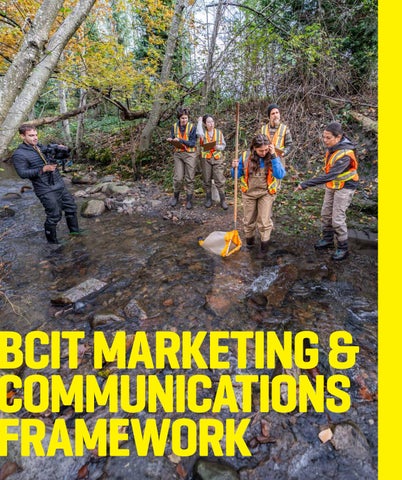
BCIT MARKETING & COMMUNICATIONS FRAMEWORK
2
BCIT MARKETING AND COMMUNICATIONS FRAMEWORK
The British Columbia Institute of Technology (BCIT) acknowledges that our campuses are located on the unceded traditional territories of the Coast Salish Nations of Sḵwx̱wú7mesh (Squamish), səl̓ilwətaɁɬ (TsleilWaututh), and xwməθkwəy̓əm (Musqueam).
The BCIT Marketing and Communications Framework (the Framework) guides how BCIT builds understanding, trust, engagement, and action with the people and communities we serve. Grounded in the BCIT Strategic Plan 2025-2030 and the BCIT Education Plan 2026-2031, the Framework outlines how marketing and communications help advance the Institute’s key priorities. These include student success, future-ready applied education, workforce development, inclusive communities, digital transformation, and partner impact. Beyond these, the Framework strengthens BCIT’s broader influence on BC’s economy and prosperity. The Framework, developed and championed by the Marketing and Communications team, provides a shared approach to aligning marketing and communications across BCIT. It supports a strong, consistent BCIT brand, cohesive storytelling, the responsible use of data and technology, and meaningful engagement with key audiences, including students, employees, alumni, donors, government, industry, and the public.
BCIT MARKETING AND COMMUNICATIONS FRAMEWORK
WHY THE BCIT MARKETING AND COMMUNICATIONS FRAMEWORK?
BCIT OVERVIEW BCIT is one of BC’s largest post-secondary institutes, serving over 44,000 students annually across five campuses. Learning is hands-on and industry-focused to prepare graduates for job-readiness across sectors, including applied and natural sciences, business and media, computing and IT, engineering, health sciences, and trades. Programs across six Schools are developed in close consultation with industry and taught by experienced professionals, while applied research initiatives are designed to provide practical solutions to real-world, industry challenges. As a post-secondary institute with a provincial mandate for strategic workforce development, BCIT connects education, industry, and government to build a future-ready workforce in BC. In fact, BCIT ranked #1 in BC for job-ready graduates.* All this work is made possible by members of the BCIT community. As one of BC’s top employers for 16 consecutive years, BCIT fosters a vibrant and inclusive environment where employees can grow while contributing to student success. Cover. Behind the scenes at Guichon Creek, BCIT Burnaby Campus. Left. Final brand photo features students and faculty from the BCIT Ecological Restoration program.
*From the 2026 BCIT Brand Reputation Tracking Report, which included a survey of 1,681 Lower Mainland residents.
3
4
BCIT MARKETING AND COMMUNICATIONS FRAMEWORK
OUR APPROACH TO MARKETING AND COMMUNICATIONS
Marketing and communications advance the Institute’s priorities by translating them into clear, credible, inclusive, and measurable ways to engage. Through brand strategy, recruitment marketing, internal communications, experiential events, issues management, digital engagement, media relations, and partner communications, we connect BCIT with our key audiences in ways that are relevant and timely.
The marketing and communications function at BCIT operates as a centralized team (MarComm) in collaboration with Schools, Applied Research, Student Success, Advancement, and other departments across the Institute. Together, we build brand affinity, support enrolment, strengthen reputation, and advance initiatives aligned with the Institute’s strategic priorities. Our work includes institute-level brand and reputation campaigns, sector and workforce-priority campaigns, and marketing for programs, credentials, and pathways. We also support communications that build understanding and trust, promote transparency, mitigate risk, and help BCIT respond effectively to emerging issues.
Our approach is informed by all stages of the learner and partner journey. This includes awareness and exploration, application and enrolment, retention and graduation, alumni connection, lifelong learning, employment, partnership, and advocacy. As enrolment rebounds from the impacts of the pandemic and we adjust our enrolment plan in response to international student policy changes, we continue to support students throughout their journey and focus efforts on initiatives that make the greatest impact. The Education Plan’s commitment to ‘Clear the path. Support the climb.’ shapes how we communicate with students. It means providing timely, accessible, and actionable information about pathways, supports, deadlines, and outcomes. ‘Empower educators. Enable impact.’ reinforces the importance of keeping employees informed and connected to support teaching and learning. ‘Teach what matters. Test what’s real.’ guides how we tell the story of BCIT’s impact to prospective students, employers, and the public.
BCIT MARKETING AND COMMUNICATIONS FRAMEWORK
ADVANCING THE BCIT STRATEGIC PLAN AND EDUCATION PLAN
Our marketing and communications approach is guided by the BCIT IDEAS Lens, which provides a foundation for how we work, collaborate, and engage with others. We design accessible, representative, and culturally aware communications across all media, from organic social content and digital/print advertising, to brand videos and photography. We work in partnership with Indigenous Initiatives and Partnerships to engage with Indigenous communities in ways that build relationships grounded in trust, respect, cultural understanding, and reciprocity. We also regularly examine our processes to ensure they thoughtfully and respectfully reflect the people and communities we serve. As digital expectations evolve, we will continue to use data, research, audience insights, and CRM-inspired approaches to support more personalized engagement, cross-program recruitment, and lifelong connection. See Appendix 1 for the Marketing and Communications Framework Alignment Table that illustrates how the Marketing and Communications Framework contributes to the goals in the BCIT Strategic Plan and BCIT Education Plan.
Left. BCIT Electrical Engineering grads work with atmosphere diving suits and undersea technology at Nuytco Research Ltd.
5
6
BCIT MARKETING AND COMMUNICATIONS FRAMEWORK
WORKFORCE, LEARNERS, TRUST, AND COMPETITION BC’s labour market is changing. Demographic shifts, technological disruption, affordability pressures, immigration policy, and evolving expectations about work and education are reshaping workforce needs. With more than one million job openings projected over the next decade, BCIT plays a vital role in building the workforce BC needs to strengthen its economic competitiveness. The applied and industry-focused education model, work-integrated learning opportunities, shorter-cycle credentials, flexible pathways, and applied research work in harmony to prepare learners for job-readiness and career resilience—a role reinforced by the Strategic Plan and Education Plan. For marketing and communications, this means clearly demonstrating why BCIT matters now and how our established track record meets national and provincial priorities. Learners are increasingly assessing the value, affordability, flexibility, and outcomes of postsecondary education. Meanwhile, BCIT competes with public institutions, private and union providers, online platforms, and employer-led training. In this competitive environment, BCIT must consistently communicate and reinforce its differentiators. These dynamics extend to BCIT as an employer and community partner. From attracting and retaining employees to building trust with learners, alumni, donors, government, Indigenous communities, and industry, it is essential to have clear, consistent, and values-aligned communications. With the Institute’s sustainability dependent on enrolment, diversified revenue, philanthropy, and partner confidence, marketing and communications is a strategic asset in shaping BCIT’s future.
KEY POSITIONING AND DIFFERENTIATION OF THE BCIT BRAND BCIT’s provincial mandate for workforce development sets it apart within the post-secondary sector. Marketing and communications plays a key role in strengthening understanding of BCIT’s unique model, its value to industry, and its contribution to the province’s economic and social progress. Our brand promise, ‘Education for a complex world’, reflects our distinct value: connecting education, industry, technology, and community to prepare learners for a changing workforce. The promise comes to life through a consistent brand identity reflected in visual design, tone of voice, storytelling, and alumni and employer success stories.
BCIT MARKETING AND COMMUNICATIONS FRAMEWORK
CURRENT CONTEXT:
The BCIT brand is driven to lead. It is respected and admired, caring and empowering, and committed and enduring. At its heart are people who lead with purpose. Our voice, grounded in authenticity, is human, inspirational, and approachable. We have a futurist outlook and a get-it-done attitude. We communicate in a clear, active, and visual way—using plain language that is accessible to all. Our photography and video focus on active, applied learning in natural settings. We showcase students in simulation spaces and shops, graduates at work, and campus life as it really is. This helps learners see themselves in our stories, collateral, and digital feeds. Our key differentiators—applied, industry-focused education and research, work-integrated learning opportunities, and flexible pathways—shape the strong graduate outcomes that make BCIT compelling for learners, employers, partners, and communities. It is also why BCIT is ranked #1 in BC for job-ready graduates.*
Top. Behind the scenes in Masset, Haida Gwaii. Bottom. Final brand photo features BCIT Electrical Engineering grad employed by Hedgehog Technologies, supporting the Tll Yahda Energy solar array project—a Haida-led initiative.
*From the 2026 BCIT Brand Reputation Tracking Report, which included a survey of 1,681 Lower Mainland residents.
7
BCIT MARKETING AND COMMUNICATIONS FRAMEWORK
PROFILES:
SCHOOLS AND APPLIED RESEARCH The Marketing and Communications team partners with Schools and departments across the Institute to lead marketing and communications strategies and initiatives that drive results. For instance, school-level activity is primarily focused on driving student applications and registrations, while also building awareness of new offerings, showcasing expertise, positioning BCIT as a leader and partner to industry and government, and reinforcing commitments such as Indigenization and sustainability.
APPLIED RESEARCH Applied research across the Institute connects industry, faculty, and students to develop practical solutions with real-world impact. The BCIT Centre for Applied Research and Innovation has three dedicated research groups. SMART advances energy systems, electric vehicle infrastructure, and critical infrastructure cybersecurity; NRG focuses on natural health and food product quality, safety, and innovation; and MAKE+ develops and evaluates products and technologies, including medical devices, assistive technologies, and advanced manufacturing solutions.
SCHOOL OF BUSINESS + MEDIA One of the largest business and media schools in Western Canada, with programs spanning financial management, marketing, operations management, broadcast, and new media.
SCHOOL OF COMPUTING AND ACADEMIC STUDIES
SCHOOL OF CONSTRUCTION AND THE ENVIRONMENT A leading contributor of construction-related trades, engineering, applied science, and natural science professionals in BC. It is also home to the BCIT ConnectHER Hub, a dynamic and welcoming space on the Burnaby Campus that is designed to empower women and gender-diverse trades students.
SCHOOL OF ENERGY A leader in preparing graduates for careers in clean energy, manufacturing, process engineering, power, automation, and industrial data communications. Its Industrial Network Cybersecurity program is the first of its kind in Canada, while its Technology Teacher Education program, delivered in partnership with UBC, is the only program in BC to train high school shop teachers.
SCHOOL OF HEALTH SCIENCES The School has a key role in training health professionals who form the foundation of BC’s healthcare system. It offers one of the largest Bachelor of Science in Nursing programs in BC and 34 health-related programs that are unmatched by other post-secondary institutes. The Health Sciences Centre is one of Canada’s largest simulation spaces for enhanced experiential learning with 94 simulation spaces.
SCHOOL OF TRANSPORTATION The only post-secondary institute in North America that delivers globally recognized accreditation in all modes of transportation—air, sea, road, and rail. The BCIT Marine and Aerospace campuses will soon be home to the 76.5 million dollar Marine Innovation Simulation Centre of Excellence. A landmark initiative to strengthen Canada’s marine skills development and support ongoing research and development within the marine sector.
Offering one of the largest selections of cybersecurity training and the largest Flexible Learning Computing and IT courses in Western Canada. It also offers the most comprehensive Forensic Science and Technology programs in Canada and is home to the BCIT Forensic DNA Lab, accredited by the Standards Council of Canada. Academic Studies delivers core academic courses and upgrading for entry to BCIT programs. Top. Behind the scenes at the Tech Collider, BCIT Downtown Campus. *School names may shift in alignment with the Spring 2027 Academic School Structure Review. Current as of October 2026.
8
Bottom. Final brand photo features BCIT grads employed by Skybox Labs.
BCIT MARKETING AND COMMUNICATIONS FRAMEWORK
9
BCIT MARKETING AND COMMUNICATIONS FRAMEWORK
AUDIENCE SEGMENTATION BCIT marketing and communications strategies connect with a broad and interconnected set of audiences: prospective, current, and former students; employees; alumni; industry and government partners; donors; Indigenous communities; equity-deserving communities; and the broader public. People may move between categories over time— a prospective student may become an alum, employee, donor, industry advisor, or lifelong learner. Recognizing these evolving relationships is central to building lasting connections, trust, and advocacy for BCIT. Stronger data, digital, CRM, and research capabilities will enable the Institute to communicate more meaningfully with its audiences and build stronger, more lasting relationships across the community.
PROSPECTIVE STUDENTS Prospective students reach BCIT at different stages of their journey, while weighing the value, affordability, relevance, flexibility, and outcomes of post-secondary education. BCIT must clearly communicate the value of applied education and tailor messaging to the various life stages:
∆ High school students (Grades 8-12) and their influencers: Provide clear and engaging information about programs, pathways, supports, outcomes, and the realities of BCIT’s intensive applied learning environment.
∆ Post-secondary students and graduates with prior education: Highlight practical learning, efficient pathways, credential laddering, advanced placement, and Prior Learning Assessment and Recognition.
∆ Working professionals, career changers, and returning alumni: Emphasize scheduling flexibility, modularity, employer value, funding options, and immediate applicability—through BCIT Flexible Learning, corporate training, or laddered pathways.
CURRENT BCIT STUDENTS Regardless of their chosen learning model, current students require timely, accessible, and relevant information that supports their academic progress, wellbeing, belonging, and connection to the BCIT community. Relevant communications support student success today and help build lasting connections with BCIT as students become alumni, returning learners, employers, mentors, donors, and advocates.
INTERNATIONAL STUDENTS International students, both in Canada and abroad, bring diverse perspectives and experiences to BCIT, while strengthening connections to the global workforce. Recruitment and communications must be strategic, transparent, and responsive to evolving federal and provincial policies on study permits, eligibility, and postgraduation work. They should also provide clear, accurate information about admissions, immigration processes, costs, housing, employment expectations, supports, safety, and belonging. The Institute’s international reputation depends on the quality and integrity of the full student experience, from recruitment to graduation, and beyond.
INDIGENOUS STUDENTS AND COMMUNITIES As Canada’s fastest-growing youth demographic, Indigenous students, their families, communities, and partners are essential audiences. Communications should align with BCIT’s Indigenous Action Plan and support a future in which Indigenous learners are welcomed, respected, supported, and empowered to thrive. This includes communicating pathways, culturally relevant supports, Indigenous-led initiatives, and the ways Indigeneity is being embedded across the Institute. This work, developed in collaboration with Indigenous Initiatives and Partnerships, is grounded in respect, cultural safety, reciprocity, and accountability. It also reflects the Institute’s commitment to advancing reconciliation and supporting Indigenous student success.
Across all stages, communication should help prospective students understand their options, navigate requirements, compare pathways, access supports, and see themselves succeeding at BCIT. Right. BCIT grads at Seaspan Shipyards build Canada’s largest naval ship.
10
BCIT MARKETING AND COMMUNICATIONS FRAMEWORK
11
12
BCIT MARKETING AND COMMUNICATIONS FRAMEWORK
BCIT supports learners with diverse lived experiences and those who may face barriers to access. This includes first-generation students, students with disabilities, racialized students, 2S/LGBTQIA+ learners, mature students, caregivers, low-income learners, and newcomers. Communications must be inclusive, accessible, and grounded in student success—using plain language, accessible formats, representative storytelling, and culturally-aware and trauma-informed messaging. Clear information about supports and services can help reduce barriers and make BCIT easier to understand, navigate, and access.
BCIT ALUMNI BCIT alumni live and work across Canada and around the world. Many remain closely connected to BCIT as advocates, mentors, donors, employers, industry partners, advisory committee members, returning learners, and our own employees. They are among our strongest ambassadors—influencing prospective students, hiring graduates, supporting work-integrated learning opportunities, contributing to applied research, and participating in philanthropy. Alumni communications should foster lifelong connection and learning, pride, advocacy, volunteerism, and partnership.
CURRENT BCIT EMPLOYEES Employees are a critical part of the BCIT community and bring our applied education model to life every day. They require timely, transparent, relevant information to understand Institute decisions, navigate change, access resources, and feel a sense of belonging and connection. Internal communications support the Strategic Plan and Education Plan by strengthening alignment, collaboration, and change-readiness across BCIT. Consistent with the Education Plan’s ‘Empower educators. Enable impact.’ commitment, employees also play a role as storytellers and brand ambassadors for BCIT.
PROSPECTIVE EMPLOYEES People are essential to delivering high-quality applied education at BCIT. In a competitive talent market, BCIT needs to attract people with strong professional expertise, teaching skills, technical knowledge, and a commitment to student success. Recruitment communications to prospective employees should illustrate the BCIT impact. This includes highlighting our purpose, values, inclusive community, professional development opportunities, applied education model, industry connections, and contribution to BC. For prospective faculty, communications should emphasize the opportunity to bring real-world experience into the classroom and shape future generations of industry professionals.
INDUSTRY, GOVERNMENT, AND PHILANTHROPIC PARTNERS
BCIT MARKETING AND COMMUNICATIONS FRAMEWORK
EQUITY-DESERVING AND ACCESS-FOCUSED LEARNERS
Industry and employers hire BCIT graduates, advise on curriculum, participate in program advisory committees, support work-integrated learning opportunities, collaborate on applied research, and invest in equipment, spaces, and training. They are also advocates for prospective students, government, donors, and the public. Communications should reinforce BCIT as a responsive, trusted, and solutions-oriented partner to industry. This includes demonstrating our graduate quality, program relevance, applied research strength, and role in addressing sector workforce challenges. All levels of government and public-sector partners are critical to fulfilling BCIT’s workforce mandate. Communications should clearly connect BCIT’s work to local, regional, provincial, and federal priorities— integrating outcomes, graduate stories, workforce data, or applied research impact. Donors and philanthropic partners help expand opportunities, accelerate innovation, and modernize learning environments. Communications should demonstrate the meaningful impacts of their support with trust, gratitude, stewardship, and measurable outcomes.
Top. Behind the scenes at Microsoft Vancouver. Bottom. Final brand photo features BCIT Computer Systems Technology grads working at Microsoft Vancouver.
13
BCIT MARKETING AND COMMUNICATIONS FRAMEWORK
GENERAL PUBLIC Many people in BC may not have a direct connection with BCIT, yet they benefit from the Institute’s contributions to the workforce, economy, and community wellbeing. As a publicly funded post-secondary institute, BCIT has a responsibility to build public understanding of its role and impact across communities. Communications should help people understand the role of BCIT as a leading provider of applied education in BC. This is done through the development, stewardship, and distribution of success stories featuring BCIT students, graduates, employees, research, partnerships, and community impact.
BCIT MARKETING AND COMMUNICATIONS GOALS The following six goals anchor our marketing and communications work across BCIT. They are listed in no particular order. These goals will remain areas of focus over time but may be adjusted as BCIT and its environment evolve. The MarComm team, in partnership with leaders from across the Institute, will continue to develop an annual Institute-level marketing and communications plan, alongside School-level marketing plans that reflect the immediate tasks in advancing these goals.
1. GROW BRAND AFFINITY, TRUST, AND UNDERSTANDING OF BCIT’S DISTINCT VALUE We build trust and understanding by highlighting what sets BCIT apart. While some of our work is broad brand building, other aspects are targeted at establishing and exemplifying areas of expertise, including digital transformation, sustainability, and applied research. Brand-building efforts are further complemented by marketing and communications initiatives that support the student recruitment funnel, from awareness and exploration to consideration and conversion. Indicators include awareness, favourability, likelihood to recommend, and message recall among the working population, teens, post-secondary students, parents, and business leaders who have an active role in hiring employees.
14
2. DRIVE STUDENT DEMAND, ENROLMENT, AND PATHWAY MOVEMENT Our foundational programs are central to growing enrolment, retention, conversion, and yield, and to strengthening cross-program pathways. We are particularly focused on engaging underrepresented groups, including teens, women, Indigenous peoples, and immigrants. BCIT Indigenous Initiatives and Partnerships plays an important role in the recruitment of Indigenous students, while the MarComm team works alongside the recruitment functions in Student Success and the Schools to build awareness and interest across programs. Indicators include application, registration, retention, and conversion data, which we track overall and across learner populations.
3. POSITION BCIT AS THE DESTINATION FOR WORKFORCE-RELEVANT FLEXIBLE LEARNING Consistent with the Strategic Plan, BCIT is positioned as the leading destination for dynamic, accessible, and modular education that helps learners upskill and reskill. Building on Flexible Learning, we are expanding in-person and online microcredentials that respond to changing industry needs. We are also building awareness and understanding of Flexible Learning among recent high school graduates, post-secondary students, working professionals, business influencers, current Flexible Learning students, and alumni who may return for further credentials. Indicators include application and retention data, as well as brand recognition in this domain.
4. ELEVATE PARTNER RELATIONSHIPS AND INSTITUTIONAL INFLUENCE Strong relationships with industry, employers, donors, alumni, government, Indigenous communities, and public-sector partners amplify the reputation and credibility of BCIT as a sector leader. Marketing and communications strengthen these relationships through coordinated storytelling, partner communications, donor stewardship, alumni engagement, government relations, and industryfocused campaigns. Together, these efforts demonstrate graduate quality, program relevance, applied research impact, work-integrated learning, and the role of philanthropy in expanding access, innovation, and opportunity.
5. STRENGTHEN COMMUNITY CONNECTION, BELONGING, AND EMPLOYEE ENGAGEMENT We strengthen connection and belonging through inclusive community-building, student wellbeing, employee recognition, and internal communications. We connect with current students, employees, alumni, and partners through in-person engagement, leadership interactions, alumni outreach, the BCIT website, and social media. The Student Success team leads student communications on topics related to registrar activities, wellbeing, financial aid, and other relevant supports and resources. Indicators include student and employee satisfaction, engagement, and retention.
6. BUILD MODERN, DATA-INFORMED, DIGITALLY-ENABLED MARKETING AND COMMUNICATIONS CAPABILITIES
data governance commitments. Indicators include web task completion, search performance, email performance, click-to-product rate, and eventual CRM adoption.
IMPLEMENTATION AND ACCOUNTABILITY BCIT has strong marketing and communications foundations, and this Framework provides a shared approach for planning, developing, and evaluating marketing and communications initiatives across the Institute. It supports coordinated decision-making, common language, audience-centred engagement, and resource alignment across the six goals. Annual plans support the BCIT Strategic Plan and Education Plan action-planning cycles and reflect Institute-wide and School-specific priorities.
BCIT MARKETING AND COMMUNICATIONS FRAMEWORK
As competition intensifies, BCIT’s voice matters as much as the quality of our programs. We build institutional profile through thought leadership, executive visibility, and an active media presence. Our leaders and experts help shape the conversations that matter to industry, government, donors, and the public—amplifying our contribution to BC’s economic growth, social progress, and community prosperity, while informing public policy on workforce development and applied education. Indicators include partner and donor engagement, media profile and share of voice, thought leadership reach, and government and policy engagement.
Progress will be evaluated through a balanced set of indicators. See Appendix 2 for the Key Performance Indicator Framework. The Marketing and Communications Framework will be reviewed regularly to ensure it remains responsive to changing learner expectations, labour market needs, technology, policy, and institutional priorities. As the pace of change and competition increases, marketing and communications will remain integral to strengthening BCIT’s reputation, and advancing the established brand promise of Education for a Complex World.
Strengthening the Institute’s capacity for effective marketing and communications underpins every goal in this Framework. The MarComm team has identified that a customer relationship management (CRM) system is ideal for enabling work. The CRM system would serve as a foundation to identify, nurture, and maintain relationships with prospective students, current students, and alumni—enabling lifelong connection and a significant shift in how we operate. IT Services is a critical partner across website, search, user experience, e-commerce, web governance, accessibility, cybersecurity, and measurement. As artificial intelligence (AI)-enabled tools become part of MarComm’s workflows for content, segmentation, analytics, and personalization, we will apply responsible AI principles in alignment with BCIT values. This work will also align with BCIT’s
15
BCIT MARKETING AND COMMUNICATIONS FRAMEWORK 16
APPENDIX 1 MARKETING AND COMMUNICATIONS FRAMEWORK ALIGNMENT TABLE MARKETING AND COMMUNICATIONS CONTRIBUTION
STRATEGIC PLAN 2025-2030 ALIGNMENT
EDUCATION PLAN 2026-2031 ALIGNMENT
INSTITUTIONAL BRAND AND REPUTATION CAMPAIGNS
Builds understanding, affinity, trust, and pride in BCIT as BC’s applied education leader. Supports longterm sustainability by reinforcing BCIT’s distinct value and advancing the Strategic Plan commitments to transform teaching and learning, catalyze digital transformation, foster vibrant and inclusive communities, and enrich partner and industry experiences.
Helps audiences understand the value of applied education and how BCIT prepares learners for a complex world. Reinforces the Education Plan’s focus on applied education that supports student success and contributes to a stronger BC.
RECRUITMENT, CONVERSION, AND PATHWAY MARKETING
Supports student success, enrolment, access, and financial sustainability by helping prospective students understand programs, pathways, supports, outcomes, and the value of choosing BCIT. Aligns most directly with transforming teaching and learning and fostering vibrant and inclusive communities.
Advances ‘Clear the path. Support the climb.’ by making options, requirements, supports, and outcomes easier to understand. Helps learners see practical, flexible routes into and through BCIT.
CURRICULUM, CREDENTIAL, AND PROGRAM STORYTELLING
Demonstrates how BCIT programs respond to workforce needs, changing technologies, and industry priorities. Aligns with transforming teaching and learning and enriching partner and industry experiences.
Advances ‘Teach what matters. Test what’s real.’ by showcasing how BCIT curriculum, assessment, and applied learning are connected to real-world practice and credible demonstrations of competence.
STUDENT SUCCESS, WELLBEING, AND RETENTION COMMUNICATIONS
Strengthens student persistence, belonging, wellbeing, and connection to the BCIT community. Aligns with fostering vibrant and inclusive communities and transforming teaching and learning.
Advances ‘Clear the path. Support the climb.’ by helping students access timely information, services, expectations, deadlines, financial supports, wellbeing resources, and opportunities for connection.
EMPLOYEE COMMUNICATIONS
Supports internal alignment, trust, change readiness, employee engagement, and shared ownership of BCIT’s strategic priorities. Aligns with fostering vibrant and inclusive communities and catalyzing digital transformation.
Advances ‘Empower educators. Enable impact.’ by helping employees understand priorities, access tools and supports, share effective practices, and see their role in student success.
STRATEGIC PLAN 2025-2030 ALIGNMENT
EDUCATION PLAN 2026-2031 ALIGNMENT
PARTNER, INDUSTRY, AND EMPLOYER COMMUNICATIONS
Reinforces BCIT’s role as a trusted workforce-development partner and applied research collaborator. Aligns directly with enriching partner and industry experiences and supports BCIT’s contribution to BC’s economy and communities.
Advances ‘Teach what matters. Test what’s real.’ by strengthening communication about industry-aligned learning, work-integrated learning, program advisory input, applied research, and employer engagement.
ALUMNI, DONOR, AND GOVERNMENT IMPACT STORYTELLING
Builds advocacy, philanthropic support, public trust, and understanding of BCIT’s contribution to BC. Supports long-term sustainability, strategic partnerships, workforce development, and institutional reputation.
Shows the long-term impact of applied education through graduate success, return learning, mentorship, philanthropy, and community benefit. Supports the Education Plan’s focus on student success and applied education for a stronger BC.
DIGITAL EXPERIENCE, CRM (FUTURE CAPABILITY ) , ANALYTICS, AND RESPONSIBLE AI
Advances ‘catalyzing digital transformation’ by improving user experience, data-informed decisionmaking, personalization, accessibility, cybersecurity awareness, and operational efficiency across marketing and communications.
Supports all three Education Plan commitments by making learning pathways clearer, enabling better communication with students and educators, and helping BCIT deliver more responsive, timely, and relevant information.
IDEAS (INDIGENOUS, INCLUSION, DIVERSITY, EQUITY, ACCESS, SUSTAINABILITY, STUDENT WELLBEING) COMMUNICATIONS
Demonstrates BCIT’s commitments to inclusive, respectful, accessible, sustainable, and future-ready communications. Aligns with fostering vibrant and inclusive communities and transforming teaching and learning.
Reinforces the Education Plan’s connection to institutional frameworks that support inclusive applied education, student wellbeing, Indigenous engagement, accessibility, anti-racism, and sustainability.
ISSUES, RISK, REPUTATION, AND TRUST COMMUNICATIONS
Protects and strengthens BCIT’s credibility by supporting transparency, consistency, timely response, and informed decision-making. Supports all Strategic Plan commitments by maintaining trust with students, employees, partners, government, media, and the public.
Supports student success and educator impact by ensuring communications are accurate, accessible, coordinated, and aligned during change, disruption, or uncertainty.
BCIT MARKETING AND COMMUNICATIONS FRAMEWORK
MARKETING AND COMMUNICATIONS CONTRIBUTION
17
BCIT MARKETING AND COMMUNICATIONS FRAMEWORK
APPENDIX 2 KEY PERFORMANCE INDICATOR FRAMEWORK AREA
EXAMPLE INDICATORS
BRAND
Awareness, favourability, likelihood to recommend, message recall, reputation attributes
RECRUITMENT
Leads, inquiries, applications, registrations, yield, cost per conversion, priority-program performance
STUDENT SUCCESS
Retention, campaign engagement, service-awareness metrics, student communications satisfaction
DIGITAL
Web task completion, search performance, accessibility, CRM engagement, email performance, content freshness
COMMUNITY
Employee engagement, event participation, belonging/wellbeing, communications reach
PARTNER IMPACT
Partner inquiries, PAC/industry engagement, applied research visibility, government and donor engagement
ISSUES AND TRUST
Media sentiment, response time, misinformation mitigation, crisis readiness
Behind the scenes at the BCIT Annacis Island Campus.
18
BCIT MARKETING AND COMMUNICATIONS FRAMEWORK
19