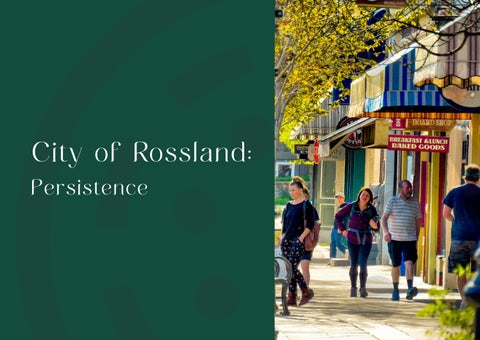
City of Rossland: Persistence
City of Rossland
104
I'd like to share with other communities in our region … and help them move forward with active transportation [within] and between our communities. The advent of e-bikes has just blown apart the world of active transportation especially in this part of the country where the topography is challenging. Now it's realistic to think that we can ride a bike between Rossland and Trail, which years ago, we wouldn't have even contemplated. So it's not only making our community a better place to travel within, it's actually to extend that outside our communities.
STACY LIGHTBOURNE, MANAGER OF PLANNING AND DEVELOPMENT, CITY OF ROSSLAND
19
The City of Rossland is a small community in the BC Interior with 3,729 residents. Located within the Kootenay Boundary Regional District and on the traditional territory of the Sinixt Nation, Rossland is near other small towns in the area, like Trail and Warfield. Rossland has an outdoorsy culture that attracts tourists; the Red Mountain Resort provides abundant skiing, snowboarding and mountain biking opportunities. The population of seniors in Rossland is growing, and projected to be 30% of the total population by 2028. 19 Rossland gets plenty of snow: about 370 cm/year in the town; and over 750 cm at Red Mountain. The temperatures are moderate and there are plenty of sunny days in Rossland, with highs of 25C in the summer and 3C average in the winter. There are two elementary (K-9) schools and one online private secondary (grades 7-12) school in Rossland.
http://communityhealth.phsa.ca/HealthProfiles/HealthReportFactorsThatAffectHealth/Rossland
Champions With nearly 20 years of experience in the city, the Manager of Planning and Development leads active transportation projects in Rossland. She recognizes that Rossland is a great place to work, play and live, and believes active transportation can make a real difference in the community. Highly proficient with grants, she is capable of securing funding to push active transportation momentum within the town’s unique context.
83%
1%
13%
2%
drive to work
public transit to work
walk to work
bike to work
City of Rossland
1
Challenges With the city built on the side of a mountain, Rossland has steep hills that challenge active transportation routes. The combination of sheer grade, deep snow and ice cover presents barriers to planning and operationalizing walking and cycling infrastructure.
Similar to other small towns, the main highway runs through the downtown area. The Rossland team – including the Manager of Planning and Development, Chief Administrative Officer, Council, Mayor and the previous Planning Manager – persistently engaged with the Ministry of Transportation and Infrastructure (MOTI) to create bump outs to slow traffic. However, this request was a completely new highway modification in BC. Since there were no local examples to work from, the Rossland team needed to bring ideas and illustrations from other jurisdictions to justify the modification.
The team’s efforts paid off: Ministry of Transportation and Infrastructure invested in the bump outs. A bird’s-eye shot of two bikers about to enter a tunnel along the trail. Photo courtesy of R. Flett from City of Rossland.
Rossland’s lack of active transportation data challenges grant applications. They are stuck estimating the number of trips, and cyclists and walkers using the infrastructure. A strong foundation of data would be valuable to Rossland’s grant success.
To create these bump outs was a big challenge with MOTI actually … to allow that to happen on a highway because it hadn't been done before. … it was not what was normally done, and [didn’t] strictly follow the tech manual, [it was] an innovation. It had to go through the process. It's challenging at the time. But sometimes these conversations … we all learn from them, too.
STACY LIGHTBOURNE, MANAGER OF PLANNING AND DEVELOPMENT, CITY OF ROSSLAND
City of Rossland
2
It's an active community. Any new route that we put in is well-received … the public [is] keen on recreation, [and] active transportation as well. And council’s focused on climate action, and [active transportation] is a big part of it. For us, active transportation has mostly meant trails and neighborhood links. And that's why people like it, because it just makes it easier to get from A to B within our community.
STACY LIGHTBOURNE, MANAGER OF PLANNING AND DEVELOPMENT,
Facilitating Factors Several factors augment active transportation in Rossland. First and foremost, active transportation is a high priority for locals, due to the active and outdoorsy culture, and the council, which is heavily focused on climate action. A culture of innovation, learning and improvement also facilitates progress. Most notably, Rossland recognized the potential in utilizing Right of Ways (ROW) for paths which would create links in the active transportation network. Students from Selkirk College laid out the groundwork for identifying and employing Right of Way paths. The concept of ROWs encouraged creative means to get people from A to B, especially as Rossland ROWS do not have roads due to steep conditions. As the town integrated and actualized these opportunities into their plan, staff continued to prioritize learning and continuous improvement.
idea successful, while also cultivating an idea to utilize the new bike lane as snow storage. This further cemented engagement and partnership with the operations team. An advisory group, composed of community volunteers, supports community and partnership engagement across the region and facilitates active transportation. For example, the group surveyed community members on whether they would use a proposed change and asked about their current barriers to active transportation.
Community engagement, complemented with innovative concepts, also enhance progress. For instance, residents couldn’t comprehend a snowplow pushing through narrowed roads and tight corners. A design exercise proved the
CITY OF ROSSLAND Bike racks are readily available for cyclists, which encourages active transportation throughout Rossland.
City of Rossland
3
A few other factors employed by Rossland to support active transportation are quite clever. One is requiring new residential development to consider and provide active transportation linkages. For example, in the new Caldera subdivision at Red Mountain, the city required builders to put an active transportation tunnel under the new road as a means to continue the Centennial Trail. A second factor is combining infrastructure upgrades – like sewer and water – with active transportation improvements, thereby ensuring that active transportation is always on the radar. Rossland recently received a grant with city funds to accomplish this: they repaired a cross country ski/ mountain biking trail, while also fixing the waterline right below. Finally, active transportation progress is expedited through grant success in two parts. In the beginning, the development of their active transportation plan was grant-supported, and that plan is now leveraged, fulfilling a key requirement for subsequent grants.
We have lots of right of ways throughout town, [not actual] roads; they’re city property. They presented an opportunity to create links. And there were lots of ideas … in this case, it was trails, linkages. And so then we developed an active transportation plan, which identified the main drivers – schools, downtown, and neighborhoods - and then tried to find ways using the right of ways to get around town and through town. We have gradually been chipping away at those projects over the last few years with the help of all the grants that were available. And learning as we go, we've definitely improved the product as we've been going along.
STACY LIGHTBOURNE, MANAGER OF PLANNING AND DEVELOPMENT, CITY OF ROSSLAND
City of Rossland
4
[Narrowing the highway and placing drainage behind the parking spaces] was even harder than the bump outs because it's not normally done. But we thought it would work best for snow melt, [it’s] usually melting at the curb and people have to step in a puddle before they get on the sidewalk. And now it doesn't happen like that. It drains to the back of cars, so you don't have that issue when
Progress Rossland’s active transportation progress has largely centred around building trails using the Right of Ways. Larger projects like the bike lanes have typically been done as part of a larger infrastructure project where the road is being dug up to replace sewer, water and storm infrastructure. In 2010, MOTI was interested in upgrading the provincial highway (Columbia Avenue) – a very wide highway with very narrow sidewalks – that runs through Rossland’s downtown. Rossland jumped at the opportunity to fix what was
underneath the highway and improve what was on top, recognizing the importance of the downtown core to the community as a place to socialize and shop. The result is an attractive, walkable downtown; and a traffic-controlled narrower highway with bump outs, sidewalks and vertical-style parking. It took persistence to push past the opposition to introducing a new “highway as main street” design but the result is a vibrant downtown to emulate in other BC small towns. The new design has other positive impacts to facilitate walking downtown. The storm water that normally would run along
you go from your car to the sidewalk. It may seem small, but it's actually quite a big deal. It's made quite a big difference. Traffic travels much slower … because of everything that's there to narrow [the road].
STACY LIGHTBOURNE, MANAGER OF PLANNING AND DEVELOPMENT, CITY OF ROSSLAND
Pedestrians can easily walk around Downtown Rossland to explore shops and dine at restaurants and cafes. Benches and statues line the streets to create visually interesting and inviting public spaces.
A view of Washington Street showcasing the bike lane going uphill and angled parking (which can act to slow traffic).
City of Rossland
5
the curb, runs at the back of all the parking spaces. Like the bump outs, this is not normally done on a provincial highway, but it had the added benefit of diverting snow melt (slush) at the curb that pedestrians have to climb over before reaching the sidewalk. So now the snow melts and drains to the back of the cars. The angled parking along with the bump outs creates a perception of narrowing and drivers slow down because of the narrowed sight lines. Washington Street was a key grant-funded project. The street is a significant connector, running from downtown to the midtown destinations (including schools, skate park, arena, City Hall and affordable housing), to the ski hill.
Before
The project on Washington started with replacing 100-year-old water lines and other aging infrastructure that lay underneath the street. Rossland decided to concurrently improve active transportation between the downtown and school zones. This resulted in Rossland’s first bike lane, which is bidirectional, separated from traffic and incorporates newly-built sidewalks on either side of the street. The upper half of Washington street includes a multipurpose pathway for walking and riding.
After
That's what we need in our community to have people get out of their cars … people like trails. People use them for recreation, but it's about getting from A to B, in a fun way or off the road. It's just more enjoyable, [and] sometimes it's shorter, because it cuts across, you don't have to go on the roads.
STACY LIGHTBOURNE, MANAGER OF PLANNING AND DEVELOPMENT, CITY OF ROSSLAND
These maps highlight Rossland before and after the Washington and Plewman Intersection Upgrade. The main focus was to replace old water and sewer pipes while also improving the safety of active transportation routes.
City of Rossland
6
The Centennial Trail is the main off-road link between the ski hill and downtown. It’s a wide gravel trail that has infrastructure (water and sewer lines that go to the ski hill) underneath. The trail is groomed for cross country skiing in the winter. People commute from town with fat bikes up the trail to the ski hill, which is the main employer in Rossland. Rossland has made progress by pushing the boundaries on grants to make changes relevant to the community. An example of this was on a grant that requested proposals for specific active transportation infrastructure, not including recreational trails. With trails being more enjoyable and heavily used by Rosslanders, the city decided to put in a trail connection within the grant, knowing that the link was a main transportation driver. They also created a switchback trail to overcome steep topography and attract seniors residing close by.
A group of bikers cycle through the trail, enjoying the natural beauty of Rossland. Trails are great connectors in the active transportation network in Rossland. Photo courtesy of R. Flett from City of Rossland.
City of Rossland
111
Don't necessarily take ‘no’ for an answer, try to negotiate. Other constraints in Rossland would be the topography, how steep it is. There's ways around that, it might not be perfect, but it it's doable. It's good to identify those possible constraints and barriers, but to not see them as a total barrier … try to find ways, talk to people or be creative.
STACY LIGHTBOURNE, MANAGER OF PLANNING AND DEVELOPMENT, CITY OF ROSSLAND
Advice For Other Small Towns Rossland’s advice for BC small towns working on active transportation is to look at the utility of Right of Ways and consider linkages. Even when the terrain is steep, switchbacks create a way around that people will use. Also consulting with residents on their walking patterns, and then adding linking trails to connect popular routes, keeps people moving.
stages. In Rossland’s case, erosion is a key concern when building on a mountain with snow and water issues. Planners now develop maintenance strategies for new projects with the operations team.
Rossland also recommended promoting active transportation with major employers in neighbouring communities and the regional district. Connections between small towns are becoming increasingly important, especially with the advent of e-bikes. The Manager of Planning advises persistence in the face of limitations. From her experience, projects often had multiple constraints, and endurance proved advantageous. A key example was the major change to the highway through downtown. Despite the significant barriers, staff persistence convinced MOTI to expand the parameters of the project. Finally, Rossland suggests considering future infrastructure maintenance during the planning
This ‘all ages and abilities’ bike lane is divided to allow cyclists to travel in both directions. The bike lane is separated from the main road with a narrow island that is decorated with attractive shrubbery. A speed limit of 30km/ hour reinforces safety in the area.
City of Rossland
8
1.
Continue the Centennial Trail
Next Steps For Rossland
Rossland plans to continue extending the Centennial Trail through to the Black Jack Cross Country ski area, eventually going under the highway, and utilizing Right of Ways on many properties to pull the trail through.
2.
Finish implementation of the current active transportation plan and develop a new one With the current active transportation plan about 85% implemented, Rossland plans to check off the remaining few projects before developing a new plan. The new plan would assess gaps in the first plan, improve the routes and consider opportunities for e-bikes and fat bikes.
City of Rossland
1 13
3.
4.
Another major emphasis will include extending active transportation outside the city to reach subdivisions like Redstone. The Green Link – utilizing wagon roads and rail grade – will ideally go towards Warfield and Trail, maximizing the use of e-bikes to commute between towns. With 1,000 metres of elevation difference between Trail and Rossland, most thought active transportation between the towns was impossible. Now, with e-bikes the possibility is there. Connecting across communities will require close collaboration with the regional district, which is already under way, and with neighbouring communities and their active transportation plans.
Rossland is moving towards winter maintenance of some busier trails to encourage active transportation year-round. The city currently maintains the ski hill trail, and is now considering maintenance options for other popular trails. For example, grooming for fat biking is on the radar.
Connect communities and subdivisions
Planning for winter maintenance Man commutes to work at Red Mountain on his fat bike, with skis tied to his backpack.
Mother and daughter use an e-bike to travel uphill in the winter in Rossland.
City of Rossland
114
SmallTownsBigStepsBC.com
BCHEALTHYLIVING
BC ALLIANCE FOR HEALTHY LIVING
BCHEALTHYLIVING
BC ALLIANCE FOR HEALTHY LIVING
THE BALANCE BC ALLIANCE FOR HEALTHY LIVING NEWSLETTER:
eepurl.com/hcpSNH
11
122