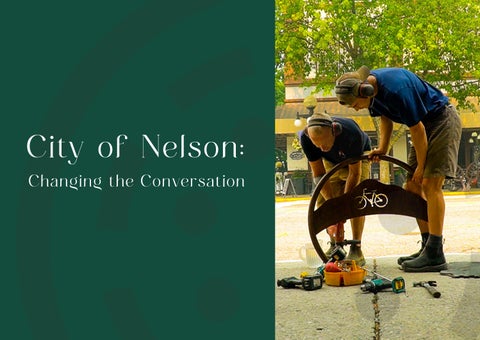
City of Nelson: Changing the Conversation
City of Nelson
79
The City of Nelson, in the BC Interior, lies largely on the south shore of the Kootenay River. 15 Nelson is part of the Regional District of Central Kootenay, and is on the traditional territories of the Sinixt, the Syilx, and the Ktunaxa peoples.
I think once we start changing the conversation, that it’s no longer active transportation versus transportation, … it's all just a new way of building infrastructure.
SEBASTIEN ARCAND, SENIOR PLANNER, CITY OF NELSON
With 10,664 people making their home in Nelson, the easy access to outdoor activities in the mountains, trails and lakes draws an active group. The city has a compact, walkable downtown core, featuring many restored heritage buildings from the silver rush days. The historical mining and forestry activity made Nelson a transportation and distribution hub for the region in the early 1900’s. Today, Nelson is a cultural centre, with many businesses focused on natural foods. Mountain-biking and rock-climbing are popular in the area. 16 The population of seniors in Nelson is climbing, while the population of children has been declining in recent years. 17
15 16 17
https://w w w.nelson.ca/DocumentCenter/ View/357/Active-Transpor tation-Plan-PDF?bidId= https://en.wikipedia.org/wiki/Nelson,_British_Columbia http://communityhealth.phsa.ca/HealthProfiles/HealthReportFactorsThatAffectHealth/Nelson
In Nelson, winters are cold and snowy, and it’s hot and dry in the summer. There are five elementary schools, one middle school and one secondary school in the area.
Champions With over 20 years of experience in Nelson, the City Manager is a keen active transportation advocate and role model. He’s been involved in active transportation since the initial plan was developed in 2010. The Senior Planner is leveraging the strong culture in Nelson of long-term planning to solidify an accessible active transportation system that reduces greenhouse gas emissions. 15 A supportive Council, strong advocacy groups, and an active, engaged population, also champion active transportation in Nelson.
66%
1%
26%
5%
drive to work
public transit to work
walk to work
bike to work
City of Nelson
1
Challenges Steep topography, sometimes in combination with snow and ice, interfere with active transportation progress in Nelson. Snow clearing and other winter maintenance for active transportation routes is expensive and demands collaboration with the Public Works Department to ensure it happens. Further, property owners sometimes neglect their responsibility of clearing their sidewalks, rendering some routes impassable. Planning staff are currently working with Public Works to establish a predictable snow clearing schedule for primary active transportation corridors, and are struggling to get some operators on board. Other physical barriers that challenge active transportation connections include the highway, which forms an obstacle between neighbourhoods, and the railway tracks, which in turn, forms a barrier between the waterfront and downtown. The Nelson Bridge, known to locals as the Big Orange Bridge, or BOB, is a challenge for the many active transportation users looking to
travel from the North Shore to downtown. The Big Orange Bridge is busy: 10,000 or more vehicles cross the bridge daily, including logging trucks.
Though there are fairly wide sidewalks, there is no dedicated cycling infrastructure on the bridge. To start addressing the barrier, Nelson and Ministry of Transportation and Infrastructure (MOTI) worked together on a cyclist-triggered light that notifies motorists of cyclists. Though this may not be enough to get more fearful cyclists crossing the bridge, it’s a step towards a more inclusive solution.
Drivers entering the bridge are notified with a flashing sign when cyclists are currently on the bridge.
Staff observed that a major barrier is the perception of active transportation versus transportation, the idea that enhancing active transportation takes something away from another user group.
City of Nelson
2
Though cyclists were excited about the implementation of a primary bike route along High Street, planners noted it had low vehicle counts and that on-street parking and street narrowness could activate competing interests. Staff struggled with two options: 1) try and reduce traffic and make it a shared street; or 2) create a two-way bike lane, and change High Street into a one-way for cars. Residents, staff and council were split on the options, which created some confusion in the community.
[MOTI] commissioned a study to look at, how do we make it safe for active transportation users to go along the bridge? There's a lot of people on the North Shore that commute into work. And, it’s a challenging area, and especially when you're trying to get people that aren't super comfortable to start cycling … the bridge is a
Ultimately, Nelson decided to implement the shared street model to test and monitor its functioning. Staff will report back to Council and suggest modifications if needed. Staff noted also that there are always a few vocal residents invested in opposing active transportation changes, and navigating controversy is an ongoing challenge to progress.
major barrier. And, though the warning lights are a step in the right
Finally, funding is a constant challenge. Staff acknowledge that their topography and intersections with the highway are not simple which makes their active transportation projects complex. This complexity often requires expensive solutions that are grantdependent.
SENIOR PLANNER,
direction [it] might not be enough for that clientele that's kind of fearful of biking in traffic. But, step in the right direction.
SEBASTIEN ARCAND, CITY OF NELSON
City of Nelson
3
Facilitating Factors
The [city’s] four major goals [are] all related to … prosperity in our community ... enhancing sustainability of city services and infrastructure, strengthening neighborhoods, and expanding local jobs and local prosperity. And when you think about active transportation, it hits all of those.
KEVIN CORMACK, CITY MANAGER AND SEBASTIEN ARCAND, SENIOR PLANNER, CITY OF NELSON
Nelson City Council was really involved in the development of the Active Transportation Plan, back in 2010, with many councillors invested in active transportation as a mechanism for fighting climate change. The Nelson-Creston MLA spearheaded the more recent update of the Plan. Council identified key priority areas for Nelson, and active transportation was one of them. Active transportation is also a key component of the Climate Action Plan. City staff recognized that the elected officials’ interest in active transportation has truly contributed to their progress.
Prioritizing implementation confers other advantages, like having shovel-ready projects at their fingertips when grants are available. The 2010 Active Transportation Plan helped Nelson make headway on sidewalks, but the review and update clearly demonstrated the need for cycling infrastructure. Their ability to clearly define the project needs over the next five years strengthened their grant funding case– which was needed – when the BC Active Transportation Grants were opened for submissions.
The new five-year Active Transportation Plan focuses on implementation, with key actions to be accomplished in a shorter time frame.
Every year, staff report to Council on accomplishments and highlight the next year’s Plan. This process ensures everyone is engaged and implementation moves forward.
City of Nelson
4
From mountain biking to water sports, Nelson’s active community culture supports active transportation and isn’t afraid to ask for changes to support this culture. The West Kootenay Cycling Coalition is an important actor: they’ve alerted staff of funding opportunities and Coalition members’ interests. Many local businesses in Nelson, such as the bike shops, have a vested interest in development of the cycling culture and amenities to support cycling. This is reciprocal, as Nelson supports local businesses when improving active transportation infrastructure; for example, local fabricators built bike racks around the city. Nelson, like other small towns, has taken advantage of upgrading other infrastructure like sewer and water, to make active transportation improvements. It’s a natural work-around solution to securing more funding.
You need that culture in the community, where people are asking for those amenities. The cycling coalition did push us, because it's important to have those groups that say, ‘Hey, there's funding available’, they will make sure you're on track. And I think we've created a good relationship with the group. We talk regularly, we don't necessarily agree on everything ... but we're able to work together, to advance this.
KEVIN CORMACK, CITY MANAGER AND SEBASTIEN ARCAND, SENIOR PLANNER, CITY OF NELSON
City of Nelson
5
We learned a lot … something that's good for people in wheelchairs is often really bad for [people with visual impairments], because then you're eliminating barriers, or you're eliminating all the cues that they use to know when to turn. We're all learning as we go.
SEBASTIEN ARCAND, SENIOR PLANNER, CITY OF NELSON
Strong engagement processes underpin equitable active transportation progress in Nelson, with hundreds of residents attending planning sessions. Throughout the engagement process for the Active Transportation Plan review, they had a citizens’ committee, and different lenses like business, seniors and youth were represented. Nelson’s Senior Planner met with a resident who has a mobility challenge to get his perspective. And recently, through the bike route project, walked the route with a legally blind resident who uses that corridor with an assistance dog. Staff found that the BC Active Transportation Design Guide supported community engagement sessions and guided their decision-making. Staff found they could explain complex design ideas, like curb extensions, to the public by using rationale laid out in the Guide. As well, the Guide demonstrates that the “best standard” can be interpreted in different ways in various contexts. This helped navigate conversations about dedicated bike lanes and alternative options in certain locations. Staff also noted the advantages of collaborating with the consultants who developed the Guide on the bike route project.
Another supporting factor comes from the e-bike loan program, which provides loans, repayable over time through the city utilities bill, of up to $8,000 per household for the purchase of e-bikes. Nelson has seen great uptake of the e-bike program, especially with city staff. Staff re-pay the loans through payroll deductions. With the momentum and excitement generated by the program, it’s easy to see e-bikes taking off.
City of Nelson
6
Though Nelson has its topography challenges, it also has some natural advantages – in terms of layout –that facilitate active transportation. One is that the city is mostly laid out in a traditional grid, which makes it easy to encourage pedestrian movement. This is complemented by neighbourhoods that have sidewalks on both sides of the street – in fact, there’s about 60 kilometres of sidewalks for pedestrians in the city. Secondly, Nelson has narrow streets, which is a natural speed deterrent. And a third factor is the rail trail – or The Great Northern Trail – which provides great opportunities for connecting neighbouring communities. This trail connects Nelson to Salmo, and connects downtown Nelson to the Fairview neighbourhood. Over the long-term, staff believe a perspective shift that supports transportation as a whole, rather than pitting active transportation against vehicles, will open up possibilities for improving culture, funding and projects. They recognize this has potential in pooled funding opportunities for all types of transportation improvements. A wider active transportation perspective reduces controversy and supports progress over time.
In the community, everyone was like, “why are you doing curb extensions? It makes no sense.” While in that guidebook, there's a section that really clearly explains curb extensions, and why you do them. People may still disagree, but it's hard to argue, once you have something that you can point to really quickly. And I think it is applicable to all municipalities for sure.
SEBASTIEN ARCAND, SENIOR PLANNER, CITY OF NELSON
City of Nelson
7
If you just say … we're investing in our transportation network, and then as part of your repaving project, you really look at your signage, you look at your pavement markings, it's just a new way of doing things. So I think once we start changing the conversation, that it’s no longer active transportation versus transportation, … it's all just a new way of building infrastructure. SEBASTIEN ARCAND, SENIOR PLANNER, CITY OF NELSON
We sometimes as local governments, kind of make things difficult for ourselves, just how we label or categorize things. Why would we create a controversy in our community by pitting one group against another? It's all transportation, whether you're walking, using a car, using your bike [or] skateboard, let's just bring that together and say, actually, this funds transportation, and now we don't have to say, drivers are bad and buses are good. Sometimes we create our own controversies that are unnecessary. KEVIN CORMACK, CITY MANAGER, CITY OF NELSON
City of Nelson
8
Progress We've made significant changes that will hopefully reduce traffic volumes to the point where this becomes a local street again, and it's not used for short cutting. I think the speed humps will discourage people from using it as a shortcut. And anecdotally, I hear some people living along there say that it’s already changed, and even from some of the users. So, it'll take
Nelson is proud of its lakeside trail, which encourages active transportation for all ages and abilities along the waterfront. The trail links the beach, baseball and soccer fields, parks and a large hotel. They are planning to extend the trail, to cross over the CP line and connect to the Railtown area, which is in the process of revitalization. Recently, the city assessed possibilities to reduce traffic on busy High Street and dangerous congestion around a nearby school. After seeing a host of poor driver decisions, amidst children crossing the intersection and cyclists finding their way through, consultants recommended that this intersection be closed.
Signage reminds drivers to slow down and to expect traffic calming measures designed to slow vehicles as they move through the neighborhood.
a bit of time, and we need to be patient with it.
SEBASTIEN ARCAND, SENIOR PLANNER, CITY OF NELSON
A busy and dangerous intersection was recently closed to motor vehicle traffic. Now, cyclists and pedestrians near the elementary school can more safely navigate the route.
City of Nelson
9
The result is a clearer situation for all users that will encourage, instead of discourage, active transportation. This is a great example of Nelson’s tendency to research options, assess the situation, then implement changes to support active transportation. The completion of Phase 1 of the Primary Bike Route, which is planned to stretch from one end of the city to the other, is an excellent example of progress. The project was supported by the BC Active Transportation Strategy funding of $424,510. Phase 1, which connects Lakeside Park to the Fairview neighbourhood, is the first two-kilometre piece of the primary bike route. The project made changes along the High
Street corridor, to encourage cycling through to downtown along a low-speed and low traffic volume route. The changes included a shared roadway design, with traffic calming measures including six new speed humps, pavement markings and signage. They also upgraded some pedestrian infrastructure, including adding sidewalks and roll over, barrier-free curbs, as well as tactile strips for those with visual challenges. Extras included the installation of a safe bike locker for 20 bikes downtown in the City Parkade on Vernon Street and 22 new bike racks downtown.
With a bike lane [people] don't [have to share with traffic]. So you're not training people to bike within that shared road concept. [Sharing is] most likely what's going to happen to most of our network, there's very little opportunity for segregated bike lanes. So I think it's important to consider, predictability in your network.
SEBASTIEN ARCAND, SENIOR PLANNER, CITY OF NELSON
Parking meters double as bike racks for cyclists in Nelson.
Workers install a bike rack on the sidewalk, next to downtown street parking. This encourages people to cycle throughout the downtown core.
City of Nelson
10
Advice For Other Small Towns I think if you can have some good long-term planning … it's not something separate or new, and it's just good urban planning. Being cognizant of what's in it for everyone, so you don't create your own internal or community controversies … not making it something that one wins and one loses.
KEVIN CORMACK, CITY MANAGER, CITY OF NELSON
Nelson staff recommended transforming the transportation conversation into a unified vision that incorporates active transportation more generally. This shift minimizes controversy, and elevates funding possibilities through a shared vision for all transportation users. Staff also recommended progressing without perfect solutions; after all, small towns have to work within the complexities of existing infrastructure and competing interests of transportation users. They know that the interim solution on the Big Orange Bridge and possibly the shared streets model are not perfect, but feel they are steps in the right direction. Waiting for a perfect solution that may never be found only delays progress and active transportation uptake. They further advised against trying to emulate cycling infrastructure in Vancouver and Victoria, as small towns have their own unique needs.
They further recommended securing additional funding to hire experts to design and implement new infrastructure, thereby removing pressure from elected officials. Project funding demonstrates that money is being brought in, the community is enhanced, and the project is putting people to work. Finally, they recommended working on the community culture that supports active transportation, through positive social media, outdoor gatherings, festivals, and enjoyable opportunities for people to gather. These are opportunities to meet the active transportation audience in the community, discuss options, and discover what changes excite them.
Knowing that budget will always be a barrier to active transportation progress, Nelson staff recommended looking at the Capital Plan and finding opportunities, like repaving or upgrading sanitation infrastructure, as active transportation opportunities. They advise others to look at where money is already being spent and insert active transportation into that sunk cost.
Beautiful and creative murals along alley walls encourage active transportation in Nelson. City of Nelson
11
Next Steps For Nelson
1.
2.
Over the next year, Nelson plans to pave more portions of the Lakeside Trail to encourage and support people of all ages and abilities. They will be adding to the existing one-kilometer of paved trail.
A priority for Nelson is to continue the Primary Bike Route. Now that the first phase is complete, they are in the planning stages for the next two phases. This includes: developing the conceptual route designs; determining the linkage between the first portion of the route through downtown and Rosemont; and identifying a connection further up to Selkirk College.
Further connect Lakeside Trail
Phases 2 and 3 of Primary Bike Route
City of Nelson
91
3.
Enhance the Big Orange Bridge for active transportation
A major challenge for Nelson is the inadequate cycling infrastructure on the Nelson Bridge / Big Orange Bridge. A priority is to find a better solution – more than the cyclist-activated light – that will accommodate cyclists in a dedicated space. The city is also prioritizing a seamless connection between the bridge and the primary bike route for commuters. Both changes will require collaboration with MOTI.
4.
Targeting the missing middle The city really wants to target the “missing middle” – the 20% to 60% of the population that has a bike or an interest in biking but are hesitant. Staff realize that this “missing middle” is waiting for enhanced infrastructure or possibly an e-bike purchase.
City of Nelson
92
SmallTownsBigStepsBC.com
BCHEALTHYLIVING
BC ALLIANCE FOR HEALTHY LIVING
BCHEALTHYLIVING
BC ALLIANCE FOR HEALTHY LIVING
THE BALANCE BC ALLIANCE FOR HEALTHY LIVING NEWSLETTER:
eepurl.com/hcpSNH
14
122