
2 From the Editor Whole Athletes BY WILLIAM BOLE
4 From the Dean Bequeathed BY ANDY
BOYNTON
5 Beyond the Crown Perianne Caron, MSF ’26, entered the Miss Massachusetts USA pageant on a whim— and found a new direction.
6 Accounts
How the Carroll School shaped “The New Boston”; Bob Ainsworth ’75 pens a thrilling second act; Eric Butler, MBA ’12, reinvigorates a Worcester museum; Juliana Owen ’25 creates a foldable handbag.
10 Insights Winston Center marks 20 years of nurturing and showcasing ethical leadership.
12 Enterprise
Under Kevin Schohl ’06, Portland’s soccer team is thriving financially and winning hearts in the community.
14 Application
Back by popular demand— the Carroll Capital test.
Carroll Capital
The Publication of the Carroll School of Management at Boston College / Issue No.4 / 2026

35 Getting Their Groove Back How groups reach peak levels of collaborative performance.
36 Community Messina College and a new pathway to the Carroll School; Brian Davids ’27 receives the Martin Luther King Jr. Scholarship; an entrepreneurship program that connects students with founders; the Finance Conference.
40 Research
48 Bottom Line Greg Bartoli ’99. 6 30
Recent findings by Carroll School faculty members.
WILLIAM BOLE, MASON BRAASCH, JACLYN JERMYN, AND SCANLON MELLOWES
’26
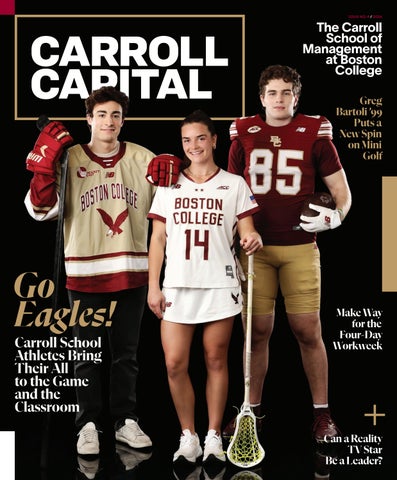
At a time when many have become cynical about college sports, the Eagles are giving us a lot to cheer about. They love the game and strive to develop all aspects of their lives. Meet nine Carroll School student athletes carrying on a hallowed BC tradition. BY
26
Pruning the Workweek
Boston College Professor Juliet Schor is generating wide interest with her blueprint for a four-day workweek. But is the 32-hour week, with full pay, a viable proposition for most organizations? Management scholars weigh in. BY WILLIAM BOLE
30
Over the course of her career, Lisa Wilson ’84 has developed a signature approach as a fragrance expert, working with clients like Michael Jordan and Yankee Candle, but through her consultancy, Scent & Strategy, she’s found new purpose. BY JACLYN JERMYN
On the Cover: Aram Minnetian ’27 (men’s hockey), Shea Baker ’26 (lacrosse), and Kaelan Chudzinski ’29 (football).
42 Impact
Paul Schmelzing’s research on seven centuries of falling interest rates is turning heads.
44 Investments
Helping students integrate the humanities, management, and sciences; the Center for the Economics of Ideas.
46 Distinctions
Jadon Lee ’26 is a hometown hero; Jasmine Lanata ’28 runs in memory of friends she lost; faculty achievements.
At one of the nation’s most rigorous schools of management, these student athletes go all out to perform at the highest levels.
16
From the Editor
It all started with a cannonball.
BY WILLIAM BOLE
For all his renown as a spiritual master, St. Ignatius Loyola was also deeply drawn to matters of the flesh, both before and after his heralded sickbed conversion. ¶ In his early life, Ignatius loved to fence and fight and otherwise show off for the ladies. That is, until one day in 1521 when he met a cannonball on a battlefield in Spain. The soldier was left with a shattered leg and a lifelong limp that upended his chivalrous
ambitions. He soon vowed to lead a life of the spirit, which, though it may seem paradoxical, only deepened his sense of physicality.
Ignatius began writing what became his Spiritual Exercises. It is a celebrated manual of prayer and contemplative practices, but it also instructs on corporeal matters, from exercise, rest, and hygiene to breathing techniques and physical posture during prayer.
The saint’s writings demonstrate how the body “is an active factor in the awakening of the soul, an essential vehicle for the sharpening of one’s appraisal of one’s particular vocation in the world,” Lynch School of Education and Human Development Professor Cristiano Casalini has written in the Journal of Jesuit Studies
The earliest colleges established by the Society of Jesus, the order Ignatius founded, ran with that idea. They not only permitted but also, unlike other universities of the time, fostered sporting activities; handball and nine-pin
bowling were particular favorites. From those Jesuit schools, you could draw a fairly direct line to the purposeful athletic programs of today’s Jesuit universities like Marquette, Gonzaga, Georgetown, and Boston College.
Enter the Carroll School’s athletes. Beginning on page 16, you’ll see and hear from nine student athletes who elected to do their academics at one of the nation’s most rigorous schools of management. Together, these students turn a light on the University’s educational and athletic mission to nurture the whole person: mind, body, and spirit.
They go all out to perform at the highest levels—at times literally, as with A.J. Colarusso ’26, a pitcher who often found himself calculating equity value and tackling other coursework on flights to away games. A couple of the students, Kaelan Chudzinski ’29 (football) and Molly FitzPatrick ’25, MBA ’26 (cross country and track), have kept alive a family
tradition that includes Eagle parents or grandparents who played those sports on the Heights.
Some are eyeing or heading into the pros, and some are going pro in other arenas. Hanna Hoffman ’26 (volleyball) used the skills she cultivated through the Joseph E. Corcoran Center for Real Estate and Urban Action to launch her career at a prominent real estate capital markets firm.
And, whether it’s Chudzinski and his scripture reading morning and night, or lacrosse star Shea Baker ’26 and her service commitments, the players seem to be reaching for something higher. “It has definitely helped me evolve into a better human,” Baker says of the team’s partnership with an organization that matches college sports teams with severely disabled children.
As we pursued other story ideas, an athletics and recreation theme began to play out.
We interviewed former basketballer Greg Bartoli ’99 (page 48), who is using technology to reboot the whole business of mini golf. We trekked up to Maine, where a community has fallen in love with the Portland Hearts of Pine, thanks largely to the soccer team’s first president and chief business officer, Kevin Schohl ’06 (page 12). We followed skating champion Jasmine Lanata ’28, several of whose friends in the Skating Club of Boston perished in a midair plane collision. She found a way to honor their memory at the Boston Marathon (page 47).
In different ways, they and others in these pages reflect the Ignatian idea of exercising mind, body, and spirit. And if you really want a mental exercise, try taking the Carroll Capital test on page 14!
Sally Parker WRITER
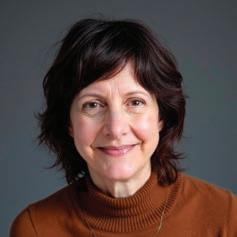
Parker, who grew up on college campuses as a faculty kid, is right at home as a higher education writer. She specializes in work for business, engineering, and medical schools. For this issue, she covered topics including lessons from speakers at the Winston Center for Leadership and Ethics (page 10) and why Jasmine Lanata ’28 swapped her ice skates for running sneakers to honor lost friends (page 47). Parker also often writes about her roots in New England and New York’s Hudson Valley, where she lives.
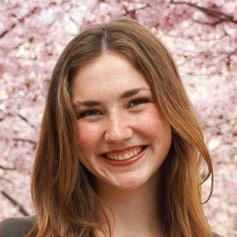
Tebbetts grew up in Ellington, Connecticut, and was raised to be a die-hard Boston sports fan. A rising senior, she studies accounting for finance and consulting and serves as a tour guide for the Student Admission Program. Tebbetts greatly enjoyed applying the lessons of her journalism minor while reporting on Juliana Owen ’25 and the launch of her luxury handbag brand (page 9). She will be spending her summer in New York City as a sustainability reporting and assurance intern for PwC.
Jason Holley ILLUSTRATOR
Holley is a Texas-born illustrator, educator, and exhibiting artist living in Los Angeles. His illustration career spans 25 years, and past clients include Sony, Rolling Stone, The New York Times, The New Yorker, and Random House. Since 1997, he has been a faculty member at ArtCenter College of Design, where he is an associate professor. In this issue, Holley depicted Boston College Professor Juliet Schor’s plan for trimming the standard workweek while maintaining worker productivity (page 26).
Levine is a Bostonbased editorial and advertising photographer. She’s photographed many prominent figures, including Kim Kardashian, Ed Sheeran, and Presidents Clinton and Obama. Her clients include Boston Magazine, MTV, Converse, Spotify, The Boston Globe Magazine, and numerous Boston-area institutions. Levine photographed nine Carroll School athletes for this issue’s cover story (page 16), capturing each student’s personality and passion through her lens.
Check out our website and follow us on social media for the latest on the Carroll School of Management.
bc.edu/carrollschool
Facebook-square carrollschoolbc
SQUARE-X-TWITTER bccarrollschool
INSTAGRAM bccarrollschool
linkedin school/carroll-schoolof-management
Mission
The Carroll School of Management at Boston College ranks among the world’s leading business schools. It offers a rigorous, transformative academic experience that integrates the study of management with the liberal arts, while developing critical thinking skills and fostering ethical leadership. Part of a vibrant, Jesuit, Catholic university, the Carroll School draws inspiration and direction from our centuries-old religious and intellectual heritage. We maintain an enduring conviction that successful management education in the 21st century must combine excellence in teaching and research with reflection and action. The Carroll School educates the whole person in an atmosphere that is inclusive, ethical, caring, collaborative, and respectful of all, consistent with Boston College’s institutional mission and motto of “Ever to Excel.”
Engagement
We invite alumni, parents, and friends to engage with Boston College and the Carroll School of Management, in concert with the University’s mission and priorities. Through opportunities such as the Alumni Association’s programming, the Career Center’s Eagle Exchange, or a gift to the Carroll School in support of students and faculty, the BC community can make a meaningful impact on the University and beyond. For more, visit bc.edu/alumni.
John and Linda Powers
Family Dean
ANDY BOYNTON ’78, P ’13
Editor-in-Chief
WILLIAM BOLE, P ’24
Deputy Editor
JACLYN JERMYN
Associate Editor
MASON BRAASCH
Creative Director
ROBERT F. PARSONS / SEVEN ELM
SEVENELM.COM
Contributing Writers
TIM GRAY
SCANLON MELLOWES, MCAS ’26
SALLY PARKER
OLIVIA TEBBETTS, CSOM ’27
Contributing Artists
A. RICHARD ALLEN
BIANCA BAGNARELLI
DAN BEJAR
CHRISTOPHER CHURCHILL
LIAM COBB
CAITLIN CUNNINGHAM
SAMANTHA DAHLBORG
ALICIA DANE
KELLY DAVIDSON
JOSHUA DALSIMER
GARY WAYNE GILBERT
MATTHEW HEALEY
JASON HOLLEY
LUISA JUNG
MATT KALINOWSKI
DIANA LEVINE
TONY LUONG
GABBY PEREZ
LEE PELLEGRINI
CHRISTINA SPANÒ
Image Specialist
STEPHEN BEDNAREK
Printing
LANE PRESS
© 2026 Trustees of Boston College. All rights reserved.
Carroll Capital is published once a year in June and printed by Lane Press in South Burlington, VT.
Please send questions, comments, or requests for more information to:
Phone: 617-552-1373
Mail: Carroll Capital, Carney Hall 443, 281 Beacon Street, Chestnut Hill, MA 02467
Email: carrollcapital@bc.edu
Opinions expressed in Carroll Capital do not necessarily reflect the views of the Carroll School of Management or Boston College.
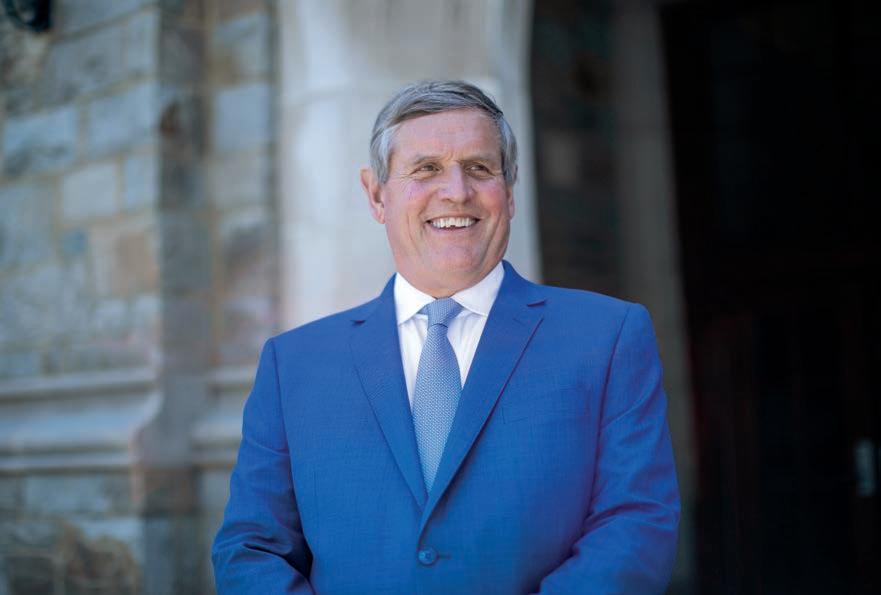
BY POWERS FAMILY DEAN ANDY BOYNTON
The idea of legacy has been very much on my mind as we, at the Carroll School, seek to build on the contributions of so many who came before us. A legacy is an extraordinarily valuable asset, but it’s also, in many ways, an intangible one. It rests on the idea that we’re all part of something greater than us, something that’s going to last forever. We’re here for a moment in time, with the purpose of extending legacies into the present and future.
I speak in the plural because we have distinct legacies at Boston College. There’s our Jesuit, Catholic tradition, which energizes us. There are our alumni,
whom we honor for the work they do and the way they engage with their alma mater. There’s also our faculty and the many gifts they have bestowed upon us.
At this historic turning point for Boston College, I give thanks for our University leadership as well, particularly that of University President William P. Leahy, SJ. His presidency has been transformational, stretching across three decades in which Boston College has risen to the top tier of national research universities while strengthening its Jesuit, Catholic identity. Fr. Leahy now passes on an extraordinary legacy of “Ever to Excel” to his successor, John T. “Jack” Butler, SJ, and to all of us.
At the Carroll School, I can get a picture of our school’s legacy every time I step out of my office in Fulton and walk down the hall. The walls are now adorned with snapshots of Carroll School history since its inception as the College of Business Administration in 1938. We call it the “Legacy Walk,” launched this past academic year.
The display pays special tribute to faculty who served for 25 years or longer and “shaped countless students’ professional journeys while contributing to our school’s intellectual foundation,” as I say in my message on the introductory panel. I think of those who shaped my own journey, especially John J. “Jack” Neuhauser, who died last September.
As Carroll School dean for more than two decades starting in the late 1970s, Jack helped make our school what it is today. After that, as Boston College’s academic vice president, he played an equally pivotal role in the University’s rise to national prominence. Jack was also a guiding force during my formative years, first as a great and peerless computer science professor, and later as a dear friend and mentor.
Like our faculty contributions,
our Jesuit, Catholic liberal arts tradition is a gift that drives us forward every day. On page 44 of this edition of Carroll Capital, you could read about one of the latest examples, having to do with the bridge we’ve been developing between management and the arts and sciences.
For the longest time, Boston College has exposed management and liberal arts students to each other’s disciplines, though much more so in recent years, with record numbers of students crossing the bridge. Now, we’re bringing all this to a new level with the creation of an overarching curriculum made up of newly designed Humanities, Management, and Sciences (HMS) courses.
During two pilot courses, students grappled with foundational ideas from disciplines ranging from philosophy and theology to sociology, literature, and, of course, management. They also dug into case studies that I’ve developed. The whole idea is to help students fully integrate what they learn when they cross from Gasson into Fulton or vice versa. The new bridge initiative begins this coming academic year.
Then there’s the legacy of our alumni. So often, I think of my late friend, the legendary Jack Connors ’63, H ’07, P ’93, ’94. He emerges in our profile of Lisa Wilson ’84 (page 30), a highly innovative fragrance expert and marketer. When she was an intern at Jack’s global advertising firm, he generously mentored her as he did untold numbers of Boston College students and alumni.
Jesuit, Catholic heritage, faculty, alumni, and leadership— legacies that keep pushing us to “ever excel” at Boston College.

PERIANNE CARON, MSF ’26, ENTERED THE MISS MASSACHUSETTS USA PAGEANT ON A WHIM. IT HAS BECOME HER DEFINING CHAPTER.
Being Miss Massachusetts was never part of Perianne Caron’s plan—her friends on the Celtics’ dance teams encouraged her to enter the pageant, and she just happened to win. “It was an out-of-body experience,” says Caron, who took home the top prize at the 2025 Miss Massachusetts USA pageant. “I kept thinking, ‘What am I doing here?’ But in the best way.” Suddenly, Caron’s weekends were filled with parades, 5k races to fight hunger and disease, and other events around the state, all while donning her crown. But even during her whirlwind reign, on many weeknights Caron could still be found in her sweatpants in Fulton Hall, working to finish her MSF. When she started the finance program in 2023, Caron’s plan was to pivot from her then job in investment marketing to something more research focused within the field, but the adventure of serving as Miss Massachusetts and competing for Miss USA last fall enlarged her idea of what’s possible. As she passes on her crown to the next reigning queen, Caron looks to use what she’s learned—both in the classroom and through the pageants— to pursue newfound dreams of fashion entrepreneurship instead. “This journey has brought out a higher level of confidence in myself,” she says. “[It’s] shown me that I have something to share with the world.”
MASON BRAASCH
HOW THE CARROLL SCHOOL AND ITS JESUIT DEAN HELPED SHAPE
“THE NEW BOSTON.”
BY WILLIAM BOLE
In 1949, Seavey Joyce, SJ, was flying into Logan Airport to begin teaching at Boston College. As he told reporters years later, he looked down on a sparse skyline and asked himself, “Where is Boston?” It was not a literal question. Joyce, a son of the city, was asking where Boston stood among the great metropolises of America and the world. The answer was: Nowhere.
Boston was floundering as middle-class residents flocked to the suburbs and property values shrank along with the tax base. Shortly after Joyce’s flight into Nowheresville, a relative political unknown named John B. Hynes emerged victorious in Boston’s 1949 mayoral election. He wanted to change the city’s reputation as an antibusiness backwater, and within a few years he sought out the counsel of Joyce, a Harvard-trained economist who had become dean of the Carroll School of Management.
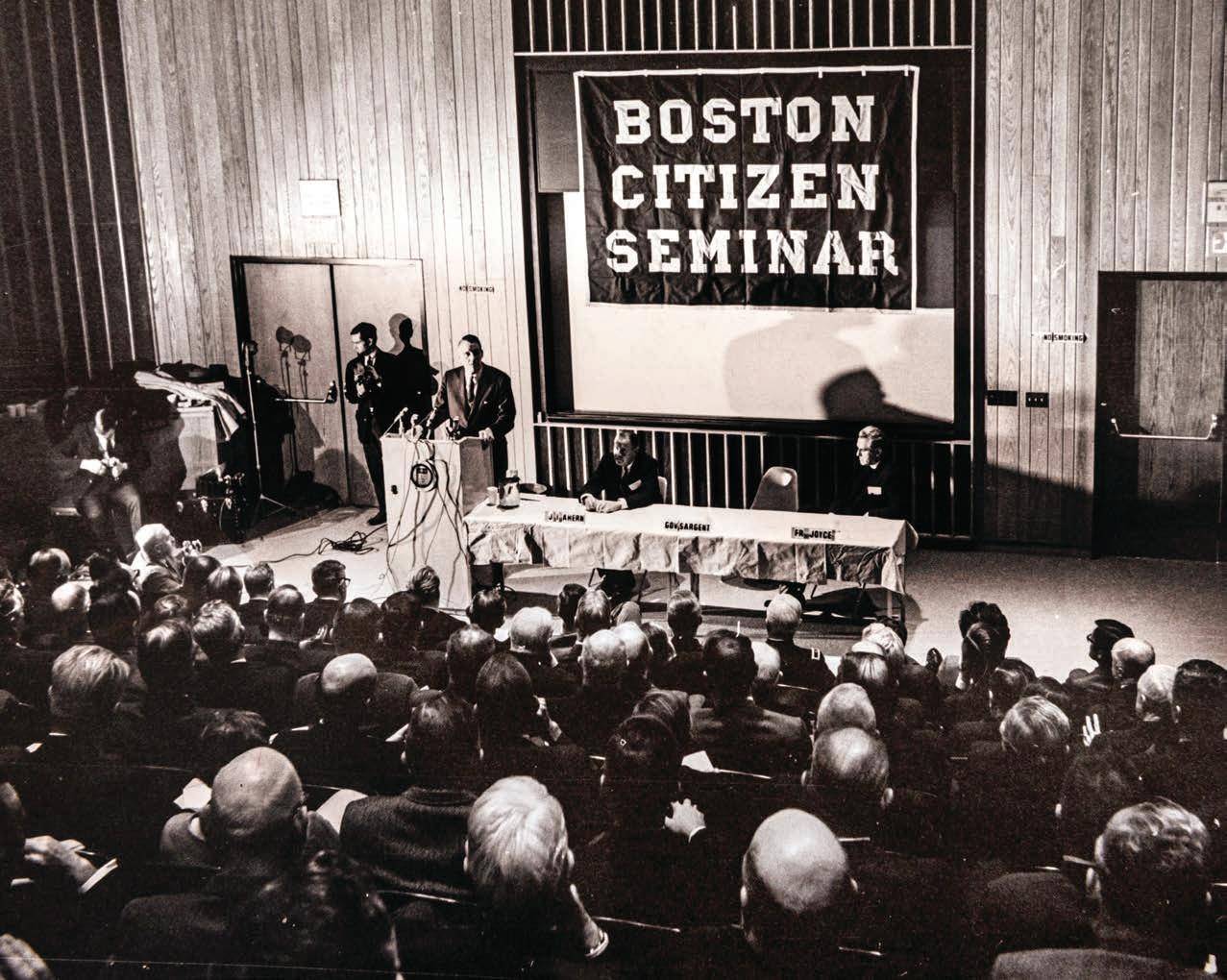
In 1954, the mayor and the Jesuit helped launch the Citi-
zen Seminars, a series of high-level gatherings widely credited with planting the seeds of “the New Boston,” a modern, thriving city.
Hosted on campus by the Carroll School (then known as the College of Business Administration), the seminars offered a neutral ground for public conversations about Boston’s predicament. Remarkably, the dialogue partners included what the late Boston College University Historian Thomas O’Connor called “the two most hostile elements in Boston politics”— Irish Catholic politicians and Protestant Brahmin business leaders. Hundreds of leaders from all sectors participated in multiple sessions each year, tracing through a maze of challenges, from transportation and energy to infrastructure and private-public cooperation.
There was socializing over drinks and meals, with ample servings of humor that leavened the weighty policy discussions. Typical was a 1958 conference wonkily titled “The Role of Aviation and Airports in the Future Development of Greater Boston,” the proceedings of which are stored in the Burns Library archives.
Speaking to the gathering, then–US Senator John F. Kennedy disarmingly noted that he knew next to nothing about aviation other than having spent countless hours on planes, such that “my political opponents can justifiably accuse me of being a senator who is always up in the air, or with his head in the clouds.” What the near-future president said he knew was that Boston would not prosper without “radically different airports,” unlike Logan with its runways designed for propeller planes.
In his remarks, Joyce told of riding Boston’s trains and passing cattle cars, at which times “I have felt some stirring of sympathy for the poor beasts.” But then he considered the chronic delays, poorly ventilated train cars, and other unpleasantries suffered by human riders. “At such times, I have felt the sympathy lavished upon the cattle was quite misspent,” he said, undoubtedly to laughter. His bottom line: “We need a comprehensive plan for transportation.”
Through the Citizen Seminars, Boston got that and much more. From those meetings came ideas and a consensus for change that led to such Boston landmarks as the Prudential Center, the World Trade Center, and the Hynes Convention Center, together with critical coordinating agencies like the Massachusetts Bay Transportation Authority and the Boston Redevelopment Authority.
This “New Boston” was not an unmixed blessing. In the name of “urban renewal,” the city bulldozed stable, blue-collar, ethnically diverse neighborhoods such as the West End, making way for an elevated highway through downtown and other development projects. Though widely regretted today, such measures arose from a sincere belief that “a major shock to the system seemed necessary to wake the city from its lethargy,” James Aloisi, a former Massachusetts secretary of transportation, explained in CommonWealth magazine in 2013.
The Citizen Seminars, with John T. Galvin ’37 at the helm, continued to “influence the course of Boston’s history,” O’Connor wrote in The Heights in 1988. The latter-day seminars, presented by the Boston College Chief Executives Club, highlighted topics such as school reform and the need for vibrant city parks before fading out in the early 2010s.
For his part, Joyce went on to become Boston College’s president from 1968 to 1972, steering the University through a tempestuous era of student uprisings. When he died in 1988, his successor as president, J. Donald Monan, SJ, paid tribute to Joyce as one who “turned the face of Boston College outward to the civic community and, through his endeavors, enriched both.”

Bob Ainsworth’s career in financial services inspired his second act as an author of thrillers.
BY JACLYN JERMYN
When Bob Ainsworth ’75 retired in 2018 from his role as a controller for an information services company, he did his best to find something to fill his free time. He did some consulting, tried drumming— even learning “Uptown Funk”—but what finally stuck was becoming an author.
It was a big leap for Ainsworth, who had very little experience writing and spent much of his career making spreadsheets in auditing roles. But he loved crime series like Perry Mason and Ironside, and he also knew that people always got a kick out of the stories he told about discovering real financial crimes in his work. Ainsworth wondered if he could combine the two worlds.
Enter Harry Bartlett, a fictional former CFO turned fraud detective. Over the course of five self-published books so far (Conned, Duped, Scammed, Ponzi’d, and The Last Unindicted Mayor), Bartlett and a menagerie of other vivid characters work to solve financial crimes that take them from Nantucket Island to the Isabella Stewart Gardner Museum and even to the doorstep of con artist Charles Ponzi. Bartlett’s adventures are often more lurid than the actual schemes Ainsworth
uncovered during his career, which included a secret supermarket cash register left off the books and someone padding the payroll at the former Wonderland dog track, but Ainsworth did give the character his same impulse to speak up about corruption.
“I had an interesting career and a lot of different experiences, and all of that has led to this. I just learned a lot,” he explains. Ainsworth credits Boston College for being where he really “learned to learn.” He recalls balancing his accounting concentration requirements with philosophy classes to expand his horizons. “It’s not always about the content,” he says. “It’s about exercising your brain, and how far you can stretch it.”
When it comes to imagining new plotlines for his novels, Ainsworth admits that coming up with the crimes is the easy part. “The hardest thing you have to do is finish the first draft,” he says. But at the end of the day, Ainsworth continues to write simply because it’s fun. “I’m never going to be John Grisham, but you know that saying, ‘dance like nobody’s watching’? I write like nobody’s going to read but me.”
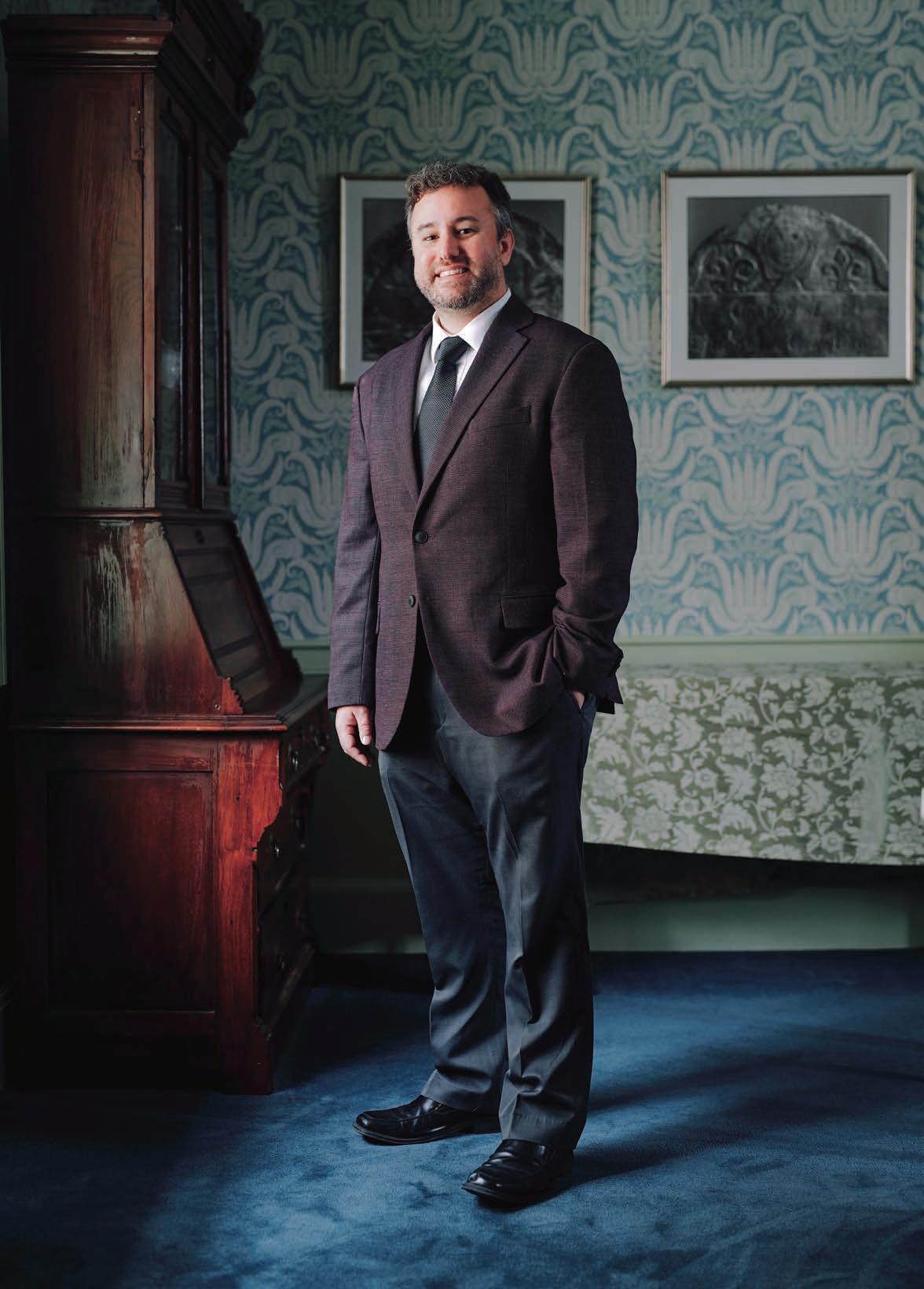
HOW ONE MBA ALUM IS BRINGING A VENERABLE HISTORY MUSEUM INTO THE FUTURE.
BY JACLYN JERMYN
The Museum of Worcester has lived many lives over the years. It was the Worcester Society of Antiquity when it was incorporated in 1877. Then, in 1919, it became the Worcester Historical Society. When Eric Butler, MBA ’12, was growing up, he knew it as the Worcester Historical Museum. And in 2025, the space reinvented itself again as the Museum of Worcester, just in time for Butler to take the reins as executive director this past winter.
It’s not just a name change, but an affirmation of the museum’s mission to celebrate the Worcester community. “We do think about the museum as Worcester’s museum, the museum of the people,” Butler says. A lifelong resident of the city, he’s proud to be part of that group.
Much like the museum, Butler has also lived many lives. After studying theater and psychology at Holy Cross, he went on to get his MBA from the Carroll School. He has held development roles in the education and education technology sectors—most recently as vice president of development for City Year—and also founded Broadway in Worcester in 2022, inviting award-winning performers to central Massachusetts each year.
Now, Butler’s bringing that versatility to his latest role. He had big shoes to fill when he became executive director in January. His predecessor, Bill Wallace, ran the Museum of Worcester for nearly 50 years. “It’s definitely daunting,” Butler said shortly after stepping into the role, but he has hit the ground running.
Although the museum is on solid financial footing, he knows that his business skills will be key to the success of future projects like incorporating more interactive technology into exhibits and expanding the gallery dedicated to the work of late Worcester artist Harvey Ball, creator of the iconic yellow smiley face. When renovations are complete, the gallery “will be the happiest place in Worcester,” Butler says, flashing a big smile himself.
Worcester has long been a hub for industry. In the museum’s Fuller Gallery of Industrial History, everything from corsets to cans of Polar Seltzer to NASA space suits—all items that have been produced in the city—pack the display cases, but Butler believes it’s Worcester’s culture that makes the city special. “It really is the vibrancy of life,” he says; things like the museum, the Worcester Red Sox minor league team, and his work with Broadway in Worcester add to that vibrancy. “That’s what people stay in communities for,” Butler adds. He hopes that people continue to see the museum as part of that essential cultural patchwork.
He knows all about feeling connected to a mission. After his time at Holy Cross, joining another strong Jesuit institution like Boston College resonated with Butler. Although he recalls once being told that he might be “too nice for business school,” he’s grateful to have found such a supportive environment in the Carroll School, especially as someone with no previous business education.
“If you had asked me what Brown Brothers Harriman was when I first started business school, I’d be like, ‘Do they sell men’s clothes?’” he jokes, referencing the esteemed investment banking firm and alluding to Brooks Brothers. But he adds that the B-school experience helped evolve how he thought about the world and problem-solving.
There’s one particular lesson from his time at the Carroll School that Butler returns to often, especially as he considers the Museum of Worcester’s future. While participating in TechTrek West and visiting alumni working in Silicon Valley, he realized that these individuals all had something important in common: They wore failure like a badge of honor.
“I have embraced that entrepreneurial spirit. It’s needed just as much in the arts and culture sector as in Silicon Valley,” he says. “In terms of experimentation and innovation as a smaller museum, I think we have the luxury to be nimble and try things out.”

In Juliana Owen’s hometown of Seagrove, North Carolina, you’re either a potter or you know one. Growing up in America’s “handmade pottery capital,” much of her childhood was spent in her father’s pottery studio.
Owen ’25 is even named after Juliana Busbee, a trailblazing ceramics designer from Seagrove who worked with her great-grandfather. It’s this legacy that inspired her to launch an upscale handbag brand with her first product, the Busbee Bag.
Owen may have studied marketing at the Carroll School, but she didn’t cast off her artistic upbringing. She double majored in studio art after taking a class in urban design offered by the Joseph E. Corcoran Center for Real Estate and Urban Action, which she says made her “think more [with] a design lens.” For her senior capstone art project, Owen decided to design a purse, despite not really knowing how to sew. Instead, she experimented with creative folding techniques. The result was a sculptural leather handbag that could be deconstructed to lie flat and reassembled in six folds.
Realizing that a folding handbag was a great business concept, she entered the Edmund H.
Shea Jr. Center for Entrepreneurship’s Strakosch Venture Competition, winning second place. Owen received $5,000 in equityfree funding and a new mentor in competition judge Cory Munchbach, MCAS ’09, former CEO of BlueConic. “I’ve always wanted to be an entrepreneur,” she says, but “having someone [like Munchbach] tell you that you can do this makes you much more likely to take the next step.”
After moving to Chicago for a marketing associate job with Deloitte, Owen found a manufacturer to produce the Busbee Bag in three colorways that she named Cabernet, Penny, and Tea as a nod to her father’s ceramic glazes. In late 2025, the first 54 bags went on sale online, selling out within a month. The bag is now also stocked at high-end Chicago boutique IngaDoutzen.
As a part-time founder, Owen is often answering emails from her manufacturer while commuting to work or spending weekends running through her to-do list. Even doing just a couple of tasks a day for her business and “moving in the right direction really makes a big difference,” she says.
Like making pottery, starting a business is a messy but exciting process. Owen is enjoying learning by doing: “There really is no age where you suddenly know everything,” she explains. “I’m just saying yes and figuring it out as I go.”
OLIVIA TEBBETTS
’27

WINSTON CENTER MARKS 20 YEARS OF NURTURING AND SHOWCASING ETHICAL LEADERSHIP.
BY SALLY PARKER
For Parvati Shallow, four seasons as a contestant on the TV series Survivor were master classes in leadership. Negotiation, strategy, and listening to her intuition (or, sometimes, ignoring it) taught her a lot, but one thing stood out: Becoming a leader isn’t a solo game. It is honed in relationships.
“You can’t fail when you’re building relationships. There is no right or wrong or good or bad, because you’re either winning or you’re learning,” she told an audience of students last fall as part of the Winston Center for Leadership and Ethics’ Brennan Symposium lecture series.
The Winston Center—where students learn, practice, and research skills in leadership and ethics—marks its 20th anniversary this coming
“Napoleon said a leader is a dealer in hope—not in fear, not in anger, not in chaos, but in hope. Be that kind of leader. Be that kind of citizen.”
James
Stavridis
RETIRED FOUR-STAR US NAVY ADMIRAL
academic year. One of its missions is to bring an eclectic variety of leaders to campus to share what they’ve learned traveling different paths. Recent examples have included an admiral, an alumnus ambassador, an NGO founder, two Nobel Peace Prize winners, and Shallow, among others who spoke at lecture programs also including the Clough Colloquium and Chambers Lecture Series.
A recurring theme in the talks is that effective leaders navigate relationships skillfully. Many demonstrate the Jesuit servant-leader perspective, says Winston Executive Director Monetta Edwards.
“When a lot of people think of leadership, they think of the person at the top,” Edwards says, noting that leadership can arise from anywhere on the organizational chart and from unlikely places, like a remote island on a reality TV show. “And for us it’s more about putting service to others above self, about leading
with empathy. Those are the values we really home in on.”
Shallow encouraged students to develop their leadership skills as “expanders,” people who offer genuine connection and want to work together, rather than as “controllers,” who need to do things their own way and create an atmosphere of fear.
“Communication is not a megaphone; it’s a bridge,” echoed retired four-star US Navy Adm. James Stavridis. “Napoleon said a leader is a dealer in hope—not in fear, not in anger, not in chaos, but in hope. Be that kind of leader. Be that kind of citizen.”
Stavridis, former commander of the US Southern Command and later the NATO Supreme Allied Commander, also cautioned against framing leadership as merely strategy. Globally and personally, it also means being willing to talk to your opponents, even if you don’t see eye to eye, and forging unconventional partnerships.
Competitors, when their interests align, can achieve goals through cooperating, said Nicholas Burns, MCAS ’78, H ’02, P ’09, ’12, former ambassador to China and professor of diplomacy at Harvard University. He spoke about the US relationship with China this past fall. “We’re not enemies. We’re competitors and rivals,” he said, underlining the need to cooperate on issues such as climate change and the next pandemic. To lead internationally, the US must also temper its own internal discord first. “A country cannot be powerful and effective overseas if they’re divided at home,” he said.
A sense of purpose is an important ingredient in the leader’s inner life—and it tends to grow outside of their safe spaces, said Barbara Bush, former CEO of Global Health Corps, a leadership accelerator that aims to reduce health inequities. “I found it liberating to realize there is no perfect step forward,” she said in the spring of last year. “I’ve grown most when I’ve had hard experiences, or when I’ve been completely out of my comfort zone.”
For some speakers, following their convictions has meant truth-telling at great personal risk. Journalist Dmitry Muratov cofounded and is editor in chief of Novaya Gazeta, a Russian independent newspaper that reports on government corruption. Journalists at the newspaper have been murdered while covering human rights abuses. A 2021 Nobel Peace Prize winner who spoke a year later, Muratov sold his medal to raise money for children in war-ravaged Ukraine.
Human rights activist Nadia
Murad spoke of experiencing the genocide of her Yazidi community in northern Iraq at the hands of ISIS. Many were forced into physical and sexual slavery, herself included. After escaping captivity, she began speaking out, determined to advocate for survivors around the world through her nonprofit, Nadia’s Initiative. Awarded a Nobel Peace Prize in 2018, she said she had to learn that politicians and other powerful people will let you down.
“When that happens, you have to keep advocating over and over again,” she said in 2024, “until the actions of one become the actions of many.”
Sometimes leadership is thrust on people. For Liz Cheney, the former Republican representative from Wyoming who spoke in 2023, leadership took on new meaning after the Jan. 6, 2021, attack on the Capitol. Famously breaking with her party, she served as vice chair of the House select committee investigating the attack. She was eventually ousted as a House leader.
Edwards said Cheney showed her overflow audience of students that leadership calls for courage— even when it bumps up against your own expected trajectory. “For our students to see that sometimes you have to take those risks, that was a story I thought was really important,” Edwards says. “How are you going to live the rest of your life knowing you didn’t take that risk?
“This is why we do the work, for our students to graduate as conscientious and ethical leaders,” she adds. “Our work is really to be part of their journey, their story.”

THE HEARTS
BY JACLYN JERMYN
Kevin Schohl ’06 loves a good game. He’s felt that way since his childhood in Cleveland, learning to contend with the sometimes agonizing experience of being an Ohio sports fan at the time.
That love of sports has buoyed him across his career, through his strategy and analytics internship with Major League Baseball; and then his time as director of analytics and strategic initiatives for both the Atlanta Falcons and Major League Soccer team Atlanta United FC; and even the half a decade spent at sports betting company DraftKings, where he climbed the ranks to vice president. That’s where he was when he heard about a brand new soccer team launching in Portland, Maine.
In spring 2024, Schohl joined the Portland Hearts of Pine, a men’s soccer team in the third division of American professional soccer, USL League One, as its first president and chief business officer. The opportunity was too good to pass up, he says. “They needed someone who’d be able to lead a business, wear a lot of hats, and grow something from nothing.” In short, it sounded like a dream job.
On a sunny October day at the tail end of the Hearts’ first season, preparations were underway for a match against Westchester Soccer Club. Wearing a blaze orange camo Hearts of Pine jersey and a big smile, Schohl walked the outer track around Portland’s Fitzpat-
rick Stadium, where the Hearts play home games.
Spirits were high—prior to kickoff, the club was hosting a fall fair with a petting zoo and carnival games. The Portland High School girls’ soccer team wandered by to pose for a photo with team mascot Moxie the Moose, and Schohl pointed out the dunk tank, where fans would have a chance to submerge team founder and Chief Community Officer Gabe Hoffman-Johnson later on.
When Hoffman-Johnson founded the Hearts of Pine, he envisioned the team being a beacon of what soccer could be in America, with real community impact like other soccer teams around the world. But to reach those heights, “You need to surround yourself with really high-quality leadership,” he says of bringing Schohl on as president. “As an operator, his ability to execute is phenomenal.”
That ability was clear all the way back to when Schohl worked on the business team of Boston College’s independent student newspaper, The Heights. “People at The Heights were writing good stories— that didn’t need to be my strength. I was able to bring my business talents and provide the revenue for it to succeed,” he says. “It was a good example of being able to match different talents together.”
Hoffman-Johnson says that if he’s the why of Hearts of Pine in his role as chief community of-
ficer, then “Kevin’s more of our how: the person who has the ability to think really big and five years forward, and at the flip of a switch, jump into the nitty-gritty,” he says. “[Hearts of Pine] has his fingerprints on it just as much as mine, if not more.”
Boston College’s emphasis on becoming a well-rounded learner has served Schohl well. In addition to his finance and operations management studies and his time on The Heights, he was also a history major. “That generalist mindset has really benefited me, especially in a role like this,” Schohl says—at any given moment he might be proofreading a marketing email, doing a million-dollar partnership deal, or dealing with an HR issue. “I’m having to feel confident in doing all of those things. That’s what the Carroll School trains people to do.”
Schohl, who went on to get a Harvard MBA, still feels deeply connected to Boston College. “I have a lot of pride, that’s who I am. I’m still a huge fan of BC sports,” he says. In building the Hearts of Pine community, he’s infusing it with that same enthusiasm.
The Hearts were dubbed “the buzziest new team in US soccer” by AdAge, thanks in part to an emphasis on community. For example, the camo jersey Schohl wore is a nod to Maine’s hunting culture. There’s also a kit dotted with red hearts, evoking a Portland tradition where the so-called Valentine’s Day Bandit secretly
hung paper hearts around the city. In the 2025 season, these design choices led to the team selling more merchandise than all other USL League One teams combined.
“[We’re always] thinking about community,” he says. One of the toughest challenges he has to tackle isn’t about optimizing revenue— the club topped gross revenue and ticket sales for the league in its inaugural season—but about “finding ways for soccer or nonprofit groups to [attend games], and making sure we’re not shutting people out,” he adds. “We know this loyalty will pay off in the long run.”
At the end of their first season, the team made it all the way to the playoff semifinals. Now in year two, there is no shortage of support for what the Hearts are doing. There was a 98 percent season ticket renewal rate, with more than 7,000 people on the waitlist.
“[In] sports business, if I were to do the exact same things in the wrong place, maybe it wouldn’t work,” Schohl says, explaining how the team’s success owes as much to the Portland community rallying around the Hearts as it does to the players and staff.
“I’ve worked with a lot of very high-caliber people throughout my career, but you realize some people aren’t cut out to work for a lower division soccer team,” he says. “Success isn’t just who’s the best marketer or the best accountant. It’s about who can understand what we’re trying to do and lead with their heart.”
“ They needed someone who’d be able to lead a business, wear a lot of hats, and grow something from nothing.”
Kevin Schohl ’06
BY WILLIAM BOLE
A year ago, Carroll Capital put its readers to the test. We served up a dozen questions culled from a much longer assessment given every three years to Carroll School of Management seniors in their final semester. Judging from the messages in our inbox, many readers were up for the challenge. They whipped out their financial calculators, mustered their critical thinking skills, and braved the questions. Alumni, parents, students, and others let us know how they did. Some suggested that we make the test less arduous for those long out of school, while others touted their results. Mary Anne (Keane) McAuliffe, MBA ’78, was pleased to report that she answered 10 out of the 12 correctly. “This, after 47 years since graduating and 30 years since actively working in the business world,” she emailed us. “This is a tribute to the BC education and the quality of your student body and alumni.”

That exam took a broad cut at the Carroll School curriculum and spanned the functional areas of management. This year, we drill down into two foundational courses with overlapping content—Financial Accounting and Fundamentals of Finance. The accounting course serves as a gateway to management education at Boston College, a prerequisite for most core courses taken by the nearly 2,500 Carroll School students and more than 2,000 management minors from other Boston College schools. The finance class is required of all those majoring or minoring in finance, which pulls in more students than any other discipline at the University.
The following questions are selected from the accounting and finance portions of the most recent 100-question senior assessment, which is ungraded and represents “what every student should know when they graduate, and hopefully for a long time afterward,” says Ethan Sullivan, senior associate dean for the undergraduate program.
1. Which of the following businesses would be most likely to use the specific identification method of inventory valuation?
A. A home supplies store
B. A grocery store
C. An auto parts store
D. An art dealer
E. All of the above are equally likely to use the specific identification method
2. If markets are efficient, when new information about a stock becomes available, the price will:
A. Accurately and rapidly adjust to include this new information
B. Remain unchanged because it already reflects this information
C. Adjust to accurately reflect this new information over the course of the next few days
D. Likely increase because all new information has a positive effect on stock prices
4. On January 1, Woodstock, Inc. purchased a machine costing $41,000. The expected useful life of the machine is six years and the residual value is $5,000. How much is the annual depreciation expense, assuming use of the straight-line depreciation method?
A. $6,100
B. $6,000
C. $5,950
D. $5,750
E. None of the above
5. What is the maximum amount a firm should pay for a project that will return $15,000 annually for five years if the opportunity cost is 10%?
A. $56,861.80
B. $24,157.65
C. $62,540.10
D. $48,021.19
6. What is the present value of a five-period annuity of $3,000 if the interest rate per period is 12% and the first payment is made one year from today?
A. $9,655.65
B. $12,112.05
C. $13,200.00
D. $10,814.33
3. Which of the following direct effects on the balance sheet equation is not possible as a result of a single business transaction that impacts only two accounts?
A. An increase in an asset and a decrease in another asset
B. An increase in an asset and an increase in stockholders’ equity
C. A decrease in stockholders’ equity and an increase in an asset
D. An increase in a liability and an increase in an asset
E. None of the above
7. Certified public accountants (CPAs) who serve as external auditors for their client firms must maintain independence from those clients. Impairments of independence can occur when:
A. A CPA owns a direct financial interest in a client
B. A CPA owns a material indirect financial interest in a client
C. Immediate family members of the CPA are in violation of the independence rules
D. All of the above
E. None of the above
8. Which one of these changes indicates an improvement in a firm’s asset management efficiency?
A. An increase in the amount of assets per dollar of sales
B. A decrease in the receivables turnover rate
C. An increase in the inventory turnover rate
D. An increase in the average days in inventory




9. At the beginning of 2022, a corporation had assets of $270,000 and liabilities of $160,000. During 2022, assets increased $25,000 and liabilities increased $5,000. What was stockholders’ equity at December 31, 2022?
A. $140,000
B. $130,000
C. $190,000
D. $80,000
E. None of the above
10. Suppose the bond market, in reacting to macroeconomic data, increases the yields to maturity on corporate bonds. As a result, prices will:
A. Fall
B. Rise
C. Stay the same
D. Can’t tell from the information provided
College sports haven’t been getting the best press lately, largely because of a spreading belief that money is calling the shots at programs that don’t underline academics the way a school like Boston College does. Often overlooked, though, are the real lives of most student athletes.
Consider Carroll School athletes. They chose to enroll at one of the nation’s most rigorous schools of management. They have breakneck schedules that could make a Silicon Valley entrepreneur seem lethargic. Most of all, they love the game and strive to develop all aspects of their lives, from the athletic and academic to the social and spiritual. Meet nine student athletes carrying on a hallowed BC tradition.
By William Bole , Mason Braasch , Jaclyn Jermyn , and Scanlon Mellowes ’26
Diana Levine
Kaelan Chudzinski’s maternal grandparents have photos of him as a toddler cheering in the stands of Alumni Stadium. And there he is, at five years old, caught in the official video of the parade cele -

brating Boston College hockey’s national championship in 2012, looking straight into the camera near the barricades of the procession on O’Neill Plaza. “I was brainwashed at a young age,” he jokes, referring to his mother’s side of the family, the Dankers, among them his grandfather and uncle who graced the gridiron on the Heights.
Still, it was hardly preordained that he play football at BC—let alone that he’d be coached there by his dad. For much of his young life,
Chudzinski’s sport was hockey. He pivoted to football well into high school at St. Sebastian’s in Needham, Massachusetts, but initially signed with Princeton before choosing Boston College. His father, Rob Chudzinski, chose BC as well. During a long NFL career, he coached for such teams as the San Diego Chargers and the Cleveland Browns, where he was head coach in 2013. He now serves as senior offensive analyst working with the tight ends, including Kaelan. Academically,
“It’s been a lot of fun and hard work,” says Chudzinski, who’s taken a liking to finance and philosophy, and finds time to strum his guitar and read scripture morning and night. So what’s it like to be coached by your dad? “He’s very intense,” Kaelan replies with a chuckle, adding in all seriousness, “I wouldn’t get better coaching from anyone else.” The proof is in the completions: Last year, he registered more catches and yards than any freshman tight end in the country.
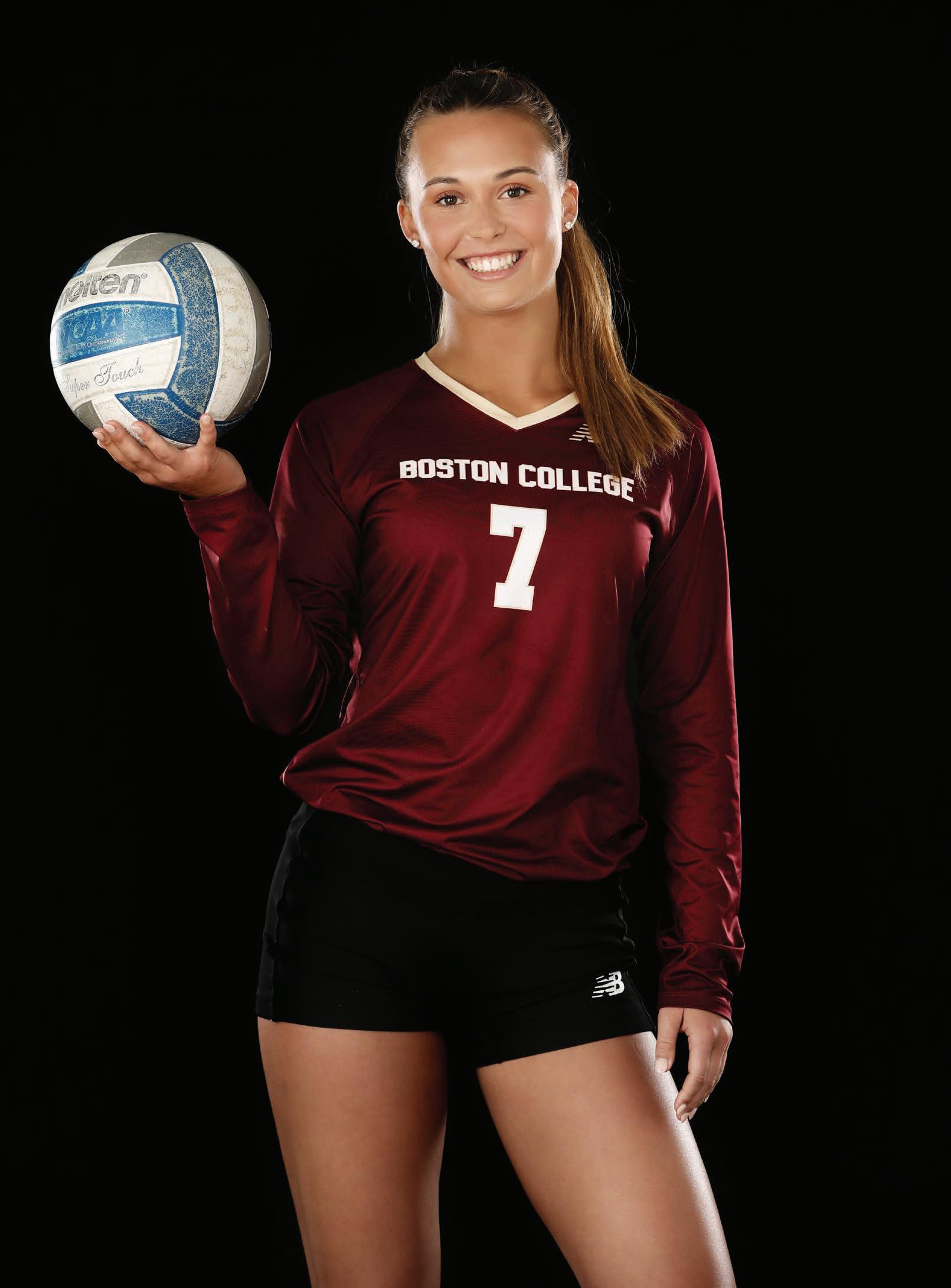
RECIPIENT OF THE CALLAHAN FAMILY SCHOLARSHIP
During summer training seasons, the Boston College volleyball team lives together and spends their free time cooking, tanning, and exploring Boston. On the road, they study and do homework together. “You get to know each other really well,” says Hanna Hoffman. While her college volleyball chapter concluded last fall, “the best parts of volleyball you get to keep with you your whole life, and that’s the relationships,” she says. Relationship building has also been at the heart of Hoffman’s work with the Joseph E. Corcoran Center for Real Estate and Urban Action. As sophomores, Hoffman and others noticed that they were among the few women attending real estate events. So they cofounded the Women in Real Estate club (WIRE). The group hosts networking events and partners with industry organizations, helping young women build their professional networks. For her part, Hoffman landed an internship with real estate capital markets firm JLL, and she returned there after graduation as an analyst. She’s confident that what she learned on the volleyball court will come in handy as she starts her new role. “Regardless of how grueling practice was on any given day, I always tried to show up with the same energy and lift up my teammates,” she says. And what’s the best way to lift up others? Her approach is simple but meaningful: “Extend a hand and be kind,” she says.
His favorite spot on campus is in the upper reaches of O’Neill Library—“I love being in the stacks up there doing my work. It gets really quiet,” says A.J. Colarusso, a starting pitcher for the Eagles. But come spring, the finance major finds himself at a far higher altitude, calculating equity value along with other assignments on flights around the country. On the ground, his study space might be a hotel lobby where he’s compiling notes on a humanities reading while waiting for the team bus. Such is the season of an Eagles baseball player. The lightning-fast schedule consists of no fewer than 56 games loaded into 12 weeks of the spring semester and played against teams in places as distant as California. How does Colarusso bolster the “scholar” part of the equation? Key, for him, is steady communication with professors. For a chunk of the season, the team flies out to warmer climes for three-game weekend matchups, frequently missing classes on Thursdays and Fridays. They also have midweek games at home. Colarusso looks for creative ways to boost his academic output on the road, like emailing the professor with his thoughts on a reading as an alternative to class participation. “Just being able to represent BC in a uniform has been such a privilege,” says the southpaw, who, as the season ended, was eyeing the MLB Draft in July.


“As soon as I could walk, my dad put me in hockey skates,” recalls Emily Mara, but it wasn’t long before she donned her first pair of soccer cleats too. She grew up excelling in both sports, and when it came time for college recruitment, “I just couldn’t imagine my life without one or the other,” she says. Mara was signed by Boston College women’s soccer, but by move-in day of her freshman year, she was officially on her second BC team. It’s not unheard of to be a two-sport athlete at Boston College, but many one-sport athletes on campus would tell you that their schedule is busy enough between balancing workouts, practices, heavy course loads, and travel for out-of-town games. Mara wasn’t daunted by the demanding schedule—being a two-sport athlete at a boarding school had prepared her well. “My biggest priorities have always been sports and school,” she says. “That hasn’t changed.” The soccer and hockey seasons overlap by just a few weeks in the fall, but even in the off-season, Mara trains with both teams as much as she can. For her, it’s worth it. “Each sport challenges different parts of me,” says Mara, who plays forward for both teams. The patience and endurance that soccer demands make her a stronger leader, she explains, while hockey’s fast pace taught her how to make quick decisions under pressure. “Doing both,” she says, “has helped me become more adaptable and well rounded as an athlete and as a student.”
MEN’S BASKETBALL
RECIPIENT OF THE HUGHES FAMILY SCHOLARSHIP FUND
If you were to ask Jayden Hastings what his word of the year is, he would pick “humility.” It applies as much to the guidance he seeks from

teammates and coaches as it does to “having that humility to say when you need help” in class, he explains. For Hastings, a forward, adjusting to Boston College took time after attending small Christian schools in Orlando. He remembers struggling through Statistical Analysis and how Professor of the Practice Linda Boardman Liu showed up for him and his teammates taking the course. “The game schedule was
getting tighter and it was also our first time doing college stats,” he explains. “Two hard things together, and she really helped us.” Boardman Liu turned out for games and cheered her students on—a perfect example of the supportive community Hastings found at BC. On Monday nights, he did Bible study with the Boston College chapter of the Christian group Athletes in Action, which has helped him stay focused
on the bigger picture. “Some things that you’re part of are not just about you. You’ve got to sacrifice yourself to a lot of things and it’s for you to be better,” he says. ”It’s about having the humility to do your part—a game or a school project— and surrender to the process.” At press time, Hastings was moving on to the University of Cincinnati after three years on the Heights. Once an Eagle, always an Eagle!

RECIPIENT OF THE BOTICA FAMILY ENDOWED SCHOLARSHIP FUND FOR WOMEN’S ATHLETICS
It may have seemed inevitable that Molly FitzPatrick would end up running for Boston College—that’s how her parents met, after all. But initially, FitzPatrick wasn’t sure about continuing the legacy. “[My parents] let me find running for myself,” she says, adding that she played soccer before getting into track in high school. Ultimately, she decided on her parents’ alma mater because of the balance it offered between competitive athletics and top-tier academics. In the end, Boston College was such a good fit that after completing her undergraduate degree, FitzPatrick, a distance runner, used her final year of NCAA eligibility to keep running and pursue a parttime MBA at the Carroll School. “It was the MBA or nothing for me,” she says. FitzPatrick used that final year well, helping guide the women’s cross country team to their first NCAA Northeast Regional title in 19 years last fall. It was also the first time she qualified to run at regionals and the national championship. An internship last summer with New Balance has FitzPatrick mulling a future career where she could stay connected to athletics, but for now she’s enjoying the time she has left on the Heights before wrapping up her MBA at the end of the summer. “I just enjoyed my undergrad experience so much,” she says. “It was a no-brainer to come back for this opportunity.”
LACROSSE
RECIPIENT OF THE DEE & DAVID STOKES
FAMILY FLYNN FUND SCHOLARSHIP, THE BROCK FAMILY SCHOLARSHIP, AND THE CARTER FAMILY SCHOLARSHIP FUND
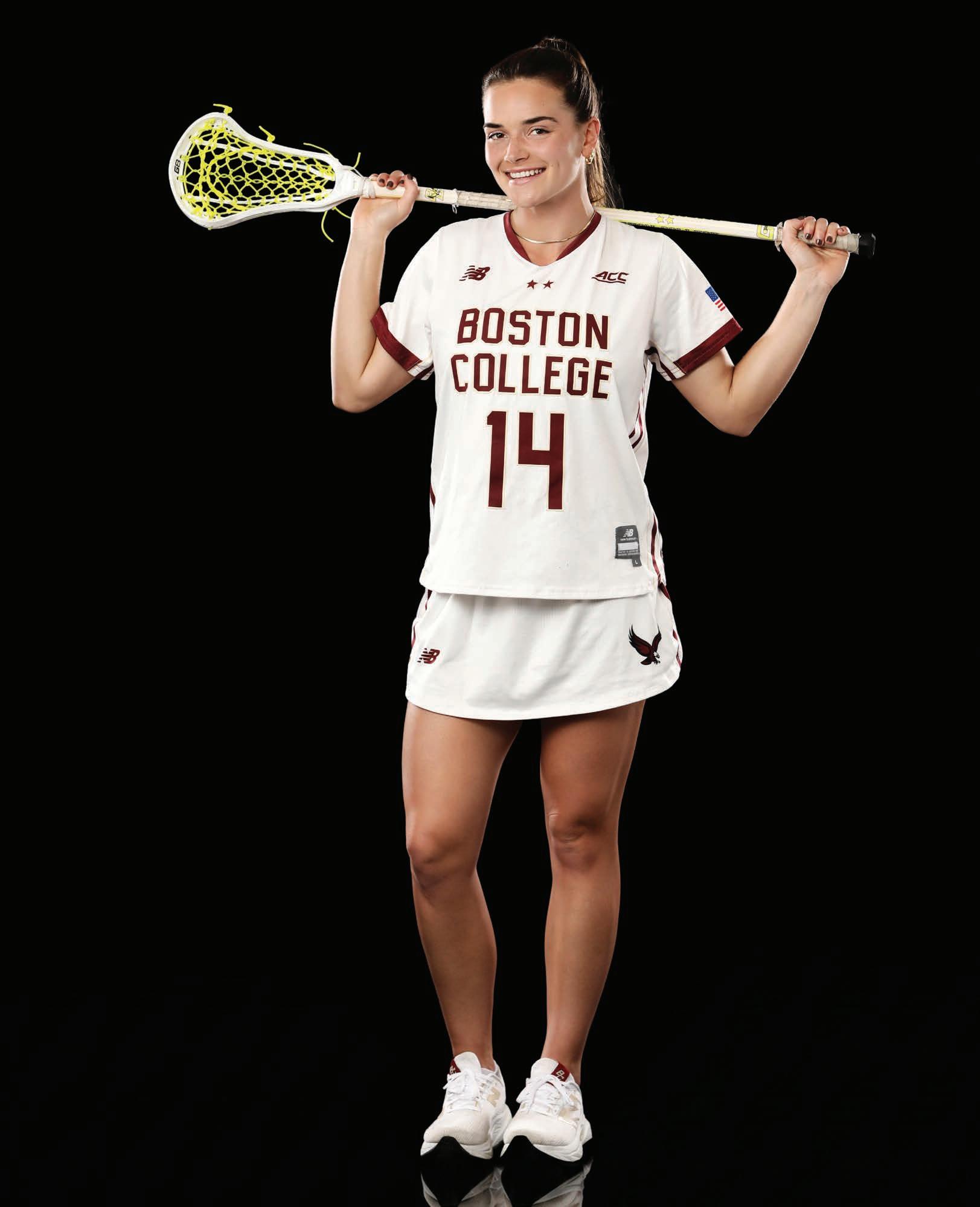
Shea Baker was a sophomore when her team won the 2024 women’s lacrosse national championship. Despite the excitement of the team’s come-from-behind 14–13 win, what she remembers most was watching the team’s seniors experience their final match in a BC uniform. “When the final buzzer went off, I saw them going through all of those emotions,” she says. “I was playing for those seniors to have that moment.” As a team captain during her own senior year, Baker wanted to be what the seniors of 2024 were to her: someone younger players could look up to. The team, a decorated powerhouse in the NCAA, takes pride in their tight-knit dynamic. “There’s always a reciprocity of care and love between every person on the team,” she says. “We spend so much time cultivating those relationships and intangible pieces that people don’t see on the field.” During the 2025 season, the team ranked first nationally among women’s lacrosse programs for community service. That includes a partnership with Team IMPACT, which pairs children facing serious illness or disability with college sports teams as honorary teammates, like six-year-old Aya. “She’s nonverbal, but she is such a bright light on our sidelines,” Baker says. “She’s a constant reminder that there’s so much more to being a student athlete than just the grind. It has definitely helped me evolve into a better human.” Baker, a defender, will be evolving further on the field as well: In April she was drafted by the Boston Guard into the professional Women’s Lacrosse League.
MEN’S HOCKEY
RECIPIENT OF THE HOLLAND
FAMILY HOCKEY FUND AND THE WILLIAM M. HOGAN, JR. ’33
ATHLETIC SCHOLARSHIP FUND
The summer before college, Aram Minnetian’s dream came true: He was drafted into the National Hockey League. “I was sitting in my seat, flooded with every emotion,” recalls Minnetian, a defenseman who was selected by the Dallas Stars in the fourth round of the 2023 NHL Draft.

“When my name was called, it was the most exhilarating feeling.” Many players on Boston College’s highly ranked men’s hockey team have already been drafted by an NHL team by the time they first hit the ice in Conte Forum. With a promising athletic career ahead of them, some will only play for a year or two before moving on to the big leagues. But while Minnetian is looking forward to his future in professional hockey, he is adamant about seeking academic success in the meantime. “I want to make the most of the education that I’m blessed enough to receive,” says Minnetian. Despite a practice schedule that keeps him at the rink for upward of five hours each weekday, Minnetian has been able to strike a happy medium between school and sport. He’ll often avail himself of online course offerings from the Woods College of Advancing Studies to make his workload more manageable each semester. “I put as much as I can into my classes without letting hockey slip, and to do that you have to be disciplined,” he says. “As an athlete, you don’t have much time to waste.”
Tiffany Cao, MSF ’26
WOMEN’S GOLF
After growing up in the Dallas suburbs and completing her undergraduate degree at the University of Texas at Austin, Tiffany Cao made the choice to leave behind that Texas warmth. She used her

final year of NCAA eligibility to join the Boston College women’s golf team and enroll in the Carroll School’s full-time MSF program. To Cao, the opportunity was well worth the colder climes. While she wanted a graduate program that would pair well with her bachelor’s degree in management information systems, Cao was also looking for a team where she could make a real mark. “The BC golf program is
steadily rising. I knew that I could do something very impactful here,” after raising her game at UT Austin, she says. “I’d be able to go out with a bang.” Cao is also keenly aware of how her own performance factors into overall team performance. “You have to flip the mindset of ‘I want to win’ to ‘I want to win as a team, and how are we going to get there?’” Within months of arriving at Boston College, she had already
helped lead the team to first-place wins at both the Red Bandanna Invitational and the Diamante Intercollegiate tournament, where she placed fourth overall. Cao is grateful for the lessons golf has taught her—the determination that will help her wherever she goes.
“You can never be perfect at golf,” Cao explains. “I really enjoy that aspect of working hard and getting 1 percent better every day.”

Boston College Professor Juliet Schor has devised a plan for a four-day workweek—an idea that’s gaining traction, partly because of her findings that less worktime significantly improves employee health and well-being. But is the 32-hour week, with full pay, a viable proposition for most organizations? Can workers achieve 100 percent of the productivity in 80 percent of the time? Management scholars weigh in.
By William Bole
the winter of 1926, thousands of garment workers, mostly immigrants from Eastern Europe, poured into the streets of Manhattan after voting to strike. They were mostly furriers who sewed and finished luxury products like mink coats and everyday hats and blankets. On the front lines were young women. They marched in their stark white shop dresses, with red sashes bearing the name of their union across their chests. The strikers demanded a 40-hour workweek: “Eight hours for work, eight hours for sleep, eight hours for what you will.”
By June, the struggle was over. Fur and leather companies agreed to institute a five-day, 40-hour workweek, in an era of six-day, 50-hour-plus weeks, as described in contemporaneous accounts in The New York Times and other publications. It was considered a first in the United States—a guaranteed 40-hour week written into a major collective bargaining agreement. Meanwhile, that year, Henry Ford ushered in the 40-hour week for his Ford Motor Company workers, acting on his own initiative.
Many thought this was just the beginning. The British economist John Maynard Keynes predicted in 1930 that we’d be working just 15 hours a week by 2030, thanks largely to technologies that made it increasingly possible for workers to produce more in less time. It was not to be.
One hundred years after Ford and the fur workers, America is still hewing to the 40-hour standard. Full-time workers are clocking an average of around 42 hours a week, according to federal data. Is the goal of a shorter workweek as elusive as ever? Hardly, says Juliet Schor, an economist and sociology professor at the Morrissey College of Arts and Sciences.
She is the author of Four Days a Week: The Life-Changing Solution for Reducing Employee Stress, Improving Well-Being, and Working Smarter, released last year. In the book, she unveils findings from the largest-ever study of its kind, involving 245 companies that piloted a four-day, 32-hour workweek—with no pay cut. Friday is the preferred day off, having already become a different and slower day for many organizations.
Schor led the international research team, and her findings (using data gathered from 2022 to 2025) have stirred
conversations in the media, politics, and industry. But what would scholars from a leading school of management say about all this? In interviews, Carroll School of Management professors said the whole question warrants a rethink for multiple reasons, including the transformational changes that AI may bring to the workplace.
Paul Romer, the Seidner University Professor and a Nobel Prize–winning economist, says a 32-hour week wouldn’t be a break with the past so much as a resumption of the long-run historical trend. That is, the downward curve from 60–80 hours a week during the late 19th century to where things stand now. “We just got kind of stuck on a plateau,” he says of the 40-hour week that became enshrined in federal law in 1940. “And we might well be finally at a point where it makes sense to push through and try something different.”
Romer, who teaches in the Seidner Department of Finance, echoes the social pioneers who championed the 40-hour week for humanistic reasons—eight hours a day “for what you will.” He says, “As a society, what we should be pursuing is quality of life and satisfaction. And we can see [from Schor’s work] that when someone is working less time, they’re able to live a more satisfied life.”
He and other Carroll School experts agree that Schor has demonstrated some clear benefits of a trimmed workweek. These include findings that employees are sleeping better, exercising more, and spending more time with family, among other measures of well-being. In addition, the professors see business reasons for enacting the four-day week, which include significantly lower levels of employee burnout and costly turnover.
And there was no loss of productivity, according to Schor’s research. Companies, by their own assessments, were usually able to squeeze their existing levels of productivity into the 32-hour week, often by clamping down on long meetings. Fewer meetings freed up creative workers for uninterrupted focus time, which can bolster productivity.
Carroll School scholars do question how far this movement can go—how many companies, especially larger ones, would follow the full-pay-for-less-time model. (The pilots have skewed toward smaller and midsize firms, one of the best known of which is Kickstarter, the global crowdsourcing platform.) Faculty members also have mixed assessments of whether AI would deliver us the added leisure, perhaps by paring down time-consuming tasks, thus allowing workers to complete their week in four days.
During the pilots, companies sculpted their four-day week in different ways to make it work. Many arranged for at least some employee availability on the off day; there were firms that suspended the time off during weeks with a holiday.
Most organizations adopted what has been dubbed the 100-80-100 model: 100 percent of the pay, 80 percent of the worktime, and 100 percent of the productivity. The latter percentage suggests there’s enough fat in the system for employees to accomplish what they do now in four days. That rings true on a personal level to those like Professor Gergana Nenkov. She recalls that when she started having kids, she quickly figured out ways to do more in less time. She declined (optional) meetings, didn’t fuss over her inbox, and spent fewer hours searching and scrolling.
“I wanted to get home to my kids, so that was a huge incentive for me,” Nenkov says. Likewise, she adds, employees of those participating companies had a similarly strong incentive to boost productivity. “I do believe employees will perform miracles if you reward them with
“As a society, what we should be pursuing is quality of life and satisfaction.”
Professor Paul Romer
an extra day off,” she says. The abridged week also serves as a means of “brand differentiation” for companies looking to attract exceptional talent, especially among younger workers more appreciative of worklife balance, the marketing professor says.
Basically, companies reorganize their work processes to expunge the least productive activities. Teams will impose a 30-minute limit on meetings or use a messaging platform like Slack rather than chat on the phone. “Meetings are a prime target,” Schor said during a TED Talk she gave a few years ago, setting off murmurs of agreement in the audience. “Yes, I see everyone nodding,” she responded.
Not every company looks to wring out inefficiencies. Some are running pretty lean already but suffer from excessive burnout and costly employee turnover, which they hope to ease with less work time. The savings can be substantial, says Professor and Joseph L. Sweeney Chair in Accounting Mary Ellen Carter. She points to participants in the study, including Temple University Hospital in Philadelphia, a high-pressure (unidentified) advertising firm, and the M’tucci’s restaurant chain in New Mexico. They had turnover rates of 40 to 50 percent and chopped them down to roughly zero.
“That’s quite significant,” Carter says, underlining the costs of recruitment and other disruptions related to turnover. “It’s not necessarily a productivity gain but it becomes a financial gain.”
There are operational questions. Say you’re a consultant and your four-day week is over—“Sometimes clients want to speak with their own people, not a stand-in,” says Professor of Business Analytics and William S. McKiernan ’78 Family Faculty Fellow Nan Liu. “How to keep your clients happy? How to do business in this new work schedule?

It’s a challenge.” Liu is quick to note that some companies tweaked the model by, for instance, turning the off day into an on-call day.
There’s a less answerable question that Schor herself raises: If firms can boost productivity through reorganization, why don’t they just do that, without granting the extra day off? In other words, Carter asks, “Who gets to capture the gains from greater productivity?”
Professor Jamie Ladge, who chairs the Management and Organization Department, adds, “Big companies would have to share those gains with their workers versus the shareholders. It’s a little hard to picture.” She says some will undoubtedly make that leap, but stubborn notions about “the ideal worker” might get in the way. Ladge explains, “We assume more hours are always better, but they’re not. You’re not necessarily productive in those long hours.”
The same question applies to AI’s effect on jobs (leaving aside dystopian visions of AI obliterating human work). Technology is allowing people to do more in less time by automating tasks, as it has always done. Might companies translate those time savings into a shorter workweek, with or without full pay?
Professor of Business Analytics and David J. Mastrocola Dean’s Faculty Fellow Sam Ransbotham says, “Using AI seems likely to boost productivity and reduce routine work, making a four-day week economically viable.” Viable, but not necessarily what companies choose to do. And there’s a cultural question: Will workers and the broader society even want to limit productive hours to four days? In the study, few workers took on second jobs after their companies adopted the lighter week. Instead, they did things like volunteer or go to the gym more often. What would happen outside the gentle environment of people and organizations aspiring to greater leisure is hard to say.
“People and culture are slow to change,” Ransbotham says. “At first, I expect that people will use the time savings to do more, not reduce work time. People are competitive.” Yet, we know from innovations like remote work that change happens, he says. “People and organizations can eventually shift.”
Schor is optimistic. For one thing, she’s not so sure companies would easily reap the productivity gains without offering something in return to workers. She points out that in the trials, the four-day week served as a “forcing mechanism” for many of the time-saving efficiencies, meaning that these gains came about because of the shorter week. Following the six-month pilots, scarcely any companies reverted to the five-day week.
Still, she says, “We’re not claiming that this could work for everyone right now.” Schor does predict that more and bigger companies will climb onto the bandwagon soon, partly for the “brand differentiation” cited by Nenkov. But she hints that a larger transformation might have to wait for something like the social consensus that materialized when Congress enacted the last reduction in work hours—86 years ago.

By Jaclyn Jermyn
Over the course of her career, Lisa Wilson ’84 has developed a sought-after signature flair in her role as a fragrance expert, working with clients like Michael Jordan, Pottery Barn, and Yankee Candle.
But it’s in running her consultancy, Scent & Strategy, that she has finally gotten a chance to stop and smell the roses.
likely don’t know Lisa Wilson ’84, but you’ve probably smelled her work.
If there’s anything from men’s grooming company Cremo in your medicine cabinet, or you’ve seen videos of beauty influencers applying drops of True Botanicals’ Pure Radiance Oil to their skin, or you’ve even spritzed on some Michael Jordan Cologne, like Oprah Winfrey did for her 1996 interview with the basketball star, you have Wilson to thank.
That’s because she’s a fragrance expert, trained extensively in both perfumery and the development of creative
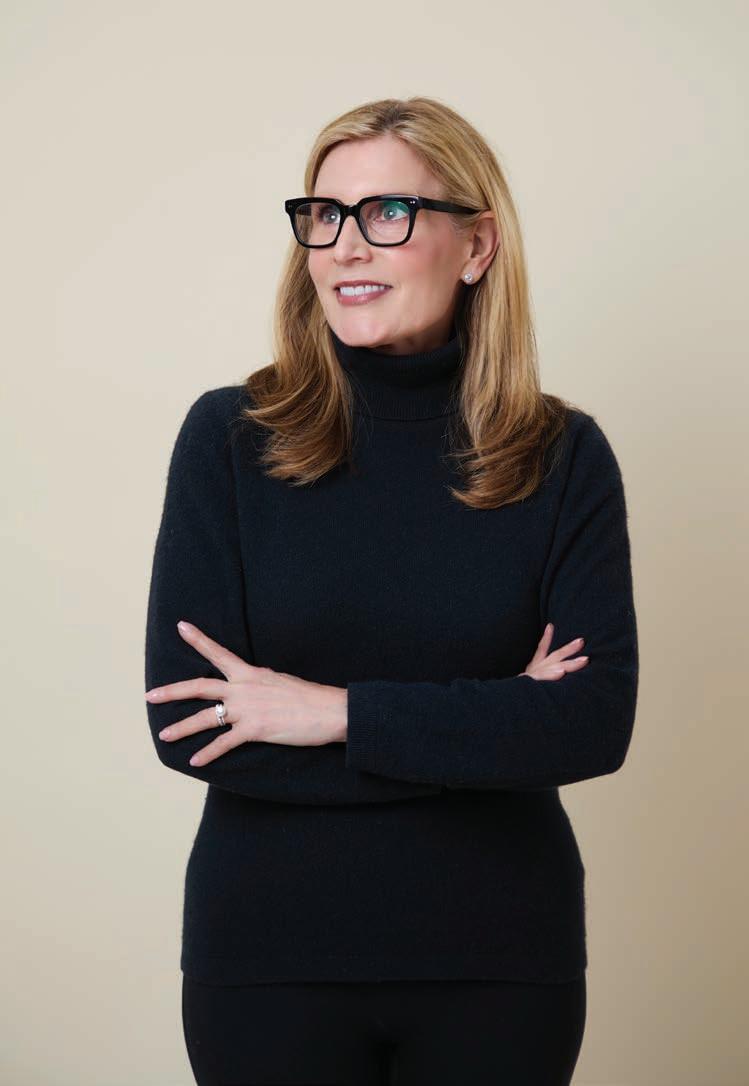
strategy around new scents. Through her fragrance consulting company, Scent & Strategy, Wilson brings fragrances to life for everyday products like candles, body washes, and shampoos. While you won’t find her name on any bottle labels, something of her essence can still be found in every product she works on. For Wilson, that’s all by design.
The world of fragrances may have romantic connotations, but with Wilson, there’s a reason “strategy” shares equal billing with “scent.” It all starts with her family background. Her father, mother, and sister had all worked in advertising, and when her mother remarried after her father’s death, Wilson’s stepfather did too. “It was sort of in the blood,” she notes.
After graduating from the Carroll School of Management in 1984 with a marketing concentration, Wilson headed to New York to work at advertising agency BBDO, then at Ogilvy & Mather, where she had her first contact with the world of fragrances as an account executive for Chesebrough-Pond’s mass market fragrances and body sprays. Wilson found herself curious about how fragrances were made, not just how to sell them.
Not long after, while working as a brand manager for ChesebroughPond’s parent company, Unilever, Wilson was sent to a fragrance house, where scents are formulated and manufactured. It was there that the trajectory of her career shifted on its axis.
When offered a men’s fragrance to smell, one whiff transported Wilson back to her childhood in the Detroit suburbs. “Something changed in my body. All of a sudden, I was 11 years old,” the year before her father passed away, she says. In the memory, she was in her parents’ bathroom while her dad was preparing to leave on yet another business trip. Wilson could smell the crab apple blossoms outside the window, see the gold flecks in the formica countertop, and feel the moisture in the air from the shower. She could even hear her dad’s voice again.
There is so much Wilson didn’t get a chance to learn firsthand from her father, including his connection with legendary Carroll School alumnus Jack Connors ’63, H ’07, P ’93, ’94.
That story begins with Connors working at BBDO, where he was told, at a particular Detroit meeting, that he had a real future with the company. “They said … if Jack keeps his nose clean, by the time he’s 30, he’ll be a vice president here in Detroit. I quit the next morning because I wanted to be the architect of my own destiny,” Connors recounted in a 2024 interview with John and Linda Powers Family Dean Andy Boynton. It was Wilson’s father, a vice president in BBDO’s Detroit office, who offered Connors the advice he didn’t take.
Many years later, she met the man himself. Wilson, as a Carroll School student, attended an on-campus event where Connors spoke. When she went to introduce herself, “I said, ‘Mr. Connors,’ and he looks at me and goes, ‘You’ve got to be John Wilson’s daughter, I’d know you anywhere,’” Wilson recollects.
Later on, as a senior, and unbeknownst to Connors, she secured an internship with Hill Holliday, the Boston advertising firm Connors cofounded. When he found out, Connors quickly became a mentor, even helping Wilson get job interviews when she decided to move to New York. “He just always looked out for me,” she says. “He would spend time telling me stories about my dad.”
That experience fed both the business and creative advertising sides of her brain. And it was the other memories of her dad, summoned at the fragrance house, that taught Wilson the sheer power of scent. “That
smell brought my father back to me,” she says—Wilson realized she needed to follow a new career path. “I had to be involved in the creation of fragrance. I had to pour myself into it.”
Fragrance has formed the bedrock of her career ever since. After leaving Unilever, she trained in perfumery evaluation, the sensory and technical analysis of fragrances, and got jobs at fragrance houses where her clients included names like Pottery Barn and Yankee Candle.
She was working for Givaudan, one of the world’s largest fragrance houses, when Michael Jordan decided to launch his own cologne. Wilson was a jack of all trades on the project, copywriting, developing PR strategy for the launch, and playing with perfume accords.
Like music chords, perfumery accords are scent notes that together make something harmonic, in this case, an aroma that evokes an idea. For Michael Jordan Cologne, Wilson conjured up scents reminiscent of cut grass, freshly showered skin, and the coniferous evergreen trees of Jordan’s boyhood in North Carolina. “I love that word, coniferous,” she says—it brings to mind the forest around the Michigan lake Wilson swam in as a kid. “The [scent] memories I have are little, random things that add up to this whole life,” she adds. “I call it my olfactive memory.”
Michael Jordan Cologne was the most successful men’s fragrance in the US when launched, earning more than $120 million in sales in the first year. It won two 1997 Fragrance Foundation awards—the Oscars of the fragrance world—for Fragrance of the Year and Media Campaign of the Year. When Jordan went on Oprah in 1996, Winfrey asked him about the cologne, calling it “like air,” wording Wilson conceived herself as part of the creative copy. “I just loved that,” Wilson says, beaming.
As fulfilling as her work was, the lifestyle required was exhausting. Behind the scenes, she had relocated to the West Coast, had two sons, and got divorced. “I was always going from the West Coast to the East Coast” for meetings, Wilson says. “I wasn’t in control of my schedule.” She struck out on her own in 2014, forming fragrance consulting firm Scent & Strategy. “I did it at a very difficult time,” she says; at home, she was a single mom and her own mother had developed dementia. “But I’ll never look back. It was the right thing.”
In the past 12 years of Scent & Strategy, Wilson’s projects have included developing Sephora’s first in-house line of home fragrances, which sold out in two weeks, and contriving scents for nearly every product for men’s grooming company Cremo and Virtue Labs, a haircare line enjoyed by celebrities like Jennifer Garner.
Her main objective is to come up with widely appealing scents that still feel targeted to the customer. “Let’s say it’s a shampoo for somebody with very damaged hair,” she offers as a hypothetical example. “I’d like to have a fragrance that communicates nurturing, something that is creamy. I can use ingredients and fragrance that tell that story,” as well as the creative strategy.
“My work and the way I work has to be authentic. If it’s not authentic, it’s meaningless to me.”
Lisa Wilson ’84
Studying subjects like Shakespeare at Boston College gave Wilson different layers of communication to tap into on top of her marketing expertise. “I have this multidisciplinary viewpoint of fragrance,” she says. “I do have a business background. I was a brand manager. I was in advertising. And I didn’t have to master all of these disciplines, I just had to know how to leverage them.”
New fragrance development is a collaborative process. “I don’t have such hubris to think I’m the only one who comes up with ideas,” Wilson asserts. But once the research is done and the concepts have been presented, making a choice is sometimes purely instinctual. “I have this quirky internal barometer to know if something is killer,” she says. Like the fragrance that brought back the memory of her dad, when she knows a scent is truly special, her response is visceral.
While Wilson has plenty of noteworthy projects, Labyrinth Made Goods, a home fragrance nonprofit and social enterprise for previously incarcerated women run by the McLean County YWCA in Illinois, is a clear contender for her favorite. “I always wanted to use my fragrance background for the greater good, but I never knew how,” she says. The team behind the project wanted Wilson to develop fragrances for the candles they hoped to sell. She couldn’t say yes fast enough.
Shortly after signing on, Wilson orchestrated a fragrance training. Setting out different scents, she asked the women assembled to discuss their reactions. “There are no right or wrong answers. That’s the beauty of it,” she says. One of the fragrance notes was an aldehyde compound, which can often smell either metallic or like fresh laundry. Wilson watched as one woman took a sniff and instantly reacted. “She said it was like working in the laundry at the jail,” Wilson says—she remains very close with the woman to this day. “Everyone in that room came alive because they could relate.”
After six years, Labyrinth Made Goods lost federal grant funding and was forced to shut down, but the opportunity changed Wilson’s life. “I’m trying to find that next step,” she says. She has even been thinking about creating a fragrance training kit to bring her work into women’s prisons. “Women who are incarcerated never have any control when they are in prison. Not when they go to bed, when they wake up, what they have to eat…” she trails off. “For them to have a voice that anyone listened to was the biggest thing.”
In Wilson’s work, her own voice shines through, and in 12 years of running Scent & Strategy, she has managed to achieve exactly what she set out to do: Pick projects she is truly excited by, be able to pour herself into the fragrance world, and simply enjoy the journey.
“At the beginning, I took every single piece of business because I had to. Now I can be much more discerning,” she says. “My work and the way I work has to be authentic. If it’s not authentic, it’s meaningless to me.”
How groups reach peak levels of collaborative performance.
Groups are a given in the modern organization, but they also fall short of expectations when they’re not, as some like to say, “in flow.” What does that mean? And how does a group step into the flow of effective collaboration? Associate Professor and Hillenbrand Family Faculty Fellow Elizabeth (Bess) Rouse, together with collaborators, has devised a theoretical framework for investigating group flow. Things flow when members work seamlessly together and quickly add to each other’s contributions, as opposed to, say, dwelling on their own ideas and critiques. In their paper, “Group Flow: A Theory of Group Member Interactions in the Moment and Over Time,” published recently in Academy of Management Review, the scholars parse out the core elements of this process, including the timing of contributions and their afterflow. Think of an SNL writing room where one writer floats a wild idea and another writer

gamely keeps the thought in motion, adding to it and spurring momentum toward a successful script. Rouse et al. go beyond previous research by spotlighting such moment-by-moment interactions rather than just the overall patterns and outcomes of teamwork. These “temporal dynamics” give rise to group flow, which the authors conceptualize as “a state characterized by full, seemingly effortless attention, shared positive emotional arousal, and additive, swift contributions.”
WILLIAM BOLE
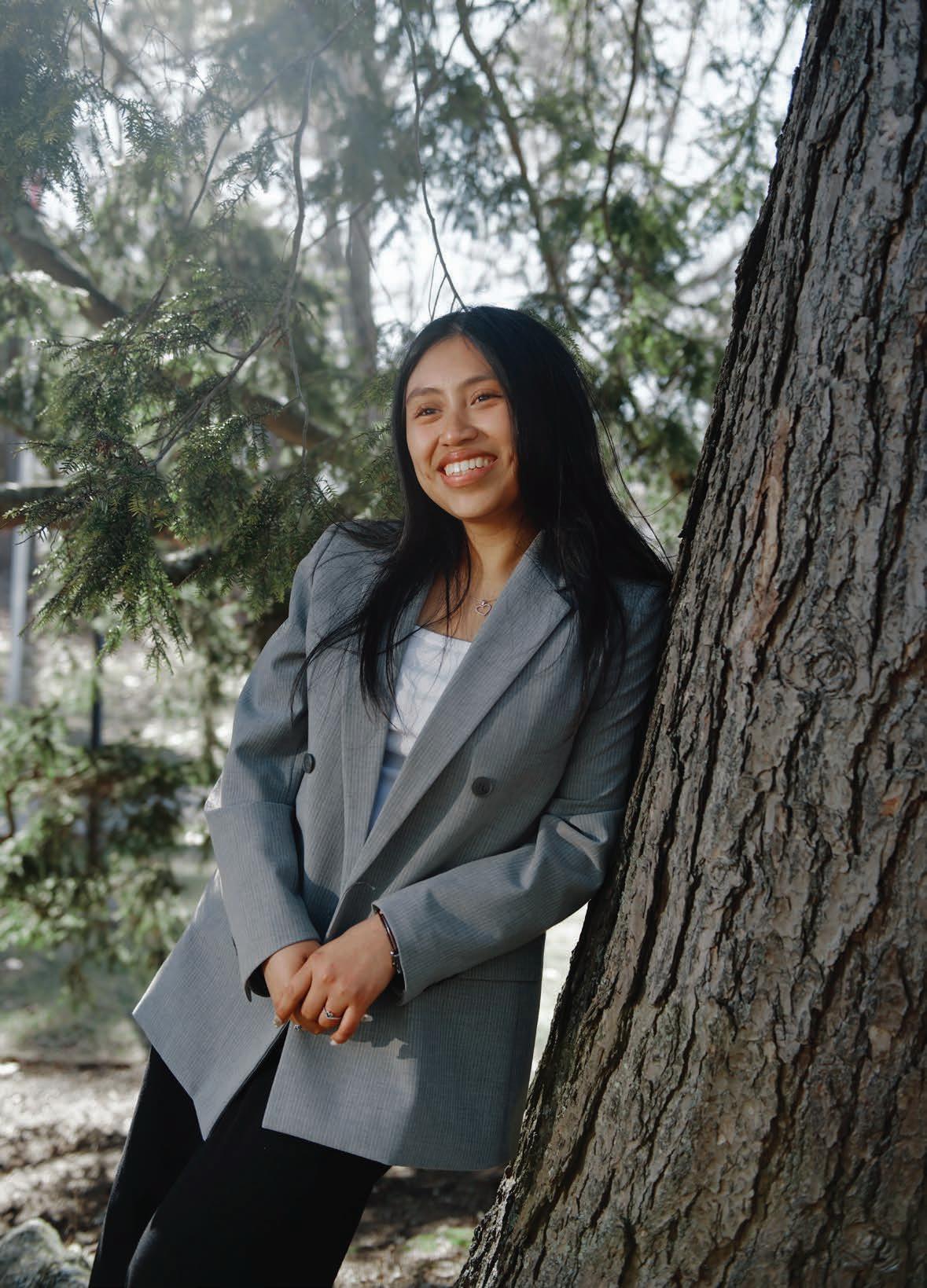
THROUGH MESSINA COLLEGE, FIRSTGENERATION COLLEGE STUDENTS HAVE A NEW PATHWAY TO A CARROLL SCHOOL DEGREE.
BY JACLYN JERMYN
In high school, Jesmary Gonzalez ’28, MC ’26, was tasked with creating an original business concept for a school competition. Her winning entry was a baked goods company, inspired by the time spent in the kitchen with her mom and the stories she had heard of her grandfather’s bakery in Guatemala. Gonzalez began thinking her future might be in business.
But when she looked into college business programs, high tuition was a discouraging obstacle. “When I started getting these replies back from schools and there wasn’t enough [financial aid], I thought ‘it’s over, I’m not going,’” she says. Then, she was accepted into Messina College.
Messina College, Boston College’s first associate’s degree program, welcomed its inaugural class of 100 first-generation, high-financial-need students to the University’s bucolic Brook-
line campus two years ago. In May, Gonzalez and her classmates became Messina’s first graduates.
Come fall, Gonzalez will also be one of around 14 general business majors (at this writing) taking advantage of one of the program’s greatest draws: After graduating, Messina’s management students with at least a 3.4 GPA are eligible to transfer into the Carroll School of Management to complete their bachelor’s degrees.
In developing the Messina experience, Patti and Jonathan Kraft Family Dean Erick Berrelleza, SJ, drew on his own experiences as a first-generation college student. “I see it as a lens,” he says. “If I were doing this for the first time, what are some of the questions that would be raised for me and how might we answer those?”
In response, Messina has committed to providing all students on-campus housing, a high level of financial aid—on average, students only pay $2,000 annually—and program adaptability tailored to specific student needs.
“This first Messina graduating class is really building this with us,” says Associate Dean Alicia LaPolla. “They are co-creators in this experience.” She also acknowledges that these students bet on an unknown program when they committed to Messina.
“I put my faith in this school without knowing much,” says general business major Yazzidy
Fernandez ’28, MC ’26, who grew up in Lawrence, Massachusetts. There were not yet Messina student success stories to be inspired by, like the ones she heard from other colleges she applied to. But Boston College’s reputation ultimately tipped the scales for her, especially the idea of transferring into the Carroll School. “I never thought I would get to go to a school like this,” she adds.
Berrelleza often compares Messina College to a startup when it comes to adapting to student needs in real time. “As a whole, the plan has worked as we designed it,” he says. In the past two years though, some tweaks have been needed, like reordering the general business major curriculum.
Take, for instance, Coding for Business, one of Messina’s eight required general business courses. “We noticed students were struggling to learn how to study for this class who were really strong performers otherwise,” LaPolla says. Messina worked closely with the Carroll School to reorder the required courses so Coding for Business would come later in the program once students were better prepared for the material.
Ethan Sullivan, the Carroll School’s senior associate dean for the undergraduate program, says that while Messina College’s original goal was to be a strong “pipeline to the BC bachelor’s degree,” not all students who come
“ When I started getting these replies back from schools and there wasn’t enough [financial aid], I thought ‘it’s over, I’m not going.’”
Jesmary Gonzalez ’28, MC ’26
through the program are ready for or interested in that pathway. Curriculum adjustments also help support general business students who will take their associate’s degrees and head into the workforce or those who transfer to other business programs, perhaps where there is less emphasis on skills like coding.
For those Messina students who are transferring into the Carroll School, they must now also hold their own among their new classmates in a particularly competitive environment. Last fall, Johnny Ray ’28, MC ’26, a pseudonym requested by a shy student, interned with Waltham-based Commonwealth Financial Network as part of Messina’s second-year program requirements. But Ray knew his future Carroll School classmates were likely planning further ahead and thinking bigger when it came to internships.
“I love Messina, and I came here to grow, learn, and think at a Boston College level,” he says. He quickly secured summer internships for both 2026 and 2027 with a Federal Reserve Bank and a top financial services firm, respectively.
Early in the spring semester, Gonzalez, Fernandez, Ray, and their general business classmates settled into Professor of the Practice Thomas Wesner’s late afternoon Introduction to Law and Legal Practice class, the first entirely Messina-student class held in Fulton Hall. Throughout his lecture on the branches of government, Wesner engaged each individual, drawing them into a conversation about the subject matter as well as their goals and ambitions.
This is not their first taste of
Fulton Hall; general business majors joined a handful of Carroll School classes last fall. Vanessa Conzon, assistant professor of management and organization, had six Messina students in her Organizational Behavior classes, a course typically taken by juniors and seniors.
It’s an adjustment for students and faculty alike, she says. Conzon points to elements of the Carroll School—like the grading curve and Portico, the interdisciplinary ethics course taken by first-year management students— that the students didn’t have experience with.
Still, Ray excelled in the class and will be a research assistant for Conzon next year. “My students are all measured by the same standards,” Conzon says. “If any sophomore receives an A, I’m scooping them up.”
“Getting an A was a big deal,” confirms Ray. “Outperforming the curve, even though there is that difference between student backgrounds, really is not lost on me.”
Berrelleza believes that the connections between Messina and the wider Boston College community will only get stronger as students like Gonzalez, Fernandez, and Ray become full-time Carroll School students in the fall, and hopes that they will help “create a community that is bridged between the campuses,” he says.
To Ray, that community is already in progress. “A Messina College student doesn’t have fewer opportunities than a Boston College student. A Messina student can do the same things and reach the same levels,” Ray says. “A Messina student is a Boston College student.”
2026 Martin Luther King Jr. Scholar Brian Davids ’27 is recognized for leadership, service, and community impact.
BY JACLYN JERMYN
On his 21st birthday, Brian Davids ’27 found out he received the 2026 Martin Luther King Jr. Scholarship. He would have loved to take the stage in the Heights Room and celebrate the accomplishment, but instead he was watching the March awards reception over Zoom from his Barcelona dorm room, where he was studying abroad. Still, as his father Conrad Davids accepted the scholarship on his behalf, Brian felt “nothing but gratitude,” he says.
“My family came to the USA in the pursuit of a better life and have all sacrificed immensely to give me the opportunities that allowed me to be in a position to receive the scholarship in the first place,” said Davids, whose parents emigrated from Jamaica before he was born.
The Martin Luther King Jr. Scholarship is awarded each year in the spring semester to a Boston College junior demonstrating excellent academics and leadership as well as deep involvement with the African American community on and off campus. Of the scholarship’s five 2026 finalists, four study in the Carroll School. Mohamed Dirar ’27 is a finance minor, Gabrielle Keeley ’27 and Kaitlyn Gyamfi ’27 both have finance concentrations, and Davids studies finance and business analytics.
Davids is a cofounder of Black in Business BC, a Carroll School club that supports Black students interested in a future in business but is open to any student looking for a diverse environment to explore professional development and make meaningful industry connections. “Spaces where no one looks like you can be daunting. Black in Business plays an instrumental role in solving that problem,” he says.
Esosa Owens ’26, the previous recipient of the scholarship, points to Davids’s leadership of the club and the heavy emphasis on alumni networking. He has a strong commitment to
“uplifting others and creating spaces where people can access opportunities that align with their values, beliefs, and character,” she says.
In his prepared reception speech delivered by his dad, Davids quoted King’s “Letter from Birmingham Jail”: “We know through painful experience that freedom is never voluntarily given by the oppressor; it must be demanded by the oppressed.” Davids added in his remarks that those assembled should internalize the words and live by them. “Continue to knock on doors you are not meant to be at.… Continue to prioritize justice and dignity over peace and the status quo.”
To Davids, the award is a “signal to people about the way I’ve tried to live my life,” he says. “The onus is still on me to execute on my vision for myself.”
“Spaces where no one looks like you can be daunting. Black in Business plays an instrumental role in solving that problem.”
Brian Davids ’27
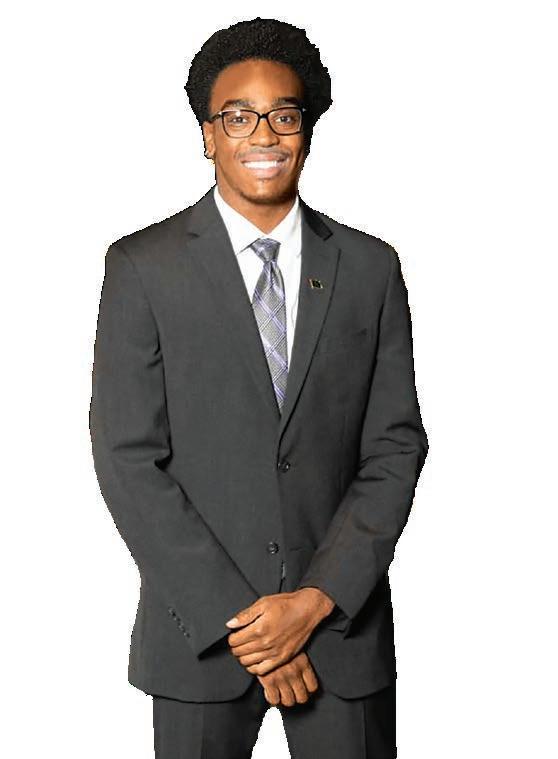
On May 1, a long, rectangular room on the upper floor of Yawkey Athletics Center was fizzing with ideas. Speakers offered insights on such questions as how new developments on the world stage will affect portfolios and pocketbooks.
The occasion was the 19th annual Boston College Finance Conference, hosted by the Carroll School’s Seidner Department of Finance. Featured presenters included former Ambassador to China Nicholas Burns, MCAS ’78, H ’02, P ’09, ’12, and Nobel laureate in economics Paul Romer, the Seidner University Professor.
The conference also showcased a community that reassembles each year. Nearly 175 alumni—young, old, and in-between— turned out. So did faculty of the Seidner Department of Finance, ranked 6th by U.S. News and World Report. Also present were students, mostly grad-level.
“For me, it’s about the community,” said Kate Warren ’25, sitting at one of the many round tables inside the Robert J. Murray ’62 and Family Function Room. She was with Lindsay Kinum ’25 and Robert Mullen ’08, MBA/MSF ’15, coworkers at Boston-based Trivalent Investments. “It’s great to meet people in the industry and get their ideas— and see my old professors,” she said.
Burns spoke of how we are moving from “a world order to a world of disorder” triggered by wars and splintering alliances. Romer discussed the digital revolution’s impact on knowledge creation (see page 45). Noted investment advisor Rich Bernstein predicted higher inflation and recommended short-term bonds and equities.
Other presenters included Finance Professor Paul Schmelzing (see page 42); Marc Seidner, MCAS ’88, P ’24; Daniel E. Holland III, MCAS ’79, P ’07, ’08; and John and Linda Powers Family Dean Andy Boynton ’78, P ’13, who said in closing remarks, “I hope you learned a lot—and met old friends and new friends.” WILLIAM BOLE Visit bc.edu/financeconference for more.

THROUGH THE ENTREPRENEUR IN RESIDENCE PROGRAM, EXPERIENCED FOUNDERS GIVE STUDENTS A CANDID LOOK AT BUILDING SOMETHING NEW.
BY MASON BRAASCH
“The path of an entrepreneur is often very nebulous,” says seasoned entrepreneur and venture capitalist Peter Bell ’86, P ’20, ’25. Luckily, Boston College students who aspire to traverse that path don’t have to do it alone. Through the Entrepreneur in Residence (EIR) program, part of the Carroll School’s Edmund H. Shea Jr. Center for Entrepreneurship, students can easily connect with professionals like Bell who have weathered the storms of the startup world.
During this past academic year, more than 80 students made their way to Bell’s on-campus office in 245 Beacon, bringing with them pitches for new businesses and questions about their future. Each conversation started with the same request from Bell: “Tell me about yourself.” It’s a standard way to open interviews, but it’s the first step toward helping students navigate their entrepreneurial aspirations.
“I want to know the person, not just the pitch,” says Bell, a senior
advisor at Amity Ventures, general partner at SSC Venture Partners, and a University trustee associate.
Established in 2016, the EIR program aims to help “interject some type of entrepreneurial spirit and mindset into students so they’re willing to take some risk and they’re not afraid to fail,” says the Shea Center’s Popolo Family Executive Director Jere Doyle, himself a serial entrepreneur.
The program brings professionals with entrepreneurial experience—typically Boston College alumni—directly to the students. EIRs have a campus office and hold office hours weekly. Many student founders use time with EIRs to work on developing their own business ventures, but the basic idea “is to give students personalized, real-time support as they explore different entrepreneurial paths” wherever they might be, says Kelsey Renda, the center’s associate director.
Last fall, Grace Landolfi ’26 found herself curious about the startup industry while listening to guest speakers in her Perspectives on Management class. She had previously interned for private equity and growth equity firms but wondered what it might be like to work for a startup, or to start her own business.
To find out, she made appointments with all three EIRs on staff that semester, including Jack McConnell ’24, who shared how he uses what he learned as part of Start@Shea, the Shea Center’s student executive board, in his current role as a financial analyst at Wayfair. “It’s easy to connect with students who have concerns about their future. We went through very similar things just a few years ago,”
says McConnell, referring also to fellow EIR Alex Park, MCAS ’24. Landolfi’s conversations with the EIRs helped her see just how many shapes entrepreneurship can take. “I can still be part of a larger company and bring entrepreneurial elements to that,” qualities such as resilience and adaptability, says Landolfi, who joined Silicon Valley Bank as an ADP associate after graduating.
Sharing their failures is a key part of what EIRs bring to the program. From shuttered businesses to backouts from venture capital firms, the EIRs show a side of professional life that students likely won’t see on LinkedIn. “The truth is that life, especially as an entrepreneur, is just a series of failures” that we learn from, says Doyle. “You can find advice in a lot of places at BC, but when somebody is willing to honestly share their knowledge outside of a classroom, that can be really impactful.”
Tuna Uskudar ’28 launched his startup Provenance, an AI tool that tracks changes to financial models in Excel, last winter. Throughout the process, Bell brainstormed ideas with Uskudar and his cofounder André Assunção ’28, helping them determine the product’s market. Now that Provenance is up and running, Uskudar still regularly meets with Bell for guidance on tackling new challenges like upping revenue.
“Being an entrepreneur can feel really lonely,” says Uskudar, who has endured many canceled meetings and last-minute hiccups already. “These things are normal in this world, but having someone remind me that I’m not the only one experiencing them just makes it easier.”
Published in top academic journals, Carroll School professors keep bringing original research to peers in their disciplines—and to students in their classrooms. Over the past year they’ve illuminated facts about lagging CEO performance, employee satisfaction, and even long waits for inpatient care, among many other questions. Here’s a sampling.
TIM GRAY AND WILLIAM BOLE
Do Remote CEOs Slack Off?
Yachts don’t normally explain executive performance, but Ran Duchin, the Coughlin Family Professor in the Seidner Department of Finance, believes they may factor into some CEOs’ decisions to work remotely. In The Review of Financial Studies, Duchin and a colleague find that the performance of firms with remote CEOs suffers. In investigating why, CEOs’ indulgence in leisure seemed one explanation: Companies with CEOs who live in a beach house or own a yacht underperformed peers. Other likely contributors to the lagging performance were
“short-termism”—remote CEOs are less committed— and a weaker ability to acquire internal information, the researchers say. Luckily, these problems have a simple solution. “When the same CEO ends a remote arrangement and moves to the headquarters during a continuous employment spell, their firm’s operating performance and valuation increase,” said the researchers, who gleaned their data from real estate ownership records and other public sources.
People Are Better Paid Than They Think Mandated disclosure of the CEO pay ratio—the gap between the CEO’s total compensation and that of the median employee—was intended to help investors evaluate executives. In an article in Management Science, Mary Ellen Carter, a professor and the Joseph L. Sweeney Chair in Account-
ing, and colleagues find the disclosure had an unexpected benefit: It made employees happier with their paychecks. Since 2018, public companies have had to disclose their ratios. Before that, most workers didn’t know what colleagues earned. The researchers discovered that, after median pay was published as part of pay ratios, employees’ satisfaction with their own pay increased. Why? Many people overestimate what peers earn. When the data showed median pay was lower than they expected, they realized their salaries were better than they thought. “Disclosing the median employee pay level may have provided employees with a new benchmark,” the researchers write.
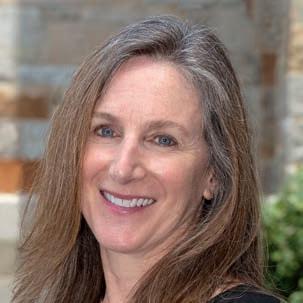
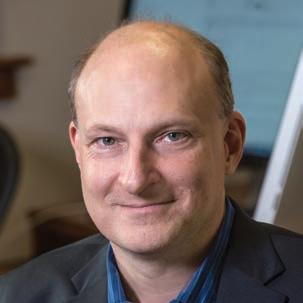
Corporate Strategy Lags AI Advances
Agentic AI, which can plan and execute tasks, complicates corporate thinking, as it’s both an asset you own and a helper you collaborate with. Sam Ransbotham, a professor of business analytics and the David J. Mastrocola Dean’s Faculty Fellow, and colleagues write in MIT Sloan Management Review that this dual nature—machine and mind—has created a rising risk for companies: “Agentic AI is spreading across enterprises faster than leaders can redesign processes, assign decision rights, or rethink workforce models.”
To better use agentic AI, companies need to reconsider their workflows, update their governance, and rethink their organizational structures, the scholars say. In an AI-forward firm, managers will oversee hybrid teams of humans and bots. That will require upskilling humans and creating an “HR for AI” that can train, evaluate, and even fire automated helpers.
“The challenge of agentic AI is organizational, not technological,” the researchers write. “Many organizations are adopting this technology at a breakneck pace, often before they have a coherent strategy in place.”
A group of IT professionals studied by Vanessa Conzon, assistant professor of management and organization, has found a way to resist overwork pressures. In a paper published in Organization Science, Conzon and a colleague call the software developers’ approach “concerted quantification.”
The researchers explain that the developers first assigned points to tasks based on how long they’d take. They then persuaded clients to assess their output using those points rather than face time at the client’s office. “This establishes completion of these [points]—rather than, for instance, long work hours or an indeterminate number of tasks—as a key criterion of success,” the researchers explain. By arranging their work this way, the developers avoided overwork while still satisfying clients. It helped that the developers could structure their workflows and were seen as experts in their field.
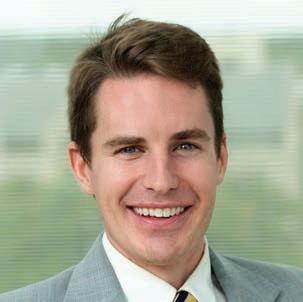
Shamed Insurers
Shed Dirty Bonds
Public shaming worked for the Puritans. DJ Stockbridge, assistant professor of accounting, and colleagues show it still works today. In an article in Journal of Accounting and Economics, the professors find that a 2016 California law requiring insurers to list their fossilfuel holdings on a public website helped induce them to change their investments. The aim was to inform external stakeholders, who might then push firms to opt for greener investments. That worked: On average, disclosing insurers cut their fossil-fuel bond holdings by about 20 percent compared to nondisclosers, prompted by pressure from stakehold-
Vanessa Conzon, assistant professor of management and organization, below, examines how developers deliver results while avoiding overwork through “concerted quantification.”
ers such as environmental groups. Larger, more visible companies were more likely to shift their holdings. The researchers conclude the changes are likely permanent. After the mandate ended in 2019, most companies didn’t revert. Instead, they updated their longterm investment policies to shun “dirty” holdings.
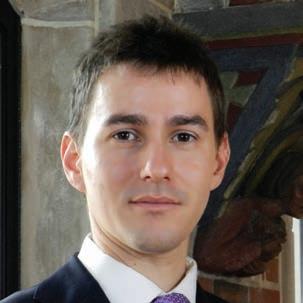
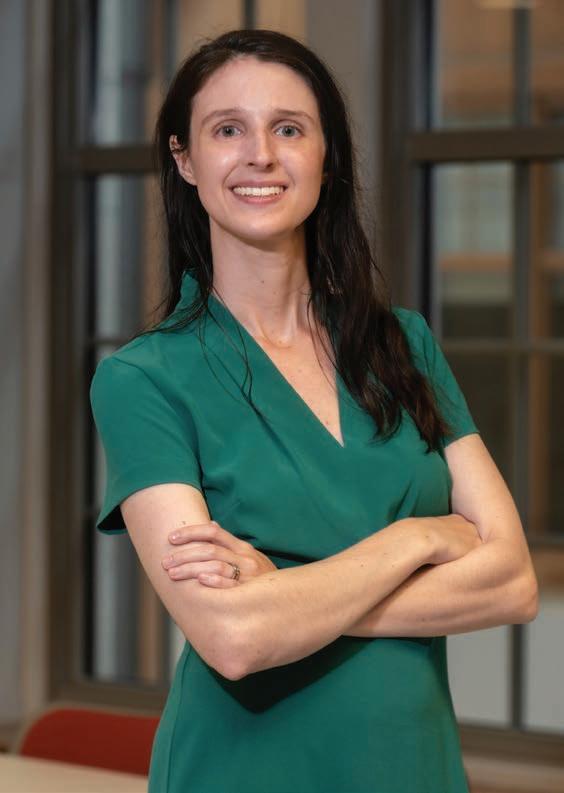
other,” they write. Barkai and his colleague argue that today’s startups have a greater ability to mark up prices, so each has more economic heft.
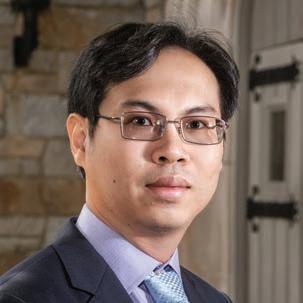
Simcha Barkai, assistant professor in the Seidner Department of Finance, noticed something odd: Labor economists were fretting about fewer startups even as venture capitalists were thriving. VCs invest in startups, so something seemed amiss. His insight led to research published in the Journal of Finance in which Barkai and a colleague show that the number of startups and the jobs they’re creating have, in fact, declined. But that doesn’t mean their overall economic contribution has waned. Startups’ wealth creation, measured via stock market capitalization, and sales keep chugging along, the researchers find. So fewer young, high-growth firms exist, but they’re sturdier. “Recent cohorts of new firms are not necessarily ‘weaker’ than their predecessors but rather different in terms of how their revenue and employment relate to each
Nan Liu, the William S. McKiernan ’78 Family Faculty Fellow and a professor of business analytics, and colleagues have developed a more efficient way for hospitals to use their diagnostic technologies, like CT scanners, while improving inpatient care. In an article in Manufacturing & Service Operations Management, they introduce a scheduling approach they call “advance notice,” which “strikes a fine balance between the two classic scheduling paradigms”—reducing patient waiting and giving providers flexibility in using their service capacity. Traditionally, hospital diagnostic services have served emergency admissions first, outpatients next, and then, whenever capacity became available, inpatients. This often led to frustrating delays for inpatients and their caregivers. The proposed approach gives inpatients advance notice to prepare for testing and a guaranteed service-time window.
Visit bc.edu/csom-research for more faculty research.
PROFESSOR PAUL SCHMELZING’S WORK ON FALLING INTEREST RATES ACROSS SEVEN CENTURIES IS TURNING HEADS IN THE FINANCIAL WORLD.
BY TIM GRAY
When most of us want to know about interest rates, we check a finance website. Paul Schmelzing, an assistant professor in the Carroll School’s Seidner Department of Finance, visits a monastery.
Schmelzing, an economic historian, has compiled a 707-year history of interest rates, arriving at a startling conclusion: For seven centuries, through countless wars and the rise and fall of empires, interest rates, on average, fell. Thus a postal worker in today’s America can borrow more cheaply than a Florentine prince during the Renaissance, even with the recent uptick of lending rates.
To compile his history, Schmelzing dug up rates from as far back as the Middle Ages. Monasteries, including Lorsch Abbey in Schmelzing’s hometown in Germany, were repositories of wealth back then. So monks cared about and kept records of rates. “Monasteries were the institutional investors of the day,” Schmelzing says.
While archaic interest rates might seem an obscure topic for research, Schmelzing’s work has found a receptive audience of policymakers and others.
has presented his research at an International Monetary Fund conference and a G20 summit of the world’s largest economies. High-profile outlets like The New York Times and The Economist have cited him repeatedly.
Part of the reason for all the attention is that Schmelzing’s findings raise questions about some influential contemporary theories about the economy.
One school of thought—former Treasury Secretary Lawrence Summers is a well-known proponent—says developed economies may be stalled in a low-growth state, called secular stagnation. Their populations are aging and their investment levels weakening, and thus they’re lately stuck with low interest rates on safe assets like CDs and treasury bills. In recent years, those rates, when considered after inflation, have sometimes turned negative. Schmelzing’s work shows low rates aren’t a recent phenomenon.
Another school of thought, pioneered by French economist Thomas Piketty, says economic inequality grows inexorably because the rate of return on assets like stocks and bonds exceeds the economy’s long-term growth rate, making investors ever richer. But if rates are continuing to shrink, as Schmelzing contends, they’re not likely to permanently outpace the economy’s rate of growth.
One might wonder whether monks and their parchment ledgers can tell us anything about financial transactions in the age of AI. But Schmelzing says there’s “more and more appreciation of the long-run view, both among investors/asset managers and researchers.” People have come to realize that if they focus only on recent data, they lack precedents for understanding economic events like the global financial crisis of 2008 and the Covid shock, he says.
Schmelzing is further exploring these dynamics in a book to be published by Yale University Press, titled The Long Run: A New
“Monasteries
were the institutional investors of the day.”
expand his empire and chasing gold and silver in the New World. When the Spanish crown defaulted on its debts, the rest of Europe suffered too.
“This is when the clear trendline came into existence,” Schmelzing says. “That affected almost half of global GDP. It took all the major banks of the time with it. It was an epic financial crisis.”
Today, policymakers have sophisticated fiscal and monetary policy tools to address times of economic tumult. When they confronted the global financial crisis, for example, central banks resorted to new, sometimes controversial techniques, like largescale purchases of bonds. (Central bankers call this approach “quantitative easing.”) Governments likewise took on lots of debt as they tried to stimulate their economies during the 2008 crisis and again during the pandemic.
Schmelzing, who is also a research fellow at The Hoover Institution at Stanford University, says interest rates have been more volatile in the last hundred years or so. That could be pointing to the emergence of a new centurieslong pattern.
Luke Mairo ’17 launched Voltpost to make EV charging more accessible for city drivers, using chargers that attach to existing street-side lampposts. With the post and electrical connection already in place, installation takes less than an hour.
The Bank of England, the United Kingdom’s central bank, published his original solo-authored work spanning seven centuries. He coauthored a paper that landed on a prominent list of the ten academic papers most cited by policymakers in 2025. Schmelzing
A problem with virtually all theories about interest rates is that they rely on recent data, Schmelzing says. But with real (inflation-adjusted) rates falling for centuries, someone could’ve guessed they might turn negative today just by extrapolating, he says. Empirical research is never strictly predictive—there’s no guarantee the future will resemble the past—but hundreds of years of data do suggest a powerful trend.
Paul Schmelzing
History of the International Financial System. “We need to understand the long-run context better,” he says. “I’ve talked to many policymakers, and there’s no catchall solution to a 500-year trend.”
He traces at least part of the this trajectory back to a financial crisis in 1557. At the time, King Philip II of Spain had overextended himself. He was stretching to
“In the book, I’m venturing that these dynamics since 1914 are comparable to the period before 1557. There’s growing skepticism about governments as safe [debt] issuers. That’s reminiscent of the pre-1557 environment, when private assets were the safe assets. It’s not a given that government debt will remain the safe asset,” he points out. “We all grew up with this idea of owning US Treasuries during bad times, but there’s no built-in necessity that that will be the case.”
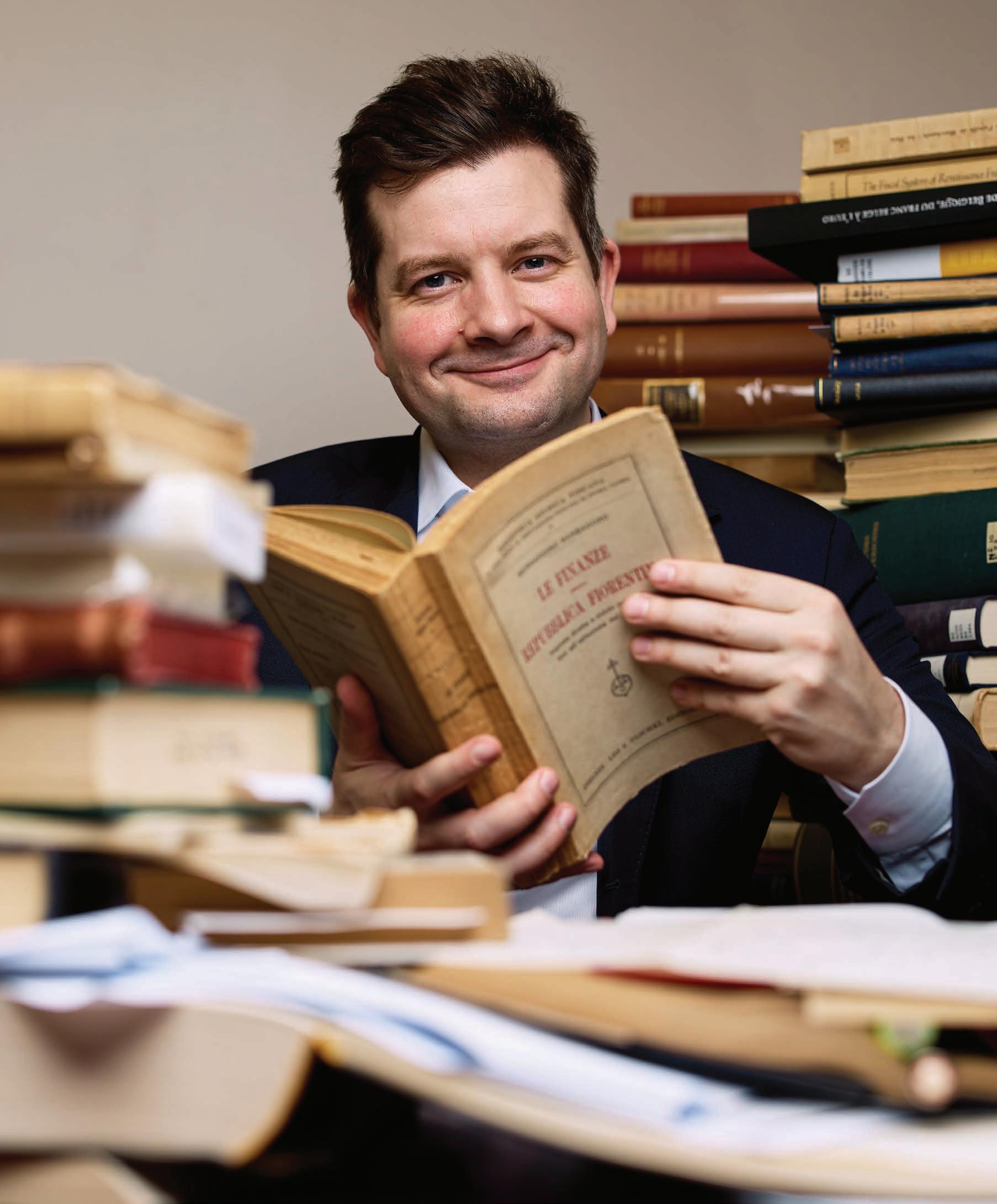

A NEW CURRICULAR INITIATIVE WILL USHER IN THE NEXT STAGE OF BOSTON COLLEGE’S BRIDGE BETWEEN MANAGEMENT AND THE ARTS AND SCIENCES.
BY WILLIAM BOLE
If you had just wandered into Professor Michael Smith’s class, From Knowledge to Wisdom, you’d find it hard to put a label on what the class covers. One minute, Smith and the students are dissecting the practical benefits of one AI engine over another. Next, they’re probing how the Boston Beer Company (Sam Adams) lifted the entire craft brewing industry, and then it’s on to Einstein’s theory of relativity. During a recent class meeting, the professor marched through these and other fields of inquiry, making several stops for perspectives from the Catholic intellectual tradition.
Much the same was happening that day in Professor Christine Rojcewicz’s class, Disciplines Collide, Wisdom Thrives. Both classes include, in their full course titles, the explanatory words “Integrating Humanities, Management, and Sciences.” Both point toward a fresh initiative conceived at the Carroll School that seeks to bring interdisciplinary learning to a new level at Boston College.
The idea behind this “bridge” initiative, as it’s called, is that the most pivotal innovations rarely spring from a single discipline. “The breakthroughs that actually
change things typically happen when ideas and methods from different fields bump into each other, challenge each other, and somehow coalesce into something new,” says John and Linda Powers Family Dean Andy Boynton, who is shepherding the effort with Thomas F. Rattigan Professor Mary Crane, a Shakespearean scholar. “It’s about connection, collision, and combination.”
There’s already a bustling bridge at Boston College, which students have been crossing in record numbers. About half of the Carroll School’s more than 2,400 students are graduating with a major or minor at the Morrissey College of Arts and Sciences. Meanwhile, more than 2,000 nonCarroll School students are minoring in a management discipline.
In the new undertaking, Boston College looks to help students more actively integrate what they’re learning when they cross the bridge. That means designing coursework specifically for that purpose, in a way that engages students across the University’s undergraduate schools.
Think of the AI discussion in Smith’s class, which segued from the relative advantages of Claude (better for coding and reasoning) and ChatGPT (better for images and multimedia applications) to what Catholic social teaching might say about interacting with bots. Beware of treating robots “like a therapist, guru, or partner,” the professor gleaned from teachings on human dignity. Also illustrative was Rojcewicz’s class on technological breakthroughs. She used social networking theories to throw light on a novel definition of technology as made up of “objects, people, and ideas.” One student surmised, “It’s when you put the different parts together that you get the innovation.”
The two classes began this past spring as Portico courses for seniors. Boynton sees these as early versions of soon-to-be human-
“It’s about connection, collision, and combination.”
Dean Andy Boynton
ities, management, and sciences, or HMS, courses. The bridge program will also involve co-curricular preparation for sophomores (lectures, retreats, etc.), along with coursework for juniors and projects in senior year.
Helping to connect the H, M, and S are a stack of case studies prepared by Boynton. For example, there’s the case of the Manhattan Project. Theoretical physicists, engineers, manufacturers, military brass, and others worked at extreme speed to create the atomic bomb, all under a cloud of moral apprehension over the use of doomsday weapons.
Underpinning the course content is a wide spectrum of foundational ideas. Among many other theoretical frameworks, students explore the colliding forces of Hegel’s dialectic, the connections revealed in sociologist Mark Granovetter’s theory of “the strength of weak ties,” and Nobel laureate Paul Romer’s combinations of existing knowledge into new “recipes,” or ideas.
Not coincidentally, the word “wisdom” appears in the course titles. Boston College is preparing students for the exercise of “practical wisdom to contribute to the common good,” Robert L. and Judith T. Winston Provost and Dean of Faculties David Quigley told Rojcewicz’s class in April. Morrissey Dean Gregory A. Kalscheur, SJ, explained during a different class meeting: “Wisdom is being able to see how things fit together in an integrated whole and making good decisions because you can see the relationships in this larger whole.”
On another day, Smith asked students to share their experiences of interdisciplinary learning. They chimed in across the room. “We’re not looking for the right answer,” said a young man sporting a Boston College hoodie. “We’re looking for different answers from different disciplines, connecting the dots and seeing the big picture.”
The bridge initiative will begin during 2026–2027, initiating Boston College’s biggest curricular innovation since the renewal of the undergraduate core curriculum more than a decade ago. Says Crane: “Nobody else is doing this in higher education.”
Paul Romer was months away from winning a Nobel Prize in economics when he decided, “I need to learn how to do software,” as he recalls. So he taught himself code, at 63 years old. Then, after winning the Nobel in 2018 for demonstrating how ideas fuel growth, he reconnected with an old conversation partner, John and Linda Powers Family Dean Andy Boynton. That led to his next act at Boston College.
In 2023, Romer arrived in Chestnut Hill as the inaugural Seidner University Professor in what is now the Seidner Department of Finance. He also launched the Carroll School’s Center for the Economics of Ideas, which is developing user-friendly, open-source tools for sharing trustworthy information in the digital jungle.
“You can’t trust an idea if you don’t know where it’s coming from,” says Romer, referring to the challenge of verifying digital communications and weeding out misinformation. The center is creating several cryptographic tools that would help anyone put a “digital signature” on a document, thus verifying the author’s identity. The signature would serve to authenticate research papers, email messages, and even social media posts, while confirming that no one has doctored the content since it was created.
Romer and Business Analytics Professor Sam Ransbotham, who is the David J. Mastrocola Dean’s Faculty Fellow, are testing other tools in the classroom. These include an app that allows beginners to write code instantly, using Python, before undertaking the frequently discouraging process of setting up the program; and another that teaches how a program interacts with the computer’s operating system.
“Coding is becoming very powerful, and very dangerous, partly because of AI-generated tools,” says Romer, who teaches Digital Self-Defense with Python. He adds, “We have to understand it, and we have to run fast to stay ahead of it.”
WILLIAM BOLE
Visit bc.edu/digital-authenticity for more.
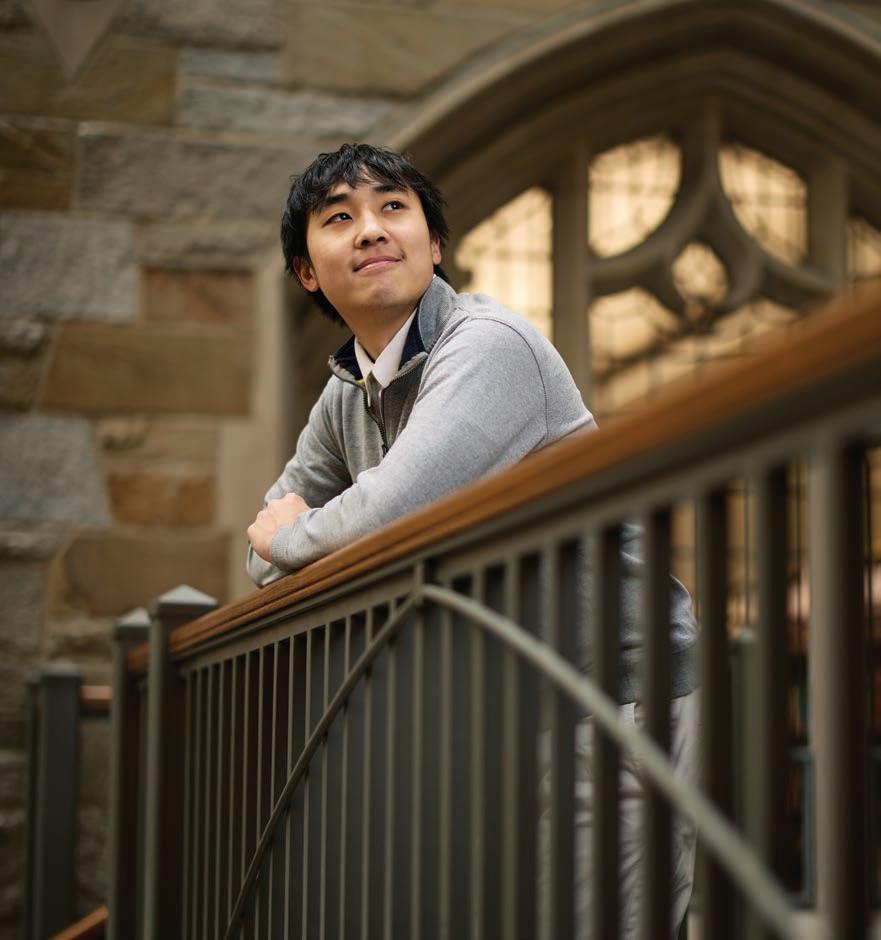
AQUINO SCHOLARSHIP AWARDEE JADON LEE ’26 WANTS TO USE HIS CARROLL SCHOOL STUDIES AND EARLY EXPERIENCES IN LA’S KOREATOWN TO TRANSFORM FINANCIAL LITERACY.
BY MASON BRAASCH
Jadon Lee ’26 has witnessed the hardships many immigrants face when it comes to financial literacy. He remembers watching his parents, who migrated to California from South Korea before he was born, trying to use Google Translate to decipher the financial jargon of loan documents. The experience planted in him a desire to help those in his community dealing with similar obstacles.
As a high school student, Lee spent hours each week at the Los Angeles Koreatown Youth & Community Center, helping with homework and leading activities for children from immigrant families. On weekends, he played violin with the LA Youth Philharmonic Orchestra and mentored younger musicians.
Still, when Lee was announced as the winner of the Benigno and Corazon Aquino Scholarship because of his service work, he was stunned. Billy Soo, the vice provost for faculties and professor of accounting, doesn’t think the decision was so surprising. “Jadon is truly a worthy recipient of this award,” he says. A member of the scholarship selection committee, Soo adds that Lee’s “willingness to share his knowledge . . . with younger students in his hometown resonated with the committee.”
The process of applying for that award in 2025 offers a glimpse into how one student grappled with his ethnic identity and helped prepare his mind and heart for life after Boston College. The $25,000 scholarship, named for the couple who fought for democracy as political leaders in the Philippines, is bestowed annually upon a junior with strong academics and active service engagement with the Asian American community. At the time, Lee didn’t feel very engaged.
He was working multiple jobs—including as a peer tutor at the University’s Connors Family Learning Center and as an online English tutor for more than 100 students as far away as Japan— to pay for college. Lee was also building a near-perfect GPA and rehearsing with the Boston College Symphony Orchestra, so he had scarce time for student cultural groups and struggled to stay connected to his Asian American identity. That struggle almost kept him from applying for the scholarship at all.
Thinking he didn’t have “as much of an Asian American story” as other applicants who took
leadership roles in student groups like the Asian Caucus, Lee decided to try anyway.
During the interview process, he reflected on his motivation to serve others. Systems weren’t “built with marginalized people in mind,” he says. Studying accounting and finance, he felt he could make financial literacy more achievable for families like his. “The real challenge wasn’t just academic,” he says. “It was about access, understanding how systems work, and feeling a sense of belonging within them.”
Lee points to Roth IRA accounts as an example. While he learned about the tool during freshman year and started contributing to his savings, his parents got that lesson much later in life, giving them a late start on saving for retirement.
He reflected further on his summer job after freshman year, working at the Korean American Coalition in Los Angeles and helping community members understand basic tax forms and immigration paperwork. “Those interactions showed me how financial literacy is tied to broader systems and how difficult it can be to access them without guidance or language support,” Lee says.
Back in LA after graduating, Lee is now an investment analyst with PGIM Private Capital. At the company and in the community, he aims to use his skills and education to expand access to financial knowledge related to budgeting, investing, managing debt, saving for college, and other goals. He says, “I want to help people in marginalized communities understand their story—the story of their financial lives.”
After losing friends in a devastating plane crash, Jasmine Lanata ’28 channels grief into action—running the Boston Marathon to honor their memory.
BY SALLY PARKER
On the morning of January 30, 2025, finance major Jasmine Lanata ’28 woke up early to catch a morning class. When she checked her phone, she saw missed calls from her parents. The news was devastating: Coaches, mothers, and fellow athletes from the Skating Club of Boston had perished in a plane crash.
Lanata had formed long-lasting friendships with the six victims over 11 years training at the club. American Airlines Flight 5342 had collided with a US Army Black Hawk helicopter, and suddenly they were gone. On hearing the news, she called a good friend from the rink. “We were in shock,” she recalls. “I remember every single moment of that day so vividly.”
Lanata, who first stepped onto the ice when she was six, spent nearly every day at the club growing up. A member of its Theatre On Ice team, she won three world championships on Team USA. She thought about the impact the club had made on her life. It had been like a family, and in the months following the crash she started thinking of ways to give back.
A cross-country runner in high school, Lanata had always wanted to run the Boston Marathon, which barrels past the Chestnut Hill campus at mile 21. The skating club was enthusiastic about her idea to apply for a spot in the marathon’s charity program for 2026, with a goal to raise funds for the club’s Always Champions scholarship campaign.

Ran Duchin, the Coughlin Family Professor in the Seidner Department of Finance, and coauthors were honored with a Dimensional Fund Advisors Distinguished Paper Prize by the Journal of Finance for their paper, “Sustainability or Greenwashing: Evidence from the Asset Market for Industrial Pollution.”
Jamie Ladge, professor and chair of the Management and Organization Department, and colleagues were awarded Best Published Careers Paper by the Careers Division of the Academy of Management for “Stable Anchors and Dynamic Evolution: A Paradox Theory of Career Identity Maintenance and Change,” published by Academy of Management Review.
Nan Liu, the William S. McKiernan ’78 Family Faculty Fellow and professor of business analytics, was named an editor of Health Care Management Science for its healthcare operations management department.

They received two bibs, doubling the fundraising potential. Lanata and fellow runner Jing Tu, whose daughter trains at the club, raised more than $30,000 for annual scholarships named in memory of Spencer Lane and Jinna Han— the two young skaters and Olympic hopefuls who died in the crash.
Training for the marathon was a lesson in balance: competing at nationals with BC’s synchronized skating club, squeezing in training runs, and keeping up with academics. But it’s worth it if more skaters have the opportunities she had, Lanata says.
“I just think back to the club and how they’ve always been a constant source of support for me,” she says. “I wanted to do this for each and every one of them.”
“I
wanted to do this for each and every one of them.”
Jasmine
Lanata ’28
Nadya Malenko, the Wargo Family Faculty Fellow and professor in the Seidner Department of Finance, and colleagues received recognition for their paper “Custom Proxy Voting Advice.” The coauthors were presented with the Paul Van Arsdell Award in Corporate Finance from the Midwest Finance Association and the Best Paper Award from the inaugural Corporate Governance Academic Forum at the David and Sharon Johnston Centre for Corporate Governance Innovation. The John L. Weinberg Center for Corporate Governance made Malenko a double honoree, awarding two of her papers, “Custom Proxy Voting Advice” and “Voting on Public Goods: Citizens vs Shareholders,” its Weinberg/IRRCi Research Paper Award.
Vanessa Conzon, assistant professor of management and organization, was recognized as one of the best undergraduate business professors of 2025 by Poets & Quants for creating an empowering learning environment and for commitment to student growth.
Visit bc.edu/csom-research for more.

Did you leave Boston College with a plan? Yes, the plan was to work on Wall Street trading fixedincome securities. I did that, right after graduating. I spent 14 years on Wall Street, almost half that time as a managing director at JP Morgan. And then, around 2010, I had the entrepreneurial itch. I started buying up commercial real estate in South Florida, and one of those properties was near the beach in Jupiter. Patty and I thought: There’s a real need for family-focused outdoor entertainment. Let’s build a mini-golf course there.
And not your usual course. No, before then, we happened to play mini golf while on vacation in Hilton Head. I started thinking of a way to modernize these businesses, bring in technology, nightlife, an ice cream parlor, a full service bar with an attached playground, and other experiences. Our kids were under four years old, so we thought of a place where you could watch games and have craft beers while your kids weren’t driving you crazy.
Greg Bartoli ’99 Founder, PopStroke
ago. We’ve developed what I refer to as a farm system, like the Red Sox or Yankees. We have a team from within that we’re developing, and when we open a new venue, we promote from within. We start off with a management team that understands the culture, the technology, the process, our brand, and most importantly, our customers.
How has technology figured into this growth? Technology is paramount to the future of the company. In 2020 I founded Heard Technologies, a vertically integrated, directto-guest, app-based, point of sale ecosystem. Our team of engineers and developers are constantly innovating and improving the guest experience. Having our own tech platform means we don’t have all these third-party software dependencies that make it harder to scale.
It’s a tech world. Any advice for students? I say, think about what the world is going to look like five or 10 years from now, not the way it looks now. It may take just one analyst to do the job of four as a result of AI. Think about the new services that will be needed, the industries branching out from new technologies. Think about starting a business.
Greg Bartoli ’99 was playing mini golf with his wife, Patty, MCAS ’99, and their three children, when a thought came to him: This whole industry could use an update. That notion eventually turned into PopStroke, a new spin on mini golf. Out are the windmills and tacky turf; in are the dining venues, playgrounds, and elevated putting greens like real golf. You can order a drink on PopStroke’s mobile app and have it delivered anywhere on the grounds. Tiger Woods and TaylorMade are equity investors, and Bartoli, a first-generation American (his father emigrated from Italy), now leads a billion-dollar-plus company he founded just six years ago. Here, the one-time Eagles basketball player speaks about scaling up an enterprise and what students need to do in the world being made by AI.
Where did that take you? Lighthouse Cove in Jupiter, a mini-golf attraction now with two other locations. It became our proof of concept for PopStroke. We started PopStroke in 2020 as a golf entertainment attraction for everything from date nights to daytime outings with the kids— something for all generations. We just opened our 21st venue, in Austin, Texas, with many more to come. We’re also heading north with climate-controlled, indoor-outdoor venues. We recently opened the first one in Nashville.
WILLIAM BOLE
Scaling up is hard to do. How have you done it so fast? For us, scaling is easier now than it was a few years
After the interview, Bartoli spoke to students at a campus event hosted by the Edmund H. Shea Jr. Center for Entrepreneurship. He talked about the advantages they have at Boston College, where they’re exposed to a teeming array of disciplines. “You can’t solve problems today by staying in one lane,” he said, adding: “When you guys are thinking of taking the risks, take the risks. You’re going to come up with great ideas. Don’t let people talk you out of them.”
write the next chapter
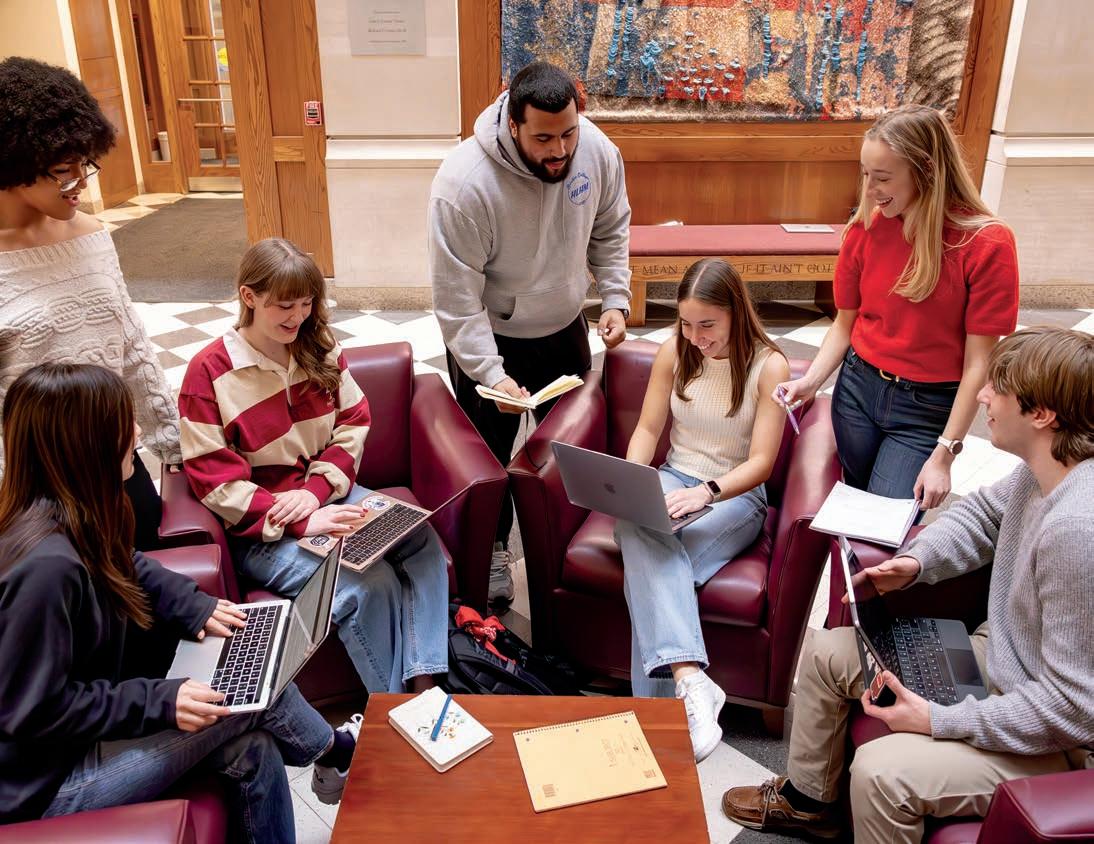
Soaring Higher: the Campaign for Boston College has reached unprecedented heights—but we are not slowing down.
The Carroll School of Management prepares students to become leaders. That’s why BC is counting on you to help sustain the momentum of the most successful campaign the University has ever undertaken. With your support, the Carroll School will make further strides toward becoming the most innovative school of management anywhere, aligned with the Jesuit, Catholic mission and fully integrated with the arts and sciences.
$3B campaign goal
60% undergraduate alumni participation goal
$1.15B goal for academics