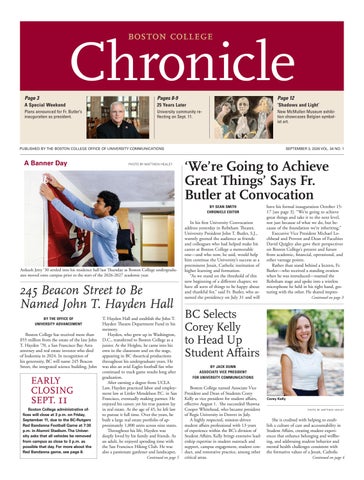
PUBLISHED BY THE BOSTON COLLEGE OFFICE OF UNIVERSITY COMMUNICATIONS
Page 3
Pages 8-9
Page 12
A Special Weekend
25 Years Later
‘Shadows and Light’
Plans announced for Fr. Butler’s inauguration as president.
University community reflecting on Sept. 11.
New McMullen Museum exhibition showcases Belgian symbolist art.
PUBLISHED BY THE BOSTON COLLEGE OFFICE OF UNIVERSITY COMMUNICATIONS
A Banner Day
PHOTO BY MATTHEW HEALEY
SEPTEMBER 3, 2026 VOL. 34 NO. 1
‘We’re Going to Achieve Great Things’ Says Fr. Butler at Convocation BY SEAN SMITH CHRONICLE EDITOR
Ankush Jetty ’30 settled into his residence hall last Thursday as Boston College undergraduates moved onto campus prior to the start of the 2026-2027 academic year.
245 Beacon Street to Be Named John T. Hayden Hall BY THE OFFICE OF UNIVERSITY ADVANCEMENT
Boston College has received more than $55 million from the estate of the late John T. Hayden ’70, a San Francisco Bay Area attorney and real estate investor who died of leukemia in 2024. In recognition of his generosity, BC will name 245 Beacon Street, the integrated science building, John
EARLY CLOSING SEPT. 11
Boston College administrative offices will close at 3 p.m. on Friday, September 11, due to the BC-Rutgers Red Bandanna Football Game at 7:30 p.m. in Alumni Stadium. The University asks that all vehicles be removed from campus as close to 3 p.m. as possible that day. For more about the Red Bandanna game, see page 8.
T. Hayden Hall and establish the John T. Hayden Theatre Department Fund in his memory. Hayden, who grew up in Washington, D.C., transferred to Boston College as a junior. At the Heights, he came into his own in the classroom and on the stage, appearing in BC theatrical productions throughout his undergraduate years. He was also an avid Eagles football fan who continued to track game results long after graduation. After earning a degree from UCLA Law, Hayden practiced labor and employment law at Littler Mendelson P.C. in San Francisco, eventually making partner. He enjoyed his career, yet his true passion lay in real estate. At the age of 45, he left law to pursue it full time. Over the years, he built a large real estate portfolio of approximately 1,000 units across nine states. Throughout his life, Hayden was deeply loved by his family and friends. As an adult, he enjoyed spending time with the San Francisco Hiking Club. He was also a passionate gardener and landscaper,
Continued on page 5
In his first University Convocation address yesterday in Robsham Theater, University President John T. Butler, S.J., warmly greeted the audience as friends and colleagues who had helped make his career at Boston College a memorable one—and who now, he said, would help him continue the University’s success as a preeminent Jesuit, Catholic institution of higher learning and formation. “As we stand on the threshold of this new beginning of a different chapter, we have all sorts of things to be happy about and thankful for,” said Fr. Butler, who assumed the presidency on July 31 and will
have his formal inauguration October 1517 [see page 3]. “We’re going to achieve great things and take it to the next level, not just because of what we do, but because of the foundation we’re inheriting.” Executive Vice President Michael Lochhead and Provost and Dean of Faculties David Quigley also gave their perspectives on Boston College’s present and future from academic, financial, operational, and other vantage points. Rather than stand behind a lectern, Fr. Butler—who received a standing ovation when he was introduced—roamed the Robsham stage and spoke into a wireless microphone he held in his right hand, gesturing with the other. He shared impres-
Continued on page 3
BC Selects Corey Kelly to Head Up Student Affairs BY JACK DUNN ASSOCIATE VICE PRESIDENT FOR UNIVERSITY COMMUNICATIONS
Boston College named Associate Vice President and Dean of Students Corey Kelly as vice president for student affairs, effective August 1. She succeeded Shawna Cooper Whitehead, who became president of Regis University in Denver in July. A highly respected, mission-driven student affairs professional with 13 years of experience within the BC’s division of Student Affairs, Kelly brings extensive leadership expertise in student outreach and support, campus engagement, student conduct, and restorative practice, among other critical areas.
Corey Kelly photo by matthew healey
She is credited with helping to establish a culture of care and accountability in Student Affairs, creating student experiences that enhance belonging and wellbeing, and addressing student behavior and mental health challenges consistent with the formative values of a Jesuit, Catholic
Continued on page 4
2
Chronicle
September 3, 2026
Fr. Beaumier to Speak at First Year Academic Convocation BY KATHLEEN SULLIVAN STAFF WRITER
Haub Vice President for Mission and Ministry and Director of Campus Ministry Casey C. Beaumier, S.J., will be the featured speaker at this year’s First Year Academic Convocation on September 10. The convocation is the official welcome for all first-year students into Boston College’s academic community and the launch of Conversations in the First Year, which engages the University’s newest students in an intellectual and reflective dialogue through a common text. This year’s text is Fr. Beaumier’s book A Purposeful Path: How far can you go with $30, a bus ticket, and a dream? “Starting college is a period of great transition, which can be a challenge,” said First Year Experience Director Christopher J. Darcy. “But at Boston College, with our mission and identity as a Jesuit, Catholic university, we talk about how you’re not alone during this time. BC students have companions on their journey—academic advisors, faculty, resident assistants, orientation leaders, peers, and others at the University. Our message is: ‘You have all these wonderful resources very similar to what Ignatius had in early companionship.’”
Casey Beaumier, S.J. photo by lee pellegrini
The events will begin at 6 p.m. on Linden Lane with a gathering of all first-year students—undergraduates in the Class of 2030, Messina College students in the Class of 2028, and transfer students—who will be presented with Ignatius medallions and
urged to follow the charge of the Jesuit founder to “Go set the world aflame.” Students will then embark on First Flight, a torch-lit procession to Lower Campus, while receiving eagle pins from Undergraduate Government of BC leaders, and gather under a tent on the lawn across from Maloney Hall, where Fr. Beaumier will address them on the themes of his book. Part memoir and part travel adventure, A Purposeful Path follows a pilgrimage Fr. Beaumier undertook in 1994 as a Jesuit novice. He traveled by bus from St. Paul, Minn., to Knoxville, Tenn., where he hiked the Appalachian Trail. He then made his way to North Carolina, Washington, D.C., and New York City, among other locales. Per the parameters of the Jesuit’s pilgrimage experiment, he traveled with little to no money, food, or other provisions, and had to learn to live with the vulnerability, discomfort, and insecurity he felt. According to Darcy, “In A Purposeful Path, Fr. Casey shares his story of how a pilgrimage helped him discern his direction in life and encourages other young people to discover their own purpose by embracing vulnerability. Throughout the journey, Fr. Casey found himself cold, hungry, and tired
Annual Constitution Event is Sept. 17 The Boston College community will commemorate Constitution and Citizenship Day—a federal observance honoring the signing of the United States Constitution— on September 17 by sharing their perspectives on the nation’s founding document at the fifth annual “What the Constitution Means to Us” event hosted by the Clough Center for the Study of Constitutional Democracy. Co-sponsored by the Winston Center for Leadership and Ethics, this year’s event— which takes place from 4-5:30 p.m. at the Robsham Theater Arts Center—will bring together BC faculty, graduate students, undergraduates, and nationally recognized scholars Doris Kearns Goodwin H’25 and Akhil Reed Amar for a public discussion on the Constitution and its centrality to public life. Goodwin is a renowned presidential historian and Pulitzer Prize recipient; Amar is a professor of law and political science at Yale University and author of Born Equal: Remaking America’s Constitution, 1840–1920. “We are delighted to have two of the sharpest observers of the American political ASSOCIATE VICE PRESIDENT FOR UNIVERSITY COMMUNICATIONS
Jack Dunn
SENIOR DIRECTOR FOR UNIVERSITY COMMUNICATIONS
Patricia Delaney EDITOR
Sean Smith
Doris Kearns Goodwin and Akhil Reed Amar will be feature speakers at this year’s “What the Constitution Means to Us” event.
experience on hand to lead this year’s edition of ‘What the Constitution Means to Us,’” said Professor of Political Science Jonathan Laurence, director of the Clough Center. “Over the past several years, the campus conversation has been enriched by the contributions of dozens of students, faculty, and guest speakers who have shared their views with us through this event and the oral histories we publish on the Clough Center website.” This year’s event is particularly timely, as discussions over constitutional interpretation continue to play a significant role in American politics and society. The evening will host an array of conversations, debates, and reflections aimed at encouraging thoughts and answers to questions such as,
CONTRIBUTING STAFF
“How should we look at the Constitution?” and “Should the Constitution be amended again?” The Constitution has long served as a source of both hope and controversy, say event organizers, and the reflections that take place each year will serve as a historical record of how people understood the Constitution’s laws and framework at different moments in history, and how they endured despite societal challenges. The program is free and open to the public with registration. Go to bc.edu/content/ bc-web/centers/clough/events/what-theconstitution-means-to-us-2026. —Audrey Loyack
Phil Gloudemans Ed Hayward Audrey Loyack Rosanne Pellegrini Kathleen Sullivan
Chronicle
PHOTOGRAPHERS
www.bc.edu/bcnews chronicle@bc.edu
Caitlin Cunningham Matthew Healey
along the Appalachian Trail, reliant only on the kindness of strangers and his faith to make it through in one piece. Through it all, Fr. Casey discovers that the best way through life’s hard battles is to trust God and keep on moving.” Prior to being named Haub Vice President last year, Fr. Beaumier served as vice president, University secretary, and director of the Institute for Advanced Jesuit Studies. He also is a teacher in the Capstone Program and resident minister in Fenwick Hall. He is the founder of Ever to Excel, a summer immersion program of Spiritual Exercises led by BC undergraduates who serve as mentors. Ever to Excel has brought more than 3,000 high school students to campus since 2016. Fr. Beaumier’s talk is open to the entire Boston College community. Established in 2004, First Year Academic Convocation is organized by the Office of First Year Experience, a division of University Mission and Ministry. To learn more or explore A Purposeful Path’s reading guide, created by Clough School of Theology and Ministry Associate Dean Maura Colleary, see bc.edu/content/bc-web/ offices/missionministry/sites/fye/first-year-academic-convocation.
Mass of the Holy Spirit Is Sept. 10 University President John T. Butler, S.J., will celebrate the annual Mass of the Holy Spirit on September 10 at noon on the Plaza at O’Neill Library. Concelebrants include members of the Jesuit communities of Saint Mary Hall and Saint Peter Faber and other priests of the University. All members of the University are invited to attend the Mass, a traditional opening of the school year at Jesuit institutions dating back to the Middle Ages. The festive liturgy serves to welcome new members into the Boston College community, renew friendships, and invoke the presence of the Holy Spirit for the year to come. Classes will be canceled on that day from noon to 1:15 p.m. The Mass of the Holy Spirit is organized by the Office of Campus Ministry in the Division of Mission and Ministry.
The Boston College Chronicle (USPS 009491), the internal newspaper for faculty and staff, is published biweekly from September to May by Boston College, with editorial offices at the Office of University Communications, 3 Lake Street, Brighton, MA 02135 (617)552-3350. Distributed free to faculty and staff offices and other locations on campus. Periodicals postage paid at Boston, MA and additional mailing offices. POSTMASTER: send address changes to The Boston College Chronicle, Office of University Communications, 3 Lake Street, Brighton, MA 02135. A flipbook edition of Chronicle is available via e-mail. Send requests to chronicle@bc.edu.
3
Chronicle
September 3, 2026
Inauguration Event for Fr. Butler Set for Oct. 15-17 BY JACK DUNN ASSOCIATE VICE PRESIDENT FOR UNIVERSITY COMMUNICATIONS
Boston College will host the Inauguration of its 26th president, John T. Butler, S.J., October 15-17, with a three-day celebration that will include academic symposia, an Inauguration Mass, an academic procession, a formal Inauguration ceremony, and an alumni tailgate prior to the BCPittsburgh football game on Saturday. Winston Provost and Dean of Faculties David Quigley, who chairs the Inauguration Planning Committee, said he is working with faculty and administrators to honor the wishes of the new president for a “celebration of the BC community,” which will include students, faculty, staff, alumni, parents, and trustees, as well as presidents and delegates from other universities, elected officials, and representatives from the Society of Jesus and the Catholic Church. “This will be Boston College’s first presidential inauguration of the 21st century, and I appreciate the many ways in which friends from across and beyond campus are working to plan October’s events,” said Quigley. “Fr. Jack has made it clear that this will be a chance to come together as a community to reflect on what we have built together. I look forward to celebrating his inauguration and imagining BC’s bright future.” The Inauguration celebration will begin on October 15 at 1:30 p.m., in Robsham Theater with the first of two academic symposia titled “The Light Shines Through:
University President John T. Butler, S.J., speaking at University Convocation [see page 1]. photo by caitlin cunningham
The Catholic Intellectual Tradition.” Moderated by Quigley, the event will feature Donna Carroll, President of the Association of Catholic Colleges and Universities; Robert Dowd, C.S.C., President of the University of Notre Dame; Mary Ann Dillon, R.S.M., Former President of Mount Aloysius College; and Brian Shanley, O.P., President of St. John’s University, with each presenter sharing insights on how the Catholic intellectual tradition is reflected through the charisms of particular religious orders. It will be followed by a second sympo-
sium titled, “Jesuit, Catholic Education at Boston College: Formation for Wisdom and Hope.” Moderated by Gregory Kalscheur, S.J., Dean of the Morrissey College of Arts and Sciences, it will feature Jeffrey Bloechl, Professor and Albert J. Fitzgibbons Chair in Philosophy; Andrew Boynton, John and Linda Powers Family Dean of the Carroll School of Management; Mary Crane, Thomas F. Rattigan Professor of English; Ryan Patrick Hanley, Professor and J. Joseph Moakley Chair in Political Science; and Avneet Hira, Associate Professor, Sabet Family Dean’s Faculty Fellow in Engineering, all of whom will reflect on the culture of the Catholic intellectual tradition at Boston College, while celebrating BC’s past and harnessing the energy of a new chapter in the University’s history. The academic symposia will be followed by a reception in Robsham Plaza. Friday’s events will feature the Inauguration Mass at 10 a.m. in Saint Ignatius of Loyola Church. The Mass, with Archbishop Richard G. Henning presiding representing the Archdiocese of Boston and diocesan priests, includes principal co-Presiders from various religious orders that have been influential in Fr. Butler’s intellectual, spiritual, and personal growth: Bishop Joel Konzen, S.M., representing the Society of Mary (Marists); Philip Dabney, C.Ss.R., representing the Congregation of the Most Holy Redeemer (Redemptorists); Kenneth Sicard, O.P., representing the Order of Preachers (Dominicans); Raymond Dlugos, O.S.A., representing the Order of Saint Augustine (Augustinians); and
Robert Reiser, S.J., representing the Society of Jesus. Adam Zielonka, O.C.S.O., representing the Order of Cistercians of the Strict Observance (Trappists), will serve as the Cross-Bearer for the Mass. Brief readings from Jesuit and Boston College history will take place beginning at 2 p.m. in front of Gasson Hall, followed by an academic procession from Linden Lane to Conte Forum featuring University Trustees, BC faculty, and presidents and delegates from colleges and universities throughout the country. The Inauguration ceremony will begin at 3 p.m. in Conte Forum, and will feature speakers representing the BC academic community, the Board of Trustees, the Society of Jesus, the Catholic Church, and public officials, and musical performances by students. Fr. Butler will then receive the University medallion and charter from University President Emeritus William P. Leahy, S.J., before offering his inaugural speech as president. A public reception will be held at 4:30 p.m., on the Lower Campus Lawn, followed by a Campus Celebration on the Gasson Quad and Stokes Lawn from 6-8:30 p.m. Saturday’s events will include an alumni tailgate prior to the noon football game vs. the University of Pittsburgh. The academic symposia, Mass, procession, and Inauguration ceremony will be livestreamed and accessible via the Inauguration website. Additional details regarding Inauguration events will be posted on the website as they become available at www. bc.edu/inauguration.
Fr. Butler Gives His First University Convocation Address Continued from page 1
sions, memories, and vignettes of his more than two decades at BC, continually offering praise and gratitude for the University’s administrators, faculty, and staff he’d encountered during that time. “For 24 years, I sat where you have sat. You’ve taught me what a university is. I believe in us because I believe in you. I’ve come to know that we’re at our best when life challenges us and calls us to be our best. The world needs us, and higher education needs us.” Fr. Butler praised the legacies of his immediate predecessors, J. Donald Monan, S.J., and William P. Leahy, S.J., for their part in making Boston College “a remarkable story.” Fathers Monan and Leahy brought “stability, continuity, and momentum” to the University, enabling it to grow and thrive. In an age fraught with uncertainty, turmoil, and divisiveness, he said, BC has an important role to play, and he looked forward to helping it be a university that makes a difference. “I am here to serve you. I will give you a full day’s work, so we can reach greater heights and maximize what we do. We may disagree on some things, but I know that we will keep working together and
continue to fulfill the promise of Boston College.” BC is operating from a position of financial strength as it enters fiscal year 2027, said Lochhead, with its FY 2026 operating performance driven by such factors as a continued robust undergraduate student demand resulting in full-time student counts that exceeded budgeted expectations; higher interest rates on larger short-term investment balances that fueled interest income ahead of budgeted expectations; salary and benefit savings, led by improvements in actual medical claims; and an increase of more than 20 percent in the University’s endowment to a market value of $5.2 billion, the third largest in Massachusetts behind Harvard and MIT. The task ahead for the University is to solidify the budget adjustments and reallocations necessary to address a multitude of challenges, Lochhead said. “At the same time, we need to help ensure BC remains accessible and an affordable option to all qualified students, regardless of financial circumstance. We also need to make sure the University has the financial resources and flexibility to remain nimble and take
advantage of opportunities that advance BC’s mission when they arise.” Lochhead offered his praise for several University-wide undertakings, including the modernization of EagleApps by Information Technology Services and Student Services, Human Resources’ endeavors in staff formation, and initiatives to further BC’s understanding and application of artificial intelligence. “Each of these efforts advances the important work of the University,” he said. Quigley cited some indicators of BC’s upward trajectory during the past three decades, such as the increases in full-time faculty (586 to 932), student applications (16,501 to 41,898), and the percentage of admitted students in the top 10 percent of their class (69 to 92). Need-based undergraduate financial aid has climbed from $35 million to $197.7 million, total annual gifts have increased from $24.6 million to $260 million, and sponsored research has more than quadrupled from $18 million to $84.8 million. “Boston College was strong in the mid-1990s,” he said, “and 30 years later, it continues to be even stronger.” Quigley also cited AI as a critical fo-
cus for Boston College, pointing to the launch this fall of Krantz Institute for Artificial Intelligence, Ethics, and Humanity through a gift from University Trustee Jason Krantz and his wife Keely [see page 6]. Drawing on a cross-disciplinary variety of BC academic programs, the institute will provide experiential learning opportunities for students, bring thought leaders to campus to discuss AI and its impact, and advance and support AI-related curricula, programs, and initiatives. Another soon-to-be launched initiative is The Bridge Program, he said, which will give students in the classes of 2028 and 2029 opportunities to integrate the humanities, management, and the sciences through courses and co-curricular experiences. These will join other recent successful ventures such as the two-year Messina College associate’s degree program, which Quigley noted had graduated its first cohort this past spring, and the Prison Education Program, which began a pilot program this past year at the Massachusetts Correctional Institution in Framingham.
4
Chronicle
September 3, 2026
Rhodes Gets Nod as BC Trustees Chairman BY JACK DUNN ASSOCIATE VICE PRESIDENT FOR UNIVERSITY COMMUNICATIONS
Travis Rhodes ’93, president of Bostonbased Abrams Capital, was elected chairman of the Boston College Board of Trustees at its June meeting. He succeeds John Fish, who had led the board as chair since 2014. Rhodes, who was elected vice chair in 2025, joined the board in 2023. He will be assisted by fellow officers James Carey ’88, J.D. ’91, who was named vice chairman of the board, and Susan Martinelli Shea ’76, who was reappointed secretary. “While a student at Boston College, I never could have imagined that I would one day serve this great university as a trustee and chair of its board,” said Rhodes. “It is an honor to have been elected chair of an institution that has played such an important role in my life, and I look forward to working with University President John T. Butler, S.J., and my fellow board members to continue the strong momentum that has elevated Boston College to its place among the nation’s best universities.” After graduating from Boston College, Rhodes attended Harvard Law School and
Travis Rhodes ’93 (left), a member of the Boston College Board of Trustees since 2023, was elected chairman in June. Darin Davidson is the board’s newest member. photo of rhodes by jared charney
began his career as a lawyer before joining Fidelity Investments as a bond analyst. He joined Abrams Capital as an investment analyst in 2003. He is also actively involved as owner and coach at the Dana Barros Basketball Club, and works closely with several local
charitable organizations, including Wide Horizons for Children, where he serves as chairman emeritus. Rhodes is the vice chairman and a trustee of the Campaign for Catholic Schools, and a founding member and co-chair of the Venture Philanthropy Network at Bos-
ton Children’s Hospital. He is also active in the annual Boston Investment Conference benefiting BCH and serves on the Boston Children’s Hospital Trust Board. He lives in Easton, Mass, with his wife, Rachel, and their five children, three of whom are enrolled at Boston College, including Nicholas ’27, Anthony ’29, and Maricela ’30. Rhodes will be joined on the board by BC parent Darin Davidson P’21, ’25, ’29, who has served as a member of the BC Board of Regents since 2023. Davidson is the managing partner of Inland Group, a developer, builder, and owner/operator of multifamily residential communities located throughout the Western United States, Minnesota, and Texas, specializing in the production and operation of active adult communities. He is also involved in the development of affordable housing on behalf of various nonprofits, including Catholic Charities of Eastern and Western Washington and Volunteers of America. Davidson received undergraduate and law degrees from the University of Washington. He and his wife, Mia, have four children.
Kelly Looks to Continue Cultivating ‘Culture of Care’ Continued from page 1
university. As associate vice president and dean of students, she also worked closely with the AVP for health and wellness to coordinate supportive resources and student care, the AVP for residential life to improve student experiences and staff preparedness and response, and the AVP for engagement and formation to foster a welcoming environment for first-year students. Executive Vice President Michael Lochhead said Kelly possesses the institutional understanding, experience, and proven track record to succeed in a role that regularly interacts with BC’s 9,400 undergraduate students and partners with the Office of the Provost and the division of University Mission and Ministry on behalf of students. “I’ve had the privilege of working with Corey during our overlapping time here at the Heights and am thrilled to have the opportunity to work with her as the new vice president for student affairs,” said Lochhead at the time Kelly’s appointment as vice president was announced. “Corey established herself as the clear choice from among a distinguished and talented candidate pool based on her indepth understanding of and commitment to Boston College and the important role Student Affairs plays in advancing the goals of formative education among our students. “Her many years of experience at Boston College and the relationships she has developed will help her transition into this new role. I very much look forward to working with her in this new capacity.”
Kelly said she is honored to lead a division to which she has dedicated herself professionally since she began working in an entry-level role as interim coordinator of student conduct in 2013. “Boston College has shaped me both professionally and personally over the past 13 years, and I am deeply honored to continue serving the division of Student Affairs as vice president,” said Kelly. “As dean of students, I have found great meaning in working with such devoted colleagues to intentionally cultivate a culture of care for our students. I look forward to building on that work by continuing to foster collaboration across the University to support the formation of students who are responsible, compassionate, and prepared to make a positive impact on the world.” A graduate of Boston University where she earned a degree in psychology, Kelly worked for several years on federally funded psychology research studies at BU before pursuing a master’s degree from the Boston College School of Social Work. While studying at BC, she worked as a graduate assistant in Student Affairs and interim coordinator before taking a series of progressive leadership positions as an assistant dean, associate dean, and director of student conduct, before becoming AVP in 2022. She earned a doctorate in higher education from the Lynch School of Education and Human Development in 2019. A licensed certified social worker who gained crisis experience working in hospitals and emergency services settings, she has also taught two popular senior Capstone courses on Leadership and Restorative
Practices which, she says, has deepened her connection with BC students beyond her role in Student Affairs. Outside of BC, Kelly lives in Newton with her husband, Ben, both of whom grew up in upstate New York, and their two elementary school-aged children. In addition to spending time with family, Kelly is an avid runner who has completed 11 marathons.
Snapshot
McNair Scholars Symposium
“Throughout my time at BC, I have benefited from extraordinary mentors and opportunities to grow as a leader, particularly through the Ignatian Leadership Development Program, which deepened my understanding of the University’s Jesuit mission and my gratitude for the strong sense of community here. I hope to provide that same guidance and mentorship among the dedicated staff in Student Affairs.”
photo by caitlin cunningham
Nilgun Colak ’28 was among the presenters at the 22nd annual Boston College McNair Scholars Research Symposium held this summer. Funded by the United States Department of Education, the McNair Scholars Program prepares undergraduates from firstgeneration and low-income backgrounds to pursue advanced degrees toward careers in research and academia.
Hayden Hall
5
Chronicle
September 3, 2026
“John didn’t spend money on himself,” says a friend of Hayden. “He spent it on the people and places that mattered to him. This gift is a reflection of what BC gave him.”
Continued from page 1
world traveler, and regular performer in local musical theater productions. Joseph Gillach, Hayden’s friend and trustee of his estate, said Boston College always had a place in Hayden’s heart. “John didn’t spend money on himself. He spent it on the people and places that mattered to him. This gift is a reflection of what BC gave him.” At the Heights, Hayden had a reputation of being studious and diligent. “He’d read all the material for class—both the required and the recommended readings,” recalled Matthew McEntee ’70, who met Hayden at BC in 1968. “He also had a great singing voice and a real stage presence.” “John Hayden’s gift will benefit many for generations to come,” said University President John T. Butler, S.J. “John’s Boston College education is manifested in this gift because it encapsulates Ignatius of Loyola’s prayer for generosity. Clearly, he was a man for others who understood what he received was meant to be shared.” David Quigley, the Robert L. and Judith T. Winston Provost and Dean of Faculties, said naming 245 Beacon for Hayden is a fitting tribute. “John embodied the Jesuit ideal of the
whole person: rigorous in mind, generous in spirit, and ever alive to beauty and culture. Hayden Hall will stand as a reminder of a life shaped by a rigorous liberal arts education.” In addition to Boston College, Hayden included St. John’s College High School in Washington, D.C., and Georgetown University in his estate—institutions that played a formative role in his academic and personal development.
photo by caitlin cunningham
(Left) John T. Hayden ’70, a San Francisco Bay Area attorney and real estate investor who died of leukemia in 2024, left $55 million in his estate for Boston College. He will be the namesake of 245 Beacon Street, the integrated science building located on Middle Campus. In addition, the University will establish the John T. Hayden Theatre Department Fund in his memory.
University to Host Conference on Vaccine Controversy BY ED HAYWARD STAFF WRITER
With American childhood immunization rates falling to their lowest levels in two generations, leading public health experts, ethicists, legal scholars, and theologians will convene at Boston College later this month to address what organizers call a growing national crisis. The daylong conference, “Vaccines, Ethics, and the Common Good,” will take place September 18 from 8:30 a.m. to 6:30 p.m. in the Heights, Boston, and Newton rooms of Corcoran Commons. The gathering comes amid a sharp resurgence of preventable childhood illnesses across the United States, according to Professor Philip Landrigan, M.D., a pediatrician, director of the University’s Global Observatory on Planetary Health, and a lead organizer of the conference. “This event will take stock of historical successes and examine the current situation, including vaccine skepticism,” said Landrigan. “We want to see if we can come up with a prescription for childhood immunization that moves past the current polarized rhetoric and frames vaccination as a medical necessity, a moral duty, and a collective responsibility.” Federal data show more than 2,700 confirmed measles cases through late August 2026, while Pennsylvania authorities confirmed two measles-associated deaths, one in a newborn. This follows a severe 2025 outbreak that saw 2,289 measles cases and 28,000 cases of pertussis, resulting in 19 combined deaths. Public health officials warn that long-vanquished diseases,
including poliomyelitis and congenital rubella syndrome, could return if vaccination trends are not reversed. “Childhood immunization programs advance the common good,” said Landrigan. “By vaccinating all children in a town, you not only protect the individual child, but you protect the community by creating a healthy environment where kids can go to school, learn, and not have to worry about a deadly disease.” “Childhood immunization is a moral good,” reads a statement by conference organizers—among them Walsh Professor of Bioethics and Theology Department Chair Andrea Vicini, S.J., and BC School of Social Work Professor Summer Sherburne Hawkins, director of the Program for Global Public Health and the Common Good—outlining the event’s objectives. “Children can flourish only when they live in communities where people care for one another and work together to prevent the spread of communicable diseases.” As rates of vaccination have declined from near-universal acceptance, “people have used the expression ‘victims of our own success,’” said Landrigan. “Because our vaccine programs were so successful, we now have two generations of parents who have no experience with measles or polio.” He added that the public health community may have become complacent and failed to sufficiently educate parents and build demand for vaccines: “We did not do enough to extol vaccines’ benefits.” Throughout the conference, commissioned papers will examine the historical and philosophical roots of the current
vaccine crisis, explore the tension between personal autonomy and public welfare, and outline practical strategies to boost vaccine equity. Special attention will be given to public communication, focusing on messaging techniques capable of bridging political and cultural divides and building demand. At the conclusion of the event, organizers plan to issue a formal declaration offering an ethically grounded framework for parents, pediatricians, health authorities, and policymakers, said Landrigan. The presentation papers will subsequently be
published as a book volume by Wipf & Stock as part of Boston College’s ongoing series on public health ethics. The conference is co-hosted by BC’s Program for Global Public Health and the Common Good and the Theology Department, in collaboration with BC Law, BCSSW, the Connell School of Nursing, the Clough School of Theology and Ministry, the BC Institute for the Liberal Arts, and the Catholic Health Association. For more information about the conference, see https://bit.ly/BC-Vaccines-Ethicsand-the-Common-Good
photo by gretchen ertl
Members of the Boston College community gathered at the McMullen Museum of Art on August 24 to celebrate the naming of the Margaret A. Dwyer Terrace. Cutting the ribbon in the photo above is Chris Toomey ’78, whose generous gift is a tribute to “Peg” Dwyer, the long-serving administrator who was BC’s first-ever female vice president, for her dedicated service to the University.
6
Chronicle
September 3, 2026
WHILE YOU WERE AWAY Boston College news from the summer of 2026
Fr. Butler Becomes President Seventeen months after being named the 26th president of Boston College, John T. “Jack” Butler, S.J., officially assumed the University presidency on July 31, the Feast Day of the founder of the Society of Jesus, St. Ignatius of Loyola. Fr. Butler used the time following his election to prepare for the role by visiting with university presidents across the country and shadowing now-retired President Emeritus William P. Leahy, S.J., to learn from them the intricacies of a college presidency as he formulates his vision for Boston College’s future. “My time with other presidents, and in particular Fr. Leahy, has shown me that there is a complexity to being a president of a university that demands humility and both trusting and consulting the team that surrounds you while serving the university at large,” said Fr. Butler. “I look forward to the opportunity that awaits me.” Board of Trustees Chair Travis Rhodes ’93 said Fr. Butler is well prepared for the position given the role he played in advancing the University’s strategic priorities in formative education, curriculum renewal, and student wellness, and his service as a senior administrator since 2010. “Fr. Butler is a unique and special person,” said Rhodes, who was elected trustees chair this past summer [see page 4]. “He connects with others in a way that is truly exceptional and brings to the position an inimitable knowledge and understanding of Boston College, given his leadership experiences during the past 20 years. He is a visionary, gifted communicator, and proven problem solver, who will devote everything
photo by caitlin cunningham
he has to enhancing the University and its distinctive strengths among the nation’s best schools. This is an exciting time for Boston College.” Prior to his election as president, Fr. Butler served as Haub Vice President for University Mission and Ministry since 2010. In addition to his administrative and pastoral responsibilities as vice president, he was a key architect of Boston College’s formative education efforts and worked closely with institutional leaders and faculty to oversee the renewal of BC’s Core Curriculum. Boston College will host Fr. Butler’s inauguration during October 15-17 with a three-day celebration that will include academic symposia, a Mass in Conte Forum, an Inauguration ceremony, and football game festivities [see page 3]. Full story at bit.ly/Fr-Butler-Assumes-BCPresidency
BC Welcomes Alumni Gifts Boston College announced two major gifts from alumni during the summer: •University Trustee Jason Krantz ’95, P’23 and his wife, Keely (Fitzgerald) Krantz ’95, P’23 made a donation that will establish the Krantz Institute for Artificial Intelligence, Ethics, and Humanity, which will utilize BC faculty, visiting scholars, and industry partners to examine AI’s long-term opportunities and impact from a humanistic perspective, while instilling BC students with the judgement, wisdom, and critical thinking necessary to help them become ethical leaders in its deployment. The Krantz Institute will draw from the University’s academic programs in liberal arts, business, education, nursing, law, social work, and theology and ethics to achieve three primary goals: convene global thought leaders at Boston College for conferences and symposia to discuss AI and its potential impact on humanity; provide fellowships, internships, and experiential learning opportunities for BC students that will enable them to lead conversations that
Jason and Keely Krantz, left, and Beth and Carmine Martignetti
New Head for Global Public Health will shape the future of AI, wherever they Boston College School of Social Work faculty from the School of Social Work, Professor Summer Hawkins (in photo) Connell School of Nursing, and the Lynch was named the new director School of Education and Huof the Program for Global man Development. Public Health and the Com“Our interdisciplinary mon Good, which she helped program prepares students to to create and where she has address today’s most pressing served as associate director. public health challenges—loHawkins succeeded Profescally and globally—through a sor of Biology Phil Landrigan, commitment to social justice, M.D., who had headed the research, and community enprogram since it was launched gagement,” she said. “I look in 2018. In that time, the forward to building on the program has seen exponential program’s strong foundation photo by caitlin cunningham growth, offered as a minor by expanding opportunities in 2019—and consistently for students to develop the among BC’s top 10 most-enrolled minors knowledge and skills needed to improve since then—and as a major beginning in population health.” 2023. Student interest remains high, with Landrigan will remain the director roughly 3.5 applications for every seat in of the Global Observatory on Planetary the major. Health, a research hub that tracks the im“I am excited to continue this work pacts of planetary degradation—such as with my faculty colleagues, our current climate change, pollution, and hazardous students, and those who will discover a chemicals—on human health and develops passion for public health at Boston Colscience-based solutions. lege,” said Hawkins, who was instrumental For more on the program, go to bit.ly/BCin starting the University’s public health Global-Public-Health academic program in 2014, working with
is expected to be hired during the coming academic year, as will new faculty and staff who will support the ongoing interdisciplinary work of BC faculty and researchers. The institute will involve all nine of BC’s schools, with interim leadership assistance from Morrissey College of Arts and Sciences Dean Gregory Kalscheur, S.J., and Carroll School of Management John and Linda Powers Family Dean Andrew Boynton. Full story at bit.ly/BC-Krantz-Institute-gift •In addition, a gift from Beth V. ’76 and BC Trustee Carmine A. Martignetti ’76 will provide unrestricted support to Boston College, allowing the University and its leadership to address its most urgent needs. In grateful recognition of the couple’s generosity, Boston College will name the residence hall located at 90 St. Thomas More Road Martignetti Hall. Located on Lower Campus just steps from the Corcoran Commons, the current “Ninety” Hall houses 380 students—mainly sopho-
take place; advance curricular innovation and integration at BC, enhance campuswide AI-related programs and projects, and award internal seed grants to fund emerging initiatives. “AI represents one of the most consequential technological transformations in human history,” said Jason Krantz, founder and executive chairman of Definitive Healthcare and founder of Breachway Capital. “Given Boston College’s commitment to formative education and the Jesuit principles of ethical discernment, BC, in our mind, is uniquely positioned to lead the conversation about the consequences of AI, what the technology means for humanity, and how it might be best leveraged in service to others.” Added Keely Krantz, president and founder of the O’Dell Women’s Center in Springfield, Mass., “We want to see values and ethics as foundational components in how the world approaches AI and AI education. Additionally, we want BC students to use their formative education and discernment skills to help lead and improve the application of AI in the future.” An executive director for the institute
photos by caitlin cunningham and gretchen ertl
mores—in 60 suites. The Martignettis—who first met at the Eagle’s Nest while they were students—are longtime BC benefactors, having supported a variety of areas and initiatives over nearly five decades, including financial aid, athletics, the Connell School of Nursing, and Pops on the Heights. “It’s about excellence in so many things—the quality of the students is better than ever. The school is so much more diverse, including geographically. But really, above all else, it has remained true to its Jesuit values and the idea of formation, which continues to contribute so meaningfully to the BC experience,” Carmine Martignetti said. “We have so much respect for Fr. [William P.] Leahy and all that he has done for Boston College, which is now among the best universities in the country thanks to his leadership,” added Beth Martignetti. “Our appreciation doesn’t end there—we’re so delighted for the transition to Fr. Jack Butler and the continuity that he will bring. It means a lot to us—Boston College is worthy of this kind of giving.” Full story at bit.ly/Martignettis-BC-Gift
7
Chronicle
September 3, 2026
Striking Gold The University’s iconic eagle statue has been returned to brilliance using centuries-old techniques Walter Eayrs (shown at left) said it was a "gratifying" to work on "such a beautiful, high-profile piece."
BY ALIX HACKETT SPECIAL TO THE CHRONICLE
Boston College’s famous golden eagle statue has been greeting students and families from its perch on Linden Lane for nearly 70 years. Now, thanks to a meticulous restoration project, it’s shining brighter than ever. In June, Facilities Management staff hired third-generation craftsman Walter Eayrs of Blackburn Building Conservation to regild the eagle, which sits atop a 30-foot column in front of Gasson Hall. Over time, due to continuous exposure to the elements, the statue’s gold-leaf coating had begun to chip away, exposing the cast bronze surface underneath and giving it a slightly tarnished appearance. It took just over a week for Eayrs to prep, prime, and regild the eagle, which stands four feet high and has a six-foot wingspan. First, he used abrasive pads to remove corrosion and dirt, followed by a coat of yellow-tinted primer. Then, he began covering the statue in tissue-thin squares of 23.75-carat gold, a painstaking process that has changed little since ancient Egyptian times. “We apply an adhesive called ‘size’ and when it’s ready, we use our fingers to push the leaf into the metal surface,” he explained. “It’s one of those truly hand-done operations—you can’t use any tool and there’s no way to expedite it.” The gilding process requires careful time
photo by andrew craig
management: depending on the weather conditions, the adhesive needs between five and six hours of drying time to reach the perfect level of stickiness. If the gold leaf is applied too soon or too late, it won’t adhere correctly, and mistakes can be costly. To ensure he could complete each section in a single day, Eayrs often arrived on campus as the sun was rising. Boston College adopted the eagle as its
mascot in 1920 and received the original eagle statue as a gift from the estate of Larz Anderson in 1954. Anderson, the United States ambassador to Japan, had procured the statue from a Japanese caster, and displayed it in his garden in Brookline. In 1957, BC received the column and base from the city of Boston. The column was placed in front of Gasson Hall, at the end of Linden Lane, and the eagle sculpture
was mounted on the top. Eventually, exposure to the New England weather took its toll, and the University replaced the statue with an exact replica in 1993. In 2019, the original statue was restored and featured in the McMullen Museum exhibit “Eaglemania: Collecting Japanese Art in Gilded Age America,” which revealed it to be a Japanese masterpiece from the Meiji period (1868–1912). “The details of it are absolutely incredible,” said Eayrs, who worked from a lift to access the statue from all angles. “The Japanese artists’ ability during that early period to capture the natural world was really far superior.” It took 2,000 leaves of gold to cover the statue, which should remain shiny and bright for at least the next three decades. Unlike other metals, gold leaf won’t rust or tarnish and requires no exterior coating. Its longevity is one of the reasons it’s often used in outdoor applications like weathervanes, clock faces, and lettering on buildings, said Eayrs, who has worked on high-profile projects including the Newport mansions and the Old State House in Boston. Recently, he was hired to regild the gold dome atop the Wilbur Cross Library at the University of Connecticut. “After we did it, they won a national championship, so maybe a little bit of the gold rubbed off,” he laughed. “Hopefully, it’ll do the same for Boston College.” Alix Hackett is a senior digital content writer in the Office of University Communications
BC Law’s Jones to Discuss ‘Unicorn’ Startup Firms Much of what is happening with startup companies, from governance to financing to culture, has Boston College Law School Professor Renée Jones concerned. The nationally renowned expert in securities law, who served as director of the Securities and Exchange Commission’s Division of Corporation Finance from 2021 to 2023, is calling out the danger being posed by rapid deregulation of securities markets. That action has contributed to the emergence of what are being called “unicorns”—private startup companies valued at $1 billion or more. In her new book, Untamed Unicorns: Why Startup Finance is Broken and How to Fix It, published by Harvard University Press, Jones—who is the Dr. Thomas F. Carney Distinguished Scholar—sounds the alarm about the risks unregulated unicorns are posing to investors and the public, including the financial security of everyday investors saving through their retirement plans. Jones is organizing a discussion on September 17 at 3 p.m. in Barat House on Newton Campus that will examine the issues around startup finance. Register for the event at https://forms.gle/emaU4F8vCoUNbtnw9. The term “unicorns” was originally coined to convey just how rare and extraordinary these businesses were, but
Renée Jones photo by diana levine
the startup ecosystem has since changed dramatically. Whereas there were just an estimated 40 such companies in 2013, that number has ballooned to an estimated 1,500 today, a number that also includes so-called “decacorns,” valued at over $10 billion, and even “centicorns,” valued at over $100 billion. The changes became possible over the
past few decades due to statutory and regulatory shifts that loosened oversight in a number of ways. The National Securities Markets Improvement Act of 1996 (NSMIA) lifted the 100-investor cap on private investment funds, allowing for an unlimited number “qualified purchasers,” causing private fund assets to skyrocket to over $15 trillion by 2024 (from about $200 billion when NSMIA was adopted). Later, the JOBS Act of 2012 raised the registration threshold for private companies at which financial disclosures are required from 500 to 2,000, further shielding startups from public insights into their dealings. Asked about the driving force behind these efforts, Jones explained that “many of these legal changes were adopted at the behest of financial industry groups, including venture capital firms and private equity funds.” Additionally, new trends in governance structures at startups have ceded more power to founders and weakened oversight by their investors and directors. In the rush to get in on attractive deals, venture capitalists have increasingly agreed to dual-class capital structures. These structures grant founders “supervoting” shares, typically 10 votes per share, which greatly entrenches their power, making the possibility of their dismissal very unlikely even when warrant-
ed by poor performance or misconduct. The problems caused by these phenomena operate on many levels. Retail investors may be lured by unduly optimistic projections to invest in SPAC-backed startups as they enter public markets, only to see the value of their investments fall precipitously, or may entrust their savings to crypto asset startups like FTX or Gemini and find themselves frozen out of access to their funds. “Under the current administration, the SEC has embarked on a campaign to ‘make IPOs great again’ by deregulating public companies—eliminating mandatory quarterly reporting and slashing public company disclosure requirements,” Jones said. “The SEC is blaming onerous regulations implemented by statutes like Sarbanes-Oxley and Dodd-Frank for the shrinking number of public companies, but this argument is off base. Deregulation has led to the decline in public offerings and the number of public companies, so further deregulation will likely make things worse.” —Timothy Karcz, Boston College Law School Magazine See the full version of this story at https:// lawmagazine.bc.edu/2026/08/taking-onuntamed-unicorns/
8
Chronicle
September 3, 2026
9/11: 25 Years Later
Pastel Examines the War on Terror and American Identity BY SEAN SMITH CHRONICLE EDITOR
The upcoming 25th anniversary of the 9/11 attacks in New York City, Pennsylvania, and Washington, D.C., will be an occasion for Americans—including the Boston College community [see story below]—to remember the 2,977 victims; the heroism, sacrifice, and bravery on the part of first responders and military personnel, as well as ordinary citizens; and the shared concern for others’ well-being in the days and weeks that followed. This quarter-century milestone also affords an opportunity to consider 9/11’s farreaching geopolitical, social, health-related, and other consequences, say Boston College faculty members [see next page]. In her forthcoming book, Assistant Professor of Communication Renée Pastel examines one of the most fateful, and controversial, post-9/11 outcomes—the War on Terror—through its representation in the media, notably fiction and nonfiction films, television shows, and online videos. Focusing on the period of 2001-2013, War in Pieces: “War on Terror” Media and the Fracturing of American Identity points to four central figures in depictions of the conflicts: the war journalist, the active-duty service member, the veteran, and the military family. As consensus about America’s response to 9/11 ebbed, and as Americans sought to deal with various post-9/11 cultural anxieties, explains Pastel, these four main narrative figures helped uphold a continued sense of unified national identity—even as different audiences came away with divergent understandings of the war and its ramifications. The intent of War in Pieces is not condemnation or second guessing, she says,
Asst. Prof. Renée Pastel (Communication): “What stories do we tell ourselves about this event and its point in time?” photo by lee pellegrini
but to offer insights into how the media simultaneously influenced and reflected American beliefs and attitudes concerning the war. “When you look at any significant period in American history, the question is: What stories do we tell ourselves about this event and its point in time?” said Pastel, who joined the BC faculty in 2020. “A good way to go about that is to examine the various forms of popular media and what narratives they offer, and which of these seem to resonate with people and why. “The American public was simultaneously fascinated by the War on Terror, yet also very disassociated from it, and in many respects we’ve had difficulty dealing with the legacy of the war. In the book, I’m
Red Bandanna Game Will Commemorate 9/11 Anniversary Boston College’s annual Red Bandanna Football Game, which honors 9/11 hero Welles Crowther ’99, will take place in Alumni Stadium at 7:30 p.m. on September 11—the 25th anniversary of the terrorist attacks on the World Trade Center. This year’s Red Bandanna Game, featuring a BC-Rutgers match-up, will include appearances by family members of Crowther and other BC alumni who died on 9/11, as well as a pre-game flyover by the United States Coast Guard and a drone show at halftime. Red bandannas will be given out to the first 10,000 spectators arriving. The game will be televised on ESPN2. Boston College administrative offices will close at 3 p.m. that day. The University asks that all vehicles be removed from campus as close to 3 p.m. as possible. All surface lots will close for entry beginning at noon. Crowther, who had played lacrosse for the Eagles, was working in the South Tower of the World Trade Center on Sep-
tember 11, 2001. Trained as a volunteer firefighter, Crowther became known as “The Man in the Red Bandanna” for the handkerchief he wore as a protective mask while organizing a rescue effort to guide survivors down the building’s stairwells to safety. He was credited with saving as many as 18 people before perishing when the tower collapsed. Earlier this year, President Donald Trump announced that Crowther would be awarded the Presidential Medal of Honor. The Red Bandanna Game has become one of the BC community’s most cherished campus traditions since it first began in 2011, then held each year beginning in 2014. Over time, other BC athletic teams have introduced their own Red Bandanna games. —University Communications The Red Bandanna Football Game, which honors Welles Crowther ’99 (photo at right) has become a Boston College campus tradition.
suggesting that the repeated narratives centering these four figures helped to mask the fracturing of a sense of unified American national identity—fracturing exacerbated by the dramatic cultural shifts created in the exponential growth of Internet access.” Pastel examines how documentaries like “Control Room,” miniseries like “Generation Kill,” and the feature film “1,000 Times Good Night”—all released during the first decade of the war—explored but did not necessarily resolve questions around the United States government’s policy of embedding journalists in fighting units. This new practice might, in theory, give reporters access they’d lacked in previous wars, she explains, but it also blurred the line between traditional journalistic objectivity and documentary subjectivity. At the same time, Pastel notes, the expansion of digital and social media meant soldiers could assume the role of journalistdocumentarian and offer their own perspectives on the war, alongside those given by traditional or entertainment media. Yet the leap forward in war-related technology—such as drones and mine-defusing robots—often provided a disjointed, incomplete view of soldiers’ experiences as did scenes of their downtime activities, like reenacting or lip-synching to popular music videos, which they shared on social media. Still, in portraying soldiers fighting the War on Terror, some films and TV shows continued to rely on familiar dramatic tropes. The combat veteran’s reintegration into civilian and family life has been a longtime staple of popular films, such as “The Best Years of Our Lives” and “Coming Home,” and TV shows and commercials, says Pastel. But as awareness of post-traumatic stress disorder (PTSD) and moral injury
has grown, this narrative has likewise become more complex, she adds: Being home may not provide the feelings of safety and comfort for some veterans. Yet the abundance of videos on YouTube and other platforms showing War on Terror veterans reuniting with their loved ones (including pets) created a genre unto itself, she notes—all following the traditional melodramatic model of a safe return to home and hearth. The active-duty soldier’s family has historically been portrayed (such as on the “Army Wives” TV series) as brave, loyal, and steadfast, says Pastel, and ideally supported by friends, neighbors, and the community at large. Unlike a potentially emotionally-distanced public, however, such families also tend to stay as fully informed as possible on the war in which their loved one is fighting, she adds, and in doing so “occupies the gap” between the military and the civilian population—which can add to their stress, especially if a war is unpopular, as the War on Terror turned out to be. “It’s not that there was an absence of thoughtful, informative media coverage of the War on Terror per se,” said Pastel. “But to a great extent, the inclination was to package the war for future cultural memory even as the conflicts continued. “September 11 was such a flashpoint of trauma, both national and personal, and 25 years ago still seems so immediate to many of us. But it’s in the history books now, and I have students in my classes who weren’t even born yet in 2001. So, I feel it’s very important for Americans to look deeply into the period following 9/11, to think about what we believed about ourselves and what we told ourselves—and how we told it.”
photos at left and below right by seho lee ’27
9
Chronicle
September 3, 2026
9/11: 25 Years Later Professor of Psychology and Neuroscience John Christianson: For me, personally, 9/11 is a true flashbulb memory from my first year of graduate school. Sitting in my research lab, I learned about the planes crashing on a (very) slowly updating Boston Globe website. The other graduate students and I spent the morning and afternoon trying to make sense of the events and feeling tremendous fear and grief—even from such a distance. Then, and ever since, my research has investigated the neurobiology of traumatic stress; 9/11 led to a broadening understanding of how groups of people exposed to common traumas respond and recover from them in highly individual ways. In the last 25 years, there are far more scientists concerned with understanding resilience and stress coping, which I believe have helped folks work through their own experience of 9/11 and other stressors. Professor of Political Science Jennifer Erickson: At the time of the 9/11 attacks, I had recently started working at a United State senator’s state office. Sent home from work and watching the news in disbelief on television, I did not yet realize how that terrible morning—and the United States’ response to it that followed—would not only affect that job but also my future career researching and teaching international politics. In particular, the United States’ handling of its subsequent Global War on Terror, along with its invasion and occupation of Iraq, raised many questions for the laws and norms of war. Could law and norms really restrain the most militarily powerful country on earth, and, if not, what would the consequences be? Yet the U.S. after 9/11 did not simply ignore international law. Instead, it was deeply attentive to it, strategically seeking to define what was—and crucially wasn’t—“war” and therefore when the laws of war would and would not apply. Years later, however, it is clear that this manipulation of law and norms has slowly opened the door for more blatant disregard for them by many states in international politics today. Associate Professor of Political Science Peter Krause: The 9/11 attacks transformed the Middle East for the worse, leading to multiple deadly wars that destabilized the region, led to the deaths of millions, and empowered extremist groups like Al-Qaeda and ISIS to terrorize the peoples of the Middle East and the world alike. Even for an optimist like me, it is challenging to find many positives on this 25th anniversary. The Taliban which was effectively removed from power controls Afghanistan again, and we will be feeling the effects of subsequent civil wars in the region for generations to come. We can take heart in the brave peoples of the Middle East, who have borne the brunt of jihadi horrors and effectively fought back, helping the United States and its allies to shrink the threat to a shell of its former self. The U.S. homeland is undoubtedly safer from international terrorism than it was on 9/11, though unfortunately we can’t say the same for many parts of the Middle East. Especially at BC, we can also remember heroes like Welles Crowther, who showed us how we don’t need to lose our humanity in even the darkest of times. His memory, and the bravery of MENA youth leaders that I have the honor of working with each year, give me hope for a region that has had too little of it for far too long.
Professor of Counseling, Developmental & Educational Psychology Betty Lai: As a researcher who studies what happens to children after disasters, I would say the 9/11 attacks made it clear that young people are a particularly vulnerable group during and after such events. Disaster exposure can lead to children developing serious, longterm mental health challenges—including symptoms of posttraumatic stress, anxiety, and depression—but it can also lead children to engage in riskier health behaviors, such as excessive smoking or drinking, or being less physically active. Additionally, children who experienced the 9/11 attacks exclusively through media coverage were at higher risk for mental health distress.
Professor of Psychology and Neuroscience Elizabeth Kensinger: Having spent over 25 years studying human memory, my own 9/11 memories are intertwined with my understanding of how it works. September 11 is a quintessential flashbulb memory—that is, people’s recollections of that day feel as vivid as a photograph, yet they’re not completely accurate. I remember wearing a black skirt when I heard the news, but my journal entry says I was wearing jeans. Vividness does not guarantee accuracy. In 2001, I began my dissertation on emotional memory. Before 9/11, I was often asked why that topic mattered; afterward, I rarely heard that question. People were living with powerful emotional memories of that day, and the importance of understanding them became intuitive. Twenty-five years later, 9/11 is shifting from lived memory to history. The memories today’s students convey are from others’ accounts. This makes intergenerational remembering especially important: Personal stories help information stick, and remembering together creates shared representations that foster connection, bolster well-being, and create cohesion across generations. I’m grateful that Boston College has prioritized collective remembrance, with traditions like the Red Bandanna Game and the contemplative space of the 9/11 Memorial Labyrinth allowing opportunities for reflection and for the sharing of memories across the generations.
Professor of Political Science Marc Landy: Although the nation rallied around in the wake of 9/11, the tragedy is that this temporary unity did not last. Indeed, the Middle East is now among the most divisive aspects of our politics.
photos by lee pellegrini, caitlin cunningham, and peter julian
Like all Americans, the Boston College community was significantly affected by the 9/11 attacks, which took place 25 years ago. Where were you that day? What do you remember most? BC invites alumni and current or former faculty, administrators, and staff to share their recollections on the @bostoncollege social channels.
10
Chronicle
September 3, 2026
Lowell Humanities Series
A ‘Remarkable’ Group of Speakers for LHS Fall Slate Daniel Bowles, the new co-director of Boston College’s Lowell Humanities Series, has one word to describe the speakers who will appear on campus during the fall semester: Remarkable. “Their work so compellingly helps us untangle and discern what makes us human—and, importantly, why that matters today,” said Bowles, an associate professor of German Studies who co-directs the series with Professor of History Sylvia SellersGarcia. “Whether addressing current questions about AI (Kate Crawford), public health (Arline Geronimus), and intellectual freedom (Emily Knox), or mining human history, creativity, and experience for insights into our present (Mark Peterson, Jeremy Frey, and Victoria Chang), these award-winning thinkers offer us at Boston College and in the greater Boston community a broad disciplinary spectrum of approaches and big ideas for making sense of our world. “My hope is that audiences will find these lectures meaningful, thought-provoking, and illuminating.” LHS events—co-sponsored by various BC departments, programs, and initiatives—will be held in person in Gasson 100 (unless otherwise noted) and begin at 7 p.m.: September 16: Mark Peterson Peterson is the Edmund S. Morgan Professor of History at Yale University, where he teaches early American history and serves as faculty director of Yale’s Lewis Walpole Library. His most recent book is The Making and Breaking of the American Constitution: A Thousand-Year History. He is also the author of The City-State of Boston: The Rise and Fall of an Atlantic Power, 1630–1865, and The Price of Redemption: The Spiritual Economy of Puritan New England. (Cosponsored by the History Department) September 30: Jeremy Frey (Devlin 110) Frey is one of the foremost Passamaquoddy craftspeople of his generation. A descendant of Indigenous weavers, he learned traditional Wabanaki methods from his mother and as a Maine Indian Basketmakers Alliance apprentice. Woven from natural materials he has foraged, Frey’s vessels are characterized by subtle forms, delicately layered colors, and elaborate weaves. His work is also in dialogue with contemporary sculpture’s emphasis on materiality, form, and variation within repetition. He is a 2025 MacArthur Fellowship recipient whose work is held in the collections of several art museums and institutes, including the Metropolitan Museum of Art and Smithsonian American Art Museum. (Cosponsored by the Art, Art History, and Film Department) Frey is among artists whose works will be displayed in BC’s contemporary art exhibit “Art Cut: Exercises in Empathy: Accompaniment,” on display September 23 through November 15 in the Burns
Clockwise from top left: Arline Geronimus, Emily Knox, Jeremy Frey, Victoria Chang, Mark Peterson, and Kate Crawford
photos by jason schmidt (frey), pat cray (chang), mary woolsey (peterson), cath muscat (crawford)
Library British Catholic Authors/Trustee Board Room [see page 11.] October 14: Emily Knox (Devlin 110) Interim dean and professor in the School of Information Sciences at the University of Illinois at Urbana-Champaign, Knox is a member of the Mapping Information Access research team whose research interests include information access and intellectual freedom and censorship. The second edition of her work, Book Banning in 21st Century America, was published in January. Her previous book, Foundations of Intellectual Freedom, won the 2023 Eli M. Oboler Prize for best published work in the area of intellectual freedom. Knox previously served on the boards of the National Coalition Against Censorship, the Freedom to Read Foundation, and is a former Journal of Intellectual Freedom and Privacy editor. (Cosponsored by BC Libraries, the Lynch School of Education and Human Development, and the Communication Department) October 21: Arline Geronimus Geronimus coined the term “weathering” to describe the effects of systemic oppression—including racism and classism—on the body. She argues in Weathering: The Extraordinary Stress of Ordinary Life in an Unjust Society, based on more than 30 years of research, that health and aging have more to do with how society treats us than with how well we take care of ourselves. She explains what happens to
human bodies as they attempt to withstand and overcome the challenges and insults leveraged by society, and details how this process ravages health. Geronimus is a professor in the School of Public Health and research professor in the Institute for Social Research at the University of Michigan, where she is affiliated with the Center for Research on Ethnicity, Culture, and Health. (Cosponsored by BC’s Park Street Corporation Series, Connell School of Nursing, and BC School of Social Work)
of the year by The Financial Times, won three international prizes, and has been translated into 14 languages. She also is an award-winning artist whose work—exhibited in more than 100 museums worldwide and in the permanent collections of MoMA, the Victoria and Albert Museum, Rijksmuseum Twenthe, and the Design Museum—explores the themes of technology, history, and power. (Cosponsored by the BC Core Curriculum and Center for Psychological Humanities & Ethics)
October 28: Poetry Days Presents Victoria Chang Chang’s recent books of poems include Tree of Knowledge and With My Back to the World, which received the Forward Prize in Poetry for Best Collection. She also has written several children’s books, among them Eureka. Chang has received awards including a Guggenheim Fellowship, the Chowdhury International Prize in Literature, and a National Endowment for the Arts Fellowship. She is the Bourne Chair in Poetry at Georgia Tech and Director of Poetry@Tech. (Cosponsored by the BC Poetry Days Series and Asian American Studies Program)
The Lowell Humanities Series is sponsored by the Lowell Institute, BC’s Institute for the Liberal Arts, and the Office of the Provost and Dean of Faculties. All events are free and open to the public. Registration via Eventbrite is required for in-person attendance. To register for events, and for more information on the series and speakers, see www.bc.edu/lowell. —University Communications
November 4: Kate Crawford A leading scholar of artificial intelligence, Crawford is a University of Southern California professor, a senior principal researcher at Microsoft Research New York, and founder of the Knowing Machines Group. Her award-winning 2021 book, Atlas of AI, was named a best book
Nota Bene Philosophy Professor of the Practice Fr. Philip Larrey was one of 10 scholars and industry leaders invited to speak at “The Mind and the Machine,” a symposium on the promise and peril of AI held August 3-5 at Thomas Aquinas College in Santa Paula, Calif. Also appearing was Michael Augros ’93, Ph.D. ’95, an instructor at the college’s Northfield, Mass., campus.
11
Chronicle
September 3, 2026
BC to Host Exhibition Commissioned by Holy See Lisa Elmaleh’s photo of the Missionary Sisters of the Eucharist of Nogales, Sonora, Mexico, is among the pieces of art to be displayed at Boston College as part of the “Art Cut: Exercises in Empathy: Accompaniment” exhibition.
BY ROSANNE PELLEGRINI STAFF WRITER
Boston College is among seven premier Catholic universities in major cities worldwide selected to host an exhibition this fall on the theme of “Exercises in Empathy.” The exhibitions are part of a global contemporary art series launched by the Catholic Universities Art Triennial (“Art Cut”), commissioned by the Dicastery for Culture and Education of the Holy See. BC—the project’s exclusive North American venue, and one of three Jesuit universities chosen to take part—will present “Art Cut: Exercises in Empathy: Accompaniment,” which opens on campus September 23 and runs through November 15 in the Burns Library British Catholic Authors/Trustee Board Room. The exhibition is co-curated by Associate Professor of Studio Art Sheila Gallagher, an interdisciplinary artist and curator whose work explores belief, grief, and our relationships with objects and memory. The triennial brings together universities from around the world dedicated to exploring how art plays a role in addressing today’s most relevant issues. The curatorial program features emerging and established artists, challenging them to reflect on contemporary issues. Empathy is approached as a human capacity to be exercised, cultivated, and shared through artistic experience. “BC welcomes this opportunity and we are honored to be a part of this global project and to highlight the work of artists who help us to see how, like us, they want to raise up those we meet around and before us,” said Vice Provost for Global Engagement James F. Keenan, S.J., Canisius Professor of Theology and Jesuit Institute director, who cited the significance of BC’s participation “with other universities at the forefront of Catholic higher education, working together with the Church.” Fr. Keenan received the invitation for BC to participate in “Art Cut” from José Cardinal Tolentino de Mendonça, prefect of the Vatican Dicastery on Culture and Education; each institution will present an exhibition central to its defining theme of empathy, with a focus on human connection, ethics, and mutual recognition. “We wanted a distinctively Jesuit trait and chose ‘Accompaniment’ as our exhibition theme,” Fr. Keenan explained. “That we are the only university from North America makes our theme particularly significant. Following Pope Leo, we see a need to highlight how in a world of conflict, accompaniment suggests that our first stance toward another is not to be scorn or suspicion, but rather an occasion for meeting and walking together.” BC educates “men and women for others,” who go beyond themselves to meet and accompany the abandoned, overlooked, and marginalized on their journey, organizers note. “’Accompaniment’ is an exercise in empathy and a key feature of healing, whether emotional, spiritual, physical, or cultural, which closes the distance between ourselves
and others,” said Gallagher. “The works of the participating artists cultivate connection, care, and compassion and sound contemporary art’s call to attention. Accompaniment redefines the artist’s labor as a form of ‘keeping company’ as they present their socially engaged work in this project.” She hopes viewers “have an art experience which moves them beyond intellectual engagement into a more affective realm of companionship and proximity, to make connections between the diverse works in the exhibition.” The installation in the stained glass, light-filled space in Burns Library offers an inspiring venue, she noted. “This is a great moment in history when the Church recognizes the power of contemporary art in fostering an ethics of care for vulnerable members of the human family. It is a great honor that BC is collaborating with the Holy See to shine a light on how art can forge connections with secular culture and communicate spiritual truths. I hope the exhibition brings a greater appreciation for the role that visual artists can play in protecting the human spirit.” Artists featured at Boston College are: •Lisa Elmaleh—An American photographer, artist, and humanitarian, Elmaleh specializes in large-format photography. Nine works will be shown from her most recent creation, “Promised Land/Tierra Prometida,” which engages with and challenges mainstream media immigration images and narratives. She traveled the United States-Mexican border to document and volunteer with humanitarian aid organizations; her borderland perspective is told through images which focus on the humanity and experiences of asylum seekers and those providing food, shelter, health care, and support. •Sidival Fila—A Franciscan friar who heads a philanthropic foundation, his artistic practice—reworking antique and discarded fabrics such as linen, silk, cotton, and brocade—explores memory, redemption, and the transformation of matter, turning forgotten textiles into abstract compositions. Deeply connected to ritual and reflection, his work often sits at the threshold between sacred and secular. The exhibition is his first New England showing of his work.
•Jeremy Frey—One of the foremost Passamaquoddy craftspeople of his generation, Frey harvests materials and weaves baskets using ancestral techniques. His 2025 retrospective, “Jeremy Frey: Woven,” toured museums around the country. The video “Ash, 2023” will be presented. Frey also will speak at BC’s Lowell Humanities Series on September 30 [see page 10]. •Sónia Gomes—A Brazilian contemporary artist, Gomes employs found objects and textiles in her works, twisting, stretching, and bundling them to fashion wiry or knotty sculptural forms. The new works on display include a new version of a site-specific installation.
Additional video works and artist’s book in exhibition: •Sr. Corita Kent (1918-1986)—Sr. Kent’s social justice messages, reflecting her concerns about poverty, racism, and war, continue to resonate today through her vibrant serigraphs. The 1965 documentary “Mary’s Day” captures the famous pop art-inspired Mary’s Day procession on the campus of Immaculate Heart College in Los Angeles in 1964, where she taught. •Lucky Pierre—The artist collaborative’s performance and video installation “Final Meals” documents the preparation and consumption of last meal requests of death row inmates and films the participants as they eat. The video centers on food as a final act of human comfort and physical care. On October 27, Lucky Pierre will work with volunteers to prepare a meal for BC community members who are involved in prison justice and ministry
and will give a presentation/discussion on the project. •Bárbara Wagner & Benjamin de Burca— Wagner and de Burca’s “RISE” is an experimental short film and video installation that blends documentary and musical styles to explore identity, migration, and self-representation. •Deb Todd Wheeler—The Boston artist’s Book of Walks is a poetic document which recounts a selection of some 300 grief walks she choreographed. These one-on-one actions of mourning and accompaniment involved listening to geo-located music, sounds, and songs, and includes a QR code to access the related audio. On November 2, she will lead a community-sung meditation of remembrance to celebrate All Souls Day in the Memorial Labyrinth outside of Burns Library. •Manthia Diawara—A Malian writer, filmmaker, cultural theorist, and scholar, Diawara is the creator of the film “Édouard Glissant: One World in Relation,” which follows the French writer, poet, and philosopher on a transatlantic journey as he discusses his philosophies of creolization, relation, and history.
The Vatican appointed art critic and Professor Nuno Crespo, dean and director of the Universidade Catolica Portuguesa School of Arts, to curate and coordinate the seven university exhibitions. A selection of works from each venue will culminate in an exhibition curated by Crespo in Venice in 2028. “The enormous ambition of our ‘School of Empathy’ is proportional to the scale of the upheavals that human societies and cultures have undergone,” said Crespo. “It is a project that finds in works of art empathic devices that need to be activated…because within them lies the possibility of deinstalling the growing dehumanisation we see coming towards us…Art, as a school in which this greater knowledge of the other can be exercised, allows our speech acts to be heard and enables us, in response to Pope Leo XIV’s appeal, to remain human.’” More on “Art Cut”—which debuted August 27 in Rio de Janeiro—and participating universities at https://bit.ly/BC-ArtCut.
Jobs The following are among the recent positions posted by the Department of Human Resources. For more information on employment opportunities at Boston College, see www.bc.edu/jobs. First Cook, Corcoran Commons
ment Assistant Director of Recruiting Programs Temporary Resident Director Assistant Director, Undergraduate Learning & Student Success
Director of Counseling Practicum Experience
Advancement Talent Assistant
Teacher Assistant
Policy Associate, Initiative on Land, Housing & Property Rights
Campus Minister Director, Procurement Services Administrative Assistant, Interdisciplinary Programs
Assistant Director, Field Education
Assistant Program Director, Montserrat Coalition Dishwasher
Waitstaff
Staff Writer/Content Producer
Assistant Director, Financial Management Systems
Administrative & Events Assistant
Staff Nurse/Registered Nurse
Associate Vice President/Dean of Students
Assistant Director of Employer Engage-
Physical Security Technician Assistant Director, Learning Laboratories
12
Chronicle
September 3, 2026
BC Arts ‘Shadows and Light’
McMullen Showcases Belgian Symbolist Art BY ROSANNE PELLEGRINI STAFF WRITER
Beginning next week, the most significant private collection of Belgian symbolist art—regarded as a key element in the advent of modern art—in North America will be on display this fall at the McMullen Museum of Art at Boston College. This exclusive exhibition, “Shadows and Light: Symbolist Art in Belgium; Works from the Hearn Family Trust,” runs from September 8 through December 6 in the Daley Family and Monan Galleries. BC community members were sent an email invitation from the McMullen, with RSVP information, to attend a virtual opening event on Sunday, September 13 at 11 a.m. The collection was assembled over more than four decades by Charles Hack, a New York-based real estate investor and prominent art collector, who in 2024 donated 36 important Belgian landscapes to the McMullen, making the museum the holder of one of the foremost collections of 19thcentury Belgian landscapes in the world. Hack collaborated closely with “Shadows and Light” curator Professor Emeritus of Art History Jeffery Howe as the exhibition developed, both on the selection of pieces from his collection and on new acquisitions. “Shadows and Light” features more than 150 major paintings, works on paper, and sculptures by Belgian and other European artists in their orbit. With 46 paintings by Léon Spilliaert, best known for his mysterious, symbolist compositions, the exhibition introduces North American audiences to one of Belgium’s most enigmatic and celebrated artists. “‘Shadows and Light’ crowns a distinguished series of exhibitions the McMullen Museum has devoted to Belgian art,” said
Léon Spilliaert “Three Dolls (Shepherdess, Marquis, Countess)” (1931)
Inaugural Robert L. and Judith T. Winston Director of the McMullen Museum Nancy Netzer, a professor of art history. “We are profoundly grateful to Charles Hack, whose acumen and expertise built the Hearn Family Trust and to Professor Emeritus Jeffery Howe, whose generative partnership with Hack and decades of scholarship made this exhibition possible. “Drawing on new research, this exhibition probes how Belgian artists explored psychological experience and the visible world, shaping the international symbolist movement during a formative period in the emergence of modern art.” The exhibition “encompasses many dualities—the visible contrast of shadows
William Degouve de Nuncques, “Bruges at Night” (1889)
and light suggests a world of dreams and stark realism, of modernism and tradition, of music and silence, and of mystery and revelation—all in the creation of works of uncommon beauty,” according to Howe, who has curated five other McMullen exhibitions featuring modern Belgian art. “It has been my great pleasure to work with Charles Hack, who has built this worldclass collection of symbolist art.” Together, these works offer a counterpoint to the sun-drenched landscapes of contemporary neo-impressionism, asserting a distinct and rival presence in Belgium. New research illuminates the complex world of Belgian artists at the vanguard of the international symbolist movement of the late 19th and early 20th centuries—a pivotal moment in the development of modern art. Composed of 10 “movements,” the exhibition unfolds in the galleries as a visual symphony with artists engaging with vital issues of modern life, including questions of faith, social justice, historical identity, and psychological analysis. Building on the historic tradition of Belgian and Flemish art, the exhibition demonstrates how these artists’ works are innovative in style and personal vision, significantly expanding the language of art. The final section, organizers note, is devoted to Spilliaert, who contributed to the development of symbolism in the visual arts in Belgium. Other Belgian artists represented include Cécile Cauterman, William Degouve de Nuncques, Léon Frederic, Fernand Khnopff, Georges Le Brun, Xavier Mellery, Constantin Meunier, George Minne, and Armand Rassenfosse. Paintings by Gustave Moreau, Dante Gabriel Rossetti, František
Kupka, and Koloman Moser elucidate the rich context of international symbolist art, in which Belgians played a leading role. Exhibition loans are drawn from the Hearn Family Trust and Hearn Family Foundation collections, both owned by Charles Hack and his wife, Angella Hearn, complemented by several pieces in the McMullen Museum collection. “Shadows and Light” is accompanied by a catalogue edited by Howe, with essays by American and Belgian scholars Anne Adriaens-Pannier, previously director of the Spillaert Huis and curator at the Royal Museums of Fine Arts of Belgium; Claude Cernuschi, former BC professor of art history; Edouard Derom, co-director of the Patrick Derom Gallery (Brussels); Alison Hokanson, curator for European painting at the Metropolitan Museum of Art; Howe; and Oliver Wunsch, BC associate professor of art history. They provide contextual background to the time period and the Belgian avant-garde, and offer fresh examinations of Khnopff, Minne, and Spilliaert. Organized by the McMullen Museum, “Shadows and Light” is underwritten by Boston College with major support from the Patrons of the McMullen Museum and Mary Ann ’67 and Vincent Q. Giffuni ’65, P’94. In-person and virtual public programming is planned for the general public and museum members. For updates and all other exhibition-related details, as well as general information about the museum, see the McMullen website at mcmullenmuseum.bc.edu.
Fernand Khnopff, “Portrait ofYvonne Suys” (1890)