PUBLISHED BY THE BOSTON COLLEGE OFFICE OF UNIVERSITY COMMUNICATIONS
NOVEMBER 12, 2026 VOL. 34 NO. 6
BC Initiative Will Develop Policies and Guidelines for Use of Data and AI BY ED HAYWARD STAFF WRITER
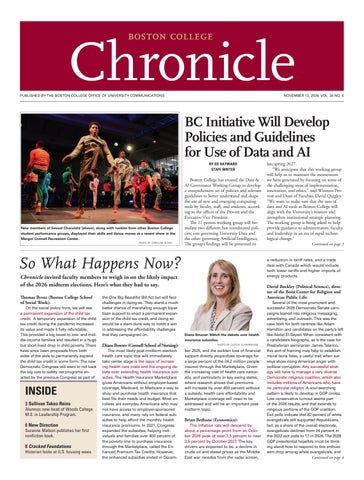
New members of Sexual Chocolate (above), along with rookies from other Boston College student performance groups, displayed their skills and dance moves at a recent show in the Margot Connell Recreation Center. photo by caroline alden
Boston College has created the Data & AI Governance Working Group to develop a comprehensive set of policies and relevant guidelines to better understand and shape the use of new and emerging computing tools by faculty, staff, and students, according to the offices of the Provost and the Executive Vice President. The 11-person working group will formulate two different but coordinated policies, one governing University Data and the other governing Artificial Intelligence. The group’s findings will be presented in
So What Happens Now? On the social policy front, we will see a permanent expansion of the child tax credit. A temporary expansion of the child tax credit during the pandemic increased its value and made it fully refundable. This provided a big boost to low- and middle-income families and resulted in a huge but short-lived drop in child poverty. There have since been proposals from both sides of the aisle to permanently expand the child tax credit in some form. The new Democratic Congress will want to roll back the big cuts to safety net programs enacted by the previous Congress as part of
INSIDE 3 Sullivan Takes Reins
Alumnus new head of Woods College M.S. in Leadership Program.
6 New Direction
Suzanne Matson publishes her first nonfiction book.
8 Cracked Foundations
Historian looks at U.S. housing woes.
the One Big Beautiful Bill Act but will face challenges in doing so. They stand a much better chance of marshaling enough bipartisan support to enact a permanent expansion of the child tax credit, and doing so would be a slam-dunk way to notch a win in addressing the affordability challenges that they campaigned on.
Diana Bowser (Connell School of Nursing):
The most likely post-midterm election health care topic that will immediately take center stage is the issue of increasing health care costs and the ongoing debate over extending health insurance subsidies. The Health Insurance Marketplace gives Americans without employer-based coverage, Medicaid, or Medicare a way to shop and purchase health insurance that best fits their needs and budget. Most enrollees are everyday Americans who may not have access to employer-sponsored insurance, and many rely on federal subsidies to help afford the monthly health insurance premiums. In 2021, Congress expanded the subsidies, helping individuals and families over 400 percent of the poverty line to purchase insurance through the Marketplace, called the Enhanced Premium Tax Credits. However, the enhanced subsidies ended in Decem-
Continued on page 3
a reduction in tariff rates, and a trade deal with Canada which would include both lower tariffs and higher imports of energy products.
Chronicle invited faculty members to weigh in on the likely impact of the 2026 midterm elections. Here’s what they had to say. Thomas Byrne (Boston College School of Social Work):
late spring 2027. “We anticipate that this working group will help us to maintain the momentum we have generated by focusing on some of the challenging areas of implementation, innovation, and ethics,” said Winston Provost and Dean of Faculties David Quigley. “We want to make sure that the uses of data and AI tools at Boston College will align with the University’s mission and strengthen institutional strategic planning. The working group is being asked to help provide guidance to administrators, faculty, and leadership in an era of rapid technological change.”
David Buckley (Political Science), director of the Boisi Center for Religion and American Public Life:
Diana Bowser: Watch the debate over health insurance subsidies. photo by caitlin cunningham
ber 2025, and the sudden loss of financial support directly jeopardizes coverage for a large percent of the 24.2 million people insured through the Marketplace. Given the increasing cost of health care nationally, and particularly in key swing states, where research shows that premiums will increase by over 400 percent without a subsidy, health care affordability and Marketplace coverage will need to be addressed and will be an important postmidterm topic.
Brian Bethune (Economics):
The inflation rate will descend by about a percentage point from an October 2026 peak of near 3.5 percent to near 2.5 percent by October 2027. The key drivers are expected to be: a decline in crude oil and diesel prices as the Middle East war recedes from the radar screen,
Several of the most prominent and successful 2026 Democratic Senate campaigns leaned into religious messaging, advertising, and outreach. This was the case both for both centrists like Adam Hamilton and candidates on the party’s left like Abdul El-Sayed. When consistent with a candidate’s biography, as is the case for Presbyterian seminarian James Talarico, this sort of framing may help to establish moral bona fides, a useful trait when surveys show rising American anger with political corruption. Any successful strategy will have to manage a very diverse Democratic religious coalition, which also includes millions of Americans who have no particular religion. A soul-searching pattern is likely to develop in GOP circles. Low conservative turnout seems part of the 2026 results, and that extends to religious portions of the GOP coalition. Exit polls indicate that 82 percent of white evangelicals still supported Republicans, but, as a share of the overall electorate, evangelicals declined from 24 percent in the 2022 exit polls to 17 in 2026. The 2028 GOP presidential hopefuls must be thinking about how to respond to this enthusiasm drop among white evangelicals, and
Continued on page 4
2
Chronicle
November 12, 2026
Around Campus
Boston College Police Bids a Fond Farewell to Four Longtime Colleagues Four recent retirees from the Boston College Police Department were celebrated this fall by their colleagues for their 127 years of combined service: Sgt. Joseph Desmond, 32 years; Officer John Ellis, 35 years; Officer Santos Perez, 28 years; and Officer Howard Lau, 32 years. “Boston College’s motto is ‘Ever to Excel’ and these officers did just that,” said BC Police Association President Michael Callahan. “They excelled at other agencies and they excelled here. They leave behind great accomplishments and great records.” Desmond spent six years with the Newton Police Department before joining BCPD, which is fully accredited by the Massachusetts Police Accreditation Commission. “With police work, every day is different,” said Desmond. “Every call is different. Sometimes it’s something routine, and sometimes it’s something serious like a medical call. But you are helping people out. “It’s a small department and they have hired quality people—the command staff, patrol officers, security officers—they are all great people to work with,” Desmond added. Ellis, who earned bachelor’s and master’s degrees from BC, particularly enjoyed his executive security assignments for visiting
(L-R) John Ellis, Howard Lau, Santos Perez, and Joseph Desmond together amassed 127 years of service for the Boston College Police Department. photo by annika engelbrecht
dignitaries. “The best thing about the job was the people,” said Ellis, who served as a patrol officer and spent 14 years as a detective. “The people that worked there. The students. I used to consider Boston College a city within a city. Everybody got along and it was such a fun place to work.”
Perez served 22 years in the United States Air Force, working for the branch’s security forces. After the military, he worked for the police department at Brandeis University before joining BC. “The best part was the community policing aspect of the job,” said Perez. “You are helping people and doing the right
CSON’s Lee Honored by American Heart Association Cardiovascular nurse scientist Christopher S. Lee, the Barry Family/Goldman Sachs Endowed Professor at the Connell School of Nursing, has been honored with the Katharine A. Lembright Award and Lecture by the American Heart Association (AHA) Council on Cardiovascular and Stroke Nursing. Lee received the award at the AHA’s Scientific Sessions, held November 6-9 in Chicago, where he delivered the Katharine A. Lembright Lecture, a presentation titled “The Heart is a Lonely Hunter: A Cardiovascular Nursing Odyssey” that looked back on his research and mentoring career. The Lembright Award and Lecture recognizes and encourages excellence in cardiovascular research by established nurse scientists. The award’s namesake was the AHA’s assistant director for nursing from 1960-1981 and played an important role in the development and growth of the Council on Cardiovascular and Stroke Nursing. Lee’s research is on heart disease, focusing on improving long-term outcomes for ASSOCIATE VICE PRESIDENT FOR UNIVERSITY COMMUNICATIONS
Jack Dunn
SENIOR DIRECTOR FOR UNIVERSITY COMMUNICATIONS
Patricia Delaney EDITOR
Sean Smith
Christopher Lee photo by matthew healey
patients and their families. He is an expert in heart failure self-care and symptom science, and patient and care-partner dyadic relationships in chronic conditions. His research has
CONTRIBUTING STAFF
been funded by the National Institutes of Health, the Office of Research on Women’s Health, and the AHA. He also directs CSON’s doctoral program. Considered a lifetime achievement award, the Lembright is the highest AHA honor given to a nurse scientist. Over the course of his career, Lee has been recognized by the AHA with the Kathleen A. Dracup Award for Exemplary Early Career Mentoring (2024); Mathy Mezey Excellence in Aging Award (2020); Atherosclerosis/Heart Failure Translational Research Prize (2015); Marie Cowan Promising New Investigator Award (2013); and Martha Hill New Investigator Award (2009). A member of the Sigma Theta Tau International Nurse Researcher Hall of Fame, Lee has published more than 300 papers and his work has been cited more than 30,000 times. He is a Fellow of the Heart Failure Society of America, the American Academy of Nursing, and the AHA. —Kathleen Sullivan
Phil Gloudemans Ed Hayward Audrey Loyack Rosanne Pellegrini Kathleen Sullivan
Chronicle
PHOTOGRAPHERS
www.bc.edu/bcnews chronicle@bc.edu
Caitlin Cunningham Matthew Healey
thing for safety. Community policing is not about arresting everybody for everything. People on campus are young, they have a lot to learn and a lot to experience. You have to show a little understanding.” Perez helped to create the University Police Coalition, working with representatives of police departments at Harvard University, Boston University, the Massachusetts Institute of Technology, Northeastern University, and Tufts University. The organization has been active at the Massachusetts State House in seeking reforms for institutional departments to ensure they and their officers are accorded the same treatment as municipal departments, the Massachusetts State Police, and the Transit Police of the Massachusetts Bay Transit Authority. “We go through the same academy, the same training, but we are not recognized the same way,” said Perez, who plans to continue advocating on behalf of the coalition. “We’ve been working on this for 10 years and we’re finally getting some movement.” Lau came to BCPD after nine years with Newton police. He worked the night shift for nearly two decades and was part of the department’s motorcycle unit. “It was great to meet the students,” said Lau. “A lot of them come back after graduation and they remember you when they come back for a game or a reunion. The students were quite amazing and they were great kids too.” He counts his three children among them. “I was so proud to have all three of our children graduate from Boston College,” Lau said. —Ed Hayward
Due to the Thanksgiving break, Boston College Chronicle will publish its final edition of the fall semester on December 3. For news and updates, go to bc.edu/news.
The Boston College Chronicle (USPS 009491), the internal newspaper for faculty and staff, is published biweekly from September to May by Boston College, with editorial offices at the Office of University Communications, 3 Lake Street, Brighton, MA 02135 (617)552-3350. Distributed free to faculty and staff offices and other locations on campus. Periodicals postage paid at Boston, MA and additional mailing offices. POSTMASTER: send address changes to The Boston College Chronicle, Office of University Communications, 3 Lake Street, Brighton, MA 02135. A flipbook edition of Chronicle is available via e-mail. Send requests to chronicle@bc.edu.
3
Chronicle
November 12, 2026
Alumnus Is New Head of Woods’ Leadership Program BY PATRICIA DELANEY SENIOR DIRECTOR FOR UNIVERSITY COMMUNICATIONS
The Master of Science in Leadership (M.S.L.) program at the Woods College of Advancing Studies welcomed a new director this fall: Boston College alumnus Robert F. Sullivan, who brings to the position more than two decades of experience in government, public service, and business, most recently as a three-term mayor of the City of Brockton, Mass. In his new role, Sullivan, who holds both bachelor’s and master of business administration degrees (1992 and 2001, respectively) from Boston College as well as a juris doctorate from New England Law School, leads a comprehensive graduate degree program that prepares professionals to become adaptable leaders skilled in strategic thinking, collaborative problemsolving, and the guiding of organizational change. The BC M.S.L. is also grounded in Ignatian principles, designed to educate leaders who are committed to creating just and purposeful organizations. “Bob Sullivan brings to this position a powerful combination of real-world experience and a deep commitment to serving others,” said Tristen Amador, senior associate dean for faculty and academic affairs at the Woods College. “He has already begun shaping our programs with insights gained from his years in leadership roles. We’re excited to have him at Woods College and as part of the broader Boston College community.” “I am thrilled to have the opportunity to be back on campus working with such a tremendous team of dedicated professionals, who possess a shared vision of educational excellence,” said Sullivan. “My father taught at the Woods College
Robert F. Sullivan ’92, M.B.A.’01 photo by matthew healey
for 19 years after he retired from teaching at Brockton High School, so I developed a strong admiration for the school’s mission and educational offerings. I am very excited about the future of the M.S.L. and look forward to collaborating on how best to reimagine, reshape, and repurpose the program to enhance the learning experience for our students.” In today’s world, Sullivan said, effective leaders must be able to think outside the box and handle situations in a timely and productive manner. “A real benefit to our M.S.L. students is that their faculty members are experts in various professional roles of leadership, so our students can learn how leaders from different sectors react to and address current real-life situations and scenarios.” Sullivan also singled out the program’s
focus on Ignatian principles as a key distinction, noting how much he valued his own experience with Jesuit education as an undergraduate and graduate student at BC. “The M.S.L. stresses the values of ‘cura personalis’ and ‘men and women for and with others,’” he said. “To me, this means that leaders at any level must work to best serve society, while also continuing to grow personally on a daily basis.” He credits his experience as an elected official and working in both the legal and business sectors with showing him that an effective leader “must be a good listener and understand that the essence of leadership is based upon the proposition of helping people and collaborating with others to achieve the best results for the situation at hand.” Born and raised in Brockton, Sullivan served his home city for more than 20 years in various roles, including 14 years on the Brockton City Council as a councilor-at-large, during which time he was elected by his colleagues to serve as council president five times. In 2019, he was elected Brockton’s 50th mayor, and, just six weeks after being sworn into office in January 2020, faced the challenges of the COVID-19 pandemic. He was reelected in 2021, and again, overwhelmingly, in 2023, before announcing in 2025 that he would not seek a fourth term. During his tenure, Brockton underwent a reimagining and revitalization of its downtown area, focused on longterm sustainability investment and economic growth, including the creation of a new, unified public safety building, new housing, and other advancements. In 2024, he was honored by the Massachusetts Housing and Shelter Alliance
for his advocacy on behalf of the homeless; the following year, he was recognized as “Visionary Leader of the Year” by the Northeast Renewable Energy Coalition for his efforts toward energy efficiency. Prior to his tenure as mayor, Sullivan held positions as legal counsel to the Massachusetts House of Representatives, and a government affairs specialist at Comcast. He currently serves as a volunteer board member for the John F. Kennedy Hyannis Museum, Scouting America-Old Colony Council, and the Lou Montgomery Foundation. He also was a member of the boards of the Good Samaritan Medical Center, the St. Joseph Manor Nursing Home, and the Brockton Historical Society, and a volunteer youth soccer, baseball, and basketball coach in Brockton. Sullivan hails from a “BC family”: His siblings Kara ’88, Suzanne ’89, and Ryan ’97 are alumni, while his father, Robert Sullivan M.A. ’95, was an adjunct faculty member at the Woods College from 2001-2020. He and his wife, Maria (Luizzi) Sullivan, also from Brockton, have three children—Tommy, Grace, and Will. They often support BC as a family, including attending the annual Pops on the Heights: Barbara and Jim Cleary Scholarship Gala, sporting events, and theater performances. On a personal level, Sullivan has relished settling into his new role. “The staff, faculty, and students at the Woods College are amazing, and others at BC have been so kind to me. In my professional career, I have never experienced such a sense of teamwork and such an atmosphere of care and collaboration.” For more information, go to bc.edu/content/bc-web/sites/lp/wcas/msl-search.html?
Working Group Will Devise Policies on Data and AI Governance Continued from page 1
Members of the working group include: Facilities Director of Planning & Information Systems Lynn Berkley, Associate General Counsel Stephanie Charles, Associate University Librarian Margaret Cohen, Center for Digital Innovation in Learning Director John FitzGibbon, ITS Technology Director Michael Gallagher, Professor of the Practice and Director of the Executive Doctorate in Higher Education Chris Glass, Associate Vice President of Finance and University Controller Lyndsay King, Executive Director of Student Services Jen Mack, Peter F. Drucker Chair and Professor of Business Analytics Sam Ransbotham, Associate Dean for the Core Curriculum Elizabeth Shlala, and Director of Research Protections Erin Sibley. The working group will be supported by the Offices of the Executive Vice President (Carrie Klemovitch), Provost and Dean of Faculties (Joe Carroll and Billy Soo), Information Technology Services (Scott Cann), and Institutional Research and Planning (Mara Hermano). According to its initial assignment, the
working group starts from the new reality that AI models and tools must have “secure, accurate, well-defined, and properly classified institutional data.” Data governance places a premium on security, with specific attention on areas that include data domains, ownership and stewardship, access protocols, and privacy compliance. Additional aspects include ensuring data quality and reliability remain intact across complex data sources. AI governance will focus on the use of AI, privacy, protecting intellectual property, vendor evaluation, and broader University standards for risk tolerance and financial management. Furthermore, the working group will develop a set of core values surrounding AI usage at BC that anchor use of the technology in alignment with the University’s “core Jesuit, Catholic identity and mission,” the charge states. “BC wants to ensure that these powerful, new technological tools uphold and foster the intellectual rigor of the BC experience, include protections for human deci-
“Boston College wants to ensure that these powerful, new technological tools uphold and foster the intellectual rigor of the BC experience, include protections for human decisionmaking and the dignity of work, and serve the common good.” —Executive Vice President Michael Lochhead sion-making and the dignity of work, and serve the common good,” said Executive Vice President Michael Lochhead. “It is crucially important that the BC leadership helps guide and support the deployment of AI across campus in a responsible and ethical manner, in keeping with our mission as a Jesuit, Catholic university.” Among the principles guiding policy development, the committee was advised to work from the perspective that the AI ecosystem on campus is a cooperative venture that must be considered in its entirety. “Institutional data and AI infrastructure are shared resources held in common
stewardship across the university,” the committee charge notes, “rather than owned exclusively by individual units or single departments.” Additional issues identified for the policy group include plans to supplement the current “hub” for AI resources [bc.edu/ content/bc-web/offices/its/services/artificial-intelligence.html] and guidance across the University, training and competency building among faculty and staff, and the establishment of a Data Portal that would serve as a primary starting point for the use of BC’s data assets.
4
Chronicle
November 12, 2026
Midterms Over, Faculty Offer Views on What’s Next Continued from page 1
how that response relates to the future of the MAGA movement.
Rocío Calvo (Boston College School of Social Work):
One prediction is that the new Congress will support the Protect American Values Act. The bill seeks to block federal funding for implementing the new Public Charge regulations, which give immigration officials broad discretion to deny green cards to immigrants who use essential services such as food stamps, housing assistance, or health care. These regulations are bound to create a chilling effect that will drive millions of eligible mixed-status families away from programs that have proven very effective in preventing poverty and adverse health outcomes and in promoting the well-being of all Americans. In a letter announcing his candidacy for Speaker of the House, Democratic leader Hakeem Jeffries urged fellow members of Congress to repair the damage caused by the current administration’s cuts to health care and food assistance and to restore our American values of justice for all and our immigrant heritage. I think Congress will back the Protect American Values Act because it aligns very well with Democrats’ agenda of keeping families from falling further into poverty and restoring American principles.
Michael Hartney (Political Science):
Starting in 2027, the Federal Scholarship Tax Credit (FSTC), a new federal school choice program enacted as part of President Trump’s One Big Beautiful Bill Act, takes effect. The program offers taxpayers a $1,700 credit for donations to Scholarship Granting Organizations (SGOs), which fund scholarships for private K–12 schooling. Importantly, governors must agree to participate and allow SGOs to be set up in their state. So far, most Republican governors have signed on, but only a handful of Democratic governors have. I predict more Democrats will sign on because of the economic incentives. Taxpayers can donate to SGOs outside their home states, meaning federal dollars could flow to support students elsewhere while
students in a governor’s own state receive nothing. Still, there will be plenty of political maneuvering. Democratic governors eyeing presidential runs in 2028 may be especially reluctant to cross teachers unions, which have signaled they will make this a litmus test.
Robert Murphy (Economics)
Rocío Calvo: Congressional support for the Protect American Values Act.
Daniel Kanstroom (BC Law School):
I predict substantial congressional oversight of interior immigration enforcement. The main reason for this is that—according to voter polls—immigration was a major issue for voters, behind the economy and democracy, but ahead of health care, foreign policy, and crime. Among the main concerns were the cruelty, capriciousness, and chaos of CBP and ICE actions. Many voters, especially Latino voters, supported candidate Trump’s promises of greater border control and targeted deportations of “the worst of the worst.” They have been deeply troubled by violent, poorly supervised actions by masked agents, such as the tragic killing of American citizens. Polls have also consistently shown revulsion over racially discriminatory, violent arrests of workers and long-term residents, separation of children from parents, and deportations to countries in which people have no connections and where they face imprisonment, corruption, and torture. Although enforcement budgets are largely set for the time being, there will undoubtedly be robust Senate and House investigations into allegations of agency abuses of power, detention conditions, enforcement practices, and corruption. There will also be legislative actions to compel greater oversight of ICE and CBP and to limit enforcement tactics, although such legislation will likely face threats of presidential veto.
Raquel Muñiz (Lynch School of Education and Human Development):
Daniel Kanstroom: Expect closer oversight of immigration enforcement. photos by caitlin cunningham and matthew healey
ruption or mismanagement, and a push for policy initiatives that are responsive to people’s economic and cost-of-living concerns. We will also see lots of interest groups trying to advocate for particular policy changes, e.g., in education, groups seeking to restore federal funding research dollars or immigrants’ rights groups seeking immigration reform. All to say, lots of debate, changes, and engagement, and this is what democracy is all about. A new era is dawning in American democracy, and we each get to shape its direction through our respective work and civic engagement.
If politics has taught us anything this past decade, it’s that things can quickly take an unexpected turn and shatter predictions. So, I make my claims cautiously. In the next 12 months, I expect to see tension between holding political and policy actors accountable for cor-
After pausing before the election, the Federal Reserve will again raise interest rates, one to two times during the next year, tightening monetary policy with the goal of pushing price inflation lower. The election results arguably have increased the probability of a diplomatic settlement to the Iran conflict. If this leads to a normalization of oil transport through the Strait of Hormuz, the pull-back in energy prices will support lower inflation. To the extent this does not occur and the conflict continues or worsens, I would expect the Federal Reserve to tighten policy even more during 2027. Much also depends on the pace of job growth, which has slowed recently but remains consistent with a steady pace of economic growth. Should the labor market falter and unemployment rise significantly, this may force the Fed to slow its pace of tightening. The Fed clearly is concerned about the persistence of inflation and wants to see it lowered, but economic and geopolitical developments will influence the pace at which it proceeds.
Elizabeth Prodromou (International Studies):
The results of this election will make for some hard work and, hopefully, re-
Robert Murphy: Look for the Fed to raise interest rates at least once.
newed unity in the country over the next two years. Voters across partisan lines are greatly concerned about affordability and the high cost of living, from food prices to gas prices to housing to health care, as well as America’s latest “forever war.” But beyond these shared concerns, priorities like the climate crisis, crime, social stability, education, and immigration are points of divergence. Congress is going to have to prove to the American electorate that they can govern. This will mean bipartisan support for ending the war in Iran and its negative cascading effects; action on must-pass bills on affordability issues, government funding packages, and dealing with the colossal national debt; and repairing the reputational and functional damage to America’s role in the world. In short, the coming two years are about the political will to do the hard work of good governance—all while both parties reflect on how to move back to their respective ideological centers. It’s difficult to predict the appetite for good work and good will and for the White House response. What’s certain is that the next two years will signal the longer-term future.
Former Clough School of Theology and Ministry student Sister Nathalie Becquart, X.M.C.J. (fourth from right), undersecretary of the General Secretariat of the Synod, spent the first week of November in residency at CSTM engaging with students, faculty, and staff on the role of women in a global, synodal Church. She attended classes, met with faculty and students, and joined the CSTM community for meals, liturgies, and conversation. She also offered remarks at the school’s annual Women in Theology and Ministry Lecture. photo by emily mayernik
5
Chronicle
November 12, 2026
Theology Adds Three New Interdisciplinary Minors “Many of our students are passionate about multiple disciplines and long for ways to deepen their familiarity with them as well as enrich their interactions,” says Theology Chair Andrea Vicini, S.J.
BY KATHLEEN SULLIVAN STAFF WRITER
The Theology Department has launched three new minors—offered in collaboration with other departments and programs in the Morrissey College of Arts and Sciences and the Carroll School of Management—that explore the theological connections in such topics as the economy, the environment, and arts, literature, and music. “Giving students the opportunity to integrate diverse fields with the study of theology is an essential task in our increasingly fragmented world,” said Associate Professor of the Practice of Theology Matthew Kruger, director of undergraduate studies in the Theology Department. “Bringing economics, the environment, and the arts into direct conversation with theological understandings helps students to develop a complex picture of the problems of our world and the potential benefits that reflection on the whole person can bring. Our hope is that students will benefit from learning the distinct methods of different disciplines and bringing them together in a capstone course, which, in turn, will form them to bring to the world their theologically inspired perspectives.” The Theology and Economy minor, offered with the Carroll School and the Morrissey College Economics Department, calls students to an interdisciplinary engagement with God, self, and society through the fields of theology, economics, and business. The minor will encourage students to explore the overlap and make connections between these academic approaches to the world and to provide the means for them to consider these domains in a unified way. Professor of the Practice in Theology Meghan Sweeney, former director of the PULSE Service Learning program, directs the minor. Can Erbil, a professor of the practice in Economics, serves as co-director.
photo by caitlin cunningham
The Theology and Environment minor, in partnership with the Earth and Environmental Sciences Department and the Environmental Studies Program, is directed by Assistant Professor of Theology Megan Loumagne Ulishney and co-directed by David Kurz, an assistant professor of the practice in Environmental Studies. “Pope Francis’ encyclical Laudato Si’ brought the environment into the center of Catholic reflection on the moral life. This document emphasized the importance of spiritual conversion for ecological change, and it highlighted the need for interdisciplinary conversation to address climate change that includes theological reflection,” said Ulishney. “Our vision for this new minor is for students to have opportunities to expand their disciplinary toolkits to approach the complexity of climate change with holistic depth. “Ultimately, we hope that this minor will play a role in sending BC students out into the world equipped both with sophisticated abilities to think well about climate change and hearts motivated to protect our common home and all creatures that live within it.” The Theology, Arts, Literature, and Mu-
to identify realistic pathBC Researchers Study eswaystogether—and for mitigation,” said Professor of Earth and Environmental Sciences Hanqin Climate Costs of Tian, lead author of the report and direcRice Cultivation tor of the Center for Earth System Science BY ED HAYWARD STAFF WRITER
Rice paddy greenhouse gas emissions have doubled during the past 60 years, but practical farm changes could cut methane emission and support global climate targets without reducing food production, a team led by Boston College scientists reported in the journal Nature Food. Rice feeds more than half the world’s population but has a growing climate footprint. Flooded paddies emit methane and nitrous oxide, two powerful greenhouse gases. As rice farming intensifies worldwide, understanding its methane footprint—and how to reduce it without threatening food security—has become a global priority. “Our goal was to understand the full climate impact of rice systems—not just methane, but all major greenhouse gas-
and Global Sustainability at the Schiller Institute for Integrated Science and Society. Since the 1960s, greenhouse gas emissions from rice paddies have doubled to approximately the equivalent of 1.1 billion tons of carbon dioxide annually, the researchers reported. Methane is a major contributor, particularly in regions such as East Asia, while Africa is emerging as a new hotspot due to expanding rice cultivation, according to the study. Methane is especially important because it drives near-term warming, making it a central focus of global climate efforts such as the Global Methane Pledge, which aims to cut methane emissions by at least 30 percent this decade, said Tian, who directs the Global Carbon Project’s Boston Office. This study provides the most comprehensive global assessment of rice-related greenhouse gas emissions to date, covering methane, nitrous oxide, and soil carbon
sic minor is being offered with the Art, Art History, and Film, English, and Music departments. This minor is intended to foster an appreciation for the intersection of these disciplines, which express human creativity and beauty and contribute to a person’s spiritual well-being and to societal flourishing. “Because theology concerns the meeting of ultimate reality with the human, the arts, literature, and music have always accompanied and integrally aided the theological quest, for human persons and communities continually make sense of their encounters with transcendence through these media,” said Assistant Professor of the Practice in Theology Roberto De La Noval, director of the minor. “Students who pursue coursework in this new theology minor will find their theological studies enriched as they learn how the arts have carried theology deeper into the mystery it seeks and how theology in turn has birthed some of history’s greatest art.” Art, Art History, and Film Department Chair and Associate Professor Aurelia Campbell serves as co-director of the Theology, Arts, Literature, and Music minor. These new minors are the latest in a series of academic enhancements the Theology Department has developed in recent years. Under the leadership of Theology Chair Andrea Vicini, S.J., seven new minors and an expanded theology major have been added to the department’s offerings since 2024. “Many of our students are passionate about multiple disciplines and long for ways to deepen their familiarity with them as well as enrich their interactions,” said Fr. Vicini, changes from 1961 to 2020, Tian said. Annual global rice cultivation ranged from 397.4 million acres in 2015 to 426 million acres in 2024. In Africa, rice cultivation acreage increased seven-fold between 1961 and 2024, to 40 million acres. The researchers combined machine learning trained on Hanqin Tian more than 21,000 photo by matthew healey field observations, a process-based ecosystem model, and a global meta-analysis. By integrating these approaches, Tian said, the team quantified total emissions, identified key drivers such as land expansion and residue management, and evaluated how future mitigation strategies could contribute to climate targets—including methane reduction goals under international initiatives. Tian said the team wanted to quantify the role rice paddy cultivation plays in global greenhouse gas emissions—especially methane—and the factors driv-
the Michael P. Walsh, S.J., Professor of Bioethics. “In each one of these minors, by relying on its long tradition and its engagement with contemporary issues and challenges, theology strives to be an integrative discipline that fosters these multiple interests and provides the context to articulate interdisciplinary and intersectional syntheses. As a department, together with the other colleagues involved in these minors, we enjoy these new opportunities for collaboration that embody the richness of the formative experience of the liberal arts.” Fr. Vicini expressed gratitude to Campbell and English Department Chair and Professor Min Hyoung Song, Economics Department Chair and Professor Robert Murphy, Environmental Studies Program Director and Professor of the Practice Tara Pisani-Gareau, Music Department Chair and Professor of Theatre Crystal Tiala, and Ethan Sullivan, senior associate dean for the undergraduate program in the Carroll School for their collaboration on this year’s new minors. Fr. Vicini added that the department has launched Bring to Light, a series of one-credit electives that provide students with the opportunity to become familiar with culturally significant texts, authors, and ideas without having to fit a full course into their schedule. The courses will include reading from classic works and engaging in important topics—from Christian contemplative practices to concepts like the Trinity. “Bring to Light courses will contribute to the scholarly life of the Boston College community and provide an introduction to seminal texts and ideas,” said Fr. Vicini. The first Bring to Light course, The Brothers Karamazov and Theology, has enrolled 14 undergraduates this semester. For details on the new Theology minors or the Bring to Light courses, see the undergraduate section of the Theology Department website [bc.edu/theology]
ing their rapid increase. Just as crucial was understanding how emissions can be reduced through realistic changes in farming practices, and the potential for reductions to contribute to climate goals set by entities such as the Global Methane Pledge, which counts 159 participating countries. Despite rising emissions, the study highlights a clear opportunity: Improved farm management could reduce emissions by about 10 percent without compromising yields. Key strategies include optimizing water management to reduce methane formation, reducing excessive residue return to soils, and improving nitrogen fertilizer efficiency. “These are practical, scalable solutions that farmers can adopt today,” said study co-author Associate Professor of Engineering Susan Pan, research director at the Center for Earth System Science and Global Sustainability. “They offer a meaningful pathway for agriculture to contribute to near-term climate targets, including methane reduction goals.” Read the full article at https://bit.ly/BostonCollege-research-rice-cultivation-climate
6
Chronicle
Matson Publishes First Work of Nonfiction, New Volume of Poetry BY ROSANNE PELLEGRINI STAFF WRITER
The decluttering phenomenon in the United States, a widespread cultural counter-response to rampant consumerism, has evolved into a lucrative organization industry, a viral social media trend, and a popular mental wellness movement focused on discarding excess possessions to reduce stress and live more purposefully. Decluttering has been analyzed, critiqued, and popularized through seminal, best-selling books. Now, Professor of English and prolific author Suzanne Matson—who will launch a new book of poetry next week [see separate story]—has added a new narrative perspective to the literary canon with her first nonfiction book, Winnowing. It is not a “how-to,” as she makes clear, but a personal, reflective account of her process sorting through a lifetime of possessions. On her website, she describes Winnowing as “a book about how we desire, acquire, live with, manage, and get rid of our ‘stuff,’ and what that process does to our quality of life, our psyche, and the environment.” Winnowing examines our personal, cultural, and environmental relationship with material objects. Matson shares her experience tackling items accumulated over some three decades in the home where she and her husband raised their three nowadult sons. As she sorted through closets, cabinets, bureaus, the basement, and other storage sites, her intentional winnowing included donating, discarding, and recycling, as well as holding onto objects with particular significance. The title is apt, Matson explains early in the book: “The word ‘winnow’ means
Suzanne Matson photo by caitlin cunningham
air moving through grain to separate the heavier kernels from the lighter chaff. It is a sorting action to keep what nourishes while letting what is worthless blow away.” Rather than a celebration or condemnation of material goods, notes the book’s publisher (Duke University Press), “Winnowing is a meditation on the personal and universal struggles and rewards of separating the chaff from the grain.” Part of the publisher’s “Practices” series—on activities or pursuits which help us understand ourselves and the world— the book evolved after Matson downsized her mother’s possessions prior to a transition to assisted living, which she recounted in a 2019 Boston Globe Magazine essay. Upon discovering the “Practices” series, Matson said in a recent interview, “I loved the notion of writing about a practice that enlarged our understanding of both the self and the world. When I landed on the idea of writing about our charged relationship
Lynch School Dean Wortham Among the Presenters at Conference in Vatican City Stanton E.F. Wortham, the Charles F. Donovan, S.J., Dean of the Lynch School, was a presenter at the “Summit on Belonging and Social Relations in the Age of Fragility” at the Casina Pio IV in Vatican City, home of the Pontifical Academies of Sciences and Social Sciences. Held earlier this fall, the conference stemmed from Pope Leo XIV’s first encyclical, Magnifica Humanitas, issued last May, in which he declared “let us cultivate relationships.” Hosted by Cardinal Peter K.A. Turkson, chancellor of the Pontifical Academy of Social Sciences (PASS) and the Pontifical Academy of Sciences (PAS)—which advise the pontiff on global and societal issues— the convening examined relational theories of human flourishing through multiple disciplinary lenses and in relation to what Pope Leo XIV has characterized as the contemporary crisis of belonging. Wortham addressed “Formative Education, Eudemonia (human flourishing), and Catholic Social Doctrine” at a session titled
“Grounding in Catholic Social Teaching & Fratelli Tutti (‘all brothers’); Harmonizing; Spiritual Formation with Evidence-based Practices to Shape a Culture of Encounter and Solidarity.” Carola Suárez-Orozco, a senior fellow at the Lynch School, also spoke at the conference, presenting “Multiple Exclusions: Threats to Belonging, Identity, and Development for Immigrant Children” during a session titled “Belonging and its Antonyms.” “It was thrilling to participate in the recent Pontifical Academy of Social Sciences conference on belonging in the heart of the Vatican,” said Wortham. “My colleague Carola and I described how formative education as practiced at BC is particularly valuable for overcoming contemporary social and technological challenges to deep human relationships.” Co-chair of the event was filmmaker and actress Jennifer Siebel Newsom, wife of California Governor Gavin Newsom. —Phil Gloudemans
November 12, 2026
The 41 poems in Professor of English Suzanne Matson’s new poetry volume As Creatures—her third—move across many years of time and memory, charting travels and life transitions from becoming a mother to burying a mother. Her poems chronicle seismic shifts of loss, as well as the beauties and gifts of everyday life, according to the volume’s description. The natural world serves as an ever-present backdrop, reminding us of our interdependencies and vulnerabilities “as creatures.” Matson will launch and read from As Creatures on November 16 at 5:30 p.m. in Burns Library; copies will be available for sale and signing. The event, sponsored by BC Libraries in collaboration with the English Department, is free and open to the public. “To launch this collection in the warm space of the Burns will feel like I am bringing it into the world among family,” said Matson. “I’m grateful for that opportunity.” Among those praising As Creatures is Laura Kasischke, author of I Was Bonnie and Clyde: “These poems move with lucid precision through childhood, marriage, illness, and the long vigil at the end of it all.
This is a collection of quiet astonishments, where what we cannot keep becomes, in language, what we most fully hold.” Kelli Russell Agodon (Accidental Devotions) describes As Creatures as “deeply affecting” and lauds Matson for writing “straight into our humanness, our tenderness, and that terrifying space of loving something so much you can already feel its absence. It is a book about love, but also about our complicated journeys as humans and the deep, instinctual need to protect and care for our loved ones.” Matson is also the author of four novels and a new nonfiction book, Winnowing, also released this month [see separate story]. Her work has garnered reviews in a range of newspapers, magazines, and literary journals. Her poems have appeared in American Poetry Review, Poetry, Indiana Review, Washington Square, Harvard Review, New England Review, and elsewhere. In addition to the BC event is a virtual launch by publisher Cloudbank Books, which selected the volume for publication as winner of its Editor’s Choice award. For more, see her author’s website, www. suzannematson.com. —Rosanne Pellegrini
to material objects—desiring them, dealing with their accumulation, and discerning how and when to part with them—it struck me as a good fit with this nonfiction series that was meant to be both personal and public.” Matson wrote the book as a series of reflective chapters on the complexities of ownership, “using stories about activating this in my own life,” and intersperses her 15-day Winnowing Log. “It was never meant to be a ‘how-to,’” she explained. In addition to her meditations on simplicity and letting go, she incorporates the writings of philosophers and teachings in Buddhism and Christianity to underscore the impermanence of possessions and examines the environmental cost of mass production and disposal. Her book dedication—“For my family, in all its generations”—is fitting, as she writes of “the stream of objects left behind by three grown boys,” and the task she and her husband faced after the death of two sets of parents: “to empty two houses that had been filled with the belongings of those family lives.” Matson also writes of her attachment to inherited collections of mother’s mementos: “Her past comes alive for me in these tactile objects.” And though she has long parted with her mother’s well-used typewriter—now retained in her “mental museum of loved things”—she hung onto her dentures (for now). As for Matson’s personal artifacts, and those of her children, winnowing necessitates “a curatorial process of choosing what gets to stay,” Matson writes, as “we are all our own memory keepers, tending and sorting the richly imbued objects in our care.” She acknowledges her appreciation of and weakness for well-designed handbags and, in turn, the difficulty in negotiating our relationships to the material world. “There are things we need, things we want,
and things we are attached to because they are conduits to other places, people, and times through the associations they hold,” she explains in the book. “Each of these factors generates its own type of magnetic field around objects.” Matson’s thoughtful approach “began with the idea of lightness, of feeling freedom and enjoyment.” That goal, she writes, was the guiding light of her book as she set out to physically, mentally, and spiritually lighten her life while reflecting on the tethers that make winnowing so hard. “It’s not just about the aesthetic or spiritual satisfaction of unweighting,” Matson writes. “It’s about shifting a whole mindset away from getting and owning, as well as loosening my grasp on (at least some of ) the many possessions that speak to me through memory and attachment.” Matson hopes readers enjoy the stories and bits of memoir and find them useful corollaries to stages of their own lives—and that Winnowing feels more like a companion than a guide. “I am not suggesting that my own house is now winnowed.” she said. “From the beginning I recognized it as an ongoing process, a way of being in touch with my own stories, legacies, and priorities, and not a finite checklist of tasks to be accomplished. “I’ve come to peace with the idea that balancing the urge to acquire and divest is part of life’s long work,” she writes—and notes that she came to enjoy the process of paring down and lightening her family’s communal load. “If we’re ever really ‘done,’ then we’re no longer living our lives,” Matson said. “As I say in the introduction, I’d much rather be ‘in-process’ than ‘over.’ As soon as a closet or drawer is clear, new things arrive to refill it.” “I want some stuff around me,” she writes in the epilogue. “Life is a great journey, and I need to bring a bag.”
OBITUARIES
Rev. Joseph Marchese Rev. Joseph P. Marchese, a dedicated Boston College administrator and Theology Department instructor who built the University’s Office of First Year Experience (FYE) into a national leader in student orientation and formation, died on October 23. He was 83. A concelebrated Liturgy of Christian Burial photo by peter julian was held October 31 at St. Mary’s Church in Longmeadow, Mass. Under Fr. Marchese’s direction from 1995-2015, FYE assisted first-year students in their transition to collegiate life through integrated curricular and co-curricular programs and opportunities. Its programs include Summer Orientation, First Year Convocation, 48hours weekend retreats, Conversations in the First Year, and academic courses through Courage to Know and the Cornerstone Program.
Dorman Picklesimer Jr. Associate Professor Emeritus of Communication Dorman Picklesimer Jr., a onetime department chair who was the namesake for an annual Boston College award, died on October 10. He was 89. A funeral service for Dr. Picklesimer was held on October 27 in Belleville, Fla. A native of West Van Lear, Ky., and one of 12 children, Dr. Picklesimer was the first in his family to attend college, graduating from Morehead State College. He joined the BC faculty in 1969 in what was then the Speech, Communication, and Theatre Department, teaching courses in rhetoric and related subjects. He also was an organizer of the Leonard Persuasive Speaking Contest for undergraduates and was involved with the University’s venerable Fulton Debating Society, which chose him for its signature Fultonian of the Year honor in 2001. In 1987, Dr. Picklesimer served as moderator for a high-profile campus debate between former radical Abbie Hoffman and G. Gordon Liddy, a one-time FBI agent who later became embroiled in the Watergate scandal. Besides their clashing sociopolitical views, The Heights reported, there was a personal dynamic between the two: Hoffman claimed Liddy had planned to kidnap him and take him to Mexico so Hoffman wouldn’t be able to protest at the 1972 Republican Convention. “Debate is the hallmark of a democratic society,” said Dr. Picklesimer in his intro-
7
Chronicle
November 12, 2026
The initiative evolved under “Fr. Joe”— as he was known to students and others on campus—to help first-year students acclimate to the University and its distinctive educational and formational mission, while also instilling in them the foundational elements to lead a good life. “The goal of FYE has been to promote a culture of academic excellence, to instill in our students an intellectual precociousness, and to infuse incoming students and parents with a sense of our Jesuit, Catholic mission, which has a 500-year tradition in St. Ignatius,” said Fr. Marchese when he stepped down in 2015. He was engaged with undergraduates throughout his 35 years on campus: A 2010 article in The Heights reported students’ desire for a coveted invitation to join Fr. Marchese for lunch in the Faculty Dining Room, where he would offer wisdom and encouragement: “Do your very best, and don’t settle for mediocrity,” he gave as an example of advice to students. “Live your life with love and generosity.” Elizabeth (Biz) Bracher ’91, M.A.’95, Ph.D.’03, who worked closely with Fr. Marchese as FYE associate director for two decades and now directs Cornerstone and Capstone Seminar Programs in the Morrissey College of Arts and Sciences, duction, according to The Heights. Dr. Picklesimer also had a scholarly interest in what constituted propaganda, and how it might be used. In a 1986 column for the Boston College Biweekly, he noted criticism in some quarters about how popular films such as “Rambo” and “Rocky IV” were aggressively jingoistic for the Cold War era. Dr. Picklesimer then went on to discuss propaganda throughout the history of film (based on research he had undertaken supported by a Mellon Foundation Grant), including a comparison of how the American, British, Soviet, and Nazi Germany film industries supported their respective governments’ efforts at making patriotic appeals to the populace. Dr. Picklesimer, who was department chair from 1986-1989, was elected to the College of Arts and Sciences Faculty Senate in 1982 and later served as president. Dr. Picklesimer also was among the first participants in the Faculty Fellow Program, which was introduced during the 19861987 academic year to promote a more personal experience and environment for students by encouraging them to form mentor relationships through informal association with faculty, administrators, and staff. Upon his retirement in 2002, Boston College honored his legacy by establishing the Dorman Picklesimer Jr. Award, presented annually to exceptional communication majors. Dr. Picklesimer was predeceased by his wife, Claudette. He is survived by his son Gregory Picklesimer (husband of Carla); daughter Stephanie Picklesimer Loprete (wife of Lawrence); granddaughter Hannah Picklesimer; and great grandson Danny Picklesimer. —University Communications Read the full obituary at bit.ly/BostonCollege-obituary-Dorman-Picklesimer
described him as a visionary leader who left a lasting legacy as the architect of how Boston College helps students to transition to college and develop as men and women of competence and character. “Fr. Marchese was devoted to BC students and to his colleagues,” said Bracher. “He taught me how to gather insightful and creative minds and how to follow imagination with organization and action, always encouraging me to lean into my ‘good gifts,’ as he called them, always helping me to become a better version of myself. “Together, we shared nearly 20 years of orientation leaders, 48hours teams, and Courage to Know students and teaching assistants, so many of whom have been filling my inbox with heartfelt reflections on how important his mentoring has been to them, guiding each of them into creating a life well-lived.” A resident of Boston, Fr. Marchese was
Stephen Molvarec, S.J. A wake and vigil service for Stephen J. Molvarec, S.J., M.Div. ’22, S.T.L. ’23, an assistant professor of church history in the Clough School of Theology and Ministry, were held on November 4 at St. Mary’s Hall conference room, followed by a Mass of Chris- photo by caitlin cunningham tian Burial at St. Ignatius Loyola Church on November 5. Fr. Molvarec died on October 24 while visiting the Jesuit community at Le Moyne College in Syracuse, NY. He was 46. A native of Buffalo, he earned a bachelor’s degree in history from Canisius Col-
born in Springfield, Mass., to Anthony C. and Marsilia V. (Formica) Marchese. A 1961 graduate of Cathedral High School, he earned a bachelor’s degree in political science from Georgetown University in 1965, a degree in sacred theology from the Theological College at Catholic University of America, and a master’s degree in guidance and counseling from Catholic University. Fr. Marchese is survived by his sisters Teresa Sergentanis; Christine Allison and husband Robert; his brothers Anthony “Tony” and wife Monica, and Paul and wife Carolyn. He leaves nieces and nephews Michael Allan, Marissa Whitney, Mary Marchese, M.D., Sarah Marchese, and Peter Marchese, and many great nieces, nephews, and extended family. He was predeceased by his brother-in-law, Anthony Sergentanis. —University Communications Full obituary at bit.ly/Boston-Collegeobituary-Joseph-Marchese lege and master of arts and doctoral degrees in medieval history from the University of Notre Dame. He entered the Society of Jesus in 2012 and was ordained in 2022. Fr. Molvarec joined the Boston College faculty in July 2023 after serving as a visiting assistant professor at CSTM during 2022-2023. He taught history at Marquette University for three years prior to coming to BC. An expert on medieval Carthusian monks, he specialized in 12thand 13th-century religious life as well as the history of medieval cities. “We are shocked and saddened at the death of Steve Molvarec,” said Clough School Dean Michael C. McCarthy, S.J. “So many of his students have shared with me how kind, generous, and understanding he was as a teacher. All of us, including his colleagues, will miss him deeply.” CSTM hosted a prayer service for Fr. Molvarec on October 26, and the midday liturgy was offered for him at the Simboli Hall chapel. —University Communications
Jobs The following are among the recent positions posted by the Department of Human Resources. For more information on employment opportunities at Boston College, see www.bc.edu/jobs or scan the QR code at right. First Cook, Corcoran Commons Director, Dining Services Assistant Carpentry Supervisor Construction Building Envelope Manager Assistant Director, Financial Management Systems Associate Director, Career Advising & Programming
Associate Director, Church in the 21st Century Center Assistant Manager, Corcoran Commons Physical Security Technician
Research Associate, BC School of Social Work
Fire Safety Officer
Research Associate, Connell School of Nursing
Assistant/Associate Director, Leadership Giving
Assistant Director, Benefits
Teacher Assistant
Associate Director, Women’s Center
8
Chronicle
November 12, 2026
BC Research
‘Why Do These Systems Keep Breaking Down?’ Award-winning historian looks at what ails housing in the U.S. It’s not a simple matter. BY SEAN SMITH CHRONICLE EDITOR
As with any profession, earning an award of distinction from one’s peers is a coveted achievement in academia. In the space of just a few months this year, Associate Professor of History Michael Glass was selected for four prizes by a pair of organizations whose interest in research and scholarship in urban history mirrors his own. The Society for American City and Regional Planning History (SACRPH) and the Urban History Association bestowed honors on Glass’s 2025 book Cracked Foundations: Debt and Inequality in Suburban America and his co-authored article with Brent Cebul, “Mortgaging Out: FHA Credit Policy, Segregated Rental Housing, and the Remaking of Metropolitan America,” in the June 2025 Journal of American History. SACRPH selected the former for best book and the latter for best peer-reviewed article. The Urban History Association chose Glass and Cebul—an associate professor of history at the University of Pennsylvania—for best article published in a scholarly journal, while Glass received an honorable mention for best first book in urban history. “I feel very honored by this recognition,” said Glass, who joined Boston College in 2020. “Cracked Foundations started as my doctoral dissertation, and it took a long journey—about a decade—and many revisions in trying to turn it into a book. Teaming up with Brent on the article was
Assoc. Prof. Michael Glass (History) thinks it may be time “to decenter homeownership from our politics and our culture.” photo by matthew healey
another great experience. “What I’ve learned is that writing and research is a social dynamic; it really takes a group. My friends, my mentors from graduate school and afterwards, all have had a heavy hand in helping me articulate my ideas and revise them where appropriate. So, to know that others in my field see value in what I do is very heartening and encouraging.” Glass points to the 2008 financial crisis that crested within months of his college graduation as a defining event for his schol-
BC Scenes Spooky Stokes
photos by amanda simpson ’28
A haunted house wasn’t available, so Boston College’s Campus Activities Board hosted “The Haunted Lawn” at the Stokes amphitheater to celebrate Halloween. No members of the University community were harmed—as far as is known.
arly pursuits, which center on how financial systems generate inequality and shape everyday life, from housing and education to environmental risk. “I think a previous generation of historians looked at questions of racism, racial segregation, inequality, redlining, and related issues in terms of why and how some people were excluded from systems that seem to work so well in America, like homeownership,” he explained. “But having lived through the meltdown of the whole financial system, to me the question was no longer about why some people were left out, but why do these systems keep breaking down, to the point where something like what happened in 2008 occurs? “There were other scholars and researchers who wondered the same thing, and this essentially resulted in a new field called the history of capitalism. Rather than focusing just on economics, business, or labor, for example, the idea is to examine these and other facets of the system holistically and historically.” In Cracked Foundations, Glass delves into the post-World War II suburban boom, notably in Long Island, NY, long depicted as a shining example of upward mobility and economic security among Americans. In fact, he notes, there was no guarantee of decent housing and high-quality education for these suburbanites, who had to obtain them by purchasing home mortgages and municipal bonds. “This was a significant shift in American society, as home ownership became a reality for the middle class,” said Glass. “But it’s a fact that many of the new suburban developments were built haphazardly, because the emphasis was on getting them done as quickly as possible. There were congressional hearings in the 1950s where people who had bought these homes testified about serious defects like leaking roofs, cracked foundations, and insufficient drainage in the back yards.” The resulting debt created financial strains for many families, distributed resources unevenly across suburbs, and codified racial segregation, according to Glass. The debt transformed housing and education into commodities, turning homes and schools into engines of capital accumulation, and life became precarious—even for the suburbanites who resided in all-white communities. Meanwhile, he adds, the advent of suburbia created inequalities in housing, educational quality, school funding, and tax equity for people of color, who were largely shut out of these favored communities— and the inequity remains to this day. In “Mortgaging Out,” Glass and Cebul argue that the credit liberalization afforded by Congress during World War II as part of the United States’ defense housing program—later extended until 1950, along with builders’ practices of speculation and profiteering—helped deepen spatial inequalities and segregation in cities such as
Chicago, Cleveland, and New York City. Private builders obtained outsized mortgages for often shoddy projects on inexpensive land, which created a mismatch between the quality of housing and rent. Tenants were left with poor living conditions and burdensome mortgages while the builders (among them one Fred Trump) pocketed “windfall” profits. These federal policies’ effect on urban development patterns helped lead to the decline of multifamily rental housing, say the authors, which has persisted as an economic and social issue for decades. “There is a core contradiction in U.S. housing policy and the beliefs that Americans have about housing,” said Glass, whose research included spending hours leafing through mortgage records in county courthouse basements. “Basically, we want housing values to go up, and if you’re a homeowner, the faster, the better: It’s seen as the route to wealth and economic security, a means to help pay for college, health care, retirement, and so on. But at the same time, we want housing to be affordable—and the fact is, both these things simply can’t be true.” Most statistics and trends suggest homeownership may be out of reach for many Americans, certainly young adults. With the median age of a first-time home buyer now 40, compared to 29 in 1987, Glass said, his students have a hard time imagining themselves as homeowners compared to previous generations. So perhaps it’s time “to decenter homeownership from our politics and our culture, to move beyond the assumption that everyone will be a homeowner,” he said, and provide more supports for tenants, like rent control and good-cause eviction, that make renting stable and therefore more attractive. Social housing—typically referred to as “public housing” in the U.S.—also offers possible alternatives to private markets. “We tend to think of public housing as those high-rise towers that loom large in the American imagination,” said Glass. “But social housing is done in many ways, not only here in the U.S., but in other parts of the world.” Vienna built its first social housing a century ago, he notes, inspiring many visiting American reformers and intellectuals whose hopes to transplant its ideas to the U.S. were dashed on the rocks of politics. Next summer, Glass will teach an undergraduate class on social housing with Neil McCullagh, executive director of the BC Corcoran Center for Real Estate and Urban Action, that will include a visit to Vienna, where half the residents now live in some form of social housing. “We’re at a full-circle moment where a lot of Americans today are looking for possible solutions for housing,” he said. “So that’s going to be the question for the class: Why has this approach to social housing inspired Americans in the past? And is there anything we could learn and bring back to America today?”