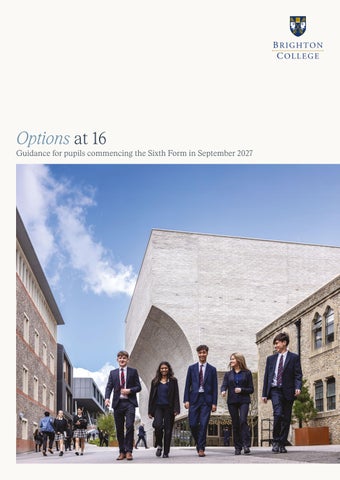
Options at 16
Guidance for pupils commencing the Sixth Form in September 2027
O P T I O N S AT 16
Introduction from the Head of Sixth Form
Your Sixth Form years should be the most engaging and fulfilling of your time at school. You form firm friendships, you sharpen your focus on areas of genuine academic interest, and you begin the task of discovering where life will take you once you leave the structured framework of a school environment. Here at Brighton College, the Sixth Form and House communities endeavour to ensure that you enjoy and flourish in your chosen academic subjects, that you take advantage of the various co-curricular opportunities on offer, and that you are guided and supported as you navigate your way through the university admissions process. It is our hope that, when the time comes, you will be ready to leave school and be excited by what the future holds, but also that you will look back on your Sixth Form experience with fondness, as a time when you pushed yourself intellectually, took your co-curricular pursuits to the next level and made firm friends for life. Throughout your time with us, you should also gain the confidence and freedom to develop your individual interests inside and outside the classroom, learning to challenge that which you might have accepted as fact, exploiting the more independent and free-thinking nature of Sixth Form study to question your teachers and learn for yourself. In essence, we want you to develop an appreciation that education is an active process, something that you should seek to acquire – not simply something that you are given. With lots of support, structure and help from a fantastic body of teachers, we obviously want you to succeed in terms of the grades you get. But we also want to stimulate an interest in your chosen subject areas, building within you the spirit of independent enquiry that is the hallmark of university study.
2
To reflect this independence, The Sixth Form Club and Study provide spaces for study, discussion and socialising away from the younger pupils in the school. So which subjects to choose? Your choices will initially focus, quite rightly, on the subjects you enjoy, but you will inevitably start to consider what lies beyond the College gates: university choices are around the corner, and career options beckon. The key will be to strike the balance between what you are good at, and love doing, and the skills you will need to thrive beyond university, in your future workplace, even if you do not yet know what that may look like (indeed, your future career may not yet exist!). At Brighton College there are a huge range of different courses on offer and we will ask what combination of subjects you wish to pursue before we construct the timetable. Please note that it is unusual that subject combinations are impossible, although it is hard to guarantee your choice if it is made after the deadline in February 2027. The information that follows gives more detail on the subjects we offer. Please do get in touch if you would like to discuss any of these decisions further, and good luck to you all with your research, explorations and of course, with your GCSEs! Best wishes,
Alexandra Granville Head of Sixth Form
3
O P T I O N S AT 16
UK Education Awards 2025
Best Sixth Form in Britain
A state-of-the-art new building contains the “world-class Sixth Form Centre at Brighton Best Sixth Form in Britain College. The Sixth Form Centre is home to the universities and careers team; here you will find the Director of Global Futures (Mr Worrallo) and two Deputy Directors of Futures (Ms Roche, Head of Y13 and Mr Webster, Head of Careers). We also have a US university counsellor (Mr Tourle) as well as our Head of Oxbridge and Medical Applications (Dr Field). Pupils benefit from a variety of specialist programmes, including courses in entrepreneurship and critical thinking. A Mind the Gap conference helps pupils manage the transition from school to university and a Futures Conference helps explore career options. Academic results are consistently excellent, with top destinations including Oxford and Cambridge, and leading American universities. With the country’s sunniest city on their doorstep, Sixth Formers make the most of Brighton’s beachside location. The Brighton College Connect alumni network, with over 10,000 members, offers Sixth Formers networking opportunities. 4
”
5
Brighton College Sixth Form
O P T I O N S AT 16
6
Ten Reasons Why Brighton College Sixth Form is the Best in Britain
Freedom with support
You are encouraged to be independent, but that doesn’t mean you are on your own. Known by your House staff and supported by the Wellbeing team, there is always someone looking out for you.
University preparation
We are experts at preparing you for applying to university, either here or abroad. Recent leavers also visit to share their experiences – social and academic.
Academic enrichment
We like nothing more than to give you the opportunity to stretch yourself. You’ll find lots of essay competitions, Olympiads and extension sessions to keep you sharp.
Social entrepreneur
Throw yourself into putting something back into the community, from volunteering every Wednesday afternoon, to our annual Make a Difference Day, working on projects around Brighton.
Business entrepreneur
Our Entrepreneurship Programme is unique, giving every member of our Sixth Form a chance to plan a business and present it to industry experts.
1. 2. 3. 4. 5. 6. 7. 8. 9. 10. Leadership
Sixth Formers who set an excellent academic, co-curricular or service-based example, and who lead through strength of character and commitment may be elected as prefects for their Upper Sixth year.
Variety of opportunities
Academically, we offer A-levels and BTEC, and we also have a plethora of co-curricular opportunities, including dance, music, drama and sports.
Critical thinking course
The era of fake news means you have to think critically. We combine philosophical, historical and practical perspectives to ensure your own arguments are robust.
Diversity
Brighton is a cosmopolitan city, and our campus reflects that. Our pupils’ life experiences represent a wide swathe of society, locally and internationally.
Contacts for life
Our commitment to you doesn’t just stop after you leave us: you get to join the Old Brightonians network with over 10,000 members across the world.
7
O P T I O N S AT 16
Top A-level School in the UK
A place to relax
A place to think
Scott’s Café
The Theatre
A place to mingle
A place to shine
188 A* grades for girls 189 A* grades for boys
98% The Dance Studio
The Black Box
A place to express yourself
A place to perform
A*-B
A-level grades A*-A % of pupils earning grades A*-A
82%
82% A*-A
We were delighted to achieve record-breaking A-level results, with a phenomenal 98% A*-B. An incredible 82% of results were A*-A and almost half were A*.
49%
29% All Schools
The Study
All Independent Schools
The Club
Brighton College
Our Stunning Sixth Form Centre
Source: Ofqual 2026
8
9
O P T I O N S AT 16
Where our Pupils are Currently Studying
The College aims to help each pupil reach the university of his or her choice, whether that is in the UK or abroad. About 20% of our pupils are offered places to study at Oxford or Cambridge every year, with over 800 offers from Russell Group universities across the year group. American universities have been eager to entice our pupils across the pond, with unconditional offers from Yale, Stanford, Princeton and Harvard in recent years.
Our University Destinations over the Past 15 Years
“Advice on filling out the UCAS form was very
clear, and support in writing and proof‑reading my personal statement was thorough and fast. Mock interviews also proved incredibly useful. Overall the support was amazing, and underpinned by departmental extension sessions which played an important role in furthering my subject understanding.” Oliver (Upper Sixth)
1in6
pupils get Oxford or Cambridge offers
10
35% of pupils take up STEM courses at university
80% of pupils offered Russell Group places
11
O P T I O N S AT 16
What our pupils say about the Sixth Form
“ “ ”“ ” ” “ ” “ “ “” ” ” “ ” “ ”“ ” “ ” “ ” “ ” “ ” “ “ ”” “ ” “ “ ” “ ” ” “ “ “ ” ” ” “ “” “ ” ” “ ” “ ”“ ” “ “ “”” ” “ ”“ ” “ It’s an amazing chance to grow.
You get to know and mentor younger pupils.
The chance to try something totally new.
There is no one like our Futures team, who are fully on hand to help cater to our personal interests and passions and give the most incredible detailed one on one help to help grow further our understanding of universities and what could be best for us in our futures. Doing subjects you are really interested in.
Having the freedom to work independently.
Being able to access Sixth Form-exclusive facilities.
We have GREAT chances to expand and broaden our horizons in ways you may not have expected. SUITS!
Helping younger pupils.
Studying subjects that you are passionate about.
The UNICEF Ball.
Opportunities to explore your passions and interests.
You are treated more as an adult, which is cool.
Asking teachers about aspects beyond the syllabus.
Leadership roles.
Scott’s Café.
Flexibility in subject choices.
Being able to receive tailored support for university admissions.
Culture of kindness, curiosity and confidence.
Myriad of competitions in every area of school life.
Readily available extension work in any subject.
Pupil-led social events.
New subjects.
Lessons feel more like a discussion.
New people = new friends.
You have more confidence.
The Sixth Form team are LIFE SAVERS when it comes to applications. Book all the meetings you can.
12
It’s so nice having areas just for Sixth Form to socialise and work.
Great support from teachers.
Meeting new people.
All of the games options.
Lots of opportunities to discuss futures with teachers.
Volunteering and charity work.
Engaging school trips.
13
O P T I O N S AT 16
Contents
14
Curriculum structure
16
The Co-Curriculum
17
The Super-Curriculum Critical Thinking Extended Project Qualification Entrepreneurship Programme
24 24 24 25
Choosing Sixth Form subjects Art and Design Biology Business Studies Chemistry Chinese Computer Science Design and Technology: Product Design Drama and Theatre Economics English Literature French Geography German Greek History Latin Mathematics and Further Mathematics Music Photography Physics Politics and Government Psychology Religious Studies Russian Spanish Sport and Exercise Science (BTEC)
26 31 32 33 34 35 36 37 38 39 40 41 42 43 44 45 46 47 48 49 50 51 52 53 54 55 56
15
O P T I O N S AT 16
Curriculum Structure Brighton College is unashamedly an academic school, and many of our pupils aspire to the very best courses at some of the world’s top higher education institutions. We offer a wide range of A-level and BTEC qualifications. We also firmly believe that the best pupil outcomes are best achieved through a rich and varied curriculum, with sport, volunteering, leadership opportunities, critical thinking and entrepreneurship all deeply embedded in our Sixth Form curriculum. All pupils will usually start the Lower Sixth pursuing four subjects. A BTEC ‘counts’ for one, two or three subjects, and Maths and Further Maths together count as two, apart from for exceptionally able mathematicians who may do these subjects in an accelerated set which allows five A-levels to be taken. Pupils wishing to drop a subject may do so in December or May of the Lower Sixth, and most pupils complete three A-levels at the end of the Upper Sixth. We believe that it is advantageous for pupils to study four subjects for at least a term for a number of reasons:
16
•
Doing four subjects, even if only for a term, offers an academically enriching and broadening experience.
•
It provides flexibility when pupils change their minds over which subjects to pursue in Michaelmas of the Lower Sixth. This often occurs as pupils’ relative ability in, and enjoyment of, different subjects at A-level is often different to those at GCSE and to their own perceptions.
•
Doing four subjects rather than three for just one term out of a six-term linear course (an overall increase in workload of around 5% across the two years of the A-level courses) should not have an impact on final attainment in those other subjects.
The Co-Curriculum If you wish to choose from the range of academic A-levels that we offer, we require that you have a good grounding across the GCSE disciplines that you have taken. We take this to be an average (mean) of 7 in the 9-1 grading system across all GCSEs taken. Passing this threshold will ensure you enter the Sixth Form well prepared for the challenges that lie ahead. There are also specific GCSE grades required to embark upon maths, the sciences and languages at A-level; these are highlighted in the subject profiles. We never ask anyone to leave at the end of the Upper Fifth. However, if you are a current pupil we ask you to achieve an average grade of 7 or higher in order to pursue an A-level only programme. Should you fall below this average and do not meet the 7 average GCSE grade requirement, then we will ask you to choose a pathway involving a BTEC, usually paired with one A-level. We offer BTEC qualifications in Sport Science at three levels: the Extended Certificate (equivalent to one A-level), the Diploma (equivalent to two A-levels) and the Extended Diploma (equivalent to three A-levels). Our pupils have a strong record of going on to top Russell Group universities every year with these BTEC qualifications, whether in combination with A-levels or, in the case of the Extended Diploma, taken in isolation.
Drama Productions: The Brighton College theatre calendar is packed with exciting productions, which range from fifty strong ensemble pieces to smaller scale, pupil-led plays. Shows in recent years include: Hadestown, The Trial and Macbeth. What is more, pupils in the Lower Sixth have a golden opportunity each summer to perform in their very own Lower Sixth production, with recent plays including Two, Woyzeck and A View from the Bridge.
for group, individual and paired lessons in Acting, Musical Theatre, Mime or Public Speaking, working towards certified grades. Trips: We make the most of our location in Brighton by taking trips to famous venues such as the Brighton Theatre Royal and Chichester Festival Theatre, while our relative proximity to London means that we can also access the best that the West End has to offer.
Our productions would not be possible without busy teams behind the scenes, so there are opportunities for pupils to get involved in a variety of crucial technical roles, like stage management and lighting and sound design. Drama beyond the classroom: We offer a number of weekly drama activities, such as Improvisation Club, Theatre Design and Technical Club, and the National Theatre young scriptwriting competition, New Views. Over a hundred pupils take LAMDA lessons annually and sign up
17
O P T I O N S AT 16
Dance Whether you are an experienced dancer or simply love to move, Sixth Form offers an exciting range of opportunities to perform, train, create and keep active. Strictly Come Dancing: A highlight of the performing arts calendar, Strictly Come Dancing is an annual charity event and one of the most anticipated evenings of the year. Lower Sixth pupils pair up and learn a range of styles before taking to the stage to compete for the Strictly trophy, accompanied by the incredible Brighton College Swing Band. From the Cha Cha Cha and Samba to the Jive, Charleston and Viennese Waltz, pupils learn new skills, build confidence and experience the thrill of performing to a packed audience. It is a fantastic opportunity to step outside your comfort zone, make memories and enjoy the excitement of performing together. Dance School Opportunities: There is something for every dancer in the Dance School, from RAD Ballet, ISTD Modern and ISTD Tap, with opportunities to take examinations, to lessons in Jazz, Contemporary, Commercial Hip Hop Fusion, Musical Theatre, and Boys Squad. 18
All Dance School members can perform in our annual Dance Show in the amazing Cairns Theatre each June. For those ready to take their performance to the next level, the Senior Show Team offers opportunities to perform in and outside the College and compete at local, regional and national dance festivals, awards and competitions. Most recently, the team were crowned champions at the All England Dance National Finals and received acclaimed awards at the Dance School Awards. Dance Games: Dance Fitness is a Sixth Form only option within Games, combining dance and exercise in energetic sessions that are a great way to keep fit, have fun and dance with friends. No previous dance experience is required – just bring your energy and enthusiasm. Activities and Clubs: Sixth Formers can explore their creativity through Creative Choreography, while Dance Conditioning and Stretching develops strength, flexibility and physical awareness. Both are available through the activities and clubs programme.Life beyond lessons at Brighton College is busy! Alongside music, drama, dance,
Music
Sport
At Brighton College there are musical opportunities to suit all tastes and abilities. The music department actively encourages all Sixth Formers to be involved, whether experienced musicians or novices. Should you choose to be in the back row of your House Song entry or have the ability to lead the Symphony Orchestra, there are musical activities to provide new experiences and enjoyment!
Sport is a core component of the curriculum at every stage of the school; this is no less the case in the Sixth Form, where regular physical exercise works in symbiosis with the mental exercise of pupils’ A-level and BTEC courses. Our aim for Sixth Form sport is to cater for all abilities and enthusiasms, whether a pupil is a national athlete, or has not previously found a sport that makes them tick. Within the timetable pupils have two weekly games sessions, on Tuesday mornings and Thursday afternoons. In addition, those wishing to represent the College can take part in the comprehensive competitive fixture list, which primarily happen on Saturdays.
Over two-thirds of the pupils learn to play a musical instrument and continue their participation in musical activities into the Sixth Form. Many musicians take Associated Board or Trinity Guildhall Music exams on their instruments. Co-curricular groups rehearse weekly and perform to a high standard in concerts and competitions inside and outside the College. Musical activities include the Symphony Orchestra, Choirs, Wind, Brass and String ensembles, the Concert Band, Swing Band and several Rock Bands. The Chamber Choir recently won a prestigious national competition and have recently performed at the Royal Albert Hall, St. Paul’s Cathedral, and Westminster Abbey. The College frequently hosts the National Chamber Music Competition for Schools, with as many as five groups of Brighton pupils in one year reaching the semi-finals. The Swing Band regularly performs at events including a performance at Disneyland Paris and multiple appearances at the Montreux Jazz Festival in Switzerland, reaching the semi-finals, and our saxophone quartet winning the competition last year.
Each term pupils are able to pick from a huge range of sports, including aerobics, athletics, badminton, basketball, climbing, cricket, dance, fencing, fitness (strength and conditioning or cardio options), football, hockey, golf, netball, rounders, running, rugby, tennis, spinning, squash, swimming, volleyball and yoga, many in our fabulous School of Science and Sport. While we compete in a variety of sports, the most frequent fixtures are in rugby, football, cricket and athletics for boys, and netball, hockey and athletics for girls. Each of the major games has up to four senior teams, representing differing levels of ability, for those who are keen to play competitive sport at the weekend. If selected to represent the College during the week and/or at weekends, all Sixth Formers are expected to play throughout the year. Many Sixth Formers have made significant contributions to the College’s sport and have gone on to represent their country and gain professional contracts. However, we are just as proud of those Sixth Formers who did not think sport was for them, and leave with a greater sense of certainty that sport will continue to play an important role in their lives in future. 19
O P T I O N S AT 16
Community Partnerships Every Wednesday afternoon, many of our pupils leave the school site and go to a variety of placements. Whether a scheme of befriending and assisting elderly residents in the local area, as part of our Pelican Primary programme, broadcasting on Sussex Hospital Radio, taking part in environmental campaigns in our Green Team and many other placements… and each year, the list grows! This is a core component of the Sixth Form curriculum, and every member of the Lower Sixth is asked to choose a placement or activity which allows them to give back in a way that ties with their own interests.
20
The benefits: The Community Partnerships programme is of great benefit to the elderly members of the community, the charities and organisations that help with the placements, and the children who attend the after school groups. It also provides valuable work experience for all of the pupils who participate in many different professions, including pupils considering a career in the caring professions, medicine, teaching or social work, journalism and broadcasting, and an increased awareness of social and environmental issues on a local, national and international level. We feel it is very important that pupils are given the opportunity to interact and work with local residents, and our strong link with the local community is a crucial part of College life.
20
Duke of Edinburgh’s Award
Combined Cadet Force
The Duke of Edinburgh’s Award scheme is valued highly by both universities and employers. It allows you to be challenged mentally and physically, to try new skills or a sport, and to look proactively for opportunities to be a good citizen by getting involved in the community and helping others. Pupils have the opportunity to complete their Gold Award during their two years in the Sixth Form. Recent UK expeditions have taken place in the Peak District and Brecon Beacons, and Gold Award groups have also travelled further afield to the Sierra Nevada in Spain.
The main aim of the CCF in the Sixth Form is to provide a challenge to the individual in practical training situations at both personal and instructional levels. At a personal level, the CCF presents training which is challenging, enjoyable and satisfying, and aids the development of self-reliance, independence, resourcefulness, leadership and perseverance, which will equip individuals for later life. At an instructional level senior members are encouraged to take on the responsibility of leadership within the CCF and the community at large, by instructing others, junior to themselves, in a wide range of different activities. Here in group situations they teach skills, face problems and share experiences together. Such situations become accessible through camps, and courses of all descriptions, many of which are arranged by the Royal Navy, Army and Air Force themselves.
21
O P T I O N S AT 16
46°|14’N/6°|3’E CERN The annual pilgrimage to CERN saw 40 physicists making the trip to see the facility credited not only for the invention of the internet, but the detection of the elusive Higgs Boson. The unbelievable scale of the engineering and the complexity of the fundamental research left a huge impression on the pupils.
SWITZERLAND PHYSICS TRIP
45°|55’N/6°|52’E Reading Week
50°|1’N/19°|12’E
In the final week of the Trinity term, all Lower Sixth pupils go on a Reading Week trip in an area related to their academic interests. Past Reading Week trips have taken place all over Europe, from Economics in Amsterdam, to Design and Business in Bologna, to Classics and French in Paris and the South of France. Pupils have a lot of fun while learning more about their chosen subjects.
Auschwitz-Birkenau Each year, our entire Lower Sixth visit the Auschwitz-Birkenau Memorial and Museum. We believe this trip is an important opportunity for critical reflection on the role of politics and power in the life of the individual.
POLAND SCHOOL TRIP
LOWER SIXTH ACADEMIC TRIPS
“I think everyone would agree it was
Out and About
Fantastic educational trips are available to pupils, linked to subjects such as history, physics and languages, as well as an annual school trip for the entire Lower Sixth to AuschwitzBirkenau.
one of the most important trips of our lives – and one we will definitely remember in the years to come. The trip was very powerful and I am so grateful to the school for giving me an opportunity to see it when I might not have done otherwise.”
31°|38’2.98”N|7°59’59.78”W Marrakech For reading week, Lower Sixth pupils set off to the bustling city of Marrakech for an insightful and thrilling trip. They immersed themselves in the sights and sounds of the city, as well as visiting the Ben Youssef Madrasa and the Slat alAzama Synagogue. A journey to Imlil in the High Atlas also beckoned, where they explored the contrasts to the city.
22
MARRAKECH FRENCH AND GEORGRAPHY TRIP
40°|43’N/73°|59’W USA The Sixth Form Universities Team runs a trip each year to visit some of the most prestigious and popular universities in the USA. The trip alternates: this year pupils were able to visit MIT, Harvard, Northeastern, Yale, NYU, Princeton and many other US schools, all in a jam-packed six day excursion.
USA UNIVERSITIES TRIP
23
O P T I O N S AT 16
The Super-Curriculum Critical Thinking All Lower Sixth pupils take a course in critical thinking which has been designed by the College in order to develop skills which will help in A-level exams, university entrance tests and at undergraduate level in the future. Pupils study topics relating to the development of national and international identity, with a particular focus on social justice movements and current affairs. They do so with an explicit focus on academic skills such as the analysis of argument, presentation skills, reading skills, problem solving and spotting bias in sources. It is assessed through a number of opportunities to produce written responses, projects, or presentations given on a topic of the pupil’s choosing.
Entrepreneurship Programme In 2010 Brighton College became the first independent school in the UK to include Entrepreneurship in the curriculum. Principal Richard Cairns explained the rationale behind the idea:
“Schools have allowed themselves to become
spectators in the shaping of our country’s future. All three party leaders reminded us that as a nation, we need to start making things again. If schools don’t play their part in encouraging young people to become entrepreneurs of the future then we are failing our pupils and our country. As it is, schools like ours turn out well educated young people who gravitate overwhelmingly to the professions and leave entrepreneurship to others.” The programme includes lectures, masterclasses and an Entrepreneurship Competition where Lower Sixth pupils, split into groups, are given time to come up with ideas for a product/service and produce a business plan. The judges are Old Brightonians who have gone on to set up their own successful businesses. At the end of the term, judges choose the three best companies who will then be given the finance to commercialise their ideas, helped by entrepreneurial advisors from the local community.
24
There is also an Entrepreneurship Day, where the groups meet the judges, watch a number of presentations and take part in a couple of masterclasses and an exercise. We have seen some great ideas ranging from an online debating platform to candles made from recycled coffee grounds to key locators.
Extended Project Qualification All Brighton College Sixth Form pupils have the opportunity to take the Extended Project Qualification run by AQA. It is a stand-alone qualification equivalent to an AS-level and all grades are available to candidates. To enjoy the course you need a genuine desire to research a topic and to be able to do this independently. You will have a supervisor who will advise you and who will monitor your progress, but this course is primarily dependent on individual motivation for independent research and study. In the Hilary Term of the Lower Sixth year pupils are invited to consider taking the EPQ. They will be required to submit an initial application stating the area they wish to study and why they would like to pursue that topic. They will then be assigned a supervisor, and given a login to ‘ProjectQ’, the online log book for the project. This is updated by the candidate, with the supervisor overseeing and signing off each component of the development of the project. which is kept by the candidate but in which the supervisor charts the development of the project. The research should be completed during the summer holiday and the first draft presented to the supervisor at the start of the Michaelmas Term in the Upper Sixth year. Following suggestions and advice, a final piece will be written and the essay should be around 5,000 words. In addition to the written aspect of the project, a presentation is given to a group which includes a mixture of those who could be expected to be conversant with the topic area and those new to it. The candidate will be expected to field questions. One of the most important aspects of the log book is the final reflection in which the candidate talks about what they have learnt by doing the project and passes on advice to future candidates. There are no pre-requisites for an EPQ other that a passion for studying above and beyond the course in any of the
Young Enterprise subjects you are pursuing at A-level or BTEC – or the desire to explore a subject which you are planning to take at university. Universities welcome the EPQ as it shows that a candidate has the ability to organise their work and to work with limited supervision, both attributes which are essential in a university student. However, myriad other enrichment opportunities are also on offer should our pupils prefer to focus their attention on essay competions, Olympiads, leading societies and other options.
“ Brighton College offers a staggering range of opportunities.”
Young Enterprise is a national education charity which delivers an exciting, practical, hands-on business experience to young people. Locally, the organisation is run by volunteers, with particular input from HSBC and American Express, who form the Young Enterprise Board. The Young Enterprise Programme is a real business experience over a full academic year open to pupils in the Lower Sixth, developing skills such as: working in a team, leadership, making presentations, planning, financial control, taking responsibility and the need for commitment to quality. In the past, Brighton College YE businesses have reached the Sussex and Regional Finals of the Programme’s competition, with their professional approach and innovative ideas.
Good Schools Guide
25
O P T I O N S AT 16
The Timescale Before Christmas, all existing Upper Fifth pupils will be asked to give an initial indication of which four subjects they would like to take in the Sixth Form. Pupils will be asked to choose five subjects in order of preference, numbering each one to indicate this preference. The fifth subject will only be allocated in case of timetabling restrictions (this happens very infrequently), and choices will be confirmed in June 2027.
Choosing Sixth Form Subjects Deciding on which four (and later three) subjects to focus is notoriously tricky, particularly for those pupils whose interests are broad. However, there are three relatively simple questions which should be asked in order to frame discussions on which subjects to pick: 1. Which subjects are you good at? 2. Which subjects do you enjoy? 3. Which, if any, subjects are required in order to facilitate
access to desired higher education options? All three considerations matter, but the least emphasis should be placed on the third. Aspiring towards a particular degree course which may not align with the interests or abilities of the pupil all too often results in inappropriate subject choices being made. Ultimately, this will lead to fewer higher education options being open to a pupil in the end, as the single most important factor in university applications generally speaking is the grades achieved, rather than which subjects they are in. Our advice is therefore that you should not pick a subject because you think you need it; instead select a subject because it interests you, and because you think you’d be good at it. The following pages outline the range of different subjects on offer at Brighton in the Sixth Form. Although we seek to offer the full range of subjects outlined in this booklet, pupils and parents should be aware that we may not be able to run subjects if insufficient numbers of pupils select them as a choice. 26
The Jump from GCSE to A-level Talking to your teacher about your particular abilities and interests is strongly advised, not least because many subjects have a big jump in the level of challenge at A-level, and your teachers will be able to give you honest and constructive advice as to how you might navigate that jump. In addition, the style of study in some subjects can change significantly between GCSE and A-level. Although the rigour of the GCSE courses aids the transition, in many subjects there remains an acute jump in conceptual difficulty to A-level. It can be the case, therefore, that pupils find an A-level very challenging (and, hence, not very enjoyable) in a subject that they enjoyed and found relatively accessible at GCSE. Since universities will make conditional offers usually based on three A-level grades – with most Brighton College pupils accepting offers in the A*AA-AAA region – it is very important to bear this in mind when choosing A-level subjects. Pupils should pick subjects that, ultimately, are going to support their university aspirations.
By January, after their GCSE mocks, each pupil will have a clearer idea of which subjects suit them. Following this, there will be a Sixth Form Taster Week in January when existing pupils can visit departments to discuss their options. The Upper Fifth Parents’ Evening follows in Hilary term and will give pupils and parents the opportunity to discuss their academic progress and ask any final questions about their subject choices before the final deadline for submission of options. After the GCSE results are published in August, there will be a period of a week when changes can be made to confirmed choices in light of known results. The school will always do its best to accommodate changes, although may not be able to guarantee all combinations of subjects at this late stage.
Sixth Form Choices and Applications to Competitive Universities Many of the principles related to subject selection and university entrance can be found in a document published by the Russell Group accessible here: https://www. informedchoices.ac.uk/ It is worth pointing out, however, that successful applications to leading universities, Oxbridge included, very rarely hinge on subject selection. Primarily, they depend upon an extensive and developed interest in the course for which the pupil has applied. This can only be honed through wider reading and genuine engagement with the subject, above and beyond GCSE and A-level course specifications. Further advice will be provided on this in the Lower Sixth, but it comes down to pupils demonstrating an academic interest, for its own sake. Successful applicants to the most competitive courses at Oxford, Cambridge, Imperial and others are always independent in their academic approach, and appreciate that their academic interests must be more holistic and well-rounded than GCSE and A-level courses permit. Half of each cohort usually applies to either Oxford or Cambridge and these two institutions have somewhat different application processes and requirements to other
With this in mind, we have, over many years, looked carefully at the GCSE qualifications that pupils require, if they are to find particular A-level courses accessible. Where relevant, these requirements are highlighted in the subject pages that follow.
27
O P T I O N S AT 16
A Broad Guide to University Course Requirements universities, albeit that many of the following points apply to other leading universities such as Imperial College, UCL, Durham, Bristol and Warwick. It is important to understand that applicants for Oxford or Cambridge must demonstrate an exceptional academic record. In 2025-6, successful applicants to Oxford and Cambridge had an average GCSE score of 8.6. It is also worth being aware that ‘obvious’ subjects are often not required – for example, a theology applicant does not need to study religion; an applicant for HSPS or PPE does not need to study politics. A-level Maths is more important for an undergraduate economics applicant than A-level Economics. However, applicants who have not chosen these subjects in a school where they are available will have to remember that they will need to be particularly well prepared to convince an Admissions Tutor of their interest in the course for which they are applying. For those considering an application to the US, it is worth looking at a range of subjects which would allow you to demonstrate breadth, but in which you will also be able to succeed, alongside the extensive co-curricular endeavours expected.
28
All Brightonians tend to make an application to a higher education institution during their Sixth Form years or, in some cases, immediately after they have completed their studies (during a gap year). Generally speaking, if you pick subjects you will enjoy, then you are keeping your options open for university. However, for certain courses, particular A-levels are specified; others may be preferred. As a general rule, you should take an A-level or BTEC in any school subject you intend to study at university. Beyond this, some required or preferred subject combinations at A-level are listed opposite for possible degree subjects.
“ Key to the College’s success is inspirational teaching.” The Sunday Times
University Subject Requirements University subject
Typical A-level requirements
Accountancy
Maths is recommended or required by some universities. There can also be GCSE Maths grade requirements.
Ancient History
No subjects specified. Can be studied without Latin or Greek and can be combined with Archaeology.
Architecture
Art or DT often strongly recommended, as a portfolio of work usually has to be submitted. Maths and/or Physics can be beneficial, although most departments only require these subjects to GCSE.
Art
Art, followed by a foundation art course normally expected.
Biochemistry
Chemistry is usually required, with Biology and/or Maths recommended.
Biological Sciences
Biology usually required. Some top departments also require or recommend one of Physics, Chemistry or Maths.
Business
No subjects normally specified.
Chemical Engineering
A-level Maths, Physics and Chemistry. Further Maths is helpful on the most competitive courses.
Chemistry
Chemistry A-level. Maths essential for some. Physics desirable.
Chinese Studies
No subjects required, though Mandarin and / or History may be beneficial.
Classical Civilization
No subjects specified.
Classics
No subjects specified. Most universities will prefer applicants with either Latin or Greek A-level.
Computer Science
Maths is frequently required, but not always. For Oxford, Cambridge, and Imperial, Further Maths is required.
Dentistry
Biology and Chemistry usually required. Manual dexterity important.
Drama
No subjects specified. These courses are often extremely competitive and extensive relevant practical experience is required.
Economics
Maths is required at most universities. Further Maths is preferable for Cambridge and LSE. Economics strongly recommended.
Engineering
Maths and Physics. Further Maths recommended, especially for Oxbridge and Imperial. DT can be useful.
English
English Literature A-level is usually recommended, at least. History and languages (ancient or modern) can be good supporting subjects.
French
French A-level usually required for single-honours, although there is more flexibility on combined programmes.
Geography
Geography A-level is usually required or recommended.
German
German A-level though ab initio is available at Cambridge and some other universities.
History
A-level History is specified by several and recommended for others.
29
O P T I O N S AT 16
Art and Design
30
University subject
Typical A-level requirements
History of Art
History, Art, English or a language recommended for Oxbridge, although they are not required for admission.
Human Sciences
Biology often required. Maths, sciences or Geography can be useful.
Italian
An A-level foreign language is required, though not necessarily Italian.
Land Economy
No subjects normally specified, but Geography, Economics and Maths are helpful.
Law
No subject requirements although at least one subject which involves use of language and/or essay writing is advised.
Liberal Arts
No specific requirements, although a bias towards arts subjects (e.g. English, Music, Theatre, History) is usually expected.
Mathematics
Maths is required, with Further Maths highly desirable and Physics recommended.
Medicine
Chemistry is required and Biology is advised at most medical schools.
Music
Music A-level is strongly recommended or required.
Natural Sciences (Biological)
Biology and Chemistry essential and Maths or Physics helpful.
Natural Sciences (Physical)
Chemistry, Maths and Physics are advised. Further Maths recommended.
Oriental Studies
A modern language required and evidence of commitment to this course.
Philosophy
No subjects specified but a subject which demonstrates logical thought is highly recommended.
Physics
Physics and Maths. Further Maths very helpful, especially for the more competitive courses.
Politics
No subjects specified, though Politics would be helpful.
Product Design
Most universities recommend DT, and it is often well supported by Physics or Art.
Psychology
Often no specific requirements. The most competitive, and scientific, courses will require two of the following subjects: Psychology, Biology, Chemistry, Physics or Maths.
Russian
Russian A-level.
Spanish
Spanish A-level.
Theology
No subjects specified.
Veterinary Science
Chemistry and usually Biology are required. Some courses have a preference for either Maths or Physics as a third A-level.
The A-level ‘Art and Design: Fine Art’ course builds on the skills and understanding acquired at GCSE. The course encourages imagination, observation and analysis of the visual world. There is an opportunity to learn practical skills such as oil painting, mixed media, photography (both digital and darkroom based) and printmaking as well as drawing from life. Drawing is a fundamental element of the course and pupils learn to use drawing as a basic tool for research and experimentation. Museum and gallery visits lead to the practical exploration of art history and contemporary artists through copies and sketchbook analysis. As the course develops, pupils are encouraged to develop a personal style which becomes the foundation for more advanced work later on. Pupils in the second year explore their ideas in depth and explore the expressive possibilities of materials.
Course Overview
Unit 2: Controlled Assignment (40%): From a series of titles given by the exam board, the candidate chooses one question which needs to be researched by direct observation and documentary research. The project will be planned through a series of prep sheets in which a variety of media is used in the development of ideas as well as for the piece of work to be produced during the examination.
Beyond A-level Pupils will develop sufficient skill for the study of art to be rewarding in its own right but it also provides an essential foundation for a wide range of careers in art, design and architecture. Art is accepted for entry to arts and humanities courses at universities and as a supporting A-level in many other subject areas.
Candidates produce a portfolio of work from starting points or themes determined by their centre. The focus is on exploration, research and acquisition of techniques and skills. Unit 1: Personal Investigation (60%): This unit is divided into the practical and academic sections. The emphasis in this project is developing ideas and refining them in sketchbooks as well as a series of highly finished resolved work(s). The academic section enables pupils to study in-depth aspects of the visual arts that particularly interest them, and needs to be related to the pupils’ practical work. The emphasis is on a personal and analytical approach and may take the form of an on-going visual workbook. A 3,000 word essay also underpins the portfolio.
Course Requirements At least a 7 in GCSE Art recommended along with enthusiasm and a keen interest in visual art.
31
O P T I O N S AT 16
Biology After 3.7 billion years of evolution, more than seven billion Homo Sapiens currently share the planet with an estimated 8.7 million other species of organism. Never has an understanding of biology been more important. A-level Biology is concerned with all aspects of life, from the interaction of organelles that drive cellular processes to the pivotal influence of plants and animals on the global carbon and nitrogen cycles; from understanding the complexities of human health and physiology, to just why conservation of biodiversity is vital to both the survival of the human race and the planet. We endeavour to instil an appreciation of the diversity and complexity of biology that will inspire pupils beyond the syllabus and encourage them to be independent and curious biologists with an awareness of the challenges and innovations in the subject in the 21st century. The department aims to deliver a balanced course with a strong practical emphasis to underpin theoretical understanding and equip pupils with the skills and knowledge necessary to achieve outstanding examination results in biology.
Business Studies These topics are examined through three papers taken at the end of the Upper Sixth – Biological Processes, Biological Diversity and Unified Biology, which is designed to be synoptic in nature. Questions include a mixture of multiple choice, structure and extended responses. A minimum of 10% of the questions now test mathematical ability and there are 12 core practical tasks that must be undertaken as part of a ‘Practical Endorsement’. A minimum of 15% of exam questions in the final A-level examination are focused on the planning and evaluation of practical experimentation.
Beyond A-level Biology is a topical A-level which can lead to degree courses in new and expanding fields such as genetics, pharmaceuticals, biotechnology, conservation, and applied biological research. It is also essential for applications to medicine, veterinary sciences or dentistry.
Key Course Components We follow the OCR A-level Biology A specification. Lower Sixth pupils study cell biology, exchange and transport, biological molecules, biodiversity, and the immune system. In the Upper Sixth the topics covered in depth will include homeostasis, photosynthesis and respiration, ecology, genetics and biotechnology.
32
Have you ever wondered how apps like TikTok or Spotify decide what prices to charge you, or how brands use social media influencers to change people’s buying habits? How do global giants use artificial intelligence (AI) to run their warehouses, and can a massive company truly care about its workers’ wellbeing and the planet while still making huge profits? Can a business really balance “People, Planet, and Profit” without just pretending to be eco-friendly? A-Level Business offers pupils a dynamic, real-world introduction to how modern organisations operate, compete, and succeed locally and in a global market. Pupils will explore how modern organisations thrive using artificial intelligence (AI), flexible working and digital technology, with a renewed focus on Environmental, Social, and Governance (ESG) sustainability reporting. Through the lens of real-world corporate case studies, pupils will master the financial, marketing, and strategic decision-making skills that drive actual industries, whilst honing their data analysis and analytical writing skills. This course develops the versatile commercial awareness, data fluency, and problemsolving skills necessary to thrive in high-level apprenticeships, competitive university degrees, and the future global workforce.
financial management, people management (HR) and operations management. In Upper Sixth, they will explore broader topics such as sustainability, business culture, strategy and change management. This course is examined through three equally weighted two-hour written papers, all taken at the end of the Upper Sixth. All papers comprise of two case studies, each followed by 5 compulsory questions worth 45 marks in total. There are 6-mark ‘analyse’, 9-mark ‘assess’ and 15-mark ‘evaluate’ questions following relatable case studies using businesses such as Apple, Gym Shark and SHEIN.
Beyond A-level Studying A-level Business opens doors to competitive university degrees in fields like international management, finance, commercial law, and digital marketing. It also provides a strong foundation for highly sought-after degree apprenticeships at major global firms, paving the way for lucrative careers in management consultancy, investment banking, and entrepreneurship.
Course Overview We follow the AQA specification (newly updated for teaching from September 2026). In Lower Sixth, pupils will study the fundamentals of entrepreneurship and forms of business ownership, followed by marketing management,
Course Requirements
Course Requirements
At least an 8 in Biology GCSE and an 8 in Maths GCSE.
None.
33
O P T I O N S AT 16
Chemistry In a nutshell, chemistry is the study of the elements: the 92 naturally occurring types of atom that account for all the matter in our universe. From knowing the atomic structure of these elements, chemists can describe how they react and predict the structure and properties of the molecules and compounds they form. Chemists exploit the properties of substances for the benefit of humankind. Indeed, chemists synthesise new compounds and molecules that exhibit the exact behaviour required for a specific function. From medicines to cosmetics to touch-screen phones to the clothes we wear to the food we eat to the houses we live in to the fuels we burn, chemists make the lot! By analysing the molecules in distant stars and planets, chemists lead the search for extra-terrestrial life. By developing new drugs, chemists are at the frontline in the battle against diseases such as cancer and HIV. Chemistry is the middleman of science: it shares the mathematical logic of physics and the natural beauty of biology. And chemistry is fun: who could forget the explosion of a hydrogen balloon, the screaming death of a jelly baby, a flaming bubble of methane, or the depth-charge reaction of potassium and water? Chemistry at A-level is inspiring, engaging and challenging. The chemistry department is committed to a teaching approach which combines a significant emphasis on problem solving and practical work, where experimental observations inform scientific thinking, with a thorough grounding in the underlying conceptual basis of chemical ideas. This is especially true of the A-level, in which pupils have to complete 16 core practicals, which are designed to develop a deep love and mastery of experimental work.
34
Chinese Course Overview We follow the Edexcel specification. The first year of the course builds on topics introduced at GCSE including atomic structure, the periodic table, chemical calculations and organic chemistry. Many extension opportunities are provided and pupils are actively encouraged to participate in competitions such as the RSC Olympiad and Cambridge Chemistry Challenge and RSC Schools’ Analyst competition, in which the department has had tremendous success in recent years. The second year of the course builds on pupils’ prior knowledge of kinetics, equilibria and organic chemistry. In addition several new and engaging topics such as entropy and NMR spectroscopy are introduced. Again, pupils are encouraged to participate in extension and enrichment work, and many pupils have gone on to read chemistry at leading universities such as Oxford, Imperial and Durham in the past few years.
Mandarin is the most widely spoken language in the world, and as such studying Chinese A-level is suited to any pupils who have an appreciation of the language, literature, film, culture, current events, and social issues of the Chinesespeaking world. Given the continued growth of China’s economy, Chinese is also an excellent choice for pupils interested in fields such as business, finance and law. Additionally, the language is playing an increasingly important role in the fields of education, academia and politics. Pupils opting for this course will need to be driven and hard working from the outset as the Edexcel A-level is a significant departure from the GCSE.
Course Structure The A-level draws on the following four themes: • Changes In Contemporary Chinese Society • Chinese Culture
Beyond A-level
• The Evolving Chinese Society and The Impact of The Reform
A-level Chemistry is prerequisite for entry to degrees in: biochemistry, biological sciences, chemical engineering, chemistry, dentistry, medicine, natural sciences and veterinary science. A successful chemist is recognised as a multi-skilled individual!
• Opening Up Policies in China in 1978 Pupils also study works of Chinese literature and films in Mandarin or Cantonese, about which they are required to craft analytical essays in Chinese; these might include literary works such as 一只叫凤的鸽子 – 曹文轩 (A Very Special Pigeon by Cao Wenxuan), extracts from 城南旧事 – 林海音 (Memories of Peking: South Side Stories by Lin Haiyin), or 故 乡 – 鲁迅 (Hometown by Lu Xun), and films such as 请投我一票 (导演 陈为军) (Please Vote for Me, 2007), 十七岁的单车(导演 王小帅) (Beijing Bicycle, 2001), or 天水围的日与夜 (导演 许鞍华) (The Way We Are, 2008)
The qualification comprises of the three papers, all taken in the summer of the Upper Sixth. Paper 1 – Listening, Reading and Translation (40%): This paper draws on vocabulary and structures across all four themes. The paper is written in Chinese (both simplified and traditional), and pupils are required to answer in Chinese (either simplified or traditional), except the last translation task. Section A involves listening to recordings of spoken Chinese, section B is a reading assessment based on a variety of text types and genres where pupils will respond to comprehension questions, and section C is a translation into English. Paper 2 – Written response to works and translation (30%): This paper is written in Chinese (both traditional and simplified) and pupils are required to answer in Chinese (either traditional or simplified). Section A requires pupils to translate an unseen passage from English into Chinese, and sections B and C ask for a written response to either two literary texts or one literary text and one film. Paper 3 – Speaking (30%): Candidates have a conversation with the examiner for approximately 20 minutes. Task 1 involves candidates discussing one theme from the specification based on a stimulus, and task 2 requires candidates to present and discuss an independent research presentation.
Course Requirements
Course Requirements
At least an 8 in Chemistry GCSE and an 8 in Maths GCSE. A grade 9 in maths is strongly recommended.
At least an 8 in Mandarin GCSE.
35
O P T I O N S AT 16
Computer Science The overall aim of this subject is to encourage you to develop an understanding of the principles of problemsolving using computational methods. Your studies will help you to understand the range of applications of computers and the impacts of their use so that you can apply this understanding in developing your own computational solutions to problems. This course offers a general, theoretical grounding in computing - including an understanding of computer architecture, network technologies, databases, and digital ethics - plus a significant practical element, which develops your understanding of software development principles and teaches you key techniques and algorithms for developing computer programs to solve problems.
Course Overview The A-level consists of three key units: Unit 1: Computer Systems: This unit is assessed at the end of the two years by a traditional, structured question paper containing a mix of short-answer, longer-answer, and mini-essay style questions. The paper covers contemporary systems architecture, including the characteristics of computer processors and how these execute lines of program code. You will also learn about other key hardware devices, operating systems and other types of software, plus the legal, moral, ethical and cultural issues associated with advances in digital technology. Theoretical aspects of programming are also covered, including data types, data structures, algorithms, and different software development methodologies. Unit 2: Algorithms and Programming: This is also a traditional, structured question paper with short-answer, longer-answer, and mini-essay style questions, plus at least one extended scenario-based question, which might present a key algorithm or discuss a given user’s requirements, on which a wide range of questions follow, including some which will require pupils to hand-write a coded solution. Other areas covered by this paper include
Design and Technology: Product Design computational thinking techniques, general and computational problem solving, and application of core algorithms such as those used to traverse graphs and trees and to work out the shortest path between nodes (the technology that drives GPS route planners and NPC pathfinding in computer games). Unit 3: Programming Project: Pupils select their own user-driven problem of an appropriate size and complexity to solve. They analyse the problem, design a programmed solution, develop the solution, put it through testing, and finally produce a thorough evaluation. The project is worth 20% of the final grade and represents, for most pupils, their most exciting programming challenge yet. The final piece of software developed will contain thousands of lines of code.
Beyond A-level Around half of those taking the Computer Science A-level go on to study computing-related courses at university, including pure computer science, or computer science with artificial intelligence, games design and programming, software engineering, creative publishing, systems analysis, informatics, computer forensics and cyber security. Joint courses include mathematics with computing, business management with computing or IT, or philosophy with computing. Whilst A-level computing is not strictly a pre-requisite for these courses, it is excellent preparation and is viewed favourably by many universities: on the course, you develop a set of fundamental skills required to pursue any scientific, technological, engineering, or mathematical (STEM) subject, such as physics, engineering, mathematics, economics, finance, and business.
Course Overview The course consists of two externally-examined papers and an internally assessed project: Principles and Problem Solving are the two written examinations worth 50% of the qualification. The Iterative Design Challenge is internally assessed but externally moderated and accounts for the remaining 50% of the qualification. In Principles of Design and Technology, pupils will develop their knowledge and understanding of a wide range of materials, and processes used in product design and manufacture. They will develop an understanding of contemporary industrial and commercial practices applied to designing and manufacturing products and management systems used in production. Pupils will visit Lamborghini and Ducati bike manufacturing facilities as part of this unit of study as well as other trips and visits. Mathematical and scientific principles are an important part of designing and developing products and pupils will be expected to apply these principles in both of the course components.
The Independent Design and Make Project is the best bit! Pupils will undertake a substantial design, make and evaluate project which will test their skills in designing and making a prototype product of their choosing. With a client in mind pupils will identify a problem and design context from which they develop a range of potential solutions and then realise one through practical making activities. Pupils are highly encouraged to use creativity and imagination when applying iterative design processes to develop and modify designs, and to design and make prototypes that solve real world problems, considering their own and others’ needs, wants, aspirations and values. There are no limits to project selection beyond time, workshop resources and the individual pupil’s ideas. Design and technology combines well with a range of other A-level subjects, but in particular it complements maths, physics or art.
Beyond A-level Design and technology gives pupils a solid foundation if they are considering a career in product design, engineering, industrial design, or architecture. Over the two years, pupils will put together a portfolio of work that will be examined, and is also invaluable for interviews with universities and sponsors.
Course Requirements
Course Requirements
A grade 8 in GCSE maths, and a grade 8 in GCSE Computer Science (if it was taken).
We prefer A-level candidates to have experience of GCSE DT and to have achieved at least a 7. However, we will occasionally take pupils who have not completed the GCSE course. Pupils in this position should talk to the Head of Department.
We will accept candidates who have not taken the GCSE course, provided they have a genuine passion for both programming and computer theory. 36
A-level Design and Technology provides a dynamic learning experience for pupils based on academic and practical training. The course of study encourages pupils to develop and sustain creativity and innovative practice, recognise and overcome challenges and constraints when working towards the production of high quality products and develop a critical understanding of the influences on product design from a contemporary and historical perspective. It also helps pupils to develop an understanding of contemporary design and technology practices and to use digital technologies and information handling skills to enhance their design capabilities.
37
O P T I O N S AT 16
Economics
Drama and Theatre A-level Drama and Theatre offers the opportunity to take a challenging and complete course of study that broadens your experience, develops your imagination, fosters creativity and promotes a complete understanding of theatre and performance. You will discover new ways of engaging with a live audience and bringing a script or idea to life with originality and precision.
Course Overview We follow the Eduqas specification, consisting of three components. The first – Theatre Workshop – is internally assessed but externally moderated, and worth 20% of the A-level. Learners will be assessed on either acting or design. Pupils participate in the creation, development and performance of a piece of theatre based on a reinterpretation of an extract from a published script. The piece must be developed using the techniques and working methods of either an influential theatre practitioner or a recognised theatre company. The second component – Text in Action – is externally assessed by a visiting examiner. It is worth 40% of the qualification. Pupils will be assessed on either acting or design as they participate in the creation, development and performance of two pieces of theatre based on a stimulus supplied by the exam board. Either as performer or designer, pupils create and deliver a devised performance and scripted performance from a published play. Pupils produce a written process and evaluation report within one week of completion of the practical work.
examination of 2 hours 30 minutes, and is worth 40% of the qualification. For this written exam, pupils study three texts from the perspective of a director, designer and actor, applying their knowledge and understanding of theatre to their interpretations and creation of theatrical concepts. Sections A and B are based on two different texts, Home, I’m Darling by Laura Wade and Emma Rice’s Brief Encounter. Section C is a question based on a specific extract from the theatrical adaptation of The Book of Dust by Philip Pullman.
Many of you reading this will not really know what economics is all about. Almost everyone who chooses it at A-level has never studied it before. As a result, new pupils often think that the subject is all about money and hope that taking it will help their earnings in the future!
macro side, we address some of the big questions often debated on the national news. Why has inflation been so high and volatile in recent years? Why is the exchange rate so important to the UK economy? Does it matter that the UK imports more goods than it exports?
Undoubtedly, economics at A-level and beyond is a useful stepping stone on the road to careers in finance, accountancy, banking or business generally, but the subject itself has a far broader and more important purpose.
Theatre Visits
At the heart of economics is the concept of scarcity. Societies have to decide how to distribute resources, given that there is not enough for everyone to have everything they want. Should resources be allocated by the market (the infamous ‘law of supply and demand’) or should the state take charge in the name of ‘distributive justice’? Most economies are based on a mix of these two methods.
In the Upper Sixth you stick with the micro/macro division, but take these two areas to new levels. Quite a lot of the macro-economics will be a global application of the basics covered in the Lower Sixth, exploring issues such as economic development, integration and global trade. Another interesting addition is the area of finance. You will have the opportunity to learn about the turbulent events that shook the international banking sector in 2008. Upper Sixth economics also looks at more controversial questions: are companies that dominate their markets – monopolies – a good thing? Is industry in the UK competitive? What can be done about ‘unfair’ competition?
Course Overview
Beyond A-level
We follow the Edexcel ‘Economics A’ specification. During the Lower Sixth you will cover micro-economics (individuals and firms) and macro-economics (issues like inflation and growth). On the micro side, you will concentrate on ‘markets’. This is where you study supply and demand theories and their outcomes in terms of price and quantity of goods and services produced. You will also explore ‘market failure’: situations where markets give us the ‘wrong answer’. For instance, what would happen if there were no state schools? Would ‘education’ be allocated efficiently to all children? Or who pays for industrial pollution? Governments often have to step in where markets fail to take all of society’s best interests into account. On the
A-level Economics is a valued subject, both by universities and employers, because, like history and politics, it requires analysis and evaluation. One of its greatest attractions is that it gives you an understanding of current affairs. There is no other subject of which you can confidently say that issues covered in the classroom feature daily in media and political debate of all types. A further attraction is the long-term employment prospects it can offer, with people with A-level economics working in almost every sector imaginable, often at very high levels.
We will visit the theatre numerous times throughout your two years and offer at least one of the following trips each year: The National Student Drama Festival, Brighton Fringe and Edinburgh Fringe.
Beyond A-level Universities value drama students because they demonstrate a wide variety of skills. They have strong communication and presentation skills, with the confidence to be innovative and creative. They are effective problem solvers and decision makers, able to work excellently in groups, and are very sociable people. Careers where a drama degree is advantageous include theatre, TV, film, media, PR, marketing, advertising, social media, journalism, therapy, charities, social work and teaching. Significantly, drama is seen to develop skills that are excellent in all work places, such as business and the law.
The third component – Text in Performance – is a written
38
Course Requirements
Course Requirements
While GCSE Drama is not a prerequisite, if taken it ought to have yielded at least a 7. Unwavering enthusiasm is essential.
None, although a strong record in mathematics and English or history is highly desirable.
39
O P T I O N S AT 16
English Literature A-level English Literature is an exciting two-year course that will develop your knowledge, understanding, and appreciation of literature across a range of literary periods and contexts. You will analyse and interpret texts more closely than ever, with added focus on textual comparison, as well as the evaluation of alternative interpretations and the contextualisation of literary texts within their cultural and/or socio-historical framework. The course will also help you hone your critical reading and writing skills in preparation for any university degree.
Course Overview You will study up to eight texts, spanning the three genres of prose, poetry and drama, and a variety of time periods from as early as the 14th century to the present day. This combination of older and very modern literature provides pupils with a thorough grounding in canonical literary history, and through comparison, threads are explored between texts, allowing pupils to understand how literature through time has used the written word to respond to our universal human concerns.
French English Literature complements other arts and social science courses and provides a lively contrast to courses which are largely mathematical or scientific. Many of our pupils also study history, politics, psychology or mathematics, but there is take-up from across the academic spectrum.
Beyond A-level Many of those who take English in the Sixth Form go on to read the subject at university, but we like to feel that those who don’t nonetheless learn to read books - and the world in general - with greater perception and sensitivity. We hope to stimulate a long-lasting interest in literature and to make the habit of reading a regular and pleasurable one. As a subject which emphasises creativity, disciplined thought and communication, a qualification in English literature provides many opportunities to progress to a wide range of courses in the arts and humanities at degree level. It is also welcomed as a qualification for many careers, especially those that prize good communication skills such as law and journalism.
The A-level is assessed using a combination of exams (80%) and coursework (20%). In the Lower Sixth pupils start the course by studying American Literature 1880-1940. Later in the year pupils study a play by Shakespeare with one teacher, whilst studying a modern text for their shorter coursework task of 1,000 words. In the Upper Sixth, pupils complete a longer comparative coursework task of 2,000 words on two other modern works of different genres, and study a pre-1900 drama and pre-1900 poetry in comparison.
40
Studying French A-level allows you to contribute to discussions on the literature, film, art and history of France and you will be expected to participate in debates, give presentations and listen to or read French articles from authentic sources and keep up to date with current events and social issues. Pupils study technological and social change, looking at diversity and the benefits it brings. They will study highlights of French-speaking artistic culture, heritage, cinema, crime and learn about political engagement and who wields political power in the Frenchspeaking world. Pupils also explore the influence of the past on present-day French-speaking communities. Throughout their studies, they will learn the language in the context of French-speaking countries and the issues and influences which have shaped them. Pupils will study texts and film and have the opportunity to carry out independent research on an area of their choice.
Unit 3 is an oral exam of a little over 20 minutes, and counts for 30% of the qualification. This involves an individual research project and one of four sub-themes i.e. current trends or issues in French-speaking society, culture or politics. All A-level linguists are strongly encouraged to spend some time abroad during their course. French department offers annual trips to improve language skills and many pupils also spend time abroad during their holidays.
Beyond A-level Many of our pupils go on to study languages at university. Most universities also offer languages in conjunction with other disciplines, and therefore it is possible to combine the study of a language with another subject such as law, business or international relations.
Course Overview The course consists of three units. The first written exam counting for 40% of the A-level, involves listening, reading and writing. It assesses current trends, issues, culture and politics in the French-speaking world, as well as grammar. Unit 2 is a writing exam, counting for 30% of the total marks. Pupils must discuss a work of literature and a film that they have studied: Bonjour Tristesse by Françoise Sagan and Au revoir les enfants by Louis Malle.
Course Requirements
Course Requirements
None, although a 7 or above in both English literature and language is recommended.
At least an 8 in French GCSE.
41
O P T I O N S AT 16
Geography We live in an increasingly globalised society where almost everything we do has a link to another part of the world; the world in which we live is likely to change more in the next 50 years than it has ever done before. Geography as a discipline draws on the political, economic, and scientific to understand space and place in modern times. The A-level course ensures that you will emerge as a well-informed and skilled geographer, tackling big questions such as why we are struggling to mitigate climate change, whether there is such a thing as an optimal global population and how we manage global commons such as the oceans in a sustainable way. The scope of the specification is far broader than at GCSE, but nonetheless aims to build upon the knowledge acquired at that level. The A-level Geography course incorporates both human and physical disciplines with studies at local, regional, national and global scales. The main focus at A-level Geography is to investigate the challenges facing humanity today – many of which will continue to be a challenge long into the future - and to focus this knowledge on a range of places. To do this we apply theoretical models to the real world and therefore practical fieldwork is also essential.
Course Structure We follow the AQA specification within which there is an equal weighting between human and physical geography sectors, with two final examinations making up 80% of the assessment. Physical geography, which involves process based scientific concepts, is assessed through a 2 hour 30 minute examination which includes three topics: water and carbon cycles; coastal systems and landscapes, and hazards. Human geography, the more political social science facet of the subject, is also assessed through a 2 hour 30 minute paper, the course content of which includes: global systems and governance; population and the environment and changing places. The remaining 20% is accounted for by an individual fieldwork investigation.
42
German Economists find common ground with human geography, while biologists, chemists and physicists find some of their work applicable to water and carbon cycles, coastal environments and plate tectonics. The A-level is statistical and a good mathematical background is therefore useful, although not required to a level higher than GCSE.
The course requires four days of compulsory fieldwork. We divide these into one coastal excursion in Sussex in the first term of the A-level course, followed by a three-day residential trip later in the Lower Sixth. Pupils also undertake independent fieldwork as part of their coursework during the summer holidays between the Lower Sixth and Upper Sixth.
In Europe, German is the second most widely spoken mother tongue and the second biggest language in terms of overall speakers. A-level study enables pupils to continue their study of the German language in the context of German-speaking countries in all their diversity, and the social, political, historical and artistic issues and influences which have shaped them, including an exploration of the influence of the past on present-day German speaking communities. In addition, the course comprises the study of texts and films in German, and pupils will carry out an independent research project on an area of their choice, under the guidance of their teacher. Over the duration of the course, there will be plenty of opportunity for pupils to listen to and read authentic German articles, and to burnish their oral and written fluency, as well as their presentation and translation skills.
Beyond A-level
Course Overview
Employers value geographers because whilst studying the subject they accrue a wide range of skills. They have strong communication and research skills, with the ability to select and interpret a breadth of material. They are effective problem solvers and decision makers, able to present facts, ideas and arguments into concise reports and demonstrate well-rounded, flexible thinking. Careers where a geography degree is advantageous include: management and environmental consultancy, international development work, the civil service, geopolitics, and civil engineering but equally many geography undergraduates have gone on to careers in law, accountancy, finance, banking and many other areas.
The course consists of three papers:
Fieldwork
Paper 3 is the oral exam lasting just over 20 minutes and accounting for 30% of the course. This involves an individual research project and one of four sub-themes from current trends or issues in German-speaking society, artistic culture, multiculturalism or politics.
Beyond A-level Many of our pupils go on to study languages at university. Most universities also offer German in conjunction with other disciplines, and therefore it is possible to combine the study of German with another subject, such as history, law, international politics or relations, journalism, sciences, engineering, business or economics.
Paper 1 is a 150 minute exam testing listening, reading, writing and translation skills. Worth 40% of the course, it assesses current trends, issues, artistic culture and aspects of political life in the German-speaking world, as well as German grammar. Paper 2 is a two-hour writing exam based on the literature and films studied, and accounts for 30% of the course. Pupils usually study a novel or play such as such as Andorra by Max Frisch or Der Besuch der alten Dame by Friedrick Durrenmatt and a film, such as Das Leben der Anderen or Die Letzten Tage by Sophie Scholl.
Course Requirements
Course Requirements
None, although the majority of pupils will have Geography GCSE with a grade 7 or higher.
At least an 8 in German GCSE. To enjoy the course you must have a genuine interest in other cultures and the dedication to learn vocabulary and grammar.
43
O P T I O N S AT 16
Greek Studying Classical Greek promotes intellectual rigour and cultural sensitivity towards our social, literary and historical beginnings. As in Latin, A-level Classical Greek both requires and nurtures a focus on translation skills and a deeper appreciation of a broader range of influential texts within their contexts. The texts studied, rife with themes such as grief, deception, fate and personal enlightenment, have been pivotal in shaping the subsequent 2,000 years of Western literature. As a rule, the majority of our A-level Hellenists also take Latin at A-level, but as part of Brighton College Sixth Form, pupils can choose either Classical Greek, or Latin, or both. Those who choose to take A-level Greek will have enjoyed the challenge of GCSE Greek. Pupils must not only possess a very strong grasp of fundamental grammar and syntax, but also have felt comfortable translating and exploring the literature studied at GCSE as this is a more central part of the course in the Sixth Form. A significant amount of independent research and study is also essential for success at this level.
Course Overview As at GCSE level, the A-level is made up of two very distinct elements, Classical Greek Language and Classical Greek Literature, with pupils taking two written exams in each element at the end of the two year course. The weighting of marks for each exam is: • • • •
44
Unseen translation – 33% Prose Composition or Comprehension – 17% Prose Literature – 25% Verse Literature – 25%
History In the Sixth Form pupils come face to face with those more complex aspects of the language which are not covered at GCSE, so there is a strong focus on developing translation skills so that pupils have the ability to tackle un-adapted unseen passages in the original language with increased confidence. In addition, pupils are expected to expand their knowledge of Greek vocabulary without the support of a defined vocabulary list.
History in the Sixth Form is designed to enable you to broaden your historical knowledge, and also to learn invaluable skills that will train and discipline your mind. Historians should possess the facility both to imagine the world of the past, and to explain why it developed as it did. They should be intolerant of sloppy thinking and easy answers, and willing to investigate their own assumptions and preconceptions as well as those of people in the past.
The verse set texts studied will be selected from a range of authors, such as Homer, Euripides and Sophocles, while the prose set texts will cover the like of Thucydides, Herodotus or Plato. Pupils will be expected to be able to take on the challenges posed by reading more complex material, and of analysing in greater depth original Greek works within their cultural, social and historical contexts. Significantly longer and more detailed responses are required at this level than at GCSE.
History is a subject that can give enormous pleasure, and most people opt to study it because of their fascination with the ways in which human beings have shaped the world around them. We have selected topics that we think will be distinctive on a university application and enable our students to get a breadth of historical understanding, spanning the medieval and modern periods.
Beyond A-level Traditionally, Classical Greek attracts pupils of the highest academic calibre. Classical languages are extremely highly regarded and sought after by universities and employers alike. They combine well with all arts and science subjects, and A-level pupils have gone on to a wide range of analytical and problem-solving degrees. The transferable skills acquired in studying a classical language can lead to many careers, in law, consultancy, and work in the Civil Service.
History in the Sixth Form is also about developing your own ideas about the past through wider reading and independent study. However, we do not expect you to reach the high analytical standards demanded at A-level overnight, and we also structure and teach the syllabus carefully so you develop the necessary logic and discipline to succeed across all your A-level topics.
of modern Britain from 1780 to 1928. For coursework, pupils select a question from their Germany module that they would like to explore in more depth. History goes well with any combination of subjects, and can be mixed with languages, social sciences or natural sciences just as easily. It helps to combine history with at least one other subject that involves essay writing, as this gives an opportunity to practise and consolidate skills, but it is not essential.
Beyond A-level Every year Brightonians have won places to study history at Oxford or Cambridge universities, and we have an exceptionally strong programme to cater for those who want to read the subject at university. History is a highly regarded subject by universities and employers because of the disciplined analysis of evidence, critical awareness and intellectual integrity that producing ‘good history’ requires. It is well known that a History student will have learnt to process and think about information clearly and critically, and this gives them a valuable head start in their chosen degrees or careers.
Course Overview In the Lower Sixth the key theme is Dictatorship and Democracy; pupils will study Germany 1918-1989 and the rise and fall of Fascism in Italy 1911-1946. In the Upper Sixth pupils are given the chance to broaden their historical understanding by studying a different period of History, making a choice between a paper on Lancastrians, Yorkists and Tudors 1399-1509, or one focusing on the development
Course Requirements
Course Requirements
At least an 8 in GCSE Classical Greek is required.
None, although an 8 or above in GCSE History is preferred.
45
O P T I O N S AT 16
Latin Studying Latin at A-level is a linguistically rigorous choice which opens up a world of enthralling history, compelling literature and subversive philosophical and political views. It is a challenging enterprise which, through the study of a wide variety of literature, allows opportunities for enquiry and enlightenment. Such seminal works consider issues which remain central to a young person of the 21st century: the scourge of corruption in politics; the ups and downs of romantic and sexual escapades; the grief and pain associated with death; the consequences of power. Those who opt to take A-level Latin will have enjoyed the challenge of GCSE Latin and ultimately feel that they have succeeded in mastering the language at this level. Pupils must not only possess a very strong grasp of fundamental grammar and syntax, but also have felt comfortable translating and exploring the literature studied at GCSE as this is a more central part of the course in the Sixth Form. A significant amount of independent research and study is also essential for success.
Course Structure As at GCSE level, the A-level is made up of two very distinct elements, Latin Language and Latin Literature, with pupils taking two written exams in each element at the end of the two year course. The weighting of marks for each exam is: • • • •
Unseen translation – 33% Prose Composition or Comprehension – 17% Prose Literature – 25% Verse Literature – 25%
In the Sixth Form, pupils will come face to face with those more complex aspects of the language which are not covered at GCSE. Such mysteries as the present
46
Mathematics and Further Mathematics subjunctive will become clear, while pupils will become expert at telling apart a gerund from a gerundive. In addition, pupils are expected to expand their knowledge of Latin vocabulary without the support of a defined vocabulary list. As well as broadening their appreciation of Latin grammar and syntax, pupils will have access to some of the most important works of antiquity. In terms of prose literature, on offer are extracts from Cicero and Tacitus, and with regards to verse, pupils will have the opportunity to read works written by some of the authors of the Golden Age of literature, such as the works Ovid and Horace, or extracts from Virgil’s epic poem the Aeneid. Pupils will be expected to be able to take on the challenges posed by reading more complex material, and of analysing in greater depth original Latin works within their cultural, social and historical contexts.
Beyond A-level Traditionally, Latin attracts pupils of the highest academic calibre. Classical languages are extremely highly regarded and sought after by universities and employers alike. They combine well with all arts and science subjects. There are many university courses available that include combinations of Latin with other subjects including History, a modern foreign language and English. The transferable skills acquired in studying a classical language can lead to many careers, in law, consultancy, and work in the Civil Service.
Mathematics has been part of the development of many great civilizations – it is rightly called both ‘The Queen’ and ‘The Tool’ of the Sciences. On the one hand, mathematicians solve mathematical puzzles for the same reasons that mountaineers climb Everest, that cyclists enter the Tour de France, or indeed that wordsmiths take on the Times crossword; for the sheer sense of satisfaction when the challenge is overcome. On the other, the applications of mathematics surround us in our everyday lives: mobile phones, traffic lights, the weather forecast, even the layout of supermarket shelves. Clearly, it complements a wide range of other A-levels, and is particularly useful in subjects which have some mathematical assessment, including physics, chemistry, biology, computing, geography and psychology. Maths is available at two levels within the Sixth Form; Maths and Further Maths, which are 8 and 12 periods per week, respectively. There is also an accelerated maths/ further maths set available for the most able mathematicians, who complete the course on 10 periods per week, and can complete up to three other A-levels. While both mathematics courses focus mostly on the core elements (algebra, trigonometry, calculus and series) which underpin the subject, pupils will also study applied modules in statistics and mechanics.
Course Requirements
Course Requirements
At least an 8 in GCSE Latin is required.
For 2027, an 8 in IGCSE will still be the threshold to take A-level Mathematics. However, please note that from 2028, the threshold will be increased to a 9, or an 8 with a pass in a newly-piloted algebraic skills test which will inform suitability for the A-level mathematics course. Pupils in the Upper Fifth in 2026-2027 will take the algebraic skill test to inform their choice or A-level but will be able to take A-level Mathematics upon being awarded at least an 8 at IGCSE. For Further Mathematics, the threshold remains a 9 at IGCSE
Course Structure A-level Maths and Further Maths build on ideas from GCSE, but with an increasingly abstract focus, demanding ever more sophisticated levels of algebraic manipulation. The concept of calculus is introduced and developed in detail. Those pursuing further mathematics are doing two A-levels in the subject, and as a result it is usually offered in two of each pupil’s four timetable ‘blocks’ meaning that half of their lessons will be in the subject. All examinations in all courses are taken at the end of the Upper Sixth.
Beyond A-level Pupils who study mathematics at A-level go on to study a wide range of subjects at university. Further Mathematics is advantageous for entry to degrees including engineering, physics, chemistry, computer sciences, and more mathematically-based economics courses. Most students studying biology, economics, medicine, and physiology will have completed at least an A-level in single mathematics. The analytical and logical skills developed in the study of A-level Mathematics are also valuable preparation for courses even where there may be little explicit mathematical content, such as law.
Mathematics with an 8 in GCSE Further Maths (though 9 strongly encouraged) As above, we will be trialling a Further Mathematics Aptitude Test this year, with the expectation that from 2028, the threshold to take Further Mathematics A-level will be a 9 in Further Mathematics GCSE, or an 8 with a pass in the Further Mathematics Aptitude Test. We inform you of these planned changes to help pupils make informed decisions about taking Mathematics and Further Mathematics A-levels. 47
O P T I O N S AT 16
Music Music is both a creative and an academic subject which requires active participation in performing, composing (both free and in the style of other composers) and listening, as well as historical and analytical study of composers and their work. For those who are looking to pursue other interests as an academic study at university, music is often the subject choice for a creative topic in an otherwise purely theoretical curriculum. For those who wish to go on to study music in higher education, the subject can be studied with many others: sciences, modern foreign languages and social sciences are all possible.
Course Structure Component 1 - Performance In this component, you will develop your skills as a musical performer. You can perform on any musical instrument or sing and will have the opportunity to take part in ensemble performances, as well as performing solo. You will perform a recital of purely solo, or a combination of solo and ensemble music. The recital is assessed by a visiting examiner and candidates can choose either of the following options, in terms of weighting: Option A: 35% of qualification (8-12 minutes in duration) Option B: 25% of qualification (6-8 minutes in duration) The standard of difficulty required for this unit is approximately grade 7/8. Component 2 - Composition This unit encourages pupils to develop their composition skills leading to the creation of a composition portfolio. Candidates can choose either of the following options, in terms of weighting: Option A: 25% of qualification Two compositions, one of which must reflect the musical techniques and conventions associated with the Western Classical Tradition and be in response to one of four briefs set by the exam board. The second composition is a free composition.
Photography Option B: 35% of qualification Three compositions, one of which must reflect the musical techniques and conventions associated with the Western Classical Tradition and be in response to a brief set by the exam board. The second composition must reflect the musical characteristics of one different area of study (i.e. not the Western Classical Tradition) while the third composition is a free composition. Component 3 – Listening and Appraising This unit tests all the knowledge, understanding and skills you have developed across the whole course. Pupils will study a huge variety of musical topics and styles including a choice of Rock and Pop Music, Jazz, or Musical Theatre. All pupils will learn about the Development of the Symphony from 1760-1830 and select a focus of ‘Into the Twentieth Century’ or ‘Into the Twenty-First Century’. The Area of Study ‘Into the Twenty-First Century’ includes works by living male and female composers giving an insight into the current music industry. This will be examined in a single paper of 100 marks to be taken at the end of the Upper Sixth. Pupils will be assessed in a variety of different ways including listening exercises on both familiar and unfamiliar music, short answer questions and longer essay questions. In the longer essay questions, pupils are asked to compare historical and stylistic aspects of the prescribed scores and also respond to an unseen work, comparing it to other such works which they have studied.
Beyond A-level Many pupils continue to read music at university or music colleges. In recent years, several Brightonians have been awarded choral scholarships to Cambridge and Oxford, whilst others are studying at the country’s leading conservatoires. Those that study music for A-level acquire a broad range of transferable skills, which are highly desirable for a range of degrees at leading universities.
Course Requirements
Photography plays a crucial role in contemporary art practice. The aim of our A-level course is to develop a strong sense of critical inquiry within candidates who are committed to being artists with photography as the core of their practice. Throughout the course, pupils develop and explore the process of creating work through a practical, thematic and historical approach, through group critiques and individual tutorials which embed tacit notions of visual understanding which helps the pupils to realise their full creative potential. Photography is a medium which has no static identity. This is actually the discipline’s strength, and is further enhanced by engaging with theory, history, criticism and philosophy. In both Lower and Upper Sixth years, pupils explore and experiment widely with different elements of visual language which are manipulated to enable them to articulate their ideas through making images. The course aims to engage analytical thinking and study the many facets of photography for the purpose of unearthing an individual’s personal perspective. Pupils who undertake this two year course will be encouraged to develop their personal style and the expressive possibilities within photography.
Course Structure Unit 1: Personal Investigation/Portfolio: (60%): This unit is divided into two sections: practical and academic. The practical section gives the pupil the chance to build on the skills and knowledge gained during previous years. The emphasis in this project is on developing ideas and refining them in sketchbooks as well as a series of highly finished resolved work(s). The academic section enables pupils to study in-depth aspects of the visual arts that particularly interest them and needs to be related to the pupil’s practical work. The emphasis is on a personal and analytical approach and may take the form of an on-going visual workbook as well as written analysis, a finished visual piece and a 3,000 word essay. Unit 2: Controlled Assignment (40%): This will be a response to a question set by the exam board. The candidate is encouraged to explore and express ideas through various media. Having carried out research over a period of time, the candidate will be required to produce a final finished piece in 15 hours that resolves their intentions and in many respects should be the summit of what the candidate has achieved over the course.
Beyond A-level Pupils will develop sufficient skill for the study of photography to be rewarding in its own right, but it also provides an essential foundation for a wide range of careers in art, design and architecture.
Course Requirements None. It is not a requirement to have taken Art or Photography at GCSE, although an interest in the subject is essential.
At least a 7 in GCSE in music and at least grade 6 standard on one instrument. 48
49
O P T I O N S AT 16
Physics Physics is often regarded as the most fundamental of the natural sciences with its far reaching principles. For centuries physicists have gradually unlocked the mechanisms of our infinitely complex universe, building the foundations on which modern society is built. The study of physics at A-level will ultimately allow you to admire and begin to comprehend the complexities of nature and her awe-inspiring beauty. Such appreciation requires far more than the superficial topic-based study adopted at GCSE. Success at A-level requires an in-depth understanding of many fundamental concepts which can only be achieved through a rigorous academic approach.
Course Content The A-level course is fascinating and covers a wide variety of topics. In the Lower Sixth pupils study traditional topics such as current electricity, waves, mechanics and materials. Pupils are also introduced to some of the underlying principles behind modern physics such as quantum phenomena and particle physics. A substantial amount of time is also devoted to ensuring pupils are equipped with sound experimental skills, where a strong emphasis is placed not only on recording accurate results, but estimating the uncertainties associated with their measurements. As practical work is embedded in the fabric of the course, pupils gain a thorough theoretical and experimental understanding of the topics. In the Upper Sixth some of the more abstract topics of classical physics are covered. By studying gravitational, electric and magnetic fields, pupils can appreciate the
50
Politics and Government principles of ‘action at a distance’ and the interactions they describe. As well as studying more advanced principles of mechanics and electrical circuits, pupils are introduced to the underlying concepts behind nuclear physics, where mass-energy equivalence and radioactivity are studied in depth. As part of the optional topic ‘engineering physics’ pupils will be introduced to the laws of thermodynamics, some of the most fundamental laws of nature, and apply these to real-world systems such as engines and refrigerators. Once again, a strong emphasis is placed on experimental work where pupils are introduced to new techniques to help analyse more mathematically demanding physical relationships. Assessment takes place at the end of the course through three written papers. The first two papers deal with the material covered in the Lower Sixth and Upper Sixth respectively whilst the third covers the optional topic, practical skills and data analysis. Physics could be studied alongside many combinations of other subjects such as maths, further maths, chemistry, biology, computer science, DT, economics and business studies.
Beyond A-level Apart from its importance as a subject to be studied in its own right (there are numerous openings for physics graduates in very many areas of research, both academic and industrial), physics at A-level is a necessary qualification for many scientific and engineering courses in higher education.
With both UK and global politics undergoing rapid and perhaps long-lasting change, there has never been a more exciting or necessary time to study politics! From the US Supreme Court’s decision to overturn Roe v. Wade to the UK government’s response to the COVID-19 pandemic, politics pupils will be able to understand, analyse and evaluate current events, considering why they happen and the impact they have. Importantly, pupils will be able to place current developments in a wider political and ideological context, to think about where politics will go next and to identify possible solutions. Politics is ultimately about the distribution of power in society and the means by which disputes are resolved. The focus is primarily on UK and US politics since 1945, with an emphasis on contemporary political developments. There are plenty of opportunities to get involved in debates in lessons and pupils will have the time and space to develop their own political perspectives. The goal is to be able to critically evaluate a wide range of arguments from different viewpoints, not just those that pupils agree with; to become politically scientific rather than necessarily politically partisan.
Course Structure The A-level course is divided into three papers, each worth one third of the marks for the course. • Paper 1: UK politics Pupils will study democracy and participation, political parties, electoral systems, voting behaviour and the impact of the media on elections in the UK. They will also investigate the core political ideas that underpin the UK political system by studying conservatism, liberalism, and socialism.
• Paper 2: UK government Pupils will study the constitution, parliament, Prime Minister and executive, as well as the relationships between the branches of government. In addition, they will examine feminism and its key thinkers in depth. • Paper 3: Comparative politics (USA) In the final paper, pupils will study US politics including the US Constitution, Congress, the presidency, the Supreme Court and civil rights, and democracy and participation. Furthermore, this final section of the course specifically calls upon pupils to compare and contrast UK and US politics, and to use different theoretical approaches to enhance their analysis.
Beyond A-level The politics department runs activities beyond the A-level course: there are regular trips to London for conferences and visits to places of political interest (e.g. Parliament). The department also runs an extensive visiting speaker programme, including politicians, academics and journalists. An A-level in politics is strong support for a wide range of degree subjects such as law, international relations and sociology, all of which require high level analytical and evaluative skills and an ability to write concisely and coherently whilst taking full account of the context of modern society in which the issues are based. Every year, a high proportion of A-level pupils progress to university study in a degree related to politics.
Course Requirements
Course Requirements
At least an 8 in Physics GCSE and an 8 in Maths GCSE.
None.
51
O P T I O N S AT 16
Psychology Psychology is a science: the traditional definition is ‘the scientific study of mind and behaviour’. In other words, it covers a vast expanse of knowledge and a wide range of phenomena ranging from the activity of a single nerve cell to our social interactions in a complex socio-cultural environment. Its roots lie in the fundamental questions of philosophy but the development of psychology as a discrete discipline has brought with it an increasing emphasis on scientific method and empirical research.
Paper 3: Issues and options in psychology includes applied evaluation of the major theoretical challenges and debates within the discipline, followed by questions where pupils have a choice of one topic from each of three sub-sections:
Despite all these developments, people often view psychology as mere common sense. However, whilst our first instincts in interpreting behaviour are often useful, one often finds that when tested out these theories are not valid interpretations of our world. Psychology is challenging both academically and personally, and involves an individual journey which will broaden your outlook, challenge assumptions, make you think, increase self-awareness, introduce you to contemporary topics and issues, develop transferable skills, link theory and practice, and complement other studies.
Each paper is assessed via a two-hour written examination at the end of the second year and all three are equally weighted.
Course Structure Paper 1: Introductory topics in psychology including social influence, memory, clinical psychology and mental health, and attachment. Paper 2: Psychology in context including the five main approaches within psychology, biopsychology and research methods.
52
Religious Studies
1.
relationships, gender, cognition and development;
2.
schizophrenia, eating behaviour and stress;
3.
aggression, forensic psychology and addiction.
Psychology links well with a range of subjects as it asks for the expression of scientific knowledge in an artistic manner. As such, this subject adds a scientific strength to humanities pupils and essay writing skills for the scientists.
Beyond A-level Many of the pupils who study psychology at A-level go on to complete a BPS accredited degree course in the subject. From this they can progress to being professional psychologists (clinical, educational, occupational, sports, research, forensic) or to qualify as a lawyer, move into management or any of a variety of careers that make use of their ability to communicate, to analyse data and to understand people.
A-level Religious Studies explores philosophical and theological approaches to life’s big questions. It rewards logical thinking and argumentative rigour, and provides an excellent preparation for essay-writing subjects at undergraduate level. Whether you are primarily interested in philosophy or theology, you will find more than enough to interest you in this course.
Course Structure Candidates have a choice of four essay questions, of which they must answer three on each of the following topics:
Philosophy of Religion Does God exist? What is the connection between the mind, the brain, and the soul? As well as answering these questions, we look at the meaning of religious language and the nature of religious experience. We also study philosophy’s roots in the work of Plato and Aristotle.
Moral Philosophy
Study of Religion (Islam) With 1.8 billion adherents, Islam is the second largest religion both globally and nationally. It is also one of the most misunderstood. Starting with a thorough grounding in the core beliefs and practices, we look at how Muslims have responded to the challenges of secularism, feminism, and democracy.
Beyond A-level This A-level is particularly useful for those who want to study Philosophy, PPE, or other degrees with a philosophical component. A degree in Philosophy or Theology can be a useful starting point for a career in law, the City, the Civil Service, academia and teaching, alongside many others. The critical thinking skills that you will gain in RS will be useful across a variety of different subjects at university, irrespective of whether they are humanities or scientific, since they are valuable for developing intelligent, interesting and effective arguments.
What makes actions right or wrong? Are actions wrong just because God – or society – says so? Or can we find some rational principle on which to base morality? We look at four major answers to these questions from the history of philosophy, and ask how we can best apply them to problems in business ethics, medical ethics, and sexual ethics.
Course Requirements
Course Requirements
7 in maths is required and 7 in English language is recommended.
None, although a high level of competence in written English is necessary. A willingness to engage in debate and to have one’s views held up for scrutiny is vital.
53
O P T I O N S AT 16
Russian
Spanish
Russian is the second most widely used language of the internet, one of the most spoken languages in the world, and a language which UK MPs recently described as suffering from an “alarming shortfall” of British speakers. An A-level in Russian is designed to provide learners with advanced language skills, an understanding of Russian current affairs, and deep cultural awareness. Russian is immensely valuable for pupils interested in business, finance, law, and science. It is a key language of diplomacy and academia, whilst at the same time producing some of the greatest literature ever written. Given the obvious controversies surrounding the country, a thorough understanding of Russia, which can only come through studying its language, is more important than ever.
Paper 3 - Speaking. This oral exam lasts a little over 20 minutes, and is worth 30% of the qualification. This involves an individual research project of the pupil’s choosing, as well as one discussion of the wider four themes.
Course Structure
We have had several pupils continue their Russian studies at university, including Oxford and Cambridge. The increasing flexibility of university language courses mean that they frequently choose Russian in conjunction with a another discipline. After university, language degrees can lead to a wide range of different careers.
The Russian A-level course covers four main themes which address a truly wide range of social issues, including Russian society, political and artistic culture, urban and suburban life, and the final years of the Soviet Union from 1985-1991. Pupils also study a literary text, such as Pushkin’s , and a film, such as . These four themes are assessed in three separate papers taken in the summer of the Upper Sixth::
Trips abroad are very much encouraged. In the past, pupils have attended trips to St.Petersburg and Moscow, where they have stayed with host families, attended morning classes and experienced a huge range of culture. Whilst we hope to return to Russia at some point in the future, in the meantime we are exploring the possibility attending Russian language schools in EU countries such as Latvia.
Beyond A-level
An A-level in Russian requires pupils to be highly motivated. However, for those who do opt for this subject, there will be the reward of a course that is both stimulating and varied, with a qualification that will stand out in any profession.
Paper 1 - Listening, reading and translation. This paper is 160 minutes, and is worth 30% of the qualification. It requires pupil to translate into Russian, and to respond to the literary texts and/or film studied in class.
All A-level linguists are strongly encouraged to spend some time abroad during their course. The Spanish department offers an annual study-holiday to Salamanca, and has links with a number of Spanish language schools where many pupils spend time abroad during their holidays.
Beyond A-level Many of our pupils go on to study languages at university, including two or three each year at Oxford or Cambridge. Most universities also offer languages in conjunction with other disciplines, and therefore it is possible to combine the study of a language with another subject such as law, business or international relations.
Course Structure Paper 1 is a 150 minute examination including listening, reading and writing skills. Worth 50% of the total marks, it assesses current issues, artistic culture and aspects of political life in the Hispanic world, as well as Spanish grammar. Paper 2 is a 120 minute examination focusing on writing skills and counting for 20% of the total marks. It again assesses grammar, and also requires one text and one film to be studied. These will be Las bicicletas son para el verano by Fernando Fernán Gómez, and Volver by Pedro Almodóvar. Paper 3 is the oral examination, which is a little over 20 minutes long, and accounts for the remaining 30% of the marks. It includes a presentation and conversation on a researched topic of their choice, as well as a discussion of one of the wider Hispanic themes.
Paper 2 - Written response to works and translation. This paper is 160 minutes, and is worth 30% of the qualification. It requires pupil to translate into Russian, and to respond to the literary texts and/or film studied in class.
54
During the course you will contribute to discussions on the literature, film, art and history of the Hispanic world; you will be expected to participate in debates, give presentations and listen to and read Spanish articles from authentic sources. Pupils will study highlights of Spanish-speaking artistic culture, heritage and cinema, and learn about who wields political power in the Spanish-speaking world. Students also explore the influence of the past on presentday Spanish-speaking communities. Throughout their studies, they will learn the language in the context of these communities, and the issues and influences which have shaped them. Pupils will study literature and film, and have the opportunity to carry out independent research on an area of their choice.
Course Requirements
Course Requirements
At least a grade 8 in a language GCSE.
At least a grade 8 in Spanish GCSE.
55
O P T I O N S AT 16
Sport and Exercise Science (BTEC) If you wish to study Physical Education (sometimes known as Sports Science) in the Sixth Form then you have three options. The College offers the BTEC in Sport and Exercise Science at three levels: Extended Certificate (equivalent to one A-level), Diploma (equivalent to two A-levels) and Extended Diploma (equivalent to three A-levels). Studying BTEC Sport offers pupils an applied approach to sport and more continuous assessment than most A-level subjects. If pupils are confident that they wish to focus on Sports Science in the future, then opting for either the Diploma or Extended Diploma might prove prudent. Sport is so thrilling due to the ‘uncertainty of outcome’ – not knowing who may win or lose on any given day – but there are many interlinked explanations as to why and how we perform. As an applied course the BTEC Sport courses comprehensively cover the reasons why both outstanding and sub-standard sporting performances occur, and pupils can apply all newly acquired theoretical knowledge to themselves as a practical performer.
across all courses include coaching for performance and fitness, functional anatomy and sport and exercise psychology, with additional units including fitness training, sports massage and nutrition for sport and exercise.
Beyond Sixth Form Studying one of the BTEC Sport courses is an ideal qualification for candidates looking to read sport and exercise science, sports psychology, sport and business management, physiotherapy, sports rehabilitation and recovery, sport technology, exercise physiology, biology, nutrition, sports development, physical education (qualified teacher) or sports coaching at degree level. However, pupils in the past have also gone on to degrees in other areas, such as maths, English and film, with this qualification.
Course Structure The BTEC course offer has a flexible unit-based structure with some units being assessed through external exams, but the majority being assessed through project work. It should be noted that unlike A-levels, the exams in BTEC offer the opportunity to be retaken. The BTEC Sport qualifications have been developed with employers to ensure that the content is closely aligned with employers’ needs for a skilled future workforce, and higher education providers’ student profile requirements. Units studied
Course Requirements None, although having a GCSE in PE can be advantageous.
56
57
O P T I O N S AT 16
59 58
A-level and BTEC Exam Boards 2026 Subject Name
Exam Board
Art: Fine Art
OCR
Biology
OCR
Business Studies
AQA
Chemistry
Edexcel
Chinese
Edexcel
Classical Greek
OCR
Computer Science
OCR
Design Technology
OCR
Drama and Theatre
Eduqas
Economics
Edexcel
English Literature
OCR
French
AQA
Geography
AQA
German
AQA
Government and Politics
Edexcel
History
Edexcel
Latin
OCR
Maths/ Further Maths
Edexcel
Music
Eduqas
Religious Studies
OCR
Photography
OCR
Sport Science
Pearson Edexcel
Physics
AQA
Psychology
AQA
Russian
Edexcel
Spanish
AQA