The 2020
Beyond
Brochure: A PROGRAM GUIDE AND NEXT STEPS FOR BEYOND BOUNDARIES
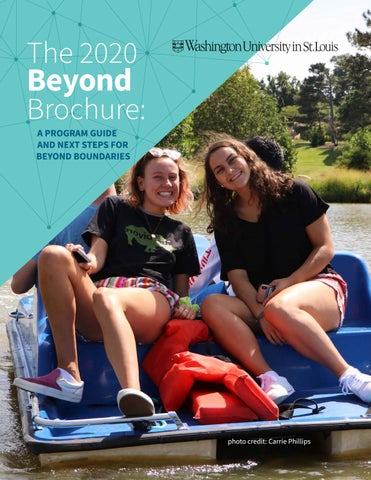
photo credit: Carrie Phillips
Welcome to the Beyond Boundaries Program WE ARE DELIGHTED THAT YOU HAVE DECIDED TO JOIN THE BEYOND BOUNDARIES PROGRAM AT WASHINGTON UNIVERSITY IN ST. LOUIS THIS FALL!
The Beyond Boundaries Program at WashU is a two-year program, with an optional two-year extension, that equips students to make a difference in a complicated world. By allowing students to enter WashU unaffiliated with any one school, the program allows you to address challenges that do not reside in the territory of a single discipline. This booklet helps you learn more about: ❶ Program leadership ❷ Advising information ❸ Overview outline of the program specifics, and curricular and extra-curricular expectations ❹ Beyond Boundaries course offerings (open to all 1st Year students, but program students get priority enrollment) ❺ Next steps ❻ The Beyond Boundaries Program app
WASHINGTON UNIVERSITY IN ST. LOUIS | BEYOND BOUNDARIES PROGRAM | 1
Program Leadership
Rob Morgan
Director of the Beyond Boundaries Program Teaching Professor in Drama Scenic/Industrial/Exhibit Designer rmorgan@wustl.edu Rob is delighted to be directing the Beyond Boundaries Program at WashU. Rob is in his 11th year of teaching at Washington University in the area of stage design for the Performing Arts Department. He has designed professionally in the areas of theatre, industrial, film, museum, and theme park venues and his professional website is here. Rob also co-teaches a Beyond Boundaries class called Designing Creativity. Directing the Beyond Boundaries Program gives Rob the opportunity to work with a select group of students who desire to collaborate across disciplines, and interact with multiple schools and departments. Rob has a master’s degree in scenic design from San Diego State University and a bachelor’s degree from Webster University.
Simone Picker
Program Coordinator simonepicker@wustl.edu Simone Picker is thrilled to be a part of the Beyond Boundaries team. She has almost 10 years experience in the non-profit sector as a program coordinator. Simone has had the opportunity to work with many populations, including being a field instructor for MSW students in the St. Louis area. Simone is a proud alumna of Washington University, studying Psychology and Spanish as an undergraduate and earning her MSW from the Brown School of Social Work. She is looking forward to working with each Beyond Boundaries student to create their unique path as they pursue their passions and gain access to the incredible resources available to them.
WASHINGTON UNIVERSITY IN ST. LOUIS | BEYOND BOUNDARIES PROGRAM | 2
Academic Advising
At right and above are the advisors from each of the four undergraduate schools who are specifically involved in helping to advise Beyond Boundaries Program students. Please use them as a resource for advice on the program as well as major/minor requirements in their respective schools. Should you be interested in two schools, you are welcome to schedule an appointment with a 2nd advisor (after scheduling your primary).
With a program like Beyond Boundaries that lives outside of traditional educational and school norms, it is imperative that first-year students be engaged and self-initiated in regards to crafting and planning their own educational path. Students will receive support from undergraduate advisors familiar with the requirements of the Beyond Boundaries Program. Each student in the Beyond Boundaries Program is assigned an advisor from one of the four undergraduate schools: Arts & Sciences, Business, Engineering, or Art & Architecture. Your advisor is determined based on your primary area of major that you cited on your WashU application. Please contact your advisor and schedule either a virtual or in-person advising session to be certain that you enroll in the appropriate courses that meet the minimum requirements in each school. You will
meet with this advisor periodically during your first year and thereafter at least once every semester to register for classes.
Georgia Binnington
Paige LaRose
Dirk Killen
Melanie Osborn
Associate Dean, Sam Fox School of Design & Visual Arts 314.935.6532 gbinning@wustl.edu
Associate Dean, College of Arts & Sciences 314.935.9457 dkillen@wustl.edu
WHAT YOU CAN DO NOW â—? Fill out this online form (found at beyondboundaries.wustl.edu) to select your preferred Beyond Boundaries course for fall. â—? Contact your undergraduate advisor to pre-enroll and plan your first year course schedule.
Assistant Dean & Director of Undergraduate Programs, Olin Business School 314.935.7774 plarose@wustl.edu
Assistant Dean, Engineering Student Services 314.935.8013 osborn@wustl.edu
WASHINGTON UNIVERSITY IN ST. LOUIS | BEYOND BOUNDARIES PROGRAM | 3
PHASE A: Foundation
PHASE B: Focus
YEAR ONE
YEAR THREE
YEAR FOUR
Non-phase A Foundation Participants:
Interdisciplinary or Collaborative Capstone Project – Co-advised and mentored by two faculty – Offer multiple disciplinary perspectives on their work
Beyond Boundaries Seminar
1
College Writing (student choice) 3 Beyond Boundaries Course CHOOSE ONE FROM:
3
FALL
– Earth’s Future: Global Climate Change – Designing Creativity: Innovation Across Disciplines – Religious Freedom in America – The Business of Elections
YEAR TWO
points-based system Less structured curriculum (based on your interests) CHOOSE MULTIPLE FROM FOLLOWING:
– Weekend Problem-Solving Seminars & Workshops – Co-Curricular Service Opportunities – Lecture Series – Networking Events – Community Building Events – Discussion Participation – Interdisciplinary Courses
SPRING
Beyond Boundaries Seminar
1
Beyond Boundaries Course CHOOSE ONE FROM:
3
– When I’m 64: Transforming Your Future – The Art of Medicine – Gender, Youth and Global Health – Morality & Markets – To Sustainability and Beyond: People, Planet, Prosperity – Endgame of Entrepreneurship: Leveraging Capitalism for Good
Less structured curriculum (based on your interests) CHOOSE MULTIPLE FROM FOLLOWING:
– Weekend Problem-Solving Seminars & Workshops – Co-Curricular Service Opportunities – Lecture Series – Networking Events – Community Building Events – Discussion Participation – Interdisciplinary Courses – Spring Break Opportunity
When available, a summer research/ internship in one of these Interdisciplinary Institutes on campus:
SUMMER
points-based system
– Interdisciplinary Program in the Humanities – Institute for School Partnerships – Skandalaris Center for Interdisciplinary Innovation and Entrepreneurship – Gephardt Institute for Civic and Community Engagement – Institute for Public Health – Office of Socially Engaged Practice – Institute for Informatics – Institute for Informational Science – Clark-Fox Institute – Office of Sustainability – International Center for Energy, Environment and Sustainability (InCEES)
Participants who complete Phase A receive a Milestone Notation in their transcript
OFF RAMP FOR PHASE A STUDENTS (IF DESIRED) AND ON-RAMP FOR ALL PHASE B STUDENTS
11 credits (2 semesters)
– Apply to the program via application. Chosen based on demonstrated interest in interdisciplinary study and problem-solving Selected students take one course: – Interdisciplinary Problem-Solving 1 credit
Phase A and B Participants:
– Opportunities similar to Year Two of the program – Added areas include: • Study abroad opportunities • Select courses in the graduate and professional schools (when available) • Attend co-curricular programming that engages faculty at these schools
points-based system
E-Portfolio – A summation of your research and interdisciplinary study. Could be an answer to your ‘big question’ or some other interdisciplinary topic.
Phase A and B Participants:
– Opportunities similar to Year Two of the program – Added areas include: • Study abroad opportunities • Select courses in the graduate and professional schools (when available) • Attend co-curricular programming that engages faculty at these schools
Participants who complete Phase B receive a Milestone Notation in their transcript
Program Structure CURRICULAR AND EXTRA-CURRICULAR OPPORTUNITIES
PHASE A: FOUNDATION First and Second Year Requirements
PHASE B: FOCUS Third and Fourth Year Requirements
First Year Courses
University Sponsored Events with Point Assignments
College Writing Fall
3 credits
Opportunities listed in Phase A
50 points total
Beyond Boundaries Seminar Fall and Spring
2 credits
25 points total
Beyond Boundaries Courses Fall and Spring 2 courses
6 credits
Collaborative Capstone or E-Portfolio Project
PHASE B TRANSCRIPT MILESTONE NOTATION At least 75 points earned during third and fourth years
University Sponsored Events with Point Assignments Guest Speaker/Lecture
1 point
Networking or Community-building Events/Symposia
2 points
Co-curricular Interdisciplinary Service Opportunities
5 points
Weekend Topic-based Seminars
8 points
Spring Break Opportunities
10 points
Summer Research/Internship
15 points
Interdisciplinary Courses Years 2-4 with BB attribute 3 credits or more
20 points
PHASE A TRANSCRIPT MILESTONE NOTATION Completion of first year curricular requirements plus 50 points (minimum) earned
Points are managed via the
Beyond Boundaries App! (see last page for d)
APPROXIMATE TIME COMMITMENT FOR EACH EVENT CATEGORY not including courses Guest Speaker/Lecture
1-2 hours
Networking or Community-building Events/Symposia
2-4 hours
Co-curricular Interdisciplinary Service Opportunities
5-8 hours
Weekend Topic-based Seminars
8 hours–2 days
Spring Break Opportunities
3 days–1 week
Summer Research/Internship
2 weeks–2 months
Interdisciplinary Courses 20 points following written proposal by student and approval by Faculty Advisory Council
WASHINGTON UNIVERSITY IN ST. LOUIS | BEYOND BOUNDARIES PROGRAM | 5
Beyond Boundaries and Bear Bridge Courses Beyond Boundaries Seminar 2 credits Led by the Beyond Boundaries Program Director, Rob Morgan, this course will cover selected relevant topics including interdisciplinary projects and lectures, collaboration, ideation exercises, and college student development. It is an interactive seminar in which students will participate in exercises related to prototyping futures, mind-mapping, salon-type discussions, dialogue, reflection, and related activities. There will be opportunities to meet and hear from faculty representing all seven schools at Washington University. The knowledge gained is designed to contribute to academic success, personal development, and a more rewarding social and academic experience over the course of the college experience. This is a pass/fail course and students will earn one credit in the Fall semester and one credit in Spring semester.
College Writing 3 credits During the fall semester, students will join other first-year students to take the 3-unit university-wide college writing course. This course will focus on basic writing skills and communication across disciplines. It will meet three days per week. The course will be taught by a faculty member in sections of 12 students. It will include various contributions from faculty in other departments and across divisions through lecture series, class visits, panels, and interviews. The courses will be grouped into six themes—Identity, Justice, Environment, Dreams & Nightmares, Technology, and Foodways—which students will self-select into. The When I’m 64 course has an optional writing section as well.
WASHINGTON UNIVERSITY IN ST. LOUIS | BEYOND BOUNDARIES PROGRAM | 6
Beyond Boundaries Courses 6 credits
BEYOND BOUNDARIES
Designing Creativity: Innovation Across Disciplines
First year students in the Beyond Boundaries Program will be required to complete two Beyond Boundaries courses (one in the fall and one in the spring), for which they will have priority enrollment. Beyond Boundaries courses are designed to prepare students for a rapidly evolving world characterized by social, political, scientific, and economic problems that cannot be solved using knowledge from a single discipline. Teamtaught by faculty from different schools across Washington University, Beyond Boundaries courses offer a window into how scholars from different disciplines approach big, critical topics—like our aging population, the nature of creativity, the phenomenon of climate change, and the evolving art of medicine. These courses will offer students in this program tangible examples from interdisciplinary approaches to these topics, including examples of faculty from across schools participating in interdisciplinary exploration. BEYOND BOUNDARIES
The Art of Medicine
Rob Morgan, College of Arts & Sciences Bruce Lindsey, Sam Fox School From “ah-ha” epiphanies to slow-developing discoveries, the creative process has been employed by innovators and artists in virtually every corner of the globe for centuries. Designing Creativity is a course that will explore the study and practice of the creative process across many disciplines with input from prominent thinkers and practitioners in the areas of medicine, neuroscience, law, engineering, architecture, human-centered design, business, stage design, and the performing arts. The class will also incorporate practice of design thinking and creativity techniques in a lab component that will allow students to explore the development of innovative ideas in collaborative teams followed by project presentations to core faculty and classmates. For more, visit the course website here. BEYOND BOUNDARIES
Rebecca Messbarger, College of Arts & Sciences Patricia Olynyk, Sam Fox School Within our contemporary culture, there has been a perceptible move toward de-emphasizing the boundary conditions that strictly define medicine on one hand and art on the other. This interdisciplinary, cross-school course offers students a singular encounter with the history of Western medicine and its represenatations within the visual arts through lectures, discussions, and a variety of written and artistic assignments. Faculty from the Sam Fox School of Design and Visual Arts and the School of Arts and Sciences will collaborate with visiting artists and faculty from biomedical ethics, the Medical School, and the Institute of Public Health. Be sure to check out the podcast episode featuring Professor Messbarger talking about this class and click here for a link to final projects.
Earth’s Future: Causes and Consequences of Global Climate Change
T.R. Kidder, College of Arts & Sciences Brent Williams, McKelvey School of Engineering Climate change is said by many to be one of the most important issues of our time. This course examines 1) the physical basis for climate change; 2) how climates are changing, and how we know and assess that climates are changing; and 3) the effects of climate change on natural and human systems. The course is team-taught and will
WASHINGTON UNIVERSITY IN ST. LOUIS | BEYOND BOUNDARIES PROGRAM | 7
involve participation by scholars across the university with expertise in specific subjects. Earth’s Future is a broad, introductory course for first year students. While this course presumes no special subject matter knowledge on the part of the student you will be exposed to a broad array of scholarship across the sciences, social sciences, engineering, and humanities. Be sure to check out the podcast episode featuring Professor Kidder talking about this class and this article online. BEYOND BOUNDARIES
Gender, Youth, and Global Health
Jessica Levy, Brown School Caline Mattar, School of Medicine Through in-depth case studies, this course provides an introduction to gender specific issues in the context of childhood and adolescence, poverty, and global health. Students will learn to identify how gender and gender differences affect conditions of life in the areas of reproductive health, nutrition, conflict, access to healthcare, and the social determinants of health—especially for young people. Students will learn to analyze health conditions and disparities in relation to both the micro dynamics of local worlds and the macro dynamics of large-scale social forces in the post-colonial global field. Additionally, they will come to understand the current challenges that global health practitioners and institutions confront in achieving gender equity, and the current efforts toward closing the gap. These learning objectives will be achieved using lectures, but also discussions-based sessions and Skype-based interactions with NGOs and experts who are currently working in the field. Check out the SP 2018 flyer for this course here.
BEYOND BOUNDARIES
When I’m 64: Transforming Your Future
Brian Carpenter, College of Arts & Sciences Nancy Morrow-Howell, Brown School of Social Work Susy Stark, School of Medicine Whether you know it or not, you’re living in the midst of a revolution – a revolution that’s going to change your personal and professional lives. You’ll live into your 80s and 90s, with a 50% chance of seeing your 100th birthday. This demographic revolution is going to change the health care you receive, the house you live in, the car you drive, the jobs you do, and the relationships you have with family and friends. In other words, this revolution will shape every aspect of your life. This class will give you an edge in understanding how you can harness these forces to shape your career and life. During the semester you’ll have the opportunity to learn from a multidisciplinary group of educators and professionals who are addressing issues related to aging right now. You’ll also have an opportunity to get off campus and witness for yourself how businesses, organizations, and the community are getting ready for the change in the city’s demographics. Be sure to check out the podcast episode featuring these faculty members talking about their class and this article/video online. BEYOND BOUNDARIES
Morality and Markets
Abram Van Engen, College of Arts & Sciences Peter Boumgarden, Olin Business School What does it look like to live a moral life in today’s market system? We know all too well what it does not look like. The news is filled with moral failures of leaders and executives at top firms. We like to believe that we would
WASHINGTON UNIVERSITY IN ST. LOUIS | BEYOND BOUNDARIES PROGRAM | 8
BEYOND BOUNDARIES
behave differently, but what kind of pressures inform our moral choices? What pulls us, what pushes us, and what persuades us to act one way rather than another? These are the questions that a course combining business and literature can open in unique ways, for the world of fiction helps open the ethical dilemmas of the market we inhabit everyday. In the course, we use great books, classics of film and modern television, and the tools of modern psychology and business strategy to think critically about what is entailed in living a moral life in the midst of the modern market.
The Business of Elections
Steve Malter, Olin Business School Andrew Reeves, Arts & Sciences
BEYOND BOUNDARIES
To Sustainability and Beyond: People, Planet, Prosperity
Anvi Solanki, McKelvey School of Engineering David Webb, College of Arts & Sciences Sustainable development is the pathway to a sustainable society and every discipline has it’s own sense of what that means and how to pursue it. Thus, the first part of the course provides perspectives on sustainability across disciplines. Students will be introduced to global concepts in sustainability and examine how they relate to specific issues in the greater St. Louis community, learning what it means to be civic-minded stewards of social and ecological systems. Additionally, they will work on developing critical soft skills needed for success on the job, such as effective communication techniques, time management, leadership, responsibility, and accountability. The second part of the course prepares students to work with community partners in the St. Louis region using sustainability as a lens for examining opportunities and challenges. Students will collaborate across disciplines; explore interdisciplinary interests; learn from a diverse cohort of faculty, community partners and peers; and gain meaningful hands-on experience. Students will emerge from this course with a systems-level understanding of sustainability, a working knowledge of the fundamentals of community engagement, and an appreciation for values-based civic stewardship. Experience in this course will prepare students for applied project-based work in other courses or internships, regardless of academic discipline.
This course will focus on understanding the primary and Presidential elections, particularly the 2020 election through a multi-disciplinary approach, primarily political science and business. Campaigns are start-ups that rely on strategy, branding, influencing consumers (voters), financing and other concepts to achieve the elections of their candidate. At the same time, American politics is highly polarized with voters who are increasingly hostile to listening to the other side. Given this context, how does a campaign succeed as an entrepreneurial venture? The course will allow students to compare and contrast how different candidate’s policies/platforms may impact different constituencies/sectors of the business/labor world as well as the economy and how the media portrays them and what role they will play in the general election. Be sure to check out the podcast episode featuring Professor Malter talking about this class! BEYOND BOUNDARIES
Religious Freedom in America
John Inazu, Law School & Danforth Center Mark Valeri, Arts & Sciences The intersection of religion and law in American society has sparked some of the fiercest cultural engagements in recent memory: Should a for-profit religious corporation have a right not to fund birth control for its employees? Can a public college expel campus religious groups whose membership is not open to all students? May a Muslim grow a beard for religious reasons in prison? Should a cake baker or a florist be permitted to refuse services for a gay wedding? Can a church hire and fire its ministers for any reason? These current debates and the issues that frame them are
WASHINGTON UNIVERSITY IN ST. LOUIS | BEYOND BOUNDARIES PROGRAM | 9
interwoven in the American story. This course introduces students to the major texts and historical arguments underlying that story. Drawing from the respective expertise of the instructors, it exposes students to a variety of scholarly methods related to the issue: legal history and case law, intellectual history and canonical texts, social history and narrative accounts, and political philosophy and contemporary analyses. Be sure to check out the podcast episode featuring Professors Valeri and Inazu talking about this class and click here for the syllabus. BEYOND BOUNDARIES
The Endgame of Entrepreneurship: Leveraging Capitalism for Good
II Luscri, Asst Vice Provost - Innovation and Entrepreneurship Heather Cameron, Brown School of Social Work Doug Villard, Olin Business School Historically, profit has been a key driver of human behavior. In this class, students will learn to take advantage of the profit seeking motive to address inequality, environmental degradation, food insecurity, and international conflict. With an emphasis on interdisciplinary and project based learning, teams of students will design implementable solutions to these challenges while developing creative problem solving behaviors that will benefit them in their personal, academic, professional, and charitable pursuits at WashU and beyond.
For interviews with Beyond Boundaries faculty and students, subscribe to the Beyond Boundaries Podcast! beyondboundaries.wustl.edu/podcast
WASHINGTON UNIVERSITY IN ST. LOUIS | BEYOND BOUNDARIES PROGRAM | 10
beyondboundaries.wustl.edu EMAIL
beyondboundaries@wustl.edu
@BBoundariesWU
Get the App! Be sure to download the new Beyond Boundaries App found on Google Play and Apple App store! Then create a profile and begin to explore the curricular and extra-curricular opportunities found there, connect with other cohort members, and collaborate!