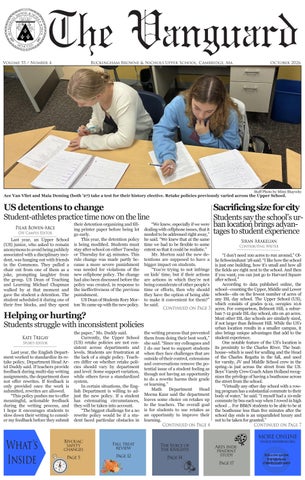
The Vanguard
October 2026
Page 1
Volume 55 / Number 4
Buckingham Browne & Nichols Upper School, Cambridge, Ma
October 2026
Staff Photo by Mimi Shaywitz
Ace Van Vliet and Maia Deming (both ’27) take a test for their history elective. Retake policies previously varied across the Upper School.
US detentions to change
Sacrificing size for city
Student-athletes practice time now on the line Pilar Bowen-Arce Off Campus Editor
Last year, an Upper School (US) junior, who asked to remain anonymous to avoid being publicly associated with a disciplinary incident, was hanging out with friends in the Commons. They pulled a chair out from one of them as a joke, prompting laughter from the group. US Dean of Teaching and Learning Michael Chapman walked by at that moment and gave the student a detention. The student scheduled it during one of their free blocks, and they spent
their detention organizing and filling printer paper before being let go early. This year, the detention policy is being modified. Students must stay after school on either Tuesday or Thursday for 45 minutes. This rule change was made partly because a more severe punishment was needed for violations of the new cellphone policy. The change had also been discussed before the policy was created, in response to the ineffectiveness of the previous punishment. US Dean of Students Rory Morton ’81 came up with the new policy.
Helping or hurting?
Students struggle with inconsistent policies Kate Tregay Sports editor
Last year, the English Department worked to standardize its retake policy, Department Head Ariel Duddy said. If teachers provide feedback during multi-day writing assignments, the department does not offer rewrites. If feedback is only provided once the work is submitted, rewrites are allowed. “This policy pushes me to offer meaningful, actionable feedback during the writing process, and I hope it encourages students to slow down their writing to consider my feedback before they submit
What’s Inside
the paper,” Ms. Duddy said. Currently, the Upper School (US) retake policies are not consistent across departments and levels. Students are frustration at the lack of a single policy. Teachers differ on whether retake policies should vary by department and level: Some support variation, while others favor a standardized system. In certain situations, the English Department is willing to adjust the new policy. If a student has extenuating circumstances, they will be taken into account. “The biggest challenge for a no rewrite policy would be if a student faced particular obstacles in
“We knew, especially if we were dealing with cellphone issues, that it needed to be addressed right away,” he said. “We knew that at the same time we had to be flexible to some extent so that it could be realistic.” Mr. Morton said the new detentions are supposed to have a bigger impact on students. “You’re trying to not infringe on kids’ time, but if their actions are actions in which they’re not being considerate of other people’s time or efforts, then why should they have the option of being able to make it convenient for them?” he said.
Students say the school’s urban location brings advantages to student experience Siran Arakelian
Contributing Writer
“I don’t need 100 acres to run around,” Ollie Schweinshaut ’28 said. “I like how the school is just one building, how it’s small and how all the fields are right next to the school. And then if you want, you can just go to Harvard Square after school.” According to data published online, the school—counting the Upper, Middle and Lower schools—sits on the fewest number of acres of any ISL day school. The Upper School (US), which consists of grades 9-12, occupies 10.6 Continued on Page 3 acres. For comparison, Belmont Hill, a suburban 7-12 grade ISL day school, sits on 40 acres. Most other ISL day schools are similarly sized, if not larger than Belmont Hill. While the US’s urban location results in a smaller campus, it the writing process that prevented also brings unique advantages that add to the them from doing their best work,” student experience. One notable feature of the US’s location is she said. “Since my colleagues and its proximity to the Charles River. The boatI do our best to support students house–which is used for sculling and the Head when they face challenges that are of the Charles Regatta in the fall, and used outside of their control, extensions for varsity, JV and Middle School crew in the and conversations remove the pospring–is just across the street from the US. tential issue of a student feeling as Boys’ Varsity Crew Coach Adam Holland recogthough not having an opportunity nizes the privilege of having a boathouse across to do a rewrite harms their grade the street from the school. or learning.” “Virtually any other day school with a rowMath Department Head ing program has a substantial commute to their Meena Kaur said the department body of water,” he said. “I myself had a 10-mile leaves some choice on retakes up commute by bus each way when I rowed in high to the teachers. The overall goal school … For BB&N students to be able to be at is for students to use retakes as the boathouse less than five minutes after the an opportunity to improve their school day ends is an unparalleled luxury and not to be taken for granted.” learning.
Continued on Page 4
Continued on Page 7
MORE ONLINE
Bivouac safety changes
Fall treat review
The Voice of the Knights
Page 5
Page 12
Page 14
Arts independent study Page 17
vanguard.bbns.org Follow us on Instagram @bbnvanguard
The Vanguard
October 2026
Editorials
Page 2
Let’s remember 9/11 Earlier this school year, Upper School (US) students and faculty went about a normal day, walking to advisory and classes, while the date Sept. 11 appeared in tiny letters on a TV screen outside the Commons that outlined the week’s block schedule. That date was the only indicator of the horrific terrorist attacks that happened 25 years ago. US students received one email from the Head of the History Department Stacey Spring acknowledging 9/11, but otherwise it was crickets. Given that we are a Boston school, with two of the planes departing from Logan Airport and many families with parents working in New York, it was disappointing that the school didn’t take the time to acknowledge 9/11, especially on the 25th anniversary. Not only was this a tragic event for many families, but it left a lasting impact in history for the United States. Many of the United States’ current foreign policy actions and economic strategies are a result of a “post 9/11 effect.” For example, the United States invaded Afghanistan on October 7, 2001, to destroy al-Qaida, the group that was involved in 9/11, and consequently overthrew the Taliban regime. Sadly, our school stood out among both public and private schools in the Boston area for not recog-
Photo Courtesy of Kate Tregay
The 9/11 Memorial in Manhattan. The site has attracted millions of visitors every year since its completion.
nizing this anniversary. Nobles held a whole assembly dedicated to remembrance; Dexter Southfield brought in Alison Crowther (the mother of Welles Crowther—“the man in the red bandana”); and Bel-
Buckingham Browne & Nichols School 80 Gerry’s Landing Road • Cambridge, MA 02138 vanguard@bbns.org, vanguard.bbns.org (617) 547-6100 Volume 55, Issue 4 Projects Editor Christine Tao
Editor-in-Chief Lucia Longstreet-Lipson
Opinions Editor Ethan Moran
Managing Editor Mimi Shaywitz Production Manager Harper Dubovik
Editorials Editor Scarlett Hawkins
Production Manager Sydney Ruiz
On Campus Editor Christian Chow
Digital Media Editor Adi Bhatia
Off Campus Editor Pilar Bowen-Arce
Asst. Production Manager Lauren Li
Features Editor Rima Demir
Asst. Production Manager Noura Farahat
Sports Editor Kate Tregay
Photo Editor Katy Varadi Arts Editor Henry Carroll
Faculty Advisor Kim Whitney
Asst. Photo Editor Tristan Ko
The Vanguard’s mission is to examine and engage the school community by providing news and information about events affecting it and by featuring the diverse range of people and perspectives that comprise it. We strive for fairness and accuracy in our content, and we strive to present that content with integrity and respect. The Vanguard is the official student newspaper of the Buckingham Browne & Nichols Upper School, which has 534 students, 84 faculty members and 79 staff members. Affiliated with the Columbia Scholastic Press Association, the paper is a forum for differing views and welcomes comments from its readers in the form of Letters to the Editor. No anonymous letters will be printed. The Vanguard reserves the right to edit all letters for length. The Vanguard publishes eight issues per annual volume and prints between 500 and 800 copies of each issue. About 200 of those are mailed out; the rest are distributed around campus. Copyright © 2026 The Vanguard. Staff Writers: Olivia Bell, Jack Reinfeld, Sydney Xu, Leah Cooper, Maggie Whitney, David Zhou, Robbie Lally, Julia Agudelo, Alice Chung, Viola Shepard, Vivian Cain-Weingram, Catalina Longstreet-Lipson, Marwa Benyounes, Bradley Shen, Siran Arakelian, James Tao, Alex Berk, Rachel Goldberg, Leo Brodsky, Sophia Kluzak Staff Photographers: Azariah Zewde Staff Artists: Lauren Li, Sydney Ruiz, Sydney Xu, Rachel Goldberg, Christine Tao, Marin MacDonald, James Tao, Catalina Longstreet-Lipson, Mimi Shaywitz, Katy Varadi
mont Hill, Winsor and Newton South held a moment of silence and speeches by their head of school. Because the US didn’t recognize the date, it appears that the US is directly avoiding uncomfortable subjects. Even a simple mention of 9/11 would have given students and faculty an opportunity to reflect and remember. Yes, the US has a rigorous schedule and little space for activities outside of the curriculum, but even a brief moment of silence would give students time to reflect, grieve and remember the tragedies. By not discussing 9/11, our school shows it teaches us only how to take tests, not how to live in our country and learn its nuances. The US does a lot of amazing things within the curriculum and community, but it also needs to inform students about current events and bring a sense of reality to our bubble. Even when the school thinks it is protecting us from hardships, it is better to learn as a community, especially when the topics are controversial and sensitive.
Stop the trending Walking through the Upper School (US) halls, you may see one common thread among the students: a brand name on their backpack, sweatshirt or water bottle. If you calculated how many girls wore a Parke crewneck on a random day, we guarantee it would be over 20. On the tables, Owalas and Hydro Flasks mask the yellow Commons, and Lululemon keychain holders are constantly grasped by passing students. The US is a warehouse of brand names, and we have two things to thank for that: consumerism and trends. Don’t worry, we at The Vanguard fall into it too. The Free People shirt fits perfectly with your Princess Polly skirt. However, when students leave classes to “use the bathroom” but really log on to the Parke hoodie drop to wait in a 1,000-person queue, it’s a sign falling into trends has gone too far. Is it really that cute? Or is it cute because we have convinced ourselves that fitting in is the new ideal? Perhaps it’s a mix of both. The US has become a homogeneous sea of students, and The Vanguard is craving unconventional, original clothing. Social media is to blame for spreading trends at an exponential rate. Specific marketing targets young girls who see famous influencers promoting certain brands and feel it will make them inherently cooler. Most importantly, clothing is often how students can express themselves; when everyone dresses the same, we lose that sense of individuality and freedom. At any rate, fashion has shifted from personal style to who can wear the most expensive name brand, making the simple act of dressing a source of insecurity for many students. On the surface, this issue feels like a champagne problem. But the pressure to keep up with trends is part of a much larger consumer culture, one that affects not only our community but people around the world. Along with conformity and targeted marketing, there is financial stress. Not necessarily because a pair of leggings costs $130, which is insane, but because of the manipulation these companies have set up. Many checkout processes in online stores, apps and even grocery stores have adopted a new form of payment: “buy now, pay later.” Instead of paying $80 for a water bottle up front, you can pay $20.50 for four months, making the purchase feel deceptively affordable. By the time people pay it off, is the item even in style anymore? Even if students don’t use “buy now, pay later,” the fact that companies built a marketing machine around a piece of clothing shows consumerism is out of hand. All in all, whether US students care about the toll on their bank account or not, there is an even more important message to get across. Conforming to consumerism and trends makes our community one big blob of perceived beauty, when, in fact, your beauty comes from being unique. Wear that top you thought was a little too boho and out of the norm. Wear the old jeans your mom gave you that are slightly baggier than your friends’ jeans. Ultimately, people don’t remember the five Parke hoodies in the hall; they remember the cute blouse, red belt and cropped graphic tee. Trending is out, and original is in.
The Vanguard
October 2026
On Campus
Page 3
Who funds the doughnuts? How the US pays for its 93 clubs Christian Chow On Campus Editor
Geography Club hands out doughnuts to the winners of its weekly games and pays for its expenses out of pocket. Model United Nations (MUN) has a budget of roughly $8,000 to $9,000, yet still has to choose between conferences at Harvard and Yale. Both are Upper School (US) clubs. Both get funded differently by the school. US Dean of Students Rory Morton ’81 said most of the 93 clubs registered this year, including Geography Club, can be reimbursed up to $250 each from the Dean of Students Office’s budget. The budget also pays for senior breakfasts, assembly chair rentals and grade deans’ requests. The exception is clubs that typically spend more than $250 a year, such as MUN, Best Buddies and nearly all school publications, including The Vanguard (IN ITALICS PLEASE), which have budgets that don’t come from his office. To be reimbursed, a club’s faculty advisor must submit forms and receipts to the Dean of Students Office, Geography Club President Malik Shadid ’28 said. “The maximum amount of reimbursement you can get is only 250 bucks, and we spend way more than that on doughnuts in a year,” he said. “So there’s no point in having to go through all that legal trouble to only get 250 bucks back.” The school agreed to cover the $150 Amazon gift card prize for the club’s geography bee this fall, but without weekly prizes and snacks, attendance might slip, he said. “It’d be way more convenient if the school could cover that for us directly instead of us having to pay out of pocket and submit our receipts for reimbursement,” Malik said. “It’s annoying and costs a decent
Drawing by Christine Tao
amount.” Malik said he is still grateful for the reimbursement for the gift card and knows the school’s resources are limited. “Although I appreciate all the help the school gives, I think a re-examination of how they distribute the funds to different clubs would help,” he said. “Maybe some way to score clubs on participation and need would be good.” Mr. Morton said his entire club funding budget is currently about $8,000 to $9,000. MUN’s budget alone is comparable, its faculty advisor said. Mr. Morton said the $250 figure dates back to long before he arrived at the US in 2000, when there were around 12 to 15 clubs. “There used to be a $250 stipend that every club gets, but that’s actually not true anymore,” Mr. Morton said. “My budget is such that I couldn’t possibly support all the clubs that we have now if I were giving them $250 each. But also, some of our clubs don’t need $250.” Giving 93 clubs $250 each would cost $23,250, more than dou-
ble the current $8,000 to $9,000 budget. When Mr. Morton arrived at the US, his budget was around $15,000, and a sizable share of it went to clubs, he said. “The money that didn’t get spent over the years, the school looks at it and says, ‘Well, we don’t really need to be including that’,” he said. “So it went elsewhere.” Mr. Morton said he can approve spending over $250 if his office has money left late in the year, and he can’t recall refusing a student’s receipt in his 26 years in the US. “A lot of times they’re thinking, ‘OK, it’s $8. I‘m not going to go through all that paperwork for $8,’” he said. “You can get reimbursed for that, but it‘s your choice if you choose not to submit the paperwork.” Clubs not funded through the Dean’s office propose changes each spring, and a new club with costs like MUN’s has to wait a year while the school works out how to fund it and who will run it, he said. Not every club with its own budget runs short. The Spectator, the US arts and literary magazine, gets a budget based on what it spent last
year to print its issues, US English Teacher and Spectator advisor Wes Williams said. “I have absolutely no idea how The Spectator’s budget compares with other clubs,” he said. “And I’m just fine with that.” MUN has run short before. Last spring, the club ran out of money before a conference at the Noble and Greenough School, so its leaders asked for more and received it, MUN Co-President Matias Egan ’28 said. “We have to pick between the Harvard and Yale conferences,” Matias said. “We’re trying to figure out ways to work around it, but it would be easier if we had more funding.” Freshmen in particular often miss out on the Yale conference, and the club is trying to get more students involved than in past years, he said. “If we had more money, we could take more kids to more things,” he said. US Spanish Teacher Gabriela Gonzenbach, who took over as the faculty advisor for MUN this year, is booking hotel rooms for the 14 students and two chaperones who usually attend the Yale conference in January, she said. “I don’t think MUN should be compared to those other clubs when it comes to funding,” she said. “It’s a different level.” Profe Gonzenbach said she thinks the club’s budget comes through US Director Jessica Keimowitz’s office. It barely covers Yale and two local conferences, she said, so she plans to ask Ms. Keimowitz for enough to add the nearby Harvard conference. “Maybe this will bring a conversation among adults,” she said. “What are we doing? Where are we supporting? Who is more important than who?”
US detentions to change CONTINUED FROM PAGE 1
Mr. Morton hopes the new policy will help students follow the rules. “It is a deterrent,” he said. “Kids don’t like missing their sports commitments or their after-school commitments, and they don’t like having to tell their coach or their teachers that ‘oh, I can’t be here at the first half because I’m in detention.’ No one’s going to be happy about that, so I hope it actually motivates kids to be a little more thoughtful about ‘okay, I don’t want to give this up.’ If you don’t want to give it up, then just follow the rules. Do what you’re supposed to do and chances are you won’t be in that situation.” US Assistant to the Dean of Students Kerri Anne Shea is in charge of running detentions. Before the system changed this year, students were required to perform tasks during detention. She had to come up with activities, such as organizing printer paper each week. “I was asking to change it for years anyway because having to come up with tasks for kids to do during the day was getting a little ridiculous,” Ms. Shea said. “It was more work for me trying to find
tasks for kids to have to do.” With the new policy, students will still occasionally help teachers with organizational tasks, but only when necessary. Otherwise, students will have “quiet time.” “I don’t want students to be scared of detention but I would like them to take it more seriously,” Ms. Shea said. “It’s not supposed to be fun. I knew students weren’t taking it seriously because they would tell me they were having fun or they actually enjoyed whatever task they were doing, or I would see them talking and laughing with friends or other classmates when they were supposed to be focusing on a specific task. Other times I would give a student a task and they would respond with ‘wait, this is all I have to do?’ Conversations like these brought up the obvious need for a change.” Varsity Football (VF) player Liam Cunningham ’27 said the new rules will make students more scared of getting in trouble. “The new detentions will definitely make people not want to commit those kinds of errors. Especially the athletes, it’s a huge, important
part of their day.” Liam said missing practice would be harmful to student-athletes. “It would be detrimental because practice is incredibly important for the development of our players,” Liam said. “We go over a lot of information during practice, which is crucial for games and it would be a shame if somebody would have to miss practice over their actions.” Liam said the threat of a detention deters him from breaking the phone policy. “It definitely makes me not want to take out my phone at all,” he said. VF Head Coach Mike Willey said it is the students’ responsibility to not get a detention and miss practice. “Obviously, if a student has to miss practice because they have to serve a detention, that’s going to put the team at a disadvantage, so it’s the responsibility of the student to not put themselves in that position,” Coach Willey said. “I think it will actually help make the students take a little bit more ownership on following the rules and not putting themselves in a position where they would get a detention.” Coach Willey said he thinks oth-
er coaches will agree with him. “We want to build cultures amongst teams in general that each student-athlete is trying to help their team out and do all the things the right way,” he said. “Part of that is doing the right things in school. I think all the coaches will support the policy and say, ‘okay, yep, that is what it is. Now let’s make sure our student-athletes don’t put themselves in a position where they’re going to miss practice.’” Isaac Xu ’29 received detention last year for accidentally skipping a Health and Fitness class. He is not in favor of the change. “I think other kids probably have similar opinions to me,” Isaac said. “They think it’s just a waste of time after school. I think the old one’s better, but the new one does motivate you to not get a detention.” Ms. Shea and Mr. Morton said the specific details of what students will be allowed to do in detention are still being discussed, and they will adjust throughout the year as the new system is tested.
The Vanguard
Page 4
Helping or hurting?
October 2026
On Campus
Continued from Page 1
“If they want to do it because they want to learn and review the material so they understand it for the exam or future subjects, then we’re all on board,” she said. “But it’s hard for us to make that determination with every student. Each student has a different motivation. We’re making a choice about kids who are motivated in improving and learning from their mistakes versus the kid doing it for the sake of a grade.” When designing retake policies, time constraints are another challenge. “A teacher doesn’t have an infiStaff Photo by Mimi Shaywitz nite amount of time to be doing reSally Hoagland and Yoyo Zou (both ’27) take a test in their senior year history takes and corrections,” she said. Retakes can also take a toll on elective. Retake policies varied depending on class and level. students, Ms. Kaur said. because I do worse in those classes, knowing I could retake,” she said. “We’re not doing this to be but because they are generally hardHer decision to do a retake is more mean or to hurt the student. We’re er topics, and it might take more focused on the grades, which she said doing this because we’ve seen kids tries to understand everything.” are crucial for college applications. go down a deep rabbit hole with Despite spending hours study“When I retake, it is mostly to retakes. It’s dangerous, and it’s ex- ing for assessments in her AP math improve the final grade, but part of hausting. They’re spending so much class, she said she received a lower it is trying to master a skill more as time preparing for the retake that grade than expected and opted to well,” she said. they lose out on the current materi- retake the assessment. After scoring US Physics teacher Jay Shah al, then they have to retake the next close to a 100 on the retake, she only said in AP Physics 1, students are test. It’s a cycle,” she said. increased her grade by a few points, not eligible to retake tests. A girl in the senior class said as she said. “This relates to the fast pace reher math classes went up in level, “Last year, I don’t think I ever quired to get through the AP curricthere were fewer retakes offered, or truly benefited from a retake. I spent ulum as well as the fact that the AP the retakes did not raise her grade a lot of time and maybe gained one exam itself is not something that you significantly. She asked to remain or two points back. I found in the can retake,” he said. “A cycle of reasanonymous to protect her relation- harder classes, when you actually sessments can limit the capacity a ship with faculty. need a retake, it’s so strict it doesn’t student has to engage with the other “The retake policy should be the really help that much,” she said. components of the class.” same across levels in a given subject Regardless of the retake policy, the History Department Head Stabecause as we are getting older and senior girl said she always puts her ef- cey Spring said policies are consisbetter, the material is also getting a fort into doing well on the initial test. tent across the same classes. Eleclot harder,” she said. “When I was “When I walk into every test, I tives for seniors are determined by taking geometry, I never needed have studied as much as I can out of class. Part of the history departto retake, but once I got up to BC that unit, and if I do poorly, that is ment’s retake policy is to ensure Calculus, the need for me to retake because I just didn’t get it, not be- grading is equitable. is more imminent, not necessarily cause I didn’t prepare as thoroughly, “Rewriting policies need to pro-
Building a culture of belonging
SDSC works to connect community with meaningful conversation Sophia Kluzak Staff Writer
munity of belonging in our school?’ Along with its other goals, the committee aims to provide students with opportunities to step up as leaders. “I see SDSC as an important leadership laboratory where students acquire skills and partner on initiatives,” they said. “It sounds really lofty, but skills in facilitating really courageous, difficult conversations is something kids need, here and beyond BB&N. That’s what real leaders have to do.” Co-president of the Amplifying Muslim Voices (AMV) affinity group Marwa Benyounes ’28 joined the committee her sophomore year. “I joined SDSC when I became an affinity group leader because SDSC is a space for student leaders in DEIG spaces. I decided to join along with my AMV co-presidents because we
wanted to be represented in the space and learn from others’ experiences. SDSC has helped me to develop skills in creating a safe space for people of different identities,” she said. Marwa said SDSC teaches affinity group leaders how to address potential conflicts. “Something we talk about a lot is differences of opinion. You can have a conversation with someone where you may not share the same viewpoint, but you can still be like, ‘here’s what I think. Here’s what you think,’ and work it out without turning it into an argument.” Co-president of the Black Student Union (BSU) Princess Adeoye ’27 said SDSC meetings bring issues to light. “A lot of the time when we come into the meetings we’re like, ‘wait, we need to have more conversations
The Student DEIG Steering Committee (SDSC) was created six years ago after the Upper School (US) reopened following the COVID-19 lockdown. The school had just created its Diversity, Equity, Inclusion and Global Education (DEIG) office to combat the isolation many students were still feeling. US DEIG Practitioner Maria Graciela Alcid said the office hoped to hear firsthand from students about their experiences, and SDSC was established to include student voices in conversations surrounding DEIG. During SDSC meetings, students learn about different affinity groups, exchange ideas about how their clubs can create belonging, participate in workshops on how to have difficult conversations and organize events. Initially, SDSC was intended for leaders of affinity or alliance groups. However, in recent years, SDSC has strongly encouraged participation from leaders of all groups, including student clubs, athletic teams and publications. “The invitation is open to all students interested in creating a community where every Upper School student feels connected, seen, valued and heard,” Ms. Alcid said. “UlPhoto Courtesy of Princess Adeoye timately, the SDSC is tasked with the The Black Student Union hosts a student gathering. They were represented by question ‘how do we cultivate a com- leadership members in the SDSC Leadership Committee meeting.
vide a chance to show learning while also not putting students who ‘got it right’ the first time at a disadvantage, meaning it does not seem fair for grades to be equal in the end when some people did the learning and work when asked to show mastery on the test as opposed to later on retake,” Dr. Spring said. Language Department Head James Sennette said each language has a retake policy based on course level. Each level has an identical policy. However, a common policy might not work for different departments, he said. “Each department is different, and each course in each department is different, so standardizing differences seems next to impossible,” he said. Jone Abadie ’28 would like a standard policy across classes. “It would be better if there was a clear policy across the board, especially if you have two blocks of the same class,” she said. “It’s different teachers that should reflect each other in grading and retake policy. At the end of the day, on the transcript, it’ll look like those two students took the same class, but if one had more opportunities than the other one, then it isn’t fair.” According to History and Macroeconomics teacher Jennifer Wallace, a standard policy might not be as good as it seems. “I don’t think students would actually like a school-wide retake policy. Standardization sounds good in theory, but in practice students would realize that forced compliance hurts them by taking away a teacher’s ability to empathize and adapt. Tailoring a policy to a subject or course is actually the fairest, most equitable approach.”
like this in our classrooms.’ There are things going on around the world that we aren’t talking about. Then we try to figure out, ‘How do we facilitate those conversations?’”she said. Princess said SDSC taught her about the meaning of belonging. “The biggest thing I’ve taken away from SDSC is how important it is to make sure everyone belongs. Belonging, one of our core values at this school, is about how much better a group feels when everyone feels they belong. Also, how good it makes you feel to know you put in that effort and someone will belong because of you. ” Student coordinator of BSU Jasiri Cash ’28 said SDSC also helps teachers understand student perspectives by highlighting problems in the school, like microaggressions, a lack of sensitivity about learning challenges or a lack of understanding about cultural differences, and offering suggestions for solutions in case the problems arise again. “We’re compiling a list of problems students have had on issues of diversity to possibly make a database of case studies for teachers so they know how to handle similar issues in the future,” she said. “The case studies would provide student feedback on how responses by teachers impacted them and how they would prefer teachers to act differently in the future.”
The Vanguard
Lost and found
October 2026
On Campus
Page 5
Map and Compass course at Bivouac undergoes changes Henry Carroll Arts Editor
On the afternoon in September 2025 when Josie Ruiz, Celia Shigley, Vivian Zhang and Victoria Wilson (all ’29) went out on the Map and Compass course at Bivouac, they certainly didn’t expect that a search party would need to come looking for them later that evening. However, after losing track of their location in the woods, they walked in the wrong direction and ended up lost for hours, 2.5 miles from the Bivouac property. “At first we didn’t take in that we were actually lost,” Victoria said. “But then it got to a point where we were like we actually might spend the night here. And when it got to that point, it was kind of scary.” Almost every Upper School (US) student has participated in Map and Compass at Bivouac, a course where students search for flags hidden in the woods, navigating with just a map and a compass. Until September 2025, when the team of four got lost, no group had been seriously missing for a prolonged period. This incident led faculty to reevaluate the safety of Map and Compass as part of their continuous effort to improve and adapt Bivouac. According to Lukas Wellesley ’26, a Junior Guide (JG) who was helping with Map and Compass on the day of the incident, after some time spent waiting for the four lost freshmen to return, a search began. This initial effort was led by Math Teacher Chip Rollinson, who sets up the Map and Compass course, and included several JGs. “Mr. Rollinson was like, ‘You patrol the road. Yell their names.
Photo Courtesy of Mr. Strodel
Garmin software displays students’ locations on the map and compass course. This year each group used new tracking devices.
And I’ll go around on every flag and check for them,’” Lukas said. However, their efforts proved unsuccessful due to the lost team’s distance from the camp. Other search efforts, involving multiple guides and vehicles, failed as well. Eventually the lost freshmen reached a road with houses and were able to get in touch with US faculty. “We used the number on the map, and then we called the guide’s phone, and it didn’t work,” Josie said. “So then we called my mom because I have her number memorized. She’s a teacher, so she was able to call Ms. Farlow and tell her, ‘Can you go pick up the girls?’” Mr. Rollinson said it was stressful while the group’s whereabouts were unknown. “At the time, it was definitely a bit scary for both the students who were lost and the Bivouac guides and JGs who were involved,” he said. “We were all very relieved when the girls were found and were safe.” In past years, other teams have been lost. However, what made this particular situation so concerning
for the US faculty was how long the four freshmen were missing. “I don’t recall that we had ever had a group that hadn’t returned or been found much past 5:30 p.m., well before dark. Last year, it was around 7:20 p.m. when we learned the team’s location, after sunset, which made us really think deeply about both immediate and future changes to the course to do our best to ensure something similar does not happen again,” Mr. Rollinson said. In light of this incident, it became clear that the safety of the Map and Compass course needed to be reevaluated. “In the months that followed, after much discussion with other guides, including many meetings with Mr. Strodel and lots of research into different technology options, we settled on also issuing two pieces of technology to each team, a GPS tracker and a two-way radio,” Mr. Rollinson said. This new technology now provides students with a way to easily communicate with guides and JGs in
the event that they are lost or there is an emergency. It can allow teams to focus more on the challenge. “It is good to feel like there is someone looking out for you there,” Charlie Weigold ’30, who recently returned from Bivouac, said. “The guides made it feel like it wasn’t so bad if you got lost. It was relatively easy to get back with all the resources they gave us. Being lost wasn’t super threatening.” He believes that if not for the new system, his team might have been more cautious and less competitive. “We maybe wouldn’t have gone for the furthest points and the furthest flags immediately,” he said. “It did feel like there was a little bit of a safety net there if we needed it.” Setti Sekhavat ’30 agrees safety equipment provided peace of mind. “We go pretty far away from Biv, but with all the new GPS and stuff, there were so many different ways for us to get help,” she said. “With the walkie-talkie, all we have to do is press a button, and then we can instantly communicate with anybody that we need.” Bivouac Director and Science Teacher David Strodel ’78 said safety is paramount to the Bivouac experience. “We are constantly evaluating every single aspect of the program to make sure it is beneficial, effective and above all, safe,” he said. “This happens both in real-time and postprogram. In this case of the Map and Compass course, we especially appreciate how our protocol modifications will not only bolster our ability to track students as they participate, but also allow the exploration and applied learning aspects of the Bivouac program to continue.”
New and improved The additional safety procedures added to the Map and Compass activity aren’t the only change since English Teacher and Wrestling Coach Gilber L. Graves ’27 led the first Bivouac in 1951. Here are some more changes made: After students dug their latrine holes, they used to just be given a toilet seat that they would have to attach to a structure they built. Now, students are given a wooden box with a toilet seat attached. Squads used to be given a grate to cook their food on. Now, they are given a grill frame which is much more stable. Students used to chop wood with axes. Now, they use a wood splitter. Incoming sophomores and juniors used to miss the bivouac experience. Now, there is a short stay option available for those students. Lake showers used to be mandatory for everyone at all times. Now, girls can use a refillable portable shower when they are on their periods. Before, students could use saws freely. Now, a saw is only left in squad area for students to use only after getting “saw certified,” working one-on-one with a guide to learn proper use and saw safety. Students used to place tents directly on the ground. Now, tent platforms are used for all student tents in the squad areas, making the insides of tents much drier especially during heavy rains.
Drawings by Christine Tao
The Vanguard
October 2026
On Campus
Page 6
Calculations or creativity?
US math team offers students a new way to engage with the subject Lucie Becker
Contributing Writer
“When students are stuck on a hard problem and have that ‘aha’ moment, that moment of clarity and satisfaction is so fun. For me, that’s what it’s all about,” Upper School (US) Math Teacher and Math Team Coach Joe Cyr said. Formed in 2009, the US Math Team teaches students new ways to solve problems. Joining the math team requires no competitive experience or specific class level. Students can fill a non-interscholastic sports credit by supplementing the bi-weekly math meetings with two blocks of Health and Fitness each week. Math team can be a creative outlet for students, Dr. Cyr said. “I think it’s important to give kids who are interested in this sort of thing the opportunity to expand their views a little bit and dig into something that they are interested in in a way that they have never seen before, and won’t see in a math class,” Dr. Cyr said. The team has inspired students to go beyond the average math class, according to Dr. Cyr. “People don’t think of math as a creative subject,” he said. “They think of Algebra 2 as more like having set rules, but that’s not really what math is. It is highly creative, by creating your own little abstract world of whatever symbols and symmetries.” The math team competes every
Staff Photo by Mimi Shaywitz
Math Team Coach Dr. Cyr teaches a problem in Advanced Topics. The math team was formed in 2009.
month against other New England schools. Math team members are given problems to answer individually and problems to work through as a group. The school’s score reflects both the individual and team component of the competition. “We do a good number of competitions,” he said. “We do some different types, but generally speaking, the students get a list of problems, and they have to try to figure them out, which takes a lot of lateral thinking. Some of the competitions we do are team competitions, which I think are a lot more fun, because you get a group of a few kids working together on a bizarre problem and they have to throw out ideas to see what will work.”
Siri Paulsson ’29 joined the math team as a freshman. She said focusing on the broader lens of the problem is more helpful than sticking to formulas. “Practice is very important, as well as making sure that you have a good understanding of what you are doing,” Siri said. “We talk about the sort of formulas that you do not really need to use in real life. For contests, when you need to solve a problem fast, memorizing formulas helps, but having a good understanding of what’s going on is really important.” Math team member Maya Figelman ’28 said there’s a lot of preparation in the days leading up to the competition.
“We will look at past competitions and past problems,” she said. “We’ll have 40 minutes and just practice them and go over the answers with Dr. Cyr. Math competitions are definitely different concepts than what you learn in school math and, even though it says all you need is algebra and geometry, there’s a bunch of specific tricks that you have to know for a lot of these problems.” According to Maya, the math team is a friendly community. “Sophomore year, it would just be me and Amy, and Dr. Cyr would always have snacks for us, so we would always eat Pirate’s Booty and solve math problems. It was great. Some of the best conversations I’ve had were during math team,” she said. Nikhil Govindaswamy ’29 joined the math team this year. He said participating in these competitions exposes him to new ways of approaching a math problem. “The style and nature of problems given at tournaments can vary quite a bit, which makes it important to understand more than one way of approaching a question or applying a concept,” he said. Team members work collectively to answer problems, Nikhil said. “From previous experiences on math teams, I’ve learned that it is important to have a strong team culture that is open to several ideas and approaches regarding problem solving.”
History & English Departments award prizes to seniors
Junior Profile
1st: Mirabel Ge History Research Paper
1st: David Guo 2nd: Leo Song 3rd: Ayaan Nallicheri
2nd: Quinn Reynolds 2nd: Erin Yu HM: Sydney Ruiz HM: Leila Blake Staff photos by Katy Varadi
The Vanguard
October 2026
On Campus
Page 7
Readers respond: tips for freshmen “Use your frees productively. Don’t cram for studying for quizzes—plan in advance. Don’t be scared to meet with your teachers; they are there to help.” —Henry Pojasek ’29
“Prioritize your time well. As more and more work gets piled onto your plate, it can feel overwhelming to deal with everything on top of sports and extracurriculars, so being mindful with your time and making sure you’re working as effectively as possible during the time you do have frees up space for stuff that you enjoy. By staying focused during work time, you can maximize the amount of time off, which at a school like BB&N where the work levels are high, is very important to students’ mental health.” —Jone Abadie ’28
“Meet with your teachers starting early! This is important to make sure you understand all of the concepts in your class and feel prepared for assessments. Also, your advisors know a lot, so feel comfortable to let them know any concerns or questions of yours!” —Luca Kovacs ’28
“Meet with your teachers regularly and stay organized with your homework using a planner. Also, get water from the drama room.” —Jordan Price ’27
Sacrificing size for city CONTINUED FROM PAGE 1 The short commute to the Charles River also opens up academic opportunities for students. Early in ninth grade, as part of the biology curriculum, students collect water samples from the river, then test them for pollutants. According to Dean of Teaching and Learning and Biology Teacher Michael Chapman, this experience supports the science department’s overall goal for the biology curriculum. “In the beginning of the year, we look at, ‘who is a scientist?’ and we end up with the conclusion that everyone can be a scientist,” he said. “So having that bit of fieldwork, being able to gather samples personally and get to test them, hits home the fact that everyone, even incoming ninth graders, can be scientists.” In addition to being so close to the Charles River, Mr. Chapman also notes the value of the US’s location relative to the surrounding urban environment. “For science, because we are in a geographic area where so much is happening, it’s easy to identify stories and examples that connect to students’ experiences or connect to the bustling environment we live in as a school in Cambridge,” he said. Proximity to the surrounding community has given the science department the ability to create the Honors Science Research Program (HSRP), which was
out of our day so we can put more time into getting good experiences.” Being in Cambridge, the US is not just close to labs, but also to many students’ homes. According to a Vanguard survey from last spring, about 10% of students walk or bike to and from school. Eliot Saad ’28 bikes 10 minutes to school most mornings. “It’s a nice way to start the day,” he said. “Just get your body moved a little bit, get to school and at least you can sit down in your first class and not have been sitting in the car for however long.” It’s not just the US parking lot that fills up in the morning; some days, Eliot struggles to find a place to leave his bike. “If you look at the bike racks, it’s packed,” he said. “When I come to school late because I have the first two blocks free on Wednesday, I don’t have a place to lock it. That thing is just absolutely full.” Photo Courtesy of Henry Carroll Many students also walk The school’s boathouse sits across the street from the US on the banks of the Charles River. The river was also the site of ninth graders’ water or bike from the US to Harvard sampling this fall. Square, which is less than a mile launched in fall 2025. The US’s location plays an important away. Oliver Song ’28 enjoys goprogram allows students to gain role in enabling HSRP. ing with friends. experience in novel research by “Being right in Cambridge has “If you have a free before or working once a week at academic made it possible for us to have so after lunch, and you want to go laboratories in the Boston area. many opportunities and amaz- eat something that isn’t cafeteria Zaria Wellesley ’28, an HSRP ing options for labs,” she said. “It food, and you didn’t pack somestudent working at the Center makes it possible for us to drive thing, you just go to Harvard for Sleep and Cognition, said the there and not take as much time Square and get food,” he said.
The Vanguard
October 2026
Current Topics
Page 8
The Lindsay Clancy Case
This page discusses postpartum mental health, suicide and the murder of children. If you or someone you know is experiencing a mental health crisis or struggling emotionally, please reach out to a trusted adult or an Upper School (US) counselor for support.
2. After giving birth, hormonal changes can contribute to temporary mood changes commonly known as the “baby blues.” These symptoms, which can include crying spells, anxiety and difficulty sleeping, affect almost 80% of mothers in their first weeks after childbirth and typically resolve within two weeks. For some mothers, symptoms can persist and intensify into postpartum depression, which can interfere with daily life and may involve persistent sadness or hopelessness, panic attacks, severe anxiety, withdrawal from loved ones and difficulty bonding with the baby. Postpartum depression can last for several months or longer but is treatable through therapy and medication.
1.
In January 2023, Lindsay Clancy, a mother from Duxbury, Massachusetts, was charged with killing her three children. Prosecutors allege that Clancy strangled her children with exercise bands before jumping from a secondstory window in a suicide attempt, leaving her paralyzed from the waist down. During her trial this past summer, Clancy pleaded not guilty to all charges, with her defense arguing that she was experiencing postpartum psychosis at the time of the killings.
3. In rare cases, postpartum depression can develop into postpartum psychosis, a psychiatric emergency that can involve hallucinations, delusions and a loss of connection to reality. Postpartum psychosis typically develops within the first two weeks after childbirth and affects approximately one to two out of every 1,000 women after delivery. Because of the potential risk of harm to the mother or baby, immediate medical treatment is necessary.
4.
In the weeks before the killings, Clancy sought mental health treatment 10 to 13 times, including seeing psychiatrists, calling a suicide hotline, participating in a specialized postpartum depression program and checking herself into McLean Hospital. Her defense team has argued she was experiencing postpartum psychosis, stating she was legally insane at the time of her actions. In early September, the case was declared a mistrial, after jurors were unable to reach a unanimous verdict. Clancy remains in a psychiatric facility while awaiting a retrial. The case has drawn national attention to postpartum mental health, prompting calls for improvement in postpartum health care.
Works cited: Biography.com
The Vanguard
October 2026
Current Topics
Page 9
Postpartum Health US Librarian Maggie Kelleher and US History Teacher Matt Turnbull shared their recent postpartum experiences. Ms. Kelleher took maternity leave in the 2025-26 school year, while Mr. Turnbull took paternity leave in the 2023-24 school year.
Mr. Turnbull: What was your role in helping your wife throughout postpartum? We both were fortunate to have parental leave from our jobs both times. She fed him a lot, and I helped with diapers and the changing of clothes. During the day, I took on most of the work, like grocery shopping, because she had to be up every couple of hours to feed the baby. Did you feel you were prepared to watch out for signs if your wife was struggling with her mental health after giving birth? We read a lot of books, we read all the “How to be a parent” books. They were sort of helpful, if only they had emphasized that there are a lot of different experiences for each birth, and there is no one “right birth” experience. The challenge is the pressure to feel that you do get that “perfect” experience. I know there is a lot of pressure, not so much on me, but on my wife. Even though we’ve talked about it logically, she still felt pressure emotionally about the challenges of raising kids the “right” way. Is there anything you wish healthcare providers had done differently to support you or your family? We were at Mount Auburn Hospital, and the nurses there were really supportive. It’s a little weird when you go home, and they just let you drive off with this tiny baby. For a few days, the nurses were coming every couple of hours to check on you, and then all of a sudden, you’re on your own. That part’s a little scary. For us, it wasn’t a lack of health care resources as much as the general culture of parenting that has so many different pressures attached to it. From your perspective as a spouse, what do you think partners should understand about supporting someone during the postpartum period? It’s important for spouses to recognize that they are not going through the same changes in their bodies, whether it’s hormones, physical, etc. Also, have humility and know that our experiences were not the same. I can sympathize with her, but I wasn’t feeling the same things she was. We talked to my sister, who had a baby, and had some of the same issues. It was helpful to talk to other people who had been through similar things.
Ms. Kelleher: Can you give a general overview of your postpartum experience? Well, this was my second postpartum experience because I just had my second baby. I think that’s where it’s such a unique and personal experience for everybody. My most recent experience wasn’t my first rodeo, so I kind of knew more of what to expect. What made it really different is already having a toddler at home. Postpartum can be a really intense time, and it is a time that you learn to rely on your community, and it is a time that hopefully people step up. Was your postpartum anxiety extra spikes of anxiety after you gave birth, was it solely focused on the baby or was it in general? I would say mine was fairly mild anxiety, but what I noticed was it’s really hard for me to leave my baby with anyone else. What was it like coming back to work? Was the transition difficult for you? It’s really emotional. The first and second days were really hard. I definitely cried a fair amount. But I will say my colleagues here are so wonderful and so supportive and understanding. Do you have any recommendations for how to improve the awareness and support surrounding postpartum mental health? I think definitely offering parental leave to not just the birthing person, but to the partner is so important. Ensuring the birthing person has someone supporting and helping them in recovery and at home, and also equalizing the playing field between the birthing partner and the non-birthing partner.
The Vanguard
October 2026
The Pulse
Page 10
Shakespeare’s Sonnet 130 translated into brainrot Original:
Brainrot:
My mistress’ eyes are nothing like the
My girl is kind of chopped;
sun; Coral is far more red than her lips’ red; If snow be white, why then her breasts are dun; If hairs be wires, black wires grow on
Her lips are lowkey crusty; She’s looking really pale, probably tanning in UV 2; She needs a low taper fade, her
her head. I have seen roses damasked, red and white, But no such roses see I in her cheeks; And in some perfumes is there more delight Than in the breath that from my mistress reeks. I love to hear her speak, yet well I know
hair is kind of musty; She needs to looksmaxx, her cheeks have no aura; No cap, lil bro’s breath stank; Her voice isn’t bussing, just put the fries in the bag;
Deanhath of Teaching & Learning Chapman shared his perspective on ThatUS music a far more pleasing Michael She’s no rizzler, she’s just from students’ growing caffeine consumption and why he chooses to keep caffeine out of sound; Ohio; his advisory’s I grant I never mini saw afridge. goddess go; My mistress, when she walks, treads on
simp fridge for her harder these Can you tell me a little bit about theImini you keep than for your the ground. advisory and how students use it? other guys, they’re capping, but she And yet, by heaven, I think my love as When the seniors in my first advisory graduated, and the others were rare nosince. Quandale Dingle. juniors, they got me this fridge, and I'veain’t had it I allow my advisees As any she belied with false compare. to leave drinks or food in there, and then I also keep it somewhat stocked with seltzer waters and Capri Suns, etc. You don’t allow caffeinated drinks in the fridge. What led you to make t e n that rule? n o s t a h T I’ve always thought that students, particularly as you’re continuing to develop e! and your brains are starting to develop, caffeine’s not actually t a necessary. It does have some benefits for adults whose brains are fully formed. The information out there doesn’t really say that it’s good for student development or needed for student development. Poppi, which doesn’t have caffeine, is allowed. Why do you think teenagers consume more caffeine now? There’s a couple of different potential reasons. One is that some students feel like they need it for energy in some way, shape or form. I do worry if students are saying they need caffeine in order to wake them up and there are other ways to do that that don’t require caffeine. I also think that it’s commercialism, it’s marketing in the grand scheme of things.
FrFr
h T
The Vanguard
October 2026
The Pulse
Page 11
l ’ s o o C h c S a r f e f e p ine Co p U n n e o s i u m t p h Drawings by Christine Tao and Lauren Li
The Vanguard surveyed 68 Upper School (US) faculty members on their caffeine consumption habits.
7% 0 mg
How much caffeine do you consume in a typical workday?
7% 1-50 mg 51-100 mg
22% 29%
101-200 mg
34%
75% of faculty said their favorite caffeinated beverage was coffee
200+ mg
Data from faculty survey
The Vanguard surveyed 140 US students on their caffeine consumption. James Tao ’29 decided to limit his caffeine consumption. What is your main reason for avoiding caffeine? I’ve heard people say a lot of bad things about it. I know people drink caffeine to help their energy levels before the caffeine crash hits. I don’t want to have a dependency on something to give me energy when I would be better off not dependent on anything. How do you stay awake or focused when you’re tired, especially during busy academic periods? I go to sugar. If I’m ever studying at midnight, I grab some ice cream, and it keeps me awake more because sugar gives you energy, and it’s kind of a substitute for caffeine. Nathan Ma ’27 has turned to caffeine more frequently as his academic workload has increased.
When did drinking coffee or caffeine in general become a daily habit for you? Last year, I started with a Red Bull a day. Then, I went to two sugar-free Red Bulls a day. Over the summer, I kind of stopped. After I got really busy again, I started drinking White Monsters when I had a lot of work to do. It ramped up to drinking coffee every day. How does your caffeine consumption change when you’re especially busy with schoolwork? I went from 180 to 300 mg per day. So it’s gone up pretty exponentially with school ramping up and having homework.
Maia Dokmo ’27 quit energy drinks after experiencing its negative effects. What made you decide to start drinking energy drinks? I decided to start drinking energy drinks, mainly Alanis, in the first place because I like the packaging and the flavors. A lot of my friends already drank them. What do you wish you had known about energy drinks when you first started drinking them? I wish I’d been more mindful about the amount of caffeine I was putting into my system. I didn’t have that serious of a problem, but it still affected me really negatively.
What’s your favorite caffeinated drink? ---------------------------
Energy drinks
36%
Coffee
27%
Tea
24%
I don’t consume caffeine
13%
Data from student survey
The Vanguard
October 2026
Features
Page 12
With the first weeks of school underway and autumn in the air, The Vanguard took a quick trip to Target to sample the wide variety of festive fall treats. Whether you’re looking for something to bring to advisory or enjoy on the sidelines of a football game, we tried three desserts from the Favorite Day Target line. —Kate Tregay, Pilar Bowen-Arce and Rima Demir (all ’28)
o o d F R n e m v u i e t w u A
Treat 1: |ced pumpkin sliced cake Price: $6.19 Quantity: Eight Slices
Treat 2: Apple Pie Cookies Price: $6.78 Quantity: 10 Cookies
Rima: The cake isn’t too sweet and doesn’t have an overpowering pumpkin flavor. The sweet frosting blends well with the subtly tasty cake.
Rima: The cookie doesn’t taste anything like apple pie, and the dried apples don’t blend nicely with the cookie base. It has a weird texture which heavily affects the taste of the cookie.
Kate: The cake is very underbaked in the middle and lacks your typical strong fall seasoning, but the lack of sweetness mixes well with the frosting.
Kate: The texture is interesting with the apple chunks, though the overpowering sweetness and flavor don’t match the rest of the cookie.
Pilar: It’s really hard to chew, but the flavor is nice and fall-y, and I really like the frosting on top.
Pilar: The parts of the cookie without the apple chunks are pretty good, but the apple gave it a weird texture. It also had a bitter cinnamon aftertaste.
Conclusion:
At first glance, these slices look and smell straight out of a fall-themed Starbucks commercial. Upon taking a bite, however, the satisfactory frosting and adequate fall scents are brought down by the texture of the cake, which we can only describe as somehow undercooked and dry at the same time. The basic vanilla icing offers a welcome relief from the dense cake that gets stuck to the roof of your mouth, making it hard to swallow. Even besides the abysmal texture, the pumpkin spice flavor itself is more potent when smelling the loaf than when actually tasting it.
Conclusion:
Rating: 5.5/10
Rating: 2/10
This cookie sounds great in theory: the delight of an apple pie all in a simple cookie. But once you take a bite, there’s a lot going on. The smell took us straight back to eating cinnamon apple instant oatmeal at Bivouac, except this time we paid $6.78. The cookie itself actually tastes fine until you hit a dried apple, and then the apple and the cookie base fight to overpower each other with their flavor, and somehow we’re the ones suffering. At 140 calories per cookie, we’d at least like to know what part of the cookie we’re eating.
Treat 3: Harvest Cinnamon Churro Mini Cupcakes
Price: $4.99 Quantity: 12 Cupcakes Rima: The overall cupcake tastes pretty good, although the frosting takes over most of what you taste. It doesn’t have much resemblance to churros but it’s a nice mini sweet treat. Kate: You can definitely taste the cinnamon incorporated into the buttercream frosting, which goes nicely with the caramel for a delicious and aesthetic finish. The cupcake base is quite small and fluffy in comparison. Pilar: There’s a lot of frosting on the cupcake which makes it a little too sweet in my opinion, but it’s definitely not bad.
Conclusion:
The presentation of the cupcakes inside the box looked very appetizing, starting with the fluffy vanilla base, then moving up to the perfectly ribboned cinnamon frosting, all topped with a dollop of caramel and brown sugar. From a taste standpoint, the flavorful buttercream frosting melded nicely with the simple undertones of the cake. Although the flavor profile does not match its label of a churro-flavored cupcake, it’s the perfect mini sweet treat to have while watching “Gilmore Girls” on a brisk fall day.
Rating: 8.6/10
Overall, our top recommendation is the Harvest Cinnamon Churro Mini Cupcakes, followed by the Iced Pumpkin Sliced cake. We warn you to never purchase the Apple Pie Cookies.
The Vanguard
October 2026
Opinions
The cellphone prohibition Dearest Gentle Reader, ’Tis time to discuss the obvious? Indeed, as students and faculty alike have returned to their scholastic endeavors this autumn, a notable transition has been none other than the unprecedented cellphone prohibition. It is amusing that the activities predicted to be most grievously missed do not align with the surfacing challenges that this author has experienced thus far. In truth, the predicaments arising are rather unforeseen. Consider the following illustration, loyal reader. It is the hour for luncheon, and your professor (while appropriately appreciated for their enthusiasm) has yet to conclude their lengthy lecture on the derivative of a function, though a monstrous three minutes ago did your recess commence. Your dearest comrade, whose company you enjoy whilst you dine, is awaiting your presence in the literary chamber: a standing rendezvous has been instated to ensure a swift reunion before venturing to the dining hall. Once your lesson has at last concluded, you hastily gather your papers and thrust them into your satchel. Your wish is to exit the classroom promptly, for you worry your comrade is growing impatient. But alas, your professor (again, of whom you hold the sincerest respect) has decided that this moment is the optimal opportunity to inquire about your summer happenings. Once again delayed, you recount your holiday with polite concision and reciprocate their tender interest. By this moment your dining partner is becoming agitated with your tardiness. They decide there is little reason not to visit the water closet whilst they await your arrival. In the interim, you have finally escaped your academic confinement. The call of nature is strong for you as well, but you avoid such a detour out of respect for your rendezvous and the concern of furthering your acquaintance’s stand-by. When you arrive at the literary chamber, you notice your comrade’s satchel on the floor. They must have surrendered all hope of your arrival and ventured on to the dining hall without you! Feeling equally ashamed as betrayed, you carry on to your luncheon in solitude. Naturally, at this time, your comrade returns from the lavatory and observes your satchel—the mark of your passing — beside their own. They cannot help but sigh at the consequence of their well-intentioned yet fateful mistake. Lady Knightingale This tale of a simple delay escalating into an Dearest gentle reader unfortunate incident could have been remedied with a brief cellular correspondence. How ever did one manage in the ancient, pre-technological era? For in the preceding year, cellular communication was used preemptively to avoid such a predicament. The abbreviated term — and dear reader, you must excuse such filthy language — “lib” was messaged to indicate one’s presence in the literary chamber, and “math bath” for the lavatory nearest the arithmetic quarters. Among other difficulties is the rise in tardiness. This author hardly took note of how heavily she once depended on her cellular device to give her the knowledge of the hour. Lacking the privilege of time readily available at their disposal, many scholars are wholly unaware that their following lesson is to begin in a mere heartbeat! It seems the previously waning quip “time for you to get a watch” is suddenly most relevant once more.
“How ever did one manage in the ancient, pre-technological era?” I do believe even professors have been taken aback by the unexpected changes that the cellphone prohibition provokes. Indeed, cellphones, though not often, were at times even encouraged for educational purposes. Namely, cellphones were used during class meetings in order for students to respond to surveys in a timely manner. They were convenient for the quizzing of material through “Kahoots,” for the photographing of the professor’s teachings on the board and for the scanning of hieroglyphic squares emblazoned on posters throughout the academy. Now, those same behaviors must be de-influenced. So, without question, the transition has proven trying for scholars and facilitators alike. But bless me, dear reader, in earnest I say I do not miss the inevitable thud as one’s device falls to the auditorium floor during assembly, or the burst of sound from the less-than-holy act of a student leaving their volume on high whilst sneaking their cellphone under their escritoire. And I cannot be the only witness to the shift in atmosphere in the common area. It lifts my spirits to take a gander through the common area and observe students engaging in real-life conversation. There is a warmer, more inviting air, not just in said common area, but in the institution as a whole. The policy is no minor change, and the disadvantages it summons shall not be disregarded. But perhaps such an undertaking is the very cultural shift that this institution was long overdue for? Sincerely yours, Lady Knightingale
Page 13
The tariff tab
If you play hockey, the newest round of the U.S.-Canada trade war might hit closer to home. Hockey sticks and skates are among the hundreds of Canadian products now facing a 50% U.S. tariff. So, if your next stick costs more, should you send the bill to Canada? Not exactly. A tariff, in essence, is nothing but a tax imposed on an imported commodity. One of the major misconceptions associated with tariffs is determining who ends up paying them. For instance, when a Canadian firm exports $100 worth of goods to America, and a 50% tariff is imposed on it, it does not mean that the Canadian government gives the American government $50; rather, it is the importer in America who pays this. However, that doesn’t mean that the store price automatically is going to rise from $100 to $150. Companies can combat this by accepting smaller profits; customers can switch products; exchange rates can change. In the end, though, somebody still bears the cost. Tariffs do not create money out of nowhere. They simply change who pays and who benefits. As of mid-September, the United States and Canada are moving deeper into a trade fight. In August, President Donald Trump’s administration placed 50% tariffs on more than 550 Canadian products representing about $20 billion in annual imports. The list has included honey, makeup, electronics, video game consoles, ice skates and hockey sticks. Canada responded on Sept. 8 with tariffs on $27.6 billion of American goods, targeting areas such as steel, aluminum, dairy, appliances, agricultural equipment, paper, plastics and electronics. And the list gets surprisingly specific. Canada’s response even includes a 50% tariff on ferrules used to manufacture pencils — the tiny metal bands that attach erasers to a pencil. Apparently, in this trade war, even fixing your mistakes now costs extra. What would motivate either nation to even do this? The Trump administration claims that Canada has engaged in discrimination towards American business interests, especially in auto manufacturing, alcoholic beverages and dairy products. Proponents of the action claim that tariffs increase costs, protect American business, promote domestic production and generate revenue for the government. When a product imported from abroad is suddenly expensive, the American product becomes more competitive by default. This is where the issue of reciprocity emerges, turning the tariff dispute into a trade war. By imposing tariffs on American goods, Canada makes those Ethan Moran products more expensive and thus negatively afEcon with Ethan fects American farmers and manufacturers. Additionally, companies dependent on Canadian materials will suffer increased costs. A car can be built in America but include metal and components that have crossed the border multiple times. In a supply chain this connected, defining something as purely American or Canadian gets complicated fast.
“Tariffs do not create money out of nowhere. They simply change who pays and who benefits.” Economists therefore tend to be skeptical of the idea that tariffs are free money paid entirely by another country. Federal Reserve economists Sinem Hacioglu Hoke and Leo Feler found that recent tariffs raised retail prices and reduced household purchases, with low-income households carrying what they called a “disproportionate welfare burden.” That does not prove every tariff is harmful, but it shows that the cost does not simply stay at the border. So, what does any of this have to do with students? Start with hockey. University of Michigan-Flint economics professor Chris Douglas explained that a 50% tariff would not necessarily raise every stick’s price by 50%, especially because Canada supplies only part of the U.S. market. Still, he warned that even a $50 or $100 increase could make an already expensive sport unaffordable for some families. The same logic can apply to electronics, clothing, cars, construction materials and products made with imported parts. Tariffs can also affect us without appearing on a receipt. If businesses pay more for supplies, they may raise prices, delay hiring or postpone investments. If families spend more on necessities, sports equipment or cars, they have less to spend elsewhere. And if schools or local businesses face higher construction and equipment costs, their budgets feel the pressure too. This does not mean tariffs are always pointless. They can protect strategically important industries or pressure another country to change a policy. But those possible benefits come with costs, and retaliation can make those costs larger. So, the next time a politician says another country is paying a tariff, ask three questions: Who writes the check at the border? Who eventually pays the higher price? And what happens when the other country strikes back? Canada may be the target of the tariff, but that does not mean Canadians are the only people paying for it. Some of the bills may end up much closer than Ottawa—possibly at a store, a car dealership, or even a hockey rink near you.
The Vanguard
October 2026
Sports
Page 14
A harder lift
Strength and Conditioning Program no longer open to freshmen in the fall Rishaan Chowdury Contributing Writer
At Bivouac, Kate Tregay ’28, a Junior Guide, asked Ryan McCullough ’30 what sports he was doing. Squash, tennis and Strength and Conditioning (S+C) in the fall, he told her. Ryan was among the freshmen who were unable to do S+C due to numbers. They were supposed to find out after returning from Bivouac, but he learned of this change from Kate while in New Hampshire. Sign-ups for S+C ran so high across the Upper School (US) this fall that the program couldn’t run safely with everyone in the gym, US Assistant Director of Athletics Taylor Clancy said in an email to The Vanguard. On Sept. 9, an email from Scott Giusti, Assistant Director of Athletics, was sent to US students announcing a change to S+C: the program closed its fall session to one grade — freshmen. The restriction is only for the fall. This season, she said, they can try Health and Fitness, taught by Director of Physical Education and Health Henri Andre. S+C focuses on lifting weights and cardio. According to the school’s website, the Health and Fitness “curriculum guides all students in developing their physical, social and emotional health.” Ryan joined Boys’ Thirds Soccer instead. He played middle school soccer last year but planned to drop the sport this fall to focus on squash and tennis. “Soccer still, because it’s a high school sport now, is taking up a lot of time,” he said. “Also on the weekends too. This weekend, I have my first soccer game for school at the same time
Staff Photo by Katy Varadi
Alex Tsay ’27 stretches during a Strength and Conditioning class. Freshmen were not allowed to sign up for the program this fall season after a surplus of sign-ups.
as a tennis tournament I have. So I’m not going to be able to play in the tennis tournament.” Ryan trains for squash and tennis twice a week, and he planned to use S+C to prepare for his seasons. S+C would have left him more free time than another sport, he said. “There’s a lot of stuff I have to fit into my day,” he said. “You need to be very motivated to do all your stuff and then go to the gym by yourself on top.” Ryan said Kate told him an email had gone out about the change. “I understand why they had to do it,” he said. “It was because there were just too many people who signed up. I just think it’s unfortunate.” Until this year, S+C students could come into the Nicholas Athletic Cen-
Behind the booth
ter gym any day after school, sign in, stay for as long as their workout took and leave when they were done, S+C Program Head Ethan Collins said. Classes ran with 30 or more students. “In the past few years we’ve tried to accommodate everyone, but it’s led to a decrease in the quality of the class,” he said. According to an email sent to S+C participants and reviewed by The Vanguard, students are assigned 45-minute sessions on three consistent days each week based on their top day preferences, with priority given to upperclassmen. Students also list whether they would prefer to do their session before or after school. Ten students are allowed in the morning sessions and 20 in the afternoon sessions.
Voice of the Knights program to announce football games Bradley Shen Staff Writer
Robbie Baker ’24 played one year of Junior Varsity Football at the Upper School (US). He has since announced a Division I football game for Vanderbilt University in front of 30,000 people. During his time at the US, he was the Voice of the Knights. The Voice of the Knights is the Varsity Football team’s student announcer, providing play-by-play coverage over the sound system at the team’s home games. Created by US Chief Learning Officer Jed Lippard in 2023, the role allows students to contribute to athletics without being on the team, he said. He can take two announcers and has never had to turn anyone down. He said he is also considering expanding the role beyond football to other US athletics programs. The role was inspired by a job he held back in high school, Dr. Lippard said. “When I was in high school, I was always interested in sports, but I was never good enough to be on the varsity team,” he said. “I asked the athletic director whether I could announce the football and basketball games. I started doing that as a junior, and did it as a senior as well.” When the school built the new athletic campus, Dr. Lippard said he saw new opportunities that came along with it.
Staff Photo by Katy Varadi
Varsity Football player Liam Cunningham ’27 talks to athletic trainer Kathy Gruning on the sidelines of a game. The Voice of the Knights program gives US students the opportunity to announce home football games.
“When we built the Grove Street athletic campus, there was technology that would allow for high quality public announcing, so I talked to Mr. Richard, the athletic director then, and said, ‘Hey, I have this talent and skill.’” Dr. Lippard started out as the Voice of the Knights, but later extended the position to students. “The first year I did it all by myself,” he said. “Soon after, it occurred to me that I’d love to open up this op-
portunity to students.” Dr. Lippard said he is happy with how the program has turned out. “The program is working very well as is,” he said. “The opportunity for change would be to expand to more sports. I can imagine announcing hockey games, or lacrosse games or basketball games.” Dr. Lippard said the program gives students the opportunity to connect with the sports community with-
Coach Collins said most S+C students come in with some lifting experience or an athletic background, while Health and Fitness is more foundational. He said he wasn’t sure why the restriction only applies to the fall athletic season and said it might come down to the sports and credit options students have in the winter and spring. “Hopefully it will be to their advantage when those freshmen become sophomores next year and have a better idea of what they’re hoping to get out of the class, because they have a year of sports under their belts,” he said. Serena Mohsen ’29, who is on the Girls’ Varsity Field Hockey and Ice Hockey team, took S+C as a freshman last spring. Having the opportunity to work out at school gave her a way to stay active, she said, while the gym staff also provided guidance for students who were unsure of what to do. “I’ve never had the chance to work out at school, so it gave me a better attitude,” she said. “It’s a good way to learn how to work out if you haven’t had infrastructure for workouts. If you’ve already been doing that, it’s a good way to practice.” Dean Riaz ’28, who runs track and field, has taken S+C since his sophomore fall, and said previously the fall sessions didn’t have enough space for more students. “I see a reason,” Dean said. “It’s kind of a valid reason [but] if you’re a freshman who wants to do strength, it’s kind of a bummer.” Although the changes to S+C were made in response to this year’s specific circumstances, Coach Collins said he expects the policy to continue in the future.
out being athletes themselves. “Student announcers can contribute to the culture of athletics without being on the field themselves.” Robbie was the Voice of the Knights during the 2023-24 school year. “I was interested in finding a way that I could still be involved with [football], even if I wasn’t playing,” he said. “This was perfect for me, and a really unique opportunity.” Robbie has continued his sports announcing career at Vanderbilt. “I think that confidence is something I took from it, and continued through my announcing career at Vanderbilt,” he said. “The earlier experiences of BB&N really helped me to get the confidence I needed from this experience.” Adi Bhatia ’27 is the Voice of the Knights this year and is the digital media editor of The Vanguard. “It’s a pretty unique opportunity,” he said. “It isn’t anything I’ve had the chance to do before so I thought it would be really cool to do.” Adi said the program is important for spectator experience. “The role can really help if you miss the plays,” he said. “I also feel it adds to the atmosphere after a big play; it’s a way to get people way more excited.” Adi said the role requires good public speaking skills. “Confidence is definitely important,” he said. “You’re speaking in front of a lot of people so your public speaking and ability behind the mic matters a lot.”
The Vanguard
October 2026
Sports
Page 15
Testing new waters
Students try out new sports for the first time at the US Maggie Whitney Staff Writer
In the 2025-26 school year, more than half of the Varsity Field Hockey team (VFH), as well as almost the entire Varsity Wrestling and Girls’ and Boys’ Varsity Crew teams had not played their respective sports before joining their teams at the Upper School (US). Head Coach of the Boys’ Varsity Crew and Assistant Coach of the Varsity Wrestling program Adam Holland said that after helping so many athletes discover new sports, he sees this as an opportunity that students should take advantage of. Playing a new sport in high school can introduce them to new teammates and help them develop different athletic skills. According to Coach Holland, students who are willing to join a new team already have something in common. “Athletes who come to try crew include athletes who are united through their willingness to try something new,” he said. “Students sampling new sports will undoubtedly make new connections and perhaps friends they would not have made otherwise.” To attract new members, the crew teams work to create a friendly environment where students with no prior rowing experience feel comfortable joining, Coach Holland said. “The coaches and captains invest a lot of time and energy in making the boathouse a welcoming community. We also, without exception, insist on a boathouse and team atmo-
Photo Courtesy of Yoyo Zou Ari Papageorgiou ’30 takes a shot during a preseason practice in September. After playing briefly in middle school, Ari tried out for the team this fall, her first time playing competitively.
sphere of positivity and respect. We make sure to create clear expectations, meet each person where they are and help them improve from there,” he said. A welcoming environment was part of what drew Ari Papageorgiou ’30 to the VFH team. After hearing from former players about the team’s culture, she decided to try
out the week before starting her freshman year. “The hardest part was showing up for tryouts and knowing no one,” Ari said. “I went into tryouts not knowing what the result would be, but knowing that I would have fun and would be proud of myself for trying a new sport.” According to Ari, pursuing field
hockey set the tone for her high school experience. She felt connected with the team as soon as practices began, which gave her confidence. “I am super excited that I have already taken a risk and pushed myself before starting freshman year,” she said. “Now I feel comfortable to attempt new things when entering the US.” For Girls’ Varsity Softball and Girls’ Junior Varsity Soccer player Charlotte Dahl ’28, switching sports for the seasons was a tactical move. She said she originally switched from basketball to soccer so she would have a season off before her main sport, softball, began in the spring. “Last year, I injured myself in basketball which harmed my ability to prepare for the softball season,” she said. “My injuries are part of the reason I switched to soccer this year. Sometimes I wish I started soccer as a freshman, but I do think it was good that I tried basketball because it made me experiment with something new and outside of my comfort zone.” Changing from basketball to soccer introduced a new set of challenges for Charlotte, but along with them were additional benefits, she said. “I admit that trying a new sport can be uncomfortable, but it is worth it due to the connections that you form with fellow students. I am really happy that I tried basketball in freshman year, and I am proud that I pushed myself to try soccer this year as well,” she said.
Playing on and off the field
Student-athlete musicians balance sports and instruments during the day Andrew Wang
Contributing Writer
For some Upper School (US) students, the end of athletic practice marks the beginning of another kind of practice. Alongside crew practice, lacrosse games and football scrimmages, some student-athletes also rehearse with the US Orchestra or US Jazz Band. Amo Forman ’27, who plays lacrosse, runs cross country and plays bass in the jazz band, said the attention given to athletics can sometimes cause students to be defined by one part of their identity. “Looking back to when I was a freshman, and still now, it was a big deal to be a sports recruit, and that type of stuff garners a lot of attention, for better or for worse,” he said. “Often it makes people feel that that is all that they are, which may contribute to the culture of not using the school’s resources to their fullest potential in both art and sports.” Boys’ Varsity Crew rower and US orchestra oboist Anthony Gao ’29 said his peers associate him more with music than rowing. “I feel like being a musician and an artist is higher on the list of what comes first when someone thinks of me,” Anthony said. “Most people don’t really think of me as a rower, because at school they don’t see a
whole lot of that. They see more of what’s present during the school day, which is more about music.” Finding time for instrumental practice while keeping up with rowing and schoolwork is challenging, he said. “I still find the time to balance instrumental practice, academics and athletics by just squeezing in time after I get home to play the oboe,” Anthony said. “Even if I get home late from a practice, I still squeeze in a short amount of time, even if it’s only half an hour every day. Orchestra
being part of the built-in school day with blocks does make it a bit more manageable too.” While rehearsal time for the orchestra is built into the musicians’ daily block schedule twice a week, the jazz band rehearses one day per week after school. Will Eddy ’29, who plays football and trumpet in the jazz band, prefers this rehearsal timing over a school time rehearsal. “It gives me extra free blocks where I can get some of my work done beforehand,” Will said. “I feel like I can focus on jazz band more
Photo Courtesy of Eliot Saad Eliot Saad ’28 writes a jazz arrangement of “Blue in Green” by Bill Evans. He created sheet music in preparation for his arts independent study on music composition with Dr. Cless.
when I don’t have classes on my mind.” Will said he typically practices trumpet for about 15 minutes every night, with longer sessions on weekends. Chamber Music and Orchestra Teacher Elliot Cless ’02 sees the time commitment of student musicians through his work as an advisor and his regular orchestra check-ins with students. “It’s a challenging balancing act,” Dr. Cless said. “There are student musicians who have an outside orchestra, are taking private lessons and are maybe required to practice an hour, an hour and a half per day, which is a heavy workload in addition to the BB&N homework and athletic commitments.” Dr. Cless also compared the discipline required in arts and in athletics. “At the deepest level, I wish more people understood the time commitment and intense focus that is required of students in order to pursue arts in high school or at higher levels,” he said. “We do talk a lot about discipline in the classroom, just as we talk about it on the playing fields. In the arts, it really requires a high degree of discipline as well. Creativity, personal expression and then also the discipline to pursue a project that might take months to come to fruition.”
The Vanguard
Page 16
Lazy lanes
October 2026
Opinions
Apple Orchard to Bivouac
On Saturday, Sept. 19, Lane Kiffin marched his Louisiana State University (LSU) Tigers down to Oxford, Mississippi, to face the Ole Miss Rebels. The matchup was highly anticipated because Kiffin was set to face his former team, and upon his entrance into the stadium, he was booed, and the booing didn’t stop until the final whistle blew. Ole Miss had a clear reason to root for LSU and Lane Kiffin’s demise — he had coached the previous season before leaving for conference rival LSU just ahead of the College Football Playoffs. The rest of college football had a different reason to root against LSU. They were infuriated, the SEC in particular, that Lane Kiffin attempted to bring former professional football players onto his roster. Historically, college football has been meant for teenagers and kids in their early twenties, and, above all, it has been meant for students — not professionals. Kiffin attempted to enroll tight end Dae’Quan Wright and defensive tackle Zxavian Harris back into college. While both were labeled as former National Football League (NFL) players, in reality they were only NFL training camp participants. Both declared for the draft and went undrafted in 2025 before signing with NFL teams for training camp, Wright with both the Eagles and Browns, and Harris with the Saints. Both players were waived by their respective teams before the commencement of the NFL season. While it is a stretch to call these players former professionals, Kiffin’s attempt is still unethical and against the proper nature of college football. Already, the NIL (name, image and likeness) has had severe ramifications. Student-athletes have decided to stay playing college football longer for upwards Jack Reinfeld of five years to maximize their profit from college Reinfeld’s Playbook football, and other students have transferred multiple times to make more money, sacrificing a typical college experience and education.
My brother Arthur’s favorite person is my profile subject. Jeremy Aron is a sports coach and teacher at the Apple Orchard School, a preschool in Brookline. Apple Orchard is a special place. Kids spend all day outside, looking for sticks, examining frogs or building treehouses. They aren’t rushed; teachers are willing to wait and expect a half-mile walk to take more than two hours. Jeremy fosters this kind of freedom. He makes school a kind of game for them —how much can you explore? What can you try? Who can you build a team with? Jeremy taught me that creativity and problem-solving are the best ways to nurture yourself and other people. Arthur is the only one of my siblings to come through Apple Orchard, and we all say he’s the best of us for it. Maybe it’s in his nature to love the bunnies in our yard, or to appreciate gardening. But our family knows it’s the Apple Orchard in him, and that there’s only one other place like it.
Photo courtesy of Quinn Reynolds
Kids at Apple Orchard have access to many outdoor spaces for exploration. The school’s emphasis on curiosity shaped Quinn’s approach as a JG at Bivouac.
Drawing by Scarlett Hawkins
Of course, there have been positives to NIL. For years, colleges and coaches have benefited from the immense profits these 20-yearolds have generated. The players earn a fraction of the money they produce. It is fair that the actual earners of that profit see some money themselves. That was the initial idea behind allowing college athletes to earn money. But it has gone too far. Had the SEC and the rest of college football turned a blind eye in the Lane Kiffin situation, the effects could have spiraled out of control, changing the college football landscape we know today. It could have changed college football into a league for professional rejects instead of college kids. The agreed-upon solution was the five-for-five rule, which went into effect for the new 2026 season. The new rule is an age-based eligibility model that gives collegiate student-athletes in Division I or II up to five seasons of eligibility within five years. The five years start either upon full-time college enrollment or the athlete’s 19th birthday — whichever comes first. Not only does this rule help stabilize college football, but it also affects the reclassifying trend appearing in prep schools across the country, like ours, where athletes repeat a grade to be bigger, faster, stronger and more skilled for their respective sport. With the new five-for-five rule, when you turn 19, your clock starts, so fewer athletes will be spending their years in high school and rather will be focused on playing college sports. Lane Kiffin’s loss to Ole Miss left the rest of the country satisfied. While he was the one guilty of abusing college football’s rules about NIL, he did highlight flaws in the structure of college football that need to be fixed to ensure College GameDay, The Game (Ohio State vs. Michigan), in-state rivalries, Dr Pepper’s Fansville commercials, the Heisman race and the rest of what we love about college football don’t vanish.
Just like at Apple Orchard, students at Bivouac are outside all day, but also all night. They are caked with mud and smell like Dr. Bronner’s peppermint soap. And they’ll tell you that they build things all day long. A-frames. Fires. Latrines. Sawbucks. This September, I came back to Bivouac as a Junior Guide to the Class of 2030, and I knew I wanted to bring the Apple Orchard attitude with me. In my squad, this happened in one of two ways. First, I tried to meet their curiosity. Instead of collecting firewood, one boy wanted to build a swing, and so for an hour, we cut rope and tied knots. He told me about his sailing camp this summer, and taught me the clove hitch. I stood on a bucket to tie the ropes around trees, while he knotted them to an extra log. We could’ve been finishing our sawbuck or looking for kindling, but it was his Bivouac, and it was my job to encourage him. The second way I tried to bring Apple Orchard with me is what Jeremy calls “getting into their world.” He does this by kneeling and making eye contact with his preschoolers so that they can see him, understand him and engage with him. Getting into the world of freshman boys was a little Quinn Reynolds harder. With my squad, it meant pulling out Quinn Zooms In any reference I had to any football team ever, or helping them play harmless pranks on one another. Sometimes it meant I dropped “bro” five times in a sentence. But, most of the time, it required me to get creative with how I framed the tasks they had to do. On the second day, all the squads built their A-frames. This can be a harrowing process. I cried out of frustration building my own A-frame freshman year. This year, no one could or wanted to remember how to lash branches together. I continued to teach them, over and over, and none of them could demonstrate it back to me. So I “got into their world” and made a game out of it. Whoever could lash the fastest and tightest would get an extra chicken sandwich at dinner. Losers had to dance. Our A-frame was up twenty minutes later, and we couldn’t stop laughing. During my profile observation, Jeremy told me he just wants his Apple Orchard students to be curious and have fun. This year, Squad 13 built their campsite with games and laughs, and it was one of the best groups I’ve ever been a part of.
The Vanguard
October 2026
Arts
The Crossword
Page 17
DOWN 1 Financial acronym 2 Fitness watch brand 3 Prefix meaning “first” 5 Pie ___ mode 8 Something Ms. Kelleher or Ms. Sloop might say to loud students in the Quiet Room
ACROSS 1 After seeing a cute puppy, say 4 Schitt’s Creek actress 6 Casual shirt 7 They may be rolled 9 Test students may take in May 10 Exclamation The winner of last issue’s caption contest: “Yikes! I think I’m in the wrong class! I wrote that I’m a cowboy who knew CACTI, not CALC. Please place me in ARITHMETIC” —US Math Teacher Mark Fidler
Beyond the syllabus
Students pursue film, music composition and more through independent studies Rima Demir
Features Editor
“There is no puppetry class in the Upper School (US) course catalog. But if a student wanted to study puppetry, we would find a way for someone to work with them,” Arts Department Head Adam Howarth said. Through arts independent studies, US students have the opportunity to work one-on-one with an art teacher, allowing them to develop specific artistic skills or pursue a subject beyond the regular arts curriculum. Students typically meet with their teacher once a week during a shared free block or CAB. Depending on the type of study, students may spend two to six hours per week working outside of class time. Independent studies can either span one year or one semester and are intended for juniors and seniors. Mr. Howarth said an independent study typically begins with a student’s idea, which the student and teacher then develop into a course. “If a student were to come up to me with an idea that they were interested in doing a study on, I would put together a syllabus with [them],” he said. “I would create a Canvas page and provide all the resources a normal class would have and break down the main project into small sections. Later, if the student has more questions on a certain topic, the syllabus could be adjusted.” While the role of the teacher is to guide the work, Mr. Howarth said students need to take more responsibility in their independent studies. “A student has to be self-motivated,” he said. “Part of the independent study is that it’s indepen-
Staff Photo by Lucia Longstreet-Lipson
Left to right: Mattia Farmer, Jonathan Harlev, Valor McGrath and Sarah Baker (all ’27) play instruments for their weekly Jazz Band practice after school. Valor, like many other student-athletes who play instruments, came straight from her Varsity Volleyball practice.
dent. It’s got to be something that the student is really interested and passionate about taking on the time outside of a normal class structure to complete it.” US Theater Teacher Ross MacDonald said independent studies enable students to work at a high level. “The difference between a class and independent study is that it’s a one-on-one course. And it’s an opportunity to really work almost on a collegiate level,” he said. “It’s more or less like a mini AP course exploring art.” Mr. MacDonald’s own experience as a student influenced his approach. “It’s so important that we learn the joy of study early on because it was only when I went to drama school that I realized studying can be fun,” he said. “I’m passionate about theater, and I also care deeply about my students. That’s why I do the independent study, because if I’m helping a young person achieve
something incredible or help them on their path, then that is a real privilege,” he said. David Guo ’27 did an independent study with US Film Teacher Christopher Gaines. He used the opportunity to explore different forms of filmmaking and photography. David said the independent study gave him guided freedom to spend more time on areas he wanted to improve. “Mr. Gaines would teach the general curriculum, but if I struggled with something, we would spend more time fixing that specific thing,” he said. “In a regular class, you might have to move on with the rest of the syllabus. In the independent study, there was more time to refine your work.” Along with learning techniques such as time-lapse photography and light painting, David continued working on his documentary about xiaolongbao, Chinese dumplings, with Mr. Gaines. His documentary later won third place at the Salem
Film Festival. “I enjoyed the learning process throughout the study and then seeing what I could create after learning those skills,” David said. “For example, with my film about Chinese culture and dumplings, I could use those skills to help other people better understand culture and cultural connections.” Eliot Saad ’28 is doing an independent study this spring with US Chamber Music and Orchestra Teacher Elliot Cless ’02. Eliot will be studying music composition, a course currently not offered in the US curriculum. Eliot said he and Dr. Cless had briefly discussed the idea before, and over the summer, while thinking about his courses, he emailed Dr. Cless to ask if they could pursue the study. “Music is a language: in English class, you read and you write; it’s the same for music study,” he said. “It’s only called composition class because so often in music, the focus is on performance.” Eliot has already begun preparing for the study. “I’ve brought together a list of my favorite compositions and started writing down little ideas that are mostly melodies,” he said. He plans to meet with Dr. Cless once a week to work on composing music and analyzing pieces. Through the study, Eliot hopes to learn how composers approach creating new music and what their creative processes look like. “I would like to be able to develop my own musical ideas in more informed, mature ways,” he said. “The independent study allows me to investigate music that I personally love, rather than following a set curriculum.”
The Vanguard
October 2026
The Back Page
Page 18
Devil’s advocate
NO PHONE?
NO WORRIES! SUPPORT THE KNIGHTS TALK WITH FRIENDS
TRY NEW ACTIVITIES
6
Photos Courtesy of Katy Varadi, Sally Hoagland, Beckett Turley (all ’27), Ady Balter (’29) and Pilar Bowen-Arce (’28)
Knights in Block out noise, focus on goals. —Deniz Keles ’27
Hard work truly does pay off. —Ady Balter ’29
Determination, consistency, friendship, leading by example. —Idy Fall ’27
I’m trying to find some balance. —Kaia Edwards ’29
I love all the new opportunities. —Alaia Hassan ’30
Chat Sol 6 Claude Opus 5.5. —Lucas Ho ’28
Before joining the debate team, I believed that winning an argument was a matter of volume, quick reflexes and sheer conviction. Arguing was not about getting closer to the truth. It was about winning—and it was about the ego. Yet, not even two weeks of debating at the Harvard Debate Camp dismantled that worldview completely. One of the key turning points came just days after I began debating. My partner and I drew the affirmative side on a resolution that went something like this: “This house believes that social media should be banned for children.” I was familiar with this topic since I had spent years arguing against it in lengthy conversations with my parents. An immediate wave of discomfort washed over me. How was I supposed to convince a panel of judges that banning social media for kids my age was the best course of action, when every personal instinct told me the opposite was true? You do not get to pick sides in debate based on what you believe. The coin flips; pairings are released and you have 20 minutes to build the strongest possible case—whether you like your side or not. That constraint forced a profound shift in how I approach debating. When you look for James Tao evidence to reinforce what you already know Guest Column and believe in, you cherry-pick the quotes, articles and facts that you want to hear and discard anything inconvenient. But when you are constrained to build a case against confirmation bias, research becomes an exercise in how to open your mind. You must ask yourself: Why would rational, informed and decent people try to advocate for this view? What foundational values are they trying to protect? What perspective are they coming from where they find it reasonable to support something you so strongly repudiate?
“Yet, maybe the most valuable lesson from debate was how I started to listen differently. Before, when someone debated me, I was listening but not really comprehending—I was reloading. While they talked, I was already preparing my next line, waiting for the moment they slipped, so I could pounce.” I remember sitting on the floor with my teammate, half a bag of pretzels next to me, racking my brain about the motion. Then, I remembered the studies I’d skimmed over about worsening concentration from scrolling, losing sleep to phones and mental health articles relating to social media. I was not just thinking about winning anymore. I actually wanted to know if my mom had a point, which felt weird to admit. Yet, maybe the most valuable lesson from debate was how I started to listen differently. Before, when someone debated me, I was listening but not really comprehending—I was reloading. While they talked, I was already preparing my next line, waiting for the moment they slipped, so I could pounce. That loses rounds and loses real arguments too. You cannot just argue against the weak link of the case, but you must understand the entirety of the argument: what your opponents are claiming, what values they hold and what they actually mean. That is where the debate concept of the “steelman” comes in. Steelmanning demands that you articulate the argument of the opponent in its strongest, most sophisticated form, before attempting to take it down. It is not just about taking down every line of their case, but giving credit where it is due, and still being able to prove why your case stands superior. We live in a culture that increasingly treats agreement and compromise as weakness. Disagreement has become more prominent, sorting us into hostile camps where the goal is no longer about reaching a common place, but to prove a complete victory over one another’s ideas. If we want to build a community capable of solving hard and controversial problems, we have to relearn how to disagree in the first place. That starts with a willingness to truly listen and the courage to inhabit the perspective of someone else— even if it’s only for one debate tournament.