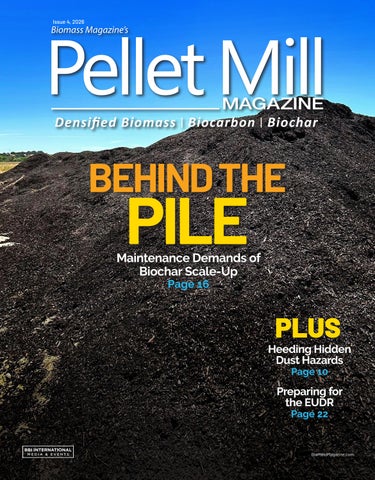
Issue 4, 2026
BEHIND THE
PILE
Maintenance Demands of Biochar Scale-Up Page 16
PLUS
Heeding Hidden Dust Hazards Page 10
Preparing for the EUDR Page 22
BiomassMagazine.com
CONTENTS »
2026 | VOLUME 15 | ISSUE 4
16
10 DEPARTMENTS
FEATURES
04 EDITOR'S NOTE
10 SAFETY The Dangers of Unmanaged Dust
Into Winter's Unknowns By Anna Simet
05 EVENTS 06 COLUMN
Half-Price Heat
By Tim Portz
08 PELLET NEWS ROUNDUP
Pellet Mill Magazine
Advertiser Index 27
2027 International Biomass Conference & Expo
15
2027 North American Biocarbon Conference
2
CITGO Petroleum Corp - Lubricants Division
18
Evergreen Engineering
19
Fagus GreCon, Inc.
28
FLAMEX Inc.
7
IAC
20
IEP Technologies
14
KEITH Manufacturing Company
13
KESCO, Inc.
21
Mid-South Engineering Company
12
MoistTech
Dry, aged and overlooked dust in pellet production carries substantial risk if left unmanaged. By Katie Schroeder
16 BIOCHAR Keeping the Kiln Turning
As biochar production scales up, maintenance is becoming less about fixing what breaks and more about designing plants, feedstocks and operating practices for large-scale, continuous operation. By Keith Loria
CONTRIBUTIONS 22 POLICY From Fiber Blend to Forest Plot: How Pellet Producers Can Prepare for EUDR
The EU Deforestation Regulation will require wood pellet producers to turn fragmented supply chain data into audit-ready traceability systems. By Timothy Daniel
24 RESEARCH AND DEVELOPMENT Optimizing Biomass and Biochar Pelleting at Scale
Instrumented farm-scale flat-die pellet production, experimental data and machine learning are being combined to make biomass pelleting more predictable across changing feedstocks and operating conditions. By Md Mashiur Rahman and Daniel Ciolkosz
COVER IMAGE: SITOS GROUP
BIOMASSMAGAZINE.COM 3
« EDITOR'S NOTE
Into Winter's Unknowns
Anna Simet
DIRECTOR OF CONTENT & SENIOR EDITOR asimet@bbiinternational.com
It’s mid-October in Minnesota, and most of us have finally given in and turned on the heat. We’re still in the throes of beautiful fall weather during the day, but the colder mornings and nights have become harder to ignore. Forecasters say there is high potential for a very strong El Niño developing for the 2026-27 winter— in fact, the NOAA Climate Prediction Center in October forecasts an 83% chance of this from October to December. For Minnesota, that means warmer-than-normal conditions; snowfall is less clear. The Southwest tends to get wetter, and while the Northeast’s snowfall becomes much less predictable amid milder temperatures, major snowstorms can still occur. The cold snaps during these storms are always critical, but especially so for pellet producers up against soft seasons. Regardless of what the forecasts say, there’s only so much that can be done to prepare for unpredictable market dynamics. Fortunately, preparing for potential problems in pellet and biochar production involves a little less guesswork. Many of the issues that arise are predictable, or at least preventable, with the right equipment, procedures and attention to detail. Others are less obvious, developing gradually until they become much bigger (and more expensive) problems. That’s much of the focus of this issue of Pellet Mill Magazine, which covers plant maintenance, protection and operational challenges, along with some of the research and regulatory developments affecting the industry. Our cover story, “Keeping the Kiln Turning,” by Keith Loria, looks at what happens as biochar production moves toward larger-scale, continuous operation. Equipment that performs well during shorter demonstration runs doesn’t necessarily hold up under thousands of hours of operation. From feedstock handling and tar buildup to thermal stress and premature equipment wear, the story examines why maintenance should be considered long before a plant is up and running. Katie Schroeder takes a closer look at another issue that can literally be hiding in plain sight: combustible dust. Her feature explores how aging, drying and moisture cycling can change the characteristics of wood pellet dust, potentially increasing fire and explosion risks. Even facilities with established dust management practices may have hazards accumulating in places that aren't routinely inspected. Also in this issue, researchers from Penn State explain how experimental data and machine learning can help make biomass and biochar pelleting more predictable, particularly when feedstocks and operating conditions vary. In a contributed article on the EU Deforestation Regulation, Timothy Daniel examines the growing challenge of tracing finished wood pellets back to their original fiber sources and how automation may help producers manage the substantial amount of data involved. One thing that stood out to me while putting this issue together is how easily relatively small things can turn into significant problems. A bearing that isn’t suited for continuous operation, dust accumulating in an overlooked area, a change in feedstock moisture or a missing piece of supply chain documentation might not seem like much on its own. But left unaddressed, any one of them can have consequences well beyond the initial issue. Of course, knowing what to look for and having the time and resources to address it are two different things. Hopefully, the information in these pages will help with at least some of that. As for what the winter brings, I suppose we’ll find out soon enough.
Subscriptions to Pellet Mill Magazine are free of charge. Issues are distributed four times per year to Biomass Magazine subscribers.To subscribe, visit www.biomassmagazine.com, or submit a mailing address to Pellet Mill Magazine Subscriptions, 308 2nd Ave. N., Suite 304, Grand Forks, ND 58203. Back Issues & Reprints Select back issues are available for $3.95 each, plus shipping. Article reprints are also available for a fee. For more information, contact us at 866-746-8385 or service@bbiinternational.com. Advertising Pellet Mill Magazine provides a specific topic delivered to a highly targeted audience. We are committed to editorial excellence and high-quality print production. To find out more about Pellet Mill Magazine advertising opportunities, please contact us at 866-746-8385 or service@bbiinternational.com. Letters to the Editor We welcome letters to the editor. Send to Pellet Mill Magazine Letters to the Editor, 308 2nd Ave. N., Suite 304, Grand Forks, ND, 58203 or email to asimet@bbiinternational.com. Please include your name, address and phone number. Letters may be edited for clarity and/or space.
4 PELLET MILL MAGAZINE ISSUE 4 2026
INDUSTRY EVENTS » 2027 International Biomass Conference & Expo
MARCH 2 - MARCH 4, 2027
Cobb Convention Center | Atlanta, Georgia
EDITORIAL
DIRECTOR OF CONTENT & SENIOR EDITOR Anna Simet | asimet@bbiinternational.com SENIOR NEWS EDITOR Erin Krueger | ekrueger@bbiinternational.com ASSOCIATE EDITOR Katie Schroeder | katie.schroeder@bbiinternational.com MAP DATA & CONTENT COORDINATOR Emma Auch | data@bbiinternational.com
DESIGN
VICE PRESIDENT, PRODUCTION & DESIGN Jaci Satterlund | jsatterlund@bbiinternational.com SENIOR GRAPHIC DESIGNER Raquel Boushee | rboushee@bbiinternational.com
PUBLISHING & SALES
CEO Joe Bryan | jbryan@bbiinternational.com PRESIDENT Tom Bryan | tbryan@bbiinternational.com CHIEF OPERATING OFFICER John Nelson | jnelson@bbiinternational.com SENIOR ACCOUNT MANAGER Chip Shereck | cshereck@bbiinternational.com SENIOR ACCOUNT MANAGER Bob Brown | bbrown@bbiinternational.com SENIOR MARKETING & ADVERTISING MANAGER Marla DeFoe | mdefoe@bbiinternational.com CUSTOMER SERVICE COORDINATOR Brandon McGarry | brandon.mcgarry@bbiinternational.com
Now in its 20th year, the International Biomass Conference & Expo is expected to bring together more than 1,000 attendees, 180 exhibitors and 100 speakers from more than 25 countries. It is the largest gathering of biomass professionals and academics in the world. The conference provides relevant content and unparalleled networking opportunities in a dynamic business-to-business environment. In addition to abundant networking opportunities, the largest biomass conference in the world is renowned for its outstanding programming— powered by Biomass Magazine—that maintains a strong focus on commercialscale biomass production, new technology, and near-term research and development. Join us at the International Biomass Conference & Expo as we enter this new and exciting era in biomass energy. (866)746-8385 | www.BiomassConference.com
2027 North American Biocarbon Conference
MARCH 2 - MARCH 4, 2027
Cobb Convention Center | Atlanta, Georgia The North American Biocarbon Conference, co-located with the International Biomass Conference & Expo, brings together the full value chain of carbonnegative and carbon-smart technologies in one powerful, integrated event. By aligning biocarbon producers, biomass power generators, biochar innovators, carbon-removal buyers, project developers, and equipment providers with the broader biomass, biogas, CHP, pellet, and renewable-power industries, this colocated experience creates unmatched cross-sector engagement. Attendees gain access to expanded networking opportunities, dual-track educational programming, a unified expo hall, and a broader pool of commercial partners—all designed to accelerate the deployment of biocarbon solutions, scale climatepositive markets, and strengthen the emerging carbon-removal economy across North America. (866)746-8385 | www.BiocarbonConference.com
2027 International Fuel Ethanol Workshop & Expo
JUNE 14 - 16, 2027
CHI Health Center | Omaha, Nebraska Now in its 43rd year, the FEW provides the ethanol industry with cutting-edge content and unparalleled networking opportunities in a dynamic business-tobusiness environment. As the largest, longest-running ethanol conference in the world, the FEW is renowned for its superb programming—powered by Ethanol Producer Magazine—that maintains a strong focus on commercial-scale ethanol production, new technology, and near-term research and development. The event draws more than 2,300 people from over 31 countries and nearly every ethanol plant in the United States and Canada. (866)746-8385 | www.FuelEthanolWorkshop.com
BIOMASS MAGAZINE PODCAST INTERVIEW
Please check our website for upcoming podcasts https://biomassmagazine.com/podcast
Please recycle this magazine and remove inserts or samples before recycling TM
COPYRIGHT © 2026 by BBI International
BIOMASSMAGAZINE.COM 5
« COLUMN
Half-Price Heat BY TIM PORTZ
As the country heads into another winter, wood pellet producers are eyeing the heating season with equal measures of optimism and concern. One of the attributes of wood pellet heating that the industry has always championed is the economic advantage it offers consumers. That said, these savings fluctuate because prices for competing heating fuels are highly volatile. This fall, the price of heating oil has become a national story, with consumers facing prices that have nearly doubled since last winter. Heating oil is essentially diesel and is affected by the same geopolitical forces driving up the cost of over-the-road fuels and impacting every corner of the economy. The statewide average price for a gallon of heating oil in Maine in the first week of October was $5.97, a nearly 80% increase from one year ago. Wood pellet prices are not immune to inflationary pressures, and ultrahigh diesel prices are certainly affecting the delivered price of pellets, but wood pellet prices have historically risen far more gradually. The Energy Information Administration has tracked production, sales and inventory levels of premium (residential) pellets since 2016, offering a decade-long look at wholesale prices. From July 2016 to July 2026, wood pellet prices rose from $173.22 per ton to $251.21 per ton, a 45% increase, or roughly 3.8% per year. Heating oil prices have risen at nearly twice that rate in just a year. While this price advantage seems to point to a strong year for pellet producers, there are challenges in the market that the industry is working to overcome. Wood pellet inventories in the East are at historic lows. The most recent data put July inventories in the East at 110,381 tons, down from 184,497 tons the previous July. Production in the East has been averaging about 10,000 tons more per month than in the first half of 2025, but sales have also increased, and producers have watched inventories of finished product continue to dwindle. Wood pellet inventories are highly regionalized, and on the other side of the country, producers and retailers are facing the opposite situation, with ballooning inventories due to mild winters and lighter sales. While the East logged its lowestever July pellet inventories, the West posted its highestever July inventory totals. There were reports of pellets
6 PELLET MILL MAGAZINE ISSUE 4 2026
produced in the West showing up in Eastern markets last year, and with heating oil at nearly twice last year's price, it seems likely that transcontinental pellet shipments will continue this season. The biggest variable for pellet consumption this year will not be the price of pellets or heating oil, but the depth and length of winter. Pellet consumption correlates closely with accumulated heating degree days (HDDs). Savvy wood pellet consumers typically split their pellet fuel purchases in half, laying in what they’ll need for the first half of the heating season and replenishing later if necessary. For that reason, pellet sales in the early months of the heating season are relatively stable. The heating seasons with the highest sales totals are those when consumer thermostats call for more heat throughout the winter. In the past 10 heating seasons, wood pellet sales for December and January have fluctuated between 150,000 tons (2016-17) and 225,000 tons (2017-18). That the lowest and highest December-January sales figures came in consecutive years perfectly illustrates the challenges wood pellet producers and retailers face every heating season. Last year, accumulated HDDs in the East were about 10% ahead of the 10-year average at the close of January. Pellet sales in the region for December and January came in at 199,623 tons, 8.2% ahead of the 10-year average—a strong correlation. Opinions vary on what this season’s “super El Niño” will mean for winter in the pellet-burning parts of the country. While a consensus is elusive, forecasts lean toward milder temperatures in the East. This heating season is shaping up to be dynamic as consumers and producers alike work to manage rising diesel and heating fuel costs. In a season when the price advantage of wood pellet heating is significantly amplified, what will the total impact on pellet consumption be? Old Man Winter will have the final say on that. Author: Tim Portz Executive Director, Pellet Fuels Institute tim@pelletheat.org
{
,$& ,6 32:(5,1* 7+( )8785( 2) %,20$66 352&(66,1* )DFLOLWLHV SURGXFLQJ KLJK WHPSHUDWXUH SDUWLFXODWH DQG V\QJDV HPLVVLRQV WKURXJK S\URO\VLV PXVW RSHUDWH ZLWKLQ DQ HYROYLQJ HPLVVLRQV FRQWURO HQYLURQPHQW ZKHWKHU XSJUDGLQJ DQ H[LVWLQJ IDFLOLW\ RU GHYHORSLQJ D QHZ RQH ,$& GHVLJQV EXLOGV DQG FRPPLVVLRQV WXUQNH\ ELRPDVV WKHUPDO SURFHVVLQJ IDFLOLWLHV HQJLQHHUHG WR PHHW WKHVH GHPDQGLQJ UHTXLUHPHQWV ZKLOH PD[LPL]LQJ XSWLPH HIĆFLHQF\ DQG ORQJ WHUP UHOLDELOLW\ $V DQ 2(0 PDQXIDFWXUHU RI EDJKRXVHV GU\HUV FDOFLQHUV DQG FRQYH\LQJ V\VWHPV ,$& SURYLGHV ERWK VWDQGDORQH HTXLSPHQW DQG IXOO\ LQWHJUDWHG WKHUPDO SURFHVVLQJ V\VWHPV JLYLQJ FXVWRPHUV RQH SDUWQHU IRU WKH HTXLSPHQW HQJLQHHULQJ DQG H[HFXWLRQ UHTXLUHG WR EULQJ FRPSOH[ ELRPDVV SURMHFWV RQOLQH )XOO (3& SURMHFW GHOLYHU\ IURP HQJLQHHULQJ WKURXJK FRPPLVVLRQLQJ
6FDODEOH LQGLUHFW FDOFLQDWLRQ WHFKQRORJ\ IRU KLJK FDSDFLW\ SURGXFWLRQ
%LRPDVV IHHGVWRFN KDQGOLQJ VWRUDJH DQG FRQYH\LQJ V\VWHPV LQFOXGLQJ ZRRG\DUGV
+LJK WHPSHUDWXUH GXVW FROOHFWLRQ DQG V\QJDV ELRJDV FOHDQXS V\VWHPV
7KHUPDO SURFHVVLQJ V\VWHPV GU\LQJ WRUUHIDFWLRQ FDOFLQDWLRQ DQG S\URO\VLV
%RLOHU LQWHJUDWLRQ KHDW UHFRYHU\ DQG FRJHQHUDWLRQ V\VWHPV
,QWHJUDWHG ELRFKDU DQG ELRFDUERQ SURGXFWLRQ V\VWHPV
&RPPLVVLRQLQJ WUDLQLQJ DQG ORQJ WHUP V\VWHP VXSSRUW
9LVLW LDF LQWO FRP ELRPDVVPDJ RU FDOO
,$& $GHOSKL 0HWFDOI $YH 6WH 2YHUODQG 3DUN .6
Pellet News Roundup
IMAGE: NEW BRUNSWICK POWER
NB Power Advances Belledune Clean Fuel Project NB Power has reached two important milestones in its plan to transition New Brunswick’s Belledune Generating Station from coal to sustainably sourced advanced pellets derived from wood and agricultural hemp biomass. Following approval by NB Power’s board of directors in August, the utility has signed agreements with Canadian suppliers to provide the fuel required to support Belledune’s conversion and future operation. The agreements secure the majority of the fuel supply needed for the station and mark a significant step toward meeting federal coal phase-out requirements while maintaining reliability for customers, according to NB Power. Converting to a renewable fuel source will make the station its largest renewable generator; currently it is the most greenhouse-gas intensive energy generator in NB Power’s fleet. The decision follows several years of technical studies, fuel testing and project development. Converting Belledune to advanced pellets was identified as the preferred option to maintain the station's contribution to New Brunswick’s electricity system while complying with federal regulations requiring coal-fired generation to be phased out by 2030. NB Power said it will continue working with local communities, Indigenous rightsholders and stakeholders as the project progresses. Those discussions have helped shape project planning to date and will continue as implementation advances and additional milestones are reached. 8 PELLET MILL MAGAZINE ISSUE 4 2026
With board approval and fuel supply agreements now in place, the project will move into the next phase of engineering, procurement and site preparation activities, including ongoing fuel testing, equipment upgrades and preparations for long-term biomass operation. The Belledune Clean Fuel Project is expected to support continued operation of the generating station beyond 2030 while preserving an important source of generation capacity for New Brunswick customers. USDA Announces Major Changes to REAP The USDA on Sept. 30 published a final rule that fundamentally changes the structure and administration of the agency’s Rural Energy for America Program. REAP will now require projects to be fully built and operational before an application can even be filed. REAP provides guaranteed loan financing and grant funding to agricultural producers and small rural businesses for renewable energy systems or to make energy efficiency improvements. Renewable biomass, including anaerobic digesters and biogas, wind, solar, small hydro-electric, ocean, geothermal or hydrogen derived from any of those sources are among the renewable energy sources eligible for the program. The National Sustainable Agriculture Coalition estimates that REAP invested more than $4.8 billion in more than 19,000 grant and loan guarantees between 2014 and 2025, spurring more than $14.7 billion of rural development investment in rural communities. Nu-
PELLET NEWS ROUNDUP » merous biogas and biomass combined-heat-and-power projects have been supported by REAP funding over the years, along with projects that improved operations at ethanol plants, biodiesel facilities and wood pellet mills. The USDA in March announced it would halt processing of REAP grant applications until the agency updated program regulations to comply with Executive Order 14315, titled “Ending Market Distorting Subsidies for Unreliable, Foreign Controlled Energy Sources.” The executive order, signed by President Donald Trump on July 7, 2025, in part aims to limit federal support for certain types of renewable energy, including wind and solar. The USDA said the changes included in the final rule “will simplify and streamline requirements and processes” for REAP. “Under the new REAP structure, projects must already be fully built and operational before the applicant ever applies,” the USDA wrote in the final rule. Applicants must submit actual energy production or savings data for the prior 12 months, along with 12 months of pre-installation data. The agency described the new approach as a “post completion, performance-validated model,” with renewable energy system and energy efficiency improvement awards based on actual documented output, energy savings, costs and system performance. Multilocation projects and certain applications of specific technologies are now ineligible, and state-level competitions will be eliminated in favor of a single national scoring and selection process. A 15-day public comment period opens following publication of the final rule in the Federal Register on Oct. 1. EIA: Densified Biomass Fuel Sales at 960,000 Tons in June U.S. manufacturers produced approximately 950,000 tons of densified biomass fuel in June, according to the U.S. Energy Information Administration’s Monthly Densified Biomass Fuels Report. Sales of densified biomass fuel reached 960,000 tons during the month. The EIA collected data from 74 operating manufacturers of densified biomass fuel to complete the report. The report does not include data on facilities with annual production capacities of less than 10,000 tons, which report data annually rather than monthly. The 74 manufacturers surveyed for June had a total combined production capacity of 13.2 million tons per year and collectively had the equivalent of 2,529 full-time employees. Respondents purchased 990,000 tons of raw biomass feedstock in June, produced 950,000 tons of densified biomass fuel and sold 960,000 tons of densified biomass fuel. Production included 141,990 tons of heating pellets and 809,041 tons of utility pellets. Domestic sales of densified biomass fuel in June reached 154,118 tons at an average price of $261.19 per ton. Exports in June reached 807,986 tons at an average price of $209.46 per ton. Inventories of utility pellets increased to 503,736 tons in June, up from 455,318 tons in May. Inventories of premium/standard wood pellets fell to 241,018 tons in June, down from 254,987 tons in May.
Data gathered by the EIA shows that total U.S. densified biomass fuel capacity reached 13.1 million tons in June, with all of that capacity listed as currently operating or temporarily not in operation. Capacity included 1.82 million tons in the East, 10.64 million tons in the South, and 642,700 tons in the West. New Zealand Funds Wood Pellet, Torrefied Biomass, Wood Energy Aggregation Projects New Zealand’s Energy Efficiency and Conservation Authority announced in early October that it is investing in five new wood energy aggregation facilities and four projects that aim to produce torrefied biomass and wood pellets. Funding awarded to the torrefied biomass and wood pellet projects is in the form of repayable grants that will help cover costs associated with developing detailed information required for final investment decisions. If brought to market, the four projects could produce more than 500,000 metric tons of wood fuel annually, spread across torrefied biomass and white wood pellets. Awards made to torrefied biomass and wood pellet projects include: • $2.5 million to Carbona: Situated in the central North Island, this facility is estimated to produce 180,000 metric tons of torrefied biomass per year. • $2.19 million to Oceania Wood Pellets: The company is developing two projects: A 90,000–120,000 metric-ton-per-year (MTPY) white wood pellet manufacturing facility located on the West Coast of the South Island near Stillwater, and a 180,000 MTPY white wood pellet manufacturing facility located in Matawhero, Gisborne. • $1.25 million to Transition (Bio) Energy: Situated near Reporoa, the first phase of this facility is estimated to produce 37,500 metric tons of torrefied biomass per year. The five wood energy aggregation facilities will secure low-grade wood from commercial forestry alongside the private sector. According to EECA, the sites will provide a central repository for nearby forest operations to collect, store and prepare wood that would otherwise go unused or be left in the forest. Collectively, the sites will have the capacity to process 200,000 metric tons of wood chip fuel annually. Aggregation facility projects selected for funding include: • $893,600 to Canterbury Energy Centre Ltd. to support a 52,000 MTPY capacity industrial wood chip fuel site near Christchurch. • $800,000 to Goodwood Ltd. to support a 60,000 MTPY capacity industrial wood chip fuel site near Hamilton. • $1 million to Kiwi Lumber to support a 50,000 MTPY capacity industrial wood chip fuel site near Masterton. • $574,018 to MG Contracting Marlborough to support a 25,000 MTPY capacity industrial wood chip fuel site near Blenheim. • $461,510 to AWT Wood Fuels Ltd. to support an industrial wood chip fuel storage, production and distribution facility with a scalable capacity near Winton. BIOMASSMAGAZINE.COM 9
« SAFETY
THE DANGERS OF UNMANAGED
DUST
Dry, aged and overlooked dust in pellet production carries substantial risk if left unmanaged. BY KATIE SCHROEDER
S
awdust, shavings and chips are inevitable byproducts of wood processing, presenting facilities with ongoing dust management challenges. For pellet producers, this challenge is amplified, as sawdust and other wood residuals are the ingredients of their product—renewable solid fuel. Making a product designed to burn presents unique safety risks, explains Adrian Pierorazio, vice president of industrial and process safety with Jensen Hughes. Proper dust handling and cleaning are vital to maintain staff safety and the structural integrity of the facility’s infrastructure. Various factors may impact the degree of risk associated with dust. New research coauthored by Kihyuk Jung, Donghyun Seo, Yirac Choi, Yunhyun Ko and Chundong Kim, titled Explosion and Self-Heating Hazards of Wood Pellet Dust: A Comparative Assessment with Wood Dust and Bituminous Coal, explores the differ10 PELLET MILL MAGAZINE ISSUE 4 2026
ences between wood dust, bituminous coal dust and wood pellet dust, examining the explosivity potential and flammability characteristics of each substance. Published in August 2026 in the Journal of Loss Prevention in the Process Industries, the study notes the age of the wood pellet dust as one potential factor impacting the material’s flammability and explosivity. Chris Cloney, CEO and lead researcher with the Combustible Dust Training Institute, offers multiple industries, including the wood products industry, safety training and education for dust hazard analysis and combustible dust safety management. He identifies three factors making the study’s findings pertinent for today’s pellet producers. Aging equipment in pellet facilities could contribute to dust accumulation. Secondly, increased pricing pressures in the market may cause producers to store pellets for longer periods of time
IMAGE: STOCK
than in the past. The final factor making this topic relevant, particularly in Canada, is the number of trees killed by fire and beetle infestation. Dust from damaged wood has different characteristics, causing it to behave differently in the pellet production process. Risk Factors The Wood Pellet Association of Canada organized a Safety Committee in 2014 to address combustible dust risks at pellet facilities and help producers implement good practices in the wake of two fatal sawmill explosions in British Columbia that occurred in 2012. Over time, the committee’s mission has expanded to include other safety issues, such as lockout-tagout, working at heights and process safety management, explains Safety Committee Chair Julie Griffiths.
Also serving as the plant supervisor at Shaw Renewables, a 50,000-metric-ton-per-year pellet facility in Nova Scotia, Griffiths says that her experience in plant operations gives her firsthand insight into the safety challenges Canadian pellet producers face. “I was excited to take on the role as safety committee chair because it’s an opportunity to make a meaningful difference in workplace safety,” Griffiths says. “We have a really unique industry.” The nature of pellet manufacturing presents a distinct set of safety challenges, according to Griffiths. The whole process— from drying sawdust, shavings and chips to processing the material through an extruder—has the potential to combine a heat source with a flammable substance: dust. As dust dries and releases moisture, it becomes finer and constitutes more of an explosion hazard, Cloney explains. Pierorazio BIOMASSMAGAZINE.COM 11
« SAFETY agrees, noting that drier and lighter dust becomes elevated in the air and dispersed more easily, which, in the case of ignition, would enable flames to propagate through the air quickly, causing a more powerful explosion. Aging wood pellets tend to dry out and crack, becoming more friable—easier to break into pieces—also contributing to fire risk. Drier dust enables the occurrence of ignition with less energy, Pierorazio adds. The study from Jung et al. bears out these statements, noting that aged wood pellet dust was less thermally stable than fresh dust. Overall, the explosion parameters of wood dust and wood pellet dust were “broadly comparable” when particle size was accounted for. Atmospheric conditions also play a role. Both humidity and dryness in the atmosphere could contribute to ignition or deflagration. For example, though wet dust is less reactive than dry dust, fire risk arises when pellets or sawdust absorb moisture, causing the material to heat up and even smolder. Swings from cold temperatures to hot temperatures have a similar effect, increasing the thermal instability of the material. Then, smoldering occurs when the material absorbs moisture from the air and heats up, Cloney explains. Known as “moisture cycling,” the study from Jung et al. identifies it as a contributing factor to qualities leading to potential combustion risks. Locating overlooked—and potentially aged—dust can help producers mitigate potential risk. Both Cloney and Rob Williamson, vice president of technical solutions and business development with Nederman, emphasize the importance of checking areas that are out of sight and difficult to access. Williamson identifies overhead structural members, the tops of equipment, ductwork, conveyors, bucket elevators, ledges and areas behind or beneath equipment. Cloney also recommends examining areas used for
long-term pellet storage, such as piles or silos. In the wood industry, standard operating procedure is to test the “most dangerous” dust in the facility and use that to determine safety measures across the entire site. “It’s almost a feature of dust hazard analysis,” Cloney says. “It’s very common for a consultant to say, ‘I want to go up to the top of your site and take dust off the top light fixture.’ The reason they’re saying that is it’s the driest, finest material, partially due to these aging effects that we’re talking about.” Characterizing Dust The wood pellet industry—and other industries using combustible dust—must complete a dust hazard analysis (DHA) every five years. A DHA should include an assessment of the dust present in the facility, along with testing to determine explosion parameters. “The biggest point for a DHA … is that you want to complete it based on the hazards that are at the site,” Cloney says. “And so, the dust should be representative of the dust at that site.” Some producers apply existing dust data to their facility, but producers must ensure the profile accurately reflects the dust present onsite. “There is a group of companies that will look at published data for standard materials, which would work fine so long as their materials are standard,” Pierorazio explains. Relying on existing literature does not work as well when a company is using less standard feedstock, such as wood left over after a forest fire. Also, Pierorazio notes that the pitfall of applying existing literature is that you might be implementing safety procedures that are more rigorous and expensive than what’s needed for your facility. Dust testing addresses this problem by making it possible for producers to design a DHA tailored to fit the facility’s specific safety needs. Jensen Hughes operates a dust testing lab in Halifax, Nova
ŀ˷˓ʧ˷ɤڑīɤǸͅڑÅ˷ʅͅǸͅɤɒ ģ̇ʧͣʹͅɤڑģɤǸͣͅɤ˰ɤ˷ʹ b˗ǹȠʳɄ ̥Ʉǹʳԫ͔ʇːɄ ː˧ʇ͔̥̓ͣɄ ̥Ʉǹȳʇ˗ɪ̓ ͔˧ ɥǹȧʇʳʇ͔ǹ͔Ʉ ˧˗ԫ͔ɴɄԫɥʳΖ ʳʇ˗Ʉ ǹȳʣ͔ͣ̓ːɄ˗͔̓Տ ʇ˗ḁ̇Ʉǹ̓ʇ˗ɪ ̡ͣǹʳʇ͔Ζ Ԋ ɄɥɥʇȧʇɄ˗ȧΖ ĥ˧ʇ͔̥̓ͣɄ ː˧˗ʇ͔˧̥ʇ˗ɪ ȳ̥ͣʇ˗ɪ ̛̥˧ȳͣȧ͔ʇ˧˗ ʇːːɄȳʇǹ͔ɄʳΖ ʇ˗ḁ̇Ʉǹ̓Ʉ̓ ̡ͣǹʳʇ͔Ζ Ԋ ɄɥɥʇȧʇɄ˗ȧΖ
ʇ˗ɥ˧ԝː˧ʇ͔͔̓ɄȧɴՐȧ˧ː ӳӭөԫӱӪӱԫөӲӨӨ
12 PELLET MILL MAGAZINE ISSUE 4 2026
Julie Griffiths speaks at the Wood Pellet Association of Canada’s 2026 Safety Summit. The summit covered rotary drum dryer safety, process safety management and emerging safety initiatives, according to the WPAC website. IMAGE: WPAC
Scotia, one of the largest explosive dust testing facilities in North America, serving a variety of industries. Pierorazio has witnessed more interest in dust testing from the wood pellet industry as safety awareness around dust has increased in recent years. Clients may either request the data alone or a full DHA based on the results. The company’s testing process begins with collecting a sample from the facility, with Jensen Hughes instructing how to gather the sample. Then, when received, the particle sizes within the sample are characterized and the company uses a sieve to remove larger particles. Pierorazio explains that explosion risk is intrinsical-
ly linked to the size of the particles—larger particles require more energy to ignite and will not disperse in air as easily as powder-like dust. Removing the larger particles allows the researchers to focus on the dust that is most likely present in the air. Jensen Hughes can run a wide variety of tests, depending on what the client needs to know. This often includes a “go/no go” test (checks if the dust will ignite), testing surface ignition (the surface temperature needed to ignite aggregated dust), minimum ignition energy (assesses whether the dust catches fire when dispersed in a cloud) and explosible concentration (the volume of dust in
CHOOSE KESCO
FROM CONCEPT TO REALITY
SERVICES PROVIDED
Feasibility Studies – Planning & Project Development – Process Audits – 3D Scanning & Modeling Drone Imagery – Thermal Scanning – System Layout & Design – Process Engineering – Project Management Construction Management – RFQ Development & Evaluation – Turn-Key Projects
CALL US TODAY 803-802-1718
EXPERIENCE MATTERS
WWW.KESCOSOLUTIONS.COM SALES@KESCOSOLUTIONS.COM BIOMASSMAGAZINE.COM 13
« SAFETY the air needed for an explosion). Other facilities” is recommended, rather than de‘The biggest point for a tests include determining a Pmax value, the pending on existing knowledge for handling maximum pressure produced in a potential DHA … is that you want to of wood dust. explosion, and a Kst value, which meacomplete it based on the sures how quickly the explosion reaches Mitigation and Management peak pressure. Characterizing the explosion Dust safety practices must be applied hazards that are at the site. potential of a facility’s dust gives the proin order to make an impact. WPAC’s Safety And so, the dust should be Committee offers pellet producers free safeducer solid data to work from in developing a DHA. “Having the testing … gives ty resources prepared by industry experts, representative of the you better data to use for your designs for including plant operator training, guidance dust at that site.’ mitigation, for control, to identify how big on best practices and more. “Our goal is the issue is, and how diligent you have to be to make the wood pellet industry safer by —Chris Cloney, in your controls to keep it safe,” Pierorazio bringing together pellet producers, industry says. Combustible Dust Training Institute organizations, researchers and other partDust hazard analyses typically examine ners to share knowledge, experiences and the volume of dust and its location rather best practices,” Griffiths says. The committhan dust age, according to Williamson. He and his team are dedi- tee’s research continues to expand into each element of the pelcated to putting theory into practice when it comes to explosion let facility. Drum dryer safety and process safety management are mitigation and safety precautions—everything from emission mon- among the committee’s current research focuses. itors and source dust capture to fans and ductwork. “We recognized the need to take a closer look at some of the An abstract from Jung et al.’s study summarizes the unique- industry’s key safety risks, particularly the potential for syngas forness of the wood pellet industry well, noting that “a material and mation in drum dryers and combustible dust explosions,” she says. condition dependent hazard assessment for wood pellet handling The committee organized a multistakeholder working group, which
14 PELLET MILL MAGAZINE ISSUE 4 2026
spent two years developing recommendations and released a report in March 2026. The five conditions causing an explosion include: a confined space, the presence of oxygen, dispersal in air, an ignition source and a fuel. Nederman aims to eliminate as many parts of the explosion pentagon as possible, according to Williamson. He explains that Nederman’s work in dust management includes general source capture, dust collection and housekeeping. Williamson views source capture as the “first line of defense,” preventing the dust from dispersing throughout the facility and accumulating in dead spots (areas without airflow). These difficult-to-access layers of dust are a major concern. “The … combustible dust risk is still very, very formidable, whether it’s new or whether it’s gone through several cycles where it’s gotten more moist and less moist and the temperature [changed],” Williamson says. Dust collection systems or central vac systems help prevent dust accumulation by ventilating, capturing, transporting and filtering dust out of the air. However, the dust collector has all the conditions needed to cause a fire or explosion, except a competent igniter. He emphasizes the importance of ensuring dust collection is not located inside of a building or near people. Putting it outside gives space between assets and the collection system, making it easier for the fire department to extinguish the fire. “Modernizing
a facility helps, since new equipment gathers dust at the source,” Williamson adds. Both Williamson and Pierorazio emphasize the important role housekeeping plays in preventing dust accumulation. Griffiths and the team at Shaw Renewables actively work to minimize dust buildup by sticking with cleaning schedules. The facility even implemented a cleaning audit, in which anyone can enter the facility, do a walkthrough and grade how well cleaning has been done based on the dust accumulation present. For Griffiths, protecting workers remains the committee’s central priority. She sees the committee as an opportunity to collaborate and enhance safety practices. “As a plant supervisor, I bring a hands-on perspective to the committee because I’m involved in daily operations and the safety challenges that come with them,” Griffiths adds. “At the end of the day, my priority is making sure everyone goes home safely. That’s what matters most.”
Author: Katie Schroeder Associate Editor, Pellet Mill Magazine
BIOMASSMAGAZINE.COM 15
« BIOCHAR
Keeping the Kiln Turning As biochar production scales up, maintenance is becoming less about fixing what breaks and more about designing plants, feedstocks and operating practices to withstand thousands of continuous production hours. BY KEITH LORIA 16 PELLET MILL MAGAZINE ISSUE 4 2026
Sitos Group uses clean agricultural, forestry and municipal organic byproducts— primarily almond shells and other local nut shells and wood residues—as its biochar feedstock. IMAGE: SITOS GROUP
BIOMASSMAGAZINE.COM 17
« BIOCHAR
A
s biochar production moves from demonstration-scale and intermittent runs into commercial operation, equipment that worked well for a few hours at a time may reveal weaknesses that weren’t visible during startup. Tom Miles, president of T.R. Miles Technical Consultants Inc., says that one of the most common mistakes happens before operators ever reach the reactor: pairing a continuous thermal process with material handling equipment that was never intended for continuous duty. “Low-cost systems are often supplied with agricultural equipment such as bins, silos and conveyors,” Miles says. “These systems are designed to operate for a few hours per year with granular agricultural products. They are not designed to operate 7,500 hours per year.” The result can be improperly designed augers, undersized conveyors and premature failures of motors and bearings. And as production increases, those weak links become harder to hide. Kyle Langseth, CEO of Langseth Engineering, identifies two issues that repeatedly shape maintenance and uptime in biomassbased pyrolysis systems: feedstock moisture and tar formation. “The maintenance burden often concentrates in material handling
‘Bearings, seals, drive components and essential instruments deserve attention even when their purchase cost is small.’
and gas handling: conveyors, augers, airlocks, char discharge equipment and—where installed—condensers and gas-cleaning equipment,” Langseth says. “These components handle variable solids, abrasive fines or condensable vapors, so wear and buildup can progressively affect performance.” Therefore, commercial reliability begins with matching the equipment to the material and to the operating hours expected of it. Feedstock Sets the Rules Feedstock variability can turn what looks like a reactor problem into a conveying, drying or maintenance problem. Oversized or stringy biomass can bridge in hoppers or wrap around shafts. Fines generate dust that can infiltrate bearings, while changes in moisture affect flow characteristics, bulk density and drying demand. Uneven feeding creates changing loads farther downstream. “Feedstocks are not usually sized to match the materials-handling equipment,” Miles says. “Motors and bearings fail because they are not applied correctly.” Langseth says plants can prevent a substantial share of those issues by defining feedstock specifications, removing contaminants, using proper hopper geometry and selecting conveyors for the actual material they will encounter. Covered storage and drain-
—Kyle Langseth, CEO, Langseth Engineering age matter as well. Every additional pound of water entering the plant has to be heated and evaporated, raising the drying load and potentially reducing throughput. Garrett Benisch, chief development officer at Bioforcetech Corp., notes consistent particle size also matters because continuous systems are designed around relatively predictable exposure to temperature and residence time. A large piece of material mixed into otherwise uniform chips may not fully pyrolyze, while excessive fines can create dust and buildup inside the system. How the material is dried can determine how much dust operators contend with later in the process. Bioforcetech views the moisture challenge from an unusual angle; its commercial systems process municipal biosolids rather
R á ! z 0à0«J«00z R0n¨ ç Èّ áááِ0à0«J«00z0zJXz00«XzJِ! x
0à0«J«00z 0zJXz00«XzJ
0zJXz00«XzJ z( ! z³Á«È!ÁX z ³0«àX!0³ I !XnXÁç (0³XJz ¨« !0³³ ȨJ« (0 á ( ç «(³ (ȳÁ R ñ «( z nç³X³ «! In ³R ³ÁÈ(X0³ z( x «0ٍ
18 PELLET MILL MAGAZINE ISSUE 4 2026
0ÈJ0z0ً
« ۴ Án zÁ ً J ווגٮגזגٮזזז
Sitos Group and Treehouse California Almonds announced in October that their $10 million almond-shell biochar facility in Delano, California, had begun production and was nearing full commercial operation. The 25,000-square-foot facility features three slow-pyrolysis units and integrated drying and emissions-control equipment. IMAGE: SITOS GROUP
than conventional woody biomass. Benisch says dewatered sludge can still average about 80% water, making moisture removal one of the most demanding early steps in the process. Once dried, however, sludge creates another issue. “The wood holds itself together, whereas a sludge, when it dries, is more like a soil, so it’s crumbly,” Benisch says. “There’s a sweet spot of moisture there in handling.” As commercial biochar production expands to include a wider range of feedstocks, equipment and handling systems must be adapted to their distinct characteristics. Sitos Group and Treehouse California Almonds announced in October that their $10 million, 25,000-square-foot facility in Delano, California, had produced its first load of almond-shell biochar and was nearing full commercial-scale production. The operation includes three slow-pyrolysis units operating together as a single system, as well as integrated drying and emissions-control equipment. That kind of configuration also illustrates how maintenance expands beyond the kiln itself as plants become more sophisticated. Miles notes that agricultural residues can introduce another complication: chemistry. Higher-ash materials such as bark, pits and nut shells can contain alkali compounds
BIOMASSMAGAZINE.COM 19
« BIOCHAR that vaporize or melt at relatively low temperatures and eventually accumulate on heattransfer surfaces. “Feedstock chemistry and temperature control are frequently underestimated,” Miles says. “We explored the mechanisms of alkali deposition with the advent of biomass power plants in the 1990s, but the experience hasn’t carried over to new suppliers.” Build It for the Hours As plants scale, lighter-duty equipment often gives way to heavier construction. “Everything becomes heavier duty,” Miles says. He recalls that heavy conveying and wood-handling equipment in the Pacific Northwest was once commonly described as “Pacific Coast Grade.” When lighter and more competitively priced equipment began entering the region in the late 1970s, failures
followed until manufacturers strengthened those systems. The same learning curve is appearing in some biochar projects. For instance, lowcost systems may use steel that is too light for the duty cycle, leading components to simply wear through. Langseth says commercial operation exposes a similar gap between proving a process and proving reliability. “I’ve seen short runs understate the impact of tar buildup,” Langseth says. “Equipment can perform adequately during a demonstration, but deposits progressively restrict gas flow during longer operation. Cleaning between runs can conceal a maintenance requirement that becomes a production bottleneck during continuous operation.” Langseth says successful scale-up requires proving not only that a system can
3527(&7,1* <285 352&(66 $*$,167 (;3/26,216
SUPPRESSION
+1-855-793-8407
20 PELLET MILL MAGAZINE ISSUE 4 2026
ISOLATION
FLAMELESS & PANEL VENTING
SPARK DETECTION
IEPTECHNOLOGIES.COM
achieve its intended throughput, but also that it can maintain that output over extended periods without frequent maintenance interruptions. Continuous-duty drives and bearings, accessible inspection points and practical replacement procedures all become more important once downtime directly reduces production. Heat, Tar and the Gas Path The reactor may be the centerpiece of a pyrolysis plant, but the equipment around it can be equally critical. Miles says refractory is one common failure point, particularly when material selected for woody feedstocks encounters agricultural residues with different ash chemistry. He also sees “hot spots” in augers where air intrusion or partial oxidation pushes temperatures above what the steel was designed to withstand. Benisch says thermal expansion and contraction must also be accounted for in piping and other high-temperature sections. Controlled ramp-up and shutdown procedures can mitigate thermal shock rather than subjecting equipment to rapid changes in temperature. “If you don’t compensate for how much the whole system can expand as it warms up and then how much it’ll contract as it cools down, problems can follow, particularly when those temperature changes happen too quickly,” he says. Tar presents a different maintenance challenge. Langseth says heavier organic compounds can condense as pyrolysis vapors cool, creating sticky deposits that trap char fines. Over time, those deposits can narrow piping, foul heat-transfer surfaces and interfere with valves and fans. Miles sees the same problem in systems handling pyrolysis tars and oils. “They accumulate and clog piping and ducting,” he says. The solution is not simply more frequent cleaning. Langseth says designers and operators need to control where condensation happens by maintaining temperature upstream of the intended condensation stage, eliminating unintended cold spots
and providing drainage and cleanout access where deposits can accumulate. “What surprised me most was how a localized cold spot could create a maintenance problem elsewhere in the system,” Langseth says. “Cleaning alone may address the symptom while leaving the underlying temperature or flow problem unresolved.” Keeping Char Moving Safely Once char leaves the reactor, cooling and discharge become the next maintenance and operating challenges. Benisch says the degree of pyrolysis affects the risk of self-heating after char is exposed to oxygen. Cooling requirements also vary by feedstock. Bioforcetech uses a combination of controlled water application, conveying time and heat exchange to bring material temperature down. “The more complete your pyrolysis, the more confident you are there, the more you drive off the syngas, the more you know that your biochar will cool correctly,” he says. That is one reason maintenance and product quality cannot be separated. Poor feed consistency can change residence time. Buildup can alter gas flow. Failing instrumentation can allow temperature changes to go unnoticed. What begins as a mechanical maintenance issue can eventually affect process stability and finished-char consistency. Spare parts planning is another component of reliability. Langseth recommends ranking parts according to their ability to stop production and their replacement lead time rather than simply their purchase price. “Bearings, seals, drive components and essential instruments deserve attention even when their purchase cost is small,” Langseth says.
and auger motor current and torque, vibration, filter pressure drop, feed rate and incoming moisture can all provide useful signals in a continuous industrial process. The greater value comes when those measurements are connected with maintenance events, operator actions and production outcomes. “The biggest opportunities are scheduling maintenance around the actual condition of the equipment and the production plan instead of the calendar,” Mister says. “And troubleshooting faster because the full history of what changed before a fault is available in one place.” He cautions that experienced operators remain essential. Serious failures may occur too infrequently to provide AI models with much training data, sensors themselves can deteriorate in harsh environments, and unusual failures are precisely the situations in which human judgment matters most.
That may be the larger maintenance lesson as biochar matures commercially. More sensors, automation and data can help, but long-term reliability still depends on understanding feedstock, choosing equipment for continuous duty and designing every system with inevitable wear in mind. As biochar plants scale, that distinction may ultimately be the measure that matters most. “Commercial operation therefore requires more than demonstrating throughput,” Langseth says. “It requires demonstrating how long that throughput can be sustained between maintenance events.” Author: Keith Loria Contributing Writer, Pellet Mill Magazine
From the Calendar to Condition Plants are also gaining more tools to identify deterioration before it becomes a shutdown. James E. Mister, head of strategy and solution engineering at Biological Lattice Industries, says temperature profiles, conveyor BIOMASSMAGAZINE.COM 21
From Fiber Blend to Forest Plot: How Pellet Producers Can Prepare for EUDR The EU Deforestation Regulation will make traceability a market access requirement for wood pellets. For producers, the challenge is not only collecting documents but turning fragmented supply chain data into an audit-ready system. BY TIMOTHY DANIEL For years, wood pellet producers have managed traceability through a familiar combination of supplier files, sustainability certifications, spreadsheets, scale tickets, bills of lading and audit binders. This approach has been workable because most reporting frameworks allowed for batch-level, supplierlevel or certification-based evidence. The EU Deforestation Regulation raises that standard considerably. As of October 2026, the regulation is scheduled to take effect on Dec. 30 for large and medium operators, and for micro and small operators already covered by the EU Timber Regulation. Most other micro and small operators have until June 30, 2027. Wood pellets fall squarely within scope, as EUDR covers wood prod-
ucts under heading 4401, including sawdust, wood waste and scrap agglomerated into pellets or similar forms. The core requirement is simple to state but considerably harder to operationalize: Relevant products placed on or exported from the EU market must be deforestationfree, legally produced and supported by documented due diligence. For wood products, this means demonstrating that the material did not originate from land affected by deforestation or forest degradation after Dec. 31, 2020, and that it was harvested in accordance with the laws of the country of production. Where Traceability Breaks Down Pellets are typically manufactured from
blended inputs—sawdust, chips, shavings, residue and other low-grade fiber sourced from multiple suppliers, mills and harvest areas. Once these materials enter storage, drying and pelletizing, it becomes increasingly difficult to connect a finished pellet shipment back to the specific supplier records, harvest dates, species information, legality evidence and geolocation data that due diligence requires. For this reason, EUDR readiness is best understood not as a last-mile reporting task, but as a data infrastructure problem. A producer preparing for EUDR needs to determine, for each EU-bound shipment, what fiber went into it, where that fiber originated, whether the origin plots are supported
CONTRIBUTION: The claims and statements made in this article belong exclusively to the author(s) and do not necessarily reflect the views of Pellet Mill Magazine or its advertisers. All questions pertaining to this article should be directed to the author(s).
22 PELLET MILL MAGAZINE ISSUE 4 2026
POLICY » by defensible geolocation evidence, whether legality records are complete and whether any risk indicators require mitigation. When this information is dispersed across email inboxes, PDFs, spreadsheets, ERP exports, scale systems and supplier portals, compliance teams can spend more time locating and reconciling data than actually evaluating risk. Geolocation Requirements Under EUDR Geolocation data constitutes a mandatory component of EUDR compliance. Each Due Diligence Statement submitted under the regulation must establish a direct link between the relevant commodity and the specific land parcel from which it originated. Geolocation requirements vary by plot size: ● Plots of 4 hectares or less: A single set of coordinates (latitude and longitude, expressed to a minimum of six decimal places) is sufficient to satisfy the geolocation requirement. ● Plots exceeding 4 hectares: A single coordinate point is insufficient. These plots must instead be represented by a polygon—a series of connected coordinate points delineating the complete outer boundary of the plot. ● Cattle: Irrespective of the size of the area involved, cattle-related submissions require only point coordinates identifying the establishment where the animals were kept. Polygon data is not required in this case. Regardless of the format in which spatial data is initially collected—including shapefiles (SHP), KML files or raw coordinate data, such data must ultimately be converted into GeoJSON format prior to submission, as this is the only format currently accepted by the EU's Information System. For pellet producers, this requirement adds a layer of complexity beyond document collection. Harvest areas feeding a single production run may span dozens of plots across multiple suppliers, some above the four-hectare threshold and some below it. Each must be resolved to the correct geolocation format, validated and preserved in a form that can be retrieved and defended years after the shipment has left the mill.
Where AI and Automation Can Help This is where AI and automation can provide meaningful support, provided they are applied to the right problem. Take Rimba, for example—an AI-native operational compliance platform that helps pellet producers continuously monitor, track and report on their operations to meet the standards set by EUDR. Rimba's role is not to replace legal judgment or sustainability programs. It is to help industrial teams convert fragmented operational, geolocation and supply chain data into structured, traceable, report-ready records. The platform is built for heavy industry workflows in which critical information arrives in many formats, including PDFs, spreadsheets, emails, invoices, bills of lading, scale tickets, sustainability declarations, production data, shapefiles, KML and others. For pellet producers, this kind of automation can support several EUDR readiness steps. First, producers need better supplier data intake. Rather than manually collecting documents and retyping fields into spreadsheets, an AI-driven workflow can extract key information from supplier declarations, harvest documents, transport records and invoices. It can normalize supplier names, dates, product types, quantities and origin data so that teams are not continually reconciling mismatched file formats. Second, producers need chain-of-custody continuity. When a truckload of sawdust is received from a sawmill, that intake record should be connected to supplier documentation, geolocation evidence, batch allocation and eventual pellet output. Rimba can help establish a single operational record spanning documents and systems, reducing the risk that compliance evidence becomes separated from the physical material it is meant to support. Third, producers need automated reconciliation. EUDR compliance depends on consistency: Quantities on purchase orders should match scale tickets, shipments should align with inventory movements and batch records should correspond to supplier claims. Rimba's reconciliation workflows can flag
discrepancies early, before they become audit findings or shipment delays. Fourth, producers need risk visibility. Missing or incomplete geolocation data is one of the most common gaps: a plot recorded as a single point when it exceeds 4 hectares and requires a full polygon, a coordinate submitted with insufficient decimal precision, or a file delivered in SHP or KML format that was never converted to GeoJSON. Alongside incomplete legality documents, unusual supplier activity or mismatched volumes, these are issues that should not be discovered days before export. Automated monitoring can surface such gaps as they emerge, giving procurement, sustainability and operations teams time to resolve issues with suppliers before they affect a shipment. Finally, producers need audit-ready reporting. EUDR requires companies to retain due diligence records for five years. This means the value of a compliance system lies not only in whether it can produce a report today, but in whether it can demonstrate how the company reached its conclusions later. A robust system should preserve source documents, data transformations, reconciliation history and human review decisions. A Familiar Pattern, at a Sharper Standard The pellet industry has already navigated overlapping sustainability expectations, including certification schemes, greenhouse gas reporting, chain-of-custody audits and renewable energy market requirements. EUDR introduces a sharper traceability standard, but it also fits a broader pattern: buyers, regulators and auditors increasingly expect companies to substantiate their claims with underlying data. AI-native platforms can serve as the connective layer across this process, bridging the messy reality of industrial data with the structured evidence regulators expect. Rather than requiring teams to chase documents across inboxes and spreadsheets, such platforms help build a reliable compliance record spanning procurement, production and shipment. Author: Timothy Daniel Cofounder and CEO, Rimba
BIOMASSMAGAZINE.COM 23
Optimizing Biomass and Biochar Pelleting at Scale Instrumented farm-scale flat-die pellet production, experimental data and machine learning are being combined to make biomass pelleting more predictable across changing feedstocks and operating conditions. BY WILLIAM STRAUSS
BY MD MASHIUR RAHMAN AND DANIEL CIOLKOSZ Biomass pelleting is often described as a straightforward densification step: prepare a feedstock, feed it into a pellet mill and compress it through a die. In practice, producing a consistent pellet is considerably more complicated. Small changes in moisture content, particle size, feedstock characteristics, roller–die clearance or die speed can alter pellet strength, durability, production rate and energy demand— and can even determine whether stable extrusion is maintained. Traditionally, this challenge has been addressed by using trial and error to identify conditions that work for one particular feedstock, then maintaining consistent feedstock and operating conditions. However, that approach has limitations, especially for farm-scale and small-scale facilities, where operators may work with several locally available feedstocks rather than one, highly standardized raw material. A process setting that performs well with pinewood may not work equally well with mixed hardwood, willow or switchgrass. Research at Pennsylvania State University’s Department of Agricultural and Biological Engineering is addressing this challenge by studying the pelleting process. The objective is not simply to produce the strongest possible pellet. Rather, it is to understand how a pelletizer responds to different feedstocks and operating conditions and then use those data to identify settings that balance pellet quality, energy consumption and production performance. Small-Scale, Flat-Die Pelleting Commercial pellet production is generally associated with large ring-die systems designed for continuous, high-throughput operation. However, small-scale, flat-die pelletizers can play an important role in decentralized biomass utilization, particularly for farms, rural enterprises, cooperatives and facilities processing locally available woody and agricultural residues. Their relatively simple configuration, lower capital requirement and flexibility in handling different feedstocks make them suitable platforms for evaluating biomass densification under realistic operating conditions. For farmer-scale production, a flat-die system can convert locally generated biomass into a denser and more manageable product for heating, combined heat and power, storage, transportation or agricultural applications. At the same time, instrumented small-scale pelletization provides valuable information on pressure development, temperature, energy consumption, feed behavior and pellet-quality formation that would be difficult or costly to obtain through extensive experimentation on an industrial production line.
The significance of small-scale research therefore extends beyond the capacity of an individual pelletizer. Relationships identified among feedstock properties, operating conditions, energy demand and pellet quality can provide a basis for process scale-up, equipment selection and larger-scale production system design. Rather than assuming that operating settings can be transferred directly from a small flat-die unit to an industrial pellet mill, the experimental data can be used to identify scalable process relationships and operating windows that can subsequently be validated at larger capacities. This creates a practical pathway from lab-scale experimentation to commercial application. Small-scale systems can be used to screen new feedstocks, establish suitable processing conditions and develop predictive models before higher-cost pilot or industrial trials are conducted. Combined with machine learning and multi-response optimization, the approach can reduce trial-and-error testing and support more systematic scale-up of biomass and biochar pellet production. A Farmer-Scale Experimental Platform The experimental system is based on a farm-scale flat-die pelletizer (7.5-kilowatt Gemco PMZL-200B) equipped with two rollers and 6-millimeter (mm) diameter press channels (Figure 1). The pelletizer was instrumented so that densification could be investigated as a thermomechanical process rather than treated as a black box. Pressure and temperature were monitored at three positions through the die, while electrical measurements were used to determine machine power demand and specific energy consumption. Feed rate, machine speed, production rate and pellet-quality responses were collected along with these process measurements. The result was a synchronized dataset connecting events occurring inside the pelletizer with the characteristics of the pellets produced. Four biomass feedstocks are included in the current modeling workflow: mixed hardwood, pinewood, willow and switchgrass. These materials differ substantially in their physical structure and composition, providing a useful test of whether a single operating strategy can be applied across different biomass resources. Feedstocks were prepared under controlled particle-size (0.1, 0.3 and 0.6 mm) and moisture conditions before pelletization. Pelletizer startup was also standardized. Roller–die clearance was checked before operation, the machine was allowed to reach stable operating conditions, and biomass feeding was increased gradually until continuous pellet extrusion was established.
CONTRIBUTION: The claims and statements made in this article belong exclusively to the author(s) and do not necessarily reflect the views of Pellet Mill Magazine or its advertisers. All questions pertaining to this article should be directed to the author(s).
24 PELLET MILL MAGAZINE ISSUE 4 2026
RESEARCH & DEVELOPMENT »
This startup procedure is more important than it may appear. Unstable feeding, inappropriate roller clearance or sudden increases in material loading can lead to excessive energy demand, plugging and inconsistent pellet formation before meaningful process data are collected. The experimental approach therefore asks a practical question relevant to small producers: Can measurable feedstock characteristics and machine settings be used to anticipate how the pelletizer will perform before extensive trial-and-error production is required? What the Experiments Show One of the clearest observations is that feedstock type cannot be treated as a minor process variable. Different biomass materials exhibit different resistance to compression and extrusion, and those differences are reflected in energy consumption, pressure development and pellet formation. For example, mixed hardwood required greater energy input and a longer compression period than pinewood under comparable experimental conditions. Measurements within the die also showed that radial pressure is highest close to the die-entry region and decreases as the material progresses through the channel (providing validation of finite element models of the process). The measurements also show the relaxation of stress that occurs between passes of the roller—a phenomenon rarely discussed or studied. At the same time, die temperature increased as pelletization continued, underlining the importance of appropriate thermal management. These observations demonstrate that the pellet emerging from the die is the result of a thermomechanical history involving compression, friction, heat generation, residence and relaxation. Therefore, pellet quality cannot be explained by die dimensions alone. For example, an appropriate moisture level can increase material flexibility and support particle bonding, while excessive moisture may weaken the resulting pellet or interfere with stable production. Smaller particles can increase particle-to-particle contact, but additional size reduction requires energy. A smaller roller–die clearance can increase compression but also increase mechanical load. Increasing rotational speed may increase production rate while reducing the time available for consolidation. The practical conclusion is that these variables interact with one another. Optimizing them individually is therefore unlikely to identify the most effective operating condition. Therefore, it is important to consider several responses simultaneously, including pellet production rate, mechanical strength, durability, higher heating value and energy consumption. From Experiments to Machine Learning Modeling Experimental pelletization provides essential information, but each trial requires feedstock, operating time and energy. When several process variables are considered simultaneously, the number of possible combinations quickly becomes too large to evaluate experimentally through trial and error. Machine learning provides a way to extract greater value from the experimental dataset. Before model development, the collected data
are checked and preprocessed so that inconsistent coding, missing information or physically unrealistic observations do not distort the predictions. Feedstock type and other categorical variables are encoded appropriately, while numerical process variables are prepared for model training and validation. The predictive model then connects user-defined operating conditions—including feedstock type, moisture content, particle size, roller–die gap, die speed and, where applicable, binder conditions—with multiple pellet-production and pellet-quality responses. Rather than developing a separate operating rule for every feedstock and response, the machine-learning approach learns relationships and interactions from the complete experimental dataset. This capability is important because pelletizer behavior is complex and rarely linear. Changing one operating variable may improve a particular response within one range of conditions but provide little benefit—or even produce an undesirable effect—under another combination of conditions. Machine-learning models can represent these nonlinear interactions more effectively than simple one-factor operating rules. Prediction alone, however, is not enough. A model that describes historical experimental data but cannot predict new pelletization runs has limited practical value. Model validation and subsequent confirmation experiments are therefore essential components of the workflow. From Predictive Model to Operator Tool A major opportunity is to move predictive pelleting models beyond the programming environment and make them useful for pelletizer operators. For this purpose, a graphical user interface, or GUI, was developed. The user selects the biomass feedstock and enters the intended process settings. The trained model then converts these inputs into predicted pelleting responses, including expected production performance, pellet characteristics and energy requirements. Instead of physically testing every potential operating combination, several candidate conditions can therefore be evaluated digitally before material is processed. For a farmer-scale or small-scale producer, such a tool could be particularly useful when changing from one feedstock to another. The objective is not to replace an experienced operator. Rather, the model provides an additional layer of decision support based on previously collected experimental evidence. The framework can also evolve as additional information becomes available. Future datasets could incorporate agricultural residues, different woody biomass blends, biochar fractions and binder formulations. The system is therefore better viewed as a learning framework rather than a fixed pellet-production recipe. Moving one step further, these models could be adapted into realtime process control tools that can adjust pelletizer operation to maintain ideal performance in industry even when feedstock or equipment properties vary over time. Multi-Response Optimization Matters Pelleting is inherently a multi-objective process. The strongest pellet is not necessarily the optimum pellet if producing it requires BIOMASSMAGAZINE.COM 25
« RESEARCH & DEVELOPMENT excessive energy or substantially reduces throughput. Likewise, maximizing production rate alone may be undesirable if pellet durability decreases and fines increase during handling. The optimization stage therefore evaluates several responses simultaneously to identify operating regions that provide a practical compromise among product quality, production rate and energy consumption. The desired balance can change according to the intended application. For solid-fuel applications, optimization may place greater emphasis on pellet durability, mechanical strength, heating value and low specific energy consumption. For agricultural biochar pellets, greater emphasis may be placed on mechanical stability during storage and transportation, reduced dust generation, ease of field application and economical production. Identifying that balance of ideal performance characteristics remains a challenge for researchers working on biomass pelleting. Once optimal operating conditions are predicted, they are tested on the pelletizer to confirm the results. This is a critical step because it establishes whether the performance predicted computationally can actually be reproduced during physical pellet production. The workflow therefore does not end with an optimization algorithm; it concludes with physical testing to verify the predicted operating conditions. Connecting Energy and Agricultural Applications Pelleting has traditionally been associated with solid biofuel and animal feed production. Densification increases bulk density and can make biomass easier to store, transport, meter and use in heating and combined heat-andpower systems. Farmer-scale or distributed pellet production could also provide a pathway for converting locally available woody and agricultural residues into a more standardized energy product. The same process-engineering principles can support another emerging application: densified biochar for agriculture. Loose biochar can be dusty, difficult to use and inefficient to transport because of its low bulk density. Pelletization can improve handling and create a product that is easier to package, 26 PELLET MILL MAGAZINE ISSUE 4 2026
Fig. 1: A flat-die pelletizer topped with a conical feeding hopper with dataloggers for pressure and temperature, connected by wires to pressure sensors and thermocouples.
transport, blend and apply. The engineering challenge is to provide sufficient pellet strength for these operations without compromising the properties that make biochar valuable for soil and carbon management applications. Considering energy and agriculture together therefore changes the optimization question. There is unlikely to be one universal “best pellet.” Instead, the appropriate pellet depends on matching feedstock properties, production conditions and final pellet characteristics with the intended application. A Data-Driven Path The broader lesson from this research is that a pelletizer can be treated as a measurable and modelable production system. Pressure, temperature, energy consumption and pellet quality measurements contain information that can be used not only to document production, but also to improve it. This approach may be particularly useful at farmer-scale and small-scale facilities, where feedstock variation is difficult to avoid and resources for prolonged trial-and-error operation may be limited. A standardized startup procedure establishes a repeatable baseline and reveals the thermomechanical behavior of the machine. Structured experiments provide reliable data.
Machine learning converts those data into predictions. Multi-response optimization identifies candidate operating conditions, and confirmation experiments determine whether those predictions perform successfully during actual pellet production. The long-term objective is a unified framework or workflow in which producers can make better-informed decisions before changing a feedstock or machine setting. For biomass fuel, that means producing consistent pellets while avoiding unnecessary energy consumption or equipment wear. For biochar, it means creating mechanically manageable forms that can support agricultural use and carbon-management applications. In both cases, the opportunity is the same: use experimental data to reduce uncertainty and move pelleting from operatordependent trial and error toward a more predictable, adaptable and data-driven production process. Authors: Md Mashiur Rahman, PhD Candidate Dr. Daniel Ciolkosz, Associate Research Professor Department of Agricultural and Biological Engineering Pennsylvania State University
BBI International 308 2nd Ave. N., Suite 304 Grand Forks, ND 58203 Change Service Requested
3UHYHQW 'XVW &ROOHFWLRQ )LUHV ([SORVLRQV
6SDUN 'HWHFWLRQ 6XSSUHVVLRQ
$XWRPDWLF 'HOXJH 6\VWHPV +RW 3DUWLFOH 'HWHFWLRQ +LJK 6SHHG $ERUW *DWHV
ZZZ VSDUNGHWHFWLRQ FRP