Issue 1, 2026
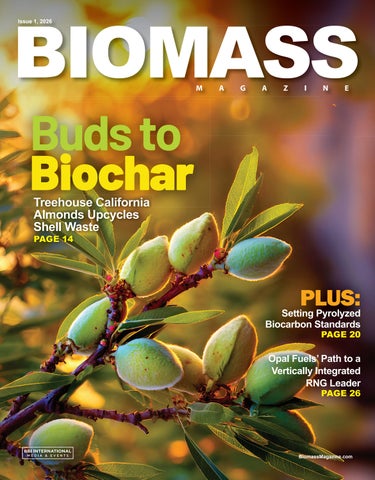
Buds to Biochar Treehouse California Almonds Upcycles Shell Waste PAGE 14
PLUS: Setting Pyrolyzed
Biocarbon Standards PAGE 20
Opal Fuels’ Path to a Vertically Integrated RNG Leader PAGE 26
BiomassMagazine.com
Hurst biomass systems lead the alternative energy boiler market with innovative solid-fuel-combustion design Hurst is a custom manufacturer of engineered packaged steam and hot water boilers and integrated boiler systems, renewable fuel fired gasification/ combustion/heat recovery systems, biomass & hybrid boiler systems, CHP/ co-generation systems, PLC-integrated boiler controls, parts & boiler room accessories. Fire-tube, water-tube & feedwater equipment for all industrial heating & process applications. Low NOx modular boilers & burners available. Hurst Biomass Systems lead the alternative energy boiler market with innovative solid-fuel-combustion design. Complete modular construction for easy low cost installation. Hurst has specialized in custom design of biomass steam plants and cogeneration systems since 1967.
High Efficiency Integrated Control Systems Offering integration and scalability, the new, high efficiency Integrated Control Systems from Hurst Boiler for boiler room monitoring and communications provide advanced supervisory boiler controls for all new and legacy Hurst products.
ZZZ KXUVWERLOHU FRP
7XUQ %LRPDVV ΖQWR &OHDQ 5HQHZDEOH (QHUJ\ :H DUH WKH ZRUOGȇV DXWKRULW\ LQ ELRPDVV SURFHVVLQJ ZLWK QHDUO\ PDFKLQHV LQVWDOOHG JOREDOO\ 2XU FRPSOHWH HTXLSPHQW DXWRPDWLRQ DQG DIWHUPDUNHW VROXWLRQV KDQGOH DQ\ PDWHULDO IRU SHOOHWLQJ EULTXHWWLQJ JULQGLQJ DQG FRROLQJ *HW FRPSOHWH ELRPDVV VROXWLRQV SOXV SDUWV DQG VHUYLFLQJ ȃ DOO IURP D VLQJOH VRXUFH
3(//(7Ζ1* %5Ζ48(77Ζ1* &22/Ζ1* *5Ζ1'Ζ1* 3$576 6(59Ζ&Ζ1*
ISSUE 1 | VOLUME 19
14
20
COLUMN
FEATURES
05 EDITOR’S NOTE
14 BIOCHAR From Burn Piles to Biochar
From Niche to Necessary
By Anna Simet
08 COLUMN
Industrial Pellets and the Work Ahead: Priorities for 2026
By Darrell Smith
DEPARTMENTS 10 SPOTLIGHT | MID-SOUTH ENGINEERING COMPANY At the Intersection of Engineering and Bioenergy Innovation 12 BIOMASS NEWS
By Biomass Magazine
| ADVERTISER INDEX 32-33 9 43 18 44 3 28 30 2 7 16 11 25 10 13 41 17 39 19 29 22 31 23 24
2026 Int’l Biomass Conference & Expo 2026 North American Biocarbon Conference BRUKS Siwertell Brunette Machinery Bulk Conveyors, Inc. CPM Industrial Solutions Detroit Stoker Company Evergreen Engineering Hurst Boiler & Welding Co. Inc. IAC KEITH Manufacturing Company KESCO, Inc. MARS Mineral Mid-South Engineering Company MoistTech NESTEC, Inc. Olsson Player Design, Inc. Rawlings Waste Wood Recovery Systems Roeslein & Associates, Inc Timber Products Inspection / Biomass Energy Labora USNR Vecoplan LLC West Salem Machinery Co.
Biochar and localized biomass solutions offer a new way forward for managing orchard and other ag residues after the San Joaquin Valley burn phaseout. By Keith Loria
20 BIOCARBON Developing Pyrogenic Biocarbon Standards
As renewable carbon demand grows, so has the need for pyrogenic biocarbon standards to bring clarity, confidence and scale to biochar, biocarbon and biocoal markets. By Katie Schroeder
26 RNG Fueling the Future
OPAL Fuels is building a vertically integrated RNG business—linking production, fueling infrastructure and fleet customers to scale renewable natural gas across transportation markets. By Caitlin Scheresky
CONTRIBUTIONS 34 FEEDSTOCK SAF and Maritime Mandates: Reshaping Biomass Demand By Matthew Stone
36 SAF The Most Viable Route to Greener Skies By Alexei Beltyukov
38 BIOCHAR Biochar at Scale: Agriculture’s Carbon Comeback By SunnyDay Renewables
40 DESIGN/ENGINEERING United in Biomass Technology: Shaping Wood Processing Systems in the Americas By Mike Curci
Biomass Magazine: (USPS No. 5336, ISSN 21690405) Issue 1, 2026. Biomass Magazine is published quarterly by BBI International. Principal Office: 308 Second Avenue North, Suite 304, Grand Forks, ND 58203. Phone: (701) 746-8385. Periodicals postage paid at Grand Forks, N.D., and additional mailing offices. POSTMASTER: Send address changes to Biomass Magazine/Subscriptions, 308 Second Avenue North, Suite 304, Grand Forks, N.D., 58203.
4 BIOMASS MAGAZINE | ISSUE 1, 2026
EDITOR’S NOTE|
From Niche to Necessary
ANNA SIMET
DIRECTOR OF CONTENT & SENIOR EDITOR
asimet@bbiinternational.com
As the biomass industry continues to evolve, so do the pathways, markets and standards shaping its future. In this issue of Biomass Magazine, we examine how renewable carbon is being defined, deployed and scaled—from pyrogenic biocarbon standards and orchard waste solutions to the accelerating role of renewable natural gas in transportation. Collectively, the feature articles we’ve delivered underscore a central theme: biomass is moving away from a niche solution, emerging as a critical tool in the broader energy and carbon-management transition. In “Developing Pyrogenic Biocarbon Standards” on page 20, Associate Editor Katie Schroeder explores the growing urgency around clear definitions and standardized testing for biochar, biocarbon and biocoal as these materials move from pilot projects to commercial markets. Through insights from Myles Gray of the U.S. Biochar Initiative and Chris Wiberg of Timber Products Inspection/Biomass Energy Lab, the article explains how standards are essential for investor confidence, global trade and safe handling—particularly as industrial demand for low-carbon materials accelerates. As interest from sectors like steelmaking and construction grows, this feature highlights why consistent terminology and ISO-aligned frameworks are foundational to the next phase of biocarbon growth. And hopefully, it serves as a resource in regard to the commonalities and differences among pyrogenic biocarbon, which is the broad term encompassing these materials. Our biochar coverage continues with “From Burn Piles to Biochar” on page 14, by contributing writer Keith Loria, which takes a deep dive into California’s San Joaquin Valley as it completes the final phase of its agricultural burn ban. With open burning no longer an option, growers are navigating higher costs, limited infrastructure and mounting volumes of ag residue. Loria examines how localized biochar and biomass solutions—such as the Sitos Group and Treehouse California Almonds pyrolysis project—could offer a viable alternative, while also outlining the regulatory, economic and logistical hurdles that still stand in the way of large-scale adoption. It’s a timely look at how policy, agriculture and bioenergy intersect on the ground. Rounding out our feature article lineup is “Fueling the Future” on page 26, by contributing writer Caitlin Scheresky. The story profiles OPAL Fuels and the rapid expansion of renewable natural gas as a transportation fuel, tracing OPAL’s evolution from landfill gas-to-power roots to a vertically integrated RNG producer serving heavy-duty trucking fleets across North America. Against a backdrop of shifting policy incentives, depressed D3 RIN prices and growing international interest, the article illustrates why methane abatement and RNG infrastructure are increasingly viewed as some of the most practical and impactful near-term decarbonization tools—especially for hard-to-electrify sectors. Together, these feature stories reflect an industry at an inflection point—one where definitions matter, local solutions are critical and scalable projects are beginning to reshape how biomass contributes to a lower-carbon future. Also complimentary to this theme are our contribution articles, which focus on sustainable aviation fuel’s potential, feedstock dynamics in the wake of SAF and maritime mandates, and lessons learned in material handling design and execution. 2025 was ripe with challenges, but we’ve also seen many successes and have been fortunate to help tell these stories. As we move into the year ahead, we wish everyone across the biomass value chain a year defined by progress, resilience and success. From project development and policy clarity to market growth and deployment, Biomass Magazine looks forward to telling the stories that shape the industry’s future.
BIOMASSMAGAZINE.COM 5
| INDUSTRY EVENTS
2026 Int’l Biomass Conference & Expo MARCH 31 – APRIL 2, 2026
Gaylord Opryland Resort & Convention Center, Nashville, Tennessee Now in its 19th year, the International Biomass Conference & Expo is expected to bring together more than 900 attendees, 160 exhibitors and 65 speakers from more than 25 countries. It is the largest gathering of biomass professionals and academics in the world. The conference provides relevant content and unparalleled networking opportunities in a dynamic business-to-business environment. In addition to abundant networking opportunities, the largest biomass conference in the world is renowned for its outstanding programming—powered by Biomass Magazine—that maintains a strong focus on commercial-scale biomass production, new technology, and near-term research and development. Join us at the International Biomass Conference & Expo as we enter this new and exciting era in biomass energy.
(866) 746-8385 | BiomassConference.com
North American Biocarbon Conference MARCH 31-APRIL 2, 2026
Gaylord Opryland Resort & Convention Center, Nashville, Tennessee
The North American Biocarbon Conference, co-located with the International Biomass Conference & Expo, brings together the full value chain of carbon-negative and carbon-smart technologies in one powerful, integrated event. By aligning biocarbon producers, biomass power generators, biochar innovators, carbon-removal buyers, project developers and equipment providers with the broader biomass, biogas, CHP, pellet and renewable-power industries, this colocated experience creates unmatched cross-sector engagement. Attendees gain access to expanded networking opportunities, dual-track educational programming, a unified expo hall, and a broader pool of commercial partners—all designed to accelerate the deployment of biocarbon solutions, scale climate-positive markets, and strengthen the emerging carbon-removal economy across North America.
(866) 746-8385 | BiocarbonConference.com
2026 Int’l Fuel Ethanol Workshop & Expo JUNE 2-4, 2026
America’s Center, Saint Louis, Missouri
EDITORIAL
DIRECTOR OF CONTENT & SENIOR EDITOR Anna Simet asimet@bbiinternational.com SENIOR NEWS EDITOR Erin Voegele evoegele@bbiinternational.com ASSOCIATE EDITOR Katie Schroeder katie.schroeder@bbiinternational.com MAP DATA & CONTENT COORDINATOR Chloe Piekkola chloe.piekkola@bbiinternational.com
ART
VICE PRESIDENT OF PRODUCTION & DESIGN Jaci Satterlund jsatterlund@bbiinternational.com SENIOR GRAPHIC DESIGNER Raquel Boushee rboushee@bbiinternational.com
PUBLISHING & SALES CEO Joe Bryan jbryan@bbiinternational.com PRESIDENT Tom Bryan tbryan@bbiinternational.com CHIEF OPERATING OFFICER John Nelson jnelson@bbiinternational.com SENIOR ACCOUNT MANAGER Chip Shereck cshereck@bbiinternational.com SENIOR ACCOUNT MANAGER Bob Brown bbrown@bbiinternational.com SENIOR MARKETING & ADVERTISING MANAGER Marla DeFoe mdefoe@bbiinternational.com CUSTOMER SERVICE COORDINATOR Brandon McGarry brandon.mcgarry@bbiinternational.com
Now in its 42nd year, the FEW provides the ethanol industry with cutting-edge content and unparalleled networking opportunities in a dynamic business-to-business environment. As the largest, longest-running ethanol conference in the world, the FEW is renowned for its superb programming. Powered by Ethanol Producer Magazine, the FEW maintains a strong focus on commercial-scale ethanol production, policy, plant management, advancing technology and near-term research and development. The event draws more than 2,400 people from over 31 countries and from nearly every ethanol plant in the United States and Canada.
(866) 746-8385 | FuelEthanolWorkshop.com
Please check our website for upcoming webinars
Please recycle this magazine and remove inserts or samples before recycling TM
COPYRIGHT © 2025 by BBI International
biomassmagazine.com/events/webinars
Subscriptions Biomass Magazine is free of charge to everyone with the exception of a shipping and handling charge for anyone outside the United States. To subscribe, visit www.BiomassMagazine.com or send a mailing address and payment (checks made out to BBI International) to Biomass Magazine Subscriptions, 308 Second Ave. N., Suite 304, Grand Forks, ND 58203. Back Issues & Reprints Select back issues are available for $3.95 each, plus shipping. Article reprints are also available for a fee. For more information, contact us at 701-746-8385 or service@bbiinternational.com. Advertising Biomass Magazine provides a specific topic delivered to a highly targeted audience. We are committed to editorial excellence and high-quality print production. To find out more about Biomass Magazine advertising opportunities, please contact us at 701-746-8385 or service@bbiinternational.com. Letters to the Editor We welcome letters to the editor. Send to Biomass Magazine Letters to the Editor, 308 2nd Ave. N., Suite 304, Grand Forks, ND 58203 or email to asimet@bbiinternational.com. Please include your name, address and phone number. Letters may be edited for clarity and/or space.
6 BIOMASS MAGAZINE | ISSUE 1, 2026
32:(5,1* 7202552:è6 (1(5*< )8785( 72'$<
Һ
3DWHQW SHQGLQJ
21( 3$571(5 (9(5< 3+$6( 9 ;,' 32' 6!8;2'8 (38 '='8@ 6,!9' 3( @3<8 683/'$;T &'£-='89 -223=!ধ=' #-31!99 93£<ধ329 ('!;<8-2+ 6!;'2;f6'2&-2+ ;'$,23£3+-'9 ;,!; 36ধ1-A' 6'8(381!2$' !2& '29<8' $329-9;'2; 1!;'8-!£ 683$'99-2+W <8 !&=!2$'& ;,'81!£ 683$'99-2+ 9@9;'19 1!?-1-A' 'ă$-'2$@T £3>'8 36'8!ধ32!£ $39;9T !2& #339; 683&<$ধ=-;@T ,'£6-2+ @3< 9;!@ $316'ধধ=' -2 ;3&!@Z9 1!80';W -;, &'$!&'9 3( 96'$-!£-A'& '?6'8-'2$'T <2&'89;!2&9 ;,' <2-7<' $,!££'2+'9 3( #-31!99 683$'99-2+W ' 683=-&' (<££@ $<9;31-A'& 9@9;'19 !2& 9<6638;T +<-&-2+ @3< (831 -2-ধ!£ '2+-2''8-2+ ;,83<+, )2!£ $311-99-32-2+ ;3 !$,-'=' &'6'2&!#£'T 9<9;!-2!#£' 8'9<£;9W
Industrial Pellets and the Work Ahead: Priorities for 2026 BY DARRELL SMITH
As the industrial pellet sector enters 2026, it does so with momentum built over the past year and a clear understanding that continued progress requires sustained engagement. Demand for low-carbon power, industrial solutions, advanced biofuels and carbon removals continues to grow, but success for industrial pellets will increasingly depend on favorable policy frameworks, opening new markets, and deeper collaboration. For USIPA, the year ahead will be guided by strategic priorities that build on recent progress and position the industry for continued growth.
Policy Engagement: Building Support at Home and Abroad
Throughout 2025, USIPA expanded its policy engagement in Washington, D.C., laying important groundwork for continued advocacy. Strong engagement with the United States government plays a critical role in shaping both foreign and domestic markets for industrial pellets. By ensuring policymakers have a clear, fact-based understanding of the sector, USIPA helps enable effective U.S. advocacy in overseas policy discussions while also supporting the development of domestic markets with long-term potential. Over the past year, USIPA engaged with multiple agencies across the administration, including meetings at the White House and with the Office of the U.S. Trade Representative, continued to work closely with the Foreign Agricultural Service, and held multiple meetings on Capitol Hill. These efforts focused on advancing and protecting the industry’s interests on trade policy, market access and the potential impact of tariffs on pellet exports. USIPA also maintains a strong focus on European policy, where regulatory decisions directly affect U.S. producers and global trade flows. A top priority will be engagement on the European Union Deforestation Regulation as implementation and simplification discussions move forward. While the EUDR delay achieved in 2025 provided breathing room, ensuring the regulation is implementable remains essential. At the same time, USIPA is actively engaging with the European Commission as it looks to undertake a review of biomass rules under the Renewable Energy Directive. While RED III is in force, many Member States are still implementing key provisions, including the controversial “cascading principle.” Revisiting the framework during this phase risks regulatory uncertainty, reinforcing the importance of policy stability as a core focus of USIPA’s European engagement.
New Markets: Expanding the Decarbonization Conversation
As interest in decarbonization accelerates across clean technology, carbon capture, sustainable aviation and maritime fuel, and heavy industry, USIPA has taken an active role by engaging industry trade associations and attending conferences and technical forums. This outreach has revealed a consistent challenge—many stakeholders remain largely unaware of the industrial pellet sector and the capabilities it has 8 BIOMASS MAGAZINE | ISSUE 1, 2026
developed. There is often limited understanding that the industry has solved the practical challenges of sourcing, processing and transporting sustainable woody biomass at scale. Once stakeholders understand the rigor of existing sustainability frameworks and the reliability of pellet logistics, conversations tend to shift quickly from curiosity to serious consideration. These moments underscore the importance of continued education and transparent engagement. A clear example of this progression is USIPA’s engagement with the National Lime Association. USIPA recently presented to the NLA Sustainability Committee, engaging senior representatives from leading lime producers and NLA leadership. The presentation covered pellet production fundamentals, emissions performance, carbon accounting, material handling considerations for lime kilns, and sustainability frameworks governing biomass supply chains, particularly in Europe. The discussion generated strong interest and substantive follow-up questions, signaling a move toward deeper technical dialogue. By leading with education, data and real-world experience, USIPA is helping new sectors evaluate biomass based on facts.
Coalition Building: Strength Through Partnership
Coalition building will remain a central priority for USIPA. The challenges facing the industrial pellet sector increasingly span jurisdictions, industries and regulatory frameworks, making coordination and alignment essential. In 2025, USIPA worked closely with allied forestry and biomass associations across the U.S. and Europe. These partnerships were instrumental in achieving meaningful policy outcomes, including EUDR delay, and demonstrated the value of presenting aligned positions across the forest products sector. USIPA occupies a unique position as a bridge between the U.S. and EU forest products sectors. Representing U.S. producers serving primarily European markets, the association maintains active dialogue on both sides of the Atlantic, coordinating positions, translating policy developments, and sharing information in real time. As European policy decisions continue to shape U.S. operations, investment decisions and trade flows, this role has become increasingly important. Looking ahead, USIPA will deepen coordination with forestry, biomass and renewable energy partners while extending engagement to new industrial end users, carbon capture stakeholders, and other climate-related sectors. As the industrial pellet sector continues to evolve in 2026, USIPA remains focused on turning opportunity into progress. With growing interest from new markets, deeper engagement from policymakers, and stronger alignment across the forest products value chain, the industry is well positioned to play an expanded role in decarbonization. Author: Darrel Smith Executive Director, U.S. Industrial Pellet Association darrell@theusipa.org
| SPOTLIGHT MID-SOUTH ENGINEERING
At the Intersection of Engineering and Bioenergy Innovation Mid-South Engineering operates at the forefront of engineering for the biomass and forest products sectors, distinguished by a strong commitment to clean air initiatives and sustainable practices. With a strategic focus on advancing bioenergy and biomass projects, Mid-South Engineering closely tracks critical industry trends, identifying key areas of opportunity essential to client success. In response to recent advancements in drying technologies, the company has supported clients in upgrading their operations with modern, energy-efficient equipment that improves productivity while reducing environmental impact. Over the past year, biochar has emerged as a significant area of industry interest. Recognizing its potential, Mid-South Engineering has leveraged its extensive expertise to conduct numerous feasibility studies tailored to individual client needs. These studies examine the viability and potential applications of innovative projects, including the production of biochar, torrefied pellets and graphene. Research efforts span a wide range of feedstocks, such as woody biomass, old corrugated containers (OCC), bagasse, municipal waste, and biochar initiatives linked to renewable diesel and biodiesel production. This broad experience enables Mid-South Engi-
10 BIOMASS MAGAZINE | ISSUE 1, 2026
neering to deliver comprehensive insight into current best practices and available technologies. Another key focus area is the development of combined-heatand-power (CHP) biomass plants. When clients pursue the construction and operation of CHP facilities, Mid-South Engineering applies advanced modeling techniques to thoroughly evaluate project requirements. This approach helps align available feedstocks with appropriate equipment, allowing clients to make informed, data-driven capital investment decisions. Throughout the process, the firm provides expert guidance and consistent support, helping clients navigate the complexities of project development and execution. With more than five decades of experience, Mid-South Engineering brings a deep reservoir of industry knowledge to every project. Its commitment to mentorship and the professional development of young engineers underscores a long-term investment in the future of the industry. Mid-South Engineering is dedicated to educating the next generation of engineers while sharing its expertise with clients to support successful, sustainable project outcomes.
CHOOSE KESCO
FROM CONCEPT TO REALITY EXPERIENCE MATTERS
SERVICES PROVIDED
" Þ« «½«æüΑ[æê « Þ T½ ÄÄ«Ä£ΑϞΑTÚ˶ æΑ õ ½Ë×à ÄæΑ TÚË ÞÞΑ ê «æÞ ͌ Α[ ÄÄ«Ä£ΑϞΑAË ½«Ä£ ÚËÄ Α+à £ Úü b¨ Úà ½Α[ ÄÄ«Ä£Α [üÞæ ÃΑ; üËêæΑϞΑ Þ«£Ä TÚË ÞÞΑ Ä£«Ä Ú«Ä£ TÚ˶ æΑA Ä £ à Äæ ËÄÞæÚê æ«ËÄΑA Ä £ à ÄæΑ W"VΑ õ ½Ë×à ÄæΑϞΑ õ ½ê æ«ËÄ bêÚÄα9 üΑTÚ˶ æÞ
CALL US TODAY
803-802-1718
Þ ½ Þϝº Þ ËÞ˽êæ«ËÄÞΠ ËÃΑΑΑΑΑΑΑΑΑΑΑΑΑº Þ ËÞ˽êæ«ËÄÞΠ ËÃ
BIOMASS NEWS |
The Ontario government announced it is investing $2.25 million in CHAR Technologies’ Thorold Renewable Energy Facility, construction of which is underway. IMAGE: CHAR TECHNOLOGIES
Ontario Invests $2.25 Million in Char Technologies
The Ontario government on Dec. 9 announced it will invest $2.25 million through the Forest Biomass Program to help Char Technologies commercialize the production of biocoal, a low-carbon fuel made from forest mill byproducts and underused wood. The funding will support Char Technologies’ efforts to improve biocoal storage and transport durability, which are needed for use in steelmaking at ArcelorMittal Dofasco. According to the Ontario government, the project will support six existing jobs, create four new jobs and build a more productive and diversified forest sector by putting up to 180,000 metric tons of forest biomass to use annually. The project is also expected to establish a new supply chain with significant potential for future growth, as collaboration between the forest sector and steel industry is expected to demonstrate the potential to use biofuel in other heavy industries. In early December, Char Technologies announced the delivery of the first of two commercial high temperature pyrolysis (HTP) kilns at its Thorold Renewable Energy Facility in Thorold, Ontario. The company said installation of the HTP kiln and feedstock handling line conveyors is currently underway. Phase 1 of the project remains on track for commissioning and commercial biocarbon production in January 2026, according to Char Technologies. Under Phase 1, the Thorold facility will convert up to 35,000 metric tons of wood waste per year into 5,000 metric tons of biocarbon, most of which will be used locally by ArcelorMittal Dofasco. In Phase 2 of the project, CHAR Technologies plans to install a second HTP kiln to double production capacity, add methanation equipment to upgrade synthetic gas into renewable natural gas, and construct an onsite natural gas pipeline injection point. Phase 2 is expected to be completed next year. 12 BIOMASS MAGAZINE | ISSUE 1, 2026
EPA Targets Q1 2026 for RFS Final Rule Setting Release
The U.S. EPA expects to issue a final rule setting 2026 and 2027 Renewable Fuel Standard renewable volume obligations (RVOs) during the first quarter of 2026, according to a notice filed Dec. 15 with the U.S. Court of Appeals for the D.C. Circuit. The notice responds to a Dec. 8 court order directing the agency to provide an update on the status of its proposal to set 2026 and 2027 RVOs. The order stems from lawsuits filed in September by HF Sinclair Refining & Marketing LLC, HF Sinclair Parco Refining LLC and Alon Refining Krotz Springs Inc., which considered challenging the EPA’s Aug. 22 denial of small refinery exemption petitions. In its Dec. 8 order, the court directed the EPA to file a status report outlining progress toward finalizing the 2026 RVOs, which will determine the expiration date of 2024 renewable identification numbers at issue in the case. The court also requested an estimated timeline for issuing the rule, if practicable. The EPA released a notice of proposed rulemaking in June to set 2026 and 2027 RVOs. The proposal, known as the Set 2 rule, would also limit participation of imported fuels and feedstocks, remove electricity from the RFS program, and reduce the 2025 cellulosic RVO. The public comment period closed Aug. 8. In September, the agency issued a supplemental notice of proposed rulemaking considering options to reallocate RVOs waived under the small refinery exemption program. The comment period closed Oct. 31. In its Dec. 15 filing, the EPA said it is working to finalize the 2026 and 2027 standards, noting that more than 2,000 public comments were submitted on the Set 2 proposal and supplemental proposal.
BIOMASS NEWS | “EPA is actively working on responding to comments, coordinating with other federal agencies, and resolving technical issues associated with the final rulemaking,” the agency wrote, citing the need to determine renewable fuel volumes and complete a Regulatory Impact Analysis. The EPA said staff must develop options for agency decision-makers, draft the final rule and supporting analyses, and submit the rule to the White House Office of Management and Budget for interagency review. The agency noted it has not yet submitted the rule and that the timing of OMB review is outside its control. The notice also cites required consultations with the U.S. Department of Agriculture, U.S. Department of Energy, U.S. Fish and Wildlife Service and National Marine Fisheries Service. Based on these requirements, the EPA said it expects to issue the final rule in the first quarter of 2026. If the rule is not finalized before Jan. 31, the statutory deadline for the 2025 RFS would be extended from March 31 to June 1.
South Carolina Renewable Diesel Plant Breaks Ground
Denver, WM Collaborate to Launch RNG facility
Dutch biomethanol producer Perpetual Next and American equipment supplier TSI celebrated their long-term collaboration on Nov. 24 with the kick-off of constructing the world’s largest torrefaction reactor in Estonia. The reactor is an important part of Perpetual Next’s Biomethanol Blueprint, which is currently deployed at four Perpetual Next production sites in Europe and the United States. The Blueprint is designed for large-scale biomethanol production with proven industrial technology to enable rapid, serial replication at a commercial scale. As part of the initiative, TSI and Perpetual Next entered into an agreement in March last year for the production of eight large-scale torrefaction reactors, each with a production capacity of 80,000 metric tons of renewable carbon per year. The carbon produced is then converted into biomethanol via a gasification system and methanol synthesis.
The Denver Department of Public Health & Environment and WM announced a joint collaboration to develop Colorado’s largest renewable natural gas (RNG) facility at the Denver Arapahoe Disposal Site landfill. The facility will be the first landfill gas-to-RNG plant in Colorado. While other RNG facilities in the state process wastewater or agricultural waste, this will be the first to convert landfill gas into energy. Denver City Council voted on Dec. 1 to approve an agreement for WM to finance, build and operate the facility. In exchange, the city will receive a royalty payment on revenue generated. Construction is expected to begin in late 2026 with the facility projected to be operational in 2027.
Carolina Renewable Products has officially broken ground on its first renewable diesel facility in Orangeburg County, South Carolina, marking the launch of a $280 million clean-energy investment that will create 155 jobs over the next five years. Located on a 20-acre site, the plant will convert pine wood residuals from local sawmills into renewable diesel and also produce high-value byproducts including biochar and wood vinegar. Construction begins in spring 2026, with initial modules operating by late 2026 and full operations expected by 2027. The project is supported by county tax incentives and a $755,000 Closing Fund grant from the Coordinating Council for Economic Development and a $200,000 grant from South Carolina’s Secretary of Agriculture.
Construction Begins on Torrefaction Reactor in Estonia
" !"/0 &+ ,&012/" " 02/"*"+1
1% 1 4,/(0ă + )" + )" )" /" )Ě1&*" *,&012/" /" !&+$0 1, &)&1 1" ,+Ě1%"ĚÖ6 )&+" !'201*"+10ă # &)&1 &)& &)&1 1"
âÝÚĚàÛàĚÚáÙÙ 444ă*,&011" %ă ,* &+#,ņ*,&011" %ă ,*
BIOMASSMAGAZINE.COM 13
| BIOCHAR
FROM BURN PILES TO
BIOCHAR Biochar and localized biomass solutions offer a new way forward for managing orchard and other ag residues in the wake of California open burning bans. BY KEITH LORIA
A
s California’s San Joaquin Valley completes the final phase of its agricultural burn ban, growers are confronting a mounting woody waste dilemma with few easy answers. The Jan. 1, 2025, phaseout of open burning has forced orchard operators to abandon a long-standing disposal method and turn instead to costlier, logistically complex alternatives, from chipping and soil incorporation to emerging bioenergy and biochar pathways—just as biomass infrastructure continues to shrink and orchard removals accelerate across the region. The shift has arrived as California grapples with declining biomass infrastructure,
14 BIOMASS MAGAZINE | ISSUE 1, 2026
rising orchard removals driven by water and market pressures and mounting volumes of woody material with nowhere obvious to go. “The district has seen a tremendous reduction in agricultural open burning in recent years through the ongoing phase-out, including the most recent and final component that kicked in at the beginning of this year,” says Jaime Holt, chief communications officer for the San Joaquin Valley Air Pollution Control District. The San Joaquin Valley’s restrictions are unique in that it’s currently the only region in California and the nation with stringent requirements to phase out agricultural open burning.
Phase-Out Impacts
The phase-out’s roots trace back almost two decades to Senate Bill 705 and the District’s Rule 4103. The most recent milestone came in 2021, when the district, in collaboration with the California Air Resources Board, adopted a final phase-out strategy that eliminated most remaining agricultural burning by the end of 2024. Through the implementation of the final phase-out strategy, the amount of agricultural material being open burned through the district’s smoke management system process has continued to decrease. “The impact has been dramatic,” Holt says. “Agricultural material open-burned
Almond waste, which consists primarily of hulls and shells, presents both challenges and opportunities for growers. IMAGE: STOCK
in the [San Joaquin] Valley dropped to approximately 30,000 tons in 2025, down from 99,000 tons in 2024, representing more than a 95% reduction compared to over 1 million tons burned per year historically. The reductions in agricultural open burning and use of alternatives mark record levels for the Valley since the institution of agricultural burning restrictions, highlighting the success of the district’s agricultural open burning emission reduction strategy.” Gabriele Ludwig, director for sustainability and environmental affairs for the Almond Board of California, notes while the burn ban is specific to the San Joaquin Valley, other growers around the state are keep-
ing a close eye on what’s happening because of past events. She explains that as burning restrictions tightened, growers increasingly relied on alternatives that have since narrowed. “For tree removals, growers used to send material to cogeneration facilities, which helped offset removal costs because the plants paid for the biomass,” Ludwig says. “When those facilities shut down, growers lost the primary alternative and burning pressures increased again.” Today, only one biomass power plant remains in operation in the San Joaquin Valley and its capacity is limited. “We used to be able to ship that material to biomass plants
or landfills,” says Roger Isom, president and CEO of the Western Tree Nut Association. “Now, there’s only one operating biomass plant left in the Valley, and it can take very limited volumes.” As a result, most growers have defaulted to chipping and soil incorporation. “For most growers, the only option left is to chip the material and incorporate it back into the soil,” Isom says. “In some places that works well, but in others it’s extremely difficult— especially if the material isn’t broken down finely enough to decompose in a reasonable timeframe.” Because of that, costs have increased considerably. Chipping an almond orchard BIOMASSMAGAZINE.COM 15
| BIOCHAR
runs about $1,600 to $1,700 per acre, walnuts can be closer to $2,200 per acre and incorporation can add another $600 to $700 per acre, according to Isom. “This problem has been compounded by several things happening at once,” he says. “SGMA [Sustainable Groundwater Management Act] implementation, low walnut prices pushing orchards out of production, and a wave of vineyards being removed. At the same time, the biomass plants disappeared, and the burn ban took effect.” The result, he says, is visible across the Valley. “There are piles of material sitting in fields because growers either don’t want to incorporate it or simply have nowhere to take it,” Isom says.
Opportunity Landscape
Biochar solutions may be one answer. For instance, there’s a project in Tulare County that many are watching which could serve as a potential template for the future. The Sitos Group, working with Treehouse California Almonds, is developing a biochar production facility centered on almond shells, considered an abundant but historically undervalued coproduct of almond processing. “Our primary feedstock for the project is almond shell, which comes directly from Treehouse California Almonds’ harvesting and shelling operations,” says Jessica Bronner, director of business operations for the Sitos Group. “Historically, those shells were sold into secondary markets like livestock bedding or other uses,
Treehouse California Almonds has partnered with Sitos Group to introduce a $9 million dollar slow pyrolysis biochar facility, the first of its kind on the West Coast. When complete, three Sitos processors in the 25,000-square-foot facility will process almond shells into biochar. IMAGE: TREEHOUSE CALIFORNIA ALMONDS
541.475.3802
16 BIOMASS MAGAZINE | ISSUE 1, 2026
KeithWalkingFloor.com/biomass
A single Sitos Group pyrolysis unit can produce 2,700 ton tons of biochar per year. IMAGE: SITOS GROUP
but now they’re being diverted as the main feedstock for our biochar production.” The $9 million project is centered on slow pyrolysis, a thermal process distinct from combustion, and will feature three side-byside slow pyrolysis units operating as one, along with a fully integrated drying system with emissions and dust control, and Organic Rankine Cycle generators to repurpose heat energy from the pyrolysis units into clean electricity that will support the local power grid. “At full scale, the facility is designed to process about 24,000 tons of almond shell per year, producing roughly 8,000 tons of biochar annually,” Bronner says. Another plus is that the conversion ratio results in reduced trucking with fewer loads on the road compared to hauling raw shell material. “Right now, phase one is about proving the biochar market,” Bronner says. “The energy component is phase two, where we plan to capture and redirect that energy either back into the grid or into onsite operations.” The good news is that the biochar offtake is already secured, sequestered in agricultural settings. “One of our primary offtake partners is Monterey Pacific, a vineyard management company that has been using biochar in its soils for nearly a decade and has seen strong yield improvements and a return on investment within a few years,” Bronner says. “From an agronomic standpoint, biochar de-
ROVVRQ FRP
0RVW VHH DQ HQJLQHHU :H VHH DQ H[SHUW LQ UHQHZDEOH IXHOV
ENGINEERING POSSIBILITIES. BIOMASSMAGAZINE.COM 17
| BIOCHAR
7$.( &21752/ 2)
<285 ),%(5 6833/< %UXQHWWH 5HFODLPHU
%$ 341$2 s +DQGOHV GLIŵFXOW VSHFLHV OLNH FHGDU DQG DVSHQ
The Valley Air District has reached the end of a multiyear tiered phase-out of nearly all agricultural open burning in the San Joaquin Valley.
s UROO RU UROO FRQŵJXUDWLRQ WR VXLW \RXU IDFLOLW\ s $YDLODEOH ZLWK K\GUDXOLF RU HOHFWULF GULYH
SOURCE: SAN JOAQUIN VALLEY AIR POLLUTION CONTROL DISTRICT
%UXQHWWH %LR6L]HU
Ŗ
%$ 341$2 &RQVLVWHQW s XQLIRUP SURGXFW 6ZLQJ DZD\ s DQYLO ZLWK EROW RQ OLQHU 5HSODFHDEOH Ř VWULNHU EDUV
VVW VWULNHU EDUV WUULLNH NHUU EEDDUV UV
6KHDU SLQ s SURWHFWLRQ
:KROH /RJ J &KLSSHU %$ 341$2 s ([WUHPH GXW\ FRQVWUXFWLRQ s 2YHUVL]H LQIHHG s 3RZHUHG IHHG ZRUNVV s /DUJH UHDU DFFHVV H GRRU IRU HDV\ VDIH PDLQWHQDQFH
RJ @ANTS NTQ 2VHMF '@LLDQ 'NFR @MC "GHO 2BQDDMR
!QTMDSSD," BNL R@KDR AQTMDSSDLB BNL 18 BIOMASS MAGAZINE | ISSUE 1, 2026
livers multiple benefits. It improves soil health, increases water retention and locks carbon into the soil. For growers, adding stable carbon to the soil is almost always a net positive.”
Lessons Learned
Treehouse was interested in the collaboration as a way to create durable value from a material long treated as an afterthought. “When you harvest almonds, you really end up with four products,” says Joe Gardiner, vice president of business development with Treehouse California Almonds. “Everyone knows the kernel, but you also have hulls, inedible almonds and shells. Historically, the shell has been the forgotten coproduct.” This project stands apart because it aims to function without relying solely on public subsidies. “Grants and subsidies are helpful, but they’re ultimately Band-aids,” Gardiner says. “This is about building a sustainable, profitable marketplace for agricultural biomass.” While ultimately successful, the project has not been without its challenges. To date, permitting has been one of the most difficult hurdles. “We spent two years op-
erating a pilot facility and working closely with air districts to explain how pyrolysis differs from combustion,” Bronner says. “Biochar is not ash or charcoal—the feedstock never touches the flame.” Finding the best locations have also been an issue. “One of the biggest lessons we’ve learned is that biochar projects need to be located where the feedstock is,” Bronner says. “Transporting biomass long distances increases costs and emissions. Ideally, the feedstock, processing facility and offtake should all be as close together as possible.” What’s more, she notes, is that it’s not enough to just make biochar; you need a reliable feedstock supply and a secure offtake. “Flooding the market without demand can create serious problems,” Bronner says.
Barriers and Bottlenecks
Despite promising examples, scaling has remained difficult. While there’s interest in bioenergy and biochar, there’s also a lot of skepticism. “We’ve seen promising projects collapse after running into permitting challenges or strong opposition from environmental groups,” Isom says.
‘For tree removals, growers used to send material to cogeneration facilities, which helped offset removal costs because the plants paid for the biomass. When those facilities shut down, growers lost the primary alternative and burning pressures increased again.’ –Gabriele Ludwig, Almond Board of California
“Our organization has met with more than 60 companies proposing alternatives—everything from biochar and pyrolysis to renewable natural gas, hydrogen and cellulosic ethanol. Only one or two are actually operating, and they’re taking very small amounts of material.” Ludwig noted air quality remains a defining constraint. “Even if an alternative produces far fewer emissions than open burning, if it adds NOX or PM2.5 in the San Joaquin Valley, it can be extremely difficult to permit,” she says. Economics also matter since growers often push back on business models that assume biomass should be free. “If there’s value created, some of that value needs to come back to the grower,” Ludwig says.
Looking Ahead
The Valley’s transition has been supported by strong incentives. Holt notes the Ag Burn Alternatives Grant Program has executed more than $226 million in grants, supporting alternatives across more than 310,000 acres. “Nearly 92% of material is incorporated into the soil,” she says. “Smaller shares are going to off-site reuse and air curtain incineration.”
Still, funding is limited. Holt notes program funds are expected to be exhausted by mid-2026, and about $75 million per year will be needed over the next five years to maintain progress while building new infrastructure. The hope is that the Sitos-Treehouse project will be replicated, something it was designed to create. “This Treehouse project is really our showroom,” Bronner says. “We already have additional projects being evaluated, including one using hazardous forest biomass and another with a large Central Valley sheller. Even though Treehouse represents a small share of the almond industry, we’ve seen time and again that when something works at a small scale, it can be adopted widely.” For Isom, the stakes are clear. “We don’t need a single silver bullet—we need multiple solutions,” he says. “But we do need projects to actually reach the finish line.” Author: Keith Loria Contributing Writer, Biomass Magazine
BIOMASSMAGAZINE.COM 19
| BIOCARBON
Developing
PYROGENIC BIOCARBON Standards Experts discuss the crucial role standards play in scaling the adoption of biochar, biocoal and biocarbon. BY KATIE SCHROEDER
IMAGE: STOCK
20 BIOMASS MAGAZINE | ISSUE 1, 2026
C
ompanies are increasingly seek- dards to help maximize growth and explain ing renewable sources of carbon the product’s value proposition to invesfor energy use and sequestration, tors. “It was always such an uphill battle to and one option consistently rises even get someone to understand what bioto the top for accessibility: biomass. With char was,” he says. “And if you got past that a wide range of feedstocks—including threshold, trying to get them convinced woody and agricultural residues, aquatic that you could make the same product over biomass and food waste—biomass serves and over again at large scale to hit certain as a versatile source of carbon, with poten- metrics.” tial use applications as diverse as the materiUSBI is funded by the U.S. Forest Serals themselves. Fertilizer producers, cement vice, which views biochar as a strategy to manufacturers, farmers and steelmakers reduce fire risk by providing another marare among those benefiting from lower car- ket for low-value wood. One of Gray’s first bon-intensity scores tied to fossil-emission projects with USBI was a survey of the reductions and carbon sequestration. global and U.S. biochar industries, he exHowever, as biomass applains, and he was surprised plications expand and specifito learn that the industry cations become increasingly identified standards as one important, so, too, do stanof the key obstacles to biodards. The biomass industry’s char’s development. “From product diversity is a strength, then forward, we really startbut it can cause confusion for ed pushing on standards, and future investors or offtakers those who really understand as they seek to understand product to market, I think, Chris Wiberg carbon-based products and are very enthusiastic about Timber Products Inspection applications. Industry experts the effort,” Gray says. StanMyles Gray, U.S. Biochar Inidards are critical because they tiative, and Chris Wiberg, enable communication beTimber Products Inspection/ tween seller and buyer. CurBiomass Energy Lab, work rently, that communication to provide clarity regard“has been a mess,” he adds, ing the differences among as both parties are looking for three seemingly equivalent different data. terms—biochar, biocoal and The terms biochar, biobiocarbon—as well as the carbon and biocoal are used Myles Gray U.S. Biochar Initiative overarching term pyrogenic by various sectors but lack biocarbon. standardized terminology. In his role at USBI, Gray promotes Serving as chair of the U.S. Technical Adthe manufacture and utilization of biochar. visory Group for the International OrHis background in environmental science ganization for Standardization Technical led him to an interest in the biochar indus- Committee 238, Wiberg works to bring try. Through his experiences working for a clarity through standardization. He also utibiochar startup, he found that the biochar lizes his extensive experience from working industry needs clearer definitions and stan- with Timber Products Inspection/Biomass BIOMASSMAGAZINE.COM 21
| BIOCARBON
Energy Lab, which involves inspecting and testing for compliance for solid biofuel- and biocarbon-based products. In a 2024 update, ISO TC 238 changed its title and scope to include “pyrogenic biocarbon,” which includes biochar, biocarbon and biocoal. In essence, this means the standards for this sector are now managed through ISO TC 238. Actual definitions for these terms are still being developed, Wiberg explains, but he believes these efforts will help differentiate how the terms biochar, biocoal and biocarbon should be used to describe various pyrogenic biocarbon products.
Technical Details
Understanding what pyrogenic biocarbon is and the differences between these products starts with understanding the basics of combustion and the components of biomass. Clean woody biomass, for example, consists of roughly 84% volatile matter
(material that is liberated as gas when heated) and roughly 15% fixed carbon (the solid carbon material that remains after all volatile matter is released), with the remainder being the ash fraction. Charcoal is an example of a material whereby biomass has been heated to remove the majority of the volatile matter, with the fixed carbon and ash remaining. The process by which the volatile matter is removed, the type of biomass material used and the amount of ash can vary significantly. Therefore, the final product may better serve a specific end use (e.g., agriculture, concrete additive, steelmaking, etc.), creating a variety of product categories that may be referred to as biochar, biocoal, biocarbon, etc. In the past, waste biomass materials were typically utilized via combustion, creating renewable heat and energy. However, interest in sequestering carbon and avoiding emissions has led to interest in processing biomass through pyrolysis or gasification to yield high fixed-car-
ϭϲϰϭ ^ŝŐŵĂŶ ZŽĂĚ͕ ŽŶLJĞƌƐ ' ϯϬϬϭϮ
ϳϳϬ͘ϵϮϮ͘ϴϬϬϬ
ĞƌƟĮĐĂƚĞƐ ŽĨ ŶĂůLJƐŝƐ /ŶƚĞƌŶĂů YƵĂůŝƚLJ ŽŶƚƌŽů dĞƐƟŶŐ YƵĂůŝƚLJ ^LJƐƚĞŵ ĞǀĞůŽƉŵĞŶƚ
tĞ ĞůŝǀĞƌ ŽŶĮĚĞŶĐĞ ͘
^ŽůŝĚ ŝŽĨƵĞů dĞƐƟŶŐ͕ /ŶƐƉĞĐƟŽŶ͕ Θ ĞƌƟĮĐĂƟŽŶ ^s Ɛ W&/͕ EƉůƵƐ͕ ĂŶĚ /EƉůƵƐ YƵĂůŝƚLJ ĞƌƟĮĐĂƟŽŶ ^ĐŚĞŵĞƐ
ELRPDVVHQHUJ\ODE FRP WSLQVSHFWLRQ FRP 22 BIOMASS MAGAZINE | ISSUE 1, 2026
bon-content materials that can be used to replace carbonaceous fossil fuels or to directly sequester carbon. Wiberg illustrates the process of combustion and the presence of volatile matter and fixed carbon using the example of a common campfire. When wood combusts in a campfire, the initial tall flames come from the volatile matter. As the wood is heated, the volatile matter off-gases and burns as an open flame, similar to a candle. As the volatile matter is depleted, the tall flames go away, but what is left is a very hot bed of coals. This is the high-energy-density fixed-carbon fraction. Smoke is essentially volatile matter that does not ignite and burn. “Any smoke is like the lost energy,” he explains. Woody biomass is transformed into charcoal through pyrolysis, which heats wood to the point that nearly all volatile matter is liberated, leaving behind fixed carbon. Charcoal is differentiated from other products because its primary feedstock is low-end biomass with high ash content; this works well for generating heat and grilling but is not well-suited for industrial applications where the material must be as clean as possible. The production process may not differ greatly from product to product, but there are differences. For example, wood shavings or sawdust could be used to make any of these three products, while biomass like sewage sludge or food waste is better used in biochar (e.g., agricultural applications) but would not work as a feedstock for biocarbon (e.g., steel manufacturing). “Not all feedstocks result in the ability to sell into all three markets,” Wiberg says. “It’s more like you can make pyrogenic biocarbon products out of a lot of different feedstock materials, but the end use may be more selective as to which ones are better or more appropriate for a specific end use.” Gray also emphasizes that the processes used to make biochar, biocarbon and biocoal are almost identical, but the quality of the feedstock often determines the ultimate end use.
Biochar
Made via pyrolysis, biochar’s main purpose is to sequester carbon for preferably hundreds of years. This could mean use as a soil amendment for marginal, low-quality soils or as a component in concrete. When added to soil, biochar improves water and nutrient retention, helping improve fertility. “If you mix it with a fertilizer, some of the fertilizer will be absorbed into the biochar, and it will allow for a more gradual dissipation of that fertilizer into the farm application,” Wiberg says. Biochar must remain in the environment for as long as possible; therefore, the biomass’ permanence constitutes the important metric rather than fixed-carbon content. Wiberg explains that data points such as random reflectance and hydrogen-to-organic-carbon ratio help predict how long the carbon will remain sequestered in the environment. Though it has been said there are 80 uses for biochar, according to Gray, only
about 10 are economically viable, and his team actively promotes five of those. Alongside use as a soil amendment and fertilizer ingredient, biochar finds use in the horticultural substrate market, replacing expensive imported products such as peat, perlite or vermiculite. The concrete sector sees biochar as a potential additive to help reduce the product’s carbon intensity and increase its strength. “Small amounts of biochar can be added in, and that’s not much. It might be like 3 to 5 percent, but 3 to 5 percent of all the concrete we use would be an astronomical amount of biochar deployed. There’s just so much concrete in the world,” Gray adds. The two other applications his team explores are soil remediation and wastewater treatment, since biochar’s properties help remove pollutants and improve plant health in stormwater systems. A particle of biochar is 90% porous, with wood biochar in particular looking like a “crazy honeycomb,” Gray explains. When the cell wall structure of the
wood is retained, it offers a lot of porosity and surface area inside biochar particles, allowing pollutants to be absorbed by the biochar. “I think of it as sort of like the poor man’s activated carbon as a product that can be deployed more broadly, in more systems where you might not want to put a bunch of very expensive activated carbon. You can use biochar instead,” he says. Currently, the largest market for biochar comes from farmers growing high-value crops on small acreage, such as vineyards and orchards. The agricultural sector will most likely continue to be biochar’s largest market, according to Gray.
Biocarbon
This substance offers itself as a lower-carbon-intensity option for industrial processes such as steel manufacturing. Coke or metallurgical coal helps reduce iron oxide into steel. Producers engineer biocarbon to be as similar to metallurgical coal or coke as possible, which means the product must
BIOMASSMAGAZINE.COM 23
| BIOCARBON
High-Performance Size Reduction Solutions High Efficiency Unmatched Durability Versatile Applications Low Maintenance
Hammermills Shredders Screens Conveyors From single machines to full process lines, rely on West Salem’s 75 years of experience for a solution built around your bioenergy goals.
westsalem.com 24 BIOMASS MAGAZINE | ISSUE 1, 2026
be highly refined. Biocarbon needs a concentrated degree of carbon, so the feedstock is typically made of clean, high-quality wood, minimizing the amount of ash created. “They want to be very calculated as to how much volatiles they cook off so that it’s a very highly concentrated fixed carbon in the final product,” Wiberg says. “It’s kind of like charcoal, only it’s been engineered more precisely.” The carbon is still used up in this application, but it enables manufacturers to avoid coal usage. Gray explains that the carbon in biocarbon becomes consumed by the reduction process, while biochar stays in the ground for up to 1,000 years.
Biocoal
The term “biocoal” is used to describe a renewable alternative to coal. While it is made from a thermally treated material, biocoal does not require the same type of charring as other products. “[A] lot of the volatile matter is dissipated when you’re making the higher-quality biocarbon reductant material for steel or even biochar— since you’re trying to get it to be as permanent in the environment as possible—but biocoal is not as heavily thermally treated. You might try to retain a larger percentage of those volatiles,” Wiberg says. Typically, biocoal is produced using steam explosion or torrefaction processes that increase the energy density of the material. Biocoal finds use in power plants, cement production facilities, heating plants and anywhere coal serves as a source of heat or power. These product uses might vary widely, but ultimately, each of them brings value by utilizing waste and reducing greenhouse gas emissions from fossil carbon, Wiberg explains. “There are different benefits, but all of them have some very nice carbon mitigation … properties and purposes, and hence the reason everybody’s trying to use them in any way they can to switch over from fossil carbon to renewable carbon,” he says.
Championing Standardization
Right now, the primary consequence of the lack of standards is confusion for buyers and sellers, but the challenges will grow with the industry. Although these products may be similar, defining each term is crucial, as the products serve different uses and may have different manufacturing methods. Wiberg lists some of the key elements the ISO seeks to standardize to help the industry speak the same language: “It’s sampling, sample prep, vocabulary, but then all of the individual test methods that go into testing these materials. You’ve got moisture, ash, volatile matter, physical properties, calorific value, metals, chlorine, etc. All the different techniques that are used to run the analysis of these materials are defined under ISO TC 238.” According to Wiberg, standards are already “late to the game.” As the industry grows and large-scale projects multiply, the necessity for clear standards becomes more urgent. Even as projects are underway, uncertainty remains regarding how these materials can be shipped, which measurements are required in testing and more. For example, the International Maritime Organization prohibits shipment of these materials unless special provisions are incorporated into the shipping process because they are believed to have the potential to be self-heating, posing a fire risk onboard ships. Research must be conducted to answer these questions and prevent any hindrances to the growth of these products. The interest in biocarbon expressed by the steel industry and the scale of research being executed into biochar applications cannot be ignored. “Even though most projects are still in the early stages of development, you can sense that they’re coming,” Wiberg says. “And as a result, we know that we’re on the cusp of a big boom.” Author: Katie Schroeder Associate Editor, Biomass Magazine
)PVJOHY +PZJ 7LSSL[PaLY
)PVJOHY 7PU 4P_LY
Unlock the Potential of Biochar Mars Mineral’s 50+ years of process development experience, paired with field-proven pelletizing technology, deliver reliable and efficient solutions that support the circular bioeconomy. Contact Kevin Leczkowski, General Manager, at info@marsmineral.com or 724-538-3000. Explore custom pelletizing solutions. Scan to complete our Agglomeration Questionnaire.
Process Development Solutions Since 1972
www.MarsMineral.com
BIOMASSMAGAZINE.COM 25
Fueling the OPAL Fuels co-CEO Adam Comora and other project stakeholders attended the ribbon cutting ceremony for the Atlantic Renewable Natural Gas Facility in Egg Harbor Township, New Jersey. The plant began operations in October. IMAGE: OPAL FUELS
26 BIOMASS MAGAZINE | ISSUE 1, 2026
| RNG
F
ive years ago, OPAL Fuels stepped out of the private sector and emerged as an ambitious leader in the production and distribution of renewable natural gas. With major partners including NextEra Energy, UPS, CHS and Fiat Chrysler Automobiles, and more than 350 projects nationwide, OPAL has positioned itself at the forefront of the renewable energy transition. And just in time, it seems, as pressure to decarbonize increases. The United Nations’ COP30 climate summit, held in Brazil in November and the first post-U.S. withdrawal, stressed “the inherent connection between pursuing efforts to limit the global temperature increase to 1.5 degrees Celsius and pursuing just transition pathways.” While the conference failed to agree on decarbonization regulations, 23 countries endorsed their commitment to Belém 4X, an initiative to quadruple the use of sustainable fuels by 2035. RNG serves as an easily applicable fuel source for industries looking to decarbonize while maintaining current infrastructure. And to OPAL coCEO Adam Comora, RNG is the perfect place to invest amid current climate goals.
Future BY CAITLIN SCHERESKY
In With the New
Formed in late 2020 by Comora and co-CEO Jonathan Maurer, OPAL entered the public sector backed by decades of experience. “We got started in the business of capturing biogas and trying to find a productive use for it 25 years ago,” Comora says. “A lot of folks were noticing that methane emissions from decaying organic waste could be used productively and that electricity generation was a good answer because it’s baseload power, 24/7.” Prior to OPAL’s formation, TruStar Energy, Fortistar Methane Group and
BIOMASSMAGAZINE.COM 27
| RNG
‘Methane abatement is likely the lowest-hanging fruit and the most impactful thing that we can do.’ –Adam Comora, co-CEO, OPAL Fuels
Fortistar RNG operated as portfolio companies of Fortistar LLC. The three companies merged together to form OPAL Fuels, bringing together upstream and downstream capabilities. Later that year, OPAL combined with ArcLight Clean Transition Corp. II, officially exiting the private sector as a vertically integrated producer and disAdam Comora tributor of RNG. OPAL Fuels “We saw a really interesting opportunity to transform what we were doing at the Fortistar Methane Group on the landfill gas-to-electric side,” Comora continues. “We really got excited that there could be something better to do with the biogas resource from an economic perspective, and create an opportunity to help fleets achieve their objectives.” OPAL’s long-term partnership with American legacy utility NextEra Energy began in April 2021 with the development of a Minnesota RNG project designed to produce 2,140 dekatherms of RNG per day, eliminating 43,900 metric tons of carbon per year. In December 2022, OPAL signed a long-term agreement with UPS to provide operations and maintenance services to 51 UPS RNG dispensing stations in the U.S. In 2023, OPAL and South Jersey Industries signed a 50-50 joint venture agreement to develop RNG facilities. The following year, OPAL announced commercial operations at its RNG facility at the Polk County municipal landfill in Jones Corner, Florida. Today, OPAL splits its operating segments into three categories: RNG fuel, renewable power and fuel station services, Comora explains. In a report of OPAL’s third-quarter results, Comora noted an 8% increase in RNG production compared to the second quarter and a 30% increase compared to the third quarter of 2024, despite depressed D3 RIN prices. Maurer shared the company’s annual design capacity of 9.1 million MMBtu across 12 projects in operation during the same briefing, adding that “at present, RNG and CNG are the most attractive alternatives to replace diesel for the Class 8 trucking market.” With D3 RINs remaining depressed, Comora and Maurer’s lengthy backgrounds in renewable energy investing bring stability 28 BIOMASS MAGAZINE | ISSUE 1, 2026
OPAL Fuels possesses 25 years of industry experience and a portfolio of over 350 projects with multiple major partners, including NextEra Energy, UPS, SJI, CHS and Fiat Chrysler Automobiles. IMAGE: OPAL FUELS
to their work. “There are a few cost areas that we’re really focused on,” Comora says. “One is the capital costs of the facilities, where we did see some significant inflationary cost pressures over the past three to four years or so. Thankfully, those have been offset by the Section 48 ITC tax credit, and we did safe harbor a number of projects in our advanced development pipeline that will qualify for those ITC tax credits. But we are spending a lot of time on value engineering.” Further federal tax incentives like the Section 45Z Clean Fuel Production Tax Credit and the Renewable Fuel Standard program affect how OPAL moves. “Policy clarity has a lot more impact on investing in RNG assets, and they all form a piece of the puzzle,” he says. “And 45Z is definitely helpful when thinking about investing in new RNG production facilities. Those run through 2029, so
if new facilities take a ballpark estimate of 18 months to build, you may only be getting a year of 45Z benefits.” Current legislative efforts, including a notice of proposed rulemaking released by the White House Office of Management and Budget, attempt to further extend 45Z beyond 2029, as well as reinstate the $1.75-per-gallon sustainable aviation fuel incentive, which Comora says makes a significant impact on RNG investments. “We’re waiting for final clarity on a GREET model to do all the carbon intensity scoring around our projects, but if you can have visibility or clarity on 45Z for a period of time, that can have a big impact on investing in RNG facilities,” he says. “It also works in conjunction with the 48 ITC, so 45Z is a tool or a lever that can offset those capital cost increases.”
TURNKEY RNG SYSTEMS SUSTAINABLE SOLUTIONS | RENEWABLE ENERGY
roeslein.com Lowest CI (Carbon Intensity) score for CARB Swine Pathway Ever Achieved
MICRO BIOGAS UPGRADING SYSTEM
FLOW RATE OF 25 SCFM TO 400 SCFM
SWINE | DAIRY | WASTEWATER BIOMASSMAGAZINE.COM 29
| RNG
Opal Fuels’ Pine Bend RNG Project in Inver Grove Heights, Minnesota, is located at a Republic Services landfill. It began commercial operations in 2022. IMAGE: OPAL FUELS
Trucking Along
Despite OPAL’s roots in the U.S., Comora says opportunities beyond the domestic market are growing. “Japan is starting to import RNG. They have a mandate that by 2030, 1% of their net gas has to be lowCI. You can send it there as LNG or as renewable methanol,” he says. “In Europe, marine fuel is really interesting, as well as here in the U.S., whether it be in barges or around ports, and potentially for ocean-going vessels. There’s going to be a big market because they’re going to be taxed based on their carbon emissions when they pull into ports, and now you’ve got all these ships on the ocean that can run on renewable methanol. So, there are other offtake markets that want low-CI natural gas.”
30 BIOMASS MAGAZINE | ISSUE 1, 2026
New markets, of course, mean new regulations, even inside the continental U.S. “Any time we dispense RNG in California, CARB assigns us a CI score based off the Argonne GREET models. 45Z is going to have something similar. And we also have third-party engineers that do baselines,” Comora says. When it comes to the transportation sector, the challenges of decarbonization are half the fun, and OPAL is happy to answer the call. “The reason why we’re focused on transportation fuel, and specifically heavy-duty trucking here in the U.S., is because it’s a hard-to-decarbonize sector,” he says. “Electrification is challenged by battery weight and electricity grids—there are just so many things that stand in the way, and hy-
drogen has proved challenging to distribute in the U.S. as well. “We’re collecting biogas that’s maybe 50% methane,” Comora continues. “We are physically passing it through membranes to separate all other impurities so that you can get it up to a pipeline-quality spec, use existing pipeline infrastructure to transport it where you need it, build a fueling station that pulls off the RNG, compresses it and puts it right into the vehicle where it can be used. You can’t get a more streamlined operational economic model for the sector.” The balancing act between building new RNG plants and expanding OPAL’s current fueling infrastructure is calculated at every step. “Everything that we invest capital in competes for that capital resource and
needs to be justified on a strong, unlevered, risk-adjusted return,” Comora explains. “And the good news is we’re seeing good opportunities on both sides. With major fleets increasingly reengaging with CNG and RNG, Comora and the OPAL Fuels team view fueling infrastructure as a compelling growth opportunity and are investing accordingly. “We see a stronger adoption curve of natural gas or RNG for heavy-duty trucking,” he says. “That being said, you’ll likely see us continue to invest in both, and at the same time, I feel like some of the capital is going to get shifted more toward the fuel station part of the business in the next couple of years.” Using RNG allows companies to record zero Scope 1 emissions (direct emissions and fossil fuels) and zero Scope 2 emissions (indirect emissions released through purchased energy). The CI of the combusted RNG can then be used to offset Scope 3 emissions, which include all other indirect emissions occurring across the value chain. “It’s hard for companies to do Scope 3 emissions accounting work, but we provide the CI of the RNG we’re supplying if they’re trying to establish a Scope 3 framework,” Comora adds. “So if you use RNG in a fleet: zero Scope 1, zero Scope 2, you create a biogenic emission and then you have a reduction in your Scope 3 emissions based on the CI.”
damaging than CO2, specifically over the first 20 years,” Comora stresses. “Methane abatement is likely the lowest-hanging fruit and the most impactful thing that we can do. Does it get us all the way there? No. Should we be doing it? Yes.” For OPAL, success is defined by setting the industry benchmark for reliable RNG production, with high facility availability and uptime, Comora says. It also includes increasing fleet conversions for heavy-duty transportation, expanding into new markets
such as marine fuels or exports to Japan, evaluating additional feedstocks, and growing the company’s fueling station network. “We really paved our own path in terms of how we built the company, so it was really exciting—and still is exciting,” he adds. “A lot of interesting things come from that. We found it to be really challenging and fun, and it continues to motivate all of us.” Author: Caitlin Scheresky Contributing Writer, Biomass Magazine
Finding the Future
With five to six projects under construction, Comora says OPAL is looking ahead. “It’s been a lot more work, and it’s more expensive being a public company. And we think it’s worthwhile to do that work,” he says. “One, we think it’s a better platform to raise capital, raise awareness and do some of our public policy advocacy work. We also think it’s been really impactful to attract talent to our team, and it’s made us much more disciplined.” With nearly 30 years of experience in the renewable investment industry, the challenges of operating as a public company are navigated by returning to fundamentals. “Methane emissions are 80 times more BIOMASSMAGAZINE.COM 31
ÀëÚãé Îåäãèäçè
us
tri
a l Pel let A
s
so t i on
U.S. I
c ia
nd
ÎêååäçéÞãÜ ÊçÜÖãÞïÖéÞäãè ÈÚÙÞÖ ËÖçéãÚçè
M A G A Z I N E
w
r
g
w
w.
theusip
a.
o
ʿ˔˥˚˘˦˧ ʵ˜ˢˠ˔˦˦ ʸ˩˘ˡ˧ ˜ˡ ˁˢ˥˧˛ ʴˠ˘˥˜˖˔ 19th ANNUAL
¾Ê Çʾ¼ÏÀ¿ ÀÑÀÉÏ
ɼÎÃÑÄÇÇÀ ËÖçéÞØÞåÖãéè Öèè äÛ !
4B Components, Ltd. Advanced Cyclone Systems, S.A. Advanced Material Handling Ltd. AGRA Industries, Inc. Amandus Kahl USA Corporation Andritz Feed & Biofuel Applied Catalysts Autoflame Engineering, Ltd. B3 Systems, Inc. Babcock & Wilcox Basic Machinery Co., Inc. BE&E Biomass Magazine BioProducts, LLC BM&M Screening Solutions BMH Technology Oy Brad Thompson Company BRUKS SIWERTELL Brunette Machinery Co., Inc. Bulk Conveyors, Inc. Caldwell/Preload Chase Nedrow Industries City of Benson/Swift County Clear Water Products Columbia Water Technology, LLC Continental Conveyor, Ltd. Cooper Tacia Corrosion Monitoring Services, Inc. CPM CV Technology, Inc. Dabmar Screens Daltec Process Fans.
ˀ˔˥ʡ ʦʤ ʠ ʴˣ˥ʡ ʥ
ʺ˔ˬ˟ˢ˥˗ ˂ˣ˥ˬ˟˔ˡ˗ ˅˘˦ˢ˥˧ ½ÞäâÖèè¾äãÛÚçÚãØÚ Øäâ
ÀíÝÞ×Þéäçè
DeNOx Enviroment Detroit Stoker Company DeweSoft LLC Dome Technology Dryer One Durr CTS, Inc. Dustmaster Enviro Systems ElectraTherm inc. Evergreen Engineering, Inc. Fagus GreCon, Inc. Finna Sensors Fire Rover, LLC FMW North America, Inc FNA Inc. Genesis III Hoffmann Inc. & Wolf Material Handling Systems HoSt Bioenergy Systems Hurst Boiler & Welding Co., Inc. IAC Inficon INTEC Engineering GmbH JC Steele & Sons, Inc Jenike & Johanson, Inc. John King USA, Inc. Johnsen Machine (JMC ) Jozana Grant Services K.R. Komarek KEITH Manufacturing Co. Kemira Water Solutions Inc. KESCO, Inc. Kice Industries, Inc.
Komax Systems, Inc. L&R Timber Company Laidig Systems, Inc. Larson Engineering, Inc. MARTECH Boiler Material Control Solutions LLC Messersmith Manufacturing, Inc. Mid-South Engineering Company MoistTech Corp. Morillon Silo Unloading Systems Navajo County - REAL AZ NESTEC, Inc. Plattco Corporation Plazer LLC Power Industry Support, LLC Premium Plant Services, Inc. Process Combustion Corporation ProcessBarron Proco Products, Inc. PureFlow Inc Puritan Magnetics, Inc. R&R-BETH Rapat Corporation Rawlings Wood Hogs
RK Rubber Roeslein & Associates, Inc. Rotex Global, LLC RUF Briquetting Systems SALMATEC GmbH Schaeffer Manufacturing Co. SCS Engineers Sioux Steel Company SPG Construction LLC Stela Drying Technology Corp. Sumitomo SHI FW Tank Connection Tarsco Bolted Tank Tennessee Department of Agriculture TerraSource Global The Essmueller Company Thomas & Muller Systems, Ltd. Timber Products Inspection/ Biomass Energy Laboratories Todd & Sargent, Inc. Troy Industrial Solutions USNR Valmet, Inc. Vecoplan, LLC Vogelsang USA Warren & Baerg Manufacturing, Inc. WastAway Wellons Wuxi Powermax Renewable Energy Technology Co., Ltd
#IBCE26
X.com/biomassmagazine 866-746-8385 service@bbiinternational.com
Aviation and maritime mandates are accelerating at a time when biomass markets are tightening. IMAGE: RESOURCEWISE
SAF and Maritime Mandates: Reshaping Biomass Demand
T
he center of gravity in biofuels is shifting, and an emerging pressure point is biomass. For years, road transport has dominated demand for waste- and residue-based feedstocks, absorbing most of the available supply of used cooking oil, tallow, distillers corn oil and other key inputs for renewable diesel and biodiesel production. That era is ending. Aviation and maritime mandates are accelerating at a time when biomass markets are tightening. The shift is creating a more competitive landscape for all participants, from refiners and traders to compliance teams and feedstock aggregators. The question is no longer which fuel pathway grows fastest, but which sector secures the biomass first.
The New Demand Equation for Biomass
Across global markets, policy is no longer the sole driver of change. Physical bio-
BY MATTHEW STONE mass availability is emerging as a defining constraint. Sustainable aviation fuel (SAF) and maritime fuels are adding new demand for the same limited pool of waste and residue oils. Both sectors will compete on price with road transport fuels to secure the feedstock needed to supply decarbonized fuels. Several forces are tightening biomass markets simultaneously: • Rising obligation levels in Europe for 2026 under RED III • Stricter sustainability and traceability requirements narrowing usable supply • Higher-value SAF pathways diverting upstream material • Early-stage maritime adoption scaling trials into contracted volumes As each sector claims more tonnage, the competition becomes structural rather than cyclical. Growing demand across all segments will continue to alter how these sectors operate.
SAF’s Claim on Biomass
Global efforts to displace fossil jet fuel with renewable SAF will have a significant impact on biomass economics. Refiners are increasingly testing every marginal unit of feedstock against potential SAF value, not just renewable diesel output. What is changing: • Current SAF production relies heavily on the same feedstocks as hydrotreated vegetable oil and renewable diesel. • Compliance and voluntary airline demand are creating price premiums competitors cannot ignore. • European SAF mandates are sharply increasing blending requirements. • U.S. producers are optimizing for Section 40B and 45Z incentives, driving increased domestic SAF production. As SAF scales, residual feedstock availability for transport renewables will tighten, requiring price adjustments to reflect these shifts.
CONTRIBUTION: The claims and statements made in this article belong exclusively to the author(s) and do not necessarily reflect the views of Biomass Magazine or its advertisers. All questions pertaining to this article should be directed to the author(s).
34 BIOMASS MAGAZINE | ISSUE 1, 2026
FEEDSTOCK |
SOURCE: RESOURCEWISE
to Europe while U.S. feedstocks remain domestic if imports are limited or taxed. These trends will redefine trade flows and producer strategies throughout 2026.
Advanced Feedstocks Take Center Stage
Because waste oils cannot scale indefinitely, the industry is being pushed toward the next tier of feedstock development, which includes: tall oil, soapstock acid oils, agricultural residues, lignocellulosic biomass, algae, e-fuels and other emerging options. Competitiveness will depend on sustainability integrity and traceability, now top priorities for regulators and compliance buyers. The race is no longer just for biomass, but for qualifying biomass.
Maritime: The Next Major Biomass Competitor
The maritime sector’s decarbonization requirements are beginning to exert a meaningful pull on the global renewable feedstock pool. The EU’s FuelEU Maritime emissions-intensity reductions, which began in 2025, require carriers to adopt low-carbon fuels well before ammonia, methanol or hydrogen reach broad commercial viability. As a result, advanced biofuels such as used cooking oil methyl ester, fatty acid methyl ester blends and other bio-bunker fuels are entering direct competition for waste oils with road and aviation fuels. The maritime sector may prove disruptive for several reasons: • Large-volume consumption potential • Immediate ability to use drop-in fuel blends • Increased visibility of customer-driven decarbonization While maritime demand remains relatively small today, its growth trajectory will draw biomass into a third major sector, further tightening supply.
A Feedstock Bottleneck is Forming
The most important market reality for 2026 is clear: The available biomass pool is not growing fast enough to meet policy-driven demand across all sectors.
Indicators of tightening supply include: • Plateauing waste oil availability in key collection regions • Tallow supplies constrained by slaughter volumes • Limited growth in EU Annex IX Part A-eligible feedstocks • Increasing feedstock disqualification due to traceability concerns • Higher utilization rates of pretreatment and refining capacity Road, aviation and maritime mandates are colliding with the physical limits of current biomass markets.
2026: The Year of Allocation Decisions
As mandates tighten, producers will be forced to make more deliberate decisions about where each unit of biomass is allocated. As mandates tighten, producers will be forced to make more deliberate decisions about where each unit of biomass is allocated. Those decisions will hinge on: netback economics, as SAF may capture more marginal tons if premiums persist and credits remain favorable; compliance exposure, with sectors facing steep penalties or rigid mandates competing more aggressively for supply; refinery and technology configuration, since not all plants can efficiently shift between diesel- and jet-range outputs; and regional arbitrage, as Asian biomass may flow
Preparing for a Multisector Biomass Market
By 2026, biofuels will no longer be defined solely by road transport. SAF, maritime and road fuels will all draw from the same constrained feedstock pool. Success in this environment will require a clear understanding of cross-sector biomass economics, improved forecasting of SAF and maritime demand, stronger traceability frameworks, diversification into next-generation feedstocks, and active monitoring of RED III national implementations. The future of biomass demand is becoming more complex, more competitive and more global. Aviation and maritime mandates are not incremental changes; they are transformative forces reshaping supply chains and pricing across the biofuels market. Producers who understand where biomass pressure points lie and track early market signals will be best positioned to navigate the remainder of 2026 Author: Matthew Stone Vice President of Business Development and Low Carbon Fuels ResourceWise matthew.stone@resourcewise.com +44 7762 773 118
BIOMASSMAGAZINE.COM 35
The Most Viable Route to Greener Skies While electric and hydrogen aircraft may eventually transform aviation, sustainable aviation fuel offers the most viable path to immediate emissions reduction.
T
BY ALEXEI BELTYUKOV
he aviation industry faces an unprecedented challenge: achieving meaningful decarbonization while maintaining the global connectivity that modern commerce and society depend upon. As the sector grapples with contributing 2.5% of global CO2 emissions—with 80% originating from long-haul flights—the search for viable alternatives to conventional jet fuel has intensified.
Alternative Aviation Technology Challenges
The promise of electric and hydrogen-powered aircraft has captured headlines and imagination, yet both technologies face fundamental barriers that limit their near-term viability for commercial aviation. Electric aircraft confront the harsh reality of battery energy density constraints. Current lithium-ion technology achieves approximately 200 to 250 watt-hours per kilogram (Wh/kg), with expectations to plateau at around 300 Wh/kg due to fundamental chemistry limitations, compared to 12,000 Wh/kg for jet fuel. However, studies have identified that electric aviation would require 400 Wh/kg for general aviation applications and 750 Wh/kg for commercial regional air service, representing a two- to three-fold improvement that remains beyond current capabilities. While electric aircraft may serve a role on short-haul regional routes, their energy density limitations constrain their applicability to the majority of commercial aviation. The infrastructure implications are equally daunting. Electric aviation would necessitate comprehensive airport charging systems, overhauls of electrical grid capacity, and aircraft redesign. To date, not a single commercial electric aircraft deployment has occurred in scheduled passenger service, underscoring the technological and economic hurdles that remain. Hydrogen propulsion presents similar challenges. While hydrogen offers impressive energy density by weight, its storage requirements create significant design constraints. Liquid hydrogen must
be maintained at -253 degrees Celsius, requiring specialized cryogenic storage systems that fundamentally alter aircraft architecture. The safety considerations, airport infrastructure modifications and lengthy recertification processes have proven so challenging that even Airbus recently scaled back its hydrogen aircraft program timeline. These realities underscore that electric and hydrogen technologies will require significant technological breakthroughs before their full potential can be realized, highlighting the aviation industry’s need for immediate solutions to achieve its decarbonization goals.
SAF: The Drop-In Solution
Sustainable aviation fuel (SAF) offers a direct path to decarbonization by working within existing systems rather than requiring wholesale transformation. Produced from renewable feedstocks— including alcohols, used cooking oil, animal fats, municipal solid waste, agricultural residues and even captured CO2—SAF can blend with conventional jet fuel without modifying aircraft engines or airport infrastructure. This compatibility is critical. Airlines operate on thin margins, and aircraft lifecycles span decades. A fuel that integrates with existing fleets enables immediate deployment without the massive capital investments required by alternative technologies. The market has responded. Global SAF production is projected to reach 6.1 billion to 8.2 billion gallons annually by 2030, according to RMI’s Sustainable Aviation Fuel Market Outlook, up from about 350 million gallons in 2024—underscoring both industry commitment and scalability.
Today’s Leading Pathway
The dominant SAF production technology today is hydroprocessed esters and fatty acids (HEFA), which converts fats, oils and greases into jet fuel through hydrogen treatment. Its appeal lies in
CONTRIBUTION: The claims and statements made in this article belong exclusively to the author(s) and do not necessarily reflect the views of Biomass Magazine or its advertisers. All questions pertaining to this article should be directed to the author(s).
36 BIOMASS MAGAZINE | ISSUE 1, 2026
SUSTAINABLE AVIATION FUEL |
compatibility with existing refinery infrastructure, allowing producers to leverage current equipment with modifications. However, HEFA faces constraints that limit long-term scalability; chief among them is feedstock availability. The U.S. produces about 23 million tons of suitable feedstock annually, with soybean oil accounting for 57% of supply. Used cooking oil is limited by collection logistics, while animal fats are geographically concentrated in states such as Nebraska, Texas and Iowa, increasing transportation costs and carbon intensity. Competition from the renewable diesel market further complicates HEFA economics, as incentives often favor diesel production and intensify feedstock competition. Maximizing SAF yields also generates substantial naphtha byproducts—up to 25% of total output—which can become a low-value burden for facilities located far from petrochemical markets. These factors create a complex optimization challenge. HEFA produces only paraffinic components, while conventional jet fuel requires 8% to 25% aromatics for proper engine performance. As a result, HEFA SAF must be blended with fossil jet fuel, limiting its carbon reduction potential. Producers must balance feedstock costs, blending requirements and infrastructure proximity while navigating agricultural commodity volatility.
Innovation in SAF Production
The industry’s response to HEFA’s challenges has been to diversify production pathways and optimize existing processes. Fischer-Tropsch technology, which converts solid waste after gasification into syngas into synthetic fuels, offers access to more abundant feedstocks but at higher capital and operating costs. Alcohol-to-jet pathways provide another alternative, though current processes remain energy-intensive and expensive. Current ASTM standards limit most SAF pathways to 50% blending with conventional jet fuel. Still, the industry is moving toward higher blend ratios and eventually 100% drop-in synthetic fuels. Achieving this goal requires addressing the aromatic component gap in HEFA SAF production, making economical sources of these molecules crucial for future fuel specifications. One particularly promising area involves upgrading the naphtha byproducts from HEFA and Fischer-Tropsch (FT) processes into aromatic components of SAF that are otherwise missing from these outputs. Rather than treating these naphtha materials as low-value byproducts, emerging add-on technologies can convert them into high-value aromatics. For example, Universal Fuel Technologies has developed a chemical processing technology that complements HEFA and FT by converting their naphtha byproducts into high-quality aromatic components essential for jet fuel. The challenge of upgrading naphtha byproducts stems from two key factors: the chemical properties of paraffinic molecules, which make them difficult to convert into aromatics, and the small quantities produced at individual HEFA facilities, which preclude economies of scale. These chemical and economic dual constraints explain why few technologies have emerged to convert this low-val-
ue stream into higher-value products. However, this approach not only improves the economics of existing SAF production, but also addresses a critical technical requirement for future 100% SAF blends.
Economic Viability Through Integration
The future of SAF production likely depends on integrated approaches that maximize resource utilization and minimize waste. Rather than viewing each production pathway in isolation, the industry must consider how different technologies can complement each other. The flexibility to adapt to changing market conditions becomes crucial as well. Feedstock availability and pricing fluctuate in response to agricultural cycles, regulatory changes, and competing demand. Production facilities that can adjust their operations—switching between different feedstocks or product slates based on market conditions—will have significant competitive advantages.
Scaling for Impact
Meeting aviation’s decarbonization goals requires SAF production to scale from hundreds of millions of gallons annually to tens of billions of gallons per year. This expansion demands not only technological improvements but also supply chain development, policy support and effective financing mechanisms. The industry must also develop production technologies that can compete economically with conventional jet fuel while maintaining the performance characteristics that aviation demands. This requires continued innovation in processing technologies, feedstock development and systems integration. In many cases, investors may be reluctant to fund HEFA and FT plants where the naphtha byproduct stream cannot be effectively monetized. Technologies that solve this byproduct utilization challenge become critical enablers, potentially transforming otherwise uneconomical projects into viable investments and accelerating the deployment of SAF production capacity.
An Immediate Path to Sustainable Aviation
While electric and hydrogen aircraft may eventually transform aviation, SAF offers the most viable path to immediate emissions reduction. Unlike alternative propulsion technologies that require fundamental changes to aircraft design and infrastructure, SAF works within existing systems while delivering measurable environmental benefits. The industry’s commitment to sustainability is clear, yet progress depends on solutions that can be deployed at scale. SAF provides that bridge, linking today’s fossil fuel reliance with a fully sustainable aviation future. By advancing production technologies that address current economic and technical barriers, the industry can accelerate SAF adoption while moving toward the goal of 100% SAF. Author: Alexei Beltyukov CEO, Universal Fuel Technologies
BIOMASSMAGAZINE.COM 37
SunnyDay Renewables’ state-of-the-art biochar reactor will produce 25,000 to 30,000 tons of biochar annually IMAGE: SUNNYDAY RENEWABLES
Biochar at Scale: Agriculture’s Carbon Comeback
T
he International Energy Agency estimates that agriculture accounts for approximately 24% of global greenhouse gas emissions. Aside from commonly cited methane emissions from livestock waste, widespread practices such as the open burning of agricultural residues—including rice husks, straw and corn stalks—releases significant amounts of CO2, methane and black carbon, a potent aerosol that accelerates atmospheric warming. The Food and Agriculture Organization estimates that this practice contributes 0.5%
BY SUNNYDAY RENEWABLES
to 1% of global emissions while also causing air pollution and soil degradation. Another significant driver of emissions is the use of synthetic fertilizers, which contribute around 4.7% of total global emissions in CO2-equivalent terms. This disproportionate impact stems from the dual role of fertilizers; their production emits over 1.5% of global CO2, while their excessive application releases nitrous oxide, a gas 265 times more potent than CO2, accounting for approximately 3.6% of global emissions. Chemical fertilizer also degrades the health
of soil where it is applied, trapping farmers in a vicious cycle of either increasing fertilizer use, or abandoning the land until its natural fertility eventually recovers on its own. A notable casualty of the overutilization of synthetic fertilizer was Florida’s once-vaunted citrus industry. Florida’s sandy soil naturally lacks nutrient- and water-holding capacity, and research has shown that chemical-intensive practices have only exacerbated this problem by reducing soil’s organic matter and disrupting microbial communities critical for nutrient cycling. This
CONTRIBUTION: The claims and statements made in this article belong exclusively to the author(s) and do not necessarily reflect the views of Biomass Magazine or its advertisers. All questions pertaining to this article should be directed to the author(s).
38 BIOMASS MAGAZINE | ISSUE 1, 2026
BIOCHAR | degradation made the industry vulnerable to an emergent citrus greening disease (HLB) blight, an incurable bacterial infection that attacks trees’ vascular systems, causing severe nutrient deficiencies and tree death. The scale of this decline is such that Florida’s citrus industry, which had produced 244 million boxes of oranges in 1998, had plummeted 95% to only 12 million boxes in 2025.
Scaling Sustainability: Biochar’s Impact
Biochar, derived from agricultural waste, is a carbon-rich soil amendment widely valued as an organic alternative to synthetic fertilizers. It’s produced through pyrolysis, a process that heats organic matter at high temperatures in a low-oxygen environment, typically within a rotary kiln. Though pyrolysis has been practiced for decades and biochar’s benefits have been recognized for centuries, recent technological advances now enable its large-scale production. Biochar improves nutrient retention, enhances water-holding capacity, and fosters microbial activity. Unlike synthetic fertilizers, which require repeated applications for each crop cycle, biochar’s benefits endure, progressively enriching soil fertility over time. Its stability, decomposing over centuries or even millennia, ensures longterm nutrient retention and makes it a powerful tool for carbon sequestration, earning praise as one of the few scalable solutions to lock carbon away and prevent its release as CO2. SunnyDay Renewables, based in Florida’s equestrian capital of Wellington, Florida, is one of a rapidly growing number of projects planning to produce biochar at scale to address the agriculture’s carbon crisis. The company’s $30 million Wellington facility, set to complete its first phase in the second quarter of 2026, will produce 25,000–30,000 tons of biochar annually and sequester over 75,000 tons of CO2 per year using agricultural wood waste from nearby horse farms. SunnyDay has partnered with Biomass Energy Techniques, a pyrolysis kiln manufacturer with 16 active units installed nationwide, on the first deployment of their prototype fourth generation unit, known as the PRD8000, on the facility. The
unit is more than twice as efficient as BET’s previous model, able to process four tons of biomass per hour, which in combination with a boiler and ORC generator, can generate over 3 megawatt hours of renewable energy per year. With a plan to install between 2 and 3 PRD8000 units by 2027, the SunnyDay Project will not only sequester vast quantities of CO2 at scale, but the process of making it will also be net zero, with the ability to feed surplus renewable energy back into the grid. The process produces no smoke, odors or harmful emissions, offering a scalable, ecofriendly model that will help to transition agriculture into becoming a climate solution, rather than climate problem. This circular approach, converting waste into a valuable agricultural input while generating renewable energy, creates an efficient closed loop in the true spirit of circular economy. Projects like SunnyDay are leading the biochar revolution and paving the way for a sustainable future
for agriculture, that mitigates climate change and offers new hope to the prospect of soil vitality.
Biochar: Carbon Capture, Soil Health and Sustainability
Biochar delivers three transformative benefits for farmers and the environment. First, in terms of carbon sequestration, each ton of biochar sequesters approximately 2.5–3 tons of CO2 equivalent, according to the International Biochar Initiative, keeping carbon out of the atmosphere for hundreds to thousands of years. Second, biochar reduces emissions by preventing methane and nitrous oxide release during waste decomposition, biochar production cuts lifecycle emissions significantly. Finally, biochar improves soil fertility, boosts water retention by up to 20%, and reduces chemical fertilizer use by enhancing nutrient availability, fostering sustainable farming.
'5<(56 72 *(7 ,7 '21(
/(7Í6 7$/. OºÒyÈèʼn È衵 ʼnSèÌÒ ´ÌʼnĦʼn L ʼn È衵 ʼnSèÌÒ ´Ì #È µʼn"Ö ®ʼnŲʼn yȬʼn Öȵ ÈÌ Èèʼn"Ö ®ʼn Öȵ ÈÌʼnĦʼn è ®ºµ ÌʼnŲʼn ¡È®º ¬Ì
Å Å®yè È Ì¡ µĜµ Ò ®y ¡ Å®y yè È Ì¡ µĜµ Ò BIOMASSMAGAZINE.COM 39
ect execution and lifecycle support for biomass processing operations across a wide range of applications.
Expanding System-Level Capabilities
As facilities scale and diversify, the efficiency and reliability of upstream wood processing and material handling systems increasingly determine overall plant performance. IMAGE: BRUKS SIWERTELL
United in Biomass Technology:
Shaping Wood Processing Systems in the Americas
F
BY MIKE CURCI
or decades, the biomass sector has evolved in step with the world’s changing energy priorities. Today, demand for reliable, efficient and sustainable biomass technologies has never been greater. At the same time, producers—whether utility-scale pellet manufacturers, combined-heat-and-power facilities, industrial bioenergy users, or emerging fuels developers—face growing pressure to increase throughput, reduce operational complexity and meet stringent quality standards. As facilities scale and diversify, the performance of upstream wood processing and material handling systems has become a determining factor in overall plant reliability. Equipment selection, system integration and layout decisions made early in project development often define long-term operating costs, uptime and safety outcomes. Against this backdrop, Bruks Siwertell and West Salem Machinery have aligned their engineering and manufacturing resources within a unified Biomass Technology Division serving the Americas. The objective of this alignment is to better coordinate system design, proj-
Bruks Siwertell brings long-standing experience in bulk material handling, including receiving systems, conveyors, storage solutions, and screening technologies. These systems are commonly deployed in large-scale pellet plants and export terminals, where consistent flow, dust control and automation are critical. West Salem Machinery contributes decades of expertise in size reduction and fiber preparation, including chipping, grinding, shredding and milling equipment. These machines are typically designed for high-duty cycles and challenging feedstocks, supporting biomass operations where durability and maintainability are essential. Combined, the division supports integrated wood processing systems that may include: • Truck and rail receiving systems • In-feed and metering equipment • Debarking, chipping and fiber preparation • Hammermills, grinders and hogs • Screening and classification technologies • Belt, drag-chain and screw conveying systems • Stacker reclaimers, storage domes and automated storage systems • Dust collection, spark detection and fire mitigation systems This combination allows us to design, integrate and support every major facet of a biomass processing line—from raw material intake to finished fuel or feedstock. It also allows system designers to evaluate interactions between equipment stages rather than treating each machine as a standalone component.
Best Practices in Wood Processing System Design
As the scale and complexity of biomass facilities grow, properly designed wood processing systems have an outsized impact on overall plant performance. Based on lessons learned from hundreds of installations, both in North America and globally, several principles consistently differentiate high-performing systems from those that fall short. Engineer for Feedstock Variability—Not Ideal Conditions. Biomass feedstocks vary widely in moisture content, density, particle size and contamination. Systems designed around idealized material conditions often struggle in real-world operation. Allowing for surge capacity, flexible size reduction and adaptable screening improves resilience and reduces unplanned downtime. Prioritize Effective Screening and Classification. Screening is one of the most underestimated, yet most impactful elements of system design. Screening is the quiet hero of plant performance. When it’s done right, everything else becomes more efficient. A high-performance screening stage upstream of size reduction improves grinder life, reduces energy consumption, and ensures downstream consistency.
CONTRIBUTION: The claims and statements made in this article belong exclusively to the author(s) and do not necessarily reflect the views of Biomass Magazine or its advertisers. All questions pertaining to this article should be directed to the author(s).
40 BIOMASS MAGAZINE | ISSUE 1, 2026
DESIGN/ENGINEERING | Design Dust Management and Fire Protection into the System. Dust control is essential for safety and reliability. Spark detection, deluge suppression and negative-pressure conveying significantly reduce fire risk and operational disruptions. Build Maintainability into the Layout. High-capacity biomass operations depend on maintainability as much as mechanical strength. Maintainability should be built into the design, not added later. It’s the foundation of uptime, safety and long-term reliability. Thoughtful layout, accessibility and modular components can increase uptime dramatically. Integrate Technologies for System-Level Performance. Our unified engineering team now designs systems where each machine is optimized within the broader process flow, not just at the equipment level. This systems integration significantly enhances throughput, energy efficiency and product quality.
Lessons Learned From Global Installations
Across hundreds of projects, from fiber preparation units to million-ton-per-year pellet export plants, several lessons consistently emerge: • Reliable receiving systems set the foundation for stable operations. • Feedstock consistency equals output consistency. • Redundancy in critical paths pays for itself. • Early alignment between OEMs prevents costly redesign. • Automated controls reduce operator burden and improve quality. These observations continue to inform system design choices with every new project.
• Low-energy, high-throughput grinders • IoT-enabled condition monitoring and predictive maintenance • Higher-capacity, higher-accuracy screens • Modular receiving systems for faster installation • Automated storage and reclaim designs for export-scale facilities As biomass applications expand beyond traditional energy markets into fuels, materials and carbon-related products, wood processing systems will need to adapt to new feedstock requirements and performance targets. We’re shifting from product-level innovation to system-level innovation, and that’s where producers will see the biggest gains.
Supporting the Next Phase of Industry Growth
The alignment of Bruks Siwertell and West Salem Machinery reflects a broader industry shift toward integrated, system-level thinking in biomass facility design. By consolidating engineering expertise and operational experience, the Biomass Technology Division aims to support producers as they navigate increasingly complex technical and market conditions. As biomass continues to play a role in renewable energy and sustainable manufacturing strategies, well-designed processing systems will remain central to reliable, safe and cost-effective operations. Our unified Biomass Technology Division stands ready to deliver the systems, expertise and performance needed for the industry’s next chapter. The future of biomass is incredibly versatile. We’re only beginning to tap the potential of what sustainable feedstocks can support.
Driving Innovation for the Next Generation of Biomass Facilities
The future of biomass will demand smarter, more automated, energy-efficient systems. Our unified division is accelerating several innovation initiatives, including:
Author: Mike Curci Vice President of Sales and Marketing Americas Division, Biomass Technology Bruks Siwertell Group
EXPERIENCE FOR SMART PELLET MILL AIR EMISSION CONTROL SOLUTIONS
NESTEC’s nearly four centuries of key staff experience with RTOs, RCOs, thermal oxidation, and system application design, fabrication and installation, provides the knowledge, actual participation, and insights into new, unique innovative solutions to offer the best and most reasonable approach for your pellet mill application. NESTEC is presently providing air emission control systems for pellet plants in Alabama, 610.323.7670 Georgia, and two new systems for plants in Louisiana and Mississippi. Several alternatives nestecinc.com with total system approach which is saving each plant more than $800,000 in capital expense as well as still providing a reduction in operating cost. contact@nestecinc.com BIOMASSMAGAZINE.COM 41
Biomass Magazine Marketplace
Heat Transfer Solutions Since 1972
Biomass Magazine Podcast Series
Trusted in the Industry Since 1862
Biomass Industry Directory
Xchanger is a leading manufacturer of custom heat exchangers and blower aftercoolers, with over 25,000 units installed worldwide. We can optimize any of our 10 standard product models to control temperature and humidity in almost any application. By making simple changes to our standard models, our Mechanical Engineers are able to provide custom designs at a fraction of the cost.
Biomass Magazine’s podcast series offers insightful discussions on the latest advancements and trends in the biomass industry. Each episode features industry experts sharing updates on renewable natural gas, biomass power, pellets, biogas, sustainable aviation fuels, and innovative biomass technologies. The podcast series provides valuable information for professionals and enthusiasts alike.
Troy Industrial Solutions is a process improvement equipment manufacturer. We don’t just repair damaged and worn equipment; we enhance its service life, minimize downtime and increase your throughput, which ultimately reduces your total cost of ownership.
Biomass Magazine’s Biomass Industry Directory is the most comprehensive list of industry suppliers, producers, researchers and government agencies available in the world. The directory is an invaluable resource to help find the contact information you are looking for, and help others find you.
Xchanger 952-933-2559 xchanger.com David Wangensteen david.wangensteen@xchanger.com
866-746-8385 service@bbiinternational.com BiomassMagazine.com/Podcast
42 BIOMASS MAGAZINE | ISSUE 1, 2026
Troy Industrial Solutions (207)-217-5037 Nick Carter ncarter@troyindustrial.com TroyIndustrialSolutions.com
Directory.BiomassMagazine.com 866-746-8385 service@bbiinternational.com
BBI International 308 2nd Ave. N., Suite 304 Grand Forks, ND 58203
BCI equipment is built to last, one piece at a time, by a team that still believes quality matters. From custom design, to fabrication, to service & support... BCI is Elevating Conveying Standards • Chain Conveyors • Bucket Elevators • Parts & Accessories for all makes/models of conveying equipment
Over 200 Years of Combined Experience. Made in the USA.