


In light of current circumstances, plans are softer, evenings are slower, and there’s a natural pull towards comforting food. Kitchens are once again becoming sanctuaries — places where familiar recipes, baking, and the simple act of cooking offer a sense of calm and control when everything else feels unpredictable.

In this issue, that spirit of comfort is woven throughout, alongside curiosity and a gentle escape through food. We begin with new flavours to try at home, bringing fresh inspiration into your kitchen. For those looking to explore, there’s a fresh spin on Jamaican cuisine that delivers warmth (p32), while Pary Baban shares her secrets to mastering Kurdish kebabs (p52). Elsewhere, Chef Chantarasak introduces us to AngloThai cooking (p72) and we journey further with a fragrant Somali fish curry and an aromatic spice mix that’s sure to enliven your cooking (p78). Those celebrating Easter will find ways to elevate their spread this season with dishes including Lamb & caramelised date stew with herby bulgur and Simnel foccacia.
Our baking guide (p74) is packed with practical tips and tricks to elevate your game, whether you’re perfecting the basics or ready to try something more ambitious. For families, we’ve included reliable dinners and snacks (p81) to see you through busy days at home. Wellbeing, too, is front of mind this month. Our 16-page Fibremaxxing special (p91) shines a light on high-fibre foods and simple ways to incorporate them into your weekly shop.
While many of us are leaning into home cooking, the UAE’s dining scene remains an important part of our community. When it feels right, supporting your neighbourhood restaurants and local favourites is a meaningful way to stay connected and uplift those around us.
We hope these pages offer comfort, inspiration, and a reminder that even in uncertain times, there is always something grounding about good food.
Stay safe and enjoy cooking.


EDITORIAL
EDITOR: Nicola Monteath nicola.monteath@cpimediagroup.com
ASSISTANT EDITOR: Blanche D’mello blanche.dmello@cpimediagroup.com
ADVERTISING
GROUP SALES DIRECTOR: Liz Smyth liz.smyth@cpimediagroup.com
SALES DIRECTOR: Gill Fairclough gill.fairclough@cpimediagroup.com
SALES & MARKETING MANAGER: Yash Gehlot yash.gehlot@cpimediagroup.com
CONSULTANT: Ivan Grbic ivan.grbic@cpimediagroup.com info@cpimediagroup.com
MARKETING marketing@cpimediagroup.com
DESIGN
Froilan A. Cosgafa IV FOR OTHER ENQUIRIES, PLEASE VISIT: www.bbcgoodfoodme.com
FOUNDER CPI MEDIA GROUP Dominic De Sousa (1959-2015)
PRINTED BY Wellpack Printing Press LLC
PUBLISHED BY
Head Office: Office 1307, DSC Tower, Dubai Studio City, Dubai, United Arab Emirates, PO Box 13700 Tel: +971 4 568 2993
Email: info@cpimediagroup.com
A publication licensed by Dubai Production City, DCCA
© Copyright 2026 CPI Media Group FZ LLC. All rights reserved.
While the publishers have made every effort to ensure the accuracy of all information in this magazine, they will not be held responsible for any errors therein. www.cpimediagroup.com
Good Food, UK
GROUP MANAGING DIRECTOR, FOOD: Jessica Norell Neeson GROUP EDITOR-IN-CHIEF: Christine Hayes COMMERCIAL DIRECTOR: Simon Carrington GROUP MAGAZINES EDITOR: Keith Kendrick
Immediate Media Co Ltd CEO: Sean Cornwell
CFO/COO: Dan Constanda
DIRECTOR, SUPPLY CHAIN & LICENSING: Alfie Lewis
DIRECTOR INTERNATIONAL, LICENSING & TOP GEAR MAGAZINE, UK: Tim Hudson
HEAD OF LICENSING: Tom Shaw
HEAD OF PARTNERS, BRAND MANAGEMENT & ETHICAL COMPLIANCE: Molly Hope-Seton HEAD OF SYNDICATION: Richard Bentley
Good Food Middle East magazine is published by CPI Media Group under licence from Immediate Media Company
Vineyard House, 44 Brook Green, Hammersmith, London W6 7BT.
© Immediate Media Company London Limited, 2026. Good Food and the Good Food logo are unregistered trade

EASY
16 COOK SMART TONIGHT
Make the most of storecupboard staples
22 MONDAY MASH-UP
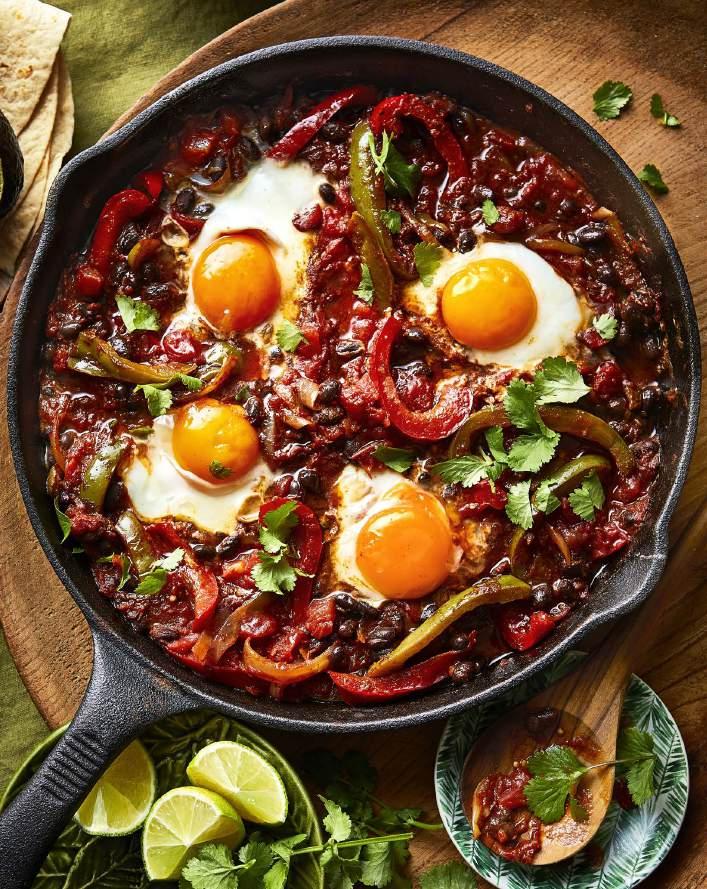
Make this one-pan black bean shakshuka
24 NEW LUNCHTIME FAVOURITES
Air fryer twists on classic North American lunches
Our recipe descriptions
Suitable for vegetarians. You can freeze it.
Not suitable for freezing.
Easy Simple recipes even beginners can make.
A little effort These require a bit more skill and confidence – such as making pastry. More of a challenge Recipes aimed at experienced cooks.
Low fat 12g or less per portion.
Low cal 500 calories or less per main.
32 ISLAND COOKING
A fresh spin on Jamaican cuisine
37 ELEVATE YOUR EASTER
Easter recipes with a twist
50 TAKE DESSERTS TO ANOTHER LEVEL
A showstopping pavlova to end Easter on
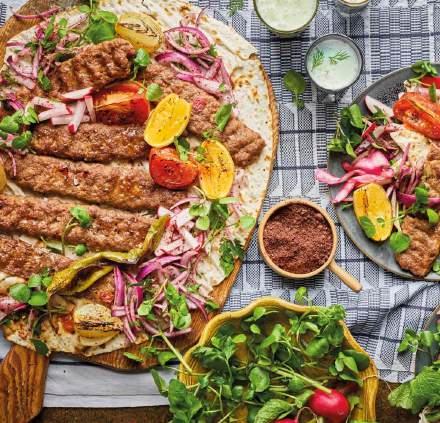
52 KURDISH KEBABS
Pary Baban’s secrets for succulent dishes
59 AT ITS BEST
Incorporate spring produce into your meals
70 NEXT LEVEL
Master the chicken chasseur
72 THE ANGLOTHAI KITCHEN
Chef Chantarasak’s Thai-British creations
74 OUR TIPS TO RAISE YOUR BAKING GAME
Baking tips and tricks we swear by
78 BOOKS FOR COOKS
Fiona Forman explores new cookbooks worth checking out
81 FUEL FOR SCHOOL HOLS
Quick family dinners and snacks for Easter
91 EVERYTHING YOU NEED TO KNOW ABOUT FIBREMAXXING High-fibre foods for your weekly shop
108 GIFT VOUCHERS, MEALS AND PLENTY MORE
Superhealthy Low in saturated fat, 5g or less per portion; low in salt, 1.5g or less; and at least one of the following: provides onethird or more of your daily requirement of fibre, iron, calcium, folic acid and/or vitamin C, or counts at least one portion of your recommended 5-a-day fruit and veg.
Good for you Low in saturated fat, low in salt.
Heart healthy Low in saturated fat, with 5g or less, and low in salt, with 1.5g or less, and high in omega-3 fatty acids.
1 of 5-a-day The number of portions of fruit and/or veg contained in a serving.
Vit C Iron Omega-3 Calcium Folate Fibre
Indicating recipes that are good sources of useful nutrients.
GLUTEN FREE Indicates a recipe is free from gluten. Some recipes contain pork. They are clearly marked and are for non-Muslims only. Look for this symbol:
P Contains pork.
I really enjoyed this month’s issue of Good Food Middle East, especially the wide variety of recipes featured throughout the magazine. What stood out the most to me was how the recipes felt both inspiring and approachable for home cooks. It’s always exciting to discover new dishes, but I also appreciate when the ingredients and instructions are practical enough to try in my own kitchen. The food photography was another highlight for me. The images were beautifully presented and made every dish look incredibly appetising. Seeing the finished dishes plated so nicely really motivates me to recreate the recipes at home and experiment with different flavours. It also helps visualise what the final result should look like, which is very helpful when cooking. I also enjoyed the helpful cooking tips and ideas included alongside the recipes. These little details make the magazine more than just a collection of dishes they make it feel like a guide that encourages readers to be more confident and creative in the kitchen. Overall, this issue was both enjoyable to read and inspiring, and it definitely gave me several new recipe ideas that I’m excited to try.
Richard Enriquez
If your kitchen has been feeling a little uninspired lately, the March 2026 edition of Good Food Middle East magazine arrives like a perfectly timed dinner guest - charming, full of ideas, and impossible not to like. This issue strikes that enviable balance between aspirational and actually achievable, serving up vibrant, globally inspired recipes alongside genuinely useful tips for everyday cooks. There’s a confident, almost effortless feel to the content, whether it’s quick, flavour-packed dishes or more indulgent weekend showstoppers, everything reads like it was designed with real life (and real appetites) in mind. What really elevates it, though, is the personality: glossy without being pretentious, informative without ever feeling like homework. It’s the kind of magazine that doesn’t just sit on your coffee table - it quietly nudges you into the kitchen, convinced you might just pull off something brilliant.
Thomas Marshall
I am a huge fan of Good Food Middle East and look forward to each new edition with great excitement. Every issue perfectly captures the region’s evolving dining scene, from new openings to timeless favourites. My favourite section has always been the restaurant reviews. They are detailed, honest, and incredibly useful I often base my dining choices on your recommendations, including which dishes to order once I’m there. Thank you for continuing to deliver such engaging and well-curated content. The magazine has become my trusted guide to discovering the best culinary experiences across the city.
Yani Eftimov
Experience The Ultimate Surf & Social at Nalu, where laid-back surf culture meets bold, comfort-driven food. Set by the water, this experience brings a generous family feast for four, built around sharing and big plates. Enter now for a chance to win this family dining experience.
To send in your Star Letter and win this prize, visit the Competitions page on bbcgoodfoodme.com
US! @goodfoodmiddleeast You can also connect with us on social media! Find us on: Email us on feedback@bbcgoodfoodme.com with your thoughts and comments, and send us your photos with your copy of Good Food ME!
Or, you could write to us at: The Editor, Good Food Middle East. Office 1307, DSC Tower, Dubai Studio City, Dubai, United Arab Emirates, PO Box 13700.







Dubai Sports City is now home to La Famiglia Dubai, a modern Italian restaurant where the warmth, generosity, and soul of traditional family cooking come alive. Inspired by La Dolce Vita, the menu highlights fresh, seasonal ingredients, handmade pasta, wood-fired pizzas, and comforting classics from coastal Italy, alongside vibrant salads, tartares, and seafood highlights such as langoustine, octopus, and sea bream. Relish antipasti, veal carpaccio with truffle, hearty meat dishes such as rack of lamb and trufflecrusted chicken, and a daily catch of seafood. Traditional tiramisu and homemade gelato are some indulgent treats to end with. La Faimglia Dubai also serves freshly baked pastries, signature croissants, kid-friendly options and egg dishes including the omelette con stracciatella for breakfast.
Contact +97152 303 2971.

The iconic Rio Brunch returns, inviting guests to experience a high-energy dining experience of Japanese, Brazilian, and Peruvian flavours. Diners can tuck into an indulgent spread featuring expertly prepared sushi, robata grill specials, and signature dishes that define the experience. Free-flowing beverages accompany the dishes, while samba dancers and a live DJ set the tone for a fun afternoon. Guests can choose from three curated packages, ranging from nonalcoholic to a bubbly option.
Saturday from 12.30pm. Packages from AED450 per person. Contact +9714 278 4888.
Families are invited to come together over authentic Italian cuisine, offering children under 12 the chance to dine for free. The Dubai Silicon Oasis restaurant, known for its relaxed neighbourhood charm offers a warm, welcoming space where residents can reconnect and enjoy quality time with loved ones during a period when moments of togetherness are especially valued.
Novecento, B5 Building, Dubai Digital Park, Dubai Silicon Oasis. Contact +9714 576 9904.

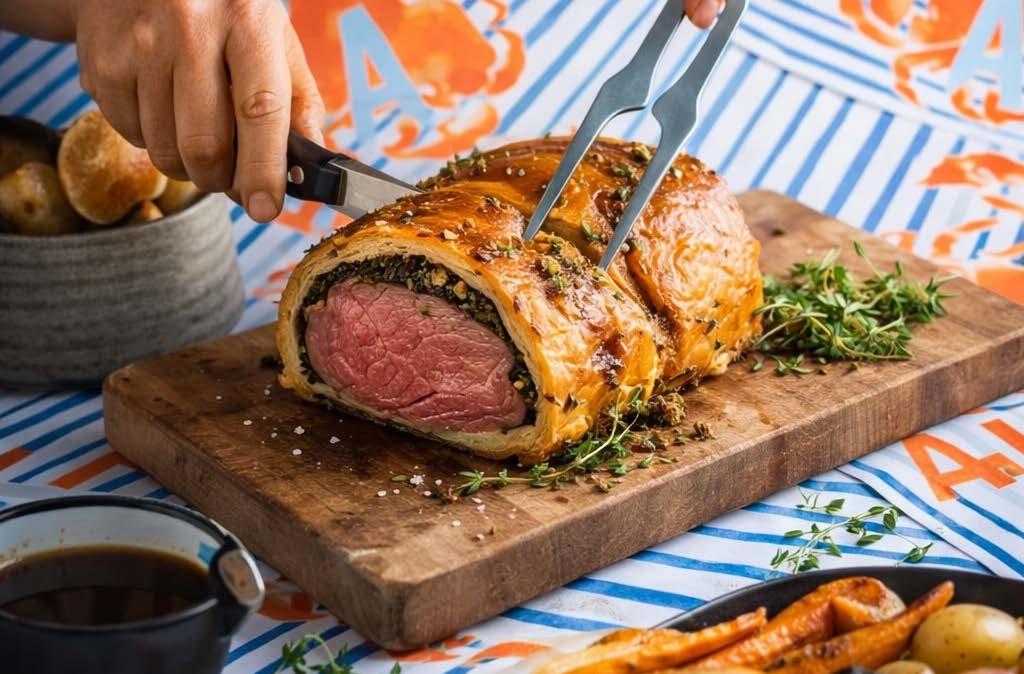
Aprons & Hammers Beach House is turning its popular Sunday Roast into a celebration by the sea at its newly renovated beach club, Anchor Bay. The menu features classic roast favourites, including USDA prime striploin roasted and carved at the table, golden roast chicken, and slow-cooked lamb shank, all served with Yorkshire pudding, crispy roast potatoes, seasonal vegetables, and rich gravy. Building on the success of its newly launched roast, the beach house is adding an Easter twist with a show-stopping Beef Wellington. Guests will also have access to the beach, making it the perfect way to spend the day from lunch through to sunset.
Prices start from AED115. Visit apronsandhammers.com.
This Easter, Cucina invites guests to the festive La Tavolata Brunch on Sunday, 5 April, featuring an extensive spread of buffet stations with focaccia, bruschetta, handmade pasta, grilled meats, seafood, and a dedicated non-halal room. Sweet treats include tiramisu, gelato and panna cotta. Little ones can join an exciting Easter egg hunt for a celebratory experience.
Packages from AED295 per person, with options for house beverages and a bubbly upgrade. AED125 for children aged 6–12. Children aged 5 and under dine free. Contact +9714 666 1408.
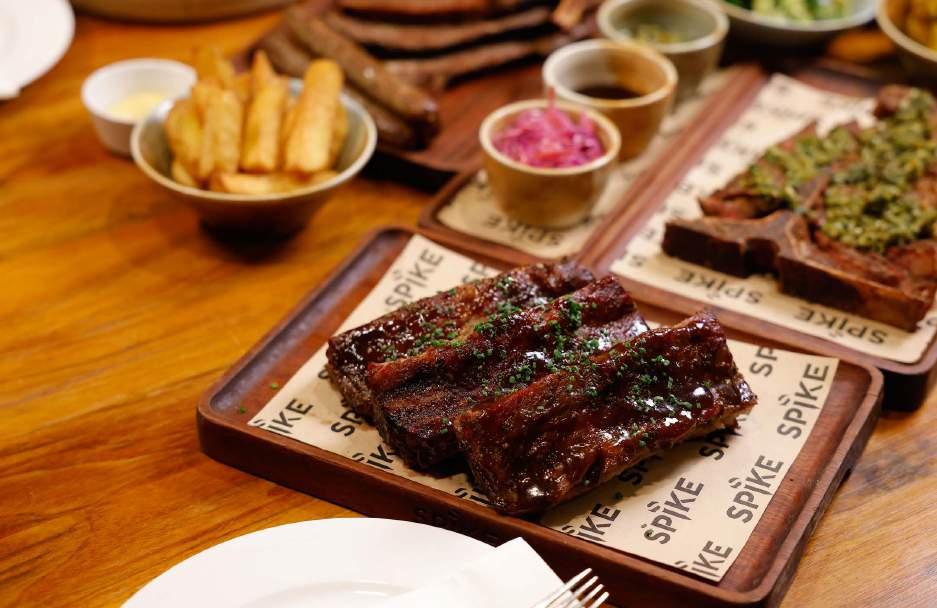
Spike Bar at Emirates Golf Club invites guests to Smokehouse Saturday, a relaxed weekend dining experience centred around slow-smoked meats, refreshing drinks, and a community-driven atmosphere. Signature dishes include the Smoke Wagon platter with beef ribs and sausages, six-hour brisket tacos, applewood-smoked honey chipotle chicken wings, and lighter options such as salmon steak with yuzu butter cream. Complemented by sides including mac and cheese, grilled asparagus, corn on the cob with lime butter, and truffle fries, every dish is best paired with cold beverages and well-crafted drinks.
Every Saturday, 5–9pm Contact +9714 417 9842.

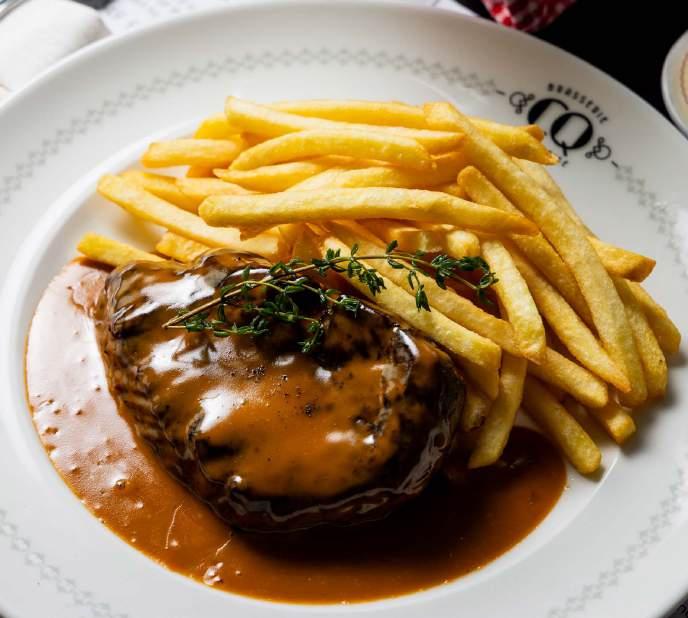
This French brasserie taps into what many diners are seeking right nowsomewhere that feels reassuringly familiar, where the experience is as dependable as the food. At the Grand Millennium outpost, the sprawling indoor-outdoor layout carries the charm of a neighbourhood brasserie that’s incredibly welcoming.
Service is attentive without being intrusive, striking that careful balance between efficiency and allowing guests to settle in at their own pace. Families, in particular, are thoughtfully catered to. Children are quickly set up with a
colouring placemat and a spill-proof cup for drinks— small gestures, but telling ones.
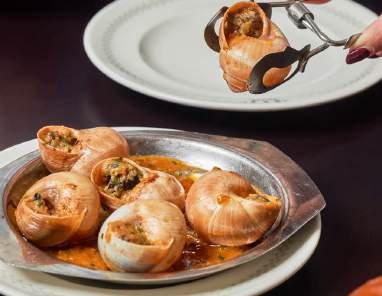
The menu leans into familiar French brasserie classics. The French onion soup is hearty, with caramelised onions and a generous layer of melted cheese that delivers exactly the comfort expected. Escargot remains a classic done right, tender and rich with garlic butter. The Chèvre chaud salad oozes texture with warm goat cheese croquettes, caramelised figs and crisp greens lifted by green apple and citrus,
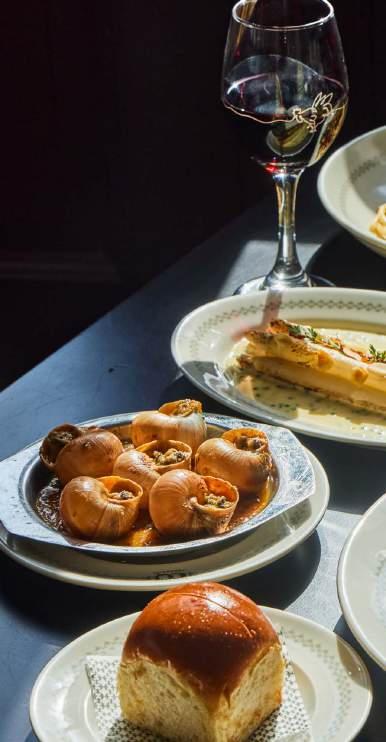

by
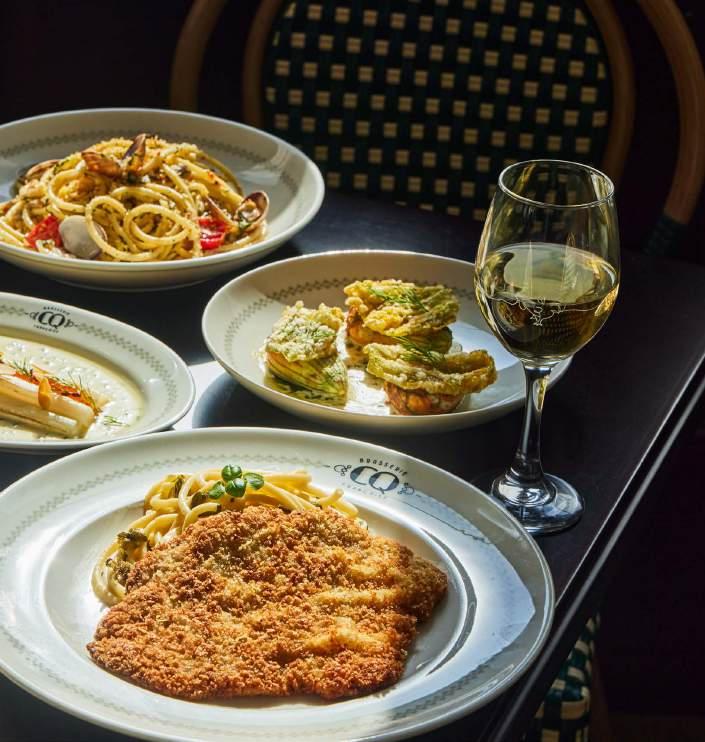
all tied together with a light honeybalsamic dressing.
Steak frites remains a perennial favourite at CQ, the cut cooked to a precise medium, the fries crisp, and signature sauce irresistibly moreish –every last drop swiped up with fries. The grilled French-sourced free-range chicken is notably juicy and paired with tagliatelle in forestière sauce – the mushrooms adding a nice bite. For something more indulgent, the gnocchi with shredded short rib and ricotta mousse leans into richness, while the linguini vongole offers clean, delicate flavours of garlic, chilli and anchovy.
Dessert had us passing on an alltime-favourite, the warm Pain perdu, in favour for Le cookie skillet gourmand – a comforting chocolate chunk cookie by Butter bakery served with vanilla bean ice cream and fleur de sel.
CQ French Brasserie delivers a dependable, well-rounded experience with consistency and care. In the current climate, this sense of assurance is exactly what diners are seeking.
CQ French Brasserie has several locations across the city and available on Deliveroo for delivery. Visit cqbrasserie.com.


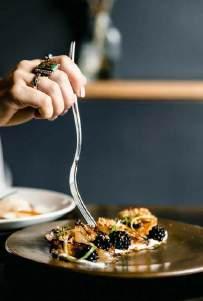
A curated look at this month’s most talked-about launches and standout trends

UAE-born hot sauce concept House of Habanero has opened its first physical location at Alserkal Avenue, introducing a container-style tasting room designed for discovery and sampling across the country’s largest selection of hot sauces, chilli oils and spicy snacks. Curated by co-founders Faisal Al Mutairi and Katy Gillett after testing over 800 products, the range spans predominantly mild, preservative-free offerings from small-batch producers—many local—alongside extreme blends featuring Pepper X and Carolina Reaper. Stocking products from 28 countries, the space champions clean ingredients and emerging regional makers, with plans for community events spotlighting local talent. Launched online in



Restaurants continue to play a vital role as spaces for connection, culture and community, particularly in times of uncertainty. Dubai-founded dining and lifestyle platform SupperClub is encouraging residents to rediscover the city’s hospitality scene, as school holidays shift and travel plans pause, creating an opportunity to explore local dining experiences. To support both diners and venues, SupperClub is offering complimentary Diamond memberships for 12 months using the code UNITY, unlocking benefits such as unlimited bookings and guests, seamless reservations and a dedicated WhatsApp concierge, alongside an incentive where members who dine at three different partner restaurants within 60 days receive AED300 in dining credit. Partnering with leading UAE and global venues—including homegrown names such as Reif Kushiyaki and Lila Molino, as well as popular destinations such as ROKA and Josette—SupperClub’s initiative reinforces its commitment to strengthening the country’s social and hospitality scene.
Visit supperclubme.com/memberships


Keto Kartel marks the Easter season with a curated collection of handcrafted desserts and gifting pieces. Take your pick from an elegantly presented Easter hamper with handcrafted chocolate eggs, artisanal chocolates, gluten-free breadsticks and gourmet spreads; Easter chocolate boxes featuring colourful mini eggs in refined four and seven-piece selections; the Easter Ice Granade Cake, layering light vanilla mousse, tonka-infused cream, almond sponge and a delicate caramel centre; and a playful Easter egg basket centred around a premium Belgian chocolate egg filled with mini eggs.
Available for pre-order and delivery across Dubai and in-store from 5–12 April. The collection can be ordered via keto-kartel.com, Instagram (@keto.kartel), Deliveroo and Talabat.
The moment you clear a dedicated space for the gleaming Sage Oracle Dual Boiler, your kitchen undergoes a transformation, shifting the morning routine from a necessity into a genuine craft. It’s a beautiful piece of kit that feels like it belongs in a boutique roastery, yet it is designed with a level of intuition that welcomes you into the world of specialty coffee without the steep learning curve.
At its heart is a sophisticated triple heating system, a luxury usually reserved for high-end cafés. By utilizing a dedicated steam boiler alongside a PID-controlled extraction boiler and a heated group head, the machine ensures clinical temperature stability. This means you can pull a rich, syrupy shot of espresso while simultaneously frothing your milk, eliminating that frustrating in between time found in counterparts and ensuring your morning beverage is served at the perfect temperature every single time.
For those of us who haven’t quite mastered the fiddly art of the perfect grind, the machine’s automation is a total lifesaver. It features a built-in, high-performance Baratza grinder with 45 precision settings that doesn’t just mill the beans; it doses and tamps them directly into the commercial-grade stainless steel portafilter using the Auto Puck System. This removes the mess and the guesswork, delivering the exact dose needed for that authentic, full-bodied depth of flavour in your desired coffee.
The beverage menu is where this machine truly shines for the home user, boasting Sage’s most expansive selection to date with 16 expertly crafted pre-set recipes. It’s not just creamy lattes, cappuccinos, and velvety flat whites; the list dives deeper into specialty territory with options like the Cortado, Latte macchiato, and the shorter, intense Piccolo. For those who prefer their coffee black, there are dedicated settings for a classic Americano, Long black, and even a Café crema. Perhaps most impressive for a home setup is how it embraces modern coffee culture through its chilled and specialty modes. You’ll find one-touch recipes for Iced Lattes and Espresso shakeratos, alongside more indulgent treats like a rich Mocha and Hot chocolate. It even features a dedicated setting for an Espressotini base, Babyccino for the younger members of the household, and hot water for tea, effectively turning your kitchen into a full-service café that can cater to every whim from a morning caffeine hit to an evening concoction. Additionally, brew customisation enables you to save your preferred settings—like a Cortado for two—so both cups can be prepared simultaneously with ease.
The user-friendly and sleek 5.7-inch high-definition touchscreen— Sage’s largest to date—allows you to swipe between a fully automated workflow and a manual mode. The all-new Auto Dial-In system monitors each extraction and makes electronic grind adjustments automatically to improve your next shot, effectively solving the biggest pain point for home baristas.
Then there is the milk, which is often the part that trips up even the most enthusiastic coffee lover. The Auto MilQ system is a dream for anyone who loves silky texture but hates the faff of manual steaming. You simply select your preference on the vibrant display, and the




machine textures the milk to your chosen temperature and frothiness level. It includes specific settings for plant-based milks such as oat, almond, and soy, which usually behave very differently than dairy. It’s entirely hands-free and consistently produces that elusive micro-foam required for latte art. Once you’re finished, the wand automatically purges itself with a blast of hot steam, so you aren’t left scrubbing the nozzle after.
Beyond the internal wizardry and the powerful quad-core processor, it’s the thoughtful, home-friendly design touches and modern connectivity that really stand out. This is Sage’s most connected machine yet, featuring built-in Wi-Fi for seamless software updates and integration with the Sage coffee app, which even allows you to switch the machine on remotely from bed.
Despite its sturdy build, the machine remains practical with a stainless steel heated cup tray on top, and a design that caters to every household member’s taste. It balances professional, third-wave coffee quality with the practical realities of a modern, busy kitchen, making the entire process feel like a morning treat.
The Sage Oracle Dual Boiler is undoubtedly a significant investment, but it’s one that pays off in the consistency of the results and the breadth of its features. It bridges the gap between a fully automatic push-button machine and a manual espresso maker beautifully, offering the tactile satisfaction of a pro setup without the learning curve.
Whether you are a total novice relying on the one-touch recipes or a seasoned coffee lover diving into manual pre-infusion and blooming, it brings a premium café experience right into your own home. It’s the kind of machine that makes the daily grind feel a lot more like a luxury, and once you’ve experienced the ease of that automated, connected workflow, it’s very hard to go back to anything else.
AED9,999 at leading retailers across the UAE. Visit sageappliances.com/en-ae for more information.


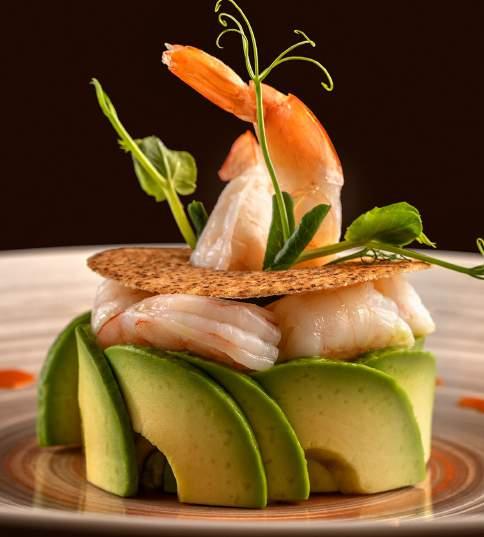
Framed by the dazzling panoramas of Palm Jumeirah, La Sirène invites you to indulge in an ode to the sea through the rich culinary heritage of coastal Beirut. The experience is defined by our lounge and spectacular 90-metre terrace, offering one of Dubai’s most iconic alfresco settings with unobstructed views from Ain Dubai to the Burj Al Arab.
Amongst various attractive offers, indulge in our curated set menu at La Sirene.
Starting from AED 99 for two courses, inclusive of soft beverages.
Monday to Friday, 12 pm to 4 pm.
Scan the QR code to learn more.
Delicious, simple, and easy-to-make recipes

Make the most of storecupboard staples like pesto and mustard in these innovative dinners recipes
• Pesto
• Dijon mustard
• Chipotle paste
• Hoisin
Anna’s tip
This recipe is easily doubled to serve four and use up the whole block of halloumi, or keep the half block wrapped tightly in the fridge for up to three days and use it to make crispy croutons.
HALLOUMI CROUTONS
Cut the halloumi into small cubes then fry until golden and crisp. Use to top salads and soups.

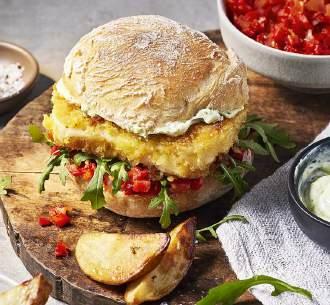
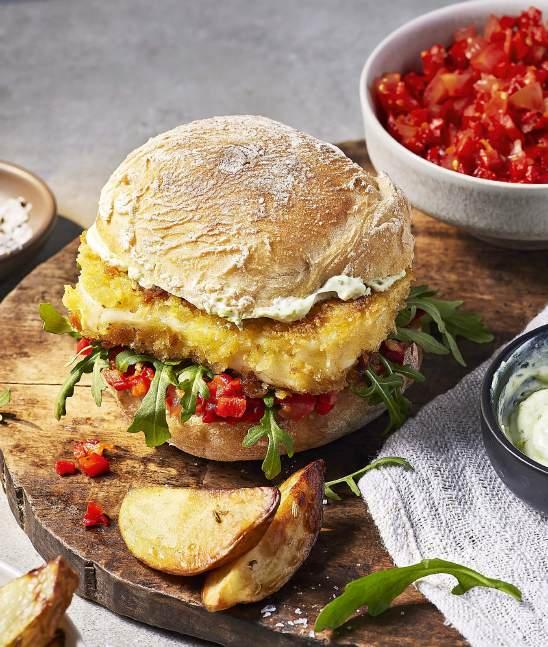
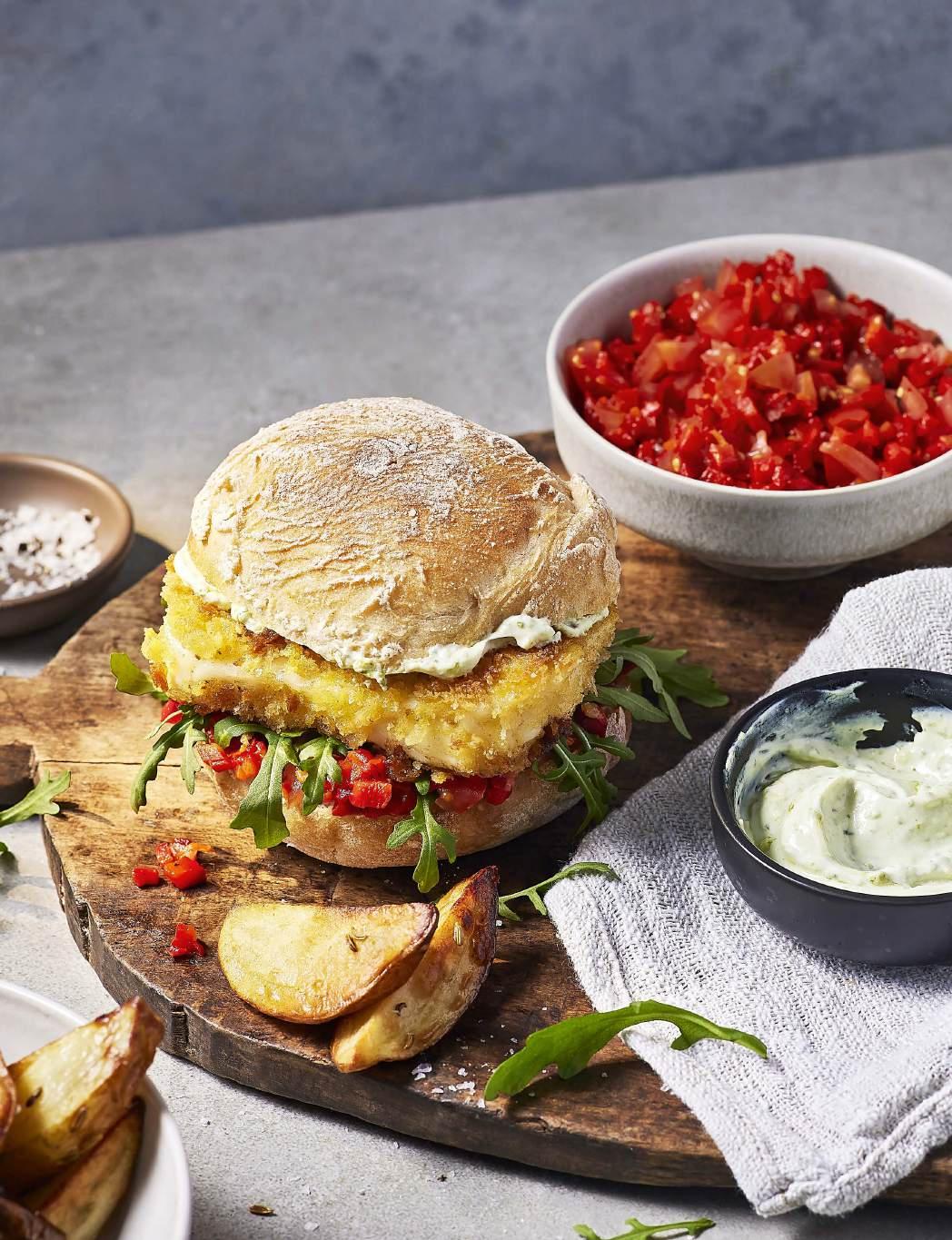
Crispy halloumi burgers with salsa rossa
SERVES 2 PREP 15 mins
COOK 30 mins EASY V
1 egg
2 tbsp plain flour
4 tbsp panko breadcrumbs
½ 200g block halloumi (see tip)
vegetable oil, for frying
2 ciabatta rolls
1 tbsp pesto
2 tbsp yogurt
handful of rocket or baby spinach
For the salsa rossa
2 large roasted red peppers (from a jar)
200g vine or canned tomatoes
1 red chilli
1 small garlic clove
1 tsp red wine vinegar or sherry vinegar
1 tbsp extra virgin olive oil
For the wedges
2 large floury potatoes such as King Edward or Maris Piper
1 garlic clove
1 tsp fennel seeds
1 tbsp olive oil
1 For the wedges, wash the potatoes, if needed, and cut into wedge shapes Bash the garlic with the side of a knife. Tip both into your air fryer basket or a roasting tray with the fennel seeds and olive oil. Season and toss well. Air-fry for 20-25 mins at 200C or roast in the oven at 220C/200C fan/gas 7, turning halfway through, until golden and cooked.
2 Meanwhile, make the salsa. Finely chop the red peppers, tomatoes, if fresh, and chilli. Tip into a bowl. Finely grate in the garlic, stir in the vinegar and olive oil. Season well. Taste and add more vinegar, salt or a pinch of sugar to balance if needed Set aside.
3 Beat the egg. Put the flour, egg and panko In three separate plates and season the flour with pepper. Cut the halloumi through the middle into two wide pieces. Dip in the flour, the egg, then the panko. Heat a glug of veg oil in a small pan over a medium-high heat, coating the base of the pan. Fry the halloumi for 3-4 mins until crisp and golden on both sides. Set aside to drain on kitchen paper.
4 Slice the ciabatta rolls in half. Lay cut-side up in the second drawer of the air fryer at 180C or above the potatoes for 2-3 mins until warmed through. Swirl the pesto through the yogurt.
5 Spread a spoonful of the salsa over the base of a roll. Top with a handful of rocket and a slice of crispy halloumi. Spoon over the pesto yogurt, add the roll tops and serve with the wedges, leftover salsa and yogurt for dunking.
get the most
from our meals
We’ll point out any swaps
If you can use things like yogurt instead of crème fraîche, chives instead of spring onions or butter beans instead of cannellini beans, we’ll let you know, so you’re not buying extra ingredients. This also helps prevent food waste.
Optional extras are your choice
If you have them, great, but if you don’t, don’t worry! We’re talking the final garnishes of nuts, seeds or lime wedges – don’t put them in your shopping basket just for one recipe.
All meals will serve at least two ...and any dishes with larger servings will be designed to be freezable in portions, so you can batch-cook them.
Dishes will be quick to make
We know time is of the essence in the week, but you still want inventive and delicious dinners. Our promise is that dinner will be on the table within an hour – and often in less time.
We’ll use storecupboard staples
All the recipes in this series will aim to include items that are already in your storecupboard. This means that if you cook from this series regularly, you’ll get to explore new ways to use up the rest of the ingredient, rather than having it linger in the back of your fridge until you make the same meal again.
Gadgets will be go-tos
We love a gadget here at Good Food, especially if it means avoiding turning the oven on midweek. So, we’ll give you options for the air fryer and other gadgets where we can, but try to avoid anything that requires extra washing-up, like food processors, stand mixers or excessive pans, where possible.
All the prep is in the method ...in this feature, to help you cook the recipe with no missteps.
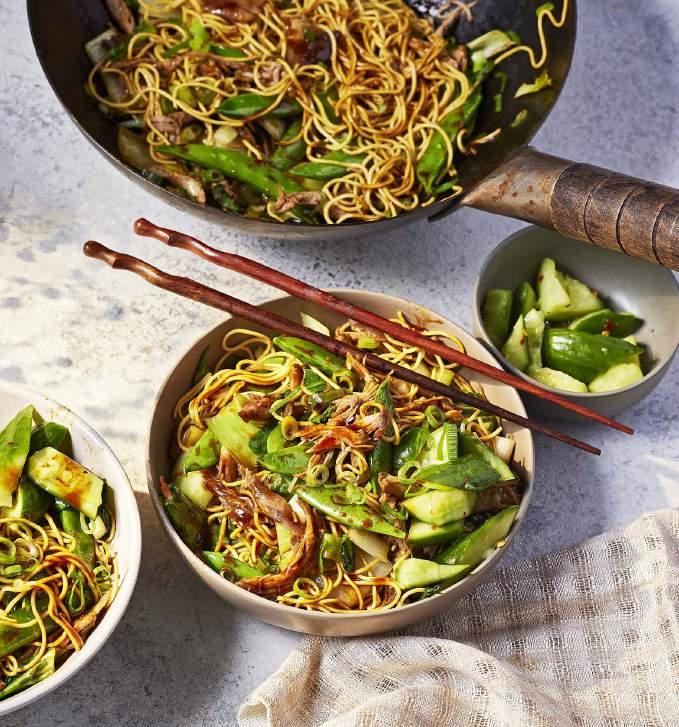
Crispy duck hoisin noodles with quick pickled cucumber
Duck is an expensive purchase, but you can make it go a long way with the addition of noodles and veg.
SERVES 2 PREP 20 mins
COOK 20-45 mins EASY
½ crispy duck or 200g leftover roast duck (see tip)
2 nests fine wheat noodles
1 garlic clove thumb-sized piece of ginger
1 bunch of spring onions
2 pak choi or 160g choi sum
2 tbsp veg oil
100g mangetout, sugar snap peas or other stir-fry veg
4-6 tbsp hoisin (to taste)
For the pickle
½ cucumber
1 tsp sugar
3 tbsp rice vinegar
½ tsp chilli flakes (optional)
1 Cook the crispy duck according to pack instructions and shred with two forks, or shred leftovers and
remove from the bones. Put the noodles in a bowl and pour over hot water from the kettle to cover
2 For the pickle, lightly bash the cucumber with a rolling pin and chop into bite-sized pieces. Put in a bowl and season with ½ tsp salt, the sugar, vinegar and chilli flakes (if using). Set aside to pickle
3 Finely chop the garlic and ginger. Slice the spring onions and chop the pak choi into bite-sized pieces
4 Heat the vegetable oil in a deep frying pan or wok over a high heat. Fry most of the spring onions and all the garlic and ginger for 1 min, then add the duck. Cook for 1 min until hot, then add the pak choi and remaining veg. Stir-fry for another minute or two until bright green, then add the hoisin
5 Drain the noodles, tip into the wok, toss and serve with the cucumber and reserved spring onions sprinkled over
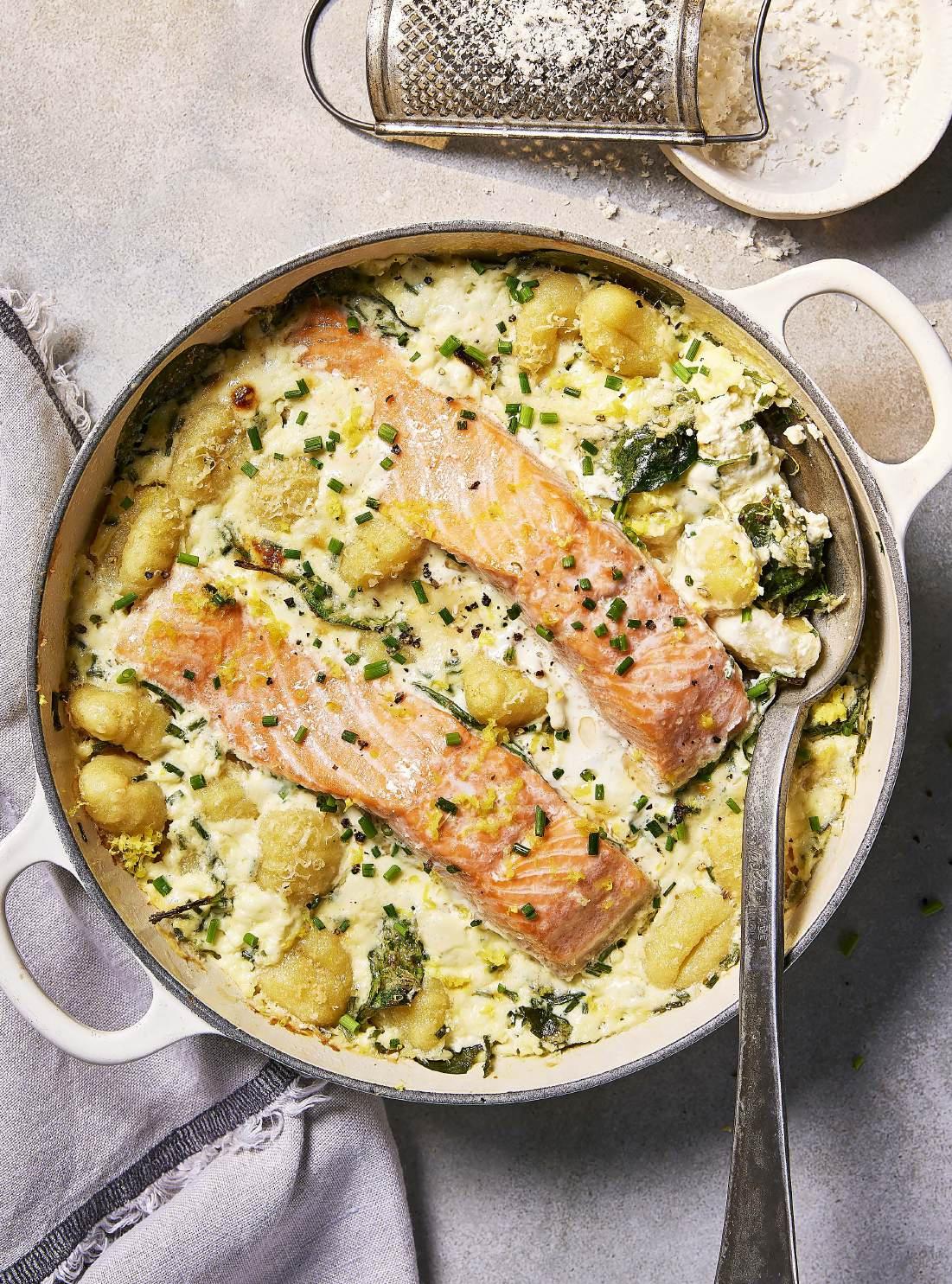
Baked trout with gnocchi & Dijon cream
Trout is a more sustinable option than salmon and is usually a little cheaper, too.
SERVES 2 PREP 5 mins COOK 20 mins EASY
200ml double cream
100ml milk
½ lemon
small handful of chives
1 tbsp Dijon mustard
200g gnocchi
2 large handfuls of spinach
2 trout fillets
5g parmesan
1 Heat the oven to 200C/fan 180C/ gas 6 or air fryer to 180C. Tip the cream and milk in a jug, finely grate the lemon zest over, snip in the chives, then stir in the mustard and some seasoning
2 Tip the gnocchi and spinach into a baking dish, pour over the Dijon cream. Nestle in the trout fillets. Finely grate over the parmesan. Bake for 15-20 mins until the fish is cooked and the gnocchi is crisp on the top, but fluffy underneath.
Make your own crispy duck
Rub 1 tsp sea salt and 1 tsp Chinese five spice into 2 duck legs. Cook, covered in foil, for 45 mins at 180C/160C fan/gas 4, remove the foil and cook for 15 mins at 220C/200C fan/gas 7 until golden and crisp.
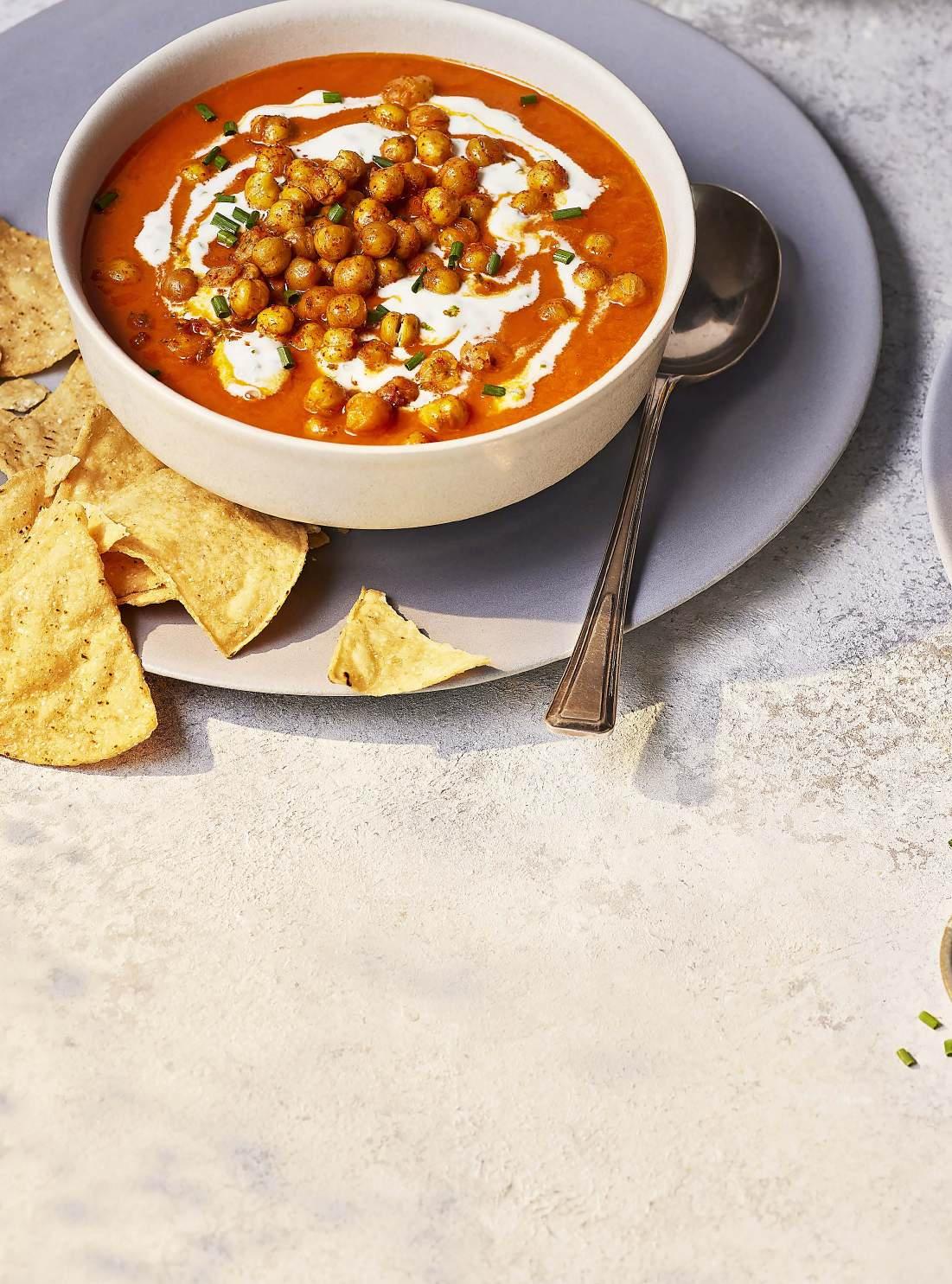
Chipotle soup with chive crème fraîche & crispy lime chickpeas
SERVES 2 PREP 20 mins
COOK 20 mins EASY V
1 large onion
1 large carrot
1 celery stick
2 tbsp olive oil
3-4 roasted red peppers from a jar
1 garlic clove
2 tsp smoked paprika
400g can plum or chopped tomatoes (or 400g vine tomatoes if in season)
1-2 tbsp chipotle paste
400ml chicken or vegetable stock
4 tbsp crème fraîche
1/2 small bunch of chives and crusty bread or tortilla chips, to serve
For the chickpeas
400g can chickpeas
1 tbsp olive oil
1 tsp smoked paprika
1 lime
1 Finely chop the onion, carrot and celery. Heat the olive oil in a saucepan over a medium heat Fry the veg with a good pinch of salt for 10-15 mins until soft but not golden. Finely chop the jarred red peppers.
2 Grate or crush the garlic, add to the veg in the saucepan and sprinkle over 2 tsp paprika, then add the peppers. Cook for another 2-3 mins, then stir in the tomatoes, chipotle paste and stock. Simmer uncovered for 10 mins. Blend using a hand blender until smooth. Stir in 2 tbsp crème fraîche and season
Keep warm over a low heat.
3 Drain the chickpeas and pat dry with a clean tea towel. Heat the oil in a frying pan over a high heat, then fry the chickpeas with a pinch of salt for 3-5 mins until golden and crispy. Stir in the smoked paprika, then remove from the heat. Zest over the lime. Check for seasoning.
4 Finely chop the chives and stir through with a squeeze of the lime juice to loosen. Divide the soup between warmed bowls. Swirl in the remaining crème fraîche, scatter over the chickpeas (you may not use them all) and serve with crusty bread or tortilla chips for dunking.
Leftover chickpeas can be kept in an airtight container for up to four days. Try them topped with chopped chilli, herbs or avocado, if you have any.
Use the leftover jarred red peppers for the salsa rossa on page 17.
SERVES 2 PREP 15 mins
COOK 20 mins EASY V
1 small onion, leek or large shallot
2 garlic cloves
1 bunch of asparagus
1 tbsp olive oil
100ml white wine
160g frozen peas
4 tbsp crème fraîche
1 tbsp pesto
2 handfuls of spinach
4 fresh lasagne sheets handful of soft herbs like tarragon, dill and mint, plus extra to serve 15g parmesan, plus extra to serve
2 tbsp pine nuts, roasted (optional)
1 Finely chop the onion, crush the garlic, trim and cut the asparagus into 4cm pieces. Bring a large pan of salted water to the boil.
2 Heat the oil in a frying pan over a medium heat and fry the onion for 5 mins until soft. Stir in the crushed garlic and asparagus pieces. Add the wine and simmer for 5 mins until the asparagus is bright green.
3 Stir the peas, crème fraîche, pesto and spinach into the pan. Season with salt and black pepper. Simmer for 3-4 mins until thickened and the spinach has wilted. Cut the lasagne sheets in half and blanch in boiling water for 2-3 mins until tender.
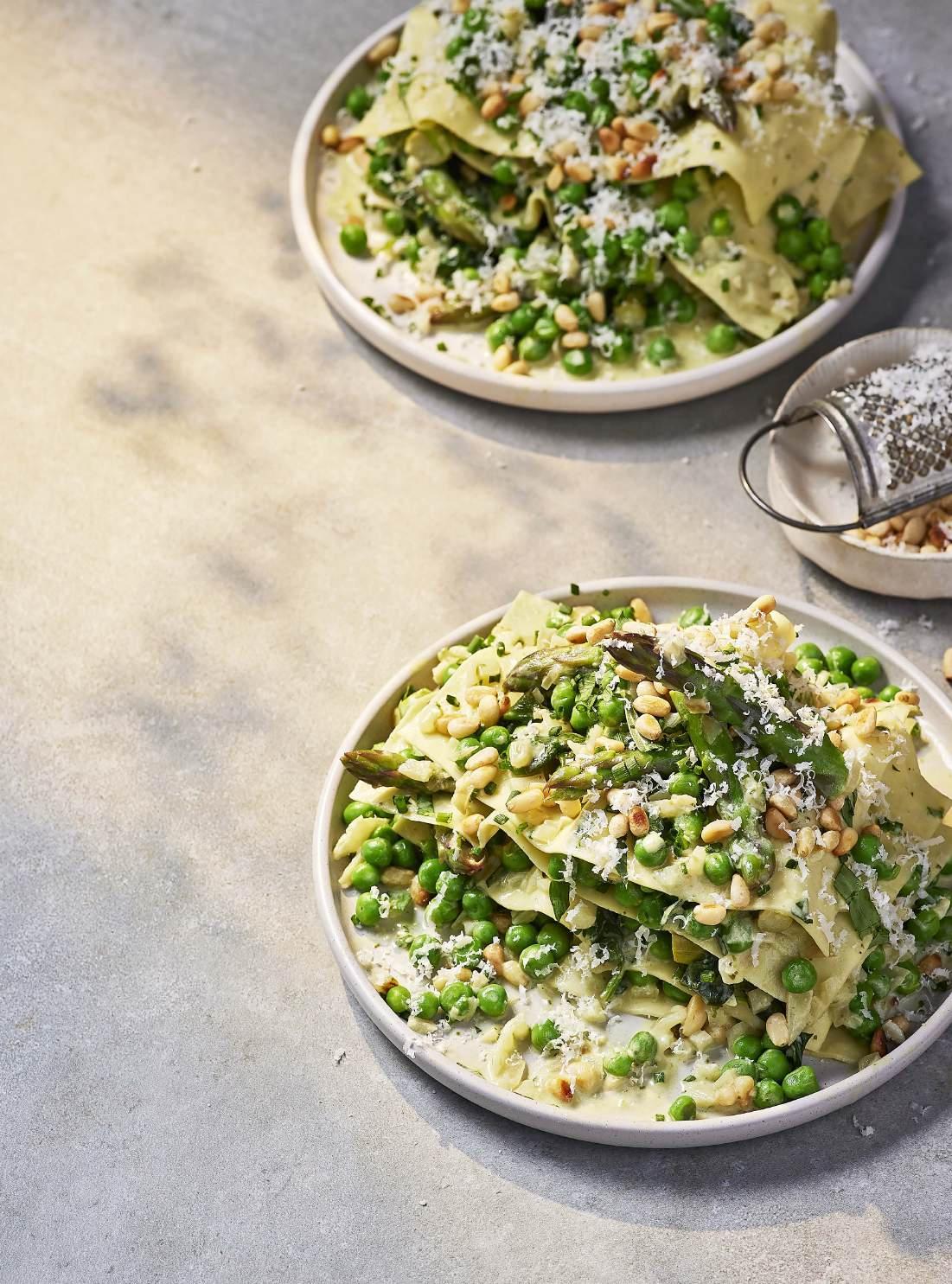
4 Lift the lasagne sheets into the pan with some of the pasta water. Add the herbs and parmesan and toss until the pasta is coated in the sauce. Layer the sheets and filling into bowls. Top with the pine nuts and more herbs and parmesan
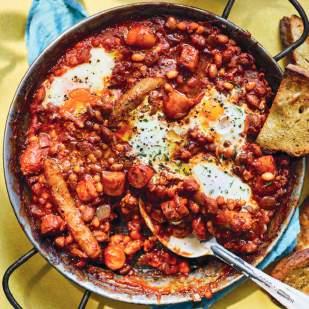
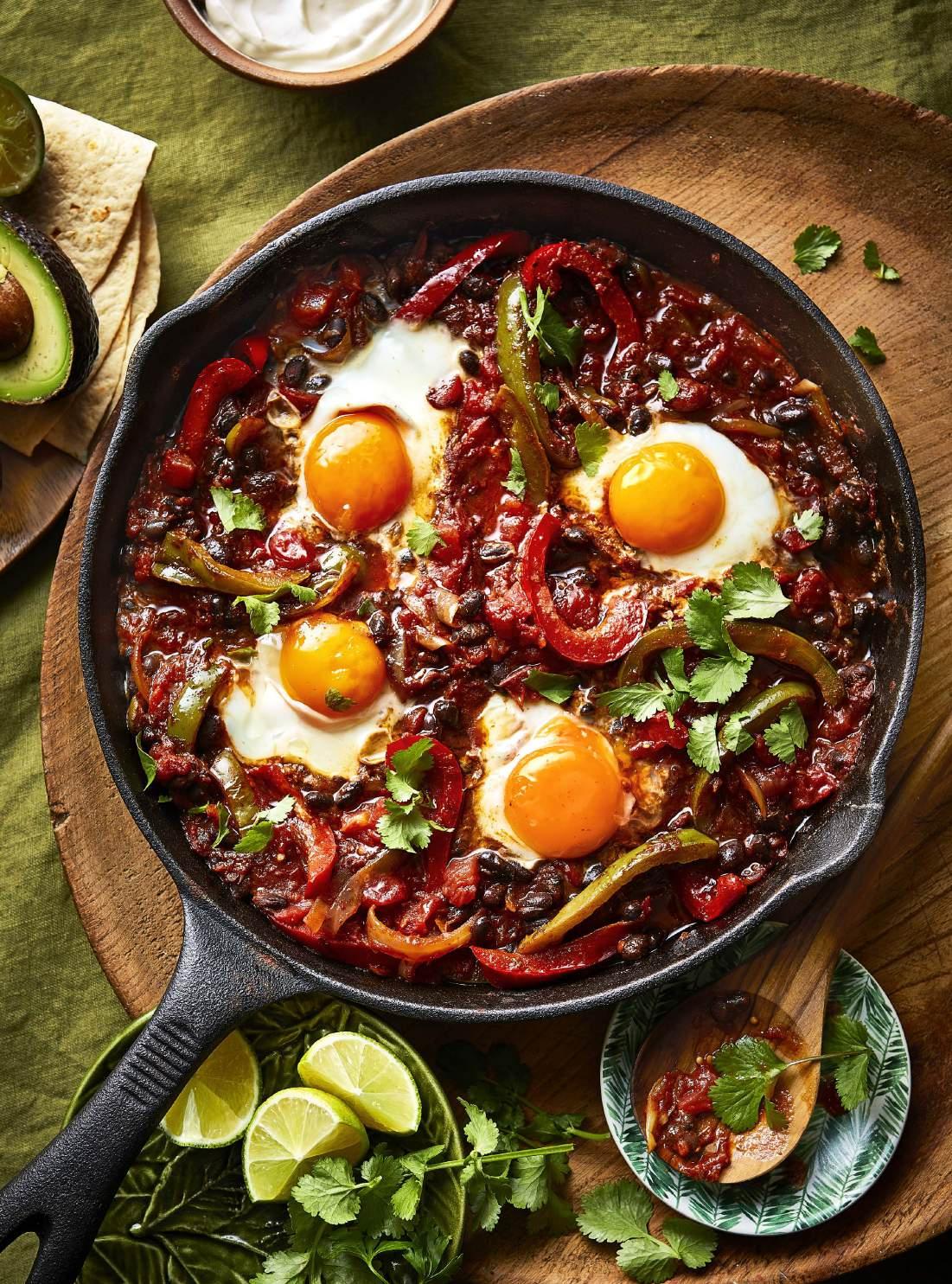
Texas meets Mexico for a Middle Eastern-style brunch
recipe BARNEY DESMAZERY photograph MAJA SMEND
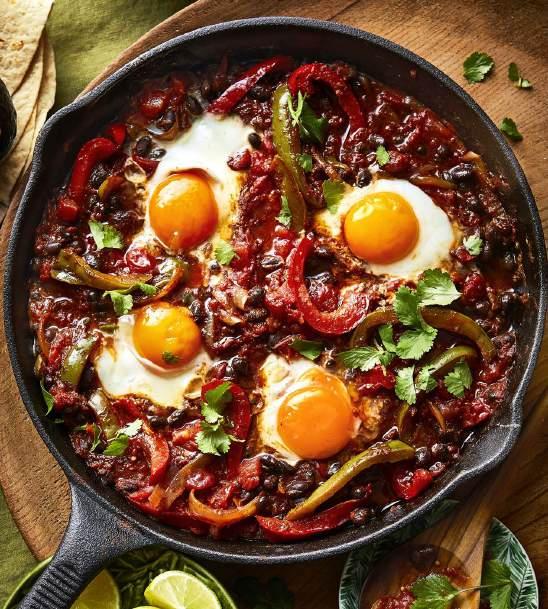
Without the eggs you have a really quick vegan chilli that you can use to fill burritos or tacos.
SERVES 4 PREP 10 mins
COOK 40 mins EASY V
1 large onion
2 peppers
2 tbsp olive oil
1/2 tsp cumin seeds
2 garlic cloves
2 tsp smoked paprika
1 tsp dried oregano
1-2 tsp chipotle paste, to taste
400g can chopped tomatoes
400g can black beans, drained and rinsed
4 eggs fresh coriander leaves
To serve warm tortillas or flatbreads avocado slices or guacamole soured cream or yogurt lime wedges hot sauce
1 Finely slice the onion and deseed and slice the peppers, then heat a wide, deep frying pan over a medium heat and pour in a good glug of olive oil. Scatter in the onion and peppers along with a pinch
of salt and the cumin seeds. Cook gently for 8-10 mins, stirring every now and then, until soft and starting to colour. Grate the garlic and add that, then sprinkle over the paprika, oregano and stir in the chipotle paste. Stir for a minute or two until fragrant and the paste is toasted. 2 Tip in the tomatoes and black beans, season with a little more salt and pepper, then bring to a gentle simmer. Leave to bubble gently, uncovered, for 15-20 mins, stirring occasionally, until thick. Use the back of a spoon to make four little hollows in the sauce. Crack an egg into each one, season the eggs lightly, then cover the pan with a lid and cook gently for 5-6 mins or until the whites are just set but the yolks are still soft. Take the pan to the table and finish with coriander scattered over the top. Serve with warm tortillas, sliced avocado or guacamole, soured cream or thick yogurt, lime wedges for squeezing over and hot sauce on the side so everyone can build their own plate.
• Get ahead
You can make the pepper, tomato and bean base up to two days ahead. Leave to cool, then cover and chill. Reheat gently in the pan, adding a splash of water if it’s thickened too much, then crack in the eggs, cook and serve.
• Pepper plant points
Did you know that different coloured peppers count as different plant points? So, whenever you’re cooking with more than one pepper, mix it up.
Helena Busiakiewicz offers exciting alternatives to your usual midday sandwich using classic North American flavours layered up in the air fryer photographs GEORGIA GOLD
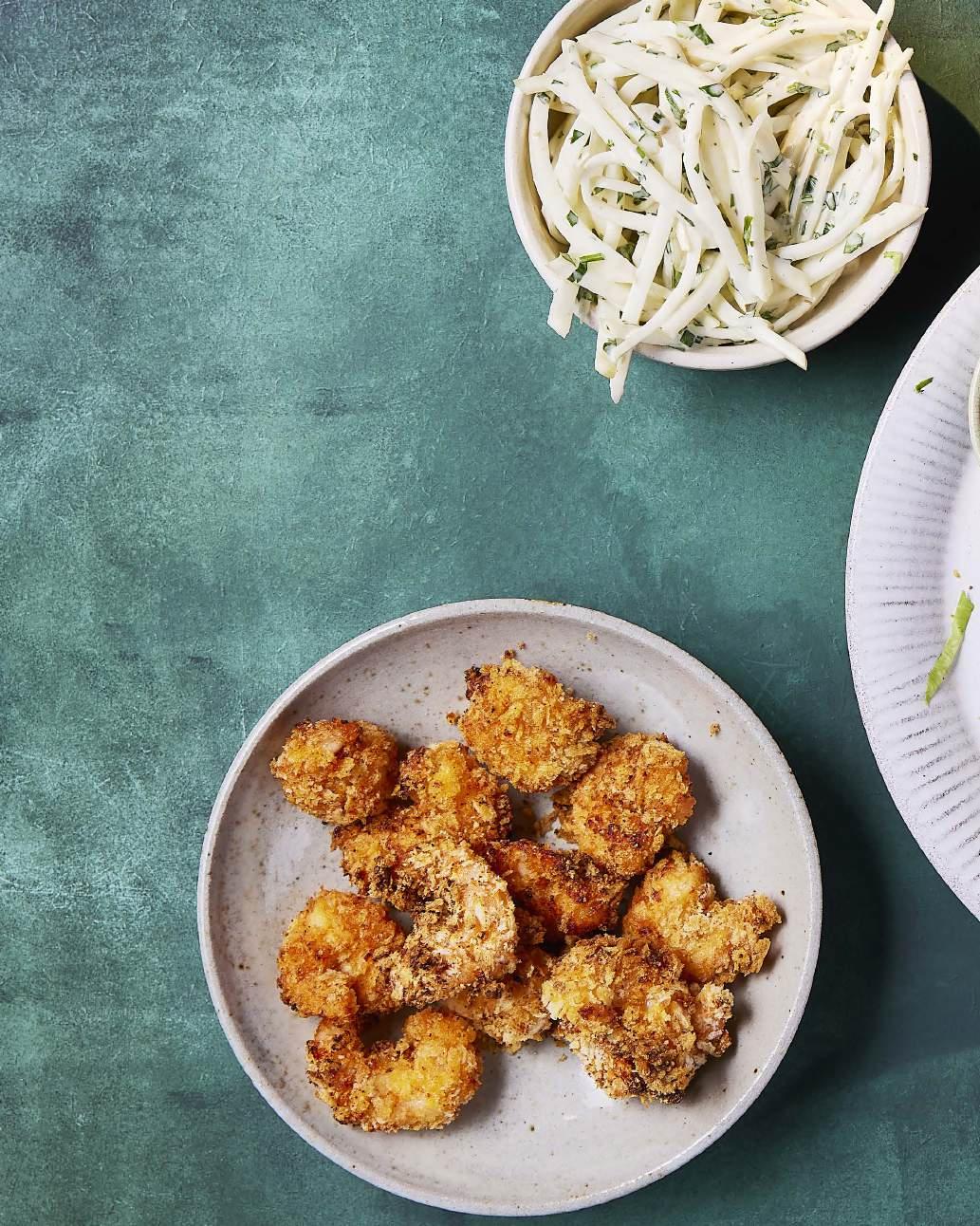
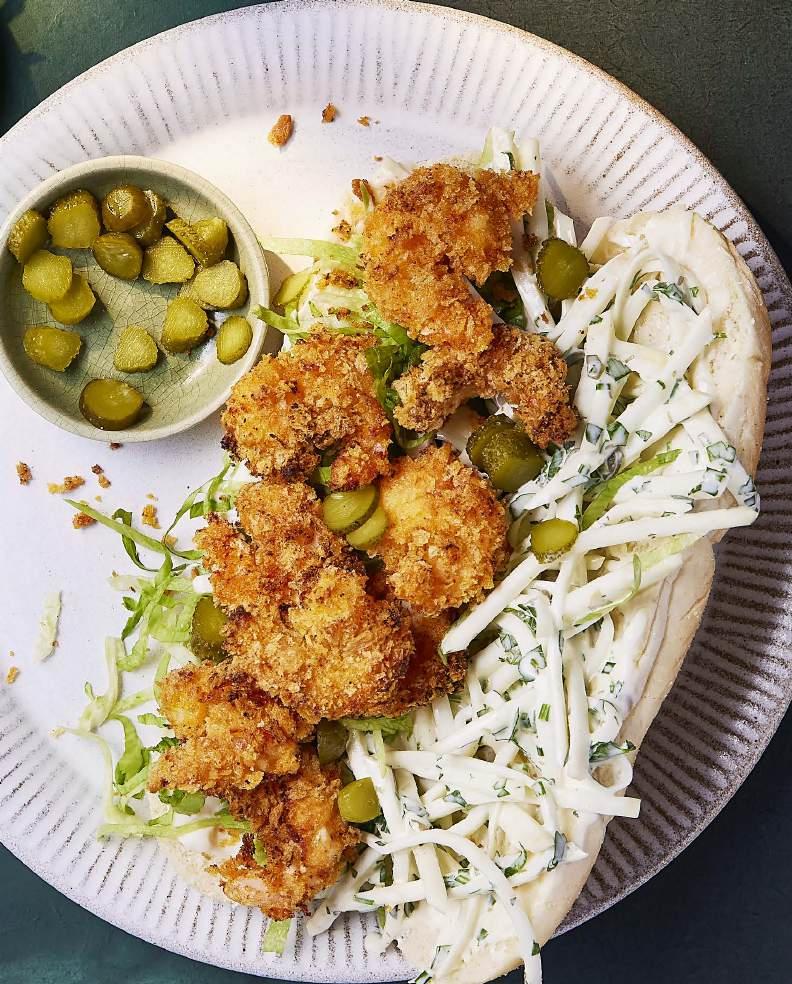
Air fryer spiced shrimp po’ boys with celeriac remoulade
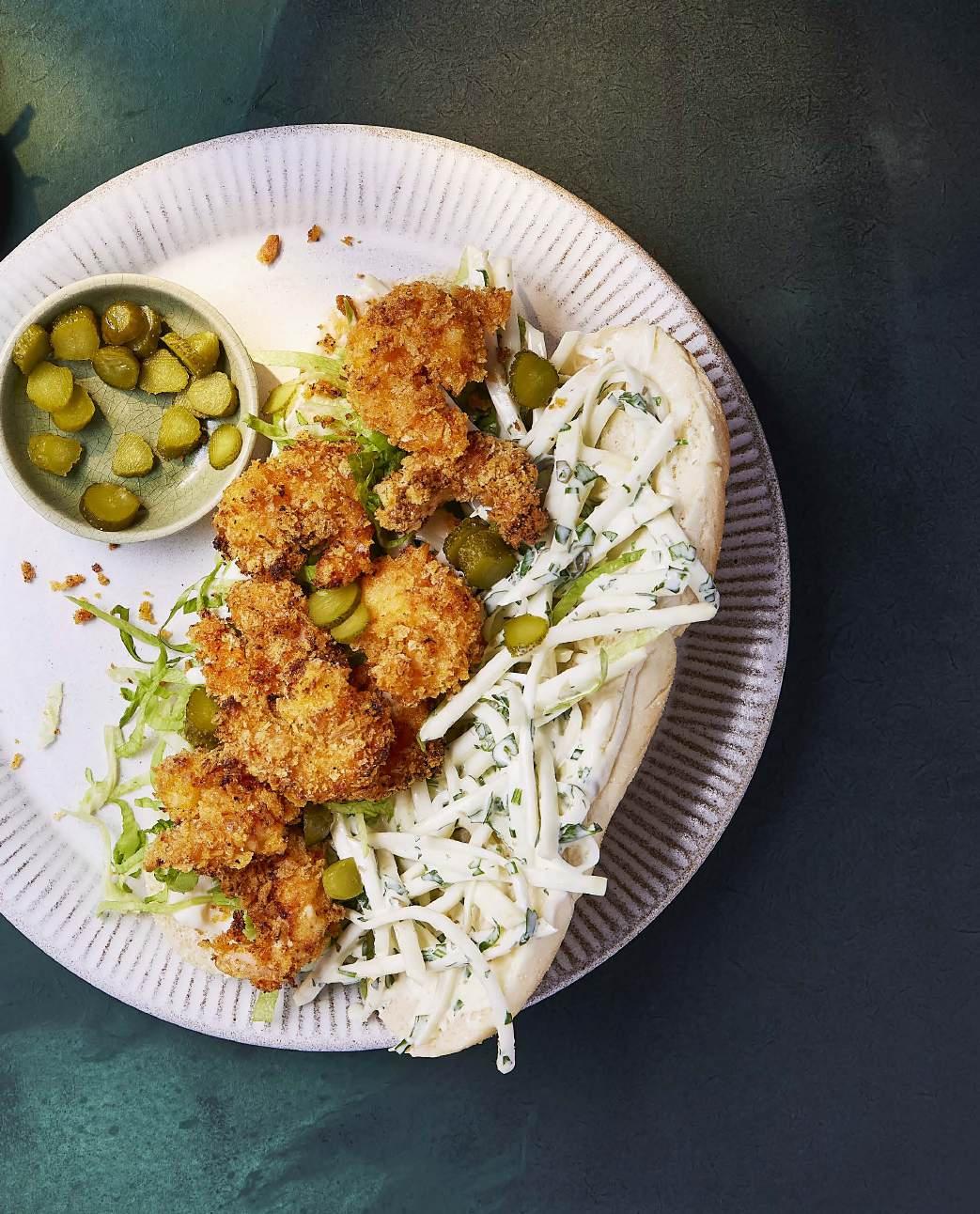
Air fryer spiced shrimp po’ boys with celeriac remoulade
Here’s a moreish recipe inspired by the po’ boys of Louisiana – a sandwich supposedly created by Benjamin and Clovis Martin, restaurateurs who are said to have given filled sandwiches made with French bread to the “poor boys” (striking workers) in New Orleans.
As well as being packed with crispy breaded shrimp, our version is offset by a celeriac remoulade that gives it an extra bit of zing.
SERVES 4-6 PREP 20 mins COOK 15 mins EASY
15g chives
20g flat-leaf parsley
1 tbsp capers
1 lemon
100g mayonnaise, plus 2-3 tbsp to serve
100g buttermilk
1 tbsp Dijon mustard
600g small celeriac (450g prepared weight)
50g plain flour
2 eggs
75g panko breadcrumbs
2 tsp onion granules
2 tsp garlic granules
1/2 tsp cayenne pepper
2 tsp Old Bay seasoning (available online and in larger supermarkets)
300g raw king prawns spray oil, for misting
100g iceberg lettuce
4-6 submarine rolls
50g cornichons
1 Finely chop the chives, parsley and capers and tip into a bowl. Juice the lemon into the bowl and tip in the 100g mayo, the buttermilk and mustard. Season lightly with salt and plenty of black pepper, and mix well to combine. Peel the celeriac, then cut into quarters.
Thinly slice each quarter using a mandoline or sharp knife, then cut the slices into thin matchsticks
Transfer to the bowl with the dressing and toss to combine.
Chill until needed.
2 Put the flour, eggs and panko breadcrumbs in three separate, shallow bowls, and line a plate with baking parchment. Season the flour with 1 tsp of the onion granules and a little salt. Put the remaining onion granules, the garlice granules, cayenne, Old Bay and a pinch of salt in the bowl with the panko breadcrumbs, and whisk to combine. Beat the eggs
3 Pat the prawns dry using kitchen paper, then use tongs to dip them in the flour, then the beaten egg and finally the breadcrumbs until coated. Transfer to the lined plate.
4 Heat the air fryer to 190C. Put the prawns in the air-fryer basket in a single layer, making sure they’re not overcrowded (you may need to do this in batches). Mist with the spray oil on both sides, then air-fry for 7-9 mins until the breading is crisp and the prawns are cooked through.
5 Meanwhile, shred the lettuce into thin strips using a sharp knife and slice the rolls in half. When the prawns have finished cooking, toast the rolls in the air fryer for a few minutes to warm through. Spread the remaining 2-3 tbsp mayo over the rolls, then top with the celeriac remoulade, lettuce, cornichons and air-fried prawns. GOOD TO KNOW low cal • folate • fibre
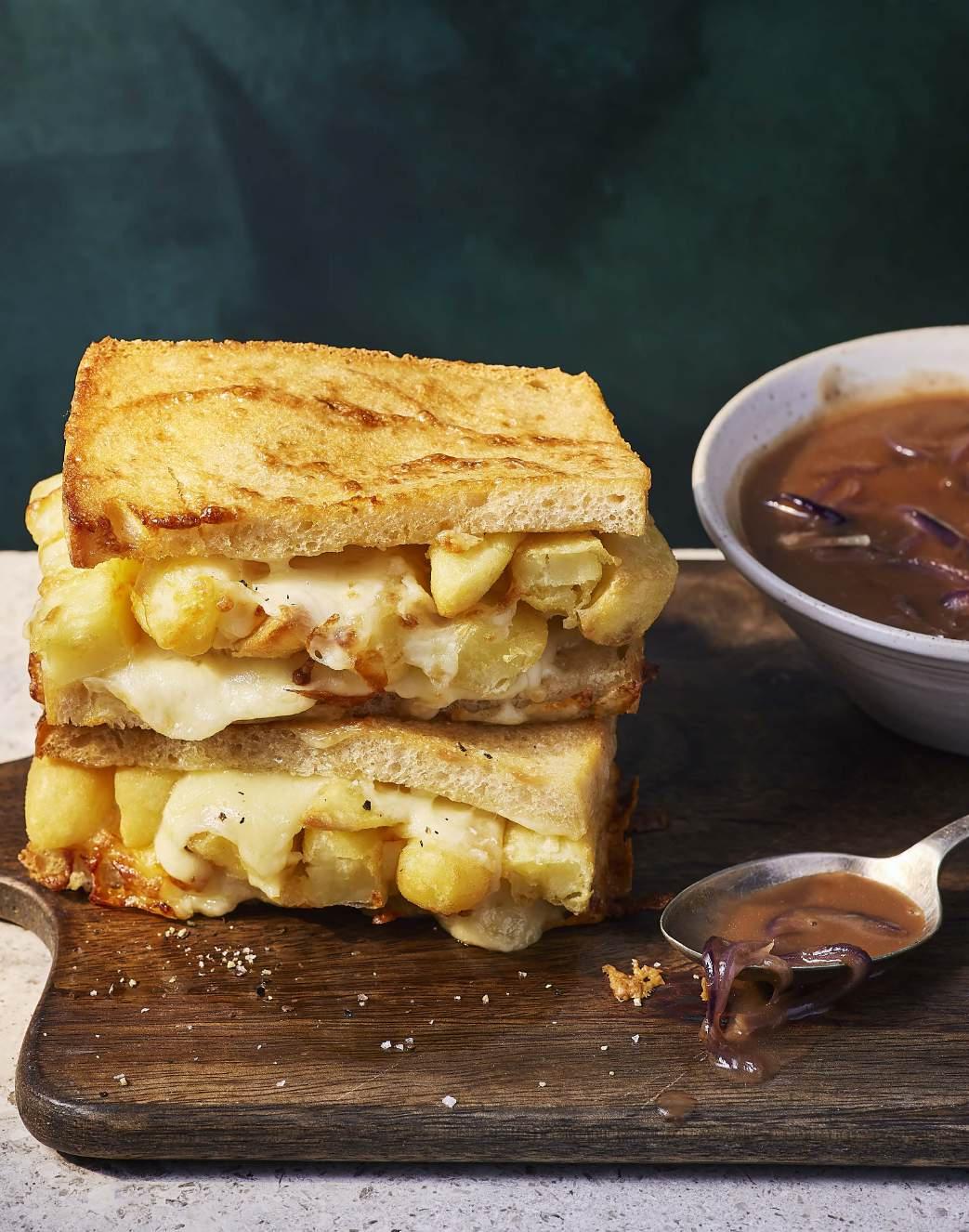
cheese toastie with gravy
Hailing from Quebec, poutine is a beloved comfort food in Canada of fries, gravy and cheese curds. We’ve combined those elements in this toastie, with gravy alongside for dunking.
SERVES 2 PREP 10 mins COOK 30 mins EASY
1 red onion
20g salted butter
1/2 tbsp plain flour
1/2 tbsp balsamic vinegar
300ml beef stock
4 tbsp mayonnaise
4 slices thick white bread
100g mozzarella (mozzarella in blocks or bags, rather than balls in brine)
275g cooked chunky chips
100g extra-mature cheddar
1 Thinly slice the onion. Melt the butter in a medium saucepan over low heat Scrunch up a small piece of baking parchment and rinse under the tap. Cook the onions in the pan, covered with the baking parchment, for 15 mins, stirring often until they’ve started to soften and caramelise.
2 Add the flour and stir into a paste, then cook for 30 seconds more Add the vinegar and continue to cook until it has almost evaporated completely, then slowly add the stock, a little at a time, stirring until you have a smooth onion gravy.
3 Spread the mayo over both sides of the bread. Thickly slice the mozzarella, then lay half across 2 slices of the bread. Layer up with the chips, then the cheddar, some black pepper and the remaining mozzarella, then close the sandwiches and slice in half.
4 Air-fry at 190C for 6-8 mins, flipping over halfway through until golden. Reheat the gravy and serve alongside the toastie for dunking.
GOOD TO KNOW calcium • folate • fibre
PER SERVING 1159 kcals • fat 67g • saturates 26g • carbs 95g sugars 10g fibre 9g protein 38g salt 2.82g
• In a rush? Use store-bought gravy or granules to speed things along.
• Slicing the toastie before you cook it makes it easier to flip.
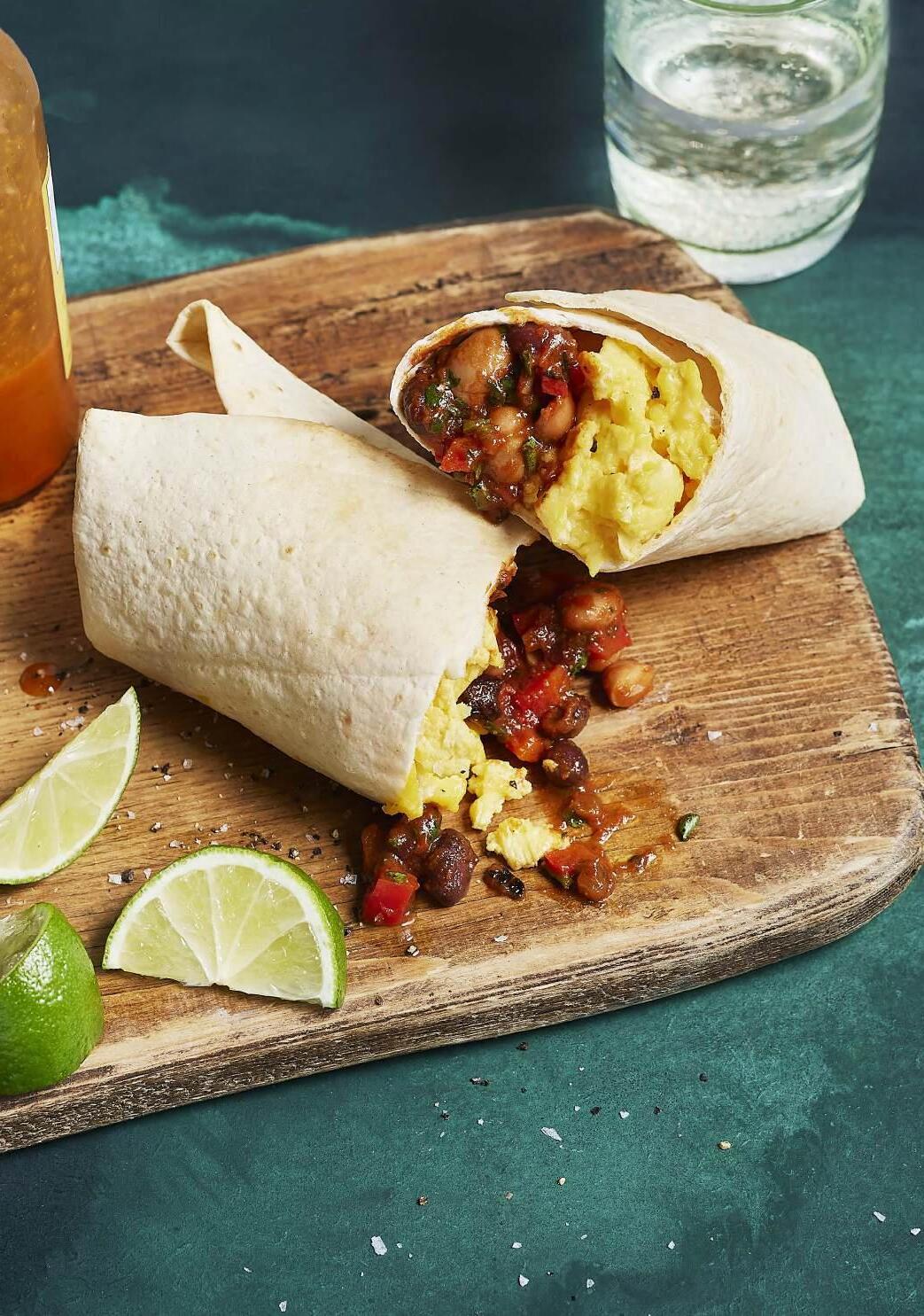
breakfast burrito
Tex-Mex dishes blend the cuisines of Mexico and the south-western states of the USA, and this burrito is a great example. It’s also a good way to get fibre and protein at breakfast or lunch. Add bacon, chorizo or pickled jalapeños, if you like.
MAKES 4 large burritos
PREP 30 mins COOK 30 mins
EASY V ❄
1 red onion
1 red pepper
2 garlic cloves
3 tbsp vegetable oil
1 tbsp tomato purée
1 tsp smoked paprika
1 tsp ground cumin
1 tsp ground coriander
1 tsp mild chilli powder
400ml passata
400g can black beans (see tip)
400g can pinto beans (see tip)
2 limes
10g coriander
6 eggs
2 tbsp milk
60g cheddar
20g salted butter
6 large tortilla wraps
1 avocado
1 Finely chop the onion and pepper, and grate the garlic. Heat 2 tbsp of the veg oil in a large saucepan or flameproof casserole over a medium heat and cook the onion, pepper and garlic with a pinch of salt for 8-10 mins, stirring until soft and golden at the edges.
2 Add the tomato purée and dried spices, and cook for 2-3 mins, stirring until fragrant. Pour in the passata, swilling out the jar or can with a splash of water. Cook for 6-7 mins more, stirring often until thickened and reduced. Drain both cans of beans and stir these in. Season, then squeeze in the juice of 1 lime. Roughly chop the coriander and stir this in. Set aside to cool.
3 Crack the eggs into a medium bowl, pour in the milk and grate in the cheese. Season, then whisk using a fork to combine. Melt the butter in a small non-stick saucepan and cook the eggs, stirring until just scrambled (We like to slightly undercook the eggs, as they will continue to cook in the air fryer ) Once cooked to your liking, transfer to a clean bowl.
4 Warm the tortillas in the microwave. Spread a quarter of the bean mixture in a roughly 15cm line down the centre of each tortilla, flattening it out slightly. Spoon a quarter of the eggs on top. Fold in the edges of the tortilla, then fold the bottom half of the tortilla up and over the filling, rolling and tucking in the edges as you go. Repeat with the remaining tortillas and filling. (See tip.)
5 Brush each burrito with the rest of the oil, then air-fry in batches for 5 mins at 200C, or until lightly golden. Peel, stone, halve and slice or mash the avocado, and slice the remaining lime into wedges to serve alongside the burritos
GOOD TO KNOW calcium • folate • fibre • vit c 3 of 5-a-day PER SERVING 745 kcals fat 32g saturates 11g carbs 73g • sugars 12g • fibre 16g • protein 33g • salt 2.21g
• Haricot, kidney or mixed beans would also work well.
• Complete the recipe up to the end of step 4, then wrap and freeze the burritos individually. Defrost in the fridge overnight, then wrap in foil and air-fry at 180C for 15 mins. Unwrap. Air-fry for 5 mins more until hot through.
• If you don’t have all the dried spices, use a fajita-style seasoning or chipotle chilli paste.



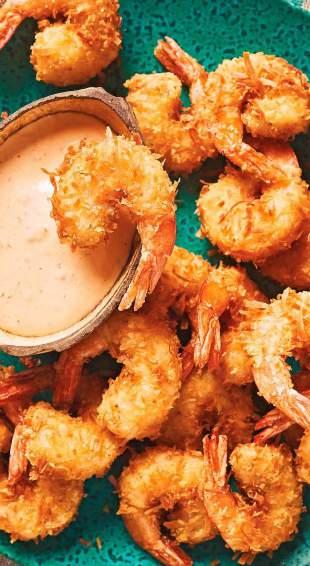
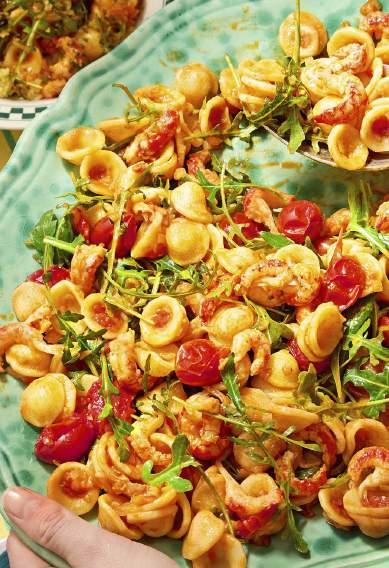
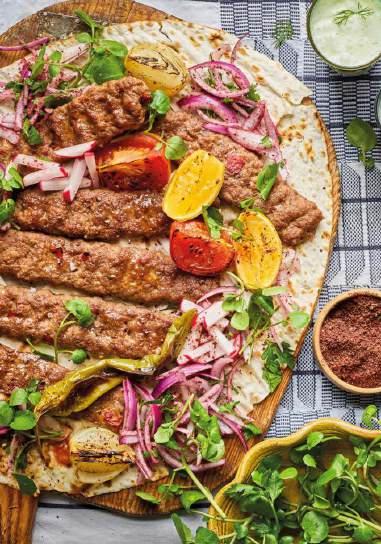
Light up the barbecue with Helen Graves, plus Kurdish kebabs from Pary Baban and oxtail Jamaican-style by Andre Fowles Plantain & black bean salad Crispy coconut prawns Crayfish, chilli & tomato pasta


COOK THIS WEEKEND
Bring sunshine to your kitchen with a fresh spin on Jamaican cuisine from chef Andre

Andre Fowles grew up in Kingston, Jamaica, and learned to cook from his mother. He trained as a chef and moved to New York, where he won awards and critical acclaim for his modern take on Jamaican cooking. He continues to champion the cuisine through pop-ups and restaurant concepts. @ cheffowles

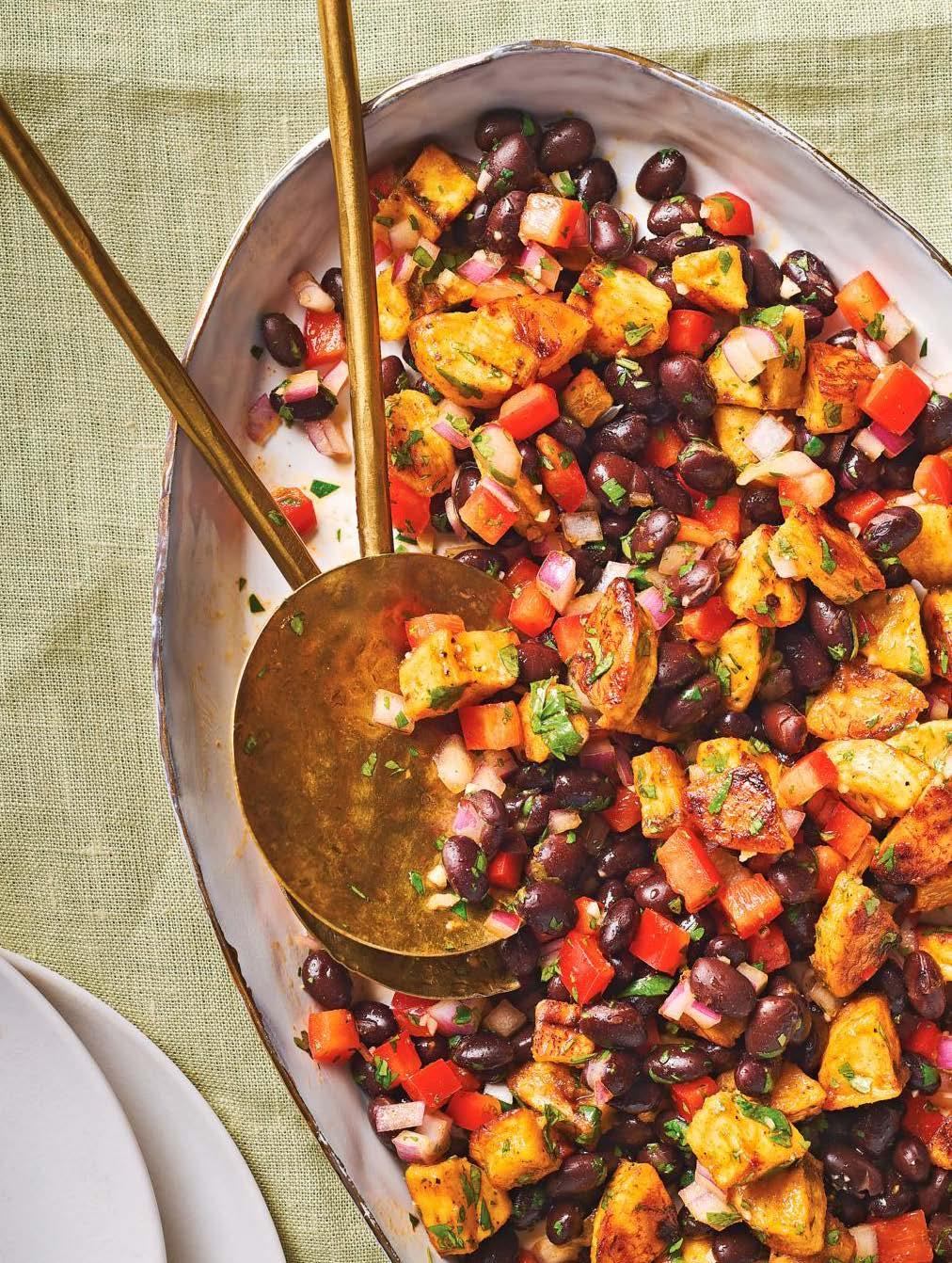
Jamaicans eat ripe plantain, fried or boiled, as a side. This salad offers a fresh alternative: roasting, which intensifies the honey notes of the plantain. The flavours intensify with time, making it a go-to for meal preppers, busy weeknights or when you’re bringing a dish to a party after a hectic work week.
SERVES 6 PREP 20 mins COOK 15 mins EASY V
2 ripe plantains, peeled and diced
60ml extra virgin olive oil, plus 2 tbsp
1 tsp smoked paprika
425g can black beans, drained and rinsed
1 red pepper, diced
1/2 large red onion, diced 1/2 bunch of coriander, chopped
2 garlic cloves, finely chopped
60ml apple cider vinegar
1 lime, zested and juiced
1 tbsp honey
½ tsp ground cumin
1 Heat the oven to 200C/180C fan/gas 6 and line a baking tray with baking parchment. Toss the plantain with 2 tbsp olive oil, 1 tsp salt, 1/2 tsp black pepper and 1/2 tsp of the smoked paprika in a bowl until coated. Spread out evenly over the prepared baking tray.
2 Roast until tender and golden brown, about 15 mins. Remove from the oven and cool slightly.
3 Combine the black beans, pepper, red onion, coriander and garlic in a large bowl. Add the 60ml olive oil, the vinegar, lime zest and juice, the honey, cumin, 1/2 tsp black pepper and the remaining smoked paprika. Stir to combine.
4 Once the plantain is cool enough to handle, add it to the bowl with the bean mixture, and stir everything until well combined. Season to taste with salt.
5 Serve immediately as a side dish, or keep chilled in an airtight container for up to three days – the salad is even better on the second day, once the flavours have had time to meld together. GOOD
Enslaved Africans were given the bare minimum of food. To make up for a lack of protein, they sought out cheap cuts of meat, or the leftover bits of slaughtered animals that nobody else wanted. Plantation owners threw out the tails, hooves, offal and other animal parts they deemed inedible, and my ancestors found creative ways to prepare and preserve them. They transformed oxtail – the tough tail of a working beast – into a rich, soul-satisfying feast by slow braising, careful browning and hours of low simmering with herbs and spices.
Today, oxtail costs as much as a sirloin steak. What you’re getting at the supermarket now are cross-cut sections of beef or veal tail – thick, cylindrical pieces of bone with meat and cartilage attached.
Because of the high ratio of bone and cartilage to meat, oxtail needs to be cooked slowly over low heat for best results. Prepared properly, this fatty, gelatinous mess becomes meltingly tender and as delicious or better than the best tenderloin. AF
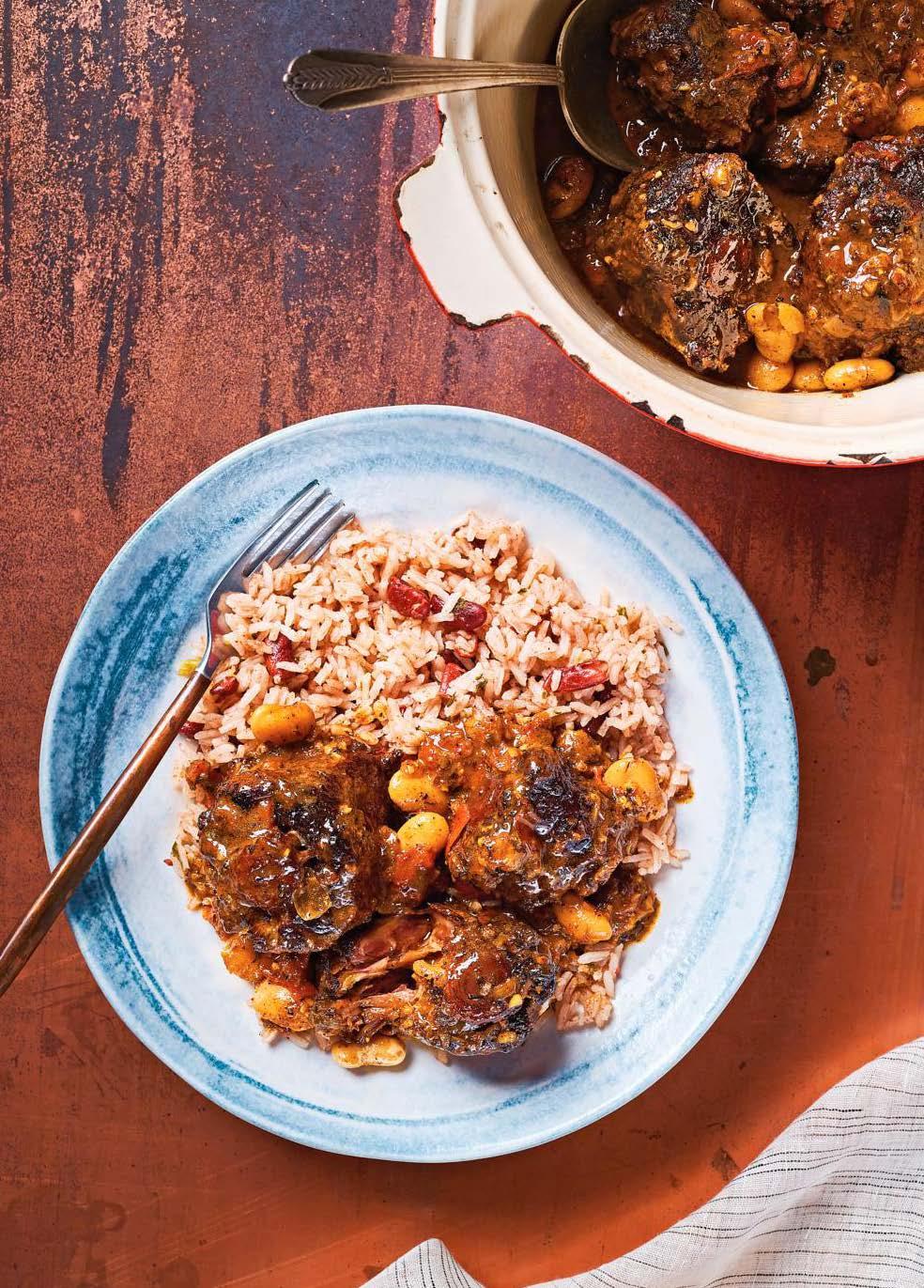
This dish marries tender, slow-cooked oxtail with creamy butter beans, creating a rich, flavorful meal for any occasion. It makes the silkiest, most delicious gravy you’ll ever eat.
A friend of mine once said, “Oxtail gravy is life” and he was right. And, while Jamaica isn’t the only culture that cooks oxtail, our treatment of it is as unapologetically unique as we are.
SERVES 6 PREP 30 mins plus at least 1 hr marinating COOK 3 hrs 30 mins EASY
1.4kg oxtail, cut into pieces at the joint (see tips)
60g Jamaican green seasoning, homemade or shop-bought
4 tbsp vegetable oil or other neutral oil
2 tbsp all-purpose seasoning
1 tsp ground allspice
1 tsp browning (optional; see tips)
11/2 litres beef stock (see tips)
1 large onion, diced
1 Roma tomato, chopped
4 spring onions, thinly sliced
6 garlic cloves, finely chopped
4 thyme sprigs, leaves picked
1 scotch bonnet pepper, left whole
1 tbsp finely chopped ginger
2 bay leaves
1 tsp paprika
1 tsp garlic granules
1 tsp onion granules
400g can butter beans, drained and rinsed rice and peas (kidney beans), to serve
1 Put the oxtail in a large bowl with the green seasoning, 2 tbsp oil, the all-purpose seasoning, 2 tsp salt, the allspice, 1 tsp black pepper and the browning, if using. Mix using clean hands or a large spoon to coat the oxtail evenly. Cover and leave to marinate in the fridge for at least 1 hr, but preferably overnight.
2 Heat the remaining oil in a large, heavy-based pot over a medium-high heat and, working in batches, sear the oxtail until browned, about 3-5 mins on each side Transfer to a plate or bowl.

3 Return all the seared oxtail to the pot. Add the beef stock, turn up the heat to high and bring the mixture to the boil. Reduce the heat to medium and cook the oxtail, covered, for 1 hr at a rapid simmer, stirring occasionally.
4 Add the onion, tomato, spring onions, garlic, thyme, scotch bonnet, ginger, bay leaves, paprika, garlic granules, onion granules and 1 litre water, and stir.
Reduce the heat to medium-low, cover the pot and cook until the oxtail is tender and beginning to fall off the bones, about 2 hrs more, stirring occasionally so the oxtail doesn’t burn at the bottom of the pot.
5 Turn up the heat to high and add the butter beans. Cook, uncovered, until the sauce has reduced slightly, about another 20 mins. Season to taste with salt. Discard the scotch bonnet and bay leaves. Serve the stew hot with rice and peas, if you like. Will keep chilled in an airtight container for up to three days (see tips)
• Most supermarkets and butchers sell oxtail precut, so don’t worry about cutting it further if it’s been jointed.
• The browning is optional, but provides richer colour and depth of flavour. Find it in the international aisle of supermarkets, or at any Caribbean grocer.
• In place of beef stock, you can use bouillon cubes dissolved in water.
• Don’t be alarmed if the oxtail is a solid mass after chilling the leftovers – it’s gelatinous, so the gravy sets like jelly as it cools. It will loosen again once reheated.
Recipes extracted from My Jamaican Table by Andre Fowles (Artisan Books) and not retested by us.
Copyright © 2026. Photographs by Michael Condran.
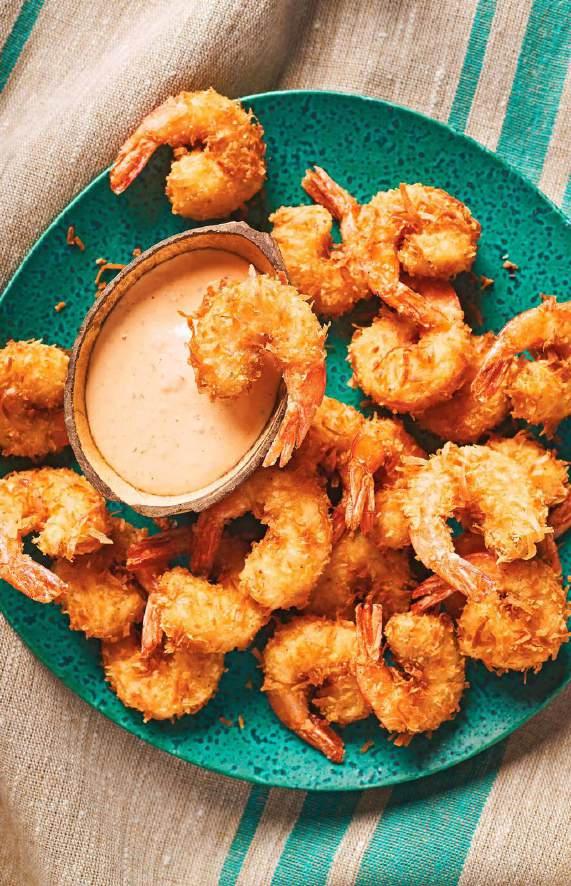
These deep-fried coconut prawns are a perfect blend of crunchy, tender, sweet and spicy. The texture of the prawns is maintained by the golden layer of crispy coconut, but make sure you don’t overcook them (the tail will be slightly curled when fully cooked).
SERVES 4 PREP 20 mins COOK 15 mins EASY
450g prawns, peeled and deveined
1 tbsp extra virgin olive oil
1/2 tsp garlic granules
1/2 tsp onion granules
125g plain flour
2 eggs
170g sweetened coconut flakes
50g panko breadcrumbs
vegetable oil or other neutral oil, for deep-frying chopped coriander, to serve (optional) lime wedges, to serve (optional)
For the chilli-lime mayo
110g mayonnaise
2 tbsp sriracha
1 tbsp chilli-garlic paste (found in specialist Asian supermarkets; if you can’t find it, use additional sriracha)
1 tsp soy sauce
1 garlic clove, finely chopped
1 lime, zested and juiced
1 To make the chili-lime mayo, stir the mayonnaise, sriracha, chilli-garlic paste, soy sauce, garlic, lime zest and juice together in a small bowl. Set aside.
2 Stir the prawns, olive oil, 1 tsp salt, 1/2 tsp black pepper, the garlic granules and the onion granules together in a medium bowl
3 Combine the flour, 1 tsp salt and 1/2 tsp black pepper in a shallow bowl Crack the eggs into a second bowl, add a splash of water and mix well using a fork. Combine the coconut and panko in a third bowl.
4 Line a plate with kitchen paper and set it near the hob. Pour a 5cm depth of oil into a large, deep pan and heat over a medium heat to 177C, or until the oil sizzles around a wooden spoon when it’s dipped in.
5 While the oil is heating, bread the prawns, working in batches, by coating them in the flour and shaking off any excess. Then, toss in the egg mixture to coat. Finally, dip into the coconut-panko mix, pressing some of the mixture into the prawns to make sure it sticks.
6 Working in batches, fry the prawns until golden brown and fully cooked, about 1-2 mins on each side. Put on the lined plate to drain using a slotted spoon
7 Serve immediately with chopped coriander and lime wedges, if you like, and the chilli-lime mayo for dipping.
GOOD
Mixitupthisyearwithtwistsonthe traditional,likefruitylamb,banana hotcrossbuns,crayfishforGoodFriday andatropicaltrifleforbreakfast–becauseit’snevertooearlytocelebrate recipes
CASSIE BEST, BARNEY DESMAZERY, HELENA BUSIAKIEWICZ photographsCHELSEA BLOXSOME


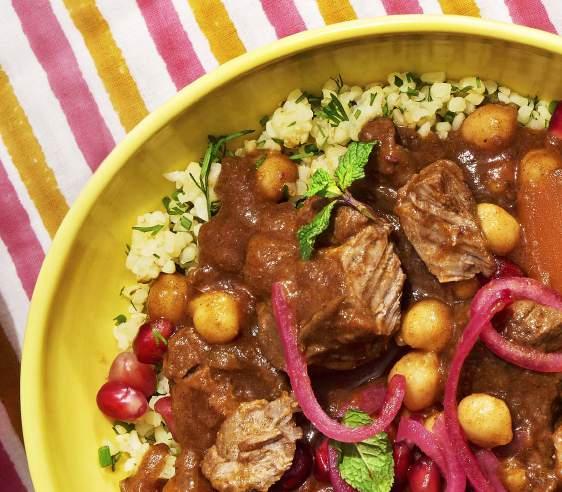
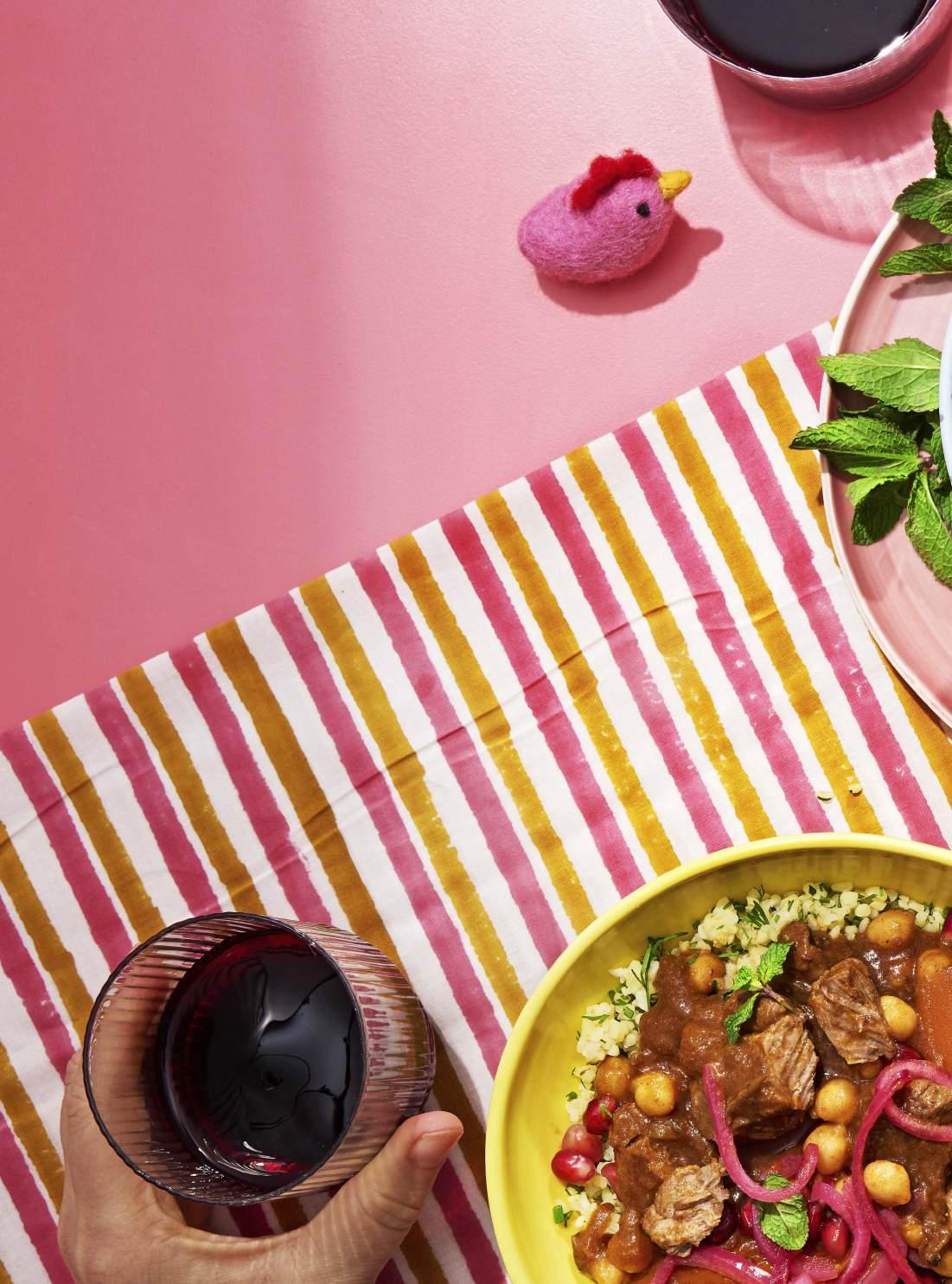
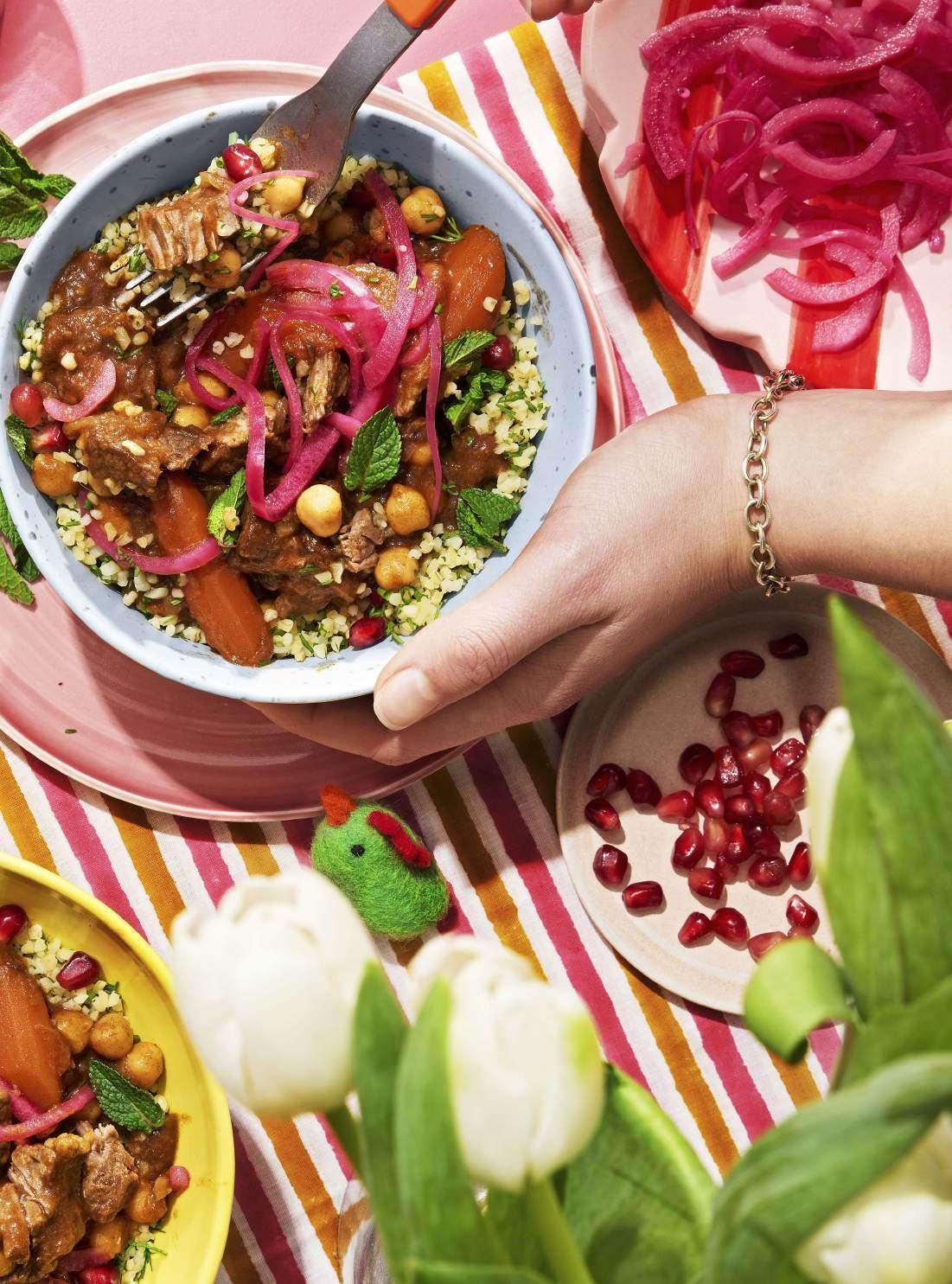
A great way of using a small amount of lamb is to bulk it out with chickpeas and veg to create something smilar to a North African tagine – or, swap the chickpeas for butter beans. The dates here add a lovely sweetness. Helena Busiakiewicz
SERVES 6 PREP 15 mins COOK 2 hrs 30 mins EASY
80g medjool dates
2-3 tbsp olive oil
400g lamb shoulder
2 red onions
2 carrots
2 celery sticks
3 garlic cloves
4 cardamom pods
2 tsp ground cumin
1 tsp ground coriander
1 cinnamon stick
1 bay leaf
2 tbsp tomato purée
2 tbsp plain flour
1 litre beef stock
570g jar chickpeas
1 tbsp red wine vinegar
200g bulgur wheat
15g dill
15g chives
1/2 lemon
pomegranate seeds, mint leaves and pickled red onions, to serve
1 Halve the dates and remove the stones. Heat 2 tbsp oil in a large flameproof casserole dish and cook the dates for 30 seconds on each side until deeply golden and caramelised. Remove from the dish and set aside
2 Chop the lamb into bite-sized cubes and season with salt. If the dish is dry, add a little more oil and reheat. Once hot, cook the lamb for 5-7 mins, browning on all sides until deeply golden and developing a good crust (you’ll need to do this in batches so you don’t overcrowd the dish) As the lamb is browned, remove to a bowl using tongs or a slotted spoon. Between batches, pour in 50ml water and scrape up the golden bits from the bottom, then tip this liquid into a bowl or cup and set aside for later
3 Roughly chop the onions, slice the carrots on the diagonal and thinly slice the celery. Add the veg to the dish, scraping up any golden bits on the bottom. Season with a little salt, then stir to coat. Cook over a medium-low heat for 10-15 mins until all the veg is well softened. Heat the oven to 170C/150C fan/gas 3.
4 Grate in the garlic, then add the cardamom pods, cumin, coriander, cinnamon stick and bay leaf. Stir in the tomato purée. Cook over a medium heat for

3-4 mins, stirring often until the purée has darkened to a brick red colour and the spices are very aromatic. Scatter in the flour and stir to coat.
5 Slowly pour in the stock and reserved browning liquid, stirring to combine. Bring to the boil, then reduce the heat to a simmer. Return the lamb and dates to the dish. Scrunch up a piece of baking parchment that’s roughly the diameter of the dish
Rinse it under the tap, squeeze out the excess water, then lay it on the top of the stew. Cover with the lid, transfer to the oven and cook for 1 hr 45 mins
6 Carefully remove the stew from the oven. Drain the chickpeas and stir them into the stew along with the vinegar, then return the dish to the oven, uncovered, for 15 mins. When ready, the lamb and veg should be very tender and the sauce thickened and reduced. Prepare the bulgur following pack instructions. Roughly chop the herbs and zest and juice the lemon, and stir all this through the cooked bulgur
7 Taste the stew and add a little salt, if needed. Spoon the stew over the herby bulgur, then scatter over pomegranate seeds, mint leaves and pickled onions
5-a-day
Put 300ml cider vinegar, 3 tbsp caster sugar, 1 tbsp sea salt and a few black peppercorns in a saucepan. Simmer until the sugar has dissolved, then pour the mixture over 3 sliced red onions. Decant into a steralised jar. Will keep chilled for up to two weeks.
TIP CHOCO-NUT
DATE BITES
Any leftover dates can be stuffed with a little almond butter, sprinkle of sea salt and drizzle of melted dark chocolate. Chill for 1 hr, then enjoy alongside a cup of tea.
SERVES 6 PREP 30 mins
COOK 1 hr 20 mins EASY V
1.2kg new potatoes
4 tbsp olive oil
25g parmesan or vegetarian alternative 250g asparagus
150g soft goat’s cheese log (one with a rind works well; ensure vegetarian, if needed)
peppery salad leaves (like watercress or rocket), to serve
For the salsa verde
2 handfuls of mint leaves (or any other soft herbs)
1 tbsp capers
1 heaped tsp Dijon mustard
6-8 tbsp olive oil
1/2 lemon
1 To make the salsa verde, tip the mint, capers, mustard and oil into a small food processor. Squeeze in the lemon juice, then blitz to a chunky paste Alternatively, finely chop the herbs and capers, then tip into a bowl with the mustard and oil, squeeze in the lemon juice and stir Will keep chilled for up to a day.
2 Scrub the potatoes, tip into a large pan, then cover with cold water and add a generous pinch of salt. Bring to the boil, then reduce the heat and simmer for 15-25 mins until completely tender. Drain well and leave to steam-dry for a few minutes, then tip back into the saucepan.
3 Heat the oven to 220C/200C fan/gas 7. Lightly crush the potatoes in the pan


Boiling times for new potatoes can vary wildly, so keep testing with the tip of a knife until they’re tender all the way through. For the salsa, we’ve gone with mint because it pairs beautifully with new potatoes, but use any soft herbs you have – or swap for seasonal wild garlic or leeks. Barney Desmazery
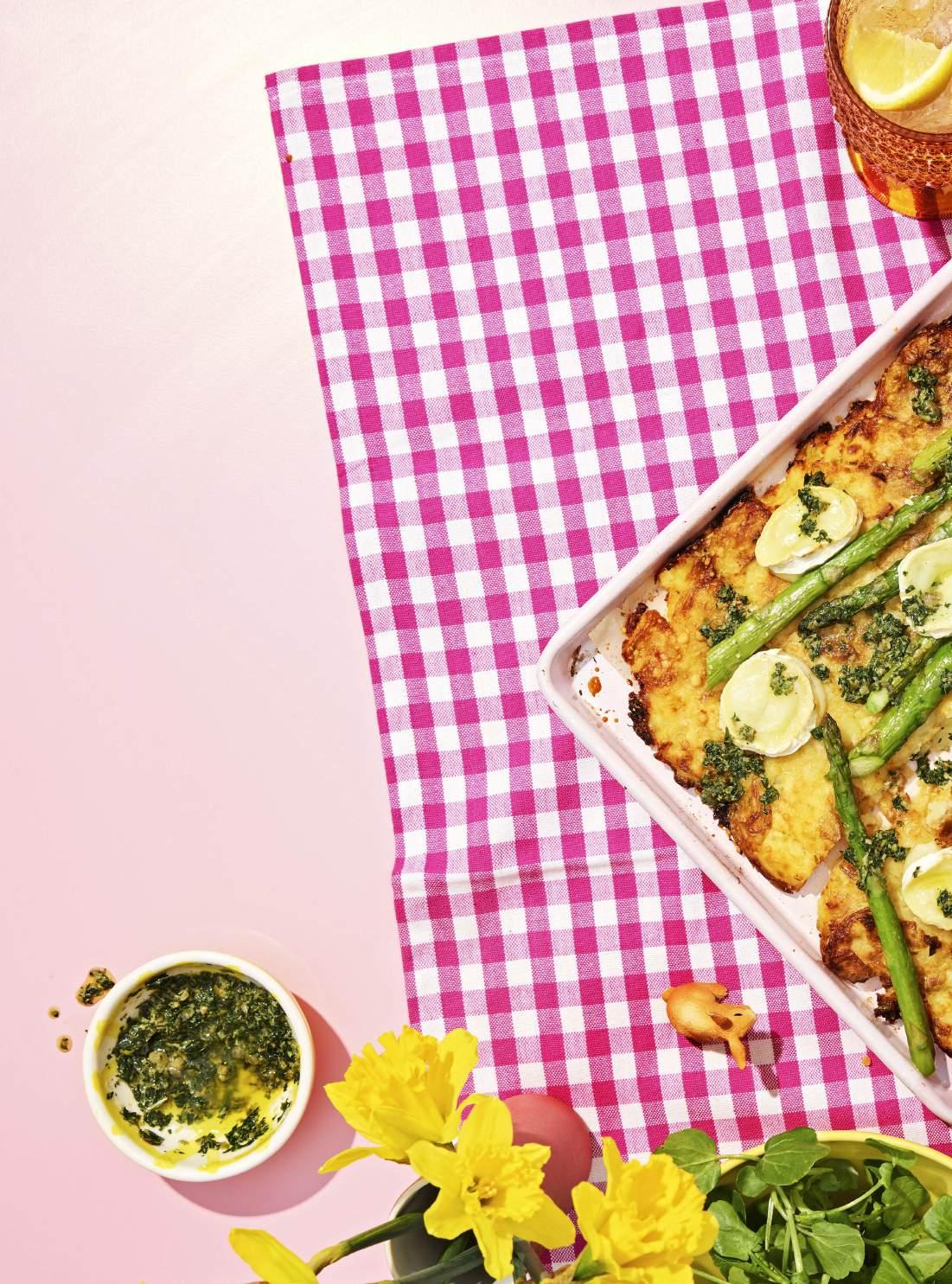
using a potato masher. Add half the oil, then finely grate in most of the parmesan Season. Mix everything together using a wooden spoon until you have a rough mash, then tip onto a large sheet of baking parchment. Cover with a second sheet of parchment and roll out into a flat rectangle using a rolling pin – it should be a bit bigger than a magazine, and about 1cm thick. Transfer to a baking tray, peel away the top layer of parchment, then grate over the remaining cheese and drizzle over another 1 tbsp oil. Bake for 30-35 mins until deeply golden and crisp at the edges. 4 Meanwhile, trim or snap the woody ends off the asparagus and toss the spears in the remaining 1 tbsp oil. When the potatoes are ready, remove from the oven and arrange the asparagus spears on top. Slice the goat’s cheese and dot all over the tart. Return to the oven for 15 mins until the asparagus is tender and the cheese is lightly golden. Let stand for a couple of minutes, then drizzle over some of the salsa verde. Slice into squares or slabs, and serve warm with the rest of the salsa and some watercress or rocket.


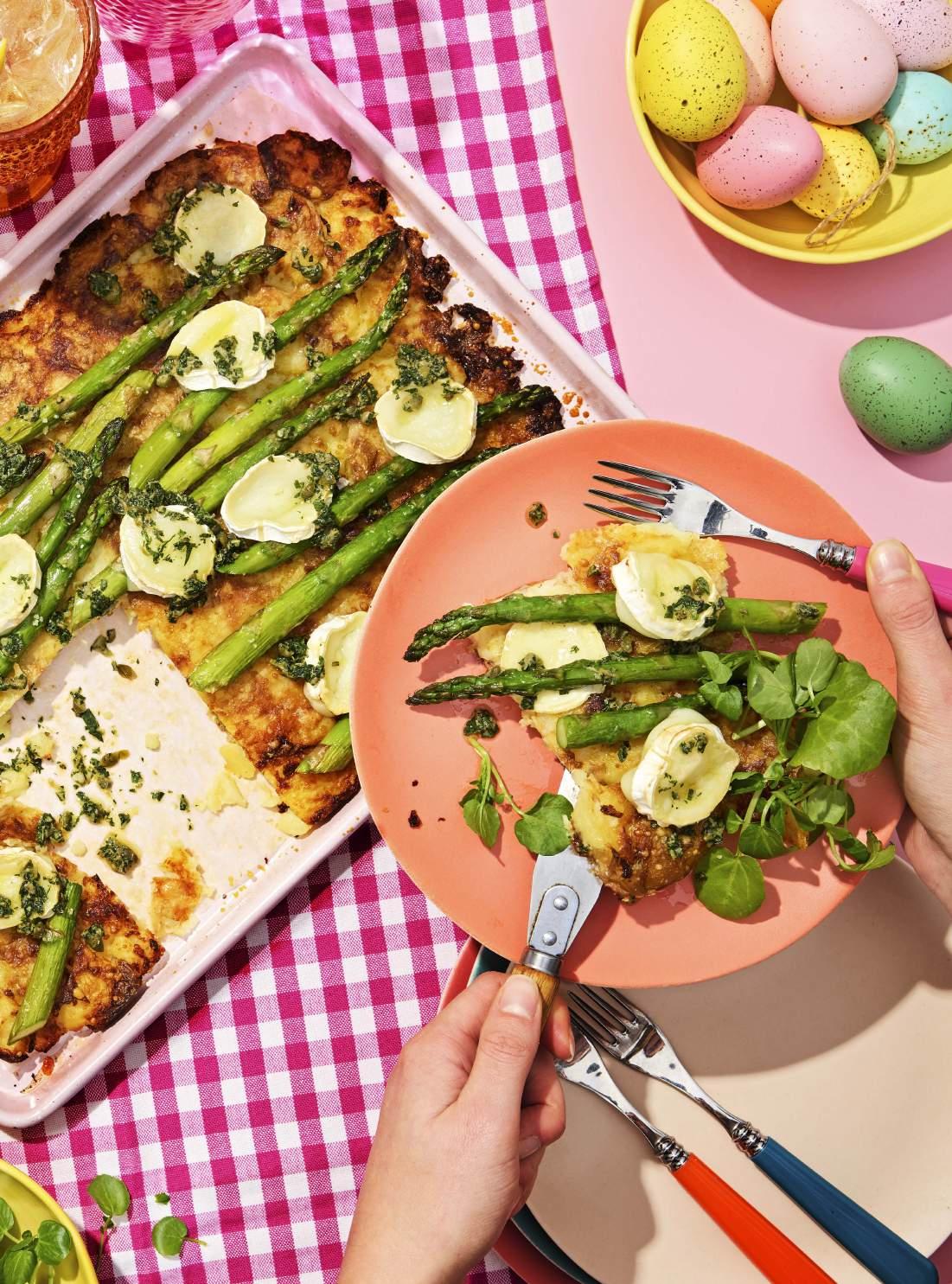
The potato base can be cooked, rolled out and chilled for up to 24 hrs before roasting. Bring back to room temperature before baking, then top and finish just before serving.
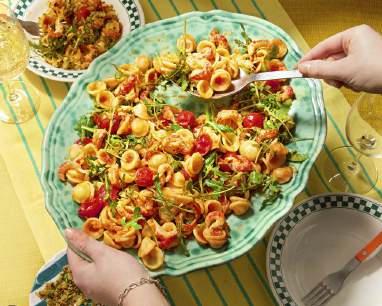
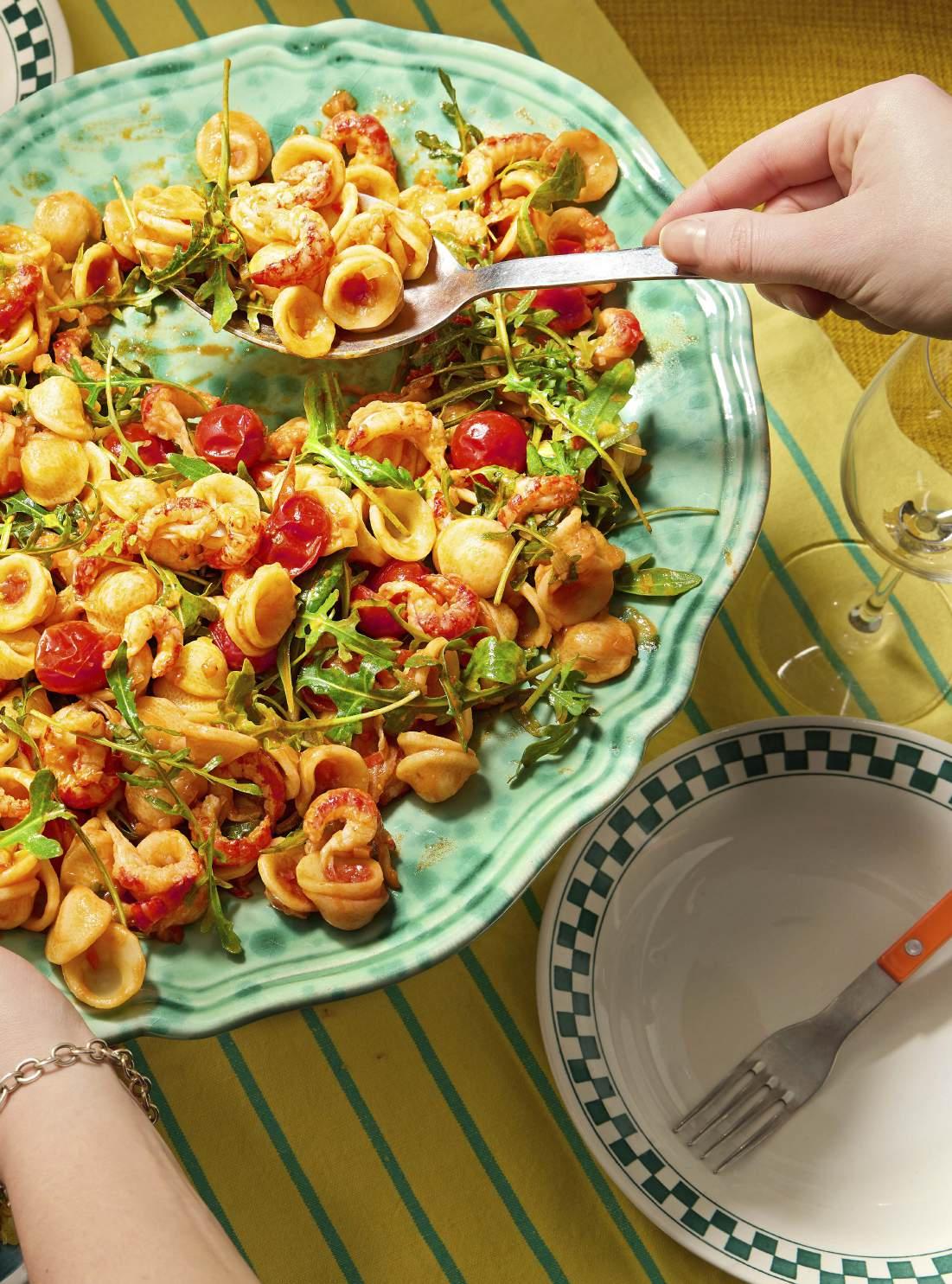
Crayfish are a high-protein, delicious seafood with a lovely briny flavour that can stand up to the chilli and tomatoes in this dish. Serve this sharing-style on a big platter for Good Friday, and let everyone help themselves.
Helena Busiakiewicz
SERVES 4 PREP 10 mins COOK 25 mins EASY
80g stale sourdough bread
2 garlic cloves
5 tbsp olive oil 15g chives
1 lemon
250g orecchiette
1 red chilli
2 shallots
100ml non-alcoholic dry white wine
400g can cherry tomatoes 60g rocket
200g prepared cooked crayfish tails (you can find these near the smoked salmon in larger supermarkets) 10g unsalted butter
1 Put the sourdough, peeled garlic cloves and some seasoning in a high-powered blender or food processor, and blitz to coarse crumbs. Heat 3 tbsp of the olive oil in a large, deep frying pan over a low heat and toast the breadcrumbs for 6-7 mins, stirring often until just lightly golden (they’ll continue to brown as they cool). Tip into a bowl.
2 While the breadcrumbs cool slightly, finely chop the chives and zest the lemon, then stir these through the breadcrumbs to make the pangrattato.
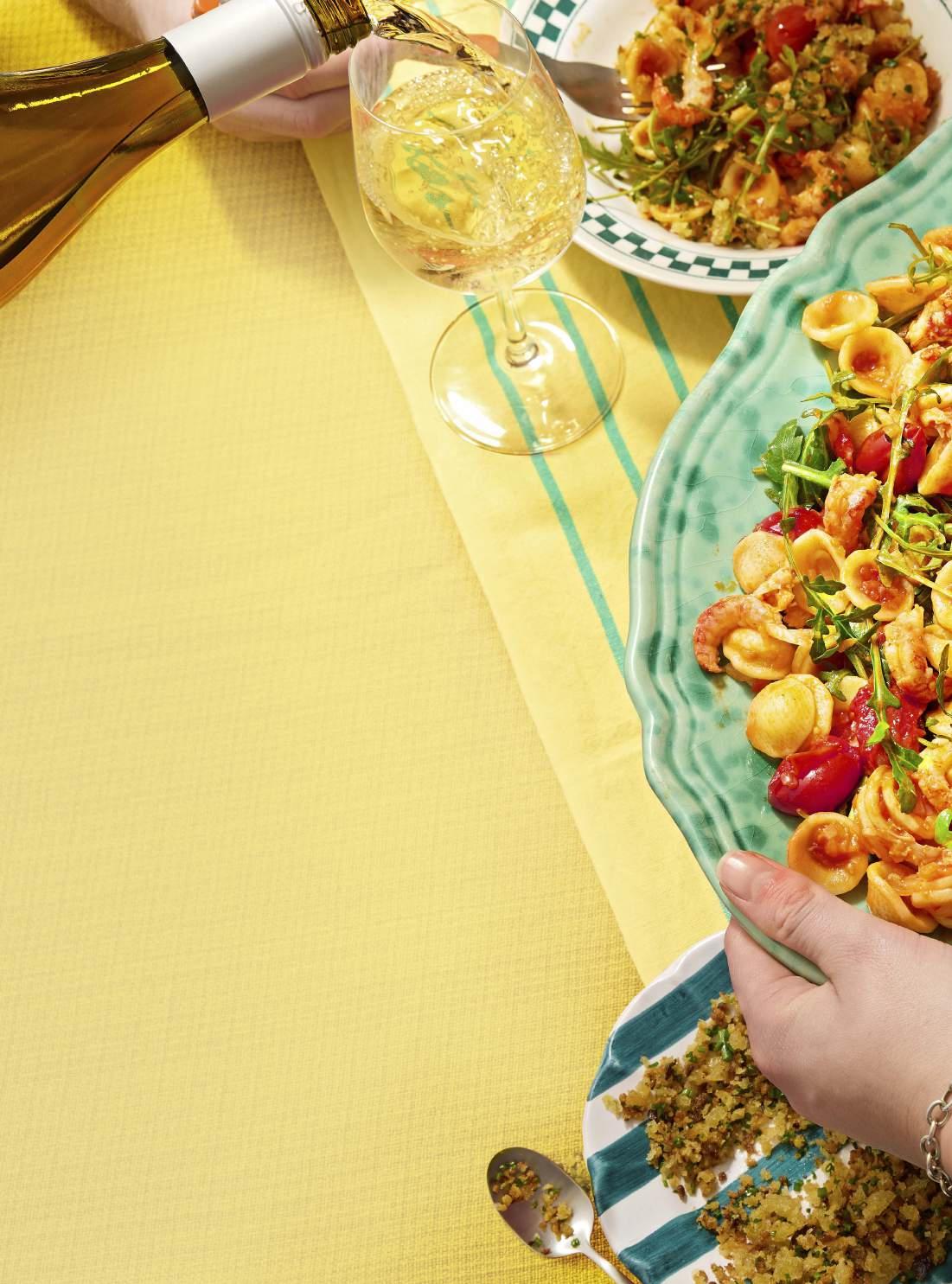
3 Cook the pasta following pack instructions, then drain, reserving some of the water. Meanwhile, finely chop the chilli and shallots. Heat the remaining oil in the frying pan over a medium-low heat and cook the chilli and shallots with a pinch of salt for 5 mins until softened and lightly golden at the edges.
4 Pour in the wine and turn the heat up slightly. Cook until the wine has reduced to barely 1 tbsp. Pour in the tomatoes, rinsing the can out with a splash of water. Simmer for 5 mins, then stir in the rocket, crayfish and the cooked pasta. Mix well to combine, stirring in a little of the reserved pasta water and the butter to create a sauce. Cut the zested lemon in half and squeeze one half over the pasta, then cut the other half into wedges.
5 Spoon the pasta onto a large sharing platter and sprinkle over the pangrattato. Serve with the lemon wedges for squeezing over.
GOOD TO KNOW healthy
2 of 5-a-day
HELENA’S TIPS
• Not a fan of crayfish? Swap for Atlantic prawns for a similar flavour.
• Orecchiette is a pasta that’s named after the Italian word for ‘ear’ due to its shape. You could swap it for conchiglie, if you prefer.
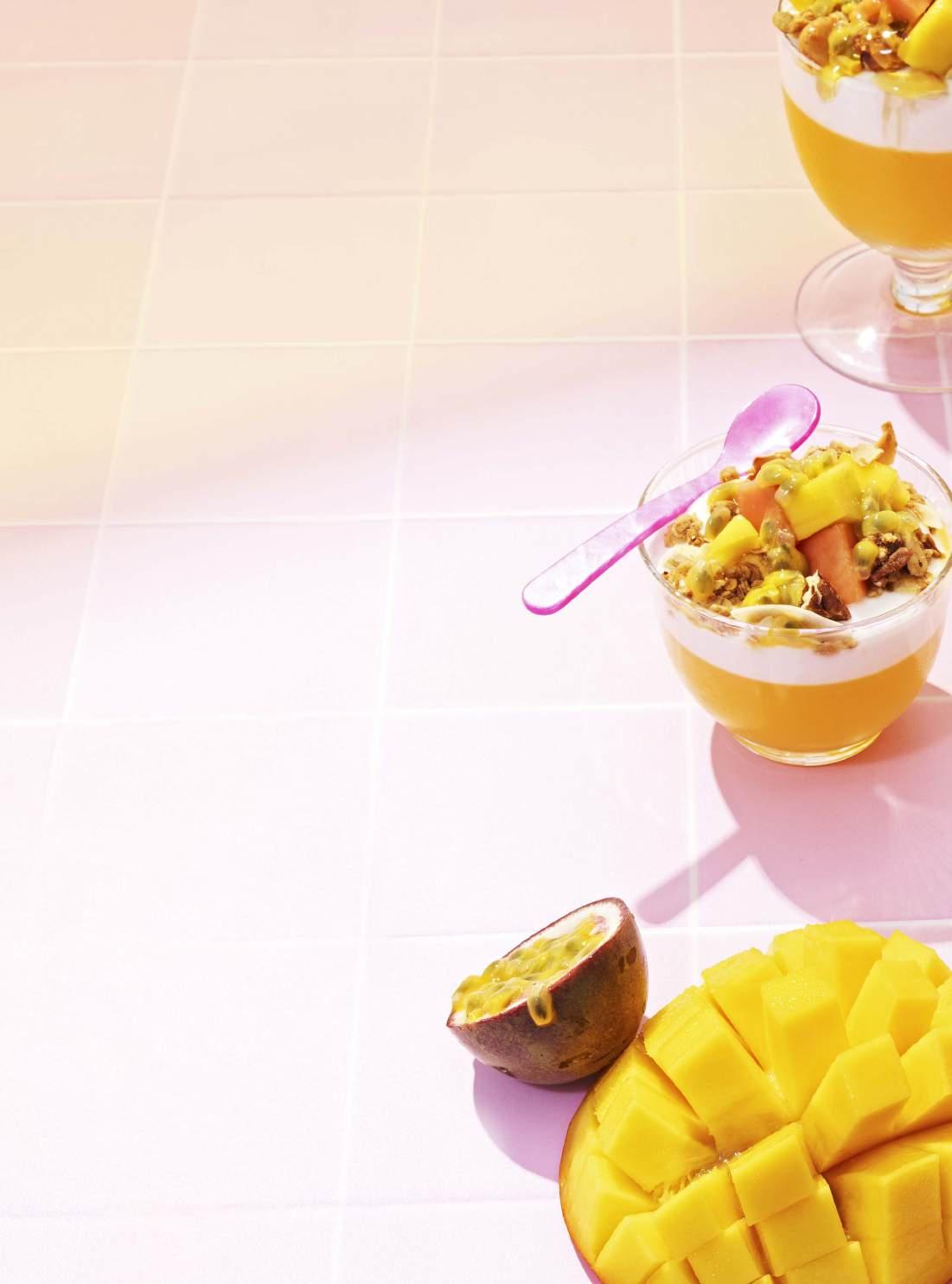
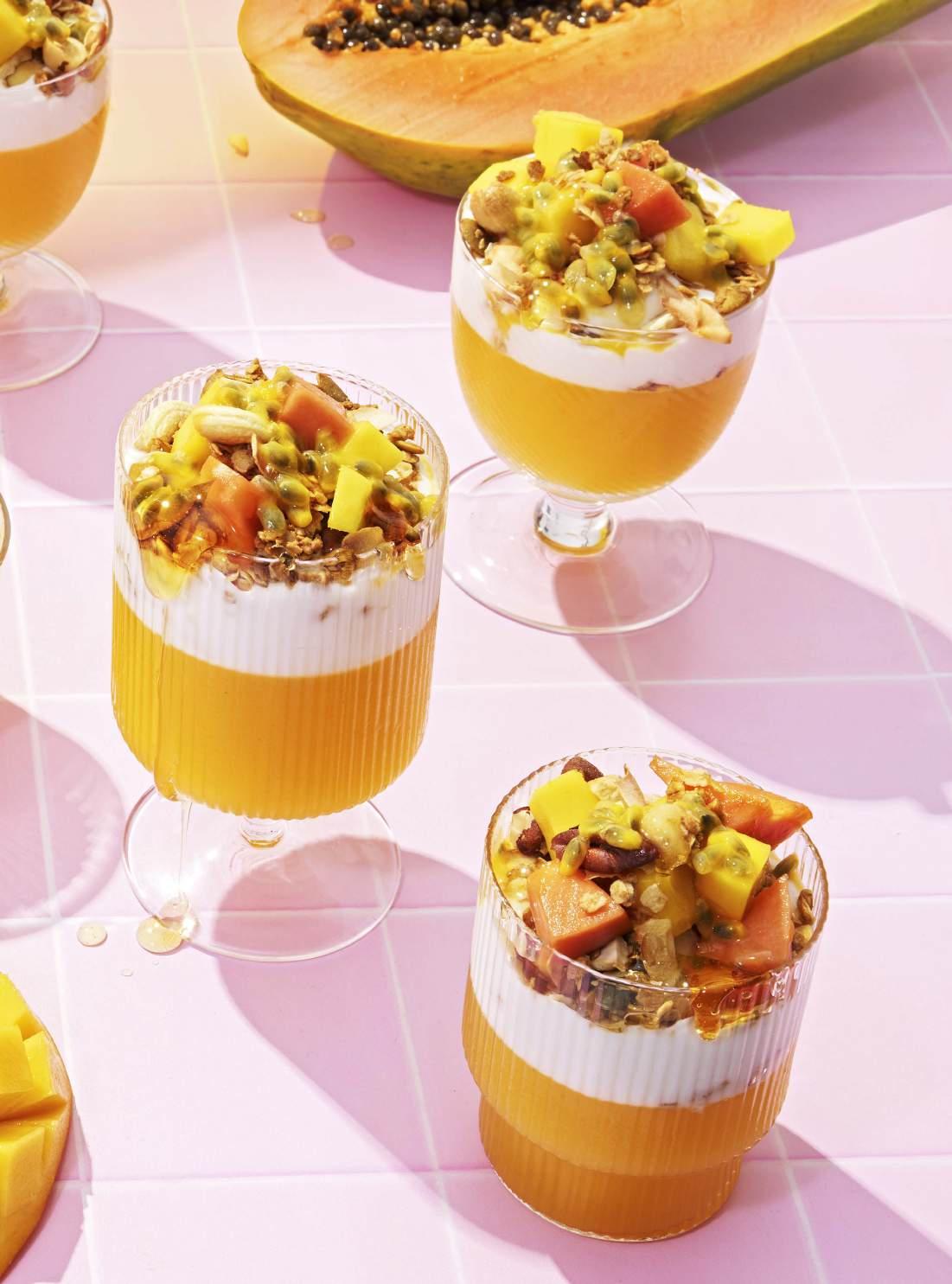
Upgrade Easter morning with prep-ahead, dessert-worthy breakfast trifles. You’ll make enough granola for leftovers that you can enjoy with yogurt and fruit. Cassie Best
SERVES 6 PREP 20 mins plus cooling and 2 hrs chilling COOK 20 mins EASY V
6 gelatine leaves
600ml mango juice
1 mango
1 papaya
3 ripe passion fruits, or 150g passion fruit pulp
800g coconut yogurt
For the granola
75g whole nuts (we used brazil, macadamia and cashews)
15 cardamom pods, or 1/2 tsp ground cardamom
50g coconut oil
175g honey, plus a drizzle to serve
275g rolled oats
50g mixed seeds (we used sunflower and pumpkin)
1 tsp ground cinnamon 50g coconut flakes
1 Heat the oven to 160C/140C fan/gas 3 and line a large baking tray with baking parchment. For the granola, roughly chop the nuts, leaving plenty of chunky pieces. Bash the cardamom pods to crack them open, then lightly grind the seeds using a pestle and mortar to release their aroma.
2 Melt the coconut oil and honey in a large saucepan over a low heat or large heatproof bowl in the microwave. Add the oats, seeds, cardamom, cinnamon, chopped nuts and 1/2 tsp sea salt. Mix until everything is coated in the syrupy mixture.
3 Tip the mixture onto the prepared tray and spread out into an even layer. Bake for 20 mins, then stir in the coconut flakes and return to the oven for 10-15 mins until golden and crisp. For chunkier granola, leave to cool without stirring, then break up into pieces. If you prefer a finer texture, stir occasionally as it cools. Will keep in an airtight container for up to a month.
4 Put the gelatine leaves in a bowl of cold water, one at a time so they don’t stick together, and leave to soften for 10 mins. Meanwhile, heat the mango juice in a saucepan until just steaming – don’t boil. Lift out the gelatine sheets, squeeze out any excess water and transfer, one at a time, to the hot mango juice, stirring until dissolved. Divide the juice between six individual serving dishes, then chill for at least 2 hrs, or until the jelly has set.
5 Peel and slice the mango and chop the papaya. Halve the passion fruits and scoop out the pulp. Divide the coconut yogurt between the dishes, spreading it out into an even layer over the mango jelly Sprinkle over the granola over, then top with the fruit and an extra drizzle of honey

To make this recipe vegan, swap the gelatine for agaragar and the honey for maple syrup. Make sure to use a plant-based coconut yogurt, rather than a flavoured dairy version.
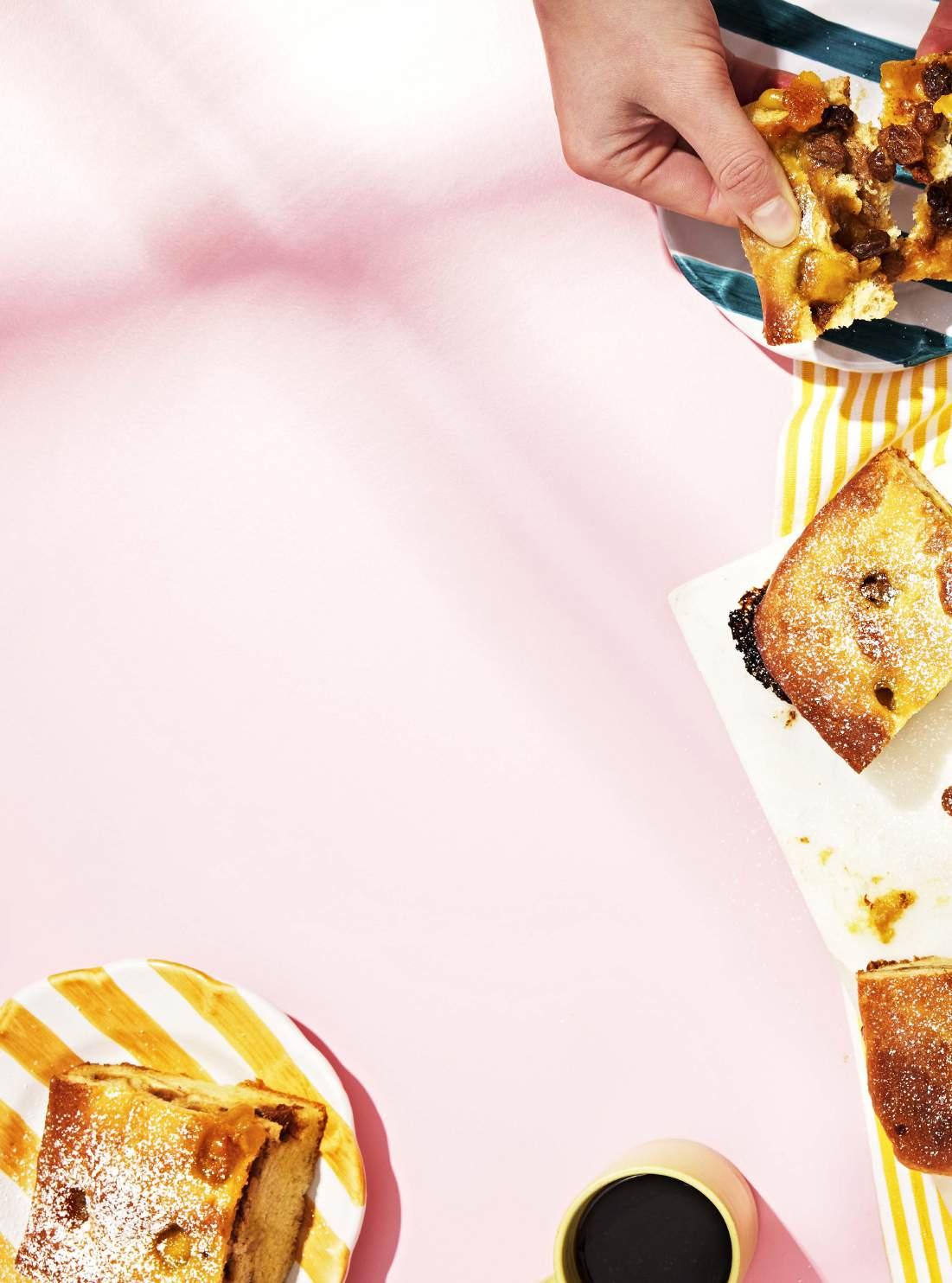
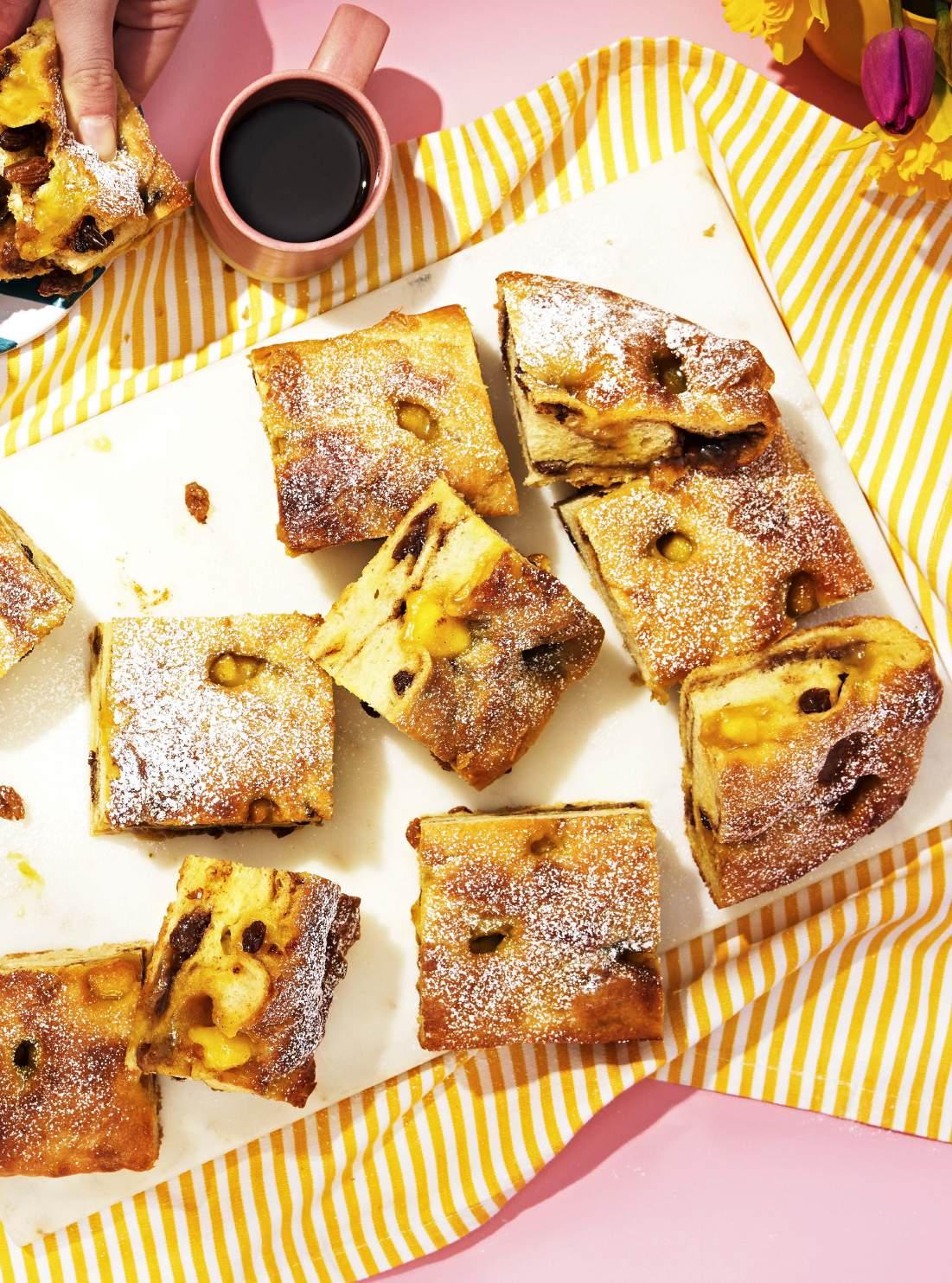
My simnel cake version of a sweet focaccia is fluffy, buttery and gently spiced, with pockets of melted marzipan and dried fruit running through the dough. It’s less formal than a traditional cake, but far more versatile – enjoy it as a sweet breakfast or brunch, or with coffee later in the day. Barney Desmazery
SERVES 12 PREP 40 mins plus at least 2 hrs proving COOK 30 mins MORE EFFORT V
For the water roux
3 tbsp plain flour
150ml milk
For the dough
500g strong white bread flour
7g sachet fast-action dried yeast
10g salt
20g light brown soft sugar
For the filling
150g dried fruit (a mix of sultanas, currants and chopped dried apricots works well)
1 orange
150g unsalted butter, softened, plus extra for the tin
75g light brown soft sugar
2 tsp mixed spice
1/2 tsp ground cinnamon
175g marzipan
To finish
2 tbsp maple syrup icing sugar, for dusting (optional)
1 To make the water roux, whisk the flour and milk together in a small pan over a low heat and cook for about 2 mins, stirring continuously until you have a thick, smooth paste. Leave to cool slightly.
2 To make the dough, tip the flour, yeast, salt, sugar, 300ml water and the water roux into the bowl of a stand mixer and, using the dough hook, slowly mix to
a rough, sticky dough, making sure there are no dry patches. Turn up the speed and mix for about 5 mins more until smooth and coming away from the bottom of the bowl. Or, bring together by hand in a bowl, then tip onto a clean surface and knead until smooth. Shape into a tight ball. Generously butter a deep 20 x 30cm tin and sit the dough in the middle. Cover and leave to rise at room temperature for 1-2 hrs until doubled in volume and bubbly.
3 Meanwhile, make the filling. Tip the dried fruit into a heatproof bowl and cover with boiling water Leave to soak for 10 mins, then drain Zest the orange, then mix this with the butter, sugar, mixed spice, cinnamon and a large pinch of sea salt flakes. Cut the marzipan into small cubes. Set aside.
4 When the dough has risen, gently pat it into the tin to fill it Spread over the spiced butter mixture, then scatter over the dried fruit and half the marzipan cubes. Using your fingertips or a dough scraper, lift a short edge up, then very loosely roll the dough up into a spiral. Lift up the rolled dough, fold in half again and sit it back in the tin, smooth-side up – this is to ripple the butter, fruit and half the marzipan through the dough as evenly as possible. Leave to rest for at least 1 hr. Will keep covered and chilled for up to 24 hrs for even better flavour.
5 If the dough has been chilled, take the tin out of the fridge 30 mins before baking. Heat the oven to 220C/200C fan/gas 7. Dimple the dough all over using your fingertips, pressing the remaining marzipan cubes deep into the holes. Bake for about 25 mins until deeply golden and cooked through; if it starts to brown too quickly, cover with foil. As soon as it comes out of the oven, slowly drizzle over the maple syrup so it sinks into the dimples. Cool in the tin for at least 30 mins. Dust with icing sugar, if you like, then cut into squares. Best served the day it’s made, but will keep in an airtight container for up to a few days.
If you’ve not made one before, a water roux (also called tangzhong) is a game-changer for baking soft and fluffy breads, buns and rolls. It’s simply flour and milk (or water, or both) cooked into a smooth paste, changing the starch so it can hold onto more water. That means your dough traps extra moisture, making it softer and easier to work with, and resulting in lighter, fluffier bakes that stay fresher for longer. Once you’ve used it in a bake like this (or brioche-style loaves, dinner rolls or burger buns), you’ll never bake without it.
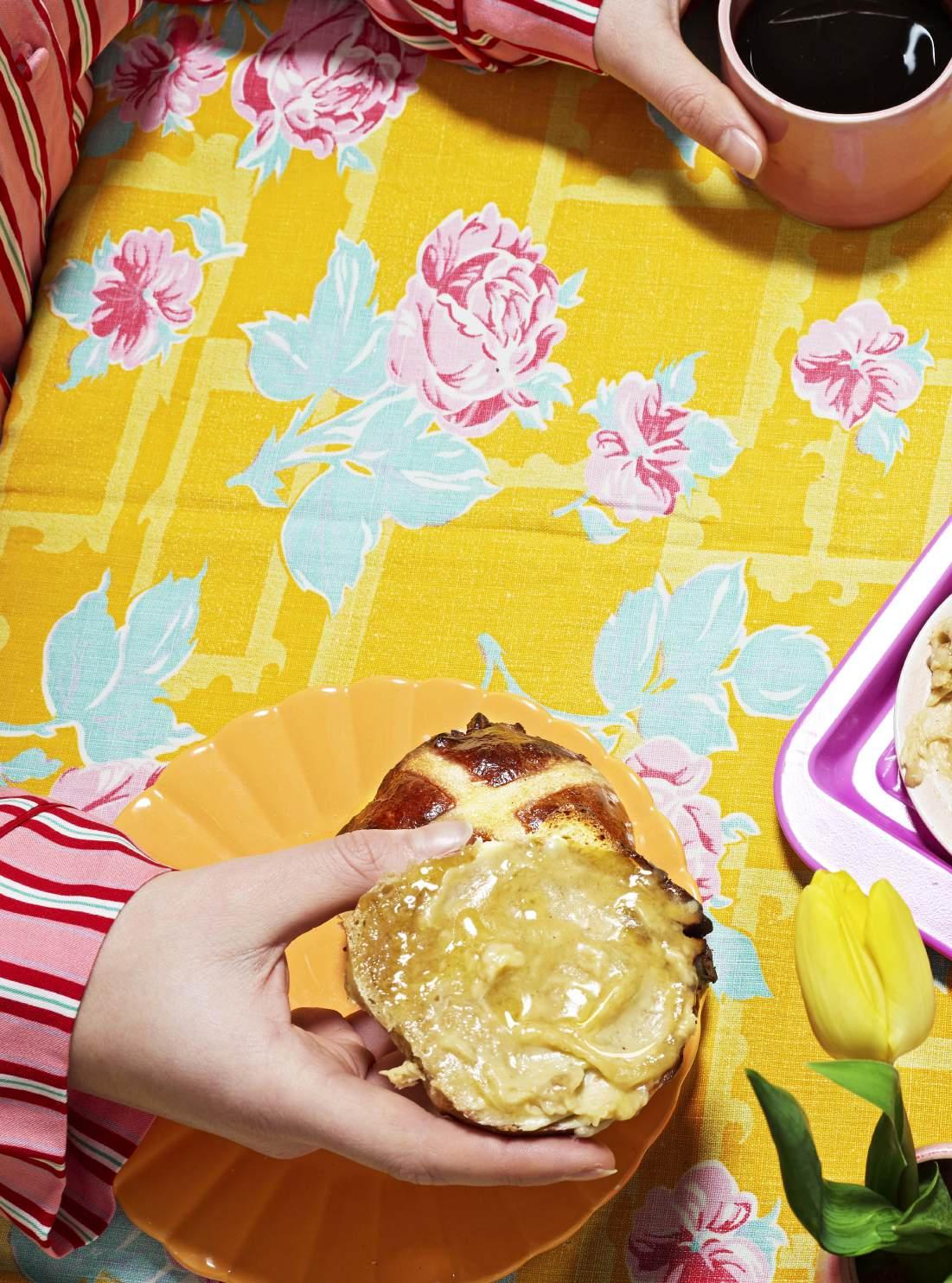

There are two keys to this recipe: the first is using the ripest, blackest bananas you possibly can, the ones that have been long forgotten in the fruit bowl. The second is to not skip making the banana butter – it really does make them extra-special.
MAKES 12 PREP 30 mins plus cooling and 2 hrs 30 mins proving COOK 35 mins MORE EFFORT V
650g strong white flour, plus 30g for the crosses
90g golden caster sugar
7g sachet fast-action dried yeast
230ml whole milk
30g unsalted butter
1 tsp ground cinnamon
1/2 tsp mixed spice
1/2 tsp ground cardamom
1/4 tsp ground cloves
2 overripe, blackened bananas (ours weighed 190g)
2 tbsp vegetable oil, plus extra for proving 2 eggs
60g pecans
60g golden raisins
For the banana butter
1 ripe banana
200g salted butter, at room temperature
3 tbsp clear honey
1/2 tsp ground cinnamon 1/8 tsp ground cloves
1 Put the 650g flour, the sugar, yeast and 1 tsp salt in the bowl of a stand mixer with the dough hook attached. Whisk briefly to combine.
2 Meanwhile, pour the milk into a medium pan. Cube the butter and add it to the pan along with the spices. Heat until the milk is just steaming and the butter has melted, gently whisking to combine. Remove from the heat and set aside to cool slightly.
3 Roughly chop the bananas (you can leave the skin on) and transfer to a high-powered blender. Tip in the oil and 1 egg, and blitz until smooth. Pour this into the milk mixture and whisk to combine.
4 With the mixer on low speed, add the banana mixture to the flour mixture. Mix for 10-12 mins, or until the dough is smooth and springy.
5 Shape the dough into a ball, then transfer to an oiled bowl. Leave to rise for 1 hr 30 mins, or until doubled in volume. Line the base and sides of a 30cm rectangular tin with baking parchment
Helena Busiakiewicz
6 Roughly chop the pecans and set aside. Knock back the dough, then flatten it out slightly until it’s roughly 30cm wide. Scatter over the pecans and raisins and knead them through the dough, then shape into a ball. Cut into 12 x 105g pieces and shape each one into a ball Arrange in the tin, spaced slightly apart, then cover with a tea towel and leave to prove for 1 hr until they’re touching one another and an indent is left when you gently press them using a floured finger.
7 Heat the oven to 200C/180C fan/gas 6. Beat the remaining egg and brush this over the buns. Gradually mix the 30g flour with 25-30ml water and a pinch of salt until you have a thick but pipeable paste (you may need to adjust the amount of water, as all flours have different absorbencies) Spoon the paste into a reusable or recyclable piping bag, and pipe crosses over the buns – start by piping a long vertical line down each column of three buns, then turn the tin and pipe a long line across each row of four buns.
8 Bake the buns for 25-28 mins until golden brown and fragrant. Leave to cool in the tin for 15 mins, then remove to a wire rack to cool completely serve warm). Once cool, will keep in an airtight container for up to four days.
9 For the banana butter, turn the oven down to 180C/160C fan/gas 4. Peel the banana and put a small baking tray lined with baking parchment Roast for 15 mins until lightly browned, then cool for 5 mins before mashing with a fork.
10 Put the softened butter, honey, cinnamon cloves in a medium bowl and beat using an electric whisk for 2-3 mins until combined. Mix in the mashed banana, then adjust the cinnamon and honey if needed Will keep chilled for up to a week.
11 Serve the buns toasted, if you like, with a good slathering of the banana butter.


• Any leftover banana butter would make a great topping for American-style pancakes.


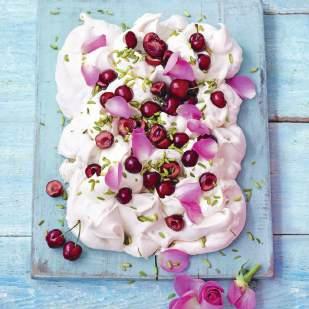
Round off Easter lunch with this showstopping pavlova from our head of food Cassie Best where cloud-like meringue meets bursts of chocolatey, sweet and salty flavour
photograph CHELSEA BLOXSOME
In most pavlova recipes, the sugar is added a spoonful at a time, but here, it’s added in one go, resulting in a super-stable pav with minimal cracking. This means it takes longer to reach stiff peaks, but it’s worth it to achieve a cloudsoft centre inside a crisp shell. As a plus, you’ll only need cocoa powder and a small amount of dark chocolate to create big flavour, so it’s cost-effective, too.
SERVES 8-10 PREP 25 mins plus cooling
COOK 1 hr 30 mins MORE EFFORT V
5 medium egg whites
225g caster sugar
50g light brown soft sugar
1 tsp vinegar
1 tsp cornflour
1 tsp cocoa powder
For the salted caramel
100g light brown soft sugar
50g butter
1 tbsp spiced rum (optional)
150ml double cream
For the chocolate ripple cream
600ml double cream
100g dark chocolate
1 tsp vanilla extract
1 tbsp icing sugar
1 Heat the oven to 170C/150C fan/gas 5 and line a baking sheet with baking parchment. Use a roughly 20cm plate or bowl as a template to draw a circle on the parchment, then flip the parchment over 2 Tip the egg whites and both sugars into a large, clean bowl (any traces of oil or butter in the bowl will prevent the meringue from whipping up) with a pinch of salt, and whisk using an electric whisk or stand mixer on a low-medium speed. After a couple of minutes, the mixture should become a fine foam. Continue to whisk for 8-10 mins until the meringue is thick and mousse-like, and holds stiff peaks when the beaters are lifted out of the bowl.
3 Rub a little of the meringue between your fingertips – if it feels grainy, the sugar has not fully dissolved, so keep beating for a few minutes more until smooth. Add the vinegar and cornflour, and whisk again briefly until just incorporated.
4 Secure the baking parchment to the baking sheet using a small dab of the meringue in each corner Spoon the rest of the meringue into the middle of
the circle template, then use a palette knife or silicone spatula to shape it into a thick disk, creating some swirls, dips and peaks as you do. Dust the meringue with the cocoa powder using a fine sieve, then transfer to the middle shelf of the oven. Reduce the temperature to 140/120C fan/gas 1 and bake for 1 hr 20 mins. When the time is up, turn off the oven, leaving the meringue inside to cool fully (ideally, leave overnight. Once cool, the meringue will keep in a cool, dry place for up to two days. Don’t chill, as the moisture will cause it to become sticky.
5 Tip all the ingredients for the caramel sauce into a saucepan set over a medium heat, and simmer until it becomes a glossy, smooth sauce. Season with a good pinch of salt. Remove from the heat and set aside to cool slightly and thicken for 10-20 mins before serving The cooled sauce will keep chilled for a few days. Warm through before serving.
6 For the chocolate ripple cream, heat 150ml of the double cream in a saucepan over a low heat or in a heatproof bowl in the microwave in short bursts until steaming – don’t boil. Finely chop the chocolate, tip into a heatproof bowl and pour over the warm cream. Leave to stand for a few minutes, then stir to a smooth ganache. Leave to cool for at least 15 mins.
7 Pour the remaining cream into a large bowl along with the vanilla and icing sugar, and whisk using an electric whisk or stand mixer until just holding its shape (the warm ganache will make the cream thicken further when added, so don’t over-whisk). Quickly and gently swirl the ganache through the whipped cream to create a rippled effect. Put the meringue on a cake plate or stand, then spoon over the rippled chocolate cream. Pour over some of the the caramel sauce, then serve the meringue with the remaining sauce in a jug for everyone to help themselves Any leftover pavlova will keep chilled for up to two days – the meringue will soften slightly, but will still be delicious

Make it fruity
If you want to add fruit to your pav, sharp raspberries offset the caramel and chocolate nicely, or use cherries to create a black forest pavlova. Frozen fruit works well – defrost for a few hours before scattering over, or simmer into a syrupy compote along with a little sugar before spooning over.
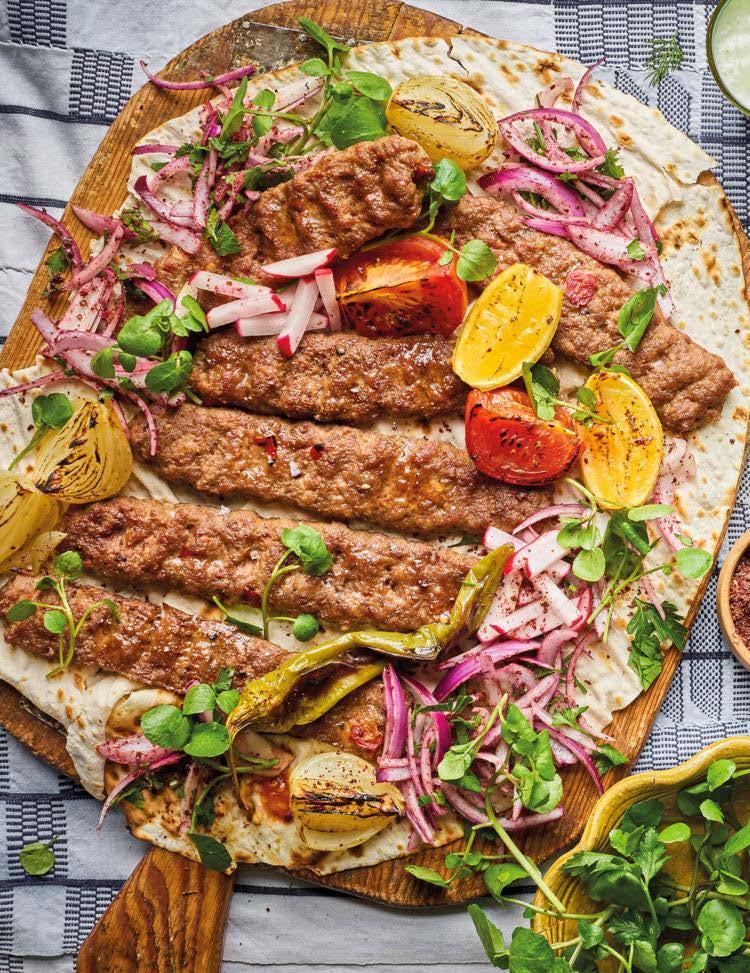
Chef and cookbook author Pary Baban shares her method for achieving tender, juicy lamb to serve with flatbreads and sides
photographs

Pary Baban fled her hometown of Qaladzê in Kurdistan in 1988 after it was invaded by Saddam Hussein’s forces. She trekked from village to village looking for safety, and collected recipes as she went. After settling in the UK, 27 years later these recipes inspired her and her family to open their acclaimed restaurant in south London, Nandine, which now has two branches. Nandên is her first cookbook.
@pary.baban
As the bread is dehydrated, it will keep in a dry, dark place (away from direct sunlight) for up to three months. The thinner the bread, the longer it will keep.
Nani tiri is the perfect bread to use for a newroz (spring) picnic – you can make a big batch of them and easily transport them. This bread is dehydrated, but if you splash water on it, it rehydrates and becomes so soft. It’s perfect for wraps with kebab, or eating with grilled meats.
MAKES 15 PREP 25 mins COOK 15 mins EASY V
420g strong white flour, plus extra for dusting
1 tbsp black sesame seeds 1/2 tsp roasted ground fenugreek You’ll also need large, flat, non-stick skillet (traditionally, this bread is cooked on a saj – a large, dome-shaped, convex metal griddle that is heated by a fire underneath)
1 Sift the flour into a large bowl, add 1/2 tsp salt, the sesame seeds and fenugreek, mix together, then push over to one side of the bowl.
2 Gradually add 320ml lukewarm water, and slowly mix together with the flour until almost blended. Keep about 1 tbsp of the water to wet your hands, and knead the dough until smooth and firm. Cover with a clean dish towel and leave to rest for 3-5 mins.
3 Sprinkle some flour on the work surface and over a baking sheet. On the floured surface, divide the dough into 15 portions (about 55g each). Holding one dough portion in your hand, dust it with a little flour from the work surface, shape into a ball and put on the floured baking sheet. Repeat for the other portions, then cover to prevent them from getting too dry.
4 Sprinkle more flour on the work surface and roll the dough balls out, one at the time, into thin, round sheets – the thinner and flatter the sheet, the quicker the bread will cook and the longer it will stay crispy.
5 Heat a frying pan over a medium-high heat. Use the rolling pin to lift up one flat sheet of dough and put it in the skillet. Cook for 1-2 mins until the dough is firm and golden, then turn it over and grill the other side. The bread should be crispy on both sides. Remove from the heat, let cool and repeat for the other flat sheets. Stack the breads on top of each other so they retain their shape.
The Kurdish kebab is soft on the inside, crispy on the outside, and tender. It should be cooked over hot charcoal whenever possible for the best flavour. Do not use knives and forks to eat it – take bite-size pieces of bread, put a piece of kebab inside followed by the tomato and onion and a sprinkle of sumac, a squeeze of the grilled lemon or drizzle of sauce. If you’re using lamb mince, rather than making your own, see my tip for how to do so.
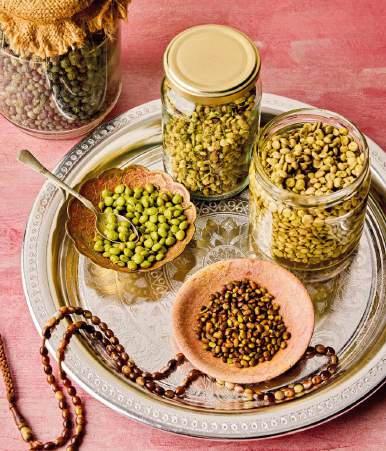
• If you don’t want to make your own lamb mince, use 1kg lamb mince, mix with the grated tomato, chilli and salt and continue with step 2.
• The best taste is made when the kebab is cooked over a hot charcoal grill. It makes it more smoky, with crisper edges, and will be more succulent, although you can cook it in an oven. We always use a charcoal grill in our restaurant.
SERVES 4 PREP 20 mins COOK 30 mins EASY
300g lamb flank (the top layer of ribs)
700g lamb leg meat
1 large tomato, deseeded and grated (no water), plus 2 tomatoes, cut into wedges
1 small hot chilli, diced
1 onion, cut into wedges
2 mild long green peppers, chopped
1 lemon, cut into wedges
1 tbsp olive oil
To serve
4 nani tiri, softened, or any flatbread
1 tbsp sumac
plate of fresh herbs
plate of pickles of your choice zalatay tirsha piyaz
vine leaf and qazwan sauce, or your favourite hot sauce
You’ll also need meat mincer (if mincing the meat yourself)
8 x 5cm-wide flat metal kebab skewers
1 Heat the oven to 240C/220C fan/gas 9. Cut the meat into small chunks and put in a bowl. Add the grated tomato, diced chilli and 1/2 tbsp salt, and mix together Push the mixture through a meat mincer and mince on a medium grind plate (you can ask a butcher to do this for you and add the tomato, chilli and salt at home).
2 Once the meat is fully minced, use your fingertips to mix the mince for 2-3 mins until combined. Divide into 8 equal meatballs and put on a lined baking sheet.
3 Have a bowl of warm water close to hand. Wet your hands, shaking off any excess – this makes shaping the kebabs around the skewer easier, and makes the kebabs more moist inside and crispy outside. Pierce a meatball through the middle using a kebab skewer, and shape the kebab by gently working the mixture upwards, flattening it around the skewer. Turn the skewer over and work the mixture downwards, using your thumb and index finger to squeeze the meat into a long, even line around the skewer. The key here is to knead the mixture onto the skewers gently to avoid over-working the meat. Start giving the kebab ‘bites’ by pressing down softly with your thumb and index finger to pinch indentations about halfway into the mince. If your skewers are too long for your own, slowly try to pull it out without breaking the kebab shape; otherwise, leave it in place for cooking. Repeat until you have used up all the meat.
4 Put the tomatoes, onion, peppers and lemon wedges around the kebabs on the baking sheet. Season, drizzle the oil over the veg and bake for 20-30 mins. The kebabs are ready when they start sizzling and are golden brown outside but still moist inside and the vegetables are grilled.
5 Serve each kebab on a flatbread with the vegetables around it. Put the sumac next to the kebab with the herbs and salad, then cover with the bread so the kebab stays moist Serve with pickles and sides.
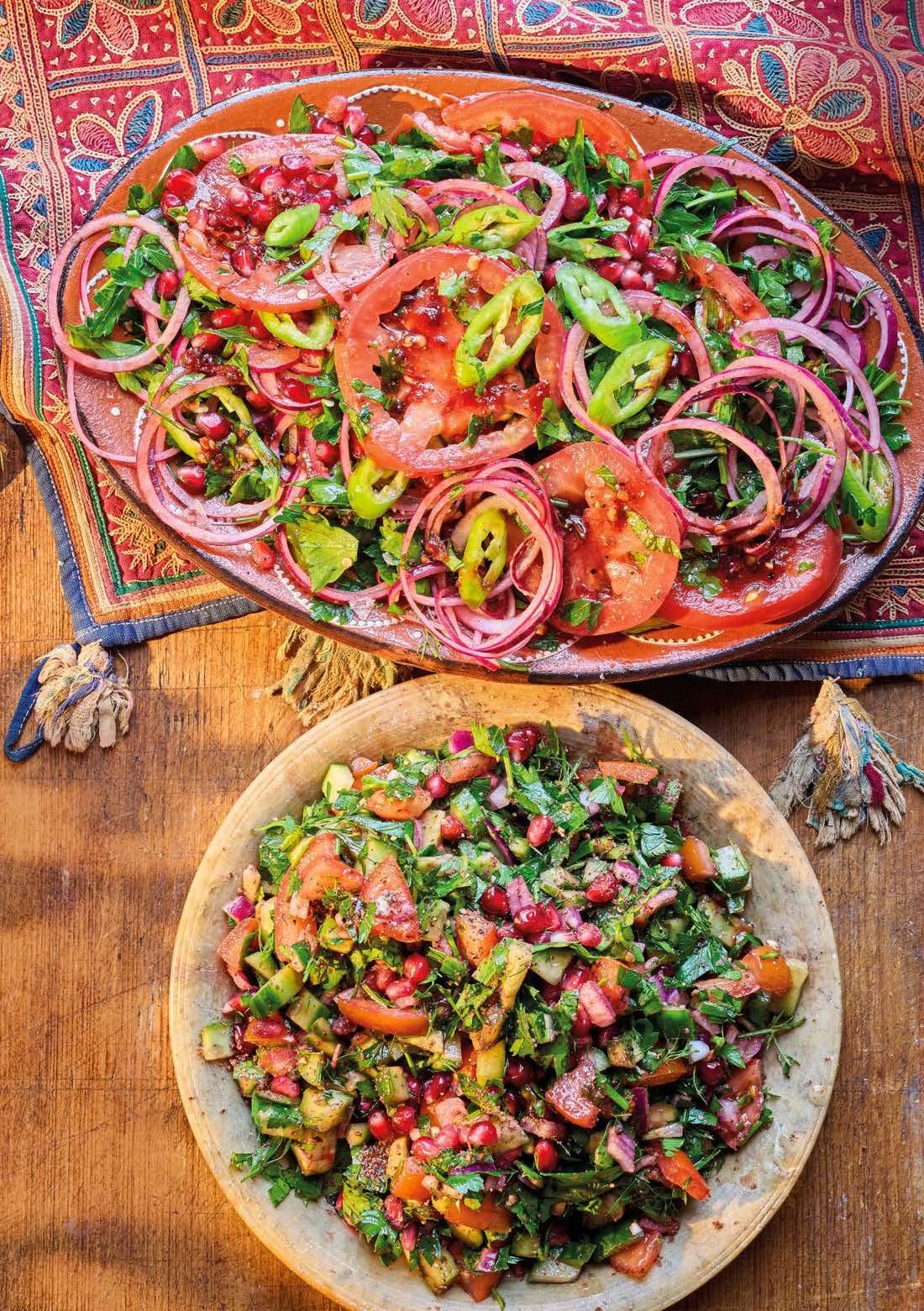
This is one of the simplest salads, pairing perfectly with grilled kebabs and chicken shish. It has a lovely sour taste, which cuts through the fat in rich meat dishes.
SERVES 4 PREP 20 mins NO COOK EASY V
2 large red onions, peeled and cut into thin slices
1 large tomato, cut into thin slices
1 long green biber pepper, cut into thin slices
1 large hot biber pepper, cut into thin slices
bunch of flat-leaf celery or parsley, finely chopped
1 pomegranate, deseeded
1/2 tbsp sumac
1 tbsp red chilli paste
1 lemon, juiced
2 tbsp olive oil
2 tbsp pomegranate molasses chopped spring onions, to garnish
1 Put the onions, tomato and peppers in a large bowl. Add half the chopped herbs and pomegranate seeds, reserving the rest to garnish.
2 Mix the sumac, 1 tsp salt, the chilli paste, lemon juice, olive oil and pomegranate molasses together in a separate small bowl, and combine well into a thick sauce.
3 Pour the sauce over the vegetables and mix together. Garnish with the reserved herbs, pomegranate seeds and spring onions to finish.
MAKES about 200ml
PREP 10 mins COOK 10 mins EASY V
10 young, fresh vine leaves and shoots (stalks)
3 wild shallots, pre-soaked and drained (soaking water reserved), then sliced
2 tbsp pre-soaked qazwan (fruit of the pistachio tree; available in specialist shops) or capers, halved
1/2 lime, thinly sliced
3 tbsp olive oil
Zalatay shwani is a very popular Kurdish salad – easy to assemble and a typical spring dish once cucumbers come into season. Traditionally, this salad was eaten by shepherds along with homemade cheese, yogurt or mastaw (a Kurdish yogurt drink).
2 large beef tomatoes
2 large cucumbers
1 large red onion handful of pomegranate seeds
1 tbsp sumac
1 tbsp pomegranate molasses
1 tbsp olive oil
½ tbsp date molasses
1 small green chilli, deseeded and finely chopped bunch of parsley, finely chopped
1 Finely dice the vegetables – you want them to be the size of pomegranate seeds – then put in a large bowl and mix with the pomegranate seeds, reserving a little for the garnish.
2 Mix the sumac, 1 tsp salt, the pomegranate molasses, oil, date molasses and the small chilli together to make the dressing. Drizzle the dressing over the salad and toss together. Add the parsley and toss again. Garnish with pomegranate seeds and more herbs, if you like.
1 Put the vine leaves and shoots, the shallots, qazwan or capers, lime slices, olive oil, 1/2 tbsp salt and 3 tbsp of the reserved shallot soaking water in a blender, and blend into a smooth, green sauce.
2 Pour the sauce into a saucepan set over a medium heat. Bring to the boil, then remove from the heat and leave to cool. Transfer to a jar Will keep chilled for up to two weeks.
Small.




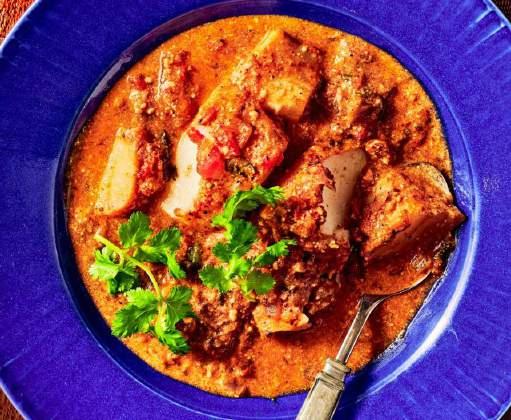

Mother, Baby & Child Awards 2026 returns!
The Mother, Baby & Child Awards in association with Baby & Kids Expo is back to honour the best products, brands, services and retailers within this core market and recognise the achievements of industry luminaries making a profound impact on the journey of parenthood!
The Mother, Baby & Child Awards are entirely consumer-voted, giving you the power to celebrate the people, brands, and services that truly make a difference to families. If you know someone or a business that supports mothers, children, or families in an exceptional way, nominate them now.
All winners will be chosen by public vote, ensuring every award reflects genuine appreciation from our community. Submit your nominations today and help us honour those who make family life better!
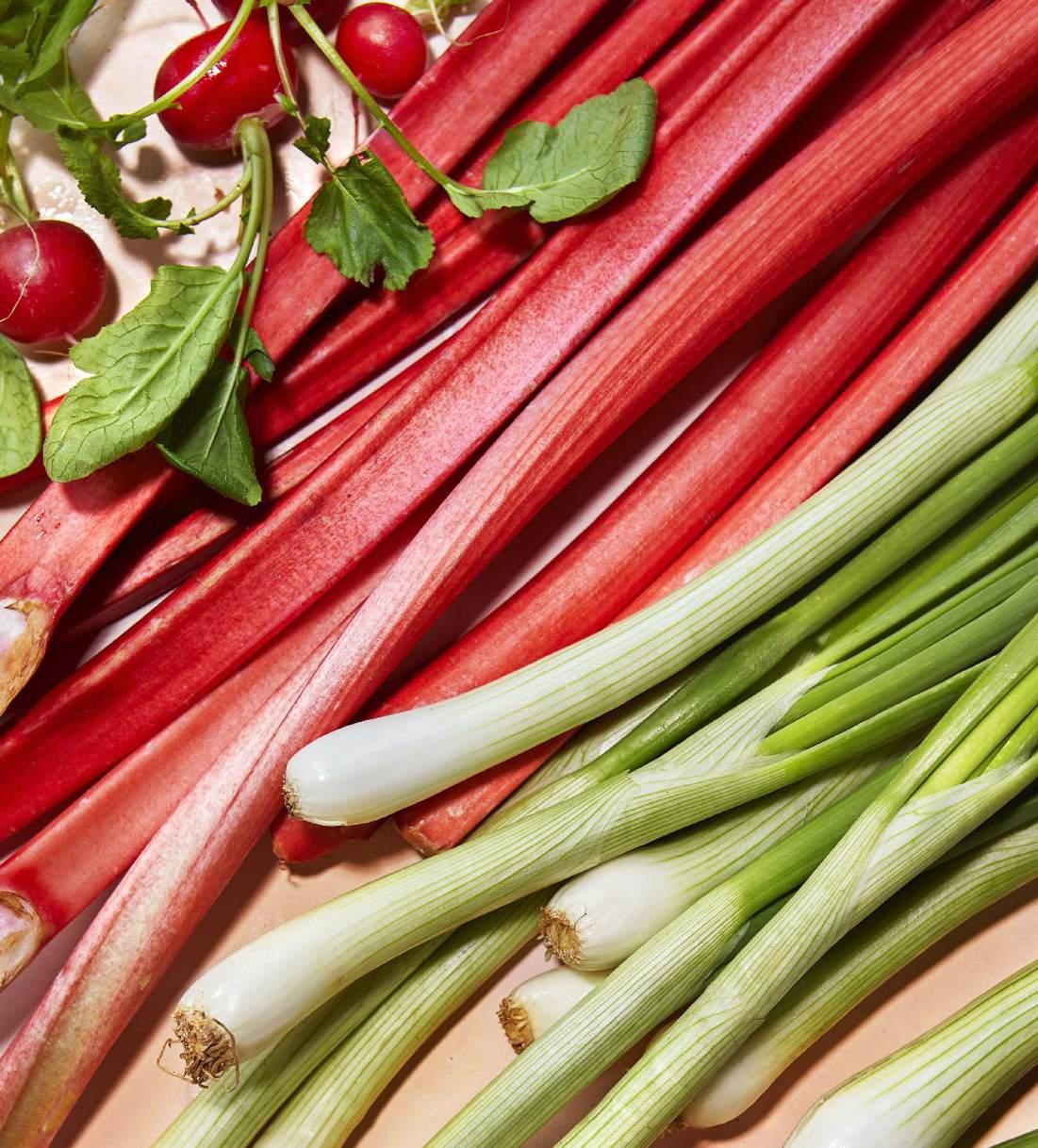
its best


Our food editor Ailsa Burt captures the freshness of spring using rhubarb, radishes, watercress, spring onions and new potatoes photographs MAJA SMEND
AILSA’S TIPS
• If you don’t have dashi, use 200ml veg stock – but we recommend seeking out dashi. Find it in the world aisle with other Japanese products, or in specialist shops.
• To serve this Japanese-style, drizzle over some okonomiyaki sauce and Kewpie mayo. Top with katsuobushi (bonito flakes).
• If you like, shred the green onion tops and dunk in cold water to curl up for a pretty garnish.
The key is in the name: I always associate spring onions with the first real shift into spring, when the days start to feel lighter and meals follow suit. They’re one of the earliest signs that fresh, green flavours are back on the table, whether pulled straight from the garden or bought in generous bunches. Milder and more delicate than regular onions, they have gentle sweetness and a fresh bite that works as well raw as it does cooked. Finely sliced into salads, scattered over noodles or blistered in a hot pan, they bring brightness without overpowering. If you have an abundance, chop and freeze them – they won’t be as crunchy as fresh, but they work in stir-fries or soups.

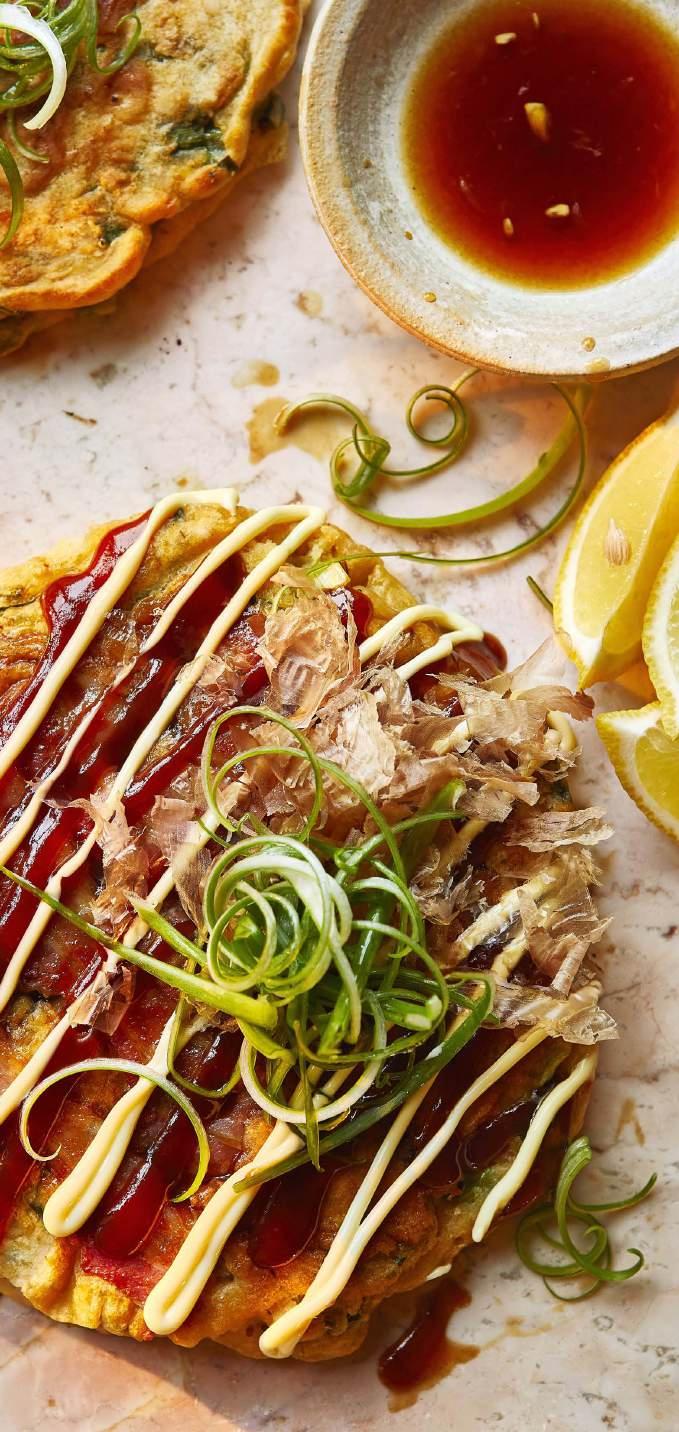
We’re taking inspiration for this dish from Japanese negiyaki, which is very similar to the more popular okonomiyaki, except the cabbage is replaced with spring onions. This isn’t authentic, though, as we’re using a few substitutes and charring the spring onions to bring a slightly smoky flavour to the dish.
2 PREP 5 mins COOK 20 mins EASY
large bunch of spring onions
4 rashers smoked streaky bacon
2 eggs
200g plain flour
1 tsp baking powder
1 tsp dashi powder (see tips)
2 tbsp vegetable oil
1 tbsp soy sauce
1 lemon okonomiyaki sauce, Kewpie mayo and bonito flakes, to serve
1 Trim the spring onions, then finely slice half the green tops and set aside (see tips). Heat a large, dry frying pan over a medium-high heat and cook the whole spring onions for 2-3 mins undisturbed, then shuffle the pan – you should see some char marks on most of the onions. Continue to cook for 5 mins until charred, then set aside on a plate to cool.
2 Meanwhile cut the bacon rashers in half Crack the eggs into a jug and beat. Tip the flour, baking powder and dashi into a large bowl and mix well Roughly chop the cooled whole spring onions into 1/2cm pieces, add to the dry ingredients, then mix in the egg and 150ml water to make a thick batter.
3 Divide the oil between two small, non-stick pans (or heat all the oil in your largest pan) over a medium heat. Divide the batter between the hot pans (or ladle in two pancakes in one large pan). Arrange the bacon over the top of each and cook for 3-4 mins until golden brown underneath – lift one side up slightly to check using a spatula. Carefully flip and cook for 4-5 mins more until the bacon is golden and crisp, and the pancake is cooked through.
4 Meanwhile, pour the soy sauce into a small bowl, cut the lemon into wedges and squeeze some of the juice into the soy sauce to taste. Brush this over the tops of the pancakes and serve hot drizzled with okonomiyaki sauce and Kewpie mayo. Garnish with the green tops of the spring onions and bonito flakes (see tips) and serve with the extra lemon wedges for squeezing over and any remaining dressing on the side.

I always looked forward to rhubarb season when I was little, as Grandma would hand me raw stalks from her garden (leaves removed, as those are poisonous) along with a pot of sugar for dipping. I’d be very happy, whether it was the field-grown, greener rhubarb – now in season – or bright pink forced rhubarb earlier in the year. Fieldgrown rhubarb isn’t as aesthetically pleasing, but it’s just as delicious and can be treated much the same. Not just for dessert, it pairs well with pork or duck, as the tang cuts through the richness of the fatty meat.

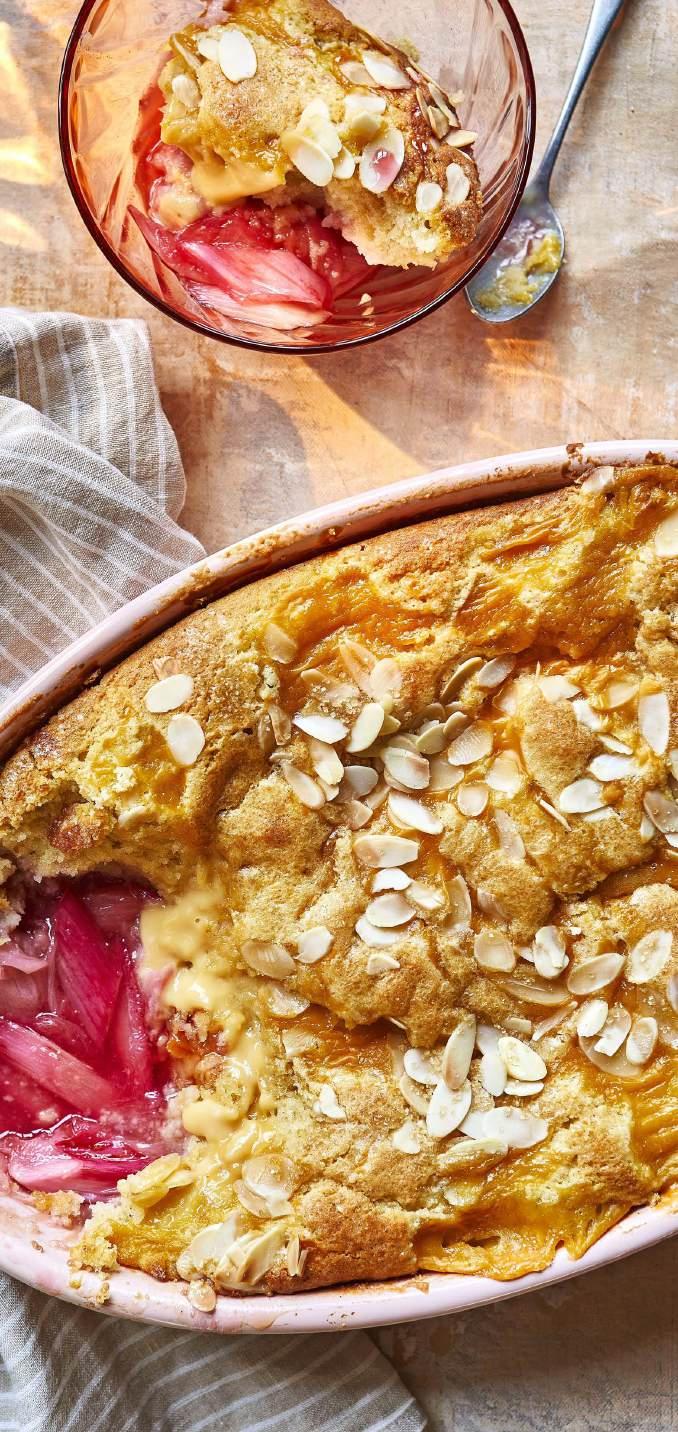
In my house, we’re big fans of desserts that contrast hot and cold temperatures, so serving this with double cream or ice cream is non-negotiable! It’s ideal for those slightly cooler spring days.
SERVES 8 PREP 20 mins COOK 55 mins EASY V
800g rhubarb
250g golden caster sugar
2 tsp vanilla bean paste
200g salted butter, softened
3 eggs
400g can custard
150g ground almonds
200g self-raising flour
1/2 tsp baking powder
cold double cream or ice cream, to serve For the topping
25g flaked almonds
1 tbsp demerara sugar (optional)
1 Heat the oven to 180C/160C fan/gas 4. Cut the rhubarb into 3-4cm pieces, then tip into a roughly 24 x 30cm baking dish along with 100g of the sugar and half the vanilla bean paste. Stir together, then cover and roast for 15-20 mins, or until almost tender. Remove from the oven and set aside. Taste and add a little more sugar if the rhubarb is too tart.
2 Put the remaining 150g sugar, the rest of the vanilla and the butter in a bowl, and beat together for 4-5 mins using an electric whisk until lightened in colour and very fluffy. Crack in the eggs, one at a time, beating well after each addition. Beat in half the custard. Once everything is well combined, sprinkle in the ground almonds, flour and baking powder. Fold in using a spatula until no flour remains.
3 Spoon the mixture over the baked rhubarb and spread out as best as you can. Spoon over the remaining custard in dollops, swirling it into the batter slightly using a cutlery knife. Scatter over the flaked almonds and demerara sugar, if using, then bake for 35-40 mins, or until browned on top and risen. Leave to stand for 5 mins, then serve warm with cold double cream or scoops of ice cream.
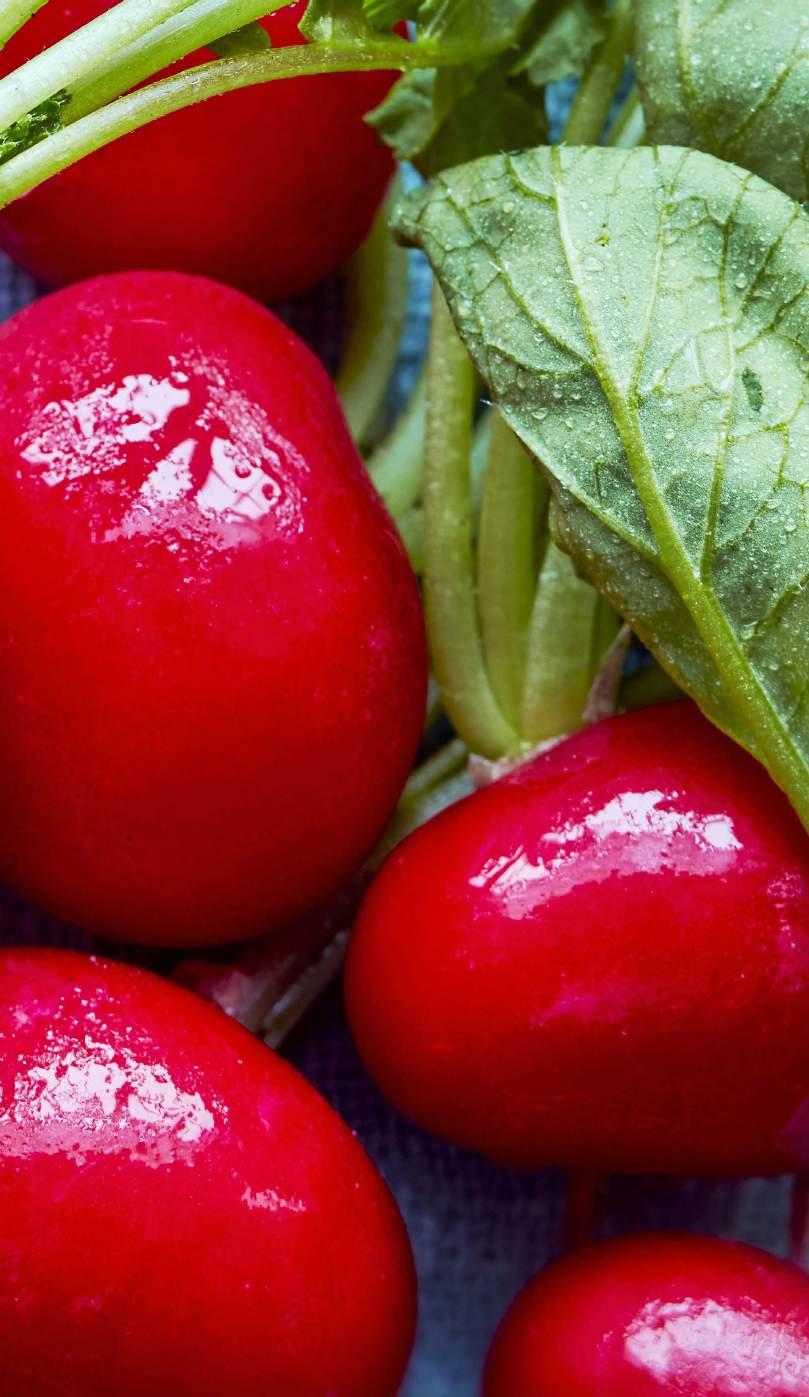
Peppery, pink radishes are a must-buy at this time of year – small, firm and perfectly crisp. While they’re most often used raw, a quick roast or sauté will soften their bite and reveal a surprising mellowness. Even the leaves are worth keeping, as they can be stirred through soups or blitzed into a pesto, making radishes one of those early season ingredients that reward you for using the whole bunch. I love eating radishes plain, dipped in butter and topped with a sprinkle of sea salt flakes.
AILSA’S TIP
If you can’t get burrata, you could use a ball of

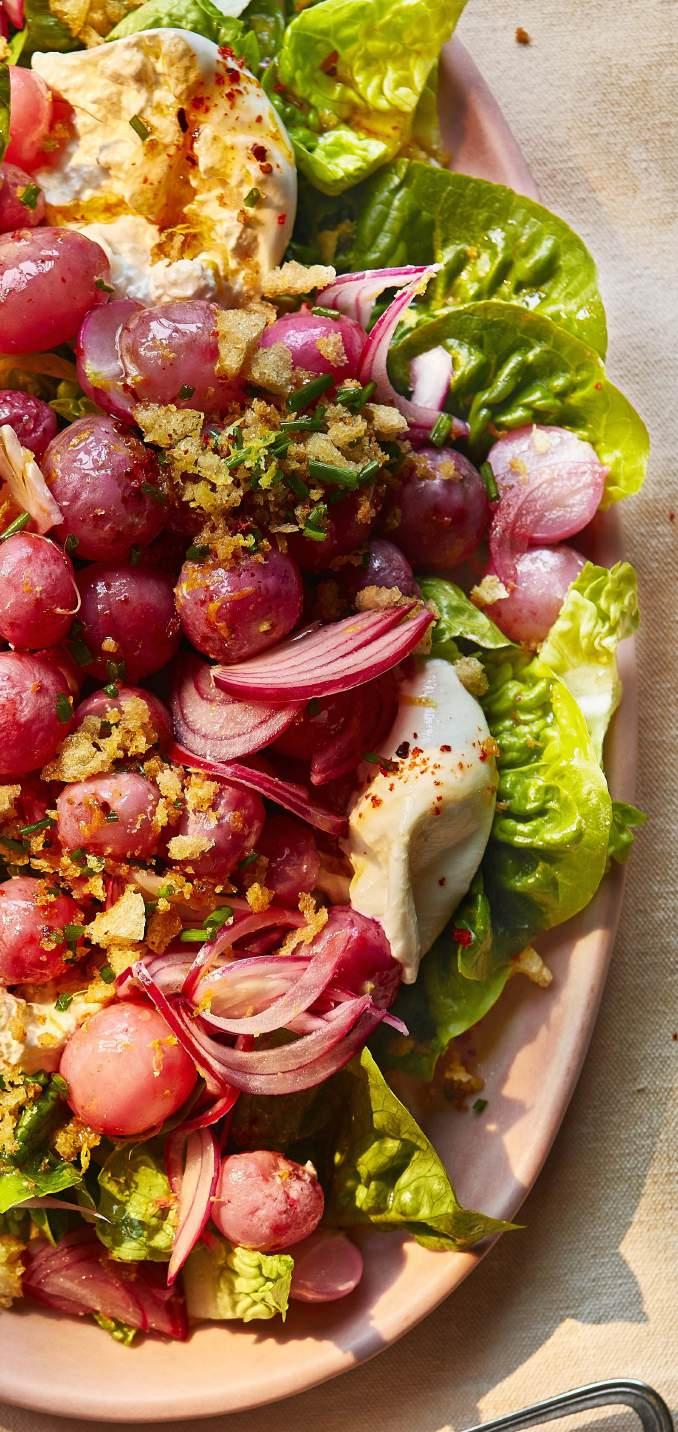
Here’s an excellent starter for Easter – serve with warm focaccia for dipping and scooping, or as part of a spread with charcuterie.
SERVES 4 PREP 20 mins COOK 15 mins EASY V
300g radishes
75ml olive oil
1 lemon
1 small red onion
2 tbsp apple cider vinegar
1/2 -1 tbsp honey
1/2 tsp chilli flakes (optional)
2 Little Gem lettuces
150g ball burrata (see tip) For the pangrattato
2 slices stale sourdough
1 large garlic clove small handful of chives
2 tbsp olive oil pinch of chilli flakes
1 Heat the oven to 200C/180C fan/gas 6. Clean and halve the radishes, or quarter if large. If your radishes came with tops, roughly chop those, too. Toss the radishes (without the leaves) in a baking tray with 1 tbsp of the olive oil. Season and roast for 10-15 mins until just tender. Remove from the oven, stir in the leaves, if you have them, then set aside to cool.
2 Meanwhile, zest and juice the lemon, then finely slice the red onion. Pour the lemon juice into a jar with the vinegar, red onion and a large pinch of salt, then leave to lightly pickle while the radishes cool.
3 To make the pangrattato, tear the sourdough into chunks, tip into a food processor and pulse a few times until you have a mixture of breadcrumbs and bigger pieces. Bash the garlic clove using the flat blade of a knife, and finely chop the chives. Heat the oil in a large frying pan over medium heat and cook the bashed garlic clove for 1 min. Stir in the breadcrumbs and chilli flakes, and season. Toast for 3-4 mins until golden, then transfer to a bowl and leave to cool before stirring in the chives. Remove the garlic clove.
4 Add the honey, remaining oil and chilli flakes (if using) to the jar with the onions, and shake well to combine. Season to taste, adding more honey, if needed. Separate the lettuce leaves, roughly chop and wash well. Dry in a salad spinner or using a clean tea towel.
5 To serve, arrange the salad leaves on plates or a platter. Spoon over the dressing. Drain the burrata and tear it over the salad. Scatter over the radishes, pangrattato and lemon zest.
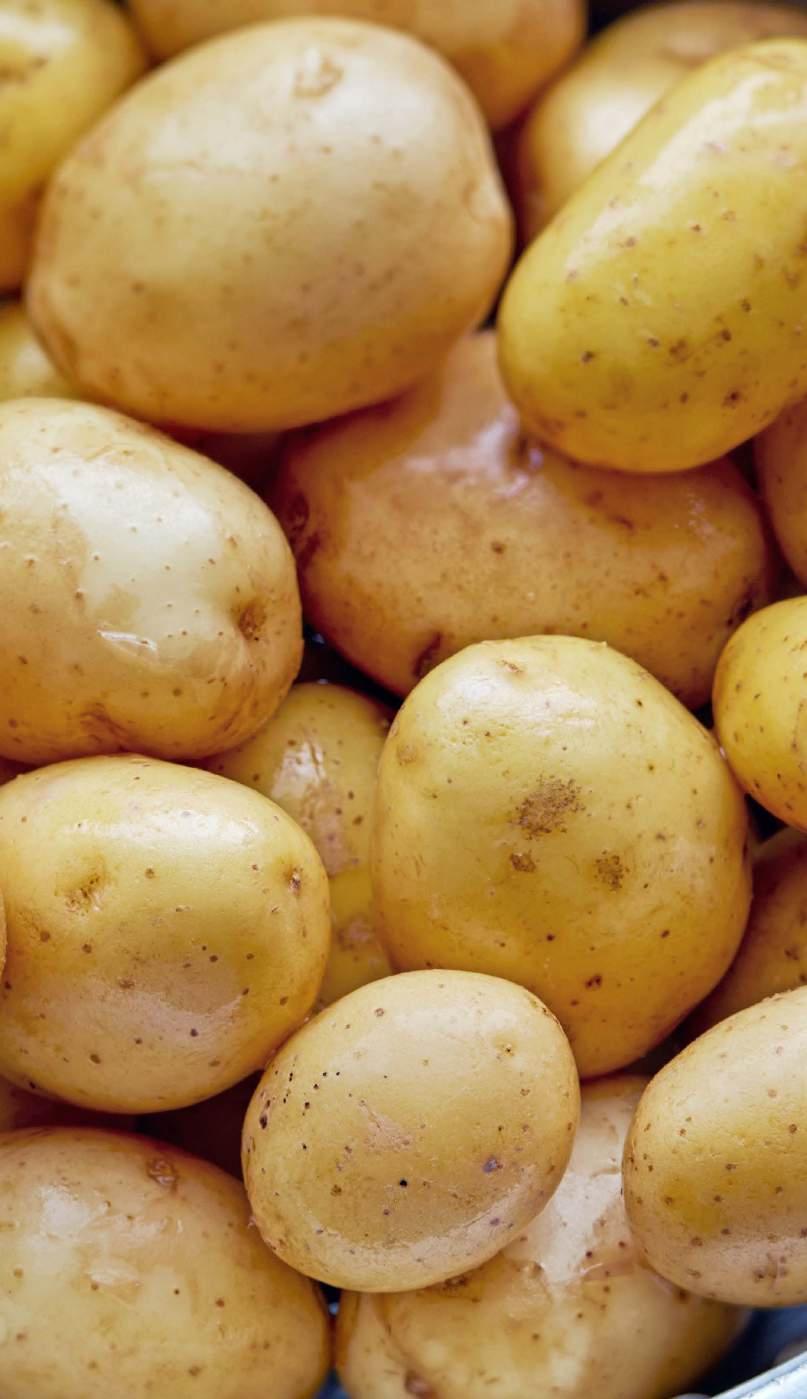
New potatoes, like spring onions, mark a clear shift into spring cooking. Harvested young, they have a naturally sweet flavour and firm, waxy texture that sets them apart from maincrop varieties. Leave the skins on, as they’re thin and provide lots of flavour, but give them a very good scrub before cooking. Simply boiled or steamed, they hold their shape beautifully and pair well with butter, herbs and light dressings, but they’re just as good roasted or mixed into warm salads.
This curry can be kept frozen for up to three months in an airtight container. Defrost in the fridge overnight and reheat gently until piping hot throughout.

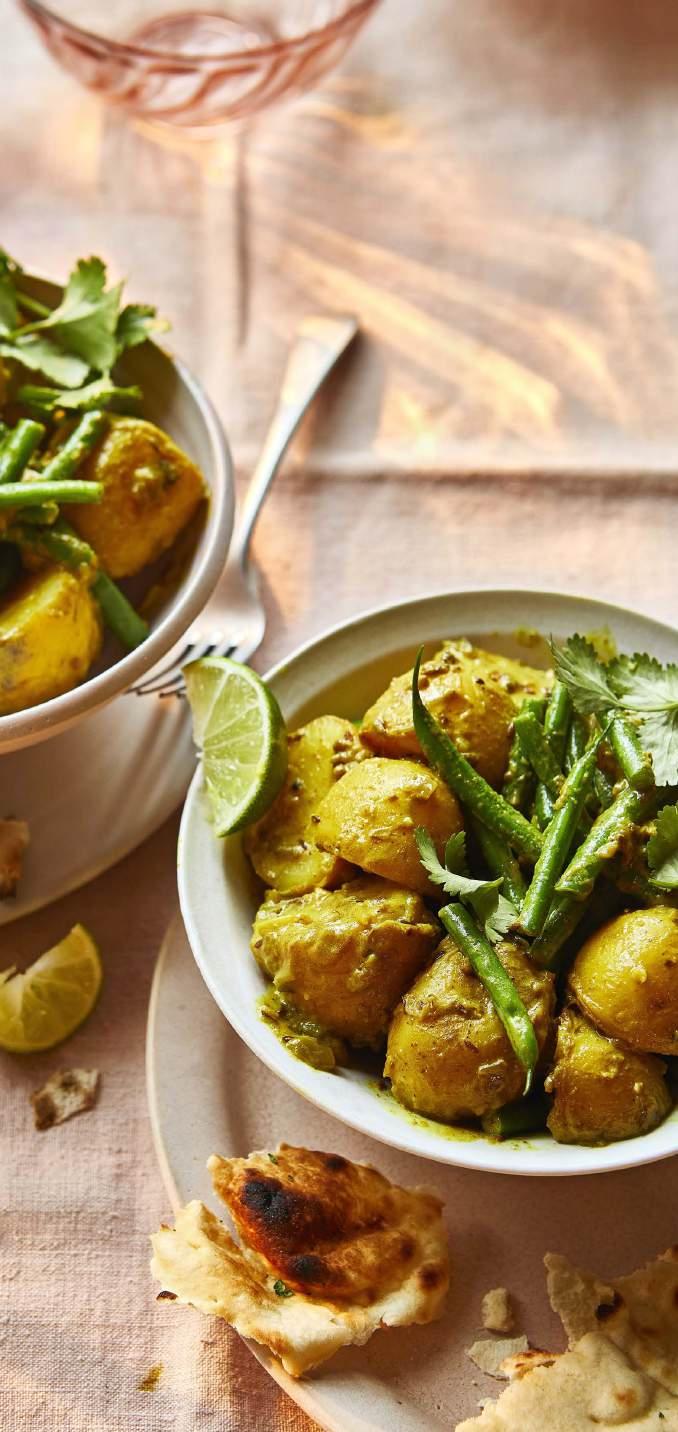
Showcase new potatoes in a creamy, spicy sauce – the coconut milk caramelises with the potatoes, creating extra depth of flavour.
SERVES 4 PREP 10 mins COOK 45 mins
EASY V ❄
1kg new potatoes
200g green beans
1 red onion
2 tbsp coconut or vegetable oil
1 tsp black mustard seeds
2 tsp cumin seeds
3 garlic cloves
1-2 green chillies, to taste
20g ginger
20g coriander
400ml can full-fat coconut milk
1 tsp ground turmeric
1 tsp garam masala
To serve paratha or basmati rice lime wedges
1 Scrub the new potatoes clean, then put in a pan of salted water. Bring to the boil and cook for 10-15 mins until a sharp knife slides through. Scoop out using a slotted spoon and set aside to cool slightly. Halve the potatoes, or quarter any larger ones. Halve the green beans and cook in the same pan of boiling water for 2-3 mins, then drain and set aside.
2 Meanwhile, finely slice the red onion. Heat the oil in a large, deep, non-stick frying pan over a medium heat and cook the mustard and cumin seeds for 2-3 mins until the mustard seeds start to pop and the cumin is fragrant. Stir in the onion and potatoes, turn up the heat to medium-high and cook for 6-8 mins, stirring often until the veg takes on some colour – watch closely so the spices don’t burn. Finely chop the garlic and chillies, and finely grate the ginger. Pick the leaves from the coriander and finely chop the stalks.
3 Push the potatoes to one side of the pan, then at the other side spoon in 2 tbsp of the thick coconut cream from the top of the can Cook until reduced and darkened in colour, about 3-4 mins. Reduce the heat to medium and mix in the garlic, chillies, ginger, coriander stalks, ground spices and 1 tsp fine sea salt. Cook for 2-3 mins until fragrant. Pour in the remaining coconut milk and add the green beans, bring to a simmer and cook for 3-4 mins until thickened. Season to taste and scatter over the coriander leaves. Serve with paratha or rice and lime wedges on the side for squeezing over.
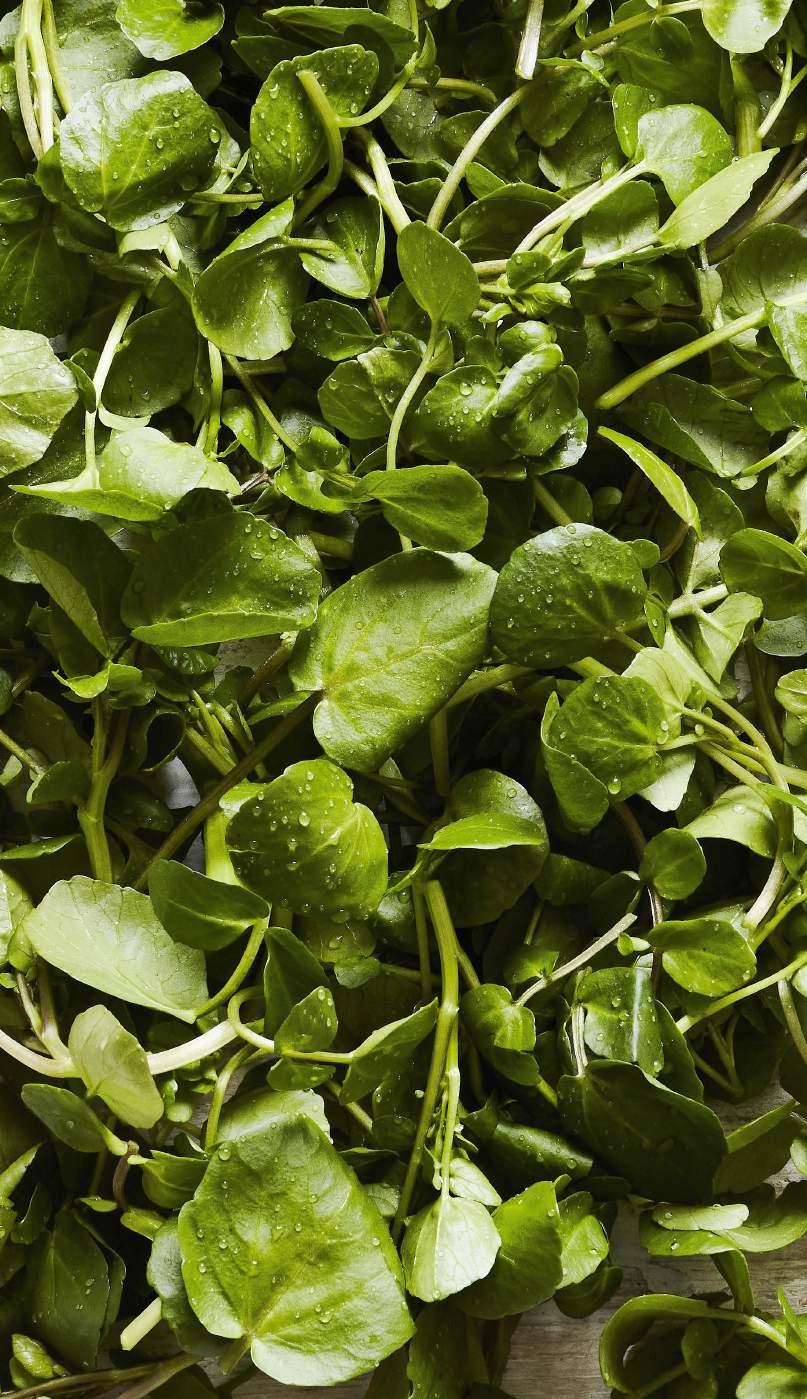
Watercress is a fast-growing, water-loving plant that thrives in cool, flowing streams and chalky beds, which give it its distinctive clean, peppery flavour. Grown in shallow water rather than soil, the leaves stay tender and vibrant, with a freshness that needs very little handling in the kitchen. Raw watercress brings bite and brightness to salads and sandwiches, but it can also be lightly wilted into soups, sauces or potato dishes, where its sharpness softens. I love it chopped into a stuffing to serve with roast chicken – you can find the recipe on the Good Food app (search for ‘crispy-skinned chicken with watercress stuffing’).
Once completely cool, the beef stock can be frozen in an airtight container for up to three months. Reheat gently in a pan until piping hot.
Good-quality beef stock or bone broth really makes this dish sing – try to use fresh instead of cubes, or even homemade, if you have it.


Use watercress in a new way by wilting it into soup – the peppery leaf lends itself beautifully to this aromatic beef broth, which is inspired by Vietnamese flavours.
SERVES 2 PREP 15 mins COOK 35 mins
EASY ❄ broth only
400g large, thick rib-eye or sirloin steak
1 lemongrass stalk
3 large banana shallots
20g ginger
20g coriander
1 tbsp sunflower oil
2 whole star anise
1 tsp coriander seeds
900ml fresh beef stock (see tip)
1 tbsp fish sauce, plus extra to taste
1 tsp light brown soft sugar
2 nests dried flat rice noodles (not vermicelli)
100g watercress
1 lime
1 Season the steak well on both sides using salt. Set aside at room temperature. Bash the lemongrass stalk using the flat blade of a knife, then cut in half. Finely slice the shallots and finely grate the ginger. Pick the leaves from the coriander and finely chop the stalks.
2 Heat the oil in a saucepan over a medium heat and cook the shallots, ginger, star anise and coriander seeds for 3-4 mins until softened and fragrant. Stir in the lemongrass, coriander stalks, stock, fish sauce and sugar. Bring to a simmer and cook for 10 mins.
3 Meanwhile, put the steak in a large, dry non-stick frying pan Set over a medium-high heat and hold fat-side down, using tongs. Cook for 4-5 mins until the fat renders and turns golden. Set the steak flat in the pan and cook undisturbed for 2-3 mins until browned, then flip and cook for a further 2-3 mins until medium rare. Remove to a plate and leave to rest. Add a generous splash of water to the pan and, still over the heat, scrape up any browned bits. Pour this into the beef stock.
4 Cook the noodles following pack instructions. Rinse well to prevent sticking, then divide between bowls. Roughly chop the watercress and add to the broth Cook for 1 min, then season to taste.
5 Juice the lime. Remove the lemongrass and star anise from the broth using a slotted spoon. Pour in any steak resting juices. Season the broth to taste using the lime juice and some salt and pepper. Slice the steak thinly against the grain, then arrange over the noodles and ladle over the stock. Scatter over the coriander leaves.
Our skills & shows editor
Barney Desmazery shares his version of a French bistro classic recipe photograph MAJA SMEND
There are several theories behind the name chicken chasseur, or hunter’s chicken. Some say it’s down to the dish being built around foraged ingredients (mushrooms and wild herbs); others claim hunters enjoyed it after a long day. In any case, it’s a classic French fricassée where chicken joints are lightly fried, then gently braised in a sauce. Done well, it’s pure bistro cooking – deeply savoury and balanced, using good technique to turn simple ingredients into something quietly luxurious.
THE CUT
Using thighs rather than a whole jointed chicken solves the issue of different cook times for different cuts. Plus, thighs are best for slow cooking – juicy and full of flavour.
HUNTER’S SEASON
Season the chicken up to a day ahead so it penetrates the meat, not just the surface.
UNDER THE SKIN
Chicken skin softens during braising, but when you fry the thighs, the fat renders beneath it, adding richness and depth.
ALL FOR ONE
Stay true to the original and use one pan for better caramelisation, a deeper flavour in the sauce and less mess.
IN SEQUENCE
The order in which the ingredients hit the pan matters to ensure the best results without burning the flour or undercooking the veg.

HERBAL NOTES
Bay, thyme and herb stalks build backbone in the sauce, while parsley and tarragon round off and lift the dish with freshness.
MAKE A SPLASH
A splash of brandy or cognac is classic, but optional. If you’re feeling theatrical, flambé it!
SECRET INGREDIENT
We’d get the guillotine for this in olden days, but a splash of soy sauce boosts the savouriness and adds rich colour.
OVEN VS HOB
Traditionally simmered on the hob, chasseur can catch and burn because of its flour-based sauce. Oven-cooking ensures a gentler, more even heat, prevents burning and means no constant stirring.
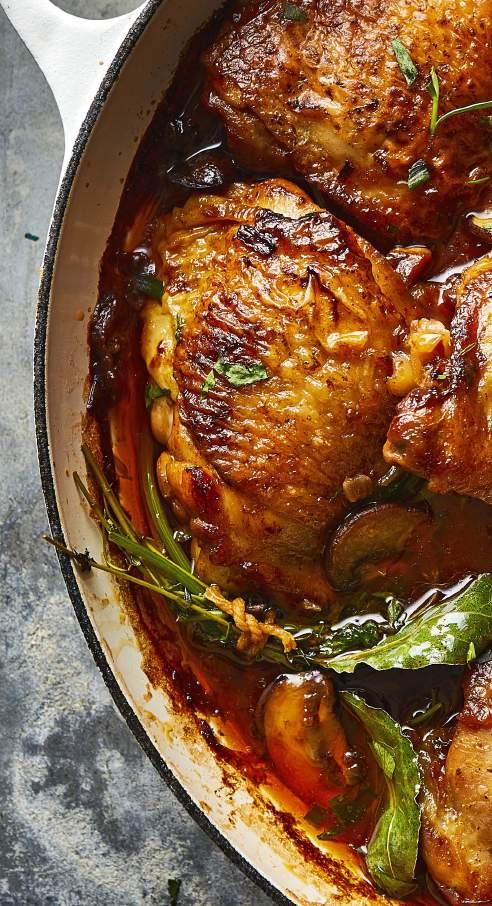

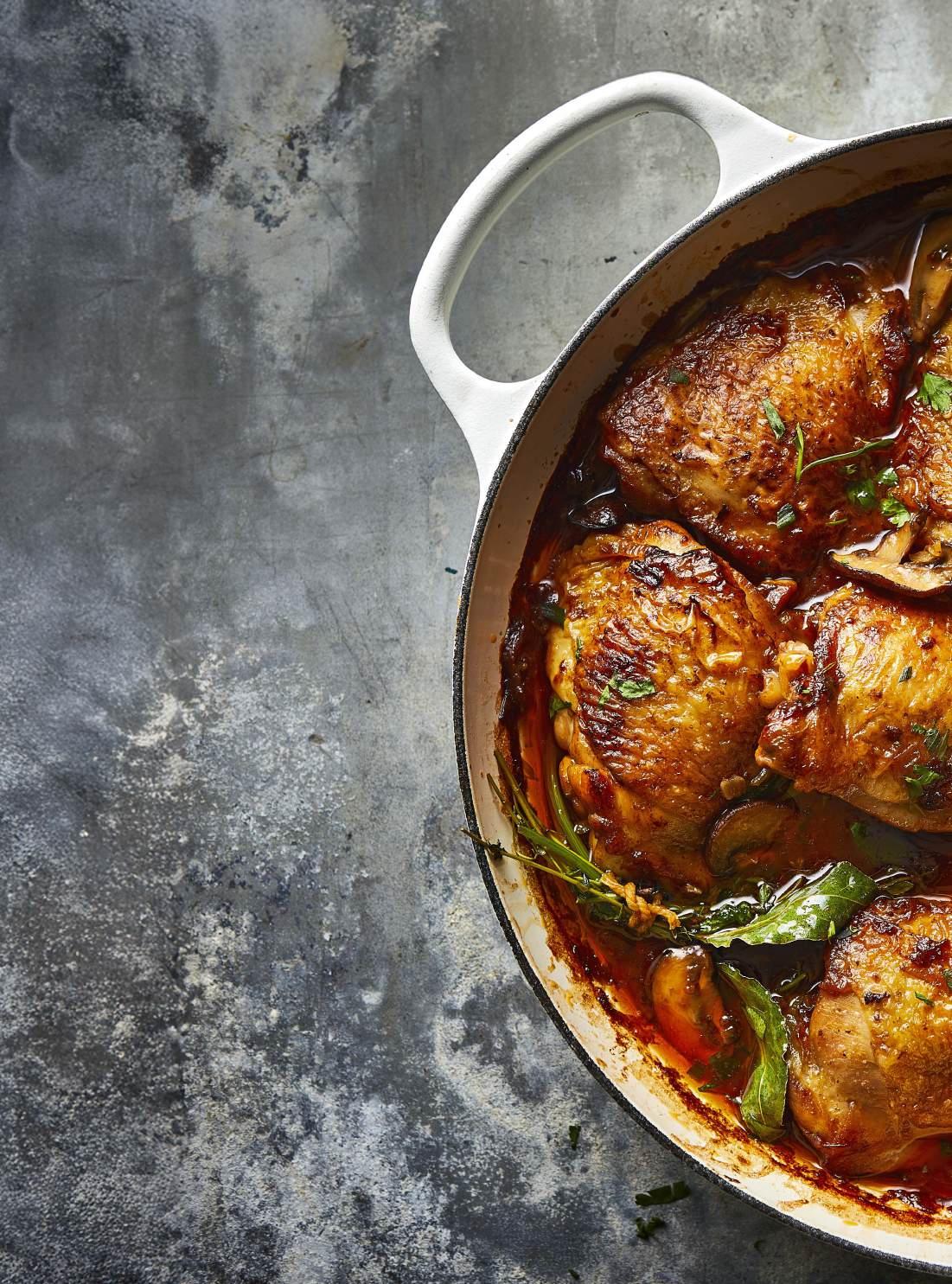
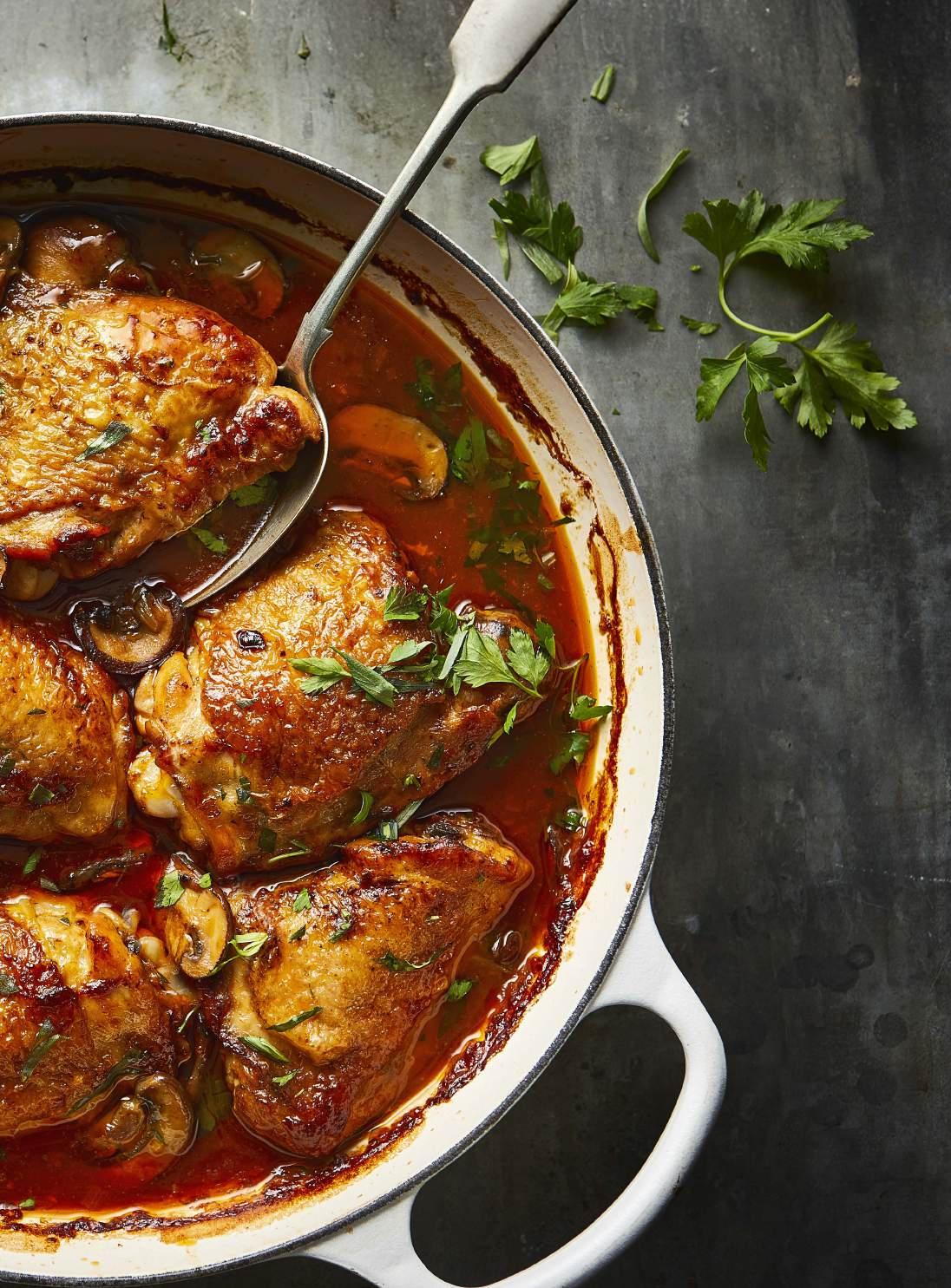
SERVES 4 PREP 30 mins
COOK 1 hr 30 mins EASY
6-8 free-range, skin-on, bone-in chicken thighs, depending on the size of the thighs
300g chestnut mushrooms
1 large or 2 small shallots
2 garlic cloves
25g butter
small bunch of tarragon
small bunch of parsley
large thyme sprig
2 bay leaves
2 tbsp plain flour
2 tbsp tomato purée
2 tbsp brandy (optional)
150ml dry white wine (about 1 glass)
500ml good-quality chicken stock
1 tsp soy sauce (optional)
1 Season the chicken all over generously with salt and pepper. If you have time, do this a few hours (up to a day) ahead, and chill the chicken. Heat the oven to 200C/ 180C fan/gas 6. Slice the mushrooms and finely chop the shallots and garlic, and set all three aside separately. Melt the butter in a large, wide, flameproof casserole or ovenproof frying pan until foaming. Add the chicken thighs, skin-side down, and spend a good 10 mins browning the skin well, using tongs to turn the thighs and crisp the sides if needed – you want them deep golden. Flip and brown on the flesh side for another 8-10 mins, then use tongs to lift onto a plate, leaving the fat behind. While the chicken cooks, pick the leaves from the tarragon and parsley, and roughly chop. Tie the parsley stalks, thyme sprig and bay together.
2 Fry the sliced mushrooms in the pan for 5-6 mins until well coloured and their moisture has cooked off, then add the shallots and garlic, and cook for a few minutes more. Stir the flour into the vegetables and cook for a few minutes to form a sticky paste, then stir in the tomato purée and toast for 2 mins.
3 If using brandy, pour it in and let it simmer down or light it to flambé it if you feel like being fancy (take care!). Pour in the wine and reduce to a thick paste again. Gradually pour in the stock and stir well to make a smooth sauce, then add the soy sauce, if using, and nestle in the herb bundle. Add the chicken thighs to the pan, skin-side up, cover and cook in the oven for 40 mins until the chicken is tender. Let stand for 5 mins, then scatter over the chopped parsley and tarragon, and bring the dish to the table to serve alongside buttery mash or roast potatoes, if you like.


Chef John Chantarasak on showcasing great British produce in Thai dishes at his Michelin-starred restaurant
AngloThai is a distillation of my heritage: Thai on my dad’s side, British on my mum’s. So, the food is rooted in Thai flavours and techniques but built around British, seasonal ingredients – ones that can replicate or replace those we’d usually import from Southeast Asia – without losing connection to the cuisine. We keep imported produce to a minimum. Coconuts are one of our few luxuries, because coconut cream is a pillar of the cuisine, and we press it fresh on site. Beyond that, we
try to only bring in non-perishable goods, if anything – fish sauce, fermented fish products, shrimp paste, palm sugar, niche dry spices – so you’re not losing flavour in transit. A charcoal grill is key, used for direct grilling, smoking and blistering. We also use a high-powered wok for intense heat, alongside hand-pounded prep and more modern kit – it’s the best of both worlds. When we use citrus, we keep it seasonal and relationship-led, working closely with farms, so it’s still about provenance, not just convenience.

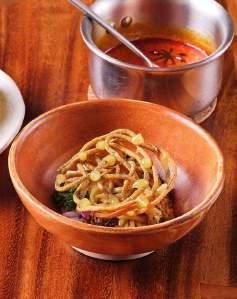
KHAO SOI NOODLES
(above) Coconut curry noodle broth from Chiang Mai, with boiled egg noodles, plus crispy deep-fried noodles on top.
FLOURISH PRODUCE
We buy chillies from Flourish in summer [a regenerative farm in Cambridgeshire], then ferment, pickle, dry and preserve for later.
Northern Thai dry spice blend that varies from village to village; ours is a 20-ingredient ‘house seasoning’.
Sweet vinegar pickle made with cucumber, shallots and other veg, which is served alongside rich coconut curries and grilled meats.
At the base of all our dishes is what I call the “four ‘S’s”: sweet, salty, spicy and sour. I’m always trying to make those big, bold flavours work as one harmonious end product. Very rarely now would I cook a savoury dish and not put a bit of sugar in it, because if something’s very spicy, very sour and very salty, you need a touch of sweetness to bring everything into balance.

It’s the backbone to so many Thai dishes, so I always keep a good shop-bought one at home, like Aroy-D. Pop the can in the fridge in the morning and by evening, you’ll have a thick cream on top that you can scoop, leaving the thinner milk behind. In Thailand, you boil that cream until it splits, then fry your curry paste in it first to build richness before loosening with stock or water and the thinner coconut milk.
We swap traditional rice for UK-grown heritage grains (spelt, barley, emmer, naked oats), cooking them like rice – braised in stock – then wok-fried in fat like fried rice.
Most of the time, we use artisanal Glastonbury honey instead of palm sugar. It’s seasonal, intensely flavoured, and stands up to bold Thai flavours in the way that good palm sugar does.
For acidity (beyond limes), I reach for seasonal ‘sours’ like
…sustainable British ingredient we should eat more of? Heritage grains. They’re underplayed, really delicious and genuinely good for you. I eat far more wholegrains at home now than I ever did before.
…ingredient you’re most surprised works in Thai food? Fig leaves – they’ve got this green, young coconut flavour, and I use them to impart that fresh coconut note.
…misconception people have about Thai food?
That it’s all spicy. It isn’t – there are sweet and mellow dishes, and the joy is having contrasts of flavour and texture on the table.
…mistake we make when cooking Thai food at home? Not making fresh curry paste. It’s more effort than opening a can, but it makes a huge difference and only takes about 10-15 mins.
…piece of Thai kitchen kit every home should have? A good pestle and mortar. It’s not that expensive and will last for life – a big one makes easy work of curry paste.
…smell that transports me to Thailand?
A floral waft of jasmine rice steaming with pandan leaf.
…Thai ingredient you incorporate most in British food? Fish sauce – it’s a building block of flavour.
rhubarb, green gooseberries and sea buckthorn – plus things like verjuice and house vinegars – for that sharp lift.
Mustard or horseradish add a different kind of British heat – it’s not the same as chilli, but it gives a brilliant punch in the right place.



John Chantarasak is chef-owner of AngloThai in London, a restaurant that blends Thai cuisine with local, seasonal British produce. It earned a Michelin star within its first three months for its charcoal-and wok-driven cooking. anglothai.co.uk | @anglothai | @englishhippy


Whether you’re new to baking or a seasoned pro, there’s always lots to learn. Here are the tricks, tips and techniques we swear by words LULU GRIMES
At Good Food, we spend lots of time talking about the tips we’ve learned, whether they’re from years ago or yesterday. Cooking is a lifelong learning experience; there are recipe books to enjoy, skills videos to watch, bakery items to eat and social media feeds of flaky, custardy joy to (doom) scroll through. The food world is teeming with ideas – good and bad. As a food team, we have about 73 years of experience between us. We’ve done a lot of baking and learned many things, some of which we hope you’ll find useful.
Unless you are a free-range, ‘I’ll take the result as it comes’ baker, it’s usually best to follow instructions… provided you trust your recipe supplier. Just be sure to measure everything carefully using scales, measuring spoons and measuring jugs.


Should your butter be soft or hard and cold? You can cream the former and grate the latter, but not vice versa. If you’re creaming butter and sugar, soft butter is more effective. Softened butter holds its shape but sinks into an indent if you push a finger against it – any softer won’t create a good bake. Put an upturned hot bowl over butter to soften it more quickly, but don’t use a microwave – you’re likely to end up with a puddle. Eggs also work differently when cold or at room temperature. Take chilled eggs out of the fridge an hour or so before use so the whites achieve more volume. However, eggs are easier to separate when cold, so chill them before embarking on meringues.
Baking powder and bicarbonate of soda (baking soda) won’t activate if they are old and lack oomph. That cute old tin on the shelf? Dump the contents and keep the tin.


The quantities for basic pastry are half fat to flour, so weigh your flour and you’ll need half the amount of fat to make a very easy-to-use pastry. A splash of hydration may be needed to bring it all together — a tablespoon or two of water, milk or beaten egg, which also helps to enrich the pastry. The more you increase the fat in this equation, the ‘shorter’ the pastry will be, meaning it will be harder for you to roll out or to line your tin with.
Put Silpat or similar silicone mats or rolls of non-stick liner cut to fit your cake tins and baking trays on your Christmas/birthday list, and you’ll not need baking parchment again. If you do need parchment, look for recyclable and compostable brands. Many people like ready-cut parchment liners; if you’re baking lots of cakes at once, you may need them. Likewise, if you bake and freeze cakes with the liners between them, you don’t want to lock your reuseable liners in the freezer for months. Wash parchment carefully after you’ve used it; you should be able to get four or five uses out of each liner and they dry well in the residual heat of an oven. But don’t forget they’re in there.
While on the subject of lining, you don’t need to waste butter under a lining when using baking parchment. Technically, you don’t need to butter a non-stick tin unless the lining is damaged.
A selection of mob-cap-like bowl covers that fit over your bowls (and can be oiled if you are proving dough) will help cut out plastic wrap. That shop of usefulness, Lakeland, has a very handy set that are microwaveand mould-proof and can go through the dishwasher. We prefer the looser ones to the silicone stretchy ones that can ping around a bit. At a pinch, you can use shower caps though these aren’t labelled as food-safe.

Softened butter holds its shape but sinks into an indent if you push a finger against it – any softer won’t create a good bake

baked by pressing it with a floured finger. If it springs back immediately, it needs longer; if it springs back slowly, it’s ready to go in the oven. Once baked, cakes should start to pull away from the sides of the tin, and a skewer should come out clean of cake mixture (a few residue crumbs are fine) when inserted into the middle.
You can listen to cakes to check whether they are cooked –there should be a faint crackling noise emitting from the surface, which is moisture escaping. Too much noise and the cake is underdone; no noise and it’s probably dry. Oops.
Modern-day scales often have a liquid measure function. Unfortunately, different liquids have different densities, and this means the scales are inaccurate unless you’re just measuring water.

Read the recipe and pay close attention to the oven temperature, remembering to go for the lower temperature if you only have a fan setting. Fan ovens add 20C and can ruin your bake if you don’t take that into account. Home ovens vary, so use the visual signs in the recipe as well as the timings – don’t hold the timings to gospel. If cooking in a different country to the one where your recipe was written, it’s useful to know if the ovens are different. American ovens are often bigger and without fan settings; in a UK oven, your bake will cook much quicker.

The secret to perfect yorkshires is equal volumes of flour, eggs and milk. Barney Desmazery (our skills editor) has a foolproof recipe based on this ratio. He measured the volume of a 12 yorkshire pudding tin and then calculated the ingredients to fit. So whether that’s big or little ones, ensure equal volumes for your batter and you’re set.

Only use chocolate chips for melting to a liquid if they are labelled for cooking with, or ‘melts’. Other chocolate chips are formulated to not melt as easily, so they retain their shape in muffins and cookies. This is why chunks of chocolate are used for some cookie recipes – the meltiness of chopped bars gives a different effect.
Choose a 60-70 per cent chocolate to cook with – the lower percentage with more fat and sugar in it is better behaved in all weathers. If you’ve ever tried to make a ganache on a hot or very humid day, you might have discovered this the hard way. High percentage chocolate can be dry and grainy when cooked with.
Cocoa plus chocolate gives you a better chocolate flavour – cocoa amps up the taste without adding more fat.
Brown sugar adds chew, whereas white sugar brings crispness. A combo gives you balance, but a heavier brown sugar ratio (say 70/30) can give you that molasses-rich softness some of us dream about. Then there’s the curveball: icing sugar. Yep, icing sugar in the dough provides a melt-in-the mouth texture. It dissolves quickly into melted butter and gives you a cleaner, less gritty bite.

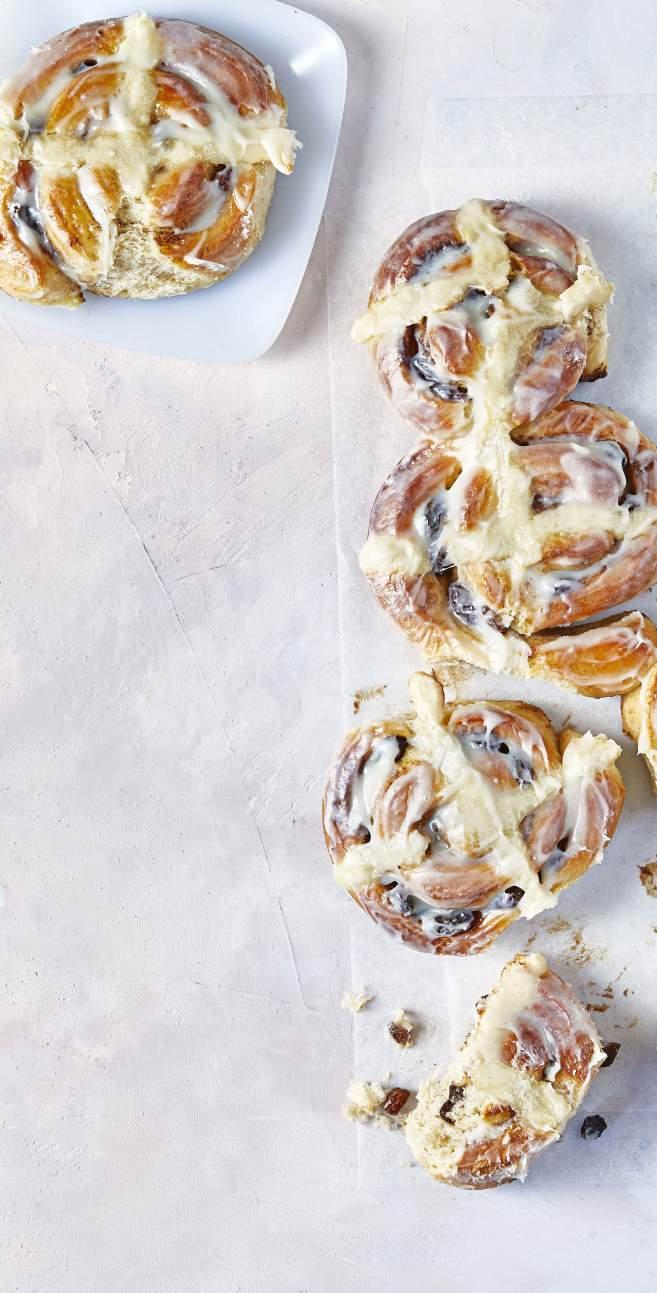
Barney (our sourdough expert) says using fresh yeast makes no difference to baking compared to dried/ fast active yeast. The latter keeps for longer and is so much easier to use. The equation for converting to dried from fresh is to halve the weight stipulated; if you want to convert dried yeast to wild yeast (starter), use 10 times the weight. What does make a difference is a slow prove versus cold prove. Barney says that a method that’s only used in artisan baking can be employed in all yeast baking – the longer and colder you leave something to prove, the more flavour it develops. Hot cross buns, cinnamon buns, pizza dough and any bread dough will have lots more depth of flavour if they’re given a minimum of 8 hrs (or up to 48 hrs) cold proving before you bake them.

Our reviewer Fiona Forman tries fish curry from Soomaaliya by Ifrah F Ahmed and casts her eye over other top titles recipe photograph DOAA ELKADY
The Civil War has deeply impacted every aspect of Somali life over the last 35 years, including its food culture. Somali traditions have long been preserved through oral storytelling rather than written records, and with very few Somali cookbooks in existence, many of their rich food traditions and family recipes were lost as millions were forced to flee. Ifrah’s family sought refuge in the US, but her mother, keen to keep their culture alive, taught her how to make traditional dishes, which paved her way into the culinary world.
Ifrah says, “I came to the United States as a refugee in 1996. My story and that of my family closely mirrors the experience of the more than two million other Somali people in the diaspora. We were families who were living peacefully in our homeland one day, and fleeing to any country that would have us the next.”
Little is known about Somali food outside of Africa, and unlike other neighbouring countries like Ethiopia, it hasn’t yet entered the food mainstream. With Soomaaliya, Ifrah hopes to change that by showing how diverse Somali food is; you’ll find pilafs, stews, baasto (pasta) dishes (a delicious blend of Italian and East African cuisine after Italian colonial rule), and cardamom-spiced bakes. Spices are hugely important, and xawaash is the main spice mix used as the base for so many dishes, including mallay qumbe (opposite), a soothing, fragrant curry, with a mild background heat from the black pepper. Perfect when you want something quick and comforting.

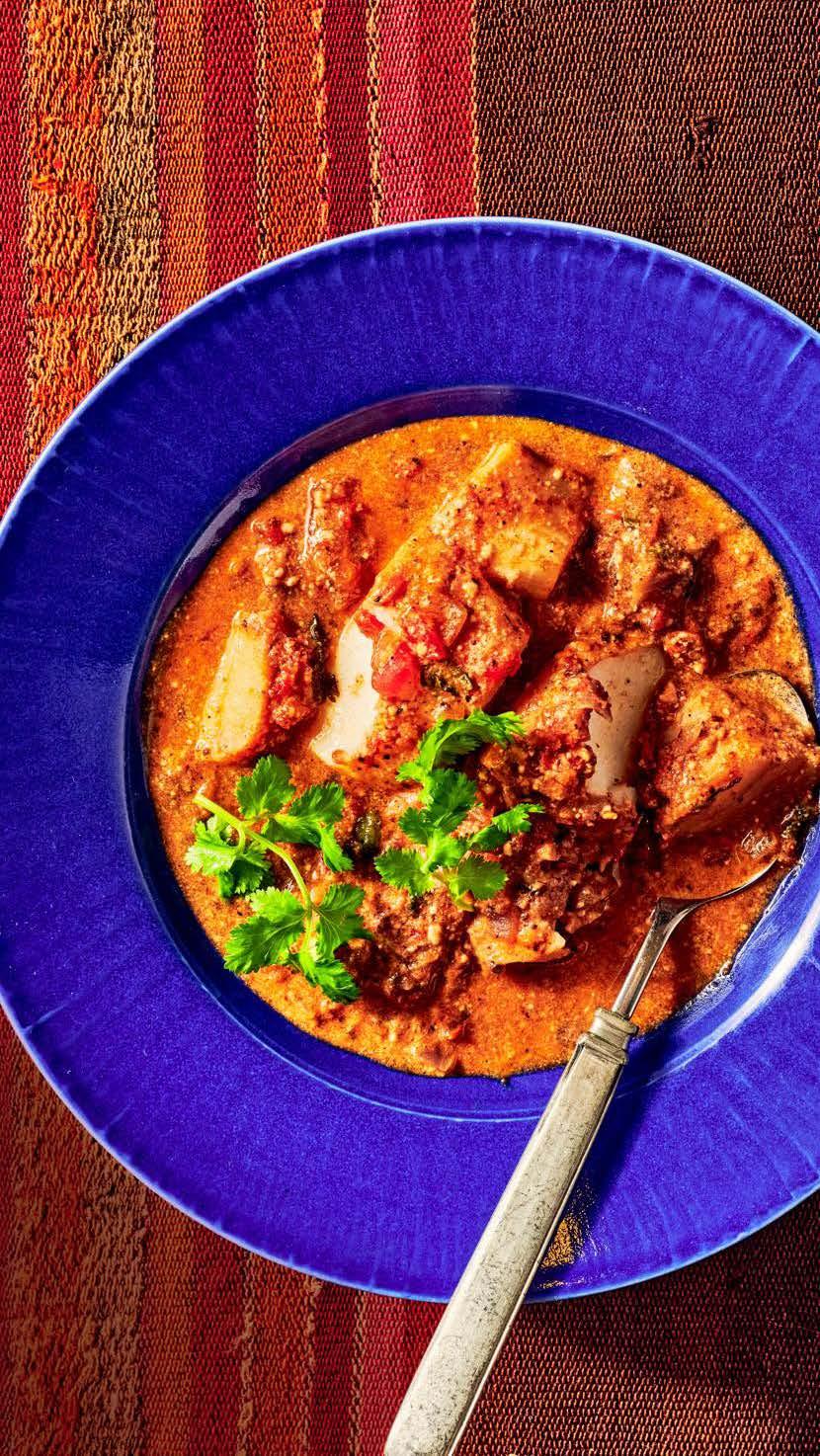
With very few Somali cookbooks in existence, many of their rich food traditions and family recipes were lost as millions were forced to flee


Mallaay qumbe (coconut fish curry)
Despite Somalia’s long coastline, seafood has not traditionally been a big part of the Somali diet outside of coastal towns. In most of the country, red meat has been king, and both seafood and poultry have been seen as lower-class food, or not “real” food, in comparison to red meat. More recently, interest in seafood consumption is growing. Mallaay qumbe can be found up and down the East African coast, including in the coastal towns of southern Somalia. This version is distinctly Somali, due to the addition of xawaash and creamy coconut milk.
SERVES 4 PREP 10 mins COOKS 30 mins EASY
450g barramundi or other firm white fish, cut into serving-size pieces
2 tbsp olive oil
1 medium red onion, chopped
2 large Roma tomatoes, finely chopped
8 garlic cloves, finely chopped
400ml can coconut milk
16g coriander leaves, finely chopped, plus extra to serve
4 tsp xawaash (see recipe, right) steamed white rice, to serve
1 Sprinkle ¼ tsp salt over the fish, then set aside.
2 In a pot just large enough to accommodate the fish in one layer, heat the oil over a medium-high heat. Once the oil is hot but not smoking, add the onion and cook, stirring, for 8-10 mins, until almost translucent. Add the tomatoes, cover, and cook for 7 mins, occasionally stirring and smashing the tomatoes down as they cook.
3 Add the garlic and cook for a minute or two, then add the coconut milk, coriander, xawaash, and 1 tsp salt; stir and cover. Cook for 4 mins to allow the flavours to come together, then add the fish, making sure the coconut milk covers the fish (if necessary, add a splash of water to cover). Cover and cook for 8-10 mins, until the fish can be easily flaked with a fork. Serve the curry with rice, topped with more chopped coriander.
Weeknight Vegetarian by Joe Woodhouse (Kyle Books)
Minimise stress on busy days with chef and author Joe’s new book, full of inspiring, colourful, meat-free dishes like mushroom parmigiana, squash saag and garlic-chilli potato dumplings. Plenty of the dishes can be batch-cooked, and it’s full of make-ahead info and handy tips to help you get dinner on the table in no time. Perfect for vegetarians or those who want to jazz up their meat-free repertoire.
It’s no exaggeration to say that xawaash is at the heart of Somali cuisine. It is Somali history on a plate – a culinary reminder of Somalia’s centuries of global trade, particularly along the Indian Ocean. Xawaash is what makes many dishes taste distinctly Somali.
MAKES about 260g PREP 5 mins COOK 2 mins EASY
100g cumin seeds
70g coriander seeds
35g black peppercorns
1 small-to-medium piece of cinnamon bark
2 tbsp green cardamom pods
1½ tsp whole cloves
30g ground turmeric
1 Toast the cumin, coriander, peppercorns, cinnamon bark, cardamom pods and cloves in a medium frying pan over a medium heat, stirring constantly so the spices don’t burn. The spices are toasted when they have a slightly darker colour and become fragrant, 1-2 mins.
2 Transfer the toasted spices to a blender or spice grinder and blend until they become a fine powder. Transfer to a bowl and mix in the ground turmeric until it’s fully incorporated and the spice mix is golden brown. Leave to cool completely, then store in an airtight container.

The Coastal Forager by Mark Williams (Skittledog)
Foraging guide and chef Mark shows how to safely identify, harvest and cook the abundance of wild coastal food that can be found on our shores. He takes us through the different landscapes and what you’ll find there, from wild thyme and rock samphire from the cliffs to sea kale and sea beet from the beach. There’s also a guide to shellfish foraging and brilliant recipe ideas.
Want to introduce your culinary offerings, restaurant, chef or FMCG/CPG brand to our targeted foodie audience? Let Good Food Middle East source the perfect venue, manage the guest list and take care of everything you need to showcase your concept to our loyal community via a fun, foodie event.



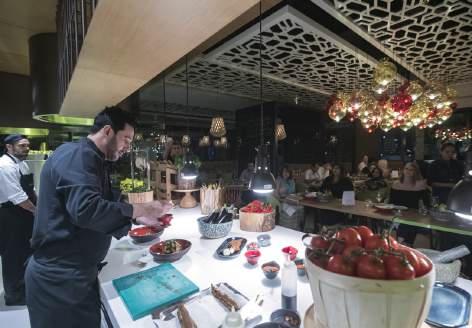
For more information, email info@cpimediagroup.com
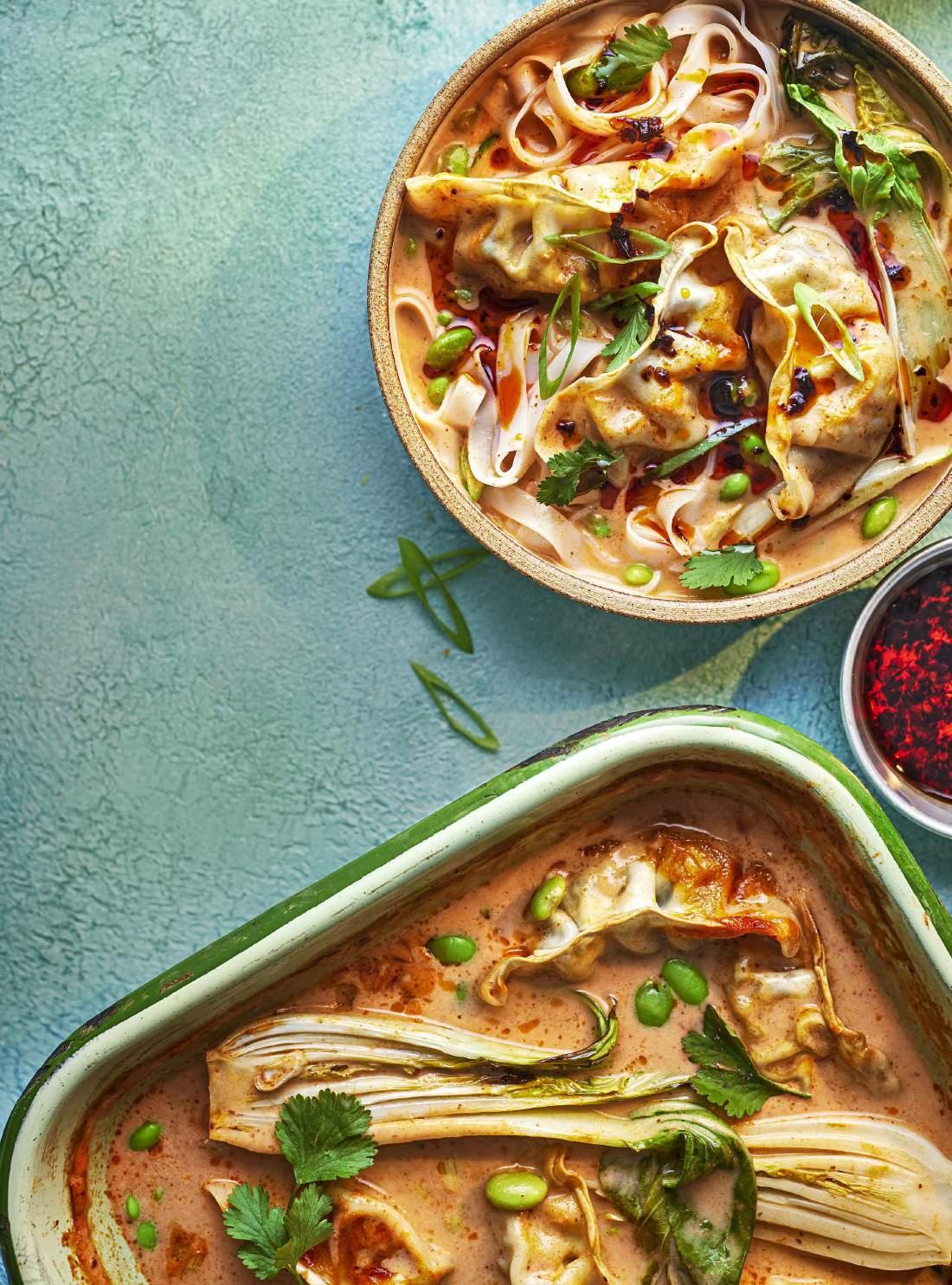
Need to feed the family in a flash or pack lunch for a day out over Easter? Our head of food
Cassie Best has easy dinners, snacks and get-ahead ideas for stress-free meals photographs TOM REGESTER
Creamy coconut dumpling traybake
Our take on this viral recipe is the ideal dinner for when you need to quickly throw something together.
SERVES 4 PREP 10 mins
COOK 30 mins EASY
2-4 tbsp red Thai curry paste (see tip)
1 tbsp light or dark brown soft sugar
2 tsp fish sauce
2 tbsp soy sauce
2 x 400g cans coconut milk
2 limes
150g frozen edamame
3 baby pak choi
12 frozen gyoza dumplings (chicken, pork or veg)
6 spring onions
2 tsp sesame oil
small handful of coriander
1 red chilli or crispy chilli oil, to serve (optional)
sooked noodles or sticky rice, to serve
1 Heat the oven to 200C/180C fan/ gas 6. Combine the curry paste, sugar, fish and soy sauces, coconut milk and juice of 1 lime in a large rectangular baking dish. Season.
2 Stir in the frozen edamame, halve the pak choi and nestle that in Arrange the gyoza in the dish – they should sit just below sauce level, with the tops sticking out. Chop the spring onions, scatter them over, then drizzle the sesame oil over the exposed parts of the pak choi and gyoza. Bake for 30 mins.
3 Cut the other lime into wedges. Pick the leaves from the coriander, then scatter these over the dish. If you like, slice a chilli and scatter this over too, or drizzle with chilli oil before serving over noodles or rice with plenty of the sauce and the lime wedges on the side
Check for spice
Thai curry pastes vary in heat level. Generally, the thicker the paste, the punchier it tastes. To test this, fry a little in some coconut milk and taste before using.
Giant sausage harissa & apricot plait
If you’re planning a day out, bake, cool and wrap up this fruity sausage roll to keep hunger pangs at bay. Or, serve with one of our suggestions below.
SERVES 4 PREP 20 mins
COOK 45 mins EASY ❄
75g shelled pistachios, plus 1 tbsp
75g dried apricots
small bunch of parsley
500g sausagemeat
50g breadcrumbs
1 tbsp harissa paste
325g sheet puff pastry
1 egg yolk (freeze the white to use in another recipe)
1 tbsp cumin seeds
1 Roughly chop the pistachios, apricots and parsley, then tip into a large bowl and mix with the sausagemeat, breadcrumbs and harissa paste to combine.
2 Unroll the puff pastry sheet on its baking parchment, with one of
Combine 50g natural yogurt with 50g mayonnaise, 2 tsp harissa, the zest and juice of 1 lemon, 2 tsp honey and some seasoning in a large bowl (A pinch of sumac is nice here, too, if you have it.) Toss with 1/4 cabbage, shredded (we used a pointed cabbage, but any will work), 2 shredded carrots and 1/2 onion, thinly sliced.
the short sides facing you. Tip the sausagemeat mixture onto the pastry, and shape into a large log down the middle.
3 Make 1cm cuts along the long sides of the pastry, from the edge to meet the filling in the middle. Starting from the right side, fold the first pastry strip over the filling to meet the left side. Repeat with the first strip on the left, then continue down the length, alternating between right and left to create a plait and enclose the filling.Beat the egg yolk, then brush this over the pastry plait. Scatter over the cumin seeds. Chill until you’re ready to cook. Will keep chilled for up to a day, or frozen for up to two months
4 Heat the oven to 200C/180C fan/ gas 6. Bake the plait for 45 mins until golden brown. Chop the 1 tbsp pistachios and scatter these over, then slice and serve with one of our side dishes, or leave to cool completely before wrapping for a packed lunch
Cut 4 small sweet potatoes into wedges, tip onto a large roasting tray and toss with 2 tbsp olive oil and seasoning. Roast alongside the plait for 40 mins, shaking the tray occasionally. Once cooked, scatter over 100g crumbled feta and a handful of chopped parsley
Make your favourite roast potatoes, then (after draining the fat) toss with 2 tsp cumin seeds
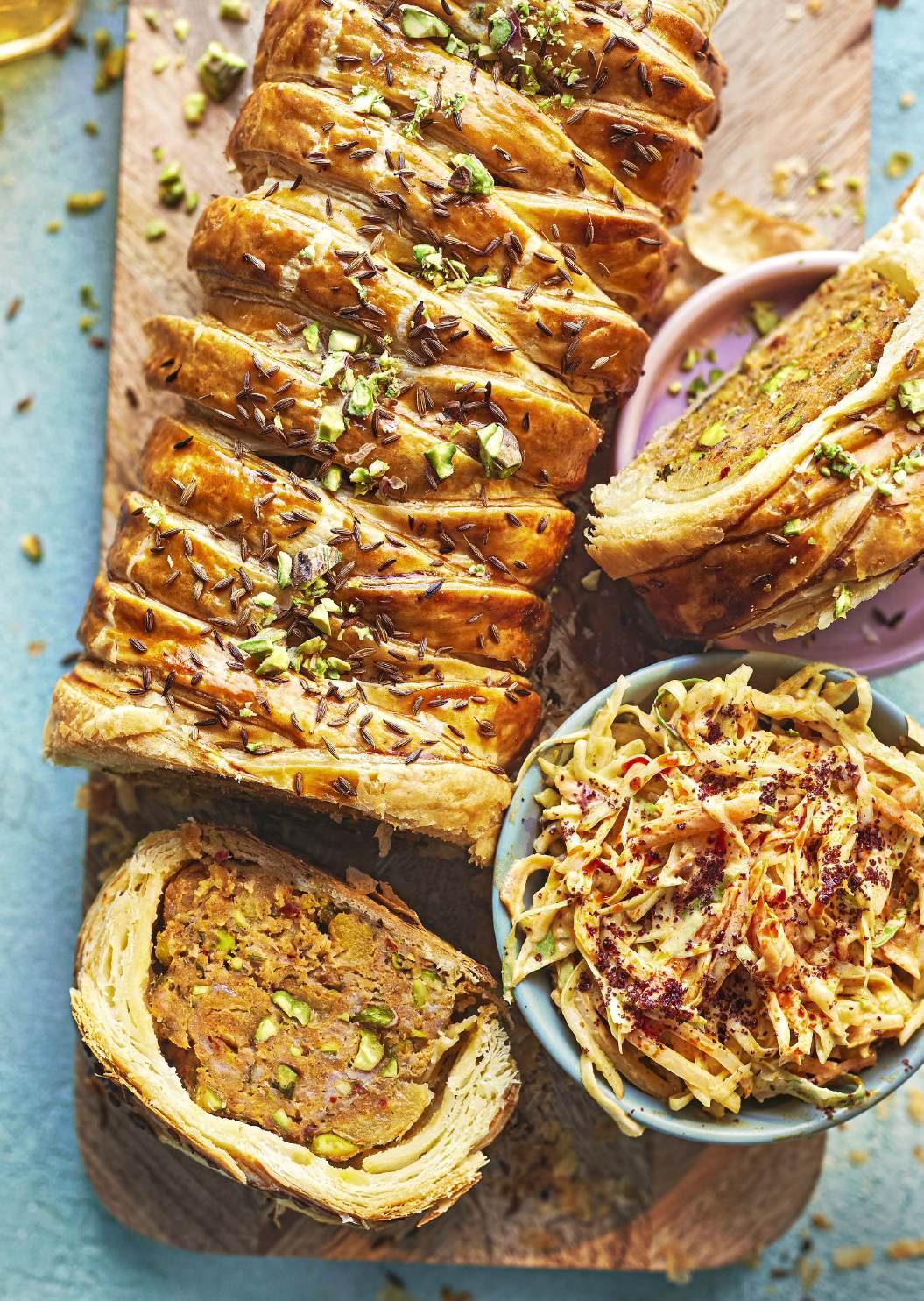
Sticky sesame, soy & honey chicken
Prep this in a slow cooker at lunchtime, then serve for dinner.
SERVES 6 PREP 10 mins COOK 4-5 hrs EASY ❄
1 chicken stock cube or 400ml fresh chicken stock
6 garlic cloves or 1 tbsp garlic purée
15g ginger or 2 tbsp ginger purée
5 tbsp soy sauce
2 tbsp ketchup
1 tsp Chinese five-spice powder
10-12 skinless, boneless chicken thighs
11/2 tbsp cornflour
50ml Shaohsing rice vinegar
50g honey
1 tbsp vegetable oil
10 spring onions
11/2 tsp sesame oil
cooked rice or noodles, to serve 1 tbsp toasted sesame seeds
1 Crumble the stock cube into a large heatproof jug and stir in 350ml boiling water. If using fresh stock, heat until steaming. Crush the garlic and finely chop the
ginger. Stir into the stock with the soy sauce, ketchup and five-spice.
2 Pour the stock into a slow cooker (or large casserole or baking dish). Add the chicken, cover and cook on high for 4-5 hrs (or for 2 hrs at 160C/140C fan/gas 3 in the oven).
3 Mix the cornflour with a splash of water until smooth. Pour into the cooker with the vinegar and honey, and cook for 20-30 mins more until the sauce has thickened and the chicken is very tender and falling apart (or, cook on the hob for 10 mins, carefully pouring into a large pan first if your dish isn’t flameproof) Once cool, will keep frozen for three months. Defrost and reheat until piping hot.
4 Meanwhile, heat the veg oil in a frying pan over a high heat and stir-fry the spring onions for a few minutes until slightly softened and charred, then roughly chop.
5 Roughly shred the chicken while still in the slow cooker, then stir in the sesame oil. Serve over rice or noodles, scattered with the spring onions and sesame seeds.
SERVING
kcals
Ways to serve Pile the pulled pork (overleaf) into buns with pickled red onions, coriander and crispy pork crackling. You can also serve in wraps, or as a jacket potato filler.
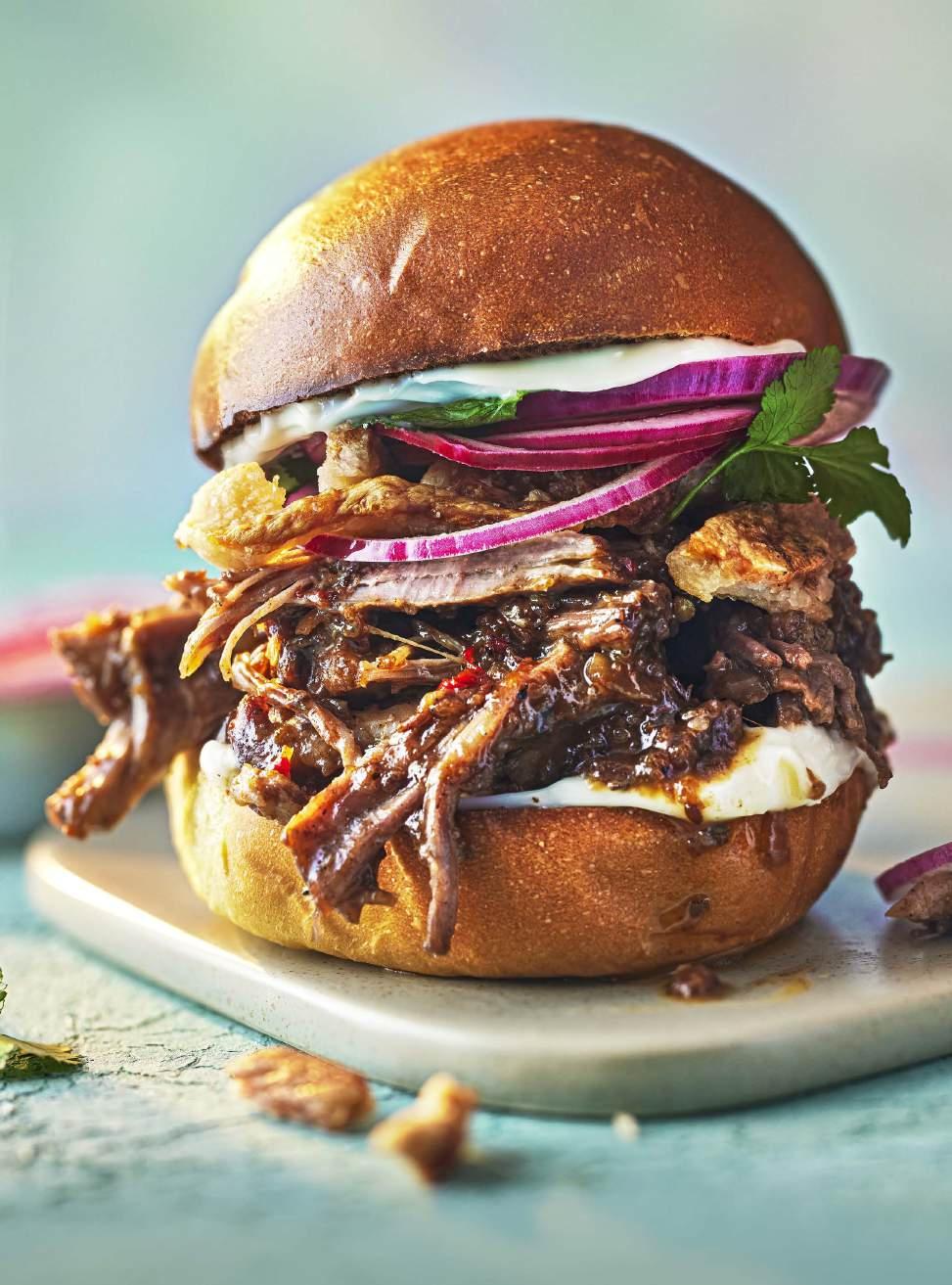
Smoky citrus & chipotle pulled pork
Because you can serve this punchy pulled pork in so many ways, it’s a great one to prepare in batches to freeze and cook later. Try in buns, wraps and jacket potatoes.
SERVES 8 PREP 10 mins
COOK 4-6 hrs EASY ❄
1 large onion
6 garlic cloves
2 medium red chillies
1 tbsp cumin seeds
2 tsp ground cinnamon
1/2 tsp ground allspice
2 large oranges
3 limes
2 tsp dried oregano or 4 oregano sprigs
1 tbsp chipotle paste
50g red wine vinegar
50g light or dark brown soft sugar
2kg boneless pork shoulder burger buns, tortilla wraps, rice or jacket potatoes and your choice of toppings, to serve
1 Cut the onion into quarters and peel the garlic. Heat a dry frying pan over a medium heat and cook the onion, cut-sides down, along with the garlic and whole chillies for a few minutes until deeply charred –you want them to impart a smoky, scorched flavour, but don’t worry about cooking them fully. Tip the charred veg into a food processor.
2 Toast the cumin seeds in the pan for a few minutes until fragrant, then tip into the food processor with the rest of the dried spices and 1/2 tsp black pepper. Juice the oranges, zest and juice the limes, then pick the oregano leaves (if using fresh). Tip the citrus juices and lime zest, the oregano, chipotle paste, vinegar and sugar into the food processor, season with a good pinch of salt, and blitz until smooth
3 Remove any kitchen string from the pork, if it’s tied, and remove the rind (see Cassie’s tip for how to turn this into pork scratchings). Cut the meat into four smaller chunks and transfer to a large container or freezer bag. Pour over the marinade and chill until needed. Will keep chilled for up to two days, or frozen for up to two months. Defrost fully before cooking as directed
4 When you’re ready to cook, heat the oven to 150C/130C fan/gas 2. Tip the pork and marinade into an ovenproof dish with a tight-fitting lid (or the bowl of the slow cooker) Cover and cook for 4-6 hrs until the pork is very tender and falling apart, checking every couple of hours and adding a mugful of water if it becomes too dry (Or, cook for 6-8 hrs on low in a slow cooker – this will produce a lot of liquid by the end of cooking, so if you like, pour the liquid into a pan and simmer over a high heat to reduce into a rich sauce before pouring it back over the pork.)
5 Shred the pork using two forks, then toss through the sauce in the dish. Serve in buns, wraps or over rice or jacket potatoes, along with your favourite toppings. GOOD TO KNOW vit c
Extra-crisp pork scratchings
Score the pork rind using a sharp knife, then season well with salt. Set on a wire rack over a baking tray to dry for 30 mins at room temperature. Heat the oven to 240C/220C fan/gas 9. Pat the rind dry using kitchen paper, then roast for 20-25 mins until golden, crisp and puffed up. Leave to cool before chopping into small chunks.
Keep a stash in the freezer for quick lunches and pan-fry to heat through.
MAKES 8 PREP 25 mins plus cooling COOK 10 mins EASY V ❄
2 sweet potatoes (about 300g)
1 red onion
small bunch of coriander
1 lime
1 tbsp chipotle paste
400g can pinto beans
200g feta
8 flour tortilla wraps vegetable oil, for frying soured cream, chilli sauce or guacamole, to serve (optional)
1 Prick the sweet potatoes all over with a fork before cooking. You can do this in the air-fryer at 200C for 30 mins, microwave on high for 12 mins, or roast at 200C/180C/ gas 6 for 40 mins. Leave to cool.
2 Scoop the potato flesh into a large bowl. Finely chop the onion and coriander, then juice the lime. Add the onion, coriander, lime juice, chipotle paste and some seasoning to the bowl and mix well.
3 Drain the beans and tip into the bowl, then crumble in the feta. Mix using a fork, roughly mashing some of the beans, but leaving some whole for a mix of textures
4 Working with one wrap at a time, lay it out on a board and spread roughly an eighth of the sweet potato mixture evenly over half of the wrap. Fold in half to make a half-moon shape. Repeat with the remaining wraps and filling until everything is used up. To freeze, transfer the wraps to freezer bags, separated with baking parchment, and freeze for up to three months.
5 Heat a drizzle of oil in a frying pan over a low-medium heat and fry the quesadillas for 3-4 mins on each side (or 5-6 mins from frozen, covered with a lid) until crisp and hot through the centre. Serve with soured cream, chilli sauce or guacamole, if you like.
GOOD TO KNOW fibre vit c 1 of 5-a-day
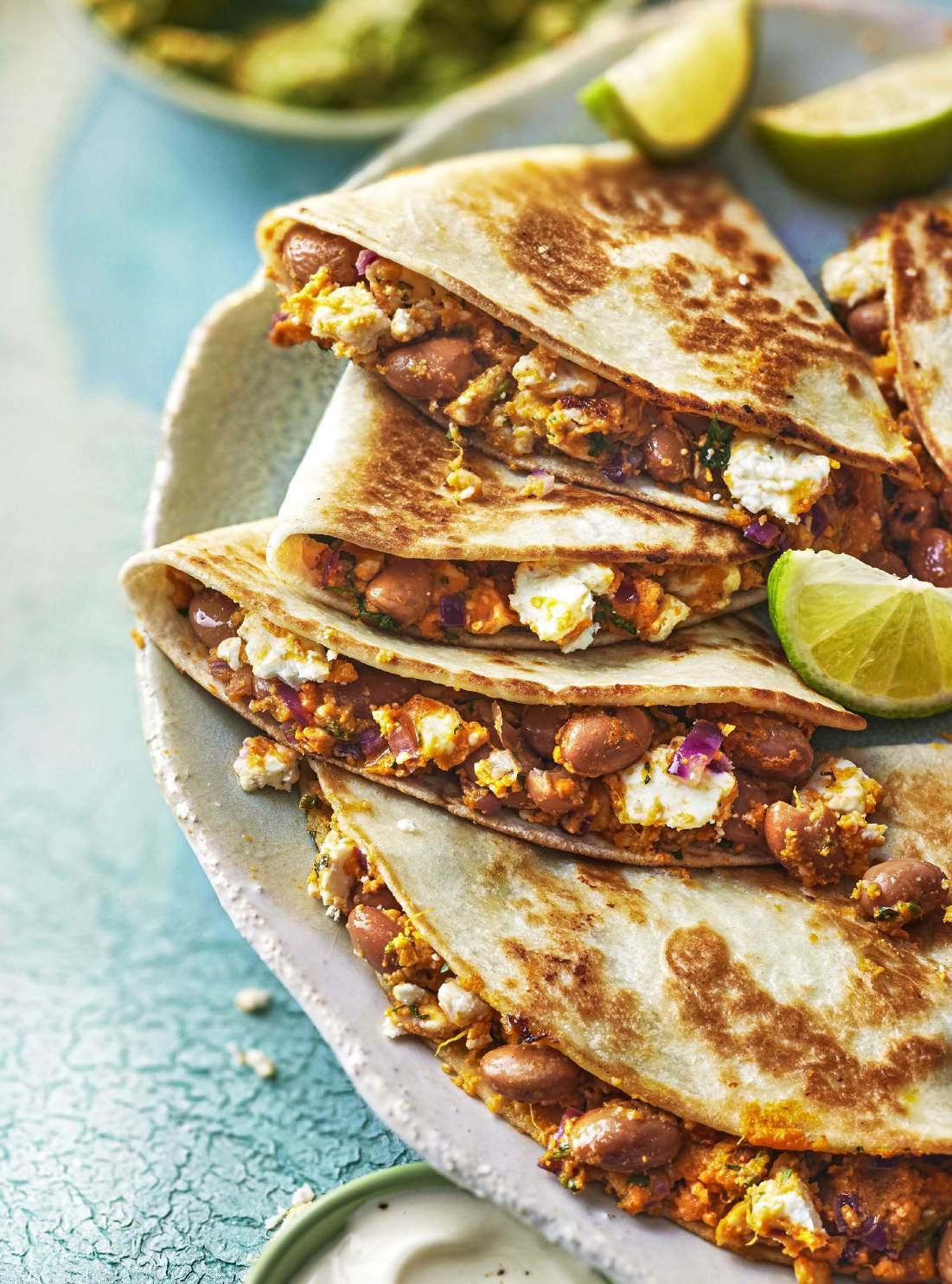












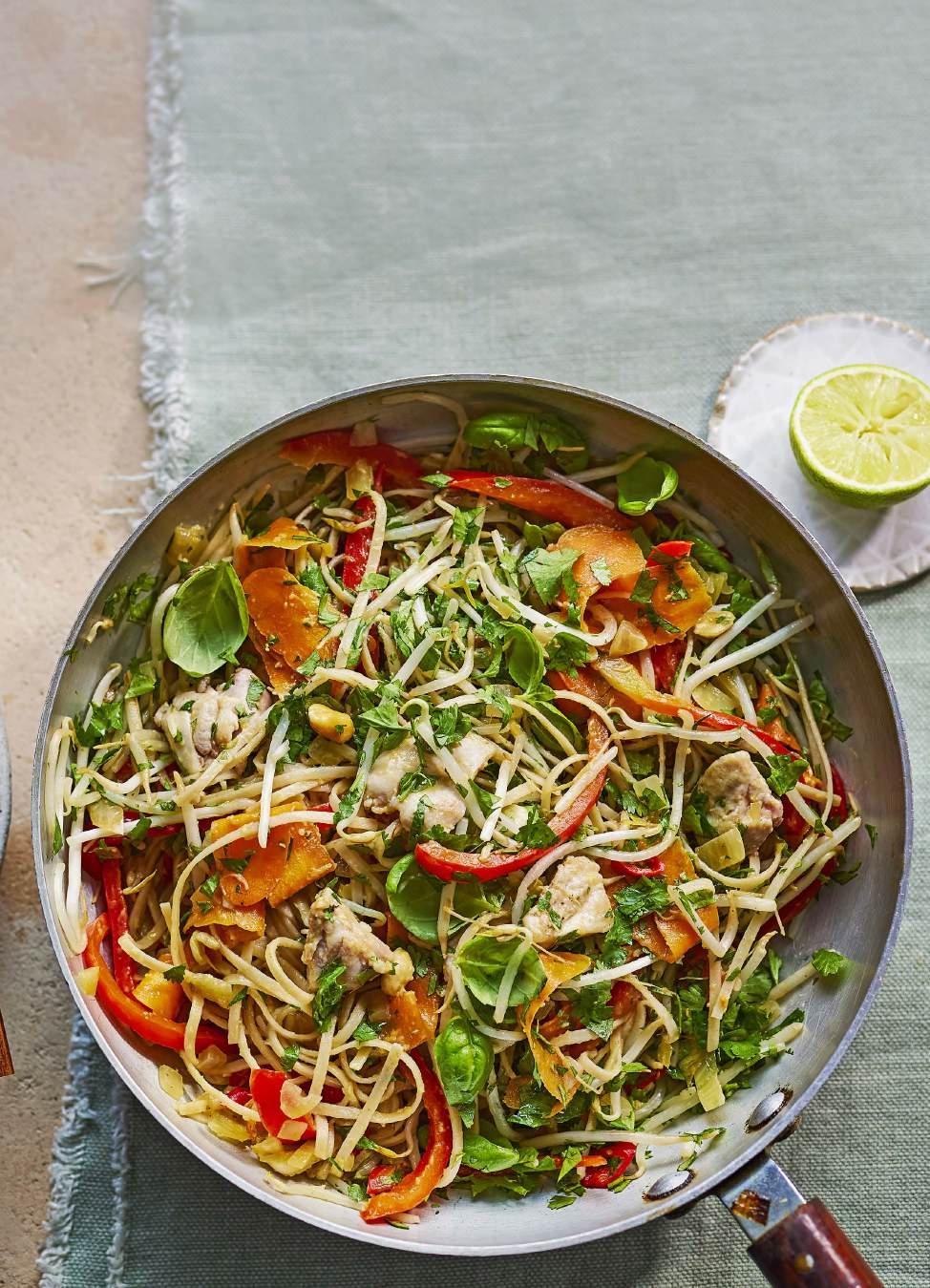



How much fibre do we really need? 16-page
The power of plants – why 30 is the magic number

The high-fibre foods to add to your weekly shop

If protein was the hot health topic last year, this year it’s firmly fibre, or as the term was coined on social media, #fibremaxxing.
With research showing that 96 per cent of us fail to reach the recommended 30g per day, we clearly need to figure out how to include more of the macronutrient in our diets. Fibre isn’t just about ‘keeping you regular’ – it’s far more important; gut health is a big part of the wider story of your overall wellbeing.
In this special, we’ll look at all the ways that fibre does you good, and we’ll also highlight what kinds of foods you should be eating more of. Naturally, we’ll also be sharing delicious recipe ideas to help you do exactly that.
Emma hartfiEld, hEalth Editor




ISSIE KEELING, DEPUTY HEALTH EDITOR
Issie looks after all health content for Good Food and our sister title, olive
KERRY TORRENS, REGISTERED NUTRITIONIST
Kerry has a postgraduate diploma in personalised nutrition



fibremaxxing is the latest wellness movement in the spotlight, recommending that people increase their fibre intake for a health boost. But, what does the science say? Here, we break down why fibre is so important, and what happens if you don’t get enough.

MELISSA KUMAN, SOCIAL MEDIA CREATOR
Melissa is a nutritionist posting for @GoodHealth ByGoodFood
Fibremaxxing is all about increasing the amount of dietary fibre you eat, usually by adding more fibre-rich foods, such as wholegrains, beans, pulses, fruit and vegetables, to your diet. The aim is to meet or even exceed the recommended daily amount of 30g, with the promise of benefits for your gut, heart and general health. This trend has gained momentum as research has revealed that the majority of adults in the UK only achieve around half their recommended daily fibre intake.
Is all fibre the same?
Fibre is made up of long chains of sugar molecules, and is the part of plant foods such as fruit, vegetables, grains and nuts that our bodies cannot digest. Unlike fat, protein or carbohydrates, fibre moves through the digestive system largely unchanged.
There are two main types of fibre, soluble and insoluble:
• Soluble fibre dissolves in water. Dependent on its source, this type has


various characteristics. For example, some types are fermented by gut bacteria, while others form a gel when mixed with water that helps slow digestion. Benefits of this type of fibre include that it lowers cholesterol, balances blood sugar and keeps you feeling full for longer.
• Insoluble fibre does not dissolve in water. This is the type that is commonly referred to as ‘roughage’. It adds bulk to your stools, and helps food move more easily through your gut, preventing constipation.
A diet rich in fibre is also linked to a lower risk of heart disease, stroke, type-2 diabetes and colon cancer. It supports healthy weight, helps regulate cholesterol and hormones, and also helps keep us feeling fuller for longer. Fibre is the preferred food source for the beneficial bacteria that live in our gut and, as such, it may help strengthen our immune system and improve our overall wellbeing.
The science behind the trend
Unlike some health trends that spark social media frenzies, fibremaxxing does have credentials. Scientific interest in the health benefits of fibre has been reawakened thanks mainly to the growing body of research on the gut microbiome (the community of microbes that live in our digestive tract).
Research supports the idea that those of us who enjoy higher amounts of dietary fibre tend to live longer, are at lower risk of heart disease and diabetes, and may experience fewer cancers.
Research supports the idea that those of us who enjoy higher amounts of dietary fibre tend to live longer, are at lower risk of heart disease, and may experience fewer cancers.


Fibremaxxing can be a powerful way to boost your health, but the key is to start slowly and listen to your body.





As the preferred fuel source for our beneficial gut microbes – known as prebiotic – fibre plays a crucial role in helping them thrive and, in return, they make molecules like short-chain fatty acids (that serve to strengthen the gut barrier), regulate immune function and influence metabolism.
In addition to this – and beyond its value for healthy digestion – fibre has proven benefits for the cardiovascular system, blood sugar control, cholesterol management and hormonal balance, which can be especially beneficial for perimenopausal women.
Science confirms that dfferent types of fibre play different roles in the body. For example, fibre that is fermentable in the gut – such as the fibre found in legumes and barley – supports our beneficial gut bacteria, helping them grow and increase in number. Gelforming fibre, on the other hand, like the types found in seeds, oats and apples, slows down the absorption of the sugars we digest, helping regulate blood sugar levels. These gels may also help trap cholesterol and excess hormones, and promote their excretion, improving their balance in the body.
potentially reducing anxiety and depression, and improving cognitive function as well.
happens when you don’t eat enough?
A lack of fibre can have a range of shortand long-term effects on the body. Common short-term signs include constipation and feeling bloated, while over time, too little fibre can increase your risk of piles (haemorrhoids), cause weight gain and even lead to chronic conditions such as heart disease, type-2 diabetes and some cancers.
Diets low in fibre can also affect your energy levels, mood, overall outlook and skin health. Insufficient fibre may also disrupt the balance of good bacteria in your gut, which has the potential to disrupt digestion and immune function.
Fibremaxxing can be a powerful way to boost your health, but the key is to start slowly and listen to your body – increasing the amount of fibre you eat too quickly can have less desirable effects on your digestive system.

Some studies suggest a role for fibre in mental health, too. This is because a healthy gut microbiome is increasingly believed to have a range of beneficial effects on the brain, including
What does 30g of fibre look like? TOTAL = 31.5g FIBRE
Hitting the 30g target doesn’t require complicated calculations or lots of unfamiliar foods. We've set out an example menu to take you through a day, illustrating how you can maximise your intake with everyday staples.
A bowl of porridge made with 50g oats (4g) topped with a whole sliced apple (1.2g) and 1 tbsp chia seeds (4.1g) = 9.3g fibre
A medium bowl of lentil soup (7.5g) with a slice of wholemeal bread (2.7g) = 10.2g fibre
Grilled chicken with a side of broccoli (2.5g) and a medium sweet potato baked with the skin on (5.7g) = 8.2g fibre
A SNACK A handful (30g) of almonds = 3.8g fibre &


Start gradually
Increase your fibre intake slowly over a number of weeks so your digestive system can adjust.
driNk morE water
Fibre works best when combined with water, so staying hydrated is essential to prevent discomfort.
swap refiNed for wholEgrainS
Choose wholegrain bread, brown rice and jumbo oats instead of refined or white versions.
add BEaNS, lENtilS aNd pUlSES
Stir lentils into soups or salads, and add beans to stews or wraps for a fibre boost.
SNaCK Smart
Keep fruit, nuts and seeds handy for snacks instead of low-fibre options.
1 2 3 4 5 5 5
GoiNG too faSt
A sudden jump in fibre can cause bloating, wind or cramping. Take it slowly!
forGEttiNG flUidS
Not drinking enough water as you increase your fibre intake can lead to constipation.
NEGlECtiNG VariEtY
Getting into a food rut means you miss out on the benefits of having different types of fibre.
oVErlooKiNG opportUNitiES
Little tweaks add up: an extra portion of veg or sprinkle of seeds makes a difference.
iGNoriNG SpECial requirEmEnts
If you have a gut condition or take medication, check dietary changes with your GP first.
A fibre-rich diet is achievable and enjoyable, especially when you focus on whole, natural foods. By making a few simple swaps and additions, you can easily achieve the 30g your body needs.
You probably know the five-a-day fruit and veg aim very well, but there’s a new goal in town: eating 30 different plant foods a week. It might sound like a lot, but there’s good reason for it – and it’s not just about eating more greens. This approach focuses on variety, not just quantity. It’s all about looking after your gut – and in turn, your overall health.
Why it matters
Our gut is home to trillions of microbes (mainly bacteria), which together make up what’s called the ‘gut microbiome’. These microbes thrive on the fibre found in plant foods, and the more variety they get, the happier and healthier they are. Research has shown that people who eat a wider range of plant foods each week have a more diverse gut microbiome, which is linked to better gut health and improved wellbeing in general. Why is this the case? Well, different plants
contain different types of fibre and plant chemicals (called polyphenols), which feed different types of bacteria in the gut. When you eat lots of different plant foods, you’re essentially throwing a banquet for a broader range of good bacteria. This diversity helps keep the whole system balanced, making it more resilient and better at supporting your health.
Looking after your gut isn’t just about avoiding tummy troubles. A healthy gut microbiome does all sorts of important jobs: it supports your immune system, plays a role in mood and mental wellbeing, and manages digestion. There’s a strong connection between the gut and brain (sometimes called the gut-brain axis), so a happy gut can mean a happier mind.
A diverse gut microbiome has also been linked to a lower risk of conditions like type-2 diabetes, heart disease and even some cancers. Good gut bacteria help keep inflammation in check, support the gut lining, and make sure harmful bacteria don’t get a foothold.
The good news is that you don’t have to eat 30 different salads a week. Plant foods include vegetables, fruit, wholegrains (like oats, barley, quinoa and brown rice), beans and pulses (such as lentils, chickpeas and kidney beans), nuts, seeds and even herbs and spices. Each different variety counts: for example, red and green apples are two different plant foods. Even a handful of mixed nuts or sprinkle of seeds on your breakfast can help you rack up your plant points. Things like coffee and dark chocolate (if it’s at least 70 per cent cocoa) also count, as they’re made from plant seeds. And, you don’t need big portions – even small amounts add up.
The easiest way to hit your 30 is to mix things up: try new grains, add extra veg to meals, snack on nuts and seeds, and use more herbs and spices. It’s not about being perfect, but about enjoying a colourful, varied diet that keeps your gut in tip-top shape. The recipes on the following pages should help.
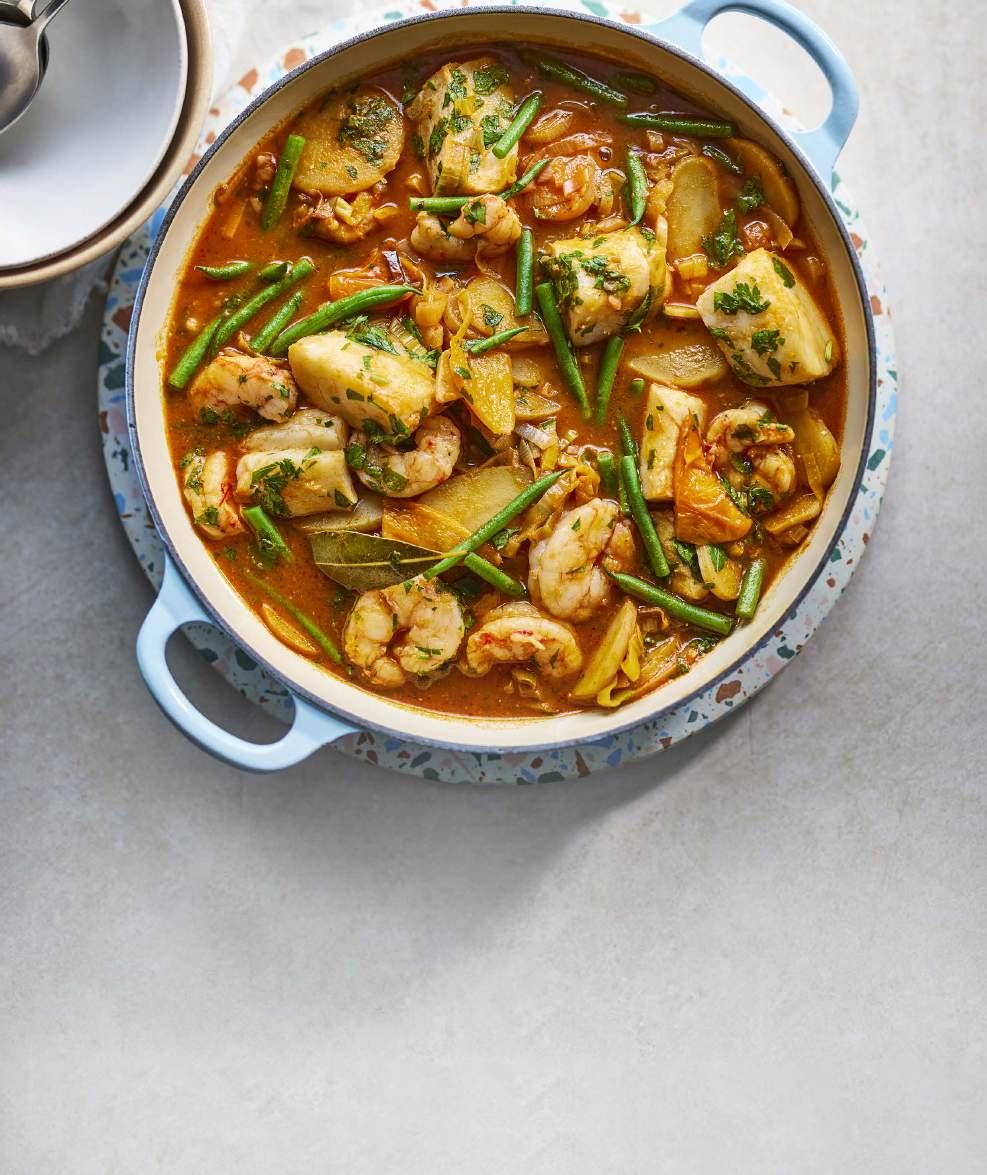
One-pan cod & red shrimp
This contains a third of your daily recommended amount of fibre, and is also high in protein.
SERVES 2 PREP 15 mins
COOK 40 mins EASY
2 tbsp rapeseed oil
250g baby potatoes
1 large orange pepper
1 bay leaf
1 tsp vegetable bouillon powder
1 leek
2 large garlic cloves

200g passata
10g flat-leaf parsley
280g pack cod loin
100g frozen wild red shrimp, defrosted
100g fine trimmed green beans
1 Heat the oil in a wide, non-stick pan over a medium heat. Slice the potatoes and cut the pepper into chunks, then fry together with the bay leaf for 5 mins until the veg starts to colour. Make up 200ml vegetable stock using the bouillon powder. Thinly slice the leek and garlic, add to the pan and cook for
a few minutes more, then stir in the passata and stock. Bring everything to a simmer, then cover and cook for 25 mins, or until the potatoes are tender.
2 Meanwhile, chop the parsley, cut the cod into six large chunks, and peel the shrimp. Halve the green beans. Add the parsley, cod, shrimp and beans to the pan, cover and cook for about 7 mins more, or until the fish flakes easily when pressed with a fork.
Healthy pad Thai
Brown noodles, peanuts and a variety of veg provide a big fibre boost.
SERVES 2 PREP 20 mins
COOK 12 mins EASY
100g flat brown rice noodles
2 boneless, skinless chicken thigh fillets
1 onion
1 red pepper
1 small carrot
3 garlic cloves
1 red chilli chunk of ginger
1 tbsp rapeseed oil
100g beansprouts
1 lime
15g roasted unsalted peanuts

1 tbsp low-salt soy sauce 15g coriander handful of basil
1 Tip the noodles into a heatproof bowl and soak following pack instructions until tender but not soft – you don’t want them to become mushy. Drain.
2 Chop the chicken thighs and onion, thinly slice the pepper and peel the carrot into ribbons using a vegetable peeler. Slice the garlic cloves, then deseed and thinly slice the chilli. Grate the ginger (you’ll need about 1 tbsp). Heat the oil in a wok over a medium-high heat and stir-fry the chicken for 5 mins until cooked. Transfer to a bowl and set aside, keeping the oil in the wok. Stir-fry the onion, pepper and carrot
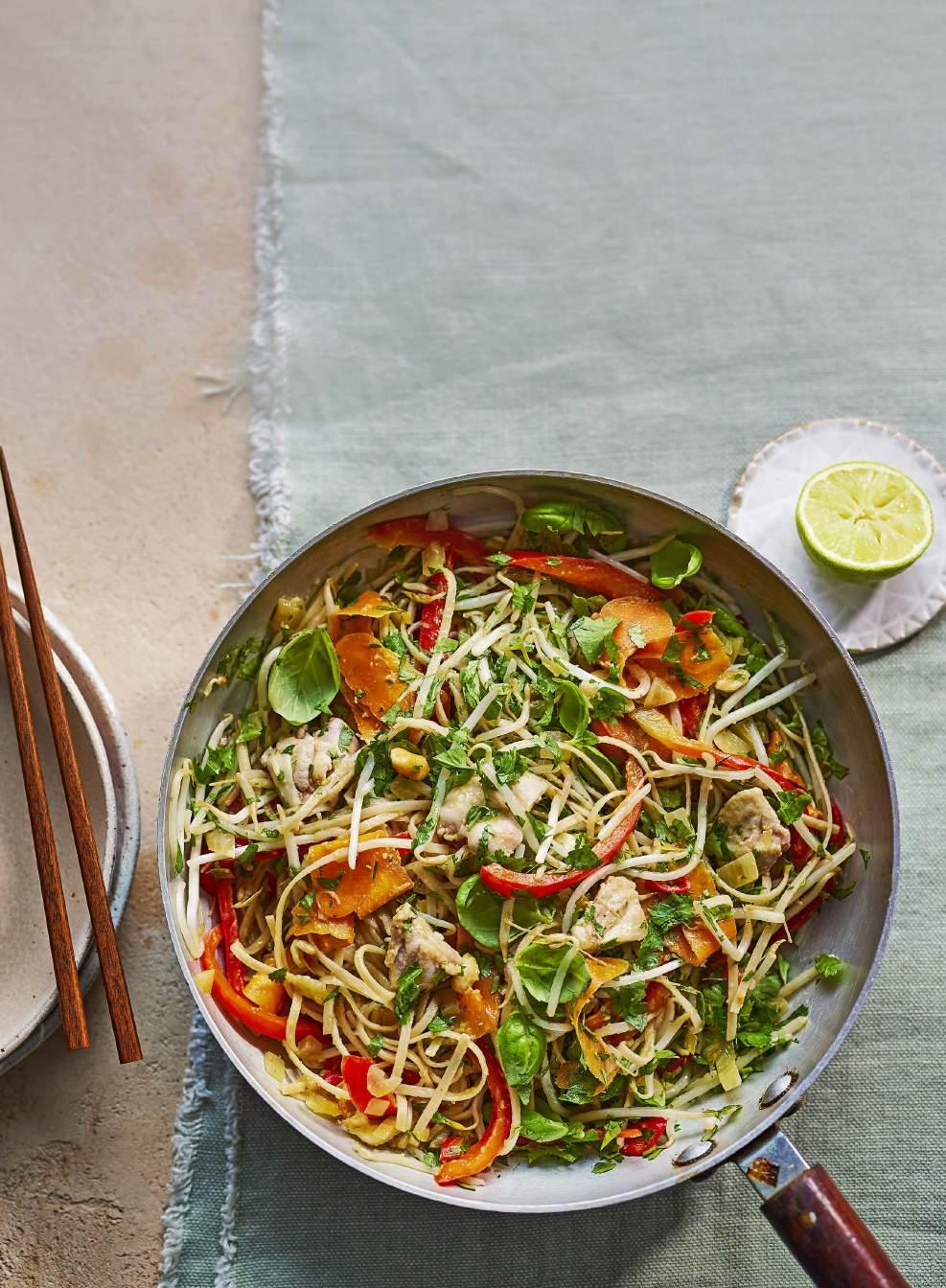
for 5 mins to soften, then add the garlic, chilli and ginger, and cook for a few minutes more until fragrant.
3 Add the beansprouts. Zest and juice the lime (you’ll need about 1 tsp zest and 2 tbsp juice). Turn up the heat to high and stir through the peanuts, lime juice and zest and the soy sauce. Roughly chop the herbs, then add to the pan along with the chicken and noodles. Gently toss everything together until heated through. Serve straightaway.
Gnocchi traybake with lemony ricotta
Achieve over half your daily fibre intake in just one meal.
SERVES 2 PREP 10 mins COOK 40 mins EASY V
1 courgette
100g baby plum tomatoes
2 garlic cloves
500g gnocchi
100g artichokes in oil, plus 2 tbsp of the oil
1/2 tsp chilli flakes
1 lemon
85g ricotta
10g basil
1 Heat the oven to 220C/200C fan/ gas 8. Halve then thickly slice the courgette, and halve the tomatoes.
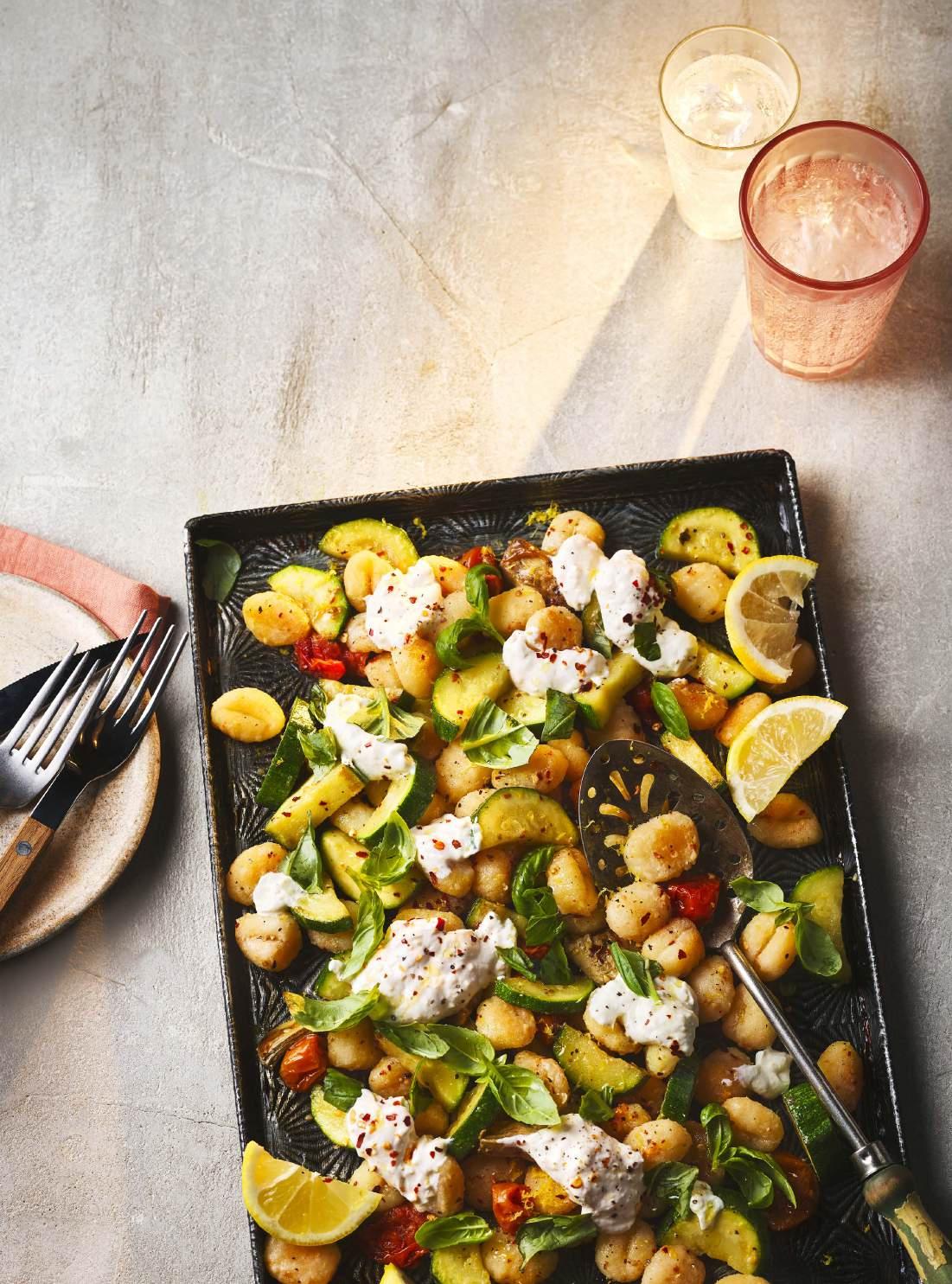
Lightly crush the garlic cloves. Tip the gnocchi, courgette and tomatoes into a large roasting tray. Add the artichokes and oil, the garlic and chilli flakes, and season. Mix well, then bake for 30-35 mins, or until the gnocchi is crisp at the edges and the veg is soft.
2 Meanwhile, zest the lemon, then cut into wedges. Mix the ricotta and lemon zest together in a small bowl, then season. Dot this over the gnocchi. Roughly chop the basil, then sprinkle over the gnocchi.
3 Divide the gnocchi between two bowls, mixing well so the ricotta breaks down into a creamy sauce. Serve with the lemon wedges for squeezing over.
Nduja & spring greens pasta
Spicy nduja provides a big hit of flavour, while the greens bring fibre. Use wholemeal pasta to up your intake even further.
SERVES 2 PREP 15 mins
COOK 15 mins EASY
200g tagliatelle (or other long pasta shape)
2 small banana shallots
3 garlic cloves
3 tbsp olive oil
20g nduja
2 tbsp tomato purée
200g spring greens
1/2 lemon, juiced
10g parsley
15g parmesan
25g breadcrumbs
1 Cook the pasta following pack instructions, then drain, reserving a mugful of the cooking water.
2 Finely chop the shallots and garlic. Heat 2 tbsp of the oil in a frying pan over a medium heat
and fry the shallots with a pinch of salt for 10-12 mins until softened but not coloured. Stir in the garlic, nduja and tomato purée. Cook for a further 2-3 mins until the tomato purée has caramelised slightly. Finely shred the greens, then mix these in along with a splash of water. Squeeze in most of the lemon juice and cook for 4-5 mins until the greens have wilted.
3 Finely chop the parsley and grate the parmesan. Heat the remaining oil in a separate pan and tip in the breadcrumbs. Stir to coat, then toast over a medium heat for 3 mins until golden. Remove from the heat and stir in the parsley, parmesan and a pinch of seasoning.
4 Stir the cooked pasta into the pan of greens along with a good splash of the reserved water. Toss to coat, adding more of the water as needed. Season, adding a little more lemon juice if needed. Scatter over the breadcrumbs to serve.
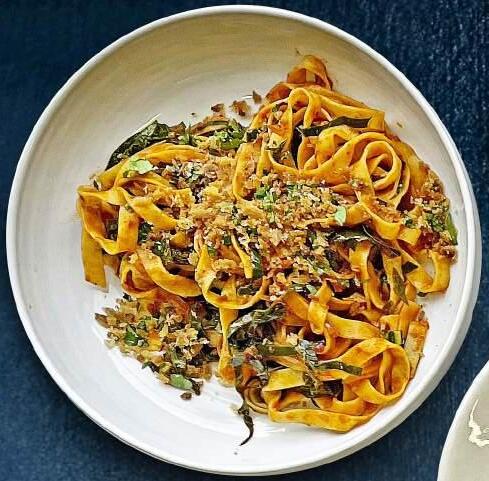
Tomato & black bean taco salad
With eight plant points, this zingy salad is a fibre-packed treat that evokes the flavours of Mexico.
. SERVES 4 PREP 15 mins NO COOK EASY V
1 lime, juiced 12g coriander
1 jalapeño pepper
1/2 tsp ground cumin
2 tbsp rapeseed oil
400g can black beans
198g can sweetcorn
200g cherry tomatoes
1 romaine lettuce
1 red pepper
4 crunchy taco shells
25g pumpkin seeds
1 Juice the lime and finely chop the coriander and jalapeño (you can deseed it if you prefer less heat). Combine in a large bowl with the cumin and oil. Season well.
2 Drain and rinse the beans and sweetcorn, halve the tomatoes, and chop the lettuce and red pepper. Toss the beans and veg together to combine. Crumble in the taco shells, drizzle over the dressing and mix to coat. Scatter over the pumpkin seeds and serve.

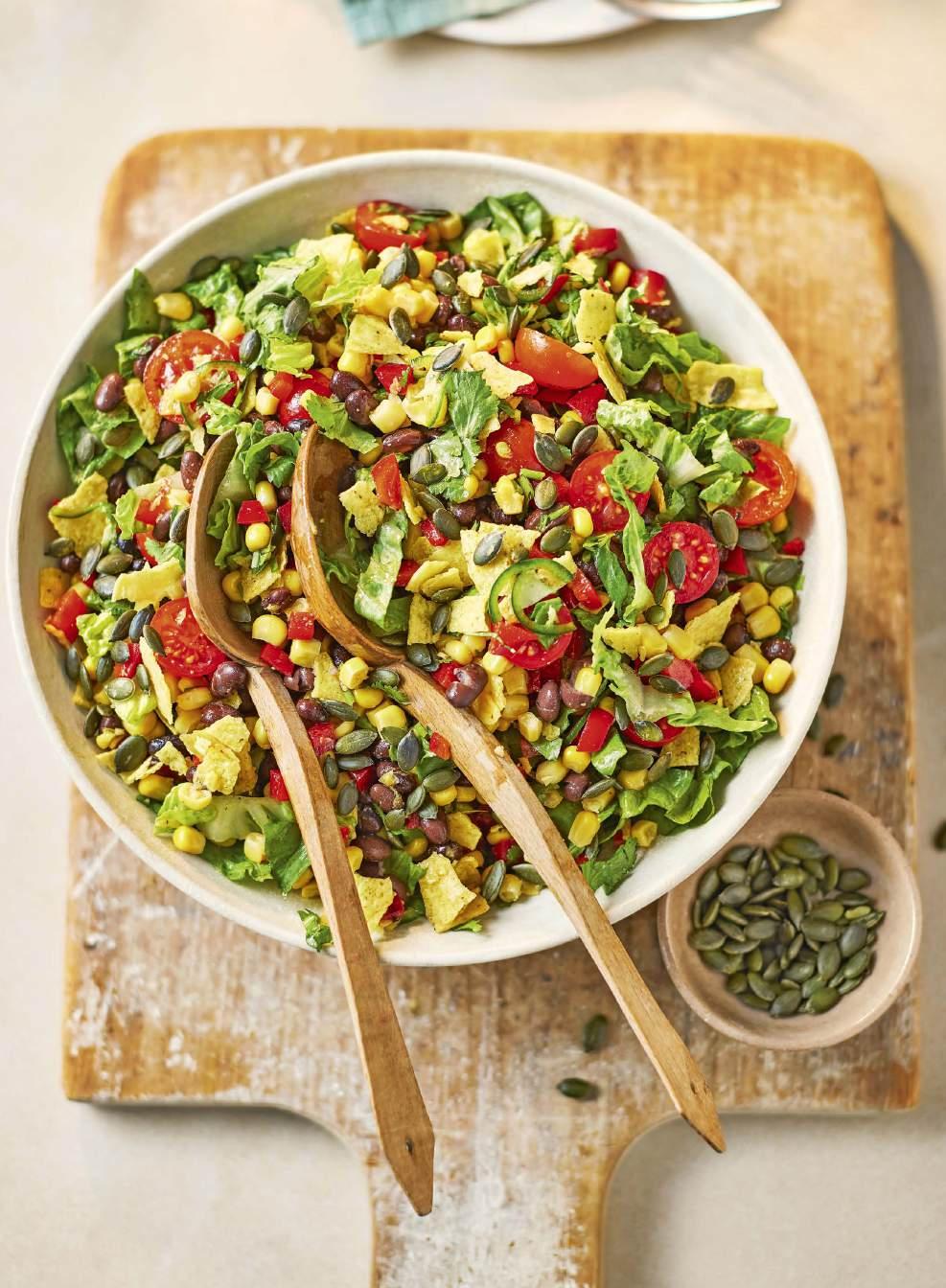
Pulses provide plenty of fibre, and you have the convenience of being able to buy them readycooked to use in this filling salad.
SERVES 4 PREP 15 mins NO COOK EASY
2 garlic cloves
2 tbsp sherry vinegar
1 tsp Dijon mustard
50ml olive oil

2 x 160g cans tuna steaks in spring water
160g cherry tomatoes (about 10)
2 ready-roasted red peppers
handful of parsley
1/2 small bunch of chives
2 x 250g pouches cooked puy lentils
1 Finely grate the garlic, then whisk with the vinegar and mustard in a small bowl. Slowly drizzle in the oil, whisking until emulsified. Season.
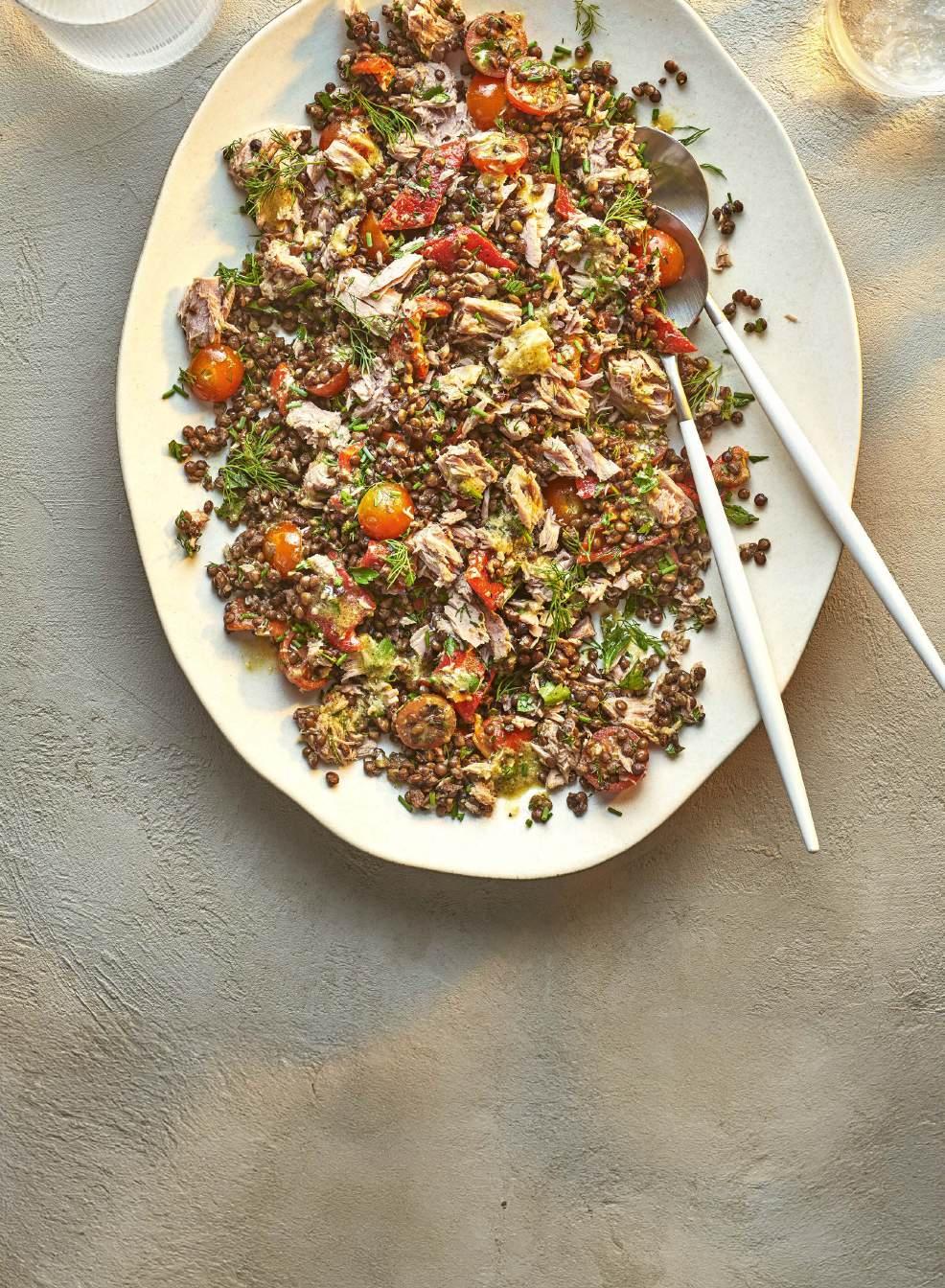
2 Drain and flake the cans of tuna, halve the tomatoes and chop the peppers, parsley and chives. Tip the lentils, tuna, tomatoes, peppers and herbs (reserve some of the chives for sprinkling over) into a large bowl and toss together. Pour over the dressing and toss again to combine. Divide between four bowls and garnish with the reserved chives.
Our beneficial bacteria are also known as probiotics – live microorganisms that can help restore or maintain a healthy balance in the gut – and are naturally present in fermented foods such as yogurt, kefir, sauerkraut, kimchi and miso. Consuming these foods regularly can help increase the population of beneficial bacteria in your gut, supporting digestive comfort and potentially easing symptoms like bloating. There’s a variety of probiotic supplements available, including capsules, powders and gummies, that contain specific strains of bacteria, most commonly from the lactobacillus and bifidobacterium families. Probiotics can support gut health, particularly during or after antibiotic use, or when you’re experiencing digestive upsets. Some supplements also combine probiotics with prebiotic fibres for a synergistic approach to gut support.

When we talk about plant foods, we’re generally thinking of prebiotics – the non-digestible fibres that act as food for our beneficial gut bacteria. They stimulate the growth and activity of these bacteria, helping maintain a healthy gut environment. Good sources of prebiotics include leeks, onions, garlic, asparagus, chicory and bananas – these foods contain inulin and other fermentable fibres that are particularly loved by gut microbes. For those who struggle to consume enough prebiotic-rich foods, supplements containing inulin or other prebiotic fibres are available. These can be especially useful for supporting gut diversity and promoting regularity, though it’s best to introduce them gradually to avoid digestive discomfort.

Depending on your needs, you could try fibre supplements, which are available as powders, capsules and tablets. Powders or capsules containing soluble fibre are most common, and dissolve in water to form a gel-like substance that helps soften stools, ease constipation and slow digestion – benefitting blood sugar and cholesterol levels. Psyllium husk is a popular soluble fibre supplement used to relieve constipation and promote regularity. Some products combine fibre with probiotics or digestive enzymes for additional support. When introducing fibre supplements, it’s important to increase intake gradually and drink plenty of fluids to minimise bloating.
Always consider starting with dietary changes – such as increasing your intake of fruits, vegetables, wholegrains and fermented foods – before turning to supplements. If you have a diagnosed digestive condition or are taking prescription medication, consult your GP before introducing new supplements. Ultimately, a tailored approach combining a varied diet and – where needed – targeted supplements, can help support a healthy, happy digestive system.
Add these storecupboard staples and freezer ingredients to your regular meals to easily boost your intake
Lentils are a nutritional powerhouse, and an excellent choice for vegetarians and meat-eaters alike. Contributing about 3-8g fibre per 100g (cooked, depending on variety), lentils are rich in plant-based protein, iron and folate. They’re incredibly versatile and make a great addition to soups, stews, curries, salads and veggie burgers, as well as an excellent way to make meat go further or add substance to a dish. They also absorb flavour well, so are a great partner to bold spices and aromatics.

Black beans contain about 8.7g fibre per 100g (cooked) and are an excellent source of protein, iron and folate. These beans are a staple in the Americas, often featuring in chillis, burritos, salads and soups. Their earthy flavour makes them a popular choice in slowly simmered dishes like stews, as well as plant-based burgers. Beyond the classic pairing with rice, black beans can be blended into dips for a nutritious, fibre-rich snack.
Chia seeds pack an impressive 34g fibre per 100g, and though you’re unlikely to eat that much in one go, even a single tablespoon contains 5g fibre. They’re also a useful plant-based source of omega-3 fatty acids, protein, calcium, magnesium and protective plant compounds. They work well in overnight oats, smoothies and chia puddings, but can also be simply stirred into porridge, sprinkled over yogurt or blended into baked goods.
In their unprepared form, oats provide about 7.8g fibre per 100g, while an average-sized bowl of porridge provides about 1.8g. Oats are particularly high in a type of soluble fibre called beta-glucan, which has been proven to lower cholesterol levels. Although most commonly enjoyed as a breakfast staple, they can also be added to smoothies, flapjacks and even savoury dishes, like oatcakes and veggie burgers.


Green peas contain 5.6g fibre per 100g (boiled) and are a versatile addition to many dishes, including risottos, soups, salads and pasta. You can also mash them to spread on toast, whizz into a dip or serve as a side. Their natural sweetness and vibrant colour make them popular with children and adults alike, and they’re a budget-friendly freezer staple.


White flour is stripped of much of its fibre, so choose bread made with wholemeal flour instead, which offers about 7g fibre per two thick slices (or about 100g). Wholemeal bread is made using flour that retains all parts of the grain, making it a nutritious and filling option. Use it for sandwiches and toast, or try transforming slices into crunchy croutons for sprinkling over soups and salads.

Boiled or steamed, broccoli provides about 2.8g fibre per 100g, and is a rich source of vitamins C and K. Although often boiled and served as a side, this cruciferous vegetable can be steamed, roasted or stir-fried. It also works well whizzed into creamy soups or tossed into pasta or risotto –its mild, slightly bitter flavour pairs well with cheese, lemon, garlic and nuts, making it easy to include in a host of dishes.
The fibre content of raspberries comes largely from their tiny seeds, offering an impressive 3.3g fibre per 100g. The berries are rich in vitamin C and a range of protective plant compounds, too, and their tart-sweet flavour makes them a delicious addition to breakfast bowls, smoothies, yogurt and desserts. Sprinkle over porridge, blend into sauces or bake into muffins, cakes and crumbles.


7

Containing about 12.5g fibre per 100g (or about 3.8g fibre per small handful), almonds are a great snack choice, as they’re also high in vitamin E, magnesium and heart-friendly monounsaturated fats, and are a useful source of protein. Outside of snacking, almonds can be chopped and sprinkled over porridge or salads, ground and used in place of breadcrumbs or blended into a nut butter. They work well in both sweet and savoury dishes, from granola and flapjacks to roasted vegetable salads. Try sprinkling over vegetable sides, using to garnish a soup or adding to your favourite bakes.
Carrots provide 2.8g fibre per 100g (cooked), and are rich in beta-carotene, the plant source of vitamin A. Add to salads, soups, stews and roasted vegetable bakes, or eat raw as a snack, grate into wraps or coleslaw, or blend into smoothies (they provide subtle natural sweetness). Roasting carrots in olive oil makes a delicious side – plus, cooking actually boosts their nutritional value, by making nutrients like beta-carotene easier for the body to absorb.





Showcase your offerings with an exclusive pre-roll commercial that plays before expert videos. The video content will be interrelated with the brand, and clients can sponsor culinary skill videos, kids’ recipes, meal inspiration, baking clips, and plenty more. For more information, email info@cpimediagroup.com

Fabulous prizes, from dining vouchers to gourmet goodies, up for grabs
Step into The Aegean Sunset Journey at Ilios, where coastal Greek flavours meet a waterfront setting. Enjoy a curated three-course menu served poolside as the sun sets. With a relaxed atmosphere and waterfront views, it’s ideal for a laid-back evening in Abu Dhabi. Enter now for a chance to win!
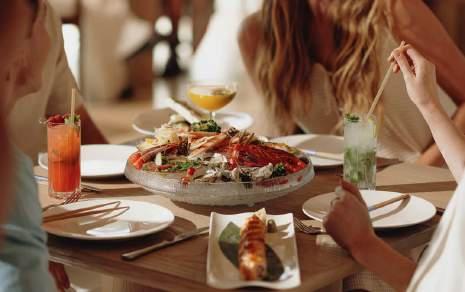


The Fin & Bone gift box brings together some of the butchery’s standout cuts and essentials. At its centre is a 1kg bone-in Angus ribeye, chosen for its rich flavour and ideal for a steakhouse-style meal at home. There are also handcrafted burger patties and house-made sausages, made with carefully selected cuts and balanced seasoning. A marinated lamb rack adds an easy, ready-to-cook option, while house-made beef tallow, a signature BBQ rub, and BBQ sauce round things out, giving you everything you need for a proper barbecue.
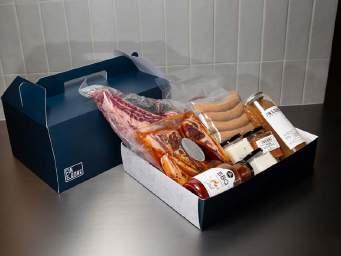

Located at Pullman Dubai Downtown, Couqley French Brasserie is known for its steak frites and classic French bistro dishes, served in a warm setting. Win an AED500 voucher to use across its weekly offers, including Steak Frites Monday, Mussels Night, and Cheese & Wine Night every Wednesday. With generous portions, accessible pricing, and a brasserie feel, it’s a great spot to get together with friends, family, or colleagues in Downtown Dubai.
To be in with a chance of winning these prizes, visit our competitions page on bbcgoodfoodme.com, or simply scan this QR code with your mobile to directly to the website.
*Terms & conditions apply. Employees of CPI Media Group and entrants below 21 years old are not eligible to enter. Winners will be selected on random basis from correct entries.
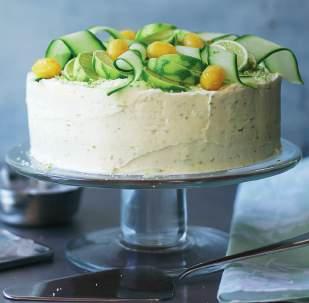

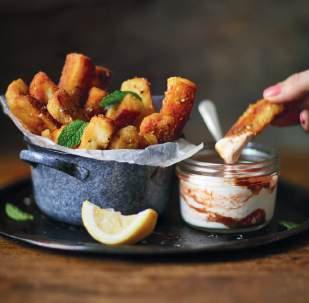



For daily inspiration, behind-the-scenes snaps and gooey videos, join the goodfood Instagram community today