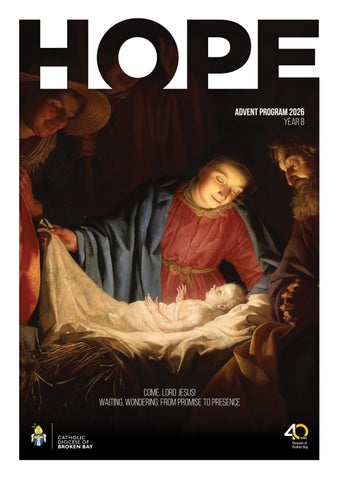
ADVENT PROGRAM 2026 YEAR B
COME, LORD JESUS! WAITING, WONDERING: FROM PROMISE TO PRESENCE
Contents 6
F I R S T S U N D AY O F A D V E N T 29 NOVEMBER 2026
14
S E C O N D S U N D AY O F A D V E N T 6 DECEMBER 2026
22
T H I R D S U N D AY O F A D V E N T 13 DECEMBER 2026
30
F O U R T H S U N D AY O F A D V E N T 20 DECEMBER 2026
38
C H R I ST M A S O C TAVE REFLECTIONS
59
NEW YEAR’S EVE REFLECTION
Introduction Dear Brothers and Sisters in Christ, As we enter this Holy Season of Advent, I warmly invite you to journey with me towards the celebration of the birth of our Lord Jesus. Advent is a Season of invitation—a time to slow down, listen, wonder, and make space for God. Amid a busyness that can easily fill these weeks, the Church gently invites us to wait— not simply for Christmas to arrive, but with joyful hope and expectation, trusting in God’s fullness and faithfulness. Our Advent theme this year, “Waiting, Wondering: From Promise to Presence,” invites us to enter more deeply into the mystery of our loving God who constantly draws us to Him. To wait is to prepare a sacred space within us for God—to quieten our hearts, surrender our own timelines and expectations, and trust that God is present and at work, even when we cannot yet see or understand what He is doing. To wonder is to remain attentive to the mystery of God at work among us—to notice the grace we might otherwise overlook, to marvel at the ways God reveals himself, and to remain open to the unexpected ways He invites us to encounter him. And from promise to presence is at the very heart of Christmas. Throughout salvation history, God’s people waited in hope for the fulfilment of His promise — a Saviour who would come, a Light that would shine in the darkness, and a God who would dwell among His people. Then, in the fullness of time, the promise became flesh.
As people of faith and hope, we share this journey. Across our parishes, schools, homes, and communities, we are one family in Christ. Wherever we find ourselves this Advent, the same hope unites us, the same promise, and the same longing: Come, Lord Jesus! This Advent, I invite you to linger in the waiting, make a sacred heart space for Jesus, and awaken more fully to the quiet signs of God’s presence among us. The reflections in this program are offered as a companion for our journey. I hope they will help you pause, pray, and ponder, and recognise God’s presence already at work in your life. May our hearts become places of welcome. May our homes become places of peace. May our parishes become places of encounter. And may we recognise Jesus Christ among us with open hands and open hearts. As we journey through these Advent weeks, be assured of my prayers for you all—for our families, our young people, our elderly, those who are alone, and all who may be carrying particular joys, hopes, or burdens at this time. As Christmas draws near, I pray that you and those you love will know the peace, hope and joy of Emmanuel—God with us. Yours sincerely in Christ,
The God we await is already drawing near. This is the beautiful mystery of Christmas: God does not remain distant. He comes close. In Jesus, He enters our humanity and our human story, becoming Emmanuel — God with us.
Very Rev Dr David Ranson Diocesan Administrator of the Diocese of Broken Bay
How to use this booklet This booklet invites you to journey prayerfully through the Sunday Gospel Readings of Advent, opening the stable of our hearts to the hope and wonder of Jesus’ coming into the world. You can use it individually or in a group. The notes below are provided for use in a small group context. For each of the four weeks of Advent, this resource encourages reading the Gospel, reflecting on Scripture and the Eucharist, and discussing. This Advent, we have offered a methodology to enable the practice of Conversation in the Spirit. It is suggested that you allocate 1 ½ hours to complete each session, and the following process is recommended:
4
1. Opening Prayer (5 min) An Opening Prayer is offered, which may be read together by participants. Music suggestions are given for each week, which may be used as part of the group’s gathering prayer time.
the group listens, individuals may wish to underline phrases that resonate with them personally. The group is then encouraged to discuss the reflection, using the guided questions at the end to inspire conversation about what each is hearing.
2. Gospel Reading (10 min) Listen to the Gospel by inviting a participant to proclaim the Word. Pause for silent reflection for a few moments. Invite people to share an insight they are hearing through the Gospel. This is not a time for discussion, but rather an invitation to offer a short comment. The group listens attentively to each person without responding.
4. Personal Reflection (15 min) A Personal Reflection is also offered, which participants may read quietly, underlining phrases that stand out to them. This time of silence and reflection can also be a prayerful invitation for the Holy Spirit to speak into each participant’s heart. This will enrich the Conversation in the Spirit that follows.
3. Gospel Reflection (25 min) A reflection is offered drawing out the themes of the Gospel and inviting us to enter more fully into the mystery of our Lord’s coming. Invite participants to take turns in reading the reflection aloud. As
Conversation in the Spirit - Round One: What is the Spirit saying to me? — a personal call to communion. Each participant shares individually what they have heard from the Scripture passage and the Gospel Reflection.
Participants are invited to share how the Holy Spirit has spoken to them. There are no responses made in this round, simply reflective silence on what is shared from each participant.
5. Closing Prayer (5 min) To conclude, pray the final prayer together.
“Speak, Lord, for your servant is listening.” — 1 Samuel 3:10 Round Two: What am I hearing the Spirit say to you? — a posture of listening and participation. Each participant now shares, one at a time, what they have heard from others. What has resonated most deeply? What new insights may have come to light? Where have they sensed the Holy Spirit moving? Once again, there are no responses made in this round, simply reflective silence on what is shared from each participant. “Where two or three are gathered in my name, there am I among them.” — Matthew 18:20 Round Three: Together we hear the Spirit saying Collaboratively the group discerns what is emerging collectively. What themes or invitations are arising? Where is there harmony, insight, or shared longing? What might the Holy Spirit be saying to us as a group? During this round, participants are invited to participate in discussion, continuing to listen to others and encouraging all to speak. “Synodality is to help the Church fulfil its primary role in the world, which is to be missionary, to announce the Gospel” — Pope Leo XIV
Prayer of Saint John Chrysostom before reading the Scripture O Lord Jesus Christ, open the eyes of my heart, that I may hear Your Word and understand and do Your will, for I am a sojourner upon the earth. Hide not Your commandments from me, but open my eyes, that I may perceive the wonders of Your law. Speak unto me the hidden and secret things of Your wisdom. On You I set my hope, O my God, that you will enlighten my mind and understanding with the light of Your knowledge, not only to cherish those things which are written, but to do them; that in reading the lives and sayings of the saints I may not sin, but that such may serve for my restoration, enlightenment and sanctification, for the salvation of my soul, and the inheritance of life everlasting. For You are the enlightenment of those who lie in darkness, and from You comes every good deed and every gift. ☩ Amen 5
Sunday 29 November 2026
First Sunday of Advent
Come, Lord Jesus! Open Hands, Hopeful Hearts We wait and watch for the One who comes.
1. O Come Divine Messiah - Benedictines of Mary, Queen of Apostles 2. Awake to the Day - Ed Bolduc Image: Elihu Vedder - Star of Bethlehem
6
F I R S T S U N D AY O F A D V E N T
Opening Prayer Loving God, As we begin this Advent journey, quieten our hearts, and open our eyes to your presence among us. Keep us awake to your coming, attentive to your gentle presence in the quiet moments and ordinary places of our lives. Teach us to prepare with trust, and to recognise the signs of your love, even when you come to us in ways we do not expect. With open hands and hopeful hearts, help us to let go of all that weighs us down, and make room for the gift of your love. Prepare within us a humble and welcoming stable, a sacred space where you may enter, where your love may find a home, and your presence dwell within us. May the hope of Advent shine as a radiant light within us, reminding us that you are ever near, and drawing our hearts towards the fulfilment of your divine promise. May our hands remain open to your grace, our hearts open to your love, and our lives open to your call. Keep us watchful in faith, joyful in hope, and ready to welcome you, whenever you draw near. Come, Lord Jesus, fill our hearts with hope. Come, Lord Jesus, make your dwelling place within us. ☩ Amen F I R S T S U N D AY O F A D V E N T
7
Gospel Reading Mark 13:33-37 (NRSVCE) “Beware, keep alert; for you do not know when the time will come. It is like a man going on a journey, when he leaves home and puts his slaves in charge, each with his work, and commands the doorkeeper to be on the watch. Therefore, keep awake—for you do not know when the master of the house will come, in the evening, or at midnight, or at cockcrow, or at dawn, or else he may find you asleep when he comes suddenly. And what I say to you I say to all: Keep awake.”
8
F I R S T S U N D AY O F A D V E N T
Gospel Reflection Fr Alex Peter Selvaraj MSFS Parish Priest of Wyoming “Beware, keep alert; for you do not know when the time will come” (Mk 13:33). With these words, Jesus opens for us the spiritual journey of Advent. Advent is not simply a preparation for Christmas. It is a season of holy longing in which the Church looks back with gratitude to Christ who came in the flesh, recognises his coming among us in grace, and looks forward with hope to his coming again in glory. The Church therefore cries: “Come, Lord Jesus”. The biblical background of this Gospel is important. Mark places these words near the end of Jesus’ teaching about his coming. Jesus compares himself to a master who goes on a journey and leaves his servants with responsibilities. Each servant has work to do. The question is not, “When will the master come?” but “Will he find us faithful when he comes?” Therefore, Christian waiting is never passive. It is hope with open hands and faith with a watchful heart. Jesus repeats one word: “Watch” His message is for everyone, in every generation. This is beautifully expressed in the Collect of the First Week of Advent: Grant your faithful, we pray, almighty God, the resolve to run forth to meet your Christ with righteous deeds at his coming, so that, gathered at his right hand, they may be worthy to possess the heavenly Kingdom.
Notice the graceful movement: we do not merely wait for Christ. We are given the grace and resolve to run forth to meet him. Advent is not sitting with closed hands, waiting for God to do everything. It means opening our hands to receive Christ and using those same hands to do righteous deeds: forgiving, helping, praying, reconciling, loving, and serving. Perhaps this is one of Advent’s questions: Are my hands open, and is my heart ready for the Lord? Christ may come to us through a lonely person, a child needing attention, someone asking forgiveness, the poor, the Eucharist, or a moment of silence. If we are spiritually asleep, we may miss his presence. The Church teaches us to live in expectation of Christ’s final coming when he will come as Judge of the living and the dead. Yet this expectation is not meant to produce fear, but faithful perseverance. Christian vigilance is not anxiety about the future; it is a life of prayer, conversion, and trust in the present. Christian vigilance is therefore not fear about the future; it is trustful love in the present. “Keep alert with all perseverance,” says Saint Teresa of Calcutta. Saint Augustine beautifully reminds us: “He hid the last day from us, so that we would be on the lookout for him every day.” What a wonderful way to live Advent. We do not know when he will come, but we know he will. Therefore, every day becomes an opportunity to say: Come, Lord Jesus. My hands are open. My heart is hopeful. Keep me awake to your presence. F I R S T S U N D AY O F A D V E N T
9
(Gospel Reflection continued.) This Advent, let us move from waiting to welcoming, from wondering to trusting, and from promise to presence. Let us not wait with empty lives but run forth to meet Christ with righteous deeds. Come, Lord Jesus— find us watching, praying, serving, and hoping. Amen.
Personal Reflection Adam and Carolina Murdoch Principals, Catholic Schools Broken Bay “And what I say to you I say to all: Keep awake.” Advent invites us into a posture of waiting, but not passivity. It calls us to prepare not only for the celebration of Christ’s birth, but also to deepen our relationship with God and ‘keep awake’ to His presence in our lives. We reflect this Advent with gratitude for the journey God has invited us to share over the past 31 years, including 28 years of marriage. We met as young teachers, passionate about learning and committed to serving young people. Since those early days in the classroom, we have journeyed together through many seasons: raising our family on the Central Coast, growing in
10
F I R S T S U N D AY O F A D V E N T
Our faith sustains us. It enables us to be fully present to our families, friends and colleagues and reminds us that our work is, above all, a ministry of service.” faith, and following a shared vocation that has led us both to principalship within the Diocese of Broken Bay. School leadership is a profound privilege, but it is also complex work, calling on us emotionally, spiritually, intellectually, and strategically to respond to the needs of students, staff, families and the wider community. The journey from teaching a subject we love to leading complex organisations encompassing education, finance, facilities, human resources and pastoral care is a challenging one. Yet at its heart remains a simple call: to accompany others. Our faith sustains us. It enables us to be fully present to our families, friends and colleagues and reminds us that our work is, above all, a ministry of service. One particularly profound experience was our pilgrimage to Poland and Rome in 2025. Before departing, we gathered prayer intentions from our school communities, carrying stories
of grief, uncertainty, illness, courage, hope, love, and gratitude. As we passed through the Holy Doors in Rome, holding those intentions in our hearts, we felt God’s presence deeply. We carried the hopes and burdens of those entrusted to our care: prayers for comfort in loss, peace during cancer treatment, and courage for uncertain futures. In that sacred moment, we were reminded that our daily work brings us close to Christ whenever we accompany others with compassion, faith and hope. We encounter Christ in the love, joy and peace at the heart of our relationship. We see Him in the privilege of accompanying young people, families and staff through life’s most challenging moments. We see Him in the courage of a student facing adversity, in a parent’s trust, and in the quiet dedication of a teacher who continues to serve each day. God is revealed in moments of everyday beauty - a student’s sudden spark of understanding, a joy-filled celebration that brings a community together, a conversation during bus duty, or a simple act of kindness that might otherwise go unnoticed. This Advent, may we all recognise God’s presence in the people we are called to serve and love. May we ‘keep awake’ not through anxious vigilance, but through hopeful attentiveness, trusting that He is already present in the ordinary moments of every day.
A Moment to Examine 1. Am I actually waiting for Christ - or merely waiting for Christmas? If Advent disappeared from the calendar tomorrow, would anything in my prayer, priorities or way of living be different? 2. If my Advent could speak, what would it say about me? “He is preparing his heart,” “She is trusting God,” or perhaps, “He is very busy preparing everything except himself!” What needs my attention most? 3. The Collect says we should “run forth to meet” Christ. Am I running towards him - or merely hoping he will catch up with me? What one concrete step could I take this week to turn my waiting into action?
F I R S T S U N D AY O F A D V E N T
11
Notes
12
F I R S T S U N D AY O F A D V E N T
Closing Prayer Loving God, As we embark on our Advent journey, keep our hearts awakened to your presence and attentive to your coming. Like the doorkeeper entrusted to keep watch, help us to be faithful to all you have placed in our care, living each day with open hands and hopeful hearts, ready to recognise You when You draw near. When we grow weary or distracted, awaken us again to Your presence. When we cannot see what lies ahead, strengthen us to trust in Your promise that You are always nearby. Awaken in us the joy of Your calling that we may remain watchful in faith, open and generous in love, and unwavering in hope as we await Your coming. May the light of Advent burn brightly within us, guiding our steps and renewing our hearts as we journey towards the joy of our Saviour’s coming. Come, Lord Jesus, fill our hearts with hope. Come, Lord Jesus, make your dwelling place within us. ☩ Amen.
F I R S T S U N D AY O F A D V E N T
13
Sunday 6 December 2026
Second Sunday of Advent
Come, Lord Jesus: Preparing the Way of Peace We make room for Christ in the stillness.
Image: The Sermon of Saint John the Baptist by Pieter Bruegel the Elder
14
1. A Voice Cries Out - Michael Joncas 2. Ready the Way - Curtis Stephan
S E C O N D S U N D AY O F A D V E N T
Opening Prayer Loving God, As we continue our Advent journey, quieten our hearts, steady our footsteps, and lead us into the stillness of our hearts. Your Word calls us to “prepare a way for the Lord and make his paths straight.” Help us to clear the paths within us— to let go of what divides us, to soften what has become hardened, and to make gentle room for your peace. Teach us, like John the Baptist, to prepare the way for Jesus, through our witness of humility, faith and love. Where there is unrest, bring Your peace. Where there is division, bring reconciliation. Where there is weariness, renew our hope. May Your Spirit work within us, turning our hearts towards You, and guiding us along the path of peace. As we prepare to welcome Jesus, may His peace take root within us and flow through us into our homes, our communities, and our world. Come, Lord Jesus. Prepare your way within us. Make our paths straight. And fill our hearts with your peace. ☩ Amen.
S E C O N D S U N D AY O F A D V E N T
15
Gospel Reading Mark 1:1-8 (NRSVCE) Make straight the paths of the Lord. The beginning of the Good News about Jesus Christ, the Son of God. It is written in the book of the prophet Isaiah: Look, I am going to send my messenger before you; He will prepare your way. A voice cries in the wilderness: Prepare a way for the Lord, make his paths straight, and so it was that John the Baptist appeared in the wilderness, proclaiming a baptism of repentance for the forgiveness of sins. All Judaea and all the people of Jerusalem made their way to him, and as they were baptised by him in the river Jordan, they confessed their sins. John wore a garment of camel-skin, and he lived on locusts and wild honey. In the course of his preaching he said, ‘Someone is following me, someone who is more powerful than I am, and I am not fit to kneel down and undo the strap of his sandals. I have baptised you with water, but he will baptise you with the Holy Spirit.’
16
S E C O N D S U N D AY O F A D V E N T
Gospel Reflection Fr Alex Peter Selvaraj MSFS Parish Priest of Wyoming “The beginning of the good news of Jesus Christ, the Son of God” (Mark 1:1). These opening words of Mark’s Gospel are full of hope. Advent invites us to return to the beginning of God’s promise and to journey towards its fulfilment in the presence of Jesus. Our cry throughout this season is: Come, Lord Jesus. But today’s Gospel asks an important question: If the Lord is coming, have we prepared the way for him?
But today’s Gospel asks an important question: If the Lord is coming, have we prepared the way for him? John the Baptist appears in the wilderness as the fulfilment of Isaiah’s prophecy: “Prepare the way of the Lord, make his paths straight.” In the ancient world, people prepared roads when a king was expected to visit. They removed obstacles, smoothed rough paths, and made the way ready. John uses this image to speak about something much deeper: the road that needs preparation is the human heart. Mark presents John
as the messenger who prepares people for Christ’s coming, calling them to repentance and pointing beyond himself to the One who will baptise with the Holy Spirit. The Collect of the Second Sunday of Advent expresses this same spiritual movement: Almighty and merciful God, may no earthly undertaking hinder those who set out in haste to meet your Son, but may our learning of heavenly wisdom gain us admittance to his company. The Collect gives us a profound description of the Advent journey: “May no earthly undertaking hinder those who set out in haste to meet your Son.” John the Baptist would ask us today: What is blocking the road to Christ in my life? Is it anger? Unforgiveness? Pride? Busyness? Worry? Perhaps Advent is God’s invitation to remove these obstacles and make room for the Prince of Peace. Here lies this Sunday’s unique message: peace is not simply something we wait for; it is something we prepare for. We cannot pray, “Come, Lord Jesus,” while refusing to forgive. We cannot wait for the God of peace while carrying bitterness in our hearts. To prepare the way of peace may mean making the first phone call, saying “I am sorry,” forgiving someone who has hurt us, or bringing peace into our family. John’s baptism was a baptism of repentance, but he points towards something greater: “He will baptise you with the Holy Spirit.”
S E C O N D S U N D AY O F A D V E N T
17
(Gospel Reflection continued.) We prepare the road, but Christ himself comes with the power to transform us. The Church teaches that Advent looks towards Christ’s coming and invites us to joyful confidence in God’s saving plan. Saint Francis de Sales said, “Nothing is so strong as gentleness, nothing so gentle as real strength.” Peace begins when we allow Christ to make our hearts gentle. And Saint Augustine reminds us: “God is closer to us than we are to ourselves.” The Lord we wait for is already nearby. So, this Advent, let us straighten the crooked paths of our relationships and remove the obstacles within our hearts. Come, Lord Jesus. Find a road prepared in us, a road of repentance, forgiveness, gentleness and peace. May no earthly undertaking hinder us as we hasten to meet you.
Personal Reflection Fr Shayne D’Cunha Assistant Priest, Epping & Carlingford It is the beginning of 2021. My third year in the seminary. As always, the year kicks off with a week-long silent retreat at Hartzer Park Retreat Centre in Bowral. It is the second day and there is unrest in my soul. I am struggling to receive the input 18
S E C O N D S U N D AY O F A D V E N T
of the retreat master; I am struggling to meditate on the Scriptures, and I find myself being overly critical about many things. So, I decided to go to confession.
I leave the confessional feeling unusually light and go to sit in the chapel. The unrest in my soul is gone because Christ’s peace has entered.” The priest is Fr Ed Travers. A wise old priest who has this deep voice, which allows him to convey simple truths with great conviction and love. As I pour out my soul, he listens patiently. Then he tells me, “For your penance, I want you to rest in the peace of absolution.” This takes me by surprise. I am a little uncertain, as it is a penance I’ve never received before. Noticing this, Fr Ed explains that being absolved of your sins and reconciled to God and neighbour brings a unique peace. It is the peace that only Christ can give (cf. Col 3:15). As Fr Ed pronounces the words of absolution, I do my best to open my heart to receive this peace. I leave the confessional feeling unusually light and go to sit in the chapel. The unrest in my soul is gone because Christ’s peace has entered.
“Prepare the way of the Lord”, says John the Baptist in the Gospel. Fr Ed helped show me how the Sacrament of Reconciliation can help me prepare my soul to receive the Lord’s peace. Later that evening I wrote these words in my journal: “the thought of giving that peace to someone as a priest was beautiful and consoling.” I left that retreat a changed man. A new source of motivation now lived in me.
A Moment to Examine
Pursuing my vocation I remember thinking, “If I, as a priest one day, could give that type of peace to one person, all the struggles and difficulty of seminary formation would be worth it.” Over the next five and a half years, I often recalled this thought.
1. What is blocking the road to Jesus in my life? Pride? Anger? Unforgiveness? Fear? Busyness? Or perhaps that wonderfully convenient excuse, “I’ll deal with it tomorrow”?
I have only been a priest for a few months now. When I am in the confessional, I do my best to pray the words of absolution as I say them. Because of my experience as a seminarian, I love the phrase “Through the ministry of the Church, may God give you pardon and peace.”
2. Is there someone I need to forgive, call, approach or make peace with? And if the answer came to me immediately, why am I still waiting to do it?
I often emphasise the word peace. While I, as the priest, can never be certain if a penitent truly experiences the peace of Christ, I have faith that the prayer of absolution does what it says it will do. Perhaps the greatest consolation of all is that I am still a penitent. So, whenever I make a good confession, I experience Christ’s peace anew. And of this I am certain.
3. If Jesus walked into my heart today, would he feel at home—or would I need to clear a few things out first? What would I need to surrender so that he finds not a crowded heart, but a place of peace?
S E C O N D S U N D AY O F A D V E N T
19
Notes
20
S E C O N D S U N D AY O F A D V E N T
Closing Prayer Loving God, We thank you for your presence among us, and for the gentle ways you guide our steps along the pathways of our lives. You call each of us to prepare the way for the Lord. Give us the courage to listen deeply, to what you have placed upon our hearts and the grace to carry it into our lives— into the conversations we have been avoiding, the forgiveness we have been holding back, and the relationships that long for your peace. May your Holy Spirit strengthen us to take the next step, trusting that your grace can transform what we cannot change by our own strength. Teach us the strength of gentleness, the freedom of forgiveness, and the deep peace that comes when we place our lives into your hands. As we leave this time together, may we carry your peace with us into our homes, our families and every encounter we share. May our lives quietly bear witness to the nearness of Jesus, and may his peace light our way and shine through us for others. Come, Lord Jesus. Prepare your way within us. Make our paths straight, and fill our hearts with your peace. ☩ Amen.
S E C O N D S U N D AY O F A D V E N T
21
Sunday 13 December 2026
Third Sunday of Advent
Come, Lord Jesus: The Joy of His Nearness We recognise the One already among us.
1. Wait for the Lord-The Songs of Taizé Session Singers 2. Come and Set Us Free-Trevor Thomson Image: Saint Jean-Baptiste by Guercino, 1661
22
T H I R D S U N D AY O F A D V E N T
Opening Prayer Loving God, As we enter the third week of Advent, our hearts begin to rejoice. The Light is drawing near. The promise is becoming presence. And yet, you remind us that the One we await is already among us. “There stands among you, unknown to you, the one who is coming after me.” Lord Jesus, open our eyes to recognise you. Help us to see you in the ordinary moments of our lives, in the people we encounter, in the kindness we receive and give, in our families and communities, and in the quiet places of our hearts. Like John the Baptist, may we become witnesses to your Light. Give us attentive hearts, that we might notice your presence; open hearts, that we might welcome you; and generous hearts, that we might share your joy with others. As we gather today, quiet our minds and still our hearts. Help us to let go of any distractions, that can prevent us from recognising you. May this time together deepen our hope, renew our joy, and draw us closer to the mystery of your coming among us. Come, Lord Jesus. Come into our hearts. Come into our homes. Come into our world. ☩ Amen.
T H I R D S U N D AY O F A D V E N T
23
Gospel Reading John 1:6–8, 19–28 (NRSVCE) There stands among you, unknown to you, the one who is coming after me. A man came, sent by God. His name was John. He came as a witness, as a witness to speak for the light, so that everyone might believe through him. He was not the light, only a witness to speak for the light. This is how John appeared as a witness. When the Jews sent priests and Levites from Jerusalem to ask him, ‘Who are you?’ he not only declared, but he declared quite openly, ‘I am not the Christ.’ ‘Well then,’ they asked, ‘are you Elijah?’ ‘I am not’, he said. ‘Are you the Prophet?’ He answered, ‘No.’ So they said to him, ‘Who are you? We must take back an answer to those who sent us. What have you to say about yourself?’ So John said, ‘I am, as Isaiah prophesied: a voice that cries in the wilderness: Make a straight way for the Lord.’ Now these men had been sent by the Pharisees, and they put this further question to him, ‘Why are you baptising if you are not the Christ, and not Elijah, and not the prophet?’ John replied, ‘I baptise with water; but there stands among you unknown to you the one who is coming after me; and I am not fit to undo his sandal-strap.’ This happened at Bethany, on the far side of the Jordan, where John was baptising.
24
T H I R D S U N D AY O F A D V E N T
Gospel Reflection Fr Alex Peter Selvaraj MSFS Parish Priest of Wyoming “Among you stands one whom you do not know” (John 1:26). These words give us a reflective and unique message for the Third Sunday of Advent. The Lord we wait for is not only a future promise. He is already nearby. The journey of Advent moves from promise to presence: the God whom Israel awaited has come close in Jesus Christ, and he continues to stand among us.
Perhaps this is the special Advent question for us: Do I recognise the Lord who is already standing among me?”
to attain the joys of so great a salvation, and to celebrate them always with solemn worship and glad rejoicing. The Collect begins with a wonderful truth: God sees his people waiting. Sometimes waiting can feel lonely. We wait for an answer, healing, reconciliation, direction, or peace. Yet Advent tells us God sees our waiting. More than that, the One we await is drawing near. Therefore, we pray not merely for a happy Christmas, but to “attain the joys of so great a salvation.” Our joy has a name: Jesus Christ. In the Gospel, John the Baptist is questioned repeatedly: “Who are you?” But John refuses to make himself the centre. “I am not the Christ.” “I am not Elijah.” “I am not the Prophet.” Finally, he describes himself simply as a voice. What humility! John knows who he is because he knows who Jesus is. His joy is not found in being important; his joy is found in pointing to the One who is greater.
This Sunday is traditionally called Gaudete Sunday, the Sunday of rejoicing. Gaudete in Latin means “Rejoice.” But why rejoice while we are still waiting? Because Christian joy is not based simply on receiving everything we want. Our joy comes from knowing that the Lord is nearby. The Collect of the third Sunday of Advent captures this eloquently:
Perhaps this is the special Advent question for us: Do I recognise the Lord who is already standing among me? We can spend our lives searching for extraordinary signs while failing to notice Christ’s quiet presence in the Eucharist, in Scripture, in prayer, in the poor, in a moment of mercy, and in the people God places before us. John says, “Among you stands one whom you do not know.” The tragedy is not that Christ is far away; sometimes it is that he is near, but we fail to recognise him.
O God, who see how your people faithfully await the feast of the Lord’s Nativity, enable us, we pray,
Saint Teresa of Calcutta said, “Joy is a net of love by which you can catch souls.” True Christian joy becomes a witness. A joyful T H I R D S U N D AY O F A D V E N T
25
(Gospel Reflection continued.) Christian says to the world, without many words: I have discovered that God is nearby. The Catechism teaches that Christ’s presence continues in his Church and especially in the sacred liturgy. Therefore, Advent joy is not simply excitement about something that will happen; it is awakening to the presence of the One who is already with us. So let us pray this week: Come, Lord Jesus! Open our eyes to recognise you already standing among us. Turn our wondering into worship, our waiting into joyful expectation, and your promise into a living presence. May we celebrate your salvation with glad rejoicing, because you are near.
Personal Reflection Layla Estasy Clergy & Parishes Broken Bay What does hope look, sound and feel like? What shape would hope form me into? These were my questions upon entering the Jubilee Year of Hope, and if I am honest, I am still finding my way into the answers, two years later. One golden
26
T H I R D S U N D AY O F A D V E N T
thread, however, weaves through the tapestry of my journey: Christ’s sacramental presence. When my carefully discerned Marian pilgrimage was abruptly cancelled, I asked God to send me where He willed. I found myself on a retreat at a Cistercian Abbey in rural Ireland. At the centre of the Emerald Isle’s dewy, green patchwork quilt stood a grey stone building, in which a tiny oratory was nestled, housing an exposition tabernacle just a few silent, beslippered steps from my room. I have been blessed with countless opportunities for Eucharistic Adoration.
I found myself gazing at Jesus in and through their eyes, and my joy was emboldened tenfold. This fleeting moment, suspended in His orbit together, felt like a secret portal to Heaven.” Still, something about this particular time with Jesus felt so intimate and so special that I share it with the same joy and delicacy as one recounts falling in love. The warmth of being alone with Him in such proximity permeated my very being. To be in that room was to be drawn
into the orbit of His Sacred Heart. The space itself seemed to worship Him. That encounter held a promise and a fullness I have since clung to in colder climates. It was like the yearned-for embrace of a beloved, after many long-distance phone calls. During this retreat, I befriended an elderly couple whose love for God shone from their eyes with a childlike brightness found solely in those walking so close to Christ that they bear His fragrance. Their lives had not been without disappointments, and yet these had not misshapen them. From them radiated a hope unbridled by fear, and a profound humility. In them I encountered an impression of Christ, and in the oratory, I found myself gazing at Jesus in and through their eyes, and my joy was emboldened tenfold. This fleeting moment, suspended in His orbit together, felt like a secret portal to Heaven. My pilgrimage has seen many seasons and stumbles. However, discovering the power of Christ’s sacramental presence in the Eucharist, in Reconciliation, and in the searingly beautiful fragility of others has been the evergreen vine that continually rights my path, reveals His love, and enriches me with boundless, transcendent hope. Lord, as we gaze upon the expectant Blessed Virgin Mary, the first tabernacle, inflame our hearts with a desire for you, your glory, and the Kingdom of Heaven.
A Moment to Examine 1. Jesus is supposed to be near—but do I actually notice him? Where do I most clearly recognise his presence in my daily life: in the Eucharist, in another person, in an unexpected kindness… or am I sometimes looking everywhere except where he is? 2. What has happened to my Christian joy? Has it been misplaced somewhere between the morning alarm, the traffic, the emails and the shopping list? What might help me rediscover the joy of knowing that the Lord is nearby? 3. If I were John the Baptist for a day, could anyone tell I was pointing toward Jesus? Do my words, actions and way of living make it easier or perhaps occasionally harder - for others to notice him?
T H I R D S U N D AY O F A D V E N T
27
Notes
28
T H I R D S U N D AY O F A D V E N T
Closing Prayer Loving God, We thank you for the gift of this time together. In the midst of our Advent journey, we are invited to slow down, to listen more deeply, and to make room for wonder. As we leave this time of reflection, may something of what we have heard and shared remain with us. Where there is weariness, renew us in strength. Where there is uncertainty, grace us with patience and hope. Where there is sadness, comfort us by your presence. Where there is joy, help us to receive it gratefully, and share it generously. In the days ahead, help us to make a little more room for youin our conversations, in our relationships, in our homes, and in the choices we make. May we become people, who carry the joy of the Gospel, into the places where we live and work. And may we go from this time together as people who have seen your Light, received your joy, and are ready to share it. Come, Lord Jesus. Come into our hearts. Come into our homes. Come into our world. ☩ Amen.
T H I R D S U N D AY O F A D V E N T
29
Sunday 20 December 2026
Fourth Sunday of Advent
Come, Lord Jesus! Love Comes Down We welcome Emmanuel, God-with-us.
1. Hail Mary: Gentle Woman-The Cathedral Singers, Richard Proulx 2. Gabriel’s Message-Benedictines of Mary, Queen of Apostles
Image: Annunciation by Fra Angelico
30
F O U R T H S U N D AY O F A D V E N T
Opening Prayer Loving God, as we draw nearer to Christmas, quieten our hearts and help us to be still in your presence. As we listen to the angel’s words to Mary: “Rejoice, so highly favoured! The Lord is with you.” Alongside our Blessed Mother, we pause before the wonder of your love — a love that does not remain distant, but comes ever closer, entering our hearts and making its dwelling among us. As we wait for the coming of your beloved Son, open our hearts to receive you fully. Awaken in each of us the wonder of your presence, renew our hope and deepen our trust in Your divine promises. May our faith be transformed by the example of Mary, who trusted even when she could not see the path ahead, and who opened her heart to your will: “Let it be done to me according to your word.” As disciples of Jesus, may we always say yes to your invitation and make room for Christ in our hearts and our lives. Come, Lord Jesus. Love comes down. Emmanuel, God-with-us, make your home among us. ☩ Amen.
F O U R T H S U N D AY O F A D V E N T
31
Gospel Reading Luke 1:26-38 (JB) You will conceive and bear a son. The angel Gabriel was sent by God to a town in Galilee called Nazareth, to a virgin betrothed to a man named Joseph, of the House of David; and the virgin’s name was Mary. He went in and said to her, ‘Rejoice, so highly favoured! The Lord is with you.’ She was deeply disturbed by these words and asked herself what this greeting could mean, but the angel said to her, ‘Mary, do not be afraid; you have won God’s favour. Listen! You are to conceive and bear a son, and you must name him Jesus. He will be great and will be called Son of the Most High. The Lord God will give him the throne of his ancestor David; he will rule over the House of Jacob forever, and his reign will have no end.’ Mary said to the angel, ‘But how can this come about, since I am a virgin?’ ‘The Holy Spirit will come upon you’, the angel answered, ‘and the power of the Most High will cover you with its shadow. And so, the child will be holy and will be called Son of God. Know this too: your kinswoman Elizabeth has, in her old age, herself conceived a son, and she whom people called barren is now in her sixth month, for nothing is impossible to God.’ ‘I am the handmaid of the Lord,’ said Mary, ‘let what you have said be done to me.’ And the angel left her.
32
F O U R T H S U N D AY O F A D V E N T
Gospel Reflection Fr Alex Peter Selvaraj MSFS Parish Priest of Wyoming “The angel Gabriel was sent by God to a town in Galilee called Nazareth” (Luke 1:26). The Fourth Week of Advent brings us to the very heart of the mystery we have been awaiting. We have waited, wondered, prepared and rejoiced. Now something extraordinary happens: the God humanity has longed for comes down to humanity. Love comes down. The Gospel does not begin in a palace, a temple, or a famous city. It begins in Nazareth, an ordinary and unnoticed place, with an ordinary young woman named Mary. This is one of God’s great surprises. Divine love does not remain distant. God enters human history. He enters a home, a conversation, a human heart, and finally takes flesh in Mary’s womb. The promise becomes presence. The Collect of the Fourth Sunday expresses this mystery perfectly: Pour forth, we beseech you, O Lord, your grace into our hearts, that we, to whom the Incarnation of Christ your Son was made known by the message of an Angel, may by his Passion and Cross be brought to the glory of his Resurrection. Notice the whole story contained in this prayer: Incarnation, Passion, Cross
and Resurrection. Christmas cannot be separated from Easter. The Child in Mary’s womb is the Saviour who will give his life on the Cross and rise again in glory. The Collect teaches us that when love comes down, it comes all the way. Christ does not merely visit our world; he enters our suffering, carries our sin, conquers death and opens heaven for us. The Roman Missal itself presents this prayer as embracing the one, integral mystery of Christ’s saving work. Mary stands at the centre of this mystery. She asks, “How can this be?” Her question is not unbelief but wonder. She does not understand everything, yet she gives God her freedom: “Here am I, the servant of the Lord; let it be with me according to your word.” This is the obedience of faith highlighted by the Church’s teaching on the Annunciation. Mary trusts the God who asks more than she can fully understand. Here is the special invitation of this final Advent week: Love comes down, but will I let love enter? God never forces the door of the human heart. At Nazareth, the salvation of the world begins with a humble “yes.” Mary’s fiat makes room for Christ. Our own “yes” in generosity, courage, sacrifice and trust can also become a place where Christ is made present. Saint Bernard of Clairvaux, reflecting on Mary’s response, imagined the whole world waiting for her answer. Heaven and earth seemed to hold their breath. Her “yes” teaches us that a single act of trust can become part of God’s great work of salvation.
F O U R T H S U N D AY O F A D V E N T
33
(Gospel Reflection continued.) Saint John Paul II said that Mary “entrusted herself completely to God.” That is the beauty of Advent’s final lesson: waiting reaches its fulfilment in surrender. We have journeyed from promise to presence; now we learn that God’s presence is welcomed where a heart is willing to say, “Let it be done to me according to your word.” As Christmas draws near, let us pray: Come, Lord Jesus! Let your love come down into the hidden places of our lives. Pour your grace into our hearts. Give us Mary’s wonder, Mary’s courage and Mary’s yes. May the love that came down at Nazareth lead us through the Cross to the joy of the Resurrection.
Personal Reflection Yvonne Corpuz Parishioner of Chatswood In this season of Advent, I find myself thinking about Mary at the Annunciation. She is given extraordinary news, but few answers. “How can this be?” she asks. I understand something of that question. Many years ago, my husband Roberto and I sat in a narrow corridor outside a hospital nursery, looking through the glass window at our newborn son. 34
F O U R T H S U N D AY O F A D V E N T
He had been born with the skin over part of his stomach not fully closed. Because of the risk of infection, I was not allowed to hold him. The doctors told us he would need surgery in three days. I remember those days less as a time of great faith than of helplessness. We could only wait and wonder what lay ahead. The nurses would bring his cradle close to the window. Roberto and I would sit on the other side and stretch our arms out in prayer towards him. Every instinct in me wanted to reach through the glass, pick up my baby and hold him close. But I couldn’t. All we could do was wait and pray. We did not even have a name for him. On the second night, I had a dream in which I saw a Bible reference: John 16:21. The next morning, Roberto looked it up. It spoke of a woman whose anguish in childbirth gives way to joy because a child has been born. We decided to name our son John Emmanuel: John because of that verse, and Emmanuel because it means “God is with us.” The morning of the scheduled surgery, our paediatrician came to see us, clearly excited. “I don’t know what you have been doing,” she said, “but whatever it was, it worked. Your son is
completely healed. You can take him home today.” In that moment, the angel’s words to Mary came alive for us: “Nothing is impossible with God.” For years, I saw John’s healing as the heart of this story. With time, I have come to see something deeper. Not every story ends as ours did. Not every prayer is answered in the way we hope. And still, God is with us. So, when I return to that corridor in my mind’s eye now, it is not only the miracle I remember. I remember the glass, our empty arms, and simply being there, loving our son by staying close and praying. Perhaps it is there that I now recognise most clearly the Christmas promise of Emmanuel. God with us. Not only when the impossible happens, but also when we are frightened and uncertain. God with us before we know how a story will end. Mary asked, “How can this be?” She did not receive all the answers, but she entrusted herself to God. Advent invites us into that same courageous hope: not certainty about what lies ahead, but trust that God is with us in the waiting.
A Moment to Examine 1. Where is God asking me to say “yes” today - even if I would really prefer to know the full plan first? Am I trusting him like Mary, or would I like God to provide a few more details before I sign up? 2. If Jesus knocked on the door of my heart today, would I gladly let him in or ask him to wait while I tidy up a few things? What part of my life am I still keeping behind a “Do Not Disturb” sign? 3. Mary said, “Let it be with me according to your word.” Could I say the same - and mean it? What would I need to surrender, loosen my grip on, or stop arguing about to make my “yes” genuine?
Come, Lord Jesus. Come into our waiting and wondering. And help us recognise that you are already here. Emmanuel. God with us.
F O U R T H S U N D AY O F A D V E N T
35
Notes
36
F O U R T H S U N D AY O F A D V E N T
Closing Prayer Loving God, As our Advent journey brings us closer to Bethlehem, we pause with grateful hearts for all that this Season has been. We give you thanks for the gift of waiting — for the quiet moments that helped us slow down, the reflections that opened our hearts, and the wonder that reminded us of your presence already among us. We give you thanks for the people, with whom we have shared this journey— for friendships formed and renewed, for conversations that encouraged us, for the kindness and generosity we have received, and for the gift of walking together as your people. We thank you for the ways our faith has been renewed, for hope rekindled, for hearts opened, and for the gentle ways you have drawn us closer to yourself. Now, as we stand on the threshold of Christmas, fill our hearts with joyful expectations. May we welcome the coming of your divine Son not simply as a moment to celebrate, but as a mystery to receive anew: Christ comes among us. God is with us. Love has come down. May the joy of Christmas remain with us long after these Advent days have passed. May we carry the light of Christ into our homes, our parishes and our communities, and may the love we have received overflow into the lives of others. As we continue our journey, keep us close to You and close to one another. Come, Lord Jesus. Come into our hearts. Come into our homes. Come into our world. And may we greet You with hearts full of faith, hope, gratitude and joy. ☩ Amen.
F O U R T H S U N D AY O F A D V E N T
37
25 December 2026 - 1 January 2027
Christmas Octave REFLECTIONS
38
C H R I ST M A S O C TAVE R E F L E CT I O N S
Image: Adoration of the Shepherds (1622) by Gerard van Honthorst.
The celebration does not simply end on 25 December; rather, the Church invites us to remain immersed in the wonder of the Incarnation and to continue celebrating the gift of Christ among us. And the joy continues beyond the Octave. The Christmas Season unfolds over the weeks that follow, giving us time to ponder more deeply what it means that God has come among us. Christmas begins on a particular day, but Christmas is more than a day—it is a season of grace, joy and wonder. For the second year, the Diocese of Broken Bay is pleased to offer reflections that continue beyond our Advent journey. Rather than bringing our prayer and reflection to an abrupt close on Christmas Day, we invite you to journey through the Christmas Octave and into some of the other significant celebrations of the Christmas Season.
A
very happy and blessed Christmas to you and your loved ones!
Christmas is too great a mystery and too joyful a celebration to be contained within a single day. For this reason, the Church celebrates the solemnity of Christmas over eight days, known as the Christmas Octave. Throughout these eight days, each day is celebrated with the same joy and solemnity as Christmas Day itself.
Each reflection can be read in just a few minutes, or you might use it as a starting point for a longer time of prayer, meditation or journalling. We hope that these reflections will help you to linger a little longer in the joy of Christmas, to contemplate the mystery of Christ among us, and to carry a spirit of joyful praise, gratitude and wonder throughout the Christmas Season. May the joy of the Christ Child fill your hearts and homes, and may the peace and hope of Christmas remain with you throughout the year ahead.
C H R I ST M A S O C TAVE R E F L E CT I O N S
39
FIRST DAY
within the Octave of Christmas The Nativity of the Lord “In the beginning was the Word: the Word was with God, and the Word was God.”
T
hese opening words of John’s Gospel take us to the heart of the Christmas mystery. The child whose birth we celebrate is the eternal Word of God, through whom all things came to be. The One who was with the Father from the beginning has entered our world and taken on our human nature. This is the wonder of Christmas. God became human so that humanity might share in divine life. And in doing so, God reveals something extraordinary about the dignity of every human person. Earlier this year, in his first encyclical, Pope Leo XIV offered a renewed invitation to reflect on the immense dignity of every human person. The mystery of Christmas goes even deeper into this truth. In Jesus, God draws near to us, becoming one of us and revealing just how profoundly each of us is loved. A very different Leo—Pope Saint Leo the Great, who lived in the fifth century—also preached about the dignity of the human person. His ancient homily forms part of the Church’s Office of Readings for
40
today. In it, Pope Saint Leo marvels at the extraordinary mystery of the Incarnation: that Jesus would become one of us so that we might be drawn into participation in the divine life. Our dignity begins with the truth that we are created in the image and likeness of the Triune God. But God’s love does not end with creation. He continues to accompany us, working patiently in our lives and inviting us, through our freedom and our choices, to grow more fully into the people he has created us to be. Little by little, through grace, love and the way we choose to live, God draws us ever more deeply into relationship with him, preparing us for the fullness of life with him in heaven. And so, in the midst of the joy of Christmas, may we pause and remember the grace-filled dignity God has given us. We are created in the image and likeness of God, and Christmas reveals just how profoundly we are loved. God does not remain distant; he continues to draw close, patiently inviting us to become more fully the people he created us to be. The Infant Child in the manger is God’s extraordinary declaration of love. May we never lose sight of the wonder of this gift. Glory to God in the highest, and peace to all people of good will!
F I R S T D AY W I T H I N T H E O C T A V E O F C H R I S T M A S
Image: Filippino Lippi - The Adoration of the Child, c. 1475/1480
F I R S T D AY W I T H I N T H E O C T A V E O F C H R I S T M A S
41
Image: The Stoning of Saint Stephen (the first signed painting by Rembrandt, made in 1625 at the age of 19)
S E C O N D D AY W I T H I N T H E O C T A V E O F C H R I S T M A S
42
SECOND DAY
within the Octave of Christmas The Feast of Saint Stephen “I can see heaven thrown open and the Son of Man standing at the right hand of God!”
And this love is already present in the mystery of Christmas.
T
Jesus enters our vulnerable human condition, not seeking power or protection, but giving Himself completely in love. The love revealed in the manger is the same love revealed on the Cross.
At first, it may seem surprising that, so soon after celebrating the joyful birth of Jesus, the Church places before us the witness of someone who died such a violent death. Yet the two mysteries are deeply connected.
Saint Stephen received this love and let it shape his life, even in the face of persecution and death.
hese are the words of Saint Stephen, whose feast we celebrate today, spoken moments before his martyrdom.
The coming of Jesus into the world is what makes it possible for heaven to be “thrown open”. In being born into the world, Jesus opens the way for us to share in the life of God and, like Stephen, one day behold him in glory. The courage of a martyr differs from the courage we might find in the stories of ancient heroes. Courage is naturally good wherever it is found, but Christian martyrdom reveals something deeper: courage born of love.
As we continue to celebrate Christmas, may his witness remind us that Jesus’ love is not fragile or sentimental. It is a love that gives freely, embraces vulnerability, and carries hope even in the face of deep suffering. May we receive that love, allow it to transform us, and have the courage to share it with others. And may we keep our hearts fixed on the promise of heaven, where, like Saint Stephen, we hope one day to behold Christ in His glory. Saint Stephen – pray for us!
Saint Stephen’s courage flowed from his participation in Christ’s self-giving love— the very love that led Jesus to give his life for us.
S E C O N D D AY W I T H I N T H E O C T A V E O F C H R I S T M A S
43
THIRD DAY
within the Octave of Christmas Holy Family of Jesus, Mary and Joseph
T
oday we celebrate the feast of Saint John the Apostle, the beloved disciple and the author of the Fourth Gospel. He is the Apostle who gave us those sacred words: “God is love.” Why did John feel compelled to write down his experiences of Jesus when Gospels and letters were already circulating? He tells us in his first letter: “That which we have seen and heard we proclaim also to you, so that you may have fellowship with us; and our fellowship is with the Father and with his Son Jesus Christ. And we are writing this that our joy may be complete.” John cannot keep the love he has encountered to himself. His love for Jesus overflows into a desire to welcome others into that same fellowship—and in doing so, his joy is made complete. Today, as we celebrate the Holy Family of Jesus, Mary and Joseph, we are reminded that God chose to enter the world within the love and tenderness of a human family.
44
Mary and Joseph welcomed Jesus into the world. In their home at Nazareth, He was nurtured, loved and formed. The Holy Family reminds us that holiness is often found in the ordinary gift of belonging—to love and be loved, to make room for one another, and to care for one another faithfully. Like the Holy Family, we are called to make room. Christmas invites us to carry that spirit into our own homes and families. We open our doors, gather around tables and make room for those we love. But our welcome does not stop at our front doors. Our parishes, too, are families of faith. And like John, may the love we have received overflow into our welcome of others—so that our joy may be complete. May our families and our parishes be places where people experience something of the love, welcome and belonging that Jesus came to reveal. Saint John the Apostle – pray for us!
T H I R D D AY W I T H I N T H E O C T A V E O F C H R I S T M A S
Image: Filippino Lippi - The Rest on the Flight to Egypt
T H I R D D AY W I T H I N T H E O C T A V E O F C H R I S T M A S
45
Image: Peter Paul Rubens - The Massacre of the Innocents
46
F O U R T H D AY W I T H I N T H E O C T A V E O F C H R I S T M A S
FOURTH DAY
within the Octave of Christmas The Holy Innocents
T
oday, still within the joy of the Christmas Season, the Church remembers the Holy Innocents— the baby boys slaughtered by Herod in his attempt to eliminate any threat to his claim as king. Once again, we are invited to hold together two realities that can seem so difficult to reconcile: the joy of Christmas and the sorrow of human suffering. Today, we remember all those throughout the world who have lost a child, at any age, and those who long for a child but are experiencing the pain of infertility or disappointment. Christmas can be especially difficult after personal tragedy, loss, or deep hurt. And yet, it is still Christmas. The Good News we celebrate is still true, and the joy of Christ’s coming can exist alongside our sorrow.
God is with us not only in moments of happiness and celebration, but also in our grief, our longing and our pain. The Christchild comes into our human story, bringing a hope that suffering cannot extinguish. Today, we pray for all those carrying sorrow, loss or unfulfilled hopes. May they know that they do not carry them alone, and may they somehow discover the gentle presence and enduring joy of Christ in their midst. O Jesus, we bring our disappointments and sorrows to you. We entrust our children and our hopes for children to your infinitely loving heart. Comfort us in our sorrow, especially where our pain is too deep for words. Help us to recognise the joy of your coming and the comfort of your presence with us. Our Lady, Mother of Sorrows – pray for us!
This is the hope of the Christmas mystery: Emmanuel—God with us.
F O U R T H D AY W I T H I N T H E O C T A V E O F C H R I S T M A S
47
FIFTH DAY
within the Octave of Christmas The Presentation of Jesus
T
oday’s Gospel brings us to the Temple, where we meet Simeon, a devout, faith-filled man whom the Holy Spirit had promised would not see death until he had laid eyes upon the Lord. Imagine yourself there for a moment. You have come to the Temple to worship when Joseph and Mary arrive with their infant son. They place the child into your arms. You look down at his peaceful face— and somehow, you recognise him. You have been waiting for this child. And now, in this tiny and vulnerable baby, you recognise the Lord. What an extraordinary mystery. God has made Himself so small and vulnerable that He allows Himself to be held.
48
The God of the universe places Himself in human arms and lets us draw close. How deeply He must love us. Holding Jesus, Simeon gives thanks and recognises Him as the salvation prepared for all peoples, a light to enlighten the nations. Perhaps we, too, are invited to look again at the Christ-child and recognise who is before us. Not simply a baby, but God-with-us. Not simply a light, but the Light for all. Not simply a gift, but our Salvation. Christ, our peace. Christ, our light. Christ, our Salvation!
F I F T H D AY W I T H I N T H E O C T A V E O F C H R I S T M A S
Image: Simeon in the Temple by Rembrandt
F I F T H D AY W I T H I N T H E O C T A V E O F C H R I S T M A S
49
Image: Joseph the Carpenter by Georges de La Tour
50
S I X T H D AY W I T H I N T H E O C T A V E O F C H R I S T M A S
SIXTH DAY
within the Octave of Christmas
I
n today’s Readings, Luke tells us that Jesus returned to Nazareth, where “the child grew to maturity, and He was filled with wisdom; and God’s favour was with Him.” Wisdom, maturity and God’s favour are woven together here. Yet we do not earn God’s favour through wisdom, maturity, virtue, or anything we might do. God’s love is first. It is freely given. The Old Testament offers a beautiful connection. King Solomon, the son of David, was given another name at birth: Jedidiah, meaning “Beloved of God.” Before Solomon became known for his great wisdom, before he had achieved anything, he was already beloved. The name was given to him as a gift. Jesus, the new Son of David, is beloved first. Before His public ministry, before His
miracles, before His suffering and death for our salvation. He is the beloved Son. And so are we. Our worth does not depend on what we achieve, how wise we are, or how perfectly we live. Before we do anything, God already knows us and loves us. We are beloved of God—so deeply loved that He sent his beloved Son to come among us. Perhaps today, we need to let that truth settle in our hearts: I am beloved of God. You are beloved of God. We are beloved of God. What an exquisite gift to carry with us this Christmas Season.
S I X T H D AY W I T H I N T H E O C T A V E O F C H R I S T M A S
51
SEVENTH DAY
within the Octave of Christmas
T
he First Reading today begins with the words, “Children, these are the last days,” while the Gospel begins with the words, “In the beginning was the Word.”
He is also the source of our hope for what lies ahead.
And so, on this final day of the year, we are reminded that Jesus is both the beginning and the end, the Alpha and the Omega. He is the Eternal Word who entered our world as Emmanuel—God with us.
“I am with you always, to the end of the age.” (Mt 28:20)
As 2026 draws to a close, God is with you.
The Christmas Octave joyfully celebrates the gift of God’s love and presence. Give thanks to the Lord, for he is good: his love endures forever! (c.f. Ps 136)
He is the giver of the many good things you have received and experienced this year. He is the comforter who has been close in moments of sorrow, and the one who can bring goodness and grace even from the things we may regret.
52
And tomorrow, when a new year begins, God will still be with you.
What a blessed promise to carry from one year into the next.
S E V E N T H D AY W I T H I N T H E O C T A V E O F C H R I S T M A S
Image: Transfiguration of Jesus by Carl Bloch
S E V E N T H D AY W I T H I N T H E O C T A V E O F C H R I S T M A S
53
Image: The Icon of the Theotokos, Hajdúdorog, Hungary Photographed by László Csongor Bedő
S O L E M N I T Y O F M A R Y , T H E H O LY M O T H E R O F G O D
54
Octave Day of Christmas
SOLEMNITY OF MARY, THE HOLY MOTHER OF GOD
T
oday, on the first day of this new year, the Church presents Mary, the Mother of God. The Gospel takes us back to the quiet wonder of Bethlehem. The shepherds arrive at the manger and find Mary, Joseph, and the infant Jesus. They share the extraordinary things they have heard about the child, and everyone is amazed. But Mary responds differently.
Perhaps this is a gentle invitation for us as we begin a new year. We do not know what the year ahead will bring. There will be moments of joy and moments of uncertainty, things we understand and things we do not. Like Mary, we can treasure the graces we have already received and hold the unknown gently before God.
“As for Mary, she treasured all these things and pondered them in her heart.” There is something deeply beautiful about this image of Mary. She does not need to have all the answers. She receives what God is revealing, treasures it, and allows it to take root within her.
S O L E M N I T Y O F M A R Y , T H E H O LY M O T H E R O F G O D
55
THE EPIPHANY OF THE LORD
W
ill you allow your encounter with the Infant King to change you in this new year?
Matthew’s Gospel is the only Gospel account of the Epiphany. We hear how the Magi travelled to Jerusalem in search of Jesus. Herod asked them to return after they had found the child, but, warned in a dream of his intentions, they went home “by another way.” Another way. A road they had not planned. A different path from the one they had intended. Having encountered Jesus, they could not simply return to life as it was. Their meeting with the Christ-child changed something within them—and so they went home by another way. Perhaps this is part of Epiphany’s invitation to us. The Infant King makes Himself small and vulnerable, not to rule our hearts through fear or power, but to draw us into His love.
56
THE EPIPHANY OF THE LORD
Will we allow His love to change us? Are we willing, when He calls us in an unexpected direction, to surrender our plans and go “by another way”? Not out of obligation, but as a free and loving response to the love He has first shown us. Perhaps the “other way” God asks of us will be something great. Perhaps it will be something very small: a change of attitude, an act of kindness, an apology, a generous response, or simply making room for someone who needs us. Lord Jesus, King of my heart, when You invite me to go “by another way”, give me the grace to recognise Your voice, and the courage to follow. In the big things and the little things, may I respond to Your love with love. May my encounter with You change me, and may I always be willing to follow where You lead.
Image: Adoration of the Magi by Domingos Sequeira
57
THE EPIPHANY OF THE LORD
Image: Nativita, by Carlo Maratta
NEW YEAR’S EVE REFLECTION
58
NEW YEAR’S EVE REFLECTION – FORTY YEARS: OUR STORY, OUR JOURNEY, OUR FUTURE Libby McManus Executive Assistant, Mission Broken Bay
B
efore the sun sets on 2026 and the world prepares to close the calendar’s final page, we, as the People of God in Broken Bay, are offered a rich and sacred opportunity to pause. New Year’s Eve is a moment suspended between the gift of what has been and the mystery of what is yet to come. It invites us to step away, even briefly, from the noise and activity of life—to breathe, to become still, and to rest in the faithful presence of God. It is a time to look back with gratitude, hold the present with wonder, and look toward the future with hope. For us as a diocesan family, this year has carried a particular grace as we have celebrated forty years of the Diocese
of Broken Bay—forty years of faith, community, culture, service, and shared witness. For forty years, the story of Broken Bay has been, and continues to be, the story of its people. Today, we remember with gratitude all those who have woven their lives into the tapestry of our local Church: our bishops, clergy and religious; our parish leaders, teachers, catechists and students; our young people and families; our elderly, our laity; the countless faces of the people of God who, through their generosity, give life and vibrancy to our local communities of faith. We remember, too, those treasures less visible—the quiet acts of love, the whispered prayers, the faithful service, the kindness offered without recognition. These, too, have shaped the heartbeat of Broken Bay.
NEW YEAR’S EVE REFLECTION
59
Each one of us has helped to write the ongoing story of God’s love in our local Church of Broken Bay. Forty years naturally encompass many seasons. Together, we have known times of growth and celebration, moments of challenge and renewal, seasons of grief and vulnerability, and times of profound change. Through it all, the Church of Broken Bay has continued to grow, adapt and journey forward, remaining deeply grounded in the joy and Good News of the Gospel. And through every changing season, one truth remains: God has been with us. Faithful. Present. Attentive. Ever Loving. Today, might we take a moment to remember where you were forty years ago. Or perhaps your own journey of faith began much later. Think of the parish where you first felt at home. The church where you were baptised. The people who taught you to pray. The priest, religious, teacher, catechist, friend, or family member who encouraged you in your faith life. The sacred places where you have celebrated, grieved, questioned, hoped, and started again. Our journeys of faith are rarely straight. Some seasons bring great certainty; others leave faith feeling fragile—moments of radiant joy and times of deep longing. Doors open unexpectedly, paths we never imagined taking, and moments when we discover that God has been quietly walking beside us all along. All of these moments belong to our story. And our story contributes to the story of Broken Bay. 60
NEW YEAR’S EVE REFLECTION
Image: Madonna in the Church, by Jan van Eyck
We uphold a rich and beautiful legacy—a heritage of faith, prayer, worship, service and belonging. But a living Church looks forward. We receive what has been entrusted to us so that we might carry it forward with renewed faith and courage.” When we look back across the landscape of our lives, we see the markers of grace: the waters of Baptism, the gift of Confirmation, the covenant of Marriage, the tenderness of funerals, the joy of Christmas and Easter, the friendships formed in our parishes, and the faith journeys we have shared. We remember those who welcomed us, those who stood beside us in times of grief, those who celebrated with us in times of joy, and those whose quiet faith became a light for our own. For all of this, we give thanks. As we honour the past, we are also invited to look towards the future. We uphold a rich and beautiful legacy—a heritage of faith, prayer, worship, service and belonging. But a living Church looks forward. We receive what has been entrusted to us so that we might carry it forward with renewed faith and courage. What might the new year look like? Let us dare to dream of a local Church that is alive in the Spirit—radiant in prayer,
rich in worship, generous in service, radical in welcome and overflowing with compassion. A Church where young people know they are seen and valued. Where families find a place of welcome and belonging. Where those who are lonely or vulnerable encounter Christ’s tenderness. Where every generation has a place. Where people can bring their questions, their hopes, and their wounds, and discover that there is room for them. A Church that listens courageously, serves generously, and goes beyond its walls to share the joy of the Gospel. As People of God in Broken Bay, we will not build this vision through great plans or significant moments alone. Rather, we will shape our local Church through ordinary acts of faith, quiet expressions of hope and everyday deeds of love. Your story is part of that future. My story is part of that future. Together, our stories become the heartbeat story of Broken Bay. As we stand at this threshold between one year and another, take a moment to become still before God. You might gently ask: • • • • •
What am I being invited to leave behind? What am I being invited to receive? Where is God calling me to greater courage, compassion, or generosity? What might God be asking of me as we begin this next chapter together? And perhaps, above all: Where have I seen God’s faithfulness in my life? NEW YEAR’S EVE REFLECTION
61
Today, we honour the road behind us. We give thanks to those who walked in front before us. We give thanks to those who walk it beside us. We remember the moments when God carried us, surprised us, and called us forward. And now, we stand at a new threshold. Forty years have brought us here. Our stories have become part of the story of Broken Bay, as the Holy Spirit calls us forward. May we step into the years ahead with grateful hearts, courageous faith, and open hands. May we honour what we have received, remain attentive to where God is leading, and together become ever more deeply the synodal Church that Jesus calls us to be.
62
NEW YEAR’S EVE REFLECTION
Image: Adoration of the Shepherds, by Francesco Fontebasso
Sede Vacante
Nihil Obstat: Fr John Hill Diocesan Censor 3 October 2026
Imprimatur: Very Rev Dr David Ranson Diocesan Administrator of Broken Bay 21 October 2026
Copyright © 2026 Catholic Diocese of Broken Bay Scripture quotations from New Revised Standard Version Bible, copyright © 1989