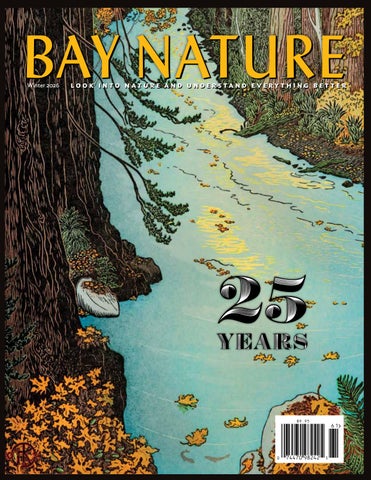
Winter 2026
LO O K I N TO N AT U R E A N D U N D E R STA N D E V E RY T H I N G B E T T E R
25
YEARS
It takes a community to protect a place
elkhornslough.org
Preserving threatened ecosystems, restoring natural areas for wildlife, and connecting people & nature in the heart of Monterey Bay. Photo by Victoria Derr
VISIT THE WORLD’S LARGEST MARINE MAMMAL HOSPITAL See Rescued Marine Mammals Join a Tour & Find Unique Gifts All in the Marin Headlands!
..................... PLAN YOUR VISIT MarineMammalCenter.org/visit-bay
Meet the Locals Preconstruction
since 1926
Construction Management
Demolition
Pipelines
Grading
Paving
Landscape
Mechanical
TOGETHER WE BUILD THINGS RIGHT Proud Supporters of Bay Nature
Community Celebration
Outreach & Education Courtland Creek Restoration Project, Oakland www.McGuireandHester.com
Make this the year you get out into nature and understand everything better with
P h ot
o©
Ba
r rba
aB
ut
ku
January 9 – March 22
s
Sign up for our newsletter so you never miss a Bay Nature Hike or Talk.
OPEN DAILY
We look forward to seeing you on the trail! On Hwy 12 in Glen Ellen
Organics: Organic Composts Organic Vegetable Blend Essential Soil Landscape Mix Potting Mix, Biotreatment Mix Lightweight Rooftop Mix Custom Soil Blends Mulch, Soil Amendments & Organic Fertilizers
Hardscapes: Flagstone, Bluestone Limestone, Sandstone, Slate Landscape Boulders, Wall Rock Thin Veneer Panels Quartzite, Ledgestone Decomposed Granite & Path Fines Decorative Gravel & Pebble Garden Ornaments, Water Features
Black-necked stilts poke around for prey in Solano County, where a city of 400,000 people may sprout.
contents
contents
f e at u r e s
36 BETTER NOW
15
HERP THOUGHTS
25
OUR MODERN AGE
31
LOOK CLOSER
Underneath California Forever
25 Years of Change
Being a Salamander
Roaming in Nature
For Bay Nature’s anniversary, we visit four places where our community’s hard work has returned nature to the San Francisco Bay Area and exult in their transformations: streams unearthed, seals returning, grasslands renewed, lost stewardship restored.
After a chance encounter with another mind at a trailside log, a writer wonders: What does it mean to be a salamander? Thus begins a journey through science, with existential undercurrents, into the minds of creatures we hardly know.
As the ding of the text message reaches us farther and farther into remote natural lands, how do we hold on to that ideal of wilderness, a seemingly pure connection with nature? A reporter considers the long role of technology in the outdoors.
A billionaire-backed company aims to build “the most sustainable city in the U.S.” on what it calls “the least ecologically diverse” land in Solano County. Yet biologists say these lands, long managed by ranchers, are likely home to fairy shrimp, California tiger salamanders, and many other threatened species.
By Marissa Ortega-Welch
By Tanvi Dutta Gupta
Anton Sorokin
By Tanvi Dutta Gupta
By Brandon Keim
W I N T E R 2 0 2 6 | B AY N AT U R E
5
d e pa r t m e n t s 44
52
10
THIS WINTER
44
EXPLORE
4 4 M onte Rio Redwood s Gone is the din of logging. This Sonoma County park has recently quadrupled in size—and now joins a magnificent 22,000-acre protected natural corridor stretching from the Bohemian Highway to the coast.
1 0 Almanac Ups and Downs 1 2 The Human Animal Heres and Nows 1 3 Signs of the Season Our Blackbirds 1 4 Swimming the Bay Murk Appreciation 5 5 Naturalist’s Notebook Rainbows
25
By Alastair Bland
4 7 Steward sh ip Our winter roundup of volunteer opportunities includes trash-picking, bird-counting, weed-battling, seal-pup-protecting, and deep-diving (virtually) into the sea. By Guananí Gómez–Van Cortright
4 8 Pach eco Mar sh Amid the industry of Martinez, what was once a drained, diked, and dry wasteland is now a lush tidal marsh. It’s just 237 acres, but big enough for a writer to find some adventure. By Aleta George
5 2 Oth erworld ly lig ht At night, an ultraviolet flashlight reveals a new world of life blazing bright, from anemones to opossums. And winter is often the best time to see it. By Damon Tighe fro m th e field : 8 Contributors | 9 Editor's Letter
6
B AY N AT U R E | B AY N AT U R E . O R G
From top: Justin Lewis / The Coldwater Collective, courtesy of Save the Redwoods League; Mandy Hackney; Jane Kim; © Joel Sartore / Photo Ark
10
Proud SPJ NorCal Excellence in Journalism Award Winners
Environment Reporting: Science Reporting:
“Point Reyes, After the Cattle”
Science Reporting:
Lisa M. Krieger
“Raising Hungry Sea Star Babies Is No Cinch”
“A New Story for Sperm Whales”
Guananí Gómez-Van Cortright
Tanvi Dutta Gupta
Science Reporting: “A Battery Fire Deposits Heavy Metals into Elkhorn Slough” Jillian Magtoto
This win wouldn’t be possible without the generous support of our members, donors, readers, event attendees, board of directors, and so many others. From all of us at Bay Nature, thank you.
Leave a Legacy
Make a lasting impact on Bay Area nature journalism with a legacy gift
Why donate to Bay Nature in your will? It allows you to give back to a nonprofit you love It costs you nothing now You create a lasting legacy By donating part of your estate to Bay Nature, you’ll continue making a difference long after you’re gone. Join our community members who’ve already added Bay Nature to their will. Questions? Contact Development Manager Barbara Butkus at: barbara@baynature.org or 510-973-3431
Bay Nature is a nonprofit organization, which means we rely on gifts like yours to continue to produce quality environmental journalism. Tax ID#: 76-0744881
FROM THE FIELD | CONTRIBUTORS
p. 15 & 36 Tanvi Dutta Gupta is a
senior reporting fellow at Bay Nature. When she first arrived in the Bay Area after a decade in tropical rainforests, she thought the brown hills looked ugly. Now—seven years, two college degrees, and one year reporting with Bay Nature later—she has grown to love California’s grasslands. Her writing can be found in Science, High Country News, her mother’s Facebook, and underground tunnels. TanviDG.wordpress.com
p. 52 Born in Klamath Falls, Oregon,
and raised in Calaveras County, Damon Tighe attended Saint Mary’s College, in Moraga, where he worked at local newspapers while earning a biology/chemistry degree. He taught high school in Portland, and moved back to the Bay Area to work on the Human Genome Project at the Lawrence Berkeley National Lab’s Joint Genome Institute. He currently works in biotech and moonlights as a naturalist with an emphasis on fungi.
Kathleen Ok-Soo Richards is Bay Nature’s explore editor and a freelance writer and editor, and was born and raised in Berkeley. Her award-winning journalism career has included stints as the editor in chief of the East Bay Express and the managing editor of The Stranger, and her byline has also appeared in Alta Journal, High Country News, Redwoods magazine, and other outlets. She’s passionate about storytelling that inspires people to protect the natural world. KathleenORichards.com Other Contributors: Amir Aziz (p. 15),
Alastair Bland (p. 44), Aleta George (p. 48), GreenInfo Network (p. 16), Guananí Gómez–Van Cortright (p. 47), Tim Lohnes (p. 38–42), Robert Meese (p. 13), Susan Kuramoto Moffat (p. 14), Ben Pease (p. 49), Endria Richardson (p. 12), Sadie Rose du Vigneaud (p. 12).
8
B AY N AT U R E | B AY N AT U R E . O R G
p. 25 Brandon Keim is a science
journalist who specializes in animals and nature. His bylines include the New York Times, National Geographic, The Atlantic, and Nautilus, where he is a contributing editor. His latest book, Meet the Neighbors, explores what animal personhood—knowing them as thinking, feeling beings— means for our relationships to wild animals and nature.
p. 31 Marissa Ortega-Welch is a print
and radio journalist and the creator and host of KALW/NPR’s How Wild, a podcast about wilderness, how it’s changing, and what that says about us as humans. Marissa wrote Bay Nature’s cover story “Who Will Capture the Acorn Throne?” in fall 2019 and “When Millions Take Flight,” about pandemic-era birding, in fall 2020. Instagram: @HowWildPodcast. Catalina Luna, Bay Nature’s graphic designer, is focused on visual communication for arts, social justice, and environmental initiatives. Based in Oakland since 2017, she has worked with Bay Area nonprofits such as SFFILM, Oakland Museum of California, Mission Cultural Center for Latino Arts, and SFJazz, creating engaging ways to connect diverse audiences with meaningful causes. Inspired by the region’s rich diversity and natural beauty, her work elevates cultural stories, fosters community engagement, and promotes an inclusive, impactful future. Cover: “Lagunitas Creek Autumn” © 2025 Tom Killion. Lined with coast redwoods and bigleaf maples, Lagunitas Creek flows north from the heights of Mount Tamalpais into Tomales Bay. Autumn brings golden foliage and coho salmon returning to spawn with the first rains. Begun in August 2024, this woodcut print required 11 color layers, including multiple reduction cuts and pressure printing from stencils glued to the tympan.
masthead, vol 26, no 1 winter 2026
Executive Director/Publisher Wes Radez Editor in Chief Victoria Schlesinger senior editor Kate Golden Explore editor Kathleen Richards graphic designers Catalina Luna, Susan Scandrett contributing artists Jane Kim, John Muir Laws events coordinator Lia Keener journalism fellows Amir Aziz, Tanvi Dutta Gupta Fact checker Sarah Trent copy editor Cynthia Rubin Advertising Director Micaelyn Compton proofreader Dominik Sklarzyk Membership Manager Patrick Brod Development manager Barbara Butkus Development assistant Sheila Moore Finance director Jenny Stampp Information technology Manager Laurence Tietz cofounders David Loeb, Malcolm Margolin Board of Directors Fatima Abdul-Khabir, Deonna Anderson, Tim Falls, Nan Ho, Rebecca Johnson (chair), Jackie Magno, Kelli McCune, Matt McKerley, Dana Swisher, Anh Phuong Tran, Gloria Zhu Volunteers Karen Anderson, Marion Cowee, Marcia Edelen, Mei-Hua Gee, Robert Jankowski, Cathy Leonard, Leah Isabella Martinez, Lesley Stoup, David Wichner, Margo Wixsom Bay Nature is published quarterly by the Bay Nature Institute 1328 6th Street #2, Berkeley, CA 94710 Membership: $40 annually (888)422-9628, BayNature.org PO Box 6409, Albany CA 94706 Advertising: Advertising@baynature.org Editorial & Business Office: 1328 6th Street #2, Berkeley, CA 94710 (510)528-8550; (510)528-8117 (fax) BayNature@baynature.org Printed by Commerce Printing (Sacramento, CA) using soy-based inks and alternative energy.
ISSN 1531-5193 No part of this magazine may be reproduced without written permission from Bay Nature and its contributors. © 2026 Bay Nature
FROM THE FIELD | EDITOR’S LETTER
Ecosystem Engineers
Barbara Butkus
One day, while poking around beneath a pot in my family’s backyard, I discovered a glistening arboreal salamander. It couldn’t have been longer than my pinkie finger. Its moist skin looked so delicate and permeable, like it hardly separated the little creature from the rest of the world. It was the first amphibian I’d found in our yard after five years of looking. I set down the pot, reconstituting the salamander’s dark, wet world, and felt pretty good that our small garden provided an arboreal salamander what it needed to survive. Knowing there was an amphibian in the yard, I hoped a reptile might also find its way to us. But really, what were the chances? We’re surrounded by cement. So many busy roads in Berkeley. How would a snake or lizard ever reach us? Maybe a red-tailed hawk would drop an extra squirmy meal while flying over our postage stamp of plants? Who knows. I hoped this patch could support a diversity of local life, especially some of the sensitive species. It was six years, a heck of a lot of planting of native wildflower seeds and a swath of red fescue from seed, and time spent hauling compost from the free pile in the Berkeley Marina every fall, before a flick of something on our steps caught my eye: a baby western fence lizard, the size of my thumbnail. Putting aside how it got here (my bets are on the compost), the wee lizard, I was certain, wouldn’t make it. A bird snack for sure. So many hazards in its enormous world! But sitting with binoculars at my kitchen table, I narrowed the 20 feet between me and the steps and watched the baby lizard grow over weeks, then months. When I encountered it, by then a juvenile, in a completely different part of the yard, I thought, “Maybe you’ll make it.” That was a year and a half ago, and we now have three fence lizards of varying sizes. I catch sight of one most days, skittering about, leaping wild and strong between fence posts and sunning on the rock wall. Despite the improbability, a little ecosystem has settled in here. I share this tale because launching and building a magazine is a lot like coaxing a garden or parcel of land into becoming a rich ecosystem, an experience well known to many Bay Nature readers. The intent is always to create a landscape where all kinds of ideas, creatures if you will, can thrive. But the external forces bearing on the success or failure of the whole endeavor are legion. So it is no small accomplishment that you are holding Bay Nature’s 25th anniversary issue in your hands. This nonprofit media organization has weathered a quarter century of perils and many moments of triumph; it has defied all the odds of a brutal media landscape, and incredibly, the organization is growing. All of it has required tremendous labor and generosity from thousands of people, but a very special thanks is owed to a handful who have given an unknowable number of hours and their hearts to this vision. In chronological order, publishers Malcolm Margolin, David Loeb, Regina Starr Ridley, and Wes Radez; board chairs Larry Orman, Catherine Fox, Bruce Hartsough, and Rebecca Johnson; longtime editors Cynthia Rubin (25 years!), Dan Rademacher, Alison Hawkes, and Eric Simons; designers David Bullen and Susan Scandrett; staff and volunteers with long tenures include Sue Rosenthal, Jenny Stampp (20 years!), Judith Katz, David Wichner, Ellen Weis, Beth Slatkin, Laurie Miller, and Laurence Tietz; longtime contributors John Muir Laws, Michael Ellis, Claire Peaslee, Ben Pease, and Jane Kim. Enduring supporters Jorgen Hildebrandt, Nancy and Bart Westcott, Paul and Elizabeth Archambeault, and Tamia Marg and Tom Anderson. What an exquisite ecosystem we have created. —Victoria Schlesinger Editor in chief
W I N T E R 2 0 2 6 | B AY N AT U R E
9
T H I S W I N T E R | B AY N AT U R E A L M A N A C
Life during Winter
… can have ups and downs over the years.
This Year’s Spotlight: Ochre sea star
S p o t l igh t s pe c i e s S e e i ng s ta r s In 2013, biologists began to notice that sea stars—more than 20 species of them, eventually—along North America’s Pacific coast were suffering from an illness that caused them to disintegrate. Literally, limbs fell off and creatures dissolved away. The illness, dubbed sea star wasting disease, ravaged populations, including the ochre sea star (Pisaster ochraceus). But that initial die-off was followed by huge recruitment pulses. Meaning, lots of ochre sea star larvae settled in tidepools and began to grow. They are so itty-bitty, it’s roughly a year before scientists can even see them to count them. Sea stars’ recovery has been mixed along Bay Area coastlines, says Sarah Cohen, a biology professor at San Francisco State University. Some have returned. Others not so much. But the infections have mostly subsided. This summer scientists concluded the bacterium Vibrio pectenicida was killing sunf lower sea stars. More study will determine its impact on other sea star species.
10
B AY N AT U R E | B AY N AT U R E . O R G
Surf scoters
Bion ic bu t t e r f ly This overwintering season, sometime between October and March, when monarch butterflies (Danaus plexippus) settle in Santa Cruz, at least two dozen will be outfitted with tiny transmitters— weighing .06 grams and attached with eyelash glue—powered by solar panels. For this new experiment studying the beleaguered western monarch population, Xerces Society researchers invite the public to follow along and detect tagged monarchs through the Project Monarch app. Scientists hope to learn more about the monarchs’ migratory routes to better protect them.
T h e no s e h a s i t Male surf scoters (Melanitta perspicillata) have a fantastic schnoz, or, technically, a bill, but really it looks like a great, lumpy, f ire-hued nose, and it has captured human hearts. It gets attention from the lady scoters, too. The colorfully snooted male swims back and forth, dipping and shaking his honker in a female’s direction. Courtship begins along California’s coast, where the diving ducks winter, before the pair flies to Alaska and Canada to breed. But since 1989, the number of scoters wintering in the Bay has been declining, according to the 2025 San Francisco Bay State of the Birds report.
I L L U S T R AT I O N S B Y J A N E K I M
Freshwater floods
Monarch butterfly
California sea lion
Common manzanita
Winter feast Manzanitas—those red-barked, smoothskinned, serpentine-limbed, quintessential California shrubs that can sometimes grow tree-high—are food banks during the Bay Area’s winter. In 2015 some 105 manzanita taxa were known; in the decade since, that number has climbed to 108, thanks to how easily they hybridize and a lot of research. The common manzanita (Arctostaphylos manzanita) has six subspecies. They supply bees and hummingbirds with nectar and host potentially dozens of species of moths as larvae during winter, including the elegant sphinx moth (Sphinx perelegans).
S tat e of f l ow Freshwater flooding in winter needs a rebrand. The dire consequences of rivers and creeks overflowing their banks in the Bay Area catch the headlines, while in fact over the last 94 years, less and less fresh water is emptying into the San Francisco Estuary, according to the 2025 State of Our Estuary report. Water has increasingly been siphoned off for all manner of human needs. That means floodplains aren’t getting a regular dose of nutrients, groundwater isn’t recharging, and the quiet, low-saline shallows that young creatures, especially salmon, depend on are missing.
RESEARCH AND WRITING BY VICTORIA SCHLESINGER
Bro - c at ion You’re not imagining it. Over the past decade, California sea lions (Zalophus californianus) have increasingly been swimming through San Francisco Bay and up the Sacramento– San Joaquin River into the Delta and hanging out for the winter. Carp and sea bass lure them, and the haul-out spots convince them to stay. It’s the adult and subadult males you’re seeing, recuperating after the summer breeding season in Southern California’s Channel Islands. If you encounter a sea lion in the Delta, calmly retreat to another spot on the water.
W I N T E R 2 0 2 6 | B AY N AT U R E
11
T H I S W I N T E R | T H E HUMAN ANIMAL BY ENDRIA RICHARDSON
Sadie Rose du Vigneaud
I
12
A Particular Here, Now
went camping along the Russian River, outside Guerneville, a few weekends ago. My wife and I went with two friends, and their medium-size dog, and their very small baby. One night of camping, about an hourand-a-half drive north from Oakland. We stayed at a small campground nestled in a canyon of secondgrowth redwoods and bay laurels, recommended by another friend who camped there at the end of last summer, to spend time calf-deep in the river, fishing for bass. Just across the road from our campsite, past a modest orchard—I grabbed a small golden yellow apple from a low branch, crunchy, delicately sweet—there is a small, pebbled beach. Green tufts of coyote brush line the riparian path; alders and maples fill in the gaps between redwoods on the ridge above the river. A young cottonwood leans toward the water. The river is low, moving slowly enough that it seems not to, dotted with mayflies. I stand ankle-deep in the water, and listen to the sound of an electric saw whirring somewhere in the hills above me, another camper whistling for their dog to come, my friends layering and de-layering the baby—it’s his first camping trip—as the sun moves in and out of clouds. This river—my feet are cold, I need to leave soon— winds westward to the Pacific. The water reaches Hawaii, Indonesia, the Indian Ocean, Madagascar, Somalia, the Gulf of Aden, Sudan. The California Current moves—slow and broad and reaching hundreds of miles offshore—from the northernmost point of Vancouver Island, southward toward Baja California in Mexico. The North and South Equatorial currents are pushed west by trade winds along the equator toward the western coast of continents, where countercurrents traveling east and north form. It is possible that the exact water I stand in, here in this brief, slow section of the Russian River in Guerneville, California, might make it across an ocean or oceans—perhaps over the course of a hundred years or so. But probably not. Still, I am thinking about the shared world. When my friend came to this campground in summer, they were not just fishing for pleasure, but in order to continue to learn skills that might
B AY N AT U R E | B AY N AT U R E . O R G
help them and their community survive, in a bad scenario. I am nearly always thinking about the bad scenario: politically, ecologically, climatologically. The bad scenario has, of course, already happened: Russian and American settlers exploited Indigenous labor in the fur trade along the river and nearly hunted the California sea otter to extinction. Large-scale weather disasters are increasing in scale and frequency around the world. War is here, just an other here than here. I am in a particular here, now. Time and space are bounded things, after all—the river is not a conduit to the world, and the countries we live in shape the lives we live. I can drive a highway without checkpoints, turn onto a river road, lie on soft duff and yellowing bay leaves, roast sausages and assemble s’mores over a fire, and sleep beneath bending trees. I can, if I choose—as so many seem to be choosing now—disbelieve the reality of anything that is not within arm’s reach, verifiable by my own senses. Perhaps because I am the child of an immigrant and the descendant of enslaved people who were brought, afraid and unwilling, to this continent across the Atlantic Ocean, I am always thinking about worlds out of reach. But it is a human impulse to wonder at the limits of what we know through experience alone, to yearn for a way to share the suffering and the delights of people and places we will never touch or know, other than through our phone and computer and television screens—flat images, sharp, but without smell or texture or taste. Back at our site the next day, early morning sun streamed through the bay trees, lightening their slivered leaves. Campfires burned in the sites around us, and someone seemed to have charred their breakfast. I smell the smells of our neighbors, I hear the sounds of their children. I am in this here and now, but there are other heres and other nows. I want to touch them, to deepen and layer the experiences that present themselves to my physical senses: woodsmoke, bay leaf, sunlight. I want to share this moment, this still-here-and-now possibility for an evening and morning of peace, so that, when we must, we can recall being part of a beautiful world. ◆
THIS WINTER | SIGNS OF THE SEASON
California’s Blackbird
From top: elijp via iNaturalist, CC-BY-NC; Robert J. Meese
“
The near-endemic tricolored blackbird traverses the Golden State with cat calls and friends.
Why does the marsh sound like it’s full of cats?” someone asked as I led a group to a stand of cattails. I explained to them there were no cats— rather a colony of tricolored blackbirds, some of the most social and vocal birds in North America. The male’s distinctive, bizarre, and cat-like calls can distinguish them from their look-alike, the red-winged blackbird. Tricolors behave differently too: unlike their more territorial relative, tricolors live in groups year-round— breeding, foraging, bathing, and roosting together through the winter. A century ago, tricolors were the most abundant bird in Southern California, and widespread elsewhere. Today, the species is listed as threatened under the California Endangered Species Act. Over 99 percent of the world’s tricolored blackbirds live in California, breeding in dense colonies scattered across the Central Valley, the Central Coast, and Southern California. Decades of tricolored blackbird studies have focused on the birds during their spring to summer breeding season, but we still know next to nothing about what they’re doing during the winter. So for 21 years, I have explored where they are, what they eat, where they’re roosting, and what they sound like as the days shorten. A retired avian ecologist from UC Davis, I’ve led the triennial statewide survey that monitors the tricolor population. I have trapped and banded over 107,000 tricolored blackbirds, from the Central Valley, the Coast Ranges, and Monterey County during the breeding season to Solano County in the winter,
where, over a decade ago, I discovered at least 50,000 tricolors foraging on a sheep ranch. By banding birds across locations and seasons, I have begun to illuminate their wintertime lives. I discovered tricolors often move over long distances from their breeding colonies to their wintering grounds. When breeding, birds often live near dairies in the Central Valley. Much is known about these breeding grounds. But over the winter, birds seem to seek out farms and ranches, especially in the Delta, where plows unearth a delicious insect and seed buffet. By banding and rec apt ur i ng bi rd s , I discovered that tricolors may f ly severa l hund red miles—sometimes over a matter of days—between the Central Coast and the Central Valley, crossing large, tricolor-unfriendly expanses of California to search for those winter feasts. To protect tricolors, I realized, we cannot focus on only one portion of the species’ range or one part of the species’ life cycle; we must protect places hundreds of miles apart. As they travel, groups of tricolors stick together—one could say that they have friends with whom they journey through life. From the hundreds of birds I banded in the winter on the ranch in Solano County, I recaptured four of the same birds at one place almost 100 miles away in Colusa County the next spring.
Those birds had moved together from Solano County to breed together in Colusa County months later. Somet imes , you c a n see t hese “friendships” at work. In winter, tricolors perform wild, dizzying flights at sunset as they return from their foraging grounds to their roost. Before descending for the night, they circle above the tule marsh in pulsing, whirling flocks. One evening, I watched the spectacular yet rarely observed display at a small marsh in Placer County, alongside a homeowner in Folsom, who was the first to ever report the location of a winter roost. As we observed the birds, we saw how smaller groups of bird s would whirl around and around until other groups joined them. Only then did they all descend abruptly into the tules to spend the night. The homeowner concluded the tricolors were “waiting for their friends” to arrive before settling down to roost. Given what I have learned about the birds, she was almost certainly right. Much remains to be discovered about the tricolor, California’s blackbird. You, too, may see or hear something that no one else knows about, and you may contribute to our knowledge of the species by reporting your obser vations of ag gregations of birds to the Tricolored Blackbird Por t a l [Tricolor.Ice.UCDavis.edu].◆ —Robert J. Meese
In 2007, more than 50,000 tricolored blackbirds flocked at one ranch near the Delta in southeastern Solano. They were likely drawn by the grain intended for the ranch’s sheep. Tricolor numbers there have plummeted in recent years.
W I N T E R 2 0 2 6 | B AY N AT U R E
13
T H I S W I N T E R | S W I M M I N G I N T H E B AY B Y S U S A N K U R A M O T O M O F FAT
Winter Clean
P
eople often wrap themselves in a hug and shiver when I tell them I swim in the San Francisco Bay without a wetsuit in winter. Yes, it’s cold, but that’s the pleasure of it—my mood rises as the temperature drops. Next they shudder about the water quality. “Isn’t the Bay dirty?” they ask. That’s a good question, especially in the rainy season. Along most of the Bay’s 400 miles of shoreline, downpours wash trash, oil, dog poop, and anything else in the gutter down storm drains and creeks that flow straight into the Bay. When I take a walk in the rain, I cast a swimmer’s critical eye on the greasy runoff pouring down the street, assessing how much it will get diluted once it flows into the Bay. The good news is that the dilution is massive, with tides pouring in from the Pacific twice a day and, from the other direction, huge quantities of water from the Sierra Nevada sluicing in through the California Delta. The result is that the water of the Bay is on the whole shockingly clean. The reality year-round is much better than the popular perception. Even in winter, Bay water is mostly safe to swim in. It smells good. It tastes fine. Many Bay beaches get A and A+ scores for water quality from the
I give thanks to the public servants who run the East Bay Municipal Utility District wastewater treatment plant four miles south of my home beach. I thank the scientists tracking pathogens and even the bureaucrats who are requiring me to spend an eye-watering sum to replace my home’s apparently leaking sewer lateral. I thank the Save the Bay movement that helped people see the Bay as more than a dump, and California’s 1969 Porter-Cologne Act, which helped lead to the federal Clean Water Act. San Francisco Bay didn’t go from a stinking, hazardous mess in the
accumulate in sediment and in animal flesh up the food chain. I swim in the water but don’t eat fish from it regularly. Nutrients including nitrogen from sewage, even after it’s treated, are also an issue. Although harmful algal blooms have not generally been a huge problem in San Francisco Bay, the reddish Heterosigma akashiwo bloom that killed thousands of fish in 2022 raised concerns. Scientists are studying whether the Bay might be growing more algae-prone, in part because humans are making it clearer— that is, less muddy. Urban development and
1960s to the swimmable beauty it is today by accident. Before the Clean Water Act passed in 1972, raw sewage went straight into the Bay. Fifteen years later, most water around Bay beaches was deemed swimmable in summer and today many are safe in winter, too. Admittedly, a few Bay beaches are persistently f ilthy in wet weather. San Francisco, alone among Bay Area cities, does the massive work of treating most of the runoff from its streets. But in heavy downpours its combined wastewater-stormwater system gets overwhelmed and millions of gallons of the combined flux spills into the Bay. And the Bay still has serious problems with toxic contaminants. As a swimmer, the infinitesimal amounts of PCBs, heavy metals, and “forever chemicals” that I could potentially absorb through my skin are likely inconsequential. But these toxins
dams on tributaries of the San Joaquin and Sacramento rivers steal essential sediment from the creek and river water that feeds the Bay, so more light is available to the photosynthetic algae, fueling blooms. A turbid Bay is a healthy Bay. It’s supposed to be brownish—suspended sediment is essential to limiting excessive algae growth, just as it is to forming and maintaining wetlands. And the animal plankton that also adds to the Bay’s opaqueness isn’t dirty, it’s life. When I can’t see my feet as I wade into the water, I’m not thinking ick, I’m wondering, what microscopic barnacle and crab babies are in the soup around my ankles? Maybe we need to adjust our image of a clean, healthy Bay. It’s not meant to look like the Caribbean or Hawaii. It should be the color of green tea mixed with chai, with nicely muddy, marshy edges—and lots of people swimming happily in the clean, biologically rich murk. ◆
“Even in winter, Bay water is mostly safe to swim in. It smells good. It tastes fine.”
Painting by Colleen Haraden-Gorski
environmental nonprofit Heal the Bay— some even in wet weather. This is something of a miracle, considering that the Bay is one of the most urbanized estuaries in the United States, surrounded by more than 7 million people flushing their toilets every day, not to mention factories, ports, refineries, and miles of dirty asphalt. As I immerse my head in the water that runs from cities into the Bay, I am grateful to nature for the Bay’s enormous daily tidal flux. I also appreciate the efforts of humans.
14
B AY N AT U R E | B AY N AT U R E . O R G
A creek for all: Children play at Sausal Creek in October 2025. This was a local dump, years ago.
By Tanvi Dutta Gupta
W
hen Bay Nature was born 25 years ago, the greater Bay Area stood at a tipping point. Environmental movements of the 1970s had galvanized a core group of people committed to bringing nature back. Thanks to key achievements—the Clean Water Act, the founding of land trusts, new state and federal funding—stinking landfills became parks, and areas once slated for bulldozing were protected. Now environmental groups had to do something with the places they had saved. “It went from ‘You’re not going to develop this’ to ‘We’re going to restore this,’ ” says David Loeb, who cofounded Bay Nature with Malcolm Margolin and was its publisher and editor in chief for 17 years. After news-grabbing purchases come far less glamorous years of developing restoration blueprints, applying for permits, cleaning up trash, and rearing native plants.
Meanwhile the threats to nature have grown and changed, Loeb says. Development continues to encroach upon natural areas, but climate change now drives much of the restoration work. New invasive species are always arriving. Yet many places have been transformed for the better, and more people are invested in local nature. “It’s not just a specialized cadre,” Loeb says. “You have a whole ecosystem of people now.” Here, we show what change looks like at four sites around the Bay Area, chosen with help from the Bay Nature community, and highlight notable themes and trends in local restoration over this past quarter century: Sausal Creek, Crissy Field, Sears Point, and Quiroste Valley Cultural Preserve. Often these projects began with a seed—someone hoping to fix one small problem—that sprouted into something much bigger.
Amir Aziz / Bay Nature
Concrete to creek. Forest to grassland. Field to marsh. Airstrip to beach. A quarter century of hard work has restored nature to the San Francisco Bay Area in places where it was once unimaginable.
F E A T U R E | C O N S E R VAT I O N W I N S
the past 25 years, conservationists have made striking progress toward Saving Over a goal of protecting half of the San Francisco Bay Area’s lands by 2050. And forget the water, great swaths of which are now covered by federal or the Bay don’t state protections.
441,551 more acres of Bay Area lands protected since 2002
90 +
federally and state-listed species with critical habitat here
Crissy Field
Sausal Creek Map data: California Protected Areas Database, NOAA. Lady beetles on facing page: Mark J. Rauzon.
Sears Point
3.5
intermediate est. feet of sea level rise for S.F., 2000–2100
Quiroste Valley Cultural Preserve
16
B AY N AT U R E | B AY N AT U R E . O R G
MAP BY GREENINFO NETWORK
F E A T U R E | C O N S E R VAT I O N W I N S
Unburied Waters
Before daylighting: For 77 years, Sausal Creek was confined to a culvert running under this grass at Dimond Park.
E AST B AY
SAUSAL CREEK
A formerly domesticated creek flows free in Oakland. The Chochenyo-speaking Ohlone people knew the East Bay’s creeks as living beings—waters that flowed from the hills, across redwood forest and chaparral and willow stands, to the mudflats and the Bay. But 19th- and 20th-century settlers in the new city of Oakland blocked or buried many of the waters—taming the unruly torrents of creeks like Sausal Creek, which starts in the hills above the Dimond District and runs through Fruitvale. Sausal Creek was dammed, concreted, and abandoned. In some places, the stream that once nourished willows and rainbow trout disappeared altogether, in wellmeant Works Progress Administration projects. Then the creek got a little help from its friends— specifically, the Friends of Sausal Creek, which formed in 1996 to plant native species along the waterway’s banks as the city removed a nearby sewer line. Since then, the group has expanded into a nonprofit that stewards the watershed in all its wanderings. From 2012 to 2016, Friends of Sausal Creek helped unearth the creek from underneath a manicured lawn in Dimond Ladies who Park. Today, the creek flows in munch (aphids, dappled sunlight—supporting that is): Convergent rainbow trout, dense willows, lady beetles and children who splash (Hippodamia through the water. convergens) at Sausal Creek. Friends of Sausal Creek volunteers have given hundreds of thousands of hours of work to clean, replant, and protect the creek over the years, and the work goes on—beating back invasive ivy, growing native plants, and cleaning up areas in the lower watershed that people are still treating as a dump site. Says Kate Berlin, the development and engagement manager for Friends of Sausal Creek: “It’s about letting folks know somebody cares about this space.”
photo Amir Aziz credit / Bay Nature
Michael Thilgen
778
miles of Bay Area streams protected, as of 2024
Now, that same place is a fish haven: alders and willows shade rainbow trout in the daylighted creek.
W I N T E R 2 0 2 6 | B AY N AT U R E
17
F E A T U R E | C O N S E R VAT I O N W I N S
A New Park Takes Flight SAN FRANCISCO
CRISSY FIELD
From top: Kirke Wrench / National Park Service, courtesy of Golden Gate National Parks Conservancy (GGNPC); Courtesy of GGNPC.
An iconic park that was once a military airstrip.
18
When Lewis Stringer began work at the abandoned military airstrip overlooking the Golden Gate Bridge in 1997, it was a “derelict concrete wasteland,” according to the National Park Service. Stringer supervised AmeriCorps members as they pulled invasive ice plants and planted native species. Thousands of volunteers helped. Soon, one of the biggest urban restoration projects the United States had ever seen, and the largest philanthropic gift NPS had ever received, would transform Crissy Field. From the concrete, the park service and the nonprofit Golden Gate National Parks Association (now the Golden Gate National Parks Conservancy) unearthed Crissy Field’s long-lost salt marsh and lagoon. Stringer returned in the 2000s to “restring the necklace” of the marsh’s watershed, as
he put it—restoring a few acres of wetland at a time, all the way to El Polín Spring. Today, you can walk from the spring to the lagoon through a natural corridor also frequented by invertebrates and lizards. Stringer, now associate director of natural
resources at the Presidio Trust, has spent almost three decades at the Presidio. During this time he has seen the restoration of 60 acres of watershed, supported by wetland mitigation funds, the Presidio Trust, and GGNPC—which has now raised among the most money of any NPS partner agency. Around 40 acres have yet to be restored.
234
bird species recorded in Crissy Field’s lagoon
Marshes were filled in to make this shoreline for a 1915 world’s fair; by 1997, after decades of military operations, it was strewn with rubble.
B AY N AT U R E | B AY N AT U R E . O R G
F E A T U R E | C O N S E R VAT I O N W I N S
The public-private partnership that sustains Crissy Field has its ups and downs. President Donald J. Trump’s administration has targeted the Presidio, and Republicans in Congress briefly challenged $200 million of Inflation Reduction Act funding meant for a long-needed park infrastructure upgrade. And since Crissy Field falls under
Old military buildings still stand here; one serves as the Greater Farallones and Cordell Bank National Marine Sanctuaries Visitor Center.
NPS management, parking there got harder when the government shut down in 2025. Even so, you could and still can experience on foot how far Crissy Field has come from its concrete past. Walk the long marsh-
lined beach, and see birders who have come for the thousands of birds that stop here, runners relishing the long, flat trails, picnickers enjoying the Golden Gate views, and others—a decades-old vision come to life.
Millions of people visit Crissy Field each year, and native dune plants thrive along the beach.
W I N T E R 2 0 2 6 | B AY N AT U R E
From top: Courtesy of Golden Gate National Parks Conservancy; David Lundgren via iNaturalist, CC-BY-NC; Amir Aziz / Bay Nature
Planes and helicopters launched here from 1919 to 1974, including some of Amelia Earhart’s flights.
19
F E A T U R E | C O N S E R VAT I O N W I N S
After the Flood N O RT H B AY
SEARS POINT
In 2004, Sears Point had been a ranch for over 120 years, thanks to dikes holding back the tides.
The fish are back. Now comes the hard, slow work of rebuilding a marsh. As conservationists let water back into Sears Point in October 2015 for the first time in more than a century, nature came with it. Within weeks, somebody photographed a seal with a striped bass clenched in its jaws, swimming over this 1,000-acre area that had been farmland not too long ago. It is one of many such projects across the Bay, returning the tides to places where levees had once barred the waters and restoring baylands on the scale of landscapes. The levee breach is the most dramatic moment—but it is just one milestone on the long, muddy journey back to becoming a tidal marsh. Projects build on each other. The neighboring Sonoma Baylands were flooded to restore wetlands in 1996. When Sonoma Land Trust acquired Sears Point in 2004, it looked at what had worked—and what hadn’t—next door. The land trust spent a decade permitting and planning the larger levee breach, dotting the basin with 500 mounds of sediment to help restoration along. Now lessons from Sears Point guide even bigger restoration projects. As sea levels rise, wetland restorers must adapt. “All the work we’re doing now just has to be done so much faster,” says Julian Meisler, associate stewardship director at Sonoma Land Trust. “We’re in a race against time.” Sears Point is still changing. Every tide washes in sediment that helps rebuild the marsh a little more. Soon, there will be enough of the stuff for pickleweed to gain a toehold. The endangered salt marsh harvest mice that depend upon it may find a new place to raise their babies. Already other wildlife have more acres of tidal joined the seals: avocets, bat wetlands in the Bay Area since 1998 rays, and even an occasional
2005, prerestoration: Little patches of marsh around Sears Point showed what the area could be, with help.
17,500
wandering salmon. 2015: Bulldozers broke down a levee to flood the land and bring back the marsh.
20
B AY N AT U R E | B AY N AT U R E . O R G
F E A T U R E | C O N S E R VAT I O N W I N S
2018: Three years post-breach, Bay waters were already reshaping the ranchland’s straight lines with the organic tendrils of a tidal marsh.
80 +% Bay Area wetlands destroyed since European settlement
53%
Clockwise from top left: Map data via Google, Maxar Technologies (2x); Stephen Joseph, Sonoma Land Trust; Amir Aziz / Bay Nature; Sonoma Land Trust (2x).
progress so far toward 100,000-acre tidal wetland restoration goal
2015: To prepare for the levee breach, Sonoma Land Trust built 500 marsh mounds where saltloving plants could grow.
Not long after the levee breach, a harbor seal like this one swam in, bearing a fish in its jaws.
2025: At lower tides birds flock in, looking for snacks; higher ones bring swimmers—sand dabs, gobies, bass.
W I N T E R 2 0 2 6 | B AY N AT U R E
21
F E A T U R E | C O N S E R VAT I O N W I N S
The Stewards Return
Young tribal members in the Native Stewardship Corps spent months out at Quiroste, learning to care for the land like their ancestors did.
S A N TA C R U Z A R E A
QUIROSTE VALLEY
Clockwise from top: California State Parks; Hylkema and Cuthrell 2013; California State Parks
Smoke curls again over the Santa Cruz Mountains, and grasslands return.
22
Valentin Lopez, former chairman of the Amah Mutsun Tribal Band, remembers how Quiroste Valley felt the first time he visited, in 2006: “Very much forested.” Douglas firs grew in dense stands, with invasive grasses dominating open patches. Along the creeks, thick-trunked redwoods remained—survivors of the clear-cutting across the Santa Cruz Mountains, remnants of a very different Quiroste. An immense coastal prairie had once covered most of the valley, which the Quiroste tribe maintained by burning there every seven to ten years, according to Lopez. (Though there are no known descendants of the Quiroste people, the Amah Mutsun trace their lineage to this region.) Lopez and other tribal members started talking about bringing back the prairie. In 2008, the state designated the valley a cultural preserve within
The corps used traditional fire-starting methods to ignite Quiroste’s first pile burn of Douglas firs.
B AY N AT U R E | B AY N AT U R E . O R G
Año Nuevo State Park. It was likely the first such partnership between an unrecognized tribe and State Parks, and it brought back tribal stewardship to the valley in perpetuity. Since then, State Parks and the Amah Mutsun Land Trust’s Native Stewardship Corps have cleared over 4,000 Douglas firs and countless stands of poison hemlock. They have set fire to the cleared firs, propagated over a quarter million native plants, and scattered seeds amid the 400 burn scars. Today, while standing amid native purple needlegrass, one can see the sky and the sea from places once overwhelmed by Douglas fir. “But there’s a lot of things that are invisible,” says Mark Hylkema, a retired State Parks archaeologist, who has studied Quiroste Valley since the 1980s. “Like the
restoration of tribal identity and pride.” The Amah Mutsun’s work here kick-started partnerships and conversations with other agencies and land trusts—especially when the CZU Fire of 2020, which burned to Song sparrow the valley’s edge, (Melospiza melodia). Coastal prairies underscored for are particularly many how lost tribal biodiverse stewa rdship put ecosystems. landscapes at stake. The tribe and State Parks are now planning the first cultural burn here, perhaps for 2026. The fire spreading across the land will be the next step in Quiroste’s long restoration. “We say it took seven, eight, nine generations to get to the condition it is today,” says Lopez. “It’s going to take seven, eight, nine generations to get back.”
Tribal homelands at the time of Spanish colonization, according to archaeologists’ historical research.
F E A T U R E | C O N S E R VAT I O N W I N S
< 2%
Patrick Robinson, CA State Parks
native grasslands remaining in California
2020: A century of ranching, clear-cutting, and fire suppression led to dense stands of Douglas fir overwhelming the once-expansive coastal prairie.
Amir Aziz / Bay Nature; sparrow, George Chrisman via iNaturalist, CC-BY-NC.
2025: By cutting down young Douglas firs, the stewards helped bring back native grasslands. They left one tree standing, as shade for their lunch breaks.
140
invasive plant species threatening the region’s grasslands
60 +
Bay Area tribal groups, before colonization
W I N T E R 2 0 2 6 | B AY N AT U R E
23
601 A Canal Blvd. Richmond, CA (510) 234-2222 sales@thewatershednursery.com
10% OFF Coupon for your next purchase of California native plants!
Available Now on Amazon
A fascinating and personal look at the condor population, the natural world around it, and the human interventions that have prevented its extinction. - Cintra Wilson, author of Colors Insulting to Nature
ic Winery of the Year! California Org-an 2025 NY International Wine Competition
Being a
Salamander On a humid spring night last April, I went for a walk in Garber Park, a hillside forest on the eastern edge of Berkeley. In a stand of live oaks not far past the entrance my eyes happened to linger on a trailside log. And in a tiny hollow beneath the log’s base, reflected in my headlamp’s glow, were two gold-flecked black eyes and a dull pinkish snout.
Brandon Keim
By Brandon Keim
An arboreal salamander rests beneath a log in Garber Park, Oakland.
F E A T U R E | C O N S E R VAT I O N
I
©Joel Sartore/ Photo Ark
stopped for a closer look. The eyes belonged to a salamander: one Aneides lugubris, a species mostly native to the coastal oak woodlands of California and northern Mexico, more commonly known as an arboreal salamander. She—I didn’t actually know if the salamander was female, but preferred to guess rather than say it—took a step back on smoothly delicate legs but did not flee. I turned my headlamp to its red-light setting and sat beside the log to ponder: What is it like to be a salamander? To be this salamander? It’s the sort of question I often find myself thinking about other animals. Some, however, are harder to answer for than others. Although we live in an era when the intelligence of animals— especially mammals and birds—is widely acknowledged, the minds of amphibians have received little attention. They’re often considered primitive, as befits cold-blooded, mostly sedentary animals who retain many of the essential features of their ancestors, who first crawled onto land some 370 million years ago. Anatomical descriptions of amphibian brains tend to emphasize their simplicity. Relatively few studies of their cognition even exist. And at a gut-reaction, first-impression level, amphibians are simply—other. To understand what it’s like to be any animal is an act of imagination; that goes extra for salamanders. Yet we can also draw upon a patchwork of life history, behavior, neurobiology, and cognitive science, full of holes and yet complete enough to suggest a picture. “Can we ever completely know the perspective of another being? No. But that is also true of you and me: I will never fully inhabit your perspective. And that impossibility doesn’t mean it’s not worth trying,” advises Becca Franks, an animal behaviorist and environmental studies professor at New York University. “Quite the reverse: it would be offensive if I refused to take your perspective merely for a lack of ever being able to know it perfectly. The trying is what matters.” To Franks it is a challenge with existential undercurrents. As a species with extraordinary power over the fate of nonhuman life, as curious creatures sharing a planet with multitudes, it is incumbent upon us to try to understand the perspectives of beings who happen not to be human. And so let us begin with an arboreal salamander. As I sat down to consider the salamander, my headlamp’s red light illuminated her log. At the entrance to her burrow were fallen leaves and wispy vegetation; I imagined how extraordinary it would be to study them at eye-level scale, but they likely appeared to my salamander in low resolution. Salamander retinas have relatively few cells, and dramatically fewer of the nerves that carry signals between eye and brain. I may only have been a looming mass.
26
B AY N AT U R E | B AY N AT U R E . O R G
A. lugubris’s
skin must remain wet to exchange gases.
SEC I ORN AO RN T ISCELREV A T I O N F AT U E | C
“Hello, little salamander friend,” I said, being the sort of person who greets the animals I meet. To her the words were likely a dull rumble. The auditory systems of salamanders are functional but simple, lacking an eardrum and the middle ear structures that would amplify and relay airborne sounds. Even so, vibrations travel from the ground through the bones of their forelimbs and into their inner ears. Earlier in the evening, the footfalls of joggers and neighborhood families out for a stroll, unaware of the amphibian just inches from their feet, perhaps registered as seismic. My own ears pick up a steady crackling of tiny creatures moving through the fallen eucalyptus and bay and live oak leaves. I glimpse a few: a sow bug, an earthworm, springtails, all fare for an arboreal salamander. Should one pass close to her den, she may feel their movements—what must a millipede’s footfalls feel like!—see their form, and detect the motion with fly-catching precision. With a flick of her tongue she would snare the luckless creature before crushing it between muscular jaws lined with flattened, blade-like teeth. Arboreal salamanders are sit-and-wait predators, using no more energy than is necessary. One can imagine how she apprehends her domain. “Salamander experience must be shaped by modalities we underappreciate: chemosensation, moisture gradients, and substrate vibrations,” Shannon Kundey, an experimental psychologist at Hood College who studies salamanders, tells me later. “Their world is likely less about vision and more about texture, humidity, and chemical trails.” On a wet night, the salamander might leave her retreat and find another place to sit and wait: atop her log, perhaps, or even in a tree climbed with help from her prehensile tail. With a taptap-tap of snout1 to substrate, whatever detail is lacking from the salamander’s visual and auditory cosmos would be found in its odors: the leaves in varying states of decomposition, the scent trails of termites, the shelf fungus filigreed through her log, a constellation of odors to which I am as blind as she was to the stars. And now, a philosophical digression: In imagining what that salamander perceived, we implicitly assume that she possessed some sort of consciousness, some sort of self, such that she subjectively experienced those sensations and even considered them, discriminating between the slight and the pronounced, the salient and the unimportant. Some would say that this is not certain, that amphibians are not conscious
1
at all, or that salamanders might be conscious but it remains inconclusive, or that salamanders are conscious but perhaps not aware of themselves as a distinct entity, or that they’re conscious and capable of thought but may not feel. Many philosophers and scientists have tied their intellectual selves into pretzels over this sort of thing. It all seems—please forgive the flippancy—silly to me, a lingering intellectual legacy of now-discredited, centuriesold conceptions of animals as akin to mechanical wind-up toys. There is also an emerging school of thought which holds that to disentangle the sensations of one’s own movements from those of the external world is to be conscious, and that consciousness is inextricably intertwined with awareness and sentience, even in amphibians. They’re a package deal. There are gradations of these capacities, and the forms they took in the salamander beneath the log can be adjudicated later, but according to this argument, she had a sense of self. She was a someone. The salamander’s chin moved up and down with her respiration, though she breathed not in the way we do but through her body’s semipermeable, capillary-latticed skin. Arboreal salamanders are members of the Plethodontidae family, characterized by an abundance of teeth and the absence of lungs; in a sense, their bodies are their lungs. As well as oxygen, she absorbed moisture through her skin. Although salamanders’ ancestors evolved to live on land, they never fully left the water, and A. lugubris are among those who depend on wet surfaces and ambient condensation to keep from desiccating. Their skin must remain wet in order to exchange gases. If they become too dry, they cannot breathe. What might that damp spring air—it had not rained for days, but coastal fog and the forest canopy kept the night humid—have felt like to the salamander? I think of the rejuvenating sensation of walking out of a cold hockey rink into a muggy spring night, multiplied by an evolutionary history that made such conditions critical to survival. Whatever it feels like, suggests Anna Wilkinson, a cognitive scientist who studies reptiles and amphibians at the University of Lincoln in England, it at least feels good. For a mammal to be content, it needs to be sated and safe from predators—but an amphibian’s contentment, she thinks, depends on the comfort of their skin. Wilkinson describes trying to motivate fire salamanders to navigate mazes for experiments on memory: she offered them food, but the salamanders ignored it. When rewarded with several minutes’ stay in a damp box, they became enthusiastic navigators. In saying that dampness feels good to a salamander, Wilkinson implicitly accepts that they can feel good—or bad—in the first place: that they have the fundament of emotion, a dimension of
Salamanders have a secondary olfactory system centered on the vomeronasal organ, which resides in their nasal
cavities. Arboreal salamanders and others of their family also have grooves in their upper lips; when they tap their snouts to the ground, capillary action pulls water up through the grooves and into their vomeronasal organs, which detect the chemicals it carries.
W I N T E R 2 0 2 6 | B AY N AT U R E
27
F E A T U R E | C O N S E R VAT I O N
negative valence for them. We just don’t know what it feels like. For many of California’s salamanders, breeding occurs on rainy nights when they find their way to ponds and slow-moving streams where they mate. Arboreal salamanders follow a different life history, instead staying on home ranges of up to an acre in size and finding partners by their scent. Having found one another, they engage in hours-long courtship rituals—foreplay is another term—with pairs performing a complex sequence of steps and contortions astride and against one another’s bodies. Arboreal salamander courtship was once thought to be a male-dominated affair, but research by Nancy Staub, a biologist at Gonzaga University, suggests that females are active participants as well. Each partner rubs glands against the other, with males even abrading their partners’ skin so that pheromones flow directly into their bloodstream. The chemicals facilitate courtship but the precise mechanisms are unknown, says Staub. They don’t simply trigger a behavioral response but seem to exert subtler influences. It seems safe to say that it all feels good. If successful, the ritual climaxes with the male depositing a sperm-filled globule in front of the female, who may—if she is sufficiently pleasured? excited? compelled?—position herself above the spermatophore and pull it into her cloaca. The sperm will fertilize her eggs, which are laid on a burrow’s floor or suspended from its ceiling. For several months the mother guards them attentively, even wrapping her body around the eggs to keep them from drying. The moisture that is so precious to a salamander, that motivates them even more than food, is given to those orbs of developing life. What does a mother arboreal salamander feel for her eggs? What do they mean to her? Egg-guarding is a form of parental care, which is so well-described among amphibians that review papers have been written on the phenomenon. In them no mention is made of the subjective experience, of whether the act of care is accompanied by feelings of care.
“We so often sit in that tension between what has been rigorously documented and what seems likely,” says Shannon Kundey. “Being overly cautious can inadvertently reinforce the idea of absence, when in fact we just haven’t looked closely enough or asked the question in the best way for the species.” That a salamander mother not only performs but feels care is uncertain but quite possible. To me it seems the likeliest explanation. After her eggs hatch the young salamanders are presumed to remain at home. The social habits of Aneides lugubris are not well-documented—courtship notwithstanding—and to a lesser extent conflicts; their bodies often bear the crescent-shaped scars of toothy battles with kin. And yet a 1903 paper describes dens containing young salamanders and their mother, and perhaps even both parents. During dry spells salamanders may congregate in burrows and damp tree hollows. What social dynamics govern those gatherings or occur on the landscape is unknown, but brain regions involved in social decisionmaking are present in salamanders, and research suggests that scent is central to individual recognition. That is yet another mystery: What would it be like to know one another not by sight, but by scent? Most everything described so far requires little capacity on the salamander’s part to engage in reflection. The salamander beneath the log could have been living in an eternal present, a conduit of sensation and response, reacting reflexively to stimuli with no memories of the past or idea of the future. Such an existence is conceivable. It would be as marvelous in its own way as any other. But is it likely? In Kundey’s experiments, she described how tiger salamanders reacted when unfamiliar objects were added to their enclosures or familiar objects were moved about: they noticed. That might not sound like much, but it is profound. The ability to recognize novelty “suggests salamanders are not locked into purely ref lexive responding but instead track their environment,” she says. “It implies a continuity of experience over time—a kind of subjectivity that goes beyond pure immediacy.” Sight Salamander retinas have relatively few cells. We may appear as looming masses.
W I N T E R 2 0 2 6 | B AY N AT U R E
29
F E A T U R E | C O N S E R VAT I O N
experience rarely acknowledged in amphibians.2 Some research has even suggested that amphibians are uniquely unemotional. About a quarter-century ago, the physiologist Michel Cabanac found that frogs subjected to the ostensible stress of being handled did not respond with increased heart rates or body temperatures, as do lizards, birds, and mammals. These reactions are considered signs of emotional response, and Cabanac surmised that emotions arose after reptiles diverged from the amphibian lineage. His theory was further supported by the failure of toads and newts to show flavor aversion, in which an animal injected with an unpleasant chemical after eating a new food subsequently avoids the food. Cabanac’s amphibians kept eating. Had they been capable of discomfort, the argument went, they would have stopped. To Wilkinson, Cabanac’s conclusions were premature and overly broad. They were based on only a few species. Later research documented emotional responses to the threat of predators, and aversion responses can be elicited by other illness-inducing chemicals. Salamanders also possess the necessary neurobiology to experience emotion. To me, the capacity to feel good or bad— and thus be rewarded with positive sensations for doing survivalpromoting things, or dissuaded by negative sensations from doing what is harmful—is so evolutionarily beneficial that its presence should be a default likelihood. What better way to keep a salamander from drying out than to make moisture pleasurable? Even more interest ing t ha n whet her sa la ma nders possess emotion is whether they have moods: whether, beyond momentary f lushes of feeling good or bad, they might experience something akin to happiness or sadness. Wilkinson recently demonstrated this possibility for the first time in reptiles by adapting cognitive bias tests, which use responses to uncertainty—a strange object, a bowl that may
or may not contain food—as proxies for Smell emotional states. Wilkinson’s red-footed Salamanders tortoises proved to have moods, and she have a secondary thinks amphibians may be similarly capable. olfactory system. Rochelle Stiles, a biologist who oversees the care of frogs in a conservation breeding program at the San Francisco Zoo, goes further. She believes that making choices—where to go, what to do—is essential to the psychological well-being of amphibians. She even speaks of them as being fulfilled. Yet all this doesn’t mean that the salamander beneath the log— who retreated another step but remained visible—experiences the same emotions we do. When humans are stressed, our adrenal glands produce extra cortisol, a hormone that increases blood sugar levels and heart rate, preparing us for action. In many other animals this is accomplished with corticosterone, a similar hormone. But when Sarah Woodley, a physiologist at Duquesne University, studied how lungless salamanders responded to seemingly stressful situations, she found that their corticosterone levels did not rise. The observation echoed Cabanac’s findings, but Woodley interpreted it differently. She thinks the metabolic acceleration experienced by other vertebrates in response to stress would be maladaptive for salamanders, who, being lungless and prone to dehydration, are necessarily specialized for low-energy lifestyles. They may go for weeks or even months without food, and if their metabolism increases, so does the rate of evaporation from their bodies. Rather than speeding up, then, they shut down. They still become stressed, says Woodley, “but they experience it in a slightly different way.” The anxiety that accompanies our own stress response is missing from arboreal salamanders—but that doesn’t mean they feel nothing. Stress still has a fundamentally
2 Emotions can be tricky to define, not least because we often think of physical and mental experiences as separate. But imagine being pinched: while the sensation of pressure can be purely mechanical, the feeling of pain is emotional. It is produced and interpreted in the brain—not as complex as something like heartbreak, but still a mental experience.
F E A T U R E | C O N S E R VAT I O N
What else did my salamander’s mind register? Repeated migration is regularly observed in many amphibian species, and though arboreal salamanders don’t range as widely as certain others—California newts, for example, may travel two miles between homes and breeding waters—even a backyardsize territory is vast to a creature no longer than my hand. At a minimum she likely knew her territorial routes and its most important features. Up the path was a spring—just a trickle of water, really, running through a mossy grotto, but to a salamander it could be manna. Perhaps she remembered salamanders she had met, the qualities of her log’s fungi, the habits of her prey, the details of her world. One can only speculate, but all that information is at least relevant to survival. Natural selection may have favored its retention. Which doesn’t mean a salamander reflects upon its past; the notion strikes Wilkinson as unlikely, though she added that if salamanders indeed do this, it would be difficult for us to know. Wilkinson and Kundey also tested their salamanders’ memories upon emergence from brumation, a long-term dormancy that many amphibians enter when temperatures fall. (Arboreal salamanders estivate, lowering their temperature and metabolism when it’s hot and dry.) Brumation is akin to hibernation, which in mammals can degrade memory, but the salamanders recalled previously learned navigation tasks. At least some of their mental world remained intact. Other memories may have been lost, though, and Kundey also found that especially cold temperatures
upon their waking made the salamanders more forgetful. It’s fascinating to imagine this cyclical life, punctuated by long spells of deep inactivity from which one emerges with some memories retained and others lost. Perhaps only the most important remain and salamanders are fated to learn their worlds anew, again and again. Will we ever truly know whether this is true, or what this is like? Probably not—but uncertainty is an invitation. What does it feel like to regenerate a limb, as salamanders do? What does a pill bug taste like? Do arboreal salamanders play? How do they know, without having ever performed them, the steps of their courtship dances? How do they know, when leaping from a treetop to escape a hungry owl or a snake, to spread their arms wide, using tail and torso to steer their fall? Do they feel a yearning to climb? Have friends? What does a salamander find aesthetically appealing? And what does an arboreal salamander learn over the course of a decade-long life? Long-term studies in frogs show that after a certain age, their survival rates become extremely high; can an elderly amphibian be wise? To even consider these possibilities, however wrong or speculative our answers might be, is to acknowledge life’s richness. It is an exercise in humility, a recognition that the limits of human knowledge are not the limits of reality. It is an act of kinship. After a while I tried to take a video of the salamander. As I did, I heard a crackling in the understory and sat up with a start. A pair of eyes reflected my headlamp back at me. The animal ran off with a huff. Chastened, I turned my light off and sat for a while in darkness. When I turned it back on, the salamander was gone. ◆
Catalina Luna
Sound The auditory systems of salamanders are functional but simple.
30
B AY N AT U R E | B AY N AT U R E . O R G
E S S AY | CONNECTED
The John Muir Trail passes Cathedral Peak and Cathedral Lakes in Yosemite National Park.
ROAMING IN NATURE It’s not just that the ding of the text message is reaching me farther into the wilderness, it’s the way my whole view of nature feels like it’s now shaped by the digital age. by Marissa Ortega-Welch
LilyMTang.com
2025, August We were trying to figure out the last creek we could get water from before starting our climb. My best friend Holly and I were on the John Muir Trail, the 211-mile route between Yosemite and Mount Whitney, and about to hike up the “Golden Staircase,” a notoriously steep set of switchbacks from a river valley up to an alpine lake basin. A hot August day, we wanted to make sure we had enough Sierra Marten water for the ascent. We passed our friends Kim and Amy whom we’d met on the trail. They pulled out their phone and opened an app that uses GPS to tell them their exact location. The app claimed we still had four miles before the climb, but according to our paper map, we should be approaching the climb soon; something wasn’t adding up.
Holly and I kept hiking and finally came across a creek. Was this it? We threw down our packs, sitting on top of them, and pulled out the map again. By our read, the last creek before the climb should have another creek coming down the valley directly across from it. We turned around to look for it and there, only a few feet away, was a marten. The beautiful, cat-size weasel stared at us, connecting us briefly to the nonhuman world, before bounding off into the forest. Here’s what I’d like to tell you about this story: We wouldn’t have seen the marten if we’d been using an app, because we would have just glanced at
W I N T E R 2 0 2 6 | B AY N AT U R E
31
our screens and kept moving. Using paper maps forced us to stop and look around, to compare the landscape with the map itself, and that’s when we saw the marten. I’d been thinking a lot about technology on our trip. We saw hikers with earbuds dangling around their necks as they listened to music. We saw a guy sitting on the side of the trail playing a video game while waiting for his buddy to catch up. We asked someone how far it was to the next mountain pass, and, annoyed, she told us to check the app. I started backpacking more than two decades ago and the incursion of digital technology into my experience of wilderness has been unavoidable. People use apps on their phones to navigate, to tell them where to camp, to help them identify the names of peaks or birds or plants. They wear smartwatches to track their progress and heart rate. Thanks to expanding cell and satellite service, they can text back home and even text for help in an emergency. They use their phones to take photos, record videos, post to blogs. It’s not just on the trail. Before even leaving home, people are consulting reviews of hikes on AllTrails, checking Reddit or Facebook for information, looking at photos from trip-report blogs. The same way that smartphones and the internet have changed our lives at home, they have altered our experience of the outdoors. As a backpacker, I’ve noticed it most in designated wilderness areas, but the same changes are happening on a day hike or in car camping. The change is bringing with it some of the qualities of the digital age that I don’t necessarily love: Information is always on demand; everything is something that can be reviewed, compared, and evaluated; and screens mediate our experiences. It’s not just that the ding of the text message is reaching me farther into the wilderness, it’s the way that my whole view of nature feels like it’s now shaped by the digital age. I increasingly cherish my time in wilderness because of the absence of screens. I’m forced to be present in the land. The surprise of eye contact with another animal like the marten is a reward for paying attention. But as the wilderness is no longer a place to “unplug,” how do we hold on to that ideal of wilderness, the seemingly pure connection with nature?
1880s It turns out that our relationship with nature has been mediated by technology for a very long time. “I thought when I started my own research on outdoor gear and clothing that I would discover a time before there was so much stuff in the way of Americans getting back to nature,” says Rachel Gross, historian and the author of the book Shopping All the Way to the Woods: How the Outdoor Industry Sold Nature to America. She and other researchers agree, the history of American outdoor recreation is reliant on technology. Maps, hiking boots,
32
B AY N AT U R E | B AY N AT U R E . O R G
the trails themselves are all forms of technology that help us access wild spaces. By the late 1800s, as more people moved to cities and worked wage jobs in lieu of subsistence living, these city folks feared they were losing their connection to nature. White men in particular worried that this meant a loss of their manliness and virility. Nature tourists flocked to places like the Adirondacks and Yosemite, fueling the movement for the establishment of national parks and other public lands. This is also when Native people were violently removed from their homelands to make way for these parks. Nature became somewhere “out there” you had to go visit, rather than land you depended on to survive. Outdoor writers and a nascent gear industry catering to these new recreators instructed them in what gear they’d need to buy to get back to nature: not too much and just the right kinds. Rachel wrote that guidebook authors at the turn of the last century would describe the experienced “woodsman” in a prized buckskin jacket versus his counterpart the “tenderfoot” who “always overdoes the equipment question,” showing ignorance in the outdoors by bringing too much gear. According to Rachel, the outdoor recreation movement has always been in a state of tension over what gear is deemed crucial for an authentic nature experience, but also what gear might get in the way of it. After the waterproof material Gore-Tex was invented in the 1970s, she says, outdoor experts worried that people would be too reliant on it to keep them dry and stop learning to read weather patterns. In the magazine Field & Stream, one mountaineer had been called on to rescue people who had “thought their raingear could perform miracles.” Rachel says that digital technology is by no means the first gear to come onto the scene and supposedly disrupt things: “Since the 1880s, people have been shaking their fist at the idea that there is some object, some incursion from modern commercial society that is threatening the idea of the wilderness that they want to get back to.”
1964 As more and more people flocked to national parks and forests, roads were built to accommodate these tourists. Early environmentalists like Aldo Leopold had worried wild places would become overdeveloped. He wanted a two-week pack trip without running into a road, a cry that became the argument for designated wilderness: to set aside large chunks of roadless areas for an even higher level of protection. In 1964, Congress passed the Wilderness Act. While setting aside roadless areas is incredibly important for ecosystem health, the law also codified the concept of wilderness as a particular type of nature experience—one where you can engage in “primitive and unconfined recreation.” The writers of the Wilderness Act obviously didn’t have anything to say about smartphones. Would they consider going live on Instagram from the top of Mount Whitney a “primitive” wilderness experience?
Previous page: Marten, CC BY 4.0 International © Sam Eberhard; photo, Redd_Angelo from Freerange Stock
E S S AY | CONNECTED
Marissa Ortega-Welch; map background, CCO 1.0 Dedication
Technology is helping to take the "search" out of search and rescue efforts.
1995
2017
Historian William Cronon argued in his seminal essay “The Trouble with Wilderness” that this concept of wilderness creates a problematic separation between humans and the rest of nature. He pointed out what Indigenous communities had been saying for over a century: The lands we now call wilderness have long histories of people living on and taking care of them. The wilderness movement shifted these lands from being homes where people lived and hunted and fished for subsistence into places of tourism and recreation where people consumed nature through collecting views and photos and experiences: “One went to the wilderness not as a producer but as a consumer.”
Always a late adopter, I bought my first smartphone.
2000 It’s been over 25 years since I started backpacking, which is both not that long ago and—technologically speaking— ages ago. To plan a trip, I’d learn about a particular route from a guidebook or a friend. The day of the hike, I’d drive up to the ranger station and get a permit on my way to the trailhead. On the trail, if I wanted to know the name of a peak, I’d consult a paper map. Because I was younger and more willing to carry a ridiculously heavy pack, I even sometimes brought a field guide to identify wildflowers. Less aware of history, I imagined this was how things more or less were always done and always would be.
2018 I first really noticed the change to tech while hiking a section of the Pacific Crest Trail, the route across the western U.S. from the Mexican border to Canada. Seemingly overnight, most backpackers had little walkie-talkies hooked to their packs’ shoulder straps. These satellite devices, for example the SPOT or Garmin inReach, use low-earth satellites instead of cell phone towers to transmit messages, making it possible to text from anywhere. Then, while on a dry stretch of trail, Holly and I asked some hikers coming from the other direction about any running creeks up ahead. The hikers pulled out their phones and opened an app: Guthook, what’s now called FarOut. This was the hiker equivalent of asking a local for directions, who then responds by pulling out Google Maps. The app provides backpackers with crowdsourced, up-to-the-mile information about where to camp, get water, and safely cross a creek. The hikers had a lightweight portable solar panel attached to the outside of their packs that they used to charge their phone and inReach. I suddenly felt very out of touch.
2019 In a meadow just over the border of Yosemite, I watched a helicopter lower and land. As the rotors slowed, Mono County
W I N T E R 2 0 2 6 | B AY N AT U R E
33
E S S AY | CONNECTED
A smartphone trail map.
34
B AY N AT U R E | B AY N AT U R E . O R G
Rescue possibly saved this hiker a day or two of being stuck in the backcountry with an injury. Still, this technology isn’t a panacea. “You can have all the cell phone battery in the world and a cell phone connection,” John says, “And it could be in the middle of a nasty spring storm, and you can call me but we might not be able to get there. Mother Nature is still in charge. It’s still wilderness.” I broke down and bought an inReach for my next backpacking trip.
2024 Apple announced that its next iPhone software update will include satellite texting. As other phone companies follow suit, our phones will function in the wilderness just as they do back at home. No longer will I be able to say I’m “out of range.”
2025, June The same summer I’m hiking the John Muir Trail, a trail crew staged a mutiny over a Starlink. Rentaro Shinohara, a crew leader for the Eastern Sierra Conservation Corps, an organization that does trail work all over the state, had started out as a crew member, working for months without even cell service most of the time. But this year, for the first time, all crews brought Starlinks into the backcountry, the SpaceX device that provides
Marissa Ortega-Welch
Search and Rescue Coordinator John Pelichowski approached an injured hiker sitting inside the chopper. John got a call about this guy late the previous night. The hiker was backpacking near Peeler Lake in the Sierra when he injured his leg. He couldn’t walk and didn’t have a phone or satellite-texting device. Other hikers who happened across him did, and they used it to call for help. Because so many people now hike with these satellite devices, when people contact John, they can tell him the exact location of the injured person. “That kind of takes the ‘search’ out of Search and Rescue,” he says. “For us, that’s awesome.” But John says they also may be inspiring more people to head into the wilderness, perhaps subconsciously emboldened to push past their comfort zones knowing they can just call for help. “We quite frequently . . . get the ‘I’m tired’ phone call or ‘I didn’t realize how far this was’ phone call.” This hiker’s injury, though, was just a case of bad luck. John and a paramedic assessed him while waiting for the ambulance to arrive. “I’ve hiked 1,500 miles in the High Sierra. I’ve climbed 15 peaks,” the hiker told him. “I’ve never had anything like this happen.” His voice faltered as he burst into tears. “I’m glad those hikers came across you,” John replied. “I’m glad they were able to get some information out.” Finding someone with a satellite device who could contact Search and
internet access via satellites. At first, Ren wanted to reserve the device for emergencies and connecting with support staff, then decided to offer the crew an hour a week for personal use. Suddenly crew members were texting loved ones, downloading movies, and checking their email. “It became such a hot topic,” Ren says. “I had some folks who were trying to push for more. I had someone ask if we could have an hour daily, and I was like ‘absolutely not.’” “It’s definitely a fight,” Agnes Vianzon, founder and executive director of the Eastern Sierra Conservation Corps, agrees. “There’s definitely been a shift in just the young people, in every detail—can I bring my phone? When can I use it? Can I bring my own Garmin?” When Agnes started her career in trail work as a California Conservation Corps member in 2002, the technology debate was around listening to music on Discmans. “It was a big deal if you could have it or not. ‘Can we do music during chores?’ ‘Can we do music during physical training?’” Agnes remembers that time fondly, though. She says she grew closer with her mom because they would write each other letters, in the absence of being able to call. Still, Agnes supports Ren and other crew leaders’ decision to not fully unplug. Agnes thinks it’s important to meet young people where they are, and for a lot of them, smartphones and staying connected with loved ones in real time can serve as an important form of support. “They’re doing a hard thing” being on a trail crew. “They’re facing challenges they’ve never done before with people they may not be getting along with.” It’s more important to Agnes that the crew members can stick out the entire backcountry season and have a positive experience in the wilderness than nitpicking over what tech is allowed. She thinks it is a crucial part of getting more young people to care about wilderness. “If we don’t give more people access and get them invested, we’re toast,” Agnes says. And the nature of trail crew hasn’t entirely changed. It’s still “decades of young people going into the mountains with what they can carry regardless of technology.” The historian Rachel Gross agrees. “Any generation’s escape to whatever version of the woods that they have is legitimate, since the whole notion of wilderness is constructed,” she says. The modern conception of wilderness is about establishing nature as somewhere “out there” that we get into cars and drive to. Technology isn’t an antithesis to these places. It’s actually what enables us to experience these places. “A lot of the debates around what any particular technology might do to undermine how an experience used to be is partly about sussing out who belongs there,” Rachel says. That leads
to questions of who gets to access these wild spaces—who is considered an insider or expert—and who is deemed to be experiencing wilderness in the supposedly “wrong” or “right” way. Rachel doesn’t deny, though, that smartphones change our ability to sit for five minutes without turning toward our devices out of boredom or habit. But, she says, that’s a problem having to do with our phones, not wilderness. “That says more about our everyday lives than it does about the rare times away.”
2025, October A few months after hiking the John Muir Trail, it’s sunset and I’m finishing a walk at Sibley Volcanic Regional Preserve in the Oakland hills. The San Francisco skyline is covered by a low purple line of fog. I snuck up here for a quick hike in between working and meeting a friend for dinner. I text my friend I’m running late, punching the tiny screen while I walk briskly on the fire road. Something in my periphery catches my eye and I stop walking, stop texting, and look up. It’s a coyote, paused in the middle of the trail, staring at me. Coyotes in the hills aren’t rare, but they still always feel special. The surprising gift of connecting with a nonhuman animal, something outside myself. This wasn’t a reward for my attention though; I wasn’t paying attention. I’m lucky to live in a place like the Bay Area where I can take an evening walk in nature and connect with a moment of wildness, like seeing this coyote. But it doesn’t feel like a wilderness experience. I can hear freeway noise from the trail. I’ve sent work emails while sitting on a bench here. As smartphones and the internet mean wilderness is no longer a place to unplug, I’ve been grieving the loss of those spaces as forced time away from screens. But maybe I shouldn’t wait for wilderness to force me to have a less addictive relationship with my phone. Why am I willing to be distracted by my phone in the Oakland hills, but not in the wilderness? Why does this coyote deserve any less rapt attention than the marten in the Sierra? “Idealizing a distant wilderness too often means not idealizing the environment in which we actually live,” Cronon wrote in “The Trouble with Wilderness.” He asks, “How can we take the positive values we associate with wilderness and bring them closer to home?” What is it that I’m actually seeking when I long to “unplug”? I think it’s being fully present in the moment, in my body and mind and in the land. And I suppose I can do that regardless of whether I’m in the wilderness or on a walk here in the Oakland hills. It’s just a matter of leaving my phone off in the bottom of my backpack. ◆
Would the writers of the Wilderness Act consider live on Instagram from the top of Mount Whitney a “primitive” wilderness experience?
W I N T E R 2 0 2 6 | B AY N AT U R E
35
F E AT U R E | ENDANGERED SPECIES
CALIFORNI S tat e Rou t e 1 2 cut to the horizon line of Solano County. Somewhere out of sight lay the small town of Rio Vista and the Delta. But about an hour northeast of San Francisco, midway through southern Solano, grasses swayed, wicked dry and golden by months of sun, shimmering in the day’s warmth. Al Medvitz and Jeanne McCormack—a few years married, on summer break from their studies at Harvard University in the late ’70s— drove down the road. For McCormack, it was a homecoming to the Rio Vista ranch where she grew up, like her father before her, and her grandfather before him. For Medvitz, this was an inaugural visit to his wife’s family’s roots. Looking out the car window, he took in the uniform landscape and thought: It’s kind of barren. McCormack turned to Medvitz. “Oh, isn’t this so beautiful?” For Medvitz, something of a city kid who grew up amid Los Angeles’s sprawl, rural Solano County was another world. He had left L.A. to serve in the Peace Corps, then moved to Massachusetts, where he met McCormack when they began work for the same researcher. Within one year they started dating; within two they were engaged; within three they had married in a Harvard chapel. They returned to Africa soon after their first trip to Solano, and together the couple worked for years in science education and international aid. But in the ’80s it became clear that McCormack—an only child—would soon need to move home to support her aging parents. Medvitz saw it as a chance to apply his academic background to on-the-ground agriculture, although it would be a steep learning curve: He wasn’t even sure he could grow a tomato, let alone raise flocks of sheep. He knew rural west Africa far better than
36
B AY N AT U R E | B AY N AT U R E . O R G
rural California. Still, in 1987, the couple relocated to McCormack’s Rio Vista ranch, where they have lived ever since. Jeanne McCormack is the third generation of McCormacks to farm this land—3,700 acres in the Montezuma Hills, bordering the Sacramento River—continuing a century-long legacy that began with her grandfather, Dan McCormack. He arrived from Canada to settle the ranch with his brother in the 1890s, right around when Rio Vista formally became a city. Like many farmers in the area, the brothers grew grains that they exported via boat through the Delta to San Francisco. When his son Wallace—also Jeanne’s dad—began running things, the business expanded and the family bought land on islands in the Delta to produce more crops. Determined to cut costs when possible, he limited fertilizer and pesticides. Instead, Wallace raised and grazed sheep judiciously on the hillside ranch: They gobbled down the grain stubble and fertilized the field; then, after the sheep moved elsewhere, the grazed field could be sown with wheat, and the cycle began once more. This was the mantle Jeanne McCormack and Medvitz took up, and built upon, as they assumed operation of the ranch. They paid careful attention to what lived on the land. A vernal pool—a temporary pond made by the winter rains—glimmered through the winters, so they plowed around it. They noticed where the burrowing owls nested and avoided their burrows. Medvitz watched golden eagles fly by at sunset. Her father would not have called himself an environmentalist, says Jeanne. She considered herself one, but in Solano, that made her unusual. Most farmers in the county would eschew the label “environmentalist,” even as endangered species thrived on their land. They just liked seeing the animals there, according to Med-
Tanvi Dutta Gupta
Tech billionaires are fighting for their proposed 400,000-person city in Solano County. At least 21 imperiled species depend on the ecosystems where the new city could be built.
A FOREVER by Tan v i D u tta Gu p ta
The McCormack ranch from the edge of the Sacramento River.
vitz. And much of that biodiversity lived alongside the region’s approach to farming: Rotational agriculture created a range of habitats, since farmland was used in various ways. The dependence on seasonal rainfall to water the crops meant a lack of intensive irrigation—infrastructure that would have reshaped the landscape. This farming system was, and is, common in the southeastern swath of the county. If you take out the wind turbines, the Solano horizon has remained largely unchanged for more than 150 years. Mark Twain—who passed through the Delta as an itinerant reporter in the 1860s—might recognize it. Season by season, Solano County has won over Medvitz: the bright green of the winter hills, the golden grain in the wind, the thick silver cords of the Delta. He has spent almost 40 years living and farming here. Now, he calls it beautiful, and worries about what might come next. The region’s ranchers, and their dry farming traditions that have sustained wildlife, face an unprecedented crisis. A handful of Silicon Valley’s billionaire tech titans have acquired more than 10 percent of Solano County since 2018, largely from ranchers in the southeast. Through their company Flannery Associates, the moguls spent almost $1 billion to purchase 68,000 acres. In 2023, Flannery was revealed to be California Forever, a developer with big plans for the land: a sustainable city built for up to 400,000 people in the heart of the county, alongside “the largest advanced manufacturing park in America.” California Forever promises its development will “bring back the California Dream.” It says it will revitalize Solano County’s flagging economy, mitigate California’s housing crisis, and model development nevertheless often stymied by environmental
advocates. “This will be the most sustainable city in the United States,” wrote a California Forever spokesperson in an email to Bay Nature. And it characterizes the 17,500 acres of land it plans to develop as “the least ecologically diverse and least agriculturally productive land in Solano County,” based on the county’s public habitat and land use maps. But many disagree. The environmental consultants who gathered that habitat data say California Forever is mischaracterizing it. At least 21 imperiled species depend on the ecosystems where the new city will be built. They’ve survived on ranches, often as a result of careful—though not always intentional—stewardship by farmers like Medvitz, McCormack, and their neighbors; land trusts; and other landowners. Many people have come to value that nature, which often needs careful attention to notice. They fear California Forever’s development could destroy it—threatening rare ecosystems, and a ranching community, found in few parts of the state.
Arou n d t h e s a m e time Medvitz was raising an eyebrow at the dry landscape on his first visit to Solano County, The Nature Conservancy was angling to buy some of it. In 1980, the conservation organization bought a 1,566-acre parcel that lay about 10 miles northwest, as the Swainson’s hawk flies, from the McCormack ranch. State biologist W. James Barry described the parcel and its surroundings—a 13,000-acre area known as Jepson Prairie—as “the largest and best preserved example of California grasslands.” The summer’s seemingly endless, flat golden grasses mask biological treasures just beneath the surface. When the winter rains arrive, vernal pools begin to form. These ephemeral
W I N T E R 2 0 2 6 | B AY N AT U R E
37
F E AT U R E | ENDANGERED SPECIES
38
B AY N AT U R E | B AY N AT U R E . O R G
Biodiversity in Jepson Prairie Area 1
2
3
4
5
6
7
1. Burrowing owl 2. Delta green ground beetle 3. California tiger salamander 4. Swainson's hawk 5. Vernal pool tadpole shrimp 6. Solano grass 7. Common goldfield Threatened=
The purple flowers blooming around vernal pools include eight species of Downingia: -cupped downingia -dwarf downingia (CA rare plant rank 2B.2) -flatfaced downingia -maroonspot downingia -toothed calicoflower -Hoover's downingia -horned downingia (folded downingia not pictured)
Endangered=
From top: Brooke Johnson, CC BY 4.0; Dan Osipov; Anton Sorokin; © passiflora4, CC BY-NC 4.0; Anton Sorokin; Charlie Russell (2x); Downingia and flower rings by Charlie Russell
pools—shallow depressions in the land where a hard layer in the soil, often clay, traps water—range from a 93-acre lake to tiny puddles. Species, many found nowhere else, have evolved to depend on the pools. The endangered golden-spotted California tiger salamander can crawl up to a mile through grasslands to find its breeding pool and lay hundreds of eggs attached to submerged vegetation. The salamander’s translucent, yellowish gray larvae later hatch and grow into juveniles in the same water. There, they may swim alongside endangered adult conservancy fairy shrimp and vernal pool tadpole shrimp, whose dried cysts are prompted to hatch by the winter rains, yielding tiny adults whose 100-something-day lifespans are circumscribed by the ephemeral water. Around each pool, goldfields and Downingias bloom into concentric circles of yellow and purple. The first blossoms emerge when the pools are at their largest, tracing their extent. Next, an inner circle grows, emerging as the rains slow and pools begin to shrink: these plants have adapted to germinate underwater and flower as the water recedes. In the last, warmest days of winter, the metallic-hued Delta green ground beetles emerge from the pools’ edges to lay their eggs. Since the 1880s, when biologist Willis Linn Jepson spent his youth botanizing the region, species after species have been discovered by Western scientists (and then rediscovered) in this landscape: the Delta green ground beetle, unseen for more than a century before biologists came across it in Jepson Prairie in 1974; the sticky, spiky Solano grass, discovered in Jepson Prairie in 1959; the translucent conservancy fairy shrimp, named after The Nature Conservancy for the conservation efforts to protect it. More than 400 species of plants—including 15 rare and endangered species—can be found in the 1,566-acre Jepson Prairie Preserve. Above the pools soar threatened Swainson’s hawks and other raptors, scanning for rodents. Burrowing owls forage through the grassland. Migrating shorebirds and waterfowl gather among the pools, taking advantage of the winter bounty. This spectacle has taken millions of years to evolve into a rhythmic, dramatic, seasonal sight. Even in 1981, Barry called the Jepson Prairie area an “island in time.” The grassland and vernal pool habitat’s survival, until The Nature Conservancy’s land purchase, was a matter of chance and choice. Most of the greater Jepson Prairie area remained in the hands of ranchers, including some whose forebears arrived around the turn of the 20th century, like the McCormacks. But few farmers looked to plow Jepson Prairie to grow crops: Solano County had much better soil elsewhere. So the clay soil layer remained intact, preserving the vernal pools. Instead, settlers raised thousands of sheep and cattle for meat—a cattle lot stood by what would become the new Jepson Prairie Preserve, with cows waiting by vernal pools to be shipped to the slaughterhouse. The grazing unintentionally helped the ecosystem. European settlers brought invasive grasses with them, and left unchecked, those grasses destabilize vernal pool ecosystems, taking over the
F E AT U R E | ENDANGERED SPECIES
Preservation and Restoration Lands
113
FAIRFIELD Map Area
SAN FRANCISCO 80
FAIRFIELD
Travis Air Force Base
Jepson Prairie Reserve
12
SUISUN CITY 113
12
RIO VISTA
nto
me
c ra Sa
California Forever Proposed Development
McCormack Ranch
Ri v e r
12
California Forever/Flannery Land Areas with High Preservation Potential Areas with High Preservation and Restoration Potential
N
0
2.5
5 mi
Map: Tim Lohnes, data courtesy of Solano County Water Agency
Years of study by consulting group LSA Associates, on behalf of the Solano County Water Agency, determined which lands in Solano had the best potential for conservation and restoration to help mitigate for the impacts of habitat development elsewhere. Flannery now owns 10 percent of Solano County, including many of the lands LSA marked for restoration. landscape in dense, dry growths that push out the small, specialized native species. The grazing animals—themselves European imports—loved eating the invasives. Researchers believe the new grazers may have helped fill the role of native elk and other herbivores long gone from the landscape. To some of Jepson Prairie Preserve’s new managers at The Nature Conservancy, letting ranchers graze a protected area seemed counterintuitive. Richard Hamilton of the Hamilton Brothers ranch, which neighbored Jepson Prairie Preserve, remembers the resistance to letting the Hamilton sheep onto the preserve. “My father’s response was that we could not be bad land managers, if these sensitive plants were still around after his family had been pasturing this ground for more than 60 years,” Hamilton wrote.
T h e s pec t e r of development seemed to hover everywhere in 1980s Solano. Safeguarding the Jepson Prairie Preserve was all the more important as prospective irrigation projects, BART lines, a PG&E dump site, and a gas pipeline threatened the Jepson Prai-
rie area. Solano’s claypan vernal pools seemed at risk of going the way of California’s other ephemeral ponds, destroyed one by one by the intensive agriculture that had consumed the Central Valley. In northern Solano County, residential developments were in the works. In 1982, the developer Hiram Woo proposed Manzanita: a 2,000-home community networked with trails, filled with shops and workplaces, and entirely powered by solar energy, according to the Vacaville Reporter. Manzanita would build over almost 900 acres of farmland. It prompted a reckoning. Some local government officials saw such development on these farmlands as inevitable. In a 1983 article in the Vacaville Reporter, county administrator Richard Watson said, “The question is not whether the area will ever become urbanized, but a question of when . . . and who is going to control it.” But many ranchers and farmers saw no reason land use had to change. They feared new housing would destroy places critical to feeding California’s growing population and maintaining their way of life. Farmer Craig McNamara (son of former defense sec-
W I N T E R 2 0 2 6 | B AY N AT U R E
39
F E AT U R E | ENDANGERED SPECIES
retary Robert McNamara) cofounded the Orderly Growth Committee with the 113 goal of keeping farmland as 80 farmland and came up with Measure A (officially called Proposition A). The measure forbade new Travis Air Force Base developments outside city FAIRFIELD boundaries, unless approved 12 by a countywide vote. In SUISUN CITY 1984, the measure passed narrowly. The Manzani113 ta development died soon after. The committee gave 12 RIO VISTA Solano County its oft-repeated mantra: “What shall be urban shall be municipal.” In 12 effect: Outside of cities, what California Forever is undeveloped will stay Proposed Development undeveloped. After moving California Forever/ Flannery Lands S to Solano, Al Medvitz later Vernal Pool Grassland helped lead the campaign to 0 2.5 5 mi Valley Floor Grassland renew Measure A. N Some ecosystems across Solano benefited from the undeveloped and grazed Southeastern Solano is dominated by valley floor grassland and vernal pools, including some of the last remaining claypan vernal pools in the world by Jepson Prairie. Much of this land has not been surveyed for years. land, while in 1986, the Orderly Growth Committee sued the city of Fairfield for allowing a housing complex that to assess where the good habitat lay in the county to inform its violated the measure’s intent. As part of the lawsuit’s settlement, nascent Habitat Conservation Plan. HCPs help developers abide the city helped fund and create what would become known as by federal and state endangered species laws, in part by allowthe Solano Land Trust, with the goal of protecting farmland ing the projects to disrupt threatened and endangered species in from urbanization and keeping Solano’s cities separated by open exchange for conserving or restoring other habitat. space. In 1997, The Nature Conservancy transferred ownership Using state data and some on-ground observations, by 2012 the of Jepson Prairie Preserve to the land trust. environmental consulting firm LSA Associates, hired by the water agency, had assembled a comprehensive picture of what could w h at T h e Or de r ly Grow t h Initiative protections have and did live across Solano County. Where they couldn’t survey, meant for biodiversity and nature in Solano can be difficult to they used aerial imagery to document vernal pools on working say for sure. What species—especially endangered species— ranches. They mapped the surrounding grasslands where Caliare currently living on the farmlands that still predominate the fornia tiger salamanders likely live, largely underground, during county? Those questions can rarely be answered without a land- three seasons of the year. They continued to update and collect owner allowing biological surveys, but in Solano County scien- data over the ensuing decade, as new species were proposed for tists’ fascination with vernal pools, along with another county endangered or threatened species listings. initiative, have helped get at an answer. They concluded then, and maintain now, that private lands Jepson Prairie Preserve provides one glimpse: Hundreds of in southeastern Solano, in the Jepson Prairie area and the Monresearch publications have chronicled the flora and fauna on tezuma Hills, support multiple endangered and threatened spethose 1,566 acres. That biodiversity likely echoes what’s on the cies, including Swainson’s hawks, California tiger salamanders, surrounding 13,000 acres—nearly all private lands—grazed burrowing owls, tricolored blackbirds, Contra Costa goldfields, more or less in the same manner and separated by little more San Joaquin Valley Orcutt grass, Delta green ground beetles, verthan a cattle fence. nal pool fairy shrimp, vernal pool tadpole shrimp, and much, Also, starting in 1999, the Solano County Water Agency began much more.
Map: Tim Lohnes, data courtesy of Solano County Water Agency
ac
ra
me
nto
Ri v e r
Vernal Pool & Valley Floor Habitat
40
B AY N AT U R E | B AY N AT U R E . O R G
F E AT U R E | ENDANGERED SPECIES
Even stranger were the sale prices. The Orderly Growth Initiative meant 113 farmland stayed cheap: Legally, farmland was only likely to be used, after all, for 80 farming. But Mayhood was hearing about sale prices Travis Air Force Base multiple times the value FAIRFIELD of the land. (Medvitz says 12 Flannery Associates offered SUISUN CITY him and McCormack more than four times the value of 113 their ranch.) In his free time, May12 RIO VISTA hood started poking around. The name Flannery AssoCalifornia Forever Proposed Development ciates kept popping up in 12 California Forever/ meeting minutes or county Flannery Land documents, but Mayhood Solano Grass couldn’t uncover much Tricolored Blackbird S more. Flannery was mostly Vernal Pool Fairy Shrimp known as a road in south0 2.5 5 mi California Tiger Salamander eastern Solano. He left for N college in Los Angeles, with one eye on what was going Multiple threatened and endangered species live on these lands, based on studies by LSA Associates. Here, on back home. By 2023, we show a selection of four listed species that depend on these areas—all species found almost exclusively in Flannery Associates, with California, and in the case of Solano grass, in this region. 52,000 acres under its con“Those species are there because [ranchers] did the right thing, trol, had become the county’s biggest landowner. Still, no one and they didn’t know that they did the right thing. They did the knew who they were and what they wanted to do with the land. right thing because they adhered to good stewardship,” says Steve Speculations mushroomed: Were these Chinese or Russian Kohlmann, senior wildlife biologist at LSA Associates, who has investors, trying to undermine Solano’s air force base? The U.S. played a critical role in the HCP. Treasury began investigating. Then, in August 2023, the New York Kohlmann and his colleagues began envisioning a network Times broke the story of the investors behind Flannery Associof protected and connected lands in their 2012 draft. “The HCP ates, whom they described as a “who’s who of Silicon Valley”— . . . has a strategy of where we want to build reserve complexes Marc Andreessen, Michael Moritz, Reid Hoffman, Laurene Powell that are actually helpful for the species, and not little postage Jobs, and others. stamps somewhere out in nowhere,” he says. The water agency Less than a week after the New York Times story, Flannery and partners, on the plan’s recommendation, began looking unveiled a website with its master plan for California Forever. Like into buying some of that land. But the HCP team realized the Manzanita development in the ’80s, California Forever promthey were too late: Someone else had purchased the land first. ises a walkable urban utopia, a close-knit, self-contained community, powered entirely by clean energy. The website claims the city By 2 019, m a n y peopl e had noticed that a lot of land was could help meet the region’s growing housing needs. The first phase being sold in Solano County. One of them was Aiden May- of construction plans include more than 20,000 new homes. Within hood, then finishing his senior year of high school in Rio Vis- months, California Forever launched a more than $2 million camta. Mayhood, a seventh-generation Solano resident, grew up paign to overturn the Orderly Growth Initiative by countywide balon his great-great-great-grandfather’s ranch at the edge of the lot; the major obstacle between Flannery and its new city was the Delta; it borders the McCormack ranch. Knowing the people initiative’s mandate that farmland remained farmland. around him, he thought anyone selling land was “very rare,” Meanwhile, groups as diverse as the Greenbelt Alliance, the he says. And yet he kept hearing about his neighbors selling Solano County Farm Bureau, United Democrats of Southern Solano their farmland. County, Solano County Republicans, and others banded together
Map: Tim Lohnes, data courtesy of Solano County Water Agency
ac
ra
me
nto
Ri v e r
Threatened and Endangered Species
W I N T E R 2 0 2 6 | B AY N AT U R E
41
F E AT U R E | ENDANGERED SPECIES
Jeannie McCormack and Al Medvitz in 1988.
linkages” and have “significant and unavoidable impacts” on multiple imperiled species. In a 5,000-word essay on Flannery’s purchases in Solano, Mayhood described how his ancestors each immigrated to the county. “Their historic investment in our communities are a key piece of future public policy,” he wrote. He urged residents to consider local solutions to the problems California Forever aims to solve—more housing, local jobs—instead of “billionaire pet projects,” adding, “If we all work hard to achieve these ends, Solano County’s best days are ahead of us.”
t o day, a s t h e w i n t e r r a i n s set in, the vernal pools at Jepson Prairie fill again. The conservancy fairy shrimp hatch and the dried seeds of the flowers, which have weathered the summer and fall, take root. Elsewhere, the Montezuma Hills have begun to green. The Sacramento River is swelling by the McCormack ranch. And a great deal is changing next door. While Medvitz and McCormack refused to sell their land, many of their neighbors have. All in all, California Forever says it purchased parcels from 600 landowners. Some were convinced by the unheard-of sale prices. Others were sued by Flannery, which accused 50 landowners of price-fixing. By February 2025, all but two had settled by selling their land to Flannery. Ian Anderson, whose ranch borders McCormack’s, told reporters he struggled to foot the legal bills to fight the accusations. The defendants’ attorneys described the suit as a “ham-fisted intimidation tactic.” Already, so much of farming in this region was about running to stay still: commodity prices haven’t changed much for 45 years,
against the proposed ballot measure. The coalition’s surveys found the majority of Solano residents would vote against it. In July 2024, California Forever pulled its ballot measure, promising to return in the next two years with an environmental impact report for the project. By the end of the year, its FAQ page answered the question “Does this city encroach on protected open space?” with a map from the Habitat Conservation Plan of conservation values across Solano County. Over the map, California Forever pasted an arrow to where the new community would be located, concluding that “the new city [is] located in areas with the lowest ecological value in the county.” In 2023 and 2024, the environmental consultants at LSA submitted two memorandums to the water agency, analyzing how California Forever would impact the county’s Habitat Conservation Plan. Their data showed at least 52 percent of California Forever's FAQ page says it is committed to expanding conservation areas within the Flannery’s lands were unprotected vernal Jepson Prairie and surrounding areas. It includes the map shown below, stating “That commitment pool and valley floor grasslands—nearly is evident in the map, showing the new city located in areas with the lowest ecological value (white) in the county.” LSA has called the use of the map "misleading." half of the potential mitigation land. And
42
B AY N AT U R E | B AY N AT U R E . O R G
Number of Overlapping Conservation Elements 0
1
2
3
4+
Interstate Highways State Routes Travis Air Force Base Developed Open Water Medvitz & McCormack archive
LSA contested California Forever’s use of the habitat value map as “misleading.” The “lowest ecological value” areas California Forever pointed to represented mostly places where LSA had less data—because those areas were private lands few could access— and where less diverse grassland habitats predominate. But that diversity, they noted, housed species found nowhere else in the county (and in some cases, California). The area was likely still important for nature, wrote LSA. Just inside the development’s boundaries, LSA identified potential habitat for 21 out of the 39 species the HCP exists to protect, in addition to at least 12 water bodies where California tiger salamanders might breed. They concluded the current city plans could “sever . . . habitat
F E AT U R E | ENDANGERED SPECIES
Anton Sorokin; Solano Land Trust; Anton Sorokin
Vernal pools provide wetland habitat for migrating and resident birds.
says Anderson. Every year, farmers must do more with less to stay afloat. Those who sold largely continue to farm the land they once owned—but they now lease it from Flannery and are mostly under nondisclosure agreements. There is little public knowledge about how long the arrangement will continue. Meanwhile, California Forever has changed tack. In April 2025, it announced it would work with Suisun City and Rio Vista so the cities could annex and expand into the Flannery acres, building California Forever’s metropolis in the process. In October, it released a completed application for annexation by Suisun City. The new plans promise some 2,700 acres of the development will be given over to parks and open space, including a “Central Park” that runs through the city’s center. In a thread on X, California Forever founder and CEO Jan Sramek declared Suisun City’s annexation put it “on the way to becoming the best example of California’s Abundance agenda.” When asked about the current land management and the ecological value of its property, California Forever’s press contact directed Bay Nature to the same map (see left) from the Habitat Conservation Plan; the company declined to make Sramek available for an interview. Following further request for comment, a California Forever spokesperson noted an environmental impact report will be completed before any development begins, and that farming will continue on “many acres.” “We believe the evidence of the last 25 years has proven beyond a shadow of a doubt that California’s attempt to prohibit greenfield development via policy has been a failure,” they wrote. “We will strive to be a responsible land manager, working closely with the farming operations, but our primary impact on the environment will be to demonstrate what a positive, working model of sustainable urban living could look like in the United States . . . It is a city based on walking and biking. All of these factors need to be weighed against the impacts of building on an undeveloped site.” Suisun City mayor Alma Hernandez views California Forever’s development as a potentially lifesaving trade-off. She’s thinking about how much of State Route 12—which she called “one of the deadliest” in the region—remains two lanes, just as it was when
Medvitz and McCormack drove it in 1979. Planners blame environmental pushback for shutting down previous expansions, according to Hernandez. As she weighs California Forever’s plans, she’s searching for a balance that considers biodiversity protection and the economic and climate needs she sees in Suisun City and Solano County. Suisun City is nearly bankrupt. Many residents commute hours every day to work elsewhere. And within decades, sea levels could rise into their backyards, leaving them in search of somewhere else to go. “There is never a development that doesn’t have a trade-off, right? There is never a conservation effort that doesn’t have a trade-off, right?” she says. California Forever’s website features multiple testimonials f rom Sola no resident s t a lk ing about t he sust a inable development they want to see, the jobs they’re excited about, and the housing they hope to own in the new city. “The reality is that they’re here. They’re not leaving,” mayor pro tem Jenalee Dawson told Suisun City residents at a public meeting, as one attendee shouted over her.
Sheep ranchers in Solano graze their livestock on the grasslands.
All the way down State Route 12, at the McCormack ranch, it’s planting season. For his part, Medvitz is well aware the changes will approach his and McCormack’s life—California Forever’s proposed shipbuilding factory abuts the property—but remain on the horizon. Years ago, before Jeanne McCormack’s parents passed away, they placed the ranch under a conservation easement with the Solano Land Trust. With the land trust’s enforcement, it ensures the ranch will be farmed indefinitely. Medvitz attends local meetings and reads the new documents and watches presentations of the many plans afoot to develop Solano. But on the McCormack ranch, he knows that as the rains soften the soil, wheat, barley, and sorghum will all take root again. Soon, once more, the hills will turn green and beautiful. ◆ This article was supported by the March Conservation Fund.
W I N T E R 2 0 2 6 | B AY N AT U R E
43
»»»»explore | Forests
Connecting Sonoma County’s Redwoods Corridor By Alastair Bland
With the addition of 1,500 acres, Monte Rio Redwoods Regional Park gains miles of new trails.
T
hrough a densely forested slope on the west side of Dutch Bill Creek, upstream of its confluence with the Russian River, a dirt road zigzags skyward through the redwoods. Once used by loggers to extract the watershed’s timber, the road leads past marks of the lumbering era: a coil of rusted cable strewn in the ferns, deeply eroded stream channels, and countless redwood stumps uphill and down. But the din of logging has vanished from this land. Today, the steep road is a multiuse trail and the recovering forest is protected, part of Sonoma County’s Monte Rio Redwoods Regional Park and Open Space Preserve. Opened in 2020, Monte Rio quadrupled in size last summer with the purchase of 1,517 acres of mostly secondgrowth redwoods and mixed woodland. Significantly, the approximately 2,030acre preserve connects to adjacent public property, making it a wonderland for hikers, cyclists, and equestrians. All told, the complex of public land covers 22,000 contiguous acres, including rugged slopes walked by black bears and mountain lions, creeks containing coho salmon and steelhead trout, an extensive
44
B AY N AT U R E | B AY N AT U R E . O R G
network of trails, and several miles of terraced prairie along the Sonoma coast. Just over two miles after starting out from the Main Street parking lot, my dog, a blue heeler named Arrow, and I have climbed nearly 1,000 vertical feet. Above the redwoods, the trail levels out and leads us northwest along a ridge of live oak, bay, madrone, and tanoak before the trees open and the view explodes. We’ve arrived at West Pole, a grassy clearing and vista point marking the park’s northwest corner. The meadow rolls forward like the soft side of Half Dome, careening toward the town of Duncans Mills and the meandering silver curls of the Russian River, while distant mountains gallop for the horizon. Before European contact, this land was used by the Kashia Band of Pomo Indians and the Southern Pomo group of the Federated Indians of Graton Rancheria. According to Anthony Macias, tribal historic preservation officer for the Kashia Band of Pomo Indians, their ancestors fished in the area’s streams, hunted in its meadows, and, using fire, tended its oaks, from which they harvested acorns. The arrival of outsiders—including Russian fur hunters and Spanish missionaries—
marked the beginning of a long and brutal subjugation that would eventually decimate the Indigenous population and displace survivors from their land.
Little Black Mtn.
Russian River Redwoods
n ia ss Ru
116
Freezeout Redwoods
r ive
Free ze
1
Willo wC ree k
Sonoma Coast SP - Willow Creek Addition
Bohemia EP
Bil l Creek
m
e
Sonoma Coast SP
Monte Rio Redwoods RP
Boh
The Monte Rio Redwoods Expansion property consists of mostly secondgrowth redwoods and mixed woodland.
R
Jenner Headlands Preserve
tch Du
In the 19th a nd 20th centuries, lumber companies felled most of the coastal range’s oldgrowth redwoods. In the Russian River watershed, devastated hillsides hemorrhaged, spewing silt and sediment into the area’s streams, clogging channels and smothering fish habitat. Salmon and steelhead dwindled. Early in this century, the logging industry loosened its grip on the area, and the locked gates into this secret landscape began to open. In 2005, Sonoma Coast State Park expanded with the acquisition of 3,373 acres of ridgeline prairie and redwood groves along Willow Creek. In 2020, Sonoma County Regional Parks
reek t C ou
Max Whittaker, courtesy of Save the Redwoods League (2x); map adapted from and courtesy of Save the Redwoods League
Pole Mtn.
i an
Hw y
Wright Hill (Poff) Ranch Preserve
purchased a 515-acre plot just over the hill, on the slopes above Dutch Bill Creek, establishing Monte Rio Redwoods Regional Park. Interest soon turned to a larger adjacent parcel, owned Carrington by the Mendocino Redwood Company, LLC. Coast Ranch Save the Redwoods League led last Chanslor summer’s acquisition effort and secured Ranch $24 million from the California Wildlife Conservation Board, the Sonoma County Agricultural Preservation and Open Space District, the Sonoma Land Trust, the Gordon and Betty Moore Foundation, the Federated Indians of Graton Rancheria, and other contributors. In June 2025, the new parcel opened for public use. The expansion means hikers and bikers now have several routes and loops where they previously would have met closed gates. And a master plan currently in development could grow or improve the trail network. “This was quite a hole in the network of connected properties,” says Sara Press, senior manager of land protection with
Save the Redwoods League. She describes the new parcel as “a missing link” that “fills in that connectivity.” The acquisition protects the headwaters of important coho salmon creeks— especially Willow and Dutch Bill—where work to restore degraded habitat in the watersheds’ lower reaches has already been completed. Greg Sarris, chair of the Federated Indians of Graton Rancheria, which contributed $306,000 to the latest purchase, says protecting large trees like redwoods is invaluable in today’s society. When many people “are living life virtually” through social media and AI, “there is something about the reality of touching a tree,” he says. “The opportunity to have open public space like this is the opportunity for health-giving.” Visitors will find marked trails with names like Bad Finger, Middle East, Radar Love, and Vacation Wonderland—not the expected legacy of a lumber operation. In
W I N T E R 2 0 2 6 | B AY N AT U R E
45
An ambitious person could hike from Monte Rio all the way to the ocean.
fact, these trails were made and named by members of the Gianni Cycling Association, which for decades enjoyed tenuous access to the property. The club’s founder, Tom Gonnella, says he’s thrilled by the new arrangement. For one thing, he says, he’s no longer responsible for monitoring public use of the land. “I didn’t like being a cop out there and saying, ‘Hey, this is private land,’” he says. “I just wanted to be able to see someone on the trail that I didn’t know and say, ‘What a great day.’” Better, the park is now preserved. “To me, this is like the jewel of the county,” Gonnella says. Arrow and I slowly amble southwestward along the Monte Rio multiuse trail, taking in views, examining plants and animal scat, and trying to match distant peaks and other features with marks on the map. Then I see the time. It’s almost 3 p.m. and I hope to cover at least another 10 miles over the erratic terrain. We pick up
46
B AY N AT U R E | B AY N AT U R E . O R G
the pace, sights set on such place names as Campo Gianni, Hole in the Tree, Sound of Music, and Koerber Benchmark, a 1,481foot summit. We trot along gently sloped fire roads like Fern Springs, Freezeout, and Box Springs, and we make crosswatershed connections on single-track trails that plunge into cool creek ravines and switchback up the opposing slopes. By the time we begin the final drop to the parking lot, my Strava route tracker shows we’ve walked 12 miles and climbed almost 3,000 feet. Still, there is so much to return for—miles of trails within Monte Rio, and many more that connect to Sonoma Coast State Park and, through valleys and over ridges, all the way to the ocean. As the forest darkens with dusk, we pass more relics of the logging age: Huge redwood stumps, hollowed by time and blackened by fire, stud the mountainside— fading scars of a messy past. But from their remains, second-growth redwoods sprout in rings, growing toward the light. ◆
»explore | Forests »the draw: Redwood forests, mixed woodlands, coastal prairie, and expansive views. »trails: Twenty-seven miles of trails. A few trails are only for cyclists or hikers. Equestrians are restricted to multiuse trails. Dogs are allowed on most trails but must be leashed. »facilities: The Main Street parking area has a portable toilet. »getting there: 9610 Main Street, Monte Rio 95462. Parking is $8 or free for members. Another access point is at 25572 Freezeout Road, off Highway 116. A third trailhead on Willow Creek Road provides walk-in access for hikers and bikers.
From left: Justin Lewis / The Coldwater Collective, courtesy of Save the Redwoods League; Max Whittaker, courtesy of Save the Redwoods League.
»»»»explore | Forests
E X P L O R E | S T E WA R D S H I P
Out and About From escorting newts to counting waterbirds, there are
plenty of ways to help local nature this winter. By Guananí Gómez-Van Cortright s ou t h B AY
B ay A r e a w i de
Located in the foothills of the Santa Cruz Mountains, Santa Teresa County Park offers sweeping views of the Almaden and Santa Clara valleys, rolling grasslands, and 1,155-foot Coyote Peak. Each month, volunteers help maintain and improve the park’s habitats for native species by watering trees and shrubs, weeding, pruning, and picking up litter. Check the website for upcoming volunteer workdays. bit.ly/teresapark
Since 1982, the San Francisco Bay Bird Observatory has conducted surveys of nesting colonies of waterbirds, such as herons, terns, gulls, and egrets, around the Bay Area. These population counts contribute to a 40-plus-year database of birds, helping to inform local conservation efforts and research. Volunteering is an ongoing commitment, with participation of one or more times a month, January through August. SFBBO.org
Pe n i n s u l a
F rom a n y w h e r e
North of Half Moon Bay, the Fitzgerald Marine Reserve protects 180 acres of bluff and rocky intertidal habitat. You can help the astounding array of creatures that call the tidepools home by volunteering with the Friends of Fitzgerald Marine Reserve. Helpers staff the visitor center, lead interpretive tours for school groups, and keep visitors at a safe distance from harbor seals rearing their pups. Register by February 9, 2026. FitzgeraldReserve.org
In Monterey Bay’s underwater canyon— and throughout the ocean—remotely operated vehicles are collecting thousands of hours of video, more than researchers can analyze on their own. They’re hoping to use artificial intelligence to help with this daunting task, but first AI needs to be trained correctly. Inspired by apps like eBird and iNaturalist, a new mobile game created by the Monterey Bay Aquarium Research Institute called FathomVerse is bringing community science underwater. In the game, players identify and label images of sea creatures, creating examples that will be used to help train machine learning models. Download the app for free from the App Store or Google Play. bit.ly/fathomverse
Weed with Friends
California newt
Tidepool Whispering Nor t h B aY
Chaperone Newts Every winter, tens of thousands of newts cross Chileno Valley Road to breed in Laguna Lake, west of Petaluma—a perilous journey that leaves up to 40 percent of them roadkill. But since 2019, volunteers from the Chileno Valley Newt Brigade have been patrolling the road and scooping up newts to bring them safely to the other side, tracking species and other data as they go. Volunteers patrol evenings from October to mid-March. ChilenoValleyNewtBrigade.org Ea s t B ay
Daniela Powers; Marike Pinsonneault/MBARI
Sweep the Broom Oakland’s 1,833-acre Reinhardt Redwood Regional Park is home to magnificent redwood groves, chaparral, and grasslands. Ongoing habitat restoration throughout the park requires clearing invasive species on and off trail. Every month, volunteers gather at different locations in the park to remove invasives such as French broom and acacia so that native plants and animals can thrive. bit.ly/ebparks1
S A N F R A NC IS CO
Beach Cleanup Keeping trash out of the ocean is essential for protecting wildlife from microplastics, entanglement, and pollution. On the last California Coastal Cleanup Day, 148 tons of debris were removed from beaches and waterways. But you don’t have to wait until September to do your part: Join the San Francisco Surfrider Foundation every month at Ocean Beach to pick up trash before it makes its way into the ocean. Participants are encouraged to bring their own reusable gloves. bit.ly/sfcleanbeach
Count Colonies
Fathom the Deep Sea
Help identify creatures like the warty deep-sea octopus (Graneledone sp.).
W I N T E R 2 0 2 6 | B AY N AT U R E
47
»»»»explore | Pacheco Marsh
A
great egret takes to the sky from a nearby pool. Rusty marsh wrens call to each other from common reeds. In the distance, a white-tailed kite glides above uplands. It’s a clear and pleasant morning in late September at Pacheco Marsh—a 237acre redesigned salt marsh landscape in Martinez that opened in May 2025. Although surrounded by industry, its 2.5 miles of new trails and navigable sloughs for canoes, kayaks, and paddleboards feel like a wetland in balance, its pools and uplands pulsing with life. Dave and I roll our canoe cart about a quarter mile down a paved trail to the small-craft boat launch. We’ve waited until my NOAA Tide Alert app tells me that the tide is halfway to its peak of 5.39 feet so we can paddle on a rising tide. But our journey begins unexpectedly. At the launch, I sit in the bow of the canoe, holding
48
B AY N AT U R E | B AY N AT U R E . O R G
on to a cleat to steady it as Dave steps into the stern. But his weight causes the canoe to pull away, forcing him into an everwidening split, with one foot on the dock and the other in the boat. Like an improv comedy move, he drops into the water butt first, tilting the boat enough to pour me into the water, too. With determination, we slosh through waist-deep water and climb into the boat from shore, our sandals thick with the silty bottom, baptized and ready to go. Wet and muddy but not cold, we paddle downstream against a gentle tide toward Suisun Bay. The slough is wide, the water calm, and the banks thick with common
Pacheco Marsh is home to dozens of species of birds, including the white-tailed kite.
A formerly barren landscape transforms into thriving habitat at Pacheco Marsh in Martinez. By Aleta George
reed, cattails, tule, and an occasional marsh gum plant with cheery-yellow flowers. We slide beneath an aluminum footbridge as cliff swallows swoop below the span. The channel narrows, and we put our backs into paddling toward the slough’s open mouth—the site of a breached levee and the gateway to Suisun Bay. Pacheco Marsh is the manifestation of a shared vision: to restore what for many years was a drained, diked, and dry wasteland filled with dredge materials. In 2001, the Contra Costa County Flood Control and Water Conservation District, along with partners John Muir Land Trust and East Bay Regional Park District, purchased 122 acres at Pacheco Marsh. Over the following two decades, the flood district worked with wetland ecologists and other scientists to design a new tidal marsh on the landscape. In 2020, Ma rat hon Petroleum donated a 18.6-acre parcel to the John Muir Land Trust. By the end of 2021, the flood district had dug out a system of
Rick Lewis (2x)
Paddling a Resurrected Wetland
Suisun
Bay oil pier
oil pier
channel
ch
t
ec
Weste r
n
Lo
o
op
u Wa l n
Pa
t idal
Trail
levee breach
Trail
Amtrak depot
P Entrance
Waterfront Rd. dead end
to 680 & Martinez
t rfron Wate d. R
680
ek
Martinez
Cre
ta
rsh
a Vis r in
private pond
rail p T
Ma
Pacheco Marsh
Ma
z ine rqu it a C t ra S
Lo o
Benicia
ter n
780
Eas
ay Suisun BBay sun i u S
Trail
Legend accessible path interpretive trail paddle route footbridge vista point wetlands
access ramp to water
ne w
small watercraft launch dock
680
tidal channel connection
bird blind
Main
sloughs, sculpted elevations to encourage wetland health and accommodate rising sea levels, and planted 30,000 native plants. That October, the levee blocking connection to Suisun Bay was breached, reuniting the marsh with the tides. The tule, cattails, salt grass, and Pacific glasswort naturally populated the channel edges, while planted toyon, coyote brush, and California rose at higher elevations settled in, providing habitat for wildlife like the endangered salt marsh harvest mouse. The flood district deeded the land to John Muir Land Trust in 2023. The land trust prepared the site for public use and now serves as its steward. Pacheco Marsh marks the beginning of the land trust’s larger campaign to preserve and restore the Bay Delta. As our canoe sails through the gateway, our vistas widen. Across Suisun Bay, several surplus military ships are barely visible. To the west, a large tanker threads its way between bridge piers of the BeniciaMartinez Bridge. A sea lion bellows from underneath a nearby pier, its ork-ork-ork echoing off the wooden pilings. Calm water makes for an easy paddle to the mouth of Walnut Creek about 1,000 feet east of the gateway. With Mount Diablo on the horizon, we keep to the right and enter the creek where two white-tailed kites serve as sentinels on a dead tree. Pacheco Marsh’s restoration is tied to the history of Walnut Creek. According to the San Francisco Estuary Institute, the creek and marsh were once part of a 5,000-acre historic wetland, where Walnut Creek ran free, strong, and deep enough for ships to navigate four miles inland to Pacheco. But extensive cattle grazing, logging, and the takeover of shallow-rooted, nonnative grasses on the hillsides led to erosion. Then, in the 1860s, periods of relentless rain interrupted by a three-year
Main
From top: Rick Lewis; map, Ben Pease
A Northern harrier soars above the marsh.
N
0
1000 feet
0
300 meters
W I N T E R 2 0 2 6 | B AY N AT U R E
49
»»»»explore | Pacheco Marsh
drought scoured the hillsides. Sediments choked the creek, leading to floods. Enter the U.S. Army Corps of Engineers, wh ich i n t he 196 0s w idened a nd straightened Lower Walnut Creek and built levees to prevent flooding. But soon the creek filled with sediment again. “It was a perfect storm of blocking the flood control channel that the Corps designed,” says Sara Duckler, senior civil engineer for the flood district, explaining that sediments entered the creek downstream from the tides and upstream from runoff. In 1973, the Corps dredged over 850,000 cubic yards of sediment from the creek and scoured floodplain and spread it across the already degraded wetland habitat of Pacheco Marsh. The flood district continued to work with the Corps on a solution, but after years of inconsistent federal funding, the district wrested control of Lower Walnut Creek in 2014 through an act of Congress. The district developed the Lower Walnut Creek Restoration Project, of which Pacheco Marsh is a part. We turn the canoe’s nose into the first slough we come to and paddle into a network of engineered sloughs on the east side of Pacheco Marsh. With the tide still rising, we duck our heads to pass under a bridge and continue until the channel narrows, forcing us to turn around. Unfortunately, this network of sloughs is not connected
to the main slough because the marsh is bisected by a berm that covers an outfall pipe carrying clean, treated wastewater. On our way out of the marsh’s eastern flank, I notice a thicket of cattails, their drying blades rustling in the wind. I stop to pinch their brown flower heads and watch the seeds scatter in the wind. According to local wetland expert Phyllis Faber, cattails indicate that the water’s salinity is no higher than 2 percent. Heading back, I spot two river otters sliding gracefully into Suisun Bay. We reach the boat launch and pull out the canoe without incident. The round trip was about three miles. “[Pacheco Marsh can] be a showcase of what can be done when a team of people keep heading in the right direction to pursue a vision,” says Tim Jensen, the flood district’s assistant chief engineer. “A lot of good things happened . . . to make this project better than imagined.” It’s also an ecological work of art. With its winged shade structures, educational signposts, sinuous sloughs, and elevated trails with flourishing native plants, Pacheco Marsh shows how a tidal marsh can heal— and thrive—even after a century of abuse. We roll our canoe back to the parking lot as a distant train whistle blows, a great blue heron banks in the wind, and the tide turns. ◆
Pickleweed is among the native plants that have naturally repopulated the channel edges.
»explore | pacheco marsh »the draw: A restored salt marsh along
the shore of Suisun Bay, home to countless birds and other wildlife and thousands of native plants.
»t h e t r a i l : Two and a half miles of
trails open to hikers and bikers (including a wheelchair-accessible trail), elevated vistas, interpretive panels, aluminum pedestrian bridges, and explorable routes for paddlers.
» fa c i l i t i e s : Restrooms and shaded »g e t t i n g t h e r e : 2501 Waterfront Road, Martinez 94553
From the small watercraft launch, you can paddle the wide slough toward Suisun Bay.
50
B AY N AT U R E | B AY N AT U R E . O R G
»online: For more about Pacheco Marsh and its restoration, read Bay Nature’s previous coverage online.
From top: Rick Lewis; Aleta George
benches are available near the parking lot.
T H A N K Y O U | S U P P O R T F O R B AY N AT U R E
We are so grateful to the community of donors who give to Bay Nature, only some of whom we have room to include in this listing. Your support makes it possible for Bay Nature to connect the people of the Bay Area to our natural world and motivate them to solve problems with nature in mind. Thank you for helping Bay Nature thrive! Publisher’s Circle $1,000+ Annual Gift Ralph & Susan Alcorn Leslie B. Alspach Angela & Robert Amarante Tania Amochaev Deonna Anderson* & Derrick Bines Robert Bruce Anderson Paul & Elizabeth Archambeault Scott Atthowe & Patricia Thomas Carol Baird** & Alan Harper Julie Barney Penny & Bill Barron Ellen Barth Joel & Wendy Bartlett Gail & Steve Berger Louis Berlot & Joyce Cutler Barbara Bessey Douglas Booth & Margaret Simpson John Bowers & Linda Stevens Barbara & Robert Brandriff Jennifer Braun & Raymond Ryan Daniel & Kathleen Brenzel Nina Brooks & Andrew Hirsch Leif Brown & Sara Webber Stephen Buckhout & Stella Yang Andrew Burgess & Max Hu Cristina Campbell & Tim DeWolf Brian Carr Robert & Kim Carroll Prasad Chakka Anne Chambers & Edward McAlpine Roseanne Chambers Hortensia Chang & John Nelson Martina & Steven Chapman Milton Chen & Ruth Cox Minder Cheng Madeleine Clarke & Steven Gray George & Sheri Clyde Suzanne Coberly & Jeffrey Haas Jean Coleman J. Frederick & Antoinette Conrad Kathleen Conrey & Terry Walker Adrian Cotter Nina Cunningham Paul Da Silva & Maria Garcia Joe & Sue Daly Christopher** & Kathryn Dann Erik Davis Electra De Peyster Thomas Debley Jacqueline Desoer Lynn & Tim Ditzler
Dan & Kathy Dixon Katherine Dollard & Sigurd Meldal Carol Donohoe Sarah Dorrance & David Kardatzke Rachel Doughty Dennis & Ian Drury Rebecca & James Eisen Wendy Eliot** & Michael Fitzgibbon Catherine Engberg** & Tom Boardman Andrea English & Tom Whiteman Carol & Christopher Espinosa Sue Estey & Tom Patterson Scott Ewart Sally & Craig Falkenhagen Melissa Felder Denise Filakosky Jessica Forbess & Tefford Reed Natalie Forrest Catherine Fox** llona Frieden & Mark Jacobson John & Tena Gallagher Theresa Gannon Annelise Goldberg & Aaron Roland Nancy & Bill Grove Tracy Grubbs** & Richard Taylor Rachel Hamilton Mike Hammes Mary Ellen Hannibal & Richard Morgenstein Marie Kay Hansen Melissa & Shepard Harris Caryl & Mickey Hart Bruce Hartsough** & Lesli Lee Jerry Hearn & Rebecca Reynolds Claudia & Scott Hein Eva & Paul Heninwolf Pedro Hernandez-Ramos & Christine Bachen Davis Hershey & Diana Quon Cheree Hethershaw Jorgen Hildebrandt Nan Ho* & Gary Miner Anastasia & Randall Hobbet Reed Holderman** & Rissa Coplan Mary Hufty & Daniel Alegria Harriet Iwamoto & Colin Rudolph Robert & Karen Jachens Carolyn Johnson* & Rick Theis Frances Johnson Rebecca Johnson & Derek Rodgers Sam Johnson
Sheryl & Dennis Johnson Richard Lewis Jones Dorothy Kakimoto Antje Kann & David Maltz Tim & Jennifer Kardos Kristine Karnos Patricia Kauffman Émilie Keas Thomas & Jane Kelly MaryFrances Kelly Poh Katheryn Kenworthy & Paul Barale Andy Kives & Joyce Abrams Bill & Beth Krumbein Patrick Laherty & Ellie Rilla Lucille Lang Day LaVerne Leach Matt Leddy & Gail Raabe Lukasz Lempart & Sharon Cox Audrey Liese & Nicolas Dessaigne Marie & Barry Lipman Cynthia Daniel & Doug Lipton Sally Liu & Bay-Wei Chang David Loeb*** Bia Lowe Mark & Paula Lowery Andrea Mackenzie & Jennifer Martin Laura Mahanes & Steven Weissman Marilyn Mangle Tamia Marg & Tom Anderson Pete May** & Diana Biondo Jeffrey Mayer & Tacy Witter Milton McClaskey & Audrey Spector Matt* & Karla McKerley Ivan Meadows John & Valerie Metcalfe Michael Meyer Christopher Miller & Catherine McNamee Mia Monroe & Stephan Meyer Alida Morzenti Suzanne Moss** & Herb Kasler Leslie Murdock & Kathy Hall Audre & Roger Newman Ilene Oba & Tim Hockenos Larry Orman** & Marice Ashe David Ortez & Joli Wilson Anne Pardee & Steve Beckendorf Mary Jane Parrine & Ed Ehmke Terry Pedersen Ryan Phelan & Stewart Brand Regina Phelps Mary Porter & Douglas Koshland Holly Potter & Jeff Garcia Mary & Matt Powell
Wesley & Kathy Radez Frances & John Raeside** Maryann Rainey Jonathan Rapp Bruce & Nan Reitz Lennie & Mike Roberts Susan Rosenberg Margaret & Oscar Rosenbloom Stephen Rosenthal Richard Roth & Delphine Ho Dennis & Jan Ruby James Rule Lynne & Daniel Russell Mike & Carol Sabarese David Sacarelos & Yvette Lanza Dianne Safholm Melinda & Roy Samuelson Pat Sandoval & Jon Kannegaard Greg Sarris Barbara Scheifler & Don del Pilar Bob** & Brenda Schildgen Jean Schulz Susan Schwartz & Robert Zucker Joseph Sciortino Judith Sernatinger Gina Solomon & Annette Huddle Regina Starr Ridley Livia & Christopher Stone Robert Strouse Dana* & Jeff Swisher Diane Talbert Laney & Pasha Thornton Tik Thurston Anh Tran* Sandra Tsui Scott Van Tyle Christine Velez & Christopher Light Inta Vodopals Patrick Waddell & Franklin Smyth Catherine Waller Richard Watkins & Heidi Hansen Don Weden Arlin Weinberger Stu Weiss & Alicia Torregrosa Nancy** & Bart Westcott Harry & Mary White Kitty Whiteside Peter Wiley David & Patricia Wimpfheimer Susan Zellerbach
Kirk Pessner & Russell Miller Penny Pollock Janice & Derek Ransley Christopher Reiger Eric Schroeder & Susan Palo Kathy & Lou Shapiro Patrick Brod & Evonne Silva Nicholas Weiler & Meaghan Pugh
Bay Nature Sustainers ($30+/month) Deborah Ainsworth Susan Desjardin Pamela Reeves & Catherine Lee Shirley Park
Support Bay Nature! Make a donation online at baynature.org/donate. The Bay Nature Institute is a 501(c)(3) nonprofit organization.
Institutions Ardea Fund Friends Of Edgewood Natural Preserve Fund for Nonprofit News at the Miam Foundation Google News Initiative March Conservation Fund The Schmidt Family Foundation Matching Gifts Abbot Laboratories Apple Inc. Autodesk Chevron Humankind Matching Gift Program Google Matching Gifts Program IBM KLA New Harbinger Publications NVIDIA Oracle Shell Oil Company Foundation Matching Gifts Program Texas Instruments Tribute Gifts Lesli Lee in honor of Ohlone Skies and all those who contributed to it Becky Jaffe in memory of Ilana Schatz Carol Espinosa in memory of Richard Enthoven Suzanne Marr in memory of Sister Jackie Graham Sandy Slichter in honor of Allison Pennell Mara Rivera in memory of Lillian Unterman * Bay Nature Board Member ** Former Bay Nature Board Member *** Founder
W I N T E R 2 0 2 6 | B AY N AT U R E
51
»»»»explore | UV Critters
Otherworldly Light A
beam of white light cuts the winter’s heavy air, dividing the coast live oak forest into the comprehensible and the unknown. I click off my torch and let the darkness envelop me, prompting my senses to quickly create theories with the shadows. Click. Click. My ultraviolet (UV) torch fires up and suddenly a new world emerges—familiar shapes but in incongruent colors. A species of f lat-backed millipede, which I couldn’t see under white light, walks by fluorescent blue. Its rhythmic
Opossums glow hot pink to lavender, with blue around their nose, hands, and ears.
52
B AY N AT U R E | B AY N AT U R E . O R G
army of feet ripples beneath Himalayan blackberry leaves saturated in the red fluorescence UV light elicits from their chlorophyll. A euphoria emerges from this sort of pseudo-synesthesia and leads to more questions than I have answers for, but one thing is for sure: under UV light, a hidden Bay Area landscape comes alive, especially in the winter months. UV f luorescence has been known about since at least the 1840s, but it has become far more accessible in the past few decades due to the widespread availability of inexpensive ultraviolet LEDs. For those just getting started, a 365-nanometer UV flashlight with a filter to remove blue and purple light, which costs less than $30, is all you need to turn an ordinary night hike into an otherworldly adventure. There is some confusion bet ween U V f luorescence and bioluminescence. U V fluorescence is caused when energetic light waves, invisible to our eyes in the UV spectrum, strike molecules, exciting their
The gills of Deconica fluoresce an unusual shade of red.
electrons to a higher energy state, which is unstable. The electrons then quickly fall back down to their ground state, releasing energy as a photon we can see in the visible spectrum. Depending on the molecule and its environment, the fluorescence can be almost any color. In contrast, bioluminescence is when an organism produces its own light through a chemical reaction. In the Bay Area only a handful of organisms do this—western jack-o’-lantern mushrooms, California pink glowworms, and the microscopic plankton dinoflagellates—compared to the dizzying number of organisms that UV-fluoresce. Scorpions are the UV-f luorescent organism most people are familiar with. Much to the dismay of many people, scorpions are widespread in the Bay Area— and you may only become aware of this fact after walking with a UV light at night. I often see the western forest scorpion (Uroctonus mordax) on rocky slopes that face the setting sun. A fascinating thing about these arachnids is that they not only fluoresce, but change their behavior due to seeing their own lime-green fluorescence. Scorpions have extraocular light sensors in their tails
From top: Mandy Hackney; Damon Tighe
Winter is the ideal season to see UV fluorescent organisms in the Bay Area By Damon Tighe
Damon Tighe (2x)
Many species in the intertidal zone fluoresce strongly, including sea anemones.
and lateral eyes that allow them to see their own f luorescence, and research suggests this helps them gauge how exposed they are during moonlit nights. Among the arthropods in the Bay Area that fluoresce, crab spiders are some of the brightest. Hanging out in flowers, they often ambush pollinators that can see in the UV spectrum. With most of the ground spiders, orb weavers, and harvestmen, f luorescence is usually noticeable at their joints and in their eyes, which have a spooky blue color to them. Another bright arthropod in moist winter forests of the Bay Area is the millipede Xystocheir dissecta. You can easily see them from 10 to 20 meters away with a UV light, and they have no behavioral change to their fluorescence, which, coupled with their hydrogen cyanide chemical defense, makes me wonder if their fluorescence is more of a warning than anything else. More than 100 mushrooms in the Bay Area are UV fluorescent, and nighttime forays highlighting their various colors have become very popular with participants in local mushroom gatherings. After more than 10 years of looking at fungi, the local mushroom that fluoresces most to me is also one that is prevalent in our forests— the sulphur tuft (Hypholoma fasciculare). It has a striking lime-green fluorescence that rivals the intensity of a scorpion’s and can be found near decaying wood in closely growing groups called troops. Russula mushrooms also often have strong fluorescence, with blue blushes on their caps and very bright green on their gills and stem. Locally, these mycorrhizal mushrooms predominantly grow in association with oaks, madrone, pines,
and Douglas fir. One of the more unusual fluorescent displays in fungi are the red gills of Deconica, which is a helpful way to identify this genus of little brown mushroom. The wet winter months are the best time to see our local mushrooms and ponder if their fluorescence is happenstance or whether it’s an evolutionary adaptation. The winter months are also a good time to see many of our larger nocturnal animals as they are a little more active while looking for food. Many birds have UV fluorescence, including owls. Their fluorescence increases throughout their lifetime, so some researchers are using this to gauge their age. One of the brightest-fluorescing nighttime animals is the opossum. These denizens of the urban-wild interface are often hot pink to lavender, with blue around their nose, hands, and ears. Another common nocturnal critter, raccoons, fluoresce blue
all over and can occasionally be found foraging in a wonderful place to bring a UV light: tidepools. The intertidal zone has many organisms that fluoresce strongly. The showstoppers are sea anemones, which can be fluorescent green to highlighter orange depending on the species. They are in the same phylum as the crystal jellyfish (Aequorea victoria), from which green f luorescent protein (GFP) is derived—a commonly used tool in cell and developmental biology research that has led to many Nobel Prizes. In the intertidal zone, starfish, sea urchins, and some seaweeds can fluoresce vividly. A UV flashlight can also make it easier to find camouflaged or very small organisms like sea spiders, which aren’t true arachnids but have a similar number of appendages and give off a very bright green glow. As more amateurs and academics pick up UV torches to look at the world under new light, the questions are expanding faster than the answers. To be part of this process, you can take photographs of organisms under UV light and upload them to the iNaturalist project “UV Fluorescent Organisms,” which I created and which can be a useful resource for finding things that fluoresce near you. ◆ Editor’s Note: Park and open space hours in the Bay Area vary—check before heading out.
Western forest scorpions change their behavior due to seeing their own UV fluorescence.
W I N T E R 2 0 2 6 | B AY N AT U R E
53
Sue Johnson Custom Lamps & Shades Since 1972
PROTECT
POLLINATORS
PROTECT
OUR WATERS What we put on the land flows to the water. Pesticides and herbicides don’t just stay in the soil - they seep into streams, threatening not only monarch butterflies, and native pollinators, but also juvenile fish that rely on healthy watersheds. Small choices in your backyard can ripple to improve the Bay.
Let’s work together for a cleaner and more resilient ecosystem from our home gardens to the ocean!
1745 Solano Avenue Berkeley, CA 94707 • 510 -527-2623 www.suejohnsonlamps.com
@SalmonProtection www.SeaTurtles.org/SPAWN Discover local habitat restoration!
THANKS OUR PARTNERS LEAD PARTNERS
SUSTAINING PARTNERS
PARTNERS
Support from our partners helps us stay financially sustainable and allows us to continue to produce high-quality environmental journalism and connect our members with nature in unique ways. If you’re interested in partnering with Bay Nature, please get in touch with Micaelyn Compton at micaelyn@baynature.org
54
B AY N AT U R E | B AY N AT U R E . O R G
NON-PROFIT ORG U.S. POSTAGE
1328 Sixth Street, #2, Berkeley, California 94710
E AYUDAR A PROTEGER A IHSS DE TES EN EL FUTURO?
se en nuestra Campaña de “Saludable en Casa”
DANGER!
1
PAID CPS
2484 Natomas Park Drive #101 Sacramento, CA 95833
Address Service Requested
LA VERSIÓN DE LA CONVENCIÓN
PAID ADVERTISEMENT
CLIMATE CHANGER Noticias de CUHW
water — Garbage is a eventually. manufactured o l e t í n d e l o s T r a b a j a d o r e s U n i d o s q u e C u i d a n e n C a s These a product, created DENTE when otherwise “sanitary” methods of recoverable es y a nuestro personal político, y asegure de que se nos haya dañado o se haya filling the land resources are uidado en los servicios de los individuos que abusado de nosotros mentalmente. (hence “sanitary mixed and un mundo viven y respiran la política durante este mashed together. derecho also de que atrapados tiempo critico en la historia del cuidado •Merecemos el landfills”) provide for Most rooms in del e, nuestra del hogar a nivel Federal y Estatal. se nos pague bajo el esquema anaerobic every building in os a otros CUHW, al salir de la burbuja, Seguro Social por una vida de trabajo decomposition the whole de la familia. dor, usted emerge con nuevas ideas ahora que por un miembro of organic country have a manda que estamos en período electoral este materials – pagadas, basket where sted es un agosto. Nuestras elecciones estatales •Merecemos vacaciones que se nos which de generates ed vive en this incluirán dos semanas en las que merecemos el derecho trate con compasión y respeto por las u relación methane. puede votar en línea o llamando manufacturing veedor de a un número sin costo, usando su Landfills are begins. familiar, número de celular o un teléfono fijo. the largest Discarded In 1938, Gar Wood Industries of Detroit introduced its first Load-Packer truck body that diferente. Una vezand más nos salimos dechassis. nuestraIt began to sell in mounted on many human-created resources are put could be sized to multiple dimensions quantity after World War II.burbuja, Army engineers returning un fromPrograma Europe had been trained to años in y one by one, hemos lanzado source of dump all discards into a single hole and move on. The newIncentivos compactor truck was perfectly proveedor de Voluntariado de methane. In the then dumped suitedaquí, to be married to the layered “sanitary”descuentos landfill developed in Fresno, California. de marcar un hasta de nuevo, ar, pero para ofrecer a nuestros short term into a larger bin, sobre el rompiendo la burbuja del pasado, miembros en los negocios al mostrar and then into a truck with a more modern body based methane is 80 times more powerful than carbon dioxide ador de siempre avanzando acercándonos, sus tarjetas del Sindicatolo cual on this one. A hydraulic piston smashes everything in creating the greenhouse effect. Making garbage emas que representa un ganar-ganar para todos. objective is to pack in more cargo Hemos changes the climate! “CUHW está endientestogether. The establecido oficinas before the truck has to be driven to where it can dump extraño. rompiendo todos los en más de 9 de nuestros condados. If you're not for Zero Waste, UHW, haonto the land, to be covered in a “sanitary“Laway. mayoría de las oficinas tienen how much waste are you for? leach al out enfocarse and make their way the planet's mitos enintobancos ya duranteLiquids de llamadas y capacidad
ención deNASA's Astronomy Picture of the Day de difusión de web y cuentan con gidos porfrom February 12, 2002, colored the grandes pantallas. Contamos con a LorettaEarth's methane green and an animation otra acción que es también otra showed how it spins to the poles. NASA continuamos construyendo burbuja que se rompe, y estas son las campañasaid,conforme (CH4) is second only to el“Methane “Puente Hacia un Mejor Futuro” actualizaciones por email y mensajes ndado decarbon dioxide (CO2) in creating a Estamos la de texto que alertan a los miembros de dificultades que enfrentamos en nuestros The dico y loswarming greenhouse effect ….reventando Urban Ore has been salvaging forpor reuse in paga Berkeley 1981. trabajos una justa,since beneficios abundance released by the US Comité los últimos acontecimientos burbuja cuando nuestro dores. Enlargest de IHSS. have 3 acres of secondhand goods, open 360 days a year We … isde created when anaerobic bacteria break down carbon-based médicos y oportunidades de educación, sugiere un cambio un grupogarbage Constitución Yo personalmente quiero in landfills.” [Emphasis added.] until 5:00PM, 900 Murray near Ashby. Come al St. igual que7th lasxotras fuerzas deshop. trabajo. que combine el espacio de nuestro salirme de la burbuja sido los en la que se uecido sus Secretario Tesorero y que cree una nueva considera la reforma de IHSS en ¡No solamente lo merecemos, plan para posición, Vicepresidente segundo. El California y sugiero que empecemos con
los miembros.”