
Former presidential adviser David Mixner dies
by Cynthia Laird
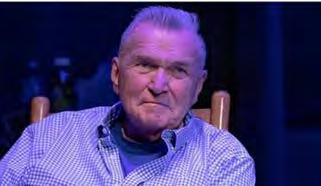
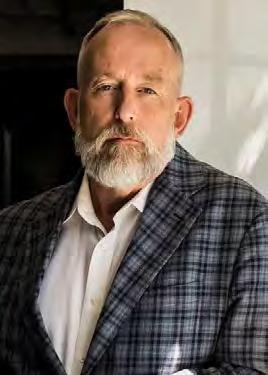
David Mixner, a gay man who once advised former President Bill Clinton before a falling out over the “Don’t Ask, Don’t Tell” policy on gays in the military, died Monday, March 11, in New York City. He was 77.
The announcement was made on Mr. Mixner’s Facebook page. “It is with a heavy heart that I share the news of David’s passing today,” read a comment under a photo captioned “R.I.P. David B. Mixner. 1946-2024.” A cause of death was not stated.
While Mr. Mixner was best known as an adviser to Clinton – Newsweek named him the most powerful gay man in America in 1993 – he was involved in many LGBTQ issues.
He became an activist in the civil rights movement over the objections of his parents and protested the Vietnam War, as the Bay Area Reporter noted in a 2008 article.
Mr. Mixner worked on the presidential campaigns of the late Eugene McCarthy and Clinton as well as the campaigns of the late Los Angeles Mayor Tom Bradley and former California governor Jerry Brown. A consummate political insider, Mr. Mixner at the same time caused countless headaches for Democratic Party officials as a rebel voice within the party, as the paper previously reported.
The falling out with Clinton occurred because the president signed DADT after promising during his 1992 campaign to allow gays to serve openly in the military. DADT was presented as a compromise law whereby gays and lesbians could serve if they remained in the closet. It took decades for DADT to be repealed by a bill in Congress that was signed by former President Barack Obama in 2010. The law went into effect in 2011. According to a 2010 study by the Williams Institute, an LGBTQ think tank at UCLA School of Law, more than 13,000 individuals were discharged for violating DADT. .
Mr. Mixner lived for a short time in San Francisco in the late 1970s. While in the city, he worked with the late gay San Francisco supervisor Harvey Milk to defeat California Proposition 6, the 1978 Briggs initiative that would have banned gays from teaching in public schools.
He told the B.A.R. during the 2008 phone interview that one of the saddest days of his life was November 27, 1978 – the day that former San Francisco Supervisor Dan White assassinated
See page 10 >>


Efforts start to pay off as vacancies decline in Castro
by John Ferrannini
Ayear ago, San Francisco’s beleaguered LGBTQ Castro neighborhood was seeking signs of hope. Now, neighborhood stakeholders tell the Bay Area Reporter that they’ve got some.
“I feel like things are starting to get better,” said Terry Asten Bennett, a straight ally who is president of the neighborhood’s merchants association and co-owner of Cliff’s Variety at 479 Castro Street. “I’m optimistic. There are issues we still see with vacancies, but we see them going away a lot faster.”
In the past year, the neighborhood has seen promise in the reopening of Badlands, agreements to fill the old Harvey’s and Baghdad Cafe spaces, and a smattering of new businesses such as the Hulu Wa China Bistro. But other businesses, such as Q Bar, remain shuttered, and it’s unclear when its doors will open.
“I think things are sort of staying the same,” Cleve Jones, a longtime gay activist who was a former aide to gay slain supervisor Harvey Milk and was a cofounder of both the San Francisco AIDS Foundation and the NAMES Project AIDS Memorial Quilt, told the B.A.R. “Losing Catch is a big blow for me. ... I think things are kind of stuck.”
Catch, at 2362 Market Street, closed March 9 after over a generation in the neighborhood, a development making visual the axiomatic truth that progress involves both steps forward and backward.
The seafood restaurant occupied the space that
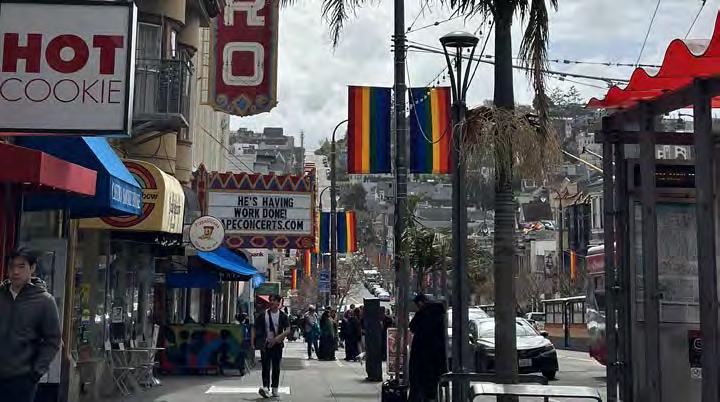
Pedestrians walk along Castro Street during a recent afternoon.
was once the headquarters of the NAMES Project. Jones told the B.A.R. that a piece of the quilt that’d been hanging in the space – as well as a bench commemorating the original site of the NAMES Project – would revert back to the quilt’s custodians, the National AIDS Memorial Grove.
The grove confirmed this to the B.A.R.
“Both the quilt and bench will return to our warehouse in San Leandro, which is open to the public for tours,” quilt conservator and production manager Gert McMullin stated.
The bench had been controversial because when no business was located at 2362 Market, neighboring businesses de facto became responsible for cleaning it regularly. Eventually, Castro businessman David Bach straight up took the bench, as the B.A.R. reported back in 2001, because the city wasn’t taking care of it. It was reported stolen by its caretaker to the police.
See page 8 >>
STIs fall in SF after doxyPEP rollout
by Liz Highleyman
The early rollout of doxyPEP in San Francisco has contributed to a decline in sexually transmitted infections, according to studies presented March 4 at the Conference on Retroviruses and Opportunistic Infections in Denver. DoxyPEP refers to taking a single dose of the antibiotic doxycycline within 72 hours after sex.
“We are seeing early evidence of the potential for a population-level impact of doxycycline on chlamydia and syphilis rates,” said Dr. Stephanie Cohen, director of HIV/STI Prevention for the San Francisco Department of Public Health. “I think this is quite an encouraging result, after over a decade of steadily rising STI rates.”
In keeping with its pioneering role in the fight against HIV, San Francisco was the first city to issue local doxyPEP guidelines, and it is the first to see outcomes in clinical practice and at the population level. The new real-world findings back up evidence from clinical trials showing that doxyPEP can substantially reduce chlamydia and syphilis, though it is less effective against gonorrhea.
“This effort is a tremendous example of the rapid translation of research into public health practice and shows that this promising prevention tool has the impact to help turn the curve on the epidemic of
STIs that we have been facing in San Francisco and across the nation,” gay San Francisco health director
Dr. Grant Colfax said a statement.
DoxyPEP in clinical practice
Dr. Annie Luetkemeyer of UCSF reported the
latest findings from the DoxyPEP trial, which enrolled more than 500 gay and bisexual men and transgender women in San Francisco and Seattle who were either living with HIV or taking PrEP.
As Luetkemeyer first reported at the 2022 International AIDS Conference, study participants randomly assigned to use doxyPEP saw about an 80% drop in chlamydia and syphilis and a 55% decline in gonorrhea. At CROI, she reported follow-up data showing that risk reduction was sustained among participants initially randomized to doxycycline. Among those initially assigned to standard care and offered doxyPEP after its effectiveness was known, STI incidence fell steeply even though the number of sex partners and condomless sex acts doubled in the short term.
Dr. Hyman Scott reported early results from the San Francisco AIDS Foundation’s Magnet clinic at its Strut health center in the LGBTQ Castro neighborhood, where doxyPEP has been offered to around 3,000 active PrEP users starting in November 2022, a month after the San Francisco Department of Public Health issued the first doxyPEP guidelines.
As the Bay Area Reporter previously reported, the Centers for Disease Control and Prevention issued the first national doxyPEP guidance a year later.
See page 10 >>

Serving the lesbian, gay, bisexual, transgender, and queer communities since 1971 www.ebar.com Vol. 54 • No. 11 • March 14-20, 2024
ARTS 13 13 ARTS
Lil Nas X documentary
Glide 09 04 The
center vandalized
Poet
theologian at
Coast Pride
Gay political activist David Mixner died March 11.
David Mixner
'
Dirty White Teslas'
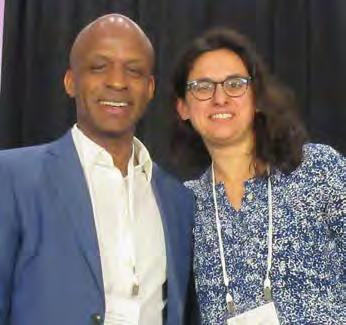
Dr. Hyman Scott, left, and epidemiologist Madeline Sankaran discussed recent research on doxyPEP at the Conference on Retroviruses and Opportunistic Infections in Denver.
Liz Highleyman
John Ferrannini
Beckles ahead in East Bay state Senate race
by Matthew S. Bajko
As lesbian former Richmond city councilmember Jovanka Beckles leapfrogs into second place in her bid for an open East Bay state Senate race, two gay former councilmembers of Northern California cities saw their leads on election night evaporate as more ballots were counted.
Michael Wilson, who had served on the Vallejo City Council, has now lost his bid to become the first LGBTQ member of the Solano County Board of Supervisors. Meanwhile, gay former Sacramento city councilmember Steve Hansen has fallen into fourth place in the race to be his city’s next mayor.
Coming out of the March 5 primary Beckles, now on the board that oversees the AC Transit public transportation agency, had landed in fourth place with 14% of the vote. She had remained out of the top two spots moving on to the November election after repeated updates to the vote count.
That is until Monday, when new totals from Alameda County put Beckles into second place with 15.8% of the vote. Her total now stands at 19,691 votes.
Trailing her in third place by 210 votes is Oakland City Councilmember Dan Kalb. His share of the ballots counted to date stands at 15.6%.
They are both competing for the Senate District 7 seat that spans Alameda and Contra Costa counties. With Senator Nancy Skinner (D-Berkeley) termed out later this year, six people had sought the seat.
Back in 2018 when Kalb and Beckles both ran for an open Assembly seat, a similar vote count dynamic had played out. Initially leading Beckles, Kalb dropped into third place in the primary,
though Beckles went on to lose against Buffy Wicks, expected to easily win a fourth two-year term this November.
In an email to her supporters last Friday, Beckles expressed confidence that she would survive the primary. But she acknowledged the financial resources deficit she will face in mounting a general election bid.
“While we wait for the results, we need to continue to prepare for a difficult fight against an opponent with enormous financial resources,” wrote Beckles. “We need your help paying our outstanding bills, buying more lawn signs, paying for campaign staff, and much more. We are depending on your help to keep our campaign competitive all the way through to November.”
While it is unclear how many ballots remain in Alameda County, an updated vote tally from Contra Costa, which has 44,500 outstanding ballots, is expected
by 4 p.m. Wednesday. Nonetheless, firstplace finisher Berkeley Mayor Jesse Arreguín celebrated his moving on to the fall ballot in an email to his supporters Tuesday morning.
“While there are still thousands of votes that remain to be counted, we are currently leading the field with 33 percent of the vote, and have earned more votes than the current second and third place finishers combined!” touted Arreguín.
“Thank you so much to everyone who made this incredible victory possible.”
As for union leader Kathryn Lybarger, who like Beckles identifies as queer and lesbian, she is in fourth place with 14.2% of the vote. While not surprising for a first-time candidate running against elected leaders, it comes as a shocking development considering Lybarger was predicted to make it to November due to the fiscal backing she had received from labor groups.
Should Beckles hold on to second place, then voters in Contra Costa County will have a chance to elect three Senate candidates to be their first out representatives in the Legislature. But like Beckles, San Ramon City Councilmember Marisol Rubio will be seen as the underdog in her fall race.
Rubio, a gender-nonconforming, demisexual, biromantic, is one of two people seeking to succeed termed out Senator Steve Glazer (D-Orinda) from his District 9 seat that covers much of Contra Costa County and a portion of southern Alameda County. Rubio landed in second place in the primary against Assemblymember Tim Grayson (D-Concord), who currently leads with 61.6% of the vote.
Also moving on to November is gay former West Sacramento mayor Christopher Cabaldon, who is vying for the
open Senate District 3 seat. Senator Bill Dodd (D-Napa) is termed out of representing the sprawling district that includes portions of Contra Costa, Solano, Sonoma and Napa counties in the Bay Area as well as Yolo and Sacramento counties.
Cabaldon is in second place with 26.6% of the vote. In first place with 28.1% is Dixon City Councilmember Thom Bogue, a Republican who survived the Jonestown massacre when he was a teenager. After it became clear the two would be moving on to the November 5 ballot last Friday, Cabaldon celebrated his surviving the primary race in an emailed note to his supporters.
“I’m thrilled to report that we earned exceptionally broad support—the only candidate to place in the top 3 in everyone of the district’s six counties. We won outright majorities among the Democratic candidates in half the counties and led the Democratic field in the two mostpopulous counties,” wrote Cabaldon.
In Solano County where no LGBTQ person has served on the Board of Supervisors, Wilson had been leading on election night with 51% of the vote in the race for the open District 1 Supervisor seat. He sought to succeed his boss, District 1 Supervisor Erin Hannigan, who had endorsed him.
But Vallejo Housing and Community Development Commission Vice Chair Cassandra James saw her vote count increase with each subsequent update. By last Friday she had garnered 53% of the vote and remained in first place thereafter.
The San Francisco native declared victory Tuesday.
“I also want to commend Michael Wilson for running an honorable cam-
paign. I appreciated his gracious concession call and offer to help me transition into this role, and I appreciate his long service to our community,” wrote James in an email to her supporters. “I want everyone who voted for and supported Michael to know that I’m proud to represent them too. Greater Vallejo needs to be united as we work to bring out the best of this community.”
Up in Sacramento Hansen has seen his hold on second place after election night slip away as more votes are counted. As of Tuesday, he had fallen into fourth place with a total of 15,103 votes.
Nonetheless, he remains in a statistical dead heat, at 22% of the vote, for second place. Assemblymember Kevin McCarty (D-Sacramento) stands in third place with 15,266 votes.
Dr. Richard Pan, a former state senator, has slipped into second place with 15,421 votes. Meanwhile, epidemiologist Dr. Flojaune Cofer has catapulted from fourth place on election night into first place with 17,547 votes or 25% of the current total.
The top-two finishers will advance to a runoff in November to determine who will succeed Mayor Darrell Steinberg. He opted against running for a third term and has pledged to remain in office through the end of the year.
With 83,886 ballots in the county left to count, Hansen is waiting to see if his standing improves come Friday, when a new vote total will be released by 4:15 p.m.
“Appreciate everyone’s patience while we await the results of this incredibly tight race. Thank you for the kind words and please continue to hang tight,” wrote Hansen in a post on X late Tuesday afternoon. t
Vote margin decreases further for Low
by Matthew S. Bajko
It is coming down to the wire to see if gay Assemblymember Evan Low (D-Cupertino) will survive his March 5 primary race for an open South Bay U.S. House seat. After days of vote count updates, he is now 162 votes away from moving into second place.
Only the top two finishers will advance to the November 5 ballot and compete for the 16th Congressional District, which spans San Mateo and Santa Clara counties. Congressmember Anna Eshoo (D-Palo Alto) decided not to seek reelection to her seat, which she has held since 1993.
Eleven people jumped into the race
to succeed her. Low was seen as having a strong chance at becoming the first LG-
BTQ congressmember from the Bay Area.
But he continues to find himself just shy of second place, despite his vote count inching upward over the past week. As of Tuesday, Low had a vote total of 27,222 for 16.7% of the total ballots counted so far.
Santa Clara County Supervisor Joe Simitian is holding on to second place with 27,384 votes. The margin of difference between the two Democrats is 0.1%.
Remaining in first place is former San Jose mayor Sam Liccardo, whose vote total now stands at 34,974. He has 21.5% percent of the unofficial returns.
Holding steady in fourth place is Republican Peter Ohtaki. He now has 20,886 votes.
The contest is one of the closest in California. As for how it feels, Low stated to the Bay Area Reporter that, “To me, no matter the ultimate outcome, the closeness of this race shows that your vote truly matters. Your vote can have a real impact on who represents your community.”
Another vote tally from Santa Clara, which has 52,000 ballots still to count, is expected Wednesday by 5 p.m. In San Mateo, where 43,550 ballots are left to count, the next update will come by 4:30 p.m. Wednesday.
In the East Bay race to succeed outgoing Congresswoman Barbara Lee (DOakland), who failed to survive Tuesday’s primary race for the seat long held
by the late U.S. senator Dianne Feinstein, queer candidate Jennifer Kim-Anh Tran, Ph.D., remains in second place. But she has seen her share of the vote decrease slightly, from nearly 17% last week to 15.2% as of Monday, with a total now of 14,095 votes.
Meanwhile, frontrunner Democratic BART board member Lateefah Simon has seen her vote count edge up to 53.1% from nearly 43% last week. As of Monday, Simon now has 49,249 votes, while Alameda City Councilmember Tony Daysog remains in third place with 11,777 votes.
See page 9 >>


2 • Bay area reporter • March 14-20, 2024 t 415-626-1110 130 Russ Street, SF okellsfireplace.com info@okellsfireplace.com OKELL’S FIREPLACE Valor LX2 3-sided gas fireplace shown here with Murano glass, and reflective glass liner
<< Election 2024
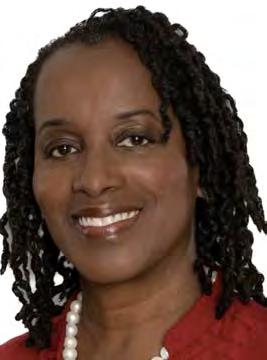
Jovanka Beckles has moved into second place in the race for an East Bay state Senate seat.
Courtesy the candidate
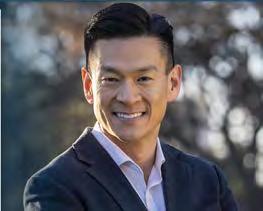
Assemblymember Evan Low is locked in a tight race for second place in his congressional race.
Courtesy the candidate

Helped
than similar projects led by City Hall. Raised
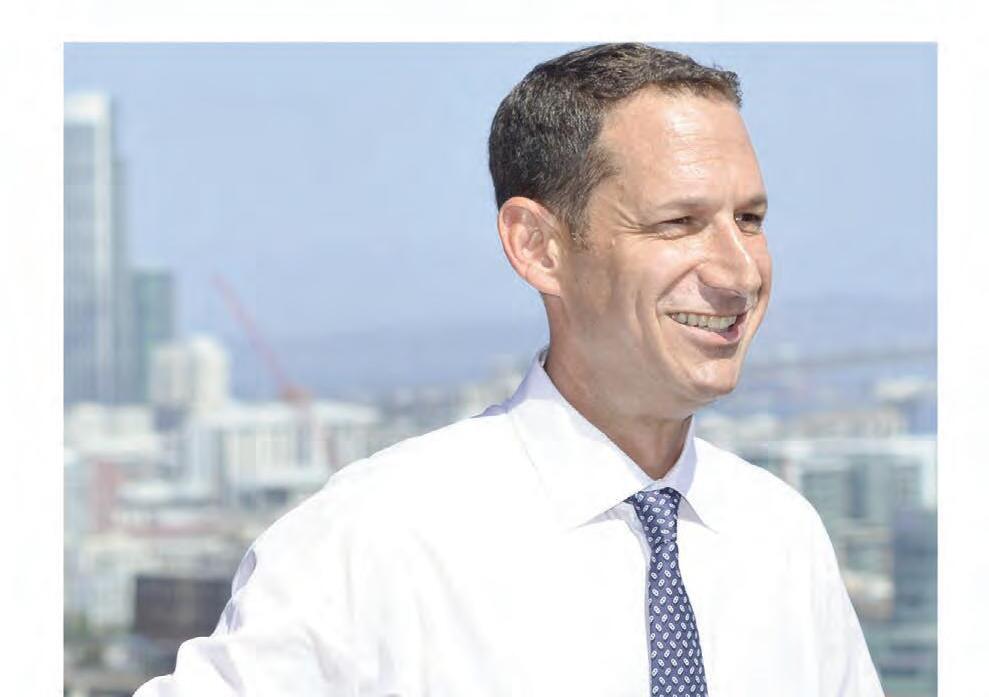

Paid Political Advertisement Ad paid for by Believe in SF Lurie for Mayor 2024 Ad Committee’s Top Funders 1. Miriam ‘Mimi’ Haas ($1,000,000) 2. Jan Koum ($250,000) 3. Oleg Nodelman ($250,000) This advertisement was not authorized by a candidate or a committee controlled by a candidate. Financial disclosures are available at sfethics.org.
LURIE
MAYOR
Believe in Accountability Daniel Lurie’s Plan for the LGBTQIA2S+ Community & Our City Plan for Change in Every Neighborhood. Plan Change in Every Neighborhood.
of a nationally renowned and successful anti-poverty organization who built a career being accountable for taking on tough problems and delivering results.
DEMOCRAT DANIEL
FOR
DEMOCRAT DANIEL LURIE FOR MAYOR
CEO
6,000
homelessness, and built 145 housing units for the formerly homeless –
using union labor.
people transition out of
on time and under budget
efficiently and under budget, spending thousands
to provide housing and job opportunities for hundreds of thousands of families
mental illness, and homelessness. Get serious about public safety by increasing police staffing and foot patrols so it's safe to walk in every neighborhood. Increase specialized care and provide shelter beds for anyone who needs them. Stop smash and grabs and shut down open-air drug markets. Cut red tape and the maze of regulations that burden small businesses. 1 2 3 4 Believe SF Believe inSF Daniel Lurie.com
Successfully built affordable housing projects
less per unit
$500 million
struggling with addiction,
Castro sewer project may impact area merchants
by John Ferrannini
Three months of sewer work construction will be closing a block of 18th Street in San Francisco’s LGBTQ Castro neighborhood as it prepares for big events this month.
That was the news out of the Castro Merchants Association’s relatively brief monthly membership meeting March 7. Other items discussed included a fundraiser for the Harvey Milk Civil Rights Academy, Easter celebrations, more recognition for the Castro’s volunteer safety group, and this week’s election results.
The construction work was announced by Adam Thongsavat, a legislative aide to gay District 8 Supervisor Rafael Mandelman.
According to a communiqué from the San Francisco Public Utilities Commission to Mandelman’s office provided to the Bay Area Reporter by Thongsavat, the anticipated start of construction for sewer line replacement was Wednesday, March 13, and the project will last for three months on the block of 18th Street between Collingwood and Eureka streets.
“Weather and construction issues could impact the schedule,” the SFPUC email states. “General workdays and hours (weather permitting) are Monday-Friday, 7 a.m. to 5 p.m. Weekend, night, and continuous 24-HR work is allowed; if necessary, advanced notice will be distributed. There may be periods of inactivity between completion of sewer work, curb ramp construction, street base repair and final paving.”
Thongsavat told the B.A.R. he would look into what parking impacts there are. After the initial online publication of this report, he stated that the project team reported to him that “parking restrictions are active M-F 8 a.m. to 5 p.m. Parking restriction info is posted 72-hours in advance and Tow-Away signs post approx. 0.5 (half) hour prior to the start of work with the exception that it shall not be earlier than 8 a.m.”
Parking lanes will “allow for creating a safe driving lane through the work zone,” the team stated. The restricted area will span 65 feet beyond the east and west
by Cynthia Laird
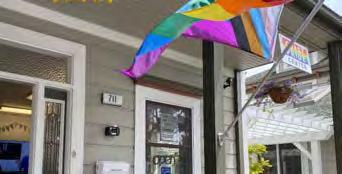
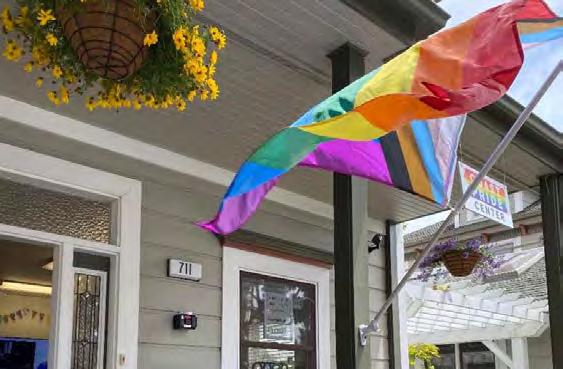
Officials at the Coast Pride Center in Half Moon Bay reported alleged anti-LGBTQ vandalism after a Progress Pride flag was removed and a rock was
intersections of both 18th and Collingwood streets and 18th and Eureka streets to allow for a driving lane.
The 33 Ashbury bus will be affected, and signs will be posted by the San Francisco Municipal Transportation Agency.
“The supervisor has made this a point for all construction projects, especially with commercial corridors, that we expect the work to be efficient, expedited, and without impacts to small business,” Thongsavat said. Mandelman said that sewers have to be replaced every 75-100 years.
“It needs to be done,” assured the supervisor.
Harvey Milk school fundraiser
In other news, drag performer Kylie Minono told the merchants that the annual competition and drag show fundraiser for the Harvey Milk Civil Rights Academy public elementary school will be held at The Cafe nightclub, 2369 Market Street, Saturday, March 23, from 5 to 8 p.m.
The Cafe did not immediately return a request for comment.
“I know businesses are still hurting, but we are doing an online auction this year and would love support,” Minono said. “It’s so important now more than ever with all of what’s going on around the world.”
The Cafe is donating everything needed for the fundraiser “at no cost to
us,” Minono said. The event will feature “RuPaul’s Drag Race’s” Thorgy Thor. General admission is $25.
San Francisco Unified School District Superintendent Matt Wayne recently announced that some schools will be closed by the fall of 2025 due to declining enrollment, as the San Francisco Chronicle reported. (https://www. sfchronicle.com/bayarea/article/sfusdpublic-schools-close-18696899.php)
He has not yet indicated specific school sites targeted for closure. The Harvey Milk elementary school was thought to be in danger of closing last year, but those rumors were unfounded at the time, as the B.A.R. previously reported.
Easter
Easter is early this year – Sunday, March 31 – and Lauro Gonzalez, a gay man who is the CEO and founder of ArtyhoodSF, said that he’s planning an event on Noe Street, between Market and Beaver streets, from noon to 6 p.m. the prior day, Saturday, March 30. Similar events have been held prior to Christmas, Halloween, and Pride in recent years.
“We are inviting all the businesses in the Castro to celebrate,” Gonzalez said. “We’re inviting all of you to take part and take advantage. ... We encourage everyone to come here, dress as a bunny, and come into your business to get a stamp for their ‘passport’.”
The event will also feature prizes, a
thrown through a window of the office.
According to an email sent to supporters Friday, March 8, the alleged incidents occurred overnight between Monday, March 4, and Tuesday, March 5. A report was made to the San Mateo
petting zoo, drag queens, music, and arts and crafts, Gonzalez said.
“There’ll be an egg hunt for the kids, but it’s only going to happen at the event,” Gonzalez said. “They’re not going to go to your store.”
Added straight ally merchants’ president Terry Asten Bennett: “Unless they bunny-hop their way down there.”
Volunteers are needed, Gonzalez said.
Greg Carey, a gay man who is chair of Castro Community on Patrol, said he is working with the Sisters of Perpetual Indulgence on the Hunky Jesus event at Mission Dolores Park on Easter Sunday. Castro patrol to be honored by feds
Carey and CCOP were honored at the San Francisco Board of Supervisors March 5, as the B.A.R. previously reported
“Tuesday was Greggy Day at the San Francisco Board of Supervisors,” Mandelman said. “It was Greggy and the Castro Community on Patrol. That’s the first of a couple of commendations they’ll be getting in March.”
The others are award ceremonies at City Hall and in Washington, D.C. The Federal Bureau of Investigation will be giving CCOP a “preliminary award,” Carey said, at the office of Mayor London Breed on March 18 at 12:30 p.m. “so you don’t have to go to Washington to see us.” The ceremony will include Mandelman, Breed, District Attorney Brooke Jenkins, Sheriff Paul M. Miyamoto, Police Chief William Scott, and officials from the San Francisco FBI Office.
There will be another ceremony on April 19 in Washington, D.C.
CCOP is being presented with the National FBI Directors Community Liaison Award for its active shooter training presentations, Carey said.
The San Francisco FBI Office did not immediately return a request for comment.
D8 supe: ‘San Franciscans are still crazy lefties’
Mandelman disagreed with people opining that the March 5 election results
County Sheriff’s Office last Tuesday at around 10 a.m., Cameron Zeller, operations director for Coast Pride, stated in an email to the Bay Area Reporter.
The email announcement stated that two people were involved. The center is located at 711 Main Street in Half Moon Bay.
“Thankfully, no person experienced physical harm or injury during or as a result of the incident,” the email stated.
“Two people cut and removed our Progress Pride flag, tore down our rainbow bunting, kicked and cut our ‘No home for hate’ lawn sign, smeared mud on our wooden trans heart, threw our painted rocks onto the sidewalk and street, and threw a rock into one of our front windows.
“We have cleaned up the visible damage, replaced our Progress Pride flag, and are working on getting the window replaced,” the email added. “We are also working closely with our group facilitators to make sure everyone is being supported, has space to process the incident during group sessions, and continues to feel safe at the center.”
Gretchen Spiker, director of communications for the San Mateo County Sheriff’s Office, stated that the department is aware of “two incidents that took place recently at CoastPride in the City of Half Moon Bay.”
“At this time, it is believed that the incidents were committed by juveniles,” Spiker wrote in an email. “Because of this, there is limited information that we can share at this time. We do, however, want to offer reassurance to the community that these are believed to be isolated incidents and we will do all we can to hold the perpetrators responsible.”
Spiker did not respond to a follow-
represent a rightward lurch by city voters.
“We got a whole bunch of shifts to the reasonable in this election,” the supervisor said. “Don’t worry – San Franciscans are still crazy lefties. We’ll be back, but for now there is some desire for some pragmatism.”
Preliminary results showed San Francisco voters approving measures to increase the powers of law enforcement and allow drug testing of some people on public assistance. It led to headlines that “S.F. can no longer be called a progressive city,” as was stated in the Chronicle.
Mandelman said that’s not the whole story, if present trends in the vote count hold.
“[People] voted more than twothirds for an affordable housing bond,” Mandelman said, referring to Proposition A. “For the moment the voters sent a very clear signal they want a little more pragmatism.”
Mandelman said that candidates for mayor in November’s election, including Breed, former mayor Mark Farrell, Levi Strauss heir Daniel Lurie, and District 11 Supervisor Ahsha Safaí, all straight allies, will be coming to Castro businesses soon.
“Tell them about the neighborhood’s problems,” Mandelman said. “Hold the mayor accountable. Hold them all accountable. This is an opportunity.”
Merchants’ elections,
new Pride flag
Asten Bennett said that elections for the merchants’ group’s leadership will be held next month. She said she’d made a commitment to run again.
The merchants will be changing the Pride flag near Harvey Milk Plaza on March 22 at noon.
“Please come join us,” she said. “Bring all your friends. It’s actually a really fun experience. That flag went up the day Dianne Feinstein died. The new flag will go up until we switch it out for Pride in June.”
The old flag will be donated under the merchants’ flag donation program, whereby the retired banners are given to a nonprofit, as the B.A.R. previously reported. t
up message about any other incident or if the sheriff’s office is investigating the case as a hate crime.
Coast Pride’s Zeller also did not respond to a follow-up question if there was an additional incident.
As the B.A.R. previously reported, Coast Pride opened its center in June 2021.
It fosters connections among coastal San Mateo County residents from Pescadero to Pacifica. That year the center also received $35,000 in funding from the San Mateo County Board of Supervisors, as the B.A.R. previously reported.
The vandalism incident at Coast Pride is the latest to occur on the Peninsula. As the B.A.R. reported last summer, a rainbow banner was vandalized at the Congregational Church of Belmont in that San Mateo County city.
Belmont police told the B.A.R. at the time that they were investigating the case
as a hate crime.
The Reverend Jim Mitulski, a gay man who serves as pastor at the Belmont church, which is part of the United Church of Christ denomination, said at the time that the incident was not surprising. (Mitulski once served as pastor at the LGBTQ Metropolitan Community Church-San Francisco in the Castro neighborhood for many years.)
“The vandalism at the Congregational Church of Belmont is disappointing but not surprising,” stated Mitulski. “As a gay pastor in the United Church of Christ, I’ve noticed a marked increase in hostility toward the LGBTQ community of late. At CCB, we remain deeply committed to LGBTQ inclusion and equality in church and society.
Mitulski responded that he has not heard anything regarding the incident at
4 • Bay area reporter • March 14-20, 2024 t
<< Community News
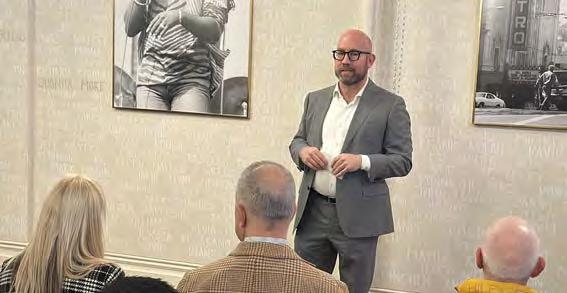
District 8 Supervisor Rafael Mandelman spoke to Castro Merchants Association members about an upcoming sewer replacement project.
John Ferrannini
Vandals
LGBTQ center We Want To Buy Our Apartment And Avoid Eviction, organized by Jeanine Reisbig Seniors Jeanine, Age 72, and Gale, Age 75, would love to stay in the apartment they’ve lived in for 43 years. Please donate to their GoFundMe page so they can buy their apartment and continue living there. Note: any amount will help. If you don’t have much money, even small donations are great!!! The cost of real estate in San Francisco is pretty high, hence the $300,000.00 goal. If you are not comfortable making an online donation, you can snail mail your donation to: Jeanine Reisbig, 584 Castro St. #231. San Francisco CA 94114. Please make out your check to Jeanine Reisbig. www.gofundme.com/f/we-want-to-buy-our-apartment-and-avoid-eviction
Officials:
attack Half Moon Bay
Officials at the Coast Pride center in Half Moon Bay reported incidents of alleged anti-LGBTQ vandalism last week
See page 10 >>
Courtesy Coast Pride
Breed touts recovery in State of the City address
by John Ferrannini
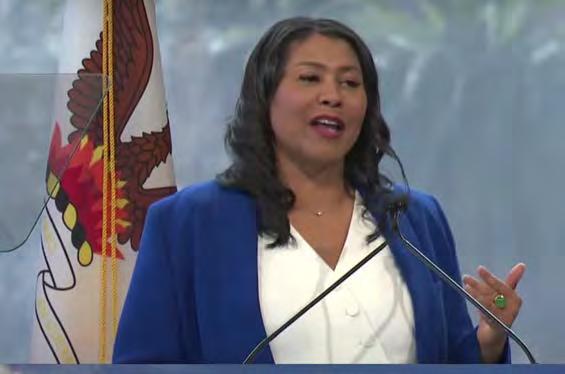
San Francisco Mayor London Breed made the case for her reelection at the State of the City address along the city’s Embarcadero on March 7.
Breed, who was elected in a 2018 special election and won with 70% of the vote in the 2019 general election, faces an uphill climb this year. (A 2022 voter-approved measure moved the mayoral and other city elections to 2024, extending Breed’s tenure by a year.)
Breed did not mention any specific LGBTQ initiatives in her speech. She did give a shout out to transgender women and to moderate LGBTQ candidates who are ahead in the race for seats on the San Francisco Democratic County Central Committee.
The mayor began her address by reminding voters of her record at the start of the COVID-19 pandemic, which she phrased as the first of two acts thus far in her mayoralty.
“San Francisco declared an emergency in February 2020, and then with our partners around the Bay, issued the first shutdown order in the country. My administration then marshaled the Departments of Emergency Management, public health, and staff throughout city government to mobilize and turn our convention center into a COVID command center. … As nursing homes across the country saw ballooning death rates, we protected our seniors, at Laguna Honda and elsewhere,” she said. “San Francisco saw the lowest COVID death rate of any large city in the country. People want to say our civic government is dysfunctional – we can’t collaborate, can’t get the hard things done. Tell that to the thousands of San Franciscans who are alive today because of the work we did.”
Breed is facing at least three major challengers in the November race.
A San Francisco Chronicle poll last month showed that Breed – weighed down by dissatisfaction on issues surrounding public safety, homelessness and the drug crisis, and the post-COVID lull in economic activity downtown – faces the disapproval of 71% of likely voters.
Breed made responding to those concerns the centerpiece of her address – saying that she and moderate members of the Board of Supervisors are working on them. The second act of her mayoralty is a work in progress, Breed said.
“As COVID waned and vaccinations rose, we entered what I consider the second phase of my tenure: the recovery,” she said.
That started with addressing public safety.
“We diverted non-emergency 911 calls to free up officers while providing better overall responses for those struggling on our streets,” Breed said. “I appointed a former hate crimes prosecutor as our new district attorney, and Brooke Jenkins began prosecuting crimes. We launched retail theft blitz operations. We used bait cars and plainclothes officers to disrupt auto break-ins.”
(Jenkins was appointed by Breed in 2022 after voters recalled former DA Chesa Boudin, a progressive. Jenkins, too, will be on the ballot in November and has already drawn one challenger, former San Francisco prosecutor Ryan Khojasteh, whom Jenkins fired when she took over. Khojasteh now works in the Alameda County DA’s office.)
Breed said that thanks to the projected passage of Proposition E earlier this week, “we will be installing new public safety cameras in high-crime areas, deploying drones for auto thefts, car break-ins, and other crimes, and changing police department rules so our sworn officers are out in the field, not behind a desk.”
On homelessness, Breed said that numbers have improved.
“We’ve helped over 15,000 indi-
viduals exit homelessness,” Breed said. “We were the only county in the Bay Area to see unsheltered homelessness go down in the last point-in-time count cycle. We did it by increasing our shelter capacity by 66%, and increasing housing for the formerly homeless by 50%.
“We are not letting up,” the mayor continued.
“We are continuing to add new housing, and new shelters,” she said. “We are setting a new goal of 1,000 people a year for Homeward Bound, the program that provides unhoused people a ticket back to their home city.”
The mayor also addressed the fentanyl crisis. The city saw a record number of 806 fentanyl overdoses last year, up from 647 in 2022. She framed it, along with COVID, as one of the major two public health crises of her tenure.
“This is a national tragedy happening in cities large and small, areas urban and rural,” Breed said. “It’s awful and it’s heartbreaking, and while I am stepping up enforcement of our laws, because that’s what our residents deserve and that’s what our city needs, I remain absolutely committed to saving lives.”
Breed touted federal actions by the Biden administration interrupting the sale and trafficking of fentanyl, and supporting compulsive treatment.
“Our approach is about accountability, resources, and new pathways,” Breed said. “This means arresting and prosecuting dealers, and when necessary, arresting users who are a danger to themselves. … offering people services is critical, but, frankly, we must compel some people into treatment.”
Big plans for beleaguered downtown
Breed also addressed the exodus from downtown San Francisco. Her administration has begun a new initiative she said, 30 by 30, which hopes to bring 30,000 more residents and students downtown by 2030.
To do that, Breed said, downtown needs housing. That was the rationale behind Proposition C, which Breed supported and that looks on its way to passage.
The proposition exempts from the real estate transfer tax a property being converted from commercial to residential use for the first time.
“We are working with thought leaders, business folks, and educational institutions to make downtown a hub, a center of excellence,” Breed said. “We’ve invited the University of California and Historically Black Colleges and Universities to join us, and some are coming as early as this summer.”
Breed appeared to reject calls –such as from mayoral opponent and former mayor Mark Farrell – to return cars to the downtown portion of Market Street, where they’ve been barred from since 2020.
“Tearing out the bike lanes on Market Street – going backwards – will not move us forward, and it won’t magically revive downtown,” Breed said. “But 30,000 more people living and
chosen or otherwise – who’ve made San Francisco an outpost of hope in a country of worrying hate,” as well as on behalf of city workers and housing activists.
“I don’t know about you, but I am tired of the negativity,” Breed said. “The credit belongs to the woman who is actually in the arena who strives valiantly; who spends herself in a worthy cause.
“San Francisco is not wearing the shackles of your negativity any longer,” Breed added. “No longer will we allow others to define who we are because we know who we are.”
going to school downtown will.”
Loss of business activity downtown since the COVID pandemic lockdowns back in 2020 is at least partly responsible for the city’s budget deficit.
As the Bay Area Reporter previously reported rtments for 10% cuts across the board. A deficit of about $800 million is expected over the next two fiscal years, and Breed has said it could reach $1 billion by Fiscal Year 2028. This has threatened critical services, such as funding to prevent HIV infections.
“Let me make two things clear,” Breed said. “One: the Board of Supervisors and I will close this deficit. And we will not weaken our public safety to do so.”
Breed on offense
Breed went on the offensive, accusing her naysayers of rooting against the city, and paraphrasing former President Theodore Roosevelt’s “Man in the Arena” speech.
She also offered the crescendo of her speech “on behalf of the transgender activists and their families –
Breed said that the city remains a place people can live together across differences. Calls that the city is no longer progressive after the March 5 election results are false, she said, congratulating the new members of the San Francisco Democratic County Central Committee.
“We are a progressive, diverse city–living together, celebrating each other: LGBTQ, AAPI, Black, Latino, Palestinian and Jewish,” she said. “That has not changed and it will not change.”
Mayoral challengers respond
Farrell issued a statement that “the anemic progress and results Mayor Breed is touting today are too little, too late.”
“Our streets have become a free for all for tent encampments, drug dealing, and overdose deaths while we have become the butt of jokes across America,” the former mayor said. “San Franciscans have lost faith in her ability to meaningfully tackle our city’s challenges and our city needs a mayor with a track record of effective leadership inside and outside of City Hall.”
District 11 Supervisor Ahsha Safaí is also challenging Breed. He told the B.A.R. that “she spoke as if she was introducing policies and ideas for the very first time.”
“For six years now, San Franciscans have been under her failed leadership,” Safaí stated. “She simply hasn’t done enough; the city remains in crisis –drug use and overdoses are rampant and tent encampments are pervasive. Residents are demanding change.
“Mayor Breed is speaking from both sides of her mouth,” he added. “She claims her policies will improve the livability and affordability but just two months ago she cut funding to after-school, senior and food pantry programs – critical services for our working and struggling families. Working families deserve a leader who will acknowledge and fight for them with clear actions, not with empty words.”
Breed is also being challenged by Daniel Lurie, heir to the Levi Strauss fortune. He stated to the B.A.R., “The state of San Francisco is one that can be defined by a broken City Hall bureaucracy that protects insiders and rewards corruption while wasting record budgets.
“Not once did the mayor propose the magnitude of reform that our city desperately needs,” Lurie continued. “San Francisco’s best days are ahead of us if we muster the courage to usher in a new era of accountable leadership and new ideas. That will never come from someone who has failed to deliver on their promises after more than a decade in office.”
Breed became District 5 supervisor back in 2013 and was reelected in 2017, becoming president of the Board of Supervisors. In that capacity, she immediately became acting mayor for several weeks after the December 2017 death of mayor Ed Lee. In January 2018, she was replaced as mayor by Farrell in a vote by the Board of Supervisors. Breed was elected in her own right in June 2018 to complete Lee’s term and won a full term a year later in November. t
THE GEORGE AT 434 MINNA STREET, SAN FRANCISCO CA 94103
MIDDLE INCOME RENTAL APARTMENTS AVAILABLE-FIRST COME, FIRST SERVE
You may qualify for alternative rental rates based upon the stated middle -income ranges noted below. Ask about our middle-income apartments program today.
THE GEORGE AT 434 MINNA STREET, SAN FRANCISCO CA 94103 MIDDLE INCOME RENTAL APARTMENTS AVAILABLE
Units available through the San Francisco Mayor’s Office of Housing and Community Development and are subject to monitoring and other restrictions. Visit www.sfmohcd.org for program information.
FIRST COME, FIRST SERVE
You may qualify for alternative rental rates based upon the stated middle-income ranges noted below. Ask about our middle-income apartments program today. Units available through the San Francisco Mayor’s Office of Housing and Community Development and are subject to monitoring and other restrictions. Visit www.sfmohcd.org for program information.
70 SOMA APARTMENTS FOR MIDDLE INCOME HOUSEHOLDS AVAILABLE NOW
BE INCOME ELIGIBLE AND MUST NOT OWN A HOME.
72 SOMA APARTMENTS FOR MIDDLE INCOME HOUSEHOLDS AVAILABLE NOW MUST BE INCOME ELIGIBLE AND MUST NOT OWN A HOME. MINIMUM AND MAXIMUM OCCUPANCY LIMITS APPLY. HOUSEHOLDS MUST EARN NO MORE THAN THE MAXIMUM INCOME LEVELS BELOW: 100% of Area Median Income
One person - $100,850; 2 persons - $115,300; 3 persons - $129,700; 4 persons - $144,100; 5 persons- $155,650 120% of Area Median Income
One person - $121,000; 2 persons - $138,350; 3 persons - $155,650; 4 persons - $172,900; 5 persons- $186,800 150% of Area Median Income
One person - $151,300; 2 persons - $172,950; 3 persons - $194,550; 4 persons - $216,150; 5 persons- $233,500
Obtain an application online through The George | San Francisco (sf.gov)

March 14-20, 2024 • Bay area reporter • 5 t
Community News>>
MUST
MAXIMUM OCCUPANCY LIMITS APPLY. HOUSEHOLDS MUST EARN NO MORE THAN THE MAXIMUM INCOME LEVELS BELOW: 100% of Area Median Income One person - $100,850; 2 persons - $115,300; 3 persons - $129,700; 4 persons - $144,100; 5 persons$155,650 120% of Area Median Income One person - $121,000; 2 persons - $138,350; 3 persons - $155,650; 4 persons - $172,900; 5 persons$186,800 150% of Area Median Income One person - $151,300; 2 persons - $172,950; 3 persons - $194,550; 4 persons - $216,150; 5 persons$233,500 Obtain an application online through The George | San Francisco (sf.gov) Households must earn within the income range levels below depending on household size: Units Income Range Rent Studios 19 Available 15 @100% AMI $4,516.00 to $9,508.00 per month 4 @120% AMI $4,776.00 to $11,529.17 $2258.00 per month per month (3 months free) Lease Now and Receive 3-Months Free!*” *Restrictions apply. Please contact us at thegeorgemiddleincome@gmail.com for details.” $2388.00 per month per month (3 months free) Lease Now and Receive 3-Months Free!*” *Restrictions apply. Please contact us at thegeorgemiddleincome@gmail.com for details.” 1 Bedrooms 25 Available 25 @120% AMI $6,072.00 to $12,970.83 per month $3036.00 per month per month (3 months free) Lease Now and Receive 3-Months Free!*” *Restrictions apply. Please contact us at thegeorgemiddleincome@gmail.com for details.” 2 Bedrooms 26 Available 1 @120% AMI $6,270.00 to $12,608.33 per month 25 @150% AMI $7,900.00 to $15,666.67 per month $3135.00 per month (3 months free) Lease Now and Receive 3-Months Free!*” *Restrictions apply. Please contact us at thegeorgemiddleincome@gmail.com for details.” $3950.00 per month (3 months free) Lease Now and Receive 3-Months Free!*” *Restrictions apply. Please contact us at thegeorgemiddleincome@gmail.com for details.” GEORGE-5.75X7.625_031424.indd 1 3/6/24 4:17 PM
MINIMUM AND
Screengrab via YouTube
San Francisco Mayor London Breed delivered her State of the City speech at Pier 27 along the Embarcadero Thursday, March 7.
Volume 54, Number 11
March 14-20, 2024 www.ebar.com
PUBLISHER
Michael M. Yamashita
Thomas E. Horn, Publisher Emeritus (2013)
Publisher (2003 – 2013)
Bob Ross, Founder (1971 – 2003)
NEWS EDITOR
Cynthia Laird
ARTS & NIGHTLIFE EDITOR
Jim Provenzano
ASSISTANT EDITORS
Matthew S. Bajko • John Ferrannini
CONTRIBUTING WRITERS
Christopher J. Beale • Robert Brokl
Brian Bromberger • Victoria A. Brownworth Philip
Campbell • Heather Cassell
Michael Flanagan •Jim Gladstone
Liz Highleyman • Brandon Judell • Lisa Keen
Philip Mayard • Laura Moreno
David-Elijah Nahmod • J.L. Odom • Paul Parish
Tim Pfaff • Jim Piechota • Adam Sandel
Jason Serinus • Gregg Shapiro
Gwendolyn Smith • Charlie Wagner
Ed Walsh • Cornelius Washington • Sura Wood
ART DIRECTION
Max Leger
PRODUCTION/DESIGN
Ernesto Sopprani
PHOTOGRAPHERS
Jane Philomen Cleland
Rick Gerharter • Gooch
Jose A. Guzman-Colon • Rudy K. Lawidjaja
Georg Lester • Rich Stadtmiller
Christopher Robledo • Fred Rowe
Shot in the City • Steven Underhill • Bill Wilson
ILLUSTRATORS & CARTOONISTS
Christine Smith
VICE PRESIDENT OF ADVERTISING
Scott Wazlowski – 415.829.8937
NATIONAL ADVERTISING REPRESENTATIVE
Rivendell Media – 212.242.6863
LEGAL COUNSEL
Paul H. Melbostad, Esq.


Bay
A division
President:
Director: Scott Wazlowski
News Editor • news@ebar.com
Arts Editor • arts@ebar.com
Out & About listings • jim@ebar.com
Advertising • scott@ebar.com
Letters
SF not progressive? Think again
The chattering classes were out in force last week declaring that San Francisco can no longer be called a progressive city because moderates have apparently won most of the seats on the Democratic County Central Committee and voters passed three local measures backed by Mayor London Breed. Supporters said those would improve public safety (Proposition E), drug test single adults with addictions as a condition to receive county assistance and get them into treatment (Prop F), and encourage housing in commercial spaces downtown (Prop C). While we did not endorse Props E and F, their passage doesn’t mean San Francisco is no longer progressive. It’s not like what happened in Huntington Beach, where voters passed Measure B, which bans the city from displaying the Pride flag, with a whopping 57% of the vote. By contrast, we’d call what happened with Prop E an overreaction – one that voters will hopefully redress – to the perception that crime is out of control. The drug crisis, on the other hand, is very real, but penalizing poor people by cutting off their general assistance if they’re using is draconian. These measures passed in large part because progressives didn’t offer any alternatives. David Campos, a gay man, progressive, and former supervisor, told the San Francisco Chronicle that progressives need to better articulate ideas and solutions that make people feel safe. (https://www.sfchronicle. com/sf/article/san-francisco-election-progressives-18699100.php)
To be sure, we have serious concerns with Prop E, especially regarding vehicle pursuits. The Chronicle recently ran a series (https://www.sfchronicle.com/ projects/2024/police-chases/) detailing how, over six years, more than 500 people across the country have died as a result of police chases. San Francisco, as we’ve noted, tightened its policies on police chases several years ago; now that work threatens to be undone because of Prop E. We hope that cooler heads prevail. We’re concerned about the surveillance aspects of Prop E, as the Board of Supervisors adopted a comprehensive surveillance policy in 2019. And we’re worried about how Prop E will affect the police

commission, which is supposed to provide independent oversight and is doing that.
Gay District 8 Supervisor Rafael Mandelman, who was once president of the progressive Harvey Milk LGBTQ Democratic Club, told members of the Castro Merchants Association last week that the city took a turn toward “pragmatism.” “We got a whole bunch of shifts to the reasonable in this election,” the supervisor said. “Don’t worry – San Franciscans are still crazy lefties. We’ll be back, but for now there is some desire for some pragmatism.” On the other hand, Mandelman pointed out voters passed a $300 million affordable housing bond, which bodes well for helping the city in addressing its housing crisis.
requiring those who receive County Adult Assistance Program funds (single, 65 and under with no dependent children) to be screened for substance dependence, San Francisco sends the wrong message. Realistically, the measure scapegoats poor people who are addicted, and the important thing to remember is that treatment doesn’t work unless the person is ready for it and, when they are, there is space for them in a program. Voters who think there are massive numbers of people who will be kicked off their benefits are incorrect. So is the argument made by proponents that those who may be in line to lose their cash benefits will get treatment options. The city can’t even implement its own 2022 Overdose Prevention Plan, as Prop F opponents noted.
We supported Prop C because it could help revitalize downtown by having developers convert office space into housing. This possibility has been discussed as the city emerges from the COVID pandemic, but it’s not easy or cheap. That was the impetus behind Breed’s proposal to exempt real estate transfer taxes the first time a property is transferred after being converted from a commercial to residential use.

Pragmatic, however, can be defined in many ways, and unfortunately, we don’t see that in Prop F. The passage of Prop F signals to us that voters don’t seem to support harm reduction like they used to. Breed at one time was much more vocal about support for supervised consumption sites, for example, which is a form of harm reduction. By
By and large, San Francisco is a progressive city, especially when compared to other locales in California and beyond. The city remains a beacon for LGBTQ people, with three cultural districts supporting the community in different ways, including entrepreneur incubators that help queer people learn about starting their own businesses. Many political leaders considered moderate here would be “crazy lefties” almost anywhere else. And that’s a good thing.
There may be some hiccups, and the city will need to correctly implement the new measures. If police vehicle chases increase and innocent people start getting killed, we think some immediate corrective action will be in order. The same is true of Prop F – the city needs to ramp up treatment options before it starts screening people. t
Why I’m running for SF district attorney
by Ryan Khojasteh
Iamfrustrated and concerned with the direction we’re heading in. From the many conversations I’ve had with my neighbors, the consensus is that people feel less safe today than they did a few years ago.
San Francisco District Attorney Brooke Jenkins herself promised that if we recalled the last district attorney, everything would get better. Now that she’s in charge, things have gotten worse.
This city is demonstrably less safe – both from a factual standpoint and from a “feelings” standpoint.
That’s why I am running for San Francisco district attorney in November. I believe there is a better way to achieve public safety.
Under Jenkins’ administration, violent crime has been steadily rising. Robberies have increased significantly. At the beginning of the Asia-Pacific Economic Cooperation summit last November, Czech journalists were robbed of their camera equipment at gunpoint in North Beach.
This happened at a time when our city was supposed to be the safest, given the massive influx of police.
And now, there are people crashing cars into buildings and stealing ATMs. This just happened twice in the quiet Richmond district – at the CVS I frequent on Clement and the Bank of America on Balboa.
People have become so brazen that even a police station was burglarized in the Fillmore.
Unfortunately, our beloved city is still seeing many high-profile crimes take place, intensifying concern throughout many dif ferent neighborhoods.
We are also facing a serious drug epidemic. Last year, San Francisco had a record 806 fatal overdoses. And our homelessness crisis has made the desperation and suffering of human beings shockingly visible.
Businesses citywide are suffering and leaving empty storefronts in their place. Residents, commuters, and tourists are fed up. By her own logic and rhetoric from the 2022 recall, this is crystal clear: the current DA’s administration is failing us. We cannot afford four more years.
As a city, I believe we can advance public safety with a better approach that balances reactive measures to address crime and proactive measures to prevent it. We don’t have to choose one or the other, we can do both.

Jenkins has dragged us into the past by reverting to the failed War on Drugs.This is why so many more have died of overdose than ever before. Using our criminal legal system as the primary means of solving a public health emergency has never worked in our country. The evidence has shown this. People die when we prioritize playing politics over sound judgment and science.
Many people aren’t even reporting property crime anymore – they’ve given up on contacting the police. I know this from direct conversations with friends, neighbors, and business leaders. Organized retail theft persists. Auto burglaries are prevalent. Open-air drug markets have gotten worse.
My family’s own experience with crime is what led me to become a prosecutor. I lost my uncle to gun violence. He was murdered on February 4, 1996. As the child of immigrants who fled violence and war in Iran, we don’t have many family members in the United States. He was our closest relative and his murder was devastating. It was also preventable. My family and I care about public safety. We believe in accountability. We care about supporting victims of crime.
I have done that work. I prosecuted violent crimes at the San Francisco Hall of Justice as an assistant district attorney. I’ve kept people in custody and I’ve personally held the hands of victims as I walked them up to the stand to testify. Incarceration is an important tool at our disposal to protect the public and one that I’ve used many times as a prosecutor.
I also understand the importance of working hard to stop the pipeline to prison for our youth. Two young people killed my uncle – they were 19 and 20 years old. I wanted to make sure the kids in our juvenile justice system wouldn’t grow up
to kill someone’s family member too. That’s why I spent two years at juvenile hall to make sure troubled youth in our city were supported and rehabilitated so they did not graduate to adult level criminal activity. We worked collaboratively to meaningfully intervene in kids’ lives. It worked; violent crime was decreasing
Placing kids on a better path is good for public safety – my passion for this work stemming from my own family tragedy. I hoped the DA’s office would continue this progress under Jenkins. I advocated for the continuation of evidence-based programs like “Make It Right” that reduced recidivism among children by up to 66%. Instead, Jenkins fired me and immediately began to roll back these programs.
I didn’t realize that common sense was a fireable offense.
As your next district attorney, I want to pursue a better approach to lasting public safety by advancing these common sense and evidence-based solutions. I believe in following the science.
For example, under the current DA’s administration, referrals to Collaborative Courts and treatment programs have been declining. These programs, like Drug Court that address substance use disorder, have proved to make us safer as opposed to temporary incarceration or probation. It’s also extremely cost-effective.
Addressing substance use disorders and mental health disorders make us safer. Case management services and access to stable housing make us safer. Educational opportunities and employment opportunities make us safer.
We can hold people accountable to their own rehabilitation. If they fail, then we can proceed with traditional prosecution.
That’s the difference between me and Jenkins. I have also worked in rehabilitative settings as a prosecutor at juvenile hall and in Collaborative Courts. I’ve seen the value of these programs. I’ve witnessed people graduate and head towards success as a productive member of society. I plan to expand our usage of these proven programs and implement robust data transparency with the public to build faith in this work.
Let me be clear – we will prosecute and file charges against those who commit crimes in our city. We will hold people accountable. When appropriate, accountability can go hand-in-hand with rehabilitation. We don’t talk enough about this. We need to make long-term investments into preventing recidivism instead of creating a revolving door
6 • Bay area reporter • March 14-20, 2024 t << Open Forum
area reporter 44 Gough Street, Suite 302 San Francisco, CA 94103 415.861.5019 • www.ebar.com
of BAR Media, Inc. © 2024
Michael M. Yamashita
• letters@ebar.com
weekly. Bay Area Reporter reserves the right to edit or reject any advertisement which the publisher believes is in poor taste or which advertises illegal items which might result in legal action against Bay Area Reporter. Ads will not be rejected solely on the basis of politics, philosophy, religion, race, age, or sexual orientation. Advertising rates available upon request. Our list of subscribers and advertisers is confidential and is not sold. The sexual orientation of advertisers, photographers, and writers published herein is neither inferred nor implied. We are not responsible for unsolicited manuscripts or artwork.
Published
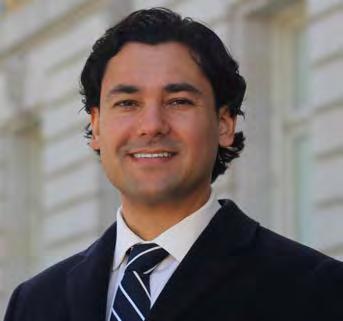
SF district attorney candidate Ryan Khojasteh
Courtesy Ryan Khojasteh
San Francisco Mayor London Breed claimed election night victories for three of her ballot measures.
See page 10 >>
Rick Gerharter
by Matthew S. Bajko
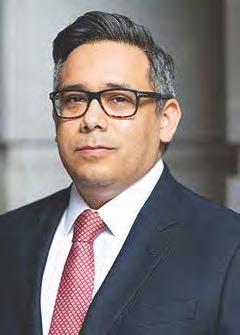
Less than a year after joining California’s 2nd District Court of Appeal bench, gay Justice Gonzalo Martinez is poised to oversee its Division Seven. If confirmed as expected, he would be the fourth out presiding justice on an appellate court in the state.
Governor Gavin Newsom announced his decision to elevate Martinez into the judicial leadership role Tuesday, March 12. The Commission on Judicial Appointments will need to confirm the appointment before Martinez can assume the position, which comes with an annual salary of $272,902.
The oversight panel had confirmed Martinez to his appeal court seat last July. Earlier in the year Newsom had tapped Martinez to fill the vacancy.
Martinez had been serving as Newsom’s deputy judicial appointments secretary, for which he was first hired in 2019. He helped vet more than 400 applicants seeking to be named to vacancies on the state courts.
While the governor’s office noted Martinez is from Los Angeles County, he and his husband, tax attorney Raul A. Es catel , had long called Oakland’s Trestle Glen neighborhood home. The couple have been together for more than two decades.
Martinez grew up the oldest of four children in the San Joaquin Valley where his non-English speaking immigrant parents worked as farm laborers. He lost a sister to leukemia, having translated for his parents during her doctor appointments.
Jim Humes serves as the presiding justice for the 1st District Court of Appeal, which covers the Bay Area region.
Gay former SF leader Marshall ramps up
Portland council campaign
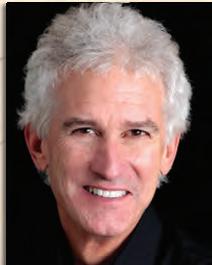
Mike Marshall, a gay man who was a longtime leader in San Francisco on LGBTQ rights and environmental issues, is ramping up his bid for a seat on the Portland City Council. He moved to Oregon in 2013 and lives in northeast

Portland with his husband Rob and their hound, Ava, according to his profile on the website of advocacy group Oregon Recovers that he co-founded and directs.
“We don’t just have a homeless problem or an addiction problem or a crime problem – we have a ‘can’t-get-it-done’ problem. I want to change that,” wrote Marshall. “Equally troubling, the city that used to take pride as ‘the city that works’ has come down with a wicked case of negativity. Truth be told, as a city, we’ve lost our mojo – and it’s hurting our businesses, our tax base, and our families.”
Marshall has long been willing to take on controversial issues and deal with the blowback from doing so. While in California, he oversaw the losing battle in 2000 against Proposition 22, the statewide ballot measure that defined marriage as between a man and a woman.
He briefly served as interim director of the city’s LGBT Community Center. In 2006, he resigned as executive director of nonprofit Under One Roof less than a year in the role. The charity, which is now defunct, had operated a retail store in San Francisco’s Castro District to funnel the proceeds toward numerous Bay Area HIV/AIDS organizations.
He went on to be executive director of Restore Hetch Hetchy, whose goal is to return to its natural state the valley in Yosemite National Park where San Francisco has stored its drinking water for more than 100 years. City voters rejected a ballot measure aimed at doing so in 2012.

The first in his family to attend college, Martinez graduated from Harvard in 1998 and later earned his law degree from the Ivy League school in 2003. Accepted into the bar a year later, Martinez worked at several law firms before becoming a partner in the Appellate and Supreme Court Practice Group at Squire Patton Boggs from 2007 to 2017.
He spent two years as a deputy solicitor general in the California Attorney General’s Office. Martinez then returned to the law firm until joining Newsom’s administration.
The 2nd District Court of Appeal covers the counties of Los Angeles, Ventura, Santa Barbara, and San Luis Obispo. It is composed of eight divisions with four justices each.
Martinez is one of two gay men serving on it. Associate Justice Luis A. Lavin is a judge on its Division Three.
There are currently six known out Court of Appeal members in the state. Gay Associate Justice David Rubin joined the 4th District Court of Appeal’s Division One last year.
The other three, two lesbians and a gay man, are all presiding justices on their benches. Laurie M. Earl presides over the 3rd District Court of Appeal, and Therese Stewart presides over the 1st District Court of Appeal’s Division Two.
Marshall has been in recovery himself since 2008 “from alcohol and meth and any other drug that was available,” as he told Treatment magazine in 2021. Drug policy is sure to be a top topic in his campaign as Beaver State leaders just rolled back a decriminalization law that voters approved in 2020.
While advocates have argued the state failed to properly implement the substance abuse treatment services called for in the ballot measure, many residents have pointed to its passage as why streets in cities like Portland have been taken over by people sleeping in tents and using drugs.
In a March 12 email confirming his plans to run for a council seat, Marshall addresses the city’s drug crisis head on.
The following year Marshall became the campaign manager for Oregon United for Marriage and in 2014 helped then-governor John Kitzhaber win reelection only to see him resign three months later amid an influence-peddling scandal. He also led the City Club of Portland, one of the country’s oldest civic engagement organizations, as its executive director, but left two years later following a “choppy tenure,” according to Willamette Week.
Over the past year he has sparred with various state leaders over drug and alcohol issues. He reportedly behind the scenes pushed lesbian Governor Tina Kotek last summer to fire Oregon Liquor and Cannabis Commission Director Steve Marks
In January, Kotek removed Marshall from a state panel overseeing alcohol taxes due to criticism he received for a Facebook post about the death of a brewery owner critics called insensitive. It led to media coverage about Marshall arguing with the governor’s office about its asking him to resign.
Now Marshall aims to be one of three people elected from Portland’s District 2 and fight for the needs of his neighbors at City Hall.
“Portland is embarking on an exciting and transformative redesign of our democratic system. Each Portlander will now elect three of their neighbors to represent them in City Hall which affords us the opportunity to reconnect our elected officials to the day-to-day problems Portlanders face,” wrote Marshall. t

Planning Ahead is Simple
Planning Ahead is Simple
The benefits are immense.
Planning Ahead is Simple
The benefits are immense.
When you plan your life celebration and lasting remembrance in advance, you can design every detail of your own unique memorial and provide your loved ones with true peace of mind. Planning ahead protects your loved ones from unnecessary stress and financial burden, allowing them to focus on what will matter most at that time—you.
The benefits are immense.
When you plan your life celebration and lasting remembrance in advance, you can design every detail of your own unique memorial and provide your loved ones with true peace of mind. Planning ahead protects your loved ones from unnecessary stress and financial burden, allowing them to focus on what will matter most at that time—you.
Proudly
When you plan your life celebration and lasting remembrance in advance, you can design every detail of your own unique memorial and provide your loved ones with true peace of mind. Planning ahead protects your loved ones from unnecessary stress and financial burden, allowing them to focus on what will matter most at that time—you. Contact us today about the beautiful ways to create a lasting legacy at the
Web Extra: For more queer political news, be sure to check http://www.ebar.com Monday mornings for Political Notes, the notebook’s online companion. This week’s column reported on new vote counts in various California primary races with out candidates.
March 14-20, 2024 • Bay area reporter • 7 t Politics >>
Contact us today about the beautiful ways to create a lasting legacy at the San Francisco Columbarium.
FD 1306 / COA 660 One Loraine Ct. | San Francisco | 415-771-0717
serving the LGBT Community.
SanFranciscoColumbarium.com
San
Contact us today about the beautiful ways to create a lasting legacy at the
Francisco Columbarium. Proudly serving the LGBT Community.
Proudly serving our Community. FD 1306 / COA 660 One Loraine Ct. | San Francisco | 415-771-0717 SanFranciscoColumbarium.com Barry Schneider Attorney at Law •Divorce w/emphasis on Real Estate & Business Divisions •Domestic Partnerships, Support & Custody •Probate and Wills www.SchneiderLawSF.com 415-781-6500 *Certified by the California State Bar family law specialist* 315 Montgomery St , Ste. 1025, San Francisco, CA 94104 Jesus didn’t discriminate so neither do we. Come and see Dignity/SF, which affirms and supports LGBTQ+ folks. Catholic liturgy Sundays at 5pm, 1329 7th Avenue (Immediately off the N Judah line) dignity | san francisco Come for the service and stay for the fellowship. dignitysf@gmail.com for more details Instagram @dignitysanfrancisco † Facebook @DignitySF Newsom elevates gay justice to lead appellate division The Scott W. Wazlowski Vice President of Advertising advertising@ebar.com 44 Gough Street #302, San Francisco, CA 94103 (415) 829-8937 • www.ebar.com Advertise! Justice Gonzalo Martinez Courtesy Governor’s office Portland City Council candidate Mike Marshall Courtesy the candidate RECEIVE OUR FREE WEEKDAY EMAIL NEWSLETTER, BREAKING NEWS, SPECIAL OFFERS, GIVEAWAYS AND MORE! Sign up! ebar.com/subscribe ebar-subscribe-fifth.indd 1 5/18/22 12:36 PM
San Francisco Columbarium.
“I will probably wait until I am comfortable that a proper home can be found before I turn it over,” Bach said at the time. The following year, the paper reported that the then-newly-opened Catch had become the new home of the bench.
“It brings back the presence of the history that was there,” Catch’s then-owner David Weiss told the B.A.R. at that time.
Catch’s most recent owner, Sanjay Gujral, thanked the neighborhood in a news release for decades of friendship.
“I’ve been so honored and grateful for this opportunity and the friendships made along the way, and to have help preserving the legacy of this space, especially for the LGBTQ+ communities who were so impacted by HIV and AIDS,” Gujral stated. “Our patrons and the community have been the heart of Catch. I thank each of you immensely for your support, patronage, and friendship throughout the years.”
John Cunningham, the AIDS grove’s chief executive officer, told the B.A.R. he wanted to “convey the deepest respect for Sanjay and all he did for the space, to honor the spirit of what went on there.”
‘I’m Available’ program working
Andrea Aiello, a lesbian who is the executive director of the Castro Community Benefit District, said that the vacancy rate within the CBD footprint is 15%. This is down 25% from one year ago, she said.
In Aiello’s view, turnover is happening more quickly than in the past.
“It seems when I talk to people that we do have businesses closing but it’s not taking two years to get them filled like it used to,” she said. “Maybe the economy is coming back a little bit. San Francisco is still a valuable place and the Castro is still a valuable place to have a business.”
As the B.A.R. reported last year, the CBD pioneered a campaign – “I’m Available” – featuring posters in vacant storefronts letting people know the space is available to rent. The campaign is also accompanied by a website boosting the neighborhood and featuring a map of available spaces.
Eight of the 21 locations where posters were displayed have now been leased, Aiello stated. These were at Rustic, 215 Church Street; Solidcore, 2175 Market Street; Entour, 2319 Market Street; Zona Rosa, 2337 Market Street; Pasta Panino, 4150 18th Street, Pink Swallow, coming at 500 and 504 Castro Street; and Sisters Coffee Shop, 506 Castro Street.
Aiello said that the initial grant funding came from the San Francisco Office of Economic and Workforce Development. A spokesperson stated that the office is “a proud partner of the CBD, contributing not only to the maintenance of the district’s physical realm, but also supporting CBD’s creative and nimble efforts to fill storefront vacancies through the ‘I’m Available’ campaign. San Francisco is leveraging the momentum of its revitalization efforts as storefront vacancies are being filled, breathing new life into the city’s commercial landscape.”
The district had received a grant in 2020 to hire a consultant; when the pandemic hit, the CBD pivoted to creating the retail leasing campaign.
“One-time grant funds are often used to build the infrastructure for the program to continue (maybe not as robust as initially) after the funds are used,” Aiello stated. “We are doing that with the grant funds.”
Aiello stated, “We are in the process of replacing posters that are faded by the sun and also putting up new posters in more recent vacancies.”
Maven Retail real estate agent Joan Ruyle told the B.A.R. that she worked on the lease of the aforementioned Zona Rosa. She also leased 2319 Market Street, 2331 Market Street, 4122 18th Street, and 215 Church Street.
“We only have two left,” she said, including the former Eureka Restaurant and Lounge at 4063 18th Street. (The other, she said, is confidential.)
“I think there’s some great advantages and attraction to the Castro,” Ruyle said. “It doesn’t receive as much attention as
Fillmore [Street] and Chestnut [Street]. It’s high tourist and a lot of nightlife, compared to the northern neighborhoods that see foot traffic pretty consistently throughout the weekends and days.”
Nonetheless that there’s two left is a good sign of interest in Castro, she said.
Ruyle said that sometimes buildings in older neighborhoods such as the old Eureka Lounge face challenges with Americans with Disabilities Act compliance.
“People are kind of leaning toward finding a restaurant that doesn’t need as much work and this space has challenges with the entrance not being compliant,”
Ruyle said.
The regulatory environment in San Francisco can also present a hurdle, she said.
“There are challenges obviously with running a business in San Francisco in terms of wage costs, cost of goods, safety, cleanliness, and other challenges outside the [COVID] pandemic.”
Aiello said that the Healthy Street Operations Center has helped CBDs around the city communicate and coordinate on issues surrounding street conditions via a once-a-week Zoom call where the Castro, SOMA West and Tenderloin CBDs can compare notes.
“I just think the mayor’s outreach team and us working together is making a positive impact,” Aiello said. “Is it 100%? No.”
A spokesperson for the San Francisco Department of Emergency Management stated to the B.A.R. that “HSOC collaborates with various non-government stakeholders to hear community input and coordinate efforts across teams. The collaboration enabled by our ongoing outreach program meetings is an essential component of our work.”
A March 5 count by the B.A.R. of storefronts along Market Street from Octavia Boulevard to Castro Street, on the 400 and 500 blocks of Castro Street, and on 18th Street from Collingwood to Noe streets found 156 (81%) that were filled and 36 (19%) that were vacant. (It’s worth noting this does not exactly correspond to the CBD footprint.)
Downtown decline had ripple effects
Asten Bennett isn’t ready to declare victory just yet in the battle against ennui and decline, symbolized by shuttered, boarded-up storefronts and despair in the streets.
“I wouldn’t say that I feel good it won’t turn right back again,” she said. “I think there’s a calculated effort being made right now. As long as we stay on top of that, we have a chance.”
One of those most responsible for that effort is gay District 8 Supervisor Rafael Mandelman. Aside from vacant storefronts, street conditions have also made business more challenging.
“We’re making a lot of progress with encampments,” Mandelman said. “It comes and goes. ... There’s too many days and nights the drugs are bringing the party to the sidewalk in the neighborhood, but the overall situation right now is dramatically improved since the [COVID-19] pandemic.”
Mandelman said that the economy of central San Francisco appears to be in a recession. The much-reported decline of downtown San Francisco has also affected the neighborhoods nearby, especially the Castro, which is one of the city’s major transit hubs.
San Francisco’s office vacancy rate was 35.9%, according to a report late last year from commercial real estate firm Global Commercial Real Estate Services. The city was ranked dead last in an Institute of Governmental Studies study the same year tracking American downtowns’ recoveries from COVID lockdowns.
Mayor London Breed and her opponents in November’s mayoral race have made reviving downtown central parts of their platforms. At last week’s State of the City, the B.A.R. reported about Breed’s plan to bring in 30,000 new residents by 2030. Opponent and former mayor Mark Farrell argues reopening Market Street to cars should be part of the solution.
“Part of the challenge is for neighborhoods that were part of the tech boom,” Mandelman said. “[South of Market], the
Mission, and the Castro are very much a part of that. Work from home has been great for neighborhoods farther away from downtown.”
Are things better in terms of businesses than last year? Mandelman’s “not quite as sure” as he is on street conditions.
“I’m happy about new businesses but I keep seeing businesses closing,” he said the day before Catch closed its doors. “There’s been an arts revival in the neighborhood. … People are working out, that’s good. Bars are coming back, and some new ones are opening up, but neighborhoods need more than bars to thrive.”
“Downtown distaste” has led some people into a “wait and see” mentality, according to Terrance Alan, the most recent former president of the Castro Merchants Association. He also said he wants to say things have improved somewhat.
“The post-COVID frenzy, which had some negative behavior attached to it, has subsided,” Alan stated. “Vacant storefronts take so long to build out and open if they are proposing something different, which is what we want. … Judging are we better or not – I want to say better.”
Weather impacts business
When asked how business has been at Cliff’s lately, Asten Bennett said that it has been dependent on the weather. The current water year has been one of the wettest in recent memory. From July 1 to March 10, San Francisco received 21.5 inches of rain, or 117% of the average from 1991-2020, according to National Weather Service data.
“I personally had a great January and a really crappy February,” she said, adding some San Franciscans “don’t go out for three days any time there’s extreme weather.”
Castro resident Gina Nguyen said she’s loyal to Cliff’s.
“It’s a very good business and they have good stuff,” Nguyen said as she worked her way through the aisles. “Only this has the good stuff and good quality.”
She added the number of shoppers she sees has been “about the same” for the last few years.
Patrick Batt, a gay man who is the proprietor of the collectable store AutoErotica at 4077A 18th Street, said that his business has seen some changes due to new outreach via Instagram.
“We’ve become quite a destination,” Batt said, crediting Bradley Roberge, a gay man who’s been leading the effort for the past few years.
Continued Batt: “It’s his [Roberge’s] ability to pick out what people want to see.”
Roberge said that “people have come from Malaysia” due to the Instagram page, curating the best of AutoErotica’s collectable content, and which now boasts almost 50,000 followers.
A relatively new addition to the Castro business scene is Sarah Fu, co-manager of the Hulu Wa China Bistro at 3970 17th Street, next to the Chevron station.
The space, which opened as a Chinese restaurant late last year, had previously been home to Niji Sushi and Nash Hot Chicken and Ramen. Before opening Hulu Wa, the family had been the landlords for the second iteration of Niji.
Fu said that things have been “slow.”
The family that runs Hulu Wa has had another location in San Rafael for the past five years; the Castro is their second.
“I think Castro is a tourist district,” she said about why they decided to open up there. “When people come to San Francisco they first go to the places with tourists and I think this is good for business.”
Fu said that the other reason is because they live in Ingleside – closer to the Castro than to San Rafael across the Golden Gate.
Street conditions haven’t helped things pick up the pace at Hulu Wa, she said. Sometimes people come inside the restaurant, cause disturbances, and refuse to leave, which means “some customers don’t come in,” she said.
Nonetheless, Fu doesn’t regret coming to the neighborhood.
“I like this district,” she said. “The weather is very nice.”
Business roundup
The reopening of Badlands at 4121 18th Street last October brought a much
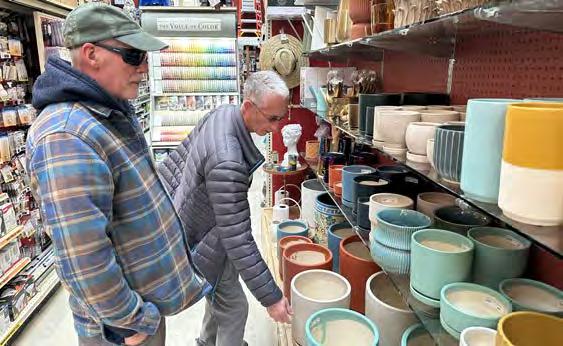
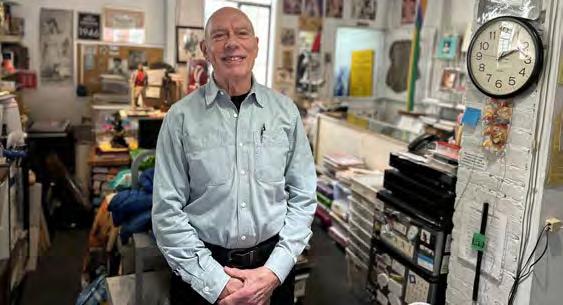
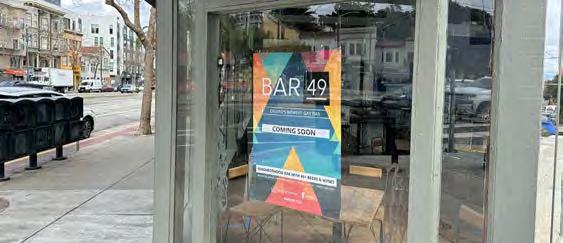
needed boost of energy to the commercial corridor, as the B.A.R. reported. Now, five months later, co-manager TJ Bruce, a gay man who owns a number of nightclubs on the West Coast, such as Splash San Jose and Badlands Sacramento, stated things are going well.
“It’s been pretty good on the weekends so we are thankful for that,” Bruce said. “Weekdays for the Castro are definitely more challenging but that is typical for any city. ... We are looking forward to the spring and summer season. Looks like other Castro bars will be opening sometime this year so that should draw even more folks to the neighborhood.”
Among those that may not be is Pink Swallow at 500 Castro Street. As the B.A.R. reported last July, a new ownership group of Beaux mainstays leased the old Harvey’s space. Though they’d intended to be finished by late summer or early fall 2024, Joshua J. Cook, a gay man who is Beaux’s general manager and who speaks for the group, told the B.A.R. that Pink Swallow – which will require extensive interior work – is “currently in permitting and application process” and that there is not a projected opening date.
Most recently, the city’s planning commission approved a conditional use authorization February 1 to establish a nighttime entertainment zone on the first and second floors of the space, as the B.A.R. reported last month.
At the end of the month, Solidcore received a conditional use permit from the planning commission to open a gym at 2175 Market Street. Solidcore representatives have not returned comment as of press time.
The planning commission also approved a permit for Los Angeles-based Muuu Meat to operate in the old 7-Eleven at 3998 18th Street last year. Muuu Meat did not return a request for comment.
That same month, Hi Tops co-manager Colm O’Brien announced his intention to open shop at 2295 Market Street, former location of Los Amigos Diner and the Baghdad Cafe. O’Brien’s concept, Bar 49, will feature over 49 beers and wines with food to complement both, he told the B.A.R.
“I picked the space because I know the neighborhood and the space recently be-
came available,” O’Brien stated. “I’ve been trying to open my own space for a few years now and the timing and space feels right. The granting of the beer and wine license will determine the opening date but I am aiming for mid-to-late May. The license will also determine the hours but I am hoping to open at 4 p.m. during the week, lunchtime on Fridays, and 10 a.m. on weekends for brunch. Closing at midnight every night.”
O’Brien doesn’t intend to serve hard liquor.
“A liquor license is so much more money and it’s a whole different process to get approval for that space,” he said.
He added that he’s making some changes to the interior.
“I am going darker with the colors inside and changing the layout of the seating,” O’Brien stated. “The location is amazing and all the windows make the corner a great place to sit, have a drink, some food, and chill out.”
Q Bar at 456 Castro Street has been closed since a 2019 fire. Gay Q Bar coowner Cip Cipriano had told the B.A.R. last year he wanted to open by Pride; then, when that didn’t happen, teased a September reopening .
However, the space remains shuttered, and Cipriano did not return a request for comment for this report. He last told the B.A.R. in October that “we won’t announce a date until we have everything completely done.”
Serhat Zorlu, who took over the old Cafe Flore space at 2298 Market Street, confirmed to the B.A.R. that his new Fisch and Flore will be having a soft opening April 3, though he added the restaurant will not be “fully operational” at that time. Zorlu declined to comment further.
The Woodhouse Fish Co., located at 2073 Market Street, closed January 23 after 18 years there, but the seafood restaurant’s location in Lower Pacific Heights remains open, co-owner Dylan MacNiven told the B.A.R.
“There were a confluence of reasons, mostly economic,” MacNiven stated. “We are continuing on Fillmore Street. We remodeled last summer and have some
8 • Bay area reporter • March 14-20, 2024 t << From the Cover << Vacancies decline From page 1
Peter Grady, left, and Peter Myers shop at Cliff’s Variety on March 12. The San Francisco residents said they often shop at the historic Castro Street hardware store.
John Ferrannini
Patrick Batt has long owned Auto Erotica on 18th Street.
John Ferrannini
Bar 49 will feature beer, wine, and food.
See page 10 >>
John Ferrannini
Glide names queer poet theologian
by J.L. Odom
In their new position as the 2024 Janice Mirikitani Poet Theologian in Residence at Glide Memorial Church, Ramona Laughing Brook Webb is off to a running start.
“I’m looking forward to every step of the way, and we’re kind of off to the races already,” said Webb in a recent phone interview with the Bay Area Reporter.
First up was their attendance at Glide’s Sunday Celebration service February 11, during which minister Marvin K. White, a gay man, introduced Webb to the congregation and Webb gave their inaugural sermon. Next up, myriad plans and events, all aimed at community-building and in line with Glide’s mission of inclusive faith and its social services.
As Webb, who is queer and uses they/ them pronouns, said, “There’s so many points of engagement and so many points of education. It feels very intersectional, and I’m really enjoying that. … I’m looking forward to continuing to create that kind of embrace while working with the congregation at Glide and in the community that surrounds us.”
Glide, located in the Tenderloin, was founded in the 1930s as a Methodist church; in the 1960s, it developed into the progressive, social justice-oriented and LGBTQ-affirming space it is today. It was for many years led by the Reverend Cecil Williams. Mirikitani, who was Williams’ wife and a Glide co-founder, died in 2021. Williams, now 94, has retired from Glide. Now nondenominational, Glide champions radical inclusivity alongside its other values of truth-telling, love and hopefulness, community-focused initiatives and celebrating life.
Webb’s appointment as Glide’s poet theologian is a yearlong residency that officially got underway January 14. At the celebratory gathering last month, White detailed Webb’s contributions and background, including her position as the first poet-in-residence at UCSF’s National Center of Excellence in Women’s Health and Black Women’s Health and Livelihood Initiative.
Simon has long been favored to win the District 12 House seat in Alameda County. Lee endorsed her in late January, followed by the state’s two Democratic U.S. Senators, Alex Padilla and Laphonza Butler, in early February.
Butler, a lesbian, chose not to seek a full term after being appointed last fall to fill the vacancy created by the death of Feinstein. She is expected to step down after the November election, in which Congressmember Adam Schiff (D-Burbank) is now favored to win against Republican Steve Garvey, a retired baseball player.
Southern California House races
In the race to succeed Schiff (DBurbank) in his District 30 House seat, first-place finisher Assemblymember Laura Friedman (D-Glendale) saw her share of the vote edge up to 29.9% over the weekend. Due to the liberal makeup of the district, which includes the LGBTQ enclave of West Hollywood, she is favored to win come November.
Her opponent will be gay Republican Dr. Alex Balekian, an ICU physician who is Armenian American. As of Tuesday he was in second place with 17.6% of the vote, a slight drop from his 21% share of the unofficial count from last week.
Senator Anthony J. Portantino (D-Burbank) continues to trail in third place with 13.3% of the vote.
Congressmember Jimmy Gomez (D-Los Angeles) will again be fending off a challenge from gay Democrat David Kim for his District 34 House seat, having defeated the pro -
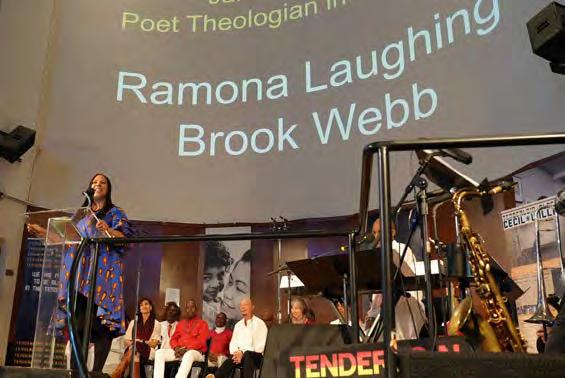
“The work they’re doing at the [UCSF] Black Wellness Center … the race and gender concordant work that is happening is just amazing to watch and witness,” said White in his introduction of Webb.
In an email to the B.A.R., White described Webb as “a practitioner of poetic medicine” and as “a reflection of the Tenderloin: womanist, queer, Black, and Indigenous.”
He conveyed that Webb “has a way of crafting words that inspire people to pause and sit with things that are hard,” encouraging people to attend Glide’s Sunday Celebration and write their own narratives as a means to heal.
“Naming Ramona as the inaugural Janice Mirikitani Poet Theologian in residence is one of the many ways Glide Church is making art and faith an accessible, revolutionary, and revelatory practice to those of all sexualities, races, education and income levels,” stated White.
Over the course of Webb’s appointment, multiple initiatives are planned, including honoring Mirikitani, for whom the annual poet theologian residency at Glide is named.
“We’ll be working on some collaborative pieces about Jan [Mirikitani]. We’re looking to put together an anthology of
gressive lawyer in 2022. Gomez is in first place with 51.2%, while Kim is at 27.7%.
“While the final results are still being tallied, it is becoming increasingly clear that we are poised for a rematch in the general election against the incumbent, Jimmy Gomez. This is an opportunity for us to continue the fight for real change in our community, to amplify our voices, and to champion the values we hold dear,” Kim told his supporters in a March 12 email.
Two other Southern California House races with gay Democratic candidates are headed to fall rematches this year. After defending his seat two years ago, Congressmember Ken Calvert (R-Corona) is again facing a challenge for his District 41 House seat from lawyer Will Rollins. With the gay retirement and resort town of Palm Springs now a part of it, Democrats are targeting the seat as a pickup opportunity this year. But Rollins, who now lives in the Coachella Valley city, is in an increasingly nasty campaign against Calvert.
The conservative GOPer currently holds first place in the primary with 52.9% of the vote, as of Tuesday. Rollins now has 38.6% of the vote, according to the unofficial returns.
Facing even longer odds to win the District 23 House seat in the high country east of Los Angeles is progressive activist Derek Marshall, who lost to Congressmember Jay Obernolte (R-Hesperia) in 2022. Marshall’s share of this year’s primary vote is currently at 36.5%.
The state’s current two gay Democratic Congressmembers, Mark Takano of Riverside and Robert Garcia of Long Beach, both easily won their primary races. The pair
ten word takes a prominent role as well, with poetry and other creative writing workshops, retreats and a “Take Back the Night” open mic night scheduled – all aimed to bring the community together. The workshop series will culminate with a January 2025 exhibition of participants’ poetry and prose.
“It will be a way to share what we’ve collectively developed as a community by the end of all this,” explained Webb.
These workshops will be hybrid, so that individuals who are unable to attend in-person sessions can still take part.
“We’re writing our own recipes for change in our creative writing sharings … and they’re going to be published in collaboration with recipes for wellness – that kind of feel good medicine that we get when we are cooking food that is indigenous to our wellness and to our households and what we relate to that abundant feeling, that vibration of love and healing and seeing ourselves as the medicine we need to receive to feel inspired and held by the world,” said Webb.
work in her honor,” said Webb.
Mirikitani, who managed Glide alongside Williams since the mid-1960s, served as the Glide Foundation’s founding president and was the executive director of Glide’s Family, Youth and Childcare Center. She was also San Francisco’s second poet laureate, from 2000 to 2002, succeeding the late Lawrence Ferlinghetti.
Through the sharing of theater and performance pieces, Webb intends to pay tribute to Mirikitani. One of the planned art exhibitions will also be dedicated to her.
“[It] exemplifies her values and the work that she shared with the world – the things that I feel like were her initiatives when it comes to the engagement of community and pivoting on humanity and the idea around forgiveness and the reclamation of time … I’m really excited about continuing to hold a candle to that legacy and share even more about it,” said Webb.
Other initiatives include the relaunching of Glide’s Maya Angelou Room, which Webb will coordinate, and bringing in some guests, such as for Sunday Celebration, to speak with the congregation and the surrounding community.
During Webb’s residency, the writ-
is expected to easily defeat their Republican opponents in the fall.
Challenging Takano for his District 39 House seat is David Serpa. Opposing Garcia for his District 42 seat is John Briscoe.
California is currently the only West Coast state with LGBTQ representation in Congress, though candidates in Oregon and Washington are aiming to change that this year. Democrats Jamie McLeod-Skinner and Eddy Morales aim to survive their May 21 party-based primary races.
McLeod-Skinner, a lesbian former councilmember in the Bay Area city of Santa Clara, is running again for Oregon’s District 5 House seat after falling short in 2022. She aims to take on a second time Republican Congressmember Lori ChavezDeRemer of Happy Valley.
Morales is seeking the Beaver State’s open District 3 House seat, as Congressmember Earl Blumenauer (D-Portland) opted not to seek reelection this year. The queer Grisham City Councilmember is expected to attend a March 23 fundraiser in San Francisco being hosted by a number of local LGBTQ leaders.
Washington state holds its primary August 6, and like California, it selects congressional candidates based on a top-two system. Queer Democratic state Senator Emily Randall, a former Bay Area resident, aims to succeed Congressmember Derek Kilmer (D-Gig Harbor) in the Puget Sound region.
She would be the first out congressmember from the Evergreen State. But Randall is facing a tough campaign, as Kilmer endorsed Washington Public Lands Commissioner Hilary Franz to succeed him. t
Community healing is another interest and aim, with meditation, journaling and affinity healing groups, such as one specifically geared toward Black women and gender-expansive people, on the table initiative-wise. The intent is for these offerings to have a wide reach, with a meditation series planned for Pride Month in June that will start at Glide and then head to the UCSF Black Wellness Center and to the Queer Healing Arts Center in Oakland.
“We’ll be taking a little bit of this medicine of creative arts and meditation on the road,” Webb noted.
Webb will be covering a lot of ground through community-building both at the church and outside of it.
“We’re going to be bridging some communities through participation, and I’m looking forward to that. ... I want to continue to build those kinds of bridges between Glide and larger community spaces that are also doing impactful work that are of service to the community that is surrounding us and thriving with us,” they said.
In these initial months of their residency, Webb will oversee a congregational cookbook writing workshop series and a “Vision and Voice” workshop.
The former, one of the creative writing workshops, involves collecting recipes from the Glide congregation and the larger community as a whole and integrating them into a collective writing project.
The latter is a workshop in which participants explore authenticity, partake in breathing exercises, and, correspondingly, focus on sources of inspiration and ways to be impactful in the future. Congregants will work toward creating an anthology of work stemming from their considerations and development of an authentic voice.
“[The workshop] also will give people an opportunity to have an introduction to me and my pace and how we’re going to be working together, sharing together and collaborating together,” noted Webb.
Now about two months into their residency, Webb has become more familiar with and involved in Glide, citing their participation in Glide’s racial justice group, meditation group, Bible study, and prayer circles as invaluable.
“It’s really given me an opportunity to completely invest and develop my own cultural competency around Glide as a community. It makes sure that the work that I’m presenting and what I’m offering is socially relevant to the community that is excitedly participating in all kinds of aspects of politics, spirit, affirmation, experience, and text,” they said.
And on a quarterly basis, Webb will give sermons at Sunday Celebration, held at 9 and 11 a.m., throughout their poet theologian tenure – yet another opportunity to establish a continual connection with the congregation.
For more information about Glide, go to glide.org. t
March 14-20, 2024 • Bay area reporter • 9 t
Community News>>
Ramona Laughing Brook Webb, the new poet theologian at Glide Memorial Church, addressed the congregation during a Sunday Celebration.
Kenneth Ward
<<
Low From page 2
From page 1
Milk along with then-mayor George Moscone in their City Hall offices.
“He was one of the funniest people I worked with in politics. He took great joy at needling people effectively,” Mr. Mixner said of Milk. “Another time and place he would have been a U.S. senator.”
The B.A.R. spoke with Mr. Mixner back then because he was returning to San Francisco to receive the Pioneer Award from GLAAD, a national organization focused on LGBTQ advocacy and cultural change.
Current GLAAD President Sarah Kate Ellis remembered Mr. Mixner in a statement.
“David changed the world forever and equality would not be where it is today without his leadership, passion, and immense heart and humor,” Ellis stated.
“David was a beloved mentor to me and so many other LGBTQ leaders, always pushing for more for our community. He dedicated his life to our community and now we must strive to live up to his legacy.”
AIDS, political activism
Mr. Mixner was also involved in AIDS activism for many years. He lost his partner, Peter Scott, to the disease in 1989.
Annise Parker, a lesbian who is the outgoing president of the national LGBTQ+ Victory Fund, recalled that Mr. Mixner
<< DoxyPEP
From page 1
The CDC recommends doxyPEP for cisgender men who have sex with men and transgender women who have had an STI during the past year. SF’s guidance is broader, including trans men and nonbinary people, as well as people with multiple sex partners who haven’t recently had an STI.
Gay and bisexual men in San Francisco were early adopters of PrEP for HIV, and the same is true for doxyPEP. Prophylactic doxycycline use at Magnet ramped up steadily, reaching 1,209 people by September 2023. Since then, the number has nearly doubled, according to SFAF. Among people who started doxyPEP, quarterly STI incidence fell by 58% overall. But, as in clinical trials, the decrease was greater for chlamydia (67%) and early syphilis (78%) than for gonorrhea (a nonsignificant 11% drop).
“We’ve been really impressed by how much our community wanted this, how many people took it when it was available, and what the impact of it was – both quite dramatic and quick,” Scott told reporters at a media briefing.
Half Moon Bay
From page 4
his church. He added that the church replaced the Pride banner and has not had problems with it.
“I’m so sorry this happened in Half Moon Bay,” he stated.
But Mitulski added that the vandalism incident has left an impact. The church recently hung up a banner stating that “love demands a ceasefire,” referring to the Israel-Hamas war. Some in the congrega-
<< Guest Opinion
From page 6
to county jail.
Both my career and involvement in politics have shown me that the DA’s office cannot be successful in isolation, surrounded only by political allies. There’s a reason over 60 people and counting have resigned from the DA’s office in such a short time, including
<< Vacancies decline
From page 8
great things coming down the pipeline including our 15-year anniversary celebration next month.”
Anchor Oyster Bar at 579 Castro Street reopened March 8 after renovations.
According to a 2022 Hoodline re-
protested in front of the White House for increased federal AIDS funding at a time when then-President Ronald Reagan would not mention the disease killing thousands of gay men, as well as others.
“David was a courageous, resilient, and unyielding force for social change at a time when our community faced widespread discrimination and an HIV/ AIDS crisis ignored by the political class in Washington, D.C.,” Parker stated. “In 1987, David joined one of the first HIV/ AIDS protests outside the Reagan White House, where police wore latex gloves because of the stigma and misinformation around HIV/AIDS. He was arrested, along with 64 others, and made national headlines, when being an out person could lead to harassment, violence or worse. But David was undeterred.”
Parker noted that the LGBTQ Victory Fund was born out of various protests, when LGBTQ leaders realized that out people weren’t represented in elected office.
“In 1991, he joined other activists to launch a new organization, LGBTQ+ Victory Fund, that exclusively supported LGBTQ+ candidates,” Parker stated. “David served with Lynn Greer as a founding board co-chair. With support for candidates underway, his vision of a government and democracy representative of its people expanded beyond elections – and moved to ensure we were represented in political parties and
Although most doxyPEP recipients were cisgender men, transgender women and nonbinary people also had high uptake. White, Black, Latino, and Asian PrEP users were about equally likely to opt for doxyPEP, at around 40%. But because Black gay men are far less likely than white or Latino men to be on PrEP, doxyPEP uptake is still not equitable.
“There is still a lot of work to be done around PrEP access” to ensure that disparities are not perpetuated, Scott acknowledged.
Still, SFAF officials noted the positive doxyPEP news.
“For so long, we have only been able to rely on condoms for STI prevention – and we know that condoms don’t work for everyone,” Jorge Roman, RN, Magnet’s senior director of clinical services, said in a statement. “It is exciting to have a new tool that we can make available for STI prevention.”
Similarly, SFDPH researcher Dr. Oliver Bacon and colleagues reported early doxyPEP data from City Clinic, comparing STI incidence before and after the local guidelines were issued. Among 506 gay men and trans women on PrEP, 73%
tion were skittish about drawing more attention to the church, he stated, attributing those feelings to the vandalism of the Pride banner. The peace banner has been up for about a week with no incidents, he added. He also noted that this type of vandalism is rare in San Mateo County.
Last May, Palo Alto police opened a hate crime investigation into the vandalism of a Pride flag flown by the city’s First Lutheran Church. A church employee had found it ripped down and reported the incident to
victim advocates and career prosecutors I learned from. When cases are shuffled around and continuity is lacking, the public suffers.
I will not run an office that prioritizes political ideology at the expense of public safety. And I will not engage in mass-firings that create a hostile work environment. In fact, I plan to promote hard-working and ethical career prosecutors from within the
port, the specialty food store Epicurean Trader will be opening beneath the housing complex at 2238 Market Street. Co-owner Holly McDell stated to the B.A.R. that they hope for a May opening. The husband-and-wife ownership duo’s first store was in Bernal Heights nine years ago.
“The Castro location will be our fifth SF location,” McDell stated. “Our busi-
presidential administrations as well.
“He pushed the presidential campaign of Bill Clinton to be inclusive of gay people – and was asked to join the campaign’s National Executive Committee – the first time an out LGBTQ+ person held a public facing presidential campaign role.
When President Clinton won, David launched Victory’s Presidential Appointments Program, pushing the administration to appoint LGBTQ+ people to key political positions. That work continues to this day,” Parker stated.
Equality California, the statewide LGBTQ rights organization, also praised Mr. Mixner.
“David Mixner was a tireless fighter for our community and dedicated his life to advancing full, lived equality for all LGBTQ+ people,” EQCA Executive Director Tony Hoang stated. “His many decades of advocacy have changed the lives of countless LGBTQ+ people in California and across the world for the better. Among his many accomplishments, David worked alongside Harvey Milk to stop California from banning LGBTQ+ schoolteachers in the 1970s, advocated for more aggressive treatment options during the AIDS crisis in the 1980s, helped lead the fight against “Don’t Ask, Don’t Tell” in the 1990s, and was central to our achieving marriage equality in the 2000s.”
In 2009, Mr. Mixner worked with gay and AIDS activist Cleve Jones to organize
started doxyPEP. Positive chlamydia tests dropped by 90% and early syphilis fell by 56% among doxyPEP users compared with 27% and 32%, respectively, among non-users. Gonorrhea declined by about a quarter in both groups, showing that doxyPEP had no significant effect.
STIs at the population level
Other researchers assessed the impact of doxyPEP a different way, looking at changes in STI incidence at the population level.
SFDPH epidemiologist Madeline Sankaran and colleagues tracked the number of people starting doxyPEP and changes in STI rates at Magnet, City Clinic, and Ward 86 at Zuckerberg San Francisco General Hospital and Trauma Center before and after the release of the city guidelines.
More than 3,700 gay and bi men and trans women started doxyPEP at the three clinics by the end of 2023. This is an underestimate of citywide use, as large health systems like Kaiser Permanente and independent practitioners also provide doxyPEP. Chlamydia cases in this population declined by 50% and early syphilis decreased by 51% relative to pre-
police in the Santa Clara County city on May 16, as the Mercury News reported.
Meanwhile, Coast Pride officials stated they were moving ahead with their mission as a welcoming organization for all.
“Looking forward, we are continuing our long-term work of creating a coastside that supports and celebrates people of all sexual orientations and gender identities,” Coast Pride’s email stated. “We do this by training teachers, school staff, parents and caregivers, and the wider community on how to create safe and af-
office to serve as chiefs.
I commit to working closely with the school board, the City College board, our partners at City Hall, and community-based organizations on policies and programs to prevent crime. It’s past due for every stakeholder in our city to come together for a week-long “Public Safety Summit” where we can prioritize collaboration instead of finger-pointing.
We have a responsibility to build part-
ness ethos is all about supporting the fantastic small producers all over the U.S. that have wonderful products, but might not have the distribution or brand awareness to make it into a city like San Francisco. We purvey a wide variety of products; from craft spirits, wine, cheese, charcuterie, oils, coffee, chocolate, spices, and pantry goods. Our new Castro location will have a specialty retail market,
the National Equality March in Washington, D.C.
In a phone interview March 12, Jones recalled that Mr. Mixner was a hero of his before he even knew that he was gay. Jones’s first political action involved organizing a walkout at his high school as part of the massive national Moratorium to End the War in Vietnam, in October 1969.
“I didn’t know at the time that he was the organizer of that,” Jones said, adding that he met Mr. Mixner for the first time when he went to Los Angeles after Milk was killed.
“In 2009 he called for a March on Washington to try and push Obama but said Torie Osborn and I should be in charge,” Jones said, laughing, adding that Osborn “wisely declined.”
So Jones went ahead with planning for the event, much of which was organized online, he said. The march took place on October 11, which is National Coming Out Day and also Jones’ birthday.
“It was incredible,” Jones said, adding that about 100,000 people attended. “Lady Gaga was there, and a lot of young people. It helped, I think, push Obama forward on marriage equality.”
Mr. Mixner authored a best-selling memoir, “Stranger Among Friends,” in 1996. He donated his personal papers to Yale University in 2005.
In 2007, when he donated a journal he kept of all the friends lost to AIDS
dicted levels. But again, there was no significant change in gonorrhea.
In a related study, Dr. Jeffrey Klausner of the University of Southern California, and a former San Francisco deputy health officer, and colleagues found that rectal chlamydia, rectal gonorrhea, and syphilis rose among men in San Francisco from April 2020 through December 2021. After that, rectal chlamydia was stable until the city doxyPEP guidelines were issued, after which it declined steeply. Rectal gonorrhea and syphilis were already decreasing before the guidelines and continued to fall.
As these studies suggest, it can be hard to tease out the effects of doxyPEP from pre-existing trends in STI rates and changes due to other factors. For example, COVID disrupted STI screening in early 2020, and many gay men changed their sexual behavior in response to the 2022 mpox outbreak.
But while chlamydia cases among gay men fell after the city’s doxyPEP guidelines were issued, cases rose among cisgender women, which “strengthens the conclusion that the decline in chlamydia and early syphilis cases is related to doxyPEP rollout,” Sankaran said.
firming environments. We do this by collaborating with schools and school districts to write policies that protect queer and trans youth. We do this by partnering with faith leaders to create affirming spiritual spaces. We do this by supporting the parents and caregivers who are caring for their Queer and Trans children every day. We do this by celebrating queer joy during June Pride Month, at every support group session, and every day we are still here.”t
nerships with everyone. We must seek solutions together, not scapegoats. We should not blame judges who are following the law for our city’s challenges. San Francisco is a city of innovation. We have always looked ahead. We don’t need a district attorney who will look to the past and push the failed policies of the 1990s on us. It didn’t work then, and it isn’t working today.
I will be a responsible and moderat-
with an adjacent cafe, and wine bar. We work with Four Barrel coffee for our coffee program, and Tartine and Craftsman and Wolves for their wonderful pastries.”
Perhaps the neighborhood’s most conspicuous business closure is the Castro Theatre at 429 Castro Street. The theater has been shuttered since February 4. David Perry, a gay man who is a spokesperson for theater managers
to Yale, Mr. Mixner recalled a freshman approached him and introduced himself as belonging to the gay student group on campus, he told the B.A.R. in the 2008 interview.
The student praised Mixner for his speech but wanted to ask a question. Who is Harvey Milk?
“Here was a freshman at Yale involved in the gay student association who didn’t know Harvey Milk,” said Mr. Mixner. “I realized one, how old I have gotten, and two, we are losing our history because many of our storytellers died of AIDS.
“Many of the people who would have passed on Harvey’s story ... who would have been mentors or tribal elders of this next generation died. So there is a deep void out there of LGBT history,” he added.
Mr. Mixner spoke with the B.A.R. several months before the “Milk” biopic was released and said he sees the film and other efforts to preserve the LGBTQ community’s contributions and milestones as providing a sense of pride not only to those who lived through it but to those just now coming out of the closet.
“When I came out I just thought I came out of nothing. I was this horrible person born of nothing. The fact of the matter is I came out of a great and noble struggle for human rights,” said Mr. Mixner. “We can find in our history a nobleness. We can find self-esteem. We can realize we come out of a rich, wonderful heroic struggle. And that is important to know.” t
STI prevention for cisgender women remains a glaring gap. Unlike the DoxyPEP trial for gay men and trans women, the dPEP Kenya trial found that doxyPEP did not prevent STIs among young cisgender women in Africa, probably due to low adherence and a high local level of drug-resistant gonorrhea. Neither the San Francisco nor CDC doxyPEP guidelines include a recommendation for cisgender women or heterosexual cisgender men, though it could be considered on a case-by-case basis, according to Cohen.
“Given what we have found to date, I think providers should support their patients in assessing their need for and interest in use of doxyPEP,” Cohen said.
“DoxyPEP doesn’t stand alone. We need everything from primary prevention, including condoms, and education to policy change that supports sexual health.”
“For so long, we have only been able to rely on condoms for STI prevention -- and we know that condoms don’t work for everyone,” Jorge Roman, Magnet’s senior director of clinical services said in a statement. “It is exciting to have a new tool that we can make available for STI prevention.” t
The State of California offers help for victims or witnesses to a hate crime or hate incident. This resource is supported in whole or in part by funding provided by the State of California, administered by the California State Library in partnership with the California Department of Social Services and the California Commission on Asian and Pacific Islander American Affairs as part of the Stop the Hate program. To report a hate incident or hate crime and get support, go to cavshate.org.
ing voice in this sea of toxic politics. I want my city to be the safest it can be for everyone. And I understand that can only happen if we work together and innovate our way to true public safety. t
Ryan Khojasteh is a proud San Franciscan and straight ally running for district attorney in the upcoming November 2024 election.
Another Planet Entertainment, told the B.A.R. that the scaffolding for extensive renovations and remodeling is finally up inside.
In a text message, Perry added that the team has begun ceiling restoration and that exterior scaffolding should be expected outside the theater “sometime in the next few weeks.” t
10 • Bay area reporter • March 14-20, 2024 t << Community News
<< Mixner
<<
 by Jim Gladstone
Naima, the 29-year-old protagonist of “Dirty White Teslas Make Me Sad,” now premiering in a Magic Theatre/Campo Santo co-production extended through March 24, may be depressed and directionless, but she wields a wicked analogy.
Seeing the titular vehicles taking over the streets of her native San Francisco, Naima (Anna Marie Sharpe, a magnetic orator) explains that while “Black folks trip off of their white shoes being
dirty…because it took so much time for us to get those shoes, and we probably won’t be able to get another pair anytime soon, so we honor them.”
Meanwhile, the city’s four-wheeled Musketeers are willing to drive around dirty.
“What kind of privilege is that?” Naima wonders in one of many monologues that playwright Ashley Smiley surely intends to articulate inner thought rather than actual speech. “To have something that screams inaccessibility and classism and capitalism and not even have to worry about it being clean?”
Lil Nas X’s ‘Long Live Montero’
‘Dirty White Teslas Make Me Sad’
at the Magic Theatre
High tech totems
Teslas are represented on stage by the presence of car doors and tires, but smartphones prove similarly ubiquitous, and more pernicious, in the show’s storytelling.
They’re essential to Naima, who sporadically works as an Uber driver (“Five different map apps and I still get turned around”) and ultimately becomes entangled in a poorly explicated but quintessentially contemporary heist scheme: reconfigured iPhones are used to hotwire Teslas.
Designer Tanya Orellana’s versatile set features
 by Brian Bromberger
As I watched the new concert documentary “Lil Nas X: Long Live Montero,” detailing his first-ever headlining U.S. tour, now streaming on HBO, images of fellow diva Madonna flashed through my mind, recalling her landmark tour documentary, “Truth or Dare,” but also her use of religious imagery (i.e. “Like a Prayer” video) and shocking sexuality (“Erotica” CD and book) that must have inspired him.
Lil Nas (real name Montero Lamar Hill) is the Black gay genre-bending hip hop singer/songwriter/dancer, whose first breakthrough hit “Old Town Road,” married rap with country music, and remained number one on the Billboard Hot 100 for a record 19 weeks. Soon after that global sensation, he came out during Pride month in 2019.
The video of his song, “Call Me By Your Name,” from his debut album “Montero,” in which he descends into hell and does a lap dance for the devil, sparked enormous controversy (plus a publicity bonanza), critics calling him a satanist.
He was even decried by fellow Black artists for being a cowboy who made kid-friendly music, or as a sex-obsessed provocateur attempting to indoctrinate young people into a gay agenda. The attacks continued with the release of his latest video, “J Christ,” with Lil Nas playing you know who.
This sketchy, occasionally compelling film follows him performing on stage during his tour, but also behind the scenes as he adjusts to his stardom. As he rehearses, the filmmakers question him about his personal life, family, fame, as he embraces his gay identity and its impact on his fans.
Self-acceptance journey
The film, directed by Carlos López Estrada and Zac Manuel, unfurls in three parts: “Rebirth,” “Transformation,” and “Becoming,” which follows the tripart video introducing the concert’s threeact structure. It also parallels Lil Nas’s journey to self-acceptance, which is complicated and not as smooth as his lyrics suggest.
Besides Madonna (who visits him prior to his show), another strong influence/connection has been the late rock’n’roll pioneer Little Richard; Lil
Nas dressed up as him last Halloween. The movie features the archival 1972 interview clip, when asked about his homosexuality, Little Richard declared, “God gave it to me and I need to show it to the world. Let it all hang out.”
While meant to be uplifting, Lil Nas expresses regret that Little Richard couldn’t be fully free and all he could be, since other times he returned to the closet denying being gay.
Lil Nas divulges that he felt like a “stepchild” in his own family. When he told his father Robert Stafford he was gay, Stafford wondered if the devil was tempting him at the start of his career. Later he addresses the crowd, “Thanks for being here, because I didn’t use a condom.”
As for his stepmom, Lil Nas confesses, “It still feels really weird being flamboyant or closer to myself when I show most people around her.”
He admits his sexuality is “the elephant in the room” and he’s hesitant to share any information about any boyfriends or who he’s dating, with his family. Lil Nas does help his older brother Tramon, to come out as bisexual, but Tramon makes it perfectly clear to the camera, “I’m not gay.”
two monumental curved white brackets. They’re somewhat suggestive of automotive design but more highly evocative of iPhone iconography. These units also serve as screens for Joan Osato’s inventive projections, including several created to work in tandem with director Raelle Myrick-Hodges’ blocking of the actors to create impressive simulated driving scenes.
Unfortunately for devoted local theatergoers, this stage design is strikingly similar to the
See page 14 >>
The motives of any conditional acceptance are a bit dubious when another brother opines, “We used to have a love-hate relationship, but as we grow, we started liking each other more, and then boom, he got rich. There you go,” since Lil Nas funds any reunion they have.
One revealing scene occurs with Lil Nas debating on whether to wear a skirt and a shirt with varieties of Pride flags on it, to a family function, worrying about being seen as “the acceptable gay person.” In one endearing scene he teaches his nephews not to be homophobic.
Tantalize and tease
The verité-style documentary’s beginning has a frenzied pace to it, undoubtedly because Lil Nas and his team had only a month to conceive, choreograph, and rehearse his tour. He’s interviewed throughout the movie, often curled up in bed, cuddling Bronco, his plush wolf toy, with little divulged, vaguely enough to tantalize and tease. The viewer should keep in mind Lil Nas’s record company bankrolled the film, though it would be unfair to call it a vanity project. Still, the movie seems carefully controlled, so there are few surprises.
Oddly, the film doesn’t discuss any of the controversies surrounding him. The closest it touches on the subject is in Boston, where an anti-LGBTQ Christian group protested outside the concert venue. His reaction is empathetic (“I think it’s really great when people have a sense of belonging to something bigger.”) but critical of their hatefulness (“It’s kind of fucked up what they were saying”).
He responds by making a TikTok about how he found one of the homophobic men cute. He sends a pizza to feed them while picketing, but with a trickster gleam in his eye, says, “I was a little evil in doing it, because there was only pineapple on the pizza.”
We learn other tidbits about him. He suffers from anxiety attacks and during one of them following his grandmother’s death, he found an escape in music, felt a divine presence that told him “this is what I’m supposed to be doing in life.”
In college he was studying to be a cardiovascular surgeon because his grandmother and other family members had heart problems. His closest friends are his gay dancers “who give him the freedom to understand himself more.”
See page 16 >>
Music documentary follows the musician’s life and tour
HBO
Guillermo Yiyo Ornelas, Anna Marie Sharpe, and Jamella Cross in ‘Dirty White Teslas Make Me Sad’
Jay Yamada
‘Unpacking in P’town’
by Jim Gladstone
Watching “Unpacking in P’town,” a New Conservatory Theater Center commission now having its premiere production feels a bit like screening a black-and-white movie that’s been colorized.
The play, an unusual and unfortunate misfire by esteemed lesbian writer Jewelle Gomez, is set in one period, but the references of later eras have been imposed upon it. Despite good intentions and often charming performances, the show lacks internal logic. It treats time like tossed salad.
The struggle with asynchrony is there from the get-go. It’s 1959 and a quartet of former vaudevillians is gathering for their traditional seasonal retreat to Provincetown. But vaudeville breathed its last in the early 1930s, and there’s virtually nothing said about how these old friends have spent the past three decades.
While drawing mid-20th-century characters with identities linked to times long gone, Gomez simultaneously piles their dialogue high with identity politics from times yet to come.
premieres at New Conservatory Theatre Center
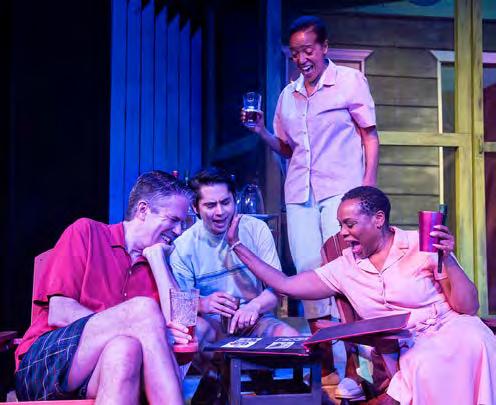
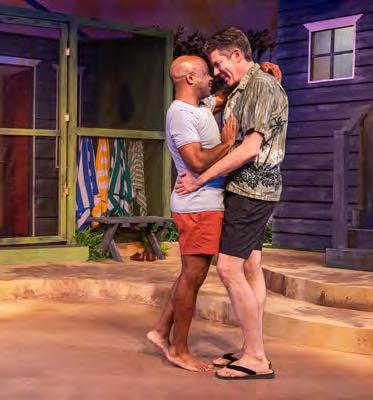
Crazy quilt chronology
How credible is it for a Black character in 1959 to object to the term “master bedroom”? Or for everyone else around to instantly get his point? How likely that a mixed-race character of the period would eloquently articulate a sense
Monday 8am (last seating 9:45pm)
Tuesday 8am (last seating 9:45pm)
Wednesday 8am (last seating 9:45pm)
Thursday 8am
Open 24 Hours
Friday Open 24 Hours
Saturday Open 24 Hours
Sunday 7am (last seating 9:45pm)
Open Daily! New Adjusted Hours




of feeling othered by both the Africanand Native-American communities and be life-coached into embracing her Wampanoag self by Black friends.
Most of the show’s drama concerns romantic relationships which seem framed through a lens of 1990s self-
<< Dirty White Teslas
From page 13
one Orellana created for Act I of “Big Data,” which closed at the Toni Rembe Theater just last week. Were it credited to someone else, it would be considered either a huge coincidence or a blatant rip-off.
Still, when an extraordinarily talented designer (Among Orellana’s past triumphs: A.C.T.’s “Fefu and her Friends” and Magic’s “Don’t Eat the Mangos”) comes up with such closely related designs for plays about very disparate characters, it does suggest how large the iPhone and its ills loom in our collective consciousness. But collectivity has its limits.
Unintegrated impact
“Big Data” was painted in brilliant broad strokes and rooted in the context of upper-middle-class society. When it approached life and death issues, it did so in a darkly humorous, “Twilight Zone” mode.
In “Dirty White Teslas Make Me Sad,” local playwright Smiley very specifically trains her eye on poor Black and Brown people in contemporary Bayview Hunters Point; people struggling to keep roofs over their heads and food on their tables. people contending with crime, violence, and the continually compounded impact of structural racism. The life and death issues here are raw urgencies, not polished intellectual musings.
The diminished attention spans, emotional disconnection, and egocentric tunnel vision induced by smartphone-addicted living only exacerbate the neighborhood’s preexisting conditions and widen the divide between San Francisco’s haves and have nots.
“You’re really going to look at your phone right now?” explodes Delcina (Tanika Baptiste), Naima’s mother, as her daughter blithely shifts focus amid a weighty argument about their future.
Like the unprescribed pills Naima pops to induce a woozy dissociated haze, a handful of technology can provide a short-term escape route with a long run dead end.
Resorting to crime
The play’s core storyline has Naima feeling directionless and desperate. A college graduate, she still lives with Delcina and between the two of them they don’t earn enough to cover the rising rent for their apartment in relentlessly gentrifying San Francisco.
As Delcina makes painful but practical decisions, she steams at her daughter’s apparent disengagement.
(Phenomenally gifted, Baptiste gives us a frayed, raging character, who’s a full 180-degree turn from the cunning
strains of a lasting relationship.
And then there’s Lydia (mononymed Awele) who reads Harlequin novels by the stack, preferring their predictable happy endings to the vicissitudes of real-live romance (This may also serve as an unconscious rationale for spending all of her vacations hidden away in a queer enclave).
There are also two coming out subplots: Scottie is shamed by his friends for not explaining his relationship with Buster to his elderly father. Really? In 1959? The gang, now including Scottie, also urges Anando (Stephen Kanaski), a working class P’town teen to be out and proud with his own Portuguese immigrant Dad. It’s as if a YA novel published last week tumbled into a souped-up Delorean. Also: The ghost story and the musical finale.
help standards. Minty (Desiree Rogers), is a lesbian recently dumped by her partner and afraid to reach out to the local pizza chef she’s pined for over many summers. Longtime couple Scottie (Matt Weimer) and Buster (ShawnJ West), are feeling the natural
If you’re searching for queer theater that features a time warp, you can clearly do better than “Unpacking in P’town.”t
‘Unpacking in P’town,’ through March 31. $25-$65. New Conservatory Theater Center. 25 Van Ness Ave. (415) 861-8972. www.nctcsf.org

sunshine of her last major role, a Nigerian Oprah in San Francisco Playhouse’s “Nollywood Dreams”.)
Meanwhile, Naima, slipping deeper into addiction, is pulled into the criminal enterprises of family friend Pappadeaux (Juan Manuel Amador) and his gender-fluid gang of lightly comical henchthem (Jamella Cross, Lauren Andrei Garcia, Guillermo Yiyo Ornelas, Jessica Maria Recinos).
Plot vs. poetry
But this plot serves primarily as scaffolding for the gorgeous flights of insight that Smiley lavishly drapes over it. While it’s sometimes difficult, perhaps intentionally, to discern whether we’re hearing conversation or cogitation, Smiley is at her strongest in the sharptongued fugues delivered primarily by Naima: Free-associative but emotionally coherent expressions of grief, nostalgia, anger, and spiritual hunger. Here’s Smiley summoning police violence, Jim Jones, and the ache of San Franciscan survival: “…the Blue and White cop cars and the red lining and the loss of damn near 1,000 souls to a Devil in gas station shades. I know this city better than I know my own hands. My veins are a map of bus lines, changing over time.”
These riffs are occasionally overripe (“Bent by the weight of high expectations and zero resources marks
of brown sugar stigmata rise from the skin like Lazarus gasping for salvation”), but more frequently inspired.
In their production notes, Smiley and director Myrick-Hodges effortfully suggest that “Dirty White Teslas Make Me Sad” is not a play per se, but “a process,” “poetry,” and “a meditation.” This feels like hedging, unnecessary insecurity.
Yes, the narrative scaffolding nearly collapses under the free verse, but that may be less tragic than its builders assume. The thematically linked riffs are more powerful than the near-surreal plot. When a project has been successfully completed, scaffolding becomes extraneous and can safely be removed.
Ntozake Shange initially used the term “choreopoem” to describe her unorthodox “For colored girls who have considered suicide / when the rainbow is enuf” but it went on to win the 1976 Tony Award for Best Play.
Future productions of “Dirty White Teslas Make Me Sad,” which are well merited, might benefit by loosening (even losing) the constraints of traditional plotting to make more space for the work’s spirit to reverberate.
14 • Bay area reporter • March 14-20, 2024
t << Theater StevenUnderhill 415 370 7152 • StevenUnderhill.com Professional headshots / profile pics Weddings / Events 3991-A 17th Street, Market & Castro 415-864-9795 Proudly serving the community since 1977.
Marina Blvd. Fort Ma-
Bldg. D. (415) 441-8822. www.magictheatre.org
‘Dirty White Teslas Make Me Sad,’ through March 24. $30-$75.
Magic Theatre, 2
son,
Anna Marie Sharpe and Tanika Baptiste in ‘Dirty White Teslas Make Me Sad’
Jay Yamada
Left: Left to Right: Matt Weimer, Stephen Kanaski, Desiree Rogers, and Awele in ‘Unpacking in P’town’
Right: ShawnJ West and Matt Weimer in ‘Unpacking in P’town’
Both Photos: Lois Tema
‘Carol Doda Topless at the Condor’
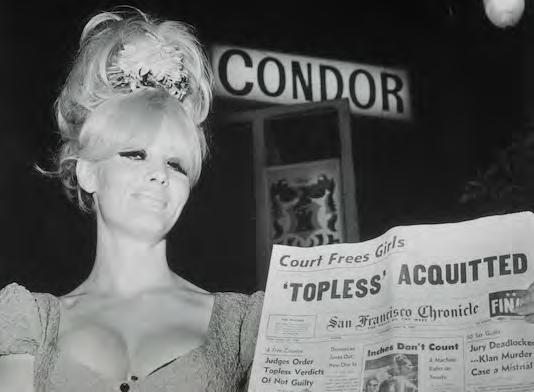
 by David-Elijah Nahmod
“The only way to get into show business was to show my business,” says the late Carol Doda in “Carol Doda Topless at the Condor,” a new feature length documentary by Marlo McKenzie and Jonathan Parker. That quote, heard in the film, pretty much sums up Doda’s attitude about her profession.
Doda (1937-2015) was a topless dancer, the first in the country. She was also the country’s first bottomless dancer. She showed her business at the Condor, a now legendary nightclub in North Beach. She was very matter-offact about her career, and didn’t think what she did was a big deal. She singlehandedly transformed North Beach’s Broadway, turning the street into a world-renowned tourist attraction.
For years the crowds lined up to see Doda and the other women who followed in her footsteps.
Doda’s career began during the 1964 Republican National Convention, which took place in San Francisco. When Republican presidential nominee Barry Goldwater’s two sons went to the Condor, the press took notice.
A few years later, the Condor was raided. Doda, along with other topless dancers, were arrested and charged with obscenity. They were represented by no less than Melvin Belli, perhaps the most famous attorney in the country at that time. Belli pointed out that it was absurd for the Condor women to be arrested when audiences could readily see nudity in the Broadway musical “Hair” and in movies like “I Am Curious Yellow,” an X-rated film from Sweden. He won the case.
One of the owners of the Condor pointed out that the club couldn’t possibly have bought the kind of publicity that trial offered. The Condor became more crowded than ever.
But Doda and the other dancers didn’t care if the case was won or not. They didn’t think they did anything wrong, and most were back on stage as soon as they were bailed out of jail.
Fascinating fun
“Carol Doda Topless at the Condor” is at once fascinating and fun. Director Jonathan Parker (also the film’s writer, producer, and music supervisor) preserves the history of a time whose like will never be seen again. It’s an ‘only in San Francisco’ story, and it documents the life of a very colorful character who lived her life on her own terms. Doda didn’t care what people thought of her.
Indeed, she reveled in her celebrity.
The story is told through beautifully edited archive footage which captures the San Francisco that was in the 1960s and ’70s. It’s a tale that’s underscored with Doda’s own words. The filmmakers unearthed scores of interviews that Doda had given, along with newly shot
interviews with other dancers of the period, as well as club managers, bartenders and musicians who worked in the club. Their memories recreate the world that Doda lived in. The film also covers Doda’s postCondor life, when she tried to earn a
living by singing in a band, by opening a lingerie shop, and by running a phone sex line. Doda always kept her private life private, but the filmmakers did their research and uncovered plenty of information, giving the audience a fairly good idea of who Doda was.
“Carol Doda Topless at the Condor” is a fitting tribute to a woman who could only have lived her life in San Francisco. She’s a character who deserves to be remembered, and this film ensures that her legacy of liberation and freedom will live on.t
‘Carol Doda Topless at the Condor’ opens March 22 at the Roxie and at the Smith Rafael Film Center in San Rafael. www.roxie.com
www.rafaelfilm.cafilm.org


March 14-20, 2024 • Bay area reporter • 15
t Film >> ODC/Dance Presents Dance Downtown LGBTQIA+ Night Saturday, March 30 Join us as we cheerfully raise a glass to ODC’s LGBTQIA+ community! After Party at W San Francisco hosted by Lady Camden! New doc recalls the ’60s trailblazing stripper
Left: Carol Doda’s acquittal is front page news in the San Francisco Chronicle
in ‘Carol Doda Topless at The Condor’
Middle: Carol Doda dances The Swim dance atop the piano at The Condor Club.
Getty © Picturehouse 2024 The San Francisco Examiner, © Picturehouse 2024 Polaris, © Picturehouse 2024
Right: Carol Doda poses in front of the iconic San Francisco Condor Club in 1966 in ‘Carol Doda Topless at The Condor’
Spring books 2024 roundup, part 3
 by Jim Piechota
The third installment of our Spring 2024 books roundup includes novels about being queer and sexpositive within a Syrian culture, a few engrossing young adult novels, and an impressive nonfiction title about the life and film legacy of Elizabeth Taylor. Enjoy and read on!
FICTION
“Selamlik” by Khaled Alesmael, translated by Leri Price; $19.99 (World Editions) April 2
This beautifully written novel chronicles the life of Furat, a twentysomething queer Syrian man who escapes his homeland of Aleppo in search of true liberation and the wonderous possibilities of desire and love.
Alesmael’s tone and language is consistently smooth and lushly descriptive as the story begins when Farat is in his first year studying English literature at the University of Aleppo, obsessed with reading E.M. Forster, and frequenting the Turkish baths (“hammams”) and gay cruising areas searching for connection and release.
As the story moves back and forth in time, things for Furat begin to change when he faints in the doorway of Ali, a man in his dormitory who would soon become his roommate and with whom he becomes enchanted and helplessly enamored with.
In the afterglow of their first sexual interlude, Ali gives the reader an impression of how homophobic the society is when he asks Furat: “Do you think they might arrest us?”
When Furat is forced to flee Syria, his journey becomes that of a refugee and the raw experiences of a queer man trying to live his life in a Muslim

country. The author, a Syrian journalist now based in London, debuts with this immersive, erotic, and memorable novel about overcoming the restrictions of a prejudicial culture to live life to its fullest.
“Skater Boy” by Anthony Nerada, $18.00 (Soho Teen)
In this enticing debut young adult novel, we meet rural Ohio, closeted bad boy teenager Wesley MacKenzie who is about to flunk out of his senior year in high school. But who cares, really, Wes thinks, when he’s sticking around town anyway to care for his mother who is recently out of a bad marriage with his father.
At a theater performance, Wesley finds himself attracted to the Black lead actor, Tristan Monroe, who, unlike Wesley, is openly gay and proud of it. Nerada crafts this relationship with care and makes certain to keep Wesley’s tough-kid personality intact as he leans into his increasing affections for Tristan. There’s a lot going on in this novel, including Wesley’s lingering trauma from an abusive father, but the author impressively keeps everything in check right up to the conclusion which feels realistic and heartfelt.
“Canto Contigo”
by Jonny Garza Villa, $20 (Wednesday Books) April 9
Non-binary author Villa is best known for writing young adult lit infused with Mexican and Chicane culture. Their third novel involves the complex, turbulent relationship between two Texas-based teenaged singing sensations.
Mexican American teenager Rafael meets Afro-Latino youth Rey after Rafael’s family relocates to San

Antonio and his legacy with the mariachi group at his former school isn’t enough to catapult him to star status at his new school. He feels lost and confused, especially when realizing that the top singer at the new school is actually Rey, a transitioning boy whom he’d hooked up with at a previous mariachi competition a year prior.
The two competitive boys share their troubles, find meaning, hope, cultural exchange, and fiery passion: but will it last? This wonderfully well-written, colorful, and beautifully expressive YA novel has mariachi culture (with all its racism and homophobia included) suffused into every page and is all about the challenges of Chicane life, queer love, and making joy out of everyday pain.
MEMOIR
“How To Live Free in a Dangerous World” by Shayla Lawson, $28 (Tiny Reparations)
This dynamic essay collection from nonbinary, disabled, Black writer



Lawson focuses on the challenges the writer faced when they were diagnosed with Ehlers-Danlos syndrome which caused them a great amount of chronic pain and discomfort.
In order to thrive with the disease, Lawson decided they had to make a valiant attempt to let go and live with it and cast aside the things in their life that held them back from doing so.
The essays in the collection each tackle a piece of that letting-go process for them as they traveled across the globe, which meant embracing drag as a means to emotionally bury a marriage to a cheating husband; attending an assisted suicide to better understand life and death; or envisioning a communal environment where citizens lifted each other up unconditionally.
Lawson is also a prize-winning poet, so the book’s prose is elegant yet also carries a strength embedded in their words that demands attention. Transformative and uplifting, this essay collection is one to be savored and re-read for its reminders on how to live authentically and without regret or remorse.
NONFICTION
“Mean Boys: Essays” by Geoffrey Mak, $27.99 (Bloomsbury) April 30
Mak, a queer Chinese American writer and an editor at Spike magazine, lends his impressions on American fashion, club life, coming out, and the influences of social media in this distinguished and very opinionated essay collection.
Across these essays, Mak discusses how being Asian and gay in 1990s southern California was tough and isolating for him socially but was compounded when he came out to his evangelical parents, who, expectedly,
He speaks longwindedly on the best time to poop before a show. He feels there’s a spiritual connection to his music, but cannot articulate it. He doesn’t mention any romantic partners. He confesses every day “he feels more free being who he is.”
Obstacle-busting
Lil Nas is a charismatic, groundbreaking, obstacle-busting performer, yet it’s a bit off-putting when he’s the one telling us his accomplishments, but he’s hardly alone. The film is bursting with gushing fan testimonies sharing how Lil Nas’s candor enabled them to come out and be themselves.
One guy exclaims, “You seem like the funnest person on earth to hang out with,” while another discloses, “He’s the first male celebrity I wanted to fuck and be at the same time.”
Then there’s acclaim from cast members, such as choreographer Sean Bankhead: “He’s breaking down barriers. There’s nobody today quite like him. Nobody’s going to be able to touch him.”
Lil Nas adds to all the praise, “I want to go places no one has ever been and do something that is great, super grand, and big. This tour changes the world.”
rejected him.
He rushed off to live in Berlin, but those episodes were drug-fueled and party-centered and only led the author toward the downward spiral that would find him returning to America to lick his wounds and get sober.
Other pieces address Mak’s obsession with status and the digital online culture that have morphed and changed as much as he has personally. This is an intensively personal archive of a writer who has come a long way and with a unique story to share.
“On Elizabeth Taylor:
An Opinionated Guide” by Matthew Kennedy, $29.99
(Oxford University Press) April 1
This immersive Old Hollywood take on the extensive storied 65-year career of Elizabeth Taylor charts the star’s beginning at 12 in “National Velvet” then to the fame of “Cleopatra” in 1963 and further details on a few flops, strange appearances, and a role in “General Hospital” in 1981. Taylor’s intuitive and emotive on-screen talents became legendary and catapulted her into the Hollywood stratosphere. Kennedy sticks primarily to the star’s film career and offers pages of sharp perspectives on the features and personal facets which made her the star she went on to become. Fans of Taylor’s legacy will find a treasure trove of information and opinion in this must-have filmography.
Author Kennedy is a distinguished Bay Area-based writer, anthropologist, and film historian and has written Hollywood biographies of Marie Dressler, Joan Blondell, and Edmund Goulding. He is also currently the host and curator of the CinemaLit Film Series at the Mechanics’ Institute in San Francisco.t
He defines his next project as happy escapism. “There’s something brewing that’s going to be so amazing for me, just talking about this puts my body in a different plane.”
In one campy scene while dressed in drag, he kisses the uncanny Madame Tussaud wax figure made in his image. Is he a visionary, or is it youthful egotism?
By far the best parts of this documentary are the concert songs arranged in elaborate theatrical productions, glam rock with dazzling choreography and eye-grabbing costumes, reminiscent of early artsy MTV videos.
With his infectious energy, Lil Nas is on the verge of becoming a gay hiphop pop diva/icon. There’s no reason to doubt his exclamation, “I’m just getting started.”
Certainly, he’s a testament to the power of liberation, of being able to be who you are, willing to push boundaries, as he explores and builds confidence in his queer identity. It will be fascinating to see if, as a trailblazer, he has staying power or burns out by believing his own publicity or overwhelming himself in his quest to “become the truest and greatest version of himself.” t www.hbo.com
16 • Bay area reporter • March 14-20, 2024
t << Books & Film
www.longlivemontero.com
<< Lil Nas X From page 13
HBO
Lil Nas X in ‘Lil Nas X: Long Live Montero’
Comedy >>
Ashley Ray tells truths with laughs
 by Laura Moreno
Ashley Ray, the “most famous bisexual solo polyamorous Black queer comedian, actor, and writer currently based in Los Angeles,” continues to inform and entertain with her recently released debut comedy album “Ice Cream Money.”
Recorded live at Union Hall in Brooklyn, “Ice Cream Money” showcases Ms. Ray’s penchant for delivering stunningly incisive humor in an effortlessly entertaining style. It informs as well as entertains.
“Albums are what made me fall in love with stand-up because it feels like being in a club,” said Ray in a press statement. “When I’m listening to comedy, I’m more aware of the audience response or one person’s unusual howl. With clips and video sets, it’s easier to ignore that unless the comic calls it out. I’ve been lucky to do stand-up all these years and this album is my appreciation for the craft.”
Originally from Chicago, Ray’s work explores the intersection between culture, race, gender, queerness, and sexuality.
Ray honed her stage presence at a lot of open mics in high school, doing spoken word and storytelling. But she found she just wanted to do comedy. That’s when she took the plunge and did Cole’s Open Mic in Chicago. She had the good fortune to meet Sarah Squirm (now part of the SNL cast), who offered generous helpings of encouragement.
“Chicago is a great place to come up,” she says. “You can be weird and find your voice.”
It’s been a rocky road, but very much worth it. The cool material featured in ‘Ice Cream Money’ is the result of over eight years of touring as a stand-up comedian. Ray was named one of HBO Max’s Queer Comics to
Black Privilege
There is such a thing as Black privilege, Ray explains in “Ice Cream Money,” introducing this segment as “the political part of the show.”
She begins with a deadpan delivery: “I’m Black.” Visibly more vanilla than chocolate, she pauses with perfect comedic timing. “Both of my parents
are Black.” The audience responds in hushed tones. “I know. I’m the color Michael Jackson was aiming for.”
Perhaps being whiter than many mixed race people who really do have a White parent has made her more aware of Black privilege.
For one, she points out that it took law enforcement seven full years to nab mobster Al Capone, but it took them 30 years to catch R. Kelly, and R. Kelly is functionally illiterate.
“Al Capone had the power of the mafia,” she says. “R. Kelly didn’t even have the alphabet. That’s crazy.” That’s Black privilege.”
Another Black privilege is based on the old stereotype that Black people do whatever they want in movie theaters. So, why not? Once she even took a whole steak dinner into the theater wrapped in foil and chowed down on a fantastic meal during the movie. The White man in front of her turned around and said, “It smells like meat in here,” but rather than confront her, he got up and walked away.
The Hit Podcast
Ray’s incredible wit and wisdom have also powered her hit podcast, “TV, I Say with Ashley Ray” currently in its third season.
Each week Ray drops a new episode
featuring a star-studded list of comedians, actors, and television writers, who discuss your favorite shows and break down memorable moments in television. Her guests have included the likes of Nicole Byer, Roxane Gay, and Jason Mantzoukas. Named a Podcast Worth Checking Out by the New York Times, “TV, I Say” is a truly funny podcast that serves up personal stories about coming out, dealing with family, and being subjected to now illegal conversion therapy as a kid, sprinkled with anecdotes about being bisexual, polyamorous, and “Midwest rude” or being mean in a very sweet way. Remember “Fargo”?
A television writer on Adult Swim’s TV show “Alabama Jackson,” Ray also covered pop culture for Cosmopolitan, Elle, Variety, The A.V. Club, The Cut and many other publications. Despite her busy schedule, Ashley Ray still finds the time to host “High Gear Comedy,” a live show with Barbara Gray that takes place every month at The Airliner in Los Angeles. “I’ve lived a ridiculous life and I wanted to introduce myself to people with ‘Ice Cream Money.’ Everyone should have ice cream money.”t
www.theashleyray.com
www.blondemedicine.com
“The longer I live, the more uninformed I feel. Only the young have an explanation for everything.” —Isabel Allende
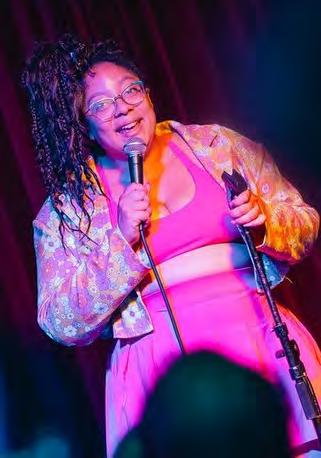
March 14-20, 2024 • Bay area reporter • 17
Breathe together, Sing together A musical journey to inner peace and tranquility. BERKELEY | SANTA CLARA | SAN FRANCISCO | SACRAMENTO Tickets $25-$63 | Buy Online at CHANTICLEER.ORG or call 415-392-4400 March 21-24, 2024 chanticleer breathe bay area reporter.indd 1 3/5/24 2:52 PM
t
Ashley Ray Instagram
Greg
Feiner






2017 Media Kit

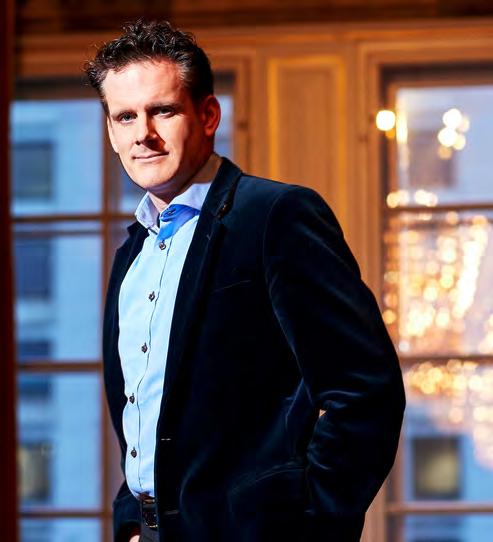

Mission Statement
The Los Angeles Blade covers Los Angeles and California news, politics, opinion, arts and entertainment and features national and international coverage from the Blade’s award-winning reporting team. Be part of this exciting publication serving LGBT Los Angeles from the team behind the Washington Blade, the nation’s first LGBT newspaper. From the freeway to the Beltway we’ve got you covered.
generally reviled for its focus not on the already nearly intractable story but on
The Vienna Philharmonic, the pit dom sounded so lithe, so alive to the micro movements of this most macro of scores. Jordan’s shrewd pacing never loses momentum. It’s faster than some, in places, and slower in others,


This “Parsifal” doesn’t so much interpret the work as elucidate it. It hews to the central concept, the importance of compassion for the suffering, which is to say all of us. And it doesn’t trivialize the legend to say that anyone who has felt remorse for a sexual misadventure of the past might see themselves in it. It’s not a mistake, merely a challenge, to present the opera’s characters as real people.
Real people
Jordan’s cast is as strong as could be assembled today. Jonas Kaufmann reprises his rightly renowned Parsifal with a performance of even greater maturity and insight. Elina Garanca is his Kundry, one of opera’s most challenging assignments – Kundry exists outside the rest of the world’s time-space continuum– and nails it with fury and a dramatic inner consistency. Their Act II encounter –the ultimate opera love duet gone bad– is all the more compelling for putting the power of sexual passion over the reflections of the mythological characters.
Instead of the wooly bass long associated with the role of Gurnemaz, the caretaker of a Grail Castle where the vow of celibacy is not going at all well, Georg Zeppenfeld trains his laser-like voice on narrations that don’t outstay their welcome and interacts with all his fellows with understanding if not always patience.
Ludovic Tezier, as Amfortas, the impeached Grail King eternally wounded by his sexual encounter with Kundry, somehow manages the character’s endless agony from a wound that never heals without a trace of self-pity. Wolfgang Koch, an important Amfortas in other productions, gives us a Klingsor, fallen knight of the Grail and operator of the femme fatale in Kundry, with all the requisite menace but none of the slobbering.
Human, all too human
The idea of unqualified forgiveness through spiritual cleansing rather than by some retrieval of lost faith guides this wise but never selfregarding traversal of a work that poses uncommon challenges at every turn. Spiritual crises are met with human, not divine, confrontations and interventions.
The long Parsifal-Kundry scene of Act II foregoes false piety in service
See page 19 >>



t << Music
Left: Conductor Philippe Jordan
Right: Joan Kauffman (seated) and members of the Vienna State Opera Chorus in the Vienna State Opera production of ‘Parsifal’
Michael Pöhn
Rosebud Gallery opening
Text by Jim Provenzano
Photos by Steven Underhill
Rosebud Gallery, a community-focused creative haven created by Shannon Amitin and Cabure Bonugli, opened its doors to the community on March 7 in celebration of art, inclusivity, and the resilient spirit of San Francisco’s LGBTQ community.
The first exhibit features artwork from Ashley Salaz, Seibot, Vinsantos, FotoHoto, Jackie Brainland, and Mister Tuft Guy.
Notable attendees included musician Suzanne Ramsey, artists Jasper Wilde, D.I.A. and Christian S. Clark, art couture dandy Bruce Beaudette, photographer Gooch and his husband William Bulkley (Emperor 48 After Norton). DJs Juanita MORE!, CarrieOnDisco, and Josh Cheon provided groovy music.
As a recipient of a Storefront Opportunity Grant from San Francisco’s Office of Economic and Workforce Development and the community-based SF New Deal nonprofit, Rosebud Gallery will join other businesses in the neighborhood in the reclamation of San Francisco’s original queer neighborhood, including Moth Belly Gallery, Dark Entries Records, the Bob Mizer Foundation, and The Compton’s Cafeteria Riot immersive theatrical experience from the Tenderloin Museum.
“We see Rosebud as a beacon of hope and creativity in the Tenderloin,” said Amitin in a press statement. “We’re committed to celebrating the diverse voices and talents within the LGBTQ+ community while creating a welcoming space for all.”
Added Bonugli, “We created Rosebud as a platform for community building, joy, and self-expression.”
See more of Steven Underhill’s photos at www.facebook.com/ lgbtsf.nightlife.
For more arts and nightlife events, see Going Out on ebar.com.t Rosebud Gallery, 839 Larkin Street. www.rosebudgallery.com


Parsifal
From page 18
of a scorching account of male sexuality undone by a mother complex. Here it’s electric with a ready willingness for that electricity to be static as indicated. Kaufmann and Garanca leave behind all the trappings that often sanitize their characters with sexuality at its most raw.
Even the minor characters evince personality as much as dramatic function. The chorus of Grail knights is sonorous without a lapse into feigned holiness.
Perhaps it warrants saying in conclusion that Jordan’s “Parsifal” forfeits none of the solemnity of the piece while making it immediate and alive in the moment.
Swanning around
While we’re in the neighborhood, two other new releases look at Wagner from unusual perspectives. Nikloai Lugansky’s “Richard Wagner: Famous Opera Scenes” (Harmonia Mundi) offers transcriptions for solo piano beyond the familiar “reminiscences,” most by Lugansky himself. “In the Shadows” (Erato) offers tenor Michael Spyres, one of the most remarkable and thoughtful singers of our time, an array of arias from the operas that influenced Wagner.
Startling as it initially is to see Christophe Rousset and his Les Talens Lyriques performing 19thcentury music, it’s in keeping with their expanded notion of historically informed performance. The collaboration brings out the best in both orchestra and singer. It ends with selec-
tions from Wagner’s still-little-known early operas and a magisterial account of “Mein lieber Schwann” from “Lohengrin,” a role next up for Spyres.
Some swans get all the luck.t
Richard Wagner, ‘Parsifal,’ Vienna State Opera, Vienna Philharmonic Orchestra, Philppe Jordan, conductor, Sony Classical, sonyclassical.com
Richard Wagner; ‘Famous Opera Scenes,’ Nikolai Lugansky, pianist and transcriptions composer, Harmonia Mundi, harmoniamundi.com
‘In the Shadows,’ tenor Michael Spyres, Les Talens Lyriques, Christophe Rousset, conductor, Erato, warnerclassics.com

March 14-20, 2024 • Bay area reporter • 19
AUTO EROTICA PURVEYOR OF VINTAGE PORN MAGAZINES • BOOKS • PHOTOGRAPHS 4077A 18th St. OPEN EVERY DAY 415•861•5787{ { AUTO EROTICA PURVEYOR OF VINTAGE PORN MAGAZINES • BOOKS • PHOTOGRAPHS 4077A 18th St. OPEN EVERY DAY 415•861•5787{ { AUTO EROTICA PURVEYOR OF VINTAGE PORN MAGAZINES • BOOKS • PHOTOGRAPHS 4077A 18th St. OPEN EVERY DAY 415•861•5787{ { WE BUY & SELL GAY STUFF! MONDAY-SATURDAY Personals Massage>> EDUARDO 9” Express massage in tension level and happy ending without pain. Text me 628-219-3747
t Fresh Starts >>
<<

This resource is supported in whole or in part by funding provided by the State of California, administered by the California State Library in partnership with the California Department of Social Services and the California Commission on Asian and Pacific Islander American Affairs as part of the Stop the Hate program. To report a hate incident or hate crime and get support, go to https://www.cavshate.org/.
