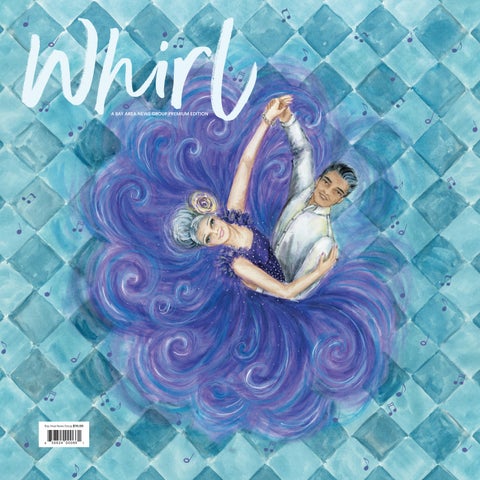
A BAY AREA NEWS GROUP PREMIUM EDITION
Bay Area News Group $10.00
2 WHIRL BAY AREA NEWS GROUP
The Bay Area in motion Connecting our cultures PAGE
4
PAGE
16
A fountain of youth PAGE
The colorful, complex world of Aztec dance 12
22
PAGE
Credits SECTION EDITORS
We’ve got rhythm, but why?
Steve Palopoli Randy McMullen
High heel mania PAGE
28
DESIGN
Jack Browning Chris Gotsill
PHOTO EDITING
Laura Oda Doug Duran
COPY EDITING
Sue Gilmore
COVER ILLUSTRATION
Bella Pilar
PAGE
52
Hip to be square 40 PAGE
Dancing on air
Opposite: Emily Pierce of San Francisco, right, and Yuriy Dybskiy dance the tango at El Valenciano in San Francisco. DAI SUGANO/ STAFF ARCHIVES BAY AREA NEWS GROUP WHIRL 3
4 WHIRL BAY AREA NEWS GROUP
— all forms of it — has long been central to Bay Area culture S TO R Y B Y M A R T H A R O S S I L L U S T R AT I O N B Y J U I I S H I D A
The late Bay Area choreographer Anna Halprin, who helped redefine dance in postwar America, liked to say that moving one’s body for whatever purpose — art, exercise, human connection — is fundamental to life. “I’ve always said dance is the breath made visible, and that covers about everything, because once you stop breathing and the breath is no longer visible, you stop moving,” Halprin said in the 2009 film about her life and career, “Breath Made Visible.” The Illinois native died in 2021, more than 70 years after she moved to the Bay Area to take advantage of the region’s embrace of alternative and avant-garde ideas. She pushed for a less rarified art form that could be improvisational, accessible to anyone and rooted in daily life. In a very Bay Area way, she also created dance pieces that were inspired by nature and practiced in outdoor spaces, including the famous classes she conducted on her home’s outdoor deck in the redwoods, perched on the side of Mount Tamalpais. “You do not have to be a professional to dance,” she said. “Everyone, at any age, no matter what their physical ability or ethnic background, can be a dancer.” Halprin is just one of many Bay Area pioneers to strive for innovation, accessibility and diversity in dance — helping to create a rich tradition here that has long nurtured all kinds of creative movement, dance lovers say. “Dance is everywhere in the Bay Area,” longtime Bay Area dance critic Rachel Howard once wrote.
BAY AREA NEWS GROUP WHIRL 5
On pretty much any day, professional artists and passionate amateurs of all ages are in studios, ballet schools or community centers. Or they are going out to clubs to salsa dance or for freeform, ecstatic “movement journeys”, or they are meeting up with friends at home or in the street — learning, creating and refining dance moves, either to express themselves, be seen or be part of a community. In the Bay Area, dance lovers can watch or participate in a seemingly infinite variety of styles. We have some of the most acclaimed professional companies in the country, elevating everything from ballet to modern, contemporary, jazz, experimental and world dance. There’s also hip-hop and ballroom, either for social or competitive purposes, as well as a long tradition of people enjoying styles shared by the Bay Area’s immigrant communities — Latin, African, Irish, Filipino and South Asian, among others. The Bay Area is also home to two annual international festivals that celebrate world dance and hip hop. “We like to say that, per capita, the Bay Area is the second-largest dance community — and possibly the most diverse dance community — in the United States,” said Wayne Hazzard, a dancer and executive director of the Dancers Group, a nonprofit that supports emerging and established dance artists in the Bay Area. According to a 2025 survey by the Dancers Groups, some 850 self-identified dance companies are operating in the Bay Area. That’s up from 799 in 2012. The increase is notable, given that the COVID-19 pandemic shut down performance opportunities in 2020 and 2021, and the cost of living makes it a challenge for artists and groups to live and work here. “I think one of the things that’s unique to the Bay Area is
6 WHIRL BAY AREA NEWS GROUP
Top: People salsa dance at Alberto’s in Mountain View in 2021. Left: Dust rises as fans dance to a Mexican band during the Jaripeo at the Oakland fairgrounds. Right: Members of the Ger Youth Center perform a traditional Mongolian dance during the Lunar New Year and Black History Month community celebration at the Oakland Asian Cultural Center in 2024. DAI SUGANO, RAY CHAVEZ,/STAFF ARCHIVES
Top: Ballet Afsaneh performers dance during “Celebrating 13 Days of Nowruz” at Mitchell Park in Palo Alto to celebrate the Persian New Year. Above: Young people dance during the Hyphy Hip-Hop Soul Showcase event at Sweet’s Ballroom in 2006. NHAT V. MEYER, SEAN CONNELLEY/STAFF ARCHIVES
the street dance culture, where dancers are saying, “Okay, we can’t afford to rent a studio, so we’re gonna be out in the community, and we’re gonna be out doing this on the streets and put some cardboard down and spin or do things,’” Hazzard said. Social dancing also is thriving here, said Richard Powers, a specialist in historic and contemporary social dance who teaches full time at Stanford University. Undergraduates are rushing to sign up for his classes in such old-timey dances as waltz, tango, swing, salsa, cha-cha and two step. “After my students graduate, they’ll go to some other city and say, ‘Why can’t we find something like this here?” he said. People who dance here, professionally or otherwise, also don’t have to fit into traditional ideas of what dancers should look like or how they should move. For nearly 40 years, the Berkeley-based AXIS dance company has created productions with disabled, deaf and neurodiverse artists that showcase “the beauty of difference.” In aerial dance, which also has its roots in the Bay Area, artists fly on trapezes or hang off the face of highrises and cliff faces to create stunning human tableaux. Janice Ross, a Stanford Universe emerita professor in theater and performance studies, says these innovations were influenced by California’s location at the western edge of North America. For 20th century innovators like Halprin or San Francisco native Isadora Duncan, the Bay Area “was a frontier, geography and aesthetically,” Ross said. “It was far removed from the more establishment world of New York and the East Coast, which was the dance center in America.” Here, Bay Area artists could foster their own ideas about dance. Six years after the San Francisco Ballet was founded in 1933, Mills College hosted a
BAY AREA NEWS GROUP WHIRL 7
historic summer session to teach modern dance, laying a foundation for the women’s college to establish what Howard called one of the most influential dance programs in the United States. Mills invited 150 dance students from all over the country to spend six weeks on campus, studying with Martha Graham and other luminaries. The students included some of the most prominent artists of the next generation of dancers, including Halprin and Merce Cunningham. In the decades after World War II, dance innovators were attracted to the Bay Area as “an incubator” of new ideas, said former San Francisco Ballet dancer Alex Keteley. Even though New York City had its “titans of dance and choreography,” Keteley, who is now an independent choreographer and teaches at Stanford, said: “I think there were people, myself included, who wanted to work in the Bay Area because we were curious about finding our own voice.” That includes postmodern choreographer Margaret Jenkins, who returned to her native San Francisco in the early 1970s after dancing, teaching and staging works in New York City; or Sarah Shelton Mann and Keith Hennessy, who created immersive, site-specific dance works in the 1980s that advocated for political engagement and social justice on poverty, homelessness and the AIDS crisis. Oakland established its place in U.S. dance history by becoming home to pioneers in boogaloo — a freestyle, funk-based improvisational form of street dance that predated hip hop and the Bay Area’s own genre, hyphy. Starting in the 1960s, Black youth, inspired by James Brown, The Temptations and other soul artists, performed at Black Panther rallies, while
8 WHIRL BAY AREA NEWS GROUP
inspiring dancers from nearby Richmond to introduce moves known as popping, roboting or strutting. A couple of decades later, turf dancing emerged as another street dance that allowed for creative expression and as a way to resolve hood disputes without resorting to violence, according to a 2023 KQED report. Jerial Bay, an Oakland-based dancer, educator and promoter, organized the first turf dance competition at Laney College in 2004. He told KQED that turf dancing “is a way of telling a story. It’s an attitude.” Speaking of Laney College, many of the Bay Area’s com-
Above: Anna Halprin, the late Bay Area choreographer who helped redefine dance in post-war America, leads a dance workshop in Kentfield. Halprin died in 2021. Right: Anthony Cruise plays music as kids dance at the Farmers Market in front of the San Ramon Valley Museum in Danville. FRANKIE FROST, RAY CHAVEZ/STAFF ARCHIVES
Above: Members of the community take part in the Odori dancing during the Obon festival at the San Jose Buddhist Church Betsuin. Right: Wesley Park, 3, of Oakland, dances during the Oakland Museum of California’s Hella Juneteenth Festival 2025 in Oakland. RAY CHAVEZ, JANE TYSKA/ STAFF
munity colleges and four-year private and public schools also fostered the region’s dance culture, Hazzard said. Besides providing regular work to dance artists, they’ve also offered programs and diverse classes in dance and performing arts. Kathak artist Farah Yasmeen Shaikh was introduced to this classical South Asian storytelling dance while an undergraduate at San Francisco State in the mid-1990s. She took a life-transforming class with a faculty member, the late Kathak dance master Pandit Chitresh Das, and ended up joining his company
and teaching at his school. She later launched a solo career as a dancer and choreographer, starting her own Menlo Park-based company Noorani Dance. But as much as Shaikh praises the Bay Area’s vibrant, multicultural “dance ecosystem,” she wonders how long it can last. That’s because creative professionals struggle to make a living wage here, said Shaikh, who also is a program manager with the Dancers Group. “I’m in the heart of the Silicon Valley,” she said. “Facebook is down the street from me, quite literally. There is just this huge disparity in the
BAY AREA NEWS GROUP WHIRL 9
“ We like to say that, per capita, the Bay Area is the secondlargest dance community — and possibly the most diverse dance community — in the United States.” Wayne Hazzard, dancer and executive director of Dancers Group
Top: Anna Halprin lightly touches Un Seong Sumim on the hands during a class in Kentfield. Right: The band Albannach from Scotland performs Gaelic music during the Scottish Highland Gathering and Games at the Alameda County Fairgrounds in Pleasanton. FRANKIE FROST, RAY CHAVEZ/ STAFF ARCHIVES
10 WHIRL BAY AREA NEWS GROUP
haves and have-nots.” While Shaikh and others ponder the future of the art form in the Bay Area, they note that dance is still ubiquitous in the general culture. Fans of reality TV can enjoy the competition spectacle of “Dancing with the Stars,” while dance “has absolutely exploded on TikTok,” said Stanford’s Keteley. “My 11-year-old daughter shows me dances she’s learned from TikTok,” he said. But the undergraduates clamoring to waltz or swing in Powers’ Stanford classes want the opposite of a TikTok dance experience. They don’t want to be isolated behind a screen or wonder if what they are experiencing is A.I.-generated, he explained. Instead, they want a human connection where they can be face to face and interacting with other people. In 2025, he said, dance can offer a refuge “from a world where we increasingly don’t know what is real and do something that we absolutely know is real and physical and social.”
Top left: Performers with the Nava Dance Collective in Berkeley practice on stage before performing during a Norooz Spring Equinox Celebration held at Marina Bay Park in Richmond. Top right: Keila Sakay and members of the Halau Hula Hi’ilani ‘O Ke Kai dancers of Monterey perform a Hawaiian dance during the 30th anniversary of the Bay Area Aloha Festival at the San Mateo County Event Center. Left: MasFX Carnival Dance Experience’s Ezra Bristow, center, participates in a dance workshop at Frank Ogawa Plaza in Oakland. JOSE CARLOS FAJARDO, RAY CHAVEZ, JANE TYSKA/STAFF
BAY AREA NEWS GROUP WHIRL 11
Danza Azteca The joyous Aztec dancers embrace culture and keep tradition alive through movement B Y J O H N M E TCA L F E
One of the great comeback stories in dance — with one of the longest histories — can be found right here in the Bay Area, in San Jose. On culturally significant days of the year, performers from what’s known as the Danza Azteca communities gather to reenact the dances of their ancestors. They often dress in elaborate regalia, with feathered headdresses and beaded pendants, and wear seedpod rattles on their ankles that sound like falling rain. There are hand-carved wooden drums strapped with animal hide and wind instruments made from conch shells and the fragrant scent of a burning tree sap called copal. “It is a dance tradition, but it’s very much culturally rooted. It’s also for many, if not all the people involved, a spiritual practice,” says Tamara Mozahuani Alvarado. “But even in different (dance) groups that hold to different ways of being, we still collaborate together — we still work together to uplift the culture.” Alvarado is the leader of Calpulli Ocelocihuatl, one of roughly half a Calpulli Tonalehqueh Aztec dancers from San Jose participate in the Fiesta Cultural Street Fair in front of the Lesher Center for the Arts in Walnut Creek. RAY CHAVEZ/STAFF ARCHIVES
12 WHIRL BAY AREA NEWS GROUP
BAY AREA NEWS GROUP WHIRL 13
An Aztec dancer wearing a colorful headdress marches in a Cinco de Mayo parade in San Jose in 2024. JOSE CARLOS FAJARDO/ STAFF ARCHIVES
dozen Aztec dance groups active in San Jose. Other Aztec dance groups — some whose histories stretch back more than half a century — are also thriving along the West Coast, from Washington state down to Sacramento, Oakland, Salinas and San Diego. “The Aztec dance is a warrior dance. It is very energetic. Aztec dance is really about putting down prayers with your feet and the movements of your arms, and every single dance has meaning,” says Alvarado. “The dance’s names are like ‘wind’ or the ‘deer dance’ or ‘Tlaloc,’ which represents rain, but it represents a lot more than just that.” The origins stretch back to the days of Tenochtitlan, the capital of the Aztec Empire that reached its peak in the 1500s. The Mexica people and indigenous populations had their musical and spiritual traditions, but these were threatened when Europeans arrived in the late 1400s. Spanish conquistadors overthrew Tenochtitlan in 1521, establishing what would become Mexico City with vastly different customs. “In the decades that followed the fall of Tenochtitlan, the Spanish decimated traditional Mexica music and culture, which the Spanish associated with the devil,” writes Kristina Nielsen, a musicologist behind the 2026 book “Aztec Music and Dance in California.” “Without the ability to time travel, it is virtually impossible to know exactly what these dances may have been, what the music sounded like or what they meant to the Mexica.” That didn’t stop subsequent generations from trying to keep the traditions alive, using what historical texts and images survived. After the Mexican
14 WHIRL BAY AREA NEWS GROUP
Revolution in the early 1900s, the political leadership sought to unite the country’s fractured groups by establishing a national identity drawn from history. “In pursuit of this goal, musicians, artists and dancers in Mexico City turned to symbols from the Aztec Empire to shape a shared national cultural heritage,” writes Nielsen. “There was a huge effort to erase a lot of our history, with the burning of our books and things like that,” says Yei Tochtli Mitlalpilli, who co-founded the San Jose group Calpulli Tonalehqueh in 2004.
“But there’s still a lot of connection to some of those original ways. And so a lot of the culture, we believe, is reemerging,” he says. “It’s like having a tree and chopping it down, and you think the tree is gone, but the roots are still in the ground. When the rain comes, all of a sudden, they start coming back alive.” Wood drums are often carved with Aztec symbols such as the sun or animals like owls, eagles and ocelots. For the regalia, there are people in Mexico whose “full-time job is making the outfit,” Mitlalpilli says. “There might be people that
are really good at working with stone, with jade, with obsidian. There are people that are really good painters, people that distribute feathers. There’s a whole ecosystem of artists.” The copilli (headdress) is a true work of art. “It’s important with our headdresses that every feather is placed individually,” says Alvarado. “So when people ask us for performances and what have you, I’m like, ‘Yes, it really does take us an hour to get ready.’” The public is welcome to observe these performances, which draw in dancers of all
Tamara Mozahuani Alvarado and daughter Millie Peeples, 4, wait in line to enter the dance ceremony at the Azteca Mexica New Year celebration at Emma Prusch Park in San Jose. JOSIE LEPE/STAFF ARCHIVES
ages. “Teenagers, who have so much pulling on their attention these days, are asking me, ‘Can I drum?’ or ‘Hey, can I be part of your group?’” Alvarado says. “Or we go to an elementary school, and we enter the room, and these little kids are screaming like we’re rock stars. It really connects with their hearts, and I’m just inspired by the fact that people still are hungry for a connection to their own culture.” For more information about these two dance groups, visit instagram.com/ calpulliocelocihuatl and instagram.com/ calpulli_tonalehqueh.
Israel Malinalcoatl Zabala blows the conch shell trumpet quiquiztli as dancers enter the ceremonial circle at the 25th Annual Mexica New Year in San Jose.
A Calpulli Tonalehqueh Aztec dancer participates in the San Jose Multicultural Artists Guild Annual Dia de los Muertos procession around Cesar Chavez Park to the San Jose Museum of Art.
JOSIE LEPE/STAFF ARCHIVES
JOSIE LEPE/STAFF ARCHIVES
BAY AREA NEWS GROUP WHIRL 15
16 WHIRL BAY AREA NEWS GROUP
We’ve got
— but why? What science can tell us about the universal human urge to dance S TO R Y B Y L U I S M E L E C I O -Z A M B R A N O I L L U S T R AT I O N B Y P E P B O AT E L L A
In the basement studio of the New Ballet in San Jose, a single figure crouched in a low lunge lifts his head, unfolding upwards like a flower turning toward a rising sun. He traverses the space in a series of gentle, sweeping steps as others come to meet him on the dance floor. With a sequence of delicate spins and gravity-defying lifts, he and the growing company of dancers seem to float across the room to the triumphant brass of Tchaikovsky’s “Nutcracker” music. Breathtaking as the movement is, another, perhaps more wondrous ballet is taking place, largely invisible to the eye. Every time we dance — whether we are rehearsing for a classic holiday dance show or cutting a rug in our kitchens, a silent symphony of systems is firing up throughout our bodies to allow us to move it to music. Decades of science reveal just how complex it is to move to the beat and show the incredible effects of dancing on our bodies and minds and even offer hints as to why — all across the world — we choose to dance in the first place.
BAY AREA NEWS GROUP WHIRL 17
How a body moves Standing at his desk in his East Bay office, Michael Rowley begins a simple dance. He lifts his left foot slightly, bringing it through the air to gently touch the ground by his right foot before quickly sending the foot back to its original home, then his right foot mirrors the movement. To the beat of a silent, internal metronome, he repeats the motion — step … touch … step … touch. The movement is simple — especially for a trained dancer like Rowley, who studies the biomechanics of dance at California State University, East Bay. But just that movement requires a mind-boggling coordination of muscles, joints and senses — Rowley estimates that a simple step-touch involves 40 muscles. While we often think of five senses — a view that can be traced at least as far back as Aristotle — the last two millennia have offered us a far deeper understanding of how we experience the world around us, and in particular, how we sense our bodies in space. “We can’t move without sensory input … then there is the complex coordination of multiple muscles at multiple joints — I mean, there’s so many levels to how the body controls that,” says Rowley. Say you’re doing the Cupid Shuffle at a wedding and have forgotten the steps since the last time you were at a reception. So you’re staring at the person in front of you, hoping you don’t get lost. Even without looking at your body, you are recruiting a host of senses that we often don’t consider. With every step you take “to the right,” nerves that sense pressure and stretch tell you when the floor is beneath your feet and measure the shape of your body. Each time you lift your foot to go “to the left,” muscles all through your legs and core allow you to briefly balance, informed by tiny sensory organs tucked in your inner ears that let you know where you are in 18 WHIRL BAY AREA NEWS GROUP
relation to gravity. As you “now kick” out your leg, nerves in your joints fire when they reach the extremes in their range, letting you know just how far you should extend your knee. And all throughout the dance, nerves attached to your muscles tell your brain the length of your muscles and how that length changes.
Feeling the beat But before we even move a muscle, we need to feel the
Above: Mikey DesaiKnight dances at New Ballet in San Jose. SHAE HAMMOND/STAFF
Left: Bharatanatyam, a dance from India, uses gesture, stance, facial expressions and body movement to portray different characters. DAI SUGANO/ STAFF ARCHIVES
growing menagerie of animals across species has been shown to move on beat. Peter Cook is responsible for introducing the world to one more species of music-movers: the sea lion. Cook studies animal cognition at UC Santa Cruz and New College of Florida and over a decade ago, helped train Ronan the sea lion to bob to the rhythm of a metronome. Ronan
“There’s something different about dance. There must be something fundamentally appealing about it, or it wouldn’t be the case that cultures everywhere were passing it along.” Sima Belmar, who researches and teaches on dance and movement at UC Berkeley
A dancer en pointe, above, puts all her weight on her toes, while Mikey DesaiKnight dances with Deborah Le, below. SHAE HAMMOND/STAFF
rhythm, which takes its own set of processes — and draws on our most basic functions. For a while, most scientists thought that human beings were the only species that could match our bodies to rhythm, but recent research has shown that other animals can get down. Perhaps the most famous is Snowball the cockatoo, who went viral in 2007 after a video of him moving to the rhythm of “Everybody (Backstreet’s Back)” by the Backstreet Boys was uploaded to YouTube, but a
then figured out how to bob to classics like “Boogie Wonderland” by Earth, Wind & Fire and — again — to the Backstreet Boys. Cook’s research from earlier this year showed that Ronan could move to different tempos as well as or even better than some humans. Cook notes that all kinds of animals need to move their bodies in reaction to sensory input to survive, whether it be a mouse escaping the swing of a cat’s paw or a sea lion chomping down on a fish after a silvery flash of scales. Moving to the rhythm takes advantage of those instincts and adds on another layer — prediction. In order to stay on beat, we have to recognize the pattern and usually start moving before the beat even hits. Humans are trained from a young age to react to and recognize rhythm: rocked as infants, introduced to children’s songs and nursery rhymes as babies and exposed to the music and dance of our cultures throughout our lives. As children BAY AREA NEWS GROUP WHIRL 19
Oakland Ballet dancers perform an excerpt of Luna Mexicana, a Day of the Dead theme ballet for K-2 students at Yu Ming Charter School in San Leandro. RAY CHAVEZ/ STAFF ARCHIVES
get older, they get better at recognizing more complex rhythmic information, and both cultural exposure and musical training can help people get better at recognizing musical patterns associated with their own culture. So while Ronan the sea lion had to be trained to stay on beat, in many ways so do humans, argues Cook. We just happen to be exceptional at training each other.
Your brain on dance In humans, that mix between sensory gathering, pattern recognition, prediction and motion involves regions all across the brain. Brain scans of dancers show that the parts of the brain that we use for movement, controlling our bodies in space and auditory processing light up as we dance — which we might expect. But dancing also activates regions associated with memory, planning, making strategic decisions and mood, as well as the brain’s reward center. Because of this, several studies have suggested that dancing offers a host of benefits that stretch far beyond movement or fitness, including improvements to overall brain function, spatial recognition, mood, visual processing, communication and social interaction. Though many of these studies are small or observational (meaning they don’t involve a direct experiment), Nicole Corso, a Stanford neuroscientist and former 20 WHIRL BAY AREA NEWS GROUP
participate in dance classes. They have fewer falls, improved balance and even improved cognitive performance, says Corso. And in 2003, a study of active hobbies from golfing to tennis found that only dance lowered risk of dementia. “(Dance) has some part that is deep-seated in the human condition, but also it does have this very neurological component that activates certain regions of the brain that are super useful for daily activities,” says Corso. “It really has great impacts on brain function and structure.” Top: Abhilasha Jain dances at The Get Down, a dance studio in San Jose. Above: The San Francisco Opera Dance Corps holds a dress rehearsal of Berlioz’s “Les Troyens” at the War Memorial Opera House in San Francisco. DAI SUGANO, RAY CHAVEZ/STAFF ARCHIVES
competitive dancer, says that the evidence points to dance forging new connections throughout our brains in ways that improve our daily lives. “(Dance) involves a lot more complexity, not only in terms of the movement but the way that you’re thinking about the move-
ment, the emotion that’s coming through,” says Corso. “That could be what’s associated with those other improvements.” That’s true even for those who have the most difficulty with movement — several studies have shown improvements in those with Parkinson’s who
Cheesecake and community Even as research unravels the incredible processes that go on every time we dance and studies show how that benefits our bodies, we are still left with a more fundamental question: Why do we dance? For humans, dance is everywhere. Cave paintings showing what looks like group dance go back 10,000 years, and evidence
of music goes back even further, with flutes made of animal bones dating up to 60,000 years old. Every human culture known to science has some form of dance — remarkable for something that, on face value, does not satisfy any basic need for sustenance or procreation. “It’s such a weird thing. We have these bodies that we train to be functional, right? We teach it how to eat. We teach it how to walk. We teach it to be able to work in the world to be productive and efficient,” says Sima Belmar, who researches and teaches on dance and movement at UC Berkeley. “Dance is kind of a non-efficient mode of moving the body, like it’s actually asking the body to do things that are not necessary.” While the biologist Cook notes that “human culture passes on all kinds of weird, arbitrary things,” the universal
Emily Cobb dances at New Ballet in San Jose on Wednesday, Dec. 3. SHAE HAMMOND/ STAFF
nature of dance hints at something beyond that. “There’s something different about dance,” he says. “There must be something fundamentally appealing about it, or it wouldn’t be the case that cultures everywhere were passing it along.” As to what that is, Cook points to two hypotheses. The first is that our love of music, and dance along with it, is just a happy accident of natural selection — tapping into our evolution to evoke delight. To explain this, Canadian psycholinguist Steven Pinker compares music to “auditory cheesecake.” While we didn’t evolve to like cheesecake, we evolved to like energy-rich fats and carbs. Cheesecake and other sweets take all the fats and carbs that used to require hunting and gathering on the savannah and pack them into a hard-to-resist treat.
So too, with music. We are primates who evolved to use language and recognize patterns, which means we are very good at honing in to changes in pitch, intonation, timing and rhythm. Music tickles all of those evolutionary traits that allow us to create and understand language and squeezes all the patterns and variations into a concentrated form. Dance takes it one step further — embodying those patterns and putting all of our ability to move and balance into play. Without meaning to, some dancers may reflect this theory of delight in how they discuss their art form. “As a dancer, I’ve never been interested in the neuroscience, the psychological science around dance,” says Belmar. “Human beings dance, we’ve always danced … because it’s awesome, it’s good for you and it feels good.”
The second hypothesis sees dance as a deeply social creation. Here, Cook points to a body of research that shows how moving in time helps us empathize with those around us and build social bonds. Different studies suggest that walking at the same pace might make people more likely to cooperate, tapping fingers at the same tempo could improve feelings of affiliation and drumming the same beat or mirroring each other’s movements might make us more likely to help each other out. For a species that relies on group coordination for virtually every aspect of survival, dancing could be part of the social glue that helped us and our cultures survive the ravages of time. Dancers themselves hint at the connective power of shared movement. Dalia Rawson, now the executive director of New Ballet in San Jose, spent decades training and refining her craft as a ballet dancer and says that after rehearsing for weeks on end with the other members of her company, something special happened. “There’s a ritualistic factor to it … It’s like a flow state, you have to let go of some control,” recalls Rawson. “It’s one of the most satisfying things when you move together. It’s beautiful.” Back in the studio that she runs, three dancers put that synchronicity into practice. The triad moves across the grey room in a dizzying chain of matching pirouettes, drawing a slow circle one after another as arpeggiating harp fills the bare space with sound. Their every motion relies on a vast network of senses and systems, perhaps tapping into ancient evolutionary hardwiring to synchronize into crisp choreography. “There’s a meditative and almost prayerlike state,” says Rawson. “There’s a real magic to it.” Watching the dancers draw their hypnotic pattern across the room, it’s easy to see that — magic, carved into place by the mysteries of what bodies and minds can do. BAY AREA NEWS GROUP WHIRL 21
Why the Bay Area ballroom scene is being called a ‘fountain of youth’
DANCING AWAY THE YEARS
C
B Y CA E LY N P E N D E R
upertino’s Rick Greene was 19 years old and taking a short vacation after his first voyage with the U.S. Merchant Marine during World War II when he decided to enroll in ballroom dancing lessons. He had enough money left over after buying his first car and wanted to be able to escort young ladies to dances, he said. So he learned how to dance swing, rumba and waltz. In his free time, he would escort women to glamorous dances that featured the music of big band stars like Glenn Miller and Tommy Dorsey. Eight decades later, in an interview just before his 100th birthday this past December, Greene said he still goes ballroom dancing three times a week. Though he can no longer do some dances — the Viennese waltz, the quickstep, the samba — due to what he calls a “gimpy leg,” he is still learning new steps from Robin Horn, his San Jose instructor of 37 years.
22 WHIRL BAY AREA NEWS GROUP
“Once I get on the dance floor, it doesn’t bother me. Away I go!” he said. “I hope to be out there at 102.” Today’s Bay Area’s ballroom dancing scene looks a bit different. While it may be smaller than it was in 1943, it’s still vibrant, with hundreds of dancers gathering at ballrooms weekly to dance the waltz, tango or swing. At retirement homes and senior centers, dancers come together at various locations almost every day of the week — with some attendees throwing in disco moves for the fun of it. And a contingent of competitive and professional dancers trains at local studios before jet-setting across the country — and world — in pursuit of prestigious ballroom dancing titles. Greene started dancing frequently again when he found himself getting lonely after his wife died in 1983, beginning with lessons at a ballroom in Saratoga, he said. Now, he goes to a dance in Santa Clara every Tuesday, one in Sunnyvale every Wednesday and one at the Starlite Ballroom in San Jose on Saturday nights. “I get to circulate,” he said. “I don’t get lonely.” “It’s little nooks and crannies, almost like high school,” said Horn of the Bay Area’s ballroom community. Horn was trained as a teacher after responding to a newspaper ad in 1984 and has taught ever since — now at her own studio Park Avenue Ballroom. “It’s a little clique-y, like in anything. … Even the people that go to the Santa Clara Studio M Ballroom Club instructors Polina Oddr and Artem Shmigelyuk demonstrate the cha-cha. DAI SUGANO/STAFF
BAY AREA NEWS GROUP WHIRL 23
dance don’t necessarily go to the Sunnyvale dance, and there’s different people you can see each place you go.” Ballroom dancing features a leader and a follower dancing together in a “frame” and generally doing opposite steps, Horn said. As the leader’s foot moves forward, the follower’s foot moves back. “It’s an international language,” said Joallyn Bohn, a Danville-based instructor who has taught ballroom dance for 30 years. “You hear the music, and you can go up to someone, sort of indicate
24 WHIRL BAY AREA NEWS GROUP
you’d like to dance with them and then get on the floor, and you’re moving like you’ve been dancing your whole life with that person.” Dublin’s Scott Harrison, 70, knows that feeling. “It’s quite exciting to dance with somebody and know that you felt that was the best dance of the evening or the afternoon, and sometimes they feel the same way,” Harrison said. “Things inspire you in the capacity of the person you’re dancing with and the synchronization with the music — it’s very rewarding.”
Above: Rick Greene, who celebrated his 100th birthday on December 26, dances with his instructor and dance partner Robin Horn at Sunnyvale Senior Center. SHAE HAMMOND/STAFF
Left: The hands of Studio M Ballroom Club instructors Polina Oddr and Artem Shmigelyuk intertwine as they demonstrate the cha-cha in San Jose. DAI SUGANO/STAFF
Harrison goes out dancing six days per week, mostly at senior centers across the region — traveling as far north as Vallejo and as far south as San Jose, he said. When he found no one seemed to be tracking local events in the scene, he even launched a Bay Area ballroom dance newsletter and website. Harrison said he joined his first ballroom dancing class with his wife about 25 years ago. He said he’s drawn to the mental workout as much as the physical one, though he very much prefers fancy footwork to lifting barbells in the gym. “It’s the kind of exercise you don’t have to feel sore the next morning,” he said. “It’s challenging because, as a leader, you have to learn the step, plan the step, execute the step, and think about what the next step is going to be. ... Assuming you change partners, each partner has a different ability, and if you’re at my level, you try to adjust your dance to your partner’s ability. It’s not repetitive at all.” Louise Kirby, president and treasurer of Richmond’s Allegro Ballroom — a hub of the ballroom scene for more than 30 years — said people come from all over the Bay Area to take classes in everything from the foxtrot to the tango to the cha-cha to samba and to take part in dance socials. She said Allegro is also a hotspot for Argentine tango, with top dancers visiting as guest teachers and giving performances. That’s significant, because the Bay Area has what longtime ballroom dancer and Allegro instructor Mark Novak calls “probably the biggest” Argentine tango scene in the U.S. The appeal, said Mat MaMoody, an Argentine tango instructor at Allegro, is that the style is particularly connective, making the dancers like “two souls in one body.” Competitive ballroom dancing has its own social rhythms, as dancers see the same faces and know everyone competing at their level as they travel to contests across the country, said Monica Serpa, Top: Marie Franke of Hercules, left, and Bob Uvacek of Hayward participate in a cha-cha dance class led by instructor Mark Novak at the Allegro Ballroom in Richmond. Left: Dance instructor Mark Novak leads a beginner waltz class at the Allegro Ballroom in Richmond. RAY CHAVEZ/STAFF
BAY AREA NEWS GROUP WHIRL 25
26 WHIRL BAY AREA NEWS GROUP
“Social dancing is the fountain of youth. It’s so good for you physically, mentally and socially.” Joallyn Bohn, a Danville-based instructor who has taught ballroom dance for 30 years
who formerly danced competitively and now owns Studio M Ballroom Club in San Jose. Studio M offers both competitive training and social dancing. The competitive side of ballroom dancing runs at a level of intensity that’s very different than what attracts those into the scene just for the fun and social connection. “You can spend hours and hours doing one step,” Serpa said. Dancers can be competing every weekend, said Horn, who was in professional and professional-amateur competitions until she was 45 and is coming out of retirement in January to dance with a student. “When they started getting really popular, we were traveling every weekend. And we would go to every single city everywhere in the country and go to a hotel and be in a ballroom for the whole weekend,” Horn said. “Not real glamorous.” Dancers generally choose to compete in either Latin or standard ballroom dance — although some compete in as many as 10 dances, said Polina Oddr, another Studio M instructor. “If you’re on a professional level, you want to get the trophy — you’re not just doing it for fun,” said Oddr, who started training at 6 years old and won the World Latin American Championship three consecutive times. “You are hungry to become better.” Both Oddr and Artem Shmigelyuk, another teacher at Studio M, have competed in the U.S. and abroad and now continue to do so with their students in professional-amateur competitions, in which the student pays the instructor to be their partner and only the ama-
teur is judged, Shmigelyuk said. But pro-am is expensive, as the student is paying not only for their own expenses but also for the fees and expenses of their teacher. One weekend can cost as much as $4,000 to $5,000. Almost everyone in the Bay Area ballroom scene agrees that its appeal is driven very much by the ongoing popularity of TV’s “Dancing with the Stars.” “It’s made the whole craft chic again,” said Novak. Greene, who watches the show every week, enjoys seeing professionals in action, he said. “They get all 10s, and it almost makes me cry, because of the reactions of the audience and the judges and the contestants and everything,” he said. “It gets pretty wild sometimes.” New dancers can find themselves hooked on not just the social aspect of ballroom, but the way it makes them feel as well. “Social dancing is the fountain of youth,” Bohn said. “It’s so good for you physically, mentally and socially.” Greene, who has an extensive library of ballroom dance videos and picks out a few new steps to learn with Horn each week, said it keeps him mentally alert — and even helped him pass his driving test. “Robin and I constantly move on to new steps,” he said. “There’s a lot of elderly people out there in our 90s dancing. The only problem is most of the ladies I dance with, I’m old enough to be their father. But they don’t seem to care.” Horn believes it can have similar benefits for everyone. “If you just keep yourself moving,” she said, “you can live to be 100.”
The chacha class at Richmond’s Allegro Ballroom attracts all kinds of eager learners. RAY CHAVEZ/STAFF
BAY AREA NEWS GROUP WHIRL 27
28 WHIRL BAY AREA NEWS GROUP
Getting a
lift
Martinez dance studio’s high heels class is boosting women’s confidence, energy and strength S TO RY B Y JA S O N M A S T R O D O N ATO P H O T O S B Y R AY C H AV E Z
It’s a dark and cold Wednesday night in Martinez, and Liz Carnathan, 36, is exhausted after a long day of working her job in healthcare. So, too, is marketing manager Stephanie Pacheco, 35, who spent her day in front of a computer, and Elia Vallone, 25, who has been working all day as a nurse. For these three women, a comfy couch and a warm blanket beckons. But instead, they find their way to a small studio, where they join 27 others in strapping on a pair of high heels and throwing themselves into two hours of dance moves. This is the beginners heels class at Vibe Dance Studio, which was started by Izzy Gonzales and her dad Ed four years ago. It’s a place where people can show up exhausted but end up with so much Women take part in a Heels and Grooves class led by studio owner and dance instructor Izzy Gonzales at Vibe Dance Studio in Martinez.
BAY AREA NEWS GROUP WHIRL 29
“So often, the dance community can be judgmental. It’s tough. In Izzy’s class, I’ve never felt that. I do not see that. We’re celebrating each other.” Stephanie Pacheco
energy, they don’t want to go home. “You feel like you’ve just been to a party,” explains Carnathan. “It’s like, ‘Where are we going next?’” There’s something about the heels class that has these women buzzing. “It’s purely about confidence and empowerment,” says Vallone. “That’s my story with Vibe. It’s boosted my confidence exponentially.” Gonzales, who owns the studio and teaches the class, had a rich history in dance, performing competitively as a child until she began her undergraduate studies at Saint Mary’s College in Moraga. Finally unshackled from the commitment of competitive dance teams, she quit the sport. She thought she’d love all her free time. “But my sophomore year, I hit a lull,” she says. “I wasn’t feeling myself. That’s when my parents were like, ‘I think you need to take a dance class.’” They took her to her first heels class at Full Out Studios in
30 WHIRL BAY AREA NEWS GROUP
Above: Studio owner and dance instructor Izzy Gonzales teaches some dance moves. Top: Mary Grafilo of Lafayette, left, Saige Riley of Walnut Creek and fellow dancers take part in a Heels and Grooves class.
Oakland, and “something shifted for me,” she says. “It was just a style I’ve never done before,” she says. “And it was so freeing and expressive in a way that I don’t think I’ve had before. Being a competitive dancer, you’re focused on being in tune with your whole team, and there’s not a lot of room for individuality. So when I took that heels class, I rediscovered my love for dance. That’s why I wanted to create something for people.” In 2021, as Izzy was finishing up her undergraduate degree, the pandemic lockdown was coming to an end. Her dad Ed worked in real estate and knew some contractors who could help fix up an abandoned gym in Martinez. He suggested she turn it into a dance studio. “If you can get people in here and keep them in here, I’ll han-
dle the business side,” he told her. Together, they opened the studio. She put a heels class on the schedule. And one person showed up. Week after week, she’d host the class. Week after week, the same student would show up. Nobody else. “I would be like, ‘Are you sure you want to come? Because it’s just you and me again,’” Gonzales says “And then she brought a friend. And then the friend would bring a friend.” And that friend brought a friend, who brought a friend, and before she knew it, the class had between 25-35 people every week. She now hosts the class twice a week. “Sometimes, there’s a wait list,” Carnathan says. “I love that it’s gotten so popular. Izzy absolutely deserves it. What draws people to her is not just great choreography and her great class. It’s the fact that she encourages such a positive space by being such a positive and loving person herself.” Carnathan says the heels class in particular has given her a chance
to rediscover sexiness and femininity. “How often are you in a room full of women here to just hype you up to do whatever you want to do?” Gonzalez says. “The more full-out you go in here, the louder we’ll cheer.” Every class starts the same way: hugs from old friends and introductions for new ones. Vallone remembers that at her first class, “girls came up to me and were like, ‘Hey, I haven’t seen you here before,’” she says. “And then next week they were like, ‘Hey, like it’s good to see you,’ and then I ended up getting their numbers. And now these girls are my longterm friends.” After introductions, the music comes on — Gonzales changes the playlist every week. Two lines form opposite one another, creating a dance floor in the middle. Two at a time, the women strut in their heels and get cheered on by the lines on both sides. Soon they’re smiling and laughing, hooting and hollering. Some are doing splits. Some are doing cartwheels. Others begin to twerk. They roll around on the ground and shake and shout and before you know
Liz Carnathan of Pleasant Hill and fellow dancers practice their moves.
BAY AREA NEWS GROUP WHIRL 31
it, it feels like a nightclub. “Whatever you need to get out of your system, this is the time,” Gonzales says. Next up: the choreography. She teaches a one-minute routine over two or three classes, depending on the difficulty. She teaches slowly and simply, allowing a lot of room for error. “I always jokingly say, ‘Luckily, we’re not auditioning to go on tour with Beyoncé tomorrow,’” she says. “Don’t take things too seriously.” Pacheco danced on her college team at San Jose State, then danced professionally for the Disney Cruise Line and Great America. But dancing in high heels at Vibe has been a much different experience. “Growing up as a studio dancer who competed, I’ve always been taught you need to go to the front, you need to do the best, and it’s competitive,” Pacheco says. “So often, the dance community can be judgmental. It’s tough. In Izzy’s class, I’ve never felt that. I do not see that. We’re celebrating each other. And she has built and protected this community. This is the most freeing thing I’ve ever felt, because no one is judging me.” Some of the dancers are less experienced, but this class has felt like a safe place to experiment. Vallone loved dancing in her kitchen, but rarely did in public. After just a few classes with Above: Studio owner and dance instructor Izzy Gonzales says she teaches slowly and simply, allowing a lot of room for error. Right: Trish Poblete of Brentwood gives a thumbs up to fellow dancers.
32 WHIRL BAY AREA NEWS GROUP
Gonzales, Vallone says, “This is the most healing thing I’ve ever done.” “As a kid,I looked up to dancers so much, and I thought for so long that it’s just never something I’m going to be able to do,” she says. “But this class totally negates that story that you can’t learn things as an adult.” The choreography can be silly and fun, or it can be challenging and confidence-building.
Gonzales switches up the vibe every month or so, sometimes aiming to make the women feel sexy, other times looking to help them let loose. “I don’t think like I’m a sexy person,” Pacheco says, “but in class, it helps me channel that energy,and it’s a lot of fun. I stopped wearing heels during the pandemic, but I’ve started wearing heels again.” While the choreography can
Above: Trish Poblete of Brentwood and fellow dancers take part in a Heels and Grooves class at Vibe Dance Studio in Martinez. Below: Rose Santos of Vallejo and fellow dancers bust some new moves in a Heels and Grooves class.
take two or three classes to master, the women get so hyped up to perform the final versions that they’re often volunteering to do solo dances, adding their own flare to the routine and taking videos of each other to share. Vallone has begun sending her videos to her parents and grandparents, realizing it’s never too late to be celebrated for something she dreamed of doing
as a kid. “I think if there’s something you wanted to do for your whole life, you should do it, at any age,” she says. “We have people as young as 16 in the class. We’ve had people 50, even older. We’ve had people of all genders. It’s never too late to do what you’ve wanted to do in life.” The confidence she’s picked up in class has translated to every part of her life. “It’s made me be able to walk into a room and not need to know someone in order to do what I want to do,” she says. “I can just go and do things now. It’s given me the confidence to progress in many areas of my life: work, relationships. So it really does translate.” Two years ago, Gonzales lost her dad to brain cancer. She was afraid to step back into the studio for fear of breaking down. “The first time I actually taught class after he passed, I hadn’t been there in maybe like a month, and I was just so anxious about going back,because I just knew I was going to feel him so much there because we literally built that space together,” she says. “Now, every time I go there, I feel him. I always tell the girls in my class that he would be so proud of the community that we have built here.” Vallone, who went to high school with Gonzales but didn’t know her well until they began dancing together, says Gonzales is the strongest person she’s ever met. “I look up to her, because she was able to keep his legend alive and keep smiling every week, even though she has been through a ton,” Vallone says. “This is what he wanted for her. It’s just so full circle and beautiful.”
BAY AREA NEWS GROUP WHIRL 33
The elegance and romance of vintage dance thrives in the Bay Area
J
S TO RY B Y M A R T H A R O S S P H O T O S B Y R AY C H AV E Z
ohn Ruzicka wasn’t quite himself when he stepped into the large, stately room at the top of a grand staircase in the Elks Lodge in downtown Alameda. On that Tuesday night in November, as on most Tuesdays, the room was being used as a classroom for Ruzicka and more than two dozen others to learn the dances and social etiquette of the 19th-century English ballroom. Ruzicka had dressed for the part. Donning a Regency-era men’s tailcoat, waistcoat and ruffled shirt, the theater actor, writer and director from Livermore was cosplaying Fitzwilliam Darcy, the aloof romantic hero of Jane Austen’s
Cathleen Myers, third from left, and James Myers, far right, lead Victorian-era dance lessons in the grand ballroom of the Elks Lodge in Alameda. RAY CHAVEZ/STAFF
34 WHIRL BAY AREA NEWS GROUP
BAY AREA NEWS GROUP WHIRL 35
Katherine Gilssey, of Menlo Park, left, and John Ruzicka of Livermore, along with other attendees, participate in Victorian-era dance lessons led by James and Cathleen Myers of PEERS (Period Events and Entertainments Recreation Society) in the grand ballroom of the Elks Lodge in Alameda. 36 WHIRL BAY AREA NEWS GROUP
“Pride and Prejudice.” More specifically, his outfit was inspired by a suit that Colin Firth wore while playing Darcy in the beloved 1995 BBC series adaptation of “Pride and Prejudice.” For the next two hours, Ruzicka danced with a swirl of partners. Some also had dressed up, displaying elegant gowns they had sewn themselves, made with glimmering fabrics and featuring shoulder-baring necklines and voluminous skirts, puffed up with petticoats or crinoline. All together, this combination of costumes and period dance — with waltz music by Johann Strauss I — created a vision of a long-ago time in Europe or America, when balls and village dances provided a key way for people to socialize. These Tuesday dance classes are organized by Period Events and Entertainments Recreation Society Inc., an Alameda-based nonprofit founded in the 1990s by the husband-and-wife duo James and Cathleen Myers. During the classes, James plays the traditional role of dance master. “And waltz!”, he said while teaching the Paganini Waltz. The couples twirled — one, two, three, four — as James continued, “Right, left, right, left. Turn! And waltz! Pass on the right. Slide on the left. Link arms!” Cathleen also acted as dance mistress by demonstrating the steps and helping James provide encouragement and brief explanations for a dance’s historical context. “I had been wanting to get back into dancing and more historic dance,” said Ruzicka, who described himself as a big fan of Austen, Charles Dickens and Shakespeare. After a theater colleague told him about PEERS, he found his way to a PEERS ball and to his first class in early 2024. “When I went to the first lessons, I got hooked, and I’ve been coming ever since.” The students include men and women of all ages, from Gen Zers in their 20s to baby boom-
Above: Sven Jensen enjoys the company of his fellow dancers in the Victorianera class. Left: Tina Riggs of Alameda braided her red hair as a fitting accessory to her Victorian-era dress for the class.
ers in their 60s and older. What evidently draws them to PEERS classes isn’t just the dance but a chance to spend time with other people who share their love of history, literature, theater, movies, period fashion or doing a grown-up version of dress-up and play-acting. Theo Lamb, 20, of Alameda, has her group of friends but was looking for a new way to exercise, get out of the house and meet new people. “Everybody was super nice. I love the dancing, even though I wasn’t very good at it at first,” she said, explaining that she also likes making her own costumes. “The dancing is awesome. It’s so ele-
gant and pretty.” The Bay Area is a mecca for social dancing, from salsa to line dancing to modern ballroom, said Richard Powers, a choreographer and dance historian who teaches social dance classes at Stanford University. Powers said people of all ages, including Stanford undergraduates, are drawn to social dancing because it emphasizes human interaction in contrast to the sense of isolation people may feel in a world of screens, AI-generated realities and political and cultural divisions. Vintage dance is especially appealing to people looking for that brief escape to times and places that seem more
BAY AREA NEWS GROUP WHIRL 37
gracious and friendly than our own, Powers said. In the classes, the Myers duo focuses on teaching dances that were popular in the 1800s, including the waltz, polka, mazurka and quadrille. The couple has occasionally explored earlier styles, going as far back as the Elizabethan era, but they are more likely to jump to 18th century country dances or all the way to the 20th century with ragtime, the Charleston, the oneand two-step and the foxtrot. They also organize regular dance parties and events that pay homage to different eras or themes: Victorian, Gilded Age, Edwardian, “My Fair Lady,” “The Great Gatsby,” 1930s swing, “Haunted Mansion” and “Film Noir.” The Myerses and other PEERS dancers also play an important role at the annual Great Dickens Fair held at Cow Palace in Daly City every December. As the Fezziwig Party Dancers, they re-create the famous dance scene in “A Christmas Carol,” when the Ghost of Christmas Past encourages Ebeneezer Scrooge to recall a joy-filled holiday party at his former workplace. Working at the Dickens Fair in the 1980s, in fact, inspired the Myerses to start PEERS. After previously meeting at a science fiction convention in Los Angeles, James moved from New Orleans to San Francisco to be with Cathleen, and they married in 1983. Cathleen had grown up doing vintage dance, thanks to her parents, while James picked it up after meeting Cathleen. While immersing themselves in vintage dance, Cathleen and James had their day jobs. She taught classics, while James still works in business as a contracts manager. For James especially, PEERS has provided a creative outlet, which he and Cathleen say is an incentive for a lot of
38 WHIRL BAY AREA NEWS GROUP
John Ruzicka, who describes himself as a big fan of Jane Austen, Charles Dickens and William Shakespeare, says he was immediately hooked after his first experience in the dance class.
their members. “I think there are a lot of dancers in our group who are in the high-tech industry, and dancing is a nice relief,” Cathleen said. “This is the place where nerds can express themselves,” said Andrew Beaubien, an audio software engineer from Oakland, who has long pursued side passions as a singer, musician and musical theater performer. He was one of the Fezziwig Party Dancers at the Dickens Fair last month. At the Tuesday night class, he dressed up in a 19th-century men’s tailcoat and top hat, while his real-life partner, Anaïs Wong, donned a white, off-the-shoulder gown that floated around the floor. (For the record, PEERS members don’t usually dress up for the Tuesday night classes, but did so for this particular class
because photos were being taken.) Wong, a psychologist who has previously studied ballet and more contemporary styles, seconded Beaubien’s view of the
allure of period dancing. After she and Beaubien met through a friend, he asked if she’d be interested in accompanying him to a dance group that specializes in historical re-enactments. “Nerd-
If you go: PEERS hosts vintage dance classes on Tuesday evenings at the Alameda Elks Lodge at 2255 Santa Clara Ave. The 7 p.m. class is designed for newcomers, while the 8 p.m. class is for more experienced dancers. The cost is $10 for both hours. For more information about PEERS classes, balls and other events, visit peersdance.org.
ery, costumes, dancing?” she recalled. “I’m like, ‘Oh yeah!’” Professionally, Wong attests to the “self-care” that PEERS classes provide to participants. People can enjoy a good workout, gain self-confidence by mastering a new physical skill and live out dreams they may have abandoned when they left behind adolescence to begin “adulting.” “I think a lot of us also are wanting to put on a show,” she said. To be part of the “show,” PEERs members learn steps, turns, passes and glides that appear simple but are woven into intricately beautiful variations that mirror the social milieu of ballrooms from 70, 100 or 200 years ago. Anyone who’s read 19th-century novels or watched their screen adaptions knows that ballroom dance
scenes tend to be loaded with drama, social jockeying and, above all, romantic intrigue. After all, the ballroom was the chief place where unmarried men and women could properly interact and scope out suitable marriage prospects. For that reason, the dances were designed to let these young people get a good look at one another, mix with as many partners as possible and maybe enjoy some conversation and flirting while on the dance floor. Fans of that BBC version of “Pride and Prejudice” may remember the sparks flying between Darcy and Elizabeth Bennet when they first danced together at the Netherfield Ball. Of course, at that early point in the story, the two hid their growing attraction for each other behind smoldering glances, verbal sparring and elegantly
Victorianera attire is encouraged at PEERS dance classes — but not required.
executed dance moves. But one thing about Elizabeth and Darcy at Netherfield: They probably wouldn’t have been dancing a waltz, according to James and Cathleen Myers. As usual after a Tuesday night class, the Myers and other PEERS members gathered for drinks in the Elks Lodge Rathskeller, where the couple offered some brief commentary about the waltz. While Austen may have been familiar with the waltz, the dance was still considered scandalous in certain segments of society in the early decades of the 19th century when she was writing. That’s because it involved an unprecedented amount of physical contact, with men and women facing each other and holding each other by the shoulders and waist. James explained that even
Lord Byron, the morally challenged Romantic poet who died in 1824, was shocked by the waltz, writing a poem that warned of its “slippery steps” and “freely” ranging hands. “Lord Byron was scandalized?” Ruzicka exclaimed in disbelief. “He was the most scandalous person!” Cathleen theorized that the growing popularity of the fast-moving polka in the 1840s, especially in the aftermath of revolutions sweeping across Europe, helped make the waltz widely acceptable, including to parents who decided to stop worrying that it would endanger the morals of their adolescent children. Meanwhile, when it comes to the romantic underpinnings of the ballroom, Cathleen acknowledged that relationships have started at PEERS events. That was the case for Beaubien and Wong, who got to know each other driving back and forth to classes. “At the Dickens Fair, we’ve had proposals on the dance floor,” Cathleen said. But most PEERs members are just looking for a way to get out, dance, maybe display their DIY costuming skills and meet friendly new people. “It’s a wonderful group,” James said, while Cathleen added, “They’re very good at getting the shy people out of their chairs and dancing.”
BAY AREA NEWS GROUP WHIRL 39
The once-flourishing scene is making a comeback in the Bay Area S TO RY B Y J O H N M E TCA L F E PHOTOS BY DON FERIA
It’s Sunday evening, and dozens of people are ping-ponging around the room at Berkeley’s Ashkenaz Music & Dance Community Center. It’s the end of a three-day traveling music festival called “Dare to Be Square West,” and folks are whirling, stomping and otherwise having a ball. A man who’s perched like a shepherd eyeing his flock calls out instructions from the stage. “Take your partner and promenade!” he hollers, as people form lines, part and reintegrate. “That was backwards — it was beautiful, though,” he says. “Now shoe the buffalo!” Yes, that innocent activity at which your grandparents might’ve met cute — square dancing — is having a moment here in the Bay Area. This is the first time “Dare to Be Square West” has been held here in more than a decade, and it’s received a raucous reception. When it departs, plenty more local groups will keep the dance going — in all corners of the Bay, put on by clubs with names like the Lucky Steppers, the South Bay Squares and the Oaktown 8s. The performer on stage right now is named Tony Mates, and he
40 WHIRL BAY AREA NEWS GROUP
came all the way from Seattle to throw down — or rather, hoedown. “When I was a boy, we had all kinds of music, and it always changed. Rock and roll went from Elvis to the Beatles. Classical music went from Bach to Rachmaninoff,” he tells the crowd. “When I first heard this old-time music, I said to myself, ‘It’s fine the way it is.’ It will change, but there’s just something about it that is so joyous and welcoming and so unnecessary to try to do anything but ‘get it.’ ” More and more people are starting to get it, according to Evie Ladin, an Oakland musician and caller — which is the person who verbally directs square dances. Ladin says these old-fashioned dances are peaking in popularity. Just a few weeks prior, the Ashkenaz Center threw its annual “Lord of the Rings Costume Party Square Dance.” Even Google has had its employees do regular contra dances, Ladin says. “We’re seeing a serious influx of new dancers and the next generation, like high-school and college students. And it’s really exciting,” she says. “We’ve got a lot of participation from people really wanting something with human contact and that Dancers of all skill levels participate in the Dare to be Square Festival at the Ashkenaz Music and Dance Community Center in Berkeley.
BAY AREA NEWS GROUP WHIRL 41
42 WHIRL BAY AREA NEWS GROUP
requires little previous knowledge to jump in.” Mike Pogue is a club caller for the Rockin’ Jokers, which holds weekly dances at the Cambrian Park United Methodist Church in San Jose. “The 1970s, that was really the peak, right? A tremendous number of people learned back then, and there was a huge number of clubs,” says Pogue, who lives in Sunnyvale. “That tapered down when the Internet showed up, Netflix showed up, and there were a lot of alternatives to square dancing. Then the pandemic came, and we lost a tremendous number of dancers who moved to be closer to their kids or to retire,” he says. “The Rockin’ Jokers were down to 30 members around 2021. But now we’re up to about a hundred dancers, so we’re actually coming back.” It would be hard to kill square dancing, given how ingrained it is in American culture. A style influenced by early English and French settlers and then by Native Americans and Black slaves, it was made the national folk dance by a 1982 act of Congress. Today almost half the states in the nation claim it as their official dance — including California, which splits it with Western swing — though there are
holdouts like Wisconsin (polka) and Hawaii (hula). Some might say square dancing has an image problem. They might have painful memories of having to do it in grade school, at a point in a child’s development when they have no desire to interact with the opposite sex. It’s been called hokey, a pastime for Appalachian hillbillies and much worse. “The famous story is that Henry Ford was trying to combat the rise of jazz. He was afraid that African-American culture was going to take over, and so he really promoted square dancing,” says Ladin. But the truth is it’s enjoyed by many groups. There’s an International Association of Gay Square Dance Clubs and a U.S. Handicapable Square Dance Association. Country music lovers do it at Nashville’s Grand Ole Opry, and nerds do it at MIT for a club called Tech Squares (which does it not just squared but “cubed”). There’s even a movement to make square dancing gender-neutral, eschewing traditional terms like “gents” and “ladies” for whatever side your partner is on. Ladin sometimes uses “larks” and “robins” for the left and right sides, respectively. “It is so much fun, and the
Raised arms and hands can be a big factor in square dancing, as this “happy feet” crowd at the Ashkenaz Center in Berkeley demonstrates.
BAY AREA NEWS GROUP WHIRL 43
people are so friendly,” says Pogue. “As a caller, I get to tell hundreds of people at a time what to do. So I’m kind of the catalyst, right? I look at it like my goal in life now is to create the maximum number of hours of fun for people.” Any doubts people might have before hitting the floor are usually dispelled when they enter the main flow of the dance. That’s facilitated by the verbal skills and ingenuity of the caller. “You’re calling in a way that tells people what to do right before they have to do it, so it just flows really smoothly,” says Ladin. “Sometimes I call it ‘white rapping,’ because there’s a lot of patter that goes along with it. You know, like, ‘circle to the left, circle south, put a little moonshine in your mouth.’ Just things that you’ll say to make it fun and interesting.” The younger crowd is interested in square dancing for its socializing aspect, says Ladin. Practitioners like to say it’s “friendship set to music.” Aside from being something to do that’s not staring at a screen, casual hookups and even marriages have resulted in strangers partnering up at a square dance. That’s why she refers to the style as “old-time Tinder.” Beyond that, it’s just a great thing to be part of a human ball — er, square — of energy. “I keep coming back to connectivity, when people get the impulse and are really moving together,” Ladin says. “It’s just like in a rave, where people feel that” — she mimics an electronics beat, inttzz! inttzz! inttzz! — “and it really releases the endorphins.”
44 WHIRL BAY AREA NEWS GROUP
Caller Sue Hulsether of Wisconsin, right, interacts with the Stumptown String Band from Portland, Oregon, while directing dancers.
Partners get swung ’round and ’round at the Dare to Be Square Festival.
BAY AREA NEWS GROUP WHIRL 45
46 WHIRL BAY AREA NEWS GROUP
Parkour practitioners in the Bay Area are pushing movement to the next level B Y K AT E B R A D S H AW
Hip rolls across public plazas. Leaping over rows of bicycle racks with “double kongs” — so named because of the gorillalike forward thrusts with both arms. “Chimney slides” down the sides of apartment buildings. And somersaulting “roll bombs” off street-side walls. These are some of the many daredevil moves in parkour, a unique art of movement that combines acrobatics with running, jumping and climbing and is often practiced in urban settings. It was first developed in France by David Belle, who was inspired by his father, a French Special Forces veteran who had trained on an obstacle course known as “parcours du combattant.” But many people got their first glimpse of parkour in the 2006 James Bond film “Casino Royale” — and as a pop culture phenomenon, it’s had its ups, downs and gainer flips ever since. In the Bay Area, the practice — part artistic expression, part demonstration of athletic prowess and all efficiency, agility and coordination — conLongtime Bay Area parkour practitioner and teacher Raul Piscoya takes a leap. COURTESY FILIP TUHY
BAY AREA NEWS GROUP WHIRL 47
Above: Condor Nguyen, right, head instructor, speaks to Ryan Gu, 6, during a class at the Praxeum in San Jose. Right: James Rhoe of San Jose does a front flip. NHAT V. MEYER/STAFF
tinues to grow and evolve in new ways. At San Jose’s 12,000-squarefoot Sessions Academy of Movement, enthusiasts practice a classic version of the sport while pushing the boundaries of what can be done. That parkour-focused gym was founded by owner Angel Abiang as a way for him to support his son Ryan, who’s been obsessed with the sport since he was 4 years old — and is today, at 17, a competitive world-class parkour athlete. From the time he saw a YouTube video about parkour, “That was the only thing he wanted to do,” Abiang recalls. “Nothing else mattered.” But finding someone to train his young son in the art of parkour was trickier. He traveled to parkour jams around the Bay Area — sometimes in not-sokid-friendly industrial neighborhoods — and started asking around to try to find people who would privately teach him. Eventually, about 10 years ago, he decided to sublease a CrossFit gym and find other students 48 WHIRL BAY AREA NEWS GROUP
to join in the classes to create a program that could cover the costs for his son while benefiting the community. Within about a month, he says, the program had expanded from three children to around 40 or 50. The activity seems to resonate widely with kids because it offers something many other organized sports don’t, Abiang says. In parkour, kids don’t have to deal with team politics or being benched while the superstar gets all the playing time. They’re freer to move without being told what to do or critiqued on their form, he explains. “Parkour relates to what a lot of kids want,” Abiang says. “It’s this freeform but still technical form of athletic expression.” Still, the sport has remained somewhat niche, due to the lack of public spaces that encourage these forms of movement. Liability is a big concern for many property owners, as so is the perception that parkour is risky. But there are many benefits to the practice, from boosting con-
“It has been, outside of family, the greatest thing that could’ve happened to him.” Angel Abiang, speaking of his son, Ryan, who does parkour
fidence to developing a greater range of functional movement skills to building patterns of grit and resilience, Abiang says. He’s seen the impact on his own son, now a two-time U.S. Parkour national freestyle champion. “It has been, outside of family, the greatest thing that could’ve happened to him,” Abiang says. And while Abiang’s gym represents a more traditional version of parkour — one in which there’s no padding — other spinoffs on the sport have developed in recent years that do rely on a more cushioned, yet still quite intense approach. Part of that’s due to the expanded popularity of TV’s American Ninja Warrior, according to Raul Piscoya, a longtime Bay Area parkour practitioner and teacher. In the early days of the series, there was more crossover between parkour athletes and participation in the competition, but the sports have grown more separate over the years, he says. Gyms have sprung up nationally with training facilities for these specific Ninja Warrior challenges. And there are even more riffs on the concept. A gym just a few miles from Sessions is taking a newer approach to parkour, using it as just one piece of a broader curriculum. In an industrial office park in San Jose’s Japantown, the Praxeum combines parkour with mixed martial arts training. There, several times a week, a BAY AREA NEWS GROUP WHIRL 49
gym full of children and young adults hosts workouts with flips, wrestling and obstacle courses on padded gym mats and equipment, kind of like IRL video game characters — or superheroes. Participants go through a series of challenges as their coach, Condor Nguyen, tells them to think of the objects in their paths as accessories, not obstacles — and how to use them to their advantage. Nguyen, who owns the gym, grew up wanting to be a superhero, but when he pursued martial arts to work toward that goal, he found it lacking, he says. Many programs taught self-defense, but it was rarer to see a focus on defending and helping others. After working with Native American mentors, he developed a curriculum described as “guardian arts,” focused on concepts of care and teamwork, while also building skills that make kids feel like superheroes. In 2014, he left his bioengineering job to develop Praxeum full-time, he says. The students, it would seem, are fans of the combination. Shreya Das, 8, says she likes the teamwork games, because they often require “crazy solutions.” I like the crazy solutions,” she says. Julie Francisco says she brings her son Tyler to the program because he “loves it so much.” He’s not only learned to “flip off of anything” but also how to encourage and protect his peers, she says. “The sparring encourages you to work with your partner,” says Hannah Chiu, 14. “Communication is really important here.” “Nothing is as exciting,” says Gael Gonzalez, 15. “I take the hardest hits here. I go for big flips and fight bigger people. I push hard, but it’s the best thing.” So where is parkour headed in the future? “Its going to keep evolving,” Piscoya says. “It’s just movement. We all love movement.”
50 WHIRL BAY AREA NEWS GROUP
Above: Intermediate class students work on a team building exercise, with two of the four students blindfolded. Left: Condor Nguyen, head instructor, speaks to his class as Ryan Gu, 6, jumps. Below: Intermediate class members try and arrange themselves in a line by height while blindfolded.
BAY AREA NEWS GROUP WHIRL 51
N G O I G 52 WHIRL BAY AREA NEWS GROUP
RAY CHAVEZ/STAFF ARCHIVES
VERTICAL
Amelia Rudolph and Roel Seeber of BANDALOOP perform during a dress rehearsal on the façade of Oakland City Hall in 2014.
The daring dance group BANDALOOP can be seen combining mountaineering and dance on buildings around the Bay Area and beyond BY J O H N M E TCA L F E
Being a professional dancer requires skill, determination and core strength. And when you’re dancing hundreds of feet in the air — with no safety net — it requires fear. “I’m opposed to the culture of ‘no fear,’ because fear reminds you of what’s important,” says Amelia Rudolph. “We like to say that we love our fear because our fear keeps us alive, our fear keeps us vigilant.” Rudolph is the founder of the longtime West Oakland-based dance group BANDALOOP and more recently of A.R.M.A., both of which practice a style called vertical dance. Using her training as a contemporary dancer and a rock climber, she and other performers ascend and interact with towering structures, whether it be an Oakland skyscraper, Seattle’s Space Needle or the Yosemite National Park monolith, El Capitan. BAY AREA NEWS GROUP WHIRL 53
It turns out the Bay Area is a hotbed of vertical dancing. Some of the biggest influencers and pioneers in the art form made their careers here. Aside from Rudolph and BANDALOOP, there’s Jo Kreiter’s Flyaway Productions in San Francisco with its “apparatus-based dance” and Zaccho Dance Theatre, which holds a biannual Aerial Arts Festival taking place in 2026 at the Fort Mason Center. There is choreographer Terry Sendgraff, credited with introducing the single-point trapeze to dance, and many others who — likely right this moment — hang from impossible angles like happy, warm-blooded spiders. All of them will tell you that what they do, while like traditional dance, belongs in a rarefied air all its own — there’s no other feeling in the world quite like doing it. “It’s hard to put into words the level of freedom you sense in the cells of your body,” says Rudolph. “It’s unprecedented as a dancer — as an athlete — to have that kind of relationship with gravity in a way that everything is slowed down, and you are held by the air.” The roots of vertical dance — sometimes called aerial dance, though that term blends spills over into the circus world — go far back and across the ocean to France. “There were several companies there who were experimenting with the art of climbing, which was called Danse Escalade,” says Roel Seeber, an independent dance artist and instructor from Oakland. “In the 1960s and ’70s, they were using climbing as a creative form for video and films. This
54 WHIRL BAY AREA NEWS GROUP
Above: BANDALOOP vertical dancers Sarah Keeney, left, Courtney Moreno and Becca Dean rehearse for a “Loom:Field” performance on the Breuner building wall on West Grand Avenue in Oakland April 13, 2022. RAY CHAVEZ/STAFF ARCHIVES
Left: Dancers perform on an ocean cliff in Ireland in 2023 as part of an international arts project led by Amelia Rudolph, founder of BANDALOOP and A.R.M.A. COURTESY AMELIA RUDOLPH
French movement was a really interesting one — mountaineering meets theater meets performance.” In the U.S., Trisha Brown of the eponymous, post-modern dance company staged a 1970 piece in New York City called “Man Walking Down the Side
of a Building.” It featured a man attached to a harness and ropes doing just that, while reacting to the ambient sounds surrounding the building. “(Brown’s) intention was not to create a sense of theatricality, but to draw attention to the simple and natural act of walking through a situation in an unnatural scenario,” art researcher Acatia Finbow writes for the Tate museum. The performance was notable not just for its physicality — Finbow notes the dancer evinced “considerable effort” fighting gravity — but for “challenging the audience to consider the expansion of the site of dance into the world around them.” In 1995, the people of San Francisco were privy to dance expanding around them when Joanna Haigood mounted a public piece titled “NOON.” Haigood and six other dancers rappelled down from the 245-foot-tall clock tower on the Ferry Building, where they dangled and enacted whimsical movements inspired by the 1923 silent comedy, “Safety Last!” “For the longest time — and I mean the very longest time, maybe even the majority of my career — my work has been questioned as to
Amelia Rudolph, founder of Oakland dance company BANDALOOP and A.R.M.A., performs in 2014 on Dana Pillar near Yosemite National Park in California. BRADEN MAYFIELD
whether or not it was dance,” says Haigood, cofounder and artistic director of San Francisco’s Zaccho Dance Theatre. “I think that isn’t part of the discourse at this point, though. People have generally accepted it as dance.” Part of the appeal of vertical dancing is the entry into secret, off-limits spaces. “I would say that doing this work has given me a very blessed life,” Haigood says. “There are only a few people who have access to the top of the (clock) tower. It’s usually maintenance folks or people in city government who manage to find somebody with the key ... But it’s a fairly restricted area. It was nice to see graffiti from the early 1900s.” Roel recalls falling in love with the style while performing in an abandoned cement mine in upstate New York. “I remember feeling this sense of being able to touch space that was primarily inaccessible, and just to be in contact with it was instant love,” he says. “And there’s this thing about being able to fly, which I think is intimately connected with being in a space that’s reserved for the avian creatures.” Rudolph’s early dances were indeed in the realm of birds and
BAY AREA NEWS GROUP WHIRL 55
56 WHIRL BAY AREA NEWS GROUP
Above: BANDALOOP performers Jessica Swanson, left, Wailana Simcock, center, and Suzanne Gallo perform on the wall of the Rotunda building during a rehearsal performance in Oakland in July. JOSE CARLOS FAJARDO/STAFF
BANDALOOP vertical dancers Melecio Estrella, left, Rachael Lincoln and Anje Lockhart rehearse for “Bound(less)” at the Great Wall in Oakland in 2011. RAY CHAVEZ/STAFF ARCHIVES
of California nature. After founding a group called Project BANDALOOP, she and her troupe headed into the Sierra Nevada to dance in the mountains. They did a piece in the early 1990s on Yosemite’s El Capitan, ascending more than 400 feet up a cliff wall, sleeping up there and rappelling down at dawn to live music. “We climbed with four climbers and four dancers. One was a belly dancer who brought her baby snake with her,” she recalls. “El Cap we had to keep very low-key, because we didn’t ask permission, and we were in Yosemite Park ... It was a little more activist back then, you kind of just went and did it, saying ‘sorry,’ not ‘please.’” Project BANDALOOP evolved into simply BANDALOOP. Over the decades, its performers have danced on more than 400 sites worldwide, including the Space Needle, the 11th-century Gol-
conda citadel in India and Saudi Arabia’s Old Jeddah city. They’ve wowed audiences on the “Late Show with David Letterman” and at the 2017 American Music Awards, where they dangled with singer Pink from the side of an L.A. hotel. “She was incredibly kind and hard-working, and she learned our form in four days,” says Melecio Estrella, artistic director for BANDALOOP. “It was quite a memory having her sing into my face while we were dueting.” Speaking later to Jimmy Kimmel about the experience, Pink said she was a “lot higher than I wanted to be” and signaled that she “got through the dangerous performance with the help of some whiskey.” The word “dangerous” isn’t tossed around lightly in vertical-dance circles. But in a pursuit where “break a leg” takes on new meaning, danger does exist. There is a notorious incident
from the 1980s with a Japanese company that was performing in Seattle. “The performance, subtitled ‘Dance of Birth and Death,’ had four nearly nude dancers — their heads shaven and their bodies coated with rice flour — hanging upside down from the top of a building and being lowered, head-first, slowly to the ground,” according to a United Press International report. A rope snapped, and the show “turned into horror on a downtown street when a male dancer, his near-naked body whitened by flour, fell six stories to his death before a crowd of hundreds.” But that kind of accident is almost unheard of. At BANDALOOP, there’s a formidable safety system that Rudolph helped establish, involving multiple layers of triple-checking sites and equipment. “People are like, ‘You defy gravity.’ I say, ‘No, I don’t. I have huge respect and would never try to defy her.’” That frees up everyone to simply enjoy the dance — both the people stunned out of their daily routines and made to look up and the performers looking down while flying high through the air. “The world is so heavy right now. Like, we feel so much weight from the climate crisis, the political crisis, the economic crisis that we’re all experiencing,” says Estrella. “I feel the lightness — the gravitational variance of vertical dance, where it looks really light and floaty — feels like an antidote to the heaviness of our times. And that beauty, I know that I actually need it to survive.” More information on BANDALOOP at BANDALOOP.org, details on classes and workshops at the Oakland studio at BANDALOOPstudio.com. For details on A.R.M.A. projects, go to ameliarudolph. com.
BAY AREA NEWS GROUP WHIRL 57
58 WHIRL BAY AREA NEWS GROUP
Classics Rock The senior dancers on the Hardwood Classics team wow Warriors fans on the court S TO R Y B Y JA S O N M A S T R O D O N ATO P H O T O S B Y N H AT V. M E Y E R
It’s 3:30 p.m. on a Monday, and a group of 16 senior dancers is grooving on the court at the Chase Center. They throw their arms up and down, give a high kick, bend over low, draw a half circle with their hips, pop up and snap their necks back and forth, their grey and white hair glistening under the giant spotlights usually reserved for Steph Curry and Draymond Green. Five hours later, after the third quarter of what will be a Warriors’ 134-117 win over the Utah Jazz, the 14 women and two men, all aged 55 and older, line up in the tunnel just outside the court as they prepare to perform for 18,000 fans. They give each other a pep talk. Some get emotional. “My heart starts to beat really fast when we’re in that tunnel,” said 72-year-old dancer Kristie Turner, who previously danced for the Oakland Raiders in the 1980s. “My first game, I started tearing up even before I went out. It’s just very emotional.” Out they run, smiles big and bright. The Hardwood Classics, the senior dance team for the Golden State Warriors, performs between the third and fourth quarters of a game against the Houston Rockets at Chase Center in San Francisco. RAY CHAVEZ/STAFF
BAY AREA NEWS GROUP WHIRL 59
“Bring the energy, smile and enjoy it,” Turner tells herself in these moments. As soon as the music starts, the dance crew moves in perfect unison. This isn’t some simple stepand-clap dance routine. It features some of the same complex choreography being used for the Warriors signature dance teams. The Hardwood Classics have been practicing all week, three times in Walnut Creek, rehearsals at Chase Center, countless hours perfecting steps in front of the mirror at home. All culminating in a 60-second routine. “I’ve had people come and watch the games, and then they’ll ask me: ‘If you practice so many hours to dance for one minute, is it worth it?’ ” said team captain Carol Uyeda, 61. “And every single time I say, ‘yeah, it’s worth it.’ Every time.” For the men and women on the Hardwood Classics, these 60 seconds can fuel their entire lives. “You can’t explain it,” Uyeda said. “I’ve tried to explain it to my kids. They would ask me, ‘What’s the draw?’ I say, ‘It’s the feeling when you run out on that court, and there’s 18,000 people all focusing on you. It just brings you up.’” The first Classics team was formed in 2018, the last season the Warriors were at Oracle Arena in Oakland. Sabrina Ellison, the senior director of the Warriors’ enterThe Hardwood Classics finish their routine during a game against the Utah Jazz at Chase Center. NHAT V. MEYER/STAFF
60 WHIRL BAY AREA NEWS GROUP
Carol Uyeda, Grace Peng and Liz Pimentel wait in the visitors tunnel before the Hardwood Classics’ performance during a game against the Utah Jazz at the Chase Center in San Francisco. NHAT V. MEYER/STAFF
Cenovia Williams is an enthusiastic member of the Hardwood Classics dance team. NHAT V. MEYER/STAFF
BAY AREA NEWS GROUP WHIRL 61
“I’ve had people come and watch the games, and then they’ll ask me: ‘If you practice so many hours to dance for one minute, is it worth it?’ And every single time I say, ‘yeah, it’s worth it.’ Every time.” Team captain Carol Uyeda, 61
tainment team, was pitched the idea of a senior dance team and liked it, but she had one concern: It couldn’t be a comedy routine. If she was going to put a group of hard-working seniors in front a rowdy crowd of NBA fans, she needed to be certain they’d be taken seriously. She decided the same choreographers would be used for all the dance teams, from the Junior Jam Squad to the Blue Crew to the senior group. So this wasn’t going to be a joy ride for the Hardwood Classics dancers. It was going to be hard work. “I wanted to push them past their limits as performers,” Ellison said. With that in mind, the Warriors held tryouts. “Usually, we get 200 or 300 people to try out for our dance teams,” Ellison said. “For the first Hardwood Classics team, we had 500 or 600 people.” Ellison wanted a mix of former professional and casual dancers, a group that could find chemistry with each other, bring out each other’s strengths as performers and engage with a young crowd. “The makeup of our team is really those people that catch your eye and that are coachable,”
62 WHIRL BAY AREA NEWS GROUP
she said. “We don’t just focus on dancers that have had years and years of experience. We focus on those that are going to make our fan base feel something.” After selecting her first team of dancers, Ellison challenged them with intense choreography. She wasn’t sure how’d they handle it. Looking back at their very first performance at Oracle Arena in 2018, Ellison said it’s one of her favorite memories. “I was nervous, because I didn’t know how the fan base would receive them,” Ellison said. “And they roared. They absolutely lost their minds.” The Hardwood Classics performed at six games that season. Over the years that followed, they’ve earned more and more time on the court, with the Warriors gradually ramping up their performance schedule. This year, they’re dancing in a record 16 games. To meet the demand, Ellison expanded her roster to 32 dancers and now rotates two squads from game to game, though some dancers, including team captain Uyeda, dance for both squads. “Sabrina doesn’t want this team to be a novelty,” Uyeda
said. “This is real dancing. That’s what makes this team special, too, is the audience will say, ‘Wow, you could still do that at their age?’ She wants the wow factor.” Uyeda was on the Warriors dance team for three years in the late ’80s. She thought her dance career was over after that. She had a career in biotech. She had kids. She kept dancing casually. Then she saw the ad for the Hardwood Classics in 2019. “It was a dream come true,” she said. “I remember constantly thinking in 1991 I’m probably not going to do this again. I may not ever get on a court again
The Hardwood Classics, the senior dance team for the Golden State Warriors, perform before the start of the fourth quarter during the game between the Utah Jazz and the Golden State Warriors at the Chase Center in San Francisco, Calif., on Monday, Nov. 24, 2025. (Nhat V. Meyer/ Bay Area News Group)
Above and left: The start of the fourth quarter against the Utah Jazz finds the Hardwood Classics dancers still pouring on the energy and pizzazz. NHAT V. MEYER/STAFF
and dance. I mean that was back with Michael Jordan and Larry Bird. And we were doing four routines a game. I didn’t think I’d get to dance professionally again.” Thinking about it, Uyeda starts to cry. “I get emotional thinking, because I know how hard everyone works,” she said. “We all love this team. I’m just so grateful to be here.” Turner said that dancing for the Hardwood Classics has kept her brain sharp. “The choreography is way more robust than it was back in the day,” said Turner, who was on the Raiders’ dance team in the ’80s and ’90s. “We looked great for what we did back then, but I love the robustness of the choreography now. I have to practice 10 times a day. I find that all the practice really helps with remembering things.”
The Hardwood Classics dancers celebrate backstage after their performance. NHAT V. MEYER/ STAFF
At least 10-20 hours of preparation go into each minute on the floor, she said. The group has an unwritten rule: Don’t complain about the pain. “Nothing hurts,” Turner said, cheekily. But in truth, every time Turner steps onto the court, she said she isn’t sure if it’ll be her last. To lengthen her career, she focuses on cardio training throughout the year. “I just ran my last half marathon,” the 72-year-old said. “I run all year. And one of the things that Sabrina asks us to do is get low, which means your quads have to be worked. So I put a weight program in there. And I try and go to as many exercise classes as possible to work the brain.” Earlier this year, the group celebrated the 80th birthday of one of its members, Jan Yale,
who retired after the 2024-2025 season. Turner is now the oldest member. Dion Wiedenhoefer, Marcy Borghi and Marlo Dewing were original Warriors dance team members decades ago and have returned to the spotlight with the Hardwood Classics. Ruben De La Pena, Tracy Perrilliat and Charlotte Merriwether all battled cancer and are now dancing again while in remission. “It’s like one little beautiful family,” Ellison said. “They’re a reminder that life will get hard. This team deals with a lot of different challenges because of where they are in that stage of life. And what is so inspiring about them is how they throw a smile on. They cheer each other on. They’re bringing treats for each other. They’re celebrating each other’s birthdays. They’re leaning on each other.” Making friends in your 60s and 70s is hard, the dancers said, but the team has given them a sense of community. The love they feel from the fans is the cherry on top. “These dancers really touched our fanbase,” Ellison said. “You see the Hardwood Classics and they’re just as strong as any of our dancers. And the expectation is high for them as well. So it really leaves a lot of joy when you see them perform.” Ellison is 47 now, still eight years away from being eligible to join the Classics. When that day comes, she plans to become a member. “The Hardwood Classics are a beautiful testament that no matter your age, you’re not done until you’re done,” she said.
BAY AREA NEWS GROUP WHIRL 63
WHEELS IN MOTION By showcasing disabled dancers, AXIS Dance reshapes the rules of contemporary choreography BY K AT I E L AU E R
The dance world has often based its plaudits on how spectacularly performers can defy gravity with leaps, kicks and twirls. But a handful of wheelchairs, some roller skates and a trapeze helped a Berkeley-based troupe flip antiquated and ableist conceptions of athletic ability and athleticism on their head. By pairing disabled dancers with able-bodied performers, AXIS Dance Company began shifting attention away from impossible feats to the art of what’s possible. The group’s unique exploration of dance — pioneering different ways to translate internal thoughts, feelings and ideas into physical motion — started as a therapeutic way to regain bodily autonomy. AXIS’ work bending the rules of contemporary choreography coincided with the national disability rights movement that began brewing on UC Berkeley’s campus and quickly
The AXIS Dance Company, based in Berkeley, taps the talents of disabled, non-disabled, d/Deaf and neurodiverse dancers. COURTESY AXIS DANCE COMPANY
64 WHIRL BAY AREA NEWS GROUP
BAY AREA NEWS GROUP WHIRL 65
garnered international acclaim. But as the idea of accessibility continues to evolve, the same is true for the nonprofit’s mission, according to executive director Danae Rees. Notably, AXIS no longer sees itself as a “physically integrated” dance company — a term the ensemble picked up decades ago when they helped introduce audiences and critics to the idea that disabled dancers could not only keep up, but also elevate on-stage dynamics with able-bodied peers. Rees said the modern iteration of AXIS now taps the talents of disabled, non-dis-
66 WHIRL BAY AREA NEWS GROUP
abled, d/Deaf and neurodiverse dancers — creating a diverse, radically inclusive spectrum of life experience that showcases the beauty found in difference. But many of the concerns that motivated the group’s formation still abound, centered around structural inequities in health care, employment and education. That’s why engagement is key to uphold AXIS’ legacy of artistry and advocacy, she said, pointing to the company’s performance calendar, which they’ve bolstered with educational resources, such as the Choreo-Lab Fellowship, and opportunities for mentorship through myriad training
The energetic members of AXIS Dance are able to accompany their ablebodied fellow dancers and elevate the onstage dynamics as well. COURTESY AXIS DANCE COMPANY
workshops. “The definition of disability has broadened over time, so we made a shift,” Rees said in December. “Being able to just create, without any expectation of having a final product, is often not an option provided to disabled artists. It’s something that feels really important to continue and nurture.” AXIS didn’t develop deep roots in the East Bay by happenstance. Judith Smith, one of the company’s founders, had moved here during the 1980s after she was severely injured in a car accident. She was drawn by the burgeoning independent living
community, led by trailblazers like Ed Roberts and Judy Heumann, who years prior had started pushing for more rights and resources. Smith’s extensive rehab involving a string of self-defense, zen and other disability workshops, however, morphed into classes studying improvisational wheelchair movement. By 1987, she joined forces with Bonnie Lewkowicz and Thais Mazur to found the “Dis-slashAbled, with a capital A, Dance Troupe,” Smith told UC Berkeley historians. The group settled on the name “AXIS” and became a nonprofit three years later,
which opened up grant funding opportunities for the dancers to continue puzzling crowds with their novel moves. “Our dance vocabulary is because of the equipment, not in spite of it,” Smith told this news organization in 2005, explaining how navigating accessibility is no different than learning steps with a new dance partner. “We have the potential to create movement other dancers can’t.” In addition to showcasing the innovative, expansive range of wheelchairs, prosthetic limbs and canes, Smith credited their success to audiences, who flocked to stages where they
could see themselves reflected on stage. Yet a chronic lack of accessibility continues to shut the disabled community out of arts venues in the Bay Area and across the nation, Rees said. That’s why she and Nadia Adame, the company’s artistic director, compiled the “Access Guide to Presenting and Touring the Performing Arts” in 2024, which offers free online resources for a range of different needs, including “relaxed performances” that reduce loud noises and strobe lighting. There are also explainers on improvements to protect immu-
nocompromised folks as well as checklists to evaluate lobbies, restrooms and greenrooms for physical barriers that linger long after the Americans with Disabilities Act was passed in 1990. “There’s not one way of thinking about this — we can’t prescribe exactly how to do it,because every venue is different,” Rees said, explaining different roadblocks that vary, depending on a venue’s size, location and budget. “We’ve tried to provide more guiding principles that are tangible and resources to help support that work so it becomes part of (a business’ everyday) practice.”
The project took several years to develop, spurred by consistent complaints and suggestions from dozens of experts, but it’s become especially timely. The Trump administration officials have already rolled back new and old guidance for public businesses like hotels and retail shops on how to comply with the ADA — the latest policy shift that disability advocates say undermines the watershed access law. Nadia Adame took over as AXIS’ artistic director in 2022, which was a sort of homecoming after she’d danced within the ensemble nearly two decades prior. Before wrapping an independent, disability-centric partnership that reimagined “A Christmas Carol” at Center REP in Walnut Creek during AXIS’ recent holiday break, Adame spearheaded a May collaboration of “Kinematic/Kinesthetic,” which studied the convergence of technology and anatomy, experimenting with dances featuring telescoping crutches and robotic hexapod legs developed by engineering students. Rees said AXIS will continue to push boundaries and expand access — on and off the dance floor. “Without enough accessibility, artists like us can’t even be on the stage, which also means audiences can’t come and participate and have that cultural experience,” Rees said, explaining how changes impact the entire arts community, regardless of ability. “If we center accessibility for everybody, then everybody feels welcome into those spaces.” That reality hit close to home during the pandemic, she said, when mounting accessibility issues forced AXIS to pivot out of its longtime Oakland studio. “But we felt like it was time to go back to Berkeley,” Rees said. “It feels very important — continuing to do the work that we’re doing — being in a place where that movement started.”
BAY AREA NEWS GROUP WHIRL 67
Hula is a hallowed — and healing — tradition As a Fremont hula school approaches its 50th anniversary, longtime dancers reflect on its impact B Y K AT E B R A D S H AW
As the women built a thrumming rhythm from their drums and began to chant while others danced, the Hula Halau ‘O Nalua and ‘Ote’a ‘Api School of Polynesian Dance seemed to teleport from the interior of an industrial park in Fremont to a Hawaiian island. It was a Wednesday evening, and a class of about 25 students had gathered in this halau, or hula school, to practice their dances. At the front of the room, some students played ipu heke, or double-gourd drums, and performed oli, an ancient Hawaiian chant. Facing them, a collective of women of diverse ages danced in rows, each gliding gracefully through her routines in seamless synchronicity, moving as one. Their hands and hips swayed like ocean waves, graceful, aligned and precise. They performed their moves in rows, cycling from back to front, where the school’s instructor, Katrina deJesus, observed and gave instruction. At the back, a mural of a volcano looming across the horizon helped make the space feel even more Hawaiian — as did the collections of bright regalia, some with hibiscus prints, and dancing gear lining 68 WHIRL BAY AREA NEWS GROUP
the walls. DeJesus is the daughter of the halau’s founder, Ruth Nalua Manaois, known as Auntie Nalua, and the halau is a family enterprise — deJesus’ son Noah also teaches drumming at the halau. Nearly 50 years ago, Manaois began offering instruction in both traditional Hawaiian hula and Tahitian dances. They practice two types of hula — Kahiko, or
ancient hula, features chanting and traditional instruments like the ipu heke, while hula ‘Auana, or modern hula, features more Western-influenced instruments like the guitar, ukulele or bass. In addition, the school teaches Ote’a, a Tahitian dance style characterized by faster rhythms and hip movements, in which dancers wear grass skirts. The school recently returned from a tour in China and regularly travels to perform and com-
Dancers from Hula Halau O Nalua / Ote’a Api, a hula and Tahitian dance studio in Fremont, perform at the Na Leo Pilimehana Concert in Hayward Dec. 6. COURTESY ALEX HERRERA
Joyce Bumanglag, front, from Fremont, dances in the Papa Pakalana class. NHAT V. MEYER/ STAFF
pete in Tahiti. Many of the participants started practicing hula as a way to connect with their heritage — but they went on to find community, a form of artistic expression and much more. On the younger side are dancers like Malie Sood, 19, who says she started dancing about six years ago because she’s Hawaiian and wanted to learn about her culture. The dance tells a story, she says, tying practitioners to their ancestors and “back to
Dancers huddle after the Papa Pakalana class at the Hula Halau ‘O Nalua and ‘Ote’a ‘Api School of Polynesian Dance in Fremont. NHAT V. MEYER/STAFF
BAY AREA NEWS GROUP WHIRL 69
where we came from.” The group is flexible enough to provide not only competition opportunities around the world but also a dose of aloha spirit amid life’s stressors for longtime practitioners, some of whom are also parents to a next generation of hula dancers. Lynn Velles is one of a number of Fremont dancers who have danced with the halau for most of her life. She started dancing at age 8, inspired by her older sister joining the halau. Today, she’s 56 and a teacher there. She and her sister continue to dance together, and she also brings her twin daughters to the halau. Dance practice is her safe haven, a way to escape the stressors of everyday life, she says. “It’s my time to be with my hula sisters, let everything go and get away from the daily grind,” she says. “It’s very healing.” Another longtime halau member is Marinell Lum, who grew up in Oahu before moving to Fremont. She’s been a hula practitioner almost her whole life, leaving the Fremont halau as a young adult to attend college before coming back to learn a dance for her wedding. Now, she’s a parent whose daughter dances with the halau, too. While she’s raising her daughter away from Hawaii’s “aloha” atmosphere of warmth, culture and community, having access to this community helps to bridge that gap, she explains. Additionally, the practice itself is a mindful one that blends words and movement to connect to nature, she explains. “You connect the environment to yourself,” she says. There’s also a sense of stability that comes from participating in this dance community for a long time — the halau is set to turn 50 in 2026. Leilani Graves, who’s
70 WHIRL BAY AREA NEWS GROUP
Hawaiian and has been dancing since she was 4 years old, says, “They have watched me grow up. I don’t know where my life would be without this halau.” People’s participation ebbs and flows based on their availability at a given phase of life, but “the halau will always be here,” she says. Put simply, the halau is a source of friendship, too: Many of the dancers stay in close contact via group chat, and a few of them had made plans to go see the new “Wicked: For Good” movie together that night. Whenever she’s faced some of the hardest moments of her life, she says, “I go to hula, and I feel better.”
Above: Bare feet tiptoe across the floor at a class at the Hula Halau O Nalua School of Polynesian Dance in Fremont. NHAT V. MEYER/STAFF
Left: Dancers from Hula Halau O Nalua / Ote’a Api, a hula and Tahitian dance studio in Fremont, perform at the Na Leo Pilimehana Concert in Hayward. COURTESY ALEX HERRERA
Oakland Ballet dancers perform an excerpt of Luna Mexicana, a Day of the Dead theme ballet, for K-2 students at Yu Ming Charter School in San Leandro. RAY CHAVEZ/STAFF ARCHIVES
BAY AREA NEWS GROUP WHIRL 71
Whether you’re looking for weekend fun, day trip adventures or the latest restaurant news, these free newsletters offer plenty of inspiration. Take a peek below, then sign up at mercurynews.com/newsletters or eastbaytimes.com/newsletters.
THE WEEKENDER
Your Bay Area guide to what to do this weekend — hikes, shows, festivals and more — arrives every Thursday morning. apps.mercurynews.com/newsletters/weekender
EAT+DRINK
Buzzy new restaurant openings, taproom updates and delicious recipe inspiration fill this free weekday newsletter. apps.mercurynews.com/newsletters/eat-drink
TRAVEL+PLAY
Find inspiration for West Coast road trips, weekend getaways and close-to-home fun here every Monday morning. apps.mercurynews.com/newsletters/travel-play