VISIA TRANSFORMS RECYCLING WITH ADVANCED HAZARD DETECTION AND REAL-TIME INSIGHTS OPTIMIZING OPERATIONS AND PROTECTING WORKERS WITH AI-POWERED MATERIAL TRACKING
I
n the world of recycling, hazards are often hidden in plain sight. Lithium-ion batteries, pressurized tanks, and other dangerous materials can slip through manual sorting, triggering thermal events, fires, and operational downtime. As material streams become increasingly more complex and regulatory scrutiny intensifies, traditional sorting and reporting methods can no longer provide the speed, accuracy, or actionable insights operators need to manage risk and optimize operations. Enter Visia, an innovative technology company driven by a passion for transforming recycling operations. With AI-powered X-ray and machine learning systems, Visia is equipping facilities to detect hazards, improve throughput, and unlock real-time operational insights, all while safeguarding workers and valuable resources. “I think the thing that really excites us is [there is] an opportunity for us to . . . play a part in redirecting these critical materials where they belong,” says Raghav Mecheri, Visia founder and CEO.
HOW IT ALL BEGAN
Visia’s origin story began as a typical college experiment. “We were 19-year-olds in engineering and design
at Columbia, and we had no idea how recycling really worked,” recalls Mecheri. The team’s first project was an AI-powered trash can: a self-sorting consumer receptacle that could identify materials by using cameras and drop them into the correct bin. While the device itself wasn’t commercially viable, the experiment sparked a fascination with the industrial side of recycling. Over the course of a year and a half, they connected with operators, studied facility workflows, and learned that the biggest challenge in recycling was unpredictability: what came in and what went out. That insight became Visia’s mission. Today, the company deploys imaging systems, including cameras, X-rays, and CT scanners, paired with machine learning models to detect hazards, analyze material streams, and provide real-time operational insights. Building on that early curiosity, Visia turned insight into impact. The team applied their understanding of material unpredictability to create AI-powered systems that detect hazards, streamline workflows, and give operators real-time control over their facilities. These innovations set the stage for Visia’s first major deployments.
CASE STUDY 1: INNOVATION IN HAZARD DETECTION
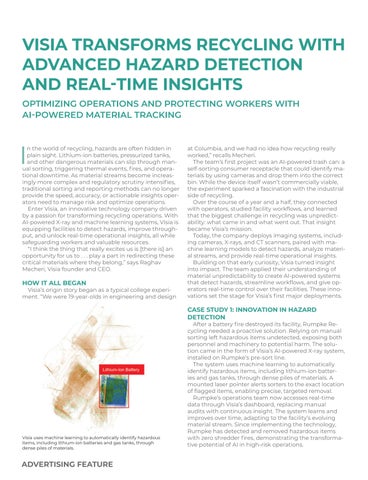
Visia uses machine learning to automatically identify hazardous items, including lithium-ion batteries and gas tanks, through dense piles of materials.
ADVERTISING FEATURE
After a battery fire destroyed its facility, Rumpke Recycling needed a proactive solution. Relying on manual sorting left hazardous items undetected, exposing both personnel and machinery to potential harm. The solution came in the form of Visia’s AI-powered X-ray system, installed on Rumpke’s pre-sort line. The system uses machine learning to automatically identify hazardous items, including lithium-ion batteries and gas tanks, through dense piles of materials. A mounted laser pointer alerts sorters to the exact location of flagged items, enabling precise, targeted removal. Rumpke’s operations team now accesses real-time data through Visia’s dashboard, replacing manual audits with continuous insight. The system learns and improves over time, adapting to the facility’s evolving material stream. Since implementing the technology, Rumpke has detected and removed hazardous items with zero shredder fires, demonstrating the transformative potential of AI in high-risk operations.