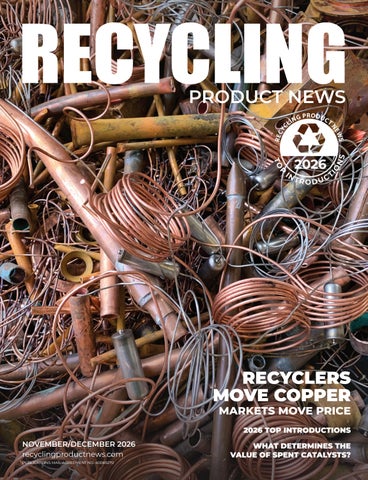
RECYCLERS MOVE COPPER
MARKETS MOVE PRICE 2026 TOP INTRODUCTIONS
NOVEMBER/DECEMBER 2026 recyclingproductnews.com PUBLICATIONS MAIL AGREEMENT NO. 40069270
WHAT DETERMINES THE VALUE OF SPENT CATALYSTS?
Discover more at: HarrisAmericanCo.com
Harris American has launched Harris American University (HAU), a technology and training center in Cordele, Georgia. The HAU curriculum leverages programs from our legacy businesses that came together to form Harris American in 2025 to provide training for our customers, authorized dealers, and employees. Current courses cover two-ram balers, triple-compression balers, and shears, while additional programs are being developed to expand technical training and support across our full product line. HAU provides classroom and hands-on training for Harris American products, including practical work with electrical panels, hydraulic manifolds, and other equipment components. Formed in 2026, built from 300 years of business experience, HAU will take product operations and maintenance training to a brand new level.
Come experience Harris American University.
Application Expertise · Legendary Performance · Superior Owner Experience
BEYOND THE EXPECTED.
WE OFFER
TOP VALUE FOR YOUR COPPER WIRE
John Ross & Sons Ltd. is the oldest, largest and most experienced scrap metal recycling company in Atlantic Canada. We operate a state-of-theart insulated copper wire chopping facility located in Halifax, Canada.
• Flexible Logistics • Competitive Pricing • Fast Payment
CONTACT US FOR A QUOTE Craig Morse, Senior Trader craig@jrsons.ca Office: 902-450-5633 Cell: 902-440-2403
Jonathan Ross jonathan@jrsons.ca Office: 902-450-5633 Cell: 902-489-3100
171 Chain Lake Drive, Halifax, Nova Scotia B3S 1B3 Canada
www.jrsons.ca
38
COVER STORY RECYCLERS MOVE COPPER, CAPITAL MARKETS MOVE PRICE
16
RECYCLING PRODUCT NEWS’ 2026 TOP INTRODUCTIONS
34
HARRIS AMERICAN EXPANDS EQUIPMENT PORTFOLIO WITH G.P.S. ACQUISITION
40
THE LOSS THAT DOESN’T STAY INSIDE YOUR YARD
November/December 2026 | Volume 34, Number 6
FEATURES
DEPARTMENTS & SECTIONS
16
Recycling Product News’ 2026 Top Introductions
8
From the Editor
24
What really determines the value of spent catalysts?
10
News Room
26
Turning grinder upkeep into uptime and margin
16
Top Introductions
24
28
Precious Metals
Recycle BC brings post-collection management inhouse
26
Organics
28
32
Paper Processing
What EPR implementation means for paper producers
34
Metals Baling
36
34
Ferrous Shredding
Harris American expands equipment portfolio with G.P.S. acquisition
38
Commodities
40
36
Insurance
Getting more from ferrous scrap shredding
45
Events Calendar
38
Recyclers move copper, capital markets move price
46
Advertiser Index
40
The loss that doesn’t stay inside your yard
NOVEMBER/DECEMBER 2026 | VOLUME 34 • NUMBER 6 EDITOR & DIRECTOR OF DIGITAL STRATEGY Slone Fox sfox@baumpub.com 604-291-9900 ext. 335
ADVERTISING PRODUCTION MANAGER Tina Anderson production@baumpub.com 604-291-9900 ext. 222
EDITOR IN CHIEF Kaitlyn Till ktill@baumpub.com 604-291-9900 ext. 330
DESIGN & PRODUCTION Morena Zanotto morena@baumpub.com 604-291-9900 ext. 325
SENIOR WRITER Meghan Barton mbarton@baumpub.com 604-291-9900 ext. 305
PRESIDENT/PUBLISHER Ken Singer ksinger@baumpub.com 604-291-9900 ext. 226
ASSOCIATE EDITOR Stephanie Bontorin sbontorin@baumpub.com 604-291-9900
VICE PRESIDENT/CONTROLLER Melvin Date Chong mdatechong@baumpub.com
VICE PRESIDENT OF SALES/ ASSOCIATE PUBLISHER Sam Esmaili sam@baumpub.com 604-291-9900 ext. 110
FROM THE COVER
Understanding copper pricing means looking beyond basic supply and demand. Read more on page 38.
FOUNDER Engelbert J. Baum
Published by: Baum Publications Ltd. 124 - 2323 Boundary Road Vancouver, BC, Canada V5M 4V8 Tel: 604-291-9900 Toll-free: 1-888-286-3630 Fax: 604-291-1906 www.baumpub.com www.recyclingproductnews.com @RecyclingPN FOR ALL CIRCULATION INQUIRIES Toll-free: 1-866-764-0227 email: rpn@mysubscription.ca Subscription: To subscribe, renew your subscription, or change your address or other information, go to: https://www.recyclingproductnews.com/ mysubscription/subscribe
CONNECT WITH US
@RecyclingPN
Recycling Product News is published six times yearly: January/February, March/April, May/June, July/August, September/October, November/ December. Advertising closes at the beginning of the issue month. One year subscription rates for others: Canada $33.50 + 1.68 GST = $35.18; U.S.A. $40; other countries $63.50. Single copies $6.00 + 0.30 GST = $6.30; outside Canada $7.00. All prices are in Canadian funds. Recycling Product News accepts no responsibility or liability for reported claims made by manufacturers and/or distributors for products or services; the views and opinions expressed are those of the authors and not necessarily those of Baum Publications Ltd. We acknowledge the financial support of the Government of Canada. Copyright 2026 Baum Publications Ltd. No portion of this publication may be reproduced without permission of the publishers. Printed on paper made of FSC®-certified and other controlled material. ISSN 1715-7013. PUBLICATIONS MAIL AGREEMENT NO. 40069270.
WE’D LIKE TO HEAR FROM YOU
Do you have a story, equipment or technology innovation, commentary, or news that our readers in the recycling industry should know about? Drop us a line any time. Contact: Editor Slone Fox at sfox@baumpub.com or 604-291-9900 ext. 335
Return undeliverable Canadian addresses to: Circulation Dept., PO Box 430 Stn Main, Alliston, ON L9R 1V6 email: rpn@mysubscription.ca / 705-502-0024
TURNING TOUGH... INTO TINY
From mixed aluminum scrap to dense UBC bales, SSI shredders deliver clean, consistent results. Engineered for heavyduty performance, SSI’s solutions reduce aluminum waste to optimal melt-ready sizes while minimizing contamination and downtime. Tough materials deserve tougher machines. Put SSI to the test. www.ssiworld.com | sales@ssiworld.com | +1-503-682-3633 | What Needs Shredding?
FROM THE EDITOR
FROM THE EDITOR FROM POLICY TO PRACTICE
G
overnments are placing more responsibility on producers for what happens to their products and packaging at the end of their life. Across North America this year, extended producer responsibility (EPR) continued to reshape how materials are collected, managed, and paid for, now moving beyond legislation and into the complicated business of implementation. Canada had a particularly busy year, with several provinces reaching important milestones and expanding existing programs. Ontario started the year with a major change: on January 1, the province completed its transition to full producer responsibility for packaging and paper under the Blue Box program. After a three-year transition, producers are now fully responsible for funding and operating the system, rather than sharing those responsibilities with municipalities. Alberta followed with Phase 2 of its EPR program on October 1. The expansion brought recycling services to additional communities while adding materials such as glass containers, foam packaging, flexible plastics, and aerosol containers. Quebec revised implementation timelines for its modernized selective collection system, while Prince Edward Island transitioned its Beverage Container Program to an EPR model in April. South of the border, EPR continues to expand state by state. Seven states now have comprehensive packaging EPR laws in place, including California, Colorado, Maine, Maryland, Minnesota, Oregon, and Washington. In 2026, Colorado entered its first year of producer fees, Oregon continued operating its producer-funded program, and California’s SB 54 regulations took effect in May. Not everything went smoothly: Maine hit a roadblock when its initial call for proposals to establish a packaging stewardship organization received no bids, forcing the state to rethink its approach and push back its implementation timeline. Producer responsibility is expanding, but the systems are far from identical. For businesses operating nationally, keeping up with different reporting requirements and collection models is
8
recyclingproductnews.com | NOVEMBER/DECEMBER 2026
For businesses operating nationally, keeping up with different reporting requirements and collection models is becoming increasingly complicated. becoming increasingly complicated. The changes could mean new material streams and business opportunities, but also raise more questions about infrastructure and processing in the year ahead. As another year comes to a close, I want to thank our readers, contributors, and industry partners for being part of another year of progress across the recycling industry. There’s no shortage of changes to keep up with, and we’ll be here to follow them every step of the way. I wish you and your teams a restful holiday season and a happy, successful start to the new year!
SLONE FOX Editor sfox@baumpub.com recyclingproductnews.com
Strength you see. Toughness you trust. Introducing the all-new Volvo VNX. The toughest truck we’ve ever built. Designed for the driver, tested in the harshest conditions, and engineered to take anything your job can dish out. Learn more at volvotrucks.ca
Volvo Trucks. Driving Progress
NEWS ROOM
NEWS ROOM STAY CURRENT
www.recyclingproductnews.com CONNECT WITH US
@RecyclingPN
10
recyclingproductnews.com | NOVEMBER/DECEMBER 2026
NWRA HONOURS RECYCLING LEADERS WITH 2026 RECYCLING AWARDS
T
he National Waste & Recycling Association (NWRA) announced the six recipients of its 2026 Recycling Awards, recognizing achievements in recycling, sustainability, public education, organics management, technology, and industry collaboration. Excellence in Sustainability Public Education: Project ReWear, a circular textile waste prevention and public education program, integrates textile waste prevention into everyday clothing donation, resale, and redistribution. ReWear has measured nearly 25,000 pounds of textiles and redistributed more than 1,500 pounds of clothing at no cost. Organics Management Facility of the Year: Circular Services’ Southington, Connecticut, organics campus combines the Northeast’s largest food and beverage de-packaging operation with the longest continuously operating anaerobic digester in North America. The facility has an annual processing capacity of 100,000 tons of food and beverage waste and 500,000 cubic yards of leaf and yard waste. Excellence in Recycling Public Education: Rumpke Waste & Recycling’s “Building Trust in Our Industry” public education program in 2025 included 272 recycling facility tours reaching 3,254 participants, 72 landfill tours reaching 1,353 participants, and 106 presentations and events that engaged approximately 20,000 people. Recycling Equipment Innovator of the Year: The CP Auger Silo is an automated storage and feed system developed by CP Group that efficiently stores and feeds recyclables to balers. The automated system measures material in controlled amounts, allowing operators to better manage inventory, maximize storage capacity, and maintain more consistent baling operations. Game Changer Partnership: The WM and Starbucks Cups To-Go initiative enabled WM to add both paper and plastic beverage cups to its accepted recyclable materials list and support communities in updating local recycling guidelines.
FIRST-OF-ITS-KIND BILL TARGETS FAST-FASHION-DRIVEN WASTE
U
.S. congresswoman Chellie Pingree, founder and chair of the Slow Fashion Caucus, introduced the Textile Waste Reduction Act (TWRA), a first-of-its-kind bill to address the harmful impacts of fast-fashion-driven waste. Based on recommendations made in the first-ever Government Accountability Office report on fast fashion pollution, this legislation establishes the first coordinated federal framework to reduce textile waste, improve data collection, and develop a national strategy to advance circularity in the textile industry. Specifically, the act seeks to direct the EPA Administrator to coordinate federal action to advance textile circularity, require the EPA to develop a comprehensive strategy, and publish federal funding opportunities available at the state level to support increased textile circularity.
B.C. FIRST NATIONS GROUP RECEIVES USED MOTOR OIL RECYCLING UPGRADE
I
nterchange Recycling has entered into a new partnership with the Lil’wat Nation Public Works Yard and Kwikwasut’inuxw Haxwa’mis First Nation recycling collection facility in British Columbia. Through it, both communities will receive essential infrastructure upgrades supporting the responsible collection and management of used oil, antifreeze, filters, and containers. The not-for-profit organization operates more than 280 collection facilities across the province, each one a dedicated drop-off point for these products. Each of the two new sites will be equipped with a 10-foot container featuring built-in spill containment, allowing oil to be recycled safely. When dropped off at a dedicated public site, used motor oil can be re-refined into new lubricants. It can also serve as a raw material for manufacturing and energy products.
WHAT EPR IMPLEMENTATION MEANS FOR PAPER PRODUCERS ALTER TRADING ACQUIRES IRON AND METALS’ DENVER FACILITY
A
Differing definitions, reporting rules, and fees are making EPR a full-time job for the paper industry. Read more on page 32.
lter Trading Corporation has purchased the operating assets of Iron and Metals, located in Denver, Colorado. The addition of Iron and Metals expands Alter’s Rocky Mountain Region and increases its total number of facilities to 82.
NOVEMBER/DECEMBER 2026 | recyclingproductnews.com
11
NEWS ROOM
GFL WINS RECYCLING FACILITY OF THE YEAR AWARD
G
FL Environmental has won the National Waste & Recycling Association’s 2026 Recycling Facility of the Year award for its Montreal-East material recovery facility in Montreal, Quebec. GFL’s Montreal-East MRF anchors a 23-acre eco-hub, co-locating the new 120,000-square-foot single-stream residential MRF alongside GFL’s construction and demolition material recovery facility, creating a centralized, multi-stream recovery hub. The new MRF can process up to 220,000 tons of single-stream residential materials using Machinex technology and serves about half of Montreal households and 25 percent of Quebec’s total curbside recycling volume.
RESPARK ACQUIRES SCRAPRIGHT
R
eSpark is expanding its platform with the acquisition of ScrapRight, a management software provider. With ScrapRight, ReSpark will serve an additional 500 recyclers with software built around the realities of daily scrap operations, including buying, selling, pricing material, yard operations, logistics, finance and accounting, and AI-powered automation.
ALBERTA TRANSITIONS TO EPR FOR SINGLE-USE PACKAGING AND PAPER PRODUCTS
A
lberta has fully transitioned to an extended producer responsibility (EPR) residential recycling program for single-use packaging and paper products (PPP) with support from Circular Materials. This shift marks a major change in how the province manages and funds recycling. The new system will reduce costs for municipalities and taxpayers and enable a more coordinated, efficient recycling system across the province. Under Alberta’s EPR framework, the producers that supply single-use packaging and paper products are now financially and operationally responsible for collecting, recycling, and managing these materials. Participating communities will also have access to an expanded list of accepted recyclable materials, including glass containers, foam packaging, flexible plastic packaging, aerosol containers, and laminated paper and plastic packaging.
12
recyclingproductnews.com | NOVEMBER/DECEMBER 2026
NEW PROGRAM PREPARES THE NEXT GENERATION OF RECYCLING PROFESSIONALS
T
he Recycled Materials Association and the Northeast Recycling Council have launched a new pilot initiative to train the next generation of recycling professionals. The Sustainable Materials Careers Program offers new exposure and a deeper understanding of career opportunities in sustainable materials management through mentorship and career guidance.
REPUBLIC SERVICES BREAKS GROUND ON ST. LOUIS RECYCLING CENTER
R
epublic Services has broken ground on a new recycling centre in Bridgeton. The 105,000-square-foot St. Louis Recycling Center, expected to open in 2028, will serve businesses and approximately 3 million residents across Greater St. Louis and surrounding communities and will process up to 45 tons — or nine truckloads — of recyclables per hour.
STUART KAGAN PUBLISHES PLAYBOOK FOR THE MODERN SCRAPYARD
S
tuart Kagan, a scrap industry veteran and co-founder of Buddy, provides insights for building a scrap metal business that can adapt faster and compete harder in his new book Balls of Steel. The book discusses converging pressures facing the metal recycling sector: tightening margins, commodity volatility, growing compliance demands, labour challenges, and the beginning of meaningful technological disruption. Kagan argues that yards that will survive and lead are those that combine operational grit with strategic intelligence, and the tools to do this are already here. Based on real stories and personal lessons, Kagan covers topics like customer relationships, cash flow to leadership, smarter systems, and what the yard of the future actually looks like.
CYCLIC MATERIALS OPENS FIRST COMMERCIAL-SCALE AUTOMATED RARE EARTH MAGNET RECOVERY FACILITY
C
yclic Materials has opened its first commercial-scale rare earth magnet recycling facility in Mesa, Arizona, marking a major milestone in building a domestic supply of rare earths and critical minerals. With an annual processing capacity of up to 25,000 tonnes of magnet-bearing end-of-life products, the facility produces Cyclic’s rare earth magnet material, Mag-Xtract, and critical minerals, such as copper, aluminum, and steel. Global demand for rare earth elements is projected to triple by 2035, driven by AI, automotive, robotics, electronics, energy, and defense applications. A new South Carolina rare earth recycling campus is in development, which will combine the company’s magnet recovery and rare earth refining platforms on a single site.
HARRIS AMERICAN OPENS TECHNOLOGY AND TRAINING CENTRE IN GEORGIA
H
arris American Company has opened its new Harris American University technology and training centre in Cordele, Georgia. The facility will train customers, Harris American dealer technicians, technical field staff, and teams from across the company’s four manufacturing plants. Companies that own Harris American equipment have full access to the curriculum, including two-ram fundamentals, advanced two-ram, triple compression balers, and shears with a broader curriculum already in the development stage. NOVEMBER/DECEMBER 2026 | recyclingproductnews.com
13
NEWS ROOM
TEXTILE RECYCLING FACILITY TO PROCESS 19,200 TONNES OF WASTE PER YEAR
S
TADLER Group has opened a new textile recycling plant in San Pietro Mosezzo, Italy, for IGERS. STADLER worked with IGERS from the initial design phase through plant layout, fitting the system into the existing building and integrating all technology and hardware into one cohesive automated sorting plant. The facility has a capacity of four tonnes per hour and is authorized to process up to 19,200 tonnes of textile waste per year. The STADLER sorting line comprises two dosing units, two TOMRA NIR optical sorters, and 16 conveyors. Its main role is to prepare textile material for the subsequent recycling stages. The quality of separation is particularly important, as different textile fractions may have different destinations and require different downstream treatments. In the initial sorting stage, the first NIR sorter separates pure textiles, such as 100 percent cotton or 100 percent wool, from blended textiles and impurities. While the high-value
pure fractions are stored in a buffer, the second NIR sorter separates the mixed textile stream from impurities and non-conforming materials, such as pieces of hangers and leather. In the second stage, the buffered material is recirculated through the same sorting equipment, with the NIR sorters configured to separate it according to fibre type. The plant is designed to handle different incoming textile streams and throughputs while giving IGERS the freedom to decide what happens to each output fraction.
WHAT THE EVOLUTION IN HOUSEHOLD COLLECTION STREAMS MEANS FOR RECYCLERS
T SWANA AND THE BATTERY NETWORK PARTNER TO EXPAND SAFE RECOVERY METHODS
T
he Solid Waste Association of North America (SWANA) has welcomed The Battery Network as its newest corporate partner. The organizations will unite with a committed goal of safe battery collection and recovery while expanding access to education and practical resources for waste and resource management professionals. Through the corporate partnership, The Battery Network will share its battery collection, safety, and compliance resources with the SWANA community, helping SWANA members strengthen local programs and educate the public about proper battery management.
14
recyclingproductnews.com | NOVEMBER/DECEMBER 2026
he Recycling Partnership has released the second installment of its 2026 State of Recycling Report. Built on The Partnership’s national recycling database, multi-year field measurement studies, and capture rate analyses, “The Evolving Ton: Residential Generation Data” examines the packaging and printed paper that U.S. households discard into both trash and recycling, revealing a material mix that is becoming lighter, more varied, and more operationally complex to manage. Since 2020, the number of U.S. households has grown by approximately 8.5 million, while generation of traditionally collected material has declined by 3.7 million tons, or 8 percent, excluding film. On a household basis, cardboard increased 32 percent, consistent with the continued growth of e-commerce. Generation of mixed paper declined 34 percent, and glass declined 28 percent, while cartons increased 61 percent, non-bottle PET increased 48 percent, polypropylene increased 47 percent, aluminum foil and trays increased 44 percent, and aluminum cans increased 18 percent. The report found that the material mix is shifting. Per-household generation of cardboard, metals, and plastic containers grew from a combined 39 percent of traditionally collected material generation in 2020 to 51 percent in 2026. With film and flexibles included, combined plastics now represent 31 percent of generation, surpassing mixed paper at 28 percent.
CARI CONSUMERS’ NIGHT DRAWS RECORD ATTENDANCE Consumers’ Night, put on by the Canadian Association of Recycling Industries (CARI), brought together its biggest crowd yet. Over 225 industry leaders convened at the annual Toronto networking event with great conversations, plenty of networking, and high energy throughout the evening.
NOVEMBER/DECEMBER 2026 | recyclingproductnews.com
15
TOP INTRODUCTIONS
RECYCLING PRODUCT NEWS’ 2026 TOP INTRODUCTIONS BY SLONE FOX, EDITOR
A
rtificial intelligence, adaptability, and efficiency define this year’s standout recycling equipment, from the sorting lines inside material recovery facilities (MRFs) to the machines working in yards. The goal is the same everywhere: more throughput and cleaner output. Sorting technology keeps getting more advanced, and artificial intelligence is a core component. New platforms are expanding what sorting equipment can see and do: performance analysis systems built on in-field AI analyzers give MRF operators a clearer picture of how their lines are running, while modular equipment offers a customizable path for facilities whose material streams and needs are still evolving. In the yard, the machines that move material all day are getting attention too. A new generation of material handlers is arriving with enhanced designs aimed at productivity, durability, and operator comfort, while updated wheel loaders are built to save fuel in demanding, high-production applications. Labour shortages remain an issue across the recycling industry, so reducing complexity and workload for the people running equipment matters as much as ever. Automation, plug-and-play set-ups, and smarter diagnostics all help crews get more done with fewer headaches, whether they’re on the sort line or in the cab. Our picks for Recycling Product News’ 2026 Top Introductions show where recycling equipment is headed: machines and systems built for today’s demands that also prepare operations for tighter material specs, shifting commodity markets, and ongoing workforce challenges. We hope you enjoy exploring this year’s highlights with us.
Caterpillar’s MH3032 material handler.
TOP INTRODUCTIONS
MACHINEX Machinex’s MIND platform combines computer vision, machine learning, and real-time decision-making to support sorting operations. MIND operates as a closed-loop intelligence system: perceiving materials, deciding and acting in real time, and learning consistently to improve performance over time. It analyzes material behaviour, monitors system performance, and delivers advanced reporting to make informed operational decisions. Using computer vision and machine learning, AI can recognize and classify objects based on visual characteristics, allowing equipment to distinguish between materials that conventional detection technologies may see as the same. MIND brings that progression together, connecting AI-driven recognition and the data it generates with the sorting equipment designed to act on it.
BRANDT Brandt’s BMH60A material handler is developed specifically for steel manufacturing, scrap metal, and recycling applications. The material handler uses John Deere components aligned with North American standards, making replacement parts quick and easy to source. The BMH60A combines serviceability with technology designed to reduce operating costs and includes an energy recovery system. Automatic idle and shutdown functions improve fuel efficiency and reduce component wear. The machine is also designed around rapid cycle times, visibility, ease of operation, and operator comfort. The material handler lineup was developed through consultation with contractors and operators, with productivity and decreased downtime as the focus.
18
recyclingproductnews.com | NOVEMBER/DECEMBER 2026
CATERPILLAR According to Caterpillar, the guiding principle behind the MH3032 material handler is straightforward: move and sort waste, scrap, or recyclables in as little time as possible, with as few movements and as little fuel as possible. Caterpillar’s MH3032 is a 30-tonne machine that fills the gap between the MH3026 and MH3040 material handlers and brings the company’s Next Generation architecture into this size class. The MH3032 has nearly 15 metres of reach and is available with drop-nose and straight-stick configurations. A standard 1-cubic-metre Cat orange-peel grapple targets typical scrap applications, and an optional 20-kW generator enables the machine to operate a magnet. An in-cab monitor displays two external camera views to increase visibility and hazard awareness.
CP GROUP CP Group’s POINT Operator Intelligence platform for material recovery facilities analyzes throughput, system performance, and commodities on the belt, alerting operators to act before quality or uptime is affected. When performance drifts from expectations, POINT sends a real-time alert and recommended action. The system analyzes and alerts for things like downtime events and motor spikes; bunker and silo fill levels; prohibitives outside the parameters set for each commodity output; recoverable recyclables on the last chance line; burden depth and material distribution across and along the belt; and more. POINT can run on new and existing CP Group systems, as well as on standalone AI or NIR product installations.
NOVEMBER/DECEMBER 2026 | recyclingproductnews.com
19
TOP INTRODUCTIONS
JOHN DEERE CONSTRUCTION & FORESTRY John Deere’s new 844 and 904 X-Tier wheel loaders feature the John Deere Electric Variable Transmission that replaces traditional drivetrain constraints with electronically managed power. The result is smoother operation, faster response, and optimized efficiency across demanding applications. The new Pile Slip Assist feature helps improve traction and bucket fill, while larger highstrength steel buckets allow operators to move more material with every pass, minimizing tire wear — one of the largest cost drivers in this size class. In Standard Mode, operators can achieve up to 15 percent fuel savings, while Performance Mode delivers up to a 5 percent productivity increase for high-demand applications.
LIEBHERR Liebherr’s new LH 60 M Industry E, introduced at CONEXPO-CON/AGG 2026, has an operating weight between 56.5 and 65 tonnes and is intended for demanding applications like scrap, waste, and industrial material handling. Rather than relying on batteries for electric operation, the machine uses a cable connection. The exhibition machine featured an 82-foot (25-metre) trailing cable, and optional self-winding systems are available with 164- or 328foot (50- or 100-metre) cables. A 180-kW electric motor powers the machine’s primary working movements while a separate 15-kW motor supplies auxiliary systems and components, which ensures even energy distribution and maximum energy efficiency. Liebherr combines the electric drive with its energy recovery cylinder system for a total system output of 334 kW.
20
recyclingproductnews.com | NOVEMBER/DECEMBER 2026
STEINERT STEINERT has introduced enhanced cast and wrought separation on the STEINERT KSS | XT L, supported by the AI-based Intelligent Object.Identifier (IOI). The IOI combines a wide variety of AI-based methods that use object-based information from all available sensor sources and spectral analyses to optimize material classification. In operation, the STEINERT KSS | XT L with IOI uses a sort filter set-up to detect low-silicon alloys. This maintains high wrought-aluminum purity while increasing its output by up to 40 percent compared with conventional sorting approaches, according to the company. Existing STEINERT KSS | XT L sorting systems can be retrofitted to include enhanced classification without replacing the entire machine.
LINDEMANN Lindemann Metal Recycling’s NxtPress scrap metal baler combines advanced control technology with robust construction. Capable of handling both ferrous and non-ferrous scrap, automated baling cycles ensure consistent output while the machine’s two-stage compression process produces highly compacted bales, maximizing material density and value. A hydraulically driven lid securely encloses the press box during operation, cutting oversized material and enabling optimal compression. The machine is also compatible with Lindemann’s digital platform, myLINDEMANN, enabling remote monitoring, diagnostics, and predictive maintenance. Optional features — including a mobile upgrade — enhance flexibility, allowing the NxtPress to adapt to evolving yard requirements and processing strategies.
NOVEMBER/DECEMBER 2026 | recyclingproductnews.com
21
TOP INTRODUCTIONS
M&J RECYCLING M&J Recycling’s M&J P3000e pre-shredder is powered by the company’s eDrive technology. Designed to handle mixed and challenging waste streams, the P3000e delivers consistent performance under varying load conditions while reducing overall energy consumption. With features such as UltraBoost and ReCapture, the P3000e continuously adapts power to the load while harvesting and reusing energy within the shredding process. This power system delivers efficient operation, steady throughput, reduced wear, and energy savings of up to 80 percent compared to conventional solutions, according to M&J. The result is controlled, high-capacity shredding with reduced wear on components and lower operating costs over time.
SIERRA INTERNATIONAL MACHINERY Sierra International Machinery has expanded its line of heavy-duty metal recycling machines with the new T800RBHD wide box shear/baler/car logger. The machine is designed for shearing heavy metal for recycling, producing dense bales, and logging automobiles. With an expanded folding box, increased shear throat, and 800 tons of cutting force, the T800RB-HD gives processors more room to work with bulky and irregular material. The T800RB-HD features a hinge door designed to help operators control and process bulky, oversized, and difficult material. The machine can perform manual and automatic shearing, baling, and logging cycles and is available in diesel or electric configurations, allowing operations to select the set-up that best fits their processing needs.
22
recyclingproductnews.com | NOVEMBER/DECEMBER 2026
REDWAVE REDWAVE’s NIR Modular offers recyclers, OEMs, and system integrators access to its sensor-based sorting technology without purchasing a complete system. Recyclers can integrate REDWAVE’s near-infrared technology and valve system directly into existing or newly designed plants instead of replacing conveyors, frames, and supporting infrastructure. Optional RGB camera technology and metal detection capabilities expand the platform’s versatility across a range of material streams, including plastics, packaging waste, paper, cardboard, municipal solid waste, and refuse-derived fuel. Available in working widths from 1,000 to 2,800 millimetres (39 to 110 inches), the modular platform can integrate into virtually any plant layout.
KOBELCO CONSTRUCTION MACHINERY U.S.A. KOBELCO added the SK300LC-11 and SK350LC-11 Straight Boom excavators to its lineup of purpose-built demolition equipment. Designed to provide greater working height than conventional mono-boom excavators, the Straight Boom models combine increased reach and demolition tool capacity with stability, controllability, and operator comfort. Both models are powered by a 265-hp Isuzu Tier 4 Final engine utilizing SCR/ DEF emissions technology without a diesel particulate filter. A case drain circuit comes standard, expanding compatibility with attachments requiring increased hydraulic drainage. KOBELCO’s in-cab hydraulic pressure release function also simplifies attachment changes by allowing the operator to release hydraulic pressure from inside the cab before disconnecting work tools or hydraulic hoses.
NOVEMBER/DECEMBER 2026 | recyclingproductnews.com
23
PRECIOUS METALS
WHAT REALLY DETERMINES THE VALUE OF SPENT CATALYSTS? SAMPLING, PROCESSING SUITABILITY, AND COMMERCIAL TERMS DETERMINE WHAT A SPENT CATALYST LOT IS ACTUALLY WORTH BY AMIN KHOSHNOUD
A
catalyst can reach the end of its operating life without exhausting the value of the metals it contains. What looks like a disposal challenge during a refinery or chemical-plant turnaround may still hold recoverable platinum, palladium, nickel, molybdenum, or other metals, yet an assay showing those elements does not, on its own, establish what the material is worth. The commercial question is more demanding: how much metal can be economically recovered, on what terms, and with which downstream processor? For industrial generators and recyclers alike, the difference between contained metal and realizable value is often decided well before a shipment leaves the site.
falls to 13.5 kilograms. Neither number is a guaranteed payable quantity. A final settlement can reflect agreed payable percentages, the recovery route, treatment and refining charges, sampling costs, freight, and the timing of metal-price fixation. Moisture and loss on ignition (LOI) also need clear definitions: depending on the test method, they may overlap and should not be treated as automatic, separate deductions. The lesson is straightforward. A quotation expressed per wet tonne cannot be compared fairly with one calculated on dry weight until both are brought onto the same basis. Even a precise laboratory result is only as useful as the terms attached to it.
AN ASSAY IS A STARTING POINT, NOT A SETTLEMENT
REPRESENTATIVE SAMPLING PROTECTS BOTH SIDES
Consider a hypothetical six-metric-tonne lot of platinum-bearing catalyst assaying 2,500 parts per million (ppm) platinum on a dry basis. If the entire six tonnes is dry material, it theoretically contains 15 kilograms of platinum. If six tonnes is the as-received weight and moisture accounts for 10 percent, the dry weight is 5.4 tonnes and theoretical contained platinum
24
recyclingproductnews.com | NOVEMBER/DECEMBER 2026
Spent catalysts are rarely perfectly uniform. Pellets and fines can segregate in handling, drums may differ from one another, and material removed from different sections of a unit may reflect different operating conditions. A convenient grab sample may not represent the shipment. Before trading a lot, the parties should agree on identification, weighing, sampling,
THE BEST OFFER IS THE BEST NET OUTCOME
An outright purchase and a refining-based settlement can each be appropriate, but the figures must be compared on equal terms. An outright transaction may provide greater price certainty; a metal-return arrangement may offer more exposure to final assay and market prices, together with additional costs and a longer settlement period. Take a purely illustrative example. One buyer offers $50,000 for a lot under agreed delivery and quality terms. Another presents an estimated gross metal return of $58,000 but deducts $7,000 for treatment and $4,000 for transport and sampling. The estimated net is $47,000, not $58,000 — and it may still change after final assay. The figures are hypothetical, not market benchmarks, but they show why the headline number is not necessarily the strongest commercial offer. Every offer should answer the same questions: Which weight and assay basis applies? Which metals are payable? What costs are deducted, and who bears freight and sampling risk? When is the price fixed, when is title transferred, and when will payment be made?
WHERE ARTIOS METALS FITS
The worth of spent catalysts is not determined by a single assay figure or a quoted percentage.
preparation, sample splits, and the analytical method used for settlement. Where appropriate, independent sampling or an umpire assay procedure can help resolve disputed results. This is not merely laboratory housekeeping; it is the foundation of trust in the commercial transaction.
THE RECOVERY ROUTE MATTERS AS MUCH AS THE GRADE
Two catalysts with similar precious-metal content may require very different processing. A platinum-bearing alumina catalyst is not the same feedstock as a palladium-bearing carbon catalyst or a mixed, sulfur-rich industrial residue. Support material, particle size, carbon, sulfur, chlorides, and other constituents can influence treatment methods, recovery performance, acceptance criteria, and cost. Quantity and geography matter, too. A technically suitable processor may be uneconomic once minimum lot sizes, packaging, freight, or cross-border requirements are considered. A credible commercial assessment therefore asks not just what is in the material, but which qualified facility can actually receive and process that specific stream.
Artios Metals is an Ontario-based industrial metals sourcing and trading company that purchases qualifying spent catalysts and other metal-bearing secondary materials. Its focus includes precious-metal-bearing catalysts as well as industrial streams containing nickel, cobalt, molybdenum, and copper. The company evaluates material characteristics and commercial feasibility, then works with qualified downstream recyclers and refiners suited to the specific feedstock. That distinction is important: successful recovery is not simply finding someone willing to take a shipment. It is matching the material with an appropriate recovery route and establishing workable purchase, documentation, and settlement terms before it moves.
VALUE BEGINS BEFORE THE CATALYST IS REMOVED
For a generator planning a change-out, preparation creates options. Record the process origin, expected quantity, physical form, packaging, available assay results, and known constituents or hazards. Keep distinct streams identifiable, and confirm classification, handling, and shipping requirements with the appropriate specialists. Recoverable value does not remove a material from applicable waste, transport, or environmental rules. Spent catalysts occupy a complicated space between industrial residue and valuable secondary resource. Their worth is not determined by a single assay figure or an attractive quoted percentage. It emerges when representative data, a feasible recovery route, and transparent commercial terms come together. In metals recovery, the strongest transaction often begins long before the first truck arrives. AMIN KHOSHNOUD is the Founder and Managing Director of Artios Metals Inc., an Ontario-based industrial metals sourcing and trading company specializing in spent catalysts and metal-bearing secondary materials.
NOVEMBER/DECEMBER 2026 | recyclingproductnews.com
25
ORGANICS
TURNING GRINDER UPKEEP INTO UPTIME AND MARGIN
HOW ROUTINE CARE OF HORIZONTAL GRINDERS LOWERS TOTAL COST OF OPERATION, EXTENDS EQUIPMENT LIFE, AND KEEPS CREWS OUT OF EMERGENCY REPAIR MODE
A
horizontal grinder breakdown in July costs more than a preventive maintenance visit in February. Teeth dull, screens clog, belts stretch — grinding pallets, stumps, or green waste day in and day out guarantees it. The only question is whether you handle it on your schedule, or if a breakdown forces the issue.
filters, cylinders, sensors, and fasteners — specific to a given machine, so when a tech finds something worn on a visit, it gets replaced that day.
TOTAL COST OF OPERATION AND PROFITS
Preventive maintenance can extend equipment lifespan by 20–40 percent. Skip it long enough, and the machine stops performing the way it’s supposed to. Worn teeth and screens, dirty bearings, hydraulics, or oil past its service life will slow output, hurt product quality, or both. Not every wear part fails on a schedule. Some wear at the rate of whatever is coming through the machine: Teeth take the brunt of the abrasion. Check multiple times a day; flip or replace once dull, and replace immediately if wear reaches the mount. Screens control end product size. Watch for thinning, stretched holes, or a drop in production; clean after every use. Mounts hold teeth to the rotor. Check daily for damage or looseness; a worn mount left unchecked can throw the rotor out of balance. Wear liners and hardfacing protect the grinding chamber and high-wear areas. Inspect on the daily walkaround and repair before wear reaches base metal. Others run on a fixed clock, regardless of feedstock: Rotor bearing grease: every 300–750 hours depending on use; check at 300 hours, recheck every 100 if contaminated. Clutch oil (FP-66 and B-66 models): every 500 hours, filter included.
For every dollar spent on preventive maintenance, an operation can save an average of five dollars in repair costs, says Rotochopper. Lost production time, emergency labour, parts, and freight all add to the total cost of operation, and running a machine hard on worn teeth, leaking hydraulic fittings, or loose belts burns more fuel while producing less material per hour. Preventive maintenance can save 12–18 percent by turning surprise repair bills into a line item you budget for instead. Part of controlling that cost is knowing what a crew can handle in-house and what needs a factory tech. Daily walkarounds — checking teeth, clearing debris off mounts, checking belt tension, greasing bearings, and checking fluid levels — are operator work and cost nothing but time. Rotor balancing, hydraulic diagnostics, engine or clutch work, and anything requiring the machine to come apart is tech work, and it’s also when bigger wear items like screens, mounts, and rotor bearings typically get replaced. Freight and downtime are two of the highest hidden costs in that total, and both come down to whether the right part is on hand when it’s needed. Rotochopper’s Uptime Parts Kit is built around that gap, stocked with the most commonly replaced items — teeth and hardware, belt and lacing supplies, hydraulic
26
recyclingproductnews.com | NOVEMBER/DECEMBER 2026
MACHINE PERFORMANCE AND LIFESPAN
A grinder running pallets eight hours a day wears differently than one processing green waste three days a week.
Drive belt tension: with every oil change on diesel grinders, or every 250 hours on electric grinders; retighten 20 hours after a new belt goes in. How fast the material-dependent parts wear still depends on what’s going through the machine. A grinder running pallets eight hours a day wears differently than one processing green waste three days a week. Pallets introduce metal contamination that’s hard on teeth and screens, land-clearing debris brings dirt and rock that’s hard on teeth and mounts, and clean green waste run only a few days a week is gentlest on the machine overall.
UPTIME AND THE LONG GAME
Operations that run on preventive maintenance rather than reactive repair see up to 52.7 percent less unplanned downtime — and breakdowns tend to hit during peak season, not a slow Tuesday. Documented maintenance also matters beyond the shop floor: lenders and insurers weigh service records and repair logs when financing or insuring a fleet, and a grinder with a clean maintenance history sells, trades, and finances better.
WHAT THE SERVICE TEAM SEES
Rotochopper’s Preventative Maintenance Program covers horizontal grinders, shredders, and supporting equipment, with regular visits scheduled around the operation’s production calendar and emergency visits available when something breaks. “Ask anyone on our service team which machines they worry about, and it’s never the ones on a PM schedule. It’s always the ones we haven’t seen in a year, where nobody really knows
Lost production time, emergency labour, parts, and freight all add to the total cost of operation.
Ask anyone on our service team which machines they worry about, and it’s never the ones on a PM schedule. It’s always the ones we haven’t seen in a year, where nobody really knows what shape the teeth or the bearings are in anymore. Adam Asmus Manager of Customer Service, Rotochopper what shape the teeth or the bearings are in anymore. When we’re out there regularly, we catch the small stuff before it turns into a service call nobody planned for. That’s the whole point of the program — not just fixing things, but knowing what’s coming before it happens,” says Adam Asmus, Manager of Customer Service at Rotochopper A grinder running worn parts is losing money quietly — in fuel, output, and margin — long before it breaks down loud. Preventive maintenance turns that slow bleed into a scheduled, budgeted cost and keeps the machine, and the operation behind it, running longer. NOVEMBER/DECEMBER 2026 | recyclingproductnews.com
27
PAPER PROCESSING
RECYCLE BC BRINGS POSTCOLLECTION MANAGEMENT INHOUSE AS MAJOR MRF INVESTMENTS MOVE FORWARD A NEW MANAGEMENT MODEL AND INVESTMENTS IN SORTING TECHNOLOGY ARE RESHAPING BRITISH COLUMBIA’S RESIDENTIAL RECYCLING NETWORK BY MEGHAN BARTON, SENIOR WRITER
R
ecycle BC, the organization responsible for managing British Columbia’s residential packaging and paper recycling program, has taken direct control of post-collection recycling materials management. The transition, which began June 1, 2026, moves responsibility for coordinating receiving, transportation, processing, and end-market management from a single contractor directly to Recycle BC. The change includes major investments in recycling infrastructure, including upgrades to existing material recovery facilities (MRFs) in New Westminster and Kelowna and the development of a new 120,000-tonne-per-year processing facility in Delta. According to Ann Goulding, Manager of Stakeholder Relations for Recycle BC and SK Recycles, the decision reflects the continued evolution of B.C.’s residential recycling program. “As the program has grown and evolved, managing these services in-house provides greater direct oversight of the entire recycling process,” Goulding says. The transition will be implemented in phases throughout 2026 to maintain service continuity for collection partners and communities.
28
recyclingproductnews.com | NOVEMBER/DECEMBER 2026
A NEW APPROACH TO POSTCOLLECTION MANAGEMENT
Recycle BC manages residential recycling services through three collection streams: curbside collection, multi-family collection, and recycling depots. The program serves residential properties only and does not include materials from the industrial, commercial, and institutional (ICI) sector. Although the collection system remains unchanged, the management of materials after collection has undergone a major restructuring. Under the previous arrangement, GFL Environmental coordinated the post-collection network on Recycle BC’s behalf, overseeing services such as receiving, transportation, processing, and logistics. The company was required to meet Recycle BC’s standards for responsible material management, chain of custody, reporting, and verified recycling end markets. Recycle BC now holds direct contracts with individual service providers, including transportation companies, receiving facilities, and MRF operators. “This model gives Recycle BC greater visibility and control
Miller Waste Systems will design, construct, and operate Recycle BC's new MRF in Delta, B.C.
over operations while continuing to leverage the expertise and infrastructure of specialized service providers,” Goulding says.
UPGRADING B.C.’S EXISTING INFRASTRUCTURE
One of the first major infrastructure investments supporting the transition is underway at the New Westminster MRF operated by Urban Impact, a B.C.-based recycling and waste management company. The facility currently has the capacity to process approximately 25 to 30 tonnes of single-stream recyclable materials per hour and can also handle materials collected in three or four separate streams. Urban Impact is upgrading its processing equipment to improve sorting efficiency, increase material recovery, and produce higher-quality recyclables for end markets. The facility has already replaced its existing optical sorting equipment with newer technology designed to identify and separate recyclable materials more accurately. Additional optical sorters, improved glass and metal separation equipment, and a new baler are planned as part of the next phase. According to Goulding, approximately 50 percent of the
The focus is on improving sorting efficiency, recovering more recyclable materials, and producing higher-quality materials for recycling end markets. Ann Goulding Manager of Stakeholder Relations, Recycle BC and SK Recycles
NOVEMBER/DECEMBER 2026 | recyclingproductnews.com
29
PAPER PROCESSING
The new Miller Waste Systems MRF in Delta will incorporate advanced optical sorting and AI-enhanced technologies to improve material recovery and produce higher-quality recyclables.
upgrade project is complete. The next equipment deliveries are expected in March 2027, with installation scheduled for the second quarter of the year. Although the improvements represent a significant investment in processing technology, they are not expected to substantially increase the facility’s hourly throughput. “Instead, the focus is on improving sorting efficiency, recovering more recyclable materials and producing higher-quality materials for recycling end markets,” Goulding says. The upgraded equipment will also be better equipped to handle wet materials and reduce the need for manual sorting and quality checks. Urban Impact is handling much of the installation work inhouse, scheduling upgrades during evenings and weekends to minimize operational disruptions. Goulding says the hands-on experience will also help its team maintain and operate the upgraded equipment over the long term. Fire prevention and lithium-ion battery incident response are prioritized at the New Westminster facility. Investments include heat-detection technology, monitored fire response systems, additional sprinkler protection, and staff training. The sorting upgrades will provide additional opportunities to identify and remove contaminants before recovered materials are shipped to end markets. Recycle BC has also expanded its regional processing network with the addition of Cascades’ single-stream MRF in Kelowna, which joined the network on June 1, 2026. Serving communities in the Interior, the facility is slated for upgrades that include optical sorting technology to increase
30
recyclingproductnews.com | NOVEMBER/DECEMBER 2026
processing capacity and speed, improve operational efficiency, and produce paper grades that can be shipped directly to recycling end markets.
NEW DELTA MRF TO ADD 120,000 TONNES OF ANNUAL CAPACITY
Recycle BC is also making a major investment in new processing capacity with the development of a 120,000-tonneper-year MRF in Delta. Selected through an open, competitive procurement process, Miller Waste Systems will design, construct, and operate the facility, which is expected to be completed in 2028. The new MRF will be dedicated to processing residential packaging and paper collected through Recycle BC’s program. It will accommodate both single-stream and multistream recyclables, providing flexibility to handle different collection systems and increase processing capacity as volumes grow. The facility will incorporate advanced optical sorting and AI-enhanced technologies designed to improve sorting accuracy, material recovery, and the quality of recyclables sent to end markets. The design will also allow for the integration of emerging technologies as processing needs evolve and new equipment and sorting capabilities become available. The Delta MRF will also feature a dedicated education space for facility tours and community engagement, giving visitors a first-hand look at how residential recyclables are processed.
WHERE RECYCLE BC’S RECOVERED MATERIALS GO
P
lastics: More than 99 percent of plastics sent for recycling are processed in Metro Vancouver, where they are converted into pellets for use in new packaging and products, such as nursery pots, pails, and garbage cans. Glass: All glass sent for recycling is processed within B.C., including at facilities in Abbotsford, where it is prepared for new glass bottle production, and Quesnel, where it is used to manufacture sandblasting materials. Metals: In 2025, 80 percent of metal sent for recycling was processed in B.C., with the remaining 20 percent processed elsewhere in Canada. Recycle BC’s metal packaging end markets also include facilities in the United States. Paper and cardboard: Materials are sent to recycling end markets in B.C., the United States, and overseas, where they are used to manufacture products such as egg cartons and kraft paper.
Recycle BC's new management model provides greater oversight of residential recycling, from collection through processing and delivery to end markets.
The world leader in
During construction, GFL Environmental will continue providing interim processing services at its Richmond MRF to support continuity across the network.
Gypsum Recycling
IMPROVING MATERIAL QUALITY AND ACCESS TO RECYCLING END MARKETS
The transition to direct post-collection management gives Recycle BC greater oversight of what happens to recyclable materials after they leave the collection system. Once materials are sorted and separated at MRFs, they are baled or consolidated and shipped to verified recycling end markets. A strict chain of custody tracks materials from collection through processing and delivery, with end markets subject to Recycle BC’s approval and verification process. Maintaining the quality of those materials begins at collection. Through resident education, community outreach, and regular material audits, Recycle BC works with communities and collection partners to reduce contamination before it reaches processing facilities. Investments in upgraded sorting equipment are intended to improve recovery and produce higher-quality materials for recycling end markets. “Recycle BC’s focus is on maintaining high-quality recyclable materials so we can maximize access to local recycling end markets wherever possible and ensure the materials we collect can ultimately be turned into new products,” Goulding says. RPN
With more than 8+ million tonnes recycled in North America and Europe.
We have recycling plants in Vancouver, Toronto, and Calgary. New West Gypsum Recycling Inc. Office Canada T +1 604 534 9925
NWGYPSUM.COM
NOVEMBER/DECEMBER 2026 | recyclingproductnews.com
31
PAPER PROCESSING
WHAT EPR IMPLEMENTATION MEANS FOR PAPER PRODUCERS DIFFERING DEFINITIONS, REPORTING RULES, AND FEES ARE MAKING EPR A FULL-TIME JOB FOR THE PAPER INDUSTRY
S
hoshana Micon, manager of recycling and packaging sustainability at the American Forest & Paper Association (AF&PA), helps member companies navigate and simplify recycling policy. Most of her work centres on extended producer responsibility (EPR), along with projects focused on designing for recyclability. In this conversation, Huban Kasimi of Davis Index explores how Micon translates complex legal frameworks into workable guidance and what shapes her policy mindset.
recycling bin.” But there are always challenges we come up against, and there’s always work to be done to make sure we can collect as much material as possible.
HK
If there were one aspect about the paper recycling industry that you’d want to change, what would that be?
SM
I wish that the average person valued the recycling system more. So much work and resources go into recovering these materials. We recognize some people believe that recycling is fake and their materials won’t get recovered. We read about low percentages as an across-the-board recycling rate, and it’s simply not true. But I am so grateful that I get to bust those myths. We’ve dedicated so much time and resources to creating a robust paper recycling system, and paper recycling is successful because of it.
Huban Kasimi
Is there enough awareness about paper recycling in the U.S.?
Shoshana Micon
One advantage of being at AF&PA is that we represent a material and an industry that already has an incredibly long-standing, successful track record in recycling. But there can always be more awareness around the high recyclability of paper in the U.S. Through my work on EPR implementation, I am helping to increase the visibility and awareness of that critical work.
HK
When we talk about education versus awareness, do you see any gaps that need to be filled?
HK
Which industrial framework would you like to see implemented or revised to promote paper recycling?
SM
Education and awareness can be challenging. How do we get paper from the consumer’s hand into the bin? As an industry, we’ve dedicated ourselves to solving those problems. We’re really lucky that most people see paper and recognize, “Of course, this can go in the
SM
There are a lot of positive things that are happening around paper recycling today that I’m excited about. For instance, we work to educate people about pizza box recycling, and we are seeing more and more local municipalities explicitly accept pizza boxes for recycling.
32
recyclingproductnews.com | NOVEMBER/DECEMBER 2026
Seven states have now passed EPR laws, and producers must track different definitions, requirements, and reporting rules in each one.
There are developments in the paper cups segment as well. The list of cities that accept them continues to grow. Earlier this year, Massachusetts announced that they accept paper cups for recycling across the state, which is a huge win.
HK
Many people believe that the cost of recycling versus the cost of landfilling depends on proximity, the amount of land that’s available, and the distance between a recycling plant and residential areas. Would that be a factor? Is it difficult for you to change people’s perception regarding this?
SM
It is very difficult to change people’s perceptions. To me, it comes down to a lack of understanding that recycling is a business, and each link in that chain is a business. The bottom line is our mills want to get their hands on as much material as possible to turn paper into new products.
HK
What are your thoughts on the debate between acceptability and recyclability?
SM
This is kind of a chicken-and-egg situation. Acceptance is a combination of community acceptance, MRF acceptance, and end market acceptance, which drives whether an item is recycled or not. And there can be a disconnect between what the community, MRF, and mill accept. At AF&PA, we work hard to educate about the paper products our mills accept for recycling. For example, there are lots of questions about paper cup recyclability. There are more facilities that are recycling paper cups now. We have a great industry partner, the Paper Cup Alliance, which is dedicated to finding mills that will sign declarations that they do accept paper cups for recycling. It’s a challenge, but we believe in paper cup recyclability.
HK
What do you think would be the best way to optimize or get the best possible recycling rate in the U.S.?
SM
Each of our members makes different products, they accept different materials, and they each know their needs and what they need to increase their own recovery at their mills. It’s my job to support them by helping implement policies that allow them to continue to recover as much material as possible. The teams that I’m working with, we all want the same thing — to continue to improve on the success of paper recycling. I find that most positive advances come from leveraging shared goals rather than getting bogged down by our differences.
NOVEMBER/DECEMBER 2026 | recyclingproductnews.com
33
METALS BALING
HARRIS AMERICAN EXPANDS EQUIPMENT PORTFOLIO WITH G.P.S. ACQUISITION
THE DEAL COMBINES COMPLEMENTARY PRODUCT LINES WHILE OPENING NEW OPPORTUNITIES FOR INTERNATIONAL GROWTH BY SLONE FOX, EDITOR
H
arris American Company’s acquisition of G.P.S. S.r.l. earlier this year was a natural and strategic evolution of the longstanding partnership between the two companies. The relationship began in 2021, when Harris signed a collaboration and supply agreement with the Italian equipment manufacturer, securing exclusive rights to market and sell select G.P.S. machines in North America. With the acquisition finalized, Harris American is now looking at what the deal means for its equipment lineup and future expansion.
FILLING IN THE GAPS
G.P.S. specializes in shear/baler/ loggers and car baler/loggers, complementing Harris American’s existing equipment portfolio with little overlap between the two manufacturers. The Predator baler/logger and Destroyer baler/logger/shear from G.P.S. entered the North American market through the companies’ partnership five years ago, with numerous units installed across the United States since then. The acquisition builds on that relationship, bringing G.P.S.’s equipment under Harris American’s ownership and strengthening its position as a one-stop supplier for the recycling industry. For D.J. VanDeusen, President of Harris American Company, the deal also represents a significant change in the company’s involvement with G.P.S. equipment. “We are not simply operating as a distributor for another manufacturer’s product,” VanDeusen says. “We now have our
34
name on the product and are involved in all design, procurement, production, and service aspects of the equipment.”
THE NEXT STEP
VanDeusen says the timing of the acquisition was driven by several factors: revenue from the Harris–G.P.S. partnership had grown steadily over the previous years, the equipment had established a record of reliability in the field, and the market outlook continued to improve. For G.P.S., the acquisition brings additional resources to support future growth. Harris American can provide capital for new product development, along with expanded manufacturing, assembly, and warehouse capacity. According to VanDeusen, these resources will help G.P.S. move forward with previously identified growth opportunities and explore new areas of development.
TWO DESIGN PHILOSOPHIES
The acquisition also brings together two approaches to equipment design. “European manufacturers have a strong tendency to produce lighter machines than those traditionally built in the U.S.,” says VanDeusen. “G.P.S., in particular, manufactures high-productivity machinery with reduced energy consumption.” He points to the Destroyer series of press shears as an example, which he says can process 35 to 40 tons of material
recyclingproductnews.com | NOVEMBER/DECEMBER 2026
We now have our name on the product and are involved in all design, procurement, production, and service aspects of the equipment. D.J. VanDeusen President, Harris American Company per hour using four 100-hp motors. Beyond equipment design, the acquisition creates opportunities for Harris American to expand its international reach. “Thanks to G.P.S.’s strong presence in the European, African, Middle Eastern, and Asian markets, over time we will have the opportunity to penetrate markets that are still unexplored or where our presence is not yet widespread,” VanDeusen says.
The Predator baler/logger from G.P.S. entered the North American market through the companies’ 2021 partnership.
EFFICIENCY WILL DRIVE THE NEXT DECADE
Looking ahead to the next decade, VanDeusen expects energy efficiency and artificial intelligence to play an important role in equipment development. “Our machinery will need to be increasingly efficient and consume less and less energy in order to achieve a cost-per-ton ratio that allows our customers to maintain healthy profit margins,” he says. “We will also see an increasingly widespread use of artificial intelligence, particularly in customer service and in the area of preventive maintenance.” These developments could have practical implications for scrap processors, from reducing energy costs to identifying potential equipment issues before they result in unplanned downtime. They also reflect a broader focus on improving machine performance while keeping day-to-day operating expenses manageable. For Harris American, these priorities will help guide future equipment development as it builds on its partnership with G.P.S. While those plans will take time to develop, the focus remains on producing equipment that meets the evolving operational and economic demands of the recycling industry. RPN
Energy efficiency is expected to be a major driver of baler design over the next decade.
NOVEMBER/DECEMBER 2026 | recyclingproductnews.com
35
FERROUS SHREDDING
GETTING MORE FROM FERROUS SCRAP SHREDDING HOW SHREDDER SELECTION AFFECTS MATERIAL QUALITY, EFFICIENCY, AND OPERATING COSTS BY MEGHAN BARTON, SENIOR WRITER
F
errous scrap arrives at recycling facilities in all shapes, sizes, and conditions. Some materials need only an initial size reduction before moving to the next stage of processing, and others must be reduced to a more uniform particle size to meet downstream requirements. The type of shredder used and how it fits into the processing line can impact productivity, material quality, and operating costs. For Brian Bonham, Industrial Sales Specialist at SSI Shredding Systems, one of the key considerations is whether an operation needs to process large volumes of scrap or produce material within a more tightly controlled size range. That distinction can determine which shredding configuration is best suited to the job and how effectively it supports the rest of the processing line.
TWO SHAFTS OR FOUR?
In ferrous scrap recycling operations, the required output is a key factor in choosing between a two-shaft and fourshaft shredder. Both use high-torque shearing action to reduce material, but they serve different processing requirements. Two-shaft shredders are typically suited to high-volume applications where precise particle sizing isn’t a priority. Their opposing cutter shafts grip and shear heavy, bulky, and inconsistent materials, reducing them to more manageable pieces for handling or further processing. “Our Dual-Shear (two-shaft) shredders are generally selected when the primary objective is to process high volumes of material reliably rather than achieve a specific, tightly controlled particle size,” says Bonham. Four-shaft shredders, such as SSI’s Quad series, provide greater control over the final particle size. A sizing screen beneath the cutters holds material in the shredding chamber until it is small enough to pass through, producing a more uniform output.
36
recyclingproductnews.com | NOVEMBER/DECEMBER 2026
This configuration can also improve material liberation when processing mixed scrap. As the scrap moves against the screen, the scrubbing action helps free materials that would otherwise remain attached, improving recovery during downstream processing.
STANDALONE SHREDDING OR PRESHREDDING?
The role a shredder plays within the processing line is another factor in equipment selection. A low-speed, hightorque shredder can break down bulky, irregular scrap before it enters a hammermill, providing a more consistent feed for downstream processing. SSI’s Dual-Shear M180HQ can be used for this type of pre-shredding application. According to Bonham, this arrangement can increase overall system throughput, reduce wear on the hammermill, and lower associated maintenance and operating costs. The M180HQ can also operate as a standalone shredder. Compared with traditional high-speed hammermills, its lowspeed shearing action produces less noise and dust, which can be beneficial for facilities located near residential areas or subject to strict environmental regulations. Low-speed processing may also offer advantages when handling mixed ferrous scrap that could contain pressurized tanks or other hazardous items. While proper material inspection and safety procedures remain essential, Bonham says the M180HQ’s slower, controlled shearing action can help minimize the potential for a high-energy event compared with high-speed impact processing. Selecting a shredder that meets the demands of the material stream and the broader processing system can improve the quality and consistency of shredded output, increase material recovery, reduce wear on downstream equipment, and help control operating costs. RPN
HIGH-SPEED CAR CRUSHERS & BALER LOGGERS
IZED CUSTOM S OPTION ! LE A IL AVA B
OverBuilt Car Crushers boast the highest opening and fastest cycle times in the industry. The crane on our Baler Logger has a 26.5-foot reach with a 5000 pound lift at 25 feet.
OVB HOLDINGS, LLC
overbuilt.com | sales@overbuilt.com | 800-548-6469 | 605-352-6469
HYDRAULIC Untitled-1 1
ELECTRIC MECHANICAL OverBuilt Quarter Vertical NEW 2023.indd 1
2023-01-27 3:44:39 PM
3/17/2026 12:07:02 PM
GRAPPLES FOR EVERY SCRAP YARD, MILL AND PORT APPLICATION THE TOUGHEST GRABS & BUCKETS FOR THE TOUGHEST JOBS.
NOBODY OFFERS MORE FOR SCRAP HANDLING
CABLE STRIPPERS
BALERS SINCE 1919
MAGNETS
TORONTO
| ATLANTA
ALLIGATOR SHEARS GENSCOEQUIP.COM 1-800-268-6797
COMMODITIES
Physical traders and institutional investors approach copper markets from different directions.
RECYCLERS MOVE COPPER, CAPITAL MARKETS MOVE PRICE UNDERSTANDING PRICING NOW MEANS LOOKING BEYOND BASIC SUPPLY AND DEMAND BY ALDO JORDAN
P
hysical traders and institutional investors approach copper markets from different directions. Their objectives differ greatly, but their participation is shared in markets such as COMEX, where copper prices are discovered, and risk changes hands every day. Recycling companies take possession of physical material and its financial risks by buying, processing, transporting, and delivering copper to manufacturers. That supply chain can last days or weeks, if not months. Institutional investors take financial positions in copper to benefit from economic growth, diversify portfolios, hedge inflation, trade currency, or profit from intraday price movements. Trading platforms allow them to trade within milliseconds or hold positions for months, without handling physical metal. A liquid market needs both. Physical participants connect the futures market to commercial activity. Financial participants add liquidity and help absorb risk that producers, recyclers, and consumers want to transfer. Together, they support a market where businesses can establish prices and manage exposure
COMEX COPPER PRICING
COMEX pricing reflects all market participants, but institutional investors exert significant influence. Price movements may therefore reflect their economic outlook and portfolio decisions more than immediate supply-and-demand conditions physical traders face. Financial investors have a substantial presence in COMEX copper through their participation, contract positions, and net buying exposure. As of October 20, 2026, the CFTC reported 77 managed-money participants compared with 29 physical businesses. Managed money held approximately 1.68 billion pounds of copper in long contracts, or nearly $10.9 billion in notional value at $6.50 per pound. In my view, it is little surprise that COMEX copper pricing can behave like an equity market, given the substantial influence of managed money. During October through the 29th, COMEX spot-month copper and the S&P 500 moved in the same direction on 14 of their 21 trading days. That relationship suggests copper shares many economic expectations and shifts in investor sentiment with
Economic sentiment, currency movements, and interest rates can move markets beyond yard conditions.
stocks, alongside the physical supply and demand we see in our industry.
EXTERNAL INFLUENCES
Copper recyclers move the copper. Institutional capital greatly influences the price. For copper recyclers, the consequences are practical. Large investment funds can adjust exposure and position within milliseconds, and artificial intelligence trading will only accelerate those adjustments. A physical business must work through purchasing, processing, transportation, delivery, and settlement. Daily pricing changes move through that process frequently while our financial obligations remain in place. Our response should be greater financial awareness and an understanding that copper pricing is heavily a reflection of economic events outside of our control: wars, currency, tariffs, and interest rates. Economic sentiment, currency movements, and interest rates can move markets beyond yard conditions. Financial investors may never handle our material, but their decisions can affect market pricing for what recyclers pay, earn, and the risks taken. Understanding those financial forces must be part of understanding our business. ALDO JORDAN is the Founder and President of The Metals Agency. NOVEMBER/DECEMBER 2026 | recyclingproductnews.com
39
INSURANCE
THE LOSS THAT DOESN’T STAY INSIDE YOUR YARD HOW ENVIRONMENTAL IMPAIRMENT INSURANCE AND RISK MANAGEMENT CAN PROTECT RECYCLERS FROM COSTLY POLLUTION INCIDENTS BY MEGHAN BARTON, SENIOR WRITER
T
he materials that recycling facilities receive, store, and process can expose operators to a wide range of environmental risks. From leaking fluids and contaminated runoff to hazardous materials hidden in incoming loads, the potential for pollution is part of everyday operations. While many of these risks can be managed, even a relatively minor incident can create a much larger problem if contamination isn’t contained. Ryan Burns, Practice Leader with Cowan Insurance Group, says the financial consequences can be significant. Cleanup costs, regulatory requirements, and potential liability for damage to neighbouring properties or waterways can quickly add up, and pollution-related losses may not be covered under a facility’s standard insurance policies. One of the greatest concerns is what happens when those contaminants migrate beyond the yard.
HOW CONTAMINATION SPREADS
A waste oil tank punctured by equipment might leak for months before anyone notices. Scrap stored directly on exposed soil can release contaminants into the ground over time. And when heavy rain or melting snow moves through a recycling yard, those contaminants can travel well beyond the property. Environmental contamination isn’t always the result of a sudden or obvious incident. Burns says some recyclers are more aware of these exposures and have invested in systems that capture runoff in holding basins, allowing contaminated water to be treated or removed by environmental contractors. But, he says, many operators underestimate the potential consequences of environmental contamination. “I’m fourth generation; this yard is already contaminated,” is a response he has often encountered.
40 recyclingproductnews.com | NOVEMBER/DECEMBER 2026
That mindset becomes particularly concerning when a facility is located near a creek, municipal waterway, agricultural property, or other environmentally sensitive area. Pollutants can migrate off-site, causing contamination of third-party properties, resulting in significant cleanup costs and potentially loss-of-use situations for the affected party. Burns recalls a recent fire at a recycling facility where contaminated firefighting water reached a holding pond on a neighbouring property. The operator was required to bring in a hydrovac truck to clean out affected culverts and environmental engineers to conduct ongoing testing. The incident resulted in approximately $300,000 in environmental cleanup costs. Costs can extend well beyond cleanup of the site and surrounding environment. Burns explains that operators must also deal with provincial environment ministries, which can order a
shutdown of operations temporarily. For a medium-sized operation, Burns estimates that a cleanup costing $300,000 to $400,000 could be accompanied by $1 million to $3 million in lost revenue during an extended shutdown. Environmental impairment insurance, he explains, may provide minimal coverage for lost revenue under the policies discussed, but can provide access to environmental consultants and remediation specialists who work with regulators to address contamination and help get operations back up and running.
UNDERSTANDING ENVIRONMENTAL IMPAIRMENT COVERAGE
Contaminated runoff from recycling facilities can carry pollutants into nearby waterways, resulting in costly cleanup and liability claims.
Environmental impairment liability insurance, commonly called pollution insurance, is designed to cover pollution-related losses, including cleanup expenses on the insured property and damage to neighbouring properties, subject to the terms of the policy. Burns identifies two primary types of coverage: Sudden and accidental coverage addresses unexpected incidents, such as a fire, explosion, or fuel spill that results in contamination. Gradual coverage addresses pollution that develops over time, such
as a slow leak from a storage tank or contaminants accumulating in soil beneath stored materials. Gradual coverage generally requires more extensive environmental assessment and ongoing monitoring to establish a baseline and identify changes in site conditions. The cost difference can be substantial. As an example, Burns estimates that sudden and accidental coverage for a single location, with a $2 million limit for on-site and off-site losses, might cost approximately $6,500 to $7,500 annually. Gradual coverage with a similar limit could cost $20,000 to $25,000, depending on the facility and its environmental exposures. “It’s much more costly to clean up a waterway than it is to clean up contaminated soil,” he says. He notes that a $2 million policy may be reasonable for a facility away from waterways, while those near creeks or other environmentally sensitive areas may require considerably higher limits. He also cautions that standard commercial general liability policies commonly contain pollution exclusions. Recyclers with off-site operations, mobile equipment, and transportation exposures should review how their policies work together to avoid gaps in protection.
A rapid response to contaminated runoff can help prevent pollutants from spreading and minimize environmental cleanup costs.
NOVEMBER/DECEMBER 2026 | recyclingproductnews.com
41
INSURANCE BEST PRACTICES FOR REDUCING ENVIRONMENTAL EXPOSURE
While insurance provides financial protection following a covered loss, even well-managed facilities remain vulnerable to unexpected incidents. Burns emphasizes the importance of reducing the likelihood and potential severity of environmental incidents. “You can do everything in your power, and you can still have a lithium-ion battery in your scrap pile that goes into thermal runaway, and you have an event,” he says. He recommends several practical actions: Map water movement throughout the property: Identify catch basins, storm drains, culverts, ditches, discharge points, and low-lying areas. Understanding where water travels during heavy rainfall, snowmelt, or firefighting operations is essential to preventing off-site contamination.
Control and contain runoff: Use appropriate grading, curbing, berms, and stormwater management systems to direct water into designated containment areas. Collected water should be tested and properly treated or disposed of. Protect the ground beneath stored materials: Where possible, store scrap piles and pre- and post-shred materials on concrete pads or recycled asphalt surfaces to reduce the potential for contaminants to leach into underlying soil. Improve battery and hazardous material storage: Inspect incoming materials for lithium-ion batteries and other hazardous items. Protect stored batteries from the elements and ensure end-of-life vehicles are de-polluted promptly rather than left to sit with fluids inside. Prevent fuel and hydraulic fluid releases: Store liquids appropriately and protect tanks from vehicle and equipment impacts using bollards or large armour stones. Keep storage areas away from activities such as hot works that could introduce additional hazards.
Monitor environmental conditions: Consider periodic soil sampling and environmental assessments, particularly near neighbouring waterways, holding ponds, or agricultural properties. Ongoing monitoring can help identify gradual contamination before it becomes a larger problem. These measures may require investment, but they can also influence insurance costs. Burns says insurers consider prevention and environmental monitoring when assessing and renewing gradual pollution coverage. But for Burns, controlling runoff remains a priority. “My biggest recommendation would be to control your runoff water,” he says.
PREPARING FOR AN ENVIRONMENTAL EMERGENCY
At an Ontario auto recycling facility, a major fire was followed by another immediate concern: contaminated runoff was moving downhill toward municipal culverts, and heavy rain was
Recycled Material Business Insurance from Cowan Insurance Group
Expert advice and tailored options
Comprehensive coverage for your business
A trusted partner for your evolving needs
Talk to a Cowan expert who understands your business recyclers@cowangroup.ca | 519-573-8284 or Toll-free: 1-866-912-6926 | cowangroup.ca/recyclers
We care about what you care about.®
Proudly Canadian. Proudly independent. Family-owned since 1927.
42
recyclingproductnews.com | NOVEMBER/DECEMBER 2026
forecast for that evening. Because the incident was reported quickly, environmental engineers arranged for hydrovac equipment to remove contaminated material before the rain arrived. Burns estimates that the rapid response reduced potential cleanup costs by hundreds of thousands of dollars. Pollution policies may have strict notification requirements, sometimes within 24 to 72 hours of an incident or its discovery. Recyclers should understand the specific requirements of their coverage. Many facilities already have emergency response plans, but the environmental component is often less developed than their fire response procedures. Burns recommends incorporating the following practices into an environmental emergency response plan: Assign responsibility: Designate an individual to coordinate the response, communicate with insurers and contractors, and manage affected areas of the facility. Identify emergency contacts and contractors: Establish relationships with environmental consultants
and remediation contractors before an incident occurs so assistance can be mobilized quickly. Prepare containment resources: Maintain accessible spill kits and ensure designated employees know how to use them. Identify drains that may need to be blocked and areas requiring immediate protection. Clearly label hazardous materials: Ensure storage containers and hazardous material areas are properly identified so employees and emergency responders understand the potential exposures. Document the response: Record when contamination was discovered, who was contacted, what containment and cleanup measures were taken, and the results of environmental testing. Maintain records demonstrating the steps taken to restore the affected area. Recyclers may not be able to prevent every environmental incident, but having the right people, resources, procedures, and protections in place can make a substantial difference when something goes wrong. RPN
My biggest recommendation would be to control your runoff water. Ryan Burns Practice Leader, Cowan Insurance Group
NOVEMBER/DECEMBER 2026 | recyclingproductnews.com
43
www.recyclingproductnews.com
ONLINE HIGHLIGHTS
ACQUISITION Terex acquires Keestrack
ORGANICS
Northern California compost facility to process 147,000 tons of material annually with Republic Services’ support
EXPORT RESTRICTIONS BIR calls on EU to reconsider recycled metal export restrictions
CONNECT WITH US
@RecyclingPN
EVENTS CALENDAR
CONNECT WITH THE INDUSTRY INTERNATIONAL MATERIALS RECYCLING CONFERENCE
JAIPUR, INDIA | JANUARY 18–20, 2027 The International Materials Recycling Conference (IMRC), presented by the Material Recycling Association of India (MRAI), brings international participants to the Novotel Jaipur Convention Centre in India. With over 230 exhibits and a comprehensive panel of speakers, attendees will get a view into the latest solutions across metals, e-waste, batteries, ELVs, tires, paper, and plastics. imrc.mrai.org.in
ALUMINUM SYMPOSIUM
FORT LAUDERDALE, FL | JANUARY 24–26, 2027 The Aluminum Symposium gathers producers, recyclers, traders, end users, and industry leaders from across global markets to examine the latest in aluminum. Attendees can experience a range of networking opportunities and insightful panels focused on changing market conditions, supply chains, and policy changes affecting nonferrous metals. spglobal.com/energy/en/events/conferences/aluminum-symposium
CDRA CONFERENCE & TRADESHOW BONITA SPRINGS, FL | JANUARY 26–28, 2027
The Construction & Demolition Recycling Association (CDRA) gathers professionals from across the industry during its annual conference and trade show. The event reflects the CDRA’s mission to advance the future of recycled construction materials and foster collaboration and connection. Attendees can explore the dynamic exhibit hall and experience a wide range of informative panels. cdraconference.com
COMING SOON COMPOST2027
DEMOLITION FORT WORTH
JACKSONVILLE, FL | FEBRUARY 1–4, 2027
FORT WORTH, TX | FEBRUARY 17–20, 2027
COMPOSTCONFERENCE.COM
DEMOLITIONASSOCIATION.COM/EVENTS/ANNUALCONVENTION-EXPO
NEXT ISSUE
ADVERTISER INDEX Construction & Demolition Recycling Association (CDRA)........ 43 Cowan Insurance Group..................... 42 FagusGreCon US.......................................37 Gensco Equipment Co Ltd................37 Harris American Company.................. 2 John Ross & Sons........................................ 3 Machinex Industries Inc.....................48 New West Gypsum Recycling Inc. .............................................31 OVB Holdings LLC...................................37 ReMA2027 Convention & Exposition ............................................... 47 SSI Shredding Systems, Inc. .............. 7 Volvo Trucks...................................................9
CONFRONTING LITHIUM-ION BATTERY FIRES BEFORE THEY SPREAD
YARD DOGS
Meet the unsung heroes of the industry — the dogs who keep watch, boost morale, and know the yard better than anyone. Send a photo of your four-legged coworker to sfox@baumpub.com for a chance to be featured in an upcoming issue.
Peanut Research Alloys
Sponsored by:
46
recyclingproductnews.com | NOVEMBER/DECEMBER 2026
WHERE THE RECYCLED MATERIALS INDUSTRY DOES BUSINESS
BUILD RELATIONSHIPS
SOURCE SOLUTIONS
SHARPEN YOUR EDGE
Connect with 6,000+ leaders at the world’s largest event for the recycled materials industry, where you can discover new innovations and tech, get game-changing insights and close real deals. Secure your seat right next to the buyers, sellers and processors driving the industry forward.
THE ENTIRE SUPPLY CHAIN IS HERE Metals • Electronics • Paper • Plastics • Rubber
Compare passes and save big when you register early.
REGISTER NOW AT ReMAShow.org/RPN
SCAN FOR EVENT DETAILS
AI-Driven Pneumatic Sorter Over 20x Sorting Rate VS Manual Sorter
Safer and More Accessible Maintenance
Multiple Ejection Patterns
Built to Fit On New or Existing Conveyors
Compact Cantilever Design