OCTOBER 2026
COMPACT EQUIPMENT DESIGNED FOR A CHANGING WORKFORCE HOW THE CONNECTED JOB SITE IS EVOLVING heavyequipmentguide.ca PUBLICATIONS MAIL AGREEMENT NO. 40069270
JCB SETS WORLD HYDROGEN LAND SPEED RECORD
A JOHN DEERE COMPANY
John Deere Operations Center™ Beyond Telematics — Smart Information from Smart Solutions
CLOSE TO OUR CUSTOMERS Unlock the full potential of your jobsite with the John Deere Operations Center™. Transfer job data to machines for automation functions, seamlessly access performance data generated by WPT solutions to track productivity, analyze machine performance, and make data-driven decisions — all in one central platform. Gain transparency, optimize processes, and turn performance insights into real results. wirtgen-group.com/operations-center
18
FEATURE STORY HOW THE CONNECTED JOB SITE IS EVOLVING
28 32
JCB HYDROMAX SETS LAND SPEED RECORD
COMPACT EQUIPMENT DESIGNED FOR A CHANGING WORKFORCE
40
NEW VERMEER SOLUTION FOR SOLAR PILE SHAKEOUT
October 2026 | Volume 41, Number 8
FEATURES
DEPARTMENTS & SECTIONS
11
LiuGong forms Canadian subsidiary
8
From the Editor
18
How the connected job site is evolving
10
News Room
24
Tech-packed compact radius excavators provide capability on space-restricted job sites
16
Spotlight
18
Focus: Connected Job Site
28
JCB sets world hydrogen land speed record using construction equipment engines
24
Earthmoving
28
Field Report
Compact equipment designed for a changing workforce
30
Compact Equipment
36
Ditch Witch all-terrain drills handle high-pressure hard rock bore
36
Utility Construction
44
Aggregates
40
Automated material transporter simplifies solar field pile shakeout
46
Lift & Access
50
Fleet Management
42
Huddig’s excavator loader is built to do the work of several machines
54
Advertiser Index
44
Portable jaw crushers: equipment insight & trends
48
The case for hybrid equipment
50
Why equipment dealers are your secret weapon for controlling TCO
32
OCTOBER 2026 | VOLUME 41 • NUMBER 8 EDITOR IN CHIEF
ADVERTISING PRODUCTION MANAGER
Kaitlyn Till ktill@baumpub.com 604-291-9900 ext. 330 DIRECTOR OF DIGITAL STRATEGY
Slone Fox sfox@baumpub.com 604-291-9900 ext. 335
Tina Anderson tanderson@baumpub.com 604-291-9900 ext. 222 DESIGN & PRODUCTION
Morena Zanotto morena@baumpub.com 604-291-9900 ext. 325
SENIOR WRITER
PRESIDENT/PUBLISHER
ASSOCIATE EDITOR
VICE PRESIDENT/CONTROLLER
Meghan Barton mbarton@baumpub.com 604-291-9900 ext. 305 Stephanie Bontorin sbontorin@baumpub.com 604-291-9900 VICE PRESIDENT OF SALES/ ASSOCIATE PUBLISHER
Ken Singer ksinger@baumpub.com 604-291-9900 ext. 226
Melvin Date Chong mdatechong@baumpub.com FOUNDER
Engelbert J. Baum
Sam Esmaili sam@baumpub.com 604-291-9900 ext. 110
Published by: Baum Publications Ltd.
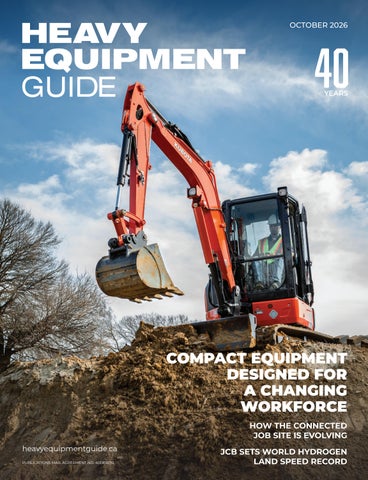
COVER PHOTO: KUBOTA’S KX033-4 MINI EXCAVATOR. Compact equipment designed for a changing workforce Turn to page 32.
124 - 2323 Boundary Road Vancouver, BC, Canada V5M 4V8 Tel: 604-291-9900 Toll-free: 1-888-286-3630 Fax: 604-291-1906 www.baumpub.com www.heavyequipmentguide.ca @HeavyEquipGuide FOR ALL CIRCULATION INQUIRIES Toll-free: 1-866-764-0227 email: heg@mysubscription.ca Subscription: To subscribe, renew your subscription, or change your address or other information, go to: http://mysubscription.ca/heg/
CONNECT WITH US @HeavyEquipGuide
Heavy Equipment Guide serves the Canadian engineered construction industry including: roadbuilding and maintenance; highways, bridges, tunnels; grading and excavating; earthmoving; crushing; trucking and hauling; underground utilities; trenching; concrete paving; asphalt paving; demolition; aggregates production; fleet maintenance; and asset security and management. The magazine is distributed to key industry personnel involved in these sectors. Subscription Price: In Canada, CDN $91.00; Outside Canada, US$149. Heavy Equipment Guide is published eight times a year in January/ February, March, April, May/June, July/August, September, October, and November/December. Heavy Equipment Guide accepts no responsibility or liability for reported claims made by manufacturers and/or distributors for products or services; the views and opinions expressed are those of the authors and not necessarily those of Baum Publications Ltd. Copyright 2026, Baum Publications Ltd. No portion of this publication may be reproduced without permission of the publishers. We acknowledge the financial support of the Government of Canada. Printed on paper made of FSC®-certified and other controlled material. ISSN 1715-7013.
WE’D LIKE TO HEAR FROM YOU Do you have a job site story, innovation, or industry concern that our readers should know about? We’d like to hear from you.
PUBLICATIONS MAIL AGREEMENT NO. 40069270 Return undeliverable Canadian addresses to: Circulation Dept., PO Box 430 Stn Main, Alliston, ON L9R 1V6 email: heg@mysubscription.ca / 705-502-0024
Contact: Editor in Chief Kaitlyn Till at ktill@baumpub.com or 604-291-9900 ext. 330
6
heavyequipmentguide.ca | OCTOBER 2026
HE
REVERSIBLE PLATES THAT MAKE THE GRADE
Compaction challenges don’t have to be an uphill battle. Wacker Neuson’s next generation medium-weight reversible plates deliver consistent performance and improved gradeability in the 700 - 1,000 lb. operating class. What’s more, these models have the smarts to prove it. The integrated Bluetooth technology provides real-time insights into machine data, helping you optimize operation, monitor usage, and stay one step ahead on maintenance. The result? Efficiency and productivity from equipment that works as hard – and as intelligently – as you do. For more information, contact your local Wacker Neuson dealer.
www.wackerneuson.com HEG_April_2026.indd 1
4/16/2026 1:49:21 PM
FROM THE EDITOR
FROM THE EDITOR CANADA HAS WHAT THE WORLD WANTS
“C
anada has what the world wants.” That bold statement introduces the 66-page, 167-project document, the Canada Investment Summit Prospectus, presented to global investors, Canadian CEOs, and public sector representatives attending the Canada Investment Summit held in Toronto on September 14 and 15. The event was hosted by Prime Minister Mark Carney in partnership with the Canada Pension Plan Investment Board and Public Sector Pension Investment Board. This is the first time that Canada has hosted an international summit to welcome global investors at this scale, and participants from nearly 30 countries represented more than $100 trillion in assets. Prime Minister Carney is seeking $1 trillion in investment over the next five years as part of a major push to strengthen Canada’s economic resilience. In the Canada Investment Summit Prospectus, an enticing buffet of projects is presented, covering conventional energy, clean energy, data centres, power and utilities, transportation infrastructure, port expansions, and more. It’s a geographically and sectorally diverse set of projects that clearly communicates the abundance of opportunity in Canada — and the majority of these projects rely on the construction industry and construction equipment. They range from conceptual and early stages of development to fully permitted and shovel-ready or under active construction. On September 15, the Prime Minister’s Office (PMO) announced that $500 billion had been committed during the summit. This includes major new investment funds created by Canada’s top five banks and Canada’s leading pension funds, insurers, and institutional investors. The PMO also announced a new Productivity Mega Deduction. This significant increase in tax deductions, which builds on the Productivity Super-Deduction announced in late 2025, covers up to roughly two-thirds of new capital investments — including equipment — and those investments can be expensed immediately, further sweetening the case for investing in Canadian businesses and building in Canada. There is a lot of uncertainty in today’s geopolitical climate, and the impressive international interest in the Canada Investment Summit is a boon for the Canadian construction industry. However, the real win only comes when shovels hit the ground. That requires cleaning up Canada’s reputation for foot-dragging over project approvals. To that end, over the past year and a half the Government of Canada has been developing a frame-
8
heavyequipmentguide.ca | OCTOBER 2026
work to ensure that the approvals process for major projects is more efficient going forward. The Major Projects Office (MPO) was formed in April 2025 with a mandate to serve as a single point of contact to get nation-building projects built faster. The MPO’s “one project, one review” approach is intended to consolidate different layers of the regulatory approval process while maintaining rigorous environmental standards and upholding the rights of Indigenous Peoples. The federal government now intends to condense the approvals process down to one year by introducing legislation that would ensure federal impact assessments and permit reviews happen at the same time instead of one after the other. If the legislation passes and these changes unfold as intended, the green light — or the “no” — will be given more quickly, reducing regulatory uncertainty and making investment more appealing. In recent weeks there have been signs of confidence in Canada from within the equipment manufacturing industry as well. At the end of August, LiuGong announced the formation of a new Canadian subsidiary, LiuGong Canada, citing opportunity in Canada’s construction, industrial manufacturing, mining, recycling, agriculture, and forestry industries. Komatsu is also expanding its Canadian operations with a new Edmonton parts distribution centre. All of this is good news, but only if we can shed our reputation for being slow to build and establish a track record of progressing projects in a timely manner while maintaining the transparent, rigorous standards for approval that Canadians and Indigenous Peoples in Canada expect. That’s a big ask, but shoring up Canada’s image as a dependable, stable, and efficient country to invest and build in is vital to our economic resilience — and construction is the foundation on which Canadian opportunity flourishes.
Kaitlyn Till Editor In Chief ktill@baumpub.com heavyequipmentguide.ca
ESCO
®
Level up with ESCO Vertasys tooth system ®
™
The Vertasys™ tooth system was extensively tested in-house and with customers in real-world conditions to deliver incomparable performance with enhanced safety. ESCO® Vertasys™ construction tooth system
• Innovative locking mechanism with stronger points and adapters • Easy-to-use with improved ergonomic installation and removal • Reduction in SKUs with an integrated lock and multi-use adapters • Advanced point profiles cast in superior ESCO® alloys • Industry-leading support and technical assistance
www.esco.weir
Copyright (C) 2026 ESCO Group LLC. All Rights reserved.
NEWS ROOM
NEWS ROOM STAY CURRENT www.heavyequipmentguide.ca CONNECT WITH US @HeavyEquipGuide
10
heavyequipmentguide.ca | OCTOBER 2026
KOMATSU OPENS NEW PARTS DISTRIBUTION CENTRE IN CANADA
K
omatsu has opened a new full-service parts distribution centre in St. Albert, Alberta, near Edmonton. The company says that the site represents a significant investment in its Canadian operations and reinforces its commitment to expanding parts availability, improving distribution efficiency, and reducing lead times. It will give dealers quicker access to critical inventory and enhance service and support across Canada. The Edmonton operation serves as a key hub within Komatsu’s North American logistics network. A grand opening celebration on September 10 brought together Komatsu leaders, employees, local officials, distinguished guests, and representatives from key dealer partners, including SMS Equipment, which covers most of Canada, Wilson Equipment in Nova Scotia, and Equipment Sales & Service (ESS) in southern and central Ontario. Attendees had the opportunity to see first-hand how the new distribution centre will help improve parts availability to support mining, construction, and forestry operations across Canada. Spanning approximately 135,000 square feet, the new facility doubles Komatsu’s previous warehouse capacity in Canada and enables the company to stock a broader range of inventory closer to job sites. Komatsu says the expanded operation improves delivery capabilities across the country, including 24-hour delivery to dealers throughout much of Western Canada. Advanced integration with Komatsu’s global planning and warehouse management systems, updated warehouse layouts, automation, and new equipment improves efficiency and accuracy. Komatsu has also increased its workforce capacity and says the Edmonton operation is ready to support future growth to meet demand from Canada’s mining, construction, and forestry industries. “Today we’re celebrating more than the opening of a new facility. We’re celebrating a long-term investment in the people and businesses that rely on our equipment, our dealer partners and our employees,” said Rod Bull, CEO, Komatsu North America. “The new Edmonton parts distribution centre enhances our ability to deliver the right parts at the right time, helping customers stay productive while supporting future growth across Canada.”
LIUGONG FORMS CANADIAN SUBSIDIARY LIUGONG CANADA WILL PROVIDE DEDICATED LOCAL SUPPORT TO CANADIAN DEALERS AND CUSTOMERS BY KAITLYN TILL, EDITOR IN CHIEF
L
iuGong is demonstrating confidence in Canada with the formation of a new Canadian subsidiary. LiuGong Canada will focus on dealer development, parts and service support, product training, and customer engagement, growing LiuGong’s presence across Canada’s provinces and territories. Canada’s construction, infrastructure, resource, and industrial sectors face significant demands for productivity, reliability, and long-term value, says the company, and this new organization dedicated to Canadian customers is prepared to closely address those needs. The announcement was made in Montreal on August 31 with a ceremony hosted by Dongchun Li, vice president of Guangxi LiuGong Machinery Co., Ltd.; Andrew Ryan, president of LiuGong North America; and Jim Miao, general manager of LiuGong Canada. The event welcomed more than 100 dealers, customers, vendors, and employees from across the company’s Canadian network. “We are building a Canadian organization for Canadian customers,” said Miao. “That means building a team here that understands this market, working closely with our dealers, and bringing the resources of LiuGong directly to the people who
depend on our equipment. Our customers know their business and our dealers know their communities. Our responsibility is to give them the products, parts, technical support, and factory resources they need to succeed.”
LIUGONG IS DEDICATED TO CANADA
Canadian equipment owners can look forward to dedicated local support behind their machines as the new subsidiary continues to strengthen its relationships across the country. “We are building a business in Canada, not just selling equipment here,” said Ryan. “That means investing in our dealers, our parts and service capabilities, and the people who support our customers. Trust takes time. We are prepared to put in the work and earn it.” LiuGong Canada will support the company’s portfolio of construction and material handling equipment, including excavators, wheel loaders, dozers, motor graders, compact equipment, forklifts, AWPs, and battery-electric machines. More than 75,000 LiuGong battery-electric machines are working in the field worldwide, and more than 20,000 of those units are wheel loaders — including machines that have passed
OCTOBER 2026 | heavyequipmentguide.ca
11
NEWS ROOM 25,000 hours of operation and continue to deliver good productivity levels for customers well into that stage of the life cycle, says LiuGong. The company’s battery-electric equipment has found success in Quebec, where Groupe Bellemare, an industrial services and transportation company, has been operating one of the first fleets of mid-size electric machines in North America. Bellemare’s 856HE MAX wheel loaders and the 924FE excavator are supported by LiuGong dealer Groupe Gymdex, which is one of LiuGong’s longest-serving North American dealer partners, having represented the OEM since 2008. LiuGong says it will extend the resources of its global engineering, manufacturing, and R&D organization to the Canadian market to further strengthen local access to technology, expertise, and equipment needed for Canadian operations. During the launch event, leadership noted that LiuGong Canada is currently seeking new dealer partnerships, particularly in Ontario and B.C.
OPPORTUNITY IN THE CANADIAN MARKET LiuGong aims to more than double its North American business in the next five years, to over $500 million, and Canada is an attractive market for the company. “[Canada] is very open to trade with China, and we believe we’ve got great partnerships with local dealers that can help
to support these growth objectives,” said Ryan. “By 2030, we’d like to have a business of more than $150 million transacting in Canada each and every year predictably and to further grow from that baseline.” Canada’s strength in construction, industrial manufacturing, mining, recycling, agriculture, and forestry industries bolsters that ambition. Ryan noted that LiuGong is the number one unit volume producer of wheel loaders worldwide and within the top ten for excavators. “We have further taken those products and gone through customization programs for cabin configuration and performance . . . to make sure they meet the requirements of North American — and specifically Canadian — operators for cold weather and for the rugged applications that we face here in Canada,” he said. The establishment of LiuGong Canada further positions the OEM to serve the country with a Canadian leadership team that understands the Canadian market and equipment owners across the country. “We’re focused on how each opportunity we have to interact with our customers adds value and contributes to their overall ROI on their relationship and the investment that we make in equipment,” said Ryan. “We intend to make sure that we do that effectively in Canada, and come up with unique solutions for Canada, to make sure that our Canadian customers can win. When they do, we can expect our business in Canada to grow.” HEG
CRUSHING DUO MB Crusher demolition pulverizer and crusher bucket. Demolish. Crush. Recycle. Scan for the full range of attachments MBCRUSHER.COM
12
heavyequipmentguide.ca | OCTOBER 2026
SAGE MFG. UNITES MULTIPLE BRANDS UNDER ONE PARENT COMPANY
S
age Mfg. will now operate as the parent company of Sage Oil Vac, Amarillo Tanks, and the newly launched Amarillo Upfitters. The new parent company says that its formation reflects its continued growth from a single-product manufacturer into a diversified portfolio of businesses serving customers in construction, agriculture, mining, transportation, energy, and industrial markets. The launch coincides with the opening of a new 20-acre headquarters and manufacturing campus in Amarillo, Texas. “Sage Mfg. represents the next step in our evolution,” said Aaron Sage, CEO of Sage Mfg. and second-generation owner. “We’ve grown beyond the single company my father founded, now becoming a family of businesses that share a common purpose: helping hardworking people do their jobs more efficiently, more safely, and more profitably.” Founded in 1993 by Gary Sage, Sage Oil Vac manufactures mobile lube equipment and preventive maintenance solutions for fleets and heavy equipment operators worldwide. Amarillo Tanks, acquired as Willborn Brothers in 2021, manufactures steel tanks and related products for commercial, industrial, and energy applications.
Amarillo Upfitters is a new vocational truck upfitting company built for contractors, municipalities, utilities, and fleet operators. Sage Mfg. says that it fills a gap in a fragmented market often served by generalist shops and template-driven builds, bringing engineering precision, technician-first design, and hands-on craftsmanship together to create custom service trucks. “Our goal is to build great companies that solve real-world problems,” Sage said. “Whether we’re developing maintenance equipment, manufacturing tanks, or delivering custom upfitting solutions, we’re focused on building the companies that build what’s next.”
MORE NEWS www.heavyequipmentguide.ca
Pre-screen
crush
screen
sDBcA
REMOVES FINES, INCREASES CAPACITY
HIGH CAPACITY IMPACT CRUSHING POWER
FOR A CONSISTENT END SPEC
HIGHNVOLUMI STOCKPILING
1-855-625-2009
FRONTLINE-MACHINERY.COM OCTOBER 2026 | heavyequipmentguide.ca
13
NEWS ROOM
VOLVO CE’S FIRST U.S. EXCAVATOR AND LARGE WHEEL LOADER ASSEMBLY LINE OPENS
L
ess than a year after announcing plans to localize more machine assembly in the U.S., Volvo Construction Equipment has delivered its first American-built excavators and larger wheel loaders to customers. More than 50 percent of Volvo’s North American machine supply is now
The World’s #1 Selling Compact Excavator For 20 Years.* From Ultra Compact to Mid Size, Kubota’s Excavator Lineup backs up two decades of proven performance with reliable digging power, wide-ranging lift and reach, and simple, comfortable operation. Add in a full range of buckets and attachments, and you’ve got the productivity to handle any job site, big or small. *According to 2023 data from Off-Highway Research including all Kubota Group brand sales.
14
heavyequipmentguide.ca | OCTOBER 2026
produced at its Shippensburg, Pennsylvania, facility. Volvo says that this localized production will shorten customer lead times by more than six weeks. The OEM now produces 30 machine models in North America, including excavators, wheel loaders, and compactors. The milestone was marked with an event attended by legislators and business and industry leaders on August 19. “What you see today is manufacturing resilience in action: adapting with purpose and speed to increase capacity and build more machines closer to our customers. This achievement advances Volvo’s long-term strategy to strengthen stability and flexibility across the North American market while supporting our employees and the regional economy,” said Scott Young, head of region North America. By building greater flexibility into its operations, Volvo says it is better positioned to navigate geopolitical dynamics and the cyclical nature of the construction equipment industry. The company increased production capacity through automation, process improvements, and more efficient use of existing factory space. The plant’s combined 436,000-square-foot assembly and fabrication footprint was reengineered to create three flexible production lines capable of building the full range of excavator, wheel loader, and compactor models while adding new excavator welding capacity. The Shippensburg-based technology team is also evolving from a single-product focus to a more flexible operating model, deploying resources where they are needed most across
the product portfolio. “Over the past 11 months, our teams have demonstrated exceptional commitment and execution to expand our production capabilities here in Shippensburg. Along the way, we’ve developed new technical capabilities within our workforce, making us more resilient and competitive as a manufacturing facility,” said Gustavo Casagrandi, head of operations, Volvo CE Shippensburg.
ARA UPDATES ECONOMIC FORECAST
T
he American Rental Association’s (ARA) latest forecast states that Canada’s rental market is projected to grow, attributing that outlook to increases in oil field and infrastructure spending. In Canada, the combined construction and industrial equipment (CIE) and general tool rental industry is forecast to grow 5.2 percent in 2026, totalling $6.3 billion. This is essentially unchanged from the previous quarter’s projection for the year. Growth in combined Canadian CIE and general tool rental revenue is projected at 5.4 percent in 2027 and 5.5 percent in 2028. The combined U.S. CIE and general tool rental industry is projected to grow by 3.4 percent in 2026, totalling $83.5
billion. Combined U.S. CIE and general tool rental revenue is projected to grow at a pace of 4.4 percent in 2027 and 5.1 percent in 2028 — slightly higher than the projections indicated in the previous quarter for these years.
MORE NEWS www.heavyequipmentguide.ca
Fueling the deals that Build Alberta - Built for Buyers. Built for Alberta. POWER UP YOUR PRESENCE - BOOK YOUR BOOTH TODAY! SCAN TO BOOK NOW ANDREW BURNS
Show Manager andrewb@mpeshows.com 506.300.4118
OCTOBER 2026 | heavyequipmentguide.ca
15
SPOTLIGHT
SPOTLIGHT
INTRODUCTIONS & UPDATES
KOBELCO Construction Machinery
HIGH-REACH DEMOLITION EXCAVATOR The SK650DLC-11 high-reach excavator combines four front configurations with a hydraulic variable undercarriage, a demolition-specific tilting cab, and an attachment connection system designed to simplify set-up and transport for efficient demolition operations. It is powered by a 463-hp Isuzu Tier 4 Final engine. Operating weight is approximately 178,100 pounds; with the counterweight removed, the base machine weighs approximately 109,000 pounds. In its maximum high-reach configuration, it provides up to 92 feet 7 inches of pin height with an 8,160-pound tool, and Separate Boom configurations can accommodate tools weighing up to 13,450 pounds. This design incorporates a two-piece structure with an additional articulation point, providing increased flexibility in positioning the attachment and supporting overhead, close-range, and below-ground-level demolition work. The new hydraulic variable undercarriage retracts to approximately 10 feet 6 inches wide for transportation. It hydraulically extends to approximately 13 feet 9 inches for a wider working footprint.
Bobcat Company
CTL LAND MANAGEMENT PACKAGE Bobcat is now offering a Land Management Package for the T86-2 compact track loader, the largest and most powerful CTL in the company’s lineup. The T86-2’s integrated cooling system is designed to support extended operation in hot, debris-heavy environments, while the Land Management Package adds factory-installed components intended to help protect key machine areas. The package’s accessories include a land management door, polycarbonate rear and side windows, Level II FOPS , exhaust debris guard, coupler guard, tailgate guard with integrated taillight guards, headlight guards, tubeline covers, air intake pre-cleaner, triple-flange rear idler, and fire extinguisher. Additional comfort features included in the package are a high-back heated air ride seat, infotainment system, premium LED lighting, and side lights.
16
heavyequipmentguide.ca | OCTOBER 2026
JLG Industries
TELEHANDLERS The redesigned JLG SkyTrak 10042, 10054, and 12054 telehandlers offer up to 12,000 pounds of lift capacity and up to 53 feet 2 inches of lift height. Each model is powered by a Tier 4 Final Cummins F3.8 110-hp diesel engine and equipped with a 4-speed Powershift transmission featuring new SmartShift technology, which automatically shifts between third and fourth gears. A new advanced control system has updated diagnostics and expanded functionality, including optional Load Stability Indication and Seatbelt Engagement and Operator Presence technologies. An updated cab design delivers more information at a glance via a larger LCD display and improved single-page load charts. The EH joystick has integrated auxiliary hydraulic functions and attachment tilt controls for greater multi-function capability.
Terramac
ROTATING CRAWLER CARRIER Designed to maximize productivity and streamline maintenance, the RT15R 360-degree rotating crawler carrier delivers a 30,000-pound (15-ton) carrying capacity, a 2,000-pound increase over its predecessor, the RT14R. The machine’s rotating upper structure makes it easy to offload materials at any angle. Terramac has optimized fuel, lubrication, and daily service checkpoints to ensure that maintenance is quick and intuitive. The machine also operates with a quieter profile, reducing site noise, and incorporates advanced systems that simplify engine management. The RT15R features several cab upgrades, including an enlarged control panel and enhanced climate control systems. Visibility is improved by replacing the exterior crusher screen with a thicker, more durable windshield. Terramac has incorporated additional and elongated access steps for easier entry, expanded operator alerts, and included a fire extinguisher to increase safety.
JCB
SKID-STEER LOADERS JCB has entered the mid-size SSL segment with the 250 and 290, which are powered by a 74-hp engine. They introduce the OEM’s single-arm boom design to the midsize SSL class, pairing enhanced visibility with convenient side-door entry. The 250 and 290 offer rated operating capacities of approximately 2,531 and 3,029 pounds, respectively, with hinge pin heights reaching more than 10 feet. High-flow hydraulic options and compatibility with a broad range of attachments allow operators to tackle material handling tasks with a single machine. Both models maintain a compact footprint and excellent manoeuvrability for efficient movement around residential job sites, commercial developments, landscape projects, and other confined work areas. OCTOBER 2026 | heavyequipmentguide.ca
17
FOCUS: CONNECTED JOB SITE
HOW THE
CONNECTED J IS EVOLVING
The connected job site brings together data from people, surveying equipment, and machines to improve productivity, efficiency, and decisionmaking across construction operations.
D JOB SITE
KOMATSU SMART CONSTRUCTION IS PUTTING REAL-TIME PROJECT INFORMATION INTO THE HANDS OF THE PEOPLE WHO CAN ACT ON IT BY MEGHAN BARTON, SENIOR WRITER
FOCUS: CONNECTED JOB SITE
T
he connected job site brings together data from people, surveying equipment, and machines to improve productivity, efficiency, and decision-making across construction operations. As equipment and processes have become increasingly digital, the focus has shifted from collecting siloed data to connecting it and turning it into actionable information for all stakeholders. For Komatsu, that means expanding its Smart Construction ecosystem with tools that make job site information easier to access and understand, so it can be acted on more quickly. Smart Construction encompasses hardware, software, and services spanning machine guidance and control, drone surveying, project visualization, remote file transfer, remote operator support, reporting, and workforce management. Over the last several years, Komatsu has continued to add capabilities, and Ron Schwieters, senior manager of customer solutions at Komatsu, says an important part of that evolution has been making the technologies easier to implement without requiring specialized expertise, easing adoption for small- and medium-sized contractors.
The data that machines generate can be easy to overlook, and not all contractors are taking full advantage of the information they can get from it.
CONNECTIVITY BUILDS A LIVING VIEW OF THE JOB SITE
Central to Komatsu’s connected job site ecosystem is Smart Construction Dashboard, which combines data from machines, drones, and 3D design files to create a visualization of a project’s progress, commonly described as a digital twin: a 3D representation of the physical job site. A drone flight can establish an initial representation of existing conditions, and subsequent flights can document changes over time. How frequently contractors update the digital twin can vary with the needs of the project. Schwieters says drone flights may occur weekly or monthly, with twice a month being a common frequency. But a job site continues to change between those flights. On a site with ten, 30, or 50 machines digging and moving material, the surface captured by a drone becomes dated as soon as the survey is complete. Komatsu supplements drone data with as-built data, a digital record of the surfaces machines have actually created as they work. Factory-integrated Intelligent Machine Control (IMC) equipment can automatically provide that data, as can non-Komatsu machines equipped with Komatsu’s 3D Smart Construction Machine Guidance system. The result is a digital representation that continues to accumulate data as work progresses rather than relying exclusively
20
heavyequipmentguide.ca | OCTOBER 2026
on periodic surveys. “We feel like that is a smart way. Automated data collection just makes it a really easy, simple workflow,” Schwieters says. Dashboard presents the information in an updated 3D view of the job site — including a comparison of current status against the design file — that contractors can use to assess overall production or drill down to individual machines. They can also move through a timeline to see how the project has changed and generate measurement reports for specific areas or stockpiles. That creates both an operational tool and a record of progress. Contractors can use the information internally and document completed work for subcontractors, general contractors, and other project stakeholders.
REAL-TIME VISIBILITY EXPEDITES DECISION-MAKING
The value of project progress visibility becomes clearer when conditions begin to diverge from the job site plan. Within Dashboard, colour-coded project maps can show where work is at grade and where additional cut or fill is required. That visualization can help supervisors identify trouble areas and determine where work may be falling behind. A superintendent overseeing several projects, for example, can review progress remotely, identify areas that need attention, and direct resources accordingly without physically visiting every site. The objective is to shorten the time between something changing on the project, someone recognizing it, and a decision being made. Schwieters says contractors can now opt for hourly machine-data updates, compared with an eight-hour interval previously. Komatsu has also extended access to that information beyond the office with Smart Construction Dashboard Mobile. Dashboard Mobile extends project visualization to phones and tablets, putting information previously associated more closely with office personnel and technical specialists into the hands of forepersons and other field personnel. “Instead of just someone in the back office or a fancy technical guy, now the people who need the data have it in real time,” Schwieters says. Brian Souders, marketing manager for Smart Construction, gives the example of a utility contractor working toward a daily production target measured in linear feet. With project progress available through Dashboard Mobile, a supervisor in the field can see whether the crew is meeting that target and, if not, begin looking at what needs to change. “Do we put another piece of equipment? Do we add some more crew to this? Why aren’t we making our numbers?” Souders says.
SMART CONSTRUCTION IS AN ADDITIVE ECOSYSTEM
Adopting an entire connected ecosystem at once may not be practical or necessary for every contractor. Organizations also vary widely in their digital readiness and familiarity with connected technologies. Smart Construction allows contractors to start with the capabilities that fit their operation and gradually add more as their needs evolve. For many, the starting point remains the machine. A contractor may begin with an IMC machine or add 3D Machine Guidance to an excavator to allow an operator to work against a digital design. From there, contractors who want to wirelessly send design changes from the office to connected
A digital twin is a 3D representation of the physical job site.
machines can add a Smart Construction Remote subscription. Dashboard adds another layer by incorporating as-built data from the machines into a digital twin of the project environment for progress tracking, visualization, and reporting. Dashboard Mobile can be added to give that visualization to field personnel. Other Smart Construction tools extend digital workflows beyond earthmoving. Smart Construction Field, for example, digitizes maintenance and administrative processes, including employee timecards, daily equipment inspections, and reporting. The recently introduced Smart Construction Whiteboard gives contractors a shared digital view of equipment assignments across projects. This modular approach can make connected construction more accessible to small and medium-sized contractors, who, according to Schwieters, are beginning to look beyond the immediate production benefits of machine technology and pay more attention to the data generated as work progresses. For smaller teams, the barrier can be the resources required to manage the digital workflow. A larger contractor may have a dedicated 3D manager responsible for files and connected technologies, while a smaller organization may not have the personnel to support that role. Schwieters says that is putting greater emphasis on simplifying the tools so they require less specialized management — but someone in the organization still needs to champion the change to digital.
THE DATA LEFT BEHIND
Machine automation tends to provide an immediate and highly visible benefit. An operator sees the blade respond automatically or uses machine guidance to reach grade. However, the data that machines generate can be easy to overlook, and not all contractors are taking full advantage of the information they can get from it. “People are really focused on the machines and the automation of the machines and the stuff that happens on the machine side,” Schwieters says. “The power of the data is somewhat forgotten.”
Smart Construction Dashboard Mobile extends project visualization to phones and tablets, putting information into the hands of forepersons and other field personnel.
The contractors getting the greatest value from connected technologies, he says, make data collection part of their standard workflow. Drone flights happen consistently, new machines are connected as they enter the fleet, and information is reviewed frequently enough to influence operations. Reaching that point requires contractors to integrate connected technologies into established workflows, and the organizational challenge can grow as those connections extend beyond the job site. A change involving machine technology may primarily affect operators and site supervisors, while digiOCTOBER 2026 | heavyequipmentguide.ca
21
FOCUS: CONNECTED JOB SITE
A drone flight can establish an initial representation of existing conditions and subsequent flights can document changes over time.
talizing other processes, such as timecards or inspections, can also involve accounting, payroll, and human resources. The more parts of the business a connected system touches, the more people and processes have to adapt with it. That helps explain why technological capability can move faster than adoption. But it is also where the broader value of connectivity begins to emerge. As separate streams of data come together, machine production, workforce activity, project progress, and eventually financial data can provide a more complete picture of how a project is performing. That value can extend beyond decisions being made while the project is active. The information also creates a historical record that may become important long after work is complete. Schwieters points to projects that appear to have gone smoothly until a dispute, rework requirement, or litigation arises, and historical information suddenly becomes important. For that reason, he says, data collection needs to be an ongoing part of the job. “Once you leave that data in the dirt, you can’t get it back.”
CONNECTING THE MIXED FLEET
Creating that more complete view of a project also means accounting for mixed fleets. For most contractors, the machines generating job site data come from multiple manufacturers. Komatsu’s core Smart Construction tools can work across mixed fleets, but connecting machine-generated data is more complicated. IMC machines and other equipment using Komatsu’s 3D Machine Guidance can automatically send as-built data into Dashboard. Bringing comparable data in from other equipment may require adding a guidance kit, while data from different GNSS systems and file formats can require conversion.
22
Souders says those limitations reflect a broader interoperability challenge across the industry: equipment may be capable of producing useful information, but data needs to move effectively between machines and digital platforms to generate those insights. Emerging ISO data standards for new equipment are one path toward improved interoperability, but Schwieters says there is still room to reduce the barriers between machines from different OEMs and the various data formats, software, and digital platforms offered by construction technology providers. Breaking down those barriers would make it easier for contractors to bring information from across their technology ecosystem into a more complete view of their operations.
CONNECTIVITY IS THE FOUNDATION FOR AUTONOMY
Job site connectivity is making project information more accessible and actionable, creating opportunities for contractors to identify problems sooner, adjust resources, and keep production on track. Those digital capabilities underpin what will be the industry’s next major advancement in job site productivity: autonomous operation. For a machine to operate autonomously, it needs a digital representation of the job site and the work it is expected to complete. “The things that we have in Smart Construction are the foundation of what autonomy is going to be,” Souders says. For contractors, the value of building that connected environment extends beyond how job site data is used today. The progression from digital plans to connected machines, digital twins, real-time progress tracking, and field-level decision-making is establishing the infrastructure for the next generation of construction technology. HEG
heavyequipmentguide.ca | OCTOBER 2026
TRM
Connec tion | Work f low | Possibilit y
At Dimensions 2026, discover how to connect your people, data and technology into one powerful ecosystem. Learn from industry leaders, gain expert advice and practical insights from peers and explore innovative solutions that help you deliver better outcomes, every time. Immerse yourself in the trends, technologies and conversations shaping your industry and discover new ways to get an edge. November 9–11, 2026 The Venetian Resort Las Vegas
Trimble.com/Dimensions Register now and secure the best available rate.
TRMB-011_Dims26_Media ads_Heavy Equipment Guide_8.25x10.75in_0826.indd 1
18/08/2026 2:01:45 pm
EARTHMOVING
Cat’s 319 excavator.
LIMITED SPACE? NO PROBLEM THE LATEST TECH-PACKED COMPACT RADIUS EXCAVATORS ARE BUILT TO DELIVER CAPABILITY, SAFETY, AND PRODUCTIVITY ON SPACERESTRICTED JOB SITES BY KAITLYN TILL, EDITOR IN CHIEF
C
ompact radius excavators are designed to deliver flexibility, safety, and easy transportation for contractors working on space-restricted job sites, particularly in urban construction, utility work, and along roadways. At CONEXPO-CON/AGG 2026, Caterpillar, Komatsu, and CASE Construction Equipment all introduced new compact radius excavators for the North American market, and all three OEMs highlighted the advanced features available on these machines. Compact radius machines are becoming more sophisticated with new standard and advanced technology packages incorporated from the factory. This development elevates their efficiency while providing increased job site safety and confidence for newer operators. Let’s take a look at the latest compact radius excavators.
NEW COMPACT RADIUS EXCAVATORS FROM CAT, KOMATSU, AND CASE
Cat’s new machine, the 319, is a 19- to 20-ton model based on the company’s 317 excavator platform. According to Brian Stellbrink, senior market professional with Caterpillar, Cat is
24
heavyequipmentguide.ca | OCTOBER 2026
addressing an underserved size class with a compact radius package that’s very nimble on space-restricted job sites while still delivering performance in lifting applications, fast cycle times, and work tool carrying capability. The new machine is ideal for contractors who need a compact radius machine that is larger than the common 15-ton size class, but don’t want to move up to 25 tons. This excavator is built on a 2.8-metre (9.2-foot) undercarriage that delivers the extra stability that operators need for lifting operations and handling a variety of work tools. For added versatility, the 319 can be configured with a two-piece boom and a blade. The wider undercarriage, paired with the 2.2-metre (7.2-foot) track gauge, allows for up to a 7 percent boost to lifting capacity, including the option to work with a 1-cubic-metre (1.31-cubic-yard) General Duty bucket. Three selectable power modes, including Smart Mode, Eco Mode, and Power Mode, tailor power from the 319’s 133-hp CAT C3.6 engine to the operator’s work. Komatsu’s PC158USLC-12, along with the technology-packed PC158USLCi-12 version that features the latest Intelligent Machine Control (IMC 3.0), is expected to come to market later in
2026. Operating weight will be around 18 tons, with final specs and details becoming available closer to launch. The new machines will succeed the PC138USCL-11, and Komatsu is emphasizing greater productivity, increased lift capacity, and improved hydraulic flow while reducing fuel consumption. Komatsu has also switched to EH controls on the -12 generation of excavators. Both versions of the excavator will have Komatsu’s new wide-profile cab, which the company says will offer improved visibility and a more spacious environment. Operators will appreciate a new multi-function seat with EPC joysticks and standard 8-inch monitor; an additional 10-inch monitor will be included on the IMC 3.0 version of the machine. CASE introduced two new reduced-tail machines at CONEXPO-CON/AGG 2026, the 105-hp CX145E SR and the 160-hp CX255E SR, weighing in at 15 and 27 tons. The company says that the new models provide significant upgrades in technology and operator assistance in addition to delivering robust digging power and breakout forces similar to the predecessor D Series machines. CASE made some adjustments to the undercarriage, compared to the D Series, to reduce sound levels. Customizable hydraulic flow balance for arm-in, boom-up, and swing functions gives operators the precision they need, and selectable free swing makes lifting and placing swinging loads safer and more stable. Four operating modes help operators tailor machine performance to their work. Operators will appreciate reduced vibration and the high-back seat in the E Series cab, which includes a 10-inch display and ergonomic controls.
EQUIPMENT DESIGN AND TECHNOLOGY THAT CREATE A SAFER WORKING ENVIRONMENT On job sites where excavators work close to obstructions, whether to the side, underground, or above, there may be less room for other workers, vehicles, and machines to manoeuvre. A compact radius reduces the risk of a strike from the counter-
weight, but the latest safety-focused technologies can provide added security for workers on the ground and prevent collisions with buildings, vehicles, and other objects. Cameras have become increasingly standard on excavators, and all of these new machines come with rear and right-sideview cameras at a minimum. A 360-degree camera is optional on the Cat 319, while CASE offers a 270-degree camera option on the CX145E SR and CX255E SR machines. The 360-degree camera is a standard part of the Komvision 360 monitoring system on both versions of the Komatsu PC158USLC-12. A variety of collision mitigation and fencing features are standard or optional on these machines. Cat’s standard 2D E-fence physically stops the excavator from crossing pre-set boundaries, and Komatsu offers 2D boundary control on the PC158USLC-12 and 3D boundary control on the IMC 3.0 version. On the CASE machines, the operator can manually pre-set height and depth warnings that audibly alert them when they are in close proximity to obstacles, like overheard powerlines. Detection systems, like the optional Cat Detect, alert an operator to the presence of people around the machine. Komatsu’s Komvision 360 likewise integrates human and object detection to increase operator awareness.
HIGH-TECH SOLUTIONS FOR COMPACT RADIUS MACHINES
Advanced excavator technologies are standard or available on these new compact radius machines, and, for contractors who want to incorporate the latest in 3D machine control and automation, OEMs have simplified the adoption process, offering advanced optional packages straight from the factory. The PC158USLCi-12, will be the smallest excavator that Komatsu has ever outfitted with IMC from the factory. Contractors who want the most advanced machine control and automation capabilities will appreciate the comprehensive IMC 3.0 semi-autonomous 3D machine control technology
Komatsu’s PC158USLCi-12 excavator.
OCTOBER 2026 | heavyequipmentguide.ca
25
EARTHMOVING
CASE’s CX145E SR excavator.
package that includes swing-to-line and travel-along-line, which automate travel and swing function for trenching and digging to 3D plans; advanced in-field design; auto swing for semi-automatic truck loading; an enhanced payload monitoring system; and more. A bucket payload system and joystick travel will be standard on both the PC158USLCi-12 and the PC158USLC-12. The PC158USLC-12 will include 2D machine control as standard. “What we heard consistently from operators, fleet managers, and business owners was the need for a tight-tail-swing excavator that delivers advanced automation without adding complexity for the operator,” says Matt Moen, product manager, excavators, Komatsu. “The PC158USLCi-12 was developed to help operators stay in control of the work while benefitting from sophisticated IMC 3.0 features that are easy for operators to use. This machine is designed to help drive accuracy, efficiency, and productivity on the job site.” CASE’s new compact radius excavators join a select number of CASE excavators available from the factory with an advanced technology package. Payload weighing in the bucket helps operators optimize every truck during loading operations, and dynamic stability assist displays roll and pitch angles and automatically reduces rocking during dumping operations. CASE’s audible height and depth alarms are included as part of this package. In addition to the safety benefits, the system can be used to set a below-ground boundary that can serve as a grade indicate system to prevent overdigging. The Leica iCON iXE2 2D machine control and iCON iXE3 3D machine control systems are available options on both CASE machines. Cat Grade with 2D is standard on the new 319, and a Cat Grade 3D Ready option is available. Cat Grade with Assist automates boom, stick, and bucket movements, and Cat Pay-
26
load on-the-go weighing is standard. Advanced Payload is an available upgrade. “Worksite efficiency and productivity is hugely influenced by operator confidence,” says Stellbrink. “Confidence to operate in tight spaces, confident handling of heavy loads, confident visibility, confidence in power — all these aspects are addressed in the 319, helping enhance safety, precision, and efficiency across the job site.” To further develop operator confidence, Cat offers an optional Operator Coaching feature for the 319. This system provides learning opportunities that can help less experienced operators be more productive and reduce wear on the machine.
ADVANCED CAPABILITY IS AVAILABLE FOR MORE JOB SITES
For work next to roadways, on urban job sites, and near other busy or obstructed areas, the increased sophistication of compact radius machines gives contractors more options that address their vital concerns around skilled labour, safety, and efficiency when working on complex job sites. The latest safety technologies ensure that all operators, no matter how experienced, can get work done with reduced risk to their machine and surroundings, and advanced grade control and automation packages make every operator more efficient. Different technology and equipment configuration packages ensure that contractors can select the features most important to them. With these new excavators, Cat, Komatsu, and CASE have responded to customer requests for compact radius machines in more sizes and with more advanced features that can address the most complex needs of today’s restricted work sites. HEG
heavyequipmentguide.ca | OCTOBER 2026
INTER
Under the High Patronage of Mr Emmanuel MACRON President of the French Republic
The entire construction industry mobilised to build tomorrow better
#sus taina bility
PARIS 21-24 APRIL 2027 Sustainable construction solutions & technology exhibition
CO-LOCATED WITH
For full details on the next edition of the show #intermatparis sales@intermatconstruction.com
www.lesfeesgraphiques.com - 08/26
SAVE THE DATE
ORGANISED BY
INTERMAT27_AP16_209,6x273,1_US.indd 1
31/08/2026 16:10
FIELD REPORT
FIELD REPORT
JCB SETS WORLD HYDROGEN LAND SPEED RECORD USING CONSTRUCTION EQUIPMENT ENGINES BY KAITLYN TILL, EDITOR IN CHIEF
O
n the morning of August 11, on the barren Bonneville Salt Flats in Utah, engines developed for construction equipment were put to a rare test — a speed record. Two JCB hydrogen combustion engines powering the 32-foot JCB Hydromax car produced a combined 1,600 bhp (brake horsepower) to set an astonishing world hydrogen land speed record of 406.320 mph on the Bonneville Speedway. Piloted by Wing Commander Andy Green OBE, the Hydromax speed record of 406.320 mph is substantially faster than Green’s own JCB Dieselmax world diesel land speed record of 350.092 mph that was set on the same track in 2006. The record was validated by the FIA (Fédération Internationale de l’Automobile), the governing body for world motor sport. The previous hydrogen internal combustion record was 185.5 mph, set by the BMW H2R in 2004, and the previous hydrogen fuel cell land speed record was 303 mph. JCB Chairman Anthony Bamford was in Bonneville to witness the record. “Twenty years ago we came to Bonneville with JCB Dieselmax and showed what
28
British engineering could do with diesel power. Today we have done it again — this time with engines powered by hydrogen. This record was set by production-based engines, the same engines powering JCB diggers right now,” said Lord Bamford. “That is the point of JCB Hydromax: it shows hydrogen works, and it works today at the highest level with zero emissions.”
WHAT CONTRACTORS SHOULD UNDERSTAND ABOUT THE JCB HYDROMAX The Dieselmax project in 2006 was designed to demonstrate JCB’s engineering capability to the world, and the Hydromax continues in that tradition. But this time a record was set using a combustion solution that’s less commonly understood and far less validated in the field. The engine model powering the Hydromax is currently used in JCB’s 3CX Hydrogen backhoe loader, which is now available in Europe. JCB says that the hydrogen-powered backhoe loader,
heavyequipmentguide.ca | OCTOBER 2026
operating on a typical duty cycle, could reduce CO2 emissions by around 9,000 tonnes annually. Unlike battery-electric equipment, the 3CX Hydrogen does not require a grid connection to recharge. Instead, the refuelling process is similar to diesel machines. After the record-setting run, JCB North America President and CEO Richard Fox-Marrs and JCB Engineering Director Ryan Ballard were excited to discuss the Hydromax project’s implications for hydrogen-powered construction equipment. “We’re very passionate that hydrogen fuel has a place with internal combustion engines. We’re absolutely convinced as a business that the internal combustion engine has got a long future . . . There’s a supply chain, the technology is understood. So [the Hydromax is] all about showcasing how hydrogen fuel can combine and just create a broader educational piece of what is truly achievable for the future,” said Fox-Marrs. Fox-Marrs hopes that the Hydromax record demonstrates JCB’s value as a partner to contractors. “We are a very forward-looking, very futuristic company that
The JCB team behind the Hydromax.
JCB Engineering Director Ryan Ballard and JCB North America President and CEO Richard Fox-Marrs discussed how the success of the Hydromax can be applied to JCB’s construction equipment.
has engineering prowess that we’re very, very proud of and someone they should see as a reliable partner moving forward.” Ballard, who served as project leader for the Hydromax, will apply learnings from the project to JCB’s construction equipment. “We’ve taken cutting edge motor sport technology and now we can go, well, how can we apply that to our machines?” Ballard said. “We’ve learned a lot on this car project, not just about hydrogen and the engines, but we’ve also learned about how to control them. We’ve got a lot of real-time monitoring of systems and [how] the system responds to temperatures, pressures, etc. . . . Now I think that has got some great potential on our construction kit.” Construction equipment has to work 24/7 and be continuously reliable on job sites, Ballard continued. “If we can have enhanced telemetry, enhanced on-board monitoring, it’s looking for how to optimize that machine all the time. It can give better uptime. It can give better fuel economy, increased performance. It’s things like that that we’ll take away from this.”
The engine powering the Hydromax is used in JCB’s 3CX Hydrogen backhoe loader, currently available in Europe.
JCB’S HYDROGENCOMBUSTION STRATEGY FOR CONSTRUCTION EQUIPMENT In 2025, JCB received approval in Europe for mobile generators and the 3CX Hydrogen backhoe loader; the company is gauging the reaction to that equipment in European markets while undergoing the approval process in the U.S. In North America, hydrogen fuel infrastructure is a significant hurdle to hydrogen combustion engine commercialization, and that fuel infrastructure is needed before hydrogen combustion machines can become cost-competitive for customers. For some, the interest is already there, Fox-Marrs said. “We have a significant number of customers who are more than interested in the concept and are pushing us to bring machines into the market. Undoubtedly, they’ll be the pioneers. And, as any new introduction into the market goes, we’ll have those early adopters and then we’ll see and we’ll go from there.”
Meanwhile, the record set in Bonneville further supports hydrogen combustion viability for construction equipment. “Clearly the powertrain in the Hydromax is working at levels way and beyond anything that you would see in a routine construction application. But I think there’s significant learning that’s come from that as an organization that we will apply to commercial products going down the line. The learnings that the team have had have been immense and just gives us another further advantage as we start to deploy that technology to our commercial customers,” said FoxMarrs. As for when those machines will become widely available to the construction industry, it’s hard to say, but Fox-Marrs is optimistic about the technology’s progress and early adoption. “Five years from now, I do see the technology beyond the early adopter phase for certain. I see it anywhere we have a JCB engine in a product . . . We’re excited to see how the infrastructure allows that to happen going forward.” HEG
OCTOBER 2026 | heavyequipmentguide.ca
29
COMPACT EQUIPMENT
HD CONSTRUCTION EQUIPMENT HYUNDAI NORTH AMERICA
MEDIUM-FRAME COMPACT TRACK LOADER AVAILABLE IN THREE CONFIGURATIONS
H
D Construction Equipment Hyundai North America’s new HT30 compact track loader is available in three versions: cab with high-flow, cab with standard flow, and canopy with standard flow. Suited to landscaping, residential contracting, and municipal applications, the HT30 offers 72-gross-horsepower. The cab versions have a rated operating capacity of 3,072 pounds, and the canopy version has a rated operating capacity of 2,900 pounds. The operating weight is 11,141 pounds for cab versions and 10,448 pounds for the canopy version. All versions can lift to a pin height of 10 feet 8 inches. The HT30 accommodates dozens of attachments, including a wide selection of buckets, brooms, grapples, augers, brush cutters, snow blowers and pushers, rakes, and forks. “The medium-frame HT30 gives customers across a range of applications the power, lifting capacity, and versatility they need without buying more machine than their jobs require,” says Jason Taylor, product manager for compact equipment. Standard productivity-enhancing features include ride control, creep control, hydraulic quick coupler, return-to-dig, lift-arm float, and auto self-levelling. Additional standard features on the onepiece, pressurized ROPS/FOPS cab versions include torsion suspension, heat and air conditioning, heated air-ride seat, Bluetooth, and an 8-inch smart touch display. Guarded exterior LED lights, two front and two rear, are standard. The cab versions include an escort light that stays on for 30 seconds after shutdown. All daily service and routine maintenance points have easy ground access, and a PowerCore air filter and reversible fan help keep the engine free of dust and debris and running cooler for longer life. A tilt-up cooling module enables easier cleaning of the cooling system to maximize airflow. “With these features, contractors can rest assured the HT30 will stay productive longer,” Taylor says, adding that Hyundai’s three-year, 3,000-hour warranty provides an extra measure of confidence.
30
heavyequipmentguide.ca | OCTOBER 2026
The HT30 accommodates dozens of attachments, including a wide selection of buckets, brooms, grapples, augers, brush cutters, snow blowers and pushers, rakes, and forks.
Hyundai’s HT30 compact track loader is available in three versions: cab with high-flow, cab with standard flow, and canopy with standard flow.
ADVERTISING FEATURE
ONE SOLUTION,
MULTIPLE OPTIONS MULTIMAX MP 527 IS THE BKT SOLUTION FOR A VARIETY OF CHALLENGING OPERATIONS Strength, stability, and a long life cycle: MULTIMAX MP 527 is a highly versatile tire for telehandlers, backhoe loaders, and compact loaders.
B
alkrishna Industries Ltd., a global leader in offhighway tires, has a multi-purpose solution specifically designed for compact equipment such as wheel loaders, backhoe loaders, and telehandlers facing diverse challenges in construction and agri-industrial applications. MULTIMAX MP 527 is BKT’s response to the demands of complex environments — typically characterized by heavy loads, a high centre of gravity, rough terrains, narrow manoeuvring spaces — where reliable, versatile, and adaptable tires are essential. Compact equipment operates across a wide range of surfaces, such as asphalt, paved roads, yards, crushed rubble, grassland, stubble fields, sand, and loose soils. MULTIMAX MP 527 is the ultimate solution by BKT that ensures reliable performance on multiple hard and firm surfaces: the unidirectional block pattern delivers effective traction for pushing and loading operations while the overlapping blocks provide excellent operator comfort. Manoeuvring is a fundamental part of daily operations for compact loaders or telehandlers, especially where frequent directional changes are the norm: this requires a wear-resistant compound and tread pattern, and BKT’s solution addresses these specific needs. Examples of the BKT MULTIMAX MP 527 reaching over 4.000 hours in service are not rare. Moreover, for loading and lifting operations, efficiency
and stability are equally essential: the heavy-duty carcass featuring a reinforced sidewall ensures this can be safely achieved. Once again, BKT provides a solution tailored to endusers’ specific needs. Willem-Jan Straatman, product manager, Agricultural and Construction Tires, BKT states: “Telehandlers have been gaining popularity in the farming sector due to their versatility, and this is the core strength of this type of equipment. Our tires for this segment follow the same philosophy: we don’t seek just a product for many applications; we strive for the right product that excels in every application, leveraging some key aspects like strength and stability. With MULTIMAX MP 527, we have developed a tire that provides high performance on any kind of firm or hard surface. Whether on the farmyard, on a stubble field, or on a biogas plant, this solution delivers the best in each setting.” The specially developed tread compound provides a long service life across all types of applications no matter how hard or rough the surface. In particular, BKT engineering has addressed the challenges of operating on crushed rubble, gravel, pebbles, and other rough terrain, resulting in a highly cut-and-chip-resistant rubber formulation. In a nutshell, choosing MULTIMAX MP 527 is a sound investment by pairing a high-performing, versatile tire with the smart equipment it is designed to serve.
55 York Street, Suite 401 Toronto, Ontario M5J 1R7
www.bkt-tires.com
COMPACT EQUIPMENT
COMPACT EQUIPMENT DESIGNED FOR A CHANGING WORKFORCE AS EXPERIENCED LABOUR BECOMES HARDER TO FIND, AUTOMATION, INTUITIVE CONTROLS, AND ERGONOMIC CAB DESIGN HELP CONTRACTORS GET MORE FROM EVERY OPERATOR BY MEGHAN BARTON, SENIOR WRITER
W
hen experienced operators leave the construction workforce, decades of accumulated knowledge leaves with them. The growing experience gap on job sites is changing what contractors need from compact equipment and, in turn, how OEMs approach machine design. According to Jonathan Gardner, construction product manager at Kubota Canada, the fundamental issue is not a change in the skills contractors need, but a shortage of experienced operators and the time required to develop that expertise in new recruits. “The people that have been doing it for years are slowly going away, and the skill is not ramped up to replace them quickly,” Gardner says. Grade control and automated functions can help operators complete complex tasks more accurately, while intuitive controls, improved visibility, and ergonomic cab design can make machines easier and less physically
32
demanding to operate. The goal is to give newer operators the assistance they need to become productive sooner while giving experienced operators tools to work more efficiently.
ASSIST TECHNOLOGIES BRIDGE THE EXPERIENCE GAP
Experienced operators often rely on knowledge developed over years in the cab. Gardner recalls speaking with a contractor who described being able to feel through his hips whether he was achieving the correct slope. This intuition is difficult to quickly develop in someone new to the industry. Machine-assist technologies can help bridge part of that experience gap by automating some of the adjustments skilled operators traditionally make themselves. Grade control, for example, allows an operator to enter job parameters so the system automatically controls the blade.
heavyequipmentguide.ca | OCTOBER 2026
“As long as someone knows how to put in what depth they need or what slope they need, they don’t necessarily need the skill to operate the machine and operate that blade,” Gardner says. “The blade will automatically move.” Automation can also supplement operator knowledge. Experienced operators are also adopting these technologies because reducing manual inputs allows them to work faster and more consistently. Grade control may also eliminate the need to manually check grade. This reduces interruptions in the workflow and allows contractors to make better use of limited labour. “You’re letting the machine think, not having the operator have to think,” Gardner says. As grade control has become more accessible and affordable, and its productivity benefits better established, Gardner says Kubota is seeing growing demand for it to be integrated directly into compact equipment.
TODAY’S MACHINES MAKE IT EASIER TO USE ATTACHMENTS
As OEMs look for ways to help contractors accomplish more with fewer people, attachment versatility is playing an important role in compact equipment design. In 2026, Kubota introduced a tiltrotator for its excavators. For applications such as retaining wall construction, the ability to tilt and rotate the attachment allows an operator to precisely position material without relying on a worker outside the cab to guide placement. It makes the operator more efficient and reduces the number of people around active machines, improving job site safety. More capable attachments may allow a contractor to complete multiple tasks with fewer workers, but as attachments become more capable, they can also become more complex to set up and operate. OEMs are responding by automating parts of the attachment set-up process and bringing more operating information directly into the cab. Systems such as Kubota’s Intell-Attach allow a machine to recognize compatible attachments and automatically apply the appropriate hydraulic flow, reducing complexity for less-experienced operators.
ing machine speed may help reduce unnecessary wear on tracks and tires. Those settings allow a contractor to simplify operation for a newer employee without permanently limiting the machine’s capabilities for an experienced operator. Ease of maintenance is another consideration that can influence productivity and equipment life regardless of operator experience. Daily checks are more likely to be completed when service points are easy to reach, particularly in larger fleets where operators may not have a sense of ownership over an individual machine. Kubota has focused on improving access to routine checkpoints while integrating maintenance tracking into in-cab displays. Telematics can also notify owners or fleet managers when service is approaching, adding another layer of oversight when responsibility for a machine is shared among multiple operators. “When you make it easier for anyone to do maintenance on the machine, the maintenance will actually get done, and the machine will have better longevity,” Gardner says.
The goal is to make the machines technologically advanced, but also simple at the same time. Jonathan Gardner Construction Product Manager, Kubota Canada
VISIBILITY WITHOUT ADDED STRAIN
Good visibility is a fundamental consideration in compact equipment design, helping operators work more precisely, position the machine with confidence, and monitor their surroundings with less physical strain. Rear-view cameras are becoming standard on more compact equipment, in part because emissions systems
PRODUCTIVITY BEYOND MACHINE PERFORMANCE
Kubota evaluates three broad priorities when designing its compact equipment: productivity, operator comfort, and ease of maintenance. Productivity gains do not always come from more horsepower or hydraulic flow. Sometimes, they come from simplifying the operator’s job. Automatic shifting, for example, allows a machine to automatically downshift and upshift as operating conditions change. Reducing those small decisions can help operators remain focused on the task while making machine operation more intuitive. For fleet owners, configurable operating limits provide another way to accommodate varying experience levels. Owners or managers can restrict access to second travel speed, reduce engine rpm, limit high-flow auxiliary hydraulics, or lock access to the touchscreen on Kubota CTLs. Restricting auxiliary flow prevents an operator from supplying excessive flow to a standard-flow attachment, while limit-
The growing experience gap on job sites is changing what contractors need from compact equipment and, in turn, how OEMs approach machine design.
OCTOBER 2026 | heavyequipmentguide.ca
33
COMPACT EQUIPMENT and other components have increased the height of rear machine structures, making direct sightlines more restricted. Rear-view cameras also provide an ergonomic benefit by reducing the need for operators to repeatedly turn to monitor the area behind the machine. But cameras cannot replace direct visibility in every situation. CTL operators need to see the tracks while approaching a wall or loading the machine onto a trailer. Loader arms and cab structures have to be designed to preserve those sightlines. The same applies to visibility to the front of the machine, where seeing the cutting edges of the bucket is important for grading and working in confined areas. On some Kubota models, cutouts in the cylinder arm guards are designed to improve visibility to the bucket edges. These design details can help experienced operators work more precisely while giving newer operators a clearer understanding of the machine’s position and surroundings.
DESIGNING FOR A FULL DAY IN THE CAB
For operators spending eight or more hours in a machine, productivity is closely connected to comfort. Seat design remains a priority for operators. Because compact machines generally lack chassis suspension, reducing the impacts and vibration transferred to the operator is particularly important. Air-ride seats can provide additional cushioning and help reduce physical strain over long shifts. Reducing cab noise is another priority. “Sound level is a big, big thing,” Gardner says. “If you’re in there for eight hours a day, at the end of the day, you get out and your ears are ringing.” Operator comfort also depends on the cab environment, and effective climate control involves more than heating or cooling the cab. Vent placement affects whether air is distributed evenly around the operator, while heated seats have become particularly popular in CTLs and skid steers operating through Canadian winters. Accommodating a range of operators of different sizes is also important, particularly when machines are shared among employees. OEMs look for opportunities to increase legroom and foot space while incorporating adjustments that help operators find a natural working position. On Kubota’s larger mini excavators, for example, operators can
34
OEMs look for opportunities to increase legroom and foot space while incorporating adjustments that help operators find a natural working position.
adjust the relationship between the seat and joysticks to accommodate different forearm lengths, and adjustable armrests can help reduce awkward postures and unnecessary fatigue.
CAPABILITY WITHOUT COMPLEXITY
Whether the focus is automation, attachment integration, visibility, ergonomics, or machine guidance, the underlying objective is to make compact equipment more capable without making it more complicated.
heavyequipmentguide.ca | OCTOBER 2026
Intuitive controls, integrated guidance, familiar operating layouts, and automated functions can help newer operators become productive more quickly while allowing experienced operators to work more efficiently. “The goal is to make the machines technologically advanced, but also simple at the same time,” Gardner says. “We want it to be simple for people to understand how to operate a Kubota.” For a construction industry adapting to a changing workforce, the objective is not to design skill out of the job. It is to give every operator better tools. HEG
UTILITY CONSTRUCTION
DITCH WITCH ALL-TERRAIN DRILLS HANDLE HIGH-PRESSURE HARD ROCK BORE FIBRE INSTALLATION CREW RELIES ON AT32 DRILLS AND DEALER SUPPORT FOR LONG BORE THROUGH GRANITE
C
ritical fibre bores are carefully mapped and planned in advance. Assessments are done to anticipate ground conditions on the chosen route, equipment is prepared, and possible scenarios are considered. But even with the best planning, there is always potential for a surprise once the first drill moves — that’s when preparation has to meet reality. Team Fishel, a multi-state provider of utility engineering, construction, and network installation services, had to adapt to unexpected hard rock along busy Route 15 in Frederick County, Maryland, when they were tasked with installing the final 14 miles of fibre needed to connect four major data centres. There were two fibre routes to complete on a timeline that left little room for the unexpected. Most fibre builds allow for some flexibility, but this one did not, and if the project was delayed by more than a few weeks, a large portion of the contract’s value would be erased. If 30 days late, the entire job would lose money. “This is a project that normally takes two to three years. We had ten months,” says Connor Bass, area manager for Team Fishel. “We had to get very granular in scheduling.” Four data centres were waiting on the two fibre routes, and every day without connectivity meant millions of dollars in idle processing capacity. Months before the first drill moved into position along Route 15, Team Fishel had mapped out an ambitious path forward. Initial assessments pointed to changing soil conditions that were expected to improve as crews moved north. Instead, the first bores began revealing a very different situation. A nearly continuous vein of granite stretched along the route, while narrow rights-of-way and strict traffic limitations confined crews to the shoulder of the busy highway. Lane closures were not an option.
36
heavyequipmentguide.ca | OCTOBER 2026
From that point forward, Team Fishel would need to rethink its drilling strategy, scale its fleet, and lean on Ditch Witch equipment and dealer support as each new stretch revealed more complications.
BACK TO THE DRAWING BOARD
As crews encountered a continuous rock vein that shadowed nearly the entire route, progress slowed to as little as 8 to 12 feet per day in many areas, which was made worse by the need to ream each bore multiple times to reach final diameters, compounding production delays. “Some days you mark the rod in the morning and hope it has been moved by lunch,” Bass says. Team Fishel knew they needed a new approach if they were going to finish the job on time. They doubled the drill count, bringing in crews from across the country and rotating mechanics through night shifts to keep equipment ready. Even the tooling plan had to be rebuilt to handle non-stop granite. Those moves bought time, but the fundamental challenge remained: finding equipment capable of performing consistently and reliably in solid rock and within extremely limited job site space. As the strategy evolved, drill selection quickly became a defining factor. Given the tight proximity to Route 15, larger rigs simply could not fit, and many rock-drilling systems lacked
Team Fishel relied on AT32 directional drills and Ditch Witch dealer support for a highstakes fibre installation through granite.
the durability to successfully push through the continuous rock conditions. The team needed a directional drill with two seemingly contradictory strengths. It has to be compact enough to operate within space-restricted rights-of-way, but powerful enough to pull heavy reamers through solid rock. The Ditch Witch AT32 directional drill delivered both. “It was the only machine compact enough to navigate the tight job site and yet powerful enough to pull a 24-inch reamer through granite,” Bass says. The All-Terrain system was essential to maintaining progress, providing stable torque and control through challenging ground conditions. Conventional methods, including mud motors and air hammers, would have degraded rapidly under continuous rock loads. However, the AT32 with its direct mechanical drive maintained steady power and minimized fluid reliance, which was a crucial advantage when pushing through granite while operating on a tight timeline and compact job site. When the extent of the granite became clear, Team Fishel expanded its fleet of AT32 drills and upgraded tooling to accommodate. They worked closely with Ditch Witch ACE, their local dealer, to pre-stock pumps, motors, swivels, and wear components, ensuring swift replacements and zero downtime. The AT32 became an indispensable workhorse from the first bore to the final pullback.
DITCH WITCH DEALER KNOWS THE DRILL
With more drills in the ground and little room for downtime, Team Fishel needed support that could keep pace with them. ACE stationed a technician on-site almost every day to handle troubleshooting, monitor performance alerts through the Orange Intel telematics system, fine-tune mud mixes, and coordinate replacement parts. That proactive support prevented minor issues from escalating into days of downtime. “Most issues were fixed before management ever heard about them. That level of field communication is rare,” Bass says. To keep production steady, Ditch Witch stocked more than $1 million in critical parts specifically for this project. In several cases, Ditch Witch and Team Fishel worked together to adapt components for extreme wear conditions. “When something broke, the Ditch Witch team knew it needed to be there immediately,” says Bass. “They did not ask what week it could be fixed, they asked where they needed to be in the next hour.” With more than 25 drills operating, that level of responsiveness and repair speed helped keep an already complicated operation from veering off course. At peak activity, 160 Team Fishel Teammates from 15 states worked along the corridor, supported by more than 80 trucks moving through the site each day. Managing that level of activity OCTOBER 2026 | heavyequipmentguide.ca
37
UTILITY CONSTRUCTION in a confined, high-traffic environment required precise coordination, careful planning, and constant communication. “Route 15 is an extremely difficult place to work, and the margin for error is zero,” Bass says. Maintaining safe traffic flow while advancing the project added another layer of complexity. With so many rigs operating simultaneously, maintenance and logistics required disciplined scheduling and execution. Every aspect of the operation had to be tightly coordinated to keep crews productive and the project on track.
COLLABORATION SUPPORTS EARLY PROJECT COMPLETION
Additional drills, upgraded tooling, and close collaboration with the Ditch Witch team were the turning point for the project. Crews who had spent days watching rods move inches at a time found a new rhythm, learning the patterns in the rock and the spots that slowed production. Reamer swaps became smoother, a bore was completed ahead of schedule, and service cycles stayed on time. Production accelerated week by week, until the final segment was set, and 14 miles of duct bank were finished. A project that typically spans several years had been completed in just eight months, the result of a team that trusted the process and equipment that held up. “I couldn’t be prouder of our team,” says Bass. “Dr. Joe C., the field PM, and his team put in the work, trusted the plan, and kept
It was the only machine compact enough to navigate the tight job site and yet powerful enough to pull a 24-inch reamer through granite. Connor Bass Area Manager, Team Fishel
pushing. All the credit goes to them. The partnership with Ditch Witch and the reliability of those drills made a huge difference. The equipment held up, the support never stopped, and our crews delivered.” The challenges that defined the job never went away. Granite continued nearly the length of the route, crews remained confined to the narrow shoulder of an active highway, and the schedule left little room for a bad day to become a bad week. What changed was how Team Fishel responded, learning from each stretch and adjusting the people, equipment, and strategy around what the job demanded. “Anyone can build fibre in clean dirt,” Bass says. “We take the work others often walk away from.”
AMERICAN AUGERS
COMPACT FLUID CLEANING SYSTEM FOR HDD OPERATIONS
A
merican Augers’ new M150D fluid cleaning system is a compact, purpose-built solution that simplifies fluid management for the utility HDD market. Built to pair with 20,000- to 120,000-pound drills, the M150D brings American Augers’ fluid cleaning expertise to a smaller, more mobile platform. The system is designed to reduce downtime and improve project efficiency without requiring additional support equipment or contributing to congestion. “Utility contractors have been asking for a compact fluid cleaning system that delivers the same level of cleaning performance as larger systems without the added size, set-up time, or complexity,” says Richard Levings, product manager for American Augers. “Instead of scaling down an existing cleaner, we built the M150D around the way utility contractors actually work. That allowed us to create a system that keeps crews drilling longer instead of stopping to manage drilling fluid.” The machine’s simple set-up and teardown reduce downtime and help crews get to work faster, says the company. The unit transports its own fluid, eliminating the need for additional fluid trucks and minimizing
38
heavyequipmentguide.ca | OCTOBER 2026
American Augers’ M150D fluid cleaning system transports its own fluid.
equipment requirements on site. Crews spend less time stopping for water, remixing drilling fluid, or hauling away spoils, allowing them to stay focused on completing the bore. On-demand mixing is made reliable with mechanical agitation. The oversized Derrick shaker ensures separation in a compact system, as finer screens remove more solids before fluid reaches the tank, helping maintain cleaner fluid throughout the drilling process.
Reliable Stay precise under pressure. At World of Concrete, commitment runs deep — to the craft, to your success and to the future of the industry. Come to the only annual international event for concrete and masonry professionals and gather with your community to connect and excel.
Unleash what drives you. Register now at worldofconcrete.com. JANUARY 19-21, 2027 WORLD OF EXHIBITS: EDUCATION: JANUARY 18-21 CONCRETE by
LAS VEGAS CONVENTION CENTER
GLOBAL EVENTS
REGISTER
UTILITY CONSTRUCTION
AUTOMATED MATERIAL TRANSPORTER SIMPLIFIES SOLAR FIELD PILE SHAKEOUT THE NEW VERMEER SOLUTION ACCURATELY PLACES PILES FOR UTILITY SCALE SOLAR FARMS BY KAITLYN TILL, EDITOR IN CHIEF
S
olar field pile shakeout is repetitive work, and precise pile placement is vital on these expansive job sites. Typically the process requires that crews operate skid steers or telehandlers to move pile bundles where they’re needed on the solar field. This is time-consuming, challenging, labour-intensive work that must be done accurately for ground-mount, utility scale solar farms. A new innovation from Vermeer reduces the time, equipment, and labour needed for solar field pile shakeout. The MT500 material transporter joins Vermeer’s lineup of equipment solutions for renewable energy infrastructure projects. Using point-to-point and row-to-row automation, the
MT500 accurately places 10-foot to 25-foot W-beam piles across the solar field with minimal operator intervention. The material transporter’s adjustable pile rack is easily configured on site to work with different pile sizes, carrying a total payload of up to 5,000 pounds. The automated arm picks each pile, which can weigh up to 400 pounds, and places it according to the site plan. GPS ensures total accuracy, and the MT500 is compatible with third-party systems. This push-button process is supervised by one operator via full-function wireless remote control, and, because most of the process is automated, training to operate the MT500 is simple.
One operator supervises the MT500 via full-function wireless remote control.
40 heavyequipmentguide.ca | OCTOBER 2026
The MT500’s rack is easy to adjust to different pile sizes.
The MT500 material transporter joins Vermeer’s lineup of equipment solutions for renewable energy infrastructure projects. Diagnostics and troubleshooting are done via the on-rig display.
Vermeer has integrated several safety systems into the material transporter. When the machine is in operation via remote control or in automation mode, an amber beacon activates. An emergency stop button is standard, and the material transporter is outfitted with an object detection system and bump bars that slow or stop the machine if there is an obstruction in its travel zone. Wet conditions and uneven terrain are no problem for the rubber-tracked MT500. Ground pressure of 6.4 psi reduces disturbance on soft ground, and a high clearance of 12 inches ensures that the MT500 can work on a variety of job sites. Simple transportation and equipment set-up are vital for solar field construction projects. Vermeer has ensured that the material transporter is easy to move between job sites without time-consuming disassembly. With the pile rack and arm stowed, the MT500 measures just 88 inches wide and 187 inches long. Powered by a Tier 4 Final 74-hp Rehlko engine with 132-litre fuel capacity, the MT500 does not require DEF, minimizing maintenance needs. Maintenance is further streamlined with on-rig diagnostics. Crews familiar with Vermeer’s PD25R pile driver will appreciate that the MT500 material transporter has a similar display, and the new machine shares many common parts with Vermeer’s pile drivers. Vermeer says that its on-rig diagnostics provide clear descriptive explanations and
The MT500 brings a level of consistency to the layout process that is hard to achieve manually. Ed Savage Product Manager, Vermeer prescriptive troubleshooting. The VermeerOne telematics platform provides real-time machine data to help fleet managers manage maintenance and performance. Improving productivity of the precise, repetitive manual work of solar pile shakeout while contending with a shortage of skilled labour is a challenge for solar contractors, but it’s the ideal application for automated equipment. “Solar contractors are looking for ways to do more with the crews they have, and accuracy matters on every pile,” says Ed Savage, product manager, Vermeer. “The MT500 brings a level of consistency to the layout process that is hard to achieve manually, and it does it with minimal user inputs and one person running the machine.” HEG
OCTOBER 2026 | heavyequipmentguide.ca
41
UTILITY CONSTRUCTION
Huddig’s 1370 excavator loader can be equipped with a loader-mounted crane, work platform, tiltrotator, and a wide range of specialized attachments.
ONE MACHINE, MANY JOBS HUDDIG’S EXCAVATOR LOADER, BUILT TO DO THE WORK OF SEVERAL MACHINES, IS NOW AVAILABLE AS A SECOND-GENERATION HYBRID BY MEGHAN BARTON, SENIOR WRITER
C
omplex jobs can require an equally complex equipment lineup, with different machines brought in for digging, loading, lifting, and specialized attachment work. Huddig’s 1370 excavator loader is designed to consolidate those functions on one platform, allowing an operator to move between tasks without changing machines. The Swedish OEM targets construction, utility, and rail applications where crews may encounter difficult terrain, confined spaces, frequent moves between jobs, and several different types of work in the same day. Instead of specializing in a single task, the articulated Huddig 1370 combines excavator and wheel loader capabilities with a range of equipment
42
options that allow it to function as a crane, mobile elevating work platform, and high-capacity tool carrier. For even greater operational flexibility, contractors can choose between the standard 1370, with a conventional diesel powertrain, and the 1370 TIGON G2, which is powered by Huddig’s hybrid technology — now in its second generation.
BUILT TO DO MORE
Huddig has been refining the excavator loader concept since 1959 and has manufactured more than 12,500 machines. The 1370 is purpose-built as a multi-functional excavator loader, with an oscillating centre pivot that keeps all four wheels in contact with the ground
heavyequipmentguide.ca | OCTOBER 2026
over uneven terrain and high-capacity hydraulics designed to support a wide range of attachments. Equipment options can further expand the machine’s role on job sites. Depending on the configuration, the 1370 can be equipped with a loader-mounted crane, work platform, tiltrotator, and a wide range of specialized attachments. That can significantly change how a utility contractor approaches a job. For example, following storm damage in Sweden, a Huddig 1370 was used to replace a utility pole in about four hours without repositioning. By combining crane and lift functions on one machine, Huddig says the 1370 completed work that would otherwise require two or
machine status, location, fuel levels, and operating data in a web application for operators and fleet managers. The 1370 TIGON G2 advances Huddig’s decades-long approach to combining multiple capabilities in a single equipment platform. Longer electric operation with its plug-in hybrid system, broader equipment compatibility, remote control, and connectivity give contractors more ways to put that versatility to work. HEG
MINIMIZE YOUR DOWNTIME TRUST THE EXPERTS TO KEEP YOUR EQUIPMENT MOVING NT
RE GROUP OF
C OM
CE
PA N
SCAN HERE
IES
DR
SE
OF
IVE
TRAIN EXPE
RT
I
ER
NA
FO
TIO
NAL ORGAN
IZA
CERTIFIED
QUALITY R S
TA N D A R D I Z AT
T
N
IN
T
TO LEARN MORE
IO
Huddig has been developing its TIGON hybrid technology for more than a decade. Work began in 2012, with the first-generation 1370 TIGON entering production a decade later. The 90V plug-in hybrid system combines a diesel engine with three electric motor generators that can charge the battery. This battery powers four regenerative electric wheel motors that recover energy during machine operation and return it to the battery. The second-generation 1370 TIGON G2, introduced in 2026, builds on four years and nearly 100,000 hours of real-world operation from 41 first-generation machines. According to machine data collected by the OEM, those first-generation units ran on electric power 57 percent of the time, with average fuel consumption of 4.22 litres per hour. Huddig estimates that the fleet saved approximately 531,621 litres of diesel and avoided 1,372 metric tonnes of CO2 emissions. Huddig has increased the 1370 TIGON G2’s battery capacity by nearly 40 percent, from 44 to 61 kWh, compared to its predecessor. The additional capacity allows the machine to recover more energy during braking and downhill travel and extends the amount of work that can be completed on electric power.
AR
HUDDIG INTRODUCES NEW-GENERATION HYBRID EXCAVATOR LOADER
and handset allows the operator to remotely operate excavator, loader, and lift functions while receiving information on machine status and operating modes. This allows the operator to position themselves for a clearer view of the work when visibility from the cab is limited, allowing more precise machine movements. The G2 is also compatible with Huddig Echo, the manufacturer’s new fleet management platform, which displays
THE GE
three pieces of equipment. The economics of the Huddig are built around that consolidation. The company acknowledges that its machines can carry a higher initial investment, but fewer pieces of equipment to transport, maintain, and insure; fewer operators required; and greater productivity from a single platform can offset that cost.
IO
N
Transmissions • Axles • Torque Converters • Pump Drives Authorized Distributor:
MORE VERSATILITY FOR THE SECOND GENERATION
The 1370 TIGON G2 is compatible with a broader selection of Huddig equipment, including the LCC loader-mounted crane and LIFT 2200C, which can be equipped with an insulated basket. Three double-acting hydraulic outlets also expand attachment functionality, including the ability to power the rotor and grapple simultaneously with a compatible tiltrotator. A new radio control system extends operation outside the cab. Two-way communication between the machine
SURREY
CALGARY
#4, 18747 - 96 Avenue
7170 Blackfoot Trail SE
14605 - 116 Avenue NW Bay #2, 7337 Pacific Circle
EDMONTON
MISSISSAUGA
1-877-882-1529
1-888-252-3880
1-877-450-4327
1-888-246-5077
GE A RCEN T RE- OF F H W Y.COM
OCTOBER 2026 | heavyequipmentguide.ca
43
AGGREGATES
PORTABLE JAW CRUSHERS
EQUIPMENT INSIGHT & TRENDS
M
aximizing profitability in the aggregates production process starts with efficient, cost-effective primary crushing. Operations have to take the total cost of crusher operation into account, including transportation logistics for relocating the plant, fuel consumption, ease of operation, and efficiency of clearing blockages when they occur. The latest portable jaw crushers, from high-production models for largescale quarry and mine operations to compact models designed for flexibility in quarrying, demolition, and recycling applications, are designed to provide the processing efficiency that is needed, with the least amount of overhead. Let’s take a look at how the latest portable jaw crushers are reducing total cost of ownership (TCO).
MAGNA MT130J High-output primary processing for large-scale quarry and mine operations requires a big crusher. MAGNA says that it has designed its largest mobile jaw crusher, the MT130J, to provide the high output that large operations need, but with cost-effective flexibility and simplified logistics. To reduce operating costs and downtime, MAGNA has designed this large plant to be easily broken down for transportation and reassembled without a heavy crane. Total weight, including bypass conveyor, magnet options, and hopper extensions, is 278,223 pounds (126,200 kilograms). This crusher has an oversize opening of 1,300 x 1,000 millimetres, which
44 heavyequipmentguide.ca | OCTOBER 2026
reduces pre-processing requirements. Electrically driven power systems reduce cost and CO2 emissions, and the MT130J’s high-powered electric drive facilitates precise chamber control and can be run in reverse to clear blockages. A standard telematics package keeps operations connected with real-time insights into operation.
FINLAY J-1280 With Finlay’s J-1280 jaw crusher, transportability doesn’t come at the expense of productivity — it has a 1,200- x 820-millimetre opening, the same jaw opening as Finlay’s larger J-1480 model. This solution is ideal for medium-size quarries and larger contractors.
MAGNA’s MT130J portable jaw crusher.
EvoQuip’s Bison 220R portable jaw crusher.
Finlay’s J-1280 portable jaw crusher.
Finlay says that it designed the new crusher to balance size with capability in response to feedback from dealers, who emphasized the need for a lighter, more transportable model with the same opening dimensions as the J-1480. Finlay also highlights its hydrostatic drive system, which allows the crusher to continuously operate in reverse to quickly clear blockages without manual removal of material from the chamber. This ability to unblock without shutting down the machine for manual removal reduces the need for working at height and minimizes downtime by eliminating lock-out/tag-out procedures during unblocking. Three in-feed configurations, including standard vibrating grizzly feeder,
pre-screen option, and extended pan feeder with pre-screen, give operators flexibility to meet the needs of their application, whether that priority is throughput, fines removal, or feed consistency.
EVOQUIP BISON 220 AND 220R
EvoQuip’s new Bison 220 and 220R compact jaw crushers provide high performance in a flexible, user-friendly package designed to reduce fuel costs while providing the strength to process tough materials. Advanced hydrostatic drive maximizes fuel efficiency and enables the machine to be run in reverse, and quick set-up times and intuitive operation keep both
versions of the Bison 220 productive. Jaw opening of both versions is 820 x 550 millimetres. EvoQuip says that the Bison has been designed for quick adjustments, ensuring that productivity remains high. On the Bison 220R version, a recirculating conveyor improves ability to achieve spec: oversized material is recirculated back into the crusher, or it can be stockpiled. The integrated 8- x 4-foot single-screen deck adds additional screening efficiency. The complete afterscreen system on the Bison 220R, including oversize conveyor, can be quickly detached for operation in standard mode or for transportation. The product conveyor can be raised and lowered to provide smooth material handling.
OCTOBER 2026 | heavyequipmentguide.ca
45
LIFT & ACCESS
LGMG NORTH AMERICA
THREE NEW LIFT SOLUTIONS FOR THE CANADIAN MARKET
L
GMG North America has introduced the T125J-2 telescopic boom lift, the LGMG M1932TE vertical mast lift, and the LGMG H5519E electric mini telehandler to the Canadian market. The T125J-2, the tallest LGMG telescopic boom lift available in Canada, offers a heavy-duty platform capacity for demanding elevated work. The M1932TE vertical mast lift provides excellent capacity for its height class, while the H5519E is LGMG’s first mini electric telehandler for North America. LGMG NA says that these machines are designed for the realities of Canadian rental fleets, offering durability for repeated use, simple operation and maintenance, and dependable performance across a wide range of applications.
T125J-2 TELESCOPIC BOOM LIFT
The LGMG T125J-2 has a maximum working height of 131 feet 11 inches (40.2 metres) and a dual-capacity platform that carries up to 661 pounds (300 kilograms) in the unrestricted mode. This basket ca-
LGMG’s H5519E electric mini telehandler.
46
pacity allows operators to accommodate more tools and materials while working at height, making it ideal for industrial maintenance, petrochemical facilities, aviation applications, infrastructure projects, and other complex environments that require high reach. The boom lift’s 180-degree rotating platform provides easy access to work areas without repositioning the machine. This added flexibility translates into more efficient operation in space-constrained applications. The T125J-2 also delivers value for rental fleets through its transport-friendly design. Weighing 42,108 pounds (19,100 kilograms), it can often be transported without special permitting requirements, simplifying logistics and reducing transport costs. Additional rental-focused features include: 45 percent gradeability for navigating loading ramps and uneven terrain between tasks, a standard Hostile Environment Kit to protect key components in harsh conditions, and durable steel service covers.
M1932TE VERTICAL MAST LIFT
The LGMG M1932TE electric vertical mast lift offers Canadians a higher-capacity solution for its height class. With a maximum working height of 24 feet 11 inches (7.6 metres), the unit has a platform capacity of 441 pounds (200 kilograms), thanks to its telescopic steel mast. An extension deck provides additional reach over obstacles. This machine is well-suited to indoor and outdoor tasks where the operator needs to access elevated work areas while carrying heavy materials but does not require the larger platform of a scissor lift. Its narrow chassis and low stowed height of 6 feet 6 inches (1.99 metres) allow it to pass easily through standard doorways and ride in passenger elevators. Powered by electric batteries, it delivers quiet, emissions-free operation and is designed to complete a full eighthour shift on a single charge.
heavyequipmentguide.ca | OCTOBER 2026
LGMG’s T125J-2 telescopic boom lift.
H5519E ELECTRIC MINI TELEHANDLER
The LGMG H5519E is an electric mini telehandler designed to help Canadian customers meet emissions reduction goals and operate in applications with strict noise or emissions requirements. It offers a maximum capacity of 5,500 pounds (2,495 kilograms), a maximum lifting height of 19 feet 6 inches (5.94 metres), and an overall width of 6 feet 1 inch (1.86 metres), making it ideal for confined indoor facilities, underground work, and urban job sites. It can also move over rugged outdoor landscapes and through gravel or mud, offering flexibility on job sites where materials must be handled both indoors and outdoors and where diesel-powered equipment may not be suitable. Designed to complete a full eight-hour shift on a single charge under typical operating conditions, the H5519E delivers performance comparable to diesel-powered telehandlers in the same size class but with reduced noise and emissions.
LEADING ASPHALT TRADE SHOW AND CONFERENCE • See the Latest Equipment • Learn Best Practices and Techniques • Improve your Jobsite and Business
March 15-17, 2027 | New Orleans, LA
250K
Net Square Feet
450+ Exhibitors
120
Education Sessions
Co-Located with
AGG1
Scan the QR code to learn more and register for World of Asphalt 2027
LIFT & ACCESS
THE CASE FOR HYBRID EQUIPMENT A FLEXIBLE SOLUTION THAT HELPS CONTRACTORS ADAPT TO SHIFTING JOB SITE DEMANDS BY MIKE WIJAYASUNDAR
A
sk contractors what matters most on a job site, and “hybrid” equipment rarely tops the list, but reliability, productivity, and staying on schedule do. The good news is that today’s hybrid equipment can deliver on all three, bridging the gap between traditional diesel machines and electric alternatives. While electric equipment is well-suited to some applications, it isn’t the right fit for every job. Limited charging infrastructure, longer recharge times, and high-demand applications can make electric equipment difficult to rely on for a full day’s work. Renting a hybrid offers a practical middle ground. By combining diesel and electric power, hybrid machines reduce fuel consumption and emissions while delivering the performance that contractors expect. While there are still some considerations around operator training and maintenance, hybrid machines are proving that improved efficiency doesn’t have to come at the expense of reliability or performance. So where does hybrid equipment make the biggest impact? In the way it helps contractors stay productive, control costs, and adapt as projects evolve.
INCREASED EQUIPMENT AVAILABILITY
Productivity is measured in uptime. Every hour equipment sits idle — waiting to be refuelled, recharged, or repaired — is an hour that costs time and money. Hybrid boom lifts can reduce this idle time on-site. In electric mode they can run a full shift on a single charge, well-suited to indoor work or jobs with noise and emissions restrictions. When a job calls for longer runtime, they can easily switch to hybrid mode, using diesel and extending working time between fuel stops. A single tank of diesel can deliver a week of runtime, keeping crews productive. The diesel engine also recharges the battery on-site, cutting or eliminating the need for external charging infrastructure — a real advantage on job sites where electrical service is unavailable or temporary power is limited. As a result, contractors avoid unnecessary downtime while maintaining the benefits of electric operation whenever the job allows.
48 heavyequipmentguide.ca | OCTOBER 2026
In electric mode a hybrid boom can run a full shift on a single charge.
Many hybrid models can lower fuel use by as much as 30 percent compared to conventional diesel equipment. LOWER EMISSIONS AND QUIETER OPERATION
Exhaust and noise restrictions rule out using diesel equipment on some projects, such as renovating a hospital wing while the facility stays operational. In this scenario, the contractor can rent a hybrid boom lift that runs in zero-emission electric mode indoors, then switch to hybrid power for the next phase of the project outside. The contractor doesn’t need to rethink the equipment plan or schedule another delivery. Outside of the building, a hybrid power pack can run lighting, battery charging, and tools all day without the constant engine noise of a standard generator. In both of these situations, hybrid equipment meets low noise and emissions requirements and can extend working hours where work would otherwise be shut down early. As demand grows for sensitive projects, the ability to cut both emissions and noise is becoming less of a competitive advantage and more of a baseline requirement. Hybrid equipment gives contractors a practical way to meet those expectations without sacrificing productivity or falling behind schedule.
A knowledgeable rental partner should be able to explain where hybrid equipment delivers the greatest value, when conventional equipment may be the better choice, and how to support your crews throughout the project. WHAT TO WEIGH BEFORE YOU SWITCH
FUEL SAVINGS ADD UP
Fuel is one of the largest controllable costs on a job site, making equipment choice an important part of the equation. Fully electric equipment eliminates it entirely, but the total cost isn’t always lower once you factor in charging infrastructure, available power, and rental rates. Hybrid equipment burns fuel only when it’s needed, cutting fuel consumption without changing how crews operate. Many hybrid models can lower fuel use by as much as 30 percent compared to conventional diesel equipment. This results in fewer fuel deliveries, less time spent refuelling, and lower total fuel spend. Those savings may seem small on a day-to-day basis, but they compound over a multi-week or multi-month project, and when bidding they can mean the difference between winning the job or not.
ONE RENTAL HANDLES SHIFTING PROJECTS
Projects rarely go as planned. A job that starts outdoors can quickly move inside, the scope of work can change, schedules shift, and equipment that was suitable one day may not remain the right fit. Instead of renting one machine for outdoor work and another for indoor applications, a hybrid rental handles both and is more flexible to meet shifting demands. A hybrid boom lift, for example, can work outside using hybrid power and then transition indoors in electric mode, where low noise and zero emissions are often required. The result is one piece of equipment that can adapt as the project evolves. That level of flexibility simplifies equipment planning and reduces costs. Fewer equipment swaps mean fewer deliveries and pickups, lower transportation expenses, and less time spent coordinating rental changes.
Choosing the right equipment starts with understanding the job, and cost is usually the first consideration. Some hybrid machines may come with a slightly higher rental rate than their diesel counterpart, but that doesn’t necessarily make them more expensive to operate. A machine running daily on a busy project can offset that premium quickly through lower fuel use and less downtime, but if it’s sitting idle for long periods, those savings take longer to materialize. Maintenance is another factor. Hybrids combine two power systems, which means more components and possibly fewer available technicians with the right training. A knowledgeable rental partner should be able to explain where hybrid equipment delivers the greatest value, when conventional equipment may be the better choice, and how to support your crews throughout the project. Most operators adapt to hybrid equipment quickly, but there’s also a learning curve. Crews still need to understand when to use electric mode, when hybrid power makes more sense, and how to get the most out of the machine. The best equipment decisions are based on the realities of the job site, and hybrids can deliver real gains in fuel efficiency, emissions reduction, and flexibility, but, like any equipment investment, the biggest returns come when the machine is matched to the right application.
SMART EQUIPMENT DECISIONS ARE DRIVEN BY PRACTICALITY
Cutting emissions and controlling costs while staying competitive isn’t always easy, and it means no longer evaluating equipment based on performance alone. Factors like fuel efficiency, emissions compliance, maintenance requirements, and equipment adaptability carry real weight. Hybrid equipment lets contractors move forward with the productivity and flexibility that they actually need. For contractors weighing the switch, the path forward isn’t to replace every diesel machine overnight. Instead, it’s to introduce hybrid equipment where it can have the greatest impact. With the right rental partner, contractors can make that transition with confidence. MIKE WIJAYASUNDAR is the director of rental equipment at Cooper Equipment Rentals. OCTOBER 2026 | heavyequipmentguide.ca
49
FLEET MANAGMENT
BEYOND THE SALE WHY EQUIPMENT DEALERS ARE YOUR SECRET WEAPON FOR CONTROLLING TCO BY SABRINA CATALDO
T
he moment you turn the key on a new piece of heavy equipment it starts wearing out. That comes with a price tag, from wear and tear on components grinding against hard rock to increasing repair costs over time. Fleet managers face a constant challenge: how to accurately predict, control, and minimize the total cost of ownership (TCO) of their machines. That’s why equipment dealers are moving beyond simply selling machines to offering comprehensive solutions that transform how companies manage their fleets. Today’s technology allows fleet managers to see individual machine performance, fuel consumption, and advance warnings of potential failures for their entire fleet, whether it’s a single excavator or hundreds of machines across multiple job sites. This evolution in fleet management is transforming how businesses can control costs, improve uptime, and make data-driven decisions that impact their bottom line. The tools and strategies available today are making the unpredictable nature of heavy equipment operations increasingly manageable.
HOW YOUR DEALER CAN HELP REDUCE TCO
“When I think about fleet management from a customer standpoint, one of the biggest expenditures is the hourly cost to run their equipment. It’s like with a car. At some kilometre rating, your car is breaking down more, and the cost of repairs are higher than a new monthly payment. That’s a reality in heavy
50
heavyequipmentguide.ca | OCTOBER 2026
equipment as well. Over time, the cost of repairs and maintenance starts to increase at a quicker rate,” says Ryan Blades, vice president of product support at Brandt. Dealers have a variety of tools to help customers manage TCO. “The first step is doing regular maintenance and following the manufacturer’s intervals for completing planned maintenance, such as changing oil and oil sampling at prescribed intervals,” Blades explains. Dealers can also offer preventive maintenance programs where technicians will come out and perform maintenance on site, giving complete reports to the equipment manager of the work that has been done. For contractors bidding on projects, understanding equipment costs is a good business practice that can mean the difference between a profitable job and a money-losing one. Yet traditional approaches to fleet management can leave operations guessing, reacting to breakdowns rather than preventing them, and struggling to provide accurate cost estimates. That’s why some dealers have started offering guaranteed cost-per-hour preventive maintenance and repair packages to contractors. “Fleet managers are always looking to keep costs down, but there’s an equal benefit to knowing what your costs are going to be. When you’re bidding on a job, you estimate for materials, labour, and machine cost — which is everything from fuel to asset depreciation. By putting together a total maintenance and repair contract with your dealer, there’s a set cost per hour for a certain period, so you know how to price your jobs,” says Blades.
PROACTIVE MONITORING HELPS FLEET MANAGERS GET AHEAD OF EQUIPMENT FAILURES
Technology also helps fleet managers identify potential problems before they become catastrophic. “We use telematics to identify when service is due, when a failure could occur, and for troubleshooting. We can monitor when service is coming up and notify the fleet manager, so they can plan service,” says Blades. “It’s like when the check engine light comes on in your car. We can visibly see it on our end, perform remote diagnostics, and help the fleet manager identify the failure in advance and get the machine up and running sooner.” Blades pulls up a map on his computer screen with hundreds of dots on it, each representing a machine in a customer’s fleet. He clicks on one of the machines. “We can see a trail of where it’s been, how much time it’s been working, and how much time it has spent idling.” This is important data because when a machine idles, it burns fuel and puts on non-productive hours that use up some of the warranty. “Being able to understand that idling time helps fleet managers strategize how to reduce it, saving fuel and maximizing the warranty.” The technology identifies diagnostic codes and can set up maintenance plans. Since it tracks machine hours, it is simple to tell when equipment is due for a service interval. “Fleet managers aren’t on the job site all the time, and some of them are taking care of hundreds of machines. This is a great way to see what’s going on with the machines. Plus, it assigns colours to different diagnostic trouble codes and can also share predictive alerts,” says Blades. It also allows fleet managers to see the equipment’s location for security purposes. “You can put a curfew and geofence on the machine, so you know where it is at all times.”
Fleet management technology is available on most new machines and isn’t restricted to large fleets with hundreds of pieces of equipment. One machine is enough to make it worthwhile. “It depends on how you use it as a fleet manager. If you have one machine, there’s still information in there that you can use — what your fuel burn is, for example,” Blades explains. “And it’s infinite the number of machines in your fleet that you could utilize this with.”
A PARTNERSHIP APPROACH TO PROFITABILITY
Fleet managers used to make educated guesses about maintenance needs and repair timelines, but now they have access to real-time data that helps them take informed action. The key to unlocking this capability relies on a strong relationship between contractors and their equipment dealers, in addition to the technology. Whether it’s a guaranteed cost-per-hour maintenance contract that brings certainty to project bids, telematics that catch failing components before they cause catastrophic damage, or detailed performance analytics that identify fuel-wasting inefficiencies, these tools represent a fundamental shift in how equipment costs are managed. And, as Blades notes, benefits scale from a single machine to fleets of any size. Fleet managers still relying on traditional reactive maintenance approaches need to ask how much money they’re leaving on the table by waiting to adopt preventive maintenance measures and telematics monitoring. In today’s competitive landscape, the difference between profitability and loss often comes down to the predictability and control that only a true dealer partnership can provide. SABRINA CATALDO is a senior copywriter at Brandt.
Today’s technology allows fleet managers to see individual machine performance, fuel consumption, and advance warnings of potential failures for their entire fleet.
OCTOBER 2026 | heavyequipmentguide.ca
51
WWW.HEAVYEQUIPMENTGUIDE.CA
ONLINE HIGHLIGHTS
VIDEO
INNOVATION
Tech-packed Yanmar mini excavator highlights the evolution of Japanese engineering
First Cat D11 XE electric-drive mining dozer
WORKFORCE DEVELOPMENT
Kitten rescued from Komatsu long-reach excavator joins construction crew
CONNECT WITH US @HeavyEquipGuide
Your expert in specialty lubricants lubricant
grease
envirolin.com
certification
1 888-844-7925
ARX Light Tandem Rollers
OBSTRUCTIONS? NO PROBLEM Ammann ARX Light Tandem Rollers excel in the open, where covering ground quickly is the goal. But other jobsites call for a compactor that can work tight against obstructions, such as curbs, without losing productivity. OTHER KEY FEATURES: • Electronic drive lever for smooth starts and stops, especially important on asphalt jobs; • Optional ACEforce , the Intelligent Compaction tool for optimal efficiency; • Perfect all-around machine visibility and LED lights for safety on the jobsite.
Ammann America Inc. | 200 S. Orange Ave., Ste 1050, Orlando, FL 32801, USA Operations / Distribution Center | 680 Clemson Rd Columbia, South Carolina, 29229, USA Phone (407)-634-7701, info.aaa@ammann.com For additional product information and services please visit : www.ammann.com MMP-3547-00-EN-US | © Ammann Group
ARX Light Tandem Rollers
COMING THIS FALL
ADVERTISER INDEX Alberta Equipment Expo 2027 ..................................................15 Ammann America...............................53 BKT Tires Canada........................... 31, 55 Canadian Concrete Expo................35 Cooper Equipment Rentals..........53 Envirolin Canada...................................53 Frontline Machinery Ltd...................13 The Gear Centre Group....................43
EXCAVATORS SPECIAL ISSUE
GOMACO Corporation Inc..............56 Intermat 2027.........................................27 Kubota Canada...................................... 14 LBX Company LLC..................................3 MB S.p.A. (MB Crusher).....................12 Trimble........................................................23 Wacker Neuson Ltd.............................. 7 Weir ESCO................................................... 9 Wirtgen Group..........................................2 World of Asphalt 2027.......................47 World of Concrete 2027...................39 HEAVY EQUIPMENT GUIDE’S 2026 TOP INTRODUCTIONS
CONNECT WITH US @HeavyEquipGuide
54
heavyequipmentguide.ca | OCTOBER 2026
A LONG WAY
TOGETHER
WHEREVER YOU ARE, BKT IS WITH YOU No matter how challenging your needs, BKT is always with you, offering a wide range of tires tailored to every need in agriculture: f rom work in the open field to the orchards and vineyards, f rom high power tractors to trailers for transport. Reliable and safe, sturdy and durable, capable of combining traction and reduced soil compaction, comfort and high performance. BKT: always with You, to maximize productivity.
Joe Dias Eastern Zone Manager Directeur Régional, Est du Canada BKT Tires (Canada) Inc. Cell: 514-792-9220 Web: www.bkt-tires.com Discover the BKT Range
The Worldwide Leader in Concrete Paving Technology
www.gomaco.com | info@gomaco.com GOMACO offers the full range of concrete slipform pavers, curb and gutter machines, trimmers, placer/spreaders, texture/cure machines and bridge/canal finishing equipment. GOMACO equipment features our exclusive and proprietary G+® control system, created in-house by our software engineers from the wants and needs of contractors paving in the field. At the heart of GOMACO equipment is our passion for concrete and our commitment to our customers. We look forward to visiting with you about your upcoming paving projects and your concrete paving equipment needs. Our worldwide distributor network and our corporate team always stand ready to serve and assist you. CONCRETE STREETS AND HIGHWAYS | AIRPORT RUNWAYS | CURB AND GUTTER | SIDEWALKS RECREATIONAL TRAILS | SAFETY BARRIER | BRIDGE PARAPET | BRIDGE DECKS | IRRIGATION CANALS GOMACO CORPORATION IN IDA GROVE, IOWA, USA | 712-364-3347