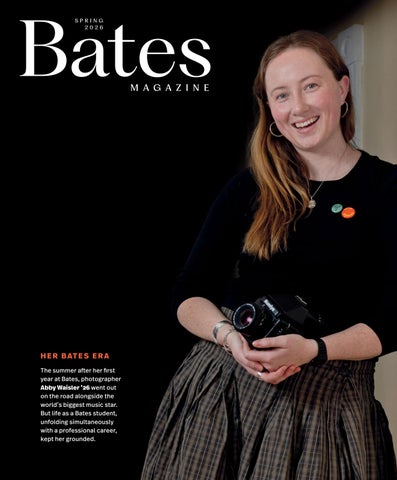
Bates SPRING 2026
M A G A Z I N E
H E R B AT E S E R A The summer after her first year at Bates, photographer Abby Waisler ’26 went out on the road alongside the world’s biggest music star. But life as a Bates student, unfolding simultaneously with a professional career, kept her grounded. S P R I N G
2 0 2 6
3
In Brief
Welcome to a reimagined Bates Magazine Bates College is always evolving. Flipping through previous Bates Magazine covers is like time-traveling, showing how the magazine has reflected those changes since its inception in 1921, when it was called The Bates Alumnus. The name has changed a few times since. What hasn’t changed is the spirit and mission of the college that the editorial team aims to capture. Our stories about Bates students, alumni, staff, and faculty demonstrate our longstanding commitment to sharing the emancipating potential of the liberal arts — and to helping you remain connected with this community both on and off campus. As alumni, you lived and learned and loved in this place when you were young adults, and whether that was five decades or five years ago, we believe you are still of it and it is of you. The Bates you attended was a place of promise and possibility and it remains so, no matter what the magazine looks like. But as we debut Bates Magazine’s first new look since 2012, designed by Lilly Pereira (aldeia.design), it’s fun to compare past and present. Above: Covers from 1921 and 1946. Left, top to bottom: 1958, 1975, 1980, and 2012.
4
B A T E S
M A G A Z I N E
On the cover: Abby Waisler ’26. (Photo by Phyllis Graber Jensen)
Contents SPRING 2026
DEPARTMENTS
03 In Brief
Campus news & highlights
17 Athletics Digest
Bobcats in and on the court, course, field, and pool
23 Built by Bates Alumni features
35 Bookshelf
Publications by Bates writers
62 Class Notes
Updates from alumni
94 From the Archives 50 years of softball
F E AT U R E S
38
44
50
56
Excitement is building for the much-needed Stoddard Fitness and Well-Being Center, coming soon to the heart of campus.
Men’s basketball seniors David Omasombo and Chiwer Mayen redefine hard work while giving back to Lewiston, the city that shaped them.
Talk about the alchemy: Abby Waisler ’26 majored in environmental studies while becoming a soughtafter concert photographer.
The longtime French and Francophone studies professor shares what he learned from guest starring in student theater productions.
Building Wellness
Standing Tall
Her Bates Era
ABOVE: Board of Trustees Chair Greg Ehret ’91, P’23 and Vice Chair Jean P. Wilson ’81, P’05, P’13 join President Garry W. Jenkins, Jocelyn Stoddard Brayshaw ’88, P’25 and Jon W. Brayshaw ’90, P’25 in breaking ground on the Stoddard Fitness and Well-Being Center. (Photo by Rene Roy.) S P R I N G
2 0 2 6
Kirk Read Has Notes
Find us on:
1
Bates
President’s Note
SPRING 2026
G A R R Y
E X E C U T I V E E D I TO R Mary Pols M A N AG I N G E D I TO R Meredith McCarroll STA F F W R I T E R Alexandra DeMarco C L A S S N OT E S E D I TO R Doug Hubley D I R E CTO R O F P H OTO G R A P H Y Phyllis Graber Jensen DESIGNER Lilly Pereira aldeia.design C R E AT I V E CO N S U LTA N TS Kirsten Marjerison Tammy Caron
PRESIDENT Garry W. Jenkins VICE PRESIDENT FOR COMMUNICATIONS AND MARKETING Kristen A. Lainsbury PRINTER Penmor Lithographers Lewiston, Maine
CONTACT US Bates Communications and Marketing 2 Andrews Road Lane Hall Lewiston, Maine 04240 207-786-6330 communications@ bates.edu
bates.edu
2
B A T E S
W .
J E N K I N S
Renewal W ELCO ME to the first issue of the new Bates Magazine. It feels appropriate to launch this reimagined publication with the spring issue — in the season of renewal. Alumni magazines strengthen the bond between a college and its graduates, and Bates alumni have long cherished theirs. We know the magazine matters deeply to our community. And we hope you love this new version as much as we do. We learned a lot when we asked you for your input last August, and your feedback helped us shape what you hold in your hands now. You told us that you consider the magazine invaluable and read it cover to cover. For many of you, it serves as your primary link to what’s happening on campus. But there were opportunities for improvement as well, including the physical shape of the magazine (“awkward and impossible to hold”) and the reading experience (“Please, a larger font size”). We heard you. The magazine is now wider, with a more spacious layout, to make it a more comfortable read. Everything feels less cramped — including the font size. You told us you wanted more stories about Bates alumni and what they are doing out in the world. Our editorial team has expanded the content to include regular features that speak to the sense of purpose that the college instills in its graduates (see “On a Purposeful Path” on page 28, featuring Jack Sapoch ’18 and an interview with science writer Laura Poppick ’10 about her acclaimed book Strata on page 32). They’ve also established multiple new features, including one called “Bates Makes,” which explores Bates graduates’ talent for making beautiful and/or delicious things (see page 24, featuring Beth George ’85). You know your classmates (and what amazing things they’re up to) better than anyone, though, so please reach out to the editorial team to share your story tips (magazine@bates.edu) for future issues. Our alumni, Bates families, and community members are always giving back to the college, and you’ll see stories about those gifts and their impact tagged as “Advancing Bates.” Sometimes these gifts
M A G A Z I N E
are not only appreciated but wholly unexpected — including the first edition of one of the best known books of all time that we received from a member of the dining staff (page 7). You also told us that you wanted to hear more about faculty, from their research to their teaching. Look for Professor of French and Francophone Studies Kirk Read’s first-person essay on page 56 on what he has gained from being a recurring guest star in Bates student theater productions over the last decade. Kirk has been at Bates for almost 36 years, but his perspective on the college and its people is continually renewed by these experiences. Renewal is a broader theme on campus this year. We don’t lack for athletic talent at Bates — you can read more about that in our Athletics Digest on page 17 — or student interest in overall well-being. But quite honestly, we haven’t had the facility to match their needs. That’s about to change. On May 1, we broke ground on the Stoddard Fitness and Well-Being Center, a new building to serve the whole campus, from our talented student athletes to students who want more space to work on their personal fitness. Nestled between Alumni Gym and the Gray Cage, this new facility will be a bridge from our history to the future. At the same time as we are adding 8,500 square feet of fitness space, we are also renewing Alumni Gym (while maintaining its magic) and the Gray Cage. Slated to open in late 2027, this will be our first new athletics facility in more than 30 years, and I’m so excited about it. You can learn more about this project and some of the many Bates alumni and friends whose philanthropy makes it possible, including Jon Brayshaw ’90, P’25 and Jocelyn Stoddard Brayshaw ’88, P’25 as well as David MacNaughton ’73 and John Amols ’72, on page 38. I look forward to seeing many of you at Reunion (June 12-14) and hearing what you’ve been up to — and what you think about our renewed Bates Magazine.
I L L U ST R AT I O N : K AT H RY N R AT H K E I P H OTO ( R I G H T ) : P H Y L L I S G R A B E R J E N S E N
MAGAZINE
In Brief CA M P U S N E W S & H I G H L I G H TS
S P R I N G
2 0 2 6
3
In Brief
Wild Swimming How the record-breaking swimmer Max Cory ’26 fuels his sport in natural waters B Y
M A R Y
P O L S
Max Cory ’26, a biochemistry major from Dublin, Calif., put in thousands of laps in Tarbell Pool on his way to becoming the most decorated men’s sport athlete in Bates history. The team’s co-captain, Cory has been named an All-American 15 times in his Bates career, and won two national championships. In 2025, he set a new Division III record with his first-place finish in the 100-yard freestyle and in March was the anchor in the winning 400-yard medley relay team that shattered another national record. It’s a good thing he loves the place. “Tarbell is really sweet,” Cory says. “It’s got the best pool chemistry in the NESCAC. And we’ve got super nice locker rooms.” Cory admits he doesn’t love the “yardage and hours and hours of work” involved in long workouts. “That’s why I’m a sprinter.” Wild swimming, or swimming in natural bodies of water, is a whole other mindset for the All-American. (The term is barely older than Cory, having gained prominence after the 1999 publication of Roger Deakins’ Waterlog: A Swimmer’s Journey Through Britain.) “I love open water swimming,” Cory says. Range Pond, only about 10 miles from campus, is a favorite spot for pure fun. “There’s a video of me from Range Pond,” he says, smiling. “Bobby [teammate Robert Amundson ’26 of Dublin, N.H.] was sitting in the canoe and we put a rope on my waist and I was pulling him in the canoe.” On Northern California’s rugged coastline, where the water temperatures stay cold year round (“it’s not super nice”), it’s more about playing with his two
4
B A T E S
M A G A Z I N E
labradoodles in the waves. For Cory, the real wild swims take place in the warmer water of his home state’s inland lakes. His mom paddleboards with one dog, while the other one is swimming with Cory, “just going wild and having fun with me.” The water temperatures in Casco Bay in October are roughly comparable to the chilly Pacific, but Cory nonetheless gamely accepted an invitation to go swimming with Bates Magazine last fall. The water was bracing, so no one stayed in long, and his teammates, Amundson and Nate Pierce ’26 from Fairfield, Maine, cheered him on from the rocky shore. But witnessing a national champion move through ocean water is akin to the marvel of seeing a porpoise soaring in and out of a boat’s wake. The churning chop gives way to arms that seem to move without effort and at a speed that seems almost impossible. There’s no perspective quite like that to understand what it means to be a national champion. On a recent episode of The Bates Bobcast, Associate Athletic Communications Director Aaron Morse asked Cory if he plans to pursue Olympic trials, post graduation. “I think it’s time for me to hang up the goggles,” Cory told him. “These have been the best four years of my life, but life is now approaching.” It’s time for a job, and professional success, he said. But may there always be wild swimming. ●
5
P H OTO : P H Y L L I S G R A B E R J E N S E N
In Brief
Bates BONDing Sometimes ideas bloom over a shared candy jar. Last summer, Leana Amáez, vice president for equity and inclusion, took a break from a project her team was developing to build opportunities for campus dialogue and visited the candy jar outside of the registrar’s office in Lane Hall. There, she ran into Professor of Politics and legal expert Stephen Engel. “I was once a lawyer, so I enjoy peppering Professor Engel with questions about what he’s teaching and what he’s reading at the moment.” Engel’s answer that day was Jamal Greene’s How Rights Went Wrong. As they talked, Amáez realized that Greene would be a perfect inaugural speaker for this new program: the Bates Open Network on Dialogue (BOND). The program is built around a key component of the Bates mission: embracing differences to cultivate “intellectual discovery and informed civic action.” “Developing the habits of engaged inquiry and effective communication are hallmarks of a liberal arts education — and we are deeply committed to cultivating those skills at Bates,” said President Garry W. Jenkins. “In complex and polarizing times, it is more essential than ever that we, as a community, practice civil discourse and productive dialogue, particularly on topics we might find difficult.” BOND events have two parts. A guest delivers a talk and takes questions, and then the community gathers for a dialogue about the guest’s ideas, led by Nate Menifield, Bates’ equity and inclusion program manager. The goals are active listening, learning together, and dialogue, which Menifield notes is “not equal to debate.”
In the inaugural BOND presentation, Greene, the Dwight Professor of Law at Columbia Law School, cut right to the heart of the dilemma of civil discourse around differences, focusing on the state of freedom of expression on college campuses and the dual role colleges often play, protecting free speech while prohibiting harassment and hate speech. “Living in a pluralistic society means being surrounded by people holding views that one disagrees with,” Greene told a full house in Chase Hall. Sometimes those views can be expressed in a “disagreeable way,” he noted, but regardless, “democratic politics require engagement.” In April, BOND welcomed to campus Shankar Vedantam, the host and creator of the Hidden Brain podcast, and a 2023 Bates honorary degree recipient, for a talk about navigating dialogue across differences. “We are creating an open conversation that brings together staff, faculty, and students to discuss ideas, and it’s interspersed with skill building,” Amáez said. “We begin by framing the conversation and centering curiosity, starting from a place of asking questions and trying to understand where other people are coming from. It’s been striking to see the student response. We’re really able to get somewhere as a community.” “Leana and Nate have built something that is both grounded in the Bates mission and responsive to the needs of the current moment,” Jenkins said. “I’m excited to see this project continue to develop and evolve.” ● — Meredith McCarroll
Common Ground
“Many people will tell you, 30 years down the road, that one of their best friends in life is their roommate from freshman dorm. … Why is that? … Some algorithm decided to put together two other people and you become friends? There’s a lot of data showing that even in a college dorm, proximity predicts how close you are going to be with that person. … Very often our choices, our friendships, our connections with other people are about how much time we are spending with this person. … The more time that you’re spending with people that’s pleasant, the more you’re likely to feel like you have things in common with that person.”
P H OTO : T H E O P H I L S YS LO
During his campus visit April 2, Hidden Brain podcaster Shankar Vedantam talked about the bonds between college roommates.
A D V A N C I N G B AT E S
P H OTO : P H Y L L I S G R A B E R J E N S E N
A Gift from a Chef Last summer, Michael Staffenski, associate director of culinary and retail operations and executive chef at Commons, swung by Ladd Library with a question for Patricia Schoknecht, vice president for Information and Library Services: Did the library ever accept donations? He had a book he was interested in giving to Bates. Schoknecht said she’d take a look. The next time he came by, he had a Ziploc bag containing a copy of a 1947 Dutch book called Het Achterhuis (translation: The Secret Annex). The author was Anne Frank, and it was a first edition, one of only 3,036, printed in Amsterdam, of a book the world came to know as The Diary of Anne Frank. Schoknecht gladly accepted it, and Staffenski’s gift lives now in the Muskie Archives and Special Collections Library, where it will be available to any faculty member who wants to incorporate it into curriculum or research. How did a chef at Bates come to have it? More than 20 years ago, Staffenski’s former mother-in-law spotted the volume at Luce’s Bargain Shop in Washington, Maine, assumed it was in German, and bought it for Staffenski, a native German speaker who had moved to the United States when he was 10. (His father, who worked on weaving machines, had landed a job in New Hampshire at a factory that made labels for companies like L.L.Bean.) Staffenski told her, “I can’t read this. It’s Dutch.” But they recognized what it was, and that it might have some value. Staffenski put it in a safe, where it sat “essentially forgotten” for about 20 years. Last year he and his wife discussed what to do with it. Selling it felt wrong. “It’s not something that somebody should profit from,” he said. But the story told by Frank, of how the teen and her family hid from the Nazis for more than two years, is vital to remember, Staffenski said, especially now. “I see that history being repeated right now with what’s happening
S P R I N G
2 0 2 6
in this country,” Staffenski said. “I see it. It’s just a different group of people that are being targeted. And who’s next?” The book had come to him because of his German heritage and it left his possession for the same reason. “I grew up with my grandparents’ stories of the war and I know what they went through.” His grandmother, as a young girl in the city of Wuppertal, did grocery shopping for a Jewish woman who was hiding in an apartment off a tunnel in the same building where Staffenski’s great-grandparents lived. Her job was to “leave a bag and keep walking.” “The important thing to me is that, one, the book is going to be used for something,” Staffenski said. “And the second thing is that people remember.” He opened his computer. “Let me show you a picture,” he said, pulling up an image of a young man with old eyes, in a German uniform. “That’s my grandfather,” Staffenski said. “He was drafted into the Wehrmacht. He was put on a machine gun and he went all the way to Stalingrad.” As a child, Staffenski knew his maternal grandfather as a loving, caring but
tough man, who never spoke of World War II. It’s only recently that he found his grandfather’s documents, including his Wehrpass, a military pass and service record for Hitler’s conscripts, and came to understand what happened to his grandfather because he followed orders. “I don’t necessarily want to say that I’m doing this out of guilt,” Staffenski said. “That’s not why. Because I know my family and I know what happened during the war. I’m doing this because I know what my family went through and I don’t want to see others go through it again.” Schoknecht said the book is a welcome addition to Ladd’s resources for faculty and students in history, politics, religion, English, and the languages. “I really loved that we were able to get this into our collection,” she said. “And the fact that this donation came from Mike just shows how everyone at Bates makes contributions to our students and the academic program. And, sometimes, in ways no one would expect,” she said. ● — Mary Pols
7
In Brief
B E F O R E B AT E S
Tonya Bailey leads the Student Center for Belonging and Community but before she could help others show up authentically, she had to find her own way. And it all started with hair. B Y
M E R E D I T H
M C C A R R O L L
As a little girl growing up in Lewiston, Tonya Bailey didn’t want to fit in. “I didn’t mind being outside of the lines or outside of the box,” she recalls. She knew who she was. She loved fashion. She had a clear sense of how she wanted to appear. The challenge was her hair. She simply did not know how to style it. Biracial and raised by their white mother and stepfather, Bailey and her sister relied on magazines like Ebony and Jet to help them find models of Black beauty. In most media, and at school, they saw trends like feathered bangs and crimped hair, which did not appeal and did not work on their hair. Bailey was 12 when she connected with Cindy Storer, local hairdresser and mother to biracial children, and began learning how to show up as herself. “I wasn’t struggling with my identity. I was struggling to look like I felt. I just couldn’t emulate what I felt inside.” Seeing Bailey on campus today, in her current role as associate dean and director of the Student Center for Belonging and Community (SCBC), she epitomizes belonging — comfortable and spreading comfort to others. She moves with ease and grace through the SCBC, checking in on a student, popping into a colleague’s office. But there was a time that she could not make her appearance match what she imagined was possible. With Storer’s help, Bailey and her sister learned how to style their hair. This is when she first understood that her hair wasn’t just about her hair.
8
B A T E S
M A G A Z I N E
“There just wasn’t cultural congruency. We just knew that we were in something that didn’t feel like us,” Bailey says. “So that’s why I think once I figured it out, it was like, oh, not only do I feel beautiful, I feel like the version of myself that has been trying to come out for so long.” Bailey wanted to help others feel this same way, so she went to cosmetology school and then spent years standing behind the chair in Storer’s hair salon where she had sat as a 12-year-old. She became an expert in all the things that had once mystified her about hair, and, along the way, she built a family and became a crucial part of the community. But just as it was about more than hair for her, the role of hairdresser was never just a relationship around hair. When a client would sit in her chair, she would say, “Tell me how you want to look. Don’t just show me a picture of somebody else. I want you to show me a picture of you when you felt like you the most, and then how can we create something around that?” At the heart of the work was Bailey’s remembered sense of not belonging. Looking into the mirror with a client, asking questions about who they are and how they want to be seen, Bailey — like many hairdressers — built longstanding relationships with those sitting in front of her. “I think there’s a reason that people stay with their hairdressers for as long as they do. One is, yeah, they like the end product, but
it’s the relationship that they build.” She realized that she was essentially acting as a therapist for her clients. An injury outside of work severed a tendon in her dominant hand. This ended one chapter of her career helping people understand how to show up in their best ways, but launched another. Bailey enrolled in the human services degree program at Central Maine Community College, and there she began to gain clarity about which career paths appealed to her. And which did not. As a student in a course on abnormal psychology, she recalls thinking, “This is actually telling people what’s wrong with them. And that’s the exact opposite of what I want to do.” Worried, she went to the director of the program and shared her concerns. He guided her toward becoming a clinical social worker so that she could work one-on-one with clients toward their own growth. She followed that path, earning her master’s degree in social work while working full time at National Alliance on Mental Illness. The day of her graduation, an acquaintance suggested that she come work at Bates. Growing up in Lewiston, Bailey felt like Bates was “over there.” Even though she had posed for pictures on the campus and she knew people connected to Bates, it felt to Bailey that “this place was for someone else.” That feeling of not fitting is precisely what Bailey sought to dissipate, and so she visited Bates. If she could show up as her full self in a place where she didn’t imagine belonging, perhaps she could help others feel the same way. She joined the counseling center in 2019 and, as the only counselor of color, was overwhelmed with clients. “All I could think about was all the students that kept saying, ‘I can’t get an appointment with you.’ And I could see it. I could see they were in an environment that they were uncomfortable in. And all of the ways that I remembered feeling outside of myself, I was watching that happen in real time with students here.”
P H OTO : P H Y L L I S G R A B E R J E N S E N
Looking Back
This showed her she was a perfect fit. She knew just what to do. But she wanted to have a broader impact. So she talked about the need that she saw, and colleagues listened. After three years in Counseling and Psychological Services, she transitioned into her role as associate dean and director of the Student Center for Belonging and Community. As Bailey sees it, her early work as a hairdresser led her directly to this place. “I went into clinical social work because I didn’t want to lead with diagnosis. And so that just means that we are able to be client-centered as a discipline. I’m student-centered here.” For Bailey, the similarities are more striking than the differences in these roles. Whether sitting and talking with a student in the kitchen in the center or meeting with administrators about future student programming, Bailey remains connected to that little girl she was. “Not knowing how to feel beautiful without trying to look like somebody that’s not you — it was like wearing a mask.” She doesn’t want Bates students to feel anything but themselves, but she understands that requires effort on the part of the whole community. And she understands her own role in that dynamic. There’s still a fair bit of hairdresser left in her. Bailey still offers to help teach families — mostly through YouTube tutorials — to style their kids’ hair, she maintains a few individual therapy clients, and she hosts pop-up barbershops in the SCBC. In each of these capacities, she works to see those who don’t feel seen and then to help them gain confidence and a sense of authentic belonging. “I don’t care how many people around you love you and accept you for who you are,” she says. “If you don’t feel like yourself, it’s hard for you to love and give yourself that same compassion that you maybe could give other people.” ●
S P R I N G
2 0 2 6
9
In Brief
<< Parker Huynh Benningfield ’26 (left) with Panasonic Impulse player Jaboreè Williams after his team won the Rice Bowl in the Tokyo Dome. (Courtesy of Parker Huynh Benningfield ’26)
Movie Maker Parker Huynh Benningfield ’26 turns his camera on Japan’s Rice Bowl When Parker Huynh Benningfield ’26 of Leander, Texas, boarded a plane to Tokyo in December 2025, he wasn’t planning on filming a feature-length film during his family’s two-week vacation. But by the time he landed, making a documentary about an American football league in Japan was all he could think about. Benningfield, an economics major, needed something to focus on. His collegiate football career had ended a month earlier. “It was a pretty difficult time because I didn’t know what was next,” Benningfield said. “I grew up playing football.” As his parents were planning the trip, Benningfield realized that their travel dates overlapped with the Rice Bowl: the championship game for Japan’s professional American football league, the X League. An avid photographer, Benningfield planned to shoot still photos at the Rice Bowl, but the idea for a film began percolating mid-flight — and led to Gridiron Gyudon, a 41-minute documentary. In Tokyo, Benningfield hit the ground running, picking up equipment and reaching out to players to schedule interviews. “I know enough Japanese
1 0
B A T E S
M A G A Z I N E
to order food or find a bathroom or get anywhere,” he said. He captured hours of footage and then, back at Bates, began editing — on top of researching and writing his senior economics thesis. Gridiron Gyudon introduces viewers to six Americans playing in Japan’s X League and captures the Panasonic Impulse’s 9–7 win over the Obic Seagulls in the Rice Bowl. He credits his parents, Carina and Don Benningfield, as producers, along with friends including Maverick Selementi ’26 and Julian Grant ’28. Bates athletics fans will recognize the voice of Aaron Morse, associate athletic communications director, doing play-by-play narration. Benningfield premiered the film on campus in February. “We had a bunch of admin,
the entire athletic communications department came out, a bunch of my friends came out. It was surreal.” The film is the culmination of everything Benningfield has learned about photography, videography, and graphic design over the past decade. In high school, he began shooting photos and making YouTube videos, then creating Instagram graphics for his peers as they committed to colleges. That led to designing graphics for Bates Athletics, then video and photo projects. At games, Benningfield works to showcase every athlete. “I feel like everyone should get one photo from the season they play,” Benningfield said. Learning about the importance of representation in film through his minor in rhetoric, film, and screen studies made
me “really think about how I went about all the projects I did, whether it be a game for Bates, taking photos for my friends, or working on this project,” Benningfield said. Gridiron Gyudon, a significant contribution to the limited repertoire of English-language media about the X League, has racked up praise and thousands of views across Instagram and YouTube. The players told Benningfield they look forward to showing it to their children one day. “I’m glad I was able to do something meaningful to those guys,” Benningfield said. Throughout production, Benningfield realized that as much as Gridiron Gyudon was about the X League and the Rice Bowl, it was also about him processing the end of his time as an athlete at Bates. In the film, the players discuss the idea of “making it” in football — what that actually means, how the definition changes over time, and, for several of the players, how that interacts with their faith practices. For Benningfield, the definition is still changing. “Maybe you don’t have to keep playing,” Benningfield said. “You can find other ways to stay connected to the game, but also serving others — serving a bigger picture, a bigger path.” ● — Alexandra DeMarco
P H OTO : P H Y L L I S G R A B E R J E N S E N
CIRCUMSCRIPTION* Listening to Associate Professor of Psychology Michael Sargent’s podcast, Circumscription, is like eavesdropping on two very smart people in a highly engaging dinner party conversation, but without the knives, forks, or ambient noise. The podcast, which will turn one this July, allows Sargent to explore any number of subjects, many of which intersect with his lifelong interest in politics. “As a kid, I would watch This Week with David Brinkley when I didn’t go to church on Sundays,” Sargent says. “And in my professional work, a lot of my teaching and my scholarship engages with politics. So it’s a through line in my life of the mind.” This is Sargent’s second foray into podcasting. His first, Tatter, ran from 2017 to 2021 and focused on politics and policy. Circumscription narrows that scope to the act of setting, maintaining, stretching, and crossing boundaries in three specific areas: collective identity, religion, and constitutional law. It’s topical, touching on issues such as birthright citizenship, academic freedom, and the rise of Christian nationalism, but not driven by headline news. “Sometimes what I do may happen to be relevant to the news cycle, but I can’t keep up with the news cycle,” Sargent says. His first guest was former student Mikey Pasek ’12, now an assistant professor of psychology at the University of Illinois Chicago, for an episode called “God, Grace, and Grudges.” A colleague from Bates, Associate Professor of Philosophy Paul Schofield, joined him for a recent episode on homelessness titled “Rough.” “It really is an opportunity for me to follow my curiosity,” Sargent says. “And I do have faith that there are other people who are curious about the same sorts of things that I am.” For this longtime faculty member (he’s been at Bates 27 years) there’s an educational bonus: “Sometimes I learn things that I bring back into my face-to-face engagement with members of the Bates community, especially students.” That’s what happened when he interviewed the sociologist Samuel Perry, who teaches at the University of Oklahoma and has written extensively on Christian nationalism and its impact on American politics. The two men went deep on faith, with Sargent reflecting on his lingering affection for rituals and rhythms of the church he left behind long ago. “He and I had one of the most fun conversations I’ve ever had with someone whom I’ve not met before,” Sargent says. And enlightening: it prompted him to add some of Perry’s work to the syllabus for his 300-level course, “Racism: A Multilevel Approach.” “I never want to lose sight of the fact that I am a professor first and a podcaster second, or third, or fourth. But when there are places where the podcasting can actually energize my teaching and my research, I want to capitalize on that.” ● — Mary Pols *A podcast that explores questions about collective identity, religion, and constitutional law.
S P R I N G
2 0 2 6
Lighting the Past
Eileen Dockery ’26 lived in Vietnam until she was 7, when her family moved to the United States (she’s from Rye, N.Y.). The language she had as a child is gone now, but she has memories, including the presence of lanterns, hanging above her seemingly all the time in Saigon. “Every holiday ever, they have lanterns everywhere,” she said at the reception for her weeklong show in May at the Immersive Media Studio in Coram Library. And everywhere above her, there were lanterns of her own creation, hanging from the ceiling, covered with the cyanotypes she’d made for an independent study in her last semester. (Dockery, who majored in environmental studies, is bound for Bulgaria on a Fulbright English teaching grant, one of 16 Bates students and alumni to receive Fulbright student awards for 2026–27.) Videos of noisy city scenes in Vietnam, made by her mother on a recent trip, flashed on the walls and echoed in the air as friends and faculty explored the dreamlike installation. The cyanotypes depict Dockery’s memories of Vietnam. Her father died two years ago, inspiring her to try to capture that era.“I felt I needed to collect evidence and put it all down on paper to confirm he actually existed,” Dockery wrote in her artist’s statement. She knows drawings from memory are unreliable, “but they communicate subjective experience the way photos cannot.” She layered her drawings on top of photographs of those real places, marrying her memories to reality, and teasing them together into blue art with the help of the sun. — Mary Pols
1 1
In Brief
RETROSPECTIVE
Sure Shot B Y
M A R Y
P O L S
Reunion weekend in June typically coincides with the opening of a new exhibition at the Bates College Museum of Art. And over the years, alumni mingling among the artwork have likely spotted a familiar figure, the college’s Director of Photography and Video Phyllis Graber Jensen, with at least one camera slung over her shoulder, another in hand, chronicling the event and capturing the fun. This year, on June 12, Graber Jensen will be the honored guest at the opening of the museum’s exhibition Phyllis Graber Jensen: Picture Stories, which will be up through Sept. 19. Museum Director Carrie Cushman has curated a retrospective of Graber Jensen at work, with 91 objects, including 51 newly printed and archival photographs, and ephemera such as contact sheets, cameras, and newspapers that “explore the full life of a photograph and the nuances of visual storytelling in the hands of our very own Phyllis Graber Jensen,” Cushman writes in her introduction to the book accompanying Picture Stories.
1 2
B A T E S
M A G A Z I N E
Above: After their 2004 marriage in Gomes Chapel, Sonali Arseculeratne Reese ’93 and James Reese, who has worked at Bates since 1977, enter the Gray Cage for their reception.
Right: Conductor Leonard Bernstein rehearses at Tanglewood in 1988, before a series of concerts celebrating his 70th birthday. Both images are part of the Bates College Museum of Art’s exhibition Phyllis Graber Jensen: Picture Stories, which opens June 12, 2026.
Graber Jensen credits former Vice President of Communications and Public Affairs Sean Findlen ’99, who was her supervisor until 2022, with planting the seed for the exhibition. “At one point, before he left, he said ‘I’d love to see you have an exhibit at the museum,’” Graber Jensen remembers. Findlen remembers that he might have even said it would be a “crime” if such an exhibition didn’t happen. “Phyllis’ work reflects the soul of the college and its many facets, contours, and angles,” Findlen said. “She has an eye that sees the heart of any situation and the skill that brings it to life in a picture. She’s simply the best of the best.” Former Museum Director Dan Mills was intrigued by the idea and connected Graber Jensen to Assistant Curator Samantha Sigmon. Sigmon and Graber Jensen had roughly agreed on a date shortly before Mills retired and Cushman joined Bates. Picture Stories is the first exhibition Cushman has curated for the college. The exhibition spans Graber Jensen’s earliest forays into the medium, including her documentation of the women’s liberation movement in Denmark in 1975 when she was a Cornell undergraduate studying abroad, her time in graduate school for journalism at Boston University, and then as a stringer for the Associated Press. About 15 images in the exhibit come from Graber Jensen’s eight years as a staff photographer at the Boston Herald. She joined Bates in 1995 as a staff writer — another great storytelling skill of hers — but by 2002 was working as a photographer and multimedia producer, just as the social media age was taking off. In the years since, Graber Jensen, more than any other person, has been responsible for creating, nurturing, and stewarding the college’s visual identity, a role she honors with a dedication that extends well beyond an eight-hour workday. On campus, she is too recognizable — and beloved by students — to truly melt into the background the way she might like, but her methods are purely journalistic and her energy
S P R I N G
2 0 2 6
unmatched by anything but the care she brings to an assignment. For Cushman, a scholar who has specialized in Japanese art and worked extensively in photography, it’s evident that Graber Jensen came to her profession with an intuitive approach to putting subjects at ease. Looking back to those images Graber Jensen made as a college student in 1975, many on communes in Denmark, Cushman was struck by how comfortable her subjects seemed “even while mowing the lawn naked!” she writes. “Phyllis says that she tries to bring a ‘quiet assurance’ to her camera work. This — in combination with practicing empathy for those that she
photographs — results in images that feel genuinely of their moment.” At Bates, that has been true of Graber Jensen in every working day, whether she is covering the joy of a thesis binding, the excitement of an athletic event, or the quiet moments of friendship and community that make this campus special. Graber Jensen plans to retire this summer. Her legacy includes the thousands (literally) of images she’s made for the college and the remarkable standard she has set within Communications and Marketing for collaboration, creativity, unwavering commitment, boundless integrity, and above all, kindness. ●
1 3
In Brief
Snow Lie
1 4
B A T E S
M A G A Z I N E
Hauling Data from the Deep Assistant Professor of Economics Amanda Lindsay wants to solve the biggest mysteries of New England’s most iconic fishery. Not the landings or the price at the wharf, but the true socioeconomic conditions of lobstering. She wants to know how lobstermen adapt to changes in the fishery, from juggling the mortgage on the boat, to navigating regulations, to making ends meet at home. Teaming with another Bates professor, sociologist Michael Rocque, and Caitlin Cleaver, assistant professor of environmental studies at Colby College, Lindsay created and launched a comprehensive socioeconomic survey for the fishery in Maine, New Hampshire, and Massachusetts, mailing surveys to almost 5,000 commercial lobstermen this spring. It asks questions that marine resource departments, which set limits on territory and methods, don’t typically delve into. Lindsay wants to get granular: “If your radar was broken, would you pay to fix it with cash?” she wonders. “Would you take out a loan, go without, fish harder to pay for it?” “We see a need for a rigorous quantitative data set tracking the well-being of fishermen,” Lindsay says. “They are facing unprecedented pressures due to market changes, endangered species, development along the coast, and changing environmental conditions.” Gaining participation requires persuasion, persistence, and knowing what questions to ask.
To that end, Lindsay attended over a dozen zone council meetings in two years, learning what is on the mind of lobstermen and recruiting survey testers. She’s even hauled traps, gaining insights and perspective. “My brain was fried for like two days,” Lindsay says. “It was the most physically and mentally exhausting thing. And I wasn’t even making decisions about the computer or steering the boat.” The survey will probe socioeconomic indicators regarding lobstermen’s experience fishing and with fisheries management and aquaculture. “And the successes and challenges they experience in regard to their lobstering business, and their households’ economic well-being more generally,” Lindsay says. Lindsay, Cleaver, and Rocque plan to repeat this survey at least twice, but hope to continue beyond that. Student researchers at Bates and Colby will help process and disseminate the information. “We want to get the results into the hands of community leaders, organizations that represent and advocate for lobstermen, and lobstermen themselves,” Lindsay says. “All of whom can use this information to engage in management decisions. We believe in community management and we believe in the power of data.” ● — Mary Pols
P H OTOS : ( L E F T ) S A M M Y W E I D E N T H A L ’27, ( TO P ) P H Y L L I S G R A B E R J E N S E N
Leave it to students to get creative in what was a very long winter. Jay Gulati ’26 of Eden Prairie, Minn., prepares to hit it out of a snow “bunker” while playing Quad golf with friends Marcos Ruiz ’27, Hayden Bernhard ’26, and Eric Facey ’27 on a rare warm March afternoon. On campus, as across New England, this past winter’s cold was locked in. In Lewiston, the temperature rose above freezing just three times between Jan. 16 and Feb. 9. The Historic Quad has long been a friendly spot for golf, “enough room to go around like an actual golf course but convenient enough where we can play the trees as holes,” said Facey, whose foursome used tennis balls for safety’s sake and to avoid shattering windows, especially the famed stainedglass windows of Gomes Chapel. “We got to see grass for the first time in months,” said Ruiz. But winter was hardly over; a March 22 storm dumped another 5 inches in Lewiston. — Jay Burns
A D V A N C I N G B AT E S
P H OTO : CO U RT E S Y O F S H E L L B U R N E T H U R B E R A N D T H E BAT E S C O L L E G E M U S E UM O F A RT
Night at the Museum During the first-ever Bates Curates event in March, faculty, staff, and students, and President Garry W. Jenkins, became “curators” as they gathered to select a new addition to the Museum of Art’s permanent collection. Carrie Cushman, director of the Bates Museum of Art, devised the idea for the event, which she hopes will be the first of many. “This program enabled us to start a conversation with the community about what it means to be a collecting institution in the 21st century,” she said. “We were able to educate students, faculty, and staff on the strengths of our own collection and to build communal investment in its future.” Museum staff had narrowed the choices to three photographs from the museum’s recent exhibition, Shellburne Thurber: Full Circle, for potential acquisition (made possible by the Barbara Morris Goodbody Collection Endowment Fund) to the museum’s collection of 8,000-plus objects. But they planned to purchase just one work — and that’s where the Bates community came in. Cushman and Samantha Sigmon, assistant curator at the museum, invited faculty, staff, and students to the museum for an evening to tour the exhibition, then vote on which work they should acquire. “Everyone was visibly excited to take part in voting and hear more about the artist and each of the three works,” Sigmon said. The museum presented cases for each photograph and then asked for help with the decision. “The experience truly enlivened our galleries. I’m thrilled that we could lift the curtain regarding how our collections are built and include our audience in such an integral museum responsibility.”
S P R I N G
2 0 2 6
The acquisition? Thurber’s “Self Portrait Sitting on the Porch in New Hampshire,” featuring the photographer herself on a porch. Outside, harshly lit by a bright sun, the photo is distinctively different from Thurber’s usual compositions of interior spaces. “She is not looking directly at the camera, and we see her in an everyday moment that captures her in a way a more polished portrait might not,” Sigmon said. “To me, it is as if we are right there next to Thurber in mid-discussion.” The photograph complements the museum’s collection of artist self-portraits and contemporary photography, Sigmon said. In addition to being a uniquely democratic selection to the permanent collection, it’s also a rare holding from Thurber, who hadn’t previously exhibited her self-portraits. “It was an honor to display this work and her other portraits at the Bates College Museum of Art,” Sigmon said. “As the curator, I love that we get to keep a photograph that sets us apart from her previous exhibitions elsewhere.” ● — Alexandra DeMarco
“Self Portrait Sitting on the Porch in New Hampshire” by Shellburne Thurber.
DID YO U K N OW? The Bates College Museum of Art has nine endowed funds that are earmarked for art acquisitions.
1 5
In Brief
A D V A N C I N G B AT E S
Memories of Marcelle
On the day he retired this past fall, Tony Drapelick ’80 sat down in his home in Middlebury, Vt., and wrote a check to Bates. This had long been his habit, to send an annual gift to the college. On this particular Friday in November, Drapelick was feeling particularly nostalgic. Exactly 50 years before, he’d visited Bates for a tour and an interview with Admission. And 49 years earlier, after he enrolled, he’d first encountered the kindness of a Bates employee named Marcelle Comeau, who had been the housekeeper in Smith Middle in 1976-77. She had died in 2011, but she had not been forgotten. Drapelick dedicated his $200 gift to her memory. “I had been thinking about Marcelle Comeau for some time,” Drapelick said in an email in February. “And the juxtaposition of those memories and that date and the receipt of a gift prompt from the Advancement office on the 14th all triggered my response.” One of his roommates in Smith Middle, Michael Beaulieu, was naturally exuberant and shared a Franco-American heritage with Comeau, which was the “tinder that fueled the relationship,” Drapelick remembered. Drapelick was more introverted, but when Comeau invited both young men to visit her home on College Street, just down the road, and to meet her husband Julien, and their teenagers, Louise and Robert (Bobby), Drapelick was happy to accept. More invitations followed over the next two years. “There was always a lot of lively conversation and laughter,” Drapelick remembered. “In the years before community service became a touchstone of the Bates experience – of course it existed, but not to the extent of the Harward years and later – Marcelle and Julien’s hospitality reminded two small-town college students that there was a big world out there beyond the campus, and that rubbing elbows with that big world was a legitimate part of our education.”
1 6
B A T E S
M A G A Z I N E
Late last year, Drapelick reconnected with Robert Comeau, who joined Bates’ Facility Services department not long before his mother’s retirement in 1992 and serves as the college’s rental property maintenance manager. “It was wonderful to hear from Bob,” Drapelick said. At Drapelick’s graduation in 1980, Julien Comeau presented him with “a small, rectangular box from Loring, Short & Harmon, an office and stationery supplier downtown. Inside the box was a Parker pen engraved with my name. It was a beautiful surprise and a meaningful gift that I carried with me for years thereafter.” And now Drapelick’s gift to Bates harkens back to the generosity and spirit of the Comeau family. ● — Mary Pols
Marcelle Comeau on the day of her retirement from Bates in 1992.
U N FO R GE TTA BL E
Did someone make your Bates experience particularly memorable? Donate in their name at bates.edu/giving
P H OTOS : ( TO P ) C O U RT E S Y O F R O B E RT COM E AU, ( O P P OS I T E ) STO C K TO N P H OTO
A connection from the 1970s inspires a gift from Tony Drapelick ’80
Athletics Digest B O B CATS I N A N D O N T H E CO U RT, CO U R S E , F I E L D, A N D P O O L
S P R I N G
2 0 2 6
W H AT A Y E A R. For the first time in Bates history, three different teams won NESCAC titles. Here you see the Bates women’s rowing team celebrating their victory on May 10, just as we were going to press. That was the third NESCAC Championship brought home by Bobcat teams this year. To learn about the others, turn to page 20.
1 7
Athletics Digest
Q&A
‘Spirit is Different’ Director of Athletics Stacey Bunting on a life in sports
Director of Athletics Stacey Bunting joined Bates in July 2025 from Princeton University, where she was senior associate director of athletics for external relations. Since Bunting arrived, the field hockey team won its first-ever NESCAC championship, women’s basketball went to the Sweet 16, and men’s basketball returned to the NCAA tourney for the first time since 2015. And the college announced a major new facility, the Stoddard Fitness and Well-Being Center. This could all be coincidence, but it must be said, Bunting is fiercely committed to furthering athletics and recreation at Bates. And she really, really likes winning. In conversation with the Delaware native, we learned about her aspirations for Bates Athletics, what sport she played in middle and high school (basketball), what drove her career choices, and the one thing that gave her pause about leaving the Ivy League for Bates. (It wasn’t winter!)
At the University of Miami you double majored in English and sports management. What drove that decision?
I remember thinking that I didn’t want to just punch a clock. I wanted to be part of creating emotion and bringing people
1 8
B A T E S
M A G A Z I N E
P H OTO : A N D R É E L
First job? Minor league baseball with a Single-A team in Delaware. I started in high school, working the front desk on game days, and then went back during college to work in ticketing and marketing. I have so much respect for people who work in minor league baseball — it’s a lot of work, but it’s a really special environment. I loved it. And I still do. I’ve already been to a Sea Dogs game!
together. Sport does that like almost nothing else, so I started thinking about what that path might look like. Sports management as a major was just starting to be popular, and not many places offered it yet — but Miami did. What are the differences between Bates and Ivy League powerhouse Princeton?
In many ways it’s not that different. The scale and the resources are certainly different, but the philosophy is very similar — it’s student-first. At a lot of schools, the focus is on being the best in either academics or athletics — or sometimes both, but in a very narrow way. At Princeton it was certainly both academics and athletics. But what we can do at Bates is be the best in all things. I tell our student-athletes: I want you to make best friends for life. I want you to have a tremendous academic experience and explore all the opportunities available to you here, whether it’s a cappella, theater, or studying abroad. I want you to leave with an incredible degree. And along the way, why not win some championships too? How much interaction do you have with student-athletes at Bates? With
31 varsity teams, it’s tough to get time with everyone, so I try to stay connected informally — catching up with students on campus, stopping by practices, and being present at games. I also serve as the sport administrator for several programs. We host more than 145 competitions on campus each year, which creates plenty of opportunities to be around our teams, and I’m fortunate to work alongside a great leadership team that supports our coaches and student-athletes every day. But athletics, and recreation, at Bates extend far beyond varsity sports. When you include club sports, intramurals, and everyday fitness facility users, we’re connected to more than 80 percent of the campus community. It really makes us the largest leadership lab on campus, where students are developing as leaders
S P R I N G
2 0 2 6
through real experiences every day, across everything they do. What are your goals for Bates Athletics? Athletics, along with
recreation, can be a powerful part of the student experience and the broader campus community when they’re done well. At the core, my goal is to continue elevating the competitive profile of Athletics in a way that fully supports the mission of the college while expanding our recreation and fitness offerings for all. It’s also important that we’re strong partners across campus and that we help tell the Bates story. Our student-athletes represent the college in so many visible ways, and when Athletics is thriving it creates a sense of pride and engagement that benefits the whole campus and beyond. What can Athletics do for school spirit and pride? I actually think pride
and spirit are two different things. Pride is embodied — it’s the person who wears a Bates tie to a meeting or speaks proudly about the college wherever they go. Spirit is different. You feel it. It’s the energy of a community — when you’re in the stands, or watching from afar and still feel connected to something bigger. Athletics has a unique ability to create that kind of spirit. It brings people together around shared moments and shared experiences, and that energy strengthens the entire community. Like seeing a game in Alumni Gym. It’s second to none, right? Honestly, that kind of spirit is one of the reasons I wanted to work in sports in the first place. You’re committed to community engagement as well, from the Block Party event in October 2025 to National Girls and Women in Sports Day in February. Should we expect more of that? Definitely. We want
Bates to be a place where everyone feels welcome. Athletics has such a unique
opportunity to open the campus up to the broader community. We want to be the place people think of when they’re looking for something positive and fun to do with their families or neighbors. When young people spend time on a college campus, it helps them see that it could be part of their future. That’s a small but really important part of how we can be good neighbors. About that one thing that gave you pause. You have a second identity on campus as a P’29. Which came first, the chicken or the egg? My oldest son,
Brady, was an athlete in high school and met some NESCAC coaches at a camp. The next thing you know, fall of 2024, we were on a visit to Bates College. I’d never been to Maine before. He had a fantastic visit. We had lunch in Commons, met professors and admins. Afterward, he was like, “I think this is the place.” And I said, “You really want to move to Maine? It’s so cold! Are you sure?” But he was impressed by the academics, enjoyed everybody he met, loved the campus and coaches. He was locked in. And then you got a call from a search firm? Maybe four months after his
decision. I’ve always been really big on my kids having their own experiences and going away from home. (Her younger son, Bryce, is finishing his junior year of high school.) I did that as an undergrad, and I wanted the same for them, so my first reaction was, “I can’t mess that up for Brady.” I remember saying to him, mostly just to see what he’d say, “You won’t believe this — I got a call about the Bates AD job.” And he said, “That’s cool.” I said, “You don’t think that’s weird?” And he just said, “No. It’s all good.” Wasn’t fazed at all. So I went through the process, came to campus to interview, and one thing led to another. The universe had a good laugh when we both ended up in Lewiston last August. Everything must happen for a reason, right? ● — Mary Pols
1 9
Athletics Digest
B Y
C H R I S
M C K I B B E N
Field Hockey
In a moment that captures both joy and a sense of team arrival, goalkeeper Ava Donohue ’28 of Cold Spring Harbor, N.Y., is mobbed by teammates following another milestone in a historic run for the No. 4 nationally ranked Bates field hockey team. The Bobcats earned their third straight NCAA tournament appearance last fall, securing a first-round bye for the first time in program history after capturing the program’s first NESCAC championship. Bates blanked Wesleyan, 2-0, in the title game behind a goal from senior captain Brooke Moloney-Kolenberg ’26 of Winchester, Mass., and a dominant defensive effort led by Donohue, who made 11 saves. “I’m so grateful to everyone who supported us from back when we were 4-11 [in 2014] to today,” said Head Coach Dani Kogut. “That village has been here throughout, so we really appreciate it all.” The Bobcats’ rise has been acknowledged with top honors across the board. Kogut and her staff were named NESCAC Coaching Staff of the Year, while captain Haley Dwight ’27 of West Newbury, Mass., became the first player in program history to earn a major conference award, taking Defensive Player of the Year and first team All-NESCAC honors. Dwight led the conference with 10 defensive saves, tied for ninth nationally, and anchored a unit allowing just one goal per game. Building on last year’s breakthrough NCAA quarterfinal appearance, Bates returned to the Elite Eight with a 1-0 second-round win over Amherst, highlighted by a goal from Elsa Copeland ’28 of Toronto, and a program-record-tying ninth shutout. Dwight earned NFHCA First Team AllAmerica honors, while Moloney-Kolenberg was named Third Team All-American, marking the first time in program history two Bobcats received All-America recognition in the same season and underscoring Bates’ continued national rise.
2 0
B A T E S
M A G A Z I N E
P H OTOS : STO C K TO N P H OTO G R A P H Y
Men’s Basketball
S P R I N G
2 0 2 6
The Bates men’s basketball bench erupts in unison — a snapshot of the energy, belief, and momentum that defined a breakthrough season for the Bobcats. Bates returned to the postseason in a big way, securing its first NESCAC Tournament berth since 2021–22 and advancing all the way to the conference semifinals for the first time since 2012. The Bobcats entered as the No. 5 seed and delivered a statement win on the road, knocking off fourth-seeded Amherst, 70–59,
for their first victory at LeFrak Gymnasium since 1991. Babacar Pouye ’27 of Carpinteria, Calif., led the charge throughout the season, earning first team All-NESCAC honors while averaging a team-best 14.5 points and 7.9 rebounds per game. The forward became the program’s first All-NESCAC First Team selection since 2017 and later added All-Region and AllDistrict recognition. Bates’ postseason push came on the heels of a strong regular season that included a 10–1 record at home in Alumni
Gym. The Bobcats showed resilience throughout, responding to adversity with balanced scoring, defensive intensity, and key contributions from both starters and bench. Following the NESCAC run, Bates earned its second ever NCAA Division III tournament bid — the first was in 2014–15 — advancing to the national stage with an 18–9 record. With a mix of veteran leadership and rising talent, the Bobcats reestablished themselves as a contender in the NESCAC and took a significant step forward nationally.
2 1
Athletics Digest WA NT MO RE BOBCAT N E W S?
There’s an app for that. Download Bates Bobcats from the App Store or Google Play. Or get the latest sports stats at gobatesbobcats.com
Amid a roaring crowd and record-breaking performances, Bates men’s swimming reached new heights on the national stage, culminating in Head Coach Peter Casares being named Co-Coach of the Year by the College Swimming and Diving Coaches Association of America, which recognizes outstanding coaching in NCAA Division III. In his 19th season leading the program, Casares guided the Bobcats to a program-best sixth-place finish at the NCAA Championships, highlighted by two national titles and a series of historic breakthroughs. Bates totaled 185 points, placing among the top programs in the country. The 400-yard medley relay team of Tim Johnson ’27 of Brewster, Mass., Marrich Somridhivej ’26 of South Windsor, Conn., Nate Oppenheim ’28 of Easton, Conn., and Max Cory ’26 of Dublin, Calif., captured the national title in record-setting fashion, clocking an NCAA Division III-best 3:08.43 — the first relay championship in program history. Somridhivej added an individual national title in the 100-yard breaststroke, posting a NESCAC-record 51.82, the second-fastest time in Division III history. Casares, who shares the national coaching honor with Denison’s Gregg Parini, has
steadily built Bates into a national contender, pairing elite recruiting with a culture of belief and development. His leadership also earned NESCAC Coaching Staff of the Year recognition. “Finishing in the top 10 at the NCAA Championships is something I promised the team we would do 19 years ago during my first team meeting,” Casares said. “Now, that day is here and I couldn’t be prouder of these men.”
Women’s Basketball
Locked arm-in-arm on the court, the No. 11 nationally ranked Bates women’s basketball team embodies the focus and unity that fueled one of the most decorated seasons in program history. The Bobcats captured their second NESCAC championship and advanced to the NCAA Division III Sweet 16 for the fourth time, finishing with a program-record 26 wins. Along the way, Bates knocked off top competition, including a comeback for the ages against then-No. 6 Smith in the second round of the NCAA tournament. Bates’ dominance was recognized across the conference. Captain Elsa Daulerio ’26 of Harpswell, Maine, became
2 2
B A T E S
M A G A Z I N E
just the third player this century to earn both NESCAC Player of the Year and Defensive Player of the Year honors, while also securing All-America recognition. On Nov. 25, the senior also became the 22nd 1,000-point scorer in program history. Sarah Hughes ’27 of Rumson, N.J., joined her on the AllNESCAC first team after a standout campaign that included multiple NESCAC Player of the Week honors. Head Coach Alison Montgomery and her staff were named NESCAC Coaching Staff of the Year, guiding the Bobcats to a 26-4 record and continuing a steady rise that has produced two conference titles and four NCAA tournament appearances in the past five seasons. From a championship breakthrough over Bowdoin to a deep NCAA run, the Bobcats combined elite defense, balanced scoring, and postseason resilience to cement their place among the nation’s top programs — and set a new standard for Bates women’s basketball.● Chris McKibben is the assistant director for Athletic Communications. He joined Bates College in 2022.
P H OTOS : ( L E F T ) M I C H A E L ST R AU S S , ( TO P ) S A M MY W E I D E N T H A L ’ 27, ( O P P OS I T E ) P H Y L L I S G R A B E R J E N S E N
Men’s Swimming
Built by Bates A LU M N I N E W S
S P R I N G
2 0 2 6
2 3
B A T E S
D
M
M A G A Z I N E
‘ I AM N
OT G
Y
HI
I NG K N
YE ST E R D
MM
LA
ST “JU
AY W E E WER
S
P O L S
Beth George ’85, P’14 loves to make things. To be hands on. To open an oven door and pull out a tray of steaming bagels, made from a sourdough recipe she’s created and refined over decades. Like the pickled jalapeno bagels, entirely housemade and good for the gut, that are flying out the door of her tiny bagel shop in Beacon, N.Y., Bagel-ish. Bagel-ish turns two this month. George had the vision for it almost six years ago, at a point in her career when arguably, she could have rested on her laurels. In September 2020, The New York Times ran a lengthy feature about how the cradle of global bagel baking was, essentially, her home in New Jersey, from which she offered consulting services via BYOB Bagels
2 4
AN
E
M A R Y
H S LE E P
D T O T H E P O I NT O
Beth George ’85 too old to start over? Hardly.
T
Everything Bagels
FM E
B AT E S M A K E S
B Y
G IN
E
UG NO
ET
T
Built by Bates
G
O
D,
?’”
IG
ET H
E R E
I
D
W
P H OTO : P H Y L L I S G R A B E R J E N S E N
HO
D
S P R I N G
2 0 2 6
(Be Your Own Boss). She got a little famous around then. NPR, ABC, and CBS called. So did new customers. “Literally overnight my life changed,” George says. She’s now worked with over 60 BYOB clients in 13 countries including Taiwan and Ethiopia, and 24 states, helping people open (or improve) their own bagel businesses. Since graduating from Bates, in addition to raising three children (including Emma Kane ’14) with her husband, Tim Kane ’82, George has been, variously — and often simultaneously — a lawyer, a baker, and then specifically a spelt bagel maker. When the price of spelt, an ancient, often more digestible wheat, went through the roof, she eased into being an in-house legal advisor for Excalibur Bagel & Bakery Equipment, run by two older men who’d sold George the equipment for her spelt bagel business and become mentors and friends. The bagel consultancy evolved organically from that; the equipment customers had baking questions and she was called in to advise as a consultant. And as BYOB Bagels was really taking off, she started to realize she wasn’t charging what she was worth. “I told Tim — I was 57 then — that by age 60, I wanted to buy my own commercial property and open a store,” George says. The shop would be an anchor for both the consultancy — a place to really demonstrate how it’s done — and her brand. Kane, vice president for advancement at Vassar College, was supportive, but two different business advisors told her she was “too old” to start again. She ignored both and made her deadline. She’s so hands on at Bagel-ish that she’s trying to triage a malfunctioning fridge (“I’m playing detective”) while recounting her journey to a less than 1,000-square-foot bagel shop in a hopping town of 13,000 only an 80-minute train ride from New York City. But that itch that’s driven her throughout her career already has her contemplating a bigger place to bake for future expansions of Bagel-ish. Maybe more storefronts. Because business is booming. “Just yesterday we were slammed to the point of me thinking ‘I am not getting enough sleep and my God, how did I get here?’ And this one guy in line is like, ‘We’re from Washington state.’ I’m like, ‘OK you didn’t fly in from there for this.’” No, but he had taken a train up from Manhattan after seeing a thread on Reddit that declared the best place to get New York City bagels was in Beacon, N.Y. ●
2 5
Built by Bates
Propelled Forward Why Chris Barbin ’93 rowed 1,750 miles. Alone. As a busy father of two, Chris Barbin ’93 thought that his role was to work hard and provide for his family. But he missed some crucial signs of his own son’s struggle with mental health and addiction — a wake-up call that had Barbin reflect on how normalized isolation has become. His son’s journey to and through recovery inspired Barbin to become a leader for the emotional well-being of boys, men, and fathers. To raise awareness and start conversations about mental health and addiction Barbin, who has served Bates as a trustee since 2016, set out on March 27 for a world-first, solo row from Monterey, Calif., to Punta Mita, Mexico. He finished on May 5. The row required more than five weeks of isolation. For Barbin, the journey has been a demonstration of how we are never alone, even in the most challenging circumstances of physical solitude. As a successful entrepreneur, Barbin believed he was showing up in the ways he was supposed to, and that he was modeling strength for his kids. But, he realized, “strength isn’t just grinding harder and providing more,” he realized. It’s more about showing up for one another and making it OK to ask for help. Because despite being alone all that time, Barbin had plenty of support. “It’s not just me rowing,” he said as he set out. “I have not just my coach, but a full-time weather router, a full-time doctor, and lots of people that I am be in touch with to keep me motivated and sane. I’m not just talking to my Wilson ball.” While that may be true, Barbin did bring a Castaway-style volleyball, signed by those rooting for him — including current residents at Providence Farm, where Barbin’s son spent time in recovery and is now working full time as a mentor to other young men. Thanks to sponsors, his row raised funds for Providence Farm and Project Healthy Minds. Barbin hatched the plan after meeting ultra endurance athlete Tez Steinberg, who rowed for 197 days from Monterey to Australia, and being inspired by his experience. “If I were to be wading into this journey on my own without his expertise … that’s kind of a no-go.” Also key? The equipment. Read on for the details on how Barbin prepared for this feat. “It’s a boat designed specifically for ocean rowing. It is 23 feet long, about six feet wide, weighs — fully loaded with all my gear — about 1,200 pounds.” What made it possible to cover that many miles alone? A lot of technology and a few surprising creature comforts. ●
2 6
—Meredith McCarroll
B A T E S
M A G A Z I N E
T H E WAT E R M A K E R Of the most critical implements on the Moderation is its water maker. In an hour, it can produce five gallons of clean drinking water by desalinating and filtering over 50 gallons of ocean water. Hydration is key, but so is rinsing off all the salt water. “To make sure that I don’t get blistered,” Barbin said. S O L A R PA N E L S Four solar panels totaling 256 watts charge a 200-ampere-hour lithium iron battery bank. The panels support all of the vessel’s electronics, including a chart plotter, satellite phones, and the Starlink satellite device that kept supporters connected to Barbin.
SLEEPING CABIN “Think of it as a two-person tent,” Barbin said. “I’m not in a fetal position. I’m fully stretched out.” Though Barbin only slept a few hours at a time, he could do so with relative ease. “It’s a bit of a washing machine but it is airtight.”
INSTRUMENT ARCH Instrumentation above the bow cabin included an anemometer to measure wind speed and direction, navigation lights helped Barbin see and be seen, and trackers to spot boat traffic and allowed his progress to be monitored online.
S U R P R I S I N G C R E AT U R E COM F O RTS Barbin brought a few things along that are, like Wilson, less essential. He brought a book his family made for him, filled with letters and photos. “When I saw it, I couldn’t even look at it,” he said. “It was so emotional.” Less sentimental, but equally motivating, Barbin packed in some “cheat food” to keep him going. “I love my Diet Cokes.” But just one six-pack. “One a week to toast myself for a solid week’s work.”
RUDDER & THE TILLER ARM Some rowers use an auto-helm for a trip of this distance, but Barbin opted for foot steering so he needed to understand the waypoints, the coordinates, and his longitude and latitude every single day. “And I’m literally steering the boat with my foot. It’s quite different than programming in a destination to your onboard computer and chart plotter.” Why foot steer? “It’s more pure.”
S P R I N G
2 0 2 6
P H OTOS : CO U RT E S Y O F C H R I S BA R B I N
FOOD Barbin needed to consume between 4,500 to 5,000 calories daily, and even then, would be in a deficit. He prepared to lose up to 15 pounds, even with his dense menu of dehydrated meals, snacks that include his favorite Peanut M&M’s and Swedish Fish, and plenty of protein shakes, smoothies, and electrolytes. His meals, amounting to nearly 300,000 calories, took up four of 15 watertight hatches below deck.
2 7
Built by Bates
O N A P U R P O S E F U L PAT H
Private Eye for Humanity A Bates education led Jack Sapoch ’18 to a complex and meaningful career, filled with purpose B Y
A L E X A N D R A
D E M A R C O
From the dozens of TikTok videos Jack Sapoch ’18 has open on his laptop, one might think he’s doomscrolling or goofing off. But he’s actually looking very closely for clues — scrutinizing the clothes people are wearing, where they’re filming, who they’re talking to. For Sapoch, an open-source digital investigator with Lighthouse Reports, these details represent enormous stakes. Sapoch uses free public resources on the internet — like social media, government publications, and satellite imagery — to investigate human rights violations and other crises, with the goal of aiding the people affected by bringing awareness to their circumstances. “What we’re trying to bring to every investigation is this very analytical approach to verifying what it is that we’re seeing,” Sapoch says. Open source investigation, which grew in popularity with the advent of the internet, is commonly thought to have emerged in the U.S. during World War II, though some scholars trace its origins back centuries. Sapoch, a politics major while at Bates, organizes his findings into written and visual reports with intricate 3D recreations of events or places. He’s investigated situations including drownings of
2 8
B A T E S
M A G A Z I N E
P H OTO : P H Y L L I S G R A B E R J E N S E N
On a Purposeful Path is an ongoing series in which we explore how Bates graduates are finding purpose in their lives and careers. We know this to be true in a vast range of professions. Do you know a Bates alum with a unique sense of purpose who you think we should profile? Please let us know at magazine@bates.edu
migrants crossing the Rio Grande, the Kutum Massacre in Sudan, and the Jan. 6 insurrection at the U.S. Capitol. Sapoch’s work has been published in news outlets like The Washington Post, Le Monde, and Der Spiegel, whom Lighthouse Reports collaborates with, among other outlets, to publish and package their investigations. Sapoch isn’t quite a reporter, nor a detective, nor a lawyer. His role combines elements of those three professions and then some, to end up with a job that’s a bit like being a private eye for humanity. A few serendipitous opportunities helped lead Sapoch down this unusual path. He became seriously interested in studying human rights and migration while taking “Comparative Politics of Latin America” with Professor of Politics Clarisa PérezArmendáriz, then worked with her as a research assistant. His academic advisor Jim Richter, who recently retired as professor of politics, introduced Sapoch to his area of expertise, the Balkans and the former Yugoslavia. Sapoch studied in Belgrade, Serbia, for a semester and there began volunteering with No Name Kitchen, a grassroots movement and nonprofit organization that supports people who are migrating due to conflict, discrimination, and poverty.
S P R I N G
2 0 2 6
As Sapoch learned, the Balkans are home to a major migration pathway, and many migrants crossing through the region faced extreme harm or death at the hands of the government. In Croatia, police officers were accused of what are termed violent pushbacks, defined as “forcing refugees and migrants out of their territory while obstructing access to applicable legal and procedural frameworks” by the European Center for Constitutional and Human Rights. Returning to Bates after study abroad, Sapoch earned a Barlow Grant to return to Serbia during his senior year to conduct thesis research. “This ended up being a super transformative experience. I got super lost in it,” Sapoch says. Returning to No Name Kitchen after graduation, Sapoch created a network of similar organizations across the Balkans and compiled testimonials from migrants to send out as monthly reports. When Croatian officials continued denying that they were carrying out violent pushbacks, Sapoch began combing through images captured by Google Earth and social media accounts run by Croatian police officers. He uncovered evidence of violence, including video evidence of a migrant man who was whipped and thrown into a river by police officers. As a result of that investigation, the man is pursuing justice against Croatian officials before the UN’s Human Rights Committee. The case is still being deliberated, but Sapoch and colleagues confirmed during subsequent investigations that the frequency and severity of border violence had decreased. “I mean, that is a real purpose, to change the amount of violence that somebody receives onto their body,” Sapoch says. Sapoch developed a reputation as an expert on migration in the Balkans, and
media requests turned into opportunities for freelance journalism and investigative work. He was torn between pursuing a career in investigations or continuing to work in direct humanitarian aid. “Purposeful work is something that you think about at Bates so much. I knew that there were certain impacts that I could have by continuing this work in this grassroots, advocacy support field,” Sapoch says. But he felt he could have more impact in the investigating route. He earned a master’s degree in human rights and humanitarian policy from Columbia University and joined Lighthouse Reports, conducting work at the intersection of politics, journalism, research, and design. Sapoch’s “background at Bates was so important for this work,” he says. “A liberal arts education does educate you on how to see the world, being more comfortable with complexities.” His job takes a mental toll, Sapoch says. He often has to analyze violent and disturbing videos, watching them repeatedly. He mutes them whenever possible. “If you’re hearing someone scream over and over, that’s really something that can stick with you,” Sapoch says. Many investigators and reporters who frequently handle disturbing material experience secondary trauma. Thinking back on the person he was when he graduated from Bates, Sapoch sees how the work has affected his disposition. “I do think about myself when I was graduating Bates, for example, and I think my demeanor has changed since working on these topics,” Sapoch says. But the work is worth it to him because of the opportunities he has to help people. “Being able to look back on some of these works and see tangible change,” Sapoch says, “it’s something I can really be proud of.” ●
2 9
Built by Bates
Playing to Win
When Perla Figuereo ’21 visited Bates in high school, she and her family drove through the night from their home in the Bronx, New York, getting to Lewiston around 6 a.m. so Figuereo could take a quick nap outside the Admission office before her visit. Even sleep-deprived, Figuereo fell in love with Bates that day. Her decision to become a Bobcat set her on a trajectory toward pursuing her dreams in the entertainment industry. Last November, the world learned she’d won season 2 of the Netflix game show Squid Game: The Challenge, along with $4.56 million in prize money that would change her family’s life. At Bates, Figuereo had double majored in rhetoric, film, and screen studies and theater, starring in multiple mainstage Bates productions. Theater “really filled my life in the best way,” Figuereo said during a recent phone interview from Los Angeles, where she lives. “I was just so happy to go to rehearsal.” Figuereo was also heavily involved in student government, serving as co-president her senior year, and with affinity organizations like Latinos Unidos and the Black Student Union. After graduation, Figuereo had an internship through Bates’ Center for Purposeful Work at the Cannes Film Festival, then moved to L.A. to work in production and marketing. But after a few years in California, during which she’d quit her full-time job to try modeling, Figuereo was looking for a way to make a name for herself. At a friend’s suggestion, she applied for the reality show Love Island, but the show’s producer asked her to appear on Squid Game instead. Her brother Jeffrey Figuereo applied to join her on the show, and the two of them headed to London for filming.
3 0
B A T E S
M A G A Z I N E
Squid Game contestants are eliminated through a series of challenges until only one player is left standing. “You’re constantly on edge,” Figuereo said. Before filming began, Figuereo carefully styled her afro so that her curls could last for weeks, her way of “manifesting through action” a long sojourn on the show. Though her brother was eliminated, Figuereo made it to Squid Game’s final challenge and was thrilled to learn that the last game — the key to winning the entire thing — was “Red Light, Green Light,” which she and her brother had grown up playing in the Dominican Republic.
“The moment I walked out, I was like, ‘I’m winning,’” Figuereo said. “This game is literally just about being still. People think it’s about speed, but it’s stillness.” Figuereo credits the leadership skills she developed in college for her confidence on Squid Game. “Bates gave me the ability to ask for help and also challenge myself,” Figuereo said. And something softer, but no less useful, came straight from her Bates theater experience: a commitment to being emotionally authentic and honest throughout the competition. “Something that I learned in Bates theater is, you’re going to feel how you’re going to feel,” Figuereo said. “In the show, I get critiqued sometimes by some people being like, ‘You were highly emotional.’ I was like, ‘Yeah, I was because I was competing for $4 million that I’d never had.’” During Reunion in June, Figuereo will join a panel, “Bates on the National Stage,” to speak about how her Bates experience prepared her for a career in entertainment. For the first time in her life, Figuereo is experiencing real financial stability. But for nearly a year between filming and when the show aired, Figuereo was required to keep her win, including the news that she would be receiving $4.56 million in prize money, a secret. “When it came out, it was just an explosion,” she said. “I had 10 months to process what was going to happen.” Figuereo split her winnings with her brother, and she has plans to buy her mom a house. Her gift to herself is the time to work on her creative passion projects, including writing a memoir. “My story is about the people that came before me and how I’m the freest woman in my lineage,” Figuereo said. “I got to move to this country, try new things, go to college, and not worry about anybody else but me. … The women before me couldn’t do that.” ● — Alexandra DeMarco
P H OTO : CO U RT E S Y O F N E T F L I X
Perla Figuereo ’21 triumphs in Netflix’s Squid Game: The Challenge
Double Guggenheim Awards Jessica Anthony ’96, senior lecturer and National Book Award finalist, was awarded a Guggenheim Fellowship this spring, along with her Department of English colleague, Myronn Hardy, associate professor and the author of six acclaimed poetry collections. “The fact that we have two Guggenheim fellows teaching creative writing at Bates speaks to the caliber of faculty that our students work with every day,” Vice President for Academic Affairs and Dean of the Faculty Joanne Roberts said. “Myronn and Jess make important contributions in and out of the classroom, and I’m thrilled to see them both celebrated with such a prestigious award for their creative work.” “This is a dreamlike award,” Hardy said. “And to have received this from such an esteemed selection committee and organization suggests, even shouts, that what I’ve made as a writer is valued by the culture.” Jess Anthony’s four novels include The Most, which was long-listed for the National Book Award for Fiction in 2024, and Enter the Aardvark, which Time named one of its “100 Must Read” books in 2020. She teaches introductory and advanced fiction and nonfiction workshops and advises students writing creative theses. “My courses at Bates often reflect my own interests as a novelist,” Anthony said. “The Most was developed through one of my favorite courses, ‘Women Writers of the 1950s.’” Anthony anticipates that the Guggenheim will create opportunities that she cannot quite imagine yet. “This award allows a novelist to carve out large swathes of time to focus and write.” She’s currently working on a “satiric, quasi-historical novel examining this moment’s unique brand of American isolation and indifference.” ●
S P R I N G
2 0 2 6
CAN YOU IDENTIFY THIS BATES GRADUATE?
Regular readers of Bates News may be able to; she was recently featured in a story about her unusual profession. The first reader to tell us who she is and what she does will receive a copy of The Things We Never Say, the new novel by Elizabeth Strout ’77. Write to us at magazine@bates.edu.
2026 Alumni Council Award Recipients Alumni Community Service Award Peter R. Basiliere ’76
The Distinguished Young Alumni Award Rachel F. Ebersole ’17
Alumni Professional Recognition Award Noah E. Petro ’01
Helen A. Papaioanou ’49 Distinguished Alumni Service Award Erica Seifert Plunkett ’86
The Bruce Stangle ’70, P’96, GP’26 Award for Distinguished Service to the Bates Community Christopher B. Lanoue ’99, P’26
R E A D MO R E about the winners online at www.bates.edu/alumni/2026/04/20/ bates-alumni-council-2026-awards
3 1
Built by Bates
Talking with Laura Poppick ’10 B Y
M E R E D I T H
M C C A R R O L L
When she arrived at Bates, Laura Poppick ’10 showed up at a “Geo Lunch” to be polite. One of her high school teachers knew Mike Retelle, professor of Earth and climate sciences (now emeritus), and had encouraged her to go meet him. What caught her eye at this gathering, though, was a canary yellow field notebook. They’re standard issue for geologists, but to Poppick, it looked an awful lot like the kind of sketchbook she’d been drawing in her whole life. Over coffee in Portland, where Poppick, the author of the acclaimed Strata: Stories from Deep Time (Norton, 2025) lives now, she remembers thinking, Is this a required book for this class? Because if so, she wanted to know more. Poppick enrolled in a Short Term course with Whitehouse Professor Emeritus of Earth and Climate Sciences Dyk Eusden, called “Geology of the Maine Coast by Sea Kayak,” where she filled her own notebook with maps of rocks and the Maine coast. “We camped on islands in the Gulf of Maine and it was this incredible learning opportunity.” “Laura’s group of students on that trip was particularly fun and really meshed well together,” Eusden remembers. “But one thing I noticed about Laura was her understanding that rocks extend below you into the ground, and they have a history you can decipher by just looking at them. Not everyone sort of gets the spatial side of geology, especially field geology mapping. But she made some fantastic maps of the geology.” So fantastic, in fact, that Eusden used them to teach for years after Poppick graduated. Poppick kept buying more yellow notebooks, filling them up as she took more geology courses. Long habits of close observation that ensured accurate drawings proved useful as her understanding of complex terminology grew and was matched on the page. She majored in geology (now Earth and climate sciences) while taking classes across disciplines — especially in English. When she wrote her
3 2
B A T E S
M A G A Z I N E
Strata: Stories from Deep Time (Norton, 2025) is the debut book from science writer Laura Poppick ’10. It examines four periods of time that enabled human habitation on Earth.
“ One of my favorite things about being a journalist is that I get to use those observation skills to recreate a scene or narrative in a way that feels alive and engaging to a reader.”
L AU R A P O P P I C K ’10
P H OTOS : AV E RY L E H M A N ’25
In the Stratasphere
thesis in geology under the direction of Retelle, her poetry instructor, Professor of English Steven C. Dillon, was on her committee. Bates encouraged Poppick to focus on narrative and craft while building her understanding as an earth scientist. During the summer before her senior year, Poppick was accepted to a program Retelle has a long association with, in Svalbard, “halfway between the north coast of Norway and the North Pole.” Working alongside scientists from NASA, and geologists from elsewhere around the world, Poppick wondered how to convey these experiences — not just what she had learned in her time at Bates, but how it was making her feel about the changing planet — to others. “All these experiences created this real care for the planet in a way that made me start thinking, do I take this care and become a scientist or do I do something else with it? I will say I was the student who was collecting my cores and doing my work, but I also brought my watercolors out and was painting the fjord while people were collecting. I was always thinking about how to translate some of the science into other types of art, essentially.” Charles A. Dana Professor of Earth and Climate Sciences Beverly Johnson knew Poppick in the way that everyone in the department knew one another. From their weekly meetings for thesis students to the classes that Poppick took with Johnson, it became clear that Poppick had a skill in not only doing the science but in communicating the science. Johnson had an idea. “I had this NSF grant that needed an outreach component. I didn’t have the skillset or the time, but I knew that Laura, who was super smart, wanted to get into science communication.” Poppick had graduated
S P R I N G
2 0 2 6
3 3
Built by Bates
and Johnson saw an opportunity to support her former student’s career path, while also getting some dependable help. After college, Poppick worked for an Earth history research group from Princeton University, both as a field assistant in South Australia and as a lab manager back on campus. It was her first time really working with stratigraphic logs, visual representations of field observations. They were working in this dry, hot landscape to understand a series of ancient ice ages, searching for evidence of Earth’s coldest days in remnants of ancient marine sediments and desert dunes. This entailed “looking at the layers one by one for a hundred days.” Poppick began thinking more about getting out into the world to share these stories of science that she was fascinated by. How would her family and her friends ever hear about this work if no one translated it for them? Poppick began looking into graduate programs focused on writing about science. She recalls seeing a tagline for a program at the University of California, Santa Cruz, that asked something along the lines of, “Are you a scientist who likes to write? Would you rather be writing about the science?” Poppick’s answer was “Yes!” so she enrolled in their graduate program in science communication. Over the next decade, as a science journalist, Poppick focused on translating sometimes intimidating stories through narrative. Her byline appeared in Audubon, Scientific American, National Geographic, and Smithsonian before her big idea for a book showed up in the middle of an assignment in Wyoming, as she was interviewing stegosaur expert Susie Maidment of London’s Natural History Museum. She was already imagining the limitations of the 2,000-word piece she would write from this immense experience. On a hike during this trip, Poppick stood looking out across Bighorn Canyon — with all its layers in full display. She knew her time in geology was relatively brief compared to those with advanced degrees. “But I still had this year of really intense work in the field and then in the lab, which is more experience than
3 4
B A T E S
M A G A Z I N E
most humans have with stratigraphy and more than most science journalists. So I felt in this unique position where I had this deeper look into this field of science than most people have.” Poppick said to Maidment, “I just feel like there’s so much more to write about stratigraphy and the power of stratigraphy to bring context to so many different stories.” “Well,” the palaeontologist replied. “You should do that.” Poppick describes the next step with comic nonchalance. “I was like, ‘Yeah.’ And then I did.” In Strata, Poppick outlines four periods of time that enabled human habitation on Earth: the first accumulations of oxygen in the atmosphere; the deep freezes of “Snowball Earth” ( just like it sounds); the rise of mud on land and accompanying proliferation of plants; and the dinosaurs’ reign on a hothouse planet. She drew from a number of scientists, creating a narrative that truly translates a complex
and layered set of truths into a digestible book. Strata has been celebrated widely, drawing comparisons to the work of legendary long-form journalist John McPhee. Shortlisted for the 2026 PEN/E.O. Wilson Literary Science Writing Award, and the Los Angeles Times Book Prize, it was one of NPR’s 2025 “Books We Love” and a Scientific American staff favorite for 2025. Rolling Stone excerpted the book, and it’s now available as an audiobook. Poppick is never far from the inquisitive girl who carried a sketchbook on family hikes to make sense of the world. Those same instincts to look closely, to capture on the page, and to consider her audience make her the storyteller that she is today. “One of my favorite things about being a journalist is that I get to use those observation skills to recreate a scene or to recreate a narrative in a way that feels alive, in a way that feels engaging to a reader,” she says. “I’ve just always loved that tension of taking the real world and putting it into the two-dimensional page.” ●
B OO KSH E LF Recent books by faculty and alumni to add to your to-be-read pile.
Dare to Think Differently: How Open-Mindedness Creates Exceptional Decision Making GERALD ZALTMAN ’60 Zaltman, an emeritus professor at the Harvard Business School, draws on his teaching experience to identify six techniques to tap into the creative power of the unconscious that will help leaders make better decisions. Publisher’s Weekly called it an “insightful guide.” Stanford Business Books, 2026
The Things We Never Say ELIZABETH ST R O U T ’77 Pulitzer Prize–winner Strout’s 11th novel revolves around a high school teacher named Artie Dam at a crucial juncture in his life. Artie lives in coastal Massachusetts — a change for Strout, for whom all roads have typically led back to fictional Crosby, Maine, the hometown and adopted home respectively of her characters Olive Kitteridge and Lucy Barton. “I turned a page and left Maine,” Strout told People magazine. That’s fine; her readers will likely follow her anywhere.
Giving Up Is Unforgivable: A Manual for Keeping a Democracy JOYCE VANCE ’82, P ’21 Vance, a former United States district attorney and longtime MSNBC commentator, implores the American public to remain engaged in the fight to preserve democracy and gives how-to suggestions. Expanding her widely popular Substack newsletter Civil Discourse, White explores “a continued erosion of democratic norms” in the U.S. Kirkus Reviews cited her “clear vision” and “useful pointers,” calling her debut “a hopeful manifesto.” Dutton, 2025
Random House, 2026
The Best Fly Fishing is Everywhere JESSE LANCE ROBBINS ’06 Predicated on a lifetime of fly fishing and exploring nature, Robbins’ collection of essays, short stories, and meditations explores fly fishing as what his publisher calls “a dialogue between human and nature, solitude and connection, movement and stillness.” The editor of The Flyfish Journal says Robbins’ “eye for the unsung details that make fly fishing such a distinctive and special obsession is unmatched.” The stories draw on Robbins’ experiences working to advance environmental conservation, both in the outdoors and through sales, marketing, and communications efforts.
Skating Away from the Binary ERICA RAND, professor of art and visual culture and gender and sexuality studies A former solo competitor at the Gay Games and the U.S. Adult National Figure Skating Championships, Rand formed a gender nonconforming team with skating journalist Anna Kellar six years ago. The book makes a case for transforming the racialized heteronormativity of figure skating, for fighting trans-hostile practices in sport, and Rand says, “working toward a world where all people can move with joy in the skins, bodies, and identities they inhabit.” University of Minnesota Press, 2026
Hatherleigh Press, 2026
S P R I N G
2 0 2 6
3 5
Built by Bates
Brunswick
M A I N ( E ) S TAY
Right at Home Meet Lincoln Benedict ’09, art director at L.L.Bean and resident of Brunswick M A R Y
P O L S
Backstory: Benedict came to Bates from Shaftsbury, Vt. He had already published his first photograph in a local paper, and was looking for opportunities to work as a photographer while at Bates. “So I just sent an email off into the blue,” he remembers. It landed in the inbox of Phyllis Graber Jensen, the director of photography and video and she hired him to shoot his AESOP backpacking trip, which he loved. “You hike the Bigelow Range and then you paddle back on Flagstaff Lake. It’s spectacularly beautiful and really fun. I have very vivid memories. Andrew Stowe ’06 and Lauren Perreault Zinsser ’06 were my leaders. It was very influential. I still remember the other kids on the trip. And two years later, I led the same trip.” The photos were a hit as well, and while Benedict majored in art history, you could say he minored in being a member of Graber Jensen’s student photographer team. Working for Graber Jensen, he had a habit of going the extra mile, often upward. “I would go up a tree to get a shot. I got kicked out of a concert because I climbed up onto a beam.” That was Paul Menice telling him to get down. (Menice retired in March as director of Campus Safety after three decades with the college.) “I tried to rationalize with him, which was hilarious. I guess I’ve always had a taste for adventure.” Role model: “Phyllis had a huge impact on me. I came in totally green, having no professional experience. I didn’t know how to tell what people wanted. I didn’t know how to interact professionally. I didn’t know how to receive criticism.
3 6
B A T E S
M A G A Z I N E
Phyllis was my first professional contact and she helped me. And that’s a journey that continues to this day because I didn’t go to grad school or any professional school afterward. This was a lot of selftaught experience, but also learning from people like Phyllis. She’s the first person I would say who I really learned from, how to be a photojournalist. If you asked me what my core is, I would say it’s a photojournalist.” Crucial internships: Benedict had a
summer internship at the Lewiston Sun Journal, and then, during his senior year, landed a high-impact gig doing photo and video for the Eastern Intercollegiate Skiing Association (the NCAA skiing conference in the East). “This was 2008–09, so really the dawn of social media. I remember opening the Twitter account for it, and it was this wacky thing.” The work he did in that second internship caught the eye of Steve Fuller ’82, then the chief marketing officer at L.L.Bean, and in his spare time, an avid photographer. “He said, ‘Hey, I work at L.L.Bean and I think we might have a position for you.’”
Career course: This was smack in the middle of the financial crisis. “So I started a week after college. Looking back, I maybe should have taken a month, but the sky was falling. Chem grads didn’t have jobs. Nobody had jobs.” Benedict was “sort of a one-man band” focused primarily on video in his first five years at Bean’s. “I filmed, I edited, I researched equipment, I worked alongside people to decide what went where.”
One of the things he researched in those early years was drone photography, which definitely topped his earlier method of climbing trees (or beams) to get a shot. Then he moved into active art direction, being “the person behind the person with the camera” for catalog and website photography for active categories like hiking and kayaking. “It was really fun but it was, ‘jack-ofall-trades, master at none.’” Eventually he segued back into video only and since 2019 he’s been a full-time art director for video production. “I used to be the player in the orchestra, and now I’m the conductor for at least that little part of it.” If you’ve seen a video from L.L.Bean in the last couple of years, Benedict says, “there’s a 98 percent chance I had something to do with it.” Why stay in Maine? “It’s a magical place
that has so much to offer. And I think that Bates was my introduction to that. I’d been to Maine only once before, when I was in fourth grade. But I would say it was L.L.Bean. I will always be a Vermont boy at heart. I’m obnoxiously in love with Vermont, but Maine, it really has been so cool to be part of an iconic Maine brand, that lives and breathes Maine. … The ability to stay in Maine has been such a gift because it’s been so fun to explore Maine. … Maine is the West of the East. There’s so much variation.”
Maybe the most Maine thing about him:
His wedding ring, which features the outline of Katahdin from Abol Bridge. “I proposed to my wife on top of Katahdin.” ●
P H OTO : P H Y L L I S G R A B E R J E N S E N
B Y
Lincoln Benedict ’09 , photographed in his office at L.L.Bean headquarters in Freeport, Maine by his former boss and mentor, Phyllis Graber Jensen.
What’s a Main(e) Stay? Students from Maine make up 9 to 10 percent of a typical Bates class. But, some 12.4 percent end up making their home in Maine. In this ongoing series, we find out how and why they stay.
S P R I N G
2 0 2 6
3 7
Construction begins on Stoddard Fitness and Well-Being Center
BUILDING WELLNESS S TO R Y BY MARY POLS
R E N D E R I N G BY SASAKI A S S O C I AT E S I N C .
3 8
B A T E S
M A G A Z I N E
O
ON MAY 1,
Bates broke ground on a grassy area in front of Alumni Gym and Clifton Daggett Gray Athletic Building for a $45 million project to update those two key athletic facilities and construct a new fitness and well-being center to serve the full campus community. A major gift of $10 million, one of the biggest in Bates history, shifted plans into reality. And it came from a couple who met at Bates, Jon W. Brayshaw ’90, P’25 and Jocelyn Stoddard Brayshaw ’88, P’25. The Stoddard Fitness and WellBeing Center, named in honor of Jocelyn Stoddard Brayshaw’s parents, Donald and Judith Stoddard, will more than double the amount of fitness space available to the campus community. Designed by internationally acclaimed Sasaki Associates Inc., the 8,500-squarefoot center will bridge Alumni Gym and the Gray Cage, and overlook Ladd Library Quad. “On behalf of the entire Bates community, I want to thank you for your generosity, for your enthusiasm, for your dedication to your alma mater, your dedication to fitness and well-being, and to generations of Bates students to come who will benefit from our newest facility,” Jenkins said to the Brayshaws at the groundbreaking. “If I could send up the roar of Alumni Gym right now I would summon that.” Addressing a group that included other donors to the project, faculty, staff, and students, Jon Brayshaw
spoke of his and Jocelyn’s experience as founding members of the Bates College Rowing Association. The association has since transitioned to varsity status at the college, fielding some of the most successful men’s and women’s rowing teams in the country, and is housed in Traquina Boathouse in Greene. That’s an “incredible” facility, Brayshaw noted, but back then, the rowers worked out in a small, windowless closet in the basement of Alumni Gym, a room that also contained one of the building’s heating pipes. “It was like working out in the sauna,” he joked. “When President Jenkins shared his team’s vision for this project with us and made the case for why it’s so important, I immediately had flashbacks to those hours working out in the basement,” Brayshaw said. “And realized that despite all the changes on campus over the past 40 years, the lack of fitness space for the entire student body
3 9
continues to be a challenge that needs to be addressed.” He spoke movingly about Don and Judy Stoddard, who both died in 2021, and the example they set. As Bates parents, the Stoddards had “deep affection” for the college, he said. “Perhaps more relevant, throughout their long lives, Don and Judy recognized the importance of developing and maintaining habits that promote long-term health and well-being.” They lived very intentionally, gardening, eating healthily, playing tennis into their 80s, volunteering, listening to and playing music, and spending “lots and lots of time outdoors,” Brayshaw said. “In sum, a lifetime of making thoughtful choices which nourished their bodies, minds, and souls. Our hope is that this new fitness and well-being center will be a resource that students can use during their formative years here at Bates to develop their own healthy habits of heart, mind, and body.” Brayshaw highlighted the community commitment to the new facility. “I want to point out that although Jocelyn and I may have made a significant gift to help facilitate this project, almost 80 percent of the funding is coming from other donors and from the college,” Brayshaw said. “We’re grateful for their generosity.” Fundraising for the project has been underway for nearly two years and support has come from more than 50 leadership donors. The Brayshaws’ gift brought the project within $4 million of its fundraising goal of $31 million. The college is investing alongside its donors to renovate and update infrastructure in the beloved Alumni Gym and the Clifton Daggett Gray Athletic Building. Completion of the entire project is slated for fall 2027. ●
4 0
B A T E S
M A G A Z I N E
6 FAST FACTS
01
This project will more than double the current fitness space on campus, bringing the dedicated space for fitness and weight training equipment to 16,500 square feet.
THE NEW STODDARD FITNESS AND WELL-BEING CENTER
02
The project encompasses improvements to Alumni Gym (originally opened in 1928), including necessary infrastructure upgrades, and renovations to lounges and other spaces. The viewing balcony in Alumni Gym will be restored.
03
There will be new or newly renovated locker rooms for 11 teams: baseball, men’s basketball, women’s basketball, field hockey, men’s alpine skiing, women’s alpine skiing, men’s Nordic skiing, women’s Nordic skiing, men’s soccer, softball, and volleyball.
04
A breathtaking secondlevel studio for yoga and Pilates in Stoddard will overlook Ladd Library Quad, and the new facility will also be home to a number of spaces to support well-being.
05
The architects are Sasaki Associates Inc., the same firm that gave Commons its distinctive look and created the vision for Alumni Walk.
06
The renovations include a new space for sports medicine and coaching offices, as well as a new basketball court in the Gray Cage.
WHERE STODDARD STARTED Former Bates athletes David MacNaughton ’73 and John Amols ’72 had a vision David MacNaughton ’73 can remember exactly when the ball really got rolling toward the Stoddard Fitness and Well-Being Center. The Bates women’s basketball team had just won the 2022 NESCAC Championship, a first in the program’s history. He and his friend John Amols ’72 were in Coach Alison Montgomery’s office to celebrate the Feb. 27 win. The mood was overwhelmingly joyful, but in MacNaughton’s
opinion, the setting was distinctly underwhelming. “It’s like a large closet,” he said. “And I’m thinking to myself, this woman is beating all of these wonderful institutions in this incredibly competitive scenario. And look at this office. This is unacceptable.” He and Amols, both former trustees, had been thinking about a project like the future Stoddard Fitness and Well-Being Center for years. Amols, who
04
02
01
works in real estate, had even commissioned plans more than a decade ago. But now they felt a sense of urgency. Not to get rid of the 1928 Alumni Gym — it’s far too special and particularly dear to the hearts of these two former members of the basketball team (Amols
S P R I N G
2 0 2 6
even served as interim coach for a year) and forever fans of Bates’ basketball. “You build around the historic edifice,” MacNaughton said, not unlike the way the legendary Fenway Park has been preserved while being modernized. That feeling of a game in
Alumni was worthy of being preserved. “So many of these schools, they spend a lot of money on these brandspanking-new facilities,” he said. “But they don’t really pull it off in terms of atmosphere.” What he and Amols envisioned is something that would “bridge the gap” between Alumni Gym and Clifton Daggett Gray Athletic Building, best-known on campus as the Gray Cage. “Modernizing the buildings in general, which truly needs to be done, but also — and this is very important — maintaining the historic venue for varsity basketball.” MacNaughton was happy to team up with Vice President for Advancement Eric Foushée on the project
since that crucial day in 2022. “Eric and Advancement always had my back on this because he agreed fully with these thoughts and sentiments and has done a tremendous job bringing in money to get it done.” The scope of the project will benefit all of Bates, doubling the capacity for the community to achieve its fitness goals. Strength training is essential now, but MacNaughton laughs when he remembers how he and his teammates “trained” for basketball in the ’60s. The first Nautilus machine hadn’t even been released and weight training was not yet part of the fitness and health conversation. “We trained for
basketball by playing basketball,” he said. He and Amols, both donors to the project as well as its early champions, will have spaces named for them. MacNaughton’s name will be linked to the court in Alumni Gym, while the new movable court going into Underhill Arena to serve as basketball’s temporary home for academic year 2026–27 will be named the John and Ingrid Amols Court. Eventually, the Amols Court will be installed in the Gray Cage, providing a second practice court for the teams as well as for recreational use. As for Coach Montgomery, who led her team to a second NESCAC championship this year, and then to the NCAA Division III’s Sweet Sixteen, her new office will indeed be bigger than a closet. For MacNaughton this is pivotal to the bright future of Athletics. “Many times the first thing a student athlete recruit really experiences in full is the coach’s office,” MacNaughton said. “You have to make a very good, favorable first impression.” — Mary Pols
4 1
IN THE LAST DECADE, Bates has steadily and intentionally improved facilities to enhance the experience for our students. With the support of generous donors, the college has completed more than a dozen projects including new locker rooms, an expansion of sports medicine spaces, dynamic scoreboards, improvements to Davis Fitness Center, and the installation of lights for night play at Russell Street Field. There’s new artificial turf on the infield at Leahey Field and we recently closed in on our fundraising goals to do the same at Lafayette Street Field, extending the number of home games both baseball and softball can play in early spring. Together this work represents a $70 million investment — supported by the college and hundreds of donors. This era of addressing these needs began with the 2016 construction of the Traquina Boathouse on the shores of the Androscoggin River in Greene and will culminate with the opening of the Stoddard Fitness and Well-Being Center, planned for late 2027. Collectively, the improvements have made a difference in how Bates teams engage in training and competition, particularly when the weather isn’t cooperating. Bobcat fans may not have noticed when the surface at Russell Street Track was replaced in 2022, but the sprinters who use it definitely did. The same is true for the varsity and club teams who use Underhill Arena to practice during bad weather, courtesy of the movable modular turf
4 2
B A T E S
M A G A Z I N E
system added in 2019. Underhill, built in 1995 and home to the Davis Fitness Center, has been the newest athletic and recreation building on campus for three decades, but the Stoddard Fitness and Well-Being Center is about to lay claim to that title. Momentum matters. Just ask our Bobcat athletes, who have been racking up honors this year at record rates, from first-time NESCAC championships (field hockey), or second (women’s basketball) to NCAA Division III honors (men’s swimming, 6th in the nation). Closing out the decade with the construction of the Stoddard Fitness & Well-Being Center is especially meaningful, Director of Athletics Stacey Bunting said, because it’s designed for every Bates student. It will also be a strong draw for prospective students. “This will be a modern, dedicated space where every student can define and prioritize their own holistic well-being,” said Bunting. “That shared experience across the entire campus is what makes this such a pivotal moment in Bates’ continued growth.” Want to learn more about the improvements of the last decade? Use this QR code.
S P R I N G
2 0 2 6
4 3
4 4
B A T E S
M A G A Z I N E
TALL
STANDING
S TO R Y BY A A R O N MO R S E
<< Chiwer Mayen ’26, in the foreground, poses with teammate David Omasombo ’26 in Alumni Gym.
S P R I N G
2 0 2 6
David Omasombo and Chiwer Mayen redefine what it means to work hard, all the while giving back to the city that shaped them
P R I N C I PA L P H OTO G R A P H Y BY PHYLLIS GRABER JENSEN
FOR LEWISTON
4 5
DAVID OMASOMBO ’26 & CHIWER MAYEN ’26 have shared many basketball courts across their young lifetimes, including historic Alumni Gym, but the first one stands out in their memories for being the worst, in a technical sense. The surface was uneven, the rims inconsistent, and, most of the time, there were no nets.
“Terrible,” says Mayen. But at Lewiston’s Hillview apartment complex, it was a gathering place for the community, which made it a great place to be introduced to each other and develop a passion for hoops. “Thirty kids on one court, 30 kids on the other court,” says Mayen, a sociology major. “Just pack it and play basketball,” adds Omasombo, also a sociology major. Omasombo would have been around 11 years old and Mayen 12 when their worlds first collided at the Hillview apartments, and both had already been on long journeys just to get to those basketball courts. Omasombo was born to Congolese parents in a refugee camp in Tanzania. He arrived in the United States in 2010 via Indianapolis, as part of a church asylum program, and then lived in Nashville. Both American cities were tough on the young Omasombo.
4 6
B A T E S
M A G A Z I N E
“Back home, America is often described as the ‘promised land,’ like in the Bible,” Omasombo says. “But I didn’t know any English and I experienced a lot of bullying. It was hard to make friends as the little African kid in the group who dressed differently and spoke Swahili.” Omasombo spent long hours in Nashville working with his second-grade teacher Tee Hassold, learning English in one-on-one sessions after school. Mayen was born in Jackson, Mississippi, to parents who had come to America from South Sudan. He lived in a house in Jackson built by Habitat for Humanity until he was in third grade. It was, he remembers, a great home, but not a great area. “The house had bars on the windows, and I mostly stayed inside,” Mayen says. “At the time I didn’t realize why, but it was for my own safety.” That’s when his father, who raised him and his sister
mostly alone, moved the family to North Carolina. They stayed with family friends for about a year. Then Mayen’s father heard about opportunities in Lewiston, where there was a growing South Sudanese community. His family drove north to Maine and eventually moved into the Hillview complex. In Nashville, Omasombo’s father had also heard about the growing community of African refugees in Maine and felt Lewiston would be a better fit for his family. That kind second grade teacher, Tee Hassold, helped Omasombo’s family raise funds to move north. “All 10 of us drove to Maine in 2012 in a 16-passenger van with all of our belongings,” Omasombo says. “Thanks to my teacher and the generosity of the community, we were able to move to Lewiston. I still keep in touch with Mr. Hassold. He is such an amazing human being.” He was 10 when he arrived in Lewiston. After his first year at Longley Elementary, the Omasombo family moved to the Hillview apartments, and he enrolled at McMahon Elementary. That’s when the two boys met on the basketball court. The memory is fuzzy but Omasombo is pretty sure about one thing. “I think my first impression of Chiwer was that he was a giant,” says Omasombo.
Mayen’s parents’ South Sudanese heritage is in the Dinka tribe, some of the tallest people in the world, and he is no exception. Today he is the tallest player on the Bobcats, standing at 6 feet 9 inches. Omasombo is the shortest player on the team, a full foot shorter than Mayen. But Omasombo had an edge in terms of basketball experience when they met. Growing up in the refugee camp in Tanzania, Omasombo only knew soccer and laughs about how when he first encountered basketball in America he tried to kick the ball through the hoop. Mayen was even newer to basketball. He hadn’t really liked sports growing up, but basketball started to grow on him. “I was so bad at first,” Mayen says. “All I could do was pass the ball. In basketball, height is height, but you really need to have other attributes as well, such as strength. But I love the journey of getting better every day.” The duo didn’t share the court in an organized setting until they attended Lewiston High School and started playing on the junior varsity team. They both made varsity the next year and, under the leadership of then head coach Ronnie Turner, helped lead Lewiston boys basketball to one of their best seasons in recent memory. “I was tough on them, but Chiwer was great about taking my coaching to heart, and David would text me to open the gym for extra shots at night after games, and then again in the early morning,” says Turner. “He would be working on his game at 5 a.m.” “Ronnie was the perfect role model that we needed to hear from,” Omasombo says. “He had grown up in Lewiston and knew what we were going through.” Turner, whose mother, Tonya Bailey, is the director of Bates’ Student Center for Belonging and Community, also had a sense, a belief, about where this hardworking pair with so much behind them might go next. Men’s basketball head coach Jon Furbush ’05 hired Turner as an assistant coach in 2021,
S P R I N G
2 0 2 6
4 7
and Turner made sure to alert him to the duo. “I had never had any players from Lewiston High School so I am grateful to Ronnie for helping me get in front of those guys,” Furbush says. “I remember watching both of them play and thinking to myself, ‘Maybe we have something here.’” Mayen played one post-grad season at The Woodstock Academy in Connecticut, so he and Omasombo both enrolled at Bates in fall 2022. They are the first Lewiston High School alumni to play men’s basketball at Bates in five decades, since Bruce Campbell ’76. Not that Bates was a completely new environment for either of them when they arrived, as Omasombo and Mayen often snuck into Alumni Gym as kids to get shots up. They’d play pick-up with Bates students. “Alumni Gym is where I threw down my first real dunk,” Mayen says. But when they first met, the notion of Bates as a future alma mater was far from their minds. Now, Omasombo and Mayen are preparing to graduate in May, after making the most (and then some) of their time at Bates. After four years steeped in academics, basketball, internships, community service, jobs, and further friendship, Omasombo and Mayen are well-aware of the example they set for future generations. Mayen was raised
4 8
B A T E S
M A G A Z I N E
by an immigrant father, trying to care for his son and daughter on his own. Omasombo spent the first eight years of his life in the refugee camp before moving to America. “I didn’t have the privilege or opportunity to go to school and there were very few resources,” Omasombo says. “All we had was family. But that kept us alive.” What might not seem possible is possible. It’s been done. Here they are. And yet, when you look at what both of them do in the Lewiston community on top of their athletic and academic pursuits at Bates, it definitely seems impossible for anyone to achieve as much as they do. There just don’t seem to be enough hours in the day. “They redefine the meaning of hard work,” Furbush says. “Some people think they’re working hard, but if they actually spent some time with either of those guys they would quickly realize, ‘Oh, I am not maximizing my day.’” For starters, both serve as substitute teachers in the Lewiston Public Schools. “I’ve really enjoyed my time with the students and seeing my old teachers,” Mayen says. “I try to put myself in the kids’ shoes and try to have an impact on their psyche in a positive way.” Mayen enjoys working with elementary school kids, while Omasombo has worked more with the middle and high schoolers. It’s not always easy, given the challenges in the aftermath of the pandemic, particularly behavioral issues. “I think it helps that the teachers can point to us as examples of people from the Lewiston Public Schools who are doing well. You don’t have to misbehave or fall into the wrong crowd,” Omasombo says. Omasombo remembers what it felt like when he was in high school. Violence in the community was a problem. So when he was a senior at LHS, Omasombo and a friend of his started an after-school club where young men
could discuss issues impacting their lives and how to address them. “Our goal was not to fix everything. We just wanted to give the boys in our community something we didn’t have growing up,” Omasombo says. “We talked about leadership and not following the crowd. Most importantly, we focused on staying away from potentially dangerous situations that could alter people’s lives forever.” In addition to working in the heart of the city, Omasombo is an organic farmer. His dad, whose first name is Omasombo, grew up farming with his father in the Democratic Republic of the Congo. The elder Omasombo was able to secure a parcel of land in Lisbon designated for refugees and started OK Community Farm. “My dad is an inspiration, getting up at 4 a.m. every day to work on the farm and support our family,” Omasombo says. “We sell our vegetables down by Kennedy Park. I really look forward to the days that I can go to the farm and help out, working side-by-side with my dad.” Omasombo is entrepreneurial, giving haircuts and starting a pressure-washing business with his girlfriend. Since eighth grade, when he traveled to Texas with his church group to help with hurricane relief, he’s been deeply vested in community service. Being there for others makes him feel closer to God. He jumps at every opportunity to pay forward the assistance he’s gotten through the years. “I know what it feels like to need help, and not know how to ask,” Omasombo says. “I know what it feels like to feel lost and alone, especially as a kid. I had people step into my life when they didn’t have to, so I feel the responsibility to be that for someone else.” Mayen is a direct support professional, providing caregiving services to people with disabilities, working in a group home in Augusta. There is also a national shortage in this field, so it’s a job that provides Mayen with a lot of
S P R I N G
2 0 2 6
Mayen is driven by the desire to help his dad and his sister. “My father raised us as a single dad, and I want to give him all the props in the world,” Mayen says. “I work so much because I want to provide for him back in South Sudan, and also my sister, who is figuring things out as a young adult in Mobile, Alabama.” Their coach, Furbush, is in awe of Mayen and Omasombo’s values. “Chiwer and David are maybe the most unselfish people I’ve ever met, not just at Bates, but in my life. They rarely put themselves first. They’re always thinking, ‘How can we give back?’” After graduation, Omasombo’s plan is to go into commercial real estate, while Mayen’s goal is to continue playing basketball after college. He’s never been to South Sudan and would like to go in the near future and meet members of his extended family. Likewise, Omasombo hopes to one day be able to go to the Congo for the first time. But for now they are making it in America, despite facing obstacles along the way that most people can’t imagine. “This country provides a lot of opportunities,” Mayen says. “America is great at times, and it’s terrible at times. But the goal is always upward mobility. Struggle and perseverance is a great teacher. You need to go through difficult times to succeed in this world.” ●
“STRUGGLE & PERSEVERANCE are great teachers. You need to go through difficult times to succeed in this world.”
P H OTOS BY R U S S D I L L I N G H A M , CO U RT E S Y O F L EW I STO N SU N J O U R N A L
opportunities. As a junior at Bates, he worked overnights, sometimes going directly from basketball games to the group home. He isn’t doing that anymore, but still works long hours. He doesn’t mind. “Working as a direct support professional can be hard but it is amazing, eye-opening work,” Mayen says. “I love the individuals I work with. One client I work with is a huge fan of Walker, Texas Ranger, so we watch that a lot together.” Mayen also connected with the Harward Center for Community Partnerships at Bates, where the mission is “to weave together campus and community for the enrichment of both student learning and public life.” Through Harward’s community work-study program, which gives students who receive Federal Work-Study funds the chance to work off-campus and engage with the community, Mayen secured an internship with The Third Place, a network that connects Maine’s Black professionals, students, and entrepreneurs to both professional and social opportunities. Mayen collects data on Black professionals in Maine and helps plan various events. It’s a job that allows him to work remotely, critical when one is as busy as Mayen is every day at Bates and beyond. “My schedule is very hectic, so it was great to find such a flexible internship through them,” Mayen says. “David and Chiwer are prime examples of what Lewiston is capable of,” says Mohamed Awil, associate director of volunteer programs and community partnerships at the Harward Center and leader of the community work-study program. Like Omasombo and Mayen, he is a Lewiston High School alumnus, having graduated in 2014. He coached track and cross country at LHS while Mayen and Omasombo were there as students. “I hope they inspire people to stay in the community,” Awil says. “Or come back to help uplift us all. I am excited to see the Bates and Lewiston connection continue to grow.”
<< Before they came to Bates, Omasombo and Mayen both played for Lewiston High. Far left, Mayen goes up for a shot. Bottom right, Omasombo pushes through.
4 9
HER BATES ERA The summer after her first year at Bates, photographer Abby Waisler ’26 went out on the road alongside the world’s biggest music star. But life as a Bates student, unfolding simultaneously, kept her grounded.
5 0
B A T E S
M A G A Z I N E
STO RY BY ALEXANDRA DEMARCO P O R T R A I T S BY PHYLLIS GRABER JENSEN A D D I T I O N A L P H OTO G R A P H Y C O U R T E S Y O F A B BY WA I S L E R ’ 26
<< In the off-campus house she shares with Bates friends, Abby Waisler ’26 poses with her traveling camera bag, filled with gear and adorned with some stickers. (Renys makes the cut!)
As Abby Waisler ’26 was packing up her Page Hall dorm room at the conclusion of her first year at Bates, her cousin, four years older and a musician, called with a request: Could Waisler rearrange her summer schedule and come to Detroit to photograph a concert in June? Waisler happily agreed. She could easily negotiate a brief break from her summer jobs at an oyster bar and a flower shop in her hometown of Los Angeles. And this wasn’t just any show. It was the 12th stop of the five-continent-spanning Eras Tour, where Waisler’s cousin and best friend from childhood, singer-songwriter Gracie Abrams, was one of the opening performers for Taylor Swift. Abrams had a sizable fan base but singing alongside Swift, in arenas that seat tens of thousands of people, was a monumental step forward in her career and had the potential to be the same for Waisler. “It was clear that this was the biggest tour in the history of the world,” Waisler said.
S P R I N G
2 0 2 6
5 1
>> Some of Waisler’s photographs of her cousin Gracie Abrams left (far right shows Waisler at work). Waisler started working for her cousin in 2019, just as Abrams’ career was taking off. “She took a really big leap of faith on me early on that I’m so grateful for,” Waisler said.
+
5 2
W
aisler did so well in Detroit that Abrams asked her, at just 19, to join the Eras Tour as the photographer for Abrams’ remaining opening performances in 2023, which would end up totaling 15 shows (Abrams opened for Swift at a total of 49 shows). Waisler said yes. Her world changed in a matter of days, from the routine of college to life on the road, traveling the country alongside today’s biggest pop star. Swift’s massive team tended to land in one city and play shows over several nights, then take a break for a few days while their equipment was traveling to the next location. Waisler would return to her parents’ home in LA between shows, then head back out the following Thursday or Friday to do it all again. “I just couldn’t believe that all of a sudden, I was thrown into it and was experiencing it every single weekend,” Waisler said. Nearly three years since the beginning of her stint on the Eras Tour, with many other concerts in her photography portfolio, Waisler has proved herself, in images and in recognition from her peers. In January, Waisler was nominated for the iHeart Radio Music Award for Best Tour Photographer of 2025 and was part of a photography showcase in LA — her first gallery show — featuring touring music photographers. “I love music photography, and I love being on tour, and it has opened up unimaginable worlds for me that I’m so grateful for,” Waisler said. Waisler is the first to admit that having Abrams as her cousin is the reason she was able to break into the industry in the way she did. Abrams herself is the daughter of Star Wars
B A T E S
M A G A Z I N E
filmmaker J.J. Abrams. “Acknowledging nepotism is so important to me,” Waisler said. Abrams and Waisler, both of whom only have brothers, were raised as “surrogate sisters,” growing up just five minutes apart from each other in LA. (Their mothers, who are sisters, grew up on the other side of the country in Brewer, Maine.) There’s even a song about that closeness: “Abby,” which Abrams released only on SoundCloud, tells the story of the two girls’ relationship. The song is wistful — “You used to fit right up on my shoulders, I can’t believe our childhood is over” — and loving — “My door is open 24/7.” Waisler heard the song for the first time during her first semester at Bates, in fall 2022. Abrams texted her an audio file as she was walking to Post and Print, and Waisler started crying. “That song is a really good representation of our sister relationship,” she said. Though the Eras Tour was Waisler’s first tour, she’d been working as a photographer for Abrams since her early teenage years. When Abrams left college to pursue her music career full time in 2019, Waisler photographed Abrams’ first-ever merchandise item (a lone T-shirt) and behind-the-scenes stills from Abrams’ first music video. “She took a really big leap of faith on me early on that I’m so grateful for,” Waisler said.
Waisler had already spent years developing her photographic eye, which she credits to poring over the work of others via social media since she was a teenager. “From the second I started consuming media, I was taking in all of these different perspectives from every photographer ever,” Waisler said. She studied photography in high school and, with her first Canon DSLR camera, began experimenting and photographing concerts at small venues across LA. But the Eras Tour was a different beast, and she was very nervous when she began working on the tour. “I had massive imposter syndrome and still definitely do,” Waisler said. “Whenever I say to someone who works in the music industry or is a photographer that my first tour was the Eras Tour, it’s hard to get out because that isn’t a thing that should be a sentence.” Focusing on what she saw through the viewfinder and capturing the energy Abrams was generating on stage was her path forward through those nerves. There was Abrams leaning over to offer her mic to a belting attendee — often sporting the hairbow that has become a uniting symbol for her fans — or gazing in admiration across the enormous stadiums of people sporting her name on friendship bracelets. Waisler’s images show Abrams backstage, preparing for
BALANCING ACT
sound check or adjusting her in-ear monitors. Knowing how much fans love glimpses behind the curtain, she tried to gaze through her lens with their perspective, thinking, “What would they want to see?” “One of the most important things that Bates has taught me is to be curious about everything,” Waisler said. “That translates to my perspective.” Waisler’s work when she turns toward the audience is just as important in telling the story of Abrams’ rise. She captures fans in extravagant, glittery costumes; groups of grinning teenage girls; and mothers and daughters in matching outfits. “I was so taken aback by the costumes and the commitment and all of the handmade bracelets and the fans who were wearing handmade Taylor outfits and also handmade Gracie
S P R I N G
2 0 2 6
outfits,” Waisler said. “They are as much a part of the show as Gracie or Taylor are.” Both Swift and Abrams have attracted audiences who feel a deep connection to the artists, built through lyricism that explores raw emotions and life as a young woman — the highs, the lows, the heartbreak. “Gracie fans are so expressive, which makes my job very easy,” Waisler said. While she aims to create powerful photographs, Waisler respects the intense emotion and catharsis some fans are experiencing, and holds back from chronicling crying fans, not wanting to capitalize on their hardships. “It’s pretty clear when there’s a sweet moment happening versus when there’s a difficult moment happening,” Waisler said. “I try to gravitate toward the sweetness.”
At the end of the summer of 2023, Waisler found herself torn between returning to Bates and pursuing concert photography full time. Abrams was embarking on a tour of the European Union and the United Kingdom that fall, which she wanted Waisler to photograph. Considering the opportunity, Waisler turned to her first-year seminar instructor, Associate Professor of History Joe Hall, for advice. While Waisler’s circumstances were certainly unique — “I thought, Well, nobody’s ever said that to me before,” Hall said — the conundrum of pursuing work versus college was not. Hall gave her advice that he would offer to any student torn between competing paths: “Do what you want and then figure out college later.” Waisler chose the road, taking the fall semester off to join Abrams in Europe. At the end of the tour, Abrams paid tribute to her on Instagram. “[Abby is] a real artist and the way she captured all of you is something I’ll honestly cherish for the rest of my life,” Abrams wrote. “I’m really grateful for her and for you.” Returning to school the next spring, Waisler declared an environmental studies major. “It’s really exciting to see how somebody is taking advantage of other opportunities and then doing the hard work of balancing them with the opportunity of going to college,” Hall said. During her junior year, Waisler balanced both her courses and photography assignments for Abrams and other performers. Her schedule grew increasingly
5 3
<< “It was definitely a big question for a while if I would stay in school,” Waisler said. “And I cannot imagine not having that stability and purpose in my life.”
being perfected. Going into my senior year, I feel super clear about, ‘Okay, this is your last year of college. Don’t have one foot out of the door.’”
EVERYTHING IS CONNECTED
“I’m a liberal arts student. I LOVE SO MANY THINGS. But it’s pretty awesome that I get to do this for my job.” hectic as her clientele — which now includes artists such as Laufey, Demi Lovato, and Halsey — expanded. Her friends joke that there are two of her — a bit like a Hannah Montana/Miley Cyrus duo without the wig — the touring Abby and the college Abby. “They’re like, ‘You, for five months max out of the year, become this person, and then the other seven months out of the year, you’re an environmental studies major…. Who are you?’” Waisler said. “And I’m like, ‘Trust me, I have no idea.’” But Waisler was steadfast in not wanting to give up either photography or Bates. “Bates and school have been what keeps me sane, and my community is the most important thing to me in the entire world,” Waisler said. “It was
5 4
B A T E S
M A G A Z I N E
definitely a big question for a while if I would stay in school, and I cannot imagine not having that stability and purpose in my life. It is the most important thing to me.” She spent the summer of 2025 again touring with Abrams, but when the fall semester began, she committed to staying put at Bates for her senior year, with the exception of an occasional nearby gig. Waisler also serves as a creative consultant to Abrams’ creative director, remotely overseeing the design process for her merchandise, brand collaborations, and VIP concert experiences. “There is a reason that I’m in school and not on tour, and that is because I want to be in school and not on tour,” Waisler said. “The balance is always
There is some irony, of course, in being an environmental studies major who, as Waisler puts it, “lives on airplanes.” She doesn’t shy away from this. There are plenty of serious environmental concerns with the concert touring industry, Waisler said, from emissions created by traveling to the carbon footprint of producing merchandise. “There are infinite corners to the issue,” Waisler said. In small ways, Waisler is chipping away at the problem. Last year, she organized a collaboration between Abrams and Oddli, a clothing company that makes the majority of its products from deadstock fabric discarded from previous textile production, to create bandanas for Abrams’ merchandise. At Bates, as part of her coursework, she researched REVERB, a Maine-based company that organizes green concerts for performers at every level — including those with massive followings and influence such as Billie Eilish, Harry Styles, and Fleetwood Mac. Hall sees Waisler threading the needle between the worlds. “I thought it was delightful to see how somebody is making these two different spaces in her life work,” Hall said, noting Waisler’s unwillingness to settle with the status quo — whether in regard to her academic work, environmental issues, or her photography. For her senior thesis, Waisler aggregated lessons from both within and outside of the classroom
to write about how musicians utilizing a nationalized train system could decrease the carbon footprint of touring, with Hall as her advisor. “Having the music industry be so based around forward-facing individuals who are the global influencers, there’s such potential for real change, which I think is the most exciting thing in the world,” Waisler said. No one would accuse Waisler of settling. She’s not just a world-traveling concert photographer, and she’s just not a college student. She’s both — and constantly searching for ways that her passions overlap. During her last semester, that meant being head down in thesis work, combing through articles and also reaching out to colleagues in the industry to incorporate real-life perspectives into her research. She met weekly with Hall in his Pettengill office, where he helped her home in on what she hoped to accomplish with her thesis. “It’s cool
S P R I N G
2 0 2 6
to potentially be the first person to ever publish an academic piece of writing on something,” Waisler said. At the beginning of her senior year, Waisler was still debating pursuing concert photography full-time, but her gallery show in LA — which her family, friends, and high school photography teacher attended — and the recognition from her peers with the iHeart award nomination proved tipping points. “I’m a liberal arts student. I love so many things,” Waisler said. “But it’s pretty awesome that I get to do this for my job.” After graduation, Waisler plans to remain based in Maine and transition to photographing concerts full-time. She’ll miss that nook on the third floor of Hedge she likes so much for studying, her off-campus home, and her four Bates roommates. “Getting to my senior year and loving everyone I love so much, and having known them for so long at this point,” Waisler said, “it’s hard to
Dozens and dozens of photographs chronicling Abrams’ run on the Eras Tour and her subsequent headlining tours live on Abrams’ and Waisler’s Instagram pages. @gracieabrams @abbywaisler
think about a world where, in six months, that’s going to change.” Waisler did get some reassurance from her Eras Tour experience that it can be possible to stay connected with Bates friends from a distance. Her friends have regularly traveled from campus to attend shows she was photographing in Boston, and perhaps they’ll be in the audience when Waisler passes through their future post-grad cities on tour. Whether it’s in the faces looking back at her from the crowd or the way her environmental studies major changes how she looks at the world, a little bit of Bates will stay with Waisler on the road, no matter where the next era takes her. ● Alexandra DeMarco has been a Bates staff writer since 2024. You can reach her at ademarco2@bates.edu
5 5
P H OTO G R A P H Y BY PHYLLIS GRABER JENSEN
q
R
S TO R Y BY KIRK READ
Professor of Fren ch Francophone Stud and ie Read in the dressi s Kirk ng room in Pettigrew Hall, w he’s spent countl here ess hours over his years ac ting in Bates theater pr oductions.
Kirk Read Has Notes
7
� 5 6
The longtime professor of French and Francophone studies tells us what he’s gained from sharing the stage with Bates students.
B A T E S
M A G A Z I N E
S P R I N G
2 0 2 6
5 7
“Luck of the Irish”
In the fall of 2020, Nicky Longo ’21 approached me to see if I might be interested in the role of Frog in the play he was directing for his senior thesis, Grand Concourse by Heidi Schreck. The play has four main characters who rotate in and out of a Bronx soup kitchen. I opened the text to the character’s short profile: “Frog, 50s–60s. Currently homeless former intellectual. Writes joke books.” Frog works in the soup kitchen. He’s desperate, off his medication, and often inappropriate. Nicky knew this would not be my first time playing a miserable 60-something in precarious health. We were castmates in 2018 when I played the conservative, closeted lawyer Roy Cohn in Tony Kushner’s Angels in America: Millennium Approaches — dying of AIDS and coughing and snarling through each and every scene. In 2019, my sad sack was Dr. Sorn in Aaron Posner’s Stupid F**king Bird, an updated imagining of Chekhov’s The Seagull — mysteriously ill, losing his grip on the family estate, blowing out birthday candles for the last time. For Kirsten Greenidge’s Luck of the Irish, directed by Cliff Odle in 2021, I’d gone even older, playing Joe Donovan, a racist in his early
5 8
B A T E S
M A G A Z I N E
80s, trying to reconcile with himself before shuffling off his mortal coil. Clearly, I had relevant experience playing an inappropriate derelict. But that’s not why I said yes. I said yes because the overwhelmingly enduring memory I had from those earlier theatrical experiences was joy. There was the tremendous intelligence and generosity my theatrical colleagues — and especially the students — brought into my life. But beyond that, I have become a much better teacher and human because of these opportunities. Typically, cast members take notes from their directors. But this whole time, I have been taking my own notes.
Because from my very first play at Bates, it was apparent to me that what was unfolding was a personal and professional adventure that would transform the final decade of my career at Bates. Five plays (to date), five chances to watch and learn since 2018. Tim Dugan, associate professor of theater and chair of the department, approached me with a surprising proposal. He told me that he wanted, for his first production at Bates, to mount a 25th-anniversary production of the ambitious epic Angels in America: Millennium Approaches. He needed someone older to play the villain Roy Cohn. Tim had been my official mentee through the Dean of Faculty’s office and we had already cultivated a relationship where I was sometimes more the rookie than he.
“Stupid F**king Bird”
“Grand Concourse”
This was a re-entry into theater for me. I had acted in many high school productions, during which the whole cast was sure Broadway talent scouts would be salivating over all of us. As an undergraduate at Dartmouth, I played Ezekiel Cheever in The Crucible (with about a half-dozen lines) and as the flamboyant Third Marquis in Cyrano de Bergerac had one line — “Out of the way, you scum!” I was, essentially, scenery. I fully expected that would be my theatrical finale. Before the first table read of Angels in America, Tim laid the ground rules for showing up, warming up, checking in, and focusing. Most often, these tasks were led by cast members who worked on breath, muscle, connection, and emotion in a series of grounding rituals, a comforting, de-stressing,
S P R I N G
2 0 2 6
even meditative process. Also new to me were intimacy check-ins, where castmates named personal boundaries in order to feel safe and respected. I fell hard for the tradition of stage managers yelling directions, like “Careful, doorway coming down!” and the way all on stage are meant to respond with “Thank you, ‘doorway coming down’!’” It galvanizes the cast and crew, a heartwarming display of peers commanding respect of peers. Soon my student castmates were calling me “Kirk” (I generally encourage “Professor Read”) and I accepted with increasing grace the frequently offered hand to get me up off the floor.
NOTE TO SELF:
How could I create this kind of selfsustaining, trusting community in my classes? What might be gained in a class where students connected like this and sometimes literally shared the weight of their common endeavor? Why wouldn’t I put them in charge of this? What if I listened more?
q
I had resisted Tim’s invitation to play Roy Cohn initially, in part over concern about what it would be like to revisit on
stage, repeatedly, the chaos and terror of an era I’d lived through. The 1980s were prehistory for all the other actors, but I’d been there for the rise of AIDS, the utter indifference of that era’s presidential administration, and the relentless, colossal grief over the deaths of young people, many right around the age of our 21st-century Bates cast. They’d probably never heard of Roy Cohn, but I’d been highly aware of both his sleazy lawyering and his insistence, all the way to his deathbed, that he was suffering from liver cancer, not AIDS. A couple of student dramaturges — researchers for the play’s content — were engaged to help make sense of the context of the play. They were remarkably adept at sifting through a broad range of references without overgeneralizing. I offered some personal observations, but the real pleasure lay in seeing the cast evolve in their own perceptions. I know this because I saw them through the process of reading, then memorizing, then giving life to those lines, and as they performed genuine, heartbreaking versions of their characters. As I sweated off-stage before my first, incredibly challenging, scene, I
5 9
“Angels in America” “The Seagull”
listened to Lila Patinkin ’20, as Rabbi Chemelwitz, eulogizing at the play’s opening. Her gravity, confidence, and humor in the role — “Eric? This is a Jewish name?” — grounded me, welcomed me, and assured me that we could tell this story. Over the arc of the production, the cast’s questions about the era became more subtle and more trenchant. From an anonymous note-sharing exercise: “Wow, AIDS was such a false affirmation of homophobia.” “How do you negotiate a faith that betrays you?” “Who the [expletive] was this Anita Bryant, anyway?!”
NOTE TO SELF:
Even in my non-theatrical classes, what can I choose to explore with students that will give them this kind of perspective on the challenges of our time and coming times? During rehearsals, mistakes are sometimes made in ways that seem obvious to fix. Our way through this was my most
6 0
B A T E S
M A G A Z I N E
meaningful personal revelation. Having never taken a theater class, I sat there blithely wondering when the director would intervene. Something like: “Kirk, Don’t say it like that. Say it like this... See?... Good job!” Instead, I watched day after day as Tim patiently took cast members aside, offering up meeting times, and asking gentle questions like, “What more do you need to know about your character in this scene?” Mistakes were not so much confronted as they were gently passed by on the way to the right approach, and the performances got better and better. I saw that in my first Bates play and also my most recent. In 2025, I played the original Pyotr Sorin in The Seagull, with a guest director, Joshua N Hsu. Hsu was just as determined not to give “right answers” or demonstrate a better version. It appeared not to occur to him. He waited patiently for me to realize what both of us were striving to figure out. It was clear that good directors know that the answer usually comes first through the body, then feelings, then the mind.
This is true, I now believe, for good teachers and mentors as well. Depositing advice is a temporary crutch; empathy is transformative. The words of 1920 graduate Benjamin Mays, who famously thanked Bates not for emancipating him but for giving him the tools to emancipate himself, come to mind. I am also reminded of the African proverb I’d so often related to my students, le mensonge arrive par l’ascenseur, la vérité, elle arrive par l’escalier: Lies take the elevator, truth takes the stairs. Indeed. Learning, whether in the period of a play production or a college career, is about the long game.
NOTE TO SELF:
What if my students gave voice to the texts they were reading? Would they apprehend the larger messages of the text more deeply and experience a more radical empathy? In that first Bates production I joined, Angels in America, I got a vital lesson in perspective from Tricia Crimmins ’19. Roy Cohn had just scorched his protégé Joe Pitt (Ethan Winglass ’19) to a pile of ashes. I fled the stage for a quick costume change and a near meltdown; I had dropped a line. I was sure that a crucial piece of information was now lost on the audience. Nothing in this three-hour play would make sense because of me. “Kirk, we’re good,” Tricia said. “We were great. Hey, this is Bates. Not Broadway. We’re having fun, right? Right?” As is often the case for me on the Bates stage, the best lessons came from someone less than half my age.
They always had my back. When there was an unplanned hesitation in our scene, Sophia Cattalani ’25, playing Petrushka’s sister, reassured me her character was just deciding if that was all Petrushka had to say. Her insouciance was a balm. Seeing my habit of obsessing about lines backstage between scenes, Josie Kim ’27 of Los Angeles, Calif., who made a luminous Nina, quickly hooked me up with her reading light. Sophie Hafter ’25, her head crowned by a headset for two months straight, stage-managed my every move and mood. During The Seagull, Aidan Bergeron ’27 of Pelham, Mass., literally had my back, steering me around the stage in a wheelchair, guiding my doddering character through a maze of lawn furniture, doorways, and props. I think back to Grand Concourse, which we performed in Gannett Theater during the COVID-19 pandemic. The audience was limited to 10 for each performance, turning the play into an intensely circumscribed and intimate experience. Flying in and out of the beautifully rendered soup kitchen set were me; Emily Diaz ’23 (Emma), kitchen volunteer; Dawrin Silfa ’21 (Oscar), the janitor crushing on Emma; and Perla Figuereo ’21 (Sister Shelley), a nun and the no-nonsense overlord of the kitchen. Perla had been in my first-year seminar “Family Stories” where, only three weeks after arriving at Bates, she had lamented how fast this would all go. “Before you know it, we’ll have to say ‘Goodbye!’” she’d said, literally wiping away tears. I remember suggesting something avuncular like, “Relish each day, Perla, live in the moment.” Now, three years later, she was playing Sister Shelley, a character who does not forgive easily and cares more about her cats than humans, yet reserves a hidden part of her cautious heart for Frog. My last scene as Frog is all manic paranoia. He’s calling out invisible predators on a prop phone and reeling around the kitchen as Sister Shelley rifles through his bag for medication (they were always there, thanks to stage manager Lucie Green ’23, who tucked Frog’s meds back in his satchel after each performance).
S P R I N G
2 0 2 6
Surprise or Fear?
Sister Shelley dampens a cloth and cools his forehead, watching over him until he feels good enough to go. For it all to be over. For us all to say “Goodbye.” My medical mask was wet with tears, both Frog’s and Kirk’s, at the end of the scene. I left the stage a mess and my throat caught as it all washed over me. Dawrin spun around. “Are you okay?” he asked. I was more than okay. While I feel good enough on stage not to evoke pity, I remain in awe of the students. Being invited into the theater with them is a privilege. For many, this is their first and best academic home. It is where they feel most seen, most heard, most articulate. And it is brave and vulnerable work. If I were feeling old, forgetful and cranky, others were feeling
things too close to the bone, or totally unexpected, or heavy. Finding answers here made more sense to them than, say, a discussion section, a lecture, a playing field, or a French tutorial. The greatest gift of all this is being able to see — and love — students in new ways.
NOTE TO SELF:
If asked to be in a Bates theater production, don’t hesitate before saying yes.
7 Endit. ●
---
Kirk Read joined the Bates faculty in 1990. He is the chair of the Department of French and Francophone Studies.
6 1
Class Notes K E E P I N TO U C H
Isabel “Sue” McBride Schulze ’49 is shown holding a copy of The Bates Student, of which she was the news editor in 1947. The image is one of three shared by her daughter, Susan Schulze Kozik ’79. “I find Mom’s comment on the back of one of them funny,” says Susan — “that she worked ‘harder at this job’ than she did at her studies.”
6 2
B A T E S
M A G A Z I N E
Who? What? Where? When? Send your latest updates, photos, story ideas, comments, tips, and solutions to magazine@bates.edu
1946
REUNION 2026, JUNE 12–14
Dr. Barbara Carter was profiled by local news organizations, including the Swampscott Tides, in January in recognition of her 100th birthday, in December. Reporters described her pioneering career as a doctor specializing in diagnostic imaging of the brain and neck — she was among the first U.S. physicians to use an X-ray image intensifier, and later worked with Massachusetts’ first CT body scanner. Readers also learned about her marriage to Dr. Jeffrey Moore and her active and engaged life today at The Residence at Vinnin Square in Swampscott, Mass. “It’s not every day you see someone reach triple digits, and Dr. Barbara makes it look good,” Resident Engagement Director Logan Ferraro told a reporter. (We regret to report that Barbara passed away in April.)
1949
REUNION 2029, JUNE 8–10
Shaffer ’13. “While at Bates, Sue was quite proud of her achievement as the news editor of The Bates Student!” Susan adds. Sue held that position in 1947. “She was also active in theater. She was a class agent for 20-plus years and supported Bates throughout her lifetime.” Sue taught school for 30 years in Attleboro, Mass., and in retirement became a docent for The John and Mable Ringling Museum of Art in Sarasota, Fla.
1951
REUNION 2026, JUNE 12–14
Sad news from Betty Kinney Faella: “My husband, Tony Faella, died Oct. 23. He was 103. We had been married almost 74 years. My 75th Reunion is coming up. I hope to get there.”...Norma Reese Jones extends “greetings to the Class of ’51. Lots of good memories of Chase Hall for Saturday dances and socials, and with Parker Hall dormmates during freshman year. I married Austin Jones ’50 in Bates’ chapel.”... Jim Vetrano wrote early in 2026 that he and Ginger Buhl Vetrano ’54 “are still doing well and looking forward to our 73rd wedding anniversary in February. We do not travel much anymore, so will not be at the 75th Reunion, but we send greetings to all classmates and their families.”
Kafka ’17, “and my cadre of new friends here at OC. Sending best wishes to my classmates.”
1955
REUNION 2030, JUNE 7–9
Ruth Haskins Bass reporting:
“Our 70th Reunion was tiny: three of us parading in the gym, getting lost on campus, talking, dealing with rain. We were the oldest class there and cheered on by all the rest. The most fun was teaming with my daughters in a book event Saturday afternoon.” Elissa Bass ’85 showed up with classmates and Amy Bass ’92 was there to chauffeur Ruth. “With Class of ’85 people dominating the audience, we talked about our books. Elissa published Happy Hour last year, and this year published Please Wait to Cross. I published The Triangle, a crime novel, last year. And Amy is the author of One Goal, the story of soccer, Somalis, Lewiston, and Coach Mike McGraw.” Ruth adds, “My weekly column continues in The Berkshire Eagle, I volunteer some editing for the
town’s monthly newspaper, I do a monthly writing workshop at a senior retirement residence, and my friends put up with my reduced skills on the golf course. My putting is still pretty steady.”…Beverly Hayne Willsey is “still living independently in my condo in Glastonbury, Conn. I have so much to be thankful for! I’m sitting here thinking about how much our Bates friends mean to us. We somehow have a connection just knowing we are Batesies. I wish I could see you all! My longest friendship is with Gail Molander Goddard ’56. We first met when we double-dated at Bates. Al Goddard ’53 was a senior, Lynn Willsey ’54 was a junior, I was a sophomore, and Gail was a freshman. We had one beautiful year together! That friendship is now 70-plus years. My sons and I went to New Hampshire for Gail’s 90th birthday in July. Our families vacationed together on Cape Cod for many years and our kids are like all one big family.” Bev adds, “My newest Bates friend is my church’s new minister, Jeff Braun ’90,” senior
Isabel “Sue” McBride Schulze
passed away in March 2024. “Sue lived a very full and healthy life and passed away peacefully at age 96,” writes her daughter, Susan Schulze Kozik ’79. Survivors also include her sons, Martin, Robert, and David, and three grandchildren including Elizabeth Schulze
S P R I N G
2 0 2 6
1954
REUNION 2029, JUNE 8–10
Georgette Thierry Kafka is liv-
ing at Orchard Cove in Canton, Mass. “I’m enjoying life with my ever-expanding family,” including granddaughter Emily
Elissa Bass ’85, Ruth Bass ’55, and Amy Bass ’92 — published authors all — are shown giving their presentation “A Family of Writers” at Ruth and Elissa’s Reunions last June. (Photo by Phyllis Graber Jensen)
6 3
Class Notes minister at the South Church in South Glastonbury. I attend his weekly Bible study class. It is like a college class with much discussion and with Jeff adding his knowledge of the history, meanings, and how biblical passages relate to us today.” (See Class of 1990 for news of Bev and Jeff’s encounter at Reunion 2025. — Editor) ...Deborah Keirstead Bublitz was profiled in January by a news organization in Littleton, Colo. The focus was on her artwork: Deborah took up painting after her long career as a pediatrician in Littleton, returning to “a passion she set aside as a young woman.” Her subjects “reflect both memory and imagination — rolling hills, barns, and fields that speak to her New England roots. [Her] painting is not only an artistic outlet but also a way to stay connected, share beauty, and contribute to the broader community,” the Patch reported. Deborah’s work has been exhibited at Wind Crest, the senior community where she lives, and in Denver at a hospital and at a credit union. “I didn’t expect my work to be shown,” she said. “I was shocked. I still am.”...Carole Lindblow Kull is “still enjoying retirement on Cape Cod, especially walking with my 15-year-old springer spaniel, Gaby, on the beach most days. I still volunteer in a local thrift shop.”...Mert Ricker writes: “It’s hard to believe that we’re all in our 90s now. Could it have been more than 70 years ago that we were fresh Bates grads? I look to the current Bates publications and marvel at what Bates has become. I’m still thankful, however, to Bates for the enrichment provided by ‘Cultch’ and for what seems like many years of Latin. I’d also like to add my thanks to the Bates staff and students who made
6 4
B A T E S
M A G A Z I N E
Reunion so special for us old folks. It was a delightful, easyto-manage weekend. We were certainly treated like royals at every meal and event.”
1956
REUNION 2026, JUNE 12–14
In a series exploring the importance of tourmaline in Maine, the Morning Sentinel looked at the history of this mineral group and the growth of tourmaline mining here. Figuring prominently is the late Frank Perham, one of Maine’s leading mineral experts. As the reporting by the Sentinel’s Rebecca Richard makes clear, Frank played a key role in the opening of Maine’s richest tourmaline deposit, on Plumbago Mountain, “and his firsthand accounts of the mining operations have become essential historical records.”...Jessie Thompson Huberty wrote in January: “No Philippines this winter, but on the docket are a trip to Georgia in April to visit a grandson and a trip to England in the fall to visit old friends. Meanwhile, I keep in touch with June Ryan Gillette ’55, Petie Peters Ern and Ernie ’55, Silver Moore-Leamon ’55, Diane Felt Swett, Ralph Davis ’57, and my roommate all four years, Diana Cosimini Maginnes. Nothing like longtime friends!”
1957
REUNION 2027, JUNE 11–13
Still living in Lexington, Mass., Helen Joerger Einstein and Tom have moved to new quarters, at 55 Watertown St., Unit 142.... Jim McGrath and Jean “are doing quite well in our condo in Monroe, Conn. We gave up our Florida winters in Naples and Marco Island. Have had
recent contact with Paul Perry and Pete Post ’58. I also have occasional contact with Peter Slovenski,” son of Bates’ storied track and cross country coach, Walter Slovenski. “Many interesting stories about his dad’s life and events at Bates.”...Bill Ryall and Edie celebrated their 66th wedding anniversary last July and their 90th birthdays, which are a week apart, in November. Speaking of celebrations, Bill notes that they are “looking forward to our 70th Reunion, in 2027!”
1958
REUNION 2028, JUNE 9–11
Cook Anderson’s assisted-living
facility is “fine, and I am well taken care of, but I’m lonesome since Marjorie Koppen Anderson passed away last year. Our son also takes very good care of me, and we get together fairly often. My balance issues continue, so I’ve had to give up golf and birdwatching. I’m a sports fan and follow many teams and golf. Looking forward to the World Cup in June.”...If it belongs to “one Lori Beer,” writes his wife, Lyn Beer, “dementia can be quite entertaining. His personality hasn’t changed one bit. We never know what will come out of his mouth. He is still incredibly sharp. His caregiver and I do a lot of laughing. And when Lori has lost the words, he makes them up, or has great gestures of expression, which we adopt. On Sundays I get him up early so we can be at the Farmers Market by 9 a.m. I put him in a wheelchair and it’s great. He can’t wander off, and he holds the heavy stuff. While I gather our food, he entertains the folks around him. He loves the kids. On warmer days we get gelato and people-watch as
we eat. It’s our big excursion for the week.” She says, “We take life one moment at a time, and appreciate the smallest things each day. It’s a good way to do life.”...Marti Boardman Swift is living comfortably at a facility in Southbury, Conn. She writes, “I was married to Dick for 49 years. We raised two wonderful children in Norwalk. I have five grandchildren and four great-grandchildren. I am blessed and amazed at this age.”...Charles Dings reports that he and Laurie “are well and continue to enjoy life in our Cape Cod home. We celebrated our 60th anniversary with a 20-day cruise to the Mediterranean. We belong to a neighborhood book group and stay active in a number of local nonprofits. I also enjoy golf and bowling. We keep in touch with Hal ’59 and Sue Brown Springstead ’60, Don Blanchard ’59, Sheldon Sullaway, and Fred Greenman.”...John Fresina’s news, “like most of our classmates’ news, revolves around family and health.” Between him and Pat Lysaght Fresina, who passed away in 2023, relatives include “about 15 Bates grads, from around 1952 to our grandson Brady OrozcoHerman ’21. I had serious cancer surgery in October, and am missing a few body parts. I’m undergoing physical therapy, occupational therapy, skilled nursing care, using a walker with assistance to get around, and trying to gain weight. My goal is to be using a cane and driving by spring.”...Carol “Gibby” Gibson Smith is “still a snowbird. Florida is very pleasant in the winter. But I really enjoy the cool air of spring in New England. I’d love to hear from classmates or see anyone in the area.”...Judy Granz Yennaco reports that “Bob and I are still in recovery
mode following our broken hip and femur, respectively, but physical therapy is very helpful.” Anyway, she adds, “‘life is good’ and we are blessed with a wonderful family and lots of great friends!”...Cindy Horton Cooke “still hikes with my dog, Sarah, and friends twice a week. Not what I used to do, but I try to get in at least five miles.” Bad knees keep Ron ’59 from joining them on the longer hikes, but the couple tries to walk Sarah around the neighborhood, in Auburn, Calif., every day. “I started line dancing and am the oldest in the class. It’s much more fun and challenging than I expected. When I’m not out hiking or dancing, I’m gardening on our five acres. Our 20 fruit trees gave us more than we could eat, dry, or freeze. Most of our veggies last year were tomatoes, cucumbers, peppers, and squash. Years ago, we planted Douglas fir seedlings, and now we are enjoying my labors by topping the trees for Christmas trees. This year’s was a beauty, 12 feet tall and 8 wide. Our son cuts them and trims the tops, and Ron and I do the rest. If you are in the area, we’d love to see you. Do call or stop by.”...Dottie Hutch says that “retirement gives me time to do as I please and I’m finding a lot to keep me busy. I’m really hoping to get the loom working this year. My three grandsons, all in their mid-20s, are enrolled in their colleges of choice and loving it.”...Dick Jasper and Manolie send greetings and best wishes. “We are both 90, and still independent. Our five children are scattered from Maine to California. Fond memories of English professor John Tagliabue remain as I complete my fifth book, Forgiving Is For Living. Our health store, Positive Living Choices, also
S P R I N G
2 0 2 6
edits and publishes other authors’ works. Our real treasures are our 18 grandchildren and seven greats — we are truly blessed in our 45th year of living in Utah Valley.”...This from Coe Jenkins Huckabee: “More and more it seems that I live at 50 mph but the world lives at 75. Nonetheless I am glad to be here, almost 90 and close to my three children and four grandchildren in spirit, if not geography. Thirteen years now I have lived in an independent apartment in a retirement community. It was a good choice and I have good friends here. The Lifelong Learning Program at Ohio Wesleyan Univ. is important to me, as are the book groups I belong to. I remember my mom saying, ‘All my friends are dying.’ Now I get it! I feel the loss of each, and many are from our Bates years. Still I cherish them and the great educational offerings of Bates in the 1950s.”...When she wrote, during the winter, Kay Johnson Howells was making the most of her remaining time in Hawaii. “I will miss the friends I’ve made here, but not the hassle and expense of the back-and-forth. I’ve made a lot of progress in organizing my photos in boxes, not albums. They bring lots of memories! My many activities remain much the same.”...Jim and Betsey Gray Kirsch are “healthy, happy, and involved in many activities in our seventh year at RiverWoods,” a continuing-care retirement community in Exeter, N.H. “Jim had his right knee replaced in October and is doing fine. Betsey chairs the Social Committee, and receives many compliments and notes of appreciation. She is very busy but this may be her last year. Our children live close by, and we appreciate their attentiveness. Our daughter and Betsey
do lots of shopping and pampering, which is a great outlet for Betsey. Two of our sons have retired. The six grandkids are happily employed, and the family often gets together for special occasions. We transferred ownership of our Kennebunkport cottage to them so their family memories can continue.”...Phil and Pat Baker Main ’59 “are still enjoying living in a 55-plus community” in Granby, Conn. “We keep busy with church, Lions Club, Senior Center, and other community activities. I enjoyed a recent phone conversation with Peter Post about our time at Bates.”... Remmy Martens writes: “After 67 years and having nothing better to do than watch Boston sports teams, I thought I’d send something. I’ve been very fortunate healthwise and fortunate to have a great wife — we’ve made it to 51 years despite my not getting married until age 39, when Maureen was 23. We could have only one child, but he’s been great and has given us a grandson. Our son graduated from Boston College in 2002 and has worked in BC’s investment department since 2003.”...Ruth Melzard Stewart was “so sad to read about the passing of my roommate, Kay Dill Taylor, from her second bout with cancer. We had been communicating off and on, and when it came to an abrupt end, I knew. I am still here, as a household of one. Expecting my first great-grandchild in April. Also, two more weddings in 2026, one in the Outer Banks and the other near Cancun, Mexico. Lucky me, I still enjoy many rounds of golf with family and friends, and regularly play mah-jongg to keep the dust off the brain. Good luck to the rest of our Class in being able to
communicate and enjoy family and friends. Please stop in anytime; I would love to see one and all.”...Writing from Mountain View, Calif., Marilyn Miller Gildea has “been exploring retirement homes, but am in no hurry to move from this house, which I chose because I can stay in it until they wheel me out. I am basically well, but carpal-tunnel syndrome affects my ability to type. That, plus other age-related problems, means that this is probably my last year as class secretary. I’ve enjoyed compiling it and will miss that. Thanks for all the messages of appreciation that came with your news.”...Miriam Oliver Swartz has “four grown daughters, five granddaughters, and two step-grandsons. Dave passed away in 2016. I am now living in a wonderful continuing-care retirement community, Medford Leas in Medford, N.J. I have been able to take many trips around the world, including my latest, to Tunisia. I even got to ride a camel!”... Peter Post hasn’t got a lot of news, “except that Jane Anderson Post is really deep with Alzheimer’s. I’m doing well, but I feel like I have to work on and worry about two lives now.”...Jane Reinelt Brown passed away last November. One of her daughters, Kathi Martin, sent news of this loss, noting that Jane “had very fond memories of — and was proud of — her time at Bates.” Kathi and her sister, Sue Connor, have followed Jane and Stan in running Brown’s Harvest, representing the sixth generation of the family to operate this farm in Windsor, Conn... Carolyn Spencer Baker writes that life in Rutland, Vt., remains “the same from year to year. We are both healthy and continue to do those things we love: for
6 5
Class Notes Roger, playing golf, and for me, bridge. I also serve on some church committees. Our children have all moved away, with two in Florida and one in Maryland. Now that we are nearing our 90s, we feel fortunate to be healthy, and look forward to spending time with family and friends.”... Sheldon Sullaway and Carol “are doing well. I have now fully retired. For the last 25 years I taught at Tufts’ dental school, in Boston. I do not miss the commute from Danvers, but I do miss the incredible students, great faculty, and the pictures of the dead presidents. Now I go to the Y three days a week and attend the easiest group-exercise class. The Rotary Club also keeps me busy. Carol still works part time at her hair salon. She trims my hair in 35 seconds.”
1960
REUNION 2030, JUNE 7–9
Donald Beal and Marcia “are
still enjoying life in our 1750s house in Holland, Mass., and plan to camp with our trailer this summer. I am still chairman of the zoning board and currently their oldest employee, in both age and length of service. We took our 25th cruise last November, this time to the Caribbean.”... Steve Hotchkiss lost Sally in April 2025. “Widowhood and being post-80 produced my third book,” he reports. A collection of essays designed to provoke thought about personal values, career, employer, and leadership choices, Working to Live is available
6 6
B A T E S
M A G A Z I N E
on Amazon, along with one of his previous books. “That and travels to Quito, Ecuador, and the Rhine River make for meeting old and new friends.”... David Nelson offers a proposal: “Since folks fear the unknown, the widespread lack of imagination constitutes a profound sociopolitical problem. The American electorate won’t mandate the Good Society if people can’t imagine what it is. Consequently, I am propagating the Imaginary Powerball Game. Imagine you have just won the Powerball jackpot of $2 billion — cash value, $900 million. The tax code allows you to give 50 percent of your newfound income in earmarked charitable donations without paying federal tax. Your charitable community is, of course, what a prior Bates president, Charles Franklin Phillips, called ‘The Community of Educated People.’ Being a loyal Batesie, how would you distribute $450 million to Bates in order to maximize its relative value in the national Little Ivy League?”...Loretta Novim Jacobson writes from Florida: “I suppose the best news is that I’m still here and living independently in my own home. It is in a 55-plus community that offers many social activities. I must admit I have considerably slowed down physically. Book club and mah-jongg are my most active events. However, I am still the Democratic precinct committeewoman for my district and it is an election year.”... Jerry Zaltman has a new book out. Dare to Think Differently: How Open-Mindedness Creates Exceptional Decision Making is broadly available (Stanford Univ.
Submitted by Carol Smith ’61, this photo embodies the rich personal connections typical among Batesies. All the young people are her grandchildren — from left, Lily, Owen, Cedar, Asher, and Leah, then Carol, and Ellie to her left. Two of them are also grandchildren of Carol’s friend Sally Marshall Corngold ’62. Two others are children of Carol’s son and daughterin-law, Alex Robertson ’95 and Erin Schaaf Robertson ’95. And two others are children of May Robertson ’94 and Richard Cross. “A Batesie family!” says Carol. (Courtesy photo)
Press). Jerry is the Joseph C. Wilson Professor of Business Administration Emeritus at Harvard Business School.
1961
miles from my last address. Ocean View in Falmouth, Maine, is a popular destination and there are other Bates people here. Right now I am trying to fit 37 years of life in my previous home into a space half the size. It is challenging.”
REUNION 2026, JUNE 12–14
Newly updated, the second edition of Mary Morton Cowan’s book Timberrr! A History of Logging in New England was released in November by 12 Willows Press (inset below left courtesy of Mary Morton Cowan).
1962
REUNION 2027, JUNE 11–13
Jean Cushman Holt and Bill
’63 are “still here and moving around, however slowly.” Jean attended her annual “Sisterhood/Brotherhood” reunion on Anna Maria Island, Fla., in January. “We Cushman sibs and spouses vow to do this as long as we can. There are 10 of us now, ranging in age from 74 to 87.” She adds, “Our granddaughter, Lara Wilson ’27, went to Paris for her junior semester abroad.”...Rachel Harper Garcelon “downsized to a large retirement community just 10
1963
REUNION 2028, JUNE 9–11
Peter Koch and Debbie moved
“from busy, touristy Hilton Head to a quiet 55-plus community in the middle of nowhere! We have maintained our house in Vermont, where I spend my winters skiing while Debbie remains in the South and where we both spend our summers. Yes, I’m still skiing and bike riding, but cannot walk or hike due to an arthritic ankle that needs replacing — which would necessitate a year’s rehab, and I don’t want to give up that year! Looking forward to our next Reunion.”...Arlene Wignall Nickerson wrote in January to announce her and Stanley’s imminent move to Lake Worth, Fla. “Both of our children, Sarah Nickerson and Amanda Nickerson ’94, now reside in that vicinity,” she explains. “We have thoroughly enjoyed living
in Maine the past 25 years, and at the same time look forward to being much closer to our extended family.”...Lou Winkler writes: “Dawn and I enjoy good health and are still quite comfortable in the ‘new’ house that our son built for us 18 years ago. We are able to travel at will and made two driving trips from Colorado to New England last year. On each trip we spent two weeks in an old rental cottage on the coast at Cushing. I still ‘work’ one day a week as a volunteer in our pediatric office seeing medically indigent children needing orthopedic consultation and care. That helps to keep me ‘young’ and sort of up to date. Dawn stays busy with quilting. We feel very blessed at our age.”...Kenneth Woodbury has settled in South Carolina. “It’s nice to be closer to family and friends,” he writes. “Looking forward to visiting Maine this summer with my husband, Jason, for his first trip Down East.”
1964
REUNION 2029, JUNE 8–10
Steve Barron spends the springs
and summers in Rhode Island, and autumns and winters in Fort Myers, Fla. He and Jackie will celebrate their 60th “in Jackson Hole, Wyo., while attending the wedding of our granddaughter. Our three daughters have blessed us with 10 handsome, beautiful, and smart grandchildren.” Meanwhile, Steve likes to golf in Fort Myers — “not well, but I have an official high Golf Handicap Information Network handicap, which makes me a desirable partner.” But, he adds, “I look in the mirror and see someone I still recognize, but miss the younger me. I remember my days at Bates,
S P R I N G
2 0 2 6
feeling indestructible and not worried about my future, except for the draft. Now, having navigated that future, I worry about the future of my children, grandchildren, and great-grandchildren. The gift I leave this world will be my family, who have been raised as decent, moral, and caring humans. Finally, whenever I write these updates, I always think of Don Blumenthal, my roommate and best friend. I miss him and always will.”... Linda Gramatky Smith
describes her 2025 as “weird,” explaining that “my husband, Kendall ’55, fell in 2024 and fractured his two top vertebrae. So we’ve been dealing with pain as he heals. We have a fabulous live-in from the country of Georgia and Ken has healed a day at a time, but I had to miss Reunion because of it. But the Zoom meeting was so great.” She continues, “Life is good at our New Jersey continuing-care retirement community, Cedar Crest. I’ve kept busy giving back via protests (‘No Kings’) and on committees here. It’s been 28 years since I started eating weighed and measured (and healthy and delicious) food so I don’t have any major health issues — yet! The biggest joy is that Tina, our daughter, who was widowed 13 years ago, put her focus on raising three terrific children who care about helping the world. And Tina has been dating a terrific guy. All you parents out there know how satisfying that is to Ken and me.”...Eric and Rhoda Morrill Silverberg are grateful to be able to continue back-andforthing between Austin, Texas, and Vinalhaven, Maine. “We thoroughly enjoy summers in Maine, then head back to Austin in late September, where summer continues for at least
another month. Rhoda enjoys playing fiddle with groups in both places (including occasionally with Steve Schaffer), and volunteering with the Women’s Storybook Project of Texas and at the Pleasant River Chapel on Vinalhaven. Eric reports that his physical condition has remained unchanged over the last year, which is something to be grateful for when you are 83.”... Nancy Nichols Dixon and Dick moved to Foxdale Village, a retirement community in State College, Pa. “Love it. We have an attached cottage with room for Dick’s art table and my sewing table, and decent-size gardens with sun front and back. There are lots of activities and friends. We’ve had to learn to say ‘No’ or we will be overwhelmed. Kids and grandkids are hanging in there with their busy lives. We even have a granddaughter here at Penn State! By the way, I went to Bates, Dick went to Bowdoin, and a next-door neighbor went to Colby. Who would have thought that, here in central Pennsylvania? Our son, Andrew ’90, lives with his family on the West Coast.”...Jon Olsen was temporarily back in Hawaii after five years, spending January with his son “in the new city — yup, built on empty sugar fields — of Kapolei. Karl is the logistics manager for the new overhead commuter rail system that operates over about 12 miles, including to the airport, and continues toward Honolulu.” He reports “a successful 2025 season with my organic blueberries, and I continue to produce my Tropical Maine syrup, a blend of Maine maple syrup and passion fruit concentrate. My health is overall good. My former wife, now friend, spent October at the farm, coming to
Jefferson, Maine, from the North Bronx where she lives with our daughter, Yolanda. We had a good time with short excursions and visiting friends.”...Last winter, Anne Packard and Roger “went to Ecuador and the Galapagos Islands. We visited several islands, marveled at all the birds who had no fear of humans, laughed at the sea lions who liked to get into Zodiac boats for a nap, and watched the Galapagos penguins play around the rocky shoreline. And the tortoises!” A tour of Quito included the Intiñan Equator Museum. “At one point the guide had a rectangular sink on a stand, a plug, and a bucket of water. She carried the sink to the Northern Hemisphere, plugged it, poured the water in, and placed the bucket under the drain. She pulled the plug and the water drained into the bucket moving in a circular path. Then she carried the sink into the Southern Hemisphere and repeated the demonstration. This time the water swirled in the opposite direction. Then the sink was brought to the Equator, a bright red line that ran through the whole area, and the demonstration was repeated a third time. This time the water went straight down the drain. During that trip we saw more than 50 species of birds, marine animals like fur seals and sea lions, sea turtles, sharks, and the colorful iguanas. But what do I remember the best? That sink and the direction of the water as it drained out!”...Lynn Parker Schiavi says that “the routine for the last few years all seems to run together. We love the security of independent living in a continuing-care community in Florida but thankfully we can still summer
6 7
Class Notes in Maine.” 2025’s big trip for her and John was a cruise to Whittier, Alaska. “Traveling in September meant cooler weather but fewer crowds. We recognize that a cruise only gives you a taste of our huge 50th state but that sample helped me realize why Lee Drury used to head back every summer. We traveled with daughter Deb Schiavi Cote ’89 and Paul, which gave me someone to tour with if John decided he wasn’t up for walking. I am learning what it takes to be the sole driver and calendar-keeper. John’s short-term memory has become iffy. He has been tested and it is not Alzheimer’s.”... Sandy Prohl Williams and Alan had a busy 2025. “We went to Brazil in July, then had three family weddings to attend on the East Coast. Fortunately we remain in good health, so we can still travel. Another highlight: We celebrated our 60th anniversary on Dec. 26. Our daughter Brenda gave us a week at her timeshare in Mexico. I loved relaxing in the sun by the pool. We’re planning a family celebration in July on Kiawah Island. Our son Scott lives near us, in Oakland, and we enjoy visiting him and our grandson Theo, a seventhgrader who plays saxophone in the school band. I especially enjoy getting pictures of our great-granddaughter. We continue to enjoy life here at Stoneridge Creek in Pleasanton, Calif. Sandy is busy with our Resident Council, but finds time for fitness activities, reader’s theater, and improv. Alan is on the finance committee and runs our duplicatebridge game. What we enjoy most here is the wonderful people.”...Joan Spruill Andren and Dick still live in Maine from May to November and
6 8
B A T E S
M A G A Z I N E
Philadelphia from November to May. “Recently the Pennsylvania weather has resembled Maine’s but Dick still rides his bike when there’s no snow. This spring we plan to travel to two countries we’ve missed, South Korea and Japan. We are still free of metal and blessed with generally good health. And we’ve had visits in Maine with Eric and Rhoda Morrill Silverberg, Pat Parsons Kay, and Linda Rolfe Raiss.”...For Scott Wilkins and Alexandra, one highlight of a great year “was a special reunion trip in August to New Hampshire to catch up with relatives. Our travels continued with a trip to Lisbon, Portugal, followed by a scenic journey through wine country on the Douro River and concluding with Madrid. In December, we took a cruise through the southern Caribbean. Alongside our travels, I remained active in charity work with the Freedom Waters Foundation, which provides boating experiences for at-risk children, veterans, and others. We’re planning to move to an independent living facility in Naples, Fla., and sell our longtime home in Bonita Springs.”...Gretchen Ziegler has been looking forward to moving to West Virginia, where she will be closer to her brothers — including Fred Ziegler ’59 — and a niece who promised to take care of her in her old age. “I’m going through years of collections and furniture from three houses: two of mine and my parents’,” she wrote from New Hampshire in January. “I’ve had time to reflect on people, places, and experiences over these many years. This weekend we are looking for temperatures well below zero and 10-plus inches of snow. Is this why the Class of 1964 officers who summer in
Maine have found winter homes further south? This will leave only Elizabeth Metz McNab still braving the New England winters!”
1965
REUNION 2030, JUNE 7–9
Susan Davis writes: “In this, my
fifth phase of aging — I turned 83 in February — it seems that I’m still doing entrepreneurial stuff, though not for income. With a friend in this news desert of northern Franklin County, Maine, I started Whazup! to provide the who, what, where, and why of stuff locals care about. Not even two months along, posted on local Facebook community forums, it was already increasing attendance at select- and planningboard meetings, as well as comments and changes.”...The late Judith Magyar Isaacson was mentioned in a news story about a new book by photographer Jack Montgomery. From the Holocaust to Maine, published by the Holocaust and Human Rights Center of Maine, comprises first-hand accounts from Holocaust survivors, including Judith’s. As News Center Maine reported, Judith, her mother Rose, and her Aunt Magda were sent from Hungary to the Auschwitz concentration camp and later made to work as slave laborers. They escaped from the Nazis in spring 1945 and Judith soon met Irving Isaacson ’36, then serving with the U.S. Army and the Office of Strategic Services. Irving and Judith moved to Auburn after the war, and she earned a math degree at Bates, later becoming the college’s first computer science teacher. She was promoted to dean of women and then dean of students at Bates. She published a memoir,
Seed of Sarah, in 1991....John Norton is living and writing in
Colorado. He is also excited to have joined a team working to advance a therapeutic approach to Alzheimer’s. Leading that effort is Dr. Don Moss, professor emeritus of psychology at the Univ. of Texas at El Paso, who for decades has worked to bring the treatment — a drug called methanesulfonyl fluoride — to market. “It is a very promising drug and these are seven million patients and their families in the U.S. alone, including my sister, who need relief,” John says. Learn more: MemoryScience.org....Karl Wolf and Nancy Barrett welcomed 2026 in the King’s Arms Tavern in Williamsburg, Va., “enjoying a terrific five-course meal with wine and ‘interaction’ with actors playing Thomas Jefferson, George Washington, and his wife Martha. In early 2026, we spent three weeks in Porto, Portugal, and 10 days in Morocco.”
1966
REUNION 2026, JUNE 12–14
This from Priscilla Clark: “I know it’s a Class of 1966 tradition to never post news in Bates Magazine, but I am feeling contrary this Reunion year. (I can’t remember when we voted on that rule but my memory — other than some really interesting facts about cannibals I learned studying sociology — isn’t what it used to be.) I am increasingly grateful for good health, good friends, and a good life, and I hope I will see many of you in June.”...Writing from Rangeley, Maine, Ginny Griscom Nuttall still stays “busy 60 years after graduation. I’m living with cold weather, visiting family in warmer climates, working on the gardens, getting
to appointments, doing real estate, and remembering what I learned from my professors in government, history, and economics: We have a Constitution and need ‘profiles in courage’!”
Le Petit Prince. ‘On ne voit bien qu’avec le coeur’ — one sees well only with the heart.”...Sue Walsh Ferro wrote while she and Don were on a winter break in Colorado and looking ahead to major downsizing back home in Virginia. “This spring, we will move to a retirement community in Maine, closer to family. A new adventure!”
1967
REUNION 2027, JUNE 11–13
Marty Braman Duckenfield
“just published Finding Our Way, another memoir of our two years in the U.K. during interesting times, 1969 to 1971” (Palmetto Publishing). “My sister Barbara Braman ’78 designed the cover.”... John Ladik and Kevin Murphy attended the campus celebration of 150 years of Bobcat football in September. John writes, “We met former teammates including Peter Stecko ’66, Jim Callahan ’65, Mike Nolan ’69, Jeff Sturgis ’69, Jim Brown ’66, and Bill Farrington ’66. It was great to see Bates defeat Amherst.” John adds, “A few weeks later I attended the canceled ’67 Rendezvous and game against Wesleyan. I found solace in Bates’ loss at the Baxter Brewing Oktoberfest. The ’67 Rendezvous made a great rebound at the Bates basketball tournament in November.”...Still in Reston, Va., Stephanie Young Abbott and Ed “finally downsized. After looking at many retirement homes, we decided to just buy a new condo. It’s a new experience and we like it!”
1968
REUNION 2028, JUNE 9–11
Jane Hippe Reilly is still
subbing in a Head Start program near her home in Middlebury, Vt., “but managed to fit in an amazing Alaskan
S P R I N G
2 0 2 6
Jane Woodcock Woodruff ’68 sent this image of a Bates cap and bib. Bibs were mandatory for first-year women back in the day, while their male classmates had to wear beanies.
cruise in August and a fun visit to Quebec to experience the Christmas market in November.”...Nancy Hohmann encourages classmates to contribute to these Notes and hereby primes the pump: “Since February 2019, I have lived in an independent apartment attached to my daughter’s house in Falmouth, Maine. It is technically an ‘accessory dwelling unit,’ making me an ‘accessory.’” Nancy enjoys “occasional pick-up and delivery service of the grandkids; soccer, baseball, and basketball games; board games; school concerts.” Last summer, she took her “youngest grandchild to Paris for a week. Magnifique! Her brother and I went to Yosemite in 2023. The three older grandkids each had a trip: Glacier National Park, a horse ranch in British Columbia, and Zion National Park. I have participated in protests, written hundreds of letters, and made phone calls in favor of protecting our Constitution and the soul of our nation. My oldest grandson and I went for matching tattoos in December: the Fox from Saint-Exupéry’s
1969
REUNION 2029, JUNE 8–10
Tom and Linda Handrich Archambault ’82 now live in
Toronto, where Linda works at the Univ. of Toronto. In January, Tom achieved the rank of Life Master at bridge. “It took seven years from the time I retired,” he says....Richard Waxman is in his 31st year as a business broker. “I find it extremely gratifying to assist business owners approaching retirement in finding just the right buyer for their ‘baby.’ I live and work full time now in Sonoma, Calif., which accommodates a great balance between work and play.”
1970
REUNION 2030, JUNE 7–9
Chris Belcher Bosanquet
has been engaged for more than a year to Robert Frank Dockendorff, “a gentleman I met through friends in the Pinehills Community,” a planned community in Plymouth, Mass. “We enjoy our families and friends living together and traveling to other places for family visits and vacations. Life is good!”...Janet Drewiany Taylor and Scott ’68 are still in Fairbanks, Alaska, but have moved to Pine Wood Road....Jim Rurak was uplifted to learn about Mike Brickley’s
nonprofit, Families Set Free, in the Spring 2025 Bates Magazine. “Mike has dedicated enormous effort to free families from slave bondage as brickmakers in Pakistan,” he says. “And it’s paying off! Mike is a wonderful example of what a Bates education can yield — a concern for others coupled with an intelligent and forceful effort to get results. Thanks to Mike’s organization, families are being set free in Pakistan.”
1971
REUNION 2026, JUNE 12–14
Susan Emmet and Michael Wing
remain active with the local food pantry, town government, and library in West Gardiner, Maine. “We’re still upright and using a 20-year-old tractor and four-wheeler to work on our two acres. If it ain’t broke, keep using it! Hope to soon see Muffy Mendall Floyd, who’s moved to Topsham, and other friends like Carol Hendrickson, Marcia Baxter, Beth Maker Gardner, Loel Donath Holloway, Linda Gilmore and others, either on Zoom or at Reunion.”...Steve Girvin, Sterling Professor of Physics and professor of applied physics at Yale, writes that he and Diane “spent a magical week in Stockholm in December participating in the Nobel Prize festivities as guests of my close Yale collaborator, Michel Devoret, who was one of the 2025 physics laureates.” A member of the Yale Quantum Institute and founding director of the Co-Design Center for Quantum Advantage, Steve co-developed, with Devoret and Robert Schoelkopf, something called circuit QED, the leading architecture for construction of quantum computers based on superconducting qubits and microwave circuits.
6 9
Class Notes
1972
REUNION 2027, JUNE 11–13
Mike Miskin and Liz “are proud
of our nephew Jake Miskin, who has created Shattered Ice, a movie about suicide and depression in high school student athletes. We are executive producers and got a real kick out of watching filming in the Needham, Mass., house where I grew up. We also have bit parts in the movie. It has won numerous festival audience awards,” including at the Sedona International and Woods Hole film festivals. “We hope that it will get picked up by a streaming service. In the meantime, it will have sponsored showings by several National Hockey League teams.”...Steve Mortimer reports that “life is good!” He and Alice Ruvane welcomed a second grandson, and rumor has it that the proud dad, Ben Mortimer ’95, will move his family to Maine this summer — “fingers crossed.” Steve adds that “Alice and I joined Bates crosscountry teammates — Bob Thomas ’69, Lloyd Geggatt ’73, Jim Leahy ’71, and Charlie Maddaus ’73 — in Elko, Nev., in January for an annual cowboy music and poetry event. We had a great time, and even ran a mountain road together.”...Jocelyn Penn Bowman is “still enjoying life in Fairbanks, Alaska, despite temperatures this winter of 40 below and colder.”...Dick Thomas celebrates “the contingency of life! Five freshmen guys met on the second floor of Roger Bill in 1968” — Paul Bibbo, Joe Buckley, Don Smith, John Sninsky, and Dick. “They hailed primarily from New England but included a guy from Pennsylvania. Their interests and majors varied from social to chemical, math,
7 0
B A T E S
M A G A Z I N E
and biological sciences. They all loved sports and participated on teams intramural (John and Dick) and varsity (Joe and Don). They struck up a deep friendship that continues today.” (Joe passed away in 2025.) “Bates prepared them for rich professional and personal lives. Their 50th Reunion brought them together and provided an opportunity to sing the ‘Roger Bill’ song from long ago. Bates served as a melting pot academically and socially for many, and the camaraderie of these five guys is representative of a cherished time in their lives.”
1973
REUNION 2028, JUNE 9–11
Mel Donalson writes: “Spring 2025 was quite fulfilling for me. First, my granddaughter, Anaya Isabela, was born, joining her brothers, Jaxon and Myles, in a trinity of nonstop energy and cuteness. At the same time, now retired, I completed my autobiography, Dream Warrior: Passages of a Creative-Scholar, published by Sunbury Press. Dream Warrior includes decades of experiences and serves as a coda to years as a professor on campuses” including Bates, UCLA, the Univ. of California, Santa Barbara, and California State Univ., Los Angeles. Mel has also penned articles and essays in diverse publications as well as books on American film, literature, and African American studies, and has also made short fictional films. “I still reside in Southern California with my wife, Beverly Tate, an educator and author of children’s books.”...Charles Gaputis presents a question that’s on many minds: “Will we still have a democracy in this country on our next Reunion?”
From left, 1976 classmates Anne Jepson, Marge McCormick Davis, Linda Hermans, and Rich Goldman pose at the Muskie Archives during an August visit to gather materials for their 50th Reunion yearbook. All but Rich were on the yearbook committee. (Casey Andersen ’12 for Bates College)
1974
REUNION 2029, JUNE 8–10
David Dysenchuk sends what he
calls “predictable news”: “Now seven years into retirement, Pamela Jo and I continue to enjoy and cherish our seven grandkids, skiing in Vail for the month of March, and traveling to increasingly less aggressive locales like the Dolomites, Portugal, and Mexico. Periodic visits to various doctors are still manageable — however, the stress of the insanity in D.C. may cause us to start therapy.”...Bern Heath and Deborah have lived in Durango, Colo., for 25 years. “Six years into retirement, we have finally become comfortable as retirees. We have a daughter and grandson nearby, a son and grandson in Tennessee, and a daughter in Oregon. Sitting on the side of a canyon with wildlife, magnificent views, breathtaking sunrises and sunsets, and the company of our border collie, Misty, life is very good. I am genuinely thankful for my time at Bates and the education (formal and informal) I received.”...
On campus and throughout the region, and from athletics to “concerts, films, debates, and more,” notes Portland, Maine, resident Don McDade, “there are many opportunities to get together with alumni friends!”
1975
REUNION 2030, JUNE 7–9
Nancy Johnson Young and Jon
“had a fabulous time at our 50th Reunion, reconnecting with classmates and Bates’ beautiful campus. 2026 started with visits to our daughters, in Vermont and Washington state. Sure wish we weren’t so far apart, as the five grandchildren are growing so fast. In April we will explore Ireland through a hiking tour — gotta enjoy it while we still can. When we’re at our South Carolina home we stay busy with church commitments, hiking, boating, and volunteering at the local food pantry. So much to be grateful for!”...Writing from Maryland in January, Colleen Peterson Seremet reported that she “enjoyed a special holiday
season with all seven grandchildren! Hoping for a spring trip to Spain, France, and Italy before heading to Maine for the summer.”...Jim Sutton was awarded a Master’s in Applied Data Science from Eastern Connecticut State Univ. in August.
1976
REUNION 2026, JUNE 11–14
Ann Austin’s family got
together over the holidays and “enjoyed every minute!” In attendance were children Katherine Beck, Andrew Beck ’11, and David Beck ’11, their spouses, and three young grandsons. “I am going to retire in August from my faculty and administrative career at Michigan State, but I plan to continue with various research projects,” Ann writes. “My work focuses on strengthening teaching and learning in higher education, and my colleagues and I just published a book called Transforming College Teaching Evaluation, based on a multiyear project examining ways to use evaluation as a lever to strengthen teaching and learning in higher education” (Harvard Education Press). “My husband, John, and I look forward to Reunion and hope to see many friends!”... Barb Calder Brown retired from the U.S. Census Bureau in 2022, “and so far have enjoyed the freedom of not having to go to a job everyday. 2024 was a year of travel for me: I went to Winnipeg to visit family, to Salt Lake City for a church conference, and then to Louisville, Ky., for a church women’s group board meeting. In 2025 I saw family and friends in Tennessee, then New Hampshire, then Vermont, and back to N.H. June 2026
S P R I N G
2 0 2 6
will find me in N.H. for my grandson’s high school graduation and also in Lewiston for my 50th (gasp!) Reunion.”... Todd Gobledale and Ana spent summer 2025 “traveling to our old homes in Dingamuzi, Zimbabwe, and Mfanefile, South Africa, with our daughter, Thandiwe, and two of our grandchildren, Cora and Ezra. We participated in worship services and connected with good friends whom we’d last seen 25 years ago. We all enjoyed seeing the flora and fauna, and the changes in post-apartheid South Africa.”...Marge McCormick Davis reports that “for pretty much all of last year, some 20 classmates and I were immersed in planning, designing, and nagging other classmates for bios and other content for our 50th Reunion yearbook. With nearly 200 participants and many hundreds of photos and memories submitted, the yearbook was absolutely the most rewarding alumni thing I’ve ever been involved in. Can’t wait for it to start rolling off the presses and into your mailboxes.”
1977
REUNION 2027, JUNE 10–13
Bob Larson and Jean were
among alumni, families, and students attending Back to Bates, in October.
1978
REUNION 2028, JUNE 8–11
Kevin Cox is “busy trying to get
in shape for the Massachusetts Senior Games in August, in the 100-meter and 200-meter dashes. My biggest competition is my brother Ray, who graduated Williams in 1975.”... Rick DeBruin has retired “once
again.” This time it was from his role as deputy clerk and assistant tax collector for Phillips, Maine. He notes, too, that he and Michelle celebrated their 25th wedding anniversary. Meanwhile, “I continue to hike with a group from Rangeley, and tried mountain snowshoeing. And, moving up the corporate ladder, I was elected as trustee to the Mount Blue Standard Water District.” Rick adds that he enjoyed seeing old trackmates — including Kim Wettlaufer ’80, Richard Johnson, and Paul Oparowski — “at the induction ceremony for Coach Walt Slovenski, and others, into the Bates College Athletics Hall of Fame.”... Chuck James reports that in April 2025, a “few of us got together in Boston for lunch at Row 34. It was great to reconnect with Tom Leonard, Martha McGann Leonard, Paul Oparowski, Dana Forman, Mary Henderson Pressman, Ann Clark Tucker, June Ross Miller, Bill Miller, Susan Peillet Yule, Dwight Bell ’77, Paul McGovern, Dave Hine, Richard Johnson, Candy Stark Bouris ’76, and George Bouris ’76.” Chuck and classmates planned “another warm-up to Reunion 2028” in April at the Arnold Arboretum in Jamaica Plain, Boston....Since Tom passed away in November 2024, Linda Mansfield Carroll has divided the year between her longtime home of Marblehead, Mass., and Ashburn, Va., where her two children, granddaughter, and grandson live. “I’m busy with babysitting and part-time work as an activities assistant in an assisted living facility,” Linda reports....Ginny Smith Wright still lives in central New Hampshire and has been married to Russ for 46 years. “I ski whenever I can, at either Ragged Mountain or Cannon,”
she wrote in January. “In the summer I swim, and I kayak in white- and flat water. We live on the Blackwater River, so I have all the options in my back yard. I’ve been working per diem at the Merrimack County Nursing Home as well as Camps Kenwood & Evergreen, and plan to try retiring again this spring.”... Emily Wesselhoeft Kelly and Michael “now spend the winters in beautiful Sun Valley, Idaho, where we ski and hike. It is a nice escape from Seattle’s dark, wet winter months. In the past couple of years, we’ve welcomed three grandsons — and are loving the transition to grandparenting.”
1979
REUNION 2029, JUNE 7–10
Paul Brown and Gayle sold
their business, the Cold Hollow Cider Mill, in October 2022, after owning and operating it for 23 years. “We then sold our house near Sugarbush, Vt., after 31 years,” he continues. “We now spend our winters in Mount Green, Utah, and summers on Lake Champlain in Vermont. I teach skiing at Snowbasin, Utah (back to my roots), and I kiteboard and play on my tractor in the summer. Our retirement plan is working out pretty good so far. See everybody at the 50th!”...In Old Lyme, Conn., Mark Massa and Leslie Joy Massa ’82 ran into Pamela Hine ’77 at a local dog park. Mark and Leslie’s dog, Meadow, and Pam’s Tucker “are best buddies.”... Chuck McKenzie is “loving semi-retirement. Kelly and I split our time between the East and West coasts. Lots of golf and travel. Still doing some consulting and board work. Life’s pretty good for an old(er)
7 1
Class Notes guy. Thank you, Bates!”...Chris O’Leary is enjoying both New
Hampshire’s Monadnock region and “the freedom that retirement brings. I launched a small woodworking business called The Studios at Resolution Farm (ResolutionFarm.com), focused on products for the equine community, as well as commissioned projects. I continue to exercise my (very modest) musical muscles, and am thankful for good friends, healthy children, and excellent health!”...Dana Petersen, a Bates trustee emerita, became the city of Baltimore’s senior advisor for boards and commissions in December. She served previously as senior advisor to the city’s response and recovery efforts following the 2024 collapse of the Francis Scott Key Bridge, and as Baltimore’s first-ever chief equity officer. She simultaneously directed the Baltimore City Office of Equity and Civil Rights. She was the first woman to serve as Baltimore’s acting and led the legal response to the COVID-19 pandemic. Prior to that position, Dana was deputy city solicitor — also the first woman to hold that position. Before entering public service, she was a full equity partner at Whiteford, Taylor & Preston.
1980
REUNION 2030, JUNE 6–9
Matt Buchman, having com-
pleted a 16-book series of thrillers about Miranda Chase, an autistic air-crash investigator, went on to sail as crew on a tall ship to the Antarctic during the winter to conduct research for his new series. In addition to writing fiction, Matt volunteers as a member of the crew and maintenance staff on the historic, century-old 122-foot
7 2
B A T E S
M A G A Z I N E
schooner Adventure, based in Gloucester, Mass.
1981
REUNION 2026, JUNE 12–14
John Aime has spent most of his
career in independent-school leadership — “thinking a lot about how schools work, how they can work better, and how to plan responsibly for the long haul,” he writes. “I’ve also stayed close to the classroom, teaching mathematics and English, which keeps me honest and connected to students’ day-to-day lives. The curiosity, perspective, and sense of community I found in college have carried me through every chapter since. These days, I’m a happy grandfather, a role that has brought a lot of joy. As retirement approaches, in June, I’m looking forward to more time for travel, reading, and staying meaningfully connected to education.”...Valerie Lasserre Coppens reports that she’s “enjoying retirement, which gives me time to travel — a lot!” Just since January 2025, she has visited Finland, France, Spain, Borneo, Morocco, and Mexico. She also enjoys having more time to devote to her five grandchildren. Valerie was “thrilled to see Jeff Lyttle ’82 and Nancy Higgins during their visit in Paris. I look forward to catching up with other classmates at Reunion.”...Jean Wilson is “looking forward to celebrating our 45th Reunion!”
1982
REUNION 2027, JUNE 11–13
Greg Fox continues to teach
international law at Wayne State Univ. Law School in Detroit. During a winter 2025 sabbatical, he spent
time at research institutes in Cambridge, England, and Heidelberg, Germany. Greg was recently elected to membership in the American Law Institute, a legal research and reform organization. His daughter Gillian is a junior at Dickinson College, and daughter Eleanor is a high school senior in Ann Arbor.... Jon Guild moved to Keene, N.H., in mid-2024. He took the change of residence as an opportunity to show the flag, in a sense. “When I registered my car, I got a custom license plate with ‘B8S82,’ which I thought clever. But disappointment set in as I realized no one would think it was custom, and thus not ‘get it.’” But the Granite State offers other consolations, as Jon “loves the scenery and miles of trails.”...Kee Hinckley’s older daughter proposed to her boyfriend next to a flaming pit in Turkmenistan. “She’s still a post-production producer for Beyoncé in LA,” Kee explains. “My younger daughter is still in Boston with her boyfriend working as a software engineer for Wayfair. And my 91-year-old mom still lives in the house she built on a hill in Maine 50 years ago.” Yet, Kee writes, “I, on the other hand, have changed. I’ve retired, transitioned to she/her, and my wife and I are exiting the country for our safety. Initially to Mexico, and then if the issues look permanent, hopefully to Europe (Croatian citizenship pending). As a good friend and Batesie said to me, ‘The U.S. is not a good place to grow old.’ No address change yet — we’re keeping a toe in each country for now.”... Rajeev Malhotra, a Paramount Network producer who has become a key figure in Taylor Sheridan’s ever-expanding Yellowstone portfolio of prestige TV products, was profiled in December by American Kahani,
a site chronicling the achievements of Indian Americans. Beginning in the early 2000s with production duties in two high-profile Mel Gibson films, Rajeev later pivoted to TV with a focus on post-production and visual effects, notably in supervisory roles on multiple Marvel/Netflix series. He joined Paramount as a producer in November 2018 — the year of Yellowstone’s premiere. Rajeev’s work on subsequent series in the franchise “demonstrated his ability to handle period productions with extensive location shooting and complex logistical challenges,” the article reported. Read more: bit.ly/ rajeev_malhotra....After finishing the original six Abbott World Marathon Majors, runner and journalist Jon Marcus ran the Sydney Marathon last August, after it had been added as the seventh....Lenny Morrison, Megan Ladd, Steve Kaufman, and Jeff Towers walked the Camino de Santiago in June 2025, covering 115 miles in eight days....Ed O’Neil resumed performing as a singer and pianist in 2024. “I play the third Friday of every month from 6–9 p.m. at The Bog in Bourne, Mass. I also play different nights at the Black Cat in Hyannis, the Quarterdeck in Falmouth, and likely in new venues this summer. Please check the websites for dates and times.”
1983
REUNION 2028, JUNE 9–11
Jennifer Hyde continues “to
be fully engaged in my career, working with a nonprofit, GoodVision.org, whose U.S. affiliate I established in 2019. We provide access to eyeglasses and vision care to individuals in the most resource-deprived environments globally for
Jon Guild ’82 realized only too late that his attempt to show the flag for his Bates class was in vain — perhaps giving a new meaning to “vanity plate.”
Walking the Camino de Santiago, Megan Ladd, Lenny Morrison, Steve Kaufman, and Jeff Towers — all Class of ’82 — covered 115 miles in 8 days last June. (Courtesy of Lenny Morrison)
whom the lack of clear vision is a pathway to poverty. It is a privilege to be involved in such meaningful work. I’m otherwise busy traveling and staying active outdoors.” Her daughter is Lucy Bronstein ’25.... Laura Murray Montenegro, with
S P R I N G
2 0 2 6
her dog, Charlotte, and her horse, Mosaic, is “still living the wild life in Tucson, Ariz., next to Saguaro National Park. Currently working with Harvest Hosts and having up to two self-contained RVs at camp spots on my five acres. I really
enjoy photography and recently set up wildlife cameras to catch shots of coyotes, bobcats, mule deer, Gila monsters, javelinas, and occasional mountain lions.” She adds that RV manufacturer Jayco “was so impressed with positive camper reviews from my first year that they plan to shoot commercials at my place.”...Colleen O’Connell Jimenez is enjoying life on California’s central coast. “I moved to San Luis Obispo four years ago and absolutely love it. Paso Robles has some of the world’s best wine and it’s only a half-hour away. The Pacific is only 15 minutes away. What’s not to love?” After 41-plus years in the hospitality industry, “I hope to retire this year and start some real traveling. I’m also loving being a grandma to two beautiful little girls.” She adds, “On my summer visits to New England, I get together with Mark Murray-Brown ’82 and family. This year I’ll see my old roomie Ellen Wilkinson Armenta ’82 to celebrate her son’s wedding. Despite the distance to Europe, I keep in touch with Martha KellerhalsDjerf and hope to visit her soon. I occasionally hear from Alex Strunc ’81. I did some wine-tasting many moons ago with Karen George up in Sonoma — I still remember the day and loved the winery, Matanzas Creek.”...Leigh Peltier, class secretary, has enjoyed connecting with different groups of classmates. “Lake Winnipesaukee and James Taylor last summer, the football game and brunch at Nancy Foley Battaglino’s home, plus Nantucket last fall and Arizona during the winter. I appreciate fellow classmates more as we all approach retirement. I’m still working, skiing, dog-walking, and spending time with my parents. Mostly I want to
remind classmates that our 45th Reunion is just two years away. We are going to plan a wild and crazy weekend that you won’t want to miss! We need to start with a great Reunion idea. Got to keep our title for Best Class Theme! Would love to see you if you’re nearby in New England or I’m traveling near you.”...Al Waitt has published the third novel in his LT Nichols Mystery series, starring the police chief of a small Maine town. Springbrookville follows Chief Tim Nichols’ investigation of the murder of a charismatic entrepreneur whose plan to transform the fishing village of Laurel into a jet-set resort has the town in a swivet — and it’s an investigation that may have grim consequences for Nichols (Level Best Books).
1984
REUNION 2029, JUNE 8–10
For Eva Hamori and Dan, “2025 was filled with both heartache and joy. We said goodbye to our cherished miniature dachshunds, a loss that left a big hole in our hearts. On a brighter note, I was humbled to receive a lifetime achievement award” — the Lifetime Preservation Award from the North Andover (Mass.) Historical Society. The award annually celebrates a resident who has shown exemplary commitment to the preservation of North Andover’s history, heritage, and/or open spaces. In addition, Eva was promoted at STV Inc., a national consulting firm, where she leads the Move and Change Management practice. Her team manages complex relocation projects for clients in such sectors as the life sciences, academia, healthcare, and manufacturing. “It’s a role I love. The year’s greatest joy, though, was becoming a
7 3
Class Notes great aunt, welcoming a new generation to our family.”... The Boating News, Part One: After 35 years in the software industry, in roles ranging from developer to CTO, Bill Hunt “returned to my true passion — boating. In 2024, I became general manager of Hodgdon Yacht Services in Southport, Maine. This is a division of Hodgdon Yachts, founded in 1816 and still owned and run by the Hodgdon family. Among the many vessels built in the last 210 years is the 100-foot ultra-high-tech supermaxi Comanche built in 2014, which took line honors in the 2025 Sydney Hobart Yacht Race, in Australia (her fifth win), and she holds the record for the fastest Atlantic crossing under sail, with an average speed of over 25 knots!” Bill loves being home in Maine and working with such an outstanding company....The Boating News, Part Two: Alex Johnston, who retired in 2024 after 30 years of teaching at Breakwater School in Portland, Maine, is now a sailboat captain. “I love it!” he says. “I have a 36-foot Catalina that I keep in South Portland. Please come join me for a sail! Learn more at portlandmainesailboatadventures.com.”...Joan Keck Campbell became a grandmother in March 2025. She thoroughly enjoys her grandson and looks forward to teaching him to ski — after he learns to walk. She still volunteers at the Delores Project, a housing support network serving women in Denver, and is on the board of directors for Leadership Golden in Golden, Colo., where she lives. Winters find her catching “as much slope time as possible.”...Brian McGrory is once again editor of The Boston Globe. He previously filled that role 2012–2023, and in the interim chaired the Boston Univ. journalism department. He first
7 4
B A T E S
M A G A Z I N E
went to work at the newspaper in 1989. During his first tenure as editor, the Globe won three Pulitzer Prizes, including one for coverage of the 2013 Boston Marathon bombing. Brian has returned to the newsroom on a permanent basis, not as an interim editor, publisher Linda Henry told staff in December. “Pretty much my entire career has been tied to the Globe, proudly so, and I’m honored to return and play what I hope will be a helpful role during this complicated moment in the region and beyond,” Brian said in Globe coverage of the appointment....Karen Palermo Saxena is “still teaching at our local high school in Palo Alto and coaching cross country and track. I enjoy visiting our grandkids in Santa Barbara on free weekends. Hoping to have all my kids living in California by the end of this year! Look me up if you are in the Bay Area.”...David Richards reports from Skowhegan, Maine: “Last summer I finished climbing the 48 New Hampshire peaks over 4,000 feet, and the 67 New England peaks, too. It makes me regret that I never joined the Bates Outing Club.”
1985
REUNION 2030, JUNE 7–9
Elissa Bass published her
second novel in September: Please Wait To Cross, a mid-life romance (Archway Publishing). “It’s been fun doing the book tour thing again!” she says, adding that she “hung out with fellow novelist Jenn Lemkin Bouchard ’99” last October at Fall in Love New England, a convention of romance-novel authors and readers. (Authors all, Elissa, her sister Amy Bass ’92, and their mother, Ruth Haskins Bass ’55, read from and discussed
their works at Reunion 2025. See Class of 1955 for details. — Editor)....Susan Bryce Voss has retired from the Greenfield, Mass., public schools. “I now work full time on our family farm,” she states. She and Wilfried moved to southern Vermont “a couple of years ago and brought home four horses, three dogs, a cat, and eight chickens. In the warmer weather I give riding lessons and run workshops for the kids who ride with me. I love the work and look forward to doing this for many more years. Next up: I’m working on my equine assisted therapy certificate. Life is good!”...This from Daniel Hoffman: “Honoring the memory of my wife, Kim, who passed away from cancer in 2021, my two sons and I have raised more than $700,000 for the Jessie Rees Foundation, which supports kids in the fight for their lives against pediatric cancer.”...Greg Johnson retired as an oceanographer from the National Oceanic and Atmospheric Administration’s Pacific Marine Environmental Laboratory in April 2025, after 32-plus years of federal service. During his career he spent a total of nine months at sea on nine separate oceanographic cruises. When he retired, the observational group he led had deployed more than 1,600 robotic profiling floats around the globe that collectively reported some 320,000 temperature and salinity profiles. Greg wrote or co-wrote more than 150 refereed journal articles and five book chapters. He is enjoying painting, sailing, and dog-walking, but still does scientific work when the mood strikes. His wife, LuAnne Thompson, plans to retire as a professor of oceanography from the Univ. of Washington in September....
Chris Mullin is “proud to announce that I have now worked for more than 40 years for the Public Interest Network, which supports organizations committed to a shared vision of a better world.” Chris and Molly Marchese Mullin ’87 live in Quincy, Mass....Mark Rees and fellow D.C.–area classmates Dan Hoffman, John Luddy, and Kevin Pomfret connected for dinner in December, “a mini-Reunion inspired in part by the 40th Reunion that not all could attend.” Mark adds that he joined the board of directors of the Boothbay Sea and Science Center, “an exciting educational nonprofit in East Boothbay, Maine.”...Andy Viles was named partner in the corporate practice of Boston-based law firm Choate in January. He advises clients on securities law matters, including capital markets and M&A transactions. “Andy brings exceptional securities and capital markets experience to our clients,” Lee Feldman, chair of Choate’s Private Equity and M&A Group, said in an announcement. Andy joined Choate after more than 20 years at Canaccord Genuity Group, a multinational full-service financial services firm, where he served as executive vice president, chief legal officer, and U.S. general counsel.
1986
REUNION 2026, JUNE 12–14
Jennifer Ankner-Edelstein left
an editorial position with Delphinium Books, a HarperCollins imprint, to pursue baking at Cedar Circle Farm & Education Center in East Thetford, Vt. (She was known at Bates as Jennifer Beaven-Ankner.) Jennifer writes, “Yes, bakers are really in the kitchen at 3:30 a.m., and no,
Susan Bryce Voss ’85, whose menagerie on her Vermont farm includes four horses, teaches riding and is working toward certification in equine-assisted therapy. (Courtesy of Susan Bryce Voss)
you don’t get used to it, and yes, it is worth it.” She lives in Norwich, where she gets to cross country ski a lot, hike and read in the summer, run into miscellaneous Batesies yearround, and generally enjoy life with Eric and their dog....Denise Barton continues to serve as chief deputy general counsel for the Univ. of Massachusetts. “To say it’s been a busy year would be a gross understatement,” she writes, but she is adamant “that the rule of law is the North Star at this moment and I’m not at all shy about using my podium.” She is proud of her son, Charles, who is assistant project manager for a company that does historic preservation all over the East Coast. Denise often connects with classmates and enjoyed an impromptu
S P R I N G
2 0 2 6
winter evening with Lisa Petrini Bell and Maria McCann Ghazal.... Barbara Carson McInnis reported during the winter that she and Lee gave up their plans for a quiet retirement full of travel when Lee declared his run for Alabama’s 3rd Congressional District. “Until we raise enough money to hire actual qualified help, I am chief of staff, campaign manager, and treasurer. So that’s a little scary,” she said. “If anyone is interested in helping to flip Alabama, or knows anyone who knows more about this than we do, you can find more info at: leemcinnis4alabama.com.”...Kerry Crehan Dunnell has worked in a public health program based in Needham, Mass., since 2023, continuing a long career in the field that includes 11 years at
Boston Univ.’s School of Public Health. She was diagnosed with Crohn’s disease late in 2021, and was hospitalized for the disorder during COVID — “it was pretty amazing and inspiring to experience the day-to-day efforts of hospital clinicians and staff during that time,” she says. “I’m fortunate to have access to great healthcare from a truly caring and dedicated team.” She’s looking forward to gathering with old and new friends at Reunion because, “as my freshman-center buddy Ben Robinson taught us, relationships matter.”... Jonathan Green joined Court Appointed Special Advocates of Central Oregon, an agency that trains and supports volunteer advocates for children in foster care, as office administrator last
September. His wife, Sue, is the music director and office manager at the Lutheran church they attend. They welcomed their first grandchild, a girl, in December. Jon and Sue still like living in Central Oregon, appreciating the high desert with juniper forests and snow-capped Cascade volcanoes. Jon enjoys hiking, biking, and some kayaking....Scott Hoffman and Janet, now empty nesters, are healthy and enjoying life in North Chelmsford, Mass. He retired after 36 years in education in the town of Harvard in 2022, most recently serving as principal of The Bromfield School. “It was time for a new leader for the school, and for me to do something different.” Now an adjunct professor at Endicott College, he teaches education courses and advises 20 or so undergraduates. “My favorite saying these days is that it has never been more challenging to be an educator and it has never been more important to be an educator.”... Beth Landry Ostaszewski is in her 37th year working in a research lab at Brigham and Women’s Hospital, focusing on Alzheimer’s disease and helping to determine potential biomarkers in blood plasma. She has also personally entered a Phase 3 clinical trial targeting a lipoprotein with a genetic component increasing risk for cardiac events. “That is right on site here at BWH, which will likely keep me from retiring until the trial is complete. It seems like a fitting finale to my career here.” Her husband of 37 years, Lee, is an account manager at an insurance company....Pamela Livingston Verfaillie proved it is never too late to go back to school by graduating in May 2025 with a Master’s of Library and
7 5
Class Notes Information Science from the Univ. of Wisconsin–Milwaukee. She lives in Valdez, Alaska, and has managed the Valdez High School library since her husband, Darryl, retired as a captain from the U.S. Coast Guard in 2013. She has joined Prince William Sound College as adjunct faculty and enjoys making positive impacts in the areas of information literacy, school librarianship, and the freedom to read....Eva Meltzer Murray still lives off the Maine coast on Matinicus Island, writes for Maine publications, runs the island’s solid waste and recycling operation, serves as municipal clerk and EMT, does some work for the island power company, and runs her bakery in the summer. “I go back and forth to the mainland a lot for work and family stuff, so I’m certainly not living an isolated life!” she notes. “I look forward to maple syrup season, although there aren’t very many good-sized maple trees on the island. I’m working — very slowly — on my instrument flight rating and learning some Spanish as a political act.”... Maria Packett Cashdollar
retired in 2024 from her job as assistant head of school at Riverview School and still lives on Cape Cod with Todd, two cats, and 60,000 bees. In 2022, after a year of treatment for an aggressive form of breast cancer, she writes that she “heard the blessed words, ‘No evidence of disease.’” Maria sends heartfelt gratitude to Bates friends who offered all manner of support during this difficult time. In spring of 2025, “I had the honor of being part of an advertising campaign for Cape Cod Healthcare’s oncology services and was also asked to be a speaker at CCHC’s Survivors Day Celebration.” She takes part in
7 6
B A T E S
M A G A Z I N E
the American Cancer Society’s Road To Recovery program, which provides cancer patients with transportation to appointments....Marjorie Raskin and Tim Allik have lived in MetroWest Boston for 26 years. She still works full time as a social worker. In her free time, she enjoys long strolls in the woods, pickleball, and cycling. “I have much appreciation for past bike rides around the L-A area and at the Maine coast, and hikes at Katahdin and Mount Battie with Karen Drugge Kemble. The day after graduating, we biked to my mom’s house in Farmington, Maine. I have this image of leaving Lewiston on my bike rather than in my parents’ car, which felt like the beginning of a new adventure on my terms.”... David and Kaja Beenhouwer Reynolds ’88 made a summer trip to Bermuda with Rachel Alfandre ’88 to visit Alison Swan ’88. “We boated, snorkeled, swam, lounged, and danced our Bobcat butts off,” David reports. In July, David and Dave Boothby ’87 backpacked in the Sangre de Cristo Range of Colorado. Kaja and David still teach in Colorado Springs, and their daughters live in the Portlands — Emma Reynolds in Maine and Sage Reynolds ’22 in Oregon. David’s collection of haiku, Coming Storm, was published by Red Moon Press last June....Between work and coaching commitments, Chuck Richardson hasn’t been able to get back for Reunion (aside from an “unofficial trip” in 2021). But this year he will be there. “I admit that I will have to take the weekend ‘off’ while in Lewiston and I’m looking forward to it!” He has been at the Massachusetts Maritime Academy since 2012, working in fundraising, communications,
and community relations — “all the ways to be able to talk about how truly awesome this place is. Healthwise, I have so far managed to avoid major setbacks.”...Benjamin Robinson’s career has spanned finance, military service, higher education leadership, governance, and community service. He served 10 years as an officer in the U.S. Navy Reserve alongside a long career in banking and financial services, and later worked as dean of the business school at the Johnson & Wales Univ. campus in Charlotte, N.C, where he lives. Ben is an independent director on the board of World Acceptance Corp. and belongs to the investment committee of the MDI Private Equity Fund, which supports community banks nationwide. A Bates trustee, he has also been a trustee of the William Penn Charter School for 25 years, led Bates’ Benjamin E. Mays Black Alumni Society, and has coached Johnson & Wales Charlotte Campus women’s soccer for 10 years. Cecilia and Ben recently celebrated 32 years of marriage. Their daughter, Sydney, teaches and coaches at an independent school in Charlotte, and their son, Benjamin IV, is a Wheaton alumnus who works in banking while pursuing a master’s in leadership and management at Pepperdine Univ....Erica Seifert Plunkett and Conor “did what all people their age do when they have no more kids left at home: We upsized.” After Conor’s mom moved from the three-floor 1876 Queen Anne Victorian in which Conor grew up, he and Erica bought and thoroughly renovated that house in Newtonville, Mass. “We are on the commuter rail, can walk to restaurants and bars, are an 18-minute drive
from Logan Airport, and serve as a bed and breakfast for friends and family passing through the area.” Erica still works full time in adolescent depression prevention through the Brown Univ. School of Public Health. Rondi Butler ’88, sister of Erica’s Bates roommate Kim Butler-Marsh, also works at SPH. “We had a chance to catch up in the fall, which was an absolute blast!” Conor now teaches computer and IT skills to adults. “We spend a lot of time with Cat Lathrop Strahan and Phil. And we have gatherings with Kathleen O’Brien Pagano and Joe, Kristen Carlson Garnett and Jeff ’83, John Howard, and any Bobkittens or other offspring who happen to be free.”...Patti Slovenski Gannon was excited to attend the first Bates College Athletics Hall of Fame ceremony last fall. Her father, Walter Slovenski, Bates track and field coach for 43 years, was inducted along with nine others. All of Walt’s six children were in attendance to celebrate his legacy. Patti lives in Williston, Vt., with her husband, Patrick. They are empty nesters and their three children have all moved out of state. Patti hopes to make it to Reunion....Scott Steinberg left the Univ. of New England in December after nearly a decade as dean of admissions, ending a 30-year admissions-office career that also included stints at Bowdoin and the Univ. of Southern Maine, as well as Bates. He is now at Collegewise, a company that helps families navigate the admissions maze. Sarah Steinberg ’96 continues to shine with her company, Steinberg Custom Designs. Scott and Sarah’s daughter Katie is in her second year at the Univ. of Washington School of Law and spends time with
Stan McKnight ’70, her grandfa-
ther and Sarah’s dad, who teaches pharmacology at the university. Daughter Abbey works as the marketing and social media coordinator at a start-up that builds drones that clean building exteriors. Scott, Sarah, and family spend summer weekends at their camp on Lake Webb in Weld, Maine, a long family tradition. The camp was built by Sarah’s grandparents, Frances Rolfe McKnight ’43 and George....Julie Wilkinson Thomas and Jeff were involved in a major car crash after Christmas. In Pennsylvania as they were en route to Florida, a car from the other side of the highway crossed the median, went airborne, and hit them head on. “Seeing the pictures, you’d understand how lucky we are to be alive. We spent time in a hospital there before being driven back home by one of our sons,” she wrote. Julie had two injuries requiring surgery as well as many fractures, including both ankles. Writing in January, she was using two air casts and a walker. “We had a ‘trip of a lifetime’ to Kenya and Tanzania scheduled for February, which we had to cancel, as well as a trip to the national parks in Utah, which we also had to skip.” Yet Reunion was still in her sights. “Hope to see you in June!”... Brad Wolansky and Christa welcomed their third and fourth grandchildren on a single day as their daughters, Rachael and Hannah, located 15 minutes away from each other in Tampa, gave birth. “The following week,” Brad reports, “Christa and I adopted our new rescue dog, Piper Lee, and flew her to our home on Cat Island, in the Bahamas, where she loves to run on the beach and play fetch.” Brad flies his twin-engine Piper Seneca between
S P R I N G
2 0 2 6
Florida and the Bahamas regularly....Peter Wyman and Julie celebrated the births of their second and third grandchildren four days apart last December, “capping off a blessed 2025.” Peter still runs the Avedis Zildjian Co.’s global Cymbals & Implements business as their commercial officer. He’s now in his sixth year of the legendary percussion instrument maker’s 403-year history. This year his work will take him to Asia, South and Central America, and Europe. “It’s very true that music does spread joy and soothe the soul!” He adds that in June, for their 38th anniversary, he and Julie will depart Falmouth, Mass., for a visit to Fiji and Tonga on a chartered catamaran with close friends.
1987
REUNION 2027, JUNE 11–13
Margaret Brosnahan has “con-
tinued to integrate my life as an equine veterinarian with my background in the humanities. In 2023 I completed a Master of Arts in Medical Humanities from Creighton Univ. Since then, I received a contract for a book on veterinary humanities, and I had an essay published in the Bellevue Literary Review’s special issue ‘Animalia.’ The BLR is a literary journal published by NYC’s Bellevue Hospital. I also served a term as president of the American Veterinary Medical History Society.”...This from Cindy Snell: “Turning 60 is all the more enjoyable when you get to spend it with Bates friends! Betsy Ervin Davies, Kathy Leonard Bertagna, MA MacDonald Veneziano, and I had a great week in Hilton Head” in February 2025.... Kellie Thibodeau Senghas
From left, Betsy Ervin Davies, Kathy Leonard Bertagna, MA MacDonald Veneziano, and Cindy Snell — all Class of ’87 — celebrated Cindy’s 60th birthday in Hilton Head. (Courtesy of Cindy Snell)
ended her two-year term as chair of the board of directors of The Hanover Theatre and Conservatory for the Performing Arts in Worcester, Mass. But she remains active on the board, as her term was extended through November 2028. Kellie continues to work as vice president of reinsurance at The Hanover Insurance Company. In October 2025, she and Peter ’86 moved to Worcester. She says, “We’re very happy to see both sons frequently since they both live within Massachusetts — for now!”...Linda Tilton Gibson became a director of Chicagobased CNO Financial Group in January. She previously served as chairperson and CEO at PGIM Quantitative Solutions, the quantitative equity and multi-asset specialist within Prudential Financial’s global
investment management business. From 2021 to last year, Linda provided global strategic direction at PGIM, including oversight of PGIM Wadhwani, its London-based alternatives manager. She served as chief business officer from 2019 to 2021. Linda holds a JD from Boston Univ. School of Law.
1988
REUNION 2028, JUNE 9–11
Peter Collins published his
second book of poetry, Breaking, last October under his pen name, Buffy Aakaash (published by Shanti Arts). He writes, “I serve on the board of the Poetry Society of Vermont and edit their annual publication, The Mountain Troubadour. Through my business, Buffy Aakaash Co., I design websites
7 7
Class Notes and media materials, including co-authoring, designing, and illustrating a children’s book for a client.”...Tracy Goodridge reports that “after being with the same employer for more than 20 years, I jumped ship to become human resources manager at an agency in Bangor, Maine. This agency provides in-home and community-based support to adults with intellectual disabilities and autism. We employ approximately 100 individuals.” She adds, “My son, Kane, is a high school senior. I’m not sure how we arrived here so quickly!”...Steve Kramer describes himself as “a persistently insignificant specimen of self-proclaimed, cynical wisdom in a vast universe gone mad. I randomly do things such as post to Class Notes just to try to prove to myself, and anyone who might be the slightest bit interested (assuming there is such a creature), that I do, in fact, still exist.”
1989
REUNION 2029, JUNE 8–10
Chris Barclay published a book
in December. The Forgetting Game is “a spiritual memoir of my life in Chiang Mai, Thailand, including psychedelic revelations, conversations with a hill tribe shaman, and getting lost in the jungle of the country’s north. Mixing cross-cultural adventure with some profound insights, The Forgetting Game is a story of what I discovered in my search for healing from grief.” The book is available in a Kindle edition from Amazon. ...Nora Demleitner, former president of St. John’s College and a legal scholar whose specialties include institutional responsibility within justice systems, was interviewed about potential avenues for legal action in the
7 8
B A T E S
M A G A Z I N E
2023 shootings in Lewiston that left 18 dead and 13 wounded. The shooter was Robert Card, an Army reservist who killed himself after the event, and Nora discussed the military’s responsibilities to and for Card prior to the shootings. The case could be “path-breaking” she told writer Scott Douglas Jacobsen, because “increasing the military’s responsibility for reservists would fundamentally change the relationship, oversight, and obligations involved, potentially moving it closer to the standards applied to full-time service members.” The interview appears on the website of The Good Men Project, an enterprise exploring “what enlightened masculinity might look like in the 21st century.”... Paul Dill finished his 30th year as head coach of women’s volleyball at MIT. This academic year, he wrote in January, “the team went undefeated in conference, won the NEWMAC tournament (New England Women’s and Men’s Athletic Conference) and made it to the Sweet 16 of the NCAA tournament.” Paul is “living with my 13-year-old son and 10-year-old daughter in West Newton.”... Ralph Ginorio is “happily teaching the history of our shared Western civilization at the Coeur d’Alene Charter Academy in north Idaho. For eight years, I have advocated that the history of Western civilization become a high school graduation requirement in Idaho. Thanks to the partnership of several legislators, we have made a significant step towards this goal. Last summer, the state Dept. of Education convened a panel of experts, including myself, to cobble together content standards for a oneyear elective course in Western civilization, grades 9–12. These were published in 2025, and will
likely meet with approval from the legislature and governor as a part of the 2026 education bill. This is a first step in what I hope will eventually become a statewide requirement.”... Sara Hagan Cummings reports that she and JJ “have ‘settled’ in Virginia Beach following JJ’s retirement from the Navy in 2022. After a short stint with Boeing Defense, last year he jumped aboard a start-up where he enjoys being part of a productive, high-energy team that’s developing a game-changing product for the military. I’m in my 10th year of self-employment helping people declutter, downsize, and align their lives with their priorities, and completed a 500-hour yoga-teacher training. We’re taking advantage of being sort-of empty nesters by traveling, visiting, hiking, and skiing when life allows.”...Amy Knott Job “happily continued the Bates journey through the eyes of my daughter, Isabelle Job ’24. Bates continues to be warm and welcoming, and we loved meeting President Garry Jenkins at graduation as he joined us in a family photo.” She continues, “For the past 15 years I have owned and run Jolie Tea Company, with locations in Beverly and Salem, Mass. It was a departure from my biology major, but after graduating from cooking school, I realized my passion was in recipes as opposed to ‘protocols.’ Isabelle just graduated with a Master’s in Art History from Oxford, so Bates served us both well, creating the foundations to pursue dreams as well as happiness! If you find yourself near Beverly or Salem, please stop by Jolie!”... This from Cadence Turner: “On July 1, I will retire after teaching journalism for 37 years in a public high school in NYC. I will transition to being a consultant to schools that are creating
journalism programs and building media-studies curriculums.”
1990
REUNION 2030, JUNE 7–9
Jeff Braun’s memories of 2025’s
rainy Reunion, the 35th for the senior minister of South Church in South Glastonbury, Conn., include an encounter with a member of his congregation, Bev Hayne Willsey ’55, celebrating her 70th. “I was standing with classmates and friends, cheering on the classes as they paraded by” in Merrill Gym, says Jeff. “When I spotted Bev, I literally yelled, ‘I know her! She’s from my church!’ I grabbed a classmate and said, ‘Please come take our picture.’ The timing was perfect — the moment we reached Bev, the golf cart she was riding on came to a stop, and we snapped the photo.”...Tom and Betsy Dodds George “say ‘Hello’ from Seattle, where we have created a home for more than 30 years, and are enjoying re-nesting, as our two kids are in their 20s now. We love being near water, mountains, and tall evergreens. Tom is still in aerospace and Betsy has been a massage therapist for 29 years. Last November we marked 36 years since our first date at The Sedgley Place,” not far from campus in Greene, Maine.... Tasker Smith’s first book will appear in June. Pinball: A Quest for Mastery dissects ways and means of conquering a game in which, as Tasker notes, “fortune smiles one day and turns her back on you the next.” The book aggregates “years of inquiry into what it takes to be great at pinball. Illustrations, stories, maps, and appendices help readers chart their own paths to mastery, find hidden gems out in the wild, and
deepen their connection to the community of fellow pinball super-fans.” Pre-order through Amazon, Barnes & Noble, Books-A-Million, and bookshop. org (Schiffer Publishing).
1991
REUNION 2026, JUNE 12–14
Corey Harris, a blues musician
whose expertise and dedication led to a role in Martin Scorsese’s documentary Feel Like Going Home and to a MacArthur “genius grant,” offered a Feb. 23 lecture and performance marking Black History Month at John A. Logan College in Carterville, Ill. Titled “Blues the World Forgot,” the program explored the cultural roots of blues music and ways its traditions helped shape American history....John Lanza ran the Ventura (Calif.) Marathon in February. His 10th run in that event, he set a personal record of 3:22 and qualified for next year’s Boston Marathon Marathon (inset below courtesy of John Lanza)....This from Mike O’Brien: “After spending more than 30 years in the corporate world in sales and sales leadership roles, I pivoted to academia in 2025. I joined the faculty of the Orfalea College of Business at California Polytechnic State Univ. in San Luis Obispo, where my wife Julie and I relocated in 2022 (our daughter graduated from Cal Poly in 2018). I am teaching sales, marketing, and entrepreneurship. It’s invigorating to be back on a college campus and working
S P R I N G
2 0 2 6
with students!”...Writing in January from New Orleans, Andy Wisdom noted that he and Maria Kourebanas Wisdom ’90 were “coming up on our 30th anniversary. It has been a great ride, testament to the relationships made at Bates. In 2021, I sold my companies TurboSquid and Crescent Capital Consulting to Shutterstock and CAPTRUST, respectively. We bought the Hawthorn Inn in Camden, Maine, and are converting it to single-family use. I hope classmates will visit us and our children, John, Helen ’24, and Tommy. Bates remains special to us, filled with memories of the great people we got to know and miss every day.”
from Stephen Goodwin: “On a snowy Saturday, Nov. 29, Craig D’Ambrosia and I attended the 135th college football meeting of the Minnesota Golden Gophers vs. the Wisconsin Badgers. Craig, a huge Gophers fan, was extremely happy to see them pull out a 17-7 victory and thus retain Paul Bunyan’s Axe, which is awarded to the winner each year. We also toured Paisley Park, the museum at Prince’s home and studio — a must-see if you are ever in the Twin Cities.”
1992
to enjoy Southern living in Asheville, N.C., where she and her family were fortunate to survive Hurricane Helene with no more damage to person or property than a few downed trees. The recovery of the mountain community at large, however, is ongoing. Erica works as a pediatric speech therapist, while her husband, Mike, is a carpenter, and their son Will, 17, “plays, breathes, and dreams basketball,” Erica says. Her stepdaughter, Louise, got married last fall and lives in Durham, and her stepson, Ben, lives just down the hill.... Bryce Fifield has lived in Massachusetts’ Pioneer Valley for almost 25 years, where he and Hope Guardenier ’94 are raising two teenaged sons. Bryce has taught elementary students in the Springfield public schools for 20 years. “I also spend my time walking, gardening, skiing, surfing (mostly in Maine!), reading, songwriting, attending musical performances, dancing, and playing guitar and singing in a rock band that includes Jim Wilk.”...Katharina Osmers
REUNION 2027, JUNE 11–13
Heather Ames is the direc-
tor of food and operations at Sonoma Family Meal, a nonprofit community kitchen in Petaluma, Calif., where she leads meal production, food recovery, disaster response, and workforce development efforts serving food-insecure communities across Sonoma County. With more than 30 years’ experience spanning fine dining, corporate dining, and school lunch programs, she wields a systems-focused, mission-driven approach to food as a tool for care and equity. Heather, who spent nearly a decade at director George Lucas’ Skywalker Ranch as chef at the Main House after honing her skills at San Francisco’s renowned Farallon Restaurant, joined Sonoma Family Meal in 2018....This
1993
REUNION 2028, JUNE 9–11
Erica Berkeley continues
Bandlow reports that “Liz Yuda visited Cordi Mathias, a visiting
student in 1992–1993, and me for a few days last September, flying all the way from New Zealand to Munich. We watched the traditional Oktoberfest parade, where my daughter, Eva, played flute in one of the marching bands. It was great to reconnect — hiking in the Alps with our families, visiting nearby lakes, and of course the Oktoberfest.”...This from Paola San Martini: “Having spent 20-plus years living in warm places around the globe teaching math, I decided to take the adventure to Europe and moved to Denmark with my two kids. The kids were born in India and have lived in Brazil, Turkey, Uganda, and Malawi, and we are pretty happy with Copenhagen as our now-now home. I continue to teach math here in an International Baccalaureate program and stumble through speaking Danish.”...Jonathan Schofield writes: “Having thankfully survived a major restructuring following the dissolution of the United States Agency for International Development, I am now in my 24th year with Catholic Relief Services, an international NGO. I am a technical advisor for livelihoods, markets, agriculture, and climate, and I support our teams in Africa and Latin America. Alumni or students with similar interests, please reach out! I live in Maryland with my wife Zainab and sons Elijah and Isaiah.”...Eli Spanier, Kate, and daughters Gwen and Claire moved to Portland, Maine, in 2018. “Being back in Maine has been great overall. The cold winters make summer and fall that much more enjoyable! Gwen heads off to the Univ. of North Carolina Wilmington in August and we are excited for
7 9
Class Notes
Jonathan Schofield ’93 has a close encounter with ring-tailed lemurs during a 2024 visit to the Ankarafantsika National Park in Madagascar with colleagues from Catholic Relief Services. (Courtesy of Jonathan Schofield)
her to start her college days. It’s great to be close enough to Bates to catch a football game or make it back for Reunion, as I did last summer to hang out with Laike Stewart ’95 and others.”...Madeline Yanford Gorini was promoted to the rank of colonel in the U.S. Army Judge Advocate General’s Corps in January 2025. The promotion ceremony took place on the 20th anniversary of the start of her military service. As chief of the JAG recruiting office, she leads a team responsible for recruiting law students and lawyers into the Army. Later this year, Madeline will attend the Army War College to learn about military leadership at the strategic level.
8 0
B A T E S
M A G A Z I N E
1994
REUNION 2029, JUNE 8–10
In October, in recognition of his outstanding work and dedicated service in the New York City Housing Court Guardian Ad Litem Program, Jimmy Lathrop received a pro bono award from the Access to Justice Program of the New York State Court’s Office for Justice Initiatives, in conjunction with the state bar association and the New York County Lawyers Assn. The honor was presented during the annual Pro Bono Week Awards at the Civil Court in lower Manhattan. The program recruits and trains professionals to protect vulnerable
litigants and help prevent evictions for those unable to advocate for themselves.... Brendan Moynahan became CEO of the Center for Large Landscape Conservation in January. Based in Bozeman, Mont., the nonprofit is the hub of a growing global movement to reverse the fragmentation of the Earth’s landscapes and restore nature’s resilience to climate change. Brendan, who has spent nearly two decades working in conservation, previously served as chief of wildlife conservation for the National Park Service, in which role he led the development of the 2020 Bison Conservation Initiative. He holds a Master of Science in Resource Conservation and a Ph.D. in fish and wildlife biology from the Univ. of Montana....Barnaby Wickham, who makes large sculptures from hubcaps and was pictured in these pages a year ago with his wife, Kate Ganley Wickham ’94, was the subject of an Associated Press article in December. Barnaby, a Baltimore resident who works for a defense tech company, brings home escaped hubcaps and assembles them into representative objects — a fish, a holiday wreath, Charles Schulz’s Snoopy. “Wickham said the hobby has led to interactions with city residents,” the AP reported. “It starts a lot of conversations, and it’s just something that people love to talk about,” Barnaby told the news service.
1995
REUNION 2030, JUNE 7–9
This from Nisha Koshy: “From reconnecting with classmates at our 30th Reunion, to a memorable weekend with Beth Lurvey Bounds in
Ogunquit, to celebrating her last Merimanders concert and Back to Bates family weekend with my daughter Sophia Cocchiarella ’26, last year was filled with joyful Bates moments!”...Deb Nowak Verner and Jason “loved reconnecting with so many classmates” at her 30th Reunion. “It was also great hearing from those who couldn’t attend (looking at you, Sandy Somers and Meri Ritter Greenbaum). We’re enjoying our ‘empty nest’ while caring for an Ohio barn kitten rescued by our daughter conducting research at Kenyon College; cheering on Kyle ’28, on the cross country–track team; and enjoying dinners with our Tufts graduate living in Boston’s North End.”
1996
REUNION 2026, JUNE 12–14
Matthew Arsenault has taught
data science in the Graduate School at Syracuse Univ. “for a while now. It’s where I got my doctorate, so it’s been nice to return to familiar grounds.” But he feels “very excited that this fall I will return to Bates as a parent, and my daughter Olivia Arsenault will join the Class of 2030! It’s been fun to share the news with our Bates network,” including fellow Falmouth, Mass., residents Hannah Roebuck Broadley ’10, who is a neighbor, and Amy Whittingham Chase ’00....Tracy Brown Phillips and Paul “have enjoyed our many trips to campus since August, when our daughter Elizabeth ’29 moved into Kalperis Hall. Campus is as lovely as ever, as are the people. She’s enjoying the college choir, Robinson Players, and even the weather!”...Jenni Matz is the director of The Interviews: An Oral History
of Television, a Television Academy project that preserves first-person stories by TV’s innovators and changemakers. After Bates, Jenni earned a Master of Library and Information Sciences and a JD, from Simmons University and Southwestern Law School, respectively. An advocate for educating archivists about fair use and copyright law, she co-chairs the Assn. of Moving Image Archivists’ copyright committee. A former WRBC-FM staffer, Jenni worked for the nation’s oldest freeform radio station, WFMU-FM, and still volunteers at its annual record convention. Jenni and Ian live in Pennsylvania, and she is an avid dog-mom and cyclist. She laments not making it to Reunions, but hopes to change that soon and catch up with friends from the dance program.
1997
REUNION 2027, JUNE 11–13
Sam Martin is “thrilled to announce that my son Ben was
accepted for the Class of 2030! It was his first choice, and he is excited to become a Bobcat and enjoy the same wonderful experience we all had at Bates.”... Jonathan Wyman, a music producer and recording engineer who lives in Maine, spoke to the Maine Sunday Telegram about songwriter Amy Allen, a Maine native who won her second consecutive Songwriter of the Year Grammy in February. When Jonathan produced Allen’s first EP, which was released in 2010, she impressed him as one of “only a handful of people just starting out who Wyman was sure was destined for big things.” Her success likely “has something to do
S P R I N G
2 0 2 6
with her intelligence and her ability to adapt in the rapidly changing music business.”
1998
REUNION 2028, JUNE 9–11
Jessie Klein Seret “had a blast following the Bates field hockey team last fall, catching games online and even making the short trip from where I live, in East Montpelier, Vt., to Middlebury to watch them in person. It brought back some of my best Bates memories. Congrats to the team on an incredible season!” Jessie belonged to the team all four years of her Bates career.
1999
REUNION 2029, JUNE 8–10
Katherine Hine Smith and Corey are excited that their daughter, Madeline Smith
’26, will become the family’s newest Bates grad in May. Kate notes that Maddie “is a neuroscience major and math minor on the premed track. In addition to her demanding academic coursework, she has remained active in music (voice and piano), as well as dance and training for a marathon. We are so proud of her drive, talent, and most of all, her kind spirit.”...Hannah Sessions is running for a Vermont state Senate seat representing Addison County and adjoining towns. A Democrat and the daughter of federal court judge William Sessions, Hannah said in a campaign announcement that if elected, she would be the only full-time farmer serving in the Senate. Her priorities include affordability, housing, health care, education, environmental protection, and civil rights. She and Greg Bernhardt
have owned and operated a goat dairy and cheese business in Leicester, Blue Ledge Farm, for 25 years. Their son is Hayden Bernhardt ’26 and their daughter is Livia Bernhardt ’24.
(Katherine appears below in a courtesy photo.)
2001
REUNION 2026,JUNE 12–14
2000
REUNION 2030, JUNE 7–9
A social worker who helps people with dementia, Trevor Goodyear was featured in a November Washington Post article about innovations in coping with the disorder. District of Columbia residents are at particular risk, the Post explained, in part because a large proportion of them live alone. “We don’t have the directive to bang on someone’s door,” Trevor said. “We have to prioritize people who actually want to work with us, and it can be painful, because there are times when we have a suspicion that symptoms of dementia are making it difficult for them to engage.”...Katherine Whitney opened Love Me Again, “a curated secondhand clothing, accessories, and vintage home goods boutique in Bar Harbor, Maine, last July,” she reports. “I have always loved fashion, vintage/ antique items, and the hunt for cool and unusual pieces. I enjoy researching the items in my shop and sharing that information with my customers. I love the idea of giving things a second life.”
Noah Petro, a planetary geol-
ogist who holds a Ph.D. from Brown Univ., talked to The Brown Daily Herald in February about his work as NASA’s project scientist for the Artemis III moon mission. His role is to “oversee Artemis III’s geological plan, which details the types of samples crew members will collect and the instruments they’ll leave behind on the moon.” (That mission will follow April’s moon-orbit mission intended as a shakedown cruise for the Orion spacecraft.) James Head, professor emeritus of the geological sciences at Brown, described Noah as “the perfect choice” for his position, the paper reported — someone who “can both speak and listen to ‘scientists, astronauts, managers and the public.’” Noah told the paper that “every time the moon is out, and I see it, it takes my breath away a little bit.” Read more: bit. ly/petro-artemis.
2002
REUNION 2027, JUNE 11–13
Bridget Huber joined
the Bangor Daily News as a reporter covering the city of Belfast and the rest of Maine’s Waldo County. Previously she was a staff writer for The Food and Environment Reporting Network, where she covered such issues as climate change, food insecurity, and labor through a food-systems
8 1
Class Notes lens. She has also freelanced for publications, radio shows, and podcasts including Mother Jones, The Lancet, and Public Radio International....Tina McCarthy welcomed her first child, Sutton James Corbell McCarthy, in August 2024. “I always knew I wanted to be a mom, and knew it was now or never. Being a single mother by choice is the most rewarding thing I have ever done, and I highly recommend it to anyone interested in having a child who has not yet met their life partner.”
Chris van der Lugt and Laura have settled into Hallowell, Maine, a fun and historic town on the Kennebec River. Their home started out in 1850 as the community’s one-room schoolhouse. Laura is the chief engagement officer with the Maine Connectivity Authority, which keeps her close to the State House in nearby Augusta, Maine’s capital. Chris has embarked on a new career with the multinational French corporation Schneider Electric, which deals with electrification, automation, and digitalization for industry and homes.
2003
2006
REUNION 2028, JUNE 9–11
Nick MacInnis joined the
Manhattan office of Coffey Modica LLP as counsel. Nick, who earned his JD from Suffolk Law School, focuses his practice on construction accident, labor law, and high-exposure premises liability, representing owners, general contractors, and other corporate defendants. Coffey Modica is a leading defense litigation firm representing businesses and insurance companies.
REUNION 2026, JUNE 12–14
Grace Liu and Jing Zhao wel-
Grace Liu ’06 and Jing Zhao are shown with their son, Henry Liu Zhao. (Courtesy of Grace Liu)
consulting firm where he works with forest land planning and climate-change adaptation.
2004
2005
Mike Buffo is a board member
This from Siri Berman: “After living in São Paulo, Brazil, for the past decade, our family has moved to New Zealand, where I studied in 2004 and where I swore I would move one day. Thanks to Bates for introducing me to my future home and my future husband.” Siri and Stefan Barsanti, she explains, became friends during her study-abroad term at the Univ. of Otago, in Dunedin, and they married several years later....Jackie Bowie was promoted in February to the position of vice president of
REUNION 2029, JUNE 8–10
at KiloWatts for Humanity, a Seattle-based nonprofit that builds solar power systems in underserved areas of Zambia and Kenya. He joined the board in 2018 and now serves as board secretary. Previously Mike was a Peace Corps volunteer in Zambia, where he worked to advance sustainable agriculture and public health. Outside of KiloWatts for Humanity, he is the director of technical services at Mason, Bruce & Girard, a natural resources
8 2
B A T E S
M A G A Z I N E
REUNION 2030, JUNE 7–9
board engagement and chief of staff at the National Aquarium, in Maryland, which she first joined in 2013 as a volunteer diver (a role she still holds). Since joining the organization full time in 2014 as an assistant in the philanthropy department, she has advanced through leadership roles including manager of major gifts, director of donor relations, and director of board engagement. In 2016, she received the organization’s highest employee honor.... Andy Peters was featured in a crowd shot during ABC-TV’s broadcast of the Pop-Tarts Bowl in Orlando, Fla., last December. “Thrilling” was how Andy characterized the contest between the victorious Brigham Young Univ. Cougars and Georgia Tech’s Yellow Jackets....
comed their baby boy, Henry Liu Zhao, in November.... Katherine Speegle joined Duane Morris LLP as a partner in the firm’s Trial Practice Group in its NYC and Washington, D.C., offices. Prior to joining Duane Morris, Katie was assistant chief in the Transportation, Energy & Agriculture Section, Antitrust Division, at the U.S. Dept. of Justice, a position she had held since 2019. She earned a JD at Georgetown Univ. Law Center.
2007
REUNION 2027, JUNE 11–13
Alden Davis was appointed
head of resource and project management operations at Iris North America, a full-service international ad agency that’s part of the Cheil Network. She is based in NYC....Sorina Matthey de l’Endroit is “developing PersuasiveDiscourse.com, an interview-based platform and podcast (The Persuasive Mindset) that explores ethical
persuasion, communication, and mindset in careers, leadership, and public life. Through conversations with academics and professionals in international relations, economics, finance, education, sustainability, media, and more, I aim to make complex ideas accessible and illuminate diverse realworld career paths. The project reflects Bates’ emphasis on critical thinking, ethical communication, and global engagement. Based in Switzerland, my work reaches audiences in more than 100 countries. I hope this can serve as a resource for current students and alumni navigating careers or lifelong learning. Please visit persuasivediscourse.com or youtube.com/@PersuasiveMindset. Happy to connect with fellow Bobcats!”...Jessie Ricker and her partner, Jay, returned to Jamaica Plain, Mass., after five years living in Altadena, a suburb of Los Angeles. Jessie teaches math and science to middle-schoolers.
2008
REUNION 2028, JUNE 9–11
Dan Loman and Kevin Berry,
former roommates and skiing teammates, have launched Camino, a software company that helps people-ops teams build better employee-onboarding programs. They are based in Mill Valley, Calif., near other Bates friends. Learn more at joincamino.com....Rob McVety has opened a dental practice in Auburn. 207 Dental provides modern, judgment-free dental care in a friendly and accessible setting. Rob grew up in Maine and was inspired by a family friend to enter the field. He earned a DDM from the Univ. of Connecticut School of Dental Medicine and followed
S P R I N G
2 0 2 6
up with a general-practice residency at the VA Medical Center in Denver with advanced surgical training.
2009
REUNION 2029, JUNE 8–10
Elizabeth Rie had her fourth
child, Jacob, last June.
2010
REUNION 2030, JUNE 7–9
Wesley Chaput, an educator
who cares deeply about citizenship and liberal democracy, published his first book last summer. The 7-Minute Citizen: Your Power, Your Rights, Your Democracy is intended “to inspire young people to use their tremendous power, provide educators and families with a framework for teaching politics in a nonpartisan way, and offer an unapologetic defense of liberal democracy.” He adds, “My goal is to get it into the hands of as many middle- and high school students, teachers, and parents as possible.” Wes is on faculty at an independent school in Massachusetts. Published by Wheatmark, the 97-page book is available in print and Kindle editions.
2012
REUNION 2027, JUNE 11–13
Caylin Carbonell, an assistant
professor of history at Bowdoin College, is writing a book that examines daily life in Colonial New England households, revealing cooperation and conflicts among people who lived and worked there. Her research encompasses laborers in 17thand 18th-century New England — ranging from enslaved and indentured people to hired workers including Indigenous, African, and European women and men — and examines how these individuals became part of households. Her writing has appeared in Early American Studies, Commonplace: The Journal of Early American Life, and The Junto: A Group Blog on Early American History....Dylan Hannum and Carissa welcomed their son, Callum Hannum, in December....Romina Istratii
established the Institute of Domestic Violence, Religion & Migration in 2025. This nonprofit enterprise in the UK develops community-led, culturally resonant, and faith-sensitive responses to domestic violence in international development, humanitarian, and migration contexts. After serving as lecturer of international development, religion, and violence at the School of Oriental and African Studies, Univ. of London, and principal investigator of a £1.8 million project that responded to domestic violence in Ethiopia and the UK, Romina established IDVRM to expand this model internationally. She seeks to highlight the fact that without contextual understanding, domestic-violence survivors from religious, ethnic minority, and migrant communities cannot be effectively supported....Mikey Pasek and Estelle Winkleman
2011
REUNION 2026, JUNE 12–14
Hannah Arenstam Stowe left
a law firm practice to become assistant general counsel at the residential mortgage company Rate Inc. During the past few years, she and George built a house in the Chicago suburbs. They also had a second son in July 2023. Hannah is “very much looking forward to bringing her family to Reunion this summer.”
Callum Hannum is the son of Dylan Hannum ’12 and Carissa Hannum. (Courtesy photo)
8 3
Class Notes celebrated the arrival of their daughter, Sophie, in Chicago last September....Sarah Vigne Covie and Pal Cornforth Covie were thrilled to welcome Iris Elizabeth Covie to their family last July.
2013
REUNION 2028, JUNE 9–11
Margaret Toohey Fulton of
Cleveland was promoted to partner at Jones Day. A member of the firm’s Global Disputes practice, she represents clients in high-stakes, cross-border litigation and arbitration. Margaret holds a JD from Cornell Law School.
2014
REUNION 2029, JUNE 8–10
Lexie Carter is “celebrating the
third year of co-owning and co-operating a travel planning business,” ELx Travel, with business partner Emily Davin. She writes, “I wouldn’t have made it this far without my Bates semester abroad, which sparked my love for travel, and the support from lifelong friendships forged at Bates!” Lexie, holding the world in her hand, appears here with business partner Emily Davin. (Courtesy photo)... Pete Cowan, who works in investment management and flies planes in his spare time, reports that he’s “enjoying life at all altitudes.”
8 4
B A T E S
M A G A Z I N E
2016
REUNION 2026, JUNE 12–14
Sarah Stanley remains in
Maine, where she is a regional representative in York County for U.S. Sen. Angus King. “I’ve enjoyed the Bates alumni monthly meetups in Portland,” she says. “It’s a fun way to connect with old friends and meet new people, too.”
2017
REUNION 2027, JUNE 11–13
Malcolm Delpeche joined the
Caledonia Gladiators, a basketball team in Glasgow, Scotland, as a center. Known at Bates for his hoop exploits alongside twin brother Marcus, Malcolm went to the Gladiators after two seasons with the Newcastle Eagles. According to the Gladiators, “he averaged 5 points, 4.4 rebounds, and 0.6 blocks last year and arrives with a strong defensive pedigree, including being
named NESCAC Defensive Player of the Year during his time at Bates. The 6-foot, 8-inch American brings extensive BBL and European experience.”
2018
wrote, “Recent public polling data, research findings, precedents in other states, and the urgent and extreme nature of Massachusetts’ housing shortage all suggest that now is the right time to [reduce] minimum lot sizes in places with sufficient infrastructure for new housing.”
REUNION 2028, JUNE 9–11
Kiernan Majerus-Collins is
running as a progressive for the Maine House of Representatives in District 95, representing part of Lewiston. An immigration and civil rights lawyer promising to work to lower the cost of living, defend immigrants’ rights, and advance clean energy, Kiernan previously served as a member of the Lewiston School Committee.... Sierra Ryder attended Milano Cortina 2026 — that is, the Winter Olympics — as the alpine press officer with the U.S. Ski Team. “It’s my fourth season with the team, but my first time at the games.”
2019
REUNION 2029, JUNE 8–10
Chelsea Anglin moved to
Taiwan last August to complete the Master’s Program in International Communication Studies at National Chengchi Univ. She was a semifinalist for a Fulbright study grant, and finished her first semester at NCCU with a 4.2 GPA out of a possible maximum of 4.3.... Andrew Mikula wrote a Boston Globe op-ed in January advocating that the Bay State shrink its minimum house-lot size. Chair of an effort to place a 5,000-square-foot minimum on this fall’s ballot, he argued that legalizing smaller lots would create “opportunities to build smaller, lower-cost homes suitable for first-time buyers and downsizing seniors.” He
2020
REUNION 2030, JUNE 7–9
Kati Cabral was sworn in as
an at-large member and vice chair of the school committee in Chelsea, Mass., in January — “marking five years of public service!” she notes....Lily Meier expanded her reporting beats for Bloomberg News in December to include sportswear companies such as Nike, Lululemon, Under Armour, and Dick’s Sporting Goods. At Bloomberg for two years, she started out covering specialty retailers such as The Gap and Abercrombie, as well as such mass-market retailers as Best Buy and dollar stores.... Mia Smith Hallam is a grants administrator for the Center for Justice and Accountability in San Francisco, where she has worked since 2024. According to the CJA website, she previously worked for an immigrant and refugee services organization in Boston, where she did finance, development, and other data-related work, and has interned at other nonprofits, including one that provides ESOL courses and career coaching to immigrants and another that teaches therapeutic horseback riding.
2021
REUNION 2026, JUNE 12–14
Brianna Karboski broke the
women’s record at the seventh annual Last Skier Standing
Sierra Ryder ’18 attended the 2026 Winter Olympics as alpine press officer with the U.S. Ski Team. (Courtesy photo)
event held at Black Mountain of Maine in February. In this endurance race, downhill skiers complete a lap starting every hour on the hour — a lap comprising an ascent using climbing skins and a return to base down a 1,137-foot run. Brianna made 64 runs, breaking the previous women’s record of 38 and approaching the event’s alltime highest tally of 76. Rather than breaking the women’s record and stopping, Brianna “went into the event intent on finding her limit,” The Boston Globe reported. “I wanted to keep going as far as I could, to push myself to the point where I had no regrets,” Brianna, who learned to ski at Bates, told the newspaper....Vanessa Paolella completed her Peace Corps service in Madagascar last November, but remains engaged with that island nation. Specifically, she seeks
S P R I N G
2 0 2 6
to launch a nonprofit organization dedicated to expanding access to education for deaf children in Madagascar, where it’s estimated that fewer than 1 percent of deaf children receive any formal education. In 2024, she began working with the Fianarantsoa School for the Deaf (SEMAFI) after helping a girl from her community enroll, and since then has helped coordinate improvement projects and connected students with sponsors from abroad. She has returned to Madagascar to get the nonprofit up and running while volunteering at SEMAFI. “As Peace Corps volunteers, we lived among people in deep poverty and experienced life as they do, to an extent.
But for us, it was always a choice,” she wrote in her final “Letter from Madagascar,” in the Sun Journal. “We will always have more money, more opportunities, and a way out — something the people we lived among will likely never have.”... Matt Suslovic hosts monthly “Hearths” at his home in South Portland, Maine. Aiming to create more “third places” for Batesies in the Greater Portland area, “I was inspired by the magic, simplicity, and intentionality of the Hearths run by the Bates Multifaith Chaplaincy,” he explains. Matt’s monthly Hearths “offer a place in the coziness of a home to share a meal, silence, and reflections on soul-searching queries, big and small.” He adds, “If you’re a Portland-area Batesie in your 20s or 30s who misses Hearth on Thursday nights and the human connection it fostered, please get in touch! We cap registration at around 35 and there are always vegetarian options.” Matt sends “all my gratitude” to the Rev. Raymond Clothier, interim multifaith chaplain, and the Rev. Brittany Longsdorf, former multifaith chaplain, “who hosted this event with so much care during my years at Bates!” Email Matt: msuslovic@ gmail.com.
2023
REUNION 2028, JUNE 9–11
Maria Gray’s poetry chapbook
debut, Science Before Fiction, is forthcoming from Game Over Books this autumn.
2024
REUNION 2029, JUNE 8–10
Mohammed M. Obaid Shwani
was named a Schwarzman Scholar in January, one of 150 who will attend a yearlong, fully funded master’s program in global affairs at Schwarzman College, Tsinghua Univ., in Beijing. Mohammed was selected by the U.S. State Dept. as a Young Iraqi Leader in 2016. He received the Schwarzman while leading global partnerships at the Kurdistan Foundation, where he works to attract investment to the region and promote collaborative and strategic alliances. “My country is now actively engaging with another great power whose system we do not understand,” he told BatesNews. “We have strong economic ties with China, but almost no insight into its strategic culture, its governance model, or its long-term vision. Kurdistan and Iraq’s future leaders must understand and have connections with all sides to be able to navigate the country’s relationships in this new multipolar world.” Learn more at bit. ly/shwani-schwartzman. Kati Cabral ’20, at right, is shown with U.S. Rep. Ayanna Pressley at Chelsea (Mass.) City Hall after Kati’s swearing in as a member of the Chelsea School Committee in January. (Courtesy of Jonathan Gomez Pereira)
8 5
In Memoriam
FAREWELL TO
Charles A. Dana Professor Emeritus of Theater Martin E. Andrucki died Feb. 8, 2026, at age 80. A faculty member for 47 years, Andrucki was among the longest-serving Bates professors in the college’s history. Raised in the Bronx, N.Y., Andrucki earned a bachelor’s degree in English, magna cum laude and Phi Beta Kappa, from Columbia University and a doctoral degree in English from Harvard University. Andrucki’s arrival at Bates for the 1974–75 academic year coincided with theater becoming a major. As with other young professors who joined Bates in the 1970s and 1980s and helped to build academic programs, Andrucki arrived brimming with gusto. The task, Andrucki said, was to “create a curriculum that emphasized literature and theory and producing serious drama on our stages. We wanted our majors to be broadly educated in theater and drama and to see theater as one of the liberal arts.” Andrucki rose swiftly through the academic ranks. In 1975, he began his decades-long service as department chair. He earned tenure in 1983, was promoted to full professor in 1990, and in 2001 was appointed to the prestigious Dana Professorship. At Bates, he taught courses on theater history, dramatic literature, directing, and playwriting. He directed more than 50 theatrical productions at Bates, in the U.S., and abroad. His directing ranged widely: classics such as Antigone and Shakespeare’s Hamlet and A Midsummer Night’s Dream; European modern and political theater including The Three Sisters, Endgame, and The Caucasian Chalk Circle; American and contemporary plays such as Bus Stop, The Skin of Our Teeth, Eurydice, and Love/Sick; and original and experimental projects including his own Marie and the Nutcracker and the radio-play production Radio Waves. Every other Short Term from 1999 to 2019, Andrucki and Kati Vecsey, senior lecturer in theater, led students to Budapest and Prague for “Central European Theater and Film,” the college’s longest-running off-campus Short Term course. In 1979, Andrucki was named a Mellon Fellow to conduct research into the teaching of theater. In 1987 he joined a directors’ forum at Columbia University, doing advanced studies with Liviu Ciulei, Lee Breuer, Adrian Hall, and others. He was a professor of
8 6
B A T E S
M A G A Z I N E
English at the Harvard Summer School from 1993 to 1996. In 2002, he earned a Fulbright Scholar award for research in Hungary. Andrucki was a prolific writer. He wrote four plays, including Manny’s War. Staged at Bates in 2000 in collaboration with The Public Theatre of Lewiston, the play helped a local man, Murray Schwartz, reconcile his feelings of failure as a World War II soldier. For the Portland Stage Company, he wrote a series of 15 critical essays on topics ranging from love and lying in Sam Shepard’s Fool for Love to the handicap of virtue in Ted Tally’s Terra Nova. Among his hundreds of essays were 108 audience guides reflecting his role as a humanities scholar and dramaturge for Maine’s professional theaters. His writing appeared in Modern Philology, Theatre Journal, Text and Performance Quarterly, and The Encyclopedia of Modern Drama. In the early 1990s, he was host and writer of Wide Angle, a weekly television show on Maine Public focused on Maine filmmakers. Andrucki treated theater, and his teaching of theater, as both an intellectual discipline and a lived experience. “I teach because I like working in a profession and at a place where intellectual and aesthetic values prevail, where telling the truth, as one understands it, is the objective,” he said, during a retirement event in 2021. Drawing on the thinking of the late Princeton scholar and poet Michael Goldman, he spoke of theater’s power to deliver “total education.” For students, that meant discovering their “entire being rather than the intellect alone.” Theater, Andrucki said “engages the whole self,” whether as actor, director, designer, or playwright, in the deepest sense of education: the Latin educare, to lead forth, to draw out what is already present and waiting to be revealed. “Which is what college is supposed to be all about,” he concluded. — Jay Burns >> Students of Martin Andrucki, seen teaching circa 1985, felt both his intellect and generosity, his lofty standards coupled with a belief in their potential for success.
P H OTO CO U RT E SY O F M U S K I E A R C H I V E S A N D S P E C I A L CO L L E CT I O N S L I B R A RY
Martin Andrucki, faculty legend
S P R I N G
2 0 2 6
8 7
In Memoriam
FAC U LT Y/STA F F Martin Andrucki Feb. 8, 2026 Leila Ben-Naser Nov. 28, 2025 Lorette Nadeau Goulette March 23, 2025
Irene Gillette Illing Fariss Oct. 16, 2025 Elaine C. Hubbard Dec. 9, 2025
1953 Paul Oscar Anderson June 9, 2025
1957 Harold Roger King May 25, 2025
Beverly Bragdon Borden Dec. 12, 2025
Edward E. Mills Sept. 4. 2025
Ann Rich Boynton May 27, 2025 Kenneth Z. Liatsos Jan. 11, 2026
Sylvia Gray Hawks March 14, 2025
Allen Kneeland March 6, 2023
Kenneth Labrecque April 14, 2025
David Joseph Turell June 18, 2025
James Leander Moody Jr. June 8, 2025
Robert Fairchild Morrison Dec. 20, 2024
1951 Grace Ulrich Harris Feb. 22, 2026
Patricia Scheuerman Pfeiffer Jan. 20, 2026
James Morrison Jan. 7, 2025
Carolyn Goddard Reid April 24, 2025
ALUMNI
Arnold Smoller May 11, 2025
1954 Ruth “Jeri” Gray Oct. 11, 2025
1942 Ruth Maitland Andrews April 20, 2020 1946 Elizabeth Widger Arms June 1, 2025
1952 Margery Schumacher Clark Dec. 4, 2025 Joan Hanson Damon Dec. 29, 2025
Iona Carter Hubbard Dec. 2, 2025
Ruth Parr Faulkner May 5, 2025
Barbara Carter Moore April 7, 2026
Eugene H. Gilmartin Feb. 3, 2026
1947 Jean Labagh Kiskaddon Jan. 3, 2026 1948 Marjorie Willard Travis Sept. 17, 2025 1949 Shirley Lee Bean April 10, 2025 Elizabeth Dyer Haskell June 28, 2025 Isabel “Sue” McBride Schulze March 29, 2024
8 8
1950 Arthur Hilaire Blanchard April 15, 2012
B A T E S
M A G A Z I N E
Karen E. Thompson Nov. 20, 2022 1955 Lauralyn Watson Blanchard Feb. 24, 2026 Virginia Whidden Durgin Feb. 12, 2026 Mary Lewis Graves Dec. 30, 2025 Melvin King July 28, 2025 Margaret Bartlett Ulrich Jan. 12, 2026 1956 Mary Lee Rogers Barnard Nov. 1, 2025 Dan Ernest Barrows May 25, 2025 Alison Mann Etherton Nov. 21, 2025 Sherwood L. Parkhurst Oct. 19, 2025
Margaret Leask Olney June 15, 2025 Ruth Zimmerman Reeves Jan. 4, 2026 Judith Larkin Sherman March 23, 2025 Paul Steinberg Sept. 13, 2025 Kenneth L. Swasey Dec. 7, 2025 1958 Jane Reinelt Brown Nov. 25, 2025 Karen Dill Taylor Sept. 1, 2025
1959 Beverly Husson Callender Nov. 13, 2025 Ross Irving Deacon July 28, 2025 Audrey Alice Kilbourne Flanagan June 25, 2025 Roger V. Langley Jan. 13, 2026 Miriam A. Hugins Mills Oct. 21, 2025 Margaret Diane Montgomery June 26, 2025 Michael Vartabedian May 28, 2025 Andrew Morrison Wirth Sr. April 26, 2025
Sally Morris Thwing Feb. 1, 2026
1960 Nathaniel John Douglas March 2, 2025
Bruce C. Young Oct. 25, 2025
Jerome Yale Feitelberg April 3, 2025 David S. Graham Jan. 30, 2026 Susan Chadwell Thorner June 1, 2025 1961 Adelaide Dorfman Fu June 2, 2025 Deanne Rollins Koen Oct. 2, 2025 Paul Hadley Maier Oct. 30, 2025 Kathryn B. Smith Dec. 7, 2025
1962 Gwendolyn M. Blodgett Feb. 17, 2026
1965 Sara Smyth Booth May 2, 2025
Joseph John Lawler Jr. July 15, 2025
Evelyn Hathaway Horton June 19, 2025
Joan Duarte Ohrn May 14, 2025 Alfonse Paul Squitieri June 1, 2025 1963 Peter Paul Aransky Feb. 5, 2025
1968 Twila Elaine Akerman Anderson July 5, 2025 Paul F. Lavallee Feb. 26, 2026
Nancy Levin Coleman Jan. 30, 2025 Wayne Wilmont Corson Dec. 29, 2026 Alfred R. Francoeur Dec. 2, 2025 Arthur Van Kleek Goodwin Oct. 28, 2025
Susan Pendleton March 3, 2026 Gail E. Smith Jan. 7, 2026 1969 Charles William Gameros Sr. April 30, 2025 John Alan Howard May 27, 2025
James Patrick Kiernan Feb. 19, 2026
Michael P. Leahey Jan. 9, 2025
Douglas Gerrard Memery June 17, 2025
Brian Merry June 7, 2025
Bradford H. Tuck Feb. 7, 2026 1964 David Colin Campbell May 8, 2025 Bertha Emond Doucette Oct. 21, 2025 Nora Jensen Goodwin June 2, 2025 Richard Clarence Walker April 21, 2025
Robert A. Marion Jan. 13, 2026 1975 Deanna Lydia Grayton July 30, 2025 John Philip McAloon Dec. 6, 2024 1976 Bertrand E. Berube July 27, 2016 Holly Gullifer Bunting Nov. 7, 2021 Dawn Austin Carson Dec. 1, 2025 Robert Wayne Cedrone May 3, 2025 Ibrahim Elias Gharghour Jan. 13, 2025 Emil Bernhardt “Sparky” Godiksen III June 27, 2025
Elizabeth Hasty Thompson Oct. 17, 2025
1977 Carl Weick Flora July 17, 2025
1970 Bruce Steven Lutz July 2, 2025
Jacqueline Harris Nov. 26, 2025
1972 Joseph Stuart Buckley Jr. April 17, 2025 Dana Dimock July 3, 2025
2 0 2 6
Thomas R. Konjoyan Jan. 31, 2026
Suzan H. Stephenson Dec. 8, 2025
Judith Conkling Fales Dec. 15, 2025
S P R I N G
1973 John William Emerson Sr. July 12, 2025
John Stanley Paszko May 6, 2025
1980 Alison Albrecht Scully June 22, 2025 1981 Constance Limmer Gawarkiewicz March 1, 2025 1983 Michael Joseph Kelly July 30, 2025 1984 Rebecca Jean Senior Jan. 20, 2026 1985 William G. Scott Oct. 8, 2025 1987 Keith W. Rankin Jan. 22, 2026 1989 Cynthia L. Barden Dec. 3, 2025 1991 Katherine A. Killoran Nov. 21, 2025 1994 Louis P. Carbonneau Jan. 18, 2026 Catherine Lane Muldoon June 9, 2025 1995 David B. Landry Oct. 22, 2025 David Norkin Aug. 9, 2025
Michael W. Zinni Oct. 15, 2019
2002 Justin D. Stebbins Dec. 19, 2025
1978 John “Jay” Bright March 12, 2025
2004 Glenn Kelsey Janke Aug. 20, 2025
Heidi Brockelman Schmelz Jan. 15, 2026
2005 Marcus Owens 2025
8 9
Weddings
Loves
2
B AT E S 1
5
6
8
9 0
B A T E S
M A G A Z I N E
Please email your high-resolution Bates group wedding photos to magazine@bates.edu. Please identify all people and their class years and include the wedding date, location, and any other news. Wedding photos are published in the order they are received.
4
3
7
9
1. Sullivan ’20 & Obrien ’19 Lydia Sullivan ’20 and Ellis Obrien ’19, Aug. 9, 2025, Portland, Maine. Back, from left: Griff Golden ’19, Josh Caldwell ’19, Aidan Sullivan ’15, Gibby Sullivan ’26. Third row: Suzie Elfman ’20, Lila Patinkin ’20, Kylie Martin ’19, Dylan Metsch-Ampel ’19. Second row: Gillian Coyne ’19, Grace Gardner ’20, Maddy Clark ’20, Anna Glass ’20, Analea Angot ’20. Front row: Max Friedenwald-Fishman ’21, Doug Leon ’19, Hannah Tower ’21, Lydia, Ellis, Sophie Norton ’20. 2. Burns ’17 & Thebarge Audrey Burns ’17 and Matt Thebarge, Aug. 30, 2025, Beech Ridge Barn, Scarborough, Maine. Front, Audrey and Matt. Back, from left: Johie Farrar Seltzer ’03,
Abby Ryan ’21, Jason DeFelice ’17, Sam Wheeler ’17, Amanda San Román ’17, Nate Stephenson ’18, Ted Burns ’19, Rachel Marks ’17, Jay Burns, retired Bates Magazine editor. 3. Leslie ’15 & Brann Frances Leslie ’15 and Garrett Brann, July 19, 2025, South Conway, N.H. All Class of 2015 except as noted. Back row, from left: Sarah Durgy Guinee, Larry Guinee, Nick Mann ’04, Tommy Fitzgerald ’16, Teika Carlson. Middle row, from left: Helen Lober, Suzanne Goodlatte Mann ’04, Frances, Garrett, Assistant Professor of Mathematics Laurie Baker, Allison Hill ’17, Kim Sullivan ’13. Front row, from left: Tara PatelSaavedra, Hannah Whitehead, Quincy Snellings, Katlyn Flynn, Katie Williams.
4. Folk ’93 & Montgomery ’93 Lisa McLellan Folk ’93 and Rob Montgomery ’93, Aug. 16, 2025, at home in Wayne, Maine. From left: Bethany Dunfee ’94, Lisa, Rob, Marion Griffith Burghart ’93. (Photo: Emily McCabe Photography) 5. Holmes & Bette ’07 Allyson Holmes and Brent Bette ’07, June 25, 2022, Berkshire Scenic Railway Museum, Lenox, Mass. Back row, from left: Molly Stoddard ’06, Jim Maldonis ’06, Kate Brown ’08, Shelly Davgun ’06, Andrea Lichtman Farrow ’06, Kyle Easton ’06, Claire Sickinger ’19, Eric Williams ’06. Front row: Allyson and Brent.
b
Weddings
11
10
13
14
6. Rand ’18 & Fry ’19 Laura Rand ’18 and Trevor Fry ’19, Sept. 20, 2025, Raymond, Maine. Back row, from left: Miles Lamberson ’19, Harry Meadows ’19, Emma Russell ’18, Nick Osborn ’19, Constantine Gregoire ’19, Julian Stolper ’19, Kelsey Cornwell ’12, Bella Miller ’18, Sadie Mae Palmatier ’18, Rosemary Kyne ’18, Lizzie Mitchell (former assistant coach of Bates rowing), Emma Conover ’16, Emily Disler ’18, Olivia Stockly ’18, Emilie Muller ’16, Peter Steenstra, head coach of Bates rowing. Second row: Gillian Coyne ’19, Emily Tan ’19, Claire Hammer ’19, Aidan Temperino ’21, Cara Starnbach ’19, Grace Murnaghan ’20, India Lissak ’18, Sophia Rintell ’19, Marianna Paone ’18, Grace Jurkovich ’18, Sophie Claus ’19, Claudia Glickman Stolper ’19. First row: Xavier
9 2
B A T E S
Fallone ’22, Hannah Fitts ’20, assistant men’s rowing coach, Laura, Trevor.
Rosen, Sarah McCarthy, Emma Goff, Allegra Opiela, Alex Opiela ’16, Kevin Lubelczyk ’16.
7. Gaden ’19 & O’Donnell Ani Gaden ’19 and Evan O’Donnell, June 28, 2025, Institute of Contemporary Art, Boston, Mass. All Class of 2019 (except Evan and Brian). From left, Katie Weidmann, Marisol Hernandez, JR Watanasiri, Jill Sheltra, Brian Pansius ’18, Ani, Evan, Ryan Whittemore, Arianna Fano, Sarah Douglas.
9. Nienaber ’13 & Potter Hannah Nienaber ’13 and Alexander Potter, July 27, 2024, Waitsfield, Vt. From left: Maria Rouvalis ’12, Colleen Gaither ’13, Brianna Hawkins ’13, Alexander, Meredith Kirk ’14, Hannah, Callie Cramer ’14, Taryn Woelfel ’13, Matthew Gaither ’13, Valerie Vincent ’13, Jonathan Woelfel ’13, Heath Vincent.
8. Jamieson ’18 & Mather Ainsley Jamieson ’18 and Chris Mather (Colgate ’18), Aug. 9, 2025, Southport, Maine. All Class of 2018 except as noted. From left: Gil Connolly, Neil Jamieson ’82, Cathy Jamieson ’81, Callie Abouzeid ’20, Emma Polgrean ’20, Lexie Jamieson ’20, Chris, Ainsley, Alanna Morque, Blair Weintraub, Lindsey Landwehrle, Julia
M A G A Z I N E
10. Detwiler & Robbins ’06 Jesse Robbins ’06 & Stacey Detwiler, Oct. 4, 2025, McKenzie Bridge, Oregon. Back row, from left: Peter Goldsborough ’06, James Halsch ’09, Hannah Davis ’09, Josh Galvin ’08. Front row, from left: Machias Schoen ’06, Matt Gerety ’06, Lily Hanstein ’09, Andrew Wilkie ’02, Tyler
16
Schoen ’09, Jesse, Stacey, Brooke Hammond ’06, Steve Hallas ’01, S. Neil Larsen ’03, Keith Lane ’03, Chet Clem ’05, Clark Winchell ’09.
12
11. Duncan ’10 & El Hachem Vantiel Elizabeth Duncan-El Hachem ’10 and Taj El Hachem, April 12, 2024, Ocean Gateway, Portland, Maine. All Class of 2010 except Taj. From left: Kyle Hagenbuch, Lilia Tontito, Harita Dharaneeswaran, Taj, Vantiel, Kaleigh Pare Shaughnessy, (two unidentified). 12. O’Neil ’09 & Gardner ’09 Eliza O’Neil ’09 and Will Gardner ’09, June 21, 2025, Concord, Mass. All Class of 2009 except as noted. Back row, from left: Ben Linder, Andrew Karp ’10, Rob Friedman ’11, Ali Spangler ’10, Toby Childs ’10, Sarah Codraro, Charlotte Cucchiaro, Ben Latham ’11, Will, Eliza, Emily Sampson, Alicia Dessain Schwab ’07, Madeline McLean, Tim Howard, Liz Thompson. Front row, from left: Lexi Kirsch, Megan Papineau, JeanMarie Gossard ’10, Courtney Stachowski.
15
17
13. Fox ’19 & Fantoni ’19 Madison Fox ’19 and Rocco Fantoni ’19, Sept. 27, 2025, Beach Haven, N.J. In order of class year: Alayna Garbarino ’14, Kristin Calvo ’15, Blake Downey ’17, Maria Downey ’18, Stephen Bull ’19, Sara Buscher ’19, Duane Davis ’19, Dylan Davis ’19, Mitchell Drake ’19, Sarah Drake ’19, Rocco, Madison, Sydney Howard ’19, Katie Kelley ’19, Seamus Kelley ’19, Ned Moreland ’19, Brendan Smith ’19, Emily Smith ’19, Myles Smith ’19, Catie Spaulding ’19, Eliza Statile ’19, Dayna Vasconcelos ’19, Walter Washington ’19, Javier Andres Carranza Betancourt ’21. 14. Campbell ’02 & McCann Charis Campbell ’02 and Michael McCann, Oct. 18, 2025, Laudholm Farm, Wells, Maine.
S P R I N G
2 0 2 6
From left: Trung Troy Huynh ’02, Thuy Mary Huynh, Charis, Michael. (Photo: The Libbys Photos and Film) 15. Pham ’15 & Kumar Michelle Pham ’15 and Akshay Kumar, July 2025, Stockton Springs, Maine. All Class of 2015 except as noted. From left: Calvin Reedy ’17, Austin Lee ’17, Hyewon Shin ’18, Associate Dean of Students James Reese, Sebastian Martinez-Miranda, Nancy Tran ’16, Julian Hackney, Paul Fourgous, David Akinyemi ’21, Michelle, Akshay, Graeme Welds, Sohee Ki ’16, Felix Xie, Rakey Drammeh ’14, Eric Adamson, Rokya Samake, Gabrielle Concepcion, Cristal Martin ’13. 16. Brallier ’13 & Fulton ’13 Jennifer Brallier ’13 and Linnea Fulton ’13, Aug. 2, 2025, Dorset, Vt. All Class of 2013 except as noted. From left: Courtney Talcott Fox ’12, Kristen Finn McDonnell ’12, Dave Barrett ’10, Annie Burns ’12, Erin O’Connor Barrett, Ali Bragg Murphy, Eloise O’Connor Fruth, Riley Kundtz, Linnea, Jenn, Lauren Dobish Rutherford ’12, Libby King ’12, Annie King Hall, Alex Briody ’16, Kelsey Flaherty ’12, Palo Peirce ’12, Catherine Flint Lund, Kiely Barnard-Webster ’12. 17. Tycz & Commers ’20 Caitlin Tycz (Yale ’21) and Patrick Commers ’20, July 12, 2025, Great Diamond Island, Portland, Maine. All Class of 2020 except as noted. From left: Alexa Jurgeleit, Lily Patterson, Will Slayne, Nolan Collins, Cameron Carlson, Arielle Kassinove ’21, Nick Eaton, Zach Avila ’21, Henri Pratt ’21, Ryan Moralejo, Alex Simon ’19, Will Sylvia, Sam Cruickshank, Patrick, Peter Schuldt ’21, Jon Lindgren, Colin Coyne ’21, Patrick Beaton, Emmy Daigle, Abby Ford, Ally Leahy, Mahmoud Yousry. (Caitlin isn’t pictured.)
9 3
From the Archives
The Spirit of ’76 Half a century ago, the first Bates softball team played its inaugural season in borrowed uniforms on a bumpy field. But what they did have was each other. B Y
J A Y
B U R N S
FIFTY YEARS AGO, the Bates softball team played the first game in program history, defeating host Saint Joseph’s College, 21–4, on April 28, 1976. It marked a step forward for women’s athletics, but the headline in the next day’s Lewiston Evening Journal did not: “Bates Belles in a Romper.” Reading that dismissive headline with decades of hindsight, one player on that first team, Mary Ellen Kelley O’Leary ’78, offered a glass half-full, half-empty take. “At least they ran something,” she says, adding in nearly the same breath, “we lived through Title IX. We fought for everything.” With interest in women’s sports surging, boosted by the landmark law’s enactment in 1972, Bates approved softball as a varsity women’s sport in November 1975. That left little time or budget for niceties — like uniforms or a field. “We were a ragtag bunch,” says Vicki Tripp Gordan ’77. The team wore jerseys borrowed from the women’s basketball team, by way of the volleyball team. They wore sweatpants with the legs pushed up to look like softball pants. “Not the best look,” recalls Patti Bremner ’76. A day after the St. Joe’s win, Bates played its first home game on a postage stamp of green borrowed from the practice football field, then located alongside Garcelon Field. The makeshift field was bumpy and all grass, including the infield. “Balls took crazy bounces,” recalls Pat Mador ’77. (The next year, softball moved across Central Avenue to a new field.) The team went 5–5 that first year, playing most of its away games against colleges that had both a softball team and a lacrosse team, since the two Bates squads traveled together to save money. On road trips, the Bates women saw well-resourced women’s athletic programs. Mary Raftery ’79 recalls playing the University of Rhode Island. “I definitely felt outclassed,” she says. “Their locker
9 4
B A T E S
M A G A Z I N E
<< Vicki Tripp Gordan ’77 scores a run during a miraculous Bates comeback against the University of Maine at Portland-Gorham, now the University of Southern Maine, on May 4, 1976. “That was an incredibly proud moment for us as a team,” says Gordan. “Both coming back and beating a very strong team.” The game was played on the team’s temporary, all-grass first field near Garcelon Field. Photo courtesy of Muskie Archives and Special Collections Library
Crosby pulled out all the stops. During one rainsoaked game, she decamped to the team bus and used the windshield wipers to send bunt and steal signals. S P R I N G
2 0 2 6
rooms were amazing, with couches and benches, and proper showers and lockers.” And the URI athletes themselves “seemed like giant women to me, tall and very athletic.” But still, Raftery says, “we were playing. And we were representing Bates.” The Bates women quickly learned what they did have: each other. Softball captain Claudia Turner ’76 (a standout athlete who also captained field hockey and women’s basketball) played competitive adult softball in Boston after graduation. “But that could never match my experience with my Bates softball teammates.” Turner and other seniors took the first-years under their wings. “Claudia and Anne [Greenbaum ’76] took very good care of me,” recalls Raftery. “We were a very green team, but had a very strong team culture,” says Gordan. The women also had the right coach, fiery Gloria Crosby, a 28-year-old graduate of the University of South Carolina who came to Bates in fall 1975 to coach volleyball, basketball, and softball. Crosby sank her teeth into the Title IX mandate. “She was just what Bates needed,” says Gordan. “Her lovely Southern drawl belied a fierce spirit, intensity, resilience, and a purpose-driven mission.” Greenbaum recalls how a throng of 40 turned out for the first practice, a tough workout that was classic Crosby. “We spent the entire practice doing a fitness circuit, including wall sits in a hallway,” she says. “There were fewer people at the next practice.” Other Crosby practices included learning head-first slides, à la Pete Rose. Crosby pulled out all the stops. During one rainsoaked game, she decamped to
the team bus and used the windshield wipers to send bunt and steal signals. And she went to bat for all her athletes. She demanded that her basketball team get equal practice time in Alumni Gym, rather than be relegated to the tiny court then in Rand Hall. “It showed us that we mattered,” says Gordan. “And we had a ton of fun together.” One sweet memory is when the otherwise no-nonsense Crosby agreed to a post-game detour off the highway for a stop at legendary Steve’s Ice Cream in Somerville, Mass. “Gloria was just the coach to get the program started,” says Raftery, “but Yak” — Sherry Yakawonis, Crosby’s assistant on the inaugural team — “was the one to keep it going.” Yakawonis, now Sherry Deschaine, coached softball from 1977 to 1997 and led the field hockey program for 26 years. Crosby left Bates in 1980 to become director of athletics at Rollins College. The late, beloved professor Carl Straub described Bates as “a place of memory and hope.” And that certainly rang true on a day in early January, as Mary Ellen O’Leary paused in the midst of fulfilling a New Year’s resolution — to organize old photos and memorabilia — and opened up an email from Bates Magazine asking about her softball experience. Memories flooded in, carrying with them the hope that she and her friends shared long ago: to compete as the Bates softball team, even in borrowed jerseys. And on that January day, she says, “I found my varsity letter.” ● Longtime Bates Magazine editor Jay Burns retired in June 2025, but will continue to write for the magazine regularly.
9 5
End Note
“Need a Lift?” The Class of 1976 already packed the car for Reunion 2026 (June 11–14), but it’s never too early to start planning for Reunion 2027.
June 10–13, 2027, for the 50th Reunion Class of 1977 June 11–13, 2027, for all other classes ending in 2s and 7s
Save the date and watch your inbox for more details!
9 6
B A T E S
M A G A Z I N E
By the Numbers
Bates is full of surprising facts and figures. Ever wondered how many thousands of chicken wings are consumed on Wing Night in Commons? Read on for the somewhat shocking answer. And drop us a note at magazine@bates.edu if there is some numberrelated fact you’d like to know.
15
The number of years Bates has been a TOP PRODUCER of Fulbright Student Awards
2.13
1,750
NAUTICAL MILES Chris Barbin ’93 rowed from Monterey, Calif., to Punta Mita, Mexico. See page 26
8,500
7
COUNTRIES Brett Karpf ’26 will visit during his Watson Fellowship in 2026–2027
SQUARE FEET Bates will add to its community athletics and recreation facilities with the construction of the Stoddard Fitness and Well-Being Center
2,465
DONORS who contributed to the college in a single, Great Day on March 13, 2026 (raising $1,155,057)
1,628
12,009
items depicted in the MARSDEN HARTLEY LEGACY PROJECT DIGITAL CATALOGUE. The first comprehensive accounting of artworks of artworks by the Lewiston-born acclaimed modernist painter (1877–1943) went live in April. Find it at marsdenhartleylegacy.org
7,620
CHICKEN WINGS Commons serves on a single Wing Night
S P R I N G
2 0 2 6
ACRE body of water LAKE ANDREWS is a puddle with a purpose. About a quarter of the college’s 133 acres drain into the pond and its storage capacity prevents campus runoff from overwhelming the city’s drainage system during major rainstorms
21
TREES have had their life stories featured on the Muskie Archives’ Historic Campus Map
38 29 MAJORS
Bates turned
>> Bates was founded in 1855
171
YEARS OLD on March 16, 2026
MINORS Yes, this has grown. Bates continues to expand its programs.
That’s how many APPLICATIONS Bates Admission received this year.
9
INDIVIDUALS inducted into inaugural BATES ATHLETICS HALL OF FAME in 2025 (plus one team, the 2015 women’s rowing team, who were the first team to win an NCAA championship in Bates history)
11,246 251
DAYS between Director of Photography and Video Phyllis Graber Jensen’s start at Bates in 1995 and the opening of the exhibition of her work at the Museum of Art, June 12, 2026. See page 12
STUDENTS registered for intramural dodgeball this spring (apparently no longer the dreaded sport we remember from gym class)
3
2 A N D R E W S R OA D L E W I STO N , M A I N E 04240
An Abundance of Fulbright Awards
Sixteen current and former Bates students have been offered Fulbright Student international exchange awards for 2026–2027.
From left are seniors and Fulbright Student awardees Katie Heumann, Aiman Hasan, Jacqueline Coraci, Charles “Lee” Anderson, Wilson Smith, Ava Elghanayan, Lucy Sterba, Evelyn Marchand, Sydney Wilmot, Ganga Corsaro, Kyra Chen Lie Friederich, Luciana Zaiet, and Blessing Ajayi. At front is Director of National Fellowships and Lecturer in English Robert Strong. Three of this year’s Fulbright awardees, Maple Buescher ’25, Eileen Dockery ’26, and Alexander Duchin ’26, are not pictured. Photo: Phyllis Graber Jensen