M I N N E S O T A
HOUSING INDUSTRY NEWS
INSIDE Appellate Court Reviewing “Unlawful” City Road Fees [PG. 3] Legislator Looks Back On Housing’s Historic Session
NEWS AND INFORMATION FOR HOME BUILDERS AND REMODELERS BY HOUSING FIRST MINNESOTA • HOUSINGFIRSTMN.ORG
[PG. 6]
VOL. 1 ISSUE 1, JUNE 2017
Homeownership Initiative Wins Big Legislative Victories Earned
Housing Industry Elevates its Message
The housing industry found itself entrenched in an action-packed 2017 legislative session that featured a $46 billion budget battle and a limited appetite for controversial policy items. Undeterred, the Minnesota REALTORS and Builders Association of the Twin Cities pressed forward with the Minnesota Homeownership Initiative and came out with several major wins. Gov. Dayton signed three major housing initiatives into law that featured a strong bipartisan mix of support and substantive changes to the housing industry. A technical fix to the twin home sprinkler issue was also addressed. The Homeownership Initiative was highlighted by the proposal to create a tax incentive for first-time homebuyers. Much like a college savings account, the First-Time Home Buyer Savings Account encourages Minnesotans to save more of their own money by providing tax deductions and incentives to
In the 2017 legislative session housing issues were pushed to the forefront of discussions and when the dust settled, several policy changes were signed into law. The catalyst for the discussion was the Minnesota Homeownership Initiative advocacy plan, which included all of the staples of modern advocacy: grassroots engagement, issue advertisements, dynamic social media presence, market research,
See Chart on Page 5 for Victory Details
media outreach, and selection of established housing champions to shepherd the issues. Housing First Minnesota’s David Siegel said the initiative was the first of its kind and that it was necessary given the challenges facing the housing market. “The steep climb for first-time homebuyers to get into the housing market is something that affects all of us in some fashion. Couple that
with the surging regulatory costs that impact the base price for all new homes; we knew we had to do something bold.” Buoyed by a steady stream of issue ads from the Homeownership Alliance and the Housing First Network, the First-Time Home Buyer Savings Account proposal served as a flagship issue that resonated with the public. With issue briefs and social media updates this CONTINUED >> PAGE 7
CONTINUED >> PAGE 5
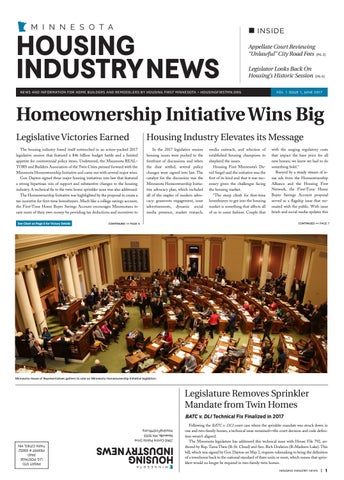
Minnesota House of Representatives gathers to vote on Minnesota Homeownership Initiative legislation.
Legislature Removes Sprinkler Mandate from Twin Homes BATC v. DLI Technical Fix Finalized in 2017 Following the BATC v. DLI court case where the sprinkler mandate was struck down in one and two-family homes, a technical issue remained—the court decision and code definition weren’t aligned. The Minnesota legislature has addressed this technical issue with House File 792, authored by Rep. Tama Theis (R-St. Cloud) and Sen. Rich Draheim (R-Madison Lake). This bill, which was signed by Gov. Dayton on May 2, requires rulemaking to bring the definition of a townhome back to the national standard of three units or more, which means that sprinklers would no longer be required in two-family twin homes.
2960 Centre Pointe Drive Roseville, MN 55113 HousingFirstMN.org
HOUSING INDUSTRY NEWS M I N N E S O T A
PRSRT STD U.S. POSTAGE PAID PERMIT # 93652 TWIN CITIES, MN
SIGN UP TO BE A PART OF THE HOUSING MOVEMENT • HOUSINGFIRSTMN.ORG
HOUSING INDUSTRY NEWS
| 1
Housing Industry News to Inform, Unite By BOB MICHELS Housing First Minnesota & The Builders Association of the Twin Cities bob@bmichels-const.com
Welcome to the first issue of Housing Industry News. Presented by Housing First Minnesota, this quarterly newspaper provides accurate and useful updates about the housing industry for licensed Minnesota contractors, suppliers. With broad distribution that also includes customers, regulators, and elected representatives. Housing Industry News is a powerful publication for influencing and unifying the industry’s collective voice. Recent research conducted for Housing First Minnesota clearly shows that homeownership remains a cornerstone of our state’s economy. Housing industry activity affects the daily lives of all Minnesotans not just by providing homeownership opportunities and jobs, but by providing homes for families in communities they love. That’s what we do in the home building industry—we are experts in building community. With Housing Industry News, we seek to reflect the importance of community within our industry.
With all 10,000 licensed contractors in Minnesota receiving our newspaper, we’re excited to share the latest and most significant information that can help our housing community grow. With growth and timely information, Housing First Minnesota will be better able to influence our government and regulators at all levels as they make decisions affecting home ownership and affordability.
Our goal is to bring high-quality information and updates to our industry, its regulators and influencers to strengthen our collective voice. The need to engage and activate our entire community on advocacy issues that will benefit home building and remodeling is of importance. We’ll do that through our Housing First Advocate Network, social media and this publication, Housing Industry News. Other exciting opportunities to engage will be announced in the future. We ask that you provide us an
Construction Industry Comes Together to Address Labor Shortage By DENNIS MEDO President TBG Education Foundation dmedo@tbgedu.org
Bob Michels, president, Housing First Minnesota , BATC and Michels Homes
email address so we can keep you informed. Whether the issue is permit fees, building and energy code updates, sprinklers, stormwater management, or the latest legal case setting precedent, you can count on Housing Industry News and Housing First Minnesota to keep you in the know. We’re so fortunate to be in a magnificent industry that fulfills the all-important need to provide shelter for our neighbors. We hope you enjoy Housing Industry News and become part of the movement. For more information, visit HousingFirstMN.org.
The Voice for Minnesota’s Housing Industry Dear Readers, There are approximately 10,000 licensed contractors in Minnesota who are joined by thousands of businesses providing products and services. Our How Can You Get industry is roughly 15 percent of the state’s GDP. Housing is massive. Engaged? One of our biggest challenges is to effectively connect and engage with all of our industry. It’s comprised of mostly small firms that often don’t feel 1 Sign up for housing news: HousingFirstMN.org connected and aren’t clear that their voice will make a difference in Minnesota’s political environment. 2 Follow us on Twitter Housing First Minnesota is the voice of home builders, remodelers and @housingfirstmn industry suppliers reaching across our state. We originated as a program of the Builders Association of the Twin Cities, but today recognize our role as the industry voice while providing opportunities for home builders and suppliers to become engaged and join a growing movement. Our cause: to inform and mobilize our industry. Speaking with data-driven messaging as part of a modern, comprehensive advocacy program, we can grow the influence of our industry and continue elevating housing as a powerhouse at the Capitol, with regulatory agencies, in the courts, in elections and in issue advocacy. We hope you enjoy this first issue of Housing Industry News. It’s reaching every one of you with a goal of sharing high-quality information and a chance to make a difference. Want to know about industry plans for the 2018 election? Read more. Want to know about Housing Day at the Capitol and Housing Day at the Minnesota State Fair? Look inside. Want to know about how our industry is using issue advocacy advertising and a dynamic social media presence? Like us, follow us, link to us. Want to help attract hard-working young people to our industry? Read about our efforts through Project Build Minnesota. Are you curious how recent court cases might impact your business? Updates can be found here in Housing Industry News. Perhaps you care deeply about the charitable work your fellow builders and remodelers do. Read about your colleagues’ efforts and tell us about yours. Most importantly, want to know how you can get involved? It’s simple. Sign up at HousingFirstMN.org so we can keep you informed and educated. And, be sure to join your local builders association as well. Housing First Minnesota will be sharing Housing Industry News with you quarterly. We’re so honored to bring this new communications vehicle to you as we bring our building community together. After all, that’s what we do—all of us are experts in building community. Thank you in advance for being part of ours.
All of us in the building industry know that we are facing a severe shortage of skilled craft professionals. To solve the labor shortage problem, we must come together to present a unified and powerful brand that draws today’s youth and others to our industry. In our state, that brand is Project Build Minnesota. PBM is housed under the umbrella of the TBG Education Foundation and is directed by a coalition of construction industry leaders who have come together with a goal of making construction a ‘first career choice’ for Minnesotans. To date, several associations representing builders and contractors have stepped forward with startup capital to begin this effort, and we’ve reached that all-important milestone of having a product to present to the market. We’ve also built out a powerful three-year marketing plan that’s designed to make a difference in attracting today’s youth to our industry. We’ve already begun some elements. For example, Project Build Minnesota and the Builders Association of the Twin Cities both had booths at the recent Minnesota School Counselors Association conference. In addition, several of the involved organizations provide scholarships to youth seeking additional technical training and many are already speaking at career days and networking with schools. But that’s just a small part of this comprehensive plan to create the Project Build Minnesota brand. We’re ready to launch a major
statewide campaign over multiple years, and to do so, we need your help! We are asking the housing industry Dennis Medo, for a financial president, TBG Education Foundation contribution to TBG Education Foundation, a non-profit 501(c)(3) tax-exempt organization, to launch PBM into the marketplace and start changing minds about construction careers. Once launched, we envision contractors and vendors across the state promoting this effort on their websites, on their social media platforms, and even with logos on trucks. The opportunities are endless. As the President of the TBG Education Foundation, I wanted to share with our industry what we are seeking to accomplish and see if you are interested in supporting our effort. We are trying to raise funds now. Please don’t hesitate to call me with immediate questions at 651-389-1043 or email me at dmedo@tbgedu.org. Contributing organizations so far include Builders Association of the Twin Cities, BATC Foundation, The Builders Group, TBG Education Foundation, Minnesota Builders Exchange, Associated Building Contractors, Minnesota Utility Contractors Association and Builders Association of Minnesota. In addition, several private industry partners are supporting the effort and the numbers are growing. We welcome your support.
The Housing Industry News Editorial Team 2 |
HOUSING INDUSTRY NEWS
SIGN UP TO BE A PART OF THE HOUSING MOVEMENT • HOUSINGFIRSTMN.ORG
LEGAL BRIEF
Court to Hear Major Impact Fee Case
Woodbury street funding mechanism at issue in major industry legal challenge.
At issue in the case is whether local governments can force developers to pay for road improvements outside of proposed developments. A lawsuit between the city of Woodbury and Twin Cities developer Martin Harstad could have a major impact on how Minnesota cities and counties assess road fees related to new developments. At issue in the case is whether local governments can force developers to pay for road improvements outside of proposed developments. In 2015, Harstad was informed by the city that his 183-unit residential development would incur $1.3 million in additional fees to pay for traffic-related improvements in Woodbury. The fees, called Major Roadway Assessment (MRA), were in addition to the fees Harstad
would pay for roadways within the development and would be dedicated for projects elsewhere in the city. Harstad sued Woodbury, arguing that state law does not give Woodbury the authority to impose fees for construction of road improvements outside of the development, even if those needs are driven by the development itself. In November 2016, the district court sided with Harstad, saying the MRA fees were illegal. In his decision, Judge Richard Ilkka called the longtime practice “unlawful and unenforceable.” Woodbury, supported by the League of Minnesota Cities,
appealed the lower court’s ruling, and the case is currently with the Minnesota Court of Appeals. In mid-March, housing industry advocates filed a friend-of-thecourt brief supporting Harstad in his case against Woodbury’s illegal fees. Rochester-area developer Frank Kottschade, the Builders Association of the Twin Cities and the National Association of Home Builders signed the brief, citing a similar case between the City of Eagan and Country Joe Homes in the 1990s. The Court of Appeals will hear the case on June 21 in St. Paul.
Harstad v. Woodbury •
The district court held that Woodbury’s Major Roadway Assessment was an illegal impact fee and in addition, is an illegal tax.
•
Twenty years ago the court weighed in on a similar major case in Country Joe v. Eagan, where the Minnesota Supreme Court ruled that the Eagan fee constituted an unlawful tax.
•
The Minnesota Court of Appeals hearing in June will test the precedent set in Country Joe and will guide how local governments apply transportation fees to new development projects.
•
BATC, NAHB, and Rochester developer Frank Kottschade joined as amici curiae (friends of the court) and argue: “Woodbury’s MRA is indistinguishable from Eagan’s road unit connection charge (in Country Joe). Both charges were motivated by the purpose of raising revenue rather than recouping the cost of regulation. Thus...the MRA is a tax that is unlawful because it is not authorized.”
Minnesota Supreme Court Rules in Favor of Rochester Developer On Wednesday, June 7, the Minnesota Supreme Court ruled in favor of Rochester-area developer and builder Frank Kottschade in his ongoing dispute with the city of Rochester. At issue in this case is whether Rochester can appeal an order for
arbitration from a previous case before any arbitration takes place. In 2010, city of Rochester and Kottschade, were ordered into arbitration by a district court in a separate case. Rochester sued, challenging the decision to enter arbitration
and sought to prohibit any further arbitration on the matter. The Supreme Court’s ruling sends the case back to district court and orders that arbitration must be completed before either party can appeal the arbitration.
Get Housing Industry News as it happens: Sign up at HousingFirstMN.org • Follow us on Twitter @housingfirstmn
SIGN UP TO BE A PART OF THE HOUSING MOVEMENT • HOUSINGFIRSTMN.ORG
David Siegel of Housing First Minnesota (left), Frank Kottschade (center), Gary Van Cleve of Larkin Hoffman (right) outside the Supreme Court chambers. HOUSING INDUSTRY NEWS
| 3
Housing theTHE Capitol HOUSINGatON HILL
Home Building Industry and REALTORS Launch First Housing Day at the State Capitol Last February, members of the home building industry joined together with members of the Minnesota REALTORS creating a force 600 strong advocating for homeownership during the first-ever Housing Day at the Capitol. The monumental event marked the start of an exciting partnership as both groups joined together to share with lawmakers their collective support of the Minnesota Homeownership Initiative, a package of legislative proposals that promote homeownership. “Homeownership strengthens our communities and helps build safe and secure neighborhoods,” said Christopher Galler, CEO, Minnesota REALTORS. “It’s important we share that message with our lawmakers.” Attendees took part in a total of 171 meetings with legislators, reaching 85 percent of the Minnesota
legislature. It gave attendees a chance to share their personal stories with their lawmakers about the challenges facing the housing industry. “A recent survey showed that 84 percent of Twin Cities’ residents believe that owning a home is central to the American Dream, and yet homeownership in Minnesota is at a 50-year low,” said David Siegel, executive director, Housing First Minnesota. “It’s clear we need to be doing more to support and encourage homeownership.” Homeownership is the backbone of safe neighborhoods, healthy schools, a consistent labor force and strong communities. In a recovering housing market in the wake of the worst recession in 70 years, a variety of strategies are needed to help families purchase their dream home.
Speaker of the House Kurt Daudt (R-Crown)(right) meets with builder Bob Michels, Michels Homes (center) and remodeler Shawn Nelson, New Spaces (left) during Housing Day at the Capitol.
Attendees gather to learn about housing-related legislation before meetings at the Minnesota State Capitol.
“Homeownership strengthens our communities and helps build safe and secure neighborhoods. It’s important we share that message with our lawmakers.” Christopher Galler, CHIEF EXECUTIVE OFFICER OF THE MINNESOTA REALTORS
600 Attendees Registered
85%
of all MN Legislators Met with Housing Day Attendees
171
Legislator Meetings took place throughout the afternoon
Sen. Tom Bakk (DFL-Cook) (right) studies housing industry priorities during a meeting with constituents.
4 |
HOUSING INDUSTRY NEWS
SIGN UP TO BE A PART OF THE HOUSING MOVEMENT • HOUSINGFIRSTMN.ORG
CONTINUED FROM PAGE 1
Legislative Victories Earned help with down payments and closing costs for first-time homebuyers. For condo and townhome builders, welcome relief is on the way to address the fasttrack lawsuits that have severely impacted multifamily development over the past decade.
Homeowner associations are now required to enter mediation prior to initiating a lawsuit and a majority of all owners are required to vote in favor of initiating a legal action against a developer. This approach was adopted in Colorado where similar issues have plagued their housing market. Over the past decade, housing moratoria have impacted local housing markets and were
often imposed without any notice to the public. This was remedied by legislation to require a public notice and hearing prior to the imposition of a housing moratorium, offering time for a broader discussion of impacts prior to a city making a major decision that will impact its residents. The legislature also implemented a technical fix to the BATC v. DLI court decision that
struck down the sprinkler mandate in one and two-family homes. Under the order signed by Gov. Dayton, sprinklers are not required in one and two-family homes. These industry wins cement a strong 2017 legislative session where housing rose to new heights.
2017 HOMEOWNERSHIP INITIATIVE First-Time Homebuyer Savings Account
Remove Barriers to Developing Condos/ Townhomes
Public Notice for Housing Moratorium
Rulemaking Review Oversight
win Home Sprinkler T Fix, Continuation of BATC v DLI
Signed Into Law
Signed Into Law
Signed Into Law
Passed MN House Floor
Signed Into Law
Authors:
Authors:
Authors:
Authors:
Authors:
Rep. Greg Davids (R-Preston)
Sen. Karin Housley (R-St. Mary’s Point)
The First-Time Homebuyer Savings Account was a leading proposal of the homeownership initiative. Importantly, this program is NOT a government handout. Instead, it encourages Minnesotans to save more of their own money by providing tax deductions and incentives to help achieve the dream of owning a home. That’s why we proposed the First-Time Homebuyer Savings Account Act—a new idea to help people get into their first home.
The Law States: •
Individuals can deposit money annually into an FDICinsured savings account.
•
The account can be opened at any Minnesota bank or credit union.
•
Contributions to the account receive a state tax deduction on interest earned. Individuals can deposit up to $14,000 annually, while married joint filers can deposit up to $28,000 per year.
•
Parents or grandparents could set up an account AND receive a deduction from their own state taxes.
•
The plan applies to firsttime homebuyers and those re-entering the housing market, if they have not owned a home within three years.
Rep. Dennis Smith (R-Maple Grove)
Sen. Kari Dziedzic (DFL-Minneapolis)
Rep. Jim Nash (R-Waconia)
Sen. Dan Hall (R-Burnsville)
A healthy housing market includes a wide variety of options to meet the needs present in the market. Condos and townhomes represent a key segment of the marketplace and face serious challenges.
Minnesota law previously allowed a municipality to enact, without notice of a public hearing, a development moratorium that suspends a property owner’s right to use property for up to one year.
A key barrier to a healthy condo/ townhome market was the state’s current construction defects law, which created a disincentive to new condo/townhome development.
Several recent housing moratoria have impacted the market in cities like Golden Valley, Lake Elmo and Minneapolis. MLS data revealed a direct impact on the housing market in cities where a moratorium was present, broadening the concerns of the policy beyond just the development community.
The Law Requires: •
•
that a Homeowners Association mail each member of the association the nature of construction defect claim, the relief sought and the HOA proposal to fund the litigation. the Homeowners Association to receive majority approval from its members to proceed with a claim.
•
That prior to any construction defect claim, both parties must agree to mediation.
•
The association’s board of directors shall prepare, approve and follow a written preventative maintenance plan and schedule.
•
Now, property owners must be notified of any proposed housing moratorium to limit the use of their property and provided an opportunity to raise objections or concerns at a public hearing.
Rep. Bob Vogel (R-Elko New Market)
Modifies the current statute to require a 10-day notice and a public hearing before enacting a moratorium that would regulate, restrict, or prohibit activities relating to housing.
Effective Date: Aug. 1, 2017
Expands the definition of a construction defect claim.
Effective Date: Applies to common interest communities created on or after Aug. 1, 2017
Rep. Tama Theis (R-St. Cloud)
Sen. Rich Draheim (R-Madison Lake)
The regulatory costs associated with new construction have surged over the past decade. We agree that we need responsible regulations to ensure safety and durability in new home construction, but the regulatory structure must meet these objectives at a price that families can afford.
For the past four years, BATC has been fighting against mandated sprinklers in any single-family or twin home construction. Following the landmark victory in BATC v. DLI where the sprinkler mandate was struck down in one and two-family homes, the industry faced a new challenge— the court decision and code definition weren’t aligned.
Key Features of the Bill:
The 2017 legislature addressed this technical issue with both the Senate and the House of Representatives voting unanimously for HF 792.
•
•
The Law Provides: •
Sen. Mary Kiffmeyer (R-Big Lake)
•
Provides a legislative mechanism to review regulatory rule proposals to consider the cost impacts and balance affordability with the proposed regulation. If a committee of either the House of Representatives or Senate with jurisdiction over the subject matter of the proposed rule votes to advise an agency that the rule should not be adopted as proposed, the agency may not adopt the rule unless the rule is approved by a law enacted after the vote of the committee. The agency may proceed with other elements of the rule that are not related to the portions under review by the committee for costbenefit analysis.
Positioned to Advance: in 2018
This bill had broad support including Housing First Minnesota and the Builders Association of Minnesota. The law directs the Department of Labor and Industry to modify Minnesota’s Building Code to match the national building code. The legislation follows the Minnesota Court of Appeals’ directive in BATC v. DLI, where the sprinkler mandate in one and twofamily homes was struck down. Housing First Minnesota will continue to seek a permanent statutory solution to the sprinkler policy issue. Absent establishing an affirmative position in statute, the sprinkler debate will begin again in the next code cycle, which starts in late 2017. Effective Date: June 5, 2017
Effective Date: For taxable years beginning after Dec. 31, 2016
TRACK THE CONVERSATION ON TWITTER: @housingfirstmn • #MNHomeownership GET HOUSING NEWS AS IT HAPPENS: Sign up at HousingFirstMN.org SIGN UP TO BE A PART OF THE HOUSING MOVEMENT • HOUSINGFIRSTMN.ORG
HOUSING INDUSTRY NEWS
| 5
Rep. Jim Nash Reflects on 2017, Looks Ahead In a big session for housing, Rep. Jim Nash (R-Waconia) found himself in the middle of the action from the outset of session, stretching all the way to the final hours when the omnibus bills were finalized. Nash, former mayor of Waconia, serves as the vice chairman of the State Government Finance Committee and is an assistant majority leader for the House Republican Caucus. As the chief author of the bill to require public notice and a hearing prior to the imposition of a housing moratorium, Nash’s bill was one of
laborers and ultimately home owners is absurd,” said Nash. “I’m glad that an overwhelming majority of my colleagues agreed, and vot- Rep. Jim Nash ed in favor of (R-Waconia) my bill.” The housing moratorium legislation was long opposed by the powerful League of Minnesota Cities, but Nash and Senate author, Sen. Dan
“Good government is the optimal goal. I’ve said for years that new pieces of legislation that impact cities are enacted to deal with glaring abuses of the business/municipal government relationship.” Rep. Jim Nash
the first policy measures to be heard in committee meetings held this session. Following hearings, floor votes, a veto of the bill and a final compromise to pass it into law, Nash reflected on what helped bring the issue to resolution. “The notification requirement is just common sense. To think that a city might not do a simple notification of an interim ordinance that could shut down housing projects and in turn harm developers, builders,
Hall (R-Burnsville) persevered and struck a compromise. Nash added, “Good government is the optimal goal. I’ve said for years that new pieces of legislation that impact cities are enacted to deal with glaring abuses of the business/municipal government relationship.” With the multi-year battle for public notice for housing moratoria solved, Nash is looking ahead to new proposals that will benefit the housing industry. In 2017 he introduced
Rep. Jim Nash (R-Waconia) introduces legislation reforming the interim ordinance process at a January legislative hearing.
a pilot program to encourage high school students to consider technical/vocational options in industries like housing, precision manufacturing and similar fields. The concept is modeled off of existing programs that allow students to obtain college credit while still in high school. Under the new concept, vocational post-secondary education options
2018 Election Preparations Underway While many continue to talk about the historic 2016 elections, the Housing First Fund is looking ahead to the next election, which will take place on Nov. 6, 2018. Highlighting the 2018 elections will be the race to succeed Gov. Mark Dayton, who will not be running. The Minnesota House, all Congressional races and the re-election of U.S. Sen. Amy Klobuchar will also be on the ballot. The Housing First Fund is already engaged in its planning for the 2018 election cycle which will feature intense campaigns, especially in the race for governor. The Housing First Advisory Group is entering its fifth election cycle and is led in 2017-18 by Daryl Doehr, regional sales manager for Warroad-based Marvin Windows and Doors. Housing Industry News recently interviewed Doehr to learn about the early work currently underway. Q: How is Housing First approaching the governor’s race in 2017-18? A: We are approaching it as one of the most important
opportunities for the housing industry in many years. Our industry has changed a great deal since 2010 when Gov. Dayton first came into office. At Housing First, we are looking at this as an opportunity to elevate our industry, and work to be a part of the conversation about where our state is going.
Sign up for our email updates at HousingFirstMN.org
6 |
HOUSING INDUSTRY NEWS
VPSEO a reality, students can get high school credit and apprentice experience on the job.” With housing experiencing a workforce crisis across all sections of the industry, Housing First Minnesota will be working closely with Nash and his colleagues to build a proposal that can be considered in 2018.
Redefining Advocacy
Q: How does Housing First plan to engage in the governor’s Race?
As the leading voice for Minnesota’s homebuilders and remodelers, Housing First Minnesota’s modern and comprehensive advocacy program engages policy makers and throught leaders in five ways:
A: We are inviting all candidates
for governor to meet with a task group of industry leaders to talk about housing issues, regulatory pressures, and our workforce challenges. We know that regardless of who is elected, we need to be able to communicate the key issues that are facing the housing/construction industry. We are optimistic that our invitation to the candidates will be a great place to begin that discussion!
(VPSEO) would be made available to a limited number of school districts as a pilot project to gauge interest and develop the program. “VPSEO is an exciting concept that we are going to refine during the interim and bring to the forefront in 2018,” said Nash. “We know that many high school students are not college bound, and if we can make
Legislative Advocacy Daryl Doehr, senior regional sales manager, Marvin Windows. Doehr serves as the 2017 Housing First Chair.
Q: Will the Housing First PAC endorse a candidate for Governor? A: If we find a candidate that demonstrates a commitment
to housing affordability and to creating a balanced regulatory environment, I think there will be an endorsement recommendation. However, at this point we are focused on starting an open dialogue with the key candidates. Q:. How can industry members engage in the 2017-18 Housing First?
A: There will be several opportunities to connect and contribute throughout 2017 and beyond. Our social media will have timely updates and engagement opportunities.
Housing First Minnesota seeks to convey the impact of current and proposed legislation with elected officials at the state and local levels, and to influence the process to ensure that our builders and remodelers operate in a healthy environment. Electoral Advocacy Electoral advocacy is critical to the success of our comprehensive advocacy program. It is essential to participate in the electoral process to get individuals who are friendly to our cause elected to public office. Legal Advocacy When a law or rule impeding home affordability must challenged in court, Housing First Minnesota steps up. Legal advocacy is the last line of defense for the industry.
Regulatory Advocacy Housing First Minnesota strives to illustrate the cumulative effect of multiple regulatory impacts on home building and remodeling. This involves working with government agencies to ensure that regulations applied to our industry are common sense, necessary, and based in sound science. Issue Advocacy The advent of social media, technology, and the internet have substantially elevated the opportunities for issue advocacy. Issue advocacy refers to social media, digital and traditional advertising focused on broad political issues. The goal is to engage and persuade the public positively in support of our advocacy agenda.
Get Housing Industry News as it Happens: Sign up at HousingFirstMN.org Follow us on Twitter @housingfirstmn
SIGN UP TO BE A PART OF THE HOUSING MOVEMENT • HOUSINGFIRSTMN.ORG
More Than 10,000 Homes in Minnesota Green Path Energy Tested Eighty percent of first-time homeowners say they either really want or must have an energy-efficient home. But energy efficiency can add significant costs that many can’t afford. Enter, Minnesota’s Green Path program, which hit a major landmark this year with its 10,000th energy tested home since its start in 2011. Minnesota’s Green Path was created to help builders and homeowners look at energy and green building in a different more affordable way. The program provides homebuyers and homeowners with RESNET’s Home Energy Rating System (HERS) scoring. With independent energy testing and a consistent index (HERS), prospective homebuyers have a valuable tool that helps them understand expected energy usage in the homes they are considering. The U.S. Department of Energy has determined that a typical resale home scores 130 on the HERS
Index while a standard new home is awarded a rating of 100. That means a home with a HERS Index Score of 70 is 30 percent more energy efficient than a standard new home. Since Minnesota Green Path started testing, the average new home in Minnesota had scored around 80 on the HERS Index. Since the adoption of the new energy codes two years ago, Minnesota new homes test around 70 or less. In the Spring 2017 Twin Cities Parade of Homes, 63 percent of the homes were energy tested. When MN Green Path began, only four percent of the homes in the Parade of Homes were energy tested. Industry observers project 900 percent growth in certification of new homes and remodeling projects over the next five years, culminating in 50 percent of all projects being certified at some level by 2018.
CONTINUED FROM PAGE 1
to address the regulatory costs that are impacting the bottom line for homeowners through a push for greater oversight of state rulemaking processes relating to housing. With this proposal, some of the strongest support emerged from legislators, including the measure’s chief author Rep. Bob Vogel (R-Elko New Market). “It is important to remember that those affected most by this affordability crisis are people who are least able to overcome it,” said Vogel. While the rulemaking oversight bill ultimately didn’t pass, its momentum was perhaps the clearest indication that legislators have prioritized housing affordability as a top shelf issue. This elevation of the housing industry paves the way for future initiatives to continue into 2018 and beyond.
Housing Industry Elevates Message issue was highlighted throughout the session. The Minnesota REALTORS conducted a statewide poll which found that 85 percent of Minnesotans viewed buying a home as a good financial decision, and 65 percent of them said they would use a firsttime home buyer tax savings account if given the opportunity. That momentum extended to several other proposals that attempted to address the multidimensional challenges facing housing, including a push to bring back condominiums and townhomes to the housing market. On the housing affordability front, legislators showed a resolve
1
3
2
5
4
1 | MN Green Path Banner: Energy Tested indicates the home has been tested by a RESNET rater. Master or Advanced Certified indicates the home has reached a superior level of green, with all added features listed on the HPR 2 | Home Information: Basic stats on the home
6
3 | HERS Index: The lower the HERS number, the more energy efficient the home’s construction 4 | HERS Graph: Places the home’s index along a continuum from “let’s heat the neighborhood” to net-zero where your Utility might even pay you for the excess energy you give back to the grid
5 | ACH50: The Air Changes per Hour index is calculated during the final blower-door test and measures the air infiltration into a new home — the lower the number the tighter the home 6 | ACH50 Graph: Places the Air Exchange rating along the continuum from a leaky energy hog to a super-tight, super-efficient home
Speaker of the House Kurt Daudt (R-Crown) presides over the House of Representatives.
Join the Housing First Minnesota Advocate Network Are you willing to contact your elected officials on behalf of the housing industry? Join Housing First Advocate Network (HFAN). When our industry is faced with challenges, it’s important elected officials hear directly from their constituents in the industry. The Housing First Advocate Network is a grassroots network utilized to advocate for the industry at all levels of government. Join the cause. Sign up at HousingFirstMN.org
SIGN UP TO BE A PART OF THE HOUSING MOVEMENT • HOUSINGFIRSTMN.ORG
HOUSING INDUSTRY NEWS
| 7
REGULATORY ROUNDUP
Lead Paint Rule Changes Loom for Remodelers at State and Federal Levels The Environmental Protection Agency (EPA) is currently reviewing its Lead-Based Paint Renovation, Repair and Painting (RRP) Rule in accordance with an executive order issued by President Trump. Fully enacted in 2010, RRP requires any contractor or subcontractor renovating a home, childcare center or kindergarten built before 1978, where lead-based paint may be present, must maintain EPA or state certification and must use certified
renovators. Any work that disturbs lead paint must be performed following specific methods of work and cleaning practices to prevent lead contamination. Industry groups, including the National Association of Home Builders, have provided comments to the EPA outlining concerns with the current RRP Rule. Here in Minnesota, the EPA is engaged in negotiations with the Minnesota Department of Health (MDH) to reach a deal
that would allow MDH to take over statewide enforcement of the EPA’s RRP Rule. Currently, the EPA enforcement division based out of Chicago has the responsibility for ensuring contractors renovating homes where lead is present are in compliance with EPA regulations. Once the EPA and MDH agree on the draft RRP Rule for Minnesota, MDH will make the draft rule available for public comment, after which the final rule will take effect.
New Law Addresses Concerns Over Code Enforcement of High-Occupancy Buildings The Omnibus Jobs and Energy Bill, authored by Sen. Jeremy Miller (R-Winona) and Rep. Pat Garofalo (R-Farmington), included language that addresses industry concerns about areas of the state where the structural building code is not currently enforced. Although Minnesota’s electrical and plumbing codes apply to all
buildings in the state, local governments can choose whether to apply the state’s structural building code to certain non-residential buildings within their jurisdiction. Under the new law set to go into effect on Aug. 1, 2017, any publicly or privately-owned facility designed for occupancy by 200 or more people must adhere to the state’s
structural building code. Examples of buildings include sports or entertainment arenas, stadiums, community and event centers, theaters, convention halls, and indoor amusement facilities. This legislation is in response to the 2015 collapse of the water park at Thumper Pond Resort in Otter Tail.
Rep. Pat Garofalo (R-Farmington)
Sen. Jeremy Miller (R-Winona)
Housing Related Regulation Changes in the Works for 2017 Looking Ahead
Top 10 OSHA Violations For the sixth straight year, fall protection violations were the most cited by OSHA, and the residential construction industry was the single largest source of the violations. Last year, more than 3,900 of the OSHA-issued fall protection violations were related to residential construction.
Ten most-cited issues by OSHA: 1 Fall Protection: 6,929 Violations 21
The International Code Council will release its updated guide to the International Building, Energy and Mechanical Engineering codes in September.
Hazard Communication: 5,677 Violations
DLI has indicated it will hold meetings of its technical advisory groups later this year to begin the work of preparing Minnesota’s new codes for adoption in 2019.
41
31 Scaffolding: 3,906 Violations
Respiratory Protection: 3,585 Violations 51 Lockout/Tagout: 3,414 Violations 61
Changes related to new home construction are under consideration in 2017.
This year is shaping up to be a full of regulatory changes and code updates for Minnesota’s housing industry. 2018 Construction Stormwater Permit The Minnesota Pollution Control Agency (MPCA) is in the process of drafting the 2018 construction stormwater permit. Minnesota’s current permit, adopted in August 2013, is required when any construction or development activity disturbs more than one acre of soil or if the MPCA determines
8 |
HOUSING INDUSTRY NEWS
that the activity poses a risk to water resources. MPCA is currently meeting with interested parties, including environmental groups, local government entities, state agencies and representatives from the road construction, commercial construction and residential construction entities. Industry groups, including the Builders Association of the Twin Cities, have already provided verbal comments and written recommendations to the MPCA. Few changes related to new home construction and development are
expected for the 2018 permit. The draft 2018 permit will be made available for public comment in the coming months and MPCA aims to adopt the final 2018 permit before the end of the year. Once adopted, the 2018 permit will immediately replace the current Permit. Building Codes Updates On May 2, Gov. Dayton signed legislation requiring the Department of Labor & Industry (DLI) to immediately move to remove the sprinkler mandate from twin homes. Along with the legislation, a stay was issued
stating that effective May 2, twin homes are no longer required to be built with fire sprinklers. Following the signing of the legislation, DLI drafted a modification to Minnesota Rule 1309.0313 which outlines sprinkler requirements in the state’s building code. The modified rule went into effect on Monday, June 5, and brings a technical fix to the BATC v. DLI case, which said sprinklers cannot be required in most single-family and two-family homes. The 2017 National Electric Code was adopted by the state’s Board of Electricity earlier this year. No major housing-related changes were included in the 2017 National Electric Code, which goes into effect on July 1.
Powered Industrial Trucks: 2,860 Violations 17 Ladders: 2,639 Violations 81 Machine Guarding: 2,451 Violations 91 Electrical, Wiring Methods 1,940 Violations 1 10 Electrical, General Requirements: 1,704 Violations
Source: U.S. Department of Labor
SIGN UP TO BE A PART OF THE HOUSING MOVEMENT • HOUSINGFIRSTMN.ORG
Reminder: Contractor Registration Requirements
Ask a Building Code Expert By PETER KULCZYK Green Code Knowledge
Since September 2012, all contractors providing residential or commercial building construction or improvement services that do not require a license must register with Department of Labor & Industry (DLI) through the Construction Contractor Registration Program. Who Needs To Register An individual or business entity that performs commercial or residential building construction or improvement services must register with DLI unless they • have a current license, certificate or registration issued by DLI; • are an employee of a business performing construction services; or • hold a current residential building contractor or remodeler certificate of exemption issued by DLI; or • were excluded from registration requirements by state law. Subcontractors not involved in the construction or physical improvement of a home, such as landscapers, cleaners and painters, are examples of contractors not required to register with DLI. Why is Registration Important? •
• •
• •
The Contractor Registration Program was created by the legislature to assist DLI in its investigation of worker misclassification (treating employees as independent contractors). By law, an unregistered “subcontractor” is presumed to be an employee of any contractor that hires them. The hiring contractor can rebut this presumption if they can prove that the relationship between them and the subcontractor complies with all nine factors of the Nine Factor Test found in Minn. Stat. § 181.723, subd. 4. Hiring an unregistered subcontractor is a violation of law, though the monetary penalty is forgiven for the first violation. Even if your subcontractors are registered, your relationship with them must meet the Nine Factor Test or they will be deemed to be employees of your company even if they operate as a business entity (corporation or LLC) and maintain their own liability and workers’ compensation insurance.
Verifying Registration When hiring subcontractors, be sure to verify that the subcontractor is properly registered or licensed with DLI. Contractors can check on the status of subcontractor’s license or registration at dli.mn.gov
Got building construction related questions? We have the answers! Q: Is a building permit required for all new decks? A: The provisions in the building
code will require a permit for a deck if the deck surface is 30 inches or greater above the adjacent grade level, is not attached to the house (dwelling), and does not serve as an accessible route. The “accessible route” only applies to dwellings that require an accessible route under the State of Minnesota accessibility code, which generally means that most single family dwellings do not require an accessible route. Refer to your local municipal zoning ordinance to verify requirements related to setbacks and open space. Q: When constructing a new house (dwelling) does the code require that interior finish items such as gypsum board, primer, paint, wallpaper, carpet and cabinets be completed by the time of the final inspection?
exterior barrier material, such as a house sheathing paper, can be left exposed prior to the application of the cladding material but the manufacturer’s Peter Kulczyk installation instructions probably do. Q: Can a house sheathing paper be installed at any other angle other than horizontal? A: No. The code requires asphalt
felt to be applied horizontally with a two-inch minimum horizontal lap. For manufactured house sheathing papers approved by the building official, they need to be installed according to the manufacturer. Q: Does the code allow rigid foam sheathing to be used as a water-resistive barrier instead of the standard #15 felt or manufactured house sheathing paper? A: Yes. The building official can ap-
A: The code does not require that
interior wall finishes such as primer, paint, wallpaper and carpet be in place. Gypsum board needs to be in place if it serves as either a component of the interior air barrier, or as a 15-minute thermal barrier protection for foam plastic insulation or as a component of the house/garage fire separation. The building code does not require the installation of either kitchen or bathroom cabinets, and as such there are no criteria for cabinets in the code. If the stair rise and run could be affected based on the thickness of a floor tile then that tile should be in place prior to the final inspection. Q: Does the code address how long a weather-resistive exterior barrier material can be left exposed prior to the application of the cladding material? A: No. The building code does not
address how long a weather-resistive
prove the use of rigid foam sheathing as a water-resistive barrier based on testing, an evaluation report or other data. Q: During the construction of an addition our siding crew noted that the existing siding on the original house did not have a felt paper or sheathing paper behind it. We planned on installing a proper house sheathing paper behind the siding on the new addition but we were unsure of how this existing siding without a sheathing paper should this be addressed and what does the code require? A: The water-resistive barrier needs
to be properly installed behind any newly installed siding whether it is on the original house or on the addition. The building code is not retroactive, which means that the existing siding that remains in place can remain “as-is.” Q: We are remodeling an existing house. The sleeping room windows will be removed and replaced. Are these windows required to comply
with the same minimum net clear opening size as required for new construction? A: No. The replacement windows
for sleeping rooms (also referred to as emergency escape and rescue openings or egress windows) needs only to meet the manufacturer’s largest standard size that will fit within the existing frame or existing rough opening. The replacement window shall be the same operating style as the existing window or a style that provides for an equal or greater window opening area than the existing window. This is a Minnesota amendment and may not be similar in other states. Q: Does the code require a design professional, such as a licensed architect or engineer, for the design of a dwelling or townhouse building? A: No. The construction provisions
in the code are generally written as a conventional document, within prescribed limits, and referred to as a prescriptive code. Building components such as footings, foundation walls, studs, joists, rafters, sheathing, and many others have limitations based on criteria that has been established over decades of practice. When a building of otherwise conventional construction contains structural elements exceeding the limits of the code, then these elements must be designed in accordance with accepted engineering practice. For example, many components such as engineered wood and metal trusses, engineered wood structural panels, pre-cast concrete floor and wall panels may have engineered data provided by the manufacturer. If the building official of the jurisdiction has determined that some elements of the structure exceed the limits of the prescribed code, or that additional information needs to be provided to show how an engineered element works with adjacent conventional construction (such as pre-cast concrete plank for an attached two-level garage), then the building official has the authority to require a design professional at no cost to the jurisdiction.
Have a Question You’d Like Answered? Send it to Katie@HousingFirstMN.org
Be a Part of the Housing Movement
Sign up for our email updates at
HousingFirstMN.org
SIGN UP TO BE A PART OF THE HOUSING MOVEMENT • HOUSINGFIRSTMN.ORG
HOUSING INDUSTRY NEWS
| 9
MARKET REPORT
Lumber Prices on the Rise in 2017
Year-to-Date Single-Family Construction Select Cities Minnesota single-family construction is off to a hot start in 2017. Year-to-date, through April, Minnesota single-family permits are up 10 percent over 2016. Single-family construction in the Twin Cities is up 16 percent.
MINNESOTA SINGLE-FAMILY PERMITS
TWIN CITIES SINGLE-FAMILY PERMITS
OVER 2016
OVER 2016
10%
16%
Softwood lumber prices hit their highest levels since September 2004, rising 13.4 percent yearover-year in April, according to the National Association of Home Builders. Lumber trade woes between the U.S. and Canada are behind the steady price increase. The trade agreement that has governed Canadian imports of softwood lumber since 2006 effectively expired at the end of 2016. The softwood
State of Minnesota
Moorhead
29
SOURCE: CITY OF MOORHEAD
3,853
Duluth
New Single-Family Mankato Permits
(Census Data Fargo/Moorhead 214)
22
SOURCE: US CENSUS
SOURCE: US CENSUS
St. Cloud
64
SOURCE: CENTRAL MINNESOTA BUILDERS ASSOCIATION
Twin Cities
2,472 135
(St. Cloud-Area Data Not Reported to US Census)
Mankato
28
SOURCE: US CENSUS
Rochester
SOURCE: US CENSUS
SOURCE: US CENSUS
NAHB estimates the looming tariffs could increase the cost of a new home by $3,600 lumber dispute reached a milestone of certainty in April, when the U.S. government announced an average 20 percent tariff on Canadian softwood lumber imports. NAHB estimates the looming tariffs could increase the cost of a new home by $3,600. Another concern, if Canadian mills look to other countries for their exports, U.S. home builders could face shortages unless domestic manufacturers can ramp up their own production in time. Experts say it will be several months before the full impact of the new taxes is felt, since many builders negotiated deals in advance. The future of lumber prices are highly uncertain, but, price trends in the 2001-2006 price negotiations may offer clues as to what lies ahead.
SOURCE: US CENSUS. HOUSING FIRST MINNESOTA COLLECTED THE ABOVE PERMIT INFORMATION FROM AVAILABLE PUBLIC RESOURCES.
Five Housing Market Predictions From Metrostudy The Minnesota housing market has a lot going for it right now. Across the state there is low unemployment, wage growth, and job growth, which is leading to growth in new residential construction. Here’s what Mark Gianopulos, Metrostudy’s Midwest Region Director had to say about the future of Minnesota residential construction. 1 Growth Ahead
2 More Attached Housing
With all of the positive economic signs we’re seeing in Minnesota, you can expect to see new home development. The Minnesota market has all of the golden signs we like to see. New construction has steadily grown for the last 18 months. At the end of 2016 we were up 16 percent, we’re up about 16 percent in 2017.
We’re predicting townhomes and condos will become more of a factor in the market. At one time, the majority of units in Minnesota were attached homes, but for the past few years, attached housing has made up only 15 percent of the market. State law allowing attorneys to go after homebuilders without recourse has thrown a damper on condo and townhome development. A new law passed during the 2017 legislative session should help solve this issue, and we should see a boost in townhome development in 2017. It will give Minnesota much needed lower priced units and bookend the market.
10 |
HOUSING INDUSTRY NEWS
3 Millennials Will Prove They’re Not So Different
4 Price Points Will Continue to Have an Impact
Millennials really are an interesting group. People think they are so different, but they really are more similar than we think to every other generation. They want the same things. The one difference, they are the reluctant adults. They need more of a push to be more responsible. It takes them being pushed a little more into buying the home. For many of them it takes being married, with the second kid on the way before they think of buying a home. Life happens and they get pushed into it. We are definitely seeing more of them get that push and new desire to finally buy a home.
Price points are a problem in the Twin Cities market. Of all the Midwest metro markets, the Twin Cities is by far the most expensive. For the first quarter of 2017 the median price of a new detached home was $410,000. With household incomes barely above other markets, it makes it difficult for homebuyers. That’s the biggest headwind in Minnesota’s housing market. If you can control the price point, you’ve got great growth ahead.
By Mark Gianopulos, Metrostudy’s Midwest Region Director
5 Labor Problems Ahead While Minnesota’s low unemployment rate in general is a big plus for the housing market, it has the potential to hold back new construction. It’s becoming increasingly more difficult to find labor with employment as low as it is. Even just office labor. In order to ramp up for housing starts you’ve got to have the support team behind it. Metrostudy, a Hanley Wood company, maintains a comprehensive database of national housing market information. Want More Housing Stats? Get updates at HousingFirstMN.org
SIGN UP TO BE A PART OF THE HOUSING MOVEMENT • HOUSINGFIRSTMN.ORG
Latest Survey of Minnesota Home Builders Finds them Optimistic for 2017, but With Some Concerns By HERB TOUSLEY
St. Thomas Shenehon Center for Real Estate in partnership with the Builders Association of the Twin Cities. The index reflecting the panel’s expectation of the number of new single family housing starts was recorded at 61, down slightly from 63 in June.
Director Shenehon Real Estate Center at University of St. Thomas hwtousley1@stthomas.edu
Leaders in the Minnesota single-family home construction industry are generally optimistic about market conditions for the coming year although they have concerns about mortgage rates and the cost of land and building materials. That’s according to a new survey conducted by the University of
Herb Toursley, director, Shenehon Real Estate Center
Despite the slight decrease, at 61 there continues to be a high expectation the number of single-family housing starts will show a marked increase during 2017. The Minnesota Home Builders Survey polls the same panel of 35 industry leaders in June and again in December about their expectations for the coming year in six key areas of the housing market. These experts are asked to assign a number of zero to 100 for each of the six questions. A midpoint score of 50 is neutral;
scores higher than 50 indicate a more favorable outlook and scores lower than 50 indicate a more pessimistic outlook. “These results align closely with what we are hearing from the market and our members,” said David Siegel, executive director of Housing First Minnesota. “While there is a great need for residential construction in the, there are still several factors holding it back including land prices, the regulatory burden and a shortage of labor.”
Here are the scores for each of the six questions that were asked in December 2016: Housing Starts:
Square-foot Sale Price:
Land Prices:
Availability of Finished Lots:
Cost of Building Materials:
Mortgage Rates:
61
72
31
51
29
28
Although this score is down slightly from 63 in June 2016, it indicates a high expectation that the number of single-family housing starts will show a marked increase in 2017.
This score is even more optimistic than June’s score of 69. It reinforces the panel’s continued expectations that home prices will continue to increase.
This is essentially unchanged from last June’s score of 30 and remains well in the pessimistic range. Indications are that the rate of increased land prices will not moderate in 2017.
This index number dropped from 56 last June and is essentially neutral. An adequate supply of well-located finished lots is crucial to the health of the home building industry, and the score of 51 indicates the panel is not expecting the availability of lots to be a problem this year.
The outlook for the expected costs of building materials dropped from 36 in June 2016 to an even more pessimistic score of 29 in December 2016. This score indicates a concern by panelists that building starts could be offset by higher costs.
This score, even lower than June’s 32, indicates that the panel expects mortgage rates to increase in the next 12 months.
Housing Industry Stats 6.3%
2017
Y-Y Change
$235,000
2016
$221,000
United States
47
7.7%
2017
Y-Y Change
$211,000
2016
$195,900 West - 48
Twin Cities Median Sales Price
Minnesota Median Sales Price
SOURCE: MPLS REALTORS
SOURCE: MPLS REALTORS
South - 50
Midwest - 46
Northeast - 44
Regional Remodeling Market Indicies SOURCE: NAHB
The Overall Remodeling Market Index is calculated by averaging the Current Marketing Index and the Future Market Indicators Index. Any number over 50 indicates that more remodelers view remodeling market conditions as higher than the previous quarter. Results are seasonally adjusted.
Minnesota Construction Employment Past 6 Months
Twin Cities Construction Employment Past 6 Months
SOURCE: DEED
SOURCE: DEED
SIGN UP TO BE A PART OF THE HOUSING MOVEMENT • HOUSINGFIRSTMN.ORG
HOUSING INDUSTRY NEWS
| 11
INDUSTRY IN ACTION
The Industry Shines at the Builders and Remodelers Show It was a busy day for Jason Bast of Forever Barnwood as he showed off his distressed alternative barnwood products at this year’s Builders and Remodelers Show (BRS). This was Bast’s first-time exhibiting at BRS, and it turned out to be an eventful experience as he took home the prize for Best New Product or Service. “The show was great, a lot of quality traffic,” said Bast. “The energy is just really upbeat. I would say there’s not a better forum to get a new product out to contractors than BRS.” The BRS has long been the legacy event for the homebuilding industry where everyone comes together and gets a feel for what’s new and how’s business. At this year’s event there
12 |
HOUSING INDUSTRY NEWS
was definitely an air of optimism and a showing of great new products. “Just the sheer volume of vendors this year is impressive,” said Lowell Pratt of Pratt Homes. “There’s an energy of excitement and enthusiasm at this year’s show that we haven’t seen in a while and a number of new products we’re now looking into.” This year’s event featured the most exhibit space since prior to 2011. In all there were 223 exhibitors, 35 new exhibitors and attendance topped more than 800 homebuilding industry members. Next year’s show is slated for April 12, 2018 at the Minneapolis Convention Center. Watch for information.
SIGN UP TO BE A PART OF THE HOUSING MOVEMENT • HOUSINGFIRSTMN.ORG
Exhibitors Share their Favorite Part of the Builders and Remodelers Show More than 800 Builders and Remodelers attended this year’s BRS at the Minneapolis Convention Center. The industry event featured 223 exhibitors, of which 35 were new to the event. Here’s what the first timers had to say about BRS!
“
“
“
A lot of quality traffic, with the drinks and food it’s just a cool atmosphere and there’s no better way to get the product out to the contractors.” - Jason, Forever Barnwood
“
It’s really fun, very relaxed, not your typical trade show where there’s pressure and it’s super serious. It’s much more casual and relaxed.” - Marla, Kohler Company
You meet exactly who you want to meet, there are no middle people. It’s always a fun event and everyone’s here for the right reasons.” - Dani, Muska Lighting
I think having an industry event, just industry peers where we all come together is really cool. You can tell a lot of people are more interested in the products here.” - Bob, Select Surfaces
SIGN UP TO BE A PART OF THE HOUSING MOVEMENT • HOUSINGFIRSTMN.ORG
HOUSING INDUSTRY NEWS
| 13
HOUSING INDUSTRY GIVES BACK
A Very Special Room for Rachel For months Rachel Dickinson’s parents had kept a very big secret. Rachel knew that her basement was being remodeled for her, but she had no idea what that would look like or even feature. In April, the BATC Foundation, project partner Special Spaces and build partner Ispiri, welcomed Rachel to her brand new room. “My parents would tell me that it looks good, but they wouldn’t tell me anything else. It’s amazing. I’m so excited to use it,” said Rachel. Two years ago, Rachel experienced a series of health events that led to a diagnosis of Crohn’s Disease and a type of malformation of the spine. For more than two years, Rachel’s world had consisted of hospitals (her longest stay was 86 days), doctors and multiple surgeries. Because of her illness, Rachel is homebound much of the time and has missed a lot of school. One of the things that got Rachel through this tough time was creating art. Currently, she has very little space in her home to do art projects and has no space to store all of her art supplies. “Before, if I wanted to do art I needed a lot of time in order to setup and clean-up. Now I have plenty of space to just pick up and create whenever I want,” said Rachel. “This space turned out amazing, Ispiri has done a wonderful job making a truly special space for Rachel,” said Perri Graham-Raff, executive director, BATC Foundation. Rachel’s new basement features a craft table, desk area, living room
Rachel Dickinson sees her new room for the first time.
and plenty of storage space. The BATC Foundation and Ispiri were happy to be able to make a difference in this deserving young girl’s life. “For us this is just what we do every day. It’s great to be able to take those things and help someone who otherwise couldn’t have done this,” said Jason Fabio, Ispiri, LLC. The project is a great example of all the heart in the housing industry. “When we asked people and our vendors and suppliers if they wanted to help out, they all said yes right away,” said Fabio. “So many people wanted to help, it was fun to volunteer our time and work together on this,” said Laurie Butler, of Ispiri. While Rachel is doing well today, she still has many health issues she has to deal with. Her new space is not only something that she has been looking forward to for a long time, but a place she will enjoy for years to come.
Rachel Dickinson’s new finished basement.
“My parents would tell me that it looks good, but they wouldn’t tell me anything else. It’s amazing. I’m so excited to use it.” Rachel Dickinson, RECIPIENT
Rachel Dickinson (top row, center) with representatives from Ispiri, BATC Foundation and Special Spaces.
14 |
HOUSING INDUSTRY NEWS
SIGN UP TO BE A PART OF THE HOUSING MOVEMENT • HOUSINGFIRSTMN.ORG
M I N N E S O T A
HOUSING INDUSTRY NEWS June 2017, Volume 1, Issue 1 PUBLISHER David Siegel David@HousingFIrstMN.org EDITOR Katie Elfstrom Katie@HousingFIrstMN.org GRAPHIC DESIGN Dawnita Parmely Caroline Ellingboe Hannah Swan ACCOUNTING Janice Meyer CONTRIBUTING WRITERS Katie Elfstrom
Lennar Builds More Than Housing Focused Acts of Caring Help Families in Need For more than 15 years, Lennar has partnered with Home Free, a Missions Inc. program, that provides emergency housing for battered women and children. Through the years, Lennar has raised over $600,000 in donations to support the shelter and assisted in numerous housing related issues such as donated furniture, remodeled kitchens, bathrooms and bedrooms,
landscaping services and exterior repairs. These donations alone provide major necessary support for Home Free, but at Lennar, giving back means much more than just offering help and fundraising. Whether it’s Easter egg hunts, summer fishing trips, pumpkin carving, or their annual Christmas celebrations, Lennar has made it their mission to truly be there for the shelter residents. Lennar has also established an on-site garden for residents to maintain
and enjoy picking fresh fruits and vegetables. “I think that all of us in the homebuilding industry are fortunate to have a career that positively impacts people’s lives in so many ways. Home Free affords us a unique opportunity to help women and children that are fleeing from domestic abuse,” said Bill Burgess, division president, Lennar. “Home free not only provides the safety and shelter these women need for their families, but helps set them
on a path to get their life back. At Lennar, we have been blessed by all of the families that we have met through the years and in some small way were able to make a difference.” All Lennar associates participate in these “Focused Acts of Caring” each year and it has become a major part of their culture. In the past 15 years their company culture has helped Home Free provide emergency housing and support for more than 7,500 women and children.
Katie@HousingFIrstMN.org
Nick Erickson Nick@HousingFIrstMN.org
Mark Foster Mark@HousingFIrstMN.org
David Siegel David@HousingFIrstMN.org
James Vagle
James@HousingFIrstMN.org
ADMINISTRATIVE STAFF Mary Schweich Mary@HousingFIrstMN.org
Housing First Minnesota David Siegel, Executive Director Bob Michels, President The Housing Industry News is a publication of Housing First Minnesota. The Housing Industry News is published and distributed four times per year to housing industry professionals and others associated with the home building industry. Neither the advertisers, nor Housing First Minnesota, will be responsible or liable for misinformation, misprints, typographical errors, etc., herein contained. For address change information, contact Housing First Minnesota. Suggestions, ideas and letters are welcome. HOUSING INDUSTRY NEWS 2960 Centre Pointe Drive Roseville, MN 55113 info@housingfirstmn.org www.HousingFirstMN.org Housing Industry News is published by Housing First Minnesota Entire contents copyright 2017 All rights reserved
Housing First Minnesota is the voice for homebuilders, remodelers and all who are dedicated to building safe, durable homes at a price Minnesotans can afford. Housing First Minnesota was created to advance the interests of the housing industry, engage industry members, and to be the leading resource for housing-related issues in Minnesota. Housing First Minnesota is a modern, comprehensive advocacy program that is dedicated to helping industry professionals grow their businesses. Originating as a program of the Builders Association of the Twin Cities, Housing First Minnesota recognizes its role as the state’s voice for the housing industry and engages industry members in advocacy opportunities related to grassroots advocacy, legislative lobbying, regulatory issues with state agencies, political elections, and events such as Housing Day at the Capitol. Our advocacy work has never been more important. The housing industry remains under intense regulatory pressures that impact Minnesota homeowners’ ability to buy, build, and remodel their dream home. Housing First Minnesota supports reasonable regulations and protections, but our call for balance in rules and affordability for families is a voice that must be heard.
Presents from Lennar for Home Free residents ready for Christmas celebration.
Lennar associates celebrate Easter with Home Free residents.
Builder Provides House for Hope A strong relationship between HopeKids and Tradition Companies started on a golf course in 2007. Since then, Tradition Companies has raised and donated more than $598,000 to the HopeKids organization, not including an additional $400,000 from the inaugural House that Hope Built in 2015. This June they will break ground on their next “House that Hope Built” in Lakeville. The three bedroom, three bathroom, 3,148-square-foot rambler home will be for sale at the conclusion of the event. Net proceeds after contributed labor, materials, and cash donations will be given to HopeKids Minnesota. HopeKids Minnesota is a local nonprofit organization that provides unique support for children with life threatening illnesses and their families. The Hope House will be built by Robert Thomas Homes, Inc., with the generous support of trade and business partner donations. The sale of the home will help HopeKids provide ongoing events and activities and a powerful, unique support community for families who have a child with cancer or some other life-threatening medical condition.
Robert Thomas Homes breaks ground on their 2017 “Hope House” in Lakeville.
SIGN UP TO BE A PART OF THE HOUSING MOVEMENT • HOUSINGFIRSTMN.ORG
HOUSING INDUSTRY NEWS
| 15
JOIN US FOR
HOUSING DAY AT THE MINNESOTA STATE FAIR
AUGUST 28, 2017 Visit HousingDayStateFair.eventbrite.com for Details
HOUSING FIRST M I N N E S O T A
16 |
HOUSING INDUSTRY NEWS
SIGN UP TO BE A PART OF THE HOUSING MOVEMENT • HOUSINGFIRSTMN.ORG