B A S I N T O D AY BASIN ELECTRIC POWER COOPERATIVE
|
FALL 2026
POWER ACROSS THE PASTURE
The electric industry is navigating a period of rapid change, from growing demand and evolving generation resources to maintaining a reliable grid. During Basin Electric’s 2026 Annual Meeting of the Membership, keynote speaker Jim Robb, president and CEO of the North American Electric Reliability Corporation, offered his perspective on the opportunities and challenges ahead. Watch his full presentation on basinelectric.com.
CONTENTS VOLUME 29
|
NUMBER 3
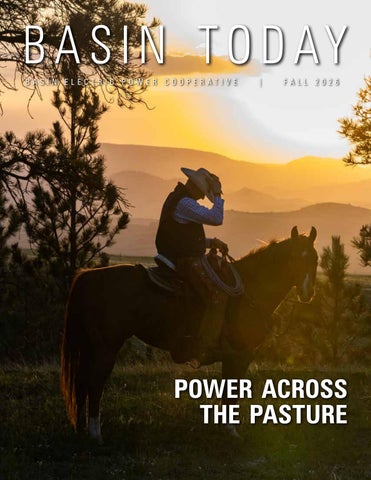
ON THE COVER Bathed in the golden light of a western South Dakota sunset, rancher Boyd Dean checks on cattle west of Spearfish. Butte Electric Cooperative, a Class C member of Basin Electric, has power lines running through the pasture, connecting this Black Hills landscape to reliable electricity from the Newell, South Dakota-based cooperative.
IN EVERY ISSUE 2 4 8 10 16
CEO column: SEC update In brief Member focus How we serve Employee highlights
FEATURE STORIES 6 12 13 14
Groton Generation Station celebrates 20 years of innovation on the Great Plains Dwight Rossow: A commitment to serving the cooperative family A cat called cooperative 2026 scholarship recipients
CONTRIBUTORS Editor:
Kalli Senske (communications@bepc.com)
Graphic designer:
Joy Schnabel
Photographers:
Joy Schnabel, Juan Thomas, Greg Wheeler
Writers:
Erin Becker, Jenifer Gray, Dana Hager, Kelly Miller
Scan the QR code with your cell phone to view stories online. FALL 2026 | 1
CEO A ND G E NE R A L M A N AG E R C OL UMN
TODD BRICKHOUSE GROWING AS A
COOPERATIVE WHILE STAYING TRUE TO
OUR ROOTS
A growing family eventually needs a bigger vehicle. A growing community needs more roads, schools, and infrastructure. And a growing electric cooperative needs new resources, new transmission, and occasionally some new financing tools. At Basin Electric, we are in one of the most significant periods of growth in our 65-year history. Our members continue to need more electricity, and meeting that demand requires substantial investment in generation, transmission, and the infrastructure that ties it all together. The projects are large. The investments are significant. And so are the financing needs. That is why Basin recently took an important step in our financial evolution by becoming a registrant with the U.S. Securities and Exchange Commission, or SEC. I realize SEC registration may not be the most exciting topic you’ll read about today. Few people spend their free time reviewing financial disclosure filings. But this milestone is important because it provides Basin with another tool to support long-term growth while remaining focused on the members we serve.
More tools for the road ahead The SEC oversees U.S. securities markets and establishes reporting and disclosure requirements designed 2 | BASIN TODAY
to provide investors with consistent, transparent financial information. For Basin, SEC registration gives us greater access to the public bond market and a broader pool of investors. Think of it as part of an all-of-the-above financing strategy. Just as a diverse portfolio of generation resources strengthens our ability to reliably serve our members, a diverse set of financing options helps us fund the infrastructure they need.
That hasn’t changed. Our responsibility today is the same as it was then: providing reliable, affordable electricity while making thoughtful decisions that position Basin to continue serving our members and rural communities well into the future. What has changed are the tools available to help us meet today’s challenges and tomorrow’s opportunities. SEC registration is one of those tools.
A milestone powered by teamwork There is another part of this story worth sharing.
Public bonds provide access to a larger investor market, creating opportunities for competitive financing, improved liquidity, and greater flexibility as we make long-term funding decisions. And long term matters at Basin. The generation and transmission facilities we build today will serve our members for generations to come. Financing those investments requires us to think beyond next year and focus on what will best position the cooperative for success 10, 20, and 30 years from now.
Some things change. The important things don’t. While SEC registration introduces new reporting requirements, it does not change who we are. Basin remains a member-owned cooperative. Our mission does not change, and our members remain at the center of every decision we make. In many ways, the transparency and accountability that come with SEC reporting align naturally with cooperative values. Our members have always expected responsible stewardship of their cooperative. Public reporting reinforces that commitment while providing additional insight into Basin’s financial performance.
Built for what comes next Sixty-five years ago, the people who founded the cooperative were facing their own period of change. Growing farms, businesses, and rural communities needed reliable electricity, and our founders recognized they could accomplish more together than they could individually. They pooled resources, planned for the future, and built something designed to serve generations of members.
When we began this process, we knew SEC registration would require a significant amount of effort across the cooperative. What we didn’t necessarily expect was how quickly that work would come together. On May 6, our registration was declared effective, just 21 days after the initial filing, far sooner than we expected. That doesn’t happen by accident. It took employees across multiple departments working together to learn new requirements, develop processes, review disclosures, and make sure every detail was right. And the work doesn’t stop there. Our teams continue to build the foundation for ongoing compliance, including preparing quarterly reports and disclosures and establishing processes that will serve Basin well for years to come. My sincere thanks to everyone who contributed to this effort. Your willingness to take on new challenges and work across teams made this achievement possible. While SEC registration is an important step forward, what gives me confidence about Basin’s future isn’t a new financing tool. It’s the people of Basin Electric. Time and again, our teammates demonstrate that when a challenge or opportunity is in front of us, we find a way to deliver for our members.
TODD BRICKHOUSE CEO and general manager
FALL 2026 | 3
IN B RIE F meeting July 21 in Washington, D.C., where discussions focused on the future of coal-fired generation, export opportunities, and regulatory policy affecting the coal value chain. Basin Electric leaders present the Untarnished Turbine Award to Antelope Valley Station employees in recognition of their outstanding performance and commitment to reliability.
Basin Electric honors Antelope Valley Station Unit 2 with reliability award Basin Electric recognized Antelope Valley Station Unit 2 as the cooperative’s most reliably operated coal generation facility for 2025. Recently renamed the “Untarnished Turbine Award”, this award recognizes exceptional reliability performance over the past year, reflecting commitment to safe operations, strong maintenance practices, and teamwork. “I am so proud of Cory Bryngelson and the team at Antelope Valley Station, and I hope they are proud of themselves,” Gavin McCollam, senior vice president and chief operating officer at Basin Electric, said. “We continuously talk about the importance of reliability, and we hope that employees see this award as a daily reminder that their efforts to keep the plant running are valued and appreciated. Todd Brickhouse, Basin Electric’s CEO and general manager, named the “Untarnished Turbine Award” very aptly, and the team at Antelope Valley Station is very deserving.”
Representing Basin Electric were Todd Brickhouse, CEO and general manager, who was appointed to the NCC in January 2026, and Valerie Weigel, senior vice president of energy markets and Dakota Coal Company operations. The NCC is a federal advisory committee to the U.S. Secretary of Energy, providing advice and recommendations on general policy matters relating to the coal industry. The meeting featured remarks from senior Trump administration officials, including U.S. Energy Secretary Chris Wright, Interior Secretary Doug Burgum, Environmental Protection Agency Administrator Lee Zeldin, and Department of Energy leaders. https://bit.ly/Basin-NCC
https://bit.ly/Untarnished-Turbine-AVS
Todd Brickhouse, Basin Electric CEO and general manager, addresses attendees at the 2026 Basin Electric Annual Meeting.
Basin Electric, members discuss Power and Purpose at 65th Annual Meeting Industry leaders gather at the recent National Coal Council meeting. Photo Credit: The National Coal Council
Basin Electric leaders attend National Coal Council meeting Basin Electric leaders joined energy industry executives and federal officials at the National Coal Council (NCC) 4 | BASIN TODAY
Basin Electric’s 2026 Annual Meeting of the Membership was held Aug. 12 at the Bismarck Event Center in Bismarck, North Dakota. Hundreds of member cooperative employees, directors, public officials, utility representatives, and guests attended the meeting. The theme for Basin Electric’s 65th Annual Meeting was “Connected by Power and Purpose.” This theme reflects
the cooperative’s commitment to strengthening communities and ensuring that reliable, affordable electricity continues to power the lives of rural Americans.
serving new large loads. Under the program, customers requesting service for non-traditional loads must bear the cost of any generation and transmission infrastructure needed to meet their demand.
Wayne Peltier, Basin Electric board president and District 9 representative, reflected on the cooperative’s commitment to serving its members. Peltier emphasized that member priorities guide Basin Electric’s decisions and highlighted the role of directors, committee members, and employees in helping the cooperative meet growing demand and build on its 65-year legacy of service.
Developed in collaboration with the Basin Electric membership, the program offers a consistent framework for evaluating and managing large load requests. By working together to manage growth responsibly, Basin Electric ensures reliable, affordable power for all members today and for generations to come.
Todd Brickhouse, Basin Electric CEO and general manager, discussed how being “Connected by Power and Purpose” means providing reliable, affordable electricity while making strategic investments to meet growing energy demand. He highlighted Basin Electric’s role in supporting U.S. energy independence, reflected on the cooperative’s 65-year history, and outlined the organization’s continued focus on safety, reliability, affordability, and major infrastructure projects that will help serve members for generations to come.
“One year in, the Large Load Commercial Program is delivering exactly what it was designed to accomplish: creating a clear path for growth while protecting our members,” said Daniel Gallagher, vice president of Commercial Operations. “We’ve established a disciplined process that allows viable projects to advance quickly, ensures project-related costs remain with the large loads driving them, and helps Basin Electric and our members responsibly capture the economic opportunities emerging across our service territory.”
https://bit.ly/Basin-65-Annual-Meeting
Basin Electric’s Large Load Commercial Program marks one year
The program also provides flexibility to accommodate system growth, reduces the risk of stranded assets, protects Basin Electric’s credit rating, and promotes responsible capital investment.
Adopted in June 2025, Basin Electric’s Large Load Commercial Program was created to insulate existing members from costs and potential risks associated with
SEE FULL STORIES
https://bit.ly/LLCP-one-year
CONNECT WITH US /basinelectric /company/basin-electricpower-cooperative /basinelectric
Read Basin Today online @ basinelectric.com/BasinToday
basin_electric
Read Basin Electric news online @ basinelectric.com/News-Center
@basin_electric
FALL 2026 | 5
Aerial view of Groton Generation Station.
GROTON GENERATION STATION
CELEBRATES 20 YEARS OF
INNOVATION ON THE GREAT PLAINS GROUNDBREAKING TECHNOLOGY AT THE PLANT INFLUENCED PROJECTS WORLDWIDE. By Jenifer Gray
In 2006, Groton, South Dakota, became home to a technological milestone. In the early morning hours of July 1, Groton Generation Station Unit 1 began commercial operation, launching one of the world’s first applications of a technology that would later be adopted around the globe. Located five miles south of Groton, Basin Electric’s Groton Generation Station Unit 1 introduced the first commercial application of General Electric’s (GE) LMS100® simple cycle gas turbine. The turbine, unlike anything in the world at the time, represented a new class of engineering. Part of it came from jet engine design, which allowed it to start very quickly, and part of it came from traditional heavy duty power turbines, which gave it the strength and durability needed for utility use. This capability allowed the 6 | BASIN TODAY
plant to ramp from a complete shutdown to generating 95 megawatts of electricity in just a few minutes. “Purchasing the first LMS-100 turbine from GE enabled Basin to be an industry leader in adopting advanced energy technology in rural South Dakota,” Chris Karch, plant manager South Dakota generation, says. “The project improved generation efficiency and reliability to cooperative members and helped demonstrate the capabilities of a technology that would go on to influence power generation across the industry.” Groton Generation Station came on at a time when Basin Electric was experiencing steady load growth and expanding its service territory into Minnesota. New long-term power contracts increased the
cooperative’s obligation to supply additional electricity, and national energy policy was shifting away from large coal units toward more flexible natural gas and renewable resources.
change from minute to minute, fast-response plants like Groton Generation Station are more important than ever. Their ability to quickly start up and adjust output helps balance those fluctuations and maintain grid reliability.
With the lessons of past overbuilding still in mind, Basin Electric chose a more incremental approach to adding capacity. Wind projects, recovered energy units, and fast-start natural gas facilities became key parts of that strategy. “Combining Basin’s need for peaking power with Groton’s access to natural gas and water resources made it an excellent location for the new GE LMS-100,” Brian Jones, Basin Electric operations and maintenance supervisor at Groton Generation Station, says. “Its proximity to Basin Electric 345-kV and Western Area Power Administration 115-kV substations made sense.” In this environment, Groton Generation Station provided reliable peaking power and system support needed to meet rising demand.
Today that flexibility remains critical. “As more renewable energy has become available, natural gas generation facilities like Groton are needed to quickly start up and provide a backstop if wind and solar generation does not meet the forecasted load schedule,” Karch says. “Having 200 megawatts of dispatchable power that can be brought online within 10 minutes ensures that the transmission system remains reliable.”
The facility also came with a lower installation cost than many of the baseload resources built in the 1980s, which were designed to operate continuously and were less flexible in responding to changing system needs. “By adding peaking generation, Basin was able to make more optimal use of its existing generation assets while creating a more balanced and adaptable resource portfolio,” Becky Kern, Basin Electric vice president of Resource Planning and Rates, says. “Groton was among the first facilities to help diversify Basin’s generation mix, signaling a shift toward a broader strategy that combined reliability, flexibility, and cost-effective capacity additions.”
As the station celebrates 20 years of operation, recognition goes to the employees, both past and present, whose dedication has shaped its success. Their expertise, hard work, and commitment have enabled the station to deliver dependable performance, support Basin Electric’s changing generation needs, and advance innovation in serving rural electric cooperatives.
From left to right: Zane Fees, operator technician I, Brian Jones, operations and maintenance supervisor, and Drew Prentice, operator technician I, at Groton Generation Station.
Over the past two decades, Groton Generation Station’s role has evolved along with the electric grid. “When the station was first commissioned, it operated only as a peaking power plant,” Jones says. “Since joining the Southwest Power Pool in 2015, however, it has increasingly operated as a load-following plant. The amount of electricity generated annually between 2006 and 2015 is now produced in a single month.” At the same time, renewable energy generation has grown more than tenfold. Because renewable output can FALL 2026 | 7
M E MB E R F OCUS
Snakenberg (left) thanks a veteran for his service during a flagpole installation completed by employees at Grundy County REC. Photo courtesy of Grundy County REC.
HONORING HOMETOWN HEROES
FOR DEREK SNAKENBERG, FIRST CLASS LINEMAN WITH GRUNDY COUNTY RURAL ELECTRIC COOPERATIVE, IT’S NEVER BEEN A QUESTION OF WHETHER TO PAY TRIBUTE TO AMERICA’S SERVICEMEN AND WOMEN, ONLY A MATTER OF HOW. By Kelly Miller
Rural roots that run deep Like many in Basin Electric’s service territory, Snakenberg grew up in a small town where friends and neighbors are more like family than acquaintances. Originally from Sigourney, Iowa, he first got involved with the local electric co-op, T.I.P Rural Electric Cooperative, working there during school breaks while attending Wartburg College in Waverly, Iowa. After graduating from the Northwest Iowa Community College lineman program in 2015, Snakenberg was hired at an investor-owned utility (IOU) in Des Moines, Iowa, before ultimately going to work for Grundy County REC, a Basin Electric Class C member. Snakenberg has been a full-time part of the cooperative family for six years. “After working for a large IOU, the cooperative difference feels more personal, meaningful, 8 | BASIN TODAY
and impactful,” he says. “We are a small cooperative, but each person brings a unique piece of the puzzle to the table. It takes all of us.” Working for Grundy County REC has allowed Snakenberg to get to know the members the cooperative serves, giving him a unique opportunity to connect with home and business owners throughout its service territory. “As a lineman, we are on the front line of who represents the cooperative the most and what our members expect to receive as friendly and respectful customer service,” he acknowledges.
A desire to do more Just as he is committed to serving others through his work, Snakenberg also feels a strong calling to serve those who have made a lasting impact on our country. Enter the Veteran Flagpole Initiative (VFI).
Formed in 2021 by a group of nearly 50 friends who wanted to “provide veterans with a permanent visual reminder of appreciation for their service and sacrifice,” VFI is a non-profit organization run entirely by volunteers whose efforts are funded solely through donations. “Our mission is to fund and install flagpoles in the yards of veterans at no cost to them,” Snakenberg remarks. “And that’s what we do.” Snakenberg says, “Volunteering with this organization is a no-brainer.” After helping with his first install and seeing just how special it was to that veteran, he knew he needed to do more. “It is one of the most impactful things I have had the opportunity to get involved with,” he says. “Our military men and women are heroes. They are the difference makers in all our freedoms and safety. I am thankful for every veteran.” For Snakenberg, the work of this organization hits close to home. Several of his family members and friends have served in the military, including a great uncle who lost his life aboard the USS Arizona during the attack on Pearl Harbor and his best friend from high school who became a Green Beret and was awarded a Purple Heart after being wounded in action. Earlier this year, Basin Electric provided a monetary donation to VFI through the cooperative’s member match program. In total, the donation received through this match was $4,500, all of which will be used to purchase flags, flagpoles, and other supplies necessary to complete installations.
One foot in front of the other In addition to using his personal time to support VFI’s efforts, Snakenberg has taken his desire to be of service a step further by spreading awareness using another passion of his—fitness. With the goal of bringing attention to VFI’s mission and honoring veterans, Snakenberg ran a 52-mile stretch of the Register’s Annual Great Bicycle Ride Across Iowa (RAGBRAI) carrying an American flag, stopping along the route to install flagpoles with other VFI volunteers. As the oldest, largest, and longest multi-day bicycle tour in the world, RAGBRAI brings together riders from all 50 states and nearly 20 countries. As a result of his efforts, VFI officially partnered with RAGBRAI on longterm planning to serve veterans.
Appreciation in action Inspired by the VFI’s mission and the actions of their team member, Grundy County REC staff participated in three flagpole installations for its members earlier this year. “Grundy County REC has always believed in giving back to our communities and our membership. Derek’s involvement in VFI is a great example of that commitment to community service,” Michael Geerdes, Grundy County REC general manager/executive vice president, says. “Being able to support Derek in this endeavor by having a volunteer day was a great experience for our entire staff. He is a great employee and, more importantly, an even better person. We truly enjoyed the day, especially getting to meet some of our members who are veterans and having the opportunity to present them with this gift.”
A growing impression VFI has 11 team leads across Iowa—and branching into several new states—who spearhead each installation, including scheduling the date, lining up volunteers, ensuring the necessary materials are ready, and calling for underground line locates. Though the organization is established and focused in Iowa, volunteers have also installed flagpoles in Colorado, Illinois, Missouri, Montana, and Texas. This year marked two significant milestones for VFI. On our nation’s 250th anniversary, volunteers completed the organization’s 250th flagpole installation, and on the 25th anniversary of 9/11, a 101-year-old World War II Navy veteran received his flagpole. “It was a very special day for everybody involved,” Snakenberg recalls. The organization is working toward meeting its “Operation 99” goal of installing at least one flagpole in each of Iowa’s 99 counties by 2028. To help meet this goal, the organization makes a big push on military holidays—Flag Day, Veterans Day, and the 4th of July—to raise awareness of the program and install additional flagpoles. To learn more about the VFI and how you can nominate or sponsor a veteran, visit www.veteranflagpoles.org.
FALL 2026 | 9
F E AT URE SE RIES
As part of his role, Fitzwater checks contacts on a motor-operated switch.
HOW WE SERVE: SUBSTATION ELECTRICIANS
BEHIND THE SCENES, LEAD SUBSTATION ELECTRICIAN RAY FITZWATER HELPS DELIVER SAFE, DEPENDABLE POWER EVERY DAY. By Jenifer Gray
When you flip a light switch, charge your phone, or power up your computer, there’s a complex electrical system working behind the scenes to deliver reliable electricity. One of the key professionals responsible for keeping that system running is the substation electrician. Substation electricians work in electrical substations, which are facilities that help transfer electricity from power plants to homes, businesses, and industries. Their primary role is to install, maintain, test, troubleshoot, and repair the equipment that controls the flow of electricity across the power grid. Ray Fitzwater, Basin Electric lead substation electrician, works in Wheatland, Wyoming, at one of 12 Transmission System Maintenance (TSM) outposts. 10 | BASIN TODAY
Located across Basin Electric’s service territory, TSM outposts play a critical role in ensuring reliable power delivery to members. The outposts serve as home bases for specialized crews, including lineworkers, substation electricians, substation system protection technicians, and telecommunications technicians, who maintain and support the cooperative’s transmission infrastructure. As a lead substation electrician, his responsibilities go far beyond working on electrical equipment. “I coordinate the activities of a substation electrician crew, schedule outages, and work closely with supervisors to lead construction and maintenance projects,” Fitzwater says. “I also coordinate the commissioning and testing of substation equipment and oversee periodic substation inspections to identify potential problems or safety
hazards.” Every project requires careful scheduling of both personnel and equipment to ensure jobs are completed safely and efficiently. At Basin Electric, reliability is a core value, and for Fitzwater, it is one of the most important parts of the job. “Every piece of equipment in a substation plays a critical role in delivering electricity,” he says. “When equipment fails unexpectedly, it can impact service for the members who rely on that power. That’s why regular inspections, testing, and maintenance are so important.” Because electrical systems are complex, unexpected issues can arise any time. Working closely with relay crews and engineers, the team helps identify root causes and develop solutions that keep the system operating. The goal is always the same: ensure electricity is delivered safely and reliably to our members without interruption. Technology continues to improve the way substations operate and how maintenance is performed. Over the years, Fitzwater has seen significant advancements in equipment design. “We have new breakers that utilize mixed-gas technology, which eliminates the need for traditional tank heaters,” he says. “In cold climates like Wyoming, this improvement reduces maintenance requirements and increases reliability during winter months by removing a common point of failure.”
Other technological improvements have also changed the industry. Modern transformer gas monitoring systems now provide real-time data that can help identify developing issues long before they become serious problems. Upgraded relay systems offer enhanced diagnostics and troubleshooting capabilities, allowing crews to respond more quickly and accurately when issues arise. These innovations help improve reliability and give technicians better tools to maintain the system. Preventive maintenance also plays a major role in achieving reliability. “Routine testing, inspections, and maintenance help identify potential concerns before they become equipment failures,” Fitzwater says. “Taking the time to address small issues today helps prevent larger problems down the road.” For Fitzwater, the reward comes at the end of every day. After the planning, inspections, testing, construction, and maintenance are complete, there is satisfaction in knowing the power being generated is reaching the people who need it. “Our communities, farms, businesses, and families depend on reliable electricity every hour of every day,” Fitzwater says. “Playing a role in delivering that power safely and reliably is more than just a job. It is a responsibility the team and I take seriously, and it motivates us every day.”
PLAYING A ROLE IN DELIVERING THAT POWER SAFELY AND RELIABLY IS MORE THAN JUST A JOB. IT IS A RESPONSIBILITY THE TEAM AND I TAKE SERIOUSLY, AND IT MOTIVATES US EVERY DAY. Ray Fitzwater, lead substation electrician at Wheatland TSM
FALL 2026 | 11
A COMMITMENT TO SERVING
THE COOPERATIVE FAMILY
DWIGHT ROSSOW CONTINUES HIS FAMILY’S TRADITION OF COOPERATIVE LEADERSHIP, MOST RECENTLY ON THE BASIN ELECTRIC BOARD OF DIRECTORS By Jenifer Gray
Raised on a farm and ranch spanning four generations, Dwight Rossow is firmly anchored in rural life; his dedication to the cooperative system reflects decades of commitment to member ownership, common sense governance, and putting people first.
“My grandfather, Ernie Rossow, was elected to the Cam Wal board in 1951, just six years after the cooperative was formed,” Dwight says. “He served until 1975, and then my dad, Dennis, ran for and won the same seat. Dad continued serving on the board until 1989.”
The Rossow family’s roots in Campbell County, South Dakota, trace back to 1887, when Dwight’s great-grandfather took advantage of the Homestead Act and claimed 160 acres. By the following year, the family had established itself on the land and begun farming. Dwight and his family now raise cattle on that same piece of land.
After the Rossow’s brief absence from the board, Dwight was elected in 1996, continuing a family tradition of cooperative leadership that spans more than seven decades.
For the Rossow family, commitment to the cooperative has spanned generations. Dwight leads the Cam Wal Electric Cooperative board, a Basin Electric Class C member. As president, he continues a legacy established by family members decades before he took on the role.
For Dwight, board service was a natural progression. “Some of my earliest memories include listening to Dad (Dennis) and Gramps (Ernie) talk about Cam Wal,” he says. “Those conversations were a constant part of my life growing up, and it didn’t take long to develop an understanding of the business.” When asked about his motivation, Dwight downplays any sense of ambition. Instead, his guiding principle remains simple and direct: common sense. “Don’t look out for your personal interest,” he says. “Look at what’s best for the members.” He believes that when decisions are grounded in that mindset, leadership becomes clearer even when the issues are complex. On May 1, 2026, Dwight joined the Basin Electric Board of Directors representing District 7, Rushmore Electric Power Cooperative, located in Rapid City, South Dakota.
Dwight Rossow represents District 7, Rushmore Electric Power Cooperative, on the Basin Electric Board of Directors.
12 | BASIN TODAY
Dedication to the position, thoughtful decision making, and keeping member interests at the center of every discussion will be Dwight’s focus as he continues his family’s legacy of service.
A CAT CALLED COOPERATIVE
BASIN ELECTRIC EMPLOYEES HELP A STRAY KITTEN AT HEADQUARTERS FIND A HOME By Kalli Senske
It was one of those frigid December mornings we’re all familiar with when Basin Electric Senior Talent Acquisition Specialist Darcy Roberts Geffre pulled into the parking lot at Basin Electric’s Headquarters. She hadn’t even parked her car when she saw a furry kitten dart under a vehicle looking for shelter from the zerodegree weather.
“Before I went to bed, I set my alarm clock to go off every two hours that night so I could run to Basin and check the trap,” she says. “Justin was not amused by the possibility of my alarm going off every two hours, so before bed he decided to run to Basin one last time to check the trap. He was surprised to see that we actually caught the kitten this time!”
“We have a situation,” Roberts Geffre told her coworker, Executive Administrative Assistant Jen Kemmet, when she ran inside the building. Together the two chased the kitten around the parking lot, Roberts Geffre in heels, until he eventually outran them, and the pair couldn’t find him again. But animal-lover Roberts Geffre didn’t give up that easily.
Originally, the couple planned to foster the kitten, but Roberts Geffre says she secretly knew he would end up joining their family.
The kitten had run towards Basin Electric’s maintenance shop, so Roberts Geffre called in reinforcements. “We found paw prints in the snow in that area, so we had the maintenance team help set a live trap,” she recalls. “The wet food they used for the trap froze immediately, so Jen brought some kibble from home. We moved the trap a couple times to where we were seeing fresh paw prints, and he was spotted on the security cameras.” Two days later, the kitten still hadn’t been caught. Kemmet believed it must have a home it returned to, but Roberts Geffre wasn’t convinced and went to check the trap again before leaving work. “As I sneaked around the generator, I heard something, so I slowly peeked around and saw him in the trap – but the door didn’t close, and he ran when he saw me,” she says.
“One night, he curled up on my chest and fell asleep purring with his head on my shoulder,” she shares. “After that, I had to break the news to Justin that he was staying. It didn’t take long for Justin to get on board because he had already fallen in love with him at this point, too.” When it came to choosing a name, the two wanted a clever way to link him to the place he was found: Basin Electric. “We thought of Leland, Faraway, Basin, Power, Electra, Windy, and Genny, but chose Cooperative, aka Cooper, because it was easy to say and fit him the best,” Roberts Geffre says. Fittingly, Cooper’s name is now a reminder of the cooperative spirit that helped save him, proving that small acts of kindness can make a life-changing difference.
After a winter rescue, Cooper became a permanent member of the Geffre family.
The weather was forecasted to be well below freezing with life-threatening wind chills that week, and Roberts Geffre says, “I knew if I didn’t save him, he would not survive.” After her husband, Basin Electric Power Modeling Engineer II Justin Geffre, helped reset the trap, Roberts Geffre went home and converted a basement bathroom into a “kitty rescue station” for when the kitten was hopefully caught. FALL 2026 | 13
POWERING BRIGHT FUTURES:
MEET THIS YEAR’S SCHOLARSHIP RECIPIENTS!
Twenty-four $1,000 scholarships were awarded to children of Basin Electric and subsidiary employees to further their education this fall. Recipients were chosen for their participation in school and community activities, academic excellence, work experience, and career goals.
Maverick Bachmeier, son of Eric (Headquarters) and Aimee Bachmeier, is studying cybersecurity at the University of Mary in Bismarck, North Dakota.
14 | BASIN TODAY
Adam Friez, son of Angie (Headquarters) and Chris Friez, is studying business economics with a minor in political science at the University of Nor th Dakota in Grand Forks, North Dakota.
A nna Bahm, daughter of John (Menoken TSM) and Katie Bahm, is studying microbiology with minors in soil science and chemistry at North Dakota State University in Fargo, North Dakota.
Kate Friez, daughter of Angie (Headquarters) and Chris Friez, is studying business management at the University of North Dakota in Grand Forks, North Dakota.
Sophie Lynn DePriest, daughter of Sarah (Headquarters) and Gary DePriest, is studying applied science in architectural modeling and design technology at North Dakota State College of Science in Wahpeton, North Dakota.
Alexis Huntimer, daughter of Randy (Dakota Gas) and Amanda (Leland Olds Station) Huntimer, is studying biology at the University of North Dakota in Grand Forks, North Dakota, on a pre-med track.
Parker Feigitsch, son of Jen (Headquarters) and Bucky Feigitsch, is studying electrical engineering at North Dakota State University in Fargo, North Dakota.
Kyten Johnson, son of Abon (Gillette TSM) and Heidi Johnson, is studying computer science at Gillette College in Gillette, Wyoming.
Berlynn Felchle, daughter of Tyler (Headquarters) and Kayla Felchle, is studying clinical psychology at the University of North Dakota in Grand Forks, North Dakota.
We s l e y J or d a n , son o f Jesse (Headquarters) and Rachel Jordan, is studying biology at the University of North Dakota in Grand Forks, North Dakota, on a pre-med track.
Ava Jungers, daughter of Char (Dakota Gas) and Mike Jungers, is studying exercise science/physical therapy at Williston State College in Williston, North Dakota.
Jacob Schlag, son of Kate (Headquarters) and Matthew Schlag, is studying atmospheric sciences at the University of North Dakota in Grand Forks, North Dakota.
Danae Kern, daughter of Beck y (Headquarters) and Josh Kern, is studying biology at the University of Minnesota in Minneapolis, Minnesota, on a pre-med track.
Alexis Selensky, daughter of Tera (Headquarters) and Donovan Selensky, is studying speech pathology at the University of North Dakota in Grand Forks, North Dakota.
Cour tney K rueger, daughter of Germain (Headquarters) and Justin Krueger, is studying pre-dental at Bismarck State College in Bismarck, North Dakota.
Halle Severson, daughter of Jeremy (Headquarters) and Jennifer Severson, is pursuing her doctorate in pharmacy at North Dakota State University in Fargo, North Dakota.
Grant Lang, son of Ryan (Headquarters) and Beth Lang, is studying welding at Bismarck State College in Bismarck, North Dakota.
Cali Steffan, daughter of Todd (Dakota Gas) and Jennifer Steffan, is studying elementar y education at Valley City State University in Valley City, North Dakota.
Madalyn Meckle, daughter of Bob (Headquarters) and April Meckle, is studying biology with a concentration in wildlife and conservation at Dickinson State University in Dickinson, North Dakota.
Andrew Swenson, son of Nate (Headquarters) and Becca Swenson, is studying cybersecurity with a minor in music at the University of Mary in Bismarck, North Dakota.
Elise Meier, daughter of Eric (Headquarters) and Kristle Meier, is studying geriatric neurology at the University of Nor th Dakota in Grand Forks, North Dakota, on a pre-physician assistant track. Mia Peterson, daughter of Colleen (Headquarters) and Eric Peterson, is studying music performance at the University of North Dakota in Grand Forks, North Dakota.
Tyson Wick, son of Angie (Antelope Valley Station) and Aaron Wick, is studying organizational management and leadership at Bismarck State College in Bismarck, North Dakota. Brynlee Wittenberg, daughter of Jeremy (Headquarters) and Melissa Wittenberg, is studying occupational performance at the University of Mary in Bismarck, North Dakota.
FALL 2026 | 15
E M P L OY E E HIG HL IG H T S
SERVICE AWARDS
45 years Instrumentation and Control and Telecommunications Engineering Manager Headquarters
35 years Senior vice president and chief operating officer Headquarters
Gavin McCollam
Lawrence Anderson
Bradley Bergstad
Dave Eustice
Mike Merck
Rick Schantz
Dale Call
Dana Jensen
Jay Lundstrom
Ryan Martens
Bob Meckle
Robb Moore
Tammy Roehrich
Tim Rogness
Dave Rudolph
Robert Starr
Boyd Trester
John Worthington
Dan Baumiller
John Frank
Derek Grimm
Ted Grimm
Nathan Helbling
Casey Jacobson
Matt Jolovich
Nathan Mann
Joe Pedersen
Gregory Petroski
Richard Reich
Steve Mundahl
30 years Field technician V BQ process operations Dakota Gas
25 years Senior rotating equipment engineer Dakota Gas
25 years Shift supervisor Laramie River Station
20 years Senior staff counsel Headquarters
16 | BASIN TODAY
25 years Lead yard equipment operator Laramie River Station
25 years Senior IT systems administrator Headquarters
20 years Protection services supervisor Dakota Gas
20 years Maintenance planner/ scheduler Laramie River Station
30 years Operations shift supervisor Dakota Gas
25 years Instrumentation and control engineering supervisor Headquarters
25 years Area inspection specialist II Dakota Gas
20 years Director of Risk and Insurance Headquarters
20 years Mechanic I Antelope Valley Station
30 years Maintenance superintendent Menoken TSM
25 years Load forecasting and reporting supervisor Headquarters
25 years NERC compliance manager Headquarters
20 years Maintenance superintendent Antelope Valley Station
20 years Lead electrician Laramie River Station
30 years Shift superintendent Dakota Gas
25 years Field maintenance technician V - E&I control systems IT Dakota Gas
25 years Mechanic/welder I Laramie River Station
20 years Mechanical supervisor Leland Olds Station
20 years Maintenance planner/ scheduler Laramie River Station
30 years Field technician V BQ process operations Dakota Gas
25 years IT enterprise network and telecommunications manager Headquarters
25 years Director of Electrical Engineering Headquarters
20 years Substation superintendent Menoken TSM
20 years Field maintenance technician V - E&I power distribution Dakota Gas
SERVICE AWARDS
Seth Sailer
20 years Mechanic I Antelope Valley Station
Kurt Winkler
20 years Lead electrician Antelope Valley Station
Gregory Petroski 20 years Maintenance planner/ scheduler Laramie River Station
Richard Reich
20 years Field maintenance technician V - E&I power distribution
RETIREES Quinn Messer retired from his position of maintenance supervisor at Dakota Gas on Dec. 29, 2025, after a 25-year career with the cooperative. The Richardton, North Dakota, native began working as a maintenance technician in 2001. “It has been a great learning experience,” Messer says. “I’ve made great friendships that will continue on. It’s been interesting work through the last 25 years, and I was constantly learning something new.” Reflecting on his time working with Messer, Doug Moore, maintenance superintendent at Dakota Gas, says, “Quinn has been a valued member of the Dakota Gas team and someone others could always rely on. His experience, professionalism, and willingness to help have made a positive impact on both the organization and the people he worked with. We appreciate his many years of service
and wish him all the best in retirement.” In his retirement, Messer plans to spend time on the lake, relax, golf, and enjoy time with his family. Frederick Bernhardt, electrician I, retired from Laramie River Station on May 1, 2026, after 11 years with the cooperative. “Fritz’s knowledge, work ethic, and willingness to help others will be missed in the electric shop,” Joseph Suko, electrical supervisor, says about his time working with Bernhardt. “He was never afraid of hard work and would jump in and help a coworker any time he was asked.” Prior to joining Basin Electric, the Wheatland, Wyoming, native worked as an electrician with the International Brotherhood of Electrical Workers Local 415.
WE WILL REMEMBER Jaydon Johnson, field technician III at Dakota Gas, passed away on Sept. 5. A North Dakota native, Johnson received an associate degree from Bismarck State College in 2024. He began working as an intern at the Great Plains Synfuels Plant during college in May 2023 and was hired full-time on May 20, 2024. “Those of us who do shift work often spend more time with the people on our crew than we do with anyone else,
including our own families. Over time, your coworkers become more than just people you work alongside—they become family. Losing a coworker is always difficult, but Jaydon was someone who made it especially hard,” Travis Creighton, fertilizer shift supervisor at Dakota Gas, says. “He got along so well with everyone and was genuinely liked by all of us. He was simply a great guy all around, and his presence made our crew better. Jaydon will be deeply missed by everyone on our crew. We’ll always remember him and the time we were fortunate enough to spend working alongside him.” FALL 2026 | 17
PRESORTED STANDARD U.S. POSTAGE PAID BISMARCK, ND PERMIT 224
1717 EAST INTERSTATE AVENUE BISMARCK, NORTH DAKOTA 58503-0564 701.223.0441 ADDRESS SERVICE REQUESTED PRINTED ON RECYCLED PAPER
BASIN ELECTRIC
COMMUNITY
C R E AT E D F O R C O M M U N I T I E S Community support is more than a nice idea – it’s Basin Electric’s culture. Giving back is important to us because charitable programs and non-profit organizations help our communities thrive. Our communities have supported us throughout the years by providing a strong workforce, and without them, we couldn’t provide reliable, affordable electricity across rural America. Now more than ever, community matters.