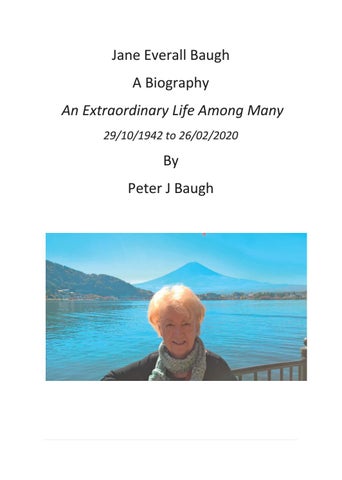
Jane Everall Baugh A Biography An Extraordinary Life Among Many 29/10/1942 to 26/02/2020
By Peter J Baugh
Preface Jane Everall Baugh was an extraordinary person destined for a life from a background that was to be unexceptional, but which was catalysed by the advent of WW2 for a greater outcome. She became revered and admired by many people with whom she came into contact, her peers, colleagues and friends. She was an organiser, a thinker and effective multitasker, often having an ability to pre-empt the thoughts of the person with whom she was conversing. Her legacy in the Borough where she lived for more than 50 years is considerable, particularly, in the 30-year-period from 1990 until her untimely death in 2020 when she was councillor first for Broadheath and then Priory Ward. In 1997 she stood in Altrincham & Sale Constituency as the Labour Party candidate and almost succeeded in being its first Labour MP and defeating the new Conservative candidate even before he became an MP. As executive member in the first of two Labour administrations, she was active in promoting the arts culminating in the creation of the Waterside Arts Centre and the Robert Bolt Theatre in 2003. She had a passion for parks and recreational facilities and drove forward initiatives in these facilities, including an outdoor gym in Worthington Park. She was a member of Walkden Garden and Worthington Park friends’ groups and Sale Festival Vice Chair. She represented Sale Brass Band, The Alma Singers and Parkinson’s Trafford Branch as their president and The Alex Hulme Foundation as Patron. She was the Mayor of Trafford from 2011 to 2012 and with a dedicated team organised many fund-raising events, which she fronted with exuberant enthusiasm. In the second Labour administration, as executive member for children services, she showed a compassion for children and young people who were disadvantaged and strived to ensure that their care and welfare was of paramount importance. Of extreme importance to her was her politics and she never hesitated to leaflet and campaign in every target ward in addition to her own in all weathers. Although she decided to resign as a councillor in late 2019, within two months before she died she was still organising the rounds for delivery of New Years’ cards in Priory Ward with her colleague and political brother, Barry Brotherton. She continued to show the same determination and resilience until the end of her life. As her husband for more than 54 years, 1965-2020, and since the chance meeting in May 1960, I am forever grateful to have known her, admired her and loved her. This biography is dedicated to the life of Jane Everall Baugh by her husband, Peter, and describes the relationship from the start, proceeding through their long courtship, their 1 | Peter J Baugh, March 2020
marriage in the USA and early adventures in New Orleans, USA, their upset in not having children on their return to the UK in 1966, and the joy of the first born son, prematurely, in 1972 followed by the second son in 1974 and the number three son in 1979, the schools years, many holidays in the period 1972 to 1990 with their sons, physiotherapy work at weekends, return to the NHS in 1987, becoming a councillor in 1990 and continuing until she resigned in early 2020 immediately before her passing. During this busy period as a councillor and part time physiotherapist, she found time also for many holidays, including revisiting the USA in 1995, visiting Japan in 2003 and 2017, the road trips in Spain 2005, New Zealand 2007, the USA 2015, 2018 & Canada, 2014 and 2016, Lake Bled, Scotland, many vacations in France and Greece, city breaks- Venice and Prague, Madeira, Dubrovnik, Cyprus, Crete, UK holidays on the edge of Exmoor, Yorkshire Dales and Moors, Northumberland, Pembroke, Dorset, Lake District, North Wales. Hosting many Christmases, New Year’s Eves, dinner parties and many coffee mornings, including fund raising events, was her forte. Dedication I am pleased to present this biography as a dedication to: Her Devoted & Immediate Family: Sons- Jonathan, David & James, daughters-in-law- Jemma & Louise, sister-in-law and pal- Sue, her grandchildren- Benjamin and Lily. Her brother and sister-in-law, John & Sue. Her Granddaughter, Maya (and her mother, Julie) Her Relations: her cousin and cousin-in-law- Paul & Maureen and Family; her brother and sister-inlaw- Phil & Margaret; Her niece and nephew-in-law- Erica & Graham and their family; Her sister-inlaw and nephew- Juliet & Alistair; Lee & Derek, her sister & brother-in-law; Her nephew and niecesin-law, Leon, Sasha and their children, Herbie Tate and Larkin, her nephew and niece-in-law, Simon & Jessica. Her special friends: Tim & Judy, Ann & Geoff, Sue & Colin, Jenny & Vic, Jeni & Brian, Glenda, Sheila & Tony, Lynn & Barry, (her political brother); Margaret Anya Baugh; Liz & Peter. Her special physio friends of long standing, Glenda in Rhiwbina, Sheila Lloyd, Liz and Sheila Lane (& Roy) Her school friends, Susan, Jane (& John), two Johns & Sally, and many others Her neighbours, Paul, Chris and Tom; Richard, Helen, Alice and Jack. Her community friends in the Parkinson’s Trafford Branch (Rod, Simon & Norma, all the committee and members), Alex Hulme Foundation (Nicola, Dave & Matt), Walkden Gardens (Sue, Garth, Gill, Rob, Nicola, Les) & Worthington Park (Nona, Rachel, Jaquie) groups, Sale Festival (Garth, Susan, John, Mike and all the committee), Sale Brass Band (Daisy, Steve and all the band), The Alma Singers (Margaret, Audrey, Tony and the choir, in particular, Ginny, Dianne & Brian). Her Priory Ward Labour Party colleagues (Fianna, Steve and the team) and council colleagues including, Sale East councillors- Andrew, Joanne, Liz & Mike; confidants- Dave & Tom, Sophie, Laurence and all the Labour Group and the Altrincham & Sale West constituency councillors and Labour Party members.
2 | Peter J Baugh, March 2020
Chapter 1. The chance meeting and ‘if’ interventions? Life is a game of chance with many ‘if’ interventions and buts, and ‘but ifs’ along its intricate path. IF1 Intervention If WW2 had not happened would J and P ever have met? The answer is extremely unlikely. Why, well, J would not have been borne at Haddington in Scotland in 1942 where her father was stationed at Port Seton with the RAF. She would have resided in Rhiwbina, Cardiff and schooled there. P who was born in Taunton, Somerset, where his father worked, where he would have remained and schooled there. The question is would he have attended university in Cardiff, in all probability not. As we are all aware, WW2 did commence in 1939 and J was born in Scotland in 1942 and remained there until 1946, when, with her parents and older brother, she returned to the family home in Rhiwbina, Cardiff. P did not remain in Taunton when his father was called up to the army but returned in 1940, with his mother and younger brother, to the family home in Colwyn Bay, North Wales. So, the situation that is presented here, J is resident in Rhiwbina, Cardiff and P in Colwyn Bay. Is there a chance that they will ever meet, it seems only a slim one. IF2 Intervention However, all that was to change, because in 1957, P, with moderate A levels, is accepted for a place at the University College of South Wales and Monmouth, Cardiff. But hang on what happens if he had been accepted on the first year of the general degree course in 1957? He would probably have completed the honours course in 1960. However, because his A levels were only moderate, he was obliged to enter the intermediate course in 1957; as a result, he completed the general degree course in 1960 and was accepted onto the honours course, which he completed in 1961. There was a slight difference between being on the honours degree programme or general degree programme in May 1960, as for the former, P would probably not have attended the university hop in mid-May 1960 due to the imminence of the honours exams. However, P was studying for a general degree in 1960, not as intensive, and did attend the hop. J with her best friend, Megan, as 17-and-a-half-year-old first-year sixth formers decided to gate crash the hop at the students’ union, Park Place, Cardiff, on Saturday, May 21, 1960. P arrives and asks J for dance. During the dance she steps on a watch, which P gruffly comments on. However, she agrees to a date, and several days before P’s degree exams they meet in Rhiwbina for a walk in a local park and up the Wenallt, a local beauty spot. They meet several times before P returns to Colwyn Bay to work as a temporary summer conductor on Crosville buses. P returns to Cardiff for degree day in July 1960 and meets up with J. He introduces an embarrassed J to his parents. P takes J to a local restaurant for lunch, 5s 3d for chicken & chips 3 | Peter J Baugh, March 2020
for J and steak & chips for him 7s 6d. He attempts to cut a hard bread roll with his knife, which he fails to do, and it jumps off the plate and rolls across the floor, not a very good impression on J. P returns to home to continue as a bus conductor in later July and August 1960, and except for exchanging correspondence and ‘phone calls, they do not meet until P returns to Cardiff to study honours chemistry in late September 1960. They meet for a date and go to the Capitol cinema to see “The League of Gentleman” with Jack Hawkins playing the lead. J takes an instant dislike to the suit and light mac P is wearing, which is not a good start. During the evening P senses that J is not at all happy. After the film is over, and they are walking back to the bus stop for her to return to Rhiwbina, J informs P that she needs, at this stage of her life, to have the space to understand what she wants out of her life; she was always a deep thinker. It is clear that J is indicating that P is not to be part of that life. So, they part after a fleeting relationship, which did not blossom, and it appeared was not going to do so. P returned to his lodgings accepting that it was over before it really began and, anyway, he has a lot on his plate, an intensive honours chemistry programme, lectures and laboratory classes, even on Saturday mornings, going to rugby at Cardiff Arms Park alternating with football at Ninian Park, and beer most evenings and more on Saturday evenings. He does not recall meeting or dating a girl at the hops during this period where he had met J. Are they destined to meet again? IF3 Intervention If Jane’s mother had not intervened in late 1960, J and P would quite definitely not have met again. During the summer, while P was home in North Wales, J had met a local boy, who she stated, on a number of occasions, over her life when she was reminiscing, she liked a lot. However, the relationship was cut short because when, one day, he appeared at the door of J’s home, 6, Clas Tynycae, Rhiwbina, her mother answered and informed him that J did not wish to see him again. What J’s response was at this intervention from her mother has never been revealed but knowing J there would have been considerable foot stamping and door banging. Also, how J’s mother persuades her to go round to P lodgings is also unclear but go she did with Megan in support. On a Sunday evening in late Autumn, the front door of 58, Station Road, Llanishen is opened by the Ms Merchants, spinster landladies, who look after P and Roger, his lodging mate. They look sternly at the two new second year sixth formers on the doorstep, almost aged 18. Jane asks to see Peter, almost aged 22 ; Roger is almost 21. She with her friend is shown into the room where P and R are revising intensively in the first term of their honours chemistry. They are dumbfounded by the state of room as the floor is covered with screwed up note paper, which has accumulated as P and R scribble and learn their chemistry subjects. J indicates that she would like to see P again and subsequently a date is arranged, which kicks off a long relationship of four and half years up until they marry on April 24, 1965.
4| Peter J Baugh, March 2020
Jane age 171/2 in May 1960 Summarising, these three IF interventions led to J and P having lives of almost 60 years together with many adventures and ups & downs along the way but more ups than downs.
Jane loved ballet and attended the Phil Williams and Sybil Marks Dancing School in Birchgrove, Cardiff, circa 1950.
5 | Peter J Baugh, March 2020
Chapter 2. The courtship period- 1960 until the end of 1963 After J and P had resumed their relationship in late 1960, many interesting events and adventures occurred, which are anecdotally related here, hopefully in a chronological order. 1961 was a turning point in their education, J took her A levels in chemistry, physics and zoology and P his honours degree in chemistry exams. J had been tutored in physics by one of P’s peers at the university and P recalls attempting to assist her in understanding organic chemistry. She had obtained 10 passes at ordinary level and would have been predicted passes at A level. In comparison, P had obtained only 8 passes at O level in 1955 but had obtained passes in chemistry and physics at A level in 1957. It was an unfortunate visit by J to Colwyn Bay in August 1961 that changed her career aspirations, successfully as it turns out. The day after she arrived J received her A level results from her Father by ‘phone in which he informed her that she had passed in all three subjects, which everyone congratulated her on. J and P went to the local library to check the WJEC A level results in the Liverpool Post. They were both devastated to read lower case o for each subject she had taken at A level. This was a disappointment as she had aspirations to attend medical school in Cardiff, which her father also desired because of his long-standing asthmatic bronchitis condition and visits to St David’s hospital, where he was a patient for research into bronchitic conditions. In the evening, J with P and family members attended her future sister-in-law, Juliet’s 21st birthday celebration. It was not a good evening for J as can be imagined but a positive outcome ensued when Juliet suggested ‘Why don’t you consider physiotherapy as a career?’ Juliet had commenced her studies in this medical discipline having obtained a pass at A level but did not continue after the first year. (J took this advice on board, and on her return to Cardiff, applied to the School of Physiotherapy attached to Cardiff Medical School. She was accepted and commenced the three-year course in October 1961). Also, on one evening during the visit, J was introduced to prawn cocktail when the family went for a posh meal at the Ferry Hotel alongside the River Conway. Although impressed with the venue and particularly the location, she felt very much out of her league and inferior because P’s family who had tendency to be a little aloof, she considered that they looked down on her. At this stage, little did they know that she was already very much politically on the left and diametrically opposed to their conservative views. P had graduated with an upper second-class honours degree in July of 1961 and had applied for posts with several companies, one in the North West. In mid-July, he attended for an interview at Turner Bros Asbestos, which had a factory and a research centre in Hindley Green near Widnes but when he asked about the social activities in the area, he was informed that he could become a member of a local non-conformist church. He was offered a post commencing at a salary of £775 per annum. There did not appear to be a golf club associated with the company, which also disappointed him because he had been playing the game since he was fourteen. Also, his relationship with Jane would be a long distance one, which would 6 | Peter J Baugh, March 2020
have put considerable pressure on it at this early stage. The relationship was in its infancy although getting married at some stage may have been on their minds. Having been advised by his peers that studying for a higher degree would benefit his career, he refused the offer and ‘phoned his chemistry professor in Cardiff to ask if there were any research grants still available. He was informed that a grant could be made available for him to undertake postgraduate research under the supervision of Dr Glyn O Phillips. As a result of this decision, the relationship with J continued and flourished. The several years that followed, later in 1961, 1962, 1963, and 1964 contained many interesting features and interludes, which it is difficult to put in order and probably it is more appropriate to list the events and then describe these more fully. Please note the year in which these events are allotted to may not be quite correct and some activities also may continue from year to year. Later in 1961 J in Cardiff & P in Colwyn Bay, Train returns to and from Colwyn Bay to Cardiff, walks around Colwyn Bay and Llandudno, free bus rides from the conductor. Always dancing at the university hop, Autumn separation, Sunday evenings at J’s home. For the few days after the disappointment of J’s A levels and while she was still with P in Colwyn Bay, they continued to enjoy each other’s company on long walks, from his home in Penrhos Road to Eirias Park, Rhos on Sea, Penrhyn Bay, Little Orme, Bryn Euryn, sometimes tailed by P’s 12-year-old brother, Philip. The Summer months of 1961 were also P’s last season as a temporary student bus conductor, which gave him the opportunity to give J free rides on the Llandudno, Colwyn Bay, Rhyl bus route with her sitting on the side seat nearest the rear door wearing a short white mac and low heels, looking like a conductor’s moll, all courtesy of Crosville Buses.
.J, aged 18 and 10 months, sitting on the sea wall, resting, while on a walk to Rhos on Sea and Penrhyn Bay from Colwyn Bay and towards Llandudno, August 1961, with Little Orme in the background. Please note the wonderful wildly curly hair, which P liked a lot, but J did not! On the right, J and P sitting in the backyard of Treetops Penrhos Road, Colwyn Bay August 1961.
J returned to Rhiwbina in August after being waved off by P at the station. They had to bear a few weeks apart, which ended when P returned to commence a postgraduate research degree in the Department of Chemistry on a subject entitled, ‘The Radiation Chemistry of Carbohydrate Systems’. At about the same time, J commenced her physiotherapy course of study in Cardiff Medical School. They met during the evenings, went to university hops to dance the night away before returning on the bus to Rhiwbina to say goodnight with P walking back the mile to his Lodgings in Llanishen. Many Sunday evenings were spent in the front room of J’s house listening to the 7 | Peter J Baugh, March 2020
singing of Shirley Bassey, John Mathis, and Nat King Cole with P having to eat his own and J’s beef butties that her father had prepared. The keyhole was obscured with tissue paper to prevent peeping Jill, Jane’s 13-year-old sister from spying on the couple. 1961/1962 Physiotherapy, Politics is first, Waiting at Roberts Corner opposite Cardiff Castle, Saturday agency work and reports; Summer work at Cardiff transport wages dept., nose bleeds, parties including breaking and entering, late night visits to the chemistry department with drinks after at the Park Hotel Physiotherapy, 1961-1964 As previously mentioned, Jane had applied and been accepted on the physiotherapy course attached to the Cardiff Medical School and commenced training at the end of September 1961. Practice was conducted St David’s Hospital and sometimes at other local minor hospitals in the area. There are many amusing stories, which the physios could tell. Early in the course she became friendly with the two Sheilas Warner and Bowman, and Liz Mills, who became known as the gang of four or by P, who called them the four musketeers, and they were the leaders in the group of twenty-four students. J received a small grant which, was mainly spent on travel to and from the hospital to her home. During their lunchtimes, they frequently went to the Kardomah Café on the corner opposite Cardiff Castle. They minimised the order to a plate of chips and asked for four forks. After eating the chips, one cigarette was shared between the four of them. Politics is first J at 17, was a member of a young Labour Group who met at the Wendy house in the middle of Rhiwbina close to the Garden Village and she was the chairperson. They invited local dignitaries to speak, including councillors, and a young David Marquand, who became a Liberal MP. It was a small group as Labour voters were in the minority in Cardiff North, the constituency, where she lived. P had voted Conservative in 1959, the year before he met J.
The Wendy House in the Garden Village, Rhiwbina where Jane chaired young Labour meetings in 1959/60. Photo taken on a return visit in July, 2015, 55 years later.
She showed her political colours one Saturday evening in no uncertain terms. After all, it was Saturday and P had thought as usual they would be going out for the evening. However, J had different ideas as her father was attending a meeting in Cardiff at which Harold Wilson, 8 | Peter J Baugh, March 2020
the future Prime Labour Minister (1964) was speaking. J decided that she wished to accompany her father. P was a little disappointed and selfishly did not considered what J wished to do. On that evening she demonstrated that politics was more important than going out with her boyfriend, who she had been dating for about 12 months. P did regret later that he did not accompany them, but his politics had not really developed to an extent at that stage and never was likely to be as important to him as it was to J. Meanwhile, P played Chopin pieces for her mother on the piano, her parents had purchased for Jill, her sister, to learn to play. Jane, always considerate, had purchased the book of nineteen nocturnes, ambitiously thinking that P was sufficiently proficient to play these pieces, which he struggled with for many years to come. Saturday work On Saturdays, J worked at Slade’s Agency in St Mary’s Street with her dad, receiving reports on football & rugby matches, collating results and sometimes reporting on matches. She informed P that the reports were usually written by listening to the spectators’ comments. She was paid 10 shillings or 50 pence for this work. P usually after Saturday morning research work, attended rugby and football matches on alternate weeks at Cardiff Arms Park and Ninian Park with Roger and Tim. In the early evenings, J and P usually met up at the corner opposite Cardiff Castle with P waiting patiently for up to one hour because J was late back from reporting on matches. On at least one occasion, when J appeared across the road from P, because of her short sightedness and unwillingness to wear her glasses, she would make a beeline for who she thought was P and approach a complete stranger with a greeting intended for P only to realise at the final moment, her mistake. After meeting they would frequent a local hotel for a drink, go to the cinema or dancing at the hop. Quite often it was drenching down with rain and J hated waiting at the bus stop to return home in these conditions, particularly through the winter. She was known to mutter, ‘Why don’t you buy a car?’ P always ignored this plea as he knew that on a grant of less than £7 per week, he could ill afford to make the purchase. He did, however, take driving lessons and passed the test first time but J remained disappointed as he could not hire a car for one year . J also worked in the summer months at the salary and wages department of Cardiff transport, a job, which as always, her father secured for her. Unfortunately, when presenting the busmen with their wages on Fridays she was known not to have calculated the stoppages correctly, which caused the recipients some consternation. However, she won through, as they could not harangue a female with such striking features. Nose bleeds J and P loved to be outdoors but their frequent outings, walks in the park and visits to seaside venues were often disrupted by nose bleeds, which, with hay fever, J suffered from quite badly. On one occasion, J and P decided on an outing to the seaside at Penarth about 5 miles from Cardiff centre. They caught the local train from Cardiff Queen Street station to Penarth. On alighting at Penarth station, a little later, they proceeded to walk in the direction of the 9 | Peter J Baugh, March 2020
seafront. Before they were able to reach their destination, disaster overtook J and she experienced the severest nosebleed imaginable. What to do to combat this serious situation? P with J bloodied rushed back to the station to catch the next train and proceeded by taxi, which whisked them back to her home for her to lie down. Her father expressed his gratitude to P, and he may on reflection have instigated the rapid return by taxi. Breaking and entering All work and no play was not a feature of their long relationship. J and P had a vibrant social life and partied as much as possible but mainly at weekends and midweek. On one occasion , they were invited to a party at the apartment of one of P's research colleagues within walking distance. They had no idea of time as it whisked by, but when they realised that the time had advanced beyond 2 am, P thought that he should escort J back home. At around 3 am, when approaching J’s house, J had an awful thought, where was her house key? She could not find it So what to do? Was there a window that could be opened? The side door to the garden and access to kitchen and back bedroom windows was bolted. The lounge bay windows were fast. The only window that could be forced was in the front bay of the bedroom where her parents were sleeping. Without hesitation and impetuously, J decided that the only course of action was to break in and hopefully not to disturb her parents, a futile idea. As you can imagine she was severely reprimanded for her intrusion and P was given a lecture by her father while walking the dog. She did not repeat this folly and never forgot her house key again (not true later in life). Late night visits to the Department of Chemistry P with Roger frequently worked on their research projects until late in the evening. On some occasions, J would visit the lab by calling the porter at the lodge to allow her access. There was no security check requirement and it was quite acceptable for a young female to visit her boyfriend. J proceeded to walk along a long corridor to the research labs in the Department of Chemistry. Long before J reached the stairs to the lab, P could hear her footsteps echoing on the tiled floor of the corridor and the steps of the stairs. This sound was always pleasing to P as he was aware that J was approaching, soon to appear at the door of the lab. No risk assessment was ever carried out. P packed up his work immediately J appeared, and they hurried off to the nearest bar for rye and dry (favourite of J’s) and a pint, all of 4 shillings or 20 pence. Scotland, away the lasses The two-week holiday in Scotland taken by Jane and Sheila (Warner) was a return to the past. They stayed in the barracks, which was a base for Scottish troops at the Battle of Preston Pans in 1745, and where Jane had been brought to after her birth in Haddington and which she came back to with her brother a number of times as a small girl during the summers in the late 1940s and early 1950s. Aunty Mary (no relation), who had looked after Jane, her brother and mother in the 1940s lived there with Betty and her daughter, Isabel, who pestered and followed them around everywhere they frequented. One of the delights was acquiring kilts,
10 | Peter J Baugh, March 2020
which
J
mentions
in
a
postcard
to
P
while
she
is
away.
Port Seton, Scotland revisited, Summer 1962
1963, Chemical Society dinner in the snow, Rag Day frolics, physios joining the UWIST union. City Hall end-of-year balls, Spanish away with physios, joint 21st birthday at Cardiff transport canteen. 1963 was very eventful year, in particular, as Jane got the key of the door at 21. It was the year of the big snow, which made certain events all the more exciting, some of which are narrated here. Again, dates are inexact, which in telling a life story are not of great concern. The UK Chemical Society Dinner The dinner in question was not the local University Chemical Society dinner, which was held annually, and which J and P had attended several times. This was real thing, as it was the dinner held by the London-based UK Chemical Society, which had come to Cardiff for its annual meeting. P attended lectures presented by eminent speakers during the day but as a postgraduate he really wanted to take J to the dinner, which was held in the City Hall. There was a problem, he had to purchase a dinner suit on the never-never for about £10 11s at 11 shillings or 55 pence per week and there was no long evening dress for J. Fortunately, her friend, Susan, who lived at number 10 had been a bridesmaid recently and so very kindly she lent Jane her long dress, the colour of which was approximately red-brown as I recall. As mentioned previously, it was the year of the big snow, so how does P arrange to collect J in her long dress from her home and transport her to the City Hall. Well, he orders a taxi from his lodgings but, alas, the taxi has to halt at the entrance to the cul-de-sac and cannot be driven to the gate of J’s house. P in chivalrous manner carries J in her topcoat and long dress to the taxi and they arrive at City Hall. This was more of a banquet than a dinner, with aperitifs, wine with each course, starters, fish and meat, port with dessert and after dinner drinks. J had the time of her life at 20-years-of-age being courteously attended by an elder statesman of the Chemical Society sitting next to her. After the dinner was over, P ordered a taxi to take them home to J’s house. He again carries her from taxi to the house door and fortunately this time she had her house key. He stays for some time, but that is a private matter. How does a postgraduate afford a banquet? Well, the total cost was just under £5 inclusive of two dinners costing £4 4 shillings, taxi fares 15 shillings.
11| Peter J Baugh, March 2020
Rag Day frolics Both J and P were involved in Rag Day in different ways but only J’s escapades are included here. Because of the association with the medical school, the physios combined with the medics to design and man a float on a rag day to depict aspects of hospital life. All the physios appeared as overgrown babies in nappies and P was in the crowd to observe his 20-year-old girlfriend acting like a baby thinking that her mother would be appalled. Also, the physios, including the notorious gang of four comprising Jane, the two Sheilas, Warner & Bowman and Liz, held up the traffic on a zebra crossing by playing tiddlywinks. There were no fatalities, and everyone joined in with the prank. Special dance occasions The end-of-year balls at the City Hall were special and attended by P and J with their friends, Joan and John Moore, Lynn and Bill Griffiths, Tim and Judy but these occasions were not always sedate. On one occasion, a now well-known Welsh political figure appeared in a brown worsted suit with his girlfriend and associates and proceeded to the middle of the dance floor where they sat down in a circle, a great entrance for the president of the union. Also, there were physio balls with boyfriends and always university dances to go to.
Jane & Peter at one their frequent University hops, circa 1962
12 | Peter J Baugh, March 2020
Days out at the beach At weekends, on occasions the three of the physio friends and P sometimes with Jill and John would catch the train to Port Talbot and get the local train to Ogmore to lie on the beach and swim. They sometimes called in on Sheila’s mother and father who lived in the area.
Liz, Jane, Peter & Sheila W on Ogmore beach, c.1963
Spanish adventure for physios A group of physios including J decided to have a jaunty week away in Spain and they travelled by bus to one of the east coast resorts. They were unlucky because J informed P that it pretty well rained the whole week. They obviously had a good time followed around by Spanish males, and on one occasion not all of them got back to their bedrooms to sleep in bed but several ended up in the bathroom.
One day it did not rain, looks like very bright sunshine!
21st Birthday, October 29, 1963 J and another physio Sally, whose birthdays were close in date, decided to have a joint 21st party. Jane’s father, who was always ready with suggestions, arranged for them to have the party in the Cardiff transport premises largely because they would not have to pay for the hire of the venue. It was the age of the Beatles and She Loves You Yeah Yeah, Hard Day’s Night & Twist and Shout were prominent in the dance routines.
13 | Peter J Baugh, March 2020
21st birthday at Cardiff transport club arranged by Jane’s dad, October,1963
J decided that P should present her with a silver bracelet as a 21st birthday present and he visited a local jewellers to choose what he considered was a suitable bracelet. When he presented it to J, she showed some displeasure as it was narrower than she had expected. She demanded that P return to the jewellers to obtain a wider bracelet, which was quite a lot more expensive. So, he was landed with a greater than expected expense. It was all of £10 in price with extra for the engraving. This J had expensive tastes and the bracelet cost more than a week’s grant money, and P was not too pleased but accepted his lot. Physios joining UWIST Students Union The physios were not affiliated to the University College or the Medical School student unions and decided that they required this association to support them, as they were a small group of only 24 students. A group of four of them, probably the gang, and including J decided to approach the president of the UWIST students union. So, they made an appointment to see him. After entering his office, his first comment was to ask them, cynically, if they were basket makers. They were, as you can imagine, instantly to take a dislike to this pompous president. However, interestingly, they were accepted and obtained UWIST union cards as a result. He was to become a long-time friend of J and P until his untimely death in 1992, aged 52, as he married Liz, one of the gang in 1966.
14 | Peter J Baugh, March 2020
Chapter 3. 1964. The interruption to their relationship J and P’s New Year’s celebration, breaking the news of Ps offer of postdoctoral research associate in the USA and acceptance, guests at Judy and Tim’s wedding, visit to Scotland, marriage engagement, P leaves for USA, J’s final exams in London, J’s offer and acceptance of a post at Touro Infirmary, New Orleans Louisiana, application to American Embassy for green card to work in USA Breaking the news of P’s post doctorate in New Orleans, USA 1964 was a further turning point in their relationship and one of their most important years for a number of reasons. They were both to complete their courses of study, J, physiotherapy and P, PhD. The first decision to be made fell to P who had, in late 1962, met Jett C Arthur from USDA, Southern Regional Research Laboratory in New Orleans in the office of his supervisor, Glyn Phillips. The next step was that his supervisor spent four summer months of 1963 at this laboratory conducting research and working with Jett Arthur’s group. In late 1963, Jett Arthur asks if a postgraduate student from Glyn Phillips’s group wished to apply for a postdoctoral award to work in New Orleans and P was approached by his supervisor. A short description of P’s research was hurriedly put together with the application in the early part of 1964. The outcome was successful and an offer of a postdoctoral post was received by P at his home in Colwyn Bay in a four page telegram from the Congressional Office in Washington DC, starting at a salary of $9,990 per annum (note £1 = $2.8). P makes an instant decision to accept and send his telegram reply to Washington. He has not immediately informed J of this momentous decision or realised that it was to have a dramatic effect on their lives and the decisions to be made later in 1964. Social events in 1964, J and P’s lone New Year’s celebration Unlike J’s Mum & Dad, J and P were very party and socially active. J would have loved to have had a party in her own house on a number of occasions, e.g., New Year, P leaving for the USA. This was never to happen, and J’s mum having agreed, initially, pulled the plug at the 11th hour. So, what were J and P to do? Well, on New Year’s Eve, probably 1964, since they could not celebrate with friends at J’s home, they decided to have a celebration for themselves, as there were no parties to go to, which commenced at 6.00 pm in a local bar, and which ended as late as possible with them, a little merry but very happy. It was quite evident that J and P were very compatible and socially minded, and that was to continue for the rest of their married lives. It was also clear also that J was P’s best drinking pal and P was hers. Later in the year, J’s mum had also agreed to have their friends at the house for P’s leaving do, before he departed for the USA in November. Again, this event did not happen but the couple acting on their own initiative, swiftly decided to transfer the celebration with 14 friends to a local hostelry in St Mellons, a few miles from the city centre. A special wedding occasion P was best man for Tim, a postgraduate colleague, for his marriage to Judy in July 1964 at a church in Newport, where Judy’s parents lived. He had been best man twice previously for 15 | Peter J Baugh, March 2020
his brother, Derek, and Brian Smith, a school friend. J accompanied P to the wedding probably thinking that she was not yet engaged to P. The best man role was to be reversed on April 24, 1965 when J and P married in Trenton, NJ, as Tim had taken up a postdoctoral position in Princeton NJ close by and so it was an easy decision to ask him to be best man.
Jane with Peter as best man for Judy and Tim’s wedding, July 1964
Holidays in 1964 Before P left for the USA, J and P had several holiday breaks, in Colwyn Bay hiring a car this time, and in Scotland. Sheila Warner’s boyfriend, Mike Abbot, possessed a Wolsey 1500 and in August the four of them drove to Scotland to visit Aunty Mary at Port Seton and again stayed in the barracks. Whereas, the girls were well accommodated in a bedroom with a double bed, the boys had to sleep for the whole fortnight in a 3 ft bed with no space to turn over. It was, as you can imagine, excruciatingly difficult. There was respite because the couples had one night away in Fort William in a B & B, the girls in one room and the boys in another (there was no swapping of rooms, BG or GB!!).
What a cool group, they really fancy themselves, on the way to Scotland
Engagement, August 1964 and complications Since J had been informed by P that he was leaving for the USA for one year in November, sometime after he accepted the post in April and on his return to Cardiff; she was in a dilemma as to how she was going to cope, the rug had been swept from under her feet. Also, they had not got engaged. An intervention again occurred, and J’s Mum stepped in and told her, ‘You had better get engaged before he departs’. John, J’s brother, had been an apprentice jeweller 16 | Peter J Baugh, March 2020
in the city and he approached the jeweller to get an engagement ring made. It was not to be any old ring but one of white gold with a large slightly oblong sapphire, set in diamonds, knock down price £75. This ring was very costly to P, who had only received an increase in grant to a little under £9 per week for his final year. However, his salary in the USA was to more than compensate for this outlay. A platinum wedding ring was also made by the jeweller at a cost of £20. As a result, P, on one Sunday afternoon in August 1964, proposed to J with permission from her father. This was a pretty long time to wait to get engaged, four years since they first met. The first step on the road to marriage, the engagement, had finally been achieved. What was the next step going to be? J was now thinking fast, “Dad, I am going to marry P before he goes”. A blunt reply comes back from her Dad, “No, you are not, as you have to concentrate on and pass your physio exams in November”. J’s mind is now in a whirl and tempestuously, she says to her Dad, “If that is the situation, I am going over to America to marry him after I have finished and passed my exams”. Her Dad agrees, and that is exactly what J did, but that is a story for 1965. The leaving In mid-November, P departed for the USA, several weeks prior to J’s physio exams in London. The departing was difficult for both them as they would not be reunited for more than five months. The next step to their marriage was achieved as J passed her physio exams in late November. In the following five months, she had the difficult task of organising her departure to the USA. As a result of a recruitment notice in the UK, promoted by an English physiotherapist at Touro Infirmary in New Orleans, she had been offered a post as a physical therapist. She was fortunate in that Louisiana was one of the states in which state examinations for physical therapy were not required. An application for a green card was also required to allow her to work in the USA, in fact, emigrate, which involved a submission to the American Embassy in London. Furthermore, she had to organise buying her wedding outfit and trousseau with her mother and make arrangements for flying to the USA with her mother and father-in-law who had decided to accompany her (to ensure that P honoured his commitment, it was said). Her own mother and father were not in a position to make the journey but accepted her decision, graciously. Her air fare of around £90 was paid by P from the substantial US salary he was receiving. Where in the USA were they to be married? P had left Cardiff and stayed overnight with Brian and Ann Smith in Carshalton. P departed from London for New York by PANAM Airlines, took a local flight to Philadelphia and then proceeded by train to Trenton NJ where his relations on his mother side lived. He stayed for several days with his second cousin, Lilian Newbanks and Al her husband, and visited his Great Aunt Lucy, 77, who lived nearby. He had a discussion with her about arrangements for the marriage to Jane to take place in Trenton, which continued with her in the months ahead by ‘phone after he arrived in New Orleans. He departed for New Orleans and was met at the airport by Jett Arthur with whom he stayed for several days until he found an apartment. 17 | Peter J Baugh, March 2020
Chapter 4. 1965 The Wedding and Their Lives Together in New Orleans Five months of separation There was much to do for both of them, early in 1965, prior to the wedding. In late 1964, J had commenced work mainly at St David’s Hospital with other physios but occasionally worked at Rookwood hospital and Llandough. She continued to work at the hospitals until close to her departure to the USA. With P being in the USA he was not totally aware of what J was doing socially or at work and J’s final notes do not reveal much about her activities in the period, December 1964 until April 1965. They corresponded by letter exchanging their thoughts about having to be separated, which must have been excruciatingly difficult after spending four years in a very close relationship; they also communicated less frequently by ‘phone. J had commenced already getting ready for her departure to the USA in late 1964 and continued to do so until April 18, 1965. P, in addition to working at the laboratory in Jett Arthur’s group, was busy arranging the wedding by ‘phone with his great Aunt Lucy, which involved fixing the date and arranging the wedding service at the Episcopal church with the minister, the Reverend Roeger, in Hamilton, a district of Trenton (Jane had been christened & confirmed, Church of Wales in the UK), the photographer, the wedding reception and importantly the wedding cake. His Aunt Lucy had contacted a local baker to make traditional English wedding fruit cake, which was unusual, as American wedding cakes were comprised of sponge. It had been mentioned by his great aunt on one occasion because of the difficulty of arranging the wedding at a considerable distance (1,300 miles between Trenton and New Orleans) that it might be easier if the couple married in New Orleans but that would have meant that no relations or friends would be present at the ceremony. However, that suggestion past and she persuaded herself that the couple genuinely and sincerely wished to be married in a location close to where P’s relations lived and to where J could easily arrive. He did however play a lot of golf and enjoy a drink in French quarter. Two UK citizens, resident in New Orleans were detained in a New Orleans Jail in the French quarter, one claimed he was out on his stag night before his wedding to his fiancée in Trenton, NJ, on April 24. The story was considered incredulous and two were kept in jail overnight to sober up.
18| Peter J Baugh, March 2020
The lead-up to the Wedding Day J was driven by her brother, John, in his old Morris Oxford, to Colwyn Bay on April 17, 1965 for her to meet up with her mother and father-in-law who were to accompany her to the USA for the wedding. They departed for the USA from Manchester, Ringway Airport on April 18 by BOAC and arrived at New York. It is uncertain how they proceeded from New York and where they were met by Lilian and Al Newbanks, or whether they flew into Philadelphia and were met there. Lilian and Al provided accommodation for them at their home until the day of the wedding. In the meantime, P flew from New Orleans to Philadelphia on April 20 and was met by Tim and Judy who were to accommodate him until the wedding day. J and P met up on April 21, the first day for more than five months and it felt somewhat strange and uneasy for them both, how would they react? There was no place for privacy and in the evening, they crept outside to sit in the back of Tim’s car for a short reunion. J had the experience of an American shower complete with umbrella, women only, of course, while P and Tim went for a wellearned beer. Several days prior to the wedding day, the couple visited the church to discuss the service and their marriage vows with Reverend Roeger. J and P also visited the town centre to have blood tests taken and to the local registry to obtain a marriage license. J was extremely perturbed when the line they were standing in was also for dog licenses and, even more so, when she realised that the charge was the same $7.50 = £2.67. Food: American-Style During their few days in Trenton, they experienced food, American-style. Country-style breakfasts were prepared by Al, which comprised layers of egg, bacon, pancakes drizzled with syrup. Also, Lilian was not renowned to be a proficient cook and, they were aghast, when she produced already barbecued steaks from the freezer and reheated these for the evening meal, the steaks which were blackened and did not taste great. However, when they visited Aunt Lucy’s house for lunch, they were given a treat. Although the American cheese in 1965 was not that great or the bread, she made sandwiches, as they thought, but to their surprise inserted the bread inlaid with cheese into a toaster and heated them until light brown; you have guessed it, J and P were to eat their first cheese toasties. The Wedding Day, April 24, 1965 The weather was absolutely superb with a cool breeze and bright sunshine. For the few days in Trenton, J had the unfortunate experience of having to sleep in the same bedroom as her mother-in-law, Elsie, and the eve of her wedding day proved to be no different. Also, Elsie never appreciated how long J took to get ready to go out on any occasion and on the morning of the wedding day, this was to be no different, guessing probably longer.
19 | Peter J Baugh, March 2020
Jane Everall Lugg on the morning of her wedding day, April 24, 1965
The wedding was held at St James’s Episcopal church in Trenton at 11.00 am. P had been patiently waiting in the vestry when Father Roeger, remarked, casually, would P rather go fishing. P, with his best man, Tim, proceeded to the altar to await J’s arrival. After a short time, J arrived in Al’s car, accompanied by Tom, P’s second cousin, the brother of Lilian, who, in the absence of her father, was to give her away. The ceremony proceeded and they exchanged their vows and retired to the vestry to sign the church register with Tim and Judy as their witnesses. They were now husband and wife, Dr Peter John Baugh, and Mrs Jane Everall Baugh, MCSP. It was worth noting, that at the fairly young age of 22, when J was married in the USA, none of her relations, including her mother and father were present. Of the 17 guests, only her mother and father-in-law, Tim and Judy, currently in Princeton, and a friend of J’s, Jane Thomas, who was studying at John Hopkins in Baltimore, were from the UK. The remaining 12 of the guests comprised P’s American relatives and several close friends.
20 | Peter J Baugh, March 2020
Arriving at church, Marriage certificate, Leaving church, J and P at Washington Crossing Inn, The Wedding guests in the Inn garden, Going Away
The wedding breakfast at the Washington Crossing Inn on the Delaware River The wedding breakfast had been arranged with the help of P’s relations at the Washington Crossing Inn on the Delaware River. For history buffs, this location was highly significant because in 1776, one hundred and eighty-nine years earlier, George Washington and his army had crossed the Delaware on their way to defeat the British in the American War of Independence. The time of the wedding breakfast was early afternoon. The guests sat down to an Englishstyle meal with a starter-?, main course- chicken, etc., and a fruit dessert, followed by a piece of wedding cake served with ice cream (total cost of the wedding breakfast at $3.65 per guest was about $70 = £25) . The health of the bride and groom was toasted by Tim. Guests were able to wander outside into the garden in the bright sunshine and gather for photographs. All in all, it was a beautiful and momentous occasion for J, 3,000 miles away from her home in Wales. J and P left the wedding reception in Tim’s car and J changed into her going away outfit before their flight to New Orleans. P had booked the flight to New Orleans with Eastern Airlines, return for him and single for J, but which he thought was scheduled to leave about 5.25 pm. The time was short, and Tim drove at some speed to Philadelphia airport thinking that there was some time to spare. However, the plane was scheduled to leave about 15 minutes earlier at 5.10 pm and when they reached the airport the plane was on the tarmac ready for take-off except that two 21 | Peter J Baugh, March 2020
passengers were missing. J and P hurried down the gangway to the tarmac followed by an Eastern Airlines employee carrying their bags, as Tim has recalled since.
The Eastern Airlines wedding plane, photo courtesy of Tim Lee
The airline cabin crew had not been informed that J and P had married that day and were not particularly interested when proudly informed by P. After a 3-hour flight they landed at New Orleans International Airport and were met by Jett Arthur, P’s boss and his daughter, Laura Jean. They were driven from the Airport downtown to their apartment at 2900, St Charles Avenue, where they are to spend the first night of their married life together. This moment is momentous because the couple, except for meeting for three days in Trenton, had not been together for five and a half months. P has purchased a meal, a sort of TV one, and pink champagne from New York State. They were a bit nervous about being together and sleeping in the same bed, which they have never done before. In the four years up to November 1964 they had had an extremely close and passionate relationship and knew what they both desired and wanted. What occurs on their wedding night is for P to remember always and never to reveal; it was a rapid learning curve about loving each other, as this was the only relationship that they were ever to experience. Theirs was a truly monogamous marriage; J was a one-man woman and P, a one woman man. No man or woman would ever come between them, which made them almost unique. How fortunate they were and, perhaps, it was the start of their married life in New Orleans, The Big Easy, which cemented their lifelong relationship. How their married life develops is the subject of Chapter 5.
22 | Peter J Baugh, March 2020
Chapter 5. 1965. The first year in New Orleans The honeymoon New Orleans was an exciting place to be for a newly married couple, especially from the UK and who were to honeymoon on the Mississippi Gulf Coast. The next day, P collected a lefthand drive manual VW Beetle from a car hire company on Canal Street, the main street, which was a short distance from their apartment and he remembered to drive on the RHS of what was the widest thoroughfare in the city. He then drove successfully back to the apartment to pick up J and after they had collected their bags, they drove out of New Orleans to connect with Interstate Highway 10 and State Highway 90 to a Hotel in the vicinity of Gulfport, motoring across the edge of Lake Pontchartrain towards Slidell and branching off to the Mississippi Gulf Coast.
April 25 was a date out of the holiday season with the daytime temperature in the low 70s F. They had a wonderfully quiet and serene time; they had the pool and the beach to themselves and, in fact, J swam alone in the swimming pool (with a headscarf to protect her hair from becoming too frizzy, a never ending problem for her all her life). P had informed the hotel that they were on their honeymoon and P had expected a bottle of champagne to be on their table. He reminded the waiter and in a moment of generosity, he produced a half bottle and placed it on the table. J and P had to make do with the rationing. Each morning, as you would expect, they rose late and, in fact, when they arrived for breakfast around 12.00 noon at the local mall, the breakfast menu had already been withdrawn. However, the staff, seeing their disappointment and realising they were British and newly married, allowed them to eat breakfast every morning at this time. The weather was fine for the whole of the honeymoon and they made as many trips as they could, inland to drive on dirt roads in Mississippi, to Alabama where they went on board SS Alabama a warship from WW2 in Mobile Bay, further on to Bellingrath Gardens, where Edwardian silver from the early 1900s was the oldest antique on display; it was also where William Bellingrath lived, who was one of the first bottlers of Coca-Cola from its secret recipe. As well as sightseeing on the 23| Peter J Baugh, March 2020
Mississippi and Alabama Gulf Coasts, J & P had their first experience of an open-air cinema. They drove into the cinema and found a suitable parking spot with a portable heater that could be clipped into the VW Beetle. They were enjoying the days on their honeymoon, the film was irrelevant and pretty bad, ‘Robin and Seven Hoods’, starring Frank Sinatra, Dean Martin, Sammy Davis, Jr and the rest of the Rat Pack. They also visited Jefferson Davis’s Home to pay respects to the president of the confederacy in the Civil War, which had ended 100 years ago to the year previously.
Jane entering Jefferson Davis’s house on her honeymoon, April 25-30, 1965
Their first month after the honeymoon Going to work delayed After the honeymoon, J and P returned to 2900, St. Charles Avenue to carry on with their married life. P had to go to work by street car to Canal Street, then out to the Lakeside and Metairie Road by two buses to reach the laboratory, which was on Robert E Lee Boulevard (prompting memories of the American civil war and the renowned confederate general). J visited Touro Infirmary for a medical, which was required before she commenced work as a physical therapist. She had developed a female complaint and was not allowed to start until it cleared up. This problem frustrated J, immensely, as she was anxious to work in the profession she was qualified for. It was more than one month before she was finally able to start. The effect of high temperature and humidity was experienced by J when P suggested they visit the post office on Canal Street to get stamps, which he indicated was only a short walk away from the junction with St Charles Avenue, where they lived. At around 11.00 am they boarded the streetcar to Canal Street and then proceeded to walk to the post office. About halfway, J felt faint and had to sit down on a sidewalk wall and was clearly suffering from the heat, temperature 86o F in mid-May. She did not wish to repeat walking around New Orleans at midday. Changing apartments and starting work In the meantime, J, as always, was thinking ahead, too many cockroaches in the apartment in this older building, in the evening on the food scraps around the sink unit. You could almost hear the patter of tiny feet. Also, the air conditioning unit in the bedroom window was very 24| Peter J Baugh, March 2020
noisy but necessary because of the high temperature and more so, the high humidity. Before the end of the month of May, she had located a ground floor apartment on the 5800 block on the corner of Coliseum Street, conveniently only two blocks from the hospital and with a 10 m swimming pool ($135 = ÂŁ48 per month). J was given the go ahead to commence work towards the end of May. J had made a good decision to move to an apartment, which was nearer to the hospital because it meant she could rise at 7.45 am, shower, get into her uniform and hurry to arrive in the department, two blocks away by 8.00 am on time to start work (P was very aware that his 22-year-old wife was vulnerable when only walking this short distance, but thankfully no harm ever beset her).
Jane outside the apartment on Coliseum Street; Jane and Glenda, Touro Physical Therapy Department
Getting groceries At this early time, they were carless and had to rely on public transport to get around. To get groceries locally, after P returned from work, in the early evening, they usually walked to the Wynn Dixie store on St Charles Avenue, a few blocks away (this was not a usual activity, as virtually no one walked anywhere in New Orleans). They paid at the checkout (a small store, with only about 10 checkouts) and loaded their groceries into three large brown paper bags (note, not plastic). At the exit, they were approached by a boy no more than 13 or 14 years old who offered to carry the bags for them. J and P thought this was a very nice gesture and agreed. Little did the bag boy know that he was hired to carry bags the few blocks back to their apartment and not to their car; had they had one it would have been parked in the store parking lot. To his credit, he did oblige, and P tipped him well for his efforts. It must have been a unique experience for him. Acquisition of an automobile At the end of May, P was assisted in buying a car by George Drake from the lab. with whom he played golf and also who, with his family, befriended J and P. George took him to a used car lot across the river and the salesman (who looked a bit dodgy) showed P a blue Bellaire Chevrolet, 2-door, 6-seater, automatic with aircon and 47,000 miles on the clock, selling price $1,000 (c. ÂŁ360). P did not immediately purchase the car. After several days, the salesman appeared in the car park of the research laboratory with the car obviously to persuade P to agree the purchase. 25 | Peter J Baugh, March 2020
The car required some attention and after about a week P was taken back to car lot to collect the car. He drove back to the apartment and into parking area in front. When J observed the car later, she cried out almost in tears, ‘It’s too big!’ She almost persuaded P to return it to the car lot. However, she calmed down, realising they did desperately need a car and after all she had demanded one with aircon, which it had. After about one month, disaster almost occurred as the automatic clutch started slipping and P took it to a local garage to check it out. The mechanic took the dipstick out to check the hydraulic fluid and discovered it was dry, there was no hydraulic fluid in the sump. P was disturbed, as it appeared that the salesman had sold him a dodgy car, deficient of fluid essential for the automatic transmission. He returned the car to the car lot where the automatic transmission was examined and okayed. From then on, the car gave them uninterrupted and untroubled motoring for almost 20,000 miles. The next step, although P could drive on his UK license, initially, was to take a US driving test and written exam. Jett Arthur, his boss drove with him to the local police station where he took the test, which required him to drive around several blocks in the presence of a police officer who remarked afterwards, ‘Hey, you are driving too near to parked cars’. Fortunately, he passed the test and also the written exam, for which he had obtained the minimum of 70%, which he did in spite of lacking knowledge of local byelaws.
Jane can be seen observing the Bellaire Chevrolet from inside the door of the apartment, ’It’s too big!’
The period June to September 1965 The events and activities of J and P in 1965 from June until September are too numerous to recall in total and snapshots will be used to describe their experiences. The move to the apartment with a swimming pool allowed them to relax outside the apartment, swim, have a drink and BBQ; sometimes the apartment complex manager barbecued excellent chicken basted with garlic butter.
26 | Peter J Baugh, March 2020
Jane, Glenda, John and Tony by the pool of Apartment Complex on Coliseum Street
The nearest location to go swimming was Lake Pontchartrain about a 30 minute drive along Canal Street and Boulevard to the Metairie road, which had sandy manmade beach areas and embankments, where J & P with their golf and physio friends would frequent to spend pleasant weekend afternoons and very infrequently go sailing with an acquaintance of the physios who had a sailing dinghy.
Peter and Christianne, a German physio, on the bank of Lake Pontchartrain to the north of the city A favourite fish restaurant can be seen in the distance, upper left
Eating out experiences The first visit to the French Quarter was disturbing for J. They boarded the streetcar and traversed Canal Street to enter the Quarter down Royal Street. The restaurant they had chosen to eat at was a short walk along the street and as they were entering from the road, J almost fell over a body lying prone in the gutter, which they assumed, hopefully, was of some guy who had collapsed there after too much alcohol. She managed to eat, but with some unease but this experience was almost too much for a young woman from the UK to stomach. Eating out featured much in the evenings, and they appreciated how inexpensive it was. On one occasion, they boarded the streetcar in the opposite direction from Canal Street towards South Carrollton Avenue. There was a good inexpensive steak restaurant on the corner there and they were to experience eating for several dollars, steaks with French fries & trimmings 27 | Peter J Baugh, March 2020
and access to a Lazy Susan with fillings for baked potatoes, including sour cream with chives, cost $1 10 cents equivalent to 8 shillings or 40 pence now. With drinks it was a cheap evening. P was really keen to introduce J to eating oysters by visiting Jack’s Oyster Bar in the French Quarter. She was not too keen on seafood, particularly, raw shellfish but this was New Orleans and it was imperative that she should appreciate the delights of these delicacies. Perhaps only once did she have raw oysters with a squeeze of lemon, horseradish or ketchup but with P having a dozen, she plucked up courage to slurp half a dozen, all of 90 cents in cost. On all occasions, thereafter, she preferred them cooked, which is another story to be narrated later. Invitations to eat out were also a feature of their experiences and Mulholland Methodist Church hall was a venue on one occasion, which had been organised by the women of the church, including Jett Arthur’s wife, Laverne, who herself was an excellent cook. It was one of those evenings on which the women had brought sumptuous southern Louisiana food and which P and J attended. Both J and P had very good appetites, which continued all their lives almost until the end of J’s life. The women were astounded but extremely pleased to see the couple from UK return for second and possibly third helpings. Eating out in the French Quarter was always a treat and although they ate at Arnaud's, Court of Two Sisters, Galatoirs, Brennans for breakfast until midnight, and several well-known steak house in hotels, such as the Monteleone, they never ate at Antoine’s, which was perhaps the most famous restaurant in the French Quarter. The lakeside had several fish restaurants and J and P and friends frequently drove out there to eat. The portions were large, and the sea trout served was complete with head, J being a bit squeamish was observed to cover the head with a napkin. She also ordered frogs legs at one venue and said it was very like chicken, but she was less than happy on seeing the webbed feet.
J’s first photo of a sunset over Lake Pontchartrain, Lakeside, Metairie, La
Visit to the State Capital, Baton Rouge One of the first trips that J and P made by car was to the state capital, Baton Rouge, about 70 miles to the north from New Orleans up the River Mississippi. This journey was navigated by a windy road called, appropriately, the river road and passed by the Huey P Long Bridge. Louisiana was unique in that the capitol building was not of the same architectural type as the federal capitol in Washington DC like most other state capitols. It was an art deco building 28 | Peter J Baugh, March 2020
with a central tower, but which was well worth visiting. On mounting the steps, they observed a plaque indicating where the Governor of Louisiana and US Senator Huey P Long Jr was assassinated by gunshot in 1935, complete with bullet holes. July - August 1965 Arrival of the Phillips Family In these several months, J and P were joined in New Orleans by Glyn Phillips, his wife, Rhiain, and two small children, Aled and Elen. They had travelled via Icelandic Airways from Manchester to Reykjavik and on to mainland US before continuing to New Orleans. Glyn, as in 1963 and ‘64, worked with the Jett Arthur Group and was introduced to Oscar, who was responsible for running the Varian EPR Spectrometer with P on the basement floor of the laboratory. The Phillips family had an apartment in a large complex, which had a larger swimming pool than at J and P’s and they joined the family for BBQs, swimming and also baby sat the children while the adults went out to an evening engagement. J and P drove with the family to local places, such as, to the shore of Lake Pontchartrain for playing with the children, light exercise and a stroll. Unfortunately, for J, she had to sit in the middle of the front seat, which was opposite to the aircon unit. This position made her feel very uncomfortable and because of this she had a tendency to stretch out her legs. On one occasion, this movement led to an incident. P suddenly felt that the automobile had gone out of control because the engine started revving wildly. What had happened? J had hit the accelerator (gas pedal) by accident. He was not too pleased and gave her a rocket, which embarrassed J in front of his ex-supervisor’s family. Interlude with Oscar at the lab While Glyn Phillips was working with Jett Arthur’s group, there was much research activity centred on applications using the EPR spectrometer, which Oscar with Peter operated. A range of experiments were designed to investigate free radical reactions on model systems for cellulose, as cotton research was the main priority and remit of the SRRL, USDA laboratory. One morning, Oscar, Peter, and Glyn were setting up experiments to be conducted at liquid nitrogen temperatures 77 Kelvin (-196 Celsius), when the tuning of the spectrometer was lost. For some time, Oscar with Peter struggled to identify the problem and Glyn looked a bit impatient and left the laboratory, for some reason. Oscar, with his physics nous, puzzled for some minutes as to why there was a problem and realised that due to the low temperature, 77 K, water from the lab atmosphere had condensed on the metal walls of the chamber preventing operation of the instrument. What to do was the question and the answer was to blow dry nitrogen from a high-pressure cylinder through a tygon tube connected to the rear entrance to the metal chamber. Hey presto, the tuning returned, and the instrument could be operated to conduct the experiments. Oscar and Peter worked furiously through their lunch period and by the time, Glyn had returned in the early afternoon, they had completed the experiments successfully (research motto: always depend on co-workers to do the business).
29 | Peter J Baugh, March 2020
You might think, ‘What was J doing when Oscar and Peter were working at the lab?’ Well, normally, she was carrying out physical therapy duties at Touro Infirmary until late afternoon but would have been very amused to hear what they had been up to on this particular day. What did J do after work on Saturday afternoons when P was on the golf course? Unlike when P was a postgraduate student in Cardiff, Saturday was a day off for staff of the Government lab in New Orleans. After purchasing second-hand golf clubs, bag and shoes for $130 (£46) in early January from the professional in City Park, where there were three golf courses, he had joined the staff golf society. Before he had a car, he had to get to the golf courses by streetcar and several buses, followed by a walk carrying his golf clubs sometimes at 5.30 am for an early tee off. He was usually accompanied on the bus by a number of black women in white uniforms going to cleaning jobs at large houses on the Lakeside, as the only white person. After J arrived, he continued to play golf with friends they had made and who lived nearby their apartment and was able to drive there. However, J worked until 12.30 pm on Saturdays and she needed to find something to do afterwards. With several physios, she decided that they should treat themselves to celebrate the end of the week. This decision resulted in them lunching at a renowned restaurant, Commanders Palace, on Washington Avenue in the Garden District, where they lived, only a short walk from the apartment. These lunches were special, no ordinary fare, as they comprised of vodka martinis to assist with the consumption of half a dozen cooked oysters in half shells on rock salt prepared with Rockefeller, Bienville and Commander’s Palace sauces. As a result of these gourmet outings, when P returned from golf, he frequently found J fast asleep in bed but looking satisfied. So, this story tells you that she did enjoy oysters when cooked, but she was to lose her appetite for shellfish later in life. Party time and dinner invitations J and P continued to party and have a good social life. They were treated by friends in their homes from the lab to barbecued shrimp, crayfish or, as they were called locally, Mississippi Mud Bugs and other fish delights. They also held parties in their apartment and invited as many friends as their kitchen, diner lounge could accommodate. On one such occasion, one of the physios who knew several catholic priests invited them to attend and they arrived with two bottles of red wine (comments were made about altar wine) and 10 lbs of cooked, but shelled shrimp. The party went on late until the early hours of the morning and P was playing golf at 5.30 am. He did not have time to clear up and when he returned he found that the shrimp shells were scattered all over the floor of the lounge with empty glasses strewn around; it was a real mess, which took some time to clear up. Because Jett and Laverne Arthur had made J and P feel welcome by inviting them to their home, J and P thought that they should return this generosity with a dinner invitation. There was a slight problem, Laverne was teetotal, and Jett did not drink when he was with his wife. What to do, J decided ambitiously to prepare a dish of shrimp and crab meat in a cream sauce containing not only wine but also brandy. The Arthurs commented that the meal was really interesting, possibly being aware that it contained an ingredient that they would not have normally experienced. 30 | Peter J Baugh, March 2020
The music scene in New Orleans, jazz and classical music New Orleans is often called the home of Jazz, but because of racial prejudice, many black musicians had migrated north in the 1920s to Chicago, including, Louis Armstrong and King Oliver. There was one spot at 726, St Peter’s Street in the French Quarter, that was devoted to jazz and designed to retain the origins and mood of jazz and that was Preservation Hall, originated in 1961. J and P with friends frequented this venue on a number of occasions and listened to the black musicians, mainly in their 60s and 70s, stomp jazz, such as Sweet Emma and her jazz band. The audience was predominantly white, entry charge $1.
Sweet Emma and her jazz band
Also popular was Al Hirt, a white jazz trumpeter, who was born in New Orleans in 1922 and had opened a club on Bourbon Street in 1962. J and P also liked classical music and attended the Municipal Auditorium on Rampart Street to listen to classical concerts. On one occasion, they were fortunate enough to attend when Dave Brubeck with the municipal orchestra gave a performance of his only concerto (they had first attended a Dave Brubeck quartet concert at the Colston Hall, Bristol in 1963, before they married and when they were studying in Cardiff). Short stays on the Florida coast Pensacola about 200 miles to the east of New Orleans on the Florida Gulf Coast was a popular destination for New Orleanians to visit and J and P had overnight stays several times with Martha Ann, Jett Arthur’s daughter, and her husband, Bob. They had arranged to stay at a Holiday Inn near to the beach and on one occasion, the American couple suggested that they should share a family room, which apparently was acceptable practice. J and P, newly married, were not keen on this arrangement and politely refused. September 8, 1965, an experience not to remember, Hurricane Betsy J and P had been made aware that the hurricane season had commenced but did not expect to experience the worst hurricane to hit the New Orleans up until Hurricane Katrina in 2005. Taken from Wikipedia Betsy's most severe impacts were felt in Louisiana, where it made landfall as a powerful Category 4 hurricane. The cyclone propelled damaging storm surge into Lake Pontchartrain, breaching levees in New Orleans and inundating several neighborhoods, most notably the lower Ninth Ward (the same ward that was most severely affected by Katrina).
31 | Peter J Baugh, March 2020
P drove home from the laboratory mid-afternoon, noticing that the wind was gradually increasing in intensity and arrived later at the apartment. They were both concerned as they were vulnerable in a ground floor apartment. They asked the manager if they could move upstairs in the event there was likely to be any flooding; New Orleans is below sea level in some areas and only 8 feet maximum above. J and P listened to the increasing roar of the wind as the evening progressed and were concerned about the car parked outside. They considered moving it to a covered car park but decided not to. They stayed awake anxiously hoping that the apartment would not be flooded and when they peered through front window, they could observe corrugated sheets being flung around by the wind like tissue paper. The wind reached 120 mph downtown in the city at the height of the storm. After midnight, the eye of the storm passed over and the wind speed dropped to around 20 mph. However, that lull only lasted around an hour and the wind increased to hurricane force in the opposite direction, which often causes damage to buildings that have not suffered damage before the eye. Around 8.00 am the next morning, the storm had abated, and J and P looked outside to see if there was damage to the car. To their alarm, they observed that the car had been quite badly damaged with three windows smashed. Also, they did not have electricity, but they did have gas for the stove, so they were able to cook food. They decided to go for a short walk and see the damage locally and were amazed to see cars in grid lock at the first crossroads because the traffic lights were not working. The Arthurs were out of power for over a week. All food in freezers would have been lost, and to preserve food many people barbecued every evening. In the next few weeks, P had to get the car repaired and visited a local garage to obtain a quote, having covered the broken windows with plastic film. The car was covered by insurance and the repair cost was around $300 = ÂŁ100. The period up to Christmas 1965 The day to day routine of work and play, invitations to parties went on during this period and is not elaborated in this section. However, there were several interesting events, which are worth narrating. In October, another physio arrived from Cardiff to work at Touro, who J did not know but with whom she and P became friends for life; Glenda Hicks, who had a wicked sense of humour bordering on the satirical. Trick or Treat at Halloween Trick or Treat at Halloween October 31, 1965 was a completely new experience for J and P but for J in particular. The two had been invited to the home of George Drake, his wife and two sons, aged about ten and twelve, for a BBQ and to celebrate Halloween. J did not appreciate immediately what was in store for her. After a while and when they had tasted marsh mallows toasted on the BBQ, also a new experience, the two boys were ready for T & T. Somehow J sensed, that she was being invited to join them, as she immediately jumped up ready to go. So, J, a 22--year-old newlywed of only five months and the two sons went on a jaunt around the neighbourhood and stayed out quite a time enjoying the occasion. How they got on tricking or treating I do not know, but it was great fun.
32 | Peter J Baugh, March 2020
Thanksgiving Day, November 1965 Thanksgiving Day, a national holiday for Americans, is the fourth Thursday in November when families get together to celebrate with a traditional turkey dinner. For some reason not remembered, J and P were not invited by anyone at the USDA laboratory or Touro Infirmary, a lack of American hospitality or an oversight, probably. They did wish to experience celebrating this national holiday but were in a dilemma as to how to do this. However, there was a Rexall Drugstore near to their apartment and they knew having visited the store on a few occasions that there was a small restaurant on the premises. They entered the store and approached the restaurant where at the entrance they were pleasantly surprised to see that thanksgiving dinner was on the menu. Pretty well all alone, they were served by a very pleasant waitress and enjoyed thanksgiving dinner of sliced turkey with trimmings and all the vegetables, possibly including sweet potato. They had been married all of seven months and having anyone else to talk during this meal would have been totally unnecessary and probably an intrusion. Returning to the UK for Christmas and New Year P was given the opportunity to remain in the postdoctoral post for a second year, which dismayed J as she had understood at the outset of her decision to marry in the USA that P’s post was for one year and they would be returning home in November of 1965 (she had made a promise to her parents). P had a little difficulty in persuading J of the advantage of remaining in New Orleans for a further year, one of which was that his salary would rise by $250, to more than $10,000 per annum*, and hers also, which was considerably more than she would have earned in the UK.
*It is worth noting that the combined annual salary of J and P was of the order of $15,000+, equivalent to about £5,500 per annum, meaning they were well off by American standards (the Laboratory store man, IJ, who befriended them was on a salary of $7,000 per annum) and were in the top 15% of wage earners in the USA.
J was immediately on her thinking track again and informed him, probably curtly, that if that was his decision then she wished to fly back to the UK for Christmas and the New Year. This decision P knew would subject him to considerable pain, as J, earlier in the year, possibly in the July-August period, had suggested that they have a holiday south of the border down Mexico way. P had to inform J that he was allowed multiple re-entries into the USA only for nine months, which commenced on his arrival in mid-November 1964. He would have had to re-apply to re-enter the USA. She accepted this lame excuse with reluctance. The plan to visit Mexico had to be abandoned although on her green card as an immigrant J could have reentered the USA as many times as she wished. P had to work hard getting all the paperwork in place, which involved contacting the immigration authorities in the port of New Orleans so that the application for re-entry could be made at the American Embassy in London during the period they were in the UK. What a prospect for P and a worry for the whole three weeks they were in the UK. This J was a considerable woman with a mind to boot. Anyway, they were returning and subsequently, booked their return flights on PANAM Delta in combination for around $900 = £300, a cost they could quite easily afford. In mid-to-late December 1965, they departed for the UK and arrived in London later that day. The first stop was J’s home in Rhiwbina, Cardiff by train, where she was reunited with her family who had 33| Peter J Baugh, March 2020
not seen her since her departure in April; they remained with the family until after Christmas Day. They then visited P’s parents in Colwyn Bay for New Year and returned to Cardiff for the remainder of the three weeks. They were also re-united with close friends who had not attended the wedding in the USA. A further problem for P arose, should he post his passport to the American Embassy for authorisation and hope that it would be returned by post in time for their departure back to the USA. He decided to contact the American Embassy who advised him not to post the passport but to attend on the morning they were departing for the USA. So, the departure was complicated by the need to catch a train to London, proceed to American Embassy at around 11.00 am, obtain the passport multiple re-entry authorisation stamp and then arrive at the airport for departure in the afternoon around 2.00 pm, a rather tight schedule. So, P grew accustomed, within the first eight months of their married life, to expect the unexpected from this J.
34 | Peter J Baugh, March 2020
Chapter 6. 1966 and much of all that Mardi Gras, day tours to Lake Charles, Louisiana and Vicksburg, Mississippi, civil war battlefield; first wedding anniversary to Birmingham, Alabama, Chattanooga, Gatlinburg, Tennessee, Montgomery, Mississippi; Late night French Quarter escapades; Fort Walton beach, Florida and a close encounter with sharks; Greater New Orleans Open with Jack Nicklaus aged 26; The Music scene, Swimming & BBQ in Pearl River, Mississippi at the swamp home of Jett Arthur’s boss; September trip to Tallahassee, Miami, Silver Springs of Sea Hunt fame-Lloyd Bridges, Cocoa Beach to hear Gemini 11 launch from Cape Canaveral; Saying farewell to friends and getting ready for departure in November Nine hundred years to the year after William the Conqueror had defeated Harold at Battle of Hastings, New Orleans had been invaded by physios from the UK, and 1966 was to be another memorable year with many parties and, most importantly, Oscar and Elaine’s meeting, who were to marry and continue to be life-long friends; the last visit by Elaine with two daughters Adelita and Rebecca and two grandchildren was in April 2019. Mardi Gras, Fat Tuesday, February 1966 Mardi Gras in New Orleans was a glitzy but splendid event to be a part of with parades involving Krewes (floats), balls and fancy dress following the street parades. It was no different for the physios and their friends who decided to dress as the Munsters - a take from the TV series (remember, Yvonne de Carlo). On the day of parade, the Munsters group followed the main parade on the sidewalk, all day. Unfortunately, Tony Wells, a friend and one of the group, fell afoul of the law, as he decided to run on the road following at the rear of the parade, which according to local byelaws was strictly forbidden. He was accosted and forced up against the wall by two police officers who had jumped out of squad car. He was lucky to avoid arrest, maybe it was because of his refined English accent. The white and black citizens of New Orleans had separate Krewes and parades and also balls, one of which J and P with Glenda and Tony attended, but as observers only.
The UK and German Munsters, Jane is third from left with the obscured face, a street scene of Munsters with drag artist and getting ready for one of the Krewe’s Balls during Mardi Gras, February 1966
35 | Peter J Baugh, March 2020
Day and overnight short tours In addition to visiting the Florida Gulf Coast, there were several day and overnight tours that are worth a mention. The dates may be inexact. Lake Charles, Louisiana :- One Sunday, J and P with Tony and Glenda, decided to take a trip west to Lake Charles making an early start at 6.30 am. The route required them to cross the Mississippi River Bridge early on in their journey. There was no traffic on the bridge and Tony indicated that he wished to take a photo from the middle of the bridge. This action was strictly forbidden, and the foursome were fortunate that there no squad cars on the bridge, otherwise it would have been instant arrest of the four and the trip would have ended almost before it had begun. Luckily for them, they were able to continue unhindered to stop at Morgan City, after about 85 miles, for breakfast at 8.00 am, comprising I will guess of first, a glass of iced water, followed by coffee with eggs, sunny side up and streaky American bacon, all for a couple of dollars. It was rather an overcast day when further on, the four came across a unique island, Avery Island. What was special about the island? Well, it was the place where McIlhenny’s hot (Tabasco) sauce was manufactured. A purchase was made of the sauce, which is often placed on many dining tables in restaurants in the USA more so than vinegar. By lunch time, they had arrived at Lake Charles and found a quite well-known restaurant, at that time, called Joe’s or possibly, Cajun Joe’s, which served Cajun & Creole food, including a specialty of Louisiana, shrimp etouffee. With Lake Charles more than 200 miles from New Orleans, it was time to return home via several towns and cities, Lafayette and Opelousas. They arrived home after dark following a trip of more than 400 miles, just an average Sunday jaunt.
Avery island, Louisiana, on a gloomy day, home of McIlhenny’s Tabasco sauce
Vicksburg, Mississippi: J and P with Glenda, Tony and John, another colleague from the USDA Lab on secondment from the Shirley Institute in Manchester, decided they would like to visit a civil war battlefield and one of the nearest locations to New Orleans where a major battle was fought in 1863 was Vicksburg, Mississippi. This visit required an overnight stay and the five drove to Vicksburg more than 200 miles from New Orleans to reach the location of the battlefield before dark. In fact, they were still at the site of the battle when dusk came, and spectacular photos were taken of them in profile ambling over grassed covered trenches in the sunset as mementos. The evening presented some problems. They had not realised 36 | Peter J Baugh, March 2020
they were in a dry county; there were no bars at which to drink or alcohol served at the hotel, where they were staying. They received some advice and were directed to a club, nearby. They had to be admitted to the club for possibly a small fee $7, so that they could be served a meal with drinks. Even at the club there were restrictions, as there was no formal bar. Drinks of choice were brought to the table by the waiter in screw-capped bottles for the four them to open themselves. After breakfast next morning, they returned to New Orleans having driven about 600 miles on a short weekend break.
Site of the Battle of Vicksburg, Mississippi, 1863 at sunset, with Glenda and John in profile and Peter, John and Tony ambling over the grassed over trenches, date in 1966. Photos courtesy of Jane.
First Wedding Anniversary, April 24, 1966 The first anniversary of their wedding was a memorable occasion and they decided to take a trip for five days to Chattanooga, Gatlinburg and the Smoky Mountains in Tennessee. This journey took them first through Mississippi and then to Birmingham, Alabama, a distance of more than 200 miles, where they stayed overnight at a holiday inn, which P usually booked using his Texaco card and which allowed hotel concessions. In the evening they went for a stroll downtown and were treated unexpectedly to a street show. The next day, they continued on their journey passing through the Smoky Mountains National Park bordering North Carolina and Tennessee. The next stopover was Chattanooga where they remained for several nights.
37 | Peter J Baugh, March 2020
Black bear in the Smoky Mountains National Park
Views of the Smoky Mountains and the seven state look out at Chattanooga, Tennessee, with Jane on walkway in the centre, first anniversary, April 24-28, 1966
They were aware that they really were in hillbilly country when in Tennessee and the Carolinas and during the visit, they passed by many wooden shacks indicative of poor white America with only the bare subsistence employment in the area. After leaving Chattanooga they stayed at Gatlinburg, Tennessee, a ski resort, and remember viewing the town from the ski lift, which they had alighted on.
View of Gatlinburg from the ski lift, April 24-28, 1966
38 | Peter J Baugh, March 2020
The distance of 600 miles to travel back to New Orleans required a stopover at Montgomery, Alabama, close to Selma where the three civil rights workers were murdered in 1965. However, J and P were not wholly aware of this tragedy at that time and not until later in their lives would it have a poignancy. Fort Walton Beach, Florida, swimming with sharks J and P with Glenda and John had a short weekend break away at Fort Walton near Pensacola on the Florida Gulf Coast, which turned out to be more dangerously exciting than they had bargained for. They had gone to the beach for a swim in the sea, which was invitingly clear blue and decided to swim a little further out, perhaps, a couple of hundred yards. All four of them were lazily swimming around enjoying themselves not noticing that people on the beach at the water’s edge were waving frantically in an attempt to warn them that they were danger. It was not until they swam back to the beach that they realised that there were large shapes in the water close to where they had been swimming. John had not wanted to alarm J and Glenda, but he told them and P afterwards that he was aware of these creatures perhaps 12 ft in length. They had, unknowingly, been basking with sharks. They retired to sunbathe on the beach, did not swim again, and a more relaxed evening.
Relaxing on Fort Walton Beach, date in 1966, photo taken by friends
Greater New Orleans Open, May 16, 1966
J was not really interested in P’s golf and only once did she accompany him to watch golf at the Greater New Orleans Open, on the Sunday, the final day. Little did she realise that she was to watch the greatest living golfer, Jack Nicklaus, who was aged 26, play with other notables, such as, Gary Player, Billy Casper and Tony Lemma, who later tragically died in a plane crash. Glenda and Tony had accompanied them to the event. It was a very fine day at the start but, as at any time of the year, thunderstorms break out in New Orleans, in the afternoons. Normally, the golf is uneventful, just competitors trying to manoeuvre a small ball into a hole just over 4” in diameter in the lowest number of strokes possible. All very silly, J thought, but it keeps P occupied and out of my way on Saturdays. This day was to erupt with the most violent of thunderstorms imaginable, of such intensity that play had to be abandoned and was rescheduled to resume on the Monday. The drenching rain caused severe flooding of the greens and the fairways. The four were not dressed appropriately, no umbrellas or raincoats, and were soaked to the skin, often wading through water up to their ankles. When they returned to the car, they were in for a shock; it was standing over 18” of water and when they opened the doors, to their dismay water had poured inside into the foot wells to a level of 3-4”. P had kittens and wondered whether he 39 | Peter J Baugh, March 2020
would be able to start the car; it would be not easy to find someone with leads who could jump start the car. Fortunately, the car could be started and so the four golf spectators could return home to dry out with their feet dangling in water inside the car. They probably had experienced the only year that this tournament was completed in five days instead of four. By the way, Jack Nicklaus did not win the event on this occasion, but won 18 majors, including the US Open in 1962 and many other tournaments on the circuit, still a record. Independence Day, July 4th, 1966 J and P attended an open-air event in New Orleans on July 4th, 1966 and were spectators at a parade. The float shown below is of Orleanians in Cajun dress, whose ancestors may have been originally Acadians from Canada who were expelled and migrated to Louisiana and Texas in the mid-18th century as a result of the conflict between the British and the French, because of religious prejudice. They speak Louisiana or Cajun French and are associated with Creoles. Note: Jett Arthur remarked on a number of occasions, rather sarcastically, ‘George III was our last king’.
July 4th with Louisiana Cajuns in historical dress on a float in a parade.
A party to remember for life- Oscar and Elaine’s chance meeting & late night- early morning French Quarter escapades The parties were often memorable and sometimes slightly riotous. On one occasion, J and P were invited to a party on the first floor by a physio and friend living there, which was attended by Oscar invited by P and unbeknown to J and P, Elaine who came with a friend of the physio. The party progressed noisily and raucously with so many attending, John, in particular commenced drumming on the floor for some obscure reason, which was unfortunate for the occupants of the apartments directly below. About 3.00 am the police were called to investigate the noise. Two squad cars arrived and questioned the revellers but left when they got agreement for the partying to end. However, because some party goers were still in the mood, several carloads headed for the French Quarter and remained partying until after 5.00 am. For P this was unfortunate as he had an early starting time at the golf course. One positive outcome of this noisy fracas was that Oscar and Elaine dated and were soon to make a lifelong commitment. It could be said that another intervention had occurred, what if J and P had not met would Oscar and Elaine have done? As it happened, J and P formed a lifelong distant friendship with several tours to Wales, Ireland and Spain, and trips to New Orleans in 1995 and 2005 for J and P’s 40th wedding anniversary and 2016 on a road trip ending in New Orleans.
40 | Peter J Baugh, March 2020
Swimming in Pearl River Mississippi at a swamp home J and P were treated like royalty by many people, particularly, from the USDA Laboratory where P worked, and one occasion is memorable. They were invited with Glenda and John to a house by Pearl River in Mississippi, which was owned by Jett Arthur’s boss, John D Guthrie and his partner, Polly Nelson. They arrived in the Chevrolet at mid-morning and were greeted by J D and Polly near to their home in a secluded swamp area. On the path to the house there was a carpet of grasshoppers, coloured orange and black, stretching across the path, so many that it was difficult to avoid stamping on them. They changed into swimsuits to enjoy swimming in Pearl River. The water was about 50 ft deep they were informed and was cool but very refreshing. They were also told with some humour that the water was far too cold for them to be swimming in the presence of water moccasins, poisonous snakes, indigenous to the swampy areas of the Southern States. John, somewhat unsuccessfully, tried to water ski but the boat engine was not sufficiently powerful to allow him to stand upright on the skis.
Pearl River, Mississippi, no water moccasins
After their refreshing swim, they were treated to a delicious southern lunch, always with chicken, cooked Louisiana-style. Since they were in swampy area, there were many insects of various types including mosquitoes and the door to the house had an outer mesh-covered frame to keep out unwanted insects. However, J and P observed that the mesh was almost completely covered by horseflies that obviously could sense the smell of the food. They digested the meal with a slightly uneasy feeling and were so glad that the mesh was protecting them from an invasion of insects. September trip to Florida Unlike postdoctoral workers at research Institutes or universities in the USA, P, in government employment, was only allowed two weeks’ vacation per annum on the grade he was on, and due to the fact he was on a short term 12-month contract, increased to 24 months. If he wished to take further days or weeks off, he could do so without pay. As a result, their vacation breaks were shorter, of five days to eight days duration. This meant that they were unable to take long trips because of the immense distances required to tour the USA. Going west was impossible, 300 miles to the Louisiana border and more than 900 miles across Texas and they would still be about 1,000 miles from the west coast and San Francisco. To fly long distances meant missing out stopping at intervals at beauty spots and places of interest along the route. Going north also presented problems as it was 300 miles to Louisiana state border. They had toured to the northeast as far the Tennessee and the Carolinas on their first anniversary and had managed to drive in a circular tour over 1,000 miles in five days. Due 41 | Peter J Baugh, March 2020
east, therefore, was the only option and they gave themselves eight days to visit Florida and spend three days in the Miami area. On the first day, they left New Orleans for Tallahassee in Florida about a 450-mile drive, arriving well into the evening. The next day they drove 300 miles to Jacksonville on the east Florida coast and stayed near St Augustine, where they visited the oldest wooden schoolhouse in the USA, dating from around 1700. Their next stop was at Cocoa Beach near to Cape Canaveral. While on the beach in the morning with many other sightseers they could view the launch of Gemini 11 and hear the roar of the rocket engines. Although, they were not close enough to see the Saturn rocket, they were able to observe the trail in the sky in the distance above the launch site.
Cocoa Beach, near to Cape Canaveral: unconvincingly, the cloud to the right is due to the trail of Gemini 11 Note: The Gemini series of launches were tests for the Saturn rockets used in the Apollo missions, including Apollo 11, to put an astronaut on the Moon, July 20, 1969
Miami was their next stop and they located a motel with rooms opening on to the beach. Unfortunately, time and distance was against them, the Florida Keys and Key West were a round trip of 500 miles. In the two days they spent in Miami, they went on a short cruise to view the houses of the rich and famous on the water front, mostly shuttered up because it was close to hurricane season (Florida experiences on average about 1.7 per annum). Notably, one large house was owned by Betty Hutton, the vivacious American actress and singer.
Waterfront house owned by Betty Hutton, shuttered for the hurricane season
A visit to Miami would not be complete without visiting a night club, and suitably attired, J and P spent one evening at one of the clubs in the vicinity for show time, meal and drinks.
42 | Peter J Baugh, March 2020
J and P Night Clubbing at the Carillon Hotel, Miami Beach, September 1966
Lazing on the Miami beach also featured during their short stay, and J made full use of the facilities although they changed motels to one that was more suitable, another J-ism.
Relaxing Jane on a north Miami Beach, Florida, September 1966
Unfortunately, whether by bad planning or because of a lack of time, J and P did not visit the Everglades National Park. Because of the distance to drive back to New Orleans, they required two stops in Florida. The first stop about 265 miles from Miami Beach was Silver Springs, north of Orlando, where J and P stayed overnight. The name, ‘Silver Springs’ originates from the clearness of the water through which observations can be made underwater for a distance of 400 metres. So, J and P boarded a glass bottomed boat for a short cruise around the water. It was the location for filming the popular TV series, ‘Sea Hunt’, starring Lloyd Bridges, as a diver.
Glass bottomed boat, Silver Springs, Florida
They motored on for 300 miles to the Florida Gulf Coast and P had booked ahead, a Holiday Inn in Panama City. Trust his luck, J decided she wanted to stay nearer to the beach, as it was 43 | Peter J Baugh, March 2020
their last night before returning to New Orleans, which of course they did, since this J likes to get what she wants, sometimes but not always. They had a quiet evening relaxing before heading back to New Orleans, a distance of 330 miles. Well, all was not going to go well with the drive home. The saga of the flat battery Previously, it was narrated that the light blue Bellaire had given uninterrupted motoring and reliability for about 20,000 miles. Well, on this occasion it didn’t, but fortuitously it broke down after a 300 mile journey and only about eight miles from the apartment, coming to a full stop near to traffic lights, where P was taking a left and also close to a garage. How to get the automobile off the road near to the sidewalk was the first problem. There was an obliging American in the automobile behind who called out, ‘Say, I will give you a shunt’ . Now P knows why these 1960s American cars have large bumper bars, as the guy proceeds to use his car to bump P’s car to the side of the road. Second problem was how to get the car restarted with what turned out to be a flat battery, which had to be recharged. Jump-starting was the first step to get the car off the side of the road to the garage forecourt. The flat battery had arisen, as it turns out, as a result of the fan belts being slack, so that, with the aircon on constantly to combat the high temperature and humidity, the charging via the alternator was inefficient leading to a drain on the battery. After some time, the mechanic considered that the battery had been sufficiently charged for J and P to continue home. However, that was not the end of the matter, as the car came to halt again near to the gas station where P usually had the car checked for oil, filters, brakes, etc. The battery had to be put back on charge for a second time so that J and P could finally arrive at the apartment a little later than they anticipated, tired but relieved. Saying farewell to friends and getting ready for departure in November 1966 After their return from Miami in September, J and P only had about two months to organise their departure from the USA. Because of the amount of baggage, golf clubs, household items, including ironing board and BBQ, they had accumulated, they decided to return home by sea on the 83,000 ton famous Cunard Liner, Queen Elizabeth (QE1), but flying to Trenton first, where P’s relations lived on the way. This return trip was complicated and caused considerable worry. How were they going to transport their belongings and in what? P got friendly with many people at the laboratory because he was based on the basement floor where the service men had their workshops, including importantly, as it worked out, the joiner and IJ, the store man who had befriended them. They somehow got news that P required a container to transport their belongings to the UK. The joiner very kindly indicated that he could make a wooden crate and asked for the dimensions, which P said would be approx. 8x3x3 ft. So, a crate was constructed, and P arranged to bring all the belongings to the lab that they could not take with them on the plane. When the crate was ready, P had to arrange with Manchester Liners for the crate to be collected and put on a freight train to transport it 1,300 miles to New York to Pier 92, where the QE1 was to berth, allowing three weeks for the journey. Well, freight in America moved in a logistically complicated fashion that meant 44 | Peter J Baugh, March 2020
the crate could end up in a freight yard in Chicago before proceeding on to New York, which concerned P a little. Arrangements for departure It was P’s turn to think ahead on this important occasion; how were they going to visit Trenton on the return home? Well, by flying first to Washington DC, as it happened. P’s attention had been drawn to an advert for recruitment to the civil service in the UK and interviews were being held at the British Embassy, there. P posted the application and was called for an interview in November, a few days prior to their arrival In Trenton and departure from New York. His airfare to Washington and for one night’s accommodation was paid. Final weeks in New Orleans Trips had finished, partying was on the wane and there was a definite wind down in the air. There were goodbyes to be said to J’s Touro Infirmary colleagues, Glenda, Sheila Jacobs, Mr Landry and the office staff, and to P’s co-workers and scientist friends at the laboratory on Robert E Lee Boulevard. The Arthurs arranged a farewell party to which P’s group co-workers were invited, most importantly, Oscar after two years of close research harmony, chemist and physicist, but also Trinidad Mares, Flo Blouin and Nell Morris. Also, some of J’s Touro infirmary colleagues attended.
J and P with Jett and Laverne Arthur and guests at the farewell party, Nell Morris in the foreground
Friends for life, Oscar and Elaine (Hinojosa) and Jane and Peter (Baugh)
45 | Peter J Baugh, March 2020
Farewell to New Orleans With about ten pieces of baggage, heavily laden, J and P departed for Washington DC around November 16 and stayed the first night at the Sheraton Charles. P went to the British Embassy the next morning for the interview with the Civil Service, which he recalls wasn’t that good; it was a case of mutual moderate impression. However, the interview with the civil service had provided a wonderful opportunity for J and P to explore the capital, taking in The Jefferson Memorial, The Washington Monument 550 ft, which they ascended, The White House and the Capitol complex. For the second night, J and P decided the Sheraton Charles was too expensive and they found older hotel accommodation nearby; the recall is not good, but the name might have been the Manchester Hotel. The tariff was $12 (£4) and the radiators clanked all night long. Anyhow, their short stay in Washington was a memorable one in bright late autumn sunshine, Some stunning pictures were taken.
Jane and Peter in Washington DC, late November 1966
J and P departed from Washington Union Station by train for Trenton NJ to stay with Lilian and Al Newbanks and meet up with P’s relations, including Great Aunt Lucy and Great Uncle Tom. They had planned a short visit to Boston while staying in Trenton, but a great sadness struck the Pimlott family as Great Uncle Tom died the very next day. So, the funeral was arranged for early in the next week and P was honoured to be a pall bearer for his Great Uncle. 46 | Peter J Baugh, March 2020
Great Aunt Lucy at the wake following the funeral of Great Uncle Tom, both aged 79
Leaving for the UK from on RMS Queen Elizabeth at Pier 92, New York: On Thursday, November 24, 1966, J and P with all their baggage were driven to New York by members of the Pimlott family and headed for Pier 29 to board the liner due to depart at 13.55. There was a snag, P was approached by the baggage master asking about the crate, which was twice the size as that normally allowed for tourist class passengers and also could he verify whether or not he was exporting two motorbikes. P informed the baggage master that the crate only contained their personal effects. J and P bade their farewells to the family group, who they were not ever to meet again, and began their four-and-half-day voyage to Cherbourg and Southampton. This was like a cruise except for the weather, which was, as usually expected for late November in the Atlantic Ocean. There were only 90 first and 300 tourist-class passengers on board. They decided to have lunch and the ship passed the Statue of Liberty without them knowing. Jane did not take breakfast on any morning during the voyage, but the lunches and evening meals were substantial with a different fish course served with every meal. There was entertainment, and J and P danced on a ballroom floor that curved upwards at the perimeter. Several days into the voyage, the Commodore announced that this was the last scheduled crossing of the Atlantic of the season before the liner departed for a cruise to the Caribbean and invited the passengers to a midday cocktail party with a very ample selection of drinks, including champagne and whisky.
47 | Peter J Baugh, March 2020
Jane with Dorothy, her daughter and Arthur Mountford, a family friend on the deck of the QE1 to wish J and P farewell.
The stern view of the Queen Elizabeth and The Ship’s Log for the passage to the UK, November 24 to 28, 1966
Arrival in the UK After a crossing of nearly five days, J and P arrived at Southampton, organised for the crate to be delivered to her home, and caught a train to Cardiff Central for the homecoming at 6, Clas Tynycae, Rhiwbina. They now had the rest of their lives ahead of them and much to look forward to, a little more than fifty-three years, as it turned out.
48 | Peter J Baugh, March 2020
Profile of Jane Everall Baugh alone on the deck of the RMS Queen Elizabeth during the eastern crossing of the Atlantic Ocean, November 24 to 28, 1966. Memories of a Great Woman with a Big Heart
49 | Peter J Baugh, March 2020
Jane has the final smile with her tongue out!
50 | Peter J Baugh, March 2020
Appendix 1 Quotes and Notes, 1965-1966
Racial differences and disharmony: J and P were aware of the racial differences that were present in Louisiana in 1965 and 1966 and they were sometimes uncomfortable. J, at Touro Infirmary, was more sensitive to the fact that black people were treated very much like second-class citizens because the orderlies in the department were black but not the physical therapists or the admin staff. The white and black people went to separate schools, colleges, churches, entered through different doors to department stores, had different loos but the public transport had been de-segregated, no longer did black people have to enter through the rear door (viz. Rosa Parks, 1956). Although they passed through Mississippi in April 1965 on the return from their first wedding anniversary trip to Tennessee, they do not recall the murder of the three civil rights workers in Selma later that year, although it registered with some poignancy in later years. It was not exactly akin to the differences in South Africa, but could be described as a de facto apartheid, although all citizens of the USA could vote, if officially registered. Appendix 1 describes the quotes and notes which indicate what J and P encountered and experienced at intervals during their time in New Orleans. • On a city park golf course, P is playing with G and other friends from the laboratory when G remarks, ‘I like black people, but I could not have them as friends’. • Comments exchanged when driving passed two groups of swimmers enjoying a dip in Lake Pontchartrain, driver remarks on passing the first group, ‘Look at all those blacks‘, not to be outdone, a passenger remarks on passing the second group, ‘Look at all those whites’. • On city park golf course, local Louisiana guy says, ‘Why did you lose your Empire?’ to which P replies, incredulously, and looking thoughtful, “‘Because we did not want it in the first place’. • P at a po-boy sandwich bar is asked, ‘D’y want mayo?’ ‘No mayonnaise, please’, then is asked, ‘Where y’all from?’ to which he replies, ‘Wales’, server, quizzically, replies, ‘Isn’t that somewhere off Australia?’” • ‘Your national health system is socialist, no it’s not free, we pay through national insurance. But that is the state, so it is socialised medicine. I paid only $96 of an $890 private health bill for treatment, recently. Yes, but you have US Government insurance. What about IJ (lab store man) whose salary is $7,000 per year having a bill for $5,000 for treatment of his mother because she is not covered by private insurance or the US government scheme’? The dialogue ends without any further exchange. • White guy, P, sitting next to a female in white uniform, offers his seat to elderly white woman standing in the aisle, who continues to stand in the aisle looking vacant. After several moments, the white guy P realises that elderly white woman is not going to sit down and resumes his seat next to the black female in the white uniform. • J is in the physical therapy department at Touro Infirmary, one day, when she is asked to take a crutch up to the top floor of the hospital, with the remark, ‘Leave it outside and do not enter the ward’. Reason: The top floor is for black patients only.
51 | Peter J Baugh, March 2020
•
•
As they normally do every working day, J and Glenda go for lunch at the hospital restaurant but, on one particular day, they are admonished by the admin staff on their return for doing so. Reason: The restaurant has been just been de-segregated so that black people can eat there also. P works with Oscar on the basement floor of the laboratory and so goes to the nearest john (loo), close by. After six months he realises that he is the only white guy using that convenience. He has pleasant exchanges though with any black guys there, sometimes relaxing on benches.
52 | Peter J Baugh, March 2020
ISBN 978-1-8380432-0-9
Publisher: Jane Everall Baugh
© Peter J Baugh. April 2020