Earthwatch
luj'c;f]hv,
51
xk,aoskp
wx.l\qfDD
E A R T H WATC H
50
Photo by Barry J. Atkinson
Earthwatch
E A R T H WATC H
52
By BArry J. ATkINsON
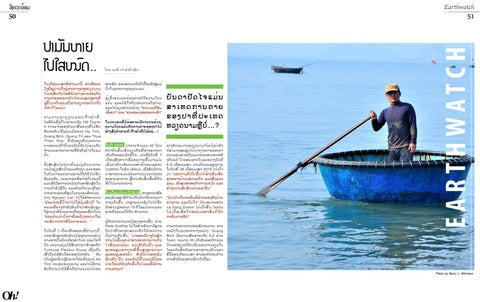
In April this year, the fishing ports and local villages of central Vietnam experienced a “catastrophic disaster”, as tons of dead fish were found floating offshore or washed up along a 200 km stretch of coastline. According to an official source, the disaster killed at least 100 tons of fish. This was based on reports from the four affected provinces; Ha Tinh, Quang Binh, Quang Tri and Thua Thien Hue. This estimate excluded the dead fish that remained in the waters. To add to the confusion, farm-raised or aquaculture fish such as prawns and clams, in the same coastal districts, also died en masse. This region, where coastal populations depend almost entirely on fishing, is considered the country’s poorest and most vulnerable area. ”I’m stocking enough fish sauce for a year,” said Ms Nguyen Lan as she piled sauce bottles into her basket at a supermarket in Hanoi. ”I need to avoid sauce made out of dead fish before it spreads…..” On 1 May thousands of people of different ages and professions took to the streets of Hanoi and Ho Chi Minh City, to protest against the Formosa Plastics Group. One of Taiwan’s largest industrial conglomerates, it operates a stainless steel plant in Ha Tinh, Vietnam. It is thought they could have been responsible for chemiphoto by www.businessinsider.com
cal run-off and polluting the waters of central Vietnam.
Could this have been the same cause and “Justice 4 Fish” and “Save Our Seas.” effect for the recent In a country where public protests are Vietnamese phenrare, anger over the dead fish created a major challenge for officials …! omenon…? Protesters were outraged, shouting slogans and displaying banners;
In 2015, at least 40 tons of dead fish were cleared from a lake in western Mexico. The fish, first started appearing on the surface of Lake Cajititlan, in Jalisco state, on 7 August. It was believed that climate change or poor land management practices were the cause of this similar incident.
In March 2016, in northern Australia, mystery surrounded the cause of a fish kill which left thousands of dead fish washed up along a 10-kilometre section of coastline near Broome. Fisheries regional manager Peter Godfrey said a combination of factors appeared to have been at play. ”So far the evidence suggests it could be culmination of environmental factors, including high land and air temperatures, higher than normal water temperatures, a week of consistent onshore winds, and also the large spring tides we were having at the peak period of the fish deaths,” he said.
The Vietnamese government said it didn’t know why the fish were found dead on the coastline, specifically from 6-18 April. The phenomenon ”has caused economic and environmental damage, hurt the fishery industry and particularly resulted in puzzled sentiment among citizens,” it said in a statement on 28 April 2016. “The impact is severe, both physically and morally,” said economist Le Dang Doanh. “Public trust has been reduced to the lowest level.” Fishermen in central Quang Binh province lost $5.2 million, according to the local government reports. About 30 percent of tourists cancelled visits to the province during a national four-day holiday in April, fearing potential contamination.