The Norfolk Superhero Swim leg is proudly sponsored by Barratt & Cooke.
Regulatory disclaimer: This newsletter is provided solely to enable clients to make their own investment decisions. The information within this newsletter does not constitute advice or a personal recommendation, or take into account the particular investment objectives, financial situations, or needs of individual clients. It may therefore not be suitable for all recipients. If you have any doubts as to the suitability of this service, you should seek advice from your investment adviser. The past is not necessarily a guide to future performance. The value of investments and the income from them can fall as well as rise and investors may get back less than they originally invested. Certain Investment Trusts will permit using gearing as an investment strategy. Gearing is a strategy which involves borrowing money to increase holdings of investments or investing in warrants or derivatives. Such a strategy is likely to result in movements in the price of the relevant security being amplified significantly and may be subject to sudden and large falls in value and investors may get back nothing at all. Any tax rates and reliefs are those currently applying, are dependent on individual circumstances, and could be subject to change. All estimates and prospective figures quoted in this newsletter are forecasts and are not guaranteed. Within our advisory service we offer advice on a wide range of investments including shares, corporate bonds, gilts and managed funds. We offer restricted advice. This means that we do not offer advice on the whole of the financial planning market which includes products such as life policies and personal pension schemes. We will always recommend what we believe is suitable, based on your personal circumstances and objectives. Barratt and Cooke is the trading name of Barratt & Cooke Limited. Registered in England No. 5378036. Barratt & Cooke Limited is authorised and regulated by the Financial Conduct Authority, who are based at 12 Endeavour Square, London, E20 1JN.
Many of you will know that my brother and I participate in an amazing event – the Norfolk Superhero – which raises vast sums of money for charity. Indeed, almost £1m has been raised over the last 5 years and it has been going since 2007!
This year’s event was another fantastic day, with competitors, organisers, volunteers and supporters all assembled at Burnham Overy to raise money for another fabulous organisation – the Norfolk Community Foundation – specifically to support children to become more active in a day and age of computer games and social media rather than bicycles and footballs.
In good news, Sam and his partner had their best spin, chapeau lads. In less good news, I managed to secure my first DNF ‘Did Not Finish’ (sorry partner). No excuses. Whilst it was fairly warm out there, I wasn’t good enough. The vomiting has stopped but the scars of battle are still raw and the ribbing, rightly, hasn’t yet subsided (when you celebrate winning some “bling” so wholeheartedly in one year, you have to take a loss on the chin in the next!).
But I do know one thing for sure; I still LOVE Burnham Overy. Nelson’s home has become a ‘playground’ for so many of us that are a little too old for a climbing frame!
This brings me on to Burnham Andy…
The ‘King of the North’ has risen from the ashes like a phoenix. Let us not forget he was defeated in a Labour leadership contest in 2010, receiving just 8.7% of the vote (when Ed Miliband pipped his brother to the line), and he finished second in 2015 with just 19% of the vote (when Jeremy Corbyn was the victor). These races were important, but they were ‘only’ to become leader of the opposition. This time it is crucial as it is to govern as Prime Minister. Seemingly, as I write, Andy Burnham is ‘home and hosed’ to waltz in as the heir to Sir Keir, though a matter of weeks ago he was not even an elected MP. His coronation might even be unopposed (though there could be the theatre of some sort of kangaroo court to try and demonstrate a degree of democracy). With only 0.3% of the electorate (based in Makerfield) voting for him, surely we all have the right to know what he stands for prior to taking up his position at the dispatch box, otherwise how can Kemi Badenoch, who has hit her stride in recent months, hold him to account as she did Starmer?
When Sir Keir won the election, I gave him the benefit of the doubt. The country had lost faith in the Conservatives and there was a desire for change. What we got was a total mess.
When Sir Keir won the election, I gave him the benefit of the doubt. The country had lost faith in the Conservatives and there was a desire for change. What we got was a total mess. The Labour party became fractured, with the backbenchers pulling the strings leading to umpteen U-turns. The final aboutface was the promise to stay on as leader just days before the lectern appeared outside 10 Downing Street, but the incumbent’s time was up a while ago having alienated: farmers, pupils and their parents, the hospitality industry, small business owners, and working people. He appointed the now disgraced Mandelson and dithered over a pathetic allocation of capital to defence spending (where it transpires a massive £5bn is yet to be funded).
Liam Byrne, Chief Secretary to the Treasury under Gordon Brown, left a note for David Cameron and George Osborne saying, “I’m afraid there is no money”. This was for an opposition party, but Sir Keir has left a negative balance for Andy. You will remember Tony Blair celebrating his election victory to the tune of “things can only get better”. Surely this time around they can’t get any worse, can they? There are many questions over Burnham’s politics, specifically whether he tries to appease his audience with mixed messages to the WASPI women or on Brexit, and, whether he even knows what the fiscal rules are for this term. Is the rumoured issuance of war bonds (gilts) not a breach of fiscal rule number one, that in this Parliament the Government will not increase borrowings? However, the statement that really concerned me, sitting in this chair looking after investment portfolios, was that “we should not be in hock to bond markets”, better put by one of his Labour MP allies, Paula Barker, who said “the bond markets will have to fall into line”. Try telling Liz Truss and Kwasi Kwarteng that. The bond vigilantes do not sing to the tune of any ‘Pied Piper’, not even the ‘King of the North’, and I hope he realises this before drama unfolds.
Burnham’s ‘strategy’ (or lack of) speech on the 29th June revolved around removing power from London (Westminster and Whitehall) and empowering a new ‘No. 10 in the North’. In doing so, he envisages allocating decision-making to local councils, fuelled by buckets of funding, no doubt with a massive swelling in the number of civil servants, but without an iota of commentary on how to finance this. Once again, it will be time for working people to “brace, brace, brace” as a third round of additional tax rises will no doubt be forthcoming. As a caller into LBC radio said, “I have never earned more, but never felt poorer”. He spoke for many.
Devolution is more akin to the US model where US Mayors (of big cities rather than small towns per Trump’s scathing ‘put down’) have significant control over both finances and laws, where state-to-state legal process and the allocation of resources differ quite considerably. This is not to say the principle can’t work but, my goodness, it will take a long time for such considerable reform to become the natural order. I think the 10 years Mr Burnham has asked for is frankly a little on the short side. Whilst Burnham’s time as Mayor of Greater Manchester might have been a reasonable success, does one man’s ability to re-route the buses qualify him to both divide up and lead the whole of the UK when, in Birmingham, the council can’t even manage to collect the bins? And what about international relations? As John Major put it: “how will he manage Trump, Putin and Xi”. The lack of real world ‘nous’ is of considerable concern. Louise Haigh (clearly no relation of William Hague!), a very close ally of Burnham’s and likely to be re-elected to the Cabinet, is already calling for increases to capital gains tax (into line with higher rate income tax at 40% or 45%, from 24% currently) and inheritance tax (40% already). Is there nobody in the Labour party who understands the basic principle of the Laffer curve? I would encourage them all to do a ‘crash course’ in GCSE-level economics.
The bond vigilantes do not sing to the tune of any ‘Pied Piper’, not even the ‘King of the North’, and I hope [Andy Burnham] realises this before drama unfolds.
The Laffer Curve
Arthur
Laffer identified the relationship between tax thresholds and total Governmental tax receipts.
He established that there is a fulcrum point where, if tax rises any further, both individuals and businesses are disincentivised to such an extent that they adjust their behaviours accordingly. This leads to less tax being collected, not more. i.e. why should one take on risk, going through the stress of managing a business and employing individuals, when excess reward is going to be taken by the State.
In the case of IHT (where there are rumours of both a higher rate of tax and that book costs will no longer be permitted to be uplifted on death), individuals might seek to mitigate penalties by gifting more, several years before death. The danger here is that, with life expectancy increasing, a 70-80 year-old could well live for another 30+ years and, with the inflationary impact on lifestyle and care, this can have serious ramifications. My father, CWLB, used to always ask clients how much they felt they might need in their twilight years, then worked on double this number, a sensible and prudent strategy as the cost of living continues to ramp up exponentially day-by-day.
In the case of CGT, the most important force is that this really is an ‘opt in’ tax. i.e. investors typically have the choice to sell an asset or not. At the higher rate (of 24%, which has already increased from 20%), investors get to keep their stake in addition to 76% of the profit. This is possibly an acceptable trade-off to de-risk or to re-invest in different (better) investments as markets develop (opportunity cost). However, if CGT were to rise to 40%+, investors might well choose to do nothing, which, in turn, means nil receipts for the Treasury. This leads to ‘sticky’ unbalanced portfolios carrying inflated levels of risk, which isn’t good for the investor or for the Treasury.
HMRC has just announced a further tax of 22% on the interest earned in cash held within a shares ISA (previously an untouchable tax haven, IHT aside). This really is trying to squeeze blood out of a stone. Having done the maths, it really won’t impact investors at Barratt & Cooke too much as cash balances within their ISAs tend to be 5% or less and interest is low, so any such tax bill will be minimal, but the bureaucracy around it (tax returns etc) are yet another headwind for individuals. We will keep you updated when the rules are clarified.
Moreover, it is another ‘carrot’ for ‘risk-on’ investment when, quite often, particularly in older age, de-risking into cash (which would then be taxed) is suitable. This is not dissimilar to the AIM market losing half of the IHT benefit but with the ‘carrot’ that investors can seek full IHT benefits in even riskier unlisted equity. I think the regulator, who has offered sensible advice over recent years, is going to be very busy on the back of this policy.
Furthermore, let’s not forget that these various taxes are incurred on savings which have been taxed already. i.e. on earnings that have had income tax paid already, or inherited capital that has probably suffered both income tax and then IHT. Penalising savers even further could well accelerate us into a period of stagflation (stagnant or negative growth, with stubbornly high inflation), but that is an essay for another day.
It may look like I am apportioning blame at the door of Burnham before he has got the job, but I am simply highlighting challenges he faces and the risks ahead for the UK populate. The challenges presented are not just a function of Starmer, Burnham and their Chancellors, but the whole Labour Party.
Labour got in on a manifesto with the promise not to increase income tax, VAT or national insurance (although one of these promises has since been broken). This has meant that everything else has been raided and will continue to be called on.
A ‘mansion tax’ is coming and, who knows, soon a wealth tax too. I’m not sure even Mr Laffer could have considered such wide disincentives when he penned his theory in the 1970s.
We will see how the next few months unfold and will be watching keenly to see who is appointed to the Cabinet. Rumours of Ed Miliband as Chancellor would cause concern, where in his capacity as Energy Secretary he is now seeking to ban both tumble dryers and underfloor heating! His net zero agenda is killing UK business with astronomically high energy prices, when instead we just import goods from overseas, manufactured and shipped with even greater pollution. The aforementioned Tony Blair said that Miliband’s energy policy is a “quixotic fantasy”, which is absolutely correct. Wes Streeting would be a more moderate choice for No. 11.
All this being said we will ‘roll with the punches’ as we have, here, for almost 150 years. The really important question is who the ‘Messiah of the East’ will be.
I hear Ben Stokes is looking for a new job but Sir Alastair Cook, who lives just inside the East Anglian boundary, might be a better bet. If only Edith Cavell, on whom I listened to an excellent podcast recently, was still with us.
Labour got in on a manifesto with the promise not to increase income tax, VAT or national insurance (although one of these promises has since been broken). This has meant that everything else has been raided and will continue to be called on.
The really important question is who the ‘Messiah of the East’ will be. I hear Ben Stokes is looking for a new job but Sir Alastair Cook, who lives just inside the East Anglian boundary, might be a better bet.
Let’s look at some more positive stories:
The
FTSE
100 looks good value.
Political headwinds are not helpful, but I do want to temper back fears you may have surrounding stockmarkets, specifically on UK shores. As you know, the FTSE 100 remains relatively resilient, despite the political uncertainty, with the index still north of 10,000 points.
10,000 is of course close to all-time highs, which might lead one to believe that UK shares stand at premium valuations. However, in order to establish the true value (and therefore whether a company or index is ‘cheap’ or ‘expensive’) we have to consider earnings as well. If earnings have grown at a faster clip than share prices, this insinuates that the investment is actually ‘cheaper’ or ‘better value’ than it was before. Without getting too technical, we use various metrics to help judge ‘value’, including P/E ratios (Price/Earnings), PEG ratios (Price/Earnings/ Growth) and FCF yields (Free Cash Flow).
Picks and Shovels
Portfolios tend to have exposure to two or three of the ‘Magnificent 7’ stocks, typically Alphabet, Amazon and/or Microsoft, albeit a more measured allocation versus the wider stockmarket. As I have said before, “we are participating in the bull run, but are not all in”, acknowledging that this is a rocket-fuelled sector priced for perfection. Some of these companies have given up a little bit of ground recently (as have the other four, being Apple, Meta, Nvidia and Tesla) but still warrant their position.
The real question over the ‘Magnificent 7’ is, which will ultimately survive and which won’t? Of course, the easy answer ‘now’ is they all will, but when I first started stockbroking in Edinburgh in the aftermath of the dotcom bust, Vodafone and Nokia were deemed invincible winners. They had weathered the storm and looked impregnable, with technologies well in advance of their peers. Then along came the Blackberry, accelerating the height of innovation to having a computer in your pocket. All three of these companies have subsequently seen drawdowns of well over 75%.
*The highs and lows are distorted by the COVID-19 pandemic, when earnings collapsed before subsequently recovering. Historically, the FTSE 100 has traded within a relatively narrow valuation range and remains just under its long-term average today.
‘Picks and Shovels’ is a term which arose in the 1850s during the California Gold Rush. Clearly, it refers to companies which made the tools with which to mine. Such products were in considerable demand and therefore turnover and profits were high, irrespective of which company actually ‘hit gold’. i.e. the risk of a dud mine was not their problem as the miner was taking on that risk. Just so long as some miners were striking gold, these businesses were thriving, selling ‘picks and shovels’ as others chased the dream. The reward was not quite as great as for the successful miner, but on a risk basis these businesses were the best, by far. This is why, whilst investors might not hold all the flagship names, companies like Vertiv (cooling systems for data centres), Texas Instruments and ASML (chip manufacturing and related equipment), Halma and Schneider (engineering companies servicing data centre clients, amongst others) have all contributed to positive performance.
To the Moon and beyond?
Arguably, some of the recent sell off in the ‘Magnificent 7’ was from investors freeing up cash to invest in the next loss-making promise, Elon Musk’s SpaceX. So how did the IPO go? The IPO price (at which SpaceX sold shares to institutional investors) was $135, opening at $150 on the day, before rising north of $200, subsequently dropping to circa $155. That said, currently, those private market investors in SpaceX who have seen extraordinary paper gains in recent years are ‘locked in’ for between three months and a year, so are not yet in a position to sell their shares, crystallising their profits. As such, whilst the public market buyers have come in, pushing up the price, we will likely only find out the true value of SpaceX once the sellers can participate. In the meantime, it is staggering that a company that made a loss last year of $5bn, and which is seeking revenue of ‘just’ $20bn in 2026, is valued at over $2tn ($2,000,000,000,000!), however grand the company’s ambitions.
Templeton Emerging Markets (TEMIT)
When I came back to Barratt & Cooke in 2008, I contributed to my first newsletter (though CWLB firmly held the quill at that stage). I wrote about the BRIC economies (Brazil, Russia, India, China), where BRIC had become a buzz acronym (coined by Jim O’Neill, then chief economist at Goldman Sachs, now interestingly one of Burnham’s key economic advisors, bought in to help reassure to markets). At the time, we were not that keen on China, where corporate governance was murky, or indeed Russia which we simply didn’t understand (and which we were subsequently thankful to had steered well clear of!). Brazil was a little behind the curve in terms of development, but India was of interest with its significant, young population and booming middleclass consumer base.
Whilst the countries of focus have evolved, we continue to believe that a modest allocation to companies based in the emerging markets (typically via diversified investment trusts such as TEMIT) serve an important role in portfolios, further improving geographical diversification, as well as gaining exposure to some world leading businesses in Asia in particular (not least in the ‘picks and shovels’ of the AI industry, such as Taiwan Semiconductor Manufacturing Company and Samsung).
I was so sad to read that Mark Mobius is no longer with us. He was a pioneer of emerging markets investment, helping to launch TEMIT in 1989, which he managed through until 2015, growing this into one of the leading investment trusts in the UK (knocking on the door of inclusion in the FTSE 100). A strong believer in the importance of ‘boots on the ground’, Mark visited over 100 countries in his quest to identify the best investment opportunities in the emerging world.
I had my first ever investment trust meeting with Mark in about 2004, I remember it like yesterday. I found myself walking into the dining room on the top floor of the UBS building, overlooking the ice rink at Broadgate Circle. I thought I was in for a 45-minute Q&A session, only to look down and see six places laid (just three of us on the buy side) and seven rows of cutlery each side of the place mats. I was confident enough to know that you work from the outside in, but not as confident about questioning the doyen for 3 ½ hours! He made it easy and understandable, occasionally offering the kind words “good question” to something which was probably very basic. He was a great educator and truly passionate about his subject. He was hard and fair but empathetic too and he surrounded himself by a good team who continue to hold his mantra in managing the Trust today; good corporate governance and paying the right price in emerging markets is absolutely key. Thank you, Mr Mobius, I remember you well.
We continue to believe that a modest allocation to companies based in the emerging markets (typically via diversified investment trusts such as TEMIT) serve an important role in portfolios.
Intuitive Surgical
by Ashley Baxter
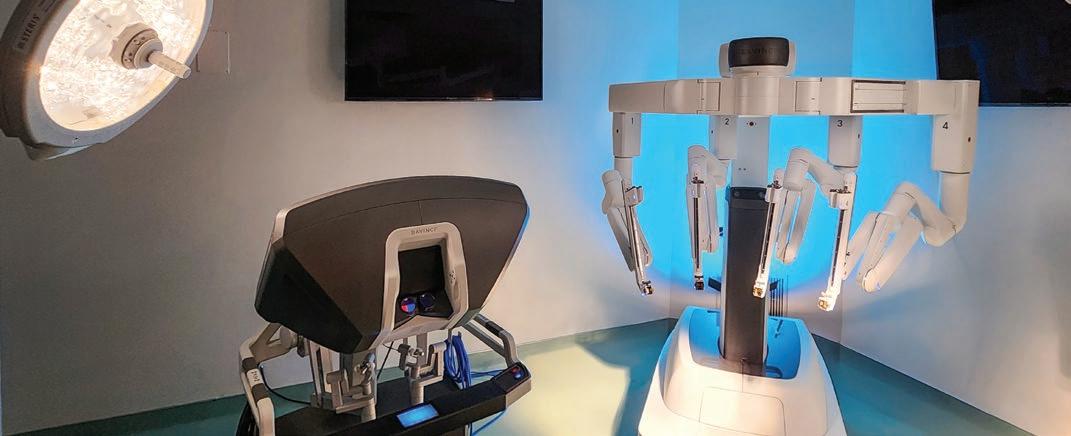
Earlier this year members of the team visited the Norfolk and Norwich University Hospital (NNUH), joining an event held to celebrate a decade of robotic surgery at the hospital.
This milestone coincided with the doubling of the hospital’s robotic-assisted surgery capacity, following the arrival of two new ‘da Vinci’ systems. These have been purchased, with the assistance of the hospital’s superb charity, as part of the Trust’s programme to expand its capabilities as a leading robotic surgery centre, maintaining its position at the forefront of surgical innovation. As a result, NNUH now has the joint-highest number of surgical robots on a single site in the East of England, attracting surgical talent to the hospital, globally.
During the visit, surgeons, consultants, and patients shared their experiences, enthusiastically highlighting the extraordinary benefits of robotic surgery (still very much with surgeons at the helm, for now at least!). These include shorter operation times, reduced operative risks, less post-operative pain, and materially faster recovery times, offering clear advantages for patients and surgical teams, as well as for hospitals seeking to improve cost efficiency.
Some may know that the da Vinci systems (named to evoke Leonardo da Vinci’s artistry and innovation) used at NNUH are manufactured by US-based Intuitive Surgical, a company that Barratt & Cooke has followed for many years. This is a truly innovative company that pioneered robotic-assisted, minimally invasive surgery. The company has invested billions of dollars in research and development to reach this stage, helping the company maintain an industryleading position, with more than 12,000 installed systems worldwide. These robots are currently used primarily in urology (prostate removal), gynaecology (uterus removal) and general surgery (hernia repairs), with adoption expected to continue accelerating as use cases increase. Indeed, it was clear that there is competitive tension within the surgical team as to who has access to the robots.
The team was also fortunate to see the latest generation da Vinci 5 system up close and even test the controls (not on a human!).
NNUH now has the joint-highest number of surgical robots on a single site in the East of England.
Given Intuitive Surgical’s leadership in this growing market, its shares trade at a premium valuation. We have therefore been selective, adding Intuitive Surgical to portfolios during periods of share price weakness, focused on those mandates which allow for a growthorientated, long-term investment such as this.
William Whitmore
As you know, at Barratt and Cooke, we try to place a premium on service. This service manifests itself through the visible – portfolio performance and ease of administration – and the invisible – trust and indeed friendship. As such, I was sad that the time came for William Whitmore to retire, having joined the firm in 1998. Those of you who were looked after by William will be unsurprised to hear that this was meticulously planned three years ago, as his primary wish was for all clients to have a smooth transition across to their new Investment Manager.
William’s care over each portfolio was exemplary and we have the file notes to prove it! He took delight in diligently looking after every client with extraordinary attention to detail. Furthermore, he was a huge team player, the Declan Rice of Barratt and Cooke, taking new joiners under his wing and training them up to become fantastic Investment Managers, where he expected each to work with his level of enthusiasm and attention to detail. And so, whilst William has now retired, we still have an ethos to do things ‘The Whitmore Way’ which, in turn, is brilliant for clients. Moreover, he was a great friend and confidant to me, helping ‘bridge the gap’ from the CWLB days and I shall be forever grateful to him for his counsel and guidance. Thank you, William.
Conclusion
Ronald Reagan (a Republican) said of the Democrat policy: “If it moves, tax it. If it keeps moving, regulate it. And if it stops moving, subsidize it.”. He continued “I think we’ve turned all that around. We cut taxes, we squashed inflation, we brought interest rates down and threw out needless regulations setting the economy on a growth path”.
Let’s hope that the fears I alluded to earlier are in fact just that, ‘fears’, and whoever takes on the Labour leadership stops to think about the real solution, as Laffer identified, being incentivisation. Incentivise business, incentivise entrepreneurship and incentivise a desire to work rather than live off the State. As, with these incentives we will see: GDP growth, unemployment fall, a tempering back of the cost-of-living crisis, better mental health (and therefore a lower requirement for Treasury coffers to be spent on the welfare bill). This will ultimately give scope to finally reduce tax.
Starmer was going to take Friday afternoons off to be with his family, whilst Burnham will be ‘working from home’ in ‘No. 10 North’. At Barratt & Cooke, we will still all be ‘here’ in the office, full time, as this is how we can best work as a team to serve clients.
Who knows how England will have fared in the World Cup by the time this newsletter lands on your doorstep, but we did stay in the competition a little longer than Germany, who had never failed in a penalty shootout before. And I hope those of you who enjoy the tennis made it to Wimbledon this year as there is a good chance that Wimbledon will soon move to Manchester!
Last time I called for spending on defence, food security and energy security. That was too much to ask, so this time I simply call for transparency on policy, policy, policy, as nobody has a clue in which direction we are travelling. Maybe this needs a General Election.
A final word - “Sorry for letting you down at Burnham Overy, Robert” (I know you are one of very few who reads every word of these letters so this really is a private message, but now I’ve said it to about 1,500 potential readers I can ‘move on’!). Let’s hope, in due course, we all talk about Burnham Andy with the same affection as Burnham Overy!
It’s coming home!
William Barratt Chairman
July 2026
July 2026 equity suggestions
* Equivalent Gross Redemption Yield for Index Linked Gilts assuming RPI inflation averages 3% or 5% to redemption. ** Price adjusted for inflation (please note the published price may be different as it does not include accrued inflation)
FTSE 100 – 1 year
FTSE 100 – 5 year
Source: Iress
Barratt & Cooke
Barratt & Cooke is:
• The trading name of Barratt & Cooke Ltd., a wholly owned subsidiary of Barratt & Cooke Holdings Ltd.
• Authorised and regulated by The Financial Conduct Authority (registered number: 428789), whose address is 12 Endeavour Square, London, E20 1JN.
• Registered in England and Wales (registered number: 05378036) and is a Member of the London Stock Exchange.