Dara Horn tackles antisemitic lies head-on, proposes educational fix p. 24 Davidenduring Moss designs Grace After Meals in comic book form p. 22
THE DAYTON Published by the Jewish Federation of Greater Dayton
The Miami Valley’s Jewish Monthly
November 2026 Cheshvan/Kislev 5787 Vol. 31, No. 3
OBSERVER Celebrating 30 Years
daytonjewishobserver.org Marshall Weiss
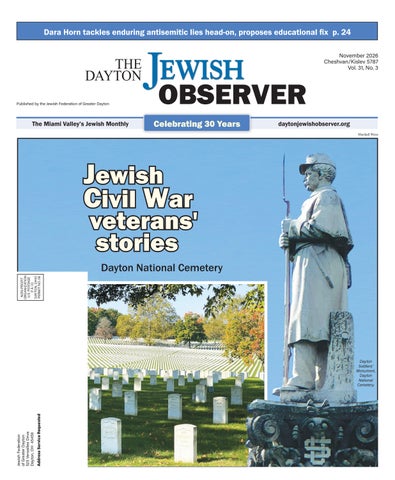
Jewish Civil War
veterans' stories
NON-PROFIT ORGANIZATION U.S. POSTAGE PAID DAYTON, OHIO PERMIT NO. 59
Dayton National Cemetery
Address Service Requested
Jewish Federation of Greater Dayton 525 Versailles Drive Dayton, OH 45459
Dayton Soldiers’ Monument, Dayton National Cemetery.
No one does fall better.
DAYTON
JCRC launches Exodus Over Dinner program
Laila Blumer
Corner of Far Hills & Dorothy Lane 2977 FAR HILLS AVE DAYTON OH 45419
937-224-7673 THEFLOWERSHOPPE.COM
B Quality repair on site
Jewish Federation CEO Cathy Gardner (center) hosted the Jewish Community Relations Council's Greater Dayton Black Jewish Relations Exodus Over Dinner program at her home, Sept. 9. The meal, prepared by JCRC Exec. Dir. Jeff Blumer (standing), was inspired by culinary themes in Michael Twitty's book Koshersoul: The Faith and Food Journey of an African American Jew. Exodus Over Dinner is a national initiative founded by CNN host Van Jones to bring together Black, Jewish, and Black Jewish leaders around dinner to restore and strengthen the historic Black-Jewish alliance. Guests with Gardner and Blumer were (from L) Miami Valley Urban League Exec. Dir. Nikol Miller, UD Alumni Chair in Humanities and Oakwood City Council Member Sam Dorf, JCRC Member Vicki Minor, Certified Diversity Professional/consultant Mary Tyler, MLK Dayton Inc. Pres. & Gen. Chair Anthony B. Whitmore, JCRC Chair Bonnie Beaman Rice, and Dayton Mayor Shenise Turner-Sloss.
Custom, New, and Estate
43 S. Main Street Centerville, Ohio 45458 • 937-433-9598
Hadassah Dayton celebrates centennial
Marshall Weiss
D Formerly
Formerly
Formerly Formerly
Custom, New, and Estate 43 S. Main Street Centerville, Ohio 45458 • 937-433-9598
Hadassah National Pres. Carol Ann Schwartz (2nd from R) delivered the keynote address for Hadassah Dayton's centennial party, Oct. 11 at the Boonshoft Center for Jewish Culture and Education in Centerville. Here with Schwartz are (from L) Hadassah Dayton newsletter Editor Marsha Johnston, Programming VP Paula Gessiness, and Pres. Julie Bloom.
Arts..............................24 Ca l e n da r. . . . . . . . . . . . . . . . . . . . . . . . . . . . .1 7
PAGE 2
Mazel Tov................................. 21 Obituaries........................... 26
O p i n i o n . . . . . . . . . . . . . . . . . . . . . . . . .1 2 R e l i g i o n . . . . . . . . . . . . . . . . . . . . . . . . . .1 8
THE THETHE DAYTON DAYTON JEWISH JEWISH OBSERVER OBSERVER ••NOVEMBER NOVEMBER DAYTON JEWISH OBSERVER • AUGUST 2026 THE DAYTON JEWISH OBSERVER • MAY 2026
DAYTON Marshall Weiss
7 (possibly 8) Jewish Civil War veterans are buried at Dayton Nat'l Cemetery.
Wright Brothers Home Asphalt Restoration
Make the “Wright Choice” Our 54th Year
Here are their stories.
Bark Mitzvah Boy OMenachem c
BMB
Houser Asphalt & Concrete Paving, Repairs, Sealcoating, Concrete, Walks, Patios, Drainage, Curbs, Approaches • Residential & Commercial
937-223-9207 • 800-319-1114 • www.houserasphalt.com
convalesced at the Dayton National Soldiers Home and died there. In the first part of this series, The Observer explored the confusion surrounding the final resting place of Simon Oberdorfer. A grave marker for him is placed at Temple Israel's Riverview Cemetery as well as at Dayton National Cemetery. Though it's likely his remains are at Riverview, it's a mystery that has yet to be solved.
Henry M. Auerbach
Born in Posen, Prussia in 1839, Henry M. Auerbach served three times in the Union Army. A farrier by trade, he first enlisted in April 1861 for three months as a private with Company B, 2nd Ohio Infantry and was mustered out that July. He reenlisted in May 1862 as a private with Company H, 85th Ohio Infantry and transferred in June 1862 to Company F, 86th Ohio Infantry as a private. He was detached as a commissary assistant in July 1862 and mustered out in SeptemContinued on Page Four
From the editor’s desk
According to the American Battlefield Trust, the Civil War remains the bloodiest military conflict in U.S. history. An estimated 620,000 soldiers died on both sides. This surpasses World War II U.S. military deaths by about 215,000 souls. Marshall One in four soldiers who went to fight Weiss in the Civil War never returned home. For every three soldiers killed in battle, five more died of disease. And more than 400,000 soldiers were wounded. Jewish immigration to the United States in the mid-1800s was mainly from central Europe in response to antisemitism and the economic and political upheaval in German states surrounding a spate of unsuccessful revolutions. Out of approximately 150,000 Jews living in the United States at the time of the Civil War, scholarly estimates put the number who fought for the Union at about 7,000 Jewish soldiers. Along with a sense of duty and a steady income, an incentive for immigrants to the United States to enlist with Union forces was a faster track toward naturalization.
THE DAYTON JEWISH OBSERVER • NOVEMBER 2026
Pr em ier RETIREMENT LIVING AT ONE LINCOLN PARK
ON
Henry M. Auerbach is one of seven, possibly eight Jewish Civil War Union veterans buried at Dayton National Cemetery.
E
COLN LIN PA RK
By Marshall Weiss, The Observer Beneath the 70-foot-tall Dayton Soldiers' Monument topped by a statue of a “private soldier of the Volunteer Army of the Republic,” the graves of more than 11,000 Civil War Union soldiers cascade in perfect concentric half circles downhill and outward from Dayton National Cemetery's highest point. Among them are seven, possibly eight graves of Jewish Civil War Union veterans. Our knowledge of them comes from the records of the Shapell Roster of Jewish Service in the American Civil War. Since 2009, the professional researchers with the Shapell project have compiled this digital database (shapell.org) to identify every Jewish soldier and sailor who served in the Union and Confederate militaries during the Civil War. To date, the Shapell Roster offers profile pages of 7,000 Jewish Union Civil War veterans. In the June Observer, we presented the stories of the three known Jewish Union Civil War veterans buried in our local Jewish cemeteries. Here, in time for Veterans Day, is what we know about those buried at Dayton National Cemetery. Signed into being by Abraham Lincoln in March 1865, Dayton's National Soldiers Home — now the Dayton VA Medical Center — was among the first three facilities to care for discharged Union army and navy veterans. According to the U.S. Department of Veterans Affairs, the first Civil War veteran was buried there in 1867, the year it opened; the last one in 1947. In total, more than 62,000 veterans are now buried at Dayton National Cemetery. The Jewish Union veterans buried there all
YOU’RE INVITED One Lincoln Park is hosting Osher Lifelong Learning classes at the University of Dayton which are open to residents and the public at no charge. One Lincoln Park residents have a genuine curiosity and enthusiasm for learning, and these classes are a wonderful opportunity to bring new topics, ideas and connections. Research class availability at lifelonglearning.udayton.edu.
1 9 8 6 — 2 0 2 6
November 4/2026 Support Starts with Self Care November 11/2026 Introduction to Mah Jongg All sessions are held from 1–3 pm at One Lincoln Park, 590 Isaac Prugh Way, Dayton, Ohio 45429. To RSVP email nicole.jackson@olp.life or call 937-913-8101.
Premier Retirement Living
For More Information About OLP Call 937.298.0594 590 Isaac Prugh Way — Kettering www. LincolnPar k Seniors.com
Contact Patty Caruso at jewishobserver@jfgd.net to advertise in The Observer. PAGE 3
DAYTON
THE DAYTON
Dayton National Cemetery
Dayton Metro Library supports digital equity. Our 17 branches and website offer loanable laptops, public desktop computers, wireless hotspots, streaming services, adaptive technology, and more. Learn more at
DaytonMetroLibrary.org or by calling the Ask Me Desk at 937.463.2665.
PAGE 4
Continued from Page Three ber 1862. In April 1864, he reenlisted at Columbus, Ohio, this time with Company G, 13th Ohio Cavalry as a farrier and was promoted to veterinary surgeon. He was honorably discharged in August 1865 at Petersburg, Va. Three months into his service with the 13th Ohio, he wrote a letter to The Israelite Jewish newspaper, published by Rabbi Isaac Mayer Wise in Cincinnati. Then in its 10th year of publication, The Israelite had a national readership base of Jews who had emigrated from central Europe. "All that we seek from you is to see whether those in the army could be furnished with a (prayer book) Zizis (prayer shawls) and Tefilin (phylacteries)," Auerbach wrote on behalf of the Jews of the Ohio 13th. Auerbach also asked Wise to send copies of his newspaper, "for we are tired of reading the Evangelist and others." He closed the letter informing readers, "In every instance where a coreligionist has been killed and the fact ascertained, we have buried them by themselves. There are at present nine in the hospital, who receive all the attention we can give them." Printed below the letter, Wise added, "We never refuse our papers, or any other little favor to any soldier; and we would not have published this letter if it was not to remind the community to do something." After the war, Auerbach served as a veterinary surgeon in Chillicothe, Ohio. He never married. He died of cancer in 1884 at 45-46 years old.
Herman Brod
An engraver by trade, Herman Brod of Gallizien, Austria enlisted as a private in Company A, 39th New York Infantry, in May 1861. He was wounded the following month at the Battle of Cross Keys in Virginia. That September, he was captured at the Battle of Harpers Ferry. On the way to the battle of Gettysburg in 1863, he collapsed and was hospitalized for several months and honorably discharged for disability. "I believe I broke down from exposure and (was) paralyzed by rheumatism," Brod wrote in an 1879 petition for a disability pension. He added he was unable "to earn a living at my former or any other trade, for my fingers are powerless to handle any tools." To provide for himself and his family, Brod wrote that he had reenlisted for one year, 1865-66, with a veteran volunteer infantry where he did light duty, "until after getting worse again, they discharged me for not being able to do any service at all." In the same petition, Brod added: "Still, I solemnly declare that if I had to do it over again and I was able bod-
OBSERVER daytonjewishobserver.org Editor and Publisher Marshall Weiss mweiss@jfgd.net 937-610-1555 Contributor Candace R. Kwiatek Advertising Sales Executive Patty Caruso, jewishobserver@jfgd.net Administrative Assistant Samantha Daniel, sdaniel@jfgd.net 937-401-1547 Billing Sheila Myers, smyers@jfgd.net 937-610-1555 Proofreaders Leslie Buerki, Kylee Dickinson, Caitlin Freeman, Claire Gaglione, Rachel Haug Gilbert, Steven H. Solomon Observer Advisor Dr. Elaine Knoll Gaglione
Letter from Union soldier Henry M. Auerbach in The Israelite, July 29, 1864.
ied as I was in 1861, I should enlist again and march under the StarSpangled Banner until I would break down as I already did." Brod married twice, in Wyandotte, Kan. His first wife died in 1879. He married again in 1881 and divorced in 1887. He was the father of three daughters and one son with his first wife, three sons and one daughter with his second. He died in 1920 at the Dayton Soldiers Home of mitral insufficiency at age 88. Brod had lived on the campus since 1892.
Arnold Gruber
While on picket duty (forwardguard surveillance) near Aquia Creek in Virginia in November 1862, Arnold Gruber was wounded by a bullet that ricocheted off a tree and struck him across both knees. His feet were already severely frostbitten from picket duty. The private, who was born in Pozsega in the Austrian Empire, had enlisted with Company B, 119th New York Infantry in August 1862 in New York City when he was 18-19. He was first treated for his knees at a field hospital and then sent to Lincoln Hospital in Washington, D.C. when he also contracted typhoid fever. He remained at the hospital for about eight months and was then sent to Knoxville, Tenn. Gruber was promoted to the rank of corporal in July 1864 and honorably discharged in June 1865 at Bladensburg, Md. He died of gangrene and nephritis in 1916 at age 77-78. His profile page at the Shapell Roster includes a scan of the ketubah Continued on Page Five
Published by the Jewish Federation of Greater Dayton Marni Flagel President Bill Doner Secretary Teddy Goldenberg Treasurer Ben Mazer VP Personnel Josh Atkin VP Resource Development Neil Friedman Officer at Large Dan Sweeny Immediate Past President Cathy Gardner CEO The Dayton Jewish Observer, Vol. 31, No. 3. The Dayton Jewish Observer is published monthly by the Jewish Federation of Greater Dayton, a nonprofit corporation, 525 Versailles Dr., Dayton, OH 45459. Views expressed by columnists, in readers’ letters, and in opinion pieces do not necessarily reflect the opinion of staff or layleaders of The Dayton Jewish Observer or the Jewish Federation of Greater Dayton. Acceptance of advertising neither endorses advertisers nor guarantees kashrut. The Dayton Jewish Observer Mission Statement To support, strengthen and champion the Dayton Jewish community by providing a forum and resource for Jewish community interests. Goals • To encourage affiliation, involvement and communication. • To provide announcements, news, opinions and analysis of local, national and international activities and issues affecting Jews and the Jewish community. • To build community across institutional, organizational and denominational lines. • To advance causes important to the strength of our Jewish community including support of Federation agencies, its annual campaign, synagogue affiliation, Jewish education and participation in Jewish and general community affairs. • To provide an historic record of Dayton Jewish life. The Dayton Jewish Observer
Please recycle this newspaper.
THE DAYTON JEWISH OBSERVER • NOVEMBER 2026
DAYTON NARA
Continued from Page Four (Jewish marriage contract) from his wedding to Lena Davidson in Manhattan in 1888. After his death, she submitted the ketubah and an English translation with her Declaration for Widow's Pension form.
Marshall Weiss
Nathan Lyons (Loeb)
Born in Claiborne, Ala., Nathan Loeb enlisted as a drummer boy with Company A, 15th U.S. Infantry at age 15 in 1863 at Fort Adams, Newport, R.I. He was raised by his aunt and uncle, Theresa and Leopold Loeb; his mother died when he was three weeks old. On Jan. 11, 1865, Loeb deserted the infantry at Lookout Mountain, Chattanooga, Tenn., only to reenlist under the name Nathan Lyons with Company I, 188th Henry Straus' 1863 Volunteer Enlistment contract Ohio Infantry at Cincinnati 12 days later. He was boy and every time I had a dirty gun or honorably discharged that September at something, they would lock me up in Nashville, Tenn. the guard house. I just walked away and He and his wife would make their they never seemed to bother about me home in Bethel, Clermont County, Ohio. again...I complained in this service with In an 1896 deposition to receive a pen- pains across the small of my back and sion, he claimed that abuse led him to drowsiness but I was not in hospital or desert at Lookout Mountain: excused from duty on account of sick"I enlisted in this organization as a ness that I now remember." drummer boy but was pushed in as a Nathan Lyons died in 1912 of myocarprivate and had to carry a gun all the dial insufficiency at age 64. time...The fact is I worked along and beat my way...on the train with the Henry C. Phillips soldiers from Nashville, Tenn. to CincinLittle information is available to date nati Ohio...I left the service on account about Henry C. Phillips, born in 1845 in of rough treatment. I was nothing but a Kentucky and who enlisted in Company K, 29th Pennsylvania Infantry as a drummer in July 1861. He was honorably discharged in July 1865. The Shapell Roster does note that his Jews & the Civil War brother, Isaac N. Phillips, also served in integral to Piqua's history.......... the company and that their sister, Rosa,
Related
6
According to his declaration for an invalid pension in 1884 in Cincinnati, while in service in North Carolina in July 1865, "he was thrown from his horse, which became frightened in a charge upon the enemy, dislocating his left shoulder, greatly disabling him at the time." Records indicate he was honorably discharged and mustered out on July 20, 1865. Eight years after his petition, in 1892, the government granted him his invalid pension. He died of a cerebral hemorrhage in 1896 at age 68-69. Henry Straus' gravestone was set with his last name spelled incorrectly, as Strauss.
David Strauss
Another Bavarian, David Strauss, enlisted with Company B, 63rd Ohio Infantry in October 1861 at Chilliwas married to Jewish Confederate cothe. As with other Jews buried at soldier Benjamin Hilborn of MissisDayton National Cemetery, disability sippi in 1873. Henry C. Phillips died in didn't keep him from reenlisting — in 1906 at age 60-61. his case, two more times. His first honorable discharge for disHenry Straus ability came in July 1862 at Columbus Bavarian Jew Henry Straus, a due to pulmonary tuberculosis, a severe salesman in his early 30s, enlisted as a and contagious bacterial infection of the private with Company A, 2nd Iowa Inlungs: "He is not fit for duty and never fantry, in May 1861. In July 1863, he was will be. He has not done duty for eight honorably discharged due to disability months." at Memphis, Tenn. Shapell indicates that a year later, in His discharge certificate indicated August 1863, he reenlisted for a period three reasons: "Said soldier is rendered of six months with Company D, 4th unfit for the service caused by the easy Independent Battalion Ohio Cavalry at and frequent dislocation of left shoulder Camp Dennison, Symmes Township, joint and demoralization and too meek Hamilton County, and was assigned to nerved to face the enemy in battle... an escort guard in Knoxville, Tenn. in Chronic alcoholism. He is basically October 1863. Strauss was honorably intoxicated at every opportunity. Has discharged in March 1864 at Cincinnati. frequent attacks of delirium tremens... His third and final enlistment was as and he is of no use to the service in any a private for 100 days in May 1864 with capacity whatsoever and never will be." Company A, 149th Ohio Infantry (NaEven so, Straus reenlisted a month tional Guard) at Chillicothe, from which later as a private with Company K, 9th he was honorably discharged in August Ohio Cavalry in Cincinnati. In Novem1864 at Cincinnati. ber 1863, he was promoted to commisStrauss died of acute enteritis in Ausary sergeant. gust 1907 at age 63-64. Henry Straus' gravestone at Dayton National Cemetery spells his last name incorrectly.
Oakwood’s Concierge Primary Care Practice. Now accepting new patients! “Their patient-centered and compassionate care takes EMC and its patients into the future of best medical practices. The immediate access and individual attention are remarkable.” - Jay W.
Call (937) 395-3622 or visit www.emcohio.com to become a member today!
THE DAYTON JEWISH OBSERVER • NOVEMBER 2026
PAGE 5
THE REGION
Jews and the Civil War integral to Piqua's history Over the years, The Observer has shared the story of Piqua clothing merchant David Urbansky, one of four Jews to receive the Medal of Honor from Congress for service in the Civil War. In Private Urbansky's case, it was for "Gallantry at Shiloh and Vicksburg." The Prussian-born Urbansky served with Company B, 58th Ohio Infantry, a German-speaking unit out of Columbus. He was involved in at least 15 fighting engagements in the Civil War and rose to the rank of corporal (his regiment spelled
David Urbansky
PAGE 6
his name Orbanski on its muster rolls). When he died in 1897 of a stroke at 56, he was buried at Temple Anshe Emeth's Cedar Hill Cemetery in Piqua. His family eventually moved to Cincinnati and reinterred Urbansky's remains at Walnut Hills United Jewish Cemetery. His Medal of Honor is part of the American Jewish Archives' collection in Cincinnati. But did you know that since 2016, Greenville's Garst Museum has exhibited a Union Army officer's coat made by Jewish tailor Aaron Friedlich, also of PiPhotos: American Jewish Archives qua? A Bavarian Jew, Friedlich settled in Piqua in 1848 with his wife, Theresa, and established his merchant tailoring business there. The couple had 10 children. In 1861, he built a store on the north side of the public square known as the Commercial Block. According to The Garst, Friedlich made the uniform for 6-foot, 4-inch Capt. Joseph C. Ullery of Company G, 110th Ohio Volunteer Infantry, which was organized at Camp Piqua in October 1862 and mustered out in June 1865. Although the Union Army issued mass produced ready-to-wear uniforms to enlistees, commissioned officers were expected to have their uniforms tailormade at their own expense. Paul R. Wright, Ullery's grandson, donated the uniform — hat, vest, jacket, overcoat, sword, and walking stick — to The Garst. — Marshall Weiss Back of Urbansky's Medal of Honor.
Eileen Litchfield/The Garst Museum
Civil War-era Union Army officer's coat made by Aaron Friedlich of Piqua for Capt. Joseph C. Ullery, on display at the Garst Museum in Greenville. Inset: the coat's label.
THE DAYTON JEWISH OBSERVER • NOVEMBER 2026
ai179069289485_DL-JewishObsvr_Ad_CLUE_ PR.pdf
1
9/29/26
10:41 AM
THE REGION
Neo-Nazis return Ohio appeals court rules state’s to Springfield WDTN Channel 2 reported that masked members of the neo-Nazi hate group Blood Tribe marched for about 10 minutes with swastika flags through downtown Springfield, Saturday afternoon, Sept. 26. They departed in two black vans, according to an eyewitness. WDTN noted that Blood Tribe sent the television station a statement taking credit for the march, to "highlight all the work Blood Tribe did to help get Haitian migrants deported from Springfield." In February 2025, the Anti-Defamation League and two legal firms filed a civil lawsuit on behalf of the city of Springfield, its elected officials, and several residents against the Blood Tribe in Dayton’s U.S. District Court for the Southern District of Ohio. The suit seeks compensatory and punitive damages for “the campaign of harassment and intimidation they unleashed against the people and city of Springfield, Ohio beginning in July 2024.” Incidents the lawsuit cites include the Blood Tribe’s Aug. 10, 2024 march in downtown Springfield with its members “waving swastika flags, brandishing weapons at residents, and yelling racial slurs.” It also notes that after the march, the city received at least 33 bomb threats to locations such as elementary schools, hospitals, private homes, and government buildings. According to the ADL, Blood Tribe is a White supremacist neo-Nazi group with semi-autonomous chapters in the United States and Canada. It was formed online in 2021 and started showing up at anti-LGBTQ+ events in 2023. Blood Tribe’s spate of 2024 actions in Springfield came in the wake of negative national media attention focused on the city’s soaring Haitian population — much of it from then Republican vice presidential candidate JD Vance’s stump speech references. Baseless claims about Haitian immigrants eating pets in Springfield, according to NBC News, had already been circulating on right-wing social media platforms. It's a claim President Donald Trump has repeated as recently as Oct. 12 at a rally in Youngstown for Republican candidates, according to AP. In July, his administration cancelled Temporary Protected Status for an estimated 330,000 Haitians in the United States. Springfield's lawsuit states that Blood Tribe engaged in and incited a campaign of harassment and intimidation “motivated by ethnic and racial hatred against those who supported Springfield’s Haitian community in the face of Defendants’ racist attacks.” Springfield Mayor Rob Rue was the target of Blood Tribe harassment at his own home, according to the lawsuit.
private school voucher system unconstitutional
EdChoice program allowed to continue pending state appeal to Ohio Supreme Court By Jimmy Oswald Columbus Jewish News The 10th District Court of Appeals in Franklin County Oct. 14 ruling that Ohio’s EdChoice private school voucher program violates the Ohio Constitution could force tens of thousands of students, including some attending Jewish day schools, to withdraw from their school, according to Rabbi Yitz Frank, executive director of Agudath Israel of Ohio, which represents Orthodox families and day schools. “If the ruling is allowed to stand, and we are very confident that the Supreme Court will not allow it to, that would mean that a huge percentage of those 180,000 students on EdChoice Agudath Israel of scholarships would Ohio Exec. Dir. be forced to withdraw Rabbi Yitz Frank from the school that their parents chose and likely have to go back to local public schools,” Frank said Oct. 15. The ruling was made by a threejudge panel of the 10th District Court of Appeals, which affirmed a lower court’s June 2025 ruling that found the EdChoice program violates an Ohio constitutional requirement for “a thorough and efficient system of common schools.” The EdChoice program is allowed to keep running for the time being in anticipation of an appeal. “EdChoice, as presently structured and funded, secures with taxpayer funds a competing system of uncommon schools that is not subject to the same obligations imposed on Ohio’s system of common schools,” Judge David Leland wrote in a unanimous opinion. Interim Ohio Attorney General Andy Wilson said in a statement Oct. 15 that he would appeal the decision to the state supreme court. “I believe that parents should have the option to send their kids to the school of their choice,” he said. “If the legislature wants to help parents fund that choice, then that is within the authority of the General Assembly to do so. The current system does not hurt our public schools.” EdChoice scholarships are used at Continued on Page Eight
THE DAYTON JEWISH OBSERVER • NOVEMBER 2026
NOVEMBER 2429
PAGE 7
THE REGION
Vouchers
Continued from Page Seven Jewish day schools such as the Hebrew Academy of Cleveland and Yeshiva Derech Hatorah in Cleveland Heights; Gross Schechter Day School and Chaviva High School in Pepper Pike; Fuchs Mizrachi School and the Joseph and Florence Mandel Jewish Day School in Beachwood; Columbus Jewish Day School in New Albany; Columbus Torah Academy in Columbus; Rockwern Academy in Cincinnati and Cincinnati Hebrew Day School; and Hillel Academy in the Dayton suburb of Washington Township. In 2023, Ohio lawmakers increased the EdChoice expansion eligibility to 450% of the poverty line through the state budget — creating near-universal school vouchers, according to the Ohio Capital Journal. Students in kindergarten through eighth grade can receive a $6,166 scholarship and high schoolers can receive a $8,408 scholarship in state funding under that move. Also according to the Ohio Capital Journal, the total amount for Ohio’s five private school
PAGE 8
voucher programs in 2026 was $1.173 billion, according to data from the Ohio Department of Education and Workforce. Nearly half of the money, $532.8 million, was from EdChoice Expansion vouchers. “It’s not good for the families of students using the scholarships, it’s not good for public school districts and it’s a really bad deal for taxpayers as Ohio spends, on average statewide, about $17,500 per student in schools, and in urban areas it’s significantly more,” Frank said. “These EdChoice scholarships create opportunities at a fraction of that cost.” Judges took particular issue that a private school that participates in EdChoice has “broad discretion” over which students it admits, including denying or discontinuing any student “based on its perception that its stated admissions criteria are not met, whatever those criteria may be,” according to AP. "Thus, under the program, it is the participating school, not the student or their family, that chooses whether to admit the student and, consequently, whether the student may utilize taxpayer vouchers at that
school,” the court said. William L. Phillis, speaking on The court further found behalf of Vouchers Hurt Ohio EdChoice harms public schools and the Coalition for Equity & in three ways: by allowing Adequacy of School Funding, private schools to cherry-pick said in a news release. “It’s a students, concentrating particirefund and rebate program for pating schools in urban areas, mostly wealthy families whose and giving voters less reason children were already enrolled to approve local school levies, in private schools. Local taxaccording to AP. payers are left holding the $2 In 2022, a coalition of 300 billion bill.” school districts sued the state of Frank said the students being Ohio over the EdChoice vouch- educated through the vouchers, arguing that they take ers need to learn somewhere, state resources so if the court needed for public The total amount says they can’t schools, and the go to the schools for Ohio’s five public education that their parents system is under- private school choose, then they funded due to overwhelm voucher programs may the scholarships. the public school in 2026 was On May 20, districts. Ohio Sens. Kent $1.173 billion He added that Smith (D-Euclid) while opponents and Bill Blessing often assert that (R-Colerain Township), introprivate schools and their scholduced Ohio Senate Bill 443 to arships don’t receive much require Ohio’s auditor to audit oversight, that isn’t the case. the funds of each school that is In a statement, Ohio House using EdChoice and EdChoice Speaker Matt Huffman, who expansion vouchers each fiscal spearheaded the 2023 expanyear. sion to a universal voucher pro“This is a $1 billion boongram, said the appellate court’s doggle for mostly religious ruling is out of step and is not schools, which decide who they in line with legal precedent. let in and who they shut out,” “The constitutionality of
various school choice programs has been affirmed by the U.S. Supreme Court, the Ohio Supreme Court, and a variety of other tribunals over the past several decades,” Huffman said. “The decision of one of 12 courts of appeal in Ohio will not affect that.” Frank agrees with that sentiment, and said that there is precedent in Ohio law that the vouchers are constitutional. “If you read the rulings that were made by Judge Page and now the 10th Circuit, it’s almost like they twisted the law to get a result that they desired,” Frank said. “The plain reading of the law, the understanding of the constitution and the role of the general assembly and passing laws would clearly say that school choice is something we’re allowed to do. The constitution requires the state to fund and establish a system of public education. They do that. That’s a floor and not a ceiling. "If the state wants to do additional things, like support families’ choices directly or allow for the creation of charter schools, they are allowed, so long as they meet their basic obligation."
THE DAYTON JEWISH OBSERVER • NOVEMBER 2026
THE NATION Robert Knopes/UCG/Universal Images Group via Getty Images
Authors of University of Pittsburgh campus antisemitism report didn’t speak with Jewish students By Andrew Lapin, JTA Can a college campus accurately assess its antisemitism problem without talking to Jews? That’s the question facing the University of Pittsburgh, where an internal working group on campus antisemitism recently published a report that did not include, nor appear to have solicited, the perspectives of the school’s estimated 1,400 Jewish students — nor any other members of the campus Jewish community beyond the group itself. The July report by Pitt’s working group on campus antisemitism, which is made up of Jews, has divided the campus, drawing criticism from the left for what they perceive as recommendations that would limit speech, and from within the campus Jewish community for not adequately consulting with Jewish students and faculty. Even before its publication, one author of the report said her home was
targeted after she was named to join the working group. The report has also resurfaced questions about the most effective methods for universities to address antisemitism for Jewish students three years on from the Oct. 7, 2023, Hamas attacks that prompted so much uproar across campuses. The report’s omission of any research on its Jewish community was by design, the working group’s chair told JTA. “Our charge from the chancellor and provost was not to provide data as part of our report,” Katherine Blee, a sociologist and the faculty chair of the Pitt working group, said in an interview. Instead, she said, the recommendations came out of discussions between the group members, whom she characterized as “a very diverse group with a very diverse set of opinions, which is representative of the university.” The school immediately agreed to
Supported Every Step Of The Way
The University of Pittsburgh campus.
take action on the group’s recommendations, which include strengthening its Title VI civil rights law compliance; giving “clear guidance” on free speech and protest policies; reviewing its bias training; and committing to new “dialogue and discourse” programming to facilitate constructive conversations around Jews and Israel. The issue of antisemitism at Pitt became urgent after two Jewish students wearing kipahs were wounded in a violent off-campus attack in 2024 in an incident that preceded the announcement of the working group. The perpe-
trator, who wore a keffiyeh and had no apparent university affiliation, attacked the students with a bottle as they were on their way to a Hillel Shabbat dinner. “We recognize that members of our Jewish community have experienced harm, and we take that seriously,” the university said in its press release following the report. This was a heartening development for some of the committee members. But the finished report, as well as a strict confidentiality agreement agreed upon by its authors, have sparked local Continued on Page 10
Paul and Dolores wanted a place where they could continue making memories without worrying about what tomorrow might bring. After seeing the care Paul's father received at Bethany Village, they knew it was a place they could trust. Today they're surrounded by friends, opportunities to share their love of music, and the confidence that comes from knowing they're supported through every stage of life.
Scan the QR code to see how Paul and Dolores live with purpose at Bethany Village, or call us to schedule a personal consultation with Amy today.
(937) 731-3900
BethanyLutheranVillage.org/neighbors
THE DAYTON JEWISH OBSERVER • NOVEMBER 2026
PAGE 9
THE DOROTHEE AND LOUIS
Ryterband Lecture Series 2026- 2027 SEASON FALL 2026 OCT 11 Rabbi David Sofian
Dispatches from David: An Insider’s Look at Life in Israel
OCT 18 Brian Kerstine
Community Programming and Involvement
AT BETH ABRAHAM
OCT 25 Rabbi Richard Sarason
A Taste of Talmud: Do Not Bad-Mouth Your Fellow!
NOV 1
Fred Krome
The 1919 Ethnic Map of New York City: Antisemitism and the First Red Scare
NOV 8
Retired Col. Dr. Kathy The Plight of Veterans Platoni AT BETH ABRAHAM
NOV 15 Liz Hirsh Naftali IN PARTNERSHIP WITH CABS
NOV 22 Rabbi Jeffrey and Mindy Glickman
Saving Abigail: The Abduction and Rescue of a Three-Year-Old Hostage The Values of Jewish Games
WINTER 2027 JAN 10 Dr. Paul Levy
Heritable Diseases Common in the Ashkenazi Population
JAN 24 Mike Caplin
Kibbutz Lotan Virtual Tour
JAN 31 Dr. Mark Oxman
Diagnosis, Causes, Classification, and Prevention of Chronic Kidney Disease
FEB 7
Rabbi Haim Rechnitzer
After October 7: Trauma, Israel, and Jewish Identity
FEB 21
Esther Brownsmith
Holy Killjoys: Women of the Hebrew Bible and the Art of Sacred Dissent
FEB 28
Dana Herman
Treasures of the American Jewish Archives
SPRING 2027 MAR 7
Rabbi Reuven Firestone
The Golden Age for Jewry in Spain: How Golden Was It?
APR 4
Rabbi Tina Sobo
What Holds Us Together?
APR 11 Rabbi Karen Bodney-Halasz
From My Side of the Bimah
APR 18 Marshall Weiss
Jews and Dayton’s Booze Trade
Sunday Brunch • 9:45 AM Lectures • 10:15 AM followed by Q&A $10 per Lecture • $85 Full Series Pass* *Beth Abraham ticketed separately tidayton.org • 937-496-0050 130 Riverside Drive, Dayton, Ohio
PAGE 10
THE NATION
Pitt
Continued from Page Nine controversy. The university’s Jewish Studies program director, initially a member of the working group, didn’t sign the final document. And some non-Jewish campus faculty have criticized the report’s recommendations for, they claim, potentially threatening shared governance principles at the university. The university’s chapter of the American Association of University Professors — the national faculty union that in 2024 ended its long-standing opposition to academic boycotts to allow members to boycott Israel — called for the report to be withdrawn. Blowback among a progressive contingent of Jewish personnel at Pitt has led to the proposal of an alternative set of recommendations for tackling antisemitism, including creating a joint Kosher/Halal dining area and emphasizing teshuva, or the Jewish value of repentance, “when a member of the university community does harm.” This cohort has stronger, more ideological concerns with the report than whether it surveyed Jewish students. “We refuse to let anyone use the pain of antisemitism to dismantle academic freedom, free speech, and open engagement within our university community,” an open letter proposing the new plan reads. Proponents of the second plan stressed the importance of soliciting perspectives from the broader Jewish community. “If you’re going to really talk about this, you need to be really thinking more broadly about what does the rest of the community think,” said Harry Hochheiser, a Jewish biomedical professor at Pitt and critic of the report who has helped push the alternative set of recommendations to the university. Pitt’s report, and the response to it, comes as the question of how to respond to campus antisemitism feels less settled than ever. Some campuses continue to see fresh threats to Jewish safety: Recent flyers at the University of Oregon targeted that school’s Hillel director, by name, as an “enemy of the people.” At the same time, the Trump administration’s aggressive response to the issue is starting to see pushback. A recent bipartisan report from the federally mandated U.S. Commission on Civil Rights criticizes the administration’s handling of campus antisemitism cases, as well as its withholding of documents related to the investigations. In response to a series of emailed questions from JTA, a Pitt spokesperson said the working group “drew on perspectives from across the University community rather than establishing a faculty-only process,” and that the school is “taking next steps on a number of the Working Group’s recommendations.”
The working group’s members include administrators, a student Hillel president — the lone student whose name appears on the final report — and a former director of Pittsburgh’s Jewish Community Relations Council. The Pitt spokesperson, Jared Stonesifer, also said the school “is in frequent and ongoing discussions with Jewish students about their experiences and their views on the campus environment, and student input was included on the Working Group that produced the report.” Both Blee and Stonesifer framed the report as the first of many future steps to help Pitt confront campus antisemitism, and expressed hope that future steps would involve talking to Jewish students. One of the report’s recommendations is to “survey antisemitism in the campus environment regularly.” Pitt’s undergraduate student body is home to around 1,400 Jews, just under 7% of the 21,000 total students, according to Hillel International estimates. It's served by Hillel Jewish University Center, a local Hillel that also tends to Jewish students at other Pittsburgh colleges, as well as a dedicated Chabad house and a Jewish Studies program that grants an undergraduate certificate. Julia Jassey, cofounder and CEO of the national Jewish student advocacy group Jewish on Campus, offered a mixed assessment of the Pitt report and of the school’s promise to include students in future decision-making. “Students should be a part of the process in the implementation, not looking at it as a postmortem,” Jassey said, noting student input is valuable because “no two campuses are exactly the same.” Yet, Jassey added, “That doesn’t mean that the report itself is inherently not helpful.”
A sensitive climate
That Pitt would commission a campus antisemitism report wasn't unusual. In addition to the attack on the two Jewish students in 2024, Pitt’s Jewish community lives in the shadow of the 2018 shooting at the Tree of Life worship center, two miles from campus. Many of the university’s Jewish students and faculty have personal connections to it; Pitt has also hosted exhibits about the attack. A local memorial and museum commemorating the attack, now under construction, is scheduled to open to the public in 2028. Both the 2024 attack and the Tree of Life massacre were part of “the context in which we were writing,” Blee said. Blee is a longtime member and past president of Congregation Dor Hadash, the Reconstructionist synagogue located inside the Tree of Life building. One Dor Hadash congregant was among the 11 killed in the attack. In addition, her research specialty is White nationalism and far-right antisemitism: When the perpetrators of the deadly 2017 Unite the Right rally Continued on Page 26
THE DAYTON JEWISH OBSERVER • NOVEMBER 2026
THE NATION
Jewish groups hail California law making it the first state to list Jewish as an ethnicity Gov. Gavin Newsom supported the legislation but voiced reservations about its implementation. accurate data leads to better underBy Sharon Udasin, JTA standing to inform policy,” Newsom, California is now the first state in the who is considering a presidential run in nation to deem Jewish an ethnic and 2028, wrote in a signing racial identity, rather Gabrielle Lurie/San Francisco statement. than just a religious Chronicle via Getty Images But he said he was affiliation. concerned that the Democratic Gov. bill’s strictures would Gavin Newsom make it hard for state on Sept. 30 signed agencies to comply SB 1387, a bill that with the new law and expands California’s with federal laws, and legal definition of recommended revisitethnicity “to include ing the bill. Jewish identity” in In addition to signdemographic data coling SB 1387 on Sept. lection. 30 — the final day on As of Jan. 1, 2029, which he could apforms distributed by prove or veto bills in public entities like this year’s legislative schools and prisons session — Newsom will need to include a also authorized AB 395, Jewish category when Calif. Gov. Gavin Newsom which will prohibit asking for voluntary public meetings and disclosures of ethnicity graduations from being scheduled on or race. major cultural and religious holidays. David Bocarsly, CEO of Jewish Cali“Californians of all faiths and backfornia, a group that lobbies on behalf of a number of Jewish organizations in the grounds should be able to fully participate in public life,” the bill’s author, state, described the signing in a stateDemocratic Assemblymember Jesse ment as “a historic step for the Jewish Gabriel, said in a statement. community.” “For too long members of our reli“Under the shadow of Nazi race gious communities have been forced to theory, American Jewish leaders asked choose between observing their faith the government to count us only as a and participating in important pubreligion,” he said, noting that this aplic events and academic milestones,” proach “didn’t work” and led to excluadded Gabriel, who chairs the Califorsion from data that shapes policy. nia Legislative Jewish Caucus. “Now hate crime, health, poverty, Also on Sept. 30, Newsom approved and education data will reflect who AB 1763, which will include Jewish Californians religious holiday observance actually are so we as a type of excused absence can ensure the best in schools without requiring a support for our comwritten request from a parent munity,” Bocarsly or guardian. added. Newsom recently signed “Most importantly, other bills relevant to the Jewit allows us to be ish community, including AB seen as the diverse, 2664, which will establish 100complex people we foot protective zones around are.” entrances to houses of worship. The legislation was Another new law is AB 1836, which a priority among many Jewish groups will close a gap in California’s nonprofit across the Gold Rush state, who believe security grant structure by extending that Jewish peoplehood should be connected to more than just religion — and funds to off-site religious events like Chanukah menorah lightings. that the law should reflect this relationThe governor also approved AB 1853, ship. enacting a ban on including misleading Newsom, however, expressed some or threatening information, like hate reservations in signing the bill into law. speech, in California voter guides. “I strongly support this bill’s goal:
The legislation was a priority among many Jewish groups across the state
Leads with Integrity and Accountability. Committed to Equal Justice Under the Rule of Law. ELECT RICHARD GLENNON COMMON PLEAS COURT JUDGE Endorsed by Montgomery County Prosecutor, Mat Heck, Jr. www.glennonforjudge.com @glennonforjudge PAID FOR BY GLENNON FOR JUDGE ALEX GLENNON, TREASURER.
Contact Patty Caruso at jewishobserver@jfgd.net to advertise in The Observer. THE DAYTON JEWISH OBSERVER • NOVEMBER 2026
Career Prosecutor Fighting to Seek Justice for our Community.
PAGE 11
OPINION
For a few terrifying minutes, Holocaust memory compels us Israelis were heroes again to reject false genocide claims A doomed flight produced a once familiar picture of Israeli society: resourceful, brave, irreverent, and remarkably well-equipped for trouble. By Dan Perry For a few terrifying minutes aboard a Flydubai flight bound for Tel Aviv Sept. 30, a group of Israeli passengers found themselves with a problem that was considerably more immediate than the usual arguments about Israel. The copilot had become violent, the airplane was descending rapidly, and the people aboard had to figure out what to do. They did. Israeli passengers helped overpower the attacker and restrain him, while pilots traveling as passengers assisted in getting the aircraft safely onto the ground in Saudi Arabia. Other passengers provided medical assistance. A flight that could have ended in catastrophe instead became one of those extraordinary stories in which ordinary people discover that the few seconds available for a decision are the only seconds that matter. There is something refreshing about the simplicity of the story. The passengers were confronted with a danger that required immediate action, and some of them acted. Israelis watching the story unfold saw a familiar national trait emerge in circumstances where slogans had very little use. Former Israeli spokesman Eylon Levy captured the comic quality of it perfectly. “Overall, the probability that a plane full of Israelis will contain a trained assault team, two additional pilots, and, statistically, at least one cardiac surgeon, psychologist, lawyer, and diamond dealer is substantially higher than 50%.” The joke survives the caution that is always needed with stereotypes because anyone who has spent time around Israelis recognizes the type. Put 180 Israelis in a metal tube in the skies and you have a statistically improbable concentration of people who have served in the military, flown aircraft, treated patients, run companies, handled emergencies, argued with authority, and developed the conviction that whatever has gone wrong can probably be fixed if everyone stops panicking and starts doing something. For Israelis, that quality has long been part of the national mythology. The country was built around the idea
that its people would have to improvise their way through circumstances that seemed to offer very little room for error. The mythology produced its own cliches: the engineer who can repair anything, the doctor who appears when somebody needs one, the stranger who immediately assumes responsibility because waiting for an official response seems inefficient. In the military, it is the officer who shouts “after me” — aharai! — rather than leading from behind. This is the Israel that was admired after the 1967 Six Day War — or for the 1977 commando raid on Entebbe Airport that rescued over 100 hostages held by pro-Palestinian hijackers. Sadly, much of the world has encountered a very different Israeli stereotype in recent years. Israelis have increasingly become symbols in arguments about war, occupation, nationalism, and international law. Israel itself has become increasingly isolated, and Israelis have experienced insults and worse while traveling abroad. Oct. 7, 2023 added another layer to the picture. The country that had spent decades cultivating an image of military competence suddenly had to confront an astonishing failure of intelligence and security. The image of the Israeli who always knows what to do became harder to sustain when the country itself had been caught so badly unprepared. And Israel has been widely and wildly vilified around the world — by the far left, by the far right, by antisemites of every stripe, and activists who have made Zionism a dirty word and have turned Israel into an avatar for everything that is wrong in the world. Then came the FlyDubai flight. The flight’s landing in Israel was top news all over the world. CNN reported the event as a miraculous act of heroism. Even The Guardian, not known for its pro-Israel coverage of late, gushed about the “daring rescue.” That may explain why Prime Minister Benjamin Netanyahu moved so quickly to meet the returning passengers. Continued on Page 20
Countries become caricatures when their people are reduced to the arguments surrounding them.
So, what do you think? PAGE 12
— and face Gaza’s agony
By Menachem Z. Rosensaft and James McAuley There is a rising and troubling consensus that the Jewish state may be guilty of the very crime that led in part to its establishment: genocide, a term and concept originally introduced in 1944 to describe the industrial-scale murder of the European Jews at the hands of the Nazis. The explosive allegation achieved a significant victory Oct. 9, with the awarding of the 2026 Nobel Peace Prize to the South African jurist Navi Pillay, the head of a United Nations commission that concluded in a 2025 report that Israel has committed a genocide in Gaza. The trouble with the 2026 Peace Nobel is not that Pillay is sharply critical of Israel’s conduct of the Gaza war; it is that the U.N. report in question, which shockingly failed even to address, let alone condemn, the Hamas atrocities of Oct. 7, 2023, is rooted in such an extreme anti-Israel bias as to render her an apologist for Hamas' terrorism and disqualify her as an honest broker. Pillay’s award puts her in line with multiple human rights organizations and genocide scholars that have reached the same conclusion, and the allegation has significant traction in public opinion. About three in 10 American voters now believe that Israel has committed a genocide in Gaza, as does about half of the British public, according to recent polls. The fierce battle over the term genocide is far more than a fight over the specific nature of alleged war crimes in a particular military campaign. It is nothing less than a fight for the memory of the Holocaust itself — to whom that memory most belongs, what its apparent lessons are or should be, and who is entitled to arbitrate its uses. We write as two Jews who have long been deeply invested in this question, personally and professionally. One of us, Menachem Rosensaft, teaches the law of genocide at two Ivy League law schools and served on the United States Holocaust Memorial Council for 20 years. The other, James McAuley, interned at the United States Holocaust Memorial Museum in Washington early in his career before writing books on various aspects of Holocaust memory. We come
from different generations and different backgrounds, but we write with the same profound heartbreak. We do not believe that Israel’s fierce, potentially disproportionate conduct in Gaza meets the legal criteria of genocide. Under the Genocide Convention, the crime requires the “intent to destroy, in whole or in part, a national, ethnical, racial or religious group as such.” Moreover, such a goal must be the specific purpose, for any finding of genocide rather than a tangential side effect or by-product. Israel waged its war against Hamas in Gaza after the ravages of Oct. 7 to remove that terrorist organization as an existential security threat after the most devastating attack in its history. Moreover, it is clear that the Israeli government did not intend to eliminate the Palestinian presence in Gaza, even if the reckless rhetoric of some extremist ministers suggested otherwise. There were some two million Palestinians living in Gaza prior to Oct. 7, and there remain just about the same amount after the ceasefire went into effect in October 2025. But whatever position one takes on the issue, the nature of Holocaust memory is in crisis. To some, the horrors of the Holocaust are the ultimate justification for Jewish security and self-defense by any means necessary, an ostensible justification for Israel to pursue its enemies however and as long as it sees fit. For others, the true lesson of the Holocaust is the moral imperative of human rights and human dignity for all, Jews and non-Jews alike. One “lesson,” as it were, is Judeocentric, the other universal. Without question, many are all too eager to accuse the Jewish state of the very crime that led to its establishment; they are seemingly intent on delegitimizing its standing in the global arena by exploiting if not altogether delegitimizing the memory of the slaughtered Jews of Europe. But rejecting the charge of genocide against Israel — and saying nothing more in its place — far too often serves as a convenient semantic shield that avoids any confrontation with the inescapable reality that Gaza is indeed a humanitarian catastrophe. Continued on Page 20
Merely because it may not qualify as a genocide or does not compare to the Holocaust does not mean it can or should be ignored.
Views expressed by columnists, in readers’ letters, and in opinion Send letters (350 words max.) to The Dayton Jewish Observer, pieces do not necessarily reflect the opinion of staff or layleaders of 525 Versailles Dr., Dayton, OH 45459 • MWeiss@jfgd.net The Dayton Jewish Observer or the Jewish Federation of Greater Dayton.
THE DAYTON JEWISH OBSERVER • NOVEMBER 2026
November 2026 JEWISH FEDERATION of GREATER DAYTON & ITS AGENCIES
SUN
MON
TUE
WED
THU
FRI
SAT
1
2
3
4
5
6
7
UPCOMING EVENTS WEDNESDAY, NOVEMBER 4, 11, & 18, 12:30 – 3:30PM
8 15
9
10
16
17
11 18
12 19
13
JCC Canasta Lessons
14
20
SATURDAY, NOVEMBER 7, 7:30 – 9:30PM Hear Us: A Poetry and Music Café
SUNDAY, NOVEMBER 8, 6 – 7:30PM Dayton BBYO Friendsgiving
21
FRIDAY, NOVEMBER 13 through SUNDAY, NOVEMBER 15 BBYO Fall Convention
SUNDAY, NOVEMBER 15, 9:45 – 11:45AM CABS – Liz Hirsh Naftali, Saving Abigail
22
23
24
25
26
27
MONDAY, NOVEMBER 16, 1 – 3PM
28
Jewish Dayton at the Foodbank
WEDNESDAY, NOVEMBER 18, 12 – 3PM
29
30
1
2
3
4
JCC Boomers Dayton Art Institute Quilt Exhibition Tour and Lunch
5
SATURDAY, NOVEMBER 21, 6 – 8PM Camp Shalom Family Night Out
Connect with us! Check out our events. For more information, check out our calendar at jewishdayton.org.
For tots ages 2-4 and an adult
At Camp Shalom, we warmly nurture the qualities that create lasting friendships: kindness, empathy, bravery, trust, and communication. Winter Camp Shalom is packed with adventures, from exciting field trips that include ice skating, museums, and entertainment centers. Every day brings something new: cooking projects, arts and crafts, STEM explorations, and fun indoor sports.
Winter Camp Schedule
December 21 - 24 December 28 - 31 Closed December 25 and January 1
Hours:
Tiny Tinkerers STEAM Kitchen Sundays, November 1, January 10, March 7, & May 2 10 – 11:30AM at Hillel Academy of Greater Dayton 5275 Marshall Road, Washington Township, 45429
Camp Day 9AM - 4PM Rise & Shine 8 - 9AM Stay & Play 4 - 5:30PM
Enrollment now open!
Cost:
$400 for all 8 amazing days of Camp or $80 a day Rise & Shine $5 per day Stay & Play $7 per day
Camp Shalom Night Out: Family Color Wars Edition Saturday, November 21, 6PM at the Boonshoft Center for Jewish Culture & Education 525 Versailles Drive, Centerville, 45459
Cooking and science through a Jewish lens with stories and art sprinkled on top... all designed for little hands and little minds! RSVP online at daytonhillel.org. Questions? Contact Meryl Hattenbach at mhattenbach@daytonhillel.org
Get ready for a packed, fast-paced night of fun as families compete in classic Camp Shalom challenges to see who can take home the Color Wars Championship! Cost: $25 per family. RSVP by November 18. For more information and to register, visit jewishdayton.org/events. For more information, please contact Jennifer Holman at jholman@jfgd.net
THE DAYTON JEWISH OBSERVER • NOVEMBER 2026
PAGE 13
November 2026 JEWISH FEDERATION of GREATER DAYTON & ITS AGENCIES Friday, December 11 11:30AM – 1PM
Boonshoft Center for Jewish Culture & Education 525 Versailles Drive, Centerville, 45459
QUILT
Adults ~ Join the JCC and Hadassah to celebrate Chanukah! There will be door prizes, Chanukah songs, and musical entertainment by Steve Wyke, Marc Gilbert, and Mary Rogers.
E INSTITUT T R A N UNCH DAYTO R AND L U O T N EXHIBITIO
Includes Kosher lunch of fresh salad with dressing, tuna salad, egg salad, potato latkes, sour cream, applesauce, Marx bagels, cream cheese, fresh fruit salad, assortment of donuts and cookies, coffee, tea, and juice.
Wednesday, November 18, 12 – 3PM The Dayton Art Institute 456 Belmonte Park North, Dayton, 45405 Join the JCC Boomers at 2PM for a docent-led one-hour tour at the Dayton Art Institute of the special exhibition Wall Power! Spectacular Quilts from the American Folk Art Museum. Before the tour, we will meet at 12PM for lunch at Old Scratch Pizza (812 S Patterson Blvd, Dayton, 45402). Cost: $10 per person for exhibit tour; lunch cost on your own. Space is limited. Must register by Monday, November 9. For more information about the exhibit and to register, visit jewishdayton.org/events. Questions? contact Stacy Emoff at semoff@jfgd.net or 937-610-5513.
In the spirit of holiday giving, please bring canned goods for donation to the local food bank.
$22 per person. Register online by Monday, December 7 at jewishdayton.org/events Questions? Contact Stacy Emoff at semoff@jfgd.net or 937-610-5513.
Jewish Community Center OF GREATER DAYTON
Canasta Lessons & Weekly Mah-Jongg
An Original Documentary Sunday, November 8, 6:30PM Chabad of Greater Dayton 2001 Far Hills Avenue, Oakwood 45419 Cost: $36, includes hours d'oeuvres, desserts, and the film To RSVP and for more information, visit chabaddayton.com/cwc. Co-sponsored by Chabad Women's Circle and the JCC Dayton Jewish International Film Festival
CALLING ALL MAH-JONGG PLAYERS! The JCC is looking to bring mah-jongg players together for a new weekly group at the Boonshoft Center for Jewish Culture and Education! Whether you're an experienced player or new to the game, all experience levels are welcome. Interested in playing? Contact Jordan Smith to be added to our group email list and receive updates as we get the group started. Tuesdays, 1:30 – 3:30PM To register, contact Jordan Smith at jsmith@jfgd.net or 937-401-1553
LEARN CANASTA FOR FREE! Join us at the JCC for a three-part Canasta lesson series at the Boonshoft Center for Jewish Culture and Education! Whether you’re brand-new to the game or looking to brush up on your skills, this is a great way to learn, meet fellow players, and enjoy a new card game. Wednesdays, November 4, 11, and 18, 12:30 – 3:30PM No cost. RSVP by November 2 at jewishdayton.org/events. Questions? Contact Stacy Emoff at semoff@jfgd.net or Jordan Smith at jsmith@jfgd.net
PAGE 14
THE DAYTON JEWISH OBSERVER • NOVEMBER 2026
November 2026 JEWISH FEDERATION of GREATER DAYTON & ITS AGENCIES
Sunday, November 15 at 9:45AM Temple Israel 130 Riverside Drive, Dayton, 45405 In partnership with Temple Israel Brotherhood’s Ryterband Lecture Series
A Poetry & Music Café
Cost: $10 Includes brunch Liz Hirsh Naftali, Saving Abigail: The True Story of the Abduction and Rescue of a Three-Year-Old Hostage Saving Abigail is a gripping true story of courage, resilience, and the extraordinary power of family in the face of unimaginable tragedy. On October 7, 2023, threeyear-old Abigail Mor Edan’s world was shattered when Hamas terrorists attacked her Israeli community, murdering her parents and abducting her into Gaza. Alone, vulnerable, and held hostage amid a rapidly escalating conflict, Abigail became one of the many innocent victims caught in a devastating geopolitical crisis. Refusing to accept the unthinkable, Abigail’s great-aunt, Liz Hirsh Naftali, launched an urgent and relentless campaign to bring her home. With no diplomatic training, political influence, or blueprint to follow, Liz navigated the highest levels of government, rallied bipartisan support, and captured international attention with Abigail’s heartbreaking story.
Sunday, December 13 at 2PM Wright Memorial Public Library 1776 Far Hills Avenue, Oakwood, 45419 In partnership with Wright Memorial Public Library and Hadassah Wright Memorial Public Library
No Cost Limited seating — registration is required
Rebecca Blumenstein and Diana Kapp The Last Free Women: A Daring Escape From Afghanistan and Coming of Age in America
Saturday, November 7 7:30 – 9:30PM Boonshoft Center for Jewish Culture and Education 525 Versailles Drive, Centerville, 45459
Join us for a unique evening of poetry and music at the “CJCE Café.” Immerse yourself in the beatnik world, where we will delight your senses with performances by local Jewish poets and musicians. $18 per person, includes food and one drink ticket.
The Last Free Women is a powerful true story of survival, courage, and second chances set against the dramatic fall of Afghanistan in August 2021. As the Taliban swept into Kabul, dreams that had taken years to build vanished overnight. For young women like Marwa, Mursal, Maryam, and Samira, the future they had envisioned was suddenly replaced by fear, uncertainty, and a desperate race to escape. At the center of this extraordinary story is Rebecca Blumenstein, a senior journalist who helped orchestrate one of the largest privately sponsored refugee evacuations in modern American history. Working against impossible odds, she led efforts that brought hundreds of Afghans to safety and helped them begin anew in the United States.
Registration required at jewishdayton.org/events by October 30.
Hear Us Committee: Wendy Gray • Ruth Schumacher • Elyssa Wortzman Poetry Consultant: Rabbi Debrah Shenefelt Jewish Federation: Cathy Gardner, CEO
Register online at jewishdayton.org/events or by calling 937-610-1555.
Jewish Community Center OF GREATER DAYTON
THE CULTURAL ARTS AND BOOK SERIES IS THE RECIPIENT OF A MONTGOMERY COUNTY ARTS AND CULTURAL DISTRICT SPECIAL PROJECTS GRANT. THIS SERIES IS IN PARTNERSHIP WITH THE JEWISH BOOK COUNCIL.
THE DAYTON JEWISH OBSERVER • NOVEMBER 2026
In partnership with the Cultural Arts & Book Series PAGE 15
November 2026 JEWISH FEDERATION of GREATER DAYTON & ITS AGENCIES
Legacies, Tributes, & Memorials JCC
FEDERATION
JEWISH FEDERATION OF GREATER DAYTON ENDOWMENT FUND In memory of Felix Garfunkel Hal Selzer Bethany Village Orchid Circle Group In memory of Donald Marger Cathy Gardner
HOLOCAUST PROGRAMMING FUND In memory of Felix Garfunkel Yom Hashoah Committee Samantha and Natalie Daniel Helene Gordon Esther Green Jane and Gary Hochstein
JEWISH COMMUNITY RELATIONS COUNCIL In memory of Felix Garfunkel In honor of Lynn and David Goldenberg’s special birthdays Marni Flagel
JOE BETTMAN MEMORIAL TZADIK AWARD In memory of Felix Garunkel In memory of Donald Marger In memory of our dear friend and the 2026 Joe Bettman Memorial Tzadik Award Honoree, Beth Adelman Jean and Todd Bettman Elaine Bettman
PJ LIBRARY FUND CAROLE RABINOWITZ JEWISH EXPERIENCE FUND In honor of Bernie Rabinowitz’s special birthday Cindy and Larry Burick
JOAN AND PETER WELLS AND REBECCA LINVILLE FAMILY, CHILDREN AND YOUTH FUND In memory of Peter Wells Vicki and Leonard Peal FILM FESTIVAL In memory of Beth Adelman Jane and Gary Hochstein
Did you know you can honor a friend or family member through a Legacy, Tribute or Memorial? A donation to one of the Jewish Foundation's many endowment funds benefits our Jewish community while honoring a loved one. For more information, please call 937-610-1555.
Let's do a KNITZVAH Calling all our crafty community members…Let’s do a KNITZVAH! Monday, November 2 to Wednesday, November 25, JFS will welcome your hand-knitted, crocheted, or sewn donations of hats, scarves, lap blankets, socks, or gloves to help make our Chanukah outreach extra special (and fuzzy). For questions or to schedule a drop-off, please contact Jacquelyn Archie, JFS administrative assistant, at jarchie@jfgd.net or 937-401-1551.
PAGE 16
MEDICARE CHECK-UP DAYS
Learn ways to: Stay Informed. Stay Healthy. Save Money. Tuesday, November 17, 9AM – 1PM Boonshoft Center for Jewish Culture and Education (525 Versailles Drive, Centerville 45459) By appointment only.
Free Medicare Check-Up Day with the Ohio Senior Health Insurance Information Program (OSHIIP) in partnership with Jewish Family Services at the Boonshoft Center for Jewish Culture and Education. Schedule an appointment by calling 937-610-1555. Medicare counselors from the Ohio Department of Insurance will be on hand to sit down with you individually. The Annual Medicare Enrollment Period is October 15 – December 7. Get tips on how to enroll for 2027 coverage in a Medicare prescription drug plan (Part D) and/or a Medicare health plan. THE DAYTON JEWISH OBSERVER • NOVEMBER 2026
CALENDAR Classes
Beth Jacob Classes: W. Rabbi Agar on Zoom. Call to register, 937-274-2149. Tuesdays, 7 p.m.: Torah Tuesdays. Thursdays, 7 p.m.: Thursdays of Thought. Chabad Classes: Wednesdays, 7:30 p.m.: Talmud Class in person & Zoom. Call for Zoom link & location. Fridays, 9:30 a.m.: Women’s Class. Call for location. 2001 Far Hills Ave, Oakwood. 937-643-0770. Temple Beth Or Classes: Sat., Nov. 14, 10 a.m.: Apocryphal Study. Thurs., Nov. 19, 6 p.m.: Navigating Loss. Register at templebethor.com/calendar. 5275 Marshall Rd., Wash. Twp. 937-435-3400. Temple Israel Classes: Wednesdays, 10 a.m.: Torah in person & Zoom. For Zoom info., email info@tidayton. org. Saturdays, 9:15 a.m.: Torah. For Zoom info., email Fran Rickenbach, franwr@ gmail.com. Fri., Nov. 13, 11 a.m.: Living w. Loss. Thurs., Nov. 19, 3:30 p.m.: Living w. Ambiguous Loss. tidayton.org/ calendar. 130 Riverside Dr., Dayton.
Family
Hillel Academy Tiny Tinkerer STEAM Kitchen: Sun., Nov. 1, 10 a.m. W. PJ Library. Kids 2-5. RSVP to Meryl Hattenbach at 937-277-8966. Temple Beth Or, 5275 Marshall Rd., Wash. Twp. Chabad Kids Make Shabbat: Thurs., Nov. 12, 4 p.m. Kids 3-13 prepare dinner for Kids Host Shabbat, Fri., Nov. 13, 5 p.m. Dinner $30 adults, kids free. 2001 Far Hills Ave, Oakwood. 937-643-0770. Beth Abraham Rhythm ‘N’ Ruach: Fri., Nov. 13, 5:306:15 p.m. 305 Sugar Camp Cir., Oakwood. 937-293-9520. JCC Camp Shalom Family Night Out: Sat., Nov. 21, 6 p.m. $25 family. Details & RSVP by Nov. 18 at jewishdayton.org/event. Email Jennifer Holman w. questions, jholman@jfgd.net. Boonshoft CJCE, 525 Versailles Dr., Centerville. 937-610-1555.
Kids & Teens
JCC Youth Magic: The Gathering Night: Thurs., Nov. 5, 5:30 p.m. Grades 5-12. Email Jennifer Holman, jholman@ jfgd.net for more info. RSVP by Nov. 4 at jewishdayton.org/
event. Boonshoft CJCE, 525 Versailles Dr., Centerville. 937610-1555. Dayton BBYO Friendsgiving: Sun., Nov. 8, 6 p.m. $10. Email Jennifer Holman w. questions, jholman@jfgd.net. More info. & RSVP by Nov. 10 at jewishdayton.org/event. Event address w. registration. 937-610-1555. BBYO Fall Convention: Fri. Nov. 13, 2:30 p.m.-Sun. Nov. 15, 6 p.m. Register at jewishdayton.org/event. Email Jennifer Holman for info., jholman@ jfgd.net. Event location upon registration. 937-610-1555.
Adults
JCC Canasta Lessons: Wed., Nov. 4, 11, 18, 12:30 p.m. Contact Jordan Smith, jsmith@ jfgd.net for details. RSVP by Nov. 2 at jewishdayton.org/ event. Boonshoft CJCE, 525 Versailles Dr., Centerville. Hear Us: A Poetry & Music Café: Sat., Nov. 7, 7:30 p.m. $18. RSVP by Oct. 30 at jewishdayton.org/event. Boonshoft CJCE, 525 Versailles Dr., Centerville. 937-610-1555. Temple Israel Ryterband Brunch Speaker Series: Sundays, 9:45 a.m. $10. Nov. 1: Fred Krome, Prof. of History, UC Clermont. Nov. 8: Dr. Kathy Platoni, The Plight of Veterans. At Beth Abraham, 305 Sugar Camp Cir., Oakwood. Nov. 15: Liz Hirsh Naftali, Saving Abigail. In partnership w. JCC. Nov. 22: Rabbi Jeffrey & Mindy Glickman, Values of Jewish Games. RSVP at tidayton.org/ calendar. 130 Riverside Dr., Dayton. 937-496-0050. Beth Abraham Rick Pinsky Brunch Speaker Series: Sundays, 10 a.m. $12. Nov. 8: Dr. Kathy Platoni: The Plight of Veterans. In partnership w. Temple Israel. Nov. 22: Bing Davis: Local Art & What Inspires It. RSVP to 937-2939520. 305 Sugar Camp Cir., Oakwood. Temple Beth Or Veterans Day Brunch & Presentation: 4 Paws for Ability: Sun., Nov. 8, 10 a.m. RSVP at templebethor. com/event. 5275 Marshall Rd., Wash. Twp. 937-435-3400. Red Cross Blood Drive at Beth Abraham: Tues., Nov. 10, noon-6 p.m. Call 1-800733-2767 or visit redcrossblood.org and enter BAS to schedule appointment. 305
THE DAYTON JEWISH OBSERVER • NOVEMBER 2026
Sugar Camp Cir., Oakwood. Temple Israel Sacred Stitching: Wed., Nov. 11, 25, 11:30 a.m. Make items for donation w. JCRC’s Upstander initiative. For info. email Alexandria King, garyuzzking@hotmail.com. 130 Riverside Dr., Dayton. 937-4960050. JCC Cultural Arts & Book Series presents Saving Abigail author Liz Hirsh Naftali: Sun., Nov. 15, 9:45 a.m. $10. W. Temple Israel Ryterband Brunch & Lecture Series. Email Stacy Emoff w. questions, semoff@jfgd.net. RSVP at jewishdayton.org/event. Temple Israel, 130 Riverside Dr., Dayton. 937-496-0050. Jewish Dayton at the Foodbank: Mon., Nov. 16, 1 p.m. Ages 16 & up. RSVP by Nov. 10 at jewishdayton.org/event. Contact Jeff Blumer for more info., jblumer@jfgd.net. 56 Armor Pl., Dayton. 937-610-1555. JCC Boomers Dayton Art Institute Quilt Exhibition Tour & Lunch: Wed., Nov. 18, noon: Lunch at own cost at Old Scratch Pizza, 812 S. Patterson Blvd., Dayton. 2 p.m.: $10. Docent-led tour of Quilts from American Folk Art Museum. Email Stacy Emoff for more info., semoff@jfgd. net. RSVP by Nov. 9 at jewishdayton.org/event. Dayton Art Institute, 456 Belmonte Park North, Dayton. 937-610-1555.
Seniors
OSHIIP Medicare Check-Up Day: Tues., Nov. 17, 9 a.m.-1 p.m. In partnership w. JFS. By appt. only at Boonshoft CJCE, 525 Versailles Dr., Centerville. Register at 937-610-1555.
Women
Chabad Women’s Circle Film: Sun., Nov. 8, 6:30 p.m. $36. W. JCC Film Fest. Sheitel: Beauty in the Hidden. Zoom discussion w. dir. Lynda Medjuck Suissa. RSVP at chabaddayton.com/cwc. 2001 Far Hills Ave., Oakwood. 937-643-0770. Chabad Rosh Chodesh Society: Sun., Nov. 15, 10 a.m. $15. Generating a Universe. RSVP at chabaddayton.com/ rcs. 2001 Far Hills Ave., Oakwood. 937-643-0770.
Men
Chabad Bagels, Lox & Tefillin: Sun., Nov. 1, 9:30 a.m. 13+ welcome. 2001 Far Hills Ave., Oakwood. 937-643-0770.
WEDDINGS • SPECIAL EVENTS CORPORATE bernsteinscatering.com 937-898-2761 Beth Abraham Men’s Club Presents:
The Rick Pinsky Sunday Brunch Speaker Series November 8: Veteran’s Day Program- The Plight of Veterans Your paragraph text
Dr. Kathy Platoni is a practicing clinical psychologist for 42 years in Centerville. In service of her country and as an Army Reserve clinical psychologist, she has deployed on four occasions in time of war. Your paragraph text
November 22: Bing Davis Local Art and What Inspires It
Bing Davis has created a legacy as an educator, artist, mentor, community builder, community leader and innovator. 1etext YourNovembr paragraph
10 am • $12 RSVP by calling or emailing the office
Hannukah Beats & Israeli Feast Dance! Dine! Create! SAVE THE DATE SUNDAY, DECEMBER 6TH 4:00 - 7:00 PM
305 Sugar Camp Circle Dayton, Ohio 45409 937-293-9520
www.bethabrahamdayton.org
Contact Patty Caruso at jewishobserver@jfgd.net to advertise in The Observer. PAGE 17
RELIGION
WORSHIP SERVICES Beth Abraham Synagogue
Conservative Rabbi Aubrey L. Glazer Saturdays, 9:30 a.m. 937-293-9520 305 Sugar Camp Cir., Oakwood. bethabrahamdayton.org.
Beth Boruk Temple
Reform Cantor Andrea Raizen 2810 Southeast Pkwy., Richmond, Ind. bethboruk@yahoo.com. Friday night Shabbat service monthly, September through May. Service schedule at bethboruktemple.com.
Beth Jacob Congregation
Modern Orthodox Rabbi Leibel Agar Saturdays, 9:30 a.m. Evening minyans upon request. 7020 N. Main St., Harrison Twp. 937-274-2149. bethjacobcong.org
Chabad of Greater Dayton
Orthodox Rabbi Nochum Mangel Associate Rabbi Shmuel Klatzkin Youth & Prog. Dir. Rabbi Levi Simon. Beginner educational service Saturdays, 9:30 a.m. 2001 Far Hills Ave., Oakwood. 937-643-0770. chabaddayton.com
Temple Anshe Emeth
Reform Worship led by Jese Shell Friday, Nov. 6, 7:30 p.m. 320 Caldwell St., Piqua. Contact Steve Shuchat, 937-7262116, ansheemeth@gmail.com. ansheemeth.org
Temple Beth Or
Reform Rabbi Judy Chessin Fridays, 6:15 p.m. 5275 Marshall Rd., Wash. Twp. 937-435-3400. templebethor.com
Temple Beth Sholom
Reform Rabbi Haviva Horvitz 610 Gladys Dr., Middletown. 513-422-8313. facebook.com/ templebethsholommiddletown
Temple Israel
Reform Senior Rabbi Karen BodneyHalasz, Rabbi/Educator Tina Sobo 130 Riverside Dr., Dayton. 937496-0050. Service schedule at tidayton.org/calendar.
Temple Sholom
Reform Rabbi Cary Kozberg Fridays, 6 p.m. 2424 N. Limestone St., Springfield. 937-399-1231. templesholomoh.com
Yellow Springs Havurah
Independent Antioch College Rockford Chapel. 1st & 3rd Saturday each month. Contact Len Kramer, 937-5724840 or len2654@gmail.com.
PAGE 18
In a time of uncertainty, European Jews renovate synagogues, dedicate Torah scrolls By Toby Axelrod, JTA Getting a “200-year-old lady” ready for a major debut is quite a task. But in Vienna, the Jewish community’s historic main synagogue made it just in time for the Jewish New Year. The “lady” — Vienna’s stately Stadttempel synagogue, or City Temple — has been rededicated after more than a year of top-to-bottom renovations, from floors to windows, to the heating and cooling systems, from safety features to restroom facilities. The job cost more than 10 million euros, or $11.3 million. The synagogue was “still beautiful but has its signs of age,” Rabbi Jaron Engelmayer told JTA in a phone interview. “And it wasn’t adequate for some matters of today.” “The whole concept was sticking to what it was and still is, but it has a new face,” said Engelmayer, who has been chief rabbi of Vienna’s Jewish community since 2020. The Orthodox congregation also inaugurated a new Torah scroll in ceremonies Sept. 15. Parts of it incorporated earlier manuscripts “written in the old synagogue of the Middle Ages in Vienna,” making it a bridge to history, he said. Large and small, Jewish communities in Europe marked the season of renewal in concrete ways at a time of uncertainty seeded by antisemitism and anti-Israel sentiment. In Budapest, the historic Rákospalota Synagogue — used as a library warehouse for decades — recently held its first service in its renovated premises. And a 15-member Jewish prayer group in Leipzig has welcomed its first Torah scroll,
November
Cheshvan/Kislev Shabbat Candle Lightings November 6: 5:11 p.m. November 13: 5:04 p.m. November 20: 4:59 p.m. November 27: 4:56 p.m.
IKG/Rosa
Vienna Jews celebrating the renovation of the Stadttempel synagogue walk a new Torah scroll through the streets, Vienna, Sept. 9.
on a 99-year loan. All are looking to the future, whether fixing a hole in the roof or dedicating a holy book. “Jews by definition have to be optimistic,” said Rabbi Pinchas Goldschmidt, head of the Munich-based Conference of European Rabbis, which represents some 800 Orthodox Jewish communities. “They have no other choice. And having said that, if in the past there was a tendency to say, ‘OK, the situation is bad over here, let’s go somewhere else,’ today, wherever you look, the situation is not good,” he said. Taking action is more constructive than regretting current circumstances, said Rabbi Elisa Klapheck, head
of Germany’s non-Orthodox General Rabbinical Assembly, which has 45 member rabbis. “We can lament antisemitism, we can lament attacks on Jewish communities, but that doesn’t help us,” she said. “So I think on a smaller scale, but maybe a much more resilient scale, the chagim (holidays) have shown that there was a positive atmosphere.” Ruth Ellen Gruber, developer of the Jewish Heritage Europe portal, a project of the Rothschild Foundation Hanadiv Europe, expressed amazement at the pace of the rehabilitations. “Despite increasing incidents of antisemitism, there are so many synagogue restoration projects that I cannot keep up,” said Gruber. Whether maintenance or
The U.S.-Europe connection has been a fruitful one, when it comes to Torahs.
preservation, all are “sign(s) of resilience among Jewish communities, volunteers, researchers, NGOs, civic bodies, and others,” she said in an email to JTA. Examples include the Ashkenazi Great Synagogue in Constanta, Romania; the grand synagogue in Metz, France; the domed synagogue in Trencin, Slovakia; the Etz Hayyim Synagogue in Larissa, Greece; and the historic Yanbol synagogue in Istanbul. “Some will serve as museums or cultural centers that usually house Jewish heritage exhibitions; others will serve as venues for both Jewish worship and cultural events,” she said. In Leipzig, Rabbi Esther Jonas-Maerten doesn’t actually have a synagogue building for her Beth Ez Chaim Lehrhaus, a study group that meets in private homes. But she now has a Torah scroll for participants in the program, which is open to all Continued on Page 20
Torah Portions
Wikimedia Commons
November 7: Chaye Sarah (Gen. 23:1-25:18) November 14: Toldot (Gen. 25:19-28:9) November 21: Vayetze (Gen. 28:10-32:3) November 28: Vayishlach (Gen. 32:4-36:43)
The Rákospalota Synagogue, Budapest.
THE DAYTON JEWISH OBSERVER • NOVEMBER 2026
JEWISH FAMILY EDUCATION
An ordinary Tuesday afternoon
How small habits mend a fractured world
Dog-waste bags beside park trails, private audio blasting in crowded coffee shops, and drivers plowing through zipper-merge points all raise the same question: What exactly is happening to our shared values? The evidence does not stop at minor public nuisances. We are watching decay scale up in real-time — shoplifting at local boutiques, drug deals in grocery store parking lots, porch pirates, and online scammers.
Candace R. Kwiatek It even extends into our leadership, evident in profiteering politicians, “phantom” government programs, and faked medical research. Every day, the average citizen encounters a dozen microcollapses of the social contract. They happen to us, occur around us, and fill our feeds, driving a growing consensus that morality is in a steep, downward spiral. According to a 2026 Gallup poll, a record 56% of Americans view this country’s moral values as poor and 80% see them worsening. This pessimistic outlook is shared across all age groups, religious backgrounds, and political affiliations. We are losing faith in the fundamental bargain that
keeps society whole: the unwritten agreement to look beyond our own self-interest so we can all inhabit a just, orderly, and cohesive world. Yet, behavioral scientists Adam Mastroianni and Daniel Gilbert assert that this "moral decline" is a psychological illusion. Their meta-analysis of seven decades of global studies suggests that a combination of negativity bias — magnified by modern media — and a memory bias that idealizes the past misleads us into viewing the present as a “moral wasteland" and the past as a “moral wonderland.” Objectively, they maintain, public morality remains stable. But this statistical dismissal misses a deeper truth: The daily friction of perceived moral decay erodes both life and soul. Whether or not the data reflects it, the visceral feeling of a crumbling social contract demands a response. When asked to identify America’s most problematic moral value, a simple lack of consideration of others (18%) ranks nearly twice as high as any other response in two decades of Gallup polling. This data underscores what David Brooks, author of How America Got Mean, describes as a modern society that has essentially granted permission for unchecked self-interest. Historically, America’s institutional landscape — spanning eras from colonial town halls and public schools
Literature to share The Whole Mishpocha: New and Selected Jewish Poems, 1998-2023 (Jewish Poetry Project) by Philip Terman. A Jew in a trailer park? A Torah reader who mows the cemetery lawn? From reflections on the Jewish experience in rural and Rust Belt America to musings about history and faraway places, this poetry anthology creates a richly textured portrait of Jewish survival, even in the face of declining communities. Beni’s War by Tammar Stein. This fiction novel for middlegrade readers chronicles 12-year-old Beni’s experiences during Israel’s 1973 Yom Kippur War. Along the way, he faces fear, learns there’s dignity in every person, and discovers different ways to be a hero. Praised by major library and literary reviewers for its accurate historical details and humanization of soldiers on all sides of the conflict, this is the stand-alone sequel to The Six-Day Hero.
THE DAYTON JEWISH OBSERVER • NOVEMBER 2026
to industrial-era unions and youth clubs — deliberately prioritized moral education, linking individual flourishing with community responsibility. Yet, by the mid-20th century, participation in these vital civic networks plummeted, which Harvard Prof. Robert D. Putnam explored in his 2000 book, Bowling Alone: The Collapse and Revival of American Community. This cultural shift traded community cohesion for radical self-actualization, leaving individuals to build their own moral compasses from scratch. But when we look only inward and look out primarily for ourselves, Brooks warns, we end up “morally naked and alone.” This breeds a crippling cynicism: If the social contract is broken and everyone else is looking out for themselves, why should we bother to hold the line? Pirke Avot (Ethics of the Fathers) meets this exact question head-on. A third-century Mishnah tractate filled with ethical maxims and spiritual wisdom, it shifts the focus from "Is society declining?" to "What are you doing about it?” We cannot control others’ cellphone use at social events, the weaponization of the news, or similar moral and ethical micro collapses. But Pirke Avot also forbids us from throwing up our hands. Instead, it demands that we focus on our own personal conduct in one small corner of the world, as Rabbi Tarfon famously insisted, “It is not your duty to finish the work, but neither are you at liberty to neglect it.” But cultivating decency in our own small corner requires us to understand that individual behavior is always a communal act. No human action happens in a vacuum; even private choices ripple into the community around us. If we want that community to be better, our personal actions must be better. That is why Rabbi Hillel challenged pure self-interest by asking, “If I am only for myself, what am I?”
He drove the point home by warning that we cannot simply pull away from the group: “Do not separate yourself from the community.” Because our lives are bound together, improving our own conduct lifts the collective, leaving us with Hillel’s ultimate rule, paraphrased here with Yiddish: “In a place where there are no mensches (humane people), strive to be a mensch.” Scattered throughout Pirke Avot are concrete blueprints for what this mensch behavior actually looks like on an ordinary Tuesday afternoon. It means practicing conversational restraint: refusing to break into a neighbor's speech, listening before answering, and acknowledging the truth rather than needing to win an argument. It means adopting Rabbi Shammai's balance of humility and hospitality, choosing to "speak little but do much,” and receiving everyone with a pleasant countenance. It means bringing fairness into our interactions, judging everyone “with the scale weighted in their favor," and treating a neighbor’s property as precious as your own. Maybe it simply means beginning with a friendly smile, or being the first to extend a greeting — intentionally honoring those around you. You cannot fix the macro collapses of society, but you can control the moral climate of your personal corner of the world. We are not born with a moral framework, nor do we acquire it through osmosis, lectures, or even the study of Pirke Avot. True character is built like a craft — honed through the quiet repetition of small, decent actions within a community, gradually flowing into the daily habits that define who we are and inspire those around us. When the macro society feels morally fractured, the micro choices of the individual become the ultimate way to mend its moral fabric.
'It is not your duty to finish the work, but neither are you at liberty to neglect it.'
Help us reach our $10,000 goal for Dayton Hadassah’s 100th Birthday. Mail check to: Dayton Chapter of Hadassah P.O. Box 292815 Dayton, OH 45429
Scan QR code or donate at go.hadassah.org/Dayton100 A full list of donors will be listed in the January 2027 Dayton Hadassah Newsletter.
Weekly podcast
The Jewish News Hour with The Dayton Jewish Observer’s Marshall Weiss
Search for The Dayton Jewish Observer in Spotify podcasts and subscribe PAGE 19
Heroes again Memory compels us Continued from Page 12 Whatever one thinks of Netanyahu’s politics, his instincts for symbolism are unusually sharp. For a man far behind in the polls ahead of Oct. 27, it was a godsend. He understood the importance of attaching himself to bravery. There is an old Israeli sensibility that can be difficult to explain to people who have never lived there. It combines selfconfidence with improvisation, anxiety with humor and a stoicism before dire circumstances. The Flydubai passengers offered a particularly vivid demonstration of that quality. But there is a larger lesson here, although it is a modest one. Countries become caricatures when their people are reduced to the arguments surrounding them. Israelis have been seen increasingly through the prism of the Israeli-Palestinian conflict, and sometimes through the actions of the government that happens to represent them. A plane full of passengers offers a different perspective. They were scared. They were ordinary. They were resourceful. Some of them were brave. And the world was reminded of another side of Israel. Dan Perry is the former chief editor of AP in Europe, Africa and the Middle East, and former chairman of the Foreign Press Association in Jerusalem. Distributed by The Forward.
Continued from Page 12 Merely because it may not qualify as a genocide or does not compare to the Holocaust does not mean it can or should be ignored. Israel and its supporters should not use Holocaust memory as a justification for failing to confront military excesses on its part or the brutal violence of Israeli settlers against Palestinian civilians in the West Bank. At the same time, Israel’s enemies should not use the Jewish catastrophe as a cudgel to delegitimize the very existence of the Jewish state. On Kol Nidre, Rabbi Elliot Cosgrove of New York City’s Park Avenue Synagogue urged his congregation, and Jews worldwide, to avoid what he called “the fantasy of innocence,” and instead to claim agency in their lives as individuals and as a people. “We Jews, historically the targets of indiscriminate blame, can ourselves, at times, fall prey to the temptation to leverage our own hurt as a shield against moral accountability,” he said. Religious leaders and elected officials often speak of the lessons of the Holocaust as if there was ever a consensus about what, exactly, these are. In fact, there was never such a consensus in the immediate aftermath of the war, and there is no such consensus today. But a lesson that we may not ignore is that we must decry injustice regardless of who its victims are, just as
European Jews
we must hold any and all perpetrators of such injustice accountable. Whether or not there has been a genocide in Gaza, the horrific plight of Palestinian civilians there is undeniable, and we, whether as an international society or as Jews, have a collective obligation to recognize and alleviate their anguish and agony. “We must remember the suffering of my people,” Auschwitz survivor Elie Wiesel said in his lecture when he won the Nobel Peace Prize in 1986, “as we must remember that of the Ethiopians, the Cambodians, the boat people, Palestinians, the Mesquite Indians, the Argentinian desaparecidos.” He continued: “There may be times when we are powerless to prevent injustice, but there must never be a time when we fail to protest.” Our challenge to our fellow Jews and anyone else outraged by the term genocide with respect to Gaza is to follow Wiesel’s lead. If one particular word is unacceptable to you, find others that aren’t. Doing so does not mean turning your back on Israel — quite the contrary. It shows a deep love for Israel, and a belief in the Jewish state living up to its own vaunted values. Nuance matters, but silence is not an option.
Menachem Z. Rosensaft is a lawyer and human rights activist, visiting professor of the practice at Cornell Law School, lecturerin-law at Columbia Law School, and author of Burning Psalms. James McAuley is the author of The Shadow and the Flame and the forthcoming Making of Holocaust Memory. Distributed by JTA.
Weekly podcast
Save the Date
The Jewish News Hour with The Dayton Jewish Observer’s Marshall Weiss
Search for The Dayton Jewish Observer in Spotify podcasts and subscribe PAGE 20
Continued from Page 18 who wish to learn more about Judaism. The scroll, on a 99-year-loan from the Kehilat Shalom synagogue in Gaithersburg, Md., was dedicated in ceremonies on Oct. 4. “That will be the first public event with our new Torah,” JonasMaerten, a Conservative rabbi, said in a phone interview. After a long and fruitless search for a scroll her group could afford, she asked Washington, D.C.-based Rabbi Lauren Tuchman to share her appeal: “I wrote a letter basically saying, ‘Most wanted! A sefer Torah!'” Jonas-Maerten recalled. “Within two weeks, I got a response.” The U.S.-Europe connection has been a fruitful one, when it comes to Torahs. Last year, the Conservative congregation Ki Tov in Warsaw received the gift of a scroll from New Jersey sister congregation B’nai Sholom/Fair Lawn Jewish Center. The scroll, originally from Europe, was donated in memory of Holocaust survivors. The independent Berlin-Brandenburg congregation Ohel Hachidush received its first scroll in 2008 from Shir Tikvah in Troy, Mich., and purchased a second scroll in 2024 from retiring Rabbi Moshe Halfon of Mount Sinai Synagogue in Cheyenne, Wyo. Both needed repair, especially the first one, Cantor Jalda Rebling, a Jewish Renewal movement ordainee who cofounded Ohel Hachidush with Anna Adam, said. “Its brokenness is also a symbol, I always say, for our Jewish history here in Europe,” said Rebling, “because all our Jewish lives are broken, and we all love this Torah.” Vienna’s Jewish community currently has about 12,000 members. Before World War II, it numbered close to 200,000, according to the community’s website. Many fled, and about 47,000 Austrian Jews, most of them from Vienna, were murdered in the Holocaust. Today’s community is “quite small in numbers, but very highly active and diverse in its traditions,” said Engelmayer, whose mother’s family came from Switzerland and father’s from Poland. “It goes from Ashkenazi to Sephardi, from secular to ultra-Orthodox, and it’s a whole range between. And it feels like a family.” During Engelmayer’s tenure, “there was the Covid crisis and afterwards the war in Ukraine, which brought a lot of fugitives and refugees to Vienna — also Jews. And of course, the 7th of October, which brought a big rise in antisemitism, which is still being dealt with today.” Nevertheless, celebrants went “through the streets of Vienna with high hats and proudly Jewish, bringing the new Torah scroll into the restored synagogue,” Engelmayer said. All those challenges led to “an increase of inner strength, of holding together, of answering to the crisis by much more Jewish life and being more active and more visible.”
THE DAYTON JEWISH OBSERVER • NOVEMBER 2026
MAZEL TOV!
Walter David Kahn
Linda Ohlmann Kahn and Dennis Kahn, formerly of Dayton and now of Boynton Beach, Fla., along with Ronit and Sam Litwack of Palm Coast, Fla., are delighted to announce the arrival of their new grandson, Walter David Kahn. Proud parents, Andrew and Alina Kahn, welcomed him into the world on Aug. 29 in Cleveland. Walter is named in loving memory of his paternal great-grandfather, Walter Ohlmann of Dayton, and his maternal great-grandfather, David Litwack, a former U.S. fighter pilot. Both men were dedicated pillars of their communities and enduring inspirations to their families. The family felt so blessed to be surrounded by loving family and friends who gathered from near and far to celebrate his bris.
Marilyn and Larry Klaben have been named the recipients of the Dayton Business Journal 2026 PhilanthroMarilyn & Larry Klaben py Award, to be given at DBJ's Business of the Year Awards Banquet, Thursday, Nov. 12 at the Schuster Center. Since 2001, Morris Furniture Company and the Klabens have provided more than 15,000 beds to children in need, partnering with Hope to Dream, Secret Smiles of Dayton, Society of St. Vincent de Paul of Cincinnati, and Furniture Bank of Central Ohio.
Debbie Feldman
The Dayton Business Journal will also present Debbie Feldman with its Regional Leader of the Year Award at the banquet. Debbie retired in June after 14 years as president and CEO of Dayton Children’s Hospital.
Steven Solomon was recently appointed to Dayton Mayor Shenise TurnerSloss' People-Centered Governance
Committee, which advises on housing policy, neighborhood stability, and returning vacant properties to productive use by delivering formal policy recommendations to the Dayton City Commission for review. He has also Steven Solomon joined the Jewish Community Relations Council.
71. Yetta is the daughter of Miriamne Krummel and Matt Adkins. Stephen Goldberg's photography exhibit Images of Africa, South America, and Antarctica is on display through Oct. 30 at Centerville Art Gallery, located in Centerville Police Headquarters. To commemorate the Stephen Goldberg 88th anniversary of Kristallnacht, the one-person play Anschel, by Michael London, based on the book Anschel’s Story by Renate Frydman, will be presented by the Baltimore Jewish Council and the Gordon Center for the Performing Arts in Owings Mills, Md., Nov. 11.
While working on her senior honors thesis at New York University, Russian studies major Yetta Krummel-Adkins discovered archival materials at YIVO Institute for Jewish Research connected to the Dayton Jewish community's activism with the National Conference on Soviet Jewry in the 1970s. Materials include information about a UD basketball game against the U.S.S.R. National Send your Mazel Tov announcements to Team at UD Arena, Nov. 8, 1975. "(Jewmweiss@jfgd.net. ish) community members went to the basketball game to plead their case when the Soviet delegation was attending," she said, about the U.S.S.R. withholding exit visas from refuseniks. The Michael London Soviets beat UD, 84- Yetta Krummel-Adkins Renate Frydman
Hillel Academy Celebrating 65 years of educating tomorrow’s Jewish leaders
Enrolling three years through 8th grade Advanced curriculum featuring project-based learning Enroll by January 1 for waived admission fees!
937.277.8966 daytonhillel.org
Enrollment is open for the 2027-28 school year!
mhattenbach@daytonhillel.org THE DAYTON JEWISH OBSERVER • NOVEMBER 2026
PAGE 21
FOOD
She couldn’t make a challah. Now she's written the book on it. By Jordan Palmer, St. Louis Jewish Light Fourteen years ago, Mandy Silverman couldn’t make a challah. More precisely, she couldn’t make the challah her mother wanted. Silverman, who grew up in St. Louis and now lives in Sharon, Mass., had never made challah when her mother, longtime St. Louis Jewish educator Jackie Oppenheimer, called her before Rosh Hashanah in 2012 with a culinary mystery. Oppenheimer had eaten a challah at a friend’s Shabbat lunch that oozed honey when it was sliced. Her friend wouldn’t reveal the secret. Silverman volunteered to crack the case. She failed. Repeatedly. “I never failed so much and I don’t like to fail,” Silverman said. Frustrated, she temporarily abandoned the honey and started experimenting with other fillings — salami, cookie dough, and pulled brisket among them. That failure helped create Mandylicious, the challah business Silverman launched from her Massachusetts home in 2013. Now it has helped create a cookbook. Twisted: A New Approach to Challah, Babka, and Other Twisty Breads, Silverman’s first cookbook, was published in September by Rock Point. It features more than 60 sweet and savory recipes. Silverman, known as Mandylicious to more than 85,000 Instagram followers, still has trouble believing the journey. “I went from not knowing how to make a challah at all, to building an entire business around challah, to writing a book full of challah recipes in less than 14 years,” she said. “That is kind of insane!”
Challah business to cookbook
For years, Silverman’s followers had been asking for a cookbook. She just didn’t know how to make it happen. Then one of those followers emailed her. She happened to be a literary agent. “It was a perfect opportunity to make the cookbook I had wanted to give everyone, while having the guidance I so sorely needed,” Silverman said. Her agent shopped Silverman’s proposal to publishers. She chose Rock Point because she wanted a book that bakers of different backgrounds and experiences could use. For Silverman, that approach goes back to those early failures. “I do truly think the only reason I was successful at this was because I was so largely unsuccessful at the beginning,” she said. “People feel comfortable talking to me because they know I will never make them feel bad about anything that goes wrong — because it probably happened to me at least once,” she said.
From Pop-Tart challah to dill pickle
Contact Patty Caruso at jewishobserver@jfgd.net to advertise in The Observer. PAGE 22
Silverman has now created more than 600 flavor combinations. Deciding which ones belonged in Twisted, she said, may have been the hardest part of writing it. She wanted recipes that beginners could tackle alongside creations that pushed expectations. Two that best represent Mandylicious, she
Mandylicious
Mandy Silverman, known as Mandylicious, holds her new cookbook, Twisted: A New Approach to Challah, Babka, and Other Twisty Breads.
said, are Brown Sugar Cinnamon Pop-Tart Challah and Dill Pickle Challah. The Pop-Tart version is what Silverman calls a “gateway challah.” “If Pop-Tarts can be brown-sugar filled, why can’t a challah?” she said. Dill Pickle Challah goes in the other direction. “Sometimes I am here to blow your challahloving mind and get you to think past your preconceived notions with something you never thought could — or should — go in a challah,” Silverman said. It’s also the challah that produces some of the most skeptical reactions. Then people taste it. “They’re the most pleasantly surprised, even shocked at how delicious…or 'dillicious' it is,” she said. Silverman attended Epstein Hebrew Academy and graduated from Block Yeshiva High School in 1996. Her mother taught at Epstein for more than 30 years. Today, Silverman is the only member of her family who no longer lives in St. Louis. “My family is probably the biggest piece of St. Louis that is on my mind with every recipe I create,” she said. Twisted includes special recipes for her parents, siblings, and their spouses. Silverman still talks with her mother every day, just as she did when that phone call started her challah journey. “I may be the only one in my family who doesn’t live in St. Louis anymore, but so much of what I brought with me from St. Louis is simply who my family taught me to be.” Silverman now hears daily from Jewish and non-Jewish bakers around the world who send pictures, ask questions, and share their stories. “It means everything,” Silverman said. “I continuously feel humbled and sometimes even overwhelmed that something that started as a gesture to help my mother has now morphed into something that helps people all over the world.”
THE DAYTON JEWISH OBSERVER • NOVEMBER 2026
FOOD
Mandy Silverman's Coconut Curry Challah
THE DAYTON
Chanukah OBSERVER Greetings
Fast, easy, convenient!
Sheneur Menaker
1. Select greeting size. Check your selection: A, B, or C.
C
A Happy Chanukah to all our friends
Wishing you and yours a very Happy Chanukah
The Mensch Family This is a 1-column-inch size. (Does not include graphic)
Only $15
B Happy Chanukah By Mandy Silverman, from Twisted: A New Approach to Challah, Babka, and Other Twisty Breads (2026, Rock Point). Go full on King Midas mode! The perfect touch of curry, tumeric, and garam masala turns this challah gold. Coconut milk adds creamy richness so the loaf bakes soft and squishy, warm and fragrant, and Indian-spiced with just enough coconut and curry to stand out, yet versatile enough to pair with almost anything. This challah is pure gold. Prep: 25 minutes. Rise: two hours. Bake: 30 minutes. Yield: two loaves. 1 cup coconut water, plus more as needed 1/3 cup coconut cream 4 large egg yolks 2 Tbsp. curry powder 1 tsp. garam masala 1 tsp. turmeric 1/2 cup granulated sugar 2 tsp. table salt 4 1/2 cups bread flour, plus more as needed 2 1/4 tsp. instant yeast nonstick cooking spray, for greasing (optional) 1 large egg, beaten well, for egg wash If using a bread machine, add the dry and wet ingredients to the bread machine in the order specified by the manufacturer. Set the machine for "dough" cycle. When the dough cycle is complete, remove the dough from the bread machine or bowl. If making by hand or in a stand mixer, in a large bowl or the bowl of a stand mixer fitted with the dough hook attachment, combine the coconut water,
coconut cream, egg yolks, curry powder, garam masala, turmeric, sugar, salt, flour, and yeast and knead or mix at low speed until a smooth dough forms (it will be tacky), five to seven minutes. Add more flour or water, one tablespoon at a time, as needed, to help with consistency. Cover the bowl with a clean kitchen towel and let rise for 90 minutes. Grease two 5-by-9-inch loaf pans with nonstick cooking spray or line a baking sheet with parchment paper. Transfer the dough to a clean work surface and divide it into six equal portions. Roll three portions into ropes, 9 to 10 inches long, flouring only as needed. Braid the ropes. Repeat with the remaining dough. Transfer the braids to the prepared pans or place on a baking sheet, spacing them about 8 inches apart. Cover with a clean kitchen towel and let rise for 30 minutes. Preheat the oven to 350 degrees. Brush the tops of the dough with the egg wash. Bake until golden brown, about 30 minutes. Transfer the loaf pans or baking sheet to a wire rack; let cool for 30 minutes before slicing. Store any leftovers in a resealable plastic bag or plastic loaf bag in the refrigerator for up to three days, or in the freezer for up to one month. Thaw in the refrigerator overnight, then wrap in foil and reheat in the oven at 350 degrees until warmed through, 15 to 20 minutes. Knead to know: Coconut water adds extra coconut flavor, but regular water works fine too. If you can't find coconut cream, you can use the thick, fatty top layer that rises in a can of full-fat coconut milk when it separates. Most cans separate naturally. If it isn't separated, you can refrigerate the can for a few hours.
THE DAYTON JEWISH OBSERVER • NOVEMBER 2026
The Haimishe Family This is a 3-column-inch size. (Includes graphic)
Only $45
Send ‘em in!
The Simcha Family This is a 2-column-inch size. (Includes graphic)
Only $30
Observer mascot Bark Mitzvah Boy
è
2. Select your message. Check off your selection.
□ Happy Chanukah □ Other □ A sweet and joyous Chanukah □ Happy Chanukah to our friends □ Our warmest wishes for a joyous Chanukah □ Warm Chanukah greetings from □ Best wishes to all for a Happy Chanukah □ Wishing all of Dayton Happy Chanukah 3. Print the name(s) as you’d like them to appear. 4. Fill in the information below Your Name Phone # Address City
State
Zip
5. Make sure your selections are checked off above.
Send this form with your check, payable to The Dayton Jewish Observer, 525 Versailles Drive, Dayton, OH 45459. Deadline is Monday, Nov. 9, 2026. PAGE 23
Arts&Culture
Dara Horn tackles enduring antisemitic lies head-on with optimistic Final Solution Inundated by readers sharing painful personal experiences, the author of People Love Dead Jews parses the hateful phenomenon and proposes an innovative educational fix.
By Renee Ghert-Zand The Times of Israel For centuries, argues author Dara Horn, people have tried to gain or maintain power by employing the lie that Jews are responsible for destroying whatever a society, government, or institution values most. Tyrants, totalitarian regimes on both the right and left, and conformist societies in particular, have employed this lie, Horn says, because they are threatened by Jews — and by Judaism’s long history as an anti-tyrannical, countercultural tradition. It is the central argument of Horn’s new bestselling book, The Final Solution to the Jewish Question, which was released Sept. 1. The title is every bit as provocative as that of her 2021 bestseller, People Love Dead Jews — and its cover is sure to draw attention in bookstores and on social media. With its direct reference to the Nazis’ nearly successful extermination of Europe’s Jews during World War II, this collection of related essays is, unsurprisingly, about antisemitism. But its subtitle, A Love Letter to the Living, hints from the outset that things are not all doom and gloom. Writing after the bloody Oct. 7, 2023 Hamas-led massacres in Israel, Horn could hardly avoid addressing what she sees as a dangerous escalation of Jew-hatred in the United States and around the world. But she is also hopeful about the possibility of turning the situation around, especially through the right kind of education. “I absolutely think that this is winnable,” Horn told The Times of Israel in a recent interview. “The through line of antisemitism for thousands of years has been the denial
PAGE 24
of truth and the promotion of lies," Horn wrote. "These lies range in scope from conspiracy theories to Holocaust denial to the blood libel to the currently popular claims that Zionism is racism, that Jews are settler colonialists, and that Jewish civilization isn’t native to the land of Israel. These lies are all part of the foundational Big Lie: that antisemitism itself is a righteous act of resistance against evil, because Jews are collectively evil and have no right to exist. Today, the Big Lie is winning.” One only needs to look at various eras throughout history to grasp how consistent the Big Lie has been. “It’s in every era, every social circle. The only thing that varies is what you value the most. Say you’re a religious Christian, then you are lied to that Jews are destroying Christianity, or that they killed Christ. Say you’re a human rights activist, then Israel’s the world’s worst violator of human rights, and it doesn’t matter that you’re being told this by the Islamic Republic of Iran,” Horn said. This new book resulted from countless people reaching out to Horn after reading People Love Dead Jews, attending her lectures, or hearing her on a podcast. They emailed and messaged her, and they approached her at speaking engagements. Jews of all ages and backgrounds shared with her their personal experiences of being targeted by antisemitism and asked for her help. These experiences ranged from being on the receiving end of antisemitic comments all the way up to violence, including the destruction of property, death threats, and bodily harm. One young woman who had heard that Horn had been invited to an event at the White House jumped up on a stage in Toronto and implored Horn to intervene with the American administration to achieve the release of her savta (Hebrew for grandmother), who was being held hostage in Gaza by Hamas. “I am a writer, not a therapist. I was entirely unprepared to become the emotional receptacle for hundreds of strangers’ shame, confusion, and fear,” she wrote. Horn hadn’t even initially considered antisemitism the subject of People Love Dead Jews. “I conceived of it as an intellectual exploration of a phenomenon in history and literature I had observed as a schol-
Screenshot
Author Dara Horn in a promotional video for her Tell Institute.
ar, journalist, and author,” she said. What she had wanted to look at more closely was that non-Jews continue to be fascinated with Jewish individuals and communities that no longer exist, but have little respect for Jews as they live their lives today and carry on Jewish traditions. In other words, people only like Jews if they are dead or politically powerless. It was only later that it occurred to her that the book was indeed about antisemitism and that its content evoked very personal responses from readers. Although devastated and emotionally drained by what people were telling her, she felt she had to act. For her, that meant writing this new book: defining antisemitism for people and suggesting an approach she believes will combat it. While maintaining the through line of the Big Lie across the book, Horn covered a wide range of topics. Among them are the long-standing leadership, educational, and funding policy failures of top U.S. universities that have resulted in institutional antisemitism and a lack of protection for Jewish students. Horn got an up-close view and plenty of insight on this when she accepted an invitation to serve on now-
former Harvard president Claudine Gay’s Antisemitism Advisory Group, convened after Oct. 7 and the anti-Israel student protests that rocked campuses in the wake of the onslaught. She wrote about Gay's testimony at the December 2023 congressional hearings about antisemitism at American universities, “during which the presidents of Harvard University, the University of Pennsylvania, and Massachusetts Institute of Technology all claimed that calls for the genocide of Jews would violate their university’s policies only ‘depending on the context.'” “You realize the depth of this 30-year investment and the role of this hate movement in teaching (antisemitism)... There’s obviously been a lot of press about the protests at universities in the U.S., but to me, the story that was totally missed was that they are teaching antisemitic lies as facts, and saturating it to the point where it’s in everything. You’re taking an English class, and it’s about decolonizing Palestine. It’s in the graduate school of education and the school of public health. This is a plot,” Horn said. She warned that to assume that antisemitic acts on campus and elsewhere are organic is extremely misguided. Antisemitism is a well-funded and
THE DAYTON JEWISH OBSERVER • NOVEMBER 2026
Abigail’s seventh birthday is Nov. 23.
Liz Hirsh Naftali will discuss Saving Abigail at 9:45 a.m., Sunday, Nov. 15 as part of Temple Israel Brotherhood’s Ryterband Lecture & Brunch Series, in partnership with the JCC Cultural Arts & Book Series. 130 Riverside Dr., Dayton. $10 includes kosher brunch. Register at jewishdayton.org/events.
THE DAYTON JEWISH OBSERVER • NOVEMBER 2026
things. But what I put in there is the truth.” For Naftali, the book was more than a recounting of events; it was a way to process deeply conflicting emotions. “When I did the audio (version), there were moments I cried so much saying it out loud that I had to take a break,” Naftali said. “To this day, when I speak and I talk about it, it’s not just, ‘Oh, I’m saying the story again.’ It’s taking my heart and the hearts of this family and Abigail and having to share it once again.” Abigail’s seventh birthday is Nov. 23.
@FRONTSTREETARTIST
PHOTO CREDIT: @SCOTTYDFOTO
officials like National Security Advisor Jake Sullivan and CIA Director William Burns — had ever dealt with before. Special Presidential Envoy Roger Carstens, who had handled hostage cases for the U.S. State Department since 2020, admitted the situation was unlike anything he had encountered before. Carstens, she writes, “was hardly sanguine about the challenges of bringing Abigail home. His office had a wall displaying the pictures of hostages he helped bring home…I also noticed that the gallery of photographs on Carstens’ wall didn’t include any pictures of 3-year-old girls or, for that matter, any children at all.” What made Abigail’s case even more extraordinary was the level of attention it garnered. President Joe Biden received daily updates on the hostages, including Abigail. “Knowing that Abigail’s fate was on the president’s desk every day gave me hope,” Naftali wrote. She hopes this can be a book to be read by skeptics of the atrocities committed by Hamas against Jews. “I wanted people to understand. People can make judgments, they can decide
BJ DARNELL, OWNER OF BJ’S BOUTIQUE
By Brian Fishbach Jewish Journal (Los Angeles) Liz Hirsh Naftali’s book, Saving Abigail: The True Story of the Abduction and Rescue of a Three-Year-Old Hostage, is an intimate, sobering account of one family’s horrific loss and the effort to find any semblance of hope. Released 11 months after the attacks of Oct. 7, 2023, it follows the story of Abigail Mor Edan, only 3 years old when Hamas terrorists stormed her border community in Israel on that terrible Saturday. The attack left over 1,200 dead and 251 abducted. Naftali is Abigail’s great-aunt. After Abigail’s parents were murdered in front of their children, Abigail was taken hostage by Hamas. Naftali made it her mission to bring her great-niece home. “Abigail’s story, our story, is tragic, and it’s one of many tragic stories from Oct. 7, but it’s one that not only had the murder and the kidnapping but also the atrocity of what could happen,” Naftali said. “And then yes, (Abigail) was released, but she didn’t come ‘home.’ She had no house. Her parents were gone, they were murdered. And yes, she has a beautiful family, and her sister and brother and she are going to be OK. They’re good.” Naftali describes her journey as both a grieving family member and an advocate navigating the highest levels of international diplomacy. “I was so new to all this that I just started taking notes from the beginning,” she said of her writing process. “People said, ‘Take notes, keep Liz Hirsh Naftali a journal,’ and I kept lots of journals…even in meetings, some of the leaders would ask, ‘Why are you writing?’” These detailed records became the foundation for the 200 pages of Saving Abigail. Though she was new to hostage advocacy, as a businesswoman and philanthropist, Naftali is no stranger to taking charge. She writes that the mass kidnapping of young children by terrorists was something few people in government — including, as it turned out, senior
SATURDAY SHOPS * EVERY WEEK * 11 - 4
Horn devotes chapters to the weaknesses of current Holocaust education, the rise of anti-Zionism well before there was a modern State of Israel, and what she calls the “illusion” of the “Golden Age of American Jewry” of the mid-to-late 20th century. She also expounds on how new media, both past and present, play a significant and dangerous role in spreading misinformation, including antisemitism. A chapter on the use of artificial intelligence to spread antisemitism and radicalize people against Jews grew out of Horn’s contact with a data scientist who studies and combats the phenomenon. Horn also shares her reflections on some of the best and worst practices she observed in teaching about Jews, Judaism, Zionism, and antisemitism in American public and non-Jewish private schools. She argues it is time for Jews to stop having to prove their worthiness. Instead, it’s time for the world to develop curiosity about who Jews actually are and learn how and why Jewish civilization has endured and been foundational to world history. “The assumption was that the ‘positives’ of Jewish life and the ‘negatives’ of antisemitism were unrelated. The fact that Jews had endured so much hate so often over so many places and centuries was simply because, as a minority, they were an easy scapegoat. There was no point in looking deeper to see if there was any particular reason why Jews were so consistently scapegoated through the millennia, even in places like Japan with essentially no Jews,” Horn wrote. New Jersey-based Horn is so convinced that this is the right way to go that she has established The Tell Institute, an educational project using this approach. According to Horn, the program, which was piloted in a dozen public high schools, has garnered interest from educators and Holocaust commissions in several U.S. states, and even the Australian parliament. Although the project was conceived for non-Jewish students, demand from synagogue schools and JCC programs has led to an additional version tailored for b’nai mitzvah students. “What I’m doing is providing people with the story they need to know to understand what’s happening and not fall for the Big Lie. It’s not the story of what the Qatari or Iranian governments are doing. It’s a much longer, deeper story about 3,000 years of not bowing to tyrants. What that takes. What that looks like,” Horn said. “People don’t like finding out that they have been manipulated and fooled. When they find out, they get very upset about it and come back roaring. Certainly, where I live in the United States, there’s so much more ignorance than malice, and that is an opportunity,” she said.
MONTHLY ART HOPS * EVERY 1ST FRIDAY * 5 - 9
The illusion of the Golden Age
Saving Abigail recaps year of advocating for hostages
STUDIOS | GALLERIES | SHOPS
highly organized hate movement, as it has almost always been.
LEARN MORE AT FRONTSTREET.ART
PAGE 25
OBITUARY Jerome "Jerry" Cohen, age 90, of Troy, passed away Sept. 19. Born on the 4th of July in 1936 in Brooklyn, N.Y., Jerry always had a flare for life. Jerry graduated from NYU business school, and moved to Dayton in 1964. He became the manager and TV personality for Concord City. With his famous catch phrase, "See you Please," he had the highest profiting store in the Value City chain for decades, in great part due to his customerfirst attitude and friendly nature. More importantly, Jerry made his mark in Dayton through his service to the community. He served on the Red Cross board for decades, as disaster chairperson, liaison with food banks, and traveled to help staff shelters during natural disasters. Jerry served on the Optimist Club board in Englewood. With his leadership, he cohosted with Dr. Creep for many years, the largest Christmas party in Dayton for underprivileged children. He was honored by both
Over a Century of Trust. Funeral Homes, Inc.
— Since 1925 —
Pre-need Arrangements Pre-paid Funeral Trusts Cremation Services • Transfers North Main Chapel 1706 N. Main Street Huber Heights Chapel 5844 Old Troy Pike
For Both Locations Call 937-275-7434
the Dayton Metropolitan Housing Authority and the Red Cross for his many volunteer efforts and contributions. He volunteered for years at Aullwood Audubon Center and the Miami County Park Department, helping in the reading program, giving nature tours to children, serving as the resident "snake man," and helping at Troy's festivals and park activities. Whether it be the Jerry Lewis Telethon, the Great Kite Flight, or as Dayton's Most Beautiful Male, Jerry was always there to lend a hand and give his time to raise money for worthy causes. Jerry was a member of Beth Abraham Synagogue and Temple Israel. Significantly, Jerry was a proud Zionist, who cared deeply for Israel and its people throughout his life. Jerry is survived by his wife, Louise Cohen, who shared his love of nature and hiking; his son, Ira Cohen; daughter and sonin-law, Rachelle and Fred Singer; brother and sister-in-law, Bruce and Heather Cohen; his three grandsons, Alex and Davey Singer and Noah Cohen; Louise's son and grandson, Scott and Michael Crider; and many other relatives and friends. Jerry was preceded in death by his beloved first wife of nearly 40 years, Annette Cohen; his parents, Murray and Sophie Cohen, and his sister, Harriet Lamberg Marron. Jerry deeply loved his family and being around people. In his later years, he liked gardening, bird-watching, and coloring. He had a strong work ethic, a can-do attitude, and an ability to make those around him smile. Interment was at Beth Abraham Cemetery. Donations may be sent in his memory to American Friends of Magen David Adom (afmda.org) or the American Red Cross (redcross.org/donate/donation.html).
L’ dor V’dor. L’dor V’dor. From From Generation Generation To To Generation. Generation. From Generation To Generation.
G GLICKLER LICKLER GLICKLER FFUNERAL UNERAL FUNERAL H OME HOME OME H & &CREMATION CREMATION & CREMATION SSERVICE ERVICE SERVICE
Since 1913 Larry LarryS. S.Glickler, Glickler,Director Director LarryONLY S. Glickler, Dayton’s Jewish Funeral Dayton’s ONLY JewishDirector Funeral Director Director Dayton’s ONLY Jewish Funeral Director 1849 Salem Avenue, Dayton, 1849 Salem Avenue, Dayton,Ohio Ohio45406-4927 45406-4927 1849 (937) Salem278-4287 Avenue, Dayton, Ohio 45406-4927 (937) 278-4287 lgfuneralhome@gmail.com lgfuneralhome@gmail.com (937) 278-4287 lgfuneralhome@gmail.com PAGE 26
Pitt
Continued from Page 10 in Charlottesville, Va. were charged with violations of federal law, Blee was called to the stand as an expert witness. So when her synagogue became the site of the deadliest antisemitic attack in U.S. history, Blee recalled, “my work and my Jewish life intersected in a really terrible way.” The final report recommends the university form an “advisory group” on Jewish issues, and that the local Hillel and Chabad-Lubavitch house, as well as the Pittsburgh Jewish Federation, should be represented — a recommendation that spurred criticism from pro-Palestinian groups on campus who objected to the Federation’s presence. Additional members of the working group contacted for this story, including the former JCRC staffer, directed requests for comment to Blee or declined to comment. The director of the Hillel serving Pitt’s campus, after requesting questions from JTA by email, did not respond by press time. In a statement accompanying the report’s publication, the working group’s vice chair, Jennifer Murshatashvili, wrote, “My goal was to contribute to outcomes that would improve life for everyone at Pitt, not only Jewish and Israeli members of our community.” Murshatashvili, a professor of Eurasian studies at Pitt, also told the university community that after she was named to the working group, “my home was targeted, and I was subjected to extensive online hatred and harassment.” Even though the working group was not charged with gathering data, Blee said one of its instructions was to investigate how effective the university’s existing policies on antisemitism were after the Oct. 7, 2023 Hamas attacks in Israel strained relationships on the campus. There was disagreement among the group about how seriously to take the encampments mounted by pro-Palestinian groups at Pitt, she said.
“Some people were more concerned about the encampments than others,” she said. Drawing on her own research into the far right, she explained, “Everybody would agree that a Nazi rally is antisemitic. Not everyone on the committee, and not everyone at the university, and not everyone in the United States Jewish community would agree that the totality of the protests after Oct. 7 were antisemitic.” Blee declined to elaborate on how the working group determined policy effectiveness without gathering data. The confidentiality agreement brokered by the group members also prevented her from sharing more detail on their internal deliberations, she said. Rachel Kranson, director of Pitt’s Jewish Studies program, was announced as a member of the working group in 2025 but does not appear on its final report. Kranson declined to comment.
A flood of reports
Internal reports chaired by Jewish university faculty, officials, and students have become part of the standard university response to campus antisemitism since Oct. 7. At public and elite private schools alike, the formation and release of an internal antisemitism report has been greeted with considerable fanfare — and no small amount of controversy, directed at everything from the political makeup of committee members to the data-gathering process, and final recommendations. Yet one consistency among such reports has been the presence of at least some polling of the experiences of that school’s Jewish students — which many Jewish groups and Jewish leaders have agreed is a crucial component of any successful campus antisemitism response. Committees at Harvard and Columbia, two schools figuring prominently into the national conversation on campus antisemitism, each conducted reports with more than 500 Jews on campus to inform their findings. Harvard’s final report runs 311 pages, while Colum-
The family and friends of Beth Adelman express our heartfelt gratitude for the kindness, love, and support the community has shown us during this difficult time. Your visits, phone calls, cards, and donations have reminded us how deeply Beth was loved and cherished. We are very appreciative of all your thoughtfulness.
bia released multiple reports on the subject. Stanford’s antisemitism committee report, released in 2024, runs nearly 150 pages and was informed by listening sessions with more than 300 people, as well as additional one-onone interviews with students, administrators, and representatives of national Jewish groups. The University of Washington and the University of California, Los Angeles, both public universities like Pitt, also surveyed and interviewed Jewish students to inform their own reports. The data itself can sometimes lead to controversy: A contingent of progressive Jews at UW criticized that school’s report for conducting focus groups with only a few dozen Jewish students, among other objections. Pitt’s report — published two years after the administration committed to forming the working group — runs eight pages and includes no references to interviews or focus groups. It largely praised the university for, its authors said, already taking meaningful steps to combat antisemitism. “I was surprised at the brevity of the report as the culmination of 1.5 years of work,” Andrea Goldschmidt, a psychiatry professor at Pitt and member of the Pitt Jewish Community affinity group, wrote in an open letter. She also criticized the lack of “listening sessions or focus groups with the Jewish community during the course of the task force’s work.” She suggested the lack of such conversations “reflects either that there was so much internal disagreement on the task force that the short report reflects the only areas of confluence among its members, or that the task force was somehow hobbled in its work before it even began.” Pitt Jewish Community Affinity Group President Vicky Davide echoed such concerns in the student newspaper, telling the Pitt News she and her colleagues had trouble accessing information about the group’s inner deliberations. They were “really disappointed” by the finished report, she said. Some suggested that, despite the lack of input from Jewish students, the recommendations themselves could still be useful. Jassey claimed Pitt’s recommendations generally enjoy a “consensus” among Jewish students more broadly, and expressed hope that students would be included in the implementation step. "I guess the question now is, what’s next," Jassey said.
THE DAYTON JEWISH OBSERVER • NOVEMBER 2026
We're here for you. Please help us continue. $18 Subscriber
Ad sales and Jewish Federation support only cover a portion of our expenses to bring you The Observer. Your help will ensure the depth of our coverage.
One-year subscription to The Observer and acknowledgment in The Observer ($18 value)
$36 Double Chai
One-year subscription, acknowledgment in The Observer and one free one-column holiday greeting ($33 value)
Consider a Voluntary Subscription to The Observer. $100 Angel
$250 Guardian Angel
One-year subscription, acknowledgment in The Observer and one free three-column holiday greeting ($63 value)
One-year subscription, one-year acknowledgment in The Observer and three free three-column holiday greetings ($153 value)
Name Address
Phone
State
Zip
Ü
(check one) I currently receive The Observer via mail: yes
One-year subscription, one-year acknowledgment in The Observer and three free three-column holiday greetings ($153 value)
$1,000 Champion
All listed in Guardian Angel, plus the gratitude of knowing how much you help support Jewish journalism in the Miami Valley. ($153 value)
Make Here’s a gift subscription for someone special: checks payable to The Dayton Name Jewish Observer. Address — OR — Subscribe City State Zip Here
Fill out your name as you wish it to appear in The Observer:
City
$500 Sustainer
Phone
(check one) Currently receives The Observer via mail:
no
yes
no
Return with payment to: The Dayton Jewish Observer, 525 Versailles Drive, Dayton, OH 45459
The Dayton Jewish Observer New & Renewing Voluntary Subscribers, Sept. 3 - Oct. 7 • Thank You! Renewing Champion + Howard Michaels Renewing Guardian Angels Robert & Vicky Heuman Renewing Angels Elaine Abramson Sylvia Blum & Family Judith & Steven Carne Keri & Don Cohen Lynn & David Goldenberg Martin & Joan Holzinger Ronald & Mary Kahn Elli Kent Beth Kolotkin Kristen Mitchem Susan Kahn Rapoport Sharyn Reger Felice Shane Ronald Wasserstrom Paula Schwartz Weiss New Angels Michael & Jade Silverman Double Chai Bari & Steve Blumhof Cheryl & Rick Carne Alan & Judy Chesen Michael & Judy Feinstein Dee & Chuck Fried
Vladimir & Bella Futoryansky Gary Gams Mark & Kathy Gordon Ellen Holroyd Sondra Kulback Linda Novak Wendy Rachlin & Roger Pankake Patricia A. Riley Haana Serotkin Elisabeth B. Spiro Alvin & Ellen Stein Dr. Warren Wingate Subscribers Lawrence Baron Nicki Caplan Joseph Castner & Rowan Evans Pam & Mike Feldman Doris Fickler Hillel Academy of Dayton Jeffrey A. Horwitz Alvin Kallas Benjamin Klein Myra Lewis Amy Margolin Mardi Morantz Rosalyn Mosrow Denise Robinow Max Rubin Patty & Steve Wyke Danielle Zeisloft
Current Champions + Joan Knoll Andrea Scher Rabiner Current Champions Elaine & John Gaglione Harriet Klass William Marwil Milton Nathan Lee and Patti Schear Current Sustainers Susan & Jonas Gruenberg Laurence and Olive Lasky Mark Scher Current Guardian Angels Steven Adler Roger Chudde Dr. Douglas & Mrs. Bethany Einstein Tara & Adam Feiner Bruce & Debbie Feldman Marni Flagel Marc & Cindy Fox Bella Freeman Donna D. Gibson Marsha & Stephen Goldberg Debby & Bob Goldenberg Carol Graff Linda & Steve Horenstein Todd & Gabriele Leventhal Laurie & Eddie Leventhal
THE DAYTON JEWISH OBSERVER • NOVEMBER 2026
Judy Lipton Marvin & Susan Mason Gary Pacernick & Peggy Weller Bernard Rabinowitz Brenda Rinzler Susan & Nathaniel Ritter Zerla Stayman Myron Stayman Steve & Shara Taylor Temple Anshe Emeth Joan Wells Ted Wendeln Current Angels Jeffrey Abrahams K.W. Baker & Assoc., LLC Skip & Ann Becker Jack & Maryann Bernstein Tara & Dan Brodbeck Natalie R. Cohn Thomas & Katherine Cruse Scot & Linda Denmark Judge Susan Dlott Bill & Melinda Doner Marilyn Donoff Phil & Louisa Dreety Diane & Jim Duberstein Howard & Sue Ducker Irwin Dumtschin Beverly Farnbacher Phyllis Finkelstein
Lynn Foster Jeff Froelich, Cindy Pretekin & Families Renate Frydman Ph.D Mr. Roger J. Gebhart Sylvia Gleason Mrs. Jack Goldberg Kim & Shelley Goldenberg John Gower Judi & George Grampp Art & Joan Greenfield Sydney & Lois Gross Harold & Melissa Guadalupe Joel & Judi Guggenheimer Dr. Stephen Harlan Ralph E. & Sylvia S. Heyman Rachel Jacobs Michael Jaffe David & Susan Joffe Joseph & Marsha Johnston Linda Ohlmann Kahn & Dennis Kahn Jeffrey Kantor Susan & Stanley Katz Debbie & Norbert Klopsch Edye Leuin Iris Levi Levy Family Ellie Lewis Beverly A. Louis Perry & Renata Lubens Carole Marger
Helen Markman Scott & Brenda Meadow Bonnie Mendelson Suzi & Jeff Mikutis Robin & Tim Moore Irvin & Gayle Moscowitz Lori Ohlmann Ann Paddock Karyn & Robert Posner Roberta & Richard Prigozen Susan Kahn Rapoport Steven Rothstein Sumner Saeks Alice & Burt Saidel Barbara Sanderow Michael & Marcie Sherman Diane Lieberman Slovin Sue & Bruce Soifer Jerome Spiegel Jeff & Cathy Startzman Maggie Stein Rina Thau & Col. Jeffrey Thau, USAF, (Ret.) Bob & Suzanne Thum Rex & Louise Tincher David & Laurie Verson The Waldman Family Judith Weber Donald & Caryl Weckstein Mr. Michael & Mrs. Karen Weprin Ronald Bernard & Judy Woll
PAGE 27
March 29 - April 5, 2027
JOURNEY TO
POLAND Warsaw. Kraków. Auschwitz. Treblinka A transformative journey through 1,000 years of Jewish life in Poland—discovering the rich heritage and vibrant communities of European Jewry while bearing witness to the darkest chapter in our history.
ONLY $2,399 plus flights: subsidized cost for eligible participants 4 star hotels, all meals, touring and transport Pricing based on double occupancy
APPLY NOW thecjx.org/poland Lisa@thecjx.org 513-268-7154