Three known Civil War veterans are buried in our Jewish cemeteries. Here are their stories.
Story and Photos
by Marshall Weiss
The Observer
One fought at the Battle of Antietam. Another was an orderly and then a telegraph operator at the Cumberland Gap. A third defended Cincinnati against the threat of a Confederate invasion.
One went on to live a long life surrounded by prosperity and family, and made significant contributions to the betterment of his community. The other two suffered debilitating injuries and relied on Dayton's National Soldiers Home and its hospital, where each died.
One has three gravestones. Another has none.
They are the three known Jewish Civil War veterans buried in the Dayton area's Jewish cemeteries. All were with Union forces. As The Observer's contribution to America 250, here are their stories.
Isaac Pollack: Squirrel Hunter
Jewish immigration to the United States in the mid-1800s was mainly from central Europe in response to antisemitism and the economic and political upheaval in German states surrounding a spate of unsuccessful revolutions.
Isaac Pollack was born in 1836 in Riedseltz, part of France's Alsace region, which alternated between German and French rule. He arrived in the United States as a teenager in 1851.
Eight years later, he and Bavarian Jew Sol Rauh began selling wholesale wines, liquors, brandies, and cigars at Third and Kenton Streets in Dayton.
When Ohio's governor urged all able-bodied men to report to Cincinnati to defend it against a possible Confederate invasion in September 1862, Pollack was among the 15,000
**Correction**
An article in the May issue, Wright State paints over 'KILL BIBI' on campus rock, incorrectly reported that Wright State's administration painted over the message a day after it was first seen on the rock. The administration painted over the message the same day it was seen, Sunday, April 12.
civilian volunteers to join the militia. It would become known as the Squirrel Hunters. Pollack enlisted with the rank of 5th corporal in Company B, 1st Regiment.
The men were sent home when the threat subsided, about two weeks later. Pollack's discharge papers are yet to be found. In later life, he was frequently referred to in Dayton society as "Col. Pollack."
Adeline Pollack, his widow, shared her recollections of that time period with The Dayton
Daily News on her 90th birthday in 1933
She met him on a visit to Dayton from her home in Baltimore. A year later, he proposed.
Members of Pollack's militia regiment happened to be in Baltimore when he married her there on May 24, 1864.
"What did my husband do but invite six of them to attend, and they all showed up with uniforms, spick and span," Adeline Pollack recalled.
Isaac Pollack then brought his wife to live in Dayton.
"When he fell in love with and proposed to me, he decided that he had to give all his time to me and to his business," she said. "So when his regiment was called to war, he paid a substitute to go to war in his place. That was possible in those days and many men with families did the same thing."
Not only did Pollack and Rauh prosper in the wholesale liquor business, the close friends built identical mansions next door to each other in 1876: Continiued on Page Four
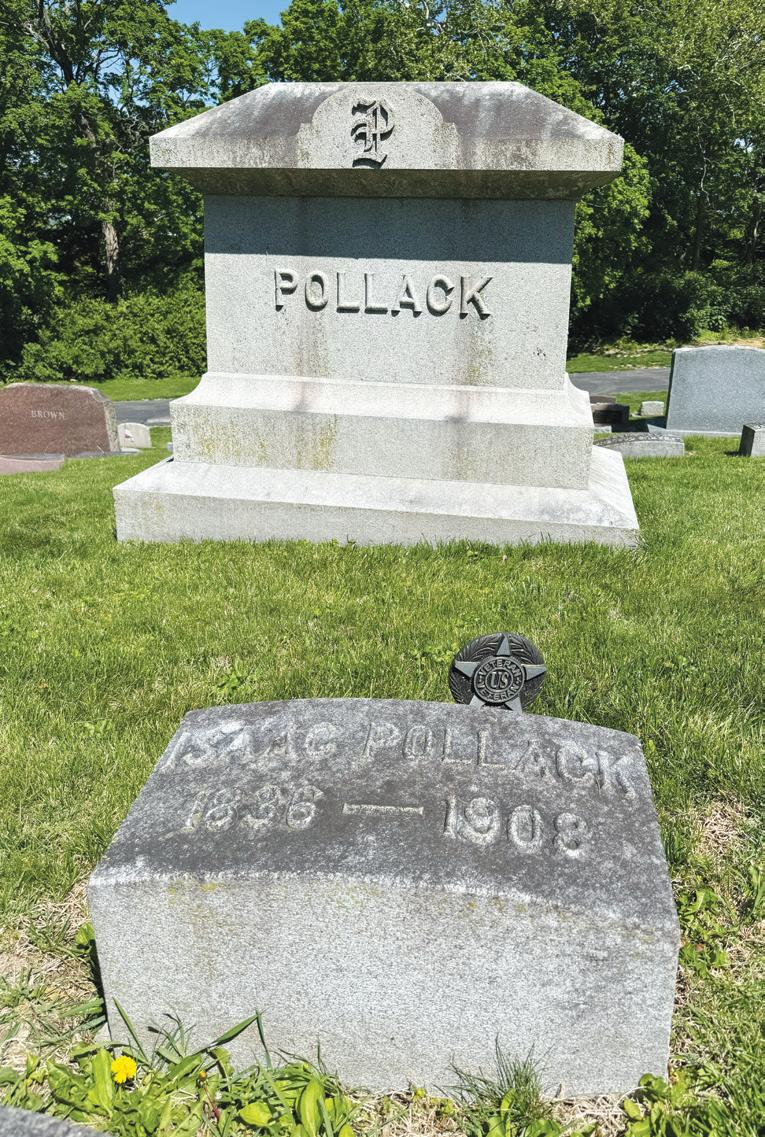
Col. Isaac Pollack is buried in his family plot at Riverview Cemetery.
Private David Rothchild was likely the first person buried at Beth Jacob Cemetery, in December 1875, in this oldest section of the cemetery. No identifying grave marker remains.
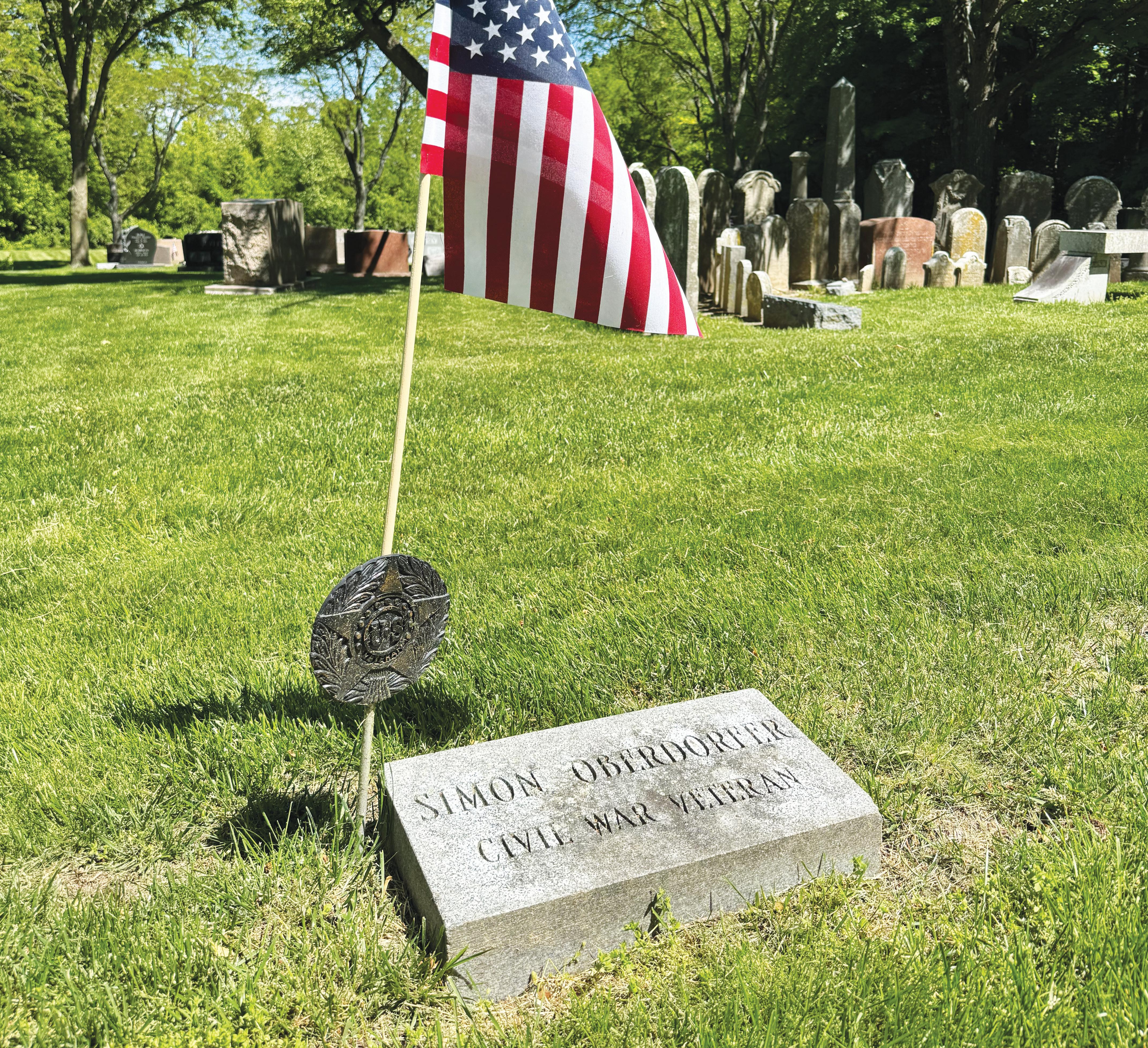
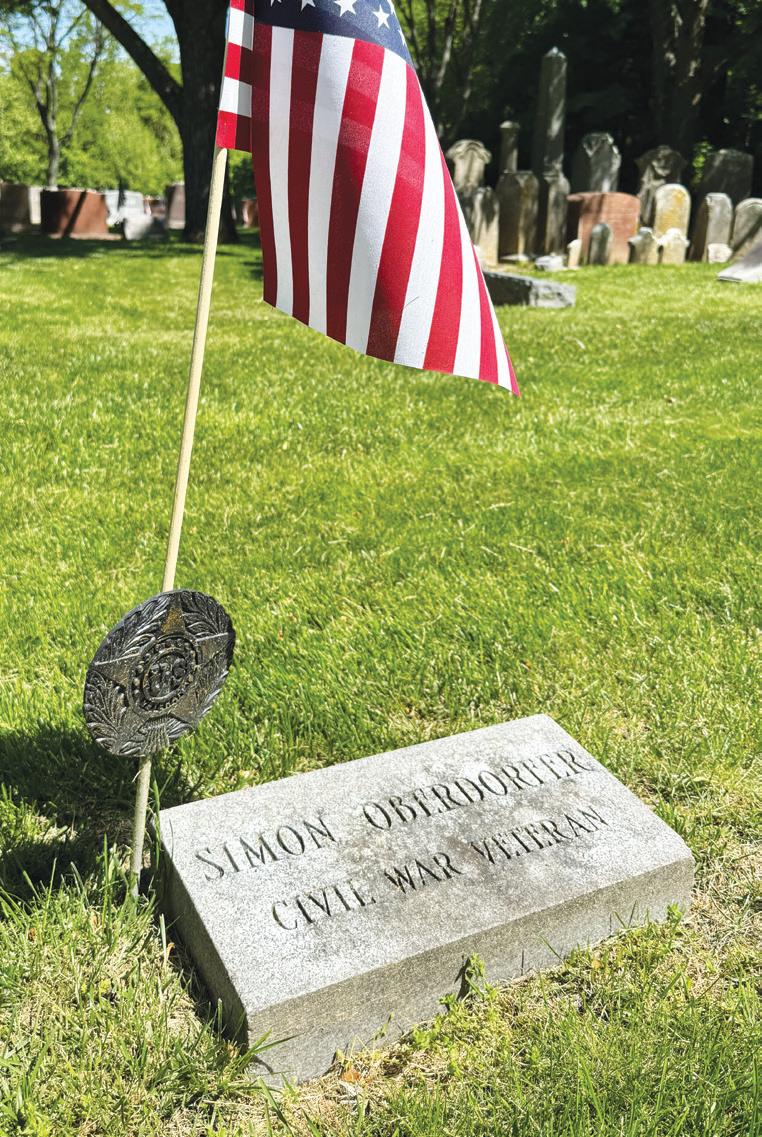
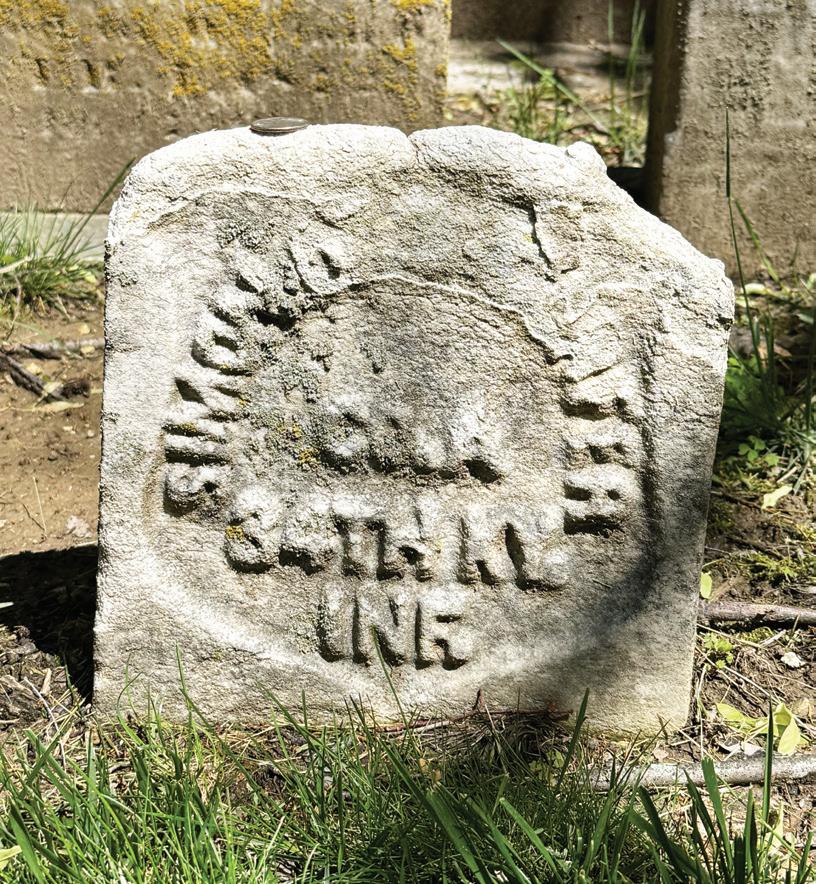
Private Simon Oberdorfer's grave was relocated to Riverview Cemetery's Founders' Circle from Temple Israel's old cemetery in 1967.
The Pollack house was built in 1876 at 319 W. Third Street in Dayton. In 1979, it was moved to 208 W. Monument Ave., where it stands today.
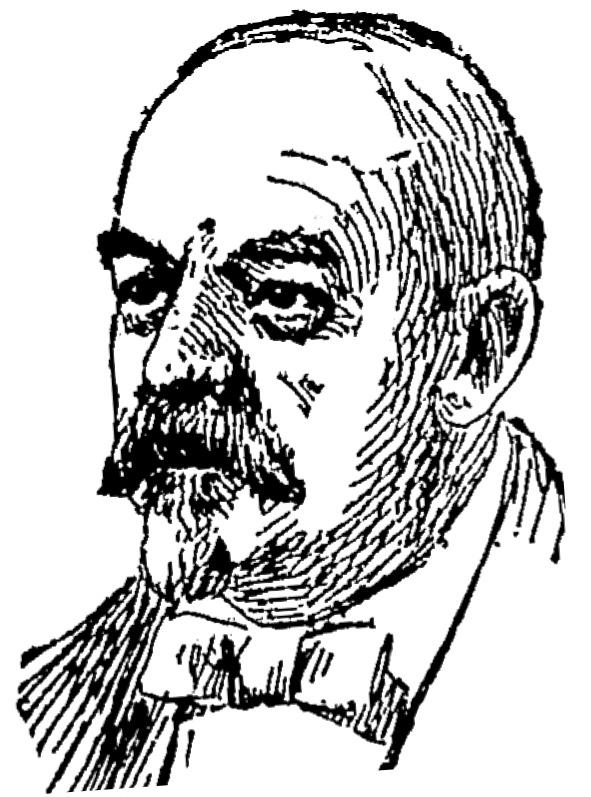
An engraving of Isaac Pollack from The Dayton Daily News, 1899.
Jewish Federation launches campaign to sustain expanded community security
$100K is goal for coming budget year to unlock LiveSecure matching grant from JFNA.
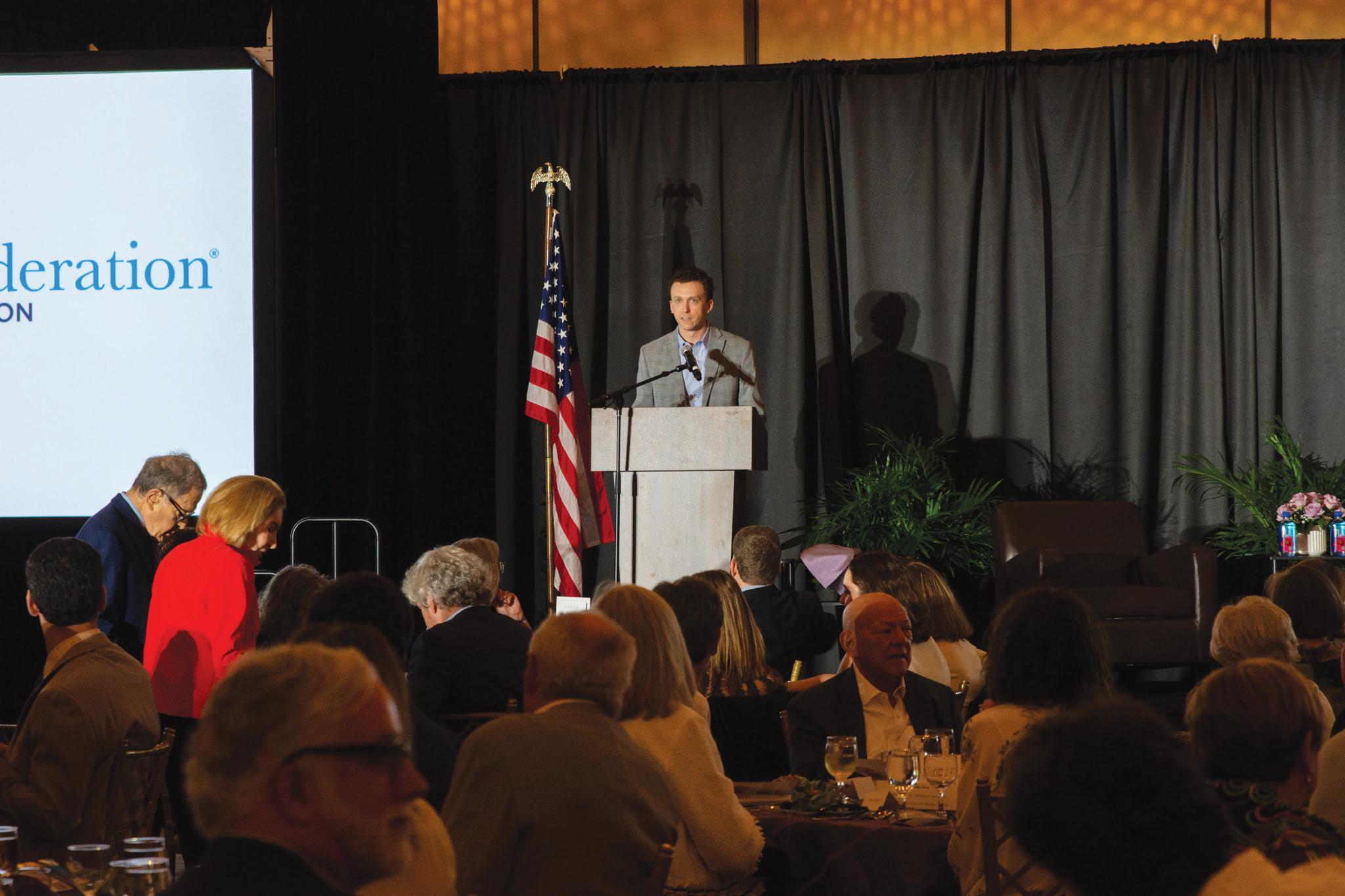
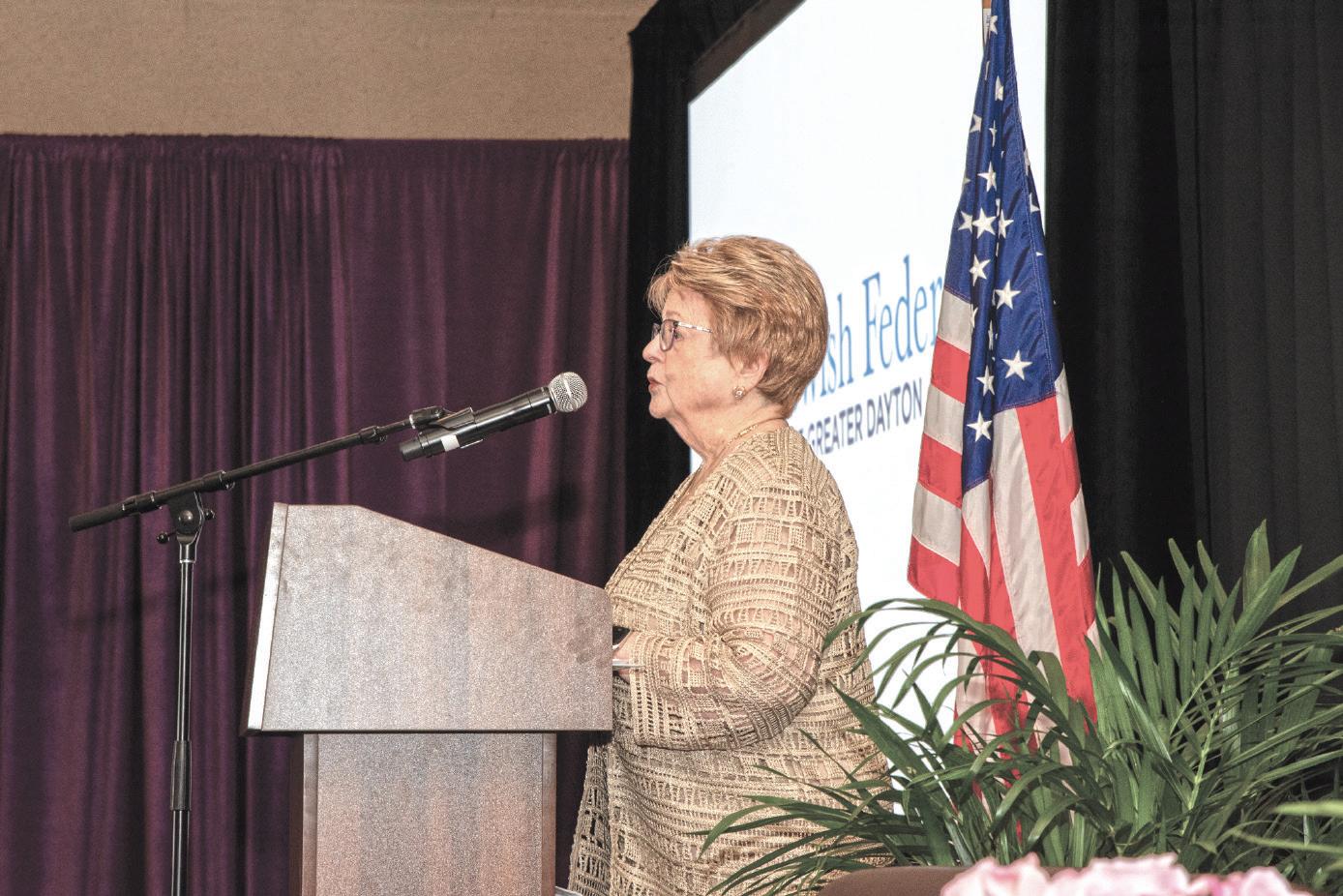
In addition to its $1.2 million annual campaign, the Jewish Federation launched a secondline campaign at its Presidents Dinner on May 17 — to raise its $100,000 portion of a one-to-one matching grant for 2027 from Jewish Federations of North America's LiveSecure initiative.
The terms of the Federation's agreement with JFNA call for the combined $200,000 to provide security services to local Jewish community institutions.
"About $40,000 is specific to us, and the rest is for communitywide security, such as the security director, trainings, security personnel for community events," Jewish Federation CEO Cathy Gardner said.
"A Jewish community can only survive when it is safe," Federation Vice President of Resource Development Ted Goldenberg told attendees at the Presidents Dinner. "According to the most recent FBI data, in 2025, 69% of religion-based hate crimes in the U.S. targeted Jewish communities. That number is staggering, and even more so if you consider that only 2.4% of the U.S. population is Jewish."
JFNA's LiveSecure has awarded Dayton's Jewish Federation a total of $400,000 over three years: $200,000 outright for 2026, $100,000 to be matched locally for 2027, and another $100,000 to be matched locally for 2028.
LiveSecure's first funding cycle allowed the Federation to expand its security director position, held by retired Centerville Police Officer John Davis, to full-time at the end of August last year.
"With over 36 years in law enforcement, John has proven to be an asset for our entire community," Goldenberg said at the fundraising dinner. "He brings with him a wealth of knowledge, experience, and connections with other law enforcement professionals and agencies within our area and state. But as with most improvements, there is a financial cost. We are asking members of the community to help support this new initiative that benefits all Jewish organizations within our community."
Gardner said that going into the Presidents Dinner, the
security campaign had already raised $20,000 from donors.
She also said it's too early to determine if the Federation will add a second-line security campaign in future years.
"I believe as we move forward, the need for security will not go away. The funding for security will have to be more permanent in our community."
Since Oct. 7, 2023 and the global explosion of anti-Jewish hate crimes, the Federation's expenses for security have increased from $30,750 in 2023 to an estimated $192,386 by the end of 2026.
This has included grants at the federal and state levels via the Nonprofit Security Grant Program allocated to states by the U.S. Department of Homeland Security/Federal Emergency Management Agency, and grants from the private Tepper Foundation, to provide additional security guards at area Jewish institutions with programs for young children.
— Marshall Weiss
One Lincoln Park provides dining options that go above & beyond for our residents.
Our NEW Bistro A relaxed, casual café o ering lighter fare throughout the day. Perfect for a quick bite or co ee with neighbors. The bistro provides flexible dining hours and a great atmosphere.
The Fairmont Dining Room
Over the years on these pages, we've now and then shared the story of Piqua clothing merchant David Urbansky, one of four Jews to receive the Medal of Honor from Congress for service in the Civil War. In Private Urbansky's case, it was for "Gallantry at Shiloh and Vicksburg." The Prussian-born Urbansky served with Company B, 58th Ohio Infantry, a German-speaking unit out of Columbus. He was involved in at least 15 fighting engagements in the Civil War and rose to the rank of corporal. When he died in 1897 in his early 50s, he was buried at Temple Anshe Emeth's Cedar Hill Cemetery in Piqua. His family eventually moved to Cincinnati and reinterred Urbansky's remains at Walnut Hills United Jewish Cemetery. In this issue, we bring you stories of the three known Jewish Civil War veterans buried in our local Jewish cemeteries. Later this year, we'll share more stories, about the eight known Jewish Civil War veterans buried at Dayton National Cemetery.
An elegant, restaurantstyle dining room where residents enjoy chefprepared meals served by attentive sta . The menu features a wide range of fresh, seasonal dishes.
With variety like this, I wouldn’t want to live anywhere else!
Jewish Federation Security Dir. John Davis
Bark Mitzvah Boy
My favorite spot at Gettysburg.
DAYTON
Civil War veterans
Continued from Page Two
at 319 and 321 W. Third St. in Dayton.
Adeline Pollack remembered that "after Isaac Pollack and Sol Rauh bought the ground on which they built their homes, they drew lots to determine on which side of the lot each was to build. When the houses were completed, they were often referred to as 'show places' of the city."
The Pollack house stands today, though at a different location. In 1979, it was moved to 208 W. Monument Ave.
When Isaac Pollack died at age 72 in 1908, he was remembered for his philanthropy and activism in the Jewish and general communities. He had served as president of Dayton's Reform congregation, B'nai Yeshurun (now Temple Israel), was a founding member and president of Dayton's B'nai B'rith lodge, and a longtime Mason.
He was also a founding member of the Standard Club, the social and literary club for Dayton's German Jews — effectively an extension of B'nai
Yeshurun, and a major donor to St. Elizabeth's Hospital when it was established.
A staunch Democrat, Pollack served as grand marshal at the funeral of Dayton's former Copperhead Congressman Clement Vallandigham in 1871.
David Rothchild: Wounded at Antietam
Born in the Grand Duchy of Hesse in 1826, David Rothchild made a living as a butcher in Dayton. He and his wife, Rosalia, lived at 40 St. Clair St. Rothchild enlisted in the 11th Ohio Infantry, Company A, in Dayton, May 25, 1861.
At the Battle of Antietam, Sept. 17, 1862, an explosion impaired his vision and disfigured both of his feet. He was honorably discharged as incapable of performing the duties of a soldier from a Washington, D.C. military hospital on Oct. 29, 1862.
Rothchild returned to his wife in Dayton.
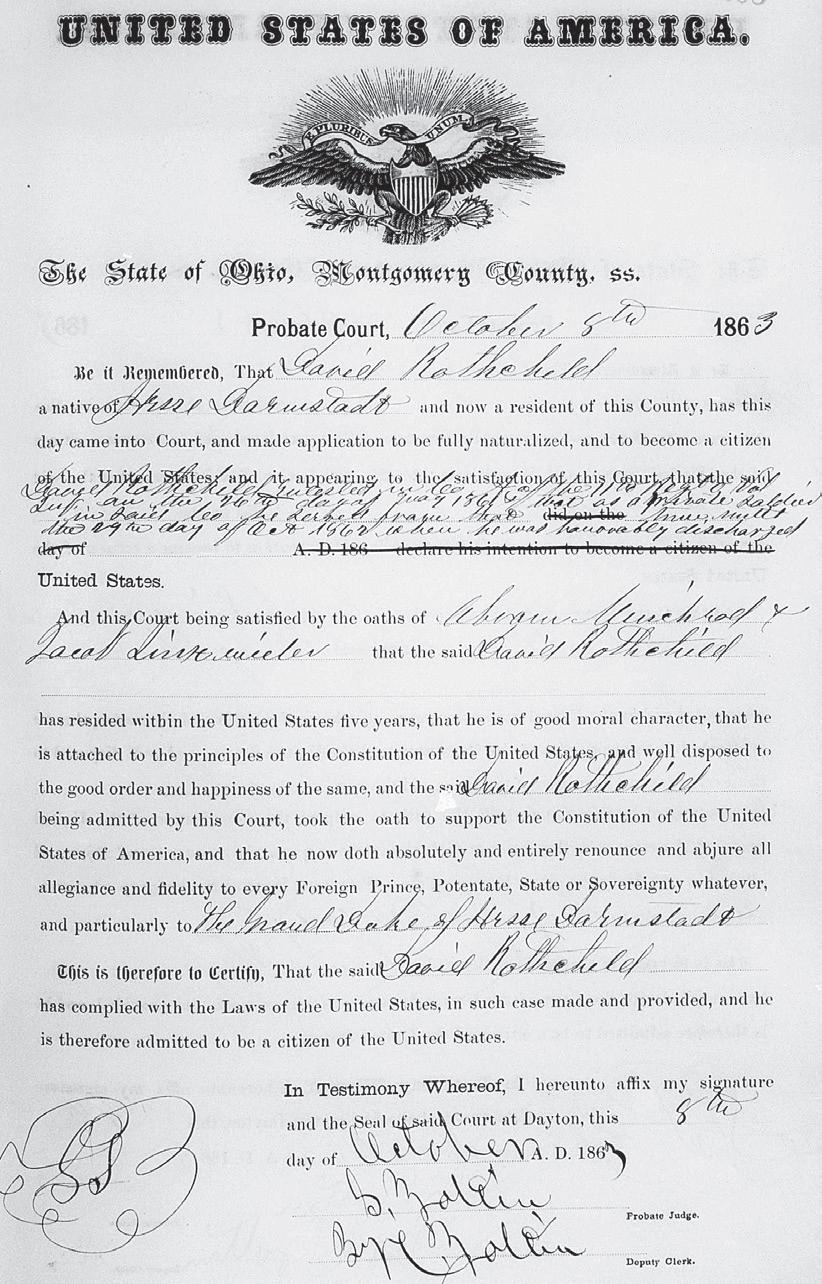
Along with a sense of duty and a steady income, another incentive for immigrants to the United States to enlist with Union forces was a faster track toward naturalization. This may have contributed to Rothchild's naturalization in Montgomery County Probate Court, Oct.
8, 1863.
In 1864, Dayton's city directory listed him as a sawyer. Two years later, he was a butcher once again.
It didn't last long. He was admitted to the Dayton National Home for Disabled Volunteer Soldiers in September 1868, a year after the facility opened. In 1874, a notary documented on a government form (to increase his military pension) that Rothchild's "diseased eyes...has so increased that it is almost impossible for him to get along without assistance of others. Sight has become so weak that glasses have become useless; he is totally unfitted for any kind of manual labor."
He died of paralysis in the Soldiers Home hospital, Dec. 6, 1875 at age 48.
Simon Oberdorfer: Injured as an orderly
On Memorial Day 1923 — Wednesday, May 30 — a brief article ran in The Dayton Herald without a byline, as was usual in those days:
"When peans are sung Wednesday and the glorious deeds of fallen heroes are told in the various cemeteries of Dayton, there will be one cemetery in the city where no service is scheduled, where one soldier's grave will not be visited. This soldier in his day was known to his fellow men as Simon Oberdorfer. He fought with Lincoln's troops as a member of Company A, 34th Kentucky Infantry. How his body comes to rest in an abandoned Jewish cemetery at Rubicon Road and Stewart Street is a mystery hidden in the folding pages of time. Even the name of
the cemetery has been forgotten...Stranger hands Wednesday placed an American flag on the grave."
With the advent of technologies unimaginable a century ago, answers are easier to find and verify now.
The unknown writer was referring to Temple Israel's old cemetery, Dayton's first Jewish cemetery, which opened in 1851.
Today's Temple Israel members might be surprised to learn the old cemetery did have a name: Beth Hayim, Hebrew for House of Life or House of Living.
Temple Israel's current cemetery, Riverview, opened in 1889. And Beth Hayim cemetery hadn't been abandoned; it was out of use.
Three generations of caregivers — grandfather Charles, son Otto, and grandson Elmer Peckolt — served as Beth Hayim's caretakers from 1875 to 1961.
What we know about Simon Oberdorfer, born in Württemberg in 1842, dates to 1855 in Louisville, Ky.
In March that year, the Louisville Evening Bulletin and The Louisville Daily Courier ran city court reports that Oberdorfer was fined for selling liquor on March 18, "that being the Christian Sabbath day."
"The trial was entered upon, and it was proven that prior to last Saturday, Oberdorfer, though an Israelite, had never in good faith observed the Jewish Sabbath, his recent conversion being so that he might avail himself of the profits of the Sunday liquor traffic when the Gentiles could not sell," The Louisville Daily Courier reported.
A week later, the newspaper reported the case was disposed of, "the jury assessing his fine at $75 and costs, equal to a sum that will about use up the profits of his Sabbath bar," and that the board of aldermen had passed a resolution refusing to grant Oberdorfer a tavern license, "because he shapes his religious creed to suit the exigency of the times."
He found work as a tailor instead. Oberdorfer enlisted with the Union Army in Louisville. While he was assigned as an orderly in May 1864 to brigade headquarters at Cumberland Gap, Tenn., he suffered from a hernia in Bowling Green,
Editor and Publisher Marshall Weiss mweiss@jfgd.net 937-610-1555
The Dayton Jewish Observer, Vol. 30, No. 10. The Dayton Jewish Observer is published monthly by the Jewish Federation of Greater Dayton, a nonprofit corporation, 525 Versailles Dr., Dayton, OH 45459.
Views expressed by columnists, in readers’ letters, and in opinion pieces do not necessarily reflect the opinion of staff or layleaders of The Dayton Jewish Observer or the Jewish Federation of Greater Dayton. Acceptance of advertising neither endorses advertisers nor guarantees kashrut.
The Dayton Jewish Observer Mission Statement
To support, strengthen and champion the Dayton Jewish community by providing a forum and resource for Jewish community interests.
Goals
• To encourage affiliation, involvement and communication.
• To provide announcements, news, opinions and analysis of local, national and international activities and issues affecting Jews and the Jewish community.
• To build community across institutional, organizational and denominational lines.
• To advance causes important to the strength of our Jewish community including support of Federation agencies, its annual campaign, synagogue affiliation, Jewish education and participation in Jewish and general community affairs.
• To provide an historic record of Dayton Jewish life.
The National Soldiers Home 'near Dayton, Ohio' as it appeared circa 1878. Isaac Pollack and his wife, Adeline, would ride out to its grounds by carriage with their children and take in summer stock theater. David Rothchild and Simon Oberdorfer each convalesced and died there.
David Rothchild was naturalized in Montgomery County Probate Court, Oct. 8, 1863. Immigrants to the United States could speed up the naturalization process through service in Union forces.
Continiued from Page Four Ky. He was then assigned to the Cumberland Gap U.S. Telegraph Office, where he worked for four months. Oberdorfer was honorably discharged in Knoxville, Tenn. with the end of the war, on June 24, 1865. He also served in Company E, 2nd U.S. Infantry after the war. He worked as a waiter and never married.
He was first admitted to the Dayton National Soldiers Home Jan. 28 to March 1, 1869. From Jan. 13 to April 12, 1871, he was under treatment at a government insane asylum in Washington, D.C. Oberdorfer's final admittance to the Dayton Soldiers Home was Nov. 3, 1876. He died there April 9, 1877 due to inflammation of the bowels, between 34 and 35 years old.
The Soldiers Home
Signed into being by Abraham Lincoln in March 1865, Dayton's National Soldiers Home — now the Dayton VA Medical Center — was among the first three facilities to care for discharged Union army and navy veterans. Its greenery and amenities appealed to Dayton-area residents, who used it for their own recreation.
"After the Soldiers Home was established in Dayton, near the beginning of the 1870s, we found a lot of pleasure in going out there," Isaac Pollack's widow, Adeline, remembered in her 90th birthday Dayton Daily News interview. "The Soldiers Home used to present excellent stock companies in its Memorial Hall every summer, and it was customary for us to attend these performances every week and to take our children."
Where they're buried
DAYTON
Above: Only part of the top of Oberdorfer's original headstone remains, now set at Riverview Cemetery's Founder's Circle with other headstones from Temple Israel's original cemetery.
there was a grave marker for David Rothchild in Beth Jacob Cemetery, it's no longer there.
burial and the old gravestones arranged together in a semicircle at the rear of the section.
Adeline Pollack died in 1940. She and Isaac Pollack are buried in the Pollack family plot at Temple Israel's Riverview Cemetery.
Soldiers Home records indicate that when David Rothchild died, Dec. 6, 1875, his body was "taken to Dayton by his friends" at 10 p.m. According to the Montgomery County Recorder's Veterans Grave Index, Rothchild was buried at Beth Jacob Cemetery, Dec. 8, 1875.
The founders of Beth Jacob Congregation purchased the land for their cemetery Nov. 23, 1875; it's likely Rothchild was the first person to be buried there. The congregation itself has no record of his burial. If
His wife, Rosalia Rothchild, would be buried at Baltimore's Hebrew Friendship Cemetery after her death in 1896. She had moved to Baltimore to be near their adult children.
Adding to the confusion, someone posted at the Find A Grave website that David Rothchild is buried at Beth Abraham Cemetery — it didn't open until 1894.
Confusion also surrounds the final resting place of Simon Oberdorfer. His remains were among the last 63 bodies to be disinterred from Temple Israel's old cemetery and reinterred at Riverview Cemetery in May 1967.
The 63 were reinterred in what Temple Israel calls its Founders Circle, with new gravestones above each
See what our patients have say:
- Jay W.
Call (937) 395-3622 or visit www.emcohio.com to become a member today!
It turns out there is a gravestone at Dayton National Cemetery for Oberdorfer, but spelled with an A: Aberdorfer. Temple Israel Administrative Assistant Ellen Finke-McCarthy has pieced together records of two burials for Oberdorfer: April 9, 1877 at Dayton National Cemetery and April 11, 1877 at the old Temple Israel cemetery, Beth Hayim.
With knowledge that in 1967, Temple Israel's cemetery committee placed new gravestones in the Founders Circle only over actual remains recovered from the old cemetery, it's likely that Oberdorfer is buried at Riverview. We'll let you know what we find.
And we've already identified eight Jewish Civil War veterans buried at Dayton National Cemetery. Look for a feature on those veterans later this year.
Daniel Opris, D.O.
Barry Taylor, M.D.
Beth Duvall, M.D.
Left: Image of a flag placed at Simon Oberdorfer's grave when it was at Temple Israel's original cemetery at Rubicon Road and Stewart Street, from a Dayton Herald article, May 30, 1923.
Right: The headstone of Simon Aberdofrer at Dayton National Cemetery.
Elyssa Wortzman and her students with Beth Abraham Synagogue's Maaseh religious school learned hands-on about the Jewish environmental value of bal tashchit, do not waste, when they volunteered at Cox Arboretum, mulching around trees. 'We learned that mulch is made from a by-product of the lumber industry — tree bark — that may otherwise have been destroyed,' Wortzman explained. She and the students also talked about modern applications for bal tashchit and each person's responsibility to apply it in their own lives.
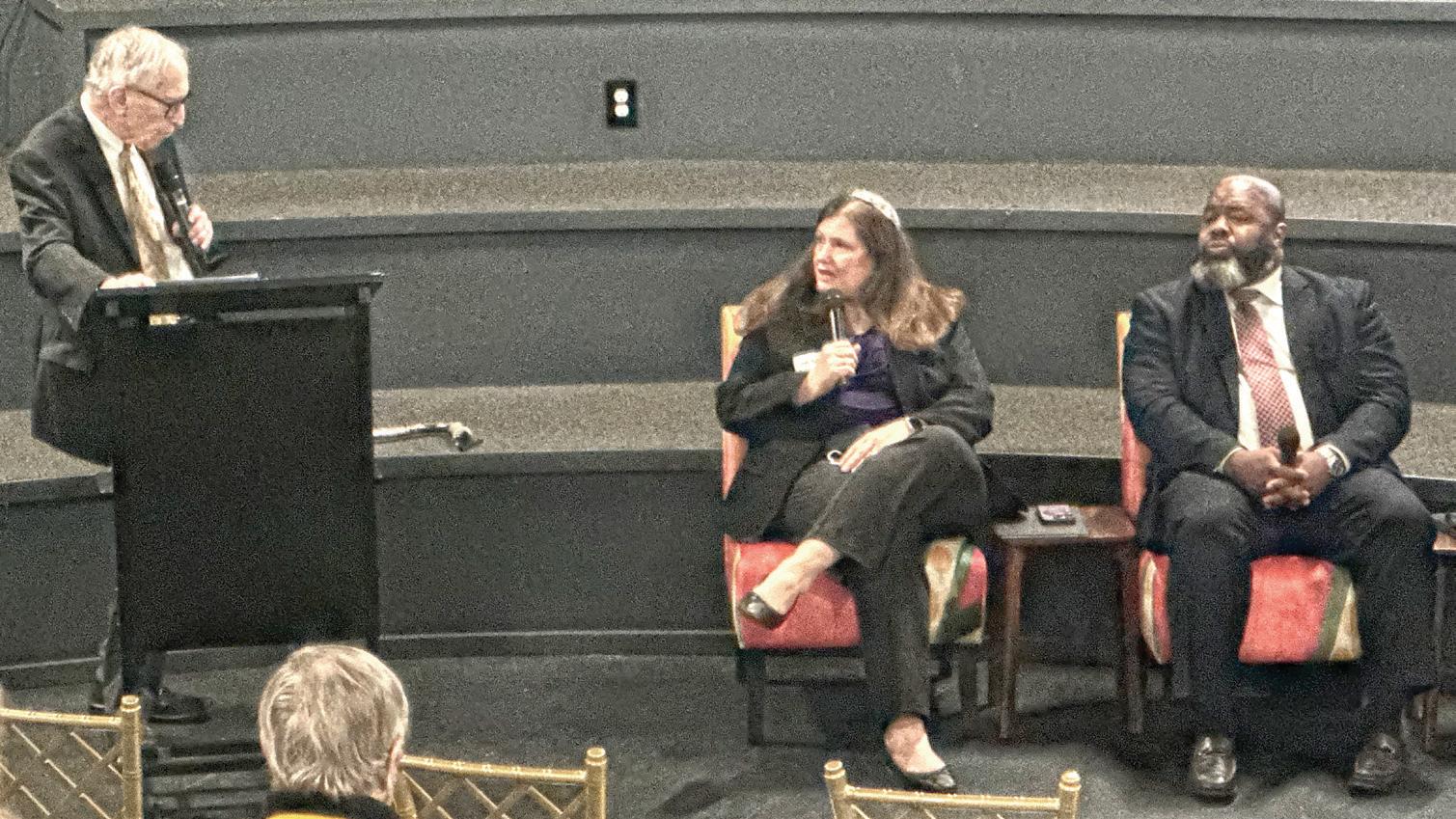
After screening excerpts from the PBS documentary Black and Jewish America at The Tank at The Arcade, U.S. District Judge Walter H. Rice moderated a discussion with Temple Israel's Rabbi Karen Bodney-Halasz and Omega Baptist Church's Pastor Joshua D. Ward. ThinkTV and PBS presented the event in partnership with the Jewish Federation of Greater Dayton and Miami Valley Urban League. The church and temple have partnered on an MLK weekend pulpit exchange since 1994 when Omega Baptist purchased Temple Israel's former building on Emerson Avenue and Temple Israel moved to its current location on Riverside Drive.
American Friends of Soroka Med. Ctr. dinner program June 17
Dayton ophthalmologist Dr. Mike Bloom will share his experiences of volunteering to care for wounded patients at Soroka Medical Center in Beersheba, Israel over the last two years, at the American Friends of Soroka Medical Center's Hope, Healing, and Heroism Dinner, 6 p.m., Wednesday, June 17 at the Boonshoft Center for Jewish Culture and Education.
The program will highlight Soroka Medical Center's frontline role in the Negev region caring for victims of Oct. 7, 2023, ongoing wartime trauma, and the recent ballistic missile strike on the hospital.
The Boonshoft CJCE is located at 525 Versailles Dr., Centerville. The cost is $36 per person. Kashrut will be observed. For details and to RSVP, go to soroka.org/dayton.
Beth Jacob's 6th Jewish Women Inspiring Jewish Women, June 14
Beth Jacob Congregation's Sixth Jewish Women Inspiring Jewish Women luncheon will be held at 11 a.m., Sunday, June 14 with speakers Sandy Sloane-Brenner, Renate Frydman, Judy Heller, Lori Lipp, Cantor Andrea Rai-
zen, and Mary 'Mahira' Rogers. The cost is $26.
Beth Jacob Congregation is located at 7020 N. Main St., Harrison Township. RSVP by June 5 to bethjacob1@aol.com or 937-274-2149.
Beth Abraham Synagogue
Marshall Weiss
Dr. Mike Bloom and his wife, Amy, when he volunteered at Soroka in July 2024.
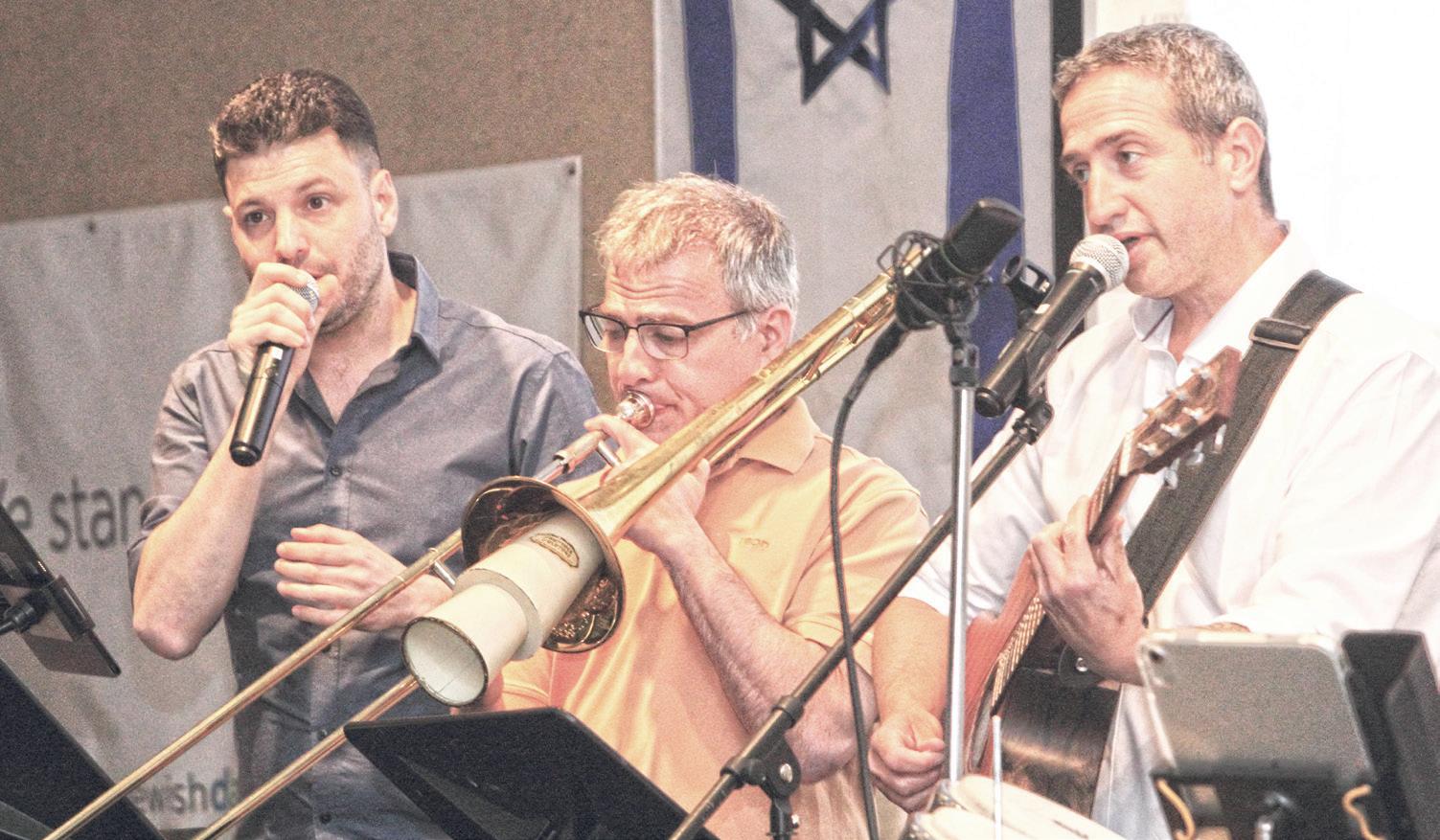
Dayton Philharmonic Orchestra trombonist and Flying Klezmerians leader Rich Begel (Center) sits in with the Hashayara ensemble from Israel's Galilee at the JCC's Celebrate Israel at 78 dinner program, April 22 at the Boonshoft CJCE.
Peter Wine
Springboro man charged after threatening student outside Golf Manor Jewish school
By Sam Fisher, Cincy Jewfolk
A Springboro man faces charges of ethnic intimidation and menacing following an incident outside a Jewish school in Golf Manor. Jackson Mettler, 19 of Springboro, was charged in connection with a May 4 incident at Yeshivas Lubavitch Cincinnati on Section Road.
“A Jewish child should be able to walk to school without being threatened for being Jewish,” said the Jewish Federation of Cincinnati in a statement. “That is unacceptable in our city.”
According to court documents, Mettler yelled “F--- the Jews“ and “Free Palestine“ at a victim outside the school. He also told the victim, “If I were you, I’d get my a-- back inside.“ The victim reentered the school, fearing for his safety and the safety of other students.
ADL reports 47% drop in Ohio antisemitic acts in 2025
By Casey Couch, Cleveland Jewish News
The Anti-Defamation League’s annual Audit of Antisemitic Incidents found that antisemitic incidents across Ohio dropped sharply in the last year, falling 47% from 394 incidents in 2024 to 209 in 2025, according to data released on May 6.
In a statement, ADL Regional Director Kelly Fishman said that antisemitic incidents in Ohio dropped from 233 in 2024 to 117 in 2025, and that progress reflects the hard work of law enforcement, higher education and the broader community.
“But 117 incidents is still 117 too many,” said Fishman, who is based in Cleveland. “We know that every number in this data represents a real person whose sense of safety was shaken. Antisemitism remains a genuine and prevalent threat to Jewish Ohioans, and ADL Ohio River Valley remains committed to expanding on the progress we saw in 2025.”
those directly targeted, citing an incident that resonated with her in the past year.
“An Ohio State University student described returning to her dorm last September only to learn that a swastika-emblazoned flyer with the message ‘We’re back’ had appeared at Mirror Lake, at the heart of campus,” Fishman said.
The student described feeling unable to focus on her studies, constantly on guard, and worried about her safety and her roommate, who is Black, felt the threat too, according to Fishman.
In the ADL’s national report, 2025 marked one of the most violent periods for American Jews, with physical assaults reaching record historically high levels and antisemitic attacks resulting in fatalities on American soil for the first time since 2022 and in Jewish fatalities for the first time since 2019.
“Free speech is protected,” the Cincinnati Jewish Federation’s noted. “Threatening a child is a crime. When threats against a Jewish child are wrapped in the language of political protest, that is antisemitism. The criminal charge reflects that line.“
Ethnic intimidation can result in a first-degree misdemeanor or a fifth-degree felony conviction in Ohio. Mettler was released from jail without having to post bond.
The Ohio River Valley region, which includes Ohio, Kentucky, West Virginia and western Pennsylvania, tracked 31 antisemitic incidents on college campuses, down from 77 incidents in 2024. White supremacist propaganda also decreased from 46 incidents in 2024 to 37 incidents in 2025. The ADL attributed the decline in these numbers to its pointed work in targeting those areas of improvement from previous year’s data.
Fishman added it's important to note the human cost of antisemitism, which extends far beyond
Across the country, there were 6,274 incidents of antisemitic assault, harassment, and vandalism in 2025, an average of 17 incidents per day. While this total represents a 33% decrease from 2024, it remains considerably higher than the total in years prior to Oct. 7, 2023 and ranks as the third-highest year for antisemitic incidents, after 2023 and 2024, since ADL began tracking in 1979.
Incidents of assault involving a deadly weapon also increased nationally by 39%, claiming two victims in the May 21, 2025 shooting outside the Capital Jewish Museum in Washington, D.C., and one victim who died from injuries sustained in the June 1, 2025 firebombing attack in Boulder, Colo.
Hamilton Co. Sheriff’s Office
Jackson Mettler
Kelly Fishman
Students Supporting Israel event met with protests at Ohio State
By Jimmy Oswald Columbus Jewish News
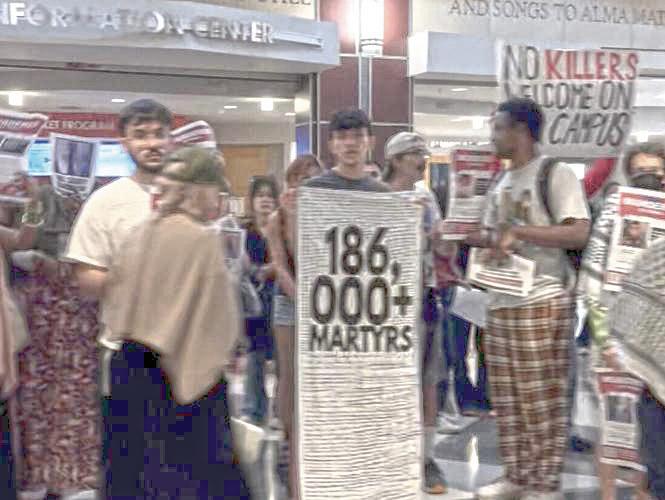
Chants of “Death to the IDF” and “baby killers” rang through the Ohio Union on The Ohio State University campus April 14 during a protest against an event put together by the university’s chapter of Students Supporting Israel that featured two Israeli Defense Force soldiers as speakers.
Two people were arrested by the OSU Police Department during the demonstration, which saw about 50 to 60 people gather inside the student union waving a Palestinian flag, chanting anti-Israel sentiments, and holding up flyers that read, “MURDERED
BY ISRAEL,” with photos of Palestinians killed during the Israel-Hamas war.
The protest was put together by the Ohio State branches of Students for Justice in Palestine, Faculty and Staff for Justice in Palestine at Ohio State, and Law Students for Justice in Palestine at the Moritz College of Law.
“It was quite the display,” Ava Zweig, a Solon native, and cofounder and copresident of SSI at Ohio State, said.
as if they were peacefully protesting. But I saw it with my own eyes, and it was the furthest thing from peaceful you could ever imagine. It was absolutely nuts. People were screaming bloody murder.”
'It was absolutely nuts. People were screaming bloody murder.'
“They framed it online after
The event, called Triggered: The Ceaseless Tour, was hosted by SSI, a proIsrael international campus movement that has 150 chapters on college and high-school campuses around the country.
IDF soldiers travel to college campuses around the United States and tell stories from the Oct. 7 Hamas-led invasion and the ensuing conflict.
“On April 14th, students, faculty, staff, and community members united in opposition to Ohio State University’s facilitation of a visit from Zionist war criminals, demanding accountability for their crimes,” SJP said in a statement published on Instagram.
“These war criminals have directly participated in carnage and massacres in Gaza and Lebanon: one, a reservist in the Chashmonaim Brigade who carried out genocide in Gaza in October 2025, and the other, a commander and combat engineer skilled in munitions and explosives within the IOF who carried out genocide in Gaza for 450 days and engaged in ongoing massacres in Lebanon, leaving only a few days ago.”
SJP did not respond to a request for an additional comment. IOF stands for “Israel Offense Force,” a way antiIsrael social media users refer to the IDF.
Zweig, a sophomore with a dual specialization major in finance and economics, said the purpose of the SSI event was to “keep students informed with first-hand accounts of what’s going on the ground.”
“That’s why we bring combat soldiers: we’re combating,
in a sense, misinformation on college campuses,” she said.
“And, as you can imagine, people get triggered. That’s how the name came to be. And it’s also a spoof on pulling the trigger in combat.”
This was the third time The Triggered Tour visited Ohio State, first in the spring and fall semesters of 2025. Zweig said a small group of people showed up the first time with signs protesting the event and Israel, but the soldiers spoke to the demonstrators afterward in the cold for about an hour.
“Some of those conversations were actually really productive,” she said. “Some people, you can’t change their minds, but the soldiers really got through and it was beautiful to see. People left thinking about things that were said, which is important.”
was wearing an SSI T-shirt, and a car drove by, unrolled the window and shot him with a Nerf gun,” she said. “Thank God it was a foam bullet, but that’s the kind of stuff we’re seeing on campus.”
Zweig said the student called the police, who are investigating the incident. SSI’s Ohio State chapter has a good relationship with OSU Police, Zweig added, and they always ensure an armed security presence plan is in place.
But no such conversation was possible this time as protesters were disruptive enough that the Ohio State PD had to escort the soldiers out of a back exit out of an abundance of caution, Zweig said.
“And one of the students who came to the event was walking on High Street and
“Thank God we did,” she added. “We only disclose the location to registered attendees, which we had about 80 of. Everyone looked to be familiar faces or friends of friends, but unfortunately one person slipped through the cracks and released all the information to SJP.”
About 24 hours before the event, SJP advertised the protest on Instagram, saying, “We vehemently oppose any attempts to commemorate or honor war criminals, in addition to any acts of normalization with the Zionist entity. We will not stand by and allow them to be welcomed onto our campus.”
Screenshot of protesters demonstrating against Students Supporting Israel’s program called Triggered: The Ceaseless Tour, inside the Ohio Union on the Ohio State campus, Columbus, April 14.
OSU Students Supporting Israel cofounder, CoPres. Ava Zweig
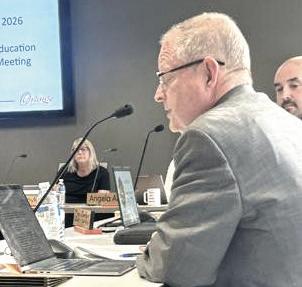
Orange schools’ ‘Jew hate’ angers residents
By Jimmy Oswald Columbus Jewish News
“What you are saying is it is OK to be hateful just so long as it is Jew hate.” That was the message Sarah Schwarz, a Pepper Pike resident who has a seventh-grade daughter at Ballard Brady Middle School, directed at Orange City School District board members and Superintendent Lynn Campbell at a board of education meeting on May 11 as over 100 residents packed into the Pepper Pike Learning Center to speak out against the reinstatement of a Brady Middle School paraprofessional who was put on leave because of alleged antisemitic posts made on social media.
“Let’s take a look at our handbook that we signed at the beginning of the year,” Schwarz said as she addressed
the room. “There was a pledge to respect diversity. Is she respecting that pledge? There is a no bullying policy. Is this post in line with that policy?... The Jewish students of Brady Middle School have taken notice. Do not think they do not see. Do not think they are not talking. And do not think they are not planning. Words have meaning, and what you have said is the Jewish students of Brady Middle School do not mean enough to have consequences.”
Orange schools, serving students across several suburbs east of Cleveland, announced in an April 12 letter to families that it was investigating an employee for posts made on the employee’s “personal social media page” with allegations that the content was “discriminatory and antisemitic in na-
Ohio No Kings post draws condemnation
By Sam Fisher, Cincy Jewfolk
Ohio 50501, the state’s No Kings organizers, posted an Instagram infographic in May titled, “Learn the Difference Between Judaism, Antisemitism, and Zionism.”
It included statements opposing a two-state solution and expressed support for the elimination of the State of Israel:
“The truth is plain and simple: Palestine and the world will never be free until Israel is gone. The world will not be free while Israel exists. We the people have the power to achieve liberation for all.”
Local Jewish organizations said the language in the post goes beyond criticism of Israeli policy.
“Cincinnati’s Jewish community does not need OHIO 50501 to define Judaism, Zionism, or antisemitism for us, least of all during Jewish American Heritage Month,” said the Jewish Federation of Cincinnati in a statement. “The carousel ends with a call for Israel to be 'gone' and tells the 88% of American Jews who support Israel’s right to exist that they are supporting a genocidal state. It is antisemitism wearing a heritage month as a costume.”
While the national account has shared posts critical of Israeli government policy, it has not called for the elimination of Israel. Cincy Jewfolk has reached out for comment and has not yet received a reply.
The infographic also draws comparisons between Zionism and Christian nationalism, and characterizes Zionism as a genocidal movement, claiming it “emerged in Europe with the intention of committing a total genocide in Palestine.”
“Zionism is the right of Jewish people to self-determination in their historic homeland, the same right Italians have in Italy and Irish have in Ireland,” said the Cincinnati Jewish Federation. “It is also the only one routinely called genocide.”
The Ohio 50501 post included language that echoes historically antisemitic tropes like blood libel, including claims that “Zionists believe they are entitled to killing Palestinians and take the land, claiming it was promised to them in their religious texts.”
ture and not consistent with the values of the Orange City School District.”
While the district didn’t name the employee in the letter, the Cleveland Jewish News obtained a copy of two posts made by Citlali Afsharian, a paraprofessional employed at Ballard Brady Middle School in Pepper Pike, on Facebook, published the week of April 6 that criticized Israel and in one post called the country “the cancer of the region” that “must be stopped.”
In another, she said that “Today’s Anne Frank is a Lebanese Muslim girl hiding in the attic of a Lebanese Christian Family, terrified of Israeli Jewish soldiers finding her and killing her.”
On May 6, Afsharian returned to work. In a letter sent to her from Campbell published on Facebook by Fairlawn-based Pattakos Law Firm LLC, who was representing Afsharian, Campbell said he “reviewed the investigation and find that evidence related to the posts does not substantiate violation of any of” the eight board of education policies she was being looked into for violating.
At the May 11 meeting, 11 people
spoke to address concerns and voice opposition to the reinstatement.
Patrick Russo of Orange called on Campbell to resign.
“I’ve emailed you a handful of times about the issues with our sports programs,” he said. “And for me, that was a sign of bigger mismanagement. You’ve continued to miss that message and not
Continued on Page 10
According to the American Jewish Committee Regional Director Justin Kirschner, the post undermines prospects for coexistence.
“Calling for a world where Israel ‘does not exist’ is not liberation; it is a call for the elimination of the Jewish homeland,” said Kirschner. “Real advocacy centers Israeli and Palestinian dignity, their prospects for a better future, and a path to coexistence – not the destruction of another people.”
Ohio 50501 has approximately 18,000 social media followers. The national No Kings social media account has not reposted the infographic.
“Language like this crosses multiple lines,” said Rabbi Ari Jun, senior Rabbi at Temple Sholom. “Calling for Israel’s destruction; characterizing it as uniquely evil; separating Zionism writ large from Judaism; tokenizing fringe Jewish perspectives, like that of JVP.”
Jewish Voice for Peace is an American anti-Zionist advocacy organization.
The post reflected a broader trend of highly charged rhetoric on social media, and the rising mix of antisemitism in criticism of Israeli government policies and actions.
“Doing things like this with any other marginalized group would immediately be called out; for some reason, though, many progressives have a blind spot for it when it comes to Jews," Jun said.
Rabbi Ari Jun
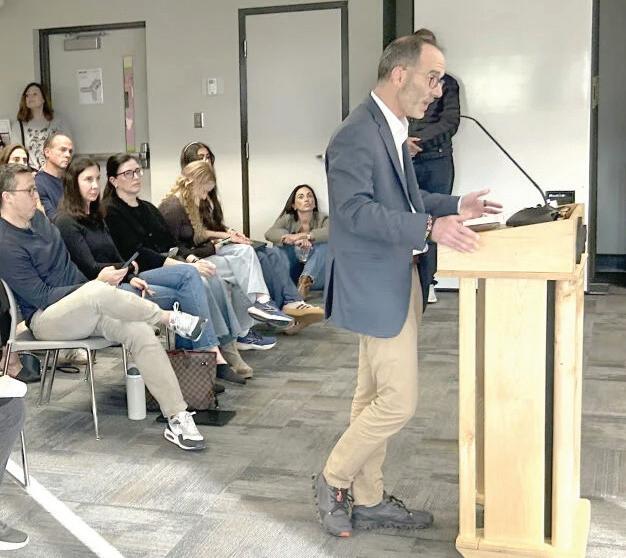
Hunting Valley resident Jason Wuliger, an Orange High School graduate and chair of the Jewish Federations of North America Public Affairs Committee, addresses the Orange Board of Education, May 11 at the Pepper Pike Learning Center.
Jimmy Oswald/CJN
Orange schools
Continued from Page Nine
lead appropriately. I believe this is another example of that playing out right here. And when you don’t lead, you bring mediocrity. I don’t think you’re right to lead Orange.”
Members of the audience applauded after each speaker was finished speaking. Aliza Falk of Moreland Hills, who has two children in the district, including one in Brady school, and is a 1993 graduate of Orange High School, said that in recent years Jews have begun to feel more and more unsafe, have had to consider taking off their Jewish stars, and are forced to pick colleges where their children would feel the least hate, but that Orange always felt like a safe home.
“As other schools came to play in our fields with swastikas, we said, ‘Thank goodness for Orange schools and that we don’t have that hate here.’ But now we do,” she said. “While we may have lost a lawsuit, had you opposed her, you absolutely lost your moral compass by doing nothing. I would ask that you condemn any staff member who made any comments that made any Muslim, African American, LGBTQ or anyone feel uncomfortable. Orange should be no place for hate.”
Before the public comment portion of the meeting, Campbell read a statement
THE REGION
that addressed the situation.
“While that investigation found no violation of district policies, it provided the opportunity for the district to review and consider professional development around social media, while also reaffirming the district’s stance against discrimination, harassment, intimidation, and bullying in the school environment,” he said.
“Currently, as a microcosm of our greater society, our district is feeling the impact of the complex conflicts in the Middle East, including recent escalation and its impact on the region. These geopolitical issues and the internalexternal conflicts have created division in the school community.”
League, including its commitment to its No Place for Hate designated schools and to provide educational resources; and continue to address social-emotional learning through MHS Guidance, BMS Pride and OHS Advisory.
Campbell said the district is committed to educating students in a safe and collaborative environment; reaffirming to uphold policies related to harassment, intimidation and bullying; continue ongoing training for all staff related to harassment policies; continue training related to social media use and pertinent policies and Ohio professional conduct standards for educators; continue efforts with the Anti Defamation
“The safety of our students remains the top concern, so please speak up if they or someone else is encountering mistreatment, including harassment, intimidation or bullying at school or at school-related events,” he said. “In closing, I continue to proudly lead this diverse school district with so much to celebrate and cherish. We have faced many challenges over the years, and we have stood strong and endured, drawing closer together as Team Orange.”
Jason Wuliger, a Hunting Valley resident, Orange High School graduate, and chair of the Jewish Federations of North America Public Affairs Committee, said he was “shocked and outraged by the district’s dismissiveness of the abhorrent social media posts of its employee.”
“The message sent by the superintendent’s exoneration of her moves the district from investigator to endorser. To say that there is nothing wrong with a post that analogizes the tragedy of Anne Frank’s murder at the hands of the Nazis with Israel’s war against the terrorist organization recognized as
such by the U.S., EU and all well-meaning governments of the world is disgusting. This mistake would not have been made had Orange adopted the International Holocaust Remembrance Alliance definition of antisemitism that has been adopted by 47 national governments, including 26 of the 27 EU member states. It has also been adopted by 37 U.S. state governments, including Ohio. Orange not doing so puts them outside the mainstream.”
Michell Hirsch doesn't have children in the district; she is an Orange resident who believes the situation deserves clearer acknowledgment from the district.
“I understand that some might believe that criticism of the Israeli government is not inherently antisemitic, but invoking Anne Frank and Holocaust imagery in this context – it crossed a line,” she said. “To dismiss this as merely a political disagreement minimizes why this struck such a deep nerve in this community. By not acknowledging or making any statement whatsoever, you’re not just letting this person off the hook, your lack of action will actually approve and encourage actions that will continue to make Jews feel unsafe.”
When reached for comment, Orange Schools Board of Education member Jeffrey Leikin, a congregant of Park Synagogue in Pepper Pike, said he did not have a comment at this time.
Orange City School District Superintendent Lynn Campbell
Jimmy Oswald/CJN
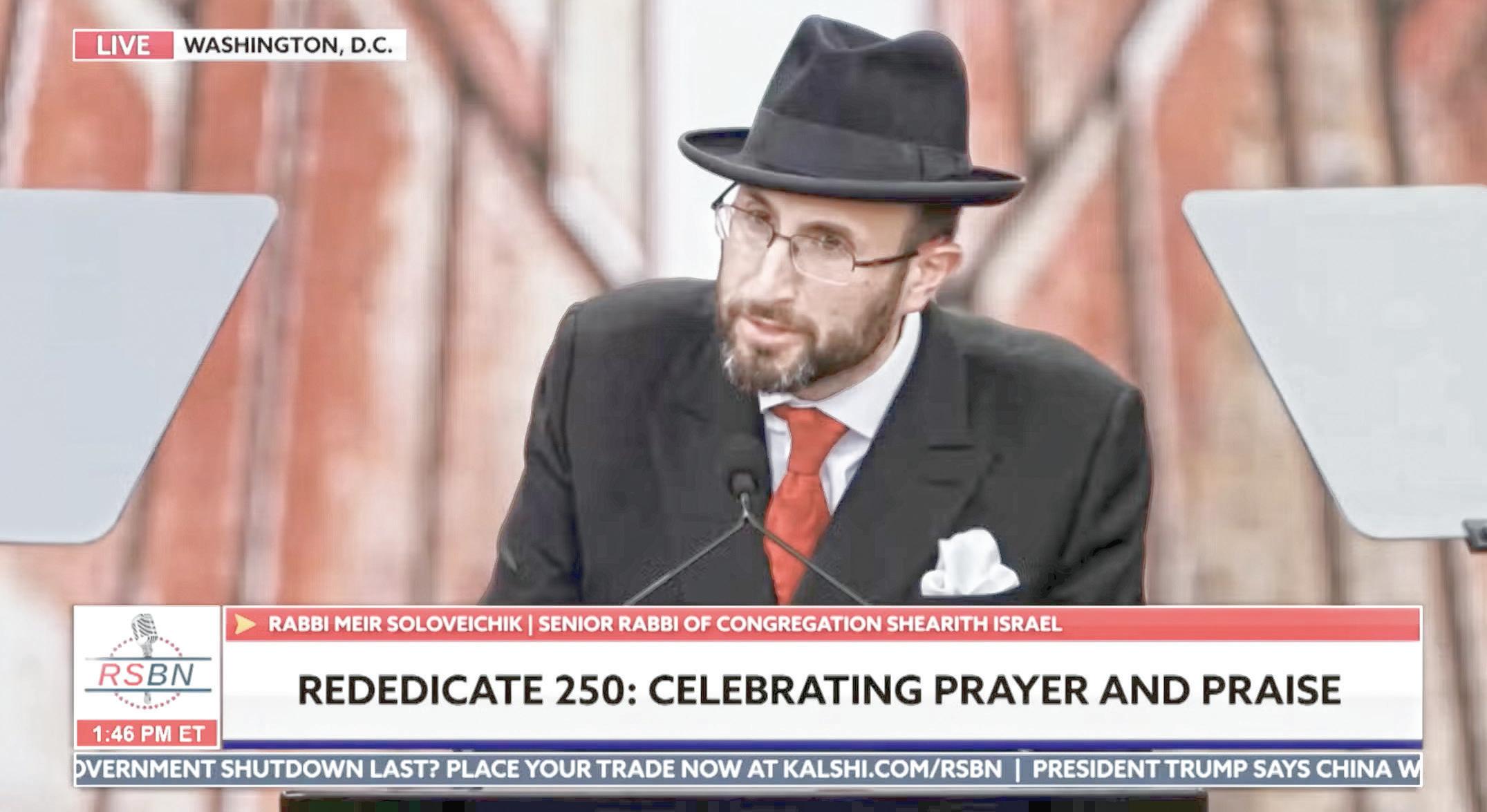
Orthodox rabbi at Rededicate 250 rally: ‘Antisemitism is un-American’
Rabbi Meir Soloveichik made the point by extolling Irving Berlin’s God Bless America
By Philissa Cramer, JTA
The only non-Christian speaker at a mass prayer rally on the National Mall Sunday, May 17 was an Orthodox rabbi who got the crowd applauding against antisemitism.
Rabbi Meir Soloveichik leads New York City’s Congregation Shearith Israel and is a senior fellow at Tikvah, the conservative Jewish think tank. He also sits on the Religious Liberty Commission that President Donald Trump convened last year.
Speaking to the crowd who had assembled for a rally on the National Mall called Rededicate 250 that aims to put faith at the center of celebrations to mark this year’s semiquincentennial of the United States, Soloveichik described the Jewish history of one of the country’s most iconic songs.
God Bless America was written by Irving Berlin, who as a child witnessed his home village in Russia burned in a pogrom and wanted to thank the country that gave him refuge, Soloveichik explained. He said that decades after writing the lyrics, Berlin resurrected them as the Nazis expanded their ambitions in the late 1930s, premiering the song on the radio the day after the Kristallnacht pogroms in 1938.
“At the very moment when darkness deepened abroad, America raised its voice, united in the song that Irving Berlin wrote,” Soloveichik said. A few moments later, he noted, “The prayer that is God Bless America was carried by American soldiers who defeated evil, liberating Europe and the world. And it is a reminder as hatred of Jews makes itself manifest again that antisemitism is utterly un-American.”
The line drew substantial applause, according to multiple videos of the event.
The rally along with Trump’s call for Jews to observe Shabbat 250 the day before drew mixed reactions from
American Jews. Some, particularly in the Orthodox world, said they appreciated any effort to increase Shabbat and religious observance. Others said the events represented an inappropriate merger of church and state, as well as an appropriation of Jewish values in service of Christian nationalism.
Soloveichik did not directly address any of the debates during his fourminute address. But he did say that the staying power of Berlin’s song points to a unique feature of the American character.
“The power and popularity of God
Bless America reveals to us,” he said, “that America’s passion for prayer and its love of liberty are always intertwined.”
In addition to God Bless America, Berlin is famous for authoring one of the most enduring Christmas songs in the American canon, White Christmas. Less well known is an anti-lynching anthem that he wrote around the same time as he popularized God Bless America
Berlin also dedicated songs to Ellin Mackay, the Catholic socialite he wed in 1926 in an intermarriage that sparked both familial tensions and national scrutiny.
Screenshot of Rabbi Meir Soloveitchik speaking at the Rededicate 250 prayer rally on the National Mall, Washington, D.C., May 17.
Antisemitism is rising. Here’s what we need to do to fight back.
By Jonathan Greenblatt
A Jewish Israeli restaurant owner faced an online harassment campaign after a video posted by a staff member calling her out as a “Zionist” went viral on Tik Tok.
At an Illinois school, students started a new game at recess called “Concentration Camp,” which involved a selection process and putting their Jewish classmates into the “camp.”
A Jewish high school student in Columbus, Ohio repeatedly was targeted with horrific and stereotypical A.I.-generated antisemitic memes and videos over a period several months before parents, the Anti-Defamation League (ADL), and the school intervened.
All these awful incidents, and thousands of others like them, happened in communities across the U.S. in 2025. And yet, most Americans never hear about these incidents of antisemitism which don’t make for big headlines.
But for those of us working to protect Jewish communities, these are the stories that play out, in different forms, with terrifying regularity.
ADL just released its annual Audit of Antisemitic Incidents (adl.org), and I want to be direct about what the headline number means, and what it does not.
First there is good news. We recorded 6,274 antisemitic incidents across the United States in 2025, down 33% from the record-shattering 9,354 in 2024. This indisputably is an improvement. We can and should celebrate this healthy sign of progress.
Causes for concern
However, it’s also not that simple. In a news cycle that rewards simple narratives, some will not bother to read past the headline. But, poke just a bit at this figure, and there is cause for concern.
Here is what the data actually shows: 2025 was the third-highest year for antisemitic incidents since ADL
began tracking them in 1979. It was one of the most violent years for American Jews in recent memory.
Physical assaults reached a record high. Three people were murdered simply because of their Jewish identities. And the level of antisemitism in this country today is 70% higher than what we saw in 2022, before the Oct. 7, 2023 massacre fundamentally transformed the landscape. The baseline has shifted, and we must not pretend otherwise.
Every single day, 17 Jewish communities across the country experienced antisemitic incidents both small and large.
They ran the gamut from offensive slights in a school yard to violent attacks affecting the entire community. In 2025 we’ve seen swastikas spray-painted on synagogues, students harassed at school, antisemitic slurs uttered in the workplace, and Jewish businesses vandalized. And then there’s the more public incidents that make headlines.
On May 21, Yaron Lischinsky and Sarah Milgram were shot and killed outside the Capital Jewish Museum in Washington, D.C. Their sole offense was attending an event at a Jewish institution. As he was taken away by authorities, the suspect chanted “Free, free Palestine.”
On June 1, in Boulder, Colo., 82-year-old Karen Diamond was firebombed and burned to death because she was walking to raise awareness of hostages being held in subterranean dungeons by Hamas, a foreign terrorist organization.
The alleged attacker, authorities say, told them he had planned the attack for a year and "wanted to kill all Zionist people."
We also know that last year could have been much worse if it wasn’t for the swift and courageous actions of law enforcement and security officers who managed to stop antisemitic hate crimes before or during the attacks.
So, what do you think?
The antisemitic incident data is only a reflection of broader trends we are seeing, including the institutionalization of antisemitism in policy spheres – see the efforts of activists to remove the IHRA definition from public life or the DSA demand that their candidates for elected office renounce Zionism – to the normalization of anti-Jewish hate by cultural commentators – see Hasan Piker, Tucker Carlson, Candace Owens, and Nick Fuentes are a few of the most prominent examples – to the spread of hate on social media, and the increasing political polarization of seemingly all spheres of our society.
How does this touch the lives of ordinary people?
Ask the rabbi in San Diego whose synagogue has repeatedly been vandalized with antisemitic graffiti. Or ask the employee at a Connecticut business whose supervisor decided to remove all of the Chanukah menorahs from the office holiday display because “they were making some people uncomfortable.”
Or the Massachusetts small business owner who had a brick labeled, “Free Palestine” thrown through the window of his kosher grocery store
So, what will it take to solve the antisemitism crisis in America?
First and foremost, we need more political leaders to speak out, especially when hatred emerges from within their own party. Silence at this moment is a choice, and it is one with consequences.
Standing silent or even endorsing candidates who espouse antisemitic views, who traffic in hateful memes or who dismiss the evil of Nazi symbols may help you win an election in the near-term, but you are guaranteed to lose the battle against hate in the long run.
Next, we need social media companies to recognize their responsibility. When their platforms algorithmically amplify antisemitism and hate, they are not neutral. They are complicit in this crisis. Silicon Valley needs to take meaningful action against the antisemitism coursing through their feeds and corroding our culture.
Third, we need school administrators from kindergarten through graduate school to recognize that a Jewish student who does not feel safe cannot learn. That is not an abstraction. It is happening today in classrooms across this country.
Finally, we need laws with teeth. Congress must pass the SACRED Act, new bipartisan legislation that would establish 100-foot safe access zones around houses of worship, ensuring that Americans can pray without being intimidated or obstructed.
Lawmakers must also strengthen the Nonprofit Security Grant Program and increase its funding to $1 billion. This cannot happen soon enough because the demand is real, the threats are documented, and the gap between what communities need and what they receive is growing.
The 2025 numbers are down from their peak. That is worth acknowledging and applauding. But 6,274 antisemitic incidents is far from a reasonable decrease. We should not accept that this is some kind of new normal. Indeed, antisemitism in America remains a crisis that requires the full, sustained attention of every U.S. institution.
ADL will keep counting. We will keep fighting. The question is whether America will act on what the data is telling us.
Jonathan A. Greenblatt is CEO and national director of ADL.
Screenshot from a video of firebomber Mohamed Sabry Soliman on the grass, about to be handcuffed by police, while people pour water on a burn victim (bottom L), June 1, 2025 in front of the Boulder, Colo. County Historic Courthouse.
Brian Horwitz
Connect with us! Check out our events. For more information, check out our calendar at jewishdayton.org
UPCOMING EVENTS
THURSDAY, JUNE 4, 7:30PM
Dayton Jewish Film Festival Opening Night • Ethan Bloom
SUNDAY, JUNE 7, 2PM
Dayton Jewish Film Festival • Labors of Love
TUESDAY, JUNE 9, 7:30PM
Dayton Jewish Film Festival • A Night of Short Films
THURSDAY, JUNE 11, 7:30PM
Dayton Jewish Film Festival • Pink Lady
SUNDAY, JUNE 14, 7:30PM
Dayton Jewish Film Festival • Once Upon My Mother
JUNE 15 through 19, 9AM - 5PM
JFS Mitzvah Mission Week
TUESDAY, JUNE 16, 7:30PM
Dayton Jewish Film Festival • The Road Between Us
THURSDAY, JUNE 18, 7:30PM
Dayton Jewish Film Festival • Soda
SUNDAY, JUNE 21, 7:30PM
Dayton Jewish Film Festival • The Ring
TUESDAY, JUNE 23, 7:30PM
Dayton Jewish Film Festival • Art Spiegelman: Disaster is My Muse
THURSDAY, JUNE 25, 7:30PM
Dayton Jewish Film Festival • Never Alone
SUNDAY, JUNE 28, 5 - 6:30PM
Boomers Dine Out before attending Matchmaking 2
SUNDAY, JUNE 28, 5:30 - 7:30PM
PJ Library Picnic in the Park
SUNDAY, JUNE 28, 7:30PM
Dayton Jewish Film Festival • Matchmaking 2
TUESDAY, JUNE 30, 7:30PM
Dayton Jewish Film Festival Closing Night • Rosenthal
Picnic in the Park with PJ Library in partnership with Hillel Academy of Greater Dayton
Sunday, June 28, 5:30 – 7:30PM Iron Horse Park 6161 Millshire Drive, Centerville, 45459
Celebrate summer with your friends at a picnic in the park! Kosher dinner will be provided.
No cost. RSVP at jewishdayton.org/events by June 26
Questions? Please contact Kate Elder at kelder@jfgd.net
June 2026
DAY AT THE
Sunday, July 26, 1 – 4PM
Day Air Ballpark
220 N. Patterson Street, Dayton, 45402
Join us for Jewish Community Day at Day Air Ballpark! Join friends, family, and community members for an afternoon of fun. Come for the ballpark food, stay for the games and activities, and don’t forget – there’s even a baseball game!
Cost is $18.32 per person. RSVP by June 27. For more information, visit jewishdayton.org/events 50% of the proceeds will support JCC family programming.
DINE OUT
Sunday, June 28, 5:00 – 6:30PM Thai 9
11 Brown St., Dayton, 45402
Questions? Contact Jennifer Holman at jholman@jfgd.net.
The preschool that nurtures and grows with your child
The JCC Preschool specializes in childcare between 10 weeks and 5 years old, providing a warm, nurturing environment where children can learn, play, and grow at every stage of early development.
Meet up with the JCC Boomers for a fun night out! We will go to Thai 9 before the JCC Film Festival movie, Matchmaking 2 Movie starts at 7:30PM at The Neon. Must purchase JCC Film Festival movie tickets separately – seating is limited, so get your tickets early!
Cost of Dinner: On your own RSVP by June 26 at jewishdayton.org/events. Questions? contact Stacy Emo at semo @jfgd.net or 937-610-5513.
To book a guided tour today, contact Rebecca Levi, Preschool Director, at 937-610-1794 or rlevi@jfgd.net. Come see the di erence for yourself!
JEWISH FEDERATION of GREATER DAYTON & ITS AGENCIES
PRESIDENTS DINNER 2026
Corporate
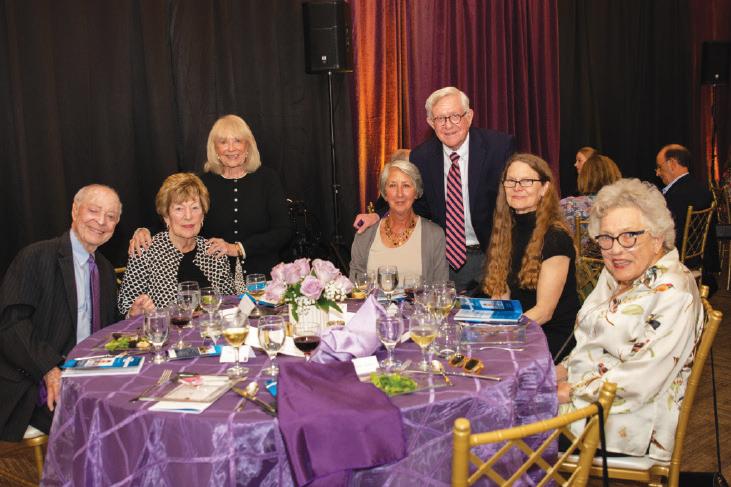
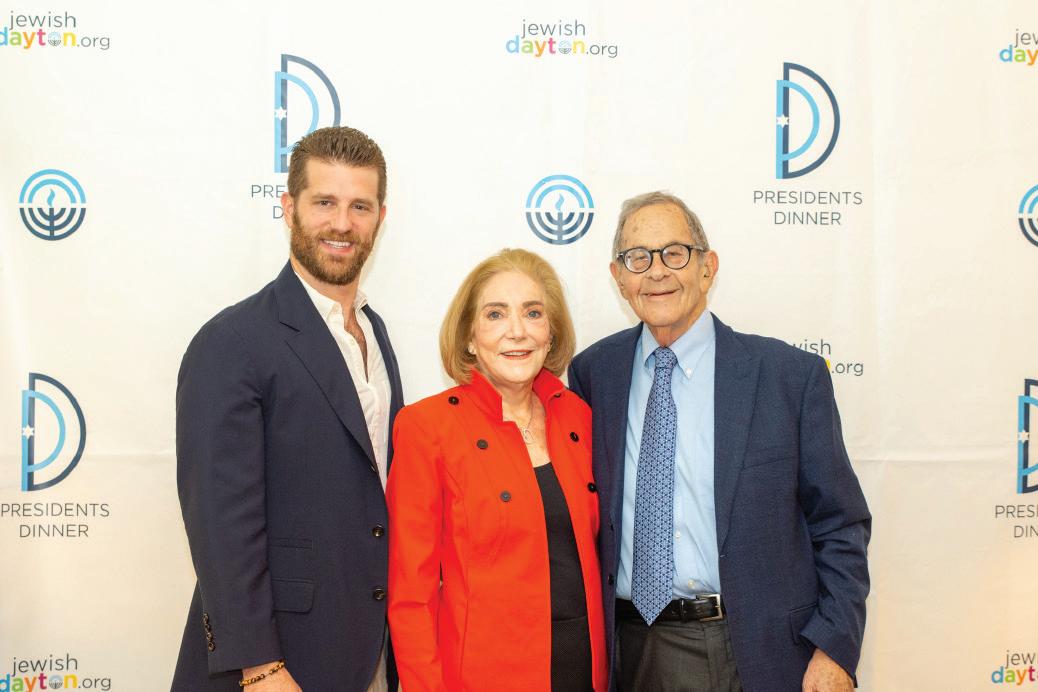
Thank you to our fantastic Presidents Dinner chairs, Bernie Rabinowitz and Elaine Goldberg, and many thanks to our wonderful community for making this evening such a success.
Jonah Platt (R) in conversation with Marshall Weiss.
Jewish Federation President Dan Sweeny honors past board presidents.
sponsor Mike Houser and friends.
Father and son Bob (L) and Ted Goldenberg present the case for giving.
Jonah Platt with Event Chairs Elaine Goldberg and Bernie Rabinowitz.
Jewish Federation's next president, Marni Flagel.
June 2026
Legacies, Tributes, & Memorials
JEWISH FEDERATION OF GREATER DAYTON ENDOWMENT FUND
In honor of Donald Zulanch
Rhonda Chambal
JOAN AND PETER WELLS AND REBECCA LINVILLE FAMILY, CHILDREN AND YOUTH FUND
Jodi Watts is in our thoughts and prayers
Joan and Peter Wells and Jennifer Smith
HAROLD SHANE SENIOR CULTURAL ARTS FUND
In memory of Dorothy and Harold Shane and Morris Cherny
Stanley Cherny
JEWISH FAMILY SERVICES DIRECTOR’S DISCRETIONARY FUND
In memory of Beth Harlan
In memory of Neil Kahn
In honor of Helen Halcomb’s 75th bithday Cathy Gardner JFS
Did you know you can honor a friend or family member through a Legacy, Tribute or Memorial?
itzvah m ission
A donation to one of the Jewish Foundation's many endowment funds benefits our Jewish community while honoring a loved one. For more information, please call 937-610-1555.
m itzvah m ission m itzvah m ission m itzvah m ission WEEK
Monday, June 15 – Friday, June 19, 9AM – 5PM The Boonshoft CJCE 525 Versailles Dr., Centerville, 45459
JFS is holding a weeklong Mitzvah Mission donation drive to support YWCA and House of Bread. From June 15-19, please consider dropping o high-need items from the below list. Questions? Contact Jacquelyn Archie at jarchie@jfgd.net.
High-Need Items for House of Bread
Peanut Butter (personal size, in plastic jar), Jelly (personal size, in plastic jar), Tuna Fish (in flip-top cans or pouches), Co ee, Sugar, Cooking/Vegetable Oil, New Underwear (men’s or women’s all sizes), New Socks (men’s, women’s, or children’s)
High-Need Items for YWCA Dayton
Children’s Items: Crafts, Art Supplies, Bubbles, Sensory Items, Toys for all Ages, Dry Erase Boards for Children, Prepackaged Snacks and Drinks
Trauma Informed Adult Programming Materials: Yoga Mats, Adult Coloring Books, A rmation Cards, Self-Care Items for Adults, Beauty Items, Nail Polish
Classes
Beth Jacob Classes: W. Rabbi Agar on Zoom. Call to register, 937-274-2149. Tuesdays, 7 p.m.: Torah Tuesdays. Thursdays, 7 p.m.: Thursdays of Thought.
Chabad Classes: Mondays, June 1-June 22, 7 p.m.: $54. JLI: Sinai & Civics, in person & Zoom. Wednesdays, 7:30 p.m.: Talmud Class in person & Zoom. Call for Zoom link & location. Fridays, 9:30 a.m.: Women’s Class. Call for location. 2001 Far Hills Ave., Oakwood. 937-643-0770.
Temple Beth Or Classes: Sat., June 13, 27, 10 a.m.: Apocryphal Study in person & Zoom. Thurs., June 18, 6 p.m.: Navigating Loss w. Andy Chaet. Wed., June 24, 7 p.m.: The Jewish Short Story. Register at templebethor.com/calendar. 5275 Marshall Rd., Wash. Twp. 937-435-3400.
Temple Israel Classes: Wednesdays, 10 a.m.: Torah Study Commentary in person & Zoom. For Zoom info., email info@tidayton.org. Thursdays, noon: Talmud Study in person & Zoom. Saturdays, 9:15 a.m.: Virtual Torah Study on Zoom. For Torah Study Zoom info., email Fran Rickenbach, franwr@gmail.com. Fri., June 12, 11 a.m.: Living w. Loss. Thurs., June 18, 3:30 p.m.: Living w. Ambiguous Loss. Sat., June 20, 9:15 a.m.: Torah Study in person and Zoom. tidayton.org/calendar. 130 Riverside Dr., Dayton. RSVP to 937-496-0050.
Family
Beth Abraham Rhythm ‘N’ Ruach: Fri., June 12, 5:306:15 p.m. At Temple Israel, 130 Riverside Dr., Dayton. 937-2939520.
PJ Library Picnic in the Park: Sun., June 28, 5:30 p.m. Free. RSVP by June 26. Email Kate Elder for more info., kelder@ jfgd.net. Iron Horse Park, 6161 Millshire Dr., Centerville.
Youths & Teens
JCC Camp Shalom: June 1-July 24. At Temple Beth Or, 5275 Marshall Rd., Wash. Twp. For info., contact Jennifer Hol-
CALENDAR
man, jholman@jfgd.net.
Adults
Temple Israel Sacred Stitching: Tues., June 10, 24, 11 a.m. Make items for donation w. JCRC’s Upstander initiative. For info. email Alexandria King, garyuzzking@hotmail.com. 130 Riverside Dr., Dayton. 937-4960050.
Jewish Family Services
Mitzvah Mission Week: Mon., June 15-Fri., June 19, 9 a.m.-5 p.m. Drop off highneed items for House of Bread & YWCA Dayton (see list on Page 16) at Boonshoft CJCE, 525 Versailles Dr., Centerville. 937-610-1555.
American Friends of Soroka Medical Center's Hope, Healing & Heroism Dinner: Wed., June 17, 5 p.m. $36. Kashrut will be observed. RSVP at soroka.org/dayton. Boonshoft CJCE, 525 Versailles Dr., Centerville. 937-610-1555.
JCC Boomers Dine Out: Sun., June 28, 5 p.m. Food & drink at own cost. Purchase JCC FilmFest tickets to see Matchmaking 2 after dinner. For info., contact Stacy Emoff, semoff@jfgd.net. RSVP at jewishdayton.org/events. Thai 9, 11 Brown St., Dayton. 937610-1555.
Men
Chabad Bagels, Lox & Tefillin: Sun., June 7, 9:30 a.m. 13+ welcome. 2001 Far Hills Ave., Oakwood. 937-643-0770.
JCC Film Fest
Complete schedule on Page 28.
Community
Temple Israel’s Jewish Cultural Festival: Sun., May 31, 11 a.m.-6 p.m. Free admission. Details at tidayton.org/festival. 130 Riverside Dr., Dayton. 937496-0050.
Beth Abraham Mirpeset Porchfest Kabalat Shabbat: Fri., June 5, 7:15 p.m. W. Americana musician Rick Good, Sounds of the Bob Dylan Songbook. Followed by Oneg. Patio of Beth Abraham Synagogue, 305 Sugar Camp Cir., Oakwood. RSVP to bas@
bethabrahamdayton.org or 937-293-9520.
Beth Jacob Jewish Women Inspiring Jewish Women Luncheon: Sun., June 14, 11 a.m. $26 person. Call Tammy by June 5 to RSVP, 937-2742149. bethjacobcong.org/bethjacob-happenings. 7020 N. Main St., Harrison Twp.
REBECCA WARTELL
Registered
• L’dor V’dor - 3rd gen. in the
•
•
WORSHIP SERVICES
Beth Abraham Synagogue
Conservative
Rabbi Aubrey L. Glazer
Saturdays, 9:30 a.m. 937-293-9520
Check website for location, bethabrahamdayton.org.
Beth Boruk Temple Reform
Cantor Andrea Raizen
2810 Southeast Pkwy., Richmond, Ind. bethboruk@yahoo.com. Friday night Shabbat service monthly, September through May. For schedule, go to bethboruktemple.com.
Beth Jacob Congregation
Modern Orthodox
Rabbi Leibel Agar Saturdays, 9:30 a.m. Evening minyans upon request. 7020 N. Main St., Harrison Twp. 937-274-2149. bethjacobcong.org
Chabad of Greater Dayton Orthodox Rabbi Nochum Mangel
Associate Rabbi Shmuel Klatzkin Youth & Prog. Dir. Rabbi Levi Simon. Beginner educational service Saturdays, 9:30 a.m. 2001 Far Hills Ave., Oakwood. 937-643-0770. chabaddayton.com
Temple Anshe Emeth Reform
Worship led by Jese Shell 320 Caldwell St., Piqua. Contact Steve Shuchat, 937-7262116, ansheemeth@gmail.com. ansheemeth.org
Yellow Springs Havurah Independent Antioch College Rockford Chapel. 1st & 3rd Saturday each month. Contact Len Kramer, 937-5724840 or len2654@gmail.com.
RELIGION
After a Maryland teacher’s death, her 200-piece Judaica collection finds new life at Capital Jewish Museum
By Grace Gilson, JTA
As Rae Ann Kaylie sat on her mother’s couch after her death, the Judaica felt overwhelming. Over 50 menorahs adorned the shelves. A dozen Seder plates had been meticulously hung alongside a trove of Jewish art on each wall. And countless dreidels, Kiddush cups, and shofars filled every corner of the 1,100-square-foot home in Rockville, Md.
There were so many hamsas hanging near the entrance, Kaylie joked, “Whoa, Mom, what on earth? Like, how much evil eye do we have in here?”
For 35 years, Kaylie’s mother, Deborah Brodie, had amassed a collection of over 200 Jewish ritual objects, which she had used as a hands-on classroom for her Hebrew school students with special needs.
Among the collection, Brodie had also obtained a Torah from Ebay, which her students used to practice for their b’nai mitzvah.
“She wasn’t the one who was like, ‘Oh, don’t touch it. You’re going to break it,’” Kaylie said. “She was like, ‘Touch it, here, take a bunch,’ you know what I mean, and that was really cool about her entire collection.”
Brodie — known as “Bubbie
June 5: 8:43 p.m.
June 12: 8:47 p.m.
June 19: 8:50 p.m.
June 26: 8:51 p.m.
Brodie and Jay Brill built
over decades.
Cookie” to her family — had not built the collection alone. Her longtime partner, Jay Brill, whom she met through a Washington Jewish Week personals ad in 1986, was alongside her on the journey, traveling with her to all 50 states to sell Jewish jewelry and a computerized Hebrew-learning program they created together.
Over the years, the couple attended B’nai Shalom and Shaare Tefila Congregation, two Conservative synagogues in Olney, Md. Toward the end of their lives, they attended Chabad of Olney, whose rabbi officiated their funerals.
But after Brodie, 76, and Brill, 74, died in February — just 19 days apart — Kaylie said
June 27: Chukat-Balak (Num. 19:1-25:9) Torah Portions
June 6: Behalotecha (Num. 8:1-12:16)
June 13: Shelach (Num. 13:1-15:41)
June 20: Korach (Num. 16:1-18:32)
she and her family were faced with a painful question: What would happen to the couple’s lifetime of Jewish devotion in their absence?
“We all picked something we wanted, but then, you know, you don’t want to sell it, you don’t want to make any money off of it,” Kaylie said. “It was just trying to figure out, like, what can we do to further her passion, her vision?”
The answer, Kaylie said, arrived through Instagram.
In April, Kaylie sent a simple message to Nick Fox, who operates a social media series titled Millennial Inheritance, writing, “Hey, you want to see a lot of menorahs?”
Since October, Fox has documented dozens of inheritance stories across his social media channels, featuring people grappling with their late parents’ vast collections of Breyer Horse figurines, salt and pepper shakers, and Christmas decorations.
But while Fox said his page's mission is not necessarily to help people find homes for inherited collections, Kaylie’s story felt different.
As he viewed images of Brodie and Brill’s home, Fox, who
is Catholic, said he flashed back to childhood memories attending his classmates’ bar mitzvahs and receiving souvenir hamsas from their trips to Israel.
“It was the fact that she was actively grieving and really had no idea what to do, and I think the fact that I was raised how I was, where I was, that I had a knowledge of what this stuff was and what it meant,” Fox said.
Days later, Fox posted a short video for his 200,000 followers featuring snippets of the sprawling collection along with a call to help find it a permanent home that would “love it the way Rae Ann’s mom did.”
The post garnered hundreds of comments offering ideas for the collection’s future and tributes to Brodie’s contributions to Jewish education; it also made its way through Washington’s Jewish community.
The morning after the post, Jonathan Edelman, the collections curator for the Lillian and Albert Small Capital Jewish Museum, said he woke up to dozens of messages from people urging the museum to find a home for the collection.
“It was so meaningful that so many people in the broader
A photo of the interior of Deborah Brodie and Jay Brill's residence in Rockville, Md.
Jonathan Edelman
Deborah
a vast Judaica collection
Rae Ann Kaylie
Some of 'Bubbie Cookie's' menorahs and Kiddush cups. Alex Fradkin
RELIGION
community, and who have never stopped in our museum, tagged us and said, you know, this should be the home of this sort of wild story and this amazing collection,” Edelman said.
By the following weekend, Edelman had visited Brodie’s home to meet with Rae Ann and view the collection himself. Even after seeing Fox’s post, Edelman said he was unprepared for what awaited him inside.
“It was incredible, floor-toceiling Judaica like I’d never seen in anyone’s home before,” Edelman said. “It wasn’t just thrown on a shelf. It was so thoughtfully laid out. I mean, she had Seder plates and chanukiot (Chanukah menorahs) hanging on the wall, which is no easy task to do…it felt like a museum-quality display. It was really impressive.”
He reported back to the museum — which opened in June 2023 — that he believed he had stumbled upon an incredible opportunity to launch its inaugural education collection.
Now, the Capital Jewish Museum has plans to house the entirety of Brodie and Brill’s collection in its second-floor education and program space, the Community Action Lab, where visitors will be able to interact with the Judaica firsthand, just as Brodie encouraged her students to do in her home.
The museum also plans to photograph the collection so it is accessible online, and lend individual pieces to area schools and organizations for educational use.
“When I heard her mother’s story, you know, we were doing the same thing. Our goal was Jewish education, and she did it as an individual, we’re doing it as an institution,” Edelman said. “It means so much for us to honor her mother’s memory by doing the work that she dedicated her life to…it feels particularly special.”
While Fox said he was not surprised by the outpouring of support and suggestions from the Jewish community, he said other Jews that inherit large quantities of Judaica should not look to Kaylie’s story as a roadmap.
“This is absolute best-case scenario, but it also makes it so very unique, because there aren’t going to be a lot of collections that museums usually are going to take on,” Fox said, adding that people should not assume that inheritances will find a place in a museum.
The Class of 2026
Celebrating our high school graduates
Hannah Simone Dritz
Parents: Jay and Michele Dritz
Grandparents: Robert and Phyllis Dritz, Rod and Cindy Frilot School: Miami Valley Activities: MVS Soccer, Track, Basketball, Half Marathons, Full Marathon, YMCA Junior Leadership Dayton, MVS Musicals, Hope Squad, Sources of Strength, GUCI Counselor
Volunteering: BBYO Dayton and Regional Boards, Temple Israel Assistant Teacher Honors: 2nd Team All-Conference Soccer
Congregation: Temple Israel After Graduation: Furman University
Avi Ross Gilbert
Parents: Heath Gilbert and Rachel Haug Gilbert
Grandparents: The late Shirlee and Ron Gilbert, Gary Haug and the late Vera Warner, and Sue and Ron Nelson School: Centerville
Activities: DECA Marketing, Basketball Leagues, Flag Football Referee, OHSSA Basketball Official, Temple Beth Or song leader Volunteering: BBYO Regional Officer, Octagon Club, Buddy Up Fitness, Save a Child’s Heart in Israel
Honors: National Honor Society Officer, Magna Cum Laude, Honors Diploma, AP Scholar with Honor
Congregation: Temple Beth Or, Chabad
After Graduation: The Ohio State University, Fisher College of Business, Business Scholars Program, Marketing
Send your Mazel Tov announcements to mweiss@jfgd.net.
Grayson Noah Glovka
Parents: Todd and Melinda Glovka
Grandparents: Linda and the late Michael Novak, Roberta Mary Glovka
Volunteering: Rachel & Friends, Kettering Habitat Environmental Center
Honors: National Honor Society Congregation: Temple Beth Or After Graduation: The Ohio State University, Honors College, Environmental Science
Noa Lobel
Parent: Rebecca Wartell
School: Richmond
Honors: National Honor Society Congregation: Temple Beth Boruk After Graduation: Kenyon College
Oren Watson
Parent: Meryl Hattenbach
School: Oakwood
Activities: Tennis Volunteering: People and Paws, Beth Abraham Religious School Congregation: Beth Abraham After Graduation: Industrial Engineering
The highest priority
‘America Is On Track To Literally Die Off,’ New Fertility Data Warns. Fertility rate: 'Jaw-dropping' global crash in children being born. Falling birth rates could upend global economy in 20 years. The Birth-Rate Crisis Isn’t as Bad as You’ve Heard — It’s Worse. The tipping point: what happens when deaths outnumber births?
Just decades ago, fears of an impending population explosion gripped the world. During the late 1960s and early 70s, the Zero Population Growth movement frantically urged families to limit themselves to two children to avert environmental catastrophe.
Today, that narrative has completely reversed. Global fertility rates — the average number of children born per woman — have halved since 1950, resulting in concerns over too few children, dominating headlines worldwide.
The U.S. highlights this global baby bust: while Americans’ ideal family size remains high at 2.7, the actual rate has plummeted to a record 1.6, down from over 3.5 in the 1960s.
Consequently, the U.S. is
among more than half the world's countries — representing over 70% of the global population — with fertility rates below the 2.1 replacement level.
The Lancet peer-reviewed medical journal projects that 76% of countries will fall below this threshold by 2050, reaching 97% by 2100, leaving only a handful with sustainable birth rates.
Experts debate the impact: Some cite benefits like a reduced human ecological footprint and improved quality of life, while others warn of geopolitical instability and the existential threat of population collapse.
What is driving this rapid global decline? The consensus points to delayed milestones, economic constraints, and cultural shifts.
As women pursue education and careers, postponed family planning leads to fertility challenges and smaller families.
Meanwhile, crippling financial pressures — skyrocketing childcare costs, housing expenses, student debt, and job insecurity — make having children daunting, making policy incentives like maternity grants and parental leave only marginally effective.
Beneath these factors lies a profound cultural shift toward individualism and leisure.
Combined with accessible contraception, these values have normalized child-free lifestyles.
Furthermore, rapid urbanization, environmental anxiety, and geopolitical instability have created a climate of pessimism, causing many to question the prudence of bringing children into the world.
Yet, this trend is not universal. Israel stands out as a major exception, prompting headlines like Why are there so many children in Israel? Birth rates: Why are Israel's rising while numbers drop in the West? Demographic Reversal: Israel Chooses Life.
As Times of Israel blogger David Heller noted, “Across the developed world, societies turn away from family. Israel runs toward it.”
This outlier status is driven by a unique blend of law, biology, history, and culture.
Law. At the end of Genesis 1, God said to the newly-formed humans, pru u’rvu (be fruitful and multiply), the first positive commandment in the Torah.
Rabbi Tzadok HaKohen of Lublin taught that an idea’s profundity is found in its first scriptural appearance.
By making pru u’rvu — creating and nurturing life — the first Divine message to humankind, God established parenting as the fundamental purpose of life, a worldly purpose that reflects the Divine’s relationship with humanity. Beyond biological creation, Rabbi Samson Raphael Hirsch framed this mitzvah as a spiritual duty to pass down Jewish values.
This perspective allows those facing infertility — whether medical or circumstantial — to participate in this commandment by producing "positive fruit” through adoption, mentoring, supporting Jewish education, even arranging shidduchim (marriages).
While this obligation traditionally drives high fertility among the religiously observant, a notable shift since the 1990s shows that Israel's Jewish demographic growth is also
Lions and Scavengers: The True Story of America by Ben Shapiro. Lions and Scavengers is a passionate, easy-to-read allegory that breaks down two competing worldviews. While undeniably polarizing, the analogy offers a sharp look at modern social divides, making it a useful resource for anyone seeking to understand perspectives different from their own in the interest of a more cohesive society.
Email:
Right Side Up: Adventures in Chelm by Eric A. Kimmel. Who doesn’t love a good story about Chelm, the town of fools? This illustrated chapter book offers a dozen slightly modernized versions of Chelm classics perfectly retold by a multiaward-winning author for elementary ages.
propelled by rising birth rates among non-religious Israeli citizens.
Biology. Israel’s fertility is not only exceptional because it is high. Among Israeli Jewish women, there is a direct correlation between the rise of fertility rates and a rise in urbanization, education, and level of income.
At the same time, fertility has been increasing alongside a rise in the age at which women first give birth. From an international perspective, these are extremely unusual patterns.
History. The history of Israel and the Jewish people is characterized by cycles of conflict, displacement, and persecution — culminating in the Holocaust — which have extended into the modern era through wars and continuous security threats.
This context has fostered deep societal resilience and a commitment to national rebuilding.
As sociologist Leo Davids explains, “Israelis are always conscious of the losses we suffered, hence the virtue of bringing new life to rebuild the Jewish people.”
Consequently, Israel serves as a unique test case for the relationship between demography and national security, note researchers Kobi Michael and Ori Wertman, particularly as a small, Jewish democratic state in a region constantly buffeted by fluctuating ethnic-nationalreligious conflicts.
Cultural prioritization. In Israel, the family is central, generally overshadowing individualism and material goods. High regard for raising children is reinforced by government support, including birth grants, income replacement, and policies designed to help women balance work and family life.
From shopkeepers to bus drivers, people generally have a positive attitude toward children, often looking out for them in public. With parks and playgrounds everywhere, children are free to roam.
“Having children is more than a gift. It’s a responsibility,” Rabbi Jonathan Sacks concluded. “For us as Jews it’s the most sacred responsibility there is. On it depends the future of the Jewish people. For 4,000 years our people survived because in every generation, Jews made it their highest priority.”
What can we learn from Israel and Israelis about this most high priority?
Candace R. Kwiatek
Maternity ward at Hadassah Medical Center, Jerusalem, 1945.
Zoltan Kluger/National Photo Collection of Israel
Sour Cherry Vareniki
Ukrainian Sour Cherry Dumplings — perfect as a main course or dessert. Recipe and Photos by
Sonya Sanford,
The Nosher Cherry vareniki (half-moonshaped dumplings) in Ukraine are typically made with sour cherries, known as vishnya They are nostalgic for many from the region — including my family.
We emigrated from Soviet Ukraine to Seattle. After almost a decade of building a new life in America, my parents were able to buy their first home. It had an enormous garden, with an established cherry tree.
Soon after moving, when I was a very small child, my grandparents came to visit us from out of town. That summer, the cherry tree was loaded with fruit. I vividly remember picking glossy, red cherries off the tree with my grandmother and brother by my side. There was more fruit than could be eaten fresh, and my grandmother decided to use some of the harvest to make a large batch of cherry vareniki. We sat outside and ate bowls of the dumplings – pillowy and bursting with tart, sweet fruit.
Vareniki are similar to pierogi or pelmeni; the dough is tender and soft, and the filling is only lightly sweetened so that the flavor of the fruit shines. This dish straddles the line between sweet and savory; topped with smetana (sour cream), one can eat cherry vareniki either as a main course or as a dessert. When using sour cherries, I eat my vareniki as a savory dish; when I fill the vareniki with Bing or Rainier cherries, I enjoy these dumplings as a sweet treat.
I love to serve cherry vareniki with a simple cherry sauce made from the extra filling, topped with big dollops of sour cream to balance out the sweetness. They take some effort to make, but are worth
knead until very soft, smooth and elastic, about 8-10 minutes. If the dough is very sticky, add additional flour one tablespoon at a time until it’s easy to knead and doesn’t stick to your hands.
You can also make this dough in a stand mixer with the dough hook attachment by adding all of the ingredients to the bowl, and mixing on the lowest speed until a shaggy dough forms. Turn up the speed to medium-low, and mix until smooth and soft, about four to five minutes.
the work. This recipe makes about 50 vareniki, but you can double or even triple the recipe as needed.
Vareniki freeze well, offering a way to preserve the best of fleeting cherry season. Freeze uncooked in a single layer, then transfer to a bag or container for three months.
Time: one hour, 10 minutes
Yield: Serves four to six
For the dough
3 cups + 2 Tbsp. all-purpose flour, plus more for dusting or as needed
¾ cup water
2 Tbsp. sour cream or plain Greek yogurt
1 large egg, beaten
1 tsp. kosher salt
For the filling and sauce
1 ½ lb. cherries or sour cherries
½ cup sugar
1 tsp. cornstarch juice of ½ a lemon sour cream, for serving
Start by making your dough:
In a large bowl, combine the three cups of flour, water, sour cream, egg, and salt. Mix until a shaggy dough forms, then transfer to a clean surface and
Transfer the dough to a bowl and cover it with a lid or plastic wrap. Allow the dough to rest at room temperature for one hour.
While the dough is resting, start on your filling. Wash, dry, and pit all of your cherries. If using a cherry pitter, cut the cherry in half after removing the pit. Add the cherries to a bowl with half a cup of sugar, and let them sit and start to release their juices for a minimum of 30 minutes, or as the dough rests.
Once your dough has rested for an hour and your cherries have been sitting for at least 30 minutes, you can begin shaping your vareniki.
Line a baking sheet with parchment and heavily dust it with flour.
Divide the dough into four pieces. Liberally dust both your rolling pin and your surface with flour. Roll out each piece of dough very thin, almost as thin as pasta; if you lift it up the dough, light should come through it.
Cut out 2-inch rounds of dough using a water glass or biscuit cutter, lightly flour the rim of the glass or cutter before making rounds.
Gather up the scraps into a ball and reserve to reroll the dough one time; after that discard any scraps.
Fill each round of dough
with about a teaspoon of cherry, about one to one and a half cherries. Seal the dumplings into half-moon shapes, if needed, dab the edges with water to help it stick, but the dough should be sticky enough to press together on its own. Using the tines of a fork, press the edges of the dough to ensure they’re properly sealed. Transfer the formed dumplings onto the lined baking sheet. Reserve any remaining cherries for sauce. Repeat the process until you have used up all of the dough, and then place the dumplings in the freezer for a minimum of 15 minutes before cooking. While your vareniki are in the freezer, you can bring a large pot of water to a boil.
While the water is coming to a boil, add the remaining cherries to a small pot. Bring
the cherry mixture up to a boil, lower the heat, and simmer the cherries for 10-15 minutes or until they are very soft and broken down. In a small bowl, combine one teaspoon of cornstarch with the juice of half a lemon. At the end of cooking the cherries, add the starch slurry, and simmer for an additional minute or until just thickened. If the sauce thickens too much, you can always thin it with water.
Add vareniki, in batches if needed, to the pot of water (don't overfill). Once the vareniki float to the top, simmer them for an additional five minutes. If using frozen vareniki, it may take a few minutes longer for them to float to the top. Remove the vareniki from the pot and serve immediately.
Top with sour cream and cherry sauce.
Arts&Culture
Director of Oct. 7 doc The Road Between Us highlights story of hope
By Carin M. Smilk, JNS
Everyone has heard of the unlikely hero—that person who, despite all odds, comes to the rescue. And then there’s the likely hero — that person trained to do the right thing as a result of career and happenstance. In the movies, such roles are often fulfilled by fictional Marvel or DC Comics characters
In Israel, such individuals are everywhere, exhibiting derring-do since the Hamas-led terrorist attacks in southern Jewish communities on Oct. 7, 2023. They come in the likely form of the Israel Defense Forces, law enforcement, and first responders, as well as in the unlikely appearance of hostages, bereaved families, and volunteers who often risk their own lives to help others.
In the 2025 documentary The Road Between Us: The Ultimate Rescue, these roles are epitomized by IDF Maj. Gen. (Res.) Noam Tibon and his wife, Gali Mir-Tibon, both 63.
to elevate any of the drama. It was built into the real-life story.
“I was looking for something to do around Oct. 7,” he said. “I was looking for heroism and one ray of light. The key for me was a great storyteller and a great character,” which he said he found in the general. Tibon is nicknamed by his own family members as “911.”
The process of making the movie was something of a feat in and of itself.
Avrich noted that everything had to be approved, since basically, he was shooting on location in a crime scene. As such, he said, “we did lots of prep work; we didn’t want to waste the general’s time or a minute on the ground. We wanted a seamless presentation, properly planned and executed.”
The two drive to the rescue of their son and daughter-in-law — Amir and Miri Tibon, and their two young daughters — trapped in a safe room at Kibbutz Nahal Oz while Palestinian terrorists who infiltrated the Gaza border that morning swarmed the area and surrounded their home. The journey reads like a tension-filled blockbuster screenplay. (The Tibons also have another son, Uri.)
Despite main roads that were empty as they barreled down south from their home in Tel Aviv (Gali commandeered the car, while Noam made phone calls and gripped his pistol), the couple interrupted their mission to assist person after person they encountered along the way—some who needed a safe haven, some who required medical attention, and some military colleagues who were also performing impromptu rescues.
At one point, they separated for hours as they kept their heads about them and performed necessary tasks in what turned out to be one interminable day.
The film was released in U.S. and Canadian theatres in the fall, and is now making the rounds of Israel and Jewish film festivals, as well as events at Jewish Federations and related venues. It will be screened as part of the Dayton JCC Film Fest, June 16 at The Neon.
Director Barry Avrich, 62, didn’t have
JCC Film Fest presents The Road Between Us: The Ultimate Rescue, 7:30 p.m., Tuesday, June 16 at The Neon, 130 E. Fifth St., Dayton. $12. Purchase tickets at jewishdayton.org/events.
secured guilty verdicts against 22 Nazis during the Nuremberg Trials following World War II and the Holocaust. Ferencz, who died in 2023, lived to 103.
encompassed the arts, culture, and academic sphere for Israelis and Diaspora Jews for years, though heightened to new levels since Oct. 7.
He acknowledged how much, even as a seasoned professional, Israel’s border communities and the site of the ravaged kibbutz affected him as both an individual and an artist.
“Seeing this firsthand as a Jew, the aftermath of war materials on the road — bullets, missiles, abandoned cars — was very difficult for me. It was very, very emotional.”
Add to that, he said, was the job of reviewing vast amounts of footage from that day, much of it from the lens of Tibon.
“It stays with you,” Avrich said.
This wasn’t his only work that involved intrepid Jewish men. He directed Prosecuting Evil: The Extraordinary World of Ben Ferencz (2018), who at the age of 27, with no prior trial experience,
Avrich saw a line between the two, Ferencz and Tibon, noting that they can be described as extraordinarily optimistic, not living “in a world of vengeance and darkness.” Ferencz, he said, “sought to make people accountable, but he was always of the mind that this, too, shall pass.”
A correlation to the Holocaust has consistently been made these last two years. Avrich, now intimately linked to both historical periods through his work, said that after Oct. 7, “I really feel that the Jewish people, the world, will never be the same.”
The 95-minute Canadian documentary, produced by Mark Selby, had a bumpy debut at the Toronto International Film Festival (TIFF).
Scheduled to premiere in September 2025, festival organizers got nervous and rescinded the invitation as a result of the same outside pressure that has
In this case, the claim was twofold: fear of anti-Israel protesters and, in what was deemed a rather outlandish excuse, the fact that the filmmakers had not cleared rights for the usage of GoPro video taken by the terrorists, which they themselves exhibited via social media and individual smartphones from that day forward.
“They decided it was a film they didn’t want to show,” Avrich said, emphasizing that art should be about the art. “It proved to be a mistake for them.”
After an immediate backlash, the festival decided to screen the film as planned for an audience that filled the 1,800-seat Roy Thomson Hall and gave it a three-minute standing ovation. It won a TIFF People’s Choice Award in the documentary category.
Avrich said he wants the film to reach as large an audience as possible in a visual market that seems saturated by the events of Oct. 7 — shows on Netflix, Hulu, and Apple TV; semi-fictional series on other channels; never-ending media reports; and a flurry of brandnew documentaries.
Yet he noted that a moratorium need not be placed on such works. “We have a problem in Hollywood — that there is a quota on films about a certain subject.” That said, he asked a rhetorical question: “Do we have enough romcoms, sci-fi, World War II movies? Are there ever enough?”
Through a Zoom call, he practically winked at the notion.
Avrich didn’t want to linger on any negatives — and certainly not the political.
“This is a film wrapped in the flag of a family, not a country,” he said. “The Tibons are fighters, but they are also optimistic. You watch this film because of hope. It’s a story of hope.”
IDF Maj. Gen. (Res.) Noam Tibon
Melbar Entertainment
Noam and Gali Tibon
Melbar Entertainment
Director Barry Avrich
Melbar Entertainment
Arts&Culture
Committed to Orthodoxy, tempted by desire
Review by Simi Horwitz, Forward
Early in Nir Bergman’s Pink Lady, Bati (Nur Fibak), a married Haredi woman and the mother of three children, is riding a city bus when she becomes aware of a dark-skinned man, perhaps an Arab, eyeing her. She is at once attracted, intrigued, and profoundly uncomfortable. She quickly turns away.
A deceptively simple film that explores sexuality and desire within an insular and restrictive Haredi community, Pink Lady marks an impressive debut for screenwriter Mindi Ehrlich, an insider who married at 17, became a mother shortly thereafter, and ultimately departed.
Though this Israeli film offers a harsh critique of its world, it is never strident or even obvious. It’s an understated slice-of-life family drama that encompasses elements of mystery, thriller and, at moments, sex comedy that are simultaneously funny and unsettling, though often far more the latter.
Bati has opened a letter addressed to her husband, Lazer (Uri Blufarb), demanding blackmail money. The note is accompanied by compromising photos featuring Lazer and his male study partner cuddling and kissing. Lazer insists the pictures are Photoshopped. She tries but ultimately fails to accept the lie.
Still, every attempt is made to change him, including the use of brutal conversion therapy that predictably alters nothing. If anything, he is more drawn to men than ever.
Pink Lady is most centrally about Bati’s sexual awakening. It's largely told from her perspective, paradoxically set in an intensely sexual world. Perhaps that’s precisely because the forbidden is ubiquitous.
In the wake of Lazer’s revelation, Bati becomes increasingly aware that her husband has never approached her with enthusiasm, not that she really knows what desire looks or even feels like. Still, she can’t help but compare her situation to that of her sister who says that her husband is so sexually eager he waits for her outside the mikvah (ritual bath).
Bati asks Lazer, “Are you attracted to me?” To which he says, “I’m attracted to your soul.” He adds that the rabbi assured him his true sexual impulses would pass once he was married.
The film wonderfully brings to life a cross section of Haredi society
Bati also consults their rabbi, who urges her to pray at the Western Wall for 40 days. She complies even as she notices that not all women, including those in her own community, are as chaste or unschooled as she is.
their community of homosexual people, who they say are “disgusting” to God. And there are the warring mothersin-law who begrudgingly join forces to keep their children’s marriage intact. Theirs is a subtle nod to both class differences and improbable sisterhood.
In scenes that boast a feminist streak while at the same time being profoundly anti-feminist, Natalie also serves as teacher, showing Bati how to do a lap dance while Bati clumsily impersonates her moves.
The underlying assumption here is that Bati is responsible for Lazer’s homosexuality and that she is in a position to cure it. Indeed, if she is a dutiful wife, she will do so.
Bergman summons forth a textured, contradictory, and at times visually striking world. The acting is superb throughout. Fibak creates a strong woman who evolves, matures, and changes. Blufarb is every bit a tormented trapped soul who desperately wants to be what he isn’t.
It would be glib and reductive to say he’s bisexual (though he probably is), and in lesser hands that’s what the film would assert.
What’s relevant here is that, in the end, though open to interpretation, this film is a powerful love story between Bati and Lazer. The film never loses its authenticity. What remains undisputed is freedom’s cost.
Lazer has never come out to her and she feels deeply betrayed, questioning her own judgments, and their whole shared history; far worse, though, is the fact that he is gay, a major sin in God’s eyes that needs, in the view of their community, to be punished, corrected, and eradicated.
Suddenly, their safe, secure universe has been upended. There’s the blackmailers’ endless financial drain on their limited resources, the devastating fear of public exposure, and the question of how Bati and Lazer should navigate their own relationship as they attempt to move forward in a space where every activity — from the mundane to the most holy — is prescribed.
Two thematic threads, the pragmatic and theological, are overtly, but more usually subtextually, present throughout. First, maintaining marriage and family is sacrosanct. The theological aspect, the second thread, is more complex, raising questions about God’s plans. If we are all God’s creation, Lazer wonders, doesn’t that include homosexual people?
JCC Film Fest presents Pink Lady, 7:30 p.m., Thursday, June 11 at The Neon, 130 E. Fifth St., Dayton. $12. Purchase tickets at jewishdayton. org/events.
At the mikvah, where she hands out towels and helps women prepare themselves for immersion, she encounters an unfettered Natalie (Gal Malka), sporting long, unkempt hair, tight-fitting jeans, and nail polish.
Devoid of inhibition, Natalie takes a selfie as she waits her turn. Bati warns her that her nail polish will only serve as a “buffer” to immersion and in the event she’s pregnant, she will give birth to an “impure” child.
Amused and derisive, Natalie is an anomalous character, but revealing nonetheless. Her presence hints at cultural cracks beginning to surface. Bati’s distaste for her gives way to feelings of reluctant affection. A friendship grows. Natalie escorts Bati to department stores, where she encourages her to try on a range of immodest outfits.
And later, when Bati discovers a stack of heterosexual pornographic magazines that one assumes the rabbi has given Lazer in an effort to turn him on to women, Bati is fascinated by the explicit pictures, particularly one model’s wild, dyed-pink wig, and all that it evokes. She refers to the model as the pink lady (thus the film’s title), who becomes an emblem of everything Bati is not and perhaps yearns to be.
The film wonderfully brings to life a cross section of Haredi society, starting with its most dissonant violent outliers, a gang of three blackmailers clad in traditional garb who are determined to rid
Uri Blufarb and Nur Fibak play a married couple in Nir Bergman’s Pink Lady
PHOTO: MARCELA DE LA TRIGG, CURATOR OF MARYSOUL EXPRESSION
Arts&Culture
How MAD magazine, family ghosts, censorship made Art Spiegelman an anti-fascist artist
Review by PJ Grisar, Forward
Art Spiegelman’s life was always doomed to be one that wrestled with a larger legacy — or a 500-pound mouse. In his book Breakdowns, about his artist’s journey, he illustrated his Holocaust survivor father, Wladek, giving him a Yiddish-syntaxed lesson in packing. “Use what little space you have to pack inside everything what you can.” (You’ll never know when you may have to run.) He claims it was the best advice he’d ever gotten as a cartoonist.
In 2004, Spiegelman drew a strip — also included in Breakdowns — where he gifts his son, Dash, a locked chest, something he got from his own father as a child. Inside is a green dragon, an Auschwitz inmate’s cap on its head, a snake with Hitler’s face crawling from a sharp-toothed maw in its stomach.
The depictions of inherited trauma, like the Jewish mice of his graphic memoir Maus, are elegantly simple metaphors, and the through line of the new documentary Art Spiegelman: Disaster is My Muse. But the metaphors are more than memoiristic. Spiegelman’s work has always had an anti-authoritarian, and later antifascist bent, and that’s what makes it such compelling catnip for those looking to muzzle free expression.
The film, an American Masters co-production directed by Molly Bernstein and Philip Dolin, tells Spiegelman’s story through his own work — with speech bubbles narrated by the man himself — and interviews with his contemporaries, family, and friends. (There’s a dinner scene with Robert Crumb, who is dressed virtually identically to Spiegelman.)
It
The narrative kicks off with the “shards of information” his parents fed him growing up — on car rides home from a party with a Sonderkommando or a trip to the grocery store where his mother recalled the latrine schedule at the camps — but the film insists that it was MAD magazine, as much as the ghosts of dead relatives, that guided Spiegelman’s pen, and that of underground comix as a whole.
world is lying to you.'
It was through MAD, Spiegelman says, that he learned “the whole adult world is lying to you.” That lesson helped him to create the consumerist sticker parodies Wacky Packages and the Garbage Pail Kids for Topps (he describes the trading card company as his Medicis). Its spirit of questioning would also color his more personal work, which was often as structurally inventive as it was fearless.
Spiegelman’s breakthrough — and even his courtship with his wife, Françoise Mouly — now the longtime art editor of The New Yorker — came after he began to write autobiographically. It began in stages, with the 1971 comic Prisoner on the Hell Planet, about his psychotic episode in college and his mother’s suicide. A three-strip in the anthology Funny Aminals sparked the project that would become Maus, serialized as an insert in his magazine Raw throughout the 1980s and published in two volumes in 1990 and 1991.
That Maus was a game changer, the first ever comic to win a Pulitzer and a foundational work in graphic memoir, is something Spiegelman has spent decades
JCC Film Fest presents Art Spiegelman: Disaster is My Muse, 7:30 p.m., Tuesday, June 23 at The Neon, 130 E. Fifth St., Dayton. $12. Purchase tickets at jewishdayton.org/events.
grappling with. Even today, when he draws himself, as he did recently for a piece about Gaza in The New York Review of Books, it is in his vested, mousy persona, a cigarette still dangling from his mouth, though in real life he appears to have switched to a vape pen.
Spiegelman’s 9/11 cartoons, which the Forward serialized, captured a premature-for-many skepticism of the U.S. response. His New Yorker covers, which tackled police brutality and depicted a West Indian woman and a Haredi Jew kissing following the Crown Heights riots, stirred up controversy. But the mice pursued him still, and he drew himself fleeing with no hope of success.
Receiving a lifetime achievement award from the National Book Awards, Spiegelman stated that he promised himself to never become a Holocaust memoirist first and foremost — “the Elie Wiesel of comics” — but as comics scholar Hillary Chute notes, in the age of Trump, he realized Maus was “a text for people explicitly reacting to and fighting fascism,” both in content and aesthetics. (In 2019, Spiegelman withdrew his introduction to a Marvel comics compendium after editors insisted he delete a comparison between Trump and the supervillain Red Skull.)
When a Tennessee school district banned Maus in 2022, the urgency of the work became even clearer.
“I never thought I would live to see something where America, which saved my parents after the war, and gave them a new start in life, could be tilted toward a new kind of fascism,” Spiegelman said in a Zoom talk shown late in the film. In the banning — which extended beyond Maus to graphic novels about LGBTQ issues, racism, and an illustrated diary of Anne Frank — Spiegelman recognized a new form of Nazi book burning.
“It’s like destroying memory yet again,” he argued. For Spiegelman, there is a solemn duty to remember. Eloquent in prose, in the Zoom, he nonetheless referred to an image to explain this.
In the picture, Spiegelman and the mouse version of his daughter, Nadja, sit in their living room, a TV, dollhouse, and a pet cat behind them. But cast against the wall are the silhouettes of mice with nooses around their necks. The image is called The Past Hangs Over the Future. Spiegelman hopes Maus can be a cautionary tale — as long as people can still read it.
Art Spiegelman: Disaster is my Muse reveals the Maus author's influences, and what keeps him up at night.
Zipatone
Arts&Culture
Screening of Hadassah founder doc to celebrate Dayton chapter at 100
By Andrew Guckes Baltimore Jewish Times
Abby Ginzberg has made a lot of films. None, however, was as important or as personal to her as Labors of Love: The Life and Legacy of Henrietta Szold Ginzberg, as it turns out, is a distant relative of Szold and the granddaughter of a man who played an important role in her story. She spent years in preparation to create the documentary focused on the pioneering Zionist and founder of Hadassah, the women’s Zionist organization.
“Even in the mid-'90s, I thought about making this movie, but as I say in the film, Henrietta was not speaking to me yet. I couldn’t figure out how I would tell her story, or what I wanted to tell about it.
cousins, who are the only people who are still alive to critique it, would feel that I did a good job of representing both Henrietta and Louis Ginzberg,” she said. “Since I’m the person who stands at the intersection of these two families, I was really, in a way, the right person to do this.”
Ginzberg made the artistic choice to tell the story of Szold’s trailblazing work with Hadassah and the Israeli Ihud political party largely from Szold’s perspective. She said this was the truest way to honor her relative’s tale.
Director/Producer
Twenty years later, it just became clear that I either had to do it now or I was never going to do it,” she said. “I just kept thinking to myself, ‘Do I really want to go to my grave not having made this movie?’”
Released last year, it tells Szold’s story from her origins in Baltimore to her time in Mandatory Palestine fighting for Jewish self-determination and the rights of the Palestinians who lived there when Jews arrived.
“I needed both more experience as a filmmaker and more experience as a wise woman to be the right person to tell the story,” Ginzberg said. “By waiting those 20 years, I think I was finally ready to be in dialogue with Henrietta...it’s like for 20 years she was whispering in my ear, but I wasn’t able to hear what she was saying.”
“I really present the story from Henrietta’s point of view, especially the breakup. That was very important to me — it’s like there’s no way to really critique it. This is what she thought; this is what she felt; this is how it unfolded for her. And my job is to be as true to that experience as I could be, and to represent it as authentically as I could,” Ginzberg said.
The film has been well-received by audiences, with some coming up to Ginzberg after a given screening and telling her it brought them emotions they didn’t expect or even moved them to tears. Ginzberg said that typically, about a third of any audience has heard of Szold prior to seeing the film.
Ginzberg said that typically, about a third of any audience has heard of Szold prior to seeing the film.
Szold’s name has been lost to history for many, despite her numerous accomplishments.
grandfather,” Ginzberg said.
“The idea that she worked this out with an Arab man who worked at the local cemetery is sort of amazing to me, and it was a big ‘aha’ moment for me when I got to Israel and thought ‘wow, three generations of this family tending to her.’”
The grave tender and his daughter came to the first screening in Jerusalem and received a standing ovation.
For Ginzberg, the process of creating and screening the film is about more
than just showing a movie to audiences. She's been able to relate to her subject and relative through this journey, not something she takes for granted.
“I’m 75 (years old), shleping around the country with this film, taking it to all kinds of audiences. And, you know, I feel a little like Henrietta. It’s like somebody could say to me, ‘You should take it a little easier.’ And Henrietta would say, ‘No, I have work to do. It’s not time for me to retire,’ and that’s how I’m feeling,” Ginzberg said.
Ginzberg is the granddaughter of Szold’s longtime friend and unrequited love, Louis Ginzberg, in addition to being a distant cousin of Szold.
“This film is different because it involves my family. So the level of responsibility that I felt to get it right is so that both my Szold and my Ginzberg
JCC Film Fest and Hadassah Dayton present Labors of Love: The Life and Legacy of Henrietta Szold, 2 p.m., Sunday, June 7 at the Boonshoft CJCE, 525 Versailles Dr., Centerville. To celebrate Hadassah Dayton's centennial, Hadassah Great Plains Region President Sharon Star will lead a discussion and Q&A after the film, to be followed by a reception. $12. Purchase tickets at jewishdayton.org/events.
She fought to keep Hadassah a women’s organization, instead of being absorbed into the Zionist Organization of America. In addition to her pioneering feminist and Zionist work, Szold was a proponent of an equal Israel where Arabs were afforded representation just like Jews.
“She really felt like, ‘Here is a population of Arab people who have been living in the same land that we’re trying to claim. We have to be in dialogue with them. We have to work something out with them,’” Ginzberg said.
A story that exemplifies this as well as any is that of Szold’s funeral arrangements, which she made herself.
“When I first went to Israel to shoot the film, I didn’t know she had an Arab family that’s been managing her grave since she died in 1945. When I met Abed, the grave tender, he was doing it because his grandfather got him into the business. Henrietta’s decision to be buried at the Mount of Olives was worked out between her and Abed’s
Classes begin August 24
The College of Liberal Arts offers bachelor’s, master's, and certificate programs, from anthropology a nd art to environmental studies a nd theatre studies. Major in something you love! Apply to Wright State— and go further.
Abby Ginzberg
Henrietta Szold going over plans with kibbutz leaders circa 1940.
Tim Nahum Gidal/The Israel Museum
The Time Is Now.
Several years ago, the community came together and created Jewish Cemeteries of Greater Dayton to protect and preserve the eternal homes of our loved ones.
Research showed the need to raise $5 million for an endowment fund. Thanks to the boards of Beth Abraham, Beth Jacob and Temple Israel, as well as hundreds of donations, we are just $200,000 away from reaching our goal
Once completed, JCGD will ensure the sanctity of our cemeteries and financial security for each congregation.
You
into
OBITUARIES
Daniel A. Cohn, age 96 of Dayton, passed away April 19 at Ohio's Hospice of Dayton. Daniel was a retired system director for Standard Register with over 47 years of service. He was a member of Temple Israel, a U.S. Army Veteran of the Korean War, a member of VFW Post 5018, American Legion, and the Fraternal Order of Eagles. Daniel was preceded in death by his beloved wife, Janis Y. Cohn; son, Wesley Helfinstine; and daughter, Linda Helfinstine. He is survived by his daughter and son-inlaw, Carla and Kenneth Ludwig; son and daughter-inlaw, Barry and Vicki Cohn; sister, Rosetta Golden; two grandchildren and several great-grandchildren. Memorial contributions may be made to Ohio's Hospice of Dayton in Daniel’s memory.
sister, Sandy. She is survived by her husband, Stu; her son, Todd; her daughter, Jenn Kuntz; Jenn’s husband, Darren; and her adored granddaughters, Drew and Dylan. She is also survived by her baby brother, Gary Azaroff. The family requests donations to an Alzheimer’s charity of your choice or Day City Hospice.
Sharon Holzer peacefully passed away on May 17 in Centerville, the town she loved and kept thoroughly entertained for decades. Born on May 16, 1946 to Joe and Min Azaroff, Sharon grew up in Marion, Ohio with a lively crew of siblings who helped shape her infectious personality and sense of humor. She married the love of her life, Stu Holzer, and they started their journey in Columbus before making their forever home in good old Warm and Cheerful. Sharon started out as an elementary school teacher before deciding her true calling was raising her kids — and focused all her time and energy on their activities. Following her kids’ graduation, she decided she would not leave Centerville High School and became a lifelong Elk — running the bookstore, monitoring study hall, and amassing a collection of hundreds of rubber ducks until she “quit” in 2020. (She insisted on that word. “Retired” was not allowed.) A gifted seamstress, Sharon handled alterations for many, as well as making doll clothes, costumes, and even a Big Ten twirler’s uniform. She created show backdrops and Mickey/Minnie clothes, and cared for the uniforms for the Centerville Jazz Band. She masterminded costumes for countless CHS theater productions and joyfully volunteered for Bands of America — she just genuinely loved enriching her life with the constant presence of witty and sometimes obnoxious high school-aged kids. A proud graduate of THE Ohio State University, Sharon always cheered for the Buckeyes (as well as the Bengals) with gusto. She was the life of every party, a treasured aunt and cousin, and the unofficial second mom to many of her kids’ friends. Sharon was preceded in death by her parents; her brother, Larry; her older sister, Eileen; and her twin
Neil D. Kahn, age 71 of Beavercreek, passed away peacefully on April 18, after his fight with pancreatic cancer. He was born in Paterson, N.J. on May 5, 1954, to the late Leo and Lila Kahn. He completed USAF ROTC at Rutgers University in 1976. Neil reported to active duty in March 1977. After serving his country honorably for 20 plus years, he retired at the rank of lieutenant colonel from Wright-Patterson AFB in 1997. His next career was a support contractor for various programs at WPAFB. Neil married his wife, Gina, in 1992 and together they raised two boys, Sam and Daniel. He is survived by his sister, Ruth (late husband Steve) and his brother Howard (Karen). Neil is also survived by many sisters-in-law and brothers-in-law along with many nieces and nephews. In his spare time, he was an avid reader, enjoyed working with computers, played golf, and enjoyed watching movies. Interment will be at Arlington National Cemetery. If desired, friends may contribute to Hospice of Dayton, Temple Beth Or, or a charity of their choice.
Marilyn Moscowitz, age 72 of Kettering, passed away on May 11. A caring wife, mother, and grandmother, her life was defined by a loving heart, quiet strength, and a dedication to those she held dear. Marilyn, known to all who loved her as Myrnie, was preceded in death by her beloved parents, Joan and Howard Azen, and sister, Ellen Elovitz, whose memories she carried close to her heart throughout her life. She leaves behind her devoted husband of 41 years, Alan Moscowitz, and sister, Phyllis Michaelson. Myrnie was the proud and loving mother of Julie (Jason) Grindstaff and Andrea (Garrett) Salk, whose lives were shaped by her guidance, warmth, and steady encouragement. Myrnie’s greatest joy came from her grandchildren — Aiden, Carter, Isla, and Charlie — each of whom brought light to her days and carry forward her legacy of love. Her presence will be deeply missed, yet her spirit lives on in the family she nurtured, the special memories, and the countless moments of tenderness she offered so freely. Interment was at Beth Jacob Cemetery. Memorial contributions may be made to Jewish Cemeteries of Greater Dayton in care of the Jewish Federation of Greater Dayton. May her memory be a blessing for all who knew and loved her.
One-year subscription to The Observer and acknowledgment in The Observer ($18 value)
$36 Double Chai
One-year subscription, acknowledgment in The Observer and one free one-column holiday greeting ($33 value)
2025 Best Monthly in Ohio & Best Religion Reporting (Small Newspapers), Ohio Society of Professional Journalists Awards
2025 First-Place Rockower Award for Excellence in News Reporting (Magazines & Monthly Newspapers), American Jewish Press Association
Ad sales and Jewish Federation support only cover a portion of our expenses to bring you The Observer. Your help will ensure the depth of our coverage.
$500 Sustainer
One-year subscription, acknowledgment in The Observer and one free three-column holiday greeting ($63 value)
One-year subscription, one-year acknowledgment in The Observer and three free three-column holiday greetings ($153 value)
One-year subscription, one-year acknowledgment in The Observer and three free three-column holiday greetings ($153 value)
$1,000 Champion All listed in Guardian Angel, plus the gratitude of knowing how much you help support Jewish journalism in the Miami Valley. ($153 value)
a gift subscription for someone special: Make
Renewing Angel
Ellie Lewis
New Angels
Carole & Donald Marger
Double Chai
Gary and Andrea Abrams
Aaron Burke
Marcia Cox
Lenorah Leichtman Hart
Susan Fitterman Witte
Subscribers
Tim & Melissa Sweeny
Current Champions +
Joan Knoll
Howard Michaels
Andrea Scher Rabiner
Current Champions
Elaine & John Gaglione
Harriet Klass
William Marwil
Milton Nathan
Lee and Patti Schear
Current Sustainers
Susan & Jonas Gruenberg
Laurence and Olive Lasky
Current Guardian Angels
Steven Adler
Roger Chudde
Dr. Douglas & Mrs. Bethany
Einstein
Tara & Adam Feiner
Bruce & Debbie Feldman
Marni Flagel
Marc & Cindy Fox
Bella Freeman
Marsha & Stephen Goldberg
Debby & Bob Goldenberg
Carol Graff
Robert & Vicky Heuman
Linda & Steve Horenstein
Laurie & Eddie Leventhal
Todd & Gabriele Leventhal
Judy Lipton
Gary Pacernick & Peggy Weller
Bernard Rabinowitz
Brenda Rinzler
Susan & Nathaniel Ritter
Zerla Stayman
Steve & Shara Taylor
Temple Anshe Emeth
Joan & Peter Wells
Ted Wendeln
Current Angels
Elaine Abramson
Karen & Steve Arkin
K.W. Baker & Assoc., LLC
Skip & Ann Becker
Jack & Maryann Bernstein
Sylvia Blum & Family
Tara & Dan Brodbeck
Judith & Steven Carne
Mr. & Mrs. Matt Carper
Keri & Don Cohen
Natalie R. Cohn
Thomas & Katherine Cruse
Scot & Linda Denmark
Judge Susan Dlott
Bill & Melinda Doner
Marilyn Donoff
Phil & Louisa Dreety
Diane & Jim Duberstein
Howard & Sue Ducker
Irwin Dumtschin
Beverly Farnbacher
Phyllis Finkelstein
Lynn Foster
Jeff Froelich, Cindy Pretekin & Families
Renate Frydman Ph.D
Dr. Felix Garfunkel
Mr. Roger J. Gebhart
Donna D. Gibson
Mrs. Jack Goldberg
Lynn & David Goldenberg
Kim & Shelley Goldenberg
Judi & George Grampp
Art & Joan Greenfield
Harold & Melissa Guadalupe
Joel & Judi Guggenheimer
Dr. Stephen Harlan
Ralph E. & Sylvia S. Heyman
Rachel Jacobs
Michael Jaffe
David & Susan Joffe
Joseph & Marsha Johnston
Ronald & Mary Kahn
Linda Ohlmann Kahn &
Dennis Kahn
Jeffrey Kantor
Susan & Stanley Katz
Elli Kent
Debbie & Norbert Klopsch
Beth Kolotkin
Edye Leuin
Iris Levi
Levy Family
Beverly A. Louis
Perry & Renata Lubens
Helen Markman
Marvin & Susan Mason
Scott & Brenda Meadow
Bonnie Mendelson
Suzi & Jeff Mikutis
Kristen Mitchem
Robin & Tim Moore
Irvin & Gayle Moscowitz
Bobbie & Jack Myers
Nora & Bob Newsock
Lori Ohlmann
Ann Paddock
Karyn & Robert Posner
Roberta & Richard Prigozen
Susan Kahn Rapoport
Sharyn Reger
Steven Rothstein
Sumner Saeks
Alice & Burt
Saidel
Barbara Sanderow
Les Sandler
Linda Schoonover
Annie & Craig Self
Felice Shane
Katherine Sher & Jared Serota
Michael & Marcie Sherman
Diane Lieberman Slovin
Sue & Bruce Soifer
Susan Spiegel & Lisa Hanauer
Jerome Spiegel
Jeff & Cathy Startzman
Myron Stayman
Maggie Stein
Rina Thau & Col. Jeffrey Thau, USAF, (Ret.)
Bob & Suzanne Thum
Rex & Louise Tincher
The Waldman Family
Ronald Wasserstrom
Judith Weber
Donald & Caryl Weckstein
Paula Schwartz Weiss
Mr. Michael & Mrs. Karen
Weprin
Ronald Bernard & Judy Woll
The Roger Glass Center for the Arts
29 Creative Way, Dayton, 45479
$18 for an individual Opening Night ticket
SUNDAY, JUNE 7, 2PM AT THE BOONSHOFT CENTER FOR JEWISH CULTURE & EDUCATION Labors of Love
Opening Night
Thursday, June 4, 7:30PM
Ethan Bloom
(USA, 2025, 96 minutes, English) • Drama/Comedy
Thirteen-year-old Ethan Bloom is supposed to be preparing for his bar mitzvah — but despite his Jewish family, Ethan is convinced his spiritual calling is with the Catholic Church, where he secretly finds solace under the guidance of Father Diaz (Carlos Ponce).
Through the wisdom of an unconventional rabbi (Rachelle Lefevre), the love of his complicated father (Joshua Malina), and his first romance with a cowboy-boot-wearing girl who can put him in a headlock, Ethan must confront his lies and grief to discover that faith isn’t about choosing sides — it’s about honoring all the messy, beautiful pieces of who we are.
Dessert reception after movie
2026 LINEUP
TUESDAY, JUNE 16, 7:30PM AT THE NEON The Road Between Us
NIGHT OF Short Films Dayton Hadassah Centennial Celebration to follow movie
TUESDAY, JUNE 9, 7:30PM AT THE NEON
The Shabbos Goy, The Cave Synagogue, No Harm Done, Gary’s Letter, JewCE: The Jewish Comic Experience
THURSDAY, JUNE 11, 7:30PM AT THE NEON Pink Lady
SUNDAY, JUNE 14, 7:30PM AT THE NEON Once Upon My Mother
THURSDAY, JUNE 18, 7:30PM AT THE NEON Soda
SUNDAY, JUNE 21, 7:30PM AT THE NEON The Ring
TUESDAY, JUNE 23, 7:30PM AT THE NEON
Art Spiegelman: Disaster is My Muse
$12 individual film unless otherwise noted
$110 Festival pass includes all films
To purchase tickets or a festival pass, visit jewishdayton.org. For more information or assistance, contact 937-610-1555.
THURSDAY, JUNE 25, 7:30PM AT THE NEON Never Alone
SUNDAY, JUNE 28, 7:30PM AT THE NEON Matchmaking 2
CLOSING NIGHT
TUESDAY, JUNE 30, 7:30PM AT THE NEON Rosenthal Presented By THE JEWISH COMMUNITY CENTER of GREATER DAYTON