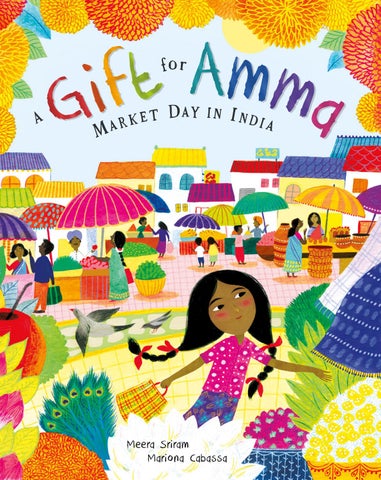
fo r a
M
et k r a
Da y
in
Meera Sriram Mariona Cabassa
India
Me era Sriram grew up in India and moved to the United States in 1999. An engineer in the past, she now enjoys writing, leading early literacy initiatives and advocating for diverse bookshelves. Meera is the author of The Yellow Suitcase and has also co-authored several books in India. She believes in the transformative power of stories and likes to write about people, places and experiences less visible in children’s literature.
Mariona Cabassa studied illustration at the Massana Art School. She completed her postgraduate degree at the School of Fine Arts in Strasbourg, where she also learned how to speak French. She has illustrated more than 80 books in Spain and other countries. Mariona lives in Barcelona, Spain.
fo r a
M
et k r a
Da y
in
India
Meera Sriram ILLUSTRATED BY Mariona Cabassa WRITTEN BY
The sun grows bright. The street is busy. It’s market day in town!
I count my money and dash outside To find a treasure for Amma.
SAFFRON orange strands in tiny scoops. Would Amma like to season rice?
Orange marigolds swing over doors — Swish , swish! Should I make her a garland?
JASMINE white in starry blooms, Petals to perfume Amma’s braid.
But white goats shove past — Shoo , shoo! I squirm away.
LOTUS pink shimmering fresh. Would Amma like dewy buds?
Pink sweets soaked in ghee — Yum , yum! I’ll come back for my treat.
PEACOCK green dancing in the breeze . . . Would she need a fan for the heat?
Green herbs — mint and coriander — Sniff, sniff! I’m hungry for chutney.
VERMILION red like rising flame, But Amma never dots her forehead.
Red-hot peppers spill over — Achoo , achoo! I cover my face.
CHARCOAL black fires up fast, Ready to roast sweetcorn and kebabs.
Black drums beat and boom — Hop, skip! What would Amma like?
TURMERIC yellow like sunshine dust, Plenty of powdery spice at home.
A yellow rickshaw pedals by — Ding-a-ling! I scoot to the side.
PIGEON grey at every corner, Street birds pecking grains.
Grey buffalo blinks and stomps — Moo , moo! I must hurry.
TERRACOTTA brown baked from clay, Cool water in delicate pots.
Brown tea with milk and sugar — “Tea , tea!” I smell cardamom.
INDIGO blue waves to me, Soft cotton like Amma’s sari.
Blue bangles sing and chime — Clink , clink! Like Amma’s lullaby.
I pick a bangle in every shade And hand over my pocket money.
I skip back home and tiptoe in. Jingle , jingle . . .
. . . a rainbow just for Amma!
What’s at the Market? The market in this story is based on the Vadapalani and Mylapore markets in the author’s hometown, Chennai, in India.
SAFFRON:
a thin, orange, thread-like part of the crocus flower, used as a spice and dye for food
JASMINE:
a sweet-smelling white flower that grows in Asia; worn on the head as decoration
LOTUS:
a big pink flower that grows in lakes and ponds; the national flower of India
PEACOCK:
a bird with long green tail feathers (only on the males) that open up into a fan shape; the national bird of India
VERMILION:
bright red powder that people of the Hindu religion sometimes wear in a dot on their foreheads
CHARCOAL:
a kind of half-burnt black wood used to cook corn, meat, bread and other foods outdoors
TURMERIC:
a yellow plant root, similar to ginger, used as a medicine and cooking spice
PIGEON:
grey, white or speckled bird found almost everywhere on Earth except the driest deserts and the North and South Poles
TERRACOTTA:
a brown, baked clay material used to make bricks, pots, cups, toys and artwork
INDIGO:
a dark blue fabric dye originally made from plants that grow in India
Markets Around the World Markets have been around for thousands of years. The earliest markets, called bazaars,, are thought to have started in the region of Persia (now called Iran). bazaars
Marrakech ’s Souks
(Marrakech, Morocco) “Souk” (SHOOK) is the Arabic word for “market.” In the souks of Marrakech, you can buy clothing, food, artwork and other items from all around the world. At a souk, you might see customers bargaining or “haggling” with the merchants to try to get a lower price.
Kraków Cloth Hall
(Kraków, Poland)
At a cloth hall, you can buy fabric for making clothes, rugs, curtains and other crafts. The Cloth Hall in Kraków (CRACKoof), built in the 13th century, is considered the world’s oldest shopping mall. The buildings and streets are kept to look like they did back in medieval times.
? D id y o u k n o w T he world’s oldest market is the Grand Bazaar in Istanbul, Turkey.
The world’s largest bazaar is the Bazaar of Tabriz in Tabriz, Iran.
Shilin Night Market
(Shilin District, Taipei, Taiwan) Night markets are outdoor street markets that are open at night. The Shilin (SHIHlin) Night Market is famous for its xiaochi (show-chee), which are snack-sized street foods such as stinky tofu, oyster omelettes, pineapple cake and fried ice cream.
Mercado de Jamaica
(Mexico City, Mexico)
Mercado de Jamaica (mer-CAH-doh day haMAY-ca) is a flower market. “Jamaica” is the Spanish word for “hibiscus,” an important flower in Mexican food and culture. At Mercado de Jamaica, you can visit over a thousand stalls that sell beautiful plants. Most of the stands are open all day and all night long, because it takes a lot of work to care for all those flowers!
Damnoen Saduak Floating Market (Damnoen Saduak
District, Ratchaburi, Thailand) People buy and sell things on boats at floating markets, such as the Damnoen Saduak (DAMnoon SAD-oo-ack). Here, you can buy food cooked in a canoe, such as Thailand’s famous boat noodles with pickled tofu. There are also floating markets in Indonesia, Vietnam, Sri Lanka, Bangladesh, India and other South Asian countries.
T he world’s largest fish and seafood market is the Tsukiji Fish Market in Tokyo, Japan.
The world’s largest flea market is El Rastro in Madrid, Spain.
To my amma, for her quiet strength — M. S. For Anik, beautiful and dear soul — M. C.
The author took these photographs at the outdoor markets she often visited as a child. They were taken during her 2019 summer trip to Chennai, her hometown in southern India.
turmeric & vermilion
rickshaw
bangles
drums
terracotta pots
Barefoot Books 23 Bradford Street, 2nd Floor, Concord, MA 01742 29/30 Fitzroy Square, London, W1T 6LQ Text and photographs copyright © 2020 by Meera Sriram Illustrations copyright © 2020 by Mariona Cabassa The moral rights of Meera Sriram and Mariona Cabassa have been asserted First published in the United States of America by Barefoot Books, Inc and in Great Britain by Barefoot Books, Ltd in 2020 All rights reserved Graphic design by Sarah Soldano, Barefoot Books Edited and art directed by Lisa Rosinsky and Nivair H. Gabriel, Barefoot Books Reproduction by Bright Arts, Hong Kong
saris
chili peppers
peacock feather fans
vegetables
lotus buds
Printed in China on 100% acid-free paper This book was typeset in Bentham, DK Crayon Crumble and Mr Anteater The illustrations for this book were prepared in pencils, pastels and water-based paints Hardback ISBN 978-1-64686-061-6 Paperback ISBN 978-1-64686-062-3 E-book ISBN 978-1-64686-081-4 British Cataloguing-in-Publication Data: a catalogue record for this book is available from the British Library Library of Congress CIP data is available under LCCN 2020006121 579864
“This heartwarming story about a little girl choosing to give her mother something special showcases depth and richness of color on every page” - School Library Journal , starred review “[A] brilliant exploration of the five senses . . . shared in a dazzling, charming array. It’s a must-have for primary libraries seeking fresh material for required curricula” - Foreword Reviews , starred review