Bard FOUNDED 1860
2026–27
Bard College Catalogue 2026–27
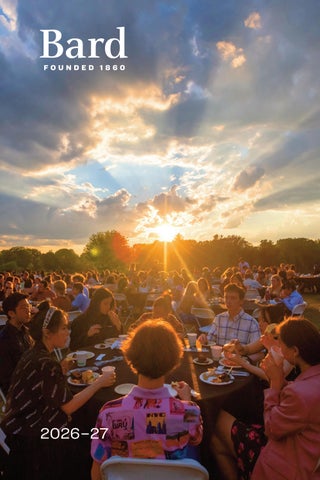
Cover: First-Year Matriculation Dinner. Photo: Karl Rabe Back cover: Students preparing for Election Day, Bertelsmann Campus Center. Photo: Rachel L. Crittenden Bard College PO Box 5000 Annandale-on-Hudson, NY 12504-5000 845-758-6822 bard.edu admission@bard.edu The Bard College catalogue is published by the Bard Publications Office. Be advised that the provisions of this catalogue are not to be regarded as an irrevocable contract between the student and Bard College or its officers and faculty. The College reserves the right to make changes affecting admission procedures, tuition, fees, courses of instruction, programs of study, faculty listings, academic grading policies, and general regulations. The information in this catalogue is subject to change without notice.
CONTENTS Mission
1
History of Bard
3
Acknowledging Bard’s Origins
25
Learning at Bard Curricular Goals The Bard Education: Four Pillars The Curriculum Academic Programs, Concentrations, and Second Focus Academic Requirements and Regulations Specialized Degree Programs
27 27 28 28 35 37 41
Admission
43
Academic Calendar
49
Division of the Arts Architecture Art History and Visual Culture Dance Film and Electronic Arts Music Photography Studio Arts Theater and Performance
51 52 54 56 58 60 64 65 68
Division of Languages and Literature Foreign Languages, Cultures, and Literatures Literature Written Arts
71 73 77 81
Division of Science, Mathematics, and Computing Biology Chemistry and Biochemistry Computational Sciences Data Analytics Mathematics Physics Psychology Additional Courses in the Sciences
85 87 89 91 93 94 95 97 99
i
Division of Social Studies Anthropology Economics Economics and Finance Historical Studies Interdisciplinary Study of Religions Philosophy Politics Sociology
101 102 104 107 108 111 113 115 117
Interdivisional Programs and Concentrations Africana Studies American and Indigenous Studies Asian Studies Classical Studies Environmental Studies Experimental Humanities French Studies Gender and Sexuality Studies German Studies Global and International Studies Global Public Health Human Rights Irish and Celtic Studies Italian Studies Jewish Studies Latin American and Iberian Studies Medieval Studies Middle Eastern Studies Mind, Brain, and Behavior Russian and Eurasian Studies Science, Technology, and Society Spanish Studies Theology Victorian Studies Multidisciplinary Studies Interdisciplinary Curricular Initiatives
119 120 120 121 123 124 126 128 128 130 131 132 133 136 136 137 138 139 140 141 142 143 144 145 145 146 146
Bard College Conservatory of Music Undergraduate Program Graduate Programs Advanced Performance Studies Postgraduate Collaborative Piano Fellowships US-China Music Institute
149 149 153 153 153 153
ii
Bard Abroad Bard Network Study Abroad Programs Tuition Exchange Programs Language Intensives
155 156 157 160
Additional Study Opportunities and Affiliated Institutes Independent Work Study Away Specialized Programs Professional Education Preprofessional Preparation Professional Option: Dual-Degree Programs Affiliated Programs and Institutes
161 161 162 162 164 164 165 167
Civic Engagement Center for Civic Engagement Student-Led Engagement Classroom, Community, and Careers Bard and the Local Community Innovations in Science and Sustainability Education Reform International Partnerships
177 177 177 178 180 182 183 183
Campus Life and Facilities Campus Life Student Services and Resources Residence Life and Housing Campus Facilities Safety and Security Title IX and Nondiscrimination Consensual Relations Policy
185 186 190 195 197 208 208 209
Graduate Programs Bard College Conservatory of Music Bard Graduate Center Bard Graduate Programs in Sustainability Center for Curatorial Studies and Art in Contemporary Culture Levy Economics Institute Graduate Programs in Economic Theory and Policy Longy School of Music of Bard College Master of Arts in Global Studies Master of Arts in Public Humanities Master of Arts in Teaching Milton Avery Graduate School of the Arts The Orchestra Now
213 213 214 215 216 217 217 218 218 219 219 220
iii
Educational Outreach Bard Early College Programs Bard Baccalaureate Bard Microcolleges Bard Prison Initiative Bridge Program Clemente Course in the Humanities Global Higher Education Alliance for the 21st Century International Partnerships Lifetime Learning Institute Longy School of Music of Bard College Return to College Program Zora Neale Hurston Writing Fellowship
221 221 222 223 223 224 224 225 226 227 227 228 228
Levy Economics Institute of Bard College
229
The Bard Center Bard Fiction Prize Distinguished Scientist Lecture Series Fellows of the Bard Center Institute for Writing and Thinking Leon Levy Endowment Fund Cultural Programs
233 233 233 234 234 234 235
Finances Financial Aid Fees, Payment, and Refunds
237 237 247
Scholarships, Awards, and Prizes
255
Faculty Faculty Emeritus Undergraduate Faculty Conservatory Faculty Graduate Programs Faculty Faculty of the Affiliate Programs
271 271 273 290 294 301
Honorary Degrees and Bard College Awards
313
Boards and Administration
321
Bard Campus Map
326
Travel to Bard
329
Policies and Procedures
331
iv
MISSION Bard College seeks to inspire curiosity, a love of learning, idealism, and a commitment to the link between higher education and civic participation. The undergraduate curriculum is designed to address central, enduring questions facing succeeding generations of students. Academic disciplines are interconnected through multidisciplinary programs; a balance in the curriculum is sought between general education and individual specialization. Students pursue a rigorous course of study reflecting diverse traditions of scholarship, research, speculation, and artistic expression. They engage philosophies of human existence; theories of human behavior and society; the making of art; and the study of the humanities, science, nature, and history. Bard’s approach to learning focuses on the individual, primarily through small group seminars. These are structured to encourage thoughtful, critical discourse in an inclusive environment. Faculty are active in their fields and stress the connection between the contemplative life of the mind and active engagement outside the classroom. They strive to foster rigorous and free inquiry, intellectual ambition, and creativity. Bard acts at the intersection of education and civil society, extending liberal arts and sciences education to communities in which it has been underdeveloped, inaccessible, or absent. Through its undergraduate college, distinctive graduate programs, commitment to the fine and performing arts, civic and public engagement programs, and network of international dual-degree partnerships, early colleges, and prison education initiatives, Bard offers unique opportunities for students and faculty to study, experience, and realize the principle that higher education institutions can and should operate in the public interest.
Mission 1
HISTORY OF BARD Bard College has always been a place to think, critically and creatively. Founding of the College: Bard was founded as St. Stephen’s College in 1860, a time of national crisis. Though we have no written records of the founders’ attitude toward the Civil War, a passage from the College’s 1943 catalogue applies also to the institution’s beginnings: “While the immediate demands in education are for the training of men for the war effort, liberal education in America must be preserved as an important value in the civilization for which the War is being fought. . . . Since education, like life itself, is a continuous process of growth and effort, the student has to be trained to comprehend and foster his own growth and direct his own efforts.” This philosophy molded the College during its early years and continues to inform its academic aims. St. Stephen’s College was established by John (1819–99) and Margaret Johnston Bard (1825–75) in association with leaders of the Episcopal Church of New York City. For its first 60 years, St. Stephen’s offered young men a classical curriculum in preparation for their entrance into the seminary. But even as a theologically oriented institution, St. Stephen’s challenged its students to be active participants in charting their own intellectual paths. In support of this venture, the Bards donated part of their riverside estate, Annandale, to the College, along with the Chapel of the Holy Innocents, which is still in use. Early Years: With the appointment in 1919 of Bernard Iddings Bell as warden, the College began to move toward a broader and more secular mission. Social and natural sciences augmented the classical curriculum, and the student body was recruited from a more diverse population. In 1928, a time of increasing financial uncertainty, St. Stephen’s became an undergraduate school of Columbia University. Over the next decade, under the leadership of Dean Donald G. Tewksbury, Bard further integrated the classical and progressive educational traditions, in the process becoming one of the first colleges in the nation to give full academic status to the study of the creative and performing arts. In 1934, the name of the College was changed to Bard in honor of its founders. 1930s to 1960s: Beginning in the mid-1930s and throughout World War II and the postwar years, the College was a haven for distinguished writers, artists, intellectuals, and scientists fleeing Europe. Among these émigrés were philosopher Heinrich Bluecher and his wife, the social critic Hannah Arendt; violinist Emil Hauser, founder of the Budapest String Quartet; precisionist painter Stefan Hirsch; labor economist Adolf Sturmthal; and psychologist Werner Wolff. Bard’s international outlook was reflected in a variety of programs and initiatives as well as in its faculty. During the war, the College welcomed an elite group of soldiers who were trained in the French
History of Bard 3
and German languages and cultures, and in the late 1940s Eleanor Roosevelt was a frequent participant in Bard’s international student conferences. Bard underwent another redefining moment in 1944 when it opened its doors to women. The decision to become coeducational required the College to end its association with Columbia, paving the way to Bard’s current status as an independent liberal arts college. The same year marked the arrival of the first female faculty members. The faculty of the postwar years included Mary McCarthy, Saul Bellow, Dorothy Dulles Bourne, Irma Brandeis, Ralph Ellison, Anthony Hecht ’44, William Humphrey, and Theodore Weiss. This partial list indicates that Bard had assumed a place of eminence in the teaching of literature and writing and was attracting leading thinkers in the social sciences. The College also continued to demonstrate its commitment to global issues of education and democracy. In 1956, Bard provided a haven for 325 Hungarian student refugees after their participation in that country’s revolt against its Stalinist government. The 1960s marked a period of significant growth. Under the stewardship of Reamer Kline, who served for 14 years as president of the College, the number of students and faculty increased, as did campus facilities, and the curriculum was expanded, particularly in science and the visual arts. Bard also demonstrated an early commitment to civil rights. In 1962, Bard was among the first colleges to award an honorary degree to Rev. Martin Luther King Jr. 1975 to Present: Leon Botstein became Bard’s 14th president in 1975. After 51 years in that office, Botstein announced his retirement in 2026. Under Botstein, the College continued to innovate, take risks, and broaden its global outlook. Botstein oversaw curricular innovation—including one of the nation’s first human rights majors; and the Language and Thinking Program, a presemester workshop for firstyear students—and the development of a new model for the liberal arts college as a central body surrounded by affiliated institutes and programs that strengthen core academic offerings. This model is flexible enough to include programs for research, graduate study, and community outreach, yet each affiliate is designed to enhance the undergraduate experience by offering students the opportunity to interact with leading artists, scientists, and scholars. A number of these initiatives developed within the Bard Center, established by Botstein in 1978 to present artistic and intellectual programs. These include the Distinguished Scientist Lecture Series, which has brought 47 Nobel laureates to Bard, and the Bard Fiction Prize, awarded to emerging writers who spend a semester in residence at the College. Other programs developed under Bard Center auspices include the Institute for Writing and Thinking, which has had a major impact on the teaching of writing in high schools and colleges around the country and internationally; the Bard Music Festival, which debuted in 1990 and each year illuminates the work and era of a specific composer; and the literary journal Conjunctions.
4 History of Bard
Botstein made Bard a leader in early college education beginning in 1979, when it acquired Simon’s Rock, the nation’s first early college. The College has since partnered with public school systems across the country to establish tuition-free early college programs that allow young scholars to earn up to 60 college credits and an associate in arts degree along with their high school diploma. The first Bard Early College opened in 2001 in Manhattan, and Bard now also operates early college campuses in Queens (2008); New Orleans (2008); Newark, New Jersey (2011); Cleveland (2014); Baltimore (2015); Hudson Valley, New York (2016); Washington, DC (2019); the Bronx (2023), and Brooklyn (2024). During Botstein’s tenure, the College developed a number of additional initiatives to address the educational needs of underserved communities. These include the Bard Prison Initiative (BPI), founded by Max Kenner ’01 as a student project to bring higher education into New York State prisons. The program is the subject of an Emmy-nominated documentary series, College Behind Bars, which debuted on PBS in 2019. BPI expanded its reach nationally through partnerships with other colleges and universities, and internationally by providing capacity-building grants to programs in 14 nations across six continents. Building on the success of BPI, the College partnered with community-based institutions to create Bard Microcollege campuses at the Holyoke (Massachusetts) Care Center, Brooklyn Public Library, and Countee Cullen public library in Harlem. These programs, which lead to an AA degree, feature the elements of an Annandale education. Another BPI project, the Bard Baccalaureate, which launched in 2020, is a full-scholarship program for adult learners in the Hudson Valley region. The Clemente Course, established in 1995, provides college-level instruction for college credit to economically disadvantaged students aged 17 and older at some 30 sites around the country. Affiliated programs initiated in the Botstein years also include the Milton Avery Graduate School of the Arts (1981); Levy Economics Institute of Bard College (1986); Center for Curatorial Studies (1990); Bard Graduate Center in New York City (1993); Bard Center for Environmental Policy (1999); Human Rights Project (1999); Bard Globalization and International Affairs Program (2001); Master of Arts in Teaching Program (2004); Bard College Conservatory of Music (2005) and its graduate programs in vocal arts (2006), conducting (2010), and instrumental arts (2022) as well as the US-China Music Institute (2017); Hannah Arendt Center for Politics and Humanities (2006); Center for Civic Engagement (2011); Bard MBA in Sustainability (2012); Longy School of Music of Bard College (2012) in Cambridge, Massachusetts; The Orchestra Now (2015); Bard Center for the Study of Hate (2019); Center for Human Rights and the Arts (2021); Wihánble S’a Center for Indigenous AI (2024), and Chang Chavkin Center for Liberal Education and Civic Life (2025). Bard has continued to further its efforts to promote freedom of inquiry internationally. In 1991, under the Program in International Education (PIE), the College began bringing students from emerging democracies in Eastern and Central Europe, Central Asia, and the Middle East to Bard for one semester of study. This
History of Bard 5
program is one of many overseen by the Institute for International Liberal Education, which was founded in 1998 to develop long-term collaborations between Bard and other leading institutions around the world. Partner campuses include Al-Quds University in East Jerusalem, which joined with Bard in 2009 to create the Al-Quds Bard College for Arts and Sciences and a master of arts in teaching program; American University of Central Asia in Bishkek, Kyrgyzstan, where Bard established a dual-degree program in 2010; Bard College Berlin: A Liberal Arts University, a partner institution since 2011; and Central European University, a graduate-level institution based in Vienna. Bard’s faculty has also grown in range and distinction, and today boasts eight recipients of MacArthur fellowships: poet Ann Lauterbach; artists Jeffrey Gibson, An-My Lê, and Judy Pfaff; journalist Mark Danner; and novelists Valeria Luiselli, Norman Manea (emeritus), and Dinaw Mengestu. Other distinguished and awardwinning faculty members include writers Nuruddin Farah, M. Gessen, Hua Hsu, Daniel Mendelsohn, Jenny Offill, Joseph O’Neill, Francine Prose, Mona Simpson, and Thomas Chatterton Williams; composers Marcus Roberts, Joan Tower, and George Tsontakis; anthropologist John Ryle; art historian Kobena Mercer; photographers Gilles Peress, Stephen Shore, and Walid Raad; filmmaker Kelly Reichardt; journalist Ian Buruma; mezzo-soprano Stephanie Blythe; computer scientist Valerie Barr; and Pulitzer Prize–winning biographer Elizabeth Frank. Grammy- and Academy Award– winning composer and conductor Tan Dun leads the Bard College Conservatory of Music as dean. Noted writers and artists who spent time at Bard include the late Chinua Achebe, widely revered as the founding father of African fiction; John Ashbery, considered one of America’s most influential 20th-century poets; Nobel laureates Orhan Pamuk, José Saramago, and Mario Vargas Llosa; choreographer Bill T. Jones; and soprano Dawn Upshaw, who developed Bard’s Graduate Vocal Arts Program. Bard alumni/ae have also been an influential force in the arts and in the physical, social, and political sciences. A short list includes actors Blythe Danner ’65, Adrian Grenier ’98, Youssef Kerkour ’00, Gaby Hoffmann ’04, Patrick Vaill ’07, and Pauline Chalamet ’14; comedians Chevy Chase ’68, Christopher Guest ’70, Ali Wentworth ’88, and Adam Conover ’04; film editor Jinmo Yang ’03 and filmmaker Gia Coppola ’09; screenwriter, actor, and producer Raphael Bob-Waksberg ’06; playwrights Sherman Yellen ’53, Nick Jones ’01, and Thomas Bradshaw ’02; dancer Arthur Aviles ’87; classical singer Julia Bullock VAP ’11; visual artists Xaviera Simmons ’05, Carolyn Lazard ’10, and Tschabalala Self ’12; fashion designer Brandon Blackwood ’13; sculptor Rita McBride ’82; musicians Donald Fagen ’69 and Walter Becker ’71 (founders of Steely Dan), Billy Steinberg ’72, and Adam Yauch ’86 (a founder of the Beastie Boys); scientist László Z. Bitó ’60, who was instrumental in developing a drug used to combat glaucoma; Fredric S. Maxik ’86, a leader in environmentally innovative lighting technologies; environmental writer Elizabeth Royte ’81; financial entrepreneur and investor Mostafiz ShahMohammed ’97; poet and translator Pierre Joris ’69; journalists Emily Schmall ’07, William Sherman ’68, who won the 1974 Pulitzer Prize for local investigative specialized reporting, and Ronan Farrow ’04,
6 History of Bard
2018 Pulitzer Prize winner for public service; and several whose student projects continue to make a difference, including Max Kenner ’01, founder and executive director of the Bard Prison Initiative; Mariel Fiori ’05, cofounder and managing editor of La Voz; and Dariel Vasquez ’17, cofounder of Brothers@. Botstein spearheaded an expansion of the campus in 2016, when Bard purchased Montgomery Place, a neighboring 380-acre property that features a 19th-century mansion, coach house, greenhouse, farm, gardens, walking trails, and outbuildings. Activities at Montgomery Place have included classes, lectures, exhibitions, guided walks by Bard horticultural staff, SummerScape galas and events, and a salon series presented with Hudson River Heritage. Several undergraduate courses have been inspired by the history of the property. With the 2023 acquisition of the 260-acre Massena property south of Montgomery Place—now home to Simon’s Rock at Bard College, the early college that relocated after nearly six decades in Great Barrington, Massachusetts—the campus consists of more than 1,200 acres. Over the course of his five decades in office, Botstein has inspired, built, and fiercely defended the most distinctive liberal arts college in our nation committed to serving the public good; in so doing he not only transformed Bard College, he advanced the cause of liberal education in the United States and beyond. Recent Initiatives: In 2023, a SummerScape commission allowed Tony Award winner Justin Peck and Pulitzer Prize–winning playwright Jackie Sibblies Drury to transform Sufjan Stevens’s 2005 cult concept album Illinois into a full-length theatrical performance—called Illinoise—which moved from Bard to Chicago’s Shakespeare Theater and New York City’s Park Avenue Armory before opening on Broadway in April 2024, earning four Tony nominations and winning one. Illinoise followed on the success of SummerScape’s 2015 staging of Oklahoma!, which went to Broadway in 2019 and won the Tony Award for Best Revival of a Musical. The US-China Music Institute, a partnership between the Bard College Conservatory and the Central Conservatory of Music in Beijing, launched in 2017, offering a degree program in Chinese instruments; a graduate program in Chinese music and culture began in 2022. The Open Society University Network (OSUN), created with support from George Soros’s Open Society Foundations (OSF), debuted in 2020 with the goal of integrating teaching and research across higher education institutions worldwide. Currently, the Bard network includes dozens of educational and research institutions both nationally and internationally. Bard students and faculty can connect and collaborate with their peers across the network through a variety of online courses. Also in 2020, Bard introduced a stand-alone undergraduate program in architecture and a suite of interdisciplinary Common Courses that engage with themes of the contemporary moment, such as epidemics and society, and local, national, and global citizenship.
History of Bard 7
In response to the 2021 collapse of the Afghan government, the College, with support from OSF and others, evacuated hundreds of Afghan students, alumni/ae, and scholars to safety. Nearly 400 students enrolled at Bard network institutions in Central Asia, Europe, and the United States, including more than 80 who graduated from or are still studying at the Annandale campus. The College has also initiated a scholarship program to support displaced Ukrainian and Russian students; 25 students from Ukraine and 20 Eurasian students (mainly Russian dissidents) arrived in fall 2023. The 2021–22 academic year saw the launch of several graduate programs and undergraduate initiatives, including the MA in Human Rights and the Arts; MA in Global Studies; a bachelor of music program in vocal performance, offered through the Conservatory of Music; and a summer program in decorative arts, design history, and material culture at the Bard Graduate Center. In 2022, Bard received a $1.49 million Andrew W. Mellon Foundation grant in support of its Rethinking Place: Bard-on-Mahicantuck project, which has helped make possible a Native American and Indigenous studies approach to a revitalized American studies curriculum, the hiring of postdoctoral teaching fellows with Native and Indigenous studies (NAIS) expertise, the creation of a Native Artist residency, and public events such as conferences and lectures. A landmark endowment from the Gochman Family Foundation provides support for NAIS programming, faculty appointments, and scholarships, transforming undergraduate and graduate studies across the Bard network. In 2023, the College established Bard NYC, a portfolio of experiential study away opportunities for students to live in Williamsburg, Brooklyn, and combine coursework with professional internships and cocurricular programming; the Office of Undergraduate Research, a central resource for students interested in research opportunities and seeking out a mentor; and the Center for Ethics and Writing in partnership with Bard Early Colleges, community colleges, and nonprofit organizations. Thanks to a grant from the Korea Foundation, Bard began building a Korean studies curriculum, beginning with courses in Korean literature and culture as well as language classes. Data analytics became a second focus, Bard’s version of a curricular minor. New initiatives also include the Gagarin Center for the Study of Civil Society and Human Rights at Bard College, which allows Russian scholars forced to leave Russia to pursue research and educational activities, and the Russian Independent Media Archive (RIMA), a project of the Gagarin Center and PEN America. In recognition of the responsibility of higher education to prepare students for citizenship in a democratic society, the College established the Chang Chavkin Center for Liberal Education and Civic Life. Part think tank and part teaching institute for faculty, the Center will advance curricular reform in colleges and universities with the aim of restoring liberal education to the heart of the undergraduate curriculum.
8 History of Bard
Bard College received a transformational $500 million endowment grant from philanthropist and longtime Bard supporter George Soros and the Open Society Foundations in 2021. The challenge grant, among the largest ever made to higher education in the United States, was successfully completed in January 2026— nearly 2,000 gifts and pledges from more than 1,000 trustees, alumni/ae, and friends were made to the endowment—and will facilitate and strengthen Bard’s educational and social initiatives. It has already supported the addition of 17 new faculty chairs and a number of new named scholarships, awards, and prizes. With a solid financial foundation in place, the College was able to embark on several projects as part of its capital campaign, including four recently completed residences on North Campus—made up of 92 suites and housing a total of 432 beds—geared toward juniors and seniors, along with Campus Center North, where students will be able to gather, study, and take classes. Looking Ahead: Among the ongoing and planned improvements to the Bard campus are a performing arts studio designed by acclaimed artist and designer Maya Lin that will open in 2026, a new wellness center/field house, new science building, expansion of the Garcia-Renart House to accommodate the Architecture Program, and renovation of the Drill Hall at the north end of the Blithewood parking lot.
Bard College: A Selective Chronology 1860 Bard College is founded as St. Stephen’s College by Margaret and John Bard, in association with the Episcopal Church of New York City. 1866 The College grants degrees in the liberal arts and sciences, in addition to the preseminarian program. 1928 St. Stephen’s becomes an undergraduate college of Columbia University. 1929 Franklin Delano Roosevelt becomes a trustee and serves until 1933. 1934 The College is renamed to honor its founders. A new educational program is adopted, based on the Oxford tutorial. It includes a second-year assessment (Moderation) and a Senior Project; both are pillars of the Bard education today. 1944 Bard ends its affiliation with Columbia in order to become coeducational. 1947 Radio station WXBC begins as a Senior Project. 1953 The innovative Common Course, designed by Heinrich Bluecher, is inaugurated. It is the forerunner of today’s First-Year Seminar. 1956 Bard welcomes 325 Hungarian refugee students and provides instruction in English and an introduction to life in the United States. 1960 The College celebrates its centennial year. Under President Reamer Kline, it undergoes a tremendous expansion in buildings, grounds, faculty, students, and core curricula. 1975 Leon Botstein takes office as the 14th president of the College. He expands the educational program by integrating the progressive tutorial system with the classical legacy of St. Stephen’s. 1978 The Bard Center is founded.
History of Bard 9
1979 Bard assumes responsibility for Simon’s Rock Early College in Great Barrington, Massachusetts. 1981 Bard launches its first affiliated graduate program, the Milton Avery Graduate School of the Arts, which offers a master of fine arts degree. The first Workshop in Language and Thinking is held for entering students. 1982 The Institute for Writing and Thinking is founded. 1986 The Jerome Levy Economics Institute is founded (now the Levy Economics Institute). 1988 The Graduate School of Environmental Studies (the Bard Center for Environmental Policy since 1999) offers a master of science in environmental studies. 1990 The Center for Curatorial Studies and Art in Contemporary Culture (CCS Bard) is founded. The literary journal Conjunctions makes its home at Bard. The Bard Music Festival presents its first season. 1991 The Program in International Education (PIE) brings young people from emerging democracies to study at Bard. 1993 The Bard Graduate Center: Decorative Arts, Design History, Material Culture (BGC) opens in New York City. 1994 CCS Bard initiates its graduate program in curatorial studies. 1996 Bard launches the Trustee Leader Scholar Program, a leadership development program. 1998 The Institute for International Liberal Education (IILE) is founded with a mission to advance the theory and practice of international liberal arts education. 1999 The Bard Prison Initiative (BPI) is founded. 2000 Bard College and Rockefeller University in New York City establishes the Bard-Rockefeller Semester in Science 2001 Bard and the New York City Department of Education launch Bard High School Early College (BHSEC), a four-year public school in downtown Manhattan. The Bard Globalization and International Affairs (BGIA) program opens and BPI launches a pilot program with 16 students. 2003 The Richard B. Fisher Center for the Performing Arts, designed by architect Frank Gehry, opens. Bard and the International Center of Photography join forces to offer an MFA degree in photography. 2004 The Master of Arts in Teaching (MAT) Program welcomes its first class. 2005 The Bard College Conservatory of Music opens, offering a five-year doubledegree (BM/BA) program. 2006 The Conservatory of Music initiates a graduate program in vocal performance (a graduate conducting program follows in 2010). CCS Bard inaugurates the Hessel Museum of Art. The West Point–Bard Initiative is launched. The Hannah Arendt Center for Politics and Humanities is established. 2007 The Gabrielle H. Reem and Herbert J. Kayden Center for Science and Computation, designed by Rafael Viñoly, opens. The College launches the five-year BS/BA Economics and Finance Program. The Landscape and Arboretum Program is established to preserve and enhance the Bard campus. 2008 BHSEC Queens opens in New York; Bard launches an early college program in New Orleans. 10 History of Bard
2009 Bard partners with Al-Quds University in East Jerusalem to launch the College for Arts and Sciences and a master of arts in teaching program. The Lynda and Stewart Resnick Science Laboratories are completed, as is The parliament of reality, an outdoor installation by artist Olafur Eliasson. 2010 Bard marks the 150th anniversary of its founding. The College establishes a partnership with American University of Central Asia. 2011 The Center for Civic Engagement (CCE) is established. BHSEC Newark opens. Bard assumes ownership of the European College of Liberal Arts in Berlin (now Bard College Berlin). 2012 The Longy School of Music merges with the College. Live Arts Bard (now Fisher Center LAB) launches. Construction is completed on the Anne Cox Chambers Alumni/ae Center and an addition to the Stevenson Athletic Center. Bard inaugurates the MBA in Sustainability program and establishes the Bard College Farm. 2013 The Bard Entrance Examination is introduced as an alternative application for admission. The László Z. Bitó ’60 Conservatory Building opens, and BardWorks, a professional development program for juniors and seniors, debuts. 2014 The Center for Moving Image Arts opens. The Levy Economics Institute Master of Science in Economic Theory and Policy welcomes its first students. A fourth BHSEC campus opens in Cleveland, Ohio. Honey Field, a baseball facility, is completed. The Fisher Center’s Theater Two is renamed LUMA Theater. 2015 New initiatives include The Orchestra Now (TŌN), a preprofessional orchestra and graduate program; BHSEC Baltimore; and Bard Academy at Simon’s Rock, a college preparatory program for 9th and 10th graders in Great Barrington, Massachusetts. 2016 The 150th Anniversary Campaign, the largest fundraising campaign in the College’s history, raises more than $565 million for scholarships, new buildings and renovations, operating support, and endowment. The College acquires Montgomery Place, an adjacent 380-acre property. Bard Early College (BEC) Hudson and Bard Microcollege Holyoke open. 2017 New Annandale House, a sustainably built multiuse space and the home of Experimental Humanities, is completed. BEC New Orleans expands to a fullday program and Central European University opens an extension site on the Bard campus. 2018 The US-China Music Institute, a partnership of the Bard College Conservatory and Central Conservatory of Music in Beijing, opens to students. Bard Microcollege Brooklyn, a joint venture with the Brooklyn Public Library, launches. The Center for Environmental Policy and Bard MAT initiate an MEd program in environmental education. BGC offers a 3+2 BA/MA program in decorative arts, design history, and material culture. The Levy Economics Institute’s graduate programs expand to include a one-year MA in economic theory and policy. Bard and Central European University offer an Advanced Certificate in Inequality Analysis.
History of Bard 11
2019 BHSEC DC opens. College Behind Bars, an Emmy-nominated documentary series profiling students in the Bard Prison Initiative, airs on PBS. The Bard Center for the Study of Hate launches. 2020 Bard and Central European University establish the Open Society University Network (OSUN). The President’s Commission on Racial Equity and Justice is created. The Fisher Center debuts UPSTREAMING, a virtual stage featuring new commissions and archival works. 2021 Bard offers new master of arts programs in global studies and in human rights and the arts, and a bachelor of music in vocal performance. The Center for Human Rights and the Arts opens; the Bard Microcollege for Just Community Leadership launches in Harlem at the Countee Cullen branch of the New York Public Library; and Bard begins Camden Reach, a new early college initiative. Solve Climate by 2030, an initiative of OSUN and the Center for Environmental Policy, begins with 50 webinars from locations throughout the world. Bard receives a $500 million challenge grant from philanthropist George Soros, setting the stage for a $1 billion endowment drive. 2022 Bard and its network partners help evacuate nearly 400 Afghan students to safety. A scholarship program offers support for displaced Ukrainian and Russian students. Two graduate programs debut: an MA in Chinese Music and Culture and the Graduate Instrumental Arts Program. Renovations to Kline Commons are completed. The Center for Environmental Sciences and Humanities opens with the mission to connect research with grassroots efforts to protect the environment. Bard receives a $1.49 million grant from the Andrew W. Mellon Foundation for its Rethinking Place: Bard-onMahicantuck project. The College also receives a landmark gift from the Gochman Family Foundation that, in part, supports Native American and Indigenous studies programming and scholarships, including the Center for Indigenous Studies. 2023 Bard NYC, which combines advanced coursework with professional internships, welcomes its first cohort of students to its state-of-the-art facility in Williamsburg, Brooklyn. The College launches the Office of Undergraduate Research and the Center for Ethics and Writing. The MA in Global Studies program initiates a dual-degree track in partnership with Central European University. A new Bard High School Early College campus opens in the South Bronx. New initiatives also include the Gagarin Center for the Study of Civil Society and Human Rights at Bard College and Russian Independent Media Archive (RIMA), a project of the Gagarin Center and PEN America. The Fisher Center LAB biennial Common Ground focuses on the politics of land and food. Ground is broken for four new suite-style residence halls on North Campus. Massena Campus, a 260-acre property adjacent to the Montgomery Place Campus, is acquired. 2024 A new Bard High School Early College campus opens in Brooklyn. Illinoise, a dance musical based on the Sufjan Stevens album Illinois and cocommissioned by the Fisher Center at Bard, wins a Tony Award for best choreography. The Center for Curatorial Studies receives $3 million from the Keith Haring Foundation to expand its library and archives; the 6,000square-foot addition will be named the Keith Haring Wing. 12 History of Bard
2025 Simon’s Rock relocates from Great Barrington, Massachusetts, to Massena Campus; under the baton of Music Director Leon Botstein, The Orchestra Now, on the occasion of its 10th anniversary, performs memorial concerts in Germany commemorating the end of World War II; Sō Percussion, whose members were founding codirectors of the Bard Conservatory of Music’s Percussion Program, wins a Grammy Award. Lapham’s Quarterly, a journal of history and reportage founded in 2007, is acquired by the College. New suitestyle residences, housing more than 400 students, open on North Campus.
Presidents of Bard College George Franklin Seymour Thomas Richey Robert Brinckerhoff Fairbairn Lawrence T. Cole Thomas R. Harris William Cunningham Rodgers Bernard Iddings Bell Donald George Tewksbury Harold Mestre Charles Harold Gray Edward C. Fuller James Herbert Case Jr. Reamer Kline Leon Botstein Jonathan Becker, Acting President
1860–1861 1861–1863 1863–1898 1899–1903 1904–1907 1909–1919 1919–1933 1933–1937 1938–1939 1940–1946 1946–1950 1950–1960 1960–1974 1975–2026 Fall 2026
Holders of the office have been variously titled president, warden, or dean.
History of Bard 13
Top: Celebration in front of Aspinwall, c. 1920s Bottom: Chapel of the Holy Innocents (left) and Bard Hall, c. 1940s Photos: Bard College Archives; Helene Tieger ’85, archivist
14 History of Bard
Top: Blithewood, 1954 Bottom: Outdoor seminar with Professor Artine Artinian, early 1950s Photos: Bard College Archives; Helene Tieger ’85, archivist
History of Bard 15
Top: Richard B. Fisher Center for the Performing Arts, designed by Frank Gehry, with the Sosnoff Theater, LUMA Theater, Stewart and Lynda Resnick Theater Studio, and Felicitas S. Thorne Dance Studio, is home to the Theater & Performance and Dance Programs. Bottom: Stone Row Photos: ©Peter Aaron ’68/OTTO
16 History of Bard
Top: Charles P. Stevenson Jr. Library Bottom: The Gabrielle H. Reem and Herbert J. Kayden Center for Science and Computation, designed by Rafael Viñoly Architects, with the Lynda and Stewart Resnick Science Laboratories and the László Z. Bitó ’60 Auditorium, is home to the Biology, Chemistry, and Computational Sciences Programs. Photos: ©Peter Aaron ’68/OTTO
History of Bard 17
Top: Blithewood Mansion, home to the Levy Economics Institute of Bard College and Levy Graduate Programs in Economic Theory and Policy Bottom: Blithewood Garden, overlooking the Hudson River and Catskill Mountains Photos: ©Peter Aaron ’68/OTTO
18 History of Bard
Top: Olafur Eliasson’s parliament of reality. Photo: Karl Rabe Bottom: Center for Curatorial Studies and Hessel Museum of Art. Photo: Lisa Quiñones
History of Bard 19
Top: Robbins House residence hall. Photo: ©Peter Aaron ’68/OTTO Bottom: Mansion House on the Montgomery Place Campus. Photo: ©Pieter Estersohn
20 History of Bard
Top: Massena Campus. Photo: ©DCE Productions Bottom: László Z. Bitó ’60 Conservatory Building. Photo: Karl Rabe
History of Bard 21
Top: Residence hall in Resnick Commons. Photo: ©Peter Aaron ’68/OTTO Bottom: Campus Center North. Photo: Bilyana Dimitrova ’99
22 History of Bard
Top: North Campus residence halls. Photo: Bilyana Dimitrova ’99 Bottom: Jim Ottaway Jr. Film Center at the Milton and Sally Avery Arts Center. Photo: Chris Kendall ’82
History of Bard 23
ACKNOWLEDGING BARD’S ORIGINS Bard College acknowledges that its origins are intertwined with the systems of racial injustice that have been a part of this nation’s history from its founding. Land Acknowledgment In December 2019, the Stockbridge-Munsee Band of Mohican Indians Tribal Council approved the following collaboratively authored text of Bard’s land acknowledgment (also known as a territorial acknowledgment): In the spirit of truth and equity, it is with gratitude and humility that we acknowledge that we are gathered on the sacred homelands of the Munsee and Muhheaconneok people, who are the original stewards of the land. Today, due to forced removal, the community resides in Northeast Wisconsin and is known as the Stockbridge-Munsee Community. We honor and pay respect to their ancestors, past and present, as well as to future generations, and we recognize their continuing presence in their homelands. We understand that our acknowledgment requires those of us who are settlers to recognize our own place in and responsibilities toward addressing inequity, and that this ongoing and challenging work requires that we commit to real engagement with the Munsee and Mohican communities to build an inclusive and equitable space for all. This land acknowledgment requires establishing and maintaining long-term and evolving relationships with the Stockbridge-Munsee Band of Mohican Indians. The Mellon Foundation’s 2022 Humanities for All Times grant for Rethinking Place: Bard-on-Mahicantuck offered three years of support for developing a land acknowledgment–based curriculum, public-facing Native American and Indigenous Studies (NAIS) programming, and opportunities supporting the work of emerging NAIS scholars and tribally enrolled artists at Bard. A landmark gift by the Gochman Family Foundation in 2022 generously extended this work, providing new support for faculty lines, student scholarships, curricular development in undergraduate and graduate programs and the arts, and NAIS programming across Bard’s network. Slavery Acknowledgment The College acknowledges that its origins are intertwined with slavery, which has shaped the United States and American institutions from the beginning. Starting in the 16th century, European traders trafficked approximately 12 million Africans to the Americas, where they were held as property and forced to work as enslaved laborers. Their descendants were also held as slaves in perpetuity. The exploitation of enslaved people was at the foundation of the economic development of New York and the Hudson Valley, including the land now composing the Bard College campus. In the early 18th century, Barent Van Benthuysen purchased most of this land and was a slave owner. Later owners of the property also relied on Black workers they
Acknowledging Bard’s Origins 25
held in bondage for material gain. Montgomery Place, which became part of the College in 2016, was a working farm during the 19th century that likewise profited from the labor of enslaved people. The founders of Bard College, John Bard (1819–99) and Margaret Johnston Bard (1825–75) inherited wealth from their families and used it to found the College. That inheritance was implicated in slavery on both sides. John’s grandfather Samuel Bard (1742–1821) owned slaves. His father, William Bard (1778–1853), was the first president of the New York Life Insurance Company, which insured enslaved people as property. Margaret’s fortune derived from her father’s commercial firm, Boorman and Johnston, which traded in tobacco, sugar, and cotton produced by enslaved labor throughout the Atlantic World. Other early benefactors of the College, such as John Lloyd Aspinwall (1816–73), also derived a significant proportion of their wealth, which they donated to the College, from commercial ventures that depended on slavery. John and Margaret Bard devoted their lives and monies to educational pursuits. In his retirement, John Aspinwall redirected his fortune and energies toward humanitarian pursuits. Recognition and redress of this history are due. As students, teachers, researchers, administrators, staff, and community members, we acknowledge the pervasive legacy of slavery and commit ourselves to the pursuit of equity and restorative justice for the descendants of enslaved people within the Bard community.
26 Acknowledging Bard’s Origins
LEARNING AT BARD Bard is an independent, residential college of the liberal arts and sciences located in New York’s Hudson Valley, about 90 miles north of New York City. The College provides a beautiful setting in which students pursue their academic interests and craft a rich cultural and social life. The campus covers some 1,200 acres of fields and forested land bordering the Hudson River, and features such state-of-the-art facilities as the Gabrielle H. Reem and Herbert J. Kayden Center for Science and Computation; Center for Experimental Humanities; North Campus residence halls and Campus Center North; Maya Lin–designed performing arts studio; and Richard B. Fisher Center for the Performing Arts, created by Frank Gehry. Many facilities are clustered at the center of campus (the library, Bertelsmann Campus Center, dining hall, and most classrooms), while others are within walking or biking distance. A free shuttle also makes frequent stops throughout the campus. Approximately 1,900 undergraduates study at Bard’s Annandale campus, representing all regions of the country. About 14 percent of the student body is international, coming from more than 40 countries. Undergraduates share the campus with the students and faculty of a conservatory of music and several graduate programs, which present lectures, concerts, and exhibitions that are open to the entire College community. Affiliated programs and research centers, such as the Levy Economics Institute, Hessel Museum of Art, Human Rights Project, Bard College Ecology Field Station, and Hannah Arendt Center for Politics and Humanities, also enrich the undergraduate experience.
Curricular Goals The Bard curriculum fosters curiosity, growth, and joy in the pursuit of knowledge. The student’s experience of discovery, inquiry, and reflection illuminates both the self and the wider world, igniting a desire to participate in it. A Bard education prepares students to: • Practice critical engagement and informed, responsible judgment; • Create meaningful connections between education and life, both personal and civic, at Bard and beyond, with a sustained commitment to learning; • Collaborate responsibly and constructively; • Value others and other ways of being; • Build on a foundation of both content and contexts; • Practice close reading and writing as integral to thinking and creating; • Evaluate and reflect on their own interests, actions, and abilities; • Act while confronting complexity and contradictions.
Learning at Bard 27
The Bard Education: Four Pillars The undergraduate curriculum creates a flexible system of courses that gives coherence, breadth, and depth to the four years of study; it helps students become knowledgeable across academic boundaries and able to think critically within a discipline or mode of thought. Students move from the Lower College (first and second years), which focuses on general education and introduces the content and methodology of the academic and artistic areas in which students may specialize, to the Upper College (third and fourth years), which involves advanced study of particular subjects and more independent work. The pillars of the Bard education are the Language and Thinking Program, First-Year Seminar, Moderation, and the Senior Project. • The Language and Thinking Program is an intensive, writing-rich, presemester introduction to the liberal arts and sciences in which students learn to read and listen thoughtfully, articulate ideas clearly, and review their work critically. • The two-semester First-Year Seminar presents intellectual, cultural, and artistic ideas in historical context, through extraordinary works of literature, philosophy, politics, religion, science, and the arts. • Through Moderation, students declare a major and move into the Upper College. Sophomores write two Moderation papers: one that assesses their academic performance and experience during their first two years, and one that identifies goals and a study plan for the next two. Students discuss these papers with a review board of faculty members—an unusual and valuable experience at this level. • The capstone of the Bard education is the Senior Project, an original, focused work that reflects a student’s cumulative academic experience. Preparation begins in the junior year, when students pursue tutorials and seminars directed toward selecting a Senior Project topic.
The Curriculum Choice, flexibility, and rigor are the hallmarks of the Bard education, which is a transformative synthesis of the liberal arts and progressive traditions. The liberal arts tradition is evident in the common curriculum for first-year students and in general courses that ground students in the essentials of inquiry and analysis and present a serious encounter with the world of ideas. The progressive tradition is reflected in Bard’s interdisciplinary curriculum, which emphasizes independent and creative thought—and the skills required to express that thought with power and effect. Other defining aspects of the curriculum are the program- and concentration-based approach to study and the concept of distribution by modes of thought and approach to learning. Students are encouraged to be actively engaged throughout the four years of their undergraduate experience and to help shape, in tandem with faculty advisers, the subject matter of their education.
28 Learning at Bard
Structure of a Student’s First Year All first-year students participate in a common curriculum—the Language and Thinking Program (L&T) and First-Year Seminar (FYSEM)—and take elective courses. Language and Thinking Program: L&T is attended by all first-year Bard students during the last three weeks of August. Students read extensively, work on a variety of writing and other projects, and meet throughout the day in small groups and in one-on-one conferences with faculty. The work aims to cultivate habits of thoughtful reading and discussion, clear articulation, accurate self-critique, and productive collaboration. Students who do not complete the program satisfactorily are asked to take one year’s academic leave. First-Year Seminar, The Republic Revisited: The current moment presents a historical juncture in which assumptions about government and public life, in the United States and beyond, are being challenged in renewed and disconcerting ways. Economic and political stability, once regarded as the dividend of the end of the Cold War, can no longer be taken for granted, even in the so-called mature liberal democracies of the North Atlantic region. Faith in democracy as a form of government, and in free speech, cosmopolitanism, and a separation of religion and politics as supporting pillars of such a government, are in decline. International challenges, associated with climate change and global public health, test a world system built upon independent nation-states. Against such a backdrop, students across the world are confronted with an urgent need to reexamine, articulate, and perhaps rejuvenate what it means to live together in a shared society. This incarnation of First-Year Seminar explores the challenges that arise from membership in a democratic community, the obligations and possibilities of citizenship, and the very notion of a collective society. Students read important works from across history—drawn from literature, philosophy, political theory, science, and the arts—that have shaped how people think about citizenship and civic membership across time and space. In the process, students develop the core skills needed to succeed at Bard, from engaging in active, critical reading and conversation to writing original, thought-provoking, and persuasive essays. The fall semester takes Plato’s Republic as an anchoring text to focus on the idea of the Republic as a commitment to organizing society and political life as a shared endeavor. The spring semester will build from the constitutional documents of the United States and elsewhere to address the obligations and possibilities that arise for individuals as a consequence of membership in such a community. Authors including Aeschylus, Plato, Burke, Douglass, Wollstonecraft, Locke, Hobbes, Liang, Ellison, and Rousseau—who offer a variety of theorizations of, challenges to, and support for existing constitutional orders—will aid our thinking.
Learning at Bard 29
First-Year Advising: All students are assigned an academic adviser, with whom they meet at strategic points during each semester. The advising system is intended to help students begin the process of selecting a program in which to major, meet the requirements of that program, prepare for professional study or other activities outside of or after college, and satisfy other interests. First-Year Electives: Elective courses allow students to explore fields in which they are interested and experiment with unfamiliar areas of study. Students select three electives in each semester of the first year (the fourth course is First-Year Seminar).
Program, Concentration, and Second-Focus Approach to Study A liberal arts education offers students both breadth and depth of learning. At Bard, the primary sources of breadth are the First-Year Seminar and distribution requirements. The primary source of depth is the requirement that each student major in a stand-alone academic program, possibly in conjunction with a concentration, a second focus, or another program (in a joint or double major). A program is a sequenced course of study designed by faculty (and sometimes by students in conjunction with faculty) to center on a particular field of knowledge or a particular approach to an area. The course of study begins at the introductory level and moves in progressive stages toward the development of the ability to think and/or create, innovatively and reflectively, by means of the formal structures that the discipline provides. A concentration is a cluster of related courses on a clearly defined topic. A student may moderate into a concentration, but only in tandem with Moderation into a program. A second focus recognizes a student’s achievement in a field other than their primary program of study. Students work with their advisers to ensure that they fulfill the requirements of a chosen second focus, but they are not required to incorporate it into their Moderation or Senior Project work. With a curriculum based on programs rather than more traditionally defined departments, the faculty are encouraged to rethink boundaries between divisions and disciplines, and examine the content of their courses in terms of how they interact with one another. This more flexible framework allows students to create interdisciplinary plans of study. Many programs and concentrations, such as Asian Studies and Human Rights, are interdisciplinary in nature and can take advantage of the faculty and offerings of the entire College. For example, the Asian Studies Program may draw from courses in history, literature, art history, and economics. The requirements for Moderation and graduation differ from program to program and are summarized in the individual descriptions that appear in this catalogue. All students must declare a major in a program in order to moderate from the Lower College to the Upper College and become a candidate for the bachelor of arts degree. A student who decides to pursue a double major—say, physics and philosophy—must satisfy the requirements of both programs and complete two Senior Projects. A student who pursues a joint major moderates into two programs,
30 Learning at Bard
ideally in a joint Moderation, and completes course requirements for both programs and a single, unified Senior Project. A student who pursues study in a concentration must also moderate into a program, fulfill all course requirements, and produce a Senior Project that combines the interdisciplinary theories and methods of the concentration with the disciplinary theories and methods of the program.
Moderation Moderation is a unique aspect of the Bard curriculum in which students formally address their commitment to a field of study and engage in conversation with faculty in that field, creating pathways to the Senior Project, graduation, and life beyond Bard. This enhanced advising session, which takes place halfway through their time at the College, provides students with the opportunity to articulate questions that motivate them while exploring resources and identifying challenges they may face as they continue their education. This key moment becomes part of a student’s assumption of ever-increasing responsibility, both intellectually and practically. Moderation takes place in the second semester of the sophomore year. Transfer students entering with the equivalent of two full years of credit and comparable background should, if possible, be moderated during the first semester of residence, but certainly by the second. All students are expected, however, to moderate after four semesters at the College. A student submits a written evaluation of previous college work and a projection of plans of study in the Upper College, which are reviewed by a panel of three faculty members, including the student’s adviser. Students engage critically with the recommendations of the Moderation board, collaboratively developing a future course of study.
Distribution Requirements The distribution requirements at Bard are a formal statement of the College’s desire to achieve an equilibrium between breadth and depth, between communication across disciplinary boundaries and rigor within a mode of thought. In order to introduce the student to a variety of intellectual and artistic experiences and to foster encounters with faculty members trained in a broad range of disciplines, each student is required to take one course in each of the 10 categories listed below. Difference and Justice is the only category that can pair with another distribution requirement, making it possible for the 10 requirements to be fulfilled by completing nine courses. For example, some courses fulfill both the Historical Analysis and the Difference and Justice requirements. So too, students have the option of fulfilling two distribution requirements with one Common Course. High school Advanced Placement and International Baccalaureate courses may not be used to satisfy the requirements. Analysis of Art (AA): The Analysis of Art requirement teaches students to interpret both the form and content of creative works, including visual and performing arts. The requirement further aims to help students understand how works of visual art,
Learning at Bard 31
music, film, theater, and dance shape, or are shaped by, social, political, and historical circumstances and contexts. Difference and Justice (DJ): Courses fulfilling this requirement have a primary focus on the study of difference in the context of larger social dynamics such as globalization, nationalism, and social justice. They address differences that may include, but are not limited to, ability/disability, age, body size, citizenship status, class, color, ethnicity, gender, gender expression, geography, nationality, political affiliation, religion, race, sexual orientation, or socioeconomic background; and engage critically with issues of difference, diversity, inequality, and inclusivity. Foreign Languages and Literatures (FL): The study of another language involves not just internalizing new linguistic forms but also paying attention to the various cultural manifestations of that language. The goal of this requirement is to gain a critical appreciation of non-Anglophone languages and to question the assumption of an underlying uniformity across cultures and literary traditions. To satisfy this requirement, students may take any course in a foreign language (including American Sign Language), in a foreign literature, or in the theory and practice of translation. Historical Analysis (HA): Courses focus on analysis of change over time in society or the distinctiveness of a past era, using written or physical evidence. HA courses should alert students to the differences and similarities between contemporary experience and past modes of life, and suggest that present categories of experience are shaped historically and can be analyzed by imaginatively investigating past institutions, texts, and worldviews. Laboratory Science (LS): In courses satisfying the LS requirement, students actively participate in data collection and analysis using technology and methodology appropriate to the particular field of study. Students develop analytical, modeling, and quantitative skills in comparing theory and data, as well as an understanding of statistical and other uncertainties in the process of constructing and interpreting scientific evidence. Literary Analysis in English (LA): What distinguishes poetry, fiction, or drama from other kinds of discourse? These courses investigate the relationship between form and content, inviting students to explore not only the “what” or “why” of literary representation but also the “how.” The goal is to engage critically the multiple ways in which language shapes thought and makes meaning by considering the cultural, historical, and formal dimensions of literary texts. Mathematics and Computing (MC): Courses satisfying this requirement challenge students to model and reason about the world logically and quantitatively, explicitly grappling with ambiguity and precision. Students learn and practice disciplinespecific techniques and, in doing so, represent and communicate ideas through mathematical arguments, computer programs, or data analysis.
32 Learning at Bard
Meaning, Being, and Value (MBV): This distribution area addresses how humans conceptualize the nature of knowledge and belief, construct systems of value, and interpret the nature of what is real. Such courses may also focus on questions pertaining to the human moral condition, human society and culture, and humanity’s place in the cosmos, or on the ways in which civilizations have dealt with those questions. All MBV courses pay special attention to analysis and interpretation of texts and practices, and seek to cultivate skills of argument development and the open-minded consideration of counterargument. Practicing Arts (PA): The Practicing Arts requirement emphasizes making or performing as an educational process. Courses develop students’ creative and imaginative faculties by focusing on a set of artistic skills or working methods. Fields of study include dance, theater, music performance and composition, film production, creative writing, and the visual arts. Students learn through experiential practices in order to cultivate the self as a primary agent of expression, cultural reflection, and creativity. Social Analysis (SA): Courses in this area approach the study of people and society at various levels of analysis, ranging from the individual to large social institutions and structures. Consideration is given to how people relate to and are shaped by social frameworks, divisions, and groups, such as politics, economics, family, and culture, as well as their past experiences and immediate situations. The goal of this requirement is to understand one’s own or others’ place within a wider social world, and thus these courses are central to discussions about citizenship, ethics, and the possibilities and limits of social change.
Senior Project The Senior Project is an original, individual, focused project growing out of a student’s cumulative academic experiences. Students have great flexibility in choosing the form of their project. For example, a social studies major might undertake a research project, close textual analysis, report of findings from fieldwork, or photographic essay, while a science major’s Senior Project might be a report on original experiments, an analysis of published research findings, or a contribution to theory. Preparation for the Senior Project begins in the junior year. Students consult with advisers and pursue coursework, tutorials, and seminars directed toward selecting a topic, choosing the form of the project, and becoming competent in the analytical and research methods required by the topic and form. Students in some programs design a Major Conference during their junior year, which may take the form of a seminar, tutorial, studio work, or field or laboratory work. One course each semester of the student’s final year is devoted to completing the Senior Project. The student submits the completed project to a board of three professors, who conduct a Senior Project review. Written projects are filed in the library’s archives; select papers are available online at digitalcommons.bard.edu.
Learning at Bard 33
Academic Courses Undergraduate courses are described in this catalogue under the four divisional headings and the Interdivisional Programs and Concentrations heading. Courses that are required by, recommended for, or related to another program are crosslisted along with the course titles. For example, Art History 389, Deconstructing the Museum, is cross-listed as a course in Human Rights. Courses numbered 100 through 199 are primarily, though not exclusively, for first-year students; 200-level courses are primarily for Lower College students; and 300- and 400-level courses are designed for Upper College students. The average class size is 15 in the Lower College and 12 in the Upper College. Most Lower College courses meet twice weekly for 80 minutes each session, although instructors may vary the length and frequency of meetings. Many Upper College seminars meet once a week for two hours and 20 minutes. Laboratory courses usually meet three times a week (two seminars or lectures and a laboratory session). Introductory language courses customarily have four one-hour sessions each week, intensive language courses have five two-hour sessions, and immersion language courses have five three-hour sessions each week. Most tutorials meet once a week for one hour. All courses carry 4 credits unless otherwise noted. Bard offers several 2-credit seminars, and intensive language courses carry 8 credits. Common Courses enable students to fulfill two distribution requirements with one 4-credit class. A normal course load is 16 credits each semester. To register for more than 18 credits, a student must be certified by the registrar’s office as having had a 3.6 average or higher in the preceding semester and cumulatively. Exceptions must be approved by the registrar.
Attendance Policy Attendance at all scheduled classes is expected. Each member of the faculty is free to set individual policies in the course syllabus, including expectations and requirements about attendance, participation, and any required extra classes or events. Bard College does not regularly offer distance education or online classes.
34 Learning at Bard
Academic Programs, Concentrations, and Second Focus Undergraduate students can earn a bachelor of arts degree in the following academic divisions: The Arts; Languages and Literature; Science, Mathematics, and Computing; Social Studies; and Interdivisional Programs and Concentrations. They may moderate into a concentration, or cluster of related courses, in conjunction with Moderation into a program. They may also fulfill the requirements of a second focus in a subject of their choice that is unconnected to their primary field of study. The programs, concentrations, and second focuses currently offered are listed alphabetically below, along with their home division. Primary programs of study are indicated by the letter “P.” Concentrations are indicated by the letter “C.” Programs that also offer the option of a second focus are indicated by the letters “SF.” Fields of study marked with an asterisk offer only a second focus option and are not available as primary programs of study. Program/Concentration/Second Focus Africana Studies C American and Indigenous Studies P Anthropology P, SF Architecture P Art History and Visual Culture P, SF Asian Studies P, SF Biology P Chemistry and Biochemistry P, SF Classical Studies P, SF Computational Sciences P, SF Curatorial Studies* SF Dance P Data Analytics* SF Economics P, SF Economics and Finance P Environmental Studies C Experimental Humanities C Film and Electronic Arts P Finance* SF
Home Division Interdivisional Interdivisional Social Studies The Arts The Arts Interdivisional Science, Mathematics, and Computing Science, Mathematics, and Computing Interdivisional Science, Mathematics, and Computing The Arts The Arts Science, Mathematics, and Computing Social Studies Social Studies Interdivisional Interdivisional The Arts Social Studies
List continued next page
Learning at Bard 35
Program/Concentration/Second Focus Foreign Languages, Cultures, and Literatures American Sign Language (ASL) Arabic* SF Chinese* SF French German Greek (ancient)* SF Hebrew Italian Japanese* SF Korean* SF Latin* SF Russian* SF Spanish Yiddish French Studies P, SF Gender and Sexuality Studies C German Studies P, SF Global and International Studies P Global Public Health C Historical Studies P, SF Human Rights P Interdisciplinary Study of Religions P, SF Irish and Celtic Studies C Italian Studies P, SF Jewish Studies C Latin American and Iberian Studies C Literature P, SF Mathematics P, SF Medieval Studies C Middle Eastern Studies P, SF Mind, Brain, and Behavior C Multidisciplinary Studies P Music P Philosophy P Photography P Physics P, SF Politics P, SF Psychology P Russian and Eurasian Studies P, SF Science, Technology, and Society C Sociology P, SF Spanish Studies P, SF Studio Arts P Theater and Performance P Theology C Translation Studies* SF Victorian Studies C Written Arts P, SF
36 Learning at Bard
Home Division Languages and Literature
Interdivisional Interdivisional Interdivisional Interdivisional Interdivisional Social Studies Interdivisional Social Studies Interdivisional Interdivisional Interdivisional Interdivisional Languages and Literature Science, Mathematics, and Computing Interdivisional Interdivisional Interdivisional The Arts Social Studies The Arts Science, Mathematics, and Computing Social Studies Science, Mathematics, and Computing Interdivisional Interdivisional Social Studies Interdivisional The Arts The Arts Interdivisional Languages and Literature Interdivisional Languages and Literature
Academic Requirements and Regulations Bachelor’s Degree Requirements Candidates for a bachelor of arts degree from Bard must meet the following requirements: 1. Completion, by entering first-year students, of the Language and Thinking Program. Students failing to complete the program will be placed on leave and invited to repeat the program the following year. 2. Completion, by entering first-year students, of the two-semester First-Year Seminar. A student who enters in the second semester of the first year must complete that semester of the course. A student who transfers into the College as a sophomore or junior is exempt from the course. 3. Promotion to the Upper College through Moderation. 4. Completion of the requirements of the program into which they moderate. 5. Completion of the courses necessary to satisfy the distribution requirements. 6. Semester hours of academic credit: 128 (160 for students in five-year, dualdegree programs). 7. Enrollment as full-time students for not less than two years at the Annandale-onHudson campus of Bard College or at a program directly run by Bard College. At least 64 credits must be earned at the Annandale-on-Hudson campus of Bard College; for transfer students, these 64 credits may include approved study at another institution or within the Bard network. At least 40 credits must be outside the major division; First-Year Seminar counts for 8 of the 40 credits. 8.Completion of an acceptable Senior Project. A student who fulfills the above Bard College requirements also fulfills the requirements of the Board of Regents of the University of the State of New York and of the New York State Education Department.
Evaluation and Grades Every student receives a criteria sheet in every course that contains midterm and final grades and comments by the instructor about the student’s performance. Grading System: The academic divisions regularly use a letter grading system, although in some instances a pass/D/fail option may be requested. Students must submit a request before the end of the late drop/add period to take a course pass/D/fail. Professors may accommodate requests at their own discretion. An honors grade (H) in the Arts Division is the equivalent of an A. Unless the instructor of a course specifies otherwise, letter grades (and their grade point equivalents) are defined as follows. (The grades A+, D+, and D- are not used at Bard.)
Learning at Bard 37
A, A– (4.0, 3.7) B+, B, B– (3.3, 3.0, 2.7) C+, C (2.3, 2.0) C–, D (1.7, 1.0) F
Excellent work Work that is more than satisfactory Competent work Performance that is poor, but deserving of credit Failure to reach the standard required in the course for credit
Incomplete (I) Status: All work for a course must be submitted no later than the date of the last class of the semester, except in extenuating medical or personal circumstances beyond a student’s control. In such situations, and only in such situations, a designation of Incomplete (“I”) may be granted by the professor at the end of the semester to allow a student extra time to complete the work of the course. It is recommended that an incomplete status not be maintained for more than one semester, but a professor may specify any date for the completion of the work. In the absence of specification, the registrar will assume that the deadline is the end of the semester after the one in which the course was taken. At the end of the time assigned, the “I” will be changed to a grade of F unless another default grade has been specified. Requests for grade changes at later dates may be submitted to the registrar. Withdrawal (W) from Courses: After the drop/add deadline, a student may withdraw from a course with the written consent of the instructor (using the proper form, available in the Office of the Registrar). Withdrawal from a course after the withdrawal deadline requires permission from the Faculty Executive Committee. In all cases of withdrawal, the course appears on the student’s criteria sheet and grade transcript with the designation of W. Registration (R) Credit: Students who wish to explore an area of interest may register for an R credit course (in addition to their regular credit courses), which will be entered on their record but does not earn credits toward graduation. To receive the R credit, a student’s attendance must meet the requirements of the instructor.
Academic Deficiencies The Faculty Executive Committee determines the status of students with academic deficiencies, with attention to the following guidelines: • A warning letter may be sent to students whose academic work is deficient but does not merit probation. • A first-semester student who completes fewer than 12 credits, earns a grade point average below 2.0, or fails the First-Year Seminar will be placed on academic probation. • Students other than first-semester students who are full time and complete fewer than 12 credits or earn a grade point average below 2.0 will be placed on academic probation. • A student who has failed to make satisfactory progress toward the degree may be required to take a mandatory leave of absence. Factors taken into account include grades, failure to moderate in the second year, and the accumulation of incompletes and withdrawals. 38 Learning at Bard
• A student on mandatory leave of absence may return to the College only after having complied with conditions stated by the Faculty Executive Committee. • To be removed from probation, a student must successfully complete at least 12 credits, with a grade point average of 2.0 or above, and fulfill any other stipulations mandated by the Faculty Executive Committee. • A student who is on probation for two successive semesters may be dismissed from the College. • A student who receives three Fs or two Fs and two Ds may be dismissed from the College. Decisions about a student’s status are made at the discretion of the Faculty Executive Committee, taking into consideration the student’s entire record and any recommendations from the student’s instructors and advisers and relevant members of the administration. Academic dismissal appears on a student’s transcript.
Plagiarism and Academic Dishonesty To plagiarize is “to steal and pass off” the ideas or words of another “as one’s own,” or use another’s production “without crediting the source” (Merriam-Webster’s Dictionary, merriam-webster.com). This includes the unacknowledged use of generative AI sources. The dictionary definition is quite straightforward, but it is possible for students to plagiarize inadvertently if they do not carefully distinguish between their own ideas or paper topics and those of others. The Bard faculty regards acts of plagiarism very seriously. Listed below are guidelines to help students avoid committing plagiarism. • All work submitted must be the author’s. Authors should be able to trace all of their sources and defend the originality of the final argument presented in the work. When taking notes, students should record full bibliographical material pertaining to the source and should record the page reference for all notes, not just quotations. • All phrases, sentences, and excerpts that are not the author’s must be identified with quotation marks or indentation. • Footnotes, endnotes, and parenthetical documentation (“in-noting”) must identify the source from which the phrases, sentences, and excerpts have been taken. • All ideas and data that are not the author’s must also be attributed to a particular source, in either a footnote, endnote, or in-note (see above). • Bibliographies must list all sources used in a paper. Students who have doubts as to whether they are providing adequate documentation of their sources should seek guidance from their instructor before preparing a final draft of the assignment.
Learning at Bard 39
Penalties for Plagiarism and Academic Dishonesty Students who are found to have plagiarized or engaged in academic dishonesty will be placed on academic probation. Additional penalties may also include: • Failure in the course in which plagiarism or dishonesty occurs. • Denial of the degree, in cases involving a Senior Project. • Expulsion from the College for a second offense. The following penalties may be imposed on a student who writes a paper or part of a paper for another student (even if this is done during a formal tutoring session): • Loss of all credit for that semester and suspension for the remainder of that semester. • Expulsion for a second offense. Any student accused of plagiarism, academic dishonesty, or writing for another’s use may submit a written appeal to the Faculty Executive Committee. Appeals are ordinarily submitted in the semester in which the charge of plagiarism is made; they will not be considered if submitted later than the start of the semester following the one in which the charge of plagiarism is made. The findings of this body are final. Students may not submit the same work, in whole or in part, for more than one course without first consulting with, and receiving consent from, all professors involved.
Withdrawal from the College and Rematriculation Students in good academic standing who find it necessary to withdraw from the College may apply for rematriculation. They must submit an application for rematriculation to the dean of students, stating the reasons for withdrawal and the activities engaged in while away from Bard. Students who leave Bard for medical reasons must also submit a physician’s statement that they are ready to resume a full-time academic program. Students in good academic standing who wish to withdraw for a stated period of time (one semester or one academic year) may maintain their status as degree candidates by filing a leave of absence form approved by the dean of students in advance. Such students may rematriculate by notifying the dean of students of their intention to return by the end of the semester immediately preceding the semester they intend to return. A student dismissed for academic reasons may apply for readmission after one year’s absence from Bard by writing to the dean of students. The student’s record at Bard and application for readmission are carefully reviewed; the student must have fulfilled requirements specified by the Faculty Executive Committee at the time of dismissal.
40 Learning at Bard
Specialized Degree Programs In addition to the bachelor of arts degree, Bard College offers two five-year, doubledegree undergraduate programs. The Economics and Finance Program offers a BS in economics and finance and a BA in another field in the liberal arts or sciences other than economics. The Bard College Conservatory of Music offers a BM and a BA in another field in the liberal arts or sciences other than music. Additional dual-degree options include 3+2 and 4+1 BA/MS programs in economic theory and policy, engineering, environmental policy, climate science and policy, and forestry; BA/MA programs in decorative arts, design history, and material culture, as well as economic theory and policy; and a BA/MAT program. For a complete list of dual-degree programs, see “Additional Study Opportunities and Affiliated Institutes.” Bard and its affiliates offer the following graduate degrees: MA, MPhil, and PhD in decorative arts, design history, and material culture; MA in Chinese music and culture; MA in curatorial studies; MA in global studies; MBA in sustainability; MS in environmental policy and in climate science and policy; MEd in environmental education; MS and MA in economic theory and policy; MA in public humanities; MAT; MFA; MM; and MM/MMEd.
Learning at Bard 41
New York State HEGIS* Codes Enrollment in other than registered or otherwise approved programs may jeopardize a student’s eligibility for certain student aid awards. The following undergraduate and graduate degree programs have been registered for Bard College by the New York State Education Department. Undergraduate Program Arts Conservatory of Music Economics and Finance Globalization and International Affairs Languages and Literature Liberal Arts and Sciences Return to College Science, Mathematics, and Computing Social Studies Graduate Program Advanced Performance Studies Chinese Music and Culture Curatorial Studies Decorative Arts, Design History, Material Culture Economic Theory and Policy Environmental / Climate Science Policy Environmental Education Fine Arts Global Studies Music (Graduate Conducting Program) Music (Graduate Vocal Arts Program) Music (Instrumental Arts) Certificate Music (The Orchestra Now) Certificate Music Education (Longy School of Music) Public Humanities Sustainability Certificate Teaching * Higher Education General Information Survey
42 Learning at Bard
HEGIS Code 1001 1005 2204 2201 1599 5649 4901 4902 2201
Degree/ Certificate BA BM BS Certificate BA AA BA/BS/BPS BA BA
1004 1005 1099 1003 2204 0420 0420 1001 2201 1004 1004 1004
Advanced Certificate MA MA MA/MPhil/PhD MA/MS MS/Advanced Certificate MEd MFA MA MM MM MM/Advanced
1004
MM/Advanced
0832 4901 0506
MM/MMEd MA MBA/Advanced
0803
MAT
ADMISSION bard.edu/admission
In selecting an incoming class of students for whom Bard is the right choice, the Admission Committee appraises the standards of the secondary school curriculum and considers achievement, motivation, and intellectual ambition. The committee reviews the time and effort a student has dedicated to classes and out-of-class activities and pays close attention to recommendations. Bard expects applicants to have pursued an appropriately challenging program of study offered by their schools, including honors or advanced-level courses. In addition, a well-balanced program of study is considered the best preparation for a college of the liberal arts and sciences. The Admission Committee is interested in the entire high school record, with junior- and senior-year courses and results being especially important. Using the Common Application or Coalition Application with Scoir, candidates may apply to Bard through the Early Action, Early Decision, Early Decision II, Regular Decision, or Immediate Decision Plan application process. However, students also applying to the Bard College Conservatory of Music must apply via the Regular Decision round. A complete application includes letters of recommendation from at least two of the student’s academic teachers (with the recommendation that one be a mathematics or science teacher); the guidance counselor recommendation and school report; and a complete transcript, including grades from the senior year as soon as they become available. Alternatively, candidates may choose to apply using the Bard Entrance Exam (BEE), an online essay platform created by Bard College faculty. The BEE is open to high school seniors as well as juniors or students with equivalent secondary school standing who wish to apply to college during their junior year. Candidates are encouraged to visit the Bard website and, if convenient, tour the campus with a student ambassador and learn about the College’s curriculum, academic programs, and cocurricular activities. Appointments for campus visits may be made through the College’s website (bard.edu/admission/tours) or the Admission Office (845-758-7472 or admission@bard.edu). Conversations with an admission counselor are not required but are available to applicants from early September until mid-November. The Office of Admission offers both in-person and virtual campus visits and interviews. All first-year students are required to complete the Language and Thinking Program (L&T), a three-week orientation and workshop, in August, before the start of their first semester. First-year students are also required to complete First-Year Seminar (FYSEM), a two-semester course that creates a basis for shared conversation among the first-year class and builds foundational skills for success as they advance in the College. Admission 43
Application options include: • Early Action (EA): Candidates for whom Bard is a top choice may apply using the nonbinding EA process by November 1 for notification in December. • Early Decision (ED): Candidates for whom Bard is the top choice may opt to use the binding ED process by November 1 for notification in December. • Early Decision II (EDII): Candidates for whom Bard is the top choice may opt to use the binding EDII process by January 15 for notification in February. • Immediate Decision Plan (IDP): Early Action and Early Decision candidates for whom Bard is the top choice may participate in this daylong program that is offered in both in-person and virtual formats on select dates in November (dates become available in September). Participating applicants are notified of their admission decisions on the next business day. If a student applying via the IDP program submits their application as an Early Decision candidate, the process is binding; if a student submits their application as an Early Action candidate, the process is nonbinding. Early Decision II candidates may participate in a one-day IDP event in January. • Regular Decision (RD): The application deadline is January 15 for notification in March. This is a nonbinding process. • Bard Entrance Exam (BEE): Candidates complete the online essay examination by November 1 and receive a pass/fail notification in December. Students who pass the essay exam must complete their file by submitting two documents: an official high school transcript and a general reference letter from the high school counselor, teacher, or another appropriate school official. Homeschooled students may submit documentation of their curriculum in lieu of a transcript. Following a review of these documents, official offers of admission are released to students in January. Visit bard.edu/bardexam for more information. Commitment Dates: A nonrefundable deposit of $515 is required to hold a place in the class, and students must reply to our offer of admission by May 1 on their Bard portal. Students admitted through Early Decision or Early Decision II are expected to submit their deposit within a month after receipt of an offer of admission and, when appropriate, an offer of financial aid. Admitted students may ask to defer matriculation for one year. Students intending to defer must make a deposit of $515 by May 1 of the year they applied and should use the appropriate “Reply to Offer of Admission” selection on the Bard portal to indicate their intention to defer. Bard Early College Students: Students applying to Bard Annandale from a Bard Early College program must submit the first-year Common Application or Coalition Application with Scoir. A complete application includes letters of recommendation from at least two academic teachers; the school counselor recommendation and school report; and a complete transcript, including grades from Year 2 as soon as they become available. Students applying for the Early College Opportunity (ECO) Scholarship must submit, along with their Common Application or Coalition Application with Scoir, an ECO Scholarship form, available at the Office of Equity and Inclusion website
44 Admission
(bard.edu/oei) beginning in September. All ECO Scholarship applicants will be invited to complete a required scholarship interview. Students applying from a Bard Early College program via Early Action, Early Decision, or Regular Decision receive admission decisions on an earlier timeline than students applying from outside the Bard network. Students applying via the Early Action or Early Decision options receive admission decisions in early December. Students applying via the Early Decision II round receive admission decisions in February. Students applying via the Regular Decision application receive admission decisions in early March. Applying for the ECO Scholarship does not inhibit students from being considered for other paths of admission. ECO Scholarship applicants who are offered admission outside the ECO Scholarship program are considered for all other forms of need-based financial aid. College credits earned in good academic standing through a Bard Early College program transfer seamlessly to Bard Annandale, often allowing admitted Bard Early College students to graduate from Bard College with their bachelor’s degree within three years. Students admitted to Bard Annandale from a Bard Early College program are required to complete an orientation program in the tradition of Language and Thinking in August. ECO Scholars must also complete the Office of Equity and Inclusion Summer Program in July. Transfer Students: Transfer students are expected to be familiar with Bard’s distinctive curricular components, particularly Moderation and the Senior Project, and should anticipate spending at least three years at the College. Students who wish to transfer apply by March 1 for the fall semester (notification in March) or November 1 for the spring semester (notification in December). Transfer students must submit the transfer Common Application or Coalition Application with Scoir. A complete application includes the college report and college transcript. A high school transcript is required unless the candidate will have completed an associate’s degree by the time of matriculation at Bard. Two letters of recommendation are also required from college faculty. However, for those who have completed only one or two college semesters in circumstances where the classes have been large and contact with professors minimal, high school faculty recommendations are accepted. A student transferring from an accredited institution usually receives full credit for in-person courses completed with a grade of C or higher that are appropriate to the Bard academic program, up to a maximum of 64 credits. Conversations with an admission counselor are not required, but are available to spring transfer applicants from early September until late November and to fall transfer applicants during the month of February. Transfer students must complete a transfer orientation program before the start of their first semester. Transfer students with fewer than 28 transferable credits must also complete one semester of First-Year Seminar during their first semester enrolled at the College. Students with first- or second-year status must live on campus. Students with third- or fourth-year status are not required to live on campus. Admission 45
Return to College Students: The Return to College Program (RCP) is for college applicants who are 24 years old or older. The RCP program requires that students have at least one semester’s worth of college credits (12 or more credits) from a previous higher education program that can be transferred to Bard College. In general, all transfer forms and supplements are applicable for RCP students. RCP students applying to Bard College must submit the transfer/RCP Common Application. A complete RCP application includes the college report and college transcript from any institution of higher education where the student was previously enrolled. Two letters of recommendation are also required from college faculty. However, while recommendation letters from college instructors are preferred, this may not be possible for RCP candidates; therefore, personal or employment recommendations are accepted. In addition to the application forms listed on the transfer student web page, candidates must specify in the “additional information” section of the Common Application that they are applying to the Return to College Program; include a cover letter summarizing employment and academic history; and complete a conversation with an admission counselor. RCP students are eligible for financial aid if they register for 12 or more credits in one semester. The Free Application for Student Aid (FAFSA) and College Scholarship Service of the College Board (CSS) Profile must be submitted to the Financial Aid Office. If an RCP student registers for fewer than 12 credits in a given semester, the cost is calculated on a per-credit basis and no institutional aid is available. Return to College students must complete an orientation program before the start of their first semester. They are not eligible for on-campus housing. Bard Baccalaureate Scholarship Students: The Bard Baccalaureate (Bard Bac) is available only to RCP applicants and requires students to complete the Bard Bac Scholarship form on the Bard Baccalaureate website after submitting a completed transfer/RCP Common Application. The Bard Baccalaureate is both a scholarship and a specialized program for RCP students interested in participating in a rigorous cohort model program. Bard Bac students are not eligible for on-campus housing. For more information, see bac.bard.edu. International Students: Bard encourages applications from students regardless of citizenship or national origin. Candidates whose first language is not English, and who have not spent at least three years of their secondary school education in an institution where the language of instruction is English, must submit the result of either the Test of English as a Foreign Language (TOEFL), International English Language Testing System (IELTS), or Duolingo test. Test results must be sent to Bard directly from the testing organization. Copies of the results may not be submitted by applicants directly. Based on need, international students may be eligible for Bard scholarships. Students seeking aid must submit the Bard International Student Financial Aid Application. This form is available through the College’s website (bard.edu). DACA
46 Admission
(Deferred Action for Childhood Arrivals) or undocumented students may apply for Bard College institutional financial aid using the CSS Profile. Advanced Standing: Advanced standing or college credit for College Board Advanced Placement courses may be given for the grade of 5. Students who wish to request credit or advanced standing must submit the appropriate record of their grade(s) to the registrar. The following international diplomas may be accepted for advanced standing: International Baccalaureate, A-Levels, French Baccalaureate, Swiss Maturity, and German Abitur. A student may be allowed to accelerate for up to 32 credits (a full year) at the time of Moderation if the Moderation board so recommends. To be eligible for credit, International Baccalaureate students must score 5 or above in individual subjects; A-level students must have a C or better to receive credit.
Bard College Conservatory of Music Candidates for admission to the Bard College Conservatory of Music must complete the Conservatory’s separate online supplemental application by January 15. As part of this online application, candidates must upload a prescreening video recording, musical résumé, and at least one letter of recommendation from a music teacher. Prescreening recordings are reviewed by faculty, and selected candidates are then invited for a final audition. Bard Conservatory offers three different final audition options: a live, in-person audition at Bard College; a live, virtual audition via Zoom; or a recorded video audition. All audition options are given the same amount of consideration. The musical résumé should include the names of teachers, dates and places of study, public performances, honors and awards, and other information about musical influences and education. In addition to the Conservatory application, Conservatory applicants must also submit a Common Application or Coalition Application with Scoir during the Regular Decision application round, which has a deadline of January 15. Conservatory applicants are not eligible to apply to the College during the early application rounds. To learn more, see bard.edu/conservatory.
Financial Aid and Scholarships United States citizens or eligible noncitizens applying for financial aid must submit the Free Application for Federal Student Aid (FAFSA) and College Scholarship Service of the College Board (CSS) Profile to Student Financial Services (for details, see bard.edu/sfs/prospective/applying). Non-US citizens applying for financial aid must submit the Bard International Student Financial Aid Application (BISFAA). For more information on financial aid application deadlines, please visit bard.edu/admission/applying. A complete list of available scholarships can be found at bard.edu/sfs/financial-aid/programs.
Admission 47
Equity and Inclusion Scholarships: In addition to need-based aid and need-based named scholarships, the College supports students through particular programs with wraparound support led by the Office of Equity and Inclusion. The HEOP (Higher Education Opportunity Program) Scholarship (for New York State residents), Bard Opportunity Program Scholarship, and Early College Opportunity Scholarship (for students applying from Bard Early Colleges) are designed to support students who seek significant financial aid and would benefit from specialized programming, resources, and additional academic advising. Posse Scholars: Bard College is a long-standing partner with the Posse Foundation, a college success and youth leadership development organization that recruits talented public high school students who might have been overlooked by the traditional college acceptance process. Each year, these students enter as Posse Scholars with full, four-year tuition awards as part of a group (a posse) of 10 other first-year students from the same city or country. Since 2009, Bard has offered fulltuition funding for a cohort of students from Atlanta, Georgia. The Posse Foundation has expanded to increase access to art students in Puerto Rico through a new project launched in collaboration with Lin-Manuel Miranda and the Miranda Family Fund and Bard College. Posse will identify, select, and train cohorts of high school seniors who are interested in pursuing undergraduate arts degrees at mainland US colleges like Bard. Bard has partnered with Posse in providing this pathway to study in its renowned arts programs.
48 Admission
ACADEMIC CALENDAR Summer 2026 August 7, Friday
Arrival day, check-in, and financial clearance for all new first-year students
August 10, Monday – August 26, Wednesday
Language and Thinking Program
August 21, Friday
Arrival day, check-in, and financial clearance for fall transfer students
August 24, Monday – August 26, Wednesday
Transfer student Language and Thinking Program
August 27, Thursday – August 28, Friday
Matriculation days: advising and class registration for new first-year and transfer students
Fall Semester 2026 August 29, Saturday
Arrival day, check-in, and financial clearance for all returning students
August 31, Monday
First day of fall classes
September 9, Wednesday
Drop/add period ends; Moderation papers due for students moderating in the fall semester
September 30, Wednesday Late drop period ends; pass/fail option deadline October 12, Monday – October 13, Tuesday
Fall break
October 23, Friday – October 25, Sunday
Family and Alumni/ae Weekend
November 26, Thursday – November 29, Sunday
Thanksgiving recess (classes end at 5 pm Wednesday)
December 4, Friday
Last day to withdraw from a course
December 7, Monday
Senior Projects due for students finishing in December
December 9, Wednesday
Advising day
December 10, Thursday
Course registration opens for spring 2027 semester
December 14, Monday – December 18, Friday
Completion days
December 18, Friday
Last day of fall classes
Academic Calendar 49
Intersession December 19, 2026, Saturday – January 30, 2027, Saturday
Winter intersession
January 26, Tuesday
Arrival day, check-in, and financial clearance for spring transfer students
January 27, Wednesday – January 29, Friday
Transfer student Language and Thinking Program
Spring Semester 2027 January 30, Saturday
Arrival day, check-in, and financial clearance for all returning students
February 1, Monday
First day of spring classes
February 10, Wednesday
Drop/add period ends; Moderation papers due for students moderating in the spring semester
March 3, Wednesday
Late drop period ends; pass/fail option deadline
March 20, Saturday – March 28, Sunday
Spring recess
May 3, Monday – May 4, Tuesday
Advising days
May 5, Wednesday
Last day to withdraw from a course; Senior Projects due for students graduating in May
May 6, Thursday
Course registration opens for fall 2027 semester
May 19, Wednesday – May 25, Tuesday
Completion days
May 25, Tuesday
Last day of spring classes
May 27, Thursday
167th Commencement ceremonies begin: Baccalaureate service and Senior Dinner
May 28, Friday
Alumni/ae Association’s Bard College Awards Ceremony
May 29, Saturday
Graduate Degrees and Undergraduate Degrees Commencement ceremonies
May 30, Sunday
Alumni/ae Memorial Service
50 Academic Calendar
DIVISION OF THE ARTS The Division of the Arts offers programs in architecture, art history and visual culture, dance, film and electronic arts, music, photography, studio arts, and theater and performance. Theoretical understanding and practical skills alike are developed through production and performance in all disciplines. In the course of their program studies, students in the arts also develop aesthetic criteria that can be applied to other areas of learning. Students may undertake the arts for different reasons—as a path to a vocation or an avocation, or simply as a means of cultural enrichment. Working with a faculty adviser, the student plans a curriculum with their needs and goals in mind. As a student progresses to the Upper College, the coursework increasingly consists of smaller studio discussion groups and seminars in which active participation is expected. Advisory conferences, tutorials, and independent work prepare the student for the Senior Project. This yearlong independent project may be a critical or theoretical monograph, a collection of essays, or, for a large proportion of students, an artistic work such as an exhibition of original paintings, sculpture, or photography; performances in dance, theater, or music; dance choreography or musical composition; or the making of a short film with sound. In designing their Senior Project topics, students may have reason to join their arts studies together with a complementary field or discipline, including programs or concentrations in other divisions. Plans for such integrated or interdivisional projects are normally created on an individual basis with the adviser. Several special curricular initiatives are noted throughout the chapter. The Center for Experimental Humanities is a hub for exploring intersections between media, technology, and disciplines in the arts, science, and humanities. Engaged Liberal Arts and Sciences courses link academic work with civic engagement; Hate Studies Initiative courses examine the human capacity to define and dehumanize an “other”; Rethinking Place: Bard-on-Mahicantuck Initiative courses provide a Native American and Indigenous studies approach to American studies; and Disability and Accessibility Studies Initiative courses examine disability and accessibility from a variety of practical, theoretical, and interdisciplinary perspectives. Division chair: Julia Rosenbaum
The Arts 51
Architecture arch.bard.edu Faculty: Ross Exo Adams and Ivonne Santoyo-Orozco (codirectors), Farah Alkhoury, Adare Brown, Betsy Clifton, Michael Robinson Cohen, Ivan Lopez Munuera, Olga Touloumi Overview: Architecture at Bard builds its pedagogy around a concern for the present, acute attention to structural inequalities, and a longing for other futures. The curriculum frames architecture as an art form and an argument—a situated aesthetic spatial practice whose propositions aim to reconfigure our collective present toward more just futures. The program builds across architectural cultures, design techniques, histories, and propositions to equip students with an expansive and experimental approach toward the field that simultaneously opens paths for engaging other disciplines spatially. The program teaches students that architecture is a site for transformative, insurgent spatial and material possibilities with which to imagine worlds otherwise. Requirements: To moderate into Architecture, students must complete two Analytical Spatial Practices courses (Architecture 111 and Architecture 211) and two Discourses on Space courses (Art History and Visual Culture 125 or 126, and an Architecture elective). Additionally, they must present a portfolio of work to date, an independently developed featured project, and a brief essay that reflects on the work in the portfolio and speculates on the student’s future intellectual development within architecture. To graduate, students can follow either a design-focused path, taking three Design Studio-Seminars (Architecture 221, Architecture 321, Architecture 322), or a research-focused path, taking Architecture as Research (Architecture 311) and two Design Studio-Seminars (Architecture 221 and Architecture 321). All students must also take an Open Practices Workshop (Architecture 330) and complete the Senior Project.
52 The Arts
Course Clusters: Structurally, the curriculum is composed of four families of courses that build upon the following concepts. • Analytical Spatial Practices (ASP) courses introduce architectural practice and techniques within a sociopolitical field. They harness methods of design and representations of space as analytical tools to pose challenging environmental, social, and political questions. • Design Studio-Seminars (DSS) are conceived as a hybrid studio model that situates the practice of creative design work within a broader, transdiscursive series of lectures, readings, and discussions around a given question. • Discourses on Space (DS) courses position architecture as a way of understanding the world beyond and below the single building. These elective seminars and lecture courses share a scope that interrogates the production of space and questions the social, material, and historical structures that animate the ways in which we inhabit the world. • Open Practices Workshops (OPW) are intensive, 2-credit, one-month-long studio courses that invite emerging and renowned external practitioners and thinkers to expose students to a variety of contemporary practices and modes of architectural design. Program Sequence: The curriculum builds a pedagogical sequence that cuts across the four course clusters to encourage common points of inquiry and give disciplinary and methodological progression over the duration of the program. • Planetary: Recognizing issues like climate change brings to the fore the trans-scalar relations that directly tie buildings, bodies, cities, and ecosystems together. In this context, the planetary lens shifts our view of architecture from the isolated object to the structurally situated and historically entangled design practice—an art form that necessarily cuts across and interrelates multiple scales, disciplines, bodies, and actors. • Constituencies: Building on an interscalar understanding of architecture, the second phase in the sequence grounds architectural design and discourse in the
spatial concerns of specific social groups, movements, and struggles. It opens a critical framework by which to develop projects alongside various groups, organizations, or actors that directly address issues such as spatial justice, housing rights, gentrification, and spatial inequalities of gender and race. • Collective Futures: The final phase of the sequence mobilizes the intellectual maturity, design skills, and technical agility of the students to approach architecture as a site of open experimentation in building collective futures. This phase is the most methodologically open and intellectually challenging of the three. It aims to empower students to explore design as a means to imagine realities of collective spatial life otherwise.
Architecture as Media: Working Drawings Architecture 111 AB Cross-listed: Experimental Humanities Designated: Landscape Studies
In addition to the courses listed below, recent offerings include Race and Real Estate; Architecture in the Age of Colonialism; and Urbanization and Climate Change: A Counternarrative.
Architecture as Translation: At Scale Architecture 211 BC
Facilities: Bard architecture students benefit from a thriving studio culture, housed in three locations on campus. The Garcia-Renart House offers two studio spaces; model-making stations; foam cutters; and high-quality, multiformat printing equipment. New Henderson offers a fully equipped model-making and installation workshop with laser cutters, 3D printers, CNC fabrication equipment, and a host of woodworking tools. The Achebe Architecture Flex Space provides an additional studio and seminar space. Note: The Architecture Program does not offer an accredited professional degree. Students who wish to proceed to a professional graduate degree program are encouraged to take Calculus I (Mathematics 141) and Introduction to Physics I (Physics 141), which allows them to apply with advanced standing to most architecture graduate programs in the United States. They are also encouraged to discuss entry requirements for graduate programs with their advisers.
Architecture as Media: Spatial Subjects Architecture 111 MC Cross-listed: Experimental Humanities, Environmental Studies Architecture as Media: Narrative and Counternarrative Architecture Architecture 111 RA Cross-listed: Experimental Humanities Architecture as Translation: The Real Possible Architecture 211 AB Designated: Engaged Liberal Arts and Sciences
Urbanization and Climate Change: A Counternarrative Architecture 213 Cross-listed: Environmental Studies The Affordability Complex: Fieldwork in the Housing Industry Architecture 216 Designated: Engaged Liberal Arts and Sciences Bad Architecture: On Cringe, Sleaze, and Other Archives of Architecture’s Recent Past Architecture 219 Planetary Practice: Confronting the Architecture of Occupied Ecologies Architecture 221 Cross-listed: Environmental Studies, Experimental Humanities, Human Rights Discotecture: The Architecture of Nightclubs Architecture 226 Governing Housing: Architectural Histories of Affordable Design Architecture 230
The Arts 53
Latin American Collectives and Cooperatives: Spatio-Political Alliances Architecture 250 Cross-listed: Global and International Studies, Human Rights, Latin American and Iberian Studies Architecture as Research: Tracing Environmental Violence Architecture 311 Cross-listed: Environmental Studies Constituencies: Designing Potential Histories of One Manhattan Square Architecture 321 Designated: Engaged Liberal Arts and Sciences, Hate Studies Futures: The Architectural Exhibition as Practice Architecture 322 Cross-listed: Studio Arts, Experimental Humanities Spatializing Gender: Collective Gatherings Architecture 324 Cross-listed: Gender and Sexuality Studies, Human Rights Designated: Hate Studies Exhibiting Architecture / Architecturing Exhibitions Architecture 326 Cross-listed: Art History and Visual Culture Open Practices Workshop Architecture 330 Cross-listed: Studio Arts Senior Project Colloquium Architecture 405
Art History and Visual Culture arthistory.bard.edu Faculty: Alex Kitnick (director), Susan Aberth, Katherine M. Boivin, Anne Hunnell Chen, Laurie Dahlberg, Kobena Mercer, Susan Merriam, Julia Rosenbaum, Heeryoon Shin, Olga Touloumi Overview: The Art History and Visual Culture Program offers a broad range of courses that explore art and visual culture through a critical lens. Faculty members work closely with students both in and outside the classroom to hone their skills in looking at and writing about visual material. Introductory (100-level) courses generally provide wide surveys of the visual production of a period, culture, or region, while thematic (200-level) courses center particular questions, themes, or issues. Advanced (300-level) seminars offer focused, in-depth study of specific subject matter and prepare students to complete their yearlong Senior Project. In addition to introducing students to the terminology, literature, and methods of art history, this curriculum helps students develop their reading, writing, research, and discussion skills so that they can articulate ideas effectively. The program runs a trip to the Metropolitan Museum of Art in New York City every semester; specific courses may visit other museums and galleries in conjunction with current exhibitions. In addition, the art and architecture of the Hudson Valley provide a fruitful resource for study and original research. The program maintains close contact with local institutions so that students can access original documents and find opportunities to work as volunteer interns during the summer break or January intercession. Advanced students may also work with faculty at the Center for Curatorial Studies and Montgomery Place collection on campus or apply to the 3+2 program with the Bard Graduate Center in New York City (see “Professional Option: Dual-Degree Programs”). Requirements: Students intending to major in the Art History and Visual Culture Program should work with their adviser to
54 The Arts
develop individual study plans that reflect their interests and meet the program’s distribution requirements. These requirements are designed to introduce students to a range of artistic practices across cultures and times. Students need a total of four art history courses to moderate, including either Perspectives in World Art I or II (Art History 101, 102).
Modern Architecture in the Age of Colonialism Art History 125 Cross-listed: Architecture
Moderated students generally take at least one program course per semester thereafter. Course requirements for graduation include at least seven art history courses and a successful Senior Project. These courses include: Perspectives in World Art I (Art History 101) or Perspectives in World Art II (Art History 102); Theories and Methods of Art History (Art History 385); one course covering the chronological period prior to 1500; one course covering the chronological period after 1500; one course in each of three of the five geographic categories: Africa, the Americas, Asia, Europe, or the Middle East; and two 300-level seminars. Before undertaking the Senior Project—a longer written project that examines an original art historical issue—the student is encouraged to demonstrate reading knowledge of a language other than English. Each senior presents their project in a poster session (in December) and in a colloquium (in May). Students who wish to pursue a second focus in Art History and Visual Culture must complete five courses in the program before graduation.
Survey of Latin American Art Art History 160 Cross-listed: Latin American and Iberian Studies
Perspectives in World Art I-II Art History 101-102 Art of Korea Art History 107 Cross-listed: Asian Studies Introduction to the History of Photography Art History 113 Cross-listed: Science, Technology, and Society Visual Cultures of Ancient India Art History 121 Cross-listed: Architecture, Asian Studies, Study of Religions Survey: 20th-Century Art (What It Means to Be Avant-Garde) Art History 123
Situating Architecture: Modernisms Art History 126 Cross-listed: Architecture, Environmental Studies
Arts of Buddhism Art History 194 Cross-listed: Asian Studies, Study of Religions Blackness and Abstraction Art History 202 Cross-listed: Africana Studies Art and Experiment in Early Modern Europe Art History 204 Cross-listed: Experimental Humanities Korean Visual Culture Between Tradition and Contemporaneity Art History 206 Cross-listed: Asian Studies Designated: Hate Studies Themes in Roman Art and Architecture Art History 207 Northern Renaissance Art Art History 219 Wild Visions: Picturing Nature in Early Modern Northern Europe Art History 223 Cross-listed: Environmental Studies; Experimental Humanities; Science, Technology, and Society Designated: Landscape Studies Art and Environment: Perspectives on Land, Landscape, and Ecology Art History 225 Cross-listed: American and Indigenous Studies, Environmental Studies, Experimental Humanities Designated: Landscape Studies
The Arts 55
Asian Art in the Global Maritime Trade Art History 230 Cross-listed: Asian Studies, Experimental Humanities, Middle Eastern Studies Designated: Material Culture Studies Art Since 1989 Art History 242 Painters of Modern Life: European Modernism 1850-1900 Art History 258 Cross-listed: French Studies, Gender and Sexuality Studies, German Studies Dura-Europos and the Problems of Archaeological Archives Art History 288 Cross-listed: Classical Studies, Experimental Humanities, Human Rights, Middle Eastern Studies Contested Spaces Art History 307 Cross-listed: Environmental Studies, Gender and Sexuality Studies, Human Rights Designated: Disability and Accessibility Studies, Material Culture Studies Visual Culture of Medieval Death Art History 328 Cross-listed: French Studies, Medieval Studies Pop Art Art History 337 Contested Images and Iconoclastic Acts: A History of Image Destruction Art History 351 Cross-listed: Human Rights Designated: Material Culture Studies Theories and Methods of Art History Art History 385 Deconstructing the Museum Art History 389 Cross-listed: Human Rights Designated: Material Culture Studies
Dance dance.bard.edu Faculty: Tara Lorenzen (director), Souleymane Badolo, Lisa Fagan, Yebel Gallegos, Maria Q. Simpson Company in Residence: Guest faculty from Movement Research, a New York City– based dance and artist residency program Overview: The Bard Dance Program sees the pursuit of artistry and intellect as a single endeavor and the study of the body as a cognitive act, demanding both physical practice and exploration of the broader academic contexts in which the art form exists. The program fosters the discovery of a dance vocabulary that is meaningful to dancers/choreographers and essential to their creative ambitions. This discovery leads students to cultivate original choices that are informed by a full exploration of their surroundings and to find expression in new and dynamic ways. Through intensive technique and composition courses, onstage performance, and production experience, dance students are prepared to understand and practice the art of choreography and performance. In fall 2026, the Dance Program begins a multiyear partnership with Movement Research. The partnership brings cuttingedge and New York City–supported dance artists to Bard through undergraduate courses, artist residencies, interdisciplinary collaborations, campus-wide events, and public performances. Dance majors have the opportunity to attend MELT, a three-week dance intensive held at the Movement Research studios in New York City. Areas of Study: The Dance Program offers technique courses in ballet, jazz, West African, and modern dance, as well as courses in composition, dance history, dance science, performance and production, and dance repertory. Courses: The Dance Program offers 100level studio courses for beginning dancers with no experience; 200-level courses, which are open to all students at the intermediate level of technique; and 300-
56 The Arts
level courses, open to all students with the experience appropriate for an advancedlevel course. All dance studio courses have live musical accompaniment. Tutorials arise out of a student’s interest in delving deeply into a subject that is not generally covered in the curriculum. Topics have included dance pedagogy, partnering technique, and pointe work. Requirements: Prior to Moderation, students must take a minimum of 4 credits in technique and 6 credits in composition. All moderating students must submit choreography for consideration in one of the year’s two Moderation dance concerts. Each moderating student must present performance work for acceptance into the major. Once a student moderates, requirements for the major include two technique courses every semester (a minimum of 10 credits representing no fewer than 3 credits in ballet, 3 credits in African diaspora, and 3 credits in modern/contemporary); Dance Composition III (3 credits); Dance History (4 credits total, from one of two options); Materials of Movement/Anatomy (4 credits); Writing the Body (4 credits); a 4-credit elective—that is, one course from a menu of Dance Studies options such as Identity Maintenance, an additional dance history course, Africa, Artists, and Activism, or a Common Course taught by a dance faculty member when available; a Practicing Arts course outside of the Dance Program (1–4 credits); the Senior Project (8 credits); and performance in at least one faculty or student choreography (0–3 credits). Additionally, attendance at Dance Workshop is required of all majors. The workshop helps students prepare for any one of four annual productions. For the Senior Project, students prepare choreography, a performance, or other material of appropriate scope for public presentation. All Senior Projects include a 20- to 30-page paper that synthesizes interests in areas outside of dance, where appropriate, and relates these processes to the development of the specific work presented.
Facilities: The Dance Program is located in the Fisher Center for the Performing Arts, where facilities include two studios and a fully equipped, 200-seat theater. Introduction to Dance Dance 102 Introduction to Contemporary West African Dance Dance 103-104A Beginning Modern Dance I Dance 103M Beginning Ballet I Dance 104B Beginning Dance Composition Dance 118 Intermediate Ballet Dance 211B Intermediate Modern Dance Dance 211-212M Intermediate Contemporary West African Dance Dance 212A Intermediate/Advanced Modern Dance Dance 215-216M Intermediate/Advanced Ballet Dance 216B Dance Composition II Dance 217 Africa, Artists, and Activism Dance 223 Cross-listed: Africana Studies, Human Rights Designated: Engaged Liberal Arts and Sciences Dance Repertory Dance 316 Dance Composition III Dance 318
The Arts 57
Opening the Machine: New Media in Performance Dance 345 Cross-listed: Experimental Humanities, Studio Arts Trisha Brown: Cycle Studies Dance 346 Dance History: 20th-Century American Modern Dance Dance 360 Dancing Migrations: Tracing Mexico’s Points of Access and Departure Dance 361 Cross-listed: Latin American and Iberian Studies Designated: Hate Studies Dance Workshop Dance Wkshp
Film and Electronic Arts film.bard.edu Faculty: Ephraim Asili (director), Joshua Glick (associate director), Ben Coonley, Jacqueline Goss, Brent Green, Ed Halter, A. Sayeeda Moreno, Fiona Otway, Kelly Reichardt, Masha Shpolberg, Richard Suchenski, Sasha Wortzel Overview: Critical thinking and creative work combine in the Film and Electronic Arts Program, which integrates a wide variety of creative practices with the study of history, theory, and criticism of the medium. A student writing a Senior Project that explores a historical or contemporary topic in cinema and media studies will have also completed creative production workshops as part of the major; a student focusing on film production will also be required to take history, theory, and criticism while pursuing filmmaking. Areas of Study: The program encourages interest in a wide range of expressive modes in film and electronic arts. These include animation, narrative and nonnarrative filmmaking, documentary, performance, and installation practices. Regardless of a student’s choice of specialization, the program’s emphasis leans toward neither fixed professional formulas nor technical expertise but rather toward imaginative engagement and the cultivation of an individual voice that has command over the entire creative process. Students are also expected to take advantage of Bard’s liberal arts curriculum by studying subjects that relate to their specialties. Requirements: A student’s first year is devoted primarily to acquiring a basic understanding of cinematic language and form, and to acquiring a historical background of moving image arts. The focus in the second year is on continuing to develop the fundamentals of production and working toward Moderation. For Moderation, each prospective major presents a selection of work in film/electronic arts or a historical/critical essay. In the Upper College, students choose one of two tracks: production or film history, theory, and
58 The Arts
criticism. The junior year is devoted mainly to deepening and broadening the student’s creative and critical awareness; the senior year to a yearlong Senior Project, which can take the form of a creative work in film/electronic arts or an extended, in-depth historical or critical essay. Students on the production track are expected to complete the following courses prior to Moderation: two film history courses; Film 111, Introduction to Video; and one 200-level film or electronic media production workshop. Upper College students must complete a 200- or 300-level production course; a 300-level film or electronic media production workshop; a 300-level film history course; Film 405, Senior Seminar (no credit); and the Senior Project. Students on the film history, theory, and criticism track are expected to complete the following courses prior to Moderation: three history, theory, and criticism courses. Upper College students must complete a 200-level film or video production course; two 300level film history courses; a course outside of the program related to proposed Senior Project work; the Senior Project; and additional coursework charted in consultation with the adviser. Facilities: The Jim Ottaway Jr. Film Center houses a 110-seat theater equipped with 16mm, 35mm, and 4K digital projection; performance space with digital projection capabilities; shooting studio with a green screen; computer lab with current Adobe editing software and other multimedia applications; darkroom; two seminar/screening rooms; editing suites for sound and video; studios for seniors; and a film archive. Artist talks, screenings, symposia, and other public events are regularly scheduled in the theater. For production classes, students take advantage of the resources of the equipment room and have access to various workrooms. The program also has a media collection that consists of features, documentaries, experimental films, and past Senior Projects.
Aesthetics of Film Film 109 Introduction to Video Film 111A-B Introduction to Video Lab Film 111 LBA-LBB The History of Cinema Film 115 Gesture, Light, and Motion Film 205 Introduction to 16mm Film: Production Film 208 Graphic Film Film 223 3D Animation Film 225 Cross-listed: Experimental Humanities Writing the Film Film 256 Cross-listed: Experimental Humanities, Written Arts Asian Cinematic Modernisms Film 258 Cross-listed: Art History and Visual Culture, Asian Studies Reframing Reality: Documentary Practicum Film 260 Cross-listed: Human Rights Designated: Hate Studies Historical Media Workshop Film 263 Designated: Material Culture Studies Introduction to Film Theory and Criticism Film 269 Narrative Production Workshop Film 290 Advanced Screenwriting Film 312 Cross-listed: Experimental Humanities, Written Arts
The Arts 59
Reframing Reality: Documentary Practicum II Film 315 Cross-listed: Human Rights Designated: Hate Studies Digital Cinematography Film 317 Science Fiction Film Seminar Film 324 Script to Screen Film 330 Video Installation Film 335 Cross-listed: Experimental Humanities Color Film 340 Auteur Studies: Alfred Hitchcock Film 358 Artists’ Television Film 365 Public Access / Local Groove Film 367 Designated: Engaged Liberal Arts and Sciences Sound and Vision: Scoring Film Film 388 Cross-listed: Music Cinema and Revolution Film 389 Senior Seminar Film 405
60 The Arts
Music music.bard.edu Faculty: James Bagwell (director), Kathryn Aldous, Leon Botstein, Teresa Buchholz, Luis Chávez, Sean Colonna, Matthew Deming, Daniella Dobkin, John Esposito, Kyle Gann, Christopher H. Gibbs, Marka Gustavsson, Sarah Hennies, Erica Kiesewetter, Erica Lindsay, Missy Mazzoli, Blair McMillen, Sima Mitchell, Jessie Montgomery, Rufus Müller, Franz Nicolay, Isabelle O’Connell, Eric Person, Tami Petty, Dylan Pramuk, Karen Raizen, Raman Ramakrishnan, Melissa Reardon, Kory Reeder, Marcus Roberts, Jonathan Salamon, Angelica Sanchez, Matt Sargent, Zachary Schwartzman, Whitney Slaten, Maria Sonevytsky, Patricia Spencer, I Ketut Suadin, Erika Switzer, David Sytkowski, Francesca Tanksley, Joan Tower, George Tsontakis, Roland Vasquez Overview: Performance, creativity, and historical study in the areas of classical music (including new music), jazz, world music, and electronic music, among others, are the primary focuses of the Bard Music Program. Students may take private lessons in voice, composition, and many instruments, in a range of styles. Performance opportunities are frequent and include Moderation and Senior Recitals; chamber music and ensemble concerts; Indonesian gamelan and other world music ensembles; and, for composers, a concert of student works by a professional ensemble every semester. All senior musicians are eligible to perform with or have their work played by The Orchestra Now, the College’s graduate orchestra, at the annual Commencement Concert. Bard offers a state-of-the-art electronic music studio with a wide range of software and analog instruments, and a variety of performance spaces across campus, including installation rooms, a recital hall, a converted garage, and the acoustically magnificent Sosnoff Theater at the Richard B. Fisher Center for the Performing Arts. Performances at other venues in the Hudson Valley are common. Some students pursue Senior Projects in music history, theory, or ethnomusicology, and in hybrid areas, combining performance with research or with other disciplines.
In addition to the BA program in music, the Bard College Conservatory of Music offers a five-year program in which students pursue a simultaneous double degree: a bachelor of music and a bachelor of arts in a field other than music. Music Program courses are open to Conservatory students, and the two programs share some courses, workshops, faculty, and performance facilities. Areas of Study: Bard’s Music Program is equipped for specialization in the following areas: classical vocal performance; classical instrumental performance; composition; jazz (vocal, instrumental, and composition); electronic music; musicology (including music theory and music history); and ethnomusicology (including world music and pop music). Music majors explore the history and theory of one of these areas through coursework, and students are free to take music courses outside the area of specialization. The Music Program encourages diversity, provided the musician becomes sufficiently immersed in one tradition to experience the richness and complexity of a musical culture. Requirements: By the time of graduation, all music majors are expected to have completed between eight and 10 specific requirements, depending on their area of study. The requirements include courses in both music theory and history; one class in composition or, with the approval of the adviser, 4 credits in an equivalent course involving personal musical creativity; and a performance class, accompanied by two semesters’ worth of private lessons (performance class may be replaced by some other class involving public performance). Generally, half of these requirements should be completed by the time of Moderation. For their Moderation Project, most students give a 25- to 40minute concert of their own music and/or music by other composers; a substantial music history or theory paper written for a class serves for students pursuing those fields. The Senior Project consists of two concerts of approximately 45 to 60 minutes each. Composers may replace one concert with an orchestral work written for performance in the Commencement Concert. In certain cases involving expertise
in music technology, a student may submit produced recordings of music rather than give a live performance. An advanced research project in music history or theory can also be considered as a Senior Project. Visit the program website for specific requirements for each area of specialization. Courses: Music Program offerings are grouped under the headings of courses, workshops, and ensembles. Courses cover specific material, and one-time-only registration is anticipated; workshops are project oriented, allowing a student to enroll repeatedly in the same one. Courses, workshops, and ensembles are open to music majors and nonmajors alike. Some courses are specifically aimed at stimulating the interest and listening involvement of the general student population. Recent workshops have included American Tableaux, Art of Collaboration, Bach Arias, Baroque Ensemble, Chamber Music, Classical Guitar, Composition, Contemporary Electronics, Early Music Vocal Performance, Electronic Music, English and American Art Song, French Art Song, German Diction, Hands-on Music History, Improvisation, Jazz Vocals, Music Software for Composition and Performance, Musical Theater Performance, Opera, Orchestral and Festival Audition Preparation, Percussion Discussion, Production and Reproduction, Samba School, Sight Reading, Songwriting, Transcription Analysis, 20th-Century Compositions, and Voice and Vocal Repertoire for Singers and Pianists. Bard College Community Orchestra Music 104 Bard College Symphonic Chorus Music 105 Afro-Caribbean Jazz Ensemble Music 108AC Ensemble: Chamber Singers Music 108D Electroacoustic Groove/Jazz Ensemble Music 108GJ
The Arts 61
Ensemble: Balinese Gamelan Music 108H Jazz Vocal Ensemble Music 108K Ensemble for Any Instruments Music 108M Contemporary Jazz Composers Ensemble Music 108N Baroque Ensemble Music 108P Mixed Trios, Quartets, and Quintets Music 108Q The Bard Georgian Choir Music 108R Spontaneous Composition Ensemble Music 108SC Alternative Strings Improvising Ensemble Music 108SI Jazz Improv Ensemble I Music 108V Great Jazz Women Composers Ensemble Music 108W Jazz Standards Ensemble Music 108Z Introduction to Music Theory Music 122 Against All Odds: Women Composers Music 149 Music and Modernity in Native North America Music 153 Cross-listed: American and Indigenous Studies Designated: Hate Studies Special Topics in Music: Music and the Spirit Music 154 Cross-listed: Philosophy, Study of Religions String Techniques for Conductors Music 155
62 The Arts
Nutcracker and Co.: Introduction to Ballet Music Music 156 Cross-listed: Russian and Eurasian Studies Listening to String Quartets: Haydn through Shostakovich Music 169 Jazz Fundamentals I-II Music 171-172 Cross-listed: Africana Studies Jazz Through the Prism of History I-II Music 177 Social Media and Music Music 180 Music and Animism Music 182 Cross-listed: Study of Religions Introduction to Ethnomusicology Music 185 Cross-listed: Anthropology Musics of Latin America Music 186 Cross-listed: American and Indigenous Studies, Latin American and Iberian Studies Music Theory and Ear Training I-II Music 201-202 Writing About Music Music 222 Introduction to Electronic Music Music 240 Pronunciation/Diction for Singers: English and German Music 254 Orchestration Workshop Music 256 Production and Reproduction Music 257 Topics in Music Software: Introduction to Max/MSP Music 262 Cross-listed: Computer Science, Experimental Humanities
Literature and Language of Music IV Music 265 Cross-listed: German Studies American Popular Song II, 1930-1950 Music 266B Cross-listed: Africana Studies, American and Indigenous Studies The Music of John Coltrane II Music 266D Cross-listed: Africana Studies Intermediate Conducting Music 275 Music of the Black Atlantic I-II Music 278 Cross-listed: Africana Studies, American and Indigenous Studies, Latin American and Iberian Studies Circus On John Cage and Ralph Ellison: An Experimental Seminar and Workshop Music 279 Topics in Sound Studies: Queer Sound Music 292 Cross-listed: Gender and Sexuality Studies Songwriting Fundamentals Music 296
Experimental Composition Seminar Music 352 Death Set to Music: The Passion Settings of J. S. Bach Music 355 Cross-listed: German Studies Arranging Techniques: Jazz Music 356 Advanced Contemporary Improvisational Techniques I Music 366 Cross-listed: Africana Studies Jazz Composition II Music 367B The Recording Studio as Compositional Tool Music 382 Environmental Sound Matter: Composing with Field Recordings Music 385 Cross-listed: Environmental Studies The Telepathic Connection of the Jazz Rhythm Section Music 386
Magic Encounters: Opera and Film in Liaison Music 298 Cross-listed: German Studies
Accordionology: Class, Race, and Migration in American Musics Music 387 Cross-listed: American and Indigenous Studies, Anthropology
Minimalist Music Music 302
Composition Workshop for Performers Music WkshA
Arithmetic of Listening Music 304
Performance Workshop: Oratorious: The Glories of the Aria Music WkshB RM
Vocal Pedagogy Music 309 Introduction: Analog Synthesis Music 318 History of Electronic Music Music 326 Field Methods: Ethnomusicology Music 334 Cross-listed: Anthropology
Sight-Reading Workshop Music WkshD Chamber Music Workshop Music Wksh GMR Opera Workshop Music WkshL Hands-on Music History Music WkshN
The Arts 63
Chamber Music Sight Reading Music WkshS Jazz Improvisation Workshop Music Wksp3 Hear Here! An Introduction to Jazz Vocal Improvisation Workshop Music Wksp4 Jazz Vocal Workshop I Music Wksp7 Diction Workshop: Italian and French Music WkspD Musical Theater Performance Workshop Music WkspM Sun Ra Ensemble: Pictures of Infinity Workshop Music WkspQ Jazz Piano Workshop Music WkspZ
Photography photo.bard.edu Faculty: Stephen Shore (director), Rebecca Bengal, Lucas Blalock, Jasmine Clarke, Laurie Dahlberg, Tim Davis, An-My Lê, Tanya Marcuse, Gilles Peress, Walid Raad, Richard Renaldi Overview: A photographer’s growth is the product of the simultaneous development of three interdependent factors. The first is the conscious or intuitive understanding of the visual language of photography—that is, how the world is translated into a photograph and how a photograph orders a segment of the world in the space and time that it shows. This is a photograph’s grammar. The second factor is the acquisition of technique. Without a technical foundation there is no possibility of expression; the broader the foundation, the greater the scope of expression. This is a photograph’s vocabulary. The third factor is the photographer’s work on the self. This entails overcoming visual and psychological preconceptions and conditioning, deepening and clarifying perceptions, opening emotions, and finding passions. This is a photograph’s content. The Photography Program instructs students in this threepart process and provides a historical and aesthetic framework for their development. Requirements: Photography students are expected to take and pass one studio course in photography each semester; Art History 113, Introduction to the History of Photography; at least one upper-level photography art history course; and one additional art history and visual culture course. Moderation occurs at the end of the fourth semester; by that time, photography majors should have earned at least 60 credits as well as taken History of Photography and at least two semesters of photography studio classes. The student meets with a Moderation board, presenting two short papers and a portfolio of 30 prints, 8” x 10” or larger. The portfolio demonstrates to the Moderation board whether the student can see and think photographically, can communicate their perceptions and feelings in pictures, and possesses the technical skills required for expression.
64 The Arts
Courses: Following is a course of study for studio classes. In the first semester: Photography 101, Introduction to Photography. In the second through fourth semesters: Photography 105, Photographic Seeing; Photography 201, The View Camera; and Photography 203, Color Photography. In the fifth and sixth semesters: Photography 301-302, Advanced Photography I and II. Students work on their Senior Projects in the seventh and eighth semesters. Introduction to Photography Photography 101A-B Photographic Seeing Photography 105A-B The Photo Diary Photography 113 The View Camera Photography 201A-B Color Photography Photography 203A-B Color Photography: Production and Practice Photography 203P A-B Art and the Uses of Photography Photography 216 Contemporary Photography Photography 231 Advanced Photography Photography 301A-B Reading Jalal Toufic in the Studio Photography 318 The Power of Place: Writing and Photography Photography 319 Cross-listed: Written Arts Senior Seminar Photography Sem
Studio Arts studioarts.bard.edu Faculty: Nayland Blake and Julianne Swartz (codirectors), Lauren Anderson, Mara Baldwin, Lukaza Branfman-Verissimo, Jace Clayton, Adriane Colburn, Opal Ecker DeRuvo, Daniella Dooling, Kenji Fujita, Arthur Gibbons, Jeffrey Gibson, Beka Goedde, Laleh Khorramian, Suzanne Kite, Carolyn Lazard, Rebecca Morgan, Lothar Osterburg, Judy Pfaff, Lisa Sanditz, Tschabalala Self, Jonathan VanDyke, Julia Weist, Stephanie Zimmerman Overview: In an era when much contemporary art cannot be contained within the traditional categories of painting and sculpture, and when technology is transforming the production of visual images, the Studio Arts Program at Bard has expanded the breadth of its offerings while retaining a strong core of courses that provide a firm grounding in basic techniques and principles. The Studio Arts Program is available to the student who wishes to major in the program and the student who wishes to experience the visual arts and apply that experience to other disciplines. Requirements: Students who wish to graduate with a degree in studio arts must successfully moderate into the program, execute a Senior Project, and complete all of the required courses as described below. Students are encouraged to moderate in their second semester of their sophomore year. To do this, they must have an adviser in the Studio Arts Program and either have completed or be enrolled in the following: four Studio Arts classes, including Drawing I, and one class offered by the Art History and Visual Culture Program. Transfer students who hope to moderate into Studio Arts are encouraged to contact the program early on to receive an adviser and to make sure that they have the equivalent qualifying credits. Moderating students must participate in the group Moderation exhibition and submit a short paper on their work and plans for their remaining time at Bard. They will also present a body of work to a group of three faculty members—determined by the program and including the student’s
The Arts 65
adviser—to assess the student’s work to date, clarify strengths and weaknesses, and discuss curricular and academic goals for the rest of the student’s Bard career.
Campus gives seniors the opportunity to present their Senior Projects in a professional space dedicated solely to the exhibition of student work.
Successfully moderated students who wish to graduate must complete Junior Seminar, Senior Seminar, and a second course in the Art History and Visual Culture Program. Additionally, moderated studio arts majors are eligible for 200- to 300-level studio classes in a variety of topics and media such as painting, drawing, sculpture, installation, extended media, digital, and printmaking. The content of each studio class and the degree of structure are up to each instructor.
Painting I Art 101-102 Designated: Material Culture Studies
In their senior year, studio arts majors must successfully complete their Senior Project: an exhibition of original work. The exhibition is reviewed by a Senior Project board consisting of the student’s project adviser and two other faculty members. Note: Studio arts students are responsible for purchasing their own art materials. In certain introductory classes, the materials take the form of a required kit, determined by the instructor. The Fund for Visual Learning provides need-based financial aid to help students obtain art supplies, and students taking a 100-level studio arts course may be eligible to apply this support to the purchase of the kit. Students are only eligible to receive one grant in this category. Interested students should contact the professor during fall course registration; after the course registration period closes, late requests are not eligible for consideration. For more information, visit bardfvl.com. Facilities: The exhibition space in the Fisher Studio Arts Building permits an ambitious schedule of exhibitions, which are an integral component of the program. In addition to open student exhibitions, Senior Project shows, and Moderation exhibitions, student work on particular themes is presented at student-curated and faculty-curated shows. Bard’s Massena Campus has approximately 16,000 square feet of gallery, studio, and class space, including individual studios for seniors, and facilities for sculpture, ceramics, and printmaking. The Massena
66 The Arts
Sculpture I: Sustainable Form Art 105 AC Cross-listed: Environmental Studies Sculpture I Art 105 JS Drawing I Art 107 Drawing I: Ways of Seeing Art 107 LB Drawing I: Botanical Illustration Art 107 MB Designated: Material Culture Studies, Landscape Studies Printmaking I: Relief Art 109 BG Intro to Intaglio: Platemaking and Printing Art 109 OD The Creative Self and the No Self of the Zen Arts Art 113 Cross-listed: Asian Studies, Study of Religions Designated: Material Culture Studies Paper Art 125 Cross-listed: Environmental Studies Extended Media I Art 150 Painting II: Color, Color, Color Art 202 LS Painting II: Form and Concept Art 202 TS Sculpture II: Flexible Molds Art 205 DD
Sculpture II: Between Painting and Sculpture Art 205 KF
Archives as Material Art 250 JW Designated: Material Culture Studies
Sculpture II: Ceramics, FREE CLAY! Art 205 LA
Painting III: A Body of Work Art 301
Sculpture II: Steel Art 206 AG
Painting III: Developing a Studio Practice Art 302
Sculpture II: Building Without a Plan Art 206 LO
Sculpture III: Installation Art 305 JP
Drawing II: Parts + Labor: Drawing in Serial Form Art 207
Experimental Ceramics Art 305 JS
Printmaking II: Screenprinting Art 209 BG Designated: Engaged Liberal Arts and Sciences
Drawing III: Narrative Drawing Art 307 The Quilter’s Art Art 327 Designated: Material Culture Studies
Print II: To the Streets Art 209 LB Designated: Disability and Accessibility Studies, Engaged Liberal Arts and Sciences
Junior Seminar Art 330
Printmaking II: Bookmaking Art 209 LO
Natural Technology: The Power of Making Art 331 Cross-listed: American and Indigenous Studies
Print II: The Printed Picture Art 209 OD Chado: The Way of Tea Art 233 Cross-listed: Asian Studies Bard Farm Natural Dye Garden Practicum Art 236 Cross-listed: Environmental Studies, Experimental Humanities Designated: Engaged Liberal Arts and Sciences, Landscape Studies
Indigenous Feminisms Art 332 Cross-listed: American and Indigenous Studies, Gender and Sexuality Studies Designated: Hate Studies Senior Seminar Art 405
Extended Media II: ZINES! ZINES! ZINES! Art 250 AC Designated: Engaged Liberal Arts and Sciences Extended Media II: Site, Context, Intervention Art 250 CL Extended Media II: Time as Medium Art 250 JC
The Arts 67
Theater and Performance theater.bard.edu Faculty: Miriam Felton-Dansky (codirector), Jack Ferver (codirector), Tania El Khoury, Gideon Lester, Lindsey J. Liberatore, DN Bashir, Beto O’Byrne, Bhavesh Patel, Jonathan Rosenberg, Ashley Tata, Alexandra Templer Overview: The Theater and Performance Program aims to develop innovative thinkers and artists who use theatrical ideas from the past and present to imagine and instigate the theater of the future. The title, Theater and Performance, signals the program’s embrace of a wide range of dramatic, theatrical, and performance practices, from live art and interactive installation to classical theater from around the globe. Theater and performance are intrinsically collaborative, and collaboration is at the heart of students’ work in the program, which emphasizes process, cohort building, and dialogue between theatrical work and the social, cultural, and political contexts in which it is made. Students study and perform in the landmark Richard B. Fisher Center for the Performing Arts, designed by Frank Gehry, and its new Performing Arts Lab, designed by Maya Lin. The program trains well-rounded theater makers who study the history, theory, and contemporary practice of theater and performance; hone their technical abilities as writers, performers, and directors; and create their own productions and performances under the mentorship of leading theater artists. Students are encouraged to explore the intersection of theater and performance with dance, music, the visual arts, film, and literature, as well as with the sciences and humanities, according to their individual interests. The practice of integrity and respect for the form, self, and the community are central to our work for both faculty and students. Invested in a culture of responsibility, we reject white supremacy and work against the exclusionary ways that Eurocentrism and patriarchy have shaped theater education. We aim to explore and celebrate the diversity of the United States and the world.
68 The Arts
We encourage ongoing self-inquiry, exploration of form and content, originality, imagination, and dedication to hard work in pursuit of excellence. Areas of Study: Theater and Performance students take courses in context (theater history and analysis), technique (skills building), and creative practice and research (advanced studio courses exploring specific methods of creation). Context courses examine the history of world theater traditions, delve into particular theater practices such as Noh theater, and investigate topics within contemporary practice such as theater in the digital world. Technique courses foster skills in playwriting, directing, acting, voice, and movement. Creative practice and research courses introduce students to specific topics and methods, such as solo performance, theater and gender, and curating performance. Requirements: The program’s curriculum emphasizes courses in context and technique, ensuring that a strong foundation is built in the first two years of study. The following courses are required of all Theater and Performance students before Moderation: Introduction to Contemporary Performance, Introduction to World Theater Traditions, and Theater Making. Students must also take at least two of the following three courses as pre-Moderation requirements: Introduction to Playwriting: The Theatrical Voice; Introduction to Acting: The Actor and the Moment; and Introduction to Directing. Students participate in the creation and performance of a collaboratively created Moderation project in the context of the Theater Making class. After Moderation, students are required to take two electives in each of the three areas of study—context, technique, and creative practice and research (for a total of six courses). One of these should be a course designated Junior Practicum, and one elective can be substituted with participation in a faculty- or guest artist–led production. Students also complete a Senior Project, which may take the form of an original performance, production of an existing play or excerpted play, written play, or research paper.
Senior Projects in Theater and Performance emphasize collaboration and process. Performance projects take the form of a two-semester sequence, in which students spend the fall semester creating a short piece, to be produced in a festival format in the Fisher Center with the collaborative assistance of their senior cohort. In the spring semester, students may elect to create a longer piece to be staged in a second, more fully produced festival; to team up and collaboratively produce a project for the spring festival; or to self-produce elsewhere on campus. Projects produced in the Fisher Center receive technical and production support from Fisher Center staff. All members of the Theater and Performance Program senior class participate in the Senior Project Colloquium, which aims to facilitate dialogue, constructive feedback, and cohort building among the group.
Introduction to Directing Theater 219 Voice and Text Theater 243 Theater Making Theater 244 Theater and Democracy Theater 254 Lighting and Media Design for Live Performance Theater 272 Advanced Acting: On Camera Theater 307 Contemporary Practice in Theater and Performance Theater 335
Facilities: The Fisher Center’s state-of-theart facilities include studios, workshops, and two theaters, including the flexible LUMA Theater, which seats up to 200.
Performing Difficult Questions: Theater as Disruption Theater 342 Cross-listed: Human Rights Designated: Hate Studies
Acting Company: The Antipodes Theater 103
Advanced Directing Lab Theater 374
Introduction to Playwriting: The Theatrical Voice Theater 107A-B Cross-listed: Written Arts
Performance Composition Theater 378
Introduction to Acting: The Actor and the Moment Theater 110A-C
Latiné Theater and Performance Theater 383 Senior Project Colloquium Theater 406
Introduction to Contemporary Performance Theater 145 Introduction to World Theater Traditions Theater 204A-B Intermediate Playwriting Theater 208 Intermediate Acting: Scene Study Theater 209 Writing Plays Using Facts and Data Theater 213
The Arts 69
DIVISION OF LANGUAGES AND LITERATURE The Division of Languages and Literature offers majors in the areas of literature; written arts; and foreign languages, cultures, and literatures. Foreign language instruction currently offered includes American Sign Language, Arabic, Chinese, French, German, Hebrew, Italian, Japanese, Korean, Russian, Sanskrit, Spanish, and ancient Greek and Latin. Interdisciplinary majors are also offered in Asian studies, classical studies, French studies, German studies, Italian studies, Middle Eastern studies, Russian and Eurasian studies, and Spanish studies (see “Interdivisional Programs and Concentrations” in this catalogue). The Literature Program at Bard challenges the national, cultural, and disciplinary boundaries that have too often dictated the terms by which we understand the meaning and value of the written word. The cornerstones of what program faculty teach and practice include thinking critically; speaking up with compassion and conviction; and writing with clarity and purpose. These skills are essential to the study of literature, to active citizenship, and, ultimately, to having a voice in the world. The curriculum emphasizes cultural, linguistic, and geographic diversity, and it is vitally engaged with interdisciplinary fields such as Africana studies, American and Indigenous studies, Asian studies, environmental studies, experimental humanities, gender and sexuality studies, human rights, Latin American and Iberian studies, medieval studies, Middle Eastern studies, and theology. The Written Arts Program recommends that students experiment with their own writing in a context sensitive to intellectual, historical, and social realities. Students are encouraged to consider how their writing is and can be an act of critical and creative engagement— a way of interrogating and translating the world around us. Written Arts students are also expected to be passionate readers. Students in the Written Arts Program take writing-intensive seminars in fiction, poetry, and nonfiction that emphasize innovative, experimental work while foregrounding literary history and the conventions of writing. Seniors must summon up imagination, knowledge, discipline, and independence for the Senior Project. Senior Projects are normally 40 to 60 pages in length and represent a year’s worth of research, writing, and revision. Each student usually decides on a topic in the spring of their junior year and is matched with a faculty member to serve as their Senior Project adviser at that time. During their senior year, students generally meet with their advisers for an hour each week. Over the years, students have translated works of poetry and fiction; written critical studies of texts from across the world, from the ancient past to the present day; and produced original novellas, book-length poems, and short story collections.
Languages and Literature 71
Several special interdisciplinary initiatives offer a series of courses that are clustered thematically. Center for Ethics and Writing courses foreground the creation of verbal art as an ethical practice; Engaged Liberal Arts and Sciences courses link academic work with civic engagement; Courage to Be seminars address the practice of courageous action in the 21st century; Hate Studies Initiative courses examine the human capacity to define and dehumanize an “other”; Rethinking Place: Bard-on-Mahicantuck Initiative courses provide a Native American and Indigenous studies approach to American studies; and Disability and Accessibility Studies Initiative courses that examine disability and accessibility from various perspectives. Certain online and collaborative courses are taught by faculty at Bard and at partner institutions throughout the world, enrolling students from across the Bard network. Division chair: Alex Benson
72 Languages and Literature
Foreign Languages, Cultures, and Literatures
curricula, and stimulate experimentation and debate across the College’s academic divisions, the Bard network, and the community at large.
flcl.bard.edu Faculty: Nicole Caso (director), Stephanie Kufner (coordinator), Andrew Atwell, Franco Baldasso, John Burns, Odile S. Chilton, Robert Cioffi, Lauren Curtis, Ziad Dallal, Soonyoung Lee, Huiwen Li, Gabriella Lindsay, Patricia López-Gay, Nabanjan Maitra, Mary E. McLaughlin, Daniel Mendelsohn, Oleg Minin, Chiara Pavone, Karen Raizen, James Romm, Luisanna Sardu, Jana Schmidt, Nathan Shockey, Éric Trudel, David Ungvary, Marina van Zuylen, Olga Voronina, Thomas Wild, Shuangting Xiong Overview: At Bard, the study of a foreign language gives students the opportunity to acquire a critical appreciation of foreign cultures and literatures in addition to language skills. Integral to the process is the mastery of the foreign language and its use in the study of written texts—not only literature but also texts from such fields as philosophy, history, and theology—and of other expressions of culture such as art history, music, and cinema. Languages currently taught at Bard include American Sign Language, Arabic, Chinese, French, German, Hebrew, Italian, Japanese, Korean, Russian, Sanskrit, Spanish, ancient Greek, and Latin. Bard College fosters a vibrant center for foreign languages and cultures at the F.W. Olin Language Center, offering the community rich opportunities to engage with languages and cultures beyond the classroom. In collaboration with foreign language tutors and professors from across disciplines, our multilingual student researchers bring language and technology into a dynamic dialogue. See flcl.bard.edu/language-lab for more details. In addition, the Bard Translation and Translatability Initiative (BTTI) brings together scholars, practitioners, and students to implement translation in a variety of cross-disciplinary approaches that emphasize interactions among different fields of knowledge. The initiative aims to elicit collaborative insights, develop
Most of the languages taught through the Foreign Languages, Cultures, and Literatures (FLCL) Program offer an intensive format that allows students to complete the equivalent of one and a half years of language study within just a few months. Such courses include a one- or two-month summer or winter program in a country where the target language is spoken. After studying abroad, students demonstrate an impressive increase in linguistic capacity. They also gain cultural knowledge, and the exposure to different manifestations of cultural activity makes them aware of the interrelatedness of diverse disciplines. Most students choose to continue their paths toward linguistic and cultural fluency by taking courses at the intermediate and advanced levels. Requirements: While each area of language study has its own intellectual and academic plan, all are connected by the study of literature and other cultural expressions through the medium of language. Students are free to work with the languages and texts of more than one culture; thus they can combine the plans of more than one language for Moderation and in their Senior Project. Moderation requirements may vary depending on the focus language; students should refer to information provided by the specific area of study. For all FLCL students, a Senior Project can be a purely literary project (typically involving critical interpretation and translation) or any combination of literary and nonliterary expressions of a given culture. Some of the languages at Bard offer the opportunity to complete a second focus in addition to the student’s primary program of study in a separate field. These include: Arabic: Students must complete Arabic 101 and 102 (or the equivalent); two 200-level courses either in the language (Arabic 201 and 202) or cross-listed with Arabic and containing at least 50 percent Arabic content or an Arabic tutorial component; and two Literature Program or
Languages and Literature 73
Interdisciplinary Study of Religions Program courses at any level on a topic related to Arabic (such as Arabic or world literature, translation, or Islam). Chinese: Students must complete 16 credits in the Chinese language sequence and two China-related courses (e.g. History 229, Confucianism: Humanity, Rites, and Rights; History 239, Student Protest and Youth Activism in Modern China; Literature 2422, Social Change and the Arts in Modern China; or Literature 156, Introduction to Chinese Narrative). Greek and/or Latin: Students must complete six courses in the program, at least four of which must be courses in Latin or ancient Greek. For the rest, students should take at least one Classical Studies course taught in English translation (preferably Classics 115 and/or Classics 122), and one 300-level seminar (preferably taken in the junior or senior year). Japanese: Students are expected to complete six 4-credit Japan-related courses, at least two of which must be “content” courses rather than language instruction. Second-focus students must achieve intermediate competency by either completing Japanese 202 or testing out and into higher-level language courses. For transfer students, one course from a prior institution may be counted toward the Japanese major, with the approval of the program director. Courses taken at Japanese partner universities Waseda and Kyoto Seika (including the summer language intensive) may be counted toward the second focus. Korean: Open to all undergraduates regardless of major, status (including transfers), or prior exposure to Korean. Students must complete six 4-credit courses related to Korea, with at least two “content” courses beyond language instruction. Students must demonstrate intermediate proficiency by completing Korean 202 or by placement into a higherlevel Korean language course. Up to one transfer course may count toward the major with the program director’s approval. Approved study abroad in Korea (including summer intensives) may count toward the second focus.
74 Languages and Literature
Russian: Students must take Russian 101 (4 credits); Russian 106 (4 credits); Russian 206 (4 credits); and either Russian 207 (4 credits) or the 8-week summer Russian language program in Bishkek, Kyrgyzstan. Students must also take one course in the Literature Program that is cross-listed with Russian and Eurasian Studies; either a second course in the Literature Program that is cross-listed with Russian and Eurasian Studies or one course in art, music, or theater and performance that is cross-listed with Russian and Eurasian Studies; and one course in the Division of Social Studies that is cross-listed with Russian and Eurasian Studies. Please note: The requirement for language instruction will be adjusted for native or heritage speakers of Russian according to the student’s level of proficiency. If no language instruction courses are required, one additional literature, arts, or social studies course will be added to the student’s individual requirements. Translation Studies: Students who wish to pursue a second focus in translation studies must have proficiency in at least one language other than English on the intermediate level. Students complete two core courses—both of which are offered on a regular basis (at minimum one of the two each semester)—including a translation workshop and a course in translation theory and poetics. Additionally, students must take one elective class in either written arts or literature, or an upper-level FLCL literature seminar with a translation study component. Other requirements for the second focus in translation studies include two 4-credit courses of language instruction at the intermediate level (e.g., 201 or 202). Incoming students with respective proof of language proficiency at the B1–B2 level can test out of one or both courses of the language requirement, and may instead take two additional core translation courses, plus two electives with a translation component.
American Sign Language
Ancient Greek
Beginning American Sign Language ASL 101
Beginning Greek I-II Greek 101-102
Intermediate American Sign Language ASL 102
Intermediate Greek Greek 201
Arabic
Euripides’s Alcestis Greek 202
Elementary Arabic Arabic 101-102 Cross-listed: Africana Studies, Middle Eastern Studies Intermediate Arabic I-II Arabic 202 Cross-listed: Africana Studies, Middle Eastern Studies Advanced Arabic I-II Arabic 301-302 Cross-listed: Africana Studies, Middle Eastern Studies
Latin Beginning Latin I-II Latin 101-102 Intermediate Latin: Politics and Poetry in Republican Rome Latin 201 Intermediate Latin II: Vergil Latin 202
French Chinese Beginning Chinese I Chinese 101 Cross-listed: Asian Studies Intensive Chinese Chinese 106 Cross-listed: Asian Studies Intermediate Chinese II Chinese 202 Cross-listed: Asian Studies
Basic Intensive French French 106 Intermediate French I French 201 Intermediate French III French 203 What Is French? French 208 French Translation French 215
Chinese Calligraphy Chinese 315 Cross-listed: Asian Studies
French Conversation and Composition French 270
Advanced Chinese: China Through the Camera Lens Chinese 319 Cross-listed: Asian Studies
Writing the More-than-Human World in Contemporary France French 348 Cross-listed: Environmental Studies
Classical Chinese Poetry: Reading, Translation, and Performing Chinese 411 Cross-listed: Asian Studies
The Culture of Narcissism French 349
Languages and Literature 75
German
Japanese
Beginning German Intensive German 106
Elementary Japanese I Japanese 101 Cross-listed: Asian Studies
Intermediate German II German 202 Literature with an Axe: Intro to German Modernism German 332 On Edge: Literature from the Margin German 427
Introductory Japanese II Japanese 102 Cross-listed: Asian Studies Intermediate Japanese I-II Japanese 201-202 Cross-listed: Asian Studies Readings in Japanese Culture Japanese 303
Hebrew Elementary Hebrew I-II Hebrew 101-102 Cross-listed: Jewish Studies, Middle Eastern Studies
Korean
Italian
Intermediate Korean II Korean 202 Cross-listed: Asian Studies
Intensive Italian Italian 106 Intermediate Italian Italian 201 Intermediate Italian II: Italy in Dialogue Italian 202 Advanced Italian: Food and Sustainability in Italian Culture Italian 239 Italian Studies and Translation Italian 240 Pier Paolo Pasolini Italian 322
Introductory Korean I-II Korean 102 Cross-listed: Asian Studies
Russian Beginning Russian I-II Russian 101-102 Continuing Russian Russian 206-207 Advanced Russian: Diary Writing in War and Peace Russian 319 Kino po-russki: Advanced Russian Through Film Russian 418
Sanskrit Beginning Sanskrit I Sanskrit 101 Cross-listed: Asian Studies, Classical Studies, Study of Religions
76 Languages and Literature
Spanish
Literature literature.bard.edu
Basic Intensive Spanish Spanish 106 Cross-listed: Latin American and Iberian Studies Designated: Engaged Liberal Arts and Sciences Accelerated First-Year Spanish Spanish 110 Cross-listed: Latin American and Iberian Studies Beginning Spanish for Heritage Speakers Spanish 115 Cross-listed: Latin American and Iberian Studies Intermediate Spanish I-II Spanish 201-202 Cross-listed: Latin American and Iberian Studies Cultures of Latin America and Spain Spanish 223 Cross-listed: Latin American and Iberian Studies Spanish Literature in Conversation with the Visual Arts Spanish 301 Cross-listed: Experimental Humanities, Latin American and Iberian Studies, Literature Introduction to Latin American Literature Spanish 302 Cross-listed: Latin American and Iberian Studies, Literature Archive Fever: Art, Film, and the Literary Imagination Spanish 325 Cross-listed: Experimental Humanities, Human Rights, Literature Popular Culture in Latin American Literature: Stories about Storytelling Spanish 364 Cross-listed: Latin American and Iberian Studies
Faculty: Marisa Libbon (director), Jaime Osterman Alves (MAT Program), Franco Baldasso, Thomas Bartscherer, Ingrid Becker, Alex Benson, Jonathan Brent, John Burns, Ian Buruma, Mary Caponegro, Nicole Caso, Maria Sachiko Cecire, Robert Cioffi, Lauren Curtis, Deirdre d’Albertis, Ziad Dallal, Adhaar Noor Desai, Nuruddin Farah, Elizabeth Frank, Derek Lance Furr (MAT Program), Stephen Graham, Donna Ford Grover, Elizabeth M. Holt, Hua Hsu, Michael Ives, Thomas Keenan, Ann Lauterbach, Soonyoung Lee, Peter L’Official, Patricia López-Gay, Joseph Luzzi, Daniel Mendelsohn, Roosevelt Montás, Alys Moody, Matthew Mutter, Joseph O’Neill, Chiara Pavone, Francine Prose, Karen Raizen, James Romm, Jana Schmidt, Nathan Shockey, Karen Sullivan, Éric Trudel, David Ungvary, Marina van Zuylen, Olga Voronina, Thomas Wild, Daniel Williams, Shuangting Xiong Overview: The Literature Program at Bard challenges the national, cultural, and disciplinary boundaries that have too often dictated the terms by which we understand the meaning and value of the written word. Thinking critically, both individually and collectively; speaking up with compassion and conviction; and writing with clarity and purpose are the cornerstones of what program faculty teach and practice. These skills are essential to the study of literature, to active citizenship, and, ultimately, to having a voice in the world. The curriculum emphasizes cultural, linguistic, and geographic diversity, and is engaged with interdisciplinary programs and concentrations such as Africana Studies, Asian Studies, Environmental Studies, Experimental Humanities, Gender and Sexuality Studies, Human Rights, Latin American and Iberian Studies, Medieval Studies, and Middle Eastern Studies. Requirements: In order to moderate, a student entering Bard in the fall 2026 semester or later who plans to major in the Literature Program must take four 4-credit courses (or the equivalent, totaling 16 credits) including Literature 201
Languages and Literature 77
(Narrative/Poetics/Representation), an additional literature course at the 100 or 200 level, an additional literature course at the 200 level or higher, and any additional 200-level course in the Division of Languages and Literature (e.g., a Literature Program course, language instruction course, or Written Arts course). In order to graduate, a student who matriculated in fall 2026 or later and has moderated into the Literature Program must take four additional 4-credit literature courses, including at least one 300-level Research Seminar (Research Seminars should be taken no earlier than sophomore year, but before the start of senior year); another 300-level course (this may be a literature course conducted in a language other than English and cross-listed with a Literature Program course); another literature course at the 200 level or higher; and another literature course at any level. Note: Of the above eight courses required during a student’s career in the Literature Program, one must be a pre-1800 course and one must be a post-1800 course. At least one World Literature course is strongly encouraged. Students must also take Senior Project I, Literature 401; Senior Colloquium I, Literature 405 (concurrently with Senior Project I); Senior Project II, Literature 402; and Senior Colloquium II, Literature 406 (concurrently with Senior Project II). Transfer students may fulfill elective requirements with courses taken at their previous institution, at the Literature Program director’s discretion. Literature 201 and at least one 300-level literature course must be completed at Annandale. Students who entered Bard prior to fall 2026 must fulfill the requirements outlined in the 2025–26 College Catalogue.
Second Focus: Students who wish to pursue a second focus in Literature must complete a minimum of five 4-credit courses in the program, all of which must be taken for a letter grade. Of these five courses, no more than two may be at the 100 level; at least one must be at the 200 level; and at least one must be at the 300 level, though second-focus students are encouraged to enroll in at least two 300-level courses. Courses in the Written Arts Program and foreign language instruction do not count toward fulfillment of second-focus requirements. However, advanced literature courses that fulfill the foreign languages and literature distribution requirement, as well as literature courses that are taught in translation, do count. Literature 201 is not a requirement for the second focus; it is designed primarily for students planning to moderate into the Literature Program. Coursework for the second focus must be completed by graduation. No more than two courses taken outside the Annandale campus may count toward fulfillment of the second focus, conditional on the Literature Program director’s approval. A student who wishes to petition the Literature Program for substitution of up to two courses completed outside of Annandale toward fulfillment of the second focus must provide to the Literature Program director the relevant course syllabi, evidence of successful course completion (if not already available through the student’s record), and a compelling written rationale that explains the way(s) in which the course or courses in question intellectually enrich the student’s second focus. At least one course at the 300 level must be completed on the Annandale campus. Uterine Fictions: Fantasies of Gender and Reproduction in Modern Japan Literature 117 Cross-listed: Asian Studies, Gender and Sexuality Studies Introduction to the Study of Poetry Literature 123
78 Languages and Literature
Moby Dick Lives Literature 129 Cross-listed: American and Indigenous Studies Anna Karenina Literature 130 Cross-listed: Russian and Eurasian Studies Women and Leadership Literature 131 Cross-listed: Gender and Sexuality Studies Designated: Engaged Liberal Arts and Sciences Writing While Black Literature 138 Cross-listed: Africana Studies, American and Indigenous Studies, Human Rights The Dean’s Colloquium: Reading Jane Austen Literature 162 Cross-listed: Victorian Studies Tales of Hope: Eurasian Fantasy and Folklore Literature 164 Cross-listed: Russian and Eurasian Studies, Written Arts Poetry and Decolonization Literature 171 Cross-listed: Human Rights Narrative/Poetics/Representation Literature 201A-C The Rhetoric of Conquest and Contact: (De)Colonizing Narratives of Latin America Literature 203 Cross-listed: American and Indigenous Studies, Human Rights, Latin American and Iberian Studies, Spanish Studies Religion and the Secular in Literary Modernism Literature 2035 Cross-listed: American and Indigenous Studies, Study of Religions Old Arabic Books Literature 2062
Theory in Translation Literature 210 Cross-listed: Written Arts Modern Ireland Literature 2103 Cross-listed: Irish and Celtic Studies Medieval Warfare Literature 214 Cross-listed: Medieval Studies Designated: Hate Studies K-Pop in the Streets: Korean Popular Music in History and Literature Literature 2144 Cross-listed: Asian Studies The Savage Detectives and the Bolaño Phenomenon Literature 232 Cross-listed: Latin American and Iberian Studies American Gothic Literature 2331 Cross-listed: American and Indigenous Studies, Gender and Sexuality Studies Literary Journalism Literature 240 Cross-listed: Human Rights Sex, Lies, and the Renaissance Literature 241 Cross-listed: Art History and Visual Culture, Historical Studies, Italian Studies Writing the Rainbow Nation: South African Literature and Culture after Apartheid Literature 242 Cross-listed: Africana Studies, Human Rights Palestinian Literature in Translation Literature 245 Literature and Media Transformation: How Technology Changes How We Read, Write, and Think Literature 247 Cross-listed: Experimental Humanities, German Studies
Languages and Literature 79
Arthurian Romance Literature 249 Cross-listed: Medieval Studies Telling Stories About Rights Literature 2509 Cross-listed: Human Rights Designated: Hate Studies Beyond Human: Animals and Cyborgs in Chinese Literature and Films Literature 254 Cross-listed: Asian Studies, Experimental Humanities Democratic Vistas, Democratic Crises Literature 258 Cross-listed: American and Indigenous Studies, Environmental Studies The Modern and the Postmodern: Twentieth-Century American Literature Literature 259 Cross-listed: American and Indigenous Studies
Consuming Cultures: Global Korea and Asian/American Food Media Literature 269 Cross-listed: Asian Studies Life into Art: Emergent Modernities from Rousseau to Césaire Literature 271 The Heroic Age Literature 280 Cross-listed: Medieval Studies Neon City Blues: Japan in the 1980s Literature 288 Cross-listed: Asian Studies, Experimental Humanities Syncretic Lexica Literature 289 Cross-listed: Written Arts Old English Literature 291W Cross-listed: Medieval Studies
Translation Workshop Literature 2604 Cross-listed: Foreign Languages, Cultures, and Literatures; Written Arts
North African Literature Literature 293 Cross-listed: Africana Studies, Human Rights
Introduction to Literary Theory Literature 2607
Research Seminar: Nabokov’s Shorts: The Art of Conclusive Writing Literature 3019 Cross-listed: Russian and Eurasian Studies
Reading Marx’s Capital Literature 261 Cross-listed: German Studies, Human Rights, Politics Far from Paris: Voices and Visions from Africa and the Caribbean Literature 262 Cross-listed: French Studies, Human Rights, Middle Eastern Studies What Is a Character? Literature 263 Cross-listed: Experimental Humanities Encounters with Mephistopheles Literature 265 Cross-listed: Jewish Studies, Russian and Eurasian Studies
80 Languages and Literature
Research Seminar: Always Ecologize! Literature 308 Cross-listed: Environmental Studies Disability Poetics Literature 310 Designated: Disability and Accessibility Studies Refugee Conversations: German Literatures of Exile and Flight Literature 311 Cross-listed: German Studies, Human Rights James Baldwin in Conversation Literature 312 Cross-listed: Africana Studies, American and Indigenous Studies
Love and Death in Dante Literature 3205 Cross-listed: Italian Studies Foundations of American Political Thought Literature 321 Cross-listed: Historical Studies Climate Fiction Literature 3251 Cross-listed: Environmental Studies The Literary Archive Literature 335 Failure Literature 337 Cross-listed: Written Arts Literature in the Digital Age Literature 3432 Cross-listed: Experimental Humanities Difficulty Literature 345 Cross-listed: Written Arts On Power: Theories and Stories Literature 359 Cross-listed: German Studies, Philosophy Beyond Technopolis: Media / Theory / Japan Literature 394 Cross-listed: Asian Studies, Experimental Humanities Translation Studies Seminar: Theories, Histories, Poetics Literature 396 Senior Project I-II Literature 401-402 Senior Colloquium I-II Literature 405-406
Written Arts writtenarts.bard.edu Faculty: Dinaw Mengestu (director), Mary Caponegro, Benjamin Hale, Hua Hsu, Michael Ives, erica kaufman, Ann Lauterbach, Dawn Lundy Martin, Wyatt Mason, Daniel Mendelsohn, Franz Nicolay, Jenny Offill, Joseph O’Neill, Philip Pardi, Francine Prose, Mona Simpson, Tara Westover, Jenny Xie Overview: Bard’s Written Arts Program encourages students to experiment with their own writing in a context sensitive to intellectual, historical, and social realities, as well as past and current literary landscapes. Students are encouraged to consider how their writing is and can be an act of critical and creative engagement—a way of interrogating and translating the world around us. Written Arts students are also expected to be passionate readers. The program is staffed by distinguished writers of poetry, fiction, and nonfiction who emphasize both innovative, experimental work and work that foregrounds the conventions of writing. Intellectual stress is placed on literary theory and history, making students aware of conscious and unconscious influences on their writing. Writing seminars in genres such as fiction, poetry, nonfiction, and translation are offered every semester at several levels. Requirements: Students hoping to moderate into Written Arts are required to take five courses in the Division of Languages and Literature prior to Moderation. A portfolio of original writing in the genre in which the student anticipates composing the Senior Project must be submitted, along with a revised version of an analytical paper composed in a past or present literature course. Students must have excelled in their Written Arts courses in order to successfully moderate into the program. All students moderating into Written Arts are strongly encouraged to study a foreign language.
Languages and Literature 81
Fiction/Nonfiction: Students hoping to moderate into fiction or nonfiction must take the following: • Literature 201, Narrative/Poetics/Representation • A Written Arts course in fiction or nonfiction at the 100-200 level • A Written Arts course in any discipline at the 200-300 level • Two additional courses in the Division of Languages and Literature Poetry: Students hoping to moderate into poetry must take the following: • Literature 201, Narrative/Poetics/Representation • A Written Arts poetry course at the 100200 level • A Written Arts course in any discipline at the 200-300 level • Two additional courses in the Division of Languages and Literature Written Arts Post-Moderation Prose Requirement: The new post-Moderation prose requirement for the Written Arts Program can be filled by completing a 300level Written Arts prose workshop that is designated as such. The courses that fulfill this requirement are intended to help prepare students for their Senior Projects by prioritizing revision and critical feedback. These courses will require students to complete a substantial body of work. Prose Workshop, which is already reserved for moderated students, will be offered every fall. The remaining courses that fulfill the post-Moderation requirement will be adapted from previous course offerings. The requirement will be effective for the Class of 2028 and all classes that follow. Students who have moderated into poetry are encouraged to take an upper-level course in the writing or analysis of poetry prior to the start of their Senior Projects. Second Focus: Students who wish to pursue a second focus in Written Arts must take at least three courses in the program, one of which may be a cross-listed course in screenwriting, playwriting, or translation. Second-focus students must also take at least two courses in the Literature Program.
82 Languages and Literature
Courses: In addition to the courses listed below, students may find that other programs offer writing courses and workshops specific to their subjects (e.g., Film 256, Writing the Film; Theater 107, Introduction to Playwriting). Fiction Workshop I Written Arts 121A-B Principles of Prose Written Arts 122 Poetry Workshop I Written Arts 123A-B The Ekphrastic Poem Written Arts 211 Principles of Ethical Journalism Written Arts 212 The Here and Now: Inquiries into the Everyday Written Arts 217 The Unhinged Narrator Written Arts 218 Experiments in Enduring Forms Written Arts 253 Writing Poetry from the Edge of the Earth Written Arts 260 The American Sonnet Written Arts 262 Practicing Poetics Written Arts 263 Cross-listed: Literature, Philosophy Le Mot Juste: Investigations in Style Written Arts 301 Writing and Resistance Written Arts 326 Cross-listed: Human Rights Prose Workshop Written Arts 336
Imagining Nonhuman Consciousness Written Arts 345 Cross-listed: Environmental Studies, Experimental Humanities, Human Rights Story Intensive Written Arts 378 “Words, words, words.” Written Arts 382 Poetry, Voice, Performance, and Performativity: A Workshop Written Arts 384 Self as Fiction Written Arts 385 Written Arts Senior Colloquium Written Arts 405
Languages and Literature 83
DIVISION OF SCIENCE, MATHEMATICS, AND COMPUTING In the Division of Science, Mathematics, and Computing, progressive and classical curricular elements lead to an active understanding of the concepts, methods, and contexts of these disciplines. The division welcomes all students—science majors and nonmajors—and offers a diverse array of introductory and advanced courses to meet the needs, interests, and backgrounds of Bard’s students. In all courses in the division, learning comes from doing: working in the laboratory, using computers, and posing and solving problems. Students in divisional courses acquire not only a body of fundamental knowledge in a field but also the habits of critical and creative thinking that are necessary components in all scientific activity. The Gabrielle H. Reem and Herbert J. Kayden Center for Science and Computation opened in 2007 and is home to the Biology, Chemistry and Biochemistry, and Computational Sciences Programs. The Lynda and Stewart Resnick Science Laboratories wing opened in 2009. In addition, the building features the László Z. Bitó ’60 Auditorium, which seats up to 65 people; smart classrooms for multimedia presentations and videoconferencing; faculty offices; and open spaces for studying, computer work, and informal meetings. A scanning electron microscope and microscopy suite—four lasers, two optical microscopes, and two scanning probe microscopes—allow for cutting-edge research in biology, chemistry, and physics. Bard provides a range of research opportunities on campus and at affiliated institutions. In 2000, Bard College and Rockefeller University in New York City established a collaboration in the sciences. The Bard-Rockefeller Semester in Science is a program designed for advanced science students, particularly in the fields of neuroscience, biochemistry, molecular biology, developmental biology, biophysics, and genetics. Students spend a semester working in the lab with Rockefeller faculty and taking specially designed classes at Rockefeller and at Bard NYC. The Bard Summer Research Institute offers students the opportunity to spend eight weeks in residence at the College, working on projects with faculty in the empirical or quantitative fields. In addition to math and science courses that meet students at their level, Bard offers humanities courses that connect science to larger topics. Avenues into Math and Science+ (AIMS+) Fellows are students looking for a path into science and math, regardless of whether they pursued these fields in high school. AIMS+ Fellows are a cohort of like-minded peers discovering the many facets of science, mathematics, or computer science. AIMS+ Fellows participate in group discussions, receive one-on-one faculty advising tailored to their experiences and interests, and
Science, Mathematics, and Computing 85
work closely with peer tutors majoring in science and math. Fellows participate in paid research assistantships with a faculty mentor starting in their first semester, with the option of a continued summer research internship after their first year. The Division of Science, Mathematics, and Computing oversees programs in Biology, Chemistry and Biochemistry, Computational Sciences, Mathematics, Physics, and Psychology. Additionally, a 3+2 dual-degree program is offered in engineering, and a 4+1 through Bard’s Graduate Programs in Sustainability. The pursuit of a degree in the Division of Science, Mathematics, and Computing provides majors with the foundation needed for advanced, independent, and original work in graduate or professional schools or in technical professions requiring no further academic preparation. Several special course series are noted throughout this chapter. Engaged Liberal Arts and Sciences courses link academic work with civic engagement; Hate Studies Initiative courses examine the human capacity to define and dehumanize an “other”; and Disability and Accessibility Studies Initiative courses explore disability and accessibility from various perspectives. Division chair: Emily McLaughlin
86 Science, Mathematics, and Computing
Biology biology.bard.edu Faculty: Cathy D. Collins (director), Rebecca Cox, Eleanor Diamant, M. Elias Dueker, Emily Hager, Alyssa Hernandez, Brooke Jude, Craig Jude, Felicia Keesing, Gabriel G. Perron, Bruce Robertson, Michael Tibbetts, Rob Todd Overview: In order to meet the needs and interests of students within this diverse field, the biology curriculum at Bard is designed to be flexible. Students are encouraged to consult with their advisers to design a personal curriculum that covers requirements for advanced study and satisfies varied interests (biochemical, molecular, ecological) and approaches (laboratory-based, field-based, computational). Students are encouraged to gain additional expertise in chemistry, physics, mathematics, or computer science to prepare for the interdisciplinary nature of modern biological research. Bard’s laboratory facilities, ecology field station, and relationship with Rockefeller University allow students to undertake sophisticated Senior Projects in a variety of areas. Funds for summer research are available on a competitive basis. Requirements: In addition to the Collegewide distribution requirements and First-Year Seminar, biology majors must complete at least 8 credits of 100-level coursework (from among courses numbered above 140); Biology 201, Genetics and Evolution; Biology 202, Ecology and Evolution; Biology 244, Biostatistics; one course outside of the Biology Program within the Division of Science, Mathematics, and Computing; at least two 300-level biology courses with labs; 4 credits of 400-level biology seminar courses; and a Senior Project of original scientific research. They must also enroll in the 1-credit Biology Seminar (Biology 208) two times during their college career. Facilities: Biology equipment includes standard and real-time PCR machines, tissue culture facilities, growth chambers, fluorescence microscopes, a confocal microscope, and a variety of ecology field
equipment. Biology students may also use the facilities of the Bard College Ecology Field Station, which is located on the Hudson River and affords access to freshwater tidal marshes, swamps, and shallows; perennial and intermittent streams; and young and old deciduous and coniferous forests, among other habitats. Courses: Elective courses in biology cover ornithology, neurobiology, microbiology, plant ecology, conservation biology, cell biology, animal behavior, molecular biology, genomics, and cancer biology, among other topics. Upper College courses emphasize exposure to experimental techniques, examination of the primary literature, and written and oral presentation of scientific material. Beautiful Bugs Biology 103 Natural History of the Hudson Valley Biology 104 Designated: Landscape Studies Mammals Biology 106 Designated: Landscape Studies Laws of Nature Biology 109 Ecology and Evolution of Urban Wildlife Biology 110 Cross-listed: Environmental Studies Proteins: The Art and Science of Molecular Beauty Biology 113 Beautiful Birds Biology 122 Cross-listed: Environmental Studies Neuroscience for Nonmajors Biology 131 Cross-listed: Mind, Brain, and Behavior Introduction to Community Sciences Biology 133 Cross-listed: Environmental Studies Designated: Engaged Liberal Arts and Sciences
Science, Mathematics, and Computing 87
Food Molecular Microbiology Biology 146 Designated: Engaged Liberal Arts and Sciences Form and Function Biology 149
Genomics Biology 322 Principles of Developmental Biology Biology 325 Biology Cohort Workshop Year 3 Biology 399
Global Change Biology Biology 153 Cross-listed: Environmental Studies, Global Public Health
Communicating Unresolved Ecological Controversies Biology 437
Introduction to Neurobiology Biology 162 Cross-listed: Mind, Brain, and Behavior
From Biology to Technology: An Introduction to Bioinspired Design Biology 448
Wildlife Biology of the Hudson Valley Biology 169 Designated: Landscape Studies
Microbiomes and Health Biology 449
Biology Cohort Workshop Year 1 Biology 199 Genetics and Evolution Biology 201A-B Cross-listed: Global Public Health; Mind, Brain, and Behavior Ecology and Evolution Biology 202 Cross-listed: Environmental Studies Biology Seminar Biology 208 Biostatistics Biology 244 Cross-listed: Environmental Studies, Global Public Health, Mathematics Biology Cohort Workshop Year 2 Biology 299 Field Ornithology Biology 311 Cross-listed: Environmental Studies Sensory Neuroscience Biology 318 Cross-listed: Mind, Brain, and Behavior Insect Biology Biology 320
88 Science, Mathematics, and Computing
Evolution and Development Biology 450 Biology Cohort Workshop Year 4 Biology 499
Chemistry and Biochemistry chemistry.bard.edu Faculty: Christopher N. LaFratta (director), Craig Anderson, Matthew Greenberg, Swapan Jain, Tanay Kesharwani, Emily McLaughlin, Emily White Overview: The Chemistry and Biochemistry Program at Bard is geared primarily, but not exclusively, toward meeting the needs of students planning to do graduate and/or professional work in a variety of chemistry, biochemistry, and engineering subfields. During their course of study, students receive research training in modern methods of chemistry, including extensive hands-on experience with contemporary instruments and equipment (see “Facilities”). In addition to the core courses, a student typically completes at least two advanced electives in chemistry, biology, mathematics, or physics, according to personal goals. Requirements: Before moderating in the program, students should complete (or be enrolled in) Chemistry 141-142 and 201-202, Mathematics 141 and 142, and Physics 141. Students are expected to follow the standard divisional procedure for Moderation and fulfill the College-wide distribution and First-Year Seminar requirements. To graduate, students must successfully complete Chemistry 311, 312, 350, and 360; one elective at the 400 level; and the Senior Project. Students interested in pursuing the biochemistry track must complete the core courses noted above, Chemistry 390, two biology laboratory electives, and the Senior Project. Students who wish to pursue a second focus in Chemistry and Biochemistry must complete Chemistry 141-142 and 201-202; and at least two of the following 300-level courses: Chemistry 311, 312, 350, 360, or 390, with at least one of them being Chemistry 350 or 360.
Faculty/Student Publications: Undergraduate students have the opportunity to work on research projects with members of the program faculty. Recent publications that have featured student coauthors include the following: “Inhibition of xpt Guanine Riboswitch by a synthetic nucleoside analog.” PLoS One (2025) 20(5); e0322308. “Cisplatin Destabilizes RNA: DNA Hybrid Structures and Inhibits RNA Function in a CRISPR Model System.” ChemistrySelect (2023); 8, e202303928. “Synthesis, Structure, and Photophysical Properties of Platinum Compounds with Thiophene-Derived Cyclohexyl Diimine Ligands.” ACS Omega (2023); 8, 38587– 38596. “Electro-and photochemical studies of gold (III) bromide towards a novel laser-based method of gold patterning.” International Journal of Extreme Manufacturing 4 (2022); 035001. “Photophysical properties of cyclometalated platinum(II) diphosphine compounds in the solid state and in PMMA films.” ACS Omega (2021); 6, 42, 28316–28325. “Synthesis, characterization, and photophysical properties of bismetalated platinum complexes with benzothiophene ligands.” Journal of Organometallic Chemistry 882, (2019); 10–17. “Ultrafast laser ablation of graphene under water immersion.” Optical Materials Express 9 (2019); 3871–3877. “A ruthenium platinum metal complex that binds to sarcin ricin loop RNA and lowers mRNA expression.” Chemical Communications 54 (2018); 8987–90. Facilities: Facilities at the Gabrielle H. Reem and Herbert J. Kayden Center for Science and Computation and the Lynda and Stewart Resnick Science Laboratories include teaching labs, individual research laboratories for faculty and their students, seminar rooms, and expanded space for student research posters. Students have the
Science, Mathematics, and Computing 89
opportunity to work with modern instrumentation, including a Varian 400 MHz nuclear magnetic resonance spectrometer; Magritek 80 MHz nuclear magnetic resonance spectrometer; two Thermo Scientific Nicolet Fourier transform infrared spectrophotometers; a gas chromatograph–mass spectrometer; liquid chromatograph–mass spectrometer; several ultraviolet/visible spectrophotometers; a polarimeter; two microwave reactors; a Dionex high-performance liquid chromatograph; two PTI fluorescence spectrometers; a CombiFlash® chromatography system; Isothermal Titration Calorimeter; Raman Spectrometer; Agilent ICP-Optical Emission Spectrometer; BASi Potentiostat; CHI Potentiostat; ultrafast Ti:Sapphire Laser; Olympus laser scanning confocal microscope; field emission scanning electron microscope; BMG microplate reader; an inert atmosphere glove box; and, in collaboration with Vassar College, a state-of-the-art X-ray diffractometer. More details are available at the program website. Courses: Core courses include Chemistry 141-142, Basic Principles of Chemistry; Chemistry 201-202, Organic Chemistry; Chemistry 311, Physical Chemistry; Chemistry 312, Advanced Inorganic Chemistry; and laboratory concepts– focused Chemistry 350, Advanced Techniques: Physical and Analytical Chemistry; Chemistry 360, Advanced Techniques: Synthesis; and Chemistry 390, Biochemistry. One advanced elective course is offered each semester, covering topics such as organic synthesis, nucleic acids, organometallics, and nanotechnology. Basic Principles of Chemistry I-II Chemistry 141-142 Basic Principles of Chemistry I-II Lab Chemistry 141-142 LBA-LBE Organic Chemistry I: Structure/Mechanism Chemistry 201 Organic Chemistry I Lab Chemistry 201 LBA-C
90 Science, Mathematics, and Computing
Organic Chemistry II: Reactivity and Synthesis Chemistry 202 Organic Chemistry II: Reactivity and Synthesis Lab Chemistry 202 LBA-LBC Physical Chemistry Chemistry 311 Advanced Inorganic Chemistry Chemistry 312 Advanced Techniques: Physical and Analytical Chemistry Chemistry 350 Advanced Techniques: Synthesis Chemistry 360 Biochemistry Chemistry 390 Nanochemistry Chemistry 471
Computational Sciences cs.bard.edu Faculty: Kerri-Ann Norton (director), Valerie Barr, Emma Benser, Theresa Law, Robert W. McGrail, Annabel Rothschild, Md Farhan Tasnim Oshim Overview: Computing is an integral part of contemporary life; Bard’s Computational Sciences Program and computer science major encompass the study of computing technology, theory, and applications in all contexts, including data analytics, mobile computing, modeling, robotics and autonomous vehicles, the internet, humancomputer and human-robot interaction, and computer science education. The Computational Sciences Program at Bard offers courses tailored to the interests of students from across the College. The major focuses on the fundamental ideas of computer science and introduces students to multiple programming languages and paradigms, as well as critical investigation of technology’s role in our society. It covers theoretical, applied, social, and systemsoriented topics. Most courses include hands-on projects so that students can learn by building, and by participating in research projects in laboratories devoted to cognition, computational biology, human-robot interaction, computing and incarceration, human-computer interaction, and symbolic computation. The curriculum is designed to offer many opportunities for students whose interest in computing arises from their own disciplinary context. Computational Sciences has links with, among other programs and concentrations, Data Analytics; Mind, Brain, and Behavior; Experimental Humanities; Mathematics; Film and Electronic Arts; Psychology; and Music. Students from these fields often use their computing skills and knowledge in carrying out Senior Projects.
divisional procedures for Moderation and to fulfill the College-wide distribution and FirstYear Seminar requirements. To graduate, a student in the program must take Computer Science 301, 305, and a statistics course such as 275; one systems course such as 226, 326, or 327; two or more computer science electives (including cross-listed courses), at least one at or above the 300 level, and at least one or more of which must be a Computational Sciences course; and the Senior Project. Students who wish to pursue a second focus in Computational Sciences must complete at least 20 credits (five courses) in the program, 12 of which must be Computational Sciences courses at the 200 level or above, and four of which must be from a single course at the 300 level or above. All courses must be passed with a grade of C or higher. Facilities: Program facilities at the Gabrielle H. Reem and Herbert J. Kayden Center for Science and Computation include computer and hardware teaching labs as well as a human-robot interaction lab, dedicated computer server room, and study space with wireless networking. Courses: The following core courses are offered every year: Computer Science 141/143, Object-Oriented Programming; Computer Science 145, Discrete Mathematics; Computer Science 201, Data Structures; Computer Science 275, Statistics for Computing; Computer Science 301, Algorithms; Computer Science 305, Design of Programming Languages; and Computer Science 226, Principles: Computing Systems or Computer Science 326, Operating Systems. Elective courses are offered at least once every three years or by tutorial; recent examples include Databases, Modeling, and Simulation; Bioinformatics; Introduction to Artificial Intelligence; Robots in Society; Software Development; and Machine Learning.
Requirements: Before Moderation, a student in the Computational Sciences Program should complete or be enrolled in Computer Science 141, 145, and 201, as well as Mathematics 141 (or the equivalents). Students are expected to follow standard
Science, Mathematics, and Computing 91
The History of AI: From the Turing Test to ChatGPT Computer Science 103 Cross-listed: Mind, Brain, and Behavior; Science, Technology, and Society Programming Essentials Computer Science 110 Introduction to Computing: Graphics and Animation Computer Science 112 Cross-listed: Experimental Humanities Introduction to Computing: Python for Everyone Computer Science 118 Object-Oriented Programming Computer Science 141A-B Cross-listed: Experimental Humanities; Mind, Brain, and Behavior Discrete Mathematics Computer Science 145 Cross-listed: Mathematics Logic and Computation Computer Science 174 Data Structures Computer Science 201 Cross-listed: Mind, Brain, and Behavior Algorithmic Bias and Data Ethics Computer Science 205 Cross-listed: Human Rights Programming Nature Computer Science 210 Computing and Incarceration Computer Science 224 Principles: Computing Systems Computer Science 226 Cross-listed: Experimental Humanities Physical Computing Computer Science 234 Statistics for Computing Computer Science 275 Cross-listed: Mathematics
92 Science, Mathematics, and Computing
Algorithms Computer Science 301 Cross-listed: Mathematics; Mind, Brain, and Behavior Design of Programming Languages Computer Science 305 Cross-listed: Mind, Brain, and Behavior Databases: Theory and Practice Computer Science 321 Computer Networks Computer Science 335 Cross-listed: Mind, Brain, and Behavior Machine Learning Computer Science 352 Robots in Society Computer Science 362 Cross-listed: Mind, Brain, and Behavior Software Development Computer Science 375 Junior/Senior Seminar Computer Science 405
Data Analytics dataanalytics.bard.edu Faculty: Valerie Barr (director), Jordan Ayala, Charlotte Clapham, Matthew Lavin, Till Porrmann Overview: The Data Analytics second focus prepares students from a wide range of disciplines to use data to address problems in both their chosen fields and in multidisciplinary settings. The second focus provides the level of understanding and computational skills necessary to do data analysis, modeling and simulation, and data visualization, and grasp the concept of how data are used to make decisions and predictions about the future. Students learn various tools that can be used to make sense of data, and how to identify the ways in which data are used to manipulate the message conveyed. Issues of algorithmic bias, data ethics, and the power exercised by those who control data and make decisions about its use are also addressed. Requirements: The following courses are needed for a second focus in Data Analytics: • Data 121, Introduction to Data Analytics and R Programming • One course with statistics content, such as: Data 135, Introduction to Statistics; Computer Science 275, Statistics for Computing; Biology 244, Biostatistics; Physics 221 or 222, Mathematical Methods of Physics I or II; Psychology 202, Design and Analysis in Psychology II • At least two data analysis courses, one of which must be numbered above 199. Examples include: Data 216, Introduction to Cultural Analytics; Data 202, Geography and the Data of Everyday Life; Environmental Studies 210, Data Analytics for Understanding Place and Environmental Change; Computer Science 251, Introduction to Artificial Intelligence; Computer Science 352, Machine Learning • At least one intermediate-level data visualization course. Examples include: Data 222, Data Visualization; Environmental Studies 210, Data Analytics for
Contextualizing Place and Environmental Change; Environmental Studies 321, GIS for Environmental Justice; Environmental Studies 113, Geography, Environment, and Society (formerly Introduction to Geography) Facilities: Data Analytics facilities at the Gabrielle H. Reem and Herbert J. Kayden Center for Science and Computation include computer and hardware teaching labs. Courses: The following core courses are offered every year: Data 121, Introduction to Data Analytics and R Programming; Data 135, Introduction to Statistics; and Data 222, Data Visualization. Elective courses are offered at least once every two years or by tutorial. Recent examples include Geography and the Data of Everyday Life; Spatial Analysis and Mapping in R; GIS for Environmental Justice; and Geography, Environment, and Society. In addition, Data Analytics faculty offer short modules in courses throughout the College such as Introduction to Media, Epidemics, and Society; Introduction to Community Sciences; and Dura-Europos and the Problems of Archaeological Archives. Thinking with Data: Introduction to Data Analytics and R Programming Data 121 Cross-listed: Computer Science, Environmental Studies Introduction to Statistics Data 135 Geography and the Data of Everyday Life Data 202 Cross-listed: Architecture, Environmental Studies, Human Rights Designated: Engaged Liberal Arts and Sciences Introduction to Cultural Analytics Data 216 Data Visualization Data 222 Data Analytics Capstone Data 375
Science, Mathematics, and Computing 93
Mathematics math.bard.edu Faculty: Steven Simon (director), Ethan D. Bloch, John Cullinan, Mary C. Krembs (MAT), Caitlin Leverson, Joshua Meisel, Stefan M. Mendez-Diez, Daniel Newsome, Lauren Lynn Rose, Japheth Wood Overview: The Mathematics Program has three main functions: to provide students in the program with the opportunity to study the primary areas of contemporary mathematics, to provide physical and social science majors with the necessary mathematical tools for work in their disciplines, and to introduce all students to serious and interesting mathematical ideas and their applications. Requirements: The program requirements are flexible enough to allow a student to prepare for graduate study in mathematics, professional schools (such as medical or law), or employment in the public or private sector. Students are expected to follow the standard divisional procedure for Moderation and to fulfill the College-wide distribution and First-Year Seminar requirements. By the time of Moderation, a student in the program should have taken (or be taking) these courses or their equivalents: Mathematics 141, Calculus I; Mathematics 142, Calculus II; Mathematics 242, Linear Algebra; and Mathematics 261, Proofs and Fundamentals. By graduation, a student must also have completed: Mathematics 255, Vector Calculus; Mathematics 332, Abstract Algebra, or Mathematics 331, Abstract Linear Algebra; Mathematics 361, Real Analysis; at least two other mathematics courses numbered 300 or above, at most one of which may be offered by another program and is cross-listed with Mathematics; Computer Science 141, Object-Oriented Programming, or another programming-based computational sciences course with approval of the Mathematics Program, preferably before beginning the Senior Project; and the Senior Project. Physics 221 may be taken as a substitute for Mathematics 242, and Physics 222 may be taken as a substitute for Mathematics 255.
94 Science, Mathematics, and Computing
Students who place out of some of the required courses must take a minimum of eight mathematics courses at the level of calculus or higher. Students who wish to pursue a second focus in Mathematics must complete Mathematics 141, 142, 242, 255, 261, and one mathematics course at the 300 level or above, excluding courses offered by other programs that are cross-listed with Mathematics. Physics 221 may be taken as a substitute for Mathematics 242, and Physics 222 may be taken as a substitute for Mathematics 255. Students who place out of some of the required courses must take a minimum of five mathematics courses at the level of calculus or higher. Mathematics and Politics Mathematics 106A-B Precalculus Mathematics 110A-B Games of Chance Mathematics 117A-B Calculus I Mathematics 141A-C Calculus II Mathematics 142A-B Ordinary Differential Equations Mathematics 211 Linear Algebra Mathematics 242 Vector Calculus Mathematics 255 Proofs and Fundamentals Mathematics 261 Scientific Computing Mathematics 301 Cross-listed: Computer Science Combinatorics Mathematics 316 Graph Theory Mathematics 317
Partial Differential Equations Mathematics 321 Abstract Linear Algebra Mathematics 331 Abstract Algebra Mathematics 332 Real Analysis Mathematics 361 Complex Analysis Mathematics 362
Physics physics.bard.edu Faculty: Antonios Kontos (director), Paul Cadden-Zimansky, Hal Haggard, Beate Liepert, Abhinav Prem, Clara Sousa-Silva, John Cullinan*, Gidon Eshel*, Christopher N. LaFratta*, Simeen Sattar*, Matthew Deady** * affiliated faculty | ** emeritus faculty Overview: The Physics Program is dedicated to helping students at all levels gain a better understanding of the universe and how it works. Majors and those who take Physics as a second focus learn through beginning, intermediate, and advanced courses in physics, including several electives based on their individual interests. In addition, the program offers hands-on opportunities through laboratory activities and participation in cutting-edge faculty research. Students as early as their first year may elect to join a faculty research group in fields that include experimental condensed matter, experimental optics, quantum astrochemistry, quantum gravity, geophysical fluid dynamics, and ultraquantum matter theory. Requirements: Prior to Moderation, a student has usually completed Physics 141 and 142, Introduction to Physics I and II; Mathematics 141 and 142, Calculus I and II; and Physics 241, Modern Physics. Majors are required to complete the courses listed above, plus Physics 221 and 222, Mathematical Methods of Physics I and II; Physics 303, Mechanics; Physics 312, Electricity and Magnetism; Physics 314, Thermal Physics; Physics 321, Quantum Mechanics; and the Senior Project. Students who wish to pursue a second focus in Physics must complete Physics 141-142; 241; either 221 or 222, or an alternate mathematical preparation for 300-level physics courses provided by the Mathematics Program; and one 300-level physics course.
Science, Mathematics, and Computing 95
Courses: In addition to the core required courses, electives include courses or tutorials in laboratory (Optics, Introduction to Electronics, Advanced Laboratory) or theoretical (Astrophysics, General Relativity, Condensed Matter Physics) subjects, and other advanced studies. Introduction to Meteorology Physics 112 Cross-listed: Environmental Studies Demystifying Quantum Physics 114 Demystifying Quantum Lab Physics 114 LBA-B Geology Physics 117 Cross-listed: Environmental Studies Global Warming and Climate Change Physics 124 Cross-listed: Environmental Studies Designated: Landscape Studies Introduction to Physics I Physics 141 Cross-listed: Architecture Introduction to Physics I Lab Physics 141 LBA-LBB Cross-listed: Architecture Introduction to Physics II Physics 142 Introduction to Physics II Lab Physics 142 LBA-LBB Introduction to Electronics Physics 210 Mathematical Methods of Physics I-II Physics 221-222 Cross-listed: Mathematics Optics Physics 231 Modern Physics Physics 241
96 Science, Mathematics, and Computing
Mechanics Physics 303 Thermal Physics Physics 314 Fluid Dynamics Physics 317 Quantum Mechanics Physics 321
Psychology psychology.bard.edu Faculty: Justin Dainer-Best (director), Sarah Dunphy-Lelii, Thomas Hutcheon, Elena Kim, Kristin Lane, Sean O’Bryan, Frank M. Scalzo, Christa Schmidt, Katherine van Stolk-Cooke, Natalie Wittlin Overview: The mission of Bard’s Psychology Program is to serve a foundational role in engaging the College and broader community with the science of human behavior. The program provides a thorough foundation in empirical methodology and analysis, and offers opportunities to participate in meaningful research and laboratory experiences. The Psychology Program cultivates an environment where teaching and research mutually inform each other by providing opportunities for students to become engaged in research during the academic year and summer; supporting faculty research; encouraging students to gain internships and externships; and hosting speakers from other institutions. Courses strive to introduce students to foundational content in psychology’s subfields (social, cognitive, developmental, and abnormal psychology, as well as neuroscience); take a multilevel approach to answering psychological questions; engage students in integrative, critical thinking about the mechanisms underlying human thought and behavior; educate students in the process of science as it applies to human behavior; and prepare students to excel in their chosen place in an interdependent global society. Areas of Study: The program provides grounding in the areas of abnormal psychology, cognitive psychology, developmental psychology, neuroscience, and social psychology. In brief, abnormal psychology is both an applied discipline and a research-oriented science that pertains to the study of psychopathology (psychological disorders, atypical development) and personality. Cognitive psychology is the scientific study of how our minds receive, store, and utilize information (e.g., how we perceive the world, acquire and later remember new information, make plans,
reason, and use language) through careful observation of behavior and, increasingly, neurophysiological measurements. Developmental psychology involves the study of change (growth and decline) over the lifespan, including changes in cognition, social interaction, and brain development. Neuroscience focuses on understanding the structure and function of the central and peripheral nervous systems while investigating questions of brain and behavioral development, normal brain function, and disease. Social psychology is the scientific study of people in their social contexts, emphasizing the empirical study of behavior and social thought, preferences, and feelings about oneself, one’s social groups, and others. Requirements: In order to sit for Moderation in Psychology, students must take the following courses at minimum: Psychology 141, Introduction to Psychological Science (although a score of 5 on the AP Psychology exam may fulfill the requirement); Psychology 201, Design and Analysis in Psychology I; and at least two additional 200-level courses in psychology. Psychology 202, Design and Analysis in Psychology II, must be taken before the Senior Project begins. Psychology students must complete the following requirements to graduate: two additional 200-level courses in psychology (for a total of four, not including 201 and 202); two 300-level psychology courses (at least one, and preferably both, completed before the Senior Project begins); one 4credit course in biology, chemistry and biochemistry, computer science, mathematics, or physics; Psychology 405, Senior Conference (2 credits); and the Senior Project. At least one 200-level course must be completed from each of the following course clusters: in Cluster A, a core course in individual differences or abnormal psychology (courses numbered 210–219); in Cluster B, a core course in developmental or social psychology (220–229); in Cluster C, a core course in cognitive psychology or neuroscience (230–239).
Science, Mathematics, and Computing 97
All requirements for the major (including the nonpsychology Science, Mathematics, and Computing Division course) must be completed for a letter grade (i.e., not P/D/F).
Trauma Psychology 217 Designated: Disability and Accessibility Studies, Hate Studies
Although the Psychology Program is housed in the Division of Science, Mathematics, and Computing, students decide at the time of Moderation whether they will pursue their degree in psychology from the Division of Science, Mathematics, and Computing (SM&C) or the Division of Social Studies (SSt). These divisional degrees are distinguished by two features: an SSt degree entails at least two courses in one or more related disciplines in the Social Studies Division (decided individually in consultation with the adviser); and the Senior Project for an SM&C degree must have an empirical focus, in which the student collects and analyzes data, or presents a detailed plan for doing so. The SSt Senior Project does not carry this requirement, though it may, of course, do so. Students should choose a division based on their interests, their Senior Project type, and conversation with their adviser.
Social Psychology Psychology 220 Cross-listed: Gender and Sexuality Studies, Sociology
For more information and descriptions of recent Senior Projects, visit the Psychology Program website. Introduction to Psychological Science Psychology 141A-C Cross-listed: Mind, Brain, and Behavior Design and Analysis in Psychology I-II Psychology 201-202 Design and Analysis in Psychology I-II Lab Psychology 201-202 LBA-LBB
Psychology of Gender Psychology 225 Designated: Hate Studies Cognitive Psychology Psychology 230 Cross-listed: Mind, Brain, and Behavior Neuroscience Psychology 231 Cross-listed: Mind, Brain, and Behavior Learning and Memory Psychology 234 Drugs and Human Behavior Psychology 237 Cross-listed: Mind, Brain, and Behavior; Science, Technology, and Society Cultural Psychology Psychology 255 Psycholinguistics Psychology 256 Cross-listed: Mind, Brain, and Behavior Current Treatments of Psychological Disorders Psychology 319 Designated: Disability and Accessibility Studies
Adult Abnormal Psychology Psychology 210 Designated: Disability and Accessibility Studies
Human Visual Perception Psychology 323 Cross-listed: Mind, Brain, and Behavior
Child Abnormal Psychology Psychology 211 Designated: Disability and Accessibility Studies
Recent Developments in Pharmacotherapies for Mental Illness Psychology 345 Cross-listed: Mind, Brain, and Behavior
98 Science, Mathematics, and Computing
Global Perspectives on Mental Health Psychology 350 Cross-listed: Global Public Health Designated: Engaged Liberal Arts and Sciences Cultural Development Psychology 366 The Human Cortex Psychology 369 Cross-listed: Mind, Brain, and Behavior Language and the Brain Psychology 378 Cross-listed: Mind, Brain, and Behavior Psychobiology of Stress and Mental Illness Psychology 391 Cross-listed: Mind, Brain, and Behavior Senior Conference Psychology 405
Additional Courses in the Sciences Strange Loops: Paradox in Science and Literature Science 110 Cross-listed: Experimental Humanities Reinventing the Wheel: The Art and Craft of Science Science 112 Cross-listed: Medieval Studies; Science, Technology, and Society The Art and Craft of Science Lab Science 112 LBA-LBB Cross-listed: Medieval Studies; Science, Technology, and Society Paint and Examination of Paintings Science 123A-B Designated: Material Culture Studies
Advanced Methodology: Critical Psychology PSY CRI
Photographic Processes Science 125A-B Cross-listed: Photography Designated: Material Culture Studies
Developmental Psychology: Advanced Methodology PSY DEV
Learning About Learning Science 127
Advanced Methodology: Social Psychology of Gender PSY GEN
Environmental Chemistry Techniques: Water Science 210 Cross-listed: Chemistry and Biochemistry, Environmental Studies Environmental Chemistry Techniques: Soil Science 211 Cross-listed: Chemistry and Biochemistry, Environmental Studies
Science, Mathematics, and Computing 99
DIVISION OF SOCIAL STUDIES The Division of Social Studies offers academic programs in Anthropology, Economics, Economics and Finance, Historical Studies, Interdisciplinary Study of Religion, Philosophy, Politics, and Sociology. Additional courses of study are available through interdivisional and area studies programs, such as Asian Studies, American and Indigenous Studies, Human Rights, Global and International Studies, and Middle Eastern Studies; and concentrations, such as Environmental Studies, Gender and Sexuality Studies, Global Public Health, and Medieval Studies. Students take courses from multiple fields in the division in order to develop an interdisciplinary perspective on fundamental questions about the human experience that is historically rooted and geared toward contemporary issues. Through practice in the interpretive strategies and analytic methods of multiple disciplines, they develop a critical understanding of society, politics, thought, and culture. Students within the division pursue intensive study in at least one of the above programs, while benefitting from the close collaboration across fields that characterizes Bard’s intellectual community. Within their home program(s), students are encouraged to customize their course of study in order to foster their own intellectual growth and to put their studies into action both on campus and beyond. Typically, courses in the Upper College are seminars characterized by active discussion, intensive reading, synthetic analysis, and independent research. Major Conferences, tutorials, fieldwork, methods courses, and research projects prepare students for the Senior Project. Each Senior Project is unique and reflects the student’s understanding of their discipline, subject, and methodology; most are based in independent research, but a project may also involve a critical review of relevant literature, a close textual analysis, a series of related essays, or a translation and commentary. Several special interdisciplinary initiatives offer courses that are clustered thematically. Engaged Liberal Arts and Sciences courses link academic work with civic engagement; Courage to Be seminars address the meaning of courageous action in the 21st century; Hate Studies Initiative courses examine the human capacity to define and dehumanize an “other”; Rethinking Place: Bard-onMahicantuck Initiative courses provide a Native American and Indigenous studies approach to American studies; and Disability and Accessibility Initiative courses orient students to the social and cultural significance of disability from the perspectives of a variety of disciplines. Division chair: Greg Moynahan (Fall 2026); Jay Elliott (Spring 2027)
Social Studies 101
Anthropology anthropology.bard.edu Faculty: Sophia Stamatopoulou-Robbins (director), J. Andrew Bush, Jeffrey Jurgens, Sucharita Kanjilal, Laura Kunreuther, John Ryle, Maria Sonevytsky, Yuka Suzuki, Robert Vigar, Archaeologist in Residence: Christopher R. Lindner Overview: The Anthropology Program encompasses the subfields of sociocultural, linguistic, historical, archaeological, and applied anthropology. It seeks to understand the cultural dynamics in the formation of the nation-state; the precolonial, colonial, and postcolonial; and the politics of identity, difference, and inequality in the contemporary world. The core of the program consists of courses that examine everyday experiences in relation to a range of societal issues, such as development and the environment, medicine and health, religion, language, kinship and reproductivity, sports, mass media, visual culture, and aesthetics. Anthropology offers a way to understand patterns and contradictions of cultural meaning within a transnational and transcultural world. Area strengths include sub-Saharan Africa, Eastern Europe, South Asia, the Middle East, and the United States. Requirements: Anthropology majors can design a course of study in various topical, area, and theoretical orientations. Prior to Moderation, students must complete an introductory course and at least two 200-level courses in Anthropology. For courses cross-listed in Anthropology, and primarily listed in another program, a maximum of one course may count toward Moderation requirements. All students moderating into the Anthropology Program must have a 3.0 average or above in their anthropology courses. In consultation with their Moderation board, students shape their plan of study in the Upper College. In addition to the Moderation requirements, students must take at least five additional courses in anthropology plus the Senior Project:
102 Social Studies
1. The methodology course Doing Ethnography or an archaeological methods course (if doing a Senior Project in archaeology). In rare cases, students may take a methods course before moderating, in which case they do not need to take another methods course after Moderation. 2. The 300-level seminar Contemporary Cultural Theory 3. An additional 200-level or 300-level course 4. An elective 300-level course 5. Two semesters of the Senior Project, together equaling one 8-credit course 6. Senior Project Colloquium, for students beginning Senior Project in the fall semester All moderated Anthropology students submit a proposal for the Senior Project at the end of their junior year. A Senior Project may be ethnographic (based on fieldwork), historical (using archival or secondary sources), comparative/theoretical (exploring a theory or phenomenon across two or more contexts), or archaeological (involving excavations). Students intending to pursue postgraduate study or ethnographic research in a non-English-speaking area are encouraged to study a foreign language to at least the 200 level. Students who wish to pursue a second focus in anthropology must take Anthropology 101, Introduction to Cultural Anthropology, and complete four additional courses in the program before graduation. Courses: Anthropology courses approach seemingly “natural” ideas such as indigeneity, race, gender, sexuality, and class as cultural constructions that change over time. They critically examine, for instance, the international division of labor, growth of the media, and global commodification of culture. Many classes apply this anthropological perspective to sources ranging from traditional ethnographies to novels, travel literature, music, films, and new forms of electronic media. The program has a film library, which includes ethnographic and experimental films, and some recording equipment for the purpose of student research. The program also
administers a student research and travel fund, the Harry Turney-High Fund, to support work on Senior Projects. Introduction to Cultural Anthropology Anthropology 101 Cross-listed: Global and International Studies Beyond the Nation-State Anthropology 204 Cross-listed: Environmental Studies, Global and International Studies, Middle Eastern Studies Medical Anthropology Anthropology 205 Designated: Disability and Accessibility Studies, Hate Studies Historical Archaeology at Montgomery Place: Gilson’s Conservatory and Home Anthropology 210 Cross-listed: Africana Studies, American and Indigenous Studies, Environmental Studies, Historical Studies Designated: Landscape Studies, Material Culture Studies Archaeology Laboratory Methods: Ancient Artistry in Annandale and Southern Ohio Anthropology 213 Cross-listed: American and Indigenous Studies, Environmental Studies The Modern Dinosaur Anthropology 216 Cross-listed: Environmental Studies; Science, Technology, and Society Music and Rights Anthropology 236 Cross-listed: Human Rights, Music Anthropology of Religion Anthropology 238 Cross-listed: Global and International Studies, Jewish Studies, Middle Eastern Studies, Study of Religions
Disability and Divergence Anthropology 240 Cross-listed: Global Public Health; Science, Technology, and Society Designated: Disability and Accessibility Studies Anthropology on the Dance Floor: An Experiment Anthropology 245 Cross-listed: Human Rights, Middle Eastern Studies Disobedient Bodies Anthropology 254 Cross-listed: Human Rights, Middle Eastern Studies Forensic Anthropology Anthropology 259 Cross-listed: Human Rights The Sudans: History, Anthropology, Human Rights Anthropology 268 Cross-listed: Africana Studies Museum Ethnography Anthropology 272 Cross-listed: Art History and Visual Culture Race and the Animal Anthropology 291 Cross-listed: Africana Studies, American and Indigenous Studies, Environmental Studies, Human Rights Designated: Hate Studies Doing Ethnography Anthropology 324 Cross-listed: Environmental Studies, Human Rights Contemporary Cultural Theory Anthropology 350 The Interview Anthropology 351 Cross-listed: American and Indigenous Studies, Human Rights, Written Arts Designated: Engaged Liberal Arts and Sciences
Social Studies 103
Sex and Money Anthropology 373 Cross-listed: Gender and Sexuality Studies, Global and International Studies Designated: Hate Studies Ethnography in the Humanitarian Field Anthropology 380 Cross-listed: Global and International Studies, Human Rights Designated: Engaged Liberal Arts and Sciences Empire, Knowledge, and Power: Archaeology in Southwest Asia and North Africa Anthropology 381 Cross-listed: Middle Eastern Studies; Science, Technology, and Society Senior Project Colloquium Anthropology 403
Economics economics.bard.edu Faculty: Aniruddha Mitra (director), Youssef Ait Benasser, Emanuele Citera, Sanjaya DeSilva, Michael Martell, Kyle Mohr, Dimitri B. Papadimitriou, Gautam Sethi (GPS), Birte Strunk, Pavlina R. Tcherneva, Nurgul Ukueva (AUCA) Overview: The basic methodological approach of economics is to analyze the ubiquitous problem of human choice among alternative uses of limited resources. Economics examines how decisions are influenced by incentives, opportunities, and resource constraints, and explores the interacting consequences of those choices in our private and public lives. The Economics Program at Bard trains students to think critically about the economy and its social, political, and historical context. The curriculum spans different paradigms, from ecological economics to post-Keynesian economics to feminist economics; and different methodologies, from econometrics to economic history to game theory. Requirements: Three economics courses are required for Moderation, including Principles of Economics (Economics 100), and two 200-level courses. At Moderation, students identify an area of focus and discuss their preliminary ideas for the Senior Project. Graduation requirements include: (1) the theory sequence (Principles of Economics, Intermediate Microeconomics, and Intermediate Macroeconomics); (2) Introduction to Econometrics; (3) a course in economic history; (4) a course in economic thought; (5) at least four electives at the 200 level or above in economics, two of which must be at the 300 level (students with joint majors or interdisciplinary concentrations may replace one 300-level elective with two 300-level courses in a related discipline); (6) Calculus I (Mathematics 141) or the equivalent (as a prerequisite for Intermediate Microeconomics, Calculus II [Mathematics 142] is recommended); and (7) the Senior Project.
104 Social Studies
Second Focus: Non-economics majors who wish to pursue a second focus in Economics must take both Principles of Economics (Economics 100) and Introduction to Econometrics (Economics 229), along with three electives in the program. One of these electives must be Economic Perspectives (Economics 225), or a substitute course in economic thought approved by the program. The Economics Program also offers a second focus in finance. For this, students should take (1) Principles of Economics (Economics 100); (2) Introduction to Econometrics (Economics 229); (3) Money and Banking (Economics 200); (4) Foundations: Finance and Investments (Economics 291); (5) Corporate Finance (Economics 391); and (6) a course in the general area of finance and capital flows, including, but not limited to, Contemporary Developments in Finance (Economics 390), History of Financial Crises (Economics 248), and other courses. Please reach out to Emanuele Citera, assistant professor of economics (ecitera@bard.edu), for further information. Students already majoring in economics are welcome to add a second focus in finance. Please consult with your adviser if you wish to pursue this option. Be aware, however, that if you decide to add the second focus to your economics major, you will not be allowed to count courses (3), (5), and (6) toward both major and second-focus requirements. In other words, if you are an economics major who has already taken Foundations: Finance and Investments (Economics 291), you can count this course either as a 200-level elective for your economics major or as a requirement for the second focus in finance, but not both. Reach out to Emanuele Citera for further clarification. Faculty/Student Publications: Undergraduates have the opportunity to work with faculty on research and publications. A recent Senior Project, “A Theoretical and Empirical Analysis of the Wage Effects of Marriage in Same-Sex Households,” was expanded, refined, and published in the Journal of Labor Research, coauthored by Peyton Nash ’19 and Michael Martell. It was subsequently written up by the Cato Institute.
Courses: Students usually begin their study of economics by taking Principles of Economics (Economics 100). The 200-level courses typically assume knowledge of introductory theory and are of special interest to students in politics, historical studies, sociology, philosophy, human rights, global and international studies, social policy, and environmental studies. Students who have completed introductory theory are encouraged to take at least one 200-level applied course before proceeding to more advanced coursework. The 300-level Upper College courses and seminars provide advanced treatment of theory, research methodology, and applications for moderated economics majors. Students are encouraged to construct their academic program in a sequence of cognate courses that culminates in a Senior Project. Students contemplating graduate school in economics are encouraged to take advanced theory courses and to develop their quantitative skills with additional courses such as Games, Markets, and Information (Economics 327), Advanced Econometrics (Economics 329), and related courses in mathematics (Linear Algebra, Proofs and Fundamentals, Probability, and Mathematical Statistics). Sample curricula for all areas of study are available on the Economics Program website. Related Programs: • For students who wish to pursue a career in the financial world, Bard offers a fiveyear, double-degree program in economics and finance, which leads to both a BS degree in economics and finance and a BA degree in any other program. Please contact Emanuele Citera (ecitera@bard.edu) for more information. • The Levy Economics Institute of Bard College offers both a master of arts and a master of science degree in economic theory and policy. In the Levy’s 3+2 program, Bard students can earn a BA and an MA or MS in five years through either of two paths. Students usually apply during the junior year. :• Levy’s 4+1 program allows Bard graduates (usually in economics) to earn the MA in economic theory and policy with one
Social Studies 105
additional year of study. Please contact Thomas Masterson (masterso@levy.org), Levy Institute graduate programs director, for more information on the 3+2 and 4+1 pathways. Principles of Economics Economics 100A-D Cross-listed: Economics and Finance, Global and International Studies Money and Banking Economics 200 Cross-listed: Economics and Finance, Global and International Studies Intermediate Microeconomics Economics 201 Cross-listed: Economics and Finance Game Theory Economics 203 Cross-listed: Economics and Finance, Environmental Studies, Global and International Studies, Politics Health Economics Economics 212 Labor Economics Economics 214 Cross-listed: American and Indigenous Studies, Gender and Sexuality Studies, Human Rights Asian Economies: A Comparative History Economics 218 Cross-listed: Asian Studies, Global and International Studies Economic Development Economics 221 Cross-listed: Africana Studies; Asian Studies; Environmental Studies; Global and International Studies; Human Rights; Latin American and Iberian Studies; Science, Technology, and Society Economic Perspectives Economics 225
The Right to Employment Economics 227 Cross-listed: Africana Studies, American and Indigenous Studies, Environmental Studies, Historical Studies, Human Rights, Sociology Designated: Engaged Liberal Arts and Sciences, Hate Studies Introduction to Econometrics Economics 229 Cross-listed: Economics and Finance, Environmental Studies, Global and International Studies Behavioral Economics Economics 243 Cross-listed: Environmental Studies International Economics Economics 249 Cross-listed: Global and International Studies Ecological Economics Economics 258 Cross-listed: Environmental Studies, Global and International Studies Foundations: Finance and Investments Economics 291 Cross-listed: Economics and Finance Microeconomic Theory Economics 293 Cross-listed: Economics and Finance Macroeconomic Theory Economics 294 Cross-listed: Global and International Studies Macroeconomic Stability Economics 304 International Trade Policy Seminar Economics 307 Cross-listed: Global and International Studies Games, Markets, and Information Economics 327 Advanced Econometrics Economics 329 Cross-listed: Economics and Finance
106 Social Studies
Seminar in the Economics of Discrimination Economics 338 Cross-listed: Africana Studies, American and Indigenous Studies, Gender and Sexuality Studies, Human Rights Designated: Hate Studies Migration and Development Economics 361 Contemporary Developments in Finance Economics 390 Cross-listed: Economics and Finance Corporate Finance Economics 391 Cross-listed: Economics and Finance Senior Seminar I: Economics Economics 405
Economics and Finance econfinance.bard.edu Faculty: Dimitri B. Papadimitriou (director), Youssef Ait Benasser, Emanuele Citera, Sanjaya DeSilva, Michael Martell, Aniruddha Mitra, Pavlina R. Tcherneva, Taun Toay Overview: The Bard Economics and Finance Program, established in the fall of 2007, is a five-year, BS/BA double-degree program. Students receive both a BS degree in economics and finance and a BA degree in an academic program other than economics. The program is designed to meet the needs of students who wish to achieve a broad education in the liberal arts and sciences even as they prepare themselves for careers in the financial world. Requirements: The BS/BA program requires 160 credits; the student must fulfill all general educational requirements of the College’s BA program. The BS degree will not be awarded unless the student also receives the BA degree. However, a student may elect to step out of the program, continuing in the BA program. Hence, the double-degree program is structured to allow all requirements for the BA to be met within four years. Candidates for the double degree must complete 56 credits in economics and finance, comprising the core courses of the program: Principles of Economics; Foundations: Finance and Investments; Money and Banking; Intermediate Microeconomics; Mathematical Economics or Game Theory; Accounting; Industrial Organization; Introduction to Econometrics; Seminar in International Economics; Advanced Econometrics; Contemporary Developments in Finance; and Corporate Finance. Students are required to complete a Senior Project relating to finance. Second Focus in Finance: A second focus in finance is designed to complement the economics major by building a structured understanding of financial systems, markets, and decision-making. The requirements include Principles of Economics (Economics 100); Introduction to Econometrics
Social Studies 107
(Economics 229); Money and Banking (Economics 200); Foundations: Finance and Investments (Economics 291); Corporate Finance (Economics 391); and an additional upper-level elective in finance: Contemporary Developments in Finance (Economics 390), History of Finance (Economics 248), or Macroeconomic Stability (Economics 304). Important: Economics majors who want to pursue a second focus in finance are allowed to count Economics 100, Economics 229, and one of the additional upper-level electives listed above toward both the major and secondary focus, but are not allowed to count Economics 200, Economics 291, or Economics 391 toward both sets of requirements.
Historical Studies historicalstudies.bard.edu Faculty: Tabetha Ewing (director, Fall 2026), Robert J. Culp (director, Spring 2027), Folarin Ajibade, Richard Aldous, Nathanael Aschenbrenner, Leon Botstein, Christian Ayne Crouch, Valentina Grasso, Cecile E. Kuznitz, Sean McMeekin, Miles Rodríguez, Michael Salgarolo, Drew Thompson, Ali M. Uğurlu, Wendy Urban-Mead (MAT) Overview: The Historical Studies Program focuses primarily, but not exclusively, on political, social, economic, and cultural aspects of history. The program encourages students to examine history through the prism of other relevant disciplines (sociology, anthropology, economics, philosophy) and forms of expression (art, film, drama, literature, architecture). The program also introduces a variety of methodological perspectives used in historical research and philosophical assumptions about men, women, and society that underlie these perspectives. Areas of Study: Study plans can be divided into the following categories: national, regional, or local history (for example, American, European, Asian, Russian); period-oriented history (ancient, medieval, early modern, modern); and topical specializations (environmental history, urban history, diplomatic history, ethnic history, African American history, history of gender and sexuality, history of ideas, history of science and technology). Individual study plans may be further subdivided into specific areas of concentration. Requirements: In the Lower College, students are expected to take three or four history courses covering different regions and time periods and using a variety of research methodologies. Students are required to take a global core course before graduation, preferably before Moderation. For Moderation, students are required to submit the standard two short papers and a paper responding to an assigned reading. By the time of their graduation, students must have completed between six and eight history courses covering at least three world
108 Social Studies
regions and one period prior to 1800. These should include one course focused on issues of historiography. As part of the preparation for their Senior Project, Upper College students should take two 300-level seminars; at least one of these should be a Major Conference taken in the junior year that culminates in a substantial research project. Students who wish to pursue a second focus in Historical Studies must complete five courses in the program, one of which must be at the 300 level (either a Major Conference or other advanced course). Courses: The course descriptions begin with 100-level introductory classes and continue through 300 level research seminars. Tutorials and Major Conferences are also offered regularly; recent examples include Latin America: Race, Religion, and Revolution, Total Recall, and The Revolutionary History. The Global Middle Ages I History 101 Cross-listed: Africana Studies, Asian Studies, Medieval Studies, Middle Eastern Studies, Study of Religions Designated: Hate Studies The Global Middle Ages II, c. 1000–1600 History 102 Cross-listed: Global and International Studies, Medieval Studies A Nation and an Empire: A History of the United States from 1865 to the Present History 111 Cross-listed: American and Indigenous Studies The Boundaries of Freedom: A History of the United States, 1865–2026 History 113 Cross-listed: American and Indigenous Studies, Human Rights The Ottoman Empire History 134 Cross-listed: Human Rights, Middle Eastern Studies
A Haunted Union: 20th-Century Germany and the Unifications of Europe History 141 Cross-listed: German Studies, Global and International Studies, Human Rights European Diplomatic History History 143 Cross-listed: Global and International Studies, Russian and Eurasian Studies Global Africa before the 1880s History 147 Cross-listed: Global and International Studies Latin America: Independence, Sovereignty, and Revolution History 152 Cross-listed: American and Indigenous Studies, Global and International Studies, Human Rights, Latin American and Iberian Studies Russia’s Cultural Landscape History 168 Cross-listed: Russian and Eurasian Studies The Jews in the Modern World History 181 Cross-listed: Jewish Studies Designated: Hate Studies The Secret Histories of the Silk Roads History 189 Cross-listed: Asian Studies, Medieval Studies, Middle Eastern Studies Designated: Hate Studies James Bond’s World History 2007 Cross-listed: Global and International Studies Soviet Russia, 1917–1991 History 2118 Cross-listed: Global and International Studies, Russian and Eurasian Studies A History of the Modern Police History 222 Cross-listed: Human Rights
Social Studies 109
Contemporary Russia, Ukraine, and the CIS History 2241 Cross-listed: Global and International Studies, Politics, Russian and Eurasian Studies
“Bad Asians” History 277 Cross-listed: American and Indigenous Studies, Asian Studies Designated: Hate Studies
Migrants and Refugees in the Americas History 225 Cross-listed: American and Indigenous Studies, Global and International Studies, Human Rights, Latin American and Iberian Studies
Restoring the Roman Empire in the Age of Justinian: Conquest, Codification, and Catastrophe History 280 Cross-listed: Classical Studies
Gender/Sexuality: Modern China History 2306 Cross-listed: Anthropology, Asian Studies, Gender and Sexuality Studies, Human Rights Africa in the Americas History 233 Cross-listed: Africana Studies, American and Indigenous Studies, Global and International Studies, Human Rights 20th-Century Diplomatic History History 240 Cross-listed: Global and International Studies, Politics, Russian and Eurasian Studies Popular Culture in Africa History 241 Cross-listed: Africana Studies The Holocaust, 1933–1945 History 2701 Cross-listed: German Studies, Human Rights, Jewish Studies, Russian and Eurasian Studies Designated: Hate Studies Laboratories of Nation: Scotland, Catalonia, and the Don Cossacks in the Age of Empires History 275 Cross-listed: Global and International Studies, Human Rights Designated: Hate Studies Living in an African City: A History of Urban Life in Africa History 276 Cross-listed: Africana Studies, Environmental Studies
110 Social Studies
Fascism in Europe and Beyond: Ideologies of Populist Authoritarianism in the Global South History 281 Cross-listed: Sociology, Study of Religions Designated: Hate Studies Staging the Past: The American Musical and American History History 283 Cross-listed: American and Indigenous Studies, Theater and Performance Revolution and Social Transformation in the Middle East and North Africa History 284 Cross-listed: Global and International Studies, Human Rights, Middle Eastern Studies, Politics Designated: Hate Studies Beyond Witches, Abbesses, and Queens: European Women 1500-1800 History 297 Cross-listed: French Studies, Gender and Sexuality Studies, Human Rights Histories of Capitalism, Social Theory, and the Middle East History 305 Cross-listed: Economics, Middle Eastern Studies, Philosophy The Great War in World History History 3224 The Revolutionary City: Paris and Philadelphia Around 1776 History 323 Cross-listed: American and Indigenous Studies, French Studies
Latin America: Race, Religion, and Revolution History 331 Cross-listed: Global and International Studies, Human Rights, Latin American and Iberian Studies The Politics of History History 340 Cross-listed: Anthropology, Global and International Studies, Human Rights, Politics History of History History 378 The Early Modernity of Witchcraft History 386 Cross-listed: French Studies Radicalism and Reform in New York City: A Major Conference History 398 Sticks, Stones, and Broken Bones: Unearthing the Ancient Near East History 399 Cross-listed: Classical Studies, Middle Eastern Studies Senior Project Colloquium History 403
Interdisciplinary Study of Religions religion.bard.edu Faculty: Bruce Chilton (director), Andrew Atwell, Erin Atwell, Hillary Langberg, Nabanjan Maitra, Shai Secunda Overview: At Bard, the study of religion is undertaken as an interdisciplinary examination of various ways in which religion operates and affects life. Courses in the program approach religion through multiple questions and perspectives, including the study of scripture; the performance of religion in everyday life; intersections of religion and politics as well as religion and material culture; and the evolution of concepts like tradition, modernity, and secularism. Moderation in the program equips students with key methods and approaches in the humanities and social sciences while also familiarizing them with central doctrines, practices, and narratives of major religious traditions. Requirements: Prior to Moderation, students should have pursued three elective courses in the interdisciplinary study of religions, and three additional elective courses after that. Among those electives, at least three traditions among the five that are regularly represented (Buddhism, Christianity, Hinduism, Islam, and Judaism) must be addressed. After Moderation, the theoretical course entitled Imagining Religion (Religion 317) is required of juniors, while seniors are to take a not-for-credit colloquium, as well as complete the Senior Project. Students are also encouraged to study a language relevant to the particular religion or area of study that provides the focus for their Senior Project. Some relevant languages taught at Bard include Arabic, Chinese, ancient Greek, Hebrew, Japanese, Latin, and Sanskrit. The Senior Project in the Interdisciplinary Study of Religions Program is the culmination of the student’s investigation of religion at Bard and should reflect a sustained analysis of a carefully defined topic in the critical study of religion.
Social Studies 111
Students who wish to pursue a second focus in Interdisciplinary Study of Religions must complete five courses in the program prior to graduation. Buddhism Religion 103 Cross-listed: Asian Studies Islam Religion 106 Cross-listed: Medieval Studies, Middle Eastern Studies Religions of the World Religion 108 Cross-listed: Theology First Bible Religion 111 Cross-listed: Jewish Studies, Theology The New Testament in Contexts Religion 154 Cross-listed: Jewish Studies, Theology The Bhagavad Gita: A Revolutionary Text? Religion 245 Cross-listed: Asian Studies Designated: Hate Studies Subversive Sages: Talmudic Tales from the Margins Religion 251 Cross-listed: Jewish Studies, Literature, Middle Eastern Studies Fear in the Medieval World Religion 272 Cross-listed: Medieval Studies, Middle Eastern Studies, Philosophy After Evil Religion 273 Cross-listed: Anthropology, Global and International Studies, Human Rights, Jewish Studies, Philosophy, Politics Jerusalem: Holiness, Conflict, and Coexistence Religion 281 Cross-listed: Human Rights, Middle Eastern Studies, Sociology
112 Social Studies
Buddhist Innovators Religion 292 Cross-listed: Asian Studies, Philosophy Imagining Religion: Theory and Methods for the Study of Religion Religion 317 Cross-listed: Middle Eastern Studies
Philosophy philosophy.bard.edu Faculty: Ruth Zisman (director), Roger Berkowitz, Tez Clark, Jay Elliott, Garry L. Hagberg, Seth Halvorson, Michelle Hoffman, Yarran Hominh, Archie Magno, Kathryn Tabb Overview: The Philosophy Program at Bard approaches philosophy as a humanistic discipline and emphasizes connections between philosophy and many other fields, including history, politics, literature, the arts, and the sciences. The program offers introductory courses designed to show how students in any field of study can use philosophy to fruitfully reflect on their own experience. Intermediate courses initiate students into philosophy as a discipline by introducing them to one or more of the many histories, traditions, and debates that have shaped the field. Advanced courses invite students to contribute to the work of contemporary philosophy as a living practice. Areas of Study: Program faculty regularly offer courses in the following historical areas: ancient Greek and Roman philosophy, medieval Latin and Arabic philosophy, early modern European philosophy, and 19th- and 20th-century European and American philosophy. Also offered regularly are courses that introduce students to major philosophical problems in the following subject areas: aesthetics, epistemology, ethics, philosophy of mind and language, philosophy of science and medicine, social and political philosophy, and symbolic logic. The curriculum embraces a variety of philosophical traditions, including continental philosophy, analytic philosophy, and pragmatism. Requirements: In order to moderate into the program, students are required to take three philosophy courses in the Lower College, including at least one 200-level course. Majors are required to take at least seven philosophy courses altogether, at least four of which must be taken during their studies in the Upper College. Two of these seven courses must be at the 200 level, and two must be at the 300 level. All majors must complete the program’s Philosophical
Methods course. Seniors are also required to take the Senior Project Colloquium, a collaborative workshop that supports the work of the Senior Project. A Senior Project in philosophy is typically an extended philosophical essay that includes sustained critical investigation of a philosophical question using a combination of primary and secondary sources. The program hosts a Philosophy Salon on Fridays at noon during the semester, which includes research presentations by thinkers inside and outside of the Bard community, as well as conversations on the practice of philosophy and its connections with other disciplines. Students can register for the salon as a course (1 credit per semester). Registration is not required to attend, but students majoring in philosophy must take at least two semesters of the salon for credit. Courses: Introductory courses are numbered in the 100s. Courses numbered in the 200s, while more specialized in content, are also generally appropriate as first courses in philosophy. Courses numbered in the 300s are more advanced and require permission of the instructor for students in the Lower College. Advanced students may also request that faculty members supplement their coursework with tutorials. In recent years, tutorials have allowed students to explore such topics as Aristotle’s Metaphysics, Kant’s Critique of Pure Reason, theories of democracy, philosophy of disability, and contemporary queer theory. Introduction to Philosophy: Trust, Disagreement, and Expertise Philosophy 101 Introduction to Philosophy: Humanities, or What Does the World Mean? Philosophy 102 Cross-listed: Historical Studies Introduction to Philosophy: The End of Nature Philosophy 106 Cross-listed: Environmental Studies Introduction to Philosophy: Sleeping, Waking, Dreaming Philosophy 111
Social Studies 113
Introduction to Philosophy: Philosophy and Humor Philosophy 113 Designated: Hate Studies
Philosophy Intensive: Wittgenstein’s Philosophical Investigations: The Central Themes Philosophy 398
The Philosophy Salon Philosophy 199
Senior Project Colloquium Philosophy 403
Body and World: Selves and Social SenseMaking Philosophy 219 Symbolic Logic Philosophy 237 Cross-listed: Mind, Brain, and Behavior Relativism Philosophy 242 Cross-listed: Science, Technology, and Society Kierkegaard and Nietzsche: How to Have an Existential Crisis (and Carry On) Philosophy 246 Cross-listed: German Studies Philosophical Methods Philosophy 283 Introduction to German Idealism Philosophy 286 Cross-listed: German Studies Human Nature Philosophy 287 Designated: Hate Studies From Structuralism to Deconstruction Philosophy 323 Cross-listed: French Studies Hegel: A Logic for the Topsy-Turvy World Philosophy 346 Cross-listed: German Studies Pragmatism Philosophy 350 Feminist Philosophy Philosophy 360 Cross-listed: Gender and Sexuality Studies, Human Rights What Do They Know? Descartes, Locke, and Hume Philosophy 388 Designated: Education and Society
114 Social Studies
Politics politics.bard.edu Faculty: Michelle Murray (director), Jonathan Becker, Roger Berkowitz, Omar G. Encarnación, Simon Gilhooley, Mie Inouye, Pınar Kemerli, Christopher McIntosh, Lucas Guimarães Pinheiro Overview: Politics can be understood in many ways: as a struggle for power over other people, groups, and nations; as a social process that determines who has what kinds of authority and how this affects particular communities; as a series of conversations or disputations about what counts as a “public problem” and how to address public problems; or as the art or science of institutional design, especially the design of governments and international institutions. However it is defined, politics matters. Political outcomes shape the choices we can make as individuals and the fates of communities, states, and nations. The Politics Program at Bard welcomes students who care about politics and want to reason critically about political outcomes and debates at the local, national, and international levels. The program intends to inform responsible participation in American and global public affairs. It also prepares students for work and/or further study in political science, international affairs, public policy, law, cultural studies, and related fields. Areas of Study: At Bard, four broad areas of politics are identified: political theory, American politics, comparative politics, and international relations. These areas of study overlap with one another, and the Politics Program curriculum is structured to engage students to think across them. Students are encouraged to combine courses in politics with relevant courses in related disciplines, such as history, economics, and sociology. Requirements: Prior to Moderation, a student must have taken five courses in the program, including The Politics of Citizenship and two others from the core curriculum (see “Courses”). After Moderation, students are required to take two politics seminars, the Senior Project Colloquium, and one
additional politics course at the 200 or 300 level. Depending on the interests of the student, and with the approval of the academic adviser, one of the seminars may come from another social science discipline, such as economics or sociology; from study abroad; or from Bard NYC in New York City. All students are required to complete a Senior Project that examines a political problem/puzzle or that synthesizes the political science literature on a major subject, such as democracy, development, or war. Students who wish to pursue a second focus in Politics must complete six 4-credit courses in the program, including one core course (100 level); three elective courses (200 level); one seminar (300 level); and one additional course from any of the program’s offerings. Courses: Politics offers a core curriculum that includes 1) The Politics of Citizenship (required of all majors); 2) Issues, Institutions, Ideas: Introduction to American Politics; 3) Authority, Equality, Freedom: Introduction to Political Theory; 4) Anarchy, Violence, Power: Introduction to International Relations; and 5) States, Regimes, Society: Introduction to Comparative Politics. The program also offers a wide range of courses in area studies (Western Europe, Latin America, and the Middle East) and thematic courses on political economy, political development, international security, political violence, democratization, civil society, political organizing, elections and campaigns, and foreign policy, among other topics. The Politics of Citizenship Politics 100 Cross-listed: Human Rights Designated: Hate Studies Issues, Institutions, Ideas: Introduction to American Politics Politics 102 Cross-listed: American and Indigenous Studies Designated: Engaged Liberal Arts and Sciences, Hate Studies
Social Studies 115
Authority, Equality, Freedom: Introduction to Political Theory Politics 103 Cross-listed: Human Rights, Philosophy
Dissent! Politics, Justice, Dignity Politics 2251 Cross-listed: Global and International Studies, Human Rights
Anarchy, Violence, Power: Introduction to International Relations Politics 104 Cross-listed: Global and International Studies, Human Rights
Diplomacy for the 21st Century Politics 232 Cross-listed: Global and International Studies Designated: Engaged Liberal Arts and Sciences
States, Regimes, Society: Introduction to Comparative Politics Politics 105 Cross-listed: Global and International Studies Politics Assembly Politics 106 Designated: Engaged Liberal Arts and Sciences The Fight for the Right to Vote: Student Voting, Civil Rights, and the Fight for American Democracy Politics 161 Cross-listed: American and Indigenous Studies, Human Rights Designated: Engaged Liberal Arts and Sciences Global Citizenship Politics 207 Cross-listed: Global and International Studies, Human Rights Civic Engagement and Social Action Politics 209 Cross-listed: Human Rights Designated: Engaged Liberal Arts and Sciences Latin American Political Thought Politics 216 Cross-listed: Global and International Studies, Human Rights, Latin American and Iberian Studies, Philosophy Latin American Politics Politics 222 Cross-listed: Global and International Studies, Human Rights, Latin American and Iberian Studies
116 Social Studies
Foundations of Law Politics 237 Cross-listed: Human Rights, Philosophy Reading Joy Politics 240 Cross-listed: Human Rights Congress in Crisis Politics 242 Designated: Engaged Liberal Arts and Sciences War Abolition Politics 246 Cross-listed: Global and International Studies, Human Rights Political Organizing: Theory and Practice Politics 251 Cross-listed: Human Rights Russian Politics and Society Politics 255 Cross-listed: Global and International Studies, Russian and Eurasian Studies All Politics Is Local Politics 270 Cross-listed: American and Indigenous Studies Designated: Engaged Liberal Arts and Sciences Machiavelli and Friends Politics 325 Cross-listed: French Studies, Human Rights Designated: Hate Studies
All Men Are Created Equal: Dissent and the Declaration of Independence Politics 329 Cross-listed: American and Indigenous Studies, Historical Studies Backsliding: The Global Crisis of Democracy Politics 330 Cross-listed: Global and International Studies, Human Rights Political Violence and Terrorism Politics 352 Cross-listed: Global and International Studies, Human Rights Radical American Democracy Politics 358 Cross-listed: American and Indigenous Studies, Human Rights, Philosophy Antonio Gramsci’s Prison Notebooks: Ideology, Organizing, and SelfEmancipation Politics 369 Cross-listed: Human Rights, Philosophy, Sociology The Global Politics of Gay Rights Politics 394 Cross-listed: Historical Studies, Sociology Senior Project Colloquium Politics 403
Sociology sociology.bard.edu Faculty: Peter Klein (director), Yuval Elmelech, Allison McKim, Jussara dos Santos Raxlen Overview: The Sociology Program at Bard aims to provide an understanding of the structure and processes of human social relations, from everyday interactions to social transformations of global magnitude. Sociology students learn to systematically examine a wide array of social phenomena, including social inequality, work and economic systems, political institutions and policy, race and ethnicity, gender and sexuality, education, culture, religion, family, health and medicine, environmental risks, technological change, social movements, crime, and punishment. The Sociology Program curriculum offers students a theoretical and methodological foundation for evaluating evidence and empirical claims, conducting social research, and thinking rigorously about important social issues. The most wide-ranging of the social sciences, sociology situates the economic, cultural, and political aspects of human communities within the complex whole of social life and its historical foundations. With its diverse topics, theories, and methodologies, the sociological perspective teaches people to examine the social world in a way that is both rigorous and flexible. Requirements: Before moderating into Sociology, students are required to take three courses: Introduction to Sociology, Introduction to Research Methods, and Sociological Theory. Before graduation, students must take three electives at any level and two 300-level seminars. Each student must also write a Senior Project based on their own original sociological research. In the first semester of the Senior Project, students enroll in a 0-credit colloquium that offers additional support and community. Students can take one to two courses in sociology outside Bard, depending on adviser approval. For Moderation, students submit a two-page Senior Project proposal and the two short essays required of all Bard students.
Social Studies 117
Students who wish to pursue a second focus in Sociology must take at least five courses in the program, including Introduction to Sociology, either Introduction to Research Methods or Sociological Theory, two other courses at any level, and a 300-level seminar (excluding Sociology 333, Qualitative Research Practicum). Courses: Sociology Program courses expose students to quantitative, qualitative, and historical research. Students learn to use research to inform policy, and they use social theory to engage profound questions about the nature of social life. Through this training, students acquire skills in conducting systematic social research. Introduction to Sociology Sociology 101A-B Cross-listed: American and Indigenous Studies Introduction to Urban Sociology Sociology 138 Cross-listed: American and Indigenous Studies, Architecture, Environmental Studies The American Family Sociology 147 Cross-listed: American and Indigenous Studies, Gender and Sexuality Studies Introduction to Research Methods Sociology 205 Cross-listed: American and Indigenous Studies, Environmental Studies, Global and International Studies, Human Rights Sociological Theory Sociology 213 Cross-listed: Human Rights Designated: Hate Studies The Environment and Society Sociology 231 Cross-listed: American and Indigenous Studies; Environmental Studies; Human Rights; Science, Technology, and Society Sexualities Sociology 262 Cross-listed: American and Indigenous Studies, Gender and Sexuality Studies, Human Rights
118 Social Studies
Global Inequality and Development Sociology 269 Cross-listed: Environmental Studies, Global and International Studies, Human Rights Religious Pluralism, Religious Freedom, and Dialogue Sociology 289 Cross-listed: Asian Studies, Middle Eastern Studies, Study of Religions What Is the Problem with Work? The Sociology of Work, Labor, and Occupations Sociology 293 Designated: Hate Studies Sociology of Race and Ethnicity Sociology 295 Cross-listed: Africana Studies, American and Indigenous Studies, Human Rights, Latin American and Iberian Studies Designated: Hate Studies Tricks of the Trade: Qualitative Research Practicum Sociology 333 Cross-listed: American and Indigenous Studies, Environmental Studies, Global and International Studies, Human Rights Empires, City-States, and Nation-States: An Exploration of the Social and Political Dimensions of Rule Sociology 348 Cross-listed: Historical Studies Sociology of Knowledge and Science Sociology 373 Cross-listed: Science, Technology, and Society Sociology of Care Sociology 375 Cross-listed: Human Rights Designated: Education and Society, Hate Studies Senior Project Colloquium Sociology 403
INTERDIVISIONAL PROGRAMS AND CONCENTRATIONS
Bard’s approach to the liberal arts curriculum provides students and faculty with the opportunity to rethink traditional boundaries of academic divisions and disciplines. This flexible framework allows students to create plans of study that integrate the content and methodologies of multiple fields. The areas of study listed in this chapter are interdisciplinary in nature, and draw on faculty, courses, and resources of the four academic divisions. Many of these fields are considered concentrations, and therefore require a student to moderate either simultaneously or sequentially into a primary program. The Senior Project combines the interdisciplinary theories and methods of the concentration with the disciplinary theories and methods of the program. Other fields in this chapter are stand-alone programs, in which students can major. These include American and Indigenous Studies, Asian Studies, Classical Studies, French Studies, German Studies, Global and International Studies, Human Rights, Italian Studies, Middle Eastern Studies, Russian and Eurasian Studies, and Spanish Studies. Students may also opt for a multidisciplinary course of study, with permission of the Executive Committee. Some courses are connected to specific academic initiatives. Engaged Liberal Arts and Sciences courses link academic work with civic engagement; Courage to Be seminars address the practice of courageous action in the 21st century; Hate Studies Initiative courses examine the human capacity to define and dehumanize an “other”; Rethinking Place courses provide a Native American and Indigenous approach to American studies; and Disability and Accessibility Initiative courses explore disability and accessibility from a variety of perspectives.
Interdivisional Programs and Concentrations 119
Africana Studies africana.bard.edu
American and Indigenous Studies americanstudies.bard.edu
Faculty: Helen Epstein (director), Susan Aberth, Folarin Ajibade, Souleymane Badolo, Christian Ayne Crouch, Tabetha Ewing, Nuruddin Farah, Donna Ford Grover, Lloyd Hazvineyi, Christopher R. Lindner, Peter L’Official, Dinaw Mengestu, Kobena Mercer, A. Sayeeda Moreno, Jomaira Salas Pujols, Dina Ramadan, Peter Rosenblum, John Ryle, Adam Shatz, Yuka Suzuki, Drew Thompson, Wendy Urban-Mead, Daniel Williams, Thomas Chatterton Williams Overview: Africana Studies is an interdisciplinary concentration that examines the cultures, histories, and politics of African peoples on the African continent and throughout the African diaspora. The Africana Studies concentration teaches students to use diverse historical, political, ethnographic, artistic, and literary forms of analysis. Through these interdisciplinary studies, students trace the historical and cultural connections between Africa and the rest of the world, and explore their importance for African peoples and the nature of modern global society. Requirements: Concentration in Africana Studies must be combined with a major in a traditional disciplinary program. Ideally, a student moderates simultaneously in Africana Studies and the disciplinary program. Before Moderation, a student is expected to take at least three Africana Studies courses or Africana Studies crosslisted courses, including the core course Africana Studies 101, Introduction to Africana Studies, or the equivalent. To graduate, the student must take two additional Africana Studies or cross-listed courses, including one 300-level seminar. The Moderation and Senior Project boards should each include one Africana Studies core faculty member.
Faculty: Peter L’Official (director), Alex Benson, Luis Chávez, Christian Ayne Crouch, Yuval Elmelech, Elizabeth Frank, Simon Gilhooley, Joshua Glick, Donna Ford Grover, Hua Hsu, Mie Inouye, Suzanne Kite, Christopher R. Lindner, Allison McKim, Matthew Mutter, Lucas Guimarães Pinheiro, Julia Rosenbaum, Michael Salgarolo, Whitney Slaten Overview: The American and Indigenous Studies Program offers a multidisciplinary approach to the study of culture and society in the United States. Students take courses in a wide range of fields with the aim of learning how to study this complex subject in a sensitive and responsible way. In the introductory courses, students develop the ability to analyze a broad spectrum of materials, including novels, autobiographies, newspapers, photographs, films, songs, and websites. In junior seminars and the Senior Project, students identify and integrate relevant methodologies from at least two disciplines, creating modes of analysis appropriate to their topics. By graduation, students should have developed a base of knowledge about the past and present conditions of the American experience both at home and abroad. Requirements: Before Moderation, students must take American Studies 101 or American Studies 102, and at least two other courses focusing on the United States. After Moderation, they must take at least two more courses on the United States and at least two courses on non-US national cultures. One post-Moderation course on the United States must be a junior seminar, and a second junior seminar in a different division is strongly encouraged. Every junior seminar culminates in a 20- to 25-page paper in which students bring multiple analytical frameworks to bear on a subject of their choice. At least two of the students’ total US-focused courses must emphasize the period before 1900. In order to ensure a variety of perspectives on students’ work, both the Moderation and Senior Project boards must consist of faculty members drawn from more than one division.
120 Interdivisional Programs and Concentrations
Constellations of US Cultural Studies American Studies 102
Asian Studies asianstudies.bard.edu
The Haunting of America: History, Ghosts and the Undead American Studies 200 Indigenous Sciences American Studies 213 Cross-listed: Anthropology; Environmental Studies; Philosophy; Science, Technology, and Society Designated: Hate Studies Native American Religion and Philosophy American Studies 216 Art, Animals, and Anthropocene American Studies 310 Cross-listed: Experimental Humanities Indigenous Methodologies for Arts Research American Studies 311 Cross-listed: Studio Arts American Dreams American Studies 313 Cross-listed: Literature American Study American Studies 316 Cross-listed: Environmental Studies, Literature
Faculty: Nathan Shockey (director), Ian Buruma, Robert J. Culp, Sanjaya DeSilva, Hua Hsu, Sucharita Kanjilal, Laura Kunreuther, Soonyoung Lee, Huiwen Li, Nabanjan Maitra, Chiara Pavone, Heeryoon Shin, Richard Suchenski, Yuka Suzuki, Jenny Xie, Shuangting Xiong Overview: The Asian Studies Program draws from courses in literature, history, politics, music, art history and visual culture, anthropology, religion, and economics. Students work with program faculty to select a regional and disciplinary focus and create a coherent program of study. The program focuses on China, Japan, Korea, and South Asia, but encourages investigations into other regions as well as diasporic and transnational topics. Requirements: The program has three different sets of requirements for the following groups: Chinese, Japanese, or Korean studies students with a Division of Languages and Literature focus; Chinese, Japanese, or Korean studies students with a Social Studies Division focus; and all other Asian studies majors with subject-based courses of study focused on other regions and topics, including South Asian studies. In order to moderate, all students must take four courses cross-listed with the Asian Studies Program. For graduation, students should complete a minimum of 40 credits in Asian Studies. One course must be an Asian Studies core course treating an aspect of Asia in comparative perspective. The Senior Project topic may be specific or comparative in approach, but should be grounded in a particular disciplinary methodology. Students are encouraged to incorporate primary source materials that are written in Asian languages into their Senior Project research whenever possible. Prior to Moderation, students focusing on Chinese, Japanese, and Korean studies are expected to have taken at least one year of Chinese, Japanese, or Korean language and at least two courses cross-listed with Asian Studies, one of which should be in their field
Interdivisional Programs and Concentrations 121
of future disciplinary interest. Students focusing on other regions or traditions, including South Asia, should take four subject courses chosen in consultation with their adviser. For students in Chinese, Japanese, or Korean studies focusing on language and literature, 44 credits are required, including at least three years of language study in the relevant language and four other subject courses cross-listed with Asian Studies. Of these, at least two courses should be on the literature of the student’s primary region, one course on the literature of another Asian region, and one course outside of Asian literature, preferably oriented toward methodologies of literary study or literary theory.
Courses: A sampling of Asian Studies courses offered in the last few years includes courses from the Division of the Arts (Ancient Arts of China; Asian American Artists Seminar; Asian Art in the Global Maritime Trade; Korean Visual Culture between Tradition and Contemporaneity), Division of Languages and Literature (Beyond Technopolis: Media/Theory/Japan; Chinese Calligraphy; Supernatural Tales of Asia: Ghosts, Gods, and Goblins; Social Change and the Arts in Modern China; Tokyo Textscapes), and the Division of Social Studies (Asian Economic History; Hindu Religious Traditions; The Indian Ocean World; Modern Japanese History; Shanghai and Hong Kong).
For students in Chinese, Japanese, or Korean studies focusing on the arts and/or social studies, 40 credits are required, including at least two years of language study in the relevant language and five subject courses cross-listed with Asian Studies. Of these, at least two courses should be in the primary discipline and region. At least one other course should be on the primary region of interest, plus one course in the primary discipline that considers an area outside of Asia. For students focusing on other regions, traditions, or topics, including South Asia, 40 credits are required, including five subject courses to be selected in consultation with the adviser to constitute a coherent program of study centered around a particular theme and methodological approach. Of these, one should be a core course that covers multiple regions of Asia or the Asian diaspora in comparative perspective. Students who wish to pursue a second focus in Asian Studies must complete a minimum of 20 credits in the program, of which at least 8 must be in nonlanguage courses. Second-focus students are encouraged, but not required, to take the program’s comparative introductory course, Asian Humanities Seminar.
122 Interdivisional Programs and Concentrations
Classical Studies classicalstudies.bard.edu Faculty: Lauren Curtis (director), Jasmine Akiyama-Kim, Anne Hunnell Chen, Robert Cioffi, Jay Elliott, Daniel Mendelsohn, James Romm, David Ungvary Overview: Classical Studies is an interdisciplinary field of study encompassing the civilizations of ancient Greece and Rome. Students seek to understand the languages, literatures, histories, and visual and material cultures of the premodern Mediterranean world—from the Bronze Age to the dawn of the Middle Ages; from the Iliad and Odyssey to Saint Augustine; and from Greece, Italy, France, and Spain to North Africa, the Middle East, and the Greek-speaking kingdoms of the Indian subcontinent. These ancient societies are approached from a variety of disciplinary perspectives, including linguistics, art history, archaeology, anthropology, and philosophy, while also considering the long and complex legacies of ancient Greece and Rome in art, language, politics, and culture from antiquity to the present day. Bard offers full-tuition scholarships to academically outstanding students committed to majoring in Classical Studies. Majors and soon-to-be majors can also apply for Bard’s Summer Access Awards in Classical Studies, which support summer projects related to student research (e.g., archaeological fieldwork and language study). For more information, and examples of student projects that the program has supported, see the Classical Studies website. Requirements: For the Classical Studies major, students pursue one of two tracks, Classical Languages or Classical Civilizations. In Classical Languages, students focus on the ancient languages and their literatures (primarily Greek and Latin, which are offered every year at all levels, but also Persian and Hebrew, which are offered sporadically). At the same time, they also gain a foundational understanding of ancient Mediterranean history and culture. Students should choose this track if they love language (the traditional term for ancient
language study, “philology,” means “love of language”), and want to read ancient authors and approach ancient evidence in the original languages. Students in the Classical Civilizations track focus on the history, cultures, and literatures of the ancient Mediterranean world. While their work is primarily conducted in English, they are encouraged—but not required—to take Latin or Greek at some point. Students should choose this track if they want to focus on the texts and material culture mainly through the methodologies of history, art history, archaeology, philosophy, and literary studies in English. Some students may further choose to connect the ancient Mediterranean world to a broader context of ancient civilizations (e.g., the Middle East, India, and China), or to postclassical literatures and cultures from Late Antiquity and the Middle Ages to the contemporary world. For more details on requirements, including sample paths of study, see the Classical Studies website. Students who wish to pursue a second focus in Classical Studies must complete at least six courses in the program. Of these, four must be courses in the Greek or Latin language sequence (see “Foreign Languages, Cultures, and Literatures”); at least one must be listed under Classics (recommendations include Classics 115 and Classics 122); and at least one must be a seminar at the 300 level or above. Courses: All Classical Studies courses are open to majors in both tracks, as well as to nonmajors interested in learning more about the ancient Greek and Roman worlds and their legacy in the present day. At the introductory level, Beginning Latin and Beginning Ancient Greek are offered every fall, and are designed to make language learning accessible and engaging for all Bard students. The 100-level courses in ancient history and culture, The Greek World: An Introduction, and The Roman World: An Introduction, are offered in alternate years and provide a foundational overview of the ancient Greek and Roman worlds, and how and why we study them. Courses at the 100
Interdivisional Programs and Concentrations 123
level are also regularly offered in Early Greek Thinking (Philosophy) and Ancient Art of the Mediterranean World (Art History and Visual Culture). 200- and 300-level Greek and Latin courses continue the language sequences, introducing students to the study of literature in the original language and helping develop the skills to begin independent research. Courses taught in English at the 200 level explore broad cultural, historical, and literary topics such as classical mythology, gender and sexuality, the fall of the Roman Empire, and the invention of difference in classical antiquity, while 300level seminars pursue a changing roster of interdisciplinary topics designed to prepare students to complete a Senior Project in classics or a related field (e.g., ancient religions, ancient literary criticism, the Romans and the natural world). The Roman World: An Introduction Classics 122 Cross-listed: Historical Studies Alexander the Great Classics 201 Race, Identity, Homeland: The Ancient Mediterranean Classics 203 Cross-listed: Environmental Studies Designated: Hate Studies Greek Epic: Homer, Hesiod, and Beyond Classics 334 Cross-listed: Literature The Roman Poet: Singer, Seer, and Scrivener Classics 335 Cross-listed: Literature Crime and Correction in the Roman World Classics 336 Cross-listed: Historical Studies, Human Rights Comedy and the City: Aristophanes and Ancient Athens Classics 337 Cross-listed: Literature, Theater and Performance
Environmental Studies environmental.bard.edu Faculty: Beate Liepert (director), Ross Exo Adams, Jordan Ayala, Alex Benson, Adriane Colburn, Cathy D. Collins, M. Elias Dueker, Gidon Eshel, Peter Klein, Peter L’Official, Jana Mader, Gabriel G. Perron, Jennifer Phillips, Bruce Robertson, Monique Segarra, Gautam Sethi, Yuka Suzuki Overview: Students in all divisions of the College can concentrate in environmental studies (ES), whether their primary program is Sociology, Literature, Psychology, Studio Arts, or another discipline. The concentration is based on the conviction that our planet’s most urgent problems— including climate change, biodiversity loss, and the inequities of our built environments—call for holistic knowledge of both human and natural systems. The curriculum offers a grounding in core topics in environmental studies alongside crosslisted courses on topics ranging from nature writing to urban geography, food systems to contemporary Indigenous art, and planetary thinking to local community engagement. Well suited for students interested in careers in environmental policy or sciences, the ES concentration is equally intended for those who will bring their environmental commitments and curiosities to their pursuits in many other fields, whether teaching, research, journalism, urban planning, law, activism, or the arts. Requirements: In order to moderate into the Environmental Studies concentration (ES) along with a primary program, students must: • Successfully complete (or be enrolled in during the Moderation semester) two courses: 1. ES 100, Introduction to Environmental Studies 2. One other ES or cross-listed course, at any level. Sample courses include Biology 133, Introduction to Community Sciences; Biology 110, Ecology and Evolution of Urban Wildlife; Biology 153, Global Change Biology; Philosophy 106, Introduction to Philosophy: The End of Nature
124 Interdivisional Programs and Concentrations
• Fulfill the Moderation requirements of the student’s major program of study. The short papers submitted for Moderation should demonstrate a clear idea of how the ES concentration will intersect with that program. (If Moderation into ES happens at a separate meeting rather than simultaneously with the major program, a separate two- to-three-page paper addressing this question should be provided.) At least one member of the Moderation board should be a faculty member affiliated with Environmental Studies. To graduate, students must, in addition to the Moderation requirements: • Complete three more courses: 1. An ES course at the 200 level or above. Sample courses include Environmental Studies 205, Planetary Consequences of Human Diet; Environmental Studies 206, Landscape Studies: The Hudson Valley; Environmental Studies 211, Environmental and Climate Policy in Troubling Times; Environmental Studies 212, Advanced Reading in the Environmental Sciences: Thermodynamics of Built Environments; Science 210-211, Environmental Chemistry Techniques: Water/Soil. 2. An Environmental Studies or crosslisted course at the 200 level or above, outside the student’s primary program. Sample courses include Art 236, Bard Farm Natural Dye Garden Practicum; Biology 236, Ecology and Evolution; Sociology 269, Global Inequality and Development; Economics 243, Behavioral Economics; History 276, Living in an African City: A History of Urban Life in Africa. 3. An Environmental Studies or crosslisted course at the 300 level or above. Sample courses include Environmental Studies 309, The Anthropocene; Environmental Studies 311, Climate and Agroecology; Environmental Studies 315, Environmental Science of the Built Environment; Environmental Studies 321, GIS for Environmental Justice; Architecture 311, Architecture as Research: Tracing Environmental Violence; Literature 3251, Climate Fiction; Written Arts 345, Imagining
Nonhuman Consciousness; French 348, Writing the More-than-Human World in Contemporary France. • Complete the Senior Project in the student’s major program, integrating issues and methods from Environmental Studies. At least one member of the Senior Project board should be a faculty member affiliated with Environmental Studies. For more information, email Environmental Studies Director Beate Liepert at bliepert@bard.edu. Introduction to Environmental Studies Environmental Studies 100 Designated: Landscape Studies Planetary Consequences of Human Diet Environmental Studies 205 Landscape Studies: The Hudson Valley Environmental Studies 206 Cross-listed: Architecture, Experimental Humanities, Literature Designated: Landscape Studies Applied Environmental Science Environmental Studies 207 Environmental and Climate Policy in Troubling Times Environmental Studies 211 Cross-listed: Global and International Studies, Politics Feeding 10 Billion People Environmental Studies 219 Designated: Landscape Studies Advanced Reading in the Environmental Sciences: Thermodynamics of Built Environments Environmental Studies 240 The Anthropocene Environmental Studies 309 Cross-listed: Science, Technology, and Society Climate and Agroecology Environmental Studies 311
Interdivisional Programs and Concentrations 125
Environmental Science of the Built Environment Environmental Studies 315 Cross-listed: Science, Technology, and Society Climate Futures Environmental Studies 316 Cross-listed: Architecture GIS for Environmental Justice Environmental Studies 321 Cross-listed: Architecture, Computational Sciences, Environmental Studies, Historical Studies, Human Rights Designated: Engaged Liberal Arts and Sciences, Landscape Studies Introduction to Environmental Policy I Environmental Studies 405
Experimental Humanities eh.bard.edu Faculty: Krista Caballero (codirector), Laura Kunreuther (codirector), Ross Exo Adams, Farah Alkhoury, Valerie Barr, Alex Benson, Katherine M. Boivin, Montserrat Bonvehi Rosich, Adare Brown, Luis Chávez, Anne Hunnell Chen, Betsy Clifton, Michael Robinson Cohen, Ben Coonley, Christian Ayne Crouch, Robert J. Culp, Adhaar Noor Desai, M. Elias Dueker, Miriam FeltonDansky, Joshua Glick, Jacqueline Goss, Brent Green, Beka Goedde, Benjamin Hale, Thomas Hutcheon, Sucharita Kanjilal, Thomas Keenan, Stephanie Kufner, Laura Kunreuther, Theresa Law, Soonyoung Lee, Marisa Libbon, Gabriella Lindsay, Peter L’Official, Patricia López-Gay, Jana Mader, Dawn Lundy Martin, Jesse McCormick, Susan Merriam, A. Sayeeda Moreno, Gregory B. Moynahan, Ivan Lopez Munuera, Argyro Nicolaou, Kerri-Ann Norton, Philip Pardi, Laura Parnes, Chiara Pavone, Gabriel G. Perron, Dina Ramadan, Julia Rosenbaum, Annabel Rothschild, Ivonne Santoyo-Orozco, Matthew Sargent, Heeryoon Shin, Nathan Shockey, Whitney Slaten, Maria Sonevytsky, Olga Touloumi, Daniel Williams Overview: How does technology mediate what it means to be human? How have scientific, intellectual, and artistic experiments reshaped human experience in diverse historical and cultural contexts, and how might they shape our shared futures? Experimental Humanities (EH) provides interdisciplinary experimentation with digital, analog, and conceptual methods of learning, research, and public engagement. Bard is committed to the notion that embracing experimental approaches is essential to fostering practices that are inclusive for all learners and transformative for the societies in which we live. EH works with media and technology forms from across historical periods, taking them not only as objects of scholarly study but also as live methods, and considers the experience of form a crucial pathway to understanding how it functions as a part of cultural, social, and political inquiry. EH emphasizes reflective critical engagements with media, technology, and their intersections; the
126 Interdivisional Programs and Concentrations
relationship between digital methodologies and humanities scholarship; collaboration between traditionally disparate disciplines such as computer science, literature, and the arts; the role of experimentation in humanities research; and public-facing engagement that brings rigorous academic scholarship into conversation with local concerns and community needs. Requirements: Experimental Humanities draws upon the courses offered by its core faculty and includes three dedicated introductory courses: Introduction to Media; Technology, Humanity, and the Future; and a course that explores experimentation. The course that explores experimentation is offered in different iterations, depending on the expertise of the faculty member teaching it. Previous titles of the experiment course have included History of Experiment, Philosophy of Experiment, and Art and Experiment. Two out of the three dedicated EH courses are required for graduation. To moderate into EH, students must have successfully completed (or be enrolled in) one of these core courses and one other EH cross-listed course, and fulfilled the Moderation requirements of the primary program. All candidates for Moderation must demonstrate a clear idea in their short papers of how the EH concentration will work with their major program of study (or, if not moderating simultaneously into a primary program, submit a separate two- to three-page paper addressing this question). At least one member of the Moderation board should be a faculty member affiliated with Experimental Humanities. To graduate, students must have completed two out of the three core courses, two additional EH or EH cross-listed courses (including one above the 200 level), and at least one practicing arts or computer science course beyond the College arts requirement. An EH-related Senior Project can take many forms, depending on the requirements of the student’s primary program(s). For EH, it need only engage with one or more of the questions and concerns of the concentration, including: How does technology mediate what it means to be human? How does media shape culture and/or the pursuit of knowledge? How do
traditional and experimental methods of inquiry affect what knowledge looks like? Exceptions to these guidelines may be subject to the discretion of the EH Steering Committee in consultation with the student’s primary program and academic adviser. Courses: Introduction to Media provides a foundation in media history and theory. It also explores how students can use aspects of traditional humanistic approaches (e.g., close reading and visual literacy) to critically engage with texts of all kinds. Students consider how material conditions shape discourse and assess their own positions as consumers and producers of media. Technology, Humanity, and the Future explores the intersections of technology, justice, and creative practice. Students engage key texts alongside guest lectures from artists and activists who are pushing boundaries to critically and creatively address the future of technology. Students also work intensively to develop creative projects that push boundaries between physical and digital media, integrate fieldbased research, and experiment with interdisciplinary practices of making. Courses exploring the experiment consider major figures and experimental approaches, such as poetics, the philosophical thought experiment, and the scientific method; challenge students to reconsider existing categories of and approaches to knowledge formation; look at how the experiment has been conceptualized in different epochs; and consider the epistemology of the experiment in a framework that includes aesthetics, theology, ethics, and politics. Recent EH cross-listed courses include: Media in the Age of AI; Found Footage and Appropriation; Theater, Technology, and the Politics of Surveillance; Architecture as Media; Bard Farm Natural Dye Garden Practicum; Dura-Europos and the Problems of Archaeological Archives; Digital Animation; Topics in Music Software; Understanding Social Media; Food Microbiology; Digital Theaters; Political Ritual in the Modern World; Music, Sexuality, and Gender; Multimedia Gothic; HumanComputer Interaction; Poetics of Attention; and Indigenous Ethnomusicologies.
Interdivisional Programs and Concentrations 127
French Studies french.bard.edu
Gender and Sexuality Studies gss.bard.edu
Faculty: Éric Trudel (director), Katherine M. Boivin, Odile S. Chilton, Christian Ayne Crouch, Laurie Dahlberg, Tabetha Ewing, Gabriella Lindsay, Alys Moody, Rufus Müller, Masha Shpolberg, Karen Sullivan, Marina van Zuylen Overview: Students in French Studies are expected to reach a high level of competence in the French language. The program emphasizes in-depth study of literature, history, philosophy and theory, art history and visual culture, and cinema. Areas of Study: The program allows students to choose one of three areas of specialization: French and francophone literature; society, history, culture, and the arts; or translation. For students beginning the study of French, an intensive program (one semester of study followed by four weeks in France) is offered every spring. Requirements: Prior to Moderation, students must take at least five courses (20 credits) that are accredited by the French Studies Program, or must have reached the equivalent level of fluency. Over four years, students must take 13 program-accredited courses (52 credits), including the 8-credit Senior Project. At least six of the 13 courses must be conducted entirely in French. At least two of the courses should be devoted to French history. Second Focus: Students who wish to pursue a second focus in French Studies must complete at least six courses in the program, four of which should be taught in French. No more than two of these courses can be taught in English, despite being cross-listed in French Studies. At least one of the courses taught in French should be an advanced “content” course, not a language course—examples include courses entirely devoted to French literature, history, or culture. It is recommended that students take French Conversation and Composition, offered at the 200 and 300 levels, before taking the French content course.
Faculty: Robert Weston (director), Susan Aberth, J. Andrew Bush, Nicole Caso, Christian Ayne Crouch, Robert J. Culp, Lauren Curtis, Laurie Dahlberg, Deirdre d’Albertis, Sarah Dunphy-Lelii, Yuval Elmelech, Helen Epstein, Tabetha Ewing, Jack Ferver, Donna Ford Grover, Sarah Hennies, Elizabeth M. Holt, Sucharita Kanjilal, Pınar Kemerli, Elena Kim, Laura Kunreuther, Cecile E. Kuznitz, Kristin Lane, Michael Martell, Christopher McIntosh, Allison McKim, Emily McLaughlin, Alys Moody, Michelle Murray, Jomaira Salas Pujols, Karen Raizen, Michael Sadowski, Sophia Stamatopolou-Robbins, Yuka Suzuki, Kathryn Tabb, Pavlina R. Tcherneva, Olga Touloumi, Éric Trudel, Marina van Zuylen Overview: Gender and Sexuality Studies (GSS) is an interdisciplinary concentration that examines gender and sexuality as fundamental categories of social, political, historical, and cultural analysis. Taught by faculty working in diverse academic fields, GSS courses introduce students to a range of perspectives and methodologies for thinking critically about how categories of gender and sexuality are constructed in historically and culturally specific ways. Students acquire concepts and critical skills for examining institutions and other complex social mechanisms that serve to regulate sexual practices and to reproduce certain prescribed forms of gendered subjectivity. Exploring the ways gender and sexuality operate within structures of power and inequality, GSS courses situate questions about masculinity, femininity, sexuality, and gender transition in relation to other analytical frameworks such as race, ethnicity, class, age, disability, and sexual orientation. The concentration offers courses that examine the lives and experiences of women and LGBTQ+ people in a variety of historical, cultural, and political contexts; courses that engage questions of sexual difference, sexual roles, sexual socialization, and sexual bias; and courses that explore various intersections between feminism, gender
128 Interdivisional Programs and Concentrations
theory, queer theory, transgender studies, postcolonialism, Indigeneity, Black studies, and social justice activism. Becoming familiar with the history, theoretical foundations, methods, and core debates of the discipline, students concentrating in GSS should graduate with a solid grasp of what defines gender and sexuality studies as a vibrant, evolving field of interdisciplinary research and analysis. Requirements: Gender and Sexuality Studies is a concentration, not a primary program of study. In consultation with GSS faculty and program advisers, students may declare a concentration in GSS at the time of their Moderation into their primary program or thereafter at a separate Moderation. Moderation, midway, and Senior Project boards should include at least one GSS faculty member. Students must fulfill the Moderation requirements of both the primary program and the GSS concentration, which requires a total of five courses crosslisted with GSS, two of which must be completed, or in progress, at the time of Moderation. The Senior Project should focus on some issue related to gender and sexuality studies.
in Translation; Gender and Sexuality in the Middle East; Gender Architecture; Queer Cinema; Gender Theater; Gender and Sexuality in Italian Opera; Music, Sexuality, and Gender; Contemporary Performance and Theater by Women; Topics in Sound Studies: Queer Sound; Gender and Politics in National Security; Women and the Economy; Diverse Voices in Psychology: The Gender Gap and Beyond; Gender in the History of Psychological Disorders; Feminist Resurgence and Decolonization; Queer Economics; Women and the Economy; Queer Theories, Familiar Families; Anthropologies of Men and Gender; Economic Anthropology: Feminist Approaches; Introduction to Indigenous Feminist Critiques and Geographies.
Courses: Recent courses include Introduction to Transgender Studies; Transgender Lives: Past, Present, and Future; Queer of Color Critique; Queer Subjects of Desire; Sexualities; Sociology of Gender; Gender and Deviance; Pain and Possibility: Black Feminism in Sociology; Gender, the State, and Feminist Politics; Transnational Feminism; Is Feminist Solidarity Possible?; Women’s Rights Are Human Rights; LGBTQ Rights Are Human Rights; LGBTQ+ Issues/US Education; Reproductive Health and Human Rights; Feminist Philosophy; Feminist Ethics; Woman as Cyborg; Women Artists of the Surrealist Movement; The “Abominable Woman” in 19th-Century Art; Women Writing the Caribbean; Nature, Sex, and Power; Victorian Bodies; Beyond Witches, Abbesses, and Queens: European Women 1500–1800; Gender, Sexuality, and Power in Modern China; Youth in Precarious Japan; Gender and Sexuality in Judaism; Jewish Women and Men: Gender Roles and Cultural Change; Gender and Sexuality in the Ancient World; Reading Arab Women Writers
Interdivisional Programs and Concentrations 129
German Studies german.bard.edu Faculty: Jana Schmidt (director), Thomas Wild, Stephanie Kufner, Thomas Bartscherer Affiliated faculty: Katherine M. Boivin, Leon Botstein, Garry L. Hagberg, Gregory B. Moynahan, Rufus Müller, Ruth Zisman Overview: The German Studies Program introduces students to the language, literature, culture, history, philosophy, art, and music of the German-speaking countries. The cultural and historical expressions of German can best be understood by interdisciplinary study and by situating German-speaking cultures within the larger European and global contexts. German Studies students are expected to take a range of courses in the program, focusing on literature, history, philosophy, and politics while also taking advantage of related courses in art history and visual culture, music, theater, and film. German Studies can be pursued as a stand-alone major or a second focus; designing a joint major with another discipline is encouraged and fully supported.
and several study abroad options with Bard College Berlin (see “Bard Abroad” in this catalogue). Second Focus: Students who wish to pursue a second focus in German Studies must complete at least 16 credits in the German language sequence. They must also take either two upper-level German literature/culture courses, or one upper-level German literature/culture course and two German culture courses taught in English and cross-listed with German Studies.
Requirements: A student moderates into German Studies with a focus in German literatures and cultures. Joint majors may moderate separately into German Studies and the related discipline (philosophy, music, economics, etc.), or they may integrate German Studies and another field of inquiry into one Moderation. Before Moderation, potential majors enroll in the annual German Intensive Program, which includes a semester of intensive language study at Bard in the fall, followed by a month’s study in January at Bard College Berlin, and the intermediate in the spring; a course in German literature; and at least one semester of German or European history, thought, or culture (including philosophy, music, art history, etc.). After Moderation, students should take at least one German literature course in German per semester until graduation and write a Senior Project in the senior year. The program highly recommends that moderated students study abroad for a semester, ideally in the spring of the junior year. Bard offers an exchange program with Humboldt University in Berlin
130 Interdivisional Programs and Concentrations
Global and International Studies gis.bard.edu Faculty: Christopher McIntosh (director), Richard Aldous, Jonathan Becker, Robert J. Culp, Sanjaya DeSilva, Omar G. Encarnación, Helen Epstein, Thomas Keenan, Peter Klein, Sean McMeekin, Aniruddha Mitra, Alys Moody, Gregory B. Moynahan, Michelle Murray, Miles Rodríguez, Sophia Stamatopoulou-Robbins, Yuka Suzuki, Pavlina R. Tcherneva, Drew Thompson Overview: The Global and International Studies (GIS) Program offers a problembased and interdisciplinary path for the study of global and international affairs. GIS begins from the proposition that the growing interconnectedness and complexity of global affairs is such that it cannot be studied within the narrow boundaries of traditional disciplines. Designed to draw attention to how global forces affect and shape local conditions (and vice versa), GIS emphasizes the importance of language, culture, and society to the study of international affairs, and asks all students to complete an international experience. The GIS curriculum draws on faculty strengths in anthropology, economics, history, political science, sociology, and area studies to foster connections among interdisciplinary approaches to global phenomena and facilitate new and innovative perspectives on international affairs. Areas of Study: GIS is organized into three thematic subfields: transnationalism, global economics, and international relations. Students choose one of these subfields as the primary focus of their major, and take at least one course in the remaining two fields. In addition, students complete coursework that focuses on the history, politics, and/or culture of a particular geographic area. Transnationalism: Courses in this field take up issues and activities that operate across the borders of states. Covered themes include political and cultural globalization, transnational social movements, immigration, nongovernmental organizations, global media, human rights, the environment, and infectious diseases.
Global Economics: Courses in this field focus on the global economy. Covered themes include microeconomics, macroeconomics, international economics, political economy, economic development, trade, and international economic institutions. International Relations: Courses in this field take up issues related to the theory and practice of interstate relations. Themes include international history, international relations theory, security studies, state sovereignty, and international institutions. Area Studies: Area studies courses focus on the history, politics, and/or culture and society of a particular geographic area, or the comparative study of two geographic areas. It is recommended that the geographical focus of the area studies courses correspond to the language used to fulfill the language requirement. Requirements: Students majoring in the Global and International Studies Program are required to complete a total of 10 GIS or GIS cross-listed courses and two semesters of the Senior Project; obtain competency in a foreign language; and study abroad or through the International Affairs pathway at Bard NYC. Two of the courses, excluding the research design/methodology course, must be at the 300 level. A single course may not fulfill more than one requirement. Prior to or concurrent with Moderation, a student must have taken at least four GIS courses, including one core course—i.e., Lexicon of Migration, Nations and Nationalism, Transnational Feminism, Anarchy, Violence, and Power, or Global Citizenship; identified their primary thematic field; and made progress toward the language requirement. To moderate into GIS, students should be prepared to discuss a plan of study with the Moderation board that demonstrates a coherent vision of their academic interests within global and international studies, and how they relate to their Senior Project. This should also address how the study of different disciplines would benefit the student’s research interests and Senior Project.
Interdivisional Programs and Concentrations 131
Courses: GIS core courses introduce students to, and serve as a model of, the interdisciplinary study of global affairs. Each course adopts a problem-based approach to issues of contemporary global importance and draws from an interdisciplinary set of course readings and approaches to international affairs. Women’s Sexual and Political Revolutions: Middle East and South Asia Global and International Studies 311 Cross-listed: Asian Studies, Gender and Sexuality Studies, Historical Studies
Global Public Health gph.bard.edu Faculty: Helen Epstein (director), Brooke Jude, Felicia Keesing, Michael Martell, Michelle Murray, Frank M. Scalzo Overview: Do you wonder why some groups of people are healthier than others, or why so many women and children around the world still die from easily preventable causes? Do you want to help shape health policy in your community, region, or country? Are you interested in becoming a disease detective, health-promotion specialist, or medical anthropologist? Public health is the science and art of protecting and promoting the health of populations. Where doctors deal with the health of individuals, public health agencies—governments, NGOs, researchers, activists, and others—deal with the health of communities, regions, and nations. Public health specialists work on diverse problems such as access to medical care; disease prevention; and the social, political, and economic determinants of health. The field is particularly concerned with preventing health problems before they arise and overcoming disparities in health, with special consideration for disadvantaged groups. Requirements: Global Public Health (GPH) students are required to take a total of six courses, three at the 300 level or above. To moderate into the concentration, students must have taken two courses that fulfill GPH requirements. Normally, Moderation into GPH happens alongside the student’s Moderation into their primary program. In addition to the course requirements, students must write a one-page plan of study that describes their interest in GPH and details plans for future coursework, study abroad and/or away, and the Senior Project. Any student interested in moderating into GPH should contact the program director to discuss their plans. All students are required to take: • Human Rights 223, Epidemics and Society: Introduction to Public Health • At least one health-related course from among Economics 212, Health Economics;
132 Interdivisional Programs and Concentrations
Human Rights 331, Children’s Rights; Human Rights 354, Reproductive Health and Human Rights; or Issues in Global Public Health, offered by Bard NYC • At least one biology course from among Biology 102, Food Microbiology; Biology 121, Obesity; Biology 145, Environmental Microbiology; or Biology 158, Case Studies in Medical Biology • At least one international relations and development course from among Economics 221, Economic Development; Economics 321, Seminar in Economic Development; Politics 104, Anarchy, Violence, Power: Introduction to International Relations; Politics 314, Political Economy of Development; GIS/Sociology 269, Global Inequality and Development; or Bard NYC’s Making Social Change in a Complex World • At least one statistics course from among Biology 244, Biostatistics; Economics 229, Econometrics; Psychology 203, Statistics for Psychology; or Sociology 205, Introduction to Research Methods In addition, students must take at least one elective chosen in consultation with a GPH faculty member that provides greater depth in one of the areas above and will, ideally, inform the Senior Project. Senior Project: The two-semester Senior Project, based in the student’s primary discipline, must address global health themes by incorporating the interdisciplinary lessons they’ve learned during their GPH coursework.
Human Rights humanrights.bard.edu Faculty: Thomas Keenan (director), Ziad Abu-Rish, Ingrid Becker, Roger Berkowitz, Ian Buruma, Nicole Caso, Christian Ayne Crouch, Tania El Khoury, Omar G. Encarnación, Helen Epstein, Tabetha Ewing, Nuruddin Farah, Pınar Kemerli, Elena Kim, Laura Kunreuther, Susan Merriam, Alys Moody, Gregory B. Moynahan, Michelle Murray, Gilles Peress, Dina Ramadan, Miles Rodríguez, Peter Rosenblum, John Ryle, Michael Sadowski, Sophia StamatopoulouRobbins, Kathryn Tabb, Drew Thompson, Éric Trudel, Robert Weston, Evan Calder Williams, Ruth Zisman Overview: Human Rights is an interdisciplinary program spanning the arts, natural and social sciences, and languages and literature. Human rights courses explore fundamental conceptual questions, historical and empirical issues within the disciplines, and practical and legal strategies of human rights advocacy. A number of courses include opportunities for hands-on engagement in human rights documentation and advocacy. Students are encouraged to approach human rights in a spirit of open inquiry, challenge orthodoxies, confront ideas with reality and vice versa, and think critically about human rights as a field of knowledge rather than merely training for it as a profession. Requirements: Prior to or concurrent with Moderation, students are required to take at least three Human Rights core courses, and one additional course in human rights. Following Moderation, students take at least three additional 4-credit courses in Human Rights, at least one of these at the 300 level, and the required junior methods and research seminars (Human Rights 301 and 303). The final requirement is completion of a Senior Project related to human rights, including the Senior Project Colloquium. Internships and Affiliated Programs: Students are encouraged to undertake summer internships and participate in programs off campus, including study-away opportunities at Bard NYC and partner universities.
Interdivisional Programs and Concentrations 133
Courses: Core courses include Human Rights 105, Human Rights Advocacy; Human Rights 120, Human Rights Law and Practice; Human Rights 189, Human Rights to Civil Rights; Human Rights 213, LGBTQ Rights Are Human Rights; Human Rights 218, Free Speech; Human Rights 226, Women’s Rights, Human Rights; Human Rights 234, (Un)Defining the Human; Human Rights 235, Dignity and the Human Rights Tradition; Human Rights 240, Looking at Human Rights: Methods of Observation and Description; Human Rights 264, Law of Police; and Human Rights 275, Literatures of Human Rights. Core courses offered through other fields of study include Anthropology/GIS 224, A Lexicon of Migration; Anthropology 261, Anthropology of Violence and Suffering; Literature 2509, Telling Stories about Rights; Politics 207, Global Citizenship; Politics 245, Human Rights in Global Politics; and Spanish 240, Testimonies of Latin America. Human Rights Advocacy Human Rights 105 Cross-listed: Global and International Studies The Supreme Court and (Your) Human Rights Human Rights 154 Queer Subjects of Desire Human Rights 221 Cross-listed: Gender and Sexuality Studies Women’s Rights, Human Rights Human Rights 226 Cross-listed: Gender and Sexuality Studies, Global and International Studies Constitutional Law Human Rights 243 Cross-listed: American and Indigenous Studies, Philosophy, Politics The World Since October 7 Human Rights 266 Designated: Hate Studies American Slavery and the Black Movement for Reparations Human Rights 269 Cross-listed: Africana Studies, American and Indigenous Studies, Historical Studies
Literatures of Human Rights: Post-1945 Human Rights 275 Cross-listed: Global and International Studies, Literature Designated: Hate Studies Without Shelter: Homelessness and Human Rights Advocacy in the United States Human Rights 278 Cross-listed: Africana Studies, American and Indigenous Studies, Environmental Studies Designated: Engaged Liberal Arts and Sciences Asylum Human Rights 282 Cross-listed: Global and International Studies, Politics Designated: Hate Studies The Right to Resist Human Rights 287 Cross-listed: Africana Studies, American and Indigenous Studies, Global and International Studies, Middle Eastern Studies Mental Health and Human Rights Human Rights 289 Cross-listed: Global and International Studies, Global Public Health, Sociology Designated: Disability and Accessibility Studies Forced Displacement: Detention and Deportation Human Rights 290 Designated: Engaged Liberal Arts and Sciences Methods and Human Rights Human Rights 301 Open-Source Investigations in Human Rights Human Rights 319 Cross-listed: Global and International Studies Evidence Human Rights 3206 Cross-listed: Literature, Philosophy
134 Interdivisional Programs and Concentrations
Video Advocacy: Clemency (Production) Human Rights 321A Cross-listed: Experimental Humanities, Film and Electronic Arts Designated: Engaged Liberal Arts and Sciences Video Advocacy: Clemency (Reading) Human Rights 321B Cross-listed: Experimental Humanities, Film and Electronic Arts Designated: Engaged Liberal Arts and Sciences Frantz Fanon Human Rights 325 Cross-listed: Africana Studies, French Studies Designated: Hate Studies
Queer Struggles / Creative Work Human Rights 390 Cross-listed: Gender and Sexuality Studies, Latin American and Iberian Studies, Studio Arts Queer of Color Critique Human Rights 397 Cross-listed: Africana Studies, American and Indigenous Studies, Gender and Sexuality Studies Existence and Revolt: Camus, Dostoyevsky, and Nietzsche on Nihilism and Meaning Human Rights 398 Senior Project Colloquium Human Rights 403
Qualitative Research Methods in Human Rights Human Rights 327 Designated: Engaged Liberal Arts and Sciences Children’s Rights Human Rights 331 Cross-listed: Africana Studies, Gender and Sexuality Studies, Global and International Studies Designated: Hate Studies Looking at Human Rights: Methods of Observation and Description Human Rights 344 Cross-listed: Photography Chronic: Disability and Sickness, Capital and Revolt Human Rights 372 Cross-listed: Architecture Screening Displacement: Scenes and Screens of Migration Human Rights 378 Exhibiting (Im)mobility: Art, Museums, Migration Human Rights 379 Cross-listed: Architecture, Art History and Visual Culture, Latin American and Iberian Studies, Middle Eastern Studies
Interdivisional Programs and Concentrations 135
Irish and Celtic Studies
Italian Studies italian.bard.edu
irish.bard.edu Faculty: Deirdre d’Albertis (director), Gregory B. Moynahan, Joseph O’Neill, Karen Sullivan Overview: The Irish and Celtic Studies (ICS) concentration offers access to three main areas: Celtic traditions in myth, religion, literature, and art; Anglo-Irish literature from the 18th through the 20th centuries; and the politics and history of Ireland. Requirements: Students moderate into a disciplinary program (e.g., Art History and Visual Culture, Historical Studies) and are responsible for that program’s requirements. Two members of the Moderation board should be Irish and Celtic Studies faculty. Students are advised to take two ICS crosslisted courses before Moderation, such as Literature 2103, Modern Ireland, or History 2551, Joyce’s “Ulysses,” Modernity, and Nationalism. Graduation requirements include two cross-listed courses and successful completion of the Senior Project.
Faculty: Karen Raizen (director), Franco Baldasso, Mary Caponegro*, Joseph Luzzi*, Rufus Müller*, Karen Sullivan* * affiliated faculty Overview: The present and past artistic, poetic, and intellectual richness of Italian culture engages with major questions of today’s world. Italy boasts the largest number of UNESCO sites on the World Heritage List. Its cities are rich spaces of cultural intersections, where the ancient worlds of Rome and Greece are in dialogue with medieval poetry and the stunning frescoes of the Renaissance. Its landscape, sustainability, and art are the product of a millennia-long interaction between humans and nature. Italy’s complex modern history, its unique position in the Mediterranean Sea, and the global reach of its cinema all contribute to the allure of its unique cultura, which constitutes a place of encounter for people, movements, and ideas. The Italian Studies Program focuses on the acquisition of fluency in speaking, reading, and translating Italian. This is accomplished through regular courses during the academic year and through an intensive Italian language class, which includes a month of study in Taormina, Italy, in June. The student then selects an area of specialization and plans, in collaboration with a faculty adviser and other program faculty members, an individual multidisciplinary curriculum. Requirements: Before Moderation, a student is expected to take three semesters (or the equivalent) of Italian language courses and one other course focusing on some aspect of Italian culture. A student moderates into Italian Studies by presenting to the Moderation board the customary two papers outlining both past academic achievements and a proposed program of study for the next two years. The Moderation board is composed of members of the core faculty and other faculty determined by the student’s particular interests and area of specialization. A student must present evidence of proficiency in the Italian language and demonstrate in some form
136 Interdivisional Programs and Concentrations
(e.g., a representative essay, performance, artwork) the ability to collect and integrate material with the skills needed to undertake and complete a significant Senior Project. One two-semester course in the student’s final year is devoted to the Senior Project, a major work demonstrating the student’s mastery of some aspect of the Italian language and culture. The project is not limited to a written study, but may be a film, photographic essay, or another form appropriate to the topic. In addition to the Senior Project, a student must take five elective courses in Italian studies. Second Focus: Students who wish to pursue a second focus in Italian Studies must complete Italian 106, Intensive Italian; Italian 107, Summer Abroad in Italy (may be substituted with a 200- or 300-level course cross-listed with Italian Studies and taught in English); Italian 201, Intermediate Italian I; Italian 202, Intermediate Italian II; and one 200- or 300-level course cross-listed with Italian Studies and taught in English, or a 200-level advanced Italian course. Summer Study Abroad in Taormina, Italy: Every spring semester, the Italian Studies Program offers a beginner-level intensive language course, and students can subsequently spend the month of June at the Babilonia Italian Language School in Taormina, Sicily. At Babilonia, students take courses in Italian language and traditions while enjoying the cultural richness of Sicily. Day trips and activities make for an immersive, exciting study abroad experience. Semester Abroad at the Università di Trento: Beginning in their junior year, Bard students have the opportunity to spend a semester abroad at the Università di Trento. This is a unique opportunity to sharpen language skills to an advanced level and take part in the intellectual life of a thriving European institution that attracts students from all over the world. Bard undergraduates take regular classes taught in Italian at the Università, which count for credits at Bard. The Università di Trento offers courses in diverse fields, from sociology and poetry to art history and cinema.
Jewish Studies jewishstudies.bard.edu Faculty: Cecile Kuznitz (director), Andrew Atwell, Joshua Boettiger, Leon Botstein, Bruce Chilton, Yuval Elmelech, Elizabeth Frank, Shai Secunda Overview: Jewish studies explores the many facets of the Jewish experience, with course offerings ranging across several millennia and continents. Students concentrating in Jewish Studies also moderate into a divisional program. They may focus, for example, on classic texts of rabbinic Judaism, the modern Jewish experience in Europe, or the dynamics of contemporary Jewish life in Israel or the United States. Requirements: Moderation follows the procedure for the primary program. The board consists of the student’s adviser, who is a member of the Jewish Studies concentration, and two faculty members from the divisional program. The Moderation should demonstrate progress in both Jewish Studies and the student’s divisional program. Senior Projects are directed by a member of the Jewish Studies faculty. The Senior Project board should include at least one member of the divisional program into which the student moderated. Students are required to take a minimum of five courses in the concentration, including core courses in Jewish Studies consisting of one approved course from Historical Studies and one from Interdisciplinary Study of Religions, such as Religion 104, Introduction to Judaism; History 181, Jews in the Modern World; and at least 4 credits in a Jewish language, typically Hebrew. When choosing Jewish Studies electives, at least one course must be outside the division of the student’s primary program, and one course must be an Upper College conference or seminar. Two Jewish Studies courses should be taken prior to Moderation, and two semesters of Hebrew at the 200 level count as one elective.
Interdivisional Programs and Concentrations 137
Jewishness Beyond Religion: Defining Secular Jewish Culture Jewish Studies 120 Cross-listed: Historical Studies
Latin American and Iberian Studies
From Shtetl to Socialism (and Beyond): East European Jews in the Modern Era Jewish Studies 215 Cross-listed: Global and International Studies, Historical Studies, Russian and Eurasian Studies Designated: Hate Studies
Faculty: Miles Rodríguez (director), Susan Aberth, John Burns, Nicole Caso, Christian Ayne Crouch, Omar G. Encarnación, Peter Klein, Patricia López-Gay, Ivonne SantoyoOrozco, Drew Thompson
A History of Jewish Heresy Jewish Studies 219 Cross-listed: Study of Religions Designated: Hate Studies
lais.bard.edu
Overview: Latin American and Iberian Studies (LAIS) is a multidisciplinary concentration incorporating such diverse disciplines as literature, written arts, politics, human rights, anthropology, history, economics, art history, and architecture. It provides an academic setting for the study of two regions inextricably bound by historical, cultural, linguistic, economic, and political ties. LAIS students emerge with the linguistic and analytical preparation necessary to understand the literatures and cultures of Latin American and Iberian countries; the history of Latin America in the pre-Columbian, colonial, and national periods; the formation of social and economic structures throughout the Latin American and Iberian worlds; the history and ethnography of Mesoamerica and the Andes; contemporary Latin American and Iberian politics; and the Latinx experience in the United States. Courses in these and related areas provide a framework in which to explore a wide range of compelling issues, including the “boom” in Latin American literatures; the reinterpretation of Iberian colonialism in the Americas; the politics of democratization and redemocratization in Spain, Portugal, and Latin America; economic crisis and reform in Latin America and the Iberian Peninsula; and the integration of Latinx communities into the United States’ artistic, literary, and political scenes. Requirements: LAIS students moderate into a primary divisional program and into LAIS, usually through concurrent Moderation, by fulfilling the primary program’s requirements and the following LAIS requirements. Prior to or concurrent with Moderation, students are required to take at least two of the designated LAIS core courses. After Moderation, students are expected to take two additional LAIS or LAIS cross-listed
138 Interdivisional Programs and Concentrations
elective courses and one 300-level seminar. The final requirement is the successful completion of a Senior Project in a primary divisional program and LAIS. This project must have a geographical, linguistic, or conceptual link with Latin America, Spain, or Portugal. At least one—and preferably two—of the five LAIS or LAIS cross-listed courses should be taken outside of the student’s home division and should not be (Spanish) language courses. Division-specific requirements for Social Studies and the Arts regarding language are basic proficiency in Spanish or Portuguese, as shown by courses taken (e.g., Basic Intensive Spanish or Accelerated FirstYear Spanish) or placement exam, or by demonstrated speaking ability. Students are encouraged to take Spanish language courses at some point during the first two years at Bard. Courses: Core LAIS courses include Art History 160, Survey of Latin American Art; History 152, Latin America: Independence/Sovereignty/Revolution; History 225, Migrants and Refugees in the Americas; History 2101, Latin Americans in the United States; History 331, Latin America: Race, Religion, and Revolution; LAIS 220, Mexican History and Culture; LAIS 204, Latin American and Caribbean Histories; Politics 222, Latin American Politics and Society; Spanish 201-202, Intermediate Spanish I-II; Spanish 223, Cultures of Latin America and Spain; Spanish 301, Introduction to Spanish Literature; and Spanish 302, Introduction to Latin American Literature. Additionally, recent electives include Religious Imagery in Latin American Art; Spanish Literary Translation; The Latin American Short Story; Engaging Latin American Poetry; Testimonies of Latin America; Surrealism in Latin American Art and Literature; and United States–Latin America Relations.
Medieval Studies medieval.bard.edu Faculty: David Ungvary (director), Nathanael Aschenbrenner, Erin Atwell, Katherine M. Boivin, Maria Sachiko Cecire, Jay Elliott, Valentina Grasso, Marisa Libbon, Karen Sullivan Overview: The Medieval Studies concentration exposes students to civilizations from the sixth to the 16th centuries through a range of disciplines. A broad approach is particularly appropriate to the study of medieval culture because the national and disciplinary boundaries to which the university has become habituated since the 19th century did not exist during the Middle Ages. French was spoken in England, Provençal in Italy, Arabic in Spain, and Latin or Greek throughout Europe. Major political organizations such as the Catholic Church, Holy Roman Empire, and caliphates were transregional by definition. Fields such as art, astronomy, history, literature, medicine, theology, and philosophy were not always considered distinct. People, ideas, and physical objects traveled through vast networks of trade, communication, and study. For these reasons, students are encouraged to explore medieval culture as inclusively as people of this time would have experienced it. Areas of Study: Students specialize in one discipline (e.g., literature, history, art history) related to medieval studies, but are expected to become familiar with a variety of fields within this area. Courses cover the history and culture of the Middle Ages from the British Isles and Scandinavia to the Byzantine and Islamic Empires and along the Silk Road to China. Traditionally, “medieval” has been defined as the period between the 500s and 1500s CE, centered on Western Europe. Students are invited to interrogate the historical assumptions that have shaped this definition of the medieval. They may also consider how the various “classicisms” of ancient Greece and Rome contributed to this period, or how “medievalisms” of more recent centuries—such as the neo-Gothic architecture of fantasy and children’s literature—have shaped our perceptions of the medieval world. Students are
Interdivisional Programs and Concentrations 139
encouraged to take advantage of opportunities to study medieval languages, including Old and Middle English, Old French, Old Provençal (Occitan), Medieval Latin, and Old Norse. Requirements: Students moderate into Medieval Studies as well as a divisional program. They are expected to fulfill the requirements for both the divisional program and the concentration. In the Lower College, students take at least two semesters of a survey course in Medieval Studies (e.g., Art History 120, Romanesque and Gothic Art and Architecture; Art History 145, Byzantine Art and Architecture; Classics 236, The Fall of the Roman Empire; History 101, The Global Middle Ages I; Literature 209, Rethinking European Literature I; Literature 250, Inventing England; and Philosophy 250, Medieval Philosophy in the Latin and Arabic Worlds). In the Upper College, students turn to more specialized work, taking at least three additional courses in Medieval Studies. At least one of those must be a 300-level course. Before undertaking research for the Senior Project, students must demonstrate reading knowledge of at least one appropriate language, either medieval or modern. In their final year, students complete a Senior Project, which combines work in the disciplinary program and in Medieval Studies. At least two members of the Senior Project board must be affiliated with the Medieval Studies concentration. Courses: In addition to the survey courses noted above, recent courses include Arthurian Literature, The Canterbury Tales, The Book before Print, Kings and Queens in European History and Literature, Life in the Medieval Church, Philosophies of the Islamic World, Medieval Art of the Mediterranean, Visual Culture of Medieval Death, The Crusades and Their Memory, Reading Medieval Latin, Sufism, and Before and After Islam: Arabia and the Horn of Africa in the First Millennium CE.
Middle Eastern Studies middleeastern.bard.edu Faculty: Dina Ramadan (director), Ziad Abu-Rish, Youssef Ait Benasser, Erin Atwell, Katherine M. Boivin, J. Andrew Bush, Anne Hunnell Chen, Ziad Dallal, Valentina Grasso, Jeffrey Jurgens, Pınar Kemerli, Shai Secunda, Sophia Stamatopoulou-Robbins, Ali Ugurlu Affiliated faculty: Andrew Atwell, Yuval Elmelech, Heeryon Shin, Karen Raizen Overview: The Middle Eastern Studies (MES) Program promotes the intellectual exploration and analytic study of the historical and contemporary Middle East, from North Africa to Central Asia. MES provides a broad intellectual framework with course offerings cross-listed with history, literature, Arabic, Hebrew, religion, human rights, sociology, anthropology, gender studies, politics, art history and visual culture, and environmental studies. Requirements: Students in MES must meet the following requirements before Moderation: enroll in two MES core courses at the 100 or 200 level, and obtain one year of language proficiency in Arabic or Hebrew. At Moderation, students must submit papers on past experience and projected work, as well as complete a Moderation assignment. Students also indicate whether they wish to moderate into the Social Studies or Language and Literature Division. At least one member of the Moderation board should be a faculty member affiliated with MES. After Moderation but before the senior year, students must enroll in an MES junior seminar that requires a substantial research paper on a topic pertaining to the Middle East. Students take three other electives (200 level and above) to broaden their understanding of the region, one of which should be a 300-level seminar that requires a substantial paper on a topic pertaining to the Middle East. MES students moderating into Languages and Literature are required to complete a second year of Arabic or Hebrew. Students in the Social Studies division are strongly encouraged to continue
140 Interdivisional Programs and Concentrations
language study, and coursework should introduce the methodologies of the discipline(s) that will frame their research on the Middle East in the Senior Project. The Senior Project board should include at least one faculty member affiliated with MES. Students who wish to pursue a second focus in Middle Eastern Studies must complete one 4-credit course in a Middle Eastern language (Arabic or Hebrew), three 4-credit MES or MES cross-listed courses drawn from at least two programs (e.g., Anthropology, Art History and Visual Culture, History, Politics, etc.), and one 4credit MES or MES cross-listed course at the 300 level. Courses: Core courses include but are not restricted to: Art History 140, Survey of Islamic Art; Religion 106, Islam; Literature 2071, Modernity and Modernism in Arabic Literature; Anthropology 288, Anthropology of the Modern Middle East; History 134, The Ottoman Empire; and History 185, The Making of the Modern Middle East. MES electives include: Literature 272, ArabAmerican Literature; Anthropology 237, Confronting “Crisis”: Migration, Refuge, and Populism in Europe; Anthropology 298, Men and Islam; Human Rights 278, The Right to Resist; History 292, Islam, Secularism, and Modernity; and Religion 268, Narrating Islamic Modernities. MES seminars include: Human Rights 375, Solidarity as Worldmaking; Politics 3020, Islamic Political Thought; History 399, Sticks, Stones, and Broken Bones; and Anthropology 379, Ethnography of Law and Gender. MES junior seminars carry the 300-level designation and are chosen in consultation with the student’s adviser.
Mind, Brain, and Behavior mbb.bard.edu Faculty: Theresa Law (director), Rebecca Cox, Justin Dainer-Best, Sarah Dunphy-Lelii, Thomas Hutcheon, Kristin Lane, Sean O’Bryan, Bruce Robertson, Frank M. Scalzo, Kathryn Tabb Overview: The Mind, Brain, and Behavior (MBB) concentration seeks to understand how humans, animals, and robots are able to acquire, represent, and use knowledge. The discipline combines the insights from several other fields, including neuroscience, computer science, psychology, linguistics, animal behavior, genetics, and philosophy, to work toward an understanding of the brain and the mind. The MBB concentration is a secondary field of study that requires a student to complete a major in a primary discipline. Requirements: If possible, Moderation into Mind, Brain, and Behavior should take place simultaneously with Moderation into the primary program. To moderate, students must complete two courses in two different MBB-affiliated disciplines that include biology, computer science, psychology, and philosophy. At least one of these courses should qualify as an introduction to MBB: Computational Sciences 131, Introduction to Mind, Brain, and Behavior; Biology 162, Introduction to Neurobiology; or Psychology 141, Introduction to Psychological Science. At least one member of the Moderation board must be a member of the MBB faculty. To graduate, students must complete the requirements for their primary program; take courses in two different MBB-affiliated disciplines (three courses in each discipline, from a list of approved courses); and complete a Senior Project on a topic relevant to MBB, as determined by the student’s Senior Project board. Courses: The following courses, among others, fulfill the requirements for Moderation: Biology 162, Introduction to Neurobiology; Computer Science 141 or 143, Object-Oriented Programming or ObjectOriented Programming with Robots; Psychology 141, Introduction to Psychological Science; and Philosophy 247, Philosophy of Mind.
Interdivisional Programs and Concentrations 141
Russian and Eurasian Studies russian.bard.edu Faculty: Olga Voronina (director), Victor Apryshchenko, Jonathan Becker, Jonathan Brent, Elizabeth Frank, Cecile E. Kuznitz, Sean McMeekin, Oleg Minin, Masha Shpolberg Overview: The Russian and Eurasian Studies Program (RES) focuses on the language, literature, history, and culture of imperial, Soviet, and post-Soviet Russia, Eastern Europe, and Central Asia through a range of interdisciplinary contexts, theoretical perspectives, and analytical approaches. Both Lower and Upper College courses draw upon faculty expertise in history, literature, politics, economics, art, music, culture, and religious studies as they relate to Russia and Eurasia, either individually or in a comparative context. Proficiency in the Russian language is a key component of the RES major. The language course offerings range from beginning to advanced levels of Russian. Students may choose to specialize in a literature or social science track, or combine Russian and Eurasian Studies with another program of study. Requirements: To moderate into RES, a student must complete at least 12 credits of Russian language; one course in Russian, Eastern European, or Central Asian literature; and one course from the Division of Social Studies in Russian or Eurasian studies (i.e., history, politics, economics, religion). Native or heritage speakers of Russian, Eastern European, or Central Asian languages should consult with the RES program director to determine how the language requirement will be adjusted.
these courses must be at the 300 level or above (a major seminar with a substantial research paper). Since the RES curriculum strives for balance and breadth, it is also recommended that one of these courses treat Russia, Eastern Europe, or Central Asia in a comparative context. Also required are at least 4 credits (one additional course) in the other Russian studies track (literature, social studies, or the arts) and a Senior Project. Second Focus: A second focus in Russian and Eurasian Studies allows students who are majoring in any other discipline the opportunity to learn languages and cultures offered within Russian, East European, and Central Asian studies. Students who wish to pursue a second focus in RES must complete the following 4-credit courses: Russian 101, Russian 106, Russian 206, and either Russian 207 or the 8-week summer Russian language program in Bishkek, Kyrgyzstan. Additionally, students must complete one RES cross-listed course in the Literature Program, and either a second RES cross-listed course in the Literature Program; one RES cross-listed course in the Art History and Visual Culture, Music, or Theater and Performance Programs; or one RES cross-listed course in the Division of Social Studies. Please note: The requirement for language instruction will be adjusted for native or heritage speakers of Russian according to the student’s level of proficiency. If no language instruction courses are required, one additional literature, arts, or social studies course will be added to the student’s individual requirements. Russian Art of the Avant-Garde Russian 225 Cross-listed: Art History and Visual Culture
For graduation, students should demonstrate language proficiency equivalent to at least the third-year level of Russian. This means taking the second-year Russian sequence, plus at least one thirdyear Russian course. At least 12 additional credits (three courses) are required in the student’s primary Russian studies track (either literature or social studies). One of
142 Interdivisional Programs and Concentrations
Science, Technology, and Society sts.bard.edu Faculty: Gregory B. Moynahan and Paul Cadden-Zimansky (codirectors), Laurie Dahlberg, Sanjaya DeSilva, Jacqueline Goss, Michelle Hoffman, Felicia Keesing, Sophia Stamatopoulou-Robbins, Yuka Suzuki, Kathryn Tabb, Julia Weist Overview: The interrelation of scientific and technological systems with social and political life has become perhaps the most pressing concern of modern society. The Science, Technology, and Society (STS) concentration provides a rigorous approach to this area in conjunction with a primary discipline in the social sciences, arts, literature, or the natural sciences. Developing from its foundation in the history and philosophy of science, STS acts as a bridge between the social studies disciplines and natural sciences. It also complements the focus of the Experimental Humanities concentration on media in literature and the arts. The STS concentration hopes to foster a critical community engaged in understanding science and its relation to society, and to promote contact among students across different fields and divisions. Students in STS are encouraged, but not required, to have a practical, handson technological, artistic, or policy component to their education—preferably via collective projects in their junior year. Models for such projects include constructing radio transmission equipment, developing biodiesel equipment for school vehicles, and studying construction and engineering techniques for work in developing countries. Students are encouraged to take tutorials in fields pertaining to areas of interest for such projects, but should plan ahead so that they have already taken any introductory courses in whichever area they may later need to take a specific tutorial. A student interested in nautical design, for instance, could take basic physics or calculus before approaching faculty for a tutorial on designing a boat.
Requirements: To moderate, students in STS must take two courses in the Division of Science, Mathematics, and Computing (not including science history and philosophy courses cross-listed with STS), as well as two core STS courses. For students who wish to focus on established fields of interest within STS (such as history and philosophy of science, or nonfiction science education and documentation), the student’s plan for a sequence of courses is of particular importance at Moderation. In these cases, students are required to complete particular key courses in the program (see website for details). Reading competence in a foreign language, or further science, mathematics, or computing coursework, is strongly recommended. To graduate, students must take one twocourse sequence in a basic science (AP science courses may count toward this requirement); two additional courses in the Science, Mathematics, and Computing Division; and two elective STS cross-listed courses, one outside the student’s home division. A methodology course (usually in policy analysis or statistics) is recommended but not required. Students must also complete a Senior Project informed by themes relating to the social role of science and technology. A Senior Project in biology and STS, for instance, might look at a particular biological problem of epidemiology along with the economic, political, or public health dimension of prevention surrounding that disease. Courses: Core courses include: History 144, History of the Experiment, and Philosophy 274, The History and Philosophy of Science.
Interdivisional Programs and Concentrations 143
Spanish Studies spanish.bard.edu Faculty: Patricia López-Gay (director), John Burns, Nicole Caso, Luisanna Sardu Overview: The Spanish Studies Program offers a full range of courses in the language, literatures, and cultures of the Spanishspeaking world, including Spain, Latin America, and the Latinx communities of the United States. By the time of Moderation, students are expected to have a solid grasp of the language, as well as a familiarity with reading literary texts and writing about literature and culture. After Moderation, students concentrate on particular aspects of Hispanic culture by taking specialized seminars that focus on certain geographic regions, time periods, or cultural manifestations. Spanish Studies majors are strongly encouraged to spend a semester abroad in a Spanish-speaking country. Faculty members help with choosing appropriate programs and locations, and provide guidance through the application process.
Second Focus: Students who wish to pursue a second focus in Spanish Studies must complete six relevant courses, four of which must be taught in Spanish. The two courses that may be taught in English can be taken in any discipline, but must pertain to the Spanish-speaking world. One of these courses may be on the theory or practice of translation.
Requirements: Prior to Moderation, students should have completed three semesters of Spanish language at Bard, or the equivalent. Students should also have taken two literature courses, which may include Spanish 301 or 302, Introduction to Spanish Literature and Visual Art or Introduction to Latin American Literature, respectively. After Moderation, majors should complete a minimum of three seminars in the program (in addition to any coursework completed abroad). They are also highly encouraged to take one or more courses in literature taught in English, including literary theory. The Senior Project should be written under the direction of a Spanish Studies Program faculty member, and should be either a critical analysis of a literary work or a translation of a text originally published in Spanish with a carefully researched critical introduction. Additionally, these projects often explore an innovative dialogue with other forms of cultural expression, such as dance, film, or photography.
144 Interdivisional Programs and Concentrations
Theology
Victorian Studies
theology.bard.edu
victorian.bard.edu
Faculty: Susan Aberth (director), Katherine M. Boivin, Bruce Chilton, Matthew Mutter, Shai Secunda, Karen Sullivan, Dominique Townsend, Tatjana Myoko von Prittwitz und Gaffron
Faculty: Stephen Graham (director), Richard Aldous, Laurie Dahlberg, Deirdre d’Albertis, Daniel Williams
Overview: The Theology concentration enables participants to explore new directions that have emerged since the removal of theology as a dogmatic discipline from most liberal arts curricula. The focus is on how the divine or ultimate is conceived. Two principal approaches to this issue may be combined. The first approach is referential; it begins with the evaluation of texts, works of art, or other aspects of human production that claim to express the meaning and purpose of experience. The second approach is constructive; it involves the investigator in an analysis aimed at evaluating or contributing to religious discourse. While the critical study of religion is designed to describe and analyze religious systems within their historical settings, theology’s purpose is to engage what these systems claim to refer to. The ethical, political, literary, and cultural are all contexts in which theological elements may be significant. Requirements: The principal issues of theology demand competence in several disciplines. For that reason, theology at Bard involves courses from every division, and competence (in the form of Moderation) in a discipline. Moderation into the Theology concentration is to be associated with Moderation in another discipline or disciplines. By the time of Moderation, a student should have taken two theology courses. In addition to the Senior Project, students should complete four cross-listed theology courses from at least two divisions. The board for Moderation and the Senior Project must include at least one member of the Theology concentration faculty. During the semester of Moderation, students who wish to concentrate in Theology participate in a seminar, which the concentration director arranges.
Overview: The Victorian Studies concentration guides students in their exploration of the politics, culture, and society of Britain and the United States in the 19th century, a period during which both countries were undergoing massive expansion and change. Grounded in the significant relationship between history and literature, the concentration enables majors to plan their study around specific topics in these areas and in such diverse fields as economics, the history of science, anthropology, art history and visual culture, and photography. Requirements: Students interested in Victorian Studies moderate jointly with a divisional program and are responsible for meeting the requirements of both programs. Faculty from the divisional program and the Victorian Studies concentration sit on the Moderation board. Several elective courses in literature, historical studies, anthropology, art history and visual culture, and the history of science are cross-listed with Victorian Studies each semester. Before Moderation, a student concentrating in Victorian Studies should successfully complete two crosslisted courses. Before writing a Senior Project, students are advised to take at least two Upper College seminars in Victorian Studies. Students are encouraged to approach the Victorian Studies concentration faculty to arrange tutorials or independent study projects on topics of special interest in preparation for the Senior Project. Two faculty members from Victorian Studies must be included on the Senior Project board.
Interdivisional Programs and Concentrations 145
Multidisciplinary Studies
Interdisciplinary Curricular Initiatives
Multidisciplinary Studies allows students to select an area of study or develop an individual approach to an area and then design a program that integrates material from different programs and divisions in order to pursue that study. To major in multidisciplinary studies, a student must submit a proposal to the Executive Committee requesting approval for such a concentration. The ideal time for the proposal is in the second semester of the sophomore year, as a substitute for Moderation into an existing program during that semester. Students interested in multidisciplinary studies should consult with the registrar for information on the application process and for guidance in formulating the proposal. For a proposal to be approved, the following must hold: the student must have a cumulative grade point average of 3.0 or higher; the proposed list of courses must include in-depth study in two or more disciplines; and the proposed adviser and Moderation board members must have the expertise to supervise the proposed plan of study.
Common Courses This suite of team-taught multidisciplinary courses, designed primarily for Lower College students, engages with themes and questions of the contemporary moment. The courses give students the opportunity to fulfill two distribution requirements with one 4-credit class. Negotiating the Dream: The Great Debate over Black Identity in American Life Common Course 108A Cross-listed: Human Rights The Courage to Be: Achilles, Socrates, Antigone, Mother Courage, Barbara Lee Common Course 108B Cross-listed: Human Rights, Literature The Courage to Be: The David Story Common Course 108C Cross-listed: Jewish Studies, Study of Religions The Courage to Be: Artistic Encounters with Nature Common Course 108D Cross-listed: Art History and Visual Culture, Environmental Studies, Experimental Humanities Designated: Engaged Liberal Arts and Sciences Science of Human Connection Common Course 111 Chalice of Sacrifice: Tradition and Heresy in the Christian Mass Common Course 130 Cross-listed: Art History and Visual Culture Kitchens: Food, Culture, Aesthetics Common Course 131 Cross-listed: Anthropology, Art History and Visual Culture, Experimental Humanities, Gender and Sexuality Studies Designated: Material Culture Studies Dream and Delirium Common Course 132 Cross-listed: Literature, Middle Eastern Studies, Study of Religions
146 Interdivisional Programs and Concentrations
Imagining the World Otherwise: Poetry, Politics, Philosophy Common Course 133
Bard Global Network Courses Students can take two kinds of network courses:
Work: Considering and Doing Common Course 134 Designated: Engaged Liberal Arts and Sciences Work: Considering and Doing Lab Common Course 134 LBA-LBB Designated: Engaged Liberal Arts and Sciences Kinaesthetic Knowing: Bodies, Sites, Archives, and Memory Common Course 135 Culture and Revolution: USSR, China, Cuba Common Course 136
Disability and Accessibility Studies Initiative This initiative supports coursework that examines disability and accessibility from a variety of practical, theoretical, and interdisciplinary perspectives. Look for “Designated: Disability and Accessibility Studies” throughout program course descriptions.
Engaged Liberal Arts and Sciences Engaged Liberal Arts and Sciences (ELAS) courses are designed to link academic work and critical thinking skills from the classroom with civic and other forms of engagement. ELAS+ courses may include community-based research, fieldwork, internships, and other types of hands-on learning. Look for “Designated: Engaged Liberal Arts and Sciences” throughout program course descriptions.
Hate Studies Initiative Hate Studies Initiative courses examine the human capacity to define and then dehumanize an “other,” as well as the processes that inform and give expression to that capacity—and those that curtail, control, or combat it. Look for “Designated: Hate Studies” throughout program course descriptions.
Network Online Courses (NOCs) are fully synchronous online classes that are taught by faculty from across Bard’s global network and enroll students from across the network. This gives students the opportunity to study with teachers from places with which they might not otherwise be familiar, learn alongside students who come from different geographies and traditions, and take courses in topics that are not typically taught in Annandale. Sample offerings include Mapping the World with QGIS, from the American University of Central Asia; Universal Human Rights: Ideas and Challenges, from National Sun Yat-Sen University in Taiwan; Economics of Poverty, Inequality, and Discrimination, from the American University in Bulgaria; Life Narratives and Human Rights, from Al-Quds Bard in East Jerusalem; and Social Cohesion and Peace Building, from BRAC University in Bangladesh. Students can take Network Online Courses every fall and spring semester as part of their regular program of study, and during the network’s summer term. Network Collaborative Courses (NCCs) are developed collaboratively by faculty from multiple campuses and taught in person on those campuses. While participating faculty teach their own syllabuses, the courses have a common theme, share common texts, and incorporate assignments and activities that connect students across campuses, synchronously and asynchronously, in collaborative study. Such connections might include collaborative annotation of shared texts, cross-campus discussion sessions, group attendance at lectures or viewings, development of course-related media, peerto-peer interview assignments, and group projects. Sample offerings include Civic Engagement, Global Citizenship, Sustainable Local Food in a Global Context, and The Struggle for Voting Rights at Colleges. Students can take Network Collaborative Courses every fall and spring semester as part of their regular program of study.
Interdivisional Programs and Concentrations 147
Rethinking Place: Bard-on-Mahicantuck Initiative
Composition Theory and Pedagogy Bard Learning Commons 235 Designated: Education and Society
Rethinking Place courses are part of a threeyear project that, in part, proposes a Native American and Indigenous studies approach to a revitalized American studies curriculum. Rethinking Place courses ask what it would look like to truly acknowledge the land beneath us, its history, and to collaborate with its continuing stewards.
What Is Religion? These 1-credit courses meet once a week for five weeks. What Is Martyrdom? Humanities 135A What Is Spiritualism? Humanities 135B Other Humanities courses include: First Person Narrative: Telling Your Story Humanities 179 Black Aesthetics: Ralph Ellison Humanities 182
Learning Commons Courses Intensive English for Academic Purposes Bard Learning Commons 107 Grammar for Writers Bard Learning Commons 110 Algebra Workshop Bard Learning Commons 150 Exploring the Hidden Curriculum Bard Learning Commons 170 Designated: Education and Society The Art of Public Speaking Bard Learning Commons 180 Algebra, Trigonometry, and Functions Bard Learning Commons 190 Essay and Revision Bard Learning Commons 205
148 Interdivisional Programs and Concentrations
BARD COLLEGE CONSERVATORY OF MUSIC The Bard College Conservatory of Music expands Bard’s spirit of innovation in arts and education. The Conservatory, which opened in 2005, offers a five-year, doubledegree program at the undergraduate level and, at the graduate level, master of music programs in vocal arts, instrumental studies, and conducting. Also at the graduate level, the Conservatory offers the nondegree-granting Advanced Performance Studies program and two-year Postgraduate Collaborative Piano Fellowships. The US-China Music Institute of the Bard College Conservatory of Music, established in 2017, offers a unique undergraduate degree program in Chinese instruments and a master of arts in Chinese music and culture.
Undergraduate Program All Conservatory undergraduates are enrolled in a five-year, double-degree program leading to both a bachelor of music and a bachelor of arts in a field other than music. In this way, promising young musicians pursue all of their interests at one institution, taught by experts in each field. The integrated five-year program combines the benefits of an intensive, world-class musical education with the advantages of a broad exposure to the liberal arts and sciences. The Conservatory offers unparalleled musical opportunities for its students, including a concerto competition, orchestral performances on campus and in national and international concert tours, chamber music concerts at Bard and elsewhere, and performance in the annual Bard Music Festival. Visiting performers and composers present master classes and concerts that are open to the entire Bard community. In collaboration with the undergraduate Film and Electronic Arts Program, the Conservatory also offers courses on composing for film. The BA degree curriculum is the same as for any Bard undergraduate, including the Language and Thinking Program, First-Year Seminar, fulfillment of distribution requirements, Moderation, and Senior Project. Conservatory students have access to the resources of the Bard Music Program, including faculty, libraries, facilities, and courses (such as electronic music, jazz, and world music). The Conservatory’s undergraduate program accepts applications from students studying composition, voice, and both Western and traditional Chinese instruments. Voice instruction through the Conservatory is offered at the undergraduate and graduate levels.
Bard College Conservatory of Music 149
Curriculum The crafting of each student’s double-degree program is an individual matter, developed through careful consultation between student and faculty. As a general rule, the program requires five years (10 semesters) to complete. Courses and workshops prepare students to work successfully in the music world after graduation. The Conservatory experience comprises the following dimensions, which are designed to integrate with a student’s work in the College. Studio Instruction: Bard retains one of the key components of a traditional conservatory education: the opportunity for students to develop mentoring relationships with master artists. As an important center of professional musical activity in the New York City region, Bard attracts world-class faculty who believe strongly in the mission of its Conservatory. Studio instruction is required in every semester of enrollment. Various performance requirements and assessments are mandatory for all students entering the Conservatory (see “Performance Requirements”). Chamber Music: Chamber music plays a particularly important role at the Conservatory, and participation is required of all performance majors each semester. In addition to performing the standard masterworks of the chamber music repertoire, students work closely with the Conservatory’s composition program, performing works of the 20th and 21st centuries. Studio faculty members often participate in ensembles so that students can learn firsthand from the playing of more experienced musicians. The chamber music component is further enriched by frequent master classes and concerts by guest artists. Orchestra: The growth gained by rehearsing and performing music with peers in a large ensemble is an irreplaceable part of the education of any orchestral musician. Bard places considerable emphasis on this aspect of the Conservatory experience; participation is required of all orchestral musicians each semester. The Bard Conservatory Orchestra performs twice per semester in the Fisher Center for the Performing Arts. Under Music Director Leon Botstein, Conservatory Dean Tan Dun, and distinguished guest conductors—such as Guillermo Figueroa, Xian Zhang, James Bagwell, JoAnn Falletta, David Alan Miller, Rossen Milanov, Marcelo Lehninger, and José-Luis Novo—the orchestra performs core works of the symphonic repertoire. Additional performances have taken place at major venues in New York City and Boston, and at local correctional facilities through the Bard Prison Initiative. The Conservatory Orchestra has also toured internationally in Asia, Europe, and Cuba. Conservatory Core Sequence: The Core Sequence is a unique, four-semester course of study that integrates music theory and music history. In the first and second semesters, students take an intensive in harmony and counterpoint, which
150 Bard College Conservatory of Music
covers music from the common practice period and from the 20th and 21st centuries. In the third semester, students learn free composition, working with Bard composition faculty. Finally, in the fourth semester, students examine works they are studying in their studio lessons and in orchestra as part of the capstone Conservatory Seminar. Using these works as illustration and a point of departure, students deepen their knowledge of the diverse theoretical structures and historical contexts that inform the composition of a piece of music. In addition to the Conservatory Core Sequence, two upper-level music history classes are required. Students also must take, or test out of, two advanced Aural Skills classes (see “Conservatory Requirements”).
Performance Requirements Instrumental Studio Juries: All students play a 15-minute program for a faculty jury at the end of each of their first two years, with repertoire chosen by studio faculty. Midpoint Recital: All students give a full-length midpoint recital in the fall semester (or before spring break) of their third year. Repertoire is chosen in consultation with the studio instructor. Graduation Recital: All Conservatory students are required to give a graduation recital to demonstrate their musical strengths and artistic goals. Composition students produce a program of their work, which is performed by the Da Capo Chamber Players (in residence at Bard), their fellow students, faculty members, or other outside performers.
Conservatory Requirements Requirements for the bachelor of music and bachelor of arts degrees are summarized below. For sample study plans and more information, see the websites of the Conservatory (bard.edu/conservatory) and College (bard.edu). Studio Instruction (every semester) 40 credits Aural Skills (two semesters) 4 credits Conservatory Core Sequence (four semesters) 16 credits Music History (two semesters) 8 credits Chamber Music (every semester in residence for performance majors) Orchestra (every semester in residence for performance majors) First- and Second-Year Juries Midpoint Recital Conservatory Senior Project (Graduation Recital) 4 credits Subtotal 72 credits
Bard College Conservatory of Music 151
College Program Requirements (see individual program descriptions for more information) Program Courses Moderation Senior Project Subtotal
40 to 56 credits 8 credits 48 to 64 credits
General College Requirements All Conservatory students take the same required general courses as other undergraduates in the College. The Language and Thinking Program—held for three weeks in August—is mandatory for all first-year students. There are 10 distribution requirements (each a 4-credit course). Two can be fulfilled in the Conservatory (Practicing Arts and Analysis of Art), and possibly one or two within the student’s bachelor of arts major. Degree candidates must accumulate at least 160 semester hours of academic credit. At least 80 credits must be earned at the Annandale-on-Hudson campus of Bard College or at a program run directly by Bard. At least 40 credits must be outside the division of the student’s BA major. The Common Curriculum counts for 8 of the 40 credits. (For these purposes, the Conservatory is considered to be part of the Division of the Arts.) Advanced standing or college credit for College Board Advanced Placement courses may be given for the grade of 5. Students who wish to request credit or advanced standing must submit the appropriate record of their grade to the Office of the Registrar. The following international diplomas may be accepted for advanced standing: International Baccalaureate, French Baccalaureate, Swiss Maturity, and German Abitur. Students who have earned A-level passes may enter with advanced standing. A student may be allowed to accelerate for up to 32 credits (a normal full year) at the time of Moderation if the Moderation board so recommends.
Admission In addition to applying to the College, candidates for admission to the Conservatory must complete the supplemental application, and, if they have passed the prescreening, must audition either in person at Bard or on video (live or prerecorded). Applicants in composition must send at least two scores with recordings. For details, see bard.edu/conservatory/undergraduate/admission.
Fees and Expenses Annual tuition and fees for the Bard Conservatory are the same as for Bard College. Note: The Conservatory program usually requires five years rather than four. For information on fees, expenses, and financial aid, see “Finances” in this catalogue.
152 Bard College Conservatory of Music
Graduate Programs In 2006, the Conservatory began the Graduate Vocal Arts Program, which leads to the master of music degree in vocal performance. Eight to 10 students per year are enrolled in a two-year curriculum. The Conservatory’s Graduate Conducting Program, which offers a two-year master of music curriculum, was introduced in 2010. A master of music program in instrumental studies debuted in 2022. For more information, see “Graduate Programs” in this catalogue or visit bard.edu/conservatory.
Advanced Performance Studies The Advanced Performance Studies (APS) program is a certificate-granting, foursemester sequence for gifted performers who wish to continue their musical education through concentrated study with faculty of the Bard Conservatory. Applicants must have completed at least the bachelor of music or its equivalent and must demonstrate a high level of ability and potential through the admission process. The curriculum includes weekly private lessons, full participation in the Conservatory Orchestra and chamber music programs, and the opportunity to audit or enroll in most courses throughout the College. English language classes are available as an elective for international students who wish to improve their skills. Requirements for the APS certificate are 36 hours of course credits; four semesters of residence; and private instruction, orchestra, and chamber music each semester. For information on fees, financial aid, and scholarships, visit bard.edu/conservatory/aps.
Postgraduate Collaborative Piano Fellowships Postgraduate Collaborative Piano Fellowships are awarded to pianists chosen through a rigorous audition process. Fellows spend two years being mentored in weekly group sessions and working with the Conservatory’s undergraduate and graduate students in master classes, lessons, and recitals. To learn more, visit bard.edu/conservatory/fellowship.
US-China Music Institute The mission of the US-China Music Institute is to promote the study, performance, and appreciation of music from contemporary China, and to support musical exchange between the United States and China. The Institute is led by Jindong Cai, an internationally renowned conductor and advocate of music from across Asia. In addition to its signature degree programs detailed below, the US-China Music Institute presents numerous events throughout the year, including the annual China
Bard College Conservatory of Music 153
Now Music Festival and Chinese New Year concerts at Bard and in New York City; a series of scholarly conferences on Chinese music; and regular performances of the Bard Chinese Ensemble and Bard East/West Ensemble.
Undergraduate Double-Degree Program in Chinese Instruments and Liberal Arts The US-China Music Institute of the Bard Conservatory, in partnership with the legendary Central Conservatory of Music in Beijing (CCOM), offers a one-of-a-kind undergraduate performance degree program in Chinese instruments. Like all Bard Conservatory undergraduates, Chinese instrument performance majors earn two degrees over five years: a bachelor of music degree and a bachelor of arts degree in a field other than music. Chinese instrument majors receive studio instruction from faculty of the CCOM Traditional Instruments Department through state-of-the-art video conferencing supplemented by weekly, in-person instruction from visiting graduate assistants, as well as during several study abroad trips to the CCOM campus in Beijing. The major closely follows the curriculum of the rest of the Conservatory, while offering courses specifically designed to provide a comprehensive background in Chinese musical forms and traditions. For more information, visit uschinamusic.bard.edu.
Conservatory Requirements for Chinese Instrument Majors • Studio Instruction and Chinese Ensemble: Required in every semester of enrollment • Study Abroad at CCOM: A monthlong program in China, required after the end of the first year and twice more before the start of the fifth year • Conservatory Core Sequence for Chinese Music (four semesters): Music Theory, Tonal Harmony, and Counterpoint (two semesters); Composition for Performers; Conservatory Seminar on Chinese Music • Aural Skills (two semesters) • Literature and Language of Chinese Music (four semesters): Introduction (required in the first semester of the first year), Instrumental Music, Folk Music, Operatic Music • Conservatory Senior Project: Includes the Graduation Recital
Master of Arts in Chinese Music and Culture The two-year master of arts in Chinese music and culture offered by the US-China Music Institute is a degree program unlike any other in the world. This innovative graduate program offers music students who are proficient in both English and Chinese a rich interdisciplinary curriculum that explores the intersections of music and culture of China. The degree is offered through the Bard College Conservatory of Music in collaboration with the Asian Studies Program at Bard and the Central Conservatory of Music in Beijing. For more details, see “Graduate Programs” in this catalogue or visit bard.edu/conservatory/cmc.
154 Bard College Conservatory of Music
BARD ABROAD bard.edu/bardabroad
Bard offers its students a wide range of opportunities to engage in international dialogue on campus, online, and abroad. The College believes that such engagement is critical to a liberal arts education, and is committed to supporting and expanding its network of programs and partnerships that allow students to work with and learn from—not just about—people around the world. A significant percentage of Bard students participate in at least one international program during their time at the College. Some spend a year, a term, or a summer studying abroad. Others work with leading international organizations or on community projects outside of the United States. Additionally, some academic programs use videoconferencing to hold joint courses with partner institutions overseas while others offer the opportunity for off-site study and research. Bard students who wish to study abroad are encouraged to seek out programs that allow them to attend classes within foreign universities, as opposed to those offering courses attended solely by Americans. Bard offers such integrated programs at universities in Berlin, Germany, and Bishkek, Kyrgyzstan. The College also participates in several exchanges, consortiums, and other special programs that can facilitate study abroad. Many of these programs are administered by Bard’s Institute for International Liberal Education, whose mission is to advance the theory and practice of the liberal arts education internationally. Bard sponsors faculty-led intensive language trips to China, France, Germany, Italy, Japan, Kyrgyzstan, and Mexico. The College also sponsors study away options closer to home via Bard NYC, a portfolio of innovative programs that combine coursework with professional internships and fellowships. In addition to exchanges and Bard-sponsored programs, students can receive credit for participating in study abroad programs offered by accredited study abroad program providers and by other American colleges and universities, and they can also matriculate directly at foreign institutions. All Bard students who want to study abroad for a semester must have the approval of their academic adviser(s) and submit a Petition for Study Abroad to gain Bard’s official approval for their plans. Students participating in programs not sponsored by Bard are subject to a fee for each semester of study away.
Bard Abroad 155
Bard Network Study Abroad Programs Bard offers a variety of international study programs through the following partner institutions. Al-Quds Bard (AQB) College for Arts and Sciences: AQB’s undergraduate program is a four-year, dual-degree program with a curriculum that is similar to Bard’s: it includes the Language and Thinking Program, First-Year Seminar, Moderation, and a Senior Project for all students. Majors include biology and premedicine, computer science, economics and finance, environmental studies, human rights, literature, media studies, political science, and urban studies. The language of instruction is English. Due to visa restrictions, semester study away at Al-Quds Bard is not possible at this time. AQB students have the opportunity to spend one semester at Bard College or Bard NYC. American University of Central Asia (AUCA): Bard students may study for a semester or year abroad at the American University of Central Asia. The university is located in Kyrgyzstan’s capital, Bishkek, in the heart of Central Asia. Majors include anthropology, Central Asian studies, environmental sustainability, economics, European studies, international and comparative politics, journalism and mass communication, psychology, sociology, social entrepreneurship, and software engineering. Most classes are taught in English; some are taught in Russian. An intensive Russian-language track is available for students who wish to learn Russian or improve their Russian language skills outside of the European context. The student body is international; languages offered include Chinese, French, German, Japanese, Kyrgyz, Russian, and Spanish. Bard students pay a program fee plus housing and other expenses; financial aid applies. Bard also offers an eight-week Russian language intensive for students from Bard and other American colleges and universities. More information can be found at bard.edu/bardabroad/bishkek. Bard College Berlin (BCB): In 2011, Bard assumed leadership of BCB, which emerged from the European College of Liberal Arts, one of Europe’s earliest liberal arts education programs. At BCB, students of more than 60 nationalities and a select international faculty work together in small classes and tutorials that encourage thoughtful dialogue. The language of instruction is English, and German language instruction is available. Under Bard, the curriculum has expanded to include the Arts and Society, Liberal Arts Berlin, and Begin in Berlin study abroad programs, as well as a summer intensive in theater and a summer studio arts program. A German-language intensive is held during January intersession. Courses in economics, art, and history take advantage of BCB’s location in one of the world’s most artistically vibrant and historically layered cities. BCB is an active participant in local and international initiatives to provide access to higher education for displaced students, including Syrian, Afghan, Ukrainian, and other refugees in Berlin. Flexible programs allow for visiting students to study at BCB for a semester, a year, or more. Students may participate in internships in a variety of fields. To learn more, visit bard.edu/bardabroad/berlin.
156 Bard Abroad
Tuition Exchange Programs Students participating in a Bard tuition exchange program apply through Bard to enroll directly as a student in the partner university. Students pay their regular Bard tuition, with financial aid in place, and are responsible for paying room, board, and fees directly to the partner university. Participation in exchange programs may be based upon availability, language proficiency, and the desired field of study. American University in Cairo (AUC): The American University in Cairo, Egypt, was founded in 1919 by Americans devoted to education and community service in the Middle East. Today, fully accredited in Egypt and the United States, AUC is the region’s premier English-language university. Its 5,500 undergraduates, who come from Egypt and more than 100 other countries, follow an academic program rooted in liberal education. The language of instruction is English. Bard students take courses throughout the curriculum and may also study Arabic at all levels. Center for University Programs Abroad (CUPA) Paris: Students in CUPA enroll directly in the University of Paris system, allowing them to pursue studies at a number of different universities, grandes écoles, and specialized institutes. A B2 level of French is required for enrollment in their partner universities; students may also take courses at CUPA’s center. Priority is given to applicants majoring in French. Central European University (CEU) in Vienna: Central European University is home to students from 100 countries studying with prestigious faculty from at least 40 nations. The interdisciplinary undergraduate programs at CEU, all taught in English, include philosophy, politics, and economics; culture, politics, and society; and data science and society. Fulbright University Vietnam in Ho Chi Minh City: Bard College is proud to partner with Vietnam’s first not-for-profit, independent, liberal arts undergraduate program. All courses are taught in English, and areas of study include art and media, Vietnam studies, literature, psychology, integrated sciences, engineering, mathematics, statistics, computer science, and data science. Student exchanges began in 2023. HFBK (Hochschule für Bildende Künste) University of Fine Arts Hamburg: Bard College and HFBK have a department-specific agreement allowing one Bard student in the Studio Arts or Photography Program to be nominated each year to spend the spring term at HFBK. Each fall, an HFBK student attends Bard. Humboldt University in Berlin: Humboldt has an active international program. The university’s enrollment of 36,000 includes more than 4,000 foreign students, many from Eastern Europe. The vast majority of courses at Humboldt are taught in German, and Bard students are free to study a wide variety of subjects. Priority is given to students majoring in German. Humboldt also offers a small number of courses in English, which students are free to take with the permission of their German adviser at Bard. Intensive German classes are available prior to the beginning of the Humboldt semester. Bard Abroad 157
Kyoto Seika University in Kyoto: Kyoto Seika is a small, innovative university with faculties in the arts and humanities. Courses are offered mostly in Japanese. It is an ideal exchange opportunity for Bard students who are majoring in the Studio Arts or Film and Electronic Arts Programs, and who have taken the equivalent of at least one year of college-level Japanese. They may spend a semester studying painting, ceramics, printmaking, textile design, papermaking, video and media arts, sound design, illustration, and other disciplines with distinctive Japanese traditions. Kyung Hee University in Seoul: A comprehensive private institution, Kyung Hee is one of South Korea’s top universities. It has a mission of democratization and strong ties to the United Nations. Semester exchange students from across the globe choose from a variety of courses, all taught in English, and may study the Korean language as well. National Sun Yat-sen University in Taiwan: National Sun Yat-sen University is an internationally renowned institution built on a multidisciplinary foundation of arts and humanities, social sciences, natural sciences, medical sciences, and engineering. Classes are taught in English and Chinese (some available at the master’s level), and include Mandarin intensives. The beautiful sprawling campus is situated in a picturesque crossing of hills and sea, with a large section along the beachfront. Pitzer College International Programs in Costa Rica, Ecuador, Nepal, and Southern Africa: A number of Pitzer College’s semester-long study abroad programs are open to Bard College students via tuition exchange. The programs feature homestays and study of the local language. Pitzer in Southern Africa is based in Botswana and South Africa. The program in Costa Rica includes in-depth research opportunities at Pitzer’s Firestone Center for Restoration Ecology. The program in Quito, Ecuador, allows students with advanced Spanish to enroll in up to two courses at the Universidad San Francisco de Quito, and also includes a study trip to the Galápagos Islands. The Nepal program has an integrated curriculum enabling students to interact closely with the people and cultures of this Himalayan country in a time of great transition. Reed Barcelona Universities Program (BUP) and Reed Madrid Universities Program (MUP): At these unique exchange programs, Bard students can choose to study via Reed College at one of three major universities in Barcelona: Universitat Autònoma de Barcelona, Universitat de Barcelona, and Universitat Pompeu Fabra; or at one of two universities in Madrid: Universidad Autónoma de Madrid and Universidad Carlos III de Madrid. All offer a broad range of disciplines that cover many majors at Bard, with courses available in English and Spanish. Both Reed programs give students significant flexibility in their studies and encourage a strong sense of independence.
158 Bard Abroad
Universidad de los Andes (UniAndes) in Bogotá: One of the top universities in Latin America, Universidad de los Andes is located in the heart of Bogotá, allowing students to fully immerse themselves in Colombian culture and the Spanish language. A B2 level of Spanish proficiency is required, as nearly all classes are taught in Spanish. UniAndes has 44 undergraduate programs including law, medicine, architecture, humanities, and sciences as well as a range of education and engineering programs. Universidad San Francisco de Quito (USFQ): USFQ is a private, liberal arts, Spanish-language university located in Cumbayá, just outside of Quito, Ecuador. With more than 7,000 students and hundreds of international students, USFQ offers a wide variety of courses across disciplines including architecture, biotechnology, clinical psychology, film, and visual arts. It is the only university in the world with scientific stations in the Amazon rainforest and the Galápagos Islands. University College Roosevelt (UCR) in Middelburg: University College Roosevelt is a liberal arts honors college in the Netherlands associated with Utrecht University. Students at UCR tailor their academic programs to fit their individual interests. This approach reflects the belief that today’s most complex problems can no longer be solved with a monodisciplinary approach. Classes are taught in English and are offered in a wide variety of subjects. University of Trento (UniTrento) in Trento: The University of Trento is a top public teaching and research university in the heart of the Dolomites with roughly 17,000 students, 600 professors, and a wide variety of disciplinary fields from the sciences to the humanities. The majority of courses are taught in Italian. At least one year of Italian language study is recommended for students wishing to study at UniTrento. Waseda University in Tokyo: Among the most well-regarded universities in all of Asia, Waseda consists of 13 undergraduate schools and 21 graduate schools. At least one year of Japanese language study at Bard is recommended for students wishing to study at Waseda. Students can choose from a variety of Englishlanguage courses and may also study Japanese. Priority is given to students majoring in Asian studies.
Additional Study Abroad Options Bard students may petition to attend any credit-bearing study abroad program or foreign institution, provided they have the support of their academic adviser(s).
Bard Abroad 159
Language Intensives Many foreign languages taught at Bard can be studied in an intensive format that offers both an accelerated pace of learning and a one- or two-month summer or winter program in a country of the language under study. Current sites for these programs are China, France, Germany, Italy, Japan, Kyrgyzstan, and Mexico. The intensive format allows students to complete the equivalent of two years of language study in a few months. The immersion format, currently offered in German and Russian, is even more accelerated than the intensive format. For a more detailed description of intensive and immersion foreign language courses, see the Foreign Languages, Cultures, and Literatures Program description elsewhere in this catalogue or visit flcl.bard.edu.
160 Bard Abroad
ADDITIONAL STUDY OPPORTUNITIES AND AFFILIATED INSTITUTES Bard offers a number of opportunities for learning outside the formal curriculum and course structure. Students planning professional careers can major in a liberal arts field and at the same time arrange their program to meet the requirements for admission to graduate or professional schools. In some professional areas, students may choose a program in which they combine liberal arts study at Bard with graduate work at another institution. Pathways for independent work include special study and internship programs, study at another academic institution in the United States or abroad, and individual and group study projects. The main Bard campus is also home to several graduate programs, institutes, and centers of scholarship that sponsor lectures, conferences, and other events, and offer internship and volunteer opportunities to undergraduates.
Additional Study Opportunities The following programs offer opportunities for Bard students to earn credits and/or transcript recognition outside of the regular curriculum.
Independent Work Independent Study Projects: Bard academic credit may be awarded for successful completion of an independent study project outside the College’s regular course structure, provided that the project has demonstrated academic value. After a proposed project has been approved by a faculty sponsor, the student submits it to the registrar, who presents it for final approval to the Faculty Executive Committee. An independent study project may be undertaken in the fall or spring semester (for up to 4 credits) as part of the normal course load, or during January intersession or the summer (for up to 2 credits). Students may earn up to 12 independent study credits in total. January Intersession: Intersession begins at the end of the winter holiday vacation and extends through the month of January. Students can gain academic or work experience or earn academic credits during this period in the following ways: • Independent study: A reading, research, or creative project for academic credit. The project must be planned with a faculty member, submitted to the registrar, and approved by the Faculty Executive Committee by the end of the fall semester.
Additional Study Opportunities and Affiliated Institutes 161
• Work project or internship: Paid or volunteer employment or an internship at a news organization, hospital, law firm, theater, museum, or other institution. Although work, on or off campus, does not usually carry academic credit, students who think a particular work experience or internship is worthy may apply for academic credit or transcript recognition. • Enrollment in a midyear course at another college or university: Many colleges and universities with a one-month January intersession offer courses for credit that are open to students from other institutions. Internships: Students may request 0.5 credits or formal, noncredit-bearing transcript recognition for internships that are supervised, unpaid, and require at least 40 hours of work. Transcript recognition is not available for work performed through Bard College or for work conducted on any of Bard’s campuses. After a proposed internship has been approved by a faculty sponsor, the student submits it to the registrar for approval.
Study Away Study Away: Academic credit may be awarded to a student who successfully completes courses at another comparable college or university in the United States. For courses taken during the summer or the January intersession, the application must be signed by the student’s adviser and divisional chair. For courses taken during the fall or spring semesters, the student must also obtain approval from the registrar for an academic leave of absence. Study Abroad: Bard offers many opportunities for students to study internationally at partner institutions, language immersion programs, direct exchange programs, and a variety of Bard-sponsored or approved credit-bearing programs. For additional information, see “Bard Abroad” in this catalogue or visit bard.edu/bardabroad.
Specialized Programs Archaeology Field School: For three weeks in the summer, students in the Bard Archaeology Field School (BAFS) earn 4 credits in Anthropology (cross-listed with the Historical Studies Program and Environmental Studies concentration) that will satisfy their lab science distributional requirement. The course is open to high school and post-college students as well. BAFS emphasizes basic excavating techniques (digging with a trowel, recording field notes, drawing soil layer profiles and scale maps of artifact find spots, photography), and laboratory analysis. The course can be repeated twice at advanced levels for additional training and experience. Current excavations focus on sites in nearby Germantown, nine miles north of Bard, related to descendants of the rural Rhenish settlers of 1710, Indigenous Mohican people in the 1740s, and African Americans during the 18th and 19th centuries. An alternative site is the Gothic Revival plant conservatory, now in
162 Additional Study Opportunities and Affiliated Institutes
ruins, on Bard College’s Montgomery Place campus. Alexander Gilson (c. 1824–89), the African American head gardener, likely lived there during the colder seasons. For more information, visit bard.edu/archaeology/fieldschool. Bard Global Certificate: The Global Certificate allows students to pursue a course of study that takes advantage of Bard’s innovative global network of liberal arts colleges and universities. Students are eligible for the Global Certificate if they have completed all of Bard’s regular degree requirements, spent two study abroad semesters away from Annandale, and either spent a third semester away or earned the equivalent of a semester of credit through intersession or virtual exchange courses. By pursuing a set of deliberate curricular connections across Bard’s integrated global network, Global Certificate students have the opportunity to go beyond the traditional study abroad experience and immerse themselves in multiple cultures and environments while pursuing a coherent liberal arts curriculum with expert faculty at multiple institutions and studying with students from all over the world. In this way, the Global Certificate provides students a firm grounding in the liberal arts and sciences while giving them a genuinely transnational perspective on their studies and preparing them to be leaders in an increasingly globalized world. Bard NYC: Bard NYC is an innovative study away program for undergraduates eager to combine a unique academic experience with a professional internship in New York City. Drawing from our extensive network of partner organizations across the private, public, and nonprofit sectors, Bard NYC students gain hands-on experience that enables them to put classroom learning into real-world practice. The academic program features courses across nine interdisciplinary pathways that take advantage of the incomparable resources available in New York City. Students take 12–16 credits per semester, including a mandatory core seminar that contextualizes their internship experience within academic debates. Bard NYC’s new student residence in Williamsburg, Brooklyn, offers students—from Bard and other colleges and universities around the world—a multicultural co-living community, onsite classrooms, and access to the entire city from a convenient location. For more information, visit bardnyc.bard.edu. Bard-Rockefeller Semester in Science (BRSS): BRSS is a one-semester program designed for advanced science students, particularly in the fields of neuroscience, biochemistry, molecular biology, developmental biology, biophysics, and genetics. Students spend a semester in New York City working in the laboratory with faculty from Rockefeller University (RU) and taking specially designed classes at RU and Bard NYC. BRSS takes place in the spring semester; students apply in early fall, and decisions are made by late fall. Learn more at bard.edu/brss. Field Ecology Research Opportunities: The Bard College Ecology Field Station, located on the main campus, affords research and teaching access to freshwater tidal marshes and the Hudson River National Estuarine Research Reserve of the Tivoli Bays. Also based at the Field Station is Hudsonia Ltd., a nonprofit environmental research and education organization. Campus employment and
Additional Study Opportunities and Affiliated Institutes 163
internships are available through these organizations. The Cary Institute of Ecosystem Studies in Millbrook, New York, and the Norrie Point Environmental Center in Staatsburg, New York, offer additional opportunities for students to pursue ecological research through laboratory and fieldwork. YIVO-Bard Institute for East European Jewish History and Culture: The Institute for East European Jewish History and Culture, an initiative of Bard and the YIVO Institute for Jewish Research, was founded in 2012. The Institute sponsors summer and winter programs of study in the culture, history, language, and literature of East European Jews. The YIVO-Bard Uriel Weinreich Program in Yiddish Language, Literature, and Culture, held each summer, offers instruction in the Yiddish language and an in-depth exploration of the literature and culture of East European/American Jewry. The core of the six-week program is an intensive, 4-credit language course (at one of six levels, from beginner to advanced) designed to develop proficiency in speaking, reading, and writing, and to enhance cultural literacy. Instruction is based at the YIVO Institute on West 16th Street in Manhattan. The Institute also hosts the YIVO-Bard Winter Program on Ashkenazi Civilization during the January intersession, in which leading academics teach minicourses designed to attract undergraduates, graduate students, faculty, and members of the general public. Students may enroll in as many as three courses and have the option of receiving credit from Bard. For details, see yivo.org/learn.
Professional Education The following programs provide preprofessional advising and curricula for students preparing for postgraduate study or employment. Additionally, Bard offers several early admission plans, combined study plans, and dual-degree options to qualified students who wish to pursue particular professional careers.
Preprofessional Preparation Health Professions: Medical schools vary in their educational philosophies, specific prerequisites, and training methodologies. Nonetheless, they commonly seek applicants with a comprehensive liberal arts education, coupled with a robust foundation in the natural sciences. Typically, medical schools stipulate a minimum of one year each for laboratory courses in inorganic chemistry, organic chemistry, physics, and biological science. Furthermore, they may require coursework in mathematics and English. To meet Medical College Admission Test (MCAT) requirements, a semester of biochemistry is necessary, along with competencies in psychology and sociology. Other health professions programs (including but not limited to physician assistant, dentistry, nursing, physical therapy, and public health) share similar expectations, though prerequisite requirements and standardized testing may vary by profession and program. Since students may fulfill the minimum requirements for entrance by majoring in one of the required subjects or in an
164 Additional Study Opportunities and Affiliated Institutes
unrelated subject, they are advised to select the field of greatest interest for their undergraduate program. For students interested in medicine and other health professions, early consultation with Preprofessional Health Career Adviser Lisa Kooperman is recommended (lkooperman@bard.edu). For additional information, visit bard.edu/hpa. Law, Justice, and Society at Bard: Bard is an excellent place to begin thinking about law, whether in preparation for a legal career or a lifetime of civic engagement. No specific curriculum of undergraduate study is required for law school, but law schools do value the wide-ranging, interdisciplinary preparation afforded by a liberal arts education. The most important factors in law school admission are the Law School Admission Test (LSAT) score, grade point average, and letters of recommendation. Bard professors whose teaching and scholarship focus on law include Roger Berkowitz, Simon Gilhooley, Allison McKim, Miles Rodríguez, and Peter Rosenblum. To learn more, contact Rachel Cavell, prelaw adviser, at rcavell@bard.edu.
Professional Option: Dual-Degree Programs The professional option allows exceptionally qualified students to combine undergraduate study at Bard with graduate or professional work in an approved participating program and, through the option, to qualify for a Bard BA degree and a degree from the participating program. Students wishing to apply to any of the dual-degree programs listed below must first receive permission from their academic adviser and from the registrar. Those accepted into a participating program complete three or four years of study at Bard (according to the terms of the program) and then do further work at the other institution. To qualify for the BA, students must successfully complete their distribution requirements at Bard, the degree requirements of their major program at Bard, and the degree requirements of the other institution; students who are not at Bard for their senior year may be exempt from the Senior Project as a BA requirement. Approval from the registrar is required for participation in all dual-degree programs. Decorative Arts, Design History, Material Culture: Bard Graduate Center’s BA/MA 3+2 program offers Bard undergraduates a streamlined path to a master of arts in decorative arts, design history, material culture. Open to undergraduates majoring in Historical Studies, Art History and Visual Culture, Anthropology, and American and Indigenous Studies Programs, the 3+2 programs provides an integrated course of study and graduate training that allows students to obtain their Bard BA and the Bard Graduate Center (BGC) MA in five years. Interested undergraduates must first meet all of their distribution requirements; successfully moderate into one of the above areas; and get approval from their undergraduate adviser to pursue the 3+2 program. In their third year, they apply to BGC during the normal admission cycle. Students enroll full-time in the Bard Graduate Center’s two-year MA program in Manhattan starting in their fourth year. For more information about the 3+2 program, contact Keith Condon at condon@bgc.bard.edu.
Additional Study Opportunities and Affiliated Institutes 165
Economic Theory and Policy: In 2014, the Levy Economics Institute of Bard College launched a master of science degree program in economic theory and policy. Through a 3+2 option, qualified Bard students may proceed directly from three years of undergraduate study to the two-year graduate program, which draws on the expertise of Levy Institute scholars and select Bard College faculty. Students earn a Bard liberal arts degree (BA) and a professional degree (MS) after completion of the dual-degree program. Interested Bard students should apply in their junior year. Successful Moderation into Economics as a program of study is required. Students who achieve an overall GPA of at least 3.5 in addition to at least a B+ grade in Econmics 293, Microeconomic Theory; Econmics 294, Macroeconomic Theory; and Econmics 229, Introduction to Econometrics, qualify for the Guaranteed Admission program. Qualified non-Bard undergraduates may also apply to the 3+2 program with permission from their undergraduate institution. A 4+1 path offers Bard undergraduates majoring in programs related to economics (Historical Studies, Philosophy, Politics, Sociology, American and Indigenous Studies, Asian Studies, for example) an opportunity to make a smooth transition to graduate study in a distinctive one-year MA program in economic theory and policy offered by the Levy Economics Institute. For more information, visit levygrad.bard.edu or contact levygrad@bard.edu. Engineering: In affiliation with the schools of engineering at Columbia University and Dartmouth College, Bard offers several programs of study leading to a degree in engineering. Under Columbia’s 3+2 program, a Bard student may transfer to Columbia at the end of their junior year at Bard and, upon completing a two-year program at Columbia, qualify for both a BA from Bard and a BS from Columbia. Students completing the 3+2 engineering degree are exempt from any one of the Bard distribution requirements. Columbia also offers two 4+2 programs in which Bard students can complete a BA at Bard and, after two years of study at Columbia, qualify for a BS or MS degree from Columbia. Admission is competitive. Columbia’s recommended guidelines for applicants include completing a list of science and mathematics courses at Bard, maintaining a minimum overall GPA of 3.3, and having no grade below a B in the required courses. Columbia offers financial aid to US citizens and residents admitted to the BA/BS programs; students who complete their BA prior to entering Columbia are ineligible for federal financial aid, but they may receive aid directly from Columbia. In addition to 3+2, Dartmouth offers a 2+1+1+1 BA/BE program, in which the student spends two years at Bard; takes engineering courses at Dartmouth in their third year; returns to Bard for their senior year; and returns to Dartmouth a second time to complete their engineering degree. Admission to the Dartmouth program is competitive and contingent upon fulfillment of Bard’s major and distribution requirements and foundational courses in science and mathematics. Dartmouth does not offer financial aid in the first year. Interested students should consult with Simeen Sattar, the pre-engineering adviser, early in their Bard careers. 166 Additional Study Opportunities and Affiliated Institutes
Environmental Policy / Climate Science and Policy / Environmental Education: The Bard Center for Environmental Policy (CEP) / Bard Graduate Programs in Sustainability (GPS) offers master of science and master of education degree programs for aspiring environmental leaders. The Center offers qualified Bard students a 4+1 option that allows them to proceed directly from four years of undergraduate study at Bard to a one-year master’s degree program in environmental policy, climate science and policy, or environmental education. While enrolled as Bard undergraduates, 4+1 candidates complete CEP/GPS coursework in preparation for their fifth year of study. They graduate from Bard College after their fourth year with their BA and then enroll in a final fifth year at CEP, after which they receive the MS or MEd degree. The graduate program includes a full-time professional internship designed to facilitate entry into the job market. Interested students should consult with the Bard GPS Office of Admission early in their academic careers. Forestry and Environmental Management: Bard offers a 3+2 program allowing students to obtain a master’s degree in forestry or one of seven areas of environmental management (e.g., business and environment, coastal environmental management) at Duke University. To plan appropriate coursework for these programs, interested students should consult with the program adviser, Bruce Robertson, early in their Bard careers. Teaching: The Bard College Master of Arts in Teaching (MAT) Program in Annandale offers undergraduates a five-year combined program leading to a BA degree, a master of arts in teaching degree, and New York State teaching certification for grades 7–12. The program includes graduate study in a subject area and extensive student teaching during the fifth year. To learn more about the MAT 4+1, contact Cecilia Maple ’01, director of MAT admission and student affairs, at cmaple@bard.edu, or visit the program website at bard.edu/mat/programs/ba-mat.
Affiliated Programs and Institutes Campus-Based Programs, Centers, and Initiatives The following programs offer opportunities for Bard undergraduates to attend talks, conferences, and other events, and to participate in noncredit-bearing programs, workshops, and internships to supplement their studies. Bard Arboretum: The Bard Arboretum is charged with promoting tree conservation and preservation on the Bard campus. As a long-standing Arbor Day Foundation Tree Campus and a Level II–accredited arboretum with ArbNet, an international community of arboreta and tree-focused professionals, the Bard Arboretum offers an annual Arbor Day tree celebration, campus garden tours, and lectures. The Arboretum partnered with the Bard Center for Environmental Sciences and Humanities with the goals of addressing environmental justice; cultivating
Additional Study Opportunities and Affiliated Institutes 167
community engagement and hands-on problem solving; and renewing awareness of Indigenous and other marginalized realities for a new generation of environmental thinkers, policymakers, and activists. Both entities will work to protect Bard’s historically and ecologically rich landscapes, promote ecological literacy through plant identification and interpretation, record Bard’s horticultural assets, offer diverse learning opportunities, and publish articles, papers, and guides for professional and community outreach. Additionally, the Arboretum offers a summer internship and work-study positions to several undergraduate students each year. With the recent acquisition of the Montgomery Place and Massena Campuses, Bard is now home to several of New York’s biggest tree species, as listed on the New York Big Tree Registry. In 2017, the Arboretum established the Friends of Blithewood Garden in partnership with the Garden Conservancy to rehabilitate the architectural elements of the historic Beaux Arts garden. For up-to-date information, visit bard.edu/arboretum. Bard Center for Environmental Sciences and Humanities (CESH): The mission of the Center is to develop accessible and community-based solutions to local and regional environmental problems. Projects are created and run by Bard College faculty, students, and staff, alongside community members from throughout the Hudson Valley. CESH conducts quantitative research in the natural and social sciences with community members; responds to local residents’ questions about land, air, and water; and participates in policymaking. Some of the issues raised by the community are tackled in courses across multiple academic disciplines, demonstrating the power of interdisciplinary thinking and collaboration in addressing environmental issues. This interdisciplinary approach also acknowledges the barriers that race, class, and gender inequities present to the cultural shifts required to make real environmental change. As part of CESH, the Community Sciences Lab (CSL) allows the Center to focus on projects that address the interconnectedness of land, air, water, and communities in the lab. CSL conducts environmental testing in response to community concerns. The data generated are used to evaluate local climate impacts, improve public health, and inform science-based decision-making by local leaders. Our water quality data are communicated through the Saw Kill Watershed Community Database Project (cesh.bard.edu/csl/saw-kill-monitoring-program), and our air quality data are communicated through the JustAir platform (justair.app). Center projects include the Hudson Valley Community Air Network, Saw Kill Monitoring Program; Roe Jan Monitoring Program; Kingston Air Quality Initiative, which works to monitor PM2.5 (fine particulate matter) in the City of Kingston; and the Filters Project, which focuses on air and water quality inside Hudson Valley homes. Key community partners include the Saw Kill Watershed Community, which advocates for the equitable management of local water resources, and the Hudson Valley Air Quality Coalition, which advocates for clean indoor and outdoor air for everyone. For more information, visit cesh.bard.edu.
168 Additional Study Opportunities and Affiliated Institutes
Bard Center for the Study of Hate (BCSH): The Center for the Study of Hate, an initiative of the Human Rights Project, works to increase the serious study of human hatred and ways to combat it. The Center supports faculty and students throughout the Bard network who want to study and/or combat hatred and its various manifestations. BCSH brings scholars from diverse disciplines to Bard College to speak about the human capacity to hate and demonize and/or dehumanize others. Webinars on hate feature leading scholars, experts, activists, and others from around the globe. The Center publishes original cutting-edge material on hate— most recently a groundbreaking book by hate studies experts from around the globe, published by the University of Toronto Press, entitled Simply Human: A Guide to Understanding and Combating Hate. The Center has also published a State of Hate II index that looks at hate across the United States, the Economic Costs of Hate Crimes, and a follow up publication that applies the costs of hate crime metrics to one community (Phoenix, Arizona). BCSH’s A Community Guide for Opposing Hate continues to be used by groups across the country. BCSH also maintains a database of syllabi about hate from around the globe. BCSH places, mentors, and supports students working at internships with nongovernmental organizations that combat hate; and funds students at Bard whose Senior Projects relate to the study of hate and who need additional resources for their research. BCSH also bestows the Beth Rickey Award, recognizing outstanding work against hate and named for the late Republican state committeewoman who, at great personal risk, exposed neo-Nazi David Duke’s selling of Mein Kampf and Holocaust-denying material from his legislative office. The honor was awarded most recently to Ignacio Acevedo, a 2025 Bard College graduate who worked alongside immigrant communities to defend civil and human rights through education and policy advocacy. The Center also participates in public debates about hate. Director Kenneth Stern has run workshops, written articles and op-eds for numerous publications, appeared on news programs and webinars, and testified about hate before both the US Senate Judiciary Committee and the Senate Health, Education, Labor, and Pensions (HELP) Committee. Stern also cochairs the hate studies/higher education working group of the Eradicate Hate Global Summit. To learn more, visit bcsh.bard.edu. Bard Music Festival: Since 1990, the Bard Music Festival (BMF) has been presented on the Bard campus each summer over two consecutive weekends in August. The festival offers an array of concerts and programs whose themes are taken from the life, work, and world of a single composer. Through a series of preconcert talks and panel discussions by eminent music scholars, composers are examined within the cultural and political contexts of their careers. In 2026, the festival’s 36th season explored the life and work of composer Wolfgang Amadé Mozart (1756–91), the prodigy who became one of the most celebrated names in music history. In recent years, BMF has celebrated composers Bohuslav Martinů, Hector Berlioz, Ralph Vaughan Williams, Sergei Rachmaninoff, Nadia
Additional Study Opportunities and Affiliated Institutes 169
Boulanger, Erich Wolfgang Korngold, Nikolai Rimsky-Korsakov, Fryderyk Chopin, Giacomo Puccini, Carlos Chávez, Franz Schubert, Igor Stravinsky, Camille SaintSaëns, Jean Sibelius, Alban Berg, Richard Wagner, Sergey Prokofiev, Edward Elgar, Franz Liszt, Dmitri Shostakovich, and Aaron Copland. Related articles and essays are published in a companion book edited by a major music scholar. Bard Reading Initiative: What does it mean to be a “reader” in a world seemingly overrun with images and texts, media, and networks? How do we hear the call and how do we sustain attention long enough to give ourselves over to this most intensely personal experience? Has reading become more of a challenge for all of us? And if so, why? These are some of the questions that gave rise to the Bard Reading Initiative (BRI) in spring 2017. Now in its ninth year of study, investigation, and innovation, BRI has undertaken its mission with the support of a deeply committed anonymous donor dedicated to the proposition that Bard can make a difference in this critical conversation by fostering a culture of reading—not only among undergraduates studying in Annandale-on-Hudson but also among diverse populations across higher education in the United States and beyond. BRI brings together faculty from the humanities and sciences to consider how both neuroscience and digital liberal arts can and should inform pedagogical practice in the classroom. In its first few years, the group has focused on a few key objectives: 1) Develop a set of pedagogical best practices informed by cognitive science and educational research; 2) Create new curricular formats to showcase these practices; and 3) Support active student engagement with a culture of reading. As digital technologies continue to expand and the influence of generative AI grows, the Bard Reading Initiative offers analog practices and sanctuary spaces that protect and strengthen one of our most fundamental modes of attention: reading. Bard Summer Research Institute: Students in the Bard Summer Research Institute spend eight weeks in residence over the summer working on individual research projects in the empirical or quantitative sciences. Each student has a faculty mentor for the duration of the program and receives a stipend. Center for Civic Engagement (CCE): The Center supports a wide array of initiatives that engage Bard students, faculty, and administrators with the most important issues facing society. CCE sponsors lectures, conferences, and workshops; facilitates internship, volunteer, and service-learning opportunities; and awards fellowships that are designed to reinforce the links between education, democracy, and citizenship. For additional information, see “Civic Engagement” in this catalogue or visit cce.bard.edu.
170 Additional Study Opportunities and Affiliated Institutes
Center for Human Rights and the Arts: The Center for Human Rights and the Arts at Bard College (CHRA) researches and supports art and activist practices globally. CHRA is committed to creating networks of collaboration and solidarity and to enriching the conversation on the political potential of art within human rights discourse. Through its MA program, the Center opens a space for activists, artists, and scholars from around the world to co-learn and cocreate. CHRA supports research and civic action and actively collaborates with groups engaged in frontline struggles for rights. Through its public program—operating both locally in New York’s Hudson Valley (occupied homelands of the Munsee and Muhheaconneok people) and internationally—the Center engages with innovative art practices that investigate human rights, as well as with grassroots activism that uses creative tools of resistance. Learn more at chra.bard.edu. Center for Indigenous Studies: The Center for Indigenous Studies (CfIS) provides dedicated programming on key topics and methods in and around Native American and Indigenous studies and contemporary Indigenous arts and humanities throughout the Bard network. The multipronged approach includes public-facing events, an annual lecture series and symposia, arts programming and commissions, curricular enrichment programming, and open, community-focused workshops. In complement with broadly accessible programming, CfIS works to expand Bard’s curriculum and integrate Native American and Indigenous studies through faculty and staff support, student research guidance, advising the Indigenous Students Association, financial support for Indigenous students to pursue study, and education and programming for myriad audiences on and off campus. CfIS also works as a core partner to assist the creation and grounding of an Indigenous Studies concentration within the American and Indigenous Studies Program and is guided by an external, five-member Indigenous Academic Advisory Council. The expanded role of the Center for Indigenous Studies was made possible through a transformational endowment gift to Bard College from the Gochman Family Foundation in 2022, matched by the Open Society Foundations. These gifts substantially advance the College’s work of deepening and enriching narratives in American and Indigenous Studies and supporting the ongoing College dialogue with the Stockbridge-Munsee Band of Mohican Indians, on whose homelands Bard is located. Center for Moving Image Arts (CMIA): The mission of the Center is twofold: to facilitate the study of cinema’s history and future in an interdisciplinary environment focused primarily on undergraduate education, and to gather various aspects of film culture—public screenings, publications, educational initiatives, and archival development—under the same umbrella. The “moving image arts” rubric extends broadly from the 19th century to the contemporary moment, and CMIA’s primary goal is to secure, exhibit, and contextualize major works of cinematic art from all periods and regions. CMIA’s first major international retrospective project— focused on Taiwanese director Hou Hsiao-hsien—traveled to prominent venues around the world from 2014 to 2016. Past CMIA programs have included
Additional Study Opportunities and Affiliated Institutes 171
“International Film Noir,” “Cinematic Romanticisms,” and “Remembering the Great War.” All programs are open to the entire Bard community, and the Center coordinates a number of educational workshops and internship programs for students. Richard Suchenski, associate professor of film and electronic arts, is the Center’s founder and director. To learn more, visit bard.edu/cmia. Chang Chavkin Center for Liberal Education and Civic Life: The mission of the Chang Chavkin Center for Liberal Education and Civic Life at Bard College is to revitalize liberal education in colleges and universities through discussion-based classes in which students find common ground in shared foundational texts. Such an education gives students lifelong tools to read closely, communicate their ideas clearly, and ultimately live more successful lives, regardless of their majors. The Chang Chavkin Center advances this vision by supporting faculty and institutions through convenings, research, and professional development. At the core of its work is the simple conviction that every student deserves a personally transformative education that prepares them for a life of meaning and civic purpose. changchavkincenter.bard.edu Fisher Center: The Fisher Center at Bard demonstrates the College’s commitment to the performing arts as a cultural and educational necessity. As an internationally renowned professional performing arts center and hub for research and education, the Fisher Center supports artists, students, and audiences in the development and examination of artistic ideas, offering perspectives from the past and present as well as visions of the future. Its mission includes bringing leading artists to the Hudson Valley to engage with the public and the College; producing adventurous performances across disciplines; supporting the development of new work by artists at all stages of their careers; and providing a space for Bard student and faculty work in the performing arts. Home is the Richard B. Fisher Center for the Performing Arts, designed by renowned architect Frank Gehry and the primary venue for SummerScape and the annual Bard Music Festival. The New York Times hails the festival as “a hothouse for the creation of uncompromising, cross-disciplinary hits.” In addition to major new works of theater and dance, the highly acclaimed opera program brings unjustly neglected works to the stage in major productions—often making their US debuts. Performances developed at the Fisher Center frequently travel to theaters and art centers across the country and around the world. Fisher Center LAB / Performing Arts Lab: A new studio building, designed by artist Maya Lin and completed in 2026, provides additional state-of-the-art facilities for performing arts classes and student productions, and is the home of Fisher Center LAB, the Fisher Center’s acclaimed artist residency and commissioning program that provides custom-made and long-term support to artists. Since its launch (as Live Arts Bard) in 2012, LAB has supported residencies, workshops, and performances for hundreds of artists, incubating new projects and engaging audiences, students, faculty, and staff in the process of creating contemporary performance. Productions developed by Fisher Center LAB, such as the Tony
172 Additional Study Opportunities and Affiliated Institutes
Award–winning Illinoise and a reimagined version of Rodgers and Hammerstein’s Oklahoma!, often premiere in the annual Bard SummerScape festival and frequently tour nationally and internationally. Fisher Center LAB has received a landmark gift from the Civis Foundation to establish the Civis Hope Commissions. The gift creates an endowed commissioning fund that will support, in perpetuity, the development and production of major new works in the performing arts that explore the subject of hope. To learn more, visit fishercenter.bard.edu. Gagarin Center for the Study of Civil Society and Human Rights: The Gagarin Center allows Russian scholars forced to leave Russia as a result of the war on Ukraine and risks of political persecution to pursue research and educational activities focused on contemporary social, economic, and human rights issues in Russia. The Gagarin Center, supported by the Gagarin Trust, was formerly a core component of Smolny College, a partnership created in 1994 at St. Petersburg State University in collaboration with Bard. The Center, which now partners with Smolny Beyond Borders, offers courses and public programming, conducts research on vital issues, and serves as a venue for the critical exchange of ideas. To learn more about the Gagarin Center at Bard College and Smolny Beyond Borders, visit smolny.org. In 2023, the Gagarin Center at Bard College partnered with PEN America to launch the Russian Independent Media Archive (RIMA). In collaboration with Internet Archive’s Wayback Machine, RIMA is preserving the last two decades of independent Russian journalism, guarding this historical record against erasure as media outlets not aligned with the regime of President Vladimir Putin are shuttered and their reporters and editors forced into exile. The online platform collaborates with media outlets to offer access to writers, researchers, scholars, and others seeking to build a historical narrative that stands against propaganda efforts to reinterpret the past. Inspired by PEN America trustee and Bard College Distinguished Visiting Writer in Residence M. Gessen, RIMA is supported by the Edwin Barbey Charitable Trust. In the fall of 2025, the RIMA team expanded this work by launching Kronika, a civic tech initiative dedicated to preserving endangered independent media worldwide and sharing preservation tools and expertise with media communities confronting censorship and digital oblivion. To learn more, visit rima.media and kronika.technology. Hannah Arendt Center for Politics and Humanities: The Hannah Arendt Center provides an intellectual space for passionate, uncensored, nonpartisan thinking that reframes and deepens the fundamental questions facing our world. Through a wide range of event programming, workshops, conferences, podcasts, and lectures, the Center fosters bold and provocative reflection about ethics and politics that brings Hannah Arendt’s fearless style of thinking to a broad audience. The 18th annual fall conference, now called the Arendt Forum, “Solidarity: What Are We Fighting For?,” examined this quality, which honors human dignity by binding people together in a shared political project.
Additional Study Opportunities and Affiliated Institutes 173
The Hannah Arendt Center produces not only an annual yearbook but also the “Reading Hannah Arendt with Roger Berkowitz” podcast, workshops, courses, and a weekly newsletter (Amor Mundi). The Center’s student fellowship program offers a variety of student-led programs, such as Courage to Be and the It’s Complicated screening series. In collaboration with the Stevenson Library, the Center also cares for and makes available the Hannah Arendt Personal Library, housed in Stevenson. The archive consists of nearly 5,000 books, ephemera, and pamphlets, many with marginalia and notes, that made up the library in Arendt’s last apartment in New York City. Students and members are invited to join the Virtual Reading Group, held regularly and led by the Center’s founder and academic director, Roger Berkowitz, and the director of academic programs, Jana Mader. Affiliated programs include the American Jewish Peace Archive, Meanings of October 27th, and the Democracy Innovation Hub. The Center also hosts visiting scholars, postdoctoral fellows, and senior fellows who together form a vibrant and engaged intellectual community at Bard College. To learn more, visit hac.bard.edu. Hudsonia Ltd.: Founded in 1981 and based at the Bard College Ecology Field Station, Hudsonia is an independent, not-for-profit institute for environmental science research and education. Funding for Hudsonia projects comes from government agencies, foundations, conservation and citizens’ groups, businesses, and individuals. Hudsonia focuses on biodiversity mapping and assessment, conservation science of rare species and their habitats, wetland and aquatic ecology, the Hudson River, urban biodiversity, and ecology and management of non-native species. Student interns and employees participate in project work, collections management, and research collaborations. Some current subjects are assessment of the biological impacts of solar photovoltaic facilities, studies of rare plants and animals in wetlands and other habitats, documentation of the interactions of weeds with other biota and people, management of a regional herbarium, and the education of professionals in land use and conservation. For more information, visit hudsonia.org. Human Rights Project (HRP): The Human Rights Project enables students to learn about, and engage in, the human rights movement. The Project links theoretical inquiry and critical explorations of human rights practice with active research and involvement in contemporary issues. Ongoing collaborations include projects on human rights forensics, with the Forensic Architecture agency at Goldsmiths, University of London; intersections between the arts and human rights, with Bard’s Center for Curatorial Studies (CCS Bard) and Center for Human Rights and the Arts (CHRA); advocacy campaigns for clemency applicants with the Brooklyn and CUNY Law Schools; and collaborations with legal services providers to help Hudson Valley asylum seekers prepare their applications, and more broadly in defense of noncitizens’ rights in the area.
174 Additional Study Opportunities and Affiliated Institutes
HRP has helped develop CHRA’s graduate program in human rights and the arts as well as a range of global research and advocacy collaborations. With external philanthropic support, HRP has launched a project to reimagine a human rights curriculum based around “labs,” classes that emphasize hands-on engagement with human rights issues. HRP, together with CCS Bard, hosts the annual Keith Haring Chair in Art and Activism, and sponsors the annual Anthony Lester Fellowship in Human Rights and the Rule of Law. HRP also organizes a regular lecture and film series on campus. Since 2001, HRP has supported extensive research travel by students as well as student internships at human rights and humanitarian organizations, governmental and international agencies, media outlets, community groups, hospitals and clinics, and research centers from Montgomery, Alabama, to Cairo, Egypt. To learn more about HRP activities, visit hrp.bard.edu. Institute of Advanced Theology (IAT): The Institute began its program of local discussion among professional theologians in 1988, and on that basis developed research projects, interdisciplinary conferences, and focused sequences of lectures. The great majority of events are open to the public, and membership is offered for those who wish to take advantage of the full range of activities. By special arrangement, members of the Institute may pursue higher degrees with the Graduate Theological Foundation. To learn more, visit bard.edu/iat. John Cage Trust: The John Cage Trust furthers the work of late American composer John Cage (1912–92) by gathering, organizing, preserving, and disseminating the work of his generative and creative legacy. The Trust ensures that Cage’s voice remains vibrant, and works toward generating new ways of thinking about and making music, art, poetry, and more. Created in 1993, the Trust has been in residence at Bard College since 2007. For more information, go to johncage.org. The Khanga Project, Textiles That Talk: Textiles That Talk (Methali Za Khanga) is a digital archive of East African textile designs located on the JSTOR platform and sponsored by Bard College. Textiles That Talk has so far published records of more than 300 examples of khangas, the rectangular printed cotton fabrics that have been worn by women in East Africa from the 19th century to the present day. Khangas are distinguished by a combination of spectacular polychrome designs with inscriptions that range from Swahili proverbs, song lyrics, and riddles to political slogans and public announcements. The archive forms an expanding virtual catalogue of this important aspect of the cultural history of East Africa. Each record in the khanga archive consists of high-resolution images accompanied by searchable metadata recording inscriptions, visual motifs, manufacturers’ marks, and technical details. The project director is John Ryle, Legrand Ramsey Professor of Anthropology. Other Bard faculty and staff serve as advisers, and students have the opportunity to participate as researchers and photographers. The Khanga Project has been supported by the J.M. Kaplan Fund and Bard’s Center for Experimental Humanities. To learn more, visit jstor.org/site/bard/textilesthattalk.
Additional Study Opportunities and Affiliated Institutes 175
Rift Valley Institute (RVI): The Rift Valley Institute is an independent, nonprofit organization founded in Sudan in 2001 and currently working in seven countries in Eastern and Central Africa. The aim of the Institute is to advance knowledge of the region and its diverse communities, bringing understanding of local realities to bear through social and political action. In those countries where government structures are intact and educational institutions remain functional, RVI offers specialist services to development agencies, universities, and research organizations. Where war has disrupted government and eroded civic life, the Institute aligns itself with researchers and community activists—from the region and its diasporas—in an effort to sustain local institutions and restore standards of research and public information. The Institute’s US office is located at Bard College. John Ryle, Legrand Ramsey Professor of Anthropology at Bard, is cofounder of RVI and was executive director until 2017. He is currently lead researcher on the South Sudan Customary Authorities Project. Bard students have various opportunities to assist with research on this project. Wihánble S’a Center for Indigenous AI: The mission of the Wihánble S’a Center for Indigenous AI is to explore the ethical, legal, and societal implications of artificial intelligence (AI) through an Indigenous lens, ensuring that AI technologies reflect diverse perspectives and contribute positively to society. The Center has been named a Humanities Research Center on AI by the National Endowment for the Humanities, in recognition of Wihánble S’a research that integrates Indigenous knowledge systems with cutting-edge AI technologies.
176 Additional Study Opportunities and Affiliated Institutes
CIVIC ENGAGEMENT Civic engagement is at the core of Bard’s identity as a private institution that acts in the public interest. Bard envisions a unique role for colleges and universities at the nexus of education and civil society. In its endeavors in the United States and abroad, Bard reflects a commitment to innovation, a willingness to take risks, and a fundamental belief in the link between liberal education and democracy. As a liberal arts college, Bard uses its resources to partner with community organizations in the development of robust and sustainable projects that reach underserved and under-resourced populations and tackle critical issues of education, social justice, and public policy.
Center for Civic Engagement cce.bard.edu The Bard Center for Civic Engagement (CCE) was launched on the Annandale campus in 2011 to unite a wide range of domestic and international initiatives into a vibrant and coherent network of programs, and in doing so help redefine the core mission of the College. Issues of access to education, criminal justice reform, and the future of our students as global citizens drive the Bard network of programs. From dual-degree programs with international institutions of higher education to substantial local initiatives, relationships with community partners and institutions are cultivated and maintained, giving credibility to Bard’s belief that education can be a force for freedom and democracy. CCE coordinates a broad range of initiatives that connect students to internships, volunteer opportunities, community engagement, and activism. The Center also promotes civic skills the College considers fundamental for active citizenship. It does so by tapping into the idealism and vision of its students.
Student-Led Engagement cce.bard.edu/student-leadership/tls The Trustee Leader Scholar (TLS) program is an incubator for students who are committed to civic action. In keeping with Bard’s ethos as a private institution committed to the public good, TLS students design and implement civic engagement projects based on their own compelling interests. At any given time, the program has between 30 and 50 scholars leading projects, with hundreds of students participating as volunteer team members. Most projects run for multiple years, and several have run for more than two decades. TLS projects respond to the needs expressed by communities, and a wide variety of community partners
Civic Engagement 177
welcome TLS students. Current projects involve leading English language learning programs for migrant laborers and their families in the Hudson Valley; offering play and educational support for youth who are differently abled; tutoring Afghan students to prepare them for the TOEFL exam and applying to college in the United States; and providing instruction to children in Kenya who are studying classical music. A number of TLS projects have become permanent, College-sponsored programs, including the Bard Prison Initiative; La Voz, a Spanish-language magazine widely circulated in the Hudson Valley; Bard Early College in New Orleans; and Brothers@Bard, a mentoring program for young men of color by young men of color. Many projects have been awarded Davis Projects for Peace grants: Cuerdas para Cali (Strings for Cali), a group of Bard Conservatory students who coach a classical youth orchestra in the Siloé barrio of Cali, Colombia; Nicaragua Educational Initiative, students who offer science, art, and sports to children in a small village; the Bard Palestinian Youth Initiative, groups of students who run summer camps and writing experiences in a West Bank village; Musical Mentorship Initiative Kenya, running music camps for 150 young people in Nairobi; and Connecting Threads, preserving Oaxacan artistic textile traditions in Mexico. Every Bard student is eligible to become a Trustee Leader Scholar. Applications are reviewed on a rolling basis, and acceptance is based on the student’s willingness and capacity to direct a large-scale project. Student leaders receive stipends in exchange for their participation in the program. TLS students meet one-on-one with program staff; take part in skill-building workshops; and prepare formal project proposals, budgets, and evaluations. They have hands-on opportunities to acquire skills in grant writing, lesson planning, and group facilitation. TLS workshops also address public speaking, effective interpersonal communication, and awareness building around issues of power, authority, and difference. All TLS projects draw on the participation and support of volunteers from the student body and greater Bard community. Student fellowships are also available through CCE for students interested in creating projects that focus on elections, women’s leadership, global civic engagement, science outreach, and activism, for example. Students hone leadership and media skills while developing projects that engage the Bard student body and community in Annandale and beyond.
Classroom, Community, and Careers Bard-Sponsored Internships: Internships connect students with civic engagement opportunities on and off campus. The Center for Civic Engagement hosts internships in voter engagement through Election@Bard; in communications through the online Annandale Advocate newsletter and Media Corps; and volunteer opportunities such as the Saw Kill water sampling project. Many campus offices and initiatives (including the Office of Sustainability, Human Rights Project, and Center for Environmental Sciences and Humanities) also provide community engagement internships. The Bard Career Development Office connects students with both on178 Civic Engagement
campus and off-campus employers through Bard’s online job portal, Handshake. The College sponsors off-campus programs in the United States and overseas that feature internship opportunities, including the Bard NYC program, Bard College Berlin, American University of Central Asia, and Central European University. Certificate in Civic Engagement: The certificate program provides a structured path for undergraduate students interested in deepening their knowledge and understanding of civic and community engagement by merging curricular and cocurricular interests. Certificate candidates should be familiar with theories of citizenship, civil society, and social action; their local community; and the ways in which the local, national, and global are linked. Approved courses focus on themes related to civic engagement and/or the practice of it. The certificate is acknowledged on each student’s transcript upon completion. Students participating in the program develop firsthand experience with civic engagement through cocurricular activities in the community while pursuing a series of courses that deepen connections between the understanding and practice of civic engagement. Community Action Awards (CAA): These awards support 30 Bard students every summer in pursuing unpaid internships that are centered around communityoriented and public-facing work. Students can connect with potential internships through the CCE and Career Development Office, which hosts networking sessions during the BardWorks professional development program as well as an annual summer internship fair. Students may also find their own internship placement directly with community organizations; government agencies and offices; international governmental and nongovernmental organizations; media, public policy, and nonprofit organizations; or educational projects and programs. CAA recipients have interned at national and international organizations including UNESCO Nepal, PEN America, Youth for Change (Bangladesh), Miami International Fine Arts, United States Congress, and National Aerospace Science and Technology Park (Pakistan), among others. Students have also interned closer to Bard’s Annandale campus at sites such as the Ulster Immigrant Defense Network, Red Hook Village Justice Court, Kaatsbaan Cultural Park, and Kingston YMCA Farm Project. Through these experiences, students understand firsthand how community and civic engagement can be powerful tools to redefine and rebuild a more knowledgeable, driven, and just community. Engaged Liberal Arts and Sciences (ELAS): ELAS courses are designed to link academic work and critical thinking skills from the classroom with community engagement activities that contextualize course materials and enhance learning. Annually, 25 percent of Bard students register in ELAS classes, with close to 20 ELAS courses taught each semester. Since the inception of the program in 2016, CCE has sponsored nearly 200 ELAS courses that challenge students to develop creative and practical approaches to social, cultural, and scientific issues while partnering with community organizations. A significant portion of ELAS learning takes place through student involvement with organizations and programs in surrounding communities or with national and international partners from the Bard network. Community engagement is not based on “service” but on respect and Civic Engagement 179
reciprocity. This emphasis encourages open exchanges, collaboration, and the potential to produce new forms of knowledge. Additional information can be found at cce.bard.edu/engaged-learning/elas-courses.
Bard and the Local Community Bard engages students with community partners and to respond to critical issues in local neighborhoods, such as food insecurity, sustainability, access to education, and immigration. Through January Internship Intersession (Bard’s alternative winter break program) and March Match (alternative spring break program), students are assigned to CCE-funded mini-internships with local partners based on their skills and interests. Through initiatives like VolunteerCorps, students can engage with community partners in the region for a one-time experience or on a consistent basis. These opportunities are created by a student-led team and based on the needs of community partners. Bard Debate Union (BDU): Bard Debate Union is a community of students, faculty, and staff committed to promoting civic discourse, dialogue, and debate at Bard, in the local community, and throughout Bard’s national and international networks. BDU hosts public debates and events on campus, participates in intercollegiate debate tournaments around the world, and conducts debate trainings and workshops for students and educators. The Union also works with educational partners—including local high schools, the Bard Prison Initiative, Bard Early Colleges, and Bard’s international partners—to foster a culture of open conversation and debate throughout our communities and networks. For students involved, debate is about much more than competition and individual skill building; it is about civic participation, global citizenship, and finding their voice. For more information, visit debate.bard.edu. Brothers@Bard (BAB): Brothers@Bard is a dual-beneficiary, high school retention, and college-persistence organization with the mission of improving the academic and social-emotional outcomes of young men of color in both secondary and postsecondary education. The organization serves as a platform for hope, selfempowerment, and engagement—pressing needs among low-income and underrepresented students in both secondary and higher education. The program was created by Bard students in 2014 to foster brotherhood on the Bard campus. Known as Brothers@ in its off-campus iteration, the project has expanded into a CCE institutional initiative that is growing throughout New York State. Since its inception, BAB has mentored more than 150 young men of color. All BAB collegians who volunteer for the program receive extensive training prior to becoming mentors. Find out more at brothersat.org/bard. Election@Bard: Election@Bard is a student-led group with a focus on student voter advocacy and voter education. With support from the Center for Civic Engagement, Election@Bard works to register voters and share information about local and
180 Civic Engagement
national elections, ballot measures and propositions, and important political issues that impact our community. Bard students and staff have also sponsored oncampus Meet the Candidate sessions and spearheaded important initiatives, including lobbying for the creation of an on-campus polling site. That goal was ultimately achieved, and Election@Bard’s efforts led to legislation that allows for any college in New York State with more than 300 registered voters to have a polling site on campus. For more information, see cce.bard.edu/get-involved/election. La Voz: La Voz is an award-winning, Spanish-language magazine serving the 170,000 Hispanics living in the Hudson Valley. La Voz began as a student-led initiative in 2004 and is currently the only free Spanish-language print publication for the Spanish-speaking communities of the Mid-Hudson Valley and Catskill Mountain regions. La Voz is currently distributed in the following counties: Albany, Columbia, Dutchess, Greene, Orange, Putnam, Rensselaer, Rockland, Sullivan, and Ulster. Volunteer and paid student internships are available for writers, translators, and distribution and event helpers. For more information, visit lavoz.bard.edu or on social media @lavozhudsonvalley. Red Hook Together: This initiative brings together key stakeholders in the town of Red Hook (including elected officials, public library and public school officials, outreach organizations such as community centers, etc.) on a monthly basis to promote greater collaboration. Red Hook Together serves as a space for community leaders to network, bring up common problems, and talk through potential partnerships. Spearheaded by the Center for Civic Engagement, Red Hook Together connects on shared community ideals to produce events including food donation drives, potluck dinners, repair cafés, town-wide e-waste collections, and local festivals. Sister2Sister: This mentorship program is dedicated to serving young women of color with the goal of liberating the next generation of young Black leaders. Sister2Sister organizes programming and outreach events in Kingston, New York, using performing arts, crafts, and writing as tools to facilitate conversations and conduct workshops on self-empowerment, college readiness, and career exploration. The program is unique in its purpose and approach to solving inequality and inequity in underrepresented communities as it promotes healing, growth, and unity among young women of color and youth alike. Programming is currently offered in three locations, including the Ulster County Boys and Girls Club and Kingston High School, engaging more than 30 young women of color annually. In addition to regular programming, Sister2Sister hosts an annual spring conference for Bard Early College students. The conference is designed to connect participants with the Bard College Sister2Sister student leadership team, strengthening their network of young women of color and providing a platform for shared learning, empowerment, and growth. For more information, visit the Sister2Sister website at cce.bard.edu/student-leadership/sister-2-sister.
Civic Engagement 181
Student-Led Projects in the Hudson Valley: Trustee Leader Scholar (TLS) projects, along with the Center for Civic Engagement and undergraduate clubs and initiatives, provide a variety of opportunities for students to engage with local issues and address local needs. Specifically, the Education Outreach Fellows, STEM Outreach Fellows, Bard Math Circle, and MAGPIES program for girls bring science, technology, engineering, art, and math together by creating experiences and experiments that inspire wonder, spark curiosity, and challenge outdated ideas. Bard students also serve as tutors in English and math, among other subjects, at elementary and secondary schools. Fellows help students bridge the gap between studying in the classroom and exploring the world around them. Another program, Bard Musical Mentorship Initiative, offers music instruction by Bard Conservatory student musicians to local children. The Center for Civic Engagement, Career Development Office, and Bard Professionals of Color Committee also collaborate to support student entrepreneurial work through initiatives such as pitch competitions, student-maker craft fairs, seed awards, and business start-up training. West Point–Bard Initiative (WPBI): Founded in 2006, WPBI serves as a model of cooperation and collaboration between a US liberal arts college and a service academy, and provides unique opportunities for students to explore the complexities of civil-military relations in a democracy. Students and faculty from Bard and the United States Military Academy at West Point exchange ideas in the classroom and through public presentations, debates, and extracurricular activities. The initiative also includes annual leadership discussions between cadets and Bard’s Women and Leadership class; regular debates on a wide range of public policy issues between the West Point debate team and the Bard Debate Union, including the Bard Prison Initiative debate team at Eastern NY Correctional Facility; and Bard student participation in the annual West Point Student Conference on US Affairs. Both institutions regularly exchange faculty as guest lecturers in counterinsurgency, strategy, military history, and advanced international relations theory, and West Point professors often serve as faculty at Bard NYC. In 2023, two new elements of the initiative were established: a connection with the West Point Band, whose musicians now give regular public concerts at Bard’s Fisher Center for the Performing Arts and hold master classes for students in the Bard Conservatory. For more information, visit the WPBI website at cce.bard.edu/engagedlearning/west-point-bard.
Innovations in Science and Sustainability The College is dedicated to addressing contemporary environmental challenges and committed to providing educational reform in the sciences. Bard first-year students collected and mapped water samples across the region and around the globe. Students translated their learning by participating in projects throughout the first-year experience that promoted engagement with the community and developed critical civic skills.
182 Civic Engagement
Other innovative initiatives include Bard graduate programs in sustainability that prepare students for three careers in sustainable change (education, policy, and business), as well as partnerships with the Cary Institute of Ecosystem Studies in Millbrook, New York, and Rockefeller University in New York City. The Bard community is actively involved in efforts to reduce energy, recycle, preserve the campus’s landscape and biodiversity, and work with local organizations on various energy and environmental concerns. C2C Fellows, Worldwide Climate and Justice Education Week, Global Certificate in Sustainability and Climate Solutions: These educational policy initiatives of Bard’s Graduate Programs in Sustainability, in partnership with Bard’s larger global network, connect students at Bard—and at colleges and high schools worldwide— with political, business, and nonprofit leaders on issues of climate change and clean energy; advance global environmental policy; and accelerate the learning curve for a cohort of students aspiring to become next-generation leaders. Training workshops, campus events, global classrooms, and initiatives to #MakeClimateAClass provide Bard students with unique educational opportunities and engage them with the voices of students across the world. Additional information is available at worldwide-climate-ed.org.
Education Reform Bard has been involved in efforts to transform secondary education since 1979, when it acquired Simon’s Rock early college in Great Barrington, Massachusetts. Since then, Bard has launched early college programs in New York City; New Orleans; Cleveland; Baltimore; Newark, New Jersey; Washington, DC; and the Hudson Valley, New York. In partnership with the Master of Arts in Teaching Program, Bard has created innovative graduate programs aimed at transforming teacher education in New York, East Jerusalem, and Kyrgyzstan. The Institute for Writing and Thinking, based on Bard’s Annandale campus, supports teachers across disciplines in developing and refining writing practices with the goal of creating classrooms in which writing is a catalyst for learning. The College addresses unserved communities through the Bard Prison Initiative, the largest college-inprison program of its kind; and opens doors to opportunity through the Clemente Course in the Humanities and Bard Microcolleges, which provide a transformative educational experience for adults facing economic hardship. To learn more about these programs, see “Educational Outreach” in this catalogue.
International Partnerships Bard is a leader and innovator in the field of international higher education. Bard believes that the task of creating open societies is integrally tied to education and the involvement of citizens at home and abroad. The College has a long history of global outreach and innovative international programming leading to meaningful
Civic Engagement 183
partnerships grounded in mutuality and reciprocity. Partner institutions in Kyrgyzstan, East Jerusalem, and Myanmar, among others, have taken advantage of political and cultural transitions to introduce Bard’s model of liberal arts and sciences education and student-centered pedagogy; the appeal stems from the greater liberty that the liberal arts afford to teachers and students. The liberal arts model Bard brings and adapts with partners has a profound impact, as it opens up new spaces for critical thinking and prepares students to assume the responsibilities of leadership and self-governance. Each year, student leaders from across Bard’s global network come together for the “Get Engaged: Student Action and Leadership Conference”—an inspirational gathering that encourages young people to grow into their roles as impactful leaders. The conference seeks to cultivate a new generation of globally engaged citizens and strengthen the growing network of student innovators who use the liberal arts as a creative tool to address local, national, and global challenges. The conference— which rotates locations annually, and has most recently been held in Berlin (Germany), Budapest (Hungary), and Bishkek (Kyrgyzstan)—is an opportunity for students to share experiences, learn new skills, hone leadership styles, and network with international partners. Institute for International Liberal Education (IILE): IILE was formed at Bard in 1998 and is now an integral part of the Center for Civic Engagement. Its mission is to advance the theory and practice of international liberal arts education. IILE manages the Program in International Education (PIE), as well as projects involving student mobility across the Bard network and with other international partners. Each year, PIE brings approximately 50 students from Bard’s international partner institutions to Annandale and Bard NYC. To learn more, see iile.bard.edu. IILE is also home to Bard Abroad, which operates within IILE as a unifying identity for all of Bard’s study abroad programs and activities. To learn more about the College’s international study opportunities, see “Bard Abroad” in this catalogue.
184 Civic Engagement
CAMPUS LIFE AND FACILITIES The focus of student life at Bard College, both inside and outside the classroom, is on campus. From its historic Hudson Valley setting to its state-of-the-art science and arts facilities, the College offers an idyllic environment where students can enjoy a rich social life interwoven with their cultural and intellectual pursuits. Bard provides students with a wide range of activities and opportunities to engage in challenging and rewarding ways with peers, the community, and the world at large. It also provides a support system of advisers, tutors, counselors, and related programs to help students successfully negotiate the undergraduate experience. Bard Houses, a faculty-in-residence program, provides students with support, intellectual and social connections, and the opportunity to meet with faculty outside of the classroom from the moment they arrive at Bard. All entering students are assigned to one of five “houses” (communities, rather than buildings), each named for a distinguished alumnus/a or friend of the College and led by house professors who organize events—within and across communities—that emphasize informal interactions in faculty homes and common meeting spaces around campus. Most students live on campus in a variety of residence halls—from suite-style living to substance free to women only—that are within walking or biking distance to all academic, social, and recreational resources. Many facilities are clustered at the center of the campus, including classrooms and libraries; science and computer labs; art studios and music practice rooms; the gymnasium and athletic fields; Kline Commons, with its student and faculty dining halls; and Bertelsmann Campus Center, which has a movie theater, mail room, café, bookstore, and meeting, exhibition, and event spaces. A regularly scheduled shuttle bus makes stops throughout the campus and neighboring towns. Undergraduates share the campus with the students and faculty of several affiliated institutes, research centers, and graduate programs. These centers present lectures, concerts, exhibitions, panel discussions, and conferences that are open to the entire Bard community; some welcome undergraduate assistance with research and events. The campus encompasses more than 1,200 acres of fields; orchards; forests; and portions of the Sawkill Creek, including a waterfall—all bordering the Hudson River, with the Catskill Mountains beyond. In 2016, the College acquired Montgomery Place, an adjacent historic estate that has walking trails, gardens, and scenic river views in addition to a classical revival–style mansion, a farm, and approximately 20 smaller buildings. Massena Campus, which comprises 260 acres south of Montgomery Place, is the newest addition to Bard’s undergraduate campus. Its vast
Campus Life and Facilities 185
main building and outbuildings provide the College additional space for exhibitions, art studios, and other work areas, and is the location of Simon’s Rock at Bard College, the early college. The nearby communities of Tivoli, Red Hook, Rhinebeck, Kingston, Hyde Park, Hudson, and Woodstock boast historic sites, such as the Franklin D. Roosevelt estate; music and other cultural venues; art galleries; eclectic food and shopping options; and parks for bicycling, hiking, and kayaking. In addition, New York City is 90 miles away and easily accessed by public transportation. Many classes take advantage of the opportunity to visit museums, studios, theatrical productions, and concert halls. The cultural traffic between Bard and New York flows both ways: world-class writers, artists, and musicians based in the city frequently come to campus to do what they do best for the benefit of the College and broader community.
Campus Life Academic Events A full range of academic events are available to enrich student life. Distinguished scholars, artists, and performers visit Bard regularly as featured guests in the John Ashbery Poetry Series, Anthony Hecht Lectures in the Humanities, and the Bard Center’s Distinguished Scientist Lecture Series and Concert and Lecture Series. The conferences and lectures sponsored by the Levy Economics Institute, Bard Center for Environmental Policy, Center for Curatorial Studies, Center for Human Rights and the Arts, and Hannah Arendt Center for Politics and Humanities are open to undergraduates, as are the concerts of the Bard College Conservatory of Music, The Orchestra Now, and Bard Music Festival. Staff, faculty, and students also bring a variety of speakers and artists to campus, arrange movie screenings nearly every night of the week, and present their own work in drama and dance, recitals, musical theater, art shows, poetry and fiction readings, lectures, and films. Language learners gather to share meals and practice Arabic, Chinese, French, German, Hebrew, Italian, Japanese, Russian, or Spanish conversation at weekly language tables in the dining hall.
Student Activities Activities on campus reflect social, academic, artistic, athletic, and recreational pursuits. From garage-band concerts at SMOG, to field days on the quad, to performing with the circus, students have endless opportunities to become involved. Clubs, committees, publications, and other student-sponsored initiatives are described in further detail below.
186 Campus Life and Facilities
The Office of Student Activities (OSA) is located in the Bertelsmann Campus Center, where students can find resources for planning and publicizing clubs and events. Their focus is on helping students build deep connections and create meaningful experiences. Students can participate in one of more than 150 active clubs or attend more than 300 student events each semester. Every week Manor Hall hosts pub-like events such as trivia and karaoke on Fridays and a dance club experience on Saturdays. Student-managed spaces like the Old Gym, SMOG, and Root Cellar hold concerts and shows. Signature events include the Fall Festival, the ISO Cultural Showcase, and QPOC’s Vogue Ball. The highlight of the year is Spring Fling, a three-day music festival featuring performers, a dance show, food trucks, inflatables, a battle of the bands, and much more.
Student Government All students are members of the Bard Student Government (BSG), a democratic forum with three main functions: to raise issues and take action on those issues or recommend action by the College; to provide student representation on administrative and faculty committees in all matters of concern to the College community; and to administer allocated funds for student clubs and organizations. The Educational Policies Committee makes recommendations to appropriate faculty committees and to the dean of the College. The Peer Review Board and Student Judiciary Board deal with violations of the College’s regulations regarding behavior. The Student Life Committee meets regularly with the staff of OSA and the dean of student affairs to represent BSG in all policies that concern student life. The Fiscal Committee is directly responsible for the allocation and disbursement of student activity fees to fund student-run clubs and organizations.
Clubs and Services Bard’s roster of clubs is constantly expanding as students create new groups to reflect their unique interests. The most established organizations are based on student identities such as ethnicity, race, religion, disability, gender, and sexuality. Sport-centered clubs allow students to try activities such as aerial silks, skiing, or rock climbing. Many students join clubs to become an advocate for issues, including politics, wellness, or the environment. Numerous arts groups are dedicated to dance, film, photography, a variety of crafts, music, theater, and Bard’s online radio station, WXBC. Some clubs come together to manage student-run spaces like coffeehouses, performance venues, and a black-box theater. Still other clubs are formed to support fellow students with groups dedicated to bike repair, medical assistance, and access to personal health care. Clubs can change each semester and anyone can create a club. Visit studentactivities.bard.edu for complete and current club listings. The Student Resource Group (SRG) is a conglomerate of services provided by and for students. These include Night Rides (which provides on-campus late night transportation), Tivoli and Red Hook Transportation (TART) (which transports
Campus Life and Facilities 187
students home safely from neighboring towns on weekend nights), Community Appointment Transportation Service (CATS) (which transports students to local medical appointments), Emergency Driver (providing transportation to the hospital for emergency situations not requiring an ambulance), Gilson Place (a dedicated space supporting students of color), and two student-run coffeehouses, Sawkill and Consonants.
Athletics and Recreation The Department of Athletics and Recreation offers a variety of programs to meet the needs of students, staff, and community members, ranging from intercollegiate competition to instructional classes and open cardio and weight training. The College sponsors 18 varsity intercollegiate athletic teams, with men’s and women’s teams in soccer, cross-country, volleyball, swimming, squash, tennis, track and field, and basketball, as well as baseball and women’s lacrosse. Most varsity teams require previous experience, and all athletes are welcome to try out with the permission of the head coach, but swimming, cross-country, and track and field are open to all full-time students who commit to attending practices, competitions, and other team events. The department also supports intercollegiate club sports in Ultimate Frisbee and rugby, which are open to newcomers. In addition to intercollegiate athletics, Athletics and Recreation staff and facilities support a variety of recreational and intramural offerings, changing annually based on student interest. These opportunities have included equestrian, fencing, soccer, basketball, tennis, volleyball, kickball, badminton, and squash. Classes are offered in lifetime pursuits ranging from advanced fitness to yoga. Aerobics classes include Zumba, Combat Cardio, Metafit, and TRX training. Certification courses in CPR/AED, Water Safety Instructor training, and lifeguarding are also available. In addition, the College’s rural setting makes it easy to engage in outdoor activities such as running, cross-country and downhill skiing, snowboarding, snowshoeing, hiking, cycling, mountain biking, rock climbing, and ice skating. Details at bardathletics.com.
Spiritual and Religious Life The Chaplaincy at Bard College actively promotes and develops a diverse understanding of what we believe and how to use these beliefs to transform the world. The Chaplaincy offers spiritual support to all students and members of the Bard community. We value the varied ways students can explore faith academically and spiritually, often with a focus on social issues, and always with an emphasis on interfaith awareness and openness. All are invited to learn more about the perspectives of Buddhism, Christianity, Hinduism, Islam, Judaism, and other traditions. The Chaplaincy currently includes an Episcopal priest, rabbi, Buddhist priest, Muslim student intern chaplain, Roman Catholic priest, and other chaplain interns. The chaplains are available to meet with students, staff, and faculty in times
188 Campus Life and Facilities
of crisis or whenever an attentive and sympathetic ear is needed. They also work closely with Student Counseling Services, Student Health Services, the Dean of Students Office, Office of the Dean of Inclusive Excellence, Wellness, and others in the Bard community who focus on the physical, mental, and spiritual well-being of students, faculty, and staff. The Chaplaincy holds Christian services on Sundays at the local Episcopal church and a Roman Catholic Mass in the Bard Chapel; Shabbat services every Friday; Buddhist meditation twice a week; and Muslim student gatherings on Fridays. Additionally, holiday observances across all the traditions are held throughout the year. The Chaplaincy also coordinates a series of interfaith events during the academic year and supports and advises various student groups, such as the Christian clubs, Catholic Student Association, Buddhist Meditation Group, Jewish Student Organization, and Muslim Student Organization. The Chapel of the Holy Innocents is open for prayer, reflection, and meditation, and hosts classes, concerts, student projects, and other events. A meditation garden is located next to the chapel. The Center for Spiritual Life (located at Resnick Village A) comprises the Beit Shalom Salaam House of Peace meeting room, Buddhist meditation room, the Muslim prayer room, and a kosher and halal kitchen. To learn more, visit bard.edu/chaplaincy.
Inclusive Excellence Bard College is committed to the maintenance of an educational community in which diversity—race, ethnicity, religious beliefs, sexual orientation, gender, gender identity, class, physical ability, national origin, and age—is an essential and valued component. Bard students, faculty, staff, and administration are united in support of an inclusive environment in which freedom of expression is balanced with a respectful standard of dialogue. As a community of scholars, Bard engages all issues of inclusive excellence. Intellectual and civic discourse is part of the fabric of the College, even when conflicting viewpoints are contrary to personal or institutional beliefs. In addition, through programming, campus outreach, and responding to reports of sexual or gender-based misconduct and civil rights violations, the College’s Title IX and civil rights coordinator actively and collaboratively works to create and maintain an academic and work environment where students, faculty, and staff are able to thrive, free from all forms of harassment and discrimination. The Office of the Dean of Inclusive Excellence collaborates with campus partners in the coordination of curricular and cocurricular efforts and initiatives. Students are encouraged to meet with the vice president or dean of inclusive excellence for programming support; scholarship/research; training and workshops; facilitating a response to faculty, staff, and student concerns; and student support, which includes support for historically marginalized communities. Current initiatives include Truth, Community, Healing, and Transformation Center, and the Rebecca Cole Heinowitz Memorial Fund for Student Support and Relief, which provides inclusive and equitable access to support for Bard undergraduates facing unexpected financial challenges. Campus Life and Facilities 189
Student Services and Resources Center for Student Life and Advising The Center for Student Life and Advising (CSLA) is committed to supporting students in their academic and extracurricular endeavors. The Center provides academic and personal advice as well as mentorship to students throughout their time at the College. CSLA comprises the office of the dean of student affairs working closely with other campus offices that provide support and advising. See bard.edu/csla for additional information. Dean of Student Affairs Office (DOSA): DOSA is concerned with the quality of student life. The office serves as an information resource for nonacademic matters (which may have academic implications) and tries to accommodate individual circumstances that ensure students’ success while at the College. DOSA and the student services staff create long-range plans to enhance student life and develop cocurricular experiences. Oversight for different components of student life is distributed among the dean of students, assistant and associate deans of students—including the first-year dean—and director of residence life. Other services include health and counseling, athletics, and student activities. Three peer groups—residential peer counseling, peer health, and a peer crisis hotline— supplement the College’s professional support services. DOSA is also part of Bard’s on-call system and provides 24-hour support, which can be accessed by calling the Safety and Security Office. Learn more at bard.edu/dosa.
Academic Support: The Learning Commons The Learning Commons provides all Bard undergraduates with college writing and learning support at no cost through writing fellows and consultant programs, learning strategies sessions, and academic tutoring and resources. The Learning Commons features designated study and writing rooms and offers credit-bearing courses in composition, mathematics, public speaking, inclusive pedagogies, information literacy, and educational theory, as well as reading support and one-onone peer tutoring by request. Students may also meet with staff members for more focused assistance. Workshops are offered throughout the year on specialized topics, including the Senior Project, and writing fellows provide classroom visits to lead writing-to-learn workshops. Learning strategies for note taking, time management, metacognition, and general study skills are also addressed in a structured social setting. With an entryway at ground level, the Learning Commons is accessible. For additional information, visit bard.edu/learningcommons.
190 Campus Life and Facilities
BardWorks BardWorks is a career-oriented professional development umbrella program with multiple student pathway offerings for sophomores, juniors, and seniors. The BardWorks student conference offers workshops and networking opportunities to enhance the undergraduate experience and help prepare students for a career after college. Participants meet and hear from alumni/ae, parents, and professionals as they explore avenues for converting their Bard experience to the workplace. Sessions and workshops can include writing for the job search, insight into the hiring process and applicant tracking systems, self-introductory pitches and interviewing, networking, résumé reviews, building technology-based and communication skills, financial literacy, and negotiation techniques. Panel discussions have focused on industry-sector careers and pathways, including writing and publishing, media and film, technology, environment and sustainability, journalism, business and entrepreneurship, the arts and legal professions, and civic-related, government, and NGO work. In addition to the BardWorks conferences, the Career Development Office collaborates with campus partners to offer a multitude of industry-focused programs known as BardWorks Pathways. Programs are held virtually and on site to immerse students in industry-specific, exploratory learning in collaboration with the Bard network and faculty connections. BardWorks is made possible by a grant from an anonymous donor and is a collaboration between the Center for Civic Engagement, Career Development Office, Office of Development and Alumni/ae Affairs, and Bard College Alumni/ae Association and its Board of Governors. To learn more, see bardworks.bard.edu.
Career Development Office The Bard College Career Development Office (CDO) helps students translate their liberal arts education to the workplace. In addition to career counseling, job and internship guidance, and career events that include an annual recruiting consortium for juniors and seniors, and an on-campus Internship and Job Fair, CDO offers many online resources that provide job and internship postings, career exploration assessments, and interview coaching. Informal talks, career-specific panels, and formal symposia take place throughout the year to help students learn about various professions and connect with alumni/ae and employers. The CDO hosts an online platform that lists on-campus employment, jobs, internships, volunteer opportunities, and announcements of career events. CDO’s website, bard.edu/cdo, also presents a range of services for students. CDO presents workshops—on applying to summer REU experiences as well as graduate schools, and creating an effective online presence through LinkedIn and the Bard Career Connect Network platform. In addition, CDO staff provide a review of personal statements for graduate school applications. Students and alumni/ae may use the CDO to seek assistance in exploring career options and support in applying for jobs and internships. Students are encouraged to join the online community of alumni/ae and students in the Bard Career Network at careernetwork.bard.edu. Campus Life and Facilities 191
Dining Services Dining is an essential part of the Bard College student experience, providing the fuel students need for academic, social, and athletic success, with locations at Kline Commons, Bertelsmann Campus Center (Down the Road Café), and Manor Café on North Campus, where Sushi Awarsei serves authentic Asian cuisine as well as fresh sushi. Quality is at the core of what we do, ensuring satisfying meal experiences that are fresh, creative, seasonal, and made from scratch. We are thrilled to have you dine with us! The main dining facility on campus is Kline Commons, which serves breakfast, lunch, and dinner on weekdays, and brunch and dinner on weekends. Students can personalize their meals with fresh, house-made dishes and menus that focus on seasonal items and diverse cultural choices. Menus feature build-your-own meal concepts with a variety of options for every diet including vegan, vegetarian, halal, and allergen free. Bard’s dining operations are powered by Parkhurst Dining. Our collaborative initiatives include Know Your Source (approximately 29 percent of our foods sourced from family-owned and/or local partners), use of reusable dishware, bulk condiments, and a zero-food-waste philosophy that diverts all kitchen scraps and postconsumer food waste into on-campus compost to be used on the Bard College Farm. Parkhurst serves produce grown on campus at the Bard Farm and apples from Montgomery Place Orchards. More information can be found at bardcollegedining.catertrax.com. BardEATS: BardEATS is a student-led collaborative team of Bard community members working on interdisciplinary sustainability projects with various departments throughout campus. The team is committed to bringing ecological, responsibly sourced, equitable, and community-based foods and food justice awareness to the College. BardEATS now oversees various mission-based initiatives focused on sourcing, operations, education, advocacy, and accountability. Projects have included global cuisines, waste reduction (composting, Race to Zero Waste), community awareness through creative means (murals, tabling, benefit concert), food pantry donations, food recovery and food security fundraising, teaching kitchen, game nights, and workshops.
Health and Counseling Services Student Health Services: The College maintains an on-campus, outpatient health center for students, which is staffed by one full-time physician, three nurse practitioners, and a part-time physician. Located in Robbins Annex on North Campus, the health center is open Monday through Friday, 9 am to 5 pm, when classes are in session during the academic year. During breaks in the academic year, the center is open for limited hours; however, the Bard insurance plan can be used at outside clinics year-round. For illness requiring emergency care and for after-hours
192 Campus Life and Facilities
care, the services of Bard EMS, Northern Dutchess Hospital in Rhinebeck, and other nearby urgent care centers are available. All new students must submit medical documents via the student health portal, including a health history, record of an examination by a licensed medical provider, meningitis response form, and immunization records. New York State law requires that all students born after January 1, 1957, provide proof of immunization against measles, mumps, and rubella. New York State law also requires that students provide proof of meningitis vaccination within the past five years, or sign a written statement declining vaccination. The student’s health service fee covers most services provided by the center. Medications dispensed at the health center are billed at cost to the student’s account on a monthly basis. Laboratory studies and prescriptions sent to outside pharmacies are billed to insurance directly by the laboratory or pharmacy. Additional information regarding Health Services, including hours and contact information, can be found at hcw.bard.edu/health. Student Counseling Services: Counseling services are available to all enrolled Bard students. Bard Counseling is staffed by clinical social workers, mental health counselors, psychologists, a consulting psychiatrist, and a consulting nutritionist. Staff members provide short-term, problem-focused, individual therapy; group therapy; crisis intervention; psychiatric services; medication management; and referrals to local physicians, psychiatrists, and psychotherapists. Students who would like to meet with a counselor can attend one of the Service’s open clinic hours, which are offered Monday through Friday. Students may be referred off campus for help with long-term issues or for specialized treatments. The College health insurance policy offers limited coverage for psychotherapy with some private, offcampus clinicians and psychiatrists. A student who is seeing an off-campus therapist is responsible for all arrangements, including appointments, transportation, and fees. The College offers free transportation to off-campus mental health appointments through the student-run Community Appointment Transportation Service (CATS). To request the service, students should email srgcats@bard.edu. More information about Bard’s counseling services and staff, as well as mental health resources in the area, transportation to off-campus mental health appointments, current mental health programming at the College, and insurance questions related to mental health benefits, can be found on the Counseling Services website at hcw.bard.edu/counseling or by calling 845-758-7433. BRAVE: BRAVE is a professionally directed student-service organization. Its members provide anonymous and confidential crisis intervention, supportive counseling, advocacy, and ongoing education to the Bard community. Staff members receive specific training in issues relating to sexual assault, sexual harassment, relationship violence, and sexuality. BRAVE counselors also receive
Campus Life and Facilities 193
training in eating disorders, depression and suicide, sexual orientation, loneliness, isolation, anxiety, and social and academic issues. BRAVE services are available on a 24-hour, seven-days-a-week basis; call campus extension 7777 to be put in touch with a BRAVE counselor. For more information, visit bard.edu/brave.
Internet and Mail Services Email and Internet Services: The College issues all enrolled students a Bard account that provides access to Google Workspace for Education, library services, and an increasing number of web applications. Bard Information Technology (Bard IT) provides general computing assistance for free. A 100Mb Ethernet connection to the campus network and, through that, to the internet, is provided free to all students living in Bard residence halls. Wireless networking is available for all dorms and most of the campus. Several public computing labs are available on campus. For details on Bard’s computing services and facilities, see Bard IT at Henderson Computer Resources Center in the facilities section of this chapter, or visit bard.edu/it. Mail Service: Each undergraduate student has a mailbox in the Bard mail room, which is located in Bertelsmann Campus Center, for receipt of intracampus and USPS mail. UPS and FedEx shipments can be picked up or sent out at the Shipping/Receiving Office in the Buildings and Grounds facility on campus. A FedEx drop-off box for prelabeled, prepaid packages is also located there. The Buildings and Grounds address is 30 Campus Road, Annandale-on-Hudson, NY, 12504. The general mailing address for the College is Bard College, PO Box 5000, Annandale-on-Hudson, NY, 12504-5000.
Disabilities Access Services Bard College strives to create an accessible and welcoming campus community for students with disabilities. The College is committed to maintaining compliance with Section 504 of the Rehabilitation Act of 1973, the Americans with Disabilities Act of 1990, and the ADA Amendments Act of 2008, by providing otherwise qualified individuals with disabilities equal access to academic courses, programs, and activities. In support of this mission, the College provides services and reasonable accommodations to students when a barrier to access exists. Students who may require particular accommodations to ensure access should register with Disability Access Services (DAS). The student will be asked to complete the online registration form and present documentation that verifies the disability, details the impact of the disability, and provides suggested accommodations to mitigate the impact. Registration forms and additional information can be found at bard.edu/accessibility/students. Ideal disability documentation should be written in English by a licensed professional on letterhead attesting to the nature of the student’s disability. Documentation should be current and include: diagnosis, diagnostic criteria, and evaluation methods; information about the functional limitations of the condition; 194 Campus Life and Facilities
onset, longevity, and severity of symptoms; an explanation of how the disability and/or related medications or treatments interfere with or limit a major life activity, including participation in courses, programs, and activities of the College; and prognosis. This documentation should also include recommended accommodations intended to mitigate the impact of the disability in a college setting. Students with questions or concerns about documentation are encouraged to complete the registration form and meet with Disability Access Services (DAS) to discuss them: bard-accommodate.symplicity.com/public_accommodation. Disability Access Services strives to support students with disabilities holistically, offering accommodations and additional support. DAS works with all constituents to create a campus environment that is inclusive for students with disabilities.
Transportation Services During the academic year, Bard offers a free shuttle service for Bard students, faculty, and staff, with stops at various campus locations and the nearby villages of Tivoli and Red Hook. Shuttles to the Rhinecliff and Poughkeepsie train stations run on Fridays, Saturdays, and Sundays. Shuttles to Walmart, Target, and the Hudson Valley Mall in Kingston are provided on Wednesdays and Saturdays. Special shuttles to airports, including JFK, LaGuardia, and Albany, can be reserved at nominal cost for Thanksgiving, winter breaks, spring recess, and the end of the semester. Visit the transportation website, blogs.bard.edu/transportation, for further information. The College also has a student-run bike-sharing program and bike co-op, with bicycle parking available throughout campus.
Residence Life and Housing On-Campus Housing The Bard campus offers more than 50 student residences that embrace a wide range of architectural characteristics, social styles, and sizes. All have internet access; the majority have social rooms, kitchens, and free laundry. Many boast beautiful views of the Catskill Mountains to the west. Most residence halls are gender inclusive, and roughly one-third of the rooms are single occupancy. A newly constructed group of residences southwest of Robbins Annex contains 92 suites with 432 beds. Lounges, study spaces, multiuse and café areas, and seminar and meeting rooms in the Campus Center North, as well as a central quad, are part of the complex, which also includes structures heated and cooled by a geothermal field. While all residences are within walking or biking distance of academic and recreational facilities, the College operates a free shuttle bus that makes stops on campus. Students who live on campus, as most do, are required to participate in a meal plan, which offers flexible menus and extended hours in the campus dining commons. The Campus Life and Facilities 195
meal plan may also be used at both Sushi Awarsei in Ward Manor and Down the Road Café in Bertelsmann Campus Center. Peer Counselors and Area Coordinators: Another aspect of campus living is the support provided by student Peer Counselors (PCs) and full-time Area Coordinators (ACs). They help residents develop community through programs and activities aimed at creating an environment conducive to academic engagement and safe community living. Peer Counselors are student leaders who are selected, trained, and supervised by the Office of Residence Life and Housing. They live in the residence halls, and provide assistance and support to new and returning students by organizing social, educational, and cultural events to build cohesive residential communities. Area Coordinators are full-time, professional staff members who live on campus. They assist in the management of residence halls and provide support to residents and PCs through direct supervision, advisement, counseling, and referrals, including on-duty crisis management. Room Assignment for New Students: The Office of Residence Life and Housing assigns rooms and roommates based on the information provided by each new student on the housing profile form. Ultimately, all housing assignments are subject to the discretion of the director of residence life and housing. All first-year students are required to live on campus and are assigned to doubles or triples. The only firstyear students permitted to live off campus must meet one of the following criteria: they (a) have a permanent residence within 50 miles of Bard College, (b) are married, or (c) are veterans. Room Selection: During the spring semester, current students who will continue to live on campus select their room and roommate (if applicable) by lottery. Students who have not yet moderated into the Upper College are guaranteed on-campus housing and are required to live on campus. Moderated students may elect to live off campus but must attend an Intent to Live Off Campus session by the required spring deadline. Intersession Housing (summer and winter): When classes are not in session, many residences are occupied by first-year students participating in academic programs or by conference groups and workshop participants. Students who wish to live on campus during this time must obtain permission from the Office of Residence Life and Housing by a separate application process and pay an additional daily housing fee. The College does not offer on-campus storage to students during the summer months but provides information regarding local storage options. Board: Students living on campus are required to be on a meal plan. Options are provided for a variety of dietary requirements including vegan, vegetarian, nonvegetarian, gluten free, and allergen free. Students with Families: Family housing is not offered. Students who are married are eligible to live off campus.
196 Campus Life and Facilities
Off-Campus Housing Students seeking off-campus housing options can visit the Residence Life resources web page at bard.edu/reslife/offcampus. Unmoderated students are required to live on campus. Moderated students requesting to move off campus at midyear are not permitted to break the Facilities Use Agreement. Such students must meet with the director of residence life and housing and understand that if they choose to live off campus they remain responsible for the financial obligations of on-campus housing fees. Students receiving financial aid should find out how moving off campus may affect their financial aid package.
Policies and Regulations The College expects each student to behave in a conscientious and responsible manner with due regard for the welfare and sensibilities of others. These expectations are elaborated in Bard’s Facilities Use Agreement and Student Handbook. For a complete listing of policies and regulations, consult the Student Handbook, under College Policies and Residence Life Policies, at bard.edu/dosa/handbook. For more details on residence life and housing, visit bard.edu/reslife.
Campus Facilities The College campus contains more than 140 buildings of varied architectural styles, from 19th-century stone houses and riverfront mansions to structures designed by noted contemporary architects, such as the Frank Gehry–designed Richard B. Fisher Center for the Performing Arts and the Gabrielle H. Reem and Herbert J. Kayden Center for Science and Computation designed by Rafael Viñoly. The campus is located on more than 1,200 acres just east of the Hudson River. The grounds include open fields, woodlands, gardens, and meandering pathways that connect all academic, social, recreational, and residential facilities. Numerous art installations can be found throughout the campus, including The parliament of reality, a permanent outdoor installation by Danish-Icelandic artist Olafur Eliasson. The entire campus has been designated as an arboretum, with the goal of preserving and cultivating the College’s ecological and horticultural assets. Among these are the Community Garden, used to experiment with gardening and growing techniques; the Elizabethan knot garden; formal gardens at Blithewood and Montgomery Place; and the Bard College Farm, where students learn about growing food in an ecologically sound way. Bard has pledged to achieve carbon neutrality by 2035, and all new construction incorporates high-performance design principles: the new student residence complex is Passive House certified, and the Maya Lin–designed Performing Arts Lab is LEED certified. Both projects are 100 percent geothermal.
Campus Life and Facilities 197
Bard has been a leader and early adopter of geothermal, with some systems on campus dating to the late 1980s. Nearly 50 percent of the Main Campus building area utilizes geothermal technology for heating and cooling, accounting for more than 40 buildings, and it is the default for all new construction projects. Hidden underground across campus are more than 630 geothermal wells. The College has installed over 1MW of solar photovoltaics, generating over 1,300,000 kWh of renewable electricity each year (about 7 percent of Bard’s annual consumption). Bard is also in progress with the installation of a microhydro turbine at the Saw Kill dam at Montgomery Place. Since 2013, Bard has made considerable upgrades to its existing lighting stock, and nearly 100 percent of Bard College’s interior and exterior lighting is LED. For more information on Bard’s green programs and policies, visit the Office of Sustainability website at bos.bard.edu.
Libraries Charles P. Stevenson Jr. Library: The Library’s mission is to advance inquiry, creativity, collaboration, and a love of reading and learning in the Bard community through our diverse collections, expert staff, inclusive programs, and welcoming spaces. We invite you to engage with the library in ways that help you thrive, learn, and grow as thinkers, writers, researchers, and citizens. As partners in the intellectual life of the College, we • Develop accessible, relevant, and inclusive collections that advance teaching, learning, and research. • Embrace an organizational culture that encourages collaboration, staff development, and experimentation. • Offer robust programs and services that foster inclusivity, belonging, and student success. • Maintain accessible, flexible, and user-friendly spaces and technology. Built with the generous support of Charles P. Stevenson Jr., Bard’s Library was designed by the award-winning firm of Venturi, Scott Brown and Associates. The resources of Stevenson and its satellite libraries at the Levy Economics Institute, Center for Curatorial Studies, Bard Graduate Center, and Bard College Berlin include more than 900,000 volumes in paper and e-books and access to over 80 databases and 50,000 print and online journals. Bard’s participation in several regional and national resource-sharing groups, such as Information Delivery Services (IDS), Center for Research Libraries, HathiTrust, and Eastern Academic Scholars’ Trust (EAST), provides access to millions of additional volumes. The Library’s special collections include the personal library of renowned political theorist Hannah Arendt and her husband, Heinrich Bluecher; the Montgomery Place library of 19th-century statesman and jurist Edward Livingston; and the Sussman Rare Book Collection, which contains more than 1,300 volumes ranging from bound manuscripts and examples of early printing to rare beatnik and political literature.
198 Campus Life and Facilities
The Library plays an active role in supporting scholarship and student success. Through workshops, educational programs, and individual research consultations, Library staff help students develop the information literacy skills crucial to their success as scholars and as citizens. Visit bard.edu/library for a full description of collections and services.
Academic and Administrative Facilities Anne Cox Chambers Alumni/ae Center: The Alumni/ae Center is located across Route 9G from the College’s main entrance. The space houses the Development and Alumni/ae Affairs and Institutional Support Offices and is configured to allow alumni/ae, students, faculty, and staff to host small functions, gather informally, set up readings and exhibitions, and interact with other members of the community. The purchase of the property in 2012 was made possible by donations from an anonymous alumnus and a small group of alumni/ae. Avery Arts Center: The Milton and Sally Avery Arts Center houses the Jim Ottaway Jr. Film Center, home to the Film and Electronic Arts Program; the Center for Moving Image Arts; and the Edith C. Blum Institute, home to both the Music Program and—with the adjacent László Z. Bitó ’60 Conservatory Building—the Bard College Conservatory of Music. Blum Institute facilities include practice spaces for students and staff, faculty offices, classrooms, a listening library, fully equipped recording studio, jazz band room, and studios for editing, computer music, composition, and jazz percussion. Students have access to grand and upright Steinway and Yamaha pianos. The Ottaway Film Center houses a 110-seat theater equipped with 16mm and 35mm film and 4K video projection, multimedia gallery, performance space, editing suites for sound and video, faculty offices, two screening/seminar rooms, a film/video production studio, computer lab/classroom with video editing and multimedia software, darkroom, equipment for digital scanning of 16mm film, and a film archive and media library. Students in production classes may borrow supplies and other necessary materials housed in the equipment room. Visiting artist talks, screenings, and symposia are regularly scheduled in the theater. The Center for Moving Image Arts, which is dedicated to the study of cinema’s past and future, is equipped with temperature- and humidity-controlled vaults to house its collections. The archives focus on classical Hollywood, silent/early sound cinema, international auteur cinema, and East Asian cinema. To learn more, see “Additional Study Opportunities and Affiliated Institutes” in this catalogue or visit bard.edu/cmia.
Campus Life and Facilities 199
Bard College Ecology Field Station: The Bard College Ecology Field Station provides the college and regional community with opportunities to learn about the natural world through science. Centered around the natural history of the Hudson Valley, the Field Station’s research and educational activities foster engagement and collaboration between professionals, students, and amateurs to address environmental problems that range from species identification to biodiversity conservation to sustainability. The station includes a library, natural history collection (birds, plants, insects, invertebrates), laboratories, and a classroom that are available for use by undergraduate and graduate students, faculty, and environmental researchers. Operating as a partnership between Bard College and Hudsonia Ltd.—a private, not-for-profit research institute—the Field Station is uniquely positioned at the doorstep of the Tivoli Bays. The Tivoli Bays is managed by the New York State Department of Environmental Conservation as part of the Hudson River National Estuarine Research Reserve. This area is designated as a Natural Heritage Area, Wildlife Management Area, Significant Coastal Fish and Wildlife Habitat, Bird Conservation Area, and Important Bird Area. For more information, visit fieldstation.bard.edu. Bard College Farm: The 1.25-acre Bard College Farm was established in 2012 with a mission to create a lasting connection between students, farming, and food. More than 300 students have worked at the farm and hundreds more have volunteered to help produce more than 250,000 pounds of crops and 1,200 bouquets that are sold to the College dining service and at a weekly farm stand on campus. The Farm also works with the campus food pantry to provide produce vouchers to food-insecure students. All produce is grown without the use of synthetic fertilizers, pesticides, and herbicides. Only organic, untreated, and non-GMO seeds and plant stock are used. Dining and campus residence pre- and postconsumer organic waste is composted on site and used to build the garden soil, creating a closed fertility and nourishment loop: farm to fork and fork to farm. Crops include peppers, greens, squash, tomatoes, shiitake mushrooms, eggplants, okra, and mixed greens. The Farm also produces natural dye plants, honey, maple syrup, and other value-added products. The farm stand is open on Thursdays, summer and fall, in front of Kappa House on Library Road. For more information, visit bardfarm.org. Bard Hall: Erected in 1852, Bard Hall is the College’s original academic building. It is used by the Music Program and other programs for lectures, recitals, rehearsals, and classes. Bard Hall was completely restored in 1986 with generous assistance from the late John H. Steinway ’39, who had been a trustee of the College. Bard Information Technology (Bard IT) at Henderson Computer Resources Center: Bard IT provides broadband internet access and a multigigabit data backbone to the Bard community. Wireless networking is available in all residence halls and most locations on campus. Wired 100Mb Ethernet ports are in all dormitories and many public areas. Support for academic computing includes a fully updated learning and teaching environment, multimedia classrooms, and video teleconferencing.
200 Campus Life and Facilities
Students may bring their computers to Bard, although they are not required to do so; several public computing areas provide Macintosh and Windows computers, scanners, and printers. For details, see bard.edu/it. Bard MAT Building: Bard’s Master of Arts in Teaching (MAT) admission and faculty offices are adjacent to the Anne Cox Chambers Alumni/ae Center. The space is shared with the Institute for Writing and Thinking and Language and Thinking faculty. The facility has a reception area, faculty and administrative offices, student workspaces, a central conference section, and a small kitchen and storage area. Bitó Conservatory Building: The László Z. Bitó ’60 Conservatory Building, a gift from László Z. Bitó and Olivia Cariño, is a freestanding, 16,500-square-foot structure connected to the Avery Arts Center’s music wing by a covered walkway. Designed by Deborah Berke Partners, the building was completed in 2013. Facilities include a 145-seat performance space that can be configured several ways, allowing students to reimagine the traditional concert space; 15 teaching studios; a large classroom; and a lounge. The Bitó Building also has one-touch audio and video recording, as well as live-streaming capabilities. Blithewood: Blithewood is the home of the Levy Economics Institute of Bard College and its graduate programs. Blithewood mansion, built circa 1900, and its site, originally designed by renowned landscape architect A. J. Downing, were renovated with a gift from the family of Bard Trustee Leon Levy. Students have access to the Institute’s library. Some graduate and undergraduate courses are taught here. Blum Institute: See Avery Arts Center for a full description. Center for Civic Engagement (CCE): CCE is located in the Resnick Family Gatehouse. For more information about Center activities, see “Civic Engagement” in this catalogue or visit cce.bard.edu. Center for Curatorial Studies and Art in Contemporary Culture: The Center for Curatorial Studies, Bard College (CCS Bard) is an exhibition, education, and research center dedicated to the study of art and curatorial practices from the 1960s to the present day. It is home to the CCS Bard graduate program, one of the world’s most respected and influential MA programs in curatorial studies. In addition to the CCS Bard Galleries and Hessel Museum of Art, which opened following a major expansion in 2006, CCS Bard houses the Marieluise Hessel Collection and Bard College Collection of more than 4,000 contemporary works, as well as an extensive library and archives that are accessible to students, faculty, and outside researchers. In 2016, construction was completed on a 3,600-square-foot area for archives, special collections, visible storage, and collection teaching, as well as an expansion of the library and classroom teaching space. In 2025, CCS Bard expanded again with the 12,000-square-foot Keith Haring Wing, named for a major contribution from the Keith Haring Foundation, which more than doubled the size of the library and provided greatly expanded facilities for both the art and research collections. Campus Life and Facilities 201
Exhibitions are presented year-round in the CCS Bard Galleries and Hessel Museum, providing students and the public with an opportunity to interact with world-renowned artists and curators. Museum admission is free for all visitors, and exhibitions are accompanied by a robust program of free public talks, performances, docent-led tours, educational workshops, and other public events and community outreach initiatives. The museum café and grounds are open to the public, and several contemporary sculptures are installed around the building and across Bard’s campus, including Olafur Eliasson’s The parliament of reality near the Richard B. Fisher Center for the Performing Arts. To learn more, visit ccs.bard.edu. College Bookstore: The bookstore, located in Bertelsmann Campus Center, carries textbooks and other general reading books, school supplies, Bard apparel, toiletries, and food items. Many textbooks may also be rented or purchased as digital books. Students may put money into a “bookstore account” via Student Accounts to make purchases with their student ID card. Regular charge cards and Barnes & Noble gift cards may also be used for purchases. A debit/credit card is required to secure all rental textbooks. More information can be found at bard.bncollege.com. Community Garden: The Bard College Community Garden, a haven for agricultural enthusiasts since 1997, is open to Bard students, faculty, and staff. Once the primary site for growing crops on campus, the garden served as the launching pad for the Bard College Farm. It is a great place for gathering and experimenting with different gardening and propagation modalities. The Community Garden is supported by two student clubs, the Bard College Farm, Studio Arts Program, and Rethinking Place: Bard-on-Mahicantuck, all part of a new collaborative initiative to grow edible, medicinal, and dye plants for nourishment, healing, seed saving, connecting to place, and studio arts, as well as other coursework. Fisher Center: Designed by internationally acclaimed architect Frank Gehry, the 110,000-square-foot Richard B. Fisher Center for the Performing Arts at Bard College opened in 2003. The Fisher Center, named for the former chair of Bard’s Board of Trustees, houses two theaters and the Felicitas S. Thorne Dance Studio, Stewart and Lynda Resnick Theater Studio, practice studios, and professional support facilities. The Sosnoff Theater, an intimate 800-seat theater with an orchestra, parterre, and two balcony sections, features an orchestra pit for opera and an acoustic shell designed by Yasuhisa Toyota that turns the theater into a firstclass concert hall for performances of chamber and symphonic music. The LUMA Theater is a flexible space with adjustable, bleacher-type seating that is used for teaching and for student and other performances. The Fisher Center is home to the undergraduate Theater and Performance and Dance Programs; The Orchestra Now (TŌN); Bard Conservatory Orchestra; Bard Conservatory’s Graduate Vocal Arts Program; Bard Music Festival; and Bard SummerScape, an annual festival of opera, theater, film, and dance. A new Performing Arts Lab for the Fisher Center, which opens in 2026, is designed by Maya Lin. The studio building provides additional state-of-the-art facilities for performing arts classes, artist residencies, and performances by students and professional artists. For more information on Fisher Center initiatives and performances, see fishercenter.bard.edu. 202 Campus Life and Facilities
Fisher Studio Arts Building: The Richard B. Fisher and Emily H. Fisher Studio Arts Building houses studios for painting and drawing, printmaking, digital art, woodworking, and sculpture; a welding shop; individual studios for students working on their Senior Projects; a large exhibition area for student shows; and meeting areas. Garcia-Renart House: Home to the Architecture Program, the Garcia-Renart House offers two studio spaces, model-making stations, and high-quality multiformat printing equipment. Plans for further extension of the facilities are underway. Gilson Place: Named for Alexander Gilson, an African American laborer at Montgomery Place who became the estate’s head gardener and eventually opened his own nursery, Gilson Place is a space dedicated to the academic and social advancement of students of color. Hegeman Hall and David Rose Science Laboratories: Hegeman Hall houses general-use classrooms and physics teaching laboratories. Rose houses research and teaching laboratories for the Physics Program, which has a broad array of electronics and optics equipment as well as additional teaching laboratories. Ludlow Hall: Ludlow is the main administrative building, housing the Offices of the President, Dean of the College, Registrar, and Human Resources, among others. Massena Campus: In 2023, Bard acquired 260 acres in Barrytown, adjacent to the Montgomery Place Campus. The original 1796 estate was owned by John R. Livingston, who named it after André Masséna, one of Napoleon’s generals. The Massena Campus was inaugurated in spring 2024. The Massena Campus now houses the residential Simon’s Rock at Bard College, an early college pioneer, after its nearly six decades in Great Barrington, Massachusetts. Bard Academy students, 9th and 10th graders, live in the Massena mansion and have all or nearly all courses in the former monastery. Early College students are housed in the dormitory wing of the monastery and take classes on both Main Campus and Massena Campus. Massena also contains a number of Bard programs, including studios for the Bard MFA students; Studio Arts Program (print, ceramic, wood, and metal shops); Center for Human Rights and the Arts; and Stevenson Library archives. In addition, the campus has classrooms, offices, a large exhibition space, and art studios. The Wihánble S’a Center for Indigenous AI, exploring the many implications of artificial intelligence from Indigenous perspectives, is also located at Massena. McCarthy House: McCarthy House is home to the Hannah Arendt Center for Politics and Humanities and the Human Rights Project. The house was occupied by novelist and critic Mary McCarthy when she taught English at Bard from 1946 to 1947 and from 1986 to 1989. McCarthy and Arendt were friends for many years, and McCarthy served as Arendt’s literary executor from 1976 until her death in 1989. The conference room in the house features Arendt’s desk and three glasspaneled cupboard doors from her last apartment in New York City. Campus Life and Facilities 203
Memorial Hall: Originally a gymnasium, Memorial Hall now houses the Office of Safety and Security, Environmental Services, the bike co-op, and a studentmanaged black-box theater space (the Old Gym) used for musicals, plays, filmmaking, performance art, concerts, and Senior Projects. Montgomery Place Campus: Montgomery Place, a 380-acre estate adjacent to the main Bard College campus, is a designated National Historic Landmark set amid rolling lawns, woodlands, and gardens and overlooking the Hudson River and Catskill Mountains beyond. Renowned architects, landscape designers, and horticulturists worked to create an elegant and inspiring country estate consisting of a mansion, farm, orchards, farmhouse, and other smaller buildings. Bard purchased Montgomery Place in 2016. In addition to keeping the grounds open to the public, Bard hosts trail walks, performances, symposiums, athletic events, student gatherings, and other special events on the property. Classes in food sustainability, historical studies, art history, playwriting, microbiology, and more have been held on site, taking full advantage of this historic and ecological treasure at the southern edge of campus. The greenhouse, built in 1929, is used by the Bard College Farm to start vegetable and flower seeds for the Farm and Bard Prison Initiative. The greenhouse also accommodates a collection of mature plants used on the estate during the growing season, serving the College as a unique living classroom. The adjacent renovated tool room can be reserved for small classes or as an exhibition space. Music Practice Rooms: Opened in 2012 and located near the Avery Arts Center, this facility contains a dozen practice rooms that are available to all students. New Annandale House: The two-story media studio, fabricated from four repurposed shipping containers and installed in 2017, houses the Center for Experimental Humanities. This multifunctional and innovative space hosts Experimental Humanities (EH) courses, events, exhibitions, and interdisciplinary workshops; and contains the EH library, staff office space, and equipment available for check-out on the second level. Members of the Bard community can apply to reserve the downstairs space for other activities. The building won a New York Design Gold Award from DRIVENxDESIGN, which celebrates the role of design in enriching the human experience. Franklin W. Olin Humanities Building: Constructed with a grant from the F. W. Olin Foundation and completed in 1987, the Olin Humanities Building is the main facility for anthropology, history, philosophy, religion, literature, creative writing, foreign languages, art history, and music history classes. The building contains a 370-seat auditorium for concerts, lectures, and conferences. It also includes small lecture rooms, seminar rooms, an art history room with projection equipment, a music history room with demonstration facilities, a poetry room with a library of poetry on tape, study and lounge areas, and an interior court and exterior terrace that are used for receptions.
204 Campus Life and Facilities
Olin Language Center: The two-story F. W. Olin Language Center was added to the Olin Humanities Building in 1995 through a special grant from the F. W. Olin Foundation. The facility features high-tech seminar rooms, a lecture hall, and the Language Center for Foreign Languages, Cultures, and Literatures (FLCL), which has an international staff of 20 and offers a wide range of teaching materials and audiovisual resources for foreign-language learning. Ottaway Film Center: See Avery Arts Center for a full description. Ottaway Gatehouse for International Study: Home to the Institute for International Liberal Education, the Jim and Mary Ottaway Gatehouse is one of the oldest buildings on campus and a designated state and federal historic landmark. The hexagonal gatehouse to the Blithewood estate was designed by Alexander Jackson Davis and constructed in 1841. In 2004, the gatehouse was renamed for James Haller Ottaway Jr. and Mary Hyde Ottaway, who have generously supported Bard’s international programs and students since 1988. Preston Hall: Preston houses the Psychology Program and includes facilities for conducting behavioral research and collecting psychological data using measures such as reaction time and eye-tracking. Reem-Kayden Center for Science and Computation: The Gabrielle H. Reem and Herbert J. Kayden Center for Science and Computation, a 70,000-square-foot science facility that opened in 2007, is home to the Biology, Chemistry and Biochemistry, and Computational Sciences Programs. The Lynda and Stewart Resnick Science Laboratories wing opened in 2009. Designed by Rafael Viñoly Architects, the dramatic two-story building includes nearly 17,000 square feet of dedicated laboratory space. Biology equipment in the facility includes a confocal microscope, DNA and protein electrophoresis instruments, a digital gel-imaging system, an array of standard and Real-Time PCR machines, fluorescence microscopes, and a wide range of ecology field equipment. Chemistry equipment includes a Varian 400 MHz nuclear magnetic resonance spectrometer, liquid chromatograph–mass spectrometer, gas chromatograph–mass spectrometer, and transform infrared spectrophotometers. The computer science space includes cognitive systems, robotics, and hardware teaching labs. The building also features the László Z. Bitó ’60 Auditorium, which seats 65; seven high-tech classrooms for multimedia presentations, two of which are set up for videoconferencing; faculty offices; and a series of open spaces for studying, computer work, and informal meetings. Shafer House: This midcentury modern facility provides office and meeting space for the Written Arts Program. The longtime residence of the late Frederick Q. Shafer, professor of religion at the College, and Margaret Creal Shafer, the building may be physically inaccessible to people with mobility-related disabilities.
Campus Life and Facilities 205
Squash Court: The Squash Court at Montgomery Place was built in 1928 by thenowners John Ross and Violetta White Delafield, both passionate believers in the value of outdoor activity. In the 1940s, the building was converted into a “camp” to house guests and visiting family members. The Squash Court has been renovated to accommodate the offices of the Bard Prison Initiative. Wilson House: This three-story house, located on the Bard campus, serves as home to the John Cage Trust. Multiple archives related to the life of composer, artist, writer, mycologist, thinker John Cage (1912–92) are housed here, and everything— libraries, art collections, media, music—may be explored, by appointment, by students, faculty, and visitors. For more information, go to johncage.org. Woods Studio: Woods Studio houses the classrooms, labs, studios, offices, and exhibition gallery of the Photography Program. It features two black-and-white group darkrooms, including nine 4” x 5” enlargers; private darkrooms for seniors that are equipped with black-and-white and color enlargers for negatives up to 8” x 10”; and a mural printing room. A 5,000-square-foot addition contains an exhibition gallery, classroom, 900-square-foot studio, and advanced digital imaging lab. A basic digital lab, with 12 workstations and a printer capable of handling widths of up to 44 inches, is located in the basement of nearby Brook House.
Social and Recreational Facilities Bertelsmann Campus Center: The Heinz O. and Elizabeth C. “Lilo” Bertelsmann Campus Center, a 30,000-square-foot facility, is a central meeting place on campus. It contains the College’s bookstore and mail room; offices for Student Activities, Career Development, the Trustee Leader Scholar program, and Bard Student Government; Down the Road Café; the 100-seat Weis Cinema; dining and lounge areas; public computers and printer; multipurpose and conference rooms; meeting rooms for student clubs and organizations; and art gallery space. The signature exterior feature is a spacious second-floor terrace on the building’s south side. The Campus Center is named for Heinz O. Bertelsmann, professor of international relations at Bard from 1947 to 1977, and Elizabeth C. “Lilo” Bertelsmann, a teacher of German and noted photographer, whose generous gift funded its construction. Campus Center North: With the opening of the North Campus complex in fall 2025, a 15,000-square-foot campus center became a hub for the North Campus. It includes a multipurpose room with terrace, two classrooms, offices, and extensive lounge and study spaces. The LEED-certified passive building opens onto a verdant quadrangle, centering the four dormitories. Center for Spiritual Life: The Center for Spiritual Life is one of the primary programming spaces for the Bard College Chaplaincy. Located in the basement of the Stewart and Lynda Resnick Commons residence hall A, it is home to the Buddhist meditation room, Beit Shalom Salaam House of Peace meeting room, Muslim prayer room, and a kosher/halal kitchen. 206 Campus Life and Facilities
Chapel of the Holy Innocents: The College Chapel was built in 1857 with local oak and stone from quarries across the Hudson River in Ulster County. A gift to the local parish school from John Bard, who later founded St. Stephen’s College, the chapel was dedicated to his son Willie. The structure was rebuilt in 1859 after the original edifice was destroyed by fire. In 1860, it was dedicated by the Rt. Rev. Horatio Potter, bishop of the Episcopal Diocese of New York. Today the chapel is a sacred space open to the whole Bard community; all are welcome to pray and meditate, as well as to enjoy concerts, lectures, and other events. Dining Facilities: Kline Commons is the primary campus dining hall, offering a variety of options including entrées from around the world, handmade pizzas, fresh grilled proteins, made-to-order deli, make-your-own salad bar, house-made desserts, fair-trade coffee, infused waters, and more—diverse and inclusive dining with vegan, vegetarian, halal, and gluten-free foods: all-you-care-to-eat dining. Located within Kline Commons, Clean Plate is a specialty allergen-free station providing foods free from the top nine most common food allergens. Down the Road (DTR) Café: A favorite student dining spot, DTR Café in Bertelsmann Campus Center is open through late night, featuring grilled favorites, customized sandwiches, personal pizzas, and more. The retail store offers house-made grab-’n’go items, snacks, drinks, and frozen foods. Fresh-brewed organic coffee, teas, refreshers, and frozen blendees are available at the barista-style coffee shop. Sushi Awarsei: Fresh sushi rolls, poke bowls, and a variety of hot dishes bring delicious and diverse Asian cuisine options to Manor House Café in Ward Manor. Finberg House: Finberg House, a private residence, is named in honor of the late Alan R. Finberg, a longtime trustee of the College and husband of Barbara D. Finberg, a close friend of the College and member of the board of the Bard Music Festival. Root Cellar: Located in the basement of the Stone Row (next to the Learning Commons), the Root Cellar is a student lounge space and a venue for shows and club meetings. It also houses one of the largest zine libraries on the East Coast. SMOG: Historically named the Student Mechanics Open Garage, SMOG is a converted garage and covered patio, which now serves as a student-managed concert and performance space, hosting concerts and events every weekend. Stevenson Athletic Center and Outdoor Facilities: Stevenson is an athletic and recreational complex made possible by a gift from Charles P. Stevenson Jr. In the summer of 2012, construction was completed on a 7,500-square-foot addition to the facility, thanks to a gift from Stevenson and two anonymous donors. The Athletic Center features a 25-yard, six-lane swimming pool; fitness center; strength training center; locker rooms; athletic training room; activity classrooms; spin cycling area; and 12,500 square feet of gymnasium space that includes basketball
Campus Life and Facilities 207
and volleyball courts, fencing strips, badminton courts, and seating for 700 spectators. The addition includes four international squash courts with a mezzanine viewing area, staff offices, and an activity classroom overlooking the tennis facility. Outdoor facilities include six lighted hard-surface tennis courts; miles of crosscountry running and Nordic skiing trails; the Lorenzo Ferrari Soccer and Lacrosse Complex, featuring an artificial turf field and a natural grass field; Seth Goldfine Memorial Rugby Field; and Honey Field, home to the Raptors baseball team.
Safety and Security Bard College provides round-the-clock safety and security coverage year-round. The Office of Safety and Security consists of a director, assistant director, two security shift supervisors, and 25 full-time and part-time employees. All safety and security officers are highly trained, registered New York State–certified security personnel. Their main mission is to be a positive presence on campus and encourage the Bard community and its many visitors to follow the rules and guidelines established by the College. A professional dispatching staff coordinates all security communications. Should a difficult situation arise on campus that requires a higher level of public authority, the Office of Safety and Security maintains close working relations with the Red Hook Police Department, Dutchess County Sheriff’s Department, and New York State Police. Other campus safety measures include an all-terrain vehicle patrol and bike patrol. A student-operated team of trained emergency medical technicians is on call 24 hours a day, seven days a week, while school is in session. Crimes sometimes occur on campus that require the attention of Bard Security and the police. The College annually publishes a list of crimes that occurred during the previous year and categorizes them according to standards established by the US Department of Education. This Annual Security Report is available to the public at bard.edu/security.
Title IX and Nondiscrimination Bard College is committed to providing a learning and working environment that is free of bias, prejudice, discrimination, and harassment—an environment in which all feel welcome and are treated fairly and with respect. Bard does not discriminate in admission, employment, or administration of its programs and activities on the basis of sex, gender, race, color, or any other characteristic protected by federal, state, or local law. Bard will not tolerate any kind of unlawful discrimination, harassment, or gender-based misconduct. At Bard, building a culture of care is at the core of our work. Employing a traumainformed approach, Bard offers many resources to support our community. At every stage, we endeavor to listen carefully, provide meaningful options and protections,
208 Campus Life and Facilities
work continuously to prevent harm before it occurs, and foster accountability and healing. To view Bard’s policies, reporting options, and support and resources, go to bard.edu/nondiscrimination. The Office of Title IX and Nondiscrimination works to prevent, respond to, and remedy incidents of gender-based misconduct, bias, discrimination, and harassment throughout Bard and its affiliated programs. Any person who believes they have been subjected to any type of discrimination or harassment, including gender-based misconduct, is encouraged to seek assistance and support. All complaints of gender-based misconduct involving students, faculty, staff, or any member of the Bard community (regardless of whether the incident occurred on or off campus) will be reviewed and appropriate steps will be taken. The College ensures that fair and impartial processes are in place to address all complaints of discrimination and harassment and prohibits retaliation against anyone participating in an investigation of alleged discrimination, harassment, or genderbased misconduct. To report discrimination or harassment (including gender-based misconduct, Title VI, Title VII, and Title IX), go to bard.edu/nondiscrimination/reporting. Reports can be made anonymously (though that might limit Bard’s ability to investigate). Additional information regarding support and resources can be found at bard.edu/nondiscrimination/resources. The Office of Title IX and Nondiscrimination can provide additional information regarding the College’s investigation process, policies, resources, accommodations. The Office can also assist with institutional rights, no-contact orders, and making reports to law enforcement. You can contact the Office of Title IX and Nondiscrimination at 845-758-7542 or nondiscrimination@bard.edu; or you can come in person to Room 107, Sottery Hall. Individuals can also use the Misconduct Reporting Line, 888-323-4198. Bard College strongly recommends reading its Gender-Based Misconduct Policy, Consensual Relations Policy, and Policy against Discrimination and Harassment, which are available online at bard.edu/nondiscrimination/policies or by request via email to nondiscrimination@bard.edu.
Consensual Relations Policy Bard College prohibits sexual, dating, or romantic relationships (“intimate relationships”) when one individual has actual or perceived power or authority over the other individual. Entering into these types of relationships may compromise freely given consent and undermine the trust and integrity that are essential to Bard’s learning and working environment. Relationships where one individual has actual or perceived power or authority over the other individual can give rise to unconscious or perceived bias and favoritism, thereby undermining the College’s inclusive environment and intellectual climate.
Campus Life and Facilities 209
Accordingly, faculty, administrators, and other employees who educate, supervise, employ, coach, or who make educational or employment decisions and/or recommendations should understand the fundamentally unbalanced nature of the relationship and not enter into these intimate relationships. The responsibility and obligation to follow this policy falls upon the person in a position of authority and not the student or subordinate. The following intimate relationships are prohibited at Bard: • Faculty member/instructional staff and student; • Adviser and student; • Administrator/nonstudent staff and student; • Coach and student-athlete; and • Dean/supervisor/manager and employee over whom they have supervisory control. This is not an exhaustive list and there may be other relationships where a power differential exists, which may also violate this policy. “Student” shall mean an individual who is enrolled and/or participating in any of Bard College’s educational programs. In the context of employment at Bard, “supervisory authority” is defined as having the ability to materially impact another individual’s employment. This includes, but is not limited to: hiring, promoting, managing, disciplining, scheduling, evaluating, and compensation. Consensual intimate relationships between graduate students and faculty members not in the same degree-granting program should be disclosed to the director of human resources, but are not necessarily prohibited. In certain instances, exemptions may be granted for intimate relationships between staff and students when it can be demonstrated that the relationship would not interfere with or compromise Bard’s learning and working environment; these relationships must be disclosed to the director of human resources. If an intimate relationship already exists—or if a relationship not previously prohibited becomes prohibited due to a change in circumstances—the person in power or authority should recuse themselves from the supervisory or academic responsibility. The relevant supervisor or dean may, in consultation with the director of human resources or the vice president for student affairs, set reasonable conditions so that there is no actual or perceived conflict of interest, abuse of authority, exploitation, bias, and/or preferential treatment. This policy does not prohibit preexisting relationships or joint appointments where both people are working within the same academic program. In these cases, as stated in the Faculty Handbook, the College prohibits an individual from participating in activities or decisions (including, but not limited to, evaluations) that may reward or penalize another faculty member with whom they had or have a romantic or sexual relationship.
210 Campus Life and Facilities
Individuals who violate this policy will be referred to the appropriate office or department at Bard. When allegations of gender-based misconduct exist, they will be addressed by Bard’s Gender-Based Misconduct Policy. The College may take additional steps as deemed necessary. If you have questions about this policy, please contact hr@bard.edu or nondiscrimination@bard.edu.
Campus Life and Facilities 211
GRADUATE PROGRAMS In addition to its undergraduate curriculum, Bard offers a variety of graduate programs on its main campus, at separate centers in New York City and Massachusetts, and—through the Bard Prison Initiative (BPI)—inside a New York State prison. Each graduate program has an interdisciplinary focus and draws upon the expertise of select core faculty and renowned visiting scholars, artists, and specialists to create a dynamic, rigorous learning environment. Brochures are available from the individual graduate program offices and from the Office of the Dean of Graduate Studies. Information is also available online at bard.edu/graduate.
Bard College Conservatory of Music bard.edu/conservatory The Bard College Conservatory of Music offers graduate programs in conducting, vocal arts, and instrumental studies. Graduate Conducting Program: The Graduate Conducting Program (GCP) is a twoyear master of music degree curriculum with tracks in orchestral and choral conducting, designed and directed by James Bagwell, professor of music, director of music performance studies, and principal guest conductor of the American Symphony Orchestra; and Leon Botstein, president emeritus of Bard College, music director of the American Symphony Orchestra and The Orchestra Now, and conductor laureate of the Jerusalem Symphony Orchestra. In addition to instruction in conducting, GCP includes a four-semester music history sequence; vocal diction; choral literature; private lessons; and foreign language study, ear training, and composition for all students. The program, which began in 2010, provides students access to the resources of the Bard Music Festival and other Bard-related musical institutions. Graduate Instrumental Arts Program: Through this program (IAP), an MM in instrumental studies combines academic and practical studies of music with a strong emphasis on music as a means of engaging with, and serving, the broader community beyond the campus. Society is in great need of musicians who combine excellent instrumental skills with a more expansive understanding of the role of music, and IAP aims to train this type of musician. During the two-year program, students develop the core values of music and musicians in service of society. Through private instruction with artist faculty members; coursework in music history and music theory; practical seminars in professional and program development; and performance in recital, chamber music, and orchestra, graduates of the Instrumental Arts Program are well equipped to meet the demands of a career in music.
Graduate Programs 213
Graduate Vocal Arts Program: The Graduate Vocal Arts Program (VAP) is a unique master of music program led by renowned mezzo-soprano Stephanie Blythe, who brings her wealth of experience as a groundbreaking recitalist and international star of the operatic stage to the young artists in the program. VAP was conceived and designed by soprano Dawn Upshaw, who served as artistic director from its inception in 2006 to 2019. In addition to receiving individual private lessons in voice, vocal coaching, and the Alexander Technique, students delve into the study of art song, chamber music, contemporary music, oratorio, and operatic repertoire throughout their coursework, and give public performances each semester. Opera is performed in curated scene programs, concert versions with orchestra, and fully staged productions. The innovative curriculum also includes workshops in professional development, diction, language, and acting, as well as a special course focusing on preparation for the final degree recital. The core teaching faculty includes Associate Director Kayo Iwama, pianist and vocal coach, and Lucy Fitz Gibbon, soprano, and is supplemented by guest artists from the professional music world. Master of Arts in Chinese Music and Culture: The MA in Chinese Music and Culture (CMC) is an innovative two-year graduate program offered through the USChina Music Institute of the Bard College Conservatory of Music, in collaboration with the Asian Studies Program at Bard and the Central Conservatory of Music in Beijing. This full-time program provides a unique opportunity for music scholars and performers seeking to develop a balance between music practice and academic research. Interdisciplinary courses are designed to deepen students’ understanding of Chinese musical tradition and cultivate their musical skills, while also providing a solid foundation in Chinese classical and contemporary language, history, and culture. CMC degree candidates choose one of three areas of concentration: Chinese or Western instrument performance, ethnomusicology/musicology, or composition in Chinese style. Students who complete the program are prepared for careers in various fields of China studies, such as musical performance, education and academic research, and the music and media industries.
Bard Graduate Center bgc.bard.edu Bard Graduate Center (BGC) offers programs leading to MA and PhD degrees in decorative arts, design history, and material culture. BGC also offers a 3+2 BA/MA option. Founded in 1993 and located on Manhattan’s Upper West Side, BGC is a graduate research institute dedicated to the study of the cultural histories of the material world. The curriculum offers an interdisciplinary, object-based understanding of global history. Areas of special strength include Africa and the African diaspora; cultural encounter, colonialism, and Indigeneity; early modern Europe; expansive archaeologies; global Middle Ages; late imperial and modern China; modern design and craft; museums, collecting, and conservation; New York and American material culture; and textiles, dress, and fashion. BGC sponsors
214 Graduate Programs
lectures, seminar series, and symposia; offers visiting fellowships; and publishes West 86th: A Journal of Decorative Arts, Design History, and Material Culture as well as a monograph series, Cultural Histories of the Material World. The Bard Graduate Center Gallery organizes exhibitions, presents public programs, and publishes award-winning catalogues. The campus comprises a state-of-the-art academic programs building, the gallery, and a residence hall. Each building has been designed and renovated by Ennead Architects. BGC is a member of the Association of Research Institutes in Art History (ARIAH).
Bard Graduate Programs in Sustainability gps.bard.edu Bard’s Graduate Programs in Sustainability (GPS) cultivate leaders who break through existing systems and innovate solutions to critical social, environmental, and economic challenges. Bard GPS students pursue master’s degrees in environmental and climate policy, business, or education that embed extended fieldbased practical training and individualized career support. Bard GPS grew out of the Bard Center for Environmental Policy, which was founded in 1999 to promote education, research, and leadership on critical environmental issues, and to encourage its students, alumni/ae, and faculty to work toward a just transition to shared well-being on a healthy planet. Bard GPS offers four master’s degrees as well as a variety of dual-degree options. MS in Environmental Policy and MS in Climate Science and Policy: These programs provide rigorous interdisciplinary grounding in science, economics, policy, law, education, and communication. Graduates pursue careers as policy analysts; educators; and advocates in NGOs, government, and business. During the first year of study, all students participate in an integrated interdisciplinary curriculum on the Bard campus. The MS students spend 10 days in the January of their first year completing a course in Oaxaca, Mexico, that focuses on policy for sustainable development. A high-level, full-time professional internship offered at various locations worldwide is an integral part of training during the second year, when students also complete individual capstone projects. MEd in Environmental Education: The MEd curriculum is a carefully curated program that combines environmental education classes with graduate courses from the MS in Environmental Policy and Bard’s Master of Arts in Teaching Program, with the option of taking management and leadership courses in the Bard MBA in Sustainability program. In addition to the core classroom curriculum, the MEd program features a 10-day January intensive in the Catskill Mountains, where students study environmental and outdoor education approaches in the field. The second year includes an extended, high-level professional internship away from the Bard campus, and a capstone project.
Graduate Programs 215
MBA in Sustainability: The Bard MBA teaches students to build businesses and nonprofit organizations that simultaneously pursue economic, environmental, and social objectives—the integrated bottom line—to create a healthier, more just, and sustainable world. Based in New York City, the Bard MBA is structured around monthly weekend residencies (Friday morning to Monday afternoon) and online instruction two evenings a week. This hybrid structure allows students to work while pursuing their MBA degree, and Bard offers full-time and part-time enrollment options. The curriculum fully combines the study of business with the study of sustainability, and covers subjects including leadership, operations, marketing, finance, economics, and strategy. In Bard’s unique NYCLab course, MBA students complete a professional consultancy in the first year of the program, working in small teams with corporate, governmental, and nonprofit organizations to solve sustainability-related business problems. In the final year, students pursue yearlong, individually mentored capstone projects that can take the form of a business startup, intrapreneurial project in their workplace, consultancy, research project, or business plan. The Bard MBA offers five optional focus areas: circular value chain management, impact finance, sustainability consulting, nonprofit management, and entrepreneurship. Bard GPS also offers a dual-degree option through Pace Law School and a biannual leadership training workshop for aspiring sustainability leaders through its C2C workshops. Bard GPS has led global efforts to bring climate education to classrooms around the world through its organization of Worldwide Climate and Justice Education Week. Bard GPS also seeks to increase students’ access to training in building social enterprises through its Global Certificate in Sustainability and Climate Solutions program, which brings key coursework from the MBA in Sustainability to students around the world. Additionally, Bard GPS is a partner institution in the Peace Corps’ Paul D. Coverdell Fellows Program.
Center for Curatorial Studies and Art in Contemporary Culture ccs.bard.edu The Center for Curatorial Studies, Bard College (CCS Bard), is an exhibition and research center dedicated to the study of contemporary art and culture. Since 1994, the CCS Bard graduate program has provided one of the most forward-thinking teaching and learning environments for the research of contemporary art and practice of curatorship. Broadly interdisciplinary, CCS Bard encourages students, faculty, and researchers to question the critical and political dimensions of art and its social significance; and cultivates innovative thinking, wide-ranging research, and new ways to challenge our understanding of the social and civic values of the visual arts. Course offerings include seminars in art and exhibition history, cultural and social theory, and curatorial practice, balancing academic excellence with hands-on museum work. Alongside its intensive educational program, CCS Bard organizes public events, exhibitions, and publications, which collectively explore the critical
216 Graduate Programs
potential of the institutions and practices of exhibition making. The curriculum is supported by the Center’s extensive research and study resources, which include the internationally renowned CCS Bard Library and Archives as well as the Hessel Museum of Art, with its rich permanent collection.
Levy Economics Institute Graduate Programs in Economic Theory and Policy levygrad.bard.edu The Levy Economics Institute of Bard College offers a one-year master of arts degree and a two-year master of science degree in economic theory and policy. Both programs are designed to meet the preprofessional needs of undergraduates in economics and related fields. These innovative programs draw on the expertise of select Bard College faculty and scholars of the Levy Economics Institute, an economic policy research institute with more than 35 years of public policy research experience. The programs’ curricula emphasize theoretical and empirical aspects of economic policy analysis through specialization in one of the main research areas of the Levy Institute: macroeconomic theory, policy, and modeling; monetary policy and financial structure; distribution of income, wealth, and well-being; gender equality and time poverty; and employment and labor markets. Small classes encourage a close mentoring relationship between student and instructor, and all students participate in a graduate research practicum at the Levy Institute. The master of science program offers a 3+2 dual-degree option for undergraduates, in which students earn both a BA and the MS in five years. Through a 4+1 path, undergraduates who majored in fields other than economics have the opportunity to continue their education with a master of arts in economic theory and policy.
Longy School of Music of Bard College longy.edu The Longy School of Music is a graduate-level conservatory in Cambridge, Massachusetts, preparing students to become the musicians the world needs them to be. Its innovative Catalyst Curriculum gives students the skills, knowledge, and proficiency to engage new audiences; teach anyone, anywhere; and make a difference with their music. Longy students graduate with real-world experience, thanks to extraordinary performing, teaching, and career opportunities with faculty and artistic partners in the vibrant city of Boston and beyond. Longy offers in-person programs in composition, historical performance, instrumental studies (strings, woodwinds, brass), jazz and contemporary music, keyboard studies (piano, collaborative piano, harpsichord, organ), and vocal studies. Conservatory students choose between a master of music degree or a graduate diploma. Longy also offers
Graduate Programs 217
an online, asynchronous Master of Music in Music Education Program that builds on the institution’s decade of expertise in culturally responsive teaching—an educational philosophy that contends that students learn best when lessons are formed around their cultures, languages, and life experiences.
Master of Arts in Global Studies bard.edu/ma-global-studies The Master of Arts in Global Studies program prepares students to address the 21st century’s most pressing global problems. The program’s curriculum places the theory-practice nexus at its center, equipping students with a sophisticated set of theoretical and conceptual tools and practical experiences to better understand the contemporary global landscape, where problems and solutions increasingly transcend territorially defined national communities. Students can enroll in a fully US-based program or a dual-degree program with Central European University (CEU) in Vienna. The dual-degree program, which leads to an MA in global studies from Bard College and MA in international relations from CEU, begins the fall semester in Vienna and then moves to the New York City campus of Bard NYC for the spring semester. In Vienna, participants study at CEU’s renowned International Relations Program, where they explore the form and function of the global political order. Bard NYC provides an on-the-ground perspective on pressing issues through coursework and an internship. The internships connect students with distinguished private, public, and nonprofit organizations, allowing participants to put classroom theory into real-world practice. By emphasizing critical thinking, writing, and experiential learning, the MA in Global Studies program educates the next generation of citizens to be actively engaged in the transnational public sphere.
Master of Arts in Public Humanities bpi.bard.edu The Master of Arts in Public Humanities program is offered at Eastern NY Correctional Facility through the Bard Prison Initiative (BPI). Incarcerated graduate students join the BPI community of undergraduate students who are enrolled in Bard College degree programs across seven correctional facilities in New York State. The MA in Public Humanities creates a bridge from liberal arts learning to professional impact through the practical application of critical humanistic inquiry. It prepares students to utilize their education in advancing their professional and civic lives. The program is designed around two principles. The first honors the coproduction of knowledge, prioritizing collaboration across life experience, disciplinary interests, and professional training. The second promotes the translation of humanistic inquiry into the creation and analysis of essays, art, public-facing speeches, exhibitions, and other projects. Students thus learn to understand the structures of society, record their place in it, and communicate their findings to an array of audiences.
218 Graduate Programs
Master of Arts in Teaching bard.edu/mat The Master of Arts in Teaching (MAT) Program at Bard College, which debuted in 2004, integrates graduate study in education and the academic disciplines with extensive apprentice teaching in middle- and secondary-school classrooms. It prepares teachers for a wide range of educational settings, urban and rural, in the United States and internationally. The MAT Program has three campus locations: in the Hudson Valley, New York; East Jerusalem; and Bishkek, Kyrgyzstan. Completion of the New York program leads to a master of arts in teaching degree and New York State Initial Teacher Certification (grades 7–12) in one of five areas: biology, English language arts, mathematics, social studies, and Spanish language. Having completed an undergraduate degree in their chosen field, students in New York may earn the MAT degree in one year (full time) or two years (part time). Bard undergraduates can earn their BA degree and a MAT degree through a 4+1 program on the Annandale campus. The Bard MAT Program in East Jerusalem, a partnership with Al-Quds University, and the Bard MAT Program in Bishkek, a partnership with American University of Central Asia, are for in-service teachers from their respective regions.
Milton Avery Graduate School of the Arts bard.edu/mfa Since 1981, the Milton Avery Graduate School of the Arts has offered a lowresidency master of fine arts degree program. Across three intensive summer sessions, artists from a variety of fields—moving image, music/sound, painting, photography, sculpture, and writing—gather on the Annandale-on-Hudson campus in a shared commitment to studio creation and critical discussion. Bard MFA students move between creation and exchange during their summers on campus: working alone, in dialogue with faculty and visiting artists, gathering in disciplinespecific caucuses, and opening their practice to the program’s wider current of interdisciplinary critique. In the intervening winters, progress toward the MFA degree continues via independent study and group seminars. MFA faculty are all working artists whose pedagogy unites theoretical inquiry with real-world knowhow. The diverse student body includes recent college graduates, mid-career artists, teachers, and professionals in other fields. At the Milton Avery Graduate School of the Arts, the wide-ranging questions carried by those who teach and those who learn don’t stay contained; they circulate, nurturing a long-term ecosystem of critical support, curiosity, and mutual respect.
Graduate Programs 219
The Orchestra Now ton.bard.edu The Orchestra Now (TŌN) is a graduate program that is training the next generation of music professionals to become creative ambassadors of classical music. It offers accomplished young musicians a full-time fellowship toward a master’s degree in curatorial, critical, and performance studies, or an advanced certificate in orchestral studies. TŌN’s innovative curriculum combines rehearsal, performance, recording, and touring with seminars, master classes, professional development workshops, teaching, and more. Bard faculty and guest scholars in music history, art history and visual culture, and other disciplines in the humanities participate in the program’s seminars. TŌN performs dozens of concerts a year at venues including Carnegie Hall, Lincoln Center, the Fisher Center at Bard, and other venues in New York City and the Hudson Valley. Leon Botstein, president emeritus of Bard College, is the music director and principal conductor of TŌN. The orchestra has performed with many distinguished guest conductors and soloists, including Leonard Slatkin, Stephanie Blythe, Vadim Repin, Fabio Luisi, Joan Tower, Gerard Schwarz, Tan Dun, and JoAnn Falletta. TŌN has released several albums on the Hyperion, Sorel Classics, and AVIE labels, including Premieres with violinist Gil Shaham and rare recordings of Othmar Schoeck’s Lebendig begraben and George Frederick Bristow’s Arcadian Symphony. In 2025, TŌN performed concerts in Koblenz and Nuremberg, Germany, and in 2023, TŌN appeared in the Academy Award–nominated film Maestro, as well as on the movie’s Grammy-winning Deutsche Grammophon soundtrack, conducted by Yannick Nézet-Séguin. TŌN has appeared over 100 times on Performance Today, which is broadcast on public radio nationwide.
220 Graduate Programs
EDUCATIONAL OUTREACH Bard believes in the transformative power of a liberal arts and sciences education, and that colleges can and should bring the liberal arts and sciences to communities where they are underdeveloped, inaccessible, or absent. For this reason, Bard has developed a number of initiatives in cooperation with the public, nonprofit, and private sectors to address the educational needs of underserved communities, including those in the Hudson Valley. These programs include a much-lauded college-in-prison initiative; an early college network serving high school–age students who have the opportunity to earn free college credit and degrees; lectures on campus for adults of retirement age; a degree path for adults whose education has been interrupted; and professional development programs for secondary and postsecondary teachers.
Bard Early College Programs Bard College has been a national leader in early college education—providing intellectually inspiring college study in the liberal arts and sciences to high school– aged students—since 1979, when it assumed leadership of the nation’s first early college, Simon’s Rock at Bard College. Bard Early Colleges bhsec.bard.edu Now in their 24th year, the Bard Early Colleges (BEC) were founded on the belief that many high school–age students are eager and ready for the intellectual challenges of a college education. The Bard Early Colleges—satellite campuses of Bard College in public school systems—act on this belief by providing younger scholars with a tuition-free, credit-bearing college course of study in the liberal arts and sciences following 9th and 10th grades. Through unique partnerships with public school systems, Bard Early Colleges make it possible for students to earn as many as 60 college credits and an associate in arts (AA) degree concurrently with a high school diploma. All courses are taught by college faculty in rigorous and engaging undergraduate seminars. By bringing the best qualities of the liberal arts and sciences into high school settings, Bard strengthens academic opportunities for young people across the United States. Nearly 3,800 students are enrolled nationwide. Bard operates Early College campuses in Manhattan, Queens, Brooklyn, the South Bronx, Newark, New Orleans, Cleveland, Baltimore, the Hudson Valley, and Washington, DC. In addition to the regular curriculum, Bard Bronx offers students advanced study opportunities in biomedical fields, thanks to a partnership with the Albert Einstein College of Medicine and Montefiore Medical Center. The Bard Early College model has proven extraordinarily effective in positioning young
Educational Outreach 221
people of all backgrounds to succeed in higher education. An independent, quasiexperimental study on the flagship campuses in New York City found that BEC students completed bachelor’s degrees at a 31 percent higher rate than comparison students who attended traditional public high schools.
Simon’s Rock simons-rock.edu Where independent minds thrive. The Simon’s Rock mission is to inspire the curiosity and creativity of motivated younger scholars with a challenging, empowering, and inclusive education in the liberal arts and sciences. Bard College’s 260-acre Massena Campus in Barrytown, New York, is the home of two innovative programs for these scholars: Bard Academy and Simon’s Rock at Bard College. Bard Academy is the nation’s only high school that provides a challenging two-year curriculum taught by college professors for 9th and 10th grades, and leads to a seamless transition to Simon’s Rock at Bard College after 10th grade. After Bard Academy, students who matriculate into Simon’s Rock will earn an AA degree. For more information, visit simons-rock.edu/bard-academy. Simon’s Rock at Bard College is designed for students who want to start college early, after the 10th or 11th grade. It grants a two-year AA degree. Students can then matriculate at Bard College to complete their BA. As the country’s first and most innovative early college, Simon’s Rock offers a rigorous liberal arts and science curriculum that gives motivated students meaningful, serious academic challenges in a supportive environment. Additional information can be found at simons-rock.edu.
Bard Baccalaureate bac.bard.edu The Bard Baccalaureate is a full-scholarship pathway for adults to complete bachelor’s degrees at Bard College. The BardBac is open to adults in the Bard/Hudson Valley region whose college degree paths have been interrupted or put on hold for a variety of reasons. BardBac students enroll in at least three courses (12 credits) each semester on the College’s main Annandale campus, studying alongside other Bard undergraduates. They can transfer up to 64 credits earned at other institutions toward their degree. Tuition and books are fully covered by scholarships and grants that do not have to be paid back. Students are also eligible for federally subsidized student loans to cover living expenses while they are enrolled. A project of the Bard Prison Initiative, the BardBac launched in 2020 as a response to the COVID-19 pandemic. BardBac applicants must be 24 years old or older, must hold a high school diploma or equivalency (GED, HSE, HiSET, TASC), and may not hold any degree higher than an associate’s degree from any college or university in the United States or abroad. Those whose household finances would qualify them for Pell and TAP grants are given priority. 222 Educational Outreach
Bard Microcolleges bpi.bard.edu/our-work/microcolleges Building on the Bard Prison Initiative’s values and success in enrolling incarcerated students, Bard Microcolleges bring high-quality, tuition-free liberal arts education outside the prison space to communities most often excluded from the university experience. Each Microcollege is created in partnership with a community-based institution. Their strength is the result of alliances between organizations that are conventionally separate from one another but have overlapping missions, a common purpose, and shared core values. Partners provide local know-how and credibility, classroom and study space, and a community from which to draw a student body. Bard provides an associate in arts degree program with small seminar courses taught in person by experienced professors, as well as academic advising and tutoring support. Continuing education and career development are a priority from the outset. The pilot Bard Microcollege launched in Holyoke, Massachusetts, in August 2016, in partnership with the Care Center, an innovative, community-based educational organization with a history of success in supporting young women who have left high school and are either pregnant or parenting. Bard at Brooklyn Public Library, the first New York City Microcollege, opened in January 2018. Students there are enrolled in courses across the liberal arts while taking advantage of the library’s considerable collections, events, and expertise. The Bard Microcollege for Just Community Leadership, based in Harlem, welcomed its first cohort of students in August 2021. This newest Microcollege, a partnership between the Bard Prison Initiative, JustLeadershipUSA, and College and Community Fellowship, is the nation’s first tuition-free college dedicated to advocacy, arts, and sciences. The program deploys the expertise and resources of each partner to cultivate the talent and leadership of students who have been directly impacted by the justice system as well as others who aspire to careers in advocacy, community building, or social justice. Microcollege graduates have continued on to bachelor’s degree programs at a number of colleges and universities, including Bard.
Bard Prison Initiative bpi.bard.edu The Bard Prison Initiative (BPI) enrolls incarcerated students in associate’s, bachelor’s, and master’s degree programs across seven state prisons in New York State. At three long-term, maximum-security prisons and four transitional, mediumsecurity prisons, incarcerated students are engaged in rigorous coursework in the humanities, foreign languages, sciences, mathematics, and studio arts. They also complete the four pillars of the Bard curriculum: the Language and Thinking Program, First-Year Seminar, Moderation, and the Senior Project. To date, BPI students have earned nearly 1,000 Bard College degrees. Upon returning home from incarceration, BPI alumni/ae pursue careers in private industry, the arts, social services, health professions, the nonprofit sector, and academia. Educational Outreach 223
In addition to operating its seven New York State sites, BPI founded the national Consortium for the Liberal Arts in Prison, based at Bard College. The Consortium cultivates and supports the development of new programs at other colleges and universities as part of an ongoing initiative to expand quality college-in-prison opportunities across the United States and internationally. BPI students and alumni/ae are the focus of an Emmy-nominated documentary film series directed by Lynn Novick, produced by Sarah Botstein, and executive produced by Ken Burns. College Behind Bars aired on PBS in 2019. Founded by Max Kenner ’01, the Bard Prison Initiative continues to have a profound effect on the intellectual life of the College. Each week, students at the Annandale campus visit regional prisons for joint seminars and as tutors in advanced math, languages, academic writing, and other subjects. Involvement in BPI shapes the educational and career trajectories of many of these tutors, who carry BPI’s mission into their future pursuits.
Bridge Program bard.edu/admission/bridge The Bridge Program allows local high school students in their junior and senior years to enroll in Bard courses for credit, although not as degree candidates. Bridge students may take one or two Bard courses per semester (at the 100 or 200 level) in addition to their high school work. Participation is subject to the availability of space and requires written permission from the student’s high school, their parent or guardian, and the instructor. Application for enrollment is through the Admission Office, and the application form is available at the Bridge Program website. The Registrar’s Office maintains a record of grades and credits earned, providing transcripts as required. See the program website for additional information on registration, tuition, and auditor fees.
Clemente Course in the Humanities clemente.bard.edu The Bard College Clemente Course in the Humanities provides college-level instruction, for college credit, to economically disadvantaged individuals ages 17 and older. Begun as a pilot project on the Lower East Side of Manhattan, the Clemente Course is currently in its 29th year and offers more than 30 classes around the country. Overall, the program—including Bard’s second-year Bridge courses and alumni/ae classes—has graduated more than 400 students. The program is based on the belief that by studying the humanities, participants acquire the cultural capital, conceptual skills, and appreciation for reasoned discourse necessary to improve their societal situation. Clemente students receive 110 hours of instruction in five humanistic disciplines and explore great works of
224 Educational Outreach
literature, art history, moral philosophy, and US history. Instruction in critical thinking and writing is also offered. The program removes many of the financial barriers to higher education that low-income individuals face; books, carfare, and child care are provided, and tuition is free. Bard grants a certificate of achievement to any student completing the Clemente Course and 6 college credits to those completing it at a high level of academic performance. Bard also provides information sessions on applying to colleges and offers bridge courses for graduates who desire to continue their education but are unable to transfer immediately into a regular college program. For more information, visit the Clemente Course website or contact Marina van Zuylen at vanzuyle@bard.edu.
Global Higher Education Alliance for the 21st Century Bard College has launched a new international education initiative—the Global Higher Education Alliance for the 21st Century (GHEA21)—that builds on the successes of the former Open Society University Network (OSUN), continuing the commitment to academic freedom and a belief in the fundamental link between higher education and democracy. The mission of GHEA21 is to prepare students from diverse geographies and backgrounds to address global challenges as thoughtful and engaged citizens through rigorous liberal arts and sciences education. GHEA21’s core activities include global classes that bring students together in settings that range from brick-and-mortar institutions to displaced persons’ camps; cocurricular programs in civic engagement; and rich opportunities for student and faculty mobility. GHEA21 is grounded in reciprocal relationships with 27 partners, including the Bard global network of dual-degree partners. Some of the affiliated institutions operate in exile (such as Parami University of Myanmar, American University of Afghanistan, and European Humanities University) as well as leading institutions of higher education across five continents (such as Ashesi University in Ghana, Universidad de los Andes in Colombia, BRAC University in Bangladesh, and Central European University in Vienna). Through GHEA21, students across the globe can earn an online, undergraduate Bard Global Degree, designed for those who, as a result of displacement, conflict, or political repression, have little opportunity to pursue a liberal arts education. These students join the Bard Global Degree program from five GHEA21 partner institutions and programs.
Educational Outreach 225
International Partnerships Bard believes that institutional change must be global in its orientation and reach, and that the task of creating open societies is integrally bound up with education and the involvement of citizens at home and abroad. The College has a long history of global outreach and innovative international programming, overseeing many established programs even as it seeks to explore new opportunities and build new partnerships. Well-established collaborative ventures show Bard’s commitment to engage in places that are undergoing significant social change, and demonstrate Bard’s interest in the democratic institutional reforms associated with liberal arts education. The following affiliated campuses offer credit-bearing and degreegranting programs to local students, and several groundbreaking study abroad options for Bard undergraduates and students from other universities and colleges. See “Bard Abroad” in this catalogue for additional information on study abroad and student exchange opportunities. Al-Quds Bard Partnership: In 2009, Bard College joined forces with Al-Quds University, an institution located in East Jerusalem, to establish several new programs aimed at improving the Palestinian education system: Al-Quds Bard (AQB) College for Arts and Sciences, which consists of a bachelor of arts (BA) program, and a master of arts in teaching (MAT) program. AQB offers dual degrees from Bard and Al-Quds—the first such initiative between a Palestinian university and an American institution of higher education. For more information, see bard.alquds.edu/en/about-aqb. American University of Central Asia: Bard’s partnership with American University of Central Asia (AUCA), a liberal arts college in Bishkek, Kyrgyzstan, allows AUCA students to receive a Bard-accredited degree or a certificate in liberal arts education in addition to their Kyrgyz degree. The AUCA-Bard study abroad program offers students interested in Central Asian and Russian studies the opportunity to study Russian language and post-Soviet culture in a Russian-speaking location with peers from 25 different countries. Courses from across the AUCA curriculum are offered in English. To learn more, visit bard.edu/bardabroad/auca. Bard College Berlin: A Liberal Arts University: Bard College Berlin students who complete the four-year BA program may earn German and American bachelor’s degrees. Flexible approaches allow students, including matriculated Bard undergraduates, to study at BCB for a semester, a year, or longer. For details, see bard.edu/bardabroad/berlin. Parami University: Bard and Parami University, which has its roots in Burma (Myanmar), offer an online associate’s degree and an online BA degree to students in Burma and its neighboring regions. Students who complete this dual-degree program receive a Bard-accredited degree in addition to a degree from Parami
226 Educational Outreach
(which is licensed by the District of Columbia Higher Education Licensure Commission). For details, see parami.edu.mm. In addition to these dual-degree programs, the College offers credit-bearing courses to refugee and displaced persons at refugee camps in Kenya and in Bangladesh; accredits courses taught at the American University of Afghanistan; and enjoys credit-exchange partnerships with colleges and universities in South America, Asia, Ghana, and central and western Europe.
Lifetime Learning Institute lli.bard.edu The Lifetime Learning Institute (LLI) at Bard provides educational and social opportunities for members to share their love of learning and to exchange ideas and experiences. LLI offers noncredit-bearing, noncompetitive courses and other events under the sponsorship of Bard’s Center for Civic Engagement in affiliation with the Road Scholar LLI Resource Network. LLI is a member-run organization. Members actively participate on committees and serve as class presenters, producers, and managers. LLI organizes two seven-week semesters in the fall and spring, a fourweek SummerFest in June, a four-week WinterFest in January, and other educational opportunities. Membership is open to adults on a space-available basis. This past year, 350 LLI members enrolled in more than 80 courses on the Bard campus and surrounding area. LLI strives to be an inclusive organization and welcomes applicants and members from all backgrounds.
Longy School of Music of Bard College longy.edu Because the world needs music now more than ever, Longy has reimagined conservatory education by centering music as social change, expanding students’ understanding of what a life in music can mean. Longy prepares students to engage new audiences; teach anyone, anywhere; and make a difference with their music. The innovative graduate Catalyst Curriculum pairs musical excellence with the skills needed to become a professional musician in a rapidly changing musical landscape. At Longy, students discover many paths to make a meaningful life in music and become the musicians the world needs them to be. Longy is a degree-granting conservatory in Cambridge, Massachusetts, founded in 1915 by renowned oboist Georges Longy. It offers a full spectrum of performance, composition, and teaching programs, including a master of music, master of music in music education (in person or online), and graduate diplomas in performance and composition. The school also offers professional development and specialized training programs in the summer term.
Educational Outreach 227
Return to College Program bard.edu/admission/returntocollege A cornerstone of Bard College’s mission is a commitment to the transformative nature of a liberal arts education and the role of the liberally educated student in a democratic society. This power to transform extends to students beyond traditional college age. For more than 30 years, the College served this population under the aegis of the Continuing Studies Program. In 2007, the program was redesigned as the Return to College Program (RCP). RCP is founded on the premise that returning students benefit from participating in the regular undergraduate curriculum, learning from and with their younger colleagues. While RCP students engage in a rigorous encounter with their courses of study, Bard recognizes the real-world difficulties in asking adult students for this level of engagement. To this end, Bard is committed to providing academic and other support to RCP students. The program is for students who are at least 24 years of age and who have successfully completed at least one semester of accredited college work. To apply to RCP, see the program website.
Zora Neale Hurston Writing Fellowship Bard welcomed the first cohort of Hurston Fellows to the College in summer 2022. Founded and directed by Associate Research Professor of Literature and American Studies Donna Ford Grover, the Hurston Fellowship is a three-week residency program designed to enable writers from all disciplines who have not had the opportunity to develop their scholarship; specifically, those who are without access to sabbaticals or their institution’s research funding. The fellowship is open to all individuals with a college or university affiliation and a minimum of five years’ teaching experience as an adjunct, lecturer, or visiting professor. Fellows may participate in a program of workshops and meetings, or may work independently. In the past, the residency has included visits by literary agents and editors, as well as readings and lectures by established writers. For more information or to submit materials, email hurstonfellows@bard.edu.
228 Educational Outreach
LEVY ECONOMICS INSTITUTE OF BARD COLLEGE levyinstitute.org
In 1986, the Board of Trustees of Bard College established the Levy Economics Institute of Bard College as an autonomously governed part of the College. Housed at Blithewood, a historic mansion on campus, the Institute is an independent, nonprofit, nonpartisan public policy research organization that encourages a diversity of opinion in the examination of economic issues. It was founded by financier and Bard Life Trustee Leon Levy (1925–2003) as a tribute to his father, economist and business executive Jerome Levy (1882–1967). Leon Levy was a leading donor to the College whose philanthropy provided the means to promote programs associated with the study of economics and the humanities. The Levy Institute disseminates information; facilitates interactions among academics, business leaders, and policymakers; and conducts public outreach. Its scholars have provided expert testimony to congressional committees and foreign governments on banking, finance, and employment structure, as well as media commentary based on policy options developed from Institute research. The Institute generates viable, effective public policy responses to economic issues that are central to achieving the fundamental societal goals of equity, full employment, a high living standard, and low inflation. An international group of resident scholars and outside research associates pursues these areas of study. Research is organized into the following program areas: the state of the US, European, and other economies; monetary policy and financial structure, including Modern Money Theory (MMT); distribution of income and wealth; gender equality and the economy; employment policy and labor markets; and economic policy for the 21st century. The Institute’s various programs give undergraduates and graduate students the opportunity to interact with the prominent figures who serve on its research staff and to attend its conferences. Integrated activities of the Institute and Bard College include the Levy Economics Institute Prize, awarded annually to a graduating senior majoring in economics; annual scholarships for students majoring in economics; and an endowed professorship, the Jerome Levy Professor of Economics, currently held by Dimitri B. Papadimitriou, president emeritus of the Levy Institute. The Levy Economics Institute Graduate Programs in Economic Theory and Policy offer innovative one- and two-year degree programs that draw on the extensive research and policy expertise of Institute scholars and select Bard College faculty. The MA and MS programs emphasize empirical and theoretical aspects of policy analysis through specialization in one of the Institute’s research areas. The close ties between the curriculum and the Institute’s research agenda enable students to
Levy Economics Institute of Bard College 229
experience graduate education as an application of economic theory to policy formulation. A 3+2 dual-degree option allows undergraduates to earn both their BA and MS degrees in five years, and a 4+1 option leads to BA and MA degrees. Alongside its ongoing scholarships named for the Levy Institute’s late Distinguished Scholars Hyman P. Minsky (1919–96) and Wynne Godley (1926–2010)—which are awarded to students displaying significant academic achievement and interest in the study of financial instability and macromodeling, respectively—the Levy Institute has launched a series of new scholarships and research assistantships for incoming graduate students showing academic promise and interest in incorporating gender awareness, government finance, institutional theory, and labor issues into the study of the macroeconomy. The Institute also sponsors conferences and other events that bring leading policymakers, economists, and analysts to Bard. On May 8, 2026, the Levy Economics Institute convened its annual conference to celebrate the 40th anniversary of the Institute’s founding. The conference was held at Blithewood, featuring panel discussions exploring current sources of financial instability, surveying the macro picture for the US economy, and engaging with economic policy challenges in areas such as artificial intelligence, energy, jobs, economic security, and development finance. The event featured speakers from academia, financial institutions, international organizations, think tanks, and the media as well as Levy Institute scholars. Presenters included Sheila Bair, James K. Galbraith, Darrick Hamilton, William H. Janeway, Tom Keene, Christopher Kennedy, Yan Liang, Pavlina R. Tcherneva, Isabella Weber, L. Randall Wray, and Gennaro Zezza. The Institute also launched its Capitol Hill Series, hosting financial experts, academics, and policymakers in Washington, DC, to discuss the most pressing issues facing our economy. The inaugural event, Rethinking the Federal Reserve’s Policy Framework and Independence, took place in November 2025 in the Rayburn House Office Building. To facilitate students’ and researchers’ access to Minsky’s work, selected papers in the Minsky Archive, housed at Blithewood, are made available through the Bard Digital Commons (digitalcommons.bard.edu). The archive includes more than 500 digitized articles, speeches, class lectures, and notes by Minsky, along with a comprehensive guide to help researchers locate the material they would like to examine. As of May 2026, the Digital Commons had recorded more than 309,000 total downloads from the archive. Also housed at Blithewood, since 2020, is the John Kenneth and Catherine Atwater Galbraith Library Collection, which is available to students and scholars in the Galbraith Reading Room. The Levy Institute’s archive of heterodox economics will grow even larger with the addition of the archives of economists Anwar Shaikh and Robert E. Prasch. The Levy Institute’s outreach activities include its publications program, with more than 3,200 publications issued to date. In an effort to raise the level of public debate on a broad spectrum of economic issues, the Institute publishes research findings, working papers, policy analyses, and other materials, all of which are available online 230 Levy Economics Institute of Bard College
at levyinstitute.org. In addition to a digital library, the website features information on the Institute’s research initiatives, scholars, and events, and averages 1.8 million hits and 1.5 million page views per month. In 2026, the Levy Economics Institute celebrated 40 years of independent research and policy engagement. From its founding, the Institute was dedicated to the study of finance and financial instability under Minsky’s intellectual leadership. Examining how financial structures generate fragility and how policy can counter it remains a central focus of research. The Stock-Flow Consistent (SFC) modeling approach pioneered by Godley integrates real and financial variables in a coherent accounting structure, making it possible to map the interdependence of markets, sectors, and balance sheets. The Institute’s early work on financial instability naturally led to a broader concern with economic well-being. Understanding how instability affects employment, income distribution, and economic security made clear that financial fragility is a phenomenon with pervasive social and economic consequences. Alongside macrofinancial analysis, Institute researchers study employment policies, inequality, and gender and time-use—fields often treated as peripheral within mainstream economics but essential for assessing economic performance in human terms. The Institute’s alternative measures of economic well-being and deprivation expose blind spots in many official statistics by incorporating what is commonly ignored: the realm of unpaid household labor and time. Applying alternate methodologies, the Levy Institute has worked with the US Bureau of Labor Statistics (BLS) to innovate how household consumption and well-being are measured. This research on time poverty is highly sought after by international bodies like the United Nations and International Labour Organization and governments from Latin America to subSaharan Africa. Numerous national statistical agencies have adopted the Levy Institute’s alternate measure of poverty to provide a more comprehensive picture of economic deprivation and to inform policy impacts. The employment policy and labor markets research program examines the latest dynamics, institutions, and trends shaping employment and earnings, with a focus on policies to achieve full employment and the tendency of modern market economies to fall short of the mark. A cornerstone of this research is the job guarantee—a policy that would offer a publicly funded job to all who are willing and able to work. Levy Institute scholars developed the modern money approach, which examines the financial architecture of modern economies and the unique capacities conferred by public money. By analyzing the coordination between fiscal agents and central banks, and the institutional and operational mechanics that define different monetary regimes, the Institute has clarified how public finance operates in practice and how fiscal space depends on monetary design as well as on legal and political constraints. This research has been influential internationally, reshaping how policymakers and economists understand fiscal capacity, monetary sovereignty, and employment policy. Levy Economics Institute of Bard College 231
THE BARD CENTER Since 1978, the Bard Center has developed pacesetting educational and scholarly programs with a recognized influence nationwide. These programs enrich the intellectual, cultural, and social lives of Bard undergraduates and establish a network of academic and professional centers beyond the College. Lectures, seminars, conferences, and concerts on campus bring students into contact with prominent artists, musicians, scientists, and other leaders in fields that many undergraduates aspire to enter. An equally influential aspect of Bard Center activities is the shared learning experience of College and community members. Because the Center’s focus is intellectual in the broadest sense—rather than narrowly academic—it encourages students from their first year onward to share the mantle of social responsibility and leadership.
Bard Fiction Prize The Bard Fiction Prize, established in 2001, is awarded annually to an emerging writer who is an American citizen aged 39 years or younger at the time of application. In addition to a monetary award, the recipient is appointed writer in residence at Bard College for one semester. The prize, awarded each October, is intended to encourage and support young writers of fiction, and provide them with an opportunity to work in a fertile intellectual environment. Eliza Barry Callahan received the 2026 prize for her debut novel, The Hearing Test. Past winners are Maya Binyam, Zain Khalid, Violet Kupersmith, Lindsey Drager, Akil Kumarasamy, Clare Beams, Greg Jackson, Carmen Maria Machado, Karan Mahajan, Alexandra Kleeman, Laura van den Berg, Bennett Sims, Brian Conn, Benjamin Hale, Karen Russell, Samantha Hunt, Fiona Maazel, Salvador Plascencia, Peter Orner, Edie Meidav, Paul La Farge, Monique Truong, Emily Barton, and Nathan Englander. To learn more, visit bard.edu/bfp.
Distinguished Scientist Lecture Series The Distinguished Scientist Lecture Series originated in 1979 when Nobel laureate physicist Paul Dirac accepted an invitation from Bard professor Abe Gelbart and the Bard Center to deliver a lecture titled “The Discovery of Antimatter.” The talk presented a view of science rarely seen by the general public—as a record of personal achievement as well as a body of facts and theories. Since then, audiences have heard more than 100 eminent scientists, including 46 Nobel laureates and four Fields medalists. Recent speakers have included Venki Ramakrishnan, winner of the Nobel Prize in chemistry, on “Why We Die,” about the causes of aging; Monika Zurek, a senior researcher at Oxford University’s Environmental Change Institute, who
The Bard Center 233
spoke about the past, present, and future of food, and why food systems need to change; Thomas Cech, a Nobel Prize winner in chemistry for the discovery of catalytic properties of RNA, whose talk addressed “The Magic of RNA: From CRISPR Gene Editing to mRNA Vaccines”; Beate Liepert, pioneering climate change research scientist, who discovered the phenomenon of global dimming (and who joined the Bard faculty in 2022); Nina Jablonski, author of Skin: A Natural History and a leading researcher on the evolution of human skin color; and Deborah Tannen, professor of linguistics at Georgetown University and author of You Just Don’t Understand: Women and Men in Conversation.
Fellows of the Bard Center Bard Center fellows, who serve active terms of varying lengths, present seminars and lectures that are open to the public, and teach or direct research by Bard undergraduates. Fellows are chosen on the basis of special achievement in the arts, sciences, literature, philosophy, history, or social studies.
Institute for Writing and Thinking Founded in 1982, the Bard College Institute for Writing and Thinking (IWT) focuses on the critical role that writing plays in both teaching and learning. IWT brings together secondary and college teachers for innovative, intellectually stimulating, and practical workshops and conferences at Bard and at schools and colleges around the world. The philosophy and practice of IWT are one: writing is both a record of completed thought and an exploratory process that supports teaching and deepens learning across disciplines. IWT’s foundational workshops include “Writing and Thinking,” “Writing to Learn,” “Teaching the Academic Paper in the Age of AI,” “Writing to Learn in the STEM Disciplines,” and more. IWT workshops demonstrate how teachers can lead their students to discover and make meaning, engage in productive dialogue, and learn the critical thinking skills that support academic writing and lifelong learning. IWT collaborates with educators and students worldwide, offering workshops at Bard; at partner institutions in Kyrgyzstan, East Jerusalem, and Germany; and through on-site professional development for high school and college teachers.
Leon Levy Endowment Fund The Leon Levy Endowment Fund was created in 1995 by the Bard College Board of Trustees in recognition of more than a decade of transformative philanthropy by Leon Levy, founder of the Levy Economics Institute. Through grants in many areas, the fund supports Bard College’s academic excellence. Leon Levy Endowment Fund
234 The Bard Center
Scholarships are awarded annually to second- and third-year students who demonstrate exceptional merit in written and oral expression, evidence of independent thinking and intellectual leadership, and interest in a breadth of academic and artistic pursuits. The fund also supports the Bard Music Festival and its associated book series, and makes possible many lectures and performances at Bard. The Leon Levy Professorship in the Arts and Humanities is held by Leon Botstein.
Cultural Programs Concert and Lecture Series Bard Music Festival: Since 1990, the Bard Music Festival (BMF) has been presented on the Bard campus each summer over two consecutive weekends in August. The festival offers an array of concerts and programs whose themes are taken from the life, work, and world of a single composer. To learn more about BMF, visit fishercenter.bard.edu/bmf. Hudson Valley Chamber Music Circle: Founded in 1950, the Hudson Valley Chamber Music Circle (HVCMC) has attracted a loyal regional following that has enjoyed annual June performances by some of the finest classical ensembles and soloists in the world. The Circle’s 2026 season highlights included the Poiesis Quartet, Aeolus Quartet, and Espressívo! (featuring HVCMC artistic directors Jaime Laredo and Sharon Robinson). For more information, visit hvcmc.org. John Ashbery Poetry Series: The John Ashbery Poetry Series, named for the late Charles P. Stevenson Jr. Professor Emeritus of Languages and Literature, brings leading poets to campus for readings and discussion in an intimate setting.
The Bard Center 235
FINANCES Financial Aid Through the administration of its financial aid program, Bard College seeks to assist students and families whose personal resources do not allow for total payment of the costs of attending a small private college. The College is committed to helping as many qualified candidates as its funds allow; in recent years, 66 percent of students received financial aid. Financial aid is awarded on the basis of need, academic achievement, and promise. Financial need is determined annually by the US Department of Education, the College Scholarship Service of the College Board (CSS), and Bard College. In order to qualify for financial assistance, students must submit the appropriate applications annually. Applications and other materials are available in the fall of each year. It is important to meet the deadlines. Although the majority of Bard’s scholarship aid is granted exclusively based on financial need, Bard offers a limited number of competitive merit scholarships to students who demonstrate academic excellence alongside a substantive commitment to community leadership and civic engagement. Priority is given to students who are not eligible for federal need-based financial aid. The Bard Admission Committee evaluates applications for admission, for the most part without regard to financial need. International students may be eligible for Bard scholarships. Awards are made without reference to ethnic or national origin, sex, age, marital status, or disability. Types of available financial aid are summarized below. More detailed information can be obtained from Student Financial Services or the Bard College website at bard.edu/financialaid.
Application for Financial Aid The standard applications—the Free Application for Federal Student Aid (FAFSA) and the Financial Aid PROFILE—are available online. Students complete the FAFSA (Bard’s school code is 002671) and submit it to the federal processor as soon after October 1 as possible, and preferably no later than early February. This can be done online at studentaid.gov/h/apply-for-aid/fafsa. (For returning students the deadline is March 31.) Students may submit the CSS Profile (Bard’s school code is 2037) to the College Board beginning October 1. This can be done at cssprofile.collegeboard.org. Students should complete the CSS Profile no later than early February (no later than December 1 for early applicants). Students should forward any supplemental forms to Bard College as requested.
Finances 237
By filing the FAFSA, students are applying for federal and state aid, and by filing the CSS Profile, students are applying for Bard College institutional aid. Students should check with their high school guidance office for information about state-sponsored scholarship, grant, or loan programs. International students seeking aid must submit the Bard International Student Financial Aid Application. The application may be downloaded from the Bard College website at bard.edu/financialaid/international. Financial information reported on the FAFSA and CSS Profile may be verified. The Financial Aid Direct Data Exchange will transfer contributors’ federal tax information from the IRS directly into the FAFSA form. If a required contributor doesn’t provide consent and approval to have their federal tax information transferred into the FAFSA form, the student will not be eligible for federal student aid—even if the contributor manually enters tax information into the FAFSA form. Upon request, any documentation should be forwarded to Student Financial Services. Families need to consider their ability to cover educational expenses for the full four years (or five years for Conservatory students) that the student attends Bard College. If the family finds that they have income and assets to cover only a portion of that time, they should apply for aid for the student’s first year of attendance. Aid consideration for families not receiving it initially is on a case-by-case basis and depends on available funding in subsequent years. A committee that meets in June, August, and December of each year reviews these later applications. Students applying as independent due to unusual circumstances must submit, in addition to the previously mentioned forms, information about the specific details of their circumstances. Financial aid application materials should be submitted by February 1 for fall and spring attendance and by December 1 for spring attendance only. Early admission program applicants should have their forms submitted by December 1. Students who apply by the deadline receive first consideration for awards. Late applications are considered in order of receipt until assistance funds are committed. Students who miss the deadline are advised to submit their application materials as soon as possible. Determining Eligibility for Financial Aid: In order to remain eligible to receive funds through federal, state, and institutional aid programs, a student must maintain good academic standing and progress. Such standing and progress are defined and reviewed by the College’s Executive Committee. Typically, awards are based on full-time enrollment, defined as a course load of a minimum of 12 credits per semester. In general, Bard allows only those seniors who can attend part time and still complete their degree requirements in four years (five
238 Finances
years for Conservatory students) to attend less than full time. If enrollment is less than full time, financial aid awards (federal, state and institutional) are ordinarily prorated. Federal Direct Loan eligibility requires at least half-time enrollment (a minimum of 6 credits per semester). Beginning with the 2026–27 academic year, the amount of a loan that a student may borrow for an academic year is reduced if the student is enrolled in a program of study on less than a full-time basis during that academic year. This reduction in the annual loan limit will be made in direct proportion to the degree to which the student is not enrolled full-time. Determining Financial Need: The student’s financial need is the difference between the student budget (normal educational costs) and the assessed ability of the parents and student to meet those costs. Normal educational costs for all students include tuition, fees, food and housing, books, course materials, supplies and equipment, and other personal and travel expenses. A student and family together are regarded as the primary source of financial support and are expected to make every effort within reason to meet the expense of college. (The resources of a remarried parent’s spouse are assumed to be available to support the student.) Assistance from Bard is considered a supplement to the family’s contribution. No student should expect financial aid resources solely to fund his or her education. The expected family contribution is determined by the College using data provided to the US Department of Education, CSS Profile, and Bard College. All of an applicant’s forms are analyzed by standard procedures.
Financial Aid Sources Generally speaking, there are three forms of financial assistance for students: grants, loans, and work-study funds. The forms of assistance, divided below into funds administered by external agencies and funds administered by Bard, are provided through federal, state, institutional (Bard), and, in some cases, local community agencies. Such awards, occurring singly or in combination, are referred to as a student’s financial aid “package.” Student Financial Services begins deliberation on “packaging” for new candidates in February. (Early admission applicants whose applications are submitted on time may be considered for aid beginning in December.) Students are notified of their package through an online Bard portal, assuming an admission decision has been made and Bard has received all the necessary financial aid application materials. Packaging of returning students’ applications is completed in May. Agency-Administered Funds Federal Direct Parent Loan for Undergraduate Students (PLUS): PLUS loans enable parents with good credit histories to borrow from the US Department of Education up to the total cost of attendance, minus any financial aid per year, for each child who is enrolled at least half time and is a dependent student. PLUS borrowers do not have to show need, but have to undergo a credit analysis. They
Finances 239
must begin repaying both principal and interest within 60 days after the last loan disbursement for that academic year. Alternatively, parents may request a deferment, meaning they will not need to make payments while their child is enrolled at least half time and for an additional six months after their child graduates, leaves school, or drops below half-time enrollment. Beginning with the 2026–27 award year, the Parent PLUS aggregate loan limit will be $65,000 (maximum of $20,000 per year) per dependent student for new parent borrowers. Federal Direct Loan Program: The US Department of Education sponsors a loan program that enables students to borrow money for their education. Subsidized Federal Direct Loans require proof of financial need; unsubsidized Federal Direct Loans do not. A student may borrow up to $5,500 ($3,500 subsidized, $2,000 unsubsidized) as a first-year student; $6,500 ($4,500 subsidized, $2,000 unsubsidized) as a second-year student; and $7,500 ($5,500 subsidized, $2,000 unsubsidized) as a third- and fourth-year student. The student’s obligation to repay the loan begins six months after they cease to attend college or graduate school on at least a half-time basis. While the student is in school, the federal government pays the interest on subsidized loans; the student, not the government, pays the interest on unsubsidized loans. Beginning with the 2026-27 academic year, the amount of a loan that a student may borrow for an academic year is reduced if the student is enrolled in a program of study on less than a full-time basis during that academic year. This reduction in the annual loan limit will be made in direct proportion to the degree to which the student is not enrolled full-time. Supplemental Unsubsidized Direct Loan: An independent undergraduate student may borrow a supplemental amount as an unsubsidized loan in addition to an individual subsidized or unsubsidized basic Federal Direct Loan as described above. First- and second-year independent undergraduates may borrow up to $4,000 per year. After two years of study, an independent student may borrow up to $5,000 per year. In exceptional circumstances, the financial aid administrator may be able to authorize a supplemental loan for a dependent undergraduate. Notes on PLUS loans and Federal Direct Loans: Loans are disbursed in two equal payments: the first at the beginning of the academic period for which the loan is intended and the second midway through the academic period. In a standard twosemester program, a disbursement is made each semester. A Title IV credit balance occurs whenever the amount of Title IV funds credited to a student’s account for a payment period exceeds the amount assessed the student for allowable charges associated with that payment period. If Federal Student Aid (FSA) disbursements to a student’s account at the school create an FSA credit balance, the school must pay the credit balance directly to the student or parent as soon as possible but no later than 14 days after: the first day of class of a payment period if the credit balance occurred on or before that day, or the balance occurred after the first day of class.
240 Finances
Students should not expect to receive this refund before the end of the 14-day processing period; handwritten checks are not issued. A student who chooses to leave excess funds in the account as a credit toward a future term’s fees must send written notice of this choice to the Student Financial Services. Federal Pell Grant: Pell Grants are nonrepayable awards given annually, awarded only to undergraduate students who display exceptional financial need. Students apply directly for Pell Grants by completing the FAFSA. For the 2026–27 award year, the maximum grant is $7,395. Veterans Affairs Educational Benefits: Dependents of veterans may be eligible for the Survivors’ and Dependents’ Educational Assistance Program. Students should contact the Veterans Affairs (VA) Office in their area for details. Allowing veterans to attend or participate in courses pending VA payment: Background: Section 103 of Public Law (PL) 115-407, “Veterans Benefits and Transition Act of 2018,” amends Title 38 US Code 3679 by adding a new subsection (e) that requires disapproval of courses of education, beginning August 1, 2019, at any educational institution that does not have a policy in place that will allow an individual to attend or participate in a course of education, pending VA payment, providing the individual submits a certificate of eligibility for entitlement to educational assistance under Chapter 31 or 33. Pending Payment Compliance: In accordance with Title 38 US Code 3679(e), Bard College adopts the following additional provisions for any students using US Department of Veterans Affairs (VA) Post-9/11 GI Bill® (Chapter 33) or Veteran Readiness and Employment (Chapter 31) benefits, while payment to the institution is pending from the VA. Bard College will not: • Prevent the student’s enrollment; • Assess a late penalty fee to the student; • Require the student to secure alternative or additional funding; • Deny the student access to any resources (access to classes, libraries, or other institutional facilities) available to other students who have satisfied their tuition and fee bills to the institution. However, to qualify for this provision, such students may be required to: • Produce the VA Certificate of Eligibility (COE) by the first day of class; • Provide a written request to be certified; • Provide additional information needed to properly certify the enrollment as described in other institutional policies. GI Bill® is a registered trademark of the US Department of Veterans Affairs (VA). More information about education benefits offered by VA is available at the official US government website: benefits.va.gov/gibill. Yellow Ribbon Program: The Yellow Ribbon Program can help pay for out-of-state, private, foreign, or graduate school tuition and fees that the Post-9/11 GI Bill® doesn’t cover. Bard College will fund up to five students with a maximum of $15,000 per student, per year. Finances 241
New York State Tuition Assistance Program (TAP): Nonrepayable grant assistance is available to New York State residents attending New York State schools. Awards are computed by the New York State Higher Education Services Corporation (NYSHESC) based on the net New York State taxable income and the number of full-time college students in the family. The awards range from $1,000 to $5,665. Additional information is available from secondary school guidance counselors and from NYSHESC at hesc.ny.gov. State Programs Outside of New York State: Other states sponsor grant and loan programs. For specific information on programs in their home state, students should contact their school guidance office. Bard-Administered Funds In cooperation with the US Department of Education, Bard College administers the following federal programs: Federal Supplemental Educational Opportunity Grant: Students with an exceptional degree of financial need can receive nonrepayable grants ranging from $100 to $4,000 per year. (The average annual award at Bard is $1,000.) These funds are limited and are awarded to students who are also eligible for the Federal Pell Grant Program. Federal Work-Study Program: This program offers students the opportunity to work at an approved job on or off campus. Awards vary, depending on the student’s financial need, availability of funds, and employment opportunities. (The typical allocation at Bard is $2,500.) An award is not a guarantee of the amount indicated; it is an indication of the student’s eligibility to work at an approved job. Students are paid, in accordance with the number of hours worked, on a twice-monthly payroll. Earnings from employment are used primarily to cover the cost of books and personal expenses; they may not be used as a credit against tuition and fee charges. State Assistance Programs Arthur O. Eve Higher Education Opportunity Program (HEOP): Through its Higher Education Opportunity Program, Bard accepts a limited number of New York State resident students from groups that are historically economically disadvantaged. One objective of HEOP is to assist students who, by reason of inadequate early educational preparation, do not compete with the average Bard applicant in high school grades, class rank, and College Board scores, but do possess the ability and motivation for successful study at Bard. For further information, write to the Office of Equity and Inclusion Programs, email beop@bard.edu, or visit bard.edu/oei.
242 Finances
Bard College Assistance Programs Bard Leadership Engagement Scholarship: Though the large majority of Bard’s scholarship aid is granted exclusively based on financial need, beginning with the fall 2025 admission cycle, Bard is offering a limited number of competitive merit scholarships to students who demonstrate academic excellence alongside a substantive commitment to community leadership and civic engagement. Priority is given to students who are not eligible for federal need-based financial aid. The average merit scholarship award is $25,000 per academic year. Bard Opportunity Program (BOP) Scholarship: In 2008, Bard expanded its commitment to access, equity, and inclusion in higher education through the creation of the Bard Opportunity Program Scholarship. BOP scholars have reached a high level of achievement in academics or leadership and demonstrate the potential for success in a competitive academic environment. They often exhibit a nontraditional profile and do not possess the financial means to afford a college such as Bard. They are provided with the academic and financial support necessary for success at Bard, including an optional summer program before their first year, workshops, tutoring, career development, internships, and alumni/ae networks. Bard Scholarships: Nonrepayable grants are awarded on the basis of financial need and academic achievement and promise. Bard scholarships typically range from $5,000 to $65,000 annually for full-time enrollment, and are made possible by various philanthropic sources. Scholarships do not adjust annually. Subject to the wishes of the benefactors, the recipient may be advised of the source of the scholarship. Named scholarships are listed in a separate chapter of this catalogue. Students who are awarded a Bard scholarship upon entry into the College should note that renewal of that scholarship amount for the next three successive years is contingent upon several factors, including: 1. Maintaining satisfactory academic standing, as determined by the College’s Executive Committee, unless there is a specific grade average required for a particular scholarship; 2. Submitting the FAFSA (for federal aid eligibility) and the CSS Profile each year; 3. Demonstrating financial need for the scholarship each year by the methods and procedures described above; 4. Actually incurring the charges for which the award is applicable—that is, tuition, fees, and food and housing. Bennett College Endowment Fund: Following the 1977 closing of Bennett College, a small liberal arts college for women in New York State, a court decision ruled that half of Bennett’s remaining assets would become the property of Bard College. This fund is established in perpetuity and used according to its original intention, that is, for student scholarships and faculty endowment. Civic Engagement Scholarship: The Civic Engagement Scholarship is awarded to highly motivated students who have been actively involved with social issues at the
Finances 243
local, state, national, or global level for most of their high school careers. Transfer students are also eligible for the Civic Engagement Scholarship. Admitted students receive a scholarship of $6,000 ($1,500 a year for all four years) and any additional need-based financial aid that pertains to Bard applicants in general. Recipients are free to pursue any academic major and career interest, but must maintain a grade point average of 3.3 or higher while earning at least 32 credits per year; complete at least 100 hours of community service per academic year; and develop and/or work on projects within the Center for Civic Engagement at Bard for all four years. Classical Studies Scholarship: The Classical Studies Scholarship recognizes academically outstanding students committed to classical studies. Scholarships are awarded for up to four years and are awarded based on need. If awarded, a student must maintain a 3.3 grade point average or higher while earning at least 32 credits per year. Recipients are also eligible for a $1,500 stipend for classics-related summer programs (e.g., archaeological excavations, American School at Athens/Rome, language study) following their sophomore or junior year. Transfer students are also eligible for Classical Studies Scholarship funding. Scholarships do not adjust annually. Distinguished Scientist Scholars (DSS) Program: Scholarships are awarded for up to four years of study, and are available for academically outstanding students who have demonstrated interest and strengths in biology, chemistry/biochemistry, physics, computer science, mathematics, or psychology in their educational careers to date. Scholarship recipients are also eligible for a stipend for summer research projects following the sophomore and junior years. Renewal of a DSS scholarship is contingent upon the student maintaining a 3.3 grade point average and continuing to major in one of the above-named programs. Scholarships do not adjust annually. Distinguished Scientist Scholars Program for Continuing Undergraduates: Returning students may be considered for a scholarship—typically $3,000 to $5,000 per year—that will supplement the aid they already receive. Applications for this program are considered directly by the Division of Science, Mathematics, and Computing; to be considered, contact the division. The names of the applicants selected will be forwarded to Student Financial Services for the scholarship award. (Students who were previously awarded the DSS Scholarship as new students are not eligible for this program.) Early College Opportunity (ECO) Scholarships: This program assists Bard Early College–preferred transfer applicants who demonstrate significant financial need and intellectual engagement. Scholarships provide funding up to full tuition. Foreign Language Intensive / Immersion Programs: Bard’s foreign language intensive / immersion programs include study in the country of the target language. The College provides limited financial assistance to eligible students in intensive or immersion programs to help with the additional expenses of study abroad. To be eligible for this assistance, a student must:
244 Finances
1. Enroll in and successfully complete an intensive or immersion language program during the semester and participate in the study abroad program during intersession or summer; 2. File for financial aid and demonstrate financial need as determined by federal government and Bard College guidelines; 3. Receive a financial clearance from Student Financial Services. Students who have received awards for the regular academic year are not automatically eligible for this assistance. The amount of the award depends on a systematic assessment of the family’s financial strength; the maximum award does not exceed 60 percent of program costs. Students may only receive assistance once. Students who are considering an intensive or immersion program should weigh carefully the additional expense of study abroad, and those who need financial aid for such study should consult with Student Financial Services. Hudson Valley Community College Student Scholarship: This scholarship is awarded to community college students transferring from any accredited community college in the Hudson Valley who have demonstrated superior academic performance during their college careers. Students considered for this scholarship have taken a rigorous program of study (consistent with the classes offered at Bard), maintained an overall college grade point average of 3.3 or higher, and have written an outstanding college essay. Scholarships do not adjust annually. Hyde Park Scholarship for UK Citizens Applying from the UK: The Hyde Park Scholarship recognizes the historical roots of the liberal arts education at Oxford and Cambridge and the educational philosophy practiced at Bard College. The scholarship recognizes students who have demonstrated superior academic performance during their secondary school career and who are citizens and residents of the United Kingdom. Students who have taken a rigorous program of study during their secondary school career, including their final year, and who write an outstanding college essay will be considered for this scholarship. Admitted students receive a scholarship of $6,000 ($1,500 per year for all four years) and any additional need-based financial aid support that pertains to Bard applicants in general. Transfer students are also eligible for the Hyde Park Scholarship. If awarded, a student must maintain a grade point average of 3.3 or higher while earning at least 32 credits per year. Scholarships do not adjust annually. Levy Economics Institute Scholarship: Scholarships are awarded for up to four years of study to academically outstanding students who have demonstrated interest and strength in economics during their educational careers to date. Renewal of the scholarship is contingent upon the student maintaining a grade point average of 3.3 or higher. Scholarships do not adjust annually. Emerald Rose McKenzie ’52 Scholarship: This scholarship is for students in the Bard Baccalaureate program who are adults aged 24 and older and have had their college degree paths interrupted or put on hold for a variety of reasons: the need to
Finances 245
work, family obligations, student loan debt, structural racism, or other forms of inequity. This scholarship will go toward covering the expenses of tuition and fees. To be eligible, prospective students must apply to the Bard Baccalaureate. More information is available at bac.bard.edu. New Generation Opportunity Scholarship: In order to make a liberal arts education available to recent immigrants, Bard College offers need-based scholarships each year to students who demonstrate intellectual curiosity and a commitment to academic excellence and whose parents were born abroad. Scholarships do not adjust annually. Performing Arts Scholarship: Scholarships are awarded for up to four years of study to academically outstanding students who have demonstrated interest and strengths in dance, theater and performance, or music during their educational career to date. A student receiving a Performing Arts Scholarship must maintain a 3.3 grade point average and earn at least 32 credits per year. Scholarships do not adjust annually. Trustee Leader Scholar (TLS) Program: Students who exhibit a strong commitment to academic rigor and community service may be designated Trustee Leader Scholars. They receive stipends for their participation in the program. In order to continue in the TLS Program, a student must remain in good academic standing and participate in TLS activities, including leadership training seminars, civic engagement projects, and evaluation sessions. Working closely with the program director, students develop leadership abilities by designing and implementing on- and off-campus projects, for which a stipend is provided. The stipend is disbursed to the student in weekly installments, upon approval of the TLS director. Trustee’s Scholarship: The Trustee’s Scholarship recognizes students who have demonstrated superior academic performance throughout high school. Students who have taken a rigorous program of study during their high school career (including their senior year), have participated in activities or work, and who write an outstanding college essay will be considered for this scholarship. If awarded, a student must maintain a grade point average of 3.3 or higher while earning at least 32 credits per year. Transfer students are also eligible for the Trustee’s Scholarship. Scholarships do not adjust annually. Visual Arts Scholarship: Scholarships are awarded for up to four years of study to academically outstanding students who have demonstrated interest and strength in architecture, art history and visual culture, film and electronic arts, photography, or studio arts during their educational career to date. A student receiving a Visual Arts Scholarship must maintain a 3.3 grade point average and earn at least 32 credits per year. Scholarships do not adjust annually.
246 Finances
Other Types of Aid Posse Program: Bard College partners with the Posse Foundation to recruit talented young leaders from diverse backgrounds as Bard students. Posse Scholars receive full-tuition scholarships from Bard, where they attend as members of a team. Other supports include eight months of precollege training leading up to matriculation, and faculty mentoring once enrolled. Bard Posse Scholars attend from Atlanta and Puerto Rico. bard.edu/oei/posse. Renewal of Scholarship after an Absence from the College All the scholarships and grants listed above are awarded for four years of study at Bard College or until requirements are completed for the student’s first degree, whichever comes first. The funds cannot be applied toward payment of tuition and fees for programs at other institutions in the United States or abroad. If a scholarship recipient takes an official leave of absence for a semester or a year and maintains appropriate academic standing, the scholarship will be reinstated upon the student’s return to Bard, within the limits established above and within the stipulations of the specific scholarship program. If a scholarship recipient transfers or withdraws from Bard, the scholarship award will not be reinstated should the student decide to rematriculate. In such cases the student may apply for financial aid through the regular process.
Fees, Payment, and Refunds bard.edu/sfs/policies
Fees and Expenses Information about the tuition, food and housing and fees is provided below. Costs can also be seen in table format on the Student Financial Services website: bard.edu/sfs/prospective/tuition. Additional fees are described in the next section. The full-time tuition covers a full-time course load of up to 20 credits. There is an additional charge for each credit over 20. The health and counseling fee, which provides access to the health and counseling center, is required for all enrolled students. All resident students are charged for housing and meals and are required to take the meal plan. All regular semester meal plans, which are included in the housing and meals charge, are the same cost. All nonresident students are charged a facilities fee, which provides access to campus facilities.
Finances 247
All students, including those eligible to live off campus who are attending the Language and Thinking or Orientation Workshop programs, are required to take the meal plan. An additional meal charge is applied for meals taken during the programs. With approval, students who are eligible to live off campus during the regular academic semester and are attending the Language and Thinking or Orientation Workshop programs can opt to live on campus for the duration of the program. An additional housing charge is applied for each program. All enrolled students are required to have health insurance coverage. Students are automatically enrolled in Bard’s student health insurance plan at an additional cost unless the student and/or parent/guardian applies and is approved for a waiver. If the student begins the academic year in the fall semester, the full 12-month cost is applied in the fall semester. If the student begins the academic year in the spring semester, the seven-month cost is applied in the spring semester. Students who elect to have alternate private plans must submit proof of coverage that, upon review by the health plan administrator, is equivalent to the plan offered through Bard and provides all essential benefits, including nonemergency services without referral while on campus in New York. Charges for the student health insurance cannot be deducted until the required waiver information is received from the applicable company. Payment is expected as billed. Additional information regarding health insurance is available at hcw.bard.edu/health or through the Health Services Office. All enrolled full-time students are charged for an optional tuition insurance refund plan through Bard at an additional cost. Students who elect to waive the tuition insurance must submit a waiver form online. Tuition Refund Insurance, provided by Dewar, can help refund up to 70 percent of tuition, fees, and food and housing payments if a student is unable to complete the semester due to a covered medical reason. This insurance program complements and enhances the College’s refund policy. Dewar can help refund a percentage of costs that are not refunded under Bard’s refund policy. If the student begins the academic year in the fall semester, the full cost is applied in the fall semester. If the student begins the academic year in the spring semester, the half-year cost is applied in the spring semester. Charges for the student tuition insurance cannot be deducted until the required waiver information is received from the applicable company. Payment is expected as billed. Part-Time Students: Part-time resident or nonresident students who register for 9 credits or fewer are charged the tuition fee per credit and are expected to pay the same food and housing, campus facilities, and health service fees as full-time resident and nonresident students. Students must submit an Approved Part-Time Study Form each semester to both Student Financial Services and the Registrar’s Office prior to the drop/add period so that the student’s account can be billed appropriately for the semester. No refunds are made if Student Financial Services and the Registrar’s Office have not been officially notified in writing prior to the drop/add deadline.
248 Finances
Part-Time Students in Absentia: Students living outside the immediate area who register for 8 credits (two courses) or fewer are excused from all charges except the part-time status fee per semester and the tuition fee per credit. Applications for this status must be approved by the Executive Committee.
Additional Fees Enrollment and Security Deposit: Every first-year and transfer student is required to pay the nonrefundable enrollment deposit that is applied toward the semester of attendance. The enrollment deposit that an admitted student pays in May or January is credited toward the fall or spring semester costs, depending upon the semester of enrollment. If the admitted student pays the nonrefundable deposit and then decides not to attend for that term, the student is not eligible for a refund of this deposit. Each student is also required to pay a security deposit. Provided there are no outstanding charges, the security deposit is refunded at the completion of a student’s course of study at the College. Graduation: Every undergraduate graduating senior is charged a Commencement expense fee. Programs: Students enrolled in certain academic programs may be charged an additional fee for special facilities. These fees are not refundable for courses dropped after the semester’s drop/add period. The Music Program offers private instruction in vocal and instrumental performance for a fee per course. Academic Leave: Students who have been approved to take an academic leave of absence to study at another institution pay a fee per semester. Course Audits: Registered students may audit a maximum of 4 credits per semester at no charge. A fee is charged for each additional credit audited. Nonmatriculated students who are approved to audit a course or courses at Bard will be charged a fee for each credit audited. Matriculated students who are on an approved leave and are approved to audit a course or courses at Bard will be charged a fee for each credit audited. These fees are nonrefundable for courses dropped after the semester’s drop/add period. Independent Study: A special registration fee per credit is charged for each independent study project undertaken for credit during the January intersession or summer. Only one independent study project is allowed per session. The fee is payable when the student registers for the independent study project. The registrar will record academic credit for January intersession or summer projects only upon receipt of financial clearance from Student Financial Services. No special registration fee is required when an independent study project is taken for credit during an academic semester.
Finances 249
Internships: A special registration fee per half of a credit is charged for each internship undertaken for credit during the January intersession or summer session. Registered students may register for a maximum of 4 credits per session. The fee is payable when the student registers for an internship. The registrar will record academic credit for internships undertaken during the January intersession or summer session only upon receipt of financial clearance from Student Financial Services. No special registration fee is required when an internship is taken for credit during an academic semester. Returned Payments: A check that is not honored upon presentation will be charged back to a student’s account with a fine. If the College receives several returned checks from an individual, it reserves the right to no longer accept personal checks, and will require payments by bank cashier’s check, credit card, money order, or wire transfer. If a check used to provide financial clearance is returned, room reservation, course selection, and registration will be canceled, and the account may be assessed a late-enrollment fee in addition to the returned-check fine.
Billing and Payment Billing: Account statements are available online approximately 18 days before each scheduled payment date and cover tuition and fees for the semester. Statements reflect balances due for comprehensive tuition and fees, including health insurance and tuition insurance. Miscellaneous charges assessed by various College departments are also itemized on the statements, including but not limited to infirmary costs, dormitory charges and fines, key and ID card replacement costs, dormitory access charges, parking violations, graduation fees, photography and studio arts fees, and private music lesson fees. All balances are due by the date shown on the statement. Payments must be received by that date to avoid late charges assessed on overdue balances. If accounts are not paid as due, the College reserves the right to require that payment be made by bank cashier’s check, credit card, money order, or wire transfer. Financial aid credits reflect information that has been received and processed as of the date of the statement. Reserved campus housing cannot be canceled without prior approval from the College (a breach of contract fee may apply). Students who have reserved campus housing and move off campus are still responsible for the full housing charge. If a resident student arrives for classes but moves off campus after the financial clearance date scheduled at the start of each semester, the student is responsible for the full room charge. A resident student’s choice of room is contingent upon the timely payment of fees. Late payment may result in reassignment or loss of room. Academic and financial holds are placed on accounts not paid as due. These holds prevent registration confirmation and changes, as well as financial clearance. Accounts not paid as due may be subject to registration cancellation or revocation of the housing assignment. 250 Finances
All students entering Bard College are required under federal truth-in-lending legislation to sign the Disclosure Agreement, which includes the disclosure statement for overdue account balances. Academic and financial holds are placed on accounts not in compliance. These holds prevent registration confirmation and changes, as well as financial clearance. The account of any student owing a balance after leaving Bard will be turned over to a collection agency. In such cases, a 33.33 percent collection fee will be added to the balance in addition to attorney’s fees. Once in collection, an account cannot be recalled, nor can the collection or attorney’s fees be waived. Students are responsible for keeping Student Financial Services informed of their correct address, in writing.
Payment Standard Payment Schedule: Payments are due half on or about June 20 and half on or about July 20 for the fall semester, and half on or about November 20 and half on or about December 20 for the spring semester. Payment Plan: The College offers a full-service payment plan through the online student account provider Transact. This is an alternative payment system that allows student accounts to be paid in installments. The terms and provisions of the payment plan can be found at bard.edu/sfs/bard-budget-plan. Tuition Prepayment Plan: Bard College offers a four-year tuition prepayment plan to incoming first-year students who do not receive financial aid toward tuition costs. The cost of tuition for each year of the student’s four-year tenure is stabilized at the first-year amount. For those electing this option, payment of 4 times the tuition of the entry year is due on or about June 20. If a student withdraws from the College before completing four years of study, the excess credit balance is refundable. The prepayment plan applies to tuition only; housing, food, and fees are payable as due. Additional information is available at Student Financial Services. Bard College policy prohibits the use of any current-year financial aid for payment of past-due balances from previous years. Unpaid balances are subject to a finance charge of 1 percent per month (12 percent per annum) with a minimum finance charge of $1 per month. In addition, accounts more than 15 days past due are subject to a late fee. A student with outstanding indebtedness to the College may not register or re-register, have academic credits certified, be granted a leave of absence, or have a degree certified. A resident student’s choice of room is contingent upon the timely payment of fees. Late payment may result in reassignment or loss of room.
Finances 251
Enrollment Verification Students who plan to take an academic leave of absence must submit an application to the Dean of Student Affairs Office. Students who plan to take a personal leave of absence, or to withdraw, or are placed on a mandatory or conditional leave of absence during or at the end of a semester, are required to file a “Leave” form with the Dean of Student Affairs Office on or before the last date of attendance. A student who registers for an upcoming semester and then decides to take a leave must notify Student Financial Services and the dean of student affairs in writing at least one week prior to the scheduled financial clearance date of that term in order to be eligible for a refund.
Financial Clearance Students’ accounts must be current with respect to payments and financial aid matters before financial clearance is issued for enrollment validation and for participation in room draw, online course selection, and registration. The financial clearance dates are noted on the academic calendar and in correspondence sent to students prior to these scheduled events. Accounts not cleared prior to these dates are subject to financial holds that prevent participation in the events. Students are encouraged to call Student Financial Services in advance of these dates to verify the financial clearance status of the account to avoid unexpected complications.
Refunds No refund of fees will be made if a student withdraws or takes a leave of absence from the College at any time after registration except as herein specified. In all situations, the student must submit a complete application for leave or withdrawal to the dean of students and the bursar. The date of final processing of the application for leave or withdrawal will determine if a refund will be given and the amount. If the withdrawal or leave of absence is official before the first day of expected arrival and before classes begin for the semester in question, a full refund of all charges is given. If the official withdrawal or leave occurs on or after the first day of classes, only tuition and food (prorated) are refunded; no refund for room or required fees is allowed. Meal plan refunds are made on a per-week basis, but no meal plan refunds are given if the student withdraws after the seventh week of a semester. Students are still liable for any payments due after the date of withdrawal or leave. For students not enrolled in the Language and Thinking or Orientation Workshop programs, the schedule of tuition refund is as follows: if the withdrawal occurs within the first week of classes, 80 percent of the tuition is refunded; if within two weeks, 60 percent of the tuition is refunded; if within four weeks, 30 percent of the tuition is refunded. No tuition is refunded for withdrawal after four weeks. The official date of withdrawal is the date on which Student Financial Services receives written notification of withdrawal from the Dean of Student Affairs Office.
252 Finances
For students enrolled in the Language and Thinking or Orientation Workshop programs, the first day of this program is established as the first day of fall semester classes. The tuition refund schedule for students enrolled is as follows: if withdrawal or leave of absence occurs at any time during the program, 80 percent of the tuition is refunded; if within two weeks following the program, 30 percent is refunded. No tuition is refunded if withdrawal occurs more than two weeks after the program. Satisfactory completion of the Language and Thinking Program is required. A student who fails to meet this requirement will be asked to take a one-year academic leave. Reserved campus housing cannot be canceled without prior approval from the College. Students who have reserved campus housing and move off campus are still responsible for the full housing charge. If a resident student arrives for classes but moves off campus after the financial clearance date scheduled at the start of each semester, the student is responsible for the full room charge. If a student takes a leave or withdraws after the fall semester and before the spring semester without giving the College timely notification, a spring semester room fee in the amount of 25 percent of the room charge will be levied. If a resident student returns for the spring semester but moves off campus without the College’s prior approval, the student is responsible for the full room charge for the spring semester. Refund calculations for students on the payment plan who withdraw are the same as for students not on the payment plan. They have the same financial obligations as students not on the plan and therefore are responsible for the full amount due, whatever the date of withdrawal. Adjustments in financial aid awards for students who withdraw are determined according to the following procedures. Any institutional grant or scholarship is reduced according to the schedule given above for tuition refund. Adjustments in federal aid are made on the basis of a formula prescribed by federal regulations. Details of the federal regulations may be obtained from Student Financial Services. Students considering withdrawal should confer with Student Financial Services concerning any anticipated refund and adjustments in financial aid. No refund is made in cases of suspension or expulsion, except in instances where a student is eligible for a pro rata refund as determined by the federal government.
Refunds after Registration Students who change their enrollment status from full time (10 credits or more) to part time (9 credits or fewer) while the drop/add* period is in effect during the first two weeks of the semester may receive a refund of tuition charges, provided an approved Part-Time Study Form is submitted by the student to Student Financial Services and the Registrar’s Office before the designated end date of the drop/add period. No refunds are made if Student Financial Services and the Registrar’s Office have not been officially notified in writing prior to the drop/add* deadline. Please note, “full time” for financial aid purposes is 12 credits or more. Finances 253
Students enrolled in private music lessons who change their enrollment status while the drop/add* period is in effect during the first two weeks of the semester may receive a refund of the course fee(s) if applicable, provided Student Financial Services and the Registrar’s Office have been officially notified in writing prior to the designated end date of the drop/add period. No refunds are made if both Student Financial Services and the Registrar’s Office have not been officially notified in writing prior to the drop/add* deadline. *Drop/add occurs during the first two weeks of the semester and is different from late drop. Late drop is not applicable to this policy.
254 Finances
SCHOLARSHIPS, AWARDS, AND PRIZES Scholarships Scholarships are given to continuing Bard students. All undergraduate scholarships are given only to students who are eligible for financial aid. Ad Astra Scholarship: A scholarship in memory of Harvey Walden, an elegant and dynamic man who worked for NASA for over 57 years, established by his wife, Randy Faerber ’73, and given to a deserving and promising student majoring in physics who has plans to further their studies in this field Alcaly Bodian Scholarship at Bard: An endowed scholarship established through the generosity of Roger Alcaly and Helen Bodian, awarded annually with preference to a first-generation undergraduate student George I. Alden Scholarship: An endowed scholarship providing annual support to deserving students Alumni/ae Reunion Scholarship: Established in 1950 with a gift from the alumni/ae reunion classes and supported by each reunion class since, this scholarship is given to one or more students who demonstrate academic excellence and exemplary citizenship. Amicus Foundation Scholarship: An endowed scholarship awarded annually to a qualified and deserving student in the field of economics Lee B. Anderson Memorial Foundation Fellowship: Fellowship awarded annually to outstanding students at Bard Graduate Center with interest in 18th- and 19thcentury American or European decorative arts Hannah Arendt Scholarship: A scholarship in memory of Hannah Arendt, awarded annually for study at Bard to a worthy and qualified first-, second-, or third-year student
Artine Artinian Scholarship: An endowed scholarship established by Artine Artinian, late professor emeritus of French, and given annually to talented and deserving students in the Division of the Arts Association of Episcopal Colleges’ Charitable Service Scholarship: Established in the 1980s through the Episcopal Church’s Venture in Mission, this program supports students at Episcopal colleges who are engaged in volunteer service in their campus community and beyond. Milton and Sally Avery Scholarships: Awarded to qualified and deserving students in the undergraduate and graduate programs in the arts Bettina Baruch Foundation Scholarship: Awarded to an outstanding student in the Bard College Conservatory of Music BBL Construction Services Scholarship: A scholarship established through the generosity of the firm of BBL Construction Services and given annually to a deserving student of superior academic achievement Andrew Jay Bernstein ’68 Memorial Scholarship: A scholarship in memory of Andrew Jay Bernstein ’68, awarded annually to psychology majors who demonstrate a deep commitment to the field of psychology Helen Walter Bernstein ’48 Scholarships: Scholarships established by Helen ’48 and Robert Bernstein to provide support for students to study at Bard, with preference given to deserving students with an interest in the performing or fine arts, or literature Sybil Brenner Bernstein Endowed Scholarship: Given annually to a deserving Bard Graduate Center MA student who demonstrates exceptional talent for and love of the decorative arts
Scholarships, Awards, and Prizes 255
Heinz and Elizabeth Bertelsmann Scholarship: A scholarship awarded annually to a qualified and deserving student with a serious interest in either politics or environmental studies Laszlo Z. Bito ’60 Scholarship: Awarded to students in the Bard College Conservatory of Music who demonstrate a commitment to furthering an appreciation for Hungarian culture Heinrich Bluecher Scholarship: A scholarship in memory of Heinrich Bluecher, awarded annually for study at Bard to a worthy and qualified first-, second-, or third-year student John W. Boylan Scholarship in Medicine and Science: A scholarship given to a premedicine or science major who maintains an interest in literature or music Joe Brainard Writing Fellowship: Established in honor of the writer and artist Joe Brainard to fund writing students in the Milton Avery Graduate School of the Arts Kenneth Bush ’36 Memorial Scholarship in Mathematics: A scholarship given annually in memory of distinguished mathematician Kenneth A. Bush ’36 to a junior who has demonstrated excellence in mathematics Harry J. Carman Scholarship: A scholarship established in memory of Dr. Harry J. Carman and awarded for general academic excellence Bonnie Cashin Endowed Fellowship for Study Abroad: Established by the estate of Bonnie Cashin to honor the life and career of the influential fashion designer, this travel fellowship is awarded to Bard Graduate Center students of high promise for the purpose of travel and study abroad in the area of clothing design, textiles, and fashion history. Class of ’65 Scholarship: A scholarship established by the Class of 1965 on the occasion of its 35th reunion, awarded annually to a student who embodies its spirit of leadership and intellectual curiosity Class of 1968 Scholarship: A scholarship established by the Class of 1968 upon the occasion of its 25th reunion and awarded to a student who, in the judgment of the faculty and the dean of the College, best exemplifies the spirit of social activism and community service that distinguished the Class of 1968 during its years at Bard
256 Scholarships, Awards, and Prizes
Class of 2010 Scholarship: In memory of James Kirk Bernard ’10, Anna Finkelstein ’10, and Warren Hutcheson ’10, awarded annually to a rising senior who shows a commitment to the social and academic community Class of 2012 Scholarship: An endowed scholarship established by the Class of 2012 in appreciation of the education they received and given to a rising senior to support their academic endeavors Judith L. Cohen and Lawrence R. Klein Scholarship: A scholarship in honor of Judith L. Cohen and Lawrence R. Klein given to a deserving student in the Milton Avery Graduate School of the Arts, with preference given to a sculpture student who demonstrates significant talent Cowles Fellowship: Awarded annually to an outstanding MA student at the Bard Graduate Center Margaret Creal Scholarship in Written Arts: An endowed scholarship established in memory of the writer Margaret Creal, awarded annually to an undergraduate student in the Written Arts Program Davis United World College Scholarship: A scholarship established by Shelby M. C. Davis to support graduates of the Davis United World College international schools who demonstrate need and academic excellence Muriel DeGré Scholarship: A scholarship given annually by family and friends of the late Muriel DeGré, wife of Gerard DeGré, professor of sociology at Bard College from 1946 to 1968, and awarded to a deserving Upper College student who exemplifies both scholarship and service to the community Elaine de Kooning Memorial Scholarship: A graduate scholarship given annually in memory of Elaine de Kooning to deserving students who show promise in painting, to enable them to study at the Milton Avery Graduate School of the Arts. Created by her family, friends, and former students to perpetuate the memory of a great teacher and an inspiring role model Berta and Harold J. Drescher Scholarship: A scholarship established to honor David E. Schwab II ’52, chairman emeritus of the Board of Trustees, and awarded to a deserving student of high moral and intellectual stature
George and Mary Economou Scholarship: An endowed scholarship established in memory of George and Mary Economou, awarded for academic excellence to a student who transferred from Dutchess Community College Robert C. Edmonds ’68 Leadership Scholarship: A scholarship established by Dr. Gail C. Grisetti ’68 in honor of her classmate and friend Robert C. Edmonds ’68, who as a student served as chairman of the Bard Community Council and president of the Bard Student Association, and after graduation served as president of the Alumni/ae Association and a trustee of the College, to be given to an Upper College student who has similarly exemplified leadership and community service while at Bard Dr. Lee MacCormick Edwards Fellowship: Established by the Dr. Lee MacCormick Edwards Foundation and awarded to a Bard Graduate Center student with a preference for recipients focused on 18thand 19th-century British and European subjects Ralph Ellison Scholarship: A scholarship given annually, without regard to racial, ethnic, or other personal background or characteristics, to a deserving student or students who, in the judgment of the faculty and administration, have contributed significantly to the Bard College community’s understanding of difference and its efforts to end discrimination Fred L. Emerson Foundation Scholarship: An endowed scholarship providing annual support to qualified and deserving students Nesuhi Ertegun Scholarships in Music: Scholarships established in memory of Nesuhi Ertegun, who made a great contribution to American music and to jazz in particular, and awarded annually to qualified and deserving students with a serious interest in music, especially jazz and Black American music Elsie and Otto ’27 Faerber Scholarship: A scholarship awarded in the name of Otto Faerber ’27, upon the nomination of the dean of students, to an individual with determination, a passion for exploration, and a willingness to perform community public service
Finisdore Family Scholarship: A scholarship established by Marcia Finisdore, mother of Elizabeth Ann Finisdore Rejonis ’89, to provide financial assistance to talented and deserving students Louisa E. Fish ’59 Bronx Scholarship: A scholarship awarded annually in memory of Louisa E. Fish ’59, “a girl from the Bronx” who graduated from the Bronx High School of Science and Bard College with the help of scholarships, and was a pioneer in the field of market research for more than three decades Richard B. Fisher Fellowship: A fellowship given annually in memory of Trustee Richard B. Fisher to a student of writing in the Milton Avery Graduate School of the Arts Seth Goldfine Memorial Scholarship: A scholarship given annually in memory of Seth Goldfine, who founded the Rugby Club at Bard, recognizing a student who displays outstanding leadership in academic work and athletics for the benefit of the entire Bard community Eric Warren Goldman ’98 Scholarship: Awarded annually to qualified and deserving students in the undergraduate program at Bard, preferably in economics or another field of social studies Philip H. Gordon Family Moral Leadership Scholarship: A scholarship awarded annually to students who have demonstrated moral leadership by actively opposing prejudice, discrimination, and violence Richard D. and Nancy M. Griffiths Scholarship: A scholarship established by longtime Director of Buildings and Grounds Dick Griffiths and his wife, Nancy, for a talented and deserving student who has shown a deep appreciation for the Bard campus and an interest in environmental matters Professor Jacob Grossberg Studio Arts Scholarship: A scholarship in memory of Professor Jacob Grossberg, established by his wife, Diane Sisson Baldwin ’66, and given to a deserving and promising student who has moderated into the Studio Arts Program
Scholarships, Awards, and Prizes 257
Joseph J. Hartog Scholar for Independent Study in Europe: A scholarship awarded to a student in the Graduate School of the Arts demonstrating significant talent, to enable independent study in Europe and maintain a dialogue with a European artist in his or her field William Randolph Hearst Endowed Scholarship: An endowed scholarship awarded to qualified students of the College Al Held Archive Fellowship: A fellowship for the creation and presentation of a siteresponsive artwork or performance inspired by Al Held’s archive, life, and practice at the artist’s former home in Boiceville, New York Al Held Scholarship: A scholarship honoring the legacy of the American artist and renowned abstract painter Al Held, awarded to a rising third-year student in any discipline Warren Mills Hutcheson Endowed Scholarship in Religion: Established by his family in his memory and awarded annually to students moderating in religion who best exemplify Warren’s deep inquisitiveness, aptitude for the analysis of primary sources, and inspired, original thought Walter B. James Fund / New York Community Trust Scholarship: A scholarship given annually to qualified and deserving students Clinton R. and Harriette M. Jones Scholarship: Established in 1958 by the Reverend Canon Clinton R. Jones ’38 in memory of his father and mother; a scholarship awarded annually to a qualified and deserving student of the College Stephen and Belinda Kaye Scholarship: Awarded to an outstanding piano student in the Bard College Conservatory of Music Paul J. Kellner Scholarships: Scholarships awarded to students to enable them to attend Bard Stanley Landsman Fellowship: The Stanley Landsman Fund, established by the family and friends of Stanley Landsman, provides for a limited number of partial fellowships for students who are candidates for the master of fine arts degree from the Milton Avery Graduate School of the Arts.
258 Scholarships, Awards, and Prizes
Stanley Landsman Scholarship: The Stanley Landsman Fund, established by the family and friends of Stanley Landsman, provides for two undergraduate scholarships to be awarded annually, on recommendation of the faculty, to a junior and a senior majoring in the visual arts. Eugene M. Lang Scholarship: An endowed scholarship established by the Eugene M. Lang Foundation to support students of promise Lenore Latimer Scholarship: In honor of Lenore Latimer, professor of dance and choreography at Bard College for 33 years, who was told at the age of seven she didn’t have the body for dance. Undaunted, she learned from and danced with a veritable who’s who of modern dance—a lifetime in the pursuit of the expressive beauty and power of the human body. Awarded to a moderated student in any division who best reflects the spirit of Lenore’s dedication and determination in pursuit of a life passion Clair Leonard Scholarship: A scholarship established by the friends of Clair Leonard, professor of music at Bard from 1947 to 1963, in his name and memory, for excellence in the field of music Leon Levy Endowment Fund Scholarship: Scholarship awarded to second- or thirdyear students based on superior academic and artistic achievement. Recipients must demonstrate exceptional merit in written and oral expression, show evidence of independent thinking and intellectual leadership, and display breadth of interest in intellectual and artistic pursuits. Murray Liebowitz Eastern European Scholarship: A scholarship established by Murray Liebowitz, Bard College trustee and former overseer of Simon’s Rock: The Early College, for students with an appreciation of culture from Eastern European countries Y. S. Liu Foundation Scholarship: Awarded to an outstanding student in the Bard College Conservatory of Music who demonstrates a commitment to furthering an appreciation for Asian culture Mark Loftin Scholarship: A scholarship established by the estate of Mark Loftin, a dedicated employee of the College for over 15 years, awarded to a talented and deserving student who shows outstanding academic promise
Arthur F. Martin Jr. ’56 Scholarship: A scholarship established in memory of Arthur F. Martin Jr. ’56 and awarded annually by his former classmates, friends, and teachers to a qualified and deserving student in the Division of Science, Mathematics, and Computing, with preference given to a student intending to enter medical school George Martin / Hans Thacher Clarke Scholarship: Awarded to an outstanding cellist in the Bard College Conservatory of Music who combines a love of music with concern for social justice Joe McDermott Scholarship: An endowed scholarship established in memory of Joe McDermott, who was an Irishman in body and soul; a well-grounded man of loyalty, humor, sensitivity, and great spirit; and an extraordinary friend who brought joy to all who knew him. Awarded annually to a student from the Hudson Valley Emerald Rose McKenzie ’52 Scholarship: A scholarship awarded in memory of Emerald Rose McKenzie ’52 to a student who is committed to anthropology or sociology and gender studies and who demonstrates a strong commitment to humanitarian ideals Marie McWilliams and Francis X. McWilliams ’44 Scholarship: Established by Marie McWilliams and her brother Francis X. McWilliams ’44 in appreciation of the education and learning imparted to him Katherine Lynne Mester Memorial Scholarship in Humanities: Awarded to students who carry on her spirit of generosity, her kindness, and her genuine love of learning. This scholarship has been established in her memory by her loving husband, Professor Joseph Luzzi, and her parents, Lynne and Fred Mester. Milners “Canadian” Scholarship: A scholarship made possible through the generosity of the Milners Fund and awarded with preference to an undergraduate student studying at a Canadian university, or to a student in the Environmental and Urban Studies Program or the Division of Social Studies New Generation Opportunity Scholarship: An endowed scholarship first established through the generosity of Bard parents, who wish to remain anonymous, awarded annually with preference to a firstgeneration undergraduate student
A. Lindsay and Olive B. O’Connor Scholarship: Established by the A. Lindsay and Olive B. O’Connor Foundation to honor its founders, Judge O’Connor and Mrs. O’Connor, who gave generous support to countless deserving young people Karen G. Olah ’65 Scholarship: Established by the generosity of a devoted Bard alumna and former president of the Board of Governors of the Bard College Alumni/ae Association, the Karen G. Olah ’65 Scholarship extends financial aid to an undergraduate student studying economics at Bard with the ambition of pursuing a career in the finance industry and embodies the spirit and values of the donor. Paul J. Pacini Music Scholarship: A scholarship established by Paul J. Pacini and given annually to a deserving student majoring in classical music, preferably voice or composition Charles and June Patrick Scholarship: A scholarship awarded annually to one or more qualified and deserving juniors who have contributed most to the general welfare of the College through participation in the athletic program PECO Curatorial Fellowship: A yearlong fellowship allowing a student at the Bard Graduate Center to work closely with gallery staff on all aspects of preparations for upcoming exhibitions Mark Purlia ’71 Memorial Scholarship: A scholarship given by the parents of Mark Purlia ’71, in his name and memory, and awarded annually to a student who, in the judgment of the Division of Languages and Literature, best fulfills conditions of ability and character Electa Quinney Scholarship: A scholarship named in honor of Electa Quinney, a Mohican educator who became the first public school teacher in Wisconsin after the forcible relocation of the Mohican community from their homelands in New York, and awarded to students who are enrolled in the Stockbridge-Munsee Band of Mohican Indians
Scholarships, Awards, and Prizes 259
Stanley ’65 and Elaine Reichel Science Scholarship: A scholarship awarded to an outstanding and deserving student to complete his or her education in the sciences at Bard. The scholarship is an offshoot of the Stanley and Elaine Reichel Fund for the Future of Science at Bard, which was created in 1989 by Stanley Reichel ’65 and Elaine Reichel to recognize the excellence of Bard’s Division of Science, Mathematics, and Computing. Ilene Resnick ’87 and Daniel Weiss ’87 Scholarships: A scholarship established by alumni/ae Ilene Resnick ’87 and Daniel Weiss ’87 to enable talented and deserving students to attend Bard College Lynda and Stewart Resnick Scholarship: A scholarship established by the parents of Ilene Resnick ’87 and given annually to a deserving student from either California or Pennsylvania who demonstrates exceptional academic promise Betsy Richards ’91 Memorial Scholarship: A scholarship given by the parents and friends of Betsy Richards ’91, in her name and memory, and awarded annually to a student who is a music major and demonstrates a strong interest in the liberal arts David and Rosalie Rose Scholarship: A scholarship awarded by the president of the College, upon the recommendation of the faculty, for academic excellence and commitment to high ideals in scholarship in the field of economics William F. Rueger ’40 Memorial Scholarship: A scholarship named for William F. Rueger ’40, a devoted alumnus who served Bard College as chairman of the Board of Trustees and as a life trustee, and awarded to a student of the classics who demonstrates excellence in Greek or Latin Joan A. Schaffer ’75 Scholarship: A scholarship established through the generosity of a Bard College alumna and awarded annually to a deserving student first in their family to attend college Seraphic Doctor Scholarship: Established by Johanna Shafer ’67 and Michael Shafer ’66 and awarded annually to a student who shows a commitment to faith in God and to simplicity of lifestyle as exemplified by Saint Francis
260 Scholarships, Awards, and Prizes
Peter Jay Sharp Foundation Endowed Scholarship: Awarded annually to outstanding doctoral candidates at the Bard Graduate Center Murray G. and Beatrice H. Sherman Scholarship: Established in 2001, a scholarship awarded to a deserving student who demonstrates academic excellence Siebens Lindholm Scholarship: An endowed scholarship established through the generosity of dedicated alumna Mackie Siebens ’12 and her husband, David Lindholm, to support deserving students Cooky Heiferman Signet ’56 Scholarship: A scholarship given by the parents of Esther Heiferman Signet ’56, in her name and memory, and awarded annually to a qualified and deserving student in the field of social studies Marilyn M. Simpson Endowed Scholarship: Awarded annually to an outstanding doctoral candidate at the Bard Graduate Center Stephen P. Snyder ’62 Scholarship: Awarded to students in the Division of Social Studies who have not only shown excellence in academics but have also made a significant contribution to the life of the College and its community Spadaccia Family Scholarship in Literature: An endowed scholarship established by the Spadaccia family and awarded to an outstanding Upper College student who has moderated in literature Dr. Ingrid A. Spatt ’69 Memorial Flute Scholarship: A scholarship established in loving memory of Ingrid A. Spatt ’69 and awarded annually to a deserving Conservatory student with a passion for flute C.V. Starr Scholarship: An endowed scholarship established to provide support for Bard students from abroad who demonstrate both need and academic excellence Mary and Richard Sugatt Scholarship: A scholarship for students who have distinguished themselves in both the academic life of the College and the leadership of the student body Lenore G. Tawney Scholarship: A scholarship given annually to an outstanding Bard Graduate Center student in textile history
Andreas te Boekhorst Scholarship: A scholarship in honor of Andreas te Boekhorst, a Dutch diplomat, music historian, and avid pianist and cellist, established by his son, Olivier te Boekhorst ’93, and given to a deserving and promising student who is double majoring in music or music performance and another program at the College I. Brewster Terry III ’38 Memorial Scholarship: A scholarship established and endowed in 1987 by the classmates, friends, and family of I. Brewster Terry III ’38, in his name and memory, and awarded to students in the Upper College whose commitment to liberal learning manifests itself in distinguished work in both the classroom and the College community Thomas Thompson Trust Scholarship: An endowed scholarship established to provide support for students performing community service in Rhinebeck, New York William E. Thorne Scholarship: A scholarship named for its donor and awarded with preference to a student who intends to enter the ministry Joan Tower Composition Scholarship: A merit scholarship, funded by a group of generous donors in honor of faculty member Joan Tower’s 75th birthday and given to a composition student in the Bard College Conservatory of Music Beth M. Uffner Scholarship in the Arts: Awarded to a student who has shown perseverance in facing the challenges of pursuing a college education and who displays a serious interest in the arts Nina von Maltzahn Scholarship: An endowed scholarship in memory of Nina von Maltzahn, whose unwavering generosity and commitment to fostering educational opportunities and vision for the arts had an indelible impact on countless lives, awarded to a talented and deserving undergraduate student Hayden E. Walling ’39 Memorial Scholarship: A scholarship established by Bartlett Chappell ’37 as a memorial to the kindness and generosity of Hayden E. Walling ’39, who provided similar assistance during his time at Bard
Patricia Ross Weis Scholarship: Created in honor of longtime Trustee Patricia Ross Weis and awarded annually to a talented student who has excelled in Moderation in the social sciences and who upholds Bard’s values by ensuring a strong community Hilton Weiss Scholarship: A scholarship named in honor of a distinguished teacher, mentor, and friend. Given by Daniel Fulham O’Neill ’79 and awarded to a moderated student in chemistry Jonathon Weiss ’89 Scholarship in Drama Performance: A scholarship given by the parents of Jonathon Weiss ’89, in his name and memory, and awarded annually to students matriculated in the Theater and Performance Program who show promise for a career in acting, directing, set design, or similar fields Wendy J. Weldon ’71 Scholarship: An endowed scholarship established through the generosity of dedicated alumna Wendy J. Weldon ’71 to support a deserving student studying in the Studio Arts Program Windgate Fellowship in Craft: Through a generous grant from the Windgate Charitable Foundation, awarded to an outstanding MA student studying the history of American craft at the Bard Graduate Center Jane Fromm Yacenda Scholarship in the Arts: A scholarship given annually to a deserving student or students of painting whose work combines innovation with a love of craft
Scholarships, Awards, and Prizes 261
Awards Awards are given to Bard students in open competition, irrespective of financial need. The awards carry various stipends. Betsaida Alcantara ’05 Pioneers for Progress Award: Awarded in memory of Betsaida Alcantara ’05 (1983–2022), who exemplified the best of Bard’s hope to inspire people to be passionate agents of change, pioneers for progress, and advocates for justice for those most in need. Given to a junior who has demonstrated strong leadership skills, a commitment to public service, and support for open societies Book Awards for Excellence in Language Learning: Awarded to one student from each foreign language program taught at the College, upon the nomination of the faculty in each language program; based on effective language learning, growth, and improvement over the course of study, enthusiasm, diligence, commitment, and leadership in the classroom CINOA Award for Outstanding Dissertation: Established by the American members of CINOA (Confédération Internationale des Négociants en Oeuvres d’Art), this award is given to a doctoral student at the Bard Graduate Center with an outstanding dissertation. Class of 1969 Award: Established by the Class of 1969 on the occasion of their 35th reunion, an annual award given to a junior or senior who, in the judgment of the faculty and the dean of the College, has demonstrated a commitment to justice, peace, and social equity through scholarly pursuits, community involvement, and personal example Alice P. Doyle Award in Environmental Studies: An award given annually to a student who shows outstanding potential in the field of environmental studies, particularly in exploring the social dimensions of environmental issues
262 Scholarships, Awards, and Prizes
Deborah and Philip English Professional Development Award: Established by Philip and Deborah English and awarded annually to students at the Bard Graduate Center to pursue professional development opportunities to further enhance their academic experience Barbara Ess Award for Artistic Expression in Photography: An award established by the Schwartz family, and supported by alumni/ae, faculty, and friends to support students in the Photography Program in memory of Barbara Ess, a beloved Bard professor, colleague, mentor, artist, friend, and much-loved family member Naomi Bellinson Feldman ’53 Internship Award: Given yearly to support a student internship, preferably related to music or social sciences William Frauenfelder Award: An award established in honor of William Frauenfelder, beloved professor of modern languages and literature for more than 30 years, and given to a student excelling in the study of one or more foreign languages Jean M. French Travel Award: An award given to a rising senior for travel related to their Senior Project and to support art history student group travel. Established in 2011, and later endowed by John Stevens ’94 and Timothy Williams, this award has been made available by friends, colleagues, and alumni/ae to honor Jean M. French, and to recognize her erudition, and her joy for art history and her students. Harold Griffiths ’31 Award in Chemistry: An award given in memory of Harold Griffiths ’31, through the generosity of his widow, Ethel S. Griffiths, to a deserving third-year student who, according to the faculty of the Division of Science, Mathematics, and Computing, demonstrates excellence in chemistry and outstanding potential Philip Hewat-Jaboor Memorial Award: An award given to students of Bard Graduate Center to support travel and research, with a preference for subjects connected to Egypt or European furniture, or the decorative arts of the 18th and 19th centuries
Mr. and Mrs. Raymond J. Horowitz Dissertation Writing Award: Inaugurated in 2015, this award is given to a Bard Graduate Center doctoral student working on a dissertation in American art and material culture. Mr. and Mrs. Raymond J. Horowitz Foundation for the Arts Award: Established by the Mr. and Mrs. Raymond J. Horowitz Foundation Institute for the Arts of the Americas and awarded to a Bard Graduate Center student for the best qualifying paper in American art and material culture Peter Hutton Film Award: In honor of Peter Hutton, a renowned filmmaker, professor, and beloved colleague; an award given to a junior or senior film major in recognition of exceptional skill, artistry, and commitment to the art of filmmaking Alexander Hirschhorn Klebanoff ’05 Award for Outstanding Achievement in Art History: Awarded to a student whose Senior Project demonstrates extensive scholarship and daring originality. The student should also demonstrate a commitment to art and artists in and around Bard College and show both a deep appreciation and diversified understanding of art history. Reamer Kline Award: An award given anonymously by an alumnus of the College to deserving students who, in the judgment of the president, best perpetuate the high ideals, devotion, and energetic involvement in the life and work of the College exemplified by Dr. Kline during his 14 years as president of Bard Robert Koblitz Human Rights Award: An award established in 1987 by Bard alumni/ae who are former students of Robert Koblitz, late professor emeritus of political studies, in his name and honor, and awarded annually to a member of the Bard community—student, faculty, administration, or staff—whose work demonstrates an understanding of and commitment to democracy Natalie Lunn Technical Theater Award: The Lunn Award honors the legacy of Natalie Lunn, Bard technical theater director from 1972 to 1999, with two awards: an internship at Bard SummerScape or an award to pursue a technical theater internship at a professional company of the student’s choice.
Jane Emily Lytle and Almon W. Lytle II Senior Project Research Award: An award given to one or more seniors who have moderated in American and Indigenous studies, historical studies, or environmental studies to provide support for Senior Project research, including travel, materials, books, and conference fees Bard College Jazz Studies Jeff Marx Award: An award established by the family, friends, and colleagues of Jeff Marx, the noted tenor saxophonist who played with the greats from San Francisco to New York and across Europe. Awarded to music majors who have shown a significant achievement in the development of their creative process while bringing a positive and constructive energy to Bard’s jazz program Mary McCarthy Award: An award given to a junior who, through competitive selection by a special jury, is deemed the most promising and talented prose writer entering their senior year Larry McLeod ’76 Award in Jazz: An award established by the family and friends of Larry McLeod ’76 and given annually to a student, not necessarily a music major, who has done much to keep the sound of jazz going at Bard Shelley Morgan Award: An award given to faculty, staff, or students who display the qualities of leadership, compassion, commitment, and dedication to the Bard community William C. Mullen Summer Research Award in Classical Studies: Established by a generous donation from Bill Mullen, longtime Bard professor of classical studies, to provide support for students seeking enrichment opportunities to further their academic experience Natural Philosophy Award: An award established by Andrew Choung ’94 and given to a moderated student pursuing a substantial combination of studies in both the natural and social sciences, reflecting the spirit of a Renaissance education
Scholarships, Awards, and Prizes 263
Passloff Award for Summer Study (PASS): In honor of Aileen Passloff (1931–2020), L. May Hawver and Wallace Benjamin Flint Professor of Dance for more than 40 years, and awarded annually to students for intensive summer internships in dance who, in the words of Aileen Passloff, are “strong and tireless and full of passion, and [love] dancing as deeply as one could ever love anything” Photography Advisory Board Scholar Award: An award given annually to one or more moderated Photography Program majors to cover the material costs associated with Upper College photographic work Eugenie Prendergast Award: Established to support Bard Graduate Center student travel expenses associated with researching and writing the MA qualifying paper or doctoral dissertation; made possible by a grant from Jan and Warren Adelson Presser Undergraduate Scholar Award: An award given for the senior year to an outstanding student majoring in music Elizabeth “Beth” Rickey Award: Presented to a member of the Bard community who has taken sustained and effective action against hate Justus and Karin Rosenberg Award: An award given to two moderated Bard undergraduate students, with preference to rising seniors, who have shown intellectual leadership to support their research for a written Senior Project in Middle Eastern or Jewish studies, or a combination of both. Preference given to students comparing the Jewish and Middle Eastern narratives Serota Award in Computer Science: An award in memory of Kevin Daniel Serota, a maker and professional engineer of unmanned systems; originally a fellowship at Bard’s Center for the Study of the Drone, this award is given annually to a moderated undergraduate in computer science who has shown promise and dedication in using technology to improve the human condition and make a positive impact on society.
264 Scholarships, Awards, and Prizes
C. T. Sottery Award: An award established by an alumnus of the College and given annually to a junior for significant achievement in chemistry and for an outstanding contribution to the work of the Division of Science, Mathematics, and Computing Christina R. Tarsell Athletics Award: An award given to commemorate the life and achievements of Chris Tarsell, a beautiful soul who is too soon gone. The award is given to a student athlete who exemplifies the spirit of Chris Tarsell, sportsmanship, and service to the athletics program, with a preference given to a member of the tennis team. Christina R. Tarsell Service Award: An award given to commemorate the life and achievements of Chris Tarsell, a beautiful soul who is too soon gone. The award is given to a moderated student who enriches the community through humanitarian service and bridge building. Christina R. Tarsell Studio Arts Award: An award given to commemorate the life and achievements of Chris Tarsell, a beautiful soul who is too soon gone. The award is given to a talented junior or senior of integrity whose work exemplifies intellectual openness, humanism, and a passion for light and color. Richard Teitelbaum Award in Electronic Music: This award is given in memory of Richard Teitelbaum, a distinguished member of the Bard faculty and a pioneer in the field of electronic music, to recognize a student majoring in music who has demonstrated creative excellence as an electronic musician Bernard Tieger Award in Labor, Community, and History: An award established in memory of Professor Emeritus of Sociology Bernard Tieger, by his family, friends, students, and colleagues, given to a student who has demonstrated outstanding scholarship in labor studies or in the study of communities and preferably a special interest in the Village of Tivoli Harry Holbert Turney-High ’22 Research Award: A research award established in memory of the distinguished anthropologist and sociologist Dr. Harry Holbert Turney-High ’22 and endowed through gifts from faculty, friends, and his wife, Lucille Rohrer Turney-High
Clive Wainwright Award: An award given annually to one or more Bard Graduate Center MA students for an exemplary qualifying paper that is noteworthy for its originality of concept, soundness of research, and clarity of presentation. Established in honor of the late Clive Wainwright, an esteemed curator at the Victoria and Albert Museum and influential expert in 19th-century decorative arts Lindsay F. Watton III Memorial Essay Award: An award established by the family and friends of Lindsay F. Watton III that commemorates the life achievements and numerous contributions of Professor Watton to the development of Russian and Eurasian studies at Bard College. It is awarded annually to a student whose essay on topics in Russian and Eurasian studies demonstrates excellence and dedication to the field. Lindsay F. Watton III Memorial Research Award: An award established by the family and friends of Lindsay F. Watton III that commemorates the life achievements and numerous contributions of Professor Watton to the development of Russian and Eurasian studies at Bard College. It is awarded annually to a rising senior whose Senior Project promises excellence in the field. Christopher Wise ’92 Award in Environmental Studies and Human Rights: An endowed award established in memory of Christopher James Wise ’92, given through the generosity of his friends and family, to support a student’s internship in environmental studies and/or human rights Li-hua Ying Award in Asian Studies: An award in memory of Li-hua Ying, a longtime associate professor of Chinese, who will be remembered for her generosity of spirit, kindness, and optimism, established by her loving family, colleagues, and friends, and given to students and faculty who are either pursuing an Asian Studies concentration, studying in Asia, or conducting research in the field
Prizes Prizes are given in open competition, irrespective of financial need, according to the intentions of the donors. The prizes carry various stipends. Lee B. Anderson Memorial Foundation Prize: Inaugurated in 2016, this award is given to a Bard Graduate Center student for an outstanding doctoral dissertation in the field of decorative arts, design history, and material culture. Bard Biology Prize: A prize given annually to a graduating senior in biology who has demonstrated curiosity, perseverance, resilience, and achievement through engagement with the discipline and the world Bard College Conservatory of Music Prize: A prize presented to a graduating senior at the Bard College Conservatory of Music who, in the opinion of the faculty, best embodies the values of the Conservatory Bard Equity and Inclusion Achievement Prize: A prize awarded each year to the graduating Equity and Inclusion senior who best exemplifies the spirit of the program through academic achievement and personal growth Bard Physics Prize: Awarded to the student or students who, in the judgment of the Bard Physics Program faculty, demonstrate a committed engagement to physics Margaret and John Bard Scholar Prizes: Honorary prizes awarded annually by the faculty of each division of the College for outstanding academic achievement in the field of major interest Andrew Jay Bernstein ’68 Prizes: A prize in memory of Andrew Jay Bernstein ’68, given to a junior for the purpose of assisting the preparation of the Senior Project in psychology; and a prize in memory of Andrew Jay Bernstein ’68, given to one or more seniors in recognition of the originality and quality of the Senior Project in psychology Marc Bloch Prize: A prize given each year by the Historical Studies Program to the student who completes the best Senior Project in historical studies
Scholarships, Awards, and Prizes 265
Heinrich Bluecher Prize: A prize in memory of Dr. Heinrich Bluecher, professor of philosophy at Bard College from 1952 to 1967, given annually by his family, friends, and former students to one or more Upper College students who best exemplify the ideals of scholarship espoused by Dr. Bluecher Franz Boas / Ruth Benedict Prize: A prize given to a senior in recognition of achievement demonstrated by the Senior Project in anthropology President Leon Botstein Prize: A prize endowed by the Bard faculty on the occasion of 30 years of President Botstein’s leadership of the College, given to a graduating senior with a strong academic record across the disciplines who has been judged by the faculty to have demonstrated intellectual ambition, creativity, and integrity Irma Brandeis Prize: A prize given annually to a third-year student with an excellent academic record, whose Senior Project in literature, languages, history, art history, philosophy, or the history of science is outstanding for both broadness of vision and precision of thought. The prize honors Bard’s distinguished, longtime faculty member Irma Brandeis, whose contributions to Dante scholarship and to Bard College exemplify the virtues embodied in this prize. Rachel Carson Prize: Honors the outstanding senior that reflects Carson’s determination to promote biocentric sensibility Jennifer Day Memorial Prize: A prize in memory of Professor Jennifer Day, who believed strongly in the power of travel and cultural experience, awarded annually to provide financial assistance to a student enrolled in an intensive summer session to study Russian and has a history of extraordinary academic achievement Maya Deren Prize: Given anonymously in memory of Maya Deren and awarded to a film major for excellence in and commitment to cinema Alice P. Doyle Prize in Environmental Studies: A prize given annually to a graduating senior whose Senior Project illuminates the social dimensions of environmental issues
266 Scholarships, Awards, and Prizes
Jacob Druckman Memorial Prize: A prize established by Ingrid Spatt ’69 to honor the memory of Jacob Druckman, a beloved teacher and friend, and associate professor of music from 1961 to 1967, awarded to a senior in the Music Program who demonstrates excellence and innovation in music composition Lyford P. Edwards Memorial Prize: A prize awarded annually in memory of Lyford P. Edwards, a former professor of sociology at the College, to a student in the senior class who demonstrates excellence in the social sciences Elizabeth Frank and Andrew D. Frank ’68 Senior Project Prize in Music Composition: An endowed prize created by Elizabeth Frank in honor of her brother, the composer Andrew D. Frank ’68. Andrew studied composition at Bard with Jacob Druckman and Eli Yarden and, some 40 years after graduating, happened to mention to Elizabeth (Joseph E. Harry Professor of Modern Languages and Literature at Bard) one Sunday afternoon that he was revising his Senior Project just for the sheer fun of it. William Frauenfelder Translation Prize: A prize established in honor of William Frauenfelder, professor of modern languages and literature from 1934 to 1957 and 1969 to 1977, and awarded to a senior whose project includes a substantial work of literary translation of particularly high quality and attention to scholarship Sara Gelbart Prize in Mathematics: A prize honoring a woman whose life was devoted to the encouragement of science and scholarship and given annually to the student who shows the most promise and produces outstanding work in mathematics Antonio Gramsci Prize: A prize awarded annually to a qualified and deserving student, nominated by the Division of Social Studies, who has demonstrated excellence in political studies, political economy, and the policy implications of academic analysis
R. Cole Heinowitz Prize in Literature: A prize in honor of R. Cole Heinowitz, a beloved, magnetic professor of literature from 2004 to 2025, whose scholarship and pedagogy were characterized by an uncommon perceptiveness and a sense of intellectual rigor inflected with poetic experimentation. Awarded annually for the Senior Project that best embodies the spirit of her work Jerome Hill Prize: A prize given in memory of Jerome Hill to a senior with an excellent Senior Project and for exceptional service to the Film and Electronic Arts Program Ana Itelman Prize for Choreography: A prize established by her family, friends, and admirers in memory of Ana Itelman, professor of dance from 1957 to 1969 and joint founder of the Drama/Dance Program at the College. It is awarded, when the occasion suggests, to dance students who have shown creativity, imagination, and theatrical invention as a choreographer, director, or creator of other forms of performance art and whose work embodies wit, style, dynamism, and visual flair, as did hers. Ana Itelman Prize for Performance: A prize established by her friends and admirers in memory of Ana Itelman, professor of dance from 1957 to 1969 and joint founder of the Drama/Dance Program at the College. It is awarded, when the occasion suggests, to dance students who have shown onstage in both acting and dance the expressiveness she worked to develop. Walter A. Johnston ’02 Prize in Critical Theory: Awarded to the best Senior Project displaying a theoretical approach to literature, aesthetics, politics, or human rights William E. Lensing Prize in Philosophy: An annual prize in memory of William Lensing, professor of philosophy from 1949 to 1981, given to one or more Upper College philosophy majors chosen by the program’s faculty for excellence in the field Levy Economics Institute Prize: Awarded annually to a senior with an outstanding academic record whose Senior Project represents originality of thought in economics and public policy and who has contributed consistently to furthering the goals of the Levy Institute while at Bard
William J. Lockwood Prizes: A prize awarded to the senior students who, in the judgment of the president, have contributed most to the intellectual life of the College; and a prize awarded to the senior students who, in the judgment of the president, have contributed most to the general welfare of the College Wilton Moore Lockwood Prize: Established in 1927 by Mr. Wilton Moore Lockwood, a prize awarded to a student who has submitted particularly distinguished creative and critical writing in coursework Jamie Lubarr ’72 Research Prize: A prize awarded in honor of Jamie Lubarr ’72 to a student in anthropology, film, or photography to facilitate the making of an ethnographic or documentary film, video, or photographic series as part of a Senior Project that combines anthropology and visual media Amie McEvoy Prize for Public Service: A prize established by the Board of Trustees of the College and given annually in the name and honor of Amie McEvoy, executive assistant to the President and secretary to the Board and the Bard faculty from 1981 to 2020, to a rising junior or senior student selected by the president who exemplifies a commitment to public service and the life of the College, and aspires to a superb command of language Adolfas Mekas Prize: Awarded for exceptional scriptwriting by a senior film student Edmund S. Morgan Prize in American and Indigenous Studies: A prize honoring the student who has written the outstanding Senior Project in American and Indigenous studies Elizabeth Murray and Sol Lewitt Studio Arts Prize: A prize given annually to two deserving seniors whose work exemplifies dedication, commitment, and integrity Paul J. Pacini Prize in Music: A prize created by Paul J. Pacini and given to a deserving voice student in the Music Program to assist with expenses associated with recitals, performances, Moderation, or the Senior Project Don Parker Prize for Dance: A prize awarded annually to one or more seniors in the Dance Program who have shown the greatest development and progress as performers at Bard
Scholarships, Awards, and Prizes 267
Don Parker Prize for Theater and Performance: A prize awarded annually to one or more seniors in the Theater and Performance Program who have shown the greatest development and progress as performers at Bard Sidney Peterson Prize: A prize given to a senior for exceptional service in the spirit of the late experimental filmmaker M. Susan Richman Senior Project Prize in Mathematics: A prize named in honor of Dr. Richman, mathematician, university educator and administrator, and mother of two mathematicians, given annually to recognize the senior student exhibiting the most mathematical creativity, as determined by the mathematics faculty Seymour Richman Music Prize for Excellence in Brass: In memory of Seymour Richman (1932–48)—a talented and joyous trumpet player—established by his brother and sister-in-law, Irwin and M. Susan Richman, and given annually to an outstanding senior brass instrument player at the Bard College Conservatory of Music whose performances have embodied creativity, originality, and dedication Robert Rockman Prize: A prize established by the Class of 1966 to honor and acknowledge Robert Rockman, a beloved teacher devoted to making the Bard experience come to life for more than 40 years, and awarded to a junior or senior for excellence in literature and theater Arwa Salih Middle Eastern Studies Prize: An annual prize honoring the spirit and scholarship of writer and student activist Arwa Salih, awarded to a Middle Eastern studies major in the Upper College chosen by the program’s faculty for excellence in the field Bill Sanders ’90 Memorial Prize: A prize given in memory of Bill Sanders ’90 to a student for appreciative, elegant, and insightful critical writing in English literature Margaret Creal Shafer Prizes in Composition and Performance: Given by the Hudson Valley Chamber Music Circle to music majors who have excelled—one as a composer, the other as a performer— and demonstrated active participation in the Music Program
268 Scholarships, Awards, and Prizes
Dr. Richard M. Siegel ’43 Memorial Prize in Music: Given in memory of Dr. Richard M. Siegel ’43 to a student majoring in music who, in the judgment of the faculty, demonstrates academic excellence Dr. Richard M. Siegel ’43 Memorial Prize in Science: Given in memory of Dr. Richard M. Siegel ’43 to a student majoring in science who, in the judgment of the faculty, demonstrates academic excellence Stuart Stritzler-Levine Seniors to Seniors Prize: A prize awarded by the Lifetime Learning Institute, a continuing education program for senior citizens on the Bard campus, to support undergraduates in the preparation of their Senior Projects and named in honor of Dean Stuart StritzlerLevine and his 50th anniversary at Bard College Studio Arts Prize: An award given annually to two deserving seniors whose work exemplifies dedication, commitment, and integrity Adolf Sturmthal Memorial Prize: A prize established in 1987 by the family, former students, and friends of Adolf Sturmthal—economist, educator, and author, who served on the Bard faculty from 1940 to 1955—and awarded annually to a senior student who has done outstanding work in the field of economics Carter Towbin Prize for Theater and Performance: A prize awarded annually in memory of Carter Towbin to an Upper College theater and performance student in recognition of creativity, versatility, and overall contribution to the work of that program Special Carter Towbin Prize: A prize awarded to one or more majors or nonmajors in recognition of their exceptional contribution to the technical work of the Theater and Performance Program Lindsay F. Watton III Memorial Prize in Russian and Eurasian Studies: A prize established by the family and friends of Lindsay F. Watton III, professor of Russian language and literature, and awarded annually to a student whose Senior Project demonstrates excellence in the field of Russian and Eurasian studies. The project should be interdisciplinary and reflect a knowledge of Russian or the Slavic/Eurasian language relevant to the theme of the project.
William Weaver Prize in Music and Languages: The renowned translator and authority on opera William Weaver, a distinguished member of the Bard faculty, devoted his career as a writer and teacher to exploring the links between language, music, and the visual arts. This prize is awarded to a senior Conservatory student whose work is in the spirit of William Weaver. The William Wilson ’48 Prize for Excellence in the Study of American Literature: A prize established by Paul Weinstein ’73 to honor the legacy of Professor of English William (Bill) Wilson ’48, a dedicated Bard faculty member from 1967 to 2002 who inspired countless students to read critically and write thoughtfully. This prize recognizes a senior student whose work best embodies Professor Wilson’s passion, academic rigor, and appreciation for American literature—both fiction and nonfiction. Written Arts Prize: A prize offered by the faculty of the Written Arts Program to the graduating senior or seniors whose Senior Project is of the highest quality
Scholarships, Awards, and Prizes 269
FACULTY Faculty Emeritus For complete biographies see bard.edu/faculty ARTS The Arts LANG/LIT Languages and Literature SCI Science, Mathematics, and Computing SST Social Studies Peggy Ahwesh ARTS BFA, Antioch College. (1990–2020) Professor Emeritus of Film and Electronic Arts. JoAnne Akalaitis ARTS BA, University of Chicago; graduate study, Stanford University. (1998–2012) Wallace Benjamin Flint and L. May Hawver Flint Professor Emeritus of Drama. Sven Anderson SCI BA, University of Virginia; MA, PhD, Indiana University, Bloomington. (2002–26) Associate Professor Emeritus of Computer Science. Myra B. Young Armstead SST BA, Cornell University; MA, PhD, University of Chicago. (1985–2024) Senior Adviser to the President; Lyford Paterson Edwards and Helen Gray Edwards Professor Emeritus of Historical Studies. Thurman Barker ARTS BA, SUNY Empire State; additional study at Roosevelt University and American Conservatory of Music. Jazz musician. (1993–2022) Professor Emeritus of Music. Karen Barkey SST BA, Bryn Mawr College; MA, University of Washington; PhD, University of Chicago. (2021– ) Charles Theodore Kellogg and Bertie K. Hawver Kellogg Chair Emeritus of Sociology and Religion. Sanjib Baruah SST BA, Cotton College, Guwahati, India; MA, University of Delhi, India; PhD, University of Chicago. (1983–2023) Professor Emeritus of Political Studies.
Laura Battle ARTS BFA, Rhode Island School of Design; MFA, Yale University School of Art. (1986–2023) Professor Emeritus of Studio Arts. Daniel Berthold SST BA, MA, Johns Hopkins University; PhD, Yale University. (1984–2022) Professor Emeritus of Philosophy. Mario J. A. Bick SST BA, Columbia College; PhD, Columbia University. (1970–2017) Professor Emeritus of Anthropology. Benjamin Boretz ARTS BA, Brooklyn College; MFA, Brandeis University; MFA, PhD, Princeton University. Composer, critic, editor. (1973–98) Professor Emeritus of Music and Integrated Arts. Diana De G. Brown SST BA, Smith College; PhD, Columbia University. (1988–2017) Professor Emeritus of Anthropology. Alan Cote ARTS Painter. (1970–2003) Professor Emeritus of Studio Arts. Richard H. Davis SST BA, University of Chicago; MA, University of Toronto; PhD, University of Chicago. (1997–2022) Professor Emeritus and Research Professor of Religion. Matthew Deady SCI BS, MS, University of Illinois; PhD, Massachusetts Institute of Technology. (1987–2020) Professor Emeritus of Physics. Carolyn Dewald LANG/LIT BA, Swarthmore College; MA, PhD, University of California, Berkeley. (2003–16) Professor Emeritus of Classical Studies. Michèle D. Dominy SST AB, Bryn Mawr College; MA, PhD, Cornell University. (2001–15) Dean of the College. (1981– 2023) Professor Emerita of Anthropology.
Faculty 271
Michael Donnelly SST AB, Harvard College; PhD, Birkbeck College, University of London. (1999–2015) Professor Emeritus of Sociology. Ellen Driscoll ARTS BA, Wesleyan University; MFA, Columbia University. (2013–23) Professor Emeritus of Studio Arts. Kris Feder SST BA, University of Pennsylvania; PhD, Temple University. (1991–2023) Professor Emeritus of Economics. John Ferguson SCI ScB, Brown University; MPhil, PhD, Yale University. (1977–2013) Professor Emeritus of Biology. Peter Filkins LANG/LIT BA, Williams College; MFA, Columbia University. (2007– ) Visiting Professor Emeritus of Literature. William James Griffith SST AB, cum laude, Claremont McKenna College; MA, PhD, Brown University. (1968–2013) Professor Emeritus of Philosophy. Mark D. Halsey SCI BA, Hobart College; AM, PhD, Dartmouth College. (1989–2025) Professor Emeritus of Mathematics. Patricia Karetzky ARTS (1988–2024) Oskar Munsterberg Lecturer Emeritus in Art History, Bard College. Robert Kelly LANG/LIT BA, City College of New York; graduate work, Columbia University; LittD (honorary), SUNY Oneonta. Poet, fiction writer. Founding director, Writing Program, Milton Avery Graduate School of the Arts. (1961–2023) Asher B. Edelman Professor Emeritus of Literature. Franz R. Kempf LANG/LIT MA, German, MA, Russian, University of Utah; PhD, Harvard University. (1985–2023) Professor Emeritus of German.
272 Faculty
Benjamin La Farge LANG/LIT BA, Harvard College; graduate study, Balliol College, University of Oxford. (1968–2014) Professor Emeritus of English. Peter Laki ARTS Diploma in musicology, Franz Liszt Academy of Music, Budapest; PhD, University of Pennsylvania. (2007– ) Visiting Associate Professor Emeritus of Music. Nancy S. Leonard LANG/LIT AB, Smith College; PhD, Indiana University. (1977–2014) Professor Emeritus of English. Mark Lytle SST BA, Cornell University; MPhil, PhD, Yale University. (1974–2015) Lyford Paterson Edwards and Helen Gray Edwards Professor Emeritus of Historical Studies. Norman Manea LANG/LIT MS, Institute of Construction, Bucharest. Author of novels, short fiction, memoirs, and essays. (1989–2017) Francis Flournoy Professor Emeritus in European Studies and Culture. William T. Maple SCI BA, Miami University; MA, PhD, Kent State University. (1973–2014) Professor Emeritus of Biology. Bradford Morrow LANG/LIT BA, University of Colorado; graduate studies, Danforth Fellow, Yale University. Novelist and poet; founding editor, Conjunctions. (1990–2025) Professor Emeritus of Literature. Melanie Nicholson LANG/LIT BA, Arizona State University; MA, MFA, University of Arizona; PhD, University of Texas at Austin. (1995–2025) Professor Emeritus of Spanish. Joel Perlmann SST BA, Hebrew University, Jerusalem; PhD, Harvard University. (1994–2024) Levy Institute Research Professor Emeritus; Senior Scholar, Levy Economics Institute.
Joan Retallack LANG/LIT BA, University of Illinois, Urbana; MA, Georgetown University. (2000–14) John D. and Catherine T. MacArthur Professor Emeritus of Humanities. Robert Rockman LANG/LIT, ARTS BA, Harvard University; MA, University of California, Berkeley. (1956–2002) Professor Emeritus of Literature and Theater. Lucy Sante ARTS, LANG/LIT Author, translator, essayist, critic. (1999–2023) Professor Emeritus of Writing and Photography. Gennady L. Shkliarevsky SST BA, MA, Kiev State University; MA, PhD, University of Virginia. (1985–2016) Professor Emeritus of History. Peter D. Skiff SCI BA, University of California, Berkeley; MS, University of Houston; PhD, Louisiana State University. (1966–2016) Professor Emeritus of Physics. Alice Stroup SST BA, City College of New York; Diploma in the History and Philosophy of Science and DPhil, University of Oxford. (1980–2019) Professor Emeritus of History. James Sullivan ARTS BFA, Rhode Island School of Design. (1966–95) Professor Emeritus of Studio Arts. Suzanne Vromen SST Licence ès Sciences Sociales and Première Licence ès Sciences Economiques, University of Brussels, Belgium; MSc, urban planning, Columbia University; MA, PhD, sociology, New York University. (1978–2000) Professor Emeritus of Sociology. Jean Wagner ARTS BA, Wesleyan University; MA, Smith College. (2000–23) Emeritus Artist in Residence. Hilton M. Weiss SCI ScB, Brown University; MS, University of Vermont; PhD, Rutgers University. (1961–2008) Professor Emeritus of Chemistry; David and Rosalie Rose Research Professor.
Tom Wolf ARTS BA, University of California, Berkeley; MA, PhD, Institute of Fine Arts, New York University. (1971–2024) Professor Emeritus of Art History and Visual Culture.
Faculty 273
Undergraduate Faculty For complete biographies see bard.edu/faculty ARTS ECON/FIN LANG/LIT SCI SST
The Arts Economic and Finance Languages and Literature Science, Mathematics, and Computing Social Studies
Jonathan Becker Acting President (Fall 2026); Executive Director, Center for Civic Engagement; Vice Chancellor, Global Higher Education Alliance for the 21st Century BA, McGill University; DPhil, St. Antony’s College, University of Oxford. Taught at Central European University, University of Kyiv-Mohyla Academy, Wesleyan University, Yale University. Author of Soviet and Russian Press Coverage of the United States: Press, Politics and Identity in Transition (1999; new edition, 2002); editor of Civil Rights, the Twenty-Sixth Amendment and the Fight for Voting Rights on College Campuses (2025) and Civic Engagement and Social Action: Locally, Nationally, and Globally (forthcoming 2026); guest editor a special issue of Education Studies/Voprosy obrazovania on Liberal Arts and Sciences Education (2015); and articles in Ethics and International Affairs, Rutgers Law Review, Liberal Education European Journal of Communication, Journalism and Mass Communication Quarterly, and Slovo, among others. (2001– ) Professor of Political Studies. Deirdre d’Albertis Vice President and Dean of the College. BA, Barnard College; MA, PhD, Harvard University. Author, Dissembling Fictions: Elizabeth Gaskell and the Victorian Social Text; editor, Pickering and Chatto’s Works of Elizabeth Gaskell; and review editor, Nineteenth- Century Contexts. Publications also include essays on Victorian women of letters in Victorian Writers and the Environment: Ecocritical Perspectives; Cambridge Companion to Victorian Women’s Literature, 1830–1900; Afterlives of the Brontës: Biography, Fiction, and Literary Criticism; Other Mothers: Beyond the Maternal Ideal, and The Cambridge
274 Faculty
Companion to Elizabeth Gaskell. Articles and reviews in Nineteenth-Century Contexts; Victorian Studies; Studies in English Literature, 1500–1900; and Journal of the History of Sexuality. Former President of Interdisciplinary Nineteenth-Century Studies and Review Editor, NineteenthCentury Contexts. (1991– ) Professor of English. Christian Ayne Crouch Dean of Graduate Studies; Director, Bard Center for Indigenous Studies. BA, Princeton University; MA, MPhil, PhD, New York University. Author, Nobility Lost: French and Canadian Martial Cultures, Indians, and the End of New France (Cornell, 2014); winner, Mary Alice and Philip Boucher Book Prize, French Colonial Historical Society (2015). Selected articles and essays in Early American Studies (2016), The William & Mary Quarterly (2018), The French Revolution as a Moment of Respatialization (DeGruyter, 2019), Panorama (2021), Beyond the Horizon (Chicago, 2022), The Cambridge History of the American Revolution (2025). Fellowships and grants from the American Philosophical Society, John Carter Brown Library, Ford Foundation, Harvard University Hutchins Center for African and AfricanAmerican Research, Massachusetts Historical Society, Mellon Foundation, Newberry Library, William L. Clements Library, and Yale Center for British Art. Member, Omohundro Institute Council (2018–22) and elected fellow, American Antiquarian Society (2024– ). Curatorial adviser, Jeffrey Gibson: When Fire Is Applied to a Stone It Cracks (Brooklyn Museum, 2020–21). Catalog coeditor and educational partner, Jeffrey Gibson: the space in which to place me (US representative, 60th Venice Biennale, 2024). Michèle Dominy Award for Teaching Excellence (2019). Teaching and research specialization in early modern Atlantic history, Native American and Indigenous studies, Atlantic slavery, empire, and visual and material culture (2006– ). (2022– ) Professor of History and American and Indigenous Studies.
Susan Aberth ARTS BA, University of California, Los Angeles; MA, Institute of Fine Arts, New York University; PhD, The Graduate Center, City University of New York. (2000– ) Edith C. Blum Professor of Art History. Ziad Abu-Rish SST BA, Whitman College; MA, Georgetown University; MA, PhD, University of California, Los Angeles. (2019– ) Associate Professor of Human Rights; Director, MA in Human Rights and the Arts. Ross Exo Adams ARTS BS, University of North Carolina, Chapel Hill; MArch, Berlage Institute, Rotterdam; PhD, London Consortium. (2019– ) Associate Professor of Architectural Studies. Folarin Ajibade SST BA, University of Wisconsin–Madison; MPhil, PhD, New York University. (2025– ) Assistant Professor of African History. Jasmine Akiyama-Kim LANG/LIT BA, University of Oregon; MA, PhD, University of California, Los Angeles. (2024–25) Visiting Assistant Professor of Classics. (2025– ) Postdoctoral Fellow in Classical Studies. Kathryn Aldous ARTS Visiting Associate Professor of Music Richard Aldous SST PhD, University of Cambridge. (2009– ) Eugene Meyer Distinguished Professor of History. Farah Alkhoury ARTS BArch, American University of Sharjah; MS, Columbia University. (2024– ) Architecture Fellow. Craig Anderson SCI BSc, MSc, University of Western Ontario; PhD, Université de Montréal. (2001– ) Wallace Benjamin Flint and L. May Hawver Professor of Chemistry; Director of Undergraduate Research, Division of Science, Mathematics, and Computing. Rania Antonopoulos SST BA, MA, PhD, New School University. (2001– ) Visiting Professor of Economics; Senior Scholar, Levy Economics Institute.
Victor Apryshchenko AB, Rostov State University; PhD, Southern Federal University. Visiting Scholar, Gagarin Center for the Study of Civil Society and Human Rights. Nathanael Aschenbrenner SST BS, United States Naval Academy; MA, Georgetown University and King’s College, London; PhD, Harvard University; postdoctoral research fellow, Princeton University. (2023– ) Assistant Professor of History. Ephraim Asili ARTS BA, Temple University; MFA, Milton Avery Graduate School of the Arts, Bard College. (2015– ) Associate Professor of Film and Electronic Arts. Andrew Atwell SST BA, Eckerd College; MA, University of Virginia; MAs, PhD, University of Chicago. (2024– ) Assistant Professor of the Interdisciplinary Study of Religions and Jewish Studies. Erin Atwell SST BA, Loyola University Chicago; MA, Fordham University; MA, PhD, University of Chicago. (2024– ) Assistant Professor of Islamic Studies. Jordan Ayala SST BBA, MA, Graduate Certificate in Geographic Information Systems, PhD, University of Missouri–Kansas City. (2022– ) Assistant Professor of Data Analytics and Environmental Studies in the Science, Mathematics, and Computing Division. Souleymane Badolo ARTS MFA, Bennington College. Dancer, choreographer, and founder of the Burkina Faso–based dance troupe Kongo Ba Téria. (2017– ) Assistant Professor of Dance. James Bagwell ARTS BME, Birmingham-Southern College; MME, MMM, Florida State University; DM, Indiana University. (2000– ) Professor of Music; Codirector, Graduate Conducting Program; Academic Director, The Orchestra Now. Franco Baldasso LANG/LIT Laurea in Lettere Moderne, Università degli Studi di Bologna; MA, PhD, New York University. (2015–) Associate Professor of Italian.
Faculty 275
Mara Baldwin ARTS BFA, Wesleyan University; MFA, California College of the Arts. (2022– ) Visiting Artist in Residence, Studio Arts. Valerie Barr SCI BA, Mount Holyoke College; MS, New York University; PhD, Rutgers University. (2022– ) Margaret Hamilton Distinguished Professor of Computer Science. Thomas Bartscherer SST BA, University of Pennsylvania; MA, PhD, University of Chicago. (2008– ) Peter Sourian Senior Lecturer in the Humanities; Senior Fellow, Hannah Arendt Center for Politics and Humanities. DN Bashir ARTS BFA, The School of the Art Institute of Chicago; MFA, Columbia University School of the Arts. (2021– ) Assistant Professor of Theater and Performance. Ingrid Becker SST BA, Boston University; MSt, University of Oxford; PhD, University of Chicago. (2022– ) Assistant Professor of Human Rights. Youssef Ait Benasser SST BA, Sciences Po Paris; MSc, École Polytechnique and Sciences Po Paris; PhD, University of Oregon. (2023– ) Assistant Professor of Economics. Rebecca Bengal ARTS BA, University of North Carolina at Greensboro; MFA, Michener Center for Writers, University of Texas at Austin. (Fall 2024) Visiting Artist in Residence of Photography. Emma Benser SCI BS, Siena College; PhD, University of California, San Diego. (2025– ) Assistant Professor of Computer Science. Alex Benson LANG/LIT BA, PhD, University of California, Berkeley. (2012– ) Associate Professor of Literature. Roger Berkowitz SST BA, Amherst College; JD, Berkeley Law; PhD, University of California, Berkeley. (2005– ) Professor of Political Studies and Human Rights; Academic Director, Hannah Arendt Center for Politics and Humanities.
276 Faculty
Nayland Blake ARTS BA, Bard College; MFA, California Institute of the Arts. (2021– ) Professor of Studio Arts. Lucas Blalock ARTS BA, Bard College; MFA, California Institute of the Arts. (2021– ) Assistant Professor of Photography. Ethan D. Bloch SCI BA, Reed College; MS, PhD, Cornell University. (1986– ) Professor of Mathematics. Joshua Boettiger BA, Bard College; MA, Reconstructionist Rabbinical College; MFA, Pacific University. (2021– ) Jewish Chaplain. Katherine M. Boivin ARTS BA, Tufts University; MA, MPhil, PhD, Columbia University. (2013– ) Associate Professor of Art History and Visual Culture. Leon Botstein BA, University of Chicago; MA, PhD, Harvard University. (1975– ) Leon Levy Professor in the Arts and Humanities; President Emeritus, Bard College Maxim H. Botstein BA, Princeton University; PhD, Harvard University. (2023– ) Visiting Assistant Professor of Humanities and Assistant Director of the Chang Chavkin Center for Liberal Education and Civic Life. Lukaza Branfman-Verissimo ARTS Visiting Artist in Residence of Studio Arts. Jonathan Brent BA, Columbia University; MA, PhD, University of Chicago. (2004– ) Visiting Alger Hiss Professor of History and Literature. Adare Brown ARTS BFA, Washington University in St. Louis; MArch I, Yale School of Architecture. (2025– ) Visiting Lecturer of Architecture. Teresa Buchholz ARTS BM, University of Northern Iowa; MM, Indiana University; Artist Diploma, Vocal Performance, Yale University. (2012– ) Artist in Residence. John Burns LANG/LIT BA, University of Maine–Orono; MA, PhD, University of Wisconsin–Madison. (2019– ) Associate Professor of Spanish.
Ian Buruma SST Studied at Leiden University, the Netherlands, and Nihon University, Tokyo; honorary PhD in theology, University of Groningen. (2003– ) Paul W. Williams Professor of Human Rights and Journalism. J. Andrew Bush SST BA, James Madison University; MA, PhD, Johns Hopkins University. (2022– ) Assistant Professor of Anthropology. Krista Caballero MFA, School of the Museum of Fine Arts at Tufts University. (2018– ) Artist in Residence; Codirector, Center for Experimental Humanities. Paul Cadden-Zimansky SCI BA, St. John’s College, Santa Fe; MS, London School of Economics; MS, PhD, Northwestern University. (2012– ) Professor of Physics. Mary Caponegro LANG/LIT BA, Bard College; MA, Brown University. (2002– ) Richard B. Fisher Family Professor in Literature and Writing. Nicole Caso LANG/LIT AB, Harvard University; MA, PhD, University of California, Berkeley. (2004– ) Associate Professor of Spanish. Rachel Cavell BA, Harvard University; JD, Suffolk University. Visiting Lecturer in the Humanities and faculty, Language and Thinking Program. Maria Sachiko Cecire LANG/LIT BA, University of Chicago; MSt, DPhil, University of Oxford. (2010– ) Associate Professor of Literature. Luis Chávez BA, MA, California State University, East Bay; PhD, University of California, Davis. (2022– ) Assistant Professor of Music and American and Indigenous Studies. Anne Hunnell Chen ARTS BA, University of North Carolina, Chapel Hill; MA, MPhil, PhD, Columbia University. (2022– ) Assistant Professor of Art History and Visual Culture.
Bruce Chilton SST BA, Bard College; MDiv, General Theological Seminary, ordination to the diaconate and priesthood; PhD, University of Cambridge. (1987– ) Bernard Iddings Bell Professor of Philosophy and Religion; Director, Institute of Advanced Theology. Odile S. Chilton LANG/LIT Licence ès Lettres, Maîtrise ès Lettres, Université du Maine, Le Mans. (1987– ) Visiting Associate Professor of French. Robert Cioffi LANG/LIT BA, Harvard University; MSt, University of Oxford; PhD, Harvard University. (2013; 2016– ) Associate Professor of Classics. Emanuele Citera SST BS, MS, University of Bologna, Italy; MA, Collegio Carlo Alberto, Turin, Italy; MPhil, PhD, The New School for Social Research. (2024– ) Assistant Professor of Economics. Charlotte Clapham BA, Carleton College; PhD, Johns Hopkins University. (2026– ) Assistant Professor of Data Analytics. Tez Clark SST AB, Harvard University; PhD, New York University. (2026– ) Assistant Professor of Philosophy. Jace Clayton ARTS BA, Harvard University. (2023– ) Director of Graduate Studies, Milton Avery Graduate School of the Arts; Assistant Professor of Studio Arts. Betsy Clifton ARTS BFA, School of Visual Arts; postbaccalaureate program in architecture, Columbia University, Graduate School of Architecture, Planning, and Preservation; MArch, University of California, Berkeley. (2022– ) Assistant Professor of Architecture. Michael Robinson Cohen ARTS BA, Brown University; MArch, Yale School of Architecture; MPhil, University of Cambridge. (2022– ) Lecturer of Architecture.
Faculty 277
Adriane Colburn ARTS BFA, School of the Art Institute of Chicago; MFA, Stanford University. (2014– ) Artist in Residence. Cathy D. Collins SCI BA, Pitzer College; MS, University of Arizona; PhD, University of Kansas; postdoctoral research, Washington University. (2010–11; 2016– ) Associate Professor of Biology. Sean Colonna BA, Bard College; PhD, Columbia University. Visiting Assistant Professor of Music; Associate Director of Language and Thinking Ben Coonley ARTS BA, Brown University; MFA, Milton Avery Graduate School of the Arts, Bard College. (2010– ) Associate Professor of Film and Electronic Arts. Rebecca Cox SCI BS, Massachusetts Institute of Technology; PhD, Weill Cornell Medical College. (2025– ) Assistant Professor of Biology. John Cullinan SCI BA, Bates College; PhD, University of Massachusetts Amherst. (2006– ) Professor of Mathematics. Robert J. Culp SST BA, Swarthmore College; MA, University of Michigan; MA, PhD, Cornell University. (1999– ) Professor of History and Asian Studies. Lauren Curtis LANG/LIT BA, MA, University of Oxford; PhD, Harvard University. (2013– ) Associate Professor of Classics. Laurie Dahlberg ARTS BS, MA, Illinois State University; MA, PhD, Princeton University. (1996– ) Associate Professor of Art History and Visual Culture and Photography; Faculty Director of Montgomery Place Justin Dainer-Best SCI BA, Haverford College; predoctoral internship, University of Vermont; PhD, University of Texas at Austin. (2018– ) Associate Professor of Psychology. Ziad Dallal LANG/LIT BA, American University of Beirut; PhD, New York University. (2018– ) Assistant Professor of Arabic.
278 Faculty
Tim Davis ARTS BA, Bard College; MFA, Yale University. (2003– ) Associate Professor of Photography. Matthew Deming ARTS BA, Boston Univeristy. (2026– ) Artist in Residence of Music. Opal Ecker DeRuvo ARTS BFA, Massachusetts College of Art and Design; MFA, Yale University. (2025– ) Visiting Artist in Residence of Studio Arts. Adhaar Noor Desai LANG/LIT BA, Stanford University; PhD, Cornell University. (2014– ) Associate Professor of Literature. Sanjaya DeSilva SST BA, Macalester College; MA, MPhil, PhD, Yale University. (2000– ) Associate Professor of Economics. Eleanor (Ellie) Diamant SCI BS, Davidson College; MA, Columbia University; PhD, University of California Los Angeles. (2025– ) Assistant Professor of Biology. Danielle Dobkin ARTS MFA, Columbia University. (2026– ) Visiting Instructor in Music. Daniella Dooling ARTS BFA, School of Visual Arts; MFA, Yale University School of Art. (2003– ) Professor of Studio Arts. Jussara dos Santos Raxlen SST BA, SUNY Empire State College; MA, MPhil, PhD, The New School. (2022– ) Visiting Assistant Professor of Sociology. M. Elias Dueker SST BA, Rhodes College; MA, MPhil, PhD, Columbia University. (2014– ) Associate Professor of Environmental and Urban Studies. Sarah Dunphy-Lelii SCI BA, Pennsylvania State University; MA, PhD, University of Michigan. (2007– ) Associate Professor of Psychology. Tania El Khoury ARTS BA, Institute of Fine Arts, Lebanese University; MA, Goldsmiths, University of London; PhD, Royal Holloway, University of London. (2019; 2020– ) Distinguished Artist in Residence; Associate Professor of Theater and Performance.
Jay Elliott SST BA, New York University; PhD, University of Chicago. (2013– ) Associate Professor of Philosophy. Yuval Elmelech SST BA, MA, Tel Aviv University; PhD, Columbia University. (2001– ) Associate Professor of Sociology; Research Associate, Levy Economics Institute. Omar G. Encarnación SST BA, Bridgewater College; MA, University of Texas at Austin; PhD, Princeton University. (1998– ) Charles Flint Kellogg Professor in the Division of Social Studies. Helen Epstein SST BA, University of California, Berkeley; MSc, London School of Hygiene and Tropical Medicine; PhD, University of Cambridge. (2010– ) Visiting Professor of Human Rights and Global Public Health. Gidon Eshel SST BA, Haifa University, Israel; MA, MPhil, PhD, Lamont-Doherty Earth Observatory of Columbia University. (2009– ) Research Professor. John Esposito ARTS Studied with John Cage, Elliott Carter, Frederic Rzewski. (2001– ) Visiting Assistant Professor of Music. Tabetha Ewing SST BA, Bard College; MA, PhD, Princeton University. (1998– ) Associate Professor of History. Nuruddin Farah LANG/LIT Somali novelist, essayist, playwright, screenwriter. Educated at Panjab University, Chandigarh, India. (2013– ) Distinguished Professor of Literature. Miriam Felton-Dansky ARTS BA, Barnard College; MFA, DFA, Yale University School of Drama. (2012– ) Associate Professor of Theater and Performance. Jack Ferver ARTS Trained at Martha Graham Center of Contemporary Dance; Prague Center for Continuing Education. (2013– ) Assistant Professor of Theater and Performance.
Lucy Fitz Gibbon ARTS See Bard College Conservatory of Music faculty. Elizabeth Frank LANG/LIT BA, MA, PhD, University of California, Berkeley. (1982– ) Joseph E. Harry Professor of Modern Languages and Literature. Kenji Fujita ARTS BA, Bennington College; MFA, Queens College. (1995– ) Senior Artist in Residence. Yebel Gallegos ARTS BFA, University of Texas at Austin and Escuela Profesional de Danza de Mazatlán, directed by the Delfos Dance Company. (2021– ) Assistant Professor of Dance. Kyle Gann ARTS BM, Oberlin Conservatory of Music; MM, DM, Northwestern University. (1997– ) Taylor Hawver and Frances Bortle Hawver Professor of Music. Antonio Gansley-Ortiz BA, Bard College; MDiv, Yale Divinity School. (2023– ) Visiting Instructor in the Humanities. M. Gessen LANG/LIT Russian-American journalist, author, LGBT rights activist, staff writer for the New Yorker. Studied at Rhode Island School of Design, Cooper Union. (2020– ) Distinguished Visiting Writer. Arthur Gibbons ARTS BA, Ohio Wesleyan University; BFA, MFA, University of Pennsylvania. (1990–2020) Director, Milton Avery Graduate School of the Arts. (1988– ) Professor of Sculpture. Christopher H. Gibbs ARTS BA, Haverford College; MA, MPhil, PhD, Columbia University. (2002– ) James H. Ottaway Jr. Professor of Music; Coartistic Director, Bard Music Festival. Jeffrey Gibson ARTS BFA, Art Institute of Chicago; MA, Royal College of Art. (2012– ) Artist in Residence. Simon Gilhooley SST MA, University of Edinburgh; MA, University of London, Institute for the Study of the Americas; MA, PhD, Cornell University. (2013– ) Associate Professor of Political Studies.
Faculty 279
Joshua Glick ARTS BA, Cornell University; MPhil, PhD, Yale University. (2022– ) Associate Professor of Film and Electronic Arts. Beka Goedde ARTS BA, Columbia University; MFA, Milton Avery Graduate School of the Arts, Bard College. (2015– ) Artist in Residence. Jacqueline Goss ARTS BA, Brown University; MFA, Rensselaer Polytechnic Institute. (2001– ) Professor of Film and Electronic Arts. Stephen Graham LANG/LIT BA, Harvard College; MA, MFA, MPhil, PhD, Columbia University. (2006– ) Visiting Professor of Literature. Valentina Grasso SST BA, University of Catania; MA, University of Naples; PhD, University of Cambridge. (2023– ) Assistant Professor of History. Brent Green ARTS Artist and filmmaker. (2017– ) Visiting Artist in Residence. Matthew Greenberg SCI BA, Bard College; MA, MPhil, PhD, Columbia University. (2021– ) Continuing Assistant Professor of Chemistry. Donna Ford Grover LANG/LIT BA, Bard College; PhD, The Graduate Center, City University of New York. (1999– ) Research Associate Professor of Literature and American Studies, Director of Zora Neale Huston Writing Fellowship. Marka Gustavsson ARTS BM, Indiana University; MM, Mannes College of Music; DMA, City University of New York. (2001– ) Visiting Assistant Professor of Music. Garry L. Hagberg SST BA, MA, PhD, University of Oregon. (1990– ) James H. Ottaway Jr. Professor of Aesthetics and Philosophy. Emily Hager SCI BA, Swarthmore College; PhD, Harvard University. (2026– ) Assistant Professor of Biology. Hal Haggard SCI BA, Reed College; MA, PhD, University of California, Berkeley. (2014– ) Associate Professor of Physics.
280 Faculty
Benjamin Hale LANG/LIT BA, Sarah Lawrence College; MFA, Iowa Writers Workshop. 2012 Bard Fiction Prize winner. (2012– ) Writer in Residence. Ed Halter ARTS BA, Yale University; MA, New York University. (2005– ). Critic in Residence, Film and Electronic Arts. Seth Halvorson SST BA, Macalester College; MA, Stanford University; PhD, Columbia University. (2022– ) Visiting Associate Professor in the Humanities; Faculty, Bard High School Early College Newark. Sarah Hennies ARTS BA, University of Illinois at UrbanaChampaign; MA, University of California, San Diego. (2019– ) Assistant Professor of Music. Alyssa Hernandez SCI BS, Cornell University. PhD, Harvard University. (2025– ) Assistant Professor of Biology. Michelle Hoffman BSc, Concordia University; MA, PhD, University of Toronto; Mellon Postdoctoral Fellow, American University of Central Asia. (2015– ) Visiting Assistant Professor of Humanities; Assistant Director, Institute for Writing and Thinking. Elizabeth M. Holt LANG/LIT BA, Harvard University; MA, MPhil, PhD, Columbia University. (2008– ) Associate Professor of Languages and Literature. Yarran Hominh SST BA, LLB, LLM, University of Sydney; PhD, Columbia University. (2022– ) Assistant Professor of Philosophy. Hua Hsu LANG/LIT BA, University of California, Berkeley; PhD, Harvard University. (2022– ) Professor of Literature. Thomas Hutcheon SCI BA, Bates College; MS, PhD, Georgia Institute of Technology. (2014– ) Associate Professor of Psychology. Mie Inouye SST BA, Tufts University; MA, University of Toronto; PhD, Yale University. (2021– ) Assistant Professor of Political Studies.
Michael Ives LANG/LIT BA, University of Rochester. (2003– ) Poet in Residence. Swapan Jain SCI BS, Kennesaw State University; PhD, Georgia Institute of Technology. (2009– ) Professor of Chemistry. Brooke Jude SCI BA, Colby College; PhD, Dartmouth College. (2009– ) Associate Professor of Biology; Associate Dean of the College. Craig Jude SCI BA, Colby College; PhD, Dartmouth College. (2009– ) Associate Registrar, Visiting Assistant Professor of Biology. Jeffrey Jurgens SST BA, Colorado College; MA, PhD, University of Michigan. (2017– ) Continuing Associate Professor of Anthropology. Sucharita Kanjilal SST BA, St. Xavier’s College, Mumbai; MA, SOAS University of London; PhD, University of California, Los Angeles. (2023– ) Assistant Professor of Anthropology. Erica Kaufman LANG/LIT BA, Douglass College, Rutgers University; MFA, The New School; PhD, The Graduate Center, City University of New York. (2017– ) Writer in Residence; Director, Institute for Writing and Thinking; Director, Language and Thinking Program. Thomas Keenan LANG/LIT BA, Amherst College; MPhil, PhD, Yale University. (1999– ) Professor of Comparative Literature; Director, Human Rights Project. Felicia Keesing SCI BS, Stanford University; PhD, University of California, Berkeley. (2000– ) David and Rosalie Rose Distinguished Professor of Science, Mathematics, and Computing. Jim Keller BA, University of California, Berkeley; MA, University of Montana, Missoula; PhD, SUNY Stony Brook. (2001– ) Visiting Associate Professor of Academic Writing; Director, The Learning Commons.
Pınar Kemerli SST BA, Bogaziçi University; MA, Goldsmiths, University of London; MA, PhD, Cornell University. (2013–15; 2021–26) Assistant Professor of Political Studies. Tanay Kesharwani SCI BS, MS, Indian Institute of Technology; PhD, Iowa State University, Ames. (2025– ) Professor of Chemistry. Deborah Keszenman SCI Visiting faculty of the Science, Mathematics, and Computing Division. Laleh Khorramian ARTS BFA, School of the Art Institute of Chicago; MFA, Columbia University; also studied at the Rhode Island School of Design. (2022– ) Visiting Artist in Residence. Erica Kiesewetter ARTS Violinist. Graduate, The Juilliard School, where she studied with Ivan Galamian. (2010– ) Director of Orchestral Studies and Professor of Orchestral Practice; faculty, Bard College Conservatory of Music. Elena Kim SCI, SST BA, American University of Central Asia; MA, Central European University; PhD, University of Bonn. (2021– ) Associate Professor of Psychology, Gender and Sexuality Studies, and Human Rights. Suzanne Kite ARTS BFA, California Institute of the Arts; MFA, Milton Avery Graduate School of the Arts, Bard College; PhD, Concordia University. (2023– ) Distinguished Artist in Residence; Assistant Professor of American and Indigenous Studies. Alex Kitnick ARTS BA, Wesleyan University; MA, PhD, Princeton University. (2013– ) Associate Professor of Art History and Visual Culture. Peter Klein SST BA, Drew University; MA, PhD, Brown University. (2014– ) Associate Professor of Sociology and Environmental and Urban Studies. Antonios Kontos SCI Diploma in Physics, National Technical University of Athens; MS, PhD, University of Notre Dame. (2017– ) Associate Professor of Physics.
Faculty 281
Stephanie Kufner LANG/LIT Teaching Diploma, Certification for English Language and Business Administration, Diplom-Handelslehrer, University of Munich; MA, PhD, SUNY Albany. (1990– ) Visiting Associate Professor of German; Academic Director, Center for Foreign Languages and Cultures. Laura Kunreuther SST BA, University of Pennsylvania; MA, PhD, University of Michigan. (2001– ) Associate Professor of Anthropology. Cecile E. Kuznitz SST AB, Harvard University; MA, PhD, Stanford University. (2003– ) Patricia Ross Weis ’52 Chair in Jewish History and Culture. Christopher N. LaFratta SCI BS, University of Massachusetts; PhD, University of Maryland. (2010– ) Professor of Chemistry. Kristin Lane SCI BA, University of Virginia; MS, Yale University; PhD, Harvard University. (2007– ) Associate Professor of Psychology. Hillary Langberg ARTS, SST Visiting Assistant Professor of Religion and Art History and Visual Culture. Ann Lauterbach LANG/LIT BA, University of Wisconsin–Madison; Woodrow Wilson Fellow, Columbia University. Poet. (1997– ) David and Ruth Schwab Professor of Languages and Literature; faculty, Milton Avery Graduate School of the Arts, Bard College. Theresa Law SCI BA, Vassar College; MS, PhD, Tufts University. (2023– ) Assistant Professor of Computer Science. Carolyn Lazard ARTS BA, Bard College; MFA, University of Pennsylvania. (2025– ) Distinguished Visiting Professor of Studio Arts. Matthew Lavin BA, St. Lawrence University; MA, Utah State University; PhD, University of Iowa. (2026– ) Associate Professor of Data Analytics.
282 Faculty
An-My Lê ARTS BAS, MS, Stanford University; MFA, Yale University School of Art. (1998– ) Charles Franklin Kellogg and Grace E. Ramsey Kellogg Professor in the Arts. Soonyoung Lee LANG/LIT BA, Korea University; MA, sociology, MA, literature, Seoul National University; PhD, University of California, Riverside. (2023– ) Assistant Professor of Korean Literature, Language, and Culture. Gideon Lester ARTS BA, University of Oxford; Diploma in Dramaturgy, Harvard University. (2012– ) Professor of Theater and Performance; Artistic Director and Chief Executive, Fisher Center for the Performing Arts; Senior Curator, Center for Human Rights and the Arts. Nicholas Alton Lewis Vice President for Academic Initiatives; Associate Dean of the College. Caitlin Leverson SCI BA, Wellesley College; PhD, Duke University; NSF Postdoctoral Fellow, Georgia Institute of Technology. (2020– ) Associate Professor of Mathematics. Huiwen Li LANG/LIT BA, MEd, Shandong Normal University, Jinan, China; MA, University of Pittsburgh; MEd, Cleveland State University; EdD, Duquesne University; PhD candidate, Cleveland State University. (2021– ) Continuing Associate Professor of Chinese. Marisa Libbon LANG/LIT BA, University of California, Berkeley; MPhil, University of Oxford; MA, PhD, University of California, Berkeley. (2012– ) Associate Professor of Literature. Lindsey J. Liberatore ARTS BFA, Marymount Manhattan College; MFA, A.R.T./MXAT Institute for Advanced Theater Training, Harvard University. (2014–17; 2020– ) Visiting Assistant Professor of Theater and Performance.
Beate Liepert SCI Diploma, Institute of Meteorology and Institute of Bioclimatology and Air Pollution Research, Ludwig-Maximilians University Munich; Doctor rer. nat., Institute of Meteorology, Department of Physics, Ludwig-Maximilians University; postdoctoral research scientist, LamontDoherty Earth Observatory of Columbia University; certificate program in fine ARTS, Parsons School of Design. (2022– ) Visiting Professor of Environmental Studies and Physics. Christopher R. Lindner SST BA, Hamilton College; MA, University of Cincinnati; PhD, SUNY Albany. (1988– ) Archaeologist in Residence. Erica Lindsay ARTS BA, New York University. Jazz musician, composer. (2001– ) Artist in Residence. Gabriella Lindsay LANG/LIT BA, McGill University; Master II, Université Montpellier III; PhD, New York University. (2021– ) Continuing Assistant Professor of French. Joshua Livingston BS, University of Missouri–Columbia; MS, Boston University; PhD, The Graduate Center, City University of New York. (2019– ) Visiting Assistant Professor of American Studies. Peter L’Official LANG/LIT BA, Williams College; MA, New York University; PhD, Harvard University. (2015– ) Associate Professor of Literature. Patricia López-Gay LANG/LIT PhD, New York University; joint PhD, comparative literature and translation studies, University of Paris 7 and Autonomous University of Barcelona. (2013– ) Associate Professor of Spanish. Tara Lorenzen ARTS BFA, SUNY Purchase. (2016– ) Associate Professor of Dance; Dance Program Director. Joseph Luzzi LANG/LIT BA, Tufts University; MA, New York University; MA, MPhil, PhD, Yale University. (2002– ) Asher B. Edelman Professor of Literature.
Jana Mader MA, PhD, University of Munich. (2021– ) Director of Academic Programs, Hannah Arendt Center for Politics and Humanities; Visiting Assistant Professor in Environmental Studies and the Humanities. Archie Magno SST Senior Scholar in Residence. Nabanjan Maitra SST BA, University of Virginia; MEd, George Washington University; AM, PhD, University of Chicago. (2022– ) Assistant Professor of the Interdisciplinary Study of Religions. Tanya Marcuse ARTS AA, Bard College at Simon’s Rock; BA, Oberlin College; MFA, Yale University School of Art. (2014– ) Associate Professor of Photography. Michael E. Martell SST BA, University of Oregon; MA, PhD, American University. (2016– ) Associate Professor of Economics. Dawn Lundy Martin LANG/LIT BA, University of Connecticut; MA, San Francisco State University; PhD, University of Massachusetts Amherst. (2018– ) Distinguished Writer in Residence. Prerna Masih SCI Visiting Assistant Professor of the Science, Mathematics, and Computing Division. Wyatt Mason LANG/LIT Studied literature at University of Pennsylvania, Columbia University, and University of Paris. (2010– ) Writer in Residence; Senior Fellow, Hannah Arendt Center for Politics and Humanities. Missy Mazzoli ARTS BA, Boston University College of Fine Arts; MM, Yale School of Music; additional studies, Royal Conservatory of the Hague. (2022– ) Composer in Residence. Robert W. McGrail SCI BA, Saint Joseph’s College of Maine; MA, Boston College; PhD, Wesleyan University. (1999– ) Associate Professor of Computer Science and Mathematics.
Faculty 283
Christopher McIntosh SST BA, University of Georgia; MA, Georgetown University; MA, PhD, University of Chicago. (2010– ) Associate Professor of Political Studies. Allison McKim SST BA, Columbia University; MA, PhD, New York University. (2010– ) Associate Professor of Sociology. Emily McLaughlin SCI BS, Ohio Northern University; PhD, University of Pennsylvania. (2008– ) Senior Adviser for Faculty Institutional Grants; Associate Professor of Chemistry. Mary E. McLaughlin LANG/LIT BS, Marist College; additional studies at Dutchess Community College and Northwestern Connecticut Community Technical College. (2023– ) Visiting Lecturer. Nesrin Ersoy McMeekin BA, MA, Bilkent University, Ankara. (2014– ) Visiting Instructor in the Humanities. Sean McMeekin SST AB, Stanford University; MA, PhD, University of California, Berkeley. (2014– ) Francis Flournoy Professor of European History and Culture. Blair McMillen ARTS BA, BM, Oberlin College; MM, The Juilliard School; DMA, Manhattan School of Music. (2006– ) Artist in Residence. Joshua Meisel SMC BS, Stanford University; MS, New York University; PhD, CUNY Graduate Center. (2026 ) Assistant Professor of Mathematics Daniel Mendelsohn LANG/LIT BA, University of Virginia; MA, PhD, Princeton University. (2006– ) Charles Ranlett Flint Professor of Humanities. Stefan M. Mendez-Diez SCI BA, BS, University of Chicago; PhD, University of Maryland. (2016– ) Director of Special Programs in Mathematics. Dinaw Mengestu LANG/LIT BA, Georgetown University; MFA, Columbia University. (2016– ) John D. and Catherine T. MacArthur Professor of the Humanities.
284 Faculty
Kobena Mercer ARTS BA, Saint Martin’s School of Art; PhD, Goldsmiths, University of London. (2021–26) Charles P. Stevenson Chair in Art History and the Humanities, Bard College and CCS Bard. Susan Merriam ARTS BFA, School of the Museum of Fine Arts, Tufts University; MA, Tufts University; PhD, Harvard University. (2003– ) Associate Professor of Art History and Visual Culture. Oleg Minin LANG/LIT BA, University of Victoria; MA, University of Waterloo; PhD, University of Southern California. (2012– ) Continuing Associate Professor of Russian. Sima Mitchell ARTS Visiting Associate Professor of Music. Aniruddha Mitra SST MA, Delhi School of Economics; MS, PhD, University of Illinois at UrbanaChampaign. (2012– ) Associate Professor of Economics. Kyle Mohr SST BA, University of California, Santa Cruz; MA, PhD candidate, University of Missouri–Kansas City. (2023– ) Visiting Instructor in Economics. Roosevelt Montás LANG/LIT AB, MA, MPhil, PhD, Columbia University. (2025– ) Laura Y. Chang and Arnold Chavkin Professor in Liberal Education and Civic Life; Director, Chang Chavkin Center for Liberal Education and Civic Life. Jessie Montgomery ARTS BM, The Juilliard School; MM, New York University; PhD candidate, Princeton University. (2022– ) Composer in Residence. Alys Moody LANG/LIT BA, MPhil, University of Sydney; DPhil, University of Oxford. (2019– ) Associate Professor of Literature. A. Sayeeda Moreno ARTS MFA, New York University. (2018– ) Assistant Professor of Film and Electronic Arts. Rebecca Morgan ARTS BA, Bloomsburg University; MFA, Pratt Institute of Fine Arts. (2022– ) Artist in Residence, Studio Arts.
Gregory B. Moynahan SST BA, Wesleyan University; graduate studies, Humboldt University, Berlin; MA, DPhil, PhD, University of California, Berkeley. (2001– ) Associate Professor of History. Rufus Müller ARTS BA, MA, University of Oxford. Tenor; performs internationally in operas, oratorios, and recitals. (2006– ) Professor of Music. Ivan L. Munuera ARTS BA, MA, PhD, Universidad Complutense de Madrid; MA, Princeton University. (2021– ) Assistant Professor of Architectural Studies. Michelle Murray SST BA, MA, PhD, University of Chicago. (2009– ) Associate Professor of Political Studies. Matthew Mutter LANG/LIT BA, University of North Carolina; MA, MPhil, PhD, Yale University. (2010– ) Associate Professor of Literature. Daniel Newsome SCI BA, Bard College; PhD, The Graduate Center, City University of New York. (2019– ) Visiting Assistant Professor of Mathematics. Franz Nicolay ARTS BM, New York University; also studied at the Berklee School of Music’s Summer Performance Program. (2015; 2021– ) Visiting Instructor in Music and the Humanities. Kerri-Ann Norton SCI BA, Bard College; PhD, Rutgers University; postdoctoral fellow, Johns Hopkins University School of Medicine. (2017– ) Associate Professor of Computer Science. Sean R. O’Bryan SCI BA, Psychology; PhD, Texas Tech University. (2025– ) Assistant Professor of Psychology. Beto O’Byrne ARTS BA, Northwestern State University, Louisiana; MFA, University of Southern California. (2023– ) Visiting Artist in Residence, Theater and Performance. Isabelle O’Connell ARTS BA, Royal Irish Academy of Music; MM, Manhattan School of Music. Pianist. (2014– ) Visiting Instructor in Music.
Jenny Offill LANG/LIT BA, University of North Carolina, Chapel Hill; Stegner Fellow in Fiction, Stanford University. (2020– ) Writer in Residence. Joseph O’Neill LANG/LIT JB, Girton College, University of Cambridge. (2011– ) Distinguished Visiting Professor of Written Arts. Md Farhan Tasnim Oshim SMC BS, Islamic University of Technology; MS RWTH Aachen University; PhD, University of Massachusetts, Amherst. (2026– ) Assistant Professor of Computer Science. Lothar Osterburg ARTS Diploma with excellence, Hochschule für bildende Künste, Braunschweig, Germany. Master printer in etching and photogravure. (1999– ) Senior Artist in Residence. Fiona Otway ARTS BA, Hampshire College; MFA, Temple University. (2016– ) Visiting Artist in Residence, Film and Electronic Arts. Dimitri B. Papadimitriou SST BA, Columbia University; MA, PhD, New School for Social Research. (1977– ) President Emeritus, Levy Economics Institute; Executive Vice President Emeritus, Bard College; Jerome Levy Professor of Economics. Philip Pardi LANG/LIT BA, Tufts University; MFA, Michener Center for Writers, University of Texas at Austin. Poet and translator. (2005– ) Director of Writing, Reading, and Curricular Initiatives; Writer in Residence. Bhavesh Patel ARTS BA, Southern Illinois University; certificate, Royal Academy of Dramatic Art; MFA, New York University Tisch School of the Arts. (2021– ) Visiting Associate Professor of Theater and Performance. Chiara Pavone LANG/LIT BA, PhD, University of Bologna; MA, Ca’ Foscari University, Venice; PhD, University of California, Los Angeles; also studied at Waseda University. (2023– ) Assistant Professor of Japanese.
Faculty 285
Gilles Peress ARTS, SST Studies at Institut d’Études Politiques and Université de Vincennes, France. (2008– ) Distinguished Visiting Professor of Human Rights and Photography. Gabriel G. Perron SCI BSc, MSc, McGill University; PhD, University of Oxford; Banting Postdoctoral Fellow, Center for Advanced Research in Environmental Genomics, University of Ottawa. (2015– ) Associate Professor of Biology. Tami Petty ARTS BM, Clayton State University; MM Eastman School of Music. (2026– ) Visiting Artist in Residence of Music. Judy Pfaff ARTS BFA, Washington University; MFA, Yale University School of Art. (1989, 1991, 1994– ) Richard B. Fisher Professor in the Arts. Lucas Guimarães Pinheiro SST BA, University of British Columbia; MPhil, University of Cambridge; MA, PhD, University of Chicago. (2022– ) Assistant Professor of Political Studies. Dylan Pramuk ARTS BFA, The New School; MM, The City College of New York. (2026– ) Jazz Faculty. Abhinav Prem SCI BA, BS, University of Southern California; PhD, University of Colorado Boulder. (2025– ) Assistant Professor of Physics. Francine Prose LANG/LIT BA, Radcliffe College. (2005– ) Distinguished Writer in Residence. Walid Raad ARTS BFA, Rochester Institute of Technology; MA, PhD, University of Rochester. (2023–24) Professor of Photography. Karen Raizen LANG/LIT BA, classics, BM, viola performance, Rice University; MM, Conservatorio della Svizzera Italiana; MPhil, PhD, Yale University. (2017– ) Assistant Professor of Italian. Dina Ramadan LANG/LIT BA, American University in Cairo; MA, MPhil, PhD, Columbia University. (2010– ) Continuing Associate Professor of Humanities.
286 Faculty
Raman Ramakrishnan ARTS BA, Harvard University; MM, The Juilliard School. (2015– ) Artist in Residence; faculty, Bard College Conservatory of Music. Melissa Reardon ARTS Artist in Residence, Music. See Conservatory faculty listing. Kory Reeder ARTS PhD, University of North Texas. (2026–) Visiting Assistant Professor of Music Kelly Reichardt ARTS BFA, School of the Museum of Fine Arts, Tufts University. Filmmaker, screenwriter. (2006– ) S. William Senfeld Artist in Residence. Marcus Roberts ARTS BA, Florida State University. Acclaimed jazz pianist, composer. (2020– ) Distinguished Visiting Professor of Music. Bruce Robertson SCI BS, University of Notre Dame; PhD, University of Montana. (2012– ) Associate Professor of Biology. Miles Rodríguez SST BA, Rice University; MA, PhD, Harvard University. (2012– ) Associate Professor of History and Latin American and Iberian Studies. James Romm LANG/LIT BA, Yale University; PhD, Princeton University. (1990–96, 2000– ) James H. Ottaway Jr. Professor of Classics. Lauren Lynn Rose SCI BA, Tufts University; MS, PhD, Cornell University. (1997– ) Associate Professor of Mathematics. Julia Rosenbaum ARTS BA, Yale University; MA, PhD, University of Pennsylvania. (2001–06, 2008– ) Professor of Art History and Visual Culture. Jonathan Rosenberg ARTS BA, University of Pennsylvania; MFA, New York University. (2005– ) Senior Artist in Residence.
Peter Rosenblum SST AB, Columbia College; JD, Northwestern University Law School; LLM, Columbia Law School; DEA (Diplôme d’études approfondies), University of Paris 1 (Panthéon-Sorbonne). (2012– ) Professor of International Law and Human Rights. Annabel Rothschild SCI BA, Wellesley College; PhD, Georgia Institute of Technology. (2025– ) Assistant Professor of Computer Science. John Ryle SST BA, MA, University of Oxford. Writer, filmmaker, anthropologist. Cofounder, Rift Valley Institute. (2005– ) Legrand Ramsey Professor of Anthropology. Michael Sadowski BS, Northwestern University; EdM, EdD, Harvard University. Associate Dean of the College. Jonathan Salamon ARTS BM, New York University; PhD (ABD), University of Cambridge. (2026– ) Visiting Assistant Professor of Music. Michael Salgarolo SST BA, George Washington University; PhD, New York University. (2026– ) Assistant Professor of History. Angelica Sanchez ARTS MM, William Paterson University. (2022– ) Associate Professor of Music. Lisa Sanditz ARTS BFA, Philadelphia College of Art; MFA, Yale University. Painter. (2001– ) Artist in Residence. Ivonne Santoyo-Orozco ARTS BArch, Universidad de las Américas Puebla; MArch, Berlage Institute, Rotterdam; PhD, Architectural Association School of Architecture, London. (2019– ) Assistant Professor of Architectural Studies. Luisanna Sardu LANG/LIT Visiting Assistant Professor of Spanish. Matthew Sargent ARTS BA, St. Mary’s College of Maryland; MM, The Hartt School, University of Hartford; PhD, SUNY Buffalo. (2014– ) Assistant Professor of Music. Simeen Sattar SCI BA, Rosemont College; PhD, Yale University. (1984– ) Professor of Chemical Physics.
Frank M. Scalzo SCI BS, St. Bonaventure University; MA, PhD, SUNY Binghamton. (1999– ) Associate Professor of Psychology. Christa Schmidt SCI BA, Bryn Mawr College; MA, Cornell University; PhD, University of Maryland, Baltimore County. (2025– ) Visiting Assistant Professor of Psychology. Jana Schmidt LANG/LIT MA, University of Pennsylvania; MA, PhD, SUNY Buffalo. (2023– ) Assistant Professor of German. Shai Secunda SST BTL, Ner Israel Rabbinical College; MLA, Johns Hopkins University; MA, PhD, Bernard Revel Graduate School, Yeshiva University; additional studies at Hebrew University, Harvard University. (2016– ) Jacob Neusner Professor in the History and Theology of Judaism. Tschabalala Self ARTS BA, Bard College; MFA, Yale School of Art. (2021– ) Visiting Artist in Residence. Adam Shatz SST Visiting Professor of the Humanities. Heeryoon Shin ARTS BA, MA, Seoul National University; PhD, Yale University. (2021– ) Assistant Professor of Art History and Visual Culture. Nathan Shockey LANG/LIT BA, Stanford University; MA, Waseda University; MA, PhD, Columbia University. (2012– ) Associate Professor of Japanese. Stephen Shore ARTS Photographer; exhibits internationally at major venues. (1982– ) Susan Weber Professor in the Arts. Masha Shpolberg ARTS BA, Princeton University; MA, Université Sorbonne Nouvelle–Paris 3; Diplôme, École Normale Supérieure; PhD, Yale University. (2022– ) Assistant Professor of Film and Electronic Arts. Steven Simon SCI BA, Yale University; PhD, New York University. (2016– ) Associate Professor of Mathematics.
Faculty 287
Maria Q. Simpson ARTS BFA, University of Massachusetts; MFA, University of Washington. (2004– ) Professor of Dance. Mona Simpson LANG/LIT BA, University of California, Berkeley; MFA, Columbia University. (1988–2001, 2005– ) Visiting Distinguished Writer. Whitney Slaten ARTS BM, William Paterson University; MA, MPhil, PhD, Columbia University. (2018– ) Associate Professor of Music. Maria Sonevytsky ARTS, SST BA, Barnard College; MA, PhD, Columbia University. (2014–17; 2021– ) Associate Professor of Anthropology and Music. Clara Sousa-Silva SCI Integrated MPhys, University of Edinburgh; PhD, University College London. (2022– ) Assistant Professor of Physics. Patricia Spencer ARTS BM, Oberlin Conservatory of Music. (1997– ) Visiting Associate Professor of Music. Sophia Stamatopoulou-Robbins SST BA, Columbia University; MSc, University of Oxford; MPhil, PhD, Columbia University. (2013– ) Associate Professor of Anthropology. Birte Strunk SST BA, University College Maastricht; MS, WU Vienna; MPhil, PhD, The New School; PhD Visiting Research Fellowship, Harvard University. (2025– ) Assistant Professor of Economics. I Ketut Suadin ARTS Graduate, Konservatori Karawitan, Bali, Indonesia. (2012– ) Visiting Associate Professor of Music. Richard Suchenski ARTS BA, Princeton University; MA, MPhil, PhD, Yale University. (2009– ) Associate Professor of Film and Electronic Arts; Director, Center for Moving Image Arts. Karen Sullivan LANG/LIT AB, Bryn Mawr College; MA, PhD, University of California, Berkeley. (1993– ) Irma Brandeis Professor of Romance Literature and Culture.
288 Faculty
Yuka Suzuki SST BA, Cornell University; MPhil, PhD, Yale University. (2003– ) Associate Professor of Anthropology; Associate Dean of the College Julianne Swartz ARTS BA, University of Arizona; MFA, Milton Avery Graduate School of the Arts, Bard College. (2006– ) Associate Professor of Studio Arts. Erika Switzer ARTS BM, MM, University of British Columbia; MM, Hochschule für Musik und Theater München; DM, The Juilliard School. (2010– ) Associate Professor of Music. David Sytkowski ARTS BM, University of Wisconsin–Madison. (2018– ) Visiting Artist in Residence of Music. Kathryn Tabb SST BA, University of Chicago; MPhil, University of Cambridge; MA, PhD, University of Pittsburgh. (2019– ) Assistant Professor of Philosophy. Ashley Tata ARTS BA, Marymount Manhattan College; MFA, Columbia University; also studied at American Musical and Dramatic Academy. (2021– ) Assistant Professor of Theater and Performance. Pavlina R. Tcherneva SST BA, Gettysburg College; MA, PhD, University of Missouri–Kansas City. (2006–08, 2012– ) Professor of Economics; President, Levy Economics Institute. Drew Thompson SST BA, Williams College; PhD, University of Minnesota. (2013– ) Associate Professor of Africana and Historical Studies. Michael Tibbetts SCI BS, Southeastern Massachusetts University; PhD, Wesleyan University. (1992– ) Professor of Biology. Taun Toay ECON/FIN BA, Bard College; MS, MPhil, The New School for Social Research. (2007– ) Senior Vice President and Chief Financial Officer, Bard College.
Rob Todd SCI BS, Iowa State University; MS, University of Iowa; PhD, Creighton University. (2023– ) Assistant Professor of Biology. Olga Touloumi ARTS BArch, Aristotle University of Thessaloniki; MSc, Massachusetts Institute of Technology; MA, PhD, Harvard University. (2014– ) Associate Professor of Architectural History. Joan Tower ARTS BA, Bennington College; MA, DMA, Columbia University. Composer. (1972– ) Asher B. Edelman Professor in the Arts; faculty, Bard College Conservatory of Music. Éric Trudel LANG/LIT BA, Concordia University, Montreal; MA, McGill University; PhD, Princeton University. (2002– ) Professor of French; William Fraunfelder Professor in the College. George Tsontakis ARTS Studied composition with Roger Sessions at The Juilliard School and conducting with Jorge Mester. (2003– ) Distinguished Composer in Residence. Ali Murat Uğurlu SST BA, Rutgers University; MA, The Graduate Center, CUNY; MPhil, PhD, Columbia University. Visiting Assistant Professor of History and Middle Eastern Studies. Nurgul Ukueva SST BA, Kyrgyz State University of Construction, Transportation, and Architecture; MA, Temple University; MA, Duke University; PhD, Duke University. Visiting Associate Professor of Economics. David Ungvary LANG/LIT AB, Duke University; MSt, University of Oxford; PhD, Harvard University. (2018– ) Associate Professor of Classics. Jonathan VanDyke ARTS MFA, Milton Avery Graduate School of the Arts; additional studies at Glasgow School of Art, University of Glasgow, and Skowhegan School of Painting and Sculpture. (2022– ) Artist in Residence, Studio Arts. Katherine (Cassie) van Stolk-Cooke SMC BA, Barnard College; PhD, University of Vermont. (2026– ) Assistant Professor of Psychology.
Marina van Zuylen LANG/LIT AB, MA, PhD, Harvard University. (1997– ) Professor of French and Comparative Literature; Clemente Chair in the Humanities. Roland Vazquez ARTS MM, Manhattan School of Music. (2020– ) Artist in Residence. Tatjana Myoko von Prittwitz und Gaffron BA, University of Saarland; MA, Center for Curatorial Studies, Bard College; PhD, University of Saarland. (2009– ) Artist and Scholar in Residence; Buddhist Chaplain. Olga Voronina LANG/LIT BA, MA, Herzen University, St. Petersburg, Russia; PhD, Harvard University. (2010– ) Professor of Russian. Julia Weist ARTS BFA, Cooper Union School of Art; MLIS, Pratt Institute. (2023– ) Visiting Artist in Residence, Studio Arts. Robert Weston LANG/LIT, SST BA, University of Florida; MA, MPhil, Columbia University. (2005– ) Continuing Associate Professor of Humanities. Tara Westover LANG/LIT PhD, University of Cambridge. (2026– ) Visiting Writer in Residence. Emily White SCI BS, Tufts University; MS, The Ohio State University; PhD, State University of New York, College of Environmental Science and Forestry. (2019– ) Field Station Associate Director and Research Associate. Thomas Wild LANG/LIT MA, Free University of Berlin; PhD, University of Munich. (2012– ) Professor of German; Research Director, Hannah Arendt Center for Politics and Humanities. Daniel Benjamin Williams LANG/LIT AB, Harvard College; MPhil, University of Cambridge, Magdalene College; PhD, Harvard University. (2019– ) Associate Professor of Literature. Mary Grace Williams BA, Rutgers University; MA, Fordham University; MDiv, Yale Divinity School. (2016– ) Dean of Community Life; Chaplain of the College.
Faculty 289
Thomas Chatterton Williams BA, Georgetown University; MA, New York University’s Cultural Reporting and Criticism Program, Arthur L. Carter Journalism Institute. (2019–20; 2023–) Hannah Arendt Center Senior Fellow; Visiting Professor of Humanities. Natalie Wittlin SCI BA, Barnard College; MS, MPhil, PhD, Yale University. (2024– ) Assistant Professor of Psychology. Japheth Wood SCI BA, Washington University; MA, PhD, University of California, Berkeley. (2015– ) Continuing Associate Professor of Mathematics; Director of Quantitative Literacy. Sasha Wortzel ARTS MFA, Hunter College. (2026– ) Assistant Professor of Film and Electronic Arts. Jenny Xie LANG/LIT BA, Princeton University; MFA, New York University. (2020– ) Assistant Professor of Written Arts. Shuangting Xiong LANG/LIT BA, Renmin University, China; MA, PhD, University of Oregon. (2022– ) Assistant Professor of Chinese. Stephanie Zimmerman ARTS BFA, Washington University in St. Louis; MFA, Rutgers University. (Fall 2024) Visiting Artist in Residence. Ruth Zisman SST BA, Vassar College; MA, PhD, New York University. (2011– ) Senior Lecturer in Philosophy.
290 Faculty
Conservatory Faculty For complete biographies see bard.edu/conservatory/faculty BCOM CMC GCP IAP US-CHINA VAP
Conservatory of Music Master of Arts in Chinese Music and Culture Graduate Conducting Program Graduate Instrumental Arts Program US-China Music Institute Graduate Vocal Arts Program
Tan Dun, Dean Award-winning composer, conductor. Central Conservatory of Music, Beijing; PhD, Columbia University. Frank Corliss, Director and Faculty Piano. BM, Oberlin Conservatory of Music; MM, SUNY Stony Brook. Marka Gustavsson, Director of Chamber Music and Faculty* Viola, chamber music. Visiting Assistant Professor of Music, Bard College. See undergraduate faculty listing. Robert Martin, Director Emeritus BA, Haverford College; BM, Curtis Institute of Music; MA, PhD, Yale University. Cellist, Sequoia String Quartet (1975–85); president, Chamber Music America (1999–2005). Director, Bard College Conservatory of Music (2005– 19); Vice President for Policy and Planning, Professor of Philosophy and Music, Bard College (1994–2019). Rieko Aizawa BCOM Piano. Studied with Mieczyslaw Horszowski, Curtis Institute; Seymour Lipkin and Peter Serkin, The Juilliard School. Faculty, Longy School of Music at Bard College. Mariko Anruku BCOM Harp. BM, MM, The Juilliard School; artist’s diploma, Glenn Gould School, Toronto. Associate principal harpist, Metropolitan Opera Orchestra. Adele Anthony BCOM Violin. Studied with Dorothy DeLay, Felix Galimir, and Hyo Kang at The Juilliard School. Renowned concerto soloist, recitalist, and chamber musician. Demian Austin BCOM Trombone. BM, Oberlin College (studied with Raymond Premru); MM, The Juilliard School (studied with Per Brevig). Principal trombone, Metropolitan Opera Orchestra.
Mark Baechle BCOM Composer, orchestrator, producer. BA, film scoring, Berklee College of Music; also studied at the Academy of Music and Schola Cantorum Basel. James Bagwell GCP Codirector, Graduate Conducting Program; Director, Orchestral and Choral Music; Professor of Music, Bard College; Associate Conductor and Academic Director, The Orchestra Now. See undergraduate faculty listing. Edith Bers VAP Voice. BA, MA, Columbia University. Studied with Tourel, Callas, Popper, Berl, Guth, Faull, B. P. Johnson, Cuenod, Brown, Hotter, and Stader; studied acting with Stella Adler. Stephanie Blythe VAP Artistic Director, Graduate Vocal Arts Program. BA, SUNY Potsdam. Internationally renowned opera singer and recitalist. Leon Botstein BCOM, GCP President Emeritus, Bard College; Leon Levy Professor in the Arts and Humanities; Music Director, The Orchestra Now; Codirector, Graduate Conducting Program; Codirector, Bard Music Festival. See undergraduate faculty listing. Teresa Buchholz BCOM, GCP Voice. Mezzo-soprano. Artist in Residence, Bard College. See undergraduate faculty listing. Jindong Cai CMC, GCP, US-CHINA Director, US-China Music Institute; Chair, Master of Arts in Chinese Music and Culture. Graduate studies, New England Conservatory and University of Cincinnati College-Conservatory of Music; studied with Leonard Bernstein at Tanglewood Music Center. Edward Carroll BCOM Trumpet. BM, MM, The Juilliard School. Eric Cha-Beach BCOM Percussion. BM, Graduate Performance Diploma, Peabody Institute; MM, Yale School of Music. Member, Sō Percussion. Yan Chen US-CHINA Erhu. BM, Shanghai Conservatory of Music; MM, Central Conservatory of Music, Beijing. Junzhi Cui US-CHINA Konghou. Professor Emerita at the Central Conservatory of Music, China.
Robert J. Culp CMC Professor of History and Asian Studies, Bard College. See undergraduate faculty listing. Barbara Jöstlein Currie BCOM Horn. Studied at The Juilliard School with Julie Landsman. Member, Metropolitan Opera Orchestra. Sebastian Danila BCOM, GCP History seminar. PhD, New York University Steinhardt School. Elaine Douvas BCOM Oboe. Diploma, Cleveland Institute of Music. Principal oboe, Metropolitan Opera Orchestra. Tyler Duncan VAP Voice. Studied at the University of British Columbia, the Hochschule für Musik (Augsburg), and the Hochschule für Musik und Theater (Munich). Raymond Erickson BCOM Harpsichord, piano. BA, Whittier College; PhD, Yale University. Luosha Fang BCOM Violin, viola. BA/BM, Bard College Conservatory of Music; additional studies at Curtis Institute of Music and Escuela Superior de Música Reina Sofía, Madrid. Alexander Farkas BCOM Alexander Technique. MM, Manhattan School of Music. Alexander Technique training in London with Shoshana Kaminitz. Derek Fenstermacher BCOM Tuba. BM, University of Alabama; MM, University of Cincinnati CollegeConservatory of Music. Principal tuba, New Jersey and Chattanooga Symphony Orchestras. Jack Ferver VAP Acting workshop. Assistant Professor of Theater and Performance, Bard College. See undergraduate faculty listing. Elaine Fitz Gibbon VAP German Language and Translation. BA, University of Pennsylvania; MA, Princeton University; PhD candidate, historical musicology, Harvard University. Lucy Fitz Gibbon VAP Voice, Core Seminar. Graduate of Yale University; artist diploma, Glenn Gould School of the Royal Conservatory; MM, Bard College Conservatory of Music Graduate Vocal Arts Program.
Faculty 291
Kyle Gann GCP Taylor Hawver and Frances Bortle Hawver Professor of Music, Bard College. See undergraduate listing. Christopher H. Gibbs BCOM, GCP Music theory and history. James H. Ottaway Jr. Professor of Music, Bard College; Codirector, Bard Music Festival. See undergraduate faculty listing. Marc Goldberg BCOM Bassoon. BM, MM, The Juilliard School (studied with Harold Goltzer). Yazhi Guo US-CHINA, CMC Suona. Graduate of Central Conservatory of Music, China; artist diploma, Berklee College of Music. Jason Haaheim BCOM Timpani. BA, Gustavus Adolphus College; MS, electrical engineering, University of California, Santa Barbara. Principal timpanist, Metropolitan Opera Orchestra. Benjamin Hochman BCOM Piano (master classes). Graduate, Curtis Institute of Music and Mannes College of Music, where he studied with Claude Frank and Richard Goode. Also studied with Esther Narkiss at the Conservatory of the Rubin Academy of Music and Dance, Jerusalem, and with Emanuel Krasovsky in Tel Aviv. Keisuke Ikuma BCOM Oboe, English horn, chamber music. BM, Manhattan School of Music. Member of Hudson Valley Philharmonic and Stamford Symphony. Performs regularly with New York Philharmonic, Orchestra of St. Luke’s, and numerous Broadway shows. Kayo Iwama VAP Associate Director, Graduate Vocal Arts Program. Piano. BM, Oberlin Conservatory of Music; MM, SUNY Stony Brook (studied with Gilbert Kalish). Yi-Wen Jiang BCOM Violin. Studied at Central Conservatory of Music, Beijing (with Han Li); St. Louis Conservatory (with Taras Gabora and Michael Tree); and with Arnold Steinhardt and Pinchas Zukerman. Erica Kiesewetter BCOM, GCP Orchestral studies, violin. Visiting Associate Professor of Music, Bard College. See undergraduate faculty listing.
292 Faculty
Alexandra Knoll BCOM Oboe. Graduate, Curtis Institute of Music and The Juilliard School. Member, American Symphony Orchestra and Northeastern Pennsylvania Philharmonic. David Krakauer BCOM Clarinet. BA, Sarah Lawrence College; MM, The Juilliard School. Garry Kvistad BCOM Percussion (adviser). BM, Oberlin Conservatory of Music; MM, Northern Illinois University. Nicholas Alton Lewis BCOM Chamber music. BFA, MM, Carnegie Mellon University; MDiv, Yale Divinity School. Associate Vice President for Academic Initiatives and Associate Dean, Bard College. Honggang Li BCOM Violin. Founding member of Shanghai Quartet. Studied at Central Conservatory of Music, Beijing, and Shanghai Conservatory; MM, Northern Illinois University. Weigang Li BCOM Violin. Founding member of Shanghai Quartet. Studied at Shanghai Conservatory, San Francisco Conservatory, Northern Illinois University, The Juilliard School. Xinyan Li US-CHINA Chinese music history. BA, MA, China Conservatory of Music; PhD, University of Missouri–Kansas City. Wu Man US-CHINA Pipa (master classes). Graduate of Central Conservatory of Music, China. Michaela Martens VAP Voice. Studied at the University of Washington and The Juilliard School. Pascual Martínez-Forteza BCOM Clarinet. Studied at Baleares Conservatory of Music and Liceu de Barcelona Music Conservatory, Spain; and University of Southern California (with Yehuda Gilad). Acting associate principal clarinet, New York Philharmonic. Alec Mawrence BCOM Tuba. BM, Northwestern University; MM, University of Michigan. Missy Mazzoli BCOM Composer in Residence, Bard College. See undergraduate faculty listing.
Ryan MacEvoy McCullough BCOM, IAP, VAP Music theory, vocal coach, pianist. BM, Humboldt State University; artist diploma, Colburn Conservatory and Glenn Gould School at the Royal Conservatory, Toronto; MM, University of Southern California; MFA, DMA, Cornell University. Blair McMillen BCOM Chamber music. Artist in Residence, Bard College. See undergraduate faculty listing. Rufus Müller BCOM, GCP Associate Professor of Music, Bard College. See undergraduate faculty listing. Lorraine Nubar VAP Voice. BA, MA, The Juilliard School. Isabelle O’Connell BCOM, GCP Piano. Visiting Instructor in Music, Bard College. See undergraduate faculty listing. Tara Helen O’Connor BCOM Flute. DMA, SUNY Stony Brook, where she studied with Samuel Baron. Satoshi Okamoto BCOM Double bass. Master’s from The Juilliard School, bachelor’s from Tokyo University of Fine Arts. Joan Patenaude-Yarnell VAP Voice. Studied at École de musique Vincent-d’Indy, McGill Opera Studio, and Kathryn Turney Long School (on Metropolitan Opera scholarship). Daniel Phillips BCOM Violin. Studied at The Juilliard School (with Ivan Galamian and Sally Thomas) and with Eugene Phillips, Sándor Végh, and George Neikrug. Jia Qiao US-CHINA Chinese percussion. Professor, Central Conservatory of Music, China. Raman Ramakrishnan BCOM Chamber music. Artist in Residence, Bard College. See undergraduate faculty listing. Melissa Reardon BCOM Viola. Graduate of the Curtis Institute of Music and New England Conservatory. Elizabeth Reese VAP Alexander Technique. American Center for the Alexander Technique; MS, Hunter College. Marcus Rojas BCOM Tuba. BM, New England Conservatory of Music. Sasha Romero BCOM Trombone. BM, Baylor University (studied with Brent Phillips); MM, Rice University (studied with Allen Barnhill). Principal trombone, Metropolitan Opera Orchestra.
Nicholas Schwartz BCOM Trombone. Studied with Don Harwood at The Juilliard School. Principal bass trombone, New York City Ballet. Zachary Schwartzman GCP Ear training and score reading. BA, East Asian studies, Oberlin College; piano performance, Oberlin Conservatory; MM, Moores School of Music, University of Houston. Gil Shaham BCOM Violin. Studied with Samuel Bernstein at the Rubin Academy of Music, Jerusalem; also studied at The Juilliard School and Columbia University. Avery Fisher Prize and Grammy Award recipient. James Sizemore BCOM Film composition. Composer and music producer in film and television. BA, Colorado College; MM, New York University. Caeli Smith BCOM Viola. BM, MM, The Juilliard School. Weston Sprott BCOM Trombone. BM, Curtis Institute of Music. Primary teachers: Michael Warny, Carl Lenthe, and Nitzan Haroz. Member, Metropolitan Opera Orchestra. Erika Switzer BCOM, GCP, VAP Director, Postgraduate Collaborative Piano Fellowship; Assistant Professor of Music, Bard College. See faculty undergraduate listing. David Sytkowski BCOM, VAP Visiting Artist in Residence, Bard College. See undergraduate faculty listing. Joan Tower BCOM, GCP Composition. Asher B. Edelman Professor in the Arts, Bard College. See undergraduate faculty listing. Jason Treuting BCOM Percussion. BM, performer’s certificate, Eastman School of Music; MM, Artist Diploma, Yale School of Music. Member, Sō Percussion. George Tsontakis BCOM Composition. Distinguished Composer in Residence, Bard College. See undergraduate faculty listing. Hugo Valverde BCOM Horn. Studied at Shepherd School of Music, Rice University; Lynn University Conservatory of Music, Florida; and National Music Institute, Costa Rica.
Faculty 293
Mira Wang BCOM, IAP Violin, Artist in Residence. Graduate, Boston University; also studied at Central Conservatory of Music, Beijing. Zhou Wang US-CHINA Guzheng. Professor, Central Conservatory of Music, China; vice president, China Guzheng Society. Howard Watkins VAP Opera studies. Pianist, conductor, educator. BA, University of Dayton; DMA, University of Michigan. Appears courtesy of the Metropolitan Opera. Peter Wiley BCOM Cello. Attended Curtis Institute of Music at age 13, under the tutelage of David Soyer. Terrence Wilson BCOM Piano. BM, The Juilliard School. Has studied with Yoheved Kaplinsky and Zitta Zohar. Has appeared as soloist with the Royal Scottish National Orchestra and symphony orchestras of Atlanta, Baltimore, Cincinnati, Washington, DC (National Symphony), San Francisco, others. Yang Xu US-CHINA Ruan. Professor, doctoral supervisor, Central Conservatory of Music, China. Mingmei Yip US-CHINA Qin, Chinese music history. PhD, University of Paris, Sorbonne. Hongmei Yu US-CHINA Erhu. Professor, Chairwoman of University Council, Central Conservatory of Music, China. designated guest soloist, China National Traditional Orchestra. Hongyan Zhang US-CHINA Pipa. Professor, Director of the Traditional Instruments Department, Central Conservatory of Music, China; founder, National Orchestra of the Central Conservatory. Qiang Zhang US-CHINA Pipa. Director of String Instrument Division, Chinese Music Department, Central Conservatory of Music, China. Jiazhen Zhao US-CHINA Guqin. Graduate and professor emerita, Central Conservatory of Music, China. Carmit Zori BCOM Violin. At age 15, came to the United States from her native Israel to study at the Curtis Institute of Music with Ivan Galamian, Jaime Laredo, and Arnold Steinhardt. Founder, Brooklyn Chamber Music Society.
294 Faculty
Graduate Programs Faculty Bard Graduate Center For complete biographies see bgc.bard.edu/ma-phd/5/faculty Susan Weber, Director and Founder; Iris Horowitz Professor in the History of the Decorative Arts AB, Barnard College; MA, Cooper-Hewitt National Design Museum/Parsons School of Design; PhD, Royal College of Art, London. Christian Ayne Crouch, Dean of Graduate Studies; Professor of History and American and Indigenous Studies and Director of the Center for Indigenous Studies, Bard College BA, Princeton University; MA, MPhil, PhD, New York University. Deborah L. Krohn, Chair of Research Programs; Professor; Coordinator for History and Theory of Museums AB, MFA, Princeton University; PhD, Harvard University. Freyja Hartzell, Director of Masters Studies; Associate Professor; Editor, West86th: A Journal of Decorative Arts, Design History, and Material Culture BA, Grinnell College; MA, Bard Graduate Center; PhD, Yale University. Andrew Morrall, Director of Doctoral Studies; Professor BA, University of Oxford; MA, PhD, Courtault Institute of Art, University of London. Kenneth L. Ames, Professor Emeritus BA, Carleton College; MA, PhD, University of Pennsylvania. Jeffrey L. Collins, Professor BA, PhD, Yale University; BA, MA, University of Cambridge. Ivan Gaskell, Professor BA, University of Oxford; MA, University of London; PhD, University of Cambridge. Aaron Glass, Professor BA, Reed College; BFA, Emily Carr Institute of Art and Design; MA, University of British Columbia; PhD, New York University. Pat Kirkham, Professor Emerita BA, University of Leeds; PhD, University of London
.Meredith B. Linn, Associate Professor BA, Swarthmore College; MA, University of Chicago; PhD, Columbia University. François Louis, Professor Emeritus MA, PhD, University of Zurich. Michele Majer, Professor Emerita AB, Barnard College; MA, New York University. Helen Polson, Associate Professor of Practice in Writing and Exhibition Interpretations Editor BA, MA, University of Otago, New Zealand; PhD, New York University. Mei Mei Rado, Assistant Professor BA, Nanjing University; MA, University of Chicago; PhD, Bard Graduate Center. Elizabeth Simpson, Professor Emerita BA, MA, University of Oregon; PhD, University of Pennsylvania. Paul Stirton, Professor Emeritus; Editor in Chief, West 86th: A Journal of Decorative Arts, Design, and Material Culture MA, Courtauld Institute of Art, University of London; MA, University of Edinburgh; PhD, University of Glasgow. Drew Thompson, Associate Professor; Associate Professor of Africana and Historical Studies, Bard College. See undergraduate faculty listing. Ittai Weinryb, Professor; Editor, West 86th: A Journal of Decorative Arts, Design History, and Material Culture BA, Tel Aviv University; MA, PhD, Johns Hopkins University. Catherine Whalen, Associate Professor BS, Cornell University; MA, Winterthur Program in Early American Culture, University of Delaware; PhD, Yale University.
Graduate Programs in Sustainability For complete biographies see gps.bard.edu/our-people
MBA Program Eban Goodstein, Director and Faculty BA, Williams College; PhD, University of Michigan. Director, MS/MEd Programs. Carolyn Allwin BA, Johns Hopkins University; MA, New York University; JD, Boston College Law School; LLM, Boston University School of Law; MBA, Wharton School, University of Pennsylvania.
Unique Brathwaite BA, Barnard College; MA, Rutgers University. Alejandro Crawford BA, Cornell University; MBA, Tuck School of Business at Dartmouth College. Nicholas DeGiacomo BS, Manhattan College; MS, Columbia University. Jacqueline Ebner BS, SUNY Buffalo; MBA, University of Rochester; PhD, Rochester Institute of Technology. Jesse Gerstin BA, Oberlin College; MBA, Bard College. Laura Gitman BS, Cornell University; MBA, Stanford University. Lauren Graham BA, MA, Stanford University; MEM, Yale University; MS, University of Pennsylvania. John Holm BA, University of Montana; MBA, Central European University. Lauren Kiel BA, Harvard University; MA, University College London. Kristina Kohl BA, University of Massachusetts Amherst; MBA, Wharton School, University of Pennsylvania. David Korngold BA, Amherst College. Janice Lao BSc, Ateneo De Manila University; MS, Oxford University; PhD, Prescott College. Renay Loper BS, MS, West Chester University of Pennsylvania. Gilles M. Mesrobian BA, University of Toronto; MS, Boston University. Henry Rabinowitz BA, Bard College; MBA, University of Vermont. Laura Rainier BS, University of Maryland; MBA, Columbia Business School. Sandra Seru BA, Harvard University; MBA, Columbia University. Janice Shade BS, Boston University; MBA, Yale School of Management; certificate, University of Oxford Saïd Business School.
Faculty 295
Michael Shuman AB, Stanford University; JD, Stanford Law School. M. Randall Strickland BS, Cornell University; MA, New York University. Diana Wilkinson BA, Bates College; MBA, George Washington University. Aurora Winslade BA, University of California, Santa Cruz; MBA, Fuqua School of Business, Duke University.
Gautam Sethi BA, University of Delhi; MA, Delhi School of Economics; MPhil, Jawaharlal Nehru University, New Delhi; PhD, University of California, Berkeley.
MS/MEd Programs
Faculty and Graduate Committee
Eban Goodstein, Director Director, Bard MBA Program in Sustainability. See Bard MBA faculty listing. John Mischler, Assistant Director and Faculty BA, Augustana College; MS, Pennsylvania State University; PhD, University of Colorado, Boulder Jordan Ayala Visiting Assistant Professor of Data Analytics and Environmental Studies, Bard College. See undergraduate faculty listing. Christian Braneon, Senior Research Fellow BS, Morehouse College; MS, PhD, Georgia Institute of Technology Erin Doran BA, SUNY Geneseo; JD, University of Maryland Carey School of Law. Scott Kellogg BA, New College of California; MS, Johns Hopkins University; PhD, Rensselaer Polytechnic Institute. Jennifer G. Phillips BS, Hunter College; MS, PhD, Cornell University; postdoctoral research, NASA Goddard Institute for Space Studies. Sebastian Pillitteri BA, University of Massachusetts Amherst; MS, environmental policy, Bard Center for Environmental Policy. Monique Segarra BA, Brandeis University; MIA, School of International and Public Affairs, Columbia University; PhD, Columbia University. Anton Seimon BA, SUNY Albany; PhD, University of Colorado at Boulder.
Tom Eccles, Executive Director; Faculty; Graduate Committee MA, University of Glasgow. Mariano López Seoane, Director of the Graduate Program and ISLAA Fellow in Latin American Art; Faculty; Graduate Committee BA, University of Buenos Aires; MA, New York University; PhD, New York University. Lauren Cornell, Artistic Director; Faculty; Graduate Committee BA, Oberlin College. Ann E. Butler, Director of Library and Archives; Faculty; Graduate Committee BFA, School of the Art Institute of Chicago; MLS, Rutgers University; MA, The New School. Dawn Chan, Senior Lecturer; Graduate Committee BA, Yale University; MA, New York University. Christoph Cox, Graduate Committee BA, Brown University; PhD, University of California, Santa Cruz. Lara Fresko Madra, Assistant Professor and LUMA Fellow; Graduate Committee BA, Sabancı University; MA, Istanbul Bilgi University; PhD, Cornell University. Lia Gangitano, Graduate Committee BA, Boston College. Liam Gillick, Graduate Committee BA, Goldsmiths, University of London. Candice Hopkins, Fellow in Indigenous Art History and Curatorial Studies; Graduate Committee BFA, Alberta College of Art and Design; MA, Center for Curatorial Studies, Bard College. Aimé Iglesias Lukin, Graduate Committee MA, Institute of Fine Arts; PhD, Rutgers University.
296 Faculty
Center for Curatorial Studies and Art in Contemporary Culture For complete biographies see ccs.bard.edu/people
Ruba Katrib, Graduate Committee BA, School of the Art Institute of Chicago; MA, Center for Curatorial Studies, Bard College. Kobena Mercer, Charles P. Stevenson Chair in Art History and the Humanities; Graduate Committee. See undergraduate faculty listing. Dina A. Ramadan, Faculty; Graduate Committee; Continuing Associate Professor of Human Rights and Middle Eastern Studies, Bard College See undergraduate faculty listing. Ian Sullivan, Director of Exhibitions and Operations; Faculty BA, University of Washington. Evan Calder Williams, Associate Professor; Graduate Committee BA, Wesleyan University; PhD, University of California, Santa Cruz.
Levy Economics Institute Graduate Programs in Economic Theory and Policy For complete biographies see levygrad.bard.edu/faculty Thomas Masterson, Director of Graduate Programs PhD, University of Massachusetts Amherst. Senior Scholar and Director of Applied Micromodeling Program, Levy Economics Institute. Rania Antonopoulos PhD, New School for Social Research. Senior Scholar and Director of Gender Equality and the Economy Program, Levy Economics Institute. Juan Matias De Lucchi PhD, New School for Social Research. Research Scholar, Levy Economic Institute. Dimitri B. Papadimitriou BA, Columbia University; MA, PhD, New School for Social Research. President Emeritus, Levy Economics Institute; Jerome Levy Professor of Economics and Executive Vice President Emeritus, Bard College. Izaura Solipa PhD, University of Massachusetts Amherst Research Scholar, Levy Economics Institute.
Pavlina R. Tcherneva PhD, University of Missouri–Kansas City. Associate Professor of Economics, Bard College; President, Levy Economics Institute. See undergraduate faculty listing. William Waller BS, MA, Western Michigan University; PhD, University of New Mexico. Senior Scholar, Levy Economics Institute and Professor of Economics, Hobart and William Smith Colleges. L. Randall Wray PhD, Washington University, St. Louis. Senior Scholar, Levy Economics Institute. Giuliano T. Yajima BA, MS, PhD, La Sapienza University, Roma. Research Scholar, State of the US and World Economies Program, Levy Economics Institute. Ajit Zacharias MA, University of Bombay; PhD, New School for Social Research. Senior Scholar and Director of Distribution of Income, Wealth, and Well-Being Program, Levy Economics Institute. Gennaro Zezza Degree in economics, University of Naples, Italy. Senior Scholar, Levy Economics Institute, and Professor, University of Cassino.
Master of Arts in Global Studies For complete biographies see bard.edu/ma-global-studies Michelle Murray, Director Associate Professor of Politics, Bard College. See undergraduate faculty listing. Nassim Abi Ghanem Faculty, Bard MA in Global Studies; Assistant Professor of International Relations, Bard College Berlin. Christopher LaRoche Faculty, Bard MA in Global Studies; Assistant Professor of International Relations, Central European University. James Ketterer Faculty, Bard MA in Global Studies; former Dean of International Studies, Bard College. Christopher McIntosh Faculty, Bard MA in Global Studies; Associate Professor of Politics, Bard College. See undergraduate faculty listing.
Faculty 297
Master of Arts in Public Humanities Max Kenner, Executive Director, Bard Prison Initiative, Bard College. Megan Callaghan, Dean, Bard Prison Initiative, Bard College. Alexandra Chasin, Mellon Chair in the Humanities, Bard Prison Initiative, Bard College. Steve Conn, Endowed Chair for the Study of the American Past, Bard Prison Initiative, Bard College. Amy Cox Hall, Associate Dean, Bard Prison Initiative, Bard College. Philip Gourevitch, Glenn and Amanda Fuhrman Chair for the Study of Language and Literature, Bard Prison Initiative, Bard College. Eilin R. Perez, Visiting Assistant Professor of Public Humanities, Bard Prison Initiative, Bard College.
The Master of Arts in Teaching Program For complete biographies see bard.edu/mat/faculty Derek Lance Furr, Director and Faculty; Dean of Teacher Education, Bard College BA, Wake Forest University; MEd, MA, PhD, University of Virginia. Molly Albrecht, Education BA, Fordham at Marymount; MAT, SUNY New Paltz. Kimberly Alidio, History BA, Oberlin College; MFA, University of Arizona; PhD, University of Michigan Jaime Osterman Alves, MAT Faculty Chair; Literature BA, Brooklyn College; MA, PhD, University of Maryland, College Park. Deirdre Branford, Education BA, Binghamton University; MAT, Bard College. Jennifer Buri da Cunha, Education BA, Ripon College; MA, New York University. John Burns, Spanish Associate Professor of Spanish, Bard College. See undergraduate faculty listing. Sarah Cioffi, English Language Learners
298 Faculty
BA, University of Vermont; MAT, Union College; New York State Certification in French and Spanish. Lauren Collet-Gildard, Education BA, SUNY New Paltz; MAT, Bard College; PhD, SUNY Albany. Thai S. Jones, History BA, Vassar College; MS, PhD, Columbia University. Brooke Jude, Biology Associate Professor of Biology, Bard College. See undergraduate faculty listing. Mary C. Krembs, Mathematics BA, Marist College; MS, DPhil, Rensselaer Polytechnic Institute. Michael Sadowski, Education Associate Dean of the College; Director, Inclusive Pedagogy, Bard College. See undergraduate faculty listing. Cassandra Taylor, Education, Teacher Opportunity Corps II Advisor BSE, University of Wisconsin-Whitewater; MSE, secondary English education and secondary special education, SUNY New Paltz. Wendy Tronrud MAT ’08, Education Assistant Professor of English Education, Queens College. BA, Barnard College; MAT, Bard College; PhD, The Graduate Center, City University of New York. Robert Tynes, History Site Director and Director of Research, Bard Prison Initiative. BFA, New York University; MA, University of Washington; PhD, SUNY Albany. Wendy Urban-Mead, History BA, Carleton College; MA, SUNY Albany; PhD, Columbia University. Dumaine Williams, STEM; Vice President and Dean of Early Colleges, Bard College. See Bard Early Colleges faculty listing.
Milton Avery Graduate School of the Arts For complete biographies see bard.edu/mfa/faculty Jace Clayton, Director of Graduate Studies Lawre Stone MFA ’89, Deputy Director Adrienne Truscott, Program Manager
Graduate Committee Christian Ayne Crouch, Dean of Graduate Studies, ex officio See undergraduate faculty listing. Jace Clayton, Director of Graduate Studies Assistant Professor of Studio Arts, Bard College. See undergraduate faculty listing. Jess Arndt, Chair, Writing MFA, Milton Avery Graduate School of the Arts. Michael Bell-Smith, Cochair, Moving Image BA, Brown University; MFA, Milton Avery Graduate School of the Arts. Kabir Carter, Cochair, Music/Sound MFA, Milton Avery Graduate School of the Arts. Bill Dietz, Cochair, Music/Sound Studied composition at the New England Conservatory and cultural studies at the University of Minnesota. Maryam Hoseini, Cochair, Painting BFA, Sooreh Art University, Tehran; MFA, School of the Art Institute of Chicago; MFA, Milton Avery School of the Arts. Felipe Meres, Cochair, Photography MFA, Milton Avery Graduate School of the Arts; PhD, The New School. Halsey Rodman, Cochair, Sculpture BA, University of California, Santa Barbara; MFA, Columbia University.
The Orchestra Now For complete biographies see ton.bard.edu/about/faculty-staff Leon Botstein, Music Director President Emeritus, Bard College. See undergraduate faculty listing. James Bagwell, Academic Director; Associate Conductor Professor of Music, Bard College; Director of Performance Studies, Bard College Conservatory of Music. See undergraduate faculty listing.
Jindong Cai, Associate Conductor Director, US-China Music Institute of Bard College Conservatory of Music. See Conservatory faculty listing. Keisuke Ikuma, Director of Chamber Music See Conservatory faculty listing. Erica Kiesewetter, Professor of Orchestral Practice Visiting Associate Professor of Music, Bard College. See undergraduate faculty listing. Leonardo Pineda ’15 CCS ’19, Music Lecturer and Director of Youth Educational Performance and South American Music Curator BM in Violin Performance, BA in French Studies, Bard College; MM in Curatorial, Critical, and Performance Studies, Bard College. Zachary Schwartzman, Resident Conductor and Director of Orchestral Performance Graduate degrees from Oberlin College, East Asian studies, and Oberlin Conservatory, piano performance; MM, orchestral conducting, Moores School of Music, University of Houston.
Principal Guest Conductors Oleg Caetani Conductor and artistic director of the Melbourne Symphony Orchestra (2005– 09). Previously served as principal conductor of the Staatskapelle Weimar, first kapellmeister of the Frankfurt Opera, and general music director in Wiesbaden and Chemnitz. Federico Cortese Music director of the Boston Youth Symphony Orchestras since 1999 and the New England String Ensemble since 2005. Assistant conductor of the Boston Symphony Orchestra under Seiji Ozawa from 1998 to 2002. Tan Dun Dean, Bard College Conservatory of Music. See Conservatory faculty listing. JoAnn Falletta Music director, Buffalo Philharmonic Orchestra and Virginia Symphony Orchestra. Has guest conducted more than 100 orchestras throughout North America and many of the most prominent orchestras in Europe, Asia, South America, and Africa.
Faculty 299
Hans Graf Appointed chief conductor of the Singapore Symphony in 2019 after serving as music director of the Houston Symphony. Received diplomas in piano and conducting from Musikhochschule in Graz in his native Austria. Neeme Järvi Has served as principal conductor of Gothenburg Symphony and Royal Scottish National Orchestra; music director of the Detroit Symphony Orchestra and New Jersey Symphony Orchestra; chief conductor of Residentie Orchestra of The Hague; and artistic and musical director of Orchestre de la Suisse Romande. Jan Latham-Koenig Music director of Teatro Colón, Buenos Aires. Founder and artistic director of the Britten-Shostakovich Festival Orchestra since 2019. Previously music director of the Flanders Symphony Orchestra in Bruges, Belgium, and Filarmonica del Teatro Regio, Turin. Marcelo Lehninger Music director of the Grand Rapids Symphony since 2016. Previously music director of the New West Symphony in Los Angeles, and assistant and then associate conductor of the Boston Symphony Orchestra. Fabio Luisi Grammy-winning principal conductor of the Metropolitan Opera and general music director of the Zurich Opera. Carlos Miguel Prieto Musical America’s 2019 Conductor of the Year. Music director and principal conductor of the Louisiana Philharmonic Orchestra, music director of North Carolina Symphony and Orquesta Sinfónica de Minería in Mexico, and music director of the Orchestra of the Americas. Gerard Schwarz Music director of the All-Star Orchestra and longtime former music director of the Seattle Symphony. Leonard Slatkin Six-time Grammy winning conductor and composer. Music director laureate of the Detroit Symphony Orchestra; directeur musical honoraire of the Orchestre National de Lyon; and frequent guest conductor at venues throughout the world.
300 Faculty
Chloé Van Soeterstède Appointed the 2019–21 Taki Alsop Fellow by Marin Alsop and was a Dudamel Fellow with the LA Philharmonic in the 2021–22 season. Founder of the Arch Sinfonia, a chamber orchestra based in London. Has conducted orchestras across Europe, the UK, and the US, as well as Australia and New Zealand. Naomi Woo Assistant conductor and community ambassador of the Winnipeg Symphony Orchestra. Music director of the University of Manitoba Symphony Orchestra. Finalist for the position of artistic and music director of l’Orchestre Symphonique de l’Estuaire. Joseph Young Music director of the Berkeley Symphony, artistic director of ensembles at the Peabody Conservatory, and resident conductor of the National Youth Orchestra–USA at Carnegie Hall. Previously assistant conductor of the Atlanta Symphony and music director of the Atlanta Symphony Youth Orchestra. Jean-Marie Zeitouni Artistic director of the I Musici de Montréal Chamber Orchestra (2011–21); music director of the Colorado Music Festival (2014–19), Columbus Symphony (2010–15), and of the opera program at the Banff Center (2005–07); artistic partner of the Edmonton Symphony; assistant conductor and chorus director at the Opéra de Montréal; chorus director at the Orchestre symphonique de Québec and at the Opéra de Québec; and musical director of the orchestra and of the opera workshop at Laval University. In his 12 years of collaboration with Les Violons du Roy, he alternately held the positions of conductor in residence, assistant conductor, and principal guest conductor. Since 2022, he has been conducting the Orchestre symphonique du Conservatoire de musique de Montréal as well as the orchestra conducting class.
Faculty of the Affiliate Programs Bard College Berlin For complete biographies see berlin.bard.edu/people/faculty Florian Becker, Managing Director, Literature PhD, Princeton University. Catherine Toal, Dean of the College; Literature PhD, Harvard University; research fellowship, University of Cambridge. Dorothea von Hantelmann, Associate Dean; Art History PhD, Free University of Berlin. Nassim AbiGhanem, International Relations PhD, Central European University. Ewa Atanassow, Political Thought PhD, University of Chicago; postdoctoral fellow, Harvard University. Ann-Kathrin Blankenberg, Economics PhD, University of Kassel. Kerry Bystrom, Literature and Human Rights PhD, Princeton University. Jeffrey Champlin, German Studies PhD, New York University. Tracy Colony, Philosophy PhD, University of Leuven. Marion Detjen, History PhD, Free University of Berlin. Berit Ebert, Politics PhD, Aachen University. Thomas Eife, Economics PhD, University of Munich. Manuel Gebhardt, German Studies PhD, Harvard University James Harker, Literature, Rhetoric PhD, University of California, Berkeley. David Hayes, Greek Philosophy and Literature PhD, University of Chicago. Matthias Hurst, Literature, Film Studies PhD, Habilitation, University of Heidelberg. John Kleckner, Visual Arts BFA, University of Iowa. Aysuda Kölemen, Politics PhD, University of Georgia, Athens. Geoff Lehman, Art History PhD, Columbia University. Agata Lisiak, Migration Studies PhD, Martin Luther University of HalleWittenberg.
Katalin Makkai, Philosophy PhD, Harvard University. Stephan Müller, Economics PhD, University of Kassel. Clio Nicastro, Theory of Art PhD, University of Palermo. Gale Raj, Politics PhD, University of Manchester. Laura Scuriatti, Literature PhD, University of Reading. Aya Soika, Art History PhD, research fellowship, University of Cambridge. Nina Tecklenburg, Theater and Performance PhD, Free University of Berlin. Hanan Toukan, Middle East Studies PhD, SOAS, University of London. Boris Vormann, Politics PhD, Free University of Berlin. Ulrike Wagner, German Studies PhD, Columbia University; Fulbright scholar, Johns Hopkins University. Israel Waichman, Economics PhD, University of Kiel. Andreas Martin Widmann, German Studies PhD, Johannes Gutenberg-Universität, Mainz.
Bard Early Colleges For complete biographies see bhsec.bard.edu HUM LANG LIT MATH PA PHYSED SCI SPEECH SST SPEC VA
Humanities Languages Literature Mathematics Performing Arts Physical Education and Health Biology, Chemistry, Physics Speech/Language Pathology Social Studies Special Education Visual Arts
*Also teaches Bard Sequence
Network Dumaine Williams SCI, HUM Vice President for Student Affairs; Dean of Early Colleges. BA, Bard College; MA, Montclair State University; PhD, SUNY Stony Brook.
Faculty 301
Baltimore Christopher Batten VA BFA, College for Creative Studies, Detroit, MI; MFA, Maryland Institute College of Art. Caroline Chavatel LIT BA, Salisbury University; MFA, New Mexico State University; PhD, Georgia State University. Benjamin Craig LIT BA, Sonoma State University; MA, Texas A&M University; PhD, Southern Illinois University, Carbondale. Mary Cushing SPEC MSEd, Johns Hopkins University. Mary Fe Ramos-de Armas MATH BS, Philippine Normal College; MS, University of the City of Manila, Philippines; PhD, de la Salle University, Manila, Philippines. Elliot Grabill MATH BA, MA, University of Virginia; MA, New York University; MM, Peabody Conservatory. Richard Kurker SCI BS, Providence College; PhD, University of Notre Dame. Sherry Lin LANG BS, National Changhua University of Education, Taiwan; MS, University of Pittsburgh. Andrew McKelvy LANG, LIT BA, Grove City College; MA, Kent State University; PhD, American University. Rushie McLeod LIT BA, University of California, Los Angeles; MA, Southern New Hampshire University. Nia McKenzie MATH BS, Hampton University; BS, George Mason University; MS, Johns Hopkins University School of Education. Patrick Oray LIT Assistant Dean of Academic Life. BA, University of Illinois at UrbanaChampaign; MA, PhD, University of Iowa. Catholic University of America. James Povilonis MATH BA, University of Toronto; MEd, Johns Hopkins University. Bereket Sell PHYSED BS, Morgan State University. Lyn Townes VA BFA, Towson University; MFA, Pennsylvania Academy of the Fine Arts.
302 Faculty
Brian Uthe SCI PhD, University of Maryland, Baltimore County. Catherine VanNetta MATH BS, MEd, Towson University; PhD, University of Maryland, College Park. Christine Winkler SCI BA, University of Maryland, Baltimore County. Matthew Tobias Woodle VA BA, Savannah College of Art and Design; AAS, ITT Technical Institute; MA, Savannah College of Art and Design. Richard Zarou PA BA, Shenandoah University; MA, PhD, Florida State University.
Bronx Andrew Alger SST BA, MA, University of Chicago; PhD, CUNY Graduate Center. Karen Benezra LANG BA, Bard College; PhD, Cornell University. Siska Brutsaert SCI Principal. BA, Cornell University; MS, Kyoto University; PhD, Columbia University. Nora Carr LIT BA, New York University; PhD, CUNY Graduate Center. Joseph Danquah MATH BS, Buffalo State University; MSEd, Lehman College. Mark Drury SST BA, Vassar College; PhD, CUNY Graduate Center. Nathan Eisner MATH BA, Carleton College; MA, University of Pittsburgh. Colin Harte PA BA, Bard College; Masters, University of Limerick, CUNY–Hunter College, CUNY– Lehman College; PhD, University of Florida. Kurt MacMillan SST BA, Rutgers University; MA, PhD, University of California - Irvine. Wynnter Millsaps LANG BA, MAT, Bard College. Andres Orejuela LANG/LIT BA, Wesleyan University; MPhil, The Graduate Center, CUNY. Sascha Russel SCI BA, Brown University; MA, New York University; PhD, Harvard University.
Elizabeth Scheer LIT BA, Haverford College; MA, Oxford University; PhD, University of Wisconsin– Madison. Nadim Silverman LIT BA, Brown University; MFA, Stony Brook University.
Cleveland Brandon Abood LIT BA, Miami University; MFA, University of Washington. Christa Adams SST BA, Youngstown State University; MA, John Carroll University; PhD, University of Akron. Craig Atzberger MATH BA, Occidental College; MS, PhD, Case Western Reserve University. Brett Baisch PHYSED BS, University of Akron; MEd, Kent State University. Kristin Collins SST BA, University of New Hampshire; MA, Florida State University; MA, PhD, Ohio State University. Jennifer Marquez Eccher PA BFA, Kent State University; MFA, Hollins University. Wren Haven SCI BS, MS, MEd, Cleveland State University. John Hogue SST BA, Kalamazoo College; MA, PhD, University of Wisconsin–Madison. Purnima Jaiswal Cheruvu SCI MA, Pant University of Agriculture and Technology; PhD, Jawaharlal Nehru University; Daniel Kenworthy PA BM, College of New Jersey; MA, Case Western Reserve University. Christian Lehmann LIT BA, Bard College, PhD, University of Southern California. Evan McCormick LANG BA, TESOL, Carroll College; MSEd, MA, University of Kansas. Amani Mende SPEC BS, MEd, Cleveland State University. Michael Parker LIT BA, University of Pittsburgh; MA, PhD, Case Western Reserve University. Lena Pogrebinsky MATH MS, Kiev State University, Ukraine.
Guy Andre Risko LIT Dean of Collegiate Studies. BA, University of Pittsburgh; MA, PhD, SUNY Binghamton; MA, Baldwin Wallace University. Ángel Rolón LANG BA, Ohio Wesleyan University; MA, Cleveland State University. Sweer Shah* MATH BS, University of Pune, India; MS, MEd, Cleveland State University. Ling-Ling (Lisa) Shih LANG BA, California State University, Sacramento; MA, Middlebury College; MA, PhD, SUNY Albany. Cory Steinbruner MATH BS, MS, Cleveland State University. Heidi Stoffer LIT BA, Ashland University; MA, Cleveland State University; PhD, Kent State University. Jennifer Sweeney LIT BA, University of Pittsburgh; MA, PhD, SUNY Binghamton. Christine Ticknor SCI BA, Case Western Reserve University; MEd, John Carroll University; MPhil, PhD, Yale University. Steven Wang SCI BS, Tunghai University, Taiwan; PhD, University of Wisconsin–Madison; MEd, John Carroll University.
Washington, DC Sulaiman Adeoye MATH BSc, University of Ilorin; MS Gallaudet University; MA, California State University; PhD University of North Carolina K (Yawa) Agbemabiese* SST, SPEC BA, Ohio State University; MA, PhD, Ohio University. Adrian Allen SCI BSc, Northern Caribbean University; MSc, Howard University; PhD, Howard University Victoria Bampoh* SCI BSc, MPhil, University of Cape Coast; MS, PhD, Syracuse University. Nyagoa Bayak SST BS, Louisiana State University; MA, University of Southern California. Andrea Beaudoin-Valenzuela LANG PhD, University of Cincinnati; Literacy Studies, Universidad Nacional de Colombia.
Faculty 303
Eric Ofore Bekoe SST BA, University of Ghana; MAs, University of Toledo; DA, St. John’s University. Jonathan Julius Bermudez, SCI, SPEC BS, University of Philippines; MA, St. Joseph’s College; MA, Cebu Technological University; PhD, University of Philippines. William Blake, SCI Assistant Principal. BSc, Morgan State; MEd, Trinity University; EdD, University of Maryland, Eastern Shore Naiya Brooks, SPEC BSc, Norfolk State University; MSc, Syracuse University; MEd, Liberty University. Virginia Butler LIT BA, College of William and Mary; PhD, University of Maryland, College Park. Liana Conyers PA Associate Dean of Studies. BA, Bennington College; MFA, University of Oregon. Yumin Deng LANG BS, Zhejiang Chinese Medical University; MEd, Shenzhen University. Ellen Moharsky-De’Angelo SPEC BA, Bloomsburg University; MS, University of Scranton; MS, Western Governors University. Caelan Frazier SCI BA, Kalamazoo College; MSc, University of Michigan Yuan Gao LANG BA, Yunnan Normal University, China; MA, University of Richmond; MA, Strayer University. Khristian Harris MATH BS, Virginia State University; MS, North Carolina Central University. Gregory Hines LIT BA, Coppin State University; MSc, John Hopkins University. Parul Kashyap SCI BA, MA, Hunter College; MS, PhD, St. John’s University. Milorad Lazic SST BA, University of Belgrade; MA, Central Connecticut State University; PhD, George Washington University. Pedro Rodrigo Marino-Lopez LANG Literacy Studies, MFA, Universidad Nacional de Colombia; PhD, University of Cincinnati. John Peasant Jr. PA BME, Alabama State University; MM, University of Tennessee; PhD, University of Florida.
304 Faculty
Christopher Prosser art BFA, The University of the District of Columbia; MFA, Goddard College. Aruna Kumar Rajam, SCI, MATH BSc, Andhra University; MSc, Hyderabad University; MPhil, PhD, CUNY Graduate Center. Lijuan Shi LANG, LIT BA, Tianjin Normal University; MA, Beijing Normal University; MA, PhD, University of Maryland, College Park. Michael Sigrist SST BA, MA, Miami University; PhD, SUNY Stony Brook. Sam Slattery SST BA, Bates College; MA, PhD, College of William and Mary. Devon Stokes MATH BSc, MSc, Western Governors University. Sebastian Stratan LIT MA, University Complutense of Madrid; PhD, University of California, Santa Barbara. Kym Sturdivant MATH Principal. BS, Westfield State College; MBA, Keller Graduate School of Management; PhD, Grand Canyon University. Praba Tolosi LIT BA, Nanyang Technical University; MA, University of Warwick; MA, University of Maryland, College Park. Daniel Williams SCI BA, Rutgers University; PhD, Columbia University. Emily Williams SST, LIT Assistant Principal. BA, Virginia Commonwealth University; MSc, Liberty University. Hanulun Zheng MATH BSc, MSc, University of Maryland, College Park.
Hudson Valley, New York Rachel Ephraim LIT BS, Boston University; MFA, Columbia University. Sarah Passino LIT BA, University of Wisconsin-Madison; MA, Teachers College Columbia University; MFA, Avery Graduate School of the Arts; PhD, Vanderbilt University. Jeff Roda LIT Screenwriter. Studied at North Carolina State University.
Miles Strucker LIT BA, The New School; MFA, Columbia University. Erika van der Velden SCI, HUM BA, Bard College; MS, Antioch University; MMEd, Longy School of Music of Bard College. Todd Wilmot SST BA, George Washington University; MA, Fordham University; MLIS, Rutgers University. Mike Wood LIT Dean of Students. MA, King’s College London; MAT, Bard College. Matt Zembo SST BA, SUNY Albany, MA, King’s College London.
Manhattan Adrian Agredo LIT BA, MAT, Bennington College. Nasim Almuntaser SPEC BA, MSEd, Brooklyn College. Carly Arpaio PHYSED BS, CUNY Queens College; MA, Adelphi University. Ayse Aydemir SCI BS, University of North Carolina, Chapel Hill; PhD, Carnegie Mellon University. Stewart Bachan SCI BS, University of the West Indies, Trinidad; MPhil, The Graduate Center, City University of New York; PhD, Graduate Center CUNY and Hunter College. Nicolás Brooks LIT AA, Bard High School Early College Manhattan; BA, Earlham College; MA, University of Oregon. Jessica Campbell SPEC BA, University of Pennsylvania; MS, Pace University; MA, New York University; PhD, Teachers College, Columbia University. Kyung Cho LIT BA, Vassar College; MFA, University of Iowa. Rachel Cho SPEECH BA, MA, St. John’s University. Lydia Crouse VA BFA, Herron School of Descina, MFA, Parsons School of Design. Edward Curran LANG BA, Winthrop University; MA, University of North Carolina at Charlotte; PhD, Cornell University.
Chance Dean PA BA, University of Southern California; MFA, acting, Temple University. Nisha Dhariwal SCI BS, MS, Punjabi University; MTech, Panjab University; PhD, Louisiana Tech University. Francis A. Di Donato SPEC BS, Fordham University; MA, Pace University; PhD, Temple University Medical School. Alayna Dorobek SCI BA, Case Western Reserve University; MS, Ohio State University; MA, Teachers College, Columbia University. Ursula N. Embola LIT BA, University of Buea; MA, Manhattanville College; MPhil, PhD, Drew University. Jake Fernberg SPEC BA, Ohio State University; MSEd, Long Island University Daniel Freund SST BA, Reed College; PhD, Columbia University. Fang Fu LANG AA, Fuzhou Teachers College, China; BA, MA, MEd, Columbia University; MPhil, Teachers College, Columbia University. Jesse Garcés Kiley LIT BA, University of Wisconsin–Madison; MFA, Columbia University. Joseph E. Gubbay LIT BA, Tufts University; JD, New York University. Julia Guerra LANG BA, American University; MA University of Maryland, College Park. Arturo Hale SCI BS, Universidad Autónoma Metropolitana, Mexico City; MA, Teachers College, Columbia University; PhD, University of Minnesota. William Hinrichs Dean of Academic Life. AB, Princeton University; PhD, Yale University. Zachary Holbrook LIT BA, Bard College; PhD, New York University. Adeodat Ilboudo SCI Dean of Studies. BS, MA, University of Western Brittany, France; PhD, University of Rennes. Lee Johnson LIT BA, University of California, Berkeley; MPhil, Yale University.
Faculty 305
Michael Karelis PHYSED BA, Goucher College; MSEd, Brooklyn College. Maureen Kelly SST BA, Cornell University; PhD, University of Chicago. Michael Lerner Principal Emeritus. BA, Columbia University; PhD, New York University. Cindy Li SPEC BA, MA, New York University; MSEd, Hunter College. Eva Li SPEC BA, Fordham University; MSEd, Hunter College. Steven Mazie SST AB, Harvard College; PhD, University of Michigan. Drew Miller PHYSED BS, East Stroudsburg University; MSEd, Widener University. Julie Mirwis SPEC BS, University of Maryland, College Park; MSEd, Brooklyn College. Suzanne Murray SPEC BA, University of Massachusetts, Amherst; JD, Suffolk University; MSEd, Brooklyn College Kinga Novak LANG BA, University of Washington; MA, New York University; PhD, University of California, Berkeley. Gideon Noy MATH BS, Manhattan College; MA, Lehman College. Emilia Pelliccio SCI BS, UCLA, MAT, Relay Graduate School of Education, EdD, Teacher College, Columbia University. Melanie Pflaum MATH AB, Bryn Mawr College; MA, MEd, Teachers College, Columbia University. Heidi Reich MATH AB, Dartmouth College; AM, Stanford University; PhD, Teachers College, Columbia University. Linnea Reyes-LaMon MATH AA, Bard High School Early College; BA, BS, Carnegie Mellon University; MAT, Bard College. Petra Riviere SST BA, Haverford College; MA, New York University. Gabriel Rosenberg MATH BA, Rice University; MA, PhD, Columbia University.
306 Faculty
Brahim Rouabah BA Middlesex University; MSc, London School of Economics; MPhil, The Graduate Center, CUNY. Benjamin Segal MATH BA, Cambridge University; MA, University of Pennsylvania; MBA, University of Pennsylvania. Alex Seoh SCI BA, Brown University; MAT, Relay Graduate School of Education. Claire Skotnes SPEC BA, Mount Holyoke College; MRes, St. Andrews University; MSEd, Long Island University. Christine Szeto SPEC BA, University of California, Berkeley; MSEd, Long Island University. Melissa S. Turoff SST BA, Vassar College; MA, PhD, University of California, Berkeley. Verónica Vallejo SST BA, University of Scranton; MA, MPhil, Georgetown University. Ryan Vera SPEC BA, MA, MSEd, Hunter College. Audrey Wallace LANG BA, Oberlin College; MA, PhD, Bryn Mawr College. Nicholas Weber SPEC BBA, Baruch College; MA, University of Cincinnati; MA, MPA, John Jay College of Criminal Justice; MSEd, City College; MS, Mercy College; PhD, Johns Hopkins University. Weiqing Wang SCI BA, Bard College; PhD, Icahn School of Medicine at Mount Sinai. Pablo Pérez Wilson LANG BA, Universidad ARCIS; MA, PhD, Cornell University. Matt Zimbelmann PA BA, SUNY Binghamton and Universidad de Sevilla; BA, City College of New York; MA, Aaron Copland School of Music, Queens College.
Newark Walid Abushahba SCI BS, MA, PhD, Rutgers University, Newark. Jayme Alves PHYSED AS, Essex County College; BS, Kean University.
Celeste L. Andrews SST ML, University of St. Andrews, Scotland; MA, Aberystwyth University, Wales; PhD Harvard University. Christopher Baldi SCI AS, County College of Morris; BS The Richard Stockton College of New Jersey; PhD University of Medicine and Dentistry of New Jersey. Scottye Battle SPEC BA, California State University, Long Beach; MA, New Jersey City University. Kate Beridze MATH MS, Tbilisi State University, Georgia; PhD, Georgian Academy of Sciences. Doris Brossard SST BA Université Rennes 2, France; MA, Ecole Normale Supérieure de Lyon, France; PhD, Rutgers University. Straubel Cetoute MATH BA, MA, Kean University. Stephen Crane PHYSED BS, MAT, Montclair State University. David Dowling PHYSED BS, Ithaca College; MA, Adelphi University. Lara M. Friedman-Kats PA BFA, Towson University; MFA Montclair State University. Elizabeth Goetz LIT BA, University of Chicago; MA, MPhil, PhD, Graduate Center, City University of New York. Benjamin Hughes SCI BA, Fisk University; PhD, Meharry Medical College. James Igohe SPEC BA, Fairleigh Dickinson University; MA, Touro College. Mini Jayaprakash SCI Vice Principal; Dean of Studies. BS, BEd, University of Madras, India; MS, Cochin University of Science and Technology, India; PhD, University of Madras, India; EdS, Seton Hall University. Brett Laramee SCI BS, Ramapo College of New Jersey; PhD, Clark University Rosa Lazzizera media spl BA, Kean University; MA, New Jersey City University. Alison Mahone LANG BA, Rutgers University; MEd, Saint Peter’s University.
Kamyar Malakuti MATH MA, Kerman University, Iran; PhD, New Jersey Institute of Technology. John Martin PHYSED BS, Montclair State University. Reynaldo Martinez LANG BA, Montclair State University; MA, Rutgers University; MA Montclair State University; MPhil, PhD, City University of New York. Anand Mhatre SCI BS, Queens University; PhD, McGill University. Behzad Mottahed MATH BS, University of Massachusetts; MS, Tufts University; DE, Massachusetts Institute of Technology; PhD, Stevens Institute of Technology. Michael Murray LIT BA, George Mason University; MA, University of North Carolina, Chapel Hill; MLIS, Rutgers University; AM, PhD, University of Pennsylvania. David Oquendo VA BFA, Rutgers University–Newark; MFA, Montclair State University. Jazmín Puicón SST BA, Union College; MA, New York University; PhD, Rutgers University. Gopakumar Ram SCI MEd, Bharathiar University, India; MS, Mahatma Gandhi (MG) University, India; EdD, Murray State University. Shana Russell LIT BA, Florida Agricultural and Mechanical University; MA, Simmons College; PhD, Rutgers University. Lekha Sekhar MATH BEd, MS, Mahatma Gandhi (MG) University, India. Tiffany R. Sims SCI Department Chairperson for Mathematics. BS, MS, New Jersey Institute of Technology; PhD, Rutgers University and University of Medicine and Dentistry of New Jersey. Andrew J. Trevarrow LIT BA, Western Michigan University; MA, Illinois State University; MA, PhD, Ohio State University. Lubna Tumeh SCI BS, Yarmouk University, Irbid, Jordan; MS, The University of Jordan, Amman, Jordan; PhD, Stevens Institute of New Jersey.
Faculty 307
Betsy Wood SST BA, Arkansas Tech University; MA, University of Arkansas; PhD, University of Chicago. Biyuan Yang LANG BA, Central University for Nationalities, Beijing; MS, University of Bridgeport; PhD, New York University. Juan Yu LANG BA, Huanggang Normal University, China; MA, Durham University, England.
New Orleans Ifey Anyanwu HUM BS, Jackson State University; MS, Jackson State University; EdS, Mississippi College; EdD, National University. Julia Carey Arendell LIT* BA, Loyola University, New Orleans; MFA, Louisiana State University. Cynthia Brown SST, SCI* BS, MS, PhD, Southern University A&M. Sandra Bume LIT, HUM* BA, University of Buea (Cameroon); MA, Johannes-Gutenberg University of Manz; MS, Minnesota State University, Mankato; EdD, St. Cloud State University. Amanda Burau HUM BA, Villanova University; MS, Human University of Nebraska. José Nicolas Cabrera-Schneider SCI, HUM, LANG Licentiate, Universidad del Valle de Guatemala; MS, University of Michigan Ann Arbor; MA, University of NebraskaLincoln; Ph.D. (Candidate), Tulane University. Chelsi Clark HUM BS, Xavier University of Louisiana; MA, University of Detroit Mercy; PhD, University of Southern Mississippi. Tucker Fuller PA BA, Bard College; MA, Peabody Institute; DMA, University of Michigan. Mikhayla Harrell VA BFA, University of New Mexico; MArtsEd, University of New Mexico. Devyn Keith SST BA, Samford University; MS, University of Massachusetts; PhD Candidate, Louisiana State University - New Orleans Sabast Jalal Khoshnaw MATH, SCI BA, Tishik International University; MAT, Bard College.
308 Faculty
Rachel Kirk LANG BA, Virginia Technical University; MA, Columbia University; PhD, Louisiana State University. Tam Lee SPEC* BA, Spelman College; MA, University of Louisiana-Lafayette; PhD, Temple University. Tremeka Malter SST BS, MA, MSW, Southern University at New Orleans. Karen Marshall SST BA, MBA, Florida A&M University; MSW, Simmons College. Rachel Nelson HUM* BA, Hollins University; MFA, University of Maine. Isabel Owen HUM BA, State University of New York at Geneseo; MA, Tulane University. Ben Saxton LIT, HUM BA, Lafayette College; PhD, Rice University. Nathan Smith LIT, HUM BA, Bard College; MA, University of Chicago. Sophia Unterman HUM BA, Tulane University; MFA, Columbia University. Gabriella Valentino HUM BA, MA, University of Illinois at Chicago. Camera Whicker MATH BS, University of New Orleans; MA, Relay Graduate School of Education. Tara Yanez LIT, SST, LANG BA, University of Texas at Austin; MA, Columbia University; PhD, Tulane University.
Queens María Ahmad Aparicio LANG MA, Universitat de Valencia, Spain; MST, Universitat Autònoma de Barcelona; MST, Universidad Antonio de Nebrija Spain. Jacqueline Allain SST BA, New College at the University of Toronto; MA, Duke University; MEd, University of Virginia; PhD, Duke University. James Antonaglia SCI BS, University of Illinois at UrbanaChampaign; PhD, University of Michigan. Graciela Báez LANG BA, Fordham University; PhD, New York University.
Kate Bell PA BA, Macalester College; MFA, University Of Michigan. Dorota Caetano MATH BA, MA, Hunter College. Matthew Carlberg MATH BS, Columbia University; MS, University of California, Berkeley; MAT, Bard College; Math for America Fellow. Michael Cetrangol PA BM, University of Dayton; MM, Conservatory of Music, SUNY Purchase. Christopher Chilas MATH BA, Cornell University; MS, St. John’s University; New York City Teaching Fellow; Math for America Fellow. Amadella Clarke SPEC BA, Brooklyn College; MA, Special Education, Students with Disabilities. Matthew Leonard Cohen SST BA, Bard College at Simon’s Rock: The Early College; MA, PhD, University of Texas. Jean Marie Downey SPEC BS, Boston University; MA, Relay Graduate School of Education. Sandra D’Silva SPEC BS, BA, City College of New York; MST, Pace University. Benjamin Foley SST BA, University of Michigan; MA, education, University of Michigan; MA, Humanities and social thought, New York University; MA, sociology, Rutgers University; PhD, Rutgers University. Kent Freeman MATH BS, University of Cincinnati; MA, New York University; MS, PhD, applied mathematics, Harvard University; MA, mathematics education, New York University. Jack Gaffney SPEC BA, Middlebury College; MA, English literature, Middlebury College. Martin Garcia-Bravo PHYSED BS, Queens College. Kavita Gaur SCI PhD, University of Puerto Rico. George Georgiou SCI AA, Bard High School Early College Queens; BA, Vassar College; PhD, Duke University. BA, Grinnell College; PhD, Mayo Clinic. John Grauwiler SPEC BA, Bard College; MA, Long Island University.
Alan Greene SST BA, Johns Hopkins University; MA, PhD, University of Chicago. Winston Groman LANG AB, Brown University; MA, Harvard University. Michael Herrod SPEC BA, Columbia University; MEd, Hunter College. Tyler Hicks MATH ScB, Brown University; MA, mathematics of finance, Columbia University; MA, secondary mathematics education, City College of New York. Laura Hymson SST BA, Wesleyan University; MA, Simmons College; PhD, University of Michigan. Stephanie Kadison SCI BS, Brandeis University; PhD, Albert Einstein College of Medicine; Hartwell Fellow, University of Michigan; postdoctoral associate, Weill Cornell Medical College. Jennifer Kaplan LIT BA, University of California, Berkeley; MA, PhD, New York University. Katharina Kempf LANG BA, Bard College at Simon’s Rock: The Early College; MA, New York University. Maria Khan LIT BSc, Kinnaird College for Women, Pakistan; BA, Bard College Berlin; MPhil, PhD, University of Cambridge. Irene Lam LANG BA, Hunter College; MS, City College of New York; MS, East China Normal University, Shanghai. Rosa Lee MATH BA, University of Washington; MEd, Boston College. Jon Leizman PHYSED, SST BA, St. John’s College, Annapolis; MA, University of Pennsylvania; PhD, Union Graduate College. Shannon Leslie LANG BA, University of Oklahoma; MA, University of Cincinnati. Sara Machleder SCI BA, Goucher College; PhD, Albert Einstein College of Medicine. Joshua Marshack SST BA, PhD, Washington University in St. Louis. Melissa Marturano LANG BA, Boston University; PhD, Graduate Center, City University of New York.
Faculty 309
Peri Mason SCI BS, University of Georgia; PhD, Wesleyan University. Hannah McFadden SPEC BA, Binghamton University; MS, Brooklyn College. David Meskill SST AB, Harvard University; MA, RuprechtKarls-Universität, Heidelberg; PhD, Harvard University. Sean Mills LIT BA, Knox College; MFA, Sarah Lawrence College. June Morrison-Jones SCI BS, MA, Brooklyn College; MPH, University of North Texas Health Science Center School of Public Health; EdM, Teachers College, Columbia University; PhD, University of North Texas. Joshua Mukhlall SCI BSc, University of Guyana; MA, Queens College; PhD, The Graduate Center, City University of New York. Ezra Nielsen LIT AA, Bard College at Simon’s Rock: The Early College; BA, Sarah Lawrence College; MA, PhD, Rutgers University. Suneeta Paroly SCI BS, MS, Madras University, India; PhD, Wesleyan University. Vinh Phu Pham LIT BA, MA, Florida Atlantic University; PhD, Cornell University. Zachariah Pickard LIT BA, University of King’s College, Halifax; MA, PhD, University of Toronto. David Price MATH BS, University of Chicago; MAT, Bard College. Laura Schneider PA BA, Carleton College; MA, New York University; MFA, City College of New York. Suzanne Schulz SST BA, Bard College; MA, PhD, University of Texas at Austin. Jordan Shapiro SST BA, Columbia College; MPA, Princeton University; PhD, University of Michigan; postdoctoral research, New York University. William Sherman SCI ScB, Brown University; PhD, University of Pennsylvania; postdoctoral studies, New York University.
310 Faculty
Carrie Anne Tocci SPEC BA, Fordham University; MA, City College; EdM Teachers College; MFA Georgia College; PhD, Fordham University. Brittany Wanner SPEC BA, Bucknell University; MS, Long Island University Brooklyn; MS, Hunter College. Lori Ween LIT BA, Cornell University; MA, Northwestern University; PhD, The Pennsylvania State University. Stefan Weisman PA BA, Bard College; MM, Yale University; PhD, Princeton University. Justine Wilson LIT BA, SUNY College at Old Westbury; MA, Stony Brook University; PhD, St. John’s University. Michael Woodsworth SST BA, McGill University; MA, New York University; PhD, Columbia University. Marina Woronzoff LIT BA, Smith College; MA, PhD, Yale University. Regina Zheng PHYSED BS, Queens College; MS, Lehman College. Thomas Zhu MATH BA, MA, Queens College.
Bard Sequence Mahmoud Abusultan PA BA, Al-Azhar University; MA, Bowling Green State University; PhD, Bowling Green State University. Sequence partner: Plainfield High School, Plainfield, NJ K. (Yawa) Agbemabiese SST BA, Ohio State University; MA, PhD, Ohio University. Sequence Partner: The Next Step Public Charter School, Washington, DC. Benjamin Bagocious LIT BA, Kenyon College; MFA, The New School; MA, PhD, Indiana University. Sequence partners: Thurgood Marshall Academy, Washington, DC. Deanne Battle LIT BA, Dartmouth College; MA, Dartmouth College; MFA, Vermont College of Fine Arts. Sequence Partner: South Bronx Community Charter High School, Bronx, NY.
David Copenhafer LIT BA, University of Virginia; PhD, University of California, Berkely. Sequence Partners: Bronx Envision Academy High School and Explorations Academy High School, Bronx, NY. Thomas Kevin Doyle LIT AA, Bard College at Simon’s Rock; BS, Trinity College; MAT, Bard College. Sequence Partner: Creator’s Academy. Hany Eldeib MATH BS, MS, Cairo University; MS, PhD, University of Virginia. Sweer Shah MATH BS, University of Pune, India; MS, MEd, Cleveland State University. Erika van der Velden SCI BA, Bard College; MS, Antioch University; MMEd, Longy School of Music of Bard College. Andrew Worthington LIT BA, Bard College; MS, City University of New York, Hunter College; MFA, City University of New York, City College of New York. Sequence partner: Orange High School, Orange, New Jersey.
Simon’s Rock at Bard College simons-rock.edu Michael Bergman BA, Columbia University; PhD, Massachusetts Institute of Technology Kathryn Boswell BA, Drew University; MA, Indiana University, Bloomington; PhD, Indiana University, Bloomington Jennifer Browdy BA, English Literature, Simon’s Rock at Bard College; MA and PhD, Comparative Literature, New York University Christopher Reed Coggins BA, Wesleyan University; MS, PhD, Louisiana State University Thomas Coote BA, Simon’s Rock College of Bard; MSES, Bard College; PhD, UMass Amherst Kati Garcia-Renart BA, Bard College Kate Glavin BA, Ottawa University; MA, University of South Dakota; MFA, University of Massachusetts-Boston
Sameer Hamadna B.S, Yarmouk University, Jordan; M.S, University of Toledo, OH; PhD, University of Toledo, OH Céleste M.E. Hogan BA, Earlham College; MS, University of Massachusetts Dartmouth Mark Hopkins AA, Bard College at Simon’s Rock; BA, Bard College at Simon’s Rock; MA, University of Texas at Austin; PhD, University of Texas at Austin Felix Kaputu BA, Université de Lubumbashi, Democratic Republic of the Congo; MA, Université de Lubumbashi, Democratic Republic of the Congo; PhD, Comparative Literature: Université de Lubumbashi, Democratic Republic of the Congo; PhD, Interdisciplinary Studies: Vrije Universiteit Brussel; PhD, Anthropology & Africana Studies: Ghent University; PhD, International Human Rights: Bircham International University, Spain Dan Karp BFA Studies, New York University Sara Katzoff BA, Bard College at Simon’s Rock; MFA, Boston University Brendan Mathews BA, University of North Carolina at Chapel Hill; MFA, University of Virginia John Myers BS, Towson State University; MM, Howard University; PhD, University of Maryland Baltimore County Aimée K Michel BA, Louisiana State University; MFA, Tulane University Anne O’Dwyer BA, Boston College; PhD, Boston College Francisca Oyogoa BA, Bowdoin College; PhD, University of Massachusetts Amherst Mileta Roe BA, Oberlin College; BM, Oberlin Conservatory; PhD, Brandeis University Sarah J. Snyder BS, Unity College; PhD, University of Nevada, Reno John B. Weinstein AB, Harvard University; MA, MPhil, PhD, Columbia University; MA, Montclair State University
Faculty 311
HONORARY DEGREES AND BARD COLLEGE AWARDS Doctor of Fine Arts
Honorary Degrees In 1865, the Rev. Thomas A. Pynchon received the first honorary degree conferred by St. Stephen’s College, as Bard was then known. From that time until 1944, when Bard severed its relationship with Columbia University and became an independent liberal arts college, it awarded more than 150 honorary degrees. The following individuals have received honorary degrees from Bard since the mid-1940s. *Commencement Speaker
Doctor of Civil Law Leon Botstein, 2026 Rev. Martin Luther King Jr., 1962 *John Lewis, 2017 Paul Moore Jr., 2003 David E. Schwab II ’52, 2004
Doctor of Divinity Most Rev. John Maury Allin, 1985 Rev. Bernard Iddings Bell (posthumously), 1962 Rev. James E. Clarke ’25, 1965 Rev. Vine Victor Deloria ’26, 1954 Timothy Michael Cardinal Dolan, 2015 Rt. Rev. Horace W. B. Donegan ’25, 1957 Rt. Rev. Herbert A. Donovan Jr., 2019 Rev. Lyford P. Edwards, 1947 Rev. John Heuss ’29, 1953 Rev. Canon Clinton Robert Jones ’38, 1966 Rev. Gordon Lee Kidd ’21, 1986 Rt. Rev. Arthur C. Lichtenberger, DD, 1960 Rt. Rev. Charles W. MacLean ’25, 1962 Rev. Chester E. McCahan, 1951 Father Joseph McShane SJ, 2022 Rev. John M. Mulligan ’32, 1968 Rev. Joseph Parsell ’26, 1988 Rev. James A. Paul ’32, 1955 Rev. Frederick Q. Shafer ’37, 1989 Rev. Elwyn H. Spear ’11, 1952
Alvin Ailey, 1977 El Anatsui, 2024 Laurie Anderson, 2020 Arthur Aviles ’87, 2015 Harry Belafonte, 1993 Miriam Roskin Berger ’56, 2021 Malcolm Bilson ’57, 1991 Anne D. Bogart ’74, 2014 Ilya Bolotowsky, 1981 Louise Bourgeois, 1981 Stan Brakhage, 2000 *Robert Brustein, 1981 *David Byrne, 2020 Elliott Carter, 1987 *Chevy Chase ’68, 1990 Chuck Close, 1999 Ornette Coleman, 1999 Merce Cunningham, 2008 Blythe Danner ’65, 1981 Carl Davis ’58, 2018 Emerson String Quartet, 2009 Jean Erdman, 1992 Donald Fagen ’69, 1985 Rudolf Firkušný, 1993 Lukas Foss, 2006 Helen Frankenthaler, 1976 Lee Friedlander, 2001 Gao Xiaosong, 2020 Frank O. Gehry, 2002 Benny Goodman, 1986 John Guare, 2001 Helen Hayes, 1978 John Heliker, 1991 Steven Holl, 2019 James Ivory, 1996 Judith Jamison, 1995 Ruth Prawer Jhabvala, 1996 Bill T. Jones, 1996 Louis I. Kahn, 1970 Ellsworth Kelly, 1996 André Kertész, 1981 Tony Kushner, 2004 Roy Lichtenstein, 1989 Glenn Ligon, 2018 Maya Lin, 2000 Sidney Lumet, 1987
Honorary Degrees and Bard College Awards 313
*Yo-Yo Ma, 1994 Brice Marden, 2017 Wynton Marsalis, 1998 Audra McDonald, 2021 Ismail Merchant, 1996 Meredith Monk, 1988 Mark Morris, 2006 Lynn Nottage, 2012 Claes Oldenburg, 1995 Yoko Ono, 2003 Nam June Paik, 1990 Zeena Parkins ’79, 2022 Donald Richie, 2004 Marcus Roberts, 2022 Sonny Rollins, 1992 James Rosenquist, 1997 Carolee Schneemann ’59 (posthumously), 2019 Martin Scorsese, 1992 Cindy Sherman, 2025 Richard M. Sherman ’49, 2011 Robert B. Sherman ’49, 2011 Aaron Siskind, 1981 Anna Deavere Smith, 2023 Kiki Smith, 2015 Billy Steinberg ’72, 2018 Carol Summers ’52, 1974 Louise Talma, 1984 Billy Taylor, 2000 Twyla Tharp, 1981 Virgil Thomson, 1982 Jennifer Tipton, 2011 Jonathan Tunick ’58, 2013 Robert Venturi, 1993 Rachel Weisz, 2024 Richard Wilson, 2026
Doctor of Humane Letters José Antonio Abreu, 2014 Imad Abu Kishek, 2024 V. Kofi Agawu, 2019 George A. Akerlof, 2003 Alaa Al Aswany, 2022 Anthony J. Alvarado, 1999 Kwame Anthony Appiah, 2004 Hannah Arendt, 1959 Alfred J. Ayer, 1983 *Bernard Bailyn, 1968 George Ball ’73, 2023 David C. Banks, 2024 Salo W. Baron, 1979 William J. Baumol, 2005 James Phinney Baxter, 1960 Mary Beard, 2017
Caitlin Bernard, 2023 Robert L. Bernstein, 1998 Bruno Bettelheim, 1987 Jonathan Bingham, 1958 Alan S. Blinder, 2010 R. Howard Bloch, 2024 *Michael R. Bloomberg, 2007 Heinrich Bluecher, 1968 Dorothy Dulles Bourne, 1967 Burrett B. Bouton ’24, 1964 Patricia L. Bowman, 2026 Kenneth Burns, 1998 Geoffrey Canada, 2009 *LaToya Cantrell, 2019 John Carlos, 2023 Pablo Casals, 1958 James H. Case Jr., 1960 Noam Chomsky, 1971 Sandra Cisneros, 2023 *Robert M. Coles, 1976 *Barry Commoner, 1980 Gardner Cowles, 1950 William A. Darity Jr., 2021 Arnold J. Davis ’44, 1995 Gordon J. Davis, 2001 Natalie Zemon Davis, 2002 Philip J. Deloria, 2019 Anne d’Harnoncourt, 1990 Fairleigh S. Dickinson Jr., 1968 Harry L. Dillin ’28, 1964 Wendy Doniger, 1996 Frances D. Fergusson, 2006 Barbara J. Fields, 2007 Hamilton Fish Jr., 1994 Nancy Folbre, 2006 Norman C. Francis, 2010 Phillip Frank, 1953 Richard G. Frank ’74, 2024 John Hope Franklin, 1969 William Frauenfelder, 1957 Robert E. Fullilove, 2026 Ellen V. Futter, 1999 *Patrick Gaspard, 2021 *Henry Louis Gates Jr., 1995 Adrienne Germain, 2001 *Gabrielle Giffords, 2013 Thelma Golden, 2020 Anthony Grafton, 2015 Martha Graham, 1952 Edward S. Grandin III ’37, 1997 Andrew M. Greeley, 2002 Brandon H. Grove Jr. ’50, 2010 *Lani Guinier, 2003 *Deb Haaland, 2022 Elizabeth Blodgett Hall, 1986
314 Honorary Degrees and Bard College Awards
Michael Harrington, 1966 Carla Hayden, 2024 Alexander Heard, 1979 *Fred M. Hechinger, 1956 James J. Heckman, 2004 Ernest F. Henderson III, 1976 Marieluise Hessel, 2026 Catharine B. Hill, 2018 Stefan Hirsch, 1961 Oveta Culp Hobby, 1950 Eric J. Hobsbawm, 1986 Maja Hoffmann, 2025 Harold Holzer, 2009 John C. Honey ’39, 1992 Henry G. Jarecki, 2010 Randall Jarrell, 1961 Martin E. Jay, 2018 Cindy R. Jebb, 2017 Josef Joffe, 2025 Linda E. Johnson, 2020 William Chester Jordan, 2016 William H. Jordy ’39, 1968 Robin D. G. Kelley, 2023 C. Flint Kellogg ’31, 1960 *Randall Kennedy, 2016 Lawrence R. Klein, 1986 Reamer Kline, 1974 Howard E. Koch ’22, 1972 *Louis W. Koenig ’38, 1960 Jerome Kohn, 2022 *Leszek Kolakowski, 1983 Hilton Kramer, 1981 Elisabeth Kübler-Ross, 1977 Aung San Suu Kyi, 2002 Ellen Condliffe Lagemann, 2020 David S. Landes, 1999 Eugene M. Lang, 1991 Rev. Leslie J. A. Lang ’30, 1978 *Roy E. Larsen, 1951 *Christopher Lasch, 1977 Mary Woodard Lasker, 1950 Sara Lawrence-Lightfoot, 1993 Geraldine Laybourne, 2016 Eva Le Gallienne, 1967 Harold Lever, 1989 Harold O. Levy, 2002 Leon Levy (posthumously), 2003 David Levering Lewis, 2002 Harvey Lichtenstein, 1999 Eric S. Maskin, 2008 Mary McCarthy, 1976 *William James McGill, 1975 *William H. McNeill, 1984 Desmond Meade, 2023 Deborah W. Meier, 1997
Leonard B. Meyer ’40, 1976 William E. Milliken, 2007 Franco Modigliani, 1985 Arnaldo Momigliano, 1983 Philippe de Montebello, 1981 Ian Morrison, 1968 Robert Motherwell, 1973 Eric Motley, 2022 Daniel Patrick Moynihan, 1985 *Ernest Nagel, 1964 Aryeh Neier, 2012 Jacob Neusner, 2014 Carroll V. Newsom, 1955 Rev. Vivian D. Nixon, 2021 Jacqueline Novogratz, 2014 *Martha C. Nussbaum, 1999 Sari Nusseibeh, 2011 Erwin Panofsky, 1956 *Gail Thain Parker, 1974 Martin Peretz, 1982 Hart Perry, 1986 Raymond Peterson, 2026 *Michèle Duvivier Pierre-Louis, 2025 John Harold Plumb, 1988 Richard Pousette-Dart ’39, 1965 John Herman Randall Jr., 1972 Oliver Rathkolb, 2026 Santha Rama Rau, 1954 Diane Ravitch, 2014 *Robert Redford, 2004 Lynda Resnick, 2012 Wallingford Riegger (posthumously), 1961 David Rose, 1980 Thomas F. Rosenbaum, 2026 Henry Rosovsky, 2014 William F. Rueger ’40, 1984 *Salman Rushdie, 1996 Jeffrey D. Sachs, 2009 Simon Schama, 2003 Meyer Schapiro, 1988 Orville Schell, 2023 Carl Emil Schorske, 1982 Henry L. Scott, 1964 *Amartya Sen, 1997 Maurice Sendak, 1987 Aura E. Severinghaus, 1955 Elif Shafak, 2021 Sidney Shelov ’37, 1987 Ruth J. Simmons, 2005 Elaine Sisman, 2026 *Megan J. Smith, 2018 Theodore H. Smythe ’37, 1973 Albert Spalding, 1951 Edward John Steichen, 1966 John H. Steinway ’39, 1989
Honorary Degrees and Bard College Awards 315
Charles P. Stevenson Jr., 2017 Ellen Stewart, 1975 Joseph E. Stiglitz, 2001 Margot Stern Strom, 2001 Adolf Sturmthal, 1985 Deborah Sussman ’52, 1998 Donald Tewksbury, 1954 James Tobin, 1995 Nina Totenberg, 2011 Ludmila A. Verbitskaya, 2000 Emily Townsend Vermeule, 1994 Dennis M. Walcott, 2013 Darren Walker, 2014 *Paul Langdon Ward, 1963 *Raphael Warnock, 2023 Alice Waters, 2013 Thomas J. Watson Jr., 1985 *Faye Wattleton, 1991 Bethuel M. Webster, 1980 *Wei Jingsheng, 1998 *Richard D. Weigle, 1970 Barbara Wersba ’54, 1977 Stef Wertheimer, 2009 Paul Whitcomb Williams, 1975 Roscoe L. Williams, 1969 Garry Wills, 2009 *William Julius Wilson, 1992 Janet L. Yellen, 2000
Doctor of Laws *Ernest Angell, 1954 *Edward Ware Barrett, 1950 Elliott Vallance Bell, 1950 William Benton, 1951 Jack Arthur Blum ’62, 2026 Julian Bond, 1970 *Cory A. Booker, 2012 *Chester Bowles, 1957 William B. Bryant, 1984 Gerhard Casper, 2007 *William T. Coleman Jr., 1989 Howland S. Davis, 1960 *Paul H. Douglass, 1959 David Dubinsky, 1951 Cyrus Eaton, 1958 *Marian Wright Edelman, 1982 Christopher Edley Jr., 2011 Dwight D. Eisenhower, 1964 Brian S. Fischer, 2013 James Peter Fusscas ’31, 1974 Kenneth Galbraith, 1958 Richard J. Goldstone, 2004 *Murray I. Gurfein, 1972
Edgar W. Hatfield ’31, 1956 A. Leon Higginbotham Jr., 1991 *Lt. Col. William Roy Hodgson, 1947 Wayne L. Horvitz ’42, 1979 *Sherrilyn Ifill, 2015 Irving M. Ives, 1942 *Jacob K. Javits, 1966 Nicholas deB. Katzenbach, 2000 Judith S. Kaye, 2009 Joseph Kovago, 1960 Herbert H. Lehman, 1952 Edward Hirsch Levi, 1975 W. Arthur Lewis, 1982 *Jack W. Lydman ’36, 1973 Margaret H. Marshall, 2008 Ward Melville, 1950 Soia Mentschikoff, 1978 Eleanor Holmes Norton, 1971 Lennart Nylander, 1950 *David Paterson, 2009 Hon. Ferdinand Pecora ’99, 1963 *Nancy Pelosi, 2014 Hon. Byron Price, 1950 *Charles B. Rangel, 2008 *Ogden Rogers Reid, 1969 *Abraham Ribicoff, 1961 Felix G. Rohatyn, 1976 *Eleanor Roosevelt, 1951 Bobby L. Rush, 2022 Kurt L. Schmoke, 1994 Elisabeth A. Semel ’72, 2016 Theodore H. Silbert, 1972 Frank Snowden, 1957 *Bryan A. Stevenson, 2006 *Arthur Ochs Sulzberger, 1967 *Marietta Tree, 1965 Henry Wriston, 1958 *Fareed Zakaria, 2026
Doctor of Letters Edward Albee, 1987 *Margaret Atwood, 2010 Saul Bellow, 1963 Irma Brandeis, 1980 Harold Clurman, 1959 *Joan Didion, 1987 Margaret Drabble, 1983 Frederick Dupee, 1965 Ralph W. Ellison, 1978 Max Frisch, 1980 *Carlos Fuentes, 1988 *Ernest J. Gaines, 1985 Elizabeth Hardwick, 1989
316 Honorary Degrees and Bard College Awards
Anthony Hecht ’44, 1970 Ada Louise Huxtable, 1980 Jamaica Kincaid, 1997 Doris Lessing, 1994 Henry Noble MacCracken, 1955 Ajai Singh “Sonny” Mehta, 2008 Ved Mehta, 1982 *Toni Morrison, 1979 Azar Nafisi, 2007 Cynthia Ozick, 1991 Marjorie Perloff, 2008 Henri Peyre, 1957 David Remnick, 2005 Philip Roth, 1985 Richard H. Rovere ’37, 1962 Mary Lee Settle, 1985 Robert B. Silvers, 2016 Isaac Bashevis Singer, 1974 *Charles Percy Snow, 1962 Wallace Stevens, 1951 Peter H. Stone ’51, 1971 *Ordway Tead, 1953 John Updike, 1984 *Helen Vendler, 2005 Theodore Weiss, 1973 William Carlos Williams, 1950 Louis Zukofsky, 1977
Doctor of Science Alexander Albert ’32, 1961 David Baltimore, 1990 Cornelia Bargmann, 2015 László Z. Bitó ’60, 2007 John Joseph Bittner ’25, 1950 Elizabeth Helen Blackburn, 2004 Baruch S. Blumberg, 1985 David Botstein, 2011 John T. Cacioppo, 2004 Kenneth Campbell, 1956 Jennifer Tour Chayes, 2022 Steven Chu, 2020 Gregory Chudnovsky, 1981 Erik D. Demaine, 2017 Jennifer A. Doudna, 2016 *René Dubos, 1971 *Anthony S. Fauci, 1993 David Gelernter, 2006 William T. Golden, 1988 Susan Gottesman, 2009 *Stephen Jay Gould, 1986 Margaret Heafield Hamilton, 2019 Jo Handelsman, 2013 M. D. Hassialis, 1953
David D. Ho, 1997 Kay Redfield Jamison, 2003 *John G. Kemeny, 1978 Bostwick K. Ketchum ’34, 1964 Mary Claire King, 1995 Jin H. Kinoshita ’44, 1967 Tsung-Dao Lee, 1984 *Arnold J. Levine, 2000 Barbara Liskov, 2023 Eduardo D. Maldonado ’32, 1972 Michael E. Mann, 2021 Barbara McClintock, 1983 Siddhartha Mukherjee, 2021 Paul Nurse, 2005 *Naomi Oreskes, 2024 Mary L. Pardue, 1985 Gerard Piel, 1979 Lisa Randall, 2010 Jens Reich, 2012 Gardner M. Riley ’31, 1959 George D. Rose ’63, 2020 Oliver Sacks, 1992 Karen Saxe ’82, 2017 Elie Alexis Shneour ’47, 1969 C. Theodore Sottery, 1963 Abraham Spector ’47, 1985 David Howard Spodick ’47, 1975 Kathryn E. Stein ’66, 2026 *Shirley M. Tilghman, 2002 Yaron Tomer, 2025 Yasuhisa Toyota, 2004 *Harold E. Varmus, 2001 William Vogt ’25, 1952 James Dewey Watson, 1991 Frank H. Westheimer, 1983 Nancy S. Wexler, 1998 Edward Witten, 1998 Chien-Shiung Wu, 1974
Honorary Degrees and Bard College Awards 317
Bard College Awards Each year Bard College honors a number of distinguished men and women whose accomplishments exemplify the values and traditions that the College seeks to teach and preserve.
Bard Medal The Bard Medal, the highest award given by the Bard College Alumni/ae Association, honors individuals whose efforts on behalf of Bard have significantly advanced the welfare of the College. The Bard Medal was the inspiration of Charles Flint Kellogg, who believed that Bard should establish an award recognizing outstanding service to the College. Recipients have most often been Bard alumni/ae, trustees, or very close associates of the College, including Eva T. Belefant ’49, John H. Steinway ’39, David E. Schwab II ’52, William F. Rueger ’40, Mrs. Reamer Kline, Hart Perry, Dr. Abe Gelbart, Charles Patrick, Elizabeth Blodgett Hall, Mary Sugatt, the Reverend Frederick Q. Shafer ’37, Kate Wolff, Elizabeth and Heinz O. Bertelsmann, Asher B. Edelman ’61, Arnold Davis ’44, Elizabeth Ely ’65, Annys N. Baxter Wilson ’48, Charles P. Stevenson Jr., Susan Weber, S. William Senfeld ’62, Peter McCabe ’70, Cynthia Hirsch Levy ’65, Diana Hirsch Friedman ’68, Margaret Creal Shafer, Karen Olah ’65, Stuart Stritzler-Levine, Michael DeWitt ’65, Richard D. Griffiths, Richard B. Fisher, Felicitas S. Thorne, Stanley A. Reichel ’65, Ruth Schwartz Schwab ’52, Lorelle Marcus Phillips ’57, Robert C. Edmonds ’68, Emily H. Fisher, Richard F. Koch ’40, John and Wendy Neu, Roger Phillips ’53, Toni and Martin T. Sosnoff, Marieluise Hessel, Patricia Ross Weis, Charles Simmons, James H. Ottaway Jr., Eric Warren Goldman ’98, U Ba Win, George A. Kellner, Barbara S. Grossman ’73, Emily Tow, Charles S. Johnson III ’70, George F. Hamel, Roland J. Augustine, and Penny Axelrod ’63. The Bard Medal has also been presented to individuals whose work
has advanced the course of higher education, including Hamilton Fish Jr. and Warren Anderson. 2026 Recipients: Leon Botstein, Olivia B. Carino, Audrey Lasher Smith ’78
John and Samuel Bard Award in Medicine and Science The John and Samuel Bard Award in Medicine and Science is named after two 18th-century physicians, father and son, whose descendant, John Bard, was the founder of Bard College. This award honors a scientist whose achievements demonstrate the breadth of concern and depth of commitment that characterized these pioneer physicians. Previous recipients include Detlev Bronk, Robert Loeb, Lewis Thomas, John Hilton Knowles, Martin Cherkasky, Linus Pauling, Rosalyn Sussman Yalow, Carl Djerassi, Stephen Jay Gould, Mathilde Krim, Anne Botstein, MD, the late Charles Botstein, MD, Naomi Parver Alazraki ’62, Naomi Fox Rothfield ’50, John W. Boylan, Robert M. Rose ’57, Yale Nemerson ’53, Manon P. Charbonneau ’65, Karen Saxe ’82, Theodore Zanker ’56, Ann Ho ’62, George D. Rose ’63, Stewart I. Fefer ’73, Frank Oja, László Z. Bitó ’60, Richard M. Ransohoff ’68, Robert Levenson ’67, Sanford M. Simon, Amalia C. Kelly ’75, Albert R. Matlin ’77, Gabrielle H. Reem and Herbert J. Kayden, Joel H. Fields ’53, MD, Stephen A. Wertheimer ’59, A. James Hudspeth, Richard C. Friedman ’61, Fredric S. Maxik ’86, Nicholas T. Ktistakis ’83, Kathryn E. Stein ’66, Ilyas Washington ’96, Erik Kiviat ’76, Mariana Raykova ’06, Rebecca Smith ’93, Tatiana M. Prowell ’94, Juliet Morrison ’03, Brianna Norton ’00, Chidi Chike Achebe ’92, Babacar Cisse ’03, and Jen Gaudioso ’95. 2026 Recipients: Amy Bernard ’91, Matthew DeGennaro ’96
318 Honorary Degrees and Bard College Awards
Charles Flint Kellogg Award in Arts and Letters The Charles Flint Kellogg Award in Arts and Letters is given in recognition of a significant contribution to the American artistic or literary heritage. It is named in honor of Charles Flint Kellogg (1909–80), a Bard alumnus and trustee who was an internationally respected historian and educator. Previous recipients include Mary Lee Settle, Isaac Bashevis Singer, E. L. Doctorow, Anthony Hecht ’44, John Ashbery, Susan Rothenberg, Stephen Sondheim, Elliott Carter, John Tyrrell, Henry Luce III, Sidney Geist ’35, Jonathan Tunick ’58, Rhoda Levine ’53, Sherman Yellen ’53, Mary Caponegro ’78, Arthur Aviles ’87, Joanna Haigood ’79, Mitchell Korn ’74, Rikki Ducornet ’64, Daniel Manus Pinkwater ’63, John P. Boylan ’67, Anne D. Bogart ’74, Sandra Sammataro Phillips ’67, Henry-Louis de La Grange, Gilbert Kaplan, Donald Mitchell, David Gates ’69, Rita McBride ’82, Jane Evelyn Atwood ’70, Christopher Guest ’70, Mimi Levitt, Chris Claremont ’72, Charles E. Pierce Jr., Elizabeth Prince ’83, Miriam Roskin Berger ’56, Nikolay E. Koposov, Billy Steinberg ’72, James D. Wolfensohn, Adam Yauch ’86, Carolee Schneemann ’59, Ashim Ahluwalia ’95, Amy Sillman MFA ’95, Deborah Borda, Charlotte Mandell ’90, Steven Sapp ’89 and Mildred Ruiz-Sapp ’92, Nick Jones ’01, Walead Beshty ’99, Alexandra Elliott Wentworth ’88, Xaviera Simmons ’05, Paul Chan MFA ’03, R. H. Quaytman ’83, Layli Long Soldier MFA ’14, and Lisa Kereszi ’95.
Award is named to honor the eminent American philosopher and educator John Dewey, the father of progressive education and an outspoken advocate of a system of universal learning to support and advance this country’s democratic traditions. Previous recipients include Brandon H. Grove Jr. ’50, Helene L. Kaplan, Jack A. Blum ’61, Arthur I. Blaustein ’57, James H. Ottaway Jr., Elisabeth A. Semel ’72, Barbara D. Finberg, Connie Bard Fowle ’80, Amy L. Comstock ’81, Robert J. MacAlister ’50, Earl Shorris, Kenneth S. Stern ’75, James N. Rosenau ’48, Jennifer H. Madans ’73, William T. Dickens ’76, Rev. Stephen J. Chinlund, Richard G. Frank ’74, Roy L. Herrmann ’76, David L. Miller, Elizabeth Royte ’81, Jeffrion L. Aubry, Manuel J. Rivera, Hannah “Kit” Kauders Ellenbogen ’52, Mary D. Janney, Marion Nestle, Gara LaMarche, Raymond Peterson, Pia Carusone ’03, Stephen M. Saland, José A. Aponte ’73, Valery Mikhailovich Monakhov, Herb Sturz, Alexis Papahelas ’83, Sean Patrick Maloney, Harvey L. Sterns ’65, Catherine Gund, David Harman, Betsaida Alcantara ’05, Mary T. Bassett, Cynthia Conti-Cook ’03, Sonja Brookins Santelises, Marya Warshaw ’73, Nicholas Ascienzo, Matthew Taibbi ’92, Nsikan Akpan ’06, Michael Zach Korzyk MAT ’07, Tom Begich ’82, Anthony J. Annucci, Ting Ting Cheng ’02, and Angela Edman ’03. 2026 Recipients: Kevin Barbosa ’18, Eva-Marie Quinones ’17
Laszlo Z. Bito Award for Humanitarian Service
2026 Recipient: Youssef Kerkour ’00
John Dewey Award for Distinguished Public Service The John Dewey Award for Distinguished Public Service was established in 1990 to recognize extraordinary contributions by Bard alumni/ae and others to the public sector or in the public interest. It continues Bard’s tradition of honoring public service, embodied in the Episcopal Layman Award, which was given until 1983. The Dewey
The Laszlo Z. Bito Award for Humanitarian Service recognizes extraordinary work by members of the Bard community on behalf of individuals threatened by injustice, violence, and tyranny. It honors Laszlo Z. Bito ’60 (1934–2021), a Hungarian freedom fighter who came to Bard in 1956 and graduated with a degree in biology. Bito was a scientist, author, and humanist devoted to the ideals of the liberal arts and a just society.
Honorary Degrees and Bard College Awards 319
Previous recipients include Bryan Billings, Aselia Umetalieva, Omar Waraich, Bo Bo Nge ’04, and Sasha Skochilenko ’17. 2026 Recipient: Imran Ahmed ’02
Mary McCarthy Award The Mary McCarthy Award is given in recognition of engagement in the public sphere by an intellectual, artist, or writer. Mary McCarthy taught at Bard from 1946 to 1947 and again in the 1980s. Previous recipients of the award, which honors the combination of political and cultural commitment exemplified by this fearless writer, include Elizabeth Hardwick, Susan Sontag, Jane Kramer, Janet Malcolm, Frances FitzGerald, Nadine Gordimer, Shirley Hazzard, Annie Proulx, Joan Didion, Cynthia Ozick, Joyce Carol Oates, Zadie Smith, Margaret Atwood, Ann Beattie, Deborah Eisenberg, Mona Simpson, Sharon Olds, Alice McDermott, Jorie Graham, Chimamanda Ngozi Adichie, Lorrie Moore, Judith Thurman, Carolyn Forché, Claudia Rankine, Mei-Mei Berssenbrugge, Katherine Boo, and Joy Harjo.
Brown, Marsha Davis, Larry Fink, Norman Manea, Mary Backlund, Jeffrey Katz, Ken Cooper, John Halle, David Kettler, Robert Martin, Alice Stroup, Dawn Upshaw, Carol Werner, Peggy Ahwesh, Matthew Deady, Bonnie R. Marcus ’71, Richard Teitelbaum (posthumously), Peggy Florin, Medrie MacPhee, Amie McEvoy, Marcia Acita, Thurman Barker, Norton Batkin, Daniel Berthold, Ken Buhler, Jean Churchill, Randy Clum Sr., Richard H. Davis, Joseph Santore, Sanjib Baruah, Laura Battle, Michèle D. Dominy, Ellen Driscoll, Robert Kelly, Michael Lerner, Lucy Sante, Jean Wagner, Li-hua Ying, Peter Filkins, Mark Halsey, Peter Laki, Bradford Morrow, and Melanie Nicholson. 2026 Recipient: Sven Anderson
2026 Recipient: Marilynne Robinson
Bardian Award The Bardian Award honors longtime faculty members and staff. Its first recipient, in 1999, was William Driver, professor of theater. Recipients also include Peter Sourian, Robert Rockman, William Weaver, Luis Garcia-Renart, Adolfas Mekas, Hilton M. Weiss, Elizabeth “Betty” Shea, Richard A. Gordon, Mark Lambert ’62, Aileen Passloff, Jean M. French, JoAnne Akalaitis, Burton Brody, Frederick Hammond, John B. Ferguson, William Griffith, Jane Hryshko, Jane Terney Korn, Nancy S. Leonard, William T. Maple, Joan Retallack, Benjamin La Farge, Mark Lytle, Martha J. Olson, Justus Rosenberg, Hap Tivey, Carolyn Dewald, Terence F. Dewsnap, Gennady Shkliarevsky, Peter D. Skiff, Mario J. A. Bick, Diana De G.
320 Honorary Degrees and Bard College Awards
BOARDS AND ADMINISTRATION Bard College Board of Trustees Brandon Weber ’97, Chair Barbara S. Grossman ’73, Vice Chair; Alumni/ae Trustee Charles S. Johnson III ’70, Vice Chair Elizabeth Ely ’65, Secretary Andrew S. Gundlach, Treasurer Fiona Angelini Jonathan Becker, Acting President of the College, ex officio James M. Clark Jr. SR ’76, ex officio Marcelle Clements ’69, Life Trustee Andrew Delbanco Asher B. Edelman ’61, Life Trustee Kimberly Marteau Emerson, ex officio Emily H. Fisher George F. Hamel Jr. The Rt. Rev. Matthew F. Heyd, Honorary Trustee Catharine “Cappy” Bond Hill Mark N. Kaplan, Life Trustee George A. Kellner Fredric S. Maxik ’86 Jo Frances Meyer, ex officio Juliet Morrison ’03 James H. Ottaway Jr., Life Trustee Myran Parker-Brass, ex officio Hilary Pennington Martin Peretz, Life Trustee Lucas Pipes ’08 Stanley A. Reichel ’65, Life Trustee Stewart Resnick, Life Trustee David E. Schwab II ’52, Life Trustee Roger N. Scotland ’93, Alumni/ae Trustee Annabelle Selldorf Jonathan Slone ’84 Thomas J. Vallely James von Klemperer Susan Weber
Bard College Alumni/ae Association Board of Governors Mollie Meikle ’03, President Kathleya Chotiros ’98, Vice President Kristin Waters ’73, Secretary, Communications Committee Cochair Imran Ahmed ’02 Beatrice Ajaero ’12 MBA ’17 Hannah Becker ’11, Young Alumnx Committee Cochair Connor Boehme ’17 Michael Burgevin ’10, Strategic Planning Committee Chair Kathleya Chotiros ’98 Charles Clancy III ’69, Past President Peter Criswell ’89, Past President Caia Diepenbrock ’15, Events Committee Cochair Nolan English ’13, Young Alumnx Committee Cochair Randy Faerber ’73, Events Committee Cochair Mark Feinsod ’94, Communications Committee Cochair Anna Fink ’94 Andrew Fowler ’95 Richard Frank ’74 Hanna Jane Guendel ’20 CEP ’22 Boriana Handjiyska ’02, Career Connections Committee Cochair Sonja Hood ’90, Nominations Committee Cochair Anna Kaczynska ’06 Nicole Katz ’02 Maud Kersnowski Sachs ’86 Arthur Kilongo ’20 Kenneth Kosakoff ’81 Isaac Lertola ’16 CEP ’18 René Macioce ’15 Darren Mack ’13 Anna Neverova ’07, Career Connections Committee Cochair Karen G. Olah ’65, Past President Brittany Rode ’09 KC Serota ’04, Development Committee Chair, Past President George A. Smith ’82, Events Committee Cochair Thoko Soko ’20 Geoffrey Stein ’82
Boards and Administration 321
John Stevens ’94 Paul Thompson ’93 Maxwell Toth ’22 Brandon Weber ’97, Past President Jennifer Woo ’25 Juliette Zicot ’23 Emeritus/a Robert Amsterdam ’53 Claire Angelozzi ’74 Penny Axelrod ’63 Mimi Roskin Berger ’56 Jack Blum ’62 Cathaline Cantalupo ’67 Arnold Davis ’44, Past President Michael DeWitt ’65, Past President Robert Edmonds ’68, Past President Naomi Bellison Feldman ’53, Past President Barbara Grossman Flanagan ’60 Diana Hirsch Friedman ’68 Richard Gerber ’71, Past President Michael Glass ’75 Charles Hollander ’65 Maggie Hopp ’67 Cynthia Hirsch Levy ’65 William Lowe ’66, Past President Michelle Dunn Marsh ’95, Past President Peter F. McCabe ’70, Past President Steven Miller ’70 Anne Morris-Stockton ’68 David E. Schwab II ’52, Past President Roger Scotland ’93 Mackie Siebens ’12, Past President Walter Swett ’96, Past President Olivier te Boekhorst ’93 Toni-Michelle Travis ’69 Brandon Weber ’97, Past President Paul Weinstein ’73, Past President John Weisman ’64, Past President Barbara Crane Wigren ’68
Bard College Berlin: A Liberal Arts University Board of Governors Jens Reich, Honorary Chair Kimberly Marteau Emerson, Chair Christine Wallich, First Vice Chair Susan H. Gillespie, Second Vice Chair Roland J. Augustine Florian Becker, ex officio Jonathan Becker, ex officio Ronald A. Crutcher Monika Grütters Mea Hoffmann Josef Joffe Ben Koerner Stephan Petri Ken Roth Michael Steinberg Catherine Toal, ex officio Taun Toay ’05, ex officio Christiane von Hardenberg Olivier Weddrien Jacques Séguin, Member Emeritus Marylea van Daalen, Member Emerita Academic Advisory Board Jonathan Becker Deirdre d’Albertis Gregory B. Moynahan Bard College Conservatory of Music Advisory Board Belinda Kaye, Chair Gonzalo de Las Heras Gregory Drilling ’16 Alan D. Hilliker Susan B. Hirschhorn Stephen Kaye Y. S. Liu Solange Merdinian VAP ’09 Kornelia Tamm Melissa Wegner ’08 Eric Wong Bard Early College Board of Governors Clara Haskell Botstein Lucy Friedman Cesaltine Gregorio Glendean Hamilton, Manhattan ’09 Ben Iselin Charles S. Johnson III ’70 Beth Lief Matthew Mallow Sylvia Méndez Lucha, Manhattan ’06 Marquitta Speller
322 Boards and Administration
Bard Globalization and International Affairs Program Alumni/ae Advisory Board Rachel Van Horn ’12 BGIA Fall ’11, President Yousif Yahya BGIA Summer and Fall ’15, Vice President Amanda Turcios BGIA Summer ’19, Secretary Ruth Tekleab BGIA Summer ’18, Community Chair Stephon Camara ’21 GS ’22 Regina Fuller-White BGIA Summer ’08 Aram Martirosyan BGIA Summer ’18 Kendra Mills BGIA Spring ’15 Liana Mitlyng Day ’13 BGIA Fall ’11 Anna Pycior ’09 BGIA Spring ’08 Hector Rivera BGIA Summer ’10 Jennifer Ronald ’05 BGIA Fall ’03 Bard Graduate Center Board of Trustees Michele Beiny Harkins Brandy S. Culp BGC MA ’04 Mme. Hélène David-Weill Nancy Druckman Helen W. Drutt English Elizabeth English Carol Grossman Holly Hotchner Fernanda M. Kellogg Dr. Wolfram Koeppe Dr. Sarah E. Lawrence Dr. Arnold L. Lehman Martin P. Levy David Mann Dr. Caryl McFarlane Dr. Steven Nelson Jennifer Olshin BGC MA ’98 Lisa Podos Ann Pyne BGC MA ’07 Linda Roth Sir Paul Ruddock Emma Scully BGC MA ’14 Gregory Soros Dr. Charlotte Vignon Shelby White Philip L. Yang Jr. Dr. Christian Ayne Crouch, ex officio Dr. Susan Weber, ex officio
Bard Music Festival Board of Directors Denise S. Simon, Chair Jamie Albright Roger Alcaly Michelle R. Clayman Amy Knoblauch Dubin Robert C. Edmonds ’68 Jeanne Donovan Fisher, Emerita Dr. Sanford J. Friedman Christopher H. Gibbs, ex officio George Harrar ’14 Thomas Hesse Robert Kahn Susan Petersen Kennedy Barbara Kenner Gary Lachmund Thomas O. Maggs Andrea Miron Eileen Naughton James H. Ottaway Jr. Michael Privitera Joseph M. Stopper Felicitas S. Thorne Tomas Wise Center for Civic Engagement Board of Advisors Harry Johnson ’17, Chairperson Noah Coleman ’92 James Friedlich Jennifer Gaspar Susan Gillespie Yonah Greenstein ’12 Phil Henderson George Kellner Glenn Kolleeny Alison Lankenau Jill Lundquist Jeff Lynford Vincent McGee Ngoni Munemo ’00 Sana Mustafa James Ottaway Nandini Ramanujam Felicitas Thorne Michael Zisman
Boards and Administration 323
Center for Curatorial Studies Board of Governors Martin Eisenberg, Chairman Amy Cappellazzo Lori Chemla John Garcia Marieluise Hessel, Founding Chairman Maja Hoffmann Audrey Irmas, Emeritus Virginia Lebermann Ruth Keating Lockwood Patrizia Sandretto Re Rebaudengo Annabelle Selldorf Melissa Schiff Soros Michael Ward Stout Avery Willis Hoffman Fisher Center Advisory Board Jeanne Donovan Fisher, Chair Carolyn Marks Blackwood Mark A. Cohen Jason P. Drucker ’93 Stefano Ferrari Alan Fishman Nina Matis Rebecca Gold Milikowsky Anthony Napoli Stephen Simcock Denise S. Simon Martin T. Sosnoff, Emeritus Toni Sosnoff, Emerita Felicitas S. Thorne, Emerita Taun Toay ’05, ex officio Claire Wood Hannah Arendt Center Advisory Board Jenny Lyn Bader Judith Berkowitz Roger Berkowitz Malia K. Du Mont '95 Chris Gibson Dean Hachamovitch Donovan Hohn Philip Howard Adam Kearney '12 David Matias Uday Mehta Sabrina Osmany '11 Sarah Paden '09 Allison Stanger Niobe Way Thomas Chatterton Williams Roy Zabludowicz '13
324 Boards and Administration
Levy Economics Institute of Bard College Board of Governors Eric Breon, Chairman James K. Galbraith, Senior Scholar; Lloyd M. Bentsen Jr. Chair in Government/Business Relations, Professor of Government, University of Texas at Austin Dimitri B. Papadimitriou, Senior Scholar; President Emeritus; Executive Vice President Emeritus, Bard College Pavlina R. Tcherneva, President, Senior Scholar; Professor of Economics, Bard College L. Randall Wray, Senior Scholar Longy School of Music of Bard College Board of Governors Myran Parker-Brass, Chair Jo Frances Meyer, Vice Chair Dwight “Win” Quayle, Secretary Alex Attia Martha Bacigalupo William C. Banfield Katharine Beattie Jonathan Becker, Acting President, Bard College; ex officio Judith Bose Wayman Chin, Dean Emeritus Gene D. Dahmen John Galvin, Chief Financial Officer, Longy School of Music of Bard College; ex officio Garth Greimann Harriet E. Griesinger Matina Horner, Governor Emerita Virginia Meany Deborah Smith Robert B. Straus Chatham Sullivan Jeannette H. Taylor Taun Toay ’05, Senior Vice President and Chief Financial Officer, Bard College; ex officio Karen Zorn, President, Longy School of Music of Bard College; Vice President, Bard College; ex officio
Simon’s Rock at Bard College: The Early College Board of Overseers James M. Clark Jr. ’76, Chair Emily Fisher, Chair Emerita Robert B. Strassler, Chair Emeritus Susan Beckerman Jennifer Fan ’99, Vice Chair Christopher Derhammer Hill ’86 Rufus E. Jones Jr. Dan Lipson ’74 Deanna Dement Myers, Board Secretary David Segil ’00 Matt Strassler ’81 John Thompson ’76, Financial Liaison Taun Toay ’05, Senior Vice President and Chief Financial Officer, Bard College; ex officio John B. Weinstein, Provost and Vice President, Simon’s Rock at Bard College, ex officio US-China Music Institute Artistic Council Yu Hongmei, Distinguished Artistic Advisor Wu Man, Artistic Advisor Xavier Bouvier Chen Yi Han Mei Marianne Jacobsen Martha Liao Robert Martin Ye Xiaogang Yu Long Zhang Xian Zhou Long
Bard College Senior Administration Jonathan Becker, Acting President Coleen Murphy Alexander ’00, Vice President for Administration Erin Cannan, Vice President for Civic Engagement Deirdre d’Albertis, Vice President; Dean of the College Malia K. Du Mont ’95, Vice President for Strategy and Policy Peter Gadsby, Vice President for Institutional Research; Registrar Max Kenner ’01, Vice President; Executive Director, Bard Prison Initiative Debra Pemstein, Vice President for Development and Alumni/ae Affairs Taun Toay ’05, Senior Vice President; Chief Financial Officer Stephen Tremaine ’07, Vice President of Network Education; Chief of Staff Dariel Vasquez ’17, Vice President of Strategic Partnerships and Institutional Initiatives Dumaine Williams ’03, Vice President for Student Affairs; Dean of Early Colleges
Boards and Administration 325
BARD CAMPUS MAP 1
Achebe House (Graduate Programs in Sustainability and Bard Center for Environmental Policy, Office of Sustainability) 2 Albee Hall (Chaplaincy Office, La Voz, classrooms, offices) 3 Anna Jones Memorial Garden 4 Annandale Hotel (offices) 5 Anne Cox Chambers Alumni/ae Center and Bard MAT Building (Alumni/ae Affairs, Development, Institute for Writing and Thinking, Language and Thinking Program, MAT Program) 6 Aspinwall (classrooms, faculty offices) 7 Bard College Cemetery 8 Bard College Ecology Field Station 9 Bard College Farm 10 Bard Hall (recital and rehearsal space) 11 Barringer House (Central European University New York) 12 Blithewood (Levy Economics Institute, Graduate Programs in Economic Theory and Policy) 13 Briggs House (residence hall) 14 Brook House (Student Financial Services) 15 Buildings and Grounds / Physical Plant (Shipping and Receiving) 16 Campus Center North (Ralph Ellison Center, Student Activities and Student Affairs Offices, student spaces, study rooms and lounges) 17 Carriage House (Central Services print shop) 18 Center for Curatorial Studies (CCS Bard) and Hessel Museum of Art 19 Chapel of the Holy Innocents 20 Charles P. Stevenson Jr. Library 21 Community Garden 22 Cruger Village (residence halls): Bartlett, Cruger, Keen North, Keen South, Maple, Mulberry, Oberholzer, Sawkill, Spruce, Stephens, Sycamore 23 David Rose Science Laboratories 24 Feitler House (residence hall) 25 Fisher Annex (MFA Program offices, faculty offices) 26 Franklin W. Olin Humanities Building (Olin Hall, Office of Disability Access Services, classrooms) 27 F. W. Olin Language Center (classrooms) 28 Gabrielle H. Reem and Herbert J. Kayden Center for Science and Computation (Resnick Laboratories, László Z. Bitó ’60 Auditorium) 29 Gahagan House 30 Garcia-Renart House (Architecture Program) 31 Gilson Place (student-run space) 32 Hannah Arendt Center for Politics and Humanities (Hannah Arendt Center, Human Rights Project)
326 Bard College Map
33 Health and Counseling Services 34 Hegeman Hall (Office of Residence Life and Housing, classrooms, faculty offices) 35 Heinz and Lilo Bertelsmann Campus Center (Career Development, Student Activities, and Trustee Leader Scholar Program Offices; Down the Road Café; Multipurpose Room; Weis Cinema; bookstore; mail room; student spaces) 36 Henderson Computer Resources Center 37 Henderson Technology Laboratories (Henderson Annex) 38 Hirsch (residence hall) 39 Honey Field 40 Hopson Cottage (Admission Office) 41 Jim and Mary Ottaway Gatehouse for International Study (Bard Abroad, Institute for International Liberal Education) 42 Kappa House (Office of Inclusive Excellence) 43 Kline Commons (dining facility) 44 László Z. Bitó ’60 Conservatory Building (Bard College Conservatory of Music, Performance Space, classrooms, offices) 45 Lorenzo Ferrari Soccer and Lacrosse Complex and Reichel ’65 Family Press Box 46 Ludlow (Registrar’s Office, administrative offices) 47 Memorial Hall (Safety and Security Office, student activity spaces) 48 Milton and Sally Avery Arts Center: Jim Ottaway Jr. Film Center (Film and Electronic Arts Program), Center for Moving Image Arts, Edith C. Blum Institute (Bard College Conservatory of Music and US-China Music Institute classrooms and offices, Music Program, Norma J. Cummings Jazz Room) 49 Music Practice Rooms 50 New Annandale House (Center for Experimental Humanities) 51 North Campus Residence Halls: A, B, C, D 52 Nursery School (Abigail Lundquist Botstein Nursery School, Bard Community Children’s Center) 53 parliament of reality by Olafur Eliasson 54 Performing Arts Lab (Dance Program, Theater and Performance Program, and Music Program studios and classrooms) 55 President’s House 56 Preston Hall (Psychology Program, classrooms, offices) 57 Residence Halls: Bluecher, Bourne, Honey, Leonard, Obreshkove, Rovere, Rueger, Shafer, Shelov, Steinway, Wolff
58 Residence Halls: Catskill, Hudson, Shokan 59 Resnick Family Gatehouse (Center for Civic Engagement) 60 Richard B. and Emily H. Fisher Studio Arts Building 61 Richard B. Fisher Center for the Performing Arts: Sosnoff Theater, LUMA Theater, Felicitas S. Thorne Dance Studio, Stewart and Lynda Resnick Theater Studio (Dance Program, Theater and Performance Program) 62 Robbins House (residence hall) 63 Sands House (residence hall) 64 Shafer House (Written Arts Program faculty offices) 65 Shea House (Office of International Student and Scholar Services) 66 Sottery Hall (Center for Student Life and Advising, Dean of Student Affairs Office, Office of Title IX and Nondiscrimination) 67 South Hall (residence hall) 68 Stevenson Athletic Center 69 Stewart and Lynda Resnick Commons: residence halls A-L, Brown, McCausland; Center for Spiritual Life 70 Stone Row: North Hoffman, South Hoffman, McVickar, Potter (Learning Commons) 71 Tewksbury Hall (residence hall) 72 Tremblay (residence hall) 73 Ward Manor (Chang Chavkin Center, Manor House Café, offices, residence hall) 74 Warden’s Hall: Fairbairn, Hopson, Seymour (faculty and program offices) 75 Wilson House (John Cage Trust) 76 Woods Studio (Photography Program) Massena Campus 77 Bard Academy, Simon’s Rock at Bard College, Wihánble S’a Center for Indigenous AI, Bard Center for Human Rights and the Arts, archives, offices, studios Montgomery Place Campus 78 Coach House 79 Ellipse Pool 80 Farmhouse (private) 81 Farm Stand 82 Formal Gardens 83 Gardener’s Cottage (Bard Prison Initiative offices) 84 Greenhouse 85 Mansion 86 North Cottage 87 Rough Garden 88 Spurr Cottage 89 Squash Court (Bard Prison Initiative offices and public restrooms) 90 Swiss Cottage 91 Visitors Center (parking and public restrooms)
61
N
54 73 9
Main Campus
62 33
53
51 MANOR AVENUE
16 Parking
22
ROBBINS ROAD
CRUGER ISLAND ROAD
59
ROUTE 9G (To Tivoli and Albany)
ANNANDALE ROAD
NEW VILLAGE ROAD
69
32 11
45
65
52 72
Fisher Center Entrance
CAMPUS ROAD
HUDSON RIVER SOUTH BAY
38 31 39
LIBRARY RD
68 14
76
NORTH RAVINE RD 50
WOODS AVENUE
60
3
GARDEN ROAD
18
35 57
49
28
BAY ROAD
30
BLITHEWOOD AVENUE
58
21
17
ANNANDALE ROAD
75
ROUTE 9G
85 87 79
KELLY ROAD
24
Montgomery Place Campus
64
86 82
Orchards
84
1
CAMPUS ROAD
SAW KILL CREEK
83
College Main Entrance
15
29
89
27 26 23, 34 2 47 67 37 36
63
41
8
74
5
66
71 48
7
10 70 56 6 46
19
25 12
55 20 43
40
44
ROUTE 9G
42
88 90
78
13 4
91 DAVIS WAY
80
GARDENER WAY
77
Orchards
Massena Campus 81
RIVER ROAD (ROUTE 103)
Farm Stand
To Rhinebeck and Kingston-Rhinecliff Bridge
Bard College Map 327
TRAVEL TO BARD Bard College is in Annandale-on-Hudson, New York, on the east bank of the Hudson River, about 90 miles north of New York City and 220 miles southwest of Boston. By train: Amtrak provides service from Penn Station, New York City, and from Albany to Rhinecliff, about 9 miles south of Annandale. Taxi service is available at the Rhinecliff station. By automobile: In New York State, take the Taconic State Parkway to the Red Hook/Route 199 exit, drive west on Route 199 through the village of Red Hook to Route 9G, turn right onto Route 9G, and drive north 1.6 miles. Or take the New York State Thruway (I-87) to Exit 19 (Kingston), take Route 209 (changes to Route 199 at the Hudson River) over the Kingston-Rhinecliff Bridge to Route 9G; at the second light, turn left onto Route 9G and drive north 3.5 miles. By air: Bard College is accessible from Kennedy and LaGuardia Airports in New York City; and from the airports in Newark, New Jersey, and Albany and Newburgh, New York.
Travel to Bard 329
POLICIES AND PROCEDURES Bard College Copyright and Fair Use Policy Bard College is a liberal arts institution fully committed to the intellectual and creative endeavors of its faculty, staff, and students. As part of this commitment, Bard College recognizes the importance of balancing the use of copyrighted works for educational purposes with the need to protect such works in accordance with the applicable provisions of the law. This Copyright and Fair Use Policy (the “Policy”) is intended to provide instruction regarding the use of copyrighted works at Bard College. The copyright law of the United States is contained in Title 17 of the United States Code and serves the purpose of promoting “the Progress of Science and useful Arts, by securing for limited Times to Authors and Investors the exclusive Right to their respective Writings and Discoveries,” a mandate imposed on Congress by the United States Constitution. The Copyright Act of 1976 confers upon authors of copyrighted works the exclusive rights to do and authorize any of the following: 1. To reproduce the copyrighted work; 2. To prepare derivative works based on the copyrighted work; 3. To distribute copies of the copyrighted work to the public by sale or other transfer of ownership; 4. To perform the copyrighted work publicly; and 5. To display copyrighted work publicly. Copyright protection is conferred as soon as an “original work of authorship is fixed in a tangible medium of expression.” This means copyright protections apply as soon as the work can be shown to others, through visual (written) or audio means. However, many copyright owners also choose to register their works with the United States Copyright Office, which confers a number of protections, as well as the ability to sue for copyright infringement.
I. Applicability of This Policy This policy applies to all full-time and parttime faculty, visiting faculty, staff, students, student employees, and graduate students, as well as any individual using college resources and facilities (the “Bard College community”). All members of the Bard College community must comply with applicable copyright laws and obtain proper permissions from copyright owners as required. II. Overview of Copyright Protection Copyright protection is conferred automatically to expressive or creative works. Works subject to copyright protection include literary works, musical works (including accompanying words), dramatic works (including accompanying music), pictorial/graphic/sculptural works, choreography, motion pictures and other audio-visual works, sound recordings, architectural works, computer programs, and compilations and derivative works. However, the following are examples of things not protected by copyright: 1. Ideas, procedures, principles, methods, systems, discoveries, and devices; 2. Titles, names, short phrases, slogans; 3. Works that are “unfixed,” that is, not fixed in a tangible form of expression (for example, improvisational speeches or performances that have not been written or recorded); 4. Information that is common property with no original authorship (calendars, height and weight charts, rulers). See Works Not Protected by Copyright, https://www.copyright.gov/circs/circ33.pdf (last accessed August 7, 2024).
Policies and Procedures 331
III. Fair Use Use of a copyrighted work by anyone other than the owner generally requires the explicit permission of that copyright owner. This should be in the form of a license agreement, or some other form of written agreement. However, permission is not required if the use falls within the Fair Use Doctrine, which provides a defense to copyright infringement. Whether use of a copyrighted work constitutes “fair use” is determined by the specific facts of such use. There are four factors that must be considered when analyzing whether the use of a work is permissible under the Fair Use Doctrine. No single factor is determinative, but rather, the factors must be considered together: 1. The purpose and character of the use. For example, whether the use is commercial (weighing against a finding of fair use) or educational (weighing in favor of a finding of fair use). 2. The nature of the copyrighted work being used. For example, whether the work being used is of a highly creative nature (weighing against a finding of fair use). 3. The amount or substantiality of the portion of the work being used. For example, whether the entire copyrighted work being used (weighing against a finding of fair use) or just a small excerpt (weighing in favor of a finding of fair use). 4. The effect of the use on the market for, or value of, the work. For example, whether the use of the work being examined as part of the fair use analysis would have an impact on the sales of that work (weighing against a finding of fair use). These factors must be balanced and weighed together when making an assessment of whether a use would fall under the Fair Use Doctrine. It is important to note that, while using copyrighted works for an educational purpose generally weighs in favor of a fair use finding, because all four factors must be considered, it is possible that a use is not permissible even in an educational setting. All members of the Bard College community must make a good faith effort to understand the basis of the Fair Use Doctrine and to take
332 Policies and Procedures
reasonable efforts to assess whether fair use applies to their anticipated use of a copyrighted work. The Bard College Fair Use Checklist, attached as Appendix A, should be completed as a guide by members of the Bard College community when making such a fair use analysis. IV. Display/Performance of Films, Television Shows, and Music in the Classroom and on Social Media A. Films and Television Shows Under the Fair Use Doctrine, a legally purchased full-length movie may generally be shown in an in-person classroom setting for educational purposes. However, fulllength movies cannot be shown in the classroom if the copy being shown has been “ripped” from a source such as a DVD, even if the source was legally purchased. “Ripping” even legally purchased digital copies of films is a violation of the Digital Millenium Copyright Act (DMCA). Copyrighted movies or television shows may not be shown outside of the classroom or for noneducational purposes without having obtained permission from the copyright owner. Please be advised that the terms of many streaming services, such as Netflix and Hulu, generally prohibit the showing of content in the classroom, subject to very limited exceptions. Student clubs and groups that wish to show a film or television program must obtain permission from the copyright owner. B. Music Music is also protected by copyright law, and services such as Apple Music and Spotify should not be used to promote events. Any member of the Bard College community that wishes to play or perform music at any College-sponsored event must obtain permission from the copyright owner. There may be songs available to you for use under the College’s agreement with ASCAP. Please contact Frank Corliss, Director, Bard College Conservatory of Music, at corliss@bard.edu for more information.
C. Social Media Copyrighted music or any other content protected by copyright should not be included in any social media postings. Permission from the copyright owner should be obtained prior to using copyrighted content in any such posting. Individuals permitted to post to Bard College–owned and –affiliated social media accounts also should not share or repost any postings that contain potentially copyrighted content. V. The TEACH Act and Online Learning The 2002 Technology, Education and Copyright Harmonization Act (the “TEACH Act”) addresses the use of copyrighted material in the virtual classroom setting. In an online classroom setting, the TEACH Act permits: 1. The performance of nondramatic literary works or nondramatic musical works in their entirety (i.e., reading of books and poetry). 2. The showing of limited and reasonable portions of other works (i.e., clips of a movie). However, under the TEACH Act, faculty teaching an online course are prohibited from performing or showing an entire dramatic literary or musical work (play, opera, musical, television show, movie, etc.). Moreover, any content used in the online classroom setting must: 1. Be legally obtained; 2. Be limited in access to the instructor and students enrolled in the course; 3. Be displayed under the supervision of the course instructor as a regular aspect of instruction; 4. Be accompanied by a notice that the materials are under copyright protection and may not be distributed; and 5. Reasonable controls must be used to prevent dissemination and retention (i.e., streaming rather than allowing the download of a video).
VI. Copyright Exceptions for Persons with Disabilities Section 121 of the Copyright Act (the Chafee Amendment) permits certain authorized entities (nonprofit organizations or governmental agencies that have a primary mission of providing specialized services relating to training, education, or adaptive reading or information access needs of blind or other persons with disabilities) to reproduce and distribute published literary or musical works in accessible formats for use exclusively by print-disabled persons. While there have been questions about whether colleges qualify as authorized entities, educational institutions argue they qualify due to their obligations under the Americans with Disabilities Act (ADA). The Chafee Amendment does not apply to other types of accommodations (such as those to accommodate deaf persons) and thus, for all other instances of reproducing and distributing copyrighted materials for accessibility purposes (including the addition of captioning), the principles of fair use must be considered. VII. Obtaining Copyright Permission All members of the Bard College community are responsible for obtaining copyright permission when necessary. Circumstances that may require copyright permission include, but are not limited to the following: use of materials or digital media in an inperson classroom setting, online (remote) learning, for posting on any Bard College or course website, research, for use in oncampus club activities, or for any Bard College–affiliated social media account. If you need assistance locating the proper individual(s) or entities to contact for such permissions, please contact the Dean of Libraries. It is recommended that permission be sought as soon as the determination to use a copyrighted work is made, as such permission may take time to obtain. VIII. Enforcement of this Policy Members of the Bard College community who do not comply with this Policy or the applicable copyright laws or fail to act in good faith when making fair use determinations are liable for their own
Policies and Procedures 333
actions. Failure to comply with this Policy may result in disciplinary action. IX. Interpreting and Implementing Authority The Office of the Dean of Libraries and the Office of the Dean of the College will be jointly responsible for the interpretation and implementation of this Policy.
Appendix A Fair Use Checklist Name: Project/Class: Date: Prepared by: Introduction to the Checkist The Fair Use Checklist and variations on it have been widely used for many years to help educators, librarians, lawyers, and many other users of copyrighted works determine whether their activities are within the limits of fair use under US copyright law (Section 107 of the US Copyright Act). The four factors form the structure of this checklist. Congress and courts have offered some insight into the specific meaning of the factors, and those interpretations are reflected in the details of this form. Benefits of Using the Checklist A proper use of this checklist should serve two purposes. First, it should help you to focus on factual circumstances that are important in your evaluation of fair use. The meaning and scope of fair use depends on the particular facts of a given situation, and changing one or more facts may alter the analysis. Second, the checklist can provide an important mechanism to document your decision-making process. Maintaining a record of your fair use analysis can be critical for establishing good faith; consider adding to the checklist the current date and notes about your project. Keep completed checklists on file for future reference. The Checklist as a Road Map As you use the checklist and apply it to your situations, you are likely to check more than one box in each column and even check boxes across columns. Some checked boxes
334 Policies and Procedures
will favor fair use and others may oppose fair use. A key issue is whether you are acting reasonably in checking any given box, with the ultimate question being whether the cumulative weight of the factors favors or turns you away from fair use. This is not an exercise in simply checking and counting boxes. Instead, you need to consider the relative persuasive strength of the circumstances and if the overall conditions lean most convincingly for or against fair use.Because you are most familiar with your project, you are probably best positioned to evaluate the facts and make the decision. Caveat This checklist is provided as a tool to assist you when undertaking a fair use analysis. The four factors listed in the Copyright Statute are only guidelines for making a determination as to whether a use is fair. Each factor should be given careful consideration in analyzing any specific use. There is no magic formula; an arithmetic approach to the application of the four factors should not be used. Depending on the specific facts of a case, it is possible that even if three of the factors would tend to favor a fair use finding, the fourth factor may be the most important one in that particular case, leading to a conclusion that the use may not be considered fair.
Purpose Favoring Fair Use ❑ The use is for the purpose of teaching in a non-profit educational institution (including multiple classroom copies). ❑ Criticism, comment, news reporting, or parody or transforms the presentation or use. ❑ The use is necessary to achieve an intended educational purpose. ❑ Access is restricted to students enrolled in course.
Opposing Fair Use ❑ The use is for commercial purposes. ❑ The use is non-transformative, verbatim/exact copy without criticism, comment, news reporting, or parody or transformation of presentation or use. ❑ The use is not necessary to achieve an intended educational purpose. ❑ Distribution is not limited or controlled.
Nature Favoring Fair Use ❑ The work is published. ❑ The work is non-fictional or factual in nature and the author’s voice does not dominate the work. ❑ The work is a “non-consumable” (published book or similar). ❑ The work is essential for learning objectives.
Opposing Fair Use ❑ The work is unpublished. ❑ The work is non-fictional in nature, and the author’s voice dominates the work. ❑ The work is a consumable work (workbook or test). ❑ The work is a highly creative work (art, music, novels, films, plays).
Amount Favoring Fair Use ❑ A small amount of the work is used (e.g., a single article, a chapter, or other excerpt less than 10% of the work, taking into consideration the nature of the total work). ❑ Portion used is not central to entire work as a whole. ❑ Amount is appropriate to education purpose.
Opposing Fair Use ❑ Large portion or entire work. ❑ Portion used is central or the “heart” of the work. ❑ Includes more than necessary for education purposes.
Effect on Market Favoring Fair Use ❑ User owns lawfully purchased or acquired copy of original work. ❑ One or few copies made/distributed. ❑ No significant effect on the market or potential market for copyrighted work. ❑ No similar product marketed by the copyright holder. ❑ Lack of licensing mechanism.
Opposing Fair Use ❑ Could replace sale of copyrighted work. ❑ Numerous copies made. ❑ Significantly impairs market or potential market for copyrighted work or derivative. ❑ Reasonably available and affordable licensing/permission mechanism available. ❑ It was made accessible via the Web or other public forum. ❑ Repeated or long-term use.
The Checklist and the preceding introduction are licensed by a Creative Commons Attribution License with attribution to the original creators of the checklist Kenneth D. Crews (formerly of Columbia University) and Dwayne K. Buttler (University of Louisville). Creative Commons License.
Policies and Procedures 335
Educational Rights and Privacy Act Bard College complies with the provisions of the Family Educational Rights and Privacy Act of 1974. This act assures students attending a postsecondary educational institution that they will have the right to inspect and review certain of their educational records and, by following the guidelines provided by the College, to correct inaccurate or misleading data through informal or formal hearings. It protects students’ rights to privacy by limiting transfer of these records without their consent, except in specific circumstances. Students have the right to file complaints with the Family Policy Compliance Office, US Department of Education, Washington, DC College policy relating to the maintenance of student records is available upon request from the Office of the Registrar. Notice of Nondiscrimination Bard College does not discriminate in education, employment, admission, or services on the basis of sex, sexual orientation, race, color, age, religion, national origin, or handicapping conditions. This policy is consistent with state mandates and with governmental statutes and regulations, including those pursuant to Title IX of the Federal Education Amendments of 1972, Section 504 of the Federal Rehabilitation Act of 1973, Title VI of the Civil Rights Act of 1964, and the Americans with Disabilities Act of 1990. Questions regarding compliance with the above requirements and requests for assistance should be directed to the Vice President for Administration, Bard College, PO Box 5000, Annandale-on-Hudson, NY 12504-5000. Anti-hazing Any action or situation that recklessly or intentionally endangers mental or physical health or involves forced consumption of liquor or drugs for the purpose of initiation into or affiliation with any organization of Bard College is expressly prohibited. In the event that any organization at Bard College shall authorize such conduct, permission for that organization to operate on campus property shall be rescinded. Such rescission shall be in addition to any penalty pursuant to the criminal law or any other law of the State of New York. This statement has been adopted by the Board of Trustees of Bard College. Photography and Videography Policy Bard College does not collect photo or video release forms from members of its faculty, staff, or student body. Rather, the College assumes that members of our community will welcome involvement in the documentation of activities at Bard as the best means of marketing the College. All photographs and video taken for Bard College are College property and may be used in promotional material produced, used, or contracted by Bard College, including but not limited to: electronic and print publications, websites, social media, classroom use, and college advertisements. The College reserves the right to take photographs and video of campus facilities and scenes, events, faculty, staff, and students for College use in any areas on campus where subjects do not have an expectation of privacy, and provided the photographs do not violate the privacy of the subject. Any person who prefers not to appear in College photos or video must contact the Office of Communications at communications@bard.edu, detailing their preference in writing and including an easily identifiable, recent headshot. This photo will be used for identification purposes only and will be held in confidence by the Office of Communications. Bard College also requests that persons preferring not to appear in College photos or video absent themselves or otherwise make their wishes known when College-sponsored photographers or videographers are documenting activities and events. Any individual or entity wishing to engage in photography or videography for production, broadcast, or public dissemination by any means on Bard College property must obtain permission in advance from an appropriate College official. College offices or programs wishing to document events involving minors must secure signed permission from parents or guardians.
336 Policies and Procedures
Accreditation Bard College is accredited by the New England Commission of Higher Education (formerly the Commission on Institutions of Higher Education of the New England Association of Schools and Colleges, Inc.). Accreditation of an institution of higher education by the Commission indicates that it meets or exceeds criteria for the assessment of institutional quality periodically applied through a peer review process. An accredited college or university is one which has available the necessary resources to achieve its stated purposes through appropriate educational programs, is substantially doing so, and gives reasonable evidence that it will continue to do so in the foreseeable future. Institutional integrity is also addressed through accreditation. Accreditation by the Commission is not partial but applies to the institution as a whole. As such, it is not a guarantee of every course or program offered, or the competence of individual graduates. Rather, it provides reasonable assurance about the quality of opportunities available to students who attend the institution. Inquiries regarding the accreditation status by the Commission should be directed to the administrative staff of the institution. Individuals also may contact: New England Commission of Higher Education 301 Edgewater Place, Suite 210, Wakefield, MA 01880 Phone: 781-425-7785 E-Mail: info@neche.org
Bard College Annandale-on-Hudson New York 845-758-6822 bard.edu admission@bard.edu