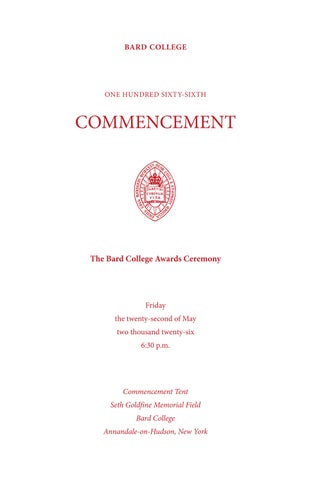
COMMENCEMENT
The Bard College Awards Ceremony
Friday the twenty-second of May two thousand twenty-six 6:30 p.m.
Commencement Tent
Seth Goldfine Memorial Field Bard College
Annandale-on-Hudson, New York
PROGRAM
Welcome
Jane Andromache Brien ’89
Director, Alumni/ae Affairs, Bard College
Remarks
Mollie Meikle ’03
President, Board of Governors, Bard College Alumni/ae Association
Daniel Mendelsohn
Charles Ranlett Flint Professor of Humanities
Leon Botstein
President, Bard College
Leon Levy Professor in the Arts and Humanities
Brandon Weber ’97
Vice Chair, Board of Trustees, Bard College
Barbara S. Grossman ’73
The Bard Medal
Audrey Lasher Smith ’78
Brooke Jude
Trustee Sponsor Faculty Sponsor
The Bard Medal
Olivia B. Carino (Antonio Fiorenza IAP ’27, trumpet)
Elizabeth Ely ’65
Frank Corliss
Trustee Sponsor Faculty Sponsor
The Charles Flint Kellogg Award in Arts and Letters
Youssef Kerkour ’00
Brandon Weber ’97 Miriam Felton-Dansky
Trustee Sponsor Faculty Sponsor
The John and Samuel Bard Award in Medicine and Science
Stanley A. Reichel ’65
Amy Bernard ’91
Kerri-Ann Norton ’04
Trustee Sponsor Faculty Sponsor
The John and Samuel Bard Award in Medicine and Science
Matthew DeGennaro ’96
Juliet Morrison ’03 Michael Tibbetts
Trustee Sponsor Faculty Sponsor
The John Dewey Award for Distinguished Public Service
Kevin A. G. Barbosa ’18
Eva-Marie Quinones ’17 (in absentia)
Hilary Pennington Jonathan Becker
Trustee Sponsor Faculty Sponsor
The Laszlo Z. Bito Award for Humanitarian Service
Imran Ahmed ’02
Charles S. Johnson III ’70 Erin Cannan
Trustee Sponsor Faculty Sponsorr
The Mary McCarthy Award
Marilynne Robinson
Kimberly Marteau Emerson Roger Berkowitz
Trustee Sponsor Faculty Sponsor
The Bardian Award
Sven Anderson
Brandon Weber ’97
Valerie Barr
Trustee Sponsor Faculty Sponsor
Closing Mollie Meikle ’03
Audrey Lasher Smith ’78
Beginning in childhood, Audrey Lasher Smith ’78 developed what would become a lifetime connection to Bard that has been consistent, strong, and true. Campus visitor, student, alumna, employee, and proud Bard parent are all terms that describe this lifelong Bardian.
Audrey was raised in Tivoli, where her family’s roots at Bard grew deep. Her father worked as a plumber for the College, and she accompanied her mother to campus, where she was typist to the esteemed Pulitzer– and Nobel Prize–winning author Saul Bellow. Audrey was entertained by drawings made for her by another faculty member, Ralph Ellison. Those early memories of Bard cemented Audrey’s determination to eventually find her way to the College on her own terms. Her first jobs involved bussing tables at the campus café in Hegeman Hall and making beds as a housekeeper with Environmental Services before she enrolled as an undergraduate.
First as a commuting student and then as a resident of Blithewood—at the time a women’s dormitory—Audrey would walk across campus with thenCollege President Reamer Kline, who engaged her in conversations about her studies. She fondly remembers classes with beloved literature professor Terence Dewsnap (1933–2020), often held, complete with cocoa and cookies, at his house on campus. While studying for her bachelor’s degree in art, she also began her tenure at the Department of Buildings and Grounds (B&G) as a first-year student and quickly became an essential member of the team. Upon graduation, B&G Director Richard Griffiths offered her permanent employment, and Audrey has remained a B&G employee to this day, ultimately serving in the leadership role of business manager.
While Audrey has been an essential member at B&G, her impact has been felt in every corner of campus. She helped found Bard Transportation and what is now officially Bard Emergency Medical Services (BEMS) in the early 1980s, where she trained to serve in this essential role. She was a dorm mentor, and, throughout her decades at Bard, she has made it a point of pride to attend events as an athletic booster, as well as arts performances— always showing up to support the students.
The relationships Audrey built at Bard will last well beyond her retirement. As she always says, “Can’t take Bard out of the girl!” Audrey Lasher Smith ’78 is part of the very fabric of the College, a true Bardian for life.
Barbara S. Grossman ’73
Brooke Jude Trustee Sponsor Faculty Sponsor
The Bard Medal honors individuals whose efforts on behalf of Bard and whose achievements have significantly advanced the welfare of the College. The Bard Medal was the inspiration of Charles Flint Kellogg ’31, who believed that Bard should establish an award recognizing outstanding service to the College.
THE BARD MEDAL
Olivia B. Carino
A woman of extraordinary energy, generosity, and spirit, Olivia B. Carino has devoted her life to the service of others. From her native Philippines to her beloved “second homes” in Hungary and the United States, she has championed cultural, educational, and humanitarian causes. Her work spans a remarkable range: supporting literary and musical organizations, animal welfare, libraries, individuals with intellectual disabilities, hospices, and medical institutions, as well as advocating for the Roma people of Hungary.
Carino joined the Bard community through her late husband, the distinguished alumnus Laszlo Z. Bito ’60. Inspired by the vision and dedication of Bard’s leadership, the couple recognized in the College a rare commitment to intellectual freedom, artistic excellence, and access to education. Together, they supported scholarships that have opened doors for generations of students, enriched the study of music and science, and made gifts that continue to shape the life of the College. While Carino shared deeply in her husband’s commitment to expanding educational opportunity, her dedication to Bard has always been entirely her own— steadfast, personal, and enduring.
Her support is distinguished not only by its breadth but by its humanity. Carino forms genuine relationships with the students she supports, extending her care through quiet acts of generosity—a word of encouragement, the gift of an instrument, or assistance in a moment of need. She has often said that this work—her engagement with students—has been among the most rewarding of her life. Her example reminds us that
Bard flourishes through the dedication of those who believe in its mission, each contributing in their own way to a shared endeavor. Through her vision and generosity, Olivia B. Carino has strengthened Bard’s intellectual and artistic community in enduring ways. Her generosity is reflected not only in what she has given, but in what she has made possible—a lasting legacy woven into the life and future of Bard and its students.
Elizabeth Ely ’65
Frank Corliss Trustee Sponsor Faculty Sponsor
The Bard Medal honors individuals whose efforts on behalf of Bard and whose achievements have significantly advanced the welfare of the College. The Bard Medal was the inspiration of Charles Flint Kellogg ’31, who believed that Bard should establish an award recognizing outstanding service to the College.
THE CHARLES FLINT KELLOGG AWARD IN ARTS AND LETTERS
Youssef Kerkour ’00
Youssef Kerkour ’00, Moroccan-British star of stage and screen, has been a leading voice in challenging stereotypes about Muslim and Arab performers.
Born and raised in Rabat, Morocco, Kerkour was formally introduced to the College while attending the Rabat American School, but he had a friend who’d gone to Bard, and so, he says, “the place already had this slightly mythic quality for me.” Initially a psychology major, he quickly realized— with the help of his adviser—that he wanted to pursue his true passion, acting, even if it was a less “practical” course of study.
“The theater department was incredibly communal,” he recalls. “It wasn’t just about performance, it was about shared effort, shared ownership, and a kind of artistic family. Later on, in professional life, that was invaluable, because you realize the best work often comes from that same spirit of ensemble, generosity, and everyone mucking in together.”
As an Arab actor in post-9/11 America, Kerkour encountered heightened stereotypes and relentless typecasting, being asked to play villains and violent characters, so he moved to England, where he continued his acting career at the London Academy of Music and Dramatic Art and the Royal Shakespeare Company. In 2019, he landed a starring role in the Channel 4 sitcom Home as Sami, a Syrian refugee who finds himself living with a suburban English family as he seeks asylum and tries to reunite with his own wife and son. This was the first complex character Kerkour had been offered, and it earned him a BAFTA Breakthrough award and nomination
for Best Male Performance in a Comedy. It also led to additional opportunities, including a starring role in the 2021 Ridley Scott film House of Gucci and a part in Scott’s 2023 film, Napoleon. He can also be seen as blacksmith Steely Pate in the Game of Thrones HBO series A Knight of the Seven Kingdoms, and alongside Natalie Portman in the 2026 film The Gallerist.
Youssef Kerkour’s generosity of spirit comes through in all his work, but it’s even more evident in how he lives his life. We are grateful for his willingness to open his heart in performance, for standing up for what he believes in, and for giving us so many laughs and tears.
Brandon Weber ’97
Miriam Felton-Dansky Trustee Sponsor Faculty Sponsor
The Charles Flint Kellogg Award in Arts and Letters is given in recognition of significant contributions to the American artistic or literary heritage. It honors Charles Flint Kellogg ’31, an internationally respected historian and educator, and Bard College trustee. Kellogg was instrumental in establishing the award, which, before his death, was given in the name of noted journalist and biographer Albert Jay Nock (class of 1892), who was also a College faculty member.
THE JOHN AND SAMUEL BARD AWARD IN MEDICINE AND SCIENCE
Amy Bernard ’91
Throughout her two-decade-long career at The Kavli Foundation and Allen Institute for Brain Science, Amy Bernard ’91 has exemplified the interdisciplinary science and philanthropic spirit that she first cultivated through her liberal arts education at Bard College. As an undergraduate, Bernard concentrated in biology, going on to earn a PhD in genetics and biophysics at University of Colorado Anschutz.
In 2005, she became a senior scientist at the Allen Institute, where she served for sixteen years and held several high-level positions, including director roles in science and technology strategy and research and development. Her work involved data delivery and analysis for a high-throughput production laboratory; managing teams of multidisciplinary scientists; and directing research in neuroscience, immunology, cell science, and brain science. She was also directly involved in the generation and collection of brain data, including the Allen Connectivity Atlas, Allen Developing Brain Atlas, and Allen Human Brain Atlas, and was product architect for the brain-map.org data portal.
In 2021, she became director of life sciences at Kavli and went on to become the vice president of science in 2024, a position she currently holds. She has been integral to the foundation’s success, where she leads programs in nanoscience, neuroscience, and scientific philanthropy. The Kavli Foundation president, Cynthia M. Friend, commented on her contributions: “Dr. Bernard is an experienced leader and innovator whose work in both academic and nonprofit research organizations has greatly contributed to the life sciences and technology fields.”
Bernard has published more than eighty articles in neuroscience, drug discovery, cell biology, molecular genetics, developmental biology, and general science. Her research focuses on gene expression and genetic signatures in brain development. She has served as a scientific adviser and expert on panels supporting organizations such as the National Institutes of Health (NIH) Common Fund Human Biomolecular Atlas Program, Chan Zuckerberg Initiative, and National Library of Medicine. She has been an invited speaker to over a dozen conferences and won prestigious grants, including several NIH awards.
Amy Bernard is a leader in academic, scientific, and philanthropic enterprises, and her work’s broad societal impacts connect scientists all over the world. The brain atlases are precise at the neuronal level, including transcriptional and histological data, and have profound implications on the understanding of the human brain. She is a worthy recipient of the John and Samuel Bard Award in Medicine and Science.
Stanley A. Reichel ’65
Kerri-Ann Norton ’04
Trustee Sponsor Faculty Sponsor
The John and Samuel Bard Award in Medicine and Science is named after two 18th-century physicians, father and son, whose descendant, John Bard, was the founder of Bard College. This award honors scientists whose achievements demonstrate the breadth of concern and depth of commitment that characterized these pioneer physicians.
THE JOHN AND SAMUEL BARD AWARD IN MEDICINE AND SCIENCE
Matthew DeGennaro ’96
Matthew DeGennaro ’96 exemplifies the Bard ethos. As a student, he designed his own multidisciplinary studies major, which allowed him to acquire the skills to pursue postgraduate work in biology while also fueling his broad-ranging interests. Between his time as an undergraduate in Annandale and starting a PhD program, DeGennaro honed his research skills in laboratories at Columbia University and then New York University (NYU), starting as a research technician and moving up the ranks to laboratory manager. For his PhD, also at NYU, DeGennaro joined the laboratory of Ruth Lehmann, a preeminent figure in the field of developmental genetics. After receiving his PhD, DeGennaro spent five years as a postdoctoral fellow in the laboratory of Leslie Vosshall, at Rockefeller University, where his interest in insect olfaction began.
In 2014, DeGennaro accepted a faculty position at Florida International University (FIU), where he has been director of the Biomolecular Sciences Institute since 2023. DeGennaro has maintained an active research career at FIU, generating nearly fifty publications, many in the most respected scientific journals, and he has written articles and op-eds in local outlets, bringing his scientific knowledge to the general public. He has also taught at the undergraduate and graduate levels, for which he has received several teaching awards.
DeGennaro’s research focuses on understanding how mosquitos find their hosts and on developing technologies to interfere with that ability. Of particular note, he developed a technique for engineering specific, targeted mutations in the genes of mosquitos, which he has used to understand the molecular mechanisms that make the insect repellent DEET effective against mosquitos.
DeGennaro has been involved with a number of community programs surrounding mosquito control, including MetroLab Network Fight the Bite Initiative (he was environment chair from 2016 to 2018), a collaboration between local governments and the academic institutions of Miami-Dade County, and an ongoing partnership with Miami-Dade Mosquito Control Division.
Matthew DeGennaro continues to model the College’s greatest aspirations. He is deeply engaged in meaningful work in the public interest, which he brings to a broad audience with the heart of an activist.
Juliet Morrison ’03
Michael Tibbetts Trustee Sponsor Faculty Sponsor
The John and Samuel Bard Award in Medicine and Science is named after two 18th-century physicians, father and son, whose descendant, John Bard, was the founder of Bard College. This award honors scientists whose achievements demonstrate the breadth of concern and depth of commitment that characterized these pioneer physicians.
THE JOHN DEWEY AWARD FOR DISTINGUISHED PUBLIC SERVICE
Kevin A. G. Barbosa ’18
Eva-Marie Quinones ’17
“Do you have time for good trouble?” Eva Quinones ’17 asked Kevin Barbosa ’18 late one evening, echoing the words she heard during the late Congressman John Lewis’s 2017 Bard commencement speech. For Eva and Kevin, “good trouble” translated into the most important of causes: defending Bard student Ali Sajad Faqirzada, who had been detained by United States Immigration and Customs Enforcement while attending a required immigration appointment in October 2025.
Tirelessly and relentlessly, Eva and Kevin committed themselves to the pursuit of justice for Faqirzada. They obtained the support of their law firm, Quinn Emanuel Urquhart & Sullivan, LLP, and represented Faqirzada in hearings. They greeted him the night he was finally released from detention in March 2026.
A commitment to community and justice are not new for Eva and Kevin.
During her time at Bard, Eva was an excellent student academically and a committed civic leader. She participated in debate and Model UN, served as an Andrew Goodman Foundation Vote Everywhere ambassador and Election@Bard lead, and spearheaded a push for a polling place on campus. Eva carried on this work after Bard, teaching debate to incarcerated women at York Correctional Institution, a women’s prison in eastern Connecticut, while she attended graduate school at Yale.
At Bard, Kevin served as speaker of the student government, engaged with efforts to support undocumented students, worked at the Center for Civic Engagement, and earned the Dr. James Brudvig Achievement Award as a
student-athlete. He carried with him the spirit of service that he developed as an undergraduate. While working at Goldman Sachs, Kevin earned a leadership award for his efforts within the Black Lives Matter movement to promote internal discussion and debate on the firm’s role in promoting racial justice and equity. At Columbia Law School, he ran a special program to bring Latinx judges to campus. Faqirzada’s case particularly resonated with Kevin, who is the child of formerly undocumented Brazilian immigrants.
Both Eva and Kevin speak of their gratitude to Bard for the scholarship support they received that made their education possible, the strong ethos of civic engagement at the College that shaped and refined their outlook on community service, and their determination to give back. Their tenacious pursuit of justice for Faqirzada represents the lessons they learned at Bard and demonstrates, as John Dewey believed, that democracy is “a way of life.”
Hilary Pennington Jonathan Becker Trustee Sponsor Faculty Sponsor
The John Dewey Award for Distinguished Public Service was established in 1990 to recognize extraordinary contributions by Bard alumni/ae and others to the public sector or in the public interest. It continues Bard’s tradition of honoring public service embodied in the Episcopal Layman Award, which was given until 1983. The award honors John Dewey, father of progressive education and advocate of a system of universal learning to advance this country’s democratic traditions.
THE LASZLO Z. BITO AWARD FOR HUMANITARIAN SERVICE
Imran Ahmed ’02
Imran Ahmed ’02 began his service to the College during his experience in the Language and Thinking Program, when he was confronted with questions related to Plato’s “Big T,” truth. “I made so many mistakes,” Imran says. “The people at Bard helped me learn what’s right and what’s wrong. Bard was the place I found my moral compass. This remains the core for me.”
Within weeks of arriving at Bard, Imran began his life of dedication to our institution. He trained as a first responder in Bard’s EMS squad, immersing himself in student life while balancing his academic study of mathematics as a Distinguished Scientist Scholar. He became a peer counselor, student government treasurer, and club head for both the International Student Organization and Muslim Student Organization, earning the Reamer Kline Award for service to the Bard community.
This foundational work would forever influence Imran’s major life decisions. After graduating, he earned his MA in international economics and finance from Brandeis University. He worked in the financial sector with McKinsey and Company, and, until 2018, the marketing and analytics company comScore Inc., when he decided to give back to his community at home. Imran returned to Bangladesh to take over the Shakti Foundation, an organization founded by his mother, focused on women’s rights and empowerment. Now one of the top ten NGOs in Bangladesh, Imran’s role as deputy executive director has helped to provide access to finance and health care, and secure legal rights for women and children, impacting more than six hundred thousand women in Bangladesh. He credits his time at the College: “My favorite part of every day is that I know that someone is better for the effort. I am making a direct impact on people. Everything I do is influenced by what I learned at Bard.”
Imran has continued his service to Bard in ways big and small since his graduation. He is an active member of the Bard College Alumni/ae Association Board of Governors, sitting on the strategic planning committee. He also works with the Career Development Office, providing internships and opportunities for current students, and he has been a regular participant in BardWorks. Imran always answers the call to help a Bardian, embodying the values of that Reamer Kline Award he received long ago—he is committed to a campus community with “high ideals, devotion, and energetic involvement in the life and work of the College.”
Charles S. Johnson III ’70 Erin Cannan Trustee Sponsor Faculty Sponsor
The Laszlo Z. Bito Award for Humanitarian Service recognizes extraordinary work by members of the Bard community on behalf of individuals threatened by injustice, violence, and tyranny. It honors Laszlo Z. Bito ’60 (1934–2021), a Hungarian freedom fighter who came to Bard in 1956 and graduated with a degree in biology. Bito was a scientist, author, and humanist devoted to the ideals of the liberal arts and a just society.
THE MARY McCARTHY AWARD
Marilynne Robinson
In her 2004 novel Gilead, Marilynne Robinson writes: “This is an interesting planet. It deserves all the attention you can give it.” Across an intellectually riveting body of fiction and essays, Robinson asks readers to look again at the people who inhabit our world—to see in them a richness of spirit and dignity too often overlooked. Her novels unfold in quiet Midwestern towns and among seemingly modest lives, yet they open onto the largest questions of existence: grace and memory, loss and redemption, and the fragile possibility that the human soul may be the singular light of existence. Attentiveness itself becomes a moral act, a way of honoring the mystery of being human.
At the heart of Robinson’s work is what might be called a romance of the self—a defense of the irreducible dignity of every human being. Against reductionist assumptions, Robinson insists that the human mind and soul cannot be explained away as mere products of biology or circumstance. She writes in Gilead that “every single one of us is a little civilization built on the ruins of any number of preceding civilizations.” Each person, in her vision, is a world unto themselves, animated by memory, conscience, imagination, and grace.
Robinson’s engagement with the life of ideas has made her the great humanist essayist of our time. In collections like The Death of Adam: Essays on Modern Thought, she confronts the contemporary tendency to reduce the richness of human life to biological explanation. Yet she does not reject science; indeed, Robinson reads scientific writing with unusual seriousness and care. What she challenges instead is the philosophical reductionism that
travels under science’s authority—the assumption that evolutionary accounts of behavior can explain the depths of human consciousness and moral imagination. Robinson reminds us that science illuminates the world but cannot exhaust its meaning.
In the spirit of Mary McCarthy, Robinson is a writer of rare depth and independence who invites us to confront the fullness of human experience. She received the 2005 Pulitzer Prize for Fiction for Gilead. For twenty-five years as a teacher at the Iowa Writers’ Workshop, she has nurtured generations of writers devoted to language, craft, creativity, and intellectual courage. At a time when many voices demean humanity as socially and biologically determined, Robinson’s work reminds us of the romance of the self—the astonishing dignity and mystery of each human life.
Kimberly Marteau Emerson Roger Berkowitz Trustee Sponsor Faculty Sponsor
The Mary McCarthy Award is given in recognition of engagement in the public sphere by an intellectual, artist, or writer. Mary McCarthy taught at Bard from 1946 to 1947 and again in the 1980s. The award honors the combination of political and cultural commitment exemplified by this fearless, eloquent writer and teacher.
THE BARDIAN AWARD
Sven Anderson
Sven Anderson, associate professor of computer science and affiliated faculty member in the Center for Experimental Humanities, arrived at Bard in 2002 with a PhD in cognitive science and linguistics from Indiana University. He brought with him teaching and research experience gained from his graduate studies and from his previous work at the University of Chicago and University of North Dakota. Anderson joined the Computer Science Program at Bard, contributing courses over the years that spanned the curriculum and included required major courses at all levels, nonmajor courses, and electives such as Artificial Intelligence, Machine Learning, and Cognitive Science. Anderson’s commitment to computer science education has been evident in his multiyear service on the program committees for several key conferences.
During his time at Bard, Anderson has played a key role in developing the Cognitive Science Concentration, today known as the Mind, Brain, and Behavior Concentration, where he held the title of concentration director for many years. Anderson also carried out two terms as program director for Computer Science and served as chair for the Division of Science, Mathematics, and Computing. In the latter role, he helped integrate the Psychology Program into the division.
Anderson’s scholarly work, much of which continues to be relevant today, has long been multidisciplinary. It crosses technology-driven fields as diverse as cognitive science, computational neuroscience, artificial intelligence, ornithology, audiology, phonology, music, and early childhood pedagogy. His research interests include various aspects of natural language
processing and text analysis, neural network learning, neural modeling of temporal processing in the avian song system, the combination of speech and nonspeech sounds in human/computer interfaces, and computer science pedagogy for specialists in other disciplines. His wide-ranging publications have addressed an eclectic range of topics such as lexical document simplification, coding and music creation, phonological awareness in preschool children, linking language and code, and automatic recognition of birdsong syllables.
His work has appeared in such publications as Computational Neuroscience, IEEE Transactions on Speech and Audio Processing, Journal of the Acoustical Society of America, Journal of Phonetics, and Neural Representation of Temporal Patterns. Anderson received a National Science Foundation grant and a National Institutes of Health grant for the study of phonological awareness in children with language impairment. His distinctive research and teaching have intersected in meaningful ways with the innovative work taking place at the Center for Experimental Humanities.
Brandon Weber ’97
Valerie Barr Trustee Sponsor Faculty Sponsor
The Bardian Award formalizes the Bard College Alumni/ae Association’s tradition of honoring the service of longtime members of the Bard community.
THE BARD COLLEGE ALUMNI/AE ASSOCIATION
The Bard College Alumni/ae Association is open to all alumni/ae who have attended Bard College as an undergraduate or graduate student in Annandale or at another campus, as well as those who have attended our Bard network institutions. The Bard College Alumni/ae Association is led by the Alumni/ae Association Board of Governors and serves to strengthen the engagement between the College and alumni/ae, offering them a lifelong connection to Bard. More than 19,000 Bard alumni/ae are spread around the country and across the world.
Recipients of the Bard College Awards are selected annually by the Board of Governors Nominations Committee in conjunction with Bard faculty and staff. These awards recognize exceptional achievements by alumni/ae and friends of the College in the fields of arts, science, public service, and humanitarian service. Previous recipients have included Chidi Chike Achebe ’92, Ashim Ahluwalia ’95, José A. Aponte ’73, László Z. Bitó ’60, Mary Caponegro ’78, Christopher Guest ’70, Ann Ho ’62, Erik Kiviat ’76, Layli Long Soldier MFA ’14, Rita McBride ’82, Juliet Morrison ’03, Brianna Norton ’00, R. H. Quaytman ’83, Karen Saxe ’82, Carolee Schneemann ’59, Billy Steinberg ’72, Ilyas Washington ’96, Alexandra Elliott Wentworth ’88, and Adam Yauch ’86.
The Bard College Alumni/ae Association congratulates all alumni/ae, friends, and faculty of the College who are honored here tonight. The Alumni/ae Association also recognizes and thanks everyone who has supported Bard in the past year.

DONORS MAKE DEGREES POSSIBLE