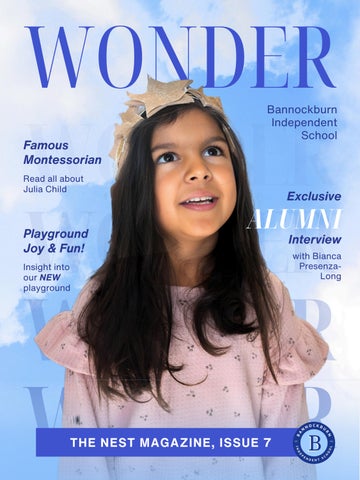
WONDER WONDER WONDER WONDER WONDER Famous Montessorian
Bannockburn Independent School
Read all about Julia Child
Playground Joy & Fun!
Exclusive
ALUMNI
Insight into our NEW playground
THE NEST MAGAZINE, ISSUE 7
Interview
with Bianca PresenzaLong
The Nest is a thrice-yearly publication published by Bannockburn Independent School to highlight our school community. A leading Montessori school, Bannockburn is recognized throughout Toronto for its outstanding academic standards, its steadfast commitment to Montessori education, and its deep respect for the potential of every child. Bannockburn Independent School is fully accredited by Montessori Canada a member of the Conference of Independent Schools (CIS) an approved candidate school for the Canadian Accredited Independent Schools (CAIS) For questions or concerns about this magazine, please contact Erica Fyvie at e.fyvie@bannockburn.ca.
Issue 7 December 2025
Writer and Editor Erica Fyvie Designer Hetvi Gandhi We would like to thank all of the contributors for their time and enthusiasm on this project:
Julia Child Chelsea Chiu Jasper Chiu Wesley Chiu Riley Fidieman Lola Lasky Bianca Presenza-Long Jacqueline Richman Sharon Robinson Maya Shah Veera Shah Julia Volkman Chelsea Yeung Luca Yuzbasiyan
Bannockburn Independent School
The Nest
Bannockburn Independent School Magazine
3080 Bayview Avenue North York, ON. M2N 5L3 (416) 789-7855 www.bannockburn.ca
Table of Contents 1
2
3
Letter from the Head of School
One Question: Wonder
Alumni Interview: Bianca Presenza-Long
5
7
9
What Makes Up Your Workspace: Art
Thought Leadership: TED Talk
New Playground Article
13
15
Q&A: Kids of the BPA Chairs
Famous Montessorian
December 2025
Wonder, the theme of this issue, is an innately personal thing. Many of us would gaze in wonder at the fleeting brilliance of a shooting star, or pause in awe at the shimmer of the Northern Lights, but daily acknowledgments of wonder are individual. As parents of young children, you are a likely witness to wonder all the time: first steps, first words, first ice cream. Everyday with young children is filled with wonder. When you work at a school, it is a privilege to have a front row seat to observe the moments of wonder in the lives of our students. When a student completes an intricate piece of work, I witness wonder on a child’s face. When a teacher shares the excitement of a student's academic achievements, I see wonder on the teacher’s face. It is these moments of wonder that make our faculty’s extensive time training for this work and their daily dedication immensely rewarding. Approximately 2400 years ago, the Greek philosophers Plato and Aristotle said that wonder was a main principle of philosophy and that it was the first manifestation of something intangible that moved human beings towards reality. That reality included a desire to learn and grow. Here at Bannockburn, everyday we work to keep our students in this beautiful state of wonder, while watching as the seeds of knowledge continue to grow.
In this issue of The Nest, we take the time to share some wonders that we are currently celebrating, such as what our new playground means for the community, the wonder of Montessori-led brain development in a TED Talk by Julia Volkman, and a look back at Julia Child, famous Montessorian, who managed to convey wonder during her entire career. With appreciation for all that is wonderful, please read on! Warmly,
Jacqueline Richman, Head of School
Primary: Luca
UEL: Chelsea
“I play on the Aces, my hockey team. I wonder how goalies do it.”
“I wonder about geography. I wish I knew all the capitals in the world.”
LEL: Riley “I wonder how technology works, like how they can make cameras that go underwater.”
What do you wonder about? The Nest Magazine
02
Exclusive Alumni Interview with
Bianca Presenza-Long Wonder, our theme in this issue, is both the feeling of surprise at the inexplicable, plus the desire to know more, to dig deeper. Interviewing Bianca PresenzaLong, Class of 2015, actually helped us to decide on a theme because she represents both. Reflecting on her time at Bannockburn, she demonstrated awe and gratitude for her time here, as well as insatiable educational curiosity.
After graduating from Bannockburn in 2015, she went to Branksome Hall where she thrived in the International Baccalaureate program. “My time at Bannockburn had a huge influence on my academic journey. I felt incredibly prepared heading into middle school at Branksome Hall, even though it was my first time doing homework or writing nonstandardized tests. Much of what I learned in Grade 7 and 8 had already been introduced at Bannockburn, which gave me a real head start and a lot of confidence. Bannockburn taught me timemanagement skills, analytical skills, and social skills, all of which set a strong foundation for everything that came after my elementary graduation.” After graduating from Branksome Hall on the Dean’s Honours List, she pursued Political Science and Philosophy at McGill University, where she earned her Bachelor’s degree, graduating with distinction. She also enjoyed building community connections there in different departments. At McGill, she served as Events Coordinator for the Political Science Students’ Association, worked as a research assistant for a Political Science professor, and was the Director of the McGill Men’s Hockey Alumni Association. She credits Bannockburn with expanding her idea of community and what it means to be a part of something bigger.
“The culture at Bannockburn was incredibly friendly and welcoming. Everyone, whether teachers, students, or staff, genuinely wanted to see each other grow and succeed. There was always an emphasis on curiosity, collaboration, and developing skills that would be useful far beyond the classroom.” One memory, in particular, reminds her of how a culture of respect and community resonated in her young life. “I remember one time we had a lesson on how to give a good handshake, and although seeming silly at the time, to this day I can still hear Mr. Pollard’s voice in my head reminding me how to approach a handshake anytime I meet someone new. Bannockburn was truly a community that fostered not only the love of learning, both academic and personal, but also a deep sense of kindness.”
Bianca felt lucky to have that kindness extend to how and what she learned. Her favourite subjects, math and science, were taught in intentional, helpful steps. “My teacher Ms. Paul always encouraged us to push ourselves and work on more difficult problems. We were able to learn at our own pace, and were also given some control over what exactly we were learning—especially in science. If you wanted to explore a particular topic, you would tell Ms. Paul what you were interested in, and by the next day she would have a carefully curated lesson that was always fun to engage in, but also highly educational. This opportunity to truly pursue our own interests was so integral to my Bannockburn experience and a true highlight.” She felt that all of her teachers here had, “in their own way, a positive impact on my experience at Bannockburn. Whether it was their passion for teaching or the way they made learning fun, they really helped shape how I approached school and learning. They were more than just teachers—they were role models that I admired and whose guidance and example left a lasting impression on me.”
That lasting impression continues today. When asked what she’s doing now, she excitedly reported, “I’m in Law School! This September, I began studying law at the University of Ottawa and I’m loving the intellectual challenge in preparation for a future career in law, or if my dream comes true, in a leadership role with the NHL.” In the spirit of gratitude and community, she shared some thoughtful advice to our current students. “If I could give any advice to current Bannockburn students, it would be to make the most of the school’s unique environment. Smaller classrooms and mixed grades create an opportunity for older students to be leaders and for everyone to learn from each other. Embrace the non-traditional learning structure as it allows you to explore what truly interests you. Embrace all that Bannockburn nurtures—curiosity, kindness, and the confidence to ask for help—as these qualities will serve you well in every aspect of life, far beyond the classroom.”
Bianca, you are a wonder to us! The Nest Magazine
04
Lola Lasky, Art Teacher
f o s r a J ons Cray w o b n i R a in t Pa
A r t ist s W ork at
Finger Puppets!
Bird Collage
M y Apron
Robot
Line Man
WHAT MAKES UP YOUR WORKSPACE?
Jars of Crayons “The supplies are a big part of the artistic process. Throughout the year we use everything: paint, crayons, pastels, chalk, charcoal, you name it.”
Finger Puppets! “These are just fun to look at, for me and the students. Left to right in the top row is Van Gogh, Diego Rivera, Keith Haring, and DaVinci. Bottom row left to right is Monet, Jackson Pollack, and Picasso.”
Robot “A robot made of recycled materials is a great lesson for some of the older elementary students. They love knowing that a discarded item can help make art.”
Bird Collage “This was made for last year’s Earth Day Art Show. The students love to see their names on the feather design.”
Artists at Work “Around the room I have posted different examples of what an artistic career can look like. I think it inspires them to know how much art can influence different kinds of work when they’re older.”
Rainbow Paint “I like to line up bright colours together because it draws them in (pun intended). The materials are accessible for the students because this is their space for creating.”
My Apron “The students love this apron from my native Mexico City. It’s based on a popular children’s game there, like a lottery.”
Line Man “Nothing in my Art Room is more popular than Line Man! A vertical line is when he’s awake, when he’s sleeping it's a horizontal line, and falling asleep is diagonal. He’s so popular that he has his own fan art!” The Nest Magazine
06
Montessori Thought Leadership
TED Talk with Julia Volkman
“When we’re learning, we have a heavy cognitive load. It takes a lot of our brain resources to do the one thing we’re doing, or the one thing we’re learning. The brain doesn’t like having a heavy cognitive load. Anything it has to do a lot, it builds a shortcut for. But these overcrowded connections are really inefficient. This is why it takes kids forever to do anything. It’s not the children’s fault that they’re so slow; it’s just their really overcrowded brains! But as you do things again and again, the brain removes the connections it doesn’t need.” Put another way, “When you’re interested in what you’re doing, it’s easy to practice.” This is a core of Bannockburn’s interest-led curriculum. Julia shares a great example from her own time as a Montessori teacher.
Julia Volkman: “The type of school you go to may influence brain development in measurable ways.” Julia Volkman has been a teacher and mentor in private and public schools since 1997. Her impressive pedigree includes earning a Master’s degree from Harvard University and an AMI 3 to 6+ diploma from the Montreal Montessori Training Centre, as well as being a faculty member of the Brain Health Initiative, a guest lecturer for Harvard University’s Neuroscience of Learning course, and an indemand researcher and speaker. Her work focuses on transforming education into a transdisciplinary, scientific pedagogy grounded in mind, brain, and education. In a recent TED Talk, she spoke about how we learn, a topic of considerable interest here at Bannockburn. Some people refer to it as the Montessori thinking of “meeting a child where they are,” and here she elaborates on the science behind that principle.
“I had a six-year-old student named Robbie. Robbie couldn’t read, and he didn’t want to practice any of the letter and sound activities. Robbie was an animal lover. All he wanted to do was look at books about animals and draw pictures of animals. One day, Robbie had a field guide open to a page about chuckwalla lizards. I pointed and said ‘chuckwalla, chuckwalla … Do you want to copy that down?’ He said yes and wrote it down. And then he started writing nonstop, copying down all these animal names. Three weeks later, Robbie started to read. It was his interest that overcame his challenges.”
The research shows that this kind of curriculum fosters a more well-rounded education: ”Students in more student-led, interest-driven schools score higher on measures of creativity, attention, self regulation, and social interaction. Researchers scanned the brains of students who went to traditional schools that were more teacherled and test-driven and compared them with the brains of Montessori students. The Montessori students had greater neuronal stability and greater network integration.”
She summaries three truths about the brain that work for everyone: 1. One size does not fit all when it comes to the brain. 2. The more we practice things, the easier they get. 3. We repeat what interests us. If the only thing your child wants to do is math and isn’t a strong reader, our teachers will see that and write out a math problem. She uses this as an example of interest being the driver that channels the desire to learn. “Interest is learning’s superpower.” The schools that emphasize this kind of learning have teachers who are willing to write out a math problem for a reluctant reader. The distinction here is about sparking student interest and generating real interest in a variety of topics. At Bannockburn, the students choose their work from the earliest ages and determine how long they need in an internally-focused engine.
Her advice to teachers and adults who support children’s learning is a threepronged approach: 1. Be flexible with timelines because no two brains are alike. 2. Find reasons and opportunities for students to repeat and go deep because repetition makes things easier. 3. Help students develop their interests and turn them into fields of inquiry. Does appreciating that no two brains are alike, finding opportunities to go deep, and helping students follow their interests sound familiar? To us, it sounds like developing a state of wonder. True curiosity is lifelong and means you will always learn and your brain will always change. Your brain is different now than it was when you began this article!
Watch the TED Talk here:
The Nest Magazine
08
New Playground Brings Joy
and Fun to Bannockburn Students Before
Students had an extra reason to smile at Bannockburn Independent School this term when their new playground was unveiled on Friday, October 31st. This much anticipated playground revitalization was met with cheers, applause, and a ribbon cutting ceremony.
This new playground project has been a source of fascination since it began! The project took months and months of research, planning, and decision making. When the work finally began, the removal of wood chips was step one, and then the dismantling of the old playground structure. Next, days of digging, levelling, and refining. Increased square footage, a dedicated soccer turf area, new fencing, rubber flooring, and a brand-new structure have captivated our student body. This project was funded by the Bannockburn Foundation, the BPA, and the generous donations of our families. Head of School, Jacqueline Richman, is thrilled with how the project came together:
“Our Playground Revitalization Project stands as a wonderful example of what our community can achieve together. The incredible spirit of Bannockburn was evident through the generous support of our families, the BPA, and the Bannockburn Foundation, which allowed us to transform our outdoor space into a vibrant new playground that enriches our students’ daily experiences.”
Business Manager, Sharon Robinson, agrees:
“I feel very fortunate to be able to look outside the windows of the school and see the new Bannockburn playground—a happy space that has quickly become a favourite place for our students. It's truly wonderful to see the children out there connecting with friends, getting some exercise, and having lots of fun!” Sharon added that “Thanks to the generous support of individual donors, the Bannockburn Parent Association (BPA) and Bannockburn Foundation, this project has transformed from an idea to an inviting space that will benefit students for years to come! My deepest gratitude to everyone who supported this special project!”
The benefit to students was remarked on by teachers from the beginning. More physical activity, student well-being, and even more active playtime between the grades have all been noted as positive outcomes. For everyone at Bannockburn, this new space has resulted in increased community involvement and pride. It is wonderful when high expectations are met with an even greater reality! Thank you to all who donated generously for everyone to play safely and have endless fun. The Nest Magazine
10
Kids of the BPA Chairs
Q&A
Jenn Hwang and Niyanta Shah are co-chairs of the Bannockburn Parents’ Association. In this role, they plan and run several events during the school year, like the Ice Cream Social, Starlight Market, Family Skate, and Fun Fair. Their dedication to the school does not go unnoticed by their children! I wanted to ask them more to see what they think of their moms’ volunteering and community involvement.
you ever help them with their events? Q Do If so, what do you do? W: Sometimes we help with clean up, like bringing the folding table back to the office and returning the pens. C: I help with the Starlight Market. For example, I clean up. J: Sometimes I help count the money and help with the sales, telling customers how much things cost. We’re learning how to fundraise with the grad fundraisers and this year I want to help the BPA Chairs to sell more things.
do you think the events they plan help to Q How make Bannockburn better?
J: I think they help make Bannockburn better by making a tighter school community and help make everyone friends with each other. It’s a very wholesome community. C: And kids like it a lot because it’s very fun. you could plan your own school event, what Q Ifwould it be? Jasper, Wesley, and Chelsea Chiu
you know what your mom does for the Q Do parents' association? J: I know that my mom helps make the events—she designs and helps execute them. She also volunteers in situations when they need an extra volunteer for BPA fundraisers. C: She sets up stuff sometimes and she cleans up.
W: Maybe there’s an entry fee and prize for the winner of a paper airplane contest. C: Going outside and picking up a leaf from the floor, or anything else like a rock.
Q Or an acorn or pinecone? C: Yes. You can also spot some animals. J: Maybe the school could go on a hike and make friends and see nature. The parents can join us in the forest.
does it make you feel to help your mom Q How with things at the school? V: Happy and grateful. do you think the events they plan help to Q How make Bannockburn better? M: By doing all the work. V: Getting the kids who aren’t in the same class together. Even the parents can come together.
you could plan your own school event, what Q Ifwould it be? V: A trampoline park for the whole school!
Q Would you serve any food? V: Yes. And juice and water. And cake.
Q What kind of cake? Both: Chocolate! Veera and Maya Shah
you know what your mom does for the Q Do parents' association? M: Helps with stuff. V: She organizes the Fall Sale and the Fun Fair and all of the events.
Q Do you know what the word volunteer means? V: When you say you’ll help with something. you ever help her with the events? Q Do If so, what do you do? M: Clean up and tidy up! V: She means set up and clean up! I help with set up and tidy up at all the events. At the Fun Fair, Maya and papa go and I stay to help.
kind of things do you do? Q What Do you help to carry things? V: Yes, I help carry stuff to the tables sometimes. At the Ice Cream Social I helped to tidy up and unstick everything on the tables. Maya helps pick things up and carry them over to mom.
The Nest Magazine
14
Famous Montessorian
Julia Child Famous chef, author, and television personality, Julia Child, loved French cuisine and inspired home cooks to appreciate it as well. She was born on August 15, 1912 in Pasadena, California. As a young child, she attended a Montessori school that allowed her to develop her coordination, which would later be so important in her work.
Montessori—with its emphasis on independence, practical life skills, and hands-on learning—naturally incorporates lessons on cooking.
The same lessons that worked for Julia Child as a child are the same ones that all successful cooks can share: create a space that is accessible to you, with the correct tools; participate in all parts of the process like washing, measuring, and cutting; practice math and reading by following recipes.
In the book, Julia Child & Company, she writes, “Influenced by my early experience at a Montessori school, and surely by living in a clan full of carvers, painters, carpenters, and cooks of all ages, I am all for encouraging children to work productively with their hands. They learn to handle and care for equipment with respect. It is good to give them knives, for instance, as early as you dare. A knife is a tool, not a toy. A sharp, clean knife is safer to use than a dull, rusty one—easier too: a four-year-old will discover that for himself as you teach him to slice a hard-boiled egg neatly and then to fillet a fish. Talk to children as you plan menus. Work together at the counter and let your children arrange platters.”
Pursuing cooking in any skillful way requires a series of repetitive motions that help build fine motor skills, handeye coordination, and a sense of responsibility.
Julia Child learned this as a very young child, through the Practical Life curriculum, which is an important part of the Montessori curriculum. Montessori also exposed her to keeping her workspace clean and organized and taking great pride in her work. “The small rituals, like the clean hands and clean apron before setting to work; the precision of gesture, like leveling off a cupful of flour; the charm of improvisation and making something new; the pride of mastery; and the gratification of offering something one has made—these have such value to a child.” The Nest Magazine
16
Cultivating Curiosity Nurturing Potential Empowering Independence
Bannockburn Mission Statement Bannockburn develops responsible, nurturing, peaceful young people with self-esteem and respect for others. Bannockburn graduates are selfmotivated, intellectually curious students who love learning and who achieve academic success.
Contact 3080 Bayview Avenue, North York, ON. M2N 5L3 (416) 789-7855 | www.bannockburn.ca | reception@bannockburn.ca