Welcome to the Bank Street Continuing Professional Studies Summer 2026 course offerings!
This year is particularly special as we celebrate the 55th anniversary of CPS. As we step toward the end of the school year, we’re thrilled to present a range of short-format classes designed to ignite your curiosity and support your professional growth. This summer, explore an expansive selection of workshops including some of our most popular classes: Sounds In Motion (p. 5), Constructing a Democratic Classroom (p. 10), and Restorative Practices in the Early Years (p. 11). We are especially excited to introduce new classes on Infant Developmental Movement (p. 5), Printmaking in the Classroom (p. 8), and Fun with High-Frequency Words (p. 8).
Be sure to check out our special events, including the 39th Annual Infancy Institute, where we will explore “Shifting from Developmentally Appropriate to Developmentally Meaningful Practice.” Additionally, our Summer Math Conference offers K-12 educators a dynamic two-day experience to explore mathematics as a connected, sense-making endeavor. For those looking to expand their perspectives globally, join us for the 2026 Long Trip to Guatemala also known as the “land of eternal spring.”
Whether you are joining us for state-mandated training or a workshop, we look forward to connecting with you and supporting your vital work in education.
Sincerely,
Joy Ellebbane Director, Continuing Professional Studies
SPECIAL EVENT
EDUC612N
2026 INFANCY INSTITUTE
Shifting from Developmentally Appropriate to Developmentally Meaningful Practice
Join us for our 39th Annual Infancy Institute. Professionals who work with infants and toddlers will come together for presentations and virtual workshops focused on curriculum development, challenging behaviors, working with families, emotionally responsive practice, and more. This early childhood development conference includes guest speakers and workshops.
KEYNOTE: Culture on the Table: Cultural Self-Awareness as Professional Practice
Keynote Speaker: Melina Gac Levin
June 15, 16, and 17 | On Site*
Monday, 10:00 AM – 4:15 PM ET
Tuesday, 9:30 AM – 4:00 PM
Wednesday, 9:30 AM – 3:15 PM
*Bank Street College | 610 West 112th Street, New York, NY
bankstreet.edu/infancy-institute
2026 SUMMER MATH CONFERENCE
Math Connections: Making Meaning Together
Bank Street’s Summer Math Conference is a dynamic two-day professional learning experience for K–12 educators, coaches, and school leaders. The conference invites participants to experience mathematics as a connected, sensemaking endeavor in which ideas build, representations reveal, and learners make meaning together. Through experiences grounded in doing mathematics together, collaborative reflection and discussions, and an inspiring keynote, participants will explore how to bring this vision to life in classrooms.
August 3 and 4 | On Site
Monday and Tuesday, 9:00 AM–4:30 PM
Bank Street College of Education
610 West 112th Street
New York, NY 10025
Participants can earn 13 CTLE hours by attending both days of the conference.
Visit bankstreet.edu/math-conference or email zbrowne@bankstreet.edu.
THE 2026 LONG TRIP
Guatemala: August 10–16, 2026
Join us to learn about indigenous education in a country known as the “land of eternal spring.” Experience the vibrant Mayan culture and a sensory-rich landscape of volcanoes, lakes, and colorful markets while engaging with local educators and communities.
Program Director Cristian Solorza will lead this year’s Long Trip to Guatemala. He is a faculty member in the Dual Language/Bilingual Education and Teaching English to Speakers of Other Languages (TESOL) programs at Bank Street’s Graduate School of Education. Cristian took his first Long Trip in 2007 to Reykjavik, Iceland and was hooked. After attending seven more Long Trips and leading the 2025 program to Puerto Rico, he is now excited about this year’s program.
EARLY CHILDHOOD
SETE513N
Bibliotherapy in the Early Childhood Setting (Grades Preschool–3)
Bibliotherapy is the art of using children’s literature to help children understand difficult experiences and resolve developmental issues that interfere with their growth. You will learn how to choose books that address developmental and experiential difficulties. You will also explore how the use of story can help children better understand their own personal experiences, and you will learn how to make books that address children’s individual and group needs. Instructor: Margaret Blachly
July 14 and 16 | Online*
Tuesday and Thursday, 9:00 AM–3:00 PM ET 12 CTLE or 1.2 CEU $425 / 1 credit $1,924
Registration Deadline: 7/7 *2.5 hours of asynchronous work required
TEWS869N
Make-Believe Gun Play in a World of Gun Violence (Grades Pre-K–2)
Gun violence is a uniquely American phenomenon that impacts children, families, teachers, and school communities throughout the nation. We will explore the context surrounding gun violence in the US, and examine the complex relationship between gun violence and children’s play. Participants will have time to explore their own experiences of children’s pretend play, as well as school and classroom policies that might impact their work in the classroom. The session will utilize whole group, pair-share, and individual reflection. Instructor: Nicole Limperopulos
July 14 | Online
Tuesday, 5:30 PM–8:00 PM ET 3 CTLE or .3 CEU / $120
Registration Deadline: 7/7
EDUC606N
Block Building and Dramatic Play as an Integral Part of the Early Childhood Curriculum (Grades Pre-K–2)
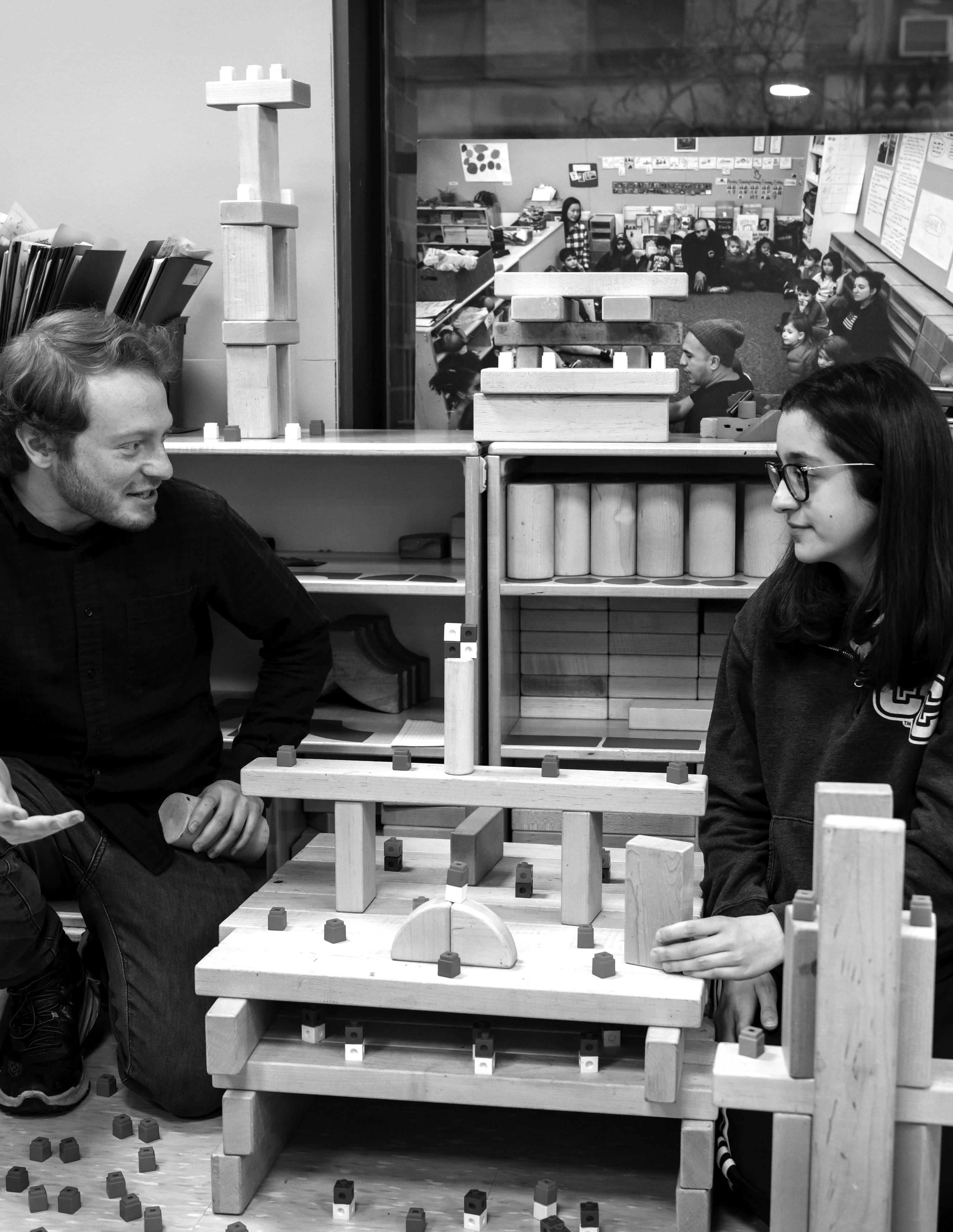
Unit blocks and the dramatic play that accompanies block building offer children multiple and diverse opportunities to develop and express their understanding of the social and physical world in which they live. In this course, you will learn how to integrate block-building experiences into the curriculum and organize block-building areas in the classroom. You will examine how block building supports the development of numeracy, literacy, problem-solving, and creative thinking skills, along with social and emotional growth. Field trips—and the opportunities for the first-hand research that they provide—are an essential component of a block program, and will also be included. This course will also support participants in settings with limited or no blocks in applying a broader understanding of the importance of play with open-ended materials and advocating for such experiences in their settings. Instructor: Elise Bauer
Section 1
July 20, 21, and 22 | On Site *
Monday, Tuesday, andWednesday, 10:00 AM–2:00 PM ET 12 CTLE or 1.2 CEU $425 / 1 credit $1,924
Registration Deadline: 7/13
*Held at City and Country School, 146 W 13th St, New York, NY 10011
Section 2
July 27, 28, and 29 | On Site*
Monday, Tuesday, and Wednesday, 10:00 AM–2:00 PM ET 12 CTLE or 1.2 CEU $425 / 1 credit $1,924
Registration Deadline: 7/20
*Held at City and Country School, 146 W 13th St, New York, NY 10011
TEED654N
The Reggio-Emilia Approach: From Theory to Practice (Ages Infant–5 Years)
The early childhood program founded in Reggio-Emilia, Italy incorporates an emphasis on the learning environment, process vs. product, developmentally appropriate practice, and the importance of the community of learners. Much of this philosophy reflects the culture of the Italians and is difficult to recreate in the United States. This course is meant to provide an introduction to the approach and will attempt to bridge the Reggio-Emilia theory with American culture. We will view the Reggio-Emilia approach as a means to combat the push-down curriculum, competition, product over process, and the jumping/skipping of learning stages we are now experiencing in this country. Instructors: Patricia Watkins and Rafa Perez-Segura
July 13, 14, 15, and 16 | Online*
Monday–Thursday, 6:00 PM–9:00 PM ET 12 CTLE or 1.2 CEU $425/1 credit $1,924
Registration Deadline: 7/6 *2 hours of asynchronous work required
TEWS894N
Making Creative Curriculum Work in Real Classrooms (Preschool, Ages 3–5)
This class supports teachers who use Creative Curriculum with diverse children and families. We will explore strategies for making the curriculum flexible, realistic, and child-centered while still meeting program expectations. Whether your classroom is socio-economically, ethnically, racially, or linguistically diverse, participants will learn how to navigate mandates without sacrificing child-centered practice or teacher autonomy. Instructor: Angelica Pilgrim
July 20 | Online
Monday, 10:00 AM–1:00 PM ET 3 CTLE or .3 CEU / $120
Registration Deadline: 7/13
TEWS693N
Sounds in Motion: The Development of Auditory Perception and Early Literacy Through the Use of Body Movements (Pre-K– Grade 1)
This workshop is designed to teach educators a unique, engaging, and effective program that helps early learners in both regular and special education classes acquire phonemic awareness, listening, early literacy, vocabulary, and articulation skills through the use of body movements. The program has been shown to be beneficial to children who are English language learners and students who qualify for Title 1 schools. You will learn body movements for 40 phonemes, along with techniques for teaching developmental listening and language skills. Instructor: Stephanie Kuhnel
July 21 | On Site*
Tuesday, 9:00 AM–4:00 PM ET 6 CTLE or .6 CEU $275
Materials Fee: $80 (Includes required materials)
Registration Deadline: 7/14
*Held at Bank Street College, 610 West 112th Street, New York, NY 10025
TEWS874N
Culturally Responsive Practice to Foster Resilience (Grades Pre-K–5)
Resilience is often described as “bouncing back” from adverse experiences (Levine, 2003). What makes this bouncing back possible are relationships to self, family, and community. We will use developmental and ecological models for understanding children’s lived experiences as tools for identifying culturally sustaining practices that view children and families through a strengths-based lens. The goal is to identify community supports, including cultural and spiritual practices, that you can incorporate into your curriculum to foster connections to others, facilitate self regulation, promote a positive view of self, and increase inner strength. You will develop your capacity for observation and assessment to deepen your practice around environmental design, materials, and curriculum to foster resilience. Instructor: Genevieve Lowry
July 22 | Online
Wednesday, 1:30 PM–3:30 PM ET
2 CTLE or .2 CEU $35
Registration Deadline: 7/15
TEWS892N
Infant Developmental Movement and Cognitive and Social-Emotional Development (Ages Birth–2 Years)
This workshop explores how early movement, from birth through early speech, relates to cognitive, social-emotional, and relational development, based on the principle that all behavior is communication. Participants will examine how embryological organization, motor progression, primitive reflexes, and relational experience shape development. Integrating theory, attachment research, neurobiology, and embodied observation, the workshop offers educators and therapists practical tools to observe, evaluate, and facilitate healthy motor and relational development. Participants will deepen their capacity to “be with” children in ways that support regulation, integration, and learning. Instructor: Ellyce di Paola
July 22 | Online
Wednesday, 12:00 PM–2:00 PM ET
2 CTLE or .2 CEU $95
Registration Deadline: 7/15
TEWS893N
Journey to Nia®: Purposefully Supporting Black Children to Thrive in Early Childhood (Ages Infant–10 Years)
Black children are magical. However, they experience a staggering number of disparities beginning in their earliest years. In this interactive class, you’ll be supported to understand the history of anti-Black racism and its impact on Black children, and you’ll develop an action plan to create spaces for Black children to thrive in your setting. Journey to Nia® is a professional development experience guided by a curriculum rooted in history, research, and racially and developmentally appropriate practices. This class is appropriate for all early education professionals, no matter the racial demographics of the children in your care. Instructor: Takiema Bunche Smith
July 22 | Online
Wednesday, 12:00 PM–2:00 PM ET
2 CTLE or .2 CEU $95
Registration Deadline: 7/15
TEED656N
Constructing a Democratic Classroom: Focus on Routines, Rules, and Transitions (Ages 3–9 Years)
Routines, rules, and transitions may be thought of as providing the framework for the daily life of the classroom. The way in which they are constructed and carried out strongly affects the social, moral, and academic atmosphere in the setting. What does democracy mean in relation to routines, rules, and transitions? How can children have a voice in determining them? The ultimate goal is not simply to create order, but also to encourage the development of both autonomy and a caring community. Topics to be considered are: views of the nature of the child, developmental appropriateness, flexibility, the needs of English language learners and children with developmental variations, issues around power and control, the meaning of resistance, and how routines and transitions relate to academic learning and the various curriculum areas, particularly social studies. You will examine and analyze the structures in your own and each others’ classrooms. Instructor: Candace Barriteau Phaire
July 27 and 29 | Online*
Monday and Wednesday, 10:30 AM–3:30 PM ET 12 CTLE or 1.2 CEU $425 / 1 credit $1,924
Registration Deadline: 7/20
*3 hours of asynchronous work required
TEWS889N
Injecting Joy into Reading Instruction (Pre-K–Grade 6)
As aliteracy (the ability to read proficiently but the choice not to) rates soar and AI large language models threaten the need to read at all, it’s more important than ever that we inspire kids to read for pleasure. This course introduces strategies to inject joy and agency back into reading instruction, along with strategies that invite kids to lean into the magic of disappearing into a book and sharing their unique reactions to the text. Practical resources, such as reading responses, interactive read-aloud strategies, book club prompts, and mentor texts, will be shared with participants. Instructor: Lily Howard Scott
July 28 and 30 | Online
Tuesday and Thursday, 11:00 AM–1:00 PM ET 4 CTLE or .4 CEU $195
Registration Deadline: 7/21
TEWS715N
Motor Play to Enhance Growth in the Classroom (Ages 1–6 Years)
This class will demystify concepts, such as sensory processing, regulation, and sensory integration. You will learn how motor play can impact energy level, attention, and a child’s ability to improve organizational skills. You will complete the course with a toolbox of activities to enhance fine and gross motor development along with strategies to keep children alert, energized, and in control in the classroom setting. Discussion will include how to collaborate with families and caretakers in using motor play to extend skillbuilding to the home environment, along with new neuroscience research underscoring the importance of sensory motor play for brain organization and building the foundation for lifelong learning. Instructor: Jill Mays
The course examines the play of neurotypical and neurodiverse children and the impact of individual differences in sensory and motor processing on development and play. A core feature of the course is how to employ the Developmental-Individual Difference-Relationship Model (DIR/Floortime) to progress play with children on the autistic spectrum. DIR expands and promotes symbolic play, the capacity to express the full range of emotions, and the ability to regulate anxiety and behavior using a teacher-caretaker mediated approach. This course presents the developmental spectrum of play and the manner in which play supports the formation of self-regulation, is selfrealizing, addresses all areas of development simultaneously, and is spontaneous and intrinsically motivated without the need for teacherdirected tasks. We will examine these themes as concept and practice. Throughout the course, you will have the opportunity to discuss challenges you may encounter related to children with whom you are working. The relationship between the material being presented and the use of play for both expressing and working through trauma will be addressed. Instructors: Gilbert Foley and Serena Wieder
August 3 and 4 | On Site*
Monday and Tuesday, 9:00 AM–4:30 PM ET 12 CTLE or 1.2 CEU $425 / 1 credit* $1,924
Registration Deadline: 7/27
*Held at Bank Street College, 610 West 112th Street, New York, NY 10025
“I came away with technical knowledge of how to observe children’s motor development as well as ways in which I can support the children’s development.”
CHILDHOOD
TEWS867N
Brain-Changing Words: Bite-Size Phrases that Transform How Kids Think, Feel, and Achieve at School (Grades K–8)
Neuroscientific research suggests that language is not separate from thought, but a part of thought itself. What we say and what we hear creates neural pathways that trigger brand-new patterns of thinking, and until a learner is exposed to a word or a particular combination of words, epiphanies lie dormant. For instance, a teacher’s unusual pairing of the words “brilliant” and “mistake” in the phrase “what a brilliant mistake!” can rewire how a child responds to making mistakes, replacing feelings of shame with self-compassion and resilience. Teachers who share bite-sized, literally brain-altering language with students (who repeat this language to themselves as positive self-talk) can transform how students feel, and therefore do, in the classroom and beyond. In this course, I’ll introduce simple, affirming language suggestions and practical curricular extensions (such as morning meeting activities, visual art exercises, poetry invitations, and reading responses) that help students explore and internalize these transformative phrases. Practical resources will be shared with participants after each session. Instructor: Lily Howard Scott
July 14 and 16 | Online
Tuesday and Thursday, 12:00 AM–2:00 PM ET 4 CTLE or .4 CEU $195
Registration Deadline: 7/7
TEWS896N
Fun with High-Frequency Words (Grades 1–4)
In this class, teachers will learn that irregular words do contain decodable patterns and that when they reveal these patterns to students, they give children a powerful context for remembering. Drawing from research on orthographic mapping, teachers will learn fun and engaging activities for teaching irregularly spelled high frequency words. These activities are designed to supplement, rather than replace classroom reading programs.Instructor: Marylen Massey
July 13 | Online
Monday, 11:00 AM–2:00 PM ET
3 CTLE or .3 CEU / $120
Registration Deadline: 7/6
TEWS869N
Make-Believe Gun Play in a World of Gun Violence (Grades Pre-K–2)
Gun violence is a uniquely American phenomenon that impacts children, families, teachers, and school communities throughout the nation. We will explore the context surrounding gun violence in the US, and examine the complex relationship between gun violence and children’s play. Participants will have time to explore their own experiences of children’s pretend play, as well as school and classroom policies that might impact their work in the classroom. The session will utilize whole group, pair-share, and individual reflection. Instructor: Nicole Limperopulos
July 14 | Online
Tuesday, 5:30 PM–8:00 PM ET
3 CTLE or .3 CEU / $120
Registration Deadline: 7/7
TEWS897N
Printmaking in the Classroom: Just Roll With It! (Grades K–5)
Learn how to bring the artisanal, time-honored art-making process of relief printmaking into your classroom. It’s a chance for you and your students to get your hands dirty and take a break from the screen! We’ll let process and craft guide the way as we turn simple sketches and doodles into interesting color combinations and exciting compositions. Printmaking encourages iteration, revision, and improvisation and strengthens mind-body connections. Get ready to pick up a roller and “just roll with it.” Instructor: Stephen Savage
July 13 | On-Site*
Monday, 9:30 AM–4:30 PM 6 CTLE or .6 CEU / $265
Materials Fee: $40
Registration Deadline: 7/6
*Held at Bank Street College, 610 West 112th Street, New York, NY 10025
TEED650N
Early Numbers, Addition, and Subtraction (K–Grade 4)
How do children develop computational strategies to help them add and subtract? This course explores how children make sense of these operations. Through video clips and student work samples, we’ll examine effective, efficient, and accurate problem-solving strategies that children can use to master addition and subtraction. We’ll discuss the role of the standard algorithm in a standards-based mathematics classroom and consider the teacher’s role in helping children develop computational fluency. In addition, you’ll examine mathematical ideas central to addition and subtraction, thereby deepening your own mathematical content knowledge. Instructor: Eliza Chung
July 16 and 17 | Online
Thursday and Friday, 10:00 PM–4:30 PM ET 12 CTLE or 1.2 CEU $425 / 1 credit $1,924
Materials Fee: $50 (includes required text)
Registration Deadline: 7/9
TEWS881N
Emotionally Responsive Practice: Introduction to Teddy Bears in Classroom Practice (Grades Pre-K–5)
Emotionally Responsive Practice (ERP) is built on a deep understanding of child development and research on the effect of social and emotional experience on the developing brain. Based on Lesley Koplow’s work (Bears, Bear Everywhere: Supporting Children’s Emotional Health in the Classroom, Teachers College Press, 2008), participants in this workshop will learn how integrating transitional objects, like teddy bears, into classroom life can strengthen teacherchild relationships and promote empathy and prosocial behavior. Building a safe and sound school community is vital to children’s ability to socialize and learn the academic skills expected of them.
Instructor: Felice Wagman
Bring a teddy bear or stuffed animal to the session. We will send a short list of common craft materials to have on hand for the class.
July 20 | Online
Monday, 10:00 AM–12:30 PM ET
2 CTLE or .2 CEU $95
Registration Deadline: 7/13
SPED585N
The Essential Orton-Gillingham (Grades 1–6)
The Orton-Gillingham method of teaching decoding, spelling, and handwriting is a multisensory approach that has been used successfully with children who experience difficulty learning these skills. This course trains you in Orton-Gillingham-based techniques using the PAF Reading Program (formerly known as Preventing Academic Failure Reading Program), which is research-based and well-suited for use in a variety of educational settings. You will leave with an in-depth understanding of the specifics of an Orton-Gillingham approach to teaching reading and you will learn how to incorporate this methodology into your practice. This is a fast-paced, intensive class intended for experienced educators who have familiarity with the different components of learning to read, including decoding, fluency, and comprehension. Your prior knowledge of these concepts will serve as the foundation to learn this multisensory approach to the teaching of reading. Direct all questions to cps@bankstreet.edu.
Required text included: PAF Reading Program Teacher Handbooks 1 and 2
*Held at Bank Street College, 610 West 112th Street, New York, NY 10025
Section 2
August 18, 19, 20, and 21 | Online
Tuesday–Friday (7 sessions)
Tuesday, 8/18: 9:00 AM–-12:00 PM and 6:00 PM–9:00 PM; Wednesday, 8/19: 9:00 AM–12:00 PM and 6:00 PM–9:00 PM; Thursday, 8/20: 9:00 AM–12:00 PM and 6:00 PM–9:00 PM; and Friday, 8/21: 9:00 AM–12: 00 PM ET
Instructor: Ginny O’Hare Perrin
24 CTLE or 2.4 CEU $830 / 2 credits $3,848
Materials Fee: $145 (includes required text)
Registration Deadline: 8/11
TEWS874N
Culturally Responsive Practice to Foster Resilience (Grades Pre-K–5)
Resilience is often described as “bouncing back” from adverse experiences (Levine, 2003). What makes this bouncing back possible are relationships to self, family, and community. We will use developmental and ecological models for understanding children’s lived experiences as tools for identifying culturally sustaining practices that view children and families through a strengths-based lens. The goal is to identify community supports, including cultural and spiritual practices, that you can incorporate into your curriculum to foster connections to others, facilitate self regulation, promote a positive view of self, and increase inner strength. You will develop your capacity for observation and assessment to deepen your practice around environmental design, materials, and curriculum to foster resilience. Instructor: Genevieve Lowry
July 22 | Online
Wednesday, 1:30 PM–3:30 PM ET
2 CTLE or .2 CEU $35
Registration Deadline: 7/15
TEWS893N
Journey to Nia®: Purposefully Supporting Black Children to Thrive in Early Childhood (Ages Infant–10 Years)
Black children are magical. However, they experience a staggering number of disparities beginning in their earliest years. In this interactive class, you’ll be supported to understand the history of anti-Black racism and its impact on Black children, and you’ll develop an action plan to create spaces for Black children to thrive in your setting. Journey to Nia® is a professional development experience guided by a curriculum rooted in history, research, and racially and developmentally appropriate practices. This class is appropriate for all early education professionals, no matter the racial demographics of the children in your care. Instructor: Takiema Bunche Smith
July 22 | Online
Wednesday, 12:00 PM–2:00 PM ET 2 CTLE or .2 CEU $95
Registration Deadline: 7/15
TEWS895N
Creating a Thinking Classroom: Using BTC Methods in your Math and Science Classrooms (Grades 2–6)
In this session, we will share how we’ve brought Peter Liljedahl’s Building Thinking Classrooms pedagogy to life in elementary math and science classrooms. Throughout the day, we will put ourselves in the role of student, working in random groups of three on vertical workspaces and engaging in rich math and science tasks—all integral aspects of the BTC approach. You will:
• Learn about the 14 foundational principles of the BTC method
• Discover how BTC pedagogy can transform math and science learning
• Explore practical strategies for creating tasks, thin-slicing problems, collaborating, and reflecting in the upper elementary classroom
• Walk away with ready-to-use ideas for how to deepen student thinking, support diverse learners, and spark joyful engagement
Whether you are new to BTC or already experimenting, you will leave with concrete strategies and adaptable tools to implement BTC methods in your own setting. Instructors: Julie Broderick and Lisbeth Uribe
July 24 | On Site*
Friday, 9:00 AM - 3:00 PM
5 CTLE or .5 CEU $195
Registration Deadline: 7/16
*Held at Bank Street College, 610 West 112th Street, New York, NY 10025
TEWS889N
Injecting Joy into Reading Instruction (Pre-K–Grade 6)
As aliteracy (the ability to read proficiently but the choice not to) rates soar and AI large language models threaten the need to read at all, it’s more important than ever that we inspire kids to read for pleasure. This course introduces strategies to inject joy and agency back into reading instruction, along with strategies that invite kids to lean into the magic of disappearing into a book and sharing their unique reactions to the text. Practical resources, such as reading responses, interactive read-aloud strategies, book club prompts, and mentor texts, will be shared with participants. Instructor: Lily Howard Scott
July 28 and 30 | Online
Tuesday and Thursday, 11:00 AM–1:00 PM ET
4 CTLE or .4 CEU $195
Registration Deadline: 7/21
TEWS870N
Equitable Access to Math: A Neurodevelopmental Approach to Differentiated Instruction (Grades K–5)
Providing all students with high-quality mathematics instruction is a goal widely shared among educators. This course is geared towards instructional leaders and coaches as they support mathematics teachers to develop lessons that meet a wide range of learners. The research-based Math for All program developed by Bank Street and Education Development Center (EDC) provides participants with an approach to mathematics instruction using the neurodevelopmental framework (NDF), which explores constructs—such as memory, language, psychosocial functions, and higher order thinking—that impact student learning. The NDF can be used to unpack the demands that a mathematics task places on students as they are engaged in the work and identify students’ strengths and challenges in the constructs that may either enhance or interfere with their success with mathematics. Participants will learn how to use the NDF to adapt lessons to meet the needs of all students, including multilingual learners and students with disabilities. In this course, we will provide the tools for incorporating the Math for All approach into coaching, planning sessions at grade-level meetings, and facilitating professional learning workshops. This course includes a one-hour online meeting to be scheduled in early October.
Section 1
July 17 | On Site*
Friday, 9:30 AM–12:30 PM ET**
Instructors: Amy Withers and Charlene Marchese 3 CTLE or .3 CEU $95
Registration Deadline: 7/10
*Held at Bank Street College, 610 West 112th Street, New York, NY 10025
**1 hour of synchronous follow-up work required
Section 2
July 29 | Online
Wednesday, 11:00 AM–2:00 PM ET*
Instructors: Nesta Marshall and Peter Tierney-Fife
3 CTLE or .3 CEU $95
Registration Deadline: 7/22
*1 hour of synchronous follow-up work required
TEED656N
Constructing a Democratic Classroom: Focus on Routines, Rules, and Transitions (Ages 3–9 Years)
Routines, rules, and transitions may be thought of as providing the framework for the daily life of the classroom. The way in which they are constructed and carried out strongly affects the social, moral, and academic atmosphere in the setting. What does democracy mean in relation to routines, rules, and transitions? How can children have a voice in determining them? The ultimate goal is not simply to create order, but also to encourage the development of both autonomy and a caring community. Topics to be considered are: views of the nature of the child, developmental appropriateness, flexibility, the needs of English language learners and children with developmental variations, issues around power and control, the meaning of resistance, and how routines and transitions relate to academic learning and the various curriculum areas, particularly social studies. You will examine and analyze the structures in your own and each others’ classrooms.
Instructor: Candace Barriteau Phaire
July 27 and 29 | Online*
Monday and Wednesday, 10:30 AM–3:30 PM ET 12 CTLE or 1.2 CEU $425 / 1 credit $1,924
Registration Deadline: 7/20
*3 hours of asynchronous work required
TEWS900N
Using AI as a Thought Partner in the Elementary Classroom (Grades 3–6)
Educators interested in the intersection of AI, teaching, and learning are encouraged to join this session as we consider practical ways to sustain curiosity, human connection, and critical thinking in an AIenhanced world. This presentation showcases how three elementary educators integrate AI tools within a progressive, inquiry-driven framework across the third, fourth, and fifth grades in art, science, literacy, social studies, and math. AI acts as a thought partner, extending human capacity for differentiation, task generation, scaffolding reasoning, deepening inquiry, and fostering creativity, rather than replacing the teacher. AI also assists with professional work, such as drafting authentic narrative reports. All interested in AI and education are encouraged to join to explore practical ways to sustain curiosity, connection, and critical thinking in an AI-enhanced world. Instructors: Julie Broderick, Lisbeth Uribe, and SeungHee Joo
July 24 | On Site*
Friday, 9:00 AM–3:00 PM
5 CTLE or .5 CEU $120
Registration Deadline: 7/16
*Held at Bank Street College, 610 West 112th Street, New York, NY 10025
NEW
TEWS898N
Storytelling in the Writing Workshop: Loose Parts & Creative Sparks (Pre-K–Grade 2)
This class explores how open-ended materials can support and deepen young children’s storytelling and writing development in classrooms. We will examine how design thinking and loose parts can elevate the writing workshop, particularly for students who struggle to generate ideas or sustain engagement. Each session begins with a thoughtfully designed firestarter—a short, creative provocation using intentional constraints to spark imagination, problem-solving, and narrative thinking. Through hands-on exploration, educators will learn how materials such as wire, clay or play-dough, paper, LEGO®, and fabric can serve as thinking tools to support the development of narrative, opinion/persuasive, and informational writing. The course emphasizes inclusive, playful strategies that honor multiple modes of expression and help all learners find their voice as writers. Instructor: Lorella Lamonaca
July 30 | On Site
Thursday, 9:30 AM–3:00 PM ET
5 CTLE or .5 CEU / $265
Registration Deadline: 7/23
TEED565N
Meeting the Diverse Needs of Beginning Readers (Grades K–3)
In every classroom, some children take longer to master beginning reading skills. Teachers, therefore, need to develop a variety of materials and approaches to help all children and particularly those having difficulty learning to read. We will discuss and demonstrate strategies you can use to enhance children’s decoding and encoding skills. We will also review methods and engage in activities designed to improve reading comprehension skills. You will have the opportunity to explore how you can use these techniques in your individual school settings. Some teaching experience is required. Instructor: Allison Arthur May
August 3, 4, 5, and 6 | Online*
Monday–Thursday, 5:30 PM–8:30 PM ET
12 CTLE or 1.2 CEU $425 / 1 credit $1,924
Registration Deadline: 7/27
*2.5 hours of asynchronous work required
TEED658N
Restorative Practices in the Early Grades (3-6th grade)
Restorative practices hold great promise for shifting the power balance, structures, and approach of traditional classroom and disciplinary practice. At their core, restorative practices are equitable and explicitly anti-racist. They incorporate themes of social-emotional learning, racial and cultural equity, and relationship- and trustbuilding to promote healthier classrooms and schools. Restorative practices encourage us to engage in self-reflection, to participate on the same level as our students, and to actively question some of the assumptions many of us may hold. In this course, we will explore the foundational philosophy and values of restorative practices, familiarizing ourselves with common themes and practices as we adopt a restorative and transformative lens. Together, we will engage with practical applications of restorative practices in the elementary classroom, trying them out together and reflecting on our experiences. Instructor: Gloria Rosario Wallace
July 28, 30, and 31 | Online
Tuesday, Thursday, and Friday, 11:00 AM–3:30 PM ET 12 CTLE or 1.2 CEU $425 / 1 credit $1,924
Registration Deadline:7/21
TEWS888N
Cultivating Emotional Intelligence in the Elementary Classroom: Leading with Heart (Grades K–5)
This workshop empowers elementary school teachers to deepen their emotional intelligence and apply it to create more supportive, connected, and emotionally safe classrooms. Through self-reflection, practical strategies, and real-life classroom scenarios, participants will explore how emotional intelligence can enhance their classroom culture and student relationships. Instructor: Dr. Nalini Singh
August 5 and 6 | Online
Wednesday and Thursday, 6:00 PM–8:00 PM ET 4 CTLE or .4 CEU $195
Registration Deadline: 7/29
TEWS833N
Talking About Race with Children (Ages 5–10)
This workshop explores how to talk about race and anti-racism with children in a classroom setting. The Bank Street community affirms that teaching and learning are expressions of justice. You will be introduced to concrete examples from an existing social justice curriculum utilized in the Bank Street School for Children. The curriculum is based on Bank Street College’s guiding belief that human beings learn best in the context of meaningful relationships and through doing, making, and changing the world around us. Participants will leave with tools and ideas that they can try out in their own classrooms in the fall. Instructor: Chaylor Clark
August 11 | Online
Tuesday, 1:00 PM–3:00 PM ET 2 CTLE or .2 CEU $95
Registration Deadline: 8/4
“I learned to think more creatively about how I could incorporate restorative practices in different way in my classroom.”
EARLY ADOLESCENCE
SETE508N
Behavior Management Strategies for the Classroom Teacher (Grades K–8)
Good classroom management is at the heart of effective teaching. This course is aimed at teachers in regular and special education settings who want to learn how to organize their classrooms to help students realize their maximum potential while also keeping their classes on track. It includes a step-by-step approach for setting up and carrying out a behavior modification strategy. This course is intended for instructors with less than five years of experience, but more experienced professionals will also come away with new techniques to add to their repertoire. Instructor: Debbie Zlotowitz
July 27 and 28 | On Site*
Monday and Tuesday, 9:00 AM–4:30 PM 12 CTLE or 1.2 CEU $425 / 1 credit $1,924
Registration Deadline: 7/20
*Held at Bank Street College, 610 West 112th Street, New York, NY 10025
TEWS901N
Bookmaking for Classroom Teachers (Grades K–6)
This workshop introduces educators to accessible bookmaking techniques for kindergarten through sixth-grade classrooms. Participants will create their own books using methods ranging from simple folded structures to more complex binding techniques, experiencing each process as their students would. The workshop will include practical strategies for adapting techniques to different developmental levels, integrating bookmaking into existing curricula and setting up classroom bookmaking centers with accessible materials. Teachers will leave with several completed book samples, step-by-step instructions for each technique, a resources list, and concrete ideas for implementing bookmaking as both a standalone activity and a meaningful tool for learning across their curricula. Instructor: Scott Teplin
July 29 | On Site*
Wednesday, 9:30 AM–3:00 PM ET 5 CTLE or .5 CEU / $265
Materials Fee $45
Registration Deadline: 7/20
*Held at Bank Street College, 610 West 112th Street, New York, NY 10025
SPED585N
The Essential Orton-Gillingham (Grades 1–6)
The Orton-Gillingham method of teaching decoding, spelling, and handwriting is a multisensory approach that has been used successfully with children who experience difficulty learning these skills. This course trains you in Orton-Gillingham-based techniques using the PAF Reading Program (formerly known as Preventing Academic Failure Reading Program), which is research-based and well-suited for use in a variety of educational settings. You will leave with an in-depth understanding of the specifics of an Orton-Gillingham approach to teaching reading and you will learn how to incorporate this methodology into your practice. This is a fast-paced, intensive class intended for experienced educators who have familiarity with the different components of learning to read, including decoding, fluency, and comprehension. Your prior knowledge of these concepts will serve as the foundation to learn this multisensory approach to the teaching of reading. Direct all questions to cps@bankstreet.edu.
Required text included: PAF Reading Program Teacher Handbooks 1 and 2
Section 1
July 13, 14, 15, and 16 | On Site*
Monday–Thursday, 9:00 AM–4:30 PM ET
Instructor: Debbie Zlotowitz
24 CTLE or 2.4 CEU $830 / 2 credits $3,848
Materials Fee: $125 (includes required text)
Registration Deadline: 7/6
*Held at Bank Street College, 610 West 112th Street, New York, NY 10025
Section 2
August 18, 19, 20, and 21 | Online
Tuesday–Friday (7 sessions)
Tuesday, 8/18: 9:00 AM–-12:00 PM and 6:00 PM–9:00 PM; Wednesday, 8/19: 9:00 AM–12:00 PM and 6:00 PM–9:00 PM; Thursday, 8/20: 9:00 AM–12:00 PM and 6:00 PM–9:00 PM; and Friday, 8/21: 9:00 AM–12: 00 PM ET
Instructor: Ginny O’Hare Perrin
24 CTLE or 2.4 CEU $830 / 2 credits $3,848
Materials Fee: $145 (includes required text)
Registration Deadline: 8/11
“I really needed this refresher [on the Orton-Gillingham method]! It just clarified everything for me and put it into place.”
CAREER DEVELOPMENT
TEWS887N
Using Technology Tools in the Elementary Classroom (Grades K–8)
As technological advances increase each day and everyone has become more dependent on the internet for daily activities, there are more tools available to engage students in their own learning. This workshop will explore technology tools, such as Book Creator, NearPod, Kahoot, and Padlet. We will explore the unique abilities and skills of each tool and how to incorporate them to increase student engagement. You will come away with the ability to access each tool and ideas for incorporating them in your current curriculum. This workshop is geared toward classroom teachers who have basic knowledge of one or more of these programs and want to expand their repertoire. Instructor: Christina Sciarotto
July 16 | Online
Thursday, 6:00 PM–8:00 PM ET 2 CTLE or .2 CEU $95
Registration Deadline: 7/9
TEWS598N
Writing for Children: Finding Your Voice
So you want to write a children’s book! This workshop will give you the boost you’ve been waiting for and get you started on that picture book, novel, or young reader once and for all. In this friendly, supportive environment, class discussions will focus on all aspects of good storytelling and good writing, including tone of voice, clear dialogue, characters who feel real, and beautiful language. The focus is on the exciting process of finding your voice and writing not just a story, but one that really means something to you. Teachers will gain a better understanding of the writing process so that they, in turn, can help their students find pleasure in crafting their stories. Everyone who takes this course will come away with new insights about the beautiful power of storytelling and why children’s books will always count. Instructor: Amy Hest
July 9, 16, 23, 30, and August 6 | Online
Thursday, 5:00 PM–7:00 PM ET 14 CTLE and 1.4 CEU $460
Registration Deadline: 7/2
TEWS810N
The Writer’s Room: Fine-tuning Your Story in a Supportive Community
We are offering this workshop for committed writers who enjoy the writing process and want to come together each month to share their works-in-progress and receive feedback from other committed writers. This is a safe, supportive place to try out what you’ve been working on independently in a facilitated workshop. Occasional guest speakers from the publishing world will join the group to discuss different aspects of writing, such as writing from an illustrator’s perspective, or to provide personal viewpoints on the writer’s experience. Prerequisite: Writing for Children: Finding Your Voice. Instructor: Amy Hest
June 23, July 7 and 21, and August 4 | Online Tuesdays, 5:00 PM–7:00 PM ET 12 CTLE or 1.2 CEU $390
Registration Deadline: 6/16
TEWS830N
Picture Book Workshop
If you ever thought: I have always wanted to write (or finish!) that picture book, here is a chance to get going. This is a nuts-and-bolts workshop that focuses on making your story better. Rhythm. Pacing. Voice. Dialogue. Universal themes. Choosing just the right words. These are just some of the things we will look at with a view to giving a uniquely picture book shape, as well as your own very personal touch to that story. You should come to class with at least the beginnings of a story. Instructor: Amy Hest
August 12 and 13 | Online
Wednesday and Thursday, 5:00 PM–6:30 PM ET
3 CTLE or .3 CEU $150
Registration Deadline: 8/5
ARTS500N
Art Studio: Discovering Self While Learning More About Drawing, Painting, and Collage
Join us this summer for virtual studio art time with Maria Elena Richa. This course will provide you with an opportunity to explore and discover properties of two-dimensional and three-dimensional materials, such as paint, cardboard, and textiles. During our time together, you will develop and have exposure to the language of art along with concepts of art, such as composition, line, color, and form. Scaffolded lessons will build confidence and skills each day along with a strong foundation for future art endeavors. Instructor: Maria Richa
*4 hours of asynchronous work required for those taking the course for 2 credits
“Always receive new ideas from Amy Hest and participants on how to improve my writing or think about my writing differently.”
CERTIFICATION SUPPORT AND STATE-MANDATED TRAININGS
PLEASE NOTE: Registrants should make sure to log into or arrive at these courses at or before the specified start time. No one will be allowed to participate in any of the State-Mandated Workshops after the posted start time. Those who log in or arrive late are not eligible for a transfer or refund.
TEWS500N
State-Mandated Training in Child Abuse Identification and Reporting
All licensed professionals working with children under 18 years of age are required by New York State law to report suspected child abuse and neglect. This course will help you learn to identify symptoms of child abuse and neglect and will provide you with information about the required procedures for reporting abuse. The New York State Certificate of Completion will be issued to all registrants who attend the full two-hour session.
Section 1
June 18 |Online
Thursday, 6:30 PM–8:30 PM ET
Instructor: Deborah Vilas Fee: $75
Registration Deadline: 6/18
Section 2
July 8 | Online
Wednesday, 7:00 PM–9:00 PM ET
Instructor: Deborah Vilas Fee: $75
Registration Deadline: 7/1
Section 3
July 21 | Online
Tuesday,12:00 PM–2:00 PM ET
Instructor: Deborah Vilas Fee: $75
Registration Deadline: 7/14
Section 4
August 3 | Online
Monday, 7:00 PM–9:00 PM ET
Instructor: Deborah Vilas Fee: $75
Registration Deadline: 7/27
TEWS501N
State-Mandated Training on School Violence Prevention
Anyone applying for certification after February 2, 2001 must complete two hours of training on school violence prevention and intervention. This workshop includes training in effective classroom management techniques, identifying the warning signs of violent and other troubling behavior, and intervention techniques for resolving violent incidents in the school. The New York State Certificate of completion will be issued to all registrants who attend the full twohour session.
Section 1
July 9 | Online
Thursday, 7:00 PM–9:00 PM ET
Instructor: Lauren Hyman Kaplan Fee: $75
Registration Deadline: 7/2
Section 2
July 22 | Online
Wednesday, 6:30 PM–8:30PM
Instructor: Ani Tiburcio Fee: $75
Registration Deadline: 7/15
Section 3
August 10 | Online
August 10| Online
Monday, 1:00 PM–3:00 PM ET
Instructor: Lauren Hyman Kaplan Fee: $75
Registration Deadline: 8/3
TEWS708N
State-Mandated Training: Dignity for All Students
Anyone applying for certification during or after the Fall 2013 semester must complete six hours of training on the social patterns of harassment, bullying, and discrimination. This workshop includes training in identifying indicators, early warning signs, prevention and intervention techniques, and how to interact with families of victims and aggressors.
Section 1
Part I*: Three-hour asynchronous session to be completed by 11:55 PM ET on 7/1
Part II: July 7 | Online
Tuesday, 12:00 PM–3:00 PM ET
Instructor: Lauren Hyman Kaplan Fee: $140
Registration Deadline: 6/26
Section 2
Part I*: Three-hour asynchronous session to be completed by 11:55 PM ET on 7/20
Part II: July 23 | Online Thursday, 12:00 PM–3:00 PM ET
Instructor: Ana Tiburcio Fee: $140
Registration Deadline: 7/15
Section 3
Part I*: Three-hour asynchronous session to be completed by 11:55 PM ET on 8/3
Part II: August 5 | Online
Wednesday, 6:30 PM–9:30 PM ET
Instructor: Ana Tiburcio Fee: $140
Registration Deadline: 7/28
*You must complete Part I online by the date and time listed for each section in order to attend the Part II in-person/synchronous session. Workshops start promptly. You must be on time for Part II in order to receive a completion certificate. Students who are late will NOT be permitted entrance to the workshop and are not eligible for a transfer or refund. Students who do not complete both Part I and Part II are not eligible for a transfer or refund. Withdrawals or transfer requests must be made in writing, are subject to a $15 change fee, and will be accepted up to the registration deadline posted.
MATH503N
Mathematics Support: Operations and Algebraic Thinking (Grades 1–6)
In this course, students will engage in the learning of content, that is on the Multi-Subject: Teachers of Early Childhood (Birth–Grade 2) and Childhood Ed (Grades 1–6) New York State Teacher Certification Exam, in a supportive online environment through direct instruction and small group problem solving. We will be working on understanding and applying properties of operations and proportions to solve problems involving algebraic equations, ratios, percents, slope and measurement. We will embed geometric concepts, such as surface area, volume, and Pythagorean Theorem in problem-solving. Instructor: Charlene Marchese
August 3–11 | Online
Mondays, Tuesdays, and Wednesday, 7:00 PM–8:30 PM ET
Fee: $200 (not offered for CTLE or graduate credit; fee is waived for matriculated students at Bank Street College)
Registration Deadline: 7/27
MATH502N
Mathematics Support for the NYS Teacher Certification Exam (Grades 7–12)
In this course, students will engage in learning the content that is on the Multi-Subject: Teachers of Early Childhood (Grades 7–12)
New York State Teacher Certification Exam in a supportive online environment through direct instruction and small group problemsolving. Instructor: Jada John Ali
August 17-24 | Online
Monday–Thursday, 12:00 PM–1:30 PM ET
Fee: $200 (not offered for CTLE or graduate credit; fee is waived for matriculated students at Bank Street College)
Registration Deadline: 8/10
CSTWS501N
Preparing for the New York State Teacher Certification Exam— English Language Content Specialty Test (Grades 7–12)
This hybrid format workshop is designed to support teachers of middle and high school (Grades 7–12) preparing for the English Language Arts portion of the Content Specialty Test. During the synchronous workshop participants will get a brief overview of the test, work on practice questions and review the answers as a group. Mandatory asynchronous work is required for all participants who plan to register for this workshop. The asynchronous portion includes a video that explains how to register for the exam and offers suggestions for pacing yourself on test day. Instructor: Maxine Townsend
August 16 | Online
Sunday, 12:00 PM–1:30 PM ET
Fee: $75 (not offered for CTLE or graduate credit; fee is waived for matriculated students at Bank Street College)
Registration Deadline 8/9
Fall 2027 Scholarship Opportunities for Grad Students—Apply Today
Bank Street Graduate School of Education is offering some exciting scholarships for Fall 2027. These opportunities make a Bank Street master’s degree more financially accessible—and we hope you’re excited about them as we are!
TEACHER RESIDENCY PROGRAMS
We are recruiting for new cohorts for our two fulltime, paid residency programs for aspiring teachers interested in working in New York City public schools. All residents will receive a scholarship that reduces tuition by over 50%, along with a stipend of up to $30,000 per year.
• TESOL Residency Program, which starts in the fall term, is designed for teachers who would like to work with students learning English as a new language (ENL) in grades pre-K-12.
• Childhood Special and General Education Residency Program, which starts in the fall term, prepares students for initial dual certification to teach grades 1-6 in both general and special education classrooms.
EARLY CHILDHOOD ADVANCED STANDING PROGRAM
Current lead teachers working with children from birth through second grade in publicly funded programs may qualify for a substantial scholarship for our Early Childhood Advanced Standing Program, which enables them to maintain their job while fast-tracking their master’s degree and positioning themselves for higher earning potential. This program can be completed in just 16 months.
For More Information
RSVP for an upcoming virtual information session, email gradadmissions@bankstreet.edu to schedule a one-on-one conversation, or start your application.
OUR FACULTY
For more details, visit graduate.bankstreet.edu/cps.
Elise Bauer has an MSEd from Bank Street College of Education and a BA in American Civilization from George Washington University.
Margaret Blachly, MSEd, holds a Master’s degree from Bank Street’s Early Childhood Bilingual General and Special Education Program.
Julie Broderick has an MS in Applied Linguistics from Georgetown University and an MSEd in Math Leadership from Bank Street College. She has a BA in Government and Linguistics from The College of William and Mary in Williamsburg, VA.
Takiema Bunche Smith holds master’s degrees from Bank Street College of Education, the CUNY Graduate Center, and NYU Robert E. Wagner School of Public Service.
Eliza Chung, MA, is a Math Tutor at West Creek Elementary school with 20 years of experience teaching young children.
Ellyce di Paola earned a doctorate in Health Education and a master’s in Developmental Psychology from Teachers College, Columbia University. She is an Infant Developmental Movement Educator through the School of Body-Mind Centering ® and a Diplomate Pediatric Bodyworker. She trained as a Parent–Infant Psychotherapist at the Columbia University Center for Psychoanalytic Training and Research.
Gilbert Foley earned his EdD in School and Counseling Psychology from Lehigh University in Bethlehem, PA. He graduated magna cum laude with a BA in psychology from Albright College in Reading, PA.
Amy Hest is the author of more than 35 books for children of all ages. She has an MA in Library Science from C.W. Post College and a BA from Hunter College.
Lily Howard Scott holds a MS in Elementary Education and Literacy from Bank Street College. Her BS from Northwestern University is in Theater and History.
Lauren Hyman Kaplan holds an MA in Counseling from New York University and a BA in Psychology from Emory University.
Chaylor Johnson has an MSEd in Childhood Special and General Education from Bank Street College of Education and a BS in Sociology from Southern Connecticut State University.
SeungHee Joo earned an MA in Arts Education from Teachers College, Columbia University. She earned a BS in Tourism and Art Management from CUNY Baccalaureate for Unique and Interdisciplinary Studies.
Lorella Lamonaca earned a MA in Administration and Supervision, an MA in Elementary Education, and a BA in Psychology, all from Bernard M. Baruch College, CUNY.
Nicole Limperopulos holds an EdD from Teachers College, Columbia University.
Genevieve Lowry holds an MSEd from Fordham University.
Stephanie Kuhnel earned an MA in Arts Education from Teachers College, Columbia University. She earned a BS in Tourism and Art Management from CUNY Baccalaureate for Unique and Interdisciplinary Studies.
Charlene Marchese earned an EdD from Rutgers University in Early Childhood Elementary Education, specializing in Mathematics Education, and a MEd in Leadership in Mathematics Education from Bank Street College. Her BA is in Elementary Education from Rutgers University.
Nesta Marshall earned her MSEd from Bank Street College of Education.
Marylen Townley Massen earned her MSEd in Teaching Literacy and Childhood General Education Dual Certification from Bank Street College and her BA in Acting from C.W. Post, Long Island University.
Allison Arthur May earned an EdD in Adult Learning & Leadership at Teachers College, Columbia University. She holds an EdM in Curriculum and Teaching from Teachers College, Columbia University and an MEd in Elementary Education, with a concentration in Science/ Environmental Education from Antioch New England, in Keene, NH.
Jill Mays earned an MS in Counseling and Human Relations from Villanova University and a BA in Occupational Therapy from University of Pennsylvania.
Rafa Perez-Segura received his master’s degree in Elementary Education with a Spanish/Bilingual authorization from Stanford University’s Graduate School of Education.
Ginny O’Hare Perrin has an MSEd in Special Education from Bank Street College.
Candace Phaire received her PhD from New York University in the Department of Teaching and Learning and her MSEd in Elementary Education from Brooklyn College. She earned her BA in Political Science from Spelman College in Atlanta, GA.
Angelica Pilgrim earned her MSEd in Early Childhood and Childhood General Education from Bank Street Graduate School.
Maria Richa has been teaching at the Bank Street School for Children since 1998. She holds a BFA from Columbus College of Art and Design and an MA from Columbia University, Teachers College.
Christina Sciarotto earned Advanced certification in Education Administration and a BA in Elementary Education and HIstory, both from Hofstra University. Her MS in Education with a focus on literacy is from Bank Street College.
Nalini Singh earned an EdD in Educational Leadership from St. John’s University in Hauppauge, NY. She holds an MA from the School of Education at Touro College, New York, NY and a BA in Accounting from Hunter College, CUNY.
Scott Teplin earned an MFA in Printmaking at University of Washington and a BS in Art at the University of Wisconsin, Madison.
Ana Lisa Tiburcio earned a Masters in Social Work from the City University of New York’s Hunter College School of Social Work. She also holds a BA in Psychology with a minor in Children’s Studies from City University of New York’s Brooklyn College.
Peter Tierney-Fife earned and MSEd in teaching and learning from the University of Southern Maine.
Lisbeth Uribe holds her master’s degree in Science Education from Teachers College and a bachelor’s degree in Biology from Princeton University. She was awarded the 2014 PAEMST by President Obama for her work in educational robotics in the classroom.
Deborah Vilas, MS, CCLS, LMSW, is an educator, child life specialist, social worker, writer, public speaker, and consultant whose passion is anything that supports children’s development and healing in the face of everyday life or trauma. She earned an MSW from New York University and MSEd from Bank Street College of Education.
Felice Wagman is a graduate of Rutgers University with a BA in Psychology and certification in Early Childhood and Elementary Education.
Gloria Rosario Wallace earned an EdD in Urban School Leadership from Fordham University. She completed the School District Leader Advanced Certificate Program from The City College of New York and holds an MSEd in Leadership for Educational Change from Bank Street College.
Patricia Watkins has a dual Master’s degree in Early Childhood Education and Special Education from Fordham University.
Amy Withers holds a Master of Science in Education from Bank Street College of Education, a Master of Science in Teaching from Fordham University, and a Master of Public Administration from NYU’s Wagner School of Public Service.
Dr. Serena Wieder is a clinical psychologist who has pioneered important approaches to diagnosing and treating infants and toddlers with infant mental health and developmental disorders. She co-developed the DIR Model with Stanley Greenspan, edited two diagnostic manuals for infants and young children, and created models for post-graduate case-based training and work with parents.
Debbie Zlotowitz has an SAS from Bank Street College of Education, an MS in Exceptional Education with additional certification in Reading from SUNY Buffalo State, and a BA in Speech Pathology and Audiology from the University of Buffalo.
“They [Rafa Perez-Segura and Pat Watkins] provided me with a different understanding of what a teacher should look like rather than what we should be doing.”
POLICY AND PROCEDURES
Registration Fees
Registrations are accepted on a space-available, first-come, first-served basis. All registration will be acknowledged by email.
• Tuition & fees are subject to approval by the Bank Street College Board of Trustees.
• Registration received after the posted registration deadline is subject to a $25 late registration fee.
• Courses taken for credit include a nonrefundable registration fee. The registration fee in any one semester is $200 for courses in both the Graduate School and Continuing Professional Studies (CPS).
• There is no registration fee for courses taken for CTLE/CEU.
Changes of Registration
Changes must be submitted in writing to the Continuing Professional Studies office at cps@bankstreet.edu no later than one week preceding the first class meeting date and are subject to a $15 fee. No withdrawals/refund/transfer requests will be accepted after that time.
• Change from credit to CTLE/CEU will be accepted up until (but no later than) the beginning of the second class session.
• Change from CLTE/CEU to credit will be accepted up until (but no later than) 5 business days after the last class session. Changes require the approval of the instructor and CPS office.
• Only the student named on the registration form may attend a course. Should a school wish to send another staff member in place of a registered student, there will be a late registration fee ($25) as well as a processing fee of $25.
• Should an emergency prevent a student from attending a workshop, a full refund will be processed upon receipt of a written request and documentation of the emergency. (Emergencies are defined as unforeseeable situations that require the registered student’s immediate attention.)
Attendance at all class sessions is required. A student who misses the first class session may not attend future class sessions. Refunds or transfers are only processed in case of emergencies. (See emergency policy above, under Changes of Registration.) For exceptions, both the instructor and the Continuing Professional Studies office must grant permission.
• Online classes are live and interactive. Your full participation in activities and discussions (to the best of your abilities) creates a rich and stimulating learning environment. The expectation is that you are actively engaged in class. For online classes, this means your video is on.
• For credit-bearing courses that meet less than 12.5 hours, asynchronous work is required.
• Students, with permission from the respective faculty member, may record a class session for their own personal use in support of their learning. The faculty member should alert the students in the class to the recording. No recording or materials of a Bank Street course may be shared beyond the student or for any public use. Recording a course or portion of a course without the permission from the respective faculty member and all students, or sharing externally, is a violation of Bank Street’s Code of Conduct.
• Children are not permitted in class and may not be left unattended on Bank Street College property.
• No one will be admitted to any State Mandated Training workshop after the posted start time and there are no refunds/transfers for late arrivals.
Courses for Credit
Courses taken for graduate credit require completion of an assignment and may require additional meeting times or asynchronous work. Final assignments must be submitted to your instructor within two weeks (for one credit courses) or four weeks (for two and three credit courses) after the completion of the class in order to receive course credit.
Incomplete Policy
Students are expected to complete the work for a course by the end of the term in which it is taken. If a student is unable to finish assignments within the term, the student may request a grade of Incomplete (IN) and additional time to complete the coursework. Incompletes are granted at the discretion of the instructor and are only considered if the student has done satisfactory work up to the point of the request. Students must request an Incomplete before the end of the semester in which they are enrolled in a course. If a grade of Incomplete is granted, the student must complete all requirements of the course by the date agreed upon by the instructor and the student. The maximum allowable extension is no later than May 15 of the following term for a fall semester course, or December 15 of the following term for a spring or summer course. If the work is not completed by the revised due date, the grade converts to NC (No Credit).
Upon successful completion of the work, the instructor of the course must submit an official change of grade form. In exceptional circumstances, a student may petition the Committee on Academic Standing for additional time to make up incomplete work. The Committee, in consultation with the course instructor involved, will decide whether any additional time—not to exceed the subsequent semester—will be granted.
bankstreet.edu/cps/policies
Continuing Professional Studies
Bank Street College of Education
610 West 112th Street
New York, NY 10025-1898
Phone: 212-875-4649
REGISTER FOR SUMMER 2026 PROGRAMS
2026 INFANCY INSTITUTE
Shifting from Developmentally Appropriate to Developmentally Meaningful Practice
On Site: June 15, 16, and 17 bankstreet.edu/infancy-institute
SUMMER MATH CONFERENCE
Math Connections: Making Meaning Together
On Site: August 3 and 4 bankstreet.edu/math-conference
SUMMER CLASSES INCLUDE:
Infant Developmental Movement (p. 5)
Using AI as a Thought Partner (p. 10)
Restorative Practices in the Early Grades (p. 11)
Art Studio: Discovering Self While Learning More About Drawing, Painting, and Collage (p. 14)